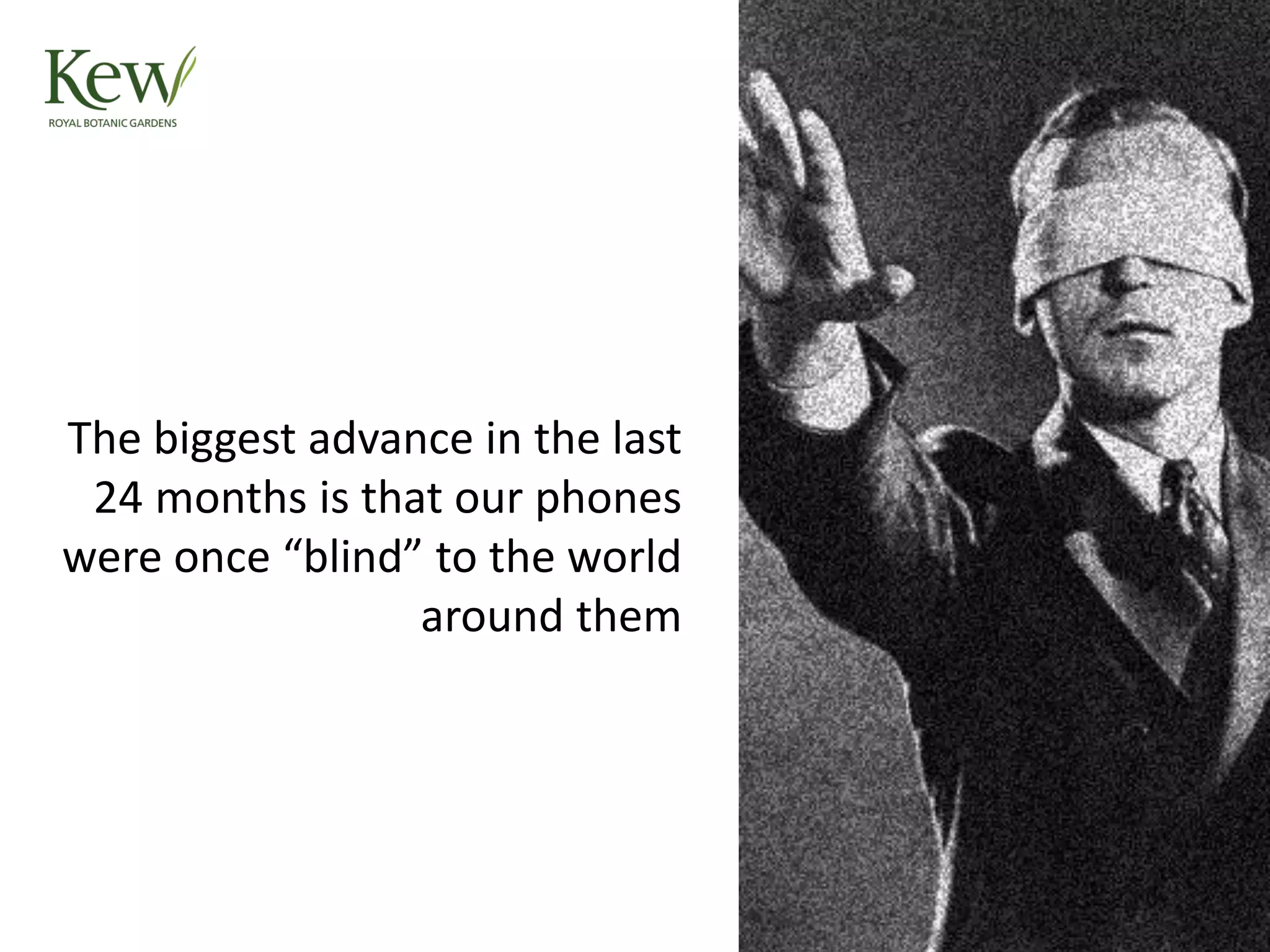
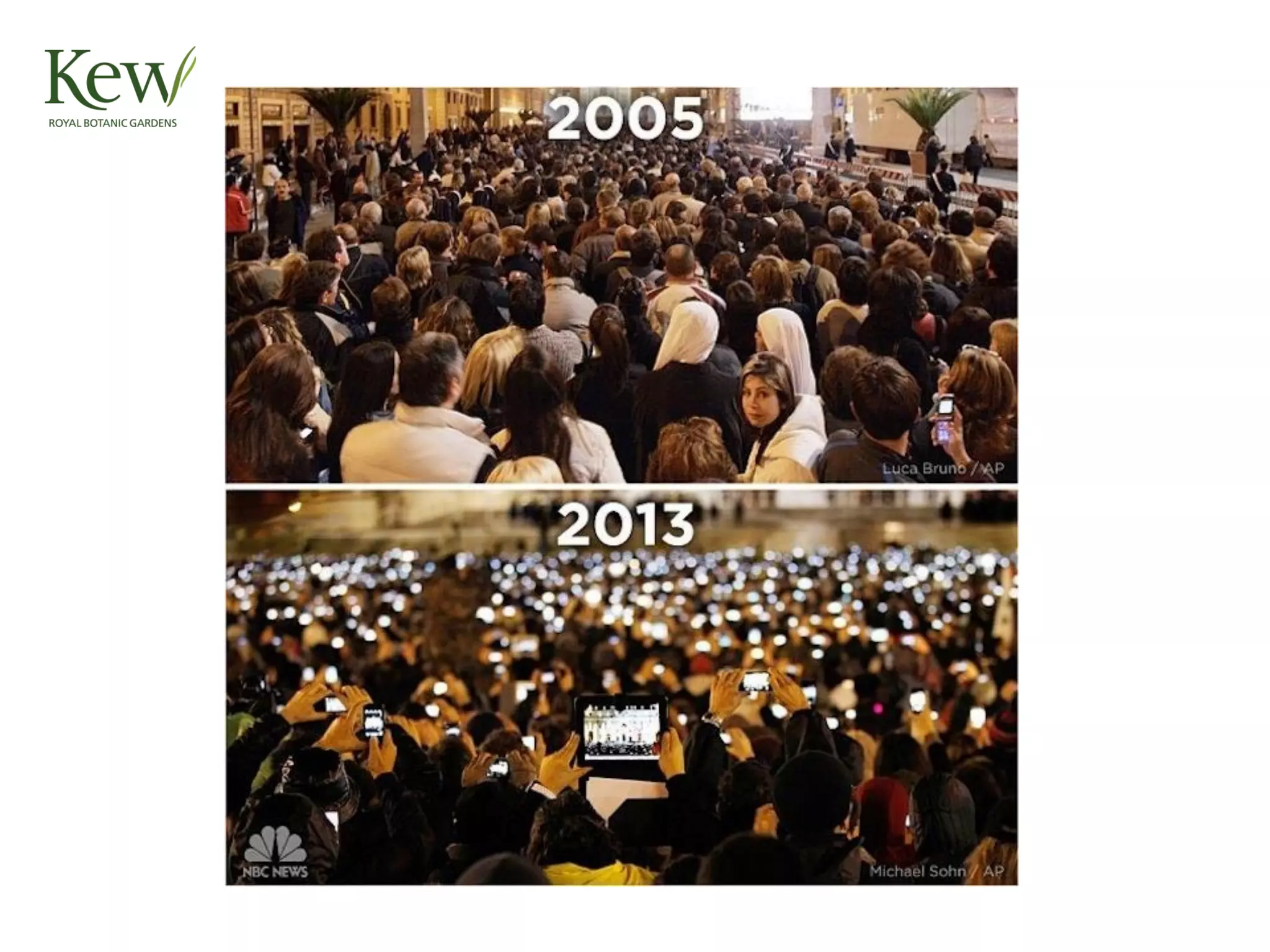
The biggest advance in the last
24 months is that our phones
were once “blind” to the world
around them
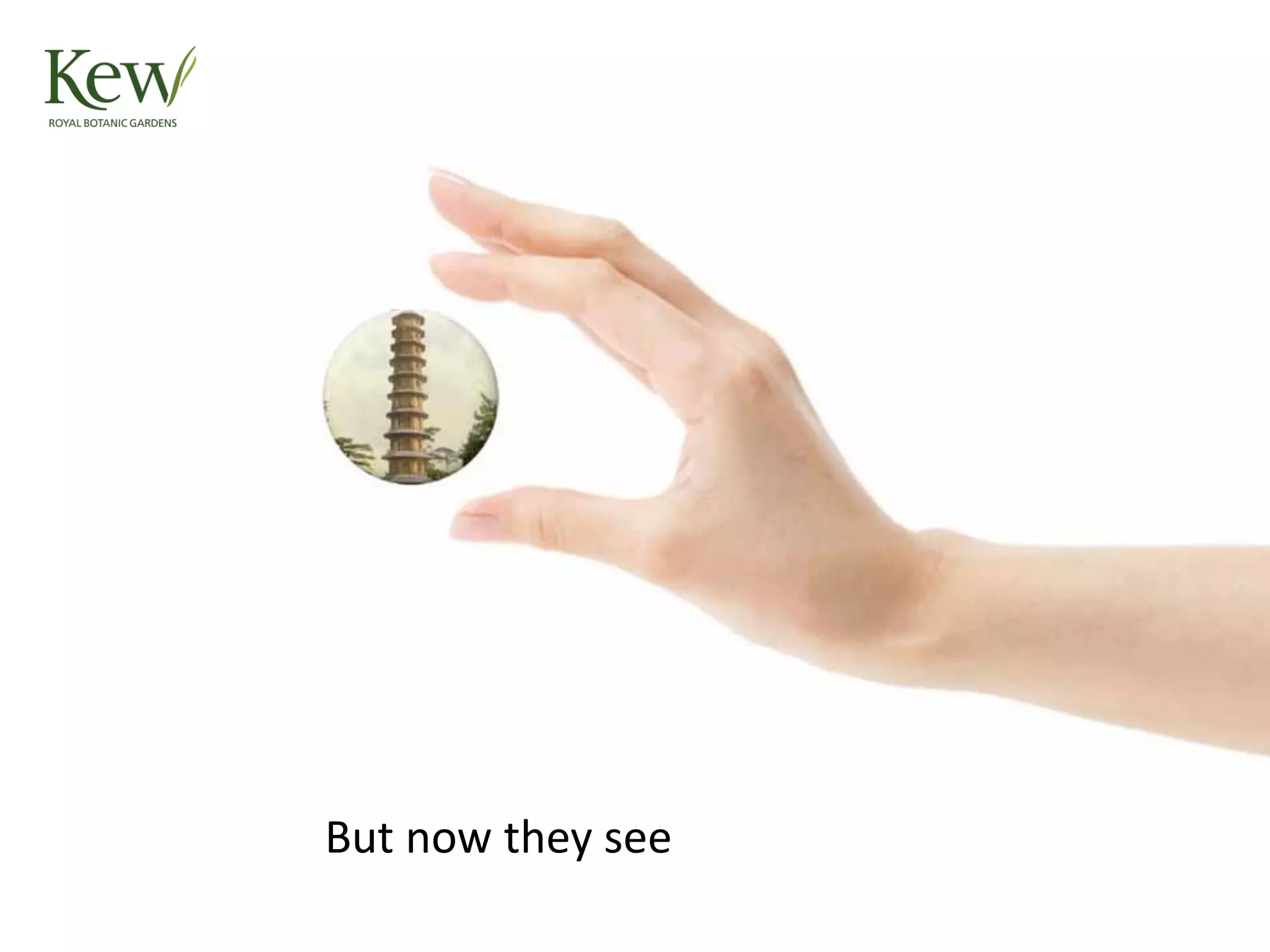
But now they see
Kew and Wakehurst in figures
How iBeacon and proximity works
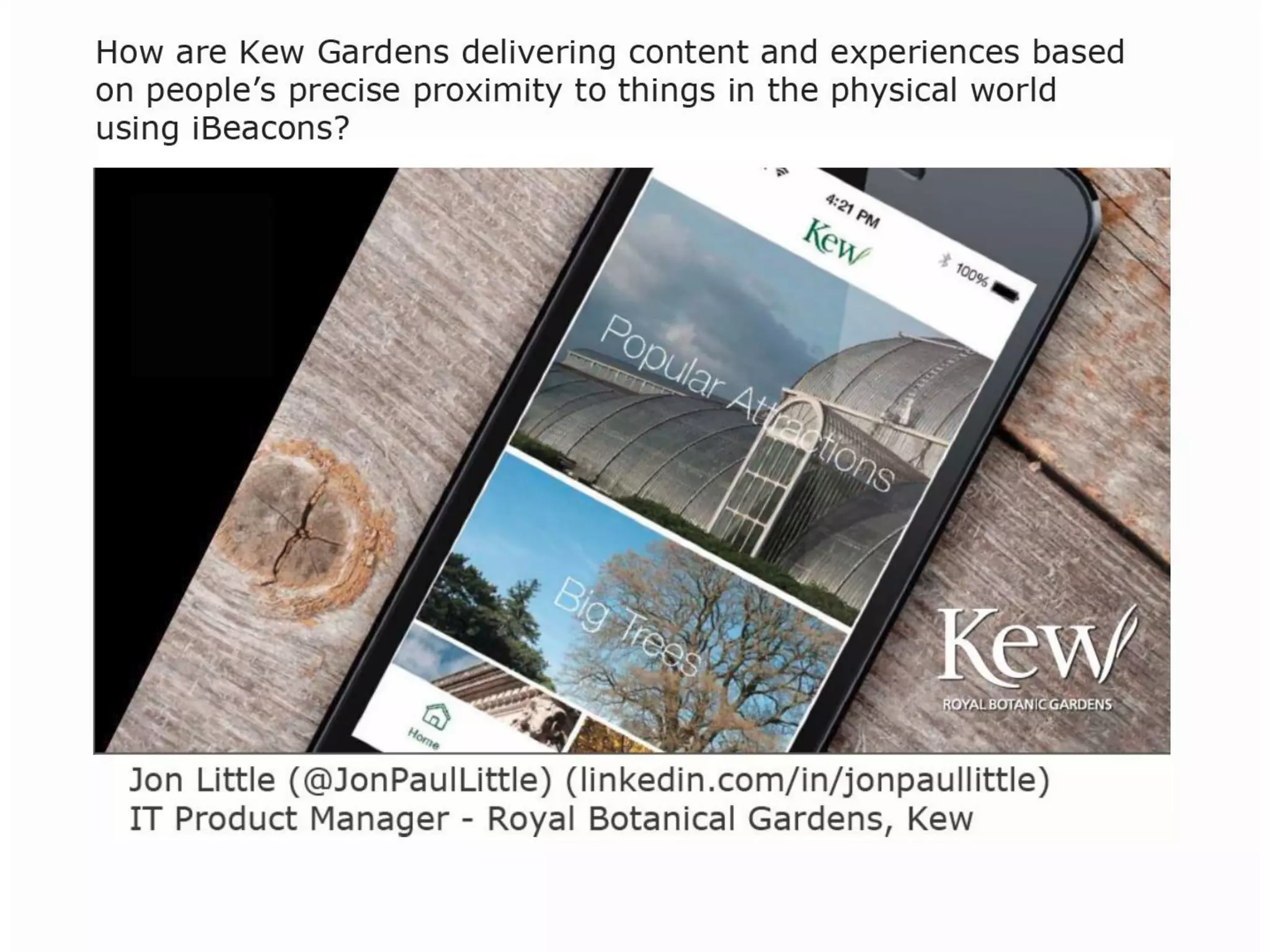
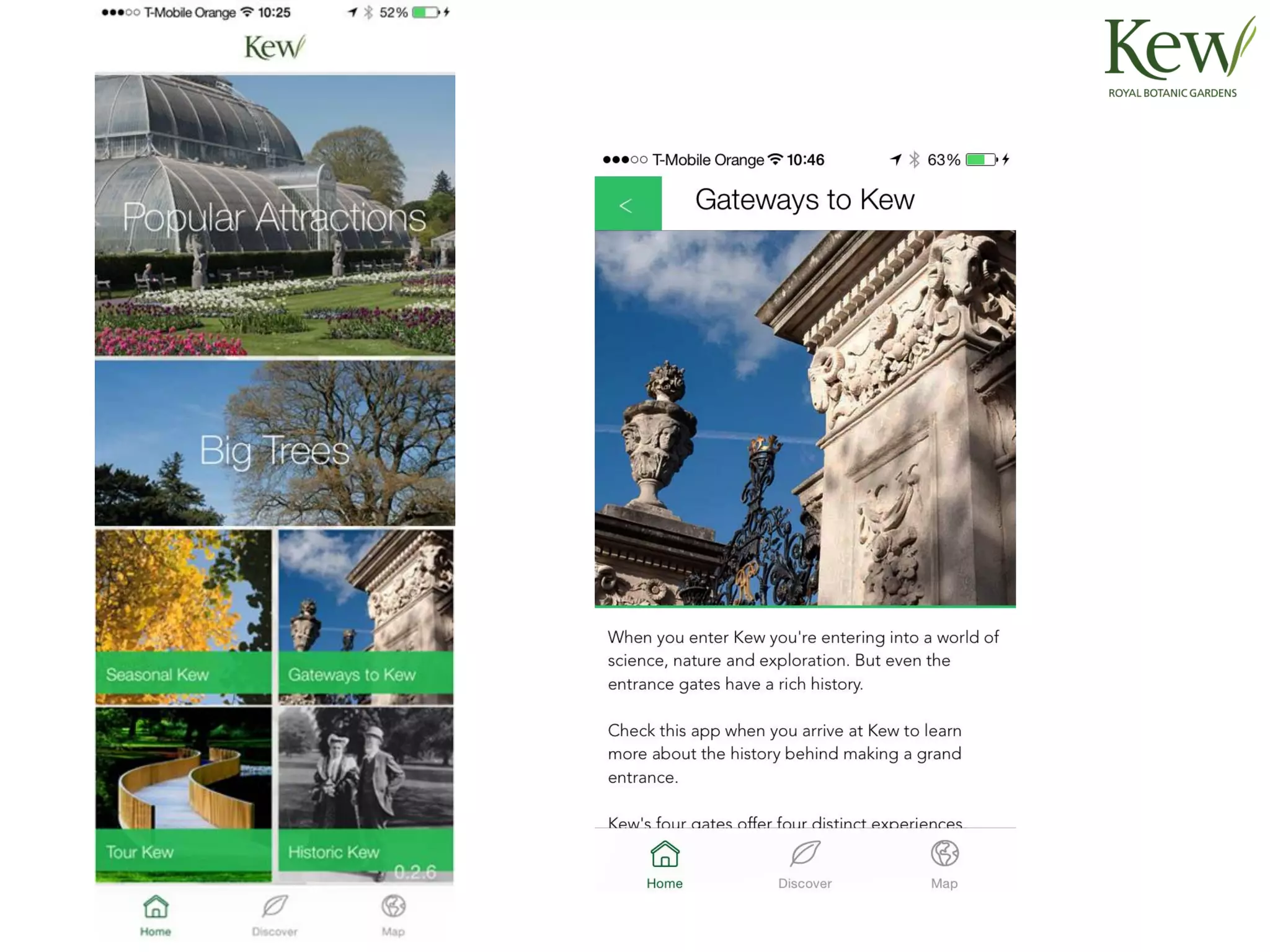
How Kew Gardens is delivering
content and experiences using
iBeacons
Kew Gardens
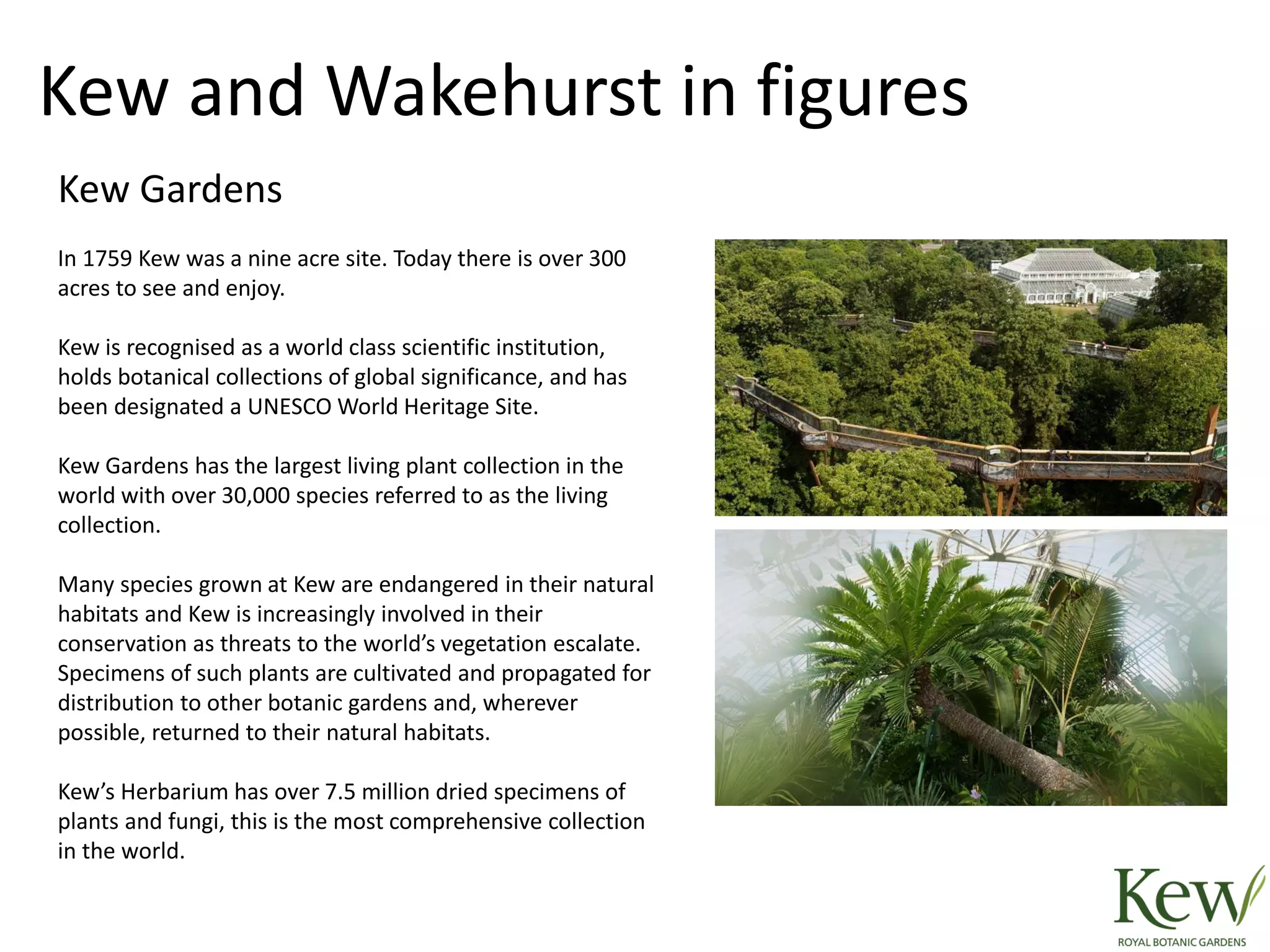
In 1759 Kew was a nine acre site. Today there is over 300
acres to see and enjoy.
Kew is recognised as a world class scientific institution,
holds botanical collections of global significance, and has
been designated a UNESCO World Heritage Site.
Kew Gardens has the largest living plant collection in the
world with over 30,000 species referred to as the living
collection.
Many species grown at Kew are endangered in their natural
habitats and Kew is increasingly involved in their
conservation as threats to the world’s vegetation escalate.
Specimens of such plants are cultivated and propagated for
distribution to other botanic gardens and, wherever
possible, returned to their natural habitats.
Kew’s Herbarium has over 7.5 million dried specimens of
plants and fungi, this is the most comprehensive collection
in the world.
Kew and Wakehurst in figures
Wakehurst Place
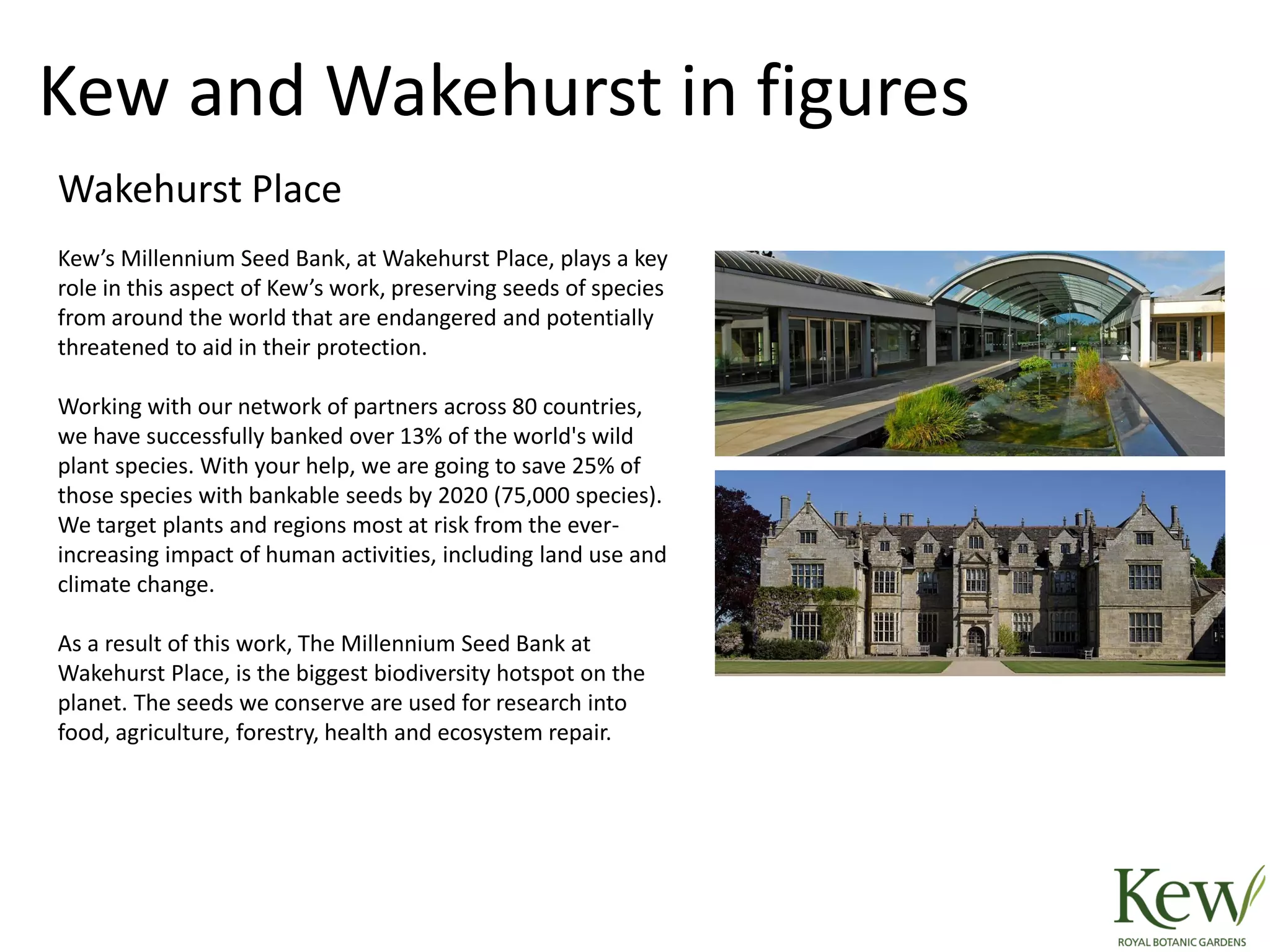
Kew’s Millennium Seed Bank, at Wakehurst Place, plays a key
role in this aspect of Kew’s work, preserving seeds of species
from around the world that are endangered and potentially
threatened to aid in their protection.
Working with our network of partners across 80 countries,
we have successfully banked over 13% of the world's wild
plant species. With your help, we are going to save 25% of
those species with bankable seeds by 2020 (75,000 species).
We target plants and regions most at risk from the ever-
increasing impact of human activities, including land use and
climate change.
As a result of this work, The Millennium Seed Bank at
Wakehurst Place, is the biggest biodiversity hotspot on the
planet. The seeds we conserve are used for research into
food, agriculture, forestry, health and ecosystem repair.
Kew and Wakehurst in figures
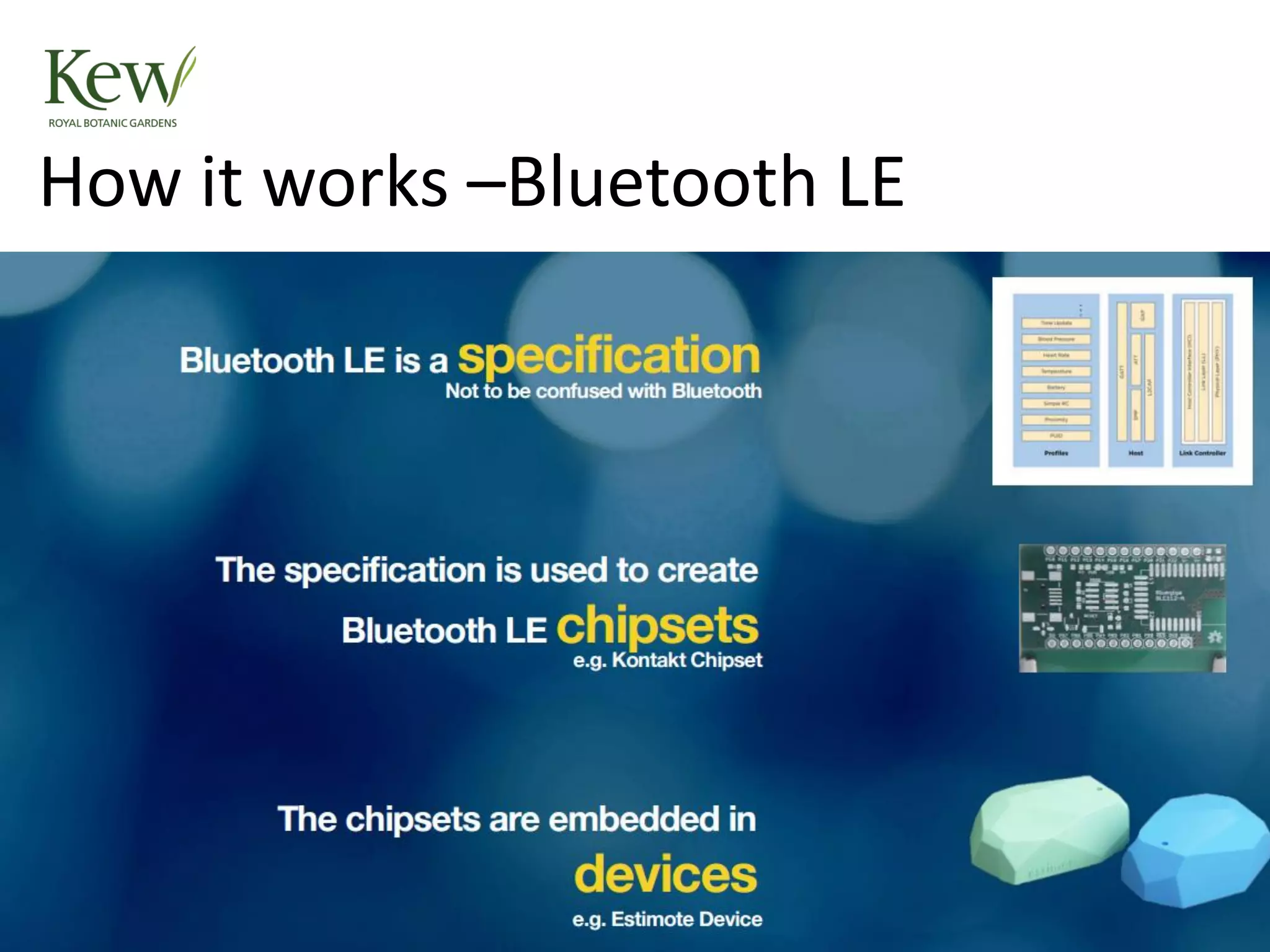
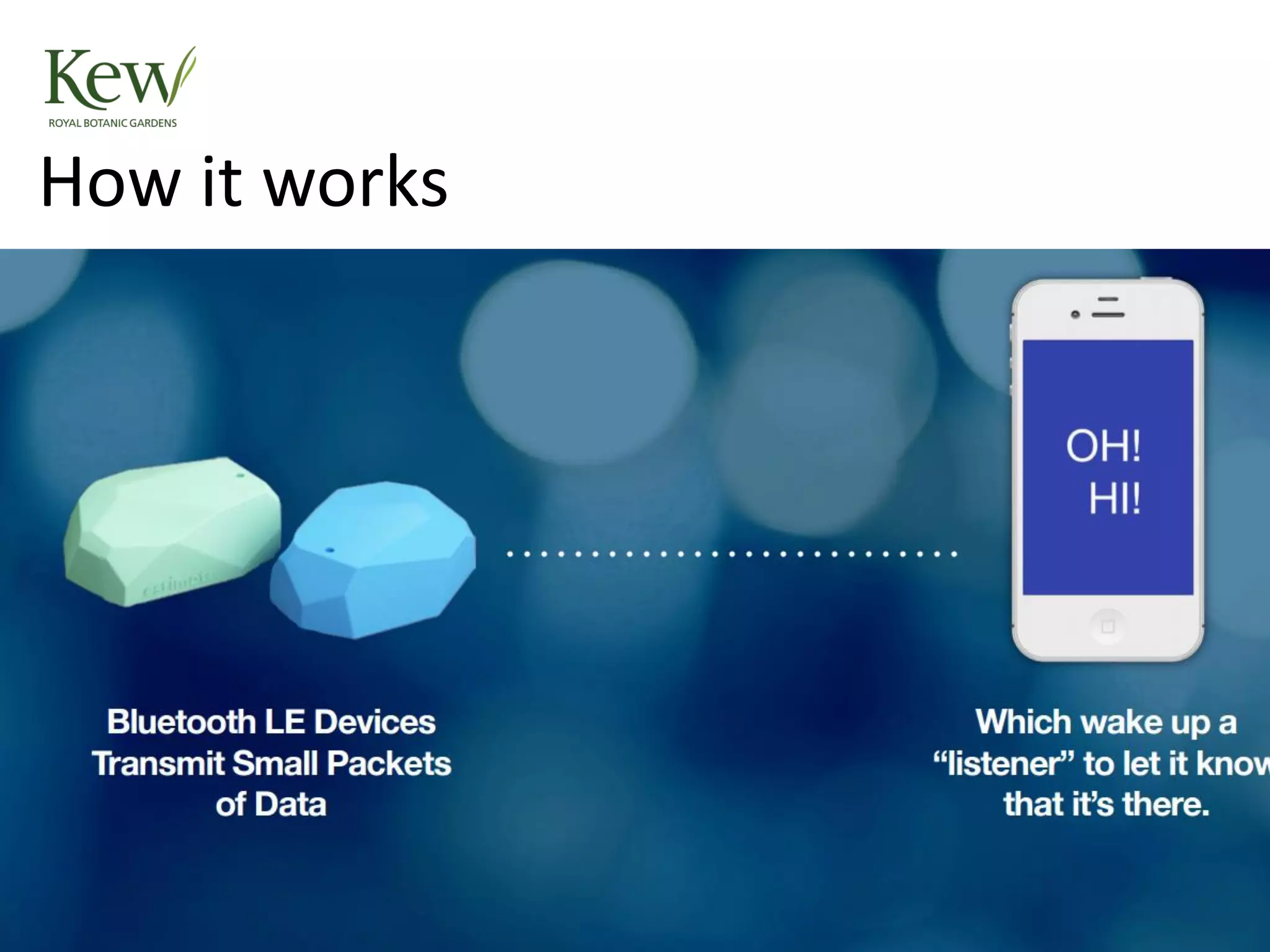
How it works –Bluetooth LE
How it works
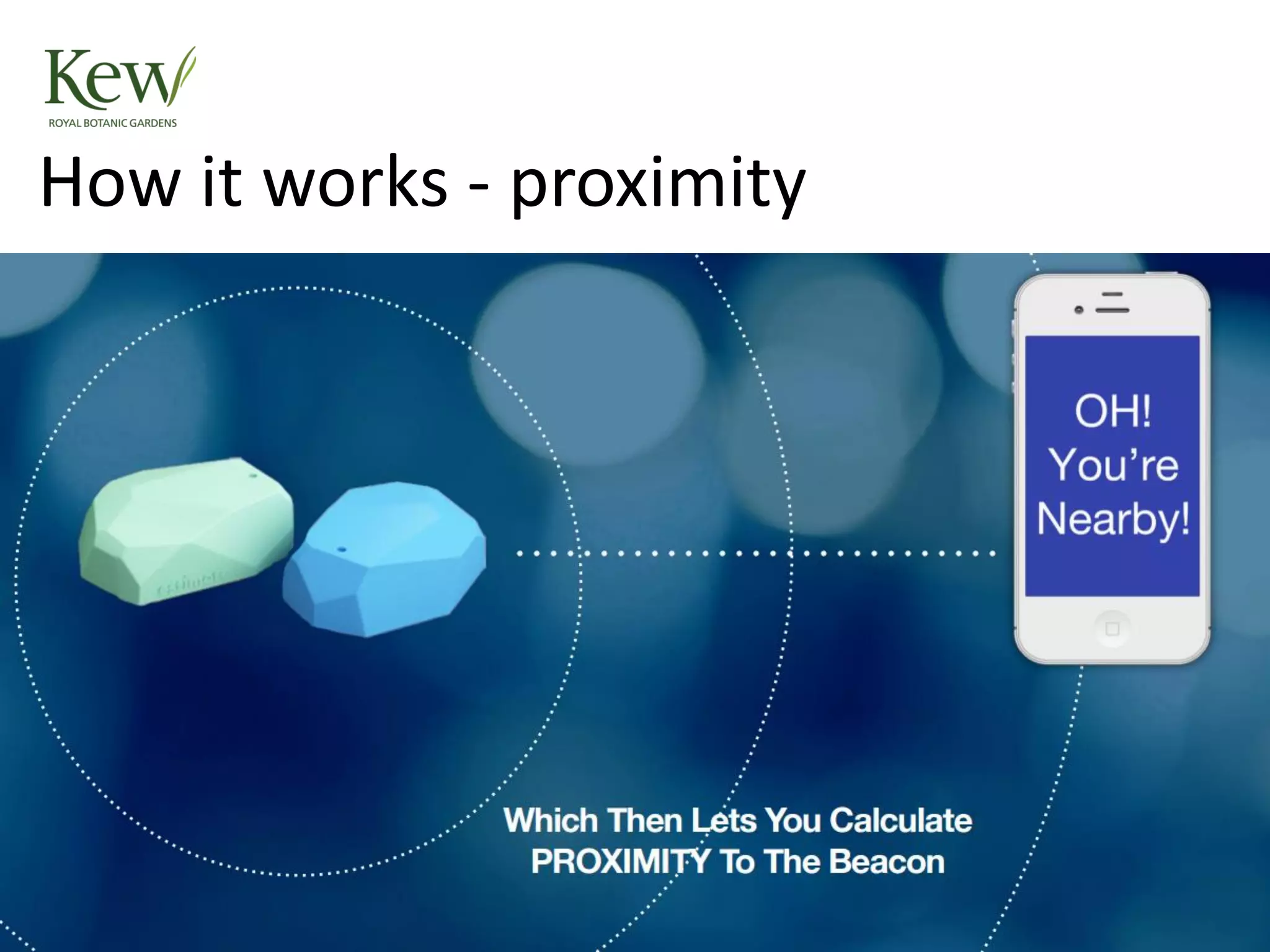
How it works - proximity
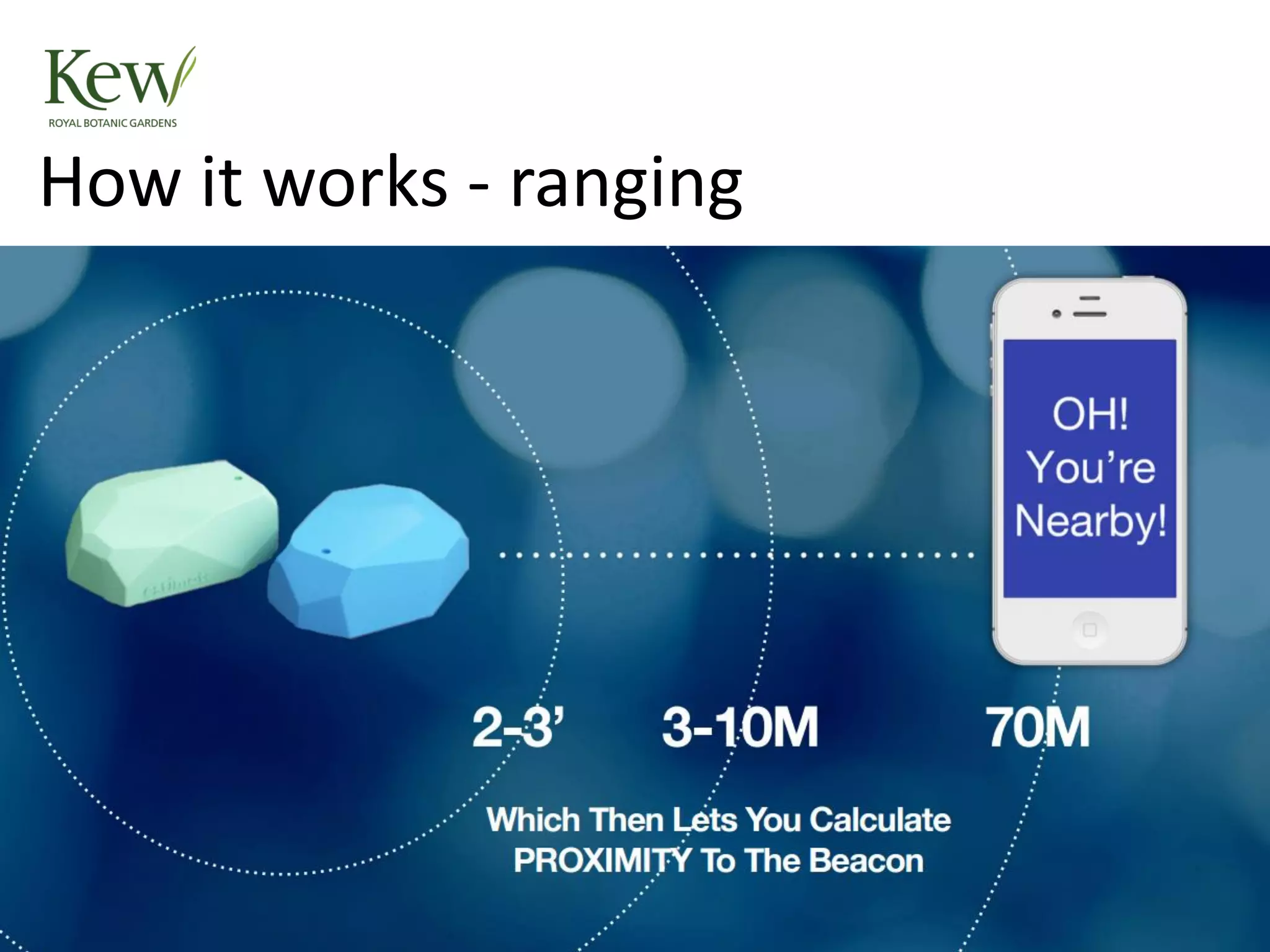
How it works - ranging
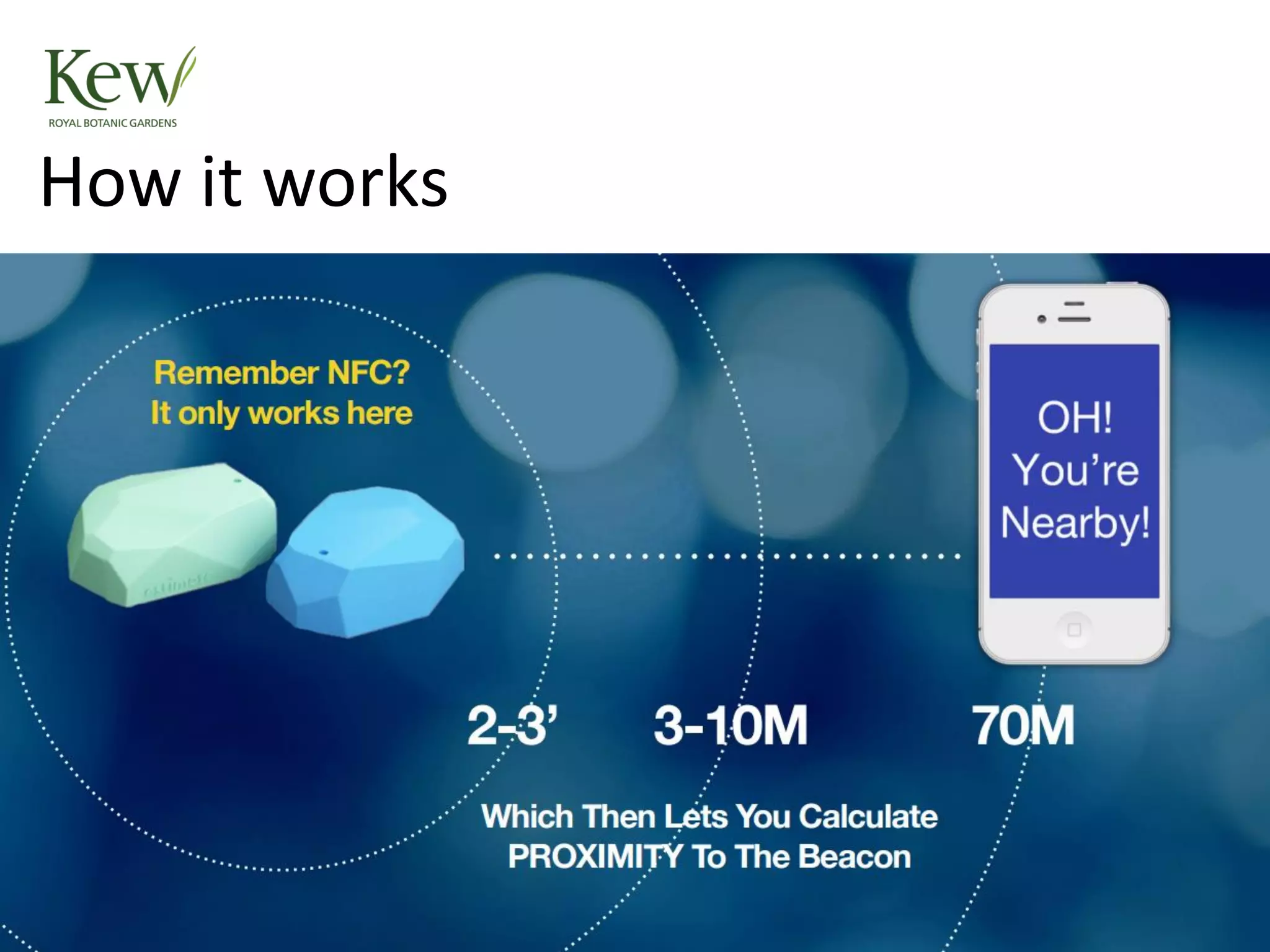
How it works
GPS is a LOCATION technology
Bluetooth LE is a PROXIMITY technology
Which means that even if the beacon MOVES you’ll still be able to find it
Understanding the difference
between location and proximity
You can think of Bluetooth LE as an ‘extension’ of location technology:
•It’s a lot like GPS but also uses a LOT less battery
•GPS doesn’t work very well once you get inside. Bluetooth LE does.
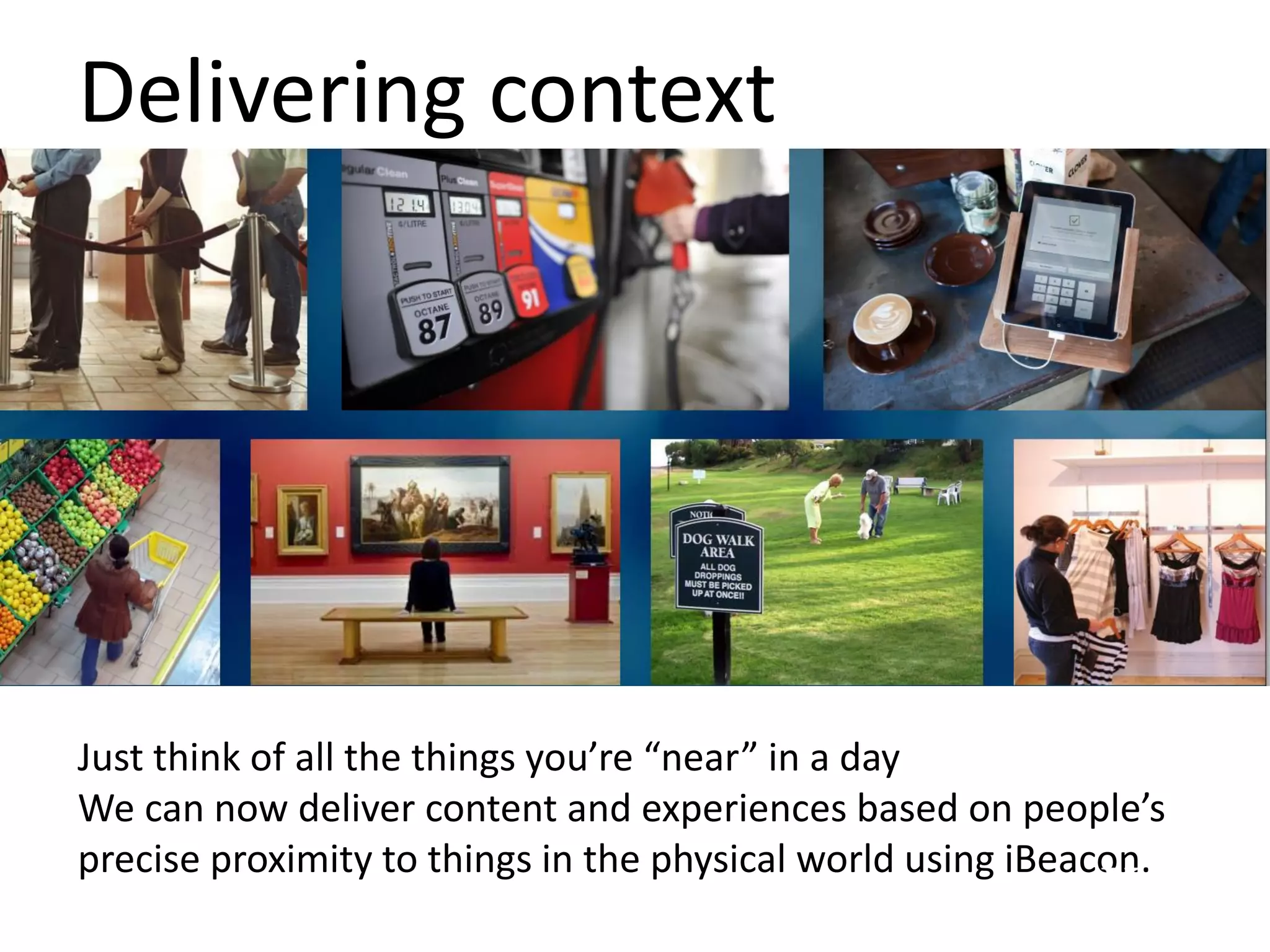
Delivering context
Just think of all the things you’re “near” in a day
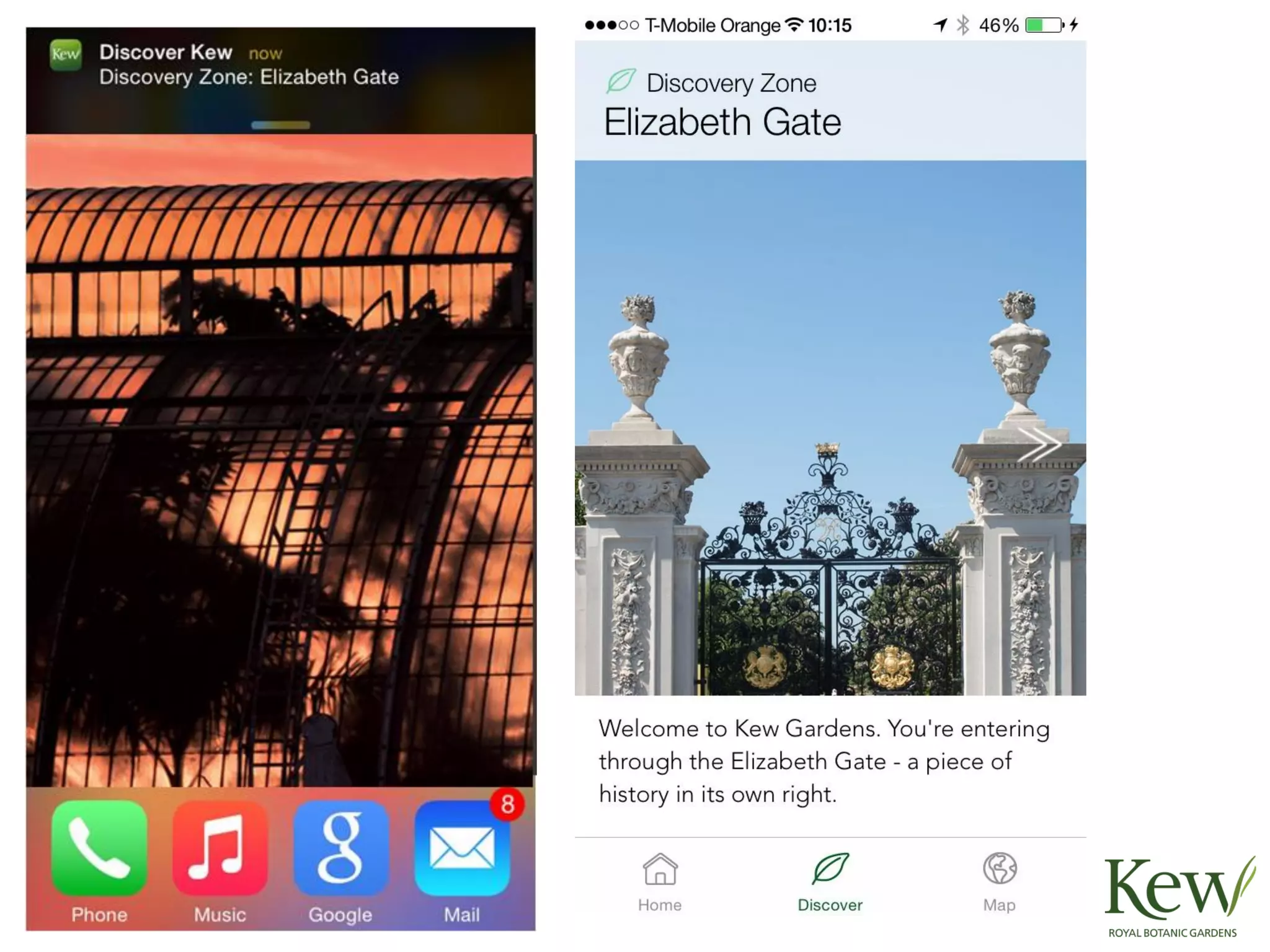
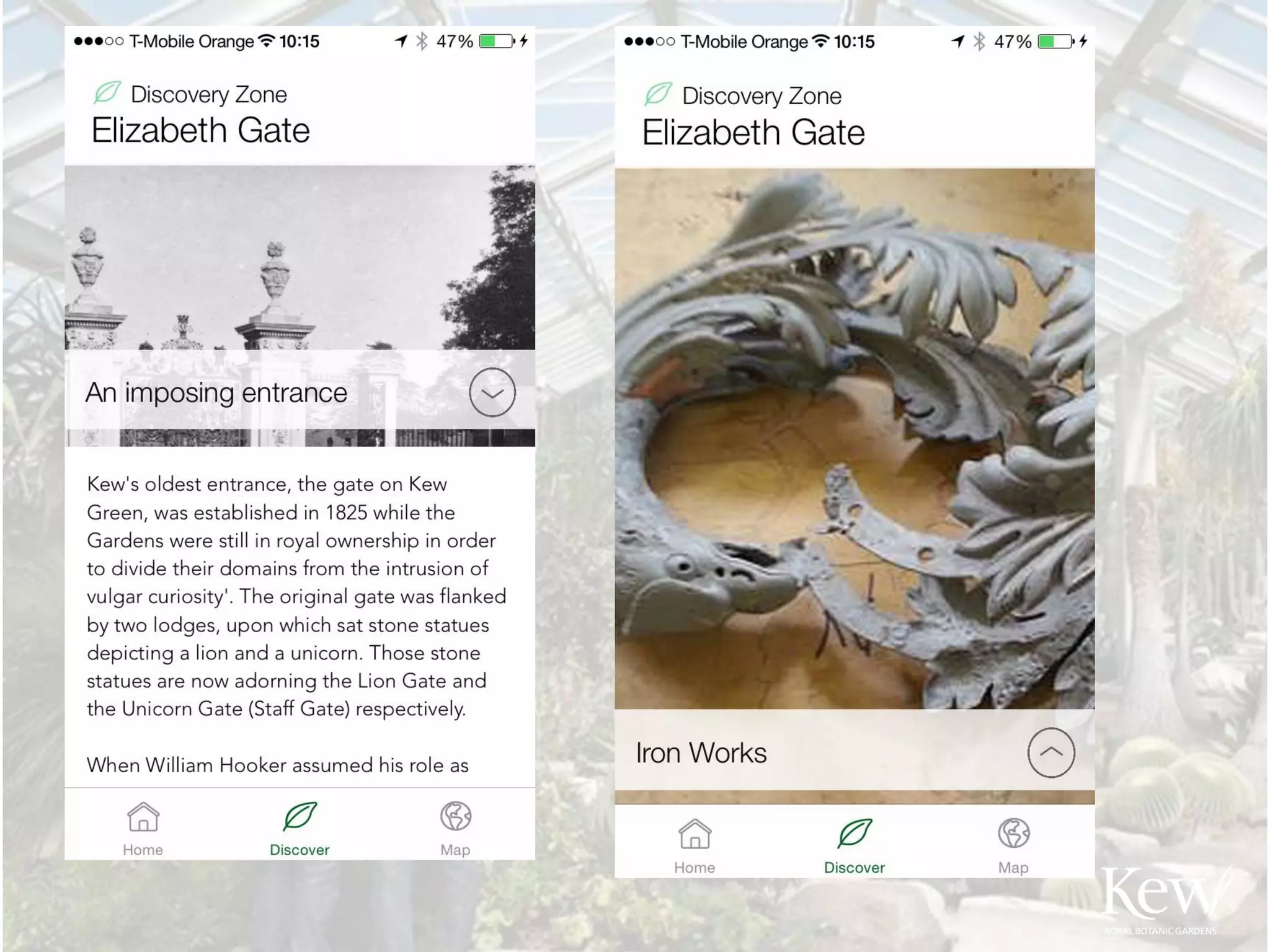
We can now deliver content and experiences based on people’s
precise proximity to things in the physical world using iBeacon.
Impediments to adoption
1. User needs your app
2. User must have app-on (does not need to
be “open”)
3. User needs Bluetooth BLE enabled device
4. User needs Bluetooth on
5. User must allow you to push messages
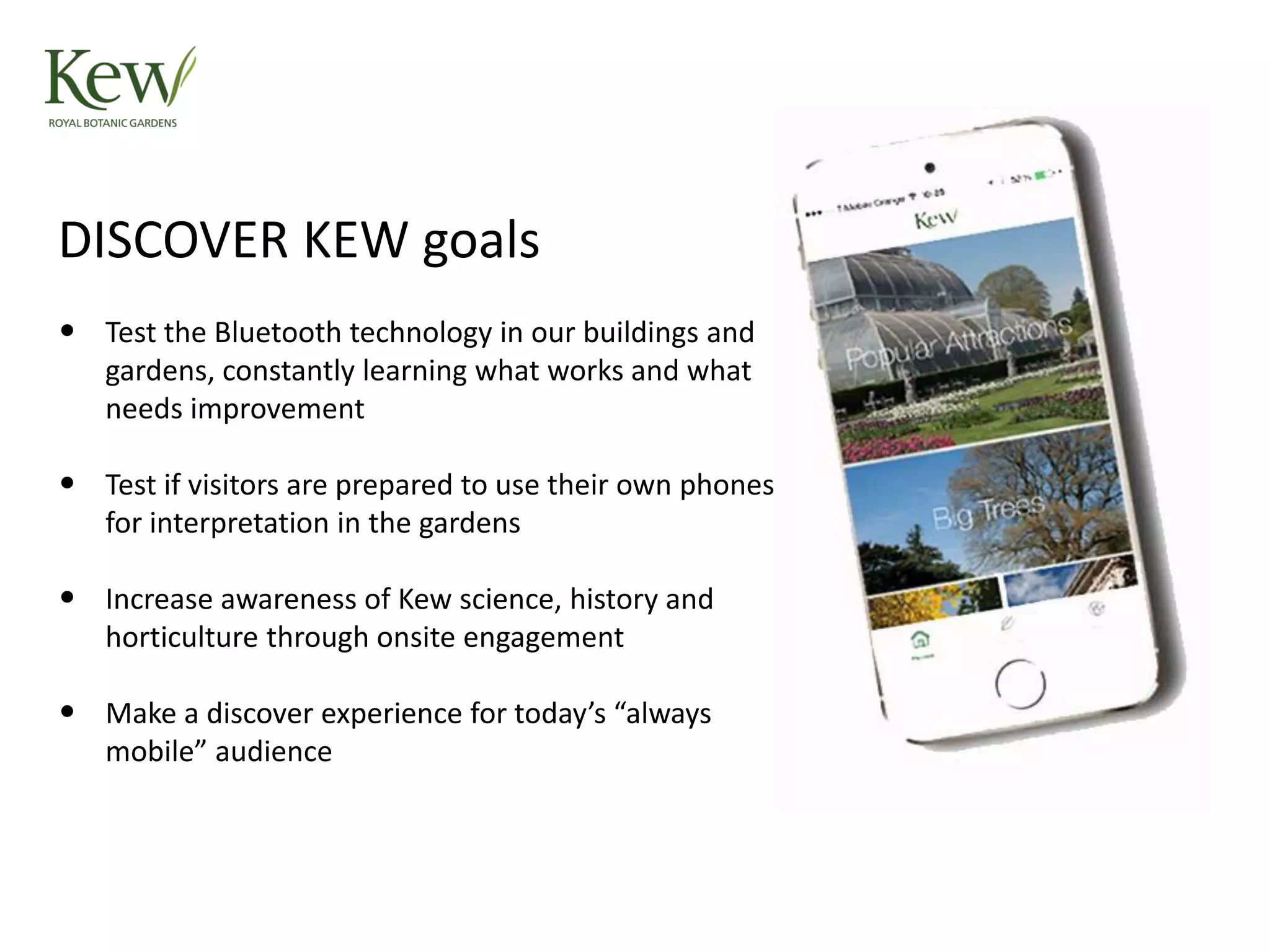
DISCOVER KEW goals
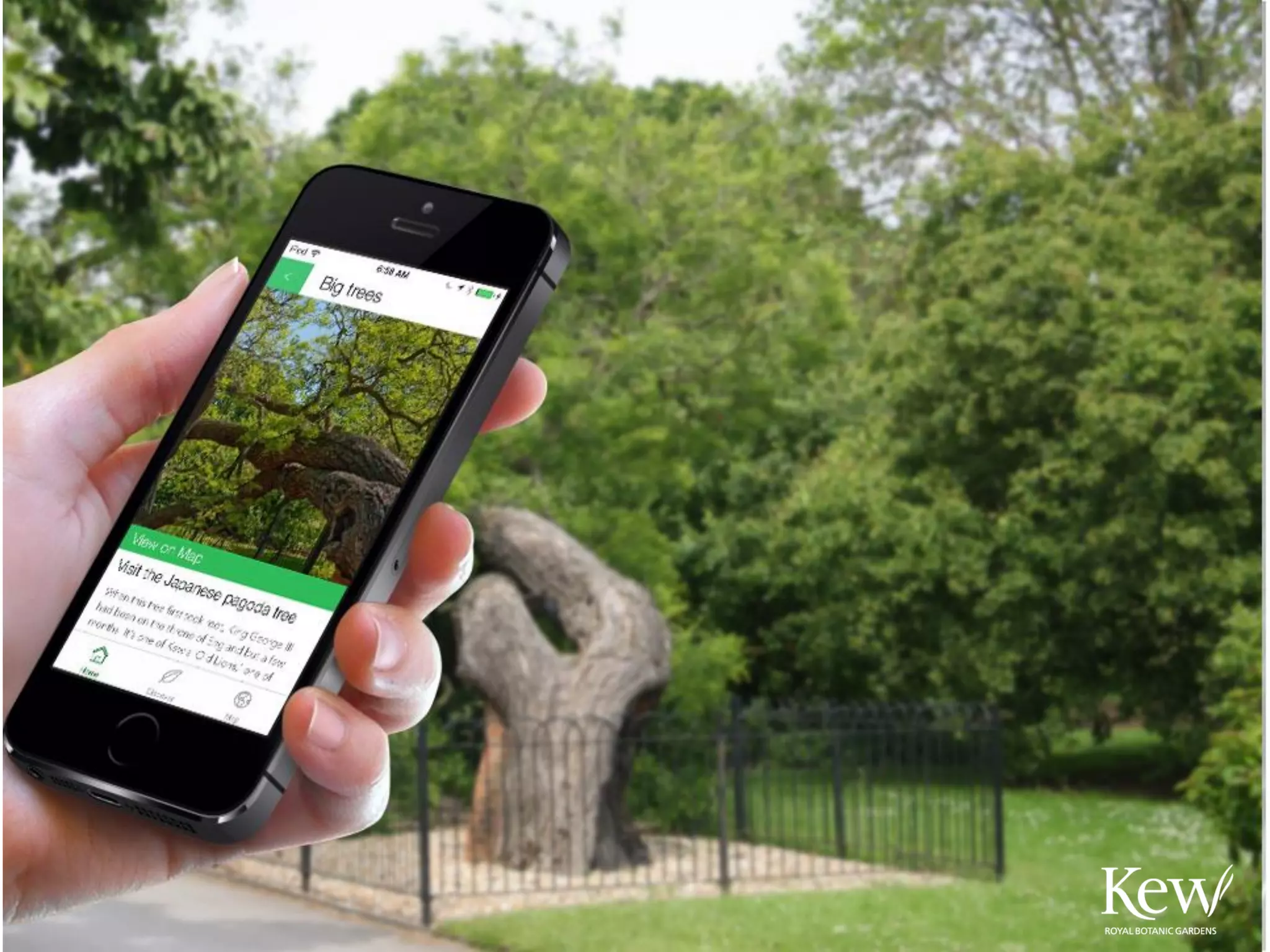
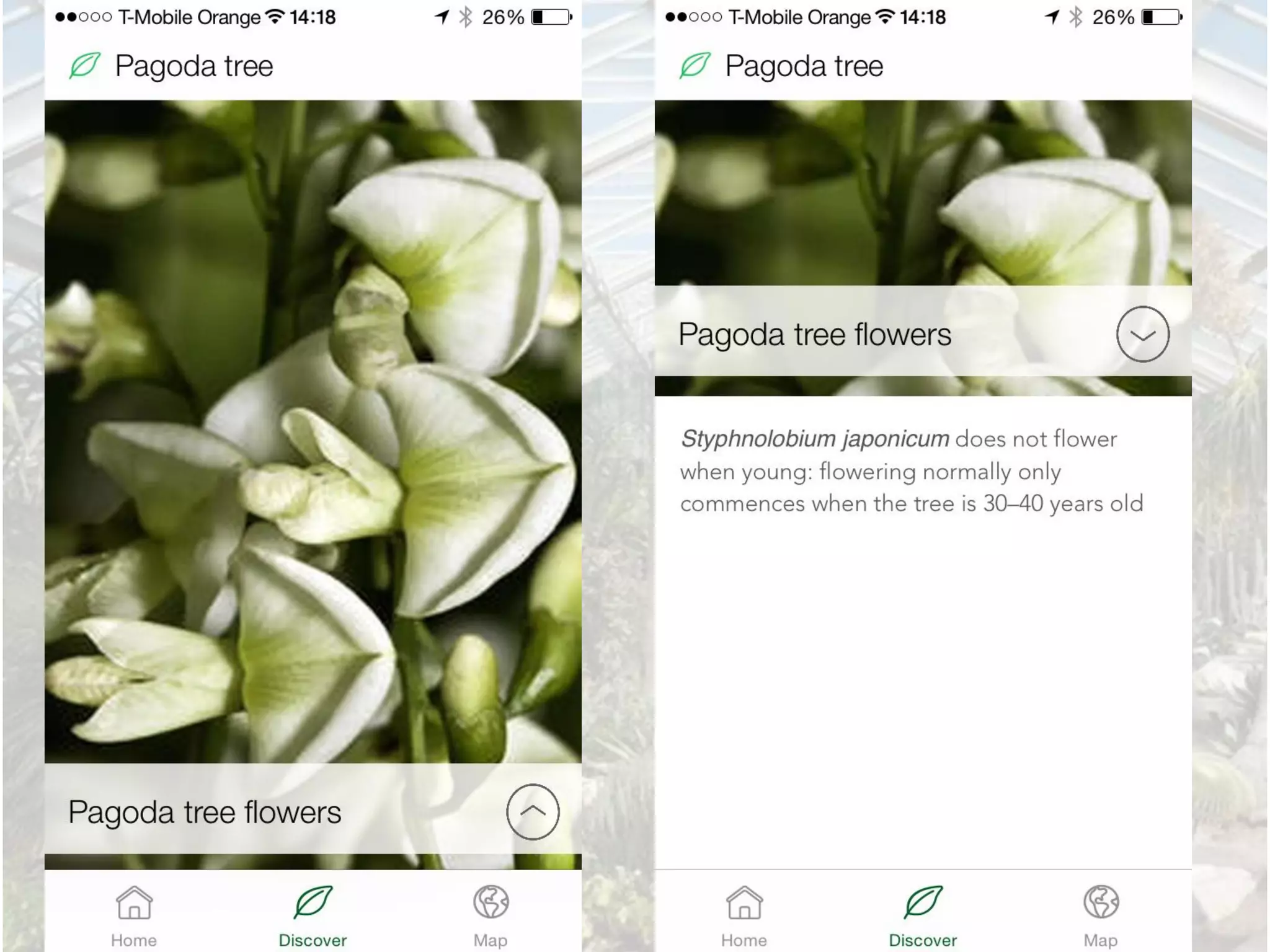
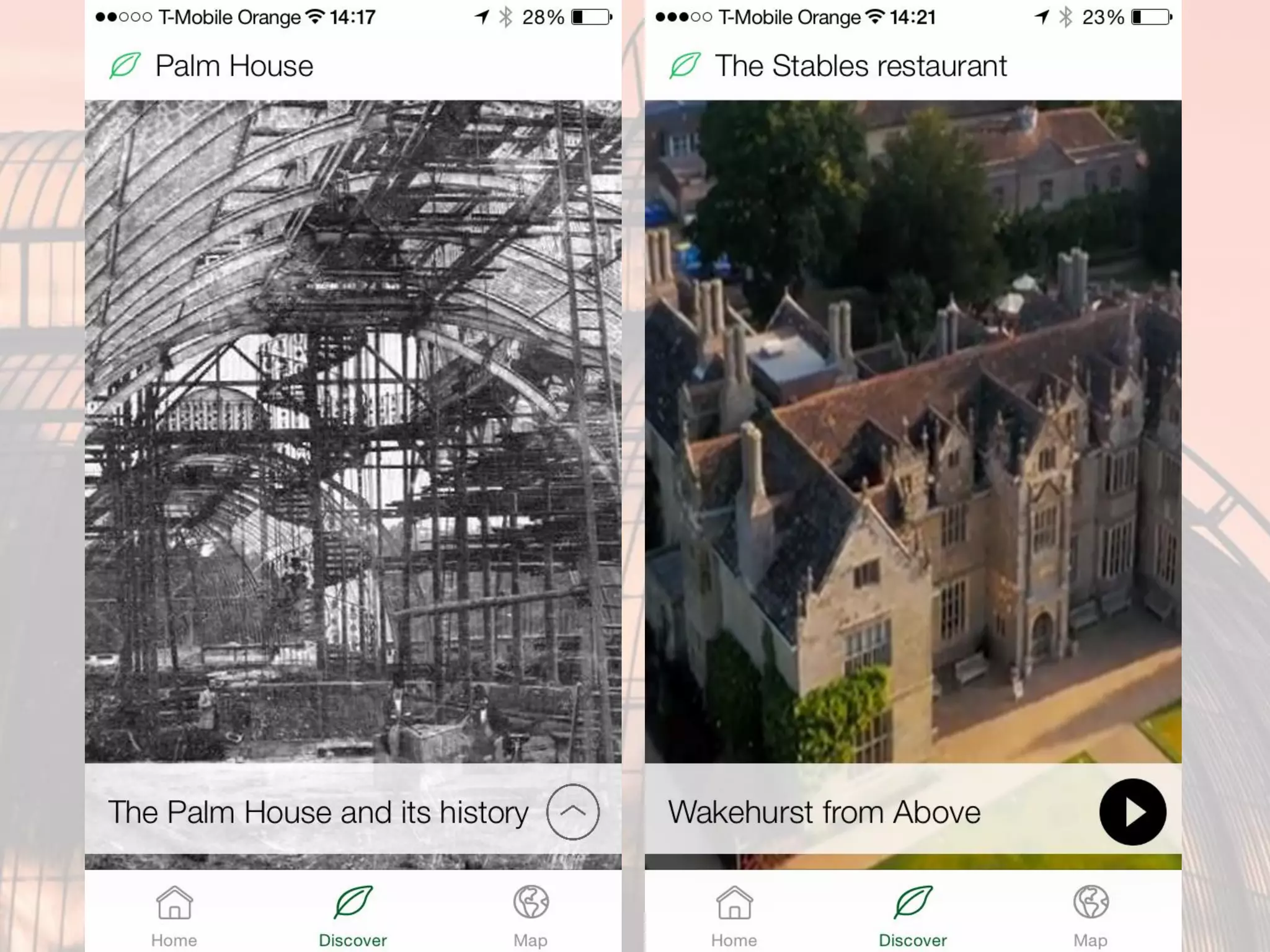
• Test the Bluetooth technology in our buildings and
gardens, constantly learning what works and what
needs improvement
• Test if visitors are prepared to use their own phones
for interpretation in the gardens
• Increase awareness of Kew science, history and
horticulture through onsite engagement
• Make a discover experience for today’s “always
mobile” audience
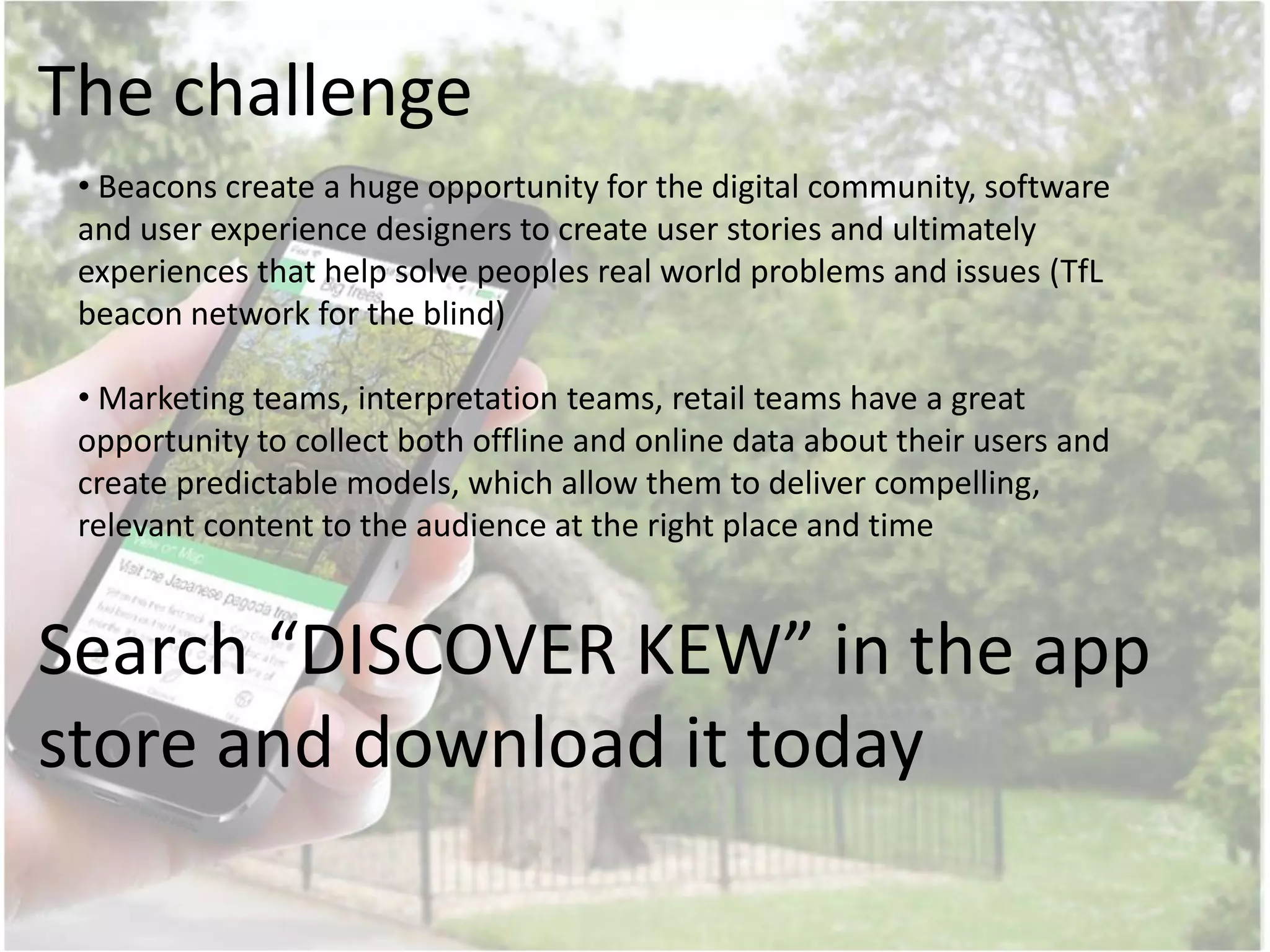
Search “DISCOVER KEW” in the app
store and download it today
• Beacons create a huge opportunity for the digital community, software
and user experience designers to create user stories and ultimately
experiences that help solve peoples real world problems and issues (TfL
beacon network for the blind)
• Marketing teams, interpretation teams, retail teams have a great
opportunity to collect both offline and online data about their users and
create predictable models, which allow them to deliver compelling,
relevant content to the audience at the right place and time
The challenge
iBeacon Kew Gardens presentation for Digital Fast Forward event

iBeacon Kew Gardens presentation for Digital Fast Forward event

  • 2.
    The biggest advancein the last 24 months is that our phones were once “blind” to the world around them
  • 3.
  • 5.
    Kew and Wakehurstin figures How iBeacon and proximity works How Kew Gardens is delivering content and experiences using iBeacons
  • 6.
    Kew Gardens In 1759Kew was a nine acre site. Today there is over 300 acres to see and enjoy. Kew is recognised as a world class scientific institution, holds botanical collections of global significance, and has been designated a UNESCO World Heritage Site. Kew Gardens has the largest living plant collection in the world with over 30,000 species referred to as the living collection. Many species grown at Kew are endangered in their natural habitats and Kew is increasingly involved in their conservation as threats to the world’s vegetation escalate. Specimens of such plants are cultivated and propagated for distribution to other botanic gardens and, wherever possible, returned to their natural habitats. Kew’s Herbarium has over 7.5 million dried specimens of plants and fungi, this is the most comprehensive collection in the world. Kew and Wakehurst in figures
  • 7.
    Wakehurst Place Kew’s MillenniumSeed Bank, at Wakehurst Place, plays a key role in this aspect of Kew’s work, preserving seeds of species from around the world that are endangered and potentially threatened to aid in their protection. Working with our network of partners across 80 countries, we have successfully banked over 13% of the world's wild plant species. With your help, we are going to save 25% of those species with bankable seeds by 2020 (75,000 species). We target plants and regions most at risk from the ever- increasing impact of human activities, including land use and climate change. As a result of this work, The Millennium Seed Bank at Wakehurst Place, is the biggest biodiversity hotspot on the planet. The seeds we conserve are used for research into food, agriculture, forestry, health and ecosystem repair. Kew and Wakehurst in figures
  • 8.
    How it works–Bluetooth LE
  • 9.
  • 10.
    How it works- proximity
  • 11.
    How it works- ranging
  • 12.
  • 13.
    GPS is aLOCATION technology Bluetooth LE is a PROXIMITY technology Which means that even if the beacon MOVES you’ll still be able to find it Understanding the difference between location and proximity You can think of Bluetooth LE as an ‘extension’ of location technology: •It’s a lot like GPS but also uses a LOT less battery •GPS doesn’t work very well once you get inside. Bluetooth LE does.
  • 14.
    Delivering context Just thinkof all the things you’re “near” in a day We can now deliver content and experiences based on people’s precise proximity to things in the physical world using iBeacon.
  • 15.
    Impediments to adoption 1.User needs your app 2. User must have app-on (does not need to be “open”) 3. User needs Bluetooth BLE enabled device 4. User needs Bluetooth on 5. User must allow you to push messages
  • 16.
    DISCOVER KEW goals •Test the Bluetooth technology in our buildings and gardens, constantly learning what works and what needs improvement • Test if visitors are prepared to use their own phones for interpretation in the gardens • Increase awareness of Kew science, history and horticulture through onsite engagement • Make a discover experience for today’s “always mobile” audience
  • 17.
    Search “DISCOVER KEW”in the app store and download it today • Beacons create a huge opportunity for the digital community, software and user experience designers to create user stories and ultimately experiences that help solve peoples real world problems and issues (TfL beacon network for the blind) • Marketing teams, interpretation teams, retail teams have a great opportunity to collect both offline and online data about their users and create predictable models, which allow them to deliver compelling, relevant content to the audience at the right place and time The challenge