Diploma Programme course outline—TOK
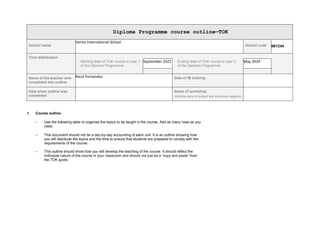
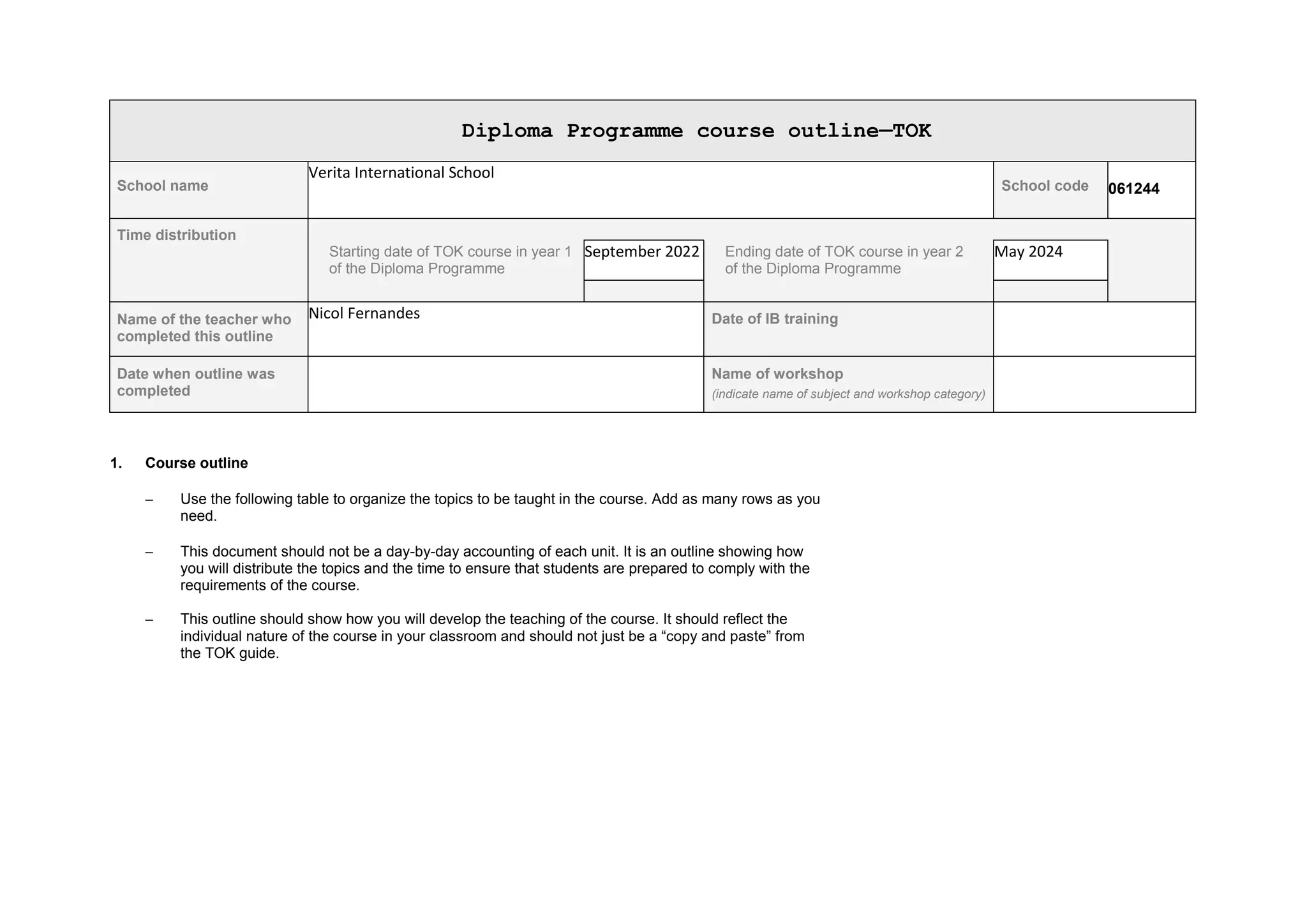
School name
Verita International School
School code 061244
Time distribution
Starting date of TOK course in year 1
of the Diploma Programme
September 2022 Ending date of TOK course in year 2
of the Diploma Programme
May 2024
Name of the teacher who
completed this outline
Nicol Fernandes Date of IB training
Date when outline was
completed
Name of workshop
(indicate name of subject and workshop category)
1. Course outline
– Use the following table to organize the topics to be taught in the course. Add as many rows as you
need.
– This document should not be a day-by-day accounting of each unit. It is an outline showing how
you will distribute the topics and the time to ensure that students are prepared to comply with the
requirements of the course.
– This outline should show how you will develop the teaching of the course. It should reflect the
individual nature of the course in your classroom and should not just be a “copy and paste” from
the TOK guide.
Topic/unit
(as identified in the
IB subject guide)
State the topics/units in the
order you are planning to teach
them.
Contents Allocated time Assessment
instruments to be
used
Resources
List the main resources to be
used, including information
technology if applicable.
One class is 40 minutes.
In one week there
are
3 classes.
Year 1
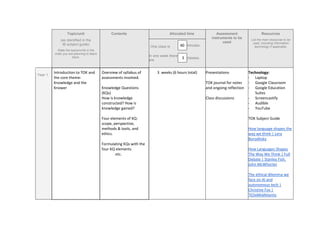
Introduction to TOK and
the core theme:
Knowledge and the
Knower
Overview of syllabus of
assessments involved.
Knowledge Questions
(KQs)
How is knowledge
constructed? How is
knowledge gained?
Four elements of KQ-
scope, perspective,
methods & tools, and
ethics.
Formulating KQs with the
four KQ elements
etc.
3 weeks (6 hours total) Presentations
TOK journal for notes
and ongoing reflection
Class discussions
Technology:
- Laptop
- Google Classroom
- Google Education
Suites
- Screencastify
- Audible
- YouTube
TOK Subject Guide
How language shapes the
way we think | Lera
Boroditsky
How Languages Shapes
The Way We Think | Full
Debate | Stanley Fish,
John McWhorter
The ethical dilemma we
face on AI and
autonomous tech |
Christine Fox |
TEDxMidAtlantic
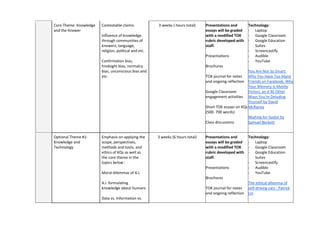
Core Theme: Knowledge
and the Knower
Contestable claims.
Influence of knowledge
through communities of
knowers; language,
religion, political and etc.
Confirmation bias,
hindsight bias, normalcy
bias, unconscious bias and
etc.
3 weeks ( hours total) Presentations and
essays will be graded
with a modified TOK
rubric developed with
staff.
Presentations
Brochures
TOK journal for notes
and ongoing reflection
Google Classroom
engagement activities
Short TOK essays on KQs
(500- 700 words)
Class discussions
Technology:
- Laptop
- Google Classroom
- Google Education
Suites
- Screencastify
- Audible
- YouTube
You Are Not So Smart:
Why You Have Too Many
Friends on Facebook, Why
Your Memory Is Mostly
Fiction, an d 46 Other
Ways You're Deluding
Yourself by David
McRaney
Waiting for Godot by
Samuel Beckett
Optional Theme #1:
Knowledge and
Technology
Emphasis on applying the
scope, perspectives,
methods and tools, and
ethics of KQs as well as
the core theme in the
topics below :
Moral dilemmas of A.I.
A.I. formulating
knowledge about humans
Data vs. Information vs.
3 weeks (6 hours total) Presentations and
essays will be graded
with a modified TOK
rubric developed with
staff.
Presentations
Brochures
TOK journal for notes
and ongoing reflection
Technology:
- Laptop
- Google Classroom
- Google Education
Suites
- Screencastify
- Audible
- YouTube
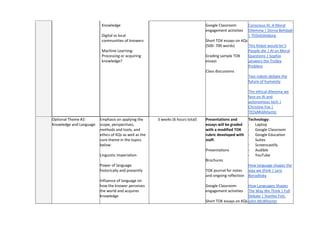
The ethical dilemma of
self-driving cars - Patrick
Lin
Knowledge
Digital vs local
communities of knowers
Machine Learning:
Processing or acquiring
knowledge?
Google Classroom
engagement activities
Short TOK essays on KQs
(500- 700 words)
Grading sample TOK
essays
Class discussions
Conscious AI: A Moral
Dilemma | Dorna Behdadi
| TEDxGöteborg
This Robot would let 5
People die | AI on Moral
Questions | Sophia
answers the Trolley
Problem
Two robots debate the
future of humanity
The ethical dilemma we
face on AI and
autonomous tech |
Christine Fox |
TEDxMidAtlantic
Optional Theme #2:
Knowledge and Language
Emphasis on applying the
scope, perspectives,
methods and tools, and
ethics of KQs as well as the
core theme in the topics
below:
Linguistic Imperialism
Power of language
historically and presently
Influence of language on
how the knower perceives
the world and acquires
knowledge
3 weeks (6 hours total) Presentations and
essays will be graded
with a modified TOK
rubric developed with
staff.
Presentations
Brochures
TOK journal for notes
and ongoing reflection
Google Classroom
engagement activities
Short TOK essays on KQs
Technology:
- Laptop
- Google Classroom
- Google Education
Suites
- Screencastify
- Audible
- YouTube
How language shapes the
way we think | Lera
Boroditsky
How Languages Shapes
The Way We Think | Full
Debate | Stanley Fish,
John McWhorter
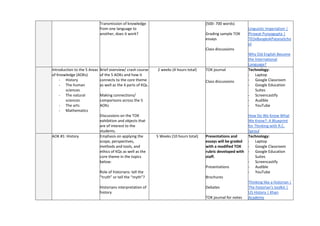
Transmission of knowledge
from one language to
another, does it work?
(500- 700 words)
Grading sample TOK
essays
Class discussions
Linguistic Imperialism |
Pirawat Punyagupta |
TEDxBangkokPatanaScho
ol
Why Did English Become
the International
Language?
Introduction to the 5 Areas
of Knowledge (AOKs)
- History
- The human
sciences
- The natural
sciences
- The arts
- Mathematics
Brief overview/ crash course
of the 5 AOKs and how it
connects to the core theme
as well as the 4 parts of KQs.
Making connections/
comparisons across the 5
AOKs
Discussions on the TOK
exhibition and objects that
are of interest to the
students.
2 weeks (4 hours total) TOK journal
Class discussions
Technology:
- Laptop
- Google Classroom
- Google Education
Suites
- Screencastify
- Audible
- YouTube
How Do We Know What
We Know?: A Blueprint
for Thinking with R.C.
Sproul
AOK #1: History Emphasis on applying the
scope, perspectives,
methods and tools, and
ethics of KQs as well as the
core theme in the topics
below:
Role of historians: tell the
“truth” or tell the “myth”?
Historians interpretation of
history
5 Weeks (10 hours total) Presentations and
essays will be graded
with a modified TOK
rubric developed with
staff.
Presentations
Brochures
Debates
TOK journal for notes
Technology:
- Laptop
- Google Classroom
- Google Education
Suites
- Screencastify
- Audible
- YouTube
Thinking like a historian |
The historian's toolkit |
US History | Khan
Academy
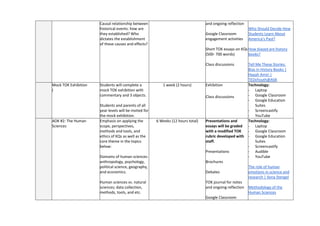
Causal relationship between
historical events: how are
they established? Who
dictates the establishment
of these causes and effects?
and ongoing reflection
Google Classroom
engagement activities
Short TOK essays on KQs
(500- 700 words)
Class discussions
Who Should Decide How
Students Learn About
America’s Past?
How biased are history
books?
Tell Me These Stories:
Bias in History Books |
Hayah Amin |
TEDxYouth@ASK
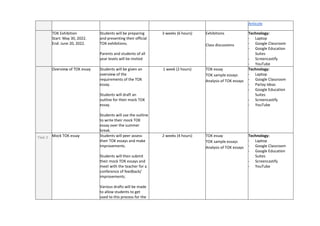
Mock TOK Exhibition
(
Students will complete a
mock TOK exhibition with
commentary and 3 objects.
Students and parents of all
year levels will be invited for
the mock exhibition.
1 week (2 hours) Exhibition
Class discussions
Technology:
- Laptop
- Google Classroom
- Google Education
Suites
- Screencastify
- YouTube
AOK #2: The Human
Sciences
Emphasis on applying the
scope, perspectives,
methods and tools, and
ethics of KQs as well as the
core theme in the topics
below:
Domains of human sciences:
anthropology, psychology,
political science, geography,
and economics.
Human sciences vs. natural
sciences; data collection,
methods, tools, and etc.
6 Weeks (12 hours total) Presentations and
essays will be graded
with a modified TOK
rubric developed with
staff.
Presentations
Brochures
Debates
TOK journal for notes
and ongoing reflection
Google Classroom
Technology:
- Laptop
- Google Classroom
- Google Education
Suites
- Screencastify
- Audible
- YouTube
The role of human
emotions in science and
research | Ilona Stengel
Methodology of the
Human Sciences
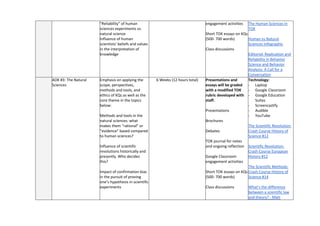
“Reliability” of human
sciences experiments vs.
natural science
Influence of human
scientists’ beliefs and values
in the interpretation of
knowledge
engagement activities
Short TOK essays on KQs
(500- 700 words)
Class discussions
The Human Sciences in
TOK
Human vs Natural
Sciences Infographic
Editorial: Replication and
Reliability in Behavior
Science and Behavior
Analysis: A Call for a
Conversation
AOK #3: The Natural
Sciences
Emphasis on applying the
scope, perspectives,
methods and tools, and
ethics of KQs as well as the
core theme in the topics
below:
Methods and tools in the
natural sciences: what
makes them “rational” or
“evidence” based compared
to human sciences?
Influence of scientific
revolutions historically and
presently. Who decides
this?
Impact of confirmation bias
in the pursuit of proving
one’s hypothesis in scientific
experiments
6 Weeks (12 hours total) Presentations and
essays will be graded
with a modified TOK
rubric developed with
staff.
Presentations
Brochures
Debates
TOK journal for notes
and ongoing reflection
Google Classroom
engagement activities
Short TOK essays on KQs
(500- 700 words)
Class discussions
Technology:
- Laptop
- Google Classroom
- Google Education
Suites
- Screencastify
- Audible
- YouTube
The Scientific Revolution:
Crash Course History of
Science #12
Scientific Revolution:
Crash Course European
History #12
The Scientific Methods:
Crash Course History of
Science #14
What’s the difference
between a scientific law
and theory? - Matt
Anticole
TOK Exhibition
Start: May 30, 2022.
End: June 20, 2022.
Students will be preparing
and presenting their official
TOK exhibitions.
Parents and students of all
year levels will be invited
3 weeks (6 hours) Exhibitions
Class discussions
Technology:
- Laptop
- Google Classroom
- Google Education
Suites
- Screencastify
- YouTube
Overview of TOK essay Students will be given an
overview of the
requirements of the TOK
essay.
Students will draft an
outline for their mock TOK
essay.
Students will use the outline
to write their mock TOK
essay over the summer
break.
1 week (2 hours) TOK essay
TOK sample essays
Analysis of TOK essays
Technology:
- Laptop
- Google Classroom
- Parlay Ideas
- Google Education
Suites
- Screencastify
- YouTube
Year 2 Mock TOK essay Students will peer assess
their TOK essays and make
improvements.
Students will then submit
their mock TOK essays and
meet with the teacher for a
conference of feedback/
improvements.
Various drafts will be made
to allow students to get
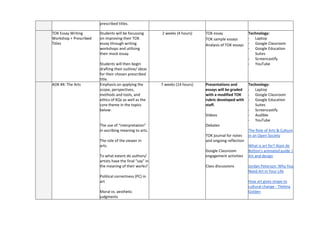
used to this process for the
2 weeks (4 hours) TOK essay
TOK sample essays
Analysis of TOK essays
Technology:
- Laptop
- Google Classroom
- Google Education
Suites
- Screencastify
- YouTube
prescribed titles.
TOK Essay Writing
Workshop + Prescribed
Titles
Students will be focussing
on improving their TOK
essay through writing
workshops and utilising
their mock essay.
Students will then begin
drafting their outline/ ideas
for their chosen prescribed
title.
2 weeks (4 hours) TOK essay
TOK sample essays
Analysis of TOK essays
Technology:
- Laptop
- Google Classroom
- Google Education
Suites
- Screencastify
- YouTube
AOK #4: The Arts Emphasis on applying the
scope, perspectives,
methods and tools, and
ethics of KQs as well as the
core theme in the topics
below:
The use of “interpretation”
in ascribing meaning to arts.
The role of the viewer in
arts.
To what extent do authors/
artists have the final “say” in
the meaning of their works?
Political correctness (PC) in
art
Moral vs. aesthetic
judgments
7 weeks (14 hours) Presentations and
essays will be graded
with a modified TOK
rubric developed with
staff.
Videos
Debates
TOK journal for notes
and ongoing reflection
Google Classroom
engagement activities
Class discussions
Technology:
- Laptop
- Google Classroom
- Google Education
Suites
- Screencastify
- Audible
- YouTube
The Role of Arts & Culture
in an Open Society
What is art for? Alain de
Botton's animated guide |
Art and design
Jordan Peterson: Why You
Need Art in Your Life
How art gives shape to
cultural change - Thelma
Golden
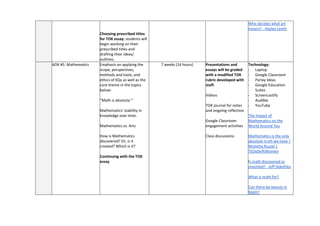
Choosing prescribed titles
for TOK essay: students will
begin working on their
prescribed titles and
drafting their ideas/
outlines.
Who decides what art
means? - Hayley Levitt
AOK #5: Mathematics Emphasis on applying the
scope, perspectives,
methods and tools, and
ethics of KQs as well as the
core theme in the topics
below:
“Math is absolute.”
Mathematics’ stability in
knowledge over time.
Mathematics vs. Arts
How is Mathematics
discovered? Or, is it
created? Which is it?
Continuing with the TOK
essay
7 weeks (14 hours) Presentations and
essays will be graded
with a modified TOK
rubric developed with
staff.
Videos
TOK journal for notes
and ongoing reflection
Google Classroom
engagement activities
Class discussions
Technology:
- Laptop
- Google Classroom
- Parlay Ideas
- Google Education
Suites
- Screencastify
- Audible
- YouTube
The Impact of
Mathematics on the
World Around You
Mathematics is the only
absolute truth we have |
Wioletta Ruszel |
TEDxDelftWomen
Is math discovered or
invented? - Jeff Dekofsky
What is math for?
Can there be beauty in
Math?
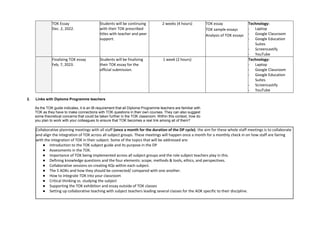
TOK Essay
Dec. 2, 2022.
Students will be continuing
with their TOK prescribed
titles with teacher and peer
support.
2 weeks (4 hours) TOK essay
TOK sample essays
Analysis of TOK essays
Technology:
- Laptop
- Google Classroom
- Google Education
Suites
- Screencastify
- YouTube
Finalizing TOK essay
Feb, 7, 2023.
Students will be finalizing
their TOK essay for the
official submission.
1 week (2 hours) Technology:
- Laptop
- Google Classroom
- Google Education
Suites
- Screencastify
- YouTube
2. Links with Diploma Programme teachers
As the TOK guide indicates, it is an IB requirement that all Diploma Programme teachers are familiar with
TOK as they have to make connections with TOK questions in their own courses. They can also suggest
some theoretical concerns that could be taken further in the TOK classroom. Within this context, how do
you plan to work with your colleagues to ensure that TOK becomes a real link among all of them?
Collaborative planning meetings with all staff (once a month for the duration of the DP cycle)- the aim for these whole staff meetings is to collaborate
and align the integration of TOK across all subject groups. These meetings will happen once a month for a monthly check in on how staff are fairing
with the integration of TOK in their subject. Some of the topics that will be addressed are:
● Introduction to the TOK subject guide and its purpose in the DP
● Assessments in the TOK.
● Importance of TOK being implemented across all subject groups and the role subject teachers play in this.
● Defining knowledge questions and the four elements: scope, methods & tools, ethics, and perspectives.
● Collaborative sessions on creating KQs within each subject.
● The 5 AOKs and how they should be connected/ compared with one another.
● How to integrate TOK into your classroom
● Critical thinking vs. studying the subject
● Supporting the TOK exhibition and essay outside of TOK classes
● Setting up collaborative teaching with subject teachers leading several classes for the AOK specific to their discipline.
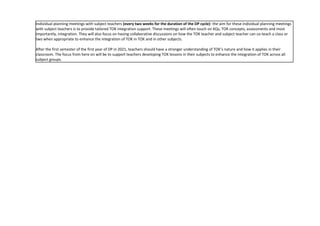
Individual planning meetings with subject teachers (every two weeks for the duration of the DP cycle)- the aim for these individual planning meetings
with subject teachers is to provide tailored TOK integration support. These meetings will often touch on KQs, TOK concepts, assessments and most
importantly, integration. They will also focus on having collaborative discussions on how the TOK teacher and subject teacher can co-teach a class or
two when appropriate to enhance the integration of TOK in TOK and in other subjects.
After the first semester of the first year of DP in 2021, teachers should have a stronger understanding of TOK’s nature and how it applies in their
classroom. The focus from here on will be to support teachers developing TOK lessons in their subjects to enhance the integration of TOK across all
subject groups.
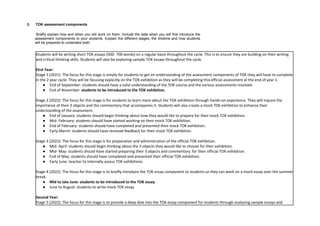
3. TOK assessment components
Briefly explain how and when you will work on them. Include the date when you will first introduce the
assessment components to your students. Explain the different stages, the timeline and how students
will be prepared to undertake both.
Students will be writing short TOK essays (500- 700 words) on a regular basis throughout the cycle. This is to ensure they are building on their writing
and critical thinking skills. Students will also be exploring sample TOK essays throughout the cycle.
First Year:
Stage 1 (2021): The focus for this stage is simply for students to get an understanding of the assessment components of TOK they will have to complete
in the 2 year cycle. They will be focusing explicitly on the TOK exhibition as they will be completing this official assessment at the end of year 1.
● End of September: students should have a solid understanding of the TOK course and the various assessments involved.
● End of November: students to be introduced to the TOK exhibition.
Stage 2 (2022): The focus for this stage is for students to learn more about the TOK exhibition through hands-on experience. They will inquire the
importance of their 3 objects and the commentary that accompanies it. Students will also create a mock TOK exhibition to enhance their
understanding of the assessment.
● End of January: students should begin thinking about how they would like to prepare for their mock TOK exhibition.
● Mid- February: students should have started working on their mock TOK exhibition.
● End of February: students should have completed and presented their mock TOK exhibition.
● Early March: students should have received feedback for their mock TOK exhibition.
Stage 3 (2022): The focus for this stage is for preparation and administration of the official TOK exhibition.
● Mid- April: students should begin thinking about the 3 objects they would like to choose for their exhibition.
● Mid- May: students should have started preparing their 3 objects and commentary for their official TOK exhibition.
● End of May: students should have completed and presented their official TOK exhibition.
● Early June: teacher to internally assess TOK exhibitions.
Stage 4 (2022): The focus for this stage is to briefly introduce the TOK essay component to students so they can work on a mock essay over the summer
break.
● Mid to late June: students to be introduced to the TOK essay.
● June to August: students to write mock TOK essay
Second Year:
Stage 5 (2022): The focus for this stage is to provide a deep dive into the TOK essay component for students through analyzing sample essays and
feedback.
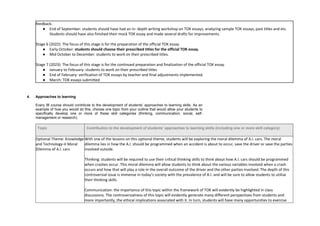
● End of September: students should have had an in- depth writing workshop on TOK essays; analyzing sample TOK essays, past titles and etc.
Students should have also finished their mock TOK essay and made several drafts for improvements.
Stage 6 (2022): The focus of this stage is for the preparation of the official TOK essay.
● Early October: students should choose their prescribed titles for the official TOK essay.
● Mid October to December: students to work on their prescribed titles.
Stage 7 (2023): The focus of this stage is for the continued preparation and finalization of the official TOK essay.
● January to February: students to work on their prescribed titles
● End of February: verification of TOK essays by teacher and final adjustments implemented.
● March: TOK essays submitted
4. Approaches to learning
Every IB course should contribute to the development of students’ approaches to learning skills. As an
example of how you would do this, choose one topic from your outline that would allow your students to
specifically develop one or more of these skill categories (thinking, communication, social, self-
management or research).
Topic Contribution to the development of students’ approaches to learning skills (including one or more skill category)
Optional Theme: Knowledge
and Technology→ Moral
Dilemma of A.I. cars
With one of the lessons on this optional theme, students will be exploring the moral dilemma of A.I. cars. The moral
dilemma lies in how the A.I. should be programmed when an accident is about to occur, save the driver or save the parties
involved outside.
Thinking: students will be required to use their critical thinking skills to think about how A.I. cars should be programmed
when crashes occur. This moral dilemma will allow students to think about the various variables involved when a crash
occurs and how that will play a role in the overall outcome of the driver and the other parties involved. The depth of this
controversial issue is immense in today’s society with the prevalence of A.I. and will be sure to allow students to utilise
their thinking skills.
Communication: the importance of this topic within the framework of TOK will evidently be highlighted in class
discussions. The controversialness of this topic will evidently generate many different perspectives from students and
more importantly, the ethical implications associated with it. In turn, students will have many opportunities to exercise
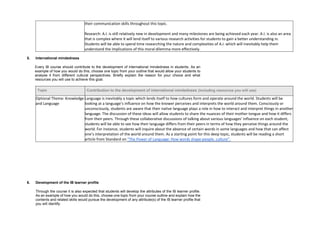
their communication skills throughout this topic.
Research: A.I. is still relatively new in development and many milestones are being achieved each year. A.I. is also an area
that is complex where it will lend itself to various research activities for students to gain a better understanding in.
Students will be able to spend time researching the nature and complexities of A.I. which will inevitably help them
understand the implications of this moral dilemma more effectively.
5. International mindedness
Every IB course should contribute to the development of international mindedness in students. As an
example of how you would do this, choose one topic from your outline that would allow your students to
analyse it from different cultural perspectives. Briefly explain the reason for your choice and what
resources you will use to achieve this goal.
Topic Contribution to the development of international mindedness (including resources you will use)
Optional Theme: Knowledge
and Language
Language is inevitably a topic which lends itself to how cultures form and operate around the world. Students will be
looking at a language’s influence on how the knower perceives and interprets the world around them. Consciously or
unconsciously, students are aware that their native language plays a role in how to interact and interpret things in another
language. The discussion of these ideas will allow students to share the nuances of their mother tongue and how it differs
from their peers. Through these collaborative discussions of talking about various languages’ influence on each student,
students will be able to see how their language differs from their peers in terms of how they perceive things around the
world. For instance, students will inquire about the absence of certain words in some languages and how that can affect
one’s interpretation of the world around them. As a starting point for this deep topic, students will be reading a short
article from Standard on “The Power of Language: How words shape people, culture”.
6. Development of the IB learner profile
Through the course it is also expected that students will develop the attributes of the IB learner profile.
As an example of how you would do this, choose one topic from your course outline and explain how the
contents and related skills would pursue the development of any attribute(s) of the IB learner profile that
you will identify.
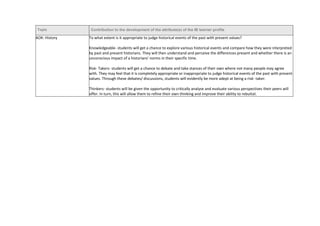
Topic Contribution to the development of the attribute(s) of the IB learner profile
AOK: History To what extent is it appropriate to judge historical events of the past with present values?
Knowledgeable- students will get a chance to explore various historical events and compare how they were interpreted
by past and present historians. They will then understand and perceive the differences present and whether there is an
unconscious impact of a historians’ norms in their specific time.
Risk- Takers- students will get a chance to debate and take stances of their own where not many people may agree
with. They may feel that it is completely appropriate or inappropriate to judge historical events of the past with present
values. Through these debates/ discussions, students will evidently be more adept at being a risk- taker.
Thinkers- students will be given the opportunity to critically analyse and evaluate various perspectives their peers will
offer. In turn, this will allow them to refine their own thinking and improve their ability to rebuttal.

IB DP- TOK Course Outline.docx

  • 1.
    Diploma Programme courseoutline—TOK School name Verita International School School code 061244 Time distribution Starting date of TOK course in year 1 of the Diploma Programme September 2022 Ending date of TOK course in year 2 of the Diploma Programme May 2024 Name of the teacher who completed this outline Nicol Fernandes Date of IB training Date when outline was completed Name of workshop (indicate name of subject and workshop category) 1. Course outline – Use the following table to organize the topics to be taught in the course. Add as many rows as you need. – This document should not be a day-by-day accounting of each unit. It is an outline showing how you will distribute the topics and the time to ensure that students are prepared to comply with the requirements of the course. – This outline should show how you will develop the teaching of the course. It should reflect the individual nature of the course in your classroom and should not just be a “copy and paste” from the TOK guide.
  • 2.
    Topic/unit (as identified inthe IB subject guide) State the topics/units in the order you are planning to teach them. Contents Allocated time Assessment instruments to be used Resources List the main resources to be used, including information technology if applicable. One class is 40 minutes. In one week there are 3 classes. Year 1 Introduction to TOK and the core theme: Knowledge and the Knower Overview of syllabus of assessments involved. Knowledge Questions (KQs) How is knowledge constructed? How is knowledge gained? Four elements of KQ- scope, perspective, methods & tools, and ethics. Formulating KQs with the four KQ elements etc. 3 weeks (6 hours total) Presentations TOK journal for notes and ongoing reflection Class discussions Technology: - Laptop - Google Classroom - Google Education Suites - Screencastify - Audible - YouTube TOK Subject Guide How language shapes the way we think | Lera Boroditsky How Languages Shapes The Way We Think | Full Debate | Stanley Fish, John McWhorter The ethical dilemma we face on AI and autonomous tech | Christine Fox | TEDxMidAtlantic
  • 3.
    Core Theme: Knowledge andthe Knower Contestable claims. Influence of knowledge through communities of knowers; language, religion, political and etc. Confirmation bias, hindsight bias, normalcy bias, unconscious bias and etc. 3 weeks ( hours total) Presentations and essays will be graded with a modified TOK rubric developed with staff. Presentations Brochures TOK journal for notes and ongoing reflection Google Classroom engagement activities Short TOK essays on KQs (500- 700 words) Class discussions Technology: - Laptop - Google Classroom - Google Education Suites - Screencastify - Audible - YouTube You Are Not So Smart: Why You Have Too Many Friends on Facebook, Why Your Memory Is Mostly Fiction, an d 46 Other Ways You're Deluding Yourself by David McRaney Waiting for Godot by Samuel Beckett Optional Theme #1: Knowledge and Technology Emphasis on applying the scope, perspectives, methods and tools, and ethics of KQs as well as the core theme in the topics below : Moral dilemmas of A.I. A.I. formulating knowledge about humans Data vs. Information vs. 3 weeks (6 hours total) Presentations and essays will be graded with a modified TOK rubric developed with staff. Presentations Brochures TOK journal for notes and ongoing reflection Technology: - Laptop - Google Classroom - Google Education Suites - Screencastify - Audible - YouTube The ethical dilemma of self-driving cars - Patrick Lin
  • 4.
    Knowledge Digital vs local communitiesof knowers Machine Learning: Processing or acquiring knowledge? Google Classroom engagement activities Short TOK essays on KQs (500- 700 words) Grading sample TOK essays Class discussions Conscious AI: A Moral Dilemma | Dorna Behdadi | TEDxGöteborg This Robot would let 5 People die | AI on Moral Questions | Sophia answers the Trolley Problem Two robots debate the future of humanity The ethical dilemma we face on AI and autonomous tech | Christine Fox | TEDxMidAtlantic Optional Theme #2: Knowledge and Language Emphasis on applying the scope, perspectives, methods and tools, and ethics of KQs as well as the core theme in the topics below: Linguistic Imperialism Power of language historically and presently Influence of language on how the knower perceives the world and acquires knowledge 3 weeks (6 hours total) Presentations and essays will be graded with a modified TOK rubric developed with staff. Presentations Brochures TOK journal for notes and ongoing reflection Google Classroom engagement activities Short TOK essays on KQs Technology: - Laptop - Google Classroom - Google Education Suites - Screencastify - Audible - YouTube How language shapes the way we think | Lera Boroditsky How Languages Shapes The Way We Think | Full Debate | Stanley Fish, John McWhorter
  • 5.
    Transmission of knowledge fromone language to another, does it work? (500- 700 words) Grading sample TOK essays Class discussions Linguistic Imperialism | Pirawat Punyagupta | TEDxBangkokPatanaScho ol Why Did English Become the International Language? Introduction to the 5 Areas of Knowledge (AOKs) - History - The human sciences - The natural sciences - The arts - Mathematics Brief overview/ crash course of the 5 AOKs and how it connects to the core theme as well as the 4 parts of KQs. Making connections/ comparisons across the 5 AOKs Discussions on the TOK exhibition and objects that are of interest to the students. 2 weeks (4 hours total) TOK journal Class discussions Technology: - Laptop - Google Classroom - Google Education Suites - Screencastify - Audible - YouTube How Do We Know What We Know?: A Blueprint for Thinking with R.C. Sproul AOK #1: History Emphasis on applying the scope, perspectives, methods and tools, and ethics of KQs as well as the core theme in the topics below: Role of historians: tell the “truth” or tell the “myth”? Historians interpretation of history 5 Weeks (10 hours total) Presentations and essays will be graded with a modified TOK rubric developed with staff. Presentations Brochures Debates TOK journal for notes Technology: - Laptop - Google Classroom - Google Education Suites - Screencastify - Audible - YouTube Thinking like a historian | The historian's toolkit | US History | Khan Academy
  • 6.
    Causal relationship between historicalevents: how are they established? Who dictates the establishment of these causes and effects? and ongoing reflection Google Classroom engagement activities Short TOK essays on KQs (500- 700 words) Class discussions Who Should Decide How Students Learn About America’s Past? How biased are history books? Tell Me These Stories: Bias in History Books | Hayah Amin | TEDxYouth@ASK Mock TOK Exhibition ( Students will complete a mock TOK exhibition with commentary and 3 objects. Students and parents of all year levels will be invited for the mock exhibition. 1 week (2 hours) Exhibition Class discussions Technology: - Laptop - Google Classroom - Google Education Suites - Screencastify - YouTube AOK #2: The Human Sciences Emphasis on applying the scope, perspectives, methods and tools, and ethics of KQs as well as the core theme in the topics below: Domains of human sciences: anthropology, psychology, political science, geography, and economics. Human sciences vs. natural sciences; data collection, methods, tools, and etc. 6 Weeks (12 hours total) Presentations and essays will be graded with a modified TOK rubric developed with staff. Presentations Brochures Debates TOK journal for notes and ongoing reflection Google Classroom Technology: - Laptop - Google Classroom - Google Education Suites - Screencastify - Audible - YouTube The role of human emotions in science and research | Ilona Stengel Methodology of the Human Sciences
  • 7.
    “Reliability” of human sciencesexperiments vs. natural science Influence of human scientists’ beliefs and values in the interpretation of knowledge engagement activities Short TOK essays on KQs (500- 700 words) Class discussions The Human Sciences in TOK Human vs Natural Sciences Infographic Editorial: Replication and Reliability in Behavior Science and Behavior Analysis: A Call for a Conversation AOK #3: The Natural Sciences Emphasis on applying the scope, perspectives, methods and tools, and ethics of KQs as well as the core theme in the topics below: Methods and tools in the natural sciences: what makes them “rational” or “evidence” based compared to human sciences? Influence of scientific revolutions historically and presently. Who decides this? Impact of confirmation bias in the pursuit of proving one’s hypothesis in scientific experiments 6 Weeks (12 hours total) Presentations and essays will be graded with a modified TOK rubric developed with staff. Presentations Brochures Debates TOK journal for notes and ongoing reflection Google Classroom engagement activities Short TOK essays on KQs (500- 700 words) Class discussions Technology: - Laptop - Google Classroom - Google Education Suites - Screencastify - Audible - YouTube The Scientific Revolution: Crash Course History of Science #12 Scientific Revolution: Crash Course European History #12 The Scientific Methods: Crash Course History of Science #14 What’s the difference between a scientific law and theory? - Matt
  • 8.
    Anticole TOK Exhibition Start: May30, 2022. End: June 20, 2022. Students will be preparing and presenting their official TOK exhibitions. Parents and students of all year levels will be invited 3 weeks (6 hours) Exhibitions Class discussions Technology: - Laptop - Google Classroom - Google Education Suites - Screencastify - YouTube Overview of TOK essay Students will be given an overview of the requirements of the TOK essay. Students will draft an outline for their mock TOK essay. Students will use the outline to write their mock TOK essay over the summer break. 1 week (2 hours) TOK essay TOK sample essays Analysis of TOK essays Technology: - Laptop - Google Classroom - Parlay Ideas - Google Education Suites - Screencastify - YouTube Year 2 Mock TOK essay Students will peer assess their TOK essays and make improvements. Students will then submit their mock TOK essays and meet with the teacher for a conference of feedback/ improvements. Various drafts will be made to allow students to get used to this process for the 2 weeks (4 hours) TOK essay TOK sample essays Analysis of TOK essays Technology: - Laptop - Google Classroom - Google Education Suites - Screencastify - YouTube
  • 9.
    prescribed titles. TOK EssayWriting Workshop + Prescribed Titles Students will be focussing on improving their TOK essay through writing workshops and utilising their mock essay. Students will then begin drafting their outline/ ideas for their chosen prescribed title. 2 weeks (4 hours) TOK essay TOK sample essays Analysis of TOK essays Technology: - Laptop - Google Classroom - Google Education Suites - Screencastify - YouTube AOK #4: The Arts Emphasis on applying the scope, perspectives, methods and tools, and ethics of KQs as well as the core theme in the topics below: The use of “interpretation” in ascribing meaning to arts. The role of the viewer in arts. To what extent do authors/ artists have the final “say” in the meaning of their works? Political correctness (PC) in art Moral vs. aesthetic judgments 7 weeks (14 hours) Presentations and essays will be graded with a modified TOK rubric developed with staff. Videos Debates TOK journal for notes and ongoing reflection Google Classroom engagement activities Class discussions Technology: - Laptop - Google Classroom - Google Education Suites - Screencastify - Audible - YouTube The Role of Arts & Culture in an Open Society What is art for? Alain de Botton's animated guide | Art and design Jordan Peterson: Why You Need Art in Your Life How art gives shape to cultural change - Thelma Golden
  • 10.
    Choosing prescribed titles forTOK essay: students will begin working on their prescribed titles and drafting their ideas/ outlines. Who decides what art means? - Hayley Levitt AOK #5: Mathematics Emphasis on applying the scope, perspectives, methods and tools, and ethics of KQs as well as the core theme in the topics below: “Math is absolute.” Mathematics’ stability in knowledge over time. Mathematics vs. Arts How is Mathematics discovered? Or, is it created? Which is it? Continuing with the TOK essay 7 weeks (14 hours) Presentations and essays will be graded with a modified TOK rubric developed with staff. Videos TOK journal for notes and ongoing reflection Google Classroom engagement activities Class discussions Technology: - Laptop - Google Classroom - Parlay Ideas - Google Education Suites - Screencastify - Audible - YouTube The Impact of Mathematics on the World Around You Mathematics is the only absolute truth we have | Wioletta Ruszel | TEDxDelftWomen Is math discovered or invented? - Jeff Dekofsky What is math for? Can there be beauty in Math?
  • 11.
    TOK Essay Dec. 2,2022. Students will be continuing with their TOK prescribed titles with teacher and peer support. 2 weeks (4 hours) TOK essay TOK sample essays Analysis of TOK essays Technology: - Laptop - Google Classroom - Google Education Suites - Screencastify - YouTube Finalizing TOK essay Feb, 7, 2023. Students will be finalizing their TOK essay for the official submission. 1 week (2 hours) Technology: - Laptop - Google Classroom - Google Education Suites - Screencastify - YouTube 2. Links with Diploma Programme teachers As the TOK guide indicates, it is an IB requirement that all Diploma Programme teachers are familiar with TOK as they have to make connections with TOK questions in their own courses. They can also suggest some theoretical concerns that could be taken further in the TOK classroom. Within this context, how do you plan to work with your colleagues to ensure that TOK becomes a real link among all of them? Collaborative planning meetings with all staff (once a month for the duration of the DP cycle)- the aim for these whole staff meetings is to collaborate and align the integration of TOK across all subject groups. These meetings will happen once a month for a monthly check in on how staff are fairing with the integration of TOK in their subject. Some of the topics that will be addressed are: ● Introduction to the TOK subject guide and its purpose in the DP ● Assessments in the TOK. ● Importance of TOK being implemented across all subject groups and the role subject teachers play in this. ● Defining knowledge questions and the four elements: scope, methods & tools, ethics, and perspectives. ● Collaborative sessions on creating KQs within each subject. ● The 5 AOKs and how they should be connected/ compared with one another. ● How to integrate TOK into your classroom ● Critical thinking vs. studying the subject ● Supporting the TOK exhibition and essay outside of TOK classes ● Setting up collaborative teaching with subject teachers leading several classes for the AOK specific to their discipline.
  • 12.
    Individual planning meetingswith subject teachers (every two weeks for the duration of the DP cycle)- the aim for these individual planning meetings with subject teachers is to provide tailored TOK integration support. These meetings will often touch on KQs, TOK concepts, assessments and most importantly, integration. They will also focus on having collaborative discussions on how the TOK teacher and subject teacher can co-teach a class or two when appropriate to enhance the integration of TOK in TOK and in other subjects. After the first semester of the first year of DP in 2021, teachers should have a stronger understanding of TOK’s nature and how it applies in their classroom. The focus from here on will be to support teachers developing TOK lessons in their subjects to enhance the integration of TOK across all subject groups.
  • 13.
    3. TOK assessmentcomponents Briefly explain how and when you will work on them. Include the date when you will first introduce the assessment components to your students. Explain the different stages, the timeline and how students will be prepared to undertake both. Students will be writing short TOK essays (500- 700 words) on a regular basis throughout the cycle. This is to ensure they are building on their writing and critical thinking skills. Students will also be exploring sample TOK essays throughout the cycle. First Year: Stage 1 (2021): The focus for this stage is simply for students to get an understanding of the assessment components of TOK they will have to complete in the 2 year cycle. They will be focusing explicitly on the TOK exhibition as they will be completing this official assessment at the end of year 1. ● End of September: students should have a solid understanding of the TOK course and the various assessments involved. ● End of November: students to be introduced to the TOK exhibition. Stage 2 (2022): The focus for this stage is for students to learn more about the TOK exhibition through hands-on experience. They will inquire the importance of their 3 objects and the commentary that accompanies it. Students will also create a mock TOK exhibition to enhance their understanding of the assessment. ● End of January: students should begin thinking about how they would like to prepare for their mock TOK exhibition. ● Mid- February: students should have started working on their mock TOK exhibition. ● End of February: students should have completed and presented their mock TOK exhibition. ● Early March: students should have received feedback for their mock TOK exhibition. Stage 3 (2022): The focus for this stage is for preparation and administration of the official TOK exhibition. ● Mid- April: students should begin thinking about the 3 objects they would like to choose for their exhibition. ● Mid- May: students should have started preparing their 3 objects and commentary for their official TOK exhibition. ● End of May: students should have completed and presented their official TOK exhibition. ● Early June: teacher to internally assess TOK exhibitions. Stage 4 (2022): The focus for this stage is to briefly introduce the TOK essay component to students so they can work on a mock essay over the summer break. ● Mid to late June: students to be introduced to the TOK essay. ● June to August: students to write mock TOK essay Second Year: Stage 5 (2022): The focus for this stage is to provide a deep dive into the TOK essay component for students through analyzing sample essays and
  • 14.
    feedback. ● End ofSeptember: students should have had an in- depth writing workshop on TOK essays; analyzing sample TOK essays, past titles and etc. Students should have also finished their mock TOK essay and made several drafts for improvements. Stage 6 (2022): The focus of this stage is for the preparation of the official TOK essay. ● Early October: students should choose their prescribed titles for the official TOK essay. ● Mid October to December: students to work on their prescribed titles. Stage 7 (2023): The focus of this stage is for the continued preparation and finalization of the official TOK essay. ● January to February: students to work on their prescribed titles ● End of February: verification of TOK essays by teacher and final adjustments implemented. ● March: TOK essays submitted 4. Approaches to learning Every IB course should contribute to the development of students’ approaches to learning skills. As an example of how you would do this, choose one topic from your outline that would allow your students to specifically develop one or more of these skill categories (thinking, communication, social, self- management or research). Topic Contribution to the development of students’ approaches to learning skills (including one or more skill category) Optional Theme: Knowledge and Technology→ Moral Dilemma of A.I. cars With one of the lessons on this optional theme, students will be exploring the moral dilemma of A.I. cars. The moral dilemma lies in how the A.I. should be programmed when an accident is about to occur, save the driver or save the parties involved outside. Thinking: students will be required to use their critical thinking skills to think about how A.I. cars should be programmed when crashes occur. This moral dilemma will allow students to think about the various variables involved when a crash occurs and how that will play a role in the overall outcome of the driver and the other parties involved. The depth of this controversial issue is immense in today’s society with the prevalence of A.I. and will be sure to allow students to utilise their thinking skills. Communication: the importance of this topic within the framework of TOK will evidently be highlighted in class discussions. The controversialness of this topic will evidently generate many different perspectives from students and more importantly, the ethical implications associated with it. In turn, students will have many opportunities to exercise
  • 15.
    their communication skillsthroughout this topic. Research: A.I. is still relatively new in development and many milestones are being achieved each year. A.I. is also an area that is complex where it will lend itself to various research activities for students to gain a better understanding in. Students will be able to spend time researching the nature and complexities of A.I. which will inevitably help them understand the implications of this moral dilemma more effectively. 5. International mindedness Every IB course should contribute to the development of international mindedness in students. As an example of how you would do this, choose one topic from your outline that would allow your students to analyse it from different cultural perspectives. Briefly explain the reason for your choice and what resources you will use to achieve this goal. Topic Contribution to the development of international mindedness (including resources you will use) Optional Theme: Knowledge and Language Language is inevitably a topic which lends itself to how cultures form and operate around the world. Students will be looking at a language’s influence on how the knower perceives and interprets the world around them. Consciously or unconsciously, students are aware that their native language plays a role in how to interact and interpret things in another language. The discussion of these ideas will allow students to share the nuances of their mother tongue and how it differs from their peers. Through these collaborative discussions of talking about various languages’ influence on each student, students will be able to see how their language differs from their peers in terms of how they perceive things around the world. For instance, students will inquire about the absence of certain words in some languages and how that can affect one’s interpretation of the world around them. As a starting point for this deep topic, students will be reading a short article from Standard on “The Power of Language: How words shape people, culture”. 6. Development of the IB learner profile Through the course it is also expected that students will develop the attributes of the IB learner profile. As an example of how you would do this, choose one topic from your course outline and explain how the contents and related skills would pursue the development of any attribute(s) of the IB learner profile that you will identify.
  • 16.
    Topic Contribution tothe development of the attribute(s) of the IB learner profile AOK: History To what extent is it appropriate to judge historical events of the past with present values? Knowledgeable- students will get a chance to explore various historical events and compare how they were interpreted by past and present historians. They will then understand and perceive the differences present and whether there is an unconscious impact of a historians’ norms in their specific time. Risk- Takers- students will get a chance to debate and take stances of their own where not many people may agree with. They may feel that it is completely appropriate or inappropriate to judge historical events of the past with present values. Through these debates/ discussions, students will evidently be more adept at being a risk- taker. Thinkers- students will be given the opportunity to critically analyse and evaluate various perspectives their peers will offer. In turn, this will allow them to refine their own thinking and improve their ability to rebuttal.