The TOK essay- 1600 WORDS
OBJECTIVES:
• Understand the essay requirements
• Write an Essay that scores an A
What have you heard TOK essay is all about?
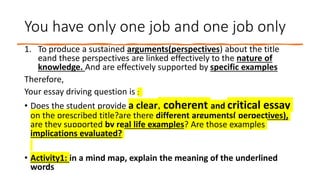
You have only one job and one job only
1. To produce a sustained arguments(perspectives) about the title
eand these perspectives are linked effectively to the nature of
knowledge. And are effectively supported by specific examples
Therefore,
Your essay driving question is :
• Does the student provide a clear, coherent and critical essay
on the prescribed title?are there different arguments( perpectives),
are they supported by real life examples? Are those examples
implications evaluated?
• Activity1: in a mind map, explain the meaning of the underlined
words
What do those terms mean?
• Clear means I am able to understand what you are saying because
you have kept your language clear.
• Coherent- this is about unity or flow of ideas, the arguments need to
flow smoothly and I can tell where you are coming from easily. Use of
transitional words help a lot to ensure the reader follows step by step.
• Critical- This asks you to critique and to evaluate strengths and
weakeness of various perspectives. Your own critical thinking is
visible.
To be critical, the secret is
• To ensure you are addressing the implications of you’re the examples
you give)
• Use the words such as this implies that, this has an implication to ,
this infers that, this insunuates that, the implication for this is. Use
the words if … then grammatical structure( eg if we accept this
particular method in the scientific view…. Then what that implies
is….)
What exactly does it mean with “
implications”
• Think of “ this is the claim and the this is the example”
 what now? So what? Who cares?
So what did this mean for the time or what does it mean for future?
How does this affect what?
etc
We have said that the tok essay focuses on
the nature of knowledge
• This means that , the essay is not about subject specific , but you
draw examples from the subjcets you study in class as well as your
own personal experinces.
• Activity 2: Write as may phrases as possible that explain what we
mean by nature of knowledge
• Foexample when exploring nature of knowledge we consider
• The scope of knowledge
• Methods of producing knowledge
• Knowledge reliability
• Continue from here
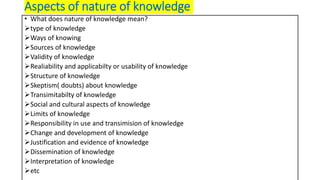
Aspects of nature of knowledge
• What does nature of knowledge mean?
type of knowledge
Ways of knowing
Sources of knowledge
Validity of knowledge
Realiability and applicabilty or usability of knowledge
Structure of knowledge
Skeptism( doubts) about knowledge
Transimitabilty of knowledge
Social and cultural aspects of knowledge
Limits of knowledge
Responsibility in use and transimision of knowledge
Change and development of knowledge
Justification and evidence of knowledge
Dissemination of knowledge
Interpretation of knowledge
etc
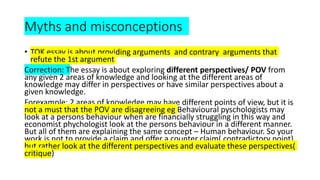
Myths and misconceptions
• TOK essay is about providing arguments and contrary arguments that
refute the 1st argument
Correction: The essay is about exploring different perspectives/ POV from
any given 2 areas of knowledge and looking at the different areas of
knowledge may differ in perspectives or have similar perspectives about a
given knowledge.
Forexample: 2 areas of knowledge may have different points of view, but it is
not a must that the POV are disagreeing eg Behavioural pyschologists may
look at a persons behaviour when are financially struggling in this way and
economist phychologist look at the persons behaviour in a different manner.
But all of them are explaining the same concept – Human behaviour. So your
work is not to provide a claim and offer a counter claim( contradictory point),
but rather look at the different perspectives and evaluate these perspectives(
critique)
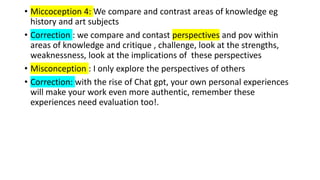
• Miccoception 4: We compare and contrast areas of knowledge eg
history and art subjects
• Correction : we compare and contast perspectives and pov within
areas of knowledge and critique , challenge, look at the strengths,
weaknessness, look at the implications of these perspectives
• Misconception : I only explore the perspectives of others
• Correction: with the rise of Chat gpt, your own personal experiences
will make your work even more authentic, remember these
experiences need evaluation too!.
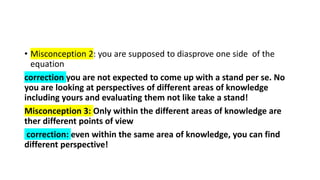
• Misconception 2: you are supposed to diasprove one side of the
equation
correction you are not expected to come up with a stand per se. No
you are looking at perspectives of different areas of knowledge
including yours and evaluating them not like take a stand!
Misconception 3: Only within the different areas of knowledge are
ther different points of view
correction: even within the same area of knowledge, you can find
different perspective!
Writing the essay
• When writing the essay we ask ourselves this main question
• What nature of knowledge does this question relate to?
Let’s look at this essay question- in a mind
map
• To what extent is the knowledge we produce determined by the
methodologies we use? Discuss with reference to human sciences
•
Providing specific examples
• To score highly in this essay,
it is important you provide
examples that you are
familiar with. This makes it
easy for you to critique
those examples and be
able to support the
perspectives you have
provided. You will get this
examples from your subject
specific. Avoid High end
exampes you do now
understand. Keep it simple
and convincing.
TOK ESSAY IS DISCUSIVE
• Meaning it’s argumentative in nature. You look
explore how a knowledge question can have
different perspectives.
• Different AREAS OF KNOWLEGDE MAY HAVE
THE SAME PERSPECTIVES ABOUT A CLAIM OR
DIFFERENT PERSPECTIVES ABOUT THE SAME
CLAIM.
• It is your work now to look for these claims, and
REAL -LIFE SITUATIONS world examples to
support the claims
The essay structure
• Introduction
• Paragraphs
• conclusion
Writing the introduction
• You need a hook- something intresting and must be connected to the
title
• Explain the key words in your own terms
• Mention the assumptions the Prescribed title( you do not have to
answer these assumptions- you do so in the conclusion
• Explain the scope of your essay- this happens in the thesis statement-
( mention some claims you will be exploring)
How should claims look like?
• Claims should be second order claims ie the claims that question the nature of knowledge
• What does nature of knowledge mean?
type of knowledge
Ways of knowing
Sources of knowledge
Validity of knowledge
Realiability and applicabilty or usability of knowledge
Structure of knowledge
Skeptism( doubts) about knowledge
Transimitabilty of knowledge
Social and cultural aspects of knowledge
Limits of knowledge
Responsibility in use and transimision of knowledge
Change and development of knowledge
Justification and evidence of knowledge
Dissemination of knowledge
Interpretation of knowledge
etc
Do we need custodians of knowledge
• Custodians of knowledge could be the producers of knowlegdge, libraians,
archivists, historians and histographers, indegienous communities, academic
institutions eg universities, scientific research insittutions, those who store, share
, manage preserve etc knowledge.
• We may need we may not need. ( discuss)
1. Claims for why we may need ( paragraph 2 (1AOK), Paragraph 3( 2 AOK)
• Real world situations ( examples)
• So? What are the implications of the RLE?
• Possible theory to back up your arguments ●Link to the PT
2. counter claims ( para 3( 1AOK) para 4( 2AOK)
• Real world situations ( examples)
• So? What are the implications of the RLE?
• Possible theory to back up your arguments ●Link to the PT
3. Claims and counter claims for why we may not need( repeat the above)
? How do you come up with Claims and
counter claims?
• Think of the nature of knowledge the title could be exploring. Is it
dealing with knowledge acquizition, production, dissemination?
Limits?etc
• Think about second order claims and counter claims you can make
Hint- to create second order claims and counter claims ensure you use
the TOK terminology eg bias, relativity, subjectivity and the 12
concepts eg values, beliefs..
Let us try an example
• Do we need custodians of knowledge?
This question ask high order knowledge questions like
- do custodian help in justifying the validity of knowledge?
H.O claim: custodians help in justifying the validity of knowledge
H. O. Q- Is having custodians of knowledge risking fallacious
conclusions due to bias?
H.O Counter claim: Custodians may give fallacious conclusions due to
bias.
Deconstructing a 10/10 essay
• Introduction:
• Activity: read the introduction provided,
- How does the introduction set the student up for success? Write a
bout 5 things that introduction has.
A good introduction like this has:
1. Has a hook- something intresting related to the title ( relevant)
2. Demonstrates understanding of the question- interpret the question in
your own words- here you may decide to define the key words if you
want to ( remember, you can even define the key words at theend of the
essay)- personal voice( I pronoun)
3. Discussing the reason behind choosing the prompt- implications of
the prompt
4. Outlining the AOKs chosen for the prompt
(room for improvement :The student could have explained why he
chose those two AOKs and how they can promote the contrast and
comparisons he intends to discuss in an additional sentence.
5. Thesis statement-student always outlines what he intends to
discuss in the main body of the essay.
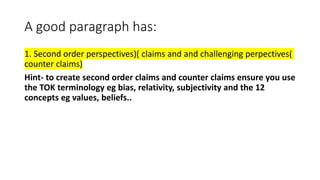
A good paragraph has:
1. Second order perspectives)( claims and and challenging perpectives(
counter claims)
Hint- to create second order claims and counter claims ensure you use
the TOK terminology eg bias, relativity, subjectivity and the 12
concepts eg values, beliefs..
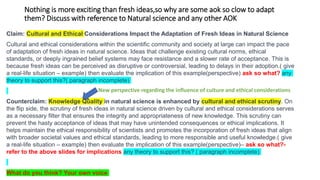
Nothing is more exciting than fresh ideas,so why are some aok so clow to adapt
them? Discuss with reference to Natural science and any other AOK
Claim: Cultural and Ethical Considerations Impact the Adaptation of Fresh Ideas in Natural Science
Cultural and ethical considerations within the scientific community and society at large can impact the pace
of adaptation of fresh ideas in natural science. Ideas that challenge existing cultural norms, ethical
standards, or deeply ingrained belief systems may face resistance and a slower rate of acceptance. This is
because fresh ideas can be perceived as disruptive or controversial, leading to delays in their adoption.( give
a real-life situation – example) then evaluate the implication of this example(perspective) ask so what? any
theory to support this?( paragraph incomplete)
Counterclaim: Knowledge Quality in natural science is enhanced by cultural and ethical scrutiny. On
the flip side, the scrutiny of fresh ideas in natural science driven by cultural and ethical considerations serves
as a necessary filter that ensures the integrity and appropriateness of new knowledge. This scrutiny can
prevent the hasty acceptance of ideas that may have unintended consequences or ethical implications. It
helps maintain the ethical responsibility of scientists and promotes the incorporation of fresh ideas that align
with broader societal values and ethical standards, leading to more responsible and useful knowledge.( give
a real-life situation – example) then evaluate the implication of this example(perspective)– ask so what?-
refer to the above slides for implications any theory to support this? ( paragraph incomplete)
What do you think? Your own voice
New perspective regarding the influence of culture and ethical considerations
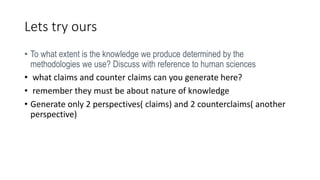
Lets try ours
• To what extent is the knowledge we produce determined by the
methodologies we use? Discuss with reference to human sciences
• what claims and counter claims can you generate here?
• remember they must be about nature of knowledge
• Generate only 2 perspectives( claims) and 2 counterclaims( another
perspective)

TOK ESSAY EDITED dp 1guide for ibdp.pptx

  • 1.
    The TOK essay-1600 WORDS OBJECTIVES: • Understand the essay requirements • Write an Essay that scores an A
  • 2.
    What have youheard TOK essay is all about?
  • 3.
    You have onlyone job and one job only 1. To produce a sustained arguments(perspectives) about the title eand these perspectives are linked effectively to the nature of knowledge. And are effectively supported by specific examples Therefore, Your essay driving question is : • Does the student provide a clear, coherent and critical essay on the prescribed title?are there different arguments( perpectives), are they supported by real life examples? Are those examples implications evaluated? • Activity1: in a mind map, explain the meaning of the underlined words
  • 4.
    What do thoseterms mean? • Clear means I am able to understand what you are saying because you have kept your language clear. • Coherent- this is about unity or flow of ideas, the arguments need to flow smoothly and I can tell where you are coming from easily. Use of transitional words help a lot to ensure the reader follows step by step. • Critical- This asks you to critique and to evaluate strengths and weakeness of various perspectives. Your own critical thinking is visible.
  • 5.
    To be critical,the secret is • To ensure you are addressing the implications of you’re the examples you give) • Use the words such as this implies that, this has an implication to , this infers that, this insunuates that, the implication for this is. Use the words if … then grammatical structure( eg if we accept this particular method in the scientific view…. Then what that implies is….)
  • 6.
    What exactly doesit mean with “ implications” • Think of “ this is the claim and the this is the example”  what now? So what? Who cares? So what did this mean for the time or what does it mean for future? How does this affect what? etc
  • 7.
    We have saidthat the tok essay focuses on the nature of knowledge • This means that , the essay is not about subject specific , but you draw examples from the subjcets you study in class as well as your own personal experinces. • Activity 2: Write as may phrases as possible that explain what we mean by nature of knowledge • Foexample when exploring nature of knowledge we consider • The scope of knowledge • Methods of producing knowledge • Knowledge reliability • Continue from here
  • 8.
    Aspects of natureof knowledge • What does nature of knowledge mean? type of knowledge Ways of knowing Sources of knowledge Validity of knowledge Realiability and applicabilty or usability of knowledge Structure of knowledge Skeptism( doubts) about knowledge Transimitabilty of knowledge Social and cultural aspects of knowledge Limits of knowledge Responsibility in use and transimision of knowledge Change and development of knowledge Justification and evidence of knowledge Dissemination of knowledge Interpretation of knowledge etc
  • 9.
    Myths and misconceptions •TOK essay is about providing arguments and contrary arguments that refute the 1st argument Correction: The essay is about exploring different perspectives/ POV from any given 2 areas of knowledge and looking at the different areas of knowledge may differ in perspectives or have similar perspectives about a given knowledge. Forexample: 2 areas of knowledge may have different points of view, but it is not a must that the POV are disagreeing eg Behavioural pyschologists may look at a persons behaviour when are financially struggling in this way and economist phychologist look at the persons behaviour in a different manner. But all of them are explaining the same concept – Human behaviour. So your work is not to provide a claim and offer a counter claim( contradictory point), but rather look at the different perspectives and evaluate these perspectives( critique)
  • 10.
    • Miccoception 4:We compare and contrast areas of knowledge eg history and art subjects • Correction : we compare and contast perspectives and pov within areas of knowledge and critique , challenge, look at the strengths, weaknessness, look at the implications of these perspectives • Misconception : I only explore the perspectives of others • Correction: with the rise of Chat gpt, your own personal experiences will make your work even more authentic, remember these experiences need evaluation too!.
  • 11.
    • Misconception 2:you are supposed to diasprove one side of the equation correction you are not expected to come up with a stand per se. No you are looking at perspectives of different areas of knowledge including yours and evaluating them not like take a stand! Misconception 3: Only within the different areas of knowledge are ther different points of view correction: even within the same area of knowledge, you can find different perspective!
  • 12.
    Writing the essay •When writing the essay we ask ourselves this main question • What nature of knowledge does this question relate to?
  • 13.
    Let’s look atthis essay question- in a mind map • To what extent is the knowledge we produce determined by the methodologies we use? Discuss with reference to human sciences •
  • 14.
    Providing specific examples •To score highly in this essay, it is important you provide examples that you are familiar with. This makes it easy for you to critique those examples and be able to support the perspectives you have provided. You will get this examples from your subject specific. Avoid High end exampes you do now understand. Keep it simple and convincing.
  • 15.
    TOK ESSAY ISDISCUSIVE • Meaning it’s argumentative in nature. You look explore how a knowledge question can have different perspectives. • Different AREAS OF KNOWLEGDE MAY HAVE THE SAME PERSPECTIVES ABOUT A CLAIM OR DIFFERENT PERSPECTIVES ABOUT THE SAME CLAIM. • It is your work now to look for these claims, and REAL -LIFE SITUATIONS world examples to support the claims
  • 16.
    The essay structure •Introduction • Paragraphs • conclusion
  • 17.
    Writing the introduction •You need a hook- something intresting and must be connected to the title • Explain the key words in your own terms • Mention the assumptions the Prescribed title( you do not have to answer these assumptions- you do so in the conclusion • Explain the scope of your essay- this happens in the thesis statement- ( mention some claims you will be exploring)
  • 18.
    How should claimslook like? • Claims should be second order claims ie the claims that question the nature of knowledge • What does nature of knowledge mean? type of knowledge Ways of knowing Sources of knowledge Validity of knowledge Realiability and applicabilty or usability of knowledge Structure of knowledge Skeptism( doubts) about knowledge Transimitabilty of knowledge Social and cultural aspects of knowledge Limits of knowledge Responsibility in use and transimision of knowledge Change and development of knowledge Justification and evidence of knowledge Dissemination of knowledge Interpretation of knowledge etc
  • 19.
    Do we needcustodians of knowledge • Custodians of knowledge could be the producers of knowlegdge, libraians, archivists, historians and histographers, indegienous communities, academic institutions eg universities, scientific research insittutions, those who store, share , manage preserve etc knowledge. • We may need we may not need. ( discuss) 1. Claims for why we may need ( paragraph 2 (1AOK), Paragraph 3( 2 AOK) • Real world situations ( examples) • So? What are the implications of the RLE? • Possible theory to back up your arguments ●Link to the PT 2. counter claims ( para 3( 1AOK) para 4( 2AOK) • Real world situations ( examples) • So? What are the implications of the RLE? • Possible theory to back up your arguments ●Link to the PT 3. Claims and counter claims for why we may not need( repeat the above)
  • 20.
    ? How doyou come up with Claims and counter claims? • Think of the nature of knowledge the title could be exploring. Is it dealing with knowledge acquizition, production, dissemination? Limits?etc • Think about second order claims and counter claims you can make Hint- to create second order claims and counter claims ensure you use the TOK terminology eg bias, relativity, subjectivity and the 12 concepts eg values, beliefs..
  • 21.
    Let us tryan example • Do we need custodians of knowledge? This question ask high order knowledge questions like - do custodian help in justifying the validity of knowledge? H.O claim: custodians help in justifying the validity of knowledge H. O. Q- Is having custodians of knowledge risking fallacious conclusions due to bias? H.O Counter claim: Custodians may give fallacious conclusions due to bias.
  • 22.
    Deconstructing a 10/10essay • Introduction: • Activity: read the introduction provided, - How does the introduction set the student up for success? Write a bout 5 things that introduction has.
  • 23.
    A good introductionlike this has: 1. Has a hook- something intresting related to the title ( relevant) 2. Demonstrates understanding of the question- interpret the question in your own words- here you may decide to define the key words if you want to ( remember, you can even define the key words at theend of the essay)- personal voice( I pronoun) 3. Discussing the reason behind choosing the prompt- implications of the prompt 4. Outlining the AOKs chosen for the prompt (room for improvement :The student could have explained why he chose those two AOKs and how they can promote the contrast and comparisons he intends to discuss in an additional sentence. 5. Thesis statement-student always outlines what he intends to discuss in the main body of the essay.
  • 24.
    A good paragraphhas: 1. Second order perspectives)( claims and and challenging perpectives( counter claims) Hint- to create second order claims and counter claims ensure you use the TOK terminology eg bias, relativity, subjectivity and the 12 concepts eg values, beliefs..
  • 25.
    Nothing is moreexciting than fresh ideas,so why are some aok so clow to adapt them? Discuss with reference to Natural science and any other AOK Claim: Cultural and Ethical Considerations Impact the Adaptation of Fresh Ideas in Natural Science Cultural and ethical considerations within the scientific community and society at large can impact the pace of adaptation of fresh ideas in natural science. Ideas that challenge existing cultural norms, ethical standards, or deeply ingrained belief systems may face resistance and a slower rate of acceptance. This is because fresh ideas can be perceived as disruptive or controversial, leading to delays in their adoption.( give a real-life situation – example) then evaluate the implication of this example(perspective) ask so what? any theory to support this?( paragraph incomplete) Counterclaim: Knowledge Quality in natural science is enhanced by cultural and ethical scrutiny. On the flip side, the scrutiny of fresh ideas in natural science driven by cultural and ethical considerations serves as a necessary filter that ensures the integrity and appropriateness of new knowledge. This scrutiny can prevent the hasty acceptance of ideas that may have unintended consequences or ethical implications. It helps maintain the ethical responsibility of scientists and promotes the incorporation of fresh ideas that align with broader societal values and ethical standards, leading to more responsible and useful knowledge.( give a real-life situation – example) then evaluate the implication of this example(perspective)– ask so what?- refer to the above slides for implications any theory to support this? ( paragraph incomplete) What do you think? Your own voice New perspective regarding the influence of culture and ethical considerations
  • 26.
    Lets try ours •To what extent is the knowledge we produce determined by the methodologies we use? Discuss with reference to human sciences • what claims and counter claims can you generate here? • remember they must be about nature of knowledge • Generate only 2 perspectives( claims) and 2 counterclaims( another perspective)