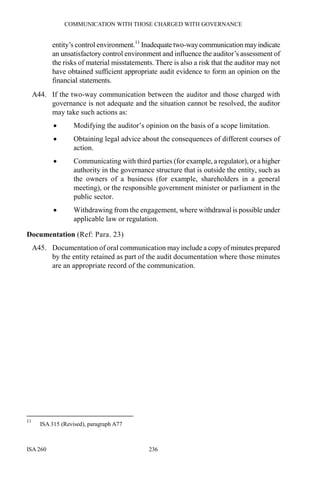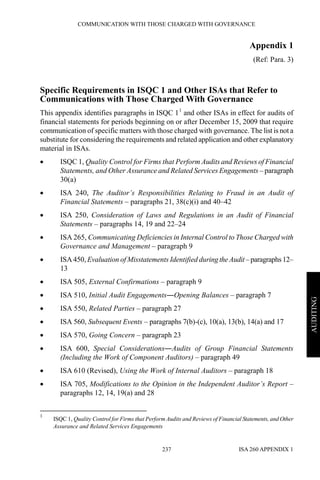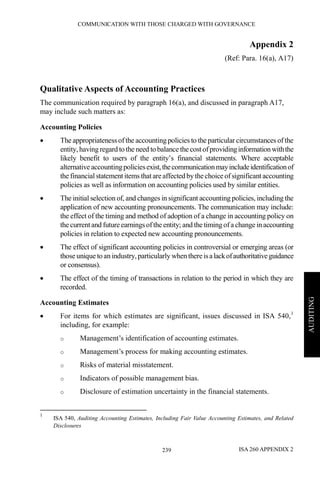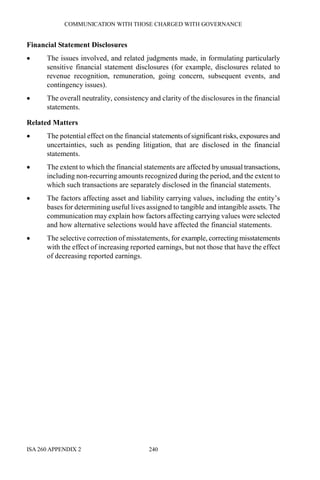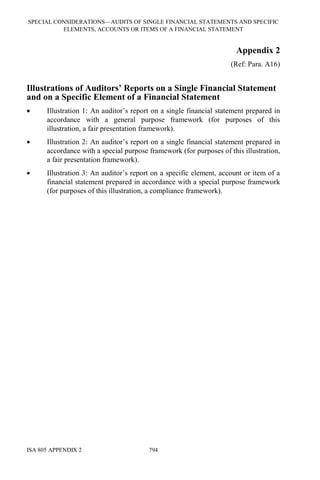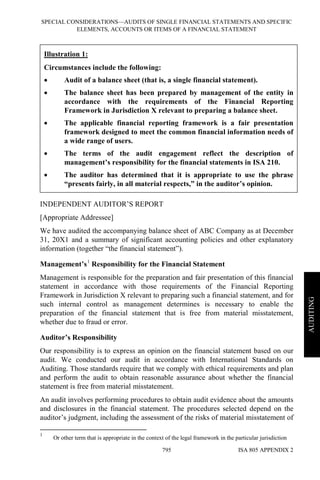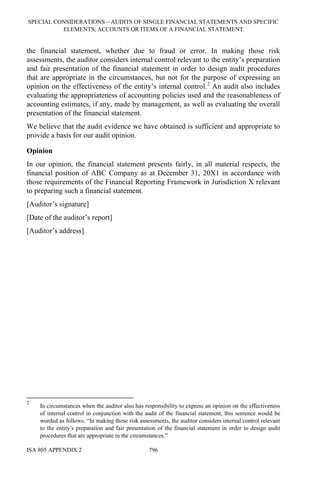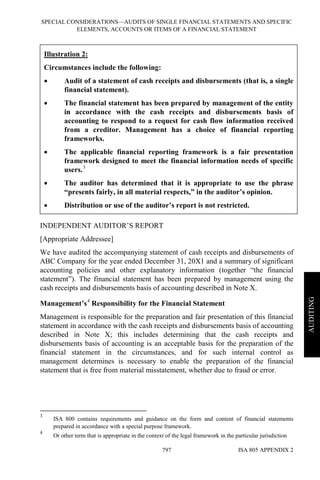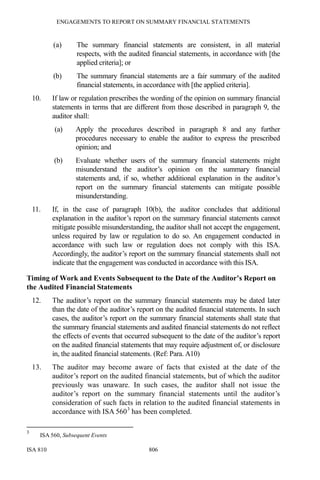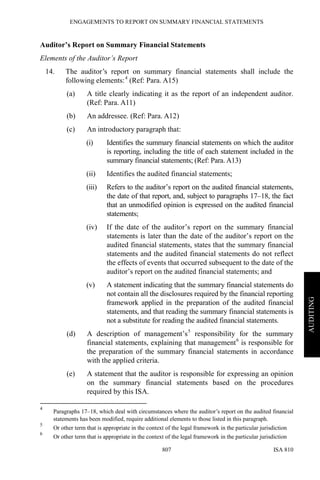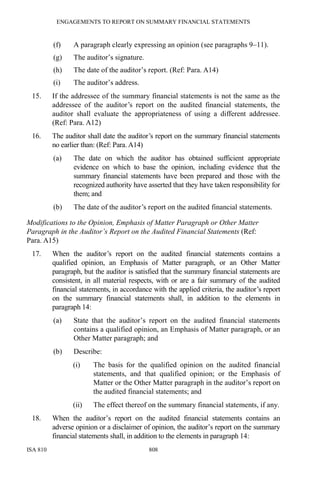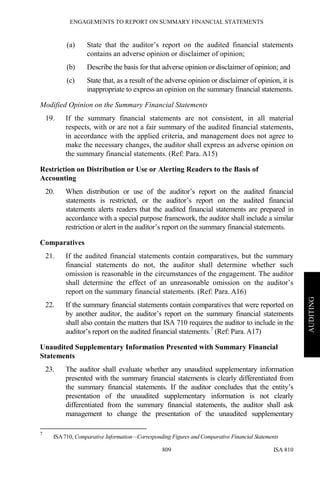


International Auditing and
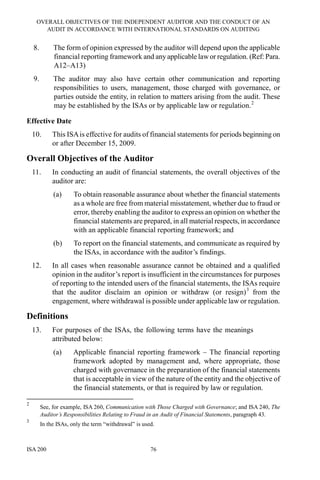
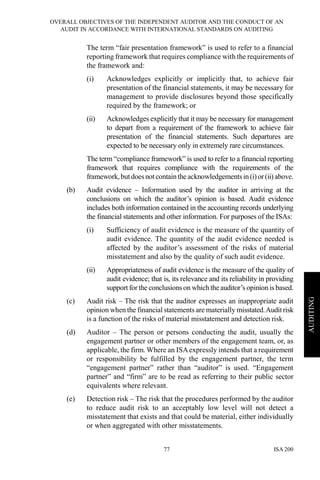
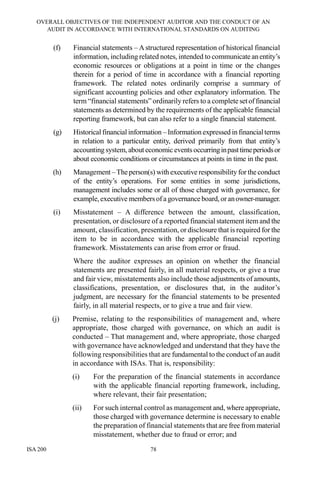
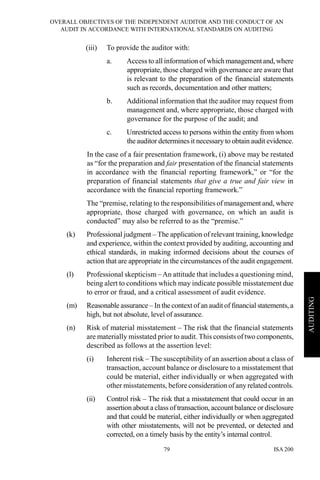
Assurance Standards Board
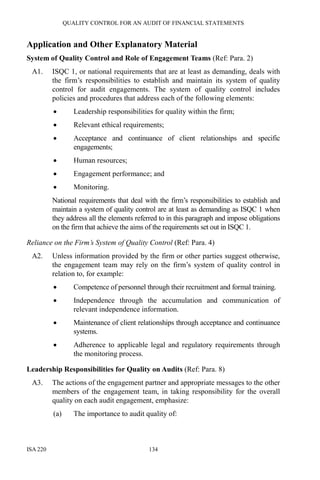
Handbook of International
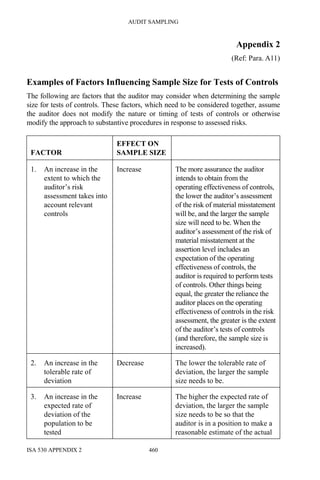
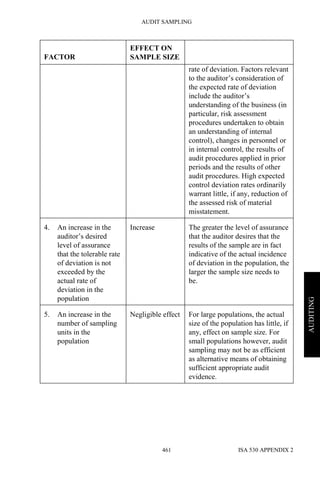
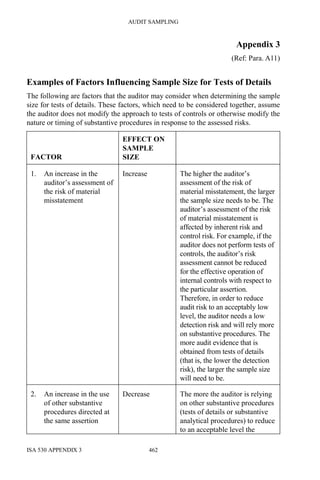
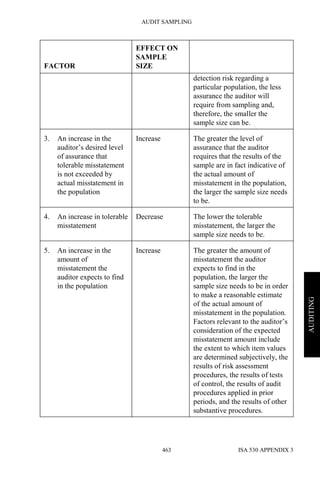
Quality Control, Auditing,
Review, Other Assurance,
and Related Services
Pronouncements
2013 Edition
Volume I
International Federation of Accountants®
529 Fifth Avenue, 6th Floor
New York, New York 10017 USA
This publication was published by the International Federation of Accountants (IFAC). Its mission is to
serve the public interest, strengthen the worldwide accountancy profession and contribute to the
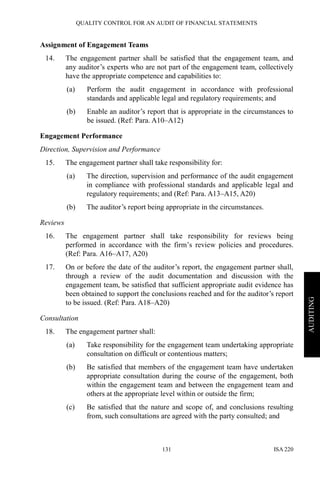
development of strong international economies by establishing and promoting adherence to high
quality professional standards, furthering the international convergence of such standards and
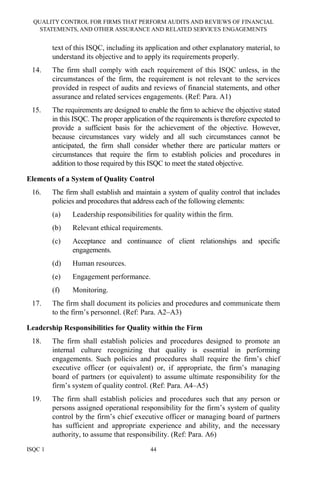
speaking out on public interest issues where the profession’s expertise is most relevant. This
publication may be downloaded free of charge for personal use only from the IAASB™
website
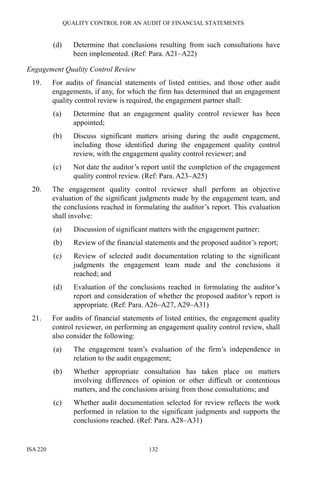
www.iaasb.org.
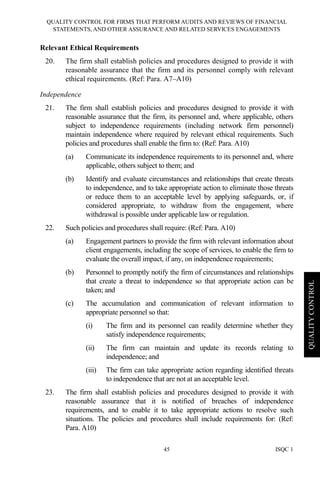
International Standards on Auditing, International Standards on Assurance Engagements, International
Standards on Review Engagements, International Standards on Related Services, International
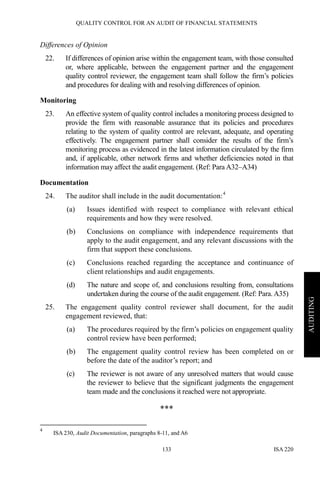
Standards on Quality Control, International Auditing Practice Notes, Exposure Drafts, Consultation
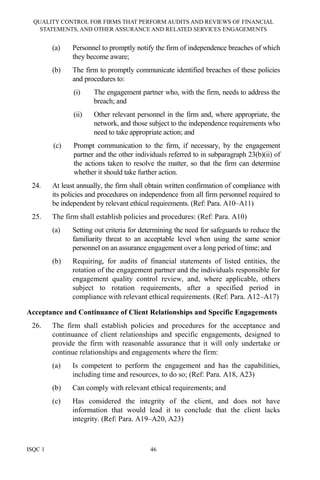
Papers, and other IAASB publications are published by, and copyright of, IFAC.
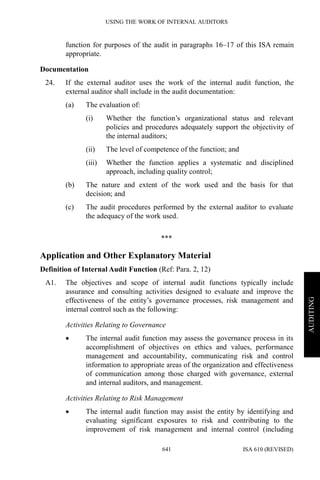
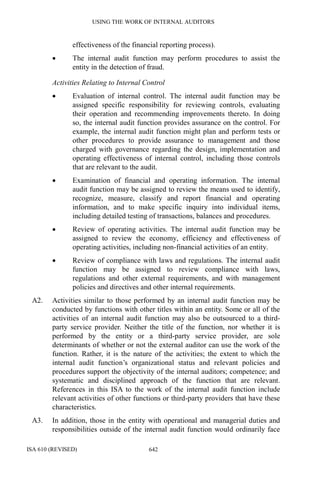
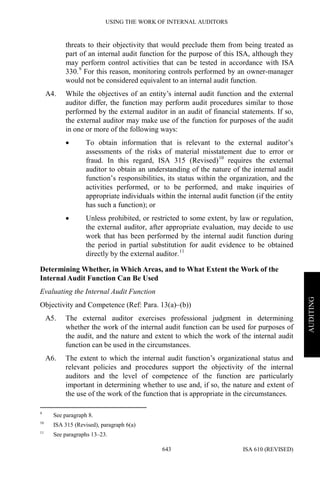
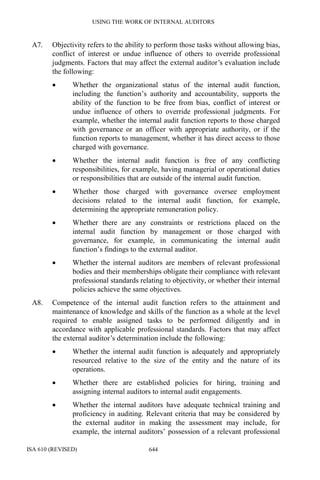
The IAASB and IFAC do not accept responsibility for loss caused to any person who acts or refrains
from acting in reliance on the material in this publication, whether such loss is caused by negligence or
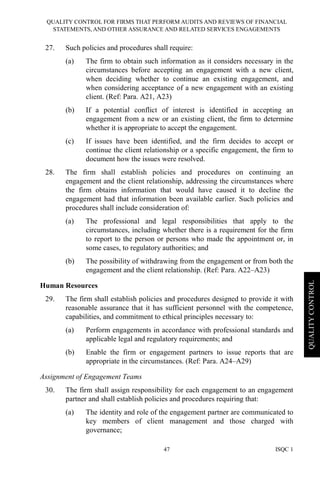
otherwise.
The IAASB logo, ‘International Auditing and Assurance Standards Board’, ‘IAASB’, ‘International
Standard on Auditing’, ‘ISA’, ‘International Standard on Assurance Engagements’, ‘ISAE’, ‘International
Standards on Review Engagements’, ‘ISRE’, ‘International Standards on Related Services’, ‘ISRS’,
‘International Standards on Quality Control’, ‘ISQC’, ‘International Auditing Practice Note’, ‘IAPN’, the
IFAC logo, ‘International Federation of Accountants’, and ‘IFAC’ are trademarks and service marks of
IFAC.
Copyright © September 2013 by the International Federation of Accountants (IFAC). All rights
reserved. Written permission from IFAC is required to reproduce, store or transmit, or to make other
similar uses of, this document, except as permitted by law. Contact permissions@ifac.org.
ISBN: 978-1-60815-152-3
Published by:
CONTENTS PART I
INTERNATIONALSTANDARDSONAUDITINGANDQUALITYCONTROLPARTI
HANDBOOK OF INTERNATIONAL
QUALITY CONTROL, AUDITING, REVIEW, OTHER
ASSURANCE, AND RELATED SERVICES
PRONOUNCEMENTS
PART I
CONTENTS
Page
Changes of Substance from the 2012 Edition of the Handbook and Recent
Developments ............................................................................................. 1–2
The International Federation of Accountants’ Role ........................................... 4
Structure of Pronouncements Issued by the International Auditing and
Assurance Standards Board ........................................................................ 5
Preface to the International Quality Control, Auditing, Review, Other
Assurance, and Related Services Pronouncements ..................................... 6–10
Glossary of Terms .............................................................................................. 11–37
INTERNATIONAL STANDARDS ON QUALITY CONTROL (ISQCs)
International Standard on Quality Control (ISQC) 1, Quality Control for
Firms that Perform Audits and Reviews of Financial Statements,
and Other Assurance and Related Services Engagements .......................... 38–72
AUDITS OF HISTORICAL FINANCIAL INFORMATION
200–299 GENERAL PRINCIPLES AND RESPONSIBILITIES
ISA 200, Overall Objectives of the Independent Auditor and the Conduct
of an Audit in Accordance with International Standards on Auditing .... 73–101
ISA 210, Agreeing the Terms of Audit Engagements ................................... 102–124
ISA 220, Quality Control for an Audit of Financial Statements .................... 125–143
ISA 230, Audit Documentation ..................................................................... 144–156
ISA 240, The Auditor’s Responsibilities Relating to Fraud in an Audit
of Financial Statements ........................................................................... 157–200
ISA 250, Consideration of Laws and Regulations in an Audit of
Financial Statements ............................................................................... 201–215
ISA 260, Communication with Those Charged with Governance ................. 216–240
ISA 265, Communicating Deficiencies in Internal Control to Those
Charged with Governance and Management .......................................... 241–252
HANDBOOK OF INTERNATIONAL QUALITY CONTROL, AUDITING, REVIEW,
OTHER ASSURANCE, AND RELATED SERVICES PRONOUNCEMENTS
PART I
CONTENTS PART I
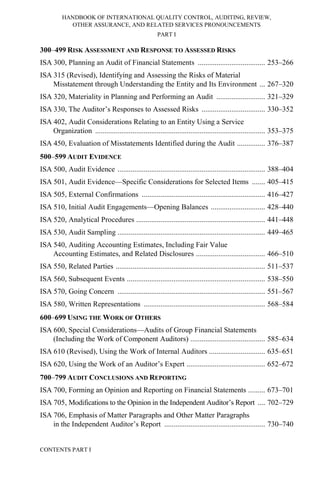
300–499 RISK ASSESSMENT AND RESPONSE TO ASSESSED RISKS
ISA 300, Planning an Audit of Financial Statements .................................... 253–266
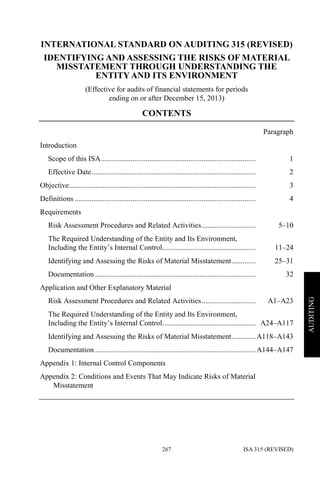
ISA 315 (Revised), Identifying and Assessing the Risks of Material
Misstatement through Understanding the Entity and Its Environment ... 267–320
ISA 320, Materiality in Planning and Performing an Audit .......................... 321–329
ISA 330, The Auditor’s Responses to Assessed Risks .................................. 330–352
ISA 402, Audit Considerations Relating to an Entity Using a Service
Organization ........................................................................................... 353–375
ISA 450, Evaluation of Misstatements Identified during the Audit ............... 376–387
500–599 AUDIT EVIDENCE
ISA 500, Audit Evidence ............................................................................... 388–404
ISA 501, Audit Evidence—Specific Considerations for Selected Items ....... 405–415
ISA 505, External Confirmations .................................................................. 416–427
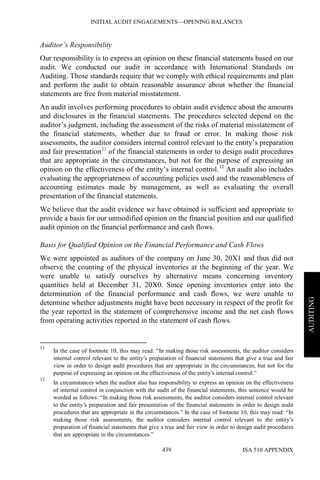
ISA 510, Initial Audit Engagements—Opening Balances ............................. 428–440
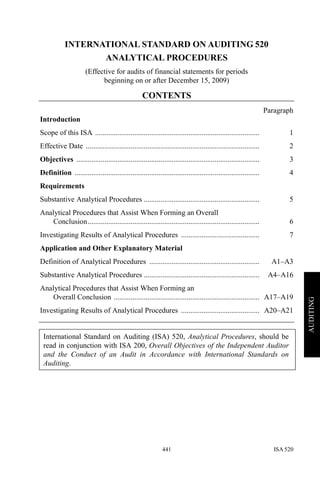
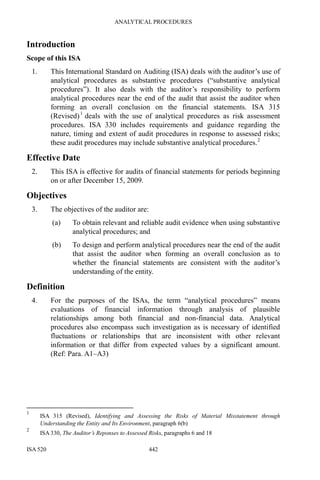
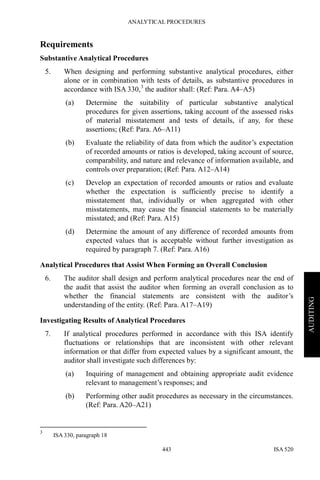
ISA 520, Analytical Procedures ..................................................................... 441–448
ISA 530, Audit Sampling ............................................................................... 449–465
ISA 540, Auditing Accounting Estimates, Including Fair Value
Accounting Estimates, and Related Disclosures ..................................... 466–510
ISA 550, Related Parties ................................................................................ 511–537
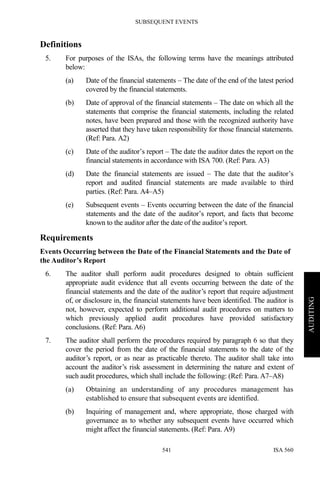
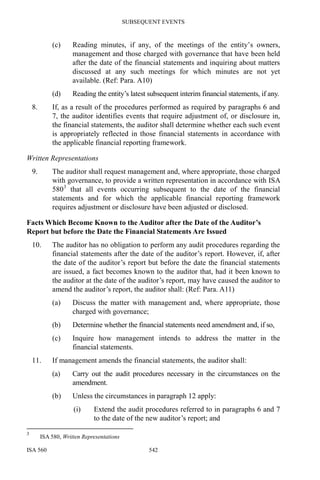
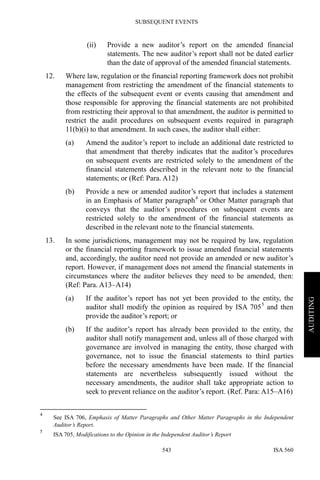
ISA 560, Subsequent Events .......................................................................... 538–550
ISA 570, Going Concern ............................................................................... 551–567
ISA 580, Written Representations ................................................................. 568–584
600–699 USING THE WORK OF OTHERS
ISA 600, Special Considerations—Audits of Group Financial Statements
(Including the Work of Component Auditors) ........................................ 585–634
ISA 610 (Revised), Using the Work of Internal Auditors .............................. 635–651
ISA 620, Using the Work of an Auditor’s Expert .......................................... 652–672
700–799 AUDIT CONCLUSIONS AND REPORTING
ISA 700, Forming an Opinion and Reporting on Financial Statements ......... 673–701
ISA 705, Modifications to the Opinion in the Independent Auditor’s Report .... 702–729
ISA 706, Emphasis of Matter Paragraphs and Other Matter Paragraphs
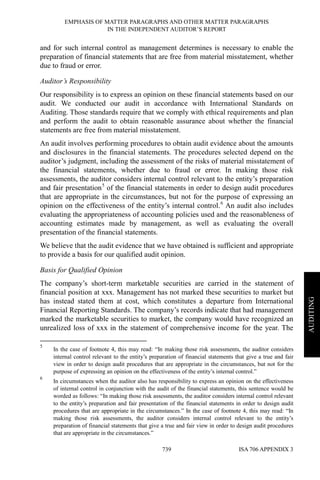
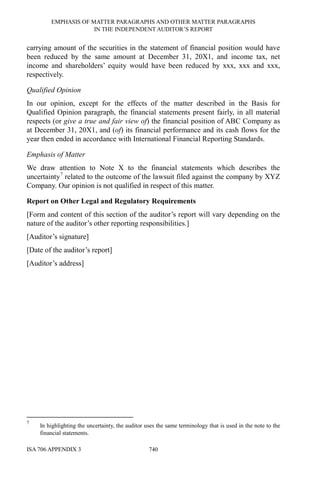
in the Independent Auditor’s Report ...................................................... 730–740
HANDBOOK OF INTERNATIONAL QUALITY CONTROL, AUDITING, REVIEW,
OTHER ASSURANCE, AND RELATED SERVICES PRONOUNCEMENTS
PART I
CONTENTS PART I
INTERNATIONALSTANDARDSONAUDITINGANDQUALITYCONTROLPARTI
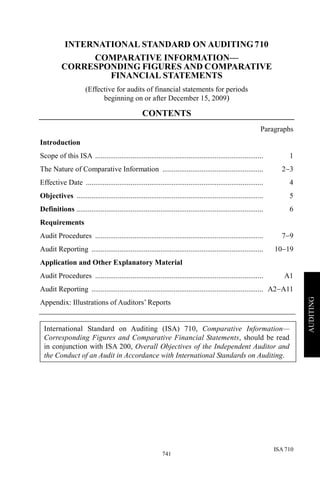
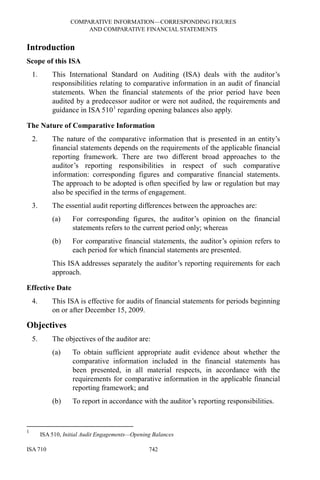
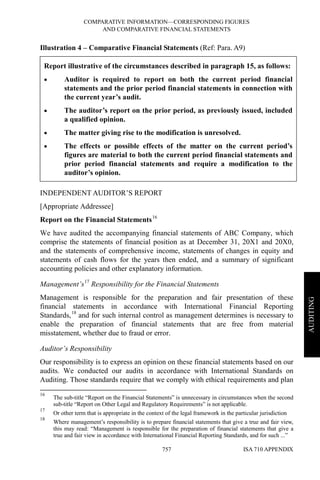
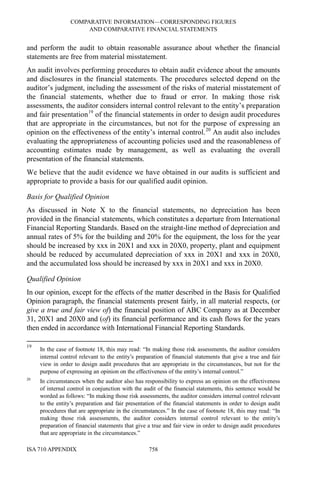
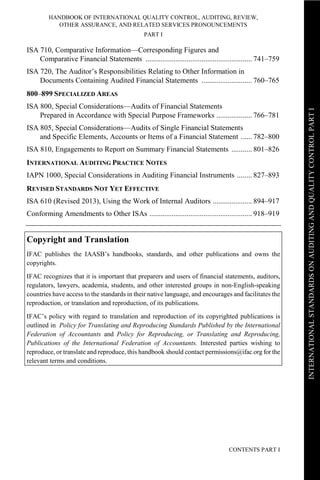
ISA 710, Comparative Information—Corresponding Figures and
Comparative Financial Statements ......................................................... 741–759
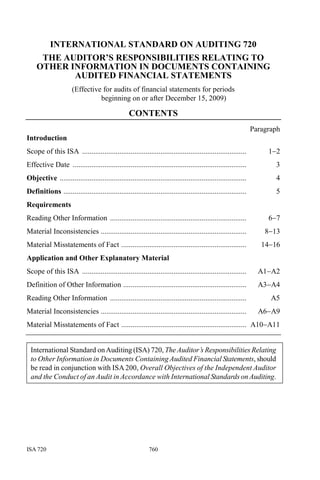
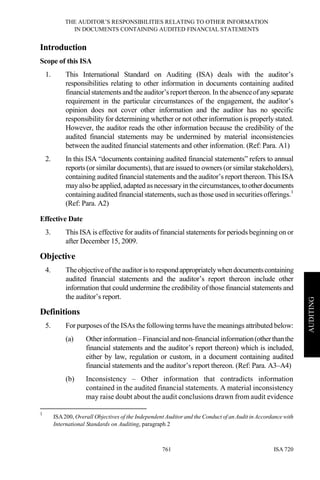
ISA 720, The Auditor’s Responsibilities Relating to Other Information in
Documents Containing Audited Financial Statements ........................... 760–765
800–899 SPECIALIZED AREAS
ISA 800, Special Considerations—Audits of Financial Statements
Prepared in Accordance with Special Purpose Frameworks ................... 766–781
ISA 805, Special Considerations—Audits of Single Financial Statements
and Specific Elements, Accounts or Items of a Financial Statement ...... 782–800
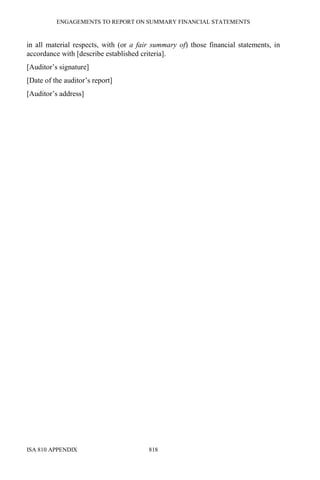
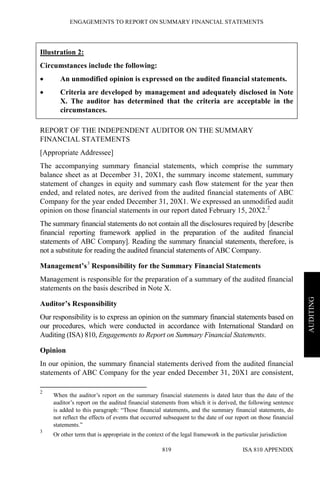
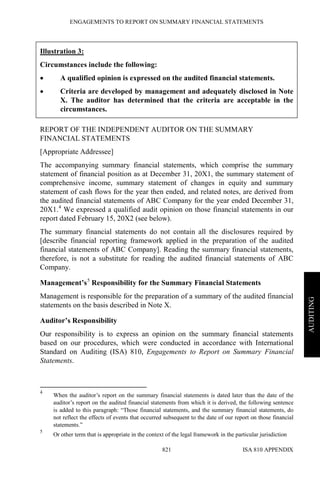
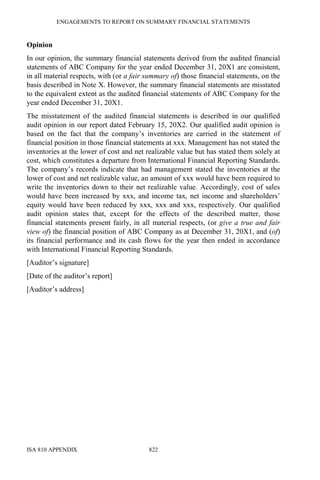
ISA 810, Engagements to Report on Summary Financial Statements ........... 801–826
INTERNATIONAL AUDITING PRACTICE NOTES
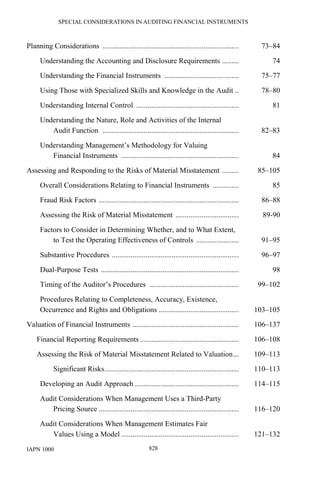
IAPN 1000, Special Considerations in Auditing Financial Instruments ........ 827–893
REVISED STANDARDS NOT YET EFFECTIVE
ISA 610 (Revised 2013), Using the Work of Internal Auditors ..................... 894–917
Conforming Amendments to Other ISAs ....................................................... 918–919
Copyright and Translation
IFAC publishes the IAASB’s handbooks, standards, and other publications and owns the
copyrights.
IFAC recognizes that it is important that preparers and users of financial statements, auditors,
regulators, lawyers, academia, students, and other interested groups in non-English-speaking
countries have access to the standards in their native language, and encourages and facilitates the
reproduction, or translation and reproduction, of its publications.
IFAC’s policy with regard to translation and reproduction of its copyrighted publications is
outlined in Policy for Translating and Reproducing Standards Published by the International
Federation of Accountants and Policy for Reproducing, or Translating and Reproducing,
Publications of the International Federation of Accountants. Interested parties wishing to
reproduce, or translate and reproduce, this handbook should contact permissions@ifac.org for the
relevant terms and conditions.
THIS PAGE INTENTIONALLY LEFT BLANK
CHANGES1
CHANGES
CHANGES OF SUBSTANCE FROM THE 2012 EDITION OF
THE HANDBOOK AND RECENT DEVELOPMENTS
References
This handbook contains references to International Accounting Standards (IASs) and
International Financial Reporting Standards (IFRSs). Unless otherwise indicated,
references to IASs and IFRSs are to the IASs and IFRSs in effect at the date of
preparing a pronouncement. Accordingly, readers are cautioned that, where a revised
IAS or IFRS has been issued subsequently, reference should be made to the most
recent IAS or IFRS.
References to “country” in this handbook should be read as “country or jurisdiction.”
Pronouncements Issued by the International Auditing and
Assurance Standards Board
This handbook contains the complete set of International Auditing and Assurance
Standards Board’s (IAASB) standards on quality control, auditing, review, other
assurance and related services, as well as the non-authoritative International Auditing
Practice Notes (IAPNs). It also includes a preface to the IAASB’s pronouncements,
and a glossary of terms. This handbook replaces the 2012 edition of the Handbook.
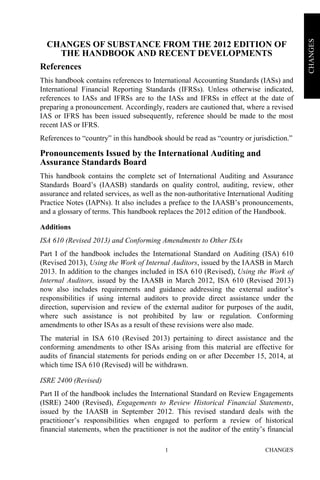
Additions
ISA 610 (Revised 2013) and Conforming Amendments to Other ISAs
Part I of the handbook includes the International Standard on Auditing (ISA) 610
(Revised 2013), Using the Work of Internal Auditors, issued by the IAASB in March
2013. In addition to the changes included in ISA 610 (Revised), Using the Work of
Internal Auditors, issued by the IAASB in March 2012, ISA 610 (Revised 2013)
now also includes requirements and guidance addressing the external auditor’s
responsibilities if using internal auditors to provide direct assistance under the
direction, supervision and review of the external auditor for purposes of the audit,
where such assistance is not prohibited by law or regulation. Conforming
amendments to other ISAs as a result of these revisions were also made.
The material in ISA 610 (Revised 2013) pertaining to direct assistance and the
conforming amendments to other ISAs arising from this material are effective for
audits of financial statements for periods ending on or after December 15, 2014, at
which time ISA 610 (Revised) will be withdrawn.
ISRE 2400 (Revised)
Part II of the handbook includes the International Standard on Review Engagements
(ISRE) 2400 (Revised), Engagements to Review Historical Financial Statements,
issued by the IAASB in September 2012. This revised standard deals with the
practitioner’s responsibilities when engaged to perform a review of historical
financial statements, when the practitioner is not the auditor of the entity’s financial
CHANGES OF SUBSTANCE FROM THE 2012 EDITION OF
THE HANDBOOK AND RECENT DEVELOPMENTS
CHANGES 2
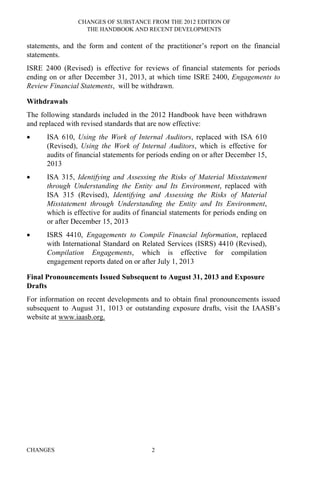
statements, and the form and content of the practitioner’s report on the financial
statements.
ISRE 2400 (Revised) is effective for reviews of financial statements for periods
ending on or after December 31, 2013, at which time ISRE 2400, Engagements to
Review Financial Statements, will be withdrawn.
Withdrawals
The following standards included in the 2012 Handbook have been withdrawn
and replaced with revised standards that are now effective:
• ISA 610, Using the Work of Internal Auditors, replaced with ISA 610
(Revised), Using the Work of Internal Auditors, which is effective for
audits of financial statements for periods ending on or after December 15,
2013
• ISA 315, Identifying and Assessing the Risks of Material Misstatement
through Understanding the Entity and Its Environment, replaced with
ISA 315 (Revised), Identifying and Assessing the Risks of Material
Misstatement through Understanding the Entity and Its Environment,
which is effective for audits of financial statements for periods ending on
or after December 15, 2013
• ISRS 4410, Engagements to Compile Financial Information, replaced
with International Standard on Related Services (ISRS) 4410 (Revised),
Compilation Engagements, which is effective for compilation
engagement reports dated on or after July 1, 2013
Final Pronouncements Issued Subsequent to August 31, 2013 and Exposure
Drafts
For information on recent developments and to obtain final pronouncements issued
subsequent to August 31, 1013 or outstanding exposure drafts, visit the IAASB’s
website at www.iaasb.org.
THIS PAGE INTENTIONALLY LEFT BLANK
IFAC BACKGROUND 4
THE INTERNATIONAL FEDERATION OF
ACCOUNTANTS’ ROLE
The International Federation of Accountants (IFAC) serves the public interest by contributing
to the development of strong and sustainable organizations, markets, and economies. It
advocates for transparency, accountability, and comparability of financial reporting; helps
develop the accountancy profession; and communicates the importance and value of
accountants to the global financial infrastructure. Founded in 1977, IFAC is currently
comprised of 172 members and associates in 129 countries and jurisdictions, representing
approximately 2.5 million accountants in public practice, education, government service,
industry, and commerce.
As part of its public interest mandate, IFAC contributes to the development, adoption, and
implementation of high-quality international auditing and assurance standards, primarily
through its support of the International Auditing and Assurance Standards Board (IAASB).
IFAC provides human resources, facilities management, communications support, and funding
to this independent standard-setting board, and facilitates the nominations and selection
process for board members.
The IAASB sets its own agendas and approves its publications in accordance with its due
process and without IFAC’s involvement. IFAC has no ability to influence the agendas or
publications. IFAC publishes the handbooks, standards, and other publications and owns the
copyrights.
The IAASB’s independence is safeguarded in a number of ways:
• formal, independent public interest oversight for standard setting by the Public Interest
Oversight Board (see www.ipiob.org for more information), which includes a rigorous
due process involving public consultation
• a public call for nominations, and formal, independent oversight of the
nominations/selection process by the Public Interest Oversight Board
• full transparency, both in terms of due process for standard setting, as well as public
access to agenda materials, meetings, and a published basis for conclusions with each
final standard
• the involvement of a Consultative Advisory Group and observers in the standard-
setting process, and
• the requirement that IAASB members, as well as nominating/employing organizations,
commit to the board’s independence, integrity, and public interest mission.
Visit the IFAC website at www.ifac.org for further information.
STRUCTURE5
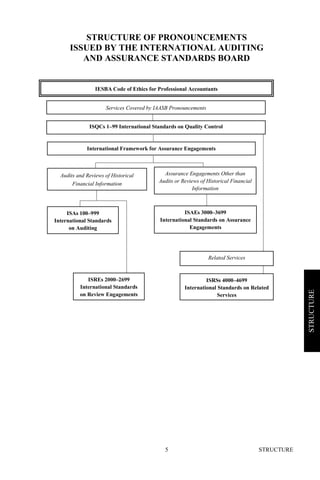
STRUCTURE
IESBA Code of Ethics for Professional Accountants
Assurance Engagements Other than
Audits or Reviews of Historical Financial
Information
ISQCs 1–99 International Standards on Quality Control
Audits and Reviews of Historical
Financial Information
International Framework for Assurance Engagements
ISAs 100–999
International Standards
on Auditing
ISAEs 3000–3699
International Standards on Assurance
Engagements
ISREs 2000–2699
International Standards
on Review Engagements
ISRSs 4000–4699
International Standards on Related
Services
Related Services
Services Covered by IAASB Pronouncements
STRUCTURE OF PRONOUNCEMENTS
ISSUED BY THE INTERNATIONAL AUDITING
AND ASSURANCE STANDARDS BOARD
PREFACE 6
PREFACE TO THE INTERNATIONAL QUALITY CONTROL,
AUDITING, REVIEW, OTHER ASSURANCE, AND RELATED
SERVICES PRONOUNCEMENTS
(Effective as of December 15, 2011)
CONTENTS
Paragraph
Introduction .................................................................................................... 1–2
The IAASB’s Pronouncements .................................................................... 3–4
IAASB Authoritative Pronouncements ............................................................ 3–4
The Authority Attaching to International Standards Issued by the
International Auditing and Assurance Standards Board .................... 5–17
International Standards on Auditing ................................................................ 11
International Standards on Quality Control ...................................................... 12
Other International Standards ........................................................................... 13–16
Professional Judgment ...................................................................................... 17
Applicability of the International Standards ..................................................... 18–19
Non-Authoritative Material .......................................................................... 20–22
International Auditing Practice Notes .............................................................. 21–22
Practice Notes Relating to Other International Standards ................................ 23
Staff Publications ............................................................................................. 24
Language ......................................................................................................... 25
PREFACE TO THE INTERNATIONAL QUALITY CONTROL, AUDITING, REVIEW, OTHER
ASSURANCE, AND RELATED SERVICES PRONOUNCEMENTS
PREFACE7
PREFACE
Introduction
1. This preface to the International Quality Control, Auditing, Review, Other
Assurance, and Related Services Pronouncements is issued to facilitate
understanding of the scope and authority of the pronouncements the
International Auditing and Assurance Standards Board (IAASB) issues, as set
forth in the IAASB’s Terms of Reference.
2. The IAASB is committed to the goal of developing a set of International
Standards and other pronouncements which are generally accepted worldwide.
IAASB members act in the common interest of the public at large and the
worldwide accountancy profession. This could result in their taking a position
on a matter that is not in accordance with current practice in their country or
firm or not in accordance with the position taken by those who put them
forward for membership of the IAASB.
The IAASB’s Pronouncements
IAASB Authoritative Pronouncements
3. The IAASB’s pronouncements govern audit, review, other assurance, and
related services engagements that are conducted in accordance with
International Standards. They do not override the local laws or regulations that
govern the audit of historical financial statements or assurance engagements on
other information in a particular country required to be followed in accordance
with that country’s national standards. In the event that local laws or regulations
differ from, or conflict with, the IAASB’s Standards on a particular subject, an
engagement conducted in accordance with local laws or regulations will not
automatically comply with the IAASB’s Standards. Aprofessional accountant
should not represent compliance with the IAASB’s Standards unless the
professional accountant has complied fully with all standards relevant to the
engagement.
4. The authoritative pronouncements of the IAASB are the International
Standards, which are issued following the IAASB’s stated due process.
The Authority Attaching to International Standards Issued by the
International Auditing and Assurance Standards Board
5. International Standards on Auditing (ISAs) are to be applied in the audit of
historical financial information.
6. International Standards on Review Engagements (ISREs) are to be applied in
the review of historical financial information.
7. International Standards onAssurance Engagements (ISAEs) are to be applied in
assurance engagements other than audits or reviews of historical financial
information.
PREFACE TO THE INTERNATIONAL QUALITY CONTROL, AUDITING, REVIEW, OTHER
ASSURANCE, AND RELATED SERVICES PRONOUNCEMENTS
PREFACE 8
8. International Standards on Related Services (ISRSs) are to be applied to
compilation engagements, engagements to apply agreed upon procedures to
information and other related services engagements as specified by the IAASB.
9. ISAs, ISREs, ISAEs and ISRSs are collectively referred to as the IAASB’s
Engagement Standards.
10. International Standards on Quality Control (ISQCs) are to be applied for all
services falling under the IAASB’s Engagement Standards.
International Standards on Auditing
11. ISAs are written in the context of an audit of financial statements1
by an
independent auditor. They are to be adapted as necessary in the circumstances
when applied to audits of other historical financial information. The authority
of ISAs is set out in ISA 200.2
International Standards on Quality Control
12. ISQCs are written to apply to firms in respect of all their services falling under
the IAASB’s Engagement Standards. The authority of ISQCs is set out in the
introduction to the ISQCs.
Other International Standards
13. Some International Standards identified in paragraphs 6–8 contain: objectives,
requirements, application and other explanatory material, introductory material
and definitions. These terms are to be interpreted in a directly analogous way to
how they are explained in the context of ISAs and financial statement audits in
ISA 200.
14. Other International Standards identified in paragraphs 6–8 contain basic
principles and essential procedures (identified in bold type lettering and by the
word “should”) together with related guidance in the form of explanatory and
other material, including appendices. The basic principles and essential
procedures are to be understood and applied in the context of the explanatory
and other material that provides guidance for their application. It is therefore
necessary to consider the entire text of a Standard to understand and apply the
basic principles and essential procedures.
15. The basic principles and essential procedures of a Standard are to be applied in
all cases where they are relevant in the circumstances of the engagement. In
exceptional circumstances, however, a professional accountant may judge it
1
Unless otherwise stated, “financial statements” mean financial statements comprising historical financial
information.
2
ISA 200, Overall Objectives of the Independent Auditor and the Conduct of an Audit in Accordance with
International Standards on Auditing
PREFACE TO THE INTERNATIONAL QUALITY CONTROL, AUDITING, REVIEW, OTHER
ASSURANCE, AND RELATED SERVICES PRONOUNCEMENTS
PREFACE9
PREFACE
necessary to depart from a relevant essential procedure in order to achieve the
purpose of that procedure. When such a situation arises, the professional
accountant is required to document how alternative procedures performed
achieve the purpose of the procedure and, unless otherwise clear, the reasons
for the departure. The need for the professional accountant to depart from a
relevant essential procedure is expected to arise only where, in the specific
circumstances of the engagement, that procedure would be ineffective.
16. Appendices, which form part of the application material, are an integral part of
a Standard. The purpose and intended use of an appendix are explained in the
body of the related Standard or within the title and introduction of the appendix
itself.
Professional Judgment
17. The nature of the International Standards requires the professional accountant
to exercise professional judgment in applying them.
Applicability of the International Standards
18. The scope, effective date and any specific limitation of the applicability of a
specific International Standard is made clear in the Standard. Unless otherwise
stated in the International Standard, the professional accountant is permitted to
apply an International Standard before the effective date specified therein.
19. International Standards are relevant to engagements in the public sector. When
appropriate, additional considerations specific to public sector entities are
included:
(a) Within the body of an International Standard in the case of ISAs and
ISQCs; or
(b) In a Public Sector Perspective (PSP) appearing at the end of other
International Standards.
Non-Authoritative Material
20. Non-authoritative material includes Practice Notes issued by the IAASB and
staff publications. Non-authoritative material is not part of the IAASB’s
International Standards.
PREFACE TO THE INTERNATIONAL QUALITY CONTROL, AUDITING, REVIEW, OTHER
ASSURANCE, AND RELATED SERVICES PRONOUNCEMENTS
PREFACE 10
International Auditing Practice Notes
21. International Auditing Practice Notes (IAPNs) do not impose additional
requirements on auditors beyond those included in the ISAs, nor do they
change the auditor’s responsibility to comply with all ISAs relevant to the
audit. IAPNs provide practical assistance to auditors. They are intended to be
disseminated by those responsible for national standards, or used in developing
corresponding national material. They also provide material that firms can use
in developing their training programs and internal guidance.
22. Depending on the nature of the topic(s) covered, an IAPN may assist the
auditor in:
• Obtaining an understanding of the circumstances of the entity, and in
making judgments about the identification and assessment of risks of
material misstatement;
• Making judgments about how to respond to assessed risks, including
judgments about procedures that may be appropriate in the
circumstances; or
• Addressing reporting considerations, including forming an opinion on
the financial statements and communicating with those charged with
governance.
Practice Notes Relating to Other International Standards
23. The IAASB may also issue International Review Engagement Practice Notes
(IREPNs), InternationalAssurance Engagement Practice Notes (IAEPNs), and
International Related Services Practice Notes (IRSPNs) to serve the same
purpose for ISREs, ISAEs, and ISRSs respectively.
Staff Publications
24. Staff publications are used to help raise practitioners’awareness of significant
new or emerging issues by referring to existing requirements and application
material, or to direct their attention to relevant provisions of IAASB
pronouncements.
Language
25. The sole official text of an IAASB International Standard, Practice Note,
exposure draft or other publication is that published by the IAASB in the
English language.
GLOSSARY11
GLOSSARY
GLOSSARY OF TERMS1
(August 2013)
Access controls—Procedures designed to restrict access to on-line terminal devices,
programs and data. Access controls consist of “user authentication” and “user
authorization.” “User authentication” typically attempts to identify a user through
unique logon identifications, passwords, access cards or biometric data. “User
authorization” consists of access rules to determine the computer resources each user
may access. Specifically, such procedures are designed to prevent or detect:
• Unauthorized access to on-line terminal devices, programs and data;
• Entry of unauthorized transactions;
• Unauthorized changes to data files;
• The use of computer programs by unauthorized personnel; and
• The use of computer programs that have not been authorized.
*Accounting estimate—An approximation of a monetary amount in the absence of a
precise means of measurement. This term is used for an amount measured at fair value
where there is estimation uncertainty, as well as for other amounts that require
estimation. Where ISA 5402
addresses only accounting estimates involving
measurement at fair value, the term “fair value accounting estimates” is used.
*Accounting records—The records of initial accounting entries and supporting records,
such as checks and records of electronic fund transfers; invoices; contracts; the general
and subsidiary ledgers, journal entries and other adjustments to the financial statements
that are not reflected in formal journal entries; and records such as work sheets and
spreadsheets supporting cost allocations, computations, reconciliations and disclosures.
Agreed-upon procedures engagement—An engagement in which an auditor is engaged
to carry out those procedures of an audit nature to which the auditor and the entity and
any appropriate third parties have agreed and to report on factual findings. The
recipients of the report form their own conclusions from the report by the auditor. The
report is restricted to those parties that have agreed to the procedures to be performed
since others, unaware of the reasons for the procedures may misinterpret the results.
*
Denotes a term defined in the ISAs
†
Denotes a term defined in ISQC 1
1
In the case of public sector engagements, the terms in this glossary should be read as referring to their
public sector equivalents.
Where accounting terms have not been defined in the pronouncements of the InternationalAuditing and
Assurance Standards Board, reference should be made to the Glossary of Terms published by the
International Accounting Standards Board.
2
ISA 540, Auditing Accounting Estimates, Including Fair Value Accounting Estimates, and Related
Disclosures
GLOSSARY OF TERMS
GLOSSARY 12
*Analytical procedures—Evaluations of financial information through analysis of
plausible relationships among both financial and non-financial data. Analytical
procedures also encompass such investigation as is necessary of identified fluctuations
or relationships that are inconsistent with other relevant information or that differ from
expected values by a significant amount.
Annual report—A document issued by an entity, ordinarily on an annual basis, which
includes its financial statements together with the auditor’s report thereon.
*Anomaly—A misstatement or deviation that is demonstrably not representative of
misstatements or deviations in a population.
Applicable criteria (in the context of ISAE 34103
)—The criteria used by the entity to
quantify and report its emissions in the GHG statement.Applicable criteria (in the context
of ISAE 34204
)—The criteria used by the responsible party when compiling the pro
forma financial information. Criteria may be established by an authorized or recognized
standard-setting organization or by law or regulation. Where established criteria do not
exist, they will be developed by the responsible party.
*Applicable financial reporting framework—The financialreportingframeworkadoptedby
management and, whereappropriate, thosecharged withgovernanceinthepreparationofthe
financial statements that is acceptable in viewof the nature of the entity and the objective of
the financial statements, or thatisrequired by laworregulation.In the context ofISRS 4410
(Revised),5
reference is to the financial information, rather than to the financial statements.
The term “fair presentation framework” is used to refer to a financial reporting
framework that requires compliance with the requirements of the framework and:
(a) Acknowledges explicitly or implicitly that, to achieve fair presentation of the
financial statements, it may be necessary for management to provide disclosures
beyond those specifically required by the framework; or
(b) Acknowledges explicitly that it may be necessary for management to depart from
a requirement of the framework to achieve fair presentation of the financial
statements. Such departures are expected to be necessary only in extremely rare
circumstances.
The term “compliance framework” is used to refer to a financial reporting framework
that requires compliance with the requirements of the framework, but does not contain
the acknowledgements in (a) or (b) above.
Application controls in information technology— Manual or automated procedures that
typically operate at a business process level. Application controls can be preventative or
detective in nature and are designed to ensure the integrity of the accounting records.
3
ISAE 3410, Assurance Engagements on Greenhouse Gas Statements
4
ISAE 3420, Assurance Engagements to Report on the Compilation of Pro Forma Financial Information
Included in a Prospectus
5
ISRS 4410 (Revised), Compilation Engagements
GLOSSARY OF TERMS
GLOSSARY13
GLOSSARY
Accordingly, application controls relate to procedures used to initiate, record, process
and report transactions or other financial data.
*Applied criteria (in the context of ISA 8106
)—The criteria applied by management in
the preparation of the summary financial statements.
*Appropriateness (of audit evidence)—The measure of the quality of audit evidence;
that is, its relevance and its reliability in providing support for the conclusions on which
the auditor’s opinion is based.
*Arm’s length transaction—A transaction conducted on such terms and conditions as
between a willing buyer and a willing seller who are unrelated and are acting
independently of each other and pursuing their own best interests.
*Assertions—Representations by management, explicit or otherwise, that are embodied
in the financial statements, as used by the auditor to consider the different types of
potential misstatements that may occur. In the context of ISAE 3410, assertions are
defined as representations by the entity, explicit or otherwise, that are embodied in the
GHG statement, as used by the practitioner to consider the different types of potential
misstatements that may occur.
Assess—Analyze identified risks of material misstatement to conclude on their
significance. “Assess,” by convention, is used only in relation to risk. (also see
Evaluate)
Association—(see Auditor association with financial information)
*†Assurance—(see Reasonable assurance)
Assurance engagement—An engagement in which a practitioner expresses a conclusion
designed to enhance the degree of confidence of the intended users other than the
responsible party about the outcome of the evaluation or measurement of a subject
matter against criteria. The outcome of the evaluation or measurement of a subject
matter is the information that results from applying the criteria (also see Subject matter
information). Under the International Framework for Assurance Engagements there are
two types of assurance engagement a practitioner is permitted to perform: a reasonable
assurance engagement and a limited assurance engagement.
Reasonable assurance engagement—The objective of a reasonable assurance
engagement is a reduction in assurance engagement risk to an acceptably low level
in the circumstances of the engagement7
as the basis for a positive form of
expression of the practitioner’s conclusion.
6
ISA 810, Engagements to Report on Summary Financial Statements
7
Engagement circumstances include the terms of the engagement, including whether it is a reasonable
assurance engagement or a limited assurance engagement, the characteristics of the subject matter, the
criteria to be used, the needs of the intended users, relevant characteristics of the responsible party and
its environment, and other matters, for example events, transactions, conditions and practices, that may
have a significant effect on the engagement.
GLOSSARY OF TERMS
GLOSSARY 14
Limited assurance engagement—The objective of a limited assurance engagement
is a reduction in assurance engagement risk to a level that is acceptable in the
circumstances of the engagement, but where that risk is greater than for a
reasonable assurance engagement, as the basis for a negative form of expression of
the practitioner’s conclusion.
Assurance engagement risk—The risk that the practitioner expresses an inappropriate
conclusion when the subject matter information is materially misstated.
*Audit documentation—The record of audit procedures performed, relevant audit
evidence obtained, and conclusions the auditor reached (terms such as “working papers”
or “workpapers” are also sometimes used).
*Audit evidence—Information used by the auditor in arriving at the conclusions on
which the auditor’s opinion is based. Audit evidence includes both information
contained in the accounting records underlying the financial statements and other
information. (See Sufficiency of audit evidence and Appropriateness of audit evidence.)
*Audit file— One or more folders or other storage media, in physical or electronic form,
containing the records that comprise the audit documentation for a specific engagement.
*†Audit firm—(see Firm)
*Audit opinion—(see Modified opinion and Unmodified opinion)
*Audit risk—The risk that the auditor expresses an inappropriate audit opinion when the
financial statements are materially misstated. Audit risk is a function of the risks of
material misstatement and detection risk.
*Audit sampling (sampling)—The application of audit procedures to less than 100% of
items within a population of audit relevance such that all sampling units have a chance
of selection in order to provide the auditor with a reasonable basis on which to draw
conclusions about the entire population.
*Audited financial statements (in the context of ISA 810)—Financial statements8
audited
by the auditor in accordance with ISAs, and from which the summary financial
statements are derived.
*Auditor—“Auditor” is used to refer to the person or persons conducting the audit,
usually the engagement partner or other members of the engagement team, or, as
applicable, the firm. Where an ISA expressly intends that a requirement or responsibility
be fulfilled by the engagement partner, the term “engagement partner” rather than
“auditor” is used. “Engagement partner” and “firm” are to be read as referring to their
public sector equivalents where relevant.
8
ISA200, Overall Objectives of the Independent Auditor and the Conduct of an Audit in Accordance with
International Standards on Auditing, paragraph 13(f), defines the term “financial statements.”
GLOSSARY OF TERMS
GLOSSARY15
GLOSSARY
Auditor association with financial information—An auditor is associated with financial
information when the auditor attaches a report to that information or consents to the use
of the auditor’s name in a professional connection.
*Auditor’s expert—An individual or organization possessingexpertiseina field otherthan
accounting or auditing, whose work in that field is used by the auditor to assist the auditor
in obtaining sufficient appropriate audit evidence. An auditor’s expert may be either an
auditor’s internal expert (who is a partner9
or staff, including temporary staff, of the
auditor’s firm or a network firm), or an auditor’s external expert.
*Auditor’s point estimate or auditor’s range—The amount, or range of amounts,
respectively, derived fromaudit evidence for use inevaluatingmanagement’spointestimate.
*Auditor’s range—(see Auditor’s point estimate)
Base year—A specific year or an average over multiple years against which an entity’s
emissions are compared over time.
*Business risk—A risk resulting from significant conditions, events, circumstances,
actions or inactions that could adversely affect an entity’s ability to achieve its
objectives and execute its strategies, or from the setting of inappropriate objectives and
strategies.
Cap and trade—A system that sets overall emissions limits, allocates emissions
allowances to participants, and allows them to trade allowances and emission credits
with each other.
*Comparative financial statements—Comparative information where amounts and other
disclosures for the prior period are included for comparison with the financial
statements of the current period but, if audited, are referred to in the auditor’s opinion.
The level of information included in those comparative financial statements is
comparable with that of the financial statements of the current period.
*Comparative information—The amounts and disclosures included in the financial
statements in respect of one or more prior periods in accordance with the applicable
financial reporting framework. In the context of ISAE 3410, comparative information is
defined as the amounts and disclosures included in the GHG statement in respect of one
or more prior periods.
Compilation engagement— An engagement in which a practitioner applies accounting
and financial reporting expertise to assist management in the preparation and
presentation of financial information of an entity in accordance with an applicable
financial reporting framework, and reports as required by this ISRS. Throughout ISRS
4410 (Revised), the words “compile”, “compiling” and “compiled” are used in this
context.
9
“Partner” and “firm” should be read as referring to their public sector equivalents where relevant.
GLOSSARY OF TERMS
GLOSSARY 16
*Complementary user entity controls—Controls that the service organization assumes,
in the design of its service, will be implemented by user entities, and which, if necessary
to achieve control objectives, are identified in the description of its system.
*Compliance framework—(see Applicable financial reporting framework and General
purpose framework)
*Component—An entity or business activity for which group or component management
prepares financial information that should be included in the group financial statements.
*Component auditor—An auditor who, at the request of the group engagement team,
performs work on financial information related to a component for the group audit.
*Component management—Management responsible for the preparation of the financial
information of a component.
*Component materiality—The materiality for a component determined by the group
engagement team.
Computer-assisted audit techniques—Applications of auditing procedures using the
computer as an audit tool (also known as CAATs).
Control activities—Those policies and procedures that help ensure that management
directives are carried out. Control activities are a component of internal control.
Control environment—Includes the governance and management functions and the
attitudes, awareness and actions of those charged with governance and management
concerning the entity’s internal control and its importance in the entity. The control
environment is a component of internal control.
*Control risk—(see Risk of material misstatement)
Corporate governance—(see Governance)
*Corresponding figures—Comparative information where amounts and other
disclosures for the prior period are included as an integral part of the current period
financial statements, and are intended to be read only in relation to the amounts and
other disclosures relating to the current period (referred to as “current period figures”).
The level of detail presented in the corresponding amounts and disclosures is dictated
primarily by its relevance to the current period figures.
Criteria—The benchmarks used to evaluate or measure the subject matter including,
where relevant, benchmarks for presentation and disclosure. Criteria can be formal or
less formal. There can be different criteria for the same subject matter. Suitable criteria
are required for reasonably consistent evaluation or measurement of a subject matter
within the context of professional judgment.
Suitable criteria—Exhibit the following characteristics:
(a) Relevance: relevant criteria contribute to conclusions that assist decision-
making by the intended users.
GLOSSARY OF TERMS
GLOSSARY17
GLOSSARY
(b) Completeness: criteria are sufficiently complete when relevant factors that
could affect the conclusions in the context of the engagement circumstances
are not omitted. Complete criteria include, where relevant, benchmarks for
presentation and disclosure.
(c) Reliability: reliable criteria allow reasonably consistent evaluation or
measurement of the subject matter including, where relevant, presentation and
disclosure, when used in similar circumstances by similarly qualified
practitioners.
(d) Neutrality: neutral criteria contribute to conclusions that are free from bias.
(e) Understandability: understandable criteria contribute to conclusions that are
clear, comprehensive, and not subject to significantly different interpretations.
*Date of approval of the financial statements—The date on which all the statements that
comprise the financial statements, including the related notes, have been prepared and
those with the recognized authority have asserted that they have taken responsibility for
those financial statements.
†Date of report (in relation to quality control)—The date selected by the practitioner to
date the report.
*Date of the auditor’s report—The date the auditor dates the report on the financial
statements in accordance with ISA 700.10
*Date of the financial statements—The date of the end of the latest period covered by
the financial statements.
*Date the financial statements are issued—The date that the auditor’s report and
audited financial statements are made available to third parties.
*Deficiency in internal control—This exists when:
(a) Acontrol is designed, implemented or operated in such a way that it is unable to
prevent, or detect and correct, misstatements in the financial statements on a
timely basis; or
(b) A control necessary to prevent, or detect and correct, misstatements in the
financial statements on a timely basis is missing.
*Detection risk—The risk that the procedures performed by the auditor to reduce audit
risk to an acceptably low level will not detect a misstatement that exists and that could
be material, either individually or when aggregated with other misstatements.
*Element—(see Element of a financial statement)
*Element of a financial statement (in the context of ISA 80511
)—An element, account or
item of a financial statement.
10
ISA 700, Forming an Opinion and Reporting on Financial Statements
GLOSSARY OF TERMS
GLOSSARY 18
Emissions—The GHGs that, during the relevant period, have been emitted to the
atmosphere or would have been emitted to the atmosphere had they not been captured
and channeled to a sink. Emissions can be categorized as:
• Direct emissions (also known as Scope 1 emissions), which are emissions from
sources that are owned or controlled by the entity.
• Indirect emissions, which are emissions that are a consequence of the activities of
the entity, but which occur at sources that are owned or controlled by another
entity. Indirect emissions can be further categorized as:
○ Scope 2 emissions, which are emissions associated with energy that is
transferred to and consumed by the entity.
○ Scope 3 emissions, which are all other indirect emissions.
Emissions deduction—Any item included in the entity’s GHG statement that is deducted
from the total reported emissions, but which is not a removal; it commonly includes
purchased offsets, but can also include a variety of other instruments or mechanisms
such as performance credits and allowances that are recognized by a regulatory or other
scheme of which the entity is a part.
Emissions factor—A mathematical factor or ratio for converting the measure of an
activity (for example, liters of fuel consumed, kilometers travelled, the number of
animals in husbandry, or tonnes of product produced) into an estimate of the quantity of
GHGs associated with that activity.
Emissions trading scheme—A market-based approach used to control greenhouse gases
by providing economic incentives for achieving reductions in the emissions of such
gases.
*Emphasis of Matter paragraph—A paragraph included in the auditor’s report that
refers to a matter appropriately presented or disclosed in the financial statements
that, in the auditor’s judgment, is of such importance that it is fundamental to
users’ understanding of the financial statements.
†Engagement documentation—The record of work performed, results obtained, and
conclusions the practitioner reached (terms such as “working papers” or “workpapers”
are sometimes used).
Engagement letter—Written terms of an engagement in the form of a letter.
*†Engagement partner12
—The partner or other person in the firm who is responsible for
the engagement and its performance, and for the report that is issued on behalf of the
11
ISA 805, Special Considerations—Audits of Single Financial Statements and Specific Elements,
Accounts or Items of a Financial Statement
12
“Engagement partner,” “partner,” and “firm” should be read as referring to their public sector
equivalents where relevant.
GLOSSARY OF TERMS
GLOSSARY19
GLOSSARY
firm, and who, where required, has the appropriate authority from a professional, legal
or regulatory body.
*†Engagement quality control review—A process designed to provide an objective
evaluation, on or before the date of the report, of the significant judgments the
engagement team made and the conclusions it reached in formulating the report. The
engagement quality control review process is for audits of financial statements of listed
entities and those other engagements, if any, for which the firm has determined an
engagement quality control review is required.
*†Engagement quality control reviewer—A partner, other person in the firm, suitably
qualified external person, or a team made up of such individuals, none of whom is part
of the engagement team, with sufficient and appropriate experience and authority to
objectively evaluate the significant judgments the engagement team made and the
conclusions it reached in formulating the report.
*†Engagement team—All partners and staff performing the engagement, and any
individuals engaged by the firm or a network firm who perform procedures on the
engagement. This excludes external experts engaged by the firm or a network firm.13
Entity (in the context of ISAE 3410)—The legal entity, economic entity, or the
identifiable portion of a legal or economic entity (for example, a single factory or other
form of facility, such as a land fill site), or combination of legal or other entities or
portions of those entities (for example, a joint venture) to which the emissions in the
GHG statement relate.
Entity’s risk assessment process—A component of internal control that is the entity’s
process for identifying business risks relevant to financial reporting objectives and
deciding about actions to address those risks, and the results thereof.
Environmental risk—In certain circumstances, factors relevant to the assessment of
inherent risk for the development of the overall audit plan may include the risk of
material misstatement of the financial statements due to environmental matters.
Error—An unintentional misstatement in financial statements, including the omission of
an amount or a disclosure.
*Estimation uncertainty—The susceptibility of an accounting estimate and related
disclosures to an inherent lack of precision in its measurement.
Evaluate—Identify and analyze therelevant issues, includingperformingfurtherprocedures
as necessary, to come to a specific conclusion on a matter. “Evaluation,” by convention, is
used only in relation to a range of matters, including evidence, the results of procedures and
the effectiveness of management’s response to a risk. (also see Assess)
*Exception—A response that indicates a difference between information requested to be
confirmed, or contained in the entity’s records, and information provided by the
confirming party.
13
ISA 620, Using the Work of an Auditor’s Expert, paragraph 6(a), defines the term “auditor’s expert.”
GLOSSARY OF TERMS
GLOSSARY 20
*Experienced auditor—An individual (whether internal or external to the firm) who has
practical audit experience, and a reasonable understanding of:
(a) Audit processes;
(b) ISAs and applicable legal and regulatory requirements;
(c) The business environment in which the entity operates; and
(d) Auditing and financial reporting issues relevant to the entity’s industry.
*Expert—(see Auditor’s expert and Management’s expert)
*Expertise—Skills, knowledge and experience in a particular field.
*External confirmation—Audit evidence obtained as a direct written response to the
auditor from a third party (the confirming party), in paper form, or by electronic or other
medium.
*Fair presentation framework —(see Applicable financial reporting framework and
General purpose framework)
*Financial statements—A structured representation of historical financial information,
including related notes, intended to communicate an entity’s economic resources or
obligations at a point in time or the changes therein for a period of time in accordance
with a financial reporting framework. The related notes ordinarily comprise a summary
of significant accounting policies and other explanatory information. The term
“financial statements” ordinarily refers to a complete set of financial statements as
determined by the requirements of the applicable financial reporting framework, but it
can also refer to a single financial statement.
*†Firm—A sole practitioner, partnership or corporation or other entity of professional
accountants.
Forecast—Prospective financial information prepared on the basis of assumptions as to
future events which management expects to take place and the actions management
expects to take as of the date the information is prepared (best-estimate assumptions).
*Fraud—An intentional act by one or more individuals among management, those
charged with governance, employees, or third parties, involving the use of deception to
obtain an unjust or illegal advantage.
*Fraud risk factors—Events or conditions that indicate an incentive or pressure to
commit fraud or provide an opportunity to commit fraud.
Fraudulent financial reporting—Involves intentional misstatements,includingomissionsof
amounts or disclosures in financial statements, to deceive financial statement users.
Further procedures—Procedures performed in response to assessed risks of material
misstatement, including tests of controls (if any), tests of details and analytical procedures.
General IT controls—Policies and procedures that relate to many applications and
support the effective functioning of application controls by helping to ensure the
GLOSSARY OF TERMS
GLOSSARY21
GLOSSARY
continued proper operation of information systems. General IT controls commonly
include controls over data center and network operations; system software acquisition,
change and maintenance; access security; and application system acquisition,
development, and maintenance.
*General purpose financial statements—Financial statements prepared in accordance
with a general purpose framework.
*General purpose framework—A financial reporting framework designed to meet the
common financial information needs of a wide range of users. The financial reporting
framework may be a fair presentation framework or a compliance framework.
The term “fair presentation framework” is used to refer to a financial reporting
framework that requires compliance with the requirements of the framework and:
(a) Acknowledges explicitly or implicitly that, to achieve fair presentation of the
financial statements, it may be necessary for management to provide disclosures
beyond those specifically required by the framework; or
(b) Acknowledges explicitly that it may be necessary for management to depart from a
requirement ofthe framework to achieve fairpresentation ofthefinancialstatements.
Such departures are expected to be necessary only in extremely rare circumstances.
The term “compliance framework” is used to refer to a financial reporting framework
that requires compliance with the requirements of the framework, but does not contain
the acknowledgements in (a) or (b) above.14
GHG statement—A statement setting out constituent elements and quantifying an
entity’s GHG emissions for a period (sometimes known as an emissions inventory) and,
where applicable, comparative information and explanatory notes including a summary
of significant quantification and reporting policies. An entity’s GHG statement may also
include a categorized listing of removals or emissions deductions. Where the
engagement does not cover the entire GHG statement, the term “GHG statement” is to
be read as that portion that is covered by the engagement. The GHG statement is the
“subject matter information” of the engagement.15
Greenhouse gases (GHGs)—Carbon dioxide (CO2) and any other gases required by the
applicable criteria to be included in the GHG statement, such as: methane; nitrous oxide;
sulfur hexafluoride; hydrofluorocarbons;perfluorocarbons; and chlorofluorocarbons.Gases
other than carbon dioxide are often expressed in terms of carbon dioxide equivalents
(CO2-e).
*Governance—Describes the role of person(s) or organization(s) with responsibility for
overseeing the strategic direction of the entity and obligations related to the
accountability of the entity.
14
ISA 200, paragraph 13(a)
15 Assurance Framework, paragraph 8
GLOSSARY OF TERMS
GLOSSARY 22
*Group—All the components whose financial information is included in the group
financial statements. A group always has more than one component.
*Group audit—The audit of group financial statements.
*Group audit opinion—The audit opinion on the group financial statements.
*Group engagement partner—The partner or other person in the firm who is responsible
for the group audit engagement and its performance, and for the auditor’s report on the
group financial statements that is issued on behalf of the firm. Where joint auditors
conduct the group audit, the joint engagement partners and their engagement teams
collectively constitute the group engagement partner and the group engagement team.
*Group engagement team—Partners, including the group engagement partner, and staff
who establish the overall group audit strategy, communicate with component auditors,
perform work on the consolidation process, and evaluate the conclusions drawn fromthe
audit evidence as the basis for forming an opinion on the group financial statements.
*Group financial statements—Financial statements that include the financial information
of more than one component. The term “group financial statements” also refers to
combined financial statements aggregating the financial information prepared by
components that have no parent but are under common control.
*Group management—Management responsible for the preparation of the group
financial statements.
*Group-wide controls—Controls designed, implemented and maintained by group
management over group financial reporting.
*Historical financial information—Information expressed in financial terms in relation
to a particular entity, derived primarily from that entity’s accounting system, about
economic events occurring in past time periods or about economic conditions or
circumstances at points in time in the past.
*Inconsistency—Other information that contradicts information contained in the audited
financial statements. A material inconsistency may raise doubt about the audit
conclusions drawn from audit evidence previously obtained and, possibly, about the
basis for the auditor’s opinion on the financial statements.
Independence16
—Comprises:
(a) Independence of mind—the state of mind that permits the provision of an
opinion without being affected by influences that compromise professional
judgment, allowing an individual to act with integrity, and exercise objectivity
and professional skepticism.
(b) Independence in appearance—the avoidance of facts and circumstances that are
so significant a reasonable and informed third party, having knowledge of all
relevant information, including any safeguards applied, would reasonably
16
As defined in the IESBA Code of Ethics for Professional Accountants
GLOSSARY OF TERMS
GLOSSARY23
GLOSSARY
conclude a firm’s, or a member of the assurance team’s, integrity, objectivity or
professional skepticism had been compromised.
Information system relevant to financial reporting—A component of internal control that
includes the financial reporting system, and consists of the procedures and records
established to initiate, record, process and report entity transactions (as well as events and
conditions) and to maintain accountability for the related assets, liabilities and equity.
*Inherent risk—(see Risk of material misstatement)
*Initial audit engagement—An engagement in which either:
(a) The financial statements for the prior period were not audited; or
(b) The financial statements for the prior period were audited by a predecessor auditor.
Inquiry—Inquiry consists of seeking information of knowledgeable persons, both
financial and non-financial, within the entity or outside the entity.
Inspection (as an audit procedure)—Examining records or documents, whether internal
or external, in paper form, electronic form, or other media,ora physicalexaminationofan
asset.
*†Inspection (in relation to quality control)—In relation to completed engagements,
procedures designed to provide evidence of compliance by engagement teams with the
firm’s quality control policies and procedures.
Intended users—The person, persons or class of persons for whom the practitioner
prepares the assurance report. The responsible party can be one of the intended users,
but not the only one.
Interim financial information or statements—Financial information (which may be less
than a complete set of financial statements as defined above) issued at interim dates
(usually half-yearly or quarterly) in respect of a financial period.
*Internal audit function—A function of an entity that performs assurance and consulting
activities designed to evaluate and improve the effectiveness of the entity’s governance,
risk management and internal control processes.
Internal auditors—Those individuals who perform the activities of the internal audit
function. Internal auditors may belong to an internal audit department or equivalent
function.
*Internal control—The process designed, implemented and maintained by those
charged with governance, management and other personnel to provide reasonable
assurance about the achievement of an entity’s objectives with regard to reliability of
financial reporting, effectiveness and efficiency of operations, and compliance with
applicable laws and regulations. The term “controls” refers to any aspects of one or
more of the components of internal control.
*International Financial Reporting Standards—The International Financial Reporting
Standards issued by the International Accounting Standards Board.
GLOSSARY OF TERMS
GLOSSARY 24
Investigate—Inquire into matters arising from other procedures to resolve them.
IT environment—The policies and procedures that the entity implements and the IT
infrastructure (hardware, operating systems, etc.) and application software that it uses to
support business operations and achieve business strategies.
Limited assurance engagement—(see Assurance engagement)
*†Listed entity—An entity whose shares, stock or debt are quoted or listed on a
recognized stock exchange, or are marketed under the regulations of a recognized stock
exchange or other equivalent body.
*Management—The person(s) with executive responsibility for the conduct of the
entity’s operations. For some entities in some jurisdictions, management includes some
or all of those charged with governance, for example, executive members of a
governance board, or an owner-manager.
*Management bias—A lack of neutrality by management in the preparation of
information.
*Management’s expert—An individual or organization possessing expertise in a field
other than accounting or auditing, whose work in that field is used by the entity to assist
the entity in preparing the financial statements.
*Management’s point estimate—The amount selected by management for recognition or
disclosure in the financial statements as an accounting estimate.
Misappropriation of assets—Involves the theft of an entity’s assets and is often
perpetrated by employees in relatively small and immaterial amounts. However, it can
also involve management who are usually more capable of disguising or concealing
misappropriations in ways that are difficult to detect.
*Misstatement—A difference between the amount, classification, presentation, or
disclosure of a reported financial statement item and the amount, classification,
presentation, or disclosure that is required for the item to be in accordance with the
applicable financial reporting framework. Misstatements can arise from error or fraud.
Where the auditor expresses an opinion on whether the financial statements are
presented fairly, in all material respects, or give a true and fair view, misstatements also
include those adjustments of amounts, classifications, presentation, or disclosures that,
in the auditor’s judgment, are necessary for the financial statements to be presented
fairly, in all material respects, or to give a true and fair view.
In the context of ISRS 4410 (Revised), a misstatement is defined as a difference
between the amount, classification, presentation, or disclosure of a reported item in the
financial information, and the amount, classification, presentation, or disclosure that is
required for the item to be in accordance with the applicable financial reporting
framework. Misstatements can arise from error or fraud.
Where the financial information is prepared in accordance with a fair presentation
framework, misstatements also include those adjustments of amounts, classifications,
GLOSSARY OF TERMS
GLOSSARY25
GLOSSARY
presentation, or disclosures that, in the practitioner’s judgment, are necessary for the
financial information to be presented fairly, in all material respects, or to give a true and
fair view.
*Misstatement of fact—Other information that is unrelated to matters appearing in the
audited financial statements that is incorrectly stated orpresented.Amaterial misstatement
of fact may undermine the credibility of the document containing audited financial
statements.
*Modified opinion—A qualified opinion, an adverse opinion or a disclaimer of opinion.
*†Monitoring (in relation to quality control)—A process comprising an ongoing
consideration and evaluation of the firm’s systemof quality control, including a periodic
inspection of a selection of completed engagements, designed to provide the firm with
reasonable assurance that its system of quality control is operating effectively.
Monitoring of controls—A process to assess the effectiveness of internal control
performance over time. It includes assessing the design and operation of controls on a
timely basis and taking necessary corrective actions modified for changes in conditions.
Monitoring of controls is a component of internal control.
*Negative confirmation request—A request that the confirming party respond directlyto
the auditor only if the confirming party disagrees with the information provided in the
request.
*†Network—A larger structure:
(a) That is aimed at cooperation, and
(b) That is clearly aimed at profit or cost-sharing or shares common ownership,
control or management, common quality control policies and procedures,
common business strategy, the use of a common brand name, or a significant part
of professional resources.
*†Network firm—A firm or entity that belongs to a network.
*Non-compliance (in the context of ISA 25017
)—Acts of omission or commission by the
entity, either intentional or unintentional, which are contrary to the prevailing laws or
regulations. Such acts include transactions entered into by, or in the name of, the entity,
or on its behalf, by those charged with governance, management or employees. Non-
compliance does not include personal misconduct (unrelated to the business activities of
the entity) by those charged with governance, management or employees of the entity.
*Non-response—A failure of the confirming party to respond, or fully respond, to a
positive confirmation request, or a confirmation request returned undelivered.
*Non-sampling risk—The risk that the auditor reaches an erroneous conclusion for any
reason not related to sampling risk.
17
ISA 250, Consideration of Laws and Regulations in an Audit of Financial Statements
GLOSSARY OF TERMS
GLOSSARY 26
Observation—Consists of looking at a process or procedure being performed by others,
for example, the auditor’s observation of inventory counting by the entity’s personnel,
or of the performance of control activities.
*Opening balances—Those account balances that exist at the beginning of the period.
Opening balances are based upon the closing balances of the prior period and reflect the
effects of transactions and events of prior periods and accounting policies applied in the
prior period. Opening balances also include matters requiring disclosure that existed at
the beginning of the period, such as contingencies and commitments.
Organizational boundary—The boundary that determines which operations to include in
the entity’s GHG statement.
*Other information—Financial and non-financial information (other than the financial
statements and the auditor’s report thereon) which is included, either by law, regulation,
or custom, in a document containing audited financial statements and the auditor’s
report thereon.
*Other Matter paragraph—Aparagraph included in the auditor’s report that refers to
a matter other than those presented or disclosed in the financial statements that, in the
auditor’s judgment, is relevant to users’ understanding of the audit, the auditor’s
responsibilities or the auditor’s report.
*Outcome of an accounting estimate—The actual monetary amount which results from
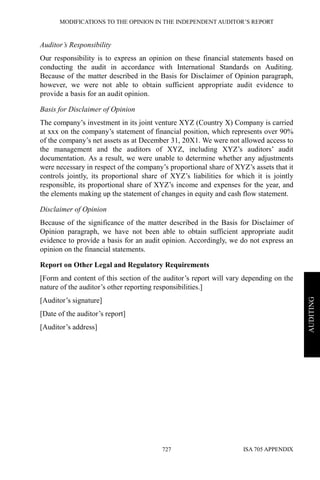
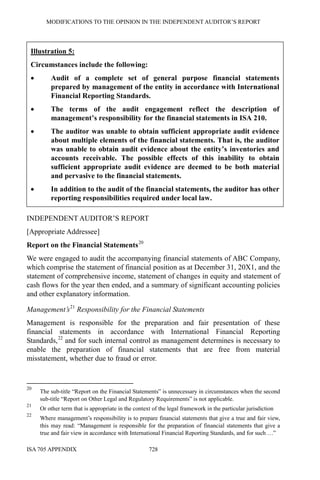
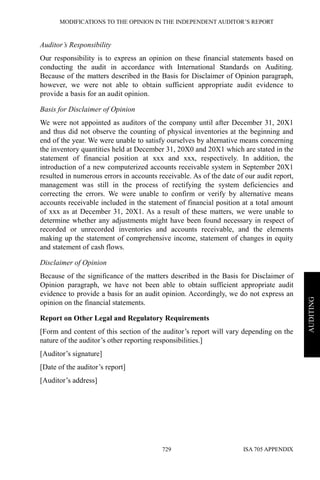
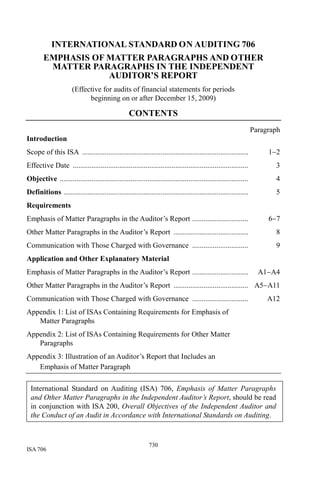
the resolution of the underlying transaction(s), event(s) or condition(s) addressed by the
accounting estimate.
Overall audit strategy—Sets the scope, timing and direction of the audit, and guides the
development of the more detailed audit plan.
*†Partner—Any individual with authority to bind the firm with respect to the
performance of a professional services engagement.
*Performance materiality—Theamountoramountssetbytheauditoratlessthanmateriality
for the financial statementsas a whole to reduce to an appropriately lowlevel theprobability
that the aggregate of uncorrected and undetected misstatements exceeds materiality for the
financial statements as a whole. If applicable, performance materiality also refers to the
amount or amounts set by the auditor at less than the materiality level or levels for particular
classes of transactions, account balances or disclosures. In the context of ISAE 3410,
performance materiality is defined as theamount or amounts set by the practitioner at less
than materiality for the GHG statement to reduce to an appropriately low level the
probability that the aggregate of uncorrected and undetected misstatements exceeds
materiality for the GHG statement.If applicable, performance materiality also refers to
the amount or amounts set by the practitioner at less than the materiality level or levels
for particular types of emissions or disclosures.
*†Personnel—Partners and staff.
*Pervasive—A term used, in the context of misstatements, to describe the effects on the
financial statements of misstatements or the possible effects on the financial statements
GLOSSARY OF TERMS
GLOSSARY27
GLOSSARY
of misstatements, if any, that are undetected due to an inability to obtain sufficient
appropriate audit evidence. Pervasive effects on the financial statements are those that,
in the auditor’s judgment:
(a) Are not confined to specific elements, accounts or items of the financial
statements;
(b) If so confined, represent or could represent a substantial proportion of the
financial statements; or
(c) In relation to disclosures, are fundamental to users’understanding of the financial
statements.
*Population—The entire set of data from which a sample is selected and about which
the auditor wishes to draw conclusions.
*Positive confirmation request—Arequest that the confirming party respond directly to
the auditor indicating whether the confirming party agrees or disagrees with the
information in the request, or providing the requested information.
Practitioner—A professional accountant in public practice.
Practitioner (in the context of ISRS 4410 (Revised))—A professional accountant in
public practice who conducts the compilation engagement. The term includes the
engagement partner or other members of the engagement team, or, as applicable, the
firm. Where ISRS 4410 (Revised) expressly intends that a requirement or responsibility
be fulfilled by the engagement partner, the term “engagement partner” rather than
“practitioner” is used. “Engagement partner” and “firm” are to be read as referring to
their public sector equivalents where relevant.*Preconditions for an audit—The use by
management of an acceptable financial reporting framework in the preparation of the
financial statements and the agreement of management and, where appropriate, those
charged with governance to the premise18
on which an audit is conducted.
*Predecessor auditor—The auditor from a different audit firm, who audited the financial
statements of an entity in the prior period and who has been replaced by the current auditor.
*Premise, relating to the responsibilities of management and, where appropriate, those
charged with governance, on which an audit is conducted—That management and,
where appropriate, those charged with governance have acknowledged and understand
that they have the following responsibilities that are fundamental to the conduct of an
audit in accordance with ISAs. That is, responsibility:
(a) For the preparation of the financial statements in accordance with the applicable
financial reporting framework, including where relevant their fair presentation;
(b) For such internal controlas managementand, where appropriate,those charged with
governance determine is necessary to enable the preparation of financial statements
that are free from material misstatement, whether due to fraud or error; and
18
ISA 200, paragraph 13
GLOSSARY OF TERMS
GLOSSARY 28
(c) To provide the auditor with:
(i) Access to all information of which management and, where appropriate,
those charged with governance are aware that is relevant to the
preparation of the financial statements such as records, documentation and
other matters;
(ii) Additional information that the auditor may request from management
and, where appropriate, those charged with governance for the purpose of
the audit; and
(iii) Unrestricted access to persons within the entity from whom the auditor
determines it necessary to obtain audit evidence.
In the case of a fair presentation framework, (a) above may be restated as “for the
preparation and fair presentation of the financial statements in accordance with the
financial reporting framework,” or “for the preparation of financial statements that give
a true and fair view in accordance with the financial reporting framework.”
The “premise, relating to the responsibilities of management and, where appropriate, those
charged with governance, on which an audit is conducted” may also be referred to as the
“premise.”
Pro forma adjustments—In relation to unadjusted financial information, these include:
(a) Adjustments to unadjusted financial information that illustrate the impact of a
significanteventortransaction (“event”or “transaction”) as iftheeventhadoccurred
or the transaction had been undertaken at an earlier date selected for purposes of the
illustration; and
(b) Adjustmentsto unadjusted financial information that are necessaryfortheproforma
financial information to be compiled on a basis consistent with the applicable
financial reporting framework of the reporting entity (“entity”) and its accounting
policies under that framework.
Pro forma adjustments include the relevant financial information of a business that has
been, or is to be, acquired (“acquiree”), or a business that has been, or is to be, divested
(“divestee”), to the extent that such information is used in compiling the pro forma
financial information (“acquiree or divestee financial information”).
Pro forma financial information—Financial information shown together with
adjustments to illustrate the impact of an event or transaction on unadjusted financial
information as if the event had occurred or the transaction had been undertaken at an
earlier date selected for purposes of the illustration. In this ISAE, it is presumed that pro
forma financial information is presented in columnar format consisting of (a) the
unadjusted financial information; (b) the pro forma adjustments; and (c) the resulting
pro forma column.
GLOSSARY OF TERMS
GLOSSARY29
GLOSSARY
Professional accountant19
—An individual who is a member of an IFAC member body.
Professional accountant in public practice20
—A professional accountant, irrespective of
functional classification (for example, audit, tax or consulting) in a firm that provides
professional services. This term is also used to refer to a firm of professional
accountants in public practice.
*Professional judgment—The application of relevant training, knowledge and
experience, within the context provided by auditing, accounting and ethical standards, in
making informed decisions about the courses of action that are appropriate in the
circumstances of the audit engagement.
*Professional skepticism—An attitude that includes a questioning mind, being alert to
conditions which may indicate possible misstatement due to error or fraud, and a critical
assessment of evidence.
*Professional standards—International Standards on Auditing (ISAs) and relevant
ethical requirements
†Professional standards (in the context of ISQC 121
)—IAASB Engagement Standards,
as defined in the IAASB’s Preface to the International Standards on Quality Control,
Auditing, Review, Other Assurance and Related Services, and relevant ethical
requirements.
Projection—Prospective financial information prepared on the basis of:
(a) Hypothetical assumptions about future events and management actions which are
not necessarily expected to take place, such as when some entities are in a start-
up phase or are considering a major change in the nature of operations; or
(b) A mixture of best-estimate and hypothetical assumptions.
Prospective financial information—Financial information based on assumptions about
events that may occur in the future and possible actions by an entity. Prospective
financial information can be in the form of a forecast, a projection or a combination of
both. (see Forecast and Projection)
Prospectus—A document issued pursuant to legal or regulatoryrequirements relating to
the entity’s securities on which it is intended that a third party should make an
investment decision.
Public sector—National governments, regional (for example, state, provincial,
territorial) governments, local (for example, city, town) governments and related
governmental entities (for example, agencies, boards, commissions and enterprises).
19
As defined in the IESBA Code of Ethics for Professional Accountants
20
As defined in the IESBA Code of Ethics for Professional Accountants
21
ISQC 1, Quality Control for Firms that Perform Audits and Reviews of Financial Statements, and Other
Assurance and Related Services Engagements
GLOSSARY OF TERMS
GLOSSARY 30
Published financial information—Financial information of the entity or of an acquiree
or a divestee that is made available publicly.
Purchased offset—An emissions deduction in which the entity pays for the lowering of
another entity’s emissions (emissions reductions) or the increasing of another entity’s
removals (removal enhancements), compared to a hypothetical baseline.
Quantification—The process of determining the quantity of GHGs that relate to the
entity, either directly or indirectly, as emitted (or removed) by particular sources (or
sinks).
*†Reasonable assurance (in the context of audit engagements, and in quality control)—
A high, but not absolute, level of assurance.
Reasonable assurance engagement—(see Assurance engagement)
Recalculation—Consists of checking the mathematical accuracy of documents or
records.
*Related party—A party that is either:
(a) A related party as defined in the applicable financial reporting framework; or
(b) Where the applicable financial reporting framework establishes minimal or no
related party requirements:
(i) A person or other entity that has control or significant influence, directly
or indirectly through one or more intermediaries, over the reporting entity;
(ii) Another entity over which the reporting entity has control or significant
influence, directly or indirectly through one or more intermediaries; or
(iii) Another entity that is under common control with the reporting entity
through having:
a. Common controlling ownership;
b. Owners who are close family members; or
c. Common key management.
However, entities that are under common control by a state (that is, a
national, regional or local government) are not considered related unless
they engage in significant transactions or share resources to a significant
extent with one another.
Related services—Comprise agreed-upon procedures and compilations.
*†Relevant ethical requirements—Ethical requirements to which the engagement team
and engagement quality control reviewer are subject, which ordinarily comprise Parts A
and B of the International Ethics Standards Board for Accountants’ Code of Ethics for
Professional Accountants (IESBA Code) together with national requirements that are
more restrictive. In the context of ISRS 4410 (Revised), relevant ethical requirements
GLOSSARY OF TERMS
GLOSSARY31
GLOSSARY
are defined as the ethical requirements the engagement team is subject to when
undertaking compilation engagements. These requirements ordinarily comprise Parts A
and B of the International Ethics Standards Board for Accountants’ Code of Ethics for
Professional Accountants (IESBA Code) (excluding Section 290, Independence—Audit
and Review Engagements, and Section 291, Independence—Other Assurance
Engagements in Part B), together with national requirements that are more restrictive.
Removal—The GHGs that the entity has, during the period, removed from the
atmosphere, or that would have been emitted to the atmosphere had they not been
captured and channeled to a sink.
Reperformance—The auditor’s independent execution of procedures or controls that
were originally performed as part of the entity’s internal controls.
*Report on the description and design of controls at a service organization (referred to
in ISA 40222
as a type 1 report)—A report that comprises:
(a) Adescription, prepared by management of the service organization, of the service
organization’s system, control objectives and related controls that have been
designed and implemented as at a specified date; and
(b) A report by the service auditor with the objective of conveying reasonable
assurance that includes the service auditor’s opinion on the description of the
service organization’s system, control objectives and related controls and the
suitability of the design of the controls to achieve the specified control objectives.
*Report on the description, design, and operating effectiveness of controls at a service
organization (referred to in ISA 402 as a type 2 report)—A report that comprises:
(a) Adescription, prepared by management of the service organization, of the service
organization’s system, control objectives and related controls, their design and
implementation as at a specified date or throughout a specified period and,in some
cases, their operating effectiveness throughout a specified period; and
(b) A report by the service auditor with the objective of conveying reasonable
assurance that includes:
(i) The service auditor’s opinion on the description of the service
organization’s system, control objectivesand related controls, the suitability
of the design of the controls to achieve the specified control objectives, and
the operating effectiveness of the controls; and
(ii) A description of the service auditor’s tests of the controls and the results
thereof.
22
ISA 402, Audit Considerations Relating to an Entity Using a Service Organization
GLOSSARY OF TERMS
GLOSSARY 32
Responsible party—The person (or persons) who:
(a) In a direct reporting engagement, is responsible for the subject matter; or
(b) In an assertion-based engagement, is responsible for thesubject matterinformation
(the assertion), and may be responsible for the subject matter.
The responsible party may or may not be the party who engages the practitioner (the
engaging party).
Review (in relation to quality control)—Appraising the quality of the work performed
and conclusions reached by others.
Review engagement—The objective of a review engagement is to enable an auditor to
state whether, on the basis of procedures which do not provide all the evidence that
would be required in an audit, anything has come to the auditor’s attention that causes
the auditor to believe that the financial statements are not prepared, in all material
respects, in accordance with an applicable financial reporting framework.
Review procedures—The procedures deemed necessary to meet the objective of a
review engagement, primarily inquiries of entity personnel and analytical procedures
applied to financial data.
*Risk assessment procedures—The audit procedures performed to obtain an
understanding of the entity and its environment, including the entity’s internal control,
to identify and assess the risks of material misstatement, whether due to fraud or error,
at the financial statement and assertion levels.
*Risk of material misstatement—The risk that the financial statements are materially
misstated prior to audit. This consists of two components, described as follows at the
assertion level:
(a) Inherent risk—The susceptibility of an assertion about a class of transaction,
account balance or disclosure to a misstatement that could be material, either
individually or when aggregated with other misstatements, before consideration
of any related controls.
(b) Control risk—The risk that a misstatement that could occur in an assertion about a
class of transaction, account balance or disclosure and thatcould be material,either
individually or when aggregated with other misstatements, will notbeprevented,or
detected and corrected, on a timely basis by the entity’s internal control.
*Sampling—(see Audit sampling)
*Sampling risk—The risk that the auditor’s conclusion based on a sample may be
different from the conclusion if the entire population were subjected to the same audit
procedure. Sampling risk can lead to two types of erroneous conclusions:
(a) In the case of a test of controls, that controls are more effective than they actually
are, or in the case of a test of details, that a material misstatement does not exist
when in fact it does. The auditor is primarily concerned with this type of erroneous
GLOSSARY OF TERMS
GLOSSARY33
GLOSSARY
conclusion because it affects audit effectiveness and is more likely to lead to an
inappropriate audit opinion.
(b) In the case of a test of controls, that controls are less effective than they actually
are, or in the case of a test of details, that a material misstatement exists when in
fact it does not. This type of erroneous conclusion affects audit efficiency as it
would usually lead to additional work to establish that initial conclusions were
incorrect.
*Sampling unit—The individual items constituting a population.
Scope of a review—The review procedures deemed necessary in the circumstances to
achieve the objective of the review.
*Service auditor—An auditor who, at the request of the service organization, provides
an assurance report on the controls of a service organization.
*Service organization—A third-party organization (or segment of a third-party
organization) that provides services to user entities that are part of those entities’
information systems relevant to financial reporting.
*Service organization’s system—The policies and procedures designed, implemented
and maintained by the service organization to provide user entities with the services
covered by the service auditor’s report.
Significance—The relative importance of a matter, taken in context. The significance of
a matter is judged by the practitioner in the context in which it is being considered. This
might include, for example, the reasonable prospect of its changing or influencing the
decisions of intended users of the practitioner’s report; or, as another example, where
the context is a judgment about whether to report a matter to those charged with
governance, whether the matter would be regarded as important by them in relation to
their duties. Significance can be considered in the context of quantitative and qualitative
factors, such as relative magnitude, the nature and effect on the subject matter and the
expressed interests of intended users or recipients.
*Significant component—A component identified by the group engagement team(i) that
is of individual financial significance to the group, or (ii) that, due to its specific nature
or circumstances, is likely to include significant risks of material misstatement of the
group financial statements.
*Significant deficiency in internal control—A deficiency or combination of deficiencies
in internal control that, in the auditor’s professional judgment, is of sufficient
importance to merit the attention of those charged with governance.
Significant facility—A facility that is of individual significance due to the size of its
emissions relative to the aggregate emissions included in the GHG statement or its
specific nature or circumstances which give rise to particular risks of material
misstatement.
GLOSSARY OF TERMS
GLOSSARY 34
*Significant risk—An identified and assessed risk of material misstatement that, in the
auditor’s judgment, requires special audit consideration.
Sink—A physical unit or process that removes GHGs from the atmosphere.
Smaller entity—An entity which typically possesses qualitative characteristics such as:
(a) Concentration of ownership and management in a small number of individuals
(often a single individual – either a natural person or another enterprise that owns
the entity provided the owner exhibits the relevant qualitative characteristics); and
(b) One or more of the following:
(i) Straightforward or uncomplicated transactions;
(ii) Simple record-keeping;
(iii) Few lines of business and few products within business lines;
(iv) Few internal controls;
(v) Few levels of management with responsibility for a broad range of
controls; or
(vi) Few personnel, many having a wide range of duties.
These qualitative characteristics are not exhaustive, they are not exclusive to
smaller entities, and smaller entities do not necessarily display all of these
characteristics.
Source—A physical unit or process that releases GHGs into the atmosphere.
*Special purpose financial statements—Financial statements prepared in accordance
with a special purpose framework.
*Special purpose framework—A financial reporting framework designed to meet the
financial information needs of specific users. The financial reporting framework may be
a fair presentation framework or a compliance framework.23
*†Staff—Professionals, other than partners, including any experts the firm employs.
*Statistical sampling—An approach to sampling that has the following characteristics:
(a) Random selection of the sample items; and
(b) The use of probability theory to evaluate sample results, including measurementof
sampling risk.
A sampling approach that does not have characteristics (a) and (b) is considered non-
statistical sampling.
*Stratification—The process of dividing a population into sub-populations,eachofwhich
is a group of sampling units which have similar characteristics (often monetary value).
23
ISA 200, paragraph 13(a)
GLOSSARY OF TERMS
GLOSSARY35
GLOSSARY
Subject matter information—The outcome of the evaluation or measurement of a subject
matter. It is the subject matter information about which the practitioner gathers
sufficient appropriate evidence to provide a reasonable basis for expressing a conclusion
in an assurance report.
*Subsequent events—Events occurring between the date of the financial statements and
the date of the auditor’s report, and facts that become known to the auditor after the date
of the auditor’s report.
*Subservice organization—A service organization used by another service organization
to perform some of the services provided to user entities that are part of those user
entities’ information systems relevant to financial reporting.
*Substantive procedure—An audit procedure designed to detect material misstatements
at the assertion level. Substantive procedures comprise:
(a) Tests of details (of classes of transactions, account balances, and disclosures); and
(b) Substantive analytical procedures.
*Sufficiency (of audit evidence)—The measure of the quantity of audit evidence. The
quantity of the audit evidence needed is affected by the auditor’s assessment of the risks
of material misstatement and also by the quality of such audit evidence.
Suitable criteria—(see Criteria)
*†Suitably qualified external person—An individual outside the firm with the
competence and capabilities to act as an engagement partner, for example a partner of
another firm, or an employee (with appropriate experience) of either a professional
accountancy body whose members may perform audits and reviews of historical
financial information, or other assurance or related services engagements, or of an
organization that provides relevant quality control services.
*Summary financial statements (in the context of ISA 810)—Historical financial
information that is derived from financial statements but that contains less detail than the
financial statements, while still providing a structured representation consistent with that
provided by the financial statements of the entity’s economic resources or obligations at a
point in time or the changes therein for a period of time.24
Different jurisdictions may use
different terminology to describe such historical financial information.
Supplementary information—Information that is presented together with the financial
statements that is not required by the applicable financial reporting framework used to
prepare the financial statements, normally presented in either supplementary schedules
or as additional notes.
Test—The application of procedures to some or all items in a population.
24
ISA 200, paragraph 13(f)
GLOSSARY OF TERMS
GLOSSARY 36
*Tests of controls—An audit procedure designed to evaluate the operating effectiveness
of controls in preventing, or detecting and correcting, material misstatements at the
assertion level.
*Those charged with governance—The person(s) or organization(s) (for example, a
corporate trustee) with responsibility for overseeing the strategic direction of the entity
and obligations related to the accountability of the entity. This includes overseeing the
financial reporting process. For some entities in some jurisdictions, those charged with
governance may include management personnel, for example, executive members of a
governance board of a private or public sector entity, or an owner-manager.25
*Tolerable misstatement—A monetary amount set by the auditor in respect of which the
auditor seeks to obtain an appropriate level of assurance that the monetary amount set
by the auditor is not exceeded by the actual misstatement in the population.
*Tolerable rate of deviation—A rate of deviation from prescribed internal control
procedures set by the auditor in respect of which the auditor seeks to obtain an
appropriate level of assurance that the rate of deviation set by the auditor is not
exceeded by the actual rate of deviation in the population.
Type of emission—A grouping of emissions based on, for example, source of emission,
type of gas, region, or facility.
Unadjusted financial information—Financial information of the entity to which pro
forma adjustments are applied by the responsible party.
Uncertainty—A matter whose outcome depends on future actions or events not under
the direct control of the entity but that may affect the financial statements.
*Uncorrected misstatements—Misstatements that the auditor has accumulated during
the audit and that have not been corrected.
*Unmodified opinion—The opinion expressed by the auditor when the auditor
concludes that the financial statements are prepared, in all material respects, in
accordance with the applicable financial reporting framework.26
*User auditor—An auditor who audits and reports on the financial statements of a user
entity.
*User entity—An entity that uses a service organization and whose financial statements
are being audited.
Walk-through test—Involves tracing a few transactions through the financial reporting
system.
25
For discussion of the diversity of governance structures, see paragraphs A1–A8 of ISA 260,
Communication with Those Charged with Governance.
26
ISA 700, paragraphs 35–36, deal with the phrases used to express this opinion in the case of a fair
presentation framework and a compliance framework respectively.
GLOSSARY OF TERMS
GLOSSARY37
GLOSSARY
*Written representation—A written statement by management provided to the auditor to
confirm certain matters or to support other audit evidence. Written representations in
this context do not include financial statements, the assertions therein, or supporting
books and records.
ISQC 1 38
INTERNATIONAL STANDARD ON QUALITY CONTROL 1
QUALITY CONTROL FOR FIRMS THAT PERFORM AUDITS
AND REVIEWS OF FINANCIAL STATEMENTS, AND OTHER
ASSURANCE AND RELATED SERVICES ENGAGEMENTS
(Effective as of December 15, 2009)+
CONTENTS
Paragraph
Introduction
Scope of this ISQC ................................................................................. 1−3
Authority of this ISQC ............................................................................ 4−9
Effective Date ......................................................................................... 10
Objective ................................................................................................ 11
Definitions .............................................................................................. 12
Requirements
Applying, and Complying with, Relevant Requirements ........................ 13−15
Elements of a System of Quality Control ............................................... 16−17
Leadership Responsibilities for Quality within the Firm ........................ 18−19
Relevant Ethical Requirements ............................................................... 20−25
Acceptance and Continuance of Client Relationships and Specific
Engagements .................................................................................... 26−28
Human Resources ................................................................................... 29−31
Engagement Performance ....................................................................... 32−47
Monitoring .............................................................................................. 48−56
Documentation of the System of Quality Control ................................... 57–59
Application and Other Explanatory Material
Applying, and Complying with, Relevant Requirements ........................ A1
Elements of a System of Quality Control ............................................... A2−A3
Leadership Responsibilities for Quality within the Firm ........................ A4−A6
+
Conforming amendments to this ISQC as a result of ISA 610 (Revised 2013), Using the Work of
Internal Auditors, will be effective for audits of financial statements for periods ending on or after
December 15, 2014.
QUALITY CONTROL FOR FIRMS THAT PERFORM AUDITS AND REVIEWS OF FINANCIAL
STATEMENTS, AND OTHER ASSURANCE AND RELATED SERVICES ENGAGEMENTS
ISQC 139
QUALITYCONTROL
Relevant Ethical Requirements ............................................................... A7−A17
Acceptance and Continuance of Client Relationships and Specific
Engagements .................................................................................... A18−A23
Human Resources ................................................................................... A24−A31
Engagement Performance ....................................................................... A32−A63
Monitoring .............................................................................................. A64−A72
Documentation of the System of Quality Control .................................. A73−A75
International Standard on Quality Control (ISQC) 1, Quality Control for Firms that
Perform Audits and Reviews of Financial Statements, and Other Assurance and
Related Services Engagements, should be read in conjunction with ISA 200,
Overall Objectives of the Independent Auditor and the Conduct of an Audit in
Accordance with International Standards on Auditing.
QUALITY CONTROL FOR FIRMS THAT PERFORM AUDITS AND REVIEWS OF FINANCIAL
STATEMENTS, AND OTHER ASSURANCE AND RELATED SERVICES ENGAGEMENTS
ISQC 1 40
Introduction
Scope of this ISQC
1. This International Standard on Quality Control (ISQC) deals with a firm’s
responsibilities for its system of quality control for audits and reviews of
financial statements, and other assurance and related services engagements.
This ISQC is to be read in conjunction with relevant ethical requirements.
2. Other pronouncements of the International Auditing and Assurance
Standards Board (IAASB) set out additional standards and guidance on the
responsibilities of firm personnel regarding quality control procedures for
specific types of engagements. ISA 220,1
for example, deals with quality
control procedures for audits of financial statements.
3. A system of quality control consists of policies designed to achieve the
objective set out in paragraph 11 and the procedures necessary to implement
and monitor compliance with those policies.
Authority of this ISQC
4. This ISQC applies to all firms of professional accountants in respect of
audits and reviews of financial statements, and other assurance and related
services engagements. The nature and extent of the policies and procedures
developed by an individual firm to comply with this ISQC will depend on
various factors such as the size and operating characteristics of the firm, and
whether it is part of a network.
5. This ISQC contains the objective of the firm in following the ISQC, and
requirements designed to enable the firm to meet that stated objective. In
addition, it contains related guidance in the form of application and other
explanatory material, as discussed further in paragraph 8, and introductory
material that provides context relevant to a proper understanding of the
ISQC, and definitions.
6. The objective provides the context in which the requirements of this ISQC
are set, and is intended to assist the firm in:
• Understanding what needs to be accomplished; and
• Deciding whether more needs to be done to achieve the objective.
7. The requirements of this ISQC are expressed using “shall.”
8. Where necessary, the application and other explanatory material provides
further explanation of the requirements and guidance for carrying them out.
In particular, it may:
1
ISA 220, Quality Control for an Audit of Financial Statements
QUALITY CONTROL FOR FIRMS THAT PERFORM AUDITS AND REVIEWS OF FINANCIAL
STATEMENTS, AND OTHER ASSURANCE AND RELATED SERVICES ENGAGEMENTS
ISQC 141
QUALITYCONTROL
• Explain more precisely what a requirement means or is intended to
cover; and
• Include examples of policies and procedures that may be appropriate
in the circumstances.
While such guidance does not in itself impose a requirement, it is relevant
to the proper application of the requirements. The application and other
explanatory material may also provide background information on matters
addressed in this ISQC. Where appropriate, additional considerations
specific to public sector audit organizations or smaller firms are included
within the application and other explanatory material. These additional
considerations assist in the application of the requirements in this ISQC.
They do not, however, limit or reduce the responsibility of the firm to apply
and comply with the requirements in this ISQC.
9. This ISQC includes, under the heading “Definitions,” a description of the
meanings attributed to certain terms for purposes of this ISQC. These are
provided to assist in the consistent application and interpretation of this
ISQC, and are not intended to override definitions that may be established
for other purposes, whether in law, regulation or otherwise. The Glossary of
Terms relating to International Standards issued by the IAASB in the
Handbook of International Quality Control, Auditing, Review, Other
Assurance, and Related Services Pronouncements published by IFAC
includes the terms defined in this ISQC. It also includes descriptions of
other terms found in this ISQC to assist in common and consistent
interpretation and translation.
Effective Date
10. Systems of quality control in compliance with this ISQC are required to be
established by December 15, 2009.
Objective
11. The objective of the firm is to establish and maintain a system of quality
control to provide it with reasonable assurance that:
(a) The firm and its personnel comply with professional standards and
applicable legal and regulatory requirements; and
(b) Reports issued by the firm or engagement partners are appropriate in
the circumstances.
Definitions
12. In this ISQC, the following terms have the meanings attributed below:
QUALITY CONTROL FOR FIRMS THAT PERFORM AUDITS AND REVIEWS OF FINANCIAL
STATEMENTS, AND OTHER ASSURANCE AND RELATED SERVICES ENGAGEMENTS
ISQC 1 42
(a) Date of report – The date selected by the practitioner to date the
report.
(b) Engagement documentation – The record of work performed, results
obtained, and conclusions the practitioner reached (terms such as
“working papers” or “workpapers” are sometimes used).
(c) Engagement partner2
– The partner or other person in the firm who is
responsible for the engagement and its performance, and for the report
that is issued on behalf of the firm, and who, where required, has the
appropriate authority from a professional, legal or regulatory body.
(d) Engagement quality control review – A process designed to provide
an objective evaluation, on or before the date of the report, of the
significant judgments the engagement team made and the conclusions
it reached in formulating the report. The engagement quality control
review process is for audits of financial statements of listed entities,
and those other engagements, if any, for which the firm has
determined an engagement quality control review is required.
(e) Engagement quality control reviewer – A partner, other person in the
firm, suitably qualified external person, or a team made up of such
individuals, none of whom is part of the engagement team, with
sufficient and appropriate experience and authority to objectively
evaluate the significant judgments the engagement team made and
the conclusions it reached in formulating the report.
(f) Engagement team – All partners and staff performing the engagement,
and any individuals engaged by the firm or a network firm who
perform procedures on the engagement. This excludes external experts
engaged by the firm or a network firm.
(g) Firm – A sole practitioner, partnership or corporation or other entity
of professional accountants.
(h) Inspection – In relation to completed engagements, procedures
designed to provide evidence of compliance by engagement teams with
the firm’s quality control policies and procedures.
(i) Listed entity – An entity whose shares, stock or debt are quoted or
listed on a recognized stock exchange, or are marketed under the
regulations of a recognized stock exchange or other equivalent body.
(j) Monitoring – A process comprising an ongoing consideration and
evaluation of the firm’s system of quality control, including a
periodic inspection of a selection of completed engagements,
2
“Engagement partner,” “partner,” and “firm” should be read as referring to their public sector
equivalents where relevant.
QUALITY CONTROL FOR FIRMS THAT PERFORM AUDITS AND REVIEWS OF FINANCIAL
STATEMENTS, AND OTHER ASSURANCE AND RELATED SERVICES ENGAGEMENTS
ISQC 143
QUALITYCONTROL
designed to provide the firm with reasonable assurance that its system
of quality control is operating effectively.
(k) Network firm – A firm or entity that belongs to a network.
(l) Network – A larger structure:
(i) That is aimed at cooperation, and
(ii) That is clearly aimed at profit or cost-sharing or shares common
ownership, control or management, common quality control
policies and procedures, common business strategy, the use of a
common brand name, or a significant part of professional
resources.
(m) Partner – Any individual with authority to bind the firm with respect to
the performance of a professional services engagement.
(n) Personnel – Partners and staff.
(o) Professional standards – IAASB Engagement Standards, as defined in
the IAASB’s Preface to the International Standards on Quality Control,
Auditing, Review, Other Assurance and Related Services, and relevant
ethical requirements.
(p) Reasonable assurance – In the context of this ISQC, a high, but not
absolute, level of assurance.
(q) Relevant ethical requirements – Ethical requirements to which the
engagement team and engagement quality control reviewer are subject,
which ordinarily comprise Parts A and B of the International Ethics
Standards Board for Accountants’ Code of Ethics for Professional
Accountants (IESBA Code) together with national requirements that are
more restrictive.
(r) Staff – Professionals, other than partners, including any experts the firm
employs.
(s) Suitably qualified external person – An individual outside the firm with
the competence and capabilities to act as an engagement partner, for
example, a partner of another firm, or an employee (with appropriate
experience) of either a professional accountancy body whose members
may perform audits and reviews of historical financial information, or
other assurance or related services engagements, or of an organization
that provides relevant quality control services.
Requirements
Applying, and Complying with, Relevant Requirements
13. Personnel within the firm responsible for establishing and maintaining the
firm’s system of quality control shall have an understanding of the entire
QUALITY CONTROL FOR FIRMS THAT PERFORM AUDITS AND REVIEWS OF FINANCIAL
STATEMENTS, AND OTHER ASSURANCE AND RELATED SERVICES ENGAGEMENTS
ISQC 1 44
text of this ISQC, including its application and other explanatory material, to
understand its objective and to apply its requirements properly.
14. The firm shall comply with each requirement of this ISQC unless, in the
circumstances of the firm, the requirement is not relevant to the services
provided in respect of audits and reviews of financial statements, and other
assurance and related services engagements. (Ref: Para. A1)
15. The requirements are designed to enable the firm to achieve the objective stated
in this ISQC. The proper application of the requirements is therefore expected to
provide a sufficient basis for the achievement of the objective. However,
because circumstances vary widely and all such circumstances cannot be
anticipated, the firm shall consider whether there are particular matters or
circumstances that require the firm to establish policies and procedures in
addition to those required by this ISQC to meet the stated objective.
Elements of a System of Quality Control
16. The firm shall establish and maintain a system of quality control that includes
policies and procedures that address each of the following elements:
(a) Leadership responsibilities for quality within the firm.
(b) Relevant ethical requirements.
(c) Acceptance and continuance of client relationships and specific
engagements.
(d) Human resources.
(e) Engagement performance.
(f) Monitoring.
17. The firm shall document its policies and procedures and communicate them
to the firm’s personnel. (Ref: Para. A2–A3)
Leadership Responsibilities for Quality within the Firm
18. The firm shall establish policies and procedures designed to promote an
internal culture recognizing that quality is essential in performing
engagements. Such policies and procedures shall require the firm’s chief
executive officer (or equivalent) or, if appropriate, the firm’s managing
board of partners (or equivalent) to assume ultimate responsibility for the
firm’s system of quality control. (Ref: Para. A4–A5)
19. The firm shall establish policies and procedures such that any person or
persons assigned operational responsibility for the firm’s system of quality
control by the firm’s chief executive officer or managing board of partners
has sufficient and appropriate experience and ability, and the necessary
authority, to assume that responsibility. (Ref: Para. A6)
QUALITY CONTROL FOR FIRMS THAT PERFORM AUDITS AND REVIEWS OF FINANCIAL
STATEMENTS, AND OTHER ASSURANCE AND RELATED SERVICES ENGAGEMENTS
ISQC 145
QUALITYCONTROL
Relevant Ethical Requirements
20. The firm shall establish policies and procedures designed to provide it with
reasonable assurance that the firm and its personnel comply with relevant
ethical requirements. (Ref: Para. A7–A10)
Independence
21. The firm shall establish policies and procedures designed to provide it with
reasonable assurance that the firm, its personnel and, where applicable, others
subject to independence requirements (including network firm personnel)
maintain independence where required by relevant ethical requirements. Such
policies and procedures shall enable the firm to: (Ref: Para. A10)
(a) Communicate its independence requirements to its personnel and, where
applicable, others subject to them; and
(b) Identify and evaluate circumstances and relationships that create threats
to independence, and to take appropriate action to eliminate those threats
or reduce them to an acceptable level by applying safeguards, or, if
considered appropriate, to withdraw from the engagement, where
withdrawal is possible under applicable law or regulation.
22. Such policies and procedures shall require: (Ref: Para. A10)
(a) Engagement partners to provide the firm with relevant information about
client engagements, including the scope of services, to enable the firm to
evaluate the overall impact, if any, on independence requirements;
(b) Personnel to promptly notify the firm of circumstances and relationships
that create a threat to independence so that appropriate action can be
taken; and
(c) The accumulation and communication of relevant information to
appropriate personnel so that:
(i) The firm and its personnel can readily determine whether they
satisfy independence requirements;
(ii) The firm can maintain and update its records relating to
independence; and
(iii) The firm can take appropriate action regarding identified threats
to independence that are not at an acceptable level.
23. The firm shall establish policies and procedures designed to provide it with
reasonable assurance that it is notified of breaches of independence
requirements, and to enable it to take appropriate actions to resolve such
situations. The policies and procedures shall include requirements for: (Ref:
Para. A10)
QUALITY CONTROL FOR FIRMS THAT PERFORM AUDITS AND REVIEWS OF FINANCIAL
STATEMENTS, AND OTHER ASSURANCE AND RELATED SERVICES ENGAGEMENTS
ISQC 1 46
(a) Personnel to promptly notify the firm of independence breaches of which
they become aware;
(b) The firm to promptly communicate identified breaches of these policies
and procedures to:
(i) The engagement partner who, with the firm, needs to address the
breach; and
(ii) Other relevant personnel in the firm and, where appropriate, the
network, and those subject to the independence requirements who
need to take appropriate action; and
(c) Prompt communication to the firm, if necessary, by the engagement
partner and the other individuals referred to in subparagraph 23(b)(ii) of
the actions taken to resolve the matter, so that the firm can determine
whether it should take further action.
24. At least annually, the firm shall obtain written confirmation of compliance with
its policies and procedures on independence from all firm personnel required to
be independent by relevant ethical requirements. (Ref: Para. A10–A11)
25. The firm shall establish policies and procedures: (Ref: Para. A10)
(a) Setting out criteria for determining the need for safeguards to reduce the
familiarity threat to an acceptable level when using the same senior
personnel on an assurance engagement over a long period of time; and
(b) Requiring, for audits of financial statements of listed entities, the
rotation of the engagement partner and the individuals responsible for
engagement quality control review, and, where applicable, others
subject to rotation requirements, after a specified period in
compliance with relevant ethical requirements. (Ref: Para. A12–A17)
Acceptance and Continuance of Client Relationships and Specific Engagements
26. The firm shall establish policies and procedures for the acceptance and
continuance of client relationships and specific engagements, designed to
provide the firm with reasonable assurance that it will only undertake or
continue relationships and engagements where the firm:
(a) Is competent to perform the engagement and has the capabilities,
including time and resources, to do so; (Ref: Para. A18, A23)
(b) Can comply with relevant ethical requirements; and
(c) Has considered the integrity of the client, and does not have
information that would lead it to conclude that the client lacks
integrity. (Ref: Para. A19–A20, A23)
QUALITY CONTROL FOR FIRMS THAT PERFORM AUDITS AND REVIEWS OF FINANCIAL
STATEMENTS, AND OTHER ASSURANCE AND RELATED SERVICES ENGAGEMENTS
ISQC 147
QUALITYCONTROL
27. Such policies and procedures shall require:
(a) The firm to obtain such information as it considers necessary in the
circumstances before accepting an engagement with a new client,
when deciding whether to continue an existing engagement, and
when considering acceptance of a new engagement with an existing
client. (Ref: Para. A21, A23)
(b) If a potential conflict of interest is identified in accepting an
engagement from a new or an existing client, the firm to determine
whether it is appropriate to accept the engagement.
(c) If issues have been identified, and the firm decides to accept or
continue the client relationship or a specific engagement, the firm to
document how the issues were resolved.
28. The firm shall establish policies and procedures on continuing an
engagement and the client relationship, addressing the circumstances where
the firm obtains information that would have caused it to decline the
engagement had that information been available earlier. Such policies and
procedures shall include consideration of:
(a) The professional and legal responsibilities that apply to the
circumstances, including whether there is a requirement for the firm
to report to the person or persons who made the appointment or, in
some cases, to regulatory authorities; and
(b) The possibility of withdrawing from the engagement or from both the
engagement and the client relationship. (Ref: Para. A22–A23)
Human Resources
29. The firm shall establish policies and procedures designed to provide it with
reasonable assurance that it has sufficient personnel with the competence,
capabilities, and commitment to ethical principles necessary to:
(a) Perform engagements in accordance with professional standards and
applicable legal and regulatory requirements; and
(b) Enable the firm or engagement partners to issue reports that are
appropriate in the circumstances. (Ref: Para. A24–A29)
Assignment of Engagement Teams
30. The firm shall assign responsibility for each engagement to an engagement
partner and shall establish policies and procedures requiring that:
(a) The identity and role of the engagement partner are communicated to
key members of client management and those charged with
governance;
QUALITY CONTROL FOR FIRMS THAT PERFORM AUDITS AND REVIEWS OF FINANCIAL
STATEMENTS, AND OTHER ASSURANCE AND RELATED SERVICES ENGAGEMENTS
ISQC 1 48
(b) The engagement partner has the appropriate competence, capabilities,
and authority to perform the role; and
(c) The responsibilities of the engagement partner are clearly defined and
communicated to that partner. (Ref: Para. A30)
31. The firm shall also establish policies and procedures to assign appropriate
personnel with the necessary competence, and capabilities to:
(a) Perform engagements in accordance with professional standards and
applicable legal and regulatory requirements; and
(b) Enable the firm or engagement partners to issue reports that are
appropriate in the circumstances. (Ref: Para. A31)
Engagement Performance
32. The firm shall establish policies and procedures designed to provide it with
reasonable assurance that engagements are performed in accordance with
professional standards and applicable legal and regulatory requirements, and
that the firm or the engagement partner issue reports that are appropriate in
the circumstances. Such policies and procedures shall include:
(a) Matters relevant to promoting consistency in the quality of
engagement performance; (Ref: Para. A32–A33)
(b) Supervision responsibilities; and (Ref: Para. A34)
(c) Review responsibilities. (Ref: Para. A35)
33. The firm’s review responsibility policies and procedures shall be determined on
the basis that work of less experienced team members is reviewed by more
experienced engagement team members.
Consultation
34. The firm shall establish policies and procedures designed to provide it with
reasonable assurance that:
(a) Appropriate consultation takes place on difficult or contentious matters;
(b) Sufficient resources are available to enable appropriate consultation
to take place;
(c) The nature and scope of, and conclusions resulting from, such
consultations are documented and are agreed by both the individual
seeking consultation and the individual consulted; and
(d) Conclusions resulting from consultations are implemented. (Ref:
Para. A36–A40)
QUALITY CONTROL FOR FIRMS THAT PERFORM AUDITS AND REVIEWS OF FINANCIAL
STATEMENTS, AND OTHER ASSURANCE AND RELATED SERVICES ENGAGEMENTS
ISQC 149
QUALITYCONTROL
Engagement Quality Control Review
35. The firm shall establish policies and procedures requiring, for appropriate
engagements, an engagement quality control review that provides an
objective evaluation of the significant judgments made by the engagement
team and the conclusions reached in formulating the report. Such policies
and procedures shall:
(a) Require an engagement quality control review for all audits of
financial statements of listed entities;
(b) Set out criteria against which all other audits and reviews of historical
financial information and other assurance and related services
engagements shall be evaluated to determine whether an engagement
quality control review should be performed; and (Ref: Para. A41)
(c) Require an engagement quality control review for all engagements, if
any, meeting the criteria established in compliance with subparagraph
35(b).
36. The firm shall establish policies and procedures setting out the nature, timing
and extent of an engagement quality control review. Such policies and
procedures shall require that the engagement report not be dated until the
completion of the engagement quality control review. (Ref: Para. A42–A43)
37. The firm shall establish policies and procedures to require the engagement
quality control review to include:
(a) Discussion of significant matters with the engagement partner;
(b) Review of the financial statements or other subject matter information
and the proposed report;
(c) Review of selected engagement documentation relating to significant
judgments the engagement team made and the conclusions it reached;
and
(d) Evaluation of the conclusions reached in formulating the report and
consideration of whether the proposed report is appropriate. (Ref:
Para. A44)
38. For audits of financial statements of listed entities, the firm shall establish
policies and procedures to require the engagement quality control review to
also include consideration of the following:
(a) The engagement team’s evaluation of the firm’s independence in
relation to the specific engagement;
(b) Whether appropriate consultation has taken place on matters
involving differences of opinion or other difficult or contentious
matters, and the conclusions arising from those consultations; and
QUALITY CONTROL FOR FIRMS THAT PERFORM AUDITS AND REVIEWS OF FINANCIAL
STATEMENTS, AND OTHER ASSURANCE AND RELATED SERVICES ENGAGEMENTS
ISQC 1 50
(c) Whether documentation selected for review reflects the work
performed in relation to the significant judgments and supports the
conclusions reached. (Ref: Para. A45–A46)
Criteria for the Eligibility of Engagement Quality Control Reviewers
39. The firm shall establish policies and procedures to address the appointment of
engagement quality control reviewers and establish their eligibility through:
(a) The technical qualifications required to perform the role, including the
necessary experience and authority; and (Ref: Para. A47)
(b) The degree to which an engagement quality control reviewer can be
consulted on the engagement without compromising the reviewer’s
objectivity. (Ref: Para. A48)
40. The firm shall establish policies and procedures designed to maintain the
objectivity of the engagement quality control reviewer. (Ref: Para. A49–A51)
41. The firm’s policies and procedures shall provide for the replacement of the
engagement quality control reviewer where the reviewer’s ability to perform an
objective review may be impaired.
Documentation of the Engagement Quality Control Review
42. The firm shall establish policies and procedures on documentation of the
engagement quality control review which require documentation that:
(a) The procedures required by the firm’s policies on engagement quality
control review have been performed;
(b) The engagement quality control review has been completed on or before
the date of the report; and
(c) The reviewer is not aware of any unresolved matters that would cause the
reviewer to believe that the significant judgments the engagement team
made and the conclusions it reached were not appropriate.
Differences of Opinion
43. The firm shall establish policies and procedures for dealing with and resolving
differences of opinion within the engagement team, with those consulted and,
where applicable, between the engagement partner and the engagement quality
control reviewer. (Ref: Para. A52–A53)
44. Such policies and procedures shall require that:
(a) Conclusions reached be documented and implemented; and
(b) The report not be dated until the matter is resolved.
QUALITY CONTROL FOR FIRMS THAT PERFORM AUDITS AND REVIEWS OF FINANCIAL
STATEMENTS, AND OTHER ASSURANCE AND RELATED SERVICES ENGAGEMENTS
ISQC 151
QUALITYCONTROL
Engagement Documentation
Completion of the assembly of final engagement files
45. The firm shall establish policies and procedures for engagement teams to
complete the assembly of final engagement files on a timely basis after the
engagement reports have been finalized. (Ref: Para. A54–A55)
Confidentiality, safe custody, integrity, accessibility and retrievability of engagement
documentation
46. The firm shall establish policies and procedures designed to maintain the
confidentiality, safe custody, integrity, accessibility and retrievability of
engagement documentation. (Ref: Para. A56–A59)
Retention of engagement documentation
47. The firm shall establish policies and procedures for the retention of engagement
documentation for a period sufficient to meet the needs of the firm or as required
by law or regulation. (Ref: Para. A60–A63)
Monitoring
Monitoring the firm’s quality control policies and procedures
48. The firm shall establish a monitoring process designed to provide it with
reasonable assurance that the policies and procedures relating to the system of
quality control are relevant, adequate, and operating effectively. This process
shall:
(a) Include an ongoing consideration and evaluation of the firm’s system of
quality control including, on a cyclical basis, inspection of at least one
completed engagement for each engagement partner;
(b) Require responsibility for the monitoring process to be assigned to a
partner or partners or other persons with sufficient and appropriate
experience and authority in the firm to assume that responsibility; and
(c) Require that those performing the engagement or the engagement quality
control review are not involved in inspecting the engagement. (Ref: Para.
A64–A68)
Evaluating, Communicating and Remedying Identified Deficiencies
49. The firm shall evaluate the effect of deficiencies noted as a result of the
monitoring process and determine whether they are either:
(a) Instances that do not necessarily indicate that the firm’s system of
quality control is insufficient to provide it with reasonable assurance
that it complies with professional standards and applicable legal and
QUALITY CONTROL FOR FIRMS THAT PERFORM AUDITS AND REVIEWS OF FINANCIAL
STATEMENTS, AND OTHER ASSURANCE AND RELATED SERVICES ENGAGEMENTS
ISQC 1 52
regulatory requirements, and that the reports issued by the firm or
engagement partners are appropriate in the circumstances; or
(b) Systemic, repetitive or other significant deficiencies that require
prompt corrective action.
50. The firm shall communicate to relevant engagement partners and other
appropriate personnel deficiencies noted as a result of the monitoring process
and recommendations for appropriate remedial action. (Ref: Para. A69)
51. Recommendations for appropriate remedial actions for deficiencies noted
shall include one or more of the following:
(a) Taking appropriate remedial action in relation to an individual
engagement or member of personnel;
(b) The communication of the findings to those responsible for training
and professional development;
(c) Changes to the quality control policies and procedures; and
(d) Disciplinary action against those who fail to comply with the policies
and procedures of the firm, especially those who do so repeatedly.
52. The firm shall establish policies and procedures to address cases where the
results of the monitoring procedures indicate that a report may be
inappropriate or that procedures were omitted during the performance of the
engagement. Such policies and procedures shall require the firm to
determine what further action is appropriate to comply with relevant
professional standards and applicable legal and regulatory requirements and
to consider whether to obtain legal advice.
53. The firm shall communicate at least annually the results of the monitoring of
its system of quality control to engagement partners and other appropriate
individuals within the firm, including the firm’s chief executive officer or, if
appropriate, its managing board of partners. This communication shall be
sufficient to enable the firm and these individuals to take prompt and
appropriate action where necessary in accordance with their defined roles
and responsibilities. Information communicated shall include the following:
(a) A description of the monitoring procedures performed.
(b) The conclusions drawn from the monitoring procedures.
(c) Where relevant, a description of systemic, repetitive or other
significant deficiencies and of the actions taken to resolve or amend
those deficiencies.
54. Some firms operate as part of a network and, for consistency, may implement
some of their monitoring procedures on a network basis. Where firms within a
network operate under common monitoring policies and procedures designed
QUALITY CONTROL FOR FIRMS THAT PERFORM AUDITS AND REVIEWS OF FINANCIAL
STATEMENTS, AND OTHER ASSURANCE AND RELATED SERVICES ENGAGEMENTS
ISQC 153
QUALITYCONTROL
to comply with this ISQC, and these firms place reliance on such a monitoring
system, the firm’s policies and procedures shall require that:
(a) At least annually, the network communicate the overall scope, extent
and results of the monitoring process to appropriate individuals
within the network firms; and
(b) The network communicate promptly any identified deficiencies in the
system of quality control to appropriate individuals within the relevant
network firm or firms so that the necessary action can be taken,
in order that engagement partners in the network firms can rely on the
results of the monitoring process implemented within the network, unless
the firms or the network advise otherwise.
Complaints and Allegations
55. The firm shall establish policies and procedures designed to provide it with
reasonable assurance that it deals appropriately with:
(a) Complaints and allegations that the work performed by the firm fails
to comply with professional standards and applicable legal and
regulatory requirements; and
(b) Allegations of non-compliance with the firm’s system of quality
control.
As part of this process, the firm shall establish clearly defined channels for
firm personnel to raise any concerns in a manner that enables them to come
forward without fear of reprisals. (Ref: Para. A70)
56. If during the investigations into complaints and allegations, deficiencies in
the design or operation of the firm’s quality control policies and procedures
or non-compliance with the firm’s system of quality control by an individual
or individuals are identified, the firm shall take appropriate actions as set out
in paragraph 51. (Ref: Para. A71–A72)
Documentation of the System of Quality Control
57. The firm shall establish policies and procedures requiring appropriate
documentation to provide evidence of the operation of each element of its
system of quality control. (Ref: Para. A73–A75)
58. The firm shall establish policies and procedures that require retention of
documentation for a period of time sufficient to permit those performing
monitoring procedures to evaluate the firm’s compliance with its system of
quality control, or for a longer period if required by law or regulation.
59. The firm shall establish policies and procedures requiring documentation of
complaints and allegations and the responses to them.
QUALITY CONTROL FOR FIRMS THAT PERFORM AUDITS AND REVIEWS OF FINANCIAL
STATEMENTS, AND OTHER ASSURANCE AND RELATED SERVICES ENGAGEMENTS
ISQC 1 54
***
Application and Other Explanatory Material
Applying, and Complying with, Relevant Requirements
Considerations Specific to Smaller Firms (Ref: Para. 14)
A1. This ISQC does not call for compliance with requirements that are not
relevant, for example, in the circumstances of a sole practitioner with no
staff. Requirements in this ISQC such as those for policies and procedures
for the assignment of appropriate personnel to the engagement team (see
paragraph 31), for review responsibilities (see paragraph 33), and for the
annual communication of the results of monitoring to engagement partners
within the firm (see paragraph 53) are not relevant in the absence of staff.
Elements of a System of Quality Control (Ref: Para. 17)
A2. In general, communication of quality control policies and procedures to firm
personnel includes a description of the quality control policies and
procedures and the objectives they are designed to achieve, and the message
that each individual has a personal responsibility for quality and is expected
to comply with these policies and procedures. Encouraging firm personnel
to communicate their views or concerns on quality control matters
recognizes the importance of obtaining feedback on the firm’s system of
quality control.
Considerations Specific to Smaller Firms
A3. Documentation and communication of policies and procedures for smaller
firms may be less formal and extensive than for larger firms.
Leadership Responsibilities for Quality within the Firm
Promoting an Internal Culture of Quality (Ref: Para. 18)
A4. The firm’s leadership and the examples it sets significantly influence the
internal culture of the firm. The promotion of a quality-oriented internal
culture depends on clear, consistent and frequent actions and messages from
all levels of the firm’s management that emphasize the firm’s quality control
policies and procedures, and the requirement to:
(a) perform work that complies with professional standards and
applicable legal and regulatory requirements; and
(b) issue reports that are appropriate in the circumstances.
Such actions and messages encourage a culture that recognizes and rewards
high quality work. These actions and messages may be communicated by,
but are not limited to, training seminars, meetings, formal or informal
QUALITY CONTROL FOR FIRMS THAT PERFORM AUDITS AND REVIEWS OF FINANCIAL
STATEMENTS, AND OTHER ASSURANCE AND RELATED SERVICES ENGAGEMENTS
ISQC 155
QUALITYCONTROL
dialogue, mission statements, newsletters, or briefing memoranda. They
may be incorporated in the firm’s internal documentation and training
materials, and in partner and staff appraisal procedures such that they will
support and reinforce the firm’s view on the importance of quality and how,
practically, it is to be achieved.
A5. Of particular importance in promoting an internal culture based on quality is
the need for the firm’s leadership to recognize that the firm’s business
strategy is subject to the overriding requirement for the firm to achieve
quality in all the engagements that the firm performs. Promoting such an
internal culture includes:
(a) Establishment of policies and procedures that address performance
evaluation, compensation, and promotion (including incentive
systems) with regard to its personnel, in order to demonstrate the
firm’s overriding commitment to quality;
(b) Assignment of management responsibilities so that commercial
considerations do not override the quality of work performed; and
(c) Provision of sufficient resources for the development, documentation
and support of its quality control policies and procedures.
Assigning Operational Responsibility for the Firm’s System of Quality Control (Ref:
Para. 19)
A6. Sufficient and appropriate experience and ability enables the person or
persons responsible for the firm’s system of quality control to identify and
understand quality control issues and to develop appropriate policies and
procedures. Necessary authority enables the person or persons to implement
those policies and procedures.
Relevant Ethical Requirements
Compliance with Relevant Ethical Requirements (Ref: Para. 20)
A7. The IESBA Code establishes the fundamental principles of professional
ethics, which include:
(a) Integrity;
(b) Objectivity;
(c) Professional competence and due care;
(d) Confidentiality; and
(e) Professional behavior.
A8. Part B of the IESBA Code illustrates how the conceptual framework is to be
applied in specific situations. It provides examples of safeguards that may
QUALITY CONTROL FOR FIRMS THAT PERFORM AUDITS AND REVIEWS OF FINANCIAL
STATEMENTS, AND OTHER ASSURANCE AND RELATED SERVICES ENGAGEMENTS
ISQC 1 56
be appropriate to address threats to compliance with the fundamental
principles and also provides examples of situations where safeguards are not
available to address the threats.
A9. The fundamental principles are reinforced in particular by:
• The leadership of the firm;
• Education and training;
• Monitoring; and
• A process for dealing with non-compliance.
Definition of “Firm,” “Network” and “Network Firm” (Ref: Para. 20–25)
A10. The definitions of “firm,” network” or “network firm” in relevant ethical
requirements may differ from those set out in this ISQC. For example, the
IESBA Code defines the “firm” as:
(a) A sole practitioner, partnership or corporation of professional
accountants;
(b) An entity that controls such parties through ownership, management
or other means; and
(c) An entity controlled by such parties through ownership, management
or other means.
The IESBA Code also provides guidance in relation to the terms “network”
and “network firm.”
In complying with the requirements in paragraphs 20–25, the definitions
used in the relevant ethical requirements apply in so far as is necessary to
interpret those ethical requirements.
Written Confirmation (Ref: Para. 24)
A11. Written confirmation may be in paper or electronic form. By obtaining
confirmation and taking appropriate action on information indicating non-
compliance, the firm demonstrates the importance that it attaches to
independence and makes the issue current for, and visible to, its personnel.
Familiarity Threat (Ref: Para. 25)
A12. The IESBA Code discusses the familiarity threat that may be created by
using the same senior personnel on an assurance engagement over a long
period of time and the safeguards that might be appropriate to address such
threats.
A13. Determining appropriate criteria to address familiarity threat may include
matters such as:
QUALITY CONTROL FOR FIRMS THAT PERFORM AUDITS AND REVIEWS OF FINANCIAL
STATEMENTS, AND OTHER ASSURANCE AND RELATED SERVICES ENGAGEMENTS
ISQC 157
QUALITYCONTROL
• The nature of the engagement, including the extent to which it
involves a matter of public interest; and
• The length of service of the senior personnel on the engagement.
Examples of safeguards include rotating the senior personnel or requiring
an engagement quality control review.
A14. The IESBA Code recognizes that the familiarity threat is particularly
relevant in the context of financial statement audits of listed entities. For
these audits, the IESBA Code requires the rotation of the key audit partner3
after a pre-defined period, normally no more than seven years, and provides
related standards and guidance. National requirements may establish shorter
rotation periods.
Considerations specific to public sector audit organizations
A15. Statutory measures may provide safeguards for the independence of public
sector auditors. However, threats to independence may still exist regardless
of any statutory measures designed to protect it. Therefore, in establishing
the policies and procedures required by paragraphs 20–25, the public sector
auditor may have regard to the public sector mandate and address any
threats to independence in that context.
A16. Listed entities as referred to in paragraphs 25 and A14 are not common in
the public sector. However, there may be other public sector entities that are
significant due to size, complexity or public interest aspects, and which
consequently have a wide range of stakeholders. Therefore, there may be
instances when a firm determines, based on its quality control policies and
procedures, that a public sector entity is significant for the purposes of
expanded quality control procedures.
A17. In the public sector, legislation may establish the appointments and terms of
office of the auditor with engagement partner responsibility. As a result, it
may not be possible to comply strictly with the engagement partner rotation
requirements envisaged for listed entities. Nonetheless, for public sector
entities considered significant, as noted in paragraph A16, it may be in the
public interest for public sector audit organizations to establish policies and
procedures to promote compliance with the spirit of rotation of engagement
partner responsibility.
3
As defined in the IESBA Code
QUALITY CONTROL FOR FIRMS THAT PERFORM AUDITS AND REVIEWS OF FINANCIAL
STATEMENTS, AND OTHER ASSURANCE AND RELATED SERVICES ENGAGEMENTS
ISQC 1 58
Acceptance and Continuance of Client Relationships and Specific Engagements
Competence, Capabilities, and Resources (Ref: Para. 26(a))
A18. Consideration of whether the firm has the competence, capabilities, and
resources to undertake a new engagement from a new or an existing client
involves reviewing the specific requirements of the engagement and the
existing partner and staff profiles at all relevant levels, and including whether:
• Firm personnel have knowledge of relevant industries or subject
matters;
• Firm personnel have experience with relevant regulatory or reporting
requirements, or the ability to gain the necessary skills and
knowledge effectively;
• The firm has sufficient personnel with the necessary competence and
capabilities;
• Experts are available, if needed;
• Individuals meeting the criteria and eligibility requirements to
perform engagement quality control review are available, where
applicable; and
• The firm is able to complete the engagement within the reporting
deadline.
Integrity of Client (Ref: Para. 26(c))
A19. With regard to the integrity of a client, matters to consider include, for
example:
• The identity and business reputation of the client’s principal owners,
key management, and those charged with its governance.
• The nature of the client’s operations, including its business practices.
• Information concerning the attitude of the client’s principal owners,
key management and those charged with its governance towards such
matters as aggressive interpretation of accounting standards and the
internal control environment.
• Whether the client is aggressively concerned with maintaining the
firm’s fees as low as possible.
• Indications of an inappropriate limitation in the scope of work.
• Indications that the client might be involved in money laundering or
other criminal activities.
QUALITY CONTROL FOR FIRMS THAT PERFORM AUDITS AND REVIEWS OF FINANCIAL
STATEMENTS, AND OTHER ASSURANCE AND RELATED SERVICES ENGAGEMENTS
ISQC 159
QUALITYCONTROL
• The reasons for the proposed appointment of the firm and non-
reappointment of the previous firm.
• The identity and business reputation of related parties.
The extent of knowledge a firm will have regarding the integrity of a client
will generally grow within the context of an ongoing relationship with that
client.
A20. Sources of information on such matters obtained by the firm may include
the following:
• Communications with existing or previous providers of professional
accountancy services to the client in accordance with relevant ethical
requirements, and discussions with other third parties.
• Inquiry of other firm personnel or third parties such as bankers, legal
counsel and industry peers.
• Background searches of relevant databases.
Continuance of Client Relationship (Ref: Para. 27(a))
A21. Deciding whether to continue a client relationship includes consideration of
significant matters that have arisen during the current or previous
engagements, and their implications for continuing the relationship. For
example, a client may have started to expand its business operations into an
area where the firm does not possess the necessary expertise.
Withdrawal (Ref: Para. 28)
A22. Policies and procedures on withdrawal from an engagement or from both the
engagement and the client relationship address issues that include the
following:
• Discussing with the appropriate level of the client’s management and
those charged with its governance the appropriate action that the firm
might take based on the relevant facts and circumstances.
• If the firm determines that it is appropriate to withdraw, discussing
with the appropriate level of the client’s management and those
charged with its governance withdrawal from the engagement or
from both the engagement and the client relationship, and the reasons
for the withdrawal.
• Considering whether there is a professional, legal or regulatory
requirement for the firm to remain in place, or for the firm to report
the withdrawal from the engagement, or from both the engagement
and the client relationship, together with the reasons for the
withdrawal, to regulatory authorities.
QUALITY CONTROL FOR FIRMS THAT PERFORM AUDITS AND REVIEWS OF FINANCIAL
STATEMENTS, AND OTHER ASSURANCE AND RELATED SERVICES ENGAGEMENTS
ISQC 1 60
• Documenting significant matters, consultations, conclusions and the
basis for the conclusions.
Considerations Specific to Public Sector Audit Organizations (Ref: Para. 26–28)
A23. In the public sector, auditors may be appointed in accordance with statutory
procedures. Accordingly, certain of the requirements and considerations
regarding the acceptance and continuance of client relationships and specific
engagements as set out paragraphs 26–28 and A18–A22 may not be
relevant. Nonetheless, establishing policies and procedures as described may
provide valuable information to public sector auditors in performing risk
assessments and in carrying out reporting responsibilities.
Human Resources (Ref: Para. 29)
A24. Personnel issues relevant to the firm’s policies and procedures related to
human resources include, for example:
• Recruitment.
• Performance evaluation.
• Capabilities, including time to perform assignments.
• Competence.
• Career development.
• Promotion.
• Compensation.
• The estimation of personnel needs.
Effective recruitment processes and procedures help the firm select
individuals of integrity who have the capacity to develop the competence
and capabilities necessary to perform the firm’s work and possess the
appropriate characteristics to enable them to perform competently.
A25. Competence can be developed through a variety of methods, including the
following:
• Professional education.
• Continuing professional development, including training.
• Work experience.
• Coaching by more experienced staff, for example, other members of
the engagement team.
• Independence education for personnel who are required to be
independent.
QUALITY CONTROL FOR FIRMS THAT PERFORM AUDITS AND REVIEWS OF FINANCIAL
STATEMENTS, AND OTHER ASSURANCE AND RELATED SERVICES ENGAGEMENTS
ISQC 161
QUALITYCONTROL
A26. The continuing competence of the firm’s personnel depends to a significant
extent on an appropriate level of continuing professional development so that
personnel maintain their knowledge and capabilities. Effective policies and
procedures emphasize the need for continuing training for all levels of firm
personnel, and provide the necessary training resources and assistance to enable
personnel to develop and maintain the required competence and capabilities.
A27. The firm may use a suitably qualified external person, for example, when
internal technical and training resources are unavailable.
A28. Performance evaluation, compensation and promotion procedures give due
recognition and reward to the development and maintenance of competence
and commitment to ethical principles. Steps a firm may take in developing
and maintaining competence and commitment to ethical principles include:
• Making personnel aware of the firm’s expectations regarding
performance and ethical principles;
• Providing personnel with evaluation of, and counseling on,
performance, progress and career development; and
• Helping personnel understand that advancement to positions of
greater responsibility depends, among other things, upon
performance quality and adherence to ethical principles, and that
failure to comply with the firm’s policies and procedures may result
in disciplinary action.
Considerations Specific to Smaller Firms
A29. The size and circumstances of the firm will influence the structure of the
firm’s performance evaluation process. Smaller firms, in particular, may
employ less formal methods of evaluating the performance of their personnel.
Assignment of Engagement Teams
Engagement Partners (Ref: Para. 30)
A30. Policies and procedures may include systems to monitor the workload and
availability of engagement partners so as to enable these individuals to have
sufficient time to adequately discharge their responsibilities.
Engagement Teams (Ref: Para. 31)
A31. The firm’s assignment of engagement teams and the determination of the level
of supervision required, include for example, consideration of the engagement
team’s:
• Understanding of, and practical experience with, engagements of a
similar nature and complexity through appropriate training and
participation;
QUALITY CONTROL FOR FIRMS THAT PERFORM AUDITS AND REVIEWS OF FINANCIAL
STATEMENTS, AND OTHER ASSURANCE AND RELATED SERVICES ENGAGEMENTS
ISQC 1 62
• Understanding of professional standards and applicable legal and
regulatory requirements;
• Technical knowledge and expertise, including knowledge of relevant
information technology;
• Knowledge of relevant industries in which the clients operate;
• Ability to apply professional judgment; and
• Understanding of the firm’s quality control policies and procedures.
Engagement Performance
Consistency in the Quality of Engagement Performance (Ref: Para. 32(a))
A32. The firm promotes consistency in the quality of engagement performance
through its policies and procedures. This is often accomplished through
written or electronic manuals, software tools or other forms of standardized
documentation, and industry or subject matter-specific guidance materials.
Matters addressed may include:
• How engagement teams are briefed on the engagement to obtain an
understanding of the objectives of their work.
• Processes for complying with applicable engagement standards.
• Processes of engagement supervision, staff training and coaching.
• Methods of reviewing the work performed, the significant judgments
made and the form of report being issued.
• Appropriate documentation of the work performed and of the timing and
extent of the review.
• Processes to keep all policies and procedures current.
A33. Appropriate teamwork and training assist less experienced members of the
engagement team to clearly understand the objectives of the assigned work.
Supervision (Ref: Para. 32(b))
A34. Engagement supervision includes the following:
• Tracking the progress of the engagement;
• Considering the competence and capabilities of individual members of
the engagement team, whether they have sufficient time to carry out their
work, whether they understand their instructions and whether the work is
being carried out in accordance with the planned approach to the
engagement;
QUALITY CONTROL FOR FIRMS THAT PERFORM AUDITS AND REVIEWS OF FINANCIAL
STATEMENTS, AND OTHER ASSURANCE AND RELATED SERVICES ENGAGEMENTS
ISQC 163
QUALITYCONTROL
• Addressing significant matters arising during the engagement,
considering their significance and modifying the planned approach
appropriately; and
• Identifying matters for consultation or consideration by more
experienced engagement team members during the engagement.
Review (Ref: Para. 32(c))
A35. A review consists of consideration of whether:
• The work has been performed in accordance with professional standards
and applicable legal and regulatory requirements;
• Significant matters have been raised for further consideration;
• Appropriate consultations have taken place and the resulting conclusions
have been documented and implemented;
• There is a need to revise the nature, timing and extent of work
performed;
• The work performed supports the conclusions reached and is
appropriately documented;
• The evidence obtained is sufficient and appropriate to support the report;
and
• The objectives of the engagement procedures have been achieved.
Consultation (Ref: Para. 34)
A36. Consultation includes discussion at the appropriate professional level, with
individuals within or outside the firm who have specialized expertise.
A37. Consultation uses appropriate research resources as well as the collective
experience and technical expertise of the firm. Consultation helps to
promote quality and improves the application of professional judgment.
Appropriate recognition of consultation in the firm’s policies and procedures
helps to promote a culture in which consultation is recognized as a strength
and encourages personnel to consult on difficult or contentious matters.
A38. Effective consultation on significant technical, ethical and other matters
within the firm or, where applicable, outside the firm can be achieved when
those consulted:
• Are given all the relevant facts that will enable them to provide informed
advice; and
• Have appropriate knowledge, seniority and experience,
QUALITY CONTROL FOR FIRMS THAT PERFORM AUDITS AND REVIEWS OF FINANCIAL
STATEMENTS, AND OTHER ASSURANCE AND RELATED SERVICES ENGAGEMENTS
ISQC 1 64
and when conclusions resulting from consultations are appropriately
documented and implemented.
A39. Documentation of consultations with other professionals that involve
difficult or contentious matters that is sufficiently complete and detailed
contributes to an understanding of:
• The issue on which consultation was sought; and
• The results of the consultation, including any decisions taken, the basis
for those decisions and how they were implemented.
Considerations Specific to Smaller Firms
A40. A firm needing to consult externally, for example, a firm without appropriate
internal resources, may take advantage of advisory services provided by:
• Other firms;
• Professional and regulatory bodies; or
• Commercial organizations that provide relevant quality control services.
Before contracting for such services, consideration of the competence and
capabilities of the external provider helps the firm to determine whether the
external provider is suitably qualified for that purpose.
Engagement Quality Control Review
Criteria for an Engagement Quality Control Review (Ref: Para. 35(b))
A41. Criteria for determining which engagements, other than audits of financial
statements of listed entities, are to be subject to an engagement quality
control review may include, for example:
• The nature of the engagement, including the extent to which it involves a
matter of public interest.
• The identification of unusual circumstances or risks in an engagement or
class of engagements.
• Whether laws or regulations require an engagement quality control
review.
Nature, Timing and Extent of the Engagement Quality Control Review (Ref: Para. 36–
37)
A42. The engagement report is not dated until the completion of the engagement
quality control review. However, documentation of the engagement quality
control review may be completed after the date of the report.
QUALITY CONTROL FOR FIRMS THAT PERFORM AUDITS AND REVIEWS OF FINANCIAL
STATEMENTS, AND OTHER ASSURANCE AND RELATED SERVICES ENGAGEMENTS
ISQC 165
QUALITYCONTROL
A43. Conducting the engagement quality control review in a timely manner at
appropriate stages during the engagement allows significant matters to be
promptly resolved to the engagement quality control reviewer’s satisfaction
on or before the date of the report.
A44. The extent of the engagement quality control review may depend, among
other things, on the complexity of the engagement, whether the entity is a
listed entity, and the risk that the report might not be appropriate in the
circumstances. The performance of an engagement quality control review
does not reduce the responsibilities of the engagement partner.
Engagement Quality Control Review of a Listed Entity (Ref: Para. 38)
A45. Other matters relevant to evaluating the significant judgments made by the
engagement team that may be considered in an engagement quality control
review of an audit of financial statements of a listed entity include:
• Significant risks identified during the engagement and the responses to
those risks.
• Judgments made, particularly with respect to materiality and significant
risks.
• The significance and disposition of corrected and uncorrected
misstatements identified during the engagement.
• The matters to be communicated to management and those charged with
governance and, where applicable, other parties such as regulatory
bodies.
These other matters, depending on the circumstances, may also be
applicable for engagement quality control reviews for audits of the financial
statements of other entities as well as reviews of financial statements and
other assurance and related services engagements.
Considerations specific to public sector audit organizations
A46. Although not referred to as listed entities, as described in paragraph A16,
certain public sector entities may be of sufficient significance to warrant
performance of an engagement quality control review.
Criteria for the Eligibility of Engagement Quality Control Reviewers
Sufficient and Appropriate Technical Expertise, Experience and Authority (Ref:
Para. 39(a))
A47. What constitutes sufficient and appropriate technical expertise, experience
and authority depends on the circumstances of the engagement. For
example, the engagement quality control reviewer for an audit of the
financial statements of a listed entity is likely to be an individual with
QUALITY CONTROL FOR FIRMS THAT PERFORM AUDITS AND REVIEWS OF FINANCIAL
STATEMENTS, AND OTHER ASSURANCE AND RELATED SERVICES ENGAGEMENTS
ISQC 1 66
sufficient and appropriate experience and authority to act as an audit
engagement partner on audits of financial statements of listed entities.
Consultation with the Engagement Quality Control Reviewer (Ref: Para. 39(b))
A48. The engagement partner may consult the engagement quality control reviewer
during the engagement, for example, to establish that a judgment made by the
engagement partner will be acceptable to the engagement quality control
reviewer. Such consultation avoids identification of differences of opinion at a
late stage of the engagement and need not compromise the engagement quality
control reviewer’s eligibility to perform the role. Where the nature and extent of
the consultations become significant the reviewer’s objectivity may be
compromised unless care is taken by both the engagement team and the
reviewer to maintain the reviewer’s objectivity. Where this is not possible,
another individual within the firm or a suitably qualified external person may be
appointed to take on the role of either the engagement quality control reviewer
or the person to be consulted on the engagement.
Objectivity of the Engagement Quality Control Reviewer (Ref: Para. 40)
A49. The firm is required to establish policies and procedures designed to maintain
objectivity of the engagement quality control reviewer. Accordingly, such
policies and procedures provide that the engagement quality control reviewer:
• Where practicable, is not selected by the engagement partner;
• Does not otherwise participate in the engagement during the period of
review;
• Does not make decisions for the engagement team; and
• Is not subject to other considerations that would threaten the reviewer’s
objectivity.
Considerations specific to smaller firms
A50. It may not be practicable, in the case of firms with few partners, for the
engagement partner not to be involved in selecting the engagement quality
control reviewer. Suitably qualified external persons may be contracted where
sole practitioners or small firms identify engagements requiring engagement
quality control reviews. Alternatively, some sole practitioners or small firms
may wish to use other firms to facilitate engagement quality control reviews.
Where the firm contracts suitably qualified external persons, the requirements in
paragraphs 39–41 and guidance in paragraphs A47–A48 apply.
Considerations specific to public sector audit organizations
A51. In the public sector, a statutorily appointed auditor (for example, an Auditor
General, or other suitably qualified person appointed on behalf of the Auditor
QUALITY CONTROL FOR FIRMS THAT PERFORM AUDITS AND REVIEWS OF FINANCIAL
STATEMENTS, AND OTHER ASSURANCE AND RELATED SERVICES ENGAGEMENTS
ISQC 167
QUALITYCONTROL
General) may act in a role equivalent to that of engagement partner with overall
responsibility for public sector audits. In such circumstances, where applicable,
the selection of the engagement quality control reviewer includes consideration
of the need for independence from the audited entity and the ability of the
engagement quality control reviewer to provide an objective evaluation.
Differences of Opinion (Ref: Para. 43)
A52. Effective procedures encourage identification of differences of opinion at an
early stage, provide clear guidelines as to the successive steps to be taken
thereafter, and require documentation regarding the resolution of the
differences and the implementation of the conclusions reached.
A53. Procedures to resolve such differences may include consulting with another
practitioner or firm, or a professional or regulatory body.
Engagement Documentation
Completion of the Assembly of Final Engagement Files (Ref: Para. 45)
A54. Law or regulation may prescribe the time limits by which the assembly of
final engagement files for specific types of engagement is to be completed.
Where no such time limits are prescribed in law or regulation, paragraph 45
requires the firm to establish time limits that reflect the need to complete the
assembly of final engagement files on a timely basis. In the case of an audit,
for example, such a time limit would ordinarily not be more than 60 days
after the date of the auditor’s report.
A55. Where two or more different reports are issued in respect of the same subject
matter information of an entity, the firm’s policies and procedures relating to
time limits for the assembly of final engagement files address each report as if it
were for a separate engagement. This may, for example, be the case when the
firm issues an auditor’s report on a component’s financial information for group
consolidation purposes and, at a subsequent date, an auditor’s report on the same
financial information for statutory purposes.
Confidentiality, Safe Custody, Integrity, Accessibility and Retrievability of
Engagement Documentation (Ref: Para. 46)
A56. Relevant ethical requirements establish an obligation for the firm’s
personnel to observe at all times the confidentiality of information contained
in engagement documentation, unless specific client authority has been
given to disclose information, or there is a legal or professional duty to do
so. Specific laws or regulations may impose additional obligations on the
firm’s personnel to maintain client confidentiality, particularly where data of
a personal nature are concerned.
QUALITY CONTROL FOR FIRMS THAT PERFORM AUDITS AND REVIEWS OF FINANCIAL
STATEMENTS, AND OTHER ASSURANCE AND RELATED SERVICES ENGAGEMENTS
ISQC 1 68
A57. Whether engagement documentation is in paper, electronic or other media,
the integrity, accessibility or retrievability of the underlying data may be
compromised if the documentation could be altered, added to or deleted
without the firm’s knowledge, or if it could be permanently lost or damaged.
Accordingly, controls that the firm designs and implements to avoid
unauthorized alteration or loss of engagement documentation may include
those that:
• Enable the determination of when and by whom engagement
documentation was created, changed or reviewed;
• Protect the integrity of the information at all stages of the engagement,
especially when the information is shared within the engagement team or
transmitted to other parties via the Internet;
• Prevent unauthorized changes to the engagement documentation; and
• Allow access to the engagement documentation by the engagement team
and other authorized parties as necessary to properly discharge their
responsibilities.
A58. Controls that the firm designs and implements to maintain the confidentiality,
safe custody, integrity, accessibility and retrievability of engagement
documentation may include the following:
• The use of a password among engagement team members to restrict
access to electronic engagement documentation to authorized users.
• Appropriate back-up routines for electronic engagement documentation
at appropriate stages during the engagement.
• Procedures for properly distributing engagement documentation to the
team members at the start of the engagement, processing it during
engagement, and collating it at the end of engagement.
• Procedures for restricting access to, and enabling proper distribution and
confidential storage of, hardcopy engagement documentation.
A59. For practical reasons, original paper documentation may be electronically
scanned for inclusion in engagement files. In such cases, the firm’s procedures
designed to maintain the integrity, accessibility, and retrievability of the
documentation may include requiring the engagement teams to:
• Generate scanned copies that reflect the entire content of the original
paper documentation, including manual signatures, cross-references and
annotations;
• Integrate the scanned copies into the engagement files, including
indexing and signing off on the scanned copies as necessary; and
• Enable the scanned copies to be retrieved and printed as necessary.
QUALITY CONTROL FOR FIRMS THAT PERFORM AUDITS AND REVIEWS OF FINANCIAL
STATEMENTS, AND OTHER ASSURANCE AND RELATED SERVICES ENGAGEMENTS
ISQC 169
QUALITYCONTROL
There may be legal, regulatory or other reasons for a firm to retain original
paper documentation that has been scanned.
Retention of Engagement Documentation (Ref: Para. 47)
A60. The needs of the firm for retention of engagement documentation, and the
period of such retention, will vary with the nature of the engagement and the
firm’s circumstances, for example, whether the engagement documentation is
needed to provide a record of matters of continuing significance to future
engagements. The retention period may also depend on other factors, such as
whether local law or regulation prescribes specific retention periods for certain
types of engagements, or whether there are generally accepted retention periods
in the jurisdiction in the absence of specific legal or regulatory requirements.
A61. In the specific case of audit engagements, the retention period would
ordinarily be no shorter than five years from the date of the auditor’s report,
or, if later, the date of the group auditor’s report.
A62. Procedures that the firm adopts for retention of engagement documentation
include those that enable the requirements of paragraph 47 to be met during
the retention period, for example to:
• Enable the retrieval of, and access to, the engagement documentation
during the retention period, particularly in the case of electronic
documentation since the underlying technology may be upgraded or
changed over time;
• Provide, where necessary, a record of changes made to engagement
documentation after the engagement files have been completed; and
• Enable authorized external parties to access and review specific
engagement documentation for quality control or other purposes.
Ownership of engagement documentation
A63. Unless otherwise specified by law or regulation, engagement documentation is
the property of the firm. The firm may, at its discretion, make portions of, or
extracts from, engagement documentation available to clients, provided such
disclosure does not undermine the validity of the work performed, or, in the
case of assurance engagements, the independence of the firm or its personnel.
Monitoring
Monitoring the Firm’s Quality Control Policies and Procedures (Ref: Para. 48)
A64. The purpose of monitoring compliance with quality control policies and
procedures is to provide an evaluation of:
• Adherence to professional standards and applicable legal and regulatory
requirements;
QUALITY CONTROL FOR FIRMS THAT PERFORM AUDITS AND REVIEWS OF FINANCIAL
STATEMENTS, AND OTHER ASSURANCE AND RELATED SERVICES ENGAGEMENTS
ISQC 1 70
• Whether the system of quality control has been appropriately designed
and effectively implemented; and
• Whether the firm’s quality control policies and procedures have been
appropriately applied, so that reports that are issued by the firm or
engagement partners are appropriate in the circumstances.
A65. Ongoing consideration and evaluation of the system of quality control
include matters such as the following:
• Analysis of:
○ New developments in professional standards and applicable
legal and regulatory requirements, and how they are reflected
in the firm’s policies and procedures where appropriate;
○ Written confirmation of compliance with policies and
procedures on independence;
○ Continuing professional development, including training; and
○ Decisions related to acceptance and continuance of client
relationships and specific engagements.
• Determination of corrective actions to be taken and improvements to be
made in the system, including the provision of feedback into the firm’s
policies and procedures relating to education and training.
• Communication to appropriate firm personnel of weaknesses identified
in the system, in the level of understanding of the system, or compliance
with it.
• Follow-up by appropriate firm personnel so that necessary modifications
are promptly made to the quality control policies and procedures.
A66. Inspection cycle policies and procedures may, for example, specify a cycle
that spans three years. The manner in which the inspection cycle is
organized, including the timing of selection of individual engagements,
depends on many factors, such as the following:
• The size of the firm.
• The number and geographic location of offices.
• The results of previous monitoring procedures.
• The degree of authority both personnel and offices have (for example,
whether individual offices are authorized to conduct their own
inspections or whether only the head office may conduct them).
• The nature and complexity of the firm’s practice and organization.
• The risks associated with the firm’s clients and specific engagements.
QUALITY CONTROL FOR FIRMS THAT PERFORM AUDITS AND REVIEWS OF FINANCIAL
STATEMENTS, AND OTHER ASSURANCE AND RELATED SERVICES ENGAGEMENTS
ISQC 171
QUALITYCONTROL
A67. The inspection process includes the selection of individual engagements,
some of which may be selected without prior notification to the engagement
team. In determining the scope of the inspections, the firm may take into
account the scope or conclusions of an independent external inspection
program. However, an independent external inspection program does not act
as a substitute for the firm’s own internal monitoring program.
Considerations Specific to Smaller Firms
A68. In the case of small firms, monitoring procedures may need to be performed by
individuals who are responsible for design and implementation of the firm’s
quality control policies and procedures, or who may be involved in performing
the engagement quality control review. A firm with a limited number of persons
may choose to use a suitably qualified external person or another firm to carry
out engagement inspections and other monitoring procedures. Alternatively, the
firm may establish arrangements to share resources with other appropriate
organizations to facilitate monitoring activities.
Communicating Deficiencies (Ref: Para. 50)
A69. The reporting of identified deficiencies to individuals other than the relevant
engagement partners need not include an identification of the specific
engagements concerned, although there may be cases where such
identification may be necessary for the proper discharge of the
responsibilities of the individuals other than the engagement partners.
Complaints and Allegations
Source of Complaints and Allegations (Ref: Para. 55)
A70. Complaints and allegations (which do not include those that are clearly
frivolous) may originate from within or outside the firm. They may be made
by firm personnel, clients or other third parties. They may be received by
engagement team members or other firm personnel.
Investigation Policies and Procedures (Ref: Para. 56)
A71. Policies and procedures established for the investigation of complaints and
allegations may include for example, that the partner supervising the
investigation:
• Has sufficient and appropriate experience;
• Has authority within the firm; and
• Is otherwise not involved in the engagement.
The partner supervising the investigation may involve legal counsel as
necessary.
QUALITY CONTROL FOR FIRMS THAT PERFORM AUDITS AND REVIEWS OF FINANCIAL
STATEMENTS, AND OTHER ASSURANCE AND RELATED SERVICES ENGAGEMENTS
ISQC 1 72
Considerations specific to smaller firms
A72. It may not be practicable, in the case of firms with few partners, for the
partner supervising the investigation not to be involved in the engagement.
These small firms and sole practitioners may use the services of a suitably
qualified external person or another firm to carry out the investigation into
complaints and allegations.
Documentation of the System of Quality Control (Ref: Para. 57)
A73. The form and content of documentation evidencing the operation of each of
the elements of the system of quality control is a matter of judgment and
depends on a number of factors, including the following:
• The size of the firm and the number of offices.
• The nature and complexity of the firm’s practice and organization.
For example, large firms may use electronic databases to document matters
such as independence confirmations, performance evaluations and the
results of monitoring inspections.
A74. Appropriate documentation relating to monitoring includes, for example:
• Monitoring procedures, including the procedure for selecting
completed engagements to be inspected.
• A record of the evaluation of:
○ Adherence to professional standards and applicable legal and
regulatory requirements;
○ Whether the system of quality control has been appropriately
designed and effectively implemented; and
○ Whether the firm’s quality control policies and procedures have
been appropriately applied, so that reports that are issued by the
firm or engagement partners are appropriate in the circumstances.
• Identification of the deficiencies noted, an evaluation of their effect,
and the basis for determining whether and what further action is
necessary.
Considerations Specific to Smaller Firms
A75. Smaller firms may use more informal methods in the documentation of their
systems of quality control such as manual notes, checklists and forms.
ISA 20073
AUDITING
INTERNATIONAL STANDARD ON AUDITING 200
OVERALL OBJECTIVES OF THE INDEPENDENT AUDITOR
AND THE CONDUCT OFAN AUDIT IN ACCORDANCE WITH
INTERNATIONAL STANDARDS ON AUDITING
(Effective for audits of financial statements for periods
beginning on or after December 15, 2009)
CONTENTS
Paragraph
Introduction
Scope of this ISA ...................................................................................... 1−2
An Audit of Financial Statements ............................................................. 3−9
Effective Date ........................................................................................... 10
Overall Objectives of the Auditor .......................................................... 11−12
Definitions ................................................................................................ 13
Requirements
Ethical Requirements Relating to an Audit of Financial Statements ........ 14
Professional Skepticism ............................................................................ 15
Professional Judgment .............................................................................. 16
Sufficient Appropriate Audit Evidence and Audit Risk ............................ 17
Conduct of an Audit in Accordance with ISAs ......................................... 18−24
Application and Other Explanatory Material
An Audit of Financial Statements ............................................................. A1−A13
Ethical Requirements Relating to an Audit of Financial Statements ........ A14−A17
Professional Skepticism ............................................................................ A18−A22
Professional Judgment .............................................................................. A23−A27
Sufficient Appropriate Audit Evidence and Audit Risk ............................ A28−A52
Conduct of an Audit in Accordance with ISAs ......................................... A53−A76
OVERALL OBJECTIVES OF THE INDEPENDENT AUDITOR AND THE CONDUCT OF AN
AUDIT IN ACCORDANCE WITH INTERNATIONAL STANDARDS ON AUDITING
ISA 200 74
Introduction
Scope of this ISA
1. This International Standard on Auditing (ISA) deals with the independent
auditor’s overall responsibilities when conducting an audit of financial
statements in accordance with ISAs. Specifically, it sets out the overall
objectives of the independent auditor, and explains the nature and scope of an
audit designed to enable the independent auditor to meet those objectives. It
also explains the scope, authority and structure of the ISAs, and includes
requirements establishing the general responsibilities of the independent
auditor applicable in all audits, including the obligation to comply with the
ISAs. The independent auditor is referred to as “the auditor” hereafter.
2. ISAs are written in the context of an audit of financial statements by an auditor.
They are to be adapted as necessary in the circumstances when applied to
audits of other historical financial information. ISAs do not address the
responsibilities of the auditor that may exist in legislation, regulation or
otherwise in connection with, for example, the offering of securities to the
public. Such responsibilities may differ from those established in the ISAs.
Accordingly, while the auditor may find aspects of the ISAs helpful in such
circumstances, it is the responsibility of the auditor to ensure compliance with
all relevant legal, regulatory or professional obligations.
An Audit of Financial Statements
3. The purpose of an audit is to enhance the degree of confidence of intended
users in the financial statements. This is achieved by the expression of an
opinion by the auditor on whether the financial statements are prepared, in all
material respects, in accordance with an applicable financial reporting
framework. In the case of most general purpose frameworks, that opinion is on
whether the financial statements are presented fairly, in all material respects, or
give a true and fair view in accordance with the framework. An audit
conducted in accordance with ISAs and relevant ethical requirements enables
the auditor to form that opinion. (Ref: Para. A1)
4. The financial statements subject to audit are those of the entity, prepared by
management of the entity with oversight from those charged with governance.
ISAs do not impose responsibilities on management or those charged with
governance and do not override laws and regulations that govern their
responsibilities. However, an audit in accordance with ISAs is conducted on
the premise that management and, where appropriate, those charged with
governance have acknowledged certain responsibilities that are fundamental to
the conduct of the audit. The audit of the financial statements does not relieve
management or those charged with governance of their responsibilities. (Ref:
Para. A2–A11)
OVERALL OBJECTIVES OF THE INDEPENDENT AUDITOR AND THE CONDUCT OF AN
AUDIT IN ACCORDANCE WITH INTERNATIONAL STANDARDS ON AUDITING
ISA 20075
AUDITING
5. As the basis for the auditor’s opinion, ISAs require the auditor to obtain
reasonable assurance about whether the financial statements as a whole are
free from material misstatement, whether due to fraud or error. Reasonable
assurance is a high level of assurance. It is obtained when the auditor has
obtained sufficient appropriate audit evidence to reduce audit risk (that is, the
risk that the auditor expresses an inappropriate opinion when the financial
statements are materially misstated) to an acceptably low level. However,
reasonable assurance is not an absolute level of assurance, because there are
inherent limitations of an audit which result in most of the audit evidence on
which the auditor draws conclusions and bases the auditor’s opinion being
persuasive rather than conclusive. (Ref: Para. A28–A52)
6. The concept of materiality is applied by the auditor both in planning and
performing the audit, and in evaluating the effect of identified misstatements
on the audit and of uncorrected misstatements, if any, on the financial
statements.1
In general, misstatements, including omissions, are considered to
be material if, individually or in the aggregate, they could reasonably be
expected to influence the economic decisions of users taken on the basis of the
financial statements. Judgments about materiality are made in the light of
surrounding circumstances, and are affected by the auditor’s perception of the
financial information needs of users of the financial statements, and by the size
or nature of a misstatement, or a combination of both. The auditor’s opinion
deals with the financial statements as a whole and therefore the auditor is not
responsible for the detection of misstatements that are not material to the
financial statements as a whole.
7. The ISAs contain objectives, requirements and application and other
explanatory material that are designed to support the auditor in obtaining
reasonable assurance. The ISAs require that the auditor exercise professional
judgment and maintain professional skepticism throughout the planning and
performance of the audit and, among other things:
• Identify and assess risks of material misstatement, whether due to fraud
or error, based on an understanding of the entity and its environment,
including the entity’s internal control.
• Obtain sufficient appropriate audit evidence about whether material
misstatements exist, through designing and implementing appropriate
responses to the assessed risks.
• Form an opinion on the financial statements based on conclusions
drawn from the audit evidence obtained.
1
ISA 320, Materiality in Planning and Performing an Audit and ISA 450, Evaluation of Misstatements
Identified during the Audit
OVERALL OBJECTIVES OF THE INDEPENDENT AUDITOR AND THE CONDUCT OF AN
AUDIT IN ACCORDANCE WITH INTERNATIONAL STANDARDS ON AUDITING
ISA 200 76
8. The form of opinion expressed by the auditor will depend upon the applicable
financial reporting framework and any applicable lawor regulation. (Ref: Para.
A12–A13)
9. The auditor may also have certain other communication and reporting
responsibilities to users, management, those charged with governance, or
parties outside the entity, in relation to matters arising from the audit. These
may be established by the ISAs or by applicable law or regulation.2
Effective Date
10. This ISAis effective for audits of financial statements for periods beginning on
or after December 15, 2009.
Overall Objectives of the Auditor
11. In conducting an audit of financial statements, the overall objectives of the
auditor are:
(a) To obtain reasonable assurance about whether the financial statements
as a whole are free from material misstatement, whether due to fraud or
error, thereby enabling the auditor to express an opinion on whether the
financial statements are prepared, in all material respects, in accordance
with an applicable financial reporting framework; and
(b) To report on the financial statements, and communicate as required by
the ISAs, in accordance with the auditor’s findings.
12. In all cases when reasonable assurance cannot be obtained and a qualified
opinion in the auditor’s report is insufficient in the circumstances for purposes
of reporting to the intended users of the financial statements, the ISAs require
that the auditor disclaim an opinion or withdraw (or resign)3
from the
engagement, where withdrawal is possible under applicable law or regulation.
Definitions
13. For purposes of the ISAs, the following terms have the meanings
attributed below:
(a) Applicable financial reporting framework – The financial reporting
framework adopted by management and, where appropriate, those
charged with governance in the preparation of the financial statements
that is acceptable in view of the nature of the entity and the objective of
the financial statements, or that is required by law or regulation.
2
See, for example, ISA 260, Communication with Those Charged with Governance; and ISA 240, The
Auditor’s Responsibilities Relating to Fraud in an Audit of Financial Statements, paragraph 43.
3
In the ISAs, only the term “withdrawal” is used.
OVERALL OBJECTIVES OF THE INDEPENDENT AUDITOR AND THE CONDUCT OF AN
AUDIT IN ACCORDANCE WITH INTERNATIONAL STANDARDS ON AUDITING
ISA 20077
AUDITING
The term “fair presentation framework” is used to refer to a financial
reporting framework that requires compliance with the requirements of
the framework and:
(i) Acknowledges explicitly or implicitly that, to achieve fair
presentation of the financial statements, it may be necessary for
management to provide disclosures beyond those specifically
required by the framework; or
(ii) Acknowledges explicitly that it may be necessary for management
to depart from a requirement of the framework to achieve fair
presentation of the financial statements. Such departures are
expected to be necessary only in extremely rare circumstances.
The term “compliance framework” is used to refer to a financial reporting
framework that requires compliance with the requirements of the
framework,butdoes not contain the acknowledgementsin (i)or(ii) above.
(b) Audit evidence – Information used by the auditor in arriving at the
conclusions on which the auditor’s opinion is based. Audit evidence
includes both information contained in the accounting records underlying
the financial statements and other information. For purposes of the ISAs:
(i) Sufficiency of audit evidence is the measure of the quantity of
audit evidence. The quantity of the audit evidence needed is
affected by the auditor’s assessment of the risks of material
misstatement and also by the quality of such audit evidence.
(ii) Appropriateness of audit evidence is the measure of the quality of
audit evidence; that is, its relevance and its reliability in providing
support for the conclusions on which the auditor’s opinion is based.
(c) Audit risk – The risk that the auditor expresses an inappropriate audit
opinion when the financial statements are materially misstated.Auditrisk
is a function of the risks of material misstatement and detection risk.
(d) Auditor – The person or persons conducting the audit, usually the
engagement partner or other members of the engagement team, or, as
applicable, the firm. Where an ISAexpressly intends that a requirement
or responsibility be fulfilled by the engagement partner, the term
“engagement partner” rather than “auditor” is used. “Engagement
partner” and “firm” are to be read as referring to their public sector
equivalents where relevant.
(e) Detection risk – The risk that the procedures performed by the auditor
to reduce audit risk to an acceptably low level will not detect a
misstatement that exists and that could be material, either individually
or when aggregated with other misstatements.
OVERALL OBJECTIVES OF THE INDEPENDENT AUDITOR AND THE CONDUCT OF AN
AUDIT IN ACCORDANCE WITH INTERNATIONAL STANDARDS ON AUDITING
ISA 200 78
(f) Financial statements – Astructured representation of historical financial
information, including related notes, intended to communicate anentity’s
economic resources or obligations at a point in time or the changes
therein for a period of time in accordance with a financial reporting
framework. The related notes ordinarily comprise a summary of
significant accounting policies and other explanatory information. The
term “financial statements” ordinarily refers to a complete setoffinancial
statements as determined by the requirements of the applicable financial
reporting framework, but can also refer to a single financial statement.
(g) Historical financial information – Information expressed in financialterms
in relation to a particular entity, derived primarily from that entity’s
accounting system, about economic events occurringinpasttimeperiodsor
about economic conditions or circumstances at points in time in the past.
(h) Management –Theperson(s) with executive responsibility for theconduct
of the entity’s operations. For some entities in some jurisdictions,
management includes some or all of those charged with governance, for
example,executive membersofa governanceboard,oranowner-manager.
(i) Misstatement – A difference between the amount, classification,
presentation, or disclosure of a reported financial statement itemand the
amount, classification, presentation, or disclosure that is required for the
item to be in accordance with the applicable financial reporting
framework. Misstatements can arise from error or fraud.
Where the auditor expresses an opinion on whether the financial
statements are presented fairly, in all material respects, or give a true
and fair view, misstatements also include those adjustments of amounts,
classifications, presentation, or disclosures that, in the auditor’s
judgment, are necessary for the financial statements to be presented
fairly, in all material respects, or to give a true and fair view.
(j) Premise, relating to the responsibilities of management and, where
appropriate, those charged with governance, on which an audit is
conducted – That management and, where appropriate, those charged
with governance have acknowledged and understand that they have the
following responsibilities that are fundamental to the conduct of an audit
in accordance with ISAs. That is, responsibility:
(i) For the preparation of the financial statements in accordance
with the applicable financial reporting framework, including,
where relevant, their fair presentation;
(ii) For such internal control as management and, where appropriate,
those charged with governance determine is necessary to enable
the preparation of financial statements that are free from material
misstatement, whether due to fraud or error; and
OVERALL OBJECTIVES OF THE INDEPENDENT AUDITOR AND THE CONDUCT OF AN
AUDIT IN ACCORDANCE WITH INTERNATIONAL STANDARDS ON AUDITING
ISA 20079
AUDITING
(iii) To provide the auditor with:
a. Access to all information of which managementand, where
appropriate, those charged with governance are aware that
is relevant to the preparation of the financial statements
such as records, documentation and other matters;
b. Additional information that the auditor may request from
management and, where appropriate, those charged with
governance for the purpose of the audit; and
c. Unrestricted access to persons within the entity from whom
the auditor determines it necessary to obtain audit evidence.
In the case of a fair presentation framework, (i) above may be restated
as “for the preparation and fair presentation of the financial statements
in accordance with the financial reporting framework,” or “for the
preparation of financial statements that give a true and fair view in
accordance with the financial reporting framework.”
The “premise, relating to the responsibilities of management and, where
appropriate, those charged with governance, on which an audit is
conducted” may also be referred to as the “premise.”
(k) Professional judgment – The application of relevant training, knowledge
and experience, within the context provided by auditing, accounting and
ethical standards, in making informed decisions about the courses of
action that are appropriate in the circumstances of the audit engagement.
(l) Professional skepticism – An attitude that includes a questioning mind,
being alert to conditions which may indicate possible misstatement due
to error or fraud, and a critical assessment of audit evidence.
(m) Reasonable assurance – In the context of an audit of financial statements, a
high, but not absolute, level of assurance.
(n) Risk of material misstatement – The risk that the financial statements
are materially misstated prior to audit. This consists of two components,
described as follows at the assertion level:
(i) Inherent risk – The susceptibility of an assertion about a class of
transaction, account balance or disclosure to a misstatement that
could be material, either individually or when aggregated with
other misstatements, before consideration of any related controls.
(ii) Control risk – The risk that a misstatement that could occur in an
assertion about a class of transaction, account balance or disclosure
and that could be material, either individually or when aggregated
with other misstatements, will not be prevented, or detected and
corrected, on a timely basis by the entity’s internal control.
OVERALL OBJECTIVES OF THE INDEPENDENT AUDITOR AND THE CONDUCT OF AN
AUDIT IN ACCORDANCE WITH INTERNATIONAL STANDARDS ON AUDITING
ISA 200 80
(o) Those charged with governance – The person(s) or organization(s) (for
example,a corporatetrustee) withresponsibilityforoverseeingthestrategic
direction of the entity and obligations related to the accountability of the
entity. This includes overseeing the financial reporting process. For some
entities in some jurisdictions, those charged with governance may include
management personnel, for example, executive members of a governance
board of a private or public sector entity, or an owner-manager.
Requirements
Ethical Requirements Relating to an Audit of Financial Statements
14. The auditor shall comply with relevant ethical requirements, including those
pertaining to independence, relating to financial statement audit engagements.
(Ref: Para. A14–A17)
Professional Skepticism
15. The auditor shall plan and perform an audit with professional skepticism
recognizing that circumstances may exist that cause the financial statements to
be materially misstated. (Ref: Para. A18–A22)
Professional Judgment
16. The auditor shall exercise professional judgment in planning and performing an
audit of financial statements. (Ref: Para. A23–A27)
Sufficient Appropriate Audit Evidence and Audit Risk
17. To obtain reasonable assurance, the auditor shall obtain sufficient appropriate
audit evidence to reduce audit risk to an acceptably low level and thereby
enable the auditor to draw reasonable conclusions on which to base the
auditor’s opinion. (Ref: Para. A28–A52)
Conduct of an Audit in Accordance with ISAs
Complying with ISAs Relevant to the Audit
18. The auditor shall comply with all ISAs relevant to the audit.An ISAis relevant
to the audit when the ISA is in effect and the circumstances addressed by the
ISA exist. (Ref: Para. A53–A57)
19. The auditor shall have an understanding of the entire text of an ISA, including
its application and other explanatory material, to understand its objectives and
to apply its requirements properly. (Ref: Para. A58–A66)
20. The auditor shall not represent compliance with ISAs in the auditor’s report
unless the auditor has complied with the requirements of this ISAand all other
ISAs relevant to the audit.
OVERALL OBJECTIVES OF THE INDEPENDENT AUDITOR AND THE CONDUCT OF AN
AUDIT IN ACCORDANCE WITH INTERNATIONAL STANDARDS ON AUDITING
ISA 20081
AUDITING
Objectives Stated in Individual ISAs
21. To achieve the overall objectives of the auditor, the auditor shall use the
objectives stated in relevant ISAs in planning and performing the audit, having
regard to the interrelationships among the ISAs, to: (Ref: Para. A67–A69)
(a) Determine whether any audit procedures in addition to those required
by the ISAs are necessary in pursuance of the objectives stated in the
ISAs; and (Ref: Para. A70)
(b) Evaluate whether sufficient appropriate audit evidence has been
obtained. (Ref: Para. A71)
Complying with Relevant Requirements
22. Subject to paragraph 23, the auditor shall comply with each requirement of an
ISA unless, in the circumstances of the audit:
(a) The entire ISA is not relevant; or
(b) The requirement is not relevant because it is conditional and the
condition does not exist. (Ref: Para. A72–A73)
23. In exceptional circumstances, the auditor may judge it necessary to depart from
a relevant requirement in an ISA. In such circumstances, the auditor shall
perform alternative audit procedures to achieve the aim of that requirement.
The need for the auditor to depart from a relevant requirement is expected to
arise only where the requirement is for a specific procedure to be performed
and, in the specific circumstances of the audit, that procedure would be
ineffective in achieving the aim of the requirement. (Ref: Para. A74)
Failure to Achieve an Objective
24. If an objective in a relevant ISAcannot be achieved, the auditor shall evaluate
whether this prevents the auditor from achieving the overall objectives of the
auditor and thereby requires the auditor, in accordance with the ISAs, to
modify the auditor’s opinion or withdraw from the engagement (where
withdrawal is possible under applicable law or regulation). Failure to achieve
an objective represents a significant matter requiring documentation in
accordance with ISA 230.4
(Ref: Para. A75–A76)
***
4
ISA 230, Audit Documentation, paragraph 8(c)
OVERALL OBJECTIVES OF THE INDEPENDENT AUDITOR AND THE CONDUCT OF AN
AUDIT IN ACCORDANCE WITH INTERNATIONAL STANDARDS ON AUDITING
ISA 200 82
Application and Other Explanatory Material
An Audit of Financial Statements
Scope of the Audit (Ref: Para. 3)
A1. The auditor’s opinion on the financial statements deals with whether the
financial statements are prepared, in all material respects, in accordance with
the applicable financial reporting framework. Such an opinion is common to all
audits of financial statements. The auditor’s opinion therefore does not assure,
for example, the future viability of the entity nor the efficiency or effectiveness
with which management has conducted the affairs of the entity. In some
jurisdictions, however, applicable law or regulation may require auditors to
provide opinions on other specific matters, such as the effectiveness of internal
control, or the consistency of a separate management report with the financial
statements. While the ISAs include requirements and guidance in relation to
such matters to the extent that they are relevant to forming an opinion on the
financial statements, the auditor would be required to undertake further work if
the auditor had additional responsibilities to provide such opinions.
Preparation of the Financial Statements (Ref: Para. 4)
A2. Law or regulation may establish the responsibilities of management and, where
appropriate, those charged with governance in relation to financial reporting.
However, the extent of these responsibilities, or the way in which they are
described, may differ across jurisdictions. Despite these differences, an audit
in accordance with ISAs is conducted on the premise that management and,
where appropriate, those charged with governance have acknowledged and
understand that they have responsibility:
(a) For the preparation of the financial statements in accordance with the
applicable financial reporting framework, including, where relevant, their
fair presentation;
(b) For such internal control as management and, where appropriate, those
charged with governance determine is necessary to enable the preparation
of financial statements that are free from material misstatement, whether
due to fraud or error; and
(c) To provide the auditor with:
(i) Access to all information of which management and, where
appropriate, those charged with governance are aware that is
relevant to the preparation of the financial statements such as
records, documentation and other matters;
(ii) Additional information that the auditor may request from
management and, where appropriate, those charged with
governance for the purpose of the audit; and
OVERALL OBJECTIVES OF THE INDEPENDENT AUDITOR AND THE CONDUCT OF AN
AUDIT IN ACCORDANCE WITH INTERNATIONAL STANDARDS ON AUDITING
ISA 20083
AUDITING
(iii) Unrestricted access to persons within the entity from whom the
auditor determines it necessary to obtain audit evidence.
A3. The preparation of the financial statements by management and, where
appropriate, those charged with governance requires:
• The identification of the applicable financial reporting framework, in
the context of any relevant laws or regulations.
• The preparation of the financial statements in accordance with that
framework.
• The inclusionofan adequate description ofthat framework in the financial
statements.
The preparation of the financial statements requires management to exercise
judgment in makingaccounting estimates that arereasonableinthecircumstances,
as well as to selectand applyappropriate accounting policies.Thesejudgmentsare
made in the context of the applicable financial reporting framework.
A4. The financial statements may be prepared in accordance with a financial
reporting framework designed to meet:
• The common financial information needs of a wide range of users (that
is, “general purpose financial statements”); or
• The financial information needs of specific users (that is, “special
purpose financial statements”).
A5. The applicable financial reporting framework often encompasses financial
reporting standards established by an authorized or recognized standards setting
organization, or legislative orregulatory requirements.In some cases, the financial
reporting framework may encompassbothfinancialreportingstandardsestablished
by an authorized or recognized standards setting organization and legislative or
regulatoryrequirements. Other sources may providedirection on theapplicationof
the applicable financial reporting framework. In some cases, the applicable
financial reporting framework may encompass such other sources, or may even
consist only of such sources. Such other sources may include:
• The legal and ethical environment, including statutes, regulations, court
decisions, and professional ethical obligations in relation to accounting
matters;
• Published accounting interpretations of varying authority issued by
standards setting, professional or regulatory organizations;
• Published views of varying authority on emerging accounting issues
issued by standards setting, professional or regulatory organizations;
• General and industry practices widely recognized and prevalent; and
OVERALL OBJECTIVES OF THE INDEPENDENT AUDITOR AND THE CONDUCT OF AN
AUDIT IN ACCORDANCE WITH INTERNATIONAL STANDARDS ON AUDITING
ISA 200 84
• Accounting literature.
Where conflicts exist between the financial reporting framework and the
sources from which direction on its application may be obtained, or among the
sources that encompass the financial reporting framework, the source with the
highest authority prevails.
A6. The requirements of the applicable financial reporting framework determine
the form and content of the financial statements. Although the framework may
not specify how to account for or disclose all transactions or events, it
ordinarily embodies sufficient broad principles that can serve as a basis for
developing and applying accounting policies that are consistent with the
concepts underlying the requirements of the framework.
A7. Some financial reporting frameworks are fair presentation frameworks, while
othersarecompliance frameworks.Financialreportingframeworksthatencompass
primarily the financial reporting standards established by an organization that is
authorized or recognized to promulgate standards to be used by entities for
preparing general purpose financial statements are often designed to achieve fair
presentation, for example, International Financial Reporting Standards (IFRSs)
issued by the International Accounting Standards Board (IASB).
A8. The requirements of the applicable financial reporting framework also
determine what constitutes a complete set of financial statements. In the case of
many frameworks, financial statements are intended to provide information
about the financial position, financial performance and cash flows of an entity.
For such frameworks, a complete set of financial statements would include a
balance sheet; an income statement; a statement of changes in equity; a cash
flow statement; and related notes. For some other financial reporting
frameworks, a single financial statement and the related notes might constitute
a complete set of financial statements:
• For example, the International Public Sector Accounting Standard
(IPSAS), Financial Reporting Under the Cash Basis of Accounting,
issued by the International Public Sector Accounting Standards Board
states that the primary financial statement is a statement of cash receipts
and payments when a public sector entity prepares its financial
statements in accordance with that IPSAS.
• Other examples of a single financial statement, each of which would
include related notes, are:
○ Balance sheet.
○ Statement of income or statement of operations.
○ Statement of retained earnings.
○ Statement of cash flows.
OVERALL OBJECTIVES OF THE INDEPENDENT AUDITOR AND THE CONDUCT OF AN
AUDIT IN ACCORDANCE WITH INTERNATIONAL STANDARDS ON AUDITING
ISA 20085
AUDITING
○ Statement of assets and liabilities that does not include owner’s
equity.
○ Statement of changes in owners’ equity.
○ Statement of revenue and expenses.
○ Statement of operations by product lines.
A9. ISA 210 establishes requirements and provides guidance on determining the
acceptability of the applicable financial reporting framework.5
ISA 800 deals
with special considerations when financial statements are prepared in
accordance with a special purpose framework.6
A10. Because of the significance of the premise to the conduct of an audit, the
auditor is required to obtain the agreement of management and, where
appropriate, those charged with governance that they acknowledge and
understand that they have the responsibilities set out in paragraph A2 as a
precondition for accepting the audit engagement.7
Considerations Specific to Audits in the Public Sector
A11. The mandates for audits of the financial statements of public sector entities
may be broader than those of other entities. As a result, the premise, relating to
management’s responsibilities, on which an audit of the financial statements of
a public sector entity is conducted may include additional responsibilities, such
as the responsibility for the execution of transactions and events in accordance
with law, regulation or other authority.8
Form of the Auditor’s Opinion (Ref: Para. 8)
A12. The opinion expressed by the auditor is on whether the financial statements are
prepared, in all material respects, in accordance with the applicable financial
reporting framework. The form of the auditor’s opinion, however, will depend
upon the applicable financial reporting framework and any applicable law or
regulation. Most financial reporting frameworks include requirements relating
to the presentation of the financial statements; for such frameworks,
preparation of the financial statements in accordance with the applicable
financial reporting framework includes presentation.
5
ISA 210, Agreeing the Terms of Audit Engagements, paragraph 6(a)
6
ISA800, Special Considerations—Audits of Financial Statements Prepared in Accordance with Special
Purpose Frameworks, paragraph 8
7
ISA 210, paragraph 6(b)
8
See paragraph A57.
OVERALL OBJECTIVES OF THE INDEPENDENT AUDITOR AND THE CONDUCT OF AN
AUDIT IN ACCORDANCE WITH INTERNATIONAL STANDARDS ON AUDITING
ISA 200 86
A13. Where the financial reporting framework is a fair presentation framework, as is
generally the case for general purpose financial statements, the opinion
required by the ISAs is on whether the financial statements are presented fairly,
in all material respects, or give a true and fair view. Where the financial
reporting framework is a compliance framework, the opinion required is on
whether the financial statements are prepared, in all material respects, in
accordance with the framework. Unless specifically stated otherwise,
references in the ISAs to the auditor’s opinion cover both forms of opinion.
Ethical Requirements Relating to an Audit of Financial Statements (Ref: Para. 14)
A14. The auditor is subject to relevant ethical requirements, including those
pertaining to independence, relating to financial statement audit engagements.
Relevant ethical requirements ordinarily comprise Parts A and B of the
International Ethics Standards Board for Accountants’ Code of Ethics for
Professional Accountants (IESBA Code) related to an audit of financial
statements together with national requirements that are more restrictive.
A15. Part A of the IESBA Code establishes the fundamental principles of professional
ethics relevant to the auditor when conducting an audit of financial statements and
provides a conceptual framework for applying those principles. The fundamental
principles with which the auditor is required to comply by the IESBA Code are:
(a) Integrity;
(b) Objectivity;
(c) Professional competence and due care;
(d) Confidentiality; and
(e) Professional behavior.
Part B of the IESBA Code illustrates how the conceptual framework is to be
applied in specific situations.
A16. In the case of an audit engagement it is in the public interest and, therefore,
required by the IESBA Code, that the auditor be independent of the entity
subject to the audit. The IESBA Code describes independence as comprising
both independence of mind and independence in appearance. The auditor’s
independence from the entity safeguards the auditor’s ability to form an audit
opinion without being affected by influences that might compromise that
opinion. Independence enhances the auditor’s ability to act with integrity, to be
objective and to maintain an attitude of professional skepticism.
OVERALL OBJECTIVES OF THE INDEPENDENT AUDITOR AND THE CONDUCT OF AN
AUDIT IN ACCORDANCE WITH INTERNATIONAL STANDARDS ON AUDITING
ISA 20087
AUDITING
A17. International Standard on Quality Control (ISQC) 1,9
or national requirements
that are at least as demanding,10
deal with the firm’s responsibilities to establish
and maintain its system of quality control for audit engagements.ISQC1 setsout
the responsibilities of the firm for establishing policies and procedures designed
to provide it with reasonable assurance that the firm and its personnel comply
with relevant ethical requirements, including those pertaining toindependence.11
ISA 220 sets out the engagement partner’s responsibilities with respect to
relevant ethical requirements. These includeremainingalert, throughobservation
and making inquiries as necessary, for evidence of non-compliance withrelevant
ethical requirements by members of the engagement team, determining the
appropriate action if matters come to the engagement partner’s attention that
indicate that members of the engagement team have not complied with relevant
ethical requirements, and formingaconclusiononcompliance withindependence
requirements that apply to the audit engagement.12
ISA 220 recognizes that the
engagement team is entitled to rely on a firm’s system of quality control in
meeting its responsibilities with respect to quality control procedures applicable
to the individual audit engagement, unless information provided by the firm or
other parties suggests otherwise.
Professional Skepticism (Ref: Para. 15)
A18. Professional skepticism includes being alert to, for example:
• Audit evidence that contradicts other audit evidence obtained.
• Information that brings into question the reliability of documents and
responses to inquiries to be used as audit evidence.
• Conditions that may indicate possible fraud.
• Circumstances that suggest the need for audit procedures in addition to
those required by the ISAs.
A19. Maintaining professional skepticism throughout the audit is necessary if the
auditor is, for example, to reduce the risks of:
• Overlooking unusual circumstances.
• Over generalizing when drawing conclusions from audit observations.
• Using inappropriate assumptions in determining the nature, timing and
extent of the audit procedures and evaluating the results thereof.
9
ISQC 1, Quality Control for Firms that Perform Audits and Reviews of Financial Statements, and Other
Assurance and Related Services Engagements
10
ISA 220, Quality Control for an Audit of Financial Statements, paragraph 2
11
ISQC 1, paragraphs 20–25
12
ISA 220, paragraphs 9–12
OVERALL OBJECTIVES OF THE INDEPENDENT AUDITOR AND THE CONDUCT OF AN
AUDIT IN ACCORDANCE WITH INTERNATIONAL STANDARDS ON AUDITING
ISA 200 88
A20. Professional skepticism is necessary to the critical assessment of audit
evidence. This includes questioning contradictory audit evidence and the
reliability of documents and responses to inquiries and other information
obtained from management and those charged with governance. It also includes
consideration of the sufficiency and appropriateness of audit evidence obtained
in the light of the circumstances, for example, in the case where fraud risk
factors exist and a single document, of a nature that is susceptible to fraud, is
the sole supporting evidence for a material financial statement amount.
A21. The auditor may accept records and documents as genuine unless the auditor has
reason to believe the contrary. Nevertheless, the auditor is required to consider the
reliabilityofinformation to be used asaudit evidence.13
In cases ofdoubt aboutthe
reliabilityofinformationor indications ofpossiblefraud(forexample,ifconditions
identified during the audit cause the auditor to believe that a document may not be
authentic or that terms in a document may have been falsified), the ISAs require
that the auditor investigate furtherand determinewhatmodificationsoradditionsto
audit procedures are necessary to resolve the matter.14
A22. The auditor cannot be expected to disregard past experience of the honesty and
integrity of the entity’s management and those charged with governance.
Nevertheless, a belief that management and those charged with governance are
honest and have integrity does not relieve the auditor of the need to maintain
professional skepticism or allow the auditor to be satisfied with less than
persuasive audit evidence when obtaining reasonable assurance.
Professional Judgment (Ref: Para. 16)
A23. Professionaljudgment isessential to theproperconduct ofanaudit.Thisisbecause
interpretation of relevant ethical requirements and the ISAs and the informed
decisions required throughout the audit cannot be made without the application of
relevant knowledge and experience to the facts and circumstances. Professional
judgment is necessary in particular regarding decisions about:
• Materiality and audit risk.
• The nature, timing and extent of audit procedures used to meet the
requirements of the ISAs and gather audit evidence.
• Evaluating whether sufficient appropriate audit evidence has been
obtained, and whether more needs to be done to achieve the objectives
of the ISAs and thereby, the overall objectives of the auditor.
• The evaluation of management’s judgments in applying the entity’s
applicable financial reporting framework.
13
ISA 500, Audit Evidence, paragraphs 7–9
14
ISA240, paragraph 13; ISA500, paragraph 11; ISA505, External Confirmations, paragraphs 10–11, and 16
OVERALL OBJECTIVES OF THE INDEPENDENT AUDITOR AND THE CONDUCT OF AN
AUDIT IN ACCORDANCE WITH INTERNATIONAL STANDARDS ON AUDITING
ISA 20089
AUDITING
• The drawing of conclusions based on the audit evidence obtained, for
example, assessing the reasonableness of the estimates made by
management in preparing the financial statements.
A24. The distinguishing feature of the professional judgment expected of an auditor
is that it is exercised by an auditor whose training, knowledge and experience
have assisted in developing the necessary competencies to achieve reasonable
judgments.
A25. The exercise of professional judgment in any particular case is based on the
facts and circumstances that are known by the auditor. Consultation on difficult
or contentious matters during the course of the audit, both within the
engagement team and between the engagement team and others at the
appropriate level within or outside the firm, such as that required by ISA 220,15
assist the auditor in making informed and reasonable judgments.
A26. Professional judgment can be evaluated based on whether the judgment reached
reflects a competent application of auditing and accounting principles and is
appropriate in the light of, and consistent with, the facts and circumstances that
were known to the auditor up to the date of the auditor’s report.
A27. Professional judgment needs to be exercised throughout the audit. It also needs
to be appropriately documented. In this regard, the auditor is required to
prepare audit documentation sufficient to enable an experienced auditor, having
no previous connection with the audit, to understand the significant
professional judgments made in reaching conclusions on significant matters
arising during the audit.16
Professional judgment is not to be used as the
justification for decisions that are not otherwise supported by the facts and
circumstances of the engagement or sufficient appropriate audit evidence.
Sufficient Appropriate Audit Evidence and Audit Risk (Ref: Para. 5 and 17)
Sufficiency and Appropriateness of Audit Evidence
A28. Audit evidence is necessary to support the auditor’s opinion and report. It is
cumulative in nature and is primarily obtained from audit procedures performed
during the course of the audit. It may, however, also include information obtained
from other sources such as previous audits (provided the auditor has determined
whether changes have occurred since the previous audit that may affect its
relevance to the current audit17
) or a firm’s quality control procedures for client
acceptance and continuance. In addition to other sources inside and outside the
15
ISA 220, paragraph 18
16
ISA 230, paragraph 8
17
ISA315 (Revised), Identifying and Assessing the Risks of Material Misstatement through Understanding
the Entity and Its Environment, paragraph 9
OVERALL OBJECTIVES OF THE INDEPENDENT AUDITOR AND THE CONDUCT OF AN
AUDIT IN ACCORDANCE WITH INTERNATIONAL STANDARDS ON AUDITING
ISA 200 90
entity, the entity’s accounting records are an important source of audit evidence.
Also, information that may be used as audit evidence may have been prepared by
an expert employed or engaged by the entity. Audit evidence comprises both
information that supports and corroborates management’s assertions, and any
information that contradicts such assertions.In addition, insomecases,theabsence
of information (for example, management’s refusal to provide a requested
representation) is used by the auditor, and therefore, alsoconstitutesauditevidence.
Most of the auditor’s work in forming the auditor’s opinion consists of obtaining
and evaluating audit evidence.
A29. The sufficiency and appropriateness of audit evidence are interrelated.
Sufficiency is the measure of the quantity of audit evidence. The quantity of
audit evidence needed is affected by the auditor’s assessment of the risks of
misstatement (the higher the assessed risks, the more audit evidence is likely to
be required) and also by the quality of such audit evidence (the higher the
quality, the less may be required). Obtaining more audit evidence, however,
may not compensate for its poor quality.
A30. Appropriateness is the measure of the quality of audit evidence; that is, its
relevance and its reliability in providing support for the conclusions on which
the auditor’s opinion is based. The reliability of evidence is influenced by its
source and by its nature, and is dependent on the individual circumstances
under which it is obtained.
A31. Whether sufficient appropriate audit evidence has been obtained to reduce audit
risk to an acceptably low level, and thereby enable the auditor to draw reasonable
conclusions on which to base the auditor’s opinion, is a matter of professional
judgment. ISA 500 and other relevant ISAs establish additional requirements and
provide further guidance applicable throughout the audit regarding the auditor’s
considerations in obtaining sufficient appropriate audit evidence.
Audit Risk
A32. Audit risk is a function of the risks of material misstatement and detection risk.
The assessment of risks is based on audit procedures to obtain information
necessary for that purpose and evidence obtained throughout the audit. The
assessment of risks is a matter of professional judgment, rather than a matter
capable of precise measurement.
A33. For purposes of the ISAs, audit risk does not include the risk that the auditor
might express an opinion that the financial statements are materially misstated
when they are not. This risk is ordinarily insignificant. Further, audit risk is a
technical term related to the process of auditing; it does not refer to the
auditor’s business risks such as loss from litigation, adverse publicity, or other
events arising in connection with the audit of financial statements.
OVERALL OBJECTIVES OF THE INDEPENDENT AUDITOR AND THE CONDUCT OF AN
AUDIT IN ACCORDANCE WITH INTERNATIONAL STANDARDS ON AUDITING
ISA 20091
AUDITING
Risks of Material Misstatement
A34. The risks of material misstatement may exist at two levels:
• The overall financial statement level; and
• The assertion level for classes of transactions, account balances, and
disclosures.
A35. Risks of material misstatement at the overall financial statement level refer to
risks of material misstatement that relate pervasively to the financial statements
as a whole and potentially affect many assertions.
A36. Risks of material misstatement at the assertion level are assessed in order to
determine the nature, timing and extent of further audit procedures necessary to
obtain sufficient appropriate audit evidence. This evidence enables the auditor to
express an opinion on the financial statements at an acceptably low level of audit
risk. Auditors use various approaches to accomplish the objective of assessing the
risks of material misstatement. For example, the auditor may make use of a model
that expresses the general relationship of the components of audit risk in
mathematical terms to arriveat an acceptable level ofdetectionrisk.Someauditors
find such a model to be useful when planning audit procedures.
A37. Therisksof material misstatement at the assertion levelconsistoftwocomponents:
inherent risk and control risk. Inherent risk and control risk are the entity’s risks;
they exist independently of the audit of the financial statements.
A38. Inherent risk is higher for some assertions and related classes of transactions,
account balances, and disclosures than for others. For example, it may be
higher for complex calculations or for accounts consisting of amounts derived
from accounting estimates that are subject to significant estimation uncertainty.
External circumstances giving rise to business risks may also influence inherent
risk. For example, technological developments might make a particular product
obsolete, thereby causing inventory to be more susceptible to overstatement.
Factors in the entity and its environment that relate to several or all of the
classes of transactions, account balances, or disclosures may also influence the
inherent risk related to a specific assertion. Such factors may include, for
example, a lack of sufficient working capital to continue operations or a
declining industry characterized by a large number of business failures.
A39. Control risk is a function of the effectiveness of the design, implementation and
maintenance of internal control by management to address identified risks that
threaten the achievement of the entity’s objectives relevant to preparation of
the entity’s financial statements. However, internal control, no matter how well
designed and operated, can only reduce, but not eliminate, risks of material
misstatement in the financial statements, because of the inherent limitations of
internal control. These include, for example, the possibility of human errors or
mistakes, or of controls being circumvented by collusion or inappropriate
OVERALL OBJECTIVES OF THE INDEPENDENT AUDITOR AND THE CONDUCT OF AN
AUDIT IN ACCORDANCE WITH INTERNATIONAL STANDARDS ON AUDITING
ISA 200 92
management override. Accordingly, some control risk will always exist. The
ISAs provide the conditions under which the auditor is required to, or may
choose to, test the operating effectiveness of controls in determining the nature,
timing and extent of substantive procedures to be performed.18
A40. The ISAs do not ordinarily refer to inherent risk and control risk separately, but
rather to a combined assessment ofthe “risksof material misstatement.” However,
the auditor may make separate or combined assessments of inherent and control
risk depending on preferred audit techniques or methodologies and practical
considerations. The assessment of the risks of material misstatement may be
expressed in quantitative terms, such as in percentages, or in non-quantitative
terms. In any case, the need for the auditor to make appropriate risk assessments is
more important than the different approaches by which they may be made.
A41. ISA 315 (Revised) establishes requirements and provides guidance on
identifying and assessing the risks of material misstatement at the financial
statement and assertion levels.
Detection Risk
A42. For a given level of audit risk, the acceptable level of detection risk bears an
inverse relationship to the assessed risks of material misstatement at the
assertion level. For example, the greater the risks of material misstatement the
auditor believes exists, the less the detection risk that can be accepted and,
accordingly, the more persuasive the audit evidence required by the auditor.
A43. Detection risk relates to the nature, timing and extent of the auditor’s
procedures that are determined by the auditor to reduce audit risk to an
acceptably low level. It is therefore a function of the effectiveness of an audit
procedure and of its application by the auditor. Matters such as:
• adequate planning;
• proper assignment of personnel to the engagement team;
• the application of professional skepticism; and
• supervision and review of the audit work performed,
assist to enhance the effectiveness of an audit procedure and of its application and
reduce the possibilitythat an auditor might selectan inappropriateauditprocedure,
misapply an appropriate audit procedure, or misinterpret the audit results.
A44. ISA 300 19
and ISA 330 establish requirements and provide guidance on planning
an audit of financial statements and the auditor’s responses to assessed risks.
18
ISA 330, The Auditor’s Reponses to Assessed Risks, paragraphs 7–17
19
ISA 300, Planning an Audit of Financial Statements
OVERALL OBJECTIVES OF THE INDEPENDENT AUDITOR AND THE CONDUCT OF AN
AUDIT IN ACCORDANCE WITH INTERNATIONAL STANDARDS ON AUDITING
ISA 20093
AUDITING
Detection risk, however, can only be reduced, not eliminated, because of the
inherent limitations ofan audit. Accordingly, somedetectionriskwillalwaysexist.
Inherent Limitations of an Audit
A45. The auditor is not expected to, and cannot, reduce audit risk to zero and cannot
therefore obtain absolute assurance that the financial statements are free from
material misstatement due to fraud or error. This is because there are inherent
limitations of an audit, which result in most of the audit evidence on which the
auditor draws conclusions and bases the auditor’sopinionbeingpersuasiverather
than conclusive. The inherent limitations of an audit arise from:
• The nature of financial reporting;
• The nature of audit procedures; and
• The need for the audit to be conducted within a reasonable period of
time and at a reasonable cost.
The Nature of Financial Reporting
A46. The preparation of financial statements involves judgment by management in
applying the requirements of the entity’s applicable financial reporting
framework to the facts and circumstances of the entity. In addition, many
financial statement items involve subjective decisions or assessments oradegree
of uncertainty, and there may be a range of acceptable interpretations or
judgments that may be made. Consequently, some financial statement items are
subject to an inherent level of variability which cannot be eliminated by the
application of additional auditing procedures. For example, this is often the case
with respect to certain accounting estimates. Nevertheless, the ISAs require the
auditor to give specific consideration to whether accounting estimates are
reasonable in the context of the applicable financial reporting framework and
related disclosures, and to the qualitative aspects of the entity’s accounting
practices, including indicators of possible bias in management’s judgments.20
The Nature of Audit Procedures
A47. There are practical and legal limitations on the auditor’s ability to obtain audit
evidence. For example:
• There is the possibility that management or others may not provide,
intentionally or unintentionally, the complete information that is
relevant to the preparation of the financial statements or that has been
requested by the auditor. Accordingly, the auditor cannot be certain of
20
ISA 540, Auditing Accounting Estimates, Including Fair Value Accounting Estimates, and Related
Disclosures, and ISA 700, Forming an Opinion and Reporting on Financial Statements, paragraph 12
OVERALL OBJECTIVES OF THE INDEPENDENT AUDITOR AND THE CONDUCT OF AN
AUDIT IN ACCORDANCE WITH INTERNATIONAL STANDARDS ON AUDITING
ISA 200 94
the completeness of information, even though the auditor has performed
audit procedures to obtain assurance that all relevant information has
been obtained.
• Fraud may involve sophisticated and carefully organized schemes
designed to conceal it. Therefore, audit procedures used to gather audit
evidence may be ineffective for detecting an intentional misstatement
that involves, for example, collusion to falsify documentation which
may cause the auditor to believe that audit evidence is valid when it is
not. The auditor is neither trained as nor expected to be an expert in the
authentication of documents.
• An audit is not an official investigation into alleged wrongdoing.
Accordingly, the auditor is not given specific legal powers, such as the
power of search, which may be necessary for such an investigation.
Timeliness of Financial Reporting and the Balance between Benefit and Cost
A48. The matter of difficulty, time, or cost involved is not in itself a valid basis for
the auditor to omit an audit procedure for which there is no alternative or to be
satisfied with audit evidence that is less than persuasive. Appropriate planning
assists in making sufficient time and resources available for the conduct of the
audit. Notwithstanding this, the relevance of information, and thereby its value,
tends to diminish over time, and there is a balance to be struck between the
reliability of information and its cost. This is recognized in certain financial
reporting frameworks (see, for example, the IASB’s Framework for the
Preparation and Presentation of Financial Statements). Therefore, there is an
expectation by users of financial statements that the auditor will form an
opinion on the financial statements within a reasonable period of time and at a
reasonable cost, recognizing that it is impracticable to address all information
that may exist or to pursue every matter exhaustively on the assumption that
information is in error or fraudulent until proved otherwise.
A49. Consequently, it is necessary for the auditor to:
• Plan the audit so that it will be performed in an effective manner;
• Direct audit effort to areas most expected to contain risks of material
misstatement, whether due to fraud or error, with correspondingly less
effort directed at other areas; and
• Use testing and other means of examining populations for misstatements.
A50. In light of the approaches described in paragraph A49, the ISAs contain
requirements fortheplanning and performanceoftheaudit and requiretheauditor,
among other things, to:
OVERALL OBJECTIVES OF THE INDEPENDENT AUDITOR AND THE CONDUCT OF AN
AUDIT IN ACCORDANCE WITH INTERNATIONAL STANDARDS ON AUDITING
ISA 20095
AUDITING
• Have a basis for the identification and assessment of risks of material
misstatement at the financial statement and assertion levels by
performing risk assessment procedures and related activities;21
and
• Use testing and other means of examining populations in a manner that
provides a reasonable basis for the auditor to draw conclusions about
the population.22
Other Matters that Affect the Inherent Limitations of an Audit
A51. In the case of certain assertions or subject matters, the potential effects of the
inherent limitations on the auditor’s ability to detect material misstatements are
particularly significant. Such assertions or subject matters include:
• Fraud, particularly fraud involving senior management or collusion. See
ISA 240 for further discussion.
• The existence and completeness of related party relationships and
transactions. See ISA 55023
for further discussion.
• The occurrence of non-compliance with laws and regulations. See ISA
25024
for further discussion.
• Future events or conditions that may cause an entity to cease to
continue as a going concern. See ISA 57025
for further discussion.
Relevant ISAs identify specific audit procedures to assist in mitigating the
effect of the inherent limitations.
A52. Because of the inherent limitations of an audit, there is an unavoidable risk that
some material misstatements of the financial statements may not be detected,
even though the audit is properly planned and performed in accordance with
ISAs. Accordingly, the subsequent discovery of a material misstatement of the
financial statements resulting from fraud or error does not by itself indicate a
failure to conduct an audit in accordance with ISAs. However, the inherent
limitations of an audit are not a justification for the auditor to be satisfied with
less than persuasive audit evidence. Whether the auditor has performed an audit
in accordance with ISAs is determined by the audit procedures performed in
the circumstances, the sufficiency and appropriateness of the audit evidence
obtained as a result thereof and the suitability of the auditor’s report based on
an evaluation of that evidence in light of the overall objectives of the auditor.
21
ISA 315 (Revised), paragraphs 5–10
22
ISA 330; ISA 500; ISA 520, Analytical Procedures; ISA 530, Audit Sampling
23
ISA 550, Related Parties
24
ISA 250, Consideration of Laws and Regulations in an Audit of Financial Statements
25
ISA 570, Going Concern
OVERALL OBJECTIVES OF THE INDEPENDENT AUDITOR AND THE CONDUCT OF AN
AUDIT IN ACCORDANCE WITH INTERNATIONAL STANDARDS ON AUDITING
ISA 200 96
Conduct of an Audit in Accordance with ISAs
Nature of the ISAs (Ref: Para. 18)
A53. The ISAs, taken together, provide the standards for the auditor’s work in
fulfilling the overall objectives of the auditor. The ISAs deal with the general
responsibilities of the auditor, as well as the auditor’s further considerations
relevant to the application of those responsibilities to specific topics.
A54. The scope, effective date and any specific limitation of the applicability of a
specific ISA is made clear in the ISA. Unless otherwise stated in the ISA, the
auditor is permitted to apply an ISA before the effective date specified therein.
A55. In performing an audit, the auditor may be required to comply with legal or
regulatory requirements in addition to the ISAs. The ISAs do not override law
or regulation that governs an audit of financial statements. In the event that
such law or regulation differs from the ISAs, an audit conducted only in
accordance with law or regulation will not automatically comply with ISAs.
A56. The auditor may also conduct the audit in accordance with both ISAs and
auditing standards of a specific jurisdiction or country. In such cases, in
addition to complying with each of the ISAs relevant to the audit, it may be
necessary for the auditor to perform additional audit procedures in order to
comply with the relevant standards of that jurisdiction or country.
Considerations Specific to Audits in the Public Sector
A57. The ISAs are relevant to engagements in the public sector. The public sector
auditor’s responsibilities, however, may be affected by the audit mandate, or by
obligations on public sector entities arising from law, regulation or other
authority (such as ministerial directives, government policy requirements, or
resolutions of the legislature), which may encompass a broader scope than an
audit of financial statements in accordance with the ISAs. These additional
responsibilities are not dealt with in the ISAs. They may be dealt with in the
pronouncements of the International Organization of Supreme Audit
Institutions or national standard setters, or in guidance developed by
government audit agencies.
Contents of the ISAs (Ref: Para. 19)
A58. In addition to objectivesand requirements(requirements are expressed in the ISAs
using “shall”), an ISA contains related guidance in the form of application and
other explanatory material. It may also contain introductory material that provides
context relevant to a proper understanding of the ISA, and definitions. The entire
text of an ISA, therefore, is relevant to an understanding of the objectives stated in
an ISA and the proper application of the requirements of an ISA.
OVERALL OBJECTIVES OF THE INDEPENDENT AUDITOR AND THE CONDUCT OF AN
AUDIT IN ACCORDANCE WITH INTERNATIONAL STANDARDS ON AUDITING
ISA 20097
AUDITING
A59. Where necessary, the application and other explanatory material provides
further explanation of the requirements of an ISA and guidance for carrying
them out. In particular, it may:
• Explain more precisely what a requirement means or is intended to cover.
• Include examples of procedures that may be appropriate in the
circumstances.
While such guidance does not in itself impose a requirement, it is relevant to
the proper application of the requirements of an ISA. The application and other
explanatory material may also provide background information on matters
addressed in an ISA.
A60. Appendices form part of the application and other explanatory material. The
purpose and intended use of an appendix are explained in the body of the
related ISA or within the title and introduction of the appendix itself.
A61. Introductory material may include, as needed, such matters as explanation of:
• The purpose and scope of the ISA, including how the ISA relates to
other ISAs.
• The subject matter of the ISA.
• The respective responsibilities of the auditor and others in relation to
the subject matter of the ISA.
• The context in which the ISA is set.
A62. An ISA may include, in a separate section under the heading “Definitions,” a
description of the meanings attributed to certain terms for purposes of the ISAs.
These are provided to assist in the consistent application and interpretation of the
ISAs, and are not intended to override definitions that may be established for other
purposes, whether in law, regulationorotherwise.Unlessotherwiseindicated,those
terms will carry the same meanings throughout the ISAs. The Glossary of Terms
relating to International Standards issued by the International Auditing and
Assurance Standards Board in the Handbook of International Quality Control,
Auditing, Review, Other Assurance, and Related Services Pronouncements
published by IFAC contains a complete listing of terms defined in the ISAs. It also
includes descriptions of other terms found in ISAs to assist in common and
consistent interpretation and translation.
A63. When appropriate, additional considerations specific to audits of smaller
entities and public sector entities are included within the application and other
explanatory material of an ISA. These additional considerations assist in the
application of the requirements of the ISA in the audit of such entities. They do
not, however, limit or reduce the responsibility of the auditor to apply and
comply with the requirements of the ISAs.
OVERALL OBJECTIVES OF THE INDEPENDENT AUDITOR AND THE CONDUCT OF AN
AUDIT IN ACCORDANCE WITH INTERNATIONAL STANDARDS ON AUDITING
ISA 200 98
Considerations Specific to Smaller Entities
A64. For purposes of specifying additional considerations to audits of smaller
entities, a “smaller entity” refers to an entity which typically possesses
qualitative characteristics such as:
(a) Concentration of ownership and management in a small number of
individuals (often a single individual – either a natural person or
another enterprise that owns the entity provided the owner exhibits the
relevant qualitative characteristics); and
(b) One or more of the following:
(i) Straightforward or uncomplicated transactions;
(ii) Simple record-keeping;
(iii) Few lines of business and few products within business lines;
(iv) Few internal controls;
(v) Few levels of management with responsibility for a broad range
of controls; or
(vi) Few personnel, many having a wide range of duties.
These qualitative characteristics are not exhaustive, they are not exclusive to
smaller entities, and smaller entities do not necessarily display all of these
characteristics.
A65. The considerations specific to smaller entities included in the ISAs have been
developed primarily with unlisted entities in mind. Some of the considerations,
however, may be helpful in audits of smaller listed entities.
A66. The ISAs refer to the proprietor of a smaller entity who is involved in running
the entity on a day-to-day basis as the “owner-manager.”
Objectives Stated in Individual ISAs (Ref: Para. 21)
A67. Each ISA contains one or more objectives which provide a link between the
requirements and the overall objectives of the auditor. The objectives in
individual ISAs serve to focus the auditor on the desired outcome of the ISA,
while being specific enough to assist the auditor in:
• Understanding what needs to be accomplished and, where necessary,
the appropriate means of doing so; and
• Deciding whether more needs to be done to achieve them in the
particular circumstances of the audit.
A68. Objectives are to be understood in the context of the overall objectives of the
auditor stated in paragraph 11 of this ISA. As with the overall objectives of the
OVERALL OBJECTIVES OF THE INDEPENDENT AUDITOR AND THE CONDUCT OF AN
AUDIT IN ACCORDANCE WITH INTERNATIONAL STANDARDS ON AUDITING
ISA 20099
AUDITING
auditor, the ability to achieve an individual objective is equally subject to the
inherent limitations of an audit.
A69. In using the objectives, the auditor is required to have regard to the
interrelationships among the ISAs.This is because, as indicated in paragraphA53,
the ISAs deal in some cases with general responsibilities and in others with the
application of those responsibilities to specific topics. For example, this ISA
requires the auditor to adopt an attitude ofprofessional skepticism;thisisnecessary
in all aspects of planning and performing an audit but is not repeated as a
requirement ofeachISA.Ata moredetailed level,ISA315 (Revised) and ISA330
contain, among other things, objectives and requirements that deal with the
auditor’s responsibilities to identify and assess the risks of material misstatement
and to design and perform further audit procedures to respond to those assessed
risks, respectively; these objectives and requirements apply throughout the audit.
An ISA dealing with specific aspects of the audit (for example, ISA 540) may
expand on howthe objectivesand requirements ofsuch ISAs as ISA315(Revised)
and ISA 330 are to be applied in relation to the subject of the ISA but does not
repeat them. Thus, in achieving the objective stated in ISA 540, the auditor has
regard to the objectives and requirements of other relevant ISAs.
Use of Objectives to Determine Need for Additional Audit Procedures (Ref: Para. 21(a))
A70. The requirements of the ISAs are designed to enable the auditor to achieve the
objectives specified in the ISAs, and thereby the overall objectives of the
auditor. The proper application of the requirements of the ISAs by the auditor
is therefore expected to provide a sufficient basis for the auditor’s achievement
of the objectives. However, because the circumstances of audit engagements
vary widely and all such circumstances cannot be anticipated in the ISAs, the
auditor is responsible for determining the audit procedures necessary to fulfill
the requirements of the ISAs and to achieve the objectives. In the
circumstances of an engagement, there may be particular matters that require
the auditor to perform audit procedures in addition to those required by the
ISAs to meet the objectives specified in the ISAs.
Use of Objectives to Evaluate Whether Sufficient Appropriate Audit Evidence Has
Been Obtained (Ref: Para. 21(b))
A71. The auditor is required to use the objectives to evaluate whether sufficient
appropriate audit evidence has beenobtained inthecontextoftheoverallobjectives
of the auditor. If as a result the auditor concludes that the audit evidence is not
sufficient and appropriate, then the auditor may follow one or more of the
following approaches to meeting the requirement of paragraph 21(b):
• Evaluate whether further relevant audit evidence has been, or will be,
obtained as a result of complying with other ISAs;
• Extend the work performed in applying one or more requirements; or
OVERALL OBJECTIVES OF THE INDEPENDENT AUDITOR AND THE CONDUCT OF AN
AUDIT IN ACCORDANCE WITH INTERNATIONAL STANDARDS ON AUDITING
ISA 200 100
• Perform other procedures judged by the auditor to be necessary in the
circumstances.
Where none of the above is expected to be practical or possible in the
circumstances, the auditor will not be able to obtain sufficient appropriate audit
evidence and is required by the ISAs to determine the effect on the auditor’s
report or on the auditor’s ability to complete the engagement.
Complying with Relevant Requirements
Relevant Requirements (Ref: Para. 22)
A72. In some cases, an ISA (and therefore all of its requirements) may not be
relevant in the circumstances. For example, if an entity does not have an
internal audit function, nothing in ISA 610 (Revised)26
is relevant.
A73. Within a relevant ISA, there may be conditional requirements. Such a
requirement is relevant when the circumstances envisioned in the requirement
apply and the condition exists. In general, the conditionality of a requirement
will either be explicit or implicit, for example:
• The requirement to modify the auditor’s opinion if there is a limitation
of scope27
represents an explicit conditional requirement.
• The requirement to communicate significant deficiencies in internal
control identified during the audit to those charged with governance,28
which depends on the existence of such identified significant
deficiencies; and the requirement to obtain sufficient appropriate audit
evidence regarding the presentation and disclosure of segment
information in accordance with the applicable financial reporting
framework,29
which depends on that framework requiring or permitting
such disclosure, represent implicit conditional requirements.
In some cases, a requirement may be expressed as being conditional on
applicable law or regulation. For example, the auditor may be required to
withdraw from the audit engagement, where withdrawal is possible under
applicable law or regulation, or the auditor may be required to do something,
unless prohibited by law or regulation. Depending on the jurisdiction, the legal
or regulatory permission or prohibition may be explicit or implicit.
26
ISA 610 (Revised), Using the Work of Internal Auditors, paragraph 2
27
ISA 705, Modifications to the Opinion in the Independent Auditor’s Report, paragraph 13
28
ISA 265, Communicating Deficiencies in Internal Control to Those Charged with Governance and
Management, paragraph 9
29
ISA 501, Audit Evidence—Specific Considerations for Selected Items, paragraph 13
OVERALL OBJECTIVES OF THE INDEPENDENT AUDITOR AND THE CONDUCT OF AN
AUDIT IN ACCORDANCE WITH INTERNATIONAL STANDARDS ON AUDITING
ISA 200101
AUDITING
Departure from a Requirement (Ref: Para. 23)
A74. ISA 230 establishes documentation requirements in those exceptional
circumstances where the auditor departs from a relevant requirement.30
The
ISAs do not call for compliance with a requirement that is not relevant in the
circumstances of the audit.
Failure to Achieve an Objective (Ref: Para. 24)
A75. Whether an objective has been achieved is a matter for the auditor’s
professional judgment. That judgment takes account of the results of audit
procedures performed in complying with the requirements of the ISAs, and the
auditor’s evaluation of whether sufficient appropriate audit evidence has been
obtained and whether more needs to be done in the particular circumstances of
the audit to achieve the objectives stated in the ISAs. Accordingly,
circumstances that may give rise to a failure to achieve an objective include
those that:
• Prevent the auditor from complying with the relevant requirements of
an ISA.
• Result in its notbeingpracticableorpossible fortheauditorto carryout the
additional audit procedures or obtain further audit evidence as determined
necessary from the use of the objectives in accordance with paragraph 21,
for example, due to a limitation in the available audit evidence.
A76. Audit documentation that meets the requirements of ISA 230 and the specific
documentation requirements of other relevant ISAs provides evidence of the
auditor’s basis for a conclusion about the achievement of the overall objectives
of the auditor. While it is unnecessary for the auditor to document separately
(as in a checklist, for example) that individual objectives have been achieved,
the documentation of a failure to achieve an objective assists the auditor’s
evaluation of whether such a failure has prevented the auditor from achieving
the overall objectives of the auditor.
30
ISA 230, paragraph 12
ISA 210 102
INTERNATIONAL STANDARD ON AUDITING 210
AGREEING THE TERMS OF AUDIT ENGAGEMENTS
(Effective for audits of financial statements for periods
beginning on or after December 15, 2009)
CONTENTS
Paragraph
Introduction
Scope of this ISA ...................................................................................... 1
Effective Date ........................................................................................... 2
Objective .................................................................................................. 3
Definitions ................................................................................................ 4–5
Requirements
Preconditions for an Audit ........................................................................ 6–8
Agreement on Audit Engagement Terms .................................................. 9–12
Recurring Audits ....................................................................................... 13
Acceptance of a Change in the Terms of the Audit Engagement .............. 14–17
Additional Considerations in Engagement Acceptance ............................ 18–21
Application and Other Explanatory Material
Scope of this ISA ...................................................................................... A1
Preconditions for an Audit ........................................................................ A2–A20
Agreement on Audit Engagement Terms .................................................. A21–A27
Recurring Audits ....................................................................................... A28
Acceptance of a Change in the Terms of the Audit Engagement .............. A29–A33
Additional Considerations in Engagement Acceptance ............................ A34–A37
Appendix 1: Example of an Audit Engagement Letter
Appendix 2: Determining the Acceptability of General Purpose
Frameworks
AGREEING THE TERMS OF AUDIT ENGAGEMENTS
ISA 210103
AUDITING
International Standard on Auditing (ISA) 210, Agreeing the Terms of Audit
Engagements, should be read in conjunction with ISA 200, Overall Objectives of the
Independent Auditor and the Conduct of an Audit in Accordance with International
Standards on Auditing.
AGREEING THE TERMS OF AUDIT ENGAGEMENTS
ISA 210 104
Introduction
Scope of this ISA
1. This International Standard on Auditing (ISA) deals with the auditor’s
responsibilities in agreeing the terms of the audit engagement with
management and, where appropriate, those charged with governance. This
includes establishing that certain preconditions for an audit, responsibility for
which rests with management and, where appropriate, those charged with
governance, are present. ISA 2201
deals with those aspects of engagement
acceptance that are within the control of the auditor. (Ref: Para. A1)
Effective Date
2. This ISAis effective for audits of financial statements for periods beginning on
or after December 15, 2009.
Objective
3. The objective of the auditor is to accept or continue an audit engagement only
when the basis upon which it is to be performed has been agreed, through:
(a) Establishing whether the preconditions for an audit are present; and
(b) Confirming that there is a common understanding between the auditor
and management and, where appropriate, those charged with
governance of the terms of the audit engagement.
Definitions
4. For purposes of the ISAs, the following term has the meaning attributed below:
Preconditions for an audit – The use by management of an acceptable financial
reporting framework in the preparation of the financial statements and the
agreement of management and, where appropriate, those charged with
governance to the premise2
on which an audit is conducted.
5. For thepurposes ofthisISA,references to “management” should beread hereafter
as “management and, where appropriate, those charged with governance.”
Requirements
Preconditions for an Audit
6. In order to establish whether the preconditions for an audit are present, the
auditor shall:
1
ISA 220, Quality Control for an Audit of Financial Statements
2
ISA 200, Overall Objectives of the Independent Auditor and the Conduct of an Audit in Accordance
with International Standards on Auditing, paragraph 13
AGREEING THE TERMS OF AUDIT ENGAGEMENTS
ISA 210105
AUDITING
(a) Determine whether the financial reporting framework to be applied in
the preparation of the financial statements is acceptable; and (Ref: Para.
A2–A10)
(b) Obtain the agreement of management that it acknowledges and
understands its responsibility: (Ref: Para. A11–A14, A20)
(i) For the preparation of the financial statements in accordance
with the applicable financial reporting framework, including
where relevant their fair presentation; (Ref: Para. A15)
(ii) For such internal control as management determines is necessary
to enable the preparation of financial statements that are free
from material misstatement, whether due to fraud or error; and
(Ref: Para. A16–A19)
(iii) To provide the auditor with:
a. Access to all information of which management is aware
that isrelevant to the preparation ofthe financialstatements
such as records, documentation and other matters;
b. Additional information that the auditor may request from
management for the purpose of the audit; and
c. Unrestricted access to persons within theentityfromwhom
the auditordetermines it necessarytoobtainauditevidence.
Limitation on Scope Prior to Audit Engagement Acceptance
7. If managementor those charged with governance impose a limitationonthescope
of the auditor’s work in the terms of a proposed audit engagement such that the
auditor believes the limitation will result in the auditor disclaiming an opinion on
the financial statements, the auditor shall not accept such a limited engagement as
an audit engagement, unless required by law or regulation to do so.
Other Factors Affecting Audit Engagement Acceptance
8. If the preconditions for an audit are not present, the auditor shall discuss the
matter with management. Unless required by law or regulation to do so, the
auditor shall not accept the proposed audit engagement:
(a) If the auditor has determined that the financial reporting framework to
be applied in the preparation of the financial statements is unacceptable,
except as provided in paragraph 19; or
(b) If the agreement referred to in paragraph 6(b) has not been obtained.
AGREEING THE TERMS OF AUDIT ENGAGEMENTS
ISA 210 106
Agreement on Audit Engagement Terms
9. The auditor shall agree the terms of the audit engagement with management or
those charged with governance, as appropriate. (Ref: Para. A21)
10. Subject to paragraph 11, the agreed terms of the audit engagement shall be
recorded in an audit engagement letter or other suitable form of written
agreement and shall include: (Ref: Para. A22–A25)
(a) The objective and scope of the audit of the financial statements;
(b) The responsibilities of the auditor;
(c) The responsibilities of management;
(d) Identification of the applicable financial reporting framework for the
preparation of the financial statements; and
(e) Reference to the expected form and content of any reports to be issued
by the auditor and a statement that there may be circumstances in which
a report may differ from its expected form and content.
11. If law or regulation prescribes in sufficient detail the terms of the audit
engagement referred to in paragraph 10, the auditor need not record them in a
written agreement, except for the fact that such law or regulation applies and
that management acknowledges and understands its responsibilities as set out
in paragraph 6(b). (Ref: Para. A22, A26–A27)
12. If law or regulation prescribes responsibilities of management similar to those
described in paragraph 6(b), the auditor may determine that the law or
regulation includes responsibilities that, in the auditor’s judgment, are
equivalent in effect to those set out in that paragraph. For such responsibilities
that are equivalent, the auditor may use the wording of the law or regulation to
describe them in the written agreement. For those responsibilities that are not
prescribed by law or regulation such that their effect is equivalent, the written
agreement shall use the description in paragraph 6(b). (Ref: Para. A26)
Recurring Audits
13. On recurring audits, the auditor shall assess whether circumstances require the
terms of the audit engagement to be revised and whether there is a need to
remind the entity of the existing terms of the audit engagement. (Ref: Para.
A28)
Acceptance of a Change in the Terms of the Audit Engagement
14. The auditor shall not agree to a change in the terms of the audit engagement
where there is no reasonable justification for doing so. (Ref: Para. A29–A31)
15. If, prior to completing the audit engagement, the auditor is requested to change
the audit engagement to an engagement that conveys a lower level of
AGREEING THE TERMS OF AUDIT ENGAGEMENTS
ISA 210107
AUDITING
assurance, the auditor shall determine whether there is reasonable justification
for doing so. (Ref: Para. A32–A33)
16. If the terms of the audit engagement are changed, the auditor and management
shall agree on and record the new terms of the engagement in an engagement
letter or other suitable form of written agreement.
17. If the auditor is unable to agree to a change of the terms of the audit
engagement and is not permitted by management to continue the original audit
engagement, the auditor shall:
(a) Withdraw from the audit engagement where possible under applicable
law or regulation; and
(b) Determine whetherthereisanyobligation,eithercontractualorotherwise,to
report the circumstances to other parties, such as those charged with
governance, owners or regulators.
Additional Considerations in Engagement Acceptance
Financial Reporting Standards Supplemented by Law or Regulation
18. Iffinancialreportingstandardsestablished byanauthorizedorrecognizedstandards
setting organization are supplemented by law or regulation, the auditor shall
determine whether there are any conflicts between the financial reporting standards
and theadditionalrequirements. Ifsuchconflictsexist,theauditorshalldiscusswith
management the nature of the additional requirements and shall agree whether:
(a) The additional requirements can be met through additional disclosures
in the financial statements; or
(b) The description of the applicable financial reporting framework in the
financial statements can be amended accordingly.
If neither of the above actions is possible, the auditor shall determine whether
it will be necessary to modify the auditor’s opinion in accordance with ISA
705.3
(Ref: Para. A34)
Financial Reporting Framework Prescribed by Law or Regulation—Other Matters
Affecting Acceptance
19. If the auditor has determined that the financial reporting framework prescribed
by law or regulation would be unacceptable but for the fact that it is prescribed
by law or regulation, the auditor shall accept the audit engagement only if the
following conditions are present: (Ref: Para. A35)
(a) Management agrees to provide additional disclosures in the financial
statements required to avoid the financial statementsbeing misleading;and
3
ISA 705, Modifications to the Opinion in the Independent Auditor’s Report
AGREEING THE TERMS OF AUDIT ENGAGEMENTS
ISA 210 108
(b) It is recognized in the terms of the audit engagement that:
(i) The auditor’s report on the financial statements will incorporate
an Emphasis of Matter paragraph, drawing users’attention to the
additional disclosures, in accordance with ISA 706;4
and
(ii) Unless the auditor is required by law or regulation to express the
auditor’s opinion on the financial statements by using the phrases
“present fairly, in all material respects,” or “give a true and fair
view” in accordance with the applicable financial reporting
framework, the auditor’s opinion on the financial statements will
not include such phrases.
20. Ifthe conditions outlined in paragraph 19 are notpresent and the auditorisrequired
by law or regulation to undertake the audit engagement, the auditor shall:
(a) Evaluate the effect of the misleading nature of the financial statements
on the auditor’s report; and
(b) Include appropriate reference to this matter in the terms of the audit
engagement.
Auditor’s Report Prescribed by Law or Regulation
21. In some cases, law or regulation of the relevant jurisdiction prescribes the
layout or wording of the auditor’s report in a form or in terms that are
significantly different from the requirements of ISAs. In these circumstances,
the auditor shall evaluate:
(a) Whether users might misunderstand the assurance obtained from the
audit of the financial statements and, if so,
(b) Whether additional explanation in the auditor’s report can mitigate
possible misunderstanding.5
If the auditor concludes that additional explanation in the auditor’s report
cannot mitigate possible misunderstanding, the auditor shall not accept the
audit engagement, unless required by law or regulation to do so. An audit
conducted in accordance with such law or regulation does not comply with
ISAs. Accordingly, the auditor shall not include any reference within the
auditor’s report to the audit having been conducted in accordance with ISAs.6
(Ref: Para. A36–A37)
***
4
ISA 706, Emphasis of Matter Paragraphs and Other Matter Paragraphs in the Independent Auditor’s
Report
5
ISA 706
6
See also ISA 700, Forming an Opinion and Reporting on Financial Statements, paragraph 43.
AGREEING THE TERMS OF AUDIT ENGAGEMENTS
ISA 210109
AUDITING
Application and Other Explanatory Material
Scope of this ISA (Ref: Para. 1)
A1. Assurance engagements, which include audit engagements, may only be accepted
when the practitioner considers that relevant ethical requirements such as
independence and professional competence will be satisfied, and when the
engagement exhibits certain characteristics.7
The auditor’s responsibilities in
respect of ethical requirements in the context of the acceptance of an audit
engagement and in so far as they are within the control of the auditor are dealt with
in ISA220.8
ThisISAdeals with those matters (orpreconditions)thatarewithinthe
control of the entity and upon which it is necessary for the auditor and the entity’s
management to agree.
Preconditions for an Audit
The Financial Reporting Framework (Ref: Para. 6(a))
A2. A condition for acceptance of an assurance engagement is that the criteria
referred to in the definition of an assurance engagement are suitable and
available to intended users.9
Criteria are the benchmarks used to evaluate or
measure the subject matter including, where relevant, benchmarks for
presentation and disclosure. Suitable criteria enable reasonably consistent
evaluation or measurement of a subject matter within the context of
professional judgment. For purposes of the ISAs, the applicable financial
reporting framework provides the criteria the auditor uses to audit the financial
statements, including where relevant their fair presentation.
A3. Without an acceptable financial reporting framework, management does not
have an appropriate basis for the preparation of the financial statements and the
auditor does not have suitable criteria for auditing the financial statements. In
many cases the auditor may presume that the applicable financial reporting
framework is acceptable, as described in paragraphs A8–A9.
Determining the Acceptability of the Financial Reporting Framework
A4. Factors that are relevant to the auditor’s determination of the acceptability of the
financial reporting framework to be applied in the preparation of the financial
statements include:
• The nature of the entity (for example, whether it is a business
enterprise, a public sector entity or a not-for-profit organization);
• The purpose of the financial statements (for example, whether they are
prepared to meet the common financial information needs of a wide
range of users or the financial information needs of specific users);
7
International Framework for Assurance Engagements, paragraph 17
8
ISA 220, paragraphs 9–11
9
International Framework for Assurance Engagements, paragraph 17(b)(ii)
AGREEING THE TERMS OF AUDIT ENGAGEMENTS
ISA 210 110
• The nature of the financial statements (for example, whether the financial
statements are a complete set of financial statements or a single financial
statement); and
• Whether law or regulation prescribes the applicable financial reporting
framework.
A5. Many users of financial statements are not in a position to demand financial
statements tailored to meet their specific information needs. While all the
information needs of specific users cannot be met, there are financial
information needs that are common to a wide range of users. Financial
statements prepared in accordance with a financial reporting framework
designed to meet the common financial information needs of a wide range of
users are referred to as general purpose financial statements.
A6. In some cases, the financial statements will be prepared in accordance with a
financial reporting framework designed to meet the financial information needs
of specific users. Such financial statements are referred to as special purpose
financial statements. The financial information needs of the intended users will
determine the applicable financial reporting framework in these circumstances.
ISA 800 discusses the acceptability of financial reporting frameworks designed
to meet the financial information needs of specific users.10
A7. Deficiencies in the applicable financial reporting framework that indicate that the
framework is not acceptable may be encountered after the audit engagement has
beenaccepted.When use ofthat framework is prescribed by laworregulation, the
requirements of paragraphs 19–20 apply. When use of that framework is not
prescribed by law or regulation, management may decide to adopt another
framework that is acceptable. When management does so, as required by
paragraph 16, new terms of the audit engagement are agreed to reflect the change
in the framework as the previously agreed terms will no longer be accurate.
General purpose frameworks
A8. At present, there is no objective and authoritative basis that has been generally
recognized globally for judging the acceptability of general purpose
frameworks. In the absence of such a basis, financial reporting standards
established by organizations that are authorized or recognized to promulgate
standards to be used by certain types of entities are presumed to be acceptable
for general purpose financial statements prepared by such entities, provided the
organizations follow an established and transparent process involving
deliberation and consideration of the views of a wide range of stakeholders.
Examples of such financial reporting standards include:
10
ISA800, Special Considerations—Audits of Financial Statements Prepared in Accordance with Special
Purpose Frameworks, paragraph 8
AGREEING THE TERMS OF AUDIT ENGAGEMENTS
ISA 210111
AUDITING
• International Financial Reporting Standards (IFRSs) promulgated by
the International Accounting Standards Board;
• International Public Sector Accounting Standards (IPSASs) promulgated
by the International Public Sector Accounting Standards Board; and
• Accounting principles promulgated by an authorized or recognized
standards setting organization in a particular jurisdiction, provided the
organization follows an established and transparent process involving
deliberation and consideration ofthe views ofa widerangeofstakeholders.
These financial reporting standards are often identified as the applicable
financial reporting framework in law or regulation governing the preparation
of general purpose financial statements.
Financial reporting frameworks prescribed by law or regulation
A9. In accordance with paragraph 6(a), the auditor is required to determine whether
the financial reporting framework, to be applied in the preparation of the
financial statements, is acceptable. In some jurisdictions, law or regulation may
prescribe the financial reporting framework to be used in the preparation of
general purpose financial statements for certain types of entities. In the absence
of indications to the contrary, such a financial reporting framework is presumed
to be acceptable for general purpose financial statements prepared by such
entities. In the event that the framework is not considered to be acceptable,
paragraphs 19–20 apply.
Jurisdictions that do not have standards setting organizations or prescribed financial
reporting frameworks
A10. When an entity is registered or operating in a jurisdiction that does not have an
authorized or recognized standards setting organization, or where use of the
financial reporting framework is not prescribed by lawor regulation, management
identifies a financial reporting framework to be applied in the preparation of the
financial statements. Appendix 2 contains guidance on determining the
acceptability of financial reporting frameworks in such circumstances.
Agreement of the Responsibilities of Management (Ref: Para. 6(b))
A11. An audit in accordance with ISAs is conducted on the premise that
management has acknowledged and understands that it has the responsibilities
set out in paragraph 6(b).11
In certain jurisdictions, such responsibilities may be
specified in law or regulation. In others, there may be little or no legal or
regulatory definition of such responsibilities. ISAs do not override law or
regulation in such matters. However, the concept of an independent audit
requires that the auditor’s role does not involve taking responsibility for the
11
ISA 200, paragraph A2
AGREEING THE TERMS OF AUDIT ENGAGEMENTS
ISA 210 112
preparation of the financial statements or for the entity’s related internal
control, and that the auditor has a reasonable expectation of obtaining the
information necessary for the audit in so far as management is able to provide
or procure it. Accordingly, the premise is fundamental to the conduct of an
independent audit. To avoid misunderstanding, agreement is reached with
management that it acknowledges and understands that it has such
responsibilities as part of agreeing and recording the terms of the audit
engagement in paragraphs 9–12.
A12. The way in which the responsibilities for financial reporting are divided between
management and those charged with governance will vary according to the
resources and structure of the entity and any relevant law or regulation, and the
respective roles of management and those charged with governance within the
entity. In most cases, management is responsible for execution while those
charged with governance have oversight of management. In some cases, those
charged with governance will have, or will assume, responsibility for approving
the financial statements or monitoring the entity’s internal control related to
financial reporting. In larger or public entities, a subgroup of those charged with
governance, such as an audit committee, may be charged with certain oversight
responsibilities.
A13. ISA 580 requires the auditor to request management to provide written
representations that it has fulfilled certain of its responsibilities.12
It may
therefore be appropriate to make management aware that receipt of such
written representations will be expected, together with written representations
required by other ISAs and, where necessary, written representations to support
other audit evidence relevant to the financial statements or one or more specific
assertions in the financial statements.
A14. Where management will not acknowledge its responsibilities, or agree to
provide the written representations, the auditor will be unable to obtain
sufficient appropriate audit evidence.13
In such circumstances, it would not be
appropriate for the auditor to accept the audit engagement, unless law or
regulation requires the auditor to do so. In cases where the auditor is required
to accept the audit engagement, the auditor may need to explain to management
the importance of these matters, and the implications for the auditor’s report.
Preparation of the Financial Statements (Ref: Para. 6(b)(i))
A15. Most financial reporting frameworks include requirements relating to the
presentation of the financial statements; for such frameworks, preparation of the
financial statements in accordance withthe financialreporting frameworkincludes
presentation. In the case of a fair presentation framework the importance of the
reporting objective of fair presentation is such that the premise agreed with
12
ISA 580, Written Representations, paragraphs 10–11
13
ISA 580, paragraph A26
AGREEING THE TERMS OF AUDIT ENGAGEMENTS
ISA 210113
AUDITING
management includes specific reference to fairpresentation,ortotheresponsibility
to ensure that the financial statements will “givea trueand fairview”inaccordance
with the financial reporting framework.
Internal Control (Ref: Para. 6(b)(ii))
A16. Management maintains such internal control as it determines is necessary to
enable the preparation of financial statements that are free from material
misstatement, whether due to fraud or error. Internal control, no matter how
effective, can provide an entity with only reasonable assurance about achieving
the entity’s financial reporting objectives due to the inherent limitations of
internal control.14
A17. An independent audit conducted in accordance with the ISAs does not act as a
substitute for the maintenance of internal control necessary for the preparation
of financial statements by management. Accordingly, the auditor is required to
obtain the agreement of management that it acknowledges and understands its
responsibility for internal control. However, the agreement required by
paragraph 6(b)(ii) does not imply that the auditor will find that internal control
maintained by management has achieved its purpose or will be free of
deficiencies.
A18. It is for management to determine what internal control is necessary to enable
the preparation of the financial statements. The term “internal control”
encompasses a wide range of activities within components that may be
described as the control environment; the entity’s risk assessment process; the
information system, including the related business processes relevant to
financial reporting, and communication; control activities; and monitoring of
controls. This division, however, does not necessarily reflect how a particular
entity may design, implement and maintain its internal control, or how it may
classify any particular component.15
An entity’s internal control (in particular,
its accounting books and records, or accounting systems) will reflect the needs
of management, the complexity of the business, the nature of the risks to which
the entity is subject, and relevant laws or regulation.
A19. In some jurisdictions, law or regulation may refer to the responsibility of
management for the adequacy of accounting books and records, or accounting
systems. In some cases, general practice may assume a distinction between
accounting books and records or accounting systems on the one hand, and
internal control or controls on the other. As accounting books and records, or
accounting systems, are an integral part of internal control as referred to in
paragraph A18, no specific reference is made to them in paragraph 6(b)(ii) for
the description of the responsibility of management. To avoid
14
ISA315 (Revised), Identifying and Assessing the Risks of Material Misstatement through Understanding
the Entity and Its Environment, paragraph A53
15
ISA 315 (Revised), paragraph A58 and Appendix 1
AGREEING THE TERMS OF AUDIT ENGAGEMENTS
ISA 210 114
misunderstanding, it may be appropriate for the auditor to explain to
management the scope of this responsibility.
Considerations Relevant to Smaller Entities (Ref: Para. 6(b))
A20. One of the purposes of agreeing the terms of the audit engagement is to avoid
misunderstanding about the respective responsibilities of management and the
auditor. For example, when a third party has assisted with the preparation of
the financial statements, it may be useful to remind management that the
preparation of the financial statements in accordance with the applicable
financial reporting framework remains its responsibility.
Agreement on Audit Engagement Terms
Agreeing the Terms of the Audit Engagement (Ref: Para. 9)
A21. The roles of management and those charged with governance in agreeing the
terms of the audit engagement for the entity depend on the governance
structure of the entity and relevant law or regulation.
Audit Engagement Letter or Other Form of Written Agreement16
(Ref: Para. 10–11)
A22. It is in the interests of both the entity and the auditor that the auditor sends an
audit engagement letter before the commencement of the audit to help avoid
misunderstandings with respect to the audit. In some countries, however, the
objective and scope of an audit and the responsibilities of management and of
the auditor may be sufficiently established by law, that is, they prescribe the
matters described in paragraph 10. Although in these circumstances paragraph
11 permits the auditor to include in the engagement letter only reference to the
fact that relevant law or regulation applies and that management acknowledges
and understands its responsibilities as set out in paragraph 6(b), the auditor may
nevertheless consider it appropriate to include the matters described in
paragraph 10 in an engagement letter for the information of management.
Form and Content of the Audit Engagement Letter
A23. The form and content of the audit engagement letter may vary for each entity.
Information included in the audit engagement letter on the auditor’s
responsibilities may be based on ISA 200.17
Paragraphs 6(b) and 12 of this ISA
deal with the description of the responsibilities of management. In addition to
including the matters required by paragraph 10, an audit engagement letter may
make reference to, for example:
16
In the paragraphs that follow, any reference to an audit engagement letter is to be taken as a reference to
an audit engagement letter or other suitable form of written agreement.
17
ISA 200, paragraphs 3–9
AGREEING THE TERMS OF AUDIT ENGAGEMENTS
ISA 210115
AUDITING
• Elaboration of the scope of the audit, including reference to applicable
legislation, regulations, ISAs, and ethical and other pronouncements of
professional bodies to which the auditor adheres.
• The form of any other communication of results of the audit engagement.
• The fact that because of the inherent limitations of an audit, together
with the inherent limitations of internal control, there is an unavoidable
risk that some material misstatements may not be detected, even though
the audit is properly planned and performed in accordance with ISAs.
• Arrangements regarding the planning and performance of the audit,
including the composition of the engagement team.
• The expectation that management will provide written representations
(see also paragraph A13).
• The agreement of management to make available to the auditor draft
financial statements and any accompanying other information in time to
allow the auditor to complete the audit in accordance with the proposed
timetable.
• The agreement of management to inform the auditor of facts that may
affect the financial statements, of which management may become
aware during the period from the date of the auditor’s report to the date
the financial statements are issued.
• The basis on which fees are computed and any billing arrangements.
• Arequest for management to acknowledgereceiptoftheauditengagement
letter and to agree to the terms of the engagement outlined therein.
A24. When relevant, the following points could also be made in the audit
engagement letter:
• Arrangements concerning the involvement of other auditors and experts
in some aspects of the audit.
• Arrangements concerning the involvement of internal auditors and other
staff of the entity.
• Arrangements to be made with the predecessor auditor, if any, in the
case of an initial audit.
• Any restriction of the auditor’s liability when such possibility exists.
• A reference to any further agreements between the auditor and the entity.
• Any obligations to provide audit working papers to other parties.
An example of an audit engagement letter is set out in Appendix 1.
AGREEING THE TERMS OF AUDIT ENGAGEMENTS
ISA 210 116
Audits of Components
A25. When the auditor of a parent entity is also the auditor of a component, the
factors that may influence the decision whether to send a separate audit
engagement letter to the component include the following:
• Who appoints the component auditor;
• Whether a separate auditor’s report is to be issued on the component;
• Legal requirements in relation to audit appointments;
• Degree of ownership by parent; and
• Degree of independence of the component management from the parent
entity.
Responsibilities of Management Prescribed by Law or Regulation (Ref: Para. 11–12)
A26. If, in the circumstances described in paragraphs A22 and A27, the auditor
concludes that it is not necessary to record certain terms of the audit
engagement in an audit engagement letter, the auditor is still required by
paragraph 11 to seek the written agreement from management that it
acknowledges and understands that it has the responsibilities set out in
paragraph 6(b). However, in accordance with paragraph 12, such written
agreement may use the wording of the law or regulation if such law or
regulation establishes responsibilities for management that are equivalent in
effect to those described in paragraph 6(b). The accounting profession, audit
standards setter, or audit regulator in a jurisdiction may have provided guidance
as to whether the description in law or regulation is equivalent.
Considerations specific to public sector entities
A27. Law or regulation governing the operations of public sector audits generally
mandate the appointment of a public sector auditor and commonly set out the
public sector auditor’s responsibilities and powers, including the power to
access an entity’s records and other information. When law or regulation
prescribes in sufficient detail the terms of the audit engagement, the public
sector auditor may nonetheless consider that there are benefits in issuing a
fuller audit engagement letter than permitted by paragraph 11.
Recurring Audits (Ref: Para. 13)
A28. The auditor may decide not to send a new audit engagement letter or other
written agreement each period. However, the following factors may make it
appropriate to revise the terms of the audit engagement or to remind the entity
of existing terms:
• Any indication that the entity misunderstands the objective and scope of
the audit.
AGREEING THE TERMS OF AUDIT ENGAGEMENTS
ISA 210117
AUDITING
• Any revised or special terms of the audit engagement.
• A recent change of senior management.
• A significant change in ownership.
• A significant change in nature or size of the entity’s business.
• A change in legal or regulatory requirements.
• A change in the financial reporting framework adopted in the
preparation of the financial statements.
• A change in other reporting requirements.
Acceptance of a Change in the Terms of the Audit Engagement
Request to Change the Terms of the Audit Engagement (Ref: Para. 14)
A29. A request from the entity for the auditor to change the terms of the audit
engagement may result from a change in circumstances affectingthe need forthe
service, a misunderstanding as to the nature of an audit as originally requested or
a restriction on the scope of the audit engagement, whether imposed by
management or caused by other circumstances. The auditor, as required by
paragraph 14, considers the justification given for the request, particularly the
implications of a restriction on the scope of the audit engagement.
A30. A change in circumstances that affects the entity’s requirements or a
misunderstanding concerning the nature of the service originally requested may
be considered a reasonable basis for requesting achange in the audit engagement.
A31. In contrast, a change may not be considered reasonable if it appears that the
change relates to information that is incorrect, incomplete or otherwise
unsatisfactory. An example might be where the auditor is unable to obtain
sufficient appropriate audit evidence regarding receivables and the entity asks
for the audit engagement to be changed to a review engagement to avoid a
qualified opinion or a disclaimer of opinion.
Request to Change to a Review or a Related Service (Ref: Para. 15)
A32. Before agreeing to change an audit engagement to a review or a related service,
an auditor who was engaged to perform an audit in accordance with ISAs may
need to assess, in addition to the matters referred to in paragraphs A29–A31
above, any legal or contractual implications of the change.
A33. If the auditor concludes that there is reasonable justification to change the audit
engagement to a review or a related service, the audit work performed to the
date of change may be relevant to the changed engagement; however, the work
required to be performed and the report to be issued would be those appropriate
to the revised engagement. In order to avoid confusing the reader, the report on
the related service would not include reference to:
AGREEING THE TERMS OF AUDIT ENGAGEMENTS
ISA 210 118
(a) The original audit engagement; or
(b) Any procedures that may have been performed in the original audit
engagement, except where the audit engagement is changed to an
engagement to undertake agreed-upon procedures and thus reference to
the procedures performed is a normal part of the report.
Additional Considerations in Engagement Acceptance
Financial Reporting Standards Supplemented by Law or Regulation (Ref: Para. 18)
A34. In some jurisdictions, law or regulation may supplement the financial reporting
standards established by an authorized or recognized standards setting
organization with additional requirements relating to the preparation of
financial statements. In those jurisdictions, the applicable financial reporting
framework for the purposes of applying the ISAs encompasses both the
identified financial reporting framework and such additional requirements
provided they do not conflict with the identified financial reporting framework.
This may, for example, be the case when law or regulation prescribes
disclosures in addition to those required by the financial reporting standards or
when they narrow the range of acceptable choices that can be made within the
financial reporting standards.18
Financial Reporting Framework Prescribed by Law or Regulation—Other Matters
Affecting Acceptance (Ref: Para. 19)
A35. Law or regulation may prescribe that the wording of the auditor’s opinion use
the phrases “present fairly, in all material respects” or “give a true and fair
view” in a case where the auditor concludes that the applicable financial
reporting framework prescribed by law or regulation would otherwise have
been unacceptable. In this case, the terms of the prescribed wording of the
auditor’s report are significantly different from the requirements of ISAs (see
paragraph 21).
Auditor’s Report Prescribed by Law or Regulation (Ref: Para. 21)
A36. ISAs require that the auditor shall not represent compliance with ISAs unless
the auditor has complied with all of the ISAs relevant to the audit.19
When law
or regulation prescribes the layout or wording of the auditor’s report in a form
or in terms that are significantly different from the requirements of ISAs and
the auditor concludes that additional explanation in the auditor’s report cannot
mitigate possible misunderstanding, the auditor may consider including a
statement in the auditor’s report that the audit is not conducted in accordance
with ISAs. The auditor is, however, encouraged to apply ISAs, including the
18
ISA 700, paragraph 15, includes a requirement regarding the evaluation of whether the financial
statements adequately refer to or describe the applicable financial reporting framework.
19
ISA 200, paragraph 20
AGREEING THE TERMS OF AUDIT ENGAGEMENTS
ISA 210119
AUDITING
ISAs that address the auditor’s report, to the extent practicable, notwithstanding
that the auditor is not permitted to refer to the audit being conducted in
accordance with ISAs.
Considerations Specific to Public Sector Entities
A37. In the public sector, specific requirements may exist within the legislation
governing the audit mandate; for example, the auditor may be required to
report directly to a minister, the legislature or the public if the entity attempts to
limit the scope of the audit.
AGREEING THE TERMS OF AUDIT ENGAGEMENTS
ISA 210 APPENDIX 1 120
Appendix 1
(Ref: Para. A23–24)
Example of an Audit Engagement Letter
The following is an example of an audit engagement letter for an audit of general purpose
financial statements prepared in accordance with International Financial Reporting
Standards. This letter is not authoritative but is intended only to be a guide that may be
used in conjunction with the considerations outlined in this ISA. It will need to be varied
according to individual requirements and circumstances. Itisdrafted to referto theauditof
financial statements for a single reporting period and would require adaptation if intended
or expected to apply to recurring audits (see paragraph 13 of this ISA). It may be
appropriate to seek legal advice that any proposed letter is suitable.
***
To the appropriate representative of management or those charged with governance of
ABC Company:1
[The objective and scope of the audit]
You2
have requested that we audit the financial statements of ABC Company, which
comprise the balance sheet as at December 31, 20X1, and the income statement,
statement of changes in equity and cash flow statement for the year then ended, and a
summary of significant accounting policies and other explanatory information. We are
pleased to confirm our acceptance and our understanding of this audit engagement by
means of this letter. Our audit will be conducted with the objective of our expressing an
opinion on the financial statements.
[The responsibilities of the auditor]
We will conduct our audit in accordance with International Standards on Auditing
(ISAs). Those standards require that we comply with ethical requirements and plan and
perform the audit to obtain reasonable assurance about whether the financial statements
are free from material misstatement. An audit involves performing procedures to obtain
audit evidence about the amounts and disclosures in the financial statements. The
procedures selected depend on the auditor’s judgment, including the assessment of the
risks of material misstatement of the financial statements, whether due to fraud or error.
An audit also includes evaluating the appropriateness of accounting policies used and
1
The addressees and references in the letter would be those that are appropriate in the circumstances of the
engagement, including the relevant jurisdiction. It is important to refer to the appropriate persons – see
paragraph A21.
2
Throughout this letter, references to “you,” “we,” “us,” “management,” “those charged with governance”
and “auditor” would be used or amended as appropriate in the circumstances.
AGREEING THE TERMS OF AUDIT ENGAGEMENTS
ISA 210 APPENDIX 1121
AUDITING
the reasonableness of accounting estimates made by management, as well as evaluating
the overall presentation of the financial statements.
Because of the inherent limitations of an audit, together with the inherent limitations of
internal control, there is an unavoidable risk that some material misstatements may not be
detected, even though theaudit isproperly planned and performed in accordance withISAs.
In making our risk assessments, we consider internal control relevant to the entity’s
preparation of the financial statements in order to design audit procedures that are
appropriate in the circumstances, but not for the purpose of expressing an opinion on the
effectiveness of the entity’s internal control. However, we will communicate to you in
writing concerning any significant deficiencies in internal control relevant to the audit of
the financial statements that we have identified during the audit.
[The responsibilities of management and identification of the applicable financial
reporting framework (for purposes of this example it is assumed that the auditor has not
determined that the law or regulation prescribes those responsibilities in appropriate
terms; the descriptions in paragraph 6(b) of this ISA are therefore used).]
Our audit will be conducted on the basis that [management and, where appropriate, those
charged with governance]3
acknowledge and understand that they have responsibility:
(a) For the preparation and fair presentation of the financial statements in accordance
with International Financial Reporting Standards;4
(b) For such internal control as [management] determines is necessary to enable the
preparation of financial statements that are free from material misstatement,
whether due to fraud or error; and
(c) To provide us with:
(i) Access to all information of which [management] is aware that is relevant
to the preparation of the financial statements such as records,
documentation and other matters;
(ii) Additional information that we may request from [management] for the
purpose of the audit; and
(iii) Unrestricted access to persons within the entity from whom we determine
it necessary to obtain audit evidence.
As part of our audit process, we will request from [management and, where appropriate,
those charged with governance], written confirmation concerning representations made
to us in connection with the audit.
We look forward to full cooperation from your staff during our audit.
3
Use terminology as appropriate in the circumstances.
4
Or, if appropriate, “For the preparation of financial statements that give a true and fair view in
accordance with International Financial Reporting Standards.”
AGREEING THE TERMS OF AUDIT ENGAGEMENTS
ISA 210 APPENDIX 1 122
[Other relevant information]
[Insert other information, such as fee arrangements, billings and other specific terms, as
appropriate.]
[Reporting]
[Insert appropriate reference to the expected form and content of the auditor’s report.]
The form and content of our report may need to be amended in the light of our audit
findings.
Please sign and return the attached copy of this letter to indicate your acknowledgement
of, and agreement with, the arrangements for our audit of the financial statements
including our respective responsibilities.
XYZ & Co.
Acknowledged and agreed on behalf of ABC Company by
(signed)
......................
Name and Title
Date
AGREEING THE TERMS OF AUDIT ENGAGEMENTS
ISA 210 APPENDIX 2123
AUDITING
Appendix 2
(Ref: Para. A10)
Determining the Acceptability of General Purpose Frameworks
Jurisdictions that Do Not Have Authorized or Recognized Standards Setting
Organizations or Financial Reporting Frameworks Prescribed by Law or
Regulation
1. As explained in paragraph A10 of this ISA, when an entity is registered or
operating in a jurisdiction that does not have an authorized or recognized
standards setting organization, or where use of the financial reporting
framework is not prescribed by law or regulation, management identifies an
applicable financial reporting framework. Practice in such jurisdictions is often
to use the financial reporting standards established by one of the organizations
described in paragraph A8 of this ISA.
2. Alternatively, there may be established accounting conventions in a particular
jurisdiction that are generally recognized as the financial reporting framework
for general purpose financial statements prepared by certain specified entities
operating in that jurisdiction. When such a financial reporting framework is
adopted, the auditor is required by paragraph 6(a) of this ISA to determine
whether the accounting conventions collectively can be considered to constitute
an acceptable financial reporting framework for general purpose financial
statements. When the accounting conventions are widely used in a particular
jurisdiction, the accounting profession in that jurisdiction may have considered
the acceptability of the financial reporting framework on behalf of the auditors.
Alternatively, the auditor may make this determination by considering whether
the accounting conventions exhibit attributes normally exhibited by acceptable
financial reporting frameworks (see paragraph 3 below), or by comparing the
accounting conventions to the requirements of an existing financial reporting
framework considered to be acceptable (see paragraph 4 below).
3. Acceptable financial reporting frameworks normally exhibit the following
attributes that result in information provided in financial statements that is
useful to the intended users:
(a) Relevance, in that the information provided in the financial statements is
relevant to the nature of the entity and the purpose of the financial
statements. For example, in the case of a business enterprise that prepares
general purpose financial statements, relevance is assessed in terms of the
information necessary to meet thecommon financialinformationneedsofa
wide range of users in making economic decisions. These needs are
AGREEING THE TERMS OF AUDIT ENGAGEMENTS
ISA 210 APPENDIX 2 124
ordinarily met by presenting the financial position, financial performance
and cash flows of the business enterprise.
(b) Completeness, in that transactions and events, account balances and
disclosures that could affect conclusions based on the financial
statements are not omitted.
(c) Reliability, in that the information provided in the financial statements:
(i) Where applicable, reflects the economic substance of events and
transactions and not merely their legal form; and
(ii) Results in reasonably consistent evaluation, measurement,
presentation and disclosure, when used in similar circumstances.
(d) Neutrality, in that it contributes to information in the financial statements
that is free from bias.
(e) Understandability, in thatthe informationinthefinancialstatementsisclear
and comprehensiveand not subject to significantly differentinterpretation.
4. The auditor may decide to compare the accounting conventions to the
requirements of an existing financial reporting framework considered to be
acceptable. For example, the auditor may compare the accounting conventions
to IFRSs. For an audit of a small entity, the auditor may decide to compare the
accounting conventions to a financial reporting framework specifically
developed for such entities by an authorized or recognized standards setting
organization. When the auditor makes such a comparison and differences are
identified, the decision as to whether the accounting conventions adopted in the
preparation of the financial statements constitute an acceptable financial
reporting framework includes considering the reasons for the differences and
whether application of the accounting conventions, or the description of the
financial reporting framework in the financial statements, could result in
financial statements that are misleading.
5. A conglomeration of accounting conventions devised to suit individual
preferences is not an acceptable financial reporting framework for general
purpose financial statements. Similarly, a compliance framework will not be an
acceptable financial reporting framework, unless it is generally accepted in the
particular jurisdictions by preparers and users.
ISA 220125
AUDITING
INTERNATIONAL STANDARD ON AUDITING 220
QUALITY CONTROL FOR AN AUDIT OF FINANCIAL
STATEMENTS
(Effective for audits of financial statements for periods
beginning on or after December 15, 2009)+
CONTENTS
Paragraph
Introduction
Scope of this ISA ........................................................................................ 1
System of Quality Control and Role of Engagement Teams ...................... 2−4
Effective Date ............................................................................................. 5
Objective .................................................................................................... 6
Definitions .................................................................................................. 7
Requirements
Leadership Responsibilities for Quality on Audits ..................................... 8
Relevant Ethical Requirements ................................................................... 9−11
Acceptance and Continuance of Client Relationships and Audit
Engagements ........................................................................................ 12−13
Assignment of Engagement Teams ............................................................ 14
Engagement Performance ........................................................................... 15−22
Monitoring .................................................................................................. 23
Documentation ............................................................................................ 24−25
Application and Other Explanatory Material
System of Quality Control and Role of Engagement Teams ...................... A1−A2
Leadership Responsibilities for Quality on Audits ..................................... A3
Relevant Ethical Requirements ................................................................... A4−A7
Acceptance and Continuance of Client Relationships and Audit
Engagements ........................................................................................ A8−A9
+
Conforming amendments to this ISA as a result of ISA 610 (Revised 2013), Using the Work of
Internal Auditors, will be effective for audits of financial statements for periods ending on or after
December 15, 2014.
QUALITY CONTROL FOR AN AUDIT OF FINANCIAL STATEMENTS
ISA 220 126
Assignment of Engagement Teams ............................................................. A10−A12
Engagement Performance ........................................................................... A13−A31
Monitoring .................................................................................................. A32−A34
Documentation ............................................................................................ A35
International Standard on Auditing (ISA) 220, Quality Control for an Audit of
Financial Statements, should be read in conjunction with ISA 200, Overall
Objectives of the Independent Auditor and the Conduct of an Audit in Accordance
with International Standards on Auditing.
QUALITY CONTROL FOR AN AUDIT OF FINANCIAL STATEMENTS
ISA 220127
AUDITING
Introduction
Scope of this ISA
1. This International Standard on Auditing (ISA) deals with the specific
responsibilities of the auditor regarding quality control procedures for an
audit of financial statements. It also addresses, where applicable, the
responsibilities of the engagement quality control reviewer. This ISA is to be
read in conjunction with relevant ethical requirements.
System of Quality Control and Role of Engagement Teams
2. Quality control systems, policies and procedures are the responsibility of the
audit firm. Under ISQC 1, the firm has an obligation to establish and maintain
a system of quality control to provide it with reasonable assurance that:
(a) The firm and its personnel comply with professional standards and
applicable legal and regulatory requirements; and
(b) Reports issued by the firm or engagement partners are appropriate in
the circumstances.1
This ISA is premised on the basis that the firm is subject to ISQC 1 or to
national requirements that are at least as demanding. (Ref: Para. A1)
3. Within the context of the firm’s system of quality control, engagement teams
have a responsibility to implement quality control procedures that are
applicable to the audit engagement and provide the firm with relevant
information to enable the functioning of that part of the firm’s system of
quality control relating to independence.
4. Engagement teams are entitled to rely on the firm’s system of quality
control, unless information provided by the firm or other parties suggests
otherwise. (Ref: Para. A2)
Effective Date
5. This ISA is effective for audits of financial statements for periods beginning
on or after December 15, 2009.
Objective
6. The objective of the auditor is to implement quality control procedures at the
engagement level that provide the auditor with reasonable assurance that:
(a) The audit complies with professional standards and applicable legal
and regulatory requirements; and
1
ISQC 1, Quality Control for Firms that Perform Audits and Reviews of Financial Statements, and
Other Assurance and Related Services Engagements, paragraph 11
QUALITY CONTROL FOR AN AUDIT OF FINANCIAL STATEMENTS
ISA 220 128
(b) The auditor’s report issued is appropriate in the circumstances.
Definitions
7. For purposes of the ISAs, the following terms have the meanings
attributed below:
(a) Engagement partner2
– The partner or other person in the firm who is
responsible for the audit engagement and its performance, and for the
auditor’s report that is issued on behalf of the firm, and who, where
required, has the appropriate authority from a professional, legal or
regulatory body.
(b) Engagement quality control review – A process designed to provide
an objective evaluation, on or before the date of the auditor’s report,
of the significant judgments the engagement team made and the
conclusions it reached in formulating the auditor’s report. The
engagement quality control review process is for audits of financial
statements of listed entities and those other audit engagements, if any,
for which the firm has determined an engagement quality control
review is required.
(c) Engagement quality control reviewer – A partner, other person in the
firm, suitably qualified external person, or a team made up of such
individuals, none of whom is part of the engagement team, with
sufficient and appropriate experience and authority to objectively
evaluate the significant judgments the engagement team made and
the conclusions it reached in formulating the auditor’s report.
(d) Engagement team – All partners and staff performing the engagement,
and any individuals engaged by the firm or a network firm who perform
audit procedures on the engagement. This excludes an auditor’s external
expert engaged by the firm or a network firm.3
(e) Firm – A sole practitioner, partnership or corporation or other entity
of professional accountants.
(f) Inspection – In relation to completed audit engagements, procedures
designed to provide evidence of compliance by engagement teams
with the firm’s quality control policies and procedures.
(g) Listed entity – An entity whose shares, stock or debt are quoted or
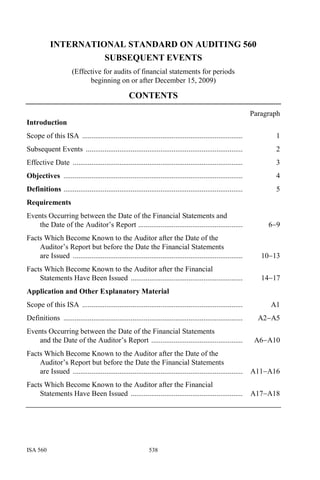
listed on a recognized stock exchange, or are marketed under the
regulations of a recognized stock exchange or other equivalent body.
2
“Engagement partner,” “partner,” and “firm” should be read as referring to their public sector
equivalents where relevant.
3
ISA 620, Using the Work of an Auditor’s Expert, paragraph 6(a), defines the term “auditor’s expert.”
QUALITY CONTROL FOR AN AUDIT OF FINANCIAL STATEMENTS
ISA 220129
AUDITING
(h) Monitoring – A process comprising an ongoing consideration and
evaluation of the firm’s system of quality control, including a
periodic inspection of a selection of completed engagements,
designed to provide the firm with reasonable assurance that its system
of quality control is operating effectively.
(i) Network firm – A firm or entity that belongs to a network.
(j) Network – A larger structure:
(i) That is aimed at cooperation, and
(ii) That is clearly aimed at profit or cost-sharing or shares
common ownership, control or management, common quality
control policies and procedures, common business strategy, the
use of a common brand name, or a significant part of
professional resources.
(k) Partner – Any individual with authority to bind the firm with respect
to the performance of a professional services engagement.
(l) Personnel – Partners and staff.
(m) Professional standards – International Standards on Auditing (ISAs)
and relevant ethical requirements.
(n) Relevant ethical requirements – Ethical requirements to which the
engagement team and engagement quality control reviewer are
subject, which ordinarily comprise Parts A and B of the International
Ethics Standards Board for Accountants’ Code of Ethics for
Professional Accountants (IESBA Code) related to an audit of
financial statements together with national requirements that are more
restrictive.
(o) Staff – Professionals, other than partners, including any experts the
firm employs.
(p) Suitably qualified external person – An individual outside the firm with
the competence and capabilities to act as an engagement partner, for
example, a partner of another firm, or an employee (with appropriate
experience) of either a professional accountancy body whose members
may perform audits of historical financial information or of an
organization that provides relevant quality control services.
Requirements
Leadership Responsibilities for Quality on Audits
8. The engagement partner shall take responsibility for the overall quality on
each audit engagement to which that partner is assigned. (Ref: Para. A3)
QUALITY CONTROL FOR AN AUDIT OF FINANCIAL STATEMENTS
ISA 220 130
Relevant Ethical Requirements
9. Throughout the audit engagement, the engagement partner shall remain
alert, through observation and making inquiries as necessary, for evidence of
non-compliance with relevant ethical requirements by members of the
engagement team. (Ref: Para. A4–A5)
10. If matters come to the engagement partner’s attention through the firm’s
system of quality control or otherwise that indicate that members of the
engagement team have not complied with relevant ethical requirements, the
engagement partner, in consultation with others in the firm, shall determine
the appropriate action. (Ref: Para. A5)
Independence
11. The engagement partner shall form a conclusion on compliance with
independence requirements that apply to the audit engagement. In doing so,
the engagement partner shall: (Ref: Para. A5)
(a) Obtain relevant information from the firm and, where applicable,
network firms, to identify and evaluate circumstances and relationships
that create threats to independence;
(b) Evaluate information on identified breaches, if any, of the firm’s
independence policies and procedures to determine whether they create a
threat to independence for the audit engagement; and
(c) Take appropriate action to eliminate such threats or reduce them to an
acceptable level by applying safeguards, or, if considered appropriate, to
withdraw from the audit engagement, where withdrawal is possible
under applicable law or regulation. The engagement partner shall
promptly report to the firm any inability to resolve the matter for
appropriate action. (Ref: Para. A6–A7)
Acceptance and Continuance of Client Relationships and Audit Engagements
12. The engagement partner shall be satisfied that appropriate procedures
regarding the acceptance and continuance of client relationships and audit
engagements have been followed, and shall determine that conclusions
reached in this regard are appropriate. (Ref: Para. A8–A9)
13. If the engagement partner obtains information that would have caused the
firm to decline the audit engagement had that information been available
earlier, the engagement partner shall communicate that information
promptly to the firm, so that the firm and the engagement partner can take
the necessary action. (Ref: Para. A9)
QUALITY CONTROL FOR AN AUDIT OF FINANCIAL STATEMENTS
ISA 220131
AUDITING
Assignment of Engagement Teams
14. The engagement partner shall be satisfied that the engagement team, and
any auditor’s experts who are not part of the engagement team, collectively
have the appropriate competence and capabilities to:
(a) Perform the audit engagement in accordance with professional
standards and applicable legal and regulatory requirements; and
(b) Enable an auditor’s report that is appropriate in the circumstances to
be issued. (Ref: Para. A10–A12)
Engagement Performance
Direction, Supervision and Performance
15. The engagement partner shall take responsibility for:
(a) The direction, supervision and performance of the audit engagement
in compliance with professional standards and applicable legal and
regulatory requirements; and (Ref: Para. A13–A15, A20)
(b) The auditor’s report being appropriate in the circumstances.
Reviews
16. The engagement partner shall take responsibility for reviews being
performed in accordance with the firm’s review policies and procedures.
(Ref: Para. A16–A17, A20)
17. On or before the date of the auditor’s report, the engagement partner shall,
through a review of the audit documentation and discussion with the
engagement team, be satisfied that sufficient appropriate audit evidence has
been obtained to support the conclusions reached and for the auditor’s report
to be issued. (Ref: Para. A18–A20)
Consultation
18. The engagement partner shall:
(a) Take responsibility for the engagement team undertaking appropriate
consultation on difficult or contentious matters;
(b) Be satisfied that members of the engagement team have undertaken
appropriate consultation during the course of the engagement, both
within the engagement team and between the engagement team and
others at the appropriate level within or outside the firm;
(c) Be satisfied that the nature and scope of, and conclusions resulting
from, such consultations are agreed with the party consulted; and
QUALITY CONTROL FOR AN AUDIT OF FINANCIAL STATEMENTS
ISA 220 132
(d) Determine that conclusions resulting from such consultations have
been implemented. (Ref: Para. A21–A22)
Engagement Quality Control Review
19. For audits of financial statements of listed entities, and those other audit
engagements, if any, for which the firm has determined that an engagement
quality control review is required, the engagement partner shall:
(a) Determine that an engagement quality control reviewer has been
appointed;
(b) Discuss significant matters arising during the audit engagement,
including those identified during the engagement quality control
review, with the engagement quality control reviewer; and
(c) Not date the auditor’s report until the completion of the engagement
quality control review. (Ref: Para. A23–A25)
20. The engagement quality control reviewer shall perform an objective
evaluation of the significant judgments made by the engagement team, and
the conclusions reached in formulating the auditor’s report. This evaluation
shall involve:
(a) Discussion of significant matters with the engagement partner;
(b) Review of the financial statements and the proposed auditor’s report;
(c) Review of selected audit documentation relating to the significant
judgments the engagement team made and the conclusions it
reached; and
(d) Evaluation of the conclusions reached in formulating the auditor’s
report and consideration of whether the proposed auditor’s report is
appropriate. (Ref: Para. A26–A27, A29–A31)
21. For audits of financial statements of listed entities, the engagement quality
control reviewer, on performing an engagement quality control review, shall
also consider the following:
(a) The engagement team’s evaluation of the firm’s independence in
relation to the audit engagement;
(b) Whether appropriate consultation has taken place on matters
involving differences of opinion or other difficult or contentious
matters, and the conclusions arising from those consultations; and
(c) Whether audit documentation selected for review reflects the work
performed in relation to the significant judgments and supports the
conclusions reached. (Ref: Para. A28–A31)
QUALITY CONTROL FOR AN AUDIT OF FINANCIAL STATEMENTS
ISA 220133
AUDITING
Differences of Opinion
22. If differences of opinion arise within the engagement team, with those consulted
or, where applicable, between the engagement partner and the engagement
quality control reviewer, the engagement team shall follow the firm’s policies
and procedures for dealing with and resolving differences of opinion.
Monitoring
23. An effective system of quality control includes a monitoring process designed to
provide the firm with reasonable assurance that its policies and procedures
relating to the system of quality control are relevant, adequate, and operating
effectively. The engagement partner shall consider the results of the firm’s
monitoring process as evidenced in the latest information circulated by the firm
and, if applicable, other network firms and whether deficiencies noted in that
information may affect the audit engagement. (Ref: Para A32–A34)
Documentation
24. The auditor shall include in the audit documentation:4
(a) Issues identified with respect to compliance with relevant ethical
requirements and how they were resolved.
(b) Conclusions on compliance with independence requirements that
apply to the audit engagement, and any relevant discussions with the
firm that support these conclusions.
(c) Conclusions reached regarding the acceptance and continuance of
client relationships and audit engagements.
(d) The nature and scope of, and conclusions resulting from, consultations
undertaken during the course of the audit engagement. (Ref: Para. A35)
25. The engagement quality control reviewer shall document, for the audit
engagement reviewed, that:
(a) The procedures required by the firm’s policies on engagement quality
control review have been performed;
(b) The engagement quality control review has been completed on or
before the date of the auditor’s report; and
(c) The reviewer is not aware of any unresolved matters that would cause
the reviewer to believe that the significant judgments the engagement
team made and the conclusions it reached were not appropriate.
***
4
ISA 230, Audit Documentation, paragraphs 8-11, and A6
QUALITY CONTROL FOR AN AUDIT OF FINANCIAL STATEMENTS
ISA 220 134
Application and Other Explanatory Material
System of Quality Control and Role of Engagement Teams (Ref: Para. 2)
A1. ISQC 1, or national requirements that are at least as demanding, deals with
the firm’s responsibilities to establish and maintain its system of quality
control for audit engagements. The system of quality control includes
policies and procedures that address each of the following elements:
• Leadership responsibilities for quality within the firm;
• Relevant ethical requirements;
• Acceptance and continuance of client relationships and specific
engagements;
• Human resources;
• Engagement performance; and
• Monitoring.
National requirements that deal with the firm’s responsibilities to establish and
maintain a system of quality control are at least as demanding as ISQC 1 when
they address all the elements referred to in this paragraph and impose obligations
on the firm that achieve the aims of the requirements set out in ISQC 1.
Reliance on the Firm’s System of Quality Control (Ref: Para. 4)
A2. Unless information provided by the firm or other parties suggest otherwise,
the engagement team may rely on the firm’s system of quality control in
relation to, for example:
• Competence of personnel through their recruitment and formal training.
• Independence through the accumulation and communication of
relevant independence information.
• Maintenance of client relationships through acceptance and continuance
systems.
• Adherence to applicable legal and regulatory requirements through
the monitoring process.
Leadership Responsibilities for Quality on Audits (Ref: Para. 8)
A3. The actions of the engagement partner and appropriate messages to the other
members of the engagement team, in taking responsibility for the overall
quality on each audit engagement, emphasize:
(a) The importance to audit quality of:
QUALITY CONTROL FOR AN AUDIT OF FINANCIAL STATEMENTS
ISA 220135
AUDITING
(i) Performing work that complies with professional standards
and applicable legal and regulatory requirements;
(ii) Complying with the firm’s quality control policies and
procedures as applicable;
(iii) Issuing auditor’s reports that are appropriate in the circumstances;
and
(iv) The engagement team’s ability to raise concerns without fear
of reprisals; and
(b) The fact that quality is essential in performing audit engagements.
Relevant Ethical Requirements
Compliance with Relevant Ethical Requirements (Ref: Para. 9)
A4. The IESBA Code establishes the fundamental principles of professional
ethics, which include:
(a) Integrity;
(b) Objectivity;
(c) Professional competence and due care;
(d) Confidentiality; and
(e) Professional behavior.
Definition of “Firm,” “Network” and “Network Firm” (Ref: Para. 9–11)
A5. The definitions of “firm,” “network” or “network firm” in relevant ethical
requirements may differ from those set out in this ISA. For example, the IESBA
Code defines the “firm” as:
(a) A sole practitioner, partnership or corporation of professional
accountants;
(b) An entity that controls such parties through ownership, management or
other means; and
(c) An entity controlled by such parties through ownership, management or
other means.
The IESBA Code also provides guidance in relation to the terms “network” and
“network firm.”
In complying with the requirements in paragraphs 9–11, the definitions used
in the relevant ethical requirements apply in so far as is necessary to
interpret those ethical requirements.
QUALITY CONTROL FOR AN AUDIT OF FINANCIAL STATEMENTS
ISA 220 136
Threats to Independence (Ref: Para. 11(c))
A6. The engagement partner may identify a threat to independence regarding the
audit engagement that safeguards may not be able to eliminate or reduce to
an acceptable level. In that case, as required by paragraph 11(c), the
engagement partner reports to the relevant person(s) within the firm to
determine appropriate action, which may include eliminating the activity or
interest that creates the threat, or withdrawing from the audit engagement,
where withdrawal is possible under applicable law or regulation.
Considerations Specific to Public Sector Entities
A7. Statutory measures may provide safeguards for the independence of public
sector auditors. However, public sector auditors or audit firms carrying out
public sector audits on behalf of the statutory auditor may, depending on the
terms of the mandate in a particular jurisdiction, need to adapt their
approach in order to promote compliance with the spirit of paragraph 11.
This may include, where the public sector auditor’s mandate does not permit
withdrawal from the engagement, disclosure through a public report, of
circumstances that have arisen that would, if they were in the private sector,
lead the auditor to withdraw.
Acceptance and Continuance of Client Relationships and Audit Engagements
(Ref: Para. 12)
A8. ISQC 1 requires the firm to obtain information considered necessary in the
circumstances before accepting an engagement with a new client, when
deciding whether to continue an existing engagement, and when considering
acceptance of a new engagement with an existing client.5
Information such
as the following assists the engagement partner in determining whether the
conclusions reached regarding the acceptance and continuance of client
relationships and audit engagements are appropriate:
• The integrity of the principal owners, key management and those
charged with governance of the entity;
• Whether the engagement team is competent to perform the audit
engagement and has the necessary capabilities, including time and
resources;
• Whether the firm and the engagement team can comply with relevant
ethical requirements; and
• Significant matters that have arisen during the current or previous audit
engagement, and their implications for continuing the relationship.
5
ISQC 1, paragraph 27(a)
QUALITY CONTROL FOR AN AUDIT OF FINANCIAL STATEMENTS
ISA 220137
AUDITING
Considerations Specific to Public Sector Entities (Ref: Para. 12–13)
A9. In the public sector, auditors may be appointed in accordance with statutory
procedures. Accordingly, certain of the requirements and considerations
regarding the acceptance and continuance of client relationships and audit
engagements as set out in paragraphs 12, 13 and A8 may not be relevant.
Nonetheless, information gathered as a result of the process described may
be valuable to public sector auditors in performing risk assessments and in
carrying out reporting responsibilities.
Assignment of Engagement Teams (Ref: Para. 14)
A10. An engagement team includes a person using expertise in a specialized area
of accounting or auditing, whether engaged or employed by the firm, if any,
who performs audit procedures on the engagement. However, a person with
such expertise is not a member of the engagement team if that person’s
involvement with the engagement is only consultation. Consultations are
addressed in paragraphs 18, A21 and A22.
A11. When considering the appropriate competence and capabilities expected of
the engagement team as a whole, the engagement partner may take into
consideration such matters as the team’s:
• Understanding of, and practical experience with, audit engagements
of a similar nature and complexity through appropriate training and
participation.
• Understanding of professional standards and applicable legal and
regulatory requirements.
• Technical expertise, including expertise with relevant information
technology and specialized areas of accounting or auditing.
• Knowledge of relevant industries in which the client operates.
• Ability to apply professional judgment.
• Understanding of the firm’s quality control policies and procedures.
Considerations Specific to Public Sector Entities
A12. In the public sector, additional appropriate competence may include skills
that are necessary to discharge the terms of the audit mandate in a particular
jurisdiction. Such competence may include an understanding of the
applicable reporting arrangements, including reporting to the legislature or
other governing body or in the public interest. The wider scope of a public
sector audit may include, for example, some aspects of performance
auditing or a comprehensive assessment of compliance with law, regulation
or other authority and preventing and detecting fraud and corruption.
QUALITY CONTROL FOR AN AUDIT OF FINANCIAL STATEMENTS
ISA 220 138
Engagement Performance
Direction, Supervision and Performance (Ref: Para. 15(a))
A13. Direction of the engagement team involves informing the members of the
engagement team of matters such as:
• Their responsibilities, including the need to comply with relevant
ethical requirements, and to plan and perform an audit with
professional skepticism as required by ISA 200.6
• Responsibilities of respective partners where more than one partner
is involved in the conduct of an audit engagement.
• The objectives of the work to be performed.
• The nature of the entity’s business.
• Risk-related issues.
• Problems that may arise.
• The detailed approach to the performance of the engagement.
Discussion among members of the engagement team allows less experienced
team members to raise questions with more experienced team members so that
appropriate communication can occur within the engagement team.
A14. Appropriate teamwork and training assist less experienced members of the
engagement team to clearly understand the objectives of the assigned work.
A15. Supervision includes matters such as:
• Tracking the progress of the audit engagement.
• Considering the competence and capabilities of individual members
of the engagement team, including whether they have sufficient time
to carry out their work, whether they understand their instructions
and whether the work is being carried out in accordance with the
planned approach to the audit engagement.
• Addressing significant matters arising during the audit engagement,
considering their significance and modifying the planned approach
appropriately.
• Identifying matters for consultation or consideration by more
experienced engagement team members during the audit engagement.
6
ISA 200, Overall Objectives of the Independent Auditor and the Conduct of an Audit in Accordance
with International Standards on Auditing, paragraph 15
QUALITY CONTROL FOR AN AUDIT OF FINANCIAL STATEMENTS
ISA 220139
AUDITING
Reviews
Review Responsibilities (Ref: Para. 16)
A16. Under ISQC 1, the firm’s review responsibility policies and procedures are
determined on the basis that work of less experienced team members is
reviewed by more experienced team members.7
A17. A review consists of consideration whether, for example:
• The work has been performed in accordance with professional standards
and applicable legal and regulatory requirements;
• Significant matters have been raised for further consideration;
• Appropriate consultations have taken place and the resulting
conclusions have been documented and implemented;
• There is a need to revise the nature, timing and extent of work
performed;
• The work performed supports the conclusions reached and is
appropriately documented;
• The evidence obtained is sufficient and appropriate to support the
auditor’s report; and
• The objectives of the engagement procedures have been achieved.
The Engagement Partner’s Review of Work Performed (Ref: Para. 17)
A18. Timely reviews of the following by the engagement partner at appropriate
stages during the engagement allow significant matters to be resolved on a
timely basis to the engagement partner’s satisfaction on or before the date of
the auditor’s report:
• Critical areas of judgment, especially those relating to difficult or
contentious matters identified during the course of the engagement;
• Significant risks; and
• Other areas the engagement partner considers important.
The engagement partner need not review all audit documentation, but may
do so. However, as required by ISA 230, the partner documents the extent
and timing of the reviews.8
A19. An engagement partner taking over an audit during the engagement may apply
the review procedures as described in paragraph A18 to review the work
7
ISQC 1, paragraph 33
8
ISA 230, paragraph 9(c)
QUALITY CONTROL FOR AN AUDIT OF FINANCIAL STATEMENTS
ISA 220 140
performed to the date of a change in order to assume the responsibilities of an
engagement partner.
Considerations Relevant Where a Member of the Engagement Team with Expertise in
a Specialized Area of Accounting or Auditing Is Used (Ref: Para. 15–17)
A20. Where a member of the engagement team with expertise in a specialized
area of accounting or auditing is used, direction, supervision and review of
that engagement team member’s work may include matters such as:
• Agreeing with that member the nature, scope and objectives of that
member’s work; and the respective roles of, and the nature, timing and
extent of communication between that member and other members of
the engagement team.
• Evaluating the adequacy of that member’s work including the relevance
and reasonableness of that member’s findings or conclusions and their
consistency with other audit evidence.
Consultation (Ref: Para. 18)
A21. Effective consultation on significant technical, ethical and other matters within
the firm or, where applicable, outside the firm can be achieved when those
consulted:
• Are given all the relevant facts that will enable them to provide
informed advice; and
• Have appropriate knowledge, seniority and experience.
A22. It may be appropriate for the engagement team to consult outside the firm, for
example, where the firm lacks appropriate internal resources. They may take
advantage of advisory services provided by other firms, professional and
regulatory bodies, or commercial organizations that provide relevant quality
control services.
Engagement Quality Control Review
Completion of the Engagement Quality Control Review before Dating of the
Auditor’s Report (Ref: Para. 19(c))
A23. ISA 700 requires the auditor’s report to be dated no earlier than the date on
which the auditor has obtained sufficient appropriate evidence on which to
base the auditor’s opinion on the financial statements.9
In cases of an audit of
financial statements of listed entities or when an engagement meets the criteria
for an engagement quality control review, such a review assists the auditor in
determining whether sufficient appropriate evidence has been obtained.
9
ISA 700, Forming an Opinion and Reporting on Financial Statements, paragraph 41
QUALITY CONTROL FOR AN AUDIT OF FINANCIAL STATEMENTS
ISA 220141
AUDITING
A24. Conducting the engagement quality control review in a timely manner at
appropriate stages during the engagement allows significant matters to be
promptly resolved to the engagement quality control reviewer’s satisfaction
on or before the date of the auditor’s report.
A25. Completion of the engagement quality control review means the completion
by the engagement quality control reviewer of the requirements in paragraphs
20–21, and where applicable, compliance with paragraph 22. Documentation
of the engagement quality control review may be completed after the date of
the auditor’s report as part of the assembly of the final audit file. ISA 230
establishes requirements and provides guidance in this regard.10
Nature, Timing and Extent of Engagement Quality Control Review (Ref: Para. 20)
A26. Remaining alert for changes in circumstances allows the engagement partner to
identify situations in which an engagement quality control review is necessary,
even though at the start of the engagement, such a review was not required.
A27. The extent of the engagement quality control review may depend, among
other things, on the complexity of the audit engagement, whether the entity
is a listed entity, and the risk that the auditor’s report might not be
appropriate in the circumstances. The performance of an engagement quality
control review does not reduce the responsibilities of the engagement
partner for the audit engagement and its performance.
Engagement Quality Control Review of Listed Entities (Ref: Para. 21)
A28. Other matters relevant to evaluating the significant judgments made by the
engagement team that may be considered in an engagement quality control
review of a listed entity include:
• Significant risks identified during the engagement in accordance with
ISA 315 (Revised),11
and the responses to those risks in accordance
with ISA 330,12
including the engagement team’s assessment of, and
response to, the risk of fraud in accordance with ISA 240.13
• Judgments made, particularly with respect to materiality and significant
risks.
• The significance and disposition of corrected and uncorrected
misstatements identified during the audit.
10
ISA 230, paragraphs 14-16
11
ISA 315 (Revised), Identifying and Assessing the Risks of Material Misstatement through
Understanding the Entity and Its Environment
12
ISA 330, The Auditor’s Responses to Assessed Risks
13
ISA 240, The Auditor’s Responsibilities Relating to Fraud in an Audit of Financial Statements
QUALITY CONTROL FOR AN AUDIT OF FINANCIAL STATEMENTS
ISA 220 142
• The matters to be communicated to management and those charged with
governance and, where applicable, other parties such as regulatory
bodies.
These other matters, depending on the circumstances, may also be applicable
for engagement quality control reviews for audits of financial statements of
other entities.
Considerations Specific to Smaller Entities (Ref: Para. 20–21)
A29. In addition to the audits of financial statements of listed entities, an engagement
quality control review is required for audit engagements that meet the criteria
established by the firm that subjects engagements to an engagement quality
control review. In some cases, none of the firm’s audit engagements may meet
the criteria that would subject them to such a review.
Considerations Specific to Public Sector Entities (Ref: Para. 20–21)
A30. In the public sector, a statutorily appointed auditor (for example, an Auditor
General, or other suitably qualified person appointed on behalf of the Auditor
General), may act in a role equivalent to that of engagement partner with overall
responsibility for public sector audits. In such circumstances, where applicable,
the selection of the engagement quality control reviewer includes consideration
of the need for independence from the audited entity and the ability of the
engagement quality control reviewer to provide an objective evaluation.
A31. Listed entities as referred to in paragraphs 21 and A28 are not common in
the public sector. However, there may be other public sector entities that are
significant due to size, complexity or public interest aspects, and which
consequently have a wide range of stakeholders. Examples include state
owned corporations and public utilities. Ongoing transformations within the
public sector may also give rise to new types of significant entities. There
are no fixed objective criteria on which the determination of significance is
based. Nonetheless, public sector auditors evaluate which entities may be of
sufficient significance to warrant performance of an engagement quality
control review.
Monitoring (Ref: Para. 23)
A32. ISQC 1 requires the firm to establish a monitoring process designed to provide it
with reasonable assurance that the policies and procedures relating to the system
of quality control are relevant, adequate and operating effectively.14
A33. In considering deficiencies that may affect the audit engagement, the
engagement partner may have regard to measures the firm took to rectify the
14
ISQC 1, paragraph 48
QUALITY CONTROL FOR AN AUDIT OF FINANCIAL STATEMENTS
ISA 220143
AUDITING
situation that the engagement partner considers are sufficient in the context of
that audit.
A34. A deficiency in the firm’s system of quality control does not necessarily indicate
that a particular audit engagement was not performed in accordance with
professional standards and applicable legal and regulatory requirements, or that
the auditor’s report was not appropriate.
Documentation
Documentation of Consultations (Ref: Para. 24(d))
A35. Documentation of consultations with other professionals that involve difficult or
contentious matters that is sufficiently complete and detailed contributes to an
understanding of:
• The issue on which consultation was sought; and
• The results of the consultation, including any decisions taken, the
basis for those decisions and how they were implemented.
ISA 230 144
INTERNATIONAL STANDARD ON AUDITING 230
AUDIT DOCUMENTATION
(Effective for audits of financial statements for periods
beginning on or after December 15, 2009)
CONTENTS
Paragraph
Introduction
Scope of this ISA ........................................................................................ 1
Nature and Purposes of Audit Documentation ............................................ 2−3
Effective Date ............................................................................................. 4
Objective .................................................................................................... 5
Definitions .................................................................................................. 6
Requirements
Timely Preparation of Audit Documentation .............................................. 7
Documentation of the Audit Procedures Performed and Audit
Evidence Obtained ............................................................................... 8−13
Assembly of the Final Audit File ................................................................ 14−16
Application and Other Explanatory Material
Timely Preparation of Audit Documentation .............................................. A1
Documentation of the Audit Procedures Performed and Audit
Evidence Obtained ............................................................................... A2−A20
Assembly of the Final Audit File ................................................................ A21−A24
Appendix: Specific Audit Documentation Requirements in Other ISAs
International Standard on Auditing (ISA) 230, Audit Documentation, should be read
in conjunction with ISA 200, Overall Objectives of the Independent Auditor and the
Conduct of an Audit in Accordance with International Standards on Auditing.
AUDIT DOCUMENTATION
ISA 230145
AUDITING
Introduction
Scope of this ISA
1. This International Standard on Auditing (ISA) deals with the auditor’s
responsibility to prepare audit documentation for an audit of financial
statements. The Appendix lists other ISAs that contain specific documentation
requirements and guidance. The specific documentation requirements of other
ISAs do not limit the application of this ISA. Law or regulation may establish
additional documentation requirements.
Nature and Purposes of Audit Documentation
2. Audit documentation that meets the requirements of this ISA and the specific
documentation requirements of other relevant ISAs provides:
(a) Evidence of the auditor’s basis for a conclusion about the achievement
of the overall objectives of the auditor;1
and
(b) Evidence that the audit was planned and performed in accordance with
ISAs and applicable legal and regulatory requirements.
3. Audit documentation serves a number of additional purposes, including the
following:
• Assisting the engagement team to plan and perform the audit.
• Assisting members of the engagement team responsible for supervision
to direct and supervise the audit work, and to discharge their review
responsibilities in accordance with ISA 220.2
• Enabling the engagement team to be accountable for its work.
• Retaining a record of matters of continuing significance to future audits.
• Enabling the conduct of quality control reviews and inspections in
accordance with ISQC 13
or national requirements that are at least as
demanding.4
• Enabling the conduct of external inspections in accordance with
applicable legal, regulatory or other requirements.
1
ISA200, Overall Objectives of the Independent Auditor and the Conduct of an Audit in Accordance with
International Standards on Auditing, paragraph 11
2
ISA 220, Quality Control for an Audit of Financial Statements, paragraphs 15–17
3
ISQC 1, Quality Control for Firms that Perform Audits and Reviews of Financial Statements, and Other
Assurance and Related Services Engagements, paragraphs 32–33, 35–38, and 48
4
ISA 220, paragraph 2
AUDIT DOCUMENTATION
ISA 230 146
Effective Date
4. This ISA is effective for audits of financial statements for periods beginning on
or after December 15, 2009.
Objective
5. The objective of the auditor is to prepare documentation that provides:
(a) Asufficient and appropriate record ofthe basis for the auditor’s report; and
(b) Evidence that the audit was planned and performed in accordance with
ISAs and applicable legal and regulatory requirements.
Definitions
6. ForpurposesoftheISAs, the following terms have the meanings attributed below:
(a) Auditdocumentation–The record ofaudit proceduresperformed,relevant
audit evidence obtained,and conclusions the auditorreached(termssuchas
“working papers” or “workpapers” are also sometimes used).
(b) Audit file – One or more folders or other storage media, in physical or
electronic form, containing the records that comprise the audit
documentation for a specific engagement.
(c) Experienced auditor – An individual (whether internal or external to the
firm) who has practical audit experience, and a reasonable understanding
of:
(i) Audit processes;
(ii) ISAs and applicable legal and regulatory requirements;
(iii) The business environment in which the entity operates; and
(iv) Auditing and financial reporting issues relevant to the entity’s
industry.
Requirements
Timely Preparation of Audit Documentation
7. The auditor shall prepare audit documentation on a timely basis. (Ref: Para. A1)
Documentation of the Audit Procedures Performed and Audit Evidence
Obtained
Form, Content and Extent of Audit Documentation
8. The auditor shall prepare audit documentation that is sufficient to enable an
experienced auditor, having no previous connection with the audit, to
understand: (Ref: Para. A2–A5, A16–A17)
AUDIT DOCUMENTATION
ISA 230147
AUDITING
(a) The nature, timing and extent of the audit procedures performed to
comply with the ISAs and applicable legal and regulatory requirements;
(Ref: Para. A6–A7)
(b) The results of the audit procedures performed, and the audit evidence
obtained; and
(c) Significant matters arising during the audit, the conclusions reached
thereon, and significant professional judgments made in reaching those
conclusions. (Ref: Para. A8–A11)
9. In documenting the nature, timing and extent of audit procedures performed,
the auditor shall record:
(a) The identifying characteristics of the specific items or matters tested;
(Ref: Para. A12)
(b) Who performed theaudit work and the date such work was completed; and
(c) Who reviewed the audit work performed and the date and extent of such
review. (Ref: Para. A13)
10. The auditor shall document discussions of significant matters with
management, those charged with governance, and others, including the nature
of the significant matters discussed and when and with whom the discussions
took place. (Ref: Para. A14)
11. If the auditor identified information that is inconsistent with the auditor’s final
conclusion regarding a significant matter, the auditor shall document how the
auditor addressed the inconsistency. (Ref: Para. A15)
Departure from a Relevant Requirement
12. If, in exceptional circumstances, the auditor judges it necessary to depart from
a relevant requirement in an ISA, the auditor shall document how the
alternative audit procedures performed achieve the aimof that requirement, and
the reasons for the departure. (Ref: Para. A18–A19)
Matters Arising after the Date of the Auditor’s Report
13. If, in exceptional circumstances, the auditor performs new or additional audit
procedures or draws new conclusions after the date of the auditor’s report, the
auditor shall document: (Ref: Para. A20)
(a) The circumstances encountered;
(b) The newor additional auditproceduresperformed,auditevidenceobtained,
and conclusions reached, and their effect on the auditor’s report; and
(c) When and by whom the resulting changes to audit documentation were
made and reviewed.
AUDIT DOCUMENTATION
ISA 230 148
Assembly of the Final Audit File
14. The auditor shall assemble the audit documentation in an audit file and
complete the administrative process of assembling the final audit file on a
timely basis after the date of the auditor’s report. (Ref: Para. A21–A22)
15. After the assembly of the final audit file has been completed, the auditor shall
not delete or discard audit documentation of any nature before the end of its
retention period. (Ref: Para. A23)
16. In circumstances other than those envisaged in paragraph 13 where the auditor
finds it necessary to modify existing audit documentation or add new audit
documentation after the assembly of the final audit file has been completed, the
auditor shall, regardless of the nature of the modifications or additions,
document: (Ref: Para. A24)
(a) The specific reasons for making them; and
(b) When and by whom they were made and reviewed.
***
Application and Other Explanatory Material
Timely Preparation of Audit Documentation (Ref: Para. 7)
A1. Preparing sufficient and appropriate audit documentation on a timely basis
helps to enhance the quality of the audit and facilitates the effective review and
evaluation of the audit evidence obtained and conclusions reached before the
auditor’s report is finalized. Documentation prepared after the audit work has
been performed is likely to be less accurate than documentation prepared at the
time such work is performed.
Documentation of the Audit Procedures Performed and Audit Evidence
Obtained
Form, Content and Extent of Audit Documentation (Ref: Para. 8)
A2. The form, content and extent of audit documentation depend on factors such as:
• The size and complexity of the entity.
• The nature of the audit procedures to be performed.
• The identified risks of material misstatement.
• The significance of the audit evidence obtained.
• The nature and extent of exceptions identified.
AUDIT DOCUMENTATION
ISA 230149
AUDITING
• The need to document a conclusion or the basis for a conclusion not
readily determinable from the documentation of the work performed or
audit evidence obtained.
• The audit methodology and tools used.
A3. Audit documentation may be recorded on paper or on electronic or other
media. Examples of audit documentation include:
• Audit programs.
• Analyses.
• Issues memoranda.
• Summaries of significant matters.
• Letters of confirmation and representation.
• Checklists.
• Correspondence (including e-mail) concerning significant matters.
The auditor may include abstracts or copies of the entity’s records (for
example, significant and specific contracts and agreements) as part of audit
documentation. Audit documentation, however, is not a substitute for the
entity’s accounting records.
A4. The auditor need not include in audit documentation superseded drafts of
working papers and financial statements, notes that reflect incomplete or
preliminary thinking, previous copies of documents corrected for typographical
or other errors, and duplicates of documents.
A5. Oral explanations by the auditor, on their own, do not represent adequate support
for the work the auditor performed or conclusions the auditor reached, but may be
used to explain or clarify information contained in the audit documentation.
Documentation of Compliance with ISAs (Ref: Para. 8(a))
A6. In principle, compliance with the requirements of this ISA will result in the
audit documentation being sufficient and appropriate in the circumstances.
Other ISAs contain specific documentation requirements that are intended to
clarify the application of this ISA in the particular circumstances of those other
ISAs. The specific documentation requirements of other ISAs do not limit the
application of this ISA. Furthermore, the absence of a documentation
requirement in any particular ISA is not intended to suggest that there is no
documentation that will be prepared as a result of complying with that ISA.
A7. Audit documentation provides evidence that the audit complies with the ISAs.
However, it is neither necessary nor practicable for the auditor to document
every matter considered, or professional judgment made, in an audit. Further, it
AUDIT DOCUMENTATION
ISA 230 150
is unnecessary for the auditor to document separately (as in a checklist, for
example) compliance with matters for which compliance is demonstrated by
documents included within the audit file. For example:
• The existence of an adequately documented audit plan demonstrates
that the auditor has planned the audit.
• The existence of a signed engagement letter in the audit file demonstrates
that the auditor has agreed the terms of the audit engagement with
management or, where appropriate, those charged with governance.
• An auditor’s report containing an appropriately qualified opinion on the
financial statements demonstrates that the auditor has complied with the
requirement to express a qualified opinion under the circumstances
specified in the ISAs.
• In relation to requirements that apply generally throughout the audit,
there may be a number of ways in which compliance with them may be
demonstrated within the audit file:
○ For example, there may be no single way in which the auditor’s
professional skepticismis documented.Buttheauditdocumentation
may nevertheless provide evidence of the auditor’s exercise of
professional skepticismin accordance withtheISAs.Suchevidence
may include specific procedures performed to corroborate
management’s responses to the auditor’s inquiries.
○ Similarly, that the engagement partner has taken responsibility
for the direction, supervision and performance of the audit in
compliance with the ISAs may be evidenced in a number of
ways within the audit documentation. This may include
documentation of the engagement partner’s timely involvement
in aspects of the audit, such as participation in the team
discussions required by ISA 315 (Revised).5
Documentation of Significant Matters and Related Significant Professional
Judgments (Ref: Para. 8(c))
A8. Judging the significance of a matter requires an objective analysis of the facts
and circumstances. Examples of significant matters include:
• Matters that give rise to significant risks (as defined in ISA 315
(Revised)).6
5
ISA315 (Revised), Identifying and Assessing the Risks of Material Misstatement through Understanding
the Entity and Its Environment, paragraph 10
6
ISA 315 (Revised), paragraph 4(e)
AUDIT DOCUMENTATION
ISA 230151
AUDITING
• Results of audit procedures indicating (a) that the financial statements
could be materially misstated, or (b) a need to revise the auditor’s
previous assessment of the risks of material misstatement and the
auditor’s responses to those risks.
• Circumstances that cause the auditor significant difficulty in applying
necessary audit procedures.
• Findings that could result in a modification to the audit opinion or the
inclusion of an Emphasis of Matter paragraph in the auditor’s report.
A9. An important factor in determining the form, content and extent of audit
documentation of significant matters is the extent of professional judgment
exercised in performing the work and evaluating the results. Documentation of
the professional judgments made, where significant, serves to explain the
auditor’s conclusions and to reinforce the quality of the judgment. Such matters
are of particular interest to those responsible for reviewing audit
documentation, including those carrying out subsequent audits when reviewing
matters of continuing significance (for example, when performing a
retrospective review of accounting estimates).
A10. Some examples of circumstances in which, in accordance with paragraph 8, it
is appropriate to prepare audit documentation relating to the use of professional
judgment include, where the matters and judgments are significant:
• The rationale for the auditor’s conclusion when a requirement provides
that the auditor “shall consider” certain information or factors, and that
consideration is significant in the context of the particular engagement.
• The basis for the auditor’s conclusion on the reasonableness of areas of
subjective judgments (for example, the reasonableness of significant
accounting estimates).
• The basis for the auditor’s conclusions about the authenticity of a
document when further investigation (such as making appropriate use
of an expert or of confirmation procedures) is undertaken in response to
conditions identified during the audit that caused the auditor to believe
that the document may not be authentic.
A11. The auditor may consider it helpful to prepare and retain as part of the audit
documentation a summary (sometimes known as a completion memorandum)
that describes the significant matters identified during the audit and how they
were addressed, or that includes cross-references to other relevant supporting
audit documentation that provides such information. Such a summary may
facilitate effective and efficient reviews and inspections of the audit
documentation, particularly for large and complex audits. Further, the
preparation of such a summary may assist the auditor’s consideration of the
significant matters. It may also help the auditor to consider whether, in light of
AUDIT DOCUMENTATION
ISA 230 152
the audit procedures performed and conclusions reached, there is any
individual relevant ISA objective that the auditor cannot achieve that would
prevent the auditor from achieving the overall objectives of the auditor.
Identification of Specific Items or Matters Tested, and of the Preparer and Reviewer
(Ref: Para. 9)
A12. Recording the identifying characteristics serves a number of purposes. For
example, it enables the engagement team to be accountable for its work and
facilitates the investigation of exceptions or inconsistencies. Identifying
characteristics will vary with the nature of the audit procedure and the item or
matter tested. For example:
• For a detailed test of entity-generated purchase orders, the auditor may
identify the documents selected for testing by their dates and unique
purchase order numbers.
• For a procedure requiring selection or review of all items over a specific
amount from a given population, the auditor may record the scope of
the procedure and identify the population (for example, all journal
entries over a specified amount from the journal register).
• For a procedure requiring systematic sampling from a population of
documents, the auditor may identify the documents selected by
recording their source, the starting point and the sampling interval (for
example, a systematic sample of shipping reports selected from the
shipping log for the period from April 1 to September 30, starting with
report number 12345 and selecting every 125th report).
• For a procedure requiring inquiries of specific entity personnel, the
auditor may record the dates of the inquiries and the names and job
designations of the entity personnel.
• For an observation procedure, the auditor may record the process or
matter being observed, the relevant individuals, their respective
responsibilities, and where and when the observation was carried out.
A13. ISA 220 requires the auditor to review the audit work performed through
review of the audit documentation.7
The requirement to document who
reviewed the audit work performed does not imply a need for each specific
working paper to include evidence of review. The requirement, however,
means documenting what audit work was reviewed, who reviewed such work,
and when it was reviewed.
7
ISA 220, paragraph 17
AUDIT DOCUMENTATION
ISA 230153
AUDITING
Documentation of Discussions of Significant Matters with Management, Those
Charged with Governance, and Others (Ref: Para. 10)
A14. The documentation is not limited to records prepared by the auditor but may
include other appropriate records such as minutes of meetings prepared by the
entity’s personnel and agreed by the auditor. Others with whom the auditor may
discuss significant matters may include other personnel within the entity, and
external parties, such as persons providing professional advice to the entity.
Documentation of How Inconsistencies Have Been Addressed (Ref: Para. 11)
A15. The requirement to document how the auditor addressed inconsistencies in
information does not imply that the auditor needs to retain documentation that
is incorrect or superseded.
Considerations Specific to Smaller Entities (Ref. Para. 8)
A16. The audit documentation for the audit of a smaller entity is generally less
extensive than that for the audit of a larger entity. Further, in the case of an
audit where the engagement partner performs all the audit work, the
documentation will not include matters that might have to be documented
solely to inform or instruct members of an engagement team, or to provide
evidence of review by other members of the team (for example, there will be
no matters to document relating to team discussions or supervision).
Nevertheless, the engagement partner complies with the overriding requirement
in paragraph 8 to prepare audit documentation that can be understood by an
experienced auditor, as the audit documentation may be subject to review by
external parties for regulatory or other purposes.
A17. When preparing audit documentation, the auditor of a smaller entity may also
find it helpful and efficient to record various aspects of the audit together in a
single document, with cross-references to supporting working papers as
appropriate. Examples of matters that may be documented together in the audit
of a smaller entity include the understanding of the entity and its internal
control, the overall audit strategy and audit plan, materiality determined in
accordance with ISA 320,8
assessed risks, significant matters noted during the
audit, and conclusions reached.
Departure from a Relevant Requirement (Ref: Para. 12)
A18. The requirements of the ISAs are designed to enable the auditor to achieve the
objectives specified in the ISAs, and thereby the overall objectives of the auditor.
Accordingly, other than inexceptionalcircumstances, theISAscallforcompliance
with each requirement that is relevant in the circumstances of the audit.
8
ISA 320, Materiality in Planning and Performing an Audit
AUDIT DOCUMENTATION
ISA 230 154
A19. The documentation requirement applies only to requirements that are relevant
in the circumstances. A requirement is not relevant9
only in the cases where:
(a) The entire ISA is not relevant (for example, if an entity does not have
an internal audit function, nothing in ISA 610 (Revised)10
is relevant);
or
(b) The requirement is conditional and the condition does not exist (for
example, the requirement to modifythe auditor’sopinion where there is an
inability to obtain sufficient appropriateaudit evidence,andthereisnosuch
inability).
Matters Arising after the Date of the Auditor’s Report (Ref: Para. 13)
A20. Examples of exceptional circumstances include facts which become known to
the auditor after the date of the auditor’s report but which existed at that date
and which, if known at that date, might have caused the financial statements to
be amended or the auditor to modify the opinion in the auditor’s report.11
The
resulting changes to the audit documentation are reviewed in accordance with
the review responsibilities set out in ISA 220,12
with the engagement partner
taking final responsibility for the changes.
Assembly of the Final Audit File (Ref: Para. 14–16)
A21. ISQC 1 (or national requirements that are at least as demanding) requires firms
to establish policies and procedures for the timely completion of the assembly
of audit files.13
An appropriate time limit within which to complete the
assembly of the final audit file is ordinarily not more than 60 days after the date
of the auditor’s report.14
A22. The completion of the assembly of the final audit file after the date of the auditor’s
report is an administrative process that does not involve the performance of new
audit procedures or the drawing of new conclusions. Changes may, however, be
made to the audit documentation during the final assembly process if they are
administrative in nature. Examples of such changes include:
• Deleting or discarding superseded documentation.
• Sorting, collating and cross-referencing working papers.
9
ISA 200, paragraph 22
10
ISA 610 (Revised), Using the Work of Internal Auditors, paragraph 2
11
ISA 560, Subsequent Events, paragraph 14
12
ISA 220, paragraph 16
13
ISQC 1, paragraph 45
14
ISQC 1, paragraph A54
AUDIT DOCUMENTATION
ISA 230155
AUDITING
• Signing off on completion checklists relating to the file assembly process.
• Documenting audit evidence that the auditor has obtained, discussed
and agreed with the relevant members of the engagement team before
the date of the auditor’s report.
A23. ISQC 1 (or national requirements that are at least as demanding) requires firms
to establish policies and procedures for the retention of engagement
documentation.15
The retention period for audit engagements ordinarily is no
shorter than five years from the date of the auditor’s report, or, if later, the date
of the group auditor’s report.16
A24. An example of a circumstance in which the auditor may find it necessary to
modify existing audit documentation or add new audit documentation after file
assembly has been completed is the need to clarify existing audit
documentation arising from comments received during monitoring inspections
performed by internal or external parties.
15
ISQC 1, paragraph 47
16
ISQC 1, paragraph A61
AUDIT DOCUMENTATION
ISA 230 APPENDIX 156
Appendix
(Ref: Para. 1)
Specific Audit Documentation Requirements in Other ISAs
This appendix identifies paragraphs in other ISAs in effect for audits of financial
statements for periods beginning on or after December 15, 2009 that contain specific
documentation requirements. The list is not a substitute for considering the requirements
and related application and other explanatory material in ISAs.
• ISA210, Agreeing the Terms of Audit Engagements – paragraphs 10–12
• ISA220, Quality Control for an Audit of Financial Statements – paragraphs 24–25
• ISA240, The Auditor’s Responsibilities Relating to Fraud in an Audit of Financial
Statements – paragraphs 44–47
• ISA250, Consideration of Laws and Regulations in an AuditofFinancialStatements
– paragraph 29
• ISA260, Communication with Those Charged with Governance – paragraph 23
• ISA300, Planning an Audit of Financial Statements – paragraph 12
• ISA 315 (Revised), Identifying and Assessing the Risks of Material Misstatement
through Understanding the Entity and Its Environment – paragraph 32
• ISA320, Materiality in Planning and Performing an Audit – paragraph 14
• ISA330, The Auditor’s Responses to Assessed Risks – paragraphs 28–30
• ISA450, Evaluation of Misstatements Identified during the Audit – paragraph 15
• ISA540, AuditingAccounting Estimates,IncludingFairValueAccountingEstimates,
and Related Disclosures – paragraph 23
• ISA550, Related Parties – paragraph 28
• ISA600, Special Considerations—Audits of Group Financial Statements (Including
the Work of Component Auditors) – paragraph 50
• ISA610 (Revised), Using the Work of Internal Auditors – paragraph 24
ISA 240157
AUDITING
INTERNATIONAL STANDARD ON AUDITING 240
THE AUDITOR’S RESPONSIBILITIES RELATING TO
FRAUD IN AN AUDIT OF FINANCIAL STATEMENTS
(Effective for audits of financial statements for periods
beginning on or after December 15, 2009)∗
CONTENTS
Paragraph
Introduction
Scope of this ISA ........................................................................................ 1
Characteristics of Fraud .............................................................................. 2−3
Responsibility for the Prevention and Detection of Fraud .......................... 4−8
Effective Date ............................................................................................. 9
Objectives .................................................................................................. 10
Definitions .................................................................................................. 11
Requirements
Professional Skepticism .............................................................................. 12−14
Discussion among the Engagement Team .................................................. 15
Risk Assessment Procedures and Related Activities .................................. 16−24
Identification and Assessment of the Risks of Material
Misstatement Due to Fraud .................................................................. 25−27
Responses to the Assessed Risks of Material Misstatement
Due to Fraud ........................................................................................ 28−33
Evaluation of Audit Evidence ..................................................................... 34−37
Auditor Unable to Continue the Engagement ............................................. 38
Written Representations .............................................................................. 39
Communications to Management and with Those Charged
with Governance .................................................................................. 40−42
∗ Conforming amendments have been made to this ISAas a result of ISA610 (Revised), Using the Work
of Internal Auditors, and are effective for audits of financial statements for periods ending on or after
December 15, 2013. The conforming amendments were identified in the 2012 Handbook on pages 948–
955.
THE AUDITOR’S RESPONSIBILITIES RELATING TO
FRAUD IN AN AUDIT OF FINANCIAL STATEMENTS
ISA 240 158
Communications to Regulatory and Enforcement Authorities ................... 43
Documentation ............................................................................................ 44−47
Application and Other Explanatory Material
Characteristics of Fraud .............................................................................. A1−A6
Professional Skepticism .............................................................................. A7−A9
Discussion among the Engagement Team .................................................. A10−A11
Risk Assessment Procedures and Related Activities .................................. A12−A27
Identification and Assessment of the Risks of Material
Misstatement Due to Fraud .................................................................. A28−A32
Responses to the Assessed Risks of Material Misstatement
Due to Fraud ........................................................................................ A33−A48
Evaluation of Audit Evidence ..................................................................... A49−A53
Auditor Unable to Continue the Engagement ............................................. A54−A57
Written Representations .............................................................................. A58−A59
Communications to Management and with Those Charged
with Governance .................................................................................. A60−A64
Communications to Regulatory and Enforcement
Authorities ........................................................................................... A65−A67
Appendix 1: Examples of Fraud Risk Factors
Appendix 2: Examples of Possible Audit Procedures to Address the
Assessed Risks of Material Misstatement Due to Fraud
Appendix 3: Examples of Circumstances that Indicate the Possibility
of Fraud
International Standard on Auditing (ISA) 240, The Auditor’s Responsibilities
Relating to Fraud in an Audit of Financial Statements, should be read in conjunction
with ISA 200, Overall Objectives of the Independent Auditor and the Conduct of an
Audit in Accordance with International Standards on Auditing.
THE AUDITOR’S RESPONSIBILITIES RELATING TO
FRAUD IN AN AUDIT OF FINANCIAL STATEMENTS
ISA 240159
AUDITING
Introduction
Scope of this ISA
1. This International Standard on Auditing (ISA) deals with the auditor’s
responsibilities relating to fraud in an audit of financial statements. Specifically, it
expands on how ISA315 (Revised)1
and ISA3302
are to be applied in relation to
risks of material misstatement due to fraud.
Characteristics of Fraud
2. Misstatements in the financial statements can arise from either fraud or error.
The distinguishing factor between fraud and error is whether the underlying
action that results in the misstatement of the financial statements is intentional
or unintentional.
3. Although fraud is abroad legal concept, for the purposesofthe ISAs, the auditor is
concerned with fraud that causes a material misstatement in the financial
statements. Two types of intentional misstatements are relevant to the auditor –
misstatements resulting from fraudulent financial reporting and misstatements
resulting from misappropriation of assets.Although the auditor may suspect or, in
rare cases, identify the occurrence of fraud, the auditor does not make legal
determinations of whether fraud has actually occurred. (Ref: Para. A1–A6)
Responsibility for the Prevention and Detection of Fraud
4. The primary responsibility for the prevention and detection of fraud rests with
both those charged with governance of the entity and management. It is
important that management, with the oversight of those charged with
governance, place a strong emphasis on fraud prevention, which may reduce
opportunities for fraud to take place, and fraud deterrence, which could
persuade individuals not to commit fraud because of the likelihood of detection
and punishment. This involves a commitment to creating a culture of honesty
and ethical behavior which can be reinforced by an active oversight by those
charged with governance. Oversight by those charged with governance
includes considering the potential for override of controls or other
inappropriate influence over the financial reporting process, such as efforts by
management to manage earnings in order to influence the perceptions of
analysts as to the entity’s performance and profitability.
1
ISA315 (Revised), Identifying and Assessing the Risks of Material Misstatement through Understanding
the Entity and Its Environment
2
ISA 330, The Auditor’s Responses to Assessed Risks
THE AUDITOR’S RESPONSIBILITIES RELATING TO
FRAUD IN AN AUDIT OF FINANCIAL STATEMENTS
ISA 240 160
Responsibilities of the Auditor
5. An auditor conducting an audit in accordance with ISAs is responsible for
obtaining reasonable assurance that the financial statements taken as a whole are
free from material misstatement, whether caused by fraud or error. Owing to the
inherent limitations of an audit, there is an unavoidable risk that some material
misstatements of the financial statements may not be detected, even though the
audit is properly planned and performed in accordance with the ISAs.3
6. As described in ISA 200,4
the potential effects of inherent limitations are
particularly significant in the case of misstatement resulting from fraud. The
risk of not detecting a material misstatement resulting from fraud is higher than
the risk of not detecting one resulting from error. This is because fraud may
involve sophisticated and carefully organized schemes designed to conceal it,
such as forgery, deliberate failure to record transactions, or intentional
misrepresentations being made to the auditor. Such attempts at concealment
may be even more difficult to detect when accompanied by collusion.
Collusion may cause the auditor to believe that audit evidence is persuasive
when it is, in fact, false. The auditor’s ability to detect a fraud depends on
factors such as the skillfulness of the perpetrator, the frequency and extent of
manipulation, the degree of collusion involved, the relative size of individual
amounts manipulated, and the seniority of those individuals involved. While
the auditor may be able to identify potential opportunities for fraud to be
perpetrated, it is difficult for the auditor to determine whether misstatements in
judgment areas such as accounting estimates are caused by fraud or error.
7. Furthermore, the risk of the auditor not detecting a material misstatement
resulting from management fraud is greater than for employee fraud, because
management is frequently in a position to directly or indirectly manipulate
accounting records, present fraudulent financial information or override control
procedures designed to prevent similar frauds by other employees.
8. When obtaining reasonable assurance, the auditor is responsible for
maintaining professional skepticism throughout the audit, considering the
potential for management override of controls and recognizing the fact that
audit procedures that are effective for detecting error may not be effective in
detecting fraud. The requirements in this ISAare designed to assist the auditor
in identifying and assessing the risks of material misstatement due to fraud and
in designing procedures to detect such misstatement.
3
ISA200, Overall Objectives of the Independent Auditor and the Conduct of an Audit in Accordance with
International Standards on Auditing, paragraphs A51–A52
4
ISA 200, paragraph A51
THE AUDITOR’S RESPONSIBILITIES RELATING TO
FRAUD IN AN AUDIT OF FINANCIAL STATEMENTS
ISA 240161
AUDITING
Effective Date
9. This ISAis effective for audits of financial statements for periods beginning on
or after December 15, 2009.*
Objectives
10. The objectives of the auditor are:
(a) To identify and assess the risks of material misstatement of the financial
statements due to fraud;
(b) To obtain sufficient appropriate audit evidence regardingthe assessedrisks
of material misstatement due to fraud,throughdesigningandimplementing
appropriate responses; and
(c) To respond appropriately to fraud or suspected fraud identified during the
audit.
Definitions
11. ForpurposesoftheISAs, the following terms have the meanings attributed below:
(a) Fraud – An intentional act by one or more individuals among
management, those charged with governance, employees,or third parties,
involving the use of deception to obtain an unjust or illegal advantage.
(b) Fraud risk factors – Events or conditions that indicate an incentive or
pressure to commit fraud or provide an opportunity to commit fraud.
Requirements
Professional Skepticism
12. In accordance with ISA 2005, the auditor shall maintain professional skepticism
throughout the audit, recognizing the possibility that a material misstatementdue
to fraud could exist, notwithstanding the auditor’s past experience of the honesty
and integrity of the entity’s management and those charged with governance.
(Ref: Para. A7–A8)
13. Unless the auditor has reason to believe the contrary, the auditor may accept
records and documents as genuine. If conditions identified during the audit
cause the auditor to believe that a document may not be authentic or that terms
in a document have been modified but not disclosed to the auditor, the auditor
shall investigate further. (Ref: Para. A9)
14. Where responses to inquiries of management or those charged with governance
are inconsistent, the auditor shall investigate the inconsistencies.
5 ISA 200, paragraph 15
THE AUDITOR’S RESPONSIBILITIES RELATING TO
FRAUD IN AN AUDIT OF FINANCIAL STATEMENTS
ISA 240 162
Discussion among the Engagement Team
15. ISA315 (Revised) requires a discussion among the engagement team members
and a determination by the engagement partner of which matters are to be
communicated to those team members not involved in the discussion.6
This
discussion shall place particular emphasison howand where theentity’s financial
statements may be susceptible to material misstatement due to fraud, including
how fraud might occur. The discussion shall occur setting aside beliefs that the
engagement team members may have that management and those charged with
governance are honest and have integrity. (Ref: Para. A10–A11)
Risk Assessment Procedures and Related Activities
16. When performing risk assessment procedures and related activities to obtain an
understanding of the entity and its environment, including the entity’s internal
control, required by ISA 315 (Revised),7
the auditor shall perform the
procedures in paragraphs 17–24 to obtain information for use in identifying the
risks of material misstatement due to fraud.
Management and Others within the Entity
17. The auditor shall make inquiries of management regarding:
(a) Management’s assessment of the risk that the financial statements may
be materially misstated due to fraud, including the nature, extent and
frequency of such assessments; (Ref: Para. A12–A13)
(b) Management’s process for identifying and responding to the risks of
fraud in the entity, including any specific risks of fraud that
management has identified or that have been brought to its attention, or
classes of transactions, account balances, or disclosures for which a risk
of fraud is likely to exist; (Ref: Para. A14)
(c) Management’s communication, if any, to those charged with
governance regarding its processes for identifying and responding to the
risks of fraud in the entity; and
(d) Management’s communication, if any, to employees regarding its views
on business practices and ethical behavior.
18. The auditor shall make inquiries of management, and others within the entity as
appropriate, to determine whether they have knowledge of any actual,
suspected or alleged fraud affecting the entity. (Ref: Para. A15–A17)
19. For those entities that have an internal audit function, the auditor shall make
inquiries of appropriate individuals within the function to determine whether
6
ISA 315 (Revised), paragraph 10
7
ISA 315 (Revised), paragraphs 5–24
THE AUDITOR’S RESPONSIBILITIES RELATING TO
FRAUD IN AN AUDIT OF FINANCIAL STATEMENTS
ISA 240163
AUDITING
they have knowledge of any actual, suspected or alleged fraud affecting the
entity, and to obtain its views about the risks of fraud. (Ref: Para. A18)
Those Charged with Governance
20. Unless all of those charged with governance are involved in managing the
entity,8
the auditor shall obtain an understanding of how those charged with
governance exercise oversight of management’s processes for identifying and
responding to the risks of fraud in the entity and the internal control that
management has established to mitigate these risks. (Ref: Para. A19–A21)
21. Unless all of those charged with governance are involved in managing the
entity, the auditor shall make inquiries of those charged with governance to
determine whether they have knowledge of any actual, suspected or alleged
fraud affecting the entity. These inquiries are made in part to corroborate the
responses to the inquiries of management.
Unusual or Unexpected Relationships Identified
22. The auditor shall evaluate whether unusual or unexpected relationshipsthat have
been identified in performing analytical procedures, including those related to
revenue accounts, may indicate risks of material misstatement due to fraud.
Other Information
23. The auditor shall consider whether other information obtained by the auditor
indicates risks of material misstatement due to fraud. (Ref: Para. A22)
Evaluation of Fraud Risk Factors
24. The auditor shall evaluate whether the information obtained fromthe other risk
assessment procedures and related activities performed indicates that one or
more fraud risk factors are present. While fraud risk factors may not necessarily
indicate the existence of fraud, they have often been present in circumstances
where frauds have occurred and therefore may indicate risks of material
misstatement due to fraud. (Ref: Para. A23–A27)
Identification and Assessment of the Risks of Material Misstatement Due to
Fraud
25. In accordance with ISA315 (Revised), the auditor shall identify and assess the
risks of material misstatement due to fraud at the financial statement level, and
at the assertion level for classes of transactions, account balances and
disclosures.9
8
ISA 260, Communication with Those Charged with Governance, paragraph 13
9
ISA 315 (Revised), paragraph 25
THE AUDITOR’S RESPONSIBILITIES RELATING TO
FRAUD IN AN AUDIT OF FINANCIAL STATEMENTS
ISA 240 164
26. When identifying and assessing therisks ofmaterial misstatement due to fraud,the
auditor shall, based on a presumption that there are risks of fraud in revenue
recognition, evaluate which types of revenue, revenue transactions or assertions
give rise to such risks. Paragraph 47 specifies the documentation required where
the auditorconcludes that thepresumption is notapplicable in thecircumstancesof
the engagement and, accordingly, has not identified revenuerecognitionasariskof
material misstatement due to fraud. (Ref: Para. A28–A30)
27. The auditor shall treat those assessed risks of material misstatement due to
fraud as significant risks and accordingly, to the extent not already done so, the
auditor shall obtain an understanding of the entity’s related controls, including
control activities, relevant to such risks. (Ref: Para. A31–A32)
Responses to the Assessed Risks of Material Misstatement Due to Fraud
Overall Responses
28. In accordance with ISA 330, the auditor shall determine overall responses to
address the assessed risks of material misstatement due to fraud at the financial
statement level.10
(Ref: Para. A33)
29. In determining overall responses to address the assessed risks of material
misstatement due to fraud at the financial statement level, the auditor shall:
(a) Assign and supervise personnel taking account of the knowledge, skill
and ability of the individuals to be given significant engagement
responsibilities and the auditor’s assessment of the risks of material
misstatement due to fraud for the engagement; (Ref: Para. A34–A35)
(b) Evaluate whether the selection and application of accounting policies by
the entity, particularly those related to subjective measurements and
complex transactions, may be indicative of fraudulent financial
reporting resulting from management’s effort to manage earnings; and
(c) Incorporate an element of unpredictability in the selection of the nature,
timing and extent of audit procedures. (Ref: Para. A36)
Audit Procedures Responsive to Assessed Risks of Material Misstatement Due to
Fraud at the Assertion Level
30. In accordance with ISA 330, the auditor shall design and perform further audit
procedures whose nature, timing and extent are responsive to the assessed risks of
material misstatement due to fraud at the assertion level.11
(Ref: Para. A37–A40)
10
ISA 330, paragraph 5
11
ISA 330, paragraph 6
THE AUDITOR’S RESPONSIBILITIES RELATING TO
FRAUD IN AN AUDIT OF FINANCIAL STATEMENTS
ISA 240165
AUDITING
Audit Procedures Responsive to Risks Related to Management Override of Controls
31. Management is in a unique position to perpetrate fraud because of
management’s ability to manipulate accounting records and prepare fraudulent
financial statements by overriding controls that otherwise appear to be
operating effectively. Although the level of risk of management override of
controls will vary from entity to entity, the risk is nevertheless present in all
entities. Due to the unpredictable way in which such override could occur, it is
a risk of material misstatement due to fraud and thus a significant risk.
32. Irrespective of the auditor’s assessment of the risks of management override of
controls, the auditor shall design and perform audit procedures to:
(a) Test the appropriateness of journal entries recorded in the general ledger
and other adjustments made in the preparation of the financial
statements. In designing and performing audit procedures for such tests,
the auditor shall:
(i) Make inquiries of individuals involved in the financial reporting
process about inappropriate or unusual activity relating to the
processing of journal entries and other adjustments;
(ii) Select journal entries and other adjustments made at the end of a
reporting period; and
(iii) Consider the need to test journal entries and other adjustments
throughout the period. (Ref: Para. A41–A44)
(b) Review accounting estimates for biases and evaluate whether the
circumstances producing the bias, if any, represent a risk of material
misstatement due to fraud. In performing this review, the auditor shall:
(i) Evaluate whether the judgments and decisions made by
management in making the accounting estimates included in the
financial statements, even if they are individually reasonable,
indicate a possible bias on the part of the entity’s management
that may represent a risk of material misstatement due to fraud.
If so, the auditor shall reevaluate the accounting estimates taken
as a whole; and
(ii) Perform a retrospective review of management judgments and
assumptions related to significant accounting estimates reflected
in the financial statements of the prior year. (Ref: Para. A45–
A47)
(c) For significant transactions that are outside the normal course of
business for the entity, or that otherwise appear to be unusual given the
auditor’s understanding of the entity and its environment and other
information obtained during the audit, the auditor shall evaluate
THE AUDITOR’S RESPONSIBILITIES RELATING TO
FRAUD IN AN AUDIT OF FINANCIAL STATEMENTS
ISA 240 166
whether the business rationale (or the lack thereof) of the transactions
suggests that they may have been entered into to engage in fraudulent
financial reporting or to conceal misappropriation of assets. (Ref: Para.
A48)
33. The auditor shall determine whether, in order to respond to the identified risks
of management override of controls, the auditor needs to perform other audit
procedures in addition to those specifically referred to above (that is, where
there are specific additional risks of management override that are not covered
as part of the procedures performed to address the requirements in paragraph
32).
Evaluation of Audit Evidence (Ref: Para. A49)
34. The auditor shall evaluate whether analytical procedures that are performed
near the end of the audit, when forming an overall conclusion as to whether the
financial statements are consistent with the auditor’s understanding of the
entity, indicate a previously unrecognized risk of material misstatement due to
fraud. (Ref: Para. A50)
35. If the auditor identifies a misstatement, the auditor shall evaluate whether such a
misstatement is indicative of fraud. If there is such an indication, the auditor shall
evaluate the implications of the misstatement in relation to other aspects of the
audit, particularly the reliabilityofmanagementrepresentations,recognizingthatan
instance of fraud is unlikely to be an isolated occurrence. (Ref: Para. A51)
36. Ifthe auditor identifies a misstatement, whether materialor not, and theauditorhas
reason to believe that it is or may be the result of fraud and that management (in
particular, senior management) is involved, the auditor shall reevaluate the
assessment of the risks of material misstatement due to fraud and its resulting
impact on the nature, timing and extent of audit procedures to respond to the
assessed risks.Theauditor shall also consider whether circumstancesorconditions
indicate possiblecollusioninvolving employees,managementorthirdpartieswhen
reconsidering the reliability of evidence previously obtained. (Ref: Para. A52)
37. If the auditor confirms that, or is unable to conclude whether, the financial
statements are materially misstated as a result of fraud the auditor shall
evaluate the implications for the audit. (Ref: Para. A53)
Auditor Unable to Continue the Engagement
38. If, as a result of a misstatement resulting from fraud or suspected fraud, the
auditor encounters exceptional circumstances that bring into question the
auditor’s ability to continue performing the audit, the auditor shall:
(a) Determine the professional and legal responsibilities applicable in the
circumstances, including whether there is a requirement for the auditor
THE AUDITOR’S RESPONSIBILITIES RELATING TO
FRAUD IN AN AUDIT OF FINANCIAL STATEMENTS
ISA 240167
AUDITING
to report to the person or persons who made the audit appointment or,
in some cases, to regulatory authorities;
(b) Consider whether it is appropriate to withdraw from the engagement,
where withdrawal is possible under applicable law or regulation; and
(c) If the auditor withdraws:
(i) Discuss with the appropriate level of management and those
charged with governance the auditor’s withdrawal from the
engagement and the reasons for the withdrawal; and
(ii) Determine whether there is a professional or legal requirement
to report to the person or persons who made the audit
appointment or, in some cases, to regulatory authorities, the
auditor’s withdrawal from the engagement and the reasons for
the withdrawal. (Ref: Para. A54–A57)
Written Representations
39. The auditor shall obtain written representations from management and, where
appropriate, those charged with governance that:
(a) They acknowledge their responsibility for the design, implementation
and maintenance of internal control to prevent and detect fraud;
(b) They have disclosed to the auditor the results of management’s
assessment of the risk that the financial statements may be materially
misstated as a result of fraud;
(c) They have disclosed to the auditor their knowledge of fraud, or
suspected fraud, affecting the entity involving:
(i) Management;
(ii) Employees who have significant roles in internal control; or
(iii) Others where the fraud could have a material effect on the
financial statements; and
(d) They have disclosed to the auditor their knowledge of any allegations
of fraud, or suspected fraud, affecting the entity’s financial statements
communicated by employees, former employees, analysts, regulators
or others. (Ref: Para. A58–A59)
Communications to Management and with Those Charged with Governance
40. If the auditor has identified a fraud or has obtained information that indicates
that a fraud may exist, the auditor shall communicate these matters on a timely
basis to the appropriate level of management in order to inform those with
primary responsibility for the prevention and detection of fraud of matters
THE AUDITOR’S RESPONSIBILITIES RELATING TO
FRAUD IN AN AUDIT OF FINANCIAL STATEMENTS
ISA 240 168
relevant to their responsibilities. (Ref: Para. A60)
41. Unless all of those charged with governance are involved in managing the
entity, if the auditor has identified or suspects fraud involving:
(a) management;
(b) employees who have significant roles in internal control; or
(c) others where the fraud results in a material misstatement in the financial
statements,
the auditor shall communicate these matters to those charged with governance
on a timely basis. If the auditor suspects fraud involving management, the
auditor shall communicate these suspicions to those charged with governance
and discuss with them the nature, timing and extent of audit procedures
necessary to complete the audit. (Ref: Para. A61–A63)
42. The auditor shall communicate with those charged with governance any other
matters related to fraud that are, in the auditor’s judgment, relevant to their
responsibilities. (Ref: Para. A64)
Communications to Regulatory and Enforcement Authorities
43. If the auditor has identified or suspects a fraud, the auditor shall determine
whether there is a responsibility to report the occurrence or suspicion to a party
outside the entity. Although the auditor’s professional duty to maintain the
confidentiality of client information may preclude such reporting, the auditor’s
legal responsibilities may override the duty of confidentiality in some
circumstances. (Ref: Para. A65–A67)
Documentation
44. The auditor shall include the following in the audit documentation12
of the
auditor’s understanding of the entity and its environment and the assessment of
the risks of material misstatement required by ISA 315 (Revised):13
(a) The significant decisions reached during the discussion among the
engagement team regarding the susceptibility of the entity’s financial
statements to material misstatement due to fraud; and
(b) The identified and assessed risks of material misstatement due to fraud
at the financial statement level and at the assertion level.
45. The auditor shall include the following in the audit documentation of the auditor’s
responses to the assessed risks of material misstatement required by ISA330:14
12
ISA 230, Audit Documentation, paragraphs 8–11, and paragraph A6
13
ISA 315 (Revised), paragraph 32
14
ISA 330, paragraph 28
THE AUDITOR’S RESPONSIBILITIES RELATING TO
FRAUD IN AN AUDIT OF FINANCIAL STATEMENTS
ISA 240169
AUDITING
(a) The overall responses to the assessed risks of material misstatement due to
fraud at the financial statement level and the nature, timing and extent of
audit procedures, and the linkage of those procedures with the assessed
risks of material misstatement due to fraud at the assertion level; and
(b) The results of the audit procedures, including those designed to address
the risk of management override of controls.
46. The auditor shall include in the audit documentation communications about fraud
made to management, those charged with governance, regulators and others.
47. If the auditor has concluded that the presumption that there is a risk of material
misstatement due to fraud related to revenue recognition is not applicable in the
circumstances of the engagement, the auditor shall include in the audit
documentation the reasons for that conclusion.
***
Application and Other Explanatory Material
Characteristics of Fraud (Ref: Para. 3)
A1. Fraud, whether fraudulent financial reporting or misappropriation of assets,
involves incentive or pressure to commit fraud, a perceived opportunity to do
so and some rationalization of the act. For example:
• Incentive or pressure to commit fraudulent financial reporting may exist
when management is under pressure, from sources outside or inside the
entity, to achieve an expected (and perhaps unrealistic) earnings target
or financial outcome – particularly since the consequences to
management for failing to meet financial goals can be significant.
Similarly, individuals may have an incentive to misappropriate assets,
for example, because the individuals are living beyond their means.
• Aperceived opportunity to commit fraud may exist when an individual
believes internal control can be overridden, for example, because the
individual is in a position of trust or has knowledge of specific
deficiencies in internal control.
• Individuals may be able to rationalize committing a fraudulent act.
Some individuals possess an attitude, character or set of ethical values
that allow them knowingly and intentionally to commit a dishonest act.
However, even otherwise honest individuals can commit fraud in an
environment that imposes sufficient pressure on them.
A2. Fraudulent financial reporting involves intentional misstatements including
omissions of amounts or disclosures in financial statements to deceive financial
statement users. It can be caused by the efforts of management to manage
earnings in order to deceive financial statement users by influencing their
THE AUDITOR’S RESPONSIBILITIES RELATING TO
FRAUD IN AN AUDIT OF FINANCIAL STATEMENTS
ISA 240 170
perceptions as to the entity’s performance and profitability. Such earnings
management may start out with small actions or inappropriate adjustment of
assumptions and changes in judgments by management.Pressuresand incentives
may lead these actions to increase to the extent that they result in fraudulent
financial reporting. Such a situation could occur when, due to pressures to meet
market expectations or a desire to maximize compensation based on
performance, management intentionally takes positions that lead to fraudulent
financial reporting by materially misstating the financial statements. In some
entities, management may be motivated to reduce earnings by a material amount
to minimize tax or to inflate earnings to secure bank financing.
A3. Fraudulent financial reporting may be accomplished by the following:
• Manipulation, falsification (including forgery), or alteration of accounting
records or supporting documentation from which the financial statements
are prepared.
• Misrepresentation in, or intentional omission from, the financial
statements of events, transactions or other significant information.
• Intentional misapplication of accounting principles relating to amounts,
classification, manner of presentation, or disclosure.
A4. Fraudulent financial reporting often involves management override of controls
that otherwise may appear to be operating effectively. Fraud can be committed
by management overriding controls using such techniques as:
• Recording fictitious journal entries, particularly close to the end of an
accounting period, to manipulate operating results or achieve other
objectives.
• Inappropriately adjusting assumptions and changing judgments used to
estimate account balances.
• Omitting, advancing or delaying recognition in the financial statements of
events and transactions that have occurred during the reporting period.
• Concealing, or not disclosing, facts that could affect the amounts recorded
in the financial statements.
• Engaging in complex transactions that are structured to misrepresent the
financial position or financial performance of the entity.
• Altering records and terms related to significant and unusual transactions.
A5. Misappropriation of assets involves the theft of an entity’s assets and is often
perpetrated by employees in relatively small and immaterial amounts. However,
it can also involve management who are usually more able to disguise or conceal
misappropriations in ways that are difficult to detect. Misappropriation of assets
can be accomplished in a variety of ways including:
THE AUDITOR’S RESPONSIBILITIES RELATING TO
FRAUD IN AN AUDIT OF FINANCIAL STATEMENTS
ISA 240171
AUDITING
• Embezzling receipts(forexample,misappropriatingcollectionsonaccounts
receivable or diverting receipts in respect of written-off accounts to
personal bank accounts).
• Stealing physical assets or intellectual property (for example, stealing
inventory for personal use or for sale, stealing scrap for resale, colluding
with a competitor by disclosing technological data in return for payment).
• Causing an entity to pay for goods and services not received (for
example, payments to fictitious vendors, kickbacks paid by vendors to
the entity’s purchasing agents in return for inflating prices, payments to
fictitious employees).
• Using an entity’s assets for personal use (for example, using the entity’s
assets as collateral for a personal loan or a loan to a related party).
Misappropriation of assets is often accompanied by false or misleading records
or documents in order to conceal the fact that the assets are missing or have
been pledged without proper authorization.
Considerations Specific to Public Sector Entities
A6. The public sector auditor’s responsibilities relating to fraud may be a result of
law, regulation or other authority applicable to public sector entities or
separately covered by the auditor’s mandate. Consequently, the public sector
auditor’s responsibilities may not be limited to consideration of risks of
material misstatement of the financial statements, but may also include a
broader responsibility to consider risks of fraud.
Professional Skepticism (Ref: Para. 12–14)
A7. Maintaining professional skepticism requires an ongoing questioning of
whether the information and audit evidence obtained suggests that a material
misstatement due to fraud may exist. It includes considering the reliability of
the information to be used as audit evidence and the controls over its
preparation and maintenance where relevant. Due to the characteristics of
fraud, the auditor’s professional skepticism is particularly important when
considering the risks of material misstatement due to fraud.
A8. Although the auditor cannot be expected to disregard past experience of the
honesty and integrity of the entity’s management and those charged with
governance, the auditor’s professional skepticism is particularly important in
considering the risks of material misstatement due to fraud because there may
have been changes in circumstances.
A9. An audit performed in accordance with ISAs rarely involves the authentication
of documents, nor is the auditor trained as or expected to be an expert in such
THE AUDITOR’S RESPONSIBILITIES RELATING TO
FRAUD IN AN AUDIT OF FINANCIAL STATEMENTS
ISA 240 172
authentication.15
However, when the auditor identifies conditions that cause the
auditor to believe that a document may not be authentic or that terms in a
document have been modified but not disclosed to the auditor, possible
procedures to investigate further may include:
• Confirming directly with the third party.
• Using the work of an expert to assess the document’s authenticity.
Discussion among the Engagement Team (Ref: Para. 15)
A10. Discussing the susceptibility of the entity’s financial statements to material
misstatement due to fraud with the engagement team:
• Provides an opportunity for more experienced engagement team
members to share their insights about how and where the financial
statements may be susceptible to material misstatement due to fraud.
• Enables the auditor to consider an appropriate response to such
susceptibility and to determine which members of the engagement team
will conduct certain audit procedures.
• Permits the auditor to determine how the results of audit procedures
will be shared among the engagement team and how to deal with any
allegations of fraud that may come to the auditor’s attention.
A11. The discussion may include such matters as:
• An exchange of ideas among engagement team members about how and
where they believe the entity’s financial statements may be susceptible
to material misstatement due to fraud, how management could
perpetrate and conceal fraudulent financial reporting, and how assets of
the entity could be misappropriated.
• A consideration of circumstances that might be indicative of earnings
management and the practices that might be followed by management
to manage earnings that could lead to fraudulent financial reporting.
• Aconsideration of the known external and internal factors affecting the
entity that may create an incentive or pressure for management or
others to commit fraud, provide the opportunity for fraud to be
perpetrated, and indicate a culture or environment that enables
management or others to rationalize committing fraud.
• Aconsideration of management’s involvement in overseeing employees
with access to cash or other assets susceptible to misappropriation.
15
ISA 200, paragraph A47
THE AUDITOR’S RESPONSIBILITIES RELATING TO
FRAUD IN AN AUDIT OF FINANCIAL STATEMENTS
ISA 240173
AUDITING
• A consideration of any unusual or unexplained changes in behavior or
lifestyle of management or employees which have come to the attention of
the engagement team.
• An emphasis on the importance of maintaining a proper state of mind
throughout the audit regarding the potential for material misstatement
due to fraud.
• A consideration of the types of circumstances that, if encountered, might
indicate the possibility of fraud.
• Aconsiderationofhowanelementof unpredictability willbe incorporated
into the nature, timing and extent of the audit procedures to be performed.
• Aconsiderationofthe auditproceduresthat mightbe selected torespondto
the susceptibility ofthe entity’s financialstatementto materialmisstatement
due to fraud and whether certain types of audit procedures are more
effective than others.
• Aconsideration of any allegations of fraud that have come to the auditor’s
attention.
• A consideration of the risk of management override of controls.
Risk Assessment Procedures and Related Activities
Inquiries of Management
Management’s Assessment of the Risk of Material Misstatement Due to Fraud (Ref:
Para. 17(a))
A12. Management accepts responsibility for the entity’s internal control and for the
preparation of the entity’s financial statements. Accordingly, it is appropriate
for the auditor to make inquiries of management regarding management’s own
assessment of the risk of fraud and the controls in place to prevent and detect it.
The nature, extent and frequency of management’s assessment of such risk and
controls may vary from entity to entity. In some entities, management may
make detailed assessments on an annual basis or as part of continuous
monitoring. In other entities, management’s assessment may be less structured
and less frequent. The nature, extent and frequency of management’s
assessment are relevant to the auditor’s understanding of the entity’s control
environment. For example, the fact that management has not made an
assessment of the risk of fraud may in some circumstances be indicative of the
lack of importance that management places on internal control.
Considerations specific to smaller entities
A13. In some entities, particularly smaller entities, the focus of management’s
assessment may be on the risks of employee fraud or misappropriation of assets.
THE AUDITOR’S RESPONSIBILITIES RELATING TO
FRAUD IN AN AUDIT OF FINANCIAL STATEMENTS
ISA 240 174
Management’s Process for Identifying and Responding to the Risks of Fraud (Ref:
Para. 17(b))
A14. In the case of entities with multiple locations management’s processes may
include different levels of monitoring of operating locations, or business
segments. Management may also have identified particular operating locations
or business segments for which a risk of fraud may be more likely to exist.
Inquiry of Management and Others within the Entity (Ref: Para. 18)
A15. The auditor’s inquiries of management may provide useful information
concerning the risks of material misstatements in the financial statements
resulting from employee fraud. However, such inquiries are unlikely to provide
useful information regarding the risks of material misstatement in the financial
statements resulting from management fraud. Making inquiries of others within
the entity may provide individuals with an opportunity to convey information
to the auditor that may not otherwise be communicated.
A16. Examples of others within the entity to whom the auditor may direct inquiries
about the existence or suspicion of fraud include:
• Operating personnel not directly involvedinthefinancialreportingprocess.
• Employees with different levels of authority.
• Employees involved in initiating, processing or recording complex or
unusual transactions and those who supervise or monitor such employees.
• In-house legal counsel.
• Chief ethics officer or equivalent person.
• The person or persons charged with dealing with allegations of fraud.
A17. Management is often in the best position to perpetrate fraud. Accordingly,
when evaluating management’s responses to inquiries with an attitude of
professional skepticism, the auditor may judge it necessary to corroborate
responses to inquiries with other information.
Inquiry of Internal Audit (Ref: Para. 19)
A18. ISA315 (Revised) and ISA 610 (Revised) establish requirements and provide
guidance relevant to audits of those entities that have an internal audit
function.16
In carrying out the requirements of those ISAs in the context of
fraud, the auditor may inquire about specific activities of the function
including, for example:
• The procedures performed, if any, by the internal auditor function
during the year to detect fraud.
16
ISA315 (Revised), paragraphs 6(a) and 23, and ISA610 (Revised), Using the Work of Internal Auditors
THE AUDITOR’S RESPONSIBILITIES RELATING TO
FRAUD IN AN AUDIT OF FINANCIAL STATEMENTS
ISA 240175
AUDITING
• Whether management has satisfactorily responded to any findings
resulting from those procedures.
Obtaining an Understanding of Oversight Exercised by Those Charged with
Governance (Ref: Para. 20)
A19. Those charged with governance of an entity oversee the entity’s systems for
monitoring risk, financial control and compliance with the law. In many
countries, corporate governance practices are well developed and those charged
with governance play an active role in oversight of the entity’s assessment of
the risks of fraud and of the relevant internal control. Since the responsibilities
of those charged with governance and management may vary by entity and by
country, it is important that the auditor understands their respective
responsibilities to enable the auditor to obtain an understanding of the oversight
exercised by the appropriate individuals.17
A20. An understanding of the oversight exercised by those charged with governance
may provide insights regarding the susceptibility of the entity to management
fraud, the adequacy of internal control over risks of fraud, and the competency
and integrity of management. The auditor may obtain this understanding in a
number of ways, such as by attending meetings where such discussions take
place, reading the minutes from such meetings or making inquiries of those
charged with governance.
Considerations Specific to Smaller Entities
A21. In some cases, all of those charged with governance are involved in managing
the entity. This may be the case in a small entity where a single owner manages
the entity and no one else has a governance role. In these cases, there is
ordinarily no action on the part of the auditor because there is no oversight
separate from management.
Consideration of Other Information (Ref: Para. 23)
A22. In addition to information obtained from applying analytical procedures, other
information obtained about the entity and its environment may be helpful in
identifying the risks of material misstatement due to fraud. The discussion
among team members may provide information that is helpful in identifying
such risks. In addition, information obtained from the auditor’s client
acceptance and retention processes, and experience gained on other
engagements performed for the entity, for example, engagements to review
interim financial information, may be relevant in the identification of the risks
of material misstatement due to fraud.
17
ISA260, paragraphsA1–A8, discuss with whom the auditor communicates when the entity’s governance
structure is not well defined.
THE AUDITOR’S RESPONSIBILITIES RELATING TO
FRAUD IN AN AUDIT OF FINANCIAL STATEMENTS
ISA 240 176
Evaluation of Fraud Risk Factors (Ref: Para. 24)
A23. The fact that fraud is usually concealed can make it very difficult to detect.
Nevertheless, the auditor may identify events or conditions that indicate an
incentive or pressure to commit fraud or provide an opportunity to commit
fraud (fraud risk factors). For example:
• The need to meet expectations of third parties to obtain additional
equity financing may create pressure to commit fraud;
• The granting of significant bonuses if unrealistic profit targets are met
may create an incentive to commit fraud; and
• Acontrol environment that is not effective may create an opportunity to
commit fraud.
A24. Fraud risk factors cannot easily be ranked in order of importance. The
significance of fraud risk factors varies widely. Some of these factors will be
present in entities where the specific conditions do not present risks of material
misstatement. Accordingly, the determination of whether a fraud risk factor is
present and whether it is to be considered in assessing the risks of material
misstatement of the financial statements due to fraud requires the exercise of
professional judgment.
A25. Examples of fraud risk factors related to fraudulent financial reporting and
misappropriation of assets are presented in Appendix 1. These illustrative risk
factors are classified based on the three conditions that are generally present
when fraud exists:
• An incentive or pressure to commit fraud;
• A perceived opportunity to commit fraud; and
• An ability to rationalize the fraudulent action.
Risk factors reflective of an attitude that permits rationalization of the
fraudulent action may not be susceptible to observation by the auditor.
Nevertheless, the auditor may become aware of the existence of such
information. Although the fraud risk factors described in Appendix 1 cover a
broad range of situations that may be faced by auditors, they are only examples
and other risk factors may exist.
A26. The size, complexity, and ownership characteristics of the entity have a
significant influence on the consideration of relevant fraud risk factors. For
example, in the case of a large entity, there may be factors that generally
constrain improper conduct by management, such as:
• Effective oversight by those charged with governance.
• An effective internal audit function.
• The existence and enforcement of a written code of conduct.
THE AUDITOR’S RESPONSIBILITIES RELATING TO
FRAUD IN AN AUDIT OF FINANCIAL STATEMENTS
ISA 240177
AUDITING
Furthermore, fraud risk factors considered at a business segment operating
level may provide different insights when compared with those obtained when
considered at an entity-wide level.
Considerations Specific to Smaller Entities
A27. In the case of a small entity, some or all of these considerations may be
inapplicable or less relevant. For example, a smaller entity may not have a
written code of conduct but, instead, may have developed a culture that
emphasizes the importance of integrity and ethical behavior through oral
communication and by management example. Domination of management by a
single individual in a small entity does not generally, in and of itself, indicate a
failure by management to display and communicate an appropriate attitude
regarding internal control and the financial reporting process. In some entities,
the need for management authorization can compensate for otherwise deficient
controls and reduce the risk of employee fraud. However, domination of
management by a single individual can be a potential deficiency in internal
control since there is an opportunity for management override of controls.
Identification and Assessment of the Risks of Material Misstatement Due to
Fraud
Risks of Fraud in Revenue Recognition (Ref: Para. 26)
A28. Material misstatement due to fraudulent financial reporting relating to revenue
recognition often results from an overstatement of revenues through, for
example, premature revenue recognition or recording fictitious revenues. It
may result also from an understatement of revenues through, for example,
improperly shifting revenues to a later period.
A29. The risks of fraud in revenue recognition may be greater in some entities than
others. For example, there may be pressures or incentives on management to
commit fraudulent financial reporting through inappropriate revenue
recognition in the case of listed entities when, for example, performance is
measured in terms of year over year revenue growth or profit. Similarly, for
example, there may be greater risks of fraud in revenue recognition in the case
of entities that generate a substantial portion of revenues through cash sales.
A30. The presumption that there are risks of fraud in revenue recognition may be
rebutted. For example, the auditor may conclude that there is no risk of
material misstatement due to fraud relating to revenue recognition in the case
where a there is a single type of simple revenue transaction, for example,
leasehold revenue from a single unit rental property.
THE AUDITOR’S RESPONSIBILITIES RELATING TO
FRAUD IN AN AUDIT OF FINANCIAL STATEMENTS
ISA 240 178
Identifying and Assessing the Risks of Material Misstatement Due to Fraud and
Understanding the Entity’s Related Controls (Ref: Para. 27)
A31. Management may make judgments on the nature and extent of the controls it
chooses to implement, and the nature and extent of the risks it chooses to
assume.18
In determining which controls to implement to prevent and detect
fraud, management considers the risks that the financial statements may be
materially misstated as a result of fraud. As part of this consideration,
management may conclude that it is not cost effective to implement and
maintain a particular control in relation to the reduction in the risks of material
misstatement due to fraud to be achieved.
A32. It is therefore important for the auditor to obtain an understanding of the
controls that management has designed, implemented and maintained to
prevent and detect fraud. In doing so, the auditor may learn, for example, that
management has consciously chosen to accept the risks associated with a lack
of segregation of duties. Information from obtaining this understanding may
also be useful in identifying fraud risks factors that may affect the auditor’s
assessment of the risks that the financial statements may contain material
misstatement due to fraud.
Responses to the Assessed Risks of Material Misstatement Due to Fraud
Overall Responses (Ref: Para. 28)
A33. Determining overall responses to address the assessed risks of material
misstatement due to fraud generally includes the consideration of how the
overall conduct of the audit can reflect increased professional skepticism, for
example, through:
• Increased sensitivity in the selection of the nature and extent of
documentation to be examined in support of material transactions.
• Increased recognition of the need to corroborate management
explanations or representations concerning material matters.
It also involves more general considerations apart fromthe specific procedures
otherwise planned; these considerations include the matters listed in paragraph
29, which are discussed below.
Assignment and Supervision of Personnel (Ref: Para. 29(a))
A34. The auditor may respond to identified risks of material misstatement due to
fraud by, for example, assigning additional individuals with specialized skill
and knowledge, such as forensic and IT experts, or by assigning more
experienced individuals to the engagement.
18
ISA 315 (Revised), paragraph A55
THE AUDITOR’S RESPONSIBILITIES RELATING TO
FRAUD IN AN AUDIT OF FINANCIAL STATEMENTS
ISA 240179
AUDITING
A35. The extent of supervision reflects the auditor’s assessment of risks of material
misstatement due to fraud and the competencies of the engagement team
members performing the work.
Unpredictability in the Selection of Audit Procedures (Ref: Para. 29(c))
A36. Incorporating an element of unpredictability in the selection of the nature,
timing and extent of audit procedures to be performed is important as
individuals within the entity who are familiar with the audit procedures
normally performed on engagements may be more able to conceal fraudulent
financial reporting. This can be achieved by, for example:
• Performing substantive procedures on selected account balances and
assertions not otherwise tested due to their materiality or risk.
• Adjusting the timing of audit procedures from that otherwise expected.
• Using different sampling methods.
• Performing audit procedures at different locations or at locations on an
unannounced basis.
Audit Procedures Responsive to Assessed Risks of Material Misstatement Due to
Fraud at the Assertion Level (Ref: Para. 30)
A37. The auditor’s responses to address the assessed risks of material misstatement
due to fraud at the assertion level may include changing the nature, timing and
extent of audit procedures in the following ways:
• The nature of audit procedures to be performed may need to be changed
to obtain audit evidence that is more reliable and relevant or to obtain
additional corroborative information. This may affect both the type of
audit procedures to be performed and their combination. For example:
○ Physical observation or inspection of certain assets may become
more important or the auditor may choose to use computer-
assisted audit techniques to gather more evidence about data
contained in significant accounts or electronic transaction files.
○ The auditor may design procedures to obtain additional
corroborative information. For example, iftheauditoridentifiesthat
management is under pressure to meet earnings expectations, there
may be a related risk that management is inflating sales by entering
into sales agreements that include terms that preclude revenue
recognition or by invoicing sales before delivery. In these
circumstances, the auditor may, for example, design external
confirmations not only to confirm outstanding amounts, but also to
confirm the details of the sales agreements, including date, any
rights of return and delivery terms. In addition, the auditor might
THE AUDITOR’S RESPONSIBILITIES RELATING TO
FRAUD IN AN AUDIT OF FINANCIAL STATEMENTS
ISA 240 180
find it effective to supplement such external confirmations with
inquiries of non-financial personnel in the entity regarding any
changes in sales agreements and delivery terms.
• Thetiming ofsubstantiveprocedures may need to be modified.Theauditor
may conclude that performing substantive testing at or near the period end
betteraddresses an assessed risk of material misstatement duetofraud.The
auditor may conclude that, given the assessed risks of intentional
misstatementor manipulation,auditprocedurestoextendauditconclusions
from an interim date to the period end would not be effective. In contrast,
because an intentional misstatement – for example, a misstatement
involving improper revenue recognition – may have been initiated in an
interim period, the auditor may elect to apply substantive procedures to
transactions occurring earlier in or throughout the reporting period.
• The extent of the procedures applied reflects the assessment of the risks of
material misstatementdueto fraud. For example,increasingsamplesizesor
performing analytical procedures at a more detailed level may be
appropriate. Also, computer-assisted audit techniques may enable more
extensive testing of electronic transactions and account files. Such
techniques can be used to select sample transactions from key electronic
files, to sort transactions with specific characteristics, or to test an entire
population instead of a sample.
A38. If the auditor identifies a risk of material misstatement due to fraud that affects
inventory quantities, examining the entity’s inventory records may help to
identify locations or items that require specific attention during or after the
physical inventory count. Such a review may lead to a decision to observe
inventory counts at certain locations on an unannounced basis or to conduct
inventory counts at all locations on the same date.
A39. The auditor may identify a risk of material misstatement due to fraud affecting a
number of accounts and assertions. These may include asset valuation, estimates
relating to specific transactions(such asacquisitions, restructurings,ordisposalsof
asegmentofthe business), and other significantaccrued liabilities(suchaspension
and other post-employment benefit obligations, or environmental remediation
liabilities).Therisk may also relate to significantchangesinassumptionsrelatingto
recurring estimates. Information gathered through obtaining an understanding of
the entity and its environment may assist the auditor in evaluating the
reasonableness of such management estimates and underlying judgments and
assumptions. A retrospective review of similar management judgments and
assumptions applied in prior periods may also provide insight about the
reasonableness of judgments and assumptions supporting management estimates.
A40. Examples of possible audit procedures to address the assessed risks of material
misstatement due to fraud, including those that illustrate the incorporation of an
element of unpredictability, are presented in Appendix 2. The appendix includes
THE AUDITOR’S RESPONSIBILITIES RELATING TO
FRAUD IN AN AUDIT OF FINANCIAL STATEMENTS
ISA 240181
AUDITING
examples of responses to the auditor’s assessment of the risks of material
misstatement resulting from both fraudulent financial reporting, including
fraudulent financial reporting resulting from revenue recognition, and
misappropriation of assets.
Audit Procedures Responsive to Risks Related to Management Override of Controls
Journal Entries and Other Adjustments (Ref: Para. 32(a))
A41. Material misstatement of financial statements due to fraud often involve the
manipulation of the financial reporting process by recording inappropriate or
unauthorized journal entries. This may occur throughout the year or at period
end, or by management making adjustments to amounts reported in the
financial statements that are not reflected in journal entries, such as through
consolidating adjustments and reclassifications.
A42. Further, the auditor’s consideration of the risks of material misstatement
associated with inappropriate override of controls over journal entries is
important since automated processes and controls may reduce the risk of
inadvertent error but do not overcome the risk that individuals may
inappropriately override such automated processes, for example, by changing
the amounts being automatically passed to the general ledger or to the financial
reporting system. Furthermore, where IT is used to transfer information
automatically, there may be little or no visible evidence of such intervention in
the information systems.
A43. When identifying and selecting journal entries and other adjustments for testing
and determining the appropriate method of examining the underlying support
for the items selected, the following matters are of relevance:
• The assessment of the risks of material misstatement due to fraud – the
presence of fraud risk factors and other information obtained during the
auditor’s assessment of the risks of material misstatement due to fraud
may assist the auditor to identify specific classes of journal entries and
other adjustments for testing.
• Controls that have been implemented over journal entries and other
adjustments – effective controls over the preparation and posting of
journal entries and other adjustments may reduce the extent of
substantive testing necessary, provided that the auditor has tested the
operating effectiveness of the controls.
• The entity’s financial reporting process and the nature of evidence that
can be obtained – for many entities routine processing of transactions
involves a combination of manual and automated steps and procedures.
Similarly, the processing of journal entries and other adjustments may
involve both manual and automated procedures and controls. Where
THE AUDITOR’S RESPONSIBILITIES RELATING TO
FRAUD IN AN AUDIT OF FINANCIAL STATEMENTS
ISA 240 182
information technology is used in the financial reporting process,
journal entries and other adjustments may exist only in electronic form.
• The characteristics of fraudulent journal entries or other adjustments –
inappropriate journal entries or other adjustments often have unique
identifying characteristics. Such characteristics may include entries (a)
made to unrelated, unusual, or seldom-used accounts, (b) made by
individuals who typically do not make journal entries, (c) recorded at the
end of the period or as post-closing entries that have little or no
explanation or description, (d) made either before or during the
preparation of the financial statements that do not have account numbers,
or (e) containing round numbers or consistent ending numbers.
• Thenatureand complexityof the accounts – inappropriatejournalentriesor
adjustments maybe applied to accounts that(a)containtransactionsthatare
complex or unusual in nature, (b) contain significant estimates and period-
end adjustments, (c) have been prone to misstatements in the past, (d) have
not been reconciled on a timely basis or contain unreconciled differences,
(e)containinter-companytransactions, or(f) are otherwise associated with
an identified risk ofmaterial misstatement due to fraud.In audits ofentities
that have several locations or components, consideration is given to the
need to select journal entries from multiple locations.
• Journal entries or other adjustments processed outside the normal
course of business – non standard journal entries may not be subject to
the same level of internal control as those journal entries used on a
recurring basis to record transactions such as monthly sales, purchases
and cash disbursements.
A44. Theauditor usesprofessional judgmentindeterminingthenature,timingandextent
of testing of journal entries and other adjustments. However, because fraudulent
journal entries and other adjustments are often made at the end of a reporting
period,paragraph32(a)(ii)requires the auditortoselectthejournalentriesandother
adjustments made at that time. Further,because material misstatementsinfinancial
statements due to fraud canoccurthroughouttheperiod and mayinvolveextensive
efforts to conceal how the fraud is accomplished, paragraph 32(a)(iii) requires the
auditor to consider whether there is also a need to test journal entries and other
adjustments throughout the period.
Accounting Estimates (Ref: Para. 32(b))
A45. Thepreparationofthe financial statements requiresmanagementto makeanumber
of judgments or assumptions that affect significant accounting estimates and to
monitor the reasonableness of such estimates on an ongoing basis. Fraudulent
financial reporting is often accomplished through intentional misstatement of
accounting estimates. This may be achieved by, for example, understating or
overstating allprovisionsor reserves in the same fashion so as to bedesignedeither
THE AUDITOR’S RESPONSIBILITIES RELATING TO
FRAUD IN AN AUDIT OF FINANCIAL STATEMENTS
ISA 240183
AUDITING
to smooth earningsover two or moreaccountingperiods,ortoachieveadesignated
earnings level in order to deceive financial statement users by influencing their
perceptions as to the entity’s performance and profitability.
A46. The purpose of performing a retrospective review of management judgments
and assumptions related to significant accounting estimates reflected in the
financial statements of the prior year is to determine whether there is an
indication of a possible bias on the part of management. It is not intended to
call into question the auditor’s professional judgments made in the prior year
that were based on information available at the time.
A47. Aretrospectivereviewisalso required by ISA540.19
That reviewisconductedasa
risk assessment procedure to obtain information regarding the effectiveness of
management’s prior period estimation process, audit evidence about the outcome,
or where applicable, the subsequent re-estimation of prior period accounting
estimates that is pertinent to making current period accounting estimates,andaudit
evidence of matters, such as estimation uncertainty, that may be required to be
disclosed in the financial statements.As a practical matter, the auditor’s review of
management judgments and assumptions for biases that could represent a risk of
material misstatement due to fraud in accordance with this ISAmay be carried out
in conjunction with the review required by ISA540.
Business Rationale for Significant Transactions (Ref: Para. 32(c))
A48. Indicators that may suggest that significant transactions that are outside the
normal course of business for the entity, or that otherwise appear to be unusual,
may have been entered into to engage in fraudulent financial reporting or to
conceal misappropriation of assets include:
• The form of such transactions appears overly complex (for example, the
transaction involves multiple entities within a consolidated group or
multiple unrelated third parties).
• Management has not discussed the nature of and accounting for such
transactions with those charged with governance of theentity,and thereis
inadequate documentation.
• Management is placing more emphasis on the need for a particular
accounting treatment than on theunderlyingeconomicsofthetransaction.
• Transactions that involve non-consolidated related parties, including
special purpose entities, have not been properly reviewed or approved by
those charged with governance of the entity.
19
ISA 540, Auditing Accounting Estimates, Including Fair Value Accounting Estimates, and Related
Disclosures, paragraph 9
THE AUDITOR’S RESPONSIBILITIES RELATING TO
FRAUD IN AN AUDIT OF FINANCIAL STATEMENTS
ISA 240 184
• The transactions involve previously unidentified related parties orparties
that do not have the substance or the financial strength to support the
transaction without assistance from the entity under audit.
Evaluation of Audit Evidence (Ref: Para. 34–37)
A49. ISA330 requires the auditor, based on the audit procedures performed and the
audit evidence obtained, to evaluate whether the assessments of the risks of
material misstatement at the assertion level remain appropriate.20
This
evaluation is primarily a qualitative matter based on the auditor’s judgment.
Such an evaluation may provide further insight about the risks of material
misstatement due to fraud and whether there is a need to perform additional or
different audit procedures.Appendix 3 contains examples of circumstances that
may indicate the possibility of fraud.
Analytical Procedures Performed Near the End of the Audit in Forming an Overall
Conclusion (Ref: Para. 34)
A50. Determining which particular trends and relationships may indicate a risk of
material misstatement due to fraud requires professional judgment. Unusual
relationships involving year-end revenue and income are particularly relevant.
These might include, for example: uncharacteristically large amounts of income
beingreported in thelast few weeksofthereportingperiod orunusualtransactions;
or income that is inconsistent with trends in cash flow from operations.
Consideration of Identified Misstatements (Ref: Para. 35–37)
A51. Since fraud involves incentiveorpressure to commitfraud,aperceivedopportunity
to do so or some rationalization of the act, an instance of fraud is unlikely to be an
isolated occurrence.Accordingly, misstatements, such as numerous misstatements
at a specific location even though the cumulative effect is not material, may be
indicative of a risk of material misstatement due to fraud.
A52. The implications of identified fraud depend on the circumstances. For example,
an otherwise insignificant fraud may be significant if it involves senior
management. In such circumstances, the reliability of evidence previously
obtained may be called into question, since there may be doubts about the
completeness and truthfulness of representations made and about the
genuineness of accounting records and documentation. There may also be a
possibility of collusion involving employees, management or third parties.
A53. ISA 45021
and ISA 70022
establish requirements and provide guidance on the
evaluation and disposition of misstatements and the effect on the auditor’s
20
ISA 330, paragraph 25
21
ISA 450, Evaluation of Misstatements Identified during the Audit
22
ISA 700, Forming an Opinion and Reporting on Financial Statements
THE AUDITOR’S RESPONSIBILITIES RELATING TO
FRAUD IN AN AUDIT OF FINANCIAL STATEMENTS
ISA 240185
AUDITING
opinion in the auditor’s report.
Auditor Unable to Continue the Engagement (Ref: Para. 38)
A54. Examples of exceptional circumstances that may arise and that may bring into
question the auditor’s ability to continue performing the audit include:
• The entity does not take the appropriate action regarding fraud that the
auditor considers necessary in the circumstances, even where the fraud
is not material to the financial statements;
• The auditor’s consideration of the risks of material misstatement due to
fraud and the results of audit tests indicate a significant risk of material
and pervasive fraud; or
• The auditor has significant concern about the competence or integrity of
management or those charged with governance.
A55. Because of the variety of the circumstances that may arise, it is not possible to
describe definitively when withdrawal from an engagement is appropriate.
Factors that affect the auditor’s conclusion include the implications of the
involvement of a member of management or of those charged with governance
(which may affect the reliability of management representations) and the
effects on the auditor of a continuing association with the entity.
A56. The auditor has professional and legal responsibilities in such circumstances
and these responsibilities may vary by country. In some countries, for example,
the auditor may be entitled to, or required to, make a statement or report to the
person or persons who made the audit appointment or, in some cases, to
regulatory authorities. Given the exceptional nature of the circumstances and
the need to consider the legal requirements, the auditor may consider it
appropriate to seek legal advice when deciding whether to withdraw from an
engagement and in determining an appropriate course of action, including the
possibility of reporting to shareholders, regulators or others.23
Considerations Specific to Public Sector Entities
A57. In many cases in the public sector, the option of withdrawing from the
engagement may not be available to the auditor due to the nature of the
mandate or public interest considerations.
Written Representations (Ref: Para. 39)
A58. ISA58024
establishes requirementsandprovidesguidanceonobtainingappropriate
representations from management and, where appropriate, those charged with
23
The IESBA Code of Ethics for Professional Accountants provides guidance on communications with an
auditor replacing the existing auditor.
24
ISA 580, Written Representations
THE AUDITOR’S RESPONSIBILITIES RELATING TO
FRAUD IN AN AUDIT OF FINANCIAL STATEMENTS
ISA 240 186
governance in the audit. In addition to acknowledging that they have fulfilled their
responsibility for the preparation of the financial statements, it is important that,
irrespective of the size of the entity, management and, where appropriate, those
charged with governance acknowledge their responsibility for internal control
designed, implemented and maintained to prevent and detect fraud.
A59. Because of the nature of fraud and the difficulties encountered by auditors in
detecting material misstatements in the financial statements resulting from
fraud, it is important that the auditor obtain a written representation from
management and, where appropriate, those charged with governance
confirming that they have disclosed to the auditor:
(a) The results of management’s assessment of the risk that the financial
statements may be materially misstated as a result of fraud; and
(b) Their knowledge of actual, suspected or alleged fraud affecting the entity.
Communications to Management and with Those Charged with Governance
Communication to Management (Ref: Para. 40)
A60. When the auditor has obtained evidence that fraud exists or may exist, it is
important that the matter be brought to the attention of the appropriate level of
management as soon as practicable. This is so even if the matter might be
considered inconsequential (for example, a minor defalcation by an employee at a
low level in the entity’s organization). The determination of which level of
management is the appropriate one is a matter of professional judgment and is
affected by such factorsas the likelihood ofcollusionand thenatureand magnitude
of the suspected fraud. Ordinarily, the appropriate level of management is at least
one level above the persons who appear to be involved with the suspected fraud.
Communication with Those Charged with Governance (Ref: Para. 41)
A61. The auditor’s communication with those charged with governance may be made
orally or in writing. ISA260 identifies factors the auditor considers in determining
whether to communicate orally or in writing.25
Due to the nature and sensitivity of
fraud involving senior management,or fraud thatresults in amaterialmisstatement
in the financial statements, the auditor reports such matters on a timely basis and
may consider it necessary to also report such matters in writing.
A62. In some cases, the auditor may consider it appropriate to communicate with
those charged with governance when the auditor becomes aware of fraud
involving employees other than management that does not result in a material
misstatement. Similarly, those charged with governance may wish to be
informed of such circumstances. The communication process is assisted if the
auditor and those charged with governance agree at an early stage in the audit
25
ISA 260, paragraph A38
THE AUDITOR’S RESPONSIBILITIES RELATING TO
FRAUD IN AN AUDIT OF FINANCIAL STATEMENTS
ISA 240187
AUDITING
about the nature and extent of the auditor’s communications in this regard.
A63. In the exceptional circumstances wherethe auditor hasdoubtsabouttheintegrityor
honesty of management or those charged with governance, the auditor may
consider it appropriate to obtain legaladvice toassistindeterminingtheappropriate
course of action.
Other Matters Related to Fraud (Ref: Para. 42)
A64. Other matters related to fraud to be discussed with those charged with governance
of the entity may include, for example:
• Concerns about the nature, extent and frequency of management’s
assessments of the controls in place to prevent and detect fraud and ofthe
risk that the financial statements may be misstated.
• A failure by management to appropriately address identified significant
deficiencies in internal control, or to appropriately respond to an
identified fraud.
• The auditor’s evaluation of the entity’s control environment, including
questions regarding the competence and integrity of management.
• Actions by management that may be indicative of fraudulent financial
reporting, such as management’s selection and application of accounting
policies that may be indicative of management’s effort to manage
earnings in order to deceive financial statement users by influencingtheir
perceptions as to the entity’s performance and profitability.
• Concerns about the adequacy and completeness of the authorization of
transactions that appear to be outside the normal course of business.
Communications to Regulatory and Enforcement Authorities (Ref: Para. 43)
A65. The auditor’s professional duty to maintain the confidentiality of client
information may preclude reporting fraud to a party outside the client entity.
However, the auditor’s legal responsibilities vary by country and, in certain
circumstances, the duty of confidentiality may be overridden by statute, the law
or courts of law. In some countries, the auditor of a financial institution has a
statutory duty to report the occurrence of fraud to supervisory authorities.Also,
in some countries the auditor has a duty to report misstatements to authorities
in those cases where management and those charged with governance fail to
take corrective action.
A66. The auditor may consider it appropriate to obtain legal advice to determine the
appropriate course of action in the circumstances, the purpose of which is to
ascertain the steps necessary in considering the public interest aspects of
identified fraud.
THE AUDITOR’S RESPONSIBILITIES RELATING TO
FRAUD IN AN AUDIT OF FINANCIAL STATEMENTS
ISA 240 188
Considerations Specific to Public Sector Entities
A67. In the public sector, requirements for reporting fraud, whether or not
discovered through the audit process, may be subject to specific provisions of
the audit mandate or related law, regulation or other authority.
THE AUDITOR’S RESPONSIBILITIES RELATING TO
FRAUD IN AN AUDIT OF FINANCIAL STATEMENTS
ISA 240 APPENDIX 1189
AUDITING
Appendix 1
(Ref: Para. A25)
Examples of Fraud Risk Factors
The fraud risk factors identified in this Appendix are examples of such factors that may
be faced by auditors in a broad range of situations. Separately presented are examples
relating to the two types of fraud relevant to the auditor’s consideration – that is,
fraudulent financial reporting and misappropriation of assets. For each of these types of
fraud, the risk factors are further classified based on the three conditions generally
present when material misstatements due to fraud occur: (a) incentives/pressures, (b)
opportunities, and (c) attitudes/rationalizations.Although the risk factors cover a broad
range of situations, they are only examples and, accordingly, the auditor may identify
additional or different risk factors. Not all of these examples are relevant in all
circumstances, and some may be of greater or lesser significance in entities of different
size or with different ownership characteristics or circumstances. Also, the order of the
examples of risk factors provided is not intended to reflect their relative importance or
frequency of occurrence.
Risk Factors Relating to Misstatements Arising from Fraudulent Financial
Reporting
The following are examples of risk factors relating to misstatements arising from
fraudulent financial reporting.
Incentives/Pressures
Financial stability or profitability is threatened by economic, industry, or entity
operating conditions, such as (or as indicated by):
• High degree of competition or market saturation, accompanied by declining
margins.
• High vulnerability to rapid changes, such as changes in technology, product
obsolescence, or interest rates.
• Significant declines in customer demand and increasing business failures in either
the industry or overall economy.
• Operating losses making the threat of bankruptcy, foreclosure, or hostile takeover
imminent.
• Recurring negative cash flows from operations or an inability to generate cash
flows from operations while reporting earnings and earnings growth.
• Rapid growth or unusual profitability especially compared to that of other
companies in the same industry.
THE AUDITOR’S RESPONSIBILITIES RELATING TO
FRAUD IN AN AUDIT OF FINANCIAL STATEMENTS
ISA 240 APPENDIX 1 190
• New accounting, statutory, or regulatory requirements.
Excessive pressure exists for management to meet the requirements or expectations of
third parties due to the following:
• Profitability or trend level expectations of investment analysts, institutional
investors, significant creditors, or other external parties (particularly expectations
that are unduly aggressive or unrealistic), including expectations created by
management in, for example, overly optimistic press releases or annual report
messages.
• Need to obtain additional debt or equity financing to stay competitive – including
financing of major research and development or capital expenditures.
• Marginal ability to meet exchange listing requirements or debt repayment or other
debt covenant requirements.
• Perceived or real adverse effects of reporting poor financial results on significant
pending transactions, such as business combinations or contract awards.
Information available indicates that the personal financial situation of management or
those charged with governance is threatened by the entity’s financial performance
arising from the following:
• Significant financial interests in the entity.
• Significant portions of their compensation (for example, bonuses, stock options,
and earn-out arrangements) being contingent upon achievingaggressive targets for
stock price, operating results, financial position, or cash flow.1
• Personal guarantees of debts of the entity.
There is excessive pressure on management or operating personnel to meet financial
targets established by those charged with governance, including sales or profitability
incentive goals.
Opportunities
The nature of the industry or the entity’s operations provides opportunities to engage in
fraudulent financial reporting that can arise from the following:
• Significant related-party transactions not in the ordinary course of businessor with
related entities not audited or audited by another firm.
• A strong financial presence or ability to dominate a certain industry sector that
allows the entity to dictate terms or conditions to suppliers or customers that may
result in inappropriate or non-arm’s-length transactions.
1
Management incentive plans may be contingent upon achieving targets relating only to certain accounts
or selected activities of the entity, even though the related accounts or activities may not be material to
the entity as a whole.
THE AUDITOR’S RESPONSIBILITIES RELATING TO
FRAUD IN AN AUDIT OF FINANCIAL STATEMENTS
ISA 240 APPENDIX 1191
AUDITING
• Assets, liabilities, revenues, or expenses based on significant estimates that
involve subjective judgments or uncertainties that are difficult to corroborate.
• Significant, unusual, or highly complex transactions, especially those close to
period end that pose difficult “substance over form” questions.
• Significant operations located or conducted across international borders in
jurisdictions where differing business environments and cultures exist.
• Use of business intermediaries for which there appears to be no clear business
justification.
• Significant bank accounts or subsidiary or branch operations in tax-haven
jurisdictions for which there appears to be no clear business justification.
The monitoring of management is not effective as a result of the following:
• Domination of management by a single person or small group (in a non owner-
managed business) without compensating controls.
• Oversight by those charged with governance over the financial reporting process
and internal control is not effective.
There is a complex or unstable organizational structure, as evidenced by the following:
• Difficulty in determining the organization or individuals that have controlling
interest in the entity.
• Overly complex organizational structure involving unusual legal entities or
managerial lines of authority.
• High turnover of senior management, legal counsel, or those charged with
governance.
Internal control components are deficient as a result of the following:
• Inadequate monitoring of controls, including automated controls and controlsover
interim financial reporting (where external reporting is required).
• High turnover rates or employment of staff in accounting, information technology,
or the internal audit function that are not effective.
• Accounting and information systems that are not effective, including situations
involving significant deficiencies in internal control.
Attitudes/Rationalizations
• Communication, implementation, support, or enforcement of the entity’s valuesor
ethical standards by management, or the communication of inappropriatevaluesor
ethical standards, that are not effective.
• Nonfinancial management’s excessive participation in or preoccupation with the
selection of accounting policies or the determination of significant estimates.
THE AUDITOR’S RESPONSIBILITIES RELATING TO
FRAUD IN AN AUDIT OF FINANCIAL STATEMENTS
ISA 240 APPENDIX 1 192
• Known history of violations of securities laws or other laws and regulations, or
claims against the entity, its senior management, or those charged with governance
alleging fraud or violations of laws and regulations.
• Excessive interest by management in maintaining or increasing the entity’s stock
price or earnings trend.
• The practice by management of committing to analysts, creditors, and other third
parties to achieve aggressive or unrealistic forecasts.
• Management failing toremedyknown significant deficienciesininternalcontrolona
timely basis.
• An interest by management in employing inappropriate means to minimize reported
earnings for tax-motivated reasons.
• Low morale among senior management.
• The owner-manager makes no distinction between personal and business
transactions.
• Dispute between shareholders in a closely held entity.
• Recurring attempts by management to justify marginal or inappropriate accounting
on the basis of materiality.
• The relationship between management and the current or predecessor auditor is
strained, as exhibited by the following:
○ Frequent disputes with the current or predecessor auditor on accounting,
auditing, or reporting matters.
○ Unreasonable demands on the auditor, such as unrealistic time constraints
regarding the completion of the audit or the issuance of the auditor’s report.
○ Restrictions on the auditor that inappropriately limit access to people or
information ortheability to communicate effectively with thosechargedwith
governance.
○ Domineering management behavior in dealing with the auditor, especially
involving attempts to influence the scope of the auditor’s work or the
selection or continuance of personnel assigned to or consulted on the audit
engagement.
Risk Factors Arising from Misstatements Arising from Misappropriation of
Assets
Risk factors that relate to misstatements arising from misappropriation of assets are also
classified according to the three conditions generally present when fraud exists:
incentives/pressures, opportunities, and attitudes/rationalization. Some of the risk factors
related to misstatements arising from fraudulent financial reporting also may be present
THE AUDITOR’S RESPONSIBILITIES RELATING TO
FRAUD IN AN AUDIT OF FINANCIAL STATEMENTS
ISA 240 APPENDIX 1193
AUDITING
when misstatementsarising from misappropriation ofassetsoccur. For example, ineffective
monitoring of management and other deficiencies in internal control may be present when
misstatementsdue to either fraudulent financial reportingormisappropriationofassetsexist.
The following are examples of risk factors related to misstatements arising from
misappropriation of assets.
Incentives/Pressures
Personal financial obligations may create pressure on management or employees with
access to cash or other assets susceptible to theft to misappropriate those assets.
Adverse relationships between the entity and employees with access to cash or other
assets susceptible to theft may motivate those employees to misappropriate those assets.
For example, adverse relationships may be created by the following:
• Known or anticipated future employee layoffs.
• Recent or anticipated changes to employee compensation or benefit plans.
• Promotions, compensation, or other rewards inconsistent with expectations.
Opportunities
Certain characteristics or circumstances may increase the susceptibility of assets to
misappropriation. For example, opportunities to misappropriate assets increase when
there are the following:
• Large amounts of cash on hand or processed.
• Inventory items that are small in size, of high value, or in high demand.
• Easily convertible assets, such as bearer bonds, diamonds, or computer chips.
• Fixed assets which are small in size, marketable, or lacking observable
identification of ownership.
Inadequate internal control over assets may increase thesusceptibilityofmisappropriationof
those assets. For example, misappropriation of assets may occur because there is the
following:
• Inadequate segregation of duties or independent checks.
• Inadequate oversight of senior management expenditures, such as travel and other
re-imbursements.
• Inadequate management oversight of employees responsible for assets, for
example, inadequate supervision or monitoring of remote locations.
• Inadequate job applicant screening of employees with access to assets.
• Inadequate record keeping with respect to assets.
THE AUDITOR’S RESPONSIBILITIES RELATING TO
FRAUD IN AN AUDIT OF FINANCIAL STATEMENTS
ISA 240 APPENDIX 1 194
• Inadequate system of authorization and approval of transactions (for example, in
purchasing).
• Inadequate physical safeguards over cash, investments, inventory, or fixed assets.
• Lack of complete and timely reconciliations of assets.
• Lack of timely and appropriate documentation of transactions, forexample,credits
for merchandise returns.
• Lack of mandatory vacations for employees performing key control functions.
• Inadequate management understanding of information technology, which enables
information technology employees to perpetrate a misappropriation.
• Inadequate access controls over automated records, including controls over and
review of computer systems event logs.
Attitudes/Rationalizations
• Disregard for the need for monitoring orreducingrisksrelated to misappropriations
of assets.
• Disregard for internal control over misappropriation of assets by overriding
existing controls or by failing to take appropriate remedial action on known
deficiencies in internal control.
• Behavior indicating displeasure or dissatisfaction with the entity or its treatmentof
the employee.
• Changes in behaviororlifestyle that may indicate assets have been misappropriated.
• Tolerance of petty theft.
THE AUDITOR’S RESPONSIBILITIES RELATING TO
FRAUD IN AN AUDIT OF FINANCIAL STATEMENTS
ISA 240 APPENDIX 2195
AUDITING
Appendix 2
(Ref: Para. A40)
Examples of Possible Audit Procedures to Address the
Assessed Risks of Material Misstatement Due to Fraud
The following are examples of possible audit procedures to address the assessed risks of
material misstatement due to fraud resulting from both fraudulent financial reporting
and misappropriation of assets. Although these procedures cover a broad range of
situations, they are only examples and, accordingly they may not be the most
appropriate nor necessary in each circumstance. Also the order of the procedures
provided is not intended to reflect their relative importance.
Consideration at the Assertion Level
Specific responses to the auditor’s assessment of the risks of material misstatement due
to fraud will vary depending upon the types or combinations of fraud risk factors or
conditions identified, and the classes of transactions, account balances, disclosures and
assertions they may affect.
The following are specific examples of responses:
• Visiting locations or performing certain tests on a surprise or unannounced basis.
For example, observing inventory at locations where auditor attendance has not
been previously announced or counting cash at a particular date onasurprisebasis.
• Requesting that inventories be counted at the end of the reporting period or on a date
closer to period end to minimize the risk of manipulation of balances in the period
between the date of completion of the count and the end of the reporting period.
• Altering the audit approach in the current year. For example, contacting major
customers and suppliers orally in addition to sending writtenconfirmation, sending
confirmation requests to a specific party within an organization, orseeking moreor
different information.
• Performing a detailed review of the entity’s quarter-end or year-end adjusting
entries and investigating any that appear unusual as to nature or amount.
• For significant and unusual transactions, particularly those occurring at or near
year-end, investigating the possibility of related parties and the sourcesoffinancial
resources supporting the transactions.
• Performing substantive analytical procedures using disaggregated data. For
example, comparing sales and cost of sales by location, line of business or month
to expectations developed by the auditor.
THE AUDITOR’S RESPONSIBILITIES RELATING TO
FRAUD IN AN AUDIT OF FINANCIAL STATEMENTS
ISA 240 APPENDIX 2 196
• Conducting interviews of personnel involved in areas where a risk of material
misstatement due to fraud has been identified, to obtain their insightsabout therisk
and whether, or how, controls address the risk.
• When other independent auditors are auditing the financial statements of one or
more subsidiaries, divisions or branches, discussing with them the extent of work
necessary to be performed to address the assessed riskofmaterial misstatementdue
to fraud resulting from transactions and activities among these components.
• If the work of an expert becomes particularly significant with respect to a financial
statement item for which the assessed risk of misstatement due to fraud is high,
performing additional procedures relating to some or all of the expert’s
assumptions, methods or findings to determine that the findings are not
unreasonable, or engaging another expert for that purpose.
• Performing audit procedures to analyze selected opening balancesheet accountsof
previously audited financial statements to assess how certain issues involving
accounting estimates and judgments, for example, an allowance for sales returns,
were resolved with the benefit of hindsight.
• Performing procedures on account or other reconciliations prepared by the entity,
including considering reconciliations performed at interim periods.
• Performing computer-assisted techniques, such asdata mining to testforanomalies
in a population.
• Testing the integrity of computer-produced records and transactions.
• Seeking additional audit evidence from sources outside of the entity beingaudited.
Specific Responses—Misstatement Resulting from Fraudulent Financial
Reporting
Examples of responses to the auditor’s assessment of the risks of material misstatement
due to fraudulent financial reporting are as follows:
Revenue Recognition
• Performing substantive analytical procedures relating to revenue using
disaggregated data, for example, comparing revenue reported by month and by
product line or business segment during the current reporting period with
comparable prior periods. Computer-assisted audit techniques may be useful in
identifying unusual or unexpected revenue relationships or transactions.
• Confirming with customers certain relevant contract terms and the absence of side
agreements, because the appropriate accounting often is influenced by such terms
or agreements and basis for rebates or the period to which they relate are often
poorly documented. For example, acceptance criteria, delivery and paymentterms,
the absence of future or continuing vendor obligations, the right to return the
THE AUDITOR’S RESPONSIBILITIES RELATING TO
FRAUD IN AN AUDIT OF FINANCIAL STATEMENTS
ISA 240 APPENDIX 2197
AUDITING
product, guaranteed resale amounts, and cancellationorrefund provisionsoftenare
relevant in such circumstances.
• Inquiring of the entity’s sales and marketing personnel or in-house legal counsel
regarding sales or shipments near the end of the period and their knowledge of any
unusual terms or conditions associated with these transactions.
• Being physically present at one or more locations at period end to observe goods
being shipped or being readied for shipment (or returns awaiting processing) and
performing other appropriate sales and inventory cutoff procedures.
• For those situations for which revenue transactions are electronically initiated,
processed, and recorded, testing controls to determine whether they provide
assurance that recorded revenue transactions occurred and are properly recorded.
Inventory Quantities
• Examining the entity’s inventory records to identify locations or items that require
specific attention during or after the physical inventory count.
• Observing inventory counts at certain locations on an unannounced basis or
conducting inventory counts at all locations on the same date.
• Conducting inventory counts at or near the end of the reporting period to minimize
the risk of inappropriate manipulation during the period between the count and the
end of the reporting period.
• Performing additional procedures during the observationofthe count, forexample,
more rigorously examining the contents of boxed items, the manner in which the
goods are stacked (for example, hollow squares) or labeled, and the quality(that is,
purity, grade, or concentration) of liquid substances such as perfumes or specialty
chemicals. Using the work of an expert may be helpful in this regard.
• Comparing the quantities for the current period with prior periods by class or
category of inventory, location or other criteria, or comparison of quantities
counted with perpetual records.
• Using computer-assisted audit techniques to further test the compilation of the
physical inventory counts – for example, sorting by tag number to test tag controls
or by item serial number to test the possibility of item omission or duplication.
Management Estimates
• Using an expert to develop an independent estimate for comparison to
management’s estimate.
• Extending inquiries to individuals outside of management and the accounting
department to corroborate management’s ability and intent to carry out plans that
are relevant to developing the estimate.
THE AUDITOR’S RESPONSIBILITIES RELATING TO
FRAUD IN AN AUDIT OF FINANCIAL STATEMENTS
ISA 240 APPENDIX 2 198
Specific Responses—Misstatements Due to Misappropriation of Assets
Differing circumstances would necessarily dictate different responses. Ordinarily, the
audit response to an assessed risk of material misstatement due to fraud relating to
misappropriation of assets will be directed toward certain account balances and classes
of transactions. Although some of the audit responses noted in the two categories above
may apply in such circumstances, the scope of the work is to be linked to the specific
information about the misappropriation risk that has been identified.
Examples of responses to the auditor’s assessment of the risk of material misstatements
due to misappropriation of assets are as follows:
• Counting cash or securities at or near year-end.
• Confirming directly withcustomers theaccount activity (including credit memo and
salesreturn activity as wellas datespayments were made) for the period under audit.
• Analyzing recoveries of written-off accounts.
• Analyzing inventory shortages by location or product type.
• Comparing key inventory ratios to industry norm.
• Reviewing supporting documentation for reductions to the perpetual inventory
records.
• Performing a computerized match of the vendor list with a list of employees to
identify matches of addresses or phone numbers.
• Performing a computerized search of payroll records to identify duplicate
addresses, employee identification or taxing authority numbers or bank accounts.
• Reviewing personnel files for those that contain little or no evidence of activity,
for example, lack of performance evaluations.
• Analyzing sales discounts and returns for unusual patterns or trends.
• Confirming specific terms of contracts with third parties.
• Obtaining evidence that contracts are being carried out in accordance with their
terms.
• Reviewing the propriety of large and unusual expenses.
• Reviewing the authorization and carrying value of senior management and
related party loans.
• Reviewing the level and propriety of expense reports submitted by senior
management.
THE AUDITOR’S RESPONSIBILITIES RELATING TO
FRAUD IN AN AUDIT OF FINANCIAL STATEMENTS
ISA 240 APPENDIX 3199
AUDITING
Appendix 3
(Ref: Para. A49)
Examples of Circumstances that Indicate the Possibility of Fraud
The following are examples of circumstances that may indicate the possibility that the
financial statements may contain a material misstatement resulting from fraud.
Discrepancies in the accounting records, including:
• Transactions that are not recorded in a complete or timely manner or are improperly
recorded as to amount, accounting period, classification, or entity policy.
• Unsupported or unauthorized balances or transactions.
• Last-minute adjustments that significantly affect financial results.
• Evidence of employees’ access to systems and records inconsistent with that
necessary to perform their authorized duties.
• Tips or complaints to the auditor about alleged fraud.
Conflicting or missing evidence, including:
• Missing documents.
• Documents that appear to have been altered.
• Unavailability of other than photocopied or electronically transmitted documents
when documents in original form are expected to exist.
• Significant unexplained items on reconciliations.
• Unusual balance sheet changes, or changes in trends or important financial
statement ratios or relationships – for example, receivables growing faster than
revenues.
• Inconsistent, vague, or implausible responses from management or employees
arising from inquiries or analytical procedures.
• Unusual discrepancies between the entity's records and confirmation replies.
• Large numbers of credit entries and other adjustments made to accounts receivable
records.
• Unexplained or inadequately explained differences between the accounts
receivable sub-ledger and the control account, or between the customer statements
and the accounts receivable sub-ledger.
• Missing or non-existent cancelled checks in circumstances wherecancelled checks
are ordinarily returned to the entity with the bank statement.
THE AUDITOR’S RESPONSIBILITIES RELATING TO
FRAUD IN AN AUDIT OF FINANCIAL STATEMENTS
ISA 240 APPENDIX 3 200
• Missing inventory or physical assets of significant magnitude.
• Unavailable or missing electronic evidence, inconsistent with the entity’s record
retention practices or policies.
• Fewer responses to confirmations than anticipated ora greater numberofresponses
than anticipated.
• Inability to produce evidence of key systems development and program change
testing and implementation activities for current-year system changes and
deployments.
Problematic or unusual relationships between the auditor and management,
including:
• Denial of access to records, facilities, certain employees, customers, vendors, or
others from whom audit evidence might be sought.
• Undue time pressures imposed by management to resolve complex or contentious
issues.
• Complaints by management about the conduct of the audit or management
intimidation of engagement team members, particularly in connection with the
auditor’s critical assessment of audit evidence or in the resolution of potential
disagreements with management.
• Unusual delays by the entity in providing requested information.
• Unwillingness to facilitate auditor access to key electronic files for testing through
the use of computer-assisted audit techniques.
• Denial of access to key IT operations staff and facilities, including security,
operations, and systems development personnel.
• An unwillingness to add or revise disclosures in the financial statements to make
them more complete and understandable.
• An unwillingness to address identified deficiencies in internal control on a timely
basis.
Other
• Unwillingness by management to permit the auditor to meet privately with those
charged with governance.
• Accounting policies that appear to be at variance with industry norms.
• Frequent changes in accounting estimates that do notappearto result fromchanged
circumstances.
• Tolerance of violations of the entity’s code of conduct.
ISA 250201
AUDITING
INTERNATIONAL STANDARD ON AUDITING 250
CONSIDERATION OF LAWS AND REGULATIONS
IN AN AUDIT OF FINANCIALSTATEMENTS
(Effective for audits of financial statements for periods
beginning on or after December 15, 2009)
CONTENTS
Paragraph
Introduction
Scope of this ISA ........................................................................................ 1
Effect of Laws and Regulations .................................................................. 2
Responsibility for Compliance with Laws and Regulations ....................... 3−8
Effective Date ............................................................................................. 9
Objectives .................................................................................................. 10
Definition ................................................................................................... 11
Requirements
The Auditor’s Consideration of Compliance with Laws and
Regulations .......................................................................................... 12−17
Audit Procedures When Non-Compliance is Identified or Suspected ........ 18−21
Reporting of Identified or Suspected Non-Compliance .............................. 22−28
Documentation ............................................................................................ 29
Application and Other Explanatory Material
Responsibility for Compliance with Laws and Regulations ....................... A1−A6
The Auditor’s Consideration of Compliance with Laws and
Regulations .......................................................................................... A7−A12
Audit Procedures When Non-Compliance is Identified or
Suspected ............................................................................................. A13−18
Reporting of Identified or Suspected Non-Compliance .............................. A19−A20
Documentation ............................................................................................ A21
CONSIDERATION OF LAWS AND REGULATIONS
IN AN AUDIT OF FINANCIAL STATEMENTS
ISA 250 202
International Standard on Auditing (ISA) 250, Consideration of Laws and
Regulations in an Audit of Financial Statements, should be read in conjunction
with ISA 200, Overall Objectives of the Independent Auditor and the Conduct of
an Audit in Accordance with International Standards on Auditing.
CONSIDERATION OF LAWS AND REGULATIONS
IN AN AUDIT OF FINANCIAL STATEMENTS
ISA 250203
AUDITING
Introduction
Scope of this ISA
1. This International Standard on Auditing (ISA) deals with the auditor’s
responsibility to consider laws and regulations in an audit of financial
statements. This ISA does not apply to other assurance engagements in
which the auditor is specifically engaged to test and report separately on
compliance with specific laws or regulations.
Effect of Laws and Regulations
2. The effect on financial statements of laws and regulations varies
considerably. Those laws and regulations to which an entity is subject
constitute the legal and regulatory framework. The provisions of some laws
or regulations have a direct effect on the financial statements in that they
determine the reported amounts and disclosures in an entity’s financial
statements. Other laws or regulations are to be complied with by
management or set the provisions under which the entity is allowed to
conduct its business but do not have a direct effect on an entity’s financial
statements. Some entities operate in heavily regulated industries (such as
banks and chemical companies). Others are subject only to the many laws
and regulations that relate generally to the operating aspects of the business
(such as those related to occupational safety and health, and equal
employment opportunity). Non-compliance with laws and regulations may
result in fines, litigation or other consequences for the entity that may have a
material effect on the financial statements.
Responsibility for Compliance with Laws and Regulations (Ref: Para. A1–A6)
3. It is the responsibility of management, with the oversight of those charged
with governance, to ensure that the entity’s operations are conducted in
accordance with the provisions of laws and regulations, including
compliance with the provisions of laws and regulations that determine the
reported amounts and disclosures in an entity’s financial statements.
Responsibility of the Auditor
4. The requirements in this ISA are designed to assist the auditor in identifying
material misstatement of the financial statements due to non-compliance
with laws and regulations. However, the auditor is not responsible for
preventing non-compliance and cannot be expected to detect non-
compliance with all laws and regulations.
5. The auditor is responsible for obtaining reasonable assurance that the financial
statements, taken as a whole, are free from material misstatement, whether
CONSIDERATION OF LAWS AND REGULATIONS
IN AN AUDIT OF FINANCIAL STATEMENTS
ISA 250 204
caused by fraud or error.1
In conducting an audit of financial statements, the
auditor takes into account the applicable legal and regulatory framework.
Owing to the inherent limitations of an audit, there is an unavoidable risk that
some material misstatements in the financial statements may not be detected,
even though the audit is properly planned and performed in accordance with
the ISAs.2
In the context of laws and regulations, the potential effects of
inherent limitations on the auditor’s ability to detect material misstatements
are greater for such reasons as the following:
• There are many laws and regulations, relating principally to the
operating aspects of an entity, that typically do not affect the financial
statements and are not captured by the entity’s information systems
relevant to financial reporting.
• Non-compliance may involve conduct designed to conceal it, such as
collusion, forgery, deliberate failure to record transactions,
management override of controls or intentional misrepresentations
being made to the auditor.
• Whether an act constitutes non-compliance is ultimately a matter for
legal determination by a court of law.
Ordinarily, the further removed non-compliance is from the events and
transactions reflected in the financial statements, the less likely the auditor is
to become aware of it or to recognize the non-compliance.
6. This ISA distinguishes the auditor’s responsibilities in relation to
compliance with two different categories of laws and regulations as follows:
(a) The provisions of those laws and regulations generally recognized to
have a direct effect on the determination of material amounts and
disclosures in the financial statements such as tax and pension laws
and regulations (see paragraph 13); and
(b) Other laws and regulations that do not have a direct effect on the
determination of the amounts and disclosures in the financial
statements, but compliance with which may be fundamental to the
operating aspects of the business, to an entity’s ability to continue its
business, or to avoid material penalties (for example, compliance with
the terms of an operating license, compliance with regulatory solvency
requirements, or compliance with environmental regulations); non-
compliance with such laws and regulations may therefore have a
material effect on the financial statements (see paragraph 14).
1
ISA 200, Overall Objectives of the Independent Auditor and the Conduct of an Audit in Accordance
with International Standards on Auditing, paragraph 5
2
ISA 200, paragraphs A51-A52
CONSIDERATION OF LAWS AND REGULATIONS
IN AN AUDIT OF FINANCIAL STATEMENTS
ISA 250205
AUDITING
7. In this ISA, differing requirements are specified for each of the above
categories of laws and regulations. For the category referred to in paragraph
6(a), the auditor’s responsibility is to obtain sufficient appropriate audit
evidence regarding compliance with the provisions of those laws and
regulations. For the category referred to in paragraph 6(b), the auditor’s
responsibility is limited to undertaking specified audit procedures to help
identify non-compliance with those laws and regulations that may have a
material effect on the financial statements.
8. The auditor is required by this ISA to remain alert to the possibility that
other audit procedures applied for the purpose of forming an opinion on
financial statements may bring instances of identified or suspected non-
compliance to the auditor’s attention. Maintaining professional skepticism
throughout the audit, as required by ISA 200,3
is important in this context,
given the extent of laws and regulations that affect the entity.
Effective Date
9. This ISA is effective for audits of financial statements for periods beginning
on or after December 15, 2009.
Objectives
10. The objectives of the auditor are:
(a) To obtain sufficient appropriate audit evidence regarding compliance
with the provisions of those laws and regulations generally
recognized to have a direct effect on the determination of material
amounts and disclosures in the financial statements;
(b) To perform specified audit procedures to help identify instances of
non-compliance with other laws and regulations that may have a
material effect on the financial statements; and
(c) To respond appropriately to non-compliance or suspected non-
compliance with laws and regulations identified during the audit.
Definition
11. For the purposes of this ISA, the following term has the meaning attributed
below:
Non-compliance – Acts of omission or commission by the entity, either
intentional or unintentional, which are contrary to the prevailing laws or
regulations. Such acts include transactions entered into by, or in the name of,
the entity, or on its behalf, by those charged with governance, management or
employees. Non-compliance does not include personal misconduct (unrelated
3
ISA 200, paragraph 15
CONSIDERATION OF LAWS AND REGULATIONS
IN AN AUDIT OF FINANCIAL STATEMENTS
ISA 250 206
to the business activities of the entity) by those charged with governance,
management or employees of the entity.
Requirements
The Auditor’s Consideration of Compliance with Laws and Regulations
12. As part of obtaining an understanding of the entity and its environment in
accordance with ISA 315 (Revised),4
the auditor shall obtain a general
understanding of:
(a) The legal and regulatory framework applicable to the entity and the
industry or sector in which the entity operates; and
(b) How the entity is complying with that framework. (Ref: Para. A7)
13. The auditor shall obtain sufficient appropriate audit evidence regarding
compliance with the provisions of those laws and regulations generally
recognized to have a direct effect on the determination of material amounts
and disclosures in the financial statements. (Ref: Para. A8)
14. The auditor shall perform the following audit procedures to help identify
instances of non-compliance with other laws and regulations that may have
a material effect on the financial statements: (Ref: Para. A9–A10)
(a) Inquiring of management and, where appropriate, those charged with
governance, as to whether the entity is in compliance with such laws and
regulations; and
(b) Inspecting correspondence, if any, with the relevant licensing or
regulatory authorities.
15. During the audit, the auditor shall remain alert to the possibility that other
audit procedures applied may bring instances of non-compliance or
suspected non-compliance with laws and regulations to the auditor’s
attention. (Ref: Para. A11)
16. The auditor shall request management and, where appropriate, those charged
with governance, to provide written representations that all known instances
of non-compliance or suspected non-compliance with laws and regulations
whose effects should be considered when preparing financial statements
have been disclosed to the auditor. (Ref: Para. A12)
17. In the absence of identified or suspected non-compliance, the auditor is not
required to perform audit procedures regarding the entity’s compliance with
laws and regulations, other than those set out in paragraphs 12–16.
4
ISA 315, Identifying and Assessing the Risks of Material Misstatement through Understanding the
Entity and Its Environment, paragraph 11
CONSIDERATION OF LAWS AND REGULATIONS
IN AN AUDIT OF FINANCIAL STATEMENTS
ISA 250207
AUDITING
Audit Procedures When Non-Compliance Is Identified or Suspected
18. If the auditor becomes aware of information concerning an instance of non-
compliance or suspected non-compliance with laws and regulations, the
auditor shall obtain: (Ref: Para. A13)
(a) An understanding of the nature of the act and the circumstances in which
it has occurred; and
(b) Further information to evaluate the possible effect on the financial
statements. (Ref: Para. A14)
19. If the auditor suspects there may be non-compliance, the auditor shall discuss
the matter with management and, where appropriate, those charged with
governance. If management or, as appropriate, those charged with governance
do not provide sufficient information that supports that the entity is in
compliance with laws and regulations and, in the auditor’s judgment, the effect
of the suspected non-compliance may be material to the financial statements, the
auditor shall consider the need to obtain legal advice. (Ref: Para. A15–A16)
20. If sufficient information about suspected non-compliance cannot be obtained,
the auditor shall evaluate the effect of the lack of sufficient appropriate audit
evidence on the auditor’s opinion.
21. The auditor shall evaluate the implications of non-compliance in relation to
other aspects of the audit, including the auditor’s risk assessment and the
reliability of written representations, and take appropriate action. (Ref: Para.
A17–A18)
Reporting of Identified or Suspected Non-Compliance
Reporting Non-Compliance to Those Charged with Governance
22. Unless all of those charged with governance are involved in management of the
entity, and therefore are aware of matters involving identified or suspected non-
compliance already communicated by the auditor,5
the auditor shall
communicate with those charged with governance matters involving non-
compliance with laws and regulations that come to the auditor’s attention during
the course of the audit, other than when the matters are clearly inconsequential.
23. If, in the auditor’s judgment, the non-compliance referred to in paragraph 22
is believed to be intentional and material, the auditor shall communicate the
matter to those charged with governance as soon as practicable.
24. If the auditor suspects that management or those charged with governance are
involved in non-compliance, the auditor shall communicate the matter to the
next higher level of authority at the entity, if it exists, such as an audit committee
5
ISA 260, Communication with Those Charged with Governance, paragraph 13
CONSIDERATION OF LAWS AND REGULATIONS
IN AN AUDIT OF FINANCIAL STATEMENTS
ISA 250 208
or supervisory board. Where no higher authority exists, or if the auditor believes
that the communication may not be acted upon or is unsure as to the person to
whom to report, the auditor shall consider the need to obtain legal advice.
Reporting Non-Compliance in the Auditor’s Report on the Financial Statements
25. If the auditor concludes that the non-compliance has a material effect on the
financial statements, and has not been adequately reflected in the financial
statements, the auditor shall, in accordance with ISA 705, express a
qualified opinion or an adverse opinion on the financial statements.6
26. If the auditor is precluded by management or those charged with governance
from obtaining sufficient appropriate audit evidence to evaluate whether
non-compliance that may be material to the financial statements has, or is
likely to have, occurred, the auditor shall express a qualified opinion or
disclaim an opinion on the financial statements on the basis of a limitation
on the scope of the audit in accordance with ISA 705.
27. If the auditor is unable to determine whether non-compliance has occurred
because of limitations imposed by the circumstances rather than by
management or those charged with governance, the auditor shall evaluate
the effect on the auditor’s opinion in accordance with ISA 705.
Reporting Non-Compliance to Regulatory and Enforcement Authorities
28. If the auditor has identified or suspects non-compliance with laws and
regulations, the auditor shall determine whether the auditor has a
responsibility to report the identified or suspected non-compliance to parties
outside the entity. (Ref: Para. A19–A20)
Documentation
29. The auditor shall include in the audit documentation identified or suspected
non-compliance with laws and regulations and the results of discussion with
management and, where applicable, those charged with governance and
other parties outside the entity.7
(Ref: Para. A21)
***
Application and Other Explanatory Material
Responsibility for Compliance with Laws and Regulations (Ref: Para. 3–8)
A1. It is the responsibility of management, with the oversight of those charged with
governance, to ensure that the entity’s operations are conducted in accordance
6
ISA 705, Modifications to the Opinion in the Independent Auditor’s Report, paragraphs 7–8
7
ISA 230, Audit Documentation, paragraphs 8–11, and A6
CONSIDERATION OF LAWS AND REGULATIONS
IN AN AUDIT OF FINANCIAL STATEMENTS
ISA 250209
AUDITING
with laws and regulations. Laws and regulations may affect an entity’s financial
statements in different ways: for example, most directly, they may affect
specific disclosures required of the entity in the financial statements or they may
prescribe the applicable financial reporting framework. They may also establish
certain legal rights and obligations of the entity, some of which will be
recognized in the entity’s financial statements. In addition, laws and regulations
may impose penalties in cases of non-compliance.
A2. The following are examples of the types of policies and procedures an entity
may implement to assist in the prevention and detection of non-compliance
with laws and regulations:
• Monitoring legal requirements and ensuring that operating procedures
are designed to meet these requirements.
• Instituting and operating appropriate systems of internal control.
• Developing, publicizing and following a code of conduct.
• Ensuring employees are properly trained and understand the code of
conduct.
• Monitoring compliance with the code of conduct and acting
appropriately to discipline employees who fail to comply with it.
• Engaging legal advisors to assist in monitoring legal requirements.
• Maintaining a register of significant laws and regulations with which the
entity has to comply within its particular industry and a record of
complaints.
In larger entities, these policies and procedures may be supplemented by
assigning appropriate responsibilities to the following:
• An internal audit function.
• An audit committee.
• A compliance function.
Responsibility of the Auditor
A3. Non-compliance by the entity with laws and regulations may result in a material
misstatement of the financial statements. Detection of non-compliance,
regardless of materiality, may affect other aspects of the audit including, for
example, the auditor’s consideration of the integrity of management or
employees.
A4. Whether an act constitutes non-compliance with laws and regulations is a
matter for legal determination, which is ordinarily beyond the auditor’s
professional competence to determine. Nevertheless, the auditor’s training,
CONSIDERATION OF LAWS AND REGULATIONS
IN AN AUDIT OF FINANCIAL STATEMENTS
ISA 250 210
experience and understanding of the entity and its industry or sector may
provide a basis to recognize that some acts, coming to the auditor’s
attention, may constitute non-compliance with laws and regulations.
A5. In accordance with specific statutory requirements, the auditor may be
specifically required to report, as part of the audit of the financial
statements, on whether the entity complies with certain provisions of laws or
regulations. In these circumstances, ISA 7008
or ISA 8009
deal with how
these audit responsibilities are addressed in the auditor’s report.
Furthermore, where there are specific statutory reporting requirements, it
may be necessary for the audit plan to include appropriate tests for
compliance with these provisions of the laws and regulations.
Considerations Specific to Public Sector Entities
A6. In the public sector, there may be additional audit responsibilities with respect
to the consideration of laws and regulations which may relate to the audit of
financial statements or may extend to other aspects of the entity’s operations.
The Auditor’s Consideration of Compliance with Laws and Regulations
Obtaining an Understanding of the Legal and Regulatory Framework (Ref: Para. 12)
A7. To obtain a general understanding of the legal and regulatory framework, and
how the entity complies with that framework, the auditor may, for example:
• Use the auditor’s existing understanding of the entity’s industry,
regulatory and other external factors;
• Update the understanding of those laws and regulations that directly
determine the reported amounts and disclosures in the financial
statements;
• Inquire of management as to other laws or regulations that may be
expected to have a fundamental effect on the operations of the entity;
• Inquire of management concerning the entity’s policies and
procedures regarding compliance with laws and regulations; and
• Inquire of management regarding the policies or procedures adopted
for identifying, evaluating and accounting for litigation claims.
8
ISA 700, Forming an Opinion and Reporting on Financial Statements, paragraph 38
9
ISA 800 Special Considerations—Audits of Financial Statements Prepared in Accordance with
Special Purpose Frameworks, paragraph 11
CONSIDERATION OF LAWS AND REGULATIONS
IN AN AUDIT OF FINANCIAL STATEMENTS
ISA 250211
AUDITING
Laws and Regulations Generally Recognized to Have a Direct Effect on the
Determination of Material Amounts and Disclosures in the Financial Statements
(Ref: Para. 13)
A8. Certain laws and regulations are well-established, known to the entity and
within the entity’s industry or sector, and relevant to the entity’s financial
statements (as described in paragraph 6(a)). They could include those that
relate to, for example:
• The form and content of financial statements;
• Industry-specific financial reporting issues;
• Accounting for transactions under government contracts; or
• The accrual or recognition of expenses for income tax or pension costs.
Some provisions in those laws and regulations may be directly relevant to
specific assertions in the financial statements (for example, the
completeness of income tax provisions), while others may be directly
relevant to the financial statements as a whole (for example, the required
statements constituting a complete set of financial statements). The aim of
the requirement in paragraph 13 is for the auditor to obtain sufficient
appropriate audit evidence regarding the determination of amounts and
disclosures in the financial statements in compliance with the relevant
provisions of those laws and regulations.
Non-compliance with other provisions of such laws and regulations and
other laws and regulations may result in fines, litigation or other
consequences for the entity, the costs of which may need to be provided for
in the financial statements, but are not considered to have a direct effect on
the financial statements as described in paragraph 6(a).
Procedures to Identify Instances of Non-Compliance—Other Laws and Regulations
(Ref: Para. 14)
A9. Certain other laws and regulations may need particular attention by the
auditor because they have a fundamental effect on the operations of the
entity (as described in paragraph 6(b)). Non-compliance with laws and
regulations that have a fundamental effect on the operations of the entity
may cause the entity to cease operations, or call into question the entity’s
continuance as a going concern. For example, non-compliance with the
requirements of the entity’s license or other entitlement to perform its
operations could have such an impact (for example, for a bank, non-
compliance with capital or investment requirements). There are also many
laws and regulations relating principally to the operating aspects of the
entity that typically do not affect the financial statements and are not
captured by the entity’s information systems relevant to financial reporting.
CONSIDERATION OF LAWS AND REGULATIONS
IN AN AUDIT OF FINANCIAL STATEMENTS
ISA 250 212
A10. As the financial reporting consequences of other laws and regulations can
vary depending on the entity’s operations, the audit procedures required by
paragraph 14 are directed to bringing to the auditor’s attention instances of
non-compliance with laws and regulations that may have a material effect
on the financial statements.
Non-Compliance Brought to the Auditor’s Attention by Other Audit Procedures (Ref:
Para. 15)
A11. Audit procedures applied to form an opinion on the financial statements may
bring instances of non-compliance or suspected non-compliance with laws
and regulations to the auditor’s attention. For example, such audit
procedures may include:
• Reading minutes;
• Inquiring of the entity’s management and in-house legal counsel or
external legal counsel concerning litigation, claims and assessments; and
• Performing substantive tests of details of classes of transactions,
account balances or disclosures.
Written Representations (Ref: Para. 16)
A12. Because the effect on financial statements of laws and regulations can vary
considerably, written representations provide necessary audit evidence about
management’s knowledge of identified or suspected non-compliance with laws
and regulations, whose effects may have a material effect on the financial
statements. However, written representations do not provide sufficient
appropriate audit evidence on their own and, accordingly, do not affect the
nature and extent of other audit evidence that is to be obtained by the auditor.10
Audit Procedures When Non-Compliance is Identified or Suspected
Indications of Non-Compliance with Laws and Regulations (Ref: Para. 18)
A13. If the auditor becomes aware of the existence of, or information about, the
following matters, it may be an indication of non-compliance with laws and
regulations:
• Investigations by regulatory organizations and government departments
or payment of fines or penalties.
• Payments for unspecified services or loans to consultants, related
parties, employees or government employees.
10
ISA 580, Written Representations, paragraph 4
CONSIDERATION OF LAWS AND REGULATIONS
IN AN AUDIT OF FINANCIAL STATEMENTS
ISA 250213
AUDITING
• Sales commissions or agent’s fees that appear excessive in relation to
those ordinarily paid by the entity or in its industry or to the services
actually received.
• Purchasing at prices significantly above or below market price.
• Unusual payments in cash, purchases in the form of cashiers’ checks
payable to bearer or transfers to numbered bank accounts.
• Unusual transactions with companies registered in tax havens.
• Payments for goods or services made other than to the country from
which the goods or services originated.
• Payments without proper exchange control documentation.
• Existence of an information system which fails, whether by design or
by accident, to provide an adequate audit trail or sufficient evidence.
• Unauthorized transactions or improperly recorded transactions.
• Adverse media comment.
Matters Relevant to the Auditor’s Evaluation (Ref: Para. 18(b))
A14. Matters relevant to the auditor’s evaluation of the possible effect on the
financial statements include:
• The potential financial consequences of non-compliance with laws
and regulations on the financial statements including, for example,
the imposition of fines, penalties, damages, threat of expropriation of
assets, enforced discontinuation of operations, and litigation.
• Whether the potential financial consequences require disclosure.
• Whether the potential financial consequences are so serious as to call
into question the fair presentation of the financial statements, or
otherwise make the financial statements misleading.
Audit Procedures (Ref: Para. 19)
A15. The auditor may discuss the findings with those charged with governance where
they may be able to provide additional audit evidence. For example, the auditor
may confirm that those charged with governance have the same understanding
of the facts and circumstances relevant to transactions or events that have led to
the possibility of non-compliance with laws and regulations.
A16. If management or, as appropriate, those charged with governance do not provide
sufficient information to the auditor that the entity is in fact in compliance with
laws and regulations, the auditor may consider it appropriate to consult with the
entity’s in-house legal counsel or external legal counsel about the application of
the laws and regulations to the circumstances, including the possibility of fraud,
CONSIDERATION OF LAWS AND REGULATIONS
IN AN AUDIT OF FINANCIAL STATEMENTS
ISA 250 214
and the possible effects on the financial statements. If it is not considered
appropriate to consult with the entity’s legal counsel or if the auditor is not
satisfied with the legal counsel’s opinion, the auditor may consider it appropriate
to consult the auditor’s own legal counsel as to whether a contravention of a law
or regulation is involved, the possible legal consequences, including the
possibility of fraud, and what further action, if any, the auditor would take.
Evaluating the Implications of Non-Compliance (Ref: Para. 21)
A17. As required by paragraph 21, the auditor evaluates the implications of non-
compliance in relation to other aspects of the audit, including the auditor’s
risk assessment and the reliability of written representations. The
implications of particular instances of non-compliance identified by the
auditor will depend on the relationship of the perpetration and concealment,
if any, of the act to specific control activities and the level of management or
employees involved, especially implications arising from the involvement of
the highest authority within the entity.
A18. In exceptional cases, the auditor may consider whether withdrawal from the
engagement, where withdrawal is possible under applicable law or regulation, is
necessary when management or those charged with governance do not take the
remedial action that the auditor considers appropriate in the circumstances, even
when the non-compliance is not material to the financial statements. When
deciding whether withdrawal from the engagement is necessary, the auditor may
consider seeking legal advice. If withdrawal from the engagement is not
possible, the auditor may consider alternative actions, including describing the
non-compliance in an Other Matter paragraph in the auditor’s report.11
Reporting of Identified or Suspected Non-Compliance
Reporting Non-Compliance to Regulatory and Enforcement Authorities (Ref: Para. 28)
A19. The auditor’s professional duty to maintain the confidentiality of client
information may preclude reporting identified or suspected non-compliance
with laws and regulations to a party outside the entity. However, the
auditor’s legal responsibilities vary by jurisdiction and, in certain
circumstances, the duty of confidentiality may be overridden by statute, the
law or courts of law. In some jurisdictions, the auditor of a financial
institution has a statutory duty to report the occurrence, or suspected
occurrence, of non-compliance with laws and regulations to supervisory
authorities. Also, in some jurisdictions, the auditor has a duty to report
misstatements to authorities in those cases where management and, where
applicable, those charged with governance fail to take corrective action. The
auditor may consider it appropriate to obtain legal advice to determine the
11 ISA 706, Emphasis of Matter Paragraphs and Other Matter Paragraphs in the Independent
Auditor’s Report, paragraph 8
CONSIDERATION OF LAWS AND REGULATIONS
IN AN AUDIT OF FINANCIAL STATEMENTS
ISA 250215
AUDITING
appropriate course of action.
Considerations Specific to Public Sector Entities
A20. A public sector auditor may be obliged to report on instances of non-compliance
to the legislature or other governing body or to report them in the auditor’s
report.
Documentation (Ref: Para. 29)
A21. The auditor’s documentation of findings regarding identified or suspected
non-compliance with laws and regulations may include, for example:
• Copies of records or documents.
• Minutes of discussions held with management, those charged with
governance or parties outside the entity.
ISA 260 216
INTERNATIONAL STANDARD ON AUDITING 260
COMMUNICATION WITH THOSE CHARGED
WITH GOVERNANCE
(Effective for audits of financial statements for periods
beginning on or after December 15, 2009)∗+
CONTENTS
Paragraph
Introduction
Scope of this ISA ........................................................................................ 1−3
The Role of Communication ....................................................................... 4−7
Effective Date ............................................................................................. 8
Objectives .................................................................................................. 9
Definitions .................................................................................................. 10
Requirements
Those Charged with Governance ................................................................ 11−13
Matters to Be Communicated ..................................................................... 14−17
The Communication Process ...................................................................... 18−22
Documentation ............................................................................................ 23
Application and Other Explanatory Material
Those Charged with Governance ................................................................ A1−A8
Matters to Be Communicated ..................................................................... A9−A27
The Communication Process ...................................................................... A28−A44
Documentation ............................................................................................ A45
Appendix 1: Specific Requirements in ISQC 1 and Other ISAs that
Refer to Communications with Those Charged with Governance
∗
Conforming amendments have been made to this ISAas a result of ISA610 (Revised), Using the Work
of Internal Auditors, and are effective for audits of financial statements for periods ending on or after
December 15, 2013. The conforming amendments were identified in the 2012 Handbook on pages 948–
955.
+
Conforming amendments to this ISAas a result of ISA610 (Revised 2013), Using the Work of Internal
Auditors, will be effective for audits of financial statements for periods ending on or after December 15,
2014.
COMMUNICATION WITH THOSE CHARGED WITH GOVERNANCE
ISA 260217
AUDITING
Appendix 2: Qualitative Aspects of Accounting Practices
International Standard on Auditing (ISA) 260, Communication with Those Charged
with Governance, should be read in conjunction with ISA 200, Overall Objectives of
the Independent Auditor and the Conduct of an Audit in Accordance with International
Standards on Auditing.
COMMUNICATION WITH THOSE CHARGED WITH GOVERNANCE
ISA 260 218
Introduction
Scope of this ISA
1. This International Standard on Auditing (ISA) deals with the auditor’s
responsibility to communicate with those charged with governance in an audit
of financial statements. Although this ISA applies irrespective of an entity’s
governance structure or size, particular considerations apply where all of those
charged with governance are involved in managing an entity, and for listed
entities. This ISA does not establish requirements regarding the auditor’s
communication with an entity’s management or owners unless they are also
charged with a governance role.
2. This ISA is written in the context of an audit of financial statements, but may
also be applicable, adapted as necessary in the circumstances, to audits of other
historical financial information when those charged with governance have a
responsibility to oversee the preparation of the other historical financial
information.
3. Recognizing the importance of effective two-way communication in an audit of
financial statements, this ISA provides an overarching framework for the
auditor’s communication with those charged with governance, and identifies
some specific matters to be communicated with them.Additional matters to be
communicated, which complement the requirements of this ISA, are identified
in other ISAs (see Appendix 1). In addition, ISA 2651
establishes specific
requirements regarding the communication of significant deficiencies in
internal control the auditor has identified during the audit to those charged with
governance. Further matters, not required by this or other ISAs, may be
required to be communicated by law or regulation, by agreement with the
entity, or by additional requirements applicable to the engagement, for
example, the standards of a national professional accountancy body. Nothing in
this ISA precludes the auditor from communicating any other matters to those
charged with governance. (Ref: Para. A24–A27)
The Role of Communication
4. This ISA focuses primarily on communications from the auditor to those
charged with governance. Nevertheless, effective two-way communication is
important in assisting:
(a) The auditor and those charged with governance in understanding
matters related to the audit in context, and in developing a constructive
working relationship. This relationship is developed while maintaining
the auditor’s independence and objectivity;
1
ISA 265, Communicating Deficiencies in Internal Control to Those Charged with Governance and
Management
COMMUNICATION WITH THOSE CHARGED WITH GOVERNANCE
ISA 260219
AUDITING
(b) The auditor in obtaining from those charged with governance
information relevant to the audit. For example, those charged with
governance may assist the auditor in understanding the entity and its
environment, in identifying appropriate sources of audit evidence, and
in providing information about specific transactions or events; and
(c) Those charged with governance in fulfilling their responsibility to
oversee the financial reporting process, thereby reducing the risks of
material misstatement of the financial statements.
5. Although the auditor is responsible for communicating matters required by this
ISA, management also has a responsibility to communicate matters of
governance interest to those charged with governance. Communication by the
auditor does not relieve management of this responsibility. Similarly,
communication by management with those charged with governance of matters
that the auditor is required to communicate does not relieve the auditor of the
responsibility to also communicate them. Communication of these matters by
management may, however, affect the form or timing of the auditor’s
communication with those charged with governance.
6. Clear communication of specific matters required to be communicated by ISAs
is an integral part of every audit. ISAs do not, however, require the auditor to
perform procedures specifically to identify any other matters to communicate
with those charged with governance.
7. Law or regulation may restrict the auditor’s communication of certain matters
with those charged with governance. For example, laws or regulations may
specifically prohibit a communication, or other action, that might prejudice an
investigation by an appropriate authority into an actual, or suspected, illegal
act. In some circumstances, potential conflicts between the auditor’s
obligations of confidentiality and obligations to communicate may be complex.
In such cases, the auditor may consider obtaining legal advice.
Effective Date
8. This ISAis effective for audits of financial statements for periods beginning on
or after December 15, 2009.*
Objectives
9. The objectives of the auditor are:
(a) To communicate clearly with those charged with governance the
responsibilities of the auditor in relation to the financial statement audit,
and an overview of the planned scope and timing of the audit;
(b) To obtain from those charged with governance information relevant to
the audit;
COMMUNICATION WITH THOSE CHARGED WITH GOVERNANCE
ISA 260 220
(c) To provide those charged with governance with timely observations
arising from the audit that are significant and relevant to their
responsibility to oversee the financial reporting process; and
(d) To promote effective two-way communication between the auditor and
those charged with governance.
Definitions
10. ForpurposesoftheISAs, the following terms have the meanings attributed below:
(a) Those charged with governance – The person(s) or organization(s) (for
example, a corporate trustee) with responsibility for overseeing the
strategic direction of the entity and obligations related to the
accountability of the entity. This includes overseeing the financial
reporting process. For some entities in some jurisdictions, those charged
with governance may include management personnel, for example,
executive members of a governance board of a private or public sector
entity, or an owner-manager. For discussion of the diversity of
governance structures, see paragraphs A1–A8.
(b) Management –Theperson(s) with executive responsibility for theconduct
of the entity’s operations. For some entities in some jurisdictions,
management includes some or all of those charged with governance, for
example,executive membersofa governanceboard,oranowner-manager.
Requirements
Those Charged with Governance
11. The auditor shall determine the appropriate person(s) within the entity’s
governance structure with whom to communicate. (Ref: Para. A1–A4)
Communication with a Subgroup of Those Charged with Governance
12. If the auditor communicates with a subgroup of those charged with governance,
for example, an audit committee, or an individual, the auditor shall determine
whether the auditor also needs to communicate with the governing body. (Ref:
Para. A5–A7)
When All of Those Charged with Governance Are Involved in Managing the Entity
13. In some cases, all of those charged with governance are involved in managing
the entity, for example, a small business where a single owner manages the
entity and no one else has a governance role. In these cases, if matters required
by this ISA are communicated with person(s) with management
responsibilities, and those person(s) also have governance responsibilities, the
matters need not be communicated again with those same person(s) in their
governance role. These matters are noted in paragraph 16(c). The auditor shall
COMMUNICATION WITH THOSE CHARGED WITH GOVERNANCE
ISA 260221
AUDITING
nonetheless be satisfied that communication with person(s) with management
responsibilities adequately informs all of those with whom the auditor would
otherwise communicate in their governance capacity. (Ref: Para. A8)
Matters to Be Communicated
The Auditor’s Responsibilities in Relation to the Financial Statement Audit
14. The auditor shall communicate with those charged with governance the
responsibilities of the auditor in relation to the financial statement audit,
including that:
(a) The auditor is responsible for forming and expressing an opinion on the
financial statements that have been prepared by management with the
oversight of those charged with governance; and
(b) The audit of the financial statements does not relieve management or those
charged with governance of their responsibilities. (Ref: Para. A9–A10)
Planned Scope and Timing of the Audit
15. The auditor shall communicate with those charged with governance an
overview of the planned scope and timing of the audit. (Ref: Para. A11–A15)
Significant Findings from the Audit
16. The auditor shall communicate with those charged with governance: (Ref: Para.
A16)
(a) The auditor’s views about significant qualitative aspects of the entity’s
accounting practices, including accounting policies, accounting
estimates and financial statement disclosures. When applicable, the
auditor shall explain to those charged with governance why the auditor
considers a significant accounting practice, that is acceptable under the
applicable financial reporting framework, not to be most appropriate to
the particular circumstances of the entity; (Ref: Para. A17)
(b) Significant difficulties, if any, encountered during the audit; (Ref: Para.
A18)
(c) Unless all of those charged with governance are involved in managing
the entity:
(i) Significant matters, if any, arising from the audit that were
discussed, or subject to correspondence with management; and
(Ref: Para. A19)
(ii) Written representations the auditor is requesting; and
(d) Other matters, if any, arising from the audit that, in the auditor’s
professional judgment, are significant to the oversight of the financial
reporting process. (Ref: Para. A20)
COMMUNICATION WITH THOSE CHARGED WITH GOVERNANCE
ISA 260 222
Auditor Independence
17. In the case of listed entities, the auditor shall communicate with those charged
with governance:
(a) A statement that the engagement team and others in the firm as
appropriate, the firm and, when applicable, network firms have
complied with relevant ethical requirements regarding independence;
and
(i) All relationships and other matters between the firm, network
firms, and the entity that, in the auditor’s professional judgment,
may reasonably be thought to bear on independence. This shall
include total fees charged during the period covered by the
financial statements for audit and non-audit services provided by
the firm and network firms to the entity and components
controlled by the entity. These fees shall be allocated to
categories that are appropriate to assist those charged with
governance in assessing the effect of services on the
independence of the auditor; and
(ii) The related safeguards that have been applied to eliminate
identified threats to independence or reduce them to an
acceptable level. (Ref: Para. A21–A23)
The Communication Process
Establishing the Communication Process
18. The auditor shall communicate with those charged with governance the form,
timing and expected general content of communications. (Ref: Para.A28–A36)
Forms of Communication
19. The auditor shall communicate in writing with those charged with governance
regarding significant findings from the audit if, in the auditor’s professional
judgment, oral communication would not be adequate. Written
communications need not include all matters that arose during the course of the
audit. (Ref: Para. A37–A39)
20. The auditor shall communicate in writing with those charged with governance
regarding auditor independence when required by paragraph 17.
Timing of Communications
21. The auditor shall communicate with those charged with governance on a timely
basis. (Ref: Para. A40–A41)
COMMUNICATION WITH THOSE CHARGED WITH GOVERNANCE
ISA 260223
AUDITING
Adequacy of the Communication Process
22. The auditor shall evaluate whether the two-way communication between the
auditor and those charged with governance has been adequate for the purpose
of the audit. If it has not, the auditor shall evaluate the effect, if any, on the
auditor’s assessment of the risks of material misstatement and ability to obtain
sufficient appropriate audit evidence, and shall take appropriate action. (Ref:
Para. A42–A44)
Documentation
23. Where matters required by this ISA to be communicated are communicated
orally, the auditor shall include them in the audit documentation, and when and
to whom they were communicated. Where matters have been communicated in
writing, the auditor shall retain a copy of the communication as part of the
audit documentation.2
(Ref: Para. A45)
***
Application and Other Explanatory Material
Those Charged with Governance (Ref: Para. 11)
A1. Governance structures vary by jurisdiction and by entity, reflecting influences
such as different cultural and legal backgrounds, and size and ownership
characteristics. For example:
• In some jurisdictions, a supervisory (wholly or mainly non-executive)
board exists that is legally separate from an executive (management)
board (a “two-tier board” structure). In other jurisdictions, both the
supervisory and executive functions are the legal responsibility of a
single, or unitary, board (a “one-tier board” structure).
• In some entities, those charged with governance hold positions that are
an integral part of the entity’s legal structure, for example, company
directors. In others, for example, some government entities, a body that
is not part of the entity is charged with governance.
• In some cases, some or all of those charged with governance are
involved in managing the entity. In others, those charged with
governance and management comprise different persons.
2
ISA 230, Audit Documentation, paragraphs 8–11, and A6
COMMUNICATION WITH THOSE CHARGED WITH GOVERNANCE
ISA 260 224
• In some cases, those charged with governance are responsible for
approving3
the entity’s financial statements (in other cases management
has this responsibility).
A2. In most entities, governance is the collective responsibility of a governing
body, such as a board of directors, a supervisory board, partners, proprietors, a
committee of management, a council of governors, trustees, or equivalent
persons. In some smaller entities, however, one person may be charged with
governance, for example, the owner-manager where there are no other owners,
or a sole trustee. When governance is a collective responsibility, a subgroup
such as an audit committee or even an individual, may be charged with specific
tasks to assist the governing body in meeting its responsibilities.Alternatively,
a subgroup or individual may have specific, legally identified responsibilities
that differ from those of the governing body.
A3. Such diversity means that it is not possible for this ISAto specify for all audits
the person(s) with whom the auditor is to communicate particular matters.
Also, in some cases, the appropriate person(s) with whom to communicate may
not be clearly identifiable from the applicable legal framework or other
engagement circumstances, for example, entities where the governance
structure is not formally defined, such as some family-owned entities, some
not-for-profit organizations, and some government entities. In such cases, the
auditor may need to discuss and agree with the engaging party the relevant
person(s) with whom to communicate. In deciding with whom to communicate,
the auditor’s understanding of an entity’s governance structure and processes
obtained in accordance with ISA 315 (Revised)4
is relevant. The appropriate
person(s) with whom to communicate may vary depending on the matter to be
communicated.
A4. ISA600 includes specific matters to be communicated by group auditors with
those charged with governance.5
When the entity is a component of a group,
the appropriate person(s) with whom the component auditor communicates
depends on the engagement circumstances and the matter to be communicated.
In some cases, a number of components may be conducting the same
businesses within the same system of internal control and using the same
accounting practices. Where those charged with governance of those
components are the same (for example, common board of directors),
3
As described at paragraphA40 of ISA700, Forming an Opinion and Reporting on Financial Statements,
having responsibility for approving in this context means having the authority to conclude that all the
statements that comprise the financial statements, including the related notes, have been prepared.
4
ISA315 (Revised), Identifying and Assessing the Risks of Material Misstatement through Understanding
the Entity and Its Environment
5
ISA 600, Special Considerations—Audits of Group Financial Statements (Including the Work of
Component Auditors), paragraphs 46–49
COMMUNICATION WITH THOSE CHARGED WITH GOVERNANCE
ISA 260225
AUDITING
duplication may be avoided by dealing with these components concurrently for
the purpose of communication.
Communication with a Subgroup of Those Charged with Governance (Ref: Para. 12)
A5. When considering communicating with a subgroup of those charged with
governance, the auditor may take into account such matters as:
• The respective responsibilities of the subgroup and the governing body.
• The nature of the matter to be communicated.
• Relevant legal or regulatory requirements.
• Whether the subgroup has the authority to take action in relation to the
information communicated, and can provide further information and
explanations the auditor may need.
A6. When deciding whether there is also a need to communicate information, in
full or in summary form, with the governing body, the auditor may be
influenced by the auditor’s assessment of how effectively and appropriately the
subgroup communicates relevant information with the governing body. The
auditor may make explicit in agreeing the terms of engagement that, unless
prohibited by law or regulation, the auditor retains the right to communicate
directly with the governing body.
A7. Audit committees (or similar subgroups with different names) exist in many
jurisdictions. Although their specific authority and functions may differ,
communication with the audit committee, where one exists, has become a key
element in the auditor’s communication with those charged with governance.
Good governance principles suggest that:
• The auditor will be invited to regularly attend meetings of the audit
committee.
• The chair of the audit committee and, when relevant, the other members
of the audit committee, will liaise with the auditor periodically.
• The audit committee will meet the auditor without management present
at least annually.
When All of Those Charged with Governance Are Involved in Managing the Entity
(Ref: Para.13)
A8. In some cases, all of those charged with governance are involved in managing
the entity, and the application of communication requirements is modified to
recognize this position. In such cases, communication with person(s) with
management responsibilities may not adequately informall of those with whom
the auditor would otherwise communicate in their governance capacity. For
example, in a company where all directors are involved in managing the entity,
COMMUNICATION WITH THOSE CHARGED WITH GOVERNANCE
ISA 260 226
some of those directors (for example, one responsible for marketing) may be
unaware of significant matters discussed with another director (for example,
one responsible for the preparation of the financial statements).
Matters to Be Communicated
The Auditor’s Responsibilities in Relation to the Financial Statement Audit (Ref:
Para. 14)
A9. The auditor’s responsibilities in relation to the financial statement audit are
often included in the engagement letter or other suitable form of written
agreement that records the agreed terms of the engagement. Providing those
charged with governance with a copy of that engagement letter or other suitable
form of written agreement may be an appropriate way to communicate with
them regarding such matters as:
• The auditor’s responsibility for performing the audit in accordance with
ISAs, which is directed towards the expression of an opinion on the
financial statements. The matters that ISAs require to be communicated,
therefore, include significant matters arising from the audit of the
financial statements that are relevant to those charged with governance
in overseeing the financial reporting process.
• The fact that ISAs do not require the auditor to design procedures for
the purpose of identifying supplementary matters to communicate with
those charged with governance.
• When applicable, the auditor’s responsibility for communicating
particular matters required by law or regulation, by agreement with the
entity or by additional requirements applicable to the engagement, for
example, the standards of a national professional accountancy body.
A10. Law or regulation, an agreement with the entity or additional requirements
applicable to the engagement may provide for broader communication with
those charged with governance. For example, (a) an agreement with the entity
may provide for particular matters to be communicated when they arise from
services provided by a firm or network firm other than the financial statement
audit; or (b) the mandate of a public sector auditor may provide for matters to
be communicated that come to the auditor’s attention as a result of other work,
such as performance audits.
Planned Scope and Timing of the Audit (Ref: Para. 15)
A11. Communication regarding the planned scope and timing of the audit may:
(a) Assist those charged with governance to understand better the
consequences of the auditor’s work, to discuss issues of risk and the
concept of materiality with the auditor, and to identify any areas in which
they may request the auditor to undertake additional procedures; and
COMMUNICATION WITH THOSE CHARGED WITH GOVERNANCE
ISA 260227
AUDITING
(b) Assist the auditor to understand better the entity and its environment.
A12. Care is required when communicating with those charged with governance
about the planned scope and timing of the audit so as not to compromise the
effectiveness of the audit, particularly where some or all of those charged with
governance are involved in managing the entity. For example, communicating
the nature and timing of detailed audit procedures may reduce the effectiveness
of those procedures by making them too predictable.
A13. Matters communicated may include:
• How the auditor proposes to address the significant risks of material
misstatement, whether due to fraud or error.
• The auditor’s approach to internal control relevant to the audit.
• The application of the concept of materiality in the context of an audit.6
A14. Other planning matters that it may be appropriate to discuss with those charged
with governance include:
• Where the entity has an internal audit function, how the external auditor
and internal auditors can work in a constructive and complementary
manner, including any planned use of the work of the internal audit
function.7
• The views of those charged with governance of:
o The appropriate person(s) in the entity’s governance structure with
whom to communicate.
o The allocation of responsibilities between those charged with
governance and management.
o The entity’s objectives and strategies, and the related business risks
that may result in material misstatements.
o Matters those charged with governance consider warrant particular
attention during the audit, and any areas where they request
additional procedures to be undertaken.
o Significant communications with regulators.
o Other matters those charged with governance consider may
influence the audit of the financial statements.
• The attitudes, awareness, and actions of those charged with governance
concerning (a) the entity’s internal control and its importance in the entity,
6
ISA 610 (Revised), paragraph 18
7
ISA 320, Materiality in Planning and Performing an Audit
COMMUNICATION WITH THOSE CHARGED WITH GOVERNANCE
ISA 260 228
including how those charged with governance oversee the effectiveness of
internal control, and (b) the detection or possibility of fraud.
• The actions of those charged with governance in response to
developments in accounting standards, corporate governance practices,
exchange listing rules, and related matters.
• The responses of those charged with governance to previous
communications with the auditor.
A15. While communication with those charged with governance may assist the
auditor to plan the scope and timing of the audit, it does not change the
auditor’s sole responsibility to establish the overall audit strategy and the audit
plan, including the nature, timing and extent of procedures necessary to obtain
sufficient appropriate audit evidence.
Significant Findings from the Audit (Ref: Para. 16)
A16. The communication of findings from the audit may include requesting further
information from those charged with governance in order to complete the audit
evidence obtained. For example, the auditor may confirm that those charged
with governance have the same understanding of the facts and circumstances
relevant to specific transactions or events.
Significant Qualitative Aspects of Accounting Practices (Ref: Para. 16(a))
A17. Financial reporting frameworks ordinarily allow for the entity to make
accounting estimates, and judgments about accounting policies and financial
statement disclosures. Open and constructive communication about significant
qualitative aspects of the entity’s accounting practices may include comment on
the acceptability of significant accounting practices. Appendix 2 identifies
matters that may be included in this communication.
Significant Difficulties Encountered during the Audit (Ref: Para. 16(b))
A18. Significant difficulties encountered during the audit may include such matters as:
• Significant delays in management providing required information.
• An unnecessarily brief time within which to complete the audit.
• Extensive unexpected effort required to obtain sufficient appropriate
audit evidence.
• The unavailability of expected information.
• Restrictions imposed on the auditor by management.
• Management’s unwillingness to make or extend its assessment of the
entity’s ability to continue as a going concern when requested.
COMMUNICATION WITH THOSE CHARGED WITH GOVERNANCE
ISA 260229
AUDITING
In some circumstances, such difficulties may constitute a scope limitation that
leads to a modification of the auditor’s opinion.8
Significant Matters Discussed, or Subject to Correspondence with Management (Ref:
Para. 16(c)(i))
A19. Significant matters discussed, or subject to correspondence with management
may include such matters as:
• Business conditions affecting the entity, and business plans and
strategies that may affect the risks of material misstatement.
• Concerns about management’s consultations with other accountants on
accounting or auditing matters.
• Discussions or correspondence in connection with the initial or
recurring appointment of the auditor regarding accounting practices, the
application of auditing standards, or fees for audit or other services.
Other Significant Matters Relevant to the Financial Reporting Process (Ref: Para. 16(d))
A20. Other significant matters arising from the audit that are directly relevant to
those charged with governance in overseeing the financial reporting process
may include such matters as material misstatements of fact or material
inconsistencies in information accompanying the audited financial statements
that have been corrected.
Auditor Independence (Ref: Para. 17)
A21. The auditor is required to comply with relevant ethical requirements, including
those pertaining to independence, relating to financial statement audit
engagements.9
A22. The relationships and other matters, and safeguards to be communicated, vary
with the circumstances of the engagement, but generally address:
(a) Threats to independence, which may be categorized as: self-interest
threats, self-review threats, advocacy threats, familiarity threats, and
intimidation threats; and
(b) Safeguards created by the profession, legislation or regulation,
safeguards within the entity, and safeguards within the firm’s own
systems and procedures.
8
ISA 705, Modifications to the Opinion in the Independent Auditor’s Report
9
ISA200, Overall Objectives of the Independent Auditor and the Conduct of an Audit in Accordance with
International Standards on Auditing, paragraph 14
COMMUNICATION WITH THOSE CHARGED WITH GOVERNANCE
ISA 260 230
The communication required by paragraph 17(a) may include an inadvertent
violation of relevant ethical requirements as they relate to auditor
independence, and any remedial action taken or proposed.
A23. The communication requirements relating to auditor independence that apply in
the case of listed entities may also be relevant in the case of some other entities,
particularly those that may be of significant public interest because, as a result
of their business, their size or their corporate status, they have a wide range of
stakeholders. Examples of entities that are not listed entities, but where
communication of auditor independence may be appropriate, include public
sector entities, credit institutions, insurance companies, and retirement benefit
funds. On the other hand, there may be situations where communications
regarding independence may not be relevant, for example, where all of those
charged with governance have been informed of relevant facts through their
management activities. This is particularly likely where the entity is owner-
managed, and the auditor’s firm and network firms have little involvement with
the entity beyond a financial statement audit.
Supplementary Matters (Ref: Para. 3)
A24. The oversight of management by those charged with governance includes
ensuring that the entity designs, implements and maintains appropriate internal
control with regard to reliability of financial reporting, effectiveness and
efficiency of operations and compliance with applicable laws and regulations.
A25. The auditor may become aware of supplementary matters that do not necessarily
relate to theoversightofthe financialreporting processbutwhichare,nevertheless,
likely to be significant to the responsibilities of those charged with governance in
overseeing the strategic direction of the entity or the entity’s obligations related to
accountability. Such matters may include, forexample, significantissuesregarding
governance structures or processes, and significant decisions or actions by senior
management that lack appropriate authorization.
A26. In determining whether to communicate supplementary matters with those
charged with governance, the auditor may discuss matters of this kind of which
the auditor has become aware with the appropriate level of management, unless
it is inappropriate to do so in the circumstances.
A27. If a supplementary matter is communicated, it may be appropriate for the
auditor to make those charged with governance aware that:
(a) Identification and communication of such matters is incidental to the
purpose of the audit, which is to form an opinion on the financial
statements;
(b) No procedures were carried out with respect to the matter other than any
that were necessary to form an opinion on the financial statements; and
COMMUNICATION WITH THOSE CHARGED WITH GOVERNANCE
ISA 260231
AUDITING
(c) No procedures were carried out to determine whether other such matters
exist.
The Communication Process
Establishing the Communication Process (Ref: Para. 18)
A28. Clear communication of the auditor’s responsibilities, the planned scope and
timing of the audit, and the expected general content of communications helps
establish the basis for effective two-way communication.
A29. Matters that may also contribute to effective two-way communication include
discussion of:
• The purpose of communications. When the purpose is clear, the auditor
and those charged with governance are better placed to have a mutual
understanding of relevant issues and the expected actions arising from
the communication process.
• The form in which communications will be made.
• The person(s) in the engagement team and amongst those charged with
governance who will communicate regarding particular matters.
• The auditor’s expectation that communication will be two-way, and that
those charged with governance will communicate with the auditor
matters they consider relevant to the audit, for example, strategic
decisions that may significantly affect the nature, timing and extent of
audit procedures, the suspicion or the detection of fraud, and concerns
with the integrity or competence of senior management.
• Theprocess for taking action and reportingbackon matters communicated
by the auditor.
• Theprocess for taking action and reportingbackon matters communicated
by those charged with governance.
A30. The communication process will vary with the circumstances, including the size
and governance structure of the entity, how those charged with governance
operate, and the auditor’s view of the significance of matters to be
communicated. Difficulty in establishing effective two-waycommunication may
indicate that the communication between the auditor and those charged with
governance is not adequate for the purpose of the audit (see paragraph A44).
Considerations Specific to Smaller Entities
A31. In the case of audits of smaller entities, the auditor may communicate in a less
structured manner with those charged with governance than in the case of listed
or larger entities.
COMMUNICATION WITH THOSE CHARGED WITH GOVERNANCE
ISA 260 232
Communication with Management
A32. Many matters may be discussed with management in the ordinary course of an
audit, including matters required by this ISA to be communicated with those
charged with governance. Such discussions recognize management’s executive
responsibility for the conduct of the entity’s operations and, in particular,
management’s responsibility for the preparation of the financial statements.
A33. Before communicating matters with those charged with governance, the auditor
may discuss them with management, unless that is inappropriate. For example,
it may not be appropriate to discuss questions of management’s competence or
integrity with management. In addition to recognizing management’s executive
responsibility, these initial discussions may clarify facts and issues, and give
management an opportunity to provide further information and explanations.
Similarly, when the entity has an internal audit function, the auditor may
discuss matters with appropriate individuals within the function before
communicating with those charged with governance.
Communication with Third Parties
A34. Those charged with governance may wish to provide third parties, for example,
bankers or certain regulatory authorities, with copies of a writtencommunication
from the auditor. In some cases, disclosure to third parties may be illegal or
otherwise inappropriate. When a written communication prepared for those
charged with governance is provided to third parties, it may be important in the
circumstances that the third parties be informed that the communication was not
prepared with them in mind, for example, by stating in written communications
with those charged with governance:
(a) That the communication has been prepared for the sole use of those
charged with governance and, where applicable, the group management
and the group auditor, and should not be relied upon by third parties;
(b) That no responsibility is assumed by the auditor to third parties; and
(c) Any restrictions on disclosure or distribution to third parties.
A35. In some jurisdictions the auditor may be required by law or regulation to, for
example:
• Notify a regulatory or enforcement body of certain matters
communicated with those charged with governance. For example, in
some countries the auditor has a duty to report misstatements to
authorities where management and those charged with governance fail
to take corrective action;
• Submit copies of certain reports prepared for those charged with
governance to relevant regulatory or funding bodies, or other bodies
such as a central authority in the case of some public sector entities; or
COMMUNICATION WITH THOSE CHARGED WITH GOVERNANCE
ISA 260233
AUDITING
• Make reports prepared for those charged with governance publicly
available.
A36. Unless required by law or regulation to provide a third party with a copy of the
auditor’s written communications with those charged with governance, the
auditor may need the prior consent of those charged with governance before
doing so.
Forms of Communication (Ref: Para. 19–20)
A37. Effective communication may involve structured presentations and written
reports as well as less structured communications, including discussions. The
auditor may communicate matters other than those identified in paragraphs 19
and 20 either orally or in writing. Written communications may include an
engagement letter that is provided to those charged with governance.
A38. In addition to the significance of a particular matter, the form of communication
(for example, whether to communicate orally or in writing, the extent of detailor
summarization in the communication, and whether to communicate in a
structured or unstructured manner) may be affected by such factors as:
• Whether the matter has been satisfactorily resolved.
• Whether management has previously communicated the matter.
• The size, operating structure, control environment, and legal structure
of the entity.
• In the case of an audit of special purpose financial statements, whether
the auditor also audits the entity’s general purpose financial statements.
• Legal requirements. In some jurisdictions, a written communication
with those charged with governance is required in a prescribed form by
local law.
• The expectations of those charged with governance, including
arrangements made for periodic meetings or communications with the
auditor.
• The amount of ongoing contact and dialogue the auditor has with those
charged with governance.
• Whether there have been significant changes in the membership of a
governing body.
A39. When a significant matter is discussed with an individual member of those
charged with governance, for example, the chair of an audit committee, it maybe
appropriate for the auditor to summarize the matter in later communications so
that all of those charged with governance have full and balanced information.
COMMUNICATION WITH THOSE CHARGED WITH GOVERNANCE
ISA 260 234
Timing of Communications (Ref: Para. 21)
A40. The appropriate timing for communications will vary with the circumstances of
the engagement. Relevant circumstances include the significance and nature of
the matter, and the action expected to be taken by those charged with
governance. For example:
• Communications regarding planning matters may often be made early
in the audit engagement and, for an initial engagement, may be made as
part of agreeing the terms of the engagement.
• It may be appropriate to communicate a significant difficulty
encountered during the audit as soon as practicable if those charged
with governance are able to assist the auditor to overcome the difficulty,
or if it is likely to lead to a modified opinion. Similarly, the auditor may
communicate orally to those charged with governance as soon as
practicable significant deficiencies in internal control that the auditor
has identified, prior to communicating these in writing as required by
ISA 265.10
• Communications regarding independence may be appropriate whenever
significant judgments are made about threats to independence and
related safeguards, for example, when accepting an engagement to
provide non-audit services, and at a concluding discussion. A
concluding discussion may also be an appropriate time to communicate
findings from the audit, including the auditor’s views about the
qualitative aspects of the entity’s accounting practices.
• When auditing both general purpose and special purpose financial
statements, it may be appropriate to coordinate the timing of
communications.
A41. Other factors that may be relevant to the timing of communications include:
• The size, operating structure, control environment, and legal structure
of the entity being audited.
• Any legal obligation to communicate certain matters within a specified
timeframe.
• The expectations of those charged with governance, including
arrangements made for periodic meetings or communications with the
auditor.
• The time at which the auditor identifies certain matters, for example, the
auditor may not identify a particular matter (for example, noncompliance
10
ISA 265, paragraphs 9 and A14
COMMUNICATION WITH THOSE CHARGED WITH GOVERNANCE
ISA 260235
AUDITING
with a law) in time forpreventiveaction to be taken,but communication of
the matter may enable remedial action to be taken.
Adequacy of the Communication Process (Ref: Para. 22)
A42. The auditor need not design specific procedures to support the evaluation of the
two-way communication between the auditor and those charged with
governance; rather, that evaluation may be based on observations resulting from
audit procedures performed for other purposes. Such observations may include:
• The appropriateness and timeliness of actions taken by those charged
with governance in response to matters raised by the auditor. Where
significant matters raised in previous communications have not been
dealt with effectively, it may be appropriate for the auditor to inquire as
to why appropriate action has not been taken, and to consider raising
the point again. This avoids the risk of giving an impression that the
auditor is satisfied that the matter has been adequately addressed or is
no longer significant.
• The apparent openness of those charged with governance in their
communications with the auditor.
• The willingness and capacity of those charged with governance to meet
with the auditor without management present.
• The apparent ability of those charged with governance to fully
comprehend matters raised by the auditor, for example, the extent to
which those charged with governance probe issues, and question
recommendations made to them.
• Difficulty in establishing with those charged with governance a mutual
understanding of the form, timing and expected general content of
communications.
• Where all or some of those charged with governance are involved in
managing the entity, their apparent awareness of how matters discussed
with the auditor affect their broader governance responsibilities, as well
as their management responsibilities.
• Whether the two-way communication between the auditor and those
charged with governance meets applicable legal and regulatory
requirements.
A43. As noted in paragraph 4, effective two-way communication assists both the
auditor and those charged with governance. Further, ISA315(Revised)identifies
participation by those charged with governance, including their interaction with
the internal audit function, if any, and external auditors, as an element of the
COMMUNICATION WITH THOSE CHARGED WITH GOVERNANCE
ISA 260 236
entity’s control environment.11
Inadequate two-waycommunication mayindicate
an unsatisfactory control environment and influence the auditor’s assessment of
the risks of material misstatements. There is also a risk that the auditor may not
have obtained sufficient appropriate audit evidence to form an opinion on the
financial statements.
A44. If the two-way communication between the auditor and those charged with
governance is not adequate and the situation cannot be resolved, the auditor
may take such actions as:
• Modifying the auditor’s opinion on the basis of a scope limitation.
• Obtaining legal advice about the consequences of different courses of
action.
• Communicating with third parties (for example, a regulator), or a higher
authority in the governance structure that is outside the entity, such as
the owners of a business (for example, shareholders in a general
meeting), or the responsible government minister or parliament in the
public sector.
• Withdrawing from the engagement, where withdrawal is possible under
applicable law or regulation.
Documentation (Ref: Para. 23)
A45. Documentation of oral communication may include a copy of minutes prepared
by the entity retained as part of the audit documentation where those minutes
are an appropriate record of the communication.
11
ISA 315 (Revised), paragraph A77
COMMUNICATION WITH THOSE CHARGED WITH GOVERNANCE
ISA 260 APPENDIX 1237
AUDITING
Appendix 1
(Ref: Para. 3)
Specific Requirements in ISQC 1 and Other ISAs that Refer to
Communications with Those Charged With Governance
This appendix identifies paragraphs in ISQC 11
and other ISAs in effect for audits of
financial statements for periods beginning on or after December 15, 2009 that require
communication of specific matters with those charged with governance. The list is not a
substitute for considering the requirements and related application and other explanatory
material in ISAs.
• ISQC 1, Quality Control for Firms that Perform Audits and Reviews of Financial
Statements, and Other Assurance and Related Services Engagements – paragraph
30(a)
• ISA 240, The Auditor’s Responsibilities Relating to Fraud in an Audit of
Financial Statements – paragraphs 21, 38(c)(i) and 40–42
• ISA 250, Consideration of Laws and Regulations in an Audit of Financial
Statements – paragraphs 14, 19 and 22–24
• ISA 265, Communicating Deficiencies in Internal Control to Those Charged with
Governance and Management – paragraph 9
• ISA 450, Evaluation of Misstatements Identified during theAudit– paragraphs12–
13
• ISA 505, External Confirmations – paragraph 9
• ISA 510, Initial Audit Engagements―Opening Balances – paragraph 7
• ISA 550, Related Parties – paragraph 27
• ISA 560, Subsequent Events – paragraphs 7(b)-(c), 10(a), 13(b), 14(a) and 17
• ISA 570, Going Concern – paragraph 23
• ISA 600, Special Considerations―Audits of Group Financial Statements
(Including the Work of Component Auditors) – paragraph 49
• ISA 610 (Revised), Using the Work of Internal Auditors – paragraph 18
• ISA 705, Modifications to the Opinion in the Independent Auditor’s Report –
paragraphs 12, 14, 19(a) and 28
1
ISQC 1, Quality Control for Firms that Perform Audits and Reviews of Financial Statements, and Other
Assurance and Related Services Engagements
COMMUNICATION WITH THOSE CHARGED WITH GOVERNANCE
ISA 260 APPENDIX 1 238
• ISA 706, Emphasis of Matter Paragraphs and Other Matter Paragraphs in the
Independent Auditor’s Report – paragraph 9
• ISA 710, Comparative Information—Corresponding Figures and Comparative
Financial Statements – paragraph 18
• ISA 720, The Auditor’s Responsibilities Relating to Other Information in
Documents Containing Audited Financial Statements – paragraphs 10, 13 and 16
COMMUNICATION WITH THOSE CHARGED WITH GOVERNANCE
ISA 260 APPENDIX 2239
AUDITING
Appendix 2
(Ref: Para. 16(a), A17)
Qualitative Aspects of Accounting Practices
The communication required by paragraph 16(a), and discussed in paragraph A17,
may include such matters as:
Accounting Policies
• The appropriateness of the accounting policies to the particular circumstances of the
entity, having regard to the need to balance the costofprovidinginformationwiththe
likely benefit to users of the entity’s financial statements. Where acceptable
alternative accountingpoliciesexist,thecommunicationmayincludeidentificationof
the financial statement items thatareaffected by thechoice ofsignificantaccounting
policies as well as information on accounting policies used by similar entities.
• The initial selection of, and changes in significant accounting policies, including the
application of new accounting pronouncements. The communication may include:
the effect of the timing and method of adoption of a change in accounting policy on
the currentand futureearningsofthe entity; and the timing ofa change inaccounting
policies in relation to expected new accounting pronouncements.
• The effect of significant accounting policies in controversial or emerging areas (or
those unique to an industry,particularly when thereisalackofauthoritativeguidance
or consensus).
• The effect of the timing of transactions in relation to the period in which they are
recorded.
Accounting Estimates
• For items for which estimates are significant, issues discussed in ISA 540,1
including, for example:
o Management’s identification of accounting estimates.
o Management’s process for making accounting estimates.
o Risks of material misstatement.
o Indicators of possible management bias.
o Disclosure of estimation uncertainty in the financial statements.
1
ISA 540, Auditing Accounting Estimates, Including Fair Value Accounting Estimates, and Related
Disclosures
COMMUNICATION WITH THOSE CHARGED WITH GOVERNANCE
ISA 260 APPENDIX 2 240
Financial Statement Disclosures
• The issues involved, and related judgments made, in formulating particularly
sensitive financial statement disclosures (for example, disclosures related to
revenue recognition, remuneration, going concern, subsequent events, and
contingency issues).
• The overall neutrality, consistency and clarity of the disclosures in the financial
statements.
Related Matters
• The potential effect on the financial statements of significant risks, exposures and
uncertainties, such as pending litigation, that are disclosed in the financial
statements.
• The extent to which the financial statements are affected by unusual transactions,
including non-recurring amounts recognized during the period, and the extent to
which such transactions are separately disclosed in the financial statements.
• The factors affecting asset and liability carrying values, including the entity’s
bases for determining useful lives assigned to tangible and intangible assets. The
communication may explain how factors affecting carrying values were selected
and how alternative selections would have affected the financial statements.
• The selective correction of misstatements, for example, correcting misstatements
with the effect of increasing reported earnings, but not those that have the effect
of decreasing reported earnings.
ISA 265241
AUDITING
INTERNATIONAL STANDARD ON AUDITING 265
COMMUNICATING DEFICIENCIES IN INTERNAL
CONTROL TO THOSE CHARGED WITH GOVERNANCE
AND MANAGEMENT
(Effective for audits of financial statements for periods
beginning on or after December 15, 2009)∗
CONTENTS
Paragraph
Introduction
Scope of this ISA......................................................................................... 1–3
Effective Date.............................................................................................. 4
Objective .................................................................................................... 5
Definitions .................................................................................................. 6
Requirements ............................................................................................ 7–11
Application and Other Explanatory Material
Determination of Whether Deficiencies in Internal Control Have Been
Identified .............................................................................................. A1–A4
Significant Deficiencies in Internal Control ............................................... A5–A11
Communication of Deficiencies in Internal Control ................................... A12–A30
International Standard on Auditing (ISA) 265, Communicating Deficiencies in
Internal Control to Those Charged with Governance and Management, should be
read in conjunction with ISA200, Overall Objectives of the IndependentAuditor and
the Conduct of an Audit in Accordance with International Standards on Auditing.
∗
Conforming amendments have been made to this ISAas a result of ISA610 (Revised), Using the Work
of Internal Auditors, and are effective for audits of financial statements for periods ending on or after
December 15, 2013. The conforming amendments were identified in the 2012 Handbook on pages 948–
955.
COMMUNICATING DEFICIENCIES IN INTERNAL CONTROL
TO THOSE CHARGED WITH GOVERNANCE AND MANAGEMENT
ISA 265 242
Introduction
Scope of this ISA
1. This International Standard on Auditing (ISA) deals with the auditor’s
responsibility to communicate appropriately to those charged with governance
and management deficiencies in internal control1
thattheauditorhasidentified in
an audit of financial statements. This ISA does not impose additional
responsibilities on the auditor regarding obtaining an understanding of internal
control and designing and performing tests of controls over and above the
requirements of ISA 315 (Revised) and ISA 330.2
ISA 2603
establishes further
requirements and provides guidance regarding the auditor’s responsibility to
communicate with those charged with governance in relation to the audit.
2. The auditor is required to obtain an understanding of internal control relevant
to the audit when identifying and assessing the risks of material misstatement.4
In making those risk assessments, the auditor considers internal control in order
to design audit procedures that are appropriate in the circumstances, but not for
the purpose of expressing an opinion on the effectiveness of internal control.
The auditor may identify deficiencies in internal control not only during this
risk assessment process but also at any other stage of the audit. This ISA
specifies which identified deficiencies the auditor is required to communicate
to those charged with governance and management.
3. Nothing in this ISAprecludes the auditor fromcommunicating to those charged
with governance and management other internal control matters that the auditor
has identified during the audit.
Effective Date
4. This ISAis effective for audits of financial statements for periods beginning on
or after December 15, 2009.*
Objective
5. The objective of the auditor is to communicate appropriately to those charged
with governance and management deficiencies in internal control that the
auditor has identified during the audit and that, in the auditor’s professional
judgment, are of sufficient importance to merit their respective attentions.
1
ISA315 (Revised), Identifying and Assessing the Risks of Material Misstatement through Understanding
the Entity and Its Environment, paragraphs 4 and 12
2
ISA 330, The Auditor’s Responses to Assessed Risks
3
ISA 260, Communication with Those Charged with Governance
4
ISA 315 (Revised), paragraph 12. Paragraphs A67–A72 provide guidance on controls relevant to the
audit.
COMMUNICATING DEFICIENCIES IN INTERNAL CONTROL
TO THOSE CHARGED WITH GOVERNANCE AND MANAGEMENT
ISA 265243
AUDITING
Definitions
6. For purposes of the ISAs, the following terms have the meanings attributed
below:
(a) Deficiency in internal control – This exists when:
(i) A control is designed, implemented or operated in such a way
that it is unable to prevent, or detect and correct, misstatements
in the financial statements on a timely basis; or
(ii) Acontrol necessary to prevent,ordetect and correct, misstatements
in the financial statements on a timely basis is missing.
(b) Significant deficiency in internal control –Adeficiency or combination
of deficiencies in internal control that, in the auditor’s professional
judgment, is of sufficient importance to merit the attention of those
charged with governance. (Ref: Para. A5)
Requirements
7. The auditor shall determine whether, on the basis of the audit work performed,
the auditor has identified one or more deficiencies in internal control. (Ref:
Para. A1–A4)
8. If the auditor has identified one or more deficiencies in internal control, the
auditor shall determine, on the basis of the audit work performed, whether,
individually or in combination, they constitute significant deficiencies. (Ref:
Para. A5–A11)
9. The auditor shall communicate in writing significant deficiencies in internal
control identified during the audit to those charged with governance on a timely
basis. (Ref: Para. A12–A18, A27)
10. The auditor shall also communicate to management at an appropriate level of
responsibility on a timely basis: (Ref: Para. A19, A27)
(a) In writing, significant deficiencies in internal control that the auditor has
communicated or intends to communicate to those charged with
governance, unless it would be inappropriate to communicate directly to
management in the circumstances; and (Ref: Para. A14, A20–A21)
(b) Other deficiencies in internal control identified during the audit that
have not been communicated to management by other parties and that,
in the auditor’s professional judgment, are of sufficient importance to
merit management’s attention. (Ref: Para. A22–A26)
COMMUNICATING DEFICIENCIES IN INTERNAL CONTROL
TO THOSE CHARGED WITH GOVERNANCE AND MANAGEMENT
ISA 265 244
11. Theauditor shall include in the writtencommunicationofsignificantdeficienciesin
internal control:
(a) A description of the deficiencies and an explanation of their potential
effects; and (Ref: Para. A28)
(b) Sufficient information to enable those charged with governance and
management to understand the context of the communication. In
particular, the auditor shall explain that: (Ref: Para. A29–A30)
(i) The purpose of the audit was for the auditor to express an
opinion on the financial statements;
(ii) The audit included consideration of internal control relevant to
the preparation of the financial statements in order to design
audit procedures that are appropriate in the circumstances, but
not for the purpose of expressing an opinion on the effectiveness
of internal control; and
(iii) The matters being reported are limited to those deficiencies that
the auditor has identified during the audit and that the auditor
has concluded are of sufficient importance to merit being
reported to those charged with governance.
***
Application and Other Explanatory Material
Determination of Whether Deficiencies in Internal Control Have Been
Identified (Ref: Para. 7)
A1. In determining whether the auditor has identified one or more deficiencies in
internal control, the auditor may discuss the relevant facts and circumstances of
the auditor’s findings with the appropriate level of management. This
discussion provides an opportunity for the auditor to alert management on a
timely basis to the existence of deficiencies of which management may not
have been previously aware. The level of management with whom it is
appropriate to discuss the findings is one that is familiar with the internal
control area concerned and that has the authority to take remedial action on any
identified deficiencies in internal control. In some circumstances, it may not be
appropriate for the auditor to discuss the auditor’s findings directly with
management, for example, if the findings appear to call management’s integrity
or competence into question (see paragraph A20).
A2. In discussing the facts and circumstances of the auditor’s findings with
management, the auditor may obtain other relevant information for further
consideration, such as:
COMMUNICATING DEFICIENCIES IN INTERNAL CONTROL
TO THOSE CHARGED WITH GOVERNANCE AND MANAGEMENT
ISA 265245
AUDITING
• Management’s understanding of the actual or suspected causes of the
deficiencies.
• Exceptions arising from the deficiencies that management may have
noted, for example, misstatements that were not prevented by the
relevant information technology (IT) controls.
• Apreliminary indication from management of its response to the findings.
Considerations Specific to Smaller Entities
A3. While the concepts underlying control activities in smaller entities are likely to
be similar to those in larger entities, the formality with which they operate will
vary. Further, smaller entities may find that certain types of control activities
are not necessary because of controls applied by management. For example,
management’s sole authority for granting credit to customers and approving
significant purchases can provide effective control over important account
balances and transactions, lessening or removing the need for more detailed
control activities.
A4. Also, smaller entities often have fewer employees which may limit the extent to
which segregation of duties is practicable. However, in a small owner-managed
entity,theowner-manager may beable to exercise moreeffectiveoversight than in
a larger entity. This higher level of management oversight needs to be balanced
against the greater potential for management override of controls.
Significant Deficiencies in Internal Control (Ref: Para. 6(b), 8)
A5. The significance of a deficiency or a combination of deficiencies in internal
control depends not only on whether a misstatement has actually occurred, but
also on the likelihood that a misstatement could occur and the potential
magnitude of the misstatement. Significant deficiencies may therefore exist
even though the auditor has not identified misstatements during the audit.
A6. Examples of matters that the auditor may consider in determining whether a
deficiency or combination of deficiencies in internal control constitutes a
significant deficiency include:
• The likelihood of the deficiencies leading to material misstatements in
the financial statements in the future.
• The susceptibility to loss or fraud of the related asset or liability.
• The subjectivity and complexity of determining estimated amounts,
such as fair value accounting estimates.
• The financial statement amounts exposed to the deficiencies.
• The volume of activity that has occurred or could occur in the account
balance or class of transactions exposed to the deficiency or deficiencies.
COMMUNICATING DEFICIENCIES IN INTERNAL CONTROL
TO THOSE CHARGED WITH GOVERNANCE AND MANAGEMENT
ISA 265 246
• The importance of the controls to the financial reporting process; for
example:
o General monitoring controls (such as oversight of management).
o Controls over the prevention and detection of fraud.
o Controls over the selection and application of significant
accounting policies.
o Controls over significant transactions with related parties.
o Controls over significant transactions outside the entity’s normal
course of business.
o Controls over the period-end financial reporting process (such as
controls over non-recurring journal entries).
• The cause and frequency of the exceptions detected as a result of the
deficiencies in the controls.
• The interaction ofthe deficiency with other deficiencies in internal control.
A7. Indicators of significant deficiencies in internal control include, for example:
• Evidence of ineffective aspects of the control environment, such as:
o Indications that significant transactions in which management is
financially interested are not being appropriately scrutinized by
those charged with governance.
o Identification of management fraud, whether or not material, that
was not prevented by the entity’s internal control.
o Management’s failure to implement appropriate remedial action
on significant deficiencies previously communicated.
• Absence of a risk assessment process within the entity where such a
process would ordinarily be expected to have been established.
• Evidence of an ineffective entity risk assessment process, such as
management’s failure to identify a risk of material misstatement that the
auditor would expect the entity’s riskassessmentprocess to haveidentified.
• Evidence of an ineffective response to identified significant risks (for
example, absence of controls over such a risk).
• Misstatements detected by the auditor’s procedures that were not
prevented, or detected and corrected, by the entity’s internal control.
• Restatement of previously issued financial statements to reflect the
correction of a material misstatement due to error or fraud.
COMMUNICATING DEFICIENCIES IN INTERNAL CONTROL
TO THOSE CHARGED WITH GOVERNANCE AND MANAGEMENT
ISA 265247
AUDITING
• Evidence of management’s inability to oversee the preparation of the
financial statements.
A8. Controls may be designed to operate individuallyor in combination to effectively
prevent, or detect and correct, misstatements.5
For example, controls over
accounts receivable may consist of both automated and manual controlsdesigned
to operate together to prevent, or detect and correct, misstatementsintheaccount
balance. A deficiency in internal control on its own may not be sufficiently
important to constitute a significant deficiency. However, a combination of
deficiencies affecting the same account balance or disclosure, relevant assertion,
or component of internal control may increase the risks of misstatement to such
an extent as to give rise to a significant deficiency.
A9. Law or regulation in some jurisdictions may establish a requirement
(particularly for audits of listed entities) for the auditor to communicate to
those charged with governance or to other relevant parties (such as regulators)
one or more specific types of deficiency in internal control that the auditor has
identified during the audit. Where law or regulation has established specific
terms and definitions for these types of deficiency and requires the auditor to
use these terms and definitions for the purpose of the communication, the
auditor uses such terms and definitions when communicating in accordance
with the legal or regulatory requirement.
A10. Where the jurisdiction has established specific terms for the types of deficiency
in internal control to be communicated but has not defined such terms, it may
be necessary for the auditor to use judgment to determine the matters to be
communicated further to the legal or regulatory requirement. In doing so, the
auditor may consider it appropriate to have regard to the requirements and
guidance in this ISA. For example, if the purpose of the legal or regulatory
requirement is to bring to the attention of those charged with governance
certain internal control matters of which they should be aware, it may be
appropriate to regard such matters as being generally equivalent to the
significant deficiencies required by this ISA to be communicated to those
charged with governance.
A11. The requirements of this ISA remain applicable notwithstanding that law or
regulation may require the auditor to use specific terms or definitions.
5
ISA 315, paragraph A73
COMMUNICATING DEFICIENCIES IN INTERNAL CONTROL
TO THOSE CHARGED WITH GOVERNANCE AND MANAGEMENT
ISA 265 248
Communication of Deficiencies in Internal Control
Communication of Significant Deficiencies in Internal Control to Those Charged
with Governance (Ref: Para. 9)
A12. Communicating significant deficiencies in writing to those charged with
governance reflects the importance of these matters, and assists those charged
with governance in fulfilling their oversight responsibilities. ISA260 establishes
relevant considerations regarding communication with those charged with
governance when all of them are involved in managing the entity.6
A13. In determining when to issue the written communication, the auditor may
consider whether receipt of such communication would be an important factor
in enabling those charged with governance to discharge their oversight
responsibilities. In addition, for listed entities in certain jurisdictions, those
charged with governance may need to receive the auditor’s written
communication before the date of approval of the financial statements in order
to discharge specific responsibilities in relation to internal control for
regulatory or other purposes. For other entities, the auditor may issue the
written communication at a later date. Nevertheless, in the latter case, as the
auditor’s written communication of significant deficiencies forms part of the
final audit file, the written communication is subject to the overriding
requirement7
for the auditor to complete the assembly of the final audit file on
a timely basis. ISA 230 states that an appropriate time limit within which to
complete the assembly of the final audit file is ordinarily not more than 60 days
after the date of the auditor’s report.8
A14. Regardless of the timing of the written communication of significant deficiencies,
the auditor maycommunicate these orally in the first instance to management and,
when appropriate,to those charged with governance to assist themin takingtimely
remedial action to minimize the risksof material misstatement.Doingso,however,
does not relieve the auditor of the responsibility to communicate the significant
deficiencies in writing, as this ISArequires.
A15. The level of detail at which to communicate significant deficiencies is a matter
of the auditor’s professional judgment in the circumstances. Factors that the
auditor may consider in determining an appropriate level of detail for the
communication include, for example:
• The nature of the entity. For example, the communication required for a
public interest entity may be different from that for a non-public interest
entity.
6
ISA 260, paragraph 13
7
ISA 230, Audit Documentation, paragraph 14
8
ISA 230, paragraph A21
COMMUNICATING DEFICIENCIES IN INTERNAL CONTROL
TO THOSE CHARGED WITH GOVERNANCE AND MANAGEMENT
ISA 265249
AUDITING
• The size and complexity of the entity. For example, the communication
required for a complex entity may be different from that for an entity
operating a simple business.
• The nature of significant deficiencies that the auditor has identified.
• The entity’s governance composition. For example, more detail may be
needed if those charged with governance include members who do not
have significant experience in the entity’s industry or in the affected
areas.
• Legal or regulatory requirements regarding the communication of
specific types of deficiency in internal control.
A16. Management and those charged with governance may already be aware of
significant deficiencies that the auditor has identified during the audit and may
have chosen not to remedy them because of cost or other considerations. The
responsibility for evaluating the costs and benefits of implementing remedial
action rests with management and those charged with governance.Accordingly,
the requirement in paragraph 9 applies regardless of cost or other
considerations that management and those charged with governance may
consider relevant in determining whether to remedy such deficiencies.
A17. The fact that the auditor communicated a significant deficiency to those
charged with governance and management in a previous audit does not
eliminate the need for the auditor to repeat the communication if remedial
action has not yet been taken. If a previously communicated significant
deficiency remains, the current year’s communication may repeat the
description from the previous communication, or simply reference the previous
communication. The auditor may ask management or, where appropriate, those
charged with governance, why the significant deficiency has not yet been
remedied.Afailure to act, in the absence of a rational explanation, may in itself
represent a significant deficiency.
Considerations Specific to Smaller Entities
A18. In the case of audits of smaller entities, the auditor may communicate in a less
structured manner with those charged with governance than in the case of
larger entities.
Communication of Deficiencies in Internal Control to Management (Ref: Para. 10)
A19. Ordinarily, the appropriate level of management is the one that has
responsibility and authority to evaluate the deficiencies in internal control and
to take the necessary remedial action. For significant deficiencies, the
appropriate level is likely to be the chief executive officer or chief financial
officer (or equivalent) as these matters are also required to be communicated to
those charged with governance. For other deficiencies in internal control, the
COMMUNICATING DEFICIENCIES IN INTERNAL CONTROL
TO THOSE CHARGED WITH GOVERNANCE AND MANAGEMENT
ISA 265 250
appropriate level may be operational management with more direct
involvement in the control areas affected and with the authority to take
appropriate remedial action.
Communication of Significant Deficiencies in Internal Control to Management (Ref:
Para. 10(a))
A20. Certain identified significant deficiencies in internal control may call into
question the integrity or competence of management. For example, there may
be evidence of fraud or intentional non-compliance with laws and regulations
by management, or management may exhibit an inability to oversee the
preparation of adequate financial statements that may raise doubt about
management’s competence. Accordingly, it may not be appropriate to
communicate such deficiencies directly to management.
A21. ISA 250 establishes requirements and provides guidance on the reporting of
identified or suspected non-compliance with laws and regulations, including
when those charged with governance are themselves involved in such non-
compliance.9
ISA 240 establishes requirements and provides guidance
regarding communication to those charged with governance when the auditor
has identified fraud or suspected fraud involving management.10
Communication of Other Deficiencies in Internal Control to Management (Ref: Para.
10(b))
A22. During the audit, the auditor may identify other deficiencies in internal control
that are not significant deficiencies but that may be of sufficient importance to
merit management’s attention. The determination as to which other deficiencies
in internal control merit management’s attention is a matter of professional
judgment in the circumstances, taking into account the likelihood and potential
magnitude of misstatements that may arise in the financial statements as a
result of those deficiencies.
A23. The communication of other deficiencies in internal control that merit
management’s attention need not be in writing but may be oral. Where the
auditor has discussed the facts and circumstances of the auditor’s findings with
management, the auditor may consider an oral communication of the other
deficiencies to have been made to management at the time of these discussions.
Accordingly, a formal communication need not be made subsequently.
A24. If the auditor has communicated deficiencies in internal control other than
significant deficiencies to management in a prior period and management has
9
ISA 250, Consideration of Laws and Regulations in an Audit of Financial Statements, paragraphs 22–28
10
ISA 240, The Auditor’s Responsibilities Relating to Fraud in an Audit of Financial Statements,
paragraph 41
COMMUNICATING DEFICIENCIES IN INTERNAL CONTROL
TO THOSE CHARGED WITH GOVERNANCE AND MANAGEMENT
ISA 265251
AUDITING
chosen not to remedy them for cost or other reasons, the auditor need not repeat
the communication in the current period. The auditor is also not required to
repeat information about such deficiencies if it has been previously
communicated to management by other parties, such as the internal audit
function or regulators. It may, however, be appropriate for the auditor to re-
communicate these other deficiencies if there has been a change of
management, or if new information has come to the auditor’s attention that
alters the prior understanding of the auditor and management regarding the
deficiencies. Nevertheless, the failure of management to remedy other
deficiencies in internal control that were previously communicated may
become a significant deficiency requiring communication with those charged
with governance. Whether this is the case depends on the auditor’s judgment in
the circumstances.
A25. In some circumstances, those charged with governance may wish to be made
aware of the details of other deficiencies in internal control the auditor has
communicated to management, or be briefly informed of the nature of the other
deficiencies. Alternatively, the auditor may consider it appropriate to inform
those charged with governance of the communication of the other deficiencies
to management. In either case, the auditor may report orally or in writing to
those charged with governance as appropriate.
A26. ISA 260 establishes relevant considerations regarding communication with
those charged with governance when all of them are involved in managing the
entity.11
Considerations Specific to Public Sector Entities (Ref: Para. 9–10)
A27. Public sector auditors may have additional responsibilities to communicate
deficiencies in internal control that the auditor has identified during the audit,
in ways, at a level of detail and to parties not envisaged in this ISA. For
example, significant deficiencies may have to be communicated to the
legislature or other governing body. Law, regulation or other authority may also
mandate that public sector auditors report deficiencies in internal control,
irrespective of the significance of the potential effects of those deficiencies.
Further, legislation may require public sector auditors to report on broader
internal control-related matters than the deficiencies in internal control required
to be communicated by this ISA, for example, controls related to compliance
with legislative authorities, regulations, or provisions of contracts or grant
agreements.
11
ISA 260, paragraph 13
COMMUNICATING DEFICIENCIES IN INTERNAL CONTROL
TO THOSE CHARGED WITH GOVERNANCE AND MANAGEMENT
ISA 265 252
Content of Written Communication of Significant Deficiencies in Internal Control
(Ref: Para. 11)
A28. In explaining the potential effects of the significant deficiencies, the auditor
need not quantify those effects. The significant deficiencies may be grouped
together for reporting purposes where it is appropriate to do so. The auditor
may also include in the written communication suggestions for remedial action
on the deficiencies, management’s actual or proposed responses, and a
statement as to whether or not the auditor has undertaken any steps to verify
whether management’s responses have been implemented.
A29. The auditor may consider it appropriate to include the following information as
additional context for the communication:
• An indication that if the auditor had performed more extensive
procedures on internal control, the auditor might have identified more
deficiencies to be reported, or concluded that some of the reported
deficiencies need not, in fact, have been reported.
• An indication that such communication has been provided for the
purposes of those charged with governance, and that it may not be
suitable for other purposes.
A30. Law or regulation may require the auditor or management to furnish a copy of
the auditor’s written communication on significant deficiencies to appropriate
regulatory authorities. Where this is the case, the auditor’s written
communication may identify such regulatory authorities.
ISA 300253
AUDITING
INTERNATIONAL STANDARD ON AUDITING 300
PLANNING AN AUDIT OF FINANCIAL STATEMENTS
(Effective for audits of financial statements for periods
beginning on or after December 15, 2009)∗+
CONTENTS
Paragraph
Introduction
Scope of this ISA ...................................................................................... 1
The Role and Timing of Planning ............................................................. 2
Effective Date ........................................................................................... 3
Objective .................................................................................................. 4
Requirements
Involvement of Key Engagement Team Members ................................... 5
Preliminary Engagement Activities .......................................................... 6
Planning Activities .................................................................................... 7–11
Documentation .......................................................................................... 12
Additional Considerations in Initial Audit Engagements ......................... 13
Application and Other Explanatory Material
The Role and Timing of Planning ............................................................. A1–A3
Involvement of Key Engagement Team Members ................................... A4
Preliminary Engagement Activities .......................................................... A5–A7
Planning Activities .................................................................................... A8–A15
Documentation .......................................................................................... A16–A19
Additional Considerations in Initial Audit Engagements ......................... A20
Appendix: Considerations in Establishing the Overall Audit Strategy
∗ Conforming amendments have been made to this ISAas a result of ISA610 (Revised), Using the Work
of Internal Auditors, and are effective for audits of financial statements for periods ending on or after
December 15, 2013. The conforming amendments were identified in the 2012 Handbook on pages 948–
955.
+ Conforming amendments to this ISAas a result of ISA610 (Revised 2013), Using the Work of Internal
Auditors, will be effective for audits of financial statements for periods ending on or after December 15,
2014.
PLANNING AN AUDIT OF FINANCIAL STATEMENTS
ISA 300 254
International Standard on Auditing (ISA) 300, Planning an Audit of Financial
Statements, should be read in conjunction with ISA 200, Overall Objectives of the
Independent Auditor and the Conduct of an Audit in Accordance with International
Standards on Auditing.
PLANNING AN AUDIT OF FINANCIAL STATEMENTS
ISA 300255
AUDITING
Introduction
Scope of this ISA
1. This International Standard on Auditing (ISA) deals with the auditor’s
responsibility to plan an audit of financial statements. This ISAis written in the
context of recurring audits. Additional considerations in an initial audit
engagement are separately identified.
The Role and Timing of Planning
2. Planning an audit involves establishing the overall audit strategy for the
engagement and developing an audit plan. Adequate planning benefits the audit
of financial statements in several ways, including the following: (Ref: Para.
A1–A3)
• Helping the auditor to devote appropriate attention to importantareasofthe
audit.
• Helping the auditor identify and resolve potential problems on a timely
basis.
• Helping the auditorproperly organize and manage the auditengagementso
that it is performed in an effective and efficient manner.
• Assisting in the selection of engagement team members with appropriate
levels of capabilities and competence to respond to anticipated risks, and
the proper assignment of work to them.
• Facilitatingthedirection and supervisionofengagementteammembersand
the review of their work.
• Assisting, where applicable, in coordination of work done by auditors of
components and experts.
Effective Date
3. This ISA is effective for audits of financial statements for periods beginning on
or after December 15, 2009.*
Objective
4. The objective of the auditor is to plan the audit so that it will be performed in
an effective manner.
Requirements
Involvement of Key Engagement Team Members
5. The engagement partner and other key members of the engagement team shall
be involved in planning the audit, including planning and participating in the
discussion among engagement team members. (Ref: Para. A4)
PLANNING AN AUDIT OF FINANCIAL STATEMENTS
ISA 300 256
Preliminary Engagement Activities
6. The auditor shall undertake the following activities at the beginning of the
current audit engagement:
(a) Performing procedures required by ISA 220 regarding the continuance
of the client relationship and the specific audit engagement;1
(b) Evaluating compliance with relevant ethical requirements, including
independence, in accordance with ISA 220;2
and
(c) Establishing an understanding of the terms of the engagement, as
required by ISA 210.3
(Ref: Para. A5–A7)
Planning Activities
7. The auditor shall establish an overall audit strategy that sets the scope, timing
and direction of the audit, and that guides the development of the audit plan.
8. In establishing the overall audit strategy, the auditor shall:
(a) Identify the characteristics of the engagement that define its scope;
(b) Ascertain the reporting objectives of the engagement to plan the timing
of the audit and the nature of the communications required;
(c) Consider the factors that, in the auditor’s professional judgment, are
significant in directing the engagement team’s efforts;
(d) Consider the results of preliminary engagement activities and, where
applicable, whether knowledge gained on other engagements performed
by the engagement partner for the entity is relevant; and
(e) Ascertain the nature, timing and extent of resources necessary to
perform the engagement. (Ref: Para. A8–A11)
1
ISA 220, Quality Control for an Audit of Financial Statements, paragraphs 12–13
2
ISA 220, paragraphs 9–11
3
ISA 210, Agreeing the Terms of Audit Engagements, paragraphs 9–13
PLANNING AN AUDIT OF FINANCIAL STATEMENTS
ISA 300257
AUDITING
9. The auditor shall develop an audit plan that shall include a description of:
(a) The nature, timing and extent of planned risk assessment procedures, as
determined under ISA 315 (Revised).4
(b) The nature, timing and extent of planned further audit procedures at the
assertion level, as determined under ISA 330.5
(c) Other planned audit procedures that are required to be carried out so that the
engagement complies with ISAs. (Ref: Para. A12)
10. The auditor shall update and change the overall audit strategy and the audit
plan as necessary during the course of the audit. (Ref: Para. A13)
11. The auditor shall plan the nature, timing and extent of direction and supervision
of engagement team members and the review of their work. (Ref: Para. A14–
A15)
Documentation
12. The auditor shall include in the audit documentation:6
(a) The overall audit strategy;
(b) The audit plan; and
(c) Any significant changes made during the audit engagement to the
overall audit strategy or the audit plan, and the reasons for such
changes. (Ref: Para. A16–A19)
Additional Considerations in Initial Audit Engagements
13. The auditor shall undertake the following activities prior to starting an initial
audit:
(a) Performing procedures required by ISA 220 regarding the acceptance of
the client relationship and the specific audit engagement;7
and
(b) Communicating with the predecessor auditor, where there has been a
change of auditors, in compliance with relevant ethical requirements.
(Ref: Para. A20)
***
4
ISA315 (Revised), Identifying and Assessing the Risks of Material Misstatement through Understanding
the Entity and Its Environment
5
ISA 330, The Auditor’s Responses to Assessed Risks
6
ISA 230, Audit Documentation, paragraphs 8–11, and A6
7
ISA 220, paragraphs 12–13
PLANNING AN AUDIT OF FINANCIAL STATEMENTS
ISA 300 258
Application and Other Explanatory Material
The Role and Timing of Planning (Ref: Para. 2)
A1. The nature and extent of planning activities will vary according to the size and
complexity of the entity, the key engagement team members’ previous
experience with the entity, and changes in circumstances that occur during the
audit engagement.
A2. Planning is not a discrete phase of an audit, but rather a continual and iterative
process that often begins shortly after (or in connection with) the completion of
the previous audit and continues until the completion of the current audit
engagement. Planning, however, includes consideration of the timing of certain
activities and audit procedures that need to be completed prior to the
performance of further audit procedures. For example, planning includes the
need to consider, prior to the auditor’s identification and assessment of the
risks of material misstatement, such matters as:
• The analytical procedures to be applied as risk assessment procedures.
• Obtaining a general understanding of the legal and regulatory
framework applicable to the entity and how the entity is complying with
that framework.
• The determination of materiality.
• The involvement of experts.
• The performance of other risk assessment procedures.
A3. The auditor may decide to discuss elements of planning with the entity’s
management to facilitate the conduct and management of the audit engagement
(for example, to coordinate some of the planned audit procedures with the work
of the entity’s personnel). Although these discussions often occur, the overall
audit strategy and the audit plan remain the auditor’s responsibility. When
discussing matters included in the overall audit strategy or audit plan, care is
required in order not to compromise the effectiveness of the audit. For
example, discussing the nature and timing of detailed audit procedures with
management may compromise the effectiveness of the audit by making the
audit procedures too predictable.
Involvement of Key Engagement Team Members (Ref: Para. 5)
A4. The involvement of the engagement partner and other key members of the
engagement team in planning the audit draws on their experience and insight,
thereby enhancing the effectiveness and efficiency of the planning process.8
8
ISA 315 (Revised), paragraph 10, establishes requirements and provides guidance on the engagement
team’s discussion of the susceptibility of the entity to material misstatements of the financial statements.
ISA 240, The Auditor’s Responsibilities Relating to Fraud in an Audit of Financial Statements,
PLANNING AN AUDIT OF FINANCIAL STATEMENTS
ISA 300259
AUDITING
Preliminary Engagement Activities (Ref: Para. 6)
A5. Performing the preliminary engagement activities specified in paragraph 6 at
the beginning of the current audit engagement assists the auditor in identifying
and evaluating events or circumstances that may adversely affect the auditor’s
ability to plan and perform the audit engagement.
A6. Performing these preliminary engagement activities enables the auditor to plan
an audit engagement for which, for example:
• The auditor maintains the necessary independence and ability to
perform the engagement.
• There are no issues with management integrity that may affect the
auditor’s willingness to continue the engagement.
• There is no misunderstanding with the client as to the terms of the
engagement.
A7. The auditor’s consideration of client continuance and relevant ethical
requirements, including independence, occurs throughout the audit engagement
as conditions and changes in circumstances occur. Performing initial
procedures on both client continuance and evaluation of relevant ethical
requirements (including independence) at the beginning of the current audit
engagement means that they are completed prior to the performance of other
significant activities for the current audit engagement. For continuing audit
engagements, such initial procedures often occur shortly after (or in connection
with) the completion of the previous audit.
Planning Activities
The Overall Audit Strategy (Ref: Para. 7–8)
A8. The process of establishing the overall audit strategy assists the auditor to
determine, subject to the completion of the auditor’s risk assessment
procedures, such matters as:
• The resources to deploy for specific audit areas, such as the use of
appropriately experienced team members for high risk areas or the
involvement of experts on complex matters;
• The amount of resources to allocate to specific audit areas, such as the
number of team members assigned to observe the inventory count at
material locations, the extent of review of other auditors’ work in the
case of group audits, or the audit budget in hours to allocate to high risk
areas;
paragraph 15, provides guidance on the emphasis given during this discussion to the susceptibilityof the
entity’s financial statements to material misstatement due to fraud.
PLANNING AN AUDIT OF FINANCIAL STATEMENTS
ISA 300 260
• When these resources are to be deployed, such as whether at an interim
audit stage or at key cutoff dates; and
• How such resources are managed, directed and supervised, such as
when team briefing and debriefing meetings are expected to be held,
how engagement partner and manager reviews are expected to take
place (for example, on-site or off-site), and whether to complete
engagement quality control reviews.
A9. TheAppendix lists examples of considerations in establishing the overall audit
strategy.
A10. Once the overall audit strategy has been established, an audit plan can be
developed to address the various matters identified in the overall audit strategy,
taking into account the need to achieve the audit objectives through the
efficient use of the auditor’s resources. The establishment of the overall audit
strategy and the detailed audit plan are not necessarily discrete or sequential
processes, but are closely inter-related since changes in one may result in
consequential changes to the other.
Considerations Specific to Smaller Entities
A11. In audits of small entities, the entire audit may be conducted by a very small
engagement team. Many audits of small entities involve the engagement
partner (who may be a sole practitioner) working with one engagement team
member (or without any engagement team members). With a smaller team, co-
ordination of, and communication between, team members are easier.
Establishing the overall audit strategy for the audit of a small entity need not be
a complex or time-consuming exercise; it varies according to the size of the
entity, the complexity of the audit, and the size of the engagement team. For
example, a brief memorandum prepared at the completion of the previous
audit, based on a review of the working papers and highlighting issues
identified in the audit just completed, updated in the current period based on
discussions with the owner-manager, can serve as the documented audit
strategy for the current audit engagement if it covers the matters noted in
paragraph 8.
The Audit Plan (Ref: Para. 9)
A12. The audit plan is more detailed than the overall audit strategy in that it includes
the nature, timing and extent of audit procedures to be performed by
engagement team members. Planning for these audit procedures takes place
over the course of the audit as the audit plan for the engagement develops. For
example, planning of the auditor’s risk assessment procedures occurs early in
the audit process. However, planning the nature, timing and extent of specific
further audit procedures depends on the outcome of those risk assessment
procedures. In addition, the auditor may begin the execution of further audit
PLANNING AN AUDIT OF FINANCIAL STATEMENTS
ISA 300261
AUDITING
procedures for some classes of transactions, account balances and disclosures
before planning all remaining further audit procedures.
Changes to Planning Decisions during the Course of the Audit (Ref: Para. 10)
A13. As a result of unexpected events, changes in conditions, or the audit evidence
obtained from the results of audit procedures, the auditor may need to modify
the overall audit strategy and audit plan and thereby the resulting planned
nature, timing and extent of further audit procedures, based on the revised
consideration of assessed risks. This may be the case when information comes
to the auditor’s attention that differs significantly from the information
available when the auditor planned the audit procedures. For example, audit
evidence obtained through the performance of substantive procedures may
contradict the audit evidence obtained through tests of controls.
Direction, Supervision and Review (Ref: Para. 11)
A14. The nature, timing and extent of the direction and supervision of engagement
team members and review of their work vary depending on many factors,
including:
• The size and complexity of the entity.
• The area of the audit.
• The assessed risks of material misstatement (for example, an increase in
the assessed risk of material misstatement for a given area of the audit
ordinarily requires a corresponding increase in the extent and timeliness
of direction and supervision of engagement team members, and a more
detailed review of their work).
• The capabilities and competence of the individual team members
performing the audit work.
ISA 220 contains further guidance on the direction, supervision and review of
audit work.9
Considerations Specific to Smaller Entities
A15. If an audit is carried out entirely by the engagement partner, questions of
direction and supervision of engagement team membersand reviewoftheir work
do not arise. In such cases, the engagement partner, having personally conducted
all aspects of the work, will be aware of all material issues. Forming an objective
view on the appropriateness of the judgments made in the course of the audit can
present practical problems when the same individual also performs the entire
audit. If particularly complex or unusual issues are involved, and the audit is
9
ISA 220, paragraphs 15–17
PLANNING AN AUDIT OF FINANCIAL STATEMENTS
ISA 300 262
performed by a sole practitioner, it may be desirable to consult with other
suitably-experienced auditors or the auditor’s professional body.
Documentation (Ref: Para. 12)
A16. The documentation of the overall audit strategy is a record of the key decisions
considered necessary to properly plan the audit and to communicate significant
matters to the engagement team. For example, the auditor may summarize the
overall audit strategy in the form of a memorandum that contains key decisions
regarding the overall scope, timing and conduct of the audit.
A17. The documentation of the audit plan is a record of the planned nature, timing
and extent of risk assessment procedures and further audit procedures at the
assertion level in response to the assessed risks. It also serves as a record of the
proper planning of the audit procedures that can be reviewed and approved
prior to their performance. The auditor may use standard audit programs or
audit completion checklists, tailored as needed to reflect the particular
engagement circumstances.
A18. A record of the significant changes to the overall audit strategy and the audit
plan, and resulting changes to the planned nature, timing and extent of audit
procedures, explains why the significant changes were made, and the overall
strategy and audit plan finally adopted for the audit. It also reflects the
appropriate response to the significant changes occurring during the audit.
Considerations Specific to Smaller Entities
A19. As discussed in paragraph A11, a suitable, brief memorandum may serve as the
documented strategy for the audit of a smaller entity. For the audit plan,
standard audit programs or checklists (see paragraph A17) drawn up on the
assumption of few relevant control activities, as is likely to be the case in a
smaller entity, may be used provided that they are tailored to the circumstances
of the engagement, including the auditor’s risk assessments.
Additional Considerations in Initial Audit Engagements (Ref: Para. 13)
A20. The purpose and objective of planning the audit are the same whether the audit
is an initial or recurring engagement. However, for an initial audit, the auditor
may need to expand the planning activities because the auditor does not
ordinarily have the previous experience with the entity that is considered when
planning recurring engagements. For an initial audit engagement, additional
matters the auditor may consider in establishing the overall audit strategy and
audit plan include the following:
• Unless prohibited by law or regulation, arrangements to be made with
the predecessor auditor, for example, to review the predecessor
auditor’s working papers.
PLANNING AN AUDIT OF FINANCIAL STATEMENTS
ISA 300263
AUDITING
• Any major issues (including the application of accounting principles or
of auditing and reporting standards) discussed with management in
connection with the initial selection as auditor, the communication of
these matters to those charged with governance and how these matters
affect the overall audit strategy and audit plan.
• The audit procedures necessary to obtain sufficient appropriate audit
evidence regarding opening balances.10
• Other procedures required by the firm’s system of quality control for
initial audit engagements (for example, the firm’s system of quality
control may require the involvement of another partner or senior
individual to review the overall audit strategy prior to commencing
significant audit procedures or to review reports prior to their issuance).
10
ISA 510, Initial Audit Engagements—Opening Balances
PLANNING AN AUDIT OF FINANCIAL STATEMENTS
ISA 300 APPENDIX 264
Appendix
(Ref: Para. 7–8, A8–A11)
Considerations in Establishing the Overall Audit Strategy
This appendix provides examples of matters the auditor may consider in establishing the
overall audit strategy. Many of these matters will also influence the auditor’s detailed
audit plan. The examples provided cover a broad range of matters applicable to many
engagements. While some of the matters referred to below may be required by other
ISAs, not all matters are relevant to every audit engagement and the list is not
necessarily complete.
Characteristics of the Engagement
• The financial reporting framework on which the financial information to be
audited has been prepared, including any need for reconciliations to another
financial reporting framework.
• Industry-specific reporting requirements such as reports mandated by industry
regulators.
• The expected audit coverage, including the number and locations of components
to be included.
• The nature of the control relationships between a parent and its components that
determine how the group is to be consolidated.
• The extent to which components are audited by other auditors.
• The nature of the business segments to be audited, including the need for
specialized knowledge.
• The reporting currency to be used, including any need for currency translation for
the financial information audited.
• The need for a statutory audit of standalone financial statements in addition to an
audit for consolidation purposes.
• Whether the entity has an internal audit function and if so, whether, in which
areas and to what extent, the work of the function can be used for purposes of the
audit.
• The entity’s use of service organizations and how the auditor may obtain
evidence concerning the design or operation of controls performed by them.
• The expected use of audit evidence obtained in previous audits, for example,
audit evidence related to risk assessment procedures and tests of controls.
• The effect of information technology on the audit procedures, including the
availability of data and the expected use of computer-assisted audit techniques.
PLANNING AN AUDIT OF FINANCIAL STATEMENTS
ISA 300 APPENDIX265
AUDITING
• The coordination of the expected coverage and timing of the audit work with any
reviews of interim financial information and the effect on the audit of the
information obtained during such reviews.
• The availability of client personnel and data.
Reporting Objectives, Timing of the Audit, and Nature of Communications
• The entity’s timetable for reporting, such as at interim and final stages.
• The organization of meetings with management and those charged with
governance to discuss the nature, timing and extent of the audit work.
• The discussion with management and those charged with governance regarding
the expected type and timing of reports to be issued and other communications,
both written and oral, including the auditor’s report, management letters and
communications to those charged with governance.
• The discussion with management regarding the expected communications on the
status of audit work throughout the engagement.
• Communication with auditors of components regarding the expected types and
timing of reports to be issued and other communications in connection with the
audit of components.
• The expected nature and timing of communications among engagement team
members, including the nature and timing of team meetings and timing of the
review of work performed.
• Whether there are any other expected communications with third parties, including
any statutory or contractual reporting responsibilities arising from the audit.
Significant Factors, Preliminary Engagement Activities, and Knowledge
Gained on Other Engagements
• The determination of materiality in accordance with ISA 3201
and, where
applicable:
o The determination of materiality for components and communication
thereof to component auditors in accordance with ISA 600.2
o The preliminary identification of significant components and material
classes of transactions, account balances and disclosures.
• Preliminary identification of areas where there may be a higher risk of material
misstatement.
1
ISA 320, Materiality in Planning and Performing an Audit
2
ISA 600, Special Considerations—Audits of Group Financial Statements (Including the Work of
Component Auditors), paragraphs 21–23 and 40(c)
PLANNING AN AUDIT OF FINANCIAL STATEMENTS
ISA 300 APPENDIX 266
• The impact of the assessed risk of material misstatement at the overall financial
statement level on direction, supervision and review.
• The manner in which the auditor emphasizes to engagement team members the
need to maintain a questioning mind and to exercise professional skepticism in
gathering and evaluating audit evidence.
• Results of previous audits that involved evaluating the operating effectiveness of
internal control, including the nature of identified deficiencies and action taken to
address them.
• The discussion of matters that may affect the audit with firm personnel responsible
for performing other services to the entity.
• Evidence of management’s commitment to the design, implementation and
maintenance of sound internal control, including evidence of appropriate
documentation of such internal control.
• Volume of transactions, which may determine whether it is more efficient for the
auditor to rely on internal control.
• Importance attached to internal control throughout the entity to the successful
operation of the business.
• Significant business developments affecting the entity, including changes in
information technology and business processes, changes in key management, and
acquisitions, mergers and divestments.
• Significant industry developments such as changes in industry regulations and
new reporting requirements.
• Significant changes in the financial reporting framework, such as changes in
accounting standards.
• Other significant relevant developments, such as changes in the legal environment
affecting the entity.
Nature, Timing and Extent of Resources
• The selection of the engagement team (including, where necessary, the
engagement quality control reviewer) and the assignment of audit work to the
team members, including the assignment of appropriately experienced team
members to areas where there may be higher risks of material misstatement.
• Engagement budgeting, including considering the appropriate amount of time to
set aside for areas where there may be higher risks of material misstatement.
ISA 315 (REVISED)267
AUDITING
INTERNATIONAL STANDARD ON AUDITING 315 (REVISED)
IDENTIFYING AND ASSESSING THE RISKS OF MATERIAL
MISSTATEMENT THROUGH UNDERSTANDING THE
ENTITYAND ITS ENVIRONMENT
(Effective for audits of financial statements for periods
ending on or after December 15, 2013)
CONTENTS
Paragraph
Introduction
Scope of this ISA................................................................................... 1
Effective Date........................................................................................ 2
Objective.................................................................................................... 3
Definitions ................................................................................................. 4
Requirements
Risk Assessment Procedures and Related Activities............................. 5–10
The Required Understanding of the Entity and Its Environment,
Including the Entity’s Internal Control.................................................. 11–24
Identifying and Assessing the Risks of Material Misstatement............. 25–31
Documentation ...................................................................................... 32
Application and Other Explanatory Material
Risk Assessment Procedures and Related Activities............................. A1–A23
The Required Understanding of the Entity and Its Environment,
Including the Entity’s Internal Control.................................................. A24–A117
Identifying and Assessing the Risks of Material Misstatement.............A118–A143
Documentation ......................................................................................A144–A147
Appendix 1: Internal Control Components
Appendix 2: Conditions and Events That May Indicate Risks of Material
Misstatement
IDENTIFYING AND ASSESSING THE RISKS OF MATERIAL MISSTATEMENT
THROUGH UNDERSTANDING THE ENTITY AND ITS ENVIRONMENT
ISA 315 (REVISED) 268
International Standard on Auditing (ISA) 315 (Revised), Identifying and Assessing
the Risks of Material Misstatement through Understanding the Entity and Its
Environment, should be read in conjunction with ISA 200, Overall Objectives of the
Independent Auditor and the Conduct of an Audit in Accordance with International
Standards on Auditing.
IDENTIFYING AND ASSESSING THE RISKS OF MATERIAL MISSTATEMENT
THROUGH UNDERSTANDING THE ENTITY AND ITS ENVIRONMENT
ISA 315 (REVISED)269
AUDITING
Introduction
Scope of this ISA
1. This International Standard on Auditing (ISA) deals with the auditor’s
responsibility to identify and assess the risks of material misstatement in the
financial statements, through understanding the entity and its environment,
including the entity’s internal control.
Effective Date
2. This ISA is effective for audits of financial statements for periods ending on
or after December 15, 2013.
Objective
3. The objective of the auditor is to identify and assess the risks of material
misstatement, whether due to fraud or error, at the financial statement and
assertion levels, through understanding the entity and its environment,
including the entity’s internal control, thereby providing a basis for
designing and implementing responses to the assessed risks of material
misstatement.
Definitions
4. For purposes of the ISAs, the following terms have the meanings attributed
below:
(a) Assertions – Representations by management, explicit or otherwise,
that are embodied in the financial statements, as used by the auditor
to consider the different types of potential misstatements that may
occur.
(b) Business risk – A risk resulting from significant conditions, events,
circumstances, actions or inactions that could adversely affect an
entity’s ability to achieve its objectives and execute its strategies, or
from the setting of inappropriate objectives and strategies.
(c) Internal control – The process designed, implemented and maintained
by those charged with governance, management and other personnel
to provide reasonable assurance about the achievement of an entity’s
objectives with regard to reliability of financial reporting,
effectiveness and efficiency of operations, and compliance with
applicable laws and regulations. The term “controls” refers to any
aspects of one or more of the components of internal control.
(d) Risk assessment procedures – The audit procedures performed to
obtain an understanding of the entity and its environment, including
the entity’s internal control, to identify and assess the risks of
material misstatement, whether due to fraud or error, at the financial
IDENTIFYING AND ASSESSING THE RISKS OF MATERIAL MISSTATEMENT
THROUGH UNDERSTANDING THE ENTITY AND ITS ENVIRONMENT
ISA 315 (REVISED) 270
statement and assertion levels.
(e) Significant risk – An identified and assessed risk of material
misstatement that, in the auditor’s judgment, requires special audit
consideration.
Requirements
Risk Assessment Procedures and Related Activities
5. The auditor shall perform risk assessment procedures to provide a basis for
the identification and assessment of risks of material misstatement at the
financial statement and assertion levels. Risk assessment procedures by
themselves, however, do not provide sufficient appropriate audit evidence
on which to base the audit opinion. (Ref: Para. A1–A5)
6. The risk assessment procedures shall include the following:
(a) Inquiries of management, of appropriate individuals within the
internal audit function (if the function exists), and of others within the
entity who in the auditor’s judgment may have information that is
likely to assist in identifying risks of material misstatement due to
fraud or error. (Ref: Para. A6–A13)
(b) Analytical procedures. (Ref: Para. A14–A17)
(c) Observation and inspection. (Ref: Para. A18)
7. The auditor shall consider whether information obtained from the auditor’s
client acceptance or continuance process is relevant to identifying risks of
material misstatement.
8. If the engagement partner has performed other engagements for the entity,
the engagement partner shall consider whether information obtained is
relevant to identifying risks of material misstatement.
9. Where the auditor intends to use information obtained from the auditor’s
previous experience with the entity and from audit procedures performed in
previous audits, the auditor shall determine whether changes have occurred
since the previous audit that may affect its relevance to the current audit.
(Ref: Para. A19–A20)
10. The engagement partner and other key engagement team members shall
discuss the susceptibility of the entity’s financial statements to material
misstatement, and the application of the applicable financial reporting
framework to the entity’s facts and circumstances. The engagement partner
shall determine which matters are to be communicated to engagement team
members not involved in the discussion. (Ref: Para. A21–A23)
IDENTIFYING AND ASSESSING THE RISKS OF MATERIAL MISSTATEMENT
THROUGH UNDERSTANDING THE ENTITY AND ITS ENVIRONMENT
ISA 315 (REVISED)271
AUDITING
The Required Understanding of the Entity and Its Environment, Including the
Entity’s Internal Control
The Entity and Its Environment
11. The auditor shall obtain an understanding of the following:
(a) Relevant industry, regulatory, and other external factors including the
applicable financial reporting framework. (Ref: Para. A24–A29)
(b) The nature of the entity, including:
(i) its operations;
(ii) its ownership and governance structures;
(iii) the types of investments that the entity is making and plans to
make, including investments in special-purpose entities; and
(iv) the way that the entity is structured and how it is financed,
to enable the auditor to understand the classes of transactions,
account balances, and disclosures to be expected in the financial
statements. (Ref: Para. A30–A34)
(c) The entity’s selection and application of accounting policies,
including the reasons for changes thereto. The auditor shall evaluate
whether the entity’s accounting policies are appropriate for its
business and consistent with the applicable financial reporting
framework and accounting policies used in the relevant industry.
(Ref: Para. A35)
(d) The entity’s objectives and strategies, and those related business risks
that may result in risks of material misstatement. (Ref: Para. A36–
A42)
(e) The measurement and review of the entity’s financial performance.
(Ref: Para. A43–A48)
The Entity’s Internal Control
12. The auditor shall obtain an understanding of internal control relevant to the
audit. Although most controls relevant to the audit are likely to relate to
financial reporting, not all controls that relate to financial reporting are
relevant to the audit. It is a matter of the auditor’s professional judgment
whether a control, individually or in combination with others, is relevant to
the audit. (Ref: Para. A49–A72)
Nature and Extent of the Understanding of Relevant Controls
13. When obtaining an understanding of controls that are relevant to the audit,
the auditor shall evaluate the design of those controls and determine whether
IDENTIFYING AND ASSESSING THE RISKS OF MATERIAL MISSTATEMENT
THROUGH UNDERSTANDING THE ENTITY AND ITS ENVIRONMENT
ISA 315 (REVISED) 272
they have been implemented, by performing procedures in addition to
inquiry of the entity’s personnel. (Ref: Para. A73–A75)
Components of Internal Control
Control environment
14. The auditor shall obtain an understanding of the control environment. As
part of obtaining this understanding, the auditor shall evaluate whether:
(a) Management, with the oversight of those charged with governance,
has created and maintained a culture of honesty and ethical behavior;
and
(b) The strengths in the control environment elements collectively
provide an appropriate foundation for the other components of
internal control, and whether those other components are not
undermined by deficiencies in the control environment. (Ref: Para.
A76–A86)
The entity’s risk assessment process
15. The auditor shall obtain an understanding of whether the entity has a process
for:
(a) Identifying business risks relevant to financial reporting objectives;
(b) Estimating the significance of the risks;
(c) Assessing the likelihood of their occurrence; and
(d) Deciding about actions to address those risks. (Ref: Para. A87)
16. If the entity has established such a process (referred to hereafter as the
“entity’s risk assessment process”), the auditor shall obtain an understanding
of it, and the results thereof. If the auditor identifies risks of material
misstatement that management failed to identify, the auditor shall evaluate
whether there was an underlying risk of a kind that the auditor expects
would have been identified by the entity’s risk assessment process. If there
is such a risk, the auditor shall obtain an understanding of why that process
failed to identify it, and evaluate whether the process is appropriate to its
circumstances or determine if there is a significant deficiency in internal
control with regard to the entity’s risk assessment process.
17. If the entity has not established such a process or has an ad hoc process, the
auditor shall discuss with management whether business risks relevant to
financial reporting objectives have been identified and how they have been
addressed. The auditor shall evaluate whether the absence of a documented
risk assessment process is appropriate in the circumstances, or determine
whether it represents a significant deficiency in internal control. (Ref: Para.
A88)
IDENTIFYING AND ASSESSING THE RISKS OF MATERIAL MISSTATEMENT
THROUGH UNDERSTANDING THE ENTITY AND ITS ENVIRONMENT
ISA 315 (REVISED)273
AUDITING
The information system, including the related business processes, relevant to
financial reporting, and communication
18. The auditor shall obtain an understanding of the information system,
including the related business processes, relevant to financial reporting,
including the following areas:
(a) The classes of transactions in the entity’s operations that are
significant to the financial statements;
(b) The procedures, within both information technology (IT) and manual
systems, by which those transactions are initiated, recorded,
processed, corrected as necessary, transferred to the general ledger
and reported in the financial statements;
(c) The related accounting records, supporting information and specific
accounts in the financial statements that are used to initiate, record,
process and report transactions; this includes the correction of
incorrect information and how information is transferred to the
general ledger. The records may be in either manual or electronic
form;
(d) How the information system captures events and conditions, other
than transactions, that are significant to the financial statements;
(e) The financial reporting process used to prepare the entity’s financial
statements, including significant accounting estimates and
disclosures; and
(f) Controls surrounding journal entries, including non-standard journal
entries used to record non-recurring, unusual transactions or
adjustments. (Ref: Para. A89–A93)
19. The auditor shall obtain an understanding of how the entity communicates
financial reporting roles and responsibilities and significant matters relating
to financial reporting, including: (Ref: Para. A94–A95)
(a) Communications between management and those charged with
governance; and
(b) External communications, such as those with regulatory authorities.
Control activities relevant to the audit
20. The auditor shall obtain an understanding of control activities relevant to the
audit, being those the auditor judges it necessary to understand in order to
assess the risks of material misstatement at the assertion level and design
further audit procedures responsive to assessed risks. An audit does not
require an understanding of all the control activities related to each
significant class of transactions, account balance, and disclosure in the
IDENTIFYING AND ASSESSING THE RISKS OF MATERIAL MISSTATEMENT
THROUGH UNDERSTANDING THE ENTITY AND ITS ENVIRONMENT
ISA 315 (REVISED) 274
financial statements or to every assertion relevant to them. (Ref: Para. A96–
A102)
21. In understanding the entity’s control activities, the auditor shall obtain an
understanding of how the entity has responded to risks arising from IT. (Ref:
Para. A103–A105)
Monitoring of controls
22. The auditor shall obtain an understanding of the major activities that the
entity uses to monitor internal control relevant to financial reporting,
including those related to those control activities relevant to the audit, and
how the entity initiates remedial actions to deficiencies in its controls. (Ref:
Para. A106–A108)
23. If the entity has an internal audit function,1
the auditor shall obtain an
understanding of the nature of the internal audit function’s responsibilities,
its organizational status, and the activities performed, or to be performed.
(Ref: Para. A109–A116)
24. The auditor shall obtain an understanding of the sources of the information
used in the entity’s monitoring activities, and the basis upon which
management considers the information to be sufficiently reliable for the
purpose. (Ref: Para. A117)
Identifying and Assessing the Risks of Material Misstatement
25. The auditor shall identify and assess the risks of material misstatement at:
(a) the financial statement level; and (Ref: Para. A118–A121)
(b) the assertion level for classes of transactions, account balances, and
disclosures, (Ref: Para. A122–A126)
to provide a basis for designing and performing further audit procedures.
26. For this purpose, the auditor shall:
(a) Identify risks throughout the process of obtaining an understanding of
the entity and its environment, including relevant controls that relate
to the risks, and by considering the classes of transactions, account
balances, and disclosures in the financial statements; (Ref: Para.
A127–A128)
(b) Assess the identified risks, and evaluate whether they relate more
pervasively to the financial statements as a whole and potentially
affect many assertions;
1
ISA 610 (Revised), Using the Work of Internal Auditors, paragraph 12, defines the term “internal
audit function” for purposes of the ISAs.
IDENTIFYING AND ASSESSING THE RISKS OF MATERIAL MISSTATEMENT
THROUGH UNDERSTANDING THE ENTITY AND ITS ENVIRONMENT
ISA 315 (REVISED)275
AUDITING
(c) Relate the identified risks to what can go wrong at the assertion level,
taking account of relevant controls that the auditor intends to test; and
(Ref: Para. A129–A131)
(d) Consider the likelihood of misstatement, including the possibility of
multiple misstatements, and whether the potential misstatement is of
a magnitude that could result in a material misstatement.
Risks that Require Special Audit Consideration
27. As part of the risk assessment as described in paragraph 25, the auditor shall
determine whether any of the risks identified are, in the auditor’s judgment,
a significant risk. In exercising this judgment, the auditor shall exclude the
effects of identified controls related to the risk.
28. In exercising judgment as to which risks are significant risks, the auditor
shall consider at least the following:
(a) Whether the risk is a risk of fraud;
(b) Whether the risk is related to recent significant economic, accounting
or other developments and, therefore, requires specific attention;
(c) The complexity of transactions;
(d) Whether the risk involves significant transactions with related parties;
(e) The degree of subjectivity in the measurement of financial
information related to the risk, especially those measurements
involving a wide range of measurement uncertainty; and
(f) Whether the risk involves significant transactions that are outside the
normal course of business for the entity, or that otherwise appear to
be unusual. (Ref: Para. A132–A136)
29. If the auditor has determined that a significant risk exists, the auditor shall
obtain an understanding of the entity’s controls, including control activities,
relevant to that risk. (Ref: Para. A137–A139)
Risks for Which Substantive Procedures Alone Do Not Provide Sufficient Appropriate
Audit Evidence
30. In respect of some risks, the auditor may judge that it is not possible or
practicable to obtain sufficient appropriate audit evidence only from
substantive procedures. Such risks may relate to the inaccurate or
incomplete recording of routine and significant classes of transactions or
account balances, the characteristics of which often permit highly automated
processing with little or no manual intervention. In such cases, the entity’s
controls over such risks are relevant to the audit and the auditor shall obtain
an understanding of them. (Ref: Para. A140–A142)
IDENTIFYING AND ASSESSING THE RISKS OF MATERIAL MISSTATEMENT
THROUGH UNDERSTANDING THE ENTITY AND ITS ENVIRONMENT
ISA 315 (REVISED) 276
Revision of Risk Assessment
31. The auditor’s assessment of the risks of material misstatement at the
assertion level may change during the course of the audit as additional audit
evidence is obtained. In circumstances where the auditor obtains audit
evidence from performing further audit procedures, or if new information is
obtained, either of which is inconsistent with the audit evidence on which
the auditor originally based the assessment, the auditor shall revise the
assessment and modify the further planned audit procedures accordingly.
(Ref: Para. A143)
Documentation
32. The auditor shall include in the audit documentation:2
(a) The discussion among the engagement team where required by
paragraph 10, and the significant decisions reached;
(b) Key elements of the understanding obtained regarding each of the
aspects of the entity and its environment specified in paragraph 11
and of each of the internal control components specified in
paragraphs 14–24; the sources of information from which the
understanding was obtained; and the risk assessment procedures
performed;
(c) The identified and assessed risks of material misstatement at the
financial statement level and at the assertion level as required by
paragraph 25; and
(d) The risks identified, and related controls about which the auditor has
obtained an understanding, as a result of the requirements in
paragraphs 27–30. (Ref: Para. A144–A147)
***
Application and Other Explanatory Material
Risk Assessment Procedures and Related Activities (Ref: Para. 5)
A1. Obtaining an understanding of the entity and its environment, including the
entity’s internal control (referred to hereafter as an “understanding of the
entity”), is a continuous, dynamic process of gathering, updating and
analyzing information throughout the audit. The understanding establishes a
frame of reference within which the auditor plans the audit and exercises
professional judgment throughout the audit, for example, when:
• Assessing risks of material misstatement of the financial statements;
2
ISA 230, Audit Documentation, paragraphs 8–11, and A6
IDENTIFYING AND ASSESSING THE RISKS OF MATERIAL MISSTATEMENT
THROUGH UNDERSTANDING THE ENTITY AND ITS ENVIRONMENT
ISA 315 (REVISED)277
AUDITING
• Determining materiality in accordance with ISA 320;3
• Considering the appropriateness of the selection and application of
accounting policies, and the adequacy of financial statement
disclosures;
• Identifying areas where special audit consideration may be necessary,
for example, related party transactions, the appropriateness of
management’s use of the going concern assumption, or considering
the business purpose of transactions;
• Developing expectations for use when performing analytical
procedures;
• Responding to the assessed risks of material misstatement, including
designing and performing further audit procedures to obtain sufficient
appropriate audit evidence; and
• Evaluating the sufficiency and appropriateness of audit evidence
obtained, such as the appropriateness of assumptions and of
management’s oral and written representations.
A2. Information obtained by performing risk assessment procedures and related
activities may be used by the auditor as audit evidence to support
assessments of the risks of material misstatement. In addition, the auditor
may obtain audit evidence about classes of transactions, account balances,
or disclosures, and related assertions, and about the operating effectiveness
of controls, even though such procedures were not specifically planned as
substantive procedures or as tests of controls. The auditor also may choose
to perform substantive procedures or tests of controls concurrently with risk
assessment procedures because it is efficient to do so.
A3. The auditor uses professional judgment to determine the extent of the
understanding required. The auditor’s primary consideration is whether the
understanding that has been obtained is sufficient to meet the objective
stated in this ISA. The depth of the overall understanding that is required by
the auditor is less than that possessed by management in managing the
entity.
A4. The risks to be assessed include both those due to error and those due to
fraud, and both are covered by this ISA. However, the significance of fraud
is such that further requirements and guidance are included in ISA 240 in
relation to risk assessment procedures and related activities to obtain
information that is used to identify the risks of material misstatement due to
fraud. 4
3
ISA 320, Materiality in Planning and Performing an Audit
4
ISA 240, The Auditor’s Responsibilities Relating to Fraud in an Audit of Financial Statements,
paragraphs 12–24
IDENTIFYING AND ASSESSING THE RISKS OF MATERIAL MISSTATEMENT
THROUGH UNDERSTANDING THE ENTITY AND ITS ENVIRONMENT
ISA 315 (REVISED) 278
A5. Although the auditor is required to perform all the risk assessment
procedures described in paragraph 6 in the course of obtaining the required
understanding of the entity (see paragraphs 11–24), the auditor is not
required to perform all of them for each aspect of that understanding. Other
procedures may be performed where the information to be obtained
therefrom may be helpful in identifying risks of material misstatement.
Examples of such procedures include:
• Reviewing information obtained from external sources such as trade
and economic journals; reports by analysts, banks, or rating agencies;
or regulatory or financial publications.
• Making inquiries of the entity’s external legal counsel or of valuation
experts that the entity has used.
Inquiries of Management, the Internal Audit Function and Others within the Entity
(Ref: Para. 6(a))
A6. Much of the information obtained by the auditor’s inquiries is obtained from
management and those responsible for financial reporting. Information may
also be obtained by the auditor through inquiries with the internal audit
function, if the entity has such a function, and others within the entity.
A7. The auditor may also obtain information, or a different perspective in
identifying risks of material misstatement, through inquiries of others within
the entity and other employees with different levels of authority. For
example:
• Inquiries directed towards those charged with governance may help
the auditor understand the environment in which the financial
statements are prepared. ISA 2605
identifies the importance of
effective two-way communication in assisting the auditor to obtain
information from those charged with governance in this regard.
• Inquiries of employees involved in initiating, processing or recording
complex or unusual transactions may help the auditor to evaluate the
appropriateness of the selection and application of certain accounting
policies.
• Inquiries directed toward in-house legal counsel may provide
information about such matters as litigation, compliance with laws
and regulations, knowledge of fraud or suspected fraud affecting the
entity, warranties, post-sales obligations, arrangements (such as joint
ventures) with business partners and the meaning of contract terms.
5
ISA 260, Communication with Those Charged with Governance, paragraph 4(b)
IDENTIFYING AND ASSESSING THE RISKS OF MATERIAL MISSTATEMENT
THROUGH UNDERSTANDING THE ENTITY AND ITS ENVIRONMENT
ISA 315 (REVISED)279
AUDITING
• Inquiries directed towards marketing or sales personnel may provide
information about changes in the entity’s marketing strategies, sales
trends, or contractual arrangements with its customers.
• Inquiries directed to the risk management function (or those
performing such roles) may provide information about operational
and regulatory risks that may affect financial reporting.
• Inquiries directed to information systems personnel may provide
information about system changes, system or control failures, or
other information system-related risks.
A8. As obtaining an understanding of the entity and its environment is a
continual, dynamic process, the auditor’s inquiries may occur throughout the
audit engagement.
Inquiries of the Internal Audit Function
A9. If an entity has an internal audit function, inquiries of the appropriate
individuals within the function may provide information that is useful to the
auditor in obtaining an understanding of the entity and its environment, and
in identifying and assessing risks of material misstatement at the financial
statement and assertion levels. In performing its work, the internal audit
function is likely to have obtained insight into the entity’s operations and
business risks, and may have findings based on its work, such as identified
control deficiencies or risks, that may provide valuable input into the
auditor’s understanding of the entity, the auditor’s risk assessments or other
aspects of the audit. The auditor’s inquiries are therefore made whether or
not the auditor expects to use the work of the internal audit function to
modify the nature or timing, or reduce the extent, of audit procedures to be
performed.6
Inquiries of particular relevance may be about matters the
internal audit function has raised with those charged with governance and
the outcomes of the function’s own risk assessment process.
A10. If, based on responses to the auditor’s inquiries, it appears that there are
findings that may be relevant to the entity’s financial reporting and the audit,
the auditor may consider it appropriate to read related reports of the internal
audit function. Examples of reports of the internal audit function that may be
relevant include the function’s strategy and planning documents and reports
that have been prepared for management or those charged with governance
describing the findings of the internal audit function’s examinations.
A11. In addition, in accordance with ISA 240,7
if the internal audit function
provides information to the auditor regarding any actual, suspected or
6
The relevant requirements are contained in ISA 610 (Revised).
7
ISA 240, paragraph 19
IDENTIFYING AND ASSESSING THE RISKS OF MATERIAL MISSTATEMENT
THROUGH UNDERSTANDING THE ENTITY AND ITS ENVIRONMENT
ISA 315 (REVISED) 280
alleged fraud, the auditor takes this into account in the auditor’s
identification of risk of material misstatement due to fraud.
A12. Appropriate individuals within the internal audit function with whom
inquiries are made are those who, in the auditor’s judgment, have the
appropriate knowledge, experience and authority, such as the chief internal
audit executive or, depending on the circumstances, other personnel within
the function. The auditor may also consider it appropriate to have periodic
meetings with these individuals.
Considerations specific to public sector entities (Ref: Para 6(a))
A13. Auditors of public sector entities often have additional responsibilities with
regard to internal control and compliance with applicable laws and
regulations. Inquiries of appropriate individuals in the internal audit function
can assist the auditors in identifying the risk of material noncompliance with
applicable laws and regulations and the risk of deficiencies in internal
control over financial reporting.
Analytical Procedures (Ref: Para. 6(b))
A14. Analytical procedures performed as risk assessment procedures may identify
aspects of the entity of which the auditor was unaware and may assist in
assessing the risks of material misstatement in order to provide a basis for
designing and implementing responses to the assessed risks. Analytical
procedures performed as risk assessment procedures may include both
financial and non-financial information, for example, the relationship
between sales and square footage of selling space or volume of goods sold.
A15. Analytical procedures may help identify the existence of unusual
transactions or events, and amounts, ratios, and trends that might indicate
matters that have audit implications. Unusual or unexpected relationships
that are identified may assist the auditor in identifying risks of material
misstatement, especially risks of material misstatement due to fraud.
A16. However, when such analytical procedures use data aggregated at a high
level (which may be the situation with analytical procedures performed as
risk assessment procedures), the results of those analytical procedures only
provide a broad initial indication about whether a material misstatement
may exist. Accordingly, in such cases, consideration of other information
that has been gathered when identifying the risks of material misstatement
together with the results of such analytical procedures may assist the auditor
in understanding and evaluating the results of the analytical procedures.
Considerations Specific to Smaller Entities
A17. Some smaller entities may not have interim or monthly financial
information that can be used for purposes of analytical procedures. In these
IDENTIFYING AND ASSESSING THE RISKS OF MATERIAL MISSTATEMENT
THROUGH UNDERSTANDING THE ENTITY AND ITS ENVIRONMENT
ISA 315 (REVISED)281
AUDITING
circumstances, although the auditor may be able to perform limited
analytical procedures for purposes of planning the audit or obtain some
information through inquiry, the auditor may need to plan to perform
analytical procedures to identify and assess the risks of material
misstatement when an early draft of the entity’s financial statements is
available.
Observation and Inspection (Ref: Para. 6(c))
A18. Observation and inspection may support inquiries of management and
others, and may also provide information about the entity and its
environment. Examples of such audit procedures include observation or
inspection of the following:
• The entity’s operations.
• Documents (such as business plans and strategies), records, and
internal control manuals.
• Reports prepared by management (such as quarterly management
reports and interim financial statements) and those charged with
governance (such as minutes of board of directors’ meetings).
• The entity’s premises and plant facilities.
Information Obtained in Prior Periods (Ref: Para. 9)
A19. The auditor’s previous experience with the entity and audit procedures
performed in previous audits may provide the auditor with information
about such matters as:
• Past misstatements and whether they were corrected on a timely
basis.
• The nature of the entity and its environment, and the entity’s internal
control (including deficiencies in internal control).
• Significant changes that the entity or its operations may have
undergone since the prior financial period, which may assist the
auditor in gaining a sufficient understanding of the entity to identify
and assess risks of material misstatement.
A20. The auditor is required to determine whether information obtained in prior
periods remains relevant, if the auditor intends to use that information for
the purposes of the current audit. This is because changes in the control
environment, for example, may affect the relevance of information obtained
in the prior year. To determine whether changes have occurred that may
affect the relevance of such information, the auditor may make inquiries and
perform other appropriate audit procedures, such as walk-throughs of
relevant systems.
IDENTIFYING AND ASSESSING THE RISKS OF MATERIAL MISSTATEMENT
THROUGH UNDERSTANDING THE ENTITY AND ITS ENVIRONMENT
ISA 315 (REVISED) 282
Discussion among the Engagement Team (Ref: Para. 10)
A21. The discussion among the engagement team about the susceptibility of the
entity’s financial statements to material misstatement:
• Provides an opportunity for more experienced engagement team
members, including the engagement partner, to share their insights
based on their knowledge of the entity.
• Allows the engagement team members to exchange information
about the business risks to which the entity is subject and about how
and where the financial statements might be susceptible to material
misstatement due to fraud or error.
• Assists the engagement team members to gain a better understanding
of the potential for material misstatement of the financial statements
in the specific areas assigned to them, and to understand how the
results of the audit procedures that they perform may affect other
aspects of the audit including the decisions about the nature, timing
and extent of further audit procedures.
• Provides a basis upon which engagement team members
communicate and share new information obtained throughout the
audit that may affect the assessment of risks of material misstatement
or the audit procedures performed to address these risks.
ISA 240 provides further requirements and guidance in relation to the
discussion among the engagement team about the risks of fraud.8
A22. It is not always necessary or practical for the discussion to include all
members in a single discussion (as, for example, in a multi-location audit),
nor is it necessary for all of the members of the engagement team to be
informed of all of the decisions reached in the discussion. The engagement
partner may discuss matters with key members of the engagement team
including, if considered appropriate, those with specific skills or knowledge,
and those responsible for the audits of components, while delegating
discussion with others, taking account of the extent of communication
considered necessary throughout the engagement team. A communications
plan, agreed by the engagement partner, may be useful.
Considerations Specific to Smaller Entities
A23. Many small audits are carried out entirely by the engagement partner (who
may be a sole practitioner). In such situations, it is the engagement partner
who, having personally conducted the planning of the audit, would be
responsible for considering the susceptibility of the entity’s financial
statements to material misstatement due to fraud or error.
8
ISA 240, paragraph 15
IDENTIFYING AND ASSESSING THE RISKS OF MATERIAL MISSTATEMENT
THROUGH UNDERSTANDING THE ENTITY AND ITS ENVIRONMENT
ISA 315 (REVISED)283
AUDITING
The Required Understanding of the Entity and Its Environment, Including the
Entity’s Internal Control
The Entity and Its Environment
Industry, Regulatory and Other External Factors (Ref: Para. 11(a))
Industry Factors
A24. Relevant industry factors include industry conditions such as the
competitive environment, supplier and customer relationships, and
technological developments. Examples of matters the auditor may consider
include:
• The market and competition, including demand, capacity, and price
competition.
• Cyclical or seasonal activity.
• Product technology relating to the entity’s products.
• Energy supply and cost.
A25. The industry in which the entity operates may give rise to specific risks of
material misstatement arising from the nature of the business or the degree
of regulation. For example, long-term contracts may involve significant
estimates of revenues and expenses that give rise to risks of material
misstatement. In such cases, it is important that the engagement team
include members with sufficient relevant knowledge and experience.9
Regulatory Factors
A26. Relevant regulatory factors include the regulatory environment. The
regulatory environment encompasses, among other matters, the applicable
financial reporting framework and the legal and political environment.
Examples of matters the auditor may consider include:
• Accounting principles and industry-specific practices.
• Regulatory framework for a regulated industry.
• Legislation and regulation that significantly affect the entity’s
operations, including direct supervisory activities.
• Taxation (corporate and other).
• Government policies currently affecting the conduct of the entity’s
business, such as monetary, including foreign exchange controls,
fiscal, financial incentives (for example, government aid programs),
and tariffs or trade restrictions policies.
9
ISA 220, Quality Control for an Audit of Financial Statements, paragraph 14
IDENTIFYING AND ASSESSING THE RISKS OF MATERIAL MISSTATEMENT
THROUGH UNDERSTANDING THE ENTITY AND ITS ENVIRONMENT
ISA 315 (REVISED) 284
• Environmental requirements affecting the industry and the entity’s
business.
A27. ISA 250 includes some specific requirements related to the legal and
regulatory framework applicable to the entity and the industry or sector in
which the entity operates.10
Considerations specific to public sector entities
A28. For the audits of public sector entities, law, regulation or other authority
may affect the entity’s operations. Such elements are essential to consider
when obtaining an understanding of the entity and its environment.
Other External Factors
A29. Examples of other external factors affecting the entity that the auditor may
consider include the general economic conditions, interest rates and
availability of financing, and inflation or currency revaluation.
Nature of the Entity (Ref: Para. 11(b))
A30. An understanding of the nature of an entity enables the auditor to understand
such matters as:
• Whether the entity has a complex structure, for example, with
subsidiaries or other components in multiple locations. Complex
structures often introduce issues that may give rise to risks of
material misstatement. Such issues may include whether goodwill,
joint ventures, investments, or special-purpose entities are accounted
for appropriately.
• The ownership, and relations between owners and other people or
entities. This understanding assists in determining whether related
party transactions have been identified and accounted for
appropriately. ISA 55011
establishes requirements and provides
guidance on the auditor’s considerations relevant to related parties.
A31. Examples of matters that the auditor may consider when obtaining an
understanding of the nature of the entity include:
• Business operations such as:
○ Nature of revenue sources, products or services, and markets,
including involvement in electronic commerce such as Internet
sales and marketing activities.
10
ISA 250, Consideration of Laws and Regulations in an Audit of Financial Statements, paragraph 12
11
ISA 550, Related Parties
IDENTIFYING AND ASSESSING THE RISKS OF MATERIAL MISSTATEMENT
THROUGH UNDERSTANDING THE ENTITY AND ITS ENVIRONMENT
ISA 315 (REVISED)285
AUDITING
○ Conduct of operations (for example, stages and methods of
production, or activities exposed to environmental risks).
○ Alliances, joint ventures, and outsourcing activities.
○ Geographic dispersion and industry segmentation.
○ Location of production facilities, warehouses, and offices, and
location and quantities of inventories.
○ Key customers and important suppliers of goods and services,
employment arrangements (including the existence of union
contracts, pension and other post- employment benefits, stock
option or incentive bonus arrangements, and government
regulation related to employment matters).
○ Research and development activities and expenditures.
○ Transactions with related parties.
• Investments and investment activities such as:
○ Planned or recently executed acquisitions or divestitures.
○ Investments and dispositions of securities and loans.
○ Capital investment activities.
○ Investments in non-consolidated entities, including
partnerships, joint ventures and special-purpose entities.
• Financing and financing activities such as:
○ Major subsidiaries and associated entities, including
consolidated and non-consolidated structures.
○ Debt structure and related terms, including off-balance-sheet
financing arrangements and leasing arrangements.
○ Beneficial owners (local, foreign, business reputation and
experience) and related parties.
○ Use of derivative financial instruments.
• Financial reporting such as:
○ Accounting principles and industry-specific practices,
including industry-specific significant categories (for example,
loans and investments for banks, or research and development
for pharmaceuticals).
○ Revenue recognition practices.
○ Accounting for fair values.
IDENTIFYING AND ASSESSING THE RISKS OF MATERIAL MISSTATEMENT
THROUGH UNDERSTANDING THE ENTITY AND ITS ENVIRONMENT
ISA 315 (REVISED) 286
○ Foreign currency assets, liabilities and transactions.
○ Accounting for unusual or complex transactions including
those in controversial or emerging areas (for example,
accounting for stock-based compensation).
A32. Significant changes in the entity from prior periods may give rise to, or
change, risks of material misstatement.
Nature of Special-Purpose Entities
A33. A special-purpose entity (sometimes referred to as a special-purpose
vehicle) is an entity that is generally established for a narrow and well-
defined purpose, such as to effect a lease or a securitization of financial
assets, or to carry out research and development activities. It may take the
form of a corporation, trust, partnership or unincorporated entity. The entity
on behalf of which the special-purpose entity has been created may often
transfer assets to the latter (for example, as part of a derecognition
transaction involving financial assets), obtain the right to use the latter’s
assets, or perform services for the latter, while other parties may provide the
funding to the latter. As ISA 550 indicates, in some circumstances, a special-
purpose entity may be a related party of the entity.12
A34. Financial reporting frameworks often specify detailed conditions that are
deemed to amount to control, or circumstances under which the special-
purpose entity should be considered for consolidation. The interpretation of
the requirements of such frameworks often demands a detailed knowledge
of the relevant agreements involving the special-purpose entity.
The Entity’s Selection and Application of Accounting Policies (Ref: Para. 11(c))
A35. An understanding of the entity’s selection and application of accounting
policies may encompass such matters as:
• The methods the entity uses to account for significant and unusual
transactions.
• The effect of significant accounting policies in controversial or
emerging areas for which there is a lack of authoritative guidance or
consensus.
• Changes in the entity’s accounting policies.
• Financial reporting standards and laws and regulations that are new to
the entity and when and how the entity will adopt such requirements.
12
ISA 550, paragraph A7
IDENTIFYING AND ASSESSING THE RISKS OF MATERIAL MISSTATEMENT
THROUGH UNDERSTANDING THE ENTITY AND ITS ENVIRONMENT
ISA 315 (REVISED)287
AUDITING
Objectives and Strategies and Related Business Risks (Ref: Para. 11(d))
A36. The entity conducts its business in the context of industry, regulatory and
other internal and external factors. To respond to these factors, the entity’s
management or those charged with governance define objectives, which are
the overall plans for the entity. Strategies are the approaches by which
management intends to achieve its objectives. The entity’s objectives and
strategies may change over time.
A37. Business risk is broader than the risk of material misstatement of the
financial statements, though it includes the latter. Business risk may arise
from change or complexity. A failure to recognize the need for change may
also give rise to business risk. Business risk may arise, for example, from:
• The development of new products or services that may fail;
• A market which, even if successfully developed, is inadequate to
support a product or service; or
• Flaws in a product or service that may result in liabilities and
reputational risk.
A38. An understanding of the business risks facing the entity increases the
likelihood of identifying risks of material misstatement, since most business
risks will eventually have financial consequences and, therefore, an effect
on the financial statements. However, the auditor does not have a
responsibility to identify or assess all business risks because not all business
risks give rise to risks of material misstatement.
A39. Examples of matters that the auditor may consider when obtaining an
understanding of the entity’s objectives, strategies and related business risks
that may result in a risk of material misstatement of the financial statements
include:
• Industry developments (a potential related business risk might be, for
example, that the entity does not have the personnel or expertise to
deal with the changes in the industry).
• New products and services (a potential related business risk might be,
for example, that there is increased product liability).
• Expansion of the business (a potential related business risk might be,
for example, that the demand has not been accurately estimated).
• New accounting requirements (a potential related business risk might
be, for example, incomplete or improper implementation, or
increased costs).
• Regulatory requirements (a potential related business risk might be,
for example, that there is increased legal exposure).
IDENTIFYING AND ASSESSING THE RISKS OF MATERIAL MISSTATEMENT
THROUGH UNDERSTANDING THE ENTITY AND ITS ENVIRONMENT
ISA 315 (REVISED) 288
• Current and prospective financing requirements (a potential related
business risk might be, for example, the loss of financing due to the
entity’s inability to meet requirements).
• Use of IT (a potential related business risk might be, for example,
that systems and processes are incompatible).
• The effects of implementing a strategy, particularly any effects that
will lead to new accounting requirements (a potential related business
risk might be, for example, incomplete or improper implementation).
A40. A business risk may have an immediate consequence for the risk of material
misstatement for classes of transactions, account balances, and disclosures at
the assertion level or the financial statement level. For example, the business
risk arising from a contracting customer base may increase the risk of
material misstatement associated with the valuation of receivables.
However, the same risk, particularly in combination with a contracting
economy, may also have a longer-term consequence, which the auditor
considers when assessing the appropriateness of the going concern
assumption. Whether a business risk may result in a risk of material
misstatement is, therefore, considered in light of the entity’s circumstances.
Examples of conditions and events that may indicate risks of material
misstatement are indicated in Appendix 2.
A41. Usually, management identifies business risks and develops approaches to
address them. Such a risk assessment process is part of internal control and
is discussed in paragraph 15 and paragraphs A87–A88.
Considerations Specific to Public Sector Entities
A42. For the audits of public sector entities, “management objectives” may be
influenced by concerns regarding public accountability and may include
objectives which have their source in law, regulation or other authority.
Measurement and Review of the Entity’s Financial Performance (Ref: Para. 11(e))
A43. Management and others will measure and review those things they regard as
important. Performance measures, whether external or internal, create
pressures on the entity. These pressures, in turn, may motivate management
to take action to improve the business performance or to misstate the
financial statements. Accordingly, an understanding of the entity’s
performance measures assists the auditor in considering whether pressures
to achieve performance targets may result in management actions that
increase the risks of material misstatement, including those due to fraud. See
ISA 240 for requirements and guidance in relation to the risks of fraud.
IDENTIFYING AND ASSESSING THE RISKS OF MATERIAL MISSTATEMENT
THROUGH UNDERSTANDING THE ENTITY AND ITS ENVIRONMENT
ISA 315 (REVISED)289
AUDITING
A44. The measurement and review of financial performance is not the same as the
monitoring of controls (discussed as a component of internal control in
paragraphs A106–A117), though their purposes may overlap:
• The measurement and review of performance is directed at whether
business performance is meeting the objectives set by management
(or third parties).
• Monitoring of controls is specifically concerned with the effective
operation of internal control.
In some cases, however, performance indicators also provide information
that enables management to identify deficiencies in internal control.
A45. Examples of internally-generated information used by management for
measuring and reviewing financial performance, and which the auditor may
consider, include:
• Key performance indicators (financial and non-financial) and key
ratios, trends and operating statistics.
• Period-on-period financial performance analyses.
• Budgets, forecasts, variance analyses, segment information and
divisional, departmental or other level performance reports.
• Employee performance measures and incentive compensation
policies.
• Comparisons of an entity’s performance with that of competitors.
A46. External parties may also measure and review the entity’s financial
performance. For example, external information such as analysts’ reports
and credit rating agency reports may represent useful information for the
auditor. Such reports can often be obtained from the entity being audited.
A47. Internal measures may highlight unexpected results or trends requiring
management to determine their cause and take corrective action (including,
in some cases, the detection and correction of misstatements on a timely
basis). Performance measures may also indicate to the auditor that risks of
misstatement of related financial statement information do exist. For
example, performance measures may indicate that the entity has unusually
rapid growth or profitability when compared to that of other entities in the
same industry. Such information, particularly if combined with other factors
such as performance-based bonus or incentive remuneration, may indicate
the potential risk of management bias in the preparation of the financial
statements.
IDENTIFYING AND ASSESSING THE RISKS OF MATERIAL MISSTATEMENT
THROUGH UNDERSTANDING THE ENTITY AND ITS ENVIRONMENT
ISA 315 (REVISED) 290
Considerations Specific to Smaller Entities
A48. Smaller entities often do not have processes to measure and review financial
performance. Inquiry of management may reveal that it relies on certain key
indicators for evaluating financial performance and taking appropriate
action. If such inquiry indicates an absence of performance measurement or
review, there may be an increased risk of misstatements not being detected
and corrected.
The Entity’s Internal Control (Ref: Para. 12)
A49. An understanding of internal control assists the auditor in identifying types
of potential misstatements and factors that affect the risks of material
misstatement, and in designing the nature, timing and extent of further audit
procedures.
A50. The following application material on internal control is presented in four
sections, as follows:
• General Nature and Characteristics of Internal Control.
• Controls Relevant to the Audit.
• Nature and Extent of the Understanding of Relevant Controls.
• Components of Internal Control.
General Nature and Characteristics of Internal Control
Purpose of Internal Control
A51. Internal control is designed, implemented and maintained to address
identified business risks that threaten the achievement of any of the entity’s
objectives that concern:
• The reliability of the entity’s financial reporting;
• The effectiveness and efficiency of its operations; and
• Its compliance with applicable laws and regulations.
The way in which internal control is designed, implemented and maintained
varies with an entity’s size and complexity.
Considerations specific to smaller entities
A52. Smaller entities may use less structured means and simpler processes and
procedures to achieve their objectives.
Limitations of Internal Control
A53. Internal control, no matter how effective, can provide an entity with only
reasonable assurance about achieving the entity’s financial reporting
IDENTIFYING AND ASSESSING THE RISKS OF MATERIAL MISSTATEMENT
THROUGH UNDERSTANDING THE ENTITY AND ITS ENVIRONMENT
ISA 315 (REVISED)291
AUDITING
objectives. The likelihood of their achievement is affected by the inherent
limitations of internal control. These include the realities that human
judgment in decision-making can be faulty and that breakdowns in internal
control can occur because of human error. For example, there may be an
error in the design of, or in the change to, a control. Equally, the operation of
a control may not be effective, such as where information produced for the
purposes of internal control (for example, an exception report) is not
effectively used because the individual responsible for reviewing the
information does not understand its purpose or fails to take appropriate
action.
A54. Additionally, controls can be circumvented by the collusion of two or more
people or inappropriate management override of internal control. For
example, management may enter into side agreements with customers that
alter the terms and conditions of the entity’s standard sales contracts, which
may result in improper revenue recognition. Also, edit checks in a software
program that are designed to identify and report transactions that exceed
specified credit limits may be overridden or disabled.
A55. Further, in designing and implementing controls, management may make
judgments on the nature and extent of the controls it chooses to implement,
and the nature and extent of the risks it chooses to assume.
Considerations specific to smaller entities
A56. Smaller entities often have fewer employees which may limit the extent to
which segregation of duties is practicable. However, in a small owner-
managed entity, the owner-manager may be able to exercise more effective
oversight than in a larger entity. This oversight may compensate for the
generally more limited opportunities for segregation of duties.
A57. On the other hand, the owner-manager may be more able to override
controls because the system of internal control is less structured. This is
taken into account by the auditor when identifying the risks of material
misstatement due to fraud.
Division of Internal Control into Components
A58. The division of internal control into the following five components, for
purposes of the ISAs, provides a useful framework for auditors to consider
how different aspects of an entity’s internal control may affect the audit:
(a) The control environment;
(b) The entity’s risk assessment process;
(c) The information system, including the related business processes,
relevant to financial reporting, and communication;
(d) Control activities; and
IDENTIFYING AND ASSESSING THE RISKS OF MATERIAL MISSTATEMENT
THROUGH UNDERSTANDING THE ENTITY AND ITS ENVIRONMENT
ISA 315 (REVISED) 292
(e) Monitoring of controls.
The division does not necessarily reflect how an entity designs, implements
and maintains internal control, or how it may classify any particular
component. Auditors may use different terminology or frameworks to
describe the various aspects of internal control, and their effect on the audit
than those used in this ISA, provided all the components described in this
ISA are addressed.
A59. Application material relating to the five components of internal control as
they relate to a financial statement audit is set out in paragraphs A76–A117
below. Appendix 1 provides further explanation of these components of
internal control.
Characteristics of Manual and Automated Elements of Internal Control Relevant to
the Auditor’s Risk Assessment
A60. An entity’s system of internal control contains manual elements and often
contains automated elements. The characteristics of manual or automated
elements are relevant to the auditor’s risk assessment and further audit
procedures based thereon.
A61. The use of manual or automated elements in internal control also affects the
manner in which transactions are initiated, recorded, processed, and
reported:
• Controls in a manual system may include such procedures as
approvals and reviews of transactions, and reconciliations and
follow-up of reconciling items. Alternatively, an entity may use
automated procedures to initiate, record, process, and report
transactions, in which case records in electronic format replace paper
documents.
• Controls in IT systems consist of a combination of automated
controls (for example, controls embedded in computer programs) and
manual controls. Further, manual controls may be independent of IT,
may use information produced by IT, or may be limited to monitoring
the effective functioning of IT and of automated controls, and to
handling exceptions. When IT is used to initiate, record, process or
report transactions, or other financial data for inclusion in financial
statements, the systems and programs may include controls related to
the corresponding assertions for material accounts or may be critical
to the effective functioning of manual controls that depend on IT.
An entity’s mix of manual and automated elements in internal control varies
with the nature and complexity of the entity’s use of IT.
IDENTIFYING AND ASSESSING THE RISKS OF MATERIAL MISSTATEMENT
THROUGH UNDERSTANDING THE ENTITY AND ITS ENVIRONMENT
ISA 315 (REVISED)293
AUDITING
A62. Generally, IT benefits an entity’s internal control by enabling an entity to:
• Consistently apply predefined business rules and perform complex
calculations in processing large volumes of transactions or data;
• Enhance the timeliness, availability, and accuracy of information;
• Facilitate the additional analysis of information;
• Enhance the ability to monitor the performance of the entity’s
activities and its policies and procedures;
• Reduce the risk that controls will be circumvented; and
• Enhance the ability to achieve effective segregation of duties by
implementing security controls in applications, databases, and
operating systems.
A63. IT also poses specific risks to an entity’s internal control, including, for
example:
• Reliance on systems or programs that are inaccurately processing
data, processing inaccurate data, or both.
• Unauthorized access to data that may result in destruction of data or
improper changes to data, including the recording of unauthorized or
non-existent transactions, or inaccurate recording of transactions.
Particular risks may arise where multiple users access a common
database.
• The possibility of IT personnel gaining access privileges beyond
those necessary to perform their assigned duties thereby breaking
down segregation of duties.
• Unauthorized changes to data in master files.
• Unauthorized changes to systems or programs.
• Failure to make necessary changes to systems or programs.
• Inappropriate manual intervention.
• Potential loss of data or inability to access data as required.
A64. Manual elements in internal control may be more suitable where judgment
and discretion are required such as for the following circumstances:
• Large, unusual or non-recurring transactions.
• Circumstances where errors are difficult to define, anticipate or
predict.
• In changing circumstances that require a control response outside the
scope of an existing automated control.
IDENTIFYING AND ASSESSING THE RISKS OF MATERIAL MISSTATEMENT
THROUGH UNDERSTANDING THE ENTITY AND ITS ENVIRONMENT
ISA 315 (REVISED) 294
• In monitoring the effectiveness of automated controls.
A65. Manual elements in internal control may be less reliable than automated
elements because they can be more easily bypassed, ignored, or overridden
and they are also more prone to simple errors and mistakes. Consistency of
application of a manual control element cannot therefore be assumed.
Manual control elements may be less suitable for the following
circumstances:
• High volume or recurring transactions, or in situations where errors
that can be anticipated or predicted can be prevented, or detected and
corrected, by control parameters that are automated.
• Control activities where the specific ways to perform the control can
be adequately designed and automated.
A66. The extent and nature of the risks to internal control vary depending on the
nature and characteristics of the entity’s information system. The entity
responds to the risks arising from the use of IT or from use of manual
elements in internal control by establishing effective controls in light of the
characteristics of the entity’s information system.
Controls Relevant to the Audit
A67. There is a direct relationship between an entity’s objectives and the controls
it implements to provide reasonable assurance about their achievement. The
entity’s objectives, and therefore controls, relate to financial reporting,
operations and compliance; however, not all of these objectives and controls
are relevant to the auditor’s risk assessment.
A68. Factors relevant to the auditor’s judgment about whether a control,
individually or in combination with others, is relevant to the audit may
include such matters as the following:
• Materiality.
• The significance of the related risk.
• The size of the entity.
• The nature of the entity’s business, including its organization and
ownership characteristics.
• The diversity and complexity of the entity’s operations.
• Applicable legal and regulatory requirements.
• The circumstances and the applicable component of internal control.
• The nature and complexity of the systems that are part of the entity’s
internal control, including the use of service organizations.
IDENTIFYING AND ASSESSING THE RISKS OF MATERIAL MISSTATEMENT
THROUGH UNDERSTANDING THE ENTITY AND ITS ENVIRONMENT
ISA 315 (REVISED)295
AUDITING
• Whether, and how, a specific control, individually or in combination
with others, prevents, or detects and corrects, material misstatement.
A69. Controls over the completeness and accuracy of information produced by
the entity may be relevant to the audit if the auditor intends to make use of
the information in designing and performing further procedures. Controls
relating to operations and compliance objectives may also be relevant to an
audit if they relate to data the auditor evaluates or uses in applying audit
procedures.
A70. Internal control over safeguarding of assets against unauthorized acquisition,
use, or disposition may include controls relating to both financial reporting
and operations objectives. The auditor’s consideration of such controls is
generally limited to those relevant to the reliability of financial reporting.
A71. An entity generally has controls relating to objectives that are not relevant to
an audit and therefore need not be considered. For example, an entity may
rely on a sophisticated system of automated controls to provide efficient and
effective operations (such as an airline’s system of automated controls to
maintain flight schedules), but these controls ordinarily would not be
relevant to the audit. Further, although internal control applies to the entire
entity or to any of its operating units or business processes, an understanding
of internal control relating to each of the entity’s operating units and
business processes may not be relevant to the audit.
Considerations Specific to Public Sector Entities
A72. Public sector auditors often have additional responsibilities with respect to
internal control, for example, to report on compliance with an established
code of practice. Public sector auditors can also have responsibilities to
report on compliance with law, regulation or other authority. As a result,
their review of internal control may be broader and more detailed.
Nature and Extent of the Understanding of Relevant Controls (Ref: Para. 13)
A73. Evaluating the design of a control involves considering whether the control,
individually or in combination with other controls, is capable of effectively
preventing, or detecting and correcting, material misstatements.
Implementation of a control means that the control exists and that the entity
is using it. There is little point in assessing the implementation of a control
that is not effective, and so the design of a control is considered first. An
improperly designed control may represent a significant deficiency in
internal control.
A74. Risk assessment procedures to obtain audit evidence about the design and
implementation of relevant controls may include:
• Inquiring of entity personnel.
IDENTIFYING AND ASSESSING THE RISKS OF MATERIAL MISSTATEMENT
THROUGH UNDERSTANDING THE ENTITY AND ITS ENVIRONMENT
ISA 315 (REVISED) 296
• Observing the application of specific controls.
• Inspecting documents and reports.
• Tracing transactions through the information system relevant to
financial reporting.
Inquiry alone, however, is not sufficient for such purposes.
A75. Obtaining an understanding of an entity’s controls is not sufficient to test
their operating effectiveness, unless there is some automation that provides
for the consistent operation of the controls. For example, obtaining audit
evidence about the implementation of a manual control at a point in time
does not provide audit evidence about the operating effectiveness of the
control at other times during the period under audit. However, because of
the inherent consistency of IT processing (see paragraph A62), performing
audit procedures to determine whether an automated control has been
implemented may serve as a test of that control’s operating effectiveness,
depending on the auditor’s assessment and testing of controls such as those
over program changes. Tests of the operating effectiveness of controls are
further described in ISA 330.13
Components of Internal Control—Control Environment (Ref: Para. 14)
A76. The control environment includes the governance and management
functions and the attitudes, awareness, and actions of those charged with
governance and management concerning the entity’s internal control and its
importance in the entity. The control environment sets the tone of an
organization, influencing the control consciousness of its people.
A77. Elements of the control environment that may be relevant when obtaining an
understanding of the control environment include the following:
(a) Communication and enforcement of integrity and ethical values –
These are essential elements that influence the effectiveness of the
design, administration and monitoring of controls.
(b) Commitment to competence – Matters such as management’s
consideration of the competence levels for particular jobs and how
those levels translate into requisite skills and knowledge.
(c) Participation by those charged with governance – Attributes of those
charged with governance such as:
• Their independence from management.
• Their experience and stature.
13
ISA 330, The Auditor’s Responses to Assessed Risks
IDENTIFYING AND ASSESSING THE RISKS OF MATERIAL MISSTATEMENT
THROUGH UNDERSTANDING THE ENTITY AND ITS ENVIRONMENT
ISA 315 (REVISED)297
AUDITING
• The extent of their involvement and the information they
receive, and the scrutiny of activities.
• The appropriateness of their actions, including the degree to
which difficult questions are raised and pursued with
management, and their interaction with internal and external
auditors.
(d) Management’s philosophy and operating style – Characteristics such
as management’s:
• Approach to taking and managing business risks.
• Attitudes and actions toward financial reporting.
• Attitudes toward information processing and accounting
functions and personnel.
(e) Organizational structure – The framework within which an entity’s
activities for achieving its objectives are planned, executed,
controlled, and reviewed.
(f) Assignment of authority and responsibility – Matters such as how
authority and responsibility for operating activities are assigned and
how reporting relationships and authorization hierarchies are
established.
(g) Human resource policies and practices – Policies and practices that
relate to, for example, recruitment, orientation, training, evaluation,
counselling, promotion, compensation, and remedial actions.
Audit Evidence for Elements of the Control Environment
A78. Relevant audit evidence may be obtained through a combination of inquiries
and other risk assessment procedures such as corroborating inquiries
through observation or inspection of documents. For example, through
inquiries of management and employees, the auditor may obtain an
understanding of how management communicates to employees its views on
business practices and ethical behavior. The auditor may then determine
whether relevant controls have been implemented by considering, for
example, whether management has a written code of conduct and whether it
acts in a manner that supports the code.
A79. The auditor may also consider how management has responded to the
findings and recommendations of the internal audit function regarding
identified deficiencies in internal control relevant to the audit, including
whether and how such responses have been implemented, and whether they
have been subsequently evaluated by the internal audit function.
IDENTIFYING AND ASSESSING THE RISKS OF MATERIAL MISSTATEMENT
THROUGH UNDERSTANDING THE ENTITY AND ITS ENVIRONMENT
ISA 315 (REVISED) 298
Effect of the Control Environment on the Assessment of the Risks of Material
Misstatement
A80. Some elements of an entity’s control environment have a pervasive effect on
assessing the risks of material misstatement. For example, an entity’s control
consciousness is influenced significantly by those charged with governance,
because one of their roles is to counterbalance pressures on management in
relation to financial reporting that may arise from market demands or
remuneration schemes. The effectiveness of the design of the control
environment in relation to participation by those charged with governance is
therefore influenced by such matters as:
• Their independence from management and their ability to evaluate
the actions of management.
• Whether they understand the entity’s business transactions.
• The extent to which they evaluate whether the financial statements
are prepared in accordance with the applicable financial reporting
framework.
A81. An active and independent board of directors may influence the philosophy
and operating style of senior management. However, other elements may be
more limited in their effect. For example, although human resource policies
and practices directed toward hiring competent financial, accounting, and IT
personnel may reduce the risk of errors in processing financial information,
they may not mitigate a strong bias by top management to overstate
earnings.
A82. The existence of a satisfactory control environment can be a positive factor
when the auditor assesses the risks of material misstatement. However,
although it may help reduce the risk of fraud, a satisfactory control
environment is not an absolute deterrent to fraud. Conversely, deficiencies
in the control environment may undermine the effectiveness of controls, in
particular in relation to fraud. For example, management’s failure to commit
sufficient resources to address IT security risks may adversely affect internal
control by allowing improper changes to be made to computer programs or
to data, or unauthorized transactions to be processed. As explained in ISA
330, the control environment also influences the nature, timing and extent of
the auditor’s further procedures.14
A83. The control environment in itself does not prevent, or detect and correct, a
material misstatement. It may, however, influence the auditor’s evaluation of
the effectiveness of other controls (for example, the monitoring of controls
and the operation of specific control activities) and thereby, the auditor’s
assessment of the risks of material misstatement.
14
ISA 330, paragraphs A2–A3
IDENTIFYING AND ASSESSING THE RISKS OF MATERIAL MISSTATEMENT
THROUGH UNDERSTANDING THE ENTITY AND ITS ENVIRONMENT
ISA 315 (REVISED)299
AUDITING
Considerations Specific to Smaller Entities
A84. The control environment within small entities is likely to differ from larger
entities. For example, those charged with governance in small entities may
not include an independent or outside member, and the role of governance
may be undertaken directly by the owner-manager where there are no other
owners. The nature of the control environment may also influence the
significance of other controls, or their absence. For example, the active
involvement of an owner-manager may mitigate certain of the risks arising
from a lack of segregation of duties in a small entity; it may, however,
increase other risks, for example, the risk of override of controls.
A85. In addition, audit evidence for elements of the control environment in
smaller entities may not be available in documentary form, in particular
where communication between management and other personnel may be
informal, yet effective. For example, small entities might not have a written
code of conduct but, instead, develop a culture that emphasizes the
importance of integrity and ethical behavior through oral communication
and by management example.
A86. Consequently, the attitudes, awareness and actions of management or the
owner-manager are of particular importance to the auditor’s understanding
of a smaller entity’s control environment.
Components of Internal Control—The Entity’s Risk Assessment Process (Ref: Para.
15)
A87. The entity’s risk assessment process forms the basis for how management
determines the risks to be managed. If that process is appropriate to the
circumstances, including the nature, size and complexity of the entity, it
assists the auditor in identifying risks of material misstatement. Whether the
entity’s risk assessment process is appropriate to the circumstances is a
matter of judgment.
Considerations Specific to Smaller Entities (Ref: Para. 17)
A88. There is unlikely to be an established risk assessment process in a small
entity. In such cases, it is likely that management will identify risks through
direct personal involvement in the business. Irrespective of the
circumstances, however, inquiry about identified risks and how they are
addressed by management is still necessary.
Components of Internal Control—The Information System, Including Related
Business Processes, Relevant to Financial Reporting, and Communication
The Information System, Including Related Business Processes, Relevant to
Financial Reporting (Ref: Para. 18)
A89. The information system relevant to financial reporting objectives, which
IDENTIFYING AND ASSESSING THE RISKS OF MATERIAL MISSTATEMENT
THROUGH UNDERSTANDING THE ENTITY AND ITS ENVIRONMENT
ISA 315 (REVISED) 300
includes the accounting system, consists of the procedures and records
designed and established to:
• Initiate, record, process, and report entity transactions (as well as
events and conditions) and to maintain accountability for the related
assets, liabilities, and equity;
• Resolve incorrect processing of transactions, for example, automated
suspense files and procedures followed to clear suspense items out on
a timely basis;
• Process and account for system overrides or bypasses to controls;
• Transfer information from transaction processing systems to the
general ledger;
• Capture information relevant to financial reporting for events and
conditions other than transactions, such as the depreciation and
amortization of assets and changes in the recoverability of accounts
receivables; and
• Ensure information required to be disclosed by the applicable
financial reporting framework is accumulated, recorded, processed,
summarized and appropriately reported in the financial statements.
Journal entries
A90. An entity’s information system typically includes the use of standard journal
entries that are required on a recurring basis to record transactions.
Examples might be journal entries to record sales, purchases, and cash
disbursements in the general ledger, or to record accounting estimates that
are periodically made by management, such as changes in the estimate of
uncollectible accounts receivable.
A91. An entity’s financial reporting process also includes the use of non-standard
journal entries to record non-recurring, unusual transactions or adjustments.
Examples of such entries include consolidating adjustments and entries for a
business combination or disposal or non-recurring estimates such as the
impairment of an asset. In manual general ledger systems, non-standard
journal entries may be identified through inspection of ledgers, journals, and
supporting documentation. When automated procedures are used to maintain
the general ledger and prepare financial statements, such entries may exist
only in electronic form and may therefore be more easily identified through
the use of computer-assisted audit techniques.
IDENTIFYING AND ASSESSING THE RISKS OF MATERIAL MISSTATEMENT
THROUGH UNDERSTANDING THE ENTITY AND ITS ENVIRONMENT
ISA 315 (REVISED)301
AUDITING
Related business processes
A92. An entity’s business processes are the activities designed to:
• Develop, purchase, produce, sell and distribute an entity’s products
and services;
• Ensure compliance with laws and regulations; and
• Record information, including accounting and financial reporting
information.
Business processes result in the transactions that are recorded, processed and
reported by the information system. Obtaining an understanding of the
entity’s business processes, which include how transactions are originated,
assists the auditor obtain an understanding of the entity’s information system
relevant to financial reporting in a manner that is appropriate to the entity’s
circumstances.
Considerations specific to smaller entities
A93. Information systems and related business processes relevant to financial
reporting in small entities are likely to be less sophisticated than in larger
entities, but their role is just as significant. Small entities with active
management involvement may not need extensive descriptions of
accounting procedures, sophisticated accounting records, or written policies.
Understanding the entity’s systems and processes may therefore be easier in
an audit of smaller entities, and may be more dependent on inquiry than on
review of documentation. The need to obtain an understanding, however,
remains important.
Communication (Ref: Para. 19)
A94. Communication by the entity of the financial reporting roles and
responsibilities and of significant matters relating to financial reporting
involves providing an understanding of individual roles and responsibilities
pertaining to internal control over financial reporting. It includes such
matters as the extent to which personnel understand how their activities in
the financial reporting information system relate to the work of others and
the means of reporting exceptions to an appropriate higher level within the
entity. Communication may take such forms as policy manuals and financial
reporting manuals. Open communication channels help ensure that
exceptions are reported and acted on.
Considerations specific to smaller entities
A95. Communication may be less structured and easier to achieve in a small
entity than in a larger entity due to fewer levels of responsibility and
management’s greater visibility and availability.
IDENTIFYING AND ASSESSING THE RISKS OF MATERIAL MISSTATEMENT
THROUGH UNDERSTANDING THE ENTITY AND ITS ENVIRONMENT
ISA 315 (REVISED) 302
Components of Internal Control—Control Activities Relevant to the Audit (Ref: Para.
20)
A96. Control activities are the policies and procedures that help ensure that
management directives are carried out. Control activities, whether within IT
or manual systems, have various objectives and are applied at various
organizational and functional levels. Examples of specific control activities
include those relating to the following:
• Authorization.
• Performance reviews.
• Information processing.
• Physical controls.
• Segregation of duties.
A97. Control activities that are relevant to the audit are:
• Those that are required to be treated as such, being control activities
that relate to significant risks and those that relate to risks for which
substantive procedures alone do not provide sufficient appropriate
audit evidence, as required by paragraphs 29 and 30, respectively; or
• Those that are considered to be relevant in the judgment of the
auditor.
A98. The auditor’s judgment about whether a control activity is relevant to the
audit is influenced by the risk that the auditor has identified that may give
rise to a material misstatement and whether the auditor thinks it is likely to
be appropriate to test the operating effectiveness of the control in
determining the extent of substantive testing.
A99. The auditor’s emphasis may be on identifying and obtaining an
understanding of control activities that address the areas where the auditor
considers that risks of material misstatement are likely to be higher. When
multiple control activities each achieve the same objective, it is unnecessary
to obtain an understanding of each of the control activities related to such
objective.
A100. The auditor’s knowledge about the presence or absence of control activities
obtained from the understanding of the other components of internal control
assists the auditor in determining whether it is necessary to devote additional
attention to obtaining an understanding of control activities.
Considerations Specific to Smaller Entities
A101. The concepts underlying control activities in small entities are likely to be
similar to those in larger entities, but the formality with which they operate
IDENTIFYING AND ASSESSING THE RISKS OF MATERIAL MISSTATEMENT
THROUGH UNDERSTANDING THE ENTITY AND ITS ENVIRONMENT
ISA 315 (REVISED)303
AUDITING
may vary. Further, small entities may find that certain types of control
activities are not relevant because of controls applied by management. For
example, management’s sole authority for granting credit to customers and
approving significant purchases can provide strong control over important
account balances and transactions, lessening or removing the need for more
detailed control activities.
A102. Control activities relevant to the audit of a smaller entity are likely to relate
to the main transaction cycles such as revenues, purchases and employment
expenses.
Risks Arising from IT (Ref: Para. 21)
A103. The use of IT affects the way that control activities are implemented. From
the auditor’s perspective, controls over IT systems are effective when they
maintain the integrity of information and the security of the data such
systems process, and include effective general IT controls and application
controls.
A104. General IT controls are policies and procedures that relate to many
applications and support the effective functioning of application controls.
They apply to mainframe, miniframe, and end-user environments. General
IT controls that maintain the integrity of information and security of data
commonly include controls over the following:
• Data center and network operations.
• System software acquisition, change and maintenance.
• Program change.
• Access security.
• Application system acquisition, development, and maintenance.
They are generally implemented to deal with the risks referred to in
paragraph A63 above.
A105. Application controls are manual or automated procedures that typically
operate at a business process level and apply to the processing of
transactions by individual applications. Application controls can be
preventive or detective in nature and are designed to ensure the integrity of
the accounting records. Accordingly, application controls relate to
procedures used to initiate, record, process and report transactions or other
financial data. These controls help ensure that transactions occurred, are
authorized, and are completely and accurately recorded and processed.
Examples include edit checks of input data, and numerical sequence checks
with manual follow-up of exception reports or correction at the point of data
entry.
IDENTIFYING AND ASSESSING THE RISKS OF MATERIAL MISSTATEMENT
THROUGH UNDERSTANDING THE ENTITY AND ITS ENVIRONMENT
ISA 315 (REVISED) 304
Components of Internal Control—Monitoring of Controls (Ref: Para. 22)
A106. Monitoring of controls is a process to assess the effectiveness of internal
control performance over time. It involves assessing the effectiveness of
controls on a timely basis and taking necessary remedial actions.
Management accomplishes monitoring of controls through ongoing
activities, separate evaluations, or a combination of the two. Ongoing
monitoring activities are often built into the normal recurring activities of an
entity and include regular management and supervisory activities.
A107. Management’s monitoring activities may include using information from
communications from external parties such as customer complaints and
regulator comments that may indicate problems or highlight areas in need of
improvement.
Considerations Specific to Smaller Entities
A108. Management’s monitoring of control is often accomplished by
management’s or the owner-manager’s close involvement in operations.
This involvement often will identify significant variances from expectations
and inaccuracies in financial data leading to remedial action to the control.
The Entity’s Internal Audit Function (Ref: Para. 23)
A109. If the entity has an internal audit function, obtaining an understanding of
that function contributes to the auditor’s understanding of the entity and its
environment, including internal control, in particular the role that the
function plays in the entity’s monitoring of internal control over financial
reporting. This understanding, together with the information obtained from
the auditor’s inquiries in paragraph 6(a) of this ISA, may also provide
information that is directly relevant to the auditor’s identification and
assessment of the risks of material misstatement.
A110. The objectives and scope of an internal audit function, the nature of its
responsibilities and its status within the organization, including the
function’s authority and accountability, vary widely and depend on the size
and structure of the entity and the requirements of management and, where
applicable, those charged with governance. These matters may be set out in
an internal audit charter or terms of reference.
A111. The responsibilities of an internal audit function may include performing
procedures and evaluating the results to provide assurance to management
and those charged with governance regarding the design and effectiveness of
risk management, internal control and governance processes. If so, the
internal audit function may play an important role in the entity’s monitoring
of internal control over financial reporting. However, the responsibilities of
the internal audit function may be focused on evaluating the economy,
efficiency and effectiveness of operations and, if so, the work of the function
IDENTIFYING AND ASSESSING THE RISKS OF MATERIAL MISSTATEMENT
THROUGH UNDERSTANDING THE ENTITY AND ITS ENVIRONMENT
ISA 315 (REVISED)305
AUDITING
may not directly relate to the entity’s financial reporting.
A112. The auditor’s inquiries of appropriate individuals within the internal audit
function in accordance with paragraph 6(a) of this ISA help the auditor
obtain an understanding of the nature of the internal audit function’s
responsibilities. If the auditor determines that the function’s responsibilities
are related to the entity’s financial reporting, the auditor may obtain further
understanding of the activities performed, or to be performed, by the internal
audit function by reviewing the internal audit function’s audit plan for the
period, if any, and discussing that plan with the appropriate individuals
within the function.
A113. If the nature of the internal audit function’s responsibilities and assurance
activities are related to the entity’s financial reporting, the auditor may also
be able to use the work of the internal audit function to modify the nature or
timing, or reduce the extent, of audit procedures to be performed directly by
the auditor in obtaining audit evidence. Auditors may be more likely to be
able to use the work of an entity’s internal audit function when it appears,
for example, based on experience in previous audits or the auditor’s risk
assessment procedures, that the entity has an internal audit function that is
adequately and appropriately resourced relative to the size of the entity and
the nature of its operations, and has a direct reporting relationship to those
charged with governance.
A114. If, based on the auditor’s preliminary understanding of the internal audit
function, the auditor expects to use the work of the internal audit function to
modify the nature or timing, or reduce the extent, of audit procedures to be
performed, ISA 610 (Revised) applies.
A115. As is further discussed in ISA 610 (Revised), the activities of an internal
audit function are distinct from other monitoring controls that may be
relevant to financial reporting, such as reviews of management accounting
information that are designed to contribute to how the entity prevents or
detects misstatements.
A116. Establishing communications with the appropriate individuals within an
entity’s internal audit function early in the engagement, and maintaining
such communications throughout the engagement, can facilitate effective
sharing of information. It creates an environment in which the auditor can be
informed of significant matters that may come to the attention of the internal
audit function when such matters may affect the work of the auditor. ISA
200 discusses the importance of the auditor planning and performing the
audit with professional skepticism, including being alert to information that
brings into question the reliability of documents and responses to inquiries
to be used as audit evidence. Accordingly, communication with the internal
audit function throughout the engagement may provide opportunities for
internal auditors to bring such information to the auditor’s attention. The
IDENTIFYING AND ASSESSING THE RISKS OF MATERIAL MISSTATEMENT
THROUGH UNDERSTANDING THE ENTITY AND ITS ENVIRONMENT
ISA 315 (REVISED) 306
auditor is then able to take such information into account in the auditor’s
identification and assessment of risks of material misstatement.
Sources of Information (Ref: Para. 24)
A117. Much of the information used in monitoring may be produced by the entity’s
information system. If management assumes that data used for monitoring
are accurate without having a basis for that assumption, errors that may exist
in the information could potentially lead management to incorrect
conclusions from its monitoring activities. Accordingly, an understanding
of:
• the sources of the information related to the entity’s monitoring
activities; and
• the basis upon which management considers the information to be
sufficiently reliable for the purpose,
is required as part of the auditor’s understanding of the entity’s monitoring
activities as a component of internal control.
Identifying and Assessing the Risks of Material Misstatement
Assessment of Risks of Material Misstatement at the Financial Statement Level (Ref:
Para. 25(a))
A118. Risks of material misstatement at the financial statement level refer to risks
that relate pervasively to the financial statements as a whole and potentially
affect many assertions. Risks of this nature are not necessarily risks
identifiable with specific assertions at the class of transactions, account
balance, or disclosure level. Rather, they represent circumstances that may
increase the risks of material misstatement at the assertion level, for
example, through management override of internal control. Financial
statement level risks may be especially relevant to the auditor’s
consideration of the risks of material misstatement arising from fraud.
A119. Risks at the financial statement level may derive in particular from a
deficient control environment (although these risks may also relate to other
factors, such as declining economic conditions). For example, deficiencies
such as management’s lack of competence may have a more pervasive effect
on the financial statements and may require an overall response by the
auditor.
A120. The auditor’s understanding of internal control may raise doubts about the
auditability of an entity’s financial statements. For example:
• Concerns about the integrity of the entity’s management may be so
serious as to cause the auditor to conclude that the risk of
management misrepresentation in the financial statements is such that
an audit cannot be conducted.
IDENTIFYING AND ASSESSING THE RISKS OF MATERIAL MISSTATEMENT
THROUGH UNDERSTANDING THE ENTITY AND ITS ENVIRONMENT
ISA 315 (REVISED)307
AUDITING
• Concerns about the condition and reliability of an entity’s records
may cause the auditor to conclude that it is unlikely that sufficient
appropriate audit evidence will be available to support an unmodified
opinion on the financial statements.
A121. ISA 70515
establishes requirements and provides guidance in determining
whether there is a need for the auditor to express a qualified opinion or
disclaim an opinion or, as may be required in some cases, to withdraw from
the engagement where withdrawal is possible under applicable law or
regulation.
Assessment of Risks of Material Misstatement at the Assertion Level (Ref: Para.
25(b))
A122. Risks of material misstatement at the assertion level for classes of
transactions, account balances, and disclosures need to be considered
because such consideration directly assists in determining the nature, timing
and extent of further audit procedures at the assertion level necessary to
obtain sufficient appropriate audit evidence. In identifying and assessing
risks of material misstatement at the assertion level, the auditor may
conclude that the identified risks relate more pervasively to the financial
statements as a whole and potentially affect many assertions.
The Use of Assertions
A123. In representing that the financial statements are in accordance with the
applicable financial reporting framework, management implicitly or
explicitly makes assertions regarding the recognition, measurement,
presentation and disclosure of the various elements of financial statements
and related disclosures.
A124. Assertions used by the auditor to consider the different types of potential
misstatements that may occur fall into the following three categories and
may take the following forms:
(a) Assertions about classes of transactions and events for the period
under audit:
(i) Occurrence—transactions and events that have been recorded
have occurred and pertain to the entity.
(ii) Completeness—all transactions and events that should have
been recorded have been recorded.
(iii) Accuracy—amounts and other data relating to recorded
transactions and events have been recorded appropriately.
15
ISA 705, Modifications to the Opinion in the Independent Auditor’s Report
IDENTIFYING AND ASSESSING THE RISKS OF MATERIAL MISSTATEMENT
THROUGH UNDERSTANDING THE ENTITY AND ITS ENVIRONMENT
ISA 315 (REVISED) 308
(iv) Cutoff—transactions and events have been recorded in the
correct accounting period.
(v) Classification—transactions and events have been recorded in
the proper accounts.
(b) Assertions about account balances at the period end:
(i) Existence—assets, liabilities, and equity interests exist.
(ii) Rights and obligations—the entity holds or controls the rights
to assets, and liabilities are the obligations of the entity.
(iii) Completeness—all assets, liabilities and equity interests that
should have been recorded have been recorded.
(iv) Valuation and allocation—assets, liabilities, and equity
interests are included in the financial statements at appropriate
amounts and any resulting valuation or allocation adjustments
are appropriately recorded.
(c) Assertions about presentation and disclosure:
(i) Occurrence and rights and obligations—disclosed events,
transactions, and other matters have occurred and pertain to
the entity.
(ii) Completeness—all disclosures that should have been included
in the financial statements have been included.
(iii) Classification and understandability—financial information is
appropriately presented and described, and disclosures are
clearly expressed.
(iv) Accuracy and valuation—financial and other information are
disclosed fairly and at appropriate amounts.
A125. The auditor may use the assertions as described above or may express them
differently provided all aspects described above have been covered. For
example, the auditor may choose to combine the assertions about
transactions and events with the assertions about account balances.
Considerations specific to public sector entities
A126. When making assertions about the financial statements of public sector
entities, in addition to those assertions set out in paragraph A124,
management may often assert that transactions and events have been carried
out in accordance with law, regulation or other authority. Such assertions
may fall within the scope of the financial statement audit.
IDENTIFYING AND ASSESSING THE RISKS OF MATERIAL MISSTATEMENT
THROUGH UNDERSTANDING THE ENTITY AND ITS ENVIRONMENT
ISA 315 (REVISED)309
AUDITING
Process of Identifying Risks of Material Misstatement (Ref: Para. 26(a))
A127. Information gathered by performing risk assessment procedures, including
the audit evidence obtained in evaluating the design of controls and
determining whether they have been implemented, is used as audit evidence
to support the risk assessment. The risk assessment determines the nature,
timing and extent of further audit procedures to be performed.
A128. Appendix 2 provides examples of conditions and events that may indicate
the existence of risks of material misstatement.
Relating Controls to Assertions (Ref: Para. 26(c))
A129. In making risk assessments, the auditor may identify the controls that are
likely to prevent, or detect and correct, material misstatement in specific
assertions. Generally, it is useful to obtain an understanding of controls and
relate them to assertions in the context of processes and systems in which
they exist because individual control activities often do not in themselves
address a risk. Often, only multiple control activities, together with other
components of internal control, will be sufficient to address a risk.
A130. Conversely, some control activities may have a specific effect on an
individual assertion embodied in a particular class of transactions or account
balance. For example, the control activities that an entity established to
ensure that its personnel are properly counting and recording the annual
physical inventory relate directly to the existence and completeness
assertions for the inventory account balance.
A131. Controls can be either directly or indirectly related to an assertion. The more
indirect the relationship, the less effective that control may be in preventing,
or detecting and correcting, misstatements in that assertion. For example, a
sales manager’s review of a summary of sales activity for specific stores by
region ordinarily is only indirectly related to the completeness assertion for
sales revenue. Accordingly, it may be less effective in reducing risk for that
assertion than controls more directly related to that assertion, such as
matching shipping documents with billing documents.
Significant Risks
Identifying Significant Risks (Ref: Para. 28)
A132. Significant risks often relate to significant non-routine transactions or
judgmental matters. Non-routine transactions are transactions that are
unusual, due to either size or nature, and that therefore occur infrequently.
Judgmental matters may include the development of accounting estimates
for which there is significant measurement uncertainty. Routine, non-
complex transactions that are subject to systematic processing are less likely
to give rise to significant risks.
IDENTIFYING AND ASSESSING THE RISKS OF MATERIAL MISSTATEMENT
THROUGH UNDERSTANDING THE ENTITY AND ITS ENVIRONMENT
ISA 315 (REVISED) 310
A133. Risks of material misstatement may be greater for significant non-routine
transactions arising from matters such as the following:
• Greater management intervention to specify the accounting treatment.
• Greater manual intervention for data collection and processing.
• Complex calculations or accounting principles.
• The nature of non-routine transactions, which may make it difficult
for the entity to implement effective controls over the risks.
A134. Risks of material misstatement may be greater for significant judgmental
matters that require the development of accounting estimates, arising from
matters such as the following:
• Accounting principles for accounting estimates or revenue
recognition may be subject to differing interpretation.
• Required judgment may be subjective or complex, or require
assumptions about the effects of future events, for example, judgment
about fair value.
A135. ISA 330 describes the consequences for further audit procedures of
identifying a risk as significant.16
Significant risks relating to the risks of material misstatement due to fraud
A136. ISA 240 provides further requirements and guidance in relation to the
identification and assessment of the risks of material misstatement due to
fraud.17
Understanding Controls Related to Significant Risks (Ref: Para. 29)
A137. Although risks relating to significant non-routine or judgmental matters are
often less likely to be subject to routine controls, management may have
other responses intended to deal with such risks. Accordingly, the auditor’s
understanding of whether the entity has designed and implemented controls
for significant risks arising from non-routine or judgmental matters includes
whether and how management responds to the risks. Such responses might
include:
• Control activities such as a review of assumptions by senior
management or experts.
• Documented processes for estimations.
• Approval by those charged with governance.
16
ISA 330, paragraphs 15 and 21
17
ISA 240, paragraphs 25–27
IDENTIFYING AND ASSESSING THE RISKS OF MATERIAL MISSTATEMENT
THROUGH UNDERSTANDING THE ENTITY AND ITS ENVIRONMENT
ISA 315 (REVISED)311
AUDITING
A138. For example, where there are one-off events such as the receipt of notice of
a significant lawsuit, consideration of the entity’s response may include such
matters as whether it has been referred to appropriate experts (such as
internal or external legal counsel), whether an assessment has been made of
the potential effect, and how it is proposed that the circumstances are to be
disclosed in the financial statements.
A139. In some cases, management may not have appropriately responded to
significant risks of material misstatement by implementing controls over
these significant risks. Failure by management to implement such controls is
an indicator of a significant deficiency in internal control.18
Risks for Which Substantive Procedures Alone Do Not Provide Sufficient Appropriate
Audit Evidence (Ref: Para. 30)
A140. Risks of material misstatement may relate directly to the recording of
routine classes of transactions or account balances, and the preparation of
reliable financial statements. Such risks may include risks of inaccurate or
incomplete processing for routine and significant classes of transactions
such as an entity’s revenue, purchases, and cash receipts or cash payments.
A141. Where such routine business transactions are subject to highly automated
processing with little or no manual intervention, it may not be possible to
perform only substantive procedures in relation to the risk. For example, the
auditor may consider this to be the case in circumstances where a significant
amount of an entity’s information is initiated, recorded, processed, or
reported only in electronic form such as in an integrated system. In such
cases:
• Audit evidence may be available only in electronic form, and its
sufficiency and appropriateness usually depend on the effectiveness
of controls over its accuracy and completeness.
• The potential for improper initiation or alteration of information to
occur and not be detected may be greater if appropriate controls are
not operating effectively.
A142. The consequences for further audit procedures of identifying such risks are
described in ISA 330.19
Revision of Risk Assessment (Ref: Para. 31)
A143. During the audit, information may come to the auditor’s attention that
differs significantly from the information on which the risk assessment was
based. For example, the risk assessment may be based on an expectation that
18
ISA 265, Communicating Deficiencies in Internal Control to Those Charged with Governance and
Management, paragraph A7
19
ISA 330, paragraph 8
IDENTIFYING AND ASSESSING THE RISKS OF MATERIAL MISSTATEMENT
THROUGH UNDERSTANDING THE ENTITY AND ITS ENVIRONMENT
ISA 315 (REVISED) 312
certain controls are operating effectively. In performing tests of those
controls, the auditor may obtain audit evidence that they were not operating
effectively at relevant times during the audit. Similarly, in performing
substantive procedures the auditor may detect misstatements in amounts or
frequency greater than is consistent with the auditor’s risk assessments. In
such circumstances, the risk assessment may not appropriately reflect the
true circumstances of the entity and the further planned audit procedures
may not be effective in detecting material misstatements. See ISA 330 for
further guidance.
Documentation (Ref: Para. 32)
A144. The manner in which the requirements of paragraph 32 are documented is
for the auditor to determine using professional judgment. For example, in
audits of small entities the documentation may be incorporated in the
auditor’s documentation of the overall strategy and audit plan.20
Similarly,
for example, the results of the risk assessment may be documented
separately, or may be documented as part of the auditor’s documentation of
further procedures.21
The form and extent of the documentation is
influenced by the nature, size and complexity of the entity and its internal
control, availability of information from the entity and the audit
methodology and technology used in the course of the audit.
A145. For entities that have uncomplicated businesses and processes relevant to
financial reporting, the documentation may be simple in form and relatively
brief. It is not necessary to document the entirety of the auditor’s
understanding of the entity and matters related to it. Key elements of
understanding documented by the auditor include those on which the auditor
based the assessment of the risks of material misstatement.
A146. The extent of documentation may also reflect the experience and capabilities
of the members of the audit engagement team. Provided the requirements of
ISA 230 are always met, an audit undertaken by an engagement team
comprising less experienced individuals may require more detailed
documentation to assist them to obtain an appropriate understanding of the
entity than one that includes experienced individuals.
A147. For recurring audits, certain documentation may be carried forward, updated
as necessary to reflect changes in the entity’s business or processes.
20
ISA 300, Planning an Audit of Financial Statements, paragraphs 7 and 9
21
ISA 330, paragraph 28
IDENTIFYING AND ASSESSING THE RISKS OF MATERIAL MISSTATEMENT
THROUGH UNDERSTANDING THE ENTITY AND ITS ENVIRONMENT
ISA 315 (REVISED) APPENDIX 1313
AUDITING
Appendix 1
(Ref: Para. 4(c), 14–24, A76–A117)
Internal Control Components
1. This appendix further explains the components of internal control, as set out
in paragraphs 4(c), 14–24 and A76–A117, as they relate to a financial
statement audit.
Control Environment
2. The control environment encompasses the following elements:
(a) Communication and enforcement of integrity and ethical values. The
effectiveness of controls cannot rise above the integrity and ethical
values of the people who create, administer, and monitor them.
Integrity and ethical behavior are the product of the entity’s ethical
and behavioral standards, how they are communicated, and how they
are reinforced in practice. The enforcement of integrity and ethical
values includes, for example, management actions to eliminate or
mitigate incentives or temptations that might prompt personnel to
engage in dishonest, illegal, or unethical acts. The communication of
entity policies on integrity and ethical values may include the
communication of behavioral standards to personnel through policy
statements and codes of conduct and by example.
(b) Commitment to competence. Competence is the knowledge and skills
necessary to accomplish tasks that define the individual’s job.
(c) Participation by those charged with governance. An entity’s control
consciousness is influenced significantly by those charged with
governance. The importance of the responsibilities of those charged
with governance is recognized in codes of practice and other laws
and regulations or guidance produced for the benefit of those charged
with governance. Other responsibilities of those charged with
governance include oversight of the design and effective operation of
whistle blower procedures and the process for reviewing the
effectiveness of the entity’s internal control.
(d) Management’s philosophy and operating style. Management’s
philosophy and operating style encompass a broad range of
characteristics. For example, management’s attitudes and actions
toward financial reporting may manifest themselves through
conservative or aggressive selection from available alternative
accounting principles, or conscientiousness and conservatism with
which accounting estimates are developed.
IDENTIFYING AND ASSESSING THE RISKS OF MATERIAL MISSTATEMENT
THROUGH UNDERSTANDING THE ENTITY AND ITS ENVIRONMENT
ISA 315 (REVISED) APPENDIX 1 314
(e) Organizational structure. Establishing a relevant organizational
structure includes considering key areas of authority and
responsibility and appropriate lines of reporting. The appropriateness
of an entity’s organizational structure depends, in part, on its size and
the nature of its activities.
(f) Assignment of authority and responsibility. The assignment of
authority and responsibility may include policies relating to
appropriate business practices, knowledge and experience of key
personnel, and resources provided for carrying out duties. In addition,
it may include policies and communications directed at ensuring that
all personnel understand the entity’s objectives, know how their
individual actions interrelate and contribute to those objectives, and
recognize how and for what they will be held accountable.
(g) Human resource policies and practices. Human resource policies and
practices often demonstrate important matters in relation to the
control consciousness of an entity. For example, standards for
recruiting the most qualified individuals – with emphasis on
educational background, prior work experience, past
accomplishments, and evidence of integrity and ethical behavior –
demonstrate an entity’s commitment to competent and trustworthy
people. Training policies that communicate prospective roles and
responsibilities and include practices such as training schools and
seminars illustrate expected levels of performance and behavior.
Promotions driven by periodic performance appraisals demonstrate
the entity’s commitment to the advancement of qualified personnel to
higher levels of responsibility.
Entity’s Risk Assessment Process
3. For financial reporting purposes, the entity’s risk assessment process
includes how management identifies business risks relevant to the
preparation of financial statements in accordance with the entity’s applicable
financial reporting framework, estimates their significance, assesses the
likelihood of their occurrence, and decides upon actions to respond to and
manage them and the results thereof. For example, the entity’s risk
assessment process may address how the entity considers the possibility of
unrecorded transactions or identifies and analyzes significant estimates
recorded in the financial statements.
4. Risks relevant to reliable financial reporting include external and internal
events, transactions or circumstances that may occur and adversely affect an
entity’s ability to initiate, record, process, and report financial data
consistent with the assertions of management in the financial statements.
Management may initiate plans, programs, or actions to address specific
risks or it may decide to accept a risk because of cost or other
IDENTIFYING AND ASSESSING THE RISKS OF MATERIAL MISSTATEMENT
THROUGH UNDERSTANDING THE ENTITY AND ITS ENVIRONMENT
ISA 315 (REVISED) APPENDIX 1315
AUDITING
considerations. Risks can arise or change due to circumstances such as the
following:
• Changes in operating environment. Changes in the regulatory or
operating environment can result in changes in competitive pressures
and significantly different risks.
• New personnel. New personnel may have a different focus on or
understanding of internal control.
• New or revamped information systems. Significant and rapid changes
in information systems can change the risk relating to internal
control.
• Rapid growth. Significant and rapid expansion of operations can
strain controls and increase the risk of a breakdown in controls.
• New technology. Incorporating new technologies into production
processes or information systems may change the risk associated with
internal control.
• New business models, products, or activities. Entering into business
areas or transactions with which an entity has little experience may
introduce new risks associated with internal control.
• Corporate restructurings. Restructurings may be accompanied by
staff reductions and changes in supervision and segregation of duties
that may change the risk associated with internal control.
• Expanded foreign operations. The expansion or acquisition of foreign
operations carries new and often unique risks that may affect internal
control, for example, additional or changed risks from foreign
currency transactions.
• New accounting pronouncements. Adoption of new accounting
principles or changing accounting principles may affect risks in
preparing financial statements.
Information System, Including the Related Business Processes, Relevant to
Financial Reporting, and Communication
5. An information system consists of infrastructure (physical and hardware
components), software, people, procedures, and data. Many information
systems make extensive use of information technology (IT).
6. The information system relevant to financial reporting objectives, which
includes the financial reporting system, encompasses methods and records
that:
• Identify and record all valid transactions.
IDENTIFYING AND ASSESSING THE RISKS OF MATERIAL MISSTATEMENT
THROUGH UNDERSTANDING THE ENTITY AND ITS ENVIRONMENT
ISA 315 (REVISED) APPENDIX 1 316
• Describe on a timely basis the transactions in sufficient detail to
permit proper classification of transactions for financial reporting.
• Measure the value of transactions in a manner that permits recording
their proper monetary value in the financial statements.
• Determine the time period in which transactions occurred to permit
recording of transactions in the proper accounting period.
• Present properly the transactions and related disclosures in the
financial statements.
7. The quality of system-generated information affects management’s ability to
make appropriate decisions in managing and controlling the entity’s
activities and to prepare reliable financial reports.
8. Communication, which involves providing an understanding of individual
roles and responsibilities pertaining to internal control over financial
reporting, may take such forms as policy manuals, accounting and financial
reporting manuals, and memoranda. Communication also can be made
electronically, orally, and through the actions of management.
Control Activities
9. Generally, control activities that may be relevant to an audit may be
categorized as policies and procedures that pertain to the following:
• Performance reviews. These control activities include reviews and
analyses of actual performance versus budgets, forecasts, and prior
period performance; relating different sets of data – operating or
financial – to one another, together with analyses of the relationships
and investigative and corrective actions; comparing internal data with
external sources of information; and review of functional or activity
performance.
• Information processing. The two broad groupings of information
systems control activities are application controls, which apply to the
processing of individual applications, and general IT controls, which
are policies and procedures that relate to many applications and
support the effective functioning of application controls by helping to
ensure the continued proper operation of information systems.
Examples of application controls include checking the arithmetical
accuracy of records, maintaining and reviewing accounts and trial
balances, automated controls such as edit checks of input data and
numerical sequence checks, and manual follow-up of exception
reports. Examples of general IT controls are program change
controls, controls that restrict access to programs or data, controls
over the implementation of new releases of packaged software
applications, and controls over system software that restrict access to
IDENTIFYING AND ASSESSING THE RISKS OF MATERIAL MISSTATEMENT
THROUGH UNDERSTANDING THE ENTITY AND ITS ENVIRONMENT
ISA 315 (REVISED) APPENDIX 1317
AUDITING
or monitor the use of system utilities that could change financial data
or records without leaving an audit trail.
• Physical controls. Controls that encompass:
○ The physical security of assets, including adequate safeguards
such as secured facilities over access to assets and records.
○ The authorization for access to computer programs and data
files.
○ The periodic counting and comparison with amounts shown on
control records (for example, comparing the results of cash,
security and inventory counts with accounting records).
The extent to which physical controls intended to prevent theft of
assets are relevant to the reliability of financial statement preparation,
and therefore the audit, depends on circumstances such as when
assets are highly susceptible to misappropriation.
• Segregation of duties. Assigning different people the responsibilities
of authorizing transactions, recording transactions, and maintaining
custody of assets. Segregation of duties is intended to reduce the
opportunities to allow any person to be in a position to both
perpetrate and conceal errors or fraud in the normal course of the
person’s duties.
10. Certain control activities may depend on the existence of appropriate higher
level policies established by management or those charged with governance.
For example, authorization controls may be delegated under established
guidelines, such as investment criteria set by those charged with
governance; alternatively, non-routine transactions such as major
acquisitions or divestments may require specific high level approval,
including in some cases that of shareholders.
Monitoring of Controls
11. An important management responsibility is to establish and maintain
internal control on an ongoing basis. Management’s monitoring of controls
includes considering whether they are operating as intended and that they
are modified as appropriate for changes in conditions. Monitoring of
controls may include activities such as management’s review of whether
bank reconciliations are being prepared on a timely basis, internal auditors’
evaluation of sales personnel’s compliance with the entity’s policies on
terms of sales contracts, and a legal department’s oversight of compliance
with the entity’s ethical or business practice policies. Monitoring is done
also to ensure that controls continue to operate effectively over time. For
example, if the timeliness and accuracy of bank reconciliations are not
monitored, personnel are likely to stop preparing them.
IDENTIFYING AND ASSESSING THE RISKS OF MATERIAL MISSTATEMENT
THROUGH UNDERSTANDING THE ENTITY AND ITS ENVIRONMENT
ISA 315 (REVISED) APPENDIX 1 318
12. Internal auditors or personnel performing similar functions may contribute
to the monitoring of an entity’s controls through separate evaluations.
Ordinarily, they regularly provide information about the functioning of
internal control, focusing considerable attention on evaluating the
effectiveness of internal control, and communicate information about
strengths and deficiencies in internal control and recommendations for
improving internal control.
13. Monitoring activities may include using information from communications
from external parties that may indicate problems or highlight areas in need
of improvement. Customers implicitly corroborate billing data by paying
their invoices or complaining about their charges. In addition, regulators
may communicate with the entity concerning matters that affect the
functioning of internal control, for example, communications concerning
examinations by bank regulatory agencies. Also, management may consider
communications relating to internal control from external auditors in
performing monitoring activities.
IDENTIFYING AND ASSESSING THE RISKS OF MATERIAL MISSTATEMENT
THROUGH UNDERSTANDING THE ENTITY AND ITS ENVIRONMENT
ISA 315 (REVISED) APPENDIX 2319
AUDITING
Appendix 2
(Ref: Para. A40, A128)
Conditions and Events That May Indicate Risks of Material
Misstatement
The following are examples of conditions and events that may indicate the existence
of risks of material misstatement. The examples provided cover a broad range of
conditions and events; however, not all conditions and events are relevant to every
audit engagement and the list of examples is not necessarily complete.
• Operations in regions that are economically unstable, for example, countries
with significant currency devaluation or highly inflationary economies.
• Operations exposed to volatile markets, for example, futures trading.
• Operations that are subject to a high degree of complex regulation.
• Going concern and liquidity issues including loss of significant customers.
• Constraints on the availability of capital and credit.
• Changes in the industry in which the entity operates.
• Changes in the supply chain.
• Developing or offering new products or services, or moving into new lines of
business.
• Expanding into new locations.
• Changes in the entity such as large acquisitions or reorganizations or other
unusual events.
• Entities or business segments likely to be sold.
• The existence of complex alliances and joint ventures.
• Use of off balance sheet finance, special-purpose entities, and other complex
financing arrangements.
• Significant transactions with related parties.
• Lack of personnel with appropriate accounting and financial reporting skills.
• Changes in key personnel including departure of key executives.
• Deficiencies in internal control, especially those not addressed by
management.
• Inconsistencies between the entity’s IT strategy and its business strategies.
• Changes in the IT environment.
IDENTIFYING AND ASSESSING THE RISKS OF MATERIAL MISSTATEMENT
THROUGH UNDERSTANDING THE ENTITY AND ITS ENVIRONMENT
ISA 315 (REVISED) APPENDIX 2 320
• Installation of significant new IT systems related to financial reporting.
• Inquiries into the entity’s operations or financial results by regulatory or
government bodies.
• Past misstatements, history of errors or a significant amount of adjustments at
period end.
• Significant amount of non-routine or non-systematic transactions including
intercompany transactions and large revenue transactions at period end.
• Transactions that are recorded based on management’s intent, for example,
debt refinancing, assets to be sold and classification of marketable securities.
• Application of new accounting pronouncements.
• Accounting measurements that involve complex processes.
• Events or transactions that involve significant measurement uncertainty,
including accounting estimates.
• Pending litigation and contingent liabilities, for example, sales warranties,
financial guarantees and environmental remediation.
ISA 320321
AUDITING
INTERNATIONAL STANDARD ON AUDITING 320
MATERIALITY IN PLANNING
AND PERFORMINGAN AUDIT
(Effective for audits of financial statements for periods
beginning on or after December 15, 2009)
CONTENTS
Paragraph
Introduction
Scope of this ISA ........................................................................................ 1
Materiality in the Context of an Audit ........................................................ 2−6
Effective Date ............................................................................................. 7
Objective .................................................................................................... 8
Definition ................................................................................................... 9
Requirements
Determining Materiality and Performance Materiality When Planning
the Audit .............................................................................................. 10−11
Revision as the Audit Progresses ................................................................ 12−13
Documentation ............................................................................................ 14
Application and Other Explanatory Material
Materiality and Audit Risk ......................................................................... A1
Determining Materiality and Performance Materiality When Planning
the Audit .............................................................................................. A2−A12
Revision as the Audit Progresses ................................................................ A13
International Standard on Auditing (ISA) 320, Materiality in Planning and
Performing an Audit, should be read in the context of ISA200, Overall Objectives of
the Independent Auditor and the Conduct of an Audit in Accordance with
International Standards on Auditing.
MATERIALITY IN PLANNING AND PERFORMING AN AUDIT
ISA 320 322
Introduction
Scope of this ISA
1. This International Standard on Auditing (ISA) deals with the auditor’s
responsibility to apply the concept of materiality in planning and performing an
audit of financial statements. ISA 4501
explains how materiality is applied in
evaluating the effect of identified misstatements on the audit and of uncorrected
misstatements, if any, on the financial statements.
Materiality in the Context of an Audit
2. Financial reporting frameworks often discuss the concept of materiality in the
context of the preparation and presentation of financial statements. Although
financial reporting frameworks may discuss materiality in different terms, they
generally explain that:
• Misstatements, including omissions, are considered to be material if they,
individually or in the aggregate, could reasonablybe expected to influence
the economic decisions of users taken on the basis of the financial
statements;
• Judgments about materiality are made in light of surrounding
circumstances,and are affected bythe size or natureofa misstatement,ora
combination of both; and
• Judgments about matters that are material to users of the financial
statements are based on a consideration of the common financial
information needsof usersas a group.2
Thepossibleeffectofmisstatements
on specific individual users, whose needs may vary widely, is not
considered.
3. Such a discussion, if present in the applicable financial reporting framework,
provides a frame of reference to the auditor in determining materiality for the
audit. If the applicable financial reporting framework does not include a
discussion of the concept of materiality, the characteristics referred to in
paragraph 2 provide the auditor with such a frame of reference.
4. The auditor’s determination of materiality is a matter of professional judgment,
and is affected by the auditor’s perception of the financial information needs of
1
ISA 450, Evaluation of Misstatements Identified during the Audit
2
For example, the Framework for the Preparation and Presentation of Financial Statements, adopted by
the InternationalAccounting Standards Board inApril 2001, indicates that, for a profit-oriented entity, as
investors are providers of risk capital to the enterprise, the provision of financial statements that meet
their needs will also meet most of the needs of other users that financial statements can satisfy.
MATERIALITY IN PLANNING AND PERFORMING AN AUDIT
ISA 320323
AUDITING
users of the financial statements. In this context, it is reasonable for the auditor
to assume that users:
(a) Have a reasonable knowledge of business and economic activities and
accounting and a willingness to study the information in the financial
statements with reasonable diligence;
(b) Understand that financial statementsareprepared, presented andauditedto
levels of materiality;
(c) Recognize the uncertainties inherent in the measurement ofamountsbased
on the use of estimates, judgment and the consideration of future events;
and
(d) Make reasonable economic decisions on the basis of the information in the
financial statements.
5. The concept of materiality is applied by the auditor both in planning and
performing the audit, and in evaluating the effect of identified misstatements on
the audit and of uncorrected misstatements, if any, on the financial statements
and in forming the opinion in the auditor’s report. (Ref: Para. A1)
6. Inplanning the audit, the auditor makesjudgmentsabout the size of misstatements
that will be considered material. These judgments provide a basis for:
(a) Determining the nature, timing and extent of risk assessment procedures;
(b) Identifying and assessing the risks of material misstatement; and
(c) Determining the nature, timing and extent of further audit procedures.
The materiality determined when planning the audit does not necessarily
establish an amount below which uncorrected misstatements, individually or in
the aggregate, will always be evaluated as immaterial. The circumstances
related to some misstatements may cause the auditor to evaluate them as
material even if they are below materiality. Although it is not practicable to
design audit procedures to detect misstatements that could be material solely
because of their nature, the auditor considers not only the size but also the
nature of uncorrected misstatements, and the particular circumstances of their
occurrence, when evaluating their effect on the financial statements.3
Effective Date
7. This ISAis effective for audits of financial statements for periods beginning on
or after December 15, 2009.
3
ISA 450, paragraph A16
MATERIALITY IN PLANNING AND PERFORMING AN AUDIT
ISA 320 324
Objective
8. The objective of the auditor is to apply the concept of materiality appropriately
in planning and performing the audit.
Definition
9. For purposes of the ISAs, performance materiality means the amount or amounts
set by the auditor at less than materiality for the financial statements as a whole to
reduce to an appropriately low level the probability that the aggregate of
uncorrected and undetected misstatements exceeds materiality for the financial
statements as a whole. If applicable, performance materiality also refers to the
amount or amounts set by the auditor at less than the materiality level or levels for
particular classes of transactions, account balances or disclosures.
Requirements
Determining Materiality and Performance Materiality When Planning the Audit
10. When establishing theoverall audit strategy,theauditor shalldeterminemateriality
for the financial statements as a whole. If, in the specific circumstances of the
entity, there is one or more particular classes of transactions, account balances or
disclosures for which misstatements of lesser amounts than materiality for the
financial statements as a whole could reasonably be expected to influence the
economic decisions of users taken on the basis of the financial statements, the
auditor shall also determine the materiality level or levels to be applied to those
particular classes of transactions, account balances or disclosures. (Ref: Para.A2–
A11)
11. The auditor shall determine performance materiality for purposes of assessing
the risks of material misstatement and determining the nature, timing and
extent of further audit procedures. (Ref: Para. A12)
Revision as the Audit Progresses
12. The auditor shall revise materiality for the financial statements as a whole (and, if
applicable, the materiality level or levels for particular classes of transactions,
account balances or disclosures) in the event of becoming aware of information
during the audit that would have caused the auditor to have determined a different
amount (or amounts) initially. (Ref: Para. A13)
13. If the auditor concludes that a lower materiality for the financial statements as a
whole (and, if applicable, materiality level or levels for particular classes of
transactions, account balances or disclosures) than that initially determined is
appropriate, the auditor shall determine whether it is necessary to revise
performance materiality, and whether the nature, timing and extent of the further
audit procedures remain appropriate.
MATERIALITY IN PLANNING AND PERFORMING AN AUDIT
ISA 320325
AUDITING
Documentation
14. The auditor shall include in the audit documentation the following amounts and
the factors considered in their determination:4
(a) Materiality for the financial statements as a whole (see paragraph 10);
(b) If applicable, the materiality level or levels for particular classes of
transactions, account balances or disclosures (see paragraph 10);
(c) Performance materiality (see paragraph 11); and
(d) Any revision of (a)–(c) as the audit progressed (see paragraphs 12–13).
***
Application and Other Explanatory Material
Materiality and Audit Risk (Ref: Para. 5)
A1. In conducting an audit of financial statements, the overall objectives of the
auditor are to obtain reasonable assurance about whether the financial
statements as a whole are free from material misstatement, whether due to
fraud or error, thereby enabling the auditor to express an opinion on whether
the financial statements are prepared, in all material respects, in accordance
with an applicable financial reporting framework; and to report on the financial
statements, and communicate as required by the ISAs, in accordance with the
auditor’s findings.5
The auditor obtains reasonable assurance by obtaining
sufficient appropriate audit evidence to reduce audit risk to an acceptably low
level.6
Audit risk is the risk that the auditor expresses an inappropriate audit
opinion when the financial statements are materially misstated. Audit risk is a
function of the risks of material misstatement and detection risk.7
Materiality
and audit risk are considered throughout the audit, in particular, when:
(a) Identifying and assessing the risks of material misstatement;8
(b) Determining the nature, timing and extentof further auditprocedures;9
and
4
ISA 230, Audit Documentation, paragraphs 8–11, and A6
5
ISA200, Overall Objectives of the Independent Auditor and the Conduct of an Audit in Accordance with
International Standards on Auditing, paragraph 11
6
ISA 200, paragraph 17
7
ISA 200, paragraph 13(c)
8
ISA315 (Revised), Identifying and Assessing the Risks of Material Misstatement through Understanding
the Entity and Its Environment
9
ISA 330, The Auditor’s Responses to Assessed Risks
MATERIALITY IN PLANNING AND PERFORMING AN AUDIT
ISA 320 326
(c) Evaluating the effect of uncorrected misstatements, if any, on the financial
statements10
and in forming the opinion in the auditor’s report.11
Determining Materiality and Performance Materiality When Planning the
Audit
Considerations Specific to Public Sector Entities (Ref: Para. 10)
A2. In the case of a public sector entity, legislators and regulators are often the primary
usersofits financial statements. Furthermore, the financial statementsmaybeused
to makedecisions otherthaneconomicdecisions.The determination ofmateriality
for the financial statementsas a whole (and, ifapplicable, materialitylevelorlevels
for particular classes oftransactions, accountbalancesor disclosures) inanauditof
the financial statements of a public sector entity is therefore influenced by law,
regulation or other authority, and by the financial information needs of legislators
and the public in relation to public sector programs.
Use of Benchmarks in Determining Materiality for the Financial Statements as a
Whole (Ref: Para. 10)
A3. Determining materiality involves the exercise of professional judgment. A
percentage is often applied to a chosen benchmark as a starting point in
determining materiality for the financial statements as a whole. Factors that may
affect the identification of an appropriate benchmark include the following:
• The elements of the financial statements (for example, assets, liabilities,
equity, revenue, expenses);
• Whether there are items on which the attention of the users of the
particular entity’s financial statements tends to be focused (for example,
for the purpose of evaluating financial performance users may tend to
focus on profit, revenue or net assets);
• The nature of the entity, where the entity is in its life cycle, and the
industry and economic environment in which the entity operates;
• The entity’s ownership structure and the way it is financed (for example, if
an entity is financed solely by debt rather than equity, users may put more
emphasis on assets, and claims on them, than on the entity’s earnings); and
• The relative volatility of the benchmark.
A4. Examples ofbenchmarks that maybe appropriate,depending onthecircumstances
of the entity, include categories of reported income such as profit before tax, total
10
ISA 450
11
ISA 700, Forming an Opinion and Reporting on Financial Statements
MATERIALITY IN PLANNING AND PERFORMING AN AUDIT
ISA 320327
AUDITING
revenue, gross profitand totalexpenses, totalequity or netassetvalue.Profitbefore
tax fromcontinuingoperationsisoften usedforprofit-orientedentities.Whenprofit
before tax from continuing operations is volatile, other benchmarks may be more
appropriate, such as gross profit or total revenues.
A5. In relation to the chosen benchmark, relevant financial data ordinarily includes
prior periods’ financial results and financial positions, the period-to-date
financial results and financial position, and budgets or forecasts for the current
period, adjusted for significant changes in the circumstances of the entity (for
example, a significant business acquisition) and relevant changes of conditions
in the industry or economic environment in which the entity operates. For
example, when, as a starting point, materiality for the financial statements as a
whole is determined for a particular entity based on a percentage of profit
before tax from continuing operations, circumstances that give rise to an
exceptional decrease or increase in such profit may lead the auditor to conclude
that materiality for the financial statements as a whole is more appropriately
determined using a normalized profit before tax from continuing operations
figure based on past results.
A6. Materiality relates to the financial statements on which the auditor is reporting.
Where the financial statements are prepared for a financial reporting period of
more or less than twelve months, such as may be the case for a new entity or a
change in the financial reporting period, materiality relates to the financial
statements prepared for that financial reporting period.
A7. Determining a percentage to be applied to a chosen benchmark involves the
exercise of professional judgment. There is a relationship between the
percentage and the chosen benchmark, such that a percentage applied to profit
before tax from continuing operations will normally be higher than a
percentage applied to total revenue. For example, the auditor may consider five
percent of profit before tax from continuing operations to be appropriate for a
profit-oriented entity in a manufacturing industry, while the auditor may
consider one percent of total revenue or total expenses to be appropriate for a
not-for-profit entity. Higher or lower percentages, however, may be deemed
appropriate in the circumstances.
Considerations Specific to Small Entities
A8. When an entity’s profit before tax from continuing operations is consistently
nominal, as might be the case for an owner-managed business where the owner
takes much of the profit before tax in the form of remuneration, a benchmark
such as profit before remuneration and tax may be more relevant.
Considerations Specific to Public Sector Entities
A9. In an audit of a public sector entity, total cost or net cost (expenses less
revenues or expenditure less receipts) may be appropriate benchmarks for
MATERIALITY IN PLANNING AND PERFORMING AN AUDIT
ISA 320 328
program activities. Where a public sector entity has custody of public assets,
assets may be an appropriate benchmark.
Materiality Level or Levels for Particular Classes of Transactions, Account Balances
or Disclosures (Ref: Para. 10)
A10. Factors that may indicate the existence of one or more particular classes of
transactions, account balances or disclosures for which misstatements of lesser
amounts than materiality for the financial statements as a whole could
reasonably be expected to influence the economic decisions of users taken on
the basis of the financial statements include the following:
• Whether law, regulation or the applicable financial reporting framework
affect users’ expectations regarding the measurement or disclosure of
certain items (for example, related party transactions, and the
remuneration of management and those charged with governance).
• The key disclosures in relation to the industry in which the entity operates
(for example, research and development costs for a pharmaceutical
company).
• Whether attention is focused on a particular aspect of the entity’s
business that is separately disclosed in the financial statements (for
example, a newly acquired business).
A11. In considering whether, in the specific circumstances of the entity, such classes
of transactions, account balances or disclosures exist, the auditor may find it
useful to obtain an understanding of the views and expectations of those
charged with governance and management.
Performance Materiality (Ref: Para. 11)
A12. Planning the audit solely to detect individually material misstatements
overlooks the fact that the aggregate of individually immaterial misstatements
may cause the financial statements to be materially misstated, and leaves no
margin for possible undetected misstatements. Performance materiality (which,
as defined, is one or more amounts) is set to reduce to an appropriately low
level the probability that the aggregate of uncorrected and undetected
misstatements in the financial statements exceeds materiality for the financial
statements as a whole. Similarly, performance materiality relating to a
materiality level determined for a particular class of transactions, account
balance or disclosure is set to reduce to an appropriately low level the
probability that the aggregate of uncorrected and undetected misstatements in
that particular class of transactions, account balance or disclosure exceeds the
materiality level for that particular class of transactions, account balance or
disclosure. The determination of performance materiality is not a simple
mechanical calculation and involves the exercise of professional judgment. It is
affected by the auditor’s understanding of the entity, updated during the
MATERIALITY IN PLANNING AND PERFORMING AN AUDIT
ISA 320329
AUDITING
performance of the risk assessment procedures; and the nature and extent of
misstatements identified in previous audits and thereby the auditor’s
expectations in relation to misstatements in the current period.
Revision as the Audit Progresses (Ref: Para. 12)
A13. Materiality for the financial statements as a whole (and, if applicable, the
materiality level or levels for particular classes of transactions, account balances
or disclosures) may need to be revised as a result of a change in circumstances
that occurred during the audit (for example, a decision to dispose of a major part
of the entity’s business), new information, or a change in the auditor’s
understanding of the entity and its operations as a result of performing further
audit procedures. For example, if during the audit it appears as though actual
financial results are likely to be substantially different from the anticipated
period-end financial results that were used initially to determine materiality for
the financial statements as a whole, the auditor revises that materiality.
ISA 330 330
INTERNATIONAL STANDARD ON AUDITING 330
THE AUDITOR’S RESPONSES TO ASSESSED RISKS
(Effective for audits of financial statements for periods
beginning on or after December 15, 2009)
CONTENTS
Paragraph
Introduction
Scope of this ISA ........................................................................................ 1
Effective Date ............................................................................................. 2
Objective .................................................................................................... 3
Definitions .................................................................................................. 4
Requirements
Overall Responses ....................................................................................... 5
Audit Procedures Responsive to the Assessed Risks of Material
Misstatement at the Assertion Level .................................................... 6–23
Adequacy of Presentation and Disclosure ................................................... 24
Evaluating the Sufficiency and Appropriateness of Audit Evidence .......... 25–27
Documentation ............................................................................................ 28–30
Application and Other Explanatory Material
Overall Responses ....................................................................................... A1–A3
Audit Procedures Responsive to the Assessed Risks of Material
Misstatement at the Assertion Level .................................................... A4–A58
Adequacy of Presentation and Disclosure ................................................... A59
Evaluating the Sufficiency and Appropriateness of Audit Evidence .......... A60–A62
Documentation ............................................................................................ A63
International Standard on Auditing (ISA) 330, The Auditor’s Responses to Assessed
Risks, should be read in conjunction with ISA 200, Overall Objectives of the
Independent Auditor and the Conduct of an Audit in Accordance with International
Standards on Auditing.
THE AUDITOR’S RESPONSES TO ASSESSED RISKS
ISA 330331
AUDITING
Introduction
Scope of this ISA
1. This International Standard on Auditing (ISA) deals with the auditor’s
responsibility to design and implement responses to the risks of material
misstatement identified and assessed by the auditor in accordance with ISA315
(Revised)1
in an audit of financial statements.
Effective Date
2. This ISAis effective for audits of financial statements for periods beginning on
or after December 15, 2009.
Objective
3. The objective of the auditor is to obtain sufficient appropriate audit evidence
regarding the assessed risks of material misstatement, through designing and
implementing appropriate responses to those risks.
Definitions
4. ForpurposesoftheISAs, the following terms have the meanings attributed below:
(a) Substantive procedure –An audit procedure designed to detect material
misstatements at the assertion level. Substantive procedures comprise:
(i) Tests of details (of classes of transactions, account balances, and
disclosures); and
(ii) Substantive analytical procedures.
(b) Test of controls –An audit procedure designed to evaluate the operating
effectiveness of controls in preventing, or detecting and correcting,
material misstatements at the assertion level.
Requirements
Overall Responses
5. The auditor shall design and implement overall responses to address the assessed
risks of material misstatement at the financial statement level. (Ref: Para.A1–A3)
Audit Procedures Responsive to the Assessed Risks of Material
Misstatement at the Assertion Level
6. The auditor shall design and perform further audit procedures whose nature,
timing and extent are based on and are responsive to the assessed risks of
material misstatement at the assertion level. (Ref: Para. A4–A8)
1
ISA315 (Revised), Identifying and Assessing the Risks of Material Misstatement through Understanding
the Entity and Its Environment
THE AUDITOR’S RESPONSES TO ASSESSED RISKS
ISA 330 332
7. In designing the further audit procedures to be performed, the auditor shall:
(a) Consider the reasons for the assessment given to the risk of material
misstatement at the assertion level for each class of transactions,
account balance, and disclosure, including:
(i) The likelihood of material misstatement due to the particular
characteristics of the relevant class of transactions, account
balance, or disclosure (that is, the inherent risk); and
(ii) Whether the risk assessment takes account of relevant controls
(that is, the control risk), thereby requiring the auditor to obtain
audit evidence to determine whether the controls are operating
effectively (that is, the auditor intends to rely on the operating
effectiveness of controls in determining the nature, timing and
extent of substantive procedures); and (Ref: Para. A9–A18)
(b) Obtain more persuasive audit evidence the higher the auditor’s
assessment of risk. (Ref: Para. A19)
Tests of Controls
8. The auditor shall design and perform tests of controls to obtain sufficient
appropriate audit evidence as to the operating effectiveness of relevant controls if:
(a) The auditor’s assessment of risks of material misstatement at the
assertion level includes an expectation that the controls are operating
effectively (that is, the auditor intends to rely on the operating
effectiveness of controls in determining the nature, timing and extent of
substantive procedures); or
(b) Substantive procedures alone cannot provide sufficient appropriate
audit evidence at the assertion level. (Ref: Para. A20–A24)
9. In designing and performing tests of controls, the auditor shall obtain more
persuasive audit evidence the greater the reliance the auditor places on the
effectiveness of a control. (Ref: Para. A25)
Nature and Extent of Tests of Controls
10. In designing and performing tests of controls, the auditor shall:
(a) Performotheraudit procedures in combination with inquiry to obtain audit
evidence about the operating effectiveness of the controls, including:
(i) How the controls were applied at relevant times during the
period under audit;
(ii) The consistency with which they were applied; and
(iii) By whom or by what means they were applied. (Ref: Para.A26–
A29)
THE AUDITOR’S RESPONSES TO ASSESSED RISKS
ISA 330333
AUDITING
(b) Determine whether the controls to be tested depend upon other controls
(indirect controls), and, if so, whether it is necessary to obtain audit
evidence supporting the effective operation of those indirect controls.
(Ref: Para. A30–A31)
Timing of Tests of Controls
11. The auditor shall test controls for the particular time, or throughout the period,
for which the auditor intends to rely on those controls, subject to paragraphs 12
and 15 below, in order to provide an appropriate basis for the auditor’s intended
reliance. (Ref: Para. A32)
Using audit evidence obtained during an interim period
12. If the auditor obtains audit evidence about the operating effectiveness of
controls during an interim period, the auditor shall:
(a) Obtain audit evidence about significant changes to those controls
subsequent to the interim period; and
(b) Determine the additional audit evidence to be obtained for the remaining
period. (Ref: Para. A33–A34)
Using audit evidence obtained in previous audits
13. In determining whether it is appropriate to use audit evidence about the
operating effectiveness of controls obtained in previous audits, and, if so, the
length of the time period that may elapse before retesting a control, the auditor
shall consider the following:
(a) The effectiveness of other elements of internal control, including the
control environment, the entity’s monitoring of controls, and the entity’s
risk assessment process;
(b) The risks arising from the characteristics of the control, including
whether it is manual or automated;
(c) The effectiveness of general IT controls;
(d) The effectiveness of the control and its application by the entity,
including the nature and extent of deviations in the application of the
control noted in previous audits, and whether there have been personnel
changes that significantly affect the application of the control;
(e) Whether the lack of a change in a particular control poses a risk due to
changing circumstances; and
(f) The risks of material misstatement and the extent of reliance on the
control. (Ref: Para. A35)
THE AUDITOR’S RESPONSES TO ASSESSED RISKS
ISA 330 334
14. If the auditor plans to use audit evidence from a previous audit about the operating
effectiveness of specific controls, the auditor shall establish the continuing
relevance of that evidence by obtaining audit evidence about whether significant
changes in those controls have occurred subsequent to the previous audit. The
auditor shallobtain thisevidencebyperforminginquirycombinedwithobservation
or inspection, to confirm the understanding of those specific controls, and:
(a) If there have been changes that affect the continuing relevance of the
audit evidence from the previous audit, the auditor shall test the controls
in the current audit. (Ref: Para. A36)
(b) If there have not been such changes, the auditor shall test the controls at
least once in every third audit, and shall test some controls each audit to
avoid the possibility of testing all the controls on which the auditor
intends to rely in a single audit period with no testing of controls in the
subsequent two audit periods. (Ref: Para. A37–A39)
Controls over significant risks
15. If the auditor plans to rely on controls over a risk the auditor has determined to
be a significant risk, the auditor shall test those controls in the current period.
Evaluating the Operating Effectiveness of Controls
16. When evaluating the operating effectiveness of relevant controls, the auditor
shall evaluate whether misstatements that have been detected by substantive
procedures indicate that controls are not operating effectively. The absence of
misstatements detected by substantive procedures, however, does not provide
audit evidence that controls related to the assertion being tested are effective.
(Ref: Para. A40)
17. If deviations from controls upon which the auditor intends to rely are detected,
the auditor shall make specific inquiries to understand these matters and their
potential consequences, and shall determine whether: (Ref: Para. A41)
(a) The tests of controls that have been performed provide an appropriate
basis for reliance on the controls;
(b) Additional tests of controls are necessary; or
(c) The potential risks of misstatement need to be addressed using substantive
procedures.
Substantive Procedures
18. Irrespective of the assessed risks of material misstatement, the auditor shall
design and perform substantive procedures for each material class of
transactions, account balance, and disclosure. (Ref: Para. A42–A47)
THE AUDITOR’S RESPONSES TO ASSESSED RISKS
ISA 330335
AUDITING
19. The auditor shall consider whether external confirmation procedures are to be
performed as substantive audit procedures. (Ref: Para. A48–A51)
Substantive Procedures Related to the Financial Statement Closing Process
20. The auditor’s substantive procedures shall include the following audit procedures
related to the financial statement closing process:
(a) Agreeing or reconciling the financial statements with the underlying
accounting records; and
(b) Examining material journal entries and other adjustments made during
the course of preparing the financial statements. (Ref: Para. A52)
Substantive Procedures Responsive to Significant Risks
21. If the auditor has determined that an assessed risk of material misstatement at
the assertion level is a significant risk, the auditor shall perform substantive
procedures that are specifically responsive to that risk. When the approach to a
significant risk consists only of substantive procedures, those procedures shall
include tests of details. (Ref: Para. A53)
Timing of Substantive Procedures
22. If substantive procedures are performed at an interim date, the auditor shall
cover the remaining period by performing:
(a) substantiveprocedures, combined with tests ofcontrols for the intervening
period; or
(b) if the auditor determines that it is sufficient, further substantive procedures
only,
that provide a reasonable basis for extending the audit conclusions from the
interim date to the period end. (Ref: Para. A54–A57)
23. If misstatements that the auditor did not expect when assessing the risks of
material misstatement are detected at an interim date, the auditor shall evaluate
whether the related assessment of risk and the planned nature, timing or extent
of substantive procedures covering the remaining period need to be modified.
(Ref: Para. A58)
Adequacy of Presentation and Disclosure
24. The auditor shall perform audit procedures to evaluate whether the overall
presentation of the financial statements, including the related disclosures, is in
accordance with the applicable financial reporting framework. (Ref: Para.A59)
THE AUDITOR’S RESPONSES TO ASSESSED RISKS
ISA 330 336
Evaluating the Sufficiency and Appropriateness of Audit Evidence
25. Based on the audit procedures performed and the audit evidence obtained, the
auditor shall evaluate before the conclusion of the audit whether the
assessments of the risks of material misstatement at the assertion level remain
appropriate. (Ref: Para. A60–A61)
26. The auditor shall conclude whether sufficient appropriate audit evidence has
been obtained. In forming an opinion, the auditor shall consider all relevant
audit evidence, regardless of whether it appears to corroborate or to contradict
the assertions in the financial statements. (Ref: Para. A62)
27. If the auditor has not obtained sufficient appropriate audit evidence as to a
material financial statement assertion, the auditor shall attempt to obtain further
audit evidence. If the auditor is unable to obtain sufficient appropriate audit
evidence, the auditor shall express a qualified opinion or disclaim an opinion
on the financial statements.
Documentation
28. The auditor shall include in the audit documentation:2
(a) The overall responses to address the assessed risks of material
misstatement at the financial statement level, and the nature, timing and
extent of the further audit procedures performed;
(b) The linkage of those procedures with the assessed risks at the assertion
level; and
(c) The results of the audit procedures, including the conclusions where
these are not otherwise clear. (Ref: Para. A63)
29. If the auditor plans to use audit evidence about the operating effectiveness of
controls obtained in previous audits, the auditor shall include in the audit
documentation the conclusions reached about relying on such controls that
were tested in a previous audit.
30. The auditor’s documentation shall demonstrate that the financial statements
agree or reconcile with the underlying accounting records.
***
Application and Other Explanatory Material
Overall Responses (Ref: Para. 5)
A1. Overall responses to address the assessed risks of material misstatement at the
financial statement level may include:
2
ISA 230, Audit Documentation, paragraphs 8–11, and A6
THE AUDITOR’S RESPONSES TO ASSESSED RISKS
ISA 330337
AUDITING
• Emphasizing to the engagement team the need to maintain professional
skepticism.
• Assigning more experienced staff or those with special skills or using
experts.
• Providing more supervision.
• Incorporating additional elements of unpredictability in the selection of
further audit procedures to be performed.
• Making general changes to the nature, timing or extent of audit
procedures, for example: performing substantive procedures at the
period end instead of at an interim date; or modifying the nature of
audit procedures to obtain more persuasive audit evidence.
A2. The assessment of the risks of material misstatement at the financial statement
level, and thereby the auditor’s overall responses, is affected by the auditor’s
understanding of the control environment. An effective control environment
may allow the auditor to have more confidence in internal control and the
reliability of audit evidence generated internally within the entity and thus, for
example, allow the auditor to conduct some audit procedures at an interim date
rather than at the period end. Deficiencies in the control environment, however,
have the opposite effect; for example, the auditor may respond to an ineffective
control environment by:
• Conducting more audit procedures as of the period end rather than at an
interim date.
• Obtaining more extensive audit evidence from substantive procedures.
• Increasing the number of locations to be included in the audit scope.
A3. Such considerations, therefore, have a significant bearing on the auditor’s
general approach, for example, an emphasis on substantive procedures
(substantive approach), or an approach that uses tests of controls as well as
substantive procedures (combined approach).
Audit Procedures Responsive to the Assessed Risks of Material
Misstatement at the Assertion Level
The Nature, Timing and Extent of Further Audit Procedures (Ref: Para. 6)
A4. The auditor’s assessment of the identified risks at the assertion level provides a
basis for considering the appropriate audit approach for designing and performing
further audit procedures. For example, the auditor may determine that:
(a) Only by performing tests of controls may the auditor achieve an
effective response to the assessed risk of material misstatement for a
particular assertion;
THE AUDITOR’S RESPONSES TO ASSESSED RISKS
ISA 330 338
(b) Performing only substantive procedures is appropriate for particular
assertions and, therefore, the auditor excludestheeffectofcontrolsfromthe
relevant risk assessment.This maybebecausetheauditor’sriskassessment
procedures have not identified any effective controls relevant to the
assertion, orbecause testing controls would be inefficientand therefore the
auditor does not intend to rely on the operating effectiveness of controls in
determining the nature, timing and extent of substantive procedures; or
(c) A combined approach using both tests of controls and substantive
procedures is an effective approach.
However, as required by paragraph 18, irrespective of the approach selected,
the auditor designs and performs substantive procedures for each material class
of transactions, account balance, and disclosure.
A5. The nature of an audit procedure refers to its purpose (that is, test of controls or
substantive procedure) and its type (that is, inspection, observation, inquiry,
confirmation,recalculation,reperformance,or analyticalprocedure).Thenatureof
the audit procedures is of most importance in responding to the assessed risks.
A6. Timing of an audit procedure refers to when it is performed, or the period or
date to which the audit evidence applies.
A7. Extent of an audit procedure refers to the quantity to be performed, for
example, a sample size or the number of observations of a control activity.
A8. Designing and performing further audit procedures whose nature, timing and
extent are based on and are responsive to the assessed risks of material
misstatement at the assertion level provides a clear linkage between the
auditor’s further audit procedures and the risk assessment.
Responding to the Assessed Risks at the Assertion Level (Ref: Para. 7(a))
Nature
A9. The auditor’s assessed risks may affect both the types of audit procedures to be
performed and their combination. For example, when an assessed risk is high,
the auditor may confirm the completeness of the terms of a contract with the
counterparty, in addition to inspecting the document. Further, certain audit
procedures may be more appropriate for some assertions than others. For
example, in relation to revenue, tests of controls may be most responsive to the
assessed risk of misstatement of the completeness assertion, whereas
substantive procedures may be most responsive to the assessed risk of
misstatement of the occurrence assertion.
A10. The reasons for the assessment given to a risk are relevant in determining the
nature of audit procedures. For example, if an assessed risk is lower because of
the particular characteristics of a class of transactions without consideration of
the related controls, then the auditor may determine that substantive analytical
THE AUDITOR’S RESPONSES TO ASSESSED RISKS
ISA 330339
AUDITING
procedures alone provide sufficient appropriate audit evidence. On the other
hand, if the assessed risk is lower because of internal controls, and the auditor
intends to base the substantive procedures on that low assessment, then the
auditor performs tests of those controls, as required by paragraph 8(a). This
may be the case, for example, for a class of transactions of reasonably uniform,
non-complex characteristics that are routinely processed and controlled by the
entity’s information system.
Timing
A11. The auditor may perform tests of controls or substantive procedures at an interim
date or at the period end. The higher the risk of material misstatement, the more
likely it is that the auditor may decide it is more effective to perform substantive
procedures nearer to, or at, the period end rather than at an earlier date, or to
perform audit procedures unannounced or at unpredictable times (for example,
performing auditprocedures at selected locationsonanunannouncedbasis).Thisis
particularly relevant when considering the response to the risks of fraud. For
example, the auditor mayconcludethat, when therisksofintentionalmisstatement
or manipulation have been identified,audit proceduresto extend audit conclusions
from interim date to the period end would not be effective.
A12. On the other hand, performing audit procedures before the period end may
assist the auditor in identifying significant matters at an early stage of the audit,
and consequently resolving them with the assistance of management or
developing an effective audit approach to address such matters.
A13. In addition, certain audit procedures can be performed only at or after the
period end, for example:
• Agreeing the financial statements to the accounting records;
• Examining adjustments made during the course of preparing the
financial statements; and
• Procedures to respond to a risk that, at the period end, the entity may
have entered into improper sales contracts, or transactions may not have
been finalized.
A14. Further relevant factors that influence the auditor’s consideration of when to
perform audit procedures include the following:
• The control environment.
• When relevant information is available (for example, electronic files
may subsequently be overwritten, or procedures to be observed may
occur only at certain times).
• The nature of the risk (for example, if there is a risk of inflated revenues
to meet earnings expectations by subsequent creation of false sales
THE AUDITOR’S RESPONSES TO ASSESSED RISKS
ISA 330 340
agreements, the auditor may wish to examine contracts available on the
date of the period end).
• The period or date to which the audit evidence relates.
Extent
A15. The extent of an audit procedure judged necessary is determined after
considering the materiality, the assessed risk, and the degree of assurance the
auditor plans to obtain. When a single purpose is met by a combination of
procedures, the extent of each procedure is considered separately. In general,
the extent of audit procedures increases as the risk of material misstatement
increases. For example, in response to the assessed risk of material
misstatement due to fraud, increasing sample sizes or performing substantive
analytical procedures at a more detailed level may be appropriate. However,
increasing the extent of an audit procedure is effective only if the audit
procedure itself is relevant to the specific risk.
A16. The use of computer-assisted audit techniques (CAATs) may enable more
extensive testing of electronic transactions and account files, which may be useful
when the auditordecides to modifytheextentoftesting,forexample,inresponding
to the risks of material misstatement due to fraud. Such techniques can be used to
select sample transactions from key electronic files, to sort transactions with
specific characteristics, or to test an entire population instead of a sample.
Considerations specific to public sector entities
A17. For the audits of public sector entities, the audit mandate and any other special
auditing requirements may affect the auditor’s consideration of the nature,
timing and extent of further audit procedures.
Considerations specific to smaller entities
A18. In the case of very small entities, there may not be many control activities that
could be identified by the auditor, or the extent to which their existence or
operation have been documented by the entity may be limited. In such cases, it
may be more efficient for the auditor to perform further audit procedures that
are primarily substantive procedures. In some rare cases, however, the absence
of control activities or of other components of control may make it impossible
to obtain sufficient appropriate audit evidence.
Higher Assessments of Risk (Ref: Para 7(b))
A19. When obtaining more persuasive audit evidence because of a higher assessment
of risk, the auditor may increase the quantity of the evidence, or obtain
evidence that is more relevant or reliable, for example, by placing more
emphasis on obtaining third party evidence or by obtaining corroborating
evidence from a number of independent sources.
THE AUDITOR’S RESPONSES TO ASSESSED RISKS
ISA 330341
AUDITING
Tests of Controls
Designing and Performing Tests of Controls (Ref: Para. 8)
A20. Tests of controls are performed only on those controls that the auditor has
determined are suitably designed to prevent, or detect and correct, a material
misstatement in an assertion. If substantially different controls were used at
different times during the period under audit, each is considered separately.
A21. Testing the operating effectiveness of controls is different from obtaining an
understanding of and evaluating the design and implementation of controls.
However, the same types of audit procedures are used. The auditor may,
therefore, decide it is efficient to test the operating effectiveness of controls at
the same time as evaluating their design and determining that they have been
implemented.
A22. Further, although some risk assessment procedures may not have been
specifically designed as tests of controls, they may nevertheless provide audit
evidence about the operating effectiveness of the controls and, consequently,
serve as tests of controls. For example, the auditor’s risk assessment procedures
may have included:
• Inquiring about management’s use of budgets.
• Observing management’s comparison of monthly budgeted and actual
expenses.
• Inspecting reports pertaining to the investigation of variances between
budgeted and actual amounts.
These audit procedures provide knowledge about the design of the entity’s
budgeting policies and whether they have been implemented, but may also
provide audit evidence about the effectiveness of the operation of budgeting
policies in preventing or detecting material misstatements in the classification
of expenses.
A23. In addition, the auditor may design a test of controls to be performed
concurrently with a test of details on the same transaction. Although the
purpose of a test of controls is different from the purpose of a test of details,
both may be accomplished concurrently by performing a test of controls and a
test of details on the same transaction, also known as a dual-purpose test. For
example, the auditor may design, and evaluate the results of, a test to examine
an invoice to determine whether it has been approved and to provide
substantive audit evidence of a transaction. A dual-purpose test is designed and
evaluated by considering each purpose of the test separately.
A24. In some cases, the auditor may find it impossible to design effective
substantive procedures that by themselves provide sufficient appropriate audit
THE AUDITOR’S RESPONSES TO ASSESSED RISKS
ISA 330 342
evidence at the assertion level.3
This may occur when an entity conducts its
business using IT and no documentation of transactions is produced or
maintained, other than through the IT system. In such cases, paragraph 8(b)
requires the auditor to perform tests of relevant controls.
Audit Evidence and Intended Reliance (Ref: Para. 9)
A25. A higher level of assurance may be sought about the operating effectiveness of
controls when the approach adopted consists primarily of tests of controls, in
particular where it is not possible or practicable to obtain sufficient appropriate
audit evidence only from substantive procedures.
Nature and Extent of Tests of Controls
Other audit procedures in combination with inquiry (Ref: Para. 10(a))
A26. Inquiry alone is not sufficient to test the operating effectiveness of controls.
Accordingly, other audit procedures are performed in combination with
inquiry. In this regard, inquiry combined with inspection or reperformance may
provide more assurance than inquiry and observation, since an observation is
pertinent only at the point in time at which it is made.
A27. The nature of the particular control influences the type of procedure required to
obtain audit evidence about whether the control was operating effectively. For
example, if operating effectiveness is evidenced by documentation, the auditor
may decide to inspect it to obtain audit evidence about operating effectiveness.
For other controls, however, documentation may not be available or relevant.
For example, documentation of operation may not exist for some factors in the
control environment, such as assignment of authority and responsibility, or for
some types of control activities, such as control activities performed by a
computer. In such circumstances, audit evidence about operating effectiveness
may be obtained through inquiry in combination with other audit procedures
such as observation or the use of CAATs.
Extent of tests of controls
A28. When more persuasive audit evidence is needed regarding the effectiveness of
a control, it may be appropriate to increase the extent of testing of the control.
As well as the degree of reliance on controls, matters the auditor may consider
in determining the extent of tests of controls include the following:
• The frequency of the performance of the control by the entity during the
period.
• The length of time during the audit period that the auditor is relying on
the operating effectiveness of the control.
3
ISA 315 (Revised), paragraph 30
THE AUDITOR’S RESPONSES TO ASSESSED RISKS
ISA 330343
AUDITING
• The expected rate of deviation from a control.
• Therelevance and reliabilityofthe audit evidence to beobtained regarding
the operating effectiveness of the control at the assertion level.
• The extent to which audit evidence is obtained from tests of other
controls related to the assertion.
ISA 5304
contains further guidance on the extent of testing.
A29. Because of the inherent consistency of IT processing, it may not be necessary
to increase the extent of testing of an automated control. An automated control
can be expected to function consistently unless the program (including the
tables, files, or other permanent data used by the program) is changed. Once the
auditor determines that an automated control is functioning as intended (which
could be done at the time the control is initially implemented or at some other
date), the auditor may consider performing tests to determine that the control
continues to function effectively. Such tests might include determining that:
• Changes to the program are not made without being subject to the
appropriate program change controls;
• The authorized version of the program is used for processing
transactions; and
• Other relevant general controls are effective.
Such tests also might include determining that changes to the programs have
not been made, as may be the case when the entity uses packaged software
applications without modifying or maintaining them. For example, the auditor
may inspect the record of the administration of IT security to obtain audit
evidence that unauthorized access has not occurred during the period.
Testing of indirect controls (Ref: Para. 10(b))
A30. In some circumstances, it may be necessary to obtain audit evidence supporting
the effective operation of indirect controls. For example, when the auditor
decides to test the effectiveness of a user review of exception reports detailing
sales in excess of authorized credit limits, the user review and related followup
is the control that is directly of relevance to the auditor. Controls over the
accuracy of the information in the reports (for example, the general IT controls)
are described as “indirect” controls.
A31. Because of the inherent consistency of IT processing, audit evidence about the
implementation of an automated application control, when considered in
combination with audit evidence about the operating effectiveness of the
entity’s general controls (in particular, change controls), may also provide
substantial audit evidence about its operating effectiveness.
4
ISA 530, Audit Sampling
THE AUDITOR’S RESPONSES TO ASSESSED RISKS
ISA 330 344
Timing of Tests of Controls
Intended period of reliance (Ref: Para. 11)
A32. Auditevidencepertaining only to apoint in time maybe sufficient for theauditor’s
purpose, for example, when testing controls over the entity’s physical inventory
counting at the period end. If, on the other hand, the auditor intends to rely on a
control over a period, tests that are capable of providing audit evidence that the
control operated effectively at relevant times during that period are appropriate.
Such tests may include tests of the entity’s monitoring of controls.
Using audit evidence obtained during an interim period (Ref: Para. 12(b))
A33. Relevant factors in determining what additional audit evidence to obtain about
controls that were operating during the period remaining after an interim
period, include:
• The significance of the assessed risks of material misstatement at the
assertion level.
• The specific controls that were tested during the interim period, and
significant changes to them since they were tested, including changes in
the information system, processes, and personnel.
• The degree to which audit evidence about the operating effectiveness of
those controls was obtained.
• The length of the remaining period.
• The extent to which the auditor intends to reduce further substantive
procedures based on the reliance of controls.
• The control environment.
A34. Additional audit evidence may be obtained, for example, by extending tests of
controls over the remaining period or testing the entity’s monitoring of controls.
Using audit evidence obtained in previous audits (Ref: Para. 13)
A35. In certain circumstances, audit evidence obtained from previous audits may
provide audit evidence where the auditor performs audit procedures to establish
its continuing relevance. For example, in performing a previous audit, the
auditor may have determined that an automated control was functioning as
intended. The auditor may obtain audit evidence to determine whether changes
to the automated control have been made that affect its continued effective
functioning through, for example, inquiries of management and the inspection
of logs to indicate what controls have been changed. Consideration of audit
evidence about these changes may support either increasing or decreasing the
expected audit evidence to be obtained in the current period about the operating
effectiveness of the controls.
THE AUDITOR’S RESPONSES TO ASSESSED RISKS
ISA 330345
AUDITING
Controls that have changed from previous audits (Ref: Para. 14(a))
A36. Changes may affect the relevance of the audit evidence obtained in previous
audits such that there may no longer be a basis for continued reliance. For
example, changes in a system that enable an entity to receive a newreport from
the system probably do not affect the relevance of audit evidence from a
previous audit; however, a change that causes data to be accumulated or
calculated differently does affect it.
Controls that have not changed from previous audits (Ref: Para. 14(b))
A37. The auditor’s decision on whether to rely on audit evidence obtained in
previous audits for controls that:
(a) have not changed since they were last tested; and
(b) are not controls that mitigate a significant risk,
is a matter of professional judgment. In addition, the length of time between
retesting such controls is also a matter of professional judgment, but is
required by paragraph 14 (b) to be at least once in every third year.
A38. In general, the higher the risk of material misstatement, or the greater the reliance
on controls, the shorter the time period elapsed, if any, is likely to be. Factors that
may decrease the period for retesting a control, or result in not relying on audit
evidence obtained in previous audits at all, include the following:
• A deficient control environment.
• Deficient monitoring of controls.
• A significant manual element to the relevant controls.
• Personnel changes that significantly affect the application of the control.
• Changing circumstances that indicate the need for changes in the control.
• Deficient general IT controls.
A39. When there are a number of controls for which the auditor intends to rely on audit
evidence obtained in previous audits, testing some of those controls in each audit
provides corroborating information about the continuing effectiveness of the
control environment. This contributes to the auditor’s decision about whether it is
appropriate to rely on audit evidence obtained in previous audits.
Evaluating the Operating Effectiveness of Controls (Ref: Para. 16–17)
A40. A material misstatement detected by the auditor’s procedures is a strong
indicator of the existence of a significant deficiency in internal control.
A41. The concept of effectiveness of the operation of controls recognizes that some
deviations in the way controls are applied by the entity may occur. Deviations
from prescribed controls may be caused by such factors as changes in key
THE AUDITOR’S RESPONSES TO ASSESSED RISKS
ISA 330 346
personnel, significant seasonal fluctuations in volume of transactions and
human error. The detected rate of deviation, in particular in comparison with
the expected rate, may indicate that the control cannot be relied on to reduce
risk at the assertion level to that assessed by the auditor.
Substantive Procedures (Ref: Para. 18)
A42. Paragraph18 requires the auditorto designand perform substantive proceduresfor
each material classoftransactions, accountbalance, and disclosure,irrespectiveof
the assessed risksof material misstatement. This requirementreflectsthefactsthat:
(a) the auditor’s assessment of risk is judgmental and so may not identify all risks
of material misstatement; and (b) there are inherent limitations to internal control,
including management override.
Nature and Extent of Substantive Procedures
A43. Depending on the circumstances, the auditor may determine that:
• Performing only substantive analytical procedures will be sufficient to
reduce audit risk to an acceptably low level. For example, where the
auditor’s assessment of risk is supported by audit evidence fromtests of
controls.
• Only tests of details are appropriate.
• A combination of substantive analytical procedures and tests of details
are most responsive to the assessed risks.
A44. Substantive analytical procedures are generally more applicable to large
volumes of transactions that tend to be predictable over time. ISA 5205
establishes requirements and provides guidance on the application of analytical
procedures during an audit.
A45. The nature of the risk and assertion is relevant to the design of tests of details.
For example, tests of details related to the existence or occurrence assertion
may involve selecting from items contained in a financial statement amount
and obtaining the relevant audit evidence. On the other hand, tests of details
related to the completeness assertion may involve selecting from items that are
expected to be included in the relevant financial statement amount and
investigating whether they are included.
A46. Because the assessment of the risk of material misstatement takes account of
internal control, the extent of substantive procedures may need to be increased
when the results from tests of controls are unsatisfactory. However, increasing
the extent of an audit procedure is appropriate only if the audit procedure itself
is relevant to the specific risk.
5
ISA 520, Analytical Procedures
THE AUDITOR’S RESPONSES TO ASSESSED RISKS
ISA 330347
AUDITING
A47. Indesigningtestsofdetails, the extentoftesting isordinarily thought ofin termsof
the sample size. However, other matters are also relevant, including whether it is
more effective to use other selective means of testing. See ISA 500.6
Considering Whether External Confirmation Procedures Are to Be Performed (Ref:
Para. 19)
A48. External confirmation procedures frequently are relevant when addressing
assertions associated with account balances and their elements, but need not be
restricted to these items. For example, the auditor may request external
confirmation of the terms of agreements, contracts, or transactions between an
entity and other parties. External confirmationproceduresalso maybeperformed
to obtain audit evidence about the absence of certain conditions. For example, a
request may specifically seek confirmation that no “side agreement” exists that
may be relevant to an entity’s revenue cutoff assertion. Other situations where
external confirmation procedures may provide relevant audit evidence in
responding to assessed risks of material misstatement include:
• Bank balances and other information relevant to banking relationships.
• Accounts receivable balances and terms.
• Inventories held by third parties at bonded warehouses for processing or
on consignment.
• Property title deeds held by lawyers or financiers for safe custody or as
security.
• Investments held for safekeeping by third parties, or purchased from
stockbrokers but not delivered at the balance sheet date.
• Amounts due to lenders, including relevant terms of repayment and
restrictive covenants.
• Accounts payable balances and terms.
A49. Although external confirmations may provide relevant audit evidence relating
to certain assertions, there are some assertions for which external confirmations
provide less relevant audit evidence. For example, external confirmations
provide less relevant audit evidence relating to the recoverability of accounts
receivable balances, than they do of their existence.
A50. The auditor may determine that external confirmation procedures performed
for one purpose provide an opportunity to obtain audit evidence about other
matters. For example, confirmation requests for bank balances often include
requests for information relevant to other financial statement assertions. Such
considerations may influence the auditor’s decision about whether to perform
external confirmation procedures.
6
ISA 500, Audit Evidence, paragraph 10
THE AUDITOR’S RESPONSES TO ASSESSED RISKS
ISA 330 348
A51. Factors that may assist the auditor in determining whether external confirmation
procedures are to be performed as substantive audit procedures include:
• Theconfirming party’s knowledge ofthesubjectmatter–responsesmaybe
more reliable if provided by a person at the confirming party who has the
requisite knowledge about the information being confirmed.
• The ability or willingness of the intended confirming party to respond –
for example, the confirming party:
o May not accept responsibility for responding to a confirmation
request;
o May consider responding too costly or time consuming;
o May have concerns about the potential legal liability resulting
from responding;
o May account for transactions in different currencies; or
o May operate in an environment where responding to confirmation
requests is not a significant aspect of day-to-day operations.
In such situations, confirming parties may not respond, may respond in a
casual manner or may attempt to restrict the reliance placed on the
response.
• The objectivity of the intended confirming party – if the confirming
party is a related party of the entity, responses to confirmation requests
may be less reliable.
Substantive Procedures Related to the Financial Statement Closing Process (Ref:
Para. 20(b))
A52. The nature, and also the extent, of the auditor’s examination of journal entries
and other adjustments depends on the nature and complexity of the entity’s
financial reporting process and the related risks of material misstatement.
Substantive Procedures Responsive to Significant Risks (Ref: Para. 21)
A53. Paragraph 21 of this ISA requires the auditor to perform substantive
procedures that are specifically responsive to risks the auditor has determined
to be significant risks. Audit evidence in the form of external confirmations
received directly by the auditor from appropriate confirming parties mayassist
the auditor in obtaining audit evidence with the high level of reliability thatthe
auditor requires to respond to significant risks of material misstatement,
whether due to fraud or error. For example, if the auditor identifies that
management is under pressure to meet earnings expectations, there may be a
risk that management is inflating sales by improperly recognizing revenue
related to sales agreements with terms that preclude revenue recognition or by
invoicing sales before shipment. In these circumstances, the auditor may, for
THE AUDITOR’S RESPONSES TO ASSESSED RISKS
ISA 330349
AUDITING
example, design external confirmation procedures not only to confirm
outstanding amounts, but also to confirm the details of the sales agreements,
including date, any rights of return and delivery terms. In addition, the auditor
may find it effective to supplement such external confirmation procedures with
inquiries of non-financial personnel in the entityregardingany changesinsales
agreements and delivery terms.
Timing of Substantive Procedures (Ref: Para. 22–23)
A54. In most cases, audit evidence from a previous audit’s substantive procedures
provides little or no audit evidence for the current period. There are, however,
exceptions, for example, a legal opinion obtained in a previous audit related to the
structureofa securitization to which no changes have occurred, may be relevantin
the currentperiod.In such cases, it may be appropriate to useauditevidencefroma
previous audit’s substantive procedures if that evidence and the related subject
matter have not fundamentally changed, andauditprocedureshavebeenperformed
during the current period to establish its continuing relevance.
Using audit evidence obtained during an interim period (Ref: Para. 22)
A55. In some circumstances, the auditor may determine that it is effective to perform
substantive procedures at an interim date, and to compare and reconcile
information concerning the balance at the period end with the comparable
information at the interim date to:
(a) Identify amounts that appear unusual;
(b) Investigate any such amounts; and
(c) Perform substantive analytical procedures or tests of details to test the
intervening period.
A56. Performing substantive procedures at an interim date without undertaking
additional procedures at a later date increases the risk that the auditor will not
detect misstatements that may exist at the period end. This risk increases as the
remaining period is lengthened. Factors such as the following may influence
whether to perform substantive procedures at an interim date:
• The control environment and other relevant controls.
• The availability at a later date of information necessary for the auditor’s
procedures.
• The purpose of the substantive procedure.
• The assessed risk of material misstatement.
• The nature of the class of transactions or account balance and related
assertions.
THE AUDITOR’S RESPONSES TO ASSESSED RISKS
ISA 330 350
• The ability of the auditor to perform appropriate substantive procedures
or substantive procedures combined with tests of controls to cover the
remaining period in order to reduce the risk that misstatements that may
exist at the period end will not be detected.
A57. Factors such as the following may influence whether to perform substantive
analytical procedures with respect to the period between the interim date and
the period end:
• Whether the period-end balancesofthe particular classesoftransactionsor
account balances arereasonably predictablewithrespecttoamount,relative
significance, and composition.
• Whether the entity’s procedures for analyzing and adjusting such
classes of transactions or account balances at interim dates and for
establishing proper accounting cutoffs are appropriate.
• Whether the information systemrelevant to financialreportingwillprovide
information concerning the balances at the period end and the transactions
in the remaining period that is sufficient to permit investigation of:
(a) Significant unusual transactions or entries (including those at or
near the period end);
(b) Other causes of significant fluctuations, or expected fluctuations
that did not occur; and
(c) Changes in the composition of the classes of transactions or
account balances.
Misstatements detected at an interim date (Ref: Para. 23)
A58. When the auditor concludes that the planned nature, timing or extent of
substantive procedures covering the remaining period need to be modified as a
result of unexpected misstatements detected at an interim date, such
modification may include extending or repeating the procedures performed at
the interim date at the period end.
Adequacy of Presentation and Disclosure (Ref: Para. 24)
A59. Evaluating theoverallpresentationofthe financialstatements,includingtherelated
disclosures, relates to whether theindividual financial statements arepresentedina
manner that reflects the appropriate classification and description of financial
information, and the form, arrangement, and contentofthefinancialstatementsand
their appended notes.This includes, for example, the terminologyused,theamount
of detail given, the classification of items in the statements, and the bases of
amounts set forth.
THE AUDITOR’S RESPONSES TO ASSESSED RISKS
ISA 330351
AUDITING
Evaluating the Sufficiency and Appropriateness of Audit Evidence (Ref: Para.
25–27)
A60. An audit of financial statements is a cumulative and iterative process. As the
auditor performs planned audit procedures, the audit evidence obtained maycause
the auditorto modifythe nature, timingor extentofotherplannedauditprocedures.
Information may come to the auditor’s attention that differs significantly from the
information on which the risk assessment was based. For example:
• The extent of misstatements that the auditor detects by performing
substantive procedures may alter the auditor’s judgment about the risk
assessments and may indicate a significant deficiency in internal control.
• The auditor may become aware of discrepancies in accounting records,
or conflicting or missing evidence.
• Analytical procedures performed at the overall reviewstage of the audit
may indicate a previously unrecognized risk of material misstatement.
In such circumstances, the auditor may need to reevaluate the planned audit
procedures, based on the revised consideration of assessed risks for all or some of
the classes oftransactions, account balances, or disclosures and related assertions.
ISA 315 (Revised) contains further guidance on revising the auditor’s risk
assessment.7
A61. The auditor cannot assume that an instance of fraud or error is an isolated
occurrence. Therefore, the consideration of how the detection of a misstatement
affects the assessed risks of material misstatement is important in determining
whether the assessment remains appropriate.
A62. The auditor’s judgment as to what constitutes sufficient appropriate audit
evidence is influenced by such factors as the following:
• Significance of the potential misstatement in the assertion and the
likelihood of its having a material effect, individually or aggregated
with other potential misstatements, on the financial statements.
• Effectiveness ofmanagement’s responses and controls to addresstherisks.
• Experience gained during previous audits with respect to similar
potential misstatements.
• Results of audit procedures performed, including whether such audit
procedures identified specific instances of fraud or error.
• Source and reliability of the available information.
• Persuasiveness of the audit evidence.
7
ISA 315 (Revised), paragraph 31
THE AUDITOR’S RESPONSES TO ASSESSED RISKS
ISA 330 352
• Understanding of the entity and its environment, including the entity’s
internal control.
Documentation (Ref: Para. 28)
A63. The form and extent of audit documentation is a matter of professional
judgment, and is influenced by the nature, size and complexity of the entity and
its internal control, availability of information from the entity and the audit
methodology and technology used in the audit.
ISA 402353
AUDITING
INTERNATIONAL STANDARD ON AUDITING 402
AUDIT CONSIDERATIONS RELATING TO AN ENTITY
USING A SERVICE ORGANIZATION
(Effective for audits of financial statements for periods
beginning on or after December 15, 2009)∗
CONTENTS
Paragraph
Introduction
Scope of this ISA ........................................................................................ 1−5
Effective Date ............................................................................................. 6
Objectives .................................................................................................. 7
Definitions .................................................................................................. 8
Requirements
Obtaining an Understanding of the Services Provided by a Service
Organization, Including Internal Control ............................................. 9−14
Responding to the Assessed Risks of Material Misstatement ..................... 15−17
Type 1 and Type 2 Reports that Exclude the Services of a Subservice
Organization ........................................................................................ 18
Fraud, Non-Compliance with Laws and Regulations and
Uncorrected Misstatements in Relation to Activities at the Service
Organization ........................................................................................ 19
Reporting by the User Auditor .................................................................... 20−22
Application and Other Explanatory Material
Obtaining an Understanding of the Services Provided by a Service
Organization, Including Internal Control ............................................. A1−A23
Responding to the Assessed Risks of Material Misstatement...................... A24−A39
Type 1 and Type 2 Reports that Exclude the Services of a Subservice
Organization ........................................................................................ A40
Fraud, Non-Compliance with Laws and Regulations and Uncorrected
Misstatements in Relation to Activities at the Service Organization ........ A41
∗
Conforming amendments to this ISA as a result of ISA 610 (Revised), Using the Work of Internal
Auditors, will be effective for audits of financial statements for periods ending on or after December
15, 2013.
AUDIT CONSIDERATIONS RELATING TO AN ENTITY USING A SERVICE ORGANIZATION
ISA 402 354
Reporting by the User Auditor .................................................................... A42−A44
International Standard on Auditing (ISA) 402, Audit Considerations Relating to an
Entity Using a Service Organization, should be read in conjunction with ISA 200,
Overall Objectives of the Independent Auditor and the Conduct of an Audit in
Accordance with International Standards on Auditing.
AUDIT CONSIDERATIONS RELATING TO AN ENTITY USING A SERVICE ORGANIZATION
ISA 402355
AUDITING
Introduction
Scope of this ISA
1. This International Standard on Auditing (ISA) deals with the user auditor’s
responsibility to obtain sufficient appropriate audit evidence when a user entity
uses the services of one or more service organizations. Specifically, it expands
on how the user auditor applies ISA 315 (Revised)1
and ISA 3302
in obtaining
an understanding of the user entity, including internal control relevant to the
audit, sufficient to identify and assess the risks of material misstatement and in
designing and performing further audit procedures responsive to those risks.
2. Many entities outsource aspects of their business to organizations that
provide services ranging from performing a specific task under the direction
of an entity to replacing an entity’s entire business units or functions, such
as the tax compliance function. Many of the services provided by such
organizations are integral to the entity’s business operations; however, not
all those services are relevant to the audit.
3. Services provided by a service organization are relevant to the audit of a
user entity’s financial statements when those services, and the controls over
them, are part of the user entity’s information system, including related
business processes, relevant to financial reporting. Although most controls at
the service organization are likely to relate to financial reporting, there may
be other controls that may also be relevant to the audit, such as controls over
the safeguarding of assets. A service organization’s services are part of a
user entity’s information system, including related business processes,
relevant to financial reporting if these services affect any of the following:
(a) The classes of transactions in the user entity’s operations that are
significant to the user entity’s financial statements;
(b) The procedures, within both information technology (IT) and manual
systems, by which the user entity’s transactions are initiated,
recorded, processed, corrected as necessary, transferred to the general
ledger and reported in the financial statements;
(c) The related accounting records, either in electronic or manual form,
supporting information and specific accounts in the user entity’s
financial statements that are used to initiate, record, process and
report the user entity’s transactions; this includes the correction of
incorrect information and how information is transferred to the
general ledger;
1
ISA 315 (Revised), Identifying and Assessing the Risks of Material Misstatement through
Understanding the Entity and Its Environment
2
ISA 330, The Auditor’s Responses to Assessed Risks
AUDIT CONSIDERATIONS RELATING TO AN ENTITY USING A SERVICE ORGANIZATION
ISA 402 356
(d) How the user entity’s information system captures events and conditions,
other than transactions, that are significant to the financial statements;
(e) The financial reporting process used to prepare the user entity’s financial
statements, including significant accounting estimates and disclosures;
and
(f) Controls surrounding journal entries, including non-standard journal
entries used to record non-recurring, unusual transactions or adjustments.
4. The nature and extent of work to be performed by the user auditor regarding
the services provided by a service organization depend on the nature and
significance of those services to the user entity and the relevance of those
services to the audit.
5. This ISA does not apply to services provided by financial institutions that
are limited to processing, for an entity’s account held at the financial
institution, transactions that are specifically authorized by the entity, such as
the processing of checking account transactions by a bank or the processing
of securities transactions by a broker. In addition, this ISA does not apply to
the audit of transactions arising from proprietary financial interests in other
entities, such as partnerships, corporations and joint ventures, when
proprietary interests are accounted for and reported to interest holders.
Effective Date
6. This ISA is effective for audits of financial statements for periods beginning
on or after December 15, 2009.*
Objectives
7. The objectives of the user auditor, when the user entity uses the services of a
service organization, are:
(a) To obtain an understanding of the nature and significance of the
services provided by the service organization and their effect on the
user entity’s internal control relevant to the audit, sufficient to
identify and assess the risks of material misstatement; and
(b) To design and perform audit procedures responsive to those risks.
Definitions
8. For purposes of the ISAs, the following terms have the meanings attributed
below:
(a) Complementary user entity controls – Controls that the service
organization assumes, in the design of its service, will be implemented
by user entities, and which, if necessary to achieve control objectives, are
identified in the description of its system.
AUDIT CONSIDERATIONS RELATING TO AN ENTITY USING A SERVICE ORGANIZATION
ISA 402357
AUDITING
(b) Report on the description and design of controls at a service organization
(referred to in this ISAas a type 1 report) – Areport that comprises:
(i) A description, prepared by management of the service
organization, of the service organization’s system, control
objectives and related controls that have been designed and
implemented as at a specified date; and
(ii) A report by the service auditor with the objective of conveying
reasonable assurance that includes the service auditor’s opinion
on the description of the service organization’s system, control
objectives and related controls and the suitability of the design of
the controls to achieve the specified control objectives.
(c) Report on the description, design, and operating effectiveness of
controls at a service organization (referred to in this ISA as a type 2
report) – A report that comprises:
(i) A description, prepared by management of the service
organization, of the service organization’s system, control
objectives and related controls, their design and implementation
as at a specified date or throughout a specified period and, in
some cases, their operating effectiveness throughout a specified
period; and
(ii) A report by the service auditor with the objective of conveying
reasonable assurance that includes:
a. The service auditor’s opinion on the description of the
service organization’s system, control objectives and
related controls, the suitability of the design of the
controls to achieve the specified control objectives, and
the operating effectiveness of the controls; and
b. A description of the service auditor’s tests of the controls
and the results thereof.
(d) Service auditor – An auditor who, at the request of the service
organization, provides an assurance report on the controls of a service
organization.
(e) Service organization – A third-party organization (or segment of a third-
party organization) that provides services to user entities that are part of
those entities’information systems relevant to financial reporting.
(f) Service organization’s system – The policies and procedures designed,
implemented and maintained by the service organization to provide
user entities with the services covered by the service auditor’s report.
AUDIT CONSIDERATIONS RELATING TO AN ENTITY USING A SERVICE ORGANIZATION
ISA 402 358
(g) Subservice organization – A service organization used by another
service organization to perform some of the services provided to user
entities that are part of those user entities’ information systems relevant
to financial reporting.
(h) User auditor – An auditor who audits and reports on the financial
statements of a user entity.
(i) User entity – An entity that uses a service organization and whose
financial statements are being audited.
Requirements
Obtaining an Understanding of the Services Provided by a Service
Organization, Including Internal Control
9. When obtaining an understanding of the user entity in accordance with ISA
315 (Revised),3
the user auditor shall obtain an understanding of how a user
entity uses the services of a service organization in the user entity’s
operations, including: (Ref: Para. A1–A2)
(a) The nature of the services provided by the service organization and
the significance of those services to the user entity, including the
effect thereof on the user entity’s internal control; (Ref: Para. A3–A5)
(b) The nature and materiality of the transactions processed or accounts
or financial reporting processes affected by the service organization;
(Ref: Para. A6)
(c) The degree of interaction between the activities of the service
organization and those of the user entity; and (Ref: Para. A7)
(d) The nature of the relationship between the user entity and the service
organization, including the relevant contractual terms for the activities
undertaken by the service organization. (Ref: Para. A8–A11)
10. When obtaining an understanding of internal control relevant to the audit in
accordance with ISA 315 (Revised),4
the user auditor shall evaluate the
design and implementation of relevant controls at the user entity that relate
to the services provided by the service organization, including those that are
applied to the transactions processed by the service organization. (Ref: Para.
A12–A14)
11. The user auditor shall determine whether a sufficient understanding of the
nature and significance of the services provided by the service organization
and their effect on the user entity’s internal control relevant to the audit has
3
ISA 315 (Revised), paragraph 11
4
ISA 315 (Revised), paragraph 12
AUDIT CONSIDERATIONS RELATING TO AN ENTITY USING A SERVICE ORGANIZATION
ISA 402359
AUDITING
been obtained to provide a basis for the identification and assessment of
risks of material misstatement.
12. If the user auditor is unable to obtain a sufficient understanding from the
user entity, the user auditor shall obtain that understanding from one or more
of the following procedures:
(a) Obtaining a type 1 or type 2 report, if available;
(b) Contacting the service organization, through the user entity, to obtain
specific information;
(c) Visiting the service organization and performing procedures that will
provide the necessary information about the relevant controls at the
service organization; or
(d) Using another auditor to perform procedures that will provide the
necessary information about the relevant controls at the service
organization. (Ref: Para. A15–A20)
Using a Type 1 or Type 2 Report to Support the User Auditor’s Understanding of the
Service Organization
13. In determining the sufficiency and appropriateness of the audit evidence
provided by a type 1 or type 2 report, the user auditor shall be satisfied as to:
(a) The service auditor’s professional competence and independence
from the service organization; and
(b) The adequacy of the standards under which the type 1 or type 2
report was issued. (Ref: Para. A 21)
14. If the user auditor plans to use a type 1 or type 2 report as audit evidence to
support the user auditor’s understanding about the design and implementation
of controls at the service organization, the user auditor shall:
(a) Evaluate whether the description and design of controls at the service
organization is at a date or for a period that is appropriate for the user
auditor’s purposes;
(b) Evaluate the sufficiency and appropriateness of the evidence
provided by the report for the understanding of the user entity’s
internal control relevant to the audit; and
(c) Determine whether complementary user entity controls identified by
the service organization are relevant to the user entity and, if so,
obtain an understanding of whether the user entity has designed and
implemented such controls. (Ref: Para. A22–A23)
AUDIT CONSIDERATIONS RELATING TO AN ENTITY USING A SERVICE ORGANIZATION
ISA 402 360
Responding to the Assessed Risks of Material Misstatement
15. In responding to assessed risks in accordance with ISA 330, the user auditor
shall:
(a) Determine whether sufficient appropriate audit evidence concerning
the relevant financial statement assertions is available from records
held at the user entity; and, if not,
(b) Perform further audit procedures to obtain sufficient appropriate audit
evidence or use another auditor to perform those procedures at the
service organization on the user auditor’s behalf. (Ref: Para. A24–A28)
Tests of Controls
16. When the user auditor’s risk assessment includes an expectation that controls
at the service organization are operating effectively, the user auditor shall
obtain audit evidence about the operating effectiveness of those controls from
one or more of the following procedures:
(a) Obtaining a type 2 report, if available;
(b) Performing appropriate tests of controls at the service organization;
or
(c) Using another auditor to perform tests of controls at the service
organization on behalf of the user auditor. (Ref: Para. A29–A30)
Using a Type 2 Report as Audit Evidence that Controls at the Service Organization
Are Operating Effectively
17. If, in accordance with paragraph 16(a), the user auditor plans to use a type
2 report as audit evidence that controls at the service organization are
operating effectively, the user auditor shall determine whether the service
auditor’s report provides sufficient appropriate audit evidence about the
effectiveness of the controls to support the user auditor’s risk assessment by:
(a) Evaluating whether the description, design and operating effectiveness
of controls at the service organization is at a date or for a period that is
appropriate for the user auditor’s purposes;
(b) Determining whether complementary user entity controls identified
by the service organization are relevant to the user entity and, if so,
obtaining an understanding of whether the user entity has designed
and implemented such controls and, if so, testing their operating
effectiveness;
(c) Evaluating the adequacy of the time period covered by the tests of
controls and the time elapsed since the performance of the tests of
controls; and
AUDIT CONSIDERATIONS RELATING TO AN ENTITY USING A SERVICE ORGANIZATION
ISA 402361
AUDITING
(d) Evaluating whether the tests of controls performed by the service
auditor and the results thereof, as described in the service auditor’s
report, are relevant to the assertions in the user entity’s financial
statements and provide sufficient appropriate audit evidence to
support the user auditor’s risk assessment. (Ref: Para. A31–A39)
Type 1 and Type 2 Reports that Exclude the Services of a Subservice
Organization
18. If the user auditor plans to use a type 1 or a type 2 report that excludes the
services provided by a subservice organization and those services are
relevant to the audit of the user entity’s financial statements, the user auditor
shall apply the requirements of this ISA with respect to the services
provided by the subservice organization. (Ref: Para. A40)
Fraud, Non-Compliance with Laws and Regulations, and Uncorrected
Misstatements in Relation to Activities at the Service Organization
19. The user auditor shall inquire of management of the user entity whether
the service organization has reported to the user entity, or whether the user
entity is otherwise aware of, any fraud, non-compliance with laws and
regulations or uncorrected misstatements affecting the financial statements
of the user entity. The user auditor shall evaluate how such matters affect
the nature, timing and extent of the user auditor’s further audit procedures,
including the effect on the user auditor’s conclusions and user auditor’s
report. (Ref: Para. A41)
Reporting by the User Auditor
20. The user auditor shall modify the opinion in the user auditor’s report in
accordance with ISA 7055
if the user auditor is unable to obtain sufficient
appropriate audit evidence regarding the services provided by the service
organization relevant to the audit of the user entity’s financial statements.
(Ref: Para. A42)
21. The user auditor shall not refer to the work of a service auditor in the user
auditor’s report containing an unmodified opinion unless required by law or
regulation to do so. If such reference is required by law or regulation, the
user auditor’s report shall indicate that the reference does not diminish the
user auditor’s responsibility for the audit opinion. (Ref: Para. A43)
22. If reference to the work of a service auditor is relevant to an understanding
of a modification to the user auditor’s opinion, the user auditor’s report
shall indicate that such reference does not diminish the user auditor’s
responsibility for that opinion. (Ref: Para. A44)
5
ISA 705, Modifications to the Opinion in the Independent Auditor’s Report, paragraph 6
AUDIT CONSIDERATIONS RELATING TO AN ENTITY USING A SERVICE ORGANIZATION
ISA 402 362
***
Application and Other Explanatory Material
Obtaining an Understanding of the Services Provided by a Service
Organization, Including Internal Control
Sources of Information (Ref: Para. 9)
A1. Information on the nature of the services provided by a service organization
may be available from a wide variety of sources, such as:
• User manuals.
• System overviews.
• Technical manuals.
• The contract or service level agreement between the user entity and the
service organization.
• Reports by service organizations, the internal audit function or regulatory
authorities on controls at the service organization.
• Reports by the service auditor, including management letters, if
available.
A2. Knowledge obtained through the user auditor’s experience with the service
organization, for example, through experience with other audit engagements,
may also be helpful in obtaining an understanding of the nature of the services
provided by the service organization. This may be particularly helpful if the
services and controls at the service organization over those services are highly
standardized.
Nature of the Services Provided by the Service Organization (Ref: Para. 9(a))
A3. A user entity may use a service organization such as one that processes
transactions and maintains related accountability, or records transactions and
processes related data. Service organizations that provide such services
include, for example, bank trust departments that invest and service assets for
employee benefit plans or for others; mortgage bankers that service mortgages
for others; and application service providers that provide packaged software
applications and a technology environment that enables customers to process
financial and operational transactions.
A4. Examples of service organization services that are relevant to the audit include:
• Maintenance of the user entity’s accounting records.
• Management of assets.
• Initiating, recording or processing transactions as agent of the user entity.
AUDIT CONSIDERATIONS RELATING TO AN ENTITY USING A SERVICE ORGANIZATION
ISA 402363
AUDITING
Considerations Specific to Smaller Entities
A5. Smaller entities may use external bookkeeping services ranging from the
processing of certain transactions (for example, payment of payroll taxes) and
maintenance of their accounting records to the preparation of their financial
statements. The use of such a service organization for the preparation of its
financial statements does not relieve management of the smaller entity and,
where appropriate, those charged with governance of their responsibilities for
the financial statements.6
Nature and Materiality of Transactions Processed by the Service Organization (Ref:
Para. 9(b))
A6. A service organization may establish policies and procedures that affect the
user entity’s internal control. These policies and procedures are at least in part
physically and operationally separate from the user entity. The significance of
the controls of the service organization to those of the user entity depends on
the nature of the services provided by the service organization, including the
nature and materiality of the transactions it processes for the user entity. In
certain situations, the transactions processed and the accounts affected by the
service organization may not appear to be material to the user entity’s
financial statements, but the nature of the transactions processed may be
significant and the user auditor may determine that an understanding of those
controls is necessary in the circumstances.
The Degree of Interaction between the Activities of the Service Organization and the
User Entity (Ref: Para. 9(c))
A7. The significance of the controls of the service organization to those of the user
entity also depends on the degree of interaction between its activities and
those of the user entity. The degree of interaction refers to the extent to which
a user entity is able to and elects to implement effective controls over the
processing performed by the service organization. For example, a high degree
of interaction exists between the activities of the user entity and those at the
service organization when the user entity authorizes transactions and the
service organization processes and does the accounting for those transactions.
In these circumstances, it may be practicable for the user entity to implement
effective controls over those transactions. On the other hand, when the service
organization initiates or initially records, processes, and does the accounting
for the user entity’s transactions, there is a lower degree of interaction between
the two organizations. In these circumstances, the user entity may be unable
to, or may elect not to, implement effective controls over these transactions at
the user entity and may rely on controls at the service organization.
6
ISA 200, Overall Objectives of the Independent Auditor and the Conduct of an Audit in Accordance
with International Standards on Auditing, paragraphs 4 and A2–A3
AUDIT CONSIDERATIONS RELATING TO AN ENTITY USING A SERVICE ORGANIZATION
ISA 402 364
Nature of the Relationship between the User Entity and the Service Organization
(Ref: Para. 9(d))
A8. The contract or service level agreement between the user entity and the
service organization may provide for matters such as:
• The information to be provided to the user entity and responsibilities
for initiating transactions relating to the activities undertaken by the
service organization;
• The application of requirements of regulatory bodies concerning the
form of records to be maintained, or access to them;
• The indemnification, if any, to be provided to the user entity in the
event of a performance failure;
• Whether the service organization will provide a report on its controls
and, if so, whether such report would be a type 1 or type 2 report;
• Whether the user auditor has rights of access to the accounting
records of the user entity maintained by the service organization and
other information necessary for the conduct of the audit; and
• Whether the agreement allows for direct communication between the
user auditor and the service auditor.
A9. There is a direct relationship between the service organization and the user
entity and between the service organization and the service auditor. These
relationships do not necessarily create a direct relationship between the user
auditor and the service auditor. When there is no direct relationship between the
user auditor and the service auditor, communications between the user auditor
and the service auditor are usually conducted through the user entity and the
service organization. A direct relationship may also be created between a user
auditor and a service auditor, taking into account the relevant ethical and
confidentiality considerations. A user auditor, for example, may use a service
auditor to perform procedures on the user auditor’s behalf, such as:
(a) Tests of controls at the service organization; or
(b) Substantive procedures on the user entity’s financial statement
transactions and balances maintained by a service organization.
Considerations Specific to Public Sector Entities
A10. Public sector auditors generally have broad rights of access established by
legislation. However, there may be situations where such rights of access are
not available, for example, when the service organization is located in a
different jurisdiction. In such cases, a public sector auditor may need to
obtain an understanding of the legislation applicable in the different
jurisdiction to determine whether appropriate access rights can be obtained.
AUDIT CONSIDERATIONS RELATING TO AN ENTITY USING A SERVICE ORGANIZATION
ISA 402365
AUDITING
A public sector auditor may also obtain or ask the user entity to incorporate
rights of access in any contractual arrangements between the user entity and
the service organization.
A11. Public sector auditors may also use another auditor to perform tests of
controls or substantive procedures in relation to compliance with law,
regulation or other authority.
Understanding the Controls Relating to Services Provided by the Service
Organization (Ref: Para. 10)
A12. The user entity may establish controls over the service organization’s
services that may be tested by the user auditor and that may enable the user
auditor to conclude that the user entity’s controls are operating effectively
for some or all of the related assertions, regardless of the controls in place at
the service organization. If a user entity, for example, uses a service
organization to process its payroll transactions, the user entity may establish
controls over the submission and receipt of payroll information that could
prevent or detect material misstatements. These controls may include:
• Comparing the data submitted to the service organization with
reports of information received from the service organization after
the data has been processed.
• Recomputing a sample of the payroll amounts for clerical accuracy
and reviewing the total amount of the payroll for reasonableness.
A13. In this situation, the user auditor may perform tests of the user entity’s
controls over payroll processing that would provide a basis for the user
auditor to conclude that the user entity’s controls are operating effectively
for the assertions related to payroll transactions.
A14. As noted in ISA 315 (Revised),7
in respect of some risks, the user auditor
may judge that it is not possible or practicable to obtain sufficient
appropriate audit evidence only from substantive procedures. Such risks
may relate to the inaccurate or incomplete recording of routine and
significant classes of transactions and account balances, the characteristics
of which often permit highly automated processing with little or no manual
intervention. Such automated processing characteristics may be particularly
present when the user entity uses service organizations. In such cases, the
user entity’s controls over such risks are relevant to the audit and the user
auditor is required to obtain an understanding of, and to evaluate, such
controls in accordance with paragraphs 9 and 10 of this ISA.
7
ISA 315 (Revised), paragraph 30
AUDIT CONSIDERATIONS RELATING TO AN ENTITY USING A SERVICE ORGANIZATION
ISA 402 366
Further Procedures When a Sufficient Understanding Cannot Be Obtained from the
User Entity (Ref: Para. 12)
A15. The user auditor’s decision as to which procedure, individually or in
combination, in paragraph 12 to undertake, in order to obtain the information
necessary to provide a basis for the identification and assessment of the risks
of material misstatement in relation to the user entity’s use of the service
organization, may be influenced by such matters as:
• The size of both the user entity and the service organization;
• The complexity of the transactions at the user entity and the
complexity of the services provided by the service organization;
• The location of the service organization (for example, the user
auditor may decide to use another auditor to perform procedures at
the service organization on the user auditor’s behalf if the service
organization is in a remote location);
• Whether the procedure(s) is expected to effectively provide the user
auditor with sufficient appropriate audit evidence; and
• The nature of the relationship between the user entity and the service
organization.
A16. A service organization may engage a service auditor to report on the
description and design of its controls (type 1 report) or on the description and
design of its controls and their operating effectiveness (type 2 report). Type 1
or type 2 reports may be issued under International Standard on Assurance
Engagements (ISAE) 34028
or under standards established by an authorized or
recognized standards setting organization (which may identify them by
different names, such as Type A or Type B reports).
A17. The availability of a type 1 or type 2 report will generally depend on
whether the contract between a service organization and a user entity
includes the provision of such a report by the service organization. A service
organization may also elect, for practical reasons, to make a type 1 or type 2
report available to the user entities. However, in some cases, a type 1 or type
2 report may not be available to user entities.
A18. In some circumstances, a user entity may outsource one or more significant
business units or functions, such as its entire tax planning and compliance
functions, or finance and accounting or the controllership function to one or
more service organizations. As a report on controls at the service
organization may not be available in these circumstances, visiting the
service organization may be the most effective procedure for the user
auditor to gain an understanding of controls at the service organization, as
8
ISAE 3402, Assurance Reports on Controls at a Service Organization
AUDIT CONSIDERATIONS RELATING TO AN ENTITY USING A SERVICE ORGANIZATION
ISA 402367
AUDITING
there is likely to be direct interaction of management of the user entity with
management at the service organization.
A19. Another auditor may be used to perform procedures that will provide the
necessary information about the relevant controls at the service organization.
If a type 1 or type 2 report has been issued, the user auditor may use the
service auditor to perform these procedures as the service auditor has an
existing relationship with the service organization. The user auditor using the
work of another auditor may find the guidance in ISA 6009
useful as it relates
to understanding another auditor (including that auditor’s independence and
professional competence), involvement in the work of another auditor in
planning the nature, timing and extent of such work, and in evaluating the
sufficiency and appropriateness of the audit evidence obtained.
A20. A user entity may use a service organization that in turn uses a subservice
organization to provide some of the services provided to a user entity that are
part of the user entity’s information system relevant to financial reporting. The
subservice organization may be a separate entity from the service organization
or may be related to the service organization. A user auditor may need to
consider controls at the subservice organization. In situations where one or
more subservice organizations are used, the interaction between the activities
of the user entity and those of the service organization is expanded to include
the interaction between the user entity, the service organization and the
subservice organizations. The degree of this interaction, as well as the nature
and materiality of the transactions processed by the service organization and
the subservice organizations are the most important factors for the user auditor
to consider in determining the significance of the service organization’s and
subservice organization’s controls to the user entity’s controls.
Using a Type 1 or Type 2 Report to Support the User Auditor’s Understanding of the
Service Organization (Ref: Para. 13–14)
A21. The user auditor may make inquiries about the service auditor to the service
auditor’s professional organization or other practitioners and inquire
whether the service auditor is subject to regulatory oversight. The service
auditor may be practicing in a jurisdiction where different standards are
followed in respect of reports on controls at a service organization, and the
user auditor may obtain information about the standards used by the service
auditor from the standard setting organization.
9
ISA 600, Special Considerations—Audits of Group Financial Statements (Including the Work of
Component Auditors), paragraph 2, states: “An auditor may find this ISA, adapted as necessary in
the circumstances, useful when that auditor involves other auditors in the audit of financial
statements that are not group financial statements …” See also paragraph 19 of ISA 600.
AUDIT CONSIDERATIONS RELATING TO AN ENTITY USING A SERVICE ORGANIZATION
ISA 402 368
A22. A type 1 or type 2 report, along with information about the user entity, may
assist the user auditor in obtaining an understanding of:
(a) The aspects of controls at the service organization that may affect the
processing of the user entity’s transactions, including the use of
subservice organizations;
(b) The flow of significant transactions through the service organization
to determine the points in the transaction flow where material
misstatements in the user entity’s financial statements could occur;
(c) The control objectives at the service organization that are relevant to
the user entity’s financial statement assertions; and
(d) Whether controls at the service organization are suitably designed and
implemented to prevent, or detect and correct processing errors that
could result in material misstatements in the user entity’s financial
statements.
A type 1 or type 2 report may assist the user auditor in obtaining a sufficient
understanding to identify and assess the risks of material misstatement. A type
1 report, however, does not provide any evidence of the operating
effectiveness of the relevant controls.
A23. A type 1 or type 2 report that is as of a date or for a period that is outside of
the reporting period of a user entity may assist the user auditor in obtaining
a preliminary understanding of the controls implemented at the service
organization if the report is supplemented by additional current information
from other sources. If the service organization’s description of controls is as
of a date or for a period that precedes the beginning of the period under
audit, the user auditor may perform procedures to update the information in
a type 1 or type 2 report, such as:
• Discussing the changes at the service organization with user entity
personnel who would be in a position to know of such changes;
• Reviewing current documentation and correspondence issued by the
service organization; or
• Discussing the changes with service organization personnel.
Responding to the Assessed Risks of Material Misstatement (Ref: Para. 15)
A24. Whether the use of a service organization increases a user entity’s risk of
material misstatement depends on the nature of the services provided and the
controls over these services; in some cases, the use of a service organization
may decrease a user entity’s risk of material misstatement, particularly if the
user entity itself does not possess the expertise necessary to undertake
particular activities, such as initiating, processing, and recording transactions,
or does not have adequate resources (for example, an IT system).
AUDIT CONSIDERATIONS RELATING TO AN ENTITY USING A SERVICE ORGANIZATION
ISA 402369
AUDITING
A25. When the service organization maintains material elements of the accounting
records of the user entity, direct access to those records may be necessary in
order for the user auditor to obtain sufficient appropriate audit evidence relating
to the operations of controls over those records or to substantiate transactions
and balances recorded in them, or both. Such access may involve either physical
inspection of records at the service organization’s premises or interrogation of
records maintained electronically from the user entity or another location, or
both. Where direct access is achieved electronically, the user auditor may
thereby obtain evidence as to the adequacy of controls operated by the service
organization over the completeness and integrity of the user entity’s data for
which the service organization is responsible.
A26. In determining the nature and extent of audit evidence to be obtained in
relation to balances representing assets held or transactions undertaken by a
service organization on behalf of the user entity, the following procedures
may be considered by the user auditor:
(a) Inspecting records and documents held by the user entity: the
reliability of this source of evidence is determined by the nature and
extent of the accounting records and supporting documentation
retained by the user entity. In some cases, the user entity may not
maintain independent detailed records or documentation of specific
transactions undertaken on its behalf.
(b) Inspecting records and documents held by the service organization:
the user auditor’s access to the records of the service organization
may be established as part of the contractual arrangements between
the user entity and the service organization. The user auditor may
also use another auditor, on its behalf, to gain access to the user
entity’s records maintained by the service organization.
(c) Obtaining confirmations of balances and transactions from the
service organization: where the user entity maintains independent
records of balances and transactions, confirmation from the service
organization corroborating the user entity’s records may constitute
reliable audit evidence concerning the existence of the transactions
and assets concerned. For example, when multiple service
organizations are used, such as an investment manager and a
custodian, and these service organizations maintain independent
records, the user auditor may confirm balances with these
organizations in order to compare this information with the
independent records of the user entity.
If the user entity does not maintain independent records, information
obtained in confirmations from the service organization is merely a
statement of what is reflected in the records maintained by the service
organization. Therefore, such confirmations do not, taken alone,
AUDIT CONSIDERATIONS RELATING TO AN ENTITY USING A SERVICE ORGANIZATION
ISA 402 370
constitute reliable audit evidence. In these circumstances, the user
auditor may consider whether an alternative source of independent
evidence can be identified.
(d) Performing analytical procedures on the records maintained by the user
entity or on the reports received from the service organization: the
effectiveness of analytical procedures is likely to vary by assertion and
will be affected by the extent and detail of information available.
A27. Another auditor may perform procedures that are substantive in nature for
the benefit of user auditors. Such an engagement may involve the
performance, by another auditor, of procedures agreed upon by the user
entity and its user auditor and by the service organization and its service
auditor. The findings resulting from the procedures performed by another
auditor are reviewed by the user auditor to determine whether they
constitute sufficient appropriate audit evidence. In addition, there may be
requirements imposed by governmental authorities or through contractual
arrangements whereby a service auditor performs designated procedures that
are substantive in nature. The results of the application of the required
procedures to balances and transactions processed by the service
organization may be used by user auditors as part of the evidence necessary
to support their audit opinions. In these circumstances, it may be useful for
the user auditor and the service auditor to agree, prior to the performance of
the procedures, to the audit documentation or access to audit documentation
that will be provided to the user auditor.
A28. In certain circumstances, in particular when a user entity outsources some or
all of its finance function to a service organization, the user auditor may face a
situation where a significant portion of the audit evidence resides at the
service organization. Substantive procedures may need to be performed at the
service organization by the user auditor or another auditor on its behalf. A
service auditor may provide a type 2 report and, in addition, may perform
substantive procedures on behalf of the user auditor. The involvement of
another auditor does not alter the user auditor’s responsibility to obtain
sufficient appropriate audit evidence to afford a reasonable basis to support the
user auditor’s opinion. Accordingly, the user auditor’s consideration of
whether sufficient appropriate audit evidence has been obtained and whether
the user auditor needs to perform further substantive procedures includes the
user auditor’s involvement with, or evidence of, the direction, supervision and
performance of the substantive procedures performed by another auditor.
Tests of Controls (Ref: Para. 16)
A29. The user auditor is required by ISA 33010
to design and perform tests of
controls to obtain sufficient appropriate audit evidence as to the operating
10
ISA 330, paragraph 8
AUDIT CONSIDERATIONS RELATING TO AN ENTITY USING A SERVICE ORGANIZATION
ISA 402371
AUDITING
effectiveness of relevant controls in certain circumstances. In the context of
a service organization, this requirement applies when:
(a) The user auditor’s assessment of risks of material misstatement includes
an expectation that the controls at the service organization are operating
effectively (that is, the user auditor intends to rely on the operating
effectiveness of controls at the service organization in determining the
nature, timing and extent of substantive procedures); or
(b) Substantive procedures alone, or in combination with tests of the
operating effectiveness of controls at the user entity, cannot provide
sufficient appropriate audit evidence at the assertion level.
A30. If a type 2 report is not available, a user auditor may contact the service
organization, through the user entity, to request that a service auditor be engaged
to provide a type 2 report that includes tests of the operating effectiveness of the
relevant controls or the user auditor may use another auditor to perform
procedures at the service organization that test the operating effectiveness of
those controls. A user auditor may also visit the service organization and
perform tests of relevant controls if the service organization agrees to it. The
user auditor’s risk assessments are based on the combined evidence provided by
the work of another auditor and the user auditor’s own procedures.
Using a Type 2 Report as Audit Evidence that Controls at the Service Organization
Are Operating Effectively (Ref: Para. 17)
A31. A type 2 report may be intended to satisfy the needs of several different user
auditors; therefore tests of controls and results described in the service
auditor’s report may not be relevant to assertions that are significant in the
user entity’s financial statements. The relevant tests of controls and results
are evaluated to determine that the service auditor’s report provides
sufficient appropriate audit evidence about the effectiveness of the controls
to support the user auditor’s risk assessment. In doing so, the user auditor
may consider the following factors:
(a) The time period covered by the tests of controls and the time elapsed
since the performance of the tests of controls;
(b) The scope of the service auditor’s work and the services and processes
covered, the controls tested and tests that were performed, and the way in
which tested controls relate to the user entity’s controls; and
(c) The results of those tests of controls and the service auditor’s opinion
on the operating effectiveness of the controls.
A32. For certain assertions, the shorter the period covered by a specific test and
the longer the time elapsed since the performance of the test, the less audit
evidence the test may provide. In comparing the period covered by the type
2 report to the user entity’s financial reporting period, the user auditor may
AUDIT CONSIDERATIONS RELATING TO AN ENTITY USING A SERVICE ORGANIZATION
ISA 402 372
conclude that the type 2 report offers less audit evidence if there is little
overlap between the period covered by the type 2 report and the period for
which the user auditor intends to rely on the report. When this is the case, a
type 2 report covering a preceding or subsequent period may provide
additional audit evidence. In other cases, the user auditor may determine it is
necessary to perform, or use another auditor to perform, tests of controls at
the service organization in order to obtain sufficient appropriate audit
evidence about the operating effectiveness of those controls.
A33. It may also be necessary for the user auditor to obtain additional evidence
about significant changes to the relevant controls at the service organization
outside of the period covered by the type 2 report or determine additional
audit procedures to be performed. Relevant factors in determining what
additional audit evidence to obtain about controls at the service organization
that were operating outside of the period covered by the service auditor’s
report may include:
• The significance of the assessed risks of material misstatement at the
assertion level;
• The specific controls that were tested during the interim period, and
significant changes to them since they were tested, including changes
in the information system, processes, and personnel;
• The degree to which audit evidence about the operating effectiveness
of those controls was obtained;
• The length of the remaining period;
• The extent to which the user auditor intends to reduce further
substantive procedures based on the reliance on controls; and
• The effectiveness of the control environment and monitoring of
controls at the user entity.
A34. Additional audit evidence may be obtained, for example, by extending tests
of controls over the remaining period or testing the user entity’s monitoring
of controls.
A35. If the service auditor’s testing period is completely outside the user entity’s
financial reporting period, the user auditor will be unable to rely on such tests
for the user auditor to conclude that the user entity’s controls are operating
effectively because they do not provide current audit period evidence of the
effectiveness of the controls, unless other procedures are performed.
A36. In certain circumstances, a service provided by the service organization may
be designed with the assumption that certain controls will be implemented
by the user entity. For example, the service may be designed with the
assumption that the user entity will have controls in place for authorizing
AUDIT CONSIDERATIONS RELATING TO AN ENTITY USING A SERVICE ORGANIZATION
ISA 402373
AUDITING
transactions before they are sent to the service organization for processing.
In such a situation, the service organization’s description of controls may
include a description of those complementary user entity controls. The user
auditor considers whether those complementary user entity controls are
relevant to the service provided to the user entity.
A37. If the user auditor believes that the service auditor’s report may not provide
sufficient appropriate audit evidence, for example, if a service auditor’s report
does not contain a description of the service auditor’s tests of controls and
results thereon, the user auditor may supplement the understanding of the
service auditor’s procedures and conclusions by contacting the service
organization, through the user entity, to request a discussion with the service
auditor about the scope and results of the service auditor’s work. Also, if the user
auditor believes it is necessary, the user auditor may contact the service
organization, through the user entity, to request that the service auditor perform
procedures at the service organization. Alternatively, the user auditor, or another
auditor at the request of the user auditor, may perform such procedures.
A38. The service auditor’s type 2 report identifies results of tests, including
exceptions and other information that could affect the user auditor’s
conclusions. Exceptions noted by the service auditor or a modified opinion
in the service auditor’s type 2 report do not automatically mean that the
service auditor’s type 2 report will not be useful for the audit of the user
entity’s financial statements in assessing the risks of material misstatement.
Rather, the exceptions and the matter giving rise to a modified opinion in the
service auditor’s type 2 report are considered in the user auditor’s
assessment of the testing of controls performed by the service auditor. In
considering the exceptions and matters giving rise to a modified opinion, the
user auditor may discuss such matters with the service auditor. Such
communication is dependent upon the user entity contacting the service
organization, and obtaining the service organization’s approval for the
communication to take place.
Communication of deficiencies in internal control identified during the audit
A39. The user auditor is required to communicate in writing significant
deficiencies identified during the audit to both management and those
charged with governance on a timely basis.11
The user auditor is also
required to communicate to management at an appropriate level of
responsibility on a timely basis other deficiencies in internal control
identified during the audit that, in the user auditor’s professional judgment,
are of sufficient importance to merit management’s attention.12
Matters that
11
ISA 265, Communicating Deficiencies in Internal Control to Those Charged with Governance and
Management, paragraphs 9–10
12
ISA 265, paragraph 10
AUDIT CONSIDERATIONS RELATING TO AN ENTITY USING A SERVICE ORGANIZATION
ISA 402 374
the user auditor may identify during the audit and may communicate to
management and those charged with governance of the user entity include:
• Any monitoring of controls that could be implemented by the user entity,
including those identified as a result of obtaining a type 1 or type 2
report;
• Instances where complementary user entity controls are noted in the type
1 or type 2 report and are not implemented at the user entity; and
• Controls that may be needed at the service organization that do not
appear to have been implemented or that are not specifically covered
by a type 2 report.
Type 1 and Type 2 Reports that Exclude the Services of a Subservice Organization
(Ref: Para. 18)
A40. If a service organization uses a subservice organization, the service auditor’s
report may either include or exclude the subservice organization’s relevant
control objectives and related controls in the service organization’s
description of its system and in the scope of the service auditor’s
engagement. These two methods of reporting are known as the inclusive
method and the carve-out method, respectively. If the type 1 or type 2 report
excludes the controls at a subservice organization, and the services provided
by the subservice organization are relevant to the audit of the user entity’s
financial statements, the user auditor is required to apply the requirements of
this ISA in respect of the subservice organization. The nature and extent of
work to be performed by the user auditor regarding the services provided by
a subservice organization depend on the nature and significance of those
services to the user entity and the relevance of those services to the audit.
The application of the requirement in paragraph 9 assists the user auditor in
determining the effect of the subservice organization and the nature and
extent of work to be performed.
Fraud, Non-Compliance with Laws and Regulations, and Uncorrected
Misstatements in Relation to Activities at the Service Organization
(Ref: Para. 19)
A41. A service organization may be required under the terms of the contract with
user entities to disclose to affected user entities any fraud, non-compliance
with laws and regulations or uncorrected misstatements attributable to the
service organization’s management or employees. As required by paragraph
19, the user auditor makes inquiries of the user entity management regarding
whether the service organization has reported any such matters and
evaluates whether any matters reported by the service organization affect the
nature, timing and extent of the user auditor’s further audit procedures. In
certain circumstances, the user auditor may require additional information to
AUDIT CONSIDERATIONS RELATING TO AN ENTITY USING A SERVICE ORGANIZATION
ISA 402375
AUDITING
perform this evaluation, and may request the user entity to contact the
service organization to obtain the necessary information.
Reporting by the User Auditor (Ref: Para. 20)
A42. When a user auditor is unable to obtain sufficient appropriate audit evidence
regarding the services provided by the service organization relevant to the
audit of the user entity’s financial statements, a limitation on the scope of
the audit exists. This may be the case when:
• The user auditor is unable to obtain a sufficient understanding of the
services provided by the service organization and does not have a
basis for the identification and assessment of the risks of material
misstatement;
• A user auditor’s risk assessment includes an expectation that controls
at the service organization are operating effectively and the user
auditor is unable to obtain sufficient appropriate audit evidence about
the operating effectiveness of these controls; or
• Sufficient appropriate audit evidence is only available from records
held at the service organization, and the user auditor is unable to
obtain direct access to these records.
Whether the user auditor expresses a qualified opinion or disclaims an
opinion depends on the user auditor’s conclusion as to whether the possible
effects on the financial statements are material or pervasive.
Reference to the Work of a Service Auditor (Ref: Para. 21–22)
A43. In some cases, law or regulation may require a reference to the work of a
service auditor in the user auditor’s report, for example, for the purposes of
transparency in the public sector. In such circumstances, the user auditor
may need the consent of the service auditor before making such a reference.
A44. The fact that a user entity uses a service organization does not alter the user
auditor’s responsibility under ISAs to obtain sufficient appropriate audit
evidence to afford a reasonable basis to support the user auditor’s opinion.
Therefore, the user auditor does not make reference to the service auditor’s
report as a basis, in part, for the user auditor’s opinion on the user entity’s
financial statements. However, when the user auditor expresses a modified
opinion because of a modified opinion in a service auditor’s report, the user
auditor is not precluded from referring to the service auditor’s report if such
reference assists in explaining the reason for the user auditor’s modified
opinion. In such circumstances, the user auditor may need the consent of the
service auditor before making such a reference.
ISA 450 376
INTERNATIONAL STANDARD ON AUDITING 450
EVALUATION OF MISSTATEMENTS IDENTIFIED
DURING THE AUDIT
(Effective for audits of financial statements for periods
beginning on or after December 15, 2009)
CONTENTS
Paragraph
Introduction
Scope of this ISA ...................................................................................... 1
Effective Date ........................................................................................... 2
Objective .................................................................................................. 3
Definitions ................................................................................................ 4
Requirements
Accumulation of Identified Misstatements ............................................... 5
Consideration of Identified Misstatements as the Audit Progresses ......... 6−7
Communication and Correction of Misstatements .................................... 8−9
Evaluating the Effect of Uncorrected Misstatements ................................ 10−13
Written Representations ............................................................................ 14
Documentation .......................................................................................... 15
Application and Other Explanatory Material
Definition of Misstatement ....................................................................... A1
Accumulation of Identified Misstatements ............................................... A2−A3
Consideration of Identified Misstatements as the Audit Progresses ......... A4−A6
Communication and Correction of Misstatements .................................... A7−A10
Evaluating the Effect of Uncorrected Misstatements ................................ A11−A23
Written Representations ............................................................................ A24
Documentation .......................................................................................... A25
EVALUATION OF MISSTATEMENTS IDENTIFIED DURING THE AUDIT
ISA 450377
AUDITING
International Standard onAuditing (ISA) 450, Evaluation of Misstatements Identified
during the Audit, should be read in the context of ISA200, Overall Objectives of the
Independent Auditor and the Conduct of an Audit in Accordance with International
Standards on Auditing.
EVALUATION OF MISSTATEMENTS IDENTIFIED DURING THE AUDIT
ISA 450 378
Introduction
Scope of this ISA
1. This International Standard on Auditing (ISA) deals with the auditor’s
responsibility to evaluate the effect of identified misstatements on the audit and
of uncorrected misstatements, if any, on the financial statements. ISA700 deals
with the auditor’s responsibility, in forming an opinion on the financial
statements, to conclude whether reasonable assurance has been obtained about
whether the financial statements as a whole are free from material
misstatement. The auditor’s conclusion required by ISA700 takes into account
the auditor’s evaluation of uncorrected misstatements, if any, on the financial
statements, in accordance with this ISA.1
ISA 3202
deals with the auditor’s
responsibility to apply the concept of materiality appropriately in planning and
performing an audit of financial statements.
Effective Date
2. This ISAis effective for audits of financial statements for periods beginning on
or after December 15, 2009.
Objective
3. The objective of the auditor is to evaluate:
(a) The effect of identified misstatements on the audit; and
(b) Theeffectof uncorrected misstatements, ifany, onthe financialstatements.
Definitions
4. For purposes of the ISAs, the following terms have the meanings attributed
below:
(a) Misstatement – A difference between the amount, classification,
presentation, or disclosure of a reported financial statement item and the
amount, classification, presentation, or disclosure that is required for the
itemto be in accordance with the applicable financial reportingframework.
Misstatements can arise from error or fraud. (Ref: Para. A1)
When theauditor expresses anopinionon whether the financial statements
are presented fairly, in all material respects, or give a true and fair view,
misstatements also include those adjustments of amounts, classifications,
presentation, ordisclosures that, in theauditor’sjudgment,arenecessaryfor
1
ISA 700, Forming an Opinion and Reporting on Financial Statements, paragraphs 10–11
2
ISA 320, Materiality in Planning and Performing an Audit
EVALUATION OF MISSTATEMENTS IDENTIFIED DURING THE AUDIT
ISA 450379
AUDITING
the financial statements to be presented fairly, in all material respects, or to
give a true and fair view.
(b) Uncorrected misstatements – Misstatements that the auditor has
accumulated during the audit and that have not been corrected.
Requirements
Accumulation of Identified Misstatements
5. The auditor shall accumulate misstatements identified during the audit, other
than those that are clearly trivial. (Ref: Para. A2–A3)
Consideration of Identified Misstatements as the Audit Progresses
6. The auditor shall determine whether the overall audit strategy and audit plan
need to be revised if:
(a) The nature of identified misstatements and the circumstances of their
occurrence indicate that other misstatements may exist that, when
aggregated with misstatements accumulated during the audit, could be
material; or (Ref: Para. A4)
(b) The aggregate of misstatements accumulated during the audit
approaches materiality determined in accordance with ISA 320. (Ref:
Para. A5)
7. If, at the auditor’s request, management has examined a class of transactions,
account balance or disclosure and corrected misstatements that were detected,
the auditor shall perform additional audit procedures to determine whether
misstatements remain. (Ref: Para. A6)
Communication and Correction of Misstatements
8. The auditor shall communicate on a timely basis all misstatements accumulated
during the audit with the appropriate level of management, unless prohibited by
law or regulation.3
The auditor shall request management to correct those
misstatements. (Ref: Para. A7–A9)
9. If management refuses to correct some or all of the misstatements
communicated by the auditor, the auditor shall obtain an understanding of
management’s reasons for not making the corrections and shall take that
understanding into account when evaluating whether the financial statements as
a whole are free from material misstatement. (Ref: Para. A10)
3
ISA 260, Communication with Those Charged with Governance, paragraph 7
EVALUATION OF MISSTATEMENTS IDENTIFIED DURING THE AUDIT
ISA 450 380
Evaluating the Effect of Uncorrected Misstatements
10. Prior to evaluating the effect of uncorrected misstatements, the auditor shall
reassess materiality determined in accordance with ISA320 to confirm whether
it remains appropriate in the context of the entity’s actual financial results.
(Ref: Para. A11–A12)
11. The auditor shall determine whether uncorrected misstatements are material,
individually or in aggregate. In making this determination, the auditor shall
consider:
(a) The size and nature of the misstatements, both in relation to particular
classes of transactions, account balances or disclosures and the financial
statements as a whole, and the particular circumstances of their
occurrence; and (Ref: Para. A13–A17, A19–A20)
(b) The effect of uncorrected misstatements related to prior periods on the
relevant classes of transactions, account balances or disclosures, and the
financial statements as a whole. (Ref: Para. A18)
Communication with Those Charged with Governance
12. The auditor shall communicate with those charged with governance
uncorrected misstatements and the effect that they, individually or in aggregate,
may have on the opinion in the auditor’s report, unless prohibited by law or
regulation.4
The auditor’s communication shall identify material uncorrected
misstatements individually. The auditor shall request that uncorrected
misstatements be corrected. (Ref: Para. A21–A23)
13. The auditor shall also communicate with those charged with governance the
effect of uncorrected misstatements related to prior periods on the relevant
classes of transactions, account balances or disclosures, and the financial
statements as a whole.
Written Representations
14. The auditor shall request a written representation from management and, where
appropriate, those charged with governance whether they believe the effects of
uncorrected misstatements are immaterial, individually and in aggregate, to the
financial statements as a whole. Asummary of such items shall be included in
or attached to the written representation. (Ref: Para. A24)
4
See footnote 3.
EVALUATION OF MISSTATEMENTS IDENTIFIED DURING THE AUDIT
ISA 450381
AUDITING
Documentation
15. The auditor shall include in the audit documentation:5
(Ref: Para. A25)
(a) The amount below which misstatements would be regarded as clearly
trivial (paragraph 5);
(b) All misstatements accumulated during the audit and whether they have
been corrected (paragraphs 5, 8 and 12); and
(c) The auditor’s conclusion as to whether uncorrected misstatements are
material, individually or in aggregate, and the basis for that conclusion
(paragraph 11).
***
Application and Other Explanatory Material
Definition of Misstatement (Ref: Para. 4(a))
A1. Misstatements may result from:
(a) An inaccuracy in gathering or processing data from which the financial
statements are prepared;
(b) An omission of an amount or disclosure;
(c) An incorrect accounting estimate arising from overlooking, or clear
misinterpretation of, facts; and
(d) Judgments of management concerning accounting estimates that the
auditor considers unreasonable or the selection and application of
accounting policies that the auditor considers inappropriate.
Examples of misstatements arising from fraud are provided in ISA 240.6
Accumulation of Identified Misstatements (Ref: Para. 5)
A2. The auditor may designate an amount below which misstatements would be
clearly trivial and would not need to be accumulated because the auditor
expects that the accumulation of such amounts clearly would not have a
material effect on the financial statements. “Clearly trivial” is not another
expression for “not material.” Matters that are clearly trivial will be of a wholly
different (smaller) order of magnitude than materiality determined in
5
ISA 230, Audit Documentation, paragraphs 8–11, and A6
6
ISA 240, The Auditor’s Responsibilities Relating to Fraud in an Audit of Financial Statements,
paragraphs A1–A6
EVALUATION OF MISSTATEMENTS IDENTIFIED DURING THE AUDIT
ISA 450 382
accordance with ISA 320, and will be matters that are clearly inconsequential,
whether taken individually or in aggregate and whether judged by any criteria of
size, nature or circumstances. When there isany uncertaintyabout whetheroneor
more items are clearly trivial, the matter is considered not to be clearly trivial.
A3. To assist the auditor in evaluating the effect of misstatements accumulated
during the audit and in communicating misstatements to management and those
charged with governance, it may be useful to distinguish between factual
misstatements, judgmental misstatements and projected misstatements.
• Factual misstatements are misstatements about which there is no doubt.
• Judgmental misstatements are differences arising fromthe judgments of
management concerning accounting estimates that the auditor considers
unreasonable, or the selection or application of accounting policies that
the auditor considers inappropriate.
• Projected misstatements are the auditor’s best estimate of misstatements
in populations, involving the projection of misstatements identified in
audit samples to the entire populations from which the samples were
drawn. Guidance on the determination of projected misstatements and
evaluation of the results is set out in ISA 530.7
Consideration of Identified Misstatements as the Audit Progresses (Ref: Para. 6–7)
A4. A misstatement may not be an isolated occurrence. Evidence that other
misstatements may exist include, for example, where the auditor identifies that a
misstatement arose from a breakdown in internal control or from inappropriate
assumptions or valuation methods that have been widely applied by the entity.
A5. If the aggregate of misstatements accumulated during the audit approaches
materiality determined in accordance with ISA320, there may be a greater than
acceptably low level of risk that possible undetected misstatements, when taken
with the aggregate of misstatements accumulated during the audit, could
exceed materiality. Undetected misstatements could exist because of the
presence of sampling risk and non-sampling risk.8
A6. The auditor may request management to examine a class of transactions,
account balance or disclosure in order for management to understand the cause
of a misstatement identified by the auditor, perform procedures to determine
the amount of the actual misstatement in the class of transactions, account
balance or disclosure, and to make appropriate adjustments to the financial
statements. Such a request may be made, for example, based on the auditor’s
7
ISA 530, Audit Sampling, paragraphs 14–15
8
ISA 530, paragraph 5(c)–(d)
EVALUATION OF MISSTATEMENTS IDENTIFIED DURING THE AUDIT
ISA 450383
AUDITING
projection of misstatements identified in an audit sample to the entire
population from which it was drawn.
Communication and Correction of Misstatements (Ref: Para. 8–9)
A7. Timelycommunicationof misstatements to the appropriate levelofmanagementis
important as it enables management to evaluate whether the items are
misstatements, inform the auditor if it disagrees, and take action as necessary.
Ordinarily, the appropriate level of management is the one that has responsibility
and authority to evaluate the misstatements and to take the necessary action.
A8. Law or regulation may restrict the auditor’s communication of certain
misstatements to management, or others, within the entity. For example, laws
or regulations may specifically prohibit a communication, or other action, that
might prejudice an investigation by an appropriate authority into an actual, or
suspected, illegal act. In some circumstances, potential conflicts between the
auditor’s obligations of confidentiality and obligations to communicate may be
complex. In such cases, the auditor may consider seeking legal advice.
A9. The correction by management of all misstatements, including those
communicated by the auditor, enables management to maintain accurate
accounting books and records and reduces the risks of material misstatement of
future financial statements because of the cumulative effect of immaterial
uncorrected misstatements related to prior periods.
A10. ISA 700 requires the auditor to evaluate whether the financial statements are
prepared and presented, in all material respects, in accordance with the
requirements of the applicable financial reporting framework. This evaluation
includes consideration of the qualitative aspects of the entity’s accounting
practices, including indicators of possible bias in management’s judgments,9
which may be affected by the auditor’s understanding of management’s reasons
for not making the corrections.
Evaluating the Effect of Uncorrected Misstatements (Ref: Para. 10–11)
A11. The auditor’s determination of materiality in accordance with ISA320 is often
based on estimates of the entity’s financial results, because the actual financial
results may not yet be known. Therefore, prior to the auditor’s evaluation of the
effect of uncorrected misstatements, it may be necessary to revise materiality
determined in accordance with ISA 320 based on the actual financial results.
A12. ISA 320 explains that, as the audit progresses, materiality for the financial
statements as a whole (and, if applicable, the materiality level or levels for
particular classes of transactions, account balances or disclosures) is revised in
9
ISA 700, paragraph 12
EVALUATION OF MISSTATEMENTS IDENTIFIED DURING THE AUDIT
ISA 450 384
the event of the auditor becoming aware of information during the audit that
would have caused the auditor to have determined a different amount (or
amounts) initially.10
Thus, any significant revision is likely to have been made
before the auditor evaluates the effect of uncorrected misstatements. However,
if the auditor’s reassessment of materiality determined in accordance with ISA
320 (see paragraph 10 of this ISA) gives rise to a lower amount (or amounts),
then performance materiality and the appropriateness of the nature, timing and
extent of the further audit procedures are reconsidered so as to obtain sufficient
appropriate audit evidence on which to base the audit opinion.
A13. Each individual misstatement is considered to evaluate its effect on the relevant
classes of transactions, account balances or disclosures, including whether the
materiality level for that particular class of transactions, account balance or
disclosure, if any, has been exceeded.
A14. If an individual misstatement is judged to be material, it is unlikely that it can be
offset by other misstatements. For example, if revenue has been materially
overstated, the financial statements as a whole will be materially misstated, even
if the effect of the misstatement on earnings is completely offset byanequivalent
overstatement of expenses. It may be appropriate to offset misstatements within
the same account balance or class of transactions; however, the risk that further
undetected misstatements may exist is considered before concluding that
offsetting even immaterial misstatements is appropriate.11
A15. Determining whether a classification misstatement is material involves the
evaluation of qualitative considerations, such as the effect of the classification
misstatement on debt or other contractual covenants, the effect on individual
line items or sub-totals, or the effect on key ratios. There may be circumstances
where the auditor concludes that a classification misstatement is not material in
the context of the financial statements as a whole, even though it may exceed
the materiality level or levels applied in evaluating other misstatements. For
example, a misclassification between balance sheet line items may not be
considered material in the context of the financial statements as a whole when
the amount of the misclassification is small in relation to the size of the related
balance sheet line items and the misclassification does not affect the income
statement or any key ratios.
A16. The circumstances related to some misstatements may cause the auditor to
evaluate them as material, individually or when considered together with other
misstatements accumulated during the audit, even if they are lower than
10
ISA 320, paragraph 12
11
The identification of a number of immaterial misstatements within the same account balance or class of
transactions may require the auditor to reassess the risk of material misstatement for that account balance
or class of transactions.
EVALUATION OF MISSTATEMENTS IDENTIFIED DURING THE AUDIT
ISA 450385
AUDITING
materiality for the financial statements as a whole. Circumstances that may
affect the evaluation include the extent to which the misstatement:
• Affects compliance with regulatory requirements;
• Affects compliance withdebt covenantsor othercontractualrequirements;
• Relatesto the incorrect selection orapplicationofan accountingpolicythat
has an immaterial effect on the current period’s financial statements but is
likely to have a material effect on future periods’financial statements;
• Masks a change in earnings or other trends, especially in the context of
general economic and industry conditions;
• Affects ratios used to evaluate the entity’s financial position, results of
operations or cash flows;
• Affects segment information presented in the financial statements (for
example, the significance of the matter to a segment or other portion of
the entity’s business that has been identified as playing a significant role
in the entity’s operations or profitability);
• Has the effect of increasing management compensation, for example, by
ensuring that the requirements for the award of bonuses or other
incentives are satisfied;
• Is significant having regard to the auditor’s understanding of known
previous communications to users, for example, in relation to forecast
earnings;
• Relatesto items involvingparticularparties(for example, whetherexternal
parties to the transaction are related to members of the entity’s
management);
• Is an omission of information not specifically required by the applicable
financial reporting framework but which, in the judgment of the auditor,
is important to the users’ understanding of the financial position,
financial performance or cash flows of the entity; or
• Affects other information that will be communicated in documents
containing the audited financial statements (for example, information to
be included in a “Management Discussion and Analysis” or an
“Operating and Financial Review”) that may reasonably be expected to
influence the economic decisions of the users of the financial
statements. ISA 72012
deals with the auditor’s consideration of other
12
ISA720, The Auditor’s Responsibilities Relating to Other Information in Documents Containing Audited
Financial Statements
EVALUATION OF MISSTATEMENTS IDENTIFIED DURING THE AUDIT
ISA 450 386
information, on which the auditor has no obligation to report, in
documents containing audited financial statements.
Thesecircumstances areonly examples; not all are likely to bepresent inall audits
nor is the list necessarily complete. The existence of any circumstances such as
these does not necessarily lead to a conclusion that the misstatement is material.
A17. ISA 24013
explains how the implications of a misstatement that is, or may be,
the result of fraud ought to be considered in relation to other aspects of the
audit, even if the size of the misstatement is not material in relation to the
financial statements.
A18. The cumulative effect of immaterial uncorrected misstatements related to prior
periods may have a material effect on the current period’s financial statements.
There are different acceptable approaches to the auditor’s evaluation of such
uncorrected misstatements on the current period’s financial statements. Using
the same evaluation approach provides consistency from period to period.
Considerations Specific to Public Sector Entities
A19. In the case of an audit of a public sector entity, the evaluation whether a
misstatement is material may also be affected by the auditor’s responsibilities
established by law, regulation or other authority to report specific matters,
including, for example, fraud.
A20. Furthermore, issues such as public interest, accountability, probity and ensuring
effective legislative oversight, in particular, may affect the assessment whether
an item is material by virtue of its nature. This is particularly so for items that
relate to compliance with law, regulation or other authority.
Communication with Those Charged with Governance (Ref: Para. 12)
A21. If uncorrected misstatements have been communicated with person(s) with
management responsibilities, and those person(s) also have governance
responsibilities, they need not be communicated again withthosesameperson(s)in
their governance role. The auditor nonetheless has to be satisfied that
communication with person(s) with management responsibilities adequately
informs all of those with whom the auditor would otherwise communicate in their
governance capacity.14
A22. Where there is a large numberofindividual immaterial uncorrectedmisstatements,
the auditor may communicate the number and overall monetary effect of the
13
ISA 240, paragraph 35
14
ISA 260, paragraph 13
EVALUATION OF MISSTATEMENTS IDENTIFIED DURING THE AUDIT
ISA 450387
AUDITING
uncorrected misstatements, rather than the details of each individual uncorrected
misstatement.
A23. ISA260 requires the auditor to communicate with those charged with governance
the written representations the auditor is requesting (see paragraph 14 of this
ISA).15
The auditor may discuss with those charged with governance the reasons
for, and the implications of, a failure to correct misstatements, having regard to the
size and nature of the misstatement judged in the surrounding circumstances, and
possible implications in relation to future financial statements.
Written Representations (Ref: Para. 14)
A24. Because the preparation of the financial statements requires management and,
where appropriate, those charged with governance to adjust the financial
statements to correct material misstatements, the auditor is required to request
them to provide a written representation about uncorrected misstatements. In
some circumstances, management and, where appropriate, those charged with
governance may not believe that certain uncorrected misstatements are
misstatements. For that reason, they may want to add to their written
representation words such as: “We do not agree that items … and … constitute
misstatements because [description of reasons].” Obtaining this representation
does not, however, relieve the auditor of the need to form a conclusion on the
effect of uncorrected misstatements.
Documentation (Ref: Para. 15)
A25. Theauditor’sdocumentationof uncorrected misstatements may take into account:
(a) The consideration of the aggregate effect of uncorrected misstatements;
(b) The evaluation of whether the materiality level or levels for particular
classes of transactions, account balances or disclosures, if any, have been
exceeded; and
(c) The evaluation of the effect of uncorrected misstatements on key ratios or
trends, and compliance with legal,regulatory and contractual requirements
(for example, debt covenants).
15
ISA 260, paragraph 16(c)(ii)
ISA 500 388
INTERNATIONAL STANDARD ON AUDITING 500
AUDIT EVIDENCE
(Effective for audits of financial statements for periods
beginning on or after December 15, 2009)∗
CONTENTS
Paragraph
Introduction
Scope of this ISA ........................................................................................ 1−2
Effective Date ............................................................................................. 3
Objective .................................................................................................... 4
Definitions .................................................................................................. 5
Requirements
Sufficient Appropriate Audit Evidence ....................................................... 6
Information to Be Used as Audit Evidence ................................................. 7−9
Selecting Items for Testing to Obtain Audit Evidence ................................ 10
Inconsistency in, or Doubts over Reliability of, Audit Evidence ................ 11
Application and Other Explanatory Material
Sufficient Appropriate Audit Evidence ....................................................... A1−A25
Information to Be Used as Audit Evidence ................................................. A26−A51
Selecting Items for Testing to Obtain Audit Evidence ................................ A52−A56
Inconsistency in, or Doubts over Reliability of, Audit Evidence ................ A57
International Standard on Auditing (ISA) 500, Audit Evidence, should be read in
conjunction with ISA 200, Overall Objectives of the Independent Auditor and the
Conduct of an Audit in Accordance with International Standards on Auditing.
∗
Conforming amendments have been made to this ISAas a result of ISA610 (Revised), Using the Work
of Internal Auditors, and are effective for audits of financial statements for periods ending on or after
December 15, 2013. The conforming amendments were identified in the 2012 Handbook on pages 948–
955.
AUDIT EVIDENCE
ISA 500389
AUDITING
Introduction
Scope of this ISA
1. This International Standard on Auditing (ISA) explains what constitutes audit
evidence in an audit of financial statements, and deals with the auditor’s
responsibility to design and perform audit procedures to obtain sufficient
appropriate audit evidence to be able to draw reasonable conclusions on which
to base the auditor’s opinion.
2. This ISA is applicable to all the audit evidence obtained during the course of
the audit. Other ISAs deal with specific aspects of the audit (for example, ISA
315 (Revised)1
), the audit evidence to be obtained in relation to a particular
topic (for example, ISA5702
), specific procedures to obtain audit evidence (for
example, ISA5203
), and the evaluation of whether sufficient appropriate audit
evidence has been obtained (ISA 2004
and ISA 3305
).
Effective Date
3. This ISA is effective for audits of financial statements for periods beginning on
or after December 15, 2009.*
Objective
4. The objective of the auditor is to design and perform audit procedures in such a
way as to enable the auditor to obtain sufficient appropriate audit evidence to
be able to draw reasonable conclusions on which to base the auditor’s opinion.
Definitions
5. For purposes of the ISAs, the following terms have the meanings attributed
below:
(a) Accounting records – The records of initial accounting entries and
supporting records, such as checks and records ofelectronic fund transfers;
invoices; contracts; the general and subsidiary ledgers, journal entries and
other adjustments to the financial statements thatare notreflectedinjournal
entries; and records such as work sheets and spreadsheets supporting cost
allocations, computations, reconciliations and disclosures.
1
ISA315 (Revised), Identifying and Assessing the Risks of Material Misstatement through Understanding
the Entity and Its Environment
2
ISA 570, Going Concern
3
ISA 520, Analytical Procedures
4
ISA200, Overall Objectives of the Independent Auditor and the Conduct of an Audit in Accordance with
International Standards on Auditing
5
ISA 330, The Auditor’s Responses to Assessed Risks
AUDIT EVIDENCE
ISA 500 390
(b) Appropriateness (of audit evidence) – The measure of the quality of
audit evidence; that is, its relevance and its reliability in providing
support for the conclusions on which the auditor’s opinion is based.
(c) Audit evidence – Information used by the auditor in arriving at the
conclusions on which the auditor’s opinion is based. Audit evidence
includes both information contained in the accounting records
underlying the financial statements and other information.
(d) Management’s expert– An individual ororganizationpossessing expertise
in a field other than accounting or auditing, whose work in that field is used
by the entity to assist the entity in preparing the financial statements.
(e) Sufficiency (of audit evidence) – The measure of the quantity of audit
evidence. The quantity of the audit evidence needed is affected by the
auditor’s assessment of the risks of material misstatement and also by
the quality of such audit evidence.
Requirements
Sufficient Appropriate Audit Evidence
6. The auditor shall design and perform audit procedures that are appropriate in
the circumstances for the purpose of obtaining sufficient appropriate audit
evidence. (Ref: Para. A1–A25)
Information to Be Used as Audit Evidence
7. When designing and performing audit procedures, the auditor shall consider the
relevance and reliabilityoftheinformation to be used as audit evidence.(Ref:Para.
A26–A33)
8. If information to be used as audit evidence has been prepared using the work of a
management’s expert, the auditorshall, to theextent necessary,havingregardtothe
significanceofthatexpert’s work fortheauditor’spurposes:(Ref:Para.A34–A36)
(a) Evaluate the competence, capabilities and objectivity of that expert; (Ref:
Para. A37–A43)
(b) Obtain an understanding of the work of that expert; and (Ref: Para. A44–
A47)
(c) Evaluate the appropriateness ofthat expert’s work as audit evidence for the
relevant assertion. (Ref: Para. A48)
9. When using informationproduced by the entity, theauditor shall evaluate whether
the information is sufficiently reliable for the auditor’s purposes, including, as
necessary in the circumstances:
(a) Obtaining audit evidence about the accuracy and completeness of the
information; and (Ref: Para. A49–A50)
AUDIT EVIDENCE
ISA 500391
AUDITING
(b) Evaluating whether the information is sufficiently precise and detailed
for the auditor’s purposes. (Ref: Para. A51)
Selecting Items for Testing to Obtain Audit Evidence
10. When designing tests of controls and tests of details, the auditor shall
determine means of selecting items for testing that are effective in meeting the
purpose of the audit procedure. (Ref: Para. A52–A56)
Inconsistency in, or Doubts over Reliability of, Audit Evidence
11. If:
(a) audit evidence obtained from one source is inconsistent with that
obtained from another; or
(b) the auditor has doubts over the reliability of information to be used as
audit evidence,
the auditor shall determine what modifications or additions to audit procedures
are necessary to resolve the matter, and shall consider the effect of the matter,
if any, on other aspects of the audit. (Ref: Para. A57)
***
Application and Other Explanatory Material
Sufficient Appropriate Audit Evidence (Ref: Para. 6)
A1. Audit evidence is necessary to support the auditor’s opinion and report. It is
cumulative in nature and is primarily obtained from audit procedures
performed during the course of the audit. It may, however, also include
information obtained from other sources such as previous audits (provided the
auditor has determined whether changes have occurred since the previous audit
that may affect its relevance to the current audit6
) or a firm’s quality control
procedures for client acceptance and continuance. In addition to other sources
inside and outside the entity, the entity’s accounting records are an important
source of audit evidence.Also, information that may be used as audit evidence
may have been prepared using the work of a management’s expert. Audit
evidence comprises both information that supports and corroborates
management’s assertions, and any information that contradicts such assertions.
In addition, in some cases the absence of information (for example,
management’s refusal to provide a requested representation) is used by the
auditor, and therefore, also constitutes audit evidence.
6
ISA 315 (Revised), paragraph 9
AUDIT EVIDENCE
ISA 500 392
A2. Most of the auditor’s work in forming the auditor’s opinion consists of obtaining
and evaluating audit evidence. Audit procedures to obtain audit evidence can
include inspection, observation, confirmation, recalculation, reperformance, and
analytical procedures,often in some combination, in addition to inquiry. Although
inquiry mayprovide importantaudit evidence, and mayevenproduceevidenceofa
misstatement, inquiry aloneordinarily does notprovidesufficientauditevidenceof
the absence of a material misstatement at the assertion level, nor of the operating
effectiveness of controls.
A3. As explained in ISA 200,7
reasonable assurance is obtained when the auditor
has obtained sufficient appropriate audit evidence to reduce audit risk (that is,
the risk that the auditor expresses an inappropriate opinion when the financial
statements are materially misstated) to an acceptably low level.
A4. The sufficiency and appropriateness of audit evidence are interrelated.
Sufficiency is the measure of the quantity of audit evidence. The quantity of
audit evidence needed is affected by the auditor’s assessment of the risks of
misstatement (the higher the assessed risks, the more audit evidence is likely to
be required) and also by the quality of such audit evidence (the higher the
quality, the less may be required). Obtaining more audit evidence, however,
may not compensate for its poor quality.
A5. Appropriateness is the measure of the quality of audit evidence; that is, its
relevance and its reliability in providing support for the conclusions on which
the auditor’s opinion is based. The reliability of evidence is influenced by its
source and by its nature, and is dependent on the individual circumstances
under which it is obtained.
A6. ISA 330 requires the auditor to conclude whether sufficient appropriate audit
evidence has been obtained.8
Whether sufficient appropriate audit evidence has
been obtained to reduce audit risk to an acceptably low level, and thereby
enable the auditor to draw reasonable conclusions on which to base the
auditor’s opinion, is a matter of professional judgment. ISA 200 contains
discussion of such matters as the nature of audit procedures, the timeliness of
financial reporting, and the balance between benefit and cost, which are
relevant factors when the auditor exercises professional judgment regarding
whether sufficient appropriate audit evidence has been obtained.
Sources of Audit Evidence
A7. Some audit evidence is obtained by performing audit procedures to test the
accounting records, for example, through analysis and review, reperforming
procedures followed in the financial reporting process, and reconciling related
7
ISA 200, paragraph 5
8
ISA 330, paragraph 26
AUDIT EVIDENCE
ISA 500393
AUDITING
types and applications of the same information. Through the performance of
such audit procedures, the auditor may determine that the accounting records
are internally consistent and agree to the financial statements.
A8. More assurance is ordinarily obtained from consistent audit evidence obtained
from different sources or of a different nature than from items of audit evidence
considered individually. For example, corroborating informationobtained froma
source independent of the entity may increase the assurance the auditor obtains
from audit evidence that is generated internally, such as evidence existing within
the accounting records, minutes of meetings, or a management representation.
A9. Information from sources independent of the entity that the auditor may use as
audit evidence may include confirmations from third parties, analysts’ reports,
and comparable data about competitors (benchmarking data).
Audit Procedures for Obtaining Audit Evidence
A10. As required by, and explained further in, ISA 315 (Revised) and ISA 330, audit
evidence to draw reasonable conclusions on which to base the auditor’s opinion
is obtained by performing:
(a) Risk assessment procedures; and
(b) Further audit procedures, which comprise:
(i) Tests of controls, when required by the ISAs or when the auditor
has chosen to do so; and
(ii) Substantive procedures, including tests of details and substantive
analytical procedures.
A11. The audit procedures described in paragraphs A14–A25 below may be used as
risk assessment procedures, tests of controls or substantive procedures,
depending on the context in which they are applied by the auditor. As
explained in ISA 330, audit evidence obtained from previous audits may, in
certain circumstances, provide appropriate audit evidence where the auditor
performs audit procedures to establish its continuing relevance.9
A12. The nature and timing of the audit procedures to be used may be affected by
the fact that some of the accounting data and other information may be
available only in electronic form or only at certain points or periods in time.
For example, source documents, such as purchase orders and invoices, may
exist only in electronic form when an entity uses electronic commerce, or may
be discarded after scanning when an entity uses image processing systems to
facilitate storage and reference.
9
ISA 330, paragraph A35
AUDIT EVIDENCE
ISA 500 394
A13. Certain electronic information may not be retrievable after a specified period of
time, for example, if files are changed and ifbackup filesdo not exist.Accordingly,
the auditor may find it necessary as a result of an entity’s data retention policies to
request retention of some information for the auditor’s review or to perform audit
procedures at a time when the information is available.
Inspection
A14. Inspection involves examining records or documents, whether internal or
external, in paper form, electronic form, or other media, or a physical
examination of an asset. Inspection of records and documents provides audit
evidence of varying degrees of reliability, depending on their nature and source
and, in the case of internal records and documents, on the effectiveness of the
controls over their production. An example of inspectionused asatestofcontrols
is inspection of records for evidence of authorization.
A15. Some documents represent direct audit evidence of the existence of an asset,
for example, a document constituting a financial instrument such as a stock or
bond. Inspection of such documents may not necessarily provide audit
evidence about ownership or value. In addition, inspecting an executed contract
may provide audit evidence relevant to the entity’s application of accounting
policies, such as revenue recognition.
A16. Inspection of tangible assets may provide reliable audit evidence with respect
to their existence, but not necessarily about the entity’s rights and obligations
or the valuation of the assets. Inspection of individual inventory items may
accompany the observation of inventory counting.
Observation
A17. Observation consists of looking at a process or procedure being performed by
others, for example,theauditor’sobservationofinventory counting by the entity’s
personnel, or of the performance of control activities. Observation provides audit
evidence about the performance of a process or procedure, but is limited to the
point in time at which the observation takes place, and by the fact that the act of
beingobserved mayaffect howthe processor procedureisperformed.SeeISA501
for further guidance on observation of the counting of inventory.10
External Confirmation
A18. An external confirmation represents audit evidence obtained by the auditor as a
direct written response to the auditor from a third party (the confirming party),
in paper form, or by electronic or other medium. External confirmation
procedures frequently are relevant when addressing assertions associated with
certain account balances and their elements. However, external confirmations
10
ISA 501, Audit Evidence—Specific Considerations for Selected Items
AUDIT EVIDENCE
ISA 500395
AUDITING
need not be restricted to account balances only. For example, the auditor may
request confirmation of the terms of agreements or transactions an entity has
with third parties; the confirmation request may be designed to ask if any
modifications have been made to the agreement and, if so, what the relevant
details are. External confirmation procedures also are used to obtain audit
evidence about the absence of certain conditions, for example, the absence of a
“side agreement” that may influence revenue recognition. See ISA 505 for
further guidance.11
Recalculation
A19. Recalculation consists of checking the mathematical accuracy of documents or
records. Recalculation may be performed manually or electronically.
Reperformance
A20. Reperformance involves the auditor’s independent execution of procedures or
controls that were originally performed as part of the entity’s internal control.
Analytical Procedures
A21. Analytical procedures consist of evaluations of financial information through
analysis of plausible relationships among both financial and non-financial data.
Analytical procedures also encompass such investigation as is necessary of
identified fluctuations or relationships that are inconsistent with other relevant
information or that differ from expected values by a significant amount. See
ISA 520 for further guidance.
Inquiry
A22. Inquiry consists of seeking information of knowledgeable persons, both
financial and non-financial, within the entity or outside the entity. Inquiry is
used extensively throughout the audit in addition to other audit procedures.
Inquiries may range from formal written inquiries to informal oral inquiries.
Evaluating responses to inquiries is an integral part of the inquiry process.
A23. Responses to inquiries may provide the auditor with information not previously
possessed or with corroborative audit evidence. Alternatively, responses might
provide information that differs significantly from other information that the
auditor has obtained, for example, information regarding the possibility of
management override of controls. In some cases, responses to inquiries provide
a basis for the auditor to modify or perform additional audit procedures.
A24. Although corroboration ofevidence obtained through inquiry is often ofparticular
importance, in the case of inquiries about management intent, the information
available to support management’s intent may be limited. In these cases,
11
ISA 505, External Confirmations
AUDIT EVIDENCE
ISA 500 396
understanding management’s past history of carrying out its stated intentions,
management’s stated reasons for choosing a particular course of action, and
management’s ability to pursue a specific course of action may provide relevant
information to corroborate the evidence obtained through inquiry.
A25. In respect of some matters, the auditor may consider it necessary to obtain written
representations from management and, where appropriate, those charged with
governance to confirm responses to oral inquiries. See ISA 580 for further
guidance.12
Information to Be Used as Audit Evidence
Relevance and Reliability (Ref: Para. 7)
A26. As noted in paragraph A1, while audit evidence is primarily obtained from
audit procedures performed during the course of the audit, it may also include
information obtained from other sources such as, for example, previous audits,
in certain circumstances, and a firm’s quality control procedures for client
acceptance and continuance. The quality of all audit evidence is affected by the
relevance and reliability of the information upon which it is based.
Relevance
A27. Relevance deals with the logical connection with, or bearing upon, the purpose of
the audit procedure and, where appropriate, the assertion under consideration. The
relevance of information to be used as audit evidence may be affected by the
direction of testing. For example, if the purpose of an audit procedure is to test for
overstatement in the existence or valuation of accounts payable, testing the
recorded accounts payable may be a relevant audit procedure. On the other hand,
when testing for understatement in the existence or valuation of accounts payable,
testing the recorded accounts payable would not be relevant, but testing such
information as subsequent disbursements, unpaid invoices, suppliers’ statements,
and unmatched receiving reports may be relevant.
A28. A given set of audit procedures may provide audit evidence that is relevant to
certain assertions, but not others. For example, inspection of documents related
to the collection of receivables after the period end may provide audit evidence
regarding existence and valuation, but not necessarily cutoff. Similarly,
obtaining audit evidence regarding a particular assertion, for example, the
existence of inventory, is not a substitute for obtaining audit evidence regarding
another assertion, for example, the valuation of that inventory. On the other
hand, audit evidence from different sources or of a different nature may often
be relevant to the same assertion.
12
ISA 580, Written Representations
AUDIT EVIDENCE
ISA 500397
AUDITING
A29. Tests of controls are designed to evaluate the operating effectiveness of
controls in preventing, or detecting and correcting, material misstatements at
the assertion level. Designing tests of controls to obtain relevant audit evidence
includes identifying conditions (characteristics or attributes) that indicate
performance of a control, and deviation conditions which indicate departures
from adequate performance. The presence or absence of those conditions can
then be tested by the auditor.
A30. Substantive procedures are designed to detect material misstatements at the
assertion level. They comprise testsofdetailsandsubstantiveanalyticalprocedures.
Designing substantive procedures includes identifying conditions relevant to the
purpose of the test that constitute a misstatement in the relevant assertion.
Reliability
A31. The reliability of information to be used as audit evidence, and therefore of the
audit evidence itself, is influenced by its source and its nature, and the
circumstances under which it is obtained, includingthecontrolsoveritspreparation
and maintenance where relevant.Therefore, generalizations about thereliabilityof
various kinds of audit evidence are subject to important exceptions. Even when
information to be used as audit evidence is obtained from sources external to the
entity, circumstances may exist that could affect its reliability. For example,
information obtained fromanindependent externalsourcemaynotbereliableifthe
source is not knowledgeable, or a management’s expert may lack objectivity.
While recognizing that exceptions may exist, the following generalizations about
the reliability of audit evidence may be useful:
• The reliability of audit evidence is increased when it is obtained from
independent sources outside the entity.
• The reliability of audit evidence that is generated internally is increased
when the related controls, including those over its preparation and
maintenance, imposed by the entity are effective.
• Audit evidence obtained directly by the auditor (for example,
observation of the application of a control) is more reliable than audit
evidence obtained indirectly or by inference (for example, inquiry about
the application of a control).
• Audit evidence in documentary form, whether paper, electronic, or other
medium, is more reliable than evidence obtained orally (for example, a
contemporaneously written record of a meeting is more reliable than a
subsequent oral representation of the matters discussed).
• Audit evidence provided by original documents is more reliable than
audit evidence provided by photocopies or facsimiles, or documents that
have been filmed, digitized or otherwise transformed into electronic
AUDIT EVIDENCE
ISA 500 398
form, the reliability of which may depend on the controls over their
preparation and maintenance.
A32. ISA 520 provides further guidance regarding the reliability of data used for
purposes of designing analytical procedures as substantive procedures.13
A33. ISA 240 deals with circumstances where the auditor has reason to believe that a
document may not be authentic, or may have been modified without that
modification having been disclosed to the auditor.14
Reliability of Information Produced by a Management’s Expert (Ref: Para. 8)
A34. The preparation of an entity’s financial statements may require expertise in a field
other than accounting or auditing, such as actuarial calculations, valuations, or
engineeringdata.Theentity may employ or engage expertsin these fieldstoobtain
the needed expertise to prepare the financial statements. Failure todosowhensuch
expertise is necessary increases the risks of material misstatement.
A35. When information to be used as audit evidence has been prepared using the
work of a management’s expert, the requirement in paragraph 8 of this ISA
applies. For example, an individual or organization may possess expertise in
the application of models to estimate the fair value of securities for which there
is no observable market. If the individual or organization applies that expertise
in making an estimate which the entity uses in preparing its financial
statements, the individual or organization is a management’s expert and
paragraph 8 applies. If, on the other hand, that individual or organization
merely provides price data regarding private transactions not otherwise
available to the entity which the entity uses in its own estimation methods, such
information, if used as audit evidence, is subject to paragraph 7 of this ISA, but
is not the use of a management’s expert by the entity.
A36. The nature, timing and extent of audit procedures in relation to the requirement
in paragraph 8 of this ISA, may be affected by such matters as:
• The nature and complexity of the matter to which the management’s
expert relates.
• The risks of material misstatement in the matter.
• The availability of alternative sources of audit evidence.
• The nature, scope and objectives of the management’s expert’s work.
• Whether the management’s expert is employed by the entity, or is a
party engaged by it to provide relevant services.
13
ISA 520, paragraph 5(a)
14
ISA 240, The Auditor’s Responsibilities Relating to Fraud in an Audit of Financial Statements,
paragraph 13
AUDIT EVIDENCE
ISA 500399
AUDITING
• The extent to which management can exercise control or influence over
the work of the management’s expert.
• Whether the management’s expert is subject to technical performance
standards or other professional or industry requirements.
• The nature and extent of any controls within the entity over the
management’s expert’s work.
• The auditor’s knowledge and experience of the management’s expert’s
field of expertise.
• The auditor’s previous experience of the work of that expert.
The Competence, Capabilities, and Objectivity of a Management’s Expert (Ref: Para.
8(a))
A37. Competence relates to the nature and level of expertise of the management’s
expert. Capability relates the ability of the management’s expert to exercise
that competence in the circumstances. Factors that influence capability may
include, for example, geographic location, and the availability of time and
resources. Objectivity relates to the possible effects that bias, conflict of
interest or the influence of others may have on the professional or business
judgment of the management’s expert. The competence, capabilities and
objectivity of a management’s expert, and any controls within the entity over
that expert’s work, are important factors in relation to the reliability of any
information produced by a management’s expert.
A38. Information regarding the competence, capabilities and objectivity of a
management’s expert may come from a variety of sources, such as:
• Personal experience with previous work of that expert.
• Discussions with that expert.
• Discussions with others who are familiar with that expert’s work.
• Knowledge of that expert’s qualifications, membership of a professional
body or industry association, license to practice, or other forms of external
recognition.
• Published papers or books written by that expert.
• An auditor’s expert, if any, who assists the auditor in obtaining sufficient
appropriate audit evidence with respect to information produced by the
management’s expert.
A39. Matters relevant to evaluating the competence, capabilities and objectivity of a
management’s expert include whether that expert’s work is subject to technical
performance standardsor other professional or industryrequirements,forexample,
ethical standards and other membership requirements of a professional body or
AUDIT EVIDENCE
ISA 500 400
industry association, accreditation standards of a licensing body, or requirements
imposed by law or regulation.
A40. Other matters that may be relevant include:
• The relevance of the management’s expert’s competence to the matter for
which that expert’s work will be used, including any areas of specialty
within that expert’s field. For example, a particular actuary may specialize
in property and casualty insurance, but have limited expertise regarding
pension calculations.
• The management’s expert’s competence with respect to relevant
accounting requirements, for example, knowledge of assumptions and
methods, including models where applicable, that are consistent with the
applicable financial reporting framework.
• Whether unexpected events, changes in conditions, or the audit evidence
obtained from the results of audit procedures indicate that it may be
necessary to reconsiderthe initialevaluation ofthecompetence,capabilities
and objectivity of the management’s expert as the audit progresses.
A41. A broad range of circumstances may threaten objectivity, for example, self-
interest threats, advocacy threats, familiarity threats, self-review threats and
intimidation threats. Safeguards may reduce such threats, and may be created
either by external structures (for example, the management’s expert’s
profession, legislation or regulation), or by the management’s expert’s work
environment (for example, quality control policies and procedures).
A42. Although safeguards cannot eliminate all threats to a management’s expert’s
objectivity, threats such as intimidation threats may be of less significance to an
expert engaged by the entity than to an expert employed by the entity, and the
effectiveness of safeguards such as quality control policies and procedures may be
greater.Because the threat to objectivitycreated by being an employeeoftheentity
will always be present, an expert employed by the entity cannot ordinarily be
regarded as being more likely to be objective than other employees of the entity.
A43. When evaluating the objectivity of an expert engaged by the entity, it may be
relevant to discuss with management and that expert any interestsandrelationships
that may create threats to the expert’s objectivity, and any applicable safeguards,
including any professional requirements that apply to the expert; and to evaluate
whether the safeguards are adequate. Interests and relationships creating threats
may include:
• Financial interests.
• Business and personal relationships.
• Provision of other services.
AUDIT EVIDENCE
ISA 500401
AUDITING
Obtaining an Understanding of the Work of the Management’s Expert (Ref: Para. 8(b))
A44. An understanding of the work of the management’s expert includes an
understanding of the relevant field of expertise. An understanding of the
relevant field of expertise may be obtained in conjunction with the auditor’s
determination of whether the auditor has the expertise to evaluate the work of
the management’s expert, or whether the auditor needs an auditor’s expert for
this purpose.15
A45. Aspects of the management’s expert’s field relevant to the auditor’s
understanding may include:
• Whether that expert’s field has areas of specialty within it that are relevant
to the audit.
• Whether any professional or other standards, and regulatory or legal
requirements apply.
• What assumptions and methods are used by the management’s expert,
and whether they are generally accepted within that expert’s field and
appropriate for financial reporting purposes.
• The nature of internal and external data or information the management’s
expert uses.
A46. In the case ofa management’s expert engaged by the entity, there willordinarilybe
an engagement letter orother written formofagreementbetweentheentityandthat
expert. Evaluating that agreement when obtaining an understanding ofthe work of
the management’s expert mayassisttheauditor in determining theappropriateness
of the following for the auditor’s purposes:
• The nature, scope and objectives of that expert’s work;
• The respective roles and responsibilities of management and that expert;
and
• The nature, timing and extent of communication between management
and that expert, including the form of any report to be provided by that
expert.
A47. In the case of a management’s expert employed by the entity, it is less likely
there will be a written agreement of this kind. Inquiry of the expert and other
members of management may be the most appropriate way for the auditor to
obtain the necessary understanding.
15
ISA 620, Using the Work of an Auditor’s Expert, paragraph 7
AUDIT EVIDENCE
ISA 500 402
Evaluating the Appropriateness of the Management’s Expert’s Work (Ref: Para. 8(c))
A48. Considerations when evaluating the appropriatenessofthe management’sexpert’s
work as audit evidence for the relevant assertion may include:
• The relevance and reasonableness of that expert’s findings or conclusions,
their consistency with other audit evidence, and whether they have been
appropriately reflected in the financial statements;
• If that expert’s work involves use of significant assumptions and methods,
the relevance and reasonableness of those assumptions and methods; and
• If that expert’s work involves significant use of source data, the relevance,
completeness, and accuracy of that source data.
Information Produced by the Entity and Used for the Auditor’s Purposes (Ref: Para.
9(a)–(b))
A49. In order for the auditor to obtain reliable audit evidence, information produced
by the entity that is used for performing audit procedures needs to be
sufficiently complete and accurate. For example, the effectiveness of auditing
revenue by applying standard prices to records of sales volume is affected by
the accuracy of the price information and the completeness and accuracy of the
sales volume data. Similarly, if the auditor intends to test a population (for
example, payments) for a certain characteristic (for example, authorization), the
results of the test will be less reliable if the population from which items are
selected for testing is not complete.
A50. Obtaining audit evidence about the accuracy and completeness of such
information may be performed concurrently with the actual audit procedure
applied to the information when obtaining such audit evidence is an integral
part of the audit procedure itself. In other situations, the auditor may have
obtained audit evidence of the accuracy and completeness of such information
by testing controls over the preparation and maintenance of the information. In
some situations, however, the auditor may determine that additional audit
procedures are needed.
A51. In some cases, the auditor may intend to use information produced by the entity
for other audit purposes. For example, the auditor may intend to make use of the
entity’s performance measures for the purpose of analytical procedures, or to
make use of the entity’s information produced for monitoring activities, such as
reports of the internal audit function. In such cases, the appropriateness of the
audit evidence obtained is affected by whether the information is sufficiently
precise or detailed for the auditor’s purposes. For example, performance
measures used by management may not be precise enough to detect material
misstatements.
AUDIT EVIDENCE
ISA 500403
AUDITING
Selecting Items for Testing to Obtain Audit Evidence (Ref: Para. 10)
A52. An effective test provides appropriate audit evidence to an extent that, taken
with other audit evidence obtained or to be obtained, will be sufficient for the
auditor’s purposes. In selecting items for testing, the auditor is required by
paragraph 7 to determine the relevance and reliability of information to be used
as audit evidence; the other aspect of effectiveness (sufficiency) is an important
consideration in selecting items to test. The means available to the auditor for
selecting items for testing are:
(a) Selecting all items (100% examination);
(b) Selecting specific items; and
(c) Audit sampling.
The application of any one or combination of these means may be appropriate
depending on the particular circumstances, for example, the risks of material
misstatement related to the assertion being tested, and the practicality and
efficiency of the different means.
Selecting All Items
A53. The auditor may decide that it will be most appropriate to examine the entire
population of items that make up a class of transactions or account balance (or
a stratum within that population). 100% examination is unlikely in the case of
tests of controls; however, it is more common for tests of details. 100%
examination may be appropriate when, for example:
• The population constitutes a small number of large value items;
• There is a significant risk and other means do not provide sufficient
appropriate audit evidence; or
• The repetitive nature of a calculation or other process performed
automatically by an information system makes a 100% examination cost
effective.
Selecting Specific Items
A54. The auditor may decide to select specific items from a population. In making this
decision, factors that may be relevant include the auditor’s understanding of the
entity, the assessed risks of material misstatement, and the characteristics of the
population being tested. The judgmental selection of specific items is subject to
non-sampling risk. Specific items selected may include:
• High value or key items. The auditor may decide to select specific items
within a population because they are of high value, or exhibit some
other characteristic, for example, items that are suspicious, unusual,
particularly risk-prone or that have a history of error.
AUDIT EVIDENCE
ISA 500 404
• All items over a certain amount. The auditor may decide to examine
items whose recorded values exceed a certain amount so as to verify a
large proportion of the total amount of a class of transactions or account
balance.
• Items to obtain information. The auditor may examine items to obtain
information about matters such as the nature of the entity or the nature
of transactions.
A55. While selective examination of specific items from a class of transactions or
account balance will often be an efficient means of obtaining audit evidence, it
does not constitute audit sampling. The results of audit procedures applied to
items selected in this way cannot be projected to the entire population;
accordingly, selective examination of specific items does not provide audit
evidence concerning the remainder of the population.
Audit Sampling
A56. Audit sampling is designed to enable conclusions to be drawn about an entire
population on the basis of testing a sample drawn from it. Audit sampling is
discussed in ISA 530.16
Inconsistency in, or Doubts over Reliability of, Audit Evidence (Ref: Para. 11)
A57. Obtaining audit evidence from different sources or of a different nature may
indicate that an individual item of audit evidence is not reliable, such as when
audit evidence obtained from one source is inconsistent with that obtained from
another. This may be the case when, for example, responses to inquiries of
management, internal auditors, and others are inconsistent, or when responses
to inquiries of those charged with governance made to corroborate the
responses to inquiries of management are inconsistent with the response by
management. ISA 230 includes a specific documentation requirement if the
auditor identified information that is inconsistent with the auditor’s final
conclusion regarding a significant matter.17
16
ISA 530, Audit Sampling
17
ISA 230, Audit Documentation, paragraph 11
ISA 501405
AUDITING
INTERNATIONAL STANDARD ON AUDITING 501
AUDIT EVIDENCE—SPECIFIC CONSIDERATIONS
FOR SELECTED ITEMS
(Effective for audits of financial statements for periods
beginning on or after December 15, 2009)
CONTENTS
Paragraph
Introduction
Scope of this ISA ........................................................................................ 1
Effective Date ............................................................................................. 2
Objective .................................................................................................... 3
Requirements
Inventory ..................................................................................................... 4−8
Litigation and Claims ................................................................................. 9−12
Segment Information .................................................................................. 13
Application and Other Explanatory Material
Inventory ..................................................................................................... A1−A16
Litigation and Claims ................................................................................. A17−A25
Segment Information .................................................................................. A26−A27
International Standard on Auditing (ISA) 501, Audit Evidence—Specific
Considerations for Selected Items, should be read in conjunction with ISA 200,
Overall Objectives of the Independent Auditor and the Conduct of an Audit in
Accordance with International Standards on Auditing.
AUDIT EVIDENCE—SPECIFIC CONSIDERATIONS
FOR SELECTED ITEMS
ISA 501 406
Introduction
Scope of this ISA
1. This International Standard on Auditing (ISA) deals with specific
considerations by the auditor in obtaining sufficient appropriate audit evidence
in accordance with ISA330,1
ISA5002
and other relevant ISAs, with respect to
certain aspects of inventory, litigation and claims involving the entity, and
segment information in an audit of financial statements.
Effective Date
2. This ISAis effective for audits of financial statements for periods beginning on
or after December 15, 2009.
Objective
3. The objective of the auditor is to obtain sufficient appropriate audit evidence
regarding the:
(a) Existence and condition of inventory;
(b) Completeness of litigation and claims involving the entity; and
(c) Presentation and disclosure of segment information in accordance with
the applicable financial reporting framework.
Requirements
Inventory
4. Ifinventory is material to the financial statements,theauditorshallobtainsufficient
appropriate audit evidence regarding the existence and condition of inventory by:
(a) Attendance at physical inventory counting, unless impracticable,to:(Ref:
Para. A1–A3)
(i) Evaluate management’s instructions and procedures forrecording
and controlling the results of the entity’s physical inventory
counting; (Ref: Para. A4)
(ii) Observe the performance ofmanagement’scountprocedures;(Ref:
Para. A5)
(iii) Inspect the inventory; and (Ref: Para. A6)
(iv) Perform test counts; and (Ref: Para. A7–A8)
1
ISA 330, The Auditor’s Responses to Assessed Risks
2
ISA 500, Audit Evidence
AUDIT EVIDENCE—SPECIFIC CONSIDERATIONS
FOR SELECTED ITEMS
ISA 501407
AUDITING
(b) Performing audit procedures over the entity’s final inventory records to
determine whether they accurately reflect actual inventory count results.
5. If physical inventory counting is conducted at a date other than the date of the
financial statements, the auditor shall, in addition to the procedures required by
paragraph 4, perform audit procedures to obtain audit evidence about whether
changes in inventory between the count date and the date of the financial
statements are properly recorded. (Ref: Para. A9–A11)
6. If the auditor is unable to attend physical inventory counting due to unforeseen
circumstances, the auditor shall make or observe some physical counts on an
alternative date, and perform audit procedures on intervening transactions.
7. If attendance at physical inventory counting is impracticable, the auditor shall
performalternative audit procedures to obtain sufficientappropriateauditevidence
regarding the existence and condition of inventory. If it is not possible to do so, the
auditor shall modify the opinion in the auditor’s report in accordance with ISA
705.3
(Ref: Para. A12–A14)
8. If inventory under the custody and control of a third party is material to the
financial statements, the auditor shall obtain sufficient appropriate audit evidence
regarding the existence and condition of that inventory by performing one or both
of the following:
(a) Request confirmation fromthethird party as to the quantities and condition
of inventory held on behalf of the entity. (Ref: Para. A15)
(b) Perform inspection or other audit procedures appropriate in the
circumstances. (Ref: Para. A16)
Litigation and Claims
9. Theauditor shalldesignand performauditprocedures inordertoidentifylitigation
and claims involving the entity which may give rise to a risk of material
misstatement, including: (Ref: Para. A17–A19)
(a) Inquiry of management and, where applicable, others within the entity,
including in-house legal counsel;
(b) Reviewing minutes of meetings of those charged with governance and
correspondence between the entity and its external legal counsel; and
(c) Reviewing legal expense accounts. (Ref: Para. A20)
10. Ifthe auditor assesses ariskof material misstatementregarding litigationorclaims
that have been identified, or when audit procedures performed indicate that other
material litigation or claims may exist, the auditor shall, in addition to the
procedures required by other ISAs, seek direct communication with the entity’s
3
ISA 705, Modifications to the Opinion in the Independent Auditor’s Report
AUDIT EVIDENCE—SPECIFIC CONSIDERATIONS
FOR SELECTED ITEMS
ISA 501 408
external legal counsel.The auditor shall do so through a letter of inquiry, prepared
by management and sent by the auditor, requesting the entity’s external legal
counsel to communicate directly with the auditor. If law, regulation or the
respective legal professionalbodyprohibits the entity’sexternallegalcounselfrom
communicatingdirectly with the auditor,theauditor shallperformalternativeaudit
procedures. (Ref: Para. A21–A25)
11. If:
(a) management refuses to give the auditor permissiontocommunicateormeet
with theentity’s external legal counsel,or the entity’sexternallegalcounsel
refuses to respond appropriately to the letter of inquiry, or is prohibited
from responding; and
(b) the auditor is unable to obtain sufficient appropriate audit evidence by
performing alternative audit procedures,
the auditor shall modify the opinion in the auditor’s report in accordance with
ISA 705.
Written Representations
12. The auditor shall request management and, where appropriate, those charged
with governance to provide written representations that all known actual or
possible litigation and claims whose effects should be considered when
preparing the financial statements have been disclosed to the auditor and
accounted for and disclosed in accordance with the applicable financial
reporting framework.
Segment Information
13. The auditor shall obtain sufficient appropriate audit evidence regarding the
presentation and disclosure of segment information in accordance with the
applicable financial reporting framework by: (Ref: Para. A26)
(a) Obtaining an understanding of the methods used by management in
determining segment information, and: (Ref: Para. A27)
(i) Evaluating whether such methods are likely to result in
disclosure in accordance with the applicable financial reporting
framework; and
(ii) Where appropriate, testing the application of such methods; and
(b) Performing analytical procedures or other auditproceduresappropriatein
the circumstances.
***
AUDIT EVIDENCE—SPECIFIC CONSIDERATIONS
FOR SELECTED ITEMS
ISA 501409
AUDITING
Application and Other Explanatory Material
Inventory
Attendance at Physical Inventory Counting (Ref: Para. 4(a))
A1. Management ordinarilyestablishesproceduresunderwhichinventoryisphysically
counted at least once a year to serve as a basis for the preparation of the financial
statements and, if applicable, to ascertain the reliability of the entity’s perpetual
inventory system.
A2. Attendance at physical inventory counting involves:
• Inspecting the inventoryto ascertainits existenceandevaluateitscondition,
and performing test counts;
• Observing compliance with management’s instructions and the
performance of procedures for recording and controlling the results of the
physical inventory count; and
• Obtaining audit evidence as to the reliability of management’s count
procedures.
These procedures may serve as test of controls or substantive procedures
depending on the auditor’s risk assessment, planned approach and the specific
procedures carried out.
A3. Matters relevant in planning attendance at physical inventory counting (or in
designing and performing audit procedures pursuant to paragraphs 4–8 of this
ISA) include, for example:
• The risks of material misstatement related to inventory.
• The nature of the internal control related to inventory.
• Whether adequate procedures are expected to be established and proper
instructions issued for physical inventory counting.
• The timing of physical inventory counting.
• Whether the entity maintains a perpetual inventory system.
• The locations at which inventory is held, including the materiality of the
inventory and the risks of material misstatement at different locations,
in deciding at which locations attendance is appropriate. ISA 6004
deals
with the involvement of other auditors and accordingly may be relevant
if such involvement is with regard to attendance of physical inventory
counting at a remote location.
4
ISA 600, Special Considerations—Audits of Group Financial Statements (Including the Work of
Component Auditors)
AUDIT EVIDENCE—SPECIFIC CONSIDERATIONS
FOR SELECTED ITEMS
ISA 501 410
• Whether the assistance of an auditor’s expert is needed. ISA 6205
deals
with the use of an auditor’s expert to assist the auditor to obtain
sufficient appropriate audit evidence.
Evaluate Management’s Instructions and Procedures (Ref: Para. 4(a)(i))
A4. Matters relevant in evaluating management’s instructions and procedures for
recording and controlling the physical inventory counting include whether they
address, for example:
• The application of appropriate control activities, for example, collection
of used physical inventory count records, accounting for unused
physical inventory count records, and count and re-count procedures.
• The accurate identification of the stage of completion of work in
progress, of slow moving, obsolete or damaged items and of inventory
owned by a third party, for example, on consignment.
• The procedures used to estimate physical quantities, where applicable,
such as may be needed in estimating the physical quantity of a coal pile.
• Control over the movement of inventory between areas and the shipping
and receipt of inventory before and after the cutoff date.
Observe the Performance of Management’s Count Procedures (Ref: Para. 4(a)(ii))
A5. Observing the performance of management’s count procedures, for example,
those relating to control over the movement of inventory before,duringand after
the count, assists the auditor in obtaining audit evidence that management’s
instructions and count procedures are adequately designed and implemented. In
addition, the auditor may obtain copies of cutoff information, such as details of
the movement of inventory, to assist the auditor in performing audit procedures
over the accounting for such movements at a later date.
Inspect the Inventory (Ref: Para. 4(a)(iii))
A6. Inspecting inventory when attending physical inventory counting assists the
auditor in ascertaining the existence of the inventory (though not necessarily its
ownership), and in identifying, forexample, obsolete,damagedoraginginventory.
Perform Test Counts (Ref: Para. 4(a)(iv))
A7. Performing test counts, for example, by tracing items selected from
management’s count records to the physical inventory and tracing items
selected from the physical inventory to management’s count records, provides
audit evidence about the completeness and the accuracy of those records.
5
ISA 620, Using the Work of an Auditor’s Expert
AUDIT EVIDENCE—SPECIFIC CONSIDERATIONS
FOR SELECTED ITEMS
ISA 501411
AUDITING
A8. In addition to recording the auditor’s test counts, obtaining copies of
management’s completed physical inventory count records assists the auditor
in performing subsequent audit procedures to determine whether the entity’s
final inventory records accurately reflect actual inventory count results.
Physical Inventory Counting Conducted Other than at the Date of the Financial
Statements (Ref: Para. 5)
A9. For practical reasons, the physical inventory counting may be conducted at a
date, or dates, other than the date of the financial statements. This may be done
irrespective of whether management determines inventory quantities by an
annual physical inventory counting or maintainsaperpetual inventorysystem.In
either case, the effectiveness of the design, implementation and maintenance of
controls over changes in inventory determines whether the conduct of physical
inventory counting at a date, or dates, other than the date of the financial
statements is appropriate for audit purposes. ISA 330 establishes requirements
and provides guidance on substantive procedures performed at an interim date.6
A10. Where a perpetual inventory system is maintained, management may perform
physical counts or other tests to ascertain the reliability of inventory quantity
information included in the entity’s perpetual inventory records. In some cases,
management or the auditor may identify differences between the perpetual
inventory records and actual physical inventory quantities on hand; this may
indicate that the controls over changes in inventory are not operating effectively.
A11. Relevant matters for consideration when designing audit procedures to obtain
audit evidence about whether changes in inventoryamounts between the count
date, or dates, and the final inventory records are properly recorded include:
• Whether the perpetual inventory records are properly adjusted.
• Reliability of the entity’s perpetual inventory records.
• Reasons for significant differences between the information obtained
during the physical count and the perpetual inventory records.
Attendance at Physical Inventory Counting Is Impracticable (Ref: Para. 7)
A12. In some cases, attendance at physical inventory counting may be
impracticable. This may be due to factors such as the nature and location of the
inventory, for example, where inventory is held in a location that may pose
threats to the safety of the auditor. The matter of general inconvenience to the
auditor, however, is not sufficient to support a decision by the auditor that
attendance is impracticable. Further, as explained in ISA 200,7
the matter of
6
ISA 330, paragraphs 22–23
7
ISA 200, Overall Objectives of the Independent Auditor and the Conduct of an Audit in Accordance
with International Standards on Auditing, paragraph A48
AUDIT EVIDENCE—SPECIFIC CONSIDERATIONS
FOR SELECTED ITEMS
ISA 501 412
difficulty, time, or cost involved is not in itself a valid basis for the auditor to
omit an audit procedure for which there is no alternative or to be satisfied with
audit evidence that is less than persuasive.
A13. In some cases where attendance is impracticable, alternative audit procedures, for
example, inspectionofdocumentationofthe subsequent saleofspecificinventory
items acquired orpurchased priorto the physical inventorycounting, mayprovide
sufficient appropriate audit evidence about the existence and condition of
inventory.
A14. In other cases, however, it may not be possible to obtain sufficient appropriate
audit evidence regarding the existence and condition of inventory by performing
alternative auditprocedures. In such cases, ISA705 requires the auditor to modify
the opinion in the auditor’s report as a result of the scope limitation.8
Inventory under the Custody and Control of a Third Party
Confirmation (Ref: Para. 8(a))
A15. ISA 5059
establishes requirements and provides guidance for performing
external confirmation procedures.
Other Audit Procedures (Ref: Para. 8(b))
A16. Depending on the circumstances, for example, where information is obtained that
raises doubt about the integrity and objectivity of the third party, the auditor may
consider it appropriate to perform other audit procedures instead of, or in addition
to, confirmation with the third party. Examples of other audit procedures include:
• Attending, or arranging for another auditor to attend, the third party’s
physical counting of inventory, if practicable.
• Obtaining another auditor’s report, or a service auditor’s report, on the
adequacy of the third party’s internal control for ensuring that inventory
is properly counted and adequately safeguarded.
• Inspecting documentation regarding inventory held by third parties, for
example, warehouse receipts.
• Requesting confirmation from other parties when inventory has been
pledged as collateral.
8
ISA 705, paragraph 13
9
ISA 505, External Confirmations
AUDIT EVIDENCE—SPECIFIC CONSIDERATIONS
FOR SELECTED ITEMS
ISA 501413
AUDITING
Litigation and Claims
Completeness of Litigations and Claims (Ref: Para. 9)
A17. Litigation and claims involving the entity may have a material effect on the
financial statements and thus may be required to be disclosed oraccounted forin
the financial statements.
A18. In addition to the procedures identified in paragraph 9, otherrelevantprocedures
include, for example, using information obtained through risk assessment
procedures carried out as part of obtaining an understanding of the entity and its
environment to assist the auditor to become aware of litigation and claims
involving the entity.
A19. Audit evidence obtained for purposes of identifying litigation and claims that
may give rise to a risk of material misstatement also may provide audit evidence
regarding other relevant considerations, such as valuation or measurement,
regarding litigation and claims. ISA 54010
establishesrequirementsand provides
guidance relevant to the auditor’s considerationoflitigationand claimsrequiring
accounting estimates or related disclosures in the financial statements.
Reviewing Legal Expense Accounts (Ref: Para. 9(c))
A20. Depending on the circumstances, the auditor may judge it appropriate to
examine related source documents, such as invoices for legal expenses, as part
of the auditor’s review of legal expense accounts.
Communication with the Entity’s External Legal Counsel (Ref: Para. 10–11)
A21. Direct communication with the entity’s external legal counsel assists the
auditor in obtaining sufficient appropriate audit evidence as to whether
potentially material litigation and claims are known and management’s
estimates of the financial implications, including costs, are reasonable.
A22. In some cases, the auditor may seek direct communication with the entity’s
external legal counsel through a letter of general inquiry. For this purpose, a
letter of general inquiry requests the entity’s external legal counsel to inform
the auditor of any litigation and claims that the counsel is aware of, together
with an assessment of the outcome of the litigation and claims, and an estimate
of the financial implications, including costs involved.
A23. If it is considered unlikely that the entity’s external legal counsel will respond
appropriately to a letter of general inquiry, for example, if the professional
body to which the external legal counsel belongs prohibits response to such a
letter, the auditor may seek direct communication through a letter of specific
inquiry. For this purpose, a letter of specific inquiry includes:
10
ISA 540, Auditing Accounting Estimates, Including Fair Value Accounting Estimates, and Related
Disclosures
AUDIT EVIDENCE—SPECIFIC CONSIDERATIONS
FOR SELECTED ITEMS
ISA 501 414
(a) A list of litigation and claims;
(b) Where available, management’s assessment of the outcome of each of
the identified litigation and claims and its estimate of the financial
implications, including costs involved; and
(c) A request that the entity’s external legal counsel confirm the
reasonableness of management’s assessments and provide the auditor
with further information if the list is considered by the entity’s external
legal counsel to be incomplete or incorrect.
A24. In certain circumstances, the auditor also may judge it necessary to meet with
the entity’s external legal counsel to discuss the likely outcome of the litigation
or claims. This may be the case, for example, where:
• The auditor determines that the matter is a significant risk.
• The matter is complex.
• There is disagreement between management and the entity’s external
legal counsel.
Ordinarily, such meetings require management’s permission and are held with
a representative of management in attendance.
A25. In accordance with ISA 700,11
the auditor is required to date the auditor’s
report no earlier than the date on which the auditor has obtained sufficient
appropriate audit evidence on which to base the auditor’s opinion on the
financial statements.Audit evidence about the status of litigation and claims up
to the date of the auditor’s report may be obtained by inquiry of management,
including in-house legal counsel, responsible for dealing with the relevant
matters. In some instances, the auditor may need to obtain updated information
from the entity’s external legal counsel.
Segment Information (Ref: Para. 13)
A26. Depending on the applicable financial reporting framework, the entity may be
required or permitted to disclose segment information in the financial
statements. The auditor’s responsibility regarding the presentation and
disclosure of segment information is in relation to the financial statements taken
as a whole.Accordingly, the auditor is not required to perform audit procedures
that would be necessary to express an opinion on the segment information
presented on a standalone basis.
11
ISA 700, Forming an Opinion and Reporting on Financial Statements, paragraph 41
AUDIT EVIDENCE—SPECIFIC CONSIDERATIONS
FOR SELECTED ITEMS
ISA 501415
AUDITING
Understanding of the Methods Used by Management (Ref: Para. 13(a))
A27. Depending on the circumstances, example of matters that may be relevant when
obtaining an understanding of the methods used by management in determining
segment informationand whether such methods are likely to result indisclosurein
accordance with the applicable financial reporting framework include:
• Sales, transfers and charges between segments, and elimination of inter-
segment amounts.
• Comparisons with budgets and other expected results, for example,
operating profits as a percentage of sales.
• The allocation of assets and costs among segments.
• Consistency with prior periods, and the adequacy of the disclosures
with respect to inconsistencies.
ISA 505 416
INTERNATIONAL STANDARD ON AUDITING 505
EXTERNAL CONFIRMATIONS
(Effective for audits of financial statements for periods
beginning on or after December 15, 2009)
CONTENTS
Paragraph
Introduction
Scope of this ISA ........................................................................................ 1
External Confirmation Procedures to Obtain Audit Evidence .................... 2−3
Effective Date .............................................................................................. 4
Objective .................................................................................................... 5
Definitions .................................................................................................. 6
Requirements
External Confirmation Procedures .............................................................. 7
Management’s Refusal to Allow the Auditor to Send a Confirmation
Request ................................................................................................ 8−9
Results of the External Confirmation Procedures ....................................... 10−14
Negative Confirmations .............................................................................. 15
Evaluating the Evidence Obtained .............................................................. 16
Application and Other Explanatory Material
External Confirmation Procedures .............................................................. A1−A7
Management’s Refusal to Allow the Auditor to Send a Confirmation
Request ................................................................................................ A8−A10
Results of the External Confirmation Procedures ....................................... A11−A22
Negative Confirmations .............................................................................. A23
Evaluating the Evidence Obtained .............................................................. A24−A25
International Standard on Auditing (ISA) 505, External Confirmations, should be
read in conjunction with ISA200, Overall Objectives of the IndependentAuditor and
the Conduct of an Audit in Accordance with International Standards on Auditing.
EXTERNAL CONFIRMATIONS
ISA 505417
AUDITING
Introduction
Scope of this ISA
1. This International Standard on Auditing (ISA) deals with the auditor’s use of
external confirmation procedures to obtain audit evidence in accordance with
the requirements of ISA 3301
and ISA 500.2
It does not address inquiries
regarding litigation and claims, which are dealt with in ISA 501.3
External Confirmation Procedures to Obtain Audit Evidence
2. ISA 500 indicates that the reliability of audit evidence is influenced by its source
and by its nature, and is dependent on the individual circumstances under which it
is obtained.4
That ISA also includes the following generalizations applicable to
audit evidence:5
• Audit evidence is more reliable when it is obtained from independent
sources outside the entity.
• Audit evidence obtained directly by the auditor is more reliable than
audit evidence obtained indirectly or by inference.
• Audit evidence is more reliable when it exists in documentary form,
whether paper, electronic or other medium.
Accordingly, depending on the circumstances of the audit, audit evidence in the
form of external confirmations received directly by the auditor fromconfirming
parties may be more reliable than evidence generated internally by the entity.
This ISAis intended to assist the auditor in designing and performing external
confirmation procedures to obtain relevant and reliable audit evidence.
3. Other ISAs recognize the importance of external confirmations as audit evidence,
for example:
• ISA 330 discusses the auditor’s responsibility to design and implement
overall responses to address the assessed risks of material misstatement at
the financial statement level, and to design and perform further audit
procedures whose nature, timing and extent are based on, and are
responsive to, the assessed risks of material misstatement at the assertion
level.6
In addition, ISA330 requires that, irrespective of the assessed risks
of material misstatement, the auditor designs and performs substantive
1
ISA 330, The Auditor’s Responses to Assessed Risks
2
ISA 500, Audit Evidence
3
ISA 501, Audit Evidence—Specific Considerations for Selected Items
4
ISA 500, paragraph A5
5
ISA 500, paragraph A31
6
ISA 330, paragraphs 5–6
EXTERNAL CONFIRMATIONS
ISA 505 418
procedures for each material class of transactions, account balance, and
disclosure. The auditor is also required to consider whether external
confirmation procedures are to be performed as substantive audit
procedures.7
• ISA330 requires that the auditor obtain morepersuasive audit evidence the
higher the auditor’s assessment ofrisk.8
To do this, the auditormayincrease
the quantity of the evidence or obtain evidence that is more relevant or
reliable, or both. For example, the auditor may place more emphasis on
obtaining evidence directly from third parties or obtaining corroborating
evidence froma number ofindependent sources.ISA330alsoindicatesthat
external confirmation procedures may assist the auditor in obtaining audit
evidence with the high level of reliability that the auditor requires to
respond to significant risks of material misstatement, whether due to fraud
or error.9
• ISA 240 indicates that the auditor may design confirmation requests to
obtain additional corroborative information as a response to address the
assessed risksof material misstatementdue to fraud at theassertion level.10
• ISA500 indicates that corroborating information obtained froma source
independent of the entity, such as external confirmations, may increase
the assurance the auditor obtains from evidence existing within the
accounting records or from representations made by management.11
Effective Date
4. This ISAis effective for audits of financial statements for periods beginning on
or after December 15, 2009.
Objective
5. The objective of the auditor, when using external confirmation procedures, is to
design and perform such procedures to obtain relevant and reliable audit
evidence.
Definitions
6. For purposes of the ISAs, the following terms have the meanings attributed
below:
7
ISA 330, paragraphs 18–19
8
ISA 330, paragraph 7(b)
9
ISA 330, paragraph A53
10
ISA 240, The Auditor’s Responsibilities Relating to Fraud in an Audit of Financial Statements,
paragraph A37
11
ISA 500, paragraphs A8–A9
EXTERNAL CONFIRMATIONS
ISA 505419
AUDITING
(a) External confirmation – Audit evidence obtained as a direct written
response to the auditor from a third party (the confirming party), in
paper form, or by electronic or other medium.
(b) Positive confirmation request – A request that the confirming party
respond directly to the auditor indicating whether the confirming party
agrees or disagrees with the information in the request, or providing the
requested information.
(c) Negative confirmation request – A request that the confirming party
respond directly to the auditor only if the confirming party disagrees
with the information provided in the request.
(d) Non-response – A failure of the confirming party to respond, or fully
respond, to a positive confirmation request, or a confirmation request
returned undelivered.
(e) Exception – Aresponse that indicates a difference between information
requested to be confirmed, or contained in the entity’s records, and
information provided by the confirming party.
Requirements
External Confirmation Procedures
7. When using external confirmation procedures, the auditor shall maintain
control over external confirmation requests, including:
(a) Determining the information to be confirmed or requested; (Ref: Para.
A1)
(b) Selecting the appropriate confirming party; (Ref: Para. A2)
(c) Designing the confirmation requests, including determining that
requests are properly addressed and contain return information for
responses to be sent directly to the auditor; and (Ref: Para. A3–A6)
(d) Sending the requests, including follow-up requests when applicable, to
the confirming party. (Ref: Para. A7)
Management’s Refusal to Allow the Auditor to Send a Confirmation Request
8. If management refuses to allow the auditor to send a confirmation request, the
auditor shall:
(a) Inquire as to management’s reasons for the refusal, and seek audit
evidence as to their validity and reasonableness; (Ref: Para. A8)
(b) Evaluate the implications of management’s refusal on the auditor’s
assessment of the relevant risks of material misstatement, including the
EXTERNAL CONFIRMATIONS
ISA 505 420
risk of fraud, and on the nature, timing and extent of other audit
procedures; and (Ref: Para. A9)
(c) Perform alternative audit procedures designed to obtain relevant and
reliable audit evidence. (Ref: Para. A10)
9. If the auditor concludes that management’s refusal to allow the auditor to send
a confirmation request is unreasonable, or the auditor is unable to obtain
relevant and reliable audit evidence from alternative audit procedures, the
auditor shall communicate with those charged with governance in accordance
with ISA260.12
The auditor also shall determine the implications for the audit
and the auditor’s opinion in accordance with ISA 705.13
Results of the External Confirmation Procedures
Reliability of Responses to Confirmation Requests
10. If the auditor identifies factors that give rise to doubts about the reliability of
the response to a confirmation request, the auditor shall obtain further audit
evidence to resolve those doubts. (Ref: Para. A11–A16)
11. If the auditor determines that a response to a confirmation request is not
reliable, the auditor shall evaluate the implications on the assessment of the
relevant risks of material misstatement, including the risk of fraud, and on the
related nature, timing and extent of other audit procedures. (Ref: Para. A17)
Non-Responses
12. In the case of each non-response, the auditor shall perform alternative audit
procedures to obtain relevant and reliable audit evidence. (Ref: ParaA18–A19)
When a Response to a Positive Confirmation Request Is Necessary to Obtain
Sufficient Appropriate Audit Evidence
13. If the auditor has determined that a response to a positive confirmation request
is necessary to obtain sufficient appropriate audit evidence, alternative audit
procedures will not provide the audit evidence the auditor requires. If the
auditor does not obtain such confirmation, the auditor shall determine the
implications for the audit and the auditor’s opinion in accordance with ISA
705. (Ref: Para A20)
Exceptions
14. The auditor shall investigate exceptions to determine whether or not they are
indicative of misstatements. (Ref: Para. A21–A22)
12
ISA 260, Communication with Those Charged with Governance, paragraph 16
13
ISA 705, Modifications to the Opinion in the Independent Auditor’s Report
EXTERNAL CONFIRMATIONS
ISA 505421
AUDITING
Negative Confirmations
15. Negative confirmations provide less persuasive audit evidence than positive
confirmations. Accordingly, the auditor shall not use negative confirmation
requests as the sole substantive audit procedure to address an assessed risk of
material misstatement at the assertion level unless all of the following are
present: (Ref: Para. A23)
(a) The auditor has assessed the risk of material misstatement as low and
has obtained sufficient appropriate audit evidence regarding the
operating effectiveness of controls relevant to the assertion;
(b) The population of items subject to negative confirmation procedures
comprises a large number of small, homogeneous account balances,
transactions or conditions;
(c) A very low exception rate is expected; and
(d) The auditor is not aware of circumstances or conditions that would
cause recipients of negative confirmation requests to disregard such
requests.
Evaluating the Evidence Obtained
16. The auditor shall evaluate whether the results of the external confirmation
procedures provide relevant and reliable audit evidence, or whether further
audit evidence is necessary. (Ref: Para A24–A25)
***
Application and Other Explanatory Material
External Confirmation Procedures
Determining the Information to Be Confirmed or Requested (Ref: Para. 7(a))
A1. External confirmation procedures frequently are performed to confirm or
request information regarding account balances and their elements. They may
also be used to confirm terms of agreements, contracts, or transactions between
an entity and other parties, or to confirm the absence of certain conditions, such
as a “side agreement.”
Selecting the Appropriate Confirming Party (Ref: Para. 7(b))
A2. Responses to confirmation requests provide more relevant and reliable audit
evidence when confirmation requests are sent to a confirming party the auditor
believes is knowledgeable about the information to be confirmed. For example,
a financial institution official who is knowledgeable about the transactions or
arrangements for which confirmation is requested may be the most appropriate
person at the financial institution from whom to request confirmation.
EXTERNAL CONFIRMATIONS
ISA 505 422
Designing Confirmation Requests (Ref: Para. 7(c))
A3. The design of a confirmation request may directly affect the confirmation
response rate, and the reliability and the nature of the audit evidence obtained
from responses.
A4. Factors to consider when designing confirmation requests include:
• The assertions being addressed.
• Specific identified risks of material misstatement, including fraud risks.
• The layout and presentation of the confirmation request.
• Prior experience on the audit or similar engagements.
• The method of communication (for example, in paper form, or by
electronic or other medium).
• Management’s authorizationor encouragement to the confirmingpartiesto
respond to the auditor. Confirmingparties mayonlybewillingtorespondto
a confirmation request containing management’s authorization.
• The ability of the intended confirming party to confirm or provide the
requested information(for example, individual invoiceamount versus total
balance).
A5. A positive external confirmation request asks the confirming party to reply to
the auditor in all cases, either by indicating the confirming party’s agreement
with the given information, or by asking the confirming party to provide
information. A response to a positive confirmation request ordinarily is
expected to provide reliable audit evidence. There is a risk, however, that a
confirming party may reply to the confirmation request without verifying that
the information is correct. The auditor may reduce this risk by using positive
confirmation requests that do not state the amount (or other information) on the
confirmation request, and ask the confirming party to fill in the amount or
furnish other information. On the other hand, use of this type of “blank”
confirmation request may result in lower response rates because additional
effort is required of the confirming parties.
A6. Determining that requests are properly addressed includes testing the validity of
some or all of the addresses on confirmation requests before they are sent out.
Follow-Up on Confirmation Requests (Ref: Para. 7(d))
A7. The auditor may send an additional confirmation request when a reply to a
previous request has not been received within a reasonable time. For example,
the auditor may, having re-verified the accuracy of the original address, send an
additional or follow-up request.
EXTERNAL CONFIRMATIONS
ISA 505423
AUDITING
Management’s Refusal to Allow the Auditor to Send a Confirmation Request
Reasonableness of Management’s Refusal (Ref: Para. 8(a))
A8. Arefusal by management to allow the auditor to send a confirmation request is
a limitation on the audit evidence the auditor may wish to obtain.The auditor is
therefore required to inquire as to the reasons for the limitation. A common
reason advanced is the existence of a legal dispute or ongoing negotiation with
the intended confirming party, the resolution of which may be affected by an
untimely confirmation request. The auditor is required to seek audit evidence as
to the validity and reasonableness of the reasons because of the risk that
management may be attempting to deny the auditor access to audit evidence
that may reveal fraud or error.
Implications for the Assessment of Risks of Material Misstatement (Ref: Para. 8(b))
A9. The auditor may conclude from the evaluation in paragraph 8(b) that it would
be appropriate to revise the assessment of the risks of material misstatement at
the assertion level and modify planned audit procedures in accordance with
ISA 315 (Revised).14
For example, if management’s request to not confirm is
unreasonable, this may indicate a fraud risk factor that requires evaluation in
accordance with ISA 240.15
Alternative Audit Procedures (Ref: Para. 8(c))
A10. The alternative audit procedures performed may be similar to those appropriate
for a non-response as set out in paragraphs A18–A19 of this ISA. Such
procedures also would take account of the results of the auditor’s evaluation in
paragraph 8(b) of this ISA.
Results of the External Confirmation Procedures
Reliability of Responses to Confirmation Requests (Ref: Para. 10)
A11. ISA500 indicates that even when audit evidence is obtained from sources external
to theentity,circumstances may exist thataffect its reliability.16
Allresponsescarry
some riskofinterception, alteration or fraud. Such risk exists regardlessofwhether
aresponse isobtainedin paper form, orby electronic orother medium. Factorsthat
may indicate doubts about the reliability of a response include that it:
• Was received by the auditor indirectly; or
• Appeared not to come from the originally intended confirming party.
14
ISA315 (Revised), Identifying and Assessing the Risks of Material Misstatement through Understanding
the Entity and Its Environment, paragraph 31
15
ISA 240, paragraph 24
16
ISA 500, paragraph A31
EXTERNAL CONFIRMATIONS
ISA 505 424
A12. Responses received electronically, for example, by facsimile or electronic mail,
involve risks as to reliability because proof of origin and authority of the
respondent maybedifficult to establish,and alterations may bedifficulttodetect.A
process used by the auditor and the respondent that creates a secure environment
for responses received electronically may mitigate these risks. If the auditor is
satisfied that such a process is secure and properly controlled, the reliability of the
related responses is enhanced. An electronic confirmation process might
incorporate various techniques forvalidatingthe identityofasenderofinformation
in electronic form, for example, through the use of encryption, electronic digital
signatures, and procedures to verify web site authenticity.
A13. If a confirming party uses a third party to coordinate and provide responses to
confirmation requests, the auditor mayperformprocedurestoaddresstherisksthat:
(a) The response may not be from the proper source;
(b) A respondent may not be authorized to respond; and
(c) The integrity of the transmission may have been compromised.
A14. The auditor is required by ISA 500 to determine whether to modify or add
procedures to resolve doubts over the reliability of information to be used as
audit evidence.17
The auditor may choose to verify the source and contents of a
response to a confirmation request by contacting the confirming party. For
example, when a confirming party responds by electronic mail, the auditor may
telephone the confirming party to determine whether the confirming party did,
in fact, send the response. When a response has been returned to the auditor
indirectly (for example, because the confirming party incorrectly addressed it
to the entity rather than to the auditor), the auditor may request the confirming
party to respond in writing directly to the auditor.
A15. On its own, an oral response to a confirmation request does not meet the
definition of an external confirmation because it is not a direct written response
to the auditor. However, upon obtaining an oral response to a confirmation
request, the auditor may, depending on the circumstances, request the
confirming party to respond in writing directly to the auditor. If no such
response is received, in accordance with paragraph 12, the auditor seeks other
audit evidence to support the information in the oral response.
A16. A response to a confirmation request may contain restrictive language
regarding its use. Such restrictions do not necessarily invalidate the reliability
of the response as audit evidence.
17
ISA 500, paragraph 11
EXTERNAL CONFIRMATIONS
ISA 505425
AUDITING
Unreliable Responses (Ref: Para. 11)
A17. When the auditor concludes that a response is unreliable, the auditor may need
to revise the assessment of the risks of material misstatement at the assertion
level and modify planned audit procedures accordingly, in accordance with ISA
315 (Revised).18
For example, an unreliable response may indicate a fraud risk
factor that requires evaluation in accordance with ISA 240.19
Non-Responses (Ref: Para. 12)
A18. Examples of alternative audit procedures the auditor may perform include:
• For accounts receivable balances – examining specific subsequent cash
receipts, shipping documentation, and sales near the period end.
• Foraccounts payable balances – examining subsequent cashdisbursements
or correspondence from third parties, and other records, such as goods
received notes.
A19. Thenatureand extent ofalternativeauditproceduresareaffected bytheaccountand
assertion in question. A non-response to a confirmation request may indicate a
previouslyunidentifiedriskofmaterialmisstatement. Insuchsituations,theauditor
may need to revise the assessed risk of material misstatement at the assertion level,
and modifyplanned audit procedures, in accordance with ISA315 (Revised).20
For
example, fewer responses to confirmation requests than anticipated, or a greater
number of responses than anticipated, mayindicate a previously unidentified fraud
risk factor that requires evaluation in accordance with ISA240.21
When a Response to a Positive Confirmation Request Is Necessary to Obtain
Sufficient Appropriate Audit Evidence (Ref: Para. 13)
A20. In certain circumstances, the auditor may identify an assessed risk of material
misstatement at the assertion level for which a response to a positive
confirmation request is necessary to obtain sufficient appropriate audit
evidence. Such circumstances may include where:
• The information available to corroborate management’s assertion(s) is
only available outside the entity.
• Specific fraud risk factors, such as the risk of management override of
controls, or the risk of collusion which can involve employee(s) and/or
management, prevent the auditor from relying on evidence from the entity.
18
ISA 315 (Revised), paragraph 31
19
ISA 240, paragraph 24
20
ISA 315 (Revised), paragraph 31
21
ISA 240, paragraph 24
EXTERNAL CONFIRMATIONS
ISA 505 426
Exceptions (Ref: Para. 14)
A21. Exceptions noted in responses to confirmation requests may indicate
misstatements or potential misstatements in the financial statements. When a
misstatement is identified, the auditor is required by ISA 240 to evaluate
whether such misstatement is indicative of fraud.22
Exceptions may provide a
guide to the quality of responses from similar confirming parties or for similar
accounts. Exceptions also may indicate a deficiency, or deficiencies, in the
entity’s internal control over financial reporting.
A22. Some exceptions do not represent misstatements. For example, the auditor may
conclude that differences in responses to confirmation requests aredueto timing,
measurement, or clerical errors in the external confirmation procedures.
Negative Confirmations (Ref: Para. 15)
A23. The failure to receive a response to a negative confirmation request does not
explicitly indicate receipt by the intended confirming party of the confirmation
request or verification of the accuracy of the information containedin therequest.
Accordingly, a failure of a confirming party to respondto a negativeconfirmation
request provides significantly less persuasive auditevidencethandoes aresponse
to a positive confirmation request. Confirming parties also may be morelikelyto
respond indicating their disagreement with a confirmation request when the
information in the request is not in their favor, and less likely to respond
otherwise. For example, holders of bank deposit accounts may be more likely to
respond if they believe that the balance in their account is understated in the
confirmation request, but may be less likely to respond when they believe the
balance is overstated. Therefore, sending negative confirmation requests to
holders of bank deposit accounts may be a useful procedure in considering
whether such balances may be understated, but is unlikely to be effective if the
auditor is seeking evidence regarding overstatement.
Evaluating the Evidence Obtained (Ref: Para. 16)
A24. When evaluating the results of individual external confirmation requests, the
auditor may categorize such results as follows:
(a) A response by the appropriate confirming party indicating agreement
with the information provided in the confirmation request, or providing
requested information without exception;
(b) A response deemed unreliable;
(c) A non-response; or
(d) A response indicating an exception.
22
ISA 240, paragraph 35
EXTERNAL CONFIRMATIONS
ISA 505427
AUDITING
A25. The auditor’s evaluation, when taken into account with other audit procedures
the auditor may have performed, may assist the auditor in concluding whether
sufficient appropriate audit evidence has been obtained or whether further audit
evidence is necessary, as required by ISA 330.23
23
ISA 330, paragraphs 26–27
ISA 510 428
INTERNATIONAL STANDARD ON AUDITING 510
INITIALAUDIT ENGAGEMENTS—OPENING BALANCES
(Effective for audits of financial statements for periods
beginning on or after December 15, 2009)
CONTENTS
Paragraph
Introduction
Scope of this ISA ......................................................................................... 1
Effective Date .............................................................................................. 2
Objective ..................................................................................................... 3
Definitions ................................................................................................... 4
Requirements
Audit Procedures .......................................................................................... 5−9
Audit Conclusions and Reporting ................................................................ 10−13
Application and Other Explanatory Material
Audit Procedures .......................................................................................... A1−A7
Audit Conclusions and Reporting ................................................................ A8−A9
Appendix: Illustrations of Auditors’ Reports with Modified Opinions
International Standard on Auditing (ISA) 510, Initial Audit Engagements—
Opening Balances, should be read in conjunction with ISA 200, Overall
Objectives of the Independent Auditor and the Conduct of an Audit in Accordance
with International Standards on Auditing.
INITIAL AUDIT ENGAGEMENTS—OPENING BALANCES
ISA 510429
AUDITING
Introduction
Scope of this ISA
1. This International Standard on Auditing (ISA) deals with the auditor’s
responsibilities relating to opening balances in an initial audit engagement.
In addition to financial statement amounts, opening balances include matters
requiring disclosure that existed at the beginning of the period, such as
contingencies and commitments. When the financial statements include
comparative financial information, the requirements and guidance in ISA
7101
also apply. ISA 3002
includes additional requirements and guidance
regarding activities prior to starting an initial audit.
Effective Date
2. This ISA is effective for audits of financial statements for periods beginning
on or after December 15, 2009.
Objective
3. In conducting an initial audit engagement, the objective of the auditor with
respect to opening balances is to obtain sufficient appropriate audit evidence
about whether:
(a) Opening balances contain misstatements that materially affect the
current period’s financial statements; and
(b) Appropriate accounting policies reflected in the opening balances
have been consistently applied in the current period’s financial
statements, or changes thereto are appropriately accounted for and
adequately presented and disclosed in accordance with the applicable
financial reporting framework.
Definitions
4. For the purposes of the ISAs, the following terms have the meanings
attributed below:
(a) Initial audit engagement – An engagement in which either:
(i) The financial statements for the prior period were not audited;
or
(ii) The financial statements for the prior period were audited by a
predecessor auditor.
1
ISA 710, Comparative Information—Corresponding Figures and Comparative Financial Statements
2
ISA 300, Planning an Audit of Financial Statements
INITIAL AUDIT ENGAGEMENTS—OPENING BALANCES
ISA 510 430
(b) Opening balances – Those account balances that exist at the
beginning of the period. Opening balances are based upon the closing
balances of the prior period and reflect the effects of transactions and
events of prior periods and accounting policies applied in the prior
period. Opening balances also include matters requiring disclosure
that existed at the beginning of the period, such as contingencies and
commitments.
(c) Predecessor auditor – The auditor from a different audit firm, who
audited the financial statements of an entity in the prior period and
who has been replaced by the current auditor.
Requirements
Audit Procedures
Opening Balances
5. The auditor shall read the most recent financial statements, if any, and the
predecessor auditor’s report thereon, if any, for information relevant to
opening balances, including disclosures.
6. The auditor shall obtain sufficient appropriate audit evidence about whether
the opening balances contain misstatements that materially affect the current
period’s financial statements by: (Ref: Para. A1–A2)
(a) Determining whether the prior period’s closing balances have been
correctly brought forward to the current period or, when appropriate,
have been restated;
(b) Determining whether the opening balances reflect the application of
appropriate accounting policies; and
(c) Performing one or more of the following: (Ref: Para. A3–A7)
(i) Where the prior year financial statements were audited,
reviewing the predecessor auditor’s working papers to obtain
evidence regarding the opening balances;
(ii) Evaluating whether audit procedures performed in the current
period provide evidence relevant to the opening balances; or
(iii) Performing specific audit procedures to obtain evidence
regarding the opening balances.
7. If the auditor obtains audit evidence that the opening balances contain
misstatements that could materially affect the current period’s financial
statements, the auditor shall perform such additional audit procedures as are
appropriate in the circumstances to determine the effect on the current
period’s financial statements. If the auditor concludes that such
misstatements exist in the current period’s financial statements, the auditor
INITIAL AUDIT ENGAGEMENTS—OPENING BALANCES
ISA 510431
AUDITING
shall communicate the misstatements with the appropriate level of
management and those charged with governance in accordance with ISA
450.3
Consistency of Accounting Policies
8. The auditor shall obtain sufficient appropriate audit evidence about whether
the accounting policies reflected in the opening balances have been
consistently applied in the current period’s financial statements, and whether
changes in the accounting policies have been appropriately accounted for
and adequately presented and disclosed in accordance with the applicable
financial reporting framework.
Relevant Information in the Predecessor Auditor’s Report
9. If the prior period’s financial statements were audited by a predecessor
auditor and there was a modification to the opinion, the auditor shall
evaluate the effect of the matter giving rise to the modification in assessing
the risks of material misstatement in the current period’s financial
statements in accordance with ISA 315 (Revised).4
Audit Conclusions and Reporting
Opening Balances
10. If the auditor is unable to obtain sufficient appropriate audit evidence
regarding the opening balances, the auditor shall express a qualified opinion
or disclaim an opinion on the financial statements, as appropriate, in
accordance with ISA 705.5
(Ref: Para. A8)
11. If the auditor concludes that the opening balances contain a misstatement
that materially affects the current period’s financial statements, and the
effect of the misstatement is not appropriately accounted for or not
adequately presented or disclosed, the auditor shall express a qualified
opinion or an adverse opinion, as appropriate, in accordance with ISA 705.
Consistency of Accounting Policies
12. If the auditor concludes that:
(a) the current period’s accounting policies are not consistently applied
in relation to opening balances in accordance with the applicable
financial reporting framework; or
3
ISA 450, Evaluation of Misstatements Identified during the Audit, paragraphs 8 and 12
4
ISA 315 (Revised), Identifying and Assessing the Risks of Material Misstatement through
Understanding the Entity and Its Environment
5
ISA 705, Modifications to the Opinion in the Independent Auditor’s Report
INITIAL AUDIT ENGAGEMENTS—OPENING BALANCES
ISA 510 432
(b) a change in accounting policies is not appropriately accounted for or
not adequately presented or disclosed in accordance with the
applicable financial reporting framework,
the auditor shall express a qualified opinion or an adverse opinion as
appropriate in accordance with ISA 705.
Modification to the Opinion in the Predecessor Auditor’s Report
13. If the predecessor auditor’s opinion regarding the prior period’s financial
statements included a modification to the auditor’s opinion that remains
relevant and material to the current period’s financial statements, the auditor
shall modify the auditor’s opinion on the current period’s financial
statements in accordance with ISA 705 and ISA 710. (Ref: Para. A9)
***
Application and Other Explanatory Material
Audit Procedures
Considerations Specific to Public Sector Entities (Ref: Para. 6)
A1. In the public sector, there may be legal or regulatory limitations on the
information that the current auditor can obtain from a predecessor auditor.
For example, if a public sector entity that has previously been audited by a
statutorily appointed auditor (for example, an Auditor General, or other
suitably qualified person appointed on behalf of the Auditor General) is
privatized, the amount of access to working papers or other information that
the statutorily appointed auditor can provide a newly-appointed auditor that
is in the private sector may be constrained by privacy or secrecy laws or
regulations. In situations where such communications are constrained, audit
evidence may need to be obtained through other means and, if sufficient
appropriate audit evidence cannot be obtained, consideration given to the
effect on the auditor’s opinion.
A2. If the statutorily appointed auditor outsources an audit of a public sector
entity to a private sector audit firm, and the statutorily appointed auditor
appoints an audit firm other than the firm that audited the financial
statements of the public sector entity in the prior period, this is not usually
regarded as a change in auditors for the statutorily appointed auditor.
Depending on the nature of the outsourcing arrangement, however, the audit
engagement may be considered an initial audit engagement from the
perspective of the private sector auditor in fulfilling the auditor’s
responsibilities, and therefore this ISA applies.
INITIAL AUDIT ENGAGEMENTS—OPENING BALANCES
ISA 510433
AUDITING
Opening Balances (Ref: Para. 6(c))
A3. The nature and extent of audit procedures necessary to obtain sufficient
appropriate audit evidence regarding opening balances depend on such
matters as:
• The accounting policies followed by the entity.
• The nature of the account balances, classes of transactions and
disclosures and the risks of material misstatement in the current
period’s financial statements.
• The significance of the opening balances relative to the current
period’s financial statements.
• Whether the prior period’s financial statements were audited and, if
so, whether the predecessor auditor’s opinion was modified.
A4. If the prior period’s financial statements were audited by a predecessor
auditor, the auditor may be able to obtain sufficient appropriate audit
evidence regarding the opening balances by reviewing the predecessor
auditor’s working papers. Whether such a review provides sufficient
appropriate audit evidence is influenced by the professional competence and
independence of the predecessor auditor.
A5. Relevant ethical and professional requirements guide the current auditor’s
communications with the predecessor auditor.
A6. For current assets and liabilities, some audit evidence about opening balances
may be obtained as part of the current period’s audit procedures. For example,
the collection (payment) of opening accounts receivable (accounts payable)
during the current period will provide some audit evidence of their existence,
rights and obligations, completeness and valuation at the beginning of the
period. In the case of inventories, however, the current period’s audit
procedures on the closing inventory balance provide little audit evidence
regarding inventory on hand at the beginning of the period. Therefore,
additional audit procedures may be necessary, and one or more of the
following may provide sufficient appropriate audit evidence:
• Observing a current physical inventory count and reconciling it to the
opening inventory quantities.
• Performing audit procedures on the valuation of the opening
inventory items.
• Performing audit procedures on gross profit and cutoff.
A7. For non-current assets and liabilities, such as property, plant and equipment,
investments and long-term debt, some audit evidence may be obtained by
examining the accounting records and other information underlying the
opening balances. In certain cases, the auditor may be able to obtain some
INITIAL AUDIT ENGAGEMENTS—OPENING BALANCES
ISA 510 434
audit evidence regarding opening balances through confirmation with third
parties, for example, for long-term debt and investments. In other cases, the
auditor may need to carry out additional audit procedures.
Audit Conclusions and Reporting
Opening Balances (Ref: Para. 10)
A8. ISA 705 establishes requirements and provides guidance on circumstances
that may result in a modification to the auditor’s opinion on the financial
statements, the type of opinion appropriate in the circumstances, and the
content of the auditor’s report when the auditor’s opinion is modified. The
inability of the auditor to obtain sufficient appropriate audit evidence
regarding opening balances may result in one of the following modifications
to the opinion in the auditor’s report:
(a) A qualified opinion or a disclaimer of opinion, as is appropriate in
the circumstances; or
(b) Unless prohibited by law or regulation, an opinion which is qualified or
disclaimed, as appropriate, regarding the results of operations, and cash
flows, where relevant, and unmodified regarding financial position.
The Appendix includes illustrative auditors’ reports.
Modification to the Opinion in the Predecessor Auditor’s Report (Ref: Para. 13)
A9. In some situations, a modification to the predecessor auditor’s opinion may
not be relevant and material to the opinion on the current period’s financial
statements. This may be the case where, for example, there was a scope
limitation in the prior period, but the matter giving rise to the scope
limitation has been resolved in the current period.
INITIAL AUDIT ENGAGEMENTS—OPENING BALANCES
ISA 510 APPENDIX435
AUDITING
Appendix
(Ref: Para. A8)
Illustrations of Auditors’ Reports with Modified Opinions
Illustration 1:
Circumstances described in paragraph A8(a) include the following:
• The auditor did not observe the counting of the physical inventory at
the beginning of the current period and was unable to obtain sufficient
appropriate audit evidence regarding the opening balances of
inventory.
• The possible effects of the inability to obtain sufficient appropriate
audit evidence regarding opening balances of inventory are deemed to
be material but not pervasive to the entity’s financial performance and
cash flows.1
• The financial position at year end is fairly presented.
• In this particular jurisdiction, law and regulation prohibit the auditor
from giving an opinion which is qualified regarding the financial
performance and cash flows and unmodified regarding financial
position.
INDEPENDENT AUDITOR’S REPORT
[Appropriate Addressee]
Report on the Financial Statements2
We have audited the accompanying financial statements of ABC Company, which
comprise the statement of financial position as at December 31, 20X1, and the
statement of comprehensive income, statement of changes in equity and statement of
cash flows for the year then ended, and a summary of significant accounting policies
and other explanatory information.
Management’s3
Responsibility for the Financial Statements
Management is responsible for the preparation and fair presentation of these
financial statements in accordance with International Financial Reporting
1
If the possible effects, in the auditor’s judgment, are considered to be material and pervasive to the
entity’s financial performance and cash flows, the auditor would disclaim an opinion on the financial
performance and cash flows.
2
The sub-title “Report on the Financial Statements” is unnecessary in circumstances when the second
sub-title “Report on Other Legal and Regulatory Requirements” is not applicable.
3
Or other term that is appropriate in the context of the legal framework in the particular jurisdiction
INITIAL AUDIT ENGAGEMENTS—OPENING BALANCES
ISA 510 APPENDIX 436
Standards,4
and for such internal control as management determines is necessary to
enable the preparation of financial statements that are free from material
misstatement, whether due to fraud or error.
Auditor’s Responsibility
Our responsibility is to express an opinion on these financial statements based on our
audit. We conducted our audit in accordance with International Standards on
Auditing. Those standards require that we comply with ethical requirements and plan
and perform the audit to obtain reasonable assurance about whether the financial
statements are free from material misstatement.
An audit involves performing procedures to obtain audit evidence about the amounts
and disclosures in the financial statements. The procedures selected depend on the
auditor’s judgment, including the assessment of the risks of material misstatement of
the financial statements, whether due to fraud or error. In making those risk
assessments, the auditor considers internal control relevant to the entity’s preparation
and fair presentation5
of the financial statements in order to design audit procedures
that are appropriate in the circumstances, but not for the purpose of expressing an
opinion on the effectiveness of the entity’s internal control.6
An audit also includes
evaluating the appropriateness of accounting policies used and the reasonableness of
accounting estimates made by management, as well as evaluating the overall
presentation of the financial statements.
We believe that the audit evidence we have obtained is sufficient and appropriate to
provide a basis for our qualified audit opinion.
Basis for Qualified Opinion
We were appointed as auditors of the company on June 30, 20X1 and thus did not
observe the counting of the physical inventories at the beginning of the year. We
were unable to satisfy ourselves by alternative means concerning inventory
quantities held at December 31, 20X0. Since opening inventories enter into the
4
Where management’s responsibility is to prepare financial statements that give a true and fair view,
this may read: “Management is responsible for the preparation of financial statements that give a
true and fair view in accordance with International Financial Reporting Standards, and for such ...”
5
In the case of footnote 4, this may read: “In making those risk assessments, the auditor considers
internal control relevant to the entity’s preparation of financial statements that give a true and fair
view in order to design audit procedures that are appropriate in the circumstances, but not for the
purpose of expressing an opinion on the effectiveness of the entity’s internal control.”
6
In circumstances when the auditor also has responsibility to express an opinion on the effectiveness
of internal control in conjunction with the audit of the financial statements, this sentence would be
worded as follows: “In making those risk assessments, the auditor considers internal control relevant
to the entity’s preparation and fair presentation of the financial statements in order to design audit
procedures that are appropriate in the circumstances.” In the case of footnote 4, this may read: “In
making those risk assessments, the auditor considers internal control relevant to the entity’s
preparation of financial statements that give a true and fair view in order to design audit procedures
that are appropriate in the circumstances.”
INITIAL AUDIT ENGAGEMENTS—OPENING BALANCES
ISA 510 APPENDIX437
AUDITING
determination of the financial performance and cash flows, we were unable to
determine whether adjustments might have been necessary in respect of the profit for
the year reported in the statement of comprehensive income and the net cash flows
from operating activities reported in the statement of cash flows.
Qualified Opinion
In our opinion, except for the possible effects of the matter described in the Basis for
Qualified Opinion paragraph, the financial statements present fairly, in all material
respects, (or give a true and fair view of) the financial position of ABC Company as
at December 31, 20X1, and (of) its financial performance and its cash flows for the
year then ended in accordance with International Financial Reporting Standards.
Other Matter
The financial statements of ABC Company for the year ended December 31, 20X0
were audited by another auditor who expressed an unmodified opinion on those
statements on March 31, 20X1.
Report on Other Legal and Regulatory Requirements
[Form and content of this section of the auditor’s report will vary depending on the
nature of the auditor’s other reporting responsibilities.]
[Auditor’s signature]
[Date of the auditor’s report]
[Auditor’s address]
INITIAL AUDIT ENGAGEMENTS—OPENING BALANCES
ISA 510 APPENDIX 438
Illustration 2:
Circumstances described in paragraph A8(b) include the following:
• The auditor did not observe the counting of the physical inventory at
the beginning of the current period and was unable to obtain sufficient
appropriate audit evidence regarding the opening balances of
inventory.
• The possible effects of the inability to obtain sufficient appropriate
audit evidence regarding opening balances of inventory are deemed to
be material but not pervasive to the entity’s financial performance and
cash flows.7
• The financial position at year end is fairly presented.
• An opinion that is qualified regarding the financial performance and
cash flows and unmodified regarding financial position is considered
appropriate in the circumstances.
INDEPENDENT AUDITOR’S REPORT
[Appropriate Addressee]
Report on the Financial Statements8
We have audited the accompanying financial statements of ABC Company, which
comprise the statement of financial position as at December 31, 20X1, and the
statement of comprehensive income, statement of changes in equity and statement of
cash flows for the year then ended, and a summary of significant accounting policies
and other explanatory information.
Management’s9
Responsibility for the Financial Statements
Management is responsible for the preparation and fair presentation of these
financial statements in accordance with International Financial Reporting
Standards,10
and for such internal control as management determines is necessary to
enable the preparation of financial statements that are free from material
misstatement, whether due to fraud or error.
7
If the possible effects, in the auditor’s judgment, are considered to be material and pervasive to the
entity’s financial performance and cash flows, the auditor would disclaim the opinion on the
financial performance and cash flows.
8
The sub-title “Report on the Financial Statements” is unnecessary in circumstances when the second
sub-title “Report on Other Legal and Regulatory Requirements” is not applicable.
9
Or other term that is appropriate in the context of the legal framework in the particular jurisdiction
10
Where management’s responsibility is to prepare financial statements that give a true and fair view,
this may read: “Management is responsible for the preparation of financial statements that give a
true and fair view in accordance with International Financial Reporting Standards, and for such ...”
INITIAL AUDIT ENGAGEMENTS—OPENING BALANCES
ISA 510 APPENDIX439
AUDITING
Auditor’s Responsibility
Our responsibility is to express an opinion on these financial statements based on our
audit. We conducted our audit in accordance with International Standards on
Auditing. Those standards require that we comply with ethical requirements and plan
and perform the audit to obtain reasonable assurance about whether the financial
statements are free from material misstatement.
An audit involves performing procedures to obtain audit evidence about the amounts
and disclosures in the financial statements. The procedures selected depend on the
auditor’s judgment, including the assessment of the risks of material misstatement of
the financial statements, whether due to fraud or error. In making those risk
assessments, the auditor considers internal control relevant to the entity’s preparation
and fair presentation11
of the financial statements in order to design audit procedures
that are appropriate in the circumstances, but not for the purpose of expressing an
opinion on the effectiveness of the entity’s internal control.12
An audit also includes
evaluating the appropriateness of accounting policies used and the reasonableness of
accounting estimates made by management, as well as evaluating the overall
presentation of the financial statements.
We believe that the audit evidence we have obtained is sufficient and appropriate to
provide a basis for our unmodified opinion on the financial position and our qualified
audit opinion on the financial performance and cash flows.
Basis for Qualified Opinion on the Financial Performance and Cash Flows
We were appointed as auditors of the company on June 30, 20X1 and thus did not
observe the counting of the physical inventories at the beginning of the year. We
were unable to satisfy ourselves by alternative means concerning inventory
quantities held at December 31, 20X0. Since opening inventories enter into the
determination of the financial performance and cash flows, we were unable to
determine whether adjustments might have been necessary in respect of the profit for
the year reported in the statement of comprehensive income and the net cash flows
from operating activities reported in the statement of cash flows.
11
In the case of footnote 10, this may read: “In making those risk assessments, the auditor considers
internal control relevant to the entity’s preparation of financial statements that give a true and fair
view in order to design audit procedures that are appropriate in the circumstances, but not for the
purpose of expressing an opinion on the effectiveness of the entity’s internal control.”
12
In circumstances when the auditor also has responsibility to express an opinion on the effectiveness
of internal control in conjunction with the audit of the financial statements, this sentence would be
worded as follows: “In making those risk assessments, the auditor considers internal control relevant
to the entity’s preparation and fair presentation of the financial statements in order to design audit
procedures that are appropriate in the circumstances.” In the case of footnote 10, this may read: “In
making those risk assessments, the auditor considers internal control relevant to the entity’s
preparation of financial statements that give a true and fair view in order to design audit procedures
that are appropriate in the circumstances.”
INITIAL AUDIT ENGAGEMENTS—OPENING BALANCES
ISA 510 APPENDIX 440
Qualified Opinion on the Financial Performance and Cash Flows
In our opinion, except for the possible effects of the matter described in the Basis for
Qualified Opinion paragraph, the Statement of Comprehensive Income and
Statement of Cash Flows present fairly, in all material respects (or give a true and
fair view of), the financial performance and cash flows of ABC Company for the
year ended December 31, 20X1 in accordance with International Financial Reporting
Standards.
Opinion on the Financial Position
In our opinion, the statement of financial position presents fairly, in all material
respects (or gives a true and fair view of), the financial position of ABC Company as
at December 31, 20X1 in accordance with International Financial Reporting
Standards.
Other Matter
The financial statements of ABC Company for the year ended December 31, 20X0
were audited by another auditor who expressed an unmodified opinion on those
statements on March 31, 20X1.
Report on Other Legal and Regulatory Requirements
[Form and content of this section of the auditor’s report will vary depending
on the nature of the auditor’s other reporting responsibilities.]
[Auditor’s signature]
[Date of the auditor’s report]
[Auditor’s address]
ISA 520441
AUDITING
INTERNATIONAL STANDARD ON AUDITING 520
ANALYTICAL PROCEDURES
(Effective for audits of financial statements for periods
beginning on or after December 15, 2009)
CONTENTS
Paragraph
Introduction
Scope of this ISA ........................................................................................ 1
Effective Date ............................................................................................. 2
Objectives .................................................................................................. 3
Definition ................................................................................................... 4
Requirements
Substantive Analytical Procedures .............................................................. 5
Analytical Procedures that Assist When Forming an Overall
Conclusion............................................................................................ 6
Investigating Results of Analytical Procedures .......................................... 7
Application and Other Explanatory Material
Definition of Analytical Procedures ........................................................... A1–A3
Substantive Analytical Procedures .............................................................. A4–A16
Analytical Procedures that Assist When Forming an
Overall Conclusion .............................................................................. A17–A19
Investigating Results of Analytical Procedures .......................................... A20–A21
International Standard on Auditing (ISA) 520, Analytical Procedures, should be
read in conjunction with ISA 200, Overall Objectives of the Independent Auditor
and the Conduct of an Audit in Accordance with International Standards on
Auditing.
ANALYTICAL PROCEDURES
ISA 520 442
Introduction
Scope of this ISA
1. This International Standard on Auditing (ISA) deals with the auditor’s use of
analytical procedures as substantive procedures (“substantive analytical
procedures”). It also deals with the auditor’s responsibility to perform
analytical procedures near the end of the audit that assist the auditor when
forming an overall conclusion on the financial statements. ISA 315
(Revised)1
deals with the use of analytical procedures as risk assessment
procedures. ISA 330 includes requirements and guidance regarding the
nature, timing and extent of audit procedures in response to assessed risks;
these audit procedures may include substantive analytical procedures.2
Effective Date
2. This ISA is effective for audits of financial statements for periods beginning
on or after December 15, 2009.
Objectives
3. The objectives of the auditor are:
(a) To obtain relevant and reliable audit evidence when using substantive
analytical procedures; and
(b) To design and perform analytical procedures near the end of the audit
that assist the auditor when forming an overall conclusion as to
whether the financial statements are consistent with the auditor’s
understanding of the entity.
Definition
4. For the purposes of the ISAs, the term “analytical procedures” means
evaluations of financial information through analysis of plausible
relationships among both financial and non-financial data. Analytical
procedures also encompass such investigation as is necessary of identified
fluctuations or relationships that are inconsistent with other relevant
information or that differ from expected values by a significant amount.
(Ref: Para. A1–A3)
1
ISA 315 (Revised), Identifying and Assessing the Risks of Material Misstatement through
Understanding the Entity and Its Environment, paragraph 6(b)
2
ISA 330, The Auditor’s Reponses to Assessed Risks, paragraphs 6 and 18
ANALYTICAL PROCEDURES
ISA 520443
AUDITING
Requirements
Substantive Analytical Procedures
5. When designing and performing substantive analytical procedures, either
alone or in combination with tests of details, as substantive procedures in
accordance with ISA 330,3
the auditor shall: (Ref: Para. A4–A5)
(a) Determine the suitability of particular substantive analytical
procedures for given assertions, taking account of the assessed risks
of material misstatement and tests of details, if any, for these
assertions; (Ref: Para. A6–A11)
(b) Evaluate the reliability of data from which the auditor’s expectation
of recorded amounts or ratios is developed, taking account of source,
comparability, and nature and relevance of information available, and
controls over preparation; (Ref: Para. A12–A14)
(c) Develop an expectation of recorded amounts or ratios and evaluate
whether the expectation is sufficiently precise to identify a
misstatement that, individually or when aggregated with other
misstatements, may cause the financial statements to be materially
misstated; and (Ref: Para. A15)
(d) Determine the amount of any difference of recorded amounts from
expected values that is acceptable without further investigation as
required by paragraph 7. (Ref: Para. A16)
Analytical Procedures that Assist When Forming an Overall Conclusion
6. The auditor shall design and perform analytical procedures near the end of
the audit that assist the auditor when forming an overall conclusion as to
whether the financial statements are consistent with the auditor’s
understanding of the entity. (Ref: Para. A17–A19)
Investigating Results of Analytical Procedures
7. If analytical procedures performed in accordance with this ISA identify
fluctuations or relationships that are inconsistent with other relevant
information or that differ from expected values by a significant amount, the
auditor shall investigate such differences by:
(a) Inquiring of management and obtaining appropriate audit evidence
relevant to management’s responses; and
(b) Performing other audit procedures as necessary in the circumstances.
(Ref: Para. A20–A21)
3
ISA 330, paragraph 18
ANALYTICAL PROCEDURES
ISA 520 444
***
Application and Other Explanatory Material
Definition of Analytical Procedures (Ref: Para. 4)
A1. Analytical procedures include the consideration of comparisons of the
entity’s financial information with, for example:
• Comparable information for prior periods.
• Anticipated results of the entity, such as budgets or forecasts, or
expectations of the auditor, such as an estimation of depreciation.
• Similar industry information, such as a comparison of the entity’s
ratio of sales to accounts receivable with industry averages or with
other entities of comparable size in the same industry.
A2. Analytical procedures also include consideration of relationships, for example:
• Among elements of financial information that would be expected to
conform to a predictable pattern based on the entity’s experience,
such as gross margin percentages.
• Between financial information and relevant non-financial information,
such as payroll costs to number of employees.
A3. Various methods may be used to perform analytical procedures. These
methods range from performing simple comparisons to performing complex
analyses using advanced statistical techniques. Analytical procedures may
be applied to consolidated financial statements, components and individual
elements of information.
Substantive Analytical Procedures (Ref: Para. 5)
A4. The auditor’s substantive procedures at the assertion level may be tests of
details, substantive analytical procedures, or a combination of both. The
decision about which audit procedures to perform, including whether to use
substantive analytical procedures, is based on the auditor’s judgment about
the expected effectiveness and efficiency of the available audit procedures to
reduce audit risk at the assertion level to an acceptably low level.
A5. The auditor may inquire of management as to the availability and reliability
of information needed to apply substantive analytical procedures, and the
results of any such analytical procedures performed by the entity. It may be
effective to use analytical data prepared by management, provided the
auditor is satisfied that such data is properly prepared.
ANALYTICAL PROCEDURES
ISA 520445
AUDITING
Suitability of Particular Analytical Procedures for Given Assertions (Ref: Para. 5(a))
A6. Substantive analytical procedures are generally more applicable to large
volumes of transactions that tend to be predictable over time. The application of
planned analytical procedures is based on the expectation that relationships
among data exist and continue in the absence of known conditions to the
contrary. However, the suitability of a particular analytical procedure will
depend upon the auditor’s assessment of how effective it will be in detecting a
misstatement that, individually or when aggregated with other misstatements,
may cause the financial statements to be materially misstated.
A7. In some cases, even an unsophisticated predictive model may be effective as
an analytical procedure. For example, where an entity has a known number
of employees at fixed rates of pay throughout the period, it may be possible
for the auditor to use this data to estimate the total payroll costs for the
period with a high degree of accuracy, thereby providing audit evidence for
a significant item in the financial statements and reducing the need to
perform tests of details on the payroll. The use of widely recognized trade
ratios (such as profit margins for different types of retail entities) can often
be used effectively in substantive analytical procedures to provide evidence
to support the reasonableness of recorded amounts.
A8. Different types of analytical procedures provide different levels of
assurance. Analytical procedures involving, for example, the prediction of
total rental income on a building divided into apartments, taking the rental
rates, the number of apartments and vacancy rates into consideration, can
provide persuasive evidence and may eliminate the need for further
verification by means of tests of details, provided the elements are
appropriately verified. In contrast, calculation and comparison of gross
margin percentages as a means of confirming a revenue figure may provide
less persuasive evidence, but may provide useful corroboration if used in
combination with other audit procedures.
A9. The determination of the suitability of particular substantive analytical
procedures is influenced by the nature of the assertion and the auditor’s
assessment of the risk of material misstatement. For example, if controls
over sales order processing are deficient, the auditor may place more
reliance on tests of details rather than on substantive analytical procedures
for assertions related to receivables.
A10. Particular substantive analytical procedures may also be considered suitable
when tests of details are performed on the same assertion. For example,
when obtaining audit evidence regarding the valuation assertion for accounts
receivable balances, the auditor may app
Iaasb handbook vol 1 0

Iaasb handbook vol 1 0

  • 1.
    International Auditing and AssuranceStandards Board Handbook of International Quality Control, Auditing, Review, Other Assurance, and Related Services Pronouncements 2013 Edition Volume I
  • 2.
    International Federation ofAccountants® 529 Fifth Avenue, 6th Floor New York, New York 10017 USA This publication was published by the International Federation of Accountants (IFAC). Its mission is to serve the public interest, strengthen the worldwide accountancy profession and contribute to the development of strong international economies by establishing and promoting adherence to high quality professional standards, furthering the international convergence of such standards and speaking out on public interest issues where the profession’s expertise is most relevant. This publication may be downloaded free of charge for personal use only from the IAASB™ website www.iaasb.org. International Standards on Auditing, International Standards on Assurance Engagements, International Standards on Review Engagements, International Standards on Related Services, International Standards on Quality Control, International Auditing Practice Notes, Exposure Drafts, Consultation Papers, and other IAASB publications are published by, and copyright of, IFAC. The IAASB and IFAC do not accept responsibility for loss caused to any person who acts or refrains from acting in reliance on the material in this publication, whether such loss is caused by negligence or otherwise. The IAASB logo, ‘International Auditing and Assurance Standards Board’, ‘IAASB’, ‘International Standard on Auditing’, ‘ISA’, ‘International Standard on Assurance Engagements’, ‘ISAE’, ‘International Standards on Review Engagements’, ‘ISRE’, ‘International Standards on Related Services’, ‘ISRS’, ‘International Standards on Quality Control’, ‘ISQC’, ‘International Auditing Practice Note’, ‘IAPN’, the IFAC logo, ‘International Federation of Accountants’, and ‘IFAC’ are trademarks and service marks of IFAC. Copyright © September 2013 by the International Federation of Accountants (IFAC). All rights reserved. Written permission from IFAC is required to reproduce, store or transmit, or to make other similar uses of, this document, except as permitted by law. Contact permissions@ifac.org. ISBN: 978-1-60815-152-3 Published by:
  • 3.
    CONTENTS PART I INTERNATIONALSTANDARDSONAUDITINGANDQUALITYCONTROLPARTI HANDBOOKOF INTERNATIONAL QUALITY CONTROL, AUDITING, REVIEW, OTHER ASSURANCE, AND RELATED SERVICES PRONOUNCEMENTS PART I CONTENTS Page Changes of Substance from the 2012 Edition of the Handbook and Recent Developments ............................................................................................. 1–2 The International Federation of Accountants’ Role ........................................... 4 Structure of Pronouncements Issued by the International Auditing and Assurance Standards Board ........................................................................ 5 Preface to the International Quality Control, Auditing, Review, Other Assurance, and Related Services Pronouncements ..................................... 6–10 Glossary of Terms .............................................................................................. 11–37 INTERNATIONAL STANDARDS ON QUALITY CONTROL (ISQCs) International Standard on Quality Control (ISQC) 1, Quality Control for Firms that Perform Audits and Reviews of Financial Statements, and Other Assurance and Related Services Engagements .......................... 38–72 AUDITS OF HISTORICAL FINANCIAL INFORMATION 200–299 GENERAL PRINCIPLES AND RESPONSIBILITIES ISA 200, Overall Objectives of the Independent Auditor and the Conduct of an Audit in Accordance with International Standards on Auditing .... 73–101 ISA 210, Agreeing the Terms of Audit Engagements ................................... 102–124 ISA 220, Quality Control for an Audit of Financial Statements .................... 125–143 ISA 230, Audit Documentation ..................................................................... 144–156 ISA 240, The Auditor’s Responsibilities Relating to Fraud in an Audit of Financial Statements ........................................................................... 157–200 ISA 250, Consideration of Laws and Regulations in an Audit of Financial Statements ............................................................................... 201–215 ISA 260, Communication with Those Charged with Governance ................. 216–240 ISA 265, Communicating Deficiencies in Internal Control to Those Charged with Governance and Management .......................................... 241–252
  • 4.
    HANDBOOK OF INTERNATIONALQUALITY CONTROL, AUDITING, REVIEW, OTHER ASSURANCE, AND RELATED SERVICES PRONOUNCEMENTS PART I CONTENTS PART I 300–499 RISK ASSESSMENT AND RESPONSE TO ASSESSED RISKS ISA 300, Planning an Audit of Financial Statements .................................... 253–266 ISA 315 (Revised), Identifying and Assessing the Risks of Material Misstatement through Understanding the Entity and Its Environment ... 267–320 ISA 320, Materiality in Planning and Performing an Audit .......................... 321–329 ISA 330, The Auditor’s Responses to Assessed Risks .................................. 330–352 ISA 402, Audit Considerations Relating to an Entity Using a Service Organization ........................................................................................... 353–375 ISA 450, Evaluation of Misstatements Identified during the Audit ............... 376–387 500–599 AUDIT EVIDENCE ISA 500, Audit Evidence ............................................................................... 388–404 ISA 501, Audit Evidence—Specific Considerations for Selected Items ....... 405–415 ISA 505, External Confirmations .................................................................. 416–427 ISA 510, Initial Audit Engagements—Opening Balances ............................. 428–440 ISA 520, Analytical Procedures ..................................................................... 441–448 ISA 530, Audit Sampling ............................................................................... 449–465 ISA 540, Auditing Accounting Estimates, Including Fair Value Accounting Estimates, and Related Disclosures ..................................... 466–510 ISA 550, Related Parties ................................................................................ 511–537 ISA 560, Subsequent Events .......................................................................... 538–550 ISA 570, Going Concern ............................................................................... 551–567 ISA 580, Written Representations ................................................................. 568–584 600–699 USING THE WORK OF OTHERS ISA 600, Special Considerations—Audits of Group Financial Statements (Including the Work of Component Auditors) ........................................ 585–634 ISA 610 (Revised), Using the Work of Internal Auditors .............................. 635–651 ISA 620, Using the Work of an Auditor’s Expert .......................................... 652–672 700–799 AUDIT CONCLUSIONS AND REPORTING ISA 700, Forming an Opinion and Reporting on Financial Statements ......... 673–701 ISA 705, Modifications to the Opinion in the Independent Auditor’s Report .... 702–729 ISA 706, Emphasis of Matter Paragraphs and Other Matter Paragraphs in the Independent Auditor’s Report ...................................................... 730–740
  • 5.
    HANDBOOK OF INTERNATIONALQUALITY CONTROL, AUDITING, REVIEW, OTHER ASSURANCE, AND RELATED SERVICES PRONOUNCEMENTS PART I CONTENTS PART I INTERNATIONALSTANDARDSONAUDITINGANDQUALITYCONTROLPARTI ISA 710, Comparative Information—Corresponding Figures and Comparative Financial Statements ......................................................... 741–759 ISA 720, The Auditor’s Responsibilities Relating to Other Information in Documents Containing Audited Financial Statements ........................... 760–765 800–899 SPECIALIZED AREAS ISA 800, Special Considerations—Audits of Financial Statements Prepared in Accordance with Special Purpose Frameworks ................... 766–781 ISA 805, Special Considerations—Audits of Single Financial Statements and Specific Elements, Accounts or Items of a Financial Statement ...... 782–800 ISA 810, Engagements to Report on Summary Financial Statements ........... 801–826 INTERNATIONAL AUDITING PRACTICE NOTES IAPN 1000, Special Considerations in Auditing Financial Instruments ........ 827–893 REVISED STANDARDS NOT YET EFFECTIVE ISA 610 (Revised 2013), Using the Work of Internal Auditors ..................... 894–917 Conforming Amendments to Other ISAs ....................................................... 918–919 Copyright and Translation IFAC publishes the IAASB’s handbooks, standards, and other publications and owns the copyrights. IFAC recognizes that it is important that preparers and users of financial statements, auditors, regulators, lawyers, academia, students, and other interested groups in non-English-speaking countries have access to the standards in their native language, and encourages and facilitates the reproduction, or translation and reproduction, of its publications. IFAC’s policy with regard to translation and reproduction of its copyrighted publications is outlined in Policy for Translating and Reproducing Standards Published by the International Federation of Accountants and Policy for Reproducing, or Translating and Reproducing, Publications of the International Federation of Accountants. Interested parties wishing to reproduce, or translate and reproduce, this handbook should contact permissions@ifac.org for the relevant terms and conditions.
  • 6.
  • 7.
    CHANGES1 CHANGES CHANGES OF SUBSTANCEFROM THE 2012 EDITION OF THE HANDBOOK AND RECENT DEVELOPMENTS References This handbook contains references to International Accounting Standards (IASs) and International Financial Reporting Standards (IFRSs). Unless otherwise indicated, references to IASs and IFRSs are to the IASs and IFRSs in effect at the date of preparing a pronouncement. Accordingly, readers are cautioned that, where a revised IAS or IFRS has been issued subsequently, reference should be made to the most recent IAS or IFRS. References to “country” in this handbook should be read as “country or jurisdiction.” Pronouncements Issued by the International Auditing and Assurance Standards Board This handbook contains the complete set of International Auditing and Assurance Standards Board’s (IAASB) standards on quality control, auditing, review, other assurance and related services, as well as the non-authoritative International Auditing Practice Notes (IAPNs). It also includes a preface to the IAASB’s pronouncements, and a glossary of terms. This handbook replaces the 2012 edition of the Handbook. Additions ISA 610 (Revised 2013) and Conforming Amendments to Other ISAs Part I of the handbook includes the International Standard on Auditing (ISA) 610 (Revised 2013), Using the Work of Internal Auditors, issued by the IAASB in March 2013. In addition to the changes included in ISA 610 (Revised), Using the Work of Internal Auditors, issued by the IAASB in March 2012, ISA 610 (Revised 2013) now also includes requirements and guidance addressing the external auditor’s responsibilities if using internal auditors to provide direct assistance under the direction, supervision and review of the external auditor for purposes of the audit, where such assistance is not prohibited by law or regulation. Conforming amendments to other ISAs as a result of these revisions were also made. The material in ISA 610 (Revised 2013) pertaining to direct assistance and the conforming amendments to other ISAs arising from this material are effective for audits of financial statements for periods ending on or after December 15, 2014, at which time ISA 610 (Revised) will be withdrawn. ISRE 2400 (Revised) Part II of the handbook includes the International Standard on Review Engagements (ISRE) 2400 (Revised), Engagements to Review Historical Financial Statements, issued by the IAASB in September 2012. This revised standard deals with the practitioner’s responsibilities when engaged to perform a review of historical financial statements, when the practitioner is not the auditor of the entity’s financial
  • 8.
    CHANGES OF SUBSTANCEFROM THE 2012 EDITION OF THE HANDBOOK AND RECENT DEVELOPMENTS CHANGES 2 statements, and the form and content of the practitioner’s report on the financial statements. ISRE 2400 (Revised) is effective for reviews of financial statements for periods ending on or after December 31, 2013, at which time ISRE 2400, Engagements to Review Financial Statements, will be withdrawn. Withdrawals The following standards included in the 2012 Handbook have been withdrawn and replaced with revised standards that are now effective: • ISA 610, Using the Work of Internal Auditors, replaced with ISA 610 (Revised), Using the Work of Internal Auditors, which is effective for audits of financial statements for periods ending on or after December 15, 2013 • ISA 315, Identifying and Assessing the Risks of Material Misstatement through Understanding the Entity and Its Environment, replaced with ISA 315 (Revised), Identifying and Assessing the Risks of Material Misstatement through Understanding the Entity and Its Environment, which is effective for audits of financial statements for periods ending on or after December 15, 2013 • ISRS 4410, Engagements to Compile Financial Information, replaced with International Standard on Related Services (ISRS) 4410 (Revised), Compilation Engagements, which is effective for compilation engagement reports dated on or after July 1, 2013 Final Pronouncements Issued Subsequent to August 31, 2013 and Exposure Drafts For information on recent developments and to obtain final pronouncements issued subsequent to August 31, 1013 or outstanding exposure drafts, visit the IAASB’s website at www.iaasb.org.
  • 9.
  • 10.
    IFAC BACKGROUND 4 THEINTERNATIONAL FEDERATION OF ACCOUNTANTS’ ROLE The International Federation of Accountants (IFAC) serves the public interest by contributing to the development of strong and sustainable organizations, markets, and economies. It advocates for transparency, accountability, and comparability of financial reporting; helps develop the accountancy profession; and communicates the importance and value of accountants to the global financial infrastructure. Founded in 1977, IFAC is currently comprised of 172 members and associates in 129 countries and jurisdictions, representing approximately 2.5 million accountants in public practice, education, government service, industry, and commerce. As part of its public interest mandate, IFAC contributes to the development, adoption, and implementation of high-quality international auditing and assurance standards, primarily through its support of the International Auditing and Assurance Standards Board (IAASB). IFAC provides human resources, facilities management, communications support, and funding to this independent standard-setting board, and facilitates the nominations and selection process for board members. The IAASB sets its own agendas and approves its publications in accordance with its due process and without IFAC’s involvement. IFAC has no ability to influence the agendas or publications. IFAC publishes the handbooks, standards, and other publications and owns the copyrights. The IAASB’s independence is safeguarded in a number of ways: • formal, independent public interest oversight for standard setting by the Public Interest Oversight Board (see www.ipiob.org for more information), which includes a rigorous due process involving public consultation • a public call for nominations, and formal, independent oversight of the nominations/selection process by the Public Interest Oversight Board • full transparency, both in terms of due process for standard setting, as well as public access to agenda materials, meetings, and a published basis for conclusions with each final standard • the involvement of a Consultative Advisory Group and observers in the standard- setting process, and • the requirement that IAASB members, as well as nominating/employing organizations, commit to the board’s independence, integrity, and public interest mission. Visit the IFAC website at www.ifac.org for further information.
  • 11.
    STRUCTURE5 STRUCTURE IESBA Code ofEthics for Professional Accountants Assurance Engagements Other than Audits or Reviews of Historical Financial Information ISQCs 1–99 International Standards on Quality Control Audits and Reviews of Historical Financial Information International Framework for Assurance Engagements ISAs 100–999 International Standards on Auditing ISAEs 3000–3699 International Standards on Assurance Engagements ISREs 2000–2699 International Standards on Review Engagements ISRSs 4000–4699 International Standards on Related Services Related Services Services Covered by IAASB Pronouncements STRUCTURE OF PRONOUNCEMENTS ISSUED BY THE INTERNATIONAL AUDITING AND ASSURANCE STANDARDS BOARD
  • 12.
    PREFACE 6 PREFACE TOTHE INTERNATIONAL QUALITY CONTROL, AUDITING, REVIEW, OTHER ASSURANCE, AND RELATED SERVICES PRONOUNCEMENTS (Effective as of December 15, 2011) CONTENTS Paragraph Introduction .................................................................................................... 1–2 The IAASB’s Pronouncements .................................................................... 3–4 IAASB Authoritative Pronouncements ............................................................ 3–4 The Authority Attaching to International Standards Issued by the International Auditing and Assurance Standards Board .................... 5–17 International Standards on Auditing ................................................................ 11 International Standards on Quality Control ...................................................... 12 Other International Standards ........................................................................... 13–16 Professional Judgment ...................................................................................... 17 Applicability of the International Standards ..................................................... 18–19 Non-Authoritative Material .......................................................................... 20–22 International Auditing Practice Notes .............................................................. 21–22 Practice Notes Relating to Other International Standards ................................ 23 Staff Publications ............................................................................................. 24 Language ......................................................................................................... 25
  • 13.
    PREFACE TO THEINTERNATIONAL QUALITY CONTROL, AUDITING, REVIEW, OTHER ASSURANCE, AND RELATED SERVICES PRONOUNCEMENTS PREFACE7 PREFACE Introduction 1. This preface to the International Quality Control, Auditing, Review, Other Assurance, and Related Services Pronouncements is issued to facilitate understanding of the scope and authority of the pronouncements the International Auditing and Assurance Standards Board (IAASB) issues, as set forth in the IAASB’s Terms of Reference. 2. The IAASB is committed to the goal of developing a set of International Standards and other pronouncements which are generally accepted worldwide. IAASB members act in the common interest of the public at large and the worldwide accountancy profession. This could result in their taking a position on a matter that is not in accordance with current practice in their country or firm or not in accordance with the position taken by those who put them forward for membership of the IAASB. The IAASB’s Pronouncements IAASB Authoritative Pronouncements 3. The IAASB’s pronouncements govern audit, review, other assurance, and related services engagements that are conducted in accordance with International Standards. They do not override the local laws or regulations that govern the audit of historical financial statements or assurance engagements on other information in a particular country required to be followed in accordance with that country’s national standards. In the event that local laws or regulations differ from, or conflict with, the IAASB’s Standards on a particular subject, an engagement conducted in accordance with local laws or regulations will not automatically comply with the IAASB’s Standards. Aprofessional accountant should not represent compliance with the IAASB’s Standards unless the professional accountant has complied fully with all standards relevant to the engagement. 4. The authoritative pronouncements of the IAASB are the International Standards, which are issued following the IAASB’s stated due process. The Authority Attaching to International Standards Issued by the International Auditing and Assurance Standards Board 5. International Standards on Auditing (ISAs) are to be applied in the audit of historical financial information. 6. International Standards on Review Engagements (ISREs) are to be applied in the review of historical financial information. 7. International Standards onAssurance Engagements (ISAEs) are to be applied in assurance engagements other than audits or reviews of historical financial information.
  • 14.
    PREFACE TO THEINTERNATIONAL QUALITY CONTROL, AUDITING, REVIEW, OTHER ASSURANCE, AND RELATED SERVICES PRONOUNCEMENTS PREFACE 8 8. International Standards on Related Services (ISRSs) are to be applied to compilation engagements, engagements to apply agreed upon procedures to information and other related services engagements as specified by the IAASB. 9. ISAs, ISREs, ISAEs and ISRSs are collectively referred to as the IAASB’s Engagement Standards. 10. International Standards on Quality Control (ISQCs) are to be applied for all services falling under the IAASB’s Engagement Standards. International Standards on Auditing 11. ISAs are written in the context of an audit of financial statements1 by an independent auditor. They are to be adapted as necessary in the circumstances when applied to audits of other historical financial information. The authority of ISAs is set out in ISA 200.2 International Standards on Quality Control 12. ISQCs are written to apply to firms in respect of all their services falling under the IAASB’s Engagement Standards. The authority of ISQCs is set out in the introduction to the ISQCs. Other International Standards 13. Some International Standards identified in paragraphs 6–8 contain: objectives, requirements, application and other explanatory material, introductory material and definitions. These terms are to be interpreted in a directly analogous way to how they are explained in the context of ISAs and financial statement audits in ISA 200. 14. Other International Standards identified in paragraphs 6–8 contain basic principles and essential procedures (identified in bold type lettering and by the word “should”) together with related guidance in the form of explanatory and other material, including appendices. The basic principles and essential procedures are to be understood and applied in the context of the explanatory and other material that provides guidance for their application. It is therefore necessary to consider the entire text of a Standard to understand and apply the basic principles and essential procedures. 15. The basic principles and essential procedures of a Standard are to be applied in all cases where they are relevant in the circumstances of the engagement. In exceptional circumstances, however, a professional accountant may judge it 1 Unless otherwise stated, “financial statements” mean financial statements comprising historical financial information. 2 ISA 200, Overall Objectives of the Independent Auditor and the Conduct of an Audit in Accordance with International Standards on Auditing
  • 15.
    PREFACE TO THEINTERNATIONAL QUALITY CONTROL, AUDITING, REVIEW, OTHER ASSURANCE, AND RELATED SERVICES PRONOUNCEMENTS PREFACE9 PREFACE necessary to depart from a relevant essential procedure in order to achieve the purpose of that procedure. When such a situation arises, the professional accountant is required to document how alternative procedures performed achieve the purpose of the procedure and, unless otherwise clear, the reasons for the departure. The need for the professional accountant to depart from a relevant essential procedure is expected to arise only where, in the specific circumstances of the engagement, that procedure would be ineffective. 16. Appendices, which form part of the application material, are an integral part of a Standard. The purpose and intended use of an appendix are explained in the body of the related Standard or within the title and introduction of the appendix itself. Professional Judgment 17. The nature of the International Standards requires the professional accountant to exercise professional judgment in applying them. Applicability of the International Standards 18. The scope, effective date and any specific limitation of the applicability of a specific International Standard is made clear in the Standard. Unless otherwise stated in the International Standard, the professional accountant is permitted to apply an International Standard before the effective date specified therein. 19. International Standards are relevant to engagements in the public sector. When appropriate, additional considerations specific to public sector entities are included: (a) Within the body of an International Standard in the case of ISAs and ISQCs; or (b) In a Public Sector Perspective (PSP) appearing at the end of other International Standards. Non-Authoritative Material 20. Non-authoritative material includes Practice Notes issued by the IAASB and staff publications. Non-authoritative material is not part of the IAASB’s International Standards.
  • 16.
    PREFACE TO THEINTERNATIONAL QUALITY CONTROL, AUDITING, REVIEW, OTHER ASSURANCE, AND RELATED SERVICES PRONOUNCEMENTS PREFACE 10 International Auditing Practice Notes 21. International Auditing Practice Notes (IAPNs) do not impose additional requirements on auditors beyond those included in the ISAs, nor do they change the auditor’s responsibility to comply with all ISAs relevant to the audit. IAPNs provide practical assistance to auditors. They are intended to be disseminated by those responsible for national standards, or used in developing corresponding national material. They also provide material that firms can use in developing their training programs and internal guidance. 22. Depending on the nature of the topic(s) covered, an IAPN may assist the auditor in: • Obtaining an understanding of the circumstances of the entity, and in making judgments about the identification and assessment of risks of material misstatement; • Making judgments about how to respond to assessed risks, including judgments about procedures that may be appropriate in the circumstances; or • Addressing reporting considerations, including forming an opinion on the financial statements and communicating with those charged with governance. Practice Notes Relating to Other International Standards 23. The IAASB may also issue International Review Engagement Practice Notes (IREPNs), InternationalAssurance Engagement Practice Notes (IAEPNs), and International Related Services Practice Notes (IRSPNs) to serve the same purpose for ISREs, ISAEs, and ISRSs respectively. Staff Publications 24. Staff publications are used to help raise practitioners’awareness of significant new or emerging issues by referring to existing requirements and application material, or to direct their attention to relevant provisions of IAASB pronouncements. Language 25. The sole official text of an IAASB International Standard, Practice Note, exposure draft or other publication is that published by the IAASB in the English language.
  • 17.
    GLOSSARY11 GLOSSARY GLOSSARY OF TERMS1 (August2013) Access controls—Procedures designed to restrict access to on-line terminal devices, programs and data. Access controls consist of “user authentication” and “user authorization.” “User authentication” typically attempts to identify a user through unique logon identifications, passwords, access cards or biometric data. “User authorization” consists of access rules to determine the computer resources each user may access. Specifically, such procedures are designed to prevent or detect: • Unauthorized access to on-line terminal devices, programs and data; • Entry of unauthorized transactions; • Unauthorized changes to data files; • The use of computer programs by unauthorized personnel; and • The use of computer programs that have not been authorized. *Accounting estimate—An approximation of a monetary amount in the absence of a precise means of measurement. This term is used for an amount measured at fair value where there is estimation uncertainty, as well as for other amounts that require estimation. Where ISA 5402 addresses only accounting estimates involving measurement at fair value, the term “fair value accounting estimates” is used. *Accounting records—The records of initial accounting entries and supporting records, such as checks and records of electronic fund transfers; invoices; contracts; the general and subsidiary ledgers, journal entries and other adjustments to the financial statements that are not reflected in formal journal entries; and records such as work sheets and spreadsheets supporting cost allocations, computations, reconciliations and disclosures. Agreed-upon procedures engagement—An engagement in which an auditor is engaged to carry out those procedures of an audit nature to which the auditor and the entity and any appropriate third parties have agreed and to report on factual findings. The recipients of the report form their own conclusions from the report by the auditor. The report is restricted to those parties that have agreed to the procedures to be performed since others, unaware of the reasons for the procedures may misinterpret the results. * Denotes a term defined in the ISAs † Denotes a term defined in ISQC 1 1 In the case of public sector engagements, the terms in this glossary should be read as referring to their public sector equivalents. Where accounting terms have not been defined in the pronouncements of the InternationalAuditing and Assurance Standards Board, reference should be made to the Glossary of Terms published by the International Accounting Standards Board. 2 ISA 540, Auditing Accounting Estimates, Including Fair Value Accounting Estimates, and Related Disclosures
  • 18.
    GLOSSARY OF TERMS GLOSSARY12 *Analytical procedures—Evaluations of financial information through analysis of plausible relationships among both financial and non-financial data. Analytical procedures also encompass such investigation as is necessary of identified fluctuations or relationships that are inconsistent with other relevant information or that differ from expected values by a significant amount. Annual report—A document issued by an entity, ordinarily on an annual basis, which includes its financial statements together with the auditor’s report thereon. *Anomaly—A misstatement or deviation that is demonstrably not representative of misstatements or deviations in a population. Applicable criteria (in the context of ISAE 34103 )—The criteria used by the entity to quantify and report its emissions in the GHG statement.Applicable criteria (in the context of ISAE 34204 )—The criteria used by the responsible party when compiling the pro forma financial information. Criteria may be established by an authorized or recognized standard-setting organization or by law or regulation. Where established criteria do not exist, they will be developed by the responsible party. *Applicable financial reporting framework—The financialreportingframeworkadoptedby management and, whereappropriate, thosecharged withgovernanceinthepreparationofthe financial statements that is acceptable in viewof the nature of the entity and the objective of the financial statements, or thatisrequired by laworregulation.In the context ofISRS 4410 (Revised),5 reference is to the financial information, rather than to the financial statements. The term “fair presentation framework” is used to refer to a financial reporting framework that requires compliance with the requirements of the framework and: (a) Acknowledges explicitly or implicitly that, to achieve fair presentation of the financial statements, it may be necessary for management to provide disclosures beyond those specifically required by the framework; or (b) Acknowledges explicitly that it may be necessary for management to depart from a requirement of the framework to achieve fair presentation of the financial statements. Such departures are expected to be necessary only in extremely rare circumstances. The term “compliance framework” is used to refer to a financial reporting framework that requires compliance with the requirements of the framework, but does not contain the acknowledgements in (a) or (b) above. Application controls in information technology— Manual or automated procedures that typically operate at a business process level. Application controls can be preventative or detective in nature and are designed to ensure the integrity of the accounting records. 3 ISAE 3410, Assurance Engagements on Greenhouse Gas Statements 4 ISAE 3420, Assurance Engagements to Report on the Compilation of Pro Forma Financial Information Included in a Prospectus 5 ISRS 4410 (Revised), Compilation Engagements
  • 19.
    GLOSSARY OF TERMS GLOSSARY13 GLOSSARY Accordingly,application controls relate to procedures used to initiate, record, process and report transactions or other financial data. *Applied criteria (in the context of ISA 8106 )—The criteria applied by management in the preparation of the summary financial statements. *Appropriateness (of audit evidence)—The measure of the quality of audit evidence; that is, its relevance and its reliability in providing support for the conclusions on which the auditor’s opinion is based. *Arm’s length transaction—A transaction conducted on such terms and conditions as between a willing buyer and a willing seller who are unrelated and are acting independently of each other and pursuing their own best interests. *Assertions—Representations by management, explicit or otherwise, that are embodied in the financial statements, as used by the auditor to consider the different types of potential misstatements that may occur. In the context of ISAE 3410, assertions are defined as representations by the entity, explicit or otherwise, that are embodied in the GHG statement, as used by the practitioner to consider the different types of potential misstatements that may occur. Assess—Analyze identified risks of material misstatement to conclude on their significance. “Assess,” by convention, is used only in relation to risk. (also see Evaluate) Association—(see Auditor association with financial information) *†Assurance—(see Reasonable assurance) Assurance engagement—An engagement in which a practitioner expresses a conclusion designed to enhance the degree of confidence of the intended users other than the responsible party about the outcome of the evaluation or measurement of a subject matter against criteria. The outcome of the evaluation or measurement of a subject matter is the information that results from applying the criteria (also see Subject matter information). Under the International Framework for Assurance Engagements there are two types of assurance engagement a practitioner is permitted to perform: a reasonable assurance engagement and a limited assurance engagement. Reasonable assurance engagement—The objective of a reasonable assurance engagement is a reduction in assurance engagement risk to an acceptably low level in the circumstances of the engagement7 as the basis for a positive form of expression of the practitioner’s conclusion. 6 ISA 810, Engagements to Report on Summary Financial Statements 7 Engagement circumstances include the terms of the engagement, including whether it is a reasonable assurance engagement or a limited assurance engagement, the characteristics of the subject matter, the criteria to be used, the needs of the intended users, relevant characteristics of the responsible party and its environment, and other matters, for example events, transactions, conditions and practices, that may have a significant effect on the engagement.
  • 20.
    GLOSSARY OF TERMS GLOSSARY14 Limited assurance engagement—The objective of a limited assurance engagement is a reduction in assurance engagement risk to a level that is acceptable in the circumstances of the engagement, but where that risk is greater than for a reasonable assurance engagement, as the basis for a negative form of expression of the practitioner’s conclusion. Assurance engagement risk—The risk that the practitioner expresses an inappropriate conclusion when the subject matter information is materially misstated. *Audit documentation—The record of audit procedures performed, relevant audit evidence obtained, and conclusions the auditor reached (terms such as “working papers” or “workpapers” are also sometimes used). *Audit evidence—Information used by the auditor in arriving at the conclusions on which the auditor’s opinion is based. Audit evidence includes both information contained in the accounting records underlying the financial statements and other information. (See Sufficiency of audit evidence and Appropriateness of audit evidence.) *Audit file— One or more folders or other storage media, in physical or electronic form, containing the records that comprise the audit documentation for a specific engagement. *†Audit firm—(see Firm) *Audit opinion—(see Modified opinion and Unmodified opinion) *Audit risk—The risk that the auditor expresses an inappropriate audit opinion when the financial statements are materially misstated. Audit risk is a function of the risks of material misstatement and detection risk. *Audit sampling (sampling)—The application of audit procedures to less than 100% of items within a population of audit relevance such that all sampling units have a chance of selection in order to provide the auditor with a reasonable basis on which to draw conclusions about the entire population. *Audited financial statements (in the context of ISA 810)—Financial statements8 audited by the auditor in accordance with ISAs, and from which the summary financial statements are derived. *Auditor—“Auditor” is used to refer to the person or persons conducting the audit, usually the engagement partner or other members of the engagement team, or, as applicable, the firm. Where an ISA expressly intends that a requirement or responsibility be fulfilled by the engagement partner, the term “engagement partner” rather than “auditor” is used. “Engagement partner” and “firm” are to be read as referring to their public sector equivalents where relevant. 8 ISA200, Overall Objectives of the Independent Auditor and the Conduct of an Audit in Accordance with International Standards on Auditing, paragraph 13(f), defines the term “financial statements.”
  • 21.
    GLOSSARY OF TERMS GLOSSARY15 GLOSSARY Auditorassociation with financial information—An auditor is associated with financial information when the auditor attaches a report to that information or consents to the use of the auditor’s name in a professional connection. *Auditor’s expert—An individual or organization possessingexpertiseina field otherthan accounting or auditing, whose work in that field is used by the auditor to assist the auditor in obtaining sufficient appropriate audit evidence. An auditor’s expert may be either an auditor’s internal expert (who is a partner9 or staff, including temporary staff, of the auditor’s firm or a network firm), or an auditor’s external expert. *Auditor’s point estimate or auditor’s range—The amount, or range of amounts, respectively, derived fromaudit evidence for use inevaluatingmanagement’spointestimate. *Auditor’s range—(see Auditor’s point estimate) Base year—A specific year or an average over multiple years against which an entity’s emissions are compared over time. *Business risk—A risk resulting from significant conditions, events, circumstances, actions or inactions that could adversely affect an entity’s ability to achieve its objectives and execute its strategies, or from the setting of inappropriate objectives and strategies. Cap and trade—A system that sets overall emissions limits, allocates emissions allowances to participants, and allows them to trade allowances and emission credits with each other. *Comparative financial statements—Comparative information where amounts and other disclosures for the prior period are included for comparison with the financial statements of the current period but, if audited, are referred to in the auditor’s opinion. The level of information included in those comparative financial statements is comparable with that of the financial statements of the current period. *Comparative information—The amounts and disclosures included in the financial statements in respect of one or more prior periods in accordance with the applicable financial reporting framework. In the context of ISAE 3410, comparative information is defined as the amounts and disclosures included in the GHG statement in respect of one or more prior periods. Compilation engagement— An engagement in which a practitioner applies accounting and financial reporting expertise to assist management in the preparation and presentation of financial information of an entity in accordance with an applicable financial reporting framework, and reports as required by this ISRS. Throughout ISRS 4410 (Revised), the words “compile”, “compiling” and “compiled” are used in this context. 9 “Partner” and “firm” should be read as referring to their public sector equivalents where relevant.
  • 22.
    GLOSSARY OF TERMS GLOSSARY16 *Complementary user entity controls—Controls that the service organization assumes, in the design of its service, will be implemented by user entities, and which, if necessary to achieve control objectives, are identified in the description of its system. *Compliance framework—(see Applicable financial reporting framework and General purpose framework) *Component—An entity or business activity for which group or component management prepares financial information that should be included in the group financial statements. *Component auditor—An auditor who, at the request of the group engagement team, performs work on financial information related to a component for the group audit. *Component management—Management responsible for the preparation of the financial information of a component. *Component materiality—The materiality for a component determined by the group engagement team. Computer-assisted audit techniques—Applications of auditing procedures using the computer as an audit tool (also known as CAATs). Control activities—Those policies and procedures that help ensure that management directives are carried out. Control activities are a component of internal control. Control environment—Includes the governance and management functions and the attitudes, awareness and actions of those charged with governance and management concerning the entity’s internal control and its importance in the entity. The control environment is a component of internal control. *Control risk—(see Risk of material misstatement) Corporate governance—(see Governance) *Corresponding figures—Comparative information where amounts and other disclosures for the prior period are included as an integral part of the current period financial statements, and are intended to be read only in relation to the amounts and other disclosures relating to the current period (referred to as “current period figures”). The level of detail presented in the corresponding amounts and disclosures is dictated primarily by its relevance to the current period figures. Criteria—The benchmarks used to evaluate or measure the subject matter including, where relevant, benchmarks for presentation and disclosure. Criteria can be formal or less formal. There can be different criteria for the same subject matter. Suitable criteria are required for reasonably consistent evaluation or measurement of a subject matter within the context of professional judgment. Suitable criteria—Exhibit the following characteristics: (a) Relevance: relevant criteria contribute to conclusions that assist decision- making by the intended users.
  • 23.
    GLOSSARY OF TERMS GLOSSARY17 GLOSSARY (b)Completeness: criteria are sufficiently complete when relevant factors that could affect the conclusions in the context of the engagement circumstances are not omitted. Complete criteria include, where relevant, benchmarks for presentation and disclosure. (c) Reliability: reliable criteria allow reasonably consistent evaluation or measurement of the subject matter including, where relevant, presentation and disclosure, when used in similar circumstances by similarly qualified practitioners. (d) Neutrality: neutral criteria contribute to conclusions that are free from bias. (e) Understandability: understandable criteria contribute to conclusions that are clear, comprehensive, and not subject to significantly different interpretations. *Date of approval of the financial statements—The date on which all the statements that comprise the financial statements, including the related notes, have been prepared and those with the recognized authority have asserted that they have taken responsibility for those financial statements. †Date of report (in relation to quality control)—The date selected by the practitioner to date the report. *Date of the auditor’s report—The date the auditor dates the report on the financial statements in accordance with ISA 700.10 *Date of the financial statements—The date of the end of the latest period covered by the financial statements. *Date the financial statements are issued—The date that the auditor’s report and audited financial statements are made available to third parties. *Deficiency in internal control—This exists when: (a) Acontrol is designed, implemented or operated in such a way that it is unable to prevent, or detect and correct, misstatements in the financial statements on a timely basis; or (b) A control necessary to prevent, or detect and correct, misstatements in the financial statements on a timely basis is missing. *Detection risk—The risk that the procedures performed by the auditor to reduce audit risk to an acceptably low level will not detect a misstatement that exists and that could be material, either individually or when aggregated with other misstatements. *Element—(see Element of a financial statement) *Element of a financial statement (in the context of ISA 80511 )—An element, account or item of a financial statement. 10 ISA 700, Forming an Opinion and Reporting on Financial Statements
  • 24.
    GLOSSARY OF TERMS GLOSSARY18 Emissions—The GHGs that, during the relevant period, have been emitted to the atmosphere or would have been emitted to the atmosphere had they not been captured and channeled to a sink. Emissions can be categorized as: • Direct emissions (also known as Scope 1 emissions), which are emissions from sources that are owned or controlled by the entity. • Indirect emissions, which are emissions that are a consequence of the activities of the entity, but which occur at sources that are owned or controlled by another entity. Indirect emissions can be further categorized as: ○ Scope 2 emissions, which are emissions associated with energy that is transferred to and consumed by the entity. ○ Scope 3 emissions, which are all other indirect emissions. Emissions deduction—Any item included in the entity’s GHG statement that is deducted from the total reported emissions, but which is not a removal; it commonly includes purchased offsets, but can also include a variety of other instruments or mechanisms such as performance credits and allowances that are recognized by a regulatory or other scheme of which the entity is a part. Emissions factor—A mathematical factor or ratio for converting the measure of an activity (for example, liters of fuel consumed, kilometers travelled, the number of animals in husbandry, or tonnes of product produced) into an estimate of the quantity of GHGs associated with that activity. Emissions trading scheme—A market-based approach used to control greenhouse gases by providing economic incentives for achieving reductions in the emissions of such gases. *Emphasis of Matter paragraph—A paragraph included in the auditor’s report that refers to a matter appropriately presented or disclosed in the financial statements that, in the auditor’s judgment, is of such importance that it is fundamental to users’ understanding of the financial statements. †Engagement documentation—The record of work performed, results obtained, and conclusions the practitioner reached (terms such as “working papers” or “workpapers” are sometimes used). Engagement letter—Written terms of an engagement in the form of a letter. *†Engagement partner12 —The partner or other person in the firm who is responsible for the engagement and its performance, and for the report that is issued on behalf of the 11 ISA 805, Special Considerations—Audits of Single Financial Statements and Specific Elements, Accounts or Items of a Financial Statement 12 “Engagement partner,” “partner,” and “firm” should be read as referring to their public sector equivalents where relevant.
  • 25.
    GLOSSARY OF TERMS GLOSSARY19 GLOSSARY firm,and who, where required, has the appropriate authority from a professional, legal or regulatory body. *†Engagement quality control review—A process designed to provide an objective evaluation, on or before the date of the report, of the significant judgments the engagement team made and the conclusions it reached in formulating the report. The engagement quality control review process is for audits of financial statements of listed entities and those other engagements, if any, for which the firm has determined an engagement quality control review is required. *†Engagement quality control reviewer—A partner, other person in the firm, suitably qualified external person, or a team made up of such individuals, none of whom is part of the engagement team, with sufficient and appropriate experience and authority to objectively evaluate the significant judgments the engagement team made and the conclusions it reached in formulating the report. *†Engagement team—All partners and staff performing the engagement, and any individuals engaged by the firm or a network firm who perform procedures on the engagement. This excludes external experts engaged by the firm or a network firm.13 Entity (in the context of ISAE 3410)—The legal entity, economic entity, or the identifiable portion of a legal or economic entity (for example, a single factory or other form of facility, such as a land fill site), or combination of legal or other entities or portions of those entities (for example, a joint venture) to which the emissions in the GHG statement relate. Entity’s risk assessment process—A component of internal control that is the entity’s process for identifying business risks relevant to financial reporting objectives and deciding about actions to address those risks, and the results thereof. Environmental risk—In certain circumstances, factors relevant to the assessment of inherent risk for the development of the overall audit plan may include the risk of material misstatement of the financial statements due to environmental matters. Error—An unintentional misstatement in financial statements, including the omission of an amount or a disclosure. *Estimation uncertainty—The susceptibility of an accounting estimate and related disclosures to an inherent lack of precision in its measurement. Evaluate—Identify and analyze therelevant issues, includingperformingfurtherprocedures as necessary, to come to a specific conclusion on a matter. “Evaluation,” by convention, is used only in relation to a range of matters, including evidence, the results of procedures and the effectiveness of management’s response to a risk. (also see Assess) *Exception—A response that indicates a difference between information requested to be confirmed, or contained in the entity’s records, and information provided by the confirming party. 13 ISA 620, Using the Work of an Auditor’s Expert, paragraph 6(a), defines the term “auditor’s expert.”
  • 26.
    GLOSSARY OF TERMS GLOSSARY20 *Experienced auditor—An individual (whether internal or external to the firm) who has practical audit experience, and a reasonable understanding of: (a) Audit processes; (b) ISAs and applicable legal and regulatory requirements; (c) The business environment in which the entity operates; and (d) Auditing and financial reporting issues relevant to the entity’s industry. *Expert—(see Auditor’s expert and Management’s expert) *Expertise—Skills, knowledge and experience in a particular field. *External confirmation—Audit evidence obtained as a direct written response to the auditor from a third party (the confirming party), in paper form, or by electronic or other medium. *Fair presentation framework —(see Applicable financial reporting framework and General purpose framework) *Financial statements—A structured representation of historical financial information, including related notes, intended to communicate an entity’s economic resources or obligations at a point in time or the changes therein for a period of time in accordance with a financial reporting framework. The related notes ordinarily comprise a summary of significant accounting policies and other explanatory information. The term “financial statements” ordinarily refers to a complete set of financial statements as determined by the requirements of the applicable financial reporting framework, but it can also refer to a single financial statement. *†Firm—A sole practitioner, partnership or corporation or other entity of professional accountants. Forecast—Prospective financial information prepared on the basis of assumptions as to future events which management expects to take place and the actions management expects to take as of the date the information is prepared (best-estimate assumptions). *Fraud—An intentional act by one or more individuals among management, those charged with governance, employees, or third parties, involving the use of deception to obtain an unjust or illegal advantage. *Fraud risk factors—Events or conditions that indicate an incentive or pressure to commit fraud or provide an opportunity to commit fraud. Fraudulent financial reporting—Involves intentional misstatements,includingomissionsof amounts or disclosures in financial statements, to deceive financial statement users. Further procedures—Procedures performed in response to assessed risks of material misstatement, including tests of controls (if any), tests of details and analytical procedures. General IT controls—Policies and procedures that relate to many applications and support the effective functioning of application controls by helping to ensure the
  • 27.
    GLOSSARY OF TERMS GLOSSARY21 GLOSSARY continuedproper operation of information systems. General IT controls commonly include controls over data center and network operations; system software acquisition, change and maintenance; access security; and application system acquisition, development, and maintenance. *General purpose financial statements—Financial statements prepared in accordance with a general purpose framework. *General purpose framework—A financial reporting framework designed to meet the common financial information needs of a wide range of users. The financial reporting framework may be a fair presentation framework or a compliance framework. The term “fair presentation framework” is used to refer to a financial reporting framework that requires compliance with the requirements of the framework and: (a) Acknowledges explicitly or implicitly that, to achieve fair presentation of the financial statements, it may be necessary for management to provide disclosures beyond those specifically required by the framework; or (b) Acknowledges explicitly that it may be necessary for management to depart from a requirement ofthe framework to achieve fairpresentation ofthefinancialstatements. Such departures are expected to be necessary only in extremely rare circumstances. The term “compliance framework” is used to refer to a financial reporting framework that requires compliance with the requirements of the framework, but does not contain the acknowledgements in (a) or (b) above.14 GHG statement—A statement setting out constituent elements and quantifying an entity’s GHG emissions for a period (sometimes known as an emissions inventory) and, where applicable, comparative information and explanatory notes including a summary of significant quantification and reporting policies. An entity’s GHG statement may also include a categorized listing of removals or emissions deductions. Where the engagement does not cover the entire GHG statement, the term “GHG statement” is to be read as that portion that is covered by the engagement. The GHG statement is the “subject matter information” of the engagement.15 Greenhouse gases (GHGs)—Carbon dioxide (CO2) and any other gases required by the applicable criteria to be included in the GHG statement, such as: methane; nitrous oxide; sulfur hexafluoride; hydrofluorocarbons;perfluorocarbons; and chlorofluorocarbons.Gases other than carbon dioxide are often expressed in terms of carbon dioxide equivalents (CO2-e). *Governance—Describes the role of person(s) or organization(s) with responsibility for overseeing the strategic direction of the entity and obligations related to the accountability of the entity. 14 ISA 200, paragraph 13(a) 15 Assurance Framework, paragraph 8
  • 28.
    GLOSSARY OF TERMS GLOSSARY22 *Group—All the components whose financial information is included in the group financial statements. A group always has more than one component. *Group audit—The audit of group financial statements. *Group audit opinion—The audit opinion on the group financial statements. *Group engagement partner—The partner or other person in the firm who is responsible for the group audit engagement and its performance, and for the auditor’s report on the group financial statements that is issued on behalf of the firm. Where joint auditors conduct the group audit, the joint engagement partners and their engagement teams collectively constitute the group engagement partner and the group engagement team. *Group engagement team—Partners, including the group engagement partner, and staff who establish the overall group audit strategy, communicate with component auditors, perform work on the consolidation process, and evaluate the conclusions drawn fromthe audit evidence as the basis for forming an opinion on the group financial statements. *Group financial statements—Financial statements that include the financial information of more than one component. The term “group financial statements” also refers to combined financial statements aggregating the financial information prepared by components that have no parent but are under common control. *Group management—Management responsible for the preparation of the group financial statements. *Group-wide controls—Controls designed, implemented and maintained by group management over group financial reporting. *Historical financial information—Information expressed in financial terms in relation to a particular entity, derived primarily from that entity’s accounting system, about economic events occurring in past time periods or about economic conditions or circumstances at points in time in the past. *Inconsistency—Other information that contradicts information contained in the audited financial statements. A material inconsistency may raise doubt about the audit conclusions drawn from audit evidence previously obtained and, possibly, about the basis for the auditor’s opinion on the financial statements. Independence16 —Comprises: (a) Independence of mind—the state of mind that permits the provision of an opinion without being affected by influences that compromise professional judgment, allowing an individual to act with integrity, and exercise objectivity and professional skepticism. (b) Independence in appearance—the avoidance of facts and circumstances that are so significant a reasonable and informed third party, having knowledge of all relevant information, including any safeguards applied, would reasonably 16 As defined in the IESBA Code of Ethics for Professional Accountants
  • 29.
    GLOSSARY OF TERMS GLOSSARY23 GLOSSARY concludea firm’s, or a member of the assurance team’s, integrity, objectivity or professional skepticism had been compromised. Information system relevant to financial reporting—A component of internal control that includes the financial reporting system, and consists of the procedures and records established to initiate, record, process and report entity transactions (as well as events and conditions) and to maintain accountability for the related assets, liabilities and equity. *Inherent risk—(see Risk of material misstatement) *Initial audit engagement—An engagement in which either: (a) The financial statements for the prior period were not audited; or (b) The financial statements for the prior period were audited by a predecessor auditor. Inquiry—Inquiry consists of seeking information of knowledgeable persons, both financial and non-financial, within the entity or outside the entity. Inspection (as an audit procedure)—Examining records or documents, whether internal or external, in paper form, electronic form, or other media,ora physicalexaminationofan asset. *†Inspection (in relation to quality control)—In relation to completed engagements, procedures designed to provide evidence of compliance by engagement teams with the firm’s quality control policies and procedures. Intended users—The person, persons or class of persons for whom the practitioner prepares the assurance report. The responsible party can be one of the intended users, but not the only one. Interim financial information or statements—Financial information (which may be less than a complete set of financial statements as defined above) issued at interim dates (usually half-yearly or quarterly) in respect of a financial period. *Internal audit function—A function of an entity that performs assurance and consulting activities designed to evaluate and improve the effectiveness of the entity’s governance, risk management and internal control processes. Internal auditors—Those individuals who perform the activities of the internal audit function. Internal auditors may belong to an internal audit department or equivalent function. *Internal control—The process designed, implemented and maintained by those charged with governance, management and other personnel to provide reasonable assurance about the achievement of an entity’s objectives with regard to reliability of financial reporting, effectiveness and efficiency of operations, and compliance with applicable laws and regulations. The term “controls” refers to any aspects of one or more of the components of internal control. *International Financial Reporting Standards—The International Financial Reporting Standards issued by the International Accounting Standards Board.
  • 30.
    GLOSSARY OF TERMS GLOSSARY24 Investigate—Inquire into matters arising from other procedures to resolve them. IT environment—The policies and procedures that the entity implements and the IT infrastructure (hardware, operating systems, etc.) and application software that it uses to support business operations and achieve business strategies. Limited assurance engagement—(see Assurance engagement) *†Listed entity—An entity whose shares, stock or debt are quoted or listed on a recognized stock exchange, or are marketed under the regulations of a recognized stock exchange or other equivalent body. *Management—The person(s) with executive responsibility for the conduct of the entity’s operations. For some entities in some jurisdictions, management includes some or all of those charged with governance, for example, executive members of a governance board, or an owner-manager. *Management bias—A lack of neutrality by management in the preparation of information. *Management’s expert—An individual or organization possessing expertise in a field other than accounting or auditing, whose work in that field is used by the entity to assist the entity in preparing the financial statements. *Management’s point estimate—The amount selected by management for recognition or disclosure in the financial statements as an accounting estimate. Misappropriation of assets—Involves the theft of an entity’s assets and is often perpetrated by employees in relatively small and immaterial amounts. However, it can also involve management who are usually more capable of disguising or concealing misappropriations in ways that are difficult to detect. *Misstatement—A difference between the amount, classification, presentation, or disclosure of a reported financial statement item and the amount, classification, presentation, or disclosure that is required for the item to be in accordance with the applicable financial reporting framework. Misstatements can arise from error or fraud. Where the auditor expresses an opinion on whether the financial statements are presented fairly, in all material respects, or give a true and fair view, misstatements also include those adjustments of amounts, classifications, presentation, or disclosures that, in the auditor’s judgment, are necessary for the financial statements to be presented fairly, in all material respects, or to give a true and fair view. In the context of ISRS 4410 (Revised), a misstatement is defined as a difference between the amount, classification, presentation, or disclosure of a reported item in the financial information, and the amount, classification, presentation, or disclosure that is required for the item to be in accordance with the applicable financial reporting framework. Misstatements can arise from error or fraud. Where the financial information is prepared in accordance with a fair presentation framework, misstatements also include those adjustments of amounts, classifications,
  • 31.
    GLOSSARY OF TERMS GLOSSARY25 GLOSSARY presentation,or disclosures that, in the practitioner’s judgment, are necessary for the financial information to be presented fairly, in all material respects, or to give a true and fair view. *Misstatement of fact—Other information that is unrelated to matters appearing in the audited financial statements that is incorrectly stated orpresented.Amaterial misstatement of fact may undermine the credibility of the document containing audited financial statements. *Modified opinion—A qualified opinion, an adverse opinion or a disclaimer of opinion. *†Monitoring (in relation to quality control)—A process comprising an ongoing consideration and evaluation of the firm’s systemof quality control, including a periodic inspection of a selection of completed engagements, designed to provide the firm with reasonable assurance that its system of quality control is operating effectively. Monitoring of controls—A process to assess the effectiveness of internal control performance over time. It includes assessing the design and operation of controls on a timely basis and taking necessary corrective actions modified for changes in conditions. Monitoring of controls is a component of internal control. *Negative confirmation request—A request that the confirming party respond directlyto the auditor only if the confirming party disagrees with the information provided in the request. *†Network—A larger structure: (a) That is aimed at cooperation, and (b) That is clearly aimed at profit or cost-sharing or shares common ownership, control or management, common quality control policies and procedures, common business strategy, the use of a common brand name, or a significant part of professional resources. *†Network firm—A firm or entity that belongs to a network. *Non-compliance (in the context of ISA 25017 )—Acts of omission or commission by the entity, either intentional or unintentional, which are contrary to the prevailing laws or regulations. Such acts include transactions entered into by, or in the name of, the entity, or on its behalf, by those charged with governance, management or employees. Non- compliance does not include personal misconduct (unrelated to the business activities of the entity) by those charged with governance, management or employees of the entity. *Non-response—A failure of the confirming party to respond, or fully respond, to a positive confirmation request, or a confirmation request returned undelivered. *Non-sampling risk—The risk that the auditor reaches an erroneous conclusion for any reason not related to sampling risk. 17 ISA 250, Consideration of Laws and Regulations in an Audit of Financial Statements
  • 32.
    GLOSSARY OF TERMS GLOSSARY26 Observation—Consists of looking at a process or procedure being performed by others, for example, the auditor’s observation of inventory counting by the entity’s personnel, or of the performance of control activities. *Opening balances—Those account balances that exist at the beginning of the period. Opening balances are based upon the closing balances of the prior period and reflect the effects of transactions and events of prior periods and accounting policies applied in the prior period. Opening balances also include matters requiring disclosure that existed at the beginning of the period, such as contingencies and commitments. Organizational boundary—The boundary that determines which operations to include in the entity’s GHG statement. *Other information—Financial and non-financial information (other than the financial statements and the auditor’s report thereon) which is included, either by law, regulation, or custom, in a document containing audited financial statements and the auditor’s report thereon. *Other Matter paragraph—Aparagraph included in the auditor’s report that refers to a matter other than those presented or disclosed in the financial statements that, in the auditor’s judgment, is relevant to users’ understanding of the audit, the auditor’s responsibilities or the auditor’s report. *Outcome of an accounting estimate—The actual monetary amount which results from the resolution of the underlying transaction(s), event(s) or condition(s) addressed by the accounting estimate. Overall audit strategy—Sets the scope, timing and direction of the audit, and guides the development of the more detailed audit plan. *†Partner—Any individual with authority to bind the firm with respect to the performance of a professional services engagement. *Performance materiality—Theamountoramountssetbytheauditoratlessthanmateriality for the financial statementsas a whole to reduce to an appropriately lowlevel theprobability that the aggregate of uncorrected and undetected misstatements exceeds materiality for the financial statements as a whole. If applicable, performance materiality also refers to the amount or amounts set by the auditor at less than the materiality level or levels for particular classes of transactions, account balances or disclosures. In the context of ISAE 3410, performance materiality is defined as theamount or amounts set by the practitioner at less than materiality for the GHG statement to reduce to an appropriately low level the probability that the aggregate of uncorrected and undetected misstatements exceeds materiality for the GHG statement.If applicable, performance materiality also refers to the amount or amounts set by the practitioner at less than the materiality level or levels for particular types of emissions or disclosures. *†Personnel—Partners and staff. *Pervasive—A term used, in the context of misstatements, to describe the effects on the financial statements of misstatements or the possible effects on the financial statements
  • 33.
    GLOSSARY OF TERMS GLOSSARY27 GLOSSARY ofmisstatements, if any, that are undetected due to an inability to obtain sufficient appropriate audit evidence. Pervasive effects on the financial statements are those that, in the auditor’s judgment: (a) Are not confined to specific elements, accounts or items of the financial statements; (b) If so confined, represent or could represent a substantial proportion of the financial statements; or (c) In relation to disclosures, are fundamental to users’understanding of the financial statements. *Population—The entire set of data from which a sample is selected and about which the auditor wishes to draw conclusions. *Positive confirmation request—Arequest that the confirming party respond directly to the auditor indicating whether the confirming party agrees or disagrees with the information in the request, or providing the requested information. Practitioner—A professional accountant in public practice. Practitioner (in the context of ISRS 4410 (Revised))—A professional accountant in public practice who conducts the compilation engagement. The term includes the engagement partner or other members of the engagement team, or, as applicable, the firm. Where ISRS 4410 (Revised) expressly intends that a requirement or responsibility be fulfilled by the engagement partner, the term “engagement partner” rather than “practitioner” is used. “Engagement partner” and “firm” are to be read as referring to their public sector equivalents where relevant.*Preconditions for an audit—The use by management of an acceptable financial reporting framework in the preparation of the financial statements and the agreement of management and, where appropriate, those charged with governance to the premise18 on which an audit is conducted. *Predecessor auditor—The auditor from a different audit firm, who audited the financial statements of an entity in the prior period and who has been replaced by the current auditor. *Premise, relating to the responsibilities of management and, where appropriate, those charged with governance, on which an audit is conducted—That management and, where appropriate, those charged with governance have acknowledged and understand that they have the following responsibilities that are fundamental to the conduct of an audit in accordance with ISAs. That is, responsibility: (a) For the preparation of the financial statements in accordance with the applicable financial reporting framework, including where relevant their fair presentation; (b) For such internal controlas managementand, where appropriate,those charged with governance determine is necessary to enable the preparation of financial statements that are free from material misstatement, whether due to fraud or error; and 18 ISA 200, paragraph 13
  • 34.
    GLOSSARY OF TERMS GLOSSARY28 (c) To provide the auditor with: (i) Access to all information of which management and, where appropriate, those charged with governance are aware that is relevant to the preparation of the financial statements such as records, documentation and other matters; (ii) Additional information that the auditor may request from management and, where appropriate, those charged with governance for the purpose of the audit; and (iii) Unrestricted access to persons within the entity from whom the auditor determines it necessary to obtain audit evidence. In the case of a fair presentation framework, (a) above may be restated as “for the preparation and fair presentation of the financial statements in accordance with the financial reporting framework,” or “for the preparation of financial statements that give a true and fair view in accordance with the financial reporting framework.” The “premise, relating to the responsibilities of management and, where appropriate, those charged with governance, on which an audit is conducted” may also be referred to as the “premise.” Pro forma adjustments—In relation to unadjusted financial information, these include: (a) Adjustments to unadjusted financial information that illustrate the impact of a significanteventortransaction (“event”or “transaction”) as iftheeventhadoccurred or the transaction had been undertaken at an earlier date selected for purposes of the illustration; and (b) Adjustmentsto unadjusted financial information that are necessaryfortheproforma financial information to be compiled on a basis consistent with the applicable financial reporting framework of the reporting entity (“entity”) and its accounting policies under that framework. Pro forma adjustments include the relevant financial information of a business that has been, or is to be, acquired (“acquiree”), or a business that has been, or is to be, divested (“divestee”), to the extent that such information is used in compiling the pro forma financial information (“acquiree or divestee financial information”). Pro forma financial information—Financial information shown together with adjustments to illustrate the impact of an event or transaction on unadjusted financial information as if the event had occurred or the transaction had been undertaken at an earlier date selected for purposes of the illustration. In this ISAE, it is presumed that pro forma financial information is presented in columnar format consisting of (a) the unadjusted financial information; (b) the pro forma adjustments; and (c) the resulting pro forma column.
  • 35.
    GLOSSARY OF TERMS GLOSSARY29 GLOSSARY Professionalaccountant19 —An individual who is a member of an IFAC member body. Professional accountant in public practice20 —A professional accountant, irrespective of functional classification (for example, audit, tax or consulting) in a firm that provides professional services. This term is also used to refer to a firm of professional accountants in public practice. *Professional judgment—The application of relevant training, knowledge and experience, within the context provided by auditing, accounting and ethical standards, in making informed decisions about the courses of action that are appropriate in the circumstances of the audit engagement. *Professional skepticism—An attitude that includes a questioning mind, being alert to conditions which may indicate possible misstatement due to error or fraud, and a critical assessment of evidence. *Professional standards—International Standards on Auditing (ISAs) and relevant ethical requirements †Professional standards (in the context of ISQC 121 )—IAASB Engagement Standards, as defined in the IAASB’s Preface to the International Standards on Quality Control, Auditing, Review, Other Assurance and Related Services, and relevant ethical requirements. Projection—Prospective financial information prepared on the basis of: (a) Hypothetical assumptions about future events and management actions which are not necessarily expected to take place, such as when some entities are in a start- up phase or are considering a major change in the nature of operations; or (b) A mixture of best-estimate and hypothetical assumptions. Prospective financial information—Financial information based on assumptions about events that may occur in the future and possible actions by an entity. Prospective financial information can be in the form of a forecast, a projection or a combination of both. (see Forecast and Projection) Prospectus—A document issued pursuant to legal or regulatoryrequirements relating to the entity’s securities on which it is intended that a third party should make an investment decision. Public sector—National governments, regional (for example, state, provincial, territorial) governments, local (for example, city, town) governments and related governmental entities (for example, agencies, boards, commissions and enterprises). 19 As defined in the IESBA Code of Ethics for Professional Accountants 20 As defined in the IESBA Code of Ethics for Professional Accountants 21 ISQC 1, Quality Control for Firms that Perform Audits and Reviews of Financial Statements, and Other Assurance and Related Services Engagements
  • 36.
    GLOSSARY OF TERMS GLOSSARY30 Published financial information—Financial information of the entity or of an acquiree or a divestee that is made available publicly. Purchased offset—An emissions deduction in which the entity pays for the lowering of another entity’s emissions (emissions reductions) or the increasing of another entity’s removals (removal enhancements), compared to a hypothetical baseline. Quantification—The process of determining the quantity of GHGs that relate to the entity, either directly or indirectly, as emitted (or removed) by particular sources (or sinks). *†Reasonable assurance (in the context of audit engagements, and in quality control)— A high, but not absolute, level of assurance. Reasonable assurance engagement—(see Assurance engagement) Recalculation—Consists of checking the mathematical accuracy of documents or records. *Related party—A party that is either: (a) A related party as defined in the applicable financial reporting framework; or (b) Where the applicable financial reporting framework establishes minimal or no related party requirements: (i) A person or other entity that has control or significant influence, directly or indirectly through one or more intermediaries, over the reporting entity; (ii) Another entity over which the reporting entity has control or significant influence, directly or indirectly through one or more intermediaries; or (iii) Another entity that is under common control with the reporting entity through having: a. Common controlling ownership; b. Owners who are close family members; or c. Common key management. However, entities that are under common control by a state (that is, a national, regional or local government) are not considered related unless they engage in significant transactions or share resources to a significant extent with one another. Related services—Comprise agreed-upon procedures and compilations. *†Relevant ethical requirements—Ethical requirements to which the engagement team and engagement quality control reviewer are subject, which ordinarily comprise Parts A and B of the International Ethics Standards Board for Accountants’ Code of Ethics for Professional Accountants (IESBA Code) together with national requirements that are more restrictive. In the context of ISRS 4410 (Revised), relevant ethical requirements
  • 37.
    GLOSSARY OF TERMS GLOSSARY31 GLOSSARY aredefined as the ethical requirements the engagement team is subject to when undertaking compilation engagements. These requirements ordinarily comprise Parts A and B of the International Ethics Standards Board for Accountants’ Code of Ethics for Professional Accountants (IESBA Code) (excluding Section 290, Independence—Audit and Review Engagements, and Section 291, Independence—Other Assurance Engagements in Part B), together with national requirements that are more restrictive. Removal—The GHGs that the entity has, during the period, removed from the atmosphere, or that would have been emitted to the atmosphere had they not been captured and channeled to a sink. Reperformance—The auditor’s independent execution of procedures or controls that were originally performed as part of the entity’s internal controls. *Report on the description and design of controls at a service organization (referred to in ISA 40222 as a type 1 report)—A report that comprises: (a) Adescription, prepared by management of the service organization, of the service organization’s system, control objectives and related controls that have been designed and implemented as at a specified date; and (b) A report by the service auditor with the objective of conveying reasonable assurance that includes the service auditor’s opinion on the description of the service organization’s system, control objectives and related controls and the suitability of the design of the controls to achieve the specified control objectives. *Report on the description, design, and operating effectiveness of controls at a service organization (referred to in ISA 402 as a type 2 report)—A report that comprises: (a) Adescription, prepared by management of the service organization, of the service organization’s system, control objectives and related controls, their design and implementation as at a specified date or throughout a specified period and,in some cases, their operating effectiveness throughout a specified period; and (b) A report by the service auditor with the objective of conveying reasonable assurance that includes: (i) The service auditor’s opinion on the description of the service organization’s system, control objectivesand related controls, the suitability of the design of the controls to achieve the specified control objectives, and the operating effectiveness of the controls; and (ii) A description of the service auditor’s tests of the controls and the results thereof. 22 ISA 402, Audit Considerations Relating to an Entity Using a Service Organization
  • 38.
    GLOSSARY OF TERMS GLOSSARY32 Responsible party—The person (or persons) who: (a) In a direct reporting engagement, is responsible for the subject matter; or (b) In an assertion-based engagement, is responsible for thesubject matterinformation (the assertion), and may be responsible for the subject matter. The responsible party may or may not be the party who engages the practitioner (the engaging party). Review (in relation to quality control)—Appraising the quality of the work performed and conclusions reached by others. Review engagement—The objective of a review engagement is to enable an auditor to state whether, on the basis of procedures which do not provide all the evidence that would be required in an audit, anything has come to the auditor’s attention that causes the auditor to believe that the financial statements are not prepared, in all material respects, in accordance with an applicable financial reporting framework. Review procedures—The procedures deemed necessary to meet the objective of a review engagement, primarily inquiries of entity personnel and analytical procedures applied to financial data. *Risk assessment procedures—The audit procedures performed to obtain an understanding of the entity and its environment, including the entity’s internal control, to identify and assess the risks of material misstatement, whether due to fraud or error, at the financial statement and assertion levels. *Risk of material misstatement—The risk that the financial statements are materially misstated prior to audit. This consists of two components, described as follows at the assertion level: (a) Inherent risk—The susceptibility of an assertion about a class of transaction, account balance or disclosure to a misstatement that could be material, either individually or when aggregated with other misstatements, before consideration of any related controls. (b) Control risk—The risk that a misstatement that could occur in an assertion about a class of transaction, account balance or disclosure and thatcould be material,either individually or when aggregated with other misstatements, will notbeprevented,or detected and corrected, on a timely basis by the entity’s internal control. *Sampling—(see Audit sampling) *Sampling risk—The risk that the auditor’s conclusion based on a sample may be different from the conclusion if the entire population were subjected to the same audit procedure. Sampling risk can lead to two types of erroneous conclusions: (a) In the case of a test of controls, that controls are more effective than they actually are, or in the case of a test of details, that a material misstatement does not exist when in fact it does. The auditor is primarily concerned with this type of erroneous
  • 39.
    GLOSSARY OF TERMS GLOSSARY33 GLOSSARY conclusionbecause it affects audit effectiveness and is more likely to lead to an inappropriate audit opinion. (b) In the case of a test of controls, that controls are less effective than they actually are, or in the case of a test of details, that a material misstatement exists when in fact it does not. This type of erroneous conclusion affects audit efficiency as it would usually lead to additional work to establish that initial conclusions were incorrect. *Sampling unit—The individual items constituting a population. Scope of a review—The review procedures deemed necessary in the circumstances to achieve the objective of the review. *Service auditor—An auditor who, at the request of the service organization, provides an assurance report on the controls of a service organization. *Service organization—A third-party organization (or segment of a third-party organization) that provides services to user entities that are part of those entities’ information systems relevant to financial reporting. *Service organization’s system—The policies and procedures designed, implemented and maintained by the service organization to provide user entities with the services covered by the service auditor’s report. Significance—The relative importance of a matter, taken in context. The significance of a matter is judged by the practitioner in the context in which it is being considered. This might include, for example, the reasonable prospect of its changing or influencing the decisions of intended users of the practitioner’s report; or, as another example, where the context is a judgment about whether to report a matter to those charged with governance, whether the matter would be regarded as important by them in relation to their duties. Significance can be considered in the context of quantitative and qualitative factors, such as relative magnitude, the nature and effect on the subject matter and the expressed interests of intended users or recipients. *Significant component—A component identified by the group engagement team(i) that is of individual financial significance to the group, or (ii) that, due to its specific nature or circumstances, is likely to include significant risks of material misstatement of the group financial statements. *Significant deficiency in internal control—A deficiency or combination of deficiencies in internal control that, in the auditor’s professional judgment, is of sufficient importance to merit the attention of those charged with governance. Significant facility—A facility that is of individual significance due to the size of its emissions relative to the aggregate emissions included in the GHG statement or its specific nature or circumstances which give rise to particular risks of material misstatement.
  • 40.
    GLOSSARY OF TERMS GLOSSARY34 *Significant risk—An identified and assessed risk of material misstatement that, in the auditor’s judgment, requires special audit consideration. Sink—A physical unit or process that removes GHGs from the atmosphere. Smaller entity—An entity which typically possesses qualitative characteristics such as: (a) Concentration of ownership and management in a small number of individuals (often a single individual – either a natural person or another enterprise that owns the entity provided the owner exhibits the relevant qualitative characteristics); and (b) One or more of the following: (i) Straightforward or uncomplicated transactions; (ii) Simple record-keeping; (iii) Few lines of business and few products within business lines; (iv) Few internal controls; (v) Few levels of management with responsibility for a broad range of controls; or (vi) Few personnel, many having a wide range of duties. These qualitative characteristics are not exhaustive, they are not exclusive to smaller entities, and smaller entities do not necessarily display all of these characteristics. Source—A physical unit or process that releases GHGs into the atmosphere. *Special purpose financial statements—Financial statements prepared in accordance with a special purpose framework. *Special purpose framework—A financial reporting framework designed to meet the financial information needs of specific users. The financial reporting framework may be a fair presentation framework or a compliance framework.23 *†Staff—Professionals, other than partners, including any experts the firm employs. *Statistical sampling—An approach to sampling that has the following characteristics: (a) Random selection of the sample items; and (b) The use of probability theory to evaluate sample results, including measurementof sampling risk. A sampling approach that does not have characteristics (a) and (b) is considered non- statistical sampling. *Stratification—The process of dividing a population into sub-populations,eachofwhich is a group of sampling units which have similar characteristics (often monetary value). 23 ISA 200, paragraph 13(a)
  • 41.
    GLOSSARY OF TERMS GLOSSARY35 GLOSSARY Subjectmatter information—The outcome of the evaluation or measurement of a subject matter. It is the subject matter information about which the practitioner gathers sufficient appropriate evidence to provide a reasonable basis for expressing a conclusion in an assurance report. *Subsequent events—Events occurring between the date of the financial statements and the date of the auditor’s report, and facts that become known to the auditor after the date of the auditor’s report. *Subservice organization—A service organization used by another service organization to perform some of the services provided to user entities that are part of those user entities’ information systems relevant to financial reporting. *Substantive procedure—An audit procedure designed to detect material misstatements at the assertion level. Substantive procedures comprise: (a) Tests of details (of classes of transactions, account balances, and disclosures); and (b) Substantive analytical procedures. *Sufficiency (of audit evidence)—The measure of the quantity of audit evidence. The quantity of the audit evidence needed is affected by the auditor’s assessment of the risks of material misstatement and also by the quality of such audit evidence. Suitable criteria—(see Criteria) *†Suitably qualified external person—An individual outside the firm with the competence and capabilities to act as an engagement partner, for example a partner of another firm, or an employee (with appropriate experience) of either a professional accountancy body whose members may perform audits and reviews of historical financial information, or other assurance or related services engagements, or of an organization that provides relevant quality control services. *Summary financial statements (in the context of ISA 810)—Historical financial information that is derived from financial statements but that contains less detail than the financial statements, while still providing a structured representation consistent with that provided by the financial statements of the entity’s economic resources or obligations at a point in time or the changes therein for a period of time.24 Different jurisdictions may use different terminology to describe such historical financial information. Supplementary information—Information that is presented together with the financial statements that is not required by the applicable financial reporting framework used to prepare the financial statements, normally presented in either supplementary schedules or as additional notes. Test—The application of procedures to some or all items in a population. 24 ISA 200, paragraph 13(f)
  • 42.
    GLOSSARY OF TERMS GLOSSARY36 *Tests of controls—An audit procedure designed to evaluate the operating effectiveness of controls in preventing, or detecting and correcting, material misstatements at the assertion level. *Those charged with governance—The person(s) or organization(s) (for example, a corporate trustee) with responsibility for overseeing the strategic direction of the entity and obligations related to the accountability of the entity. This includes overseeing the financial reporting process. For some entities in some jurisdictions, those charged with governance may include management personnel, for example, executive members of a governance board of a private or public sector entity, or an owner-manager.25 *Tolerable misstatement—A monetary amount set by the auditor in respect of which the auditor seeks to obtain an appropriate level of assurance that the monetary amount set by the auditor is not exceeded by the actual misstatement in the population. *Tolerable rate of deviation—A rate of deviation from prescribed internal control procedures set by the auditor in respect of which the auditor seeks to obtain an appropriate level of assurance that the rate of deviation set by the auditor is not exceeded by the actual rate of deviation in the population. Type of emission—A grouping of emissions based on, for example, source of emission, type of gas, region, or facility. Unadjusted financial information—Financial information of the entity to which pro forma adjustments are applied by the responsible party. Uncertainty—A matter whose outcome depends on future actions or events not under the direct control of the entity but that may affect the financial statements. *Uncorrected misstatements—Misstatements that the auditor has accumulated during the audit and that have not been corrected. *Unmodified opinion—The opinion expressed by the auditor when the auditor concludes that the financial statements are prepared, in all material respects, in accordance with the applicable financial reporting framework.26 *User auditor—An auditor who audits and reports on the financial statements of a user entity. *User entity—An entity that uses a service organization and whose financial statements are being audited. Walk-through test—Involves tracing a few transactions through the financial reporting system. 25 For discussion of the diversity of governance structures, see paragraphs A1–A8 of ISA 260, Communication with Those Charged with Governance. 26 ISA 700, paragraphs 35–36, deal with the phrases used to express this opinion in the case of a fair presentation framework and a compliance framework respectively.
  • 43.
    GLOSSARY OF TERMS GLOSSARY37 GLOSSARY *Writtenrepresentation—A written statement by management provided to the auditor to confirm certain matters or to support other audit evidence. Written representations in this context do not include financial statements, the assertions therein, or supporting books and records.
  • 44.
    ISQC 1 38 INTERNATIONALSTANDARD ON QUALITY CONTROL 1 QUALITY CONTROL FOR FIRMS THAT PERFORM AUDITS AND REVIEWS OF FINANCIAL STATEMENTS, AND OTHER ASSURANCE AND RELATED SERVICES ENGAGEMENTS (Effective as of December 15, 2009)+ CONTENTS Paragraph Introduction Scope of this ISQC ................................................................................. 1−3 Authority of this ISQC ............................................................................ 4−9 Effective Date ......................................................................................... 10 Objective ................................................................................................ 11 Definitions .............................................................................................. 12 Requirements Applying, and Complying with, Relevant Requirements ........................ 13−15 Elements of a System of Quality Control ............................................... 16−17 Leadership Responsibilities for Quality within the Firm ........................ 18−19 Relevant Ethical Requirements ............................................................... 20−25 Acceptance and Continuance of Client Relationships and Specific Engagements .................................................................................... 26−28 Human Resources ................................................................................... 29−31 Engagement Performance ....................................................................... 32−47 Monitoring .............................................................................................. 48−56 Documentation of the System of Quality Control ................................... 57–59 Application and Other Explanatory Material Applying, and Complying with, Relevant Requirements ........................ A1 Elements of a System of Quality Control ............................................... A2−A3 Leadership Responsibilities for Quality within the Firm ........................ A4−A6 + Conforming amendments to this ISQC as a result of ISA 610 (Revised 2013), Using the Work of Internal Auditors, will be effective for audits of financial statements for periods ending on or after December 15, 2014.
  • 45.
    QUALITY CONTROL FORFIRMS THAT PERFORM AUDITS AND REVIEWS OF FINANCIAL STATEMENTS, AND OTHER ASSURANCE AND RELATED SERVICES ENGAGEMENTS ISQC 139 QUALITYCONTROL Relevant Ethical Requirements ............................................................... A7−A17 Acceptance and Continuance of Client Relationships and Specific Engagements .................................................................................... A18−A23 Human Resources ................................................................................... A24−A31 Engagement Performance ....................................................................... A32−A63 Monitoring .............................................................................................. A64−A72 Documentation of the System of Quality Control .................................. A73−A75 International Standard on Quality Control (ISQC) 1, Quality Control for Firms that Perform Audits and Reviews of Financial Statements, and Other Assurance and Related Services Engagements, should be read in conjunction with ISA 200, Overall Objectives of the Independent Auditor and the Conduct of an Audit in Accordance with International Standards on Auditing.
  • 46.
    QUALITY CONTROL FORFIRMS THAT PERFORM AUDITS AND REVIEWS OF FINANCIAL STATEMENTS, AND OTHER ASSURANCE AND RELATED SERVICES ENGAGEMENTS ISQC 1 40 Introduction Scope of this ISQC 1. This International Standard on Quality Control (ISQC) deals with a firm’s responsibilities for its system of quality control for audits and reviews of financial statements, and other assurance and related services engagements. This ISQC is to be read in conjunction with relevant ethical requirements. 2. Other pronouncements of the International Auditing and Assurance Standards Board (IAASB) set out additional standards and guidance on the responsibilities of firm personnel regarding quality control procedures for specific types of engagements. ISA 220,1 for example, deals with quality control procedures for audits of financial statements. 3. A system of quality control consists of policies designed to achieve the objective set out in paragraph 11 and the procedures necessary to implement and monitor compliance with those policies. Authority of this ISQC 4. This ISQC applies to all firms of professional accountants in respect of audits and reviews of financial statements, and other assurance and related services engagements. The nature and extent of the policies and procedures developed by an individual firm to comply with this ISQC will depend on various factors such as the size and operating characteristics of the firm, and whether it is part of a network. 5. This ISQC contains the objective of the firm in following the ISQC, and requirements designed to enable the firm to meet that stated objective. In addition, it contains related guidance in the form of application and other explanatory material, as discussed further in paragraph 8, and introductory material that provides context relevant to a proper understanding of the ISQC, and definitions. 6. The objective provides the context in which the requirements of this ISQC are set, and is intended to assist the firm in: • Understanding what needs to be accomplished; and • Deciding whether more needs to be done to achieve the objective. 7. The requirements of this ISQC are expressed using “shall.” 8. Where necessary, the application and other explanatory material provides further explanation of the requirements and guidance for carrying them out. In particular, it may: 1 ISA 220, Quality Control for an Audit of Financial Statements
  • 47.
    QUALITY CONTROL FORFIRMS THAT PERFORM AUDITS AND REVIEWS OF FINANCIAL STATEMENTS, AND OTHER ASSURANCE AND RELATED SERVICES ENGAGEMENTS ISQC 141 QUALITYCONTROL • Explain more precisely what a requirement means or is intended to cover; and • Include examples of policies and procedures that may be appropriate in the circumstances. While such guidance does not in itself impose a requirement, it is relevant to the proper application of the requirements. The application and other explanatory material may also provide background information on matters addressed in this ISQC. Where appropriate, additional considerations specific to public sector audit organizations or smaller firms are included within the application and other explanatory material. These additional considerations assist in the application of the requirements in this ISQC. They do not, however, limit or reduce the responsibility of the firm to apply and comply with the requirements in this ISQC. 9. This ISQC includes, under the heading “Definitions,” a description of the meanings attributed to certain terms for purposes of this ISQC. These are provided to assist in the consistent application and interpretation of this ISQC, and are not intended to override definitions that may be established for other purposes, whether in law, regulation or otherwise. The Glossary of Terms relating to International Standards issued by the IAASB in the Handbook of International Quality Control, Auditing, Review, Other Assurance, and Related Services Pronouncements published by IFAC includes the terms defined in this ISQC. It also includes descriptions of other terms found in this ISQC to assist in common and consistent interpretation and translation. Effective Date 10. Systems of quality control in compliance with this ISQC are required to be established by December 15, 2009. Objective 11. The objective of the firm is to establish and maintain a system of quality control to provide it with reasonable assurance that: (a) The firm and its personnel comply with professional standards and applicable legal and regulatory requirements; and (b) Reports issued by the firm or engagement partners are appropriate in the circumstances. Definitions 12. In this ISQC, the following terms have the meanings attributed below:
  • 48.
    QUALITY CONTROL FORFIRMS THAT PERFORM AUDITS AND REVIEWS OF FINANCIAL STATEMENTS, AND OTHER ASSURANCE AND RELATED SERVICES ENGAGEMENTS ISQC 1 42 (a) Date of report – The date selected by the practitioner to date the report. (b) Engagement documentation – The record of work performed, results obtained, and conclusions the practitioner reached (terms such as “working papers” or “workpapers” are sometimes used). (c) Engagement partner2 – The partner or other person in the firm who is responsible for the engagement and its performance, and for the report that is issued on behalf of the firm, and who, where required, has the appropriate authority from a professional, legal or regulatory body. (d) Engagement quality control review – A process designed to provide an objective evaluation, on or before the date of the report, of the significant judgments the engagement team made and the conclusions it reached in formulating the report. The engagement quality control review process is for audits of financial statements of listed entities, and those other engagements, if any, for which the firm has determined an engagement quality control review is required. (e) Engagement quality control reviewer – A partner, other person in the firm, suitably qualified external person, or a team made up of such individuals, none of whom is part of the engagement team, with sufficient and appropriate experience and authority to objectively evaluate the significant judgments the engagement team made and the conclusions it reached in formulating the report. (f) Engagement team – All partners and staff performing the engagement, and any individuals engaged by the firm or a network firm who perform procedures on the engagement. This excludes external experts engaged by the firm or a network firm. (g) Firm – A sole practitioner, partnership or corporation or other entity of professional accountants. (h) Inspection – In relation to completed engagements, procedures designed to provide evidence of compliance by engagement teams with the firm’s quality control policies and procedures. (i) Listed entity – An entity whose shares, stock or debt are quoted or listed on a recognized stock exchange, or are marketed under the regulations of a recognized stock exchange or other equivalent body. (j) Monitoring – A process comprising an ongoing consideration and evaluation of the firm’s system of quality control, including a periodic inspection of a selection of completed engagements, 2 “Engagement partner,” “partner,” and “firm” should be read as referring to their public sector equivalents where relevant.
  • 49.
    QUALITY CONTROL FORFIRMS THAT PERFORM AUDITS AND REVIEWS OF FINANCIAL STATEMENTS, AND OTHER ASSURANCE AND RELATED SERVICES ENGAGEMENTS ISQC 143 QUALITYCONTROL designed to provide the firm with reasonable assurance that its system of quality control is operating effectively. (k) Network firm – A firm or entity that belongs to a network. (l) Network – A larger structure: (i) That is aimed at cooperation, and (ii) That is clearly aimed at profit or cost-sharing or shares common ownership, control or management, common quality control policies and procedures, common business strategy, the use of a common brand name, or a significant part of professional resources. (m) Partner – Any individual with authority to bind the firm with respect to the performance of a professional services engagement. (n) Personnel – Partners and staff. (o) Professional standards – IAASB Engagement Standards, as defined in the IAASB’s Preface to the International Standards on Quality Control, Auditing, Review, Other Assurance and Related Services, and relevant ethical requirements. (p) Reasonable assurance – In the context of this ISQC, a high, but not absolute, level of assurance. (q) Relevant ethical requirements – Ethical requirements to which the engagement team and engagement quality control reviewer are subject, which ordinarily comprise Parts A and B of the International Ethics Standards Board for Accountants’ Code of Ethics for Professional Accountants (IESBA Code) together with national requirements that are more restrictive. (r) Staff – Professionals, other than partners, including any experts the firm employs. (s) Suitably qualified external person – An individual outside the firm with the competence and capabilities to act as an engagement partner, for example, a partner of another firm, or an employee (with appropriate experience) of either a professional accountancy body whose members may perform audits and reviews of historical financial information, or other assurance or related services engagements, or of an organization that provides relevant quality control services. Requirements Applying, and Complying with, Relevant Requirements 13. Personnel within the firm responsible for establishing and maintaining the firm’s system of quality control shall have an understanding of the entire
  • 50.
    QUALITY CONTROL FORFIRMS THAT PERFORM AUDITS AND REVIEWS OF FINANCIAL STATEMENTS, AND OTHER ASSURANCE AND RELATED SERVICES ENGAGEMENTS ISQC 1 44 text of this ISQC, including its application and other explanatory material, to understand its objective and to apply its requirements properly. 14. The firm shall comply with each requirement of this ISQC unless, in the circumstances of the firm, the requirement is not relevant to the services provided in respect of audits and reviews of financial statements, and other assurance and related services engagements. (Ref: Para. A1) 15. The requirements are designed to enable the firm to achieve the objective stated in this ISQC. The proper application of the requirements is therefore expected to provide a sufficient basis for the achievement of the objective. However, because circumstances vary widely and all such circumstances cannot be anticipated, the firm shall consider whether there are particular matters or circumstances that require the firm to establish policies and procedures in addition to those required by this ISQC to meet the stated objective. Elements of a System of Quality Control 16. The firm shall establish and maintain a system of quality control that includes policies and procedures that address each of the following elements: (a) Leadership responsibilities for quality within the firm. (b) Relevant ethical requirements. (c) Acceptance and continuance of client relationships and specific engagements. (d) Human resources. (e) Engagement performance. (f) Monitoring. 17. The firm shall document its policies and procedures and communicate them to the firm’s personnel. (Ref: Para. A2–A3) Leadership Responsibilities for Quality within the Firm 18. The firm shall establish policies and procedures designed to promote an internal culture recognizing that quality is essential in performing engagements. Such policies and procedures shall require the firm’s chief executive officer (or equivalent) or, if appropriate, the firm’s managing board of partners (or equivalent) to assume ultimate responsibility for the firm’s system of quality control. (Ref: Para. A4–A5) 19. The firm shall establish policies and procedures such that any person or persons assigned operational responsibility for the firm’s system of quality control by the firm’s chief executive officer or managing board of partners has sufficient and appropriate experience and ability, and the necessary authority, to assume that responsibility. (Ref: Para. A6)
  • 51.
    QUALITY CONTROL FORFIRMS THAT PERFORM AUDITS AND REVIEWS OF FINANCIAL STATEMENTS, AND OTHER ASSURANCE AND RELATED SERVICES ENGAGEMENTS ISQC 145 QUALITYCONTROL Relevant Ethical Requirements 20. The firm shall establish policies and procedures designed to provide it with reasonable assurance that the firm and its personnel comply with relevant ethical requirements. (Ref: Para. A7–A10) Independence 21. The firm shall establish policies and procedures designed to provide it with reasonable assurance that the firm, its personnel and, where applicable, others subject to independence requirements (including network firm personnel) maintain independence where required by relevant ethical requirements. Such policies and procedures shall enable the firm to: (Ref: Para. A10) (a) Communicate its independence requirements to its personnel and, where applicable, others subject to them; and (b) Identify and evaluate circumstances and relationships that create threats to independence, and to take appropriate action to eliminate those threats or reduce them to an acceptable level by applying safeguards, or, if considered appropriate, to withdraw from the engagement, where withdrawal is possible under applicable law or regulation. 22. Such policies and procedures shall require: (Ref: Para. A10) (a) Engagement partners to provide the firm with relevant information about client engagements, including the scope of services, to enable the firm to evaluate the overall impact, if any, on independence requirements; (b) Personnel to promptly notify the firm of circumstances and relationships that create a threat to independence so that appropriate action can be taken; and (c) The accumulation and communication of relevant information to appropriate personnel so that: (i) The firm and its personnel can readily determine whether they satisfy independence requirements; (ii) The firm can maintain and update its records relating to independence; and (iii) The firm can take appropriate action regarding identified threats to independence that are not at an acceptable level. 23. The firm shall establish policies and procedures designed to provide it with reasonable assurance that it is notified of breaches of independence requirements, and to enable it to take appropriate actions to resolve such situations. The policies and procedures shall include requirements for: (Ref: Para. A10)
  • 52.
    QUALITY CONTROL FORFIRMS THAT PERFORM AUDITS AND REVIEWS OF FINANCIAL STATEMENTS, AND OTHER ASSURANCE AND RELATED SERVICES ENGAGEMENTS ISQC 1 46 (a) Personnel to promptly notify the firm of independence breaches of which they become aware; (b) The firm to promptly communicate identified breaches of these policies and procedures to: (i) The engagement partner who, with the firm, needs to address the breach; and (ii) Other relevant personnel in the firm and, where appropriate, the network, and those subject to the independence requirements who need to take appropriate action; and (c) Prompt communication to the firm, if necessary, by the engagement partner and the other individuals referred to in subparagraph 23(b)(ii) of the actions taken to resolve the matter, so that the firm can determine whether it should take further action. 24. At least annually, the firm shall obtain written confirmation of compliance with its policies and procedures on independence from all firm personnel required to be independent by relevant ethical requirements. (Ref: Para. A10–A11) 25. The firm shall establish policies and procedures: (Ref: Para. A10) (a) Setting out criteria for determining the need for safeguards to reduce the familiarity threat to an acceptable level when using the same senior personnel on an assurance engagement over a long period of time; and (b) Requiring, for audits of financial statements of listed entities, the rotation of the engagement partner and the individuals responsible for engagement quality control review, and, where applicable, others subject to rotation requirements, after a specified period in compliance with relevant ethical requirements. (Ref: Para. A12–A17) Acceptance and Continuance of Client Relationships and Specific Engagements 26. The firm shall establish policies and procedures for the acceptance and continuance of client relationships and specific engagements, designed to provide the firm with reasonable assurance that it will only undertake or continue relationships and engagements where the firm: (a) Is competent to perform the engagement and has the capabilities, including time and resources, to do so; (Ref: Para. A18, A23) (b) Can comply with relevant ethical requirements; and (c) Has considered the integrity of the client, and does not have information that would lead it to conclude that the client lacks integrity. (Ref: Para. A19–A20, A23)
  • 53.
    QUALITY CONTROL FORFIRMS THAT PERFORM AUDITS AND REVIEWS OF FINANCIAL STATEMENTS, AND OTHER ASSURANCE AND RELATED SERVICES ENGAGEMENTS ISQC 147 QUALITYCONTROL 27. Such policies and procedures shall require: (a) The firm to obtain such information as it considers necessary in the circumstances before accepting an engagement with a new client, when deciding whether to continue an existing engagement, and when considering acceptance of a new engagement with an existing client. (Ref: Para. A21, A23) (b) If a potential conflict of interest is identified in accepting an engagement from a new or an existing client, the firm to determine whether it is appropriate to accept the engagement. (c) If issues have been identified, and the firm decides to accept or continue the client relationship or a specific engagement, the firm to document how the issues were resolved. 28. The firm shall establish policies and procedures on continuing an engagement and the client relationship, addressing the circumstances where the firm obtains information that would have caused it to decline the engagement had that information been available earlier. Such policies and procedures shall include consideration of: (a) The professional and legal responsibilities that apply to the circumstances, including whether there is a requirement for the firm to report to the person or persons who made the appointment or, in some cases, to regulatory authorities; and (b) The possibility of withdrawing from the engagement or from both the engagement and the client relationship. (Ref: Para. A22–A23) Human Resources 29. The firm shall establish policies and procedures designed to provide it with reasonable assurance that it has sufficient personnel with the competence, capabilities, and commitment to ethical principles necessary to: (a) Perform engagements in accordance with professional standards and applicable legal and regulatory requirements; and (b) Enable the firm or engagement partners to issue reports that are appropriate in the circumstances. (Ref: Para. A24–A29) Assignment of Engagement Teams 30. The firm shall assign responsibility for each engagement to an engagement partner and shall establish policies and procedures requiring that: (a) The identity and role of the engagement partner are communicated to key members of client management and those charged with governance;
  • 54.
    QUALITY CONTROL FORFIRMS THAT PERFORM AUDITS AND REVIEWS OF FINANCIAL STATEMENTS, AND OTHER ASSURANCE AND RELATED SERVICES ENGAGEMENTS ISQC 1 48 (b) The engagement partner has the appropriate competence, capabilities, and authority to perform the role; and (c) The responsibilities of the engagement partner are clearly defined and communicated to that partner. (Ref: Para. A30) 31. The firm shall also establish policies and procedures to assign appropriate personnel with the necessary competence, and capabilities to: (a) Perform engagements in accordance with professional standards and applicable legal and regulatory requirements; and (b) Enable the firm or engagement partners to issue reports that are appropriate in the circumstances. (Ref: Para. A31) Engagement Performance 32. The firm shall establish policies and procedures designed to provide it with reasonable assurance that engagements are performed in accordance with professional standards and applicable legal and regulatory requirements, and that the firm or the engagement partner issue reports that are appropriate in the circumstances. Such policies and procedures shall include: (a) Matters relevant to promoting consistency in the quality of engagement performance; (Ref: Para. A32–A33) (b) Supervision responsibilities; and (Ref: Para. A34) (c) Review responsibilities. (Ref: Para. A35) 33. The firm’s review responsibility policies and procedures shall be determined on the basis that work of less experienced team members is reviewed by more experienced engagement team members. Consultation 34. The firm shall establish policies and procedures designed to provide it with reasonable assurance that: (a) Appropriate consultation takes place on difficult or contentious matters; (b) Sufficient resources are available to enable appropriate consultation to take place; (c) The nature and scope of, and conclusions resulting from, such consultations are documented and are agreed by both the individual seeking consultation and the individual consulted; and (d) Conclusions resulting from consultations are implemented. (Ref: Para. A36–A40)
  • 55.
    QUALITY CONTROL FORFIRMS THAT PERFORM AUDITS AND REVIEWS OF FINANCIAL STATEMENTS, AND OTHER ASSURANCE AND RELATED SERVICES ENGAGEMENTS ISQC 149 QUALITYCONTROL Engagement Quality Control Review 35. The firm shall establish policies and procedures requiring, for appropriate engagements, an engagement quality control review that provides an objective evaluation of the significant judgments made by the engagement team and the conclusions reached in formulating the report. Such policies and procedures shall: (a) Require an engagement quality control review for all audits of financial statements of listed entities; (b) Set out criteria against which all other audits and reviews of historical financial information and other assurance and related services engagements shall be evaluated to determine whether an engagement quality control review should be performed; and (Ref: Para. A41) (c) Require an engagement quality control review for all engagements, if any, meeting the criteria established in compliance with subparagraph 35(b). 36. The firm shall establish policies and procedures setting out the nature, timing and extent of an engagement quality control review. Such policies and procedures shall require that the engagement report not be dated until the completion of the engagement quality control review. (Ref: Para. A42–A43) 37. The firm shall establish policies and procedures to require the engagement quality control review to include: (a) Discussion of significant matters with the engagement partner; (b) Review of the financial statements or other subject matter information and the proposed report; (c) Review of selected engagement documentation relating to significant judgments the engagement team made and the conclusions it reached; and (d) Evaluation of the conclusions reached in formulating the report and consideration of whether the proposed report is appropriate. (Ref: Para. A44) 38. For audits of financial statements of listed entities, the firm shall establish policies and procedures to require the engagement quality control review to also include consideration of the following: (a) The engagement team’s evaluation of the firm’s independence in relation to the specific engagement; (b) Whether appropriate consultation has taken place on matters involving differences of opinion or other difficult or contentious matters, and the conclusions arising from those consultations; and
  • 56.
    QUALITY CONTROL FORFIRMS THAT PERFORM AUDITS AND REVIEWS OF FINANCIAL STATEMENTS, AND OTHER ASSURANCE AND RELATED SERVICES ENGAGEMENTS ISQC 1 50 (c) Whether documentation selected for review reflects the work performed in relation to the significant judgments and supports the conclusions reached. (Ref: Para. A45–A46) Criteria for the Eligibility of Engagement Quality Control Reviewers 39. The firm shall establish policies and procedures to address the appointment of engagement quality control reviewers and establish their eligibility through: (a) The technical qualifications required to perform the role, including the necessary experience and authority; and (Ref: Para. A47) (b) The degree to which an engagement quality control reviewer can be consulted on the engagement without compromising the reviewer’s objectivity. (Ref: Para. A48) 40. The firm shall establish policies and procedures designed to maintain the objectivity of the engagement quality control reviewer. (Ref: Para. A49–A51) 41. The firm’s policies and procedures shall provide for the replacement of the engagement quality control reviewer where the reviewer’s ability to perform an objective review may be impaired. Documentation of the Engagement Quality Control Review 42. The firm shall establish policies and procedures on documentation of the engagement quality control review which require documentation that: (a) The procedures required by the firm’s policies on engagement quality control review have been performed; (b) The engagement quality control review has been completed on or before the date of the report; and (c) The reviewer is not aware of any unresolved matters that would cause the reviewer to believe that the significant judgments the engagement team made and the conclusions it reached were not appropriate. Differences of Opinion 43. The firm shall establish policies and procedures for dealing with and resolving differences of opinion within the engagement team, with those consulted and, where applicable, between the engagement partner and the engagement quality control reviewer. (Ref: Para. A52–A53) 44. Such policies and procedures shall require that: (a) Conclusions reached be documented and implemented; and (b) The report not be dated until the matter is resolved.
  • 57.
    QUALITY CONTROL FORFIRMS THAT PERFORM AUDITS AND REVIEWS OF FINANCIAL STATEMENTS, AND OTHER ASSURANCE AND RELATED SERVICES ENGAGEMENTS ISQC 151 QUALITYCONTROL Engagement Documentation Completion of the assembly of final engagement files 45. The firm shall establish policies and procedures for engagement teams to complete the assembly of final engagement files on a timely basis after the engagement reports have been finalized. (Ref: Para. A54–A55) Confidentiality, safe custody, integrity, accessibility and retrievability of engagement documentation 46. The firm shall establish policies and procedures designed to maintain the confidentiality, safe custody, integrity, accessibility and retrievability of engagement documentation. (Ref: Para. A56–A59) Retention of engagement documentation 47. The firm shall establish policies and procedures for the retention of engagement documentation for a period sufficient to meet the needs of the firm or as required by law or regulation. (Ref: Para. A60–A63) Monitoring Monitoring the firm’s quality control policies and procedures 48. The firm shall establish a monitoring process designed to provide it with reasonable assurance that the policies and procedures relating to the system of quality control are relevant, adequate, and operating effectively. This process shall: (a) Include an ongoing consideration and evaluation of the firm’s system of quality control including, on a cyclical basis, inspection of at least one completed engagement for each engagement partner; (b) Require responsibility for the monitoring process to be assigned to a partner or partners or other persons with sufficient and appropriate experience and authority in the firm to assume that responsibility; and (c) Require that those performing the engagement or the engagement quality control review are not involved in inspecting the engagement. (Ref: Para. A64–A68) Evaluating, Communicating and Remedying Identified Deficiencies 49. The firm shall evaluate the effect of deficiencies noted as a result of the monitoring process and determine whether they are either: (a) Instances that do not necessarily indicate that the firm’s system of quality control is insufficient to provide it with reasonable assurance that it complies with professional standards and applicable legal and
  • 58.
    QUALITY CONTROL FORFIRMS THAT PERFORM AUDITS AND REVIEWS OF FINANCIAL STATEMENTS, AND OTHER ASSURANCE AND RELATED SERVICES ENGAGEMENTS ISQC 1 52 regulatory requirements, and that the reports issued by the firm or engagement partners are appropriate in the circumstances; or (b) Systemic, repetitive or other significant deficiencies that require prompt corrective action. 50. The firm shall communicate to relevant engagement partners and other appropriate personnel deficiencies noted as a result of the monitoring process and recommendations for appropriate remedial action. (Ref: Para. A69) 51. Recommendations for appropriate remedial actions for deficiencies noted shall include one or more of the following: (a) Taking appropriate remedial action in relation to an individual engagement or member of personnel; (b) The communication of the findings to those responsible for training and professional development; (c) Changes to the quality control policies and procedures; and (d) Disciplinary action against those who fail to comply with the policies and procedures of the firm, especially those who do so repeatedly. 52. The firm shall establish policies and procedures to address cases where the results of the monitoring procedures indicate that a report may be inappropriate or that procedures were omitted during the performance of the engagement. Such policies and procedures shall require the firm to determine what further action is appropriate to comply with relevant professional standards and applicable legal and regulatory requirements and to consider whether to obtain legal advice. 53. The firm shall communicate at least annually the results of the monitoring of its system of quality control to engagement partners and other appropriate individuals within the firm, including the firm’s chief executive officer or, if appropriate, its managing board of partners. This communication shall be sufficient to enable the firm and these individuals to take prompt and appropriate action where necessary in accordance with their defined roles and responsibilities. Information communicated shall include the following: (a) A description of the monitoring procedures performed. (b) The conclusions drawn from the monitoring procedures. (c) Where relevant, a description of systemic, repetitive or other significant deficiencies and of the actions taken to resolve or amend those deficiencies. 54. Some firms operate as part of a network and, for consistency, may implement some of their monitoring procedures on a network basis. Where firms within a network operate under common monitoring policies and procedures designed
  • 59.
    QUALITY CONTROL FORFIRMS THAT PERFORM AUDITS AND REVIEWS OF FINANCIAL STATEMENTS, AND OTHER ASSURANCE AND RELATED SERVICES ENGAGEMENTS ISQC 153 QUALITYCONTROL to comply with this ISQC, and these firms place reliance on such a monitoring system, the firm’s policies and procedures shall require that: (a) At least annually, the network communicate the overall scope, extent and results of the monitoring process to appropriate individuals within the network firms; and (b) The network communicate promptly any identified deficiencies in the system of quality control to appropriate individuals within the relevant network firm or firms so that the necessary action can be taken, in order that engagement partners in the network firms can rely on the results of the monitoring process implemented within the network, unless the firms or the network advise otherwise. Complaints and Allegations 55. The firm shall establish policies and procedures designed to provide it with reasonable assurance that it deals appropriately with: (a) Complaints and allegations that the work performed by the firm fails to comply with professional standards and applicable legal and regulatory requirements; and (b) Allegations of non-compliance with the firm’s system of quality control. As part of this process, the firm shall establish clearly defined channels for firm personnel to raise any concerns in a manner that enables them to come forward without fear of reprisals. (Ref: Para. A70) 56. If during the investigations into complaints and allegations, deficiencies in the design or operation of the firm’s quality control policies and procedures or non-compliance with the firm’s system of quality control by an individual or individuals are identified, the firm shall take appropriate actions as set out in paragraph 51. (Ref: Para. A71–A72) Documentation of the System of Quality Control 57. The firm shall establish policies and procedures requiring appropriate documentation to provide evidence of the operation of each element of its system of quality control. (Ref: Para. A73–A75) 58. The firm shall establish policies and procedures that require retention of documentation for a period of time sufficient to permit those performing monitoring procedures to evaluate the firm’s compliance with its system of quality control, or for a longer period if required by law or regulation. 59. The firm shall establish policies and procedures requiring documentation of complaints and allegations and the responses to them.
  • 60.
    QUALITY CONTROL FORFIRMS THAT PERFORM AUDITS AND REVIEWS OF FINANCIAL STATEMENTS, AND OTHER ASSURANCE AND RELATED SERVICES ENGAGEMENTS ISQC 1 54 *** Application and Other Explanatory Material Applying, and Complying with, Relevant Requirements Considerations Specific to Smaller Firms (Ref: Para. 14) A1. This ISQC does not call for compliance with requirements that are not relevant, for example, in the circumstances of a sole practitioner with no staff. Requirements in this ISQC such as those for policies and procedures for the assignment of appropriate personnel to the engagement team (see paragraph 31), for review responsibilities (see paragraph 33), and for the annual communication of the results of monitoring to engagement partners within the firm (see paragraph 53) are not relevant in the absence of staff. Elements of a System of Quality Control (Ref: Para. 17) A2. In general, communication of quality control policies and procedures to firm personnel includes a description of the quality control policies and procedures and the objectives they are designed to achieve, and the message that each individual has a personal responsibility for quality and is expected to comply with these policies and procedures. Encouraging firm personnel to communicate their views or concerns on quality control matters recognizes the importance of obtaining feedback on the firm’s system of quality control. Considerations Specific to Smaller Firms A3. Documentation and communication of policies and procedures for smaller firms may be less formal and extensive than for larger firms. Leadership Responsibilities for Quality within the Firm Promoting an Internal Culture of Quality (Ref: Para. 18) A4. The firm’s leadership and the examples it sets significantly influence the internal culture of the firm. The promotion of a quality-oriented internal culture depends on clear, consistent and frequent actions and messages from all levels of the firm’s management that emphasize the firm’s quality control policies and procedures, and the requirement to: (a) perform work that complies with professional standards and applicable legal and regulatory requirements; and (b) issue reports that are appropriate in the circumstances. Such actions and messages encourage a culture that recognizes and rewards high quality work. These actions and messages may be communicated by, but are not limited to, training seminars, meetings, formal or informal
  • 61.
    QUALITY CONTROL FORFIRMS THAT PERFORM AUDITS AND REVIEWS OF FINANCIAL STATEMENTS, AND OTHER ASSURANCE AND RELATED SERVICES ENGAGEMENTS ISQC 155 QUALITYCONTROL dialogue, mission statements, newsletters, or briefing memoranda. They may be incorporated in the firm’s internal documentation and training materials, and in partner and staff appraisal procedures such that they will support and reinforce the firm’s view on the importance of quality and how, practically, it is to be achieved. A5. Of particular importance in promoting an internal culture based on quality is the need for the firm’s leadership to recognize that the firm’s business strategy is subject to the overriding requirement for the firm to achieve quality in all the engagements that the firm performs. Promoting such an internal culture includes: (a) Establishment of policies and procedures that address performance evaluation, compensation, and promotion (including incentive systems) with regard to its personnel, in order to demonstrate the firm’s overriding commitment to quality; (b) Assignment of management responsibilities so that commercial considerations do not override the quality of work performed; and (c) Provision of sufficient resources for the development, documentation and support of its quality control policies and procedures. Assigning Operational Responsibility for the Firm’s System of Quality Control (Ref: Para. 19) A6. Sufficient and appropriate experience and ability enables the person or persons responsible for the firm’s system of quality control to identify and understand quality control issues and to develop appropriate policies and procedures. Necessary authority enables the person or persons to implement those policies and procedures. Relevant Ethical Requirements Compliance with Relevant Ethical Requirements (Ref: Para. 20) A7. The IESBA Code establishes the fundamental principles of professional ethics, which include: (a) Integrity; (b) Objectivity; (c) Professional competence and due care; (d) Confidentiality; and (e) Professional behavior. A8. Part B of the IESBA Code illustrates how the conceptual framework is to be applied in specific situations. It provides examples of safeguards that may
  • 62.
    QUALITY CONTROL FORFIRMS THAT PERFORM AUDITS AND REVIEWS OF FINANCIAL STATEMENTS, AND OTHER ASSURANCE AND RELATED SERVICES ENGAGEMENTS ISQC 1 56 be appropriate to address threats to compliance with the fundamental principles and also provides examples of situations where safeguards are not available to address the threats. A9. The fundamental principles are reinforced in particular by: • The leadership of the firm; • Education and training; • Monitoring; and • A process for dealing with non-compliance. Definition of “Firm,” “Network” and “Network Firm” (Ref: Para. 20–25) A10. The definitions of “firm,” network” or “network firm” in relevant ethical requirements may differ from those set out in this ISQC. For example, the IESBA Code defines the “firm” as: (a) A sole practitioner, partnership or corporation of professional accountants; (b) An entity that controls such parties through ownership, management or other means; and (c) An entity controlled by such parties through ownership, management or other means. The IESBA Code also provides guidance in relation to the terms “network” and “network firm.” In complying with the requirements in paragraphs 20–25, the definitions used in the relevant ethical requirements apply in so far as is necessary to interpret those ethical requirements. Written Confirmation (Ref: Para. 24) A11. Written confirmation may be in paper or electronic form. By obtaining confirmation and taking appropriate action on information indicating non- compliance, the firm demonstrates the importance that it attaches to independence and makes the issue current for, and visible to, its personnel. Familiarity Threat (Ref: Para. 25) A12. The IESBA Code discusses the familiarity threat that may be created by using the same senior personnel on an assurance engagement over a long period of time and the safeguards that might be appropriate to address such threats. A13. Determining appropriate criteria to address familiarity threat may include matters such as:
  • 63.
    QUALITY CONTROL FORFIRMS THAT PERFORM AUDITS AND REVIEWS OF FINANCIAL STATEMENTS, AND OTHER ASSURANCE AND RELATED SERVICES ENGAGEMENTS ISQC 157 QUALITYCONTROL • The nature of the engagement, including the extent to which it involves a matter of public interest; and • The length of service of the senior personnel on the engagement. Examples of safeguards include rotating the senior personnel or requiring an engagement quality control review. A14. The IESBA Code recognizes that the familiarity threat is particularly relevant in the context of financial statement audits of listed entities. For these audits, the IESBA Code requires the rotation of the key audit partner3 after a pre-defined period, normally no more than seven years, and provides related standards and guidance. National requirements may establish shorter rotation periods. Considerations specific to public sector audit organizations A15. Statutory measures may provide safeguards for the independence of public sector auditors. However, threats to independence may still exist regardless of any statutory measures designed to protect it. Therefore, in establishing the policies and procedures required by paragraphs 20–25, the public sector auditor may have regard to the public sector mandate and address any threats to independence in that context. A16. Listed entities as referred to in paragraphs 25 and A14 are not common in the public sector. However, there may be other public sector entities that are significant due to size, complexity or public interest aspects, and which consequently have a wide range of stakeholders. Therefore, there may be instances when a firm determines, based on its quality control policies and procedures, that a public sector entity is significant for the purposes of expanded quality control procedures. A17. In the public sector, legislation may establish the appointments and terms of office of the auditor with engagement partner responsibility. As a result, it may not be possible to comply strictly with the engagement partner rotation requirements envisaged for listed entities. Nonetheless, for public sector entities considered significant, as noted in paragraph A16, it may be in the public interest for public sector audit organizations to establish policies and procedures to promote compliance with the spirit of rotation of engagement partner responsibility. 3 As defined in the IESBA Code
  • 64.
    QUALITY CONTROL FORFIRMS THAT PERFORM AUDITS AND REVIEWS OF FINANCIAL STATEMENTS, AND OTHER ASSURANCE AND RELATED SERVICES ENGAGEMENTS ISQC 1 58 Acceptance and Continuance of Client Relationships and Specific Engagements Competence, Capabilities, and Resources (Ref: Para. 26(a)) A18. Consideration of whether the firm has the competence, capabilities, and resources to undertake a new engagement from a new or an existing client involves reviewing the specific requirements of the engagement and the existing partner and staff profiles at all relevant levels, and including whether: • Firm personnel have knowledge of relevant industries or subject matters; • Firm personnel have experience with relevant regulatory or reporting requirements, or the ability to gain the necessary skills and knowledge effectively; • The firm has sufficient personnel with the necessary competence and capabilities; • Experts are available, if needed; • Individuals meeting the criteria and eligibility requirements to perform engagement quality control review are available, where applicable; and • The firm is able to complete the engagement within the reporting deadline. Integrity of Client (Ref: Para. 26(c)) A19. With regard to the integrity of a client, matters to consider include, for example: • The identity and business reputation of the client’s principal owners, key management, and those charged with its governance. • The nature of the client’s operations, including its business practices. • Information concerning the attitude of the client’s principal owners, key management and those charged with its governance towards such matters as aggressive interpretation of accounting standards and the internal control environment. • Whether the client is aggressively concerned with maintaining the firm’s fees as low as possible. • Indications of an inappropriate limitation in the scope of work. • Indications that the client might be involved in money laundering or other criminal activities.
  • 65.
    QUALITY CONTROL FORFIRMS THAT PERFORM AUDITS AND REVIEWS OF FINANCIAL STATEMENTS, AND OTHER ASSURANCE AND RELATED SERVICES ENGAGEMENTS ISQC 159 QUALITYCONTROL • The reasons for the proposed appointment of the firm and non- reappointment of the previous firm. • The identity and business reputation of related parties. The extent of knowledge a firm will have regarding the integrity of a client will generally grow within the context of an ongoing relationship with that client. A20. Sources of information on such matters obtained by the firm may include the following: • Communications with existing or previous providers of professional accountancy services to the client in accordance with relevant ethical requirements, and discussions with other third parties. • Inquiry of other firm personnel or third parties such as bankers, legal counsel and industry peers. • Background searches of relevant databases. Continuance of Client Relationship (Ref: Para. 27(a)) A21. Deciding whether to continue a client relationship includes consideration of significant matters that have arisen during the current or previous engagements, and their implications for continuing the relationship. For example, a client may have started to expand its business operations into an area where the firm does not possess the necessary expertise. Withdrawal (Ref: Para. 28) A22. Policies and procedures on withdrawal from an engagement or from both the engagement and the client relationship address issues that include the following: • Discussing with the appropriate level of the client’s management and those charged with its governance the appropriate action that the firm might take based on the relevant facts and circumstances. • If the firm determines that it is appropriate to withdraw, discussing with the appropriate level of the client’s management and those charged with its governance withdrawal from the engagement or from both the engagement and the client relationship, and the reasons for the withdrawal. • Considering whether there is a professional, legal or regulatory requirement for the firm to remain in place, or for the firm to report the withdrawal from the engagement, or from both the engagement and the client relationship, together with the reasons for the withdrawal, to regulatory authorities.
  • 66.
    QUALITY CONTROL FORFIRMS THAT PERFORM AUDITS AND REVIEWS OF FINANCIAL STATEMENTS, AND OTHER ASSURANCE AND RELATED SERVICES ENGAGEMENTS ISQC 1 60 • Documenting significant matters, consultations, conclusions and the basis for the conclusions. Considerations Specific to Public Sector Audit Organizations (Ref: Para. 26–28) A23. In the public sector, auditors may be appointed in accordance with statutory procedures. Accordingly, certain of the requirements and considerations regarding the acceptance and continuance of client relationships and specific engagements as set out paragraphs 26–28 and A18–A22 may not be relevant. Nonetheless, establishing policies and procedures as described may provide valuable information to public sector auditors in performing risk assessments and in carrying out reporting responsibilities. Human Resources (Ref: Para. 29) A24. Personnel issues relevant to the firm’s policies and procedures related to human resources include, for example: • Recruitment. • Performance evaluation. • Capabilities, including time to perform assignments. • Competence. • Career development. • Promotion. • Compensation. • The estimation of personnel needs. Effective recruitment processes and procedures help the firm select individuals of integrity who have the capacity to develop the competence and capabilities necessary to perform the firm’s work and possess the appropriate characteristics to enable them to perform competently. A25. Competence can be developed through a variety of methods, including the following: • Professional education. • Continuing professional development, including training. • Work experience. • Coaching by more experienced staff, for example, other members of the engagement team. • Independence education for personnel who are required to be independent.
  • 67.
    QUALITY CONTROL FORFIRMS THAT PERFORM AUDITS AND REVIEWS OF FINANCIAL STATEMENTS, AND OTHER ASSURANCE AND RELATED SERVICES ENGAGEMENTS ISQC 161 QUALITYCONTROL A26. The continuing competence of the firm’s personnel depends to a significant extent on an appropriate level of continuing professional development so that personnel maintain their knowledge and capabilities. Effective policies and procedures emphasize the need for continuing training for all levels of firm personnel, and provide the necessary training resources and assistance to enable personnel to develop and maintain the required competence and capabilities. A27. The firm may use a suitably qualified external person, for example, when internal technical and training resources are unavailable. A28. Performance evaluation, compensation and promotion procedures give due recognition and reward to the development and maintenance of competence and commitment to ethical principles. Steps a firm may take in developing and maintaining competence and commitment to ethical principles include: • Making personnel aware of the firm’s expectations regarding performance and ethical principles; • Providing personnel with evaluation of, and counseling on, performance, progress and career development; and • Helping personnel understand that advancement to positions of greater responsibility depends, among other things, upon performance quality and adherence to ethical principles, and that failure to comply with the firm’s policies and procedures may result in disciplinary action. Considerations Specific to Smaller Firms A29. The size and circumstances of the firm will influence the structure of the firm’s performance evaluation process. Smaller firms, in particular, may employ less formal methods of evaluating the performance of their personnel. Assignment of Engagement Teams Engagement Partners (Ref: Para. 30) A30. Policies and procedures may include systems to monitor the workload and availability of engagement partners so as to enable these individuals to have sufficient time to adequately discharge their responsibilities. Engagement Teams (Ref: Para. 31) A31. The firm’s assignment of engagement teams and the determination of the level of supervision required, include for example, consideration of the engagement team’s: • Understanding of, and practical experience with, engagements of a similar nature and complexity through appropriate training and participation;
  • 68.
    QUALITY CONTROL FORFIRMS THAT PERFORM AUDITS AND REVIEWS OF FINANCIAL STATEMENTS, AND OTHER ASSURANCE AND RELATED SERVICES ENGAGEMENTS ISQC 1 62 • Understanding of professional standards and applicable legal and regulatory requirements; • Technical knowledge and expertise, including knowledge of relevant information technology; • Knowledge of relevant industries in which the clients operate; • Ability to apply professional judgment; and • Understanding of the firm’s quality control policies and procedures. Engagement Performance Consistency in the Quality of Engagement Performance (Ref: Para. 32(a)) A32. The firm promotes consistency in the quality of engagement performance through its policies and procedures. This is often accomplished through written or electronic manuals, software tools or other forms of standardized documentation, and industry or subject matter-specific guidance materials. Matters addressed may include: • How engagement teams are briefed on the engagement to obtain an understanding of the objectives of their work. • Processes for complying with applicable engagement standards. • Processes of engagement supervision, staff training and coaching. • Methods of reviewing the work performed, the significant judgments made and the form of report being issued. • Appropriate documentation of the work performed and of the timing and extent of the review. • Processes to keep all policies and procedures current. A33. Appropriate teamwork and training assist less experienced members of the engagement team to clearly understand the objectives of the assigned work. Supervision (Ref: Para. 32(b)) A34. Engagement supervision includes the following: • Tracking the progress of the engagement; • Considering the competence and capabilities of individual members of the engagement team, whether they have sufficient time to carry out their work, whether they understand their instructions and whether the work is being carried out in accordance with the planned approach to the engagement;
  • 69.
    QUALITY CONTROL FORFIRMS THAT PERFORM AUDITS AND REVIEWS OF FINANCIAL STATEMENTS, AND OTHER ASSURANCE AND RELATED SERVICES ENGAGEMENTS ISQC 163 QUALITYCONTROL • Addressing significant matters arising during the engagement, considering their significance and modifying the planned approach appropriately; and • Identifying matters for consultation or consideration by more experienced engagement team members during the engagement. Review (Ref: Para. 32(c)) A35. A review consists of consideration of whether: • The work has been performed in accordance with professional standards and applicable legal and regulatory requirements; • Significant matters have been raised for further consideration; • Appropriate consultations have taken place and the resulting conclusions have been documented and implemented; • There is a need to revise the nature, timing and extent of work performed; • The work performed supports the conclusions reached and is appropriately documented; • The evidence obtained is sufficient and appropriate to support the report; and • The objectives of the engagement procedures have been achieved. Consultation (Ref: Para. 34) A36. Consultation includes discussion at the appropriate professional level, with individuals within or outside the firm who have specialized expertise. A37. Consultation uses appropriate research resources as well as the collective experience and technical expertise of the firm. Consultation helps to promote quality and improves the application of professional judgment. Appropriate recognition of consultation in the firm’s policies and procedures helps to promote a culture in which consultation is recognized as a strength and encourages personnel to consult on difficult or contentious matters. A38. Effective consultation on significant technical, ethical and other matters within the firm or, where applicable, outside the firm can be achieved when those consulted: • Are given all the relevant facts that will enable them to provide informed advice; and • Have appropriate knowledge, seniority and experience,
  • 70.
    QUALITY CONTROL FORFIRMS THAT PERFORM AUDITS AND REVIEWS OF FINANCIAL STATEMENTS, AND OTHER ASSURANCE AND RELATED SERVICES ENGAGEMENTS ISQC 1 64 and when conclusions resulting from consultations are appropriately documented and implemented. A39. Documentation of consultations with other professionals that involve difficult or contentious matters that is sufficiently complete and detailed contributes to an understanding of: • The issue on which consultation was sought; and • The results of the consultation, including any decisions taken, the basis for those decisions and how they were implemented. Considerations Specific to Smaller Firms A40. A firm needing to consult externally, for example, a firm without appropriate internal resources, may take advantage of advisory services provided by: • Other firms; • Professional and regulatory bodies; or • Commercial organizations that provide relevant quality control services. Before contracting for such services, consideration of the competence and capabilities of the external provider helps the firm to determine whether the external provider is suitably qualified for that purpose. Engagement Quality Control Review Criteria for an Engagement Quality Control Review (Ref: Para. 35(b)) A41. Criteria for determining which engagements, other than audits of financial statements of listed entities, are to be subject to an engagement quality control review may include, for example: • The nature of the engagement, including the extent to which it involves a matter of public interest. • The identification of unusual circumstances or risks in an engagement or class of engagements. • Whether laws or regulations require an engagement quality control review. Nature, Timing and Extent of the Engagement Quality Control Review (Ref: Para. 36– 37) A42. The engagement report is not dated until the completion of the engagement quality control review. However, documentation of the engagement quality control review may be completed after the date of the report.
  • 71.
    QUALITY CONTROL FORFIRMS THAT PERFORM AUDITS AND REVIEWS OF FINANCIAL STATEMENTS, AND OTHER ASSURANCE AND RELATED SERVICES ENGAGEMENTS ISQC 165 QUALITYCONTROL A43. Conducting the engagement quality control review in a timely manner at appropriate stages during the engagement allows significant matters to be promptly resolved to the engagement quality control reviewer’s satisfaction on or before the date of the report. A44. The extent of the engagement quality control review may depend, among other things, on the complexity of the engagement, whether the entity is a listed entity, and the risk that the report might not be appropriate in the circumstances. The performance of an engagement quality control review does not reduce the responsibilities of the engagement partner. Engagement Quality Control Review of a Listed Entity (Ref: Para. 38) A45. Other matters relevant to evaluating the significant judgments made by the engagement team that may be considered in an engagement quality control review of an audit of financial statements of a listed entity include: • Significant risks identified during the engagement and the responses to those risks. • Judgments made, particularly with respect to materiality and significant risks. • The significance and disposition of corrected and uncorrected misstatements identified during the engagement. • The matters to be communicated to management and those charged with governance and, where applicable, other parties such as regulatory bodies. These other matters, depending on the circumstances, may also be applicable for engagement quality control reviews for audits of the financial statements of other entities as well as reviews of financial statements and other assurance and related services engagements. Considerations specific to public sector audit organizations A46. Although not referred to as listed entities, as described in paragraph A16, certain public sector entities may be of sufficient significance to warrant performance of an engagement quality control review. Criteria for the Eligibility of Engagement Quality Control Reviewers Sufficient and Appropriate Technical Expertise, Experience and Authority (Ref: Para. 39(a)) A47. What constitutes sufficient and appropriate technical expertise, experience and authority depends on the circumstances of the engagement. For example, the engagement quality control reviewer for an audit of the financial statements of a listed entity is likely to be an individual with
  • 72.
    QUALITY CONTROL FORFIRMS THAT PERFORM AUDITS AND REVIEWS OF FINANCIAL STATEMENTS, AND OTHER ASSURANCE AND RELATED SERVICES ENGAGEMENTS ISQC 1 66 sufficient and appropriate experience and authority to act as an audit engagement partner on audits of financial statements of listed entities. Consultation with the Engagement Quality Control Reviewer (Ref: Para. 39(b)) A48. The engagement partner may consult the engagement quality control reviewer during the engagement, for example, to establish that a judgment made by the engagement partner will be acceptable to the engagement quality control reviewer. Such consultation avoids identification of differences of opinion at a late stage of the engagement and need not compromise the engagement quality control reviewer’s eligibility to perform the role. Where the nature and extent of the consultations become significant the reviewer’s objectivity may be compromised unless care is taken by both the engagement team and the reviewer to maintain the reviewer’s objectivity. Where this is not possible, another individual within the firm or a suitably qualified external person may be appointed to take on the role of either the engagement quality control reviewer or the person to be consulted on the engagement. Objectivity of the Engagement Quality Control Reviewer (Ref: Para. 40) A49. The firm is required to establish policies and procedures designed to maintain objectivity of the engagement quality control reviewer. Accordingly, such policies and procedures provide that the engagement quality control reviewer: • Where practicable, is not selected by the engagement partner; • Does not otherwise participate in the engagement during the period of review; • Does not make decisions for the engagement team; and • Is not subject to other considerations that would threaten the reviewer’s objectivity. Considerations specific to smaller firms A50. It may not be practicable, in the case of firms with few partners, for the engagement partner not to be involved in selecting the engagement quality control reviewer. Suitably qualified external persons may be contracted where sole practitioners or small firms identify engagements requiring engagement quality control reviews. Alternatively, some sole practitioners or small firms may wish to use other firms to facilitate engagement quality control reviews. Where the firm contracts suitably qualified external persons, the requirements in paragraphs 39–41 and guidance in paragraphs A47–A48 apply. Considerations specific to public sector audit organizations A51. In the public sector, a statutorily appointed auditor (for example, an Auditor General, or other suitably qualified person appointed on behalf of the Auditor
  • 73.
    QUALITY CONTROL FORFIRMS THAT PERFORM AUDITS AND REVIEWS OF FINANCIAL STATEMENTS, AND OTHER ASSURANCE AND RELATED SERVICES ENGAGEMENTS ISQC 167 QUALITYCONTROL General) may act in a role equivalent to that of engagement partner with overall responsibility for public sector audits. In such circumstances, where applicable, the selection of the engagement quality control reviewer includes consideration of the need for independence from the audited entity and the ability of the engagement quality control reviewer to provide an objective evaluation. Differences of Opinion (Ref: Para. 43) A52. Effective procedures encourage identification of differences of opinion at an early stage, provide clear guidelines as to the successive steps to be taken thereafter, and require documentation regarding the resolution of the differences and the implementation of the conclusions reached. A53. Procedures to resolve such differences may include consulting with another practitioner or firm, or a professional or regulatory body. Engagement Documentation Completion of the Assembly of Final Engagement Files (Ref: Para. 45) A54. Law or regulation may prescribe the time limits by which the assembly of final engagement files for specific types of engagement is to be completed. Where no such time limits are prescribed in law or regulation, paragraph 45 requires the firm to establish time limits that reflect the need to complete the assembly of final engagement files on a timely basis. In the case of an audit, for example, such a time limit would ordinarily not be more than 60 days after the date of the auditor’s report. A55. Where two or more different reports are issued in respect of the same subject matter information of an entity, the firm’s policies and procedures relating to time limits for the assembly of final engagement files address each report as if it were for a separate engagement. This may, for example, be the case when the firm issues an auditor’s report on a component’s financial information for group consolidation purposes and, at a subsequent date, an auditor’s report on the same financial information for statutory purposes. Confidentiality, Safe Custody, Integrity, Accessibility and Retrievability of Engagement Documentation (Ref: Para. 46) A56. Relevant ethical requirements establish an obligation for the firm’s personnel to observe at all times the confidentiality of information contained in engagement documentation, unless specific client authority has been given to disclose information, or there is a legal or professional duty to do so. Specific laws or regulations may impose additional obligations on the firm’s personnel to maintain client confidentiality, particularly where data of a personal nature are concerned.
  • 74.
    QUALITY CONTROL FORFIRMS THAT PERFORM AUDITS AND REVIEWS OF FINANCIAL STATEMENTS, AND OTHER ASSURANCE AND RELATED SERVICES ENGAGEMENTS ISQC 1 68 A57. Whether engagement documentation is in paper, electronic or other media, the integrity, accessibility or retrievability of the underlying data may be compromised if the documentation could be altered, added to or deleted without the firm’s knowledge, or if it could be permanently lost or damaged. Accordingly, controls that the firm designs and implements to avoid unauthorized alteration or loss of engagement documentation may include those that: • Enable the determination of when and by whom engagement documentation was created, changed or reviewed; • Protect the integrity of the information at all stages of the engagement, especially when the information is shared within the engagement team or transmitted to other parties via the Internet; • Prevent unauthorized changes to the engagement documentation; and • Allow access to the engagement documentation by the engagement team and other authorized parties as necessary to properly discharge their responsibilities. A58. Controls that the firm designs and implements to maintain the confidentiality, safe custody, integrity, accessibility and retrievability of engagement documentation may include the following: • The use of a password among engagement team members to restrict access to electronic engagement documentation to authorized users. • Appropriate back-up routines for electronic engagement documentation at appropriate stages during the engagement. • Procedures for properly distributing engagement documentation to the team members at the start of the engagement, processing it during engagement, and collating it at the end of engagement. • Procedures for restricting access to, and enabling proper distribution and confidential storage of, hardcopy engagement documentation. A59. For practical reasons, original paper documentation may be electronically scanned for inclusion in engagement files. In such cases, the firm’s procedures designed to maintain the integrity, accessibility, and retrievability of the documentation may include requiring the engagement teams to: • Generate scanned copies that reflect the entire content of the original paper documentation, including manual signatures, cross-references and annotations; • Integrate the scanned copies into the engagement files, including indexing and signing off on the scanned copies as necessary; and • Enable the scanned copies to be retrieved and printed as necessary.
  • 75.
    QUALITY CONTROL FORFIRMS THAT PERFORM AUDITS AND REVIEWS OF FINANCIAL STATEMENTS, AND OTHER ASSURANCE AND RELATED SERVICES ENGAGEMENTS ISQC 169 QUALITYCONTROL There may be legal, regulatory or other reasons for a firm to retain original paper documentation that has been scanned. Retention of Engagement Documentation (Ref: Para. 47) A60. The needs of the firm for retention of engagement documentation, and the period of such retention, will vary with the nature of the engagement and the firm’s circumstances, for example, whether the engagement documentation is needed to provide a record of matters of continuing significance to future engagements. The retention period may also depend on other factors, such as whether local law or regulation prescribes specific retention periods for certain types of engagements, or whether there are generally accepted retention periods in the jurisdiction in the absence of specific legal or regulatory requirements. A61. In the specific case of audit engagements, the retention period would ordinarily be no shorter than five years from the date of the auditor’s report, or, if later, the date of the group auditor’s report. A62. Procedures that the firm adopts for retention of engagement documentation include those that enable the requirements of paragraph 47 to be met during the retention period, for example to: • Enable the retrieval of, and access to, the engagement documentation during the retention period, particularly in the case of electronic documentation since the underlying technology may be upgraded or changed over time; • Provide, where necessary, a record of changes made to engagement documentation after the engagement files have been completed; and • Enable authorized external parties to access and review specific engagement documentation for quality control or other purposes. Ownership of engagement documentation A63. Unless otherwise specified by law or regulation, engagement documentation is the property of the firm. The firm may, at its discretion, make portions of, or extracts from, engagement documentation available to clients, provided such disclosure does not undermine the validity of the work performed, or, in the case of assurance engagements, the independence of the firm or its personnel. Monitoring Monitoring the Firm’s Quality Control Policies and Procedures (Ref: Para. 48) A64. The purpose of monitoring compliance with quality control policies and procedures is to provide an evaluation of: • Adherence to professional standards and applicable legal and regulatory requirements;
  • 76.
    QUALITY CONTROL FORFIRMS THAT PERFORM AUDITS AND REVIEWS OF FINANCIAL STATEMENTS, AND OTHER ASSURANCE AND RELATED SERVICES ENGAGEMENTS ISQC 1 70 • Whether the system of quality control has been appropriately designed and effectively implemented; and • Whether the firm’s quality control policies and procedures have been appropriately applied, so that reports that are issued by the firm or engagement partners are appropriate in the circumstances. A65. Ongoing consideration and evaluation of the system of quality control include matters such as the following: • Analysis of: ○ New developments in professional standards and applicable legal and regulatory requirements, and how they are reflected in the firm’s policies and procedures where appropriate; ○ Written confirmation of compliance with policies and procedures on independence; ○ Continuing professional development, including training; and ○ Decisions related to acceptance and continuance of client relationships and specific engagements. • Determination of corrective actions to be taken and improvements to be made in the system, including the provision of feedback into the firm’s policies and procedures relating to education and training. • Communication to appropriate firm personnel of weaknesses identified in the system, in the level of understanding of the system, or compliance with it. • Follow-up by appropriate firm personnel so that necessary modifications are promptly made to the quality control policies and procedures. A66. Inspection cycle policies and procedures may, for example, specify a cycle that spans three years. The manner in which the inspection cycle is organized, including the timing of selection of individual engagements, depends on many factors, such as the following: • The size of the firm. • The number and geographic location of offices. • The results of previous monitoring procedures. • The degree of authority both personnel and offices have (for example, whether individual offices are authorized to conduct their own inspections or whether only the head office may conduct them). • The nature and complexity of the firm’s practice and organization. • The risks associated with the firm’s clients and specific engagements.
  • 77.
    QUALITY CONTROL FORFIRMS THAT PERFORM AUDITS AND REVIEWS OF FINANCIAL STATEMENTS, AND OTHER ASSURANCE AND RELATED SERVICES ENGAGEMENTS ISQC 171 QUALITYCONTROL A67. The inspection process includes the selection of individual engagements, some of which may be selected without prior notification to the engagement team. In determining the scope of the inspections, the firm may take into account the scope or conclusions of an independent external inspection program. However, an independent external inspection program does not act as a substitute for the firm’s own internal monitoring program. Considerations Specific to Smaller Firms A68. In the case of small firms, monitoring procedures may need to be performed by individuals who are responsible for design and implementation of the firm’s quality control policies and procedures, or who may be involved in performing the engagement quality control review. A firm with a limited number of persons may choose to use a suitably qualified external person or another firm to carry out engagement inspections and other monitoring procedures. Alternatively, the firm may establish arrangements to share resources with other appropriate organizations to facilitate monitoring activities. Communicating Deficiencies (Ref: Para. 50) A69. The reporting of identified deficiencies to individuals other than the relevant engagement partners need not include an identification of the specific engagements concerned, although there may be cases where such identification may be necessary for the proper discharge of the responsibilities of the individuals other than the engagement partners. Complaints and Allegations Source of Complaints and Allegations (Ref: Para. 55) A70. Complaints and allegations (which do not include those that are clearly frivolous) may originate from within or outside the firm. They may be made by firm personnel, clients or other third parties. They may be received by engagement team members or other firm personnel. Investigation Policies and Procedures (Ref: Para. 56) A71. Policies and procedures established for the investigation of complaints and allegations may include for example, that the partner supervising the investigation: • Has sufficient and appropriate experience; • Has authority within the firm; and • Is otherwise not involved in the engagement. The partner supervising the investigation may involve legal counsel as necessary.
  • 78.
    QUALITY CONTROL FORFIRMS THAT PERFORM AUDITS AND REVIEWS OF FINANCIAL STATEMENTS, AND OTHER ASSURANCE AND RELATED SERVICES ENGAGEMENTS ISQC 1 72 Considerations specific to smaller firms A72. It may not be practicable, in the case of firms with few partners, for the partner supervising the investigation not to be involved in the engagement. These small firms and sole practitioners may use the services of a suitably qualified external person or another firm to carry out the investigation into complaints and allegations. Documentation of the System of Quality Control (Ref: Para. 57) A73. The form and content of documentation evidencing the operation of each of the elements of the system of quality control is a matter of judgment and depends on a number of factors, including the following: • The size of the firm and the number of offices. • The nature and complexity of the firm’s practice and organization. For example, large firms may use electronic databases to document matters such as independence confirmations, performance evaluations and the results of monitoring inspections. A74. Appropriate documentation relating to monitoring includes, for example: • Monitoring procedures, including the procedure for selecting completed engagements to be inspected. • A record of the evaluation of: ○ Adherence to professional standards and applicable legal and regulatory requirements; ○ Whether the system of quality control has been appropriately designed and effectively implemented; and ○ Whether the firm’s quality control policies and procedures have been appropriately applied, so that reports that are issued by the firm or engagement partners are appropriate in the circumstances. • Identification of the deficiencies noted, an evaluation of their effect, and the basis for determining whether and what further action is necessary. Considerations Specific to Smaller Firms A75. Smaller firms may use more informal methods in the documentation of their systems of quality control such as manual notes, checklists and forms.
  • 79.
    ISA 20073 AUDITING INTERNATIONAL STANDARDON AUDITING 200 OVERALL OBJECTIVES OF THE INDEPENDENT AUDITOR AND THE CONDUCT OFAN AUDIT IN ACCORDANCE WITH INTERNATIONAL STANDARDS ON AUDITING (Effective for audits of financial statements for periods beginning on or after December 15, 2009) CONTENTS Paragraph Introduction Scope of this ISA ...................................................................................... 1−2 An Audit of Financial Statements ............................................................. 3−9 Effective Date ........................................................................................... 10 Overall Objectives of the Auditor .......................................................... 11−12 Definitions ................................................................................................ 13 Requirements Ethical Requirements Relating to an Audit of Financial Statements ........ 14 Professional Skepticism ............................................................................ 15 Professional Judgment .............................................................................. 16 Sufficient Appropriate Audit Evidence and Audit Risk ............................ 17 Conduct of an Audit in Accordance with ISAs ......................................... 18−24 Application and Other Explanatory Material An Audit of Financial Statements ............................................................. A1−A13 Ethical Requirements Relating to an Audit of Financial Statements ........ A14−A17 Professional Skepticism ............................................................................ A18−A22 Professional Judgment .............................................................................. A23−A27 Sufficient Appropriate Audit Evidence and Audit Risk ............................ A28−A52 Conduct of an Audit in Accordance with ISAs ......................................... A53−A76
  • 80.
    OVERALL OBJECTIVES OFTHE INDEPENDENT AUDITOR AND THE CONDUCT OF AN AUDIT IN ACCORDANCE WITH INTERNATIONAL STANDARDS ON AUDITING ISA 200 74 Introduction Scope of this ISA 1. This International Standard on Auditing (ISA) deals with the independent auditor’s overall responsibilities when conducting an audit of financial statements in accordance with ISAs. Specifically, it sets out the overall objectives of the independent auditor, and explains the nature and scope of an audit designed to enable the independent auditor to meet those objectives. It also explains the scope, authority and structure of the ISAs, and includes requirements establishing the general responsibilities of the independent auditor applicable in all audits, including the obligation to comply with the ISAs. The independent auditor is referred to as “the auditor” hereafter. 2. ISAs are written in the context of an audit of financial statements by an auditor. They are to be adapted as necessary in the circumstances when applied to audits of other historical financial information. ISAs do not address the responsibilities of the auditor that may exist in legislation, regulation or otherwise in connection with, for example, the offering of securities to the public. Such responsibilities may differ from those established in the ISAs. Accordingly, while the auditor may find aspects of the ISAs helpful in such circumstances, it is the responsibility of the auditor to ensure compliance with all relevant legal, regulatory or professional obligations. An Audit of Financial Statements 3. The purpose of an audit is to enhance the degree of confidence of intended users in the financial statements. This is achieved by the expression of an opinion by the auditor on whether the financial statements are prepared, in all material respects, in accordance with an applicable financial reporting framework. In the case of most general purpose frameworks, that opinion is on whether the financial statements are presented fairly, in all material respects, or give a true and fair view in accordance with the framework. An audit conducted in accordance with ISAs and relevant ethical requirements enables the auditor to form that opinion. (Ref: Para. A1) 4. The financial statements subject to audit are those of the entity, prepared by management of the entity with oversight from those charged with governance. ISAs do not impose responsibilities on management or those charged with governance and do not override laws and regulations that govern their responsibilities. However, an audit in accordance with ISAs is conducted on the premise that management and, where appropriate, those charged with governance have acknowledged certain responsibilities that are fundamental to the conduct of the audit. The audit of the financial statements does not relieve management or those charged with governance of their responsibilities. (Ref: Para. A2–A11)
  • 81.
    OVERALL OBJECTIVES OFTHE INDEPENDENT AUDITOR AND THE CONDUCT OF AN AUDIT IN ACCORDANCE WITH INTERNATIONAL STANDARDS ON AUDITING ISA 20075 AUDITING 5. As the basis for the auditor’s opinion, ISAs require the auditor to obtain reasonable assurance about whether the financial statements as a whole are free from material misstatement, whether due to fraud or error. Reasonable assurance is a high level of assurance. It is obtained when the auditor has obtained sufficient appropriate audit evidence to reduce audit risk (that is, the risk that the auditor expresses an inappropriate opinion when the financial statements are materially misstated) to an acceptably low level. However, reasonable assurance is not an absolute level of assurance, because there are inherent limitations of an audit which result in most of the audit evidence on which the auditor draws conclusions and bases the auditor’s opinion being persuasive rather than conclusive. (Ref: Para. A28–A52) 6. The concept of materiality is applied by the auditor both in planning and performing the audit, and in evaluating the effect of identified misstatements on the audit and of uncorrected misstatements, if any, on the financial statements.1 In general, misstatements, including omissions, are considered to be material if, individually or in the aggregate, they could reasonably be expected to influence the economic decisions of users taken on the basis of the financial statements. Judgments about materiality are made in the light of surrounding circumstances, and are affected by the auditor’s perception of the financial information needs of users of the financial statements, and by the size or nature of a misstatement, or a combination of both. The auditor’s opinion deals with the financial statements as a whole and therefore the auditor is not responsible for the detection of misstatements that are not material to the financial statements as a whole. 7. The ISAs contain objectives, requirements and application and other explanatory material that are designed to support the auditor in obtaining reasonable assurance. The ISAs require that the auditor exercise professional judgment and maintain professional skepticism throughout the planning and performance of the audit and, among other things: • Identify and assess risks of material misstatement, whether due to fraud or error, based on an understanding of the entity and its environment, including the entity’s internal control. • Obtain sufficient appropriate audit evidence about whether material misstatements exist, through designing and implementing appropriate responses to the assessed risks. • Form an opinion on the financial statements based on conclusions drawn from the audit evidence obtained. 1 ISA 320, Materiality in Planning and Performing an Audit and ISA 450, Evaluation of Misstatements Identified during the Audit
  • 82.
    OVERALL OBJECTIVES OFTHE INDEPENDENT AUDITOR AND THE CONDUCT OF AN AUDIT IN ACCORDANCE WITH INTERNATIONAL STANDARDS ON AUDITING ISA 200 76 8. The form of opinion expressed by the auditor will depend upon the applicable financial reporting framework and any applicable lawor regulation. (Ref: Para. A12–A13) 9. The auditor may also have certain other communication and reporting responsibilities to users, management, those charged with governance, or parties outside the entity, in relation to matters arising from the audit. These may be established by the ISAs or by applicable law or regulation.2 Effective Date 10. This ISAis effective for audits of financial statements for periods beginning on or after December 15, 2009. Overall Objectives of the Auditor 11. In conducting an audit of financial statements, the overall objectives of the auditor are: (a) To obtain reasonable assurance about whether the financial statements as a whole are free from material misstatement, whether due to fraud or error, thereby enabling the auditor to express an opinion on whether the financial statements are prepared, in all material respects, in accordance with an applicable financial reporting framework; and (b) To report on the financial statements, and communicate as required by the ISAs, in accordance with the auditor’s findings. 12. In all cases when reasonable assurance cannot be obtained and a qualified opinion in the auditor’s report is insufficient in the circumstances for purposes of reporting to the intended users of the financial statements, the ISAs require that the auditor disclaim an opinion or withdraw (or resign)3 from the engagement, where withdrawal is possible under applicable law or regulation. Definitions 13. For purposes of the ISAs, the following terms have the meanings attributed below: (a) Applicable financial reporting framework – The financial reporting framework adopted by management and, where appropriate, those charged with governance in the preparation of the financial statements that is acceptable in view of the nature of the entity and the objective of the financial statements, or that is required by law or regulation. 2 See, for example, ISA 260, Communication with Those Charged with Governance; and ISA 240, The Auditor’s Responsibilities Relating to Fraud in an Audit of Financial Statements, paragraph 43. 3 In the ISAs, only the term “withdrawal” is used.
  • 83.
    OVERALL OBJECTIVES OFTHE INDEPENDENT AUDITOR AND THE CONDUCT OF AN AUDIT IN ACCORDANCE WITH INTERNATIONAL STANDARDS ON AUDITING ISA 20077 AUDITING The term “fair presentation framework” is used to refer to a financial reporting framework that requires compliance with the requirements of the framework and: (i) Acknowledges explicitly or implicitly that, to achieve fair presentation of the financial statements, it may be necessary for management to provide disclosures beyond those specifically required by the framework; or (ii) Acknowledges explicitly that it may be necessary for management to depart from a requirement of the framework to achieve fair presentation of the financial statements. Such departures are expected to be necessary only in extremely rare circumstances. The term “compliance framework” is used to refer to a financial reporting framework that requires compliance with the requirements of the framework,butdoes not contain the acknowledgementsin (i)or(ii) above. (b) Audit evidence – Information used by the auditor in arriving at the conclusions on which the auditor’s opinion is based. Audit evidence includes both information contained in the accounting records underlying the financial statements and other information. For purposes of the ISAs: (i) Sufficiency of audit evidence is the measure of the quantity of audit evidence. The quantity of the audit evidence needed is affected by the auditor’s assessment of the risks of material misstatement and also by the quality of such audit evidence. (ii) Appropriateness of audit evidence is the measure of the quality of audit evidence; that is, its relevance and its reliability in providing support for the conclusions on which the auditor’s opinion is based. (c) Audit risk – The risk that the auditor expresses an inappropriate audit opinion when the financial statements are materially misstated.Auditrisk is a function of the risks of material misstatement and detection risk. (d) Auditor – The person or persons conducting the audit, usually the engagement partner or other members of the engagement team, or, as applicable, the firm. Where an ISAexpressly intends that a requirement or responsibility be fulfilled by the engagement partner, the term “engagement partner” rather than “auditor” is used. “Engagement partner” and “firm” are to be read as referring to their public sector equivalents where relevant. (e) Detection risk – The risk that the procedures performed by the auditor to reduce audit risk to an acceptably low level will not detect a misstatement that exists and that could be material, either individually or when aggregated with other misstatements.
  • 84.
    OVERALL OBJECTIVES OFTHE INDEPENDENT AUDITOR AND THE CONDUCT OF AN AUDIT IN ACCORDANCE WITH INTERNATIONAL STANDARDS ON AUDITING ISA 200 78 (f) Financial statements – Astructured representation of historical financial information, including related notes, intended to communicate anentity’s economic resources or obligations at a point in time or the changes therein for a period of time in accordance with a financial reporting framework. The related notes ordinarily comprise a summary of significant accounting policies and other explanatory information. The term “financial statements” ordinarily refers to a complete setoffinancial statements as determined by the requirements of the applicable financial reporting framework, but can also refer to a single financial statement. (g) Historical financial information – Information expressed in financialterms in relation to a particular entity, derived primarily from that entity’s accounting system, about economic events occurringinpasttimeperiodsor about economic conditions or circumstances at points in time in the past. (h) Management –Theperson(s) with executive responsibility for theconduct of the entity’s operations. For some entities in some jurisdictions, management includes some or all of those charged with governance, for example,executive membersofa governanceboard,oranowner-manager. (i) Misstatement – A difference between the amount, classification, presentation, or disclosure of a reported financial statement itemand the amount, classification, presentation, or disclosure that is required for the item to be in accordance with the applicable financial reporting framework. Misstatements can arise from error or fraud. Where the auditor expresses an opinion on whether the financial statements are presented fairly, in all material respects, or give a true and fair view, misstatements also include those adjustments of amounts, classifications, presentation, or disclosures that, in the auditor’s judgment, are necessary for the financial statements to be presented fairly, in all material respects, or to give a true and fair view. (j) Premise, relating to the responsibilities of management and, where appropriate, those charged with governance, on which an audit is conducted – That management and, where appropriate, those charged with governance have acknowledged and understand that they have the following responsibilities that are fundamental to the conduct of an audit in accordance with ISAs. That is, responsibility: (i) For the preparation of the financial statements in accordance with the applicable financial reporting framework, including, where relevant, their fair presentation; (ii) For such internal control as management and, where appropriate, those charged with governance determine is necessary to enable the preparation of financial statements that are free from material misstatement, whether due to fraud or error; and
  • 85.
    OVERALL OBJECTIVES OFTHE INDEPENDENT AUDITOR AND THE CONDUCT OF AN AUDIT IN ACCORDANCE WITH INTERNATIONAL STANDARDS ON AUDITING ISA 20079 AUDITING (iii) To provide the auditor with: a. Access to all information of which managementand, where appropriate, those charged with governance are aware that is relevant to the preparation of the financial statements such as records, documentation and other matters; b. Additional information that the auditor may request from management and, where appropriate, those charged with governance for the purpose of the audit; and c. Unrestricted access to persons within the entity from whom the auditor determines it necessary to obtain audit evidence. In the case of a fair presentation framework, (i) above may be restated as “for the preparation and fair presentation of the financial statements in accordance with the financial reporting framework,” or “for the preparation of financial statements that give a true and fair view in accordance with the financial reporting framework.” The “premise, relating to the responsibilities of management and, where appropriate, those charged with governance, on which an audit is conducted” may also be referred to as the “premise.” (k) Professional judgment – The application of relevant training, knowledge and experience, within the context provided by auditing, accounting and ethical standards, in making informed decisions about the courses of action that are appropriate in the circumstances of the audit engagement. (l) Professional skepticism – An attitude that includes a questioning mind, being alert to conditions which may indicate possible misstatement due to error or fraud, and a critical assessment of audit evidence. (m) Reasonable assurance – In the context of an audit of financial statements, a high, but not absolute, level of assurance. (n) Risk of material misstatement – The risk that the financial statements are materially misstated prior to audit. This consists of two components, described as follows at the assertion level: (i) Inherent risk – The susceptibility of an assertion about a class of transaction, account balance or disclosure to a misstatement that could be material, either individually or when aggregated with other misstatements, before consideration of any related controls. (ii) Control risk – The risk that a misstatement that could occur in an assertion about a class of transaction, account balance or disclosure and that could be material, either individually or when aggregated with other misstatements, will not be prevented, or detected and corrected, on a timely basis by the entity’s internal control.
  • 86.
    OVERALL OBJECTIVES OFTHE INDEPENDENT AUDITOR AND THE CONDUCT OF AN AUDIT IN ACCORDANCE WITH INTERNATIONAL STANDARDS ON AUDITING ISA 200 80 (o) Those charged with governance – The person(s) or organization(s) (for example,a corporatetrustee) withresponsibilityforoverseeingthestrategic direction of the entity and obligations related to the accountability of the entity. This includes overseeing the financial reporting process. For some entities in some jurisdictions, those charged with governance may include management personnel, for example, executive members of a governance board of a private or public sector entity, or an owner-manager. Requirements Ethical Requirements Relating to an Audit of Financial Statements 14. The auditor shall comply with relevant ethical requirements, including those pertaining to independence, relating to financial statement audit engagements. (Ref: Para. A14–A17) Professional Skepticism 15. The auditor shall plan and perform an audit with professional skepticism recognizing that circumstances may exist that cause the financial statements to be materially misstated. (Ref: Para. A18–A22) Professional Judgment 16. The auditor shall exercise professional judgment in planning and performing an audit of financial statements. (Ref: Para. A23–A27) Sufficient Appropriate Audit Evidence and Audit Risk 17. To obtain reasonable assurance, the auditor shall obtain sufficient appropriate audit evidence to reduce audit risk to an acceptably low level and thereby enable the auditor to draw reasonable conclusions on which to base the auditor’s opinion. (Ref: Para. A28–A52) Conduct of an Audit in Accordance with ISAs Complying with ISAs Relevant to the Audit 18. The auditor shall comply with all ISAs relevant to the audit.An ISAis relevant to the audit when the ISA is in effect and the circumstances addressed by the ISA exist. (Ref: Para. A53–A57) 19. The auditor shall have an understanding of the entire text of an ISA, including its application and other explanatory material, to understand its objectives and to apply its requirements properly. (Ref: Para. A58–A66) 20. The auditor shall not represent compliance with ISAs in the auditor’s report unless the auditor has complied with the requirements of this ISAand all other ISAs relevant to the audit.
  • 87.
    OVERALL OBJECTIVES OFTHE INDEPENDENT AUDITOR AND THE CONDUCT OF AN AUDIT IN ACCORDANCE WITH INTERNATIONAL STANDARDS ON AUDITING ISA 20081 AUDITING Objectives Stated in Individual ISAs 21. To achieve the overall objectives of the auditor, the auditor shall use the objectives stated in relevant ISAs in planning and performing the audit, having regard to the interrelationships among the ISAs, to: (Ref: Para. A67–A69) (a) Determine whether any audit procedures in addition to those required by the ISAs are necessary in pursuance of the objectives stated in the ISAs; and (Ref: Para. A70) (b) Evaluate whether sufficient appropriate audit evidence has been obtained. (Ref: Para. A71) Complying with Relevant Requirements 22. Subject to paragraph 23, the auditor shall comply with each requirement of an ISA unless, in the circumstances of the audit: (a) The entire ISA is not relevant; or (b) The requirement is not relevant because it is conditional and the condition does not exist. (Ref: Para. A72–A73) 23. In exceptional circumstances, the auditor may judge it necessary to depart from a relevant requirement in an ISA. In such circumstances, the auditor shall perform alternative audit procedures to achieve the aim of that requirement. The need for the auditor to depart from a relevant requirement is expected to arise only where the requirement is for a specific procedure to be performed and, in the specific circumstances of the audit, that procedure would be ineffective in achieving the aim of the requirement. (Ref: Para. A74) Failure to Achieve an Objective 24. If an objective in a relevant ISAcannot be achieved, the auditor shall evaluate whether this prevents the auditor from achieving the overall objectives of the auditor and thereby requires the auditor, in accordance with the ISAs, to modify the auditor’s opinion or withdraw from the engagement (where withdrawal is possible under applicable law or regulation). Failure to achieve an objective represents a significant matter requiring documentation in accordance with ISA 230.4 (Ref: Para. A75–A76) *** 4 ISA 230, Audit Documentation, paragraph 8(c)
  • 88.
    OVERALL OBJECTIVES OFTHE INDEPENDENT AUDITOR AND THE CONDUCT OF AN AUDIT IN ACCORDANCE WITH INTERNATIONAL STANDARDS ON AUDITING ISA 200 82 Application and Other Explanatory Material An Audit of Financial Statements Scope of the Audit (Ref: Para. 3) A1. The auditor’s opinion on the financial statements deals with whether the financial statements are prepared, in all material respects, in accordance with the applicable financial reporting framework. Such an opinion is common to all audits of financial statements. The auditor’s opinion therefore does not assure, for example, the future viability of the entity nor the efficiency or effectiveness with which management has conducted the affairs of the entity. In some jurisdictions, however, applicable law or regulation may require auditors to provide opinions on other specific matters, such as the effectiveness of internal control, or the consistency of a separate management report with the financial statements. While the ISAs include requirements and guidance in relation to such matters to the extent that they are relevant to forming an opinion on the financial statements, the auditor would be required to undertake further work if the auditor had additional responsibilities to provide such opinions. Preparation of the Financial Statements (Ref: Para. 4) A2. Law or regulation may establish the responsibilities of management and, where appropriate, those charged with governance in relation to financial reporting. However, the extent of these responsibilities, or the way in which they are described, may differ across jurisdictions. Despite these differences, an audit in accordance with ISAs is conducted on the premise that management and, where appropriate, those charged with governance have acknowledged and understand that they have responsibility: (a) For the preparation of the financial statements in accordance with the applicable financial reporting framework, including, where relevant, their fair presentation; (b) For such internal control as management and, where appropriate, those charged with governance determine is necessary to enable the preparation of financial statements that are free from material misstatement, whether due to fraud or error; and (c) To provide the auditor with: (i) Access to all information of which management and, where appropriate, those charged with governance are aware that is relevant to the preparation of the financial statements such as records, documentation and other matters; (ii) Additional information that the auditor may request from management and, where appropriate, those charged with governance for the purpose of the audit; and
  • 89.
    OVERALL OBJECTIVES OFTHE INDEPENDENT AUDITOR AND THE CONDUCT OF AN AUDIT IN ACCORDANCE WITH INTERNATIONAL STANDARDS ON AUDITING ISA 20083 AUDITING (iii) Unrestricted access to persons within the entity from whom the auditor determines it necessary to obtain audit evidence. A3. The preparation of the financial statements by management and, where appropriate, those charged with governance requires: • The identification of the applicable financial reporting framework, in the context of any relevant laws or regulations. • The preparation of the financial statements in accordance with that framework. • The inclusionofan adequate description ofthat framework in the financial statements. The preparation of the financial statements requires management to exercise judgment in makingaccounting estimates that arereasonableinthecircumstances, as well as to selectand applyappropriate accounting policies.Thesejudgmentsare made in the context of the applicable financial reporting framework. A4. The financial statements may be prepared in accordance with a financial reporting framework designed to meet: • The common financial information needs of a wide range of users (that is, “general purpose financial statements”); or • The financial information needs of specific users (that is, “special purpose financial statements”). A5. The applicable financial reporting framework often encompasses financial reporting standards established by an authorized or recognized standards setting organization, or legislative orregulatory requirements.In some cases, the financial reporting framework may encompassbothfinancialreportingstandardsestablished by an authorized or recognized standards setting organization and legislative or regulatoryrequirements. Other sources may providedirection on theapplicationof the applicable financial reporting framework. In some cases, the applicable financial reporting framework may encompass such other sources, or may even consist only of such sources. Such other sources may include: • The legal and ethical environment, including statutes, regulations, court decisions, and professional ethical obligations in relation to accounting matters; • Published accounting interpretations of varying authority issued by standards setting, professional or regulatory organizations; • Published views of varying authority on emerging accounting issues issued by standards setting, professional or regulatory organizations; • General and industry practices widely recognized and prevalent; and
  • 90.
    OVERALL OBJECTIVES OFTHE INDEPENDENT AUDITOR AND THE CONDUCT OF AN AUDIT IN ACCORDANCE WITH INTERNATIONAL STANDARDS ON AUDITING ISA 200 84 • Accounting literature. Where conflicts exist between the financial reporting framework and the sources from which direction on its application may be obtained, or among the sources that encompass the financial reporting framework, the source with the highest authority prevails. A6. The requirements of the applicable financial reporting framework determine the form and content of the financial statements. Although the framework may not specify how to account for or disclose all transactions or events, it ordinarily embodies sufficient broad principles that can serve as a basis for developing and applying accounting policies that are consistent with the concepts underlying the requirements of the framework. A7. Some financial reporting frameworks are fair presentation frameworks, while othersarecompliance frameworks.Financialreportingframeworksthatencompass primarily the financial reporting standards established by an organization that is authorized or recognized to promulgate standards to be used by entities for preparing general purpose financial statements are often designed to achieve fair presentation, for example, International Financial Reporting Standards (IFRSs) issued by the International Accounting Standards Board (IASB). A8. The requirements of the applicable financial reporting framework also determine what constitutes a complete set of financial statements. In the case of many frameworks, financial statements are intended to provide information about the financial position, financial performance and cash flows of an entity. For such frameworks, a complete set of financial statements would include a balance sheet; an income statement; a statement of changes in equity; a cash flow statement; and related notes. For some other financial reporting frameworks, a single financial statement and the related notes might constitute a complete set of financial statements: • For example, the International Public Sector Accounting Standard (IPSAS), Financial Reporting Under the Cash Basis of Accounting, issued by the International Public Sector Accounting Standards Board states that the primary financial statement is a statement of cash receipts and payments when a public sector entity prepares its financial statements in accordance with that IPSAS. • Other examples of a single financial statement, each of which would include related notes, are: ○ Balance sheet. ○ Statement of income or statement of operations. ○ Statement of retained earnings. ○ Statement of cash flows.
  • 91.
    OVERALL OBJECTIVES OFTHE INDEPENDENT AUDITOR AND THE CONDUCT OF AN AUDIT IN ACCORDANCE WITH INTERNATIONAL STANDARDS ON AUDITING ISA 20085 AUDITING ○ Statement of assets and liabilities that does not include owner’s equity. ○ Statement of changes in owners’ equity. ○ Statement of revenue and expenses. ○ Statement of operations by product lines. A9. ISA 210 establishes requirements and provides guidance on determining the acceptability of the applicable financial reporting framework.5 ISA 800 deals with special considerations when financial statements are prepared in accordance with a special purpose framework.6 A10. Because of the significance of the premise to the conduct of an audit, the auditor is required to obtain the agreement of management and, where appropriate, those charged with governance that they acknowledge and understand that they have the responsibilities set out in paragraph A2 as a precondition for accepting the audit engagement.7 Considerations Specific to Audits in the Public Sector A11. The mandates for audits of the financial statements of public sector entities may be broader than those of other entities. As a result, the premise, relating to management’s responsibilities, on which an audit of the financial statements of a public sector entity is conducted may include additional responsibilities, such as the responsibility for the execution of transactions and events in accordance with law, regulation or other authority.8 Form of the Auditor’s Opinion (Ref: Para. 8) A12. The opinion expressed by the auditor is on whether the financial statements are prepared, in all material respects, in accordance with the applicable financial reporting framework. The form of the auditor’s opinion, however, will depend upon the applicable financial reporting framework and any applicable law or regulation. Most financial reporting frameworks include requirements relating to the presentation of the financial statements; for such frameworks, preparation of the financial statements in accordance with the applicable financial reporting framework includes presentation. 5 ISA 210, Agreeing the Terms of Audit Engagements, paragraph 6(a) 6 ISA800, Special Considerations—Audits of Financial Statements Prepared in Accordance with Special Purpose Frameworks, paragraph 8 7 ISA 210, paragraph 6(b) 8 See paragraph A57.
  • 92.
    OVERALL OBJECTIVES OFTHE INDEPENDENT AUDITOR AND THE CONDUCT OF AN AUDIT IN ACCORDANCE WITH INTERNATIONAL STANDARDS ON AUDITING ISA 200 86 A13. Where the financial reporting framework is a fair presentation framework, as is generally the case for general purpose financial statements, the opinion required by the ISAs is on whether the financial statements are presented fairly, in all material respects, or give a true and fair view. Where the financial reporting framework is a compliance framework, the opinion required is on whether the financial statements are prepared, in all material respects, in accordance with the framework. Unless specifically stated otherwise, references in the ISAs to the auditor’s opinion cover both forms of opinion. Ethical Requirements Relating to an Audit of Financial Statements (Ref: Para. 14) A14. The auditor is subject to relevant ethical requirements, including those pertaining to independence, relating to financial statement audit engagements. Relevant ethical requirements ordinarily comprise Parts A and B of the International Ethics Standards Board for Accountants’ Code of Ethics for Professional Accountants (IESBA Code) related to an audit of financial statements together with national requirements that are more restrictive. A15. Part A of the IESBA Code establishes the fundamental principles of professional ethics relevant to the auditor when conducting an audit of financial statements and provides a conceptual framework for applying those principles. The fundamental principles with which the auditor is required to comply by the IESBA Code are: (a) Integrity; (b) Objectivity; (c) Professional competence and due care; (d) Confidentiality; and (e) Professional behavior. Part B of the IESBA Code illustrates how the conceptual framework is to be applied in specific situations. A16. In the case of an audit engagement it is in the public interest and, therefore, required by the IESBA Code, that the auditor be independent of the entity subject to the audit. The IESBA Code describes independence as comprising both independence of mind and independence in appearance. The auditor’s independence from the entity safeguards the auditor’s ability to form an audit opinion without being affected by influences that might compromise that opinion. Independence enhances the auditor’s ability to act with integrity, to be objective and to maintain an attitude of professional skepticism.
  • 93.
    OVERALL OBJECTIVES OFTHE INDEPENDENT AUDITOR AND THE CONDUCT OF AN AUDIT IN ACCORDANCE WITH INTERNATIONAL STANDARDS ON AUDITING ISA 20087 AUDITING A17. International Standard on Quality Control (ISQC) 1,9 or national requirements that are at least as demanding,10 deal with the firm’s responsibilities to establish and maintain its system of quality control for audit engagements.ISQC1 setsout the responsibilities of the firm for establishing policies and procedures designed to provide it with reasonable assurance that the firm and its personnel comply with relevant ethical requirements, including those pertaining toindependence.11 ISA 220 sets out the engagement partner’s responsibilities with respect to relevant ethical requirements. These includeremainingalert, throughobservation and making inquiries as necessary, for evidence of non-compliance withrelevant ethical requirements by members of the engagement team, determining the appropriate action if matters come to the engagement partner’s attention that indicate that members of the engagement team have not complied with relevant ethical requirements, and formingaconclusiononcompliance withindependence requirements that apply to the audit engagement.12 ISA 220 recognizes that the engagement team is entitled to rely on a firm’s system of quality control in meeting its responsibilities with respect to quality control procedures applicable to the individual audit engagement, unless information provided by the firm or other parties suggests otherwise. Professional Skepticism (Ref: Para. 15) A18. Professional skepticism includes being alert to, for example: • Audit evidence that contradicts other audit evidence obtained. • Information that brings into question the reliability of documents and responses to inquiries to be used as audit evidence. • Conditions that may indicate possible fraud. • Circumstances that suggest the need for audit procedures in addition to those required by the ISAs. A19. Maintaining professional skepticism throughout the audit is necessary if the auditor is, for example, to reduce the risks of: • Overlooking unusual circumstances. • Over generalizing when drawing conclusions from audit observations. • Using inappropriate assumptions in determining the nature, timing and extent of the audit procedures and evaluating the results thereof. 9 ISQC 1, Quality Control for Firms that Perform Audits and Reviews of Financial Statements, and Other Assurance and Related Services Engagements 10 ISA 220, Quality Control for an Audit of Financial Statements, paragraph 2 11 ISQC 1, paragraphs 20–25 12 ISA 220, paragraphs 9–12
  • 94.
    OVERALL OBJECTIVES OFTHE INDEPENDENT AUDITOR AND THE CONDUCT OF AN AUDIT IN ACCORDANCE WITH INTERNATIONAL STANDARDS ON AUDITING ISA 200 88 A20. Professional skepticism is necessary to the critical assessment of audit evidence. This includes questioning contradictory audit evidence and the reliability of documents and responses to inquiries and other information obtained from management and those charged with governance. It also includes consideration of the sufficiency and appropriateness of audit evidence obtained in the light of the circumstances, for example, in the case where fraud risk factors exist and a single document, of a nature that is susceptible to fraud, is the sole supporting evidence for a material financial statement amount. A21. The auditor may accept records and documents as genuine unless the auditor has reason to believe the contrary. Nevertheless, the auditor is required to consider the reliabilityofinformation to be used asaudit evidence.13 In cases ofdoubt aboutthe reliabilityofinformationor indications ofpossiblefraud(forexample,ifconditions identified during the audit cause the auditor to believe that a document may not be authentic or that terms in a document may have been falsified), the ISAs require that the auditor investigate furtherand determinewhatmodificationsoradditionsto audit procedures are necessary to resolve the matter.14 A22. The auditor cannot be expected to disregard past experience of the honesty and integrity of the entity’s management and those charged with governance. Nevertheless, a belief that management and those charged with governance are honest and have integrity does not relieve the auditor of the need to maintain professional skepticism or allow the auditor to be satisfied with less than persuasive audit evidence when obtaining reasonable assurance. Professional Judgment (Ref: Para. 16) A23. Professionaljudgment isessential to theproperconduct ofanaudit.Thisisbecause interpretation of relevant ethical requirements and the ISAs and the informed decisions required throughout the audit cannot be made without the application of relevant knowledge and experience to the facts and circumstances. Professional judgment is necessary in particular regarding decisions about: • Materiality and audit risk. • The nature, timing and extent of audit procedures used to meet the requirements of the ISAs and gather audit evidence. • Evaluating whether sufficient appropriate audit evidence has been obtained, and whether more needs to be done to achieve the objectives of the ISAs and thereby, the overall objectives of the auditor. • The evaluation of management’s judgments in applying the entity’s applicable financial reporting framework. 13 ISA 500, Audit Evidence, paragraphs 7–9 14 ISA240, paragraph 13; ISA500, paragraph 11; ISA505, External Confirmations, paragraphs 10–11, and 16
  • 95.
    OVERALL OBJECTIVES OFTHE INDEPENDENT AUDITOR AND THE CONDUCT OF AN AUDIT IN ACCORDANCE WITH INTERNATIONAL STANDARDS ON AUDITING ISA 20089 AUDITING • The drawing of conclusions based on the audit evidence obtained, for example, assessing the reasonableness of the estimates made by management in preparing the financial statements. A24. The distinguishing feature of the professional judgment expected of an auditor is that it is exercised by an auditor whose training, knowledge and experience have assisted in developing the necessary competencies to achieve reasonable judgments. A25. The exercise of professional judgment in any particular case is based on the facts and circumstances that are known by the auditor. Consultation on difficult or contentious matters during the course of the audit, both within the engagement team and between the engagement team and others at the appropriate level within or outside the firm, such as that required by ISA 220,15 assist the auditor in making informed and reasonable judgments. A26. Professional judgment can be evaluated based on whether the judgment reached reflects a competent application of auditing and accounting principles and is appropriate in the light of, and consistent with, the facts and circumstances that were known to the auditor up to the date of the auditor’s report. A27. Professional judgment needs to be exercised throughout the audit. It also needs to be appropriately documented. In this regard, the auditor is required to prepare audit documentation sufficient to enable an experienced auditor, having no previous connection with the audit, to understand the significant professional judgments made in reaching conclusions on significant matters arising during the audit.16 Professional judgment is not to be used as the justification for decisions that are not otherwise supported by the facts and circumstances of the engagement or sufficient appropriate audit evidence. Sufficient Appropriate Audit Evidence and Audit Risk (Ref: Para. 5 and 17) Sufficiency and Appropriateness of Audit Evidence A28. Audit evidence is necessary to support the auditor’s opinion and report. It is cumulative in nature and is primarily obtained from audit procedures performed during the course of the audit. It may, however, also include information obtained from other sources such as previous audits (provided the auditor has determined whether changes have occurred since the previous audit that may affect its relevance to the current audit17 ) or a firm’s quality control procedures for client acceptance and continuance. In addition to other sources inside and outside the 15 ISA 220, paragraph 18 16 ISA 230, paragraph 8 17 ISA315 (Revised), Identifying and Assessing the Risks of Material Misstatement through Understanding the Entity and Its Environment, paragraph 9
  • 96.
    OVERALL OBJECTIVES OFTHE INDEPENDENT AUDITOR AND THE CONDUCT OF AN AUDIT IN ACCORDANCE WITH INTERNATIONAL STANDARDS ON AUDITING ISA 200 90 entity, the entity’s accounting records are an important source of audit evidence. Also, information that may be used as audit evidence may have been prepared by an expert employed or engaged by the entity. Audit evidence comprises both information that supports and corroborates management’s assertions, and any information that contradicts such assertions.In addition, insomecases,theabsence of information (for example, management’s refusal to provide a requested representation) is used by the auditor, and therefore, alsoconstitutesauditevidence. Most of the auditor’s work in forming the auditor’s opinion consists of obtaining and evaluating audit evidence. A29. The sufficiency and appropriateness of audit evidence are interrelated. Sufficiency is the measure of the quantity of audit evidence. The quantity of audit evidence needed is affected by the auditor’s assessment of the risks of misstatement (the higher the assessed risks, the more audit evidence is likely to be required) and also by the quality of such audit evidence (the higher the quality, the less may be required). Obtaining more audit evidence, however, may not compensate for its poor quality. A30. Appropriateness is the measure of the quality of audit evidence; that is, its relevance and its reliability in providing support for the conclusions on which the auditor’s opinion is based. The reliability of evidence is influenced by its source and by its nature, and is dependent on the individual circumstances under which it is obtained. A31. Whether sufficient appropriate audit evidence has been obtained to reduce audit risk to an acceptably low level, and thereby enable the auditor to draw reasonable conclusions on which to base the auditor’s opinion, is a matter of professional judgment. ISA 500 and other relevant ISAs establish additional requirements and provide further guidance applicable throughout the audit regarding the auditor’s considerations in obtaining sufficient appropriate audit evidence. Audit Risk A32. Audit risk is a function of the risks of material misstatement and detection risk. The assessment of risks is based on audit procedures to obtain information necessary for that purpose and evidence obtained throughout the audit. The assessment of risks is a matter of professional judgment, rather than a matter capable of precise measurement. A33. For purposes of the ISAs, audit risk does not include the risk that the auditor might express an opinion that the financial statements are materially misstated when they are not. This risk is ordinarily insignificant. Further, audit risk is a technical term related to the process of auditing; it does not refer to the auditor’s business risks such as loss from litigation, adverse publicity, or other events arising in connection with the audit of financial statements.
  • 97.
    OVERALL OBJECTIVES OFTHE INDEPENDENT AUDITOR AND THE CONDUCT OF AN AUDIT IN ACCORDANCE WITH INTERNATIONAL STANDARDS ON AUDITING ISA 20091 AUDITING Risks of Material Misstatement A34. The risks of material misstatement may exist at two levels: • The overall financial statement level; and • The assertion level for classes of transactions, account balances, and disclosures. A35. Risks of material misstatement at the overall financial statement level refer to risks of material misstatement that relate pervasively to the financial statements as a whole and potentially affect many assertions. A36. Risks of material misstatement at the assertion level are assessed in order to determine the nature, timing and extent of further audit procedures necessary to obtain sufficient appropriate audit evidence. This evidence enables the auditor to express an opinion on the financial statements at an acceptably low level of audit risk. Auditors use various approaches to accomplish the objective of assessing the risks of material misstatement. For example, the auditor may make use of a model that expresses the general relationship of the components of audit risk in mathematical terms to arriveat an acceptable level ofdetectionrisk.Someauditors find such a model to be useful when planning audit procedures. A37. Therisksof material misstatement at the assertion levelconsistoftwocomponents: inherent risk and control risk. Inherent risk and control risk are the entity’s risks; they exist independently of the audit of the financial statements. A38. Inherent risk is higher for some assertions and related classes of transactions, account balances, and disclosures than for others. For example, it may be higher for complex calculations or for accounts consisting of amounts derived from accounting estimates that are subject to significant estimation uncertainty. External circumstances giving rise to business risks may also influence inherent risk. For example, technological developments might make a particular product obsolete, thereby causing inventory to be more susceptible to overstatement. Factors in the entity and its environment that relate to several or all of the classes of transactions, account balances, or disclosures may also influence the inherent risk related to a specific assertion. Such factors may include, for example, a lack of sufficient working capital to continue operations or a declining industry characterized by a large number of business failures. A39. Control risk is a function of the effectiveness of the design, implementation and maintenance of internal control by management to address identified risks that threaten the achievement of the entity’s objectives relevant to preparation of the entity’s financial statements. However, internal control, no matter how well designed and operated, can only reduce, but not eliminate, risks of material misstatement in the financial statements, because of the inherent limitations of internal control. These include, for example, the possibility of human errors or mistakes, or of controls being circumvented by collusion or inappropriate
  • 98.
    OVERALL OBJECTIVES OFTHE INDEPENDENT AUDITOR AND THE CONDUCT OF AN AUDIT IN ACCORDANCE WITH INTERNATIONAL STANDARDS ON AUDITING ISA 200 92 management override. Accordingly, some control risk will always exist. The ISAs provide the conditions under which the auditor is required to, or may choose to, test the operating effectiveness of controls in determining the nature, timing and extent of substantive procedures to be performed.18 A40. The ISAs do not ordinarily refer to inherent risk and control risk separately, but rather to a combined assessment ofthe “risksof material misstatement.” However, the auditor may make separate or combined assessments of inherent and control risk depending on preferred audit techniques or methodologies and practical considerations. The assessment of the risks of material misstatement may be expressed in quantitative terms, such as in percentages, or in non-quantitative terms. In any case, the need for the auditor to make appropriate risk assessments is more important than the different approaches by which they may be made. A41. ISA 315 (Revised) establishes requirements and provides guidance on identifying and assessing the risks of material misstatement at the financial statement and assertion levels. Detection Risk A42. For a given level of audit risk, the acceptable level of detection risk bears an inverse relationship to the assessed risks of material misstatement at the assertion level. For example, the greater the risks of material misstatement the auditor believes exists, the less the detection risk that can be accepted and, accordingly, the more persuasive the audit evidence required by the auditor. A43. Detection risk relates to the nature, timing and extent of the auditor’s procedures that are determined by the auditor to reduce audit risk to an acceptably low level. It is therefore a function of the effectiveness of an audit procedure and of its application by the auditor. Matters such as: • adequate planning; • proper assignment of personnel to the engagement team; • the application of professional skepticism; and • supervision and review of the audit work performed, assist to enhance the effectiveness of an audit procedure and of its application and reduce the possibilitythat an auditor might selectan inappropriateauditprocedure, misapply an appropriate audit procedure, or misinterpret the audit results. A44. ISA 300 19 and ISA 330 establish requirements and provide guidance on planning an audit of financial statements and the auditor’s responses to assessed risks. 18 ISA 330, The Auditor’s Reponses to Assessed Risks, paragraphs 7–17 19 ISA 300, Planning an Audit of Financial Statements
  • 99.
    OVERALL OBJECTIVES OFTHE INDEPENDENT AUDITOR AND THE CONDUCT OF AN AUDIT IN ACCORDANCE WITH INTERNATIONAL STANDARDS ON AUDITING ISA 20093 AUDITING Detection risk, however, can only be reduced, not eliminated, because of the inherent limitations ofan audit. Accordingly, somedetectionriskwillalwaysexist. Inherent Limitations of an Audit A45. The auditor is not expected to, and cannot, reduce audit risk to zero and cannot therefore obtain absolute assurance that the financial statements are free from material misstatement due to fraud or error. This is because there are inherent limitations of an audit, which result in most of the audit evidence on which the auditor draws conclusions and bases the auditor’sopinionbeingpersuasiverather than conclusive. The inherent limitations of an audit arise from: • The nature of financial reporting; • The nature of audit procedures; and • The need for the audit to be conducted within a reasonable period of time and at a reasonable cost. The Nature of Financial Reporting A46. The preparation of financial statements involves judgment by management in applying the requirements of the entity’s applicable financial reporting framework to the facts and circumstances of the entity. In addition, many financial statement items involve subjective decisions or assessments oradegree of uncertainty, and there may be a range of acceptable interpretations or judgments that may be made. Consequently, some financial statement items are subject to an inherent level of variability which cannot be eliminated by the application of additional auditing procedures. For example, this is often the case with respect to certain accounting estimates. Nevertheless, the ISAs require the auditor to give specific consideration to whether accounting estimates are reasonable in the context of the applicable financial reporting framework and related disclosures, and to the qualitative aspects of the entity’s accounting practices, including indicators of possible bias in management’s judgments.20 The Nature of Audit Procedures A47. There are practical and legal limitations on the auditor’s ability to obtain audit evidence. For example: • There is the possibility that management or others may not provide, intentionally or unintentionally, the complete information that is relevant to the preparation of the financial statements or that has been requested by the auditor. Accordingly, the auditor cannot be certain of 20 ISA 540, Auditing Accounting Estimates, Including Fair Value Accounting Estimates, and Related Disclosures, and ISA 700, Forming an Opinion and Reporting on Financial Statements, paragraph 12
  • 100.
    OVERALL OBJECTIVES OFTHE INDEPENDENT AUDITOR AND THE CONDUCT OF AN AUDIT IN ACCORDANCE WITH INTERNATIONAL STANDARDS ON AUDITING ISA 200 94 the completeness of information, even though the auditor has performed audit procedures to obtain assurance that all relevant information has been obtained. • Fraud may involve sophisticated and carefully organized schemes designed to conceal it. Therefore, audit procedures used to gather audit evidence may be ineffective for detecting an intentional misstatement that involves, for example, collusion to falsify documentation which may cause the auditor to believe that audit evidence is valid when it is not. The auditor is neither trained as nor expected to be an expert in the authentication of documents. • An audit is not an official investigation into alleged wrongdoing. Accordingly, the auditor is not given specific legal powers, such as the power of search, which may be necessary for such an investigation. Timeliness of Financial Reporting and the Balance between Benefit and Cost A48. The matter of difficulty, time, or cost involved is not in itself a valid basis for the auditor to omit an audit procedure for which there is no alternative or to be satisfied with audit evidence that is less than persuasive. Appropriate planning assists in making sufficient time and resources available for the conduct of the audit. Notwithstanding this, the relevance of information, and thereby its value, tends to diminish over time, and there is a balance to be struck between the reliability of information and its cost. This is recognized in certain financial reporting frameworks (see, for example, the IASB’s Framework for the Preparation and Presentation of Financial Statements). Therefore, there is an expectation by users of financial statements that the auditor will form an opinion on the financial statements within a reasonable period of time and at a reasonable cost, recognizing that it is impracticable to address all information that may exist or to pursue every matter exhaustively on the assumption that information is in error or fraudulent until proved otherwise. A49. Consequently, it is necessary for the auditor to: • Plan the audit so that it will be performed in an effective manner; • Direct audit effort to areas most expected to contain risks of material misstatement, whether due to fraud or error, with correspondingly less effort directed at other areas; and • Use testing and other means of examining populations for misstatements. A50. In light of the approaches described in paragraph A49, the ISAs contain requirements fortheplanning and performanceoftheaudit and requiretheauditor, among other things, to:
  • 101.
    OVERALL OBJECTIVES OFTHE INDEPENDENT AUDITOR AND THE CONDUCT OF AN AUDIT IN ACCORDANCE WITH INTERNATIONAL STANDARDS ON AUDITING ISA 20095 AUDITING • Have a basis for the identification and assessment of risks of material misstatement at the financial statement and assertion levels by performing risk assessment procedures and related activities;21 and • Use testing and other means of examining populations in a manner that provides a reasonable basis for the auditor to draw conclusions about the population.22 Other Matters that Affect the Inherent Limitations of an Audit A51. In the case of certain assertions or subject matters, the potential effects of the inherent limitations on the auditor’s ability to detect material misstatements are particularly significant. Such assertions or subject matters include: • Fraud, particularly fraud involving senior management or collusion. See ISA 240 for further discussion. • The existence and completeness of related party relationships and transactions. See ISA 55023 for further discussion. • The occurrence of non-compliance with laws and regulations. See ISA 25024 for further discussion. • Future events or conditions that may cause an entity to cease to continue as a going concern. See ISA 57025 for further discussion. Relevant ISAs identify specific audit procedures to assist in mitigating the effect of the inherent limitations. A52. Because of the inherent limitations of an audit, there is an unavoidable risk that some material misstatements of the financial statements may not be detected, even though the audit is properly planned and performed in accordance with ISAs. Accordingly, the subsequent discovery of a material misstatement of the financial statements resulting from fraud or error does not by itself indicate a failure to conduct an audit in accordance with ISAs. However, the inherent limitations of an audit are not a justification for the auditor to be satisfied with less than persuasive audit evidence. Whether the auditor has performed an audit in accordance with ISAs is determined by the audit procedures performed in the circumstances, the sufficiency and appropriateness of the audit evidence obtained as a result thereof and the suitability of the auditor’s report based on an evaluation of that evidence in light of the overall objectives of the auditor. 21 ISA 315 (Revised), paragraphs 5–10 22 ISA 330; ISA 500; ISA 520, Analytical Procedures; ISA 530, Audit Sampling 23 ISA 550, Related Parties 24 ISA 250, Consideration of Laws and Regulations in an Audit of Financial Statements 25 ISA 570, Going Concern
  • 102.
    OVERALL OBJECTIVES OFTHE INDEPENDENT AUDITOR AND THE CONDUCT OF AN AUDIT IN ACCORDANCE WITH INTERNATIONAL STANDARDS ON AUDITING ISA 200 96 Conduct of an Audit in Accordance with ISAs Nature of the ISAs (Ref: Para. 18) A53. The ISAs, taken together, provide the standards for the auditor’s work in fulfilling the overall objectives of the auditor. The ISAs deal with the general responsibilities of the auditor, as well as the auditor’s further considerations relevant to the application of those responsibilities to specific topics. A54. The scope, effective date and any specific limitation of the applicability of a specific ISA is made clear in the ISA. Unless otherwise stated in the ISA, the auditor is permitted to apply an ISA before the effective date specified therein. A55. In performing an audit, the auditor may be required to comply with legal or regulatory requirements in addition to the ISAs. The ISAs do not override law or regulation that governs an audit of financial statements. In the event that such law or regulation differs from the ISAs, an audit conducted only in accordance with law or regulation will not automatically comply with ISAs. A56. The auditor may also conduct the audit in accordance with both ISAs and auditing standards of a specific jurisdiction or country. In such cases, in addition to complying with each of the ISAs relevant to the audit, it may be necessary for the auditor to perform additional audit procedures in order to comply with the relevant standards of that jurisdiction or country. Considerations Specific to Audits in the Public Sector A57. The ISAs are relevant to engagements in the public sector. The public sector auditor’s responsibilities, however, may be affected by the audit mandate, or by obligations on public sector entities arising from law, regulation or other authority (such as ministerial directives, government policy requirements, or resolutions of the legislature), which may encompass a broader scope than an audit of financial statements in accordance with the ISAs. These additional responsibilities are not dealt with in the ISAs. They may be dealt with in the pronouncements of the International Organization of Supreme Audit Institutions or national standard setters, or in guidance developed by government audit agencies. Contents of the ISAs (Ref: Para. 19) A58. In addition to objectivesand requirements(requirements are expressed in the ISAs using “shall”), an ISA contains related guidance in the form of application and other explanatory material. It may also contain introductory material that provides context relevant to a proper understanding of the ISA, and definitions. The entire text of an ISA, therefore, is relevant to an understanding of the objectives stated in an ISA and the proper application of the requirements of an ISA.
  • 103.
    OVERALL OBJECTIVES OFTHE INDEPENDENT AUDITOR AND THE CONDUCT OF AN AUDIT IN ACCORDANCE WITH INTERNATIONAL STANDARDS ON AUDITING ISA 20097 AUDITING A59. Where necessary, the application and other explanatory material provides further explanation of the requirements of an ISA and guidance for carrying them out. In particular, it may: • Explain more precisely what a requirement means or is intended to cover. • Include examples of procedures that may be appropriate in the circumstances. While such guidance does not in itself impose a requirement, it is relevant to the proper application of the requirements of an ISA. The application and other explanatory material may also provide background information on matters addressed in an ISA. A60. Appendices form part of the application and other explanatory material. The purpose and intended use of an appendix are explained in the body of the related ISA or within the title and introduction of the appendix itself. A61. Introductory material may include, as needed, such matters as explanation of: • The purpose and scope of the ISA, including how the ISA relates to other ISAs. • The subject matter of the ISA. • The respective responsibilities of the auditor and others in relation to the subject matter of the ISA. • The context in which the ISA is set. A62. An ISA may include, in a separate section under the heading “Definitions,” a description of the meanings attributed to certain terms for purposes of the ISAs. These are provided to assist in the consistent application and interpretation of the ISAs, and are not intended to override definitions that may be established for other purposes, whether in law, regulationorotherwise.Unlessotherwiseindicated,those terms will carry the same meanings throughout the ISAs. The Glossary of Terms relating to International Standards issued by the International Auditing and Assurance Standards Board in the Handbook of International Quality Control, Auditing, Review, Other Assurance, and Related Services Pronouncements published by IFAC contains a complete listing of terms defined in the ISAs. It also includes descriptions of other terms found in ISAs to assist in common and consistent interpretation and translation. A63. When appropriate, additional considerations specific to audits of smaller entities and public sector entities are included within the application and other explanatory material of an ISA. These additional considerations assist in the application of the requirements of the ISA in the audit of such entities. They do not, however, limit or reduce the responsibility of the auditor to apply and comply with the requirements of the ISAs.
  • 104.
    OVERALL OBJECTIVES OFTHE INDEPENDENT AUDITOR AND THE CONDUCT OF AN AUDIT IN ACCORDANCE WITH INTERNATIONAL STANDARDS ON AUDITING ISA 200 98 Considerations Specific to Smaller Entities A64. For purposes of specifying additional considerations to audits of smaller entities, a “smaller entity” refers to an entity which typically possesses qualitative characteristics such as: (a) Concentration of ownership and management in a small number of individuals (often a single individual – either a natural person or another enterprise that owns the entity provided the owner exhibits the relevant qualitative characteristics); and (b) One or more of the following: (i) Straightforward or uncomplicated transactions; (ii) Simple record-keeping; (iii) Few lines of business and few products within business lines; (iv) Few internal controls; (v) Few levels of management with responsibility for a broad range of controls; or (vi) Few personnel, many having a wide range of duties. These qualitative characteristics are not exhaustive, they are not exclusive to smaller entities, and smaller entities do not necessarily display all of these characteristics. A65. The considerations specific to smaller entities included in the ISAs have been developed primarily with unlisted entities in mind. Some of the considerations, however, may be helpful in audits of smaller listed entities. A66. The ISAs refer to the proprietor of a smaller entity who is involved in running the entity on a day-to-day basis as the “owner-manager.” Objectives Stated in Individual ISAs (Ref: Para. 21) A67. Each ISA contains one or more objectives which provide a link between the requirements and the overall objectives of the auditor. The objectives in individual ISAs serve to focus the auditor on the desired outcome of the ISA, while being specific enough to assist the auditor in: • Understanding what needs to be accomplished and, where necessary, the appropriate means of doing so; and • Deciding whether more needs to be done to achieve them in the particular circumstances of the audit. A68. Objectives are to be understood in the context of the overall objectives of the auditor stated in paragraph 11 of this ISA. As with the overall objectives of the
  • 105.
    OVERALL OBJECTIVES OFTHE INDEPENDENT AUDITOR AND THE CONDUCT OF AN AUDIT IN ACCORDANCE WITH INTERNATIONAL STANDARDS ON AUDITING ISA 20099 AUDITING auditor, the ability to achieve an individual objective is equally subject to the inherent limitations of an audit. A69. In using the objectives, the auditor is required to have regard to the interrelationships among the ISAs.This is because, as indicated in paragraphA53, the ISAs deal in some cases with general responsibilities and in others with the application of those responsibilities to specific topics. For example, this ISA requires the auditor to adopt an attitude ofprofessional skepticism;thisisnecessary in all aspects of planning and performing an audit but is not repeated as a requirement ofeachISA.Ata moredetailed level,ISA315 (Revised) and ISA330 contain, among other things, objectives and requirements that deal with the auditor’s responsibilities to identify and assess the risks of material misstatement and to design and perform further audit procedures to respond to those assessed risks, respectively; these objectives and requirements apply throughout the audit. An ISA dealing with specific aspects of the audit (for example, ISA 540) may expand on howthe objectivesand requirements ofsuch ISAs as ISA315(Revised) and ISA 330 are to be applied in relation to the subject of the ISA but does not repeat them. Thus, in achieving the objective stated in ISA 540, the auditor has regard to the objectives and requirements of other relevant ISAs. Use of Objectives to Determine Need for Additional Audit Procedures (Ref: Para. 21(a)) A70. The requirements of the ISAs are designed to enable the auditor to achieve the objectives specified in the ISAs, and thereby the overall objectives of the auditor. The proper application of the requirements of the ISAs by the auditor is therefore expected to provide a sufficient basis for the auditor’s achievement of the objectives. However, because the circumstances of audit engagements vary widely and all such circumstances cannot be anticipated in the ISAs, the auditor is responsible for determining the audit procedures necessary to fulfill the requirements of the ISAs and to achieve the objectives. In the circumstances of an engagement, there may be particular matters that require the auditor to perform audit procedures in addition to those required by the ISAs to meet the objectives specified in the ISAs. Use of Objectives to Evaluate Whether Sufficient Appropriate Audit Evidence Has Been Obtained (Ref: Para. 21(b)) A71. The auditor is required to use the objectives to evaluate whether sufficient appropriate audit evidence has beenobtained inthecontextoftheoverallobjectives of the auditor. If as a result the auditor concludes that the audit evidence is not sufficient and appropriate, then the auditor may follow one or more of the following approaches to meeting the requirement of paragraph 21(b): • Evaluate whether further relevant audit evidence has been, or will be, obtained as a result of complying with other ISAs; • Extend the work performed in applying one or more requirements; or
  • 106.
    OVERALL OBJECTIVES OFTHE INDEPENDENT AUDITOR AND THE CONDUCT OF AN AUDIT IN ACCORDANCE WITH INTERNATIONAL STANDARDS ON AUDITING ISA 200 100 • Perform other procedures judged by the auditor to be necessary in the circumstances. Where none of the above is expected to be practical or possible in the circumstances, the auditor will not be able to obtain sufficient appropriate audit evidence and is required by the ISAs to determine the effect on the auditor’s report or on the auditor’s ability to complete the engagement. Complying with Relevant Requirements Relevant Requirements (Ref: Para. 22) A72. In some cases, an ISA (and therefore all of its requirements) may not be relevant in the circumstances. For example, if an entity does not have an internal audit function, nothing in ISA 610 (Revised)26 is relevant. A73. Within a relevant ISA, there may be conditional requirements. Such a requirement is relevant when the circumstances envisioned in the requirement apply and the condition exists. In general, the conditionality of a requirement will either be explicit or implicit, for example: • The requirement to modify the auditor’s opinion if there is a limitation of scope27 represents an explicit conditional requirement. • The requirement to communicate significant deficiencies in internal control identified during the audit to those charged with governance,28 which depends on the existence of such identified significant deficiencies; and the requirement to obtain sufficient appropriate audit evidence regarding the presentation and disclosure of segment information in accordance with the applicable financial reporting framework,29 which depends on that framework requiring or permitting such disclosure, represent implicit conditional requirements. In some cases, a requirement may be expressed as being conditional on applicable law or regulation. For example, the auditor may be required to withdraw from the audit engagement, where withdrawal is possible under applicable law or regulation, or the auditor may be required to do something, unless prohibited by law or regulation. Depending on the jurisdiction, the legal or regulatory permission or prohibition may be explicit or implicit. 26 ISA 610 (Revised), Using the Work of Internal Auditors, paragraph 2 27 ISA 705, Modifications to the Opinion in the Independent Auditor’s Report, paragraph 13 28 ISA 265, Communicating Deficiencies in Internal Control to Those Charged with Governance and Management, paragraph 9 29 ISA 501, Audit Evidence—Specific Considerations for Selected Items, paragraph 13
  • 107.
    OVERALL OBJECTIVES OFTHE INDEPENDENT AUDITOR AND THE CONDUCT OF AN AUDIT IN ACCORDANCE WITH INTERNATIONAL STANDARDS ON AUDITING ISA 200101 AUDITING Departure from a Requirement (Ref: Para. 23) A74. ISA 230 establishes documentation requirements in those exceptional circumstances where the auditor departs from a relevant requirement.30 The ISAs do not call for compliance with a requirement that is not relevant in the circumstances of the audit. Failure to Achieve an Objective (Ref: Para. 24) A75. Whether an objective has been achieved is a matter for the auditor’s professional judgment. That judgment takes account of the results of audit procedures performed in complying with the requirements of the ISAs, and the auditor’s evaluation of whether sufficient appropriate audit evidence has been obtained and whether more needs to be done in the particular circumstances of the audit to achieve the objectives stated in the ISAs. Accordingly, circumstances that may give rise to a failure to achieve an objective include those that: • Prevent the auditor from complying with the relevant requirements of an ISA. • Result in its notbeingpracticableorpossible fortheauditorto carryout the additional audit procedures or obtain further audit evidence as determined necessary from the use of the objectives in accordance with paragraph 21, for example, due to a limitation in the available audit evidence. A76. Audit documentation that meets the requirements of ISA 230 and the specific documentation requirements of other relevant ISAs provides evidence of the auditor’s basis for a conclusion about the achievement of the overall objectives of the auditor. While it is unnecessary for the auditor to document separately (as in a checklist, for example) that individual objectives have been achieved, the documentation of a failure to achieve an objective assists the auditor’s evaluation of whether such a failure has prevented the auditor from achieving the overall objectives of the auditor. 30 ISA 230, paragraph 12
  • 108.
    ISA 210 102 INTERNATIONALSTANDARD ON AUDITING 210 AGREEING THE TERMS OF AUDIT ENGAGEMENTS (Effective for audits of financial statements for periods beginning on or after December 15, 2009) CONTENTS Paragraph Introduction Scope of this ISA ...................................................................................... 1 Effective Date ........................................................................................... 2 Objective .................................................................................................. 3 Definitions ................................................................................................ 4–5 Requirements Preconditions for an Audit ........................................................................ 6–8 Agreement on Audit Engagement Terms .................................................. 9–12 Recurring Audits ....................................................................................... 13 Acceptance of a Change in the Terms of the Audit Engagement .............. 14–17 Additional Considerations in Engagement Acceptance ............................ 18–21 Application and Other Explanatory Material Scope of this ISA ...................................................................................... A1 Preconditions for an Audit ........................................................................ A2–A20 Agreement on Audit Engagement Terms .................................................. A21–A27 Recurring Audits ....................................................................................... A28 Acceptance of a Change in the Terms of the Audit Engagement .............. A29–A33 Additional Considerations in Engagement Acceptance ............................ A34–A37 Appendix 1: Example of an Audit Engagement Letter Appendix 2: Determining the Acceptability of General Purpose Frameworks
  • 109.
    AGREEING THE TERMSOF AUDIT ENGAGEMENTS ISA 210103 AUDITING International Standard on Auditing (ISA) 210, Agreeing the Terms of Audit Engagements, should be read in conjunction with ISA 200, Overall Objectives of the Independent Auditor and the Conduct of an Audit in Accordance with International Standards on Auditing.
  • 110.
    AGREEING THE TERMSOF AUDIT ENGAGEMENTS ISA 210 104 Introduction Scope of this ISA 1. This International Standard on Auditing (ISA) deals with the auditor’s responsibilities in agreeing the terms of the audit engagement with management and, where appropriate, those charged with governance. This includes establishing that certain preconditions for an audit, responsibility for which rests with management and, where appropriate, those charged with governance, are present. ISA 2201 deals with those aspects of engagement acceptance that are within the control of the auditor. (Ref: Para. A1) Effective Date 2. This ISAis effective for audits of financial statements for periods beginning on or after December 15, 2009. Objective 3. The objective of the auditor is to accept or continue an audit engagement only when the basis upon which it is to be performed has been agreed, through: (a) Establishing whether the preconditions for an audit are present; and (b) Confirming that there is a common understanding between the auditor and management and, where appropriate, those charged with governance of the terms of the audit engagement. Definitions 4. For purposes of the ISAs, the following term has the meaning attributed below: Preconditions for an audit – The use by management of an acceptable financial reporting framework in the preparation of the financial statements and the agreement of management and, where appropriate, those charged with governance to the premise2 on which an audit is conducted. 5. For thepurposes ofthisISA,references to “management” should beread hereafter as “management and, where appropriate, those charged with governance.” Requirements Preconditions for an Audit 6. In order to establish whether the preconditions for an audit are present, the auditor shall: 1 ISA 220, Quality Control for an Audit of Financial Statements 2 ISA 200, Overall Objectives of the Independent Auditor and the Conduct of an Audit in Accordance with International Standards on Auditing, paragraph 13
  • 111.
    AGREEING THE TERMSOF AUDIT ENGAGEMENTS ISA 210105 AUDITING (a) Determine whether the financial reporting framework to be applied in the preparation of the financial statements is acceptable; and (Ref: Para. A2–A10) (b) Obtain the agreement of management that it acknowledges and understands its responsibility: (Ref: Para. A11–A14, A20) (i) For the preparation of the financial statements in accordance with the applicable financial reporting framework, including where relevant their fair presentation; (Ref: Para. A15) (ii) For such internal control as management determines is necessary to enable the preparation of financial statements that are free from material misstatement, whether due to fraud or error; and (Ref: Para. A16–A19) (iii) To provide the auditor with: a. Access to all information of which management is aware that isrelevant to the preparation ofthe financialstatements such as records, documentation and other matters; b. Additional information that the auditor may request from management for the purpose of the audit; and c. Unrestricted access to persons within theentityfromwhom the auditordetermines it necessarytoobtainauditevidence. Limitation on Scope Prior to Audit Engagement Acceptance 7. If managementor those charged with governance impose a limitationonthescope of the auditor’s work in the terms of a proposed audit engagement such that the auditor believes the limitation will result in the auditor disclaiming an opinion on the financial statements, the auditor shall not accept such a limited engagement as an audit engagement, unless required by law or regulation to do so. Other Factors Affecting Audit Engagement Acceptance 8. If the preconditions for an audit are not present, the auditor shall discuss the matter with management. Unless required by law or regulation to do so, the auditor shall not accept the proposed audit engagement: (a) If the auditor has determined that the financial reporting framework to be applied in the preparation of the financial statements is unacceptable, except as provided in paragraph 19; or (b) If the agreement referred to in paragraph 6(b) has not been obtained.
  • 112.
    AGREEING THE TERMSOF AUDIT ENGAGEMENTS ISA 210 106 Agreement on Audit Engagement Terms 9. The auditor shall agree the terms of the audit engagement with management or those charged with governance, as appropriate. (Ref: Para. A21) 10. Subject to paragraph 11, the agreed terms of the audit engagement shall be recorded in an audit engagement letter or other suitable form of written agreement and shall include: (Ref: Para. A22–A25) (a) The objective and scope of the audit of the financial statements; (b) The responsibilities of the auditor; (c) The responsibilities of management; (d) Identification of the applicable financial reporting framework for the preparation of the financial statements; and (e) Reference to the expected form and content of any reports to be issued by the auditor and a statement that there may be circumstances in which a report may differ from its expected form and content. 11. If law or regulation prescribes in sufficient detail the terms of the audit engagement referred to in paragraph 10, the auditor need not record them in a written agreement, except for the fact that such law or regulation applies and that management acknowledges and understands its responsibilities as set out in paragraph 6(b). (Ref: Para. A22, A26–A27) 12. If law or regulation prescribes responsibilities of management similar to those described in paragraph 6(b), the auditor may determine that the law or regulation includes responsibilities that, in the auditor’s judgment, are equivalent in effect to those set out in that paragraph. For such responsibilities that are equivalent, the auditor may use the wording of the law or regulation to describe them in the written agreement. For those responsibilities that are not prescribed by law or regulation such that their effect is equivalent, the written agreement shall use the description in paragraph 6(b). (Ref: Para. A26) Recurring Audits 13. On recurring audits, the auditor shall assess whether circumstances require the terms of the audit engagement to be revised and whether there is a need to remind the entity of the existing terms of the audit engagement. (Ref: Para. A28) Acceptance of a Change in the Terms of the Audit Engagement 14. The auditor shall not agree to a change in the terms of the audit engagement where there is no reasonable justification for doing so. (Ref: Para. A29–A31) 15. If, prior to completing the audit engagement, the auditor is requested to change the audit engagement to an engagement that conveys a lower level of
  • 113.
    AGREEING THE TERMSOF AUDIT ENGAGEMENTS ISA 210107 AUDITING assurance, the auditor shall determine whether there is reasonable justification for doing so. (Ref: Para. A32–A33) 16. If the terms of the audit engagement are changed, the auditor and management shall agree on and record the new terms of the engagement in an engagement letter or other suitable form of written agreement. 17. If the auditor is unable to agree to a change of the terms of the audit engagement and is not permitted by management to continue the original audit engagement, the auditor shall: (a) Withdraw from the audit engagement where possible under applicable law or regulation; and (b) Determine whetherthereisanyobligation,eithercontractualorotherwise,to report the circumstances to other parties, such as those charged with governance, owners or regulators. Additional Considerations in Engagement Acceptance Financial Reporting Standards Supplemented by Law or Regulation 18. Iffinancialreportingstandardsestablished byanauthorizedorrecognizedstandards setting organization are supplemented by law or regulation, the auditor shall determine whether there are any conflicts between the financial reporting standards and theadditionalrequirements. Ifsuchconflictsexist,theauditorshalldiscusswith management the nature of the additional requirements and shall agree whether: (a) The additional requirements can be met through additional disclosures in the financial statements; or (b) The description of the applicable financial reporting framework in the financial statements can be amended accordingly. If neither of the above actions is possible, the auditor shall determine whether it will be necessary to modify the auditor’s opinion in accordance with ISA 705.3 (Ref: Para. A34) Financial Reporting Framework Prescribed by Law or Regulation—Other Matters Affecting Acceptance 19. If the auditor has determined that the financial reporting framework prescribed by law or regulation would be unacceptable but for the fact that it is prescribed by law or regulation, the auditor shall accept the audit engagement only if the following conditions are present: (Ref: Para. A35) (a) Management agrees to provide additional disclosures in the financial statements required to avoid the financial statementsbeing misleading;and 3 ISA 705, Modifications to the Opinion in the Independent Auditor’s Report
  • 114.
    AGREEING THE TERMSOF AUDIT ENGAGEMENTS ISA 210 108 (b) It is recognized in the terms of the audit engagement that: (i) The auditor’s report on the financial statements will incorporate an Emphasis of Matter paragraph, drawing users’attention to the additional disclosures, in accordance with ISA 706;4 and (ii) Unless the auditor is required by law or regulation to express the auditor’s opinion on the financial statements by using the phrases “present fairly, in all material respects,” or “give a true and fair view” in accordance with the applicable financial reporting framework, the auditor’s opinion on the financial statements will not include such phrases. 20. Ifthe conditions outlined in paragraph 19 are notpresent and the auditorisrequired by law or regulation to undertake the audit engagement, the auditor shall: (a) Evaluate the effect of the misleading nature of the financial statements on the auditor’s report; and (b) Include appropriate reference to this matter in the terms of the audit engagement. Auditor’s Report Prescribed by Law or Regulation 21. In some cases, law or regulation of the relevant jurisdiction prescribes the layout or wording of the auditor’s report in a form or in terms that are significantly different from the requirements of ISAs. In these circumstances, the auditor shall evaluate: (a) Whether users might misunderstand the assurance obtained from the audit of the financial statements and, if so, (b) Whether additional explanation in the auditor’s report can mitigate possible misunderstanding.5 If the auditor concludes that additional explanation in the auditor’s report cannot mitigate possible misunderstanding, the auditor shall not accept the audit engagement, unless required by law or regulation to do so. An audit conducted in accordance with such law or regulation does not comply with ISAs. Accordingly, the auditor shall not include any reference within the auditor’s report to the audit having been conducted in accordance with ISAs.6 (Ref: Para. A36–A37) *** 4 ISA 706, Emphasis of Matter Paragraphs and Other Matter Paragraphs in the Independent Auditor’s Report 5 ISA 706 6 See also ISA 700, Forming an Opinion and Reporting on Financial Statements, paragraph 43.
  • 115.
    AGREEING THE TERMSOF AUDIT ENGAGEMENTS ISA 210109 AUDITING Application and Other Explanatory Material Scope of this ISA (Ref: Para. 1) A1. Assurance engagements, which include audit engagements, may only be accepted when the practitioner considers that relevant ethical requirements such as independence and professional competence will be satisfied, and when the engagement exhibits certain characteristics.7 The auditor’s responsibilities in respect of ethical requirements in the context of the acceptance of an audit engagement and in so far as they are within the control of the auditor are dealt with in ISA220.8 ThisISAdeals with those matters (orpreconditions)thatarewithinthe control of the entity and upon which it is necessary for the auditor and the entity’s management to agree. Preconditions for an Audit The Financial Reporting Framework (Ref: Para. 6(a)) A2. A condition for acceptance of an assurance engagement is that the criteria referred to in the definition of an assurance engagement are suitable and available to intended users.9 Criteria are the benchmarks used to evaluate or measure the subject matter including, where relevant, benchmarks for presentation and disclosure. Suitable criteria enable reasonably consistent evaluation or measurement of a subject matter within the context of professional judgment. For purposes of the ISAs, the applicable financial reporting framework provides the criteria the auditor uses to audit the financial statements, including where relevant their fair presentation. A3. Without an acceptable financial reporting framework, management does not have an appropriate basis for the preparation of the financial statements and the auditor does not have suitable criteria for auditing the financial statements. In many cases the auditor may presume that the applicable financial reporting framework is acceptable, as described in paragraphs A8–A9. Determining the Acceptability of the Financial Reporting Framework A4. Factors that are relevant to the auditor’s determination of the acceptability of the financial reporting framework to be applied in the preparation of the financial statements include: • The nature of the entity (for example, whether it is a business enterprise, a public sector entity or a not-for-profit organization); • The purpose of the financial statements (for example, whether they are prepared to meet the common financial information needs of a wide range of users or the financial information needs of specific users); 7 International Framework for Assurance Engagements, paragraph 17 8 ISA 220, paragraphs 9–11 9 International Framework for Assurance Engagements, paragraph 17(b)(ii)
  • 116.
    AGREEING THE TERMSOF AUDIT ENGAGEMENTS ISA 210 110 • The nature of the financial statements (for example, whether the financial statements are a complete set of financial statements or a single financial statement); and • Whether law or regulation prescribes the applicable financial reporting framework. A5. Many users of financial statements are not in a position to demand financial statements tailored to meet their specific information needs. While all the information needs of specific users cannot be met, there are financial information needs that are common to a wide range of users. Financial statements prepared in accordance with a financial reporting framework designed to meet the common financial information needs of a wide range of users are referred to as general purpose financial statements. A6. In some cases, the financial statements will be prepared in accordance with a financial reporting framework designed to meet the financial information needs of specific users. Such financial statements are referred to as special purpose financial statements. The financial information needs of the intended users will determine the applicable financial reporting framework in these circumstances. ISA 800 discusses the acceptability of financial reporting frameworks designed to meet the financial information needs of specific users.10 A7. Deficiencies in the applicable financial reporting framework that indicate that the framework is not acceptable may be encountered after the audit engagement has beenaccepted.When use ofthat framework is prescribed by laworregulation, the requirements of paragraphs 19–20 apply. When use of that framework is not prescribed by law or regulation, management may decide to adopt another framework that is acceptable. When management does so, as required by paragraph 16, new terms of the audit engagement are agreed to reflect the change in the framework as the previously agreed terms will no longer be accurate. General purpose frameworks A8. At present, there is no objective and authoritative basis that has been generally recognized globally for judging the acceptability of general purpose frameworks. In the absence of such a basis, financial reporting standards established by organizations that are authorized or recognized to promulgate standards to be used by certain types of entities are presumed to be acceptable for general purpose financial statements prepared by such entities, provided the organizations follow an established and transparent process involving deliberation and consideration of the views of a wide range of stakeholders. Examples of such financial reporting standards include: 10 ISA800, Special Considerations—Audits of Financial Statements Prepared in Accordance with Special Purpose Frameworks, paragraph 8
  • 117.
    AGREEING THE TERMSOF AUDIT ENGAGEMENTS ISA 210111 AUDITING • International Financial Reporting Standards (IFRSs) promulgated by the International Accounting Standards Board; • International Public Sector Accounting Standards (IPSASs) promulgated by the International Public Sector Accounting Standards Board; and • Accounting principles promulgated by an authorized or recognized standards setting organization in a particular jurisdiction, provided the organization follows an established and transparent process involving deliberation and consideration ofthe views ofa widerangeofstakeholders. These financial reporting standards are often identified as the applicable financial reporting framework in law or regulation governing the preparation of general purpose financial statements. Financial reporting frameworks prescribed by law or regulation A9. In accordance with paragraph 6(a), the auditor is required to determine whether the financial reporting framework, to be applied in the preparation of the financial statements, is acceptable. In some jurisdictions, law or regulation may prescribe the financial reporting framework to be used in the preparation of general purpose financial statements for certain types of entities. In the absence of indications to the contrary, such a financial reporting framework is presumed to be acceptable for general purpose financial statements prepared by such entities. In the event that the framework is not considered to be acceptable, paragraphs 19–20 apply. Jurisdictions that do not have standards setting organizations or prescribed financial reporting frameworks A10. When an entity is registered or operating in a jurisdiction that does not have an authorized or recognized standards setting organization, or where use of the financial reporting framework is not prescribed by lawor regulation, management identifies a financial reporting framework to be applied in the preparation of the financial statements. Appendix 2 contains guidance on determining the acceptability of financial reporting frameworks in such circumstances. Agreement of the Responsibilities of Management (Ref: Para. 6(b)) A11. An audit in accordance with ISAs is conducted on the premise that management has acknowledged and understands that it has the responsibilities set out in paragraph 6(b).11 In certain jurisdictions, such responsibilities may be specified in law or regulation. In others, there may be little or no legal or regulatory definition of such responsibilities. ISAs do not override law or regulation in such matters. However, the concept of an independent audit requires that the auditor’s role does not involve taking responsibility for the 11 ISA 200, paragraph A2
  • 118.
    AGREEING THE TERMSOF AUDIT ENGAGEMENTS ISA 210 112 preparation of the financial statements or for the entity’s related internal control, and that the auditor has a reasonable expectation of obtaining the information necessary for the audit in so far as management is able to provide or procure it. Accordingly, the premise is fundamental to the conduct of an independent audit. To avoid misunderstanding, agreement is reached with management that it acknowledges and understands that it has such responsibilities as part of agreeing and recording the terms of the audit engagement in paragraphs 9–12. A12. The way in which the responsibilities for financial reporting are divided between management and those charged with governance will vary according to the resources and structure of the entity and any relevant law or regulation, and the respective roles of management and those charged with governance within the entity. In most cases, management is responsible for execution while those charged with governance have oversight of management. In some cases, those charged with governance will have, or will assume, responsibility for approving the financial statements or monitoring the entity’s internal control related to financial reporting. In larger or public entities, a subgroup of those charged with governance, such as an audit committee, may be charged with certain oversight responsibilities. A13. ISA 580 requires the auditor to request management to provide written representations that it has fulfilled certain of its responsibilities.12 It may therefore be appropriate to make management aware that receipt of such written representations will be expected, together with written representations required by other ISAs and, where necessary, written representations to support other audit evidence relevant to the financial statements or one or more specific assertions in the financial statements. A14. Where management will not acknowledge its responsibilities, or agree to provide the written representations, the auditor will be unable to obtain sufficient appropriate audit evidence.13 In such circumstances, it would not be appropriate for the auditor to accept the audit engagement, unless law or regulation requires the auditor to do so. In cases where the auditor is required to accept the audit engagement, the auditor may need to explain to management the importance of these matters, and the implications for the auditor’s report. Preparation of the Financial Statements (Ref: Para. 6(b)(i)) A15. Most financial reporting frameworks include requirements relating to the presentation of the financial statements; for such frameworks, preparation of the financial statements in accordance withthe financialreporting frameworkincludes presentation. In the case of a fair presentation framework the importance of the reporting objective of fair presentation is such that the premise agreed with 12 ISA 580, Written Representations, paragraphs 10–11 13 ISA 580, paragraph A26
  • 119.
    AGREEING THE TERMSOF AUDIT ENGAGEMENTS ISA 210113 AUDITING management includes specific reference to fairpresentation,ortotheresponsibility to ensure that the financial statements will “givea trueand fairview”inaccordance with the financial reporting framework. Internal Control (Ref: Para. 6(b)(ii)) A16. Management maintains such internal control as it determines is necessary to enable the preparation of financial statements that are free from material misstatement, whether due to fraud or error. Internal control, no matter how effective, can provide an entity with only reasonable assurance about achieving the entity’s financial reporting objectives due to the inherent limitations of internal control.14 A17. An independent audit conducted in accordance with the ISAs does not act as a substitute for the maintenance of internal control necessary for the preparation of financial statements by management. Accordingly, the auditor is required to obtain the agreement of management that it acknowledges and understands its responsibility for internal control. However, the agreement required by paragraph 6(b)(ii) does not imply that the auditor will find that internal control maintained by management has achieved its purpose or will be free of deficiencies. A18. It is for management to determine what internal control is necessary to enable the preparation of the financial statements. The term “internal control” encompasses a wide range of activities within components that may be described as the control environment; the entity’s risk assessment process; the information system, including the related business processes relevant to financial reporting, and communication; control activities; and monitoring of controls. This division, however, does not necessarily reflect how a particular entity may design, implement and maintain its internal control, or how it may classify any particular component.15 An entity’s internal control (in particular, its accounting books and records, or accounting systems) will reflect the needs of management, the complexity of the business, the nature of the risks to which the entity is subject, and relevant laws or regulation. A19. In some jurisdictions, law or regulation may refer to the responsibility of management for the adequacy of accounting books and records, or accounting systems. In some cases, general practice may assume a distinction between accounting books and records or accounting systems on the one hand, and internal control or controls on the other. As accounting books and records, or accounting systems, are an integral part of internal control as referred to in paragraph A18, no specific reference is made to them in paragraph 6(b)(ii) for the description of the responsibility of management. To avoid 14 ISA315 (Revised), Identifying and Assessing the Risks of Material Misstatement through Understanding the Entity and Its Environment, paragraph A53 15 ISA 315 (Revised), paragraph A58 and Appendix 1
  • 120.
    AGREEING THE TERMSOF AUDIT ENGAGEMENTS ISA 210 114 misunderstanding, it may be appropriate for the auditor to explain to management the scope of this responsibility. Considerations Relevant to Smaller Entities (Ref: Para. 6(b)) A20. One of the purposes of agreeing the terms of the audit engagement is to avoid misunderstanding about the respective responsibilities of management and the auditor. For example, when a third party has assisted with the preparation of the financial statements, it may be useful to remind management that the preparation of the financial statements in accordance with the applicable financial reporting framework remains its responsibility. Agreement on Audit Engagement Terms Agreeing the Terms of the Audit Engagement (Ref: Para. 9) A21. The roles of management and those charged with governance in agreeing the terms of the audit engagement for the entity depend on the governance structure of the entity and relevant law or regulation. Audit Engagement Letter or Other Form of Written Agreement16 (Ref: Para. 10–11) A22. It is in the interests of both the entity and the auditor that the auditor sends an audit engagement letter before the commencement of the audit to help avoid misunderstandings with respect to the audit. In some countries, however, the objective and scope of an audit and the responsibilities of management and of the auditor may be sufficiently established by law, that is, they prescribe the matters described in paragraph 10. Although in these circumstances paragraph 11 permits the auditor to include in the engagement letter only reference to the fact that relevant law or regulation applies and that management acknowledges and understands its responsibilities as set out in paragraph 6(b), the auditor may nevertheless consider it appropriate to include the matters described in paragraph 10 in an engagement letter for the information of management. Form and Content of the Audit Engagement Letter A23. The form and content of the audit engagement letter may vary for each entity. Information included in the audit engagement letter on the auditor’s responsibilities may be based on ISA 200.17 Paragraphs 6(b) and 12 of this ISA deal with the description of the responsibilities of management. In addition to including the matters required by paragraph 10, an audit engagement letter may make reference to, for example: 16 In the paragraphs that follow, any reference to an audit engagement letter is to be taken as a reference to an audit engagement letter or other suitable form of written agreement. 17 ISA 200, paragraphs 3–9
  • 121.
    AGREEING THE TERMSOF AUDIT ENGAGEMENTS ISA 210115 AUDITING • Elaboration of the scope of the audit, including reference to applicable legislation, regulations, ISAs, and ethical and other pronouncements of professional bodies to which the auditor adheres. • The form of any other communication of results of the audit engagement. • The fact that because of the inherent limitations of an audit, together with the inherent limitations of internal control, there is an unavoidable risk that some material misstatements may not be detected, even though the audit is properly planned and performed in accordance with ISAs. • Arrangements regarding the planning and performance of the audit, including the composition of the engagement team. • The expectation that management will provide written representations (see also paragraph A13). • The agreement of management to make available to the auditor draft financial statements and any accompanying other information in time to allow the auditor to complete the audit in accordance with the proposed timetable. • The agreement of management to inform the auditor of facts that may affect the financial statements, of which management may become aware during the period from the date of the auditor’s report to the date the financial statements are issued. • The basis on which fees are computed and any billing arrangements. • Arequest for management to acknowledgereceiptoftheauditengagement letter and to agree to the terms of the engagement outlined therein. A24. When relevant, the following points could also be made in the audit engagement letter: • Arrangements concerning the involvement of other auditors and experts in some aspects of the audit. • Arrangements concerning the involvement of internal auditors and other staff of the entity. • Arrangements to be made with the predecessor auditor, if any, in the case of an initial audit. • Any restriction of the auditor’s liability when such possibility exists. • A reference to any further agreements between the auditor and the entity. • Any obligations to provide audit working papers to other parties. An example of an audit engagement letter is set out in Appendix 1.
  • 122.
    AGREEING THE TERMSOF AUDIT ENGAGEMENTS ISA 210 116 Audits of Components A25. When the auditor of a parent entity is also the auditor of a component, the factors that may influence the decision whether to send a separate audit engagement letter to the component include the following: • Who appoints the component auditor; • Whether a separate auditor’s report is to be issued on the component; • Legal requirements in relation to audit appointments; • Degree of ownership by parent; and • Degree of independence of the component management from the parent entity. Responsibilities of Management Prescribed by Law or Regulation (Ref: Para. 11–12) A26. If, in the circumstances described in paragraphs A22 and A27, the auditor concludes that it is not necessary to record certain terms of the audit engagement in an audit engagement letter, the auditor is still required by paragraph 11 to seek the written agreement from management that it acknowledges and understands that it has the responsibilities set out in paragraph 6(b). However, in accordance with paragraph 12, such written agreement may use the wording of the law or regulation if such law or regulation establishes responsibilities for management that are equivalent in effect to those described in paragraph 6(b). The accounting profession, audit standards setter, or audit regulator in a jurisdiction may have provided guidance as to whether the description in law or regulation is equivalent. Considerations specific to public sector entities A27. Law or regulation governing the operations of public sector audits generally mandate the appointment of a public sector auditor and commonly set out the public sector auditor’s responsibilities and powers, including the power to access an entity’s records and other information. When law or regulation prescribes in sufficient detail the terms of the audit engagement, the public sector auditor may nonetheless consider that there are benefits in issuing a fuller audit engagement letter than permitted by paragraph 11. Recurring Audits (Ref: Para. 13) A28. The auditor may decide not to send a new audit engagement letter or other written agreement each period. However, the following factors may make it appropriate to revise the terms of the audit engagement or to remind the entity of existing terms: • Any indication that the entity misunderstands the objective and scope of the audit.
  • 123.
    AGREEING THE TERMSOF AUDIT ENGAGEMENTS ISA 210117 AUDITING • Any revised or special terms of the audit engagement. • A recent change of senior management. • A significant change in ownership. • A significant change in nature or size of the entity’s business. • A change in legal or regulatory requirements. • A change in the financial reporting framework adopted in the preparation of the financial statements. • A change in other reporting requirements. Acceptance of a Change in the Terms of the Audit Engagement Request to Change the Terms of the Audit Engagement (Ref: Para. 14) A29. A request from the entity for the auditor to change the terms of the audit engagement may result from a change in circumstances affectingthe need forthe service, a misunderstanding as to the nature of an audit as originally requested or a restriction on the scope of the audit engagement, whether imposed by management or caused by other circumstances. The auditor, as required by paragraph 14, considers the justification given for the request, particularly the implications of a restriction on the scope of the audit engagement. A30. A change in circumstances that affects the entity’s requirements or a misunderstanding concerning the nature of the service originally requested may be considered a reasonable basis for requesting achange in the audit engagement. A31. In contrast, a change may not be considered reasonable if it appears that the change relates to information that is incorrect, incomplete or otherwise unsatisfactory. An example might be where the auditor is unable to obtain sufficient appropriate audit evidence regarding receivables and the entity asks for the audit engagement to be changed to a review engagement to avoid a qualified opinion or a disclaimer of opinion. Request to Change to a Review or a Related Service (Ref: Para. 15) A32. Before agreeing to change an audit engagement to a review or a related service, an auditor who was engaged to perform an audit in accordance with ISAs may need to assess, in addition to the matters referred to in paragraphs A29–A31 above, any legal or contractual implications of the change. A33. If the auditor concludes that there is reasonable justification to change the audit engagement to a review or a related service, the audit work performed to the date of change may be relevant to the changed engagement; however, the work required to be performed and the report to be issued would be those appropriate to the revised engagement. In order to avoid confusing the reader, the report on the related service would not include reference to:
  • 124.
    AGREEING THE TERMSOF AUDIT ENGAGEMENTS ISA 210 118 (a) The original audit engagement; or (b) Any procedures that may have been performed in the original audit engagement, except where the audit engagement is changed to an engagement to undertake agreed-upon procedures and thus reference to the procedures performed is a normal part of the report. Additional Considerations in Engagement Acceptance Financial Reporting Standards Supplemented by Law or Regulation (Ref: Para. 18) A34. In some jurisdictions, law or regulation may supplement the financial reporting standards established by an authorized or recognized standards setting organization with additional requirements relating to the preparation of financial statements. In those jurisdictions, the applicable financial reporting framework for the purposes of applying the ISAs encompasses both the identified financial reporting framework and such additional requirements provided they do not conflict with the identified financial reporting framework. This may, for example, be the case when law or regulation prescribes disclosures in addition to those required by the financial reporting standards or when they narrow the range of acceptable choices that can be made within the financial reporting standards.18 Financial Reporting Framework Prescribed by Law or Regulation—Other Matters Affecting Acceptance (Ref: Para. 19) A35. Law or regulation may prescribe that the wording of the auditor’s opinion use the phrases “present fairly, in all material respects” or “give a true and fair view” in a case where the auditor concludes that the applicable financial reporting framework prescribed by law or regulation would otherwise have been unacceptable. In this case, the terms of the prescribed wording of the auditor’s report are significantly different from the requirements of ISAs (see paragraph 21). Auditor’s Report Prescribed by Law or Regulation (Ref: Para. 21) A36. ISAs require that the auditor shall not represent compliance with ISAs unless the auditor has complied with all of the ISAs relevant to the audit.19 When law or regulation prescribes the layout or wording of the auditor’s report in a form or in terms that are significantly different from the requirements of ISAs and the auditor concludes that additional explanation in the auditor’s report cannot mitigate possible misunderstanding, the auditor may consider including a statement in the auditor’s report that the audit is not conducted in accordance with ISAs. The auditor is, however, encouraged to apply ISAs, including the 18 ISA 700, paragraph 15, includes a requirement regarding the evaluation of whether the financial statements adequately refer to or describe the applicable financial reporting framework. 19 ISA 200, paragraph 20
  • 125.
    AGREEING THE TERMSOF AUDIT ENGAGEMENTS ISA 210119 AUDITING ISAs that address the auditor’s report, to the extent practicable, notwithstanding that the auditor is not permitted to refer to the audit being conducted in accordance with ISAs. Considerations Specific to Public Sector Entities A37. In the public sector, specific requirements may exist within the legislation governing the audit mandate; for example, the auditor may be required to report directly to a minister, the legislature or the public if the entity attempts to limit the scope of the audit.
  • 126.
    AGREEING THE TERMSOF AUDIT ENGAGEMENTS ISA 210 APPENDIX 1 120 Appendix 1 (Ref: Para. A23–24) Example of an Audit Engagement Letter The following is an example of an audit engagement letter for an audit of general purpose financial statements prepared in accordance with International Financial Reporting Standards. This letter is not authoritative but is intended only to be a guide that may be used in conjunction with the considerations outlined in this ISA. It will need to be varied according to individual requirements and circumstances. Itisdrafted to referto theauditof financial statements for a single reporting period and would require adaptation if intended or expected to apply to recurring audits (see paragraph 13 of this ISA). It may be appropriate to seek legal advice that any proposed letter is suitable. *** To the appropriate representative of management or those charged with governance of ABC Company:1 [The objective and scope of the audit] You2 have requested that we audit the financial statements of ABC Company, which comprise the balance sheet as at December 31, 20X1, and the income statement, statement of changes in equity and cash flow statement for the year then ended, and a summary of significant accounting policies and other explanatory information. We are pleased to confirm our acceptance and our understanding of this audit engagement by means of this letter. Our audit will be conducted with the objective of our expressing an opinion on the financial statements. [The responsibilities of the auditor] We will conduct our audit in accordance with International Standards on Auditing (ISAs). Those standards require that we comply with ethical requirements and plan and perform the audit to obtain reasonable assurance about whether the financial statements are free from material misstatement. An audit involves performing procedures to obtain audit evidence about the amounts and disclosures in the financial statements. The procedures selected depend on the auditor’s judgment, including the assessment of the risks of material misstatement of the financial statements, whether due to fraud or error. An audit also includes evaluating the appropriateness of accounting policies used and 1 The addressees and references in the letter would be those that are appropriate in the circumstances of the engagement, including the relevant jurisdiction. It is important to refer to the appropriate persons – see paragraph A21. 2 Throughout this letter, references to “you,” “we,” “us,” “management,” “those charged with governance” and “auditor” would be used or amended as appropriate in the circumstances.
  • 127.
    AGREEING THE TERMSOF AUDIT ENGAGEMENTS ISA 210 APPENDIX 1121 AUDITING the reasonableness of accounting estimates made by management, as well as evaluating the overall presentation of the financial statements. Because of the inherent limitations of an audit, together with the inherent limitations of internal control, there is an unavoidable risk that some material misstatements may not be detected, even though theaudit isproperly planned and performed in accordance withISAs. In making our risk assessments, we consider internal control relevant to the entity’s preparation of the financial statements in order to design audit procedures that are appropriate in the circumstances, but not for the purpose of expressing an opinion on the effectiveness of the entity’s internal control. However, we will communicate to you in writing concerning any significant deficiencies in internal control relevant to the audit of the financial statements that we have identified during the audit. [The responsibilities of management and identification of the applicable financial reporting framework (for purposes of this example it is assumed that the auditor has not determined that the law or regulation prescribes those responsibilities in appropriate terms; the descriptions in paragraph 6(b) of this ISA are therefore used).] Our audit will be conducted on the basis that [management and, where appropriate, those charged with governance]3 acknowledge and understand that they have responsibility: (a) For the preparation and fair presentation of the financial statements in accordance with International Financial Reporting Standards;4 (b) For such internal control as [management] determines is necessary to enable the preparation of financial statements that are free from material misstatement, whether due to fraud or error; and (c) To provide us with: (i) Access to all information of which [management] is aware that is relevant to the preparation of the financial statements such as records, documentation and other matters; (ii) Additional information that we may request from [management] for the purpose of the audit; and (iii) Unrestricted access to persons within the entity from whom we determine it necessary to obtain audit evidence. As part of our audit process, we will request from [management and, where appropriate, those charged with governance], written confirmation concerning representations made to us in connection with the audit. We look forward to full cooperation from your staff during our audit. 3 Use terminology as appropriate in the circumstances. 4 Or, if appropriate, “For the preparation of financial statements that give a true and fair view in accordance with International Financial Reporting Standards.”
  • 128.
    AGREEING THE TERMSOF AUDIT ENGAGEMENTS ISA 210 APPENDIX 1 122 [Other relevant information] [Insert other information, such as fee arrangements, billings and other specific terms, as appropriate.] [Reporting] [Insert appropriate reference to the expected form and content of the auditor’s report.] The form and content of our report may need to be amended in the light of our audit findings. Please sign and return the attached copy of this letter to indicate your acknowledgement of, and agreement with, the arrangements for our audit of the financial statements including our respective responsibilities. XYZ & Co. Acknowledged and agreed on behalf of ABC Company by (signed) ...................... Name and Title Date
  • 129.
    AGREEING THE TERMSOF AUDIT ENGAGEMENTS ISA 210 APPENDIX 2123 AUDITING Appendix 2 (Ref: Para. A10) Determining the Acceptability of General Purpose Frameworks Jurisdictions that Do Not Have Authorized or Recognized Standards Setting Organizations or Financial Reporting Frameworks Prescribed by Law or Regulation 1. As explained in paragraph A10 of this ISA, when an entity is registered or operating in a jurisdiction that does not have an authorized or recognized standards setting organization, or where use of the financial reporting framework is not prescribed by law or regulation, management identifies an applicable financial reporting framework. Practice in such jurisdictions is often to use the financial reporting standards established by one of the organizations described in paragraph A8 of this ISA. 2. Alternatively, there may be established accounting conventions in a particular jurisdiction that are generally recognized as the financial reporting framework for general purpose financial statements prepared by certain specified entities operating in that jurisdiction. When such a financial reporting framework is adopted, the auditor is required by paragraph 6(a) of this ISA to determine whether the accounting conventions collectively can be considered to constitute an acceptable financial reporting framework for general purpose financial statements. When the accounting conventions are widely used in a particular jurisdiction, the accounting profession in that jurisdiction may have considered the acceptability of the financial reporting framework on behalf of the auditors. Alternatively, the auditor may make this determination by considering whether the accounting conventions exhibit attributes normally exhibited by acceptable financial reporting frameworks (see paragraph 3 below), or by comparing the accounting conventions to the requirements of an existing financial reporting framework considered to be acceptable (see paragraph 4 below). 3. Acceptable financial reporting frameworks normally exhibit the following attributes that result in information provided in financial statements that is useful to the intended users: (a) Relevance, in that the information provided in the financial statements is relevant to the nature of the entity and the purpose of the financial statements. For example, in the case of a business enterprise that prepares general purpose financial statements, relevance is assessed in terms of the information necessary to meet thecommon financialinformationneedsofa wide range of users in making economic decisions. These needs are
  • 130.
    AGREEING THE TERMSOF AUDIT ENGAGEMENTS ISA 210 APPENDIX 2 124 ordinarily met by presenting the financial position, financial performance and cash flows of the business enterprise. (b) Completeness, in that transactions and events, account balances and disclosures that could affect conclusions based on the financial statements are not omitted. (c) Reliability, in that the information provided in the financial statements: (i) Where applicable, reflects the economic substance of events and transactions and not merely their legal form; and (ii) Results in reasonably consistent evaluation, measurement, presentation and disclosure, when used in similar circumstances. (d) Neutrality, in that it contributes to information in the financial statements that is free from bias. (e) Understandability, in thatthe informationinthefinancialstatementsisclear and comprehensiveand not subject to significantly differentinterpretation. 4. The auditor may decide to compare the accounting conventions to the requirements of an existing financial reporting framework considered to be acceptable. For example, the auditor may compare the accounting conventions to IFRSs. For an audit of a small entity, the auditor may decide to compare the accounting conventions to a financial reporting framework specifically developed for such entities by an authorized or recognized standards setting organization. When the auditor makes such a comparison and differences are identified, the decision as to whether the accounting conventions adopted in the preparation of the financial statements constitute an acceptable financial reporting framework includes considering the reasons for the differences and whether application of the accounting conventions, or the description of the financial reporting framework in the financial statements, could result in financial statements that are misleading. 5. A conglomeration of accounting conventions devised to suit individual preferences is not an acceptable financial reporting framework for general purpose financial statements. Similarly, a compliance framework will not be an acceptable financial reporting framework, unless it is generally accepted in the particular jurisdictions by preparers and users.
  • 131.
    ISA 220125 AUDITING INTERNATIONAL STANDARDON AUDITING 220 QUALITY CONTROL FOR AN AUDIT OF FINANCIAL STATEMENTS (Effective for audits of financial statements for periods beginning on or after December 15, 2009)+ CONTENTS Paragraph Introduction Scope of this ISA ........................................................................................ 1 System of Quality Control and Role of Engagement Teams ...................... 2−4 Effective Date ............................................................................................. 5 Objective .................................................................................................... 6 Definitions .................................................................................................. 7 Requirements Leadership Responsibilities for Quality on Audits ..................................... 8 Relevant Ethical Requirements ................................................................... 9−11 Acceptance and Continuance of Client Relationships and Audit Engagements ........................................................................................ 12−13 Assignment of Engagement Teams ............................................................ 14 Engagement Performance ........................................................................... 15−22 Monitoring .................................................................................................. 23 Documentation ............................................................................................ 24−25 Application and Other Explanatory Material System of Quality Control and Role of Engagement Teams ...................... A1−A2 Leadership Responsibilities for Quality on Audits ..................................... A3 Relevant Ethical Requirements ................................................................... A4−A7 Acceptance and Continuance of Client Relationships and Audit Engagements ........................................................................................ A8−A9 + Conforming amendments to this ISA as a result of ISA 610 (Revised 2013), Using the Work of Internal Auditors, will be effective for audits of financial statements for periods ending on or after December 15, 2014.
  • 132.
    QUALITY CONTROL FORAN AUDIT OF FINANCIAL STATEMENTS ISA 220 126 Assignment of Engagement Teams ............................................................. A10−A12 Engagement Performance ........................................................................... A13−A31 Monitoring .................................................................................................. A32−A34 Documentation ............................................................................................ A35 International Standard on Auditing (ISA) 220, Quality Control for an Audit of Financial Statements, should be read in conjunction with ISA 200, Overall Objectives of the Independent Auditor and the Conduct of an Audit in Accordance with International Standards on Auditing.
  • 133.
    QUALITY CONTROL FORAN AUDIT OF FINANCIAL STATEMENTS ISA 220127 AUDITING Introduction Scope of this ISA 1. This International Standard on Auditing (ISA) deals with the specific responsibilities of the auditor regarding quality control procedures for an audit of financial statements. It also addresses, where applicable, the responsibilities of the engagement quality control reviewer. This ISA is to be read in conjunction with relevant ethical requirements. System of Quality Control and Role of Engagement Teams 2. Quality control systems, policies and procedures are the responsibility of the audit firm. Under ISQC 1, the firm has an obligation to establish and maintain a system of quality control to provide it with reasonable assurance that: (a) The firm and its personnel comply with professional standards and applicable legal and regulatory requirements; and (b) Reports issued by the firm or engagement partners are appropriate in the circumstances.1 This ISA is premised on the basis that the firm is subject to ISQC 1 or to national requirements that are at least as demanding. (Ref: Para. A1) 3. Within the context of the firm’s system of quality control, engagement teams have a responsibility to implement quality control procedures that are applicable to the audit engagement and provide the firm with relevant information to enable the functioning of that part of the firm’s system of quality control relating to independence. 4. Engagement teams are entitled to rely on the firm’s system of quality control, unless information provided by the firm or other parties suggests otherwise. (Ref: Para. A2) Effective Date 5. This ISA is effective for audits of financial statements for periods beginning on or after December 15, 2009. Objective 6. The objective of the auditor is to implement quality control procedures at the engagement level that provide the auditor with reasonable assurance that: (a) The audit complies with professional standards and applicable legal and regulatory requirements; and 1 ISQC 1, Quality Control for Firms that Perform Audits and Reviews of Financial Statements, and Other Assurance and Related Services Engagements, paragraph 11
  • 134.
    QUALITY CONTROL FORAN AUDIT OF FINANCIAL STATEMENTS ISA 220 128 (b) The auditor’s report issued is appropriate in the circumstances. Definitions 7. For purposes of the ISAs, the following terms have the meanings attributed below: (a) Engagement partner2 – The partner or other person in the firm who is responsible for the audit engagement and its performance, and for the auditor’s report that is issued on behalf of the firm, and who, where required, has the appropriate authority from a professional, legal or regulatory body. (b) Engagement quality control review – A process designed to provide an objective evaluation, on or before the date of the auditor’s report, of the significant judgments the engagement team made and the conclusions it reached in formulating the auditor’s report. The engagement quality control review process is for audits of financial statements of listed entities and those other audit engagements, if any, for which the firm has determined an engagement quality control review is required. (c) Engagement quality control reviewer – A partner, other person in the firm, suitably qualified external person, or a team made up of such individuals, none of whom is part of the engagement team, with sufficient and appropriate experience and authority to objectively evaluate the significant judgments the engagement team made and the conclusions it reached in formulating the auditor’s report. (d) Engagement team – All partners and staff performing the engagement, and any individuals engaged by the firm or a network firm who perform audit procedures on the engagement. This excludes an auditor’s external expert engaged by the firm or a network firm.3 (e) Firm – A sole practitioner, partnership or corporation or other entity of professional accountants. (f) Inspection – In relation to completed audit engagements, procedures designed to provide evidence of compliance by engagement teams with the firm’s quality control policies and procedures. (g) Listed entity – An entity whose shares, stock or debt are quoted or listed on a recognized stock exchange, or are marketed under the regulations of a recognized stock exchange or other equivalent body. 2 “Engagement partner,” “partner,” and “firm” should be read as referring to their public sector equivalents where relevant. 3 ISA 620, Using the Work of an Auditor’s Expert, paragraph 6(a), defines the term “auditor’s expert.”
  • 135.
    QUALITY CONTROL FORAN AUDIT OF FINANCIAL STATEMENTS ISA 220129 AUDITING (h) Monitoring – A process comprising an ongoing consideration and evaluation of the firm’s system of quality control, including a periodic inspection of a selection of completed engagements, designed to provide the firm with reasonable assurance that its system of quality control is operating effectively. (i) Network firm – A firm or entity that belongs to a network. (j) Network – A larger structure: (i) That is aimed at cooperation, and (ii) That is clearly aimed at profit or cost-sharing or shares common ownership, control or management, common quality control policies and procedures, common business strategy, the use of a common brand name, or a significant part of professional resources. (k) Partner – Any individual with authority to bind the firm with respect to the performance of a professional services engagement. (l) Personnel – Partners and staff. (m) Professional standards – International Standards on Auditing (ISAs) and relevant ethical requirements. (n) Relevant ethical requirements – Ethical requirements to which the engagement team and engagement quality control reviewer are subject, which ordinarily comprise Parts A and B of the International Ethics Standards Board for Accountants’ Code of Ethics for Professional Accountants (IESBA Code) related to an audit of financial statements together with national requirements that are more restrictive. (o) Staff – Professionals, other than partners, including any experts the firm employs. (p) Suitably qualified external person – An individual outside the firm with the competence and capabilities to act as an engagement partner, for example, a partner of another firm, or an employee (with appropriate experience) of either a professional accountancy body whose members may perform audits of historical financial information or of an organization that provides relevant quality control services. Requirements Leadership Responsibilities for Quality on Audits 8. The engagement partner shall take responsibility for the overall quality on each audit engagement to which that partner is assigned. (Ref: Para. A3)
  • 136.
    QUALITY CONTROL FORAN AUDIT OF FINANCIAL STATEMENTS ISA 220 130 Relevant Ethical Requirements 9. Throughout the audit engagement, the engagement partner shall remain alert, through observation and making inquiries as necessary, for evidence of non-compliance with relevant ethical requirements by members of the engagement team. (Ref: Para. A4–A5) 10. If matters come to the engagement partner’s attention through the firm’s system of quality control or otherwise that indicate that members of the engagement team have not complied with relevant ethical requirements, the engagement partner, in consultation with others in the firm, shall determine the appropriate action. (Ref: Para. A5) Independence 11. The engagement partner shall form a conclusion on compliance with independence requirements that apply to the audit engagement. In doing so, the engagement partner shall: (Ref: Para. A5) (a) Obtain relevant information from the firm and, where applicable, network firms, to identify and evaluate circumstances and relationships that create threats to independence; (b) Evaluate information on identified breaches, if any, of the firm’s independence policies and procedures to determine whether they create a threat to independence for the audit engagement; and (c) Take appropriate action to eliminate such threats or reduce them to an acceptable level by applying safeguards, or, if considered appropriate, to withdraw from the audit engagement, where withdrawal is possible under applicable law or regulation. The engagement partner shall promptly report to the firm any inability to resolve the matter for appropriate action. (Ref: Para. A6–A7) Acceptance and Continuance of Client Relationships and Audit Engagements 12. The engagement partner shall be satisfied that appropriate procedures regarding the acceptance and continuance of client relationships and audit engagements have been followed, and shall determine that conclusions reached in this regard are appropriate. (Ref: Para. A8–A9) 13. If the engagement partner obtains information that would have caused the firm to decline the audit engagement had that information been available earlier, the engagement partner shall communicate that information promptly to the firm, so that the firm and the engagement partner can take the necessary action. (Ref: Para. A9)
  • 137.
    QUALITY CONTROL FORAN AUDIT OF FINANCIAL STATEMENTS ISA 220131 AUDITING Assignment of Engagement Teams 14. The engagement partner shall be satisfied that the engagement team, and any auditor’s experts who are not part of the engagement team, collectively have the appropriate competence and capabilities to: (a) Perform the audit engagement in accordance with professional standards and applicable legal and regulatory requirements; and (b) Enable an auditor’s report that is appropriate in the circumstances to be issued. (Ref: Para. A10–A12) Engagement Performance Direction, Supervision and Performance 15. The engagement partner shall take responsibility for: (a) The direction, supervision and performance of the audit engagement in compliance with professional standards and applicable legal and regulatory requirements; and (Ref: Para. A13–A15, A20) (b) The auditor’s report being appropriate in the circumstances. Reviews 16. The engagement partner shall take responsibility for reviews being performed in accordance with the firm’s review policies and procedures. (Ref: Para. A16–A17, A20) 17. On or before the date of the auditor’s report, the engagement partner shall, through a review of the audit documentation and discussion with the engagement team, be satisfied that sufficient appropriate audit evidence has been obtained to support the conclusions reached and for the auditor’s report to be issued. (Ref: Para. A18–A20) Consultation 18. The engagement partner shall: (a) Take responsibility for the engagement team undertaking appropriate consultation on difficult or contentious matters; (b) Be satisfied that members of the engagement team have undertaken appropriate consultation during the course of the engagement, both within the engagement team and between the engagement team and others at the appropriate level within or outside the firm; (c) Be satisfied that the nature and scope of, and conclusions resulting from, such consultations are agreed with the party consulted; and
  • 138.
    QUALITY CONTROL FORAN AUDIT OF FINANCIAL STATEMENTS ISA 220 132 (d) Determine that conclusions resulting from such consultations have been implemented. (Ref: Para. A21–A22) Engagement Quality Control Review 19. For audits of financial statements of listed entities, and those other audit engagements, if any, for which the firm has determined that an engagement quality control review is required, the engagement partner shall: (a) Determine that an engagement quality control reviewer has been appointed; (b) Discuss significant matters arising during the audit engagement, including those identified during the engagement quality control review, with the engagement quality control reviewer; and (c) Not date the auditor’s report until the completion of the engagement quality control review. (Ref: Para. A23–A25) 20. The engagement quality control reviewer shall perform an objective evaluation of the significant judgments made by the engagement team, and the conclusions reached in formulating the auditor’s report. This evaluation shall involve: (a) Discussion of significant matters with the engagement partner; (b) Review of the financial statements and the proposed auditor’s report; (c) Review of selected audit documentation relating to the significant judgments the engagement team made and the conclusions it reached; and (d) Evaluation of the conclusions reached in formulating the auditor’s report and consideration of whether the proposed auditor’s report is appropriate. (Ref: Para. A26–A27, A29–A31) 21. For audits of financial statements of listed entities, the engagement quality control reviewer, on performing an engagement quality control review, shall also consider the following: (a) The engagement team’s evaluation of the firm’s independence in relation to the audit engagement; (b) Whether appropriate consultation has taken place on matters involving differences of opinion or other difficult or contentious matters, and the conclusions arising from those consultations; and (c) Whether audit documentation selected for review reflects the work performed in relation to the significant judgments and supports the conclusions reached. (Ref: Para. A28–A31)
  • 139.
    QUALITY CONTROL FORAN AUDIT OF FINANCIAL STATEMENTS ISA 220133 AUDITING Differences of Opinion 22. If differences of opinion arise within the engagement team, with those consulted or, where applicable, between the engagement partner and the engagement quality control reviewer, the engagement team shall follow the firm’s policies and procedures for dealing with and resolving differences of opinion. Monitoring 23. An effective system of quality control includes a monitoring process designed to provide the firm with reasonable assurance that its policies and procedures relating to the system of quality control are relevant, adequate, and operating effectively. The engagement partner shall consider the results of the firm’s monitoring process as evidenced in the latest information circulated by the firm and, if applicable, other network firms and whether deficiencies noted in that information may affect the audit engagement. (Ref: Para A32–A34) Documentation 24. The auditor shall include in the audit documentation:4 (a) Issues identified with respect to compliance with relevant ethical requirements and how they were resolved. (b) Conclusions on compliance with independence requirements that apply to the audit engagement, and any relevant discussions with the firm that support these conclusions. (c) Conclusions reached regarding the acceptance and continuance of client relationships and audit engagements. (d) The nature and scope of, and conclusions resulting from, consultations undertaken during the course of the audit engagement. (Ref: Para. A35) 25. The engagement quality control reviewer shall document, for the audit engagement reviewed, that: (a) The procedures required by the firm’s policies on engagement quality control review have been performed; (b) The engagement quality control review has been completed on or before the date of the auditor’s report; and (c) The reviewer is not aware of any unresolved matters that would cause the reviewer to believe that the significant judgments the engagement team made and the conclusions it reached were not appropriate. *** 4 ISA 230, Audit Documentation, paragraphs 8-11, and A6
  • 140.
    QUALITY CONTROL FORAN AUDIT OF FINANCIAL STATEMENTS ISA 220 134 Application and Other Explanatory Material System of Quality Control and Role of Engagement Teams (Ref: Para. 2) A1. ISQC 1, or national requirements that are at least as demanding, deals with the firm’s responsibilities to establish and maintain its system of quality control for audit engagements. The system of quality control includes policies and procedures that address each of the following elements: • Leadership responsibilities for quality within the firm; • Relevant ethical requirements; • Acceptance and continuance of client relationships and specific engagements; • Human resources; • Engagement performance; and • Monitoring. National requirements that deal with the firm’s responsibilities to establish and maintain a system of quality control are at least as demanding as ISQC 1 when they address all the elements referred to in this paragraph and impose obligations on the firm that achieve the aims of the requirements set out in ISQC 1. Reliance on the Firm’s System of Quality Control (Ref: Para. 4) A2. Unless information provided by the firm or other parties suggest otherwise, the engagement team may rely on the firm’s system of quality control in relation to, for example: • Competence of personnel through their recruitment and formal training. • Independence through the accumulation and communication of relevant independence information. • Maintenance of client relationships through acceptance and continuance systems. • Adherence to applicable legal and regulatory requirements through the monitoring process. Leadership Responsibilities for Quality on Audits (Ref: Para. 8) A3. The actions of the engagement partner and appropriate messages to the other members of the engagement team, in taking responsibility for the overall quality on each audit engagement, emphasize: (a) The importance to audit quality of:
  • 141.
    QUALITY CONTROL FORAN AUDIT OF FINANCIAL STATEMENTS ISA 220135 AUDITING (i) Performing work that complies with professional standards and applicable legal and regulatory requirements; (ii) Complying with the firm’s quality control policies and procedures as applicable; (iii) Issuing auditor’s reports that are appropriate in the circumstances; and (iv) The engagement team’s ability to raise concerns without fear of reprisals; and (b) The fact that quality is essential in performing audit engagements. Relevant Ethical Requirements Compliance with Relevant Ethical Requirements (Ref: Para. 9) A4. The IESBA Code establishes the fundamental principles of professional ethics, which include: (a) Integrity; (b) Objectivity; (c) Professional competence and due care; (d) Confidentiality; and (e) Professional behavior. Definition of “Firm,” “Network” and “Network Firm” (Ref: Para. 9–11) A5. The definitions of “firm,” “network” or “network firm” in relevant ethical requirements may differ from those set out in this ISA. For example, the IESBA Code defines the “firm” as: (a) A sole practitioner, partnership or corporation of professional accountants; (b) An entity that controls such parties through ownership, management or other means; and (c) An entity controlled by such parties through ownership, management or other means. The IESBA Code also provides guidance in relation to the terms “network” and “network firm.” In complying with the requirements in paragraphs 9–11, the definitions used in the relevant ethical requirements apply in so far as is necessary to interpret those ethical requirements.
  • 142.
    QUALITY CONTROL FORAN AUDIT OF FINANCIAL STATEMENTS ISA 220 136 Threats to Independence (Ref: Para. 11(c)) A6. The engagement partner may identify a threat to independence regarding the audit engagement that safeguards may not be able to eliminate or reduce to an acceptable level. In that case, as required by paragraph 11(c), the engagement partner reports to the relevant person(s) within the firm to determine appropriate action, which may include eliminating the activity or interest that creates the threat, or withdrawing from the audit engagement, where withdrawal is possible under applicable law or regulation. Considerations Specific to Public Sector Entities A7. Statutory measures may provide safeguards for the independence of public sector auditors. However, public sector auditors or audit firms carrying out public sector audits on behalf of the statutory auditor may, depending on the terms of the mandate in a particular jurisdiction, need to adapt their approach in order to promote compliance with the spirit of paragraph 11. This may include, where the public sector auditor’s mandate does not permit withdrawal from the engagement, disclosure through a public report, of circumstances that have arisen that would, if they were in the private sector, lead the auditor to withdraw. Acceptance and Continuance of Client Relationships and Audit Engagements (Ref: Para. 12) A8. ISQC 1 requires the firm to obtain information considered necessary in the circumstances before accepting an engagement with a new client, when deciding whether to continue an existing engagement, and when considering acceptance of a new engagement with an existing client.5 Information such as the following assists the engagement partner in determining whether the conclusions reached regarding the acceptance and continuance of client relationships and audit engagements are appropriate: • The integrity of the principal owners, key management and those charged with governance of the entity; • Whether the engagement team is competent to perform the audit engagement and has the necessary capabilities, including time and resources; • Whether the firm and the engagement team can comply with relevant ethical requirements; and • Significant matters that have arisen during the current or previous audit engagement, and their implications for continuing the relationship. 5 ISQC 1, paragraph 27(a)
  • 143.
    QUALITY CONTROL FORAN AUDIT OF FINANCIAL STATEMENTS ISA 220137 AUDITING Considerations Specific to Public Sector Entities (Ref: Para. 12–13) A9. In the public sector, auditors may be appointed in accordance with statutory procedures. Accordingly, certain of the requirements and considerations regarding the acceptance and continuance of client relationships and audit engagements as set out in paragraphs 12, 13 and A8 may not be relevant. Nonetheless, information gathered as a result of the process described may be valuable to public sector auditors in performing risk assessments and in carrying out reporting responsibilities. Assignment of Engagement Teams (Ref: Para. 14) A10. An engagement team includes a person using expertise in a specialized area of accounting or auditing, whether engaged or employed by the firm, if any, who performs audit procedures on the engagement. However, a person with such expertise is not a member of the engagement team if that person’s involvement with the engagement is only consultation. Consultations are addressed in paragraphs 18, A21 and A22. A11. When considering the appropriate competence and capabilities expected of the engagement team as a whole, the engagement partner may take into consideration such matters as the team’s: • Understanding of, and practical experience with, audit engagements of a similar nature and complexity through appropriate training and participation. • Understanding of professional standards and applicable legal and regulatory requirements. • Technical expertise, including expertise with relevant information technology and specialized areas of accounting or auditing. • Knowledge of relevant industries in which the client operates. • Ability to apply professional judgment. • Understanding of the firm’s quality control policies and procedures. Considerations Specific to Public Sector Entities A12. In the public sector, additional appropriate competence may include skills that are necessary to discharge the terms of the audit mandate in a particular jurisdiction. Such competence may include an understanding of the applicable reporting arrangements, including reporting to the legislature or other governing body or in the public interest. The wider scope of a public sector audit may include, for example, some aspects of performance auditing or a comprehensive assessment of compliance with law, regulation or other authority and preventing and detecting fraud and corruption.
  • 144.
    QUALITY CONTROL FORAN AUDIT OF FINANCIAL STATEMENTS ISA 220 138 Engagement Performance Direction, Supervision and Performance (Ref: Para. 15(a)) A13. Direction of the engagement team involves informing the members of the engagement team of matters such as: • Their responsibilities, including the need to comply with relevant ethical requirements, and to plan and perform an audit with professional skepticism as required by ISA 200.6 • Responsibilities of respective partners where more than one partner is involved in the conduct of an audit engagement. • The objectives of the work to be performed. • The nature of the entity’s business. • Risk-related issues. • Problems that may arise. • The detailed approach to the performance of the engagement. Discussion among members of the engagement team allows less experienced team members to raise questions with more experienced team members so that appropriate communication can occur within the engagement team. A14. Appropriate teamwork and training assist less experienced members of the engagement team to clearly understand the objectives of the assigned work. A15. Supervision includes matters such as: • Tracking the progress of the audit engagement. • Considering the competence and capabilities of individual members of the engagement team, including whether they have sufficient time to carry out their work, whether they understand their instructions and whether the work is being carried out in accordance with the planned approach to the audit engagement. • Addressing significant matters arising during the audit engagement, considering their significance and modifying the planned approach appropriately. • Identifying matters for consultation or consideration by more experienced engagement team members during the audit engagement. 6 ISA 200, Overall Objectives of the Independent Auditor and the Conduct of an Audit in Accordance with International Standards on Auditing, paragraph 15
  • 145.
    QUALITY CONTROL FORAN AUDIT OF FINANCIAL STATEMENTS ISA 220139 AUDITING Reviews Review Responsibilities (Ref: Para. 16) A16. Under ISQC 1, the firm’s review responsibility policies and procedures are determined on the basis that work of less experienced team members is reviewed by more experienced team members.7 A17. A review consists of consideration whether, for example: • The work has been performed in accordance with professional standards and applicable legal and regulatory requirements; • Significant matters have been raised for further consideration; • Appropriate consultations have taken place and the resulting conclusions have been documented and implemented; • There is a need to revise the nature, timing and extent of work performed; • The work performed supports the conclusions reached and is appropriately documented; • The evidence obtained is sufficient and appropriate to support the auditor’s report; and • The objectives of the engagement procedures have been achieved. The Engagement Partner’s Review of Work Performed (Ref: Para. 17) A18. Timely reviews of the following by the engagement partner at appropriate stages during the engagement allow significant matters to be resolved on a timely basis to the engagement partner’s satisfaction on or before the date of the auditor’s report: • Critical areas of judgment, especially those relating to difficult or contentious matters identified during the course of the engagement; • Significant risks; and • Other areas the engagement partner considers important. The engagement partner need not review all audit documentation, but may do so. However, as required by ISA 230, the partner documents the extent and timing of the reviews.8 A19. An engagement partner taking over an audit during the engagement may apply the review procedures as described in paragraph A18 to review the work 7 ISQC 1, paragraph 33 8 ISA 230, paragraph 9(c)
  • 146.
    QUALITY CONTROL FORAN AUDIT OF FINANCIAL STATEMENTS ISA 220 140 performed to the date of a change in order to assume the responsibilities of an engagement partner. Considerations Relevant Where a Member of the Engagement Team with Expertise in a Specialized Area of Accounting or Auditing Is Used (Ref: Para. 15–17) A20. Where a member of the engagement team with expertise in a specialized area of accounting or auditing is used, direction, supervision and review of that engagement team member’s work may include matters such as: • Agreeing with that member the nature, scope and objectives of that member’s work; and the respective roles of, and the nature, timing and extent of communication between that member and other members of the engagement team. • Evaluating the adequacy of that member’s work including the relevance and reasonableness of that member’s findings or conclusions and their consistency with other audit evidence. Consultation (Ref: Para. 18) A21. Effective consultation on significant technical, ethical and other matters within the firm or, where applicable, outside the firm can be achieved when those consulted: • Are given all the relevant facts that will enable them to provide informed advice; and • Have appropriate knowledge, seniority and experience. A22. It may be appropriate for the engagement team to consult outside the firm, for example, where the firm lacks appropriate internal resources. They may take advantage of advisory services provided by other firms, professional and regulatory bodies, or commercial organizations that provide relevant quality control services. Engagement Quality Control Review Completion of the Engagement Quality Control Review before Dating of the Auditor’s Report (Ref: Para. 19(c)) A23. ISA 700 requires the auditor’s report to be dated no earlier than the date on which the auditor has obtained sufficient appropriate evidence on which to base the auditor’s opinion on the financial statements.9 In cases of an audit of financial statements of listed entities or when an engagement meets the criteria for an engagement quality control review, such a review assists the auditor in determining whether sufficient appropriate evidence has been obtained. 9 ISA 700, Forming an Opinion and Reporting on Financial Statements, paragraph 41
  • 147.
    QUALITY CONTROL FORAN AUDIT OF FINANCIAL STATEMENTS ISA 220141 AUDITING A24. Conducting the engagement quality control review in a timely manner at appropriate stages during the engagement allows significant matters to be promptly resolved to the engagement quality control reviewer’s satisfaction on or before the date of the auditor’s report. A25. Completion of the engagement quality control review means the completion by the engagement quality control reviewer of the requirements in paragraphs 20–21, and where applicable, compliance with paragraph 22. Documentation of the engagement quality control review may be completed after the date of the auditor’s report as part of the assembly of the final audit file. ISA 230 establishes requirements and provides guidance in this regard.10 Nature, Timing and Extent of Engagement Quality Control Review (Ref: Para. 20) A26. Remaining alert for changes in circumstances allows the engagement partner to identify situations in which an engagement quality control review is necessary, even though at the start of the engagement, such a review was not required. A27. The extent of the engagement quality control review may depend, among other things, on the complexity of the audit engagement, whether the entity is a listed entity, and the risk that the auditor’s report might not be appropriate in the circumstances. The performance of an engagement quality control review does not reduce the responsibilities of the engagement partner for the audit engagement and its performance. Engagement Quality Control Review of Listed Entities (Ref: Para. 21) A28. Other matters relevant to evaluating the significant judgments made by the engagement team that may be considered in an engagement quality control review of a listed entity include: • Significant risks identified during the engagement in accordance with ISA 315 (Revised),11 and the responses to those risks in accordance with ISA 330,12 including the engagement team’s assessment of, and response to, the risk of fraud in accordance with ISA 240.13 • Judgments made, particularly with respect to materiality and significant risks. • The significance and disposition of corrected and uncorrected misstatements identified during the audit. 10 ISA 230, paragraphs 14-16 11 ISA 315 (Revised), Identifying and Assessing the Risks of Material Misstatement through Understanding the Entity and Its Environment 12 ISA 330, The Auditor’s Responses to Assessed Risks 13 ISA 240, The Auditor’s Responsibilities Relating to Fraud in an Audit of Financial Statements
  • 148.
    QUALITY CONTROL FORAN AUDIT OF FINANCIAL STATEMENTS ISA 220 142 • The matters to be communicated to management and those charged with governance and, where applicable, other parties such as regulatory bodies. These other matters, depending on the circumstances, may also be applicable for engagement quality control reviews for audits of financial statements of other entities. Considerations Specific to Smaller Entities (Ref: Para. 20–21) A29. In addition to the audits of financial statements of listed entities, an engagement quality control review is required for audit engagements that meet the criteria established by the firm that subjects engagements to an engagement quality control review. In some cases, none of the firm’s audit engagements may meet the criteria that would subject them to such a review. Considerations Specific to Public Sector Entities (Ref: Para. 20–21) A30. In the public sector, a statutorily appointed auditor (for example, an Auditor General, or other suitably qualified person appointed on behalf of the Auditor General), may act in a role equivalent to that of engagement partner with overall responsibility for public sector audits. In such circumstances, where applicable, the selection of the engagement quality control reviewer includes consideration of the need for independence from the audited entity and the ability of the engagement quality control reviewer to provide an objective evaluation. A31. Listed entities as referred to in paragraphs 21 and A28 are not common in the public sector. However, there may be other public sector entities that are significant due to size, complexity or public interest aspects, and which consequently have a wide range of stakeholders. Examples include state owned corporations and public utilities. Ongoing transformations within the public sector may also give rise to new types of significant entities. There are no fixed objective criteria on which the determination of significance is based. Nonetheless, public sector auditors evaluate which entities may be of sufficient significance to warrant performance of an engagement quality control review. Monitoring (Ref: Para. 23) A32. ISQC 1 requires the firm to establish a monitoring process designed to provide it with reasonable assurance that the policies and procedures relating to the system of quality control are relevant, adequate and operating effectively.14 A33. In considering deficiencies that may affect the audit engagement, the engagement partner may have regard to measures the firm took to rectify the 14 ISQC 1, paragraph 48
  • 149.
    QUALITY CONTROL FORAN AUDIT OF FINANCIAL STATEMENTS ISA 220143 AUDITING situation that the engagement partner considers are sufficient in the context of that audit. A34. A deficiency in the firm’s system of quality control does not necessarily indicate that a particular audit engagement was not performed in accordance with professional standards and applicable legal and regulatory requirements, or that the auditor’s report was not appropriate. Documentation Documentation of Consultations (Ref: Para. 24(d)) A35. Documentation of consultations with other professionals that involve difficult or contentious matters that is sufficiently complete and detailed contributes to an understanding of: • The issue on which consultation was sought; and • The results of the consultation, including any decisions taken, the basis for those decisions and how they were implemented.
  • 150.
    ISA 230 144 INTERNATIONALSTANDARD ON AUDITING 230 AUDIT DOCUMENTATION (Effective for audits of financial statements for periods beginning on or after December 15, 2009) CONTENTS Paragraph Introduction Scope of this ISA ........................................................................................ 1 Nature and Purposes of Audit Documentation ............................................ 2−3 Effective Date ............................................................................................. 4 Objective .................................................................................................... 5 Definitions .................................................................................................. 6 Requirements Timely Preparation of Audit Documentation .............................................. 7 Documentation of the Audit Procedures Performed and Audit Evidence Obtained ............................................................................... 8−13 Assembly of the Final Audit File ................................................................ 14−16 Application and Other Explanatory Material Timely Preparation of Audit Documentation .............................................. A1 Documentation of the Audit Procedures Performed and Audit Evidence Obtained ............................................................................... A2−A20 Assembly of the Final Audit File ................................................................ A21−A24 Appendix: Specific Audit Documentation Requirements in Other ISAs International Standard on Auditing (ISA) 230, Audit Documentation, should be read in conjunction with ISA 200, Overall Objectives of the Independent Auditor and the Conduct of an Audit in Accordance with International Standards on Auditing.
  • 151.
    AUDIT DOCUMENTATION ISA 230145 AUDITING Introduction Scopeof this ISA 1. This International Standard on Auditing (ISA) deals with the auditor’s responsibility to prepare audit documentation for an audit of financial statements. The Appendix lists other ISAs that contain specific documentation requirements and guidance. The specific documentation requirements of other ISAs do not limit the application of this ISA. Law or regulation may establish additional documentation requirements. Nature and Purposes of Audit Documentation 2. Audit documentation that meets the requirements of this ISA and the specific documentation requirements of other relevant ISAs provides: (a) Evidence of the auditor’s basis for a conclusion about the achievement of the overall objectives of the auditor;1 and (b) Evidence that the audit was planned and performed in accordance with ISAs and applicable legal and regulatory requirements. 3. Audit documentation serves a number of additional purposes, including the following: • Assisting the engagement team to plan and perform the audit. • Assisting members of the engagement team responsible for supervision to direct and supervise the audit work, and to discharge their review responsibilities in accordance with ISA 220.2 • Enabling the engagement team to be accountable for its work. • Retaining a record of matters of continuing significance to future audits. • Enabling the conduct of quality control reviews and inspections in accordance with ISQC 13 or national requirements that are at least as demanding.4 • Enabling the conduct of external inspections in accordance with applicable legal, regulatory or other requirements. 1 ISA200, Overall Objectives of the Independent Auditor and the Conduct of an Audit in Accordance with International Standards on Auditing, paragraph 11 2 ISA 220, Quality Control for an Audit of Financial Statements, paragraphs 15–17 3 ISQC 1, Quality Control for Firms that Perform Audits and Reviews of Financial Statements, and Other Assurance and Related Services Engagements, paragraphs 32–33, 35–38, and 48 4 ISA 220, paragraph 2
  • 152.
    AUDIT DOCUMENTATION ISA 230146 Effective Date 4. This ISA is effective for audits of financial statements for periods beginning on or after December 15, 2009. Objective 5. The objective of the auditor is to prepare documentation that provides: (a) Asufficient and appropriate record ofthe basis for the auditor’s report; and (b) Evidence that the audit was planned and performed in accordance with ISAs and applicable legal and regulatory requirements. Definitions 6. ForpurposesoftheISAs, the following terms have the meanings attributed below: (a) Auditdocumentation–The record ofaudit proceduresperformed,relevant audit evidence obtained,and conclusions the auditorreached(termssuchas “working papers” or “workpapers” are also sometimes used). (b) Audit file – One or more folders or other storage media, in physical or electronic form, containing the records that comprise the audit documentation for a specific engagement. (c) Experienced auditor – An individual (whether internal or external to the firm) who has practical audit experience, and a reasonable understanding of: (i) Audit processes; (ii) ISAs and applicable legal and regulatory requirements; (iii) The business environment in which the entity operates; and (iv) Auditing and financial reporting issues relevant to the entity’s industry. Requirements Timely Preparation of Audit Documentation 7. The auditor shall prepare audit documentation on a timely basis. (Ref: Para. A1) Documentation of the Audit Procedures Performed and Audit Evidence Obtained Form, Content and Extent of Audit Documentation 8. The auditor shall prepare audit documentation that is sufficient to enable an experienced auditor, having no previous connection with the audit, to understand: (Ref: Para. A2–A5, A16–A17)
  • 153.
    AUDIT DOCUMENTATION ISA 230147 AUDITING (a)The nature, timing and extent of the audit procedures performed to comply with the ISAs and applicable legal and regulatory requirements; (Ref: Para. A6–A7) (b) The results of the audit procedures performed, and the audit evidence obtained; and (c) Significant matters arising during the audit, the conclusions reached thereon, and significant professional judgments made in reaching those conclusions. (Ref: Para. A8–A11) 9. In documenting the nature, timing and extent of audit procedures performed, the auditor shall record: (a) The identifying characteristics of the specific items or matters tested; (Ref: Para. A12) (b) Who performed theaudit work and the date such work was completed; and (c) Who reviewed the audit work performed and the date and extent of such review. (Ref: Para. A13) 10. The auditor shall document discussions of significant matters with management, those charged with governance, and others, including the nature of the significant matters discussed and when and with whom the discussions took place. (Ref: Para. A14) 11. If the auditor identified information that is inconsistent with the auditor’s final conclusion regarding a significant matter, the auditor shall document how the auditor addressed the inconsistency. (Ref: Para. A15) Departure from a Relevant Requirement 12. If, in exceptional circumstances, the auditor judges it necessary to depart from a relevant requirement in an ISA, the auditor shall document how the alternative audit procedures performed achieve the aimof that requirement, and the reasons for the departure. (Ref: Para. A18–A19) Matters Arising after the Date of the Auditor’s Report 13. If, in exceptional circumstances, the auditor performs new or additional audit procedures or draws new conclusions after the date of the auditor’s report, the auditor shall document: (Ref: Para. A20) (a) The circumstances encountered; (b) The newor additional auditproceduresperformed,auditevidenceobtained, and conclusions reached, and their effect on the auditor’s report; and (c) When and by whom the resulting changes to audit documentation were made and reviewed.
  • 154.
    AUDIT DOCUMENTATION ISA 230148 Assembly of the Final Audit File 14. The auditor shall assemble the audit documentation in an audit file and complete the administrative process of assembling the final audit file on a timely basis after the date of the auditor’s report. (Ref: Para. A21–A22) 15. After the assembly of the final audit file has been completed, the auditor shall not delete or discard audit documentation of any nature before the end of its retention period. (Ref: Para. A23) 16. In circumstances other than those envisaged in paragraph 13 where the auditor finds it necessary to modify existing audit documentation or add new audit documentation after the assembly of the final audit file has been completed, the auditor shall, regardless of the nature of the modifications or additions, document: (Ref: Para. A24) (a) The specific reasons for making them; and (b) When and by whom they were made and reviewed. *** Application and Other Explanatory Material Timely Preparation of Audit Documentation (Ref: Para. 7) A1. Preparing sufficient and appropriate audit documentation on a timely basis helps to enhance the quality of the audit and facilitates the effective review and evaluation of the audit evidence obtained and conclusions reached before the auditor’s report is finalized. Documentation prepared after the audit work has been performed is likely to be less accurate than documentation prepared at the time such work is performed. Documentation of the Audit Procedures Performed and Audit Evidence Obtained Form, Content and Extent of Audit Documentation (Ref: Para. 8) A2. The form, content and extent of audit documentation depend on factors such as: • The size and complexity of the entity. • The nature of the audit procedures to be performed. • The identified risks of material misstatement. • The significance of the audit evidence obtained. • The nature and extent of exceptions identified.
  • 155.
    AUDIT DOCUMENTATION ISA 230149 AUDITING •The need to document a conclusion or the basis for a conclusion not readily determinable from the documentation of the work performed or audit evidence obtained. • The audit methodology and tools used. A3. Audit documentation may be recorded on paper or on electronic or other media. Examples of audit documentation include: • Audit programs. • Analyses. • Issues memoranda. • Summaries of significant matters. • Letters of confirmation and representation. • Checklists. • Correspondence (including e-mail) concerning significant matters. The auditor may include abstracts or copies of the entity’s records (for example, significant and specific contracts and agreements) as part of audit documentation. Audit documentation, however, is not a substitute for the entity’s accounting records. A4. The auditor need not include in audit documentation superseded drafts of working papers and financial statements, notes that reflect incomplete or preliminary thinking, previous copies of documents corrected for typographical or other errors, and duplicates of documents. A5. Oral explanations by the auditor, on their own, do not represent adequate support for the work the auditor performed or conclusions the auditor reached, but may be used to explain or clarify information contained in the audit documentation. Documentation of Compliance with ISAs (Ref: Para. 8(a)) A6. In principle, compliance with the requirements of this ISA will result in the audit documentation being sufficient and appropriate in the circumstances. Other ISAs contain specific documentation requirements that are intended to clarify the application of this ISA in the particular circumstances of those other ISAs. The specific documentation requirements of other ISAs do not limit the application of this ISA. Furthermore, the absence of a documentation requirement in any particular ISA is not intended to suggest that there is no documentation that will be prepared as a result of complying with that ISA. A7. Audit documentation provides evidence that the audit complies with the ISAs. However, it is neither necessary nor practicable for the auditor to document every matter considered, or professional judgment made, in an audit. Further, it
  • 156.
    AUDIT DOCUMENTATION ISA 230150 is unnecessary for the auditor to document separately (as in a checklist, for example) compliance with matters for which compliance is demonstrated by documents included within the audit file. For example: • The existence of an adequately documented audit plan demonstrates that the auditor has planned the audit. • The existence of a signed engagement letter in the audit file demonstrates that the auditor has agreed the terms of the audit engagement with management or, where appropriate, those charged with governance. • An auditor’s report containing an appropriately qualified opinion on the financial statements demonstrates that the auditor has complied with the requirement to express a qualified opinion under the circumstances specified in the ISAs. • In relation to requirements that apply generally throughout the audit, there may be a number of ways in which compliance with them may be demonstrated within the audit file: ○ For example, there may be no single way in which the auditor’s professional skepticismis documented.Buttheauditdocumentation may nevertheless provide evidence of the auditor’s exercise of professional skepticismin accordance withtheISAs.Suchevidence may include specific procedures performed to corroborate management’s responses to the auditor’s inquiries. ○ Similarly, that the engagement partner has taken responsibility for the direction, supervision and performance of the audit in compliance with the ISAs may be evidenced in a number of ways within the audit documentation. This may include documentation of the engagement partner’s timely involvement in aspects of the audit, such as participation in the team discussions required by ISA 315 (Revised).5 Documentation of Significant Matters and Related Significant Professional Judgments (Ref: Para. 8(c)) A8. Judging the significance of a matter requires an objective analysis of the facts and circumstances. Examples of significant matters include: • Matters that give rise to significant risks (as defined in ISA 315 (Revised)).6 5 ISA315 (Revised), Identifying and Assessing the Risks of Material Misstatement through Understanding the Entity and Its Environment, paragraph 10 6 ISA 315 (Revised), paragraph 4(e)
  • 157.
    AUDIT DOCUMENTATION ISA 230151 AUDITING •Results of audit procedures indicating (a) that the financial statements could be materially misstated, or (b) a need to revise the auditor’s previous assessment of the risks of material misstatement and the auditor’s responses to those risks. • Circumstances that cause the auditor significant difficulty in applying necessary audit procedures. • Findings that could result in a modification to the audit opinion or the inclusion of an Emphasis of Matter paragraph in the auditor’s report. A9. An important factor in determining the form, content and extent of audit documentation of significant matters is the extent of professional judgment exercised in performing the work and evaluating the results. Documentation of the professional judgments made, where significant, serves to explain the auditor’s conclusions and to reinforce the quality of the judgment. Such matters are of particular interest to those responsible for reviewing audit documentation, including those carrying out subsequent audits when reviewing matters of continuing significance (for example, when performing a retrospective review of accounting estimates). A10. Some examples of circumstances in which, in accordance with paragraph 8, it is appropriate to prepare audit documentation relating to the use of professional judgment include, where the matters and judgments are significant: • The rationale for the auditor’s conclusion when a requirement provides that the auditor “shall consider” certain information or factors, and that consideration is significant in the context of the particular engagement. • The basis for the auditor’s conclusion on the reasonableness of areas of subjective judgments (for example, the reasonableness of significant accounting estimates). • The basis for the auditor’s conclusions about the authenticity of a document when further investigation (such as making appropriate use of an expert or of confirmation procedures) is undertaken in response to conditions identified during the audit that caused the auditor to believe that the document may not be authentic. A11. The auditor may consider it helpful to prepare and retain as part of the audit documentation a summary (sometimes known as a completion memorandum) that describes the significant matters identified during the audit and how they were addressed, or that includes cross-references to other relevant supporting audit documentation that provides such information. Such a summary may facilitate effective and efficient reviews and inspections of the audit documentation, particularly for large and complex audits. Further, the preparation of such a summary may assist the auditor’s consideration of the significant matters. It may also help the auditor to consider whether, in light of
  • 158.
    AUDIT DOCUMENTATION ISA 230152 the audit procedures performed and conclusions reached, there is any individual relevant ISA objective that the auditor cannot achieve that would prevent the auditor from achieving the overall objectives of the auditor. Identification of Specific Items or Matters Tested, and of the Preparer and Reviewer (Ref: Para. 9) A12. Recording the identifying characteristics serves a number of purposes. For example, it enables the engagement team to be accountable for its work and facilitates the investigation of exceptions or inconsistencies. Identifying characteristics will vary with the nature of the audit procedure and the item or matter tested. For example: • For a detailed test of entity-generated purchase orders, the auditor may identify the documents selected for testing by their dates and unique purchase order numbers. • For a procedure requiring selection or review of all items over a specific amount from a given population, the auditor may record the scope of the procedure and identify the population (for example, all journal entries over a specified amount from the journal register). • For a procedure requiring systematic sampling from a population of documents, the auditor may identify the documents selected by recording their source, the starting point and the sampling interval (for example, a systematic sample of shipping reports selected from the shipping log for the period from April 1 to September 30, starting with report number 12345 and selecting every 125th report). • For a procedure requiring inquiries of specific entity personnel, the auditor may record the dates of the inquiries and the names and job designations of the entity personnel. • For an observation procedure, the auditor may record the process or matter being observed, the relevant individuals, their respective responsibilities, and where and when the observation was carried out. A13. ISA 220 requires the auditor to review the audit work performed through review of the audit documentation.7 The requirement to document who reviewed the audit work performed does not imply a need for each specific working paper to include evidence of review. The requirement, however, means documenting what audit work was reviewed, who reviewed such work, and when it was reviewed. 7 ISA 220, paragraph 17
  • 159.
    AUDIT DOCUMENTATION ISA 230153 AUDITING Documentationof Discussions of Significant Matters with Management, Those Charged with Governance, and Others (Ref: Para. 10) A14. The documentation is not limited to records prepared by the auditor but may include other appropriate records such as minutes of meetings prepared by the entity’s personnel and agreed by the auditor. Others with whom the auditor may discuss significant matters may include other personnel within the entity, and external parties, such as persons providing professional advice to the entity. Documentation of How Inconsistencies Have Been Addressed (Ref: Para. 11) A15. The requirement to document how the auditor addressed inconsistencies in information does not imply that the auditor needs to retain documentation that is incorrect or superseded. Considerations Specific to Smaller Entities (Ref. Para. 8) A16. The audit documentation for the audit of a smaller entity is generally less extensive than that for the audit of a larger entity. Further, in the case of an audit where the engagement partner performs all the audit work, the documentation will not include matters that might have to be documented solely to inform or instruct members of an engagement team, or to provide evidence of review by other members of the team (for example, there will be no matters to document relating to team discussions or supervision). Nevertheless, the engagement partner complies with the overriding requirement in paragraph 8 to prepare audit documentation that can be understood by an experienced auditor, as the audit documentation may be subject to review by external parties for regulatory or other purposes. A17. When preparing audit documentation, the auditor of a smaller entity may also find it helpful and efficient to record various aspects of the audit together in a single document, with cross-references to supporting working papers as appropriate. Examples of matters that may be documented together in the audit of a smaller entity include the understanding of the entity and its internal control, the overall audit strategy and audit plan, materiality determined in accordance with ISA 320,8 assessed risks, significant matters noted during the audit, and conclusions reached. Departure from a Relevant Requirement (Ref: Para. 12) A18. The requirements of the ISAs are designed to enable the auditor to achieve the objectives specified in the ISAs, and thereby the overall objectives of the auditor. Accordingly, other than inexceptionalcircumstances, theISAscallforcompliance with each requirement that is relevant in the circumstances of the audit. 8 ISA 320, Materiality in Planning and Performing an Audit
  • 160.
    AUDIT DOCUMENTATION ISA 230154 A19. The documentation requirement applies only to requirements that are relevant in the circumstances. A requirement is not relevant9 only in the cases where: (a) The entire ISA is not relevant (for example, if an entity does not have an internal audit function, nothing in ISA 610 (Revised)10 is relevant); or (b) The requirement is conditional and the condition does not exist (for example, the requirement to modifythe auditor’sopinion where there is an inability to obtain sufficient appropriateaudit evidence,andthereisnosuch inability). Matters Arising after the Date of the Auditor’s Report (Ref: Para. 13) A20. Examples of exceptional circumstances include facts which become known to the auditor after the date of the auditor’s report but which existed at that date and which, if known at that date, might have caused the financial statements to be amended or the auditor to modify the opinion in the auditor’s report.11 The resulting changes to the audit documentation are reviewed in accordance with the review responsibilities set out in ISA 220,12 with the engagement partner taking final responsibility for the changes. Assembly of the Final Audit File (Ref: Para. 14–16) A21. ISQC 1 (or national requirements that are at least as demanding) requires firms to establish policies and procedures for the timely completion of the assembly of audit files.13 An appropriate time limit within which to complete the assembly of the final audit file is ordinarily not more than 60 days after the date of the auditor’s report.14 A22. The completion of the assembly of the final audit file after the date of the auditor’s report is an administrative process that does not involve the performance of new audit procedures or the drawing of new conclusions. Changes may, however, be made to the audit documentation during the final assembly process if they are administrative in nature. Examples of such changes include: • Deleting or discarding superseded documentation. • Sorting, collating and cross-referencing working papers. 9 ISA 200, paragraph 22 10 ISA 610 (Revised), Using the Work of Internal Auditors, paragraph 2 11 ISA 560, Subsequent Events, paragraph 14 12 ISA 220, paragraph 16 13 ISQC 1, paragraph 45 14 ISQC 1, paragraph A54
  • 161.
    AUDIT DOCUMENTATION ISA 230155 AUDITING •Signing off on completion checklists relating to the file assembly process. • Documenting audit evidence that the auditor has obtained, discussed and agreed with the relevant members of the engagement team before the date of the auditor’s report. A23. ISQC 1 (or national requirements that are at least as demanding) requires firms to establish policies and procedures for the retention of engagement documentation.15 The retention period for audit engagements ordinarily is no shorter than five years from the date of the auditor’s report, or, if later, the date of the group auditor’s report.16 A24. An example of a circumstance in which the auditor may find it necessary to modify existing audit documentation or add new audit documentation after file assembly has been completed is the need to clarify existing audit documentation arising from comments received during monitoring inspections performed by internal or external parties. 15 ISQC 1, paragraph 47 16 ISQC 1, paragraph A61
  • 162.
    AUDIT DOCUMENTATION ISA 230APPENDIX 156 Appendix (Ref: Para. 1) Specific Audit Documentation Requirements in Other ISAs This appendix identifies paragraphs in other ISAs in effect for audits of financial statements for periods beginning on or after December 15, 2009 that contain specific documentation requirements. The list is not a substitute for considering the requirements and related application and other explanatory material in ISAs. • ISA210, Agreeing the Terms of Audit Engagements – paragraphs 10–12 • ISA220, Quality Control for an Audit of Financial Statements – paragraphs 24–25 • ISA240, The Auditor’s Responsibilities Relating to Fraud in an Audit of Financial Statements – paragraphs 44–47 • ISA250, Consideration of Laws and Regulations in an AuditofFinancialStatements – paragraph 29 • ISA260, Communication with Those Charged with Governance – paragraph 23 • ISA300, Planning an Audit of Financial Statements – paragraph 12 • ISA 315 (Revised), Identifying and Assessing the Risks of Material Misstatement through Understanding the Entity and Its Environment – paragraph 32 • ISA320, Materiality in Planning and Performing an Audit – paragraph 14 • ISA330, The Auditor’s Responses to Assessed Risks – paragraphs 28–30 • ISA450, Evaluation of Misstatements Identified during the Audit – paragraph 15 • ISA540, AuditingAccounting Estimates,IncludingFairValueAccountingEstimates, and Related Disclosures – paragraph 23 • ISA550, Related Parties – paragraph 28 • ISA600, Special Considerations—Audits of Group Financial Statements (Including the Work of Component Auditors) – paragraph 50 • ISA610 (Revised), Using the Work of Internal Auditors – paragraph 24
  • 163.
    ISA 240157 AUDITING INTERNATIONAL STANDARDON AUDITING 240 THE AUDITOR’S RESPONSIBILITIES RELATING TO FRAUD IN AN AUDIT OF FINANCIAL STATEMENTS (Effective for audits of financial statements for periods beginning on or after December 15, 2009)∗ CONTENTS Paragraph Introduction Scope of this ISA ........................................................................................ 1 Characteristics of Fraud .............................................................................. 2−3 Responsibility for the Prevention and Detection of Fraud .......................... 4−8 Effective Date ............................................................................................. 9 Objectives .................................................................................................. 10 Definitions .................................................................................................. 11 Requirements Professional Skepticism .............................................................................. 12−14 Discussion among the Engagement Team .................................................. 15 Risk Assessment Procedures and Related Activities .................................. 16−24 Identification and Assessment of the Risks of Material Misstatement Due to Fraud .................................................................. 25−27 Responses to the Assessed Risks of Material Misstatement Due to Fraud ........................................................................................ 28−33 Evaluation of Audit Evidence ..................................................................... 34−37 Auditor Unable to Continue the Engagement ............................................. 38 Written Representations .............................................................................. 39 Communications to Management and with Those Charged with Governance .................................................................................. 40−42 ∗ Conforming amendments have been made to this ISAas a result of ISA610 (Revised), Using the Work of Internal Auditors, and are effective for audits of financial statements for periods ending on or after December 15, 2013. The conforming amendments were identified in the 2012 Handbook on pages 948– 955.
  • 164.
    THE AUDITOR’S RESPONSIBILITIESRELATING TO FRAUD IN AN AUDIT OF FINANCIAL STATEMENTS ISA 240 158 Communications to Regulatory and Enforcement Authorities ................... 43 Documentation ............................................................................................ 44−47 Application and Other Explanatory Material Characteristics of Fraud .............................................................................. A1−A6 Professional Skepticism .............................................................................. A7−A9 Discussion among the Engagement Team .................................................. A10−A11 Risk Assessment Procedures and Related Activities .................................. A12−A27 Identification and Assessment of the Risks of Material Misstatement Due to Fraud .................................................................. A28−A32 Responses to the Assessed Risks of Material Misstatement Due to Fraud ........................................................................................ A33−A48 Evaluation of Audit Evidence ..................................................................... A49−A53 Auditor Unable to Continue the Engagement ............................................. A54−A57 Written Representations .............................................................................. A58−A59 Communications to Management and with Those Charged with Governance .................................................................................. A60−A64 Communications to Regulatory and Enforcement Authorities ........................................................................................... A65−A67 Appendix 1: Examples of Fraud Risk Factors Appendix 2: Examples of Possible Audit Procedures to Address the Assessed Risks of Material Misstatement Due to Fraud Appendix 3: Examples of Circumstances that Indicate the Possibility of Fraud International Standard on Auditing (ISA) 240, The Auditor’s Responsibilities Relating to Fraud in an Audit of Financial Statements, should be read in conjunction with ISA 200, Overall Objectives of the Independent Auditor and the Conduct of an Audit in Accordance with International Standards on Auditing.
  • 165.
    THE AUDITOR’S RESPONSIBILITIESRELATING TO FRAUD IN AN AUDIT OF FINANCIAL STATEMENTS ISA 240159 AUDITING Introduction Scope of this ISA 1. This International Standard on Auditing (ISA) deals with the auditor’s responsibilities relating to fraud in an audit of financial statements. Specifically, it expands on how ISA315 (Revised)1 and ISA3302 are to be applied in relation to risks of material misstatement due to fraud. Characteristics of Fraud 2. Misstatements in the financial statements can arise from either fraud or error. The distinguishing factor between fraud and error is whether the underlying action that results in the misstatement of the financial statements is intentional or unintentional. 3. Although fraud is abroad legal concept, for the purposesofthe ISAs, the auditor is concerned with fraud that causes a material misstatement in the financial statements. Two types of intentional misstatements are relevant to the auditor – misstatements resulting from fraudulent financial reporting and misstatements resulting from misappropriation of assets.Although the auditor may suspect or, in rare cases, identify the occurrence of fraud, the auditor does not make legal determinations of whether fraud has actually occurred. (Ref: Para. A1–A6) Responsibility for the Prevention and Detection of Fraud 4. The primary responsibility for the prevention and detection of fraud rests with both those charged with governance of the entity and management. It is important that management, with the oversight of those charged with governance, place a strong emphasis on fraud prevention, which may reduce opportunities for fraud to take place, and fraud deterrence, which could persuade individuals not to commit fraud because of the likelihood of detection and punishment. This involves a commitment to creating a culture of honesty and ethical behavior which can be reinforced by an active oversight by those charged with governance. Oversight by those charged with governance includes considering the potential for override of controls or other inappropriate influence over the financial reporting process, such as efforts by management to manage earnings in order to influence the perceptions of analysts as to the entity’s performance and profitability. 1 ISA315 (Revised), Identifying and Assessing the Risks of Material Misstatement through Understanding the Entity and Its Environment 2 ISA 330, The Auditor’s Responses to Assessed Risks
  • 166.
    THE AUDITOR’S RESPONSIBILITIESRELATING TO FRAUD IN AN AUDIT OF FINANCIAL STATEMENTS ISA 240 160 Responsibilities of the Auditor 5. An auditor conducting an audit in accordance with ISAs is responsible for obtaining reasonable assurance that the financial statements taken as a whole are free from material misstatement, whether caused by fraud or error. Owing to the inherent limitations of an audit, there is an unavoidable risk that some material misstatements of the financial statements may not be detected, even though the audit is properly planned and performed in accordance with the ISAs.3 6. As described in ISA 200,4 the potential effects of inherent limitations are particularly significant in the case of misstatement resulting from fraud. The risk of not detecting a material misstatement resulting from fraud is higher than the risk of not detecting one resulting from error. This is because fraud may involve sophisticated and carefully organized schemes designed to conceal it, such as forgery, deliberate failure to record transactions, or intentional misrepresentations being made to the auditor. Such attempts at concealment may be even more difficult to detect when accompanied by collusion. Collusion may cause the auditor to believe that audit evidence is persuasive when it is, in fact, false. The auditor’s ability to detect a fraud depends on factors such as the skillfulness of the perpetrator, the frequency and extent of manipulation, the degree of collusion involved, the relative size of individual amounts manipulated, and the seniority of those individuals involved. While the auditor may be able to identify potential opportunities for fraud to be perpetrated, it is difficult for the auditor to determine whether misstatements in judgment areas such as accounting estimates are caused by fraud or error. 7. Furthermore, the risk of the auditor not detecting a material misstatement resulting from management fraud is greater than for employee fraud, because management is frequently in a position to directly or indirectly manipulate accounting records, present fraudulent financial information or override control procedures designed to prevent similar frauds by other employees. 8. When obtaining reasonable assurance, the auditor is responsible for maintaining professional skepticism throughout the audit, considering the potential for management override of controls and recognizing the fact that audit procedures that are effective for detecting error may not be effective in detecting fraud. The requirements in this ISAare designed to assist the auditor in identifying and assessing the risks of material misstatement due to fraud and in designing procedures to detect such misstatement. 3 ISA200, Overall Objectives of the Independent Auditor and the Conduct of an Audit in Accordance with International Standards on Auditing, paragraphs A51–A52 4 ISA 200, paragraph A51
  • 167.
    THE AUDITOR’S RESPONSIBILITIESRELATING TO FRAUD IN AN AUDIT OF FINANCIAL STATEMENTS ISA 240161 AUDITING Effective Date 9. This ISAis effective for audits of financial statements for periods beginning on or after December 15, 2009.* Objectives 10. The objectives of the auditor are: (a) To identify and assess the risks of material misstatement of the financial statements due to fraud; (b) To obtain sufficient appropriate audit evidence regardingthe assessedrisks of material misstatement due to fraud,throughdesigningandimplementing appropriate responses; and (c) To respond appropriately to fraud or suspected fraud identified during the audit. Definitions 11. ForpurposesoftheISAs, the following terms have the meanings attributed below: (a) Fraud – An intentional act by one or more individuals among management, those charged with governance, employees,or third parties, involving the use of deception to obtain an unjust or illegal advantage. (b) Fraud risk factors – Events or conditions that indicate an incentive or pressure to commit fraud or provide an opportunity to commit fraud. Requirements Professional Skepticism 12. In accordance with ISA 2005, the auditor shall maintain professional skepticism throughout the audit, recognizing the possibility that a material misstatementdue to fraud could exist, notwithstanding the auditor’s past experience of the honesty and integrity of the entity’s management and those charged with governance. (Ref: Para. A7–A8) 13. Unless the auditor has reason to believe the contrary, the auditor may accept records and documents as genuine. If conditions identified during the audit cause the auditor to believe that a document may not be authentic or that terms in a document have been modified but not disclosed to the auditor, the auditor shall investigate further. (Ref: Para. A9) 14. Where responses to inquiries of management or those charged with governance are inconsistent, the auditor shall investigate the inconsistencies. 5 ISA 200, paragraph 15
  • 168.
    THE AUDITOR’S RESPONSIBILITIESRELATING TO FRAUD IN AN AUDIT OF FINANCIAL STATEMENTS ISA 240 162 Discussion among the Engagement Team 15. ISA315 (Revised) requires a discussion among the engagement team members and a determination by the engagement partner of which matters are to be communicated to those team members not involved in the discussion.6 This discussion shall place particular emphasison howand where theentity’s financial statements may be susceptible to material misstatement due to fraud, including how fraud might occur. The discussion shall occur setting aside beliefs that the engagement team members may have that management and those charged with governance are honest and have integrity. (Ref: Para. A10–A11) Risk Assessment Procedures and Related Activities 16. When performing risk assessment procedures and related activities to obtain an understanding of the entity and its environment, including the entity’s internal control, required by ISA 315 (Revised),7 the auditor shall perform the procedures in paragraphs 17–24 to obtain information for use in identifying the risks of material misstatement due to fraud. Management and Others within the Entity 17. The auditor shall make inquiries of management regarding: (a) Management’s assessment of the risk that the financial statements may be materially misstated due to fraud, including the nature, extent and frequency of such assessments; (Ref: Para. A12–A13) (b) Management’s process for identifying and responding to the risks of fraud in the entity, including any specific risks of fraud that management has identified or that have been brought to its attention, or classes of transactions, account balances, or disclosures for which a risk of fraud is likely to exist; (Ref: Para. A14) (c) Management’s communication, if any, to those charged with governance regarding its processes for identifying and responding to the risks of fraud in the entity; and (d) Management’s communication, if any, to employees regarding its views on business practices and ethical behavior. 18. The auditor shall make inquiries of management, and others within the entity as appropriate, to determine whether they have knowledge of any actual, suspected or alleged fraud affecting the entity. (Ref: Para. A15–A17) 19. For those entities that have an internal audit function, the auditor shall make inquiries of appropriate individuals within the function to determine whether 6 ISA 315 (Revised), paragraph 10 7 ISA 315 (Revised), paragraphs 5–24
  • 169.
    THE AUDITOR’S RESPONSIBILITIESRELATING TO FRAUD IN AN AUDIT OF FINANCIAL STATEMENTS ISA 240163 AUDITING they have knowledge of any actual, suspected or alleged fraud affecting the entity, and to obtain its views about the risks of fraud. (Ref: Para. A18) Those Charged with Governance 20. Unless all of those charged with governance are involved in managing the entity,8 the auditor shall obtain an understanding of how those charged with governance exercise oversight of management’s processes for identifying and responding to the risks of fraud in the entity and the internal control that management has established to mitigate these risks. (Ref: Para. A19–A21) 21. Unless all of those charged with governance are involved in managing the entity, the auditor shall make inquiries of those charged with governance to determine whether they have knowledge of any actual, suspected or alleged fraud affecting the entity. These inquiries are made in part to corroborate the responses to the inquiries of management. Unusual or Unexpected Relationships Identified 22. The auditor shall evaluate whether unusual or unexpected relationshipsthat have been identified in performing analytical procedures, including those related to revenue accounts, may indicate risks of material misstatement due to fraud. Other Information 23. The auditor shall consider whether other information obtained by the auditor indicates risks of material misstatement due to fraud. (Ref: Para. A22) Evaluation of Fraud Risk Factors 24. The auditor shall evaluate whether the information obtained fromthe other risk assessment procedures and related activities performed indicates that one or more fraud risk factors are present. While fraud risk factors may not necessarily indicate the existence of fraud, they have often been present in circumstances where frauds have occurred and therefore may indicate risks of material misstatement due to fraud. (Ref: Para. A23–A27) Identification and Assessment of the Risks of Material Misstatement Due to Fraud 25. In accordance with ISA315 (Revised), the auditor shall identify and assess the risks of material misstatement due to fraud at the financial statement level, and at the assertion level for classes of transactions, account balances and disclosures.9 8 ISA 260, Communication with Those Charged with Governance, paragraph 13 9 ISA 315 (Revised), paragraph 25
  • 170.
    THE AUDITOR’S RESPONSIBILITIESRELATING TO FRAUD IN AN AUDIT OF FINANCIAL STATEMENTS ISA 240 164 26. When identifying and assessing therisks ofmaterial misstatement due to fraud,the auditor shall, based on a presumption that there are risks of fraud in revenue recognition, evaluate which types of revenue, revenue transactions or assertions give rise to such risks. Paragraph 47 specifies the documentation required where the auditorconcludes that thepresumption is notapplicable in thecircumstancesof the engagement and, accordingly, has not identified revenuerecognitionasariskof material misstatement due to fraud. (Ref: Para. A28–A30) 27. The auditor shall treat those assessed risks of material misstatement due to fraud as significant risks and accordingly, to the extent not already done so, the auditor shall obtain an understanding of the entity’s related controls, including control activities, relevant to such risks. (Ref: Para. A31–A32) Responses to the Assessed Risks of Material Misstatement Due to Fraud Overall Responses 28. In accordance with ISA 330, the auditor shall determine overall responses to address the assessed risks of material misstatement due to fraud at the financial statement level.10 (Ref: Para. A33) 29. In determining overall responses to address the assessed risks of material misstatement due to fraud at the financial statement level, the auditor shall: (a) Assign and supervise personnel taking account of the knowledge, skill and ability of the individuals to be given significant engagement responsibilities and the auditor’s assessment of the risks of material misstatement due to fraud for the engagement; (Ref: Para. A34–A35) (b) Evaluate whether the selection and application of accounting policies by the entity, particularly those related to subjective measurements and complex transactions, may be indicative of fraudulent financial reporting resulting from management’s effort to manage earnings; and (c) Incorporate an element of unpredictability in the selection of the nature, timing and extent of audit procedures. (Ref: Para. A36) Audit Procedures Responsive to Assessed Risks of Material Misstatement Due to Fraud at the Assertion Level 30. In accordance with ISA 330, the auditor shall design and perform further audit procedures whose nature, timing and extent are responsive to the assessed risks of material misstatement due to fraud at the assertion level.11 (Ref: Para. A37–A40) 10 ISA 330, paragraph 5 11 ISA 330, paragraph 6
  • 171.
    THE AUDITOR’S RESPONSIBILITIESRELATING TO FRAUD IN AN AUDIT OF FINANCIAL STATEMENTS ISA 240165 AUDITING Audit Procedures Responsive to Risks Related to Management Override of Controls 31. Management is in a unique position to perpetrate fraud because of management’s ability to manipulate accounting records and prepare fraudulent financial statements by overriding controls that otherwise appear to be operating effectively. Although the level of risk of management override of controls will vary from entity to entity, the risk is nevertheless present in all entities. Due to the unpredictable way in which such override could occur, it is a risk of material misstatement due to fraud and thus a significant risk. 32. Irrespective of the auditor’s assessment of the risks of management override of controls, the auditor shall design and perform audit procedures to: (a) Test the appropriateness of journal entries recorded in the general ledger and other adjustments made in the preparation of the financial statements. In designing and performing audit procedures for such tests, the auditor shall: (i) Make inquiries of individuals involved in the financial reporting process about inappropriate or unusual activity relating to the processing of journal entries and other adjustments; (ii) Select journal entries and other adjustments made at the end of a reporting period; and (iii) Consider the need to test journal entries and other adjustments throughout the period. (Ref: Para. A41–A44) (b) Review accounting estimates for biases and evaluate whether the circumstances producing the bias, if any, represent a risk of material misstatement due to fraud. In performing this review, the auditor shall: (i) Evaluate whether the judgments and decisions made by management in making the accounting estimates included in the financial statements, even if they are individually reasonable, indicate a possible bias on the part of the entity’s management that may represent a risk of material misstatement due to fraud. If so, the auditor shall reevaluate the accounting estimates taken as a whole; and (ii) Perform a retrospective review of management judgments and assumptions related to significant accounting estimates reflected in the financial statements of the prior year. (Ref: Para. A45– A47) (c) For significant transactions that are outside the normal course of business for the entity, or that otherwise appear to be unusual given the auditor’s understanding of the entity and its environment and other information obtained during the audit, the auditor shall evaluate
  • 172.
    THE AUDITOR’S RESPONSIBILITIESRELATING TO FRAUD IN AN AUDIT OF FINANCIAL STATEMENTS ISA 240 166 whether the business rationale (or the lack thereof) of the transactions suggests that they may have been entered into to engage in fraudulent financial reporting or to conceal misappropriation of assets. (Ref: Para. A48) 33. The auditor shall determine whether, in order to respond to the identified risks of management override of controls, the auditor needs to perform other audit procedures in addition to those specifically referred to above (that is, where there are specific additional risks of management override that are not covered as part of the procedures performed to address the requirements in paragraph 32). Evaluation of Audit Evidence (Ref: Para. A49) 34. The auditor shall evaluate whether analytical procedures that are performed near the end of the audit, when forming an overall conclusion as to whether the financial statements are consistent with the auditor’s understanding of the entity, indicate a previously unrecognized risk of material misstatement due to fraud. (Ref: Para. A50) 35. If the auditor identifies a misstatement, the auditor shall evaluate whether such a misstatement is indicative of fraud. If there is such an indication, the auditor shall evaluate the implications of the misstatement in relation to other aspects of the audit, particularly the reliabilityofmanagementrepresentations,recognizingthatan instance of fraud is unlikely to be an isolated occurrence. (Ref: Para. A51) 36. Ifthe auditor identifies a misstatement, whether materialor not, and theauditorhas reason to believe that it is or may be the result of fraud and that management (in particular, senior management) is involved, the auditor shall reevaluate the assessment of the risks of material misstatement due to fraud and its resulting impact on the nature, timing and extent of audit procedures to respond to the assessed risks.Theauditor shall also consider whether circumstancesorconditions indicate possiblecollusioninvolving employees,managementorthirdpartieswhen reconsidering the reliability of evidence previously obtained. (Ref: Para. A52) 37. If the auditor confirms that, or is unable to conclude whether, the financial statements are materially misstated as a result of fraud the auditor shall evaluate the implications for the audit. (Ref: Para. A53) Auditor Unable to Continue the Engagement 38. If, as a result of a misstatement resulting from fraud or suspected fraud, the auditor encounters exceptional circumstances that bring into question the auditor’s ability to continue performing the audit, the auditor shall: (a) Determine the professional and legal responsibilities applicable in the circumstances, including whether there is a requirement for the auditor
  • 173.
    THE AUDITOR’S RESPONSIBILITIESRELATING TO FRAUD IN AN AUDIT OF FINANCIAL STATEMENTS ISA 240167 AUDITING to report to the person or persons who made the audit appointment or, in some cases, to regulatory authorities; (b) Consider whether it is appropriate to withdraw from the engagement, where withdrawal is possible under applicable law or regulation; and (c) If the auditor withdraws: (i) Discuss with the appropriate level of management and those charged with governance the auditor’s withdrawal from the engagement and the reasons for the withdrawal; and (ii) Determine whether there is a professional or legal requirement to report to the person or persons who made the audit appointment or, in some cases, to regulatory authorities, the auditor’s withdrawal from the engagement and the reasons for the withdrawal. (Ref: Para. A54–A57) Written Representations 39. The auditor shall obtain written representations from management and, where appropriate, those charged with governance that: (a) They acknowledge their responsibility for the design, implementation and maintenance of internal control to prevent and detect fraud; (b) They have disclosed to the auditor the results of management’s assessment of the risk that the financial statements may be materially misstated as a result of fraud; (c) They have disclosed to the auditor their knowledge of fraud, or suspected fraud, affecting the entity involving: (i) Management; (ii) Employees who have significant roles in internal control; or (iii) Others where the fraud could have a material effect on the financial statements; and (d) They have disclosed to the auditor their knowledge of any allegations of fraud, or suspected fraud, affecting the entity’s financial statements communicated by employees, former employees, analysts, regulators or others. (Ref: Para. A58–A59) Communications to Management and with Those Charged with Governance 40. If the auditor has identified a fraud or has obtained information that indicates that a fraud may exist, the auditor shall communicate these matters on a timely basis to the appropriate level of management in order to inform those with primary responsibility for the prevention and detection of fraud of matters
  • 174.
    THE AUDITOR’S RESPONSIBILITIESRELATING TO FRAUD IN AN AUDIT OF FINANCIAL STATEMENTS ISA 240 168 relevant to their responsibilities. (Ref: Para. A60) 41. Unless all of those charged with governance are involved in managing the entity, if the auditor has identified or suspects fraud involving: (a) management; (b) employees who have significant roles in internal control; or (c) others where the fraud results in a material misstatement in the financial statements, the auditor shall communicate these matters to those charged with governance on a timely basis. If the auditor suspects fraud involving management, the auditor shall communicate these suspicions to those charged with governance and discuss with them the nature, timing and extent of audit procedures necessary to complete the audit. (Ref: Para. A61–A63) 42. The auditor shall communicate with those charged with governance any other matters related to fraud that are, in the auditor’s judgment, relevant to their responsibilities. (Ref: Para. A64) Communications to Regulatory and Enforcement Authorities 43. If the auditor has identified or suspects a fraud, the auditor shall determine whether there is a responsibility to report the occurrence or suspicion to a party outside the entity. Although the auditor’s professional duty to maintain the confidentiality of client information may preclude such reporting, the auditor’s legal responsibilities may override the duty of confidentiality in some circumstances. (Ref: Para. A65–A67) Documentation 44. The auditor shall include the following in the audit documentation12 of the auditor’s understanding of the entity and its environment and the assessment of the risks of material misstatement required by ISA 315 (Revised):13 (a) The significant decisions reached during the discussion among the engagement team regarding the susceptibility of the entity’s financial statements to material misstatement due to fraud; and (b) The identified and assessed risks of material misstatement due to fraud at the financial statement level and at the assertion level. 45. The auditor shall include the following in the audit documentation of the auditor’s responses to the assessed risks of material misstatement required by ISA330:14 12 ISA 230, Audit Documentation, paragraphs 8–11, and paragraph A6 13 ISA 315 (Revised), paragraph 32 14 ISA 330, paragraph 28
  • 175.
    THE AUDITOR’S RESPONSIBILITIESRELATING TO FRAUD IN AN AUDIT OF FINANCIAL STATEMENTS ISA 240169 AUDITING (a) The overall responses to the assessed risks of material misstatement due to fraud at the financial statement level and the nature, timing and extent of audit procedures, and the linkage of those procedures with the assessed risks of material misstatement due to fraud at the assertion level; and (b) The results of the audit procedures, including those designed to address the risk of management override of controls. 46. The auditor shall include in the audit documentation communications about fraud made to management, those charged with governance, regulators and others. 47. If the auditor has concluded that the presumption that there is a risk of material misstatement due to fraud related to revenue recognition is not applicable in the circumstances of the engagement, the auditor shall include in the audit documentation the reasons for that conclusion. *** Application and Other Explanatory Material Characteristics of Fraud (Ref: Para. 3) A1. Fraud, whether fraudulent financial reporting or misappropriation of assets, involves incentive or pressure to commit fraud, a perceived opportunity to do so and some rationalization of the act. For example: • Incentive or pressure to commit fraudulent financial reporting may exist when management is under pressure, from sources outside or inside the entity, to achieve an expected (and perhaps unrealistic) earnings target or financial outcome – particularly since the consequences to management for failing to meet financial goals can be significant. Similarly, individuals may have an incentive to misappropriate assets, for example, because the individuals are living beyond their means. • Aperceived opportunity to commit fraud may exist when an individual believes internal control can be overridden, for example, because the individual is in a position of trust or has knowledge of specific deficiencies in internal control. • Individuals may be able to rationalize committing a fraudulent act. Some individuals possess an attitude, character or set of ethical values that allow them knowingly and intentionally to commit a dishonest act. However, even otherwise honest individuals can commit fraud in an environment that imposes sufficient pressure on them. A2. Fraudulent financial reporting involves intentional misstatements including omissions of amounts or disclosures in financial statements to deceive financial statement users. It can be caused by the efforts of management to manage earnings in order to deceive financial statement users by influencing their
  • 176.
    THE AUDITOR’S RESPONSIBILITIESRELATING TO FRAUD IN AN AUDIT OF FINANCIAL STATEMENTS ISA 240 170 perceptions as to the entity’s performance and profitability. Such earnings management may start out with small actions or inappropriate adjustment of assumptions and changes in judgments by management.Pressuresand incentives may lead these actions to increase to the extent that they result in fraudulent financial reporting. Such a situation could occur when, due to pressures to meet market expectations or a desire to maximize compensation based on performance, management intentionally takes positions that lead to fraudulent financial reporting by materially misstating the financial statements. In some entities, management may be motivated to reduce earnings by a material amount to minimize tax or to inflate earnings to secure bank financing. A3. Fraudulent financial reporting may be accomplished by the following: • Manipulation, falsification (including forgery), or alteration of accounting records or supporting documentation from which the financial statements are prepared. • Misrepresentation in, or intentional omission from, the financial statements of events, transactions or other significant information. • Intentional misapplication of accounting principles relating to amounts, classification, manner of presentation, or disclosure. A4. Fraudulent financial reporting often involves management override of controls that otherwise may appear to be operating effectively. Fraud can be committed by management overriding controls using such techniques as: • Recording fictitious journal entries, particularly close to the end of an accounting period, to manipulate operating results or achieve other objectives. • Inappropriately adjusting assumptions and changing judgments used to estimate account balances. • Omitting, advancing or delaying recognition in the financial statements of events and transactions that have occurred during the reporting period. • Concealing, or not disclosing, facts that could affect the amounts recorded in the financial statements. • Engaging in complex transactions that are structured to misrepresent the financial position or financial performance of the entity. • Altering records and terms related to significant and unusual transactions. A5. Misappropriation of assets involves the theft of an entity’s assets and is often perpetrated by employees in relatively small and immaterial amounts. However, it can also involve management who are usually more able to disguise or conceal misappropriations in ways that are difficult to detect. Misappropriation of assets can be accomplished in a variety of ways including:
  • 177.
    THE AUDITOR’S RESPONSIBILITIESRELATING TO FRAUD IN AN AUDIT OF FINANCIAL STATEMENTS ISA 240171 AUDITING • Embezzling receipts(forexample,misappropriatingcollectionsonaccounts receivable or diverting receipts in respect of written-off accounts to personal bank accounts). • Stealing physical assets or intellectual property (for example, stealing inventory for personal use or for sale, stealing scrap for resale, colluding with a competitor by disclosing technological data in return for payment). • Causing an entity to pay for goods and services not received (for example, payments to fictitious vendors, kickbacks paid by vendors to the entity’s purchasing agents in return for inflating prices, payments to fictitious employees). • Using an entity’s assets for personal use (for example, using the entity’s assets as collateral for a personal loan or a loan to a related party). Misappropriation of assets is often accompanied by false or misleading records or documents in order to conceal the fact that the assets are missing or have been pledged without proper authorization. Considerations Specific to Public Sector Entities A6. The public sector auditor’s responsibilities relating to fraud may be a result of law, regulation or other authority applicable to public sector entities or separately covered by the auditor’s mandate. Consequently, the public sector auditor’s responsibilities may not be limited to consideration of risks of material misstatement of the financial statements, but may also include a broader responsibility to consider risks of fraud. Professional Skepticism (Ref: Para. 12–14) A7. Maintaining professional skepticism requires an ongoing questioning of whether the information and audit evidence obtained suggests that a material misstatement due to fraud may exist. It includes considering the reliability of the information to be used as audit evidence and the controls over its preparation and maintenance where relevant. Due to the characteristics of fraud, the auditor’s professional skepticism is particularly important when considering the risks of material misstatement due to fraud. A8. Although the auditor cannot be expected to disregard past experience of the honesty and integrity of the entity’s management and those charged with governance, the auditor’s professional skepticism is particularly important in considering the risks of material misstatement due to fraud because there may have been changes in circumstances. A9. An audit performed in accordance with ISAs rarely involves the authentication of documents, nor is the auditor trained as or expected to be an expert in such
  • 178.
    THE AUDITOR’S RESPONSIBILITIESRELATING TO FRAUD IN AN AUDIT OF FINANCIAL STATEMENTS ISA 240 172 authentication.15 However, when the auditor identifies conditions that cause the auditor to believe that a document may not be authentic or that terms in a document have been modified but not disclosed to the auditor, possible procedures to investigate further may include: • Confirming directly with the third party. • Using the work of an expert to assess the document’s authenticity. Discussion among the Engagement Team (Ref: Para. 15) A10. Discussing the susceptibility of the entity’s financial statements to material misstatement due to fraud with the engagement team: • Provides an opportunity for more experienced engagement team members to share their insights about how and where the financial statements may be susceptible to material misstatement due to fraud. • Enables the auditor to consider an appropriate response to such susceptibility and to determine which members of the engagement team will conduct certain audit procedures. • Permits the auditor to determine how the results of audit procedures will be shared among the engagement team and how to deal with any allegations of fraud that may come to the auditor’s attention. A11. The discussion may include such matters as: • An exchange of ideas among engagement team members about how and where they believe the entity’s financial statements may be susceptible to material misstatement due to fraud, how management could perpetrate and conceal fraudulent financial reporting, and how assets of the entity could be misappropriated. • A consideration of circumstances that might be indicative of earnings management and the practices that might be followed by management to manage earnings that could lead to fraudulent financial reporting. • Aconsideration of the known external and internal factors affecting the entity that may create an incentive or pressure for management or others to commit fraud, provide the opportunity for fraud to be perpetrated, and indicate a culture or environment that enables management or others to rationalize committing fraud. • Aconsideration of management’s involvement in overseeing employees with access to cash or other assets susceptible to misappropriation. 15 ISA 200, paragraph A47
  • 179.
    THE AUDITOR’S RESPONSIBILITIESRELATING TO FRAUD IN AN AUDIT OF FINANCIAL STATEMENTS ISA 240173 AUDITING • A consideration of any unusual or unexplained changes in behavior or lifestyle of management or employees which have come to the attention of the engagement team. • An emphasis on the importance of maintaining a proper state of mind throughout the audit regarding the potential for material misstatement due to fraud. • A consideration of the types of circumstances that, if encountered, might indicate the possibility of fraud. • Aconsiderationofhowanelementof unpredictability willbe incorporated into the nature, timing and extent of the audit procedures to be performed. • Aconsiderationofthe auditproceduresthat mightbe selected torespondto the susceptibility ofthe entity’s financialstatementto materialmisstatement due to fraud and whether certain types of audit procedures are more effective than others. • Aconsideration of any allegations of fraud that have come to the auditor’s attention. • A consideration of the risk of management override of controls. Risk Assessment Procedures and Related Activities Inquiries of Management Management’s Assessment of the Risk of Material Misstatement Due to Fraud (Ref: Para. 17(a)) A12. Management accepts responsibility for the entity’s internal control and for the preparation of the entity’s financial statements. Accordingly, it is appropriate for the auditor to make inquiries of management regarding management’s own assessment of the risk of fraud and the controls in place to prevent and detect it. The nature, extent and frequency of management’s assessment of such risk and controls may vary from entity to entity. In some entities, management may make detailed assessments on an annual basis or as part of continuous monitoring. In other entities, management’s assessment may be less structured and less frequent. The nature, extent and frequency of management’s assessment are relevant to the auditor’s understanding of the entity’s control environment. For example, the fact that management has not made an assessment of the risk of fraud may in some circumstances be indicative of the lack of importance that management places on internal control. Considerations specific to smaller entities A13. In some entities, particularly smaller entities, the focus of management’s assessment may be on the risks of employee fraud or misappropriation of assets.
  • 180.
    THE AUDITOR’S RESPONSIBILITIESRELATING TO FRAUD IN AN AUDIT OF FINANCIAL STATEMENTS ISA 240 174 Management’s Process for Identifying and Responding to the Risks of Fraud (Ref: Para. 17(b)) A14. In the case of entities with multiple locations management’s processes may include different levels of monitoring of operating locations, or business segments. Management may also have identified particular operating locations or business segments for which a risk of fraud may be more likely to exist. Inquiry of Management and Others within the Entity (Ref: Para. 18) A15. The auditor’s inquiries of management may provide useful information concerning the risks of material misstatements in the financial statements resulting from employee fraud. However, such inquiries are unlikely to provide useful information regarding the risks of material misstatement in the financial statements resulting from management fraud. Making inquiries of others within the entity may provide individuals with an opportunity to convey information to the auditor that may not otherwise be communicated. A16. Examples of others within the entity to whom the auditor may direct inquiries about the existence or suspicion of fraud include: • Operating personnel not directly involvedinthefinancialreportingprocess. • Employees with different levels of authority. • Employees involved in initiating, processing or recording complex or unusual transactions and those who supervise or monitor such employees. • In-house legal counsel. • Chief ethics officer or equivalent person. • The person or persons charged with dealing with allegations of fraud. A17. Management is often in the best position to perpetrate fraud. Accordingly, when evaluating management’s responses to inquiries with an attitude of professional skepticism, the auditor may judge it necessary to corroborate responses to inquiries with other information. Inquiry of Internal Audit (Ref: Para. 19) A18. ISA315 (Revised) and ISA 610 (Revised) establish requirements and provide guidance relevant to audits of those entities that have an internal audit function.16 In carrying out the requirements of those ISAs in the context of fraud, the auditor may inquire about specific activities of the function including, for example: • The procedures performed, if any, by the internal auditor function during the year to detect fraud. 16 ISA315 (Revised), paragraphs 6(a) and 23, and ISA610 (Revised), Using the Work of Internal Auditors
  • 181.
    THE AUDITOR’S RESPONSIBILITIESRELATING TO FRAUD IN AN AUDIT OF FINANCIAL STATEMENTS ISA 240175 AUDITING • Whether management has satisfactorily responded to any findings resulting from those procedures. Obtaining an Understanding of Oversight Exercised by Those Charged with Governance (Ref: Para. 20) A19. Those charged with governance of an entity oversee the entity’s systems for monitoring risk, financial control and compliance with the law. In many countries, corporate governance practices are well developed and those charged with governance play an active role in oversight of the entity’s assessment of the risks of fraud and of the relevant internal control. Since the responsibilities of those charged with governance and management may vary by entity and by country, it is important that the auditor understands their respective responsibilities to enable the auditor to obtain an understanding of the oversight exercised by the appropriate individuals.17 A20. An understanding of the oversight exercised by those charged with governance may provide insights regarding the susceptibility of the entity to management fraud, the adequacy of internal control over risks of fraud, and the competency and integrity of management. The auditor may obtain this understanding in a number of ways, such as by attending meetings where such discussions take place, reading the minutes from such meetings or making inquiries of those charged with governance. Considerations Specific to Smaller Entities A21. In some cases, all of those charged with governance are involved in managing the entity. This may be the case in a small entity where a single owner manages the entity and no one else has a governance role. In these cases, there is ordinarily no action on the part of the auditor because there is no oversight separate from management. Consideration of Other Information (Ref: Para. 23) A22. In addition to information obtained from applying analytical procedures, other information obtained about the entity and its environment may be helpful in identifying the risks of material misstatement due to fraud. The discussion among team members may provide information that is helpful in identifying such risks. In addition, information obtained from the auditor’s client acceptance and retention processes, and experience gained on other engagements performed for the entity, for example, engagements to review interim financial information, may be relevant in the identification of the risks of material misstatement due to fraud. 17 ISA260, paragraphsA1–A8, discuss with whom the auditor communicates when the entity’s governance structure is not well defined.
  • 182.
    THE AUDITOR’S RESPONSIBILITIESRELATING TO FRAUD IN AN AUDIT OF FINANCIAL STATEMENTS ISA 240 176 Evaluation of Fraud Risk Factors (Ref: Para. 24) A23. The fact that fraud is usually concealed can make it very difficult to detect. Nevertheless, the auditor may identify events or conditions that indicate an incentive or pressure to commit fraud or provide an opportunity to commit fraud (fraud risk factors). For example: • The need to meet expectations of third parties to obtain additional equity financing may create pressure to commit fraud; • The granting of significant bonuses if unrealistic profit targets are met may create an incentive to commit fraud; and • Acontrol environment that is not effective may create an opportunity to commit fraud. A24. Fraud risk factors cannot easily be ranked in order of importance. The significance of fraud risk factors varies widely. Some of these factors will be present in entities where the specific conditions do not present risks of material misstatement. Accordingly, the determination of whether a fraud risk factor is present and whether it is to be considered in assessing the risks of material misstatement of the financial statements due to fraud requires the exercise of professional judgment. A25. Examples of fraud risk factors related to fraudulent financial reporting and misappropriation of assets are presented in Appendix 1. These illustrative risk factors are classified based on the three conditions that are generally present when fraud exists: • An incentive or pressure to commit fraud; • A perceived opportunity to commit fraud; and • An ability to rationalize the fraudulent action. Risk factors reflective of an attitude that permits rationalization of the fraudulent action may not be susceptible to observation by the auditor. Nevertheless, the auditor may become aware of the existence of such information. Although the fraud risk factors described in Appendix 1 cover a broad range of situations that may be faced by auditors, they are only examples and other risk factors may exist. A26. The size, complexity, and ownership characteristics of the entity have a significant influence on the consideration of relevant fraud risk factors. For example, in the case of a large entity, there may be factors that generally constrain improper conduct by management, such as: • Effective oversight by those charged with governance. • An effective internal audit function. • The existence and enforcement of a written code of conduct.
  • 183.
    THE AUDITOR’S RESPONSIBILITIESRELATING TO FRAUD IN AN AUDIT OF FINANCIAL STATEMENTS ISA 240177 AUDITING Furthermore, fraud risk factors considered at a business segment operating level may provide different insights when compared with those obtained when considered at an entity-wide level. Considerations Specific to Smaller Entities A27. In the case of a small entity, some or all of these considerations may be inapplicable or less relevant. For example, a smaller entity may not have a written code of conduct but, instead, may have developed a culture that emphasizes the importance of integrity and ethical behavior through oral communication and by management example. Domination of management by a single individual in a small entity does not generally, in and of itself, indicate a failure by management to display and communicate an appropriate attitude regarding internal control and the financial reporting process. In some entities, the need for management authorization can compensate for otherwise deficient controls and reduce the risk of employee fraud. However, domination of management by a single individual can be a potential deficiency in internal control since there is an opportunity for management override of controls. Identification and Assessment of the Risks of Material Misstatement Due to Fraud Risks of Fraud in Revenue Recognition (Ref: Para. 26) A28. Material misstatement due to fraudulent financial reporting relating to revenue recognition often results from an overstatement of revenues through, for example, premature revenue recognition or recording fictitious revenues. It may result also from an understatement of revenues through, for example, improperly shifting revenues to a later period. A29. The risks of fraud in revenue recognition may be greater in some entities than others. For example, there may be pressures or incentives on management to commit fraudulent financial reporting through inappropriate revenue recognition in the case of listed entities when, for example, performance is measured in terms of year over year revenue growth or profit. Similarly, for example, there may be greater risks of fraud in revenue recognition in the case of entities that generate a substantial portion of revenues through cash sales. A30. The presumption that there are risks of fraud in revenue recognition may be rebutted. For example, the auditor may conclude that there is no risk of material misstatement due to fraud relating to revenue recognition in the case where a there is a single type of simple revenue transaction, for example, leasehold revenue from a single unit rental property.
  • 184.
    THE AUDITOR’S RESPONSIBILITIESRELATING TO FRAUD IN AN AUDIT OF FINANCIAL STATEMENTS ISA 240 178 Identifying and Assessing the Risks of Material Misstatement Due to Fraud and Understanding the Entity’s Related Controls (Ref: Para. 27) A31. Management may make judgments on the nature and extent of the controls it chooses to implement, and the nature and extent of the risks it chooses to assume.18 In determining which controls to implement to prevent and detect fraud, management considers the risks that the financial statements may be materially misstated as a result of fraud. As part of this consideration, management may conclude that it is not cost effective to implement and maintain a particular control in relation to the reduction in the risks of material misstatement due to fraud to be achieved. A32. It is therefore important for the auditor to obtain an understanding of the controls that management has designed, implemented and maintained to prevent and detect fraud. In doing so, the auditor may learn, for example, that management has consciously chosen to accept the risks associated with a lack of segregation of duties. Information from obtaining this understanding may also be useful in identifying fraud risks factors that may affect the auditor’s assessment of the risks that the financial statements may contain material misstatement due to fraud. Responses to the Assessed Risks of Material Misstatement Due to Fraud Overall Responses (Ref: Para. 28) A33. Determining overall responses to address the assessed risks of material misstatement due to fraud generally includes the consideration of how the overall conduct of the audit can reflect increased professional skepticism, for example, through: • Increased sensitivity in the selection of the nature and extent of documentation to be examined in support of material transactions. • Increased recognition of the need to corroborate management explanations or representations concerning material matters. It also involves more general considerations apart fromthe specific procedures otherwise planned; these considerations include the matters listed in paragraph 29, which are discussed below. Assignment and Supervision of Personnel (Ref: Para. 29(a)) A34. The auditor may respond to identified risks of material misstatement due to fraud by, for example, assigning additional individuals with specialized skill and knowledge, such as forensic and IT experts, or by assigning more experienced individuals to the engagement. 18 ISA 315 (Revised), paragraph A55
  • 185.
    THE AUDITOR’S RESPONSIBILITIESRELATING TO FRAUD IN AN AUDIT OF FINANCIAL STATEMENTS ISA 240179 AUDITING A35. The extent of supervision reflects the auditor’s assessment of risks of material misstatement due to fraud and the competencies of the engagement team members performing the work. Unpredictability in the Selection of Audit Procedures (Ref: Para. 29(c)) A36. Incorporating an element of unpredictability in the selection of the nature, timing and extent of audit procedures to be performed is important as individuals within the entity who are familiar with the audit procedures normally performed on engagements may be more able to conceal fraudulent financial reporting. This can be achieved by, for example: • Performing substantive procedures on selected account balances and assertions not otherwise tested due to their materiality or risk. • Adjusting the timing of audit procedures from that otherwise expected. • Using different sampling methods. • Performing audit procedures at different locations or at locations on an unannounced basis. Audit Procedures Responsive to Assessed Risks of Material Misstatement Due to Fraud at the Assertion Level (Ref: Para. 30) A37. The auditor’s responses to address the assessed risks of material misstatement due to fraud at the assertion level may include changing the nature, timing and extent of audit procedures in the following ways: • The nature of audit procedures to be performed may need to be changed to obtain audit evidence that is more reliable and relevant or to obtain additional corroborative information. This may affect both the type of audit procedures to be performed and their combination. For example: ○ Physical observation or inspection of certain assets may become more important or the auditor may choose to use computer- assisted audit techniques to gather more evidence about data contained in significant accounts or electronic transaction files. ○ The auditor may design procedures to obtain additional corroborative information. For example, iftheauditoridentifiesthat management is under pressure to meet earnings expectations, there may be a related risk that management is inflating sales by entering into sales agreements that include terms that preclude revenue recognition or by invoicing sales before delivery. In these circumstances, the auditor may, for example, design external confirmations not only to confirm outstanding amounts, but also to confirm the details of the sales agreements, including date, any rights of return and delivery terms. In addition, the auditor might
  • 186.
    THE AUDITOR’S RESPONSIBILITIESRELATING TO FRAUD IN AN AUDIT OF FINANCIAL STATEMENTS ISA 240 180 find it effective to supplement such external confirmations with inquiries of non-financial personnel in the entity regarding any changes in sales agreements and delivery terms. • Thetiming ofsubstantiveprocedures may need to be modified.Theauditor may conclude that performing substantive testing at or near the period end betteraddresses an assessed risk of material misstatement duetofraud.The auditor may conclude that, given the assessed risks of intentional misstatementor manipulation,auditprocedurestoextendauditconclusions from an interim date to the period end would not be effective. In contrast, because an intentional misstatement – for example, a misstatement involving improper revenue recognition – may have been initiated in an interim period, the auditor may elect to apply substantive procedures to transactions occurring earlier in or throughout the reporting period. • The extent of the procedures applied reflects the assessment of the risks of material misstatementdueto fraud. For example,increasingsamplesizesor performing analytical procedures at a more detailed level may be appropriate. Also, computer-assisted audit techniques may enable more extensive testing of electronic transactions and account files. Such techniques can be used to select sample transactions from key electronic files, to sort transactions with specific characteristics, or to test an entire population instead of a sample. A38. If the auditor identifies a risk of material misstatement due to fraud that affects inventory quantities, examining the entity’s inventory records may help to identify locations or items that require specific attention during or after the physical inventory count. Such a review may lead to a decision to observe inventory counts at certain locations on an unannounced basis or to conduct inventory counts at all locations on the same date. A39. The auditor may identify a risk of material misstatement due to fraud affecting a number of accounts and assertions. These may include asset valuation, estimates relating to specific transactions(such asacquisitions, restructurings,ordisposalsof asegmentofthe business), and other significantaccrued liabilities(suchaspension and other post-employment benefit obligations, or environmental remediation liabilities).Therisk may also relate to significantchangesinassumptionsrelatingto recurring estimates. Information gathered through obtaining an understanding of the entity and its environment may assist the auditor in evaluating the reasonableness of such management estimates and underlying judgments and assumptions. A retrospective review of similar management judgments and assumptions applied in prior periods may also provide insight about the reasonableness of judgments and assumptions supporting management estimates. A40. Examples of possible audit procedures to address the assessed risks of material misstatement due to fraud, including those that illustrate the incorporation of an element of unpredictability, are presented in Appendix 2. The appendix includes
  • 187.
    THE AUDITOR’S RESPONSIBILITIESRELATING TO FRAUD IN AN AUDIT OF FINANCIAL STATEMENTS ISA 240181 AUDITING examples of responses to the auditor’s assessment of the risks of material misstatement resulting from both fraudulent financial reporting, including fraudulent financial reporting resulting from revenue recognition, and misappropriation of assets. Audit Procedures Responsive to Risks Related to Management Override of Controls Journal Entries and Other Adjustments (Ref: Para. 32(a)) A41. Material misstatement of financial statements due to fraud often involve the manipulation of the financial reporting process by recording inappropriate or unauthorized journal entries. This may occur throughout the year or at period end, or by management making adjustments to amounts reported in the financial statements that are not reflected in journal entries, such as through consolidating adjustments and reclassifications. A42. Further, the auditor’s consideration of the risks of material misstatement associated with inappropriate override of controls over journal entries is important since automated processes and controls may reduce the risk of inadvertent error but do not overcome the risk that individuals may inappropriately override such automated processes, for example, by changing the amounts being automatically passed to the general ledger or to the financial reporting system. Furthermore, where IT is used to transfer information automatically, there may be little or no visible evidence of such intervention in the information systems. A43. When identifying and selecting journal entries and other adjustments for testing and determining the appropriate method of examining the underlying support for the items selected, the following matters are of relevance: • The assessment of the risks of material misstatement due to fraud – the presence of fraud risk factors and other information obtained during the auditor’s assessment of the risks of material misstatement due to fraud may assist the auditor to identify specific classes of journal entries and other adjustments for testing. • Controls that have been implemented over journal entries and other adjustments – effective controls over the preparation and posting of journal entries and other adjustments may reduce the extent of substantive testing necessary, provided that the auditor has tested the operating effectiveness of the controls. • The entity’s financial reporting process and the nature of evidence that can be obtained – for many entities routine processing of transactions involves a combination of manual and automated steps and procedures. Similarly, the processing of journal entries and other adjustments may involve both manual and automated procedures and controls. Where
  • 188.
    THE AUDITOR’S RESPONSIBILITIESRELATING TO FRAUD IN AN AUDIT OF FINANCIAL STATEMENTS ISA 240 182 information technology is used in the financial reporting process, journal entries and other adjustments may exist only in electronic form. • The characteristics of fraudulent journal entries or other adjustments – inappropriate journal entries or other adjustments often have unique identifying characteristics. Such characteristics may include entries (a) made to unrelated, unusual, or seldom-used accounts, (b) made by individuals who typically do not make journal entries, (c) recorded at the end of the period or as post-closing entries that have little or no explanation or description, (d) made either before or during the preparation of the financial statements that do not have account numbers, or (e) containing round numbers or consistent ending numbers. • Thenatureand complexityof the accounts – inappropriatejournalentriesor adjustments maybe applied to accounts that(a)containtransactionsthatare complex or unusual in nature, (b) contain significant estimates and period- end adjustments, (c) have been prone to misstatements in the past, (d) have not been reconciled on a timely basis or contain unreconciled differences, (e)containinter-companytransactions, or(f) are otherwise associated with an identified risk ofmaterial misstatement due to fraud.In audits ofentities that have several locations or components, consideration is given to the need to select journal entries from multiple locations. • Journal entries or other adjustments processed outside the normal course of business – non standard journal entries may not be subject to the same level of internal control as those journal entries used on a recurring basis to record transactions such as monthly sales, purchases and cash disbursements. A44. Theauditor usesprofessional judgmentindeterminingthenature,timingandextent of testing of journal entries and other adjustments. However, because fraudulent journal entries and other adjustments are often made at the end of a reporting period,paragraph32(a)(ii)requires the auditortoselectthejournalentriesandother adjustments made at that time. Further,because material misstatementsinfinancial statements due to fraud canoccurthroughouttheperiod and mayinvolveextensive efforts to conceal how the fraud is accomplished, paragraph 32(a)(iii) requires the auditor to consider whether there is also a need to test journal entries and other adjustments throughout the period. Accounting Estimates (Ref: Para. 32(b)) A45. Thepreparationofthe financial statements requiresmanagementto makeanumber of judgments or assumptions that affect significant accounting estimates and to monitor the reasonableness of such estimates on an ongoing basis. Fraudulent financial reporting is often accomplished through intentional misstatement of accounting estimates. This may be achieved by, for example, understating or overstating allprovisionsor reserves in the same fashion so as to bedesignedeither
  • 189.
    THE AUDITOR’S RESPONSIBILITIESRELATING TO FRAUD IN AN AUDIT OF FINANCIAL STATEMENTS ISA 240183 AUDITING to smooth earningsover two or moreaccountingperiods,ortoachieveadesignated earnings level in order to deceive financial statement users by influencing their perceptions as to the entity’s performance and profitability. A46. The purpose of performing a retrospective review of management judgments and assumptions related to significant accounting estimates reflected in the financial statements of the prior year is to determine whether there is an indication of a possible bias on the part of management. It is not intended to call into question the auditor’s professional judgments made in the prior year that were based on information available at the time. A47. Aretrospectivereviewisalso required by ISA540.19 That reviewisconductedasa risk assessment procedure to obtain information regarding the effectiveness of management’s prior period estimation process, audit evidence about the outcome, or where applicable, the subsequent re-estimation of prior period accounting estimates that is pertinent to making current period accounting estimates,andaudit evidence of matters, such as estimation uncertainty, that may be required to be disclosed in the financial statements.As a practical matter, the auditor’s review of management judgments and assumptions for biases that could represent a risk of material misstatement due to fraud in accordance with this ISAmay be carried out in conjunction with the review required by ISA540. Business Rationale for Significant Transactions (Ref: Para. 32(c)) A48. Indicators that may suggest that significant transactions that are outside the normal course of business for the entity, or that otherwise appear to be unusual, may have been entered into to engage in fraudulent financial reporting or to conceal misappropriation of assets include: • The form of such transactions appears overly complex (for example, the transaction involves multiple entities within a consolidated group or multiple unrelated third parties). • Management has not discussed the nature of and accounting for such transactions with those charged with governance of theentity,and thereis inadequate documentation. • Management is placing more emphasis on the need for a particular accounting treatment than on theunderlyingeconomicsofthetransaction. • Transactions that involve non-consolidated related parties, including special purpose entities, have not been properly reviewed or approved by those charged with governance of the entity. 19 ISA 540, Auditing Accounting Estimates, Including Fair Value Accounting Estimates, and Related Disclosures, paragraph 9
  • 190.
    THE AUDITOR’S RESPONSIBILITIESRELATING TO FRAUD IN AN AUDIT OF FINANCIAL STATEMENTS ISA 240 184 • The transactions involve previously unidentified related parties orparties that do not have the substance or the financial strength to support the transaction without assistance from the entity under audit. Evaluation of Audit Evidence (Ref: Para. 34–37) A49. ISA330 requires the auditor, based on the audit procedures performed and the audit evidence obtained, to evaluate whether the assessments of the risks of material misstatement at the assertion level remain appropriate.20 This evaluation is primarily a qualitative matter based on the auditor’s judgment. Such an evaluation may provide further insight about the risks of material misstatement due to fraud and whether there is a need to perform additional or different audit procedures.Appendix 3 contains examples of circumstances that may indicate the possibility of fraud. Analytical Procedures Performed Near the End of the Audit in Forming an Overall Conclusion (Ref: Para. 34) A50. Determining which particular trends and relationships may indicate a risk of material misstatement due to fraud requires professional judgment. Unusual relationships involving year-end revenue and income are particularly relevant. These might include, for example: uncharacteristically large amounts of income beingreported in thelast few weeksofthereportingperiod orunusualtransactions; or income that is inconsistent with trends in cash flow from operations. Consideration of Identified Misstatements (Ref: Para. 35–37) A51. Since fraud involves incentiveorpressure to commitfraud,aperceivedopportunity to do so or some rationalization of the act, an instance of fraud is unlikely to be an isolated occurrence.Accordingly, misstatements, such as numerous misstatements at a specific location even though the cumulative effect is not material, may be indicative of a risk of material misstatement due to fraud. A52. The implications of identified fraud depend on the circumstances. For example, an otherwise insignificant fraud may be significant if it involves senior management. In such circumstances, the reliability of evidence previously obtained may be called into question, since there may be doubts about the completeness and truthfulness of representations made and about the genuineness of accounting records and documentation. There may also be a possibility of collusion involving employees, management or third parties. A53. ISA 45021 and ISA 70022 establish requirements and provide guidance on the evaluation and disposition of misstatements and the effect on the auditor’s 20 ISA 330, paragraph 25 21 ISA 450, Evaluation of Misstatements Identified during the Audit 22 ISA 700, Forming an Opinion and Reporting on Financial Statements
  • 191.
    THE AUDITOR’S RESPONSIBILITIESRELATING TO FRAUD IN AN AUDIT OF FINANCIAL STATEMENTS ISA 240185 AUDITING opinion in the auditor’s report. Auditor Unable to Continue the Engagement (Ref: Para. 38) A54. Examples of exceptional circumstances that may arise and that may bring into question the auditor’s ability to continue performing the audit include: • The entity does not take the appropriate action regarding fraud that the auditor considers necessary in the circumstances, even where the fraud is not material to the financial statements; • The auditor’s consideration of the risks of material misstatement due to fraud and the results of audit tests indicate a significant risk of material and pervasive fraud; or • The auditor has significant concern about the competence or integrity of management or those charged with governance. A55. Because of the variety of the circumstances that may arise, it is not possible to describe definitively when withdrawal from an engagement is appropriate. Factors that affect the auditor’s conclusion include the implications of the involvement of a member of management or of those charged with governance (which may affect the reliability of management representations) and the effects on the auditor of a continuing association with the entity. A56. The auditor has professional and legal responsibilities in such circumstances and these responsibilities may vary by country. In some countries, for example, the auditor may be entitled to, or required to, make a statement or report to the person or persons who made the audit appointment or, in some cases, to regulatory authorities. Given the exceptional nature of the circumstances and the need to consider the legal requirements, the auditor may consider it appropriate to seek legal advice when deciding whether to withdraw from an engagement and in determining an appropriate course of action, including the possibility of reporting to shareholders, regulators or others.23 Considerations Specific to Public Sector Entities A57. In many cases in the public sector, the option of withdrawing from the engagement may not be available to the auditor due to the nature of the mandate or public interest considerations. Written Representations (Ref: Para. 39) A58. ISA58024 establishes requirementsandprovidesguidanceonobtainingappropriate representations from management and, where appropriate, those charged with 23 The IESBA Code of Ethics for Professional Accountants provides guidance on communications with an auditor replacing the existing auditor. 24 ISA 580, Written Representations
  • 192.
    THE AUDITOR’S RESPONSIBILITIESRELATING TO FRAUD IN AN AUDIT OF FINANCIAL STATEMENTS ISA 240 186 governance in the audit. In addition to acknowledging that they have fulfilled their responsibility for the preparation of the financial statements, it is important that, irrespective of the size of the entity, management and, where appropriate, those charged with governance acknowledge their responsibility for internal control designed, implemented and maintained to prevent and detect fraud. A59. Because of the nature of fraud and the difficulties encountered by auditors in detecting material misstatements in the financial statements resulting from fraud, it is important that the auditor obtain a written representation from management and, where appropriate, those charged with governance confirming that they have disclosed to the auditor: (a) The results of management’s assessment of the risk that the financial statements may be materially misstated as a result of fraud; and (b) Their knowledge of actual, suspected or alleged fraud affecting the entity. Communications to Management and with Those Charged with Governance Communication to Management (Ref: Para. 40) A60. When the auditor has obtained evidence that fraud exists or may exist, it is important that the matter be brought to the attention of the appropriate level of management as soon as practicable. This is so even if the matter might be considered inconsequential (for example, a minor defalcation by an employee at a low level in the entity’s organization). The determination of which level of management is the appropriate one is a matter of professional judgment and is affected by such factorsas the likelihood ofcollusionand thenatureand magnitude of the suspected fraud. Ordinarily, the appropriate level of management is at least one level above the persons who appear to be involved with the suspected fraud. Communication with Those Charged with Governance (Ref: Para. 41) A61. The auditor’s communication with those charged with governance may be made orally or in writing. ISA260 identifies factors the auditor considers in determining whether to communicate orally or in writing.25 Due to the nature and sensitivity of fraud involving senior management,or fraud thatresults in amaterialmisstatement in the financial statements, the auditor reports such matters on a timely basis and may consider it necessary to also report such matters in writing. A62. In some cases, the auditor may consider it appropriate to communicate with those charged with governance when the auditor becomes aware of fraud involving employees other than management that does not result in a material misstatement. Similarly, those charged with governance may wish to be informed of such circumstances. The communication process is assisted if the auditor and those charged with governance agree at an early stage in the audit 25 ISA 260, paragraph A38
  • 193.
    THE AUDITOR’S RESPONSIBILITIESRELATING TO FRAUD IN AN AUDIT OF FINANCIAL STATEMENTS ISA 240187 AUDITING about the nature and extent of the auditor’s communications in this regard. A63. In the exceptional circumstances wherethe auditor hasdoubtsabouttheintegrityor honesty of management or those charged with governance, the auditor may consider it appropriate to obtain legaladvice toassistindeterminingtheappropriate course of action. Other Matters Related to Fraud (Ref: Para. 42) A64. Other matters related to fraud to be discussed with those charged with governance of the entity may include, for example: • Concerns about the nature, extent and frequency of management’s assessments of the controls in place to prevent and detect fraud and ofthe risk that the financial statements may be misstated. • A failure by management to appropriately address identified significant deficiencies in internal control, or to appropriately respond to an identified fraud. • The auditor’s evaluation of the entity’s control environment, including questions regarding the competence and integrity of management. • Actions by management that may be indicative of fraudulent financial reporting, such as management’s selection and application of accounting policies that may be indicative of management’s effort to manage earnings in order to deceive financial statement users by influencingtheir perceptions as to the entity’s performance and profitability. • Concerns about the adequacy and completeness of the authorization of transactions that appear to be outside the normal course of business. Communications to Regulatory and Enforcement Authorities (Ref: Para. 43) A65. The auditor’s professional duty to maintain the confidentiality of client information may preclude reporting fraud to a party outside the client entity. However, the auditor’s legal responsibilities vary by country and, in certain circumstances, the duty of confidentiality may be overridden by statute, the law or courts of law. In some countries, the auditor of a financial institution has a statutory duty to report the occurrence of fraud to supervisory authorities.Also, in some countries the auditor has a duty to report misstatements to authorities in those cases where management and those charged with governance fail to take corrective action. A66. The auditor may consider it appropriate to obtain legal advice to determine the appropriate course of action in the circumstances, the purpose of which is to ascertain the steps necessary in considering the public interest aspects of identified fraud.
  • 194.
    THE AUDITOR’S RESPONSIBILITIESRELATING TO FRAUD IN AN AUDIT OF FINANCIAL STATEMENTS ISA 240 188 Considerations Specific to Public Sector Entities A67. In the public sector, requirements for reporting fraud, whether or not discovered through the audit process, may be subject to specific provisions of the audit mandate or related law, regulation or other authority.
  • 195.
    THE AUDITOR’S RESPONSIBILITIESRELATING TO FRAUD IN AN AUDIT OF FINANCIAL STATEMENTS ISA 240 APPENDIX 1189 AUDITING Appendix 1 (Ref: Para. A25) Examples of Fraud Risk Factors The fraud risk factors identified in this Appendix are examples of such factors that may be faced by auditors in a broad range of situations. Separately presented are examples relating to the two types of fraud relevant to the auditor’s consideration – that is, fraudulent financial reporting and misappropriation of assets. For each of these types of fraud, the risk factors are further classified based on the three conditions generally present when material misstatements due to fraud occur: (a) incentives/pressures, (b) opportunities, and (c) attitudes/rationalizations.Although the risk factors cover a broad range of situations, they are only examples and, accordingly, the auditor may identify additional or different risk factors. Not all of these examples are relevant in all circumstances, and some may be of greater or lesser significance in entities of different size or with different ownership characteristics or circumstances. Also, the order of the examples of risk factors provided is not intended to reflect their relative importance or frequency of occurrence. Risk Factors Relating to Misstatements Arising from Fraudulent Financial Reporting The following are examples of risk factors relating to misstatements arising from fraudulent financial reporting. Incentives/Pressures Financial stability or profitability is threatened by economic, industry, or entity operating conditions, such as (or as indicated by): • High degree of competition or market saturation, accompanied by declining margins. • High vulnerability to rapid changes, such as changes in technology, product obsolescence, or interest rates. • Significant declines in customer demand and increasing business failures in either the industry or overall economy. • Operating losses making the threat of bankruptcy, foreclosure, or hostile takeover imminent. • Recurring negative cash flows from operations or an inability to generate cash flows from operations while reporting earnings and earnings growth. • Rapid growth or unusual profitability especially compared to that of other companies in the same industry.
  • 196.
    THE AUDITOR’S RESPONSIBILITIESRELATING TO FRAUD IN AN AUDIT OF FINANCIAL STATEMENTS ISA 240 APPENDIX 1 190 • New accounting, statutory, or regulatory requirements. Excessive pressure exists for management to meet the requirements or expectations of third parties due to the following: • Profitability or trend level expectations of investment analysts, institutional investors, significant creditors, or other external parties (particularly expectations that are unduly aggressive or unrealistic), including expectations created by management in, for example, overly optimistic press releases or annual report messages. • Need to obtain additional debt or equity financing to stay competitive – including financing of major research and development or capital expenditures. • Marginal ability to meet exchange listing requirements or debt repayment or other debt covenant requirements. • Perceived or real adverse effects of reporting poor financial results on significant pending transactions, such as business combinations or contract awards. Information available indicates that the personal financial situation of management or those charged with governance is threatened by the entity’s financial performance arising from the following: • Significant financial interests in the entity. • Significant portions of their compensation (for example, bonuses, stock options, and earn-out arrangements) being contingent upon achievingaggressive targets for stock price, operating results, financial position, or cash flow.1 • Personal guarantees of debts of the entity. There is excessive pressure on management or operating personnel to meet financial targets established by those charged with governance, including sales or profitability incentive goals. Opportunities The nature of the industry or the entity’s operations provides opportunities to engage in fraudulent financial reporting that can arise from the following: • Significant related-party transactions not in the ordinary course of businessor with related entities not audited or audited by another firm. • A strong financial presence or ability to dominate a certain industry sector that allows the entity to dictate terms or conditions to suppliers or customers that may result in inappropriate or non-arm’s-length transactions. 1 Management incentive plans may be contingent upon achieving targets relating only to certain accounts or selected activities of the entity, even though the related accounts or activities may not be material to the entity as a whole.
  • 197.
    THE AUDITOR’S RESPONSIBILITIESRELATING TO FRAUD IN AN AUDIT OF FINANCIAL STATEMENTS ISA 240 APPENDIX 1191 AUDITING • Assets, liabilities, revenues, or expenses based on significant estimates that involve subjective judgments or uncertainties that are difficult to corroborate. • Significant, unusual, or highly complex transactions, especially those close to period end that pose difficult “substance over form” questions. • Significant operations located or conducted across international borders in jurisdictions where differing business environments and cultures exist. • Use of business intermediaries for which there appears to be no clear business justification. • Significant bank accounts or subsidiary or branch operations in tax-haven jurisdictions for which there appears to be no clear business justification. The monitoring of management is not effective as a result of the following: • Domination of management by a single person or small group (in a non owner- managed business) without compensating controls. • Oversight by those charged with governance over the financial reporting process and internal control is not effective. There is a complex or unstable organizational structure, as evidenced by the following: • Difficulty in determining the organization or individuals that have controlling interest in the entity. • Overly complex organizational structure involving unusual legal entities or managerial lines of authority. • High turnover of senior management, legal counsel, or those charged with governance. Internal control components are deficient as a result of the following: • Inadequate monitoring of controls, including automated controls and controlsover interim financial reporting (where external reporting is required). • High turnover rates or employment of staff in accounting, information technology, or the internal audit function that are not effective. • Accounting and information systems that are not effective, including situations involving significant deficiencies in internal control. Attitudes/Rationalizations • Communication, implementation, support, or enforcement of the entity’s valuesor ethical standards by management, or the communication of inappropriatevaluesor ethical standards, that are not effective. • Nonfinancial management’s excessive participation in or preoccupation with the selection of accounting policies or the determination of significant estimates.
  • 198.
    THE AUDITOR’S RESPONSIBILITIESRELATING TO FRAUD IN AN AUDIT OF FINANCIAL STATEMENTS ISA 240 APPENDIX 1 192 • Known history of violations of securities laws or other laws and regulations, or claims against the entity, its senior management, or those charged with governance alleging fraud or violations of laws and regulations. • Excessive interest by management in maintaining or increasing the entity’s stock price or earnings trend. • The practice by management of committing to analysts, creditors, and other third parties to achieve aggressive or unrealistic forecasts. • Management failing toremedyknown significant deficienciesininternalcontrolona timely basis. • An interest by management in employing inappropriate means to minimize reported earnings for tax-motivated reasons. • Low morale among senior management. • The owner-manager makes no distinction between personal and business transactions. • Dispute between shareholders in a closely held entity. • Recurring attempts by management to justify marginal or inappropriate accounting on the basis of materiality. • The relationship between management and the current or predecessor auditor is strained, as exhibited by the following: ○ Frequent disputes with the current or predecessor auditor on accounting, auditing, or reporting matters. ○ Unreasonable demands on the auditor, such as unrealistic time constraints regarding the completion of the audit or the issuance of the auditor’s report. ○ Restrictions on the auditor that inappropriately limit access to people or information ortheability to communicate effectively with thosechargedwith governance. ○ Domineering management behavior in dealing with the auditor, especially involving attempts to influence the scope of the auditor’s work or the selection or continuance of personnel assigned to or consulted on the audit engagement. Risk Factors Arising from Misstatements Arising from Misappropriation of Assets Risk factors that relate to misstatements arising from misappropriation of assets are also classified according to the three conditions generally present when fraud exists: incentives/pressures, opportunities, and attitudes/rationalization. Some of the risk factors related to misstatements arising from fraudulent financial reporting also may be present
  • 199.
    THE AUDITOR’S RESPONSIBILITIESRELATING TO FRAUD IN AN AUDIT OF FINANCIAL STATEMENTS ISA 240 APPENDIX 1193 AUDITING when misstatementsarising from misappropriation ofassetsoccur. For example, ineffective monitoring of management and other deficiencies in internal control may be present when misstatementsdue to either fraudulent financial reportingormisappropriationofassetsexist. The following are examples of risk factors related to misstatements arising from misappropriation of assets. Incentives/Pressures Personal financial obligations may create pressure on management or employees with access to cash or other assets susceptible to theft to misappropriate those assets. Adverse relationships between the entity and employees with access to cash or other assets susceptible to theft may motivate those employees to misappropriate those assets. For example, adverse relationships may be created by the following: • Known or anticipated future employee layoffs. • Recent or anticipated changes to employee compensation or benefit plans. • Promotions, compensation, or other rewards inconsistent with expectations. Opportunities Certain characteristics or circumstances may increase the susceptibility of assets to misappropriation. For example, opportunities to misappropriate assets increase when there are the following: • Large amounts of cash on hand or processed. • Inventory items that are small in size, of high value, or in high demand. • Easily convertible assets, such as bearer bonds, diamonds, or computer chips. • Fixed assets which are small in size, marketable, or lacking observable identification of ownership. Inadequate internal control over assets may increase thesusceptibilityofmisappropriationof those assets. For example, misappropriation of assets may occur because there is the following: • Inadequate segregation of duties or independent checks. • Inadequate oversight of senior management expenditures, such as travel and other re-imbursements. • Inadequate management oversight of employees responsible for assets, for example, inadequate supervision or monitoring of remote locations. • Inadequate job applicant screening of employees with access to assets. • Inadequate record keeping with respect to assets.
  • 200.
    THE AUDITOR’S RESPONSIBILITIESRELATING TO FRAUD IN AN AUDIT OF FINANCIAL STATEMENTS ISA 240 APPENDIX 1 194 • Inadequate system of authorization and approval of transactions (for example, in purchasing). • Inadequate physical safeguards over cash, investments, inventory, or fixed assets. • Lack of complete and timely reconciliations of assets. • Lack of timely and appropriate documentation of transactions, forexample,credits for merchandise returns. • Lack of mandatory vacations for employees performing key control functions. • Inadequate management understanding of information technology, which enables information technology employees to perpetrate a misappropriation. • Inadequate access controls over automated records, including controls over and review of computer systems event logs. Attitudes/Rationalizations • Disregard for the need for monitoring orreducingrisksrelated to misappropriations of assets. • Disregard for internal control over misappropriation of assets by overriding existing controls or by failing to take appropriate remedial action on known deficiencies in internal control. • Behavior indicating displeasure or dissatisfaction with the entity or its treatmentof the employee. • Changes in behaviororlifestyle that may indicate assets have been misappropriated. • Tolerance of petty theft.
  • 201.
    THE AUDITOR’S RESPONSIBILITIESRELATING TO FRAUD IN AN AUDIT OF FINANCIAL STATEMENTS ISA 240 APPENDIX 2195 AUDITING Appendix 2 (Ref: Para. A40) Examples of Possible Audit Procedures to Address the Assessed Risks of Material Misstatement Due to Fraud The following are examples of possible audit procedures to address the assessed risks of material misstatement due to fraud resulting from both fraudulent financial reporting and misappropriation of assets. Although these procedures cover a broad range of situations, they are only examples and, accordingly they may not be the most appropriate nor necessary in each circumstance. Also the order of the procedures provided is not intended to reflect their relative importance. Consideration at the Assertion Level Specific responses to the auditor’s assessment of the risks of material misstatement due to fraud will vary depending upon the types or combinations of fraud risk factors or conditions identified, and the classes of transactions, account balances, disclosures and assertions they may affect. The following are specific examples of responses: • Visiting locations or performing certain tests on a surprise or unannounced basis. For example, observing inventory at locations where auditor attendance has not been previously announced or counting cash at a particular date onasurprisebasis. • Requesting that inventories be counted at the end of the reporting period or on a date closer to period end to minimize the risk of manipulation of balances in the period between the date of completion of the count and the end of the reporting period. • Altering the audit approach in the current year. For example, contacting major customers and suppliers orally in addition to sending writtenconfirmation, sending confirmation requests to a specific party within an organization, orseeking moreor different information. • Performing a detailed review of the entity’s quarter-end or year-end adjusting entries and investigating any that appear unusual as to nature or amount. • For significant and unusual transactions, particularly those occurring at or near year-end, investigating the possibility of related parties and the sourcesoffinancial resources supporting the transactions. • Performing substantive analytical procedures using disaggregated data. For example, comparing sales and cost of sales by location, line of business or month to expectations developed by the auditor.
  • 202.
    THE AUDITOR’S RESPONSIBILITIESRELATING TO FRAUD IN AN AUDIT OF FINANCIAL STATEMENTS ISA 240 APPENDIX 2 196 • Conducting interviews of personnel involved in areas where a risk of material misstatement due to fraud has been identified, to obtain their insightsabout therisk and whether, or how, controls address the risk. • When other independent auditors are auditing the financial statements of one or more subsidiaries, divisions or branches, discussing with them the extent of work necessary to be performed to address the assessed riskofmaterial misstatementdue to fraud resulting from transactions and activities among these components. • If the work of an expert becomes particularly significant with respect to a financial statement item for which the assessed risk of misstatement due to fraud is high, performing additional procedures relating to some or all of the expert’s assumptions, methods or findings to determine that the findings are not unreasonable, or engaging another expert for that purpose. • Performing audit procedures to analyze selected opening balancesheet accountsof previously audited financial statements to assess how certain issues involving accounting estimates and judgments, for example, an allowance for sales returns, were resolved with the benefit of hindsight. • Performing procedures on account or other reconciliations prepared by the entity, including considering reconciliations performed at interim periods. • Performing computer-assisted techniques, such asdata mining to testforanomalies in a population. • Testing the integrity of computer-produced records and transactions. • Seeking additional audit evidence from sources outside of the entity beingaudited. Specific Responses—Misstatement Resulting from Fraudulent Financial Reporting Examples of responses to the auditor’s assessment of the risks of material misstatement due to fraudulent financial reporting are as follows: Revenue Recognition • Performing substantive analytical procedures relating to revenue using disaggregated data, for example, comparing revenue reported by month and by product line or business segment during the current reporting period with comparable prior periods. Computer-assisted audit techniques may be useful in identifying unusual or unexpected revenue relationships or transactions. • Confirming with customers certain relevant contract terms and the absence of side agreements, because the appropriate accounting often is influenced by such terms or agreements and basis for rebates or the period to which they relate are often poorly documented. For example, acceptance criteria, delivery and paymentterms, the absence of future or continuing vendor obligations, the right to return the
  • 203.
    THE AUDITOR’S RESPONSIBILITIESRELATING TO FRAUD IN AN AUDIT OF FINANCIAL STATEMENTS ISA 240 APPENDIX 2197 AUDITING product, guaranteed resale amounts, and cancellationorrefund provisionsoftenare relevant in such circumstances. • Inquiring of the entity’s sales and marketing personnel or in-house legal counsel regarding sales or shipments near the end of the period and their knowledge of any unusual terms or conditions associated with these transactions. • Being physically present at one or more locations at period end to observe goods being shipped or being readied for shipment (or returns awaiting processing) and performing other appropriate sales and inventory cutoff procedures. • For those situations for which revenue transactions are electronically initiated, processed, and recorded, testing controls to determine whether they provide assurance that recorded revenue transactions occurred and are properly recorded. Inventory Quantities • Examining the entity’s inventory records to identify locations or items that require specific attention during or after the physical inventory count. • Observing inventory counts at certain locations on an unannounced basis or conducting inventory counts at all locations on the same date. • Conducting inventory counts at or near the end of the reporting period to minimize the risk of inappropriate manipulation during the period between the count and the end of the reporting period. • Performing additional procedures during the observationofthe count, forexample, more rigorously examining the contents of boxed items, the manner in which the goods are stacked (for example, hollow squares) or labeled, and the quality(that is, purity, grade, or concentration) of liquid substances such as perfumes or specialty chemicals. Using the work of an expert may be helpful in this regard. • Comparing the quantities for the current period with prior periods by class or category of inventory, location or other criteria, or comparison of quantities counted with perpetual records. • Using computer-assisted audit techniques to further test the compilation of the physical inventory counts – for example, sorting by tag number to test tag controls or by item serial number to test the possibility of item omission or duplication. Management Estimates • Using an expert to develop an independent estimate for comparison to management’s estimate. • Extending inquiries to individuals outside of management and the accounting department to corroborate management’s ability and intent to carry out plans that are relevant to developing the estimate.
  • 204.
    THE AUDITOR’S RESPONSIBILITIESRELATING TO FRAUD IN AN AUDIT OF FINANCIAL STATEMENTS ISA 240 APPENDIX 2 198 Specific Responses—Misstatements Due to Misappropriation of Assets Differing circumstances would necessarily dictate different responses. Ordinarily, the audit response to an assessed risk of material misstatement due to fraud relating to misappropriation of assets will be directed toward certain account balances and classes of transactions. Although some of the audit responses noted in the two categories above may apply in such circumstances, the scope of the work is to be linked to the specific information about the misappropriation risk that has been identified. Examples of responses to the auditor’s assessment of the risk of material misstatements due to misappropriation of assets are as follows: • Counting cash or securities at or near year-end. • Confirming directly withcustomers theaccount activity (including credit memo and salesreturn activity as wellas datespayments were made) for the period under audit. • Analyzing recoveries of written-off accounts. • Analyzing inventory shortages by location or product type. • Comparing key inventory ratios to industry norm. • Reviewing supporting documentation for reductions to the perpetual inventory records. • Performing a computerized match of the vendor list with a list of employees to identify matches of addresses or phone numbers. • Performing a computerized search of payroll records to identify duplicate addresses, employee identification or taxing authority numbers or bank accounts. • Reviewing personnel files for those that contain little or no evidence of activity, for example, lack of performance evaluations. • Analyzing sales discounts and returns for unusual patterns or trends. • Confirming specific terms of contracts with third parties. • Obtaining evidence that contracts are being carried out in accordance with their terms. • Reviewing the propriety of large and unusual expenses. • Reviewing the authorization and carrying value of senior management and related party loans. • Reviewing the level and propriety of expense reports submitted by senior management.
  • 205.
    THE AUDITOR’S RESPONSIBILITIESRELATING TO FRAUD IN AN AUDIT OF FINANCIAL STATEMENTS ISA 240 APPENDIX 3199 AUDITING Appendix 3 (Ref: Para. A49) Examples of Circumstances that Indicate the Possibility of Fraud The following are examples of circumstances that may indicate the possibility that the financial statements may contain a material misstatement resulting from fraud. Discrepancies in the accounting records, including: • Transactions that are not recorded in a complete or timely manner or are improperly recorded as to amount, accounting period, classification, or entity policy. • Unsupported or unauthorized balances or transactions. • Last-minute adjustments that significantly affect financial results. • Evidence of employees’ access to systems and records inconsistent with that necessary to perform their authorized duties. • Tips or complaints to the auditor about alleged fraud. Conflicting or missing evidence, including: • Missing documents. • Documents that appear to have been altered. • Unavailability of other than photocopied or electronically transmitted documents when documents in original form are expected to exist. • Significant unexplained items on reconciliations. • Unusual balance sheet changes, or changes in trends or important financial statement ratios or relationships – for example, receivables growing faster than revenues. • Inconsistent, vague, or implausible responses from management or employees arising from inquiries or analytical procedures. • Unusual discrepancies between the entity's records and confirmation replies. • Large numbers of credit entries and other adjustments made to accounts receivable records. • Unexplained or inadequately explained differences between the accounts receivable sub-ledger and the control account, or between the customer statements and the accounts receivable sub-ledger. • Missing or non-existent cancelled checks in circumstances wherecancelled checks are ordinarily returned to the entity with the bank statement.
  • 206.
    THE AUDITOR’S RESPONSIBILITIESRELATING TO FRAUD IN AN AUDIT OF FINANCIAL STATEMENTS ISA 240 APPENDIX 3 200 • Missing inventory or physical assets of significant magnitude. • Unavailable or missing electronic evidence, inconsistent with the entity’s record retention practices or policies. • Fewer responses to confirmations than anticipated ora greater numberofresponses than anticipated. • Inability to produce evidence of key systems development and program change testing and implementation activities for current-year system changes and deployments. Problematic or unusual relationships between the auditor and management, including: • Denial of access to records, facilities, certain employees, customers, vendors, or others from whom audit evidence might be sought. • Undue time pressures imposed by management to resolve complex or contentious issues. • Complaints by management about the conduct of the audit or management intimidation of engagement team members, particularly in connection with the auditor’s critical assessment of audit evidence or in the resolution of potential disagreements with management. • Unusual delays by the entity in providing requested information. • Unwillingness to facilitate auditor access to key electronic files for testing through the use of computer-assisted audit techniques. • Denial of access to key IT operations staff and facilities, including security, operations, and systems development personnel. • An unwillingness to add or revise disclosures in the financial statements to make them more complete and understandable. • An unwillingness to address identified deficiencies in internal control on a timely basis. Other • Unwillingness by management to permit the auditor to meet privately with those charged with governance. • Accounting policies that appear to be at variance with industry norms. • Frequent changes in accounting estimates that do notappearto result fromchanged circumstances. • Tolerance of violations of the entity’s code of conduct.
  • 207.
    ISA 250201 AUDITING INTERNATIONAL STANDARDON AUDITING 250 CONSIDERATION OF LAWS AND REGULATIONS IN AN AUDIT OF FINANCIALSTATEMENTS (Effective for audits of financial statements for periods beginning on or after December 15, 2009) CONTENTS Paragraph Introduction Scope of this ISA ........................................................................................ 1 Effect of Laws and Regulations .................................................................. 2 Responsibility for Compliance with Laws and Regulations ....................... 3−8 Effective Date ............................................................................................. 9 Objectives .................................................................................................. 10 Definition ................................................................................................... 11 Requirements The Auditor’s Consideration of Compliance with Laws and Regulations .......................................................................................... 12−17 Audit Procedures When Non-Compliance is Identified or Suspected ........ 18−21 Reporting of Identified or Suspected Non-Compliance .............................. 22−28 Documentation ............................................................................................ 29 Application and Other Explanatory Material Responsibility for Compliance with Laws and Regulations ....................... A1−A6 The Auditor’s Consideration of Compliance with Laws and Regulations .......................................................................................... A7−A12 Audit Procedures When Non-Compliance is Identified or Suspected ............................................................................................. A13−18 Reporting of Identified or Suspected Non-Compliance .............................. A19−A20 Documentation ............................................................................................ A21
  • 208.
    CONSIDERATION OF LAWSAND REGULATIONS IN AN AUDIT OF FINANCIAL STATEMENTS ISA 250 202 International Standard on Auditing (ISA) 250, Consideration of Laws and Regulations in an Audit of Financial Statements, should be read in conjunction with ISA 200, Overall Objectives of the Independent Auditor and the Conduct of an Audit in Accordance with International Standards on Auditing.
  • 209.
    CONSIDERATION OF LAWSAND REGULATIONS IN AN AUDIT OF FINANCIAL STATEMENTS ISA 250203 AUDITING Introduction Scope of this ISA 1. This International Standard on Auditing (ISA) deals with the auditor’s responsibility to consider laws and regulations in an audit of financial statements. This ISA does not apply to other assurance engagements in which the auditor is specifically engaged to test and report separately on compliance with specific laws or regulations. Effect of Laws and Regulations 2. The effect on financial statements of laws and regulations varies considerably. Those laws and regulations to which an entity is subject constitute the legal and regulatory framework. The provisions of some laws or regulations have a direct effect on the financial statements in that they determine the reported amounts and disclosures in an entity’s financial statements. Other laws or regulations are to be complied with by management or set the provisions under which the entity is allowed to conduct its business but do not have a direct effect on an entity’s financial statements. Some entities operate in heavily regulated industries (such as banks and chemical companies). Others are subject only to the many laws and regulations that relate generally to the operating aspects of the business (such as those related to occupational safety and health, and equal employment opportunity). Non-compliance with laws and regulations may result in fines, litigation or other consequences for the entity that may have a material effect on the financial statements. Responsibility for Compliance with Laws and Regulations (Ref: Para. A1–A6) 3. It is the responsibility of management, with the oversight of those charged with governance, to ensure that the entity’s operations are conducted in accordance with the provisions of laws and regulations, including compliance with the provisions of laws and regulations that determine the reported amounts and disclosures in an entity’s financial statements. Responsibility of the Auditor 4. The requirements in this ISA are designed to assist the auditor in identifying material misstatement of the financial statements due to non-compliance with laws and regulations. However, the auditor is not responsible for preventing non-compliance and cannot be expected to detect non- compliance with all laws and regulations. 5. The auditor is responsible for obtaining reasonable assurance that the financial statements, taken as a whole, are free from material misstatement, whether
  • 210.
    CONSIDERATION OF LAWSAND REGULATIONS IN AN AUDIT OF FINANCIAL STATEMENTS ISA 250 204 caused by fraud or error.1 In conducting an audit of financial statements, the auditor takes into account the applicable legal and regulatory framework. Owing to the inherent limitations of an audit, there is an unavoidable risk that some material misstatements in the financial statements may not be detected, even though the audit is properly planned and performed in accordance with the ISAs.2 In the context of laws and regulations, the potential effects of inherent limitations on the auditor’s ability to detect material misstatements are greater for such reasons as the following: • There are many laws and regulations, relating principally to the operating aspects of an entity, that typically do not affect the financial statements and are not captured by the entity’s information systems relevant to financial reporting. • Non-compliance may involve conduct designed to conceal it, such as collusion, forgery, deliberate failure to record transactions, management override of controls or intentional misrepresentations being made to the auditor. • Whether an act constitutes non-compliance is ultimately a matter for legal determination by a court of law. Ordinarily, the further removed non-compliance is from the events and transactions reflected in the financial statements, the less likely the auditor is to become aware of it or to recognize the non-compliance. 6. This ISA distinguishes the auditor’s responsibilities in relation to compliance with two different categories of laws and regulations as follows: (a) The provisions of those laws and regulations generally recognized to have a direct effect on the determination of material amounts and disclosures in the financial statements such as tax and pension laws and regulations (see paragraph 13); and (b) Other laws and regulations that do not have a direct effect on the determination of the amounts and disclosures in the financial statements, but compliance with which may be fundamental to the operating aspects of the business, to an entity’s ability to continue its business, or to avoid material penalties (for example, compliance with the terms of an operating license, compliance with regulatory solvency requirements, or compliance with environmental regulations); non- compliance with such laws and regulations may therefore have a material effect on the financial statements (see paragraph 14). 1 ISA 200, Overall Objectives of the Independent Auditor and the Conduct of an Audit in Accordance with International Standards on Auditing, paragraph 5 2 ISA 200, paragraphs A51-A52
  • 211.
    CONSIDERATION OF LAWSAND REGULATIONS IN AN AUDIT OF FINANCIAL STATEMENTS ISA 250205 AUDITING 7. In this ISA, differing requirements are specified for each of the above categories of laws and regulations. For the category referred to in paragraph 6(a), the auditor’s responsibility is to obtain sufficient appropriate audit evidence regarding compliance with the provisions of those laws and regulations. For the category referred to in paragraph 6(b), the auditor’s responsibility is limited to undertaking specified audit procedures to help identify non-compliance with those laws and regulations that may have a material effect on the financial statements. 8. The auditor is required by this ISA to remain alert to the possibility that other audit procedures applied for the purpose of forming an opinion on financial statements may bring instances of identified or suspected non- compliance to the auditor’s attention. Maintaining professional skepticism throughout the audit, as required by ISA 200,3 is important in this context, given the extent of laws and regulations that affect the entity. Effective Date 9. This ISA is effective for audits of financial statements for periods beginning on or after December 15, 2009. Objectives 10. The objectives of the auditor are: (a) To obtain sufficient appropriate audit evidence regarding compliance with the provisions of those laws and regulations generally recognized to have a direct effect on the determination of material amounts and disclosures in the financial statements; (b) To perform specified audit procedures to help identify instances of non-compliance with other laws and regulations that may have a material effect on the financial statements; and (c) To respond appropriately to non-compliance or suspected non- compliance with laws and regulations identified during the audit. Definition 11. For the purposes of this ISA, the following term has the meaning attributed below: Non-compliance – Acts of omission or commission by the entity, either intentional or unintentional, which are contrary to the prevailing laws or regulations. Such acts include transactions entered into by, or in the name of, the entity, or on its behalf, by those charged with governance, management or employees. Non-compliance does not include personal misconduct (unrelated 3 ISA 200, paragraph 15
  • 212.
    CONSIDERATION OF LAWSAND REGULATIONS IN AN AUDIT OF FINANCIAL STATEMENTS ISA 250 206 to the business activities of the entity) by those charged with governance, management or employees of the entity. Requirements The Auditor’s Consideration of Compliance with Laws and Regulations 12. As part of obtaining an understanding of the entity and its environment in accordance with ISA 315 (Revised),4 the auditor shall obtain a general understanding of: (a) The legal and regulatory framework applicable to the entity and the industry or sector in which the entity operates; and (b) How the entity is complying with that framework. (Ref: Para. A7) 13. The auditor shall obtain sufficient appropriate audit evidence regarding compliance with the provisions of those laws and regulations generally recognized to have a direct effect on the determination of material amounts and disclosures in the financial statements. (Ref: Para. A8) 14. The auditor shall perform the following audit procedures to help identify instances of non-compliance with other laws and regulations that may have a material effect on the financial statements: (Ref: Para. A9–A10) (a) Inquiring of management and, where appropriate, those charged with governance, as to whether the entity is in compliance with such laws and regulations; and (b) Inspecting correspondence, if any, with the relevant licensing or regulatory authorities. 15. During the audit, the auditor shall remain alert to the possibility that other audit procedures applied may bring instances of non-compliance or suspected non-compliance with laws and regulations to the auditor’s attention. (Ref: Para. A11) 16. The auditor shall request management and, where appropriate, those charged with governance, to provide written representations that all known instances of non-compliance or suspected non-compliance with laws and regulations whose effects should be considered when preparing financial statements have been disclosed to the auditor. (Ref: Para. A12) 17. In the absence of identified or suspected non-compliance, the auditor is not required to perform audit procedures regarding the entity’s compliance with laws and regulations, other than those set out in paragraphs 12–16. 4 ISA 315, Identifying and Assessing the Risks of Material Misstatement through Understanding the Entity and Its Environment, paragraph 11
  • 213.
    CONSIDERATION OF LAWSAND REGULATIONS IN AN AUDIT OF FINANCIAL STATEMENTS ISA 250207 AUDITING Audit Procedures When Non-Compliance Is Identified or Suspected 18. If the auditor becomes aware of information concerning an instance of non- compliance or suspected non-compliance with laws and regulations, the auditor shall obtain: (Ref: Para. A13) (a) An understanding of the nature of the act and the circumstances in which it has occurred; and (b) Further information to evaluate the possible effect on the financial statements. (Ref: Para. A14) 19. If the auditor suspects there may be non-compliance, the auditor shall discuss the matter with management and, where appropriate, those charged with governance. If management or, as appropriate, those charged with governance do not provide sufficient information that supports that the entity is in compliance with laws and regulations and, in the auditor’s judgment, the effect of the suspected non-compliance may be material to the financial statements, the auditor shall consider the need to obtain legal advice. (Ref: Para. A15–A16) 20. If sufficient information about suspected non-compliance cannot be obtained, the auditor shall evaluate the effect of the lack of sufficient appropriate audit evidence on the auditor’s opinion. 21. The auditor shall evaluate the implications of non-compliance in relation to other aspects of the audit, including the auditor’s risk assessment and the reliability of written representations, and take appropriate action. (Ref: Para. A17–A18) Reporting of Identified or Suspected Non-Compliance Reporting Non-Compliance to Those Charged with Governance 22. Unless all of those charged with governance are involved in management of the entity, and therefore are aware of matters involving identified or suspected non- compliance already communicated by the auditor,5 the auditor shall communicate with those charged with governance matters involving non- compliance with laws and regulations that come to the auditor’s attention during the course of the audit, other than when the matters are clearly inconsequential. 23. If, in the auditor’s judgment, the non-compliance referred to in paragraph 22 is believed to be intentional and material, the auditor shall communicate the matter to those charged with governance as soon as practicable. 24. If the auditor suspects that management or those charged with governance are involved in non-compliance, the auditor shall communicate the matter to the next higher level of authority at the entity, if it exists, such as an audit committee 5 ISA 260, Communication with Those Charged with Governance, paragraph 13
  • 214.
    CONSIDERATION OF LAWSAND REGULATIONS IN AN AUDIT OF FINANCIAL STATEMENTS ISA 250 208 or supervisory board. Where no higher authority exists, or if the auditor believes that the communication may not be acted upon or is unsure as to the person to whom to report, the auditor shall consider the need to obtain legal advice. Reporting Non-Compliance in the Auditor’s Report on the Financial Statements 25. If the auditor concludes that the non-compliance has a material effect on the financial statements, and has not been adequately reflected in the financial statements, the auditor shall, in accordance with ISA 705, express a qualified opinion or an adverse opinion on the financial statements.6 26. If the auditor is precluded by management or those charged with governance from obtaining sufficient appropriate audit evidence to evaluate whether non-compliance that may be material to the financial statements has, or is likely to have, occurred, the auditor shall express a qualified opinion or disclaim an opinion on the financial statements on the basis of a limitation on the scope of the audit in accordance with ISA 705. 27. If the auditor is unable to determine whether non-compliance has occurred because of limitations imposed by the circumstances rather than by management or those charged with governance, the auditor shall evaluate the effect on the auditor’s opinion in accordance with ISA 705. Reporting Non-Compliance to Regulatory and Enforcement Authorities 28. If the auditor has identified or suspects non-compliance with laws and regulations, the auditor shall determine whether the auditor has a responsibility to report the identified or suspected non-compliance to parties outside the entity. (Ref: Para. A19–A20) Documentation 29. The auditor shall include in the audit documentation identified or suspected non-compliance with laws and regulations and the results of discussion with management and, where applicable, those charged with governance and other parties outside the entity.7 (Ref: Para. A21) *** Application and Other Explanatory Material Responsibility for Compliance with Laws and Regulations (Ref: Para. 3–8) A1. It is the responsibility of management, with the oversight of those charged with governance, to ensure that the entity’s operations are conducted in accordance 6 ISA 705, Modifications to the Opinion in the Independent Auditor’s Report, paragraphs 7–8 7 ISA 230, Audit Documentation, paragraphs 8–11, and A6
  • 215.
    CONSIDERATION OF LAWSAND REGULATIONS IN AN AUDIT OF FINANCIAL STATEMENTS ISA 250209 AUDITING with laws and regulations. Laws and regulations may affect an entity’s financial statements in different ways: for example, most directly, they may affect specific disclosures required of the entity in the financial statements or they may prescribe the applicable financial reporting framework. They may also establish certain legal rights and obligations of the entity, some of which will be recognized in the entity’s financial statements. In addition, laws and regulations may impose penalties in cases of non-compliance. A2. The following are examples of the types of policies and procedures an entity may implement to assist in the prevention and detection of non-compliance with laws and regulations: • Monitoring legal requirements and ensuring that operating procedures are designed to meet these requirements. • Instituting and operating appropriate systems of internal control. • Developing, publicizing and following a code of conduct. • Ensuring employees are properly trained and understand the code of conduct. • Monitoring compliance with the code of conduct and acting appropriately to discipline employees who fail to comply with it. • Engaging legal advisors to assist in monitoring legal requirements. • Maintaining a register of significant laws and regulations with which the entity has to comply within its particular industry and a record of complaints. In larger entities, these policies and procedures may be supplemented by assigning appropriate responsibilities to the following: • An internal audit function. • An audit committee. • A compliance function. Responsibility of the Auditor A3. Non-compliance by the entity with laws and regulations may result in a material misstatement of the financial statements. Detection of non-compliance, regardless of materiality, may affect other aspects of the audit including, for example, the auditor’s consideration of the integrity of management or employees. A4. Whether an act constitutes non-compliance with laws and regulations is a matter for legal determination, which is ordinarily beyond the auditor’s professional competence to determine. Nevertheless, the auditor’s training,
  • 216.
    CONSIDERATION OF LAWSAND REGULATIONS IN AN AUDIT OF FINANCIAL STATEMENTS ISA 250 210 experience and understanding of the entity and its industry or sector may provide a basis to recognize that some acts, coming to the auditor’s attention, may constitute non-compliance with laws and regulations. A5. In accordance with specific statutory requirements, the auditor may be specifically required to report, as part of the audit of the financial statements, on whether the entity complies with certain provisions of laws or regulations. In these circumstances, ISA 7008 or ISA 8009 deal with how these audit responsibilities are addressed in the auditor’s report. Furthermore, where there are specific statutory reporting requirements, it may be necessary for the audit plan to include appropriate tests for compliance with these provisions of the laws and regulations. Considerations Specific to Public Sector Entities A6. In the public sector, there may be additional audit responsibilities with respect to the consideration of laws and regulations which may relate to the audit of financial statements or may extend to other aspects of the entity’s operations. The Auditor’s Consideration of Compliance with Laws and Regulations Obtaining an Understanding of the Legal and Regulatory Framework (Ref: Para. 12) A7. To obtain a general understanding of the legal and regulatory framework, and how the entity complies with that framework, the auditor may, for example: • Use the auditor’s existing understanding of the entity’s industry, regulatory and other external factors; • Update the understanding of those laws and regulations that directly determine the reported amounts and disclosures in the financial statements; • Inquire of management as to other laws or regulations that may be expected to have a fundamental effect on the operations of the entity; • Inquire of management concerning the entity’s policies and procedures regarding compliance with laws and regulations; and • Inquire of management regarding the policies or procedures adopted for identifying, evaluating and accounting for litigation claims. 8 ISA 700, Forming an Opinion and Reporting on Financial Statements, paragraph 38 9 ISA 800 Special Considerations—Audits of Financial Statements Prepared in Accordance with Special Purpose Frameworks, paragraph 11
  • 217.
    CONSIDERATION OF LAWSAND REGULATIONS IN AN AUDIT OF FINANCIAL STATEMENTS ISA 250211 AUDITING Laws and Regulations Generally Recognized to Have a Direct Effect on the Determination of Material Amounts and Disclosures in the Financial Statements (Ref: Para. 13) A8. Certain laws and regulations are well-established, known to the entity and within the entity’s industry or sector, and relevant to the entity’s financial statements (as described in paragraph 6(a)). They could include those that relate to, for example: • The form and content of financial statements; • Industry-specific financial reporting issues; • Accounting for transactions under government contracts; or • The accrual or recognition of expenses for income tax or pension costs. Some provisions in those laws and regulations may be directly relevant to specific assertions in the financial statements (for example, the completeness of income tax provisions), while others may be directly relevant to the financial statements as a whole (for example, the required statements constituting a complete set of financial statements). The aim of the requirement in paragraph 13 is for the auditor to obtain sufficient appropriate audit evidence regarding the determination of amounts and disclosures in the financial statements in compliance with the relevant provisions of those laws and regulations. Non-compliance with other provisions of such laws and regulations and other laws and regulations may result in fines, litigation or other consequences for the entity, the costs of which may need to be provided for in the financial statements, but are not considered to have a direct effect on the financial statements as described in paragraph 6(a). Procedures to Identify Instances of Non-Compliance—Other Laws and Regulations (Ref: Para. 14) A9. Certain other laws and regulations may need particular attention by the auditor because they have a fundamental effect on the operations of the entity (as described in paragraph 6(b)). Non-compliance with laws and regulations that have a fundamental effect on the operations of the entity may cause the entity to cease operations, or call into question the entity’s continuance as a going concern. For example, non-compliance with the requirements of the entity’s license or other entitlement to perform its operations could have such an impact (for example, for a bank, non- compliance with capital or investment requirements). There are also many laws and regulations relating principally to the operating aspects of the entity that typically do not affect the financial statements and are not captured by the entity’s information systems relevant to financial reporting.
  • 218.
    CONSIDERATION OF LAWSAND REGULATIONS IN AN AUDIT OF FINANCIAL STATEMENTS ISA 250 212 A10. As the financial reporting consequences of other laws and regulations can vary depending on the entity’s operations, the audit procedures required by paragraph 14 are directed to bringing to the auditor’s attention instances of non-compliance with laws and regulations that may have a material effect on the financial statements. Non-Compliance Brought to the Auditor’s Attention by Other Audit Procedures (Ref: Para. 15) A11. Audit procedures applied to form an opinion on the financial statements may bring instances of non-compliance or suspected non-compliance with laws and regulations to the auditor’s attention. For example, such audit procedures may include: • Reading minutes; • Inquiring of the entity’s management and in-house legal counsel or external legal counsel concerning litigation, claims and assessments; and • Performing substantive tests of details of classes of transactions, account balances or disclosures. Written Representations (Ref: Para. 16) A12. Because the effect on financial statements of laws and regulations can vary considerably, written representations provide necessary audit evidence about management’s knowledge of identified or suspected non-compliance with laws and regulations, whose effects may have a material effect on the financial statements. However, written representations do not provide sufficient appropriate audit evidence on their own and, accordingly, do not affect the nature and extent of other audit evidence that is to be obtained by the auditor.10 Audit Procedures When Non-Compliance is Identified or Suspected Indications of Non-Compliance with Laws and Regulations (Ref: Para. 18) A13. If the auditor becomes aware of the existence of, or information about, the following matters, it may be an indication of non-compliance with laws and regulations: • Investigations by regulatory organizations and government departments or payment of fines or penalties. • Payments for unspecified services or loans to consultants, related parties, employees or government employees. 10 ISA 580, Written Representations, paragraph 4
  • 219.
    CONSIDERATION OF LAWSAND REGULATIONS IN AN AUDIT OF FINANCIAL STATEMENTS ISA 250213 AUDITING • Sales commissions or agent’s fees that appear excessive in relation to those ordinarily paid by the entity or in its industry or to the services actually received. • Purchasing at prices significantly above or below market price. • Unusual payments in cash, purchases in the form of cashiers’ checks payable to bearer or transfers to numbered bank accounts. • Unusual transactions with companies registered in tax havens. • Payments for goods or services made other than to the country from which the goods or services originated. • Payments without proper exchange control documentation. • Existence of an information system which fails, whether by design or by accident, to provide an adequate audit trail or sufficient evidence. • Unauthorized transactions or improperly recorded transactions. • Adverse media comment. Matters Relevant to the Auditor’s Evaluation (Ref: Para. 18(b)) A14. Matters relevant to the auditor’s evaluation of the possible effect on the financial statements include: • The potential financial consequences of non-compliance with laws and regulations on the financial statements including, for example, the imposition of fines, penalties, damages, threat of expropriation of assets, enforced discontinuation of operations, and litigation. • Whether the potential financial consequences require disclosure. • Whether the potential financial consequences are so serious as to call into question the fair presentation of the financial statements, or otherwise make the financial statements misleading. Audit Procedures (Ref: Para. 19) A15. The auditor may discuss the findings with those charged with governance where they may be able to provide additional audit evidence. For example, the auditor may confirm that those charged with governance have the same understanding of the facts and circumstances relevant to transactions or events that have led to the possibility of non-compliance with laws and regulations. A16. If management or, as appropriate, those charged with governance do not provide sufficient information to the auditor that the entity is in fact in compliance with laws and regulations, the auditor may consider it appropriate to consult with the entity’s in-house legal counsel or external legal counsel about the application of the laws and regulations to the circumstances, including the possibility of fraud,
  • 220.
    CONSIDERATION OF LAWSAND REGULATIONS IN AN AUDIT OF FINANCIAL STATEMENTS ISA 250 214 and the possible effects on the financial statements. If it is not considered appropriate to consult with the entity’s legal counsel or if the auditor is not satisfied with the legal counsel’s opinion, the auditor may consider it appropriate to consult the auditor’s own legal counsel as to whether a contravention of a law or regulation is involved, the possible legal consequences, including the possibility of fraud, and what further action, if any, the auditor would take. Evaluating the Implications of Non-Compliance (Ref: Para. 21) A17. As required by paragraph 21, the auditor evaluates the implications of non- compliance in relation to other aspects of the audit, including the auditor’s risk assessment and the reliability of written representations. The implications of particular instances of non-compliance identified by the auditor will depend on the relationship of the perpetration and concealment, if any, of the act to specific control activities and the level of management or employees involved, especially implications arising from the involvement of the highest authority within the entity. A18. In exceptional cases, the auditor may consider whether withdrawal from the engagement, where withdrawal is possible under applicable law or regulation, is necessary when management or those charged with governance do not take the remedial action that the auditor considers appropriate in the circumstances, even when the non-compliance is not material to the financial statements. When deciding whether withdrawal from the engagement is necessary, the auditor may consider seeking legal advice. If withdrawal from the engagement is not possible, the auditor may consider alternative actions, including describing the non-compliance in an Other Matter paragraph in the auditor’s report.11 Reporting of Identified or Suspected Non-Compliance Reporting Non-Compliance to Regulatory and Enforcement Authorities (Ref: Para. 28) A19. The auditor’s professional duty to maintain the confidentiality of client information may preclude reporting identified or suspected non-compliance with laws and regulations to a party outside the entity. However, the auditor’s legal responsibilities vary by jurisdiction and, in certain circumstances, the duty of confidentiality may be overridden by statute, the law or courts of law. In some jurisdictions, the auditor of a financial institution has a statutory duty to report the occurrence, or suspected occurrence, of non-compliance with laws and regulations to supervisory authorities. Also, in some jurisdictions, the auditor has a duty to report misstatements to authorities in those cases where management and, where applicable, those charged with governance fail to take corrective action. The auditor may consider it appropriate to obtain legal advice to determine the 11 ISA 706, Emphasis of Matter Paragraphs and Other Matter Paragraphs in the Independent Auditor’s Report, paragraph 8
  • 221.
    CONSIDERATION OF LAWSAND REGULATIONS IN AN AUDIT OF FINANCIAL STATEMENTS ISA 250215 AUDITING appropriate course of action. Considerations Specific to Public Sector Entities A20. A public sector auditor may be obliged to report on instances of non-compliance to the legislature or other governing body or to report them in the auditor’s report. Documentation (Ref: Para. 29) A21. The auditor’s documentation of findings regarding identified or suspected non-compliance with laws and regulations may include, for example: • Copies of records or documents. • Minutes of discussions held with management, those charged with governance or parties outside the entity.
  • 222.
    ISA 260 216 INTERNATIONALSTANDARD ON AUDITING 260 COMMUNICATION WITH THOSE CHARGED WITH GOVERNANCE (Effective for audits of financial statements for periods beginning on or after December 15, 2009)∗+ CONTENTS Paragraph Introduction Scope of this ISA ........................................................................................ 1−3 The Role of Communication ....................................................................... 4−7 Effective Date ............................................................................................. 8 Objectives .................................................................................................. 9 Definitions .................................................................................................. 10 Requirements Those Charged with Governance ................................................................ 11−13 Matters to Be Communicated ..................................................................... 14−17 The Communication Process ...................................................................... 18−22 Documentation ............................................................................................ 23 Application and Other Explanatory Material Those Charged with Governance ................................................................ A1−A8 Matters to Be Communicated ..................................................................... A9−A27 The Communication Process ...................................................................... A28−A44 Documentation ............................................................................................ A45 Appendix 1: Specific Requirements in ISQC 1 and Other ISAs that Refer to Communications with Those Charged with Governance ∗ Conforming amendments have been made to this ISAas a result of ISA610 (Revised), Using the Work of Internal Auditors, and are effective for audits of financial statements for periods ending on or after December 15, 2013. The conforming amendments were identified in the 2012 Handbook on pages 948– 955. + Conforming amendments to this ISAas a result of ISA610 (Revised 2013), Using the Work of Internal Auditors, will be effective for audits of financial statements for periods ending on or after December 15, 2014.
  • 223.
    COMMUNICATION WITH THOSECHARGED WITH GOVERNANCE ISA 260217 AUDITING Appendix 2: Qualitative Aspects of Accounting Practices International Standard on Auditing (ISA) 260, Communication with Those Charged with Governance, should be read in conjunction with ISA 200, Overall Objectives of the Independent Auditor and the Conduct of an Audit in Accordance with International Standards on Auditing.
  • 224.
    COMMUNICATION WITH THOSECHARGED WITH GOVERNANCE ISA 260 218 Introduction Scope of this ISA 1. This International Standard on Auditing (ISA) deals with the auditor’s responsibility to communicate with those charged with governance in an audit of financial statements. Although this ISA applies irrespective of an entity’s governance structure or size, particular considerations apply where all of those charged with governance are involved in managing an entity, and for listed entities. This ISA does not establish requirements regarding the auditor’s communication with an entity’s management or owners unless they are also charged with a governance role. 2. This ISA is written in the context of an audit of financial statements, but may also be applicable, adapted as necessary in the circumstances, to audits of other historical financial information when those charged with governance have a responsibility to oversee the preparation of the other historical financial information. 3. Recognizing the importance of effective two-way communication in an audit of financial statements, this ISA provides an overarching framework for the auditor’s communication with those charged with governance, and identifies some specific matters to be communicated with them.Additional matters to be communicated, which complement the requirements of this ISA, are identified in other ISAs (see Appendix 1). In addition, ISA 2651 establishes specific requirements regarding the communication of significant deficiencies in internal control the auditor has identified during the audit to those charged with governance. Further matters, not required by this or other ISAs, may be required to be communicated by law or regulation, by agreement with the entity, or by additional requirements applicable to the engagement, for example, the standards of a national professional accountancy body. Nothing in this ISA precludes the auditor from communicating any other matters to those charged with governance. (Ref: Para. A24–A27) The Role of Communication 4. This ISA focuses primarily on communications from the auditor to those charged with governance. Nevertheless, effective two-way communication is important in assisting: (a) The auditor and those charged with governance in understanding matters related to the audit in context, and in developing a constructive working relationship. This relationship is developed while maintaining the auditor’s independence and objectivity; 1 ISA 265, Communicating Deficiencies in Internal Control to Those Charged with Governance and Management
  • 225.
    COMMUNICATION WITH THOSECHARGED WITH GOVERNANCE ISA 260219 AUDITING (b) The auditor in obtaining from those charged with governance information relevant to the audit. For example, those charged with governance may assist the auditor in understanding the entity and its environment, in identifying appropriate sources of audit evidence, and in providing information about specific transactions or events; and (c) Those charged with governance in fulfilling their responsibility to oversee the financial reporting process, thereby reducing the risks of material misstatement of the financial statements. 5. Although the auditor is responsible for communicating matters required by this ISA, management also has a responsibility to communicate matters of governance interest to those charged with governance. Communication by the auditor does not relieve management of this responsibility. Similarly, communication by management with those charged with governance of matters that the auditor is required to communicate does not relieve the auditor of the responsibility to also communicate them. Communication of these matters by management may, however, affect the form or timing of the auditor’s communication with those charged with governance. 6. Clear communication of specific matters required to be communicated by ISAs is an integral part of every audit. ISAs do not, however, require the auditor to perform procedures specifically to identify any other matters to communicate with those charged with governance. 7. Law or regulation may restrict the auditor’s communication of certain matters with those charged with governance. For example, laws or regulations may specifically prohibit a communication, or other action, that might prejudice an investigation by an appropriate authority into an actual, or suspected, illegal act. In some circumstances, potential conflicts between the auditor’s obligations of confidentiality and obligations to communicate may be complex. In such cases, the auditor may consider obtaining legal advice. Effective Date 8. This ISAis effective for audits of financial statements for periods beginning on or after December 15, 2009.* Objectives 9. The objectives of the auditor are: (a) To communicate clearly with those charged with governance the responsibilities of the auditor in relation to the financial statement audit, and an overview of the planned scope and timing of the audit; (b) To obtain from those charged with governance information relevant to the audit;
  • 226.
    COMMUNICATION WITH THOSECHARGED WITH GOVERNANCE ISA 260 220 (c) To provide those charged with governance with timely observations arising from the audit that are significant and relevant to their responsibility to oversee the financial reporting process; and (d) To promote effective two-way communication between the auditor and those charged with governance. Definitions 10. ForpurposesoftheISAs, the following terms have the meanings attributed below: (a) Those charged with governance – The person(s) or organization(s) (for example, a corporate trustee) with responsibility for overseeing the strategic direction of the entity and obligations related to the accountability of the entity. This includes overseeing the financial reporting process. For some entities in some jurisdictions, those charged with governance may include management personnel, for example, executive members of a governance board of a private or public sector entity, or an owner-manager. For discussion of the diversity of governance structures, see paragraphs A1–A8. (b) Management –Theperson(s) with executive responsibility for theconduct of the entity’s operations. For some entities in some jurisdictions, management includes some or all of those charged with governance, for example,executive membersofa governanceboard,oranowner-manager. Requirements Those Charged with Governance 11. The auditor shall determine the appropriate person(s) within the entity’s governance structure with whom to communicate. (Ref: Para. A1–A4) Communication with a Subgroup of Those Charged with Governance 12. If the auditor communicates with a subgroup of those charged with governance, for example, an audit committee, or an individual, the auditor shall determine whether the auditor also needs to communicate with the governing body. (Ref: Para. A5–A7) When All of Those Charged with Governance Are Involved in Managing the Entity 13. In some cases, all of those charged with governance are involved in managing the entity, for example, a small business where a single owner manages the entity and no one else has a governance role. In these cases, if matters required by this ISA are communicated with person(s) with management responsibilities, and those person(s) also have governance responsibilities, the matters need not be communicated again with those same person(s) in their governance role. These matters are noted in paragraph 16(c). The auditor shall
  • 227.
    COMMUNICATION WITH THOSECHARGED WITH GOVERNANCE ISA 260221 AUDITING nonetheless be satisfied that communication with person(s) with management responsibilities adequately informs all of those with whom the auditor would otherwise communicate in their governance capacity. (Ref: Para. A8) Matters to Be Communicated The Auditor’s Responsibilities in Relation to the Financial Statement Audit 14. The auditor shall communicate with those charged with governance the responsibilities of the auditor in relation to the financial statement audit, including that: (a) The auditor is responsible for forming and expressing an opinion on the financial statements that have been prepared by management with the oversight of those charged with governance; and (b) The audit of the financial statements does not relieve management or those charged with governance of their responsibilities. (Ref: Para. A9–A10) Planned Scope and Timing of the Audit 15. The auditor shall communicate with those charged with governance an overview of the planned scope and timing of the audit. (Ref: Para. A11–A15) Significant Findings from the Audit 16. The auditor shall communicate with those charged with governance: (Ref: Para. A16) (a) The auditor’s views about significant qualitative aspects of the entity’s accounting practices, including accounting policies, accounting estimates and financial statement disclosures. When applicable, the auditor shall explain to those charged with governance why the auditor considers a significant accounting practice, that is acceptable under the applicable financial reporting framework, not to be most appropriate to the particular circumstances of the entity; (Ref: Para. A17) (b) Significant difficulties, if any, encountered during the audit; (Ref: Para. A18) (c) Unless all of those charged with governance are involved in managing the entity: (i) Significant matters, if any, arising from the audit that were discussed, or subject to correspondence with management; and (Ref: Para. A19) (ii) Written representations the auditor is requesting; and (d) Other matters, if any, arising from the audit that, in the auditor’s professional judgment, are significant to the oversight of the financial reporting process. (Ref: Para. A20)
  • 228.
    COMMUNICATION WITH THOSECHARGED WITH GOVERNANCE ISA 260 222 Auditor Independence 17. In the case of listed entities, the auditor shall communicate with those charged with governance: (a) A statement that the engagement team and others in the firm as appropriate, the firm and, when applicable, network firms have complied with relevant ethical requirements regarding independence; and (i) All relationships and other matters between the firm, network firms, and the entity that, in the auditor’s professional judgment, may reasonably be thought to bear on independence. This shall include total fees charged during the period covered by the financial statements for audit and non-audit services provided by the firm and network firms to the entity and components controlled by the entity. These fees shall be allocated to categories that are appropriate to assist those charged with governance in assessing the effect of services on the independence of the auditor; and (ii) The related safeguards that have been applied to eliminate identified threats to independence or reduce them to an acceptable level. (Ref: Para. A21–A23) The Communication Process Establishing the Communication Process 18. The auditor shall communicate with those charged with governance the form, timing and expected general content of communications. (Ref: Para.A28–A36) Forms of Communication 19. The auditor shall communicate in writing with those charged with governance regarding significant findings from the audit if, in the auditor’s professional judgment, oral communication would not be adequate. Written communications need not include all matters that arose during the course of the audit. (Ref: Para. A37–A39) 20. The auditor shall communicate in writing with those charged with governance regarding auditor independence when required by paragraph 17. Timing of Communications 21. The auditor shall communicate with those charged with governance on a timely basis. (Ref: Para. A40–A41)
  • 229.
    COMMUNICATION WITH THOSECHARGED WITH GOVERNANCE ISA 260223 AUDITING Adequacy of the Communication Process 22. The auditor shall evaluate whether the two-way communication between the auditor and those charged with governance has been adequate for the purpose of the audit. If it has not, the auditor shall evaluate the effect, if any, on the auditor’s assessment of the risks of material misstatement and ability to obtain sufficient appropriate audit evidence, and shall take appropriate action. (Ref: Para. A42–A44) Documentation 23. Where matters required by this ISA to be communicated are communicated orally, the auditor shall include them in the audit documentation, and when and to whom they were communicated. Where matters have been communicated in writing, the auditor shall retain a copy of the communication as part of the audit documentation.2 (Ref: Para. A45) *** Application and Other Explanatory Material Those Charged with Governance (Ref: Para. 11) A1. Governance structures vary by jurisdiction and by entity, reflecting influences such as different cultural and legal backgrounds, and size and ownership characteristics. For example: • In some jurisdictions, a supervisory (wholly or mainly non-executive) board exists that is legally separate from an executive (management) board (a “two-tier board” structure). In other jurisdictions, both the supervisory and executive functions are the legal responsibility of a single, or unitary, board (a “one-tier board” structure). • In some entities, those charged with governance hold positions that are an integral part of the entity’s legal structure, for example, company directors. In others, for example, some government entities, a body that is not part of the entity is charged with governance. • In some cases, some or all of those charged with governance are involved in managing the entity. In others, those charged with governance and management comprise different persons. 2 ISA 230, Audit Documentation, paragraphs 8–11, and A6
  • 230.
    COMMUNICATION WITH THOSECHARGED WITH GOVERNANCE ISA 260 224 • In some cases, those charged with governance are responsible for approving3 the entity’s financial statements (in other cases management has this responsibility). A2. In most entities, governance is the collective responsibility of a governing body, such as a board of directors, a supervisory board, partners, proprietors, a committee of management, a council of governors, trustees, or equivalent persons. In some smaller entities, however, one person may be charged with governance, for example, the owner-manager where there are no other owners, or a sole trustee. When governance is a collective responsibility, a subgroup such as an audit committee or even an individual, may be charged with specific tasks to assist the governing body in meeting its responsibilities.Alternatively, a subgroup or individual may have specific, legally identified responsibilities that differ from those of the governing body. A3. Such diversity means that it is not possible for this ISAto specify for all audits the person(s) with whom the auditor is to communicate particular matters. Also, in some cases, the appropriate person(s) with whom to communicate may not be clearly identifiable from the applicable legal framework or other engagement circumstances, for example, entities where the governance structure is not formally defined, such as some family-owned entities, some not-for-profit organizations, and some government entities. In such cases, the auditor may need to discuss and agree with the engaging party the relevant person(s) with whom to communicate. In deciding with whom to communicate, the auditor’s understanding of an entity’s governance structure and processes obtained in accordance with ISA 315 (Revised)4 is relevant. The appropriate person(s) with whom to communicate may vary depending on the matter to be communicated. A4. ISA600 includes specific matters to be communicated by group auditors with those charged with governance.5 When the entity is a component of a group, the appropriate person(s) with whom the component auditor communicates depends on the engagement circumstances and the matter to be communicated. In some cases, a number of components may be conducting the same businesses within the same system of internal control and using the same accounting practices. Where those charged with governance of those components are the same (for example, common board of directors), 3 As described at paragraphA40 of ISA700, Forming an Opinion and Reporting on Financial Statements, having responsibility for approving in this context means having the authority to conclude that all the statements that comprise the financial statements, including the related notes, have been prepared. 4 ISA315 (Revised), Identifying and Assessing the Risks of Material Misstatement through Understanding the Entity and Its Environment 5 ISA 600, Special Considerations—Audits of Group Financial Statements (Including the Work of Component Auditors), paragraphs 46–49
  • 231.
    COMMUNICATION WITH THOSECHARGED WITH GOVERNANCE ISA 260225 AUDITING duplication may be avoided by dealing with these components concurrently for the purpose of communication. Communication with a Subgroup of Those Charged with Governance (Ref: Para. 12) A5. When considering communicating with a subgroup of those charged with governance, the auditor may take into account such matters as: • The respective responsibilities of the subgroup and the governing body. • The nature of the matter to be communicated. • Relevant legal or regulatory requirements. • Whether the subgroup has the authority to take action in relation to the information communicated, and can provide further information and explanations the auditor may need. A6. When deciding whether there is also a need to communicate information, in full or in summary form, with the governing body, the auditor may be influenced by the auditor’s assessment of how effectively and appropriately the subgroup communicates relevant information with the governing body. The auditor may make explicit in agreeing the terms of engagement that, unless prohibited by law or regulation, the auditor retains the right to communicate directly with the governing body. A7. Audit committees (or similar subgroups with different names) exist in many jurisdictions. Although their specific authority and functions may differ, communication with the audit committee, where one exists, has become a key element in the auditor’s communication with those charged with governance. Good governance principles suggest that: • The auditor will be invited to regularly attend meetings of the audit committee. • The chair of the audit committee and, when relevant, the other members of the audit committee, will liaise with the auditor periodically. • The audit committee will meet the auditor without management present at least annually. When All of Those Charged with Governance Are Involved in Managing the Entity (Ref: Para.13) A8. In some cases, all of those charged with governance are involved in managing the entity, and the application of communication requirements is modified to recognize this position. In such cases, communication with person(s) with management responsibilities may not adequately informall of those with whom the auditor would otherwise communicate in their governance capacity. For example, in a company where all directors are involved in managing the entity,
  • 232.
    COMMUNICATION WITH THOSECHARGED WITH GOVERNANCE ISA 260 226 some of those directors (for example, one responsible for marketing) may be unaware of significant matters discussed with another director (for example, one responsible for the preparation of the financial statements). Matters to Be Communicated The Auditor’s Responsibilities in Relation to the Financial Statement Audit (Ref: Para. 14) A9. The auditor’s responsibilities in relation to the financial statement audit are often included in the engagement letter or other suitable form of written agreement that records the agreed terms of the engagement. Providing those charged with governance with a copy of that engagement letter or other suitable form of written agreement may be an appropriate way to communicate with them regarding such matters as: • The auditor’s responsibility for performing the audit in accordance with ISAs, which is directed towards the expression of an opinion on the financial statements. The matters that ISAs require to be communicated, therefore, include significant matters arising from the audit of the financial statements that are relevant to those charged with governance in overseeing the financial reporting process. • The fact that ISAs do not require the auditor to design procedures for the purpose of identifying supplementary matters to communicate with those charged with governance. • When applicable, the auditor’s responsibility for communicating particular matters required by law or regulation, by agreement with the entity or by additional requirements applicable to the engagement, for example, the standards of a national professional accountancy body. A10. Law or regulation, an agreement with the entity or additional requirements applicable to the engagement may provide for broader communication with those charged with governance. For example, (a) an agreement with the entity may provide for particular matters to be communicated when they arise from services provided by a firm or network firm other than the financial statement audit; or (b) the mandate of a public sector auditor may provide for matters to be communicated that come to the auditor’s attention as a result of other work, such as performance audits. Planned Scope and Timing of the Audit (Ref: Para. 15) A11. Communication regarding the planned scope and timing of the audit may: (a) Assist those charged with governance to understand better the consequences of the auditor’s work, to discuss issues of risk and the concept of materiality with the auditor, and to identify any areas in which they may request the auditor to undertake additional procedures; and
  • 233.
    COMMUNICATION WITH THOSECHARGED WITH GOVERNANCE ISA 260227 AUDITING (b) Assist the auditor to understand better the entity and its environment. A12. Care is required when communicating with those charged with governance about the planned scope and timing of the audit so as not to compromise the effectiveness of the audit, particularly where some or all of those charged with governance are involved in managing the entity. For example, communicating the nature and timing of detailed audit procedures may reduce the effectiveness of those procedures by making them too predictable. A13. Matters communicated may include: • How the auditor proposes to address the significant risks of material misstatement, whether due to fraud or error. • The auditor’s approach to internal control relevant to the audit. • The application of the concept of materiality in the context of an audit.6 A14. Other planning matters that it may be appropriate to discuss with those charged with governance include: • Where the entity has an internal audit function, how the external auditor and internal auditors can work in a constructive and complementary manner, including any planned use of the work of the internal audit function.7 • The views of those charged with governance of: o The appropriate person(s) in the entity’s governance structure with whom to communicate. o The allocation of responsibilities between those charged with governance and management. o The entity’s objectives and strategies, and the related business risks that may result in material misstatements. o Matters those charged with governance consider warrant particular attention during the audit, and any areas where they request additional procedures to be undertaken. o Significant communications with regulators. o Other matters those charged with governance consider may influence the audit of the financial statements. • The attitudes, awareness, and actions of those charged with governance concerning (a) the entity’s internal control and its importance in the entity, 6 ISA 610 (Revised), paragraph 18 7 ISA 320, Materiality in Planning and Performing an Audit
  • 234.
    COMMUNICATION WITH THOSECHARGED WITH GOVERNANCE ISA 260 228 including how those charged with governance oversee the effectiveness of internal control, and (b) the detection or possibility of fraud. • The actions of those charged with governance in response to developments in accounting standards, corporate governance practices, exchange listing rules, and related matters. • The responses of those charged with governance to previous communications with the auditor. A15. While communication with those charged with governance may assist the auditor to plan the scope and timing of the audit, it does not change the auditor’s sole responsibility to establish the overall audit strategy and the audit plan, including the nature, timing and extent of procedures necessary to obtain sufficient appropriate audit evidence. Significant Findings from the Audit (Ref: Para. 16) A16. The communication of findings from the audit may include requesting further information from those charged with governance in order to complete the audit evidence obtained. For example, the auditor may confirm that those charged with governance have the same understanding of the facts and circumstances relevant to specific transactions or events. Significant Qualitative Aspects of Accounting Practices (Ref: Para. 16(a)) A17. Financial reporting frameworks ordinarily allow for the entity to make accounting estimates, and judgments about accounting policies and financial statement disclosures. Open and constructive communication about significant qualitative aspects of the entity’s accounting practices may include comment on the acceptability of significant accounting practices. Appendix 2 identifies matters that may be included in this communication. Significant Difficulties Encountered during the Audit (Ref: Para. 16(b)) A18. Significant difficulties encountered during the audit may include such matters as: • Significant delays in management providing required information. • An unnecessarily brief time within which to complete the audit. • Extensive unexpected effort required to obtain sufficient appropriate audit evidence. • The unavailability of expected information. • Restrictions imposed on the auditor by management. • Management’s unwillingness to make or extend its assessment of the entity’s ability to continue as a going concern when requested.
  • 235.
    COMMUNICATION WITH THOSECHARGED WITH GOVERNANCE ISA 260229 AUDITING In some circumstances, such difficulties may constitute a scope limitation that leads to a modification of the auditor’s opinion.8 Significant Matters Discussed, or Subject to Correspondence with Management (Ref: Para. 16(c)(i)) A19. Significant matters discussed, or subject to correspondence with management may include such matters as: • Business conditions affecting the entity, and business plans and strategies that may affect the risks of material misstatement. • Concerns about management’s consultations with other accountants on accounting or auditing matters. • Discussions or correspondence in connection with the initial or recurring appointment of the auditor regarding accounting practices, the application of auditing standards, or fees for audit or other services. Other Significant Matters Relevant to the Financial Reporting Process (Ref: Para. 16(d)) A20. Other significant matters arising from the audit that are directly relevant to those charged with governance in overseeing the financial reporting process may include such matters as material misstatements of fact or material inconsistencies in information accompanying the audited financial statements that have been corrected. Auditor Independence (Ref: Para. 17) A21. The auditor is required to comply with relevant ethical requirements, including those pertaining to independence, relating to financial statement audit engagements.9 A22. The relationships and other matters, and safeguards to be communicated, vary with the circumstances of the engagement, but generally address: (a) Threats to independence, which may be categorized as: self-interest threats, self-review threats, advocacy threats, familiarity threats, and intimidation threats; and (b) Safeguards created by the profession, legislation or regulation, safeguards within the entity, and safeguards within the firm’s own systems and procedures. 8 ISA 705, Modifications to the Opinion in the Independent Auditor’s Report 9 ISA200, Overall Objectives of the Independent Auditor and the Conduct of an Audit in Accordance with International Standards on Auditing, paragraph 14
  • 236.
    COMMUNICATION WITH THOSECHARGED WITH GOVERNANCE ISA 260 230 The communication required by paragraph 17(a) may include an inadvertent violation of relevant ethical requirements as they relate to auditor independence, and any remedial action taken or proposed. A23. The communication requirements relating to auditor independence that apply in the case of listed entities may also be relevant in the case of some other entities, particularly those that may be of significant public interest because, as a result of their business, their size or their corporate status, they have a wide range of stakeholders. Examples of entities that are not listed entities, but where communication of auditor independence may be appropriate, include public sector entities, credit institutions, insurance companies, and retirement benefit funds. On the other hand, there may be situations where communications regarding independence may not be relevant, for example, where all of those charged with governance have been informed of relevant facts through their management activities. This is particularly likely where the entity is owner- managed, and the auditor’s firm and network firms have little involvement with the entity beyond a financial statement audit. Supplementary Matters (Ref: Para. 3) A24. The oversight of management by those charged with governance includes ensuring that the entity designs, implements and maintains appropriate internal control with regard to reliability of financial reporting, effectiveness and efficiency of operations and compliance with applicable laws and regulations. A25. The auditor may become aware of supplementary matters that do not necessarily relate to theoversightofthe financialreporting processbutwhichare,nevertheless, likely to be significant to the responsibilities of those charged with governance in overseeing the strategic direction of the entity or the entity’s obligations related to accountability. Such matters may include, forexample, significantissuesregarding governance structures or processes, and significant decisions or actions by senior management that lack appropriate authorization. A26. In determining whether to communicate supplementary matters with those charged with governance, the auditor may discuss matters of this kind of which the auditor has become aware with the appropriate level of management, unless it is inappropriate to do so in the circumstances. A27. If a supplementary matter is communicated, it may be appropriate for the auditor to make those charged with governance aware that: (a) Identification and communication of such matters is incidental to the purpose of the audit, which is to form an opinion on the financial statements; (b) No procedures were carried out with respect to the matter other than any that were necessary to form an opinion on the financial statements; and
  • 237.
    COMMUNICATION WITH THOSECHARGED WITH GOVERNANCE ISA 260231 AUDITING (c) No procedures were carried out to determine whether other such matters exist. The Communication Process Establishing the Communication Process (Ref: Para. 18) A28. Clear communication of the auditor’s responsibilities, the planned scope and timing of the audit, and the expected general content of communications helps establish the basis for effective two-way communication. A29. Matters that may also contribute to effective two-way communication include discussion of: • The purpose of communications. When the purpose is clear, the auditor and those charged with governance are better placed to have a mutual understanding of relevant issues and the expected actions arising from the communication process. • The form in which communications will be made. • The person(s) in the engagement team and amongst those charged with governance who will communicate regarding particular matters. • The auditor’s expectation that communication will be two-way, and that those charged with governance will communicate with the auditor matters they consider relevant to the audit, for example, strategic decisions that may significantly affect the nature, timing and extent of audit procedures, the suspicion or the detection of fraud, and concerns with the integrity or competence of senior management. • Theprocess for taking action and reportingbackon matters communicated by the auditor. • Theprocess for taking action and reportingbackon matters communicated by those charged with governance. A30. The communication process will vary with the circumstances, including the size and governance structure of the entity, how those charged with governance operate, and the auditor’s view of the significance of matters to be communicated. Difficulty in establishing effective two-waycommunication may indicate that the communication between the auditor and those charged with governance is not adequate for the purpose of the audit (see paragraph A44). Considerations Specific to Smaller Entities A31. In the case of audits of smaller entities, the auditor may communicate in a less structured manner with those charged with governance than in the case of listed or larger entities.
  • 238.
    COMMUNICATION WITH THOSECHARGED WITH GOVERNANCE ISA 260 232 Communication with Management A32. Many matters may be discussed with management in the ordinary course of an audit, including matters required by this ISA to be communicated with those charged with governance. Such discussions recognize management’s executive responsibility for the conduct of the entity’s operations and, in particular, management’s responsibility for the preparation of the financial statements. A33. Before communicating matters with those charged with governance, the auditor may discuss them with management, unless that is inappropriate. For example, it may not be appropriate to discuss questions of management’s competence or integrity with management. In addition to recognizing management’s executive responsibility, these initial discussions may clarify facts and issues, and give management an opportunity to provide further information and explanations. Similarly, when the entity has an internal audit function, the auditor may discuss matters with appropriate individuals within the function before communicating with those charged with governance. Communication with Third Parties A34. Those charged with governance may wish to provide third parties, for example, bankers or certain regulatory authorities, with copies of a writtencommunication from the auditor. In some cases, disclosure to third parties may be illegal or otherwise inappropriate. When a written communication prepared for those charged with governance is provided to third parties, it may be important in the circumstances that the third parties be informed that the communication was not prepared with them in mind, for example, by stating in written communications with those charged with governance: (a) That the communication has been prepared for the sole use of those charged with governance and, where applicable, the group management and the group auditor, and should not be relied upon by third parties; (b) That no responsibility is assumed by the auditor to third parties; and (c) Any restrictions on disclosure or distribution to third parties. A35. In some jurisdictions the auditor may be required by law or regulation to, for example: • Notify a regulatory or enforcement body of certain matters communicated with those charged with governance. For example, in some countries the auditor has a duty to report misstatements to authorities where management and those charged with governance fail to take corrective action; • Submit copies of certain reports prepared for those charged with governance to relevant regulatory or funding bodies, or other bodies such as a central authority in the case of some public sector entities; or
  • 239.
    COMMUNICATION WITH THOSECHARGED WITH GOVERNANCE ISA 260233 AUDITING • Make reports prepared for those charged with governance publicly available. A36. Unless required by law or regulation to provide a third party with a copy of the auditor’s written communications with those charged with governance, the auditor may need the prior consent of those charged with governance before doing so. Forms of Communication (Ref: Para. 19–20) A37. Effective communication may involve structured presentations and written reports as well as less structured communications, including discussions. The auditor may communicate matters other than those identified in paragraphs 19 and 20 either orally or in writing. Written communications may include an engagement letter that is provided to those charged with governance. A38. In addition to the significance of a particular matter, the form of communication (for example, whether to communicate orally or in writing, the extent of detailor summarization in the communication, and whether to communicate in a structured or unstructured manner) may be affected by such factors as: • Whether the matter has been satisfactorily resolved. • Whether management has previously communicated the matter. • The size, operating structure, control environment, and legal structure of the entity. • In the case of an audit of special purpose financial statements, whether the auditor also audits the entity’s general purpose financial statements. • Legal requirements. In some jurisdictions, a written communication with those charged with governance is required in a prescribed form by local law. • The expectations of those charged with governance, including arrangements made for periodic meetings or communications with the auditor. • The amount of ongoing contact and dialogue the auditor has with those charged with governance. • Whether there have been significant changes in the membership of a governing body. A39. When a significant matter is discussed with an individual member of those charged with governance, for example, the chair of an audit committee, it maybe appropriate for the auditor to summarize the matter in later communications so that all of those charged with governance have full and balanced information.
  • 240.
    COMMUNICATION WITH THOSECHARGED WITH GOVERNANCE ISA 260 234 Timing of Communications (Ref: Para. 21) A40. The appropriate timing for communications will vary with the circumstances of the engagement. Relevant circumstances include the significance and nature of the matter, and the action expected to be taken by those charged with governance. For example: • Communications regarding planning matters may often be made early in the audit engagement and, for an initial engagement, may be made as part of agreeing the terms of the engagement. • It may be appropriate to communicate a significant difficulty encountered during the audit as soon as practicable if those charged with governance are able to assist the auditor to overcome the difficulty, or if it is likely to lead to a modified opinion. Similarly, the auditor may communicate orally to those charged with governance as soon as practicable significant deficiencies in internal control that the auditor has identified, prior to communicating these in writing as required by ISA 265.10 • Communications regarding independence may be appropriate whenever significant judgments are made about threats to independence and related safeguards, for example, when accepting an engagement to provide non-audit services, and at a concluding discussion. A concluding discussion may also be an appropriate time to communicate findings from the audit, including the auditor’s views about the qualitative aspects of the entity’s accounting practices. • When auditing both general purpose and special purpose financial statements, it may be appropriate to coordinate the timing of communications. A41. Other factors that may be relevant to the timing of communications include: • The size, operating structure, control environment, and legal structure of the entity being audited. • Any legal obligation to communicate certain matters within a specified timeframe. • The expectations of those charged with governance, including arrangements made for periodic meetings or communications with the auditor. • The time at which the auditor identifies certain matters, for example, the auditor may not identify a particular matter (for example, noncompliance 10 ISA 265, paragraphs 9 and A14
  • 241.
    COMMUNICATION WITH THOSECHARGED WITH GOVERNANCE ISA 260235 AUDITING with a law) in time forpreventiveaction to be taken,but communication of the matter may enable remedial action to be taken. Adequacy of the Communication Process (Ref: Para. 22) A42. The auditor need not design specific procedures to support the evaluation of the two-way communication between the auditor and those charged with governance; rather, that evaluation may be based on observations resulting from audit procedures performed for other purposes. Such observations may include: • The appropriateness and timeliness of actions taken by those charged with governance in response to matters raised by the auditor. Where significant matters raised in previous communications have not been dealt with effectively, it may be appropriate for the auditor to inquire as to why appropriate action has not been taken, and to consider raising the point again. This avoids the risk of giving an impression that the auditor is satisfied that the matter has been adequately addressed or is no longer significant. • The apparent openness of those charged with governance in their communications with the auditor. • The willingness and capacity of those charged with governance to meet with the auditor without management present. • The apparent ability of those charged with governance to fully comprehend matters raised by the auditor, for example, the extent to which those charged with governance probe issues, and question recommendations made to them. • Difficulty in establishing with those charged with governance a mutual understanding of the form, timing and expected general content of communications. • Where all or some of those charged with governance are involved in managing the entity, their apparent awareness of how matters discussed with the auditor affect their broader governance responsibilities, as well as their management responsibilities. • Whether the two-way communication between the auditor and those charged with governance meets applicable legal and regulatory requirements. A43. As noted in paragraph 4, effective two-way communication assists both the auditor and those charged with governance. Further, ISA315(Revised)identifies participation by those charged with governance, including their interaction with the internal audit function, if any, and external auditors, as an element of the
  • 242.
    COMMUNICATION WITH THOSECHARGED WITH GOVERNANCE ISA 260 236 entity’s control environment.11 Inadequate two-waycommunication mayindicate an unsatisfactory control environment and influence the auditor’s assessment of the risks of material misstatements. There is also a risk that the auditor may not have obtained sufficient appropriate audit evidence to form an opinion on the financial statements. A44. If the two-way communication between the auditor and those charged with governance is not adequate and the situation cannot be resolved, the auditor may take such actions as: • Modifying the auditor’s opinion on the basis of a scope limitation. • Obtaining legal advice about the consequences of different courses of action. • Communicating with third parties (for example, a regulator), or a higher authority in the governance structure that is outside the entity, such as the owners of a business (for example, shareholders in a general meeting), or the responsible government minister or parliament in the public sector. • Withdrawing from the engagement, where withdrawal is possible under applicable law or regulation. Documentation (Ref: Para. 23) A45. Documentation of oral communication may include a copy of minutes prepared by the entity retained as part of the audit documentation where those minutes are an appropriate record of the communication. 11 ISA 315 (Revised), paragraph A77
  • 243.
    COMMUNICATION WITH THOSECHARGED WITH GOVERNANCE ISA 260 APPENDIX 1237 AUDITING Appendix 1 (Ref: Para. 3) Specific Requirements in ISQC 1 and Other ISAs that Refer to Communications with Those Charged With Governance This appendix identifies paragraphs in ISQC 11 and other ISAs in effect for audits of financial statements for periods beginning on or after December 15, 2009 that require communication of specific matters with those charged with governance. The list is not a substitute for considering the requirements and related application and other explanatory material in ISAs. • ISQC 1, Quality Control for Firms that Perform Audits and Reviews of Financial Statements, and Other Assurance and Related Services Engagements – paragraph 30(a) • ISA 240, The Auditor’s Responsibilities Relating to Fraud in an Audit of Financial Statements – paragraphs 21, 38(c)(i) and 40–42 • ISA 250, Consideration of Laws and Regulations in an Audit of Financial Statements – paragraphs 14, 19 and 22–24 • ISA 265, Communicating Deficiencies in Internal Control to Those Charged with Governance and Management – paragraph 9 • ISA 450, Evaluation of Misstatements Identified during theAudit– paragraphs12– 13 • ISA 505, External Confirmations – paragraph 9 • ISA 510, Initial Audit Engagements―Opening Balances – paragraph 7 • ISA 550, Related Parties – paragraph 27 • ISA 560, Subsequent Events – paragraphs 7(b)-(c), 10(a), 13(b), 14(a) and 17 • ISA 570, Going Concern – paragraph 23 • ISA 600, Special Considerations―Audits of Group Financial Statements (Including the Work of Component Auditors) – paragraph 49 • ISA 610 (Revised), Using the Work of Internal Auditors – paragraph 18 • ISA 705, Modifications to the Opinion in the Independent Auditor’s Report – paragraphs 12, 14, 19(a) and 28 1 ISQC 1, Quality Control for Firms that Perform Audits and Reviews of Financial Statements, and Other Assurance and Related Services Engagements
  • 244.
    COMMUNICATION WITH THOSECHARGED WITH GOVERNANCE ISA 260 APPENDIX 1 238 • ISA 706, Emphasis of Matter Paragraphs and Other Matter Paragraphs in the Independent Auditor’s Report – paragraph 9 • ISA 710, Comparative Information—Corresponding Figures and Comparative Financial Statements – paragraph 18 • ISA 720, The Auditor’s Responsibilities Relating to Other Information in Documents Containing Audited Financial Statements – paragraphs 10, 13 and 16
  • 245.
    COMMUNICATION WITH THOSECHARGED WITH GOVERNANCE ISA 260 APPENDIX 2239 AUDITING Appendix 2 (Ref: Para. 16(a), A17) Qualitative Aspects of Accounting Practices The communication required by paragraph 16(a), and discussed in paragraph A17, may include such matters as: Accounting Policies • The appropriateness of the accounting policies to the particular circumstances of the entity, having regard to the need to balance the costofprovidinginformationwiththe likely benefit to users of the entity’s financial statements. Where acceptable alternative accountingpoliciesexist,thecommunicationmayincludeidentificationof the financial statement items thatareaffected by thechoice ofsignificantaccounting policies as well as information on accounting policies used by similar entities. • The initial selection of, and changes in significant accounting policies, including the application of new accounting pronouncements. The communication may include: the effect of the timing and method of adoption of a change in accounting policy on the currentand futureearningsofthe entity; and the timing ofa change inaccounting policies in relation to expected new accounting pronouncements. • The effect of significant accounting policies in controversial or emerging areas (or those unique to an industry,particularly when thereisalackofauthoritativeguidance or consensus). • The effect of the timing of transactions in relation to the period in which they are recorded. Accounting Estimates • For items for which estimates are significant, issues discussed in ISA 540,1 including, for example: o Management’s identification of accounting estimates. o Management’s process for making accounting estimates. o Risks of material misstatement. o Indicators of possible management bias. o Disclosure of estimation uncertainty in the financial statements. 1 ISA 540, Auditing Accounting Estimates, Including Fair Value Accounting Estimates, and Related Disclosures
  • 246.
    COMMUNICATION WITH THOSECHARGED WITH GOVERNANCE ISA 260 APPENDIX 2 240 Financial Statement Disclosures • The issues involved, and related judgments made, in formulating particularly sensitive financial statement disclosures (for example, disclosures related to revenue recognition, remuneration, going concern, subsequent events, and contingency issues). • The overall neutrality, consistency and clarity of the disclosures in the financial statements. Related Matters • The potential effect on the financial statements of significant risks, exposures and uncertainties, such as pending litigation, that are disclosed in the financial statements. • The extent to which the financial statements are affected by unusual transactions, including non-recurring amounts recognized during the period, and the extent to which such transactions are separately disclosed in the financial statements. • The factors affecting asset and liability carrying values, including the entity’s bases for determining useful lives assigned to tangible and intangible assets. The communication may explain how factors affecting carrying values were selected and how alternative selections would have affected the financial statements. • The selective correction of misstatements, for example, correcting misstatements with the effect of increasing reported earnings, but not those that have the effect of decreasing reported earnings.
  • 247.
    ISA 265241 AUDITING INTERNATIONAL STANDARDON AUDITING 265 COMMUNICATING DEFICIENCIES IN INTERNAL CONTROL TO THOSE CHARGED WITH GOVERNANCE AND MANAGEMENT (Effective for audits of financial statements for periods beginning on or after December 15, 2009)∗ CONTENTS Paragraph Introduction Scope of this ISA......................................................................................... 1–3 Effective Date.............................................................................................. 4 Objective .................................................................................................... 5 Definitions .................................................................................................. 6 Requirements ............................................................................................ 7–11 Application and Other Explanatory Material Determination of Whether Deficiencies in Internal Control Have Been Identified .............................................................................................. A1–A4 Significant Deficiencies in Internal Control ............................................... A5–A11 Communication of Deficiencies in Internal Control ................................... A12–A30 International Standard on Auditing (ISA) 265, Communicating Deficiencies in Internal Control to Those Charged with Governance and Management, should be read in conjunction with ISA200, Overall Objectives of the IndependentAuditor and the Conduct of an Audit in Accordance with International Standards on Auditing. ∗ Conforming amendments have been made to this ISAas a result of ISA610 (Revised), Using the Work of Internal Auditors, and are effective for audits of financial statements for periods ending on or after December 15, 2013. The conforming amendments were identified in the 2012 Handbook on pages 948– 955.
  • 248.
    COMMUNICATING DEFICIENCIES ININTERNAL CONTROL TO THOSE CHARGED WITH GOVERNANCE AND MANAGEMENT ISA 265 242 Introduction Scope of this ISA 1. This International Standard on Auditing (ISA) deals with the auditor’s responsibility to communicate appropriately to those charged with governance and management deficiencies in internal control1 thattheauditorhasidentified in an audit of financial statements. This ISA does not impose additional responsibilities on the auditor regarding obtaining an understanding of internal control and designing and performing tests of controls over and above the requirements of ISA 315 (Revised) and ISA 330.2 ISA 2603 establishes further requirements and provides guidance regarding the auditor’s responsibility to communicate with those charged with governance in relation to the audit. 2. The auditor is required to obtain an understanding of internal control relevant to the audit when identifying and assessing the risks of material misstatement.4 In making those risk assessments, the auditor considers internal control in order to design audit procedures that are appropriate in the circumstances, but not for the purpose of expressing an opinion on the effectiveness of internal control. The auditor may identify deficiencies in internal control not only during this risk assessment process but also at any other stage of the audit. This ISA specifies which identified deficiencies the auditor is required to communicate to those charged with governance and management. 3. Nothing in this ISAprecludes the auditor fromcommunicating to those charged with governance and management other internal control matters that the auditor has identified during the audit. Effective Date 4. This ISAis effective for audits of financial statements for periods beginning on or after December 15, 2009.* Objective 5. The objective of the auditor is to communicate appropriately to those charged with governance and management deficiencies in internal control that the auditor has identified during the audit and that, in the auditor’s professional judgment, are of sufficient importance to merit their respective attentions. 1 ISA315 (Revised), Identifying and Assessing the Risks of Material Misstatement through Understanding the Entity and Its Environment, paragraphs 4 and 12 2 ISA 330, The Auditor’s Responses to Assessed Risks 3 ISA 260, Communication with Those Charged with Governance 4 ISA 315 (Revised), paragraph 12. Paragraphs A67–A72 provide guidance on controls relevant to the audit.
  • 249.
    COMMUNICATING DEFICIENCIES ININTERNAL CONTROL TO THOSE CHARGED WITH GOVERNANCE AND MANAGEMENT ISA 265243 AUDITING Definitions 6. For purposes of the ISAs, the following terms have the meanings attributed below: (a) Deficiency in internal control – This exists when: (i) A control is designed, implemented or operated in such a way that it is unable to prevent, or detect and correct, misstatements in the financial statements on a timely basis; or (ii) Acontrol necessary to prevent,ordetect and correct, misstatements in the financial statements on a timely basis is missing. (b) Significant deficiency in internal control –Adeficiency or combination of deficiencies in internal control that, in the auditor’s professional judgment, is of sufficient importance to merit the attention of those charged with governance. (Ref: Para. A5) Requirements 7. The auditor shall determine whether, on the basis of the audit work performed, the auditor has identified one or more deficiencies in internal control. (Ref: Para. A1–A4) 8. If the auditor has identified one or more deficiencies in internal control, the auditor shall determine, on the basis of the audit work performed, whether, individually or in combination, they constitute significant deficiencies. (Ref: Para. A5–A11) 9. The auditor shall communicate in writing significant deficiencies in internal control identified during the audit to those charged with governance on a timely basis. (Ref: Para. A12–A18, A27) 10. The auditor shall also communicate to management at an appropriate level of responsibility on a timely basis: (Ref: Para. A19, A27) (a) In writing, significant deficiencies in internal control that the auditor has communicated or intends to communicate to those charged with governance, unless it would be inappropriate to communicate directly to management in the circumstances; and (Ref: Para. A14, A20–A21) (b) Other deficiencies in internal control identified during the audit that have not been communicated to management by other parties and that, in the auditor’s professional judgment, are of sufficient importance to merit management’s attention. (Ref: Para. A22–A26)
  • 250.
    COMMUNICATING DEFICIENCIES ININTERNAL CONTROL TO THOSE CHARGED WITH GOVERNANCE AND MANAGEMENT ISA 265 244 11. Theauditor shall include in the writtencommunicationofsignificantdeficienciesin internal control: (a) A description of the deficiencies and an explanation of their potential effects; and (Ref: Para. A28) (b) Sufficient information to enable those charged with governance and management to understand the context of the communication. In particular, the auditor shall explain that: (Ref: Para. A29–A30) (i) The purpose of the audit was for the auditor to express an opinion on the financial statements; (ii) The audit included consideration of internal control relevant to the preparation of the financial statements in order to design audit procedures that are appropriate in the circumstances, but not for the purpose of expressing an opinion on the effectiveness of internal control; and (iii) The matters being reported are limited to those deficiencies that the auditor has identified during the audit and that the auditor has concluded are of sufficient importance to merit being reported to those charged with governance. *** Application and Other Explanatory Material Determination of Whether Deficiencies in Internal Control Have Been Identified (Ref: Para. 7) A1. In determining whether the auditor has identified one or more deficiencies in internal control, the auditor may discuss the relevant facts and circumstances of the auditor’s findings with the appropriate level of management. This discussion provides an opportunity for the auditor to alert management on a timely basis to the existence of deficiencies of which management may not have been previously aware. The level of management with whom it is appropriate to discuss the findings is one that is familiar with the internal control area concerned and that has the authority to take remedial action on any identified deficiencies in internal control. In some circumstances, it may not be appropriate for the auditor to discuss the auditor’s findings directly with management, for example, if the findings appear to call management’s integrity or competence into question (see paragraph A20). A2. In discussing the facts and circumstances of the auditor’s findings with management, the auditor may obtain other relevant information for further consideration, such as:
  • 251.
    COMMUNICATING DEFICIENCIES ININTERNAL CONTROL TO THOSE CHARGED WITH GOVERNANCE AND MANAGEMENT ISA 265245 AUDITING • Management’s understanding of the actual or suspected causes of the deficiencies. • Exceptions arising from the deficiencies that management may have noted, for example, misstatements that were not prevented by the relevant information technology (IT) controls. • Apreliminary indication from management of its response to the findings. Considerations Specific to Smaller Entities A3. While the concepts underlying control activities in smaller entities are likely to be similar to those in larger entities, the formality with which they operate will vary. Further, smaller entities may find that certain types of control activities are not necessary because of controls applied by management. For example, management’s sole authority for granting credit to customers and approving significant purchases can provide effective control over important account balances and transactions, lessening or removing the need for more detailed control activities. A4. Also, smaller entities often have fewer employees which may limit the extent to which segregation of duties is practicable. However, in a small owner-managed entity,theowner-manager may beable to exercise moreeffectiveoversight than in a larger entity. This higher level of management oversight needs to be balanced against the greater potential for management override of controls. Significant Deficiencies in Internal Control (Ref: Para. 6(b), 8) A5. The significance of a deficiency or a combination of deficiencies in internal control depends not only on whether a misstatement has actually occurred, but also on the likelihood that a misstatement could occur and the potential magnitude of the misstatement. Significant deficiencies may therefore exist even though the auditor has not identified misstatements during the audit. A6. Examples of matters that the auditor may consider in determining whether a deficiency or combination of deficiencies in internal control constitutes a significant deficiency include: • The likelihood of the deficiencies leading to material misstatements in the financial statements in the future. • The susceptibility to loss or fraud of the related asset or liability. • The subjectivity and complexity of determining estimated amounts, such as fair value accounting estimates. • The financial statement amounts exposed to the deficiencies. • The volume of activity that has occurred or could occur in the account balance or class of transactions exposed to the deficiency or deficiencies.
  • 252.
    COMMUNICATING DEFICIENCIES ININTERNAL CONTROL TO THOSE CHARGED WITH GOVERNANCE AND MANAGEMENT ISA 265 246 • The importance of the controls to the financial reporting process; for example: o General monitoring controls (such as oversight of management). o Controls over the prevention and detection of fraud. o Controls over the selection and application of significant accounting policies. o Controls over significant transactions with related parties. o Controls over significant transactions outside the entity’s normal course of business. o Controls over the period-end financial reporting process (such as controls over non-recurring journal entries). • The cause and frequency of the exceptions detected as a result of the deficiencies in the controls. • The interaction ofthe deficiency with other deficiencies in internal control. A7. Indicators of significant deficiencies in internal control include, for example: • Evidence of ineffective aspects of the control environment, such as: o Indications that significant transactions in which management is financially interested are not being appropriately scrutinized by those charged with governance. o Identification of management fraud, whether or not material, that was not prevented by the entity’s internal control. o Management’s failure to implement appropriate remedial action on significant deficiencies previously communicated. • Absence of a risk assessment process within the entity where such a process would ordinarily be expected to have been established. • Evidence of an ineffective entity risk assessment process, such as management’s failure to identify a risk of material misstatement that the auditor would expect the entity’s riskassessmentprocess to haveidentified. • Evidence of an ineffective response to identified significant risks (for example, absence of controls over such a risk). • Misstatements detected by the auditor’s procedures that were not prevented, or detected and corrected, by the entity’s internal control. • Restatement of previously issued financial statements to reflect the correction of a material misstatement due to error or fraud.
  • 253.
    COMMUNICATING DEFICIENCIES ININTERNAL CONTROL TO THOSE CHARGED WITH GOVERNANCE AND MANAGEMENT ISA 265247 AUDITING • Evidence of management’s inability to oversee the preparation of the financial statements. A8. Controls may be designed to operate individuallyor in combination to effectively prevent, or detect and correct, misstatements.5 For example, controls over accounts receivable may consist of both automated and manual controlsdesigned to operate together to prevent, or detect and correct, misstatementsintheaccount balance. A deficiency in internal control on its own may not be sufficiently important to constitute a significant deficiency. However, a combination of deficiencies affecting the same account balance or disclosure, relevant assertion, or component of internal control may increase the risks of misstatement to such an extent as to give rise to a significant deficiency. A9. Law or regulation in some jurisdictions may establish a requirement (particularly for audits of listed entities) for the auditor to communicate to those charged with governance or to other relevant parties (such as regulators) one or more specific types of deficiency in internal control that the auditor has identified during the audit. Where law or regulation has established specific terms and definitions for these types of deficiency and requires the auditor to use these terms and definitions for the purpose of the communication, the auditor uses such terms and definitions when communicating in accordance with the legal or regulatory requirement. A10. Where the jurisdiction has established specific terms for the types of deficiency in internal control to be communicated but has not defined such terms, it may be necessary for the auditor to use judgment to determine the matters to be communicated further to the legal or regulatory requirement. In doing so, the auditor may consider it appropriate to have regard to the requirements and guidance in this ISA. For example, if the purpose of the legal or regulatory requirement is to bring to the attention of those charged with governance certain internal control matters of which they should be aware, it may be appropriate to regard such matters as being generally equivalent to the significant deficiencies required by this ISA to be communicated to those charged with governance. A11. The requirements of this ISA remain applicable notwithstanding that law or regulation may require the auditor to use specific terms or definitions. 5 ISA 315, paragraph A73
  • 254.
    COMMUNICATING DEFICIENCIES ININTERNAL CONTROL TO THOSE CHARGED WITH GOVERNANCE AND MANAGEMENT ISA 265 248 Communication of Deficiencies in Internal Control Communication of Significant Deficiencies in Internal Control to Those Charged with Governance (Ref: Para. 9) A12. Communicating significant deficiencies in writing to those charged with governance reflects the importance of these matters, and assists those charged with governance in fulfilling their oversight responsibilities. ISA260 establishes relevant considerations regarding communication with those charged with governance when all of them are involved in managing the entity.6 A13. In determining when to issue the written communication, the auditor may consider whether receipt of such communication would be an important factor in enabling those charged with governance to discharge their oversight responsibilities. In addition, for listed entities in certain jurisdictions, those charged with governance may need to receive the auditor’s written communication before the date of approval of the financial statements in order to discharge specific responsibilities in relation to internal control for regulatory or other purposes. For other entities, the auditor may issue the written communication at a later date. Nevertheless, in the latter case, as the auditor’s written communication of significant deficiencies forms part of the final audit file, the written communication is subject to the overriding requirement7 for the auditor to complete the assembly of the final audit file on a timely basis. ISA 230 states that an appropriate time limit within which to complete the assembly of the final audit file is ordinarily not more than 60 days after the date of the auditor’s report.8 A14. Regardless of the timing of the written communication of significant deficiencies, the auditor maycommunicate these orally in the first instance to management and, when appropriate,to those charged with governance to assist themin takingtimely remedial action to minimize the risksof material misstatement.Doingso,however, does not relieve the auditor of the responsibility to communicate the significant deficiencies in writing, as this ISArequires. A15. The level of detail at which to communicate significant deficiencies is a matter of the auditor’s professional judgment in the circumstances. Factors that the auditor may consider in determining an appropriate level of detail for the communication include, for example: • The nature of the entity. For example, the communication required for a public interest entity may be different from that for a non-public interest entity. 6 ISA 260, paragraph 13 7 ISA 230, Audit Documentation, paragraph 14 8 ISA 230, paragraph A21
  • 255.
    COMMUNICATING DEFICIENCIES ININTERNAL CONTROL TO THOSE CHARGED WITH GOVERNANCE AND MANAGEMENT ISA 265249 AUDITING • The size and complexity of the entity. For example, the communication required for a complex entity may be different from that for an entity operating a simple business. • The nature of significant deficiencies that the auditor has identified. • The entity’s governance composition. For example, more detail may be needed if those charged with governance include members who do not have significant experience in the entity’s industry or in the affected areas. • Legal or regulatory requirements regarding the communication of specific types of deficiency in internal control. A16. Management and those charged with governance may already be aware of significant deficiencies that the auditor has identified during the audit and may have chosen not to remedy them because of cost or other considerations. The responsibility for evaluating the costs and benefits of implementing remedial action rests with management and those charged with governance.Accordingly, the requirement in paragraph 9 applies regardless of cost or other considerations that management and those charged with governance may consider relevant in determining whether to remedy such deficiencies. A17. The fact that the auditor communicated a significant deficiency to those charged with governance and management in a previous audit does not eliminate the need for the auditor to repeat the communication if remedial action has not yet been taken. If a previously communicated significant deficiency remains, the current year’s communication may repeat the description from the previous communication, or simply reference the previous communication. The auditor may ask management or, where appropriate, those charged with governance, why the significant deficiency has not yet been remedied.Afailure to act, in the absence of a rational explanation, may in itself represent a significant deficiency. Considerations Specific to Smaller Entities A18. In the case of audits of smaller entities, the auditor may communicate in a less structured manner with those charged with governance than in the case of larger entities. Communication of Deficiencies in Internal Control to Management (Ref: Para. 10) A19. Ordinarily, the appropriate level of management is the one that has responsibility and authority to evaluate the deficiencies in internal control and to take the necessary remedial action. For significant deficiencies, the appropriate level is likely to be the chief executive officer or chief financial officer (or equivalent) as these matters are also required to be communicated to those charged with governance. For other deficiencies in internal control, the
  • 256.
    COMMUNICATING DEFICIENCIES ININTERNAL CONTROL TO THOSE CHARGED WITH GOVERNANCE AND MANAGEMENT ISA 265 250 appropriate level may be operational management with more direct involvement in the control areas affected and with the authority to take appropriate remedial action. Communication of Significant Deficiencies in Internal Control to Management (Ref: Para. 10(a)) A20. Certain identified significant deficiencies in internal control may call into question the integrity or competence of management. For example, there may be evidence of fraud or intentional non-compliance with laws and regulations by management, or management may exhibit an inability to oversee the preparation of adequate financial statements that may raise doubt about management’s competence. Accordingly, it may not be appropriate to communicate such deficiencies directly to management. A21. ISA 250 establishes requirements and provides guidance on the reporting of identified or suspected non-compliance with laws and regulations, including when those charged with governance are themselves involved in such non- compliance.9 ISA 240 establishes requirements and provides guidance regarding communication to those charged with governance when the auditor has identified fraud or suspected fraud involving management.10 Communication of Other Deficiencies in Internal Control to Management (Ref: Para. 10(b)) A22. During the audit, the auditor may identify other deficiencies in internal control that are not significant deficiencies but that may be of sufficient importance to merit management’s attention. The determination as to which other deficiencies in internal control merit management’s attention is a matter of professional judgment in the circumstances, taking into account the likelihood and potential magnitude of misstatements that may arise in the financial statements as a result of those deficiencies. A23. The communication of other deficiencies in internal control that merit management’s attention need not be in writing but may be oral. Where the auditor has discussed the facts and circumstances of the auditor’s findings with management, the auditor may consider an oral communication of the other deficiencies to have been made to management at the time of these discussions. Accordingly, a formal communication need not be made subsequently. A24. If the auditor has communicated deficiencies in internal control other than significant deficiencies to management in a prior period and management has 9 ISA 250, Consideration of Laws and Regulations in an Audit of Financial Statements, paragraphs 22–28 10 ISA 240, The Auditor’s Responsibilities Relating to Fraud in an Audit of Financial Statements, paragraph 41
  • 257.
    COMMUNICATING DEFICIENCIES ININTERNAL CONTROL TO THOSE CHARGED WITH GOVERNANCE AND MANAGEMENT ISA 265251 AUDITING chosen not to remedy them for cost or other reasons, the auditor need not repeat the communication in the current period. The auditor is also not required to repeat information about such deficiencies if it has been previously communicated to management by other parties, such as the internal audit function or regulators. It may, however, be appropriate for the auditor to re- communicate these other deficiencies if there has been a change of management, or if new information has come to the auditor’s attention that alters the prior understanding of the auditor and management regarding the deficiencies. Nevertheless, the failure of management to remedy other deficiencies in internal control that were previously communicated may become a significant deficiency requiring communication with those charged with governance. Whether this is the case depends on the auditor’s judgment in the circumstances. A25. In some circumstances, those charged with governance may wish to be made aware of the details of other deficiencies in internal control the auditor has communicated to management, or be briefly informed of the nature of the other deficiencies. Alternatively, the auditor may consider it appropriate to inform those charged with governance of the communication of the other deficiencies to management. In either case, the auditor may report orally or in writing to those charged with governance as appropriate. A26. ISA 260 establishes relevant considerations regarding communication with those charged with governance when all of them are involved in managing the entity.11 Considerations Specific to Public Sector Entities (Ref: Para. 9–10) A27. Public sector auditors may have additional responsibilities to communicate deficiencies in internal control that the auditor has identified during the audit, in ways, at a level of detail and to parties not envisaged in this ISA. For example, significant deficiencies may have to be communicated to the legislature or other governing body. Law, regulation or other authority may also mandate that public sector auditors report deficiencies in internal control, irrespective of the significance of the potential effects of those deficiencies. Further, legislation may require public sector auditors to report on broader internal control-related matters than the deficiencies in internal control required to be communicated by this ISA, for example, controls related to compliance with legislative authorities, regulations, or provisions of contracts or grant agreements. 11 ISA 260, paragraph 13
  • 258.
    COMMUNICATING DEFICIENCIES ININTERNAL CONTROL TO THOSE CHARGED WITH GOVERNANCE AND MANAGEMENT ISA 265 252 Content of Written Communication of Significant Deficiencies in Internal Control (Ref: Para. 11) A28. In explaining the potential effects of the significant deficiencies, the auditor need not quantify those effects. The significant deficiencies may be grouped together for reporting purposes where it is appropriate to do so. The auditor may also include in the written communication suggestions for remedial action on the deficiencies, management’s actual or proposed responses, and a statement as to whether or not the auditor has undertaken any steps to verify whether management’s responses have been implemented. A29. The auditor may consider it appropriate to include the following information as additional context for the communication: • An indication that if the auditor had performed more extensive procedures on internal control, the auditor might have identified more deficiencies to be reported, or concluded that some of the reported deficiencies need not, in fact, have been reported. • An indication that such communication has been provided for the purposes of those charged with governance, and that it may not be suitable for other purposes. A30. Law or regulation may require the auditor or management to furnish a copy of the auditor’s written communication on significant deficiencies to appropriate regulatory authorities. Where this is the case, the auditor’s written communication may identify such regulatory authorities.
  • 259.
    ISA 300253 AUDITING INTERNATIONAL STANDARDON AUDITING 300 PLANNING AN AUDIT OF FINANCIAL STATEMENTS (Effective for audits of financial statements for periods beginning on or after December 15, 2009)∗+ CONTENTS Paragraph Introduction Scope of this ISA ...................................................................................... 1 The Role and Timing of Planning ............................................................. 2 Effective Date ........................................................................................... 3 Objective .................................................................................................. 4 Requirements Involvement of Key Engagement Team Members ................................... 5 Preliminary Engagement Activities .......................................................... 6 Planning Activities .................................................................................... 7–11 Documentation .......................................................................................... 12 Additional Considerations in Initial Audit Engagements ......................... 13 Application and Other Explanatory Material The Role and Timing of Planning ............................................................. A1–A3 Involvement of Key Engagement Team Members ................................... A4 Preliminary Engagement Activities .......................................................... A5–A7 Planning Activities .................................................................................... A8–A15 Documentation .......................................................................................... A16–A19 Additional Considerations in Initial Audit Engagements ......................... A20 Appendix: Considerations in Establishing the Overall Audit Strategy ∗ Conforming amendments have been made to this ISAas a result of ISA610 (Revised), Using the Work of Internal Auditors, and are effective for audits of financial statements for periods ending on or after December 15, 2013. The conforming amendments were identified in the 2012 Handbook on pages 948– 955. + Conforming amendments to this ISAas a result of ISA610 (Revised 2013), Using the Work of Internal Auditors, will be effective for audits of financial statements for periods ending on or after December 15, 2014.
  • 260.
    PLANNING AN AUDITOF FINANCIAL STATEMENTS ISA 300 254 International Standard on Auditing (ISA) 300, Planning an Audit of Financial Statements, should be read in conjunction with ISA 200, Overall Objectives of the Independent Auditor and the Conduct of an Audit in Accordance with International Standards on Auditing.
  • 261.
    PLANNING AN AUDITOF FINANCIAL STATEMENTS ISA 300255 AUDITING Introduction Scope of this ISA 1. This International Standard on Auditing (ISA) deals with the auditor’s responsibility to plan an audit of financial statements. This ISAis written in the context of recurring audits. Additional considerations in an initial audit engagement are separately identified. The Role and Timing of Planning 2. Planning an audit involves establishing the overall audit strategy for the engagement and developing an audit plan. Adequate planning benefits the audit of financial statements in several ways, including the following: (Ref: Para. A1–A3) • Helping the auditor to devote appropriate attention to importantareasofthe audit. • Helping the auditor identify and resolve potential problems on a timely basis. • Helping the auditorproperly organize and manage the auditengagementso that it is performed in an effective and efficient manner. • Assisting in the selection of engagement team members with appropriate levels of capabilities and competence to respond to anticipated risks, and the proper assignment of work to them. • Facilitatingthedirection and supervisionofengagementteammembersand the review of their work. • Assisting, where applicable, in coordination of work done by auditors of components and experts. Effective Date 3. This ISA is effective for audits of financial statements for periods beginning on or after December 15, 2009.* Objective 4. The objective of the auditor is to plan the audit so that it will be performed in an effective manner. Requirements Involvement of Key Engagement Team Members 5. The engagement partner and other key members of the engagement team shall be involved in planning the audit, including planning and participating in the discussion among engagement team members. (Ref: Para. A4)
  • 262.
    PLANNING AN AUDITOF FINANCIAL STATEMENTS ISA 300 256 Preliminary Engagement Activities 6. The auditor shall undertake the following activities at the beginning of the current audit engagement: (a) Performing procedures required by ISA 220 regarding the continuance of the client relationship and the specific audit engagement;1 (b) Evaluating compliance with relevant ethical requirements, including independence, in accordance with ISA 220;2 and (c) Establishing an understanding of the terms of the engagement, as required by ISA 210.3 (Ref: Para. A5–A7) Planning Activities 7. The auditor shall establish an overall audit strategy that sets the scope, timing and direction of the audit, and that guides the development of the audit plan. 8. In establishing the overall audit strategy, the auditor shall: (a) Identify the characteristics of the engagement that define its scope; (b) Ascertain the reporting objectives of the engagement to plan the timing of the audit and the nature of the communications required; (c) Consider the factors that, in the auditor’s professional judgment, are significant in directing the engagement team’s efforts; (d) Consider the results of preliminary engagement activities and, where applicable, whether knowledge gained on other engagements performed by the engagement partner for the entity is relevant; and (e) Ascertain the nature, timing and extent of resources necessary to perform the engagement. (Ref: Para. A8–A11) 1 ISA 220, Quality Control for an Audit of Financial Statements, paragraphs 12–13 2 ISA 220, paragraphs 9–11 3 ISA 210, Agreeing the Terms of Audit Engagements, paragraphs 9–13
  • 263.
    PLANNING AN AUDITOF FINANCIAL STATEMENTS ISA 300257 AUDITING 9. The auditor shall develop an audit plan that shall include a description of: (a) The nature, timing and extent of planned risk assessment procedures, as determined under ISA 315 (Revised).4 (b) The nature, timing and extent of planned further audit procedures at the assertion level, as determined under ISA 330.5 (c) Other planned audit procedures that are required to be carried out so that the engagement complies with ISAs. (Ref: Para. A12) 10. The auditor shall update and change the overall audit strategy and the audit plan as necessary during the course of the audit. (Ref: Para. A13) 11. The auditor shall plan the nature, timing and extent of direction and supervision of engagement team members and the review of their work. (Ref: Para. A14– A15) Documentation 12. The auditor shall include in the audit documentation:6 (a) The overall audit strategy; (b) The audit plan; and (c) Any significant changes made during the audit engagement to the overall audit strategy or the audit plan, and the reasons for such changes. (Ref: Para. A16–A19) Additional Considerations in Initial Audit Engagements 13. The auditor shall undertake the following activities prior to starting an initial audit: (a) Performing procedures required by ISA 220 regarding the acceptance of the client relationship and the specific audit engagement;7 and (b) Communicating with the predecessor auditor, where there has been a change of auditors, in compliance with relevant ethical requirements. (Ref: Para. A20) *** 4 ISA315 (Revised), Identifying and Assessing the Risks of Material Misstatement through Understanding the Entity and Its Environment 5 ISA 330, The Auditor’s Responses to Assessed Risks 6 ISA 230, Audit Documentation, paragraphs 8–11, and A6 7 ISA 220, paragraphs 12–13
  • 264.
    PLANNING AN AUDITOF FINANCIAL STATEMENTS ISA 300 258 Application and Other Explanatory Material The Role and Timing of Planning (Ref: Para. 2) A1. The nature and extent of planning activities will vary according to the size and complexity of the entity, the key engagement team members’ previous experience with the entity, and changes in circumstances that occur during the audit engagement. A2. Planning is not a discrete phase of an audit, but rather a continual and iterative process that often begins shortly after (or in connection with) the completion of the previous audit and continues until the completion of the current audit engagement. Planning, however, includes consideration of the timing of certain activities and audit procedures that need to be completed prior to the performance of further audit procedures. For example, planning includes the need to consider, prior to the auditor’s identification and assessment of the risks of material misstatement, such matters as: • The analytical procedures to be applied as risk assessment procedures. • Obtaining a general understanding of the legal and regulatory framework applicable to the entity and how the entity is complying with that framework. • The determination of materiality. • The involvement of experts. • The performance of other risk assessment procedures. A3. The auditor may decide to discuss elements of planning with the entity’s management to facilitate the conduct and management of the audit engagement (for example, to coordinate some of the planned audit procedures with the work of the entity’s personnel). Although these discussions often occur, the overall audit strategy and the audit plan remain the auditor’s responsibility. When discussing matters included in the overall audit strategy or audit plan, care is required in order not to compromise the effectiveness of the audit. For example, discussing the nature and timing of detailed audit procedures with management may compromise the effectiveness of the audit by making the audit procedures too predictable. Involvement of Key Engagement Team Members (Ref: Para. 5) A4. The involvement of the engagement partner and other key members of the engagement team in planning the audit draws on their experience and insight, thereby enhancing the effectiveness and efficiency of the planning process.8 8 ISA 315 (Revised), paragraph 10, establishes requirements and provides guidance on the engagement team’s discussion of the susceptibility of the entity to material misstatements of the financial statements. ISA 240, The Auditor’s Responsibilities Relating to Fraud in an Audit of Financial Statements,
  • 265.
    PLANNING AN AUDITOF FINANCIAL STATEMENTS ISA 300259 AUDITING Preliminary Engagement Activities (Ref: Para. 6) A5. Performing the preliminary engagement activities specified in paragraph 6 at the beginning of the current audit engagement assists the auditor in identifying and evaluating events or circumstances that may adversely affect the auditor’s ability to plan and perform the audit engagement. A6. Performing these preliminary engagement activities enables the auditor to plan an audit engagement for which, for example: • The auditor maintains the necessary independence and ability to perform the engagement. • There are no issues with management integrity that may affect the auditor’s willingness to continue the engagement. • There is no misunderstanding with the client as to the terms of the engagement. A7. The auditor’s consideration of client continuance and relevant ethical requirements, including independence, occurs throughout the audit engagement as conditions and changes in circumstances occur. Performing initial procedures on both client continuance and evaluation of relevant ethical requirements (including independence) at the beginning of the current audit engagement means that they are completed prior to the performance of other significant activities for the current audit engagement. For continuing audit engagements, such initial procedures often occur shortly after (or in connection with) the completion of the previous audit. Planning Activities The Overall Audit Strategy (Ref: Para. 7–8) A8. The process of establishing the overall audit strategy assists the auditor to determine, subject to the completion of the auditor’s risk assessment procedures, such matters as: • The resources to deploy for specific audit areas, such as the use of appropriately experienced team members for high risk areas or the involvement of experts on complex matters; • The amount of resources to allocate to specific audit areas, such as the number of team members assigned to observe the inventory count at material locations, the extent of review of other auditors’ work in the case of group audits, or the audit budget in hours to allocate to high risk areas; paragraph 15, provides guidance on the emphasis given during this discussion to the susceptibilityof the entity’s financial statements to material misstatement due to fraud.
  • 266.
    PLANNING AN AUDITOF FINANCIAL STATEMENTS ISA 300 260 • When these resources are to be deployed, such as whether at an interim audit stage or at key cutoff dates; and • How such resources are managed, directed and supervised, such as when team briefing and debriefing meetings are expected to be held, how engagement partner and manager reviews are expected to take place (for example, on-site or off-site), and whether to complete engagement quality control reviews. A9. TheAppendix lists examples of considerations in establishing the overall audit strategy. A10. Once the overall audit strategy has been established, an audit plan can be developed to address the various matters identified in the overall audit strategy, taking into account the need to achieve the audit objectives through the efficient use of the auditor’s resources. The establishment of the overall audit strategy and the detailed audit plan are not necessarily discrete or sequential processes, but are closely inter-related since changes in one may result in consequential changes to the other. Considerations Specific to Smaller Entities A11. In audits of small entities, the entire audit may be conducted by a very small engagement team. Many audits of small entities involve the engagement partner (who may be a sole practitioner) working with one engagement team member (or without any engagement team members). With a smaller team, co- ordination of, and communication between, team members are easier. Establishing the overall audit strategy for the audit of a small entity need not be a complex or time-consuming exercise; it varies according to the size of the entity, the complexity of the audit, and the size of the engagement team. For example, a brief memorandum prepared at the completion of the previous audit, based on a review of the working papers and highlighting issues identified in the audit just completed, updated in the current period based on discussions with the owner-manager, can serve as the documented audit strategy for the current audit engagement if it covers the matters noted in paragraph 8. The Audit Plan (Ref: Para. 9) A12. The audit plan is more detailed than the overall audit strategy in that it includes the nature, timing and extent of audit procedures to be performed by engagement team members. Planning for these audit procedures takes place over the course of the audit as the audit plan for the engagement develops. For example, planning of the auditor’s risk assessment procedures occurs early in the audit process. However, planning the nature, timing and extent of specific further audit procedures depends on the outcome of those risk assessment procedures. In addition, the auditor may begin the execution of further audit
  • 267.
    PLANNING AN AUDITOF FINANCIAL STATEMENTS ISA 300261 AUDITING procedures for some classes of transactions, account balances and disclosures before planning all remaining further audit procedures. Changes to Planning Decisions during the Course of the Audit (Ref: Para. 10) A13. As a result of unexpected events, changes in conditions, or the audit evidence obtained from the results of audit procedures, the auditor may need to modify the overall audit strategy and audit plan and thereby the resulting planned nature, timing and extent of further audit procedures, based on the revised consideration of assessed risks. This may be the case when information comes to the auditor’s attention that differs significantly from the information available when the auditor planned the audit procedures. For example, audit evidence obtained through the performance of substantive procedures may contradict the audit evidence obtained through tests of controls. Direction, Supervision and Review (Ref: Para. 11) A14. The nature, timing and extent of the direction and supervision of engagement team members and review of their work vary depending on many factors, including: • The size and complexity of the entity. • The area of the audit. • The assessed risks of material misstatement (for example, an increase in the assessed risk of material misstatement for a given area of the audit ordinarily requires a corresponding increase in the extent and timeliness of direction and supervision of engagement team members, and a more detailed review of their work). • The capabilities and competence of the individual team members performing the audit work. ISA 220 contains further guidance on the direction, supervision and review of audit work.9 Considerations Specific to Smaller Entities A15. If an audit is carried out entirely by the engagement partner, questions of direction and supervision of engagement team membersand reviewoftheir work do not arise. In such cases, the engagement partner, having personally conducted all aspects of the work, will be aware of all material issues. Forming an objective view on the appropriateness of the judgments made in the course of the audit can present practical problems when the same individual also performs the entire audit. If particularly complex or unusual issues are involved, and the audit is 9 ISA 220, paragraphs 15–17
  • 268.
    PLANNING AN AUDITOF FINANCIAL STATEMENTS ISA 300 262 performed by a sole practitioner, it may be desirable to consult with other suitably-experienced auditors or the auditor’s professional body. Documentation (Ref: Para. 12) A16. The documentation of the overall audit strategy is a record of the key decisions considered necessary to properly plan the audit and to communicate significant matters to the engagement team. For example, the auditor may summarize the overall audit strategy in the form of a memorandum that contains key decisions regarding the overall scope, timing and conduct of the audit. A17. The documentation of the audit plan is a record of the planned nature, timing and extent of risk assessment procedures and further audit procedures at the assertion level in response to the assessed risks. It also serves as a record of the proper planning of the audit procedures that can be reviewed and approved prior to their performance. The auditor may use standard audit programs or audit completion checklists, tailored as needed to reflect the particular engagement circumstances. A18. A record of the significant changes to the overall audit strategy and the audit plan, and resulting changes to the planned nature, timing and extent of audit procedures, explains why the significant changes were made, and the overall strategy and audit plan finally adopted for the audit. It also reflects the appropriate response to the significant changes occurring during the audit. Considerations Specific to Smaller Entities A19. As discussed in paragraph A11, a suitable, brief memorandum may serve as the documented strategy for the audit of a smaller entity. For the audit plan, standard audit programs or checklists (see paragraph A17) drawn up on the assumption of few relevant control activities, as is likely to be the case in a smaller entity, may be used provided that they are tailored to the circumstances of the engagement, including the auditor’s risk assessments. Additional Considerations in Initial Audit Engagements (Ref: Para. 13) A20. The purpose and objective of planning the audit are the same whether the audit is an initial or recurring engagement. However, for an initial audit, the auditor may need to expand the planning activities because the auditor does not ordinarily have the previous experience with the entity that is considered when planning recurring engagements. For an initial audit engagement, additional matters the auditor may consider in establishing the overall audit strategy and audit plan include the following: • Unless prohibited by law or regulation, arrangements to be made with the predecessor auditor, for example, to review the predecessor auditor’s working papers.
  • 269.
    PLANNING AN AUDITOF FINANCIAL STATEMENTS ISA 300263 AUDITING • Any major issues (including the application of accounting principles or of auditing and reporting standards) discussed with management in connection with the initial selection as auditor, the communication of these matters to those charged with governance and how these matters affect the overall audit strategy and audit plan. • The audit procedures necessary to obtain sufficient appropriate audit evidence regarding opening balances.10 • Other procedures required by the firm’s system of quality control for initial audit engagements (for example, the firm’s system of quality control may require the involvement of another partner or senior individual to review the overall audit strategy prior to commencing significant audit procedures or to review reports prior to their issuance). 10 ISA 510, Initial Audit Engagements—Opening Balances
  • 270.
    PLANNING AN AUDITOF FINANCIAL STATEMENTS ISA 300 APPENDIX 264 Appendix (Ref: Para. 7–8, A8–A11) Considerations in Establishing the Overall Audit Strategy This appendix provides examples of matters the auditor may consider in establishing the overall audit strategy. Many of these matters will also influence the auditor’s detailed audit plan. The examples provided cover a broad range of matters applicable to many engagements. While some of the matters referred to below may be required by other ISAs, not all matters are relevant to every audit engagement and the list is not necessarily complete. Characteristics of the Engagement • The financial reporting framework on which the financial information to be audited has been prepared, including any need for reconciliations to another financial reporting framework. • Industry-specific reporting requirements such as reports mandated by industry regulators. • The expected audit coverage, including the number and locations of components to be included. • The nature of the control relationships between a parent and its components that determine how the group is to be consolidated. • The extent to which components are audited by other auditors. • The nature of the business segments to be audited, including the need for specialized knowledge. • The reporting currency to be used, including any need for currency translation for the financial information audited. • The need for a statutory audit of standalone financial statements in addition to an audit for consolidation purposes. • Whether the entity has an internal audit function and if so, whether, in which areas and to what extent, the work of the function can be used for purposes of the audit. • The entity’s use of service organizations and how the auditor may obtain evidence concerning the design or operation of controls performed by them. • The expected use of audit evidence obtained in previous audits, for example, audit evidence related to risk assessment procedures and tests of controls. • The effect of information technology on the audit procedures, including the availability of data and the expected use of computer-assisted audit techniques.
  • 271.
    PLANNING AN AUDITOF FINANCIAL STATEMENTS ISA 300 APPENDIX265 AUDITING • The coordination of the expected coverage and timing of the audit work with any reviews of interim financial information and the effect on the audit of the information obtained during such reviews. • The availability of client personnel and data. Reporting Objectives, Timing of the Audit, and Nature of Communications • The entity’s timetable for reporting, such as at interim and final stages. • The organization of meetings with management and those charged with governance to discuss the nature, timing and extent of the audit work. • The discussion with management and those charged with governance regarding the expected type and timing of reports to be issued and other communications, both written and oral, including the auditor’s report, management letters and communications to those charged with governance. • The discussion with management regarding the expected communications on the status of audit work throughout the engagement. • Communication with auditors of components regarding the expected types and timing of reports to be issued and other communications in connection with the audit of components. • The expected nature and timing of communications among engagement team members, including the nature and timing of team meetings and timing of the review of work performed. • Whether there are any other expected communications with third parties, including any statutory or contractual reporting responsibilities arising from the audit. Significant Factors, Preliminary Engagement Activities, and Knowledge Gained on Other Engagements • The determination of materiality in accordance with ISA 3201 and, where applicable: o The determination of materiality for components and communication thereof to component auditors in accordance with ISA 600.2 o The preliminary identification of significant components and material classes of transactions, account balances and disclosures. • Preliminary identification of areas where there may be a higher risk of material misstatement. 1 ISA 320, Materiality in Planning and Performing an Audit 2 ISA 600, Special Considerations—Audits of Group Financial Statements (Including the Work of Component Auditors), paragraphs 21–23 and 40(c)
  • 272.
    PLANNING AN AUDITOF FINANCIAL STATEMENTS ISA 300 APPENDIX 266 • The impact of the assessed risk of material misstatement at the overall financial statement level on direction, supervision and review. • The manner in which the auditor emphasizes to engagement team members the need to maintain a questioning mind and to exercise professional skepticism in gathering and evaluating audit evidence. • Results of previous audits that involved evaluating the operating effectiveness of internal control, including the nature of identified deficiencies and action taken to address them. • The discussion of matters that may affect the audit with firm personnel responsible for performing other services to the entity. • Evidence of management’s commitment to the design, implementation and maintenance of sound internal control, including evidence of appropriate documentation of such internal control. • Volume of transactions, which may determine whether it is more efficient for the auditor to rely on internal control. • Importance attached to internal control throughout the entity to the successful operation of the business. • Significant business developments affecting the entity, including changes in information technology and business processes, changes in key management, and acquisitions, mergers and divestments. • Significant industry developments such as changes in industry regulations and new reporting requirements. • Significant changes in the financial reporting framework, such as changes in accounting standards. • Other significant relevant developments, such as changes in the legal environment affecting the entity. Nature, Timing and Extent of Resources • The selection of the engagement team (including, where necessary, the engagement quality control reviewer) and the assignment of audit work to the team members, including the assignment of appropriately experienced team members to areas where there may be higher risks of material misstatement. • Engagement budgeting, including considering the appropriate amount of time to set aside for areas where there may be higher risks of material misstatement.
  • 273.
    ISA 315 (REVISED)267 AUDITING INTERNATIONALSTANDARD ON AUDITING 315 (REVISED) IDENTIFYING AND ASSESSING THE RISKS OF MATERIAL MISSTATEMENT THROUGH UNDERSTANDING THE ENTITYAND ITS ENVIRONMENT (Effective for audits of financial statements for periods ending on or after December 15, 2013) CONTENTS Paragraph Introduction Scope of this ISA................................................................................... 1 Effective Date........................................................................................ 2 Objective.................................................................................................... 3 Definitions ................................................................................................. 4 Requirements Risk Assessment Procedures and Related Activities............................. 5–10 The Required Understanding of the Entity and Its Environment, Including the Entity’s Internal Control.................................................. 11–24 Identifying and Assessing the Risks of Material Misstatement............. 25–31 Documentation ...................................................................................... 32 Application and Other Explanatory Material Risk Assessment Procedures and Related Activities............................. A1–A23 The Required Understanding of the Entity and Its Environment, Including the Entity’s Internal Control.................................................. A24–A117 Identifying and Assessing the Risks of Material Misstatement.............A118–A143 Documentation ......................................................................................A144–A147 Appendix 1: Internal Control Components Appendix 2: Conditions and Events That May Indicate Risks of Material Misstatement
  • 274.
    IDENTIFYING AND ASSESSINGTHE RISKS OF MATERIAL MISSTATEMENT THROUGH UNDERSTANDING THE ENTITY AND ITS ENVIRONMENT ISA 315 (REVISED) 268 International Standard on Auditing (ISA) 315 (Revised), Identifying and Assessing the Risks of Material Misstatement through Understanding the Entity and Its Environment, should be read in conjunction with ISA 200, Overall Objectives of the Independent Auditor and the Conduct of an Audit in Accordance with International Standards on Auditing.
  • 275.
    IDENTIFYING AND ASSESSINGTHE RISKS OF MATERIAL MISSTATEMENT THROUGH UNDERSTANDING THE ENTITY AND ITS ENVIRONMENT ISA 315 (REVISED)269 AUDITING Introduction Scope of this ISA 1. This International Standard on Auditing (ISA) deals with the auditor’s responsibility to identify and assess the risks of material misstatement in the financial statements, through understanding the entity and its environment, including the entity’s internal control. Effective Date 2. This ISA is effective for audits of financial statements for periods ending on or after December 15, 2013. Objective 3. The objective of the auditor is to identify and assess the risks of material misstatement, whether due to fraud or error, at the financial statement and assertion levels, through understanding the entity and its environment, including the entity’s internal control, thereby providing a basis for designing and implementing responses to the assessed risks of material misstatement. Definitions 4. For purposes of the ISAs, the following terms have the meanings attributed below: (a) Assertions – Representations by management, explicit or otherwise, that are embodied in the financial statements, as used by the auditor to consider the different types of potential misstatements that may occur. (b) Business risk – A risk resulting from significant conditions, events, circumstances, actions or inactions that could adversely affect an entity’s ability to achieve its objectives and execute its strategies, or from the setting of inappropriate objectives and strategies. (c) Internal control – The process designed, implemented and maintained by those charged with governance, management and other personnel to provide reasonable assurance about the achievement of an entity’s objectives with regard to reliability of financial reporting, effectiveness and efficiency of operations, and compliance with applicable laws and regulations. The term “controls” refers to any aspects of one or more of the components of internal control. (d) Risk assessment procedures – The audit procedures performed to obtain an understanding of the entity and its environment, including the entity’s internal control, to identify and assess the risks of material misstatement, whether due to fraud or error, at the financial
  • 276.
    IDENTIFYING AND ASSESSINGTHE RISKS OF MATERIAL MISSTATEMENT THROUGH UNDERSTANDING THE ENTITY AND ITS ENVIRONMENT ISA 315 (REVISED) 270 statement and assertion levels. (e) Significant risk – An identified and assessed risk of material misstatement that, in the auditor’s judgment, requires special audit consideration. Requirements Risk Assessment Procedures and Related Activities 5. The auditor shall perform risk assessment procedures to provide a basis for the identification and assessment of risks of material misstatement at the financial statement and assertion levels. Risk assessment procedures by themselves, however, do not provide sufficient appropriate audit evidence on which to base the audit opinion. (Ref: Para. A1–A5) 6. The risk assessment procedures shall include the following: (a) Inquiries of management, of appropriate individuals within the internal audit function (if the function exists), and of others within the entity who in the auditor’s judgment may have information that is likely to assist in identifying risks of material misstatement due to fraud or error. (Ref: Para. A6–A13) (b) Analytical procedures. (Ref: Para. A14–A17) (c) Observation and inspection. (Ref: Para. A18) 7. The auditor shall consider whether information obtained from the auditor’s client acceptance or continuance process is relevant to identifying risks of material misstatement. 8. If the engagement partner has performed other engagements for the entity, the engagement partner shall consider whether information obtained is relevant to identifying risks of material misstatement. 9. Where the auditor intends to use information obtained from the auditor’s previous experience with the entity and from audit procedures performed in previous audits, the auditor shall determine whether changes have occurred since the previous audit that may affect its relevance to the current audit. (Ref: Para. A19–A20) 10. The engagement partner and other key engagement team members shall discuss the susceptibility of the entity’s financial statements to material misstatement, and the application of the applicable financial reporting framework to the entity’s facts and circumstances. The engagement partner shall determine which matters are to be communicated to engagement team members not involved in the discussion. (Ref: Para. A21–A23)
  • 277.
    IDENTIFYING AND ASSESSINGTHE RISKS OF MATERIAL MISSTATEMENT THROUGH UNDERSTANDING THE ENTITY AND ITS ENVIRONMENT ISA 315 (REVISED)271 AUDITING The Required Understanding of the Entity and Its Environment, Including the Entity’s Internal Control The Entity and Its Environment 11. The auditor shall obtain an understanding of the following: (a) Relevant industry, regulatory, and other external factors including the applicable financial reporting framework. (Ref: Para. A24–A29) (b) The nature of the entity, including: (i) its operations; (ii) its ownership and governance structures; (iii) the types of investments that the entity is making and plans to make, including investments in special-purpose entities; and (iv) the way that the entity is structured and how it is financed, to enable the auditor to understand the classes of transactions, account balances, and disclosures to be expected in the financial statements. (Ref: Para. A30–A34) (c) The entity’s selection and application of accounting policies, including the reasons for changes thereto. The auditor shall evaluate whether the entity’s accounting policies are appropriate for its business and consistent with the applicable financial reporting framework and accounting policies used in the relevant industry. (Ref: Para. A35) (d) The entity’s objectives and strategies, and those related business risks that may result in risks of material misstatement. (Ref: Para. A36– A42) (e) The measurement and review of the entity’s financial performance. (Ref: Para. A43–A48) The Entity’s Internal Control 12. The auditor shall obtain an understanding of internal control relevant to the audit. Although most controls relevant to the audit are likely to relate to financial reporting, not all controls that relate to financial reporting are relevant to the audit. It is a matter of the auditor’s professional judgment whether a control, individually or in combination with others, is relevant to the audit. (Ref: Para. A49–A72) Nature and Extent of the Understanding of Relevant Controls 13. When obtaining an understanding of controls that are relevant to the audit, the auditor shall evaluate the design of those controls and determine whether
  • 278.
    IDENTIFYING AND ASSESSINGTHE RISKS OF MATERIAL MISSTATEMENT THROUGH UNDERSTANDING THE ENTITY AND ITS ENVIRONMENT ISA 315 (REVISED) 272 they have been implemented, by performing procedures in addition to inquiry of the entity’s personnel. (Ref: Para. A73–A75) Components of Internal Control Control environment 14. The auditor shall obtain an understanding of the control environment. As part of obtaining this understanding, the auditor shall evaluate whether: (a) Management, with the oversight of those charged with governance, has created and maintained a culture of honesty and ethical behavior; and (b) The strengths in the control environment elements collectively provide an appropriate foundation for the other components of internal control, and whether those other components are not undermined by deficiencies in the control environment. (Ref: Para. A76–A86) The entity’s risk assessment process 15. The auditor shall obtain an understanding of whether the entity has a process for: (a) Identifying business risks relevant to financial reporting objectives; (b) Estimating the significance of the risks; (c) Assessing the likelihood of their occurrence; and (d) Deciding about actions to address those risks. (Ref: Para. A87) 16. If the entity has established such a process (referred to hereafter as the “entity’s risk assessment process”), the auditor shall obtain an understanding of it, and the results thereof. If the auditor identifies risks of material misstatement that management failed to identify, the auditor shall evaluate whether there was an underlying risk of a kind that the auditor expects would have been identified by the entity’s risk assessment process. If there is such a risk, the auditor shall obtain an understanding of why that process failed to identify it, and evaluate whether the process is appropriate to its circumstances or determine if there is a significant deficiency in internal control with regard to the entity’s risk assessment process. 17. If the entity has not established such a process or has an ad hoc process, the auditor shall discuss with management whether business risks relevant to financial reporting objectives have been identified and how they have been addressed. The auditor shall evaluate whether the absence of a documented risk assessment process is appropriate in the circumstances, or determine whether it represents a significant deficiency in internal control. (Ref: Para. A88)
  • 279.
    IDENTIFYING AND ASSESSINGTHE RISKS OF MATERIAL MISSTATEMENT THROUGH UNDERSTANDING THE ENTITY AND ITS ENVIRONMENT ISA 315 (REVISED)273 AUDITING The information system, including the related business processes, relevant to financial reporting, and communication 18. The auditor shall obtain an understanding of the information system, including the related business processes, relevant to financial reporting, including the following areas: (a) The classes of transactions in the entity’s operations that are significant to the financial statements; (b) The procedures, within both information technology (IT) and manual systems, by which those transactions are initiated, recorded, processed, corrected as necessary, transferred to the general ledger and reported in the financial statements; (c) The related accounting records, supporting information and specific accounts in the financial statements that are used to initiate, record, process and report transactions; this includes the correction of incorrect information and how information is transferred to the general ledger. The records may be in either manual or electronic form; (d) How the information system captures events and conditions, other than transactions, that are significant to the financial statements; (e) The financial reporting process used to prepare the entity’s financial statements, including significant accounting estimates and disclosures; and (f) Controls surrounding journal entries, including non-standard journal entries used to record non-recurring, unusual transactions or adjustments. (Ref: Para. A89–A93) 19. The auditor shall obtain an understanding of how the entity communicates financial reporting roles and responsibilities and significant matters relating to financial reporting, including: (Ref: Para. A94–A95) (a) Communications between management and those charged with governance; and (b) External communications, such as those with regulatory authorities. Control activities relevant to the audit 20. The auditor shall obtain an understanding of control activities relevant to the audit, being those the auditor judges it necessary to understand in order to assess the risks of material misstatement at the assertion level and design further audit procedures responsive to assessed risks. An audit does not require an understanding of all the control activities related to each significant class of transactions, account balance, and disclosure in the
  • 280.
    IDENTIFYING AND ASSESSINGTHE RISKS OF MATERIAL MISSTATEMENT THROUGH UNDERSTANDING THE ENTITY AND ITS ENVIRONMENT ISA 315 (REVISED) 274 financial statements or to every assertion relevant to them. (Ref: Para. A96– A102) 21. In understanding the entity’s control activities, the auditor shall obtain an understanding of how the entity has responded to risks arising from IT. (Ref: Para. A103–A105) Monitoring of controls 22. The auditor shall obtain an understanding of the major activities that the entity uses to monitor internal control relevant to financial reporting, including those related to those control activities relevant to the audit, and how the entity initiates remedial actions to deficiencies in its controls. (Ref: Para. A106–A108) 23. If the entity has an internal audit function,1 the auditor shall obtain an understanding of the nature of the internal audit function’s responsibilities, its organizational status, and the activities performed, or to be performed. (Ref: Para. A109–A116) 24. The auditor shall obtain an understanding of the sources of the information used in the entity’s monitoring activities, and the basis upon which management considers the information to be sufficiently reliable for the purpose. (Ref: Para. A117) Identifying and Assessing the Risks of Material Misstatement 25. The auditor shall identify and assess the risks of material misstatement at: (a) the financial statement level; and (Ref: Para. A118–A121) (b) the assertion level for classes of transactions, account balances, and disclosures, (Ref: Para. A122–A126) to provide a basis for designing and performing further audit procedures. 26. For this purpose, the auditor shall: (a) Identify risks throughout the process of obtaining an understanding of the entity and its environment, including relevant controls that relate to the risks, and by considering the classes of transactions, account balances, and disclosures in the financial statements; (Ref: Para. A127–A128) (b) Assess the identified risks, and evaluate whether they relate more pervasively to the financial statements as a whole and potentially affect many assertions; 1 ISA 610 (Revised), Using the Work of Internal Auditors, paragraph 12, defines the term “internal audit function” for purposes of the ISAs.
  • 281.
    IDENTIFYING AND ASSESSINGTHE RISKS OF MATERIAL MISSTATEMENT THROUGH UNDERSTANDING THE ENTITY AND ITS ENVIRONMENT ISA 315 (REVISED)275 AUDITING (c) Relate the identified risks to what can go wrong at the assertion level, taking account of relevant controls that the auditor intends to test; and (Ref: Para. A129–A131) (d) Consider the likelihood of misstatement, including the possibility of multiple misstatements, and whether the potential misstatement is of a magnitude that could result in a material misstatement. Risks that Require Special Audit Consideration 27. As part of the risk assessment as described in paragraph 25, the auditor shall determine whether any of the risks identified are, in the auditor’s judgment, a significant risk. In exercising this judgment, the auditor shall exclude the effects of identified controls related to the risk. 28. In exercising judgment as to which risks are significant risks, the auditor shall consider at least the following: (a) Whether the risk is a risk of fraud; (b) Whether the risk is related to recent significant economic, accounting or other developments and, therefore, requires specific attention; (c) The complexity of transactions; (d) Whether the risk involves significant transactions with related parties; (e) The degree of subjectivity in the measurement of financial information related to the risk, especially those measurements involving a wide range of measurement uncertainty; and (f) Whether the risk involves significant transactions that are outside the normal course of business for the entity, or that otherwise appear to be unusual. (Ref: Para. A132–A136) 29. If the auditor has determined that a significant risk exists, the auditor shall obtain an understanding of the entity’s controls, including control activities, relevant to that risk. (Ref: Para. A137–A139) Risks for Which Substantive Procedures Alone Do Not Provide Sufficient Appropriate Audit Evidence 30. In respect of some risks, the auditor may judge that it is not possible or practicable to obtain sufficient appropriate audit evidence only from substantive procedures. Such risks may relate to the inaccurate or incomplete recording of routine and significant classes of transactions or account balances, the characteristics of which often permit highly automated processing with little or no manual intervention. In such cases, the entity’s controls over such risks are relevant to the audit and the auditor shall obtain an understanding of them. (Ref: Para. A140–A142)
  • 282.
    IDENTIFYING AND ASSESSINGTHE RISKS OF MATERIAL MISSTATEMENT THROUGH UNDERSTANDING THE ENTITY AND ITS ENVIRONMENT ISA 315 (REVISED) 276 Revision of Risk Assessment 31. The auditor’s assessment of the risks of material misstatement at the assertion level may change during the course of the audit as additional audit evidence is obtained. In circumstances where the auditor obtains audit evidence from performing further audit procedures, or if new information is obtained, either of which is inconsistent with the audit evidence on which the auditor originally based the assessment, the auditor shall revise the assessment and modify the further planned audit procedures accordingly. (Ref: Para. A143) Documentation 32. The auditor shall include in the audit documentation:2 (a) The discussion among the engagement team where required by paragraph 10, and the significant decisions reached; (b) Key elements of the understanding obtained regarding each of the aspects of the entity and its environment specified in paragraph 11 and of each of the internal control components specified in paragraphs 14–24; the sources of information from which the understanding was obtained; and the risk assessment procedures performed; (c) The identified and assessed risks of material misstatement at the financial statement level and at the assertion level as required by paragraph 25; and (d) The risks identified, and related controls about which the auditor has obtained an understanding, as a result of the requirements in paragraphs 27–30. (Ref: Para. A144–A147) *** Application and Other Explanatory Material Risk Assessment Procedures and Related Activities (Ref: Para. 5) A1. Obtaining an understanding of the entity and its environment, including the entity’s internal control (referred to hereafter as an “understanding of the entity”), is a continuous, dynamic process of gathering, updating and analyzing information throughout the audit. The understanding establishes a frame of reference within which the auditor plans the audit and exercises professional judgment throughout the audit, for example, when: • Assessing risks of material misstatement of the financial statements; 2 ISA 230, Audit Documentation, paragraphs 8–11, and A6
  • 283.
    IDENTIFYING AND ASSESSINGTHE RISKS OF MATERIAL MISSTATEMENT THROUGH UNDERSTANDING THE ENTITY AND ITS ENVIRONMENT ISA 315 (REVISED)277 AUDITING • Determining materiality in accordance with ISA 320;3 • Considering the appropriateness of the selection and application of accounting policies, and the adequacy of financial statement disclosures; • Identifying areas where special audit consideration may be necessary, for example, related party transactions, the appropriateness of management’s use of the going concern assumption, or considering the business purpose of transactions; • Developing expectations for use when performing analytical procedures; • Responding to the assessed risks of material misstatement, including designing and performing further audit procedures to obtain sufficient appropriate audit evidence; and • Evaluating the sufficiency and appropriateness of audit evidence obtained, such as the appropriateness of assumptions and of management’s oral and written representations. A2. Information obtained by performing risk assessment procedures and related activities may be used by the auditor as audit evidence to support assessments of the risks of material misstatement. In addition, the auditor may obtain audit evidence about classes of transactions, account balances, or disclosures, and related assertions, and about the operating effectiveness of controls, even though such procedures were not specifically planned as substantive procedures or as tests of controls. The auditor also may choose to perform substantive procedures or tests of controls concurrently with risk assessment procedures because it is efficient to do so. A3. The auditor uses professional judgment to determine the extent of the understanding required. The auditor’s primary consideration is whether the understanding that has been obtained is sufficient to meet the objective stated in this ISA. The depth of the overall understanding that is required by the auditor is less than that possessed by management in managing the entity. A4. The risks to be assessed include both those due to error and those due to fraud, and both are covered by this ISA. However, the significance of fraud is such that further requirements and guidance are included in ISA 240 in relation to risk assessment procedures and related activities to obtain information that is used to identify the risks of material misstatement due to fraud. 4 3 ISA 320, Materiality in Planning and Performing an Audit 4 ISA 240, The Auditor’s Responsibilities Relating to Fraud in an Audit of Financial Statements, paragraphs 12–24
  • 284.
    IDENTIFYING AND ASSESSINGTHE RISKS OF MATERIAL MISSTATEMENT THROUGH UNDERSTANDING THE ENTITY AND ITS ENVIRONMENT ISA 315 (REVISED) 278 A5. Although the auditor is required to perform all the risk assessment procedures described in paragraph 6 in the course of obtaining the required understanding of the entity (see paragraphs 11–24), the auditor is not required to perform all of them for each aspect of that understanding. Other procedures may be performed where the information to be obtained therefrom may be helpful in identifying risks of material misstatement. Examples of such procedures include: • Reviewing information obtained from external sources such as trade and economic journals; reports by analysts, banks, or rating agencies; or regulatory or financial publications. • Making inquiries of the entity’s external legal counsel or of valuation experts that the entity has used. Inquiries of Management, the Internal Audit Function and Others within the Entity (Ref: Para. 6(a)) A6. Much of the information obtained by the auditor’s inquiries is obtained from management and those responsible for financial reporting. Information may also be obtained by the auditor through inquiries with the internal audit function, if the entity has such a function, and others within the entity. A7. The auditor may also obtain information, or a different perspective in identifying risks of material misstatement, through inquiries of others within the entity and other employees with different levels of authority. For example: • Inquiries directed towards those charged with governance may help the auditor understand the environment in which the financial statements are prepared. ISA 2605 identifies the importance of effective two-way communication in assisting the auditor to obtain information from those charged with governance in this regard. • Inquiries of employees involved in initiating, processing or recording complex or unusual transactions may help the auditor to evaluate the appropriateness of the selection and application of certain accounting policies. • Inquiries directed toward in-house legal counsel may provide information about such matters as litigation, compliance with laws and regulations, knowledge of fraud or suspected fraud affecting the entity, warranties, post-sales obligations, arrangements (such as joint ventures) with business partners and the meaning of contract terms. 5 ISA 260, Communication with Those Charged with Governance, paragraph 4(b)
  • 285.
    IDENTIFYING AND ASSESSINGTHE RISKS OF MATERIAL MISSTATEMENT THROUGH UNDERSTANDING THE ENTITY AND ITS ENVIRONMENT ISA 315 (REVISED)279 AUDITING • Inquiries directed towards marketing or sales personnel may provide information about changes in the entity’s marketing strategies, sales trends, or contractual arrangements with its customers. • Inquiries directed to the risk management function (or those performing such roles) may provide information about operational and regulatory risks that may affect financial reporting. • Inquiries directed to information systems personnel may provide information about system changes, system or control failures, or other information system-related risks. A8. As obtaining an understanding of the entity and its environment is a continual, dynamic process, the auditor’s inquiries may occur throughout the audit engagement. Inquiries of the Internal Audit Function A9. If an entity has an internal audit function, inquiries of the appropriate individuals within the function may provide information that is useful to the auditor in obtaining an understanding of the entity and its environment, and in identifying and assessing risks of material misstatement at the financial statement and assertion levels. In performing its work, the internal audit function is likely to have obtained insight into the entity’s operations and business risks, and may have findings based on its work, such as identified control deficiencies or risks, that may provide valuable input into the auditor’s understanding of the entity, the auditor’s risk assessments or other aspects of the audit. The auditor’s inquiries are therefore made whether or not the auditor expects to use the work of the internal audit function to modify the nature or timing, or reduce the extent, of audit procedures to be performed.6 Inquiries of particular relevance may be about matters the internal audit function has raised with those charged with governance and the outcomes of the function’s own risk assessment process. A10. If, based on responses to the auditor’s inquiries, it appears that there are findings that may be relevant to the entity’s financial reporting and the audit, the auditor may consider it appropriate to read related reports of the internal audit function. Examples of reports of the internal audit function that may be relevant include the function’s strategy and planning documents and reports that have been prepared for management or those charged with governance describing the findings of the internal audit function’s examinations. A11. In addition, in accordance with ISA 240,7 if the internal audit function provides information to the auditor regarding any actual, suspected or 6 The relevant requirements are contained in ISA 610 (Revised). 7 ISA 240, paragraph 19
  • 286.
    IDENTIFYING AND ASSESSINGTHE RISKS OF MATERIAL MISSTATEMENT THROUGH UNDERSTANDING THE ENTITY AND ITS ENVIRONMENT ISA 315 (REVISED) 280 alleged fraud, the auditor takes this into account in the auditor’s identification of risk of material misstatement due to fraud. A12. Appropriate individuals within the internal audit function with whom inquiries are made are those who, in the auditor’s judgment, have the appropriate knowledge, experience and authority, such as the chief internal audit executive or, depending on the circumstances, other personnel within the function. The auditor may also consider it appropriate to have periodic meetings with these individuals. Considerations specific to public sector entities (Ref: Para 6(a)) A13. Auditors of public sector entities often have additional responsibilities with regard to internal control and compliance with applicable laws and regulations. Inquiries of appropriate individuals in the internal audit function can assist the auditors in identifying the risk of material noncompliance with applicable laws and regulations and the risk of deficiencies in internal control over financial reporting. Analytical Procedures (Ref: Para. 6(b)) A14. Analytical procedures performed as risk assessment procedures may identify aspects of the entity of which the auditor was unaware and may assist in assessing the risks of material misstatement in order to provide a basis for designing and implementing responses to the assessed risks. Analytical procedures performed as risk assessment procedures may include both financial and non-financial information, for example, the relationship between sales and square footage of selling space or volume of goods sold. A15. Analytical procedures may help identify the existence of unusual transactions or events, and amounts, ratios, and trends that might indicate matters that have audit implications. Unusual or unexpected relationships that are identified may assist the auditor in identifying risks of material misstatement, especially risks of material misstatement due to fraud. A16. However, when such analytical procedures use data aggregated at a high level (which may be the situation with analytical procedures performed as risk assessment procedures), the results of those analytical procedures only provide a broad initial indication about whether a material misstatement may exist. Accordingly, in such cases, consideration of other information that has been gathered when identifying the risks of material misstatement together with the results of such analytical procedures may assist the auditor in understanding and evaluating the results of the analytical procedures. Considerations Specific to Smaller Entities A17. Some smaller entities may not have interim or monthly financial information that can be used for purposes of analytical procedures. In these
  • 287.
    IDENTIFYING AND ASSESSINGTHE RISKS OF MATERIAL MISSTATEMENT THROUGH UNDERSTANDING THE ENTITY AND ITS ENVIRONMENT ISA 315 (REVISED)281 AUDITING circumstances, although the auditor may be able to perform limited analytical procedures for purposes of planning the audit or obtain some information through inquiry, the auditor may need to plan to perform analytical procedures to identify and assess the risks of material misstatement when an early draft of the entity’s financial statements is available. Observation and Inspection (Ref: Para. 6(c)) A18. Observation and inspection may support inquiries of management and others, and may also provide information about the entity and its environment. Examples of such audit procedures include observation or inspection of the following: • The entity’s operations. • Documents (such as business plans and strategies), records, and internal control manuals. • Reports prepared by management (such as quarterly management reports and interim financial statements) and those charged with governance (such as minutes of board of directors’ meetings). • The entity’s premises and plant facilities. Information Obtained in Prior Periods (Ref: Para. 9) A19. The auditor’s previous experience with the entity and audit procedures performed in previous audits may provide the auditor with information about such matters as: • Past misstatements and whether they were corrected on a timely basis. • The nature of the entity and its environment, and the entity’s internal control (including deficiencies in internal control). • Significant changes that the entity or its operations may have undergone since the prior financial period, which may assist the auditor in gaining a sufficient understanding of the entity to identify and assess risks of material misstatement. A20. The auditor is required to determine whether information obtained in prior periods remains relevant, if the auditor intends to use that information for the purposes of the current audit. This is because changes in the control environment, for example, may affect the relevance of information obtained in the prior year. To determine whether changes have occurred that may affect the relevance of such information, the auditor may make inquiries and perform other appropriate audit procedures, such as walk-throughs of relevant systems.
  • 288.
    IDENTIFYING AND ASSESSINGTHE RISKS OF MATERIAL MISSTATEMENT THROUGH UNDERSTANDING THE ENTITY AND ITS ENVIRONMENT ISA 315 (REVISED) 282 Discussion among the Engagement Team (Ref: Para. 10) A21. The discussion among the engagement team about the susceptibility of the entity’s financial statements to material misstatement: • Provides an opportunity for more experienced engagement team members, including the engagement partner, to share their insights based on their knowledge of the entity. • Allows the engagement team members to exchange information about the business risks to which the entity is subject and about how and where the financial statements might be susceptible to material misstatement due to fraud or error. • Assists the engagement team members to gain a better understanding of the potential for material misstatement of the financial statements in the specific areas assigned to them, and to understand how the results of the audit procedures that they perform may affect other aspects of the audit including the decisions about the nature, timing and extent of further audit procedures. • Provides a basis upon which engagement team members communicate and share new information obtained throughout the audit that may affect the assessment of risks of material misstatement or the audit procedures performed to address these risks. ISA 240 provides further requirements and guidance in relation to the discussion among the engagement team about the risks of fraud.8 A22. It is not always necessary or practical for the discussion to include all members in a single discussion (as, for example, in a multi-location audit), nor is it necessary for all of the members of the engagement team to be informed of all of the decisions reached in the discussion. The engagement partner may discuss matters with key members of the engagement team including, if considered appropriate, those with specific skills or knowledge, and those responsible for the audits of components, while delegating discussion with others, taking account of the extent of communication considered necessary throughout the engagement team. A communications plan, agreed by the engagement partner, may be useful. Considerations Specific to Smaller Entities A23. Many small audits are carried out entirely by the engagement partner (who may be a sole practitioner). In such situations, it is the engagement partner who, having personally conducted the planning of the audit, would be responsible for considering the susceptibility of the entity’s financial statements to material misstatement due to fraud or error. 8 ISA 240, paragraph 15
  • 289.
    IDENTIFYING AND ASSESSINGTHE RISKS OF MATERIAL MISSTATEMENT THROUGH UNDERSTANDING THE ENTITY AND ITS ENVIRONMENT ISA 315 (REVISED)283 AUDITING The Required Understanding of the Entity and Its Environment, Including the Entity’s Internal Control The Entity and Its Environment Industry, Regulatory and Other External Factors (Ref: Para. 11(a)) Industry Factors A24. Relevant industry factors include industry conditions such as the competitive environment, supplier and customer relationships, and technological developments. Examples of matters the auditor may consider include: • The market and competition, including demand, capacity, and price competition. • Cyclical or seasonal activity. • Product technology relating to the entity’s products. • Energy supply and cost. A25. The industry in which the entity operates may give rise to specific risks of material misstatement arising from the nature of the business or the degree of regulation. For example, long-term contracts may involve significant estimates of revenues and expenses that give rise to risks of material misstatement. In such cases, it is important that the engagement team include members with sufficient relevant knowledge and experience.9 Regulatory Factors A26. Relevant regulatory factors include the regulatory environment. The regulatory environment encompasses, among other matters, the applicable financial reporting framework and the legal and political environment. Examples of matters the auditor may consider include: • Accounting principles and industry-specific practices. • Regulatory framework for a regulated industry. • Legislation and regulation that significantly affect the entity’s operations, including direct supervisory activities. • Taxation (corporate and other). • Government policies currently affecting the conduct of the entity’s business, such as monetary, including foreign exchange controls, fiscal, financial incentives (for example, government aid programs), and tariffs or trade restrictions policies. 9 ISA 220, Quality Control for an Audit of Financial Statements, paragraph 14
  • 290.
    IDENTIFYING AND ASSESSINGTHE RISKS OF MATERIAL MISSTATEMENT THROUGH UNDERSTANDING THE ENTITY AND ITS ENVIRONMENT ISA 315 (REVISED) 284 • Environmental requirements affecting the industry and the entity’s business. A27. ISA 250 includes some specific requirements related to the legal and regulatory framework applicable to the entity and the industry or sector in which the entity operates.10 Considerations specific to public sector entities A28. For the audits of public sector entities, law, regulation or other authority may affect the entity’s operations. Such elements are essential to consider when obtaining an understanding of the entity and its environment. Other External Factors A29. Examples of other external factors affecting the entity that the auditor may consider include the general economic conditions, interest rates and availability of financing, and inflation or currency revaluation. Nature of the Entity (Ref: Para. 11(b)) A30. An understanding of the nature of an entity enables the auditor to understand such matters as: • Whether the entity has a complex structure, for example, with subsidiaries or other components in multiple locations. Complex structures often introduce issues that may give rise to risks of material misstatement. Such issues may include whether goodwill, joint ventures, investments, or special-purpose entities are accounted for appropriately. • The ownership, and relations between owners and other people or entities. This understanding assists in determining whether related party transactions have been identified and accounted for appropriately. ISA 55011 establishes requirements and provides guidance on the auditor’s considerations relevant to related parties. A31. Examples of matters that the auditor may consider when obtaining an understanding of the nature of the entity include: • Business operations such as: ○ Nature of revenue sources, products or services, and markets, including involvement in electronic commerce such as Internet sales and marketing activities. 10 ISA 250, Consideration of Laws and Regulations in an Audit of Financial Statements, paragraph 12 11 ISA 550, Related Parties
  • 291.
    IDENTIFYING AND ASSESSINGTHE RISKS OF MATERIAL MISSTATEMENT THROUGH UNDERSTANDING THE ENTITY AND ITS ENVIRONMENT ISA 315 (REVISED)285 AUDITING ○ Conduct of operations (for example, stages and methods of production, or activities exposed to environmental risks). ○ Alliances, joint ventures, and outsourcing activities. ○ Geographic dispersion and industry segmentation. ○ Location of production facilities, warehouses, and offices, and location and quantities of inventories. ○ Key customers and important suppliers of goods and services, employment arrangements (including the existence of union contracts, pension and other post- employment benefits, stock option or incentive bonus arrangements, and government regulation related to employment matters). ○ Research and development activities and expenditures. ○ Transactions with related parties. • Investments and investment activities such as: ○ Planned or recently executed acquisitions or divestitures. ○ Investments and dispositions of securities and loans. ○ Capital investment activities. ○ Investments in non-consolidated entities, including partnerships, joint ventures and special-purpose entities. • Financing and financing activities such as: ○ Major subsidiaries and associated entities, including consolidated and non-consolidated structures. ○ Debt structure and related terms, including off-balance-sheet financing arrangements and leasing arrangements. ○ Beneficial owners (local, foreign, business reputation and experience) and related parties. ○ Use of derivative financial instruments. • Financial reporting such as: ○ Accounting principles and industry-specific practices, including industry-specific significant categories (for example, loans and investments for banks, or research and development for pharmaceuticals). ○ Revenue recognition practices. ○ Accounting for fair values.
  • 292.
    IDENTIFYING AND ASSESSINGTHE RISKS OF MATERIAL MISSTATEMENT THROUGH UNDERSTANDING THE ENTITY AND ITS ENVIRONMENT ISA 315 (REVISED) 286 ○ Foreign currency assets, liabilities and transactions. ○ Accounting for unusual or complex transactions including those in controversial or emerging areas (for example, accounting for stock-based compensation). A32. Significant changes in the entity from prior periods may give rise to, or change, risks of material misstatement. Nature of Special-Purpose Entities A33. A special-purpose entity (sometimes referred to as a special-purpose vehicle) is an entity that is generally established for a narrow and well- defined purpose, such as to effect a lease or a securitization of financial assets, or to carry out research and development activities. It may take the form of a corporation, trust, partnership or unincorporated entity. The entity on behalf of which the special-purpose entity has been created may often transfer assets to the latter (for example, as part of a derecognition transaction involving financial assets), obtain the right to use the latter’s assets, or perform services for the latter, while other parties may provide the funding to the latter. As ISA 550 indicates, in some circumstances, a special- purpose entity may be a related party of the entity.12 A34. Financial reporting frameworks often specify detailed conditions that are deemed to amount to control, or circumstances under which the special- purpose entity should be considered for consolidation. The interpretation of the requirements of such frameworks often demands a detailed knowledge of the relevant agreements involving the special-purpose entity. The Entity’s Selection and Application of Accounting Policies (Ref: Para. 11(c)) A35. An understanding of the entity’s selection and application of accounting policies may encompass such matters as: • The methods the entity uses to account for significant and unusual transactions. • The effect of significant accounting policies in controversial or emerging areas for which there is a lack of authoritative guidance or consensus. • Changes in the entity’s accounting policies. • Financial reporting standards and laws and regulations that are new to the entity and when and how the entity will adopt such requirements. 12 ISA 550, paragraph A7
  • 293.
    IDENTIFYING AND ASSESSINGTHE RISKS OF MATERIAL MISSTATEMENT THROUGH UNDERSTANDING THE ENTITY AND ITS ENVIRONMENT ISA 315 (REVISED)287 AUDITING Objectives and Strategies and Related Business Risks (Ref: Para. 11(d)) A36. The entity conducts its business in the context of industry, regulatory and other internal and external factors. To respond to these factors, the entity’s management or those charged with governance define objectives, which are the overall plans for the entity. Strategies are the approaches by which management intends to achieve its objectives. The entity’s objectives and strategies may change over time. A37. Business risk is broader than the risk of material misstatement of the financial statements, though it includes the latter. Business risk may arise from change or complexity. A failure to recognize the need for change may also give rise to business risk. Business risk may arise, for example, from: • The development of new products or services that may fail; • A market which, even if successfully developed, is inadequate to support a product or service; or • Flaws in a product or service that may result in liabilities and reputational risk. A38. An understanding of the business risks facing the entity increases the likelihood of identifying risks of material misstatement, since most business risks will eventually have financial consequences and, therefore, an effect on the financial statements. However, the auditor does not have a responsibility to identify or assess all business risks because not all business risks give rise to risks of material misstatement. A39. Examples of matters that the auditor may consider when obtaining an understanding of the entity’s objectives, strategies and related business risks that may result in a risk of material misstatement of the financial statements include: • Industry developments (a potential related business risk might be, for example, that the entity does not have the personnel or expertise to deal with the changes in the industry). • New products and services (a potential related business risk might be, for example, that there is increased product liability). • Expansion of the business (a potential related business risk might be, for example, that the demand has not been accurately estimated). • New accounting requirements (a potential related business risk might be, for example, incomplete or improper implementation, or increased costs). • Regulatory requirements (a potential related business risk might be, for example, that there is increased legal exposure).
  • 294.
    IDENTIFYING AND ASSESSINGTHE RISKS OF MATERIAL MISSTATEMENT THROUGH UNDERSTANDING THE ENTITY AND ITS ENVIRONMENT ISA 315 (REVISED) 288 • Current and prospective financing requirements (a potential related business risk might be, for example, the loss of financing due to the entity’s inability to meet requirements). • Use of IT (a potential related business risk might be, for example, that systems and processes are incompatible). • The effects of implementing a strategy, particularly any effects that will lead to new accounting requirements (a potential related business risk might be, for example, incomplete or improper implementation). A40. A business risk may have an immediate consequence for the risk of material misstatement for classes of transactions, account balances, and disclosures at the assertion level or the financial statement level. For example, the business risk arising from a contracting customer base may increase the risk of material misstatement associated with the valuation of receivables. However, the same risk, particularly in combination with a contracting economy, may also have a longer-term consequence, which the auditor considers when assessing the appropriateness of the going concern assumption. Whether a business risk may result in a risk of material misstatement is, therefore, considered in light of the entity’s circumstances. Examples of conditions and events that may indicate risks of material misstatement are indicated in Appendix 2. A41. Usually, management identifies business risks and develops approaches to address them. Such a risk assessment process is part of internal control and is discussed in paragraph 15 and paragraphs A87–A88. Considerations Specific to Public Sector Entities A42. For the audits of public sector entities, “management objectives” may be influenced by concerns regarding public accountability and may include objectives which have their source in law, regulation or other authority. Measurement and Review of the Entity’s Financial Performance (Ref: Para. 11(e)) A43. Management and others will measure and review those things they regard as important. Performance measures, whether external or internal, create pressures on the entity. These pressures, in turn, may motivate management to take action to improve the business performance or to misstate the financial statements. Accordingly, an understanding of the entity’s performance measures assists the auditor in considering whether pressures to achieve performance targets may result in management actions that increase the risks of material misstatement, including those due to fraud. See ISA 240 for requirements and guidance in relation to the risks of fraud.
  • 295.
    IDENTIFYING AND ASSESSINGTHE RISKS OF MATERIAL MISSTATEMENT THROUGH UNDERSTANDING THE ENTITY AND ITS ENVIRONMENT ISA 315 (REVISED)289 AUDITING A44. The measurement and review of financial performance is not the same as the monitoring of controls (discussed as a component of internal control in paragraphs A106–A117), though their purposes may overlap: • The measurement and review of performance is directed at whether business performance is meeting the objectives set by management (or third parties). • Monitoring of controls is specifically concerned with the effective operation of internal control. In some cases, however, performance indicators also provide information that enables management to identify deficiencies in internal control. A45. Examples of internally-generated information used by management for measuring and reviewing financial performance, and which the auditor may consider, include: • Key performance indicators (financial and non-financial) and key ratios, trends and operating statistics. • Period-on-period financial performance analyses. • Budgets, forecasts, variance analyses, segment information and divisional, departmental or other level performance reports. • Employee performance measures and incentive compensation policies. • Comparisons of an entity’s performance with that of competitors. A46. External parties may also measure and review the entity’s financial performance. For example, external information such as analysts’ reports and credit rating agency reports may represent useful information for the auditor. Such reports can often be obtained from the entity being audited. A47. Internal measures may highlight unexpected results or trends requiring management to determine their cause and take corrective action (including, in some cases, the detection and correction of misstatements on a timely basis). Performance measures may also indicate to the auditor that risks of misstatement of related financial statement information do exist. For example, performance measures may indicate that the entity has unusually rapid growth or profitability when compared to that of other entities in the same industry. Such information, particularly if combined with other factors such as performance-based bonus or incentive remuneration, may indicate the potential risk of management bias in the preparation of the financial statements.
  • 296.
    IDENTIFYING AND ASSESSINGTHE RISKS OF MATERIAL MISSTATEMENT THROUGH UNDERSTANDING THE ENTITY AND ITS ENVIRONMENT ISA 315 (REVISED) 290 Considerations Specific to Smaller Entities A48. Smaller entities often do not have processes to measure and review financial performance. Inquiry of management may reveal that it relies on certain key indicators for evaluating financial performance and taking appropriate action. If such inquiry indicates an absence of performance measurement or review, there may be an increased risk of misstatements not being detected and corrected. The Entity’s Internal Control (Ref: Para. 12) A49. An understanding of internal control assists the auditor in identifying types of potential misstatements and factors that affect the risks of material misstatement, and in designing the nature, timing and extent of further audit procedures. A50. The following application material on internal control is presented in four sections, as follows: • General Nature and Characteristics of Internal Control. • Controls Relevant to the Audit. • Nature and Extent of the Understanding of Relevant Controls. • Components of Internal Control. General Nature and Characteristics of Internal Control Purpose of Internal Control A51. Internal control is designed, implemented and maintained to address identified business risks that threaten the achievement of any of the entity’s objectives that concern: • The reliability of the entity’s financial reporting; • The effectiveness and efficiency of its operations; and • Its compliance with applicable laws and regulations. The way in which internal control is designed, implemented and maintained varies with an entity’s size and complexity. Considerations specific to smaller entities A52. Smaller entities may use less structured means and simpler processes and procedures to achieve their objectives. Limitations of Internal Control A53. Internal control, no matter how effective, can provide an entity with only reasonable assurance about achieving the entity’s financial reporting
  • 297.
    IDENTIFYING AND ASSESSINGTHE RISKS OF MATERIAL MISSTATEMENT THROUGH UNDERSTANDING THE ENTITY AND ITS ENVIRONMENT ISA 315 (REVISED)291 AUDITING objectives. The likelihood of their achievement is affected by the inherent limitations of internal control. These include the realities that human judgment in decision-making can be faulty and that breakdowns in internal control can occur because of human error. For example, there may be an error in the design of, or in the change to, a control. Equally, the operation of a control may not be effective, such as where information produced for the purposes of internal control (for example, an exception report) is not effectively used because the individual responsible for reviewing the information does not understand its purpose or fails to take appropriate action. A54. Additionally, controls can be circumvented by the collusion of two or more people or inappropriate management override of internal control. For example, management may enter into side agreements with customers that alter the terms and conditions of the entity’s standard sales contracts, which may result in improper revenue recognition. Also, edit checks in a software program that are designed to identify and report transactions that exceed specified credit limits may be overridden or disabled. A55. Further, in designing and implementing controls, management may make judgments on the nature and extent of the controls it chooses to implement, and the nature and extent of the risks it chooses to assume. Considerations specific to smaller entities A56. Smaller entities often have fewer employees which may limit the extent to which segregation of duties is practicable. However, in a small owner- managed entity, the owner-manager may be able to exercise more effective oversight than in a larger entity. This oversight may compensate for the generally more limited opportunities for segregation of duties. A57. On the other hand, the owner-manager may be more able to override controls because the system of internal control is less structured. This is taken into account by the auditor when identifying the risks of material misstatement due to fraud. Division of Internal Control into Components A58. The division of internal control into the following five components, for purposes of the ISAs, provides a useful framework for auditors to consider how different aspects of an entity’s internal control may affect the audit: (a) The control environment; (b) The entity’s risk assessment process; (c) The information system, including the related business processes, relevant to financial reporting, and communication; (d) Control activities; and
  • 298.
    IDENTIFYING AND ASSESSINGTHE RISKS OF MATERIAL MISSTATEMENT THROUGH UNDERSTANDING THE ENTITY AND ITS ENVIRONMENT ISA 315 (REVISED) 292 (e) Monitoring of controls. The division does not necessarily reflect how an entity designs, implements and maintains internal control, or how it may classify any particular component. Auditors may use different terminology or frameworks to describe the various aspects of internal control, and their effect on the audit than those used in this ISA, provided all the components described in this ISA are addressed. A59. Application material relating to the five components of internal control as they relate to a financial statement audit is set out in paragraphs A76–A117 below. Appendix 1 provides further explanation of these components of internal control. Characteristics of Manual and Automated Elements of Internal Control Relevant to the Auditor’s Risk Assessment A60. An entity’s system of internal control contains manual elements and often contains automated elements. The characteristics of manual or automated elements are relevant to the auditor’s risk assessment and further audit procedures based thereon. A61. The use of manual or automated elements in internal control also affects the manner in which transactions are initiated, recorded, processed, and reported: • Controls in a manual system may include such procedures as approvals and reviews of transactions, and reconciliations and follow-up of reconciling items. Alternatively, an entity may use automated procedures to initiate, record, process, and report transactions, in which case records in electronic format replace paper documents. • Controls in IT systems consist of a combination of automated controls (for example, controls embedded in computer programs) and manual controls. Further, manual controls may be independent of IT, may use information produced by IT, or may be limited to monitoring the effective functioning of IT and of automated controls, and to handling exceptions. When IT is used to initiate, record, process or report transactions, or other financial data for inclusion in financial statements, the systems and programs may include controls related to the corresponding assertions for material accounts or may be critical to the effective functioning of manual controls that depend on IT. An entity’s mix of manual and automated elements in internal control varies with the nature and complexity of the entity’s use of IT.
  • 299.
    IDENTIFYING AND ASSESSINGTHE RISKS OF MATERIAL MISSTATEMENT THROUGH UNDERSTANDING THE ENTITY AND ITS ENVIRONMENT ISA 315 (REVISED)293 AUDITING A62. Generally, IT benefits an entity’s internal control by enabling an entity to: • Consistently apply predefined business rules and perform complex calculations in processing large volumes of transactions or data; • Enhance the timeliness, availability, and accuracy of information; • Facilitate the additional analysis of information; • Enhance the ability to monitor the performance of the entity’s activities and its policies and procedures; • Reduce the risk that controls will be circumvented; and • Enhance the ability to achieve effective segregation of duties by implementing security controls in applications, databases, and operating systems. A63. IT also poses specific risks to an entity’s internal control, including, for example: • Reliance on systems or programs that are inaccurately processing data, processing inaccurate data, or both. • Unauthorized access to data that may result in destruction of data or improper changes to data, including the recording of unauthorized or non-existent transactions, or inaccurate recording of transactions. Particular risks may arise where multiple users access a common database. • The possibility of IT personnel gaining access privileges beyond those necessary to perform their assigned duties thereby breaking down segregation of duties. • Unauthorized changes to data in master files. • Unauthorized changes to systems or programs. • Failure to make necessary changes to systems or programs. • Inappropriate manual intervention. • Potential loss of data or inability to access data as required. A64. Manual elements in internal control may be more suitable where judgment and discretion are required such as for the following circumstances: • Large, unusual or non-recurring transactions. • Circumstances where errors are difficult to define, anticipate or predict. • In changing circumstances that require a control response outside the scope of an existing automated control.
  • 300.
    IDENTIFYING AND ASSESSINGTHE RISKS OF MATERIAL MISSTATEMENT THROUGH UNDERSTANDING THE ENTITY AND ITS ENVIRONMENT ISA 315 (REVISED) 294 • In monitoring the effectiveness of automated controls. A65. Manual elements in internal control may be less reliable than automated elements because they can be more easily bypassed, ignored, or overridden and they are also more prone to simple errors and mistakes. Consistency of application of a manual control element cannot therefore be assumed. Manual control elements may be less suitable for the following circumstances: • High volume or recurring transactions, or in situations where errors that can be anticipated or predicted can be prevented, or detected and corrected, by control parameters that are automated. • Control activities where the specific ways to perform the control can be adequately designed and automated. A66. The extent and nature of the risks to internal control vary depending on the nature and characteristics of the entity’s information system. The entity responds to the risks arising from the use of IT or from use of manual elements in internal control by establishing effective controls in light of the characteristics of the entity’s information system. Controls Relevant to the Audit A67. There is a direct relationship between an entity’s objectives and the controls it implements to provide reasonable assurance about their achievement. The entity’s objectives, and therefore controls, relate to financial reporting, operations and compliance; however, not all of these objectives and controls are relevant to the auditor’s risk assessment. A68. Factors relevant to the auditor’s judgment about whether a control, individually or in combination with others, is relevant to the audit may include such matters as the following: • Materiality. • The significance of the related risk. • The size of the entity. • The nature of the entity’s business, including its organization and ownership characteristics. • The diversity and complexity of the entity’s operations. • Applicable legal and regulatory requirements. • The circumstances and the applicable component of internal control. • The nature and complexity of the systems that are part of the entity’s internal control, including the use of service organizations.
  • 301.
    IDENTIFYING AND ASSESSINGTHE RISKS OF MATERIAL MISSTATEMENT THROUGH UNDERSTANDING THE ENTITY AND ITS ENVIRONMENT ISA 315 (REVISED)295 AUDITING • Whether, and how, a specific control, individually or in combination with others, prevents, or detects and corrects, material misstatement. A69. Controls over the completeness and accuracy of information produced by the entity may be relevant to the audit if the auditor intends to make use of the information in designing and performing further procedures. Controls relating to operations and compliance objectives may also be relevant to an audit if they relate to data the auditor evaluates or uses in applying audit procedures. A70. Internal control over safeguarding of assets against unauthorized acquisition, use, or disposition may include controls relating to both financial reporting and operations objectives. The auditor’s consideration of such controls is generally limited to those relevant to the reliability of financial reporting. A71. An entity generally has controls relating to objectives that are not relevant to an audit and therefore need not be considered. For example, an entity may rely on a sophisticated system of automated controls to provide efficient and effective operations (such as an airline’s system of automated controls to maintain flight schedules), but these controls ordinarily would not be relevant to the audit. Further, although internal control applies to the entire entity or to any of its operating units or business processes, an understanding of internal control relating to each of the entity’s operating units and business processes may not be relevant to the audit. Considerations Specific to Public Sector Entities A72. Public sector auditors often have additional responsibilities with respect to internal control, for example, to report on compliance with an established code of practice. Public sector auditors can also have responsibilities to report on compliance with law, regulation or other authority. As a result, their review of internal control may be broader and more detailed. Nature and Extent of the Understanding of Relevant Controls (Ref: Para. 13) A73. Evaluating the design of a control involves considering whether the control, individually or in combination with other controls, is capable of effectively preventing, or detecting and correcting, material misstatements. Implementation of a control means that the control exists and that the entity is using it. There is little point in assessing the implementation of a control that is not effective, and so the design of a control is considered first. An improperly designed control may represent a significant deficiency in internal control. A74. Risk assessment procedures to obtain audit evidence about the design and implementation of relevant controls may include: • Inquiring of entity personnel.
  • 302.
    IDENTIFYING AND ASSESSINGTHE RISKS OF MATERIAL MISSTATEMENT THROUGH UNDERSTANDING THE ENTITY AND ITS ENVIRONMENT ISA 315 (REVISED) 296 • Observing the application of specific controls. • Inspecting documents and reports. • Tracing transactions through the information system relevant to financial reporting. Inquiry alone, however, is not sufficient for such purposes. A75. Obtaining an understanding of an entity’s controls is not sufficient to test their operating effectiveness, unless there is some automation that provides for the consistent operation of the controls. For example, obtaining audit evidence about the implementation of a manual control at a point in time does not provide audit evidence about the operating effectiveness of the control at other times during the period under audit. However, because of the inherent consistency of IT processing (see paragraph A62), performing audit procedures to determine whether an automated control has been implemented may serve as a test of that control’s operating effectiveness, depending on the auditor’s assessment and testing of controls such as those over program changes. Tests of the operating effectiveness of controls are further described in ISA 330.13 Components of Internal Control—Control Environment (Ref: Para. 14) A76. The control environment includes the governance and management functions and the attitudes, awareness, and actions of those charged with governance and management concerning the entity’s internal control and its importance in the entity. The control environment sets the tone of an organization, influencing the control consciousness of its people. A77. Elements of the control environment that may be relevant when obtaining an understanding of the control environment include the following: (a) Communication and enforcement of integrity and ethical values – These are essential elements that influence the effectiveness of the design, administration and monitoring of controls. (b) Commitment to competence – Matters such as management’s consideration of the competence levels for particular jobs and how those levels translate into requisite skills and knowledge. (c) Participation by those charged with governance – Attributes of those charged with governance such as: • Their independence from management. • Their experience and stature. 13 ISA 330, The Auditor’s Responses to Assessed Risks
  • 303.
    IDENTIFYING AND ASSESSINGTHE RISKS OF MATERIAL MISSTATEMENT THROUGH UNDERSTANDING THE ENTITY AND ITS ENVIRONMENT ISA 315 (REVISED)297 AUDITING • The extent of their involvement and the information they receive, and the scrutiny of activities. • The appropriateness of their actions, including the degree to which difficult questions are raised and pursued with management, and their interaction with internal and external auditors. (d) Management’s philosophy and operating style – Characteristics such as management’s: • Approach to taking and managing business risks. • Attitudes and actions toward financial reporting. • Attitudes toward information processing and accounting functions and personnel. (e) Organizational structure – The framework within which an entity’s activities for achieving its objectives are planned, executed, controlled, and reviewed. (f) Assignment of authority and responsibility – Matters such as how authority and responsibility for operating activities are assigned and how reporting relationships and authorization hierarchies are established. (g) Human resource policies and practices – Policies and practices that relate to, for example, recruitment, orientation, training, evaluation, counselling, promotion, compensation, and remedial actions. Audit Evidence for Elements of the Control Environment A78. Relevant audit evidence may be obtained through a combination of inquiries and other risk assessment procedures such as corroborating inquiries through observation or inspection of documents. For example, through inquiries of management and employees, the auditor may obtain an understanding of how management communicates to employees its views on business practices and ethical behavior. The auditor may then determine whether relevant controls have been implemented by considering, for example, whether management has a written code of conduct and whether it acts in a manner that supports the code. A79. The auditor may also consider how management has responded to the findings and recommendations of the internal audit function regarding identified deficiencies in internal control relevant to the audit, including whether and how such responses have been implemented, and whether they have been subsequently evaluated by the internal audit function.
  • 304.
    IDENTIFYING AND ASSESSINGTHE RISKS OF MATERIAL MISSTATEMENT THROUGH UNDERSTANDING THE ENTITY AND ITS ENVIRONMENT ISA 315 (REVISED) 298 Effect of the Control Environment on the Assessment of the Risks of Material Misstatement A80. Some elements of an entity’s control environment have a pervasive effect on assessing the risks of material misstatement. For example, an entity’s control consciousness is influenced significantly by those charged with governance, because one of their roles is to counterbalance pressures on management in relation to financial reporting that may arise from market demands or remuneration schemes. The effectiveness of the design of the control environment in relation to participation by those charged with governance is therefore influenced by such matters as: • Their independence from management and their ability to evaluate the actions of management. • Whether they understand the entity’s business transactions. • The extent to which they evaluate whether the financial statements are prepared in accordance with the applicable financial reporting framework. A81. An active and independent board of directors may influence the philosophy and operating style of senior management. However, other elements may be more limited in their effect. For example, although human resource policies and practices directed toward hiring competent financial, accounting, and IT personnel may reduce the risk of errors in processing financial information, they may not mitigate a strong bias by top management to overstate earnings. A82. The existence of a satisfactory control environment can be a positive factor when the auditor assesses the risks of material misstatement. However, although it may help reduce the risk of fraud, a satisfactory control environment is not an absolute deterrent to fraud. Conversely, deficiencies in the control environment may undermine the effectiveness of controls, in particular in relation to fraud. For example, management’s failure to commit sufficient resources to address IT security risks may adversely affect internal control by allowing improper changes to be made to computer programs or to data, or unauthorized transactions to be processed. As explained in ISA 330, the control environment also influences the nature, timing and extent of the auditor’s further procedures.14 A83. The control environment in itself does not prevent, or detect and correct, a material misstatement. It may, however, influence the auditor’s evaluation of the effectiveness of other controls (for example, the monitoring of controls and the operation of specific control activities) and thereby, the auditor’s assessment of the risks of material misstatement. 14 ISA 330, paragraphs A2–A3
  • 305.
    IDENTIFYING AND ASSESSINGTHE RISKS OF MATERIAL MISSTATEMENT THROUGH UNDERSTANDING THE ENTITY AND ITS ENVIRONMENT ISA 315 (REVISED)299 AUDITING Considerations Specific to Smaller Entities A84. The control environment within small entities is likely to differ from larger entities. For example, those charged with governance in small entities may not include an independent or outside member, and the role of governance may be undertaken directly by the owner-manager where there are no other owners. The nature of the control environment may also influence the significance of other controls, or their absence. For example, the active involvement of an owner-manager may mitigate certain of the risks arising from a lack of segregation of duties in a small entity; it may, however, increase other risks, for example, the risk of override of controls. A85. In addition, audit evidence for elements of the control environment in smaller entities may not be available in documentary form, in particular where communication between management and other personnel may be informal, yet effective. For example, small entities might not have a written code of conduct but, instead, develop a culture that emphasizes the importance of integrity and ethical behavior through oral communication and by management example. A86. Consequently, the attitudes, awareness and actions of management or the owner-manager are of particular importance to the auditor’s understanding of a smaller entity’s control environment. Components of Internal Control—The Entity’s Risk Assessment Process (Ref: Para. 15) A87. The entity’s risk assessment process forms the basis for how management determines the risks to be managed. If that process is appropriate to the circumstances, including the nature, size and complexity of the entity, it assists the auditor in identifying risks of material misstatement. Whether the entity’s risk assessment process is appropriate to the circumstances is a matter of judgment. Considerations Specific to Smaller Entities (Ref: Para. 17) A88. There is unlikely to be an established risk assessment process in a small entity. In such cases, it is likely that management will identify risks through direct personal involvement in the business. Irrespective of the circumstances, however, inquiry about identified risks and how they are addressed by management is still necessary. Components of Internal Control—The Information System, Including Related Business Processes, Relevant to Financial Reporting, and Communication The Information System, Including Related Business Processes, Relevant to Financial Reporting (Ref: Para. 18) A89. The information system relevant to financial reporting objectives, which
  • 306.
    IDENTIFYING AND ASSESSINGTHE RISKS OF MATERIAL MISSTATEMENT THROUGH UNDERSTANDING THE ENTITY AND ITS ENVIRONMENT ISA 315 (REVISED) 300 includes the accounting system, consists of the procedures and records designed and established to: • Initiate, record, process, and report entity transactions (as well as events and conditions) and to maintain accountability for the related assets, liabilities, and equity; • Resolve incorrect processing of transactions, for example, automated suspense files and procedures followed to clear suspense items out on a timely basis; • Process and account for system overrides or bypasses to controls; • Transfer information from transaction processing systems to the general ledger; • Capture information relevant to financial reporting for events and conditions other than transactions, such as the depreciation and amortization of assets and changes in the recoverability of accounts receivables; and • Ensure information required to be disclosed by the applicable financial reporting framework is accumulated, recorded, processed, summarized and appropriately reported in the financial statements. Journal entries A90. An entity’s information system typically includes the use of standard journal entries that are required on a recurring basis to record transactions. Examples might be journal entries to record sales, purchases, and cash disbursements in the general ledger, or to record accounting estimates that are periodically made by management, such as changes in the estimate of uncollectible accounts receivable. A91. An entity’s financial reporting process also includes the use of non-standard journal entries to record non-recurring, unusual transactions or adjustments. Examples of such entries include consolidating adjustments and entries for a business combination or disposal or non-recurring estimates such as the impairment of an asset. In manual general ledger systems, non-standard journal entries may be identified through inspection of ledgers, journals, and supporting documentation. When automated procedures are used to maintain the general ledger and prepare financial statements, such entries may exist only in electronic form and may therefore be more easily identified through the use of computer-assisted audit techniques.
  • 307.
    IDENTIFYING AND ASSESSINGTHE RISKS OF MATERIAL MISSTATEMENT THROUGH UNDERSTANDING THE ENTITY AND ITS ENVIRONMENT ISA 315 (REVISED)301 AUDITING Related business processes A92. An entity’s business processes are the activities designed to: • Develop, purchase, produce, sell and distribute an entity’s products and services; • Ensure compliance with laws and regulations; and • Record information, including accounting and financial reporting information. Business processes result in the transactions that are recorded, processed and reported by the information system. Obtaining an understanding of the entity’s business processes, which include how transactions are originated, assists the auditor obtain an understanding of the entity’s information system relevant to financial reporting in a manner that is appropriate to the entity’s circumstances. Considerations specific to smaller entities A93. Information systems and related business processes relevant to financial reporting in small entities are likely to be less sophisticated than in larger entities, but their role is just as significant. Small entities with active management involvement may not need extensive descriptions of accounting procedures, sophisticated accounting records, or written policies. Understanding the entity’s systems and processes may therefore be easier in an audit of smaller entities, and may be more dependent on inquiry than on review of documentation. The need to obtain an understanding, however, remains important. Communication (Ref: Para. 19) A94. Communication by the entity of the financial reporting roles and responsibilities and of significant matters relating to financial reporting involves providing an understanding of individual roles and responsibilities pertaining to internal control over financial reporting. It includes such matters as the extent to which personnel understand how their activities in the financial reporting information system relate to the work of others and the means of reporting exceptions to an appropriate higher level within the entity. Communication may take such forms as policy manuals and financial reporting manuals. Open communication channels help ensure that exceptions are reported and acted on. Considerations specific to smaller entities A95. Communication may be less structured and easier to achieve in a small entity than in a larger entity due to fewer levels of responsibility and management’s greater visibility and availability.
  • 308.
    IDENTIFYING AND ASSESSINGTHE RISKS OF MATERIAL MISSTATEMENT THROUGH UNDERSTANDING THE ENTITY AND ITS ENVIRONMENT ISA 315 (REVISED) 302 Components of Internal Control—Control Activities Relevant to the Audit (Ref: Para. 20) A96. Control activities are the policies and procedures that help ensure that management directives are carried out. Control activities, whether within IT or manual systems, have various objectives and are applied at various organizational and functional levels. Examples of specific control activities include those relating to the following: • Authorization. • Performance reviews. • Information processing. • Physical controls. • Segregation of duties. A97. Control activities that are relevant to the audit are: • Those that are required to be treated as such, being control activities that relate to significant risks and those that relate to risks for which substantive procedures alone do not provide sufficient appropriate audit evidence, as required by paragraphs 29 and 30, respectively; or • Those that are considered to be relevant in the judgment of the auditor. A98. The auditor’s judgment about whether a control activity is relevant to the audit is influenced by the risk that the auditor has identified that may give rise to a material misstatement and whether the auditor thinks it is likely to be appropriate to test the operating effectiveness of the control in determining the extent of substantive testing. A99. The auditor’s emphasis may be on identifying and obtaining an understanding of control activities that address the areas where the auditor considers that risks of material misstatement are likely to be higher. When multiple control activities each achieve the same objective, it is unnecessary to obtain an understanding of each of the control activities related to such objective. A100. The auditor’s knowledge about the presence or absence of control activities obtained from the understanding of the other components of internal control assists the auditor in determining whether it is necessary to devote additional attention to obtaining an understanding of control activities. Considerations Specific to Smaller Entities A101. The concepts underlying control activities in small entities are likely to be similar to those in larger entities, but the formality with which they operate
  • 309.
    IDENTIFYING AND ASSESSINGTHE RISKS OF MATERIAL MISSTATEMENT THROUGH UNDERSTANDING THE ENTITY AND ITS ENVIRONMENT ISA 315 (REVISED)303 AUDITING may vary. Further, small entities may find that certain types of control activities are not relevant because of controls applied by management. For example, management’s sole authority for granting credit to customers and approving significant purchases can provide strong control over important account balances and transactions, lessening or removing the need for more detailed control activities. A102. Control activities relevant to the audit of a smaller entity are likely to relate to the main transaction cycles such as revenues, purchases and employment expenses. Risks Arising from IT (Ref: Para. 21) A103. The use of IT affects the way that control activities are implemented. From the auditor’s perspective, controls over IT systems are effective when they maintain the integrity of information and the security of the data such systems process, and include effective general IT controls and application controls. A104. General IT controls are policies and procedures that relate to many applications and support the effective functioning of application controls. They apply to mainframe, miniframe, and end-user environments. General IT controls that maintain the integrity of information and security of data commonly include controls over the following: • Data center and network operations. • System software acquisition, change and maintenance. • Program change. • Access security. • Application system acquisition, development, and maintenance. They are generally implemented to deal with the risks referred to in paragraph A63 above. A105. Application controls are manual or automated procedures that typically operate at a business process level and apply to the processing of transactions by individual applications. Application controls can be preventive or detective in nature and are designed to ensure the integrity of the accounting records. Accordingly, application controls relate to procedures used to initiate, record, process and report transactions or other financial data. These controls help ensure that transactions occurred, are authorized, and are completely and accurately recorded and processed. Examples include edit checks of input data, and numerical sequence checks with manual follow-up of exception reports or correction at the point of data entry.
  • 310.
    IDENTIFYING AND ASSESSINGTHE RISKS OF MATERIAL MISSTATEMENT THROUGH UNDERSTANDING THE ENTITY AND ITS ENVIRONMENT ISA 315 (REVISED) 304 Components of Internal Control—Monitoring of Controls (Ref: Para. 22) A106. Monitoring of controls is a process to assess the effectiveness of internal control performance over time. It involves assessing the effectiveness of controls on a timely basis and taking necessary remedial actions. Management accomplishes monitoring of controls through ongoing activities, separate evaluations, or a combination of the two. Ongoing monitoring activities are often built into the normal recurring activities of an entity and include regular management and supervisory activities. A107. Management’s monitoring activities may include using information from communications from external parties such as customer complaints and regulator comments that may indicate problems or highlight areas in need of improvement. Considerations Specific to Smaller Entities A108. Management’s monitoring of control is often accomplished by management’s or the owner-manager’s close involvement in operations. This involvement often will identify significant variances from expectations and inaccuracies in financial data leading to remedial action to the control. The Entity’s Internal Audit Function (Ref: Para. 23) A109. If the entity has an internal audit function, obtaining an understanding of that function contributes to the auditor’s understanding of the entity and its environment, including internal control, in particular the role that the function plays in the entity’s monitoring of internal control over financial reporting. This understanding, together with the information obtained from the auditor’s inquiries in paragraph 6(a) of this ISA, may also provide information that is directly relevant to the auditor’s identification and assessment of the risks of material misstatement. A110. The objectives and scope of an internal audit function, the nature of its responsibilities and its status within the organization, including the function’s authority and accountability, vary widely and depend on the size and structure of the entity and the requirements of management and, where applicable, those charged with governance. These matters may be set out in an internal audit charter or terms of reference. A111. The responsibilities of an internal audit function may include performing procedures and evaluating the results to provide assurance to management and those charged with governance regarding the design and effectiveness of risk management, internal control and governance processes. If so, the internal audit function may play an important role in the entity’s monitoring of internal control over financial reporting. However, the responsibilities of the internal audit function may be focused on evaluating the economy, efficiency and effectiveness of operations and, if so, the work of the function
  • 311.
    IDENTIFYING AND ASSESSINGTHE RISKS OF MATERIAL MISSTATEMENT THROUGH UNDERSTANDING THE ENTITY AND ITS ENVIRONMENT ISA 315 (REVISED)305 AUDITING may not directly relate to the entity’s financial reporting. A112. The auditor’s inquiries of appropriate individuals within the internal audit function in accordance with paragraph 6(a) of this ISA help the auditor obtain an understanding of the nature of the internal audit function’s responsibilities. If the auditor determines that the function’s responsibilities are related to the entity’s financial reporting, the auditor may obtain further understanding of the activities performed, or to be performed, by the internal audit function by reviewing the internal audit function’s audit plan for the period, if any, and discussing that plan with the appropriate individuals within the function. A113. If the nature of the internal audit function’s responsibilities and assurance activities are related to the entity’s financial reporting, the auditor may also be able to use the work of the internal audit function to modify the nature or timing, or reduce the extent, of audit procedures to be performed directly by the auditor in obtaining audit evidence. Auditors may be more likely to be able to use the work of an entity’s internal audit function when it appears, for example, based on experience in previous audits or the auditor’s risk assessment procedures, that the entity has an internal audit function that is adequately and appropriately resourced relative to the size of the entity and the nature of its operations, and has a direct reporting relationship to those charged with governance. A114. If, based on the auditor’s preliminary understanding of the internal audit function, the auditor expects to use the work of the internal audit function to modify the nature or timing, or reduce the extent, of audit procedures to be performed, ISA 610 (Revised) applies. A115. As is further discussed in ISA 610 (Revised), the activities of an internal audit function are distinct from other monitoring controls that may be relevant to financial reporting, such as reviews of management accounting information that are designed to contribute to how the entity prevents or detects misstatements. A116. Establishing communications with the appropriate individuals within an entity’s internal audit function early in the engagement, and maintaining such communications throughout the engagement, can facilitate effective sharing of information. It creates an environment in which the auditor can be informed of significant matters that may come to the attention of the internal audit function when such matters may affect the work of the auditor. ISA 200 discusses the importance of the auditor planning and performing the audit with professional skepticism, including being alert to information that brings into question the reliability of documents and responses to inquiries to be used as audit evidence. Accordingly, communication with the internal audit function throughout the engagement may provide opportunities for internal auditors to bring such information to the auditor’s attention. The
  • 312.
    IDENTIFYING AND ASSESSINGTHE RISKS OF MATERIAL MISSTATEMENT THROUGH UNDERSTANDING THE ENTITY AND ITS ENVIRONMENT ISA 315 (REVISED) 306 auditor is then able to take such information into account in the auditor’s identification and assessment of risks of material misstatement. Sources of Information (Ref: Para. 24) A117. Much of the information used in monitoring may be produced by the entity’s information system. If management assumes that data used for monitoring are accurate without having a basis for that assumption, errors that may exist in the information could potentially lead management to incorrect conclusions from its monitoring activities. Accordingly, an understanding of: • the sources of the information related to the entity’s monitoring activities; and • the basis upon which management considers the information to be sufficiently reliable for the purpose, is required as part of the auditor’s understanding of the entity’s monitoring activities as a component of internal control. Identifying and Assessing the Risks of Material Misstatement Assessment of Risks of Material Misstatement at the Financial Statement Level (Ref: Para. 25(a)) A118. Risks of material misstatement at the financial statement level refer to risks that relate pervasively to the financial statements as a whole and potentially affect many assertions. Risks of this nature are not necessarily risks identifiable with specific assertions at the class of transactions, account balance, or disclosure level. Rather, they represent circumstances that may increase the risks of material misstatement at the assertion level, for example, through management override of internal control. Financial statement level risks may be especially relevant to the auditor’s consideration of the risks of material misstatement arising from fraud. A119. Risks at the financial statement level may derive in particular from a deficient control environment (although these risks may also relate to other factors, such as declining economic conditions). For example, deficiencies such as management’s lack of competence may have a more pervasive effect on the financial statements and may require an overall response by the auditor. A120. The auditor’s understanding of internal control may raise doubts about the auditability of an entity’s financial statements. For example: • Concerns about the integrity of the entity’s management may be so serious as to cause the auditor to conclude that the risk of management misrepresentation in the financial statements is such that an audit cannot be conducted.
  • 313.
    IDENTIFYING AND ASSESSINGTHE RISKS OF MATERIAL MISSTATEMENT THROUGH UNDERSTANDING THE ENTITY AND ITS ENVIRONMENT ISA 315 (REVISED)307 AUDITING • Concerns about the condition and reliability of an entity’s records may cause the auditor to conclude that it is unlikely that sufficient appropriate audit evidence will be available to support an unmodified opinion on the financial statements. A121. ISA 70515 establishes requirements and provides guidance in determining whether there is a need for the auditor to express a qualified opinion or disclaim an opinion or, as may be required in some cases, to withdraw from the engagement where withdrawal is possible under applicable law or regulation. Assessment of Risks of Material Misstatement at the Assertion Level (Ref: Para. 25(b)) A122. Risks of material misstatement at the assertion level for classes of transactions, account balances, and disclosures need to be considered because such consideration directly assists in determining the nature, timing and extent of further audit procedures at the assertion level necessary to obtain sufficient appropriate audit evidence. In identifying and assessing risks of material misstatement at the assertion level, the auditor may conclude that the identified risks relate more pervasively to the financial statements as a whole and potentially affect many assertions. The Use of Assertions A123. In representing that the financial statements are in accordance with the applicable financial reporting framework, management implicitly or explicitly makes assertions regarding the recognition, measurement, presentation and disclosure of the various elements of financial statements and related disclosures. A124. Assertions used by the auditor to consider the different types of potential misstatements that may occur fall into the following three categories and may take the following forms: (a) Assertions about classes of transactions and events for the period under audit: (i) Occurrence—transactions and events that have been recorded have occurred and pertain to the entity. (ii) Completeness—all transactions and events that should have been recorded have been recorded. (iii) Accuracy—amounts and other data relating to recorded transactions and events have been recorded appropriately. 15 ISA 705, Modifications to the Opinion in the Independent Auditor’s Report
  • 314.
    IDENTIFYING AND ASSESSINGTHE RISKS OF MATERIAL MISSTATEMENT THROUGH UNDERSTANDING THE ENTITY AND ITS ENVIRONMENT ISA 315 (REVISED) 308 (iv) Cutoff—transactions and events have been recorded in the correct accounting period. (v) Classification—transactions and events have been recorded in the proper accounts. (b) Assertions about account balances at the period end: (i) Existence—assets, liabilities, and equity interests exist. (ii) Rights and obligations—the entity holds or controls the rights to assets, and liabilities are the obligations of the entity. (iii) Completeness—all assets, liabilities and equity interests that should have been recorded have been recorded. (iv) Valuation and allocation—assets, liabilities, and equity interests are included in the financial statements at appropriate amounts and any resulting valuation or allocation adjustments are appropriately recorded. (c) Assertions about presentation and disclosure: (i) Occurrence and rights and obligations—disclosed events, transactions, and other matters have occurred and pertain to the entity. (ii) Completeness—all disclosures that should have been included in the financial statements have been included. (iii) Classification and understandability—financial information is appropriately presented and described, and disclosures are clearly expressed. (iv) Accuracy and valuation—financial and other information are disclosed fairly and at appropriate amounts. A125. The auditor may use the assertions as described above or may express them differently provided all aspects described above have been covered. For example, the auditor may choose to combine the assertions about transactions and events with the assertions about account balances. Considerations specific to public sector entities A126. When making assertions about the financial statements of public sector entities, in addition to those assertions set out in paragraph A124, management may often assert that transactions and events have been carried out in accordance with law, regulation or other authority. Such assertions may fall within the scope of the financial statement audit.
  • 315.
    IDENTIFYING AND ASSESSINGTHE RISKS OF MATERIAL MISSTATEMENT THROUGH UNDERSTANDING THE ENTITY AND ITS ENVIRONMENT ISA 315 (REVISED)309 AUDITING Process of Identifying Risks of Material Misstatement (Ref: Para. 26(a)) A127. Information gathered by performing risk assessment procedures, including the audit evidence obtained in evaluating the design of controls and determining whether they have been implemented, is used as audit evidence to support the risk assessment. The risk assessment determines the nature, timing and extent of further audit procedures to be performed. A128. Appendix 2 provides examples of conditions and events that may indicate the existence of risks of material misstatement. Relating Controls to Assertions (Ref: Para. 26(c)) A129. In making risk assessments, the auditor may identify the controls that are likely to prevent, or detect and correct, material misstatement in specific assertions. Generally, it is useful to obtain an understanding of controls and relate them to assertions in the context of processes and systems in which they exist because individual control activities often do not in themselves address a risk. Often, only multiple control activities, together with other components of internal control, will be sufficient to address a risk. A130. Conversely, some control activities may have a specific effect on an individual assertion embodied in a particular class of transactions or account balance. For example, the control activities that an entity established to ensure that its personnel are properly counting and recording the annual physical inventory relate directly to the existence and completeness assertions for the inventory account balance. A131. Controls can be either directly or indirectly related to an assertion. The more indirect the relationship, the less effective that control may be in preventing, or detecting and correcting, misstatements in that assertion. For example, a sales manager’s review of a summary of sales activity for specific stores by region ordinarily is only indirectly related to the completeness assertion for sales revenue. Accordingly, it may be less effective in reducing risk for that assertion than controls more directly related to that assertion, such as matching shipping documents with billing documents. Significant Risks Identifying Significant Risks (Ref: Para. 28) A132. Significant risks often relate to significant non-routine transactions or judgmental matters. Non-routine transactions are transactions that are unusual, due to either size or nature, and that therefore occur infrequently. Judgmental matters may include the development of accounting estimates for which there is significant measurement uncertainty. Routine, non- complex transactions that are subject to systematic processing are less likely to give rise to significant risks.
  • 316.
    IDENTIFYING AND ASSESSINGTHE RISKS OF MATERIAL MISSTATEMENT THROUGH UNDERSTANDING THE ENTITY AND ITS ENVIRONMENT ISA 315 (REVISED) 310 A133. Risks of material misstatement may be greater for significant non-routine transactions arising from matters such as the following: • Greater management intervention to specify the accounting treatment. • Greater manual intervention for data collection and processing. • Complex calculations or accounting principles. • The nature of non-routine transactions, which may make it difficult for the entity to implement effective controls over the risks. A134. Risks of material misstatement may be greater for significant judgmental matters that require the development of accounting estimates, arising from matters such as the following: • Accounting principles for accounting estimates or revenue recognition may be subject to differing interpretation. • Required judgment may be subjective or complex, or require assumptions about the effects of future events, for example, judgment about fair value. A135. ISA 330 describes the consequences for further audit procedures of identifying a risk as significant.16 Significant risks relating to the risks of material misstatement due to fraud A136. ISA 240 provides further requirements and guidance in relation to the identification and assessment of the risks of material misstatement due to fraud.17 Understanding Controls Related to Significant Risks (Ref: Para. 29) A137. Although risks relating to significant non-routine or judgmental matters are often less likely to be subject to routine controls, management may have other responses intended to deal with such risks. Accordingly, the auditor’s understanding of whether the entity has designed and implemented controls for significant risks arising from non-routine or judgmental matters includes whether and how management responds to the risks. Such responses might include: • Control activities such as a review of assumptions by senior management or experts. • Documented processes for estimations. • Approval by those charged with governance. 16 ISA 330, paragraphs 15 and 21 17 ISA 240, paragraphs 25–27
  • 317.
    IDENTIFYING AND ASSESSINGTHE RISKS OF MATERIAL MISSTATEMENT THROUGH UNDERSTANDING THE ENTITY AND ITS ENVIRONMENT ISA 315 (REVISED)311 AUDITING A138. For example, where there are one-off events such as the receipt of notice of a significant lawsuit, consideration of the entity’s response may include such matters as whether it has been referred to appropriate experts (such as internal or external legal counsel), whether an assessment has been made of the potential effect, and how it is proposed that the circumstances are to be disclosed in the financial statements. A139. In some cases, management may not have appropriately responded to significant risks of material misstatement by implementing controls over these significant risks. Failure by management to implement such controls is an indicator of a significant deficiency in internal control.18 Risks for Which Substantive Procedures Alone Do Not Provide Sufficient Appropriate Audit Evidence (Ref: Para. 30) A140. Risks of material misstatement may relate directly to the recording of routine classes of transactions or account balances, and the preparation of reliable financial statements. Such risks may include risks of inaccurate or incomplete processing for routine and significant classes of transactions such as an entity’s revenue, purchases, and cash receipts or cash payments. A141. Where such routine business transactions are subject to highly automated processing with little or no manual intervention, it may not be possible to perform only substantive procedures in relation to the risk. For example, the auditor may consider this to be the case in circumstances where a significant amount of an entity’s information is initiated, recorded, processed, or reported only in electronic form such as in an integrated system. In such cases: • Audit evidence may be available only in electronic form, and its sufficiency and appropriateness usually depend on the effectiveness of controls over its accuracy and completeness. • The potential for improper initiation or alteration of information to occur and not be detected may be greater if appropriate controls are not operating effectively. A142. The consequences for further audit procedures of identifying such risks are described in ISA 330.19 Revision of Risk Assessment (Ref: Para. 31) A143. During the audit, information may come to the auditor’s attention that differs significantly from the information on which the risk assessment was based. For example, the risk assessment may be based on an expectation that 18 ISA 265, Communicating Deficiencies in Internal Control to Those Charged with Governance and Management, paragraph A7 19 ISA 330, paragraph 8
  • 318.
    IDENTIFYING AND ASSESSINGTHE RISKS OF MATERIAL MISSTATEMENT THROUGH UNDERSTANDING THE ENTITY AND ITS ENVIRONMENT ISA 315 (REVISED) 312 certain controls are operating effectively. In performing tests of those controls, the auditor may obtain audit evidence that they were not operating effectively at relevant times during the audit. Similarly, in performing substantive procedures the auditor may detect misstatements in amounts or frequency greater than is consistent with the auditor’s risk assessments. In such circumstances, the risk assessment may not appropriately reflect the true circumstances of the entity and the further planned audit procedures may not be effective in detecting material misstatements. See ISA 330 for further guidance. Documentation (Ref: Para. 32) A144. The manner in which the requirements of paragraph 32 are documented is for the auditor to determine using professional judgment. For example, in audits of small entities the documentation may be incorporated in the auditor’s documentation of the overall strategy and audit plan.20 Similarly, for example, the results of the risk assessment may be documented separately, or may be documented as part of the auditor’s documentation of further procedures.21 The form and extent of the documentation is influenced by the nature, size and complexity of the entity and its internal control, availability of information from the entity and the audit methodology and technology used in the course of the audit. A145. For entities that have uncomplicated businesses and processes relevant to financial reporting, the documentation may be simple in form and relatively brief. It is not necessary to document the entirety of the auditor’s understanding of the entity and matters related to it. Key elements of understanding documented by the auditor include those on which the auditor based the assessment of the risks of material misstatement. A146. The extent of documentation may also reflect the experience and capabilities of the members of the audit engagement team. Provided the requirements of ISA 230 are always met, an audit undertaken by an engagement team comprising less experienced individuals may require more detailed documentation to assist them to obtain an appropriate understanding of the entity than one that includes experienced individuals. A147. For recurring audits, certain documentation may be carried forward, updated as necessary to reflect changes in the entity’s business or processes. 20 ISA 300, Planning an Audit of Financial Statements, paragraphs 7 and 9 21 ISA 330, paragraph 28
  • 319.
    IDENTIFYING AND ASSESSINGTHE RISKS OF MATERIAL MISSTATEMENT THROUGH UNDERSTANDING THE ENTITY AND ITS ENVIRONMENT ISA 315 (REVISED) APPENDIX 1313 AUDITING Appendix 1 (Ref: Para. 4(c), 14–24, A76–A117) Internal Control Components 1. This appendix further explains the components of internal control, as set out in paragraphs 4(c), 14–24 and A76–A117, as they relate to a financial statement audit. Control Environment 2. The control environment encompasses the following elements: (a) Communication and enforcement of integrity and ethical values. The effectiveness of controls cannot rise above the integrity and ethical values of the people who create, administer, and monitor them. Integrity and ethical behavior are the product of the entity’s ethical and behavioral standards, how they are communicated, and how they are reinforced in practice. The enforcement of integrity and ethical values includes, for example, management actions to eliminate or mitigate incentives or temptations that might prompt personnel to engage in dishonest, illegal, or unethical acts. The communication of entity policies on integrity and ethical values may include the communication of behavioral standards to personnel through policy statements and codes of conduct and by example. (b) Commitment to competence. Competence is the knowledge and skills necessary to accomplish tasks that define the individual’s job. (c) Participation by those charged with governance. An entity’s control consciousness is influenced significantly by those charged with governance. The importance of the responsibilities of those charged with governance is recognized in codes of practice and other laws and regulations or guidance produced for the benefit of those charged with governance. Other responsibilities of those charged with governance include oversight of the design and effective operation of whistle blower procedures and the process for reviewing the effectiveness of the entity’s internal control. (d) Management’s philosophy and operating style. Management’s philosophy and operating style encompass a broad range of characteristics. For example, management’s attitudes and actions toward financial reporting may manifest themselves through conservative or aggressive selection from available alternative accounting principles, or conscientiousness and conservatism with which accounting estimates are developed.
  • 320.
    IDENTIFYING AND ASSESSINGTHE RISKS OF MATERIAL MISSTATEMENT THROUGH UNDERSTANDING THE ENTITY AND ITS ENVIRONMENT ISA 315 (REVISED) APPENDIX 1 314 (e) Organizational structure. Establishing a relevant organizational structure includes considering key areas of authority and responsibility and appropriate lines of reporting. The appropriateness of an entity’s organizational structure depends, in part, on its size and the nature of its activities. (f) Assignment of authority and responsibility. The assignment of authority and responsibility may include policies relating to appropriate business practices, knowledge and experience of key personnel, and resources provided for carrying out duties. In addition, it may include policies and communications directed at ensuring that all personnel understand the entity’s objectives, know how their individual actions interrelate and contribute to those objectives, and recognize how and for what they will be held accountable. (g) Human resource policies and practices. Human resource policies and practices often demonstrate important matters in relation to the control consciousness of an entity. For example, standards for recruiting the most qualified individuals – with emphasis on educational background, prior work experience, past accomplishments, and evidence of integrity and ethical behavior – demonstrate an entity’s commitment to competent and trustworthy people. Training policies that communicate prospective roles and responsibilities and include practices such as training schools and seminars illustrate expected levels of performance and behavior. Promotions driven by periodic performance appraisals demonstrate the entity’s commitment to the advancement of qualified personnel to higher levels of responsibility. Entity’s Risk Assessment Process 3. For financial reporting purposes, the entity’s risk assessment process includes how management identifies business risks relevant to the preparation of financial statements in accordance with the entity’s applicable financial reporting framework, estimates their significance, assesses the likelihood of their occurrence, and decides upon actions to respond to and manage them and the results thereof. For example, the entity’s risk assessment process may address how the entity considers the possibility of unrecorded transactions or identifies and analyzes significant estimates recorded in the financial statements. 4. Risks relevant to reliable financial reporting include external and internal events, transactions or circumstances that may occur and adversely affect an entity’s ability to initiate, record, process, and report financial data consistent with the assertions of management in the financial statements. Management may initiate plans, programs, or actions to address specific risks or it may decide to accept a risk because of cost or other
  • 321.
    IDENTIFYING AND ASSESSINGTHE RISKS OF MATERIAL MISSTATEMENT THROUGH UNDERSTANDING THE ENTITY AND ITS ENVIRONMENT ISA 315 (REVISED) APPENDIX 1315 AUDITING considerations. Risks can arise or change due to circumstances such as the following: • Changes in operating environment. Changes in the regulatory or operating environment can result in changes in competitive pressures and significantly different risks. • New personnel. New personnel may have a different focus on or understanding of internal control. • New or revamped information systems. Significant and rapid changes in information systems can change the risk relating to internal control. • Rapid growth. Significant and rapid expansion of operations can strain controls and increase the risk of a breakdown in controls. • New technology. Incorporating new technologies into production processes or information systems may change the risk associated with internal control. • New business models, products, or activities. Entering into business areas or transactions with which an entity has little experience may introduce new risks associated with internal control. • Corporate restructurings. Restructurings may be accompanied by staff reductions and changes in supervision and segregation of duties that may change the risk associated with internal control. • Expanded foreign operations. The expansion or acquisition of foreign operations carries new and often unique risks that may affect internal control, for example, additional or changed risks from foreign currency transactions. • New accounting pronouncements. Adoption of new accounting principles or changing accounting principles may affect risks in preparing financial statements. Information System, Including the Related Business Processes, Relevant to Financial Reporting, and Communication 5. An information system consists of infrastructure (physical and hardware components), software, people, procedures, and data. Many information systems make extensive use of information technology (IT). 6. The information system relevant to financial reporting objectives, which includes the financial reporting system, encompasses methods and records that: • Identify and record all valid transactions.
  • 322.
    IDENTIFYING AND ASSESSINGTHE RISKS OF MATERIAL MISSTATEMENT THROUGH UNDERSTANDING THE ENTITY AND ITS ENVIRONMENT ISA 315 (REVISED) APPENDIX 1 316 • Describe on a timely basis the transactions in sufficient detail to permit proper classification of transactions for financial reporting. • Measure the value of transactions in a manner that permits recording their proper monetary value in the financial statements. • Determine the time period in which transactions occurred to permit recording of transactions in the proper accounting period. • Present properly the transactions and related disclosures in the financial statements. 7. The quality of system-generated information affects management’s ability to make appropriate decisions in managing and controlling the entity’s activities and to prepare reliable financial reports. 8. Communication, which involves providing an understanding of individual roles and responsibilities pertaining to internal control over financial reporting, may take such forms as policy manuals, accounting and financial reporting manuals, and memoranda. Communication also can be made electronically, orally, and through the actions of management. Control Activities 9. Generally, control activities that may be relevant to an audit may be categorized as policies and procedures that pertain to the following: • Performance reviews. These control activities include reviews and analyses of actual performance versus budgets, forecasts, and prior period performance; relating different sets of data – operating or financial – to one another, together with analyses of the relationships and investigative and corrective actions; comparing internal data with external sources of information; and review of functional or activity performance. • Information processing. The two broad groupings of information systems control activities are application controls, which apply to the processing of individual applications, and general IT controls, which are policies and procedures that relate to many applications and support the effective functioning of application controls by helping to ensure the continued proper operation of information systems. Examples of application controls include checking the arithmetical accuracy of records, maintaining and reviewing accounts and trial balances, automated controls such as edit checks of input data and numerical sequence checks, and manual follow-up of exception reports. Examples of general IT controls are program change controls, controls that restrict access to programs or data, controls over the implementation of new releases of packaged software applications, and controls over system software that restrict access to
  • 323.
    IDENTIFYING AND ASSESSINGTHE RISKS OF MATERIAL MISSTATEMENT THROUGH UNDERSTANDING THE ENTITY AND ITS ENVIRONMENT ISA 315 (REVISED) APPENDIX 1317 AUDITING or monitor the use of system utilities that could change financial data or records without leaving an audit trail. • Physical controls. Controls that encompass: ○ The physical security of assets, including adequate safeguards such as secured facilities over access to assets and records. ○ The authorization for access to computer programs and data files. ○ The periodic counting and comparison with amounts shown on control records (for example, comparing the results of cash, security and inventory counts with accounting records). The extent to which physical controls intended to prevent theft of assets are relevant to the reliability of financial statement preparation, and therefore the audit, depends on circumstances such as when assets are highly susceptible to misappropriation. • Segregation of duties. Assigning different people the responsibilities of authorizing transactions, recording transactions, and maintaining custody of assets. Segregation of duties is intended to reduce the opportunities to allow any person to be in a position to both perpetrate and conceal errors or fraud in the normal course of the person’s duties. 10. Certain control activities may depend on the existence of appropriate higher level policies established by management or those charged with governance. For example, authorization controls may be delegated under established guidelines, such as investment criteria set by those charged with governance; alternatively, non-routine transactions such as major acquisitions or divestments may require specific high level approval, including in some cases that of shareholders. Monitoring of Controls 11. An important management responsibility is to establish and maintain internal control on an ongoing basis. Management’s monitoring of controls includes considering whether they are operating as intended and that they are modified as appropriate for changes in conditions. Monitoring of controls may include activities such as management’s review of whether bank reconciliations are being prepared on a timely basis, internal auditors’ evaluation of sales personnel’s compliance with the entity’s policies on terms of sales contracts, and a legal department’s oversight of compliance with the entity’s ethical or business practice policies. Monitoring is done also to ensure that controls continue to operate effectively over time. For example, if the timeliness and accuracy of bank reconciliations are not monitored, personnel are likely to stop preparing them.
  • 324.
    IDENTIFYING AND ASSESSINGTHE RISKS OF MATERIAL MISSTATEMENT THROUGH UNDERSTANDING THE ENTITY AND ITS ENVIRONMENT ISA 315 (REVISED) APPENDIX 1 318 12. Internal auditors or personnel performing similar functions may contribute to the monitoring of an entity’s controls through separate evaluations. Ordinarily, they regularly provide information about the functioning of internal control, focusing considerable attention on evaluating the effectiveness of internal control, and communicate information about strengths and deficiencies in internal control and recommendations for improving internal control. 13. Monitoring activities may include using information from communications from external parties that may indicate problems or highlight areas in need of improvement. Customers implicitly corroborate billing data by paying their invoices or complaining about their charges. In addition, regulators may communicate with the entity concerning matters that affect the functioning of internal control, for example, communications concerning examinations by bank regulatory agencies. Also, management may consider communications relating to internal control from external auditors in performing monitoring activities.
  • 325.
    IDENTIFYING AND ASSESSINGTHE RISKS OF MATERIAL MISSTATEMENT THROUGH UNDERSTANDING THE ENTITY AND ITS ENVIRONMENT ISA 315 (REVISED) APPENDIX 2319 AUDITING Appendix 2 (Ref: Para. A40, A128) Conditions and Events That May Indicate Risks of Material Misstatement The following are examples of conditions and events that may indicate the existence of risks of material misstatement. The examples provided cover a broad range of conditions and events; however, not all conditions and events are relevant to every audit engagement and the list of examples is not necessarily complete. • Operations in regions that are economically unstable, for example, countries with significant currency devaluation or highly inflationary economies. • Operations exposed to volatile markets, for example, futures trading. • Operations that are subject to a high degree of complex regulation. • Going concern and liquidity issues including loss of significant customers. • Constraints on the availability of capital and credit. • Changes in the industry in which the entity operates. • Changes in the supply chain. • Developing or offering new products or services, or moving into new lines of business. • Expanding into new locations. • Changes in the entity such as large acquisitions or reorganizations or other unusual events. • Entities or business segments likely to be sold. • The existence of complex alliances and joint ventures. • Use of off balance sheet finance, special-purpose entities, and other complex financing arrangements. • Significant transactions with related parties. • Lack of personnel with appropriate accounting and financial reporting skills. • Changes in key personnel including departure of key executives. • Deficiencies in internal control, especially those not addressed by management. • Inconsistencies between the entity’s IT strategy and its business strategies. • Changes in the IT environment.
  • 326.
    IDENTIFYING AND ASSESSINGTHE RISKS OF MATERIAL MISSTATEMENT THROUGH UNDERSTANDING THE ENTITY AND ITS ENVIRONMENT ISA 315 (REVISED) APPENDIX 2 320 • Installation of significant new IT systems related to financial reporting. • Inquiries into the entity’s operations or financial results by regulatory or government bodies. • Past misstatements, history of errors or a significant amount of adjustments at period end. • Significant amount of non-routine or non-systematic transactions including intercompany transactions and large revenue transactions at period end. • Transactions that are recorded based on management’s intent, for example, debt refinancing, assets to be sold and classification of marketable securities. • Application of new accounting pronouncements. • Accounting measurements that involve complex processes. • Events or transactions that involve significant measurement uncertainty, including accounting estimates. • Pending litigation and contingent liabilities, for example, sales warranties, financial guarantees and environmental remediation.
  • 327.
    ISA 320321 AUDITING INTERNATIONAL STANDARDON AUDITING 320 MATERIALITY IN PLANNING AND PERFORMINGAN AUDIT (Effective for audits of financial statements for periods beginning on or after December 15, 2009) CONTENTS Paragraph Introduction Scope of this ISA ........................................................................................ 1 Materiality in the Context of an Audit ........................................................ 2−6 Effective Date ............................................................................................. 7 Objective .................................................................................................... 8 Definition ................................................................................................... 9 Requirements Determining Materiality and Performance Materiality When Planning the Audit .............................................................................................. 10−11 Revision as the Audit Progresses ................................................................ 12−13 Documentation ............................................................................................ 14 Application and Other Explanatory Material Materiality and Audit Risk ......................................................................... A1 Determining Materiality and Performance Materiality When Planning the Audit .............................................................................................. A2−A12 Revision as the Audit Progresses ................................................................ A13 International Standard on Auditing (ISA) 320, Materiality in Planning and Performing an Audit, should be read in the context of ISA200, Overall Objectives of the Independent Auditor and the Conduct of an Audit in Accordance with International Standards on Auditing.
  • 328.
    MATERIALITY IN PLANNINGAND PERFORMING AN AUDIT ISA 320 322 Introduction Scope of this ISA 1. This International Standard on Auditing (ISA) deals with the auditor’s responsibility to apply the concept of materiality in planning and performing an audit of financial statements. ISA 4501 explains how materiality is applied in evaluating the effect of identified misstatements on the audit and of uncorrected misstatements, if any, on the financial statements. Materiality in the Context of an Audit 2. Financial reporting frameworks often discuss the concept of materiality in the context of the preparation and presentation of financial statements. Although financial reporting frameworks may discuss materiality in different terms, they generally explain that: • Misstatements, including omissions, are considered to be material if they, individually or in the aggregate, could reasonablybe expected to influence the economic decisions of users taken on the basis of the financial statements; • Judgments about materiality are made in light of surrounding circumstances,and are affected bythe size or natureofa misstatement,ora combination of both; and • Judgments about matters that are material to users of the financial statements are based on a consideration of the common financial information needsof usersas a group.2 Thepossibleeffectofmisstatements on specific individual users, whose needs may vary widely, is not considered. 3. Such a discussion, if present in the applicable financial reporting framework, provides a frame of reference to the auditor in determining materiality for the audit. If the applicable financial reporting framework does not include a discussion of the concept of materiality, the characteristics referred to in paragraph 2 provide the auditor with such a frame of reference. 4. The auditor’s determination of materiality is a matter of professional judgment, and is affected by the auditor’s perception of the financial information needs of 1 ISA 450, Evaluation of Misstatements Identified during the Audit 2 For example, the Framework for the Preparation and Presentation of Financial Statements, adopted by the InternationalAccounting Standards Board inApril 2001, indicates that, for a profit-oriented entity, as investors are providers of risk capital to the enterprise, the provision of financial statements that meet their needs will also meet most of the needs of other users that financial statements can satisfy.
  • 329.
    MATERIALITY IN PLANNINGAND PERFORMING AN AUDIT ISA 320323 AUDITING users of the financial statements. In this context, it is reasonable for the auditor to assume that users: (a) Have a reasonable knowledge of business and economic activities and accounting and a willingness to study the information in the financial statements with reasonable diligence; (b) Understand that financial statementsareprepared, presented andauditedto levels of materiality; (c) Recognize the uncertainties inherent in the measurement ofamountsbased on the use of estimates, judgment and the consideration of future events; and (d) Make reasonable economic decisions on the basis of the information in the financial statements. 5. The concept of materiality is applied by the auditor both in planning and performing the audit, and in evaluating the effect of identified misstatements on the audit and of uncorrected misstatements, if any, on the financial statements and in forming the opinion in the auditor’s report. (Ref: Para. A1) 6. Inplanning the audit, the auditor makesjudgmentsabout the size of misstatements that will be considered material. These judgments provide a basis for: (a) Determining the nature, timing and extent of risk assessment procedures; (b) Identifying and assessing the risks of material misstatement; and (c) Determining the nature, timing and extent of further audit procedures. The materiality determined when planning the audit does not necessarily establish an amount below which uncorrected misstatements, individually or in the aggregate, will always be evaluated as immaterial. The circumstances related to some misstatements may cause the auditor to evaluate them as material even if they are below materiality. Although it is not practicable to design audit procedures to detect misstatements that could be material solely because of their nature, the auditor considers not only the size but also the nature of uncorrected misstatements, and the particular circumstances of their occurrence, when evaluating their effect on the financial statements.3 Effective Date 7. This ISAis effective for audits of financial statements for periods beginning on or after December 15, 2009. 3 ISA 450, paragraph A16
  • 330.
    MATERIALITY IN PLANNINGAND PERFORMING AN AUDIT ISA 320 324 Objective 8. The objective of the auditor is to apply the concept of materiality appropriately in planning and performing the audit. Definition 9. For purposes of the ISAs, performance materiality means the amount or amounts set by the auditor at less than materiality for the financial statements as a whole to reduce to an appropriately low level the probability that the aggregate of uncorrected and undetected misstatements exceeds materiality for the financial statements as a whole. If applicable, performance materiality also refers to the amount or amounts set by the auditor at less than the materiality level or levels for particular classes of transactions, account balances or disclosures. Requirements Determining Materiality and Performance Materiality When Planning the Audit 10. When establishing theoverall audit strategy,theauditor shalldeterminemateriality for the financial statements as a whole. If, in the specific circumstances of the entity, there is one or more particular classes of transactions, account balances or disclosures for which misstatements of lesser amounts than materiality for the financial statements as a whole could reasonably be expected to influence the economic decisions of users taken on the basis of the financial statements, the auditor shall also determine the materiality level or levels to be applied to those particular classes of transactions, account balances or disclosures. (Ref: Para.A2– A11) 11. The auditor shall determine performance materiality for purposes of assessing the risks of material misstatement and determining the nature, timing and extent of further audit procedures. (Ref: Para. A12) Revision as the Audit Progresses 12. The auditor shall revise materiality for the financial statements as a whole (and, if applicable, the materiality level or levels for particular classes of transactions, account balances or disclosures) in the event of becoming aware of information during the audit that would have caused the auditor to have determined a different amount (or amounts) initially. (Ref: Para. A13) 13. If the auditor concludes that a lower materiality for the financial statements as a whole (and, if applicable, materiality level or levels for particular classes of transactions, account balances or disclosures) than that initially determined is appropriate, the auditor shall determine whether it is necessary to revise performance materiality, and whether the nature, timing and extent of the further audit procedures remain appropriate.
  • 331.
    MATERIALITY IN PLANNINGAND PERFORMING AN AUDIT ISA 320325 AUDITING Documentation 14. The auditor shall include in the audit documentation the following amounts and the factors considered in their determination:4 (a) Materiality for the financial statements as a whole (see paragraph 10); (b) If applicable, the materiality level or levels for particular classes of transactions, account balances or disclosures (see paragraph 10); (c) Performance materiality (see paragraph 11); and (d) Any revision of (a)–(c) as the audit progressed (see paragraphs 12–13). *** Application and Other Explanatory Material Materiality and Audit Risk (Ref: Para. 5) A1. In conducting an audit of financial statements, the overall objectives of the auditor are to obtain reasonable assurance about whether the financial statements as a whole are free from material misstatement, whether due to fraud or error, thereby enabling the auditor to express an opinion on whether the financial statements are prepared, in all material respects, in accordance with an applicable financial reporting framework; and to report on the financial statements, and communicate as required by the ISAs, in accordance with the auditor’s findings.5 The auditor obtains reasonable assurance by obtaining sufficient appropriate audit evidence to reduce audit risk to an acceptably low level.6 Audit risk is the risk that the auditor expresses an inappropriate audit opinion when the financial statements are materially misstated. Audit risk is a function of the risks of material misstatement and detection risk.7 Materiality and audit risk are considered throughout the audit, in particular, when: (a) Identifying and assessing the risks of material misstatement;8 (b) Determining the nature, timing and extentof further auditprocedures;9 and 4 ISA 230, Audit Documentation, paragraphs 8–11, and A6 5 ISA200, Overall Objectives of the Independent Auditor and the Conduct of an Audit in Accordance with International Standards on Auditing, paragraph 11 6 ISA 200, paragraph 17 7 ISA 200, paragraph 13(c) 8 ISA315 (Revised), Identifying and Assessing the Risks of Material Misstatement through Understanding the Entity and Its Environment 9 ISA 330, The Auditor’s Responses to Assessed Risks
  • 332.
    MATERIALITY IN PLANNINGAND PERFORMING AN AUDIT ISA 320 326 (c) Evaluating the effect of uncorrected misstatements, if any, on the financial statements10 and in forming the opinion in the auditor’s report.11 Determining Materiality and Performance Materiality When Planning the Audit Considerations Specific to Public Sector Entities (Ref: Para. 10) A2. In the case of a public sector entity, legislators and regulators are often the primary usersofits financial statements. Furthermore, the financial statementsmaybeused to makedecisions otherthaneconomicdecisions.The determination ofmateriality for the financial statementsas a whole (and, ifapplicable, materialitylevelorlevels for particular classes oftransactions, accountbalancesor disclosures) inanauditof the financial statements of a public sector entity is therefore influenced by law, regulation or other authority, and by the financial information needs of legislators and the public in relation to public sector programs. Use of Benchmarks in Determining Materiality for the Financial Statements as a Whole (Ref: Para. 10) A3. Determining materiality involves the exercise of professional judgment. A percentage is often applied to a chosen benchmark as a starting point in determining materiality for the financial statements as a whole. Factors that may affect the identification of an appropriate benchmark include the following: • The elements of the financial statements (for example, assets, liabilities, equity, revenue, expenses); • Whether there are items on which the attention of the users of the particular entity’s financial statements tends to be focused (for example, for the purpose of evaluating financial performance users may tend to focus on profit, revenue or net assets); • The nature of the entity, where the entity is in its life cycle, and the industry and economic environment in which the entity operates; • The entity’s ownership structure and the way it is financed (for example, if an entity is financed solely by debt rather than equity, users may put more emphasis on assets, and claims on them, than on the entity’s earnings); and • The relative volatility of the benchmark. A4. Examples ofbenchmarks that maybe appropriate,depending onthecircumstances of the entity, include categories of reported income such as profit before tax, total 10 ISA 450 11 ISA 700, Forming an Opinion and Reporting on Financial Statements
  • 333.
    MATERIALITY IN PLANNINGAND PERFORMING AN AUDIT ISA 320327 AUDITING revenue, gross profitand totalexpenses, totalequity or netassetvalue.Profitbefore tax fromcontinuingoperationsisoften usedforprofit-orientedentities.Whenprofit before tax from continuing operations is volatile, other benchmarks may be more appropriate, such as gross profit or total revenues. A5. In relation to the chosen benchmark, relevant financial data ordinarily includes prior periods’ financial results and financial positions, the period-to-date financial results and financial position, and budgets or forecasts for the current period, adjusted for significant changes in the circumstances of the entity (for example, a significant business acquisition) and relevant changes of conditions in the industry or economic environment in which the entity operates. For example, when, as a starting point, materiality for the financial statements as a whole is determined for a particular entity based on a percentage of profit before tax from continuing operations, circumstances that give rise to an exceptional decrease or increase in such profit may lead the auditor to conclude that materiality for the financial statements as a whole is more appropriately determined using a normalized profit before tax from continuing operations figure based on past results. A6. Materiality relates to the financial statements on which the auditor is reporting. Where the financial statements are prepared for a financial reporting period of more or less than twelve months, such as may be the case for a new entity or a change in the financial reporting period, materiality relates to the financial statements prepared for that financial reporting period. A7. Determining a percentage to be applied to a chosen benchmark involves the exercise of professional judgment. There is a relationship between the percentage and the chosen benchmark, such that a percentage applied to profit before tax from continuing operations will normally be higher than a percentage applied to total revenue. For example, the auditor may consider five percent of profit before tax from continuing operations to be appropriate for a profit-oriented entity in a manufacturing industry, while the auditor may consider one percent of total revenue or total expenses to be appropriate for a not-for-profit entity. Higher or lower percentages, however, may be deemed appropriate in the circumstances. Considerations Specific to Small Entities A8. When an entity’s profit before tax from continuing operations is consistently nominal, as might be the case for an owner-managed business where the owner takes much of the profit before tax in the form of remuneration, a benchmark such as profit before remuneration and tax may be more relevant. Considerations Specific to Public Sector Entities A9. In an audit of a public sector entity, total cost or net cost (expenses less revenues or expenditure less receipts) may be appropriate benchmarks for
  • 334.
    MATERIALITY IN PLANNINGAND PERFORMING AN AUDIT ISA 320 328 program activities. Where a public sector entity has custody of public assets, assets may be an appropriate benchmark. Materiality Level or Levels for Particular Classes of Transactions, Account Balances or Disclosures (Ref: Para. 10) A10. Factors that may indicate the existence of one or more particular classes of transactions, account balances or disclosures for which misstatements of lesser amounts than materiality for the financial statements as a whole could reasonably be expected to influence the economic decisions of users taken on the basis of the financial statements include the following: • Whether law, regulation or the applicable financial reporting framework affect users’ expectations regarding the measurement or disclosure of certain items (for example, related party transactions, and the remuneration of management and those charged with governance). • The key disclosures in relation to the industry in which the entity operates (for example, research and development costs for a pharmaceutical company). • Whether attention is focused on a particular aspect of the entity’s business that is separately disclosed in the financial statements (for example, a newly acquired business). A11. In considering whether, in the specific circumstances of the entity, such classes of transactions, account balances or disclosures exist, the auditor may find it useful to obtain an understanding of the views and expectations of those charged with governance and management. Performance Materiality (Ref: Para. 11) A12. Planning the audit solely to detect individually material misstatements overlooks the fact that the aggregate of individually immaterial misstatements may cause the financial statements to be materially misstated, and leaves no margin for possible undetected misstatements. Performance materiality (which, as defined, is one or more amounts) is set to reduce to an appropriately low level the probability that the aggregate of uncorrected and undetected misstatements in the financial statements exceeds materiality for the financial statements as a whole. Similarly, performance materiality relating to a materiality level determined for a particular class of transactions, account balance or disclosure is set to reduce to an appropriately low level the probability that the aggregate of uncorrected and undetected misstatements in that particular class of transactions, account balance or disclosure exceeds the materiality level for that particular class of transactions, account balance or disclosure. The determination of performance materiality is not a simple mechanical calculation and involves the exercise of professional judgment. It is affected by the auditor’s understanding of the entity, updated during the
  • 335.
    MATERIALITY IN PLANNINGAND PERFORMING AN AUDIT ISA 320329 AUDITING performance of the risk assessment procedures; and the nature and extent of misstatements identified in previous audits and thereby the auditor’s expectations in relation to misstatements in the current period. Revision as the Audit Progresses (Ref: Para. 12) A13. Materiality for the financial statements as a whole (and, if applicable, the materiality level or levels for particular classes of transactions, account balances or disclosures) may need to be revised as a result of a change in circumstances that occurred during the audit (for example, a decision to dispose of a major part of the entity’s business), new information, or a change in the auditor’s understanding of the entity and its operations as a result of performing further audit procedures. For example, if during the audit it appears as though actual financial results are likely to be substantially different from the anticipated period-end financial results that were used initially to determine materiality for the financial statements as a whole, the auditor revises that materiality.
  • 336.
    ISA 330 330 INTERNATIONALSTANDARD ON AUDITING 330 THE AUDITOR’S RESPONSES TO ASSESSED RISKS (Effective for audits of financial statements for periods beginning on or after December 15, 2009) CONTENTS Paragraph Introduction Scope of this ISA ........................................................................................ 1 Effective Date ............................................................................................. 2 Objective .................................................................................................... 3 Definitions .................................................................................................. 4 Requirements Overall Responses ....................................................................................... 5 Audit Procedures Responsive to the Assessed Risks of Material Misstatement at the Assertion Level .................................................... 6–23 Adequacy of Presentation and Disclosure ................................................... 24 Evaluating the Sufficiency and Appropriateness of Audit Evidence .......... 25–27 Documentation ............................................................................................ 28–30 Application and Other Explanatory Material Overall Responses ....................................................................................... A1–A3 Audit Procedures Responsive to the Assessed Risks of Material Misstatement at the Assertion Level .................................................... A4–A58 Adequacy of Presentation and Disclosure ................................................... A59 Evaluating the Sufficiency and Appropriateness of Audit Evidence .......... A60–A62 Documentation ............................................................................................ A63 International Standard on Auditing (ISA) 330, The Auditor’s Responses to Assessed Risks, should be read in conjunction with ISA 200, Overall Objectives of the Independent Auditor and the Conduct of an Audit in Accordance with International Standards on Auditing.
  • 337.
    THE AUDITOR’S RESPONSESTO ASSESSED RISKS ISA 330331 AUDITING Introduction Scope of this ISA 1. This International Standard on Auditing (ISA) deals with the auditor’s responsibility to design and implement responses to the risks of material misstatement identified and assessed by the auditor in accordance with ISA315 (Revised)1 in an audit of financial statements. Effective Date 2. This ISAis effective for audits of financial statements for periods beginning on or after December 15, 2009. Objective 3. The objective of the auditor is to obtain sufficient appropriate audit evidence regarding the assessed risks of material misstatement, through designing and implementing appropriate responses to those risks. Definitions 4. ForpurposesoftheISAs, the following terms have the meanings attributed below: (a) Substantive procedure –An audit procedure designed to detect material misstatements at the assertion level. Substantive procedures comprise: (i) Tests of details (of classes of transactions, account balances, and disclosures); and (ii) Substantive analytical procedures. (b) Test of controls –An audit procedure designed to evaluate the operating effectiveness of controls in preventing, or detecting and correcting, material misstatements at the assertion level. Requirements Overall Responses 5. The auditor shall design and implement overall responses to address the assessed risks of material misstatement at the financial statement level. (Ref: Para.A1–A3) Audit Procedures Responsive to the Assessed Risks of Material Misstatement at the Assertion Level 6. The auditor shall design and perform further audit procedures whose nature, timing and extent are based on and are responsive to the assessed risks of material misstatement at the assertion level. (Ref: Para. A4–A8) 1 ISA315 (Revised), Identifying and Assessing the Risks of Material Misstatement through Understanding the Entity and Its Environment
  • 338.
    THE AUDITOR’S RESPONSESTO ASSESSED RISKS ISA 330 332 7. In designing the further audit procedures to be performed, the auditor shall: (a) Consider the reasons for the assessment given to the risk of material misstatement at the assertion level for each class of transactions, account balance, and disclosure, including: (i) The likelihood of material misstatement due to the particular characteristics of the relevant class of transactions, account balance, or disclosure (that is, the inherent risk); and (ii) Whether the risk assessment takes account of relevant controls (that is, the control risk), thereby requiring the auditor to obtain audit evidence to determine whether the controls are operating effectively (that is, the auditor intends to rely on the operating effectiveness of controls in determining the nature, timing and extent of substantive procedures); and (Ref: Para. A9–A18) (b) Obtain more persuasive audit evidence the higher the auditor’s assessment of risk. (Ref: Para. A19) Tests of Controls 8. The auditor shall design and perform tests of controls to obtain sufficient appropriate audit evidence as to the operating effectiveness of relevant controls if: (a) The auditor’s assessment of risks of material misstatement at the assertion level includes an expectation that the controls are operating effectively (that is, the auditor intends to rely on the operating effectiveness of controls in determining the nature, timing and extent of substantive procedures); or (b) Substantive procedures alone cannot provide sufficient appropriate audit evidence at the assertion level. (Ref: Para. A20–A24) 9. In designing and performing tests of controls, the auditor shall obtain more persuasive audit evidence the greater the reliance the auditor places on the effectiveness of a control. (Ref: Para. A25) Nature and Extent of Tests of Controls 10. In designing and performing tests of controls, the auditor shall: (a) Performotheraudit procedures in combination with inquiry to obtain audit evidence about the operating effectiveness of the controls, including: (i) How the controls were applied at relevant times during the period under audit; (ii) The consistency with which they were applied; and (iii) By whom or by what means they were applied. (Ref: Para.A26– A29)
  • 339.
    THE AUDITOR’S RESPONSESTO ASSESSED RISKS ISA 330333 AUDITING (b) Determine whether the controls to be tested depend upon other controls (indirect controls), and, if so, whether it is necessary to obtain audit evidence supporting the effective operation of those indirect controls. (Ref: Para. A30–A31) Timing of Tests of Controls 11. The auditor shall test controls for the particular time, or throughout the period, for which the auditor intends to rely on those controls, subject to paragraphs 12 and 15 below, in order to provide an appropriate basis for the auditor’s intended reliance. (Ref: Para. A32) Using audit evidence obtained during an interim period 12. If the auditor obtains audit evidence about the operating effectiveness of controls during an interim period, the auditor shall: (a) Obtain audit evidence about significant changes to those controls subsequent to the interim period; and (b) Determine the additional audit evidence to be obtained for the remaining period. (Ref: Para. A33–A34) Using audit evidence obtained in previous audits 13. In determining whether it is appropriate to use audit evidence about the operating effectiveness of controls obtained in previous audits, and, if so, the length of the time period that may elapse before retesting a control, the auditor shall consider the following: (a) The effectiveness of other elements of internal control, including the control environment, the entity’s monitoring of controls, and the entity’s risk assessment process; (b) The risks arising from the characteristics of the control, including whether it is manual or automated; (c) The effectiveness of general IT controls; (d) The effectiveness of the control and its application by the entity, including the nature and extent of deviations in the application of the control noted in previous audits, and whether there have been personnel changes that significantly affect the application of the control; (e) Whether the lack of a change in a particular control poses a risk due to changing circumstances; and (f) The risks of material misstatement and the extent of reliance on the control. (Ref: Para. A35)
  • 340.
    THE AUDITOR’S RESPONSESTO ASSESSED RISKS ISA 330 334 14. If the auditor plans to use audit evidence from a previous audit about the operating effectiveness of specific controls, the auditor shall establish the continuing relevance of that evidence by obtaining audit evidence about whether significant changes in those controls have occurred subsequent to the previous audit. The auditor shallobtain thisevidencebyperforminginquirycombinedwithobservation or inspection, to confirm the understanding of those specific controls, and: (a) If there have been changes that affect the continuing relevance of the audit evidence from the previous audit, the auditor shall test the controls in the current audit. (Ref: Para. A36) (b) If there have not been such changes, the auditor shall test the controls at least once in every third audit, and shall test some controls each audit to avoid the possibility of testing all the controls on which the auditor intends to rely in a single audit period with no testing of controls in the subsequent two audit periods. (Ref: Para. A37–A39) Controls over significant risks 15. If the auditor plans to rely on controls over a risk the auditor has determined to be a significant risk, the auditor shall test those controls in the current period. Evaluating the Operating Effectiveness of Controls 16. When evaluating the operating effectiveness of relevant controls, the auditor shall evaluate whether misstatements that have been detected by substantive procedures indicate that controls are not operating effectively. The absence of misstatements detected by substantive procedures, however, does not provide audit evidence that controls related to the assertion being tested are effective. (Ref: Para. A40) 17. If deviations from controls upon which the auditor intends to rely are detected, the auditor shall make specific inquiries to understand these matters and their potential consequences, and shall determine whether: (Ref: Para. A41) (a) The tests of controls that have been performed provide an appropriate basis for reliance on the controls; (b) Additional tests of controls are necessary; or (c) The potential risks of misstatement need to be addressed using substantive procedures. Substantive Procedures 18. Irrespective of the assessed risks of material misstatement, the auditor shall design and perform substantive procedures for each material class of transactions, account balance, and disclosure. (Ref: Para. A42–A47)
  • 341.
    THE AUDITOR’S RESPONSESTO ASSESSED RISKS ISA 330335 AUDITING 19. The auditor shall consider whether external confirmation procedures are to be performed as substantive audit procedures. (Ref: Para. A48–A51) Substantive Procedures Related to the Financial Statement Closing Process 20. The auditor’s substantive procedures shall include the following audit procedures related to the financial statement closing process: (a) Agreeing or reconciling the financial statements with the underlying accounting records; and (b) Examining material journal entries and other adjustments made during the course of preparing the financial statements. (Ref: Para. A52) Substantive Procedures Responsive to Significant Risks 21. If the auditor has determined that an assessed risk of material misstatement at the assertion level is a significant risk, the auditor shall perform substantive procedures that are specifically responsive to that risk. When the approach to a significant risk consists only of substantive procedures, those procedures shall include tests of details. (Ref: Para. A53) Timing of Substantive Procedures 22. If substantive procedures are performed at an interim date, the auditor shall cover the remaining period by performing: (a) substantiveprocedures, combined with tests ofcontrols for the intervening period; or (b) if the auditor determines that it is sufficient, further substantive procedures only, that provide a reasonable basis for extending the audit conclusions from the interim date to the period end. (Ref: Para. A54–A57) 23. If misstatements that the auditor did not expect when assessing the risks of material misstatement are detected at an interim date, the auditor shall evaluate whether the related assessment of risk and the planned nature, timing or extent of substantive procedures covering the remaining period need to be modified. (Ref: Para. A58) Adequacy of Presentation and Disclosure 24. The auditor shall perform audit procedures to evaluate whether the overall presentation of the financial statements, including the related disclosures, is in accordance with the applicable financial reporting framework. (Ref: Para.A59)
  • 342.
    THE AUDITOR’S RESPONSESTO ASSESSED RISKS ISA 330 336 Evaluating the Sufficiency and Appropriateness of Audit Evidence 25. Based on the audit procedures performed and the audit evidence obtained, the auditor shall evaluate before the conclusion of the audit whether the assessments of the risks of material misstatement at the assertion level remain appropriate. (Ref: Para. A60–A61) 26. The auditor shall conclude whether sufficient appropriate audit evidence has been obtained. In forming an opinion, the auditor shall consider all relevant audit evidence, regardless of whether it appears to corroborate or to contradict the assertions in the financial statements. (Ref: Para. A62) 27. If the auditor has not obtained sufficient appropriate audit evidence as to a material financial statement assertion, the auditor shall attempt to obtain further audit evidence. If the auditor is unable to obtain sufficient appropriate audit evidence, the auditor shall express a qualified opinion or disclaim an opinion on the financial statements. Documentation 28. The auditor shall include in the audit documentation:2 (a) The overall responses to address the assessed risks of material misstatement at the financial statement level, and the nature, timing and extent of the further audit procedures performed; (b) The linkage of those procedures with the assessed risks at the assertion level; and (c) The results of the audit procedures, including the conclusions where these are not otherwise clear. (Ref: Para. A63) 29. If the auditor plans to use audit evidence about the operating effectiveness of controls obtained in previous audits, the auditor shall include in the audit documentation the conclusions reached about relying on such controls that were tested in a previous audit. 30. The auditor’s documentation shall demonstrate that the financial statements agree or reconcile with the underlying accounting records. *** Application and Other Explanatory Material Overall Responses (Ref: Para. 5) A1. Overall responses to address the assessed risks of material misstatement at the financial statement level may include: 2 ISA 230, Audit Documentation, paragraphs 8–11, and A6
  • 343.
    THE AUDITOR’S RESPONSESTO ASSESSED RISKS ISA 330337 AUDITING • Emphasizing to the engagement team the need to maintain professional skepticism. • Assigning more experienced staff or those with special skills or using experts. • Providing more supervision. • Incorporating additional elements of unpredictability in the selection of further audit procedures to be performed. • Making general changes to the nature, timing or extent of audit procedures, for example: performing substantive procedures at the period end instead of at an interim date; or modifying the nature of audit procedures to obtain more persuasive audit evidence. A2. The assessment of the risks of material misstatement at the financial statement level, and thereby the auditor’s overall responses, is affected by the auditor’s understanding of the control environment. An effective control environment may allow the auditor to have more confidence in internal control and the reliability of audit evidence generated internally within the entity and thus, for example, allow the auditor to conduct some audit procedures at an interim date rather than at the period end. Deficiencies in the control environment, however, have the opposite effect; for example, the auditor may respond to an ineffective control environment by: • Conducting more audit procedures as of the period end rather than at an interim date. • Obtaining more extensive audit evidence from substantive procedures. • Increasing the number of locations to be included in the audit scope. A3. Such considerations, therefore, have a significant bearing on the auditor’s general approach, for example, an emphasis on substantive procedures (substantive approach), or an approach that uses tests of controls as well as substantive procedures (combined approach). Audit Procedures Responsive to the Assessed Risks of Material Misstatement at the Assertion Level The Nature, Timing and Extent of Further Audit Procedures (Ref: Para. 6) A4. The auditor’s assessment of the identified risks at the assertion level provides a basis for considering the appropriate audit approach for designing and performing further audit procedures. For example, the auditor may determine that: (a) Only by performing tests of controls may the auditor achieve an effective response to the assessed risk of material misstatement for a particular assertion;
  • 344.
    THE AUDITOR’S RESPONSESTO ASSESSED RISKS ISA 330 338 (b) Performing only substantive procedures is appropriate for particular assertions and, therefore, the auditor excludestheeffectofcontrolsfromthe relevant risk assessment.This maybebecausetheauditor’sriskassessment procedures have not identified any effective controls relevant to the assertion, orbecause testing controls would be inefficientand therefore the auditor does not intend to rely on the operating effectiveness of controls in determining the nature, timing and extent of substantive procedures; or (c) A combined approach using both tests of controls and substantive procedures is an effective approach. However, as required by paragraph 18, irrespective of the approach selected, the auditor designs and performs substantive procedures for each material class of transactions, account balance, and disclosure. A5. The nature of an audit procedure refers to its purpose (that is, test of controls or substantive procedure) and its type (that is, inspection, observation, inquiry, confirmation,recalculation,reperformance,or analyticalprocedure).Thenatureof the audit procedures is of most importance in responding to the assessed risks. A6. Timing of an audit procedure refers to when it is performed, or the period or date to which the audit evidence applies. A7. Extent of an audit procedure refers to the quantity to be performed, for example, a sample size or the number of observations of a control activity. A8. Designing and performing further audit procedures whose nature, timing and extent are based on and are responsive to the assessed risks of material misstatement at the assertion level provides a clear linkage between the auditor’s further audit procedures and the risk assessment. Responding to the Assessed Risks at the Assertion Level (Ref: Para. 7(a)) Nature A9. The auditor’s assessed risks may affect both the types of audit procedures to be performed and their combination. For example, when an assessed risk is high, the auditor may confirm the completeness of the terms of a contract with the counterparty, in addition to inspecting the document. Further, certain audit procedures may be more appropriate for some assertions than others. For example, in relation to revenue, tests of controls may be most responsive to the assessed risk of misstatement of the completeness assertion, whereas substantive procedures may be most responsive to the assessed risk of misstatement of the occurrence assertion. A10. The reasons for the assessment given to a risk are relevant in determining the nature of audit procedures. For example, if an assessed risk is lower because of the particular characteristics of a class of transactions without consideration of the related controls, then the auditor may determine that substantive analytical
  • 345.
    THE AUDITOR’S RESPONSESTO ASSESSED RISKS ISA 330339 AUDITING procedures alone provide sufficient appropriate audit evidence. On the other hand, if the assessed risk is lower because of internal controls, and the auditor intends to base the substantive procedures on that low assessment, then the auditor performs tests of those controls, as required by paragraph 8(a). This may be the case, for example, for a class of transactions of reasonably uniform, non-complex characteristics that are routinely processed and controlled by the entity’s information system. Timing A11. The auditor may perform tests of controls or substantive procedures at an interim date or at the period end. The higher the risk of material misstatement, the more likely it is that the auditor may decide it is more effective to perform substantive procedures nearer to, or at, the period end rather than at an earlier date, or to perform audit procedures unannounced or at unpredictable times (for example, performing auditprocedures at selected locationsonanunannouncedbasis).Thisis particularly relevant when considering the response to the risks of fraud. For example, the auditor mayconcludethat, when therisksofintentionalmisstatement or manipulation have been identified,audit proceduresto extend audit conclusions from interim date to the period end would not be effective. A12. On the other hand, performing audit procedures before the period end may assist the auditor in identifying significant matters at an early stage of the audit, and consequently resolving them with the assistance of management or developing an effective audit approach to address such matters. A13. In addition, certain audit procedures can be performed only at or after the period end, for example: • Agreeing the financial statements to the accounting records; • Examining adjustments made during the course of preparing the financial statements; and • Procedures to respond to a risk that, at the period end, the entity may have entered into improper sales contracts, or transactions may not have been finalized. A14. Further relevant factors that influence the auditor’s consideration of when to perform audit procedures include the following: • The control environment. • When relevant information is available (for example, electronic files may subsequently be overwritten, or procedures to be observed may occur only at certain times). • The nature of the risk (for example, if there is a risk of inflated revenues to meet earnings expectations by subsequent creation of false sales
  • 346.
    THE AUDITOR’S RESPONSESTO ASSESSED RISKS ISA 330 340 agreements, the auditor may wish to examine contracts available on the date of the period end). • The period or date to which the audit evidence relates. Extent A15. The extent of an audit procedure judged necessary is determined after considering the materiality, the assessed risk, and the degree of assurance the auditor plans to obtain. When a single purpose is met by a combination of procedures, the extent of each procedure is considered separately. In general, the extent of audit procedures increases as the risk of material misstatement increases. For example, in response to the assessed risk of material misstatement due to fraud, increasing sample sizes or performing substantive analytical procedures at a more detailed level may be appropriate. However, increasing the extent of an audit procedure is effective only if the audit procedure itself is relevant to the specific risk. A16. The use of computer-assisted audit techniques (CAATs) may enable more extensive testing of electronic transactions and account files, which may be useful when the auditordecides to modifytheextentoftesting,forexample,inresponding to the risks of material misstatement due to fraud. Such techniques can be used to select sample transactions from key electronic files, to sort transactions with specific characteristics, or to test an entire population instead of a sample. Considerations specific to public sector entities A17. For the audits of public sector entities, the audit mandate and any other special auditing requirements may affect the auditor’s consideration of the nature, timing and extent of further audit procedures. Considerations specific to smaller entities A18. In the case of very small entities, there may not be many control activities that could be identified by the auditor, or the extent to which their existence or operation have been documented by the entity may be limited. In such cases, it may be more efficient for the auditor to perform further audit procedures that are primarily substantive procedures. In some rare cases, however, the absence of control activities or of other components of control may make it impossible to obtain sufficient appropriate audit evidence. Higher Assessments of Risk (Ref: Para 7(b)) A19. When obtaining more persuasive audit evidence because of a higher assessment of risk, the auditor may increase the quantity of the evidence, or obtain evidence that is more relevant or reliable, for example, by placing more emphasis on obtaining third party evidence or by obtaining corroborating evidence from a number of independent sources.
  • 347.
    THE AUDITOR’S RESPONSESTO ASSESSED RISKS ISA 330341 AUDITING Tests of Controls Designing and Performing Tests of Controls (Ref: Para. 8) A20. Tests of controls are performed only on those controls that the auditor has determined are suitably designed to prevent, or detect and correct, a material misstatement in an assertion. If substantially different controls were used at different times during the period under audit, each is considered separately. A21. Testing the operating effectiveness of controls is different from obtaining an understanding of and evaluating the design and implementation of controls. However, the same types of audit procedures are used. The auditor may, therefore, decide it is efficient to test the operating effectiveness of controls at the same time as evaluating their design and determining that they have been implemented. A22. Further, although some risk assessment procedures may not have been specifically designed as tests of controls, they may nevertheless provide audit evidence about the operating effectiveness of the controls and, consequently, serve as tests of controls. For example, the auditor’s risk assessment procedures may have included: • Inquiring about management’s use of budgets. • Observing management’s comparison of monthly budgeted and actual expenses. • Inspecting reports pertaining to the investigation of variances between budgeted and actual amounts. These audit procedures provide knowledge about the design of the entity’s budgeting policies and whether they have been implemented, but may also provide audit evidence about the effectiveness of the operation of budgeting policies in preventing or detecting material misstatements in the classification of expenses. A23. In addition, the auditor may design a test of controls to be performed concurrently with a test of details on the same transaction. Although the purpose of a test of controls is different from the purpose of a test of details, both may be accomplished concurrently by performing a test of controls and a test of details on the same transaction, also known as a dual-purpose test. For example, the auditor may design, and evaluate the results of, a test to examine an invoice to determine whether it has been approved and to provide substantive audit evidence of a transaction. A dual-purpose test is designed and evaluated by considering each purpose of the test separately. A24. In some cases, the auditor may find it impossible to design effective substantive procedures that by themselves provide sufficient appropriate audit
  • 348.
    THE AUDITOR’S RESPONSESTO ASSESSED RISKS ISA 330 342 evidence at the assertion level.3 This may occur when an entity conducts its business using IT and no documentation of transactions is produced or maintained, other than through the IT system. In such cases, paragraph 8(b) requires the auditor to perform tests of relevant controls. Audit Evidence and Intended Reliance (Ref: Para. 9) A25. A higher level of assurance may be sought about the operating effectiveness of controls when the approach adopted consists primarily of tests of controls, in particular where it is not possible or practicable to obtain sufficient appropriate audit evidence only from substantive procedures. Nature and Extent of Tests of Controls Other audit procedures in combination with inquiry (Ref: Para. 10(a)) A26. Inquiry alone is not sufficient to test the operating effectiveness of controls. Accordingly, other audit procedures are performed in combination with inquiry. In this regard, inquiry combined with inspection or reperformance may provide more assurance than inquiry and observation, since an observation is pertinent only at the point in time at which it is made. A27. The nature of the particular control influences the type of procedure required to obtain audit evidence about whether the control was operating effectively. For example, if operating effectiveness is evidenced by documentation, the auditor may decide to inspect it to obtain audit evidence about operating effectiveness. For other controls, however, documentation may not be available or relevant. For example, documentation of operation may not exist for some factors in the control environment, such as assignment of authority and responsibility, or for some types of control activities, such as control activities performed by a computer. In such circumstances, audit evidence about operating effectiveness may be obtained through inquiry in combination with other audit procedures such as observation or the use of CAATs. Extent of tests of controls A28. When more persuasive audit evidence is needed regarding the effectiveness of a control, it may be appropriate to increase the extent of testing of the control. As well as the degree of reliance on controls, matters the auditor may consider in determining the extent of tests of controls include the following: • The frequency of the performance of the control by the entity during the period. • The length of time during the audit period that the auditor is relying on the operating effectiveness of the control. 3 ISA 315 (Revised), paragraph 30
  • 349.
    THE AUDITOR’S RESPONSESTO ASSESSED RISKS ISA 330343 AUDITING • The expected rate of deviation from a control. • Therelevance and reliabilityofthe audit evidence to beobtained regarding the operating effectiveness of the control at the assertion level. • The extent to which audit evidence is obtained from tests of other controls related to the assertion. ISA 5304 contains further guidance on the extent of testing. A29. Because of the inherent consistency of IT processing, it may not be necessary to increase the extent of testing of an automated control. An automated control can be expected to function consistently unless the program (including the tables, files, or other permanent data used by the program) is changed. Once the auditor determines that an automated control is functioning as intended (which could be done at the time the control is initially implemented or at some other date), the auditor may consider performing tests to determine that the control continues to function effectively. Such tests might include determining that: • Changes to the program are not made without being subject to the appropriate program change controls; • The authorized version of the program is used for processing transactions; and • Other relevant general controls are effective. Such tests also might include determining that changes to the programs have not been made, as may be the case when the entity uses packaged software applications without modifying or maintaining them. For example, the auditor may inspect the record of the administration of IT security to obtain audit evidence that unauthorized access has not occurred during the period. Testing of indirect controls (Ref: Para. 10(b)) A30. In some circumstances, it may be necessary to obtain audit evidence supporting the effective operation of indirect controls. For example, when the auditor decides to test the effectiveness of a user review of exception reports detailing sales in excess of authorized credit limits, the user review and related followup is the control that is directly of relevance to the auditor. Controls over the accuracy of the information in the reports (for example, the general IT controls) are described as “indirect” controls. A31. Because of the inherent consistency of IT processing, audit evidence about the implementation of an automated application control, when considered in combination with audit evidence about the operating effectiveness of the entity’s general controls (in particular, change controls), may also provide substantial audit evidence about its operating effectiveness. 4 ISA 530, Audit Sampling
  • 350.
    THE AUDITOR’S RESPONSESTO ASSESSED RISKS ISA 330 344 Timing of Tests of Controls Intended period of reliance (Ref: Para. 11) A32. Auditevidencepertaining only to apoint in time maybe sufficient for theauditor’s purpose, for example, when testing controls over the entity’s physical inventory counting at the period end. If, on the other hand, the auditor intends to rely on a control over a period, tests that are capable of providing audit evidence that the control operated effectively at relevant times during that period are appropriate. Such tests may include tests of the entity’s monitoring of controls. Using audit evidence obtained during an interim period (Ref: Para. 12(b)) A33. Relevant factors in determining what additional audit evidence to obtain about controls that were operating during the period remaining after an interim period, include: • The significance of the assessed risks of material misstatement at the assertion level. • The specific controls that were tested during the interim period, and significant changes to them since they were tested, including changes in the information system, processes, and personnel. • The degree to which audit evidence about the operating effectiveness of those controls was obtained. • The length of the remaining period. • The extent to which the auditor intends to reduce further substantive procedures based on the reliance of controls. • The control environment. A34. Additional audit evidence may be obtained, for example, by extending tests of controls over the remaining period or testing the entity’s monitoring of controls. Using audit evidence obtained in previous audits (Ref: Para. 13) A35. In certain circumstances, audit evidence obtained from previous audits may provide audit evidence where the auditor performs audit procedures to establish its continuing relevance. For example, in performing a previous audit, the auditor may have determined that an automated control was functioning as intended. The auditor may obtain audit evidence to determine whether changes to the automated control have been made that affect its continued effective functioning through, for example, inquiries of management and the inspection of logs to indicate what controls have been changed. Consideration of audit evidence about these changes may support either increasing or decreasing the expected audit evidence to be obtained in the current period about the operating effectiveness of the controls.
  • 351.
    THE AUDITOR’S RESPONSESTO ASSESSED RISKS ISA 330345 AUDITING Controls that have changed from previous audits (Ref: Para. 14(a)) A36. Changes may affect the relevance of the audit evidence obtained in previous audits such that there may no longer be a basis for continued reliance. For example, changes in a system that enable an entity to receive a newreport from the system probably do not affect the relevance of audit evidence from a previous audit; however, a change that causes data to be accumulated or calculated differently does affect it. Controls that have not changed from previous audits (Ref: Para. 14(b)) A37. The auditor’s decision on whether to rely on audit evidence obtained in previous audits for controls that: (a) have not changed since they were last tested; and (b) are not controls that mitigate a significant risk, is a matter of professional judgment. In addition, the length of time between retesting such controls is also a matter of professional judgment, but is required by paragraph 14 (b) to be at least once in every third year. A38. In general, the higher the risk of material misstatement, or the greater the reliance on controls, the shorter the time period elapsed, if any, is likely to be. Factors that may decrease the period for retesting a control, or result in not relying on audit evidence obtained in previous audits at all, include the following: • A deficient control environment. • Deficient monitoring of controls. • A significant manual element to the relevant controls. • Personnel changes that significantly affect the application of the control. • Changing circumstances that indicate the need for changes in the control. • Deficient general IT controls. A39. When there are a number of controls for which the auditor intends to rely on audit evidence obtained in previous audits, testing some of those controls in each audit provides corroborating information about the continuing effectiveness of the control environment. This contributes to the auditor’s decision about whether it is appropriate to rely on audit evidence obtained in previous audits. Evaluating the Operating Effectiveness of Controls (Ref: Para. 16–17) A40. A material misstatement detected by the auditor’s procedures is a strong indicator of the existence of a significant deficiency in internal control. A41. The concept of effectiveness of the operation of controls recognizes that some deviations in the way controls are applied by the entity may occur. Deviations from prescribed controls may be caused by such factors as changes in key
  • 352.
    THE AUDITOR’S RESPONSESTO ASSESSED RISKS ISA 330 346 personnel, significant seasonal fluctuations in volume of transactions and human error. The detected rate of deviation, in particular in comparison with the expected rate, may indicate that the control cannot be relied on to reduce risk at the assertion level to that assessed by the auditor. Substantive Procedures (Ref: Para. 18) A42. Paragraph18 requires the auditorto designand perform substantive proceduresfor each material classoftransactions, accountbalance, and disclosure,irrespectiveof the assessed risksof material misstatement. This requirementreflectsthefactsthat: (a) the auditor’s assessment of risk is judgmental and so may not identify all risks of material misstatement; and (b) there are inherent limitations to internal control, including management override. Nature and Extent of Substantive Procedures A43. Depending on the circumstances, the auditor may determine that: • Performing only substantive analytical procedures will be sufficient to reduce audit risk to an acceptably low level. For example, where the auditor’s assessment of risk is supported by audit evidence fromtests of controls. • Only tests of details are appropriate. • A combination of substantive analytical procedures and tests of details are most responsive to the assessed risks. A44. Substantive analytical procedures are generally more applicable to large volumes of transactions that tend to be predictable over time. ISA 5205 establishes requirements and provides guidance on the application of analytical procedures during an audit. A45. The nature of the risk and assertion is relevant to the design of tests of details. For example, tests of details related to the existence or occurrence assertion may involve selecting from items contained in a financial statement amount and obtaining the relevant audit evidence. On the other hand, tests of details related to the completeness assertion may involve selecting from items that are expected to be included in the relevant financial statement amount and investigating whether they are included. A46. Because the assessment of the risk of material misstatement takes account of internal control, the extent of substantive procedures may need to be increased when the results from tests of controls are unsatisfactory. However, increasing the extent of an audit procedure is appropriate only if the audit procedure itself is relevant to the specific risk. 5 ISA 520, Analytical Procedures
  • 353.
    THE AUDITOR’S RESPONSESTO ASSESSED RISKS ISA 330347 AUDITING A47. Indesigningtestsofdetails, the extentoftesting isordinarily thought ofin termsof the sample size. However, other matters are also relevant, including whether it is more effective to use other selective means of testing. See ISA 500.6 Considering Whether External Confirmation Procedures Are to Be Performed (Ref: Para. 19) A48. External confirmation procedures frequently are relevant when addressing assertions associated with account balances and their elements, but need not be restricted to these items. For example, the auditor may request external confirmation of the terms of agreements, contracts, or transactions between an entity and other parties. External confirmationproceduresalso maybeperformed to obtain audit evidence about the absence of certain conditions. For example, a request may specifically seek confirmation that no “side agreement” exists that may be relevant to an entity’s revenue cutoff assertion. Other situations where external confirmation procedures may provide relevant audit evidence in responding to assessed risks of material misstatement include: • Bank balances and other information relevant to banking relationships. • Accounts receivable balances and terms. • Inventories held by third parties at bonded warehouses for processing or on consignment. • Property title deeds held by lawyers or financiers for safe custody or as security. • Investments held for safekeeping by third parties, or purchased from stockbrokers but not delivered at the balance sheet date. • Amounts due to lenders, including relevant terms of repayment and restrictive covenants. • Accounts payable balances and terms. A49. Although external confirmations may provide relevant audit evidence relating to certain assertions, there are some assertions for which external confirmations provide less relevant audit evidence. For example, external confirmations provide less relevant audit evidence relating to the recoverability of accounts receivable balances, than they do of their existence. A50. The auditor may determine that external confirmation procedures performed for one purpose provide an opportunity to obtain audit evidence about other matters. For example, confirmation requests for bank balances often include requests for information relevant to other financial statement assertions. Such considerations may influence the auditor’s decision about whether to perform external confirmation procedures. 6 ISA 500, Audit Evidence, paragraph 10
  • 354.
    THE AUDITOR’S RESPONSESTO ASSESSED RISKS ISA 330 348 A51. Factors that may assist the auditor in determining whether external confirmation procedures are to be performed as substantive audit procedures include: • Theconfirming party’s knowledge ofthesubjectmatter–responsesmaybe more reliable if provided by a person at the confirming party who has the requisite knowledge about the information being confirmed. • The ability or willingness of the intended confirming party to respond – for example, the confirming party: o May not accept responsibility for responding to a confirmation request; o May consider responding too costly or time consuming; o May have concerns about the potential legal liability resulting from responding; o May account for transactions in different currencies; or o May operate in an environment where responding to confirmation requests is not a significant aspect of day-to-day operations. In such situations, confirming parties may not respond, may respond in a casual manner or may attempt to restrict the reliance placed on the response. • The objectivity of the intended confirming party – if the confirming party is a related party of the entity, responses to confirmation requests may be less reliable. Substantive Procedures Related to the Financial Statement Closing Process (Ref: Para. 20(b)) A52. The nature, and also the extent, of the auditor’s examination of journal entries and other adjustments depends on the nature and complexity of the entity’s financial reporting process and the related risks of material misstatement. Substantive Procedures Responsive to Significant Risks (Ref: Para. 21) A53. Paragraph 21 of this ISA requires the auditor to perform substantive procedures that are specifically responsive to risks the auditor has determined to be significant risks. Audit evidence in the form of external confirmations received directly by the auditor from appropriate confirming parties mayassist the auditor in obtaining audit evidence with the high level of reliability thatthe auditor requires to respond to significant risks of material misstatement, whether due to fraud or error. For example, if the auditor identifies that management is under pressure to meet earnings expectations, there may be a risk that management is inflating sales by improperly recognizing revenue related to sales agreements with terms that preclude revenue recognition or by invoicing sales before shipment. In these circumstances, the auditor may, for
  • 355.
    THE AUDITOR’S RESPONSESTO ASSESSED RISKS ISA 330349 AUDITING example, design external confirmation procedures not only to confirm outstanding amounts, but also to confirm the details of the sales agreements, including date, any rights of return and delivery terms. In addition, the auditor may find it effective to supplement such external confirmation procedures with inquiries of non-financial personnel in the entityregardingany changesinsales agreements and delivery terms. Timing of Substantive Procedures (Ref: Para. 22–23) A54. In most cases, audit evidence from a previous audit’s substantive procedures provides little or no audit evidence for the current period. There are, however, exceptions, for example, a legal opinion obtained in a previous audit related to the structureofa securitization to which no changes have occurred, may be relevantin the currentperiod.In such cases, it may be appropriate to useauditevidencefroma previous audit’s substantive procedures if that evidence and the related subject matter have not fundamentally changed, andauditprocedureshavebeenperformed during the current period to establish its continuing relevance. Using audit evidence obtained during an interim period (Ref: Para. 22) A55. In some circumstances, the auditor may determine that it is effective to perform substantive procedures at an interim date, and to compare and reconcile information concerning the balance at the period end with the comparable information at the interim date to: (a) Identify amounts that appear unusual; (b) Investigate any such amounts; and (c) Perform substantive analytical procedures or tests of details to test the intervening period. A56. Performing substantive procedures at an interim date without undertaking additional procedures at a later date increases the risk that the auditor will not detect misstatements that may exist at the period end. This risk increases as the remaining period is lengthened. Factors such as the following may influence whether to perform substantive procedures at an interim date: • The control environment and other relevant controls. • The availability at a later date of information necessary for the auditor’s procedures. • The purpose of the substantive procedure. • The assessed risk of material misstatement. • The nature of the class of transactions or account balance and related assertions.
  • 356.
    THE AUDITOR’S RESPONSESTO ASSESSED RISKS ISA 330 350 • The ability of the auditor to perform appropriate substantive procedures or substantive procedures combined with tests of controls to cover the remaining period in order to reduce the risk that misstatements that may exist at the period end will not be detected. A57. Factors such as the following may influence whether to perform substantive analytical procedures with respect to the period between the interim date and the period end: • Whether the period-end balancesofthe particular classesoftransactionsor account balances arereasonably predictablewithrespecttoamount,relative significance, and composition. • Whether the entity’s procedures for analyzing and adjusting such classes of transactions or account balances at interim dates and for establishing proper accounting cutoffs are appropriate. • Whether the information systemrelevant to financialreportingwillprovide information concerning the balances at the period end and the transactions in the remaining period that is sufficient to permit investigation of: (a) Significant unusual transactions or entries (including those at or near the period end); (b) Other causes of significant fluctuations, or expected fluctuations that did not occur; and (c) Changes in the composition of the classes of transactions or account balances. Misstatements detected at an interim date (Ref: Para. 23) A58. When the auditor concludes that the planned nature, timing or extent of substantive procedures covering the remaining period need to be modified as a result of unexpected misstatements detected at an interim date, such modification may include extending or repeating the procedures performed at the interim date at the period end. Adequacy of Presentation and Disclosure (Ref: Para. 24) A59. Evaluating theoverallpresentationofthe financialstatements,includingtherelated disclosures, relates to whether theindividual financial statements arepresentedina manner that reflects the appropriate classification and description of financial information, and the form, arrangement, and contentofthefinancialstatementsand their appended notes.This includes, for example, the terminologyused,theamount of detail given, the classification of items in the statements, and the bases of amounts set forth.
  • 357.
    THE AUDITOR’S RESPONSESTO ASSESSED RISKS ISA 330351 AUDITING Evaluating the Sufficiency and Appropriateness of Audit Evidence (Ref: Para. 25–27) A60. An audit of financial statements is a cumulative and iterative process. As the auditor performs planned audit procedures, the audit evidence obtained maycause the auditorto modifythe nature, timingor extentofotherplannedauditprocedures. Information may come to the auditor’s attention that differs significantly from the information on which the risk assessment was based. For example: • The extent of misstatements that the auditor detects by performing substantive procedures may alter the auditor’s judgment about the risk assessments and may indicate a significant deficiency in internal control. • The auditor may become aware of discrepancies in accounting records, or conflicting or missing evidence. • Analytical procedures performed at the overall reviewstage of the audit may indicate a previously unrecognized risk of material misstatement. In such circumstances, the auditor may need to reevaluate the planned audit procedures, based on the revised consideration of assessed risks for all or some of the classes oftransactions, account balances, or disclosures and related assertions. ISA 315 (Revised) contains further guidance on revising the auditor’s risk assessment.7 A61. The auditor cannot assume that an instance of fraud or error is an isolated occurrence. Therefore, the consideration of how the detection of a misstatement affects the assessed risks of material misstatement is important in determining whether the assessment remains appropriate. A62. The auditor’s judgment as to what constitutes sufficient appropriate audit evidence is influenced by such factors as the following: • Significance of the potential misstatement in the assertion and the likelihood of its having a material effect, individually or aggregated with other potential misstatements, on the financial statements. • Effectiveness ofmanagement’s responses and controls to addresstherisks. • Experience gained during previous audits with respect to similar potential misstatements. • Results of audit procedures performed, including whether such audit procedures identified specific instances of fraud or error. • Source and reliability of the available information. • Persuasiveness of the audit evidence. 7 ISA 315 (Revised), paragraph 31
  • 358.
    THE AUDITOR’S RESPONSESTO ASSESSED RISKS ISA 330 352 • Understanding of the entity and its environment, including the entity’s internal control. Documentation (Ref: Para. 28) A63. The form and extent of audit documentation is a matter of professional judgment, and is influenced by the nature, size and complexity of the entity and its internal control, availability of information from the entity and the audit methodology and technology used in the audit.
  • 359.
    ISA 402353 AUDITING INTERNATIONAL STANDARDON AUDITING 402 AUDIT CONSIDERATIONS RELATING TO AN ENTITY USING A SERVICE ORGANIZATION (Effective for audits of financial statements for periods beginning on or after December 15, 2009)∗ CONTENTS Paragraph Introduction Scope of this ISA ........................................................................................ 1−5 Effective Date ............................................................................................. 6 Objectives .................................................................................................. 7 Definitions .................................................................................................. 8 Requirements Obtaining an Understanding of the Services Provided by a Service Organization, Including Internal Control ............................................. 9−14 Responding to the Assessed Risks of Material Misstatement ..................... 15−17 Type 1 and Type 2 Reports that Exclude the Services of a Subservice Organization ........................................................................................ 18 Fraud, Non-Compliance with Laws and Regulations and Uncorrected Misstatements in Relation to Activities at the Service Organization ........................................................................................ 19 Reporting by the User Auditor .................................................................... 20−22 Application and Other Explanatory Material Obtaining an Understanding of the Services Provided by a Service Organization, Including Internal Control ............................................. A1−A23 Responding to the Assessed Risks of Material Misstatement...................... A24−A39 Type 1 and Type 2 Reports that Exclude the Services of a Subservice Organization ........................................................................................ A40 Fraud, Non-Compliance with Laws and Regulations and Uncorrected Misstatements in Relation to Activities at the Service Organization ........ A41 ∗ Conforming amendments to this ISA as a result of ISA 610 (Revised), Using the Work of Internal Auditors, will be effective for audits of financial statements for periods ending on or after December 15, 2013.
  • 360.
    AUDIT CONSIDERATIONS RELATINGTO AN ENTITY USING A SERVICE ORGANIZATION ISA 402 354 Reporting by the User Auditor .................................................................... A42−A44 International Standard on Auditing (ISA) 402, Audit Considerations Relating to an Entity Using a Service Organization, should be read in conjunction with ISA 200, Overall Objectives of the Independent Auditor and the Conduct of an Audit in Accordance with International Standards on Auditing.
  • 361.
    AUDIT CONSIDERATIONS RELATINGTO AN ENTITY USING A SERVICE ORGANIZATION ISA 402355 AUDITING Introduction Scope of this ISA 1. This International Standard on Auditing (ISA) deals with the user auditor’s responsibility to obtain sufficient appropriate audit evidence when a user entity uses the services of one or more service organizations. Specifically, it expands on how the user auditor applies ISA 315 (Revised)1 and ISA 3302 in obtaining an understanding of the user entity, including internal control relevant to the audit, sufficient to identify and assess the risks of material misstatement and in designing and performing further audit procedures responsive to those risks. 2. Many entities outsource aspects of their business to organizations that provide services ranging from performing a specific task under the direction of an entity to replacing an entity’s entire business units or functions, such as the tax compliance function. Many of the services provided by such organizations are integral to the entity’s business operations; however, not all those services are relevant to the audit. 3. Services provided by a service organization are relevant to the audit of a user entity’s financial statements when those services, and the controls over them, are part of the user entity’s information system, including related business processes, relevant to financial reporting. Although most controls at the service organization are likely to relate to financial reporting, there may be other controls that may also be relevant to the audit, such as controls over the safeguarding of assets. A service organization’s services are part of a user entity’s information system, including related business processes, relevant to financial reporting if these services affect any of the following: (a) The classes of transactions in the user entity’s operations that are significant to the user entity’s financial statements; (b) The procedures, within both information technology (IT) and manual systems, by which the user entity’s transactions are initiated, recorded, processed, corrected as necessary, transferred to the general ledger and reported in the financial statements; (c) The related accounting records, either in electronic or manual form, supporting information and specific accounts in the user entity’s financial statements that are used to initiate, record, process and report the user entity’s transactions; this includes the correction of incorrect information and how information is transferred to the general ledger; 1 ISA 315 (Revised), Identifying and Assessing the Risks of Material Misstatement through Understanding the Entity and Its Environment 2 ISA 330, The Auditor’s Responses to Assessed Risks
  • 362.
    AUDIT CONSIDERATIONS RELATINGTO AN ENTITY USING A SERVICE ORGANIZATION ISA 402 356 (d) How the user entity’s information system captures events and conditions, other than transactions, that are significant to the financial statements; (e) The financial reporting process used to prepare the user entity’s financial statements, including significant accounting estimates and disclosures; and (f) Controls surrounding journal entries, including non-standard journal entries used to record non-recurring, unusual transactions or adjustments. 4. The nature and extent of work to be performed by the user auditor regarding the services provided by a service organization depend on the nature and significance of those services to the user entity and the relevance of those services to the audit. 5. This ISA does not apply to services provided by financial institutions that are limited to processing, for an entity’s account held at the financial institution, transactions that are specifically authorized by the entity, such as the processing of checking account transactions by a bank or the processing of securities transactions by a broker. In addition, this ISA does not apply to the audit of transactions arising from proprietary financial interests in other entities, such as partnerships, corporations and joint ventures, when proprietary interests are accounted for and reported to interest holders. Effective Date 6. This ISA is effective for audits of financial statements for periods beginning on or after December 15, 2009.* Objectives 7. The objectives of the user auditor, when the user entity uses the services of a service organization, are: (a) To obtain an understanding of the nature and significance of the services provided by the service organization and their effect on the user entity’s internal control relevant to the audit, sufficient to identify and assess the risks of material misstatement; and (b) To design and perform audit procedures responsive to those risks. Definitions 8. For purposes of the ISAs, the following terms have the meanings attributed below: (a) Complementary user entity controls – Controls that the service organization assumes, in the design of its service, will be implemented by user entities, and which, if necessary to achieve control objectives, are identified in the description of its system.
  • 363.
    AUDIT CONSIDERATIONS RELATINGTO AN ENTITY USING A SERVICE ORGANIZATION ISA 402357 AUDITING (b) Report on the description and design of controls at a service organization (referred to in this ISAas a type 1 report) – Areport that comprises: (i) A description, prepared by management of the service organization, of the service organization’s system, control objectives and related controls that have been designed and implemented as at a specified date; and (ii) A report by the service auditor with the objective of conveying reasonable assurance that includes the service auditor’s opinion on the description of the service organization’s system, control objectives and related controls and the suitability of the design of the controls to achieve the specified control objectives. (c) Report on the description, design, and operating effectiveness of controls at a service organization (referred to in this ISA as a type 2 report) – A report that comprises: (i) A description, prepared by management of the service organization, of the service organization’s system, control objectives and related controls, their design and implementation as at a specified date or throughout a specified period and, in some cases, their operating effectiveness throughout a specified period; and (ii) A report by the service auditor with the objective of conveying reasonable assurance that includes: a. The service auditor’s opinion on the description of the service organization’s system, control objectives and related controls, the suitability of the design of the controls to achieve the specified control objectives, and the operating effectiveness of the controls; and b. A description of the service auditor’s tests of the controls and the results thereof. (d) Service auditor – An auditor who, at the request of the service organization, provides an assurance report on the controls of a service organization. (e) Service organization – A third-party organization (or segment of a third- party organization) that provides services to user entities that are part of those entities’information systems relevant to financial reporting. (f) Service organization’s system – The policies and procedures designed, implemented and maintained by the service organization to provide user entities with the services covered by the service auditor’s report.
  • 364.
    AUDIT CONSIDERATIONS RELATINGTO AN ENTITY USING A SERVICE ORGANIZATION ISA 402 358 (g) Subservice organization – A service organization used by another service organization to perform some of the services provided to user entities that are part of those user entities’ information systems relevant to financial reporting. (h) User auditor – An auditor who audits and reports on the financial statements of a user entity. (i) User entity – An entity that uses a service organization and whose financial statements are being audited. Requirements Obtaining an Understanding of the Services Provided by a Service Organization, Including Internal Control 9. When obtaining an understanding of the user entity in accordance with ISA 315 (Revised),3 the user auditor shall obtain an understanding of how a user entity uses the services of a service organization in the user entity’s operations, including: (Ref: Para. A1–A2) (a) The nature of the services provided by the service organization and the significance of those services to the user entity, including the effect thereof on the user entity’s internal control; (Ref: Para. A3–A5) (b) The nature and materiality of the transactions processed or accounts or financial reporting processes affected by the service organization; (Ref: Para. A6) (c) The degree of interaction between the activities of the service organization and those of the user entity; and (Ref: Para. A7) (d) The nature of the relationship between the user entity and the service organization, including the relevant contractual terms for the activities undertaken by the service organization. (Ref: Para. A8–A11) 10. When obtaining an understanding of internal control relevant to the audit in accordance with ISA 315 (Revised),4 the user auditor shall evaluate the design and implementation of relevant controls at the user entity that relate to the services provided by the service organization, including those that are applied to the transactions processed by the service organization. (Ref: Para. A12–A14) 11. The user auditor shall determine whether a sufficient understanding of the nature and significance of the services provided by the service organization and their effect on the user entity’s internal control relevant to the audit has 3 ISA 315 (Revised), paragraph 11 4 ISA 315 (Revised), paragraph 12
  • 365.
    AUDIT CONSIDERATIONS RELATINGTO AN ENTITY USING A SERVICE ORGANIZATION ISA 402359 AUDITING been obtained to provide a basis for the identification and assessment of risks of material misstatement. 12. If the user auditor is unable to obtain a sufficient understanding from the user entity, the user auditor shall obtain that understanding from one or more of the following procedures: (a) Obtaining a type 1 or type 2 report, if available; (b) Contacting the service organization, through the user entity, to obtain specific information; (c) Visiting the service organization and performing procedures that will provide the necessary information about the relevant controls at the service organization; or (d) Using another auditor to perform procedures that will provide the necessary information about the relevant controls at the service organization. (Ref: Para. A15–A20) Using a Type 1 or Type 2 Report to Support the User Auditor’s Understanding of the Service Organization 13. In determining the sufficiency and appropriateness of the audit evidence provided by a type 1 or type 2 report, the user auditor shall be satisfied as to: (a) The service auditor’s professional competence and independence from the service organization; and (b) The adequacy of the standards under which the type 1 or type 2 report was issued. (Ref: Para. A 21) 14. If the user auditor plans to use a type 1 or type 2 report as audit evidence to support the user auditor’s understanding about the design and implementation of controls at the service organization, the user auditor shall: (a) Evaluate whether the description and design of controls at the service organization is at a date or for a period that is appropriate for the user auditor’s purposes; (b) Evaluate the sufficiency and appropriateness of the evidence provided by the report for the understanding of the user entity’s internal control relevant to the audit; and (c) Determine whether complementary user entity controls identified by the service organization are relevant to the user entity and, if so, obtain an understanding of whether the user entity has designed and implemented such controls. (Ref: Para. A22–A23)
  • 366.
    AUDIT CONSIDERATIONS RELATINGTO AN ENTITY USING A SERVICE ORGANIZATION ISA 402 360 Responding to the Assessed Risks of Material Misstatement 15. In responding to assessed risks in accordance with ISA 330, the user auditor shall: (a) Determine whether sufficient appropriate audit evidence concerning the relevant financial statement assertions is available from records held at the user entity; and, if not, (b) Perform further audit procedures to obtain sufficient appropriate audit evidence or use another auditor to perform those procedures at the service organization on the user auditor’s behalf. (Ref: Para. A24–A28) Tests of Controls 16. When the user auditor’s risk assessment includes an expectation that controls at the service organization are operating effectively, the user auditor shall obtain audit evidence about the operating effectiveness of those controls from one or more of the following procedures: (a) Obtaining a type 2 report, if available; (b) Performing appropriate tests of controls at the service organization; or (c) Using another auditor to perform tests of controls at the service organization on behalf of the user auditor. (Ref: Para. A29–A30) Using a Type 2 Report as Audit Evidence that Controls at the Service Organization Are Operating Effectively 17. If, in accordance with paragraph 16(a), the user auditor plans to use a type 2 report as audit evidence that controls at the service organization are operating effectively, the user auditor shall determine whether the service auditor’s report provides sufficient appropriate audit evidence about the effectiveness of the controls to support the user auditor’s risk assessment by: (a) Evaluating whether the description, design and operating effectiveness of controls at the service organization is at a date or for a period that is appropriate for the user auditor’s purposes; (b) Determining whether complementary user entity controls identified by the service organization are relevant to the user entity and, if so, obtaining an understanding of whether the user entity has designed and implemented such controls and, if so, testing their operating effectiveness; (c) Evaluating the adequacy of the time period covered by the tests of controls and the time elapsed since the performance of the tests of controls; and
  • 367.
    AUDIT CONSIDERATIONS RELATINGTO AN ENTITY USING A SERVICE ORGANIZATION ISA 402361 AUDITING (d) Evaluating whether the tests of controls performed by the service auditor and the results thereof, as described in the service auditor’s report, are relevant to the assertions in the user entity’s financial statements and provide sufficient appropriate audit evidence to support the user auditor’s risk assessment. (Ref: Para. A31–A39) Type 1 and Type 2 Reports that Exclude the Services of a Subservice Organization 18. If the user auditor plans to use a type 1 or a type 2 report that excludes the services provided by a subservice organization and those services are relevant to the audit of the user entity’s financial statements, the user auditor shall apply the requirements of this ISA with respect to the services provided by the subservice organization. (Ref: Para. A40) Fraud, Non-Compliance with Laws and Regulations, and Uncorrected Misstatements in Relation to Activities at the Service Organization 19. The user auditor shall inquire of management of the user entity whether the service organization has reported to the user entity, or whether the user entity is otherwise aware of, any fraud, non-compliance with laws and regulations or uncorrected misstatements affecting the financial statements of the user entity. The user auditor shall evaluate how such matters affect the nature, timing and extent of the user auditor’s further audit procedures, including the effect on the user auditor’s conclusions and user auditor’s report. (Ref: Para. A41) Reporting by the User Auditor 20. The user auditor shall modify the opinion in the user auditor’s report in accordance with ISA 7055 if the user auditor is unable to obtain sufficient appropriate audit evidence regarding the services provided by the service organization relevant to the audit of the user entity’s financial statements. (Ref: Para. A42) 21. The user auditor shall not refer to the work of a service auditor in the user auditor’s report containing an unmodified opinion unless required by law or regulation to do so. If such reference is required by law or regulation, the user auditor’s report shall indicate that the reference does not diminish the user auditor’s responsibility for the audit opinion. (Ref: Para. A43) 22. If reference to the work of a service auditor is relevant to an understanding of a modification to the user auditor’s opinion, the user auditor’s report shall indicate that such reference does not diminish the user auditor’s responsibility for that opinion. (Ref: Para. A44) 5 ISA 705, Modifications to the Opinion in the Independent Auditor’s Report, paragraph 6
  • 368.
    AUDIT CONSIDERATIONS RELATINGTO AN ENTITY USING A SERVICE ORGANIZATION ISA 402 362 *** Application and Other Explanatory Material Obtaining an Understanding of the Services Provided by a Service Organization, Including Internal Control Sources of Information (Ref: Para. 9) A1. Information on the nature of the services provided by a service organization may be available from a wide variety of sources, such as: • User manuals. • System overviews. • Technical manuals. • The contract or service level agreement between the user entity and the service organization. • Reports by service organizations, the internal audit function or regulatory authorities on controls at the service organization. • Reports by the service auditor, including management letters, if available. A2. Knowledge obtained through the user auditor’s experience with the service organization, for example, through experience with other audit engagements, may also be helpful in obtaining an understanding of the nature of the services provided by the service organization. This may be particularly helpful if the services and controls at the service organization over those services are highly standardized. Nature of the Services Provided by the Service Organization (Ref: Para. 9(a)) A3. A user entity may use a service organization such as one that processes transactions and maintains related accountability, or records transactions and processes related data. Service organizations that provide such services include, for example, bank trust departments that invest and service assets for employee benefit plans or for others; mortgage bankers that service mortgages for others; and application service providers that provide packaged software applications and a technology environment that enables customers to process financial and operational transactions. A4. Examples of service organization services that are relevant to the audit include: • Maintenance of the user entity’s accounting records. • Management of assets. • Initiating, recording or processing transactions as agent of the user entity.
  • 369.
    AUDIT CONSIDERATIONS RELATINGTO AN ENTITY USING A SERVICE ORGANIZATION ISA 402363 AUDITING Considerations Specific to Smaller Entities A5. Smaller entities may use external bookkeeping services ranging from the processing of certain transactions (for example, payment of payroll taxes) and maintenance of their accounting records to the preparation of their financial statements. The use of such a service organization for the preparation of its financial statements does not relieve management of the smaller entity and, where appropriate, those charged with governance of their responsibilities for the financial statements.6 Nature and Materiality of Transactions Processed by the Service Organization (Ref: Para. 9(b)) A6. A service organization may establish policies and procedures that affect the user entity’s internal control. These policies and procedures are at least in part physically and operationally separate from the user entity. The significance of the controls of the service organization to those of the user entity depends on the nature of the services provided by the service organization, including the nature and materiality of the transactions it processes for the user entity. In certain situations, the transactions processed and the accounts affected by the service organization may not appear to be material to the user entity’s financial statements, but the nature of the transactions processed may be significant and the user auditor may determine that an understanding of those controls is necessary in the circumstances. The Degree of Interaction between the Activities of the Service Organization and the User Entity (Ref: Para. 9(c)) A7. The significance of the controls of the service organization to those of the user entity also depends on the degree of interaction between its activities and those of the user entity. The degree of interaction refers to the extent to which a user entity is able to and elects to implement effective controls over the processing performed by the service organization. For example, a high degree of interaction exists between the activities of the user entity and those at the service organization when the user entity authorizes transactions and the service organization processes and does the accounting for those transactions. In these circumstances, it may be practicable for the user entity to implement effective controls over those transactions. On the other hand, when the service organization initiates or initially records, processes, and does the accounting for the user entity’s transactions, there is a lower degree of interaction between the two organizations. In these circumstances, the user entity may be unable to, or may elect not to, implement effective controls over these transactions at the user entity and may rely on controls at the service organization. 6 ISA 200, Overall Objectives of the Independent Auditor and the Conduct of an Audit in Accordance with International Standards on Auditing, paragraphs 4 and A2–A3
  • 370.
    AUDIT CONSIDERATIONS RELATINGTO AN ENTITY USING A SERVICE ORGANIZATION ISA 402 364 Nature of the Relationship between the User Entity and the Service Organization (Ref: Para. 9(d)) A8. The contract or service level agreement between the user entity and the service organization may provide for matters such as: • The information to be provided to the user entity and responsibilities for initiating transactions relating to the activities undertaken by the service organization; • The application of requirements of regulatory bodies concerning the form of records to be maintained, or access to them; • The indemnification, if any, to be provided to the user entity in the event of a performance failure; • Whether the service organization will provide a report on its controls and, if so, whether such report would be a type 1 or type 2 report; • Whether the user auditor has rights of access to the accounting records of the user entity maintained by the service organization and other information necessary for the conduct of the audit; and • Whether the agreement allows for direct communication between the user auditor and the service auditor. A9. There is a direct relationship between the service organization and the user entity and between the service organization and the service auditor. These relationships do not necessarily create a direct relationship between the user auditor and the service auditor. When there is no direct relationship between the user auditor and the service auditor, communications between the user auditor and the service auditor are usually conducted through the user entity and the service organization. A direct relationship may also be created between a user auditor and a service auditor, taking into account the relevant ethical and confidentiality considerations. A user auditor, for example, may use a service auditor to perform procedures on the user auditor’s behalf, such as: (a) Tests of controls at the service organization; or (b) Substantive procedures on the user entity’s financial statement transactions and balances maintained by a service organization. Considerations Specific to Public Sector Entities A10. Public sector auditors generally have broad rights of access established by legislation. However, there may be situations where such rights of access are not available, for example, when the service organization is located in a different jurisdiction. In such cases, a public sector auditor may need to obtain an understanding of the legislation applicable in the different jurisdiction to determine whether appropriate access rights can be obtained.
  • 371.
    AUDIT CONSIDERATIONS RELATINGTO AN ENTITY USING A SERVICE ORGANIZATION ISA 402365 AUDITING A public sector auditor may also obtain or ask the user entity to incorporate rights of access in any contractual arrangements between the user entity and the service organization. A11. Public sector auditors may also use another auditor to perform tests of controls or substantive procedures in relation to compliance with law, regulation or other authority. Understanding the Controls Relating to Services Provided by the Service Organization (Ref: Para. 10) A12. The user entity may establish controls over the service organization’s services that may be tested by the user auditor and that may enable the user auditor to conclude that the user entity’s controls are operating effectively for some or all of the related assertions, regardless of the controls in place at the service organization. If a user entity, for example, uses a service organization to process its payroll transactions, the user entity may establish controls over the submission and receipt of payroll information that could prevent or detect material misstatements. These controls may include: • Comparing the data submitted to the service organization with reports of information received from the service organization after the data has been processed. • Recomputing a sample of the payroll amounts for clerical accuracy and reviewing the total amount of the payroll for reasonableness. A13. In this situation, the user auditor may perform tests of the user entity’s controls over payroll processing that would provide a basis for the user auditor to conclude that the user entity’s controls are operating effectively for the assertions related to payroll transactions. A14. As noted in ISA 315 (Revised),7 in respect of some risks, the user auditor may judge that it is not possible or practicable to obtain sufficient appropriate audit evidence only from substantive procedures. Such risks may relate to the inaccurate or incomplete recording of routine and significant classes of transactions and account balances, the characteristics of which often permit highly automated processing with little or no manual intervention. Such automated processing characteristics may be particularly present when the user entity uses service organizations. In such cases, the user entity’s controls over such risks are relevant to the audit and the user auditor is required to obtain an understanding of, and to evaluate, such controls in accordance with paragraphs 9 and 10 of this ISA. 7 ISA 315 (Revised), paragraph 30
  • 372.
    AUDIT CONSIDERATIONS RELATINGTO AN ENTITY USING A SERVICE ORGANIZATION ISA 402 366 Further Procedures When a Sufficient Understanding Cannot Be Obtained from the User Entity (Ref: Para. 12) A15. The user auditor’s decision as to which procedure, individually or in combination, in paragraph 12 to undertake, in order to obtain the information necessary to provide a basis for the identification and assessment of the risks of material misstatement in relation to the user entity’s use of the service organization, may be influenced by such matters as: • The size of both the user entity and the service organization; • The complexity of the transactions at the user entity and the complexity of the services provided by the service organization; • The location of the service organization (for example, the user auditor may decide to use another auditor to perform procedures at the service organization on the user auditor’s behalf if the service organization is in a remote location); • Whether the procedure(s) is expected to effectively provide the user auditor with sufficient appropriate audit evidence; and • The nature of the relationship between the user entity and the service organization. A16. A service organization may engage a service auditor to report on the description and design of its controls (type 1 report) or on the description and design of its controls and their operating effectiveness (type 2 report). Type 1 or type 2 reports may be issued under International Standard on Assurance Engagements (ISAE) 34028 or under standards established by an authorized or recognized standards setting organization (which may identify them by different names, such as Type A or Type B reports). A17. The availability of a type 1 or type 2 report will generally depend on whether the contract between a service organization and a user entity includes the provision of such a report by the service organization. A service organization may also elect, for practical reasons, to make a type 1 or type 2 report available to the user entities. However, in some cases, a type 1 or type 2 report may not be available to user entities. A18. In some circumstances, a user entity may outsource one or more significant business units or functions, such as its entire tax planning and compliance functions, or finance and accounting or the controllership function to one or more service organizations. As a report on controls at the service organization may not be available in these circumstances, visiting the service organization may be the most effective procedure for the user auditor to gain an understanding of controls at the service organization, as 8 ISAE 3402, Assurance Reports on Controls at a Service Organization
  • 373.
    AUDIT CONSIDERATIONS RELATINGTO AN ENTITY USING A SERVICE ORGANIZATION ISA 402367 AUDITING there is likely to be direct interaction of management of the user entity with management at the service organization. A19. Another auditor may be used to perform procedures that will provide the necessary information about the relevant controls at the service organization. If a type 1 or type 2 report has been issued, the user auditor may use the service auditor to perform these procedures as the service auditor has an existing relationship with the service organization. The user auditor using the work of another auditor may find the guidance in ISA 6009 useful as it relates to understanding another auditor (including that auditor’s independence and professional competence), involvement in the work of another auditor in planning the nature, timing and extent of such work, and in evaluating the sufficiency and appropriateness of the audit evidence obtained. A20. A user entity may use a service organization that in turn uses a subservice organization to provide some of the services provided to a user entity that are part of the user entity’s information system relevant to financial reporting. The subservice organization may be a separate entity from the service organization or may be related to the service organization. A user auditor may need to consider controls at the subservice organization. In situations where one or more subservice organizations are used, the interaction between the activities of the user entity and those of the service organization is expanded to include the interaction between the user entity, the service organization and the subservice organizations. The degree of this interaction, as well as the nature and materiality of the transactions processed by the service organization and the subservice organizations are the most important factors for the user auditor to consider in determining the significance of the service organization’s and subservice organization’s controls to the user entity’s controls. Using a Type 1 or Type 2 Report to Support the User Auditor’s Understanding of the Service Organization (Ref: Para. 13–14) A21. The user auditor may make inquiries about the service auditor to the service auditor’s professional organization or other practitioners and inquire whether the service auditor is subject to regulatory oversight. The service auditor may be practicing in a jurisdiction where different standards are followed in respect of reports on controls at a service organization, and the user auditor may obtain information about the standards used by the service auditor from the standard setting organization. 9 ISA 600, Special Considerations—Audits of Group Financial Statements (Including the Work of Component Auditors), paragraph 2, states: “An auditor may find this ISA, adapted as necessary in the circumstances, useful when that auditor involves other auditors in the audit of financial statements that are not group financial statements …” See also paragraph 19 of ISA 600.
  • 374.
    AUDIT CONSIDERATIONS RELATINGTO AN ENTITY USING A SERVICE ORGANIZATION ISA 402 368 A22. A type 1 or type 2 report, along with information about the user entity, may assist the user auditor in obtaining an understanding of: (a) The aspects of controls at the service organization that may affect the processing of the user entity’s transactions, including the use of subservice organizations; (b) The flow of significant transactions through the service organization to determine the points in the transaction flow where material misstatements in the user entity’s financial statements could occur; (c) The control objectives at the service organization that are relevant to the user entity’s financial statement assertions; and (d) Whether controls at the service organization are suitably designed and implemented to prevent, or detect and correct processing errors that could result in material misstatements in the user entity’s financial statements. A type 1 or type 2 report may assist the user auditor in obtaining a sufficient understanding to identify and assess the risks of material misstatement. A type 1 report, however, does not provide any evidence of the operating effectiveness of the relevant controls. A23. A type 1 or type 2 report that is as of a date or for a period that is outside of the reporting period of a user entity may assist the user auditor in obtaining a preliminary understanding of the controls implemented at the service organization if the report is supplemented by additional current information from other sources. If the service organization’s description of controls is as of a date or for a period that precedes the beginning of the period under audit, the user auditor may perform procedures to update the information in a type 1 or type 2 report, such as: • Discussing the changes at the service organization with user entity personnel who would be in a position to know of such changes; • Reviewing current documentation and correspondence issued by the service organization; or • Discussing the changes with service organization personnel. Responding to the Assessed Risks of Material Misstatement (Ref: Para. 15) A24. Whether the use of a service organization increases a user entity’s risk of material misstatement depends on the nature of the services provided and the controls over these services; in some cases, the use of a service organization may decrease a user entity’s risk of material misstatement, particularly if the user entity itself does not possess the expertise necessary to undertake particular activities, such as initiating, processing, and recording transactions, or does not have adequate resources (for example, an IT system).
  • 375.
    AUDIT CONSIDERATIONS RELATINGTO AN ENTITY USING A SERVICE ORGANIZATION ISA 402369 AUDITING A25. When the service organization maintains material elements of the accounting records of the user entity, direct access to those records may be necessary in order for the user auditor to obtain sufficient appropriate audit evidence relating to the operations of controls over those records or to substantiate transactions and balances recorded in them, or both. Such access may involve either physical inspection of records at the service organization’s premises or interrogation of records maintained electronically from the user entity or another location, or both. Where direct access is achieved electronically, the user auditor may thereby obtain evidence as to the adequacy of controls operated by the service organization over the completeness and integrity of the user entity’s data for which the service organization is responsible. A26. In determining the nature and extent of audit evidence to be obtained in relation to balances representing assets held or transactions undertaken by a service organization on behalf of the user entity, the following procedures may be considered by the user auditor: (a) Inspecting records and documents held by the user entity: the reliability of this source of evidence is determined by the nature and extent of the accounting records and supporting documentation retained by the user entity. In some cases, the user entity may not maintain independent detailed records or documentation of specific transactions undertaken on its behalf. (b) Inspecting records and documents held by the service organization: the user auditor’s access to the records of the service organization may be established as part of the contractual arrangements between the user entity and the service organization. The user auditor may also use another auditor, on its behalf, to gain access to the user entity’s records maintained by the service organization. (c) Obtaining confirmations of balances and transactions from the service organization: where the user entity maintains independent records of balances and transactions, confirmation from the service organization corroborating the user entity’s records may constitute reliable audit evidence concerning the existence of the transactions and assets concerned. For example, when multiple service organizations are used, such as an investment manager and a custodian, and these service organizations maintain independent records, the user auditor may confirm balances with these organizations in order to compare this information with the independent records of the user entity. If the user entity does not maintain independent records, information obtained in confirmations from the service organization is merely a statement of what is reflected in the records maintained by the service organization. Therefore, such confirmations do not, taken alone,
  • 376.
    AUDIT CONSIDERATIONS RELATINGTO AN ENTITY USING A SERVICE ORGANIZATION ISA 402 370 constitute reliable audit evidence. In these circumstances, the user auditor may consider whether an alternative source of independent evidence can be identified. (d) Performing analytical procedures on the records maintained by the user entity or on the reports received from the service organization: the effectiveness of analytical procedures is likely to vary by assertion and will be affected by the extent and detail of information available. A27. Another auditor may perform procedures that are substantive in nature for the benefit of user auditors. Such an engagement may involve the performance, by another auditor, of procedures agreed upon by the user entity and its user auditor and by the service organization and its service auditor. The findings resulting from the procedures performed by another auditor are reviewed by the user auditor to determine whether they constitute sufficient appropriate audit evidence. In addition, there may be requirements imposed by governmental authorities or through contractual arrangements whereby a service auditor performs designated procedures that are substantive in nature. The results of the application of the required procedures to balances and transactions processed by the service organization may be used by user auditors as part of the evidence necessary to support their audit opinions. In these circumstances, it may be useful for the user auditor and the service auditor to agree, prior to the performance of the procedures, to the audit documentation or access to audit documentation that will be provided to the user auditor. A28. In certain circumstances, in particular when a user entity outsources some or all of its finance function to a service organization, the user auditor may face a situation where a significant portion of the audit evidence resides at the service organization. Substantive procedures may need to be performed at the service organization by the user auditor or another auditor on its behalf. A service auditor may provide a type 2 report and, in addition, may perform substantive procedures on behalf of the user auditor. The involvement of another auditor does not alter the user auditor’s responsibility to obtain sufficient appropriate audit evidence to afford a reasonable basis to support the user auditor’s opinion. Accordingly, the user auditor’s consideration of whether sufficient appropriate audit evidence has been obtained and whether the user auditor needs to perform further substantive procedures includes the user auditor’s involvement with, or evidence of, the direction, supervision and performance of the substantive procedures performed by another auditor. Tests of Controls (Ref: Para. 16) A29. The user auditor is required by ISA 33010 to design and perform tests of controls to obtain sufficient appropriate audit evidence as to the operating 10 ISA 330, paragraph 8
  • 377.
    AUDIT CONSIDERATIONS RELATINGTO AN ENTITY USING A SERVICE ORGANIZATION ISA 402371 AUDITING effectiveness of relevant controls in certain circumstances. In the context of a service organization, this requirement applies when: (a) The user auditor’s assessment of risks of material misstatement includes an expectation that the controls at the service organization are operating effectively (that is, the user auditor intends to rely on the operating effectiveness of controls at the service organization in determining the nature, timing and extent of substantive procedures); or (b) Substantive procedures alone, or in combination with tests of the operating effectiveness of controls at the user entity, cannot provide sufficient appropriate audit evidence at the assertion level. A30. If a type 2 report is not available, a user auditor may contact the service organization, through the user entity, to request that a service auditor be engaged to provide a type 2 report that includes tests of the operating effectiveness of the relevant controls or the user auditor may use another auditor to perform procedures at the service organization that test the operating effectiveness of those controls. A user auditor may also visit the service organization and perform tests of relevant controls if the service organization agrees to it. The user auditor’s risk assessments are based on the combined evidence provided by the work of another auditor and the user auditor’s own procedures. Using a Type 2 Report as Audit Evidence that Controls at the Service Organization Are Operating Effectively (Ref: Para. 17) A31. A type 2 report may be intended to satisfy the needs of several different user auditors; therefore tests of controls and results described in the service auditor’s report may not be relevant to assertions that are significant in the user entity’s financial statements. The relevant tests of controls and results are evaluated to determine that the service auditor’s report provides sufficient appropriate audit evidence about the effectiveness of the controls to support the user auditor’s risk assessment. In doing so, the user auditor may consider the following factors: (a) The time period covered by the tests of controls and the time elapsed since the performance of the tests of controls; (b) The scope of the service auditor’s work and the services and processes covered, the controls tested and tests that were performed, and the way in which tested controls relate to the user entity’s controls; and (c) The results of those tests of controls and the service auditor’s opinion on the operating effectiveness of the controls. A32. For certain assertions, the shorter the period covered by a specific test and the longer the time elapsed since the performance of the test, the less audit evidence the test may provide. In comparing the period covered by the type 2 report to the user entity’s financial reporting period, the user auditor may
  • 378.
    AUDIT CONSIDERATIONS RELATINGTO AN ENTITY USING A SERVICE ORGANIZATION ISA 402 372 conclude that the type 2 report offers less audit evidence if there is little overlap between the period covered by the type 2 report and the period for which the user auditor intends to rely on the report. When this is the case, a type 2 report covering a preceding or subsequent period may provide additional audit evidence. In other cases, the user auditor may determine it is necessary to perform, or use another auditor to perform, tests of controls at the service organization in order to obtain sufficient appropriate audit evidence about the operating effectiveness of those controls. A33. It may also be necessary for the user auditor to obtain additional evidence about significant changes to the relevant controls at the service organization outside of the period covered by the type 2 report or determine additional audit procedures to be performed. Relevant factors in determining what additional audit evidence to obtain about controls at the service organization that were operating outside of the period covered by the service auditor’s report may include: • The significance of the assessed risks of material misstatement at the assertion level; • The specific controls that were tested during the interim period, and significant changes to them since they were tested, including changes in the information system, processes, and personnel; • The degree to which audit evidence about the operating effectiveness of those controls was obtained; • The length of the remaining period; • The extent to which the user auditor intends to reduce further substantive procedures based on the reliance on controls; and • The effectiveness of the control environment and monitoring of controls at the user entity. A34. Additional audit evidence may be obtained, for example, by extending tests of controls over the remaining period or testing the user entity’s monitoring of controls. A35. If the service auditor’s testing period is completely outside the user entity’s financial reporting period, the user auditor will be unable to rely on such tests for the user auditor to conclude that the user entity’s controls are operating effectively because they do not provide current audit period evidence of the effectiveness of the controls, unless other procedures are performed. A36. In certain circumstances, a service provided by the service organization may be designed with the assumption that certain controls will be implemented by the user entity. For example, the service may be designed with the assumption that the user entity will have controls in place for authorizing
  • 379.
    AUDIT CONSIDERATIONS RELATINGTO AN ENTITY USING A SERVICE ORGANIZATION ISA 402373 AUDITING transactions before they are sent to the service organization for processing. In such a situation, the service organization’s description of controls may include a description of those complementary user entity controls. The user auditor considers whether those complementary user entity controls are relevant to the service provided to the user entity. A37. If the user auditor believes that the service auditor’s report may not provide sufficient appropriate audit evidence, for example, if a service auditor’s report does not contain a description of the service auditor’s tests of controls and results thereon, the user auditor may supplement the understanding of the service auditor’s procedures and conclusions by contacting the service organization, through the user entity, to request a discussion with the service auditor about the scope and results of the service auditor’s work. Also, if the user auditor believes it is necessary, the user auditor may contact the service organization, through the user entity, to request that the service auditor perform procedures at the service organization. Alternatively, the user auditor, or another auditor at the request of the user auditor, may perform such procedures. A38. The service auditor’s type 2 report identifies results of tests, including exceptions and other information that could affect the user auditor’s conclusions. Exceptions noted by the service auditor or a modified opinion in the service auditor’s type 2 report do not automatically mean that the service auditor’s type 2 report will not be useful for the audit of the user entity’s financial statements in assessing the risks of material misstatement. Rather, the exceptions and the matter giving rise to a modified opinion in the service auditor’s type 2 report are considered in the user auditor’s assessment of the testing of controls performed by the service auditor. In considering the exceptions and matters giving rise to a modified opinion, the user auditor may discuss such matters with the service auditor. Such communication is dependent upon the user entity contacting the service organization, and obtaining the service organization’s approval for the communication to take place. Communication of deficiencies in internal control identified during the audit A39. The user auditor is required to communicate in writing significant deficiencies identified during the audit to both management and those charged with governance on a timely basis.11 The user auditor is also required to communicate to management at an appropriate level of responsibility on a timely basis other deficiencies in internal control identified during the audit that, in the user auditor’s professional judgment, are of sufficient importance to merit management’s attention.12 Matters that 11 ISA 265, Communicating Deficiencies in Internal Control to Those Charged with Governance and Management, paragraphs 9–10 12 ISA 265, paragraph 10
  • 380.
    AUDIT CONSIDERATIONS RELATINGTO AN ENTITY USING A SERVICE ORGANIZATION ISA 402 374 the user auditor may identify during the audit and may communicate to management and those charged with governance of the user entity include: • Any monitoring of controls that could be implemented by the user entity, including those identified as a result of obtaining a type 1 or type 2 report; • Instances where complementary user entity controls are noted in the type 1 or type 2 report and are not implemented at the user entity; and • Controls that may be needed at the service organization that do not appear to have been implemented or that are not specifically covered by a type 2 report. Type 1 and Type 2 Reports that Exclude the Services of a Subservice Organization (Ref: Para. 18) A40. If a service organization uses a subservice organization, the service auditor’s report may either include or exclude the subservice organization’s relevant control objectives and related controls in the service organization’s description of its system and in the scope of the service auditor’s engagement. These two methods of reporting are known as the inclusive method and the carve-out method, respectively. If the type 1 or type 2 report excludes the controls at a subservice organization, and the services provided by the subservice organization are relevant to the audit of the user entity’s financial statements, the user auditor is required to apply the requirements of this ISA in respect of the subservice organization. The nature and extent of work to be performed by the user auditor regarding the services provided by a subservice organization depend on the nature and significance of those services to the user entity and the relevance of those services to the audit. The application of the requirement in paragraph 9 assists the user auditor in determining the effect of the subservice organization and the nature and extent of work to be performed. Fraud, Non-Compliance with Laws and Regulations, and Uncorrected Misstatements in Relation to Activities at the Service Organization (Ref: Para. 19) A41. A service organization may be required under the terms of the contract with user entities to disclose to affected user entities any fraud, non-compliance with laws and regulations or uncorrected misstatements attributable to the service organization’s management or employees. As required by paragraph 19, the user auditor makes inquiries of the user entity management regarding whether the service organization has reported any such matters and evaluates whether any matters reported by the service organization affect the nature, timing and extent of the user auditor’s further audit procedures. In certain circumstances, the user auditor may require additional information to
  • 381.
    AUDIT CONSIDERATIONS RELATINGTO AN ENTITY USING A SERVICE ORGANIZATION ISA 402375 AUDITING perform this evaluation, and may request the user entity to contact the service organization to obtain the necessary information. Reporting by the User Auditor (Ref: Para. 20) A42. When a user auditor is unable to obtain sufficient appropriate audit evidence regarding the services provided by the service organization relevant to the audit of the user entity’s financial statements, a limitation on the scope of the audit exists. This may be the case when: • The user auditor is unable to obtain a sufficient understanding of the services provided by the service organization and does not have a basis for the identification and assessment of the risks of material misstatement; • A user auditor’s risk assessment includes an expectation that controls at the service organization are operating effectively and the user auditor is unable to obtain sufficient appropriate audit evidence about the operating effectiveness of these controls; or • Sufficient appropriate audit evidence is only available from records held at the service organization, and the user auditor is unable to obtain direct access to these records. Whether the user auditor expresses a qualified opinion or disclaims an opinion depends on the user auditor’s conclusion as to whether the possible effects on the financial statements are material or pervasive. Reference to the Work of a Service Auditor (Ref: Para. 21–22) A43. In some cases, law or regulation may require a reference to the work of a service auditor in the user auditor’s report, for example, for the purposes of transparency in the public sector. In such circumstances, the user auditor may need the consent of the service auditor before making such a reference. A44. The fact that a user entity uses a service organization does not alter the user auditor’s responsibility under ISAs to obtain sufficient appropriate audit evidence to afford a reasonable basis to support the user auditor’s opinion. Therefore, the user auditor does not make reference to the service auditor’s report as a basis, in part, for the user auditor’s opinion on the user entity’s financial statements. However, when the user auditor expresses a modified opinion because of a modified opinion in a service auditor’s report, the user auditor is not precluded from referring to the service auditor’s report if such reference assists in explaining the reason for the user auditor’s modified opinion. In such circumstances, the user auditor may need the consent of the service auditor before making such a reference.
  • 382.
    ISA 450 376 INTERNATIONALSTANDARD ON AUDITING 450 EVALUATION OF MISSTATEMENTS IDENTIFIED DURING THE AUDIT (Effective for audits of financial statements for periods beginning on or after December 15, 2009) CONTENTS Paragraph Introduction Scope of this ISA ...................................................................................... 1 Effective Date ........................................................................................... 2 Objective .................................................................................................. 3 Definitions ................................................................................................ 4 Requirements Accumulation of Identified Misstatements ............................................... 5 Consideration of Identified Misstatements as the Audit Progresses ......... 6−7 Communication and Correction of Misstatements .................................... 8−9 Evaluating the Effect of Uncorrected Misstatements ................................ 10−13 Written Representations ............................................................................ 14 Documentation .......................................................................................... 15 Application and Other Explanatory Material Definition of Misstatement ....................................................................... A1 Accumulation of Identified Misstatements ............................................... A2−A3 Consideration of Identified Misstatements as the Audit Progresses ......... A4−A6 Communication and Correction of Misstatements .................................... A7−A10 Evaluating the Effect of Uncorrected Misstatements ................................ A11−A23 Written Representations ............................................................................ A24 Documentation .......................................................................................... A25
  • 383.
    EVALUATION OF MISSTATEMENTSIDENTIFIED DURING THE AUDIT ISA 450377 AUDITING International Standard onAuditing (ISA) 450, Evaluation of Misstatements Identified during the Audit, should be read in the context of ISA200, Overall Objectives of the Independent Auditor and the Conduct of an Audit in Accordance with International Standards on Auditing.
  • 384.
    EVALUATION OF MISSTATEMENTSIDENTIFIED DURING THE AUDIT ISA 450 378 Introduction Scope of this ISA 1. This International Standard on Auditing (ISA) deals with the auditor’s responsibility to evaluate the effect of identified misstatements on the audit and of uncorrected misstatements, if any, on the financial statements. ISA700 deals with the auditor’s responsibility, in forming an opinion on the financial statements, to conclude whether reasonable assurance has been obtained about whether the financial statements as a whole are free from material misstatement. The auditor’s conclusion required by ISA700 takes into account the auditor’s evaluation of uncorrected misstatements, if any, on the financial statements, in accordance with this ISA.1 ISA 3202 deals with the auditor’s responsibility to apply the concept of materiality appropriately in planning and performing an audit of financial statements. Effective Date 2. This ISAis effective for audits of financial statements for periods beginning on or after December 15, 2009. Objective 3. The objective of the auditor is to evaluate: (a) The effect of identified misstatements on the audit; and (b) Theeffectof uncorrected misstatements, ifany, onthe financialstatements. Definitions 4. For purposes of the ISAs, the following terms have the meanings attributed below: (a) Misstatement – A difference between the amount, classification, presentation, or disclosure of a reported financial statement item and the amount, classification, presentation, or disclosure that is required for the itemto be in accordance with the applicable financial reportingframework. Misstatements can arise from error or fraud. (Ref: Para. A1) When theauditor expresses anopinionon whether the financial statements are presented fairly, in all material respects, or give a true and fair view, misstatements also include those adjustments of amounts, classifications, presentation, ordisclosures that, in theauditor’sjudgment,arenecessaryfor 1 ISA 700, Forming an Opinion and Reporting on Financial Statements, paragraphs 10–11 2 ISA 320, Materiality in Planning and Performing an Audit
  • 385.
    EVALUATION OF MISSTATEMENTSIDENTIFIED DURING THE AUDIT ISA 450379 AUDITING the financial statements to be presented fairly, in all material respects, or to give a true and fair view. (b) Uncorrected misstatements – Misstatements that the auditor has accumulated during the audit and that have not been corrected. Requirements Accumulation of Identified Misstatements 5. The auditor shall accumulate misstatements identified during the audit, other than those that are clearly trivial. (Ref: Para. A2–A3) Consideration of Identified Misstatements as the Audit Progresses 6. The auditor shall determine whether the overall audit strategy and audit plan need to be revised if: (a) The nature of identified misstatements and the circumstances of their occurrence indicate that other misstatements may exist that, when aggregated with misstatements accumulated during the audit, could be material; or (Ref: Para. A4) (b) The aggregate of misstatements accumulated during the audit approaches materiality determined in accordance with ISA 320. (Ref: Para. A5) 7. If, at the auditor’s request, management has examined a class of transactions, account balance or disclosure and corrected misstatements that were detected, the auditor shall perform additional audit procedures to determine whether misstatements remain. (Ref: Para. A6) Communication and Correction of Misstatements 8. The auditor shall communicate on a timely basis all misstatements accumulated during the audit with the appropriate level of management, unless prohibited by law or regulation.3 The auditor shall request management to correct those misstatements. (Ref: Para. A7–A9) 9. If management refuses to correct some or all of the misstatements communicated by the auditor, the auditor shall obtain an understanding of management’s reasons for not making the corrections and shall take that understanding into account when evaluating whether the financial statements as a whole are free from material misstatement. (Ref: Para. A10) 3 ISA 260, Communication with Those Charged with Governance, paragraph 7
  • 386.
    EVALUATION OF MISSTATEMENTSIDENTIFIED DURING THE AUDIT ISA 450 380 Evaluating the Effect of Uncorrected Misstatements 10. Prior to evaluating the effect of uncorrected misstatements, the auditor shall reassess materiality determined in accordance with ISA320 to confirm whether it remains appropriate in the context of the entity’s actual financial results. (Ref: Para. A11–A12) 11. The auditor shall determine whether uncorrected misstatements are material, individually or in aggregate. In making this determination, the auditor shall consider: (a) The size and nature of the misstatements, both in relation to particular classes of transactions, account balances or disclosures and the financial statements as a whole, and the particular circumstances of their occurrence; and (Ref: Para. A13–A17, A19–A20) (b) The effect of uncorrected misstatements related to prior periods on the relevant classes of transactions, account balances or disclosures, and the financial statements as a whole. (Ref: Para. A18) Communication with Those Charged with Governance 12. The auditor shall communicate with those charged with governance uncorrected misstatements and the effect that they, individually or in aggregate, may have on the opinion in the auditor’s report, unless prohibited by law or regulation.4 The auditor’s communication shall identify material uncorrected misstatements individually. The auditor shall request that uncorrected misstatements be corrected. (Ref: Para. A21–A23) 13. The auditor shall also communicate with those charged with governance the effect of uncorrected misstatements related to prior periods on the relevant classes of transactions, account balances or disclosures, and the financial statements as a whole. Written Representations 14. The auditor shall request a written representation from management and, where appropriate, those charged with governance whether they believe the effects of uncorrected misstatements are immaterial, individually and in aggregate, to the financial statements as a whole. Asummary of such items shall be included in or attached to the written representation. (Ref: Para. A24) 4 See footnote 3.
  • 387.
    EVALUATION OF MISSTATEMENTSIDENTIFIED DURING THE AUDIT ISA 450381 AUDITING Documentation 15. The auditor shall include in the audit documentation:5 (Ref: Para. A25) (a) The amount below which misstatements would be regarded as clearly trivial (paragraph 5); (b) All misstatements accumulated during the audit and whether they have been corrected (paragraphs 5, 8 and 12); and (c) The auditor’s conclusion as to whether uncorrected misstatements are material, individually or in aggregate, and the basis for that conclusion (paragraph 11). *** Application and Other Explanatory Material Definition of Misstatement (Ref: Para. 4(a)) A1. Misstatements may result from: (a) An inaccuracy in gathering or processing data from which the financial statements are prepared; (b) An omission of an amount or disclosure; (c) An incorrect accounting estimate arising from overlooking, or clear misinterpretation of, facts; and (d) Judgments of management concerning accounting estimates that the auditor considers unreasonable or the selection and application of accounting policies that the auditor considers inappropriate. Examples of misstatements arising from fraud are provided in ISA 240.6 Accumulation of Identified Misstatements (Ref: Para. 5) A2. The auditor may designate an amount below which misstatements would be clearly trivial and would not need to be accumulated because the auditor expects that the accumulation of such amounts clearly would not have a material effect on the financial statements. “Clearly trivial” is not another expression for “not material.” Matters that are clearly trivial will be of a wholly different (smaller) order of magnitude than materiality determined in 5 ISA 230, Audit Documentation, paragraphs 8–11, and A6 6 ISA 240, The Auditor’s Responsibilities Relating to Fraud in an Audit of Financial Statements, paragraphs A1–A6
  • 388.
    EVALUATION OF MISSTATEMENTSIDENTIFIED DURING THE AUDIT ISA 450 382 accordance with ISA 320, and will be matters that are clearly inconsequential, whether taken individually or in aggregate and whether judged by any criteria of size, nature or circumstances. When there isany uncertaintyabout whetheroneor more items are clearly trivial, the matter is considered not to be clearly trivial. A3. To assist the auditor in evaluating the effect of misstatements accumulated during the audit and in communicating misstatements to management and those charged with governance, it may be useful to distinguish between factual misstatements, judgmental misstatements and projected misstatements. • Factual misstatements are misstatements about which there is no doubt. • Judgmental misstatements are differences arising fromthe judgments of management concerning accounting estimates that the auditor considers unreasonable, or the selection or application of accounting policies that the auditor considers inappropriate. • Projected misstatements are the auditor’s best estimate of misstatements in populations, involving the projection of misstatements identified in audit samples to the entire populations from which the samples were drawn. Guidance on the determination of projected misstatements and evaluation of the results is set out in ISA 530.7 Consideration of Identified Misstatements as the Audit Progresses (Ref: Para. 6–7) A4. A misstatement may not be an isolated occurrence. Evidence that other misstatements may exist include, for example, where the auditor identifies that a misstatement arose from a breakdown in internal control or from inappropriate assumptions or valuation methods that have been widely applied by the entity. A5. If the aggregate of misstatements accumulated during the audit approaches materiality determined in accordance with ISA320, there may be a greater than acceptably low level of risk that possible undetected misstatements, when taken with the aggregate of misstatements accumulated during the audit, could exceed materiality. Undetected misstatements could exist because of the presence of sampling risk and non-sampling risk.8 A6. The auditor may request management to examine a class of transactions, account balance or disclosure in order for management to understand the cause of a misstatement identified by the auditor, perform procedures to determine the amount of the actual misstatement in the class of transactions, account balance or disclosure, and to make appropriate adjustments to the financial statements. Such a request may be made, for example, based on the auditor’s 7 ISA 530, Audit Sampling, paragraphs 14–15 8 ISA 530, paragraph 5(c)–(d)
  • 389.
    EVALUATION OF MISSTATEMENTSIDENTIFIED DURING THE AUDIT ISA 450383 AUDITING projection of misstatements identified in an audit sample to the entire population from which it was drawn. Communication and Correction of Misstatements (Ref: Para. 8–9) A7. Timelycommunicationof misstatements to the appropriate levelofmanagementis important as it enables management to evaluate whether the items are misstatements, inform the auditor if it disagrees, and take action as necessary. Ordinarily, the appropriate level of management is the one that has responsibility and authority to evaluate the misstatements and to take the necessary action. A8. Law or regulation may restrict the auditor’s communication of certain misstatements to management, or others, within the entity. For example, laws or regulations may specifically prohibit a communication, or other action, that might prejudice an investigation by an appropriate authority into an actual, or suspected, illegal act. In some circumstances, potential conflicts between the auditor’s obligations of confidentiality and obligations to communicate may be complex. In such cases, the auditor may consider seeking legal advice. A9. The correction by management of all misstatements, including those communicated by the auditor, enables management to maintain accurate accounting books and records and reduces the risks of material misstatement of future financial statements because of the cumulative effect of immaterial uncorrected misstatements related to prior periods. A10. ISA 700 requires the auditor to evaluate whether the financial statements are prepared and presented, in all material respects, in accordance with the requirements of the applicable financial reporting framework. This evaluation includes consideration of the qualitative aspects of the entity’s accounting practices, including indicators of possible bias in management’s judgments,9 which may be affected by the auditor’s understanding of management’s reasons for not making the corrections. Evaluating the Effect of Uncorrected Misstatements (Ref: Para. 10–11) A11. The auditor’s determination of materiality in accordance with ISA320 is often based on estimates of the entity’s financial results, because the actual financial results may not yet be known. Therefore, prior to the auditor’s evaluation of the effect of uncorrected misstatements, it may be necessary to revise materiality determined in accordance with ISA 320 based on the actual financial results. A12. ISA 320 explains that, as the audit progresses, materiality for the financial statements as a whole (and, if applicable, the materiality level or levels for particular classes of transactions, account balances or disclosures) is revised in 9 ISA 700, paragraph 12
  • 390.
    EVALUATION OF MISSTATEMENTSIDENTIFIED DURING THE AUDIT ISA 450 384 the event of the auditor becoming aware of information during the audit that would have caused the auditor to have determined a different amount (or amounts) initially.10 Thus, any significant revision is likely to have been made before the auditor evaluates the effect of uncorrected misstatements. However, if the auditor’s reassessment of materiality determined in accordance with ISA 320 (see paragraph 10 of this ISA) gives rise to a lower amount (or amounts), then performance materiality and the appropriateness of the nature, timing and extent of the further audit procedures are reconsidered so as to obtain sufficient appropriate audit evidence on which to base the audit opinion. A13. Each individual misstatement is considered to evaluate its effect on the relevant classes of transactions, account balances or disclosures, including whether the materiality level for that particular class of transactions, account balance or disclosure, if any, has been exceeded. A14. If an individual misstatement is judged to be material, it is unlikely that it can be offset by other misstatements. For example, if revenue has been materially overstated, the financial statements as a whole will be materially misstated, even if the effect of the misstatement on earnings is completely offset byanequivalent overstatement of expenses. It may be appropriate to offset misstatements within the same account balance or class of transactions; however, the risk that further undetected misstatements may exist is considered before concluding that offsetting even immaterial misstatements is appropriate.11 A15. Determining whether a classification misstatement is material involves the evaluation of qualitative considerations, such as the effect of the classification misstatement on debt or other contractual covenants, the effect on individual line items or sub-totals, or the effect on key ratios. There may be circumstances where the auditor concludes that a classification misstatement is not material in the context of the financial statements as a whole, even though it may exceed the materiality level or levels applied in evaluating other misstatements. For example, a misclassification between balance sheet line items may not be considered material in the context of the financial statements as a whole when the amount of the misclassification is small in relation to the size of the related balance sheet line items and the misclassification does not affect the income statement or any key ratios. A16. The circumstances related to some misstatements may cause the auditor to evaluate them as material, individually or when considered together with other misstatements accumulated during the audit, even if they are lower than 10 ISA 320, paragraph 12 11 The identification of a number of immaterial misstatements within the same account balance or class of transactions may require the auditor to reassess the risk of material misstatement for that account balance or class of transactions.
  • 391.
    EVALUATION OF MISSTATEMENTSIDENTIFIED DURING THE AUDIT ISA 450385 AUDITING materiality for the financial statements as a whole. Circumstances that may affect the evaluation include the extent to which the misstatement: • Affects compliance with regulatory requirements; • Affects compliance withdebt covenantsor othercontractualrequirements; • Relatesto the incorrect selection orapplicationofan accountingpolicythat has an immaterial effect on the current period’s financial statements but is likely to have a material effect on future periods’financial statements; • Masks a change in earnings or other trends, especially in the context of general economic and industry conditions; • Affects ratios used to evaluate the entity’s financial position, results of operations or cash flows; • Affects segment information presented in the financial statements (for example, the significance of the matter to a segment or other portion of the entity’s business that has been identified as playing a significant role in the entity’s operations or profitability); • Has the effect of increasing management compensation, for example, by ensuring that the requirements for the award of bonuses or other incentives are satisfied; • Is significant having regard to the auditor’s understanding of known previous communications to users, for example, in relation to forecast earnings; • Relatesto items involvingparticularparties(for example, whetherexternal parties to the transaction are related to members of the entity’s management); • Is an omission of information not specifically required by the applicable financial reporting framework but which, in the judgment of the auditor, is important to the users’ understanding of the financial position, financial performance or cash flows of the entity; or • Affects other information that will be communicated in documents containing the audited financial statements (for example, information to be included in a “Management Discussion and Analysis” or an “Operating and Financial Review”) that may reasonably be expected to influence the economic decisions of the users of the financial statements. ISA 72012 deals with the auditor’s consideration of other 12 ISA720, The Auditor’s Responsibilities Relating to Other Information in Documents Containing Audited Financial Statements
  • 392.
    EVALUATION OF MISSTATEMENTSIDENTIFIED DURING THE AUDIT ISA 450 386 information, on which the auditor has no obligation to report, in documents containing audited financial statements. Thesecircumstances areonly examples; not all are likely to bepresent inall audits nor is the list necessarily complete. The existence of any circumstances such as these does not necessarily lead to a conclusion that the misstatement is material. A17. ISA 24013 explains how the implications of a misstatement that is, or may be, the result of fraud ought to be considered in relation to other aspects of the audit, even if the size of the misstatement is not material in relation to the financial statements. A18. The cumulative effect of immaterial uncorrected misstatements related to prior periods may have a material effect on the current period’s financial statements. There are different acceptable approaches to the auditor’s evaluation of such uncorrected misstatements on the current period’s financial statements. Using the same evaluation approach provides consistency from period to period. Considerations Specific to Public Sector Entities A19. In the case of an audit of a public sector entity, the evaluation whether a misstatement is material may also be affected by the auditor’s responsibilities established by law, regulation or other authority to report specific matters, including, for example, fraud. A20. Furthermore, issues such as public interest, accountability, probity and ensuring effective legislative oversight, in particular, may affect the assessment whether an item is material by virtue of its nature. This is particularly so for items that relate to compliance with law, regulation or other authority. Communication with Those Charged with Governance (Ref: Para. 12) A21. If uncorrected misstatements have been communicated with person(s) with management responsibilities, and those person(s) also have governance responsibilities, they need not be communicated again withthosesameperson(s)in their governance role. The auditor nonetheless has to be satisfied that communication with person(s) with management responsibilities adequately informs all of those with whom the auditor would otherwise communicate in their governance capacity.14 A22. Where there is a large numberofindividual immaterial uncorrectedmisstatements, the auditor may communicate the number and overall monetary effect of the 13 ISA 240, paragraph 35 14 ISA 260, paragraph 13
  • 393.
    EVALUATION OF MISSTATEMENTSIDENTIFIED DURING THE AUDIT ISA 450387 AUDITING uncorrected misstatements, rather than the details of each individual uncorrected misstatement. A23. ISA260 requires the auditor to communicate with those charged with governance the written representations the auditor is requesting (see paragraph 14 of this ISA).15 The auditor may discuss with those charged with governance the reasons for, and the implications of, a failure to correct misstatements, having regard to the size and nature of the misstatement judged in the surrounding circumstances, and possible implications in relation to future financial statements. Written Representations (Ref: Para. 14) A24. Because the preparation of the financial statements requires management and, where appropriate, those charged with governance to adjust the financial statements to correct material misstatements, the auditor is required to request them to provide a written representation about uncorrected misstatements. In some circumstances, management and, where appropriate, those charged with governance may not believe that certain uncorrected misstatements are misstatements. For that reason, they may want to add to their written representation words such as: “We do not agree that items … and … constitute misstatements because [description of reasons].” Obtaining this representation does not, however, relieve the auditor of the need to form a conclusion on the effect of uncorrected misstatements. Documentation (Ref: Para. 15) A25. Theauditor’sdocumentationof uncorrected misstatements may take into account: (a) The consideration of the aggregate effect of uncorrected misstatements; (b) The evaluation of whether the materiality level or levels for particular classes of transactions, account balances or disclosures, if any, have been exceeded; and (c) The evaluation of the effect of uncorrected misstatements on key ratios or trends, and compliance with legal,regulatory and contractual requirements (for example, debt covenants). 15 ISA 260, paragraph 16(c)(ii)
  • 394.
    ISA 500 388 INTERNATIONALSTANDARD ON AUDITING 500 AUDIT EVIDENCE (Effective for audits of financial statements for periods beginning on or after December 15, 2009)∗ CONTENTS Paragraph Introduction Scope of this ISA ........................................................................................ 1−2 Effective Date ............................................................................................. 3 Objective .................................................................................................... 4 Definitions .................................................................................................. 5 Requirements Sufficient Appropriate Audit Evidence ....................................................... 6 Information to Be Used as Audit Evidence ................................................. 7−9 Selecting Items for Testing to Obtain Audit Evidence ................................ 10 Inconsistency in, or Doubts over Reliability of, Audit Evidence ................ 11 Application and Other Explanatory Material Sufficient Appropriate Audit Evidence ....................................................... A1−A25 Information to Be Used as Audit Evidence ................................................. A26−A51 Selecting Items for Testing to Obtain Audit Evidence ................................ A52−A56 Inconsistency in, or Doubts over Reliability of, Audit Evidence ................ A57 International Standard on Auditing (ISA) 500, Audit Evidence, should be read in conjunction with ISA 200, Overall Objectives of the Independent Auditor and the Conduct of an Audit in Accordance with International Standards on Auditing. ∗ Conforming amendments have been made to this ISAas a result of ISA610 (Revised), Using the Work of Internal Auditors, and are effective for audits of financial statements for periods ending on or after December 15, 2013. The conforming amendments were identified in the 2012 Handbook on pages 948– 955.
  • 395.
    AUDIT EVIDENCE ISA 500389 AUDITING Introduction Scopeof this ISA 1. This International Standard on Auditing (ISA) explains what constitutes audit evidence in an audit of financial statements, and deals with the auditor’s responsibility to design and perform audit procedures to obtain sufficient appropriate audit evidence to be able to draw reasonable conclusions on which to base the auditor’s opinion. 2. This ISA is applicable to all the audit evidence obtained during the course of the audit. Other ISAs deal with specific aspects of the audit (for example, ISA 315 (Revised)1 ), the audit evidence to be obtained in relation to a particular topic (for example, ISA5702 ), specific procedures to obtain audit evidence (for example, ISA5203 ), and the evaluation of whether sufficient appropriate audit evidence has been obtained (ISA 2004 and ISA 3305 ). Effective Date 3. This ISA is effective for audits of financial statements for periods beginning on or after December 15, 2009.* Objective 4. The objective of the auditor is to design and perform audit procedures in such a way as to enable the auditor to obtain sufficient appropriate audit evidence to be able to draw reasonable conclusions on which to base the auditor’s opinion. Definitions 5. For purposes of the ISAs, the following terms have the meanings attributed below: (a) Accounting records – The records of initial accounting entries and supporting records, such as checks and records ofelectronic fund transfers; invoices; contracts; the general and subsidiary ledgers, journal entries and other adjustments to the financial statements thatare notreflectedinjournal entries; and records such as work sheets and spreadsheets supporting cost allocations, computations, reconciliations and disclosures. 1 ISA315 (Revised), Identifying and Assessing the Risks of Material Misstatement through Understanding the Entity and Its Environment 2 ISA 570, Going Concern 3 ISA 520, Analytical Procedures 4 ISA200, Overall Objectives of the Independent Auditor and the Conduct of an Audit in Accordance with International Standards on Auditing 5 ISA 330, The Auditor’s Responses to Assessed Risks
  • 396.
    AUDIT EVIDENCE ISA 500390 (b) Appropriateness (of audit evidence) – The measure of the quality of audit evidence; that is, its relevance and its reliability in providing support for the conclusions on which the auditor’s opinion is based. (c) Audit evidence – Information used by the auditor in arriving at the conclusions on which the auditor’s opinion is based. Audit evidence includes both information contained in the accounting records underlying the financial statements and other information. (d) Management’s expert– An individual ororganizationpossessing expertise in a field other than accounting or auditing, whose work in that field is used by the entity to assist the entity in preparing the financial statements. (e) Sufficiency (of audit evidence) – The measure of the quantity of audit evidence. The quantity of the audit evidence needed is affected by the auditor’s assessment of the risks of material misstatement and also by the quality of such audit evidence. Requirements Sufficient Appropriate Audit Evidence 6. The auditor shall design and perform audit procedures that are appropriate in the circumstances for the purpose of obtaining sufficient appropriate audit evidence. (Ref: Para. A1–A25) Information to Be Used as Audit Evidence 7. When designing and performing audit procedures, the auditor shall consider the relevance and reliabilityoftheinformation to be used as audit evidence.(Ref:Para. A26–A33) 8. If information to be used as audit evidence has been prepared using the work of a management’s expert, the auditorshall, to theextent necessary,havingregardtothe significanceofthatexpert’s work fortheauditor’spurposes:(Ref:Para.A34–A36) (a) Evaluate the competence, capabilities and objectivity of that expert; (Ref: Para. A37–A43) (b) Obtain an understanding of the work of that expert; and (Ref: Para. A44– A47) (c) Evaluate the appropriateness ofthat expert’s work as audit evidence for the relevant assertion. (Ref: Para. A48) 9. When using informationproduced by the entity, theauditor shall evaluate whether the information is sufficiently reliable for the auditor’s purposes, including, as necessary in the circumstances: (a) Obtaining audit evidence about the accuracy and completeness of the information; and (Ref: Para. A49–A50)
  • 397.
    AUDIT EVIDENCE ISA 500391 AUDITING (b)Evaluating whether the information is sufficiently precise and detailed for the auditor’s purposes. (Ref: Para. A51) Selecting Items for Testing to Obtain Audit Evidence 10. When designing tests of controls and tests of details, the auditor shall determine means of selecting items for testing that are effective in meeting the purpose of the audit procedure. (Ref: Para. A52–A56) Inconsistency in, or Doubts over Reliability of, Audit Evidence 11. If: (a) audit evidence obtained from one source is inconsistent with that obtained from another; or (b) the auditor has doubts over the reliability of information to be used as audit evidence, the auditor shall determine what modifications or additions to audit procedures are necessary to resolve the matter, and shall consider the effect of the matter, if any, on other aspects of the audit. (Ref: Para. A57) *** Application and Other Explanatory Material Sufficient Appropriate Audit Evidence (Ref: Para. 6) A1. Audit evidence is necessary to support the auditor’s opinion and report. It is cumulative in nature and is primarily obtained from audit procedures performed during the course of the audit. It may, however, also include information obtained from other sources such as previous audits (provided the auditor has determined whether changes have occurred since the previous audit that may affect its relevance to the current audit6 ) or a firm’s quality control procedures for client acceptance and continuance. In addition to other sources inside and outside the entity, the entity’s accounting records are an important source of audit evidence.Also, information that may be used as audit evidence may have been prepared using the work of a management’s expert. Audit evidence comprises both information that supports and corroborates management’s assertions, and any information that contradicts such assertions. In addition, in some cases the absence of information (for example, management’s refusal to provide a requested representation) is used by the auditor, and therefore, also constitutes audit evidence. 6 ISA 315 (Revised), paragraph 9
  • 398.
    AUDIT EVIDENCE ISA 500392 A2. Most of the auditor’s work in forming the auditor’s opinion consists of obtaining and evaluating audit evidence. Audit procedures to obtain audit evidence can include inspection, observation, confirmation, recalculation, reperformance, and analytical procedures,often in some combination, in addition to inquiry. Although inquiry mayprovide importantaudit evidence, and mayevenproduceevidenceofa misstatement, inquiry aloneordinarily does notprovidesufficientauditevidenceof the absence of a material misstatement at the assertion level, nor of the operating effectiveness of controls. A3. As explained in ISA 200,7 reasonable assurance is obtained when the auditor has obtained sufficient appropriate audit evidence to reduce audit risk (that is, the risk that the auditor expresses an inappropriate opinion when the financial statements are materially misstated) to an acceptably low level. A4. The sufficiency and appropriateness of audit evidence are interrelated. Sufficiency is the measure of the quantity of audit evidence. The quantity of audit evidence needed is affected by the auditor’s assessment of the risks of misstatement (the higher the assessed risks, the more audit evidence is likely to be required) and also by the quality of such audit evidence (the higher the quality, the less may be required). Obtaining more audit evidence, however, may not compensate for its poor quality. A5. Appropriateness is the measure of the quality of audit evidence; that is, its relevance and its reliability in providing support for the conclusions on which the auditor’s opinion is based. The reliability of evidence is influenced by its source and by its nature, and is dependent on the individual circumstances under which it is obtained. A6. ISA 330 requires the auditor to conclude whether sufficient appropriate audit evidence has been obtained.8 Whether sufficient appropriate audit evidence has been obtained to reduce audit risk to an acceptably low level, and thereby enable the auditor to draw reasonable conclusions on which to base the auditor’s opinion, is a matter of professional judgment. ISA 200 contains discussion of such matters as the nature of audit procedures, the timeliness of financial reporting, and the balance between benefit and cost, which are relevant factors when the auditor exercises professional judgment regarding whether sufficient appropriate audit evidence has been obtained. Sources of Audit Evidence A7. Some audit evidence is obtained by performing audit procedures to test the accounting records, for example, through analysis and review, reperforming procedures followed in the financial reporting process, and reconciling related 7 ISA 200, paragraph 5 8 ISA 330, paragraph 26
  • 399.
    AUDIT EVIDENCE ISA 500393 AUDITING typesand applications of the same information. Through the performance of such audit procedures, the auditor may determine that the accounting records are internally consistent and agree to the financial statements. A8. More assurance is ordinarily obtained from consistent audit evidence obtained from different sources or of a different nature than from items of audit evidence considered individually. For example, corroborating informationobtained froma source independent of the entity may increase the assurance the auditor obtains from audit evidence that is generated internally, such as evidence existing within the accounting records, minutes of meetings, or a management representation. A9. Information from sources independent of the entity that the auditor may use as audit evidence may include confirmations from third parties, analysts’ reports, and comparable data about competitors (benchmarking data). Audit Procedures for Obtaining Audit Evidence A10. As required by, and explained further in, ISA 315 (Revised) and ISA 330, audit evidence to draw reasonable conclusions on which to base the auditor’s opinion is obtained by performing: (a) Risk assessment procedures; and (b) Further audit procedures, which comprise: (i) Tests of controls, when required by the ISAs or when the auditor has chosen to do so; and (ii) Substantive procedures, including tests of details and substantive analytical procedures. A11. The audit procedures described in paragraphs A14–A25 below may be used as risk assessment procedures, tests of controls or substantive procedures, depending on the context in which they are applied by the auditor. As explained in ISA 330, audit evidence obtained from previous audits may, in certain circumstances, provide appropriate audit evidence where the auditor performs audit procedures to establish its continuing relevance.9 A12. The nature and timing of the audit procedures to be used may be affected by the fact that some of the accounting data and other information may be available only in electronic form or only at certain points or periods in time. For example, source documents, such as purchase orders and invoices, may exist only in electronic form when an entity uses electronic commerce, or may be discarded after scanning when an entity uses image processing systems to facilitate storage and reference. 9 ISA 330, paragraph A35
  • 400.
    AUDIT EVIDENCE ISA 500394 A13. Certain electronic information may not be retrievable after a specified period of time, for example, if files are changed and ifbackup filesdo not exist.Accordingly, the auditor may find it necessary as a result of an entity’s data retention policies to request retention of some information for the auditor’s review or to perform audit procedures at a time when the information is available. Inspection A14. Inspection involves examining records or documents, whether internal or external, in paper form, electronic form, or other media, or a physical examination of an asset. Inspection of records and documents provides audit evidence of varying degrees of reliability, depending on their nature and source and, in the case of internal records and documents, on the effectiveness of the controls over their production. An example of inspectionused asatestofcontrols is inspection of records for evidence of authorization. A15. Some documents represent direct audit evidence of the existence of an asset, for example, a document constituting a financial instrument such as a stock or bond. Inspection of such documents may not necessarily provide audit evidence about ownership or value. In addition, inspecting an executed contract may provide audit evidence relevant to the entity’s application of accounting policies, such as revenue recognition. A16. Inspection of tangible assets may provide reliable audit evidence with respect to their existence, but not necessarily about the entity’s rights and obligations or the valuation of the assets. Inspection of individual inventory items may accompany the observation of inventory counting. Observation A17. Observation consists of looking at a process or procedure being performed by others, for example,theauditor’sobservationofinventory counting by the entity’s personnel, or of the performance of control activities. Observation provides audit evidence about the performance of a process or procedure, but is limited to the point in time at which the observation takes place, and by the fact that the act of beingobserved mayaffect howthe processor procedureisperformed.SeeISA501 for further guidance on observation of the counting of inventory.10 External Confirmation A18. An external confirmation represents audit evidence obtained by the auditor as a direct written response to the auditor from a third party (the confirming party), in paper form, or by electronic or other medium. External confirmation procedures frequently are relevant when addressing assertions associated with certain account balances and their elements. However, external confirmations 10 ISA 501, Audit Evidence—Specific Considerations for Selected Items
  • 401.
    AUDIT EVIDENCE ISA 500395 AUDITING neednot be restricted to account balances only. For example, the auditor may request confirmation of the terms of agreements or transactions an entity has with third parties; the confirmation request may be designed to ask if any modifications have been made to the agreement and, if so, what the relevant details are. External confirmation procedures also are used to obtain audit evidence about the absence of certain conditions, for example, the absence of a “side agreement” that may influence revenue recognition. See ISA 505 for further guidance.11 Recalculation A19. Recalculation consists of checking the mathematical accuracy of documents or records. Recalculation may be performed manually or electronically. Reperformance A20. Reperformance involves the auditor’s independent execution of procedures or controls that were originally performed as part of the entity’s internal control. Analytical Procedures A21. Analytical procedures consist of evaluations of financial information through analysis of plausible relationships among both financial and non-financial data. Analytical procedures also encompass such investigation as is necessary of identified fluctuations or relationships that are inconsistent with other relevant information or that differ from expected values by a significant amount. See ISA 520 for further guidance. Inquiry A22. Inquiry consists of seeking information of knowledgeable persons, both financial and non-financial, within the entity or outside the entity. Inquiry is used extensively throughout the audit in addition to other audit procedures. Inquiries may range from formal written inquiries to informal oral inquiries. Evaluating responses to inquiries is an integral part of the inquiry process. A23. Responses to inquiries may provide the auditor with information not previously possessed or with corroborative audit evidence. Alternatively, responses might provide information that differs significantly from other information that the auditor has obtained, for example, information regarding the possibility of management override of controls. In some cases, responses to inquiries provide a basis for the auditor to modify or perform additional audit procedures. A24. Although corroboration ofevidence obtained through inquiry is often ofparticular importance, in the case of inquiries about management intent, the information available to support management’s intent may be limited. In these cases, 11 ISA 505, External Confirmations
  • 402.
    AUDIT EVIDENCE ISA 500396 understanding management’s past history of carrying out its stated intentions, management’s stated reasons for choosing a particular course of action, and management’s ability to pursue a specific course of action may provide relevant information to corroborate the evidence obtained through inquiry. A25. In respect of some matters, the auditor may consider it necessary to obtain written representations from management and, where appropriate, those charged with governance to confirm responses to oral inquiries. See ISA 580 for further guidance.12 Information to Be Used as Audit Evidence Relevance and Reliability (Ref: Para. 7) A26. As noted in paragraph A1, while audit evidence is primarily obtained from audit procedures performed during the course of the audit, it may also include information obtained from other sources such as, for example, previous audits, in certain circumstances, and a firm’s quality control procedures for client acceptance and continuance. The quality of all audit evidence is affected by the relevance and reliability of the information upon which it is based. Relevance A27. Relevance deals with the logical connection with, or bearing upon, the purpose of the audit procedure and, where appropriate, the assertion under consideration. The relevance of information to be used as audit evidence may be affected by the direction of testing. For example, if the purpose of an audit procedure is to test for overstatement in the existence or valuation of accounts payable, testing the recorded accounts payable may be a relevant audit procedure. On the other hand, when testing for understatement in the existence or valuation of accounts payable, testing the recorded accounts payable would not be relevant, but testing such information as subsequent disbursements, unpaid invoices, suppliers’ statements, and unmatched receiving reports may be relevant. A28. A given set of audit procedures may provide audit evidence that is relevant to certain assertions, but not others. For example, inspection of documents related to the collection of receivables after the period end may provide audit evidence regarding existence and valuation, but not necessarily cutoff. Similarly, obtaining audit evidence regarding a particular assertion, for example, the existence of inventory, is not a substitute for obtaining audit evidence regarding another assertion, for example, the valuation of that inventory. On the other hand, audit evidence from different sources or of a different nature may often be relevant to the same assertion. 12 ISA 580, Written Representations
  • 403.
    AUDIT EVIDENCE ISA 500397 AUDITING A29.Tests of controls are designed to evaluate the operating effectiveness of controls in preventing, or detecting and correcting, material misstatements at the assertion level. Designing tests of controls to obtain relevant audit evidence includes identifying conditions (characteristics or attributes) that indicate performance of a control, and deviation conditions which indicate departures from adequate performance. The presence or absence of those conditions can then be tested by the auditor. A30. Substantive procedures are designed to detect material misstatements at the assertion level. They comprise testsofdetailsandsubstantiveanalyticalprocedures. Designing substantive procedures includes identifying conditions relevant to the purpose of the test that constitute a misstatement in the relevant assertion. Reliability A31. The reliability of information to be used as audit evidence, and therefore of the audit evidence itself, is influenced by its source and its nature, and the circumstances under which it is obtained, includingthecontrolsoveritspreparation and maintenance where relevant.Therefore, generalizations about thereliabilityof various kinds of audit evidence are subject to important exceptions. Even when information to be used as audit evidence is obtained from sources external to the entity, circumstances may exist that could affect its reliability. For example, information obtained fromanindependent externalsourcemaynotbereliableifthe source is not knowledgeable, or a management’s expert may lack objectivity. While recognizing that exceptions may exist, the following generalizations about the reliability of audit evidence may be useful: • The reliability of audit evidence is increased when it is obtained from independent sources outside the entity. • The reliability of audit evidence that is generated internally is increased when the related controls, including those over its preparation and maintenance, imposed by the entity are effective. • Audit evidence obtained directly by the auditor (for example, observation of the application of a control) is more reliable than audit evidence obtained indirectly or by inference (for example, inquiry about the application of a control). • Audit evidence in documentary form, whether paper, electronic, or other medium, is more reliable than evidence obtained orally (for example, a contemporaneously written record of a meeting is more reliable than a subsequent oral representation of the matters discussed). • Audit evidence provided by original documents is more reliable than audit evidence provided by photocopies or facsimiles, or documents that have been filmed, digitized or otherwise transformed into electronic
  • 404.
    AUDIT EVIDENCE ISA 500398 form, the reliability of which may depend on the controls over their preparation and maintenance. A32. ISA 520 provides further guidance regarding the reliability of data used for purposes of designing analytical procedures as substantive procedures.13 A33. ISA 240 deals with circumstances where the auditor has reason to believe that a document may not be authentic, or may have been modified without that modification having been disclosed to the auditor.14 Reliability of Information Produced by a Management’s Expert (Ref: Para. 8) A34. The preparation of an entity’s financial statements may require expertise in a field other than accounting or auditing, such as actuarial calculations, valuations, or engineeringdata.Theentity may employ or engage expertsin these fieldstoobtain the needed expertise to prepare the financial statements. Failure todosowhensuch expertise is necessary increases the risks of material misstatement. A35. When information to be used as audit evidence has been prepared using the work of a management’s expert, the requirement in paragraph 8 of this ISA applies. For example, an individual or organization may possess expertise in the application of models to estimate the fair value of securities for which there is no observable market. If the individual or organization applies that expertise in making an estimate which the entity uses in preparing its financial statements, the individual or organization is a management’s expert and paragraph 8 applies. If, on the other hand, that individual or organization merely provides price data regarding private transactions not otherwise available to the entity which the entity uses in its own estimation methods, such information, if used as audit evidence, is subject to paragraph 7 of this ISA, but is not the use of a management’s expert by the entity. A36. The nature, timing and extent of audit procedures in relation to the requirement in paragraph 8 of this ISA, may be affected by such matters as: • The nature and complexity of the matter to which the management’s expert relates. • The risks of material misstatement in the matter. • The availability of alternative sources of audit evidence. • The nature, scope and objectives of the management’s expert’s work. • Whether the management’s expert is employed by the entity, or is a party engaged by it to provide relevant services. 13 ISA 520, paragraph 5(a) 14 ISA 240, The Auditor’s Responsibilities Relating to Fraud in an Audit of Financial Statements, paragraph 13
  • 405.
    AUDIT EVIDENCE ISA 500399 AUDITING •The extent to which management can exercise control or influence over the work of the management’s expert. • Whether the management’s expert is subject to technical performance standards or other professional or industry requirements. • The nature and extent of any controls within the entity over the management’s expert’s work. • The auditor’s knowledge and experience of the management’s expert’s field of expertise. • The auditor’s previous experience of the work of that expert. The Competence, Capabilities, and Objectivity of a Management’s Expert (Ref: Para. 8(a)) A37. Competence relates to the nature and level of expertise of the management’s expert. Capability relates the ability of the management’s expert to exercise that competence in the circumstances. Factors that influence capability may include, for example, geographic location, and the availability of time and resources. Objectivity relates to the possible effects that bias, conflict of interest or the influence of others may have on the professional or business judgment of the management’s expert. The competence, capabilities and objectivity of a management’s expert, and any controls within the entity over that expert’s work, are important factors in relation to the reliability of any information produced by a management’s expert. A38. Information regarding the competence, capabilities and objectivity of a management’s expert may come from a variety of sources, such as: • Personal experience with previous work of that expert. • Discussions with that expert. • Discussions with others who are familiar with that expert’s work. • Knowledge of that expert’s qualifications, membership of a professional body or industry association, license to practice, or other forms of external recognition. • Published papers or books written by that expert. • An auditor’s expert, if any, who assists the auditor in obtaining sufficient appropriate audit evidence with respect to information produced by the management’s expert. A39. Matters relevant to evaluating the competence, capabilities and objectivity of a management’s expert include whether that expert’s work is subject to technical performance standardsor other professional or industryrequirements,forexample, ethical standards and other membership requirements of a professional body or
  • 406.
    AUDIT EVIDENCE ISA 500400 industry association, accreditation standards of a licensing body, or requirements imposed by law or regulation. A40. Other matters that may be relevant include: • The relevance of the management’s expert’s competence to the matter for which that expert’s work will be used, including any areas of specialty within that expert’s field. For example, a particular actuary may specialize in property and casualty insurance, but have limited expertise regarding pension calculations. • The management’s expert’s competence with respect to relevant accounting requirements, for example, knowledge of assumptions and methods, including models where applicable, that are consistent with the applicable financial reporting framework. • Whether unexpected events, changes in conditions, or the audit evidence obtained from the results of audit procedures indicate that it may be necessary to reconsiderthe initialevaluation ofthecompetence,capabilities and objectivity of the management’s expert as the audit progresses. A41. A broad range of circumstances may threaten objectivity, for example, self- interest threats, advocacy threats, familiarity threats, self-review threats and intimidation threats. Safeguards may reduce such threats, and may be created either by external structures (for example, the management’s expert’s profession, legislation or regulation), or by the management’s expert’s work environment (for example, quality control policies and procedures). A42. Although safeguards cannot eliminate all threats to a management’s expert’s objectivity, threats such as intimidation threats may be of less significance to an expert engaged by the entity than to an expert employed by the entity, and the effectiveness of safeguards such as quality control policies and procedures may be greater.Because the threat to objectivitycreated by being an employeeoftheentity will always be present, an expert employed by the entity cannot ordinarily be regarded as being more likely to be objective than other employees of the entity. A43. When evaluating the objectivity of an expert engaged by the entity, it may be relevant to discuss with management and that expert any interestsandrelationships that may create threats to the expert’s objectivity, and any applicable safeguards, including any professional requirements that apply to the expert; and to evaluate whether the safeguards are adequate. Interests and relationships creating threats may include: • Financial interests. • Business and personal relationships. • Provision of other services.
  • 407.
    AUDIT EVIDENCE ISA 500401 AUDITING Obtainingan Understanding of the Work of the Management’s Expert (Ref: Para. 8(b)) A44. An understanding of the work of the management’s expert includes an understanding of the relevant field of expertise. An understanding of the relevant field of expertise may be obtained in conjunction with the auditor’s determination of whether the auditor has the expertise to evaluate the work of the management’s expert, or whether the auditor needs an auditor’s expert for this purpose.15 A45. Aspects of the management’s expert’s field relevant to the auditor’s understanding may include: • Whether that expert’s field has areas of specialty within it that are relevant to the audit. • Whether any professional or other standards, and regulatory or legal requirements apply. • What assumptions and methods are used by the management’s expert, and whether they are generally accepted within that expert’s field and appropriate for financial reporting purposes. • The nature of internal and external data or information the management’s expert uses. A46. In the case ofa management’s expert engaged by the entity, there willordinarilybe an engagement letter orother written formofagreementbetweentheentityandthat expert. Evaluating that agreement when obtaining an understanding ofthe work of the management’s expert mayassisttheauditor in determining theappropriateness of the following for the auditor’s purposes: • The nature, scope and objectives of that expert’s work; • The respective roles and responsibilities of management and that expert; and • The nature, timing and extent of communication between management and that expert, including the form of any report to be provided by that expert. A47. In the case of a management’s expert employed by the entity, it is less likely there will be a written agreement of this kind. Inquiry of the expert and other members of management may be the most appropriate way for the auditor to obtain the necessary understanding. 15 ISA 620, Using the Work of an Auditor’s Expert, paragraph 7
  • 408.
    AUDIT EVIDENCE ISA 500402 Evaluating the Appropriateness of the Management’s Expert’s Work (Ref: Para. 8(c)) A48. Considerations when evaluating the appropriatenessofthe management’sexpert’s work as audit evidence for the relevant assertion may include: • The relevance and reasonableness of that expert’s findings or conclusions, their consistency with other audit evidence, and whether they have been appropriately reflected in the financial statements; • If that expert’s work involves use of significant assumptions and methods, the relevance and reasonableness of those assumptions and methods; and • If that expert’s work involves significant use of source data, the relevance, completeness, and accuracy of that source data. Information Produced by the Entity and Used for the Auditor’s Purposes (Ref: Para. 9(a)–(b)) A49. In order for the auditor to obtain reliable audit evidence, information produced by the entity that is used for performing audit procedures needs to be sufficiently complete and accurate. For example, the effectiveness of auditing revenue by applying standard prices to records of sales volume is affected by the accuracy of the price information and the completeness and accuracy of the sales volume data. Similarly, if the auditor intends to test a population (for example, payments) for a certain characteristic (for example, authorization), the results of the test will be less reliable if the population from which items are selected for testing is not complete. A50. Obtaining audit evidence about the accuracy and completeness of such information may be performed concurrently with the actual audit procedure applied to the information when obtaining such audit evidence is an integral part of the audit procedure itself. In other situations, the auditor may have obtained audit evidence of the accuracy and completeness of such information by testing controls over the preparation and maintenance of the information. In some situations, however, the auditor may determine that additional audit procedures are needed. A51. In some cases, the auditor may intend to use information produced by the entity for other audit purposes. For example, the auditor may intend to make use of the entity’s performance measures for the purpose of analytical procedures, or to make use of the entity’s information produced for monitoring activities, such as reports of the internal audit function. In such cases, the appropriateness of the audit evidence obtained is affected by whether the information is sufficiently precise or detailed for the auditor’s purposes. For example, performance measures used by management may not be precise enough to detect material misstatements.
  • 409.
    AUDIT EVIDENCE ISA 500403 AUDITING SelectingItems for Testing to Obtain Audit Evidence (Ref: Para. 10) A52. An effective test provides appropriate audit evidence to an extent that, taken with other audit evidence obtained or to be obtained, will be sufficient for the auditor’s purposes. In selecting items for testing, the auditor is required by paragraph 7 to determine the relevance and reliability of information to be used as audit evidence; the other aspect of effectiveness (sufficiency) is an important consideration in selecting items to test. The means available to the auditor for selecting items for testing are: (a) Selecting all items (100% examination); (b) Selecting specific items; and (c) Audit sampling. The application of any one or combination of these means may be appropriate depending on the particular circumstances, for example, the risks of material misstatement related to the assertion being tested, and the practicality and efficiency of the different means. Selecting All Items A53. The auditor may decide that it will be most appropriate to examine the entire population of items that make up a class of transactions or account balance (or a stratum within that population). 100% examination is unlikely in the case of tests of controls; however, it is more common for tests of details. 100% examination may be appropriate when, for example: • The population constitutes a small number of large value items; • There is a significant risk and other means do not provide sufficient appropriate audit evidence; or • The repetitive nature of a calculation or other process performed automatically by an information system makes a 100% examination cost effective. Selecting Specific Items A54. The auditor may decide to select specific items from a population. In making this decision, factors that may be relevant include the auditor’s understanding of the entity, the assessed risks of material misstatement, and the characteristics of the population being tested. The judgmental selection of specific items is subject to non-sampling risk. Specific items selected may include: • High value or key items. The auditor may decide to select specific items within a population because they are of high value, or exhibit some other characteristic, for example, items that are suspicious, unusual, particularly risk-prone or that have a history of error.
  • 410.
    AUDIT EVIDENCE ISA 500404 • All items over a certain amount. The auditor may decide to examine items whose recorded values exceed a certain amount so as to verify a large proportion of the total amount of a class of transactions or account balance. • Items to obtain information. The auditor may examine items to obtain information about matters such as the nature of the entity or the nature of transactions. A55. While selective examination of specific items from a class of transactions or account balance will often be an efficient means of obtaining audit evidence, it does not constitute audit sampling. The results of audit procedures applied to items selected in this way cannot be projected to the entire population; accordingly, selective examination of specific items does not provide audit evidence concerning the remainder of the population. Audit Sampling A56. Audit sampling is designed to enable conclusions to be drawn about an entire population on the basis of testing a sample drawn from it. Audit sampling is discussed in ISA 530.16 Inconsistency in, or Doubts over Reliability of, Audit Evidence (Ref: Para. 11) A57. Obtaining audit evidence from different sources or of a different nature may indicate that an individual item of audit evidence is not reliable, such as when audit evidence obtained from one source is inconsistent with that obtained from another. This may be the case when, for example, responses to inquiries of management, internal auditors, and others are inconsistent, or when responses to inquiries of those charged with governance made to corroborate the responses to inquiries of management are inconsistent with the response by management. ISA 230 includes a specific documentation requirement if the auditor identified information that is inconsistent with the auditor’s final conclusion regarding a significant matter.17 16 ISA 530, Audit Sampling 17 ISA 230, Audit Documentation, paragraph 11
  • 411.
    ISA 501405 AUDITING INTERNATIONAL STANDARDON AUDITING 501 AUDIT EVIDENCE—SPECIFIC CONSIDERATIONS FOR SELECTED ITEMS (Effective for audits of financial statements for periods beginning on or after December 15, 2009) CONTENTS Paragraph Introduction Scope of this ISA ........................................................................................ 1 Effective Date ............................................................................................. 2 Objective .................................................................................................... 3 Requirements Inventory ..................................................................................................... 4−8 Litigation and Claims ................................................................................. 9−12 Segment Information .................................................................................. 13 Application and Other Explanatory Material Inventory ..................................................................................................... A1−A16 Litigation and Claims ................................................................................. A17−A25 Segment Information .................................................................................. A26−A27 International Standard on Auditing (ISA) 501, Audit Evidence—Specific Considerations for Selected Items, should be read in conjunction with ISA 200, Overall Objectives of the Independent Auditor and the Conduct of an Audit in Accordance with International Standards on Auditing.
  • 412.
    AUDIT EVIDENCE—SPECIFIC CONSIDERATIONS FORSELECTED ITEMS ISA 501 406 Introduction Scope of this ISA 1. This International Standard on Auditing (ISA) deals with specific considerations by the auditor in obtaining sufficient appropriate audit evidence in accordance with ISA330,1 ISA5002 and other relevant ISAs, with respect to certain aspects of inventory, litigation and claims involving the entity, and segment information in an audit of financial statements. Effective Date 2. This ISAis effective for audits of financial statements for periods beginning on or after December 15, 2009. Objective 3. The objective of the auditor is to obtain sufficient appropriate audit evidence regarding the: (a) Existence and condition of inventory; (b) Completeness of litigation and claims involving the entity; and (c) Presentation and disclosure of segment information in accordance with the applicable financial reporting framework. Requirements Inventory 4. Ifinventory is material to the financial statements,theauditorshallobtainsufficient appropriate audit evidence regarding the existence and condition of inventory by: (a) Attendance at physical inventory counting, unless impracticable,to:(Ref: Para. A1–A3) (i) Evaluate management’s instructions and procedures forrecording and controlling the results of the entity’s physical inventory counting; (Ref: Para. A4) (ii) Observe the performance ofmanagement’scountprocedures;(Ref: Para. A5) (iii) Inspect the inventory; and (Ref: Para. A6) (iv) Perform test counts; and (Ref: Para. A7–A8) 1 ISA 330, The Auditor’s Responses to Assessed Risks 2 ISA 500, Audit Evidence
  • 413.
    AUDIT EVIDENCE—SPECIFIC CONSIDERATIONS FORSELECTED ITEMS ISA 501407 AUDITING (b) Performing audit procedures over the entity’s final inventory records to determine whether they accurately reflect actual inventory count results. 5. If physical inventory counting is conducted at a date other than the date of the financial statements, the auditor shall, in addition to the procedures required by paragraph 4, perform audit procedures to obtain audit evidence about whether changes in inventory between the count date and the date of the financial statements are properly recorded. (Ref: Para. A9–A11) 6. If the auditor is unable to attend physical inventory counting due to unforeseen circumstances, the auditor shall make or observe some physical counts on an alternative date, and perform audit procedures on intervening transactions. 7. If attendance at physical inventory counting is impracticable, the auditor shall performalternative audit procedures to obtain sufficientappropriateauditevidence regarding the existence and condition of inventory. If it is not possible to do so, the auditor shall modify the opinion in the auditor’s report in accordance with ISA 705.3 (Ref: Para. A12–A14) 8. If inventory under the custody and control of a third party is material to the financial statements, the auditor shall obtain sufficient appropriate audit evidence regarding the existence and condition of that inventory by performing one or both of the following: (a) Request confirmation fromthethird party as to the quantities and condition of inventory held on behalf of the entity. (Ref: Para. A15) (b) Perform inspection or other audit procedures appropriate in the circumstances. (Ref: Para. A16) Litigation and Claims 9. Theauditor shalldesignand performauditprocedures inordertoidentifylitigation and claims involving the entity which may give rise to a risk of material misstatement, including: (Ref: Para. A17–A19) (a) Inquiry of management and, where applicable, others within the entity, including in-house legal counsel; (b) Reviewing minutes of meetings of those charged with governance and correspondence between the entity and its external legal counsel; and (c) Reviewing legal expense accounts. (Ref: Para. A20) 10. Ifthe auditor assesses ariskof material misstatementregarding litigationorclaims that have been identified, or when audit procedures performed indicate that other material litigation or claims may exist, the auditor shall, in addition to the procedures required by other ISAs, seek direct communication with the entity’s 3 ISA 705, Modifications to the Opinion in the Independent Auditor’s Report
  • 414.
    AUDIT EVIDENCE—SPECIFIC CONSIDERATIONS FORSELECTED ITEMS ISA 501 408 external legal counsel.The auditor shall do so through a letter of inquiry, prepared by management and sent by the auditor, requesting the entity’s external legal counsel to communicate directly with the auditor. If law, regulation or the respective legal professionalbodyprohibits the entity’sexternallegalcounselfrom communicatingdirectly with the auditor,theauditor shallperformalternativeaudit procedures. (Ref: Para. A21–A25) 11. If: (a) management refuses to give the auditor permissiontocommunicateormeet with theentity’s external legal counsel,or the entity’sexternallegalcounsel refuses to respond appropriately to the letter of inquiry, or is prohibited from responding; and (b) the auditor is unable to obtain sufficient appropriate audit evidence by performing alternative audit procedures, the auditor shall modify the opinion in the auditor’s report in accordance with ISA 705. Written Representations 12. The auditor shall request management and, where appropriate, those charged with governance to provide written representations that all known actual or possible litigation and claims whose effects should be considered when preparing the financial statements have been disclosed to the auditor and accounted for and disclosed in accordance with the applicable financial reporting framework. Segment Information 13. The auditor shall obtain sufficient appropriate audit evidence regarding the presentation and disclosure of segment information in accordance with the applicable financial reporting framework by: (Ref: Para. A26) (a) Obtaining an understanding of the methods used by management in determining segment information, and: (Ref: Para. A27) (i) Evaluating whether such methods are likely to result in disclosure in accordance with the applicable financial reporting framework; and (ii) Where appropriate, testing the application of such methods; and (b) Performing analytical procedures or other auditproceduresappropriatein the circumstances. ***
  • 415.
    AUDIT EVIDENCE—SPECIFIC CONSIDERATIONS FORSELECTED ITEMS ISA 501409 AUDITING Application and Other Explanatory Material Inventory Attendance at Physical Inventory Counting (Ref: Para. 4(a)) A1. Management ordinarilyestablishesproceduresunderwhichinventoryisphysically counted at least once a year to serve as a basis for the preparation of the financial statements and, if applicable, to ascertain the reliability of the entity’s perpetual inventory system. A2. Attendance at physical inventory counting involves: • Inspecting the inventoryto ascertainits existenceandevaluateitscondition, and performing test counts; • Observing compliance with management’s instructions and the performance of procedures for recording and controlling the results of the physical inventory count; and • Obtaining audit evidence as to the reliability of management’s count procedures. These procedures may serve as test of controls or substantive procedures depending on the auditor’s risk assessment, planned approach and the specific procedures carried out. A3. Matters relevant in planning attendance at physical inventory counting (or in designing and performing audit procedures pursuant to paragraphs 4–8 of this ISA) include, for example: • The risks of material misstatement related to inventory. • The nature of the internal control related to inventory. • Whether adequate procedures are expected to be established and proper instructions issued for physical inventory counting. • The timing of physical inventory counting. • Whether the entity maintains a perpetual inventory system. • The locations at which inventory is held, including the materiality of the inventory and the risks of material misstatement at different locations, in deciding at which locations attendance is appropriate. ISA 6004 deals with the involvement of other auditors and accordingly may be relevant if such involvement is with regard to attendance of physical inventory counting at a remote location. 4 ISA 600, Special Considerations—Audits of Group Financial Statements (Including the Work of Component Auditors)
  • 416.
    AUDIT EVIDENCE—SPECIFIC CONSIDERATIONS FORSELECTED ITEMS ISA 501 410 • Whether the assistance of an auditor’s expert is needed. ISA 6205 deals with the use of an auditor’s expert to assist the auditor to obtain sufficient appropriate audit evidence. Evaluate Management’s Instructions and Procedures (Ref: Para. 4(a)(i)) A4. Matters relevant in evaluating management’s instructions and procedures for recording and controlling the physical inventory counting include whether they address, for example: • The application of appropriate control activities, for example, collection of used physical inventory count records, accounting for unused physical inventory count records, and count and re-count procedures. • The accurate identification of the stage of completion of work in progress, of slow moving, obsolete or damaged items and of inventory owned by a third party, for example, on consignment. • The procedures used to estimate physical quantities, where applicable, such as may be needed in estimating the physical quantity of a coal pile. • Control over the movement of inventory between areas and the shipping and receipt of inventory before and after the cutoff date. Observe the Performance of Management’s Count Procedures (Ref: Para. 4(a)(ii)) A5. Observing the performance of management’s count procedures, for example, those relating to control over the movement of inventory before,duringand after the count, assists the auditor in obtaining audit evidence that management’s instructions and count procedures are adequately designed and implemented. In addition, the auditor may obtain copies of cutoff information, such as details of the movement of inventory, to assist the auditor in performing audit procedures over the accounting for such movements at a later date. Inspect the Inventory (Ref: Para. 4(a)(iii)) A6. Inspecting inventory when attending physical inventory counting assists the auditor in ascertaining the existence of the inventory (though not necessarily its ownership), and in identifying, forexample, obsolete,damagedoraginginventory. Perform Test Counts (Ref: Para. 4(a)(iv)) A7. Performing test counts, for example, by tracing items selected from management’s count records to the physical inventory and tracing items selected from the physical inventory to management’s count records, provides audit evidence about the completeness and the accuracy of those records. 5 ISA 620, Using the Work of an Auditor’s Expert
  • 417.
    AUDIT EVIDENCE—SPECIFIC CONSIDERATIONS FORSELECTED ITEMS ISA 501411 AUDITING A8. In addition to recording the auditor’s test counts, obtaining copies of management’s completed physical inventory count records assists the auditor in performing subsequent audit procedures to determine whether the entity’s final inventory records accurately reflect actual inventory count results. Physical Inventory Counting Conducted Other than at the Date of the Financial Statements (Ref: Para. 5) A9. For practical reasons, the physical inventory counting may be conducted at a date, or dates, other than the date of the financial statements. This may be done irrespective of whether management determines inventory quantities by an annual physical inventory counting or maintainsaperpetual inventorysystem.In either case, the effectiveness of the design, implementation and maintenance of controls over changes in inventory determines whether the conduct of physical inventory counting at a date, or dates, other than the date of the financial statements is appropriate for audit purposes. ISA 330 establishes requirements and provides guidance on substantive procedures performed at an interim date.6 A10. Where a perpetual inventory system is maintained, management may perform physical counts or other tests to ascertain the reliability of inventory quantity information included in the entity’s perpetual inventory records. In some cases, management or the auditor may identify differences between the perpetual inventory records and actual physical inventory quantities on hand; this may indicate that the controls over changes in inventory are not operating effectively. A11. Relevant matters for consideration when designing audit procedures to obtain audit evidence about whether changes in inventoryamounts between the count date, or dates, and the final inventory records are properly recorded include: • Whether the perpetual inventory records are properly adjusted. • Reliability of the entity’s perpetual inventory records. • Reasons for significant differences between the information obtained during the physical count and the perpetual inventory records. Attendance at Physical Inventory Counting Is Impracticable (Ref: Para. 7) A12. In some cases, attendance at physical inventory counting may be impracticable. This may be due to factors such as the nature and location of the inventory, for example, where inventory is held in a location that may pose threats to the safety of the auditor. The matter of general inconvenience to the auditor, however, is not sufficient to support a decision by the auditor that attendance is impracticable. Further, as explained in ISA 200,7 the matter of 6 ISA 330, paragraphs 22–23 7 ISA 200, Overall Objectives of the Independent Auditor and the Conduct of an Audit in Accordance with International Standards on Auditing, paragraph A48
  • 418.
    AUDIT EVIDENCE—SPECIFIC CONSIDERATIONS FORSELECTED ITEMS ISA 501 412 difficulty, time, or cost involved is not in itself a valid basis for the auditor to omit an audit procedure for which there is no alternative or to be satisfied with audit evidence that is less than persuasive. A13. In some cases where attendance is impracticable, alternative audit procedures, for example, inspectionofdocumentationofthe subsequent saleofspecificinventory items acquired orpurchased priorto the physical inventorycounting, mayprovide sufficient appropriate audit evidence about the existence and condition of inventory. A14. In other cases, however, it may not be possible to obtain sufficient appropriate audit evidence regarding the existence and condition of inventory by performing alternative auditprocedures. In such cases, ISA705 requires the auditor to modify the opinion in the auditor’s report as a result of the scope limitation.8 Inventory under the Custody and Control of a Third Party Confirmation (Ref: Para. 8(a)) A15. ISA 5059 establishes requirements and provides guidance for performing external confirmation procedures. Other Audit Procedures (Ref: Para. 8(b)) A16. Depending on the circumstances, for example, where information is obtained that raises doubt about the integrity and objectivity of the third party, the auditor may consider it appropriate to perform other audit procedures instead of, or in addition to, confirmation with the third party. Examples of other audit procedures include: • Attending, or arranging for another auditor to attend, the third party’s physical counting of inventory, if practicable. • Obtaining another auditor’s report, or a service auditor’s report, on the adequacy of the third party’s internal control for ensuring that inventory is properly counted and adequately safeguarded. • Inspecting documentation regarding inventory held by third parties, for example, warehouse receipts. • Requesting confirmation from other parties when inventory has been pledged as collateral. 8 ISA 705, paragraph 13 9 ISA 505, External Confirmations
  • 419.
    AUDIT EVIDENCE—SPECIFIC CONSIDERATIONS FORSELECTED ITEMS ISA 501413 AUDITING Litigation and Claims Completeness of Litigations and Claims (Ref: Para. 9) A17. Litigation and claims involving the entity may have a material effect on the financial statements and thus may be required to be disclosed oraccounted forin the financial statements. A18. In addition to the procedures identified in paragraph 9, otherrelevantprocedures include, for example, using information obtained through risk assessment procedures carried out as part of obtaining an understanding of the entity and its environment to assist the auditor to become aware of litigation and claims involving the entity. A19. Audit evidence obtained for purposes of identifying litigation and claims that may give rise to a risk of material misstatement also may provide audit evidence regarding other relevant considerations, such as valuation or measurement, regarding litigation and claims. ISA 54010 establishesrequirementsand provides guidance relevant to the auditor’s considerationoflitigationand claimsrequiring accounting estimates or related disclosures in the financial statements. Reviewing Legal Expense Accounts (Ref: Para. 9(c)) A20. Depending on the circumstances, the auditor may judge it appropriate to examine related source documents, such as invoices for legal expenses, as part of the auditor’s review of legal expense accounts. Communication with the Entity’s External Legal Counsel (Ref: Para. 10–11) A21. Direct communication with the entity’s external legal counsel assists the auditor in obtaining sufficient appropriate audit evidence as to whether potentially material litigation and claims are known and management’s estimates of the financial implications, including costs, are reasonable. A22. In some cases, the auditor may seek direct communication with the entity’s external legal counsel through a letter of general inquiry. For this purpose, a letter of general inquiry requests the entity’s external legal counsel to inform the auditor of any litigation and claims that the counsel is aware of, together with an assessment of the outcome of the litigation and claims, and an estimate of the financial implications, including costs involved. A23. If it is considered unlikely that the entity’s external legal counsel will respond appropriately to a letter of general inquiry, for example, if the professional body to which the external legal counsel belongs prohibits response to such a letter, the auditor may seek direct communication through a letter of specific inquiry. For this purpose, a letter of specific inquiry includes: 10 ISA 540, Auditing Accounting Estimates, Including Fair Value Accounting Estimates, and Related Disclosures
  • 420.
    AUDIT EVIDENCE—SPECIFIC CONSIDERATIONS FORSELECTED ITEMS ISA 501 414 (a) A list of litigation and claims; (b) Where available, management’s assessment of the outcome of each of the identified litigation and claims and its estimate of the financial implications, including costs involved; and (c) A request that the entity’s external legal counsel confirm the reasonableness of management’s assessments and provide the auditor with further information if the list is considered by the entity’s external legal counsel to be incomplete or incorrect. A24. In certain circumstances, the auditor also may judge it necessary to meet with the entity’s external legal counsel to discuss the likely outcome of the litigation or claims. This may be the case, for example, where: • The auditor determines that the matter is a significant risk. • The matter is complex. • There is disagreement between management and the entity’s external legal counsel. Ordinarily, such meetings require management’s permission and are held with a representative of management in attendance. A25. In accordance with ISA 700,11 the auditor is required to date the auditor’s report no earlier than the date on which the auditor has obtained sufficient appropriate audit evidence on which to base the auditor’s opinion on the financial statements.Audit evidence about the status of litigation and claims up to the date of the auditor’s report may be obtained by inquiry of management, including in-house legal counsel, responsible for dealing with the relevant matters. In some instances, the auditor may need to obtain updated information from the entity’s external legal counsel. Segment Information (Ref: Para. 13) A26. Depending on the applicable financial reporting framework, the entity may be required or permitted to disclose segment information in the financial statements. The auditor’s responsibility regarding the presentation and disclosure of segment information is in relation to the financial statements taken as a whole.Accordingly, the auditor is not required to perform audit procedures that would be necessary to express an opinion on the segment information presented on a standalone basis. 11 ISA 700, Forming an Opinion and Reporting on Financial Statements, paragraph 41
  • 421.
    AUDIT EVIDENCE—SPECIFIC CONSIDERATIONS FORSELECTED ITEMS ISA 501415 AUDITING Understanding of the Methods Used by Management (Ref: Para. 13(a)) A27. Depending on the circumstances, example of matters that may be relevant when obtaining an understanding of the methods used by management in determining segment informationand whether such methods are likely to result indisclosurein accordance with the applicable financial reporting framework include: • Sales, transfers and charges between segments, and elimination of inter- segment amounts. • Comparisons with budgets and other expected results, for example, operating profits as a percentage of sales. • The allocation of assets and costs among segments. • Consistency with prior periods, and the adequacy of the disclosures with respect to inconsistencies.
  • 422.
    ISA 505 416 INTERNATIONALSTANDARD ON AUDITING 505 EXTERNAL CONFIRMATIONS (Effective for audits of financial statements for periods beginning on or after December 15, 2009) CONTENTS Paragraph Introduction Scope of this ISA ........................................................................................ 1 External Confirmation Procedures to Obtain Audit Evidence .................... 2−3 Effective Date .............................................................................................. 4 Objective .................................................................................................... 5 Definitions .................................................................................................. 6 Requirements External Confirmation Procedures .............................................................. 7 Management’s Refusal to Allow the Auditor to Send a Confirmation Request ................................................................................................ 8−9 Results of the External Confirmation Procedures ....................................... 10−14 Negative Confirmations .............................................................................. 15 Evaluating the Evidence Obtained .............................................................. 16 Application and Other Explanatory Material External Confirmation Procedures .............................................................. A1−A7 Management’s Refusal to Allow the Auditor to Send a Confirmation Request ................................................................................................ A8−A10 Results of the External Confirmation Procedures ....................................... A11−A22 Negative Confirmations .............................................................................. A23 Evaluating the Evidence Obtained .............................................................. A24−A25 International Standard on Auditing (ISA) 505, External Confirmations, should be read in conjunction with ISA200, Overall Objectives of the IndependentAuditor and the Conduct of an Audit in Accordance with International Standards on Auditing.
  • 423.
    EXTERNAL CONFIRMATIONS ISA 505417 AUDITING Introduction Scopeof this ISA 1. This International Standard on Auditing (ISA) deals with the auditor’s use of external confirmation procedures to obtain audit evidence in accordance with the requirements of ISA 3301 and ISA 500.2 It does not address inquiries regarding litigation and claims, which are dealt with in ISA 501.3 External Confirmation Procedures to Obtain Audit Evidence 2. ISA 500 indicates that the reliability of audit evidence is influenced by its source and by its nature, and is dependent on the individual circumstances under which it is obtained.4 That ISA also includes the following generalizations applicable to audit evidence:5 • Audit evidence is more reliable when it is obtained from independent sources outside the entity. • Audit evidence obtained directly by the auditor is more reliable than audit evidence obtained indirectly or by inference. • Audit evidence is more reliable when it exists in documentary form, whether paper, electronic or other medium. Accordingly, depending on the circumstances of the audit, audit evidence in the form of external confirmations received directly by the auditor fromconfirming parties may be more reliable than evidence generated internally by the entity. This ISAis intended to assist the auditor in designing and performing external confirmation procedures to obtain relevant and reliable audit evidence. 3. Other ISAs recognize the importance of external confirmations as audit evidence, for example: • ISA 330 discusses the auditor’s responsibility to design and implement overall responses to address the assessed risks of material misstatement at the financial statement level, and to design and perform further audit procedures whose nature, timing and extent are based on, and are responsive to, the assessed risks of material misstatement at the assertion level.6 In addition, ISA330 requires that, irrespective of the assessed risks of material misstatement, the auditor designs and performs substantive 1 ISA 330, The Auditor’s Responses to Assessed Risks 2 ISA 500, Audit Evidence 3 ISA 501, Audit Evidence—Specific Considerations for Selected Items 4 ISA 500, paragraph A5 5 ISA 500, paragraph A31 6 ISA 330, paragraphs 5–6
  • 424.
    EXTERNAL CONFIRMATIONS ISA 505418 procedures for each material class of transactions, account balance, and disclosure. The auditor is also required to consider whether external confirmation procedures are to be performed as substantive audit procedures.7 • ISA330 requires that the auditor obtain morepersuasive audit evidence the higher the auditor’s assessment ofrisk.8 To do this, the auditormayincrease the quantity of the evidence or obtain evidence that is more relevant or reliable, or both. For example, the auditor may place more emphasis on obtaining evidence directly from third parties or obtaining corroborating evidence froma number ofindependent sources.ISA330alsoindicatesthat external confirmation procedures may assist the auditor in obtaining audit evidence with the high level of reliability that the auditor requires to respond to significant risks of material misstatement, whether due to fraud or error.9 • ISA 240 indicates that the auditor may design confirmation requests to obtain additional corroborative information as a response to address the assessed risksof material misstatementdue to fraud at theassertion level.10 • ISA500 indicates that corroborating information obtained froma source independent of the entity, such as external confirmations, may increase the assurance the auditor obtains from evidence existing within the accounting records or from representations made by management.11 Effective Date 4. This ISAis effective for audits of financial statements for periods beginning on or after December 15, 2009. Objective 5. The objective of the auditor, when using external confirmation procedures, is to design and perform such procedures to obtain relevant and reliable audit evidence. Definitions 6. For purposes of the ISAs, the following terms have the meanings attributed below: 7 ISA 330, paragraphs 18–19 8 ISA 330, paragraph 7(b) 9 ISA 330, paragraph A53 10 ISA 240, The Auditor’s Responsibilities Relating to Fraud in an Audit of Financial Statements, paragraph A37 11 ISA 500, paragraphs A8–A9
  • 425.
    EXTERNAL CONFIRMATIONS ISA 505419 AUDITING (a)External confirmation – Audit evidence obtained as a direct written response to the auditor from a third party (the confirming party), in paper form, or by electronic or other medium. (b) Positive confirmation request – A request that the confirming party respond directly to the auditor indicating whether the confirming party agrees or disagrees with the information in the request, or providing the requested information. (c) Negative confirmation request – A request that the confirming party respond directly to the auditor only if the confirming party disagrees with the information provided in the request. (d) Non-response – A failure of the confirming party to respond, or fully respond, to a positive confirmation request, or a confirmation request returned undelivered. (e) Exception – Aresponse that indicates a difference between information requested to be confirmed, or contained in the entity’s records, and information provided by the confirming party. Requirements External Confirmation Procedures 7. When using external confirmation procedures, the auditor shall maintain control over external confirmation requests, including: (a) Determining the information to be confirmed or requested; (Ref: Para. A1) (b) Selecting the appropriate confirming party; (Ref: Para. A2) (c) Designing the confirmation requests, including determining that requests are properly addressed and contain return information for responses to be sent directly to the auditor; and (Ref: Para. A3–A6) (d) Sending the requests, including follow-up requests when applicable, to the confirming party. (Ref: Para. A7) Management’s Refusal to Allow the Auditor to Send a Confirmation Request 8. If management refuses to allow the auditor to send a confirmation request, the auditor shall: (a) Inquire as to management’s reasons for the refusal, and seek audit evidence as to their validity and reasonableness; (Ref: Para. A8) (b) Evaluate the implications of management’s refusal on the auditor’s assessment of the relevant risks of material misstatement, including the
  • 426.
    EXTERNAL CONFIRMATIONS ISA 505420 risk of fraud, and on the nature, timing and extent of other audit procedures; and (Ref: Para. A9) (c) Perform alternative audit procedures designed to obtain relevant and reliable audit evidence. (Ref: Para. A10) 9. If the auditor concludes that management’s refusal to allow the auditor to send a confirmation request is unreasonable, or the auditor is unable to obtain relevant and reliable audit evidence from alternative audit procedures, the auditor shall communicate with those charged with governance in accordance with ISA260.12 The auditor also shall determine the implications for the audit and the auditor’s opinion in accordance with ISA 705.13 Results of the External Confirmation Procedures Reliability of Responses to Confirmation Requests 10. If the auditor identifies factors that give rise to doubts about the reliability of the response to a confirmation request, the auditor shall obtain further audit evidence to resolve those doubts. (Ref: Para. A11–A16) 11. If the auditor determines that a response to a confirmation request is not reliable, the auditor shall evaluate the implications on the assessment of the relevant risks of material misstatement, including the risk of fraud, and on the related nature, timing and extent of other audit procedures. (Ref: Para. A17) Non-Responses 12. In the case of each non-response, the auditor shall perform alternative audit procedures to obtain relevant and reliable audit evidence. (Ref: ParaA18–A19) When a Response to a Positive Confirmation Request Is Necessary to Obtain Sufficient Appropriate Audit Evidence 13. If the auditor has determined that a response to a positive confirmation request is necessary to obtain sufficient appropriate audit evidence, alternative audit procedures will not provide the audit evidence the auditor requires. If the auditor does not obtain such confirmation, the auditor shall determine the implications for the audit and the auditor’s opinion in accordance with ISA 705. (Ref: Para A20) Exceptions 14. The auditor shall investigate exceptions to determine whether or not they are indicative of misstatements. (Ref: Para. A21–A22) 12 ISA 260, Communication with Those Charged with Governance, paragraph 16 13 ISA 705, Modifications to the Opinion in the Independent Auditor’s Report
  • 427.
    EXTERNAL CONFIRMATIONS ISA 505421 AUDITING NegativeConfirmations 15. Negative confirmations provide less persuasive audit evidence than positive confirmations. Accordingly, the auditor shall not use negative confirmation requests as the sole substantive audit procedure to address an assessed risk of material misstatement at the assertion level unless all of the following are present: (Ref: Para. A23) (a) The auditor has assessed the risk of material misstatement as low and has obtained sufficient appropriate audit evidence regarding the operating effectiveness of controls relevant to the assertion; (b) The population of items subject to negative confirmation procedures comprises a large number of small, homogeneous account balances, transactions or conditions; (c) A very low exception rate is expected; and (d) The auditor is not aware of circumstances or conditions that would cause recipients of negative confirmation requests to disregard such requests. Evaluating the Evidence Obtained 16. The auditor shall evaluate whether the results of the external confirmation procedures provide relevant and reliable audit evidence, or whether further audit evidence is necessary. (Ref: Para A24–A25) *** Application and Other Explanatory Material External Confirmation Procedures Determining the Information to Be Confirmed or Requested (Ref: Para. 7(a)) A1. External confirmation procedures frequently are performed to confirm or request information regarding account balances and their elements. They may also be used to confirm terms of agreements, contracts, or transactions between an entity and other parties, or to confirm the absence of certain conditions, such as a “side agreement.” Selecting the Appropriate Confirming Party (Ref: Para. 7(b)) A2. Responses to confirmation requests provide more relevant and reliable audit evidence when confirmation requests are sent to a confirming party the auditor believes is knowledgeable about the information to be confirmed. For example, a financial institution official who is knowledgeable about the transactions or arrangements for which confirmation is requested may be the most appropriate person at the financial institution from whom to request confirmation.
  • 428.
    EXTERNAL CONFIRMATIONS ISA 505422 Designing Confirmation Requests (Ref: Para. 7(c)) A3. The design of a confirmation request may directly affect the confirmation response rate, and the reliability and the nature of the audit evidence obtained from responses. A4. Factors to consider when designing confirmation requests include: • The assertions being addressed. • Specific identified risks of material misstatement, including fraud risks. • The layout and presentation of the confirmation request. • Prior experience on the audit or similar engagements. • The method of communication (for example, in paper form, or by electronic or other medium). • Management’s authorizationor encouragement to the confirmingpartiesto respond to the auditor. Confirmingparties mayonlybewillingtorespondto a confirmation request containing management’s authorization. • The ability of the intended confirming party to confirm or provide the requested information(for example, individual invoiceamount versus total balance). A5. A positive external confirmation request asks the confirming party to reply to the auditor in all cases, either by indicating the confirming party’s agreement with the given information, or by asking the confirming party to provide information. A response to a positive confirmation request ordinarily is expected to provide reliable audit evidence. There is a risk, however, that a confirming party may reply to the confirmation request without verifying that the information is correct. The auditor may reduce this risk by using positive confirmation requests that do not state the amount (or other information) on the confirmation request, and ask the confirming party to fill in the amount or furnish other information. On the other hand, use of this type of “blank” confirmation request may result in lower response rates because additional effort is required of the confirming parties. A6. Determining that requests are properly addressed includes testing the validity of some or all of the addresses on confirmation requests before they are sent out. Follow-Up on Confirmation Requests (Ref: Para. 7(d)) A7. The auditor may send an additional confirmation request when a reply to a previous request has not been received within a reasonable time. For example, the auditor may, having re-verified the accuracy of the original address, send an additional or follow-up request.
  • 429.
    EXTERNAL CONFIRMATIONS ISA 505423 AUDITING Management’sRefusal to Allow the Auditor to Send a Confirmation Request Reasonableness of Management’s Refusal (Ref: Para. 8(a)) A8. Arefusal by management to allow the auditor to send a confirmation request is a limitation on the audit evidence the auditor may wish to obtain.The auditor is therefore required to inquire as to the reasons for the limitation. A common reason advanced is the existence of a legal dispute or ongoing negotiation with the intended confirming party, the resolution of which may be affected by an untimely confirmation request. The auditor is required to seek audit evidence as to the validity and reasonableness of the reasons because of the risk that management may be attempting to deny the auditor access to audit evidence that may reveal fraud or error. Implications for the Assessment of Risks of Material Misstatement (Ref: Para. 8(b)) A9. The auditor may conclude from the evaluation in paragraph 8(b) that it would be appropriate to revise the assessment of the risks of material misstatement at the assertion level and modify planned audit procedures in accordance with ISA 315 (Revised).14 For example, if management’s request to not confirm is unreasonable, this may indicate a fraud risk factor that requires evaluation in accordance with ISA 240.15 Alternative Audit Procedures (Ref: Para. 8(c)) A10. The alternative audit procedures performed may be similar to those appropriate for a non-response as set out in paragraphs A18–A19 of this ISA. Such procedures also would take account of the results of the auditor’s evaluation in paragraph 8(b) of this ISA. Results of the External Confirmation Procedures Reliability of Responses to Confirmation Requests (Ref: Para. 10) A11. ISA500 indicates that even when audit evidence is obtained from sources external to theentity,circumstances may exist thataffect its reliability.16 Allresponsescarry some riskofinterception, alteration or fraud. Such risk exists regardlessofwhether aresponse isobtainedin paper form, orby electronic orother medium. Factorsthat may indicate doubts about the reliability of a response include that it: • Was received by the auditor indirectly; or • Appeared not to come from the originally intended confirming party. 14 ISA315 (Revised), Identifying and Assessing the Risks of Material Misstatement through Understanding the Entity and Its Environment, paragraph 31 15 ISA 240, paragraph 24 16 ISA 500, paragraph A31
  • 430.
    EXTERNAL CONFIRMATIONS ISA 505424 A12. Responses received electronically, for example, by facsimile or electronic mail, involve risks as to reliability because proof of origin and authority of the respondent maybedifficult to establish,and alterations may bedifficulttodetect.A process used by the auditor and the respondent that creates a secure environment for responses received electronically may mitigate these risks. If the auditor is satisfied that such a process is secure and properly controlled, the reliability of the related responses is enhanced. An electronic confirmation process might incorporate various techniques forvalidatingthe identityofasenderofinformation in electronic form, for example, through the use of encryption, electronic digital signatures, and procedures to verify web site authenticity. A13. If a confirming party uses a third party to coordinate and provide responses to confirmation requests, the auditor mayperformprocedurestoaddresstherisksthat: (a) The response may not be from the proper source; (b) A respondent may not be authorized to respond; and (c) The integrity of the transmission may have been compromised. A14. The auditor is required by ISA 500 to determine whether to modify or add procedures to resolve doubts over the reliability of information to be used as audit evidence.17 The auditor may choose to verify the source and contents of a response to a confirmation request by contacting the confirming party. For example, when a confirming party responds by electronic mail, the auditor may telephone the confirming party to determine whether the confirming party did, in fact, send the response. When a response has been returned to the auditor indirectly (for example, because the confirming party incorrectly addressed it to the entity rather than to the auditor), the auditor may request the confirming party to respond in writing directly to the auditor. A15. On its own, an oral response to a confirmation request does not meet the definition of an external confirmation because it is not a direct written response to the auditor. However, upon obtaining an oral response to a confirmation request, the auditor may, depending on the circumstances, request the confirming party to respond in writing directly to the auditor. If no such response is received, in accordance with paragraph 12, the auditor seeks other audit evidence to support the information in the oral response. A16. A response to a confirmation request may contain restrictive language regarding its use. Such restrictions do not necessarily invalidate the reliability of the response as audit evidence. 17 ISA 500, paragraph 11
  • 431.
    EXTERNAL CONFIRMATIONS ISA 505425 AUDITING UnreliableResponses (Ref: Para. 11) A17. When the auditor concludes that a response is unreliable, the auditor may need to revise the assessment of the risks of material misstatement at the assertion level and modify planned audit procedures accordingly, in accordance with ISA 315 (Revised).18 For example, an unreliable response may indicate a fraud risk factor that requires evaluation in accordance with ISA 240.19 Non-Responses (Ref: Para. 12) A18. Examples of alternative audit procedures the auditor may perform include: • For accounts receivable balances – examining specific subsequent cash receipts, shipping documentation, and sales near the period end. • Foraccounts payable balances – examining subsequent cashdisbursements or correspondence from third parties, and other records, such as goods received notes. A19. Thenatureand extent ofalternativeauditproceduresareaffected bytheaccountand assertion in question. A non-response to a confirmation request may indicate a previouslyunidentifiedriskofmaterialmisstatement. Insuchsituations,theauditor may need to revise the assessed risk of material misstatement at the assertion level, and modifyplanned audit procedures, in accordance with ISA315 (Revised).20 For example, fewer responses to confirmation requests than anticipated, or a greater number of responses than anticipated, mayindicate a previously unidentified fraud risk factor that requires evaluation in accordance with ISA240.21 When a Response to a Positive Confirmation Request Is Necessary to Obtain Sufficient Appropriate Audit Evidence (Ref: Para. 13) A20. In certain circumstances, the auditor may identify an assessed risk of material misstatement at the assertion level for which a response to a positive confirmation request is necessary to obtain sufficient appropriate audit evidence. Such circumstances may include where: • The information available to corroborate management’s assertion(s) is only available outside the entity. • Specific fraud risk factors, such as the risk of management override of controls, or the risk of collusion which can involve employee(s) and/or management, prevent the auditor from relying on evidence from the entity. 18 ISA 315 (Revised), paragraph 31 19 ISA 240, paragraph 24 20 ISA 315 (Revised), paragraph 31 21 ISA 240, paragraph 24
  • 432.
    EXTERNAL CONFIRMATIONS ISA 505426 Exceptions (Ref: Para. 14) A21. Exceptions noted in responses to confirmation requests may indicate misstatements or potential misstatements in the financial statements. When a misstatement is identified, the auditor is required by ISA 240 to evaluate whether such misstatement is indicative of fraud.22 Exceptions may provide a guide to the quality of responses from similar confirming parties or for similar accounts. Exceptions also may indicate a deficiency, or deficiencies, in the entity’s internal control over financial reporting. A22. Some exceptions do not represent misstatements. For example, the auditor may conclude that differences in responses to confirmation requests aredueto timing, measurement, or clerical errors in the external confirmation procedures. Negative Confirmations (Ref: Para. 15) A23. The failure to receive a response to a negative confirmation request does not explicitly indicate receipt by the intended confirming party of the confirmation request or verification of the accuracy of the information containedin therequest. Accordingly, a failure of a confirming party to respondto a negativeconfirmation request provides significantly less persuasive auditevidencethandoes aresponse to a positive confirmation request. Confirming parties also may be morelikelyto respond indicating their disagreement with a confirmation request when the information in the request is not in their favor, and less likely to respond otherwise. For example, holders of bank deposit accounts may be more likely to respond if they believe that the balance in their account is understated in the confirmation request, but may be less likely to respond when they believe the balance is overstated. Therefore, sending negative confirmation requests to holders of bank deposit accounts may be a useful procedure in considering whether such balances may be understated, but is unlikely to be effective if the auditor is seeking evidence regarding overstatement. Evaluating the Evidence Obtained (Ref: Para. 16) A24. When evaluating the results of individual external confirmation requests, the auditor may categorize such results as follows: (a) A response by the appropriate confirming party indicating agreement with the information provided in the confirmation request, or providing requested information without exception; (b) A response deemed unreliable; (c) A non-response; or (d) A response indicating an exception. 22 ISA 240, paragraph 35
  • 433.
    EXTERNAL CONFIRMATIONS ISA 505427 AUDITING A25.The auditor’s evaluation, when taken into account with other audit procedures the auditor may have performed, may assist the auditor in concluding whether sufficient appropriate audit evidence has been obtained or whether further audit evidence is necessary, as required by ISA 330.23 23 ISA 330, paragraphs 26–27
  • 434.
    ISA 510 428 INTERNATIONALSTANDARD ON AUDITING 510 INITIALAUDIT ENGAGEMENTS—OPENING BALANCES (Effective for audits of financial statements for periods beginning on or after December 15, 2009) CONTENTS Paragraph Introduction Scope of this ISA ......................................................................................... 1 Effective Date .............................................................................................. 2 Objective ..................................................................................................... 3 Definitions ................................................................................................... 4 Requirements Audit Procedures .......................................................................................... 5−9 Audit Conclusions and Reporting ................................................................ 10−13 Application and Other Explanatory Material Audit Procedures .......................................................................................... A1−A7 Audit Conclusions and Reporting ................................................................ A8−A9 Appendix: Illustrations of Auditors’ Reports with Modified Opinions International Standard on Auditing (ISA) 510, Initial Audit Engagements— Opening Balances, should be read in conjunction with ISA 200, Overall Objectives of the Independent Auditor and the Conduct of an Audit in Accordance with International Standards on Auditing.
  • 435.
    INITIAL AUDIT ENGAGEMENTS—OPENINGBALANCES ISA 510429 AUDITING Introduction Scope of this ISA 1. This International Standard on Auditing (ISA) deals with the auditor’s responsibilities relating to opening balances in an initial audit engagement. In addition to financial statement amounts, opening balances include matters requiring disclosure that existed at the beginning of the period, such as contingencies and commitments. When the financial statements include comparative financial information, the requirements and guidance in ISA 7101 also apply. ISA 3002 includes additional requirements and guidance regarding activities prior to starting an initial audit. Effective Date 2. This ISA is effective for audits of financial statements for periods beginning on or after December 15, 2009. Objective 3. In conducting an initial audit engagement, the objective of the auditor with respect to opening balances is to obtain sufficient appropriate audit evidence about whether: (a) Opening balances contain misstatements that materially affect the current period’s financial statements; and (b) Appropriate accounting policies reflected in the opening balances have been consistently applied in the current period’s financial statements, or changes thereto are appropriately accounted for and adequately presented and disclosed in accordance with the applicable financial reporting framework. Definitions 4. For the purposes of the ISAs, the following terms have the meanings attributed below: (a) Initial audit engagement – An engagement in which either: (i) The financial statements for the prior period were not audited; or (ii) The financial statements for the prior period were audited by a predecessor auditor. 1 ISA 710, Comparative Information—Corresponding Figures and Comparative Financial Statements 2 ISA 300, Planning an Audit of Financial Statements
  • 436.
    INITIAL AUDIT ENGAGEMENTS—OPENINGBALANCES ISA 510 430 (b) Opening balances – Those account balances that exist at the beginning of the period. Opening balances are based upon the closing balances of the prior period and reflect the effects of transactions and events of prior periods and accounting policies applied in the prior period. Opening balances also include matters requiring disclosure that existed at the beginning of the period, such as contingencies and commitments. (c) Predecessor auditor – The auditor from a different audit firm, who audited the financial statements of an entity in the prior period and who has been replaced by the current auditor. Requirements Audit Procedures Opening Balances 5. The auditor shall read the most recent financial statements, if any, and the predecessor auditor’s report thereon, if any, for information relevant to opening balances, including disclosures. 6. The auditor shall obtain sufficient appropriate audit evidence about whether the opening balances contain misstatements that materially affect the current period’s financial statements by: (Ref: Para. A1–A2) (a) Determining whether the prior period’s closing balances have been correctly brought forward to the current period or, when appropriate, have been restated; (b) Determining whether the opening balances reflect the application of appropriate accounting policies; and (c) Performing one or more of the following: (Ref: Para. A3–A7) (i) Where the prior year financial statements were audited, reviewing the predecessor auditor’s working papers to obtain evidence regarding the opening balances; (ii) Evaluating whether audit procedures performed in the current period provide evidence relevant to the opening balances; or (iii) Performing specific audit procedures to obtain evidence regarding the opening balances. 7. If the auditor obtains audit evidence that the opening balances contain misstatements that could materially affect the current period’s financial statements, the auditor shall perform such additional audit procedures as are appropriate in the circumstances to determine the effect on the current period’s financial statements. If the auditor concludes that such misstatements exist in the current period’s financial statements, the auditor
  • 437.
    INITIAL AUDIT ENGAGEMENTS—OPENINGBALANCES ISA 510431 AUDITING shall communicate the misstatements with the appropriate level of management and those charged with governance in accordance with ISA 450.3 Consistency of Accounting Policies 8. The auditor shall obtain sufficient appropriate audit evidence about whether the accounting policies reflected in the opening balances have been consistently applied in the current period’s financial statements, and whether changes in the accounting policies have been appropriately accounted for and adequately presented and disclosed in accordance with the applicable financial reporting framework. Relevant Information in the Predecessor Auditor’s Report 9. If the prior period’s financial statements were audited by a predecessor auditor and there was a modification to the opinion, the auditor shall evaluate the effect of the matter giving rise to the modification in assessing the risks of material misstatement in the current period’s financial statements in accordance with ISA 315 (Revised).4 Audit Conclusions and Reporting Opening Balances 10. If the auditor is unable to obtain sufficient appropriate audit evidence regarding the opening balances, the auditor shall express a qualified opinion or disclaim an opinion on the financial statements, as appropriate, in accordance with ISA 705.5 (Ref: Para. A8) 11. If the auditor concludes that the opening balances contain a misstatement that materially affects the current period’s financial statements, and the effect of the misstatement is not appropriately accounted for or not adequately presented or disclosed, the auditor shall express a qualified opinion or an adverse opinion, as appropriate, in accordance with ISA 705. Consistency of Accounting Policies 12. If the auditor concludes that: (a) the current period’s accounting policies are not consistently applied in relation to opening balances in accordance with the applicable financial reporting framework; or 3 ISA 450, Evaluation of Misstatements Identified during the Audit, paragraphs 8 and 12 4 ISA 315 (Revised), Identifying and Assessing the Risks of Material Misstatement through Understanding the Entity and Its Environment 5 ISA 705, Modifications to the Opinion in the Independent Auditor’s Report
  • 438.
    INITIAL AUDIT ENGAGEMENTS—OPENINGBALANCES ISA 510 432 (b) a change in accounting policies is not appropriately accounted for or not adequately presented or disclosed in accordance with the applicable financial reporting framework, the auditor shall express a qualified opinion or an adverse opinion as appropriate in accordance with ISA 705. Modification to the Opinion in the Predecessor Auditor’s Report 13. If the predecessor auditor’s opinion regarding the prior period’s financial statements included a modification to the auditor’s opinion that remains relevant and material to the current period’s financial statements, the auditor shall modify the auditor’s opinion on the current period’s financial statements in accordance with ISA 705 and ISA 710. (Ref: Para. A9) *** Application and Other Explanatory Material Audit Procedures Considerations Specific to Public Sector Entities (Ref: Para. 6) A1. In the public sector, there may be legal or regulatory limitations on the information that the current auditor can obtain from a predecessor auditor. For example, if a public sector entity that has previously been audited by a statutorily appointed auditor (for example, an Auditor General, or other suitably qualified person appointed on behalf of the Auditor General) is privatized, the amount of access to working papers or other information that the statutorily appointed auditor can provide a newly-appointed auditor that is in the private sector may be constrained by privacy or secrecy laws or regulations. In situations where such communications are constrained, audit evidence may need to be obtained through other means and, if sufficient appropriate audit evidence cannot be obtained, consideration given to the effect on the auditor’s opinion. A2. If the statutorily appointed auditor outsources an audit of a public sector entity to a private sector audit firm, and the statutorily appointed auditor appoints an audit firm other than the firm that audited the financial statements of the public sector entity in the prior period, this is not usually regarded as a change in auditors for the statutorily appointed auditor. Depending on the nature of the outsourcing arrangement, however, the audit engagement may be considered an initial audit engagement from the perspective of the private sector auditor in fulfilling the auditor’s responsibilities, and therefore this ISA applies.
  • 439.
    INITIAL AUDIT ENGAGEMENTS—OPENINGBALANCES ISA 510433 AUDITING Opening Balances (Ref: Para. 6(c)) A3. The nature and extent of audit procedures necessary to obtain sufficient appropriate audit evidence regarding opening balances depend on such matters as: • The accounting policies followed by the entity. • The nature of the account balances, classes of transactions and disclosures and the risks of material misstatement in the current period’s financial statements. • The significance of the opening balances relative to the current period’s financial statements. • Whether the prior period’s financial statements were audited and, if so, whether the predecessor auditor’s opinion was modified. A4. If the prior period’s financial statements were audited by a predecessor auditor, the auditor may be able to obtain sufficient appropriate audit evidence regarding the opening balances by reviewing the predecessor auditor’s working papers. Whether such a review provides sufficient appropriate audit evidence is influenced by the professional competence and independence of the predecessor auditor. A5. Relevant ethical and professional requirements guide the current auditor’s communications with the predecessor auditor. A6. For current assets and liabilities, some audit evidence about opening balances may be obtained as part of the current period’s audit procedures. For example, the collection (payment) of opening accounts receivable (accounts payable) during the current period will provide some audit evidence of their existence, rights and obligations, completeness and valuation at the beginning of the period. In the case of inventories, however, the current period’s audit procedures on the closing inventory balance provide little audit evidence regarding inventory on hand at the beginning of the period. Therefore, additional audit procedures may be necessary, and one or more of the following may provide sufficient appropriate audit evidence: • Observing a current physical inventory count and reconciling it to the opening inventory quantities. • Performing audit procedures on the valuation of the opening inventory items. • Performing audit procedures on gross profit and cutoff. A7. For non-current assets and liabilities, such as property, plant and equipment, investments and long-term debt, some audit evidence may be obtained by examining the accounting records and other information underlying the opening balances. In certain cases, the auditor may be able to obtain some
  • 440.
    INITIAL AUDIT ENGAGEMENTS—OPENINGBALANCES ISA 510 434 audit evidence regarding opening balances through confirmation with third parties, for example, for long-term debt and investments. In other cases, the auditor may need to carry out additional audit procedures. Audit Conclusions and Reporting Opening Balances (Ref: Para. 10) A8. ISA 705 establishes requirements and provides guidance on circumstances that may result in a modification to the auditor’s opinion on the financial statements, the type of opinion appropriate in the circumstances, and the content of the auditor’s report when the auditor’s opinion is modified. The inability of the auditor to obtain sufficient appropriate audit evidence regarding opening balances may result in one of the following modifications to the opinion in the auditor’s report: (a) A qualified opinion or a disclaimer of opinion, as is appropriate in the circumstances; or (b) Unless prohibited by law or regulation, an opinion which is qualified or disclaimed, as appropriate, regarding the results of operations, and cash flows, where relevant, and unmodified regarding financial position. The Appendix includes illustrative auditors’ reports. Modification to the Opinion in the Predecessor Auditor’s Report (Ref: Para. 13) A9. In some situations, a modification to the predecessor auditor’s opinion may not be relevant and material to the opinion on the current period’s financial statements. This may be the case where, for example, there was a scope limitation in the prior period, but the matter giving rise to the scope limitation has been resolved in the current period.
  • 441.
    INITIAL AUDIT ENGAGEMENTS—OPENINGBALANCES ISA 510 APPENDIX435 AUDITING Appendix (Ref: Para. A8) Illustrations of Auditors’ Reports with Modified Opinions Illustration 1: Circumstances described in paragraph A8(a) include the following: • The auditor did not observe the counting of the physical inventory at the beginning of the current period and was unable to obtain sufficient appropriate audit evidence regarding the opening balances of inventory. • The possible effects of the inability to obtain sufficient appropriate audit evidence regarding opening balances of inventory are deemed to be material but not pervasive to the entity’s financial performance and cash flows.1 • The financial position at year end is fairly presented. • In this particular jurisdiction, law and regulation prohibit the auditor from giving an opinion which is qualified regarding the financial performance and cash flows and unmodified regarding financial position. INDEPENDENT AUDITOR’S REPORT [Appropriate Addressee] Report on the Financial Statements2 We have audited the accompanying financial statements of ABC Company, which comprise the statement of financial position as at December 31, 20X1, and the statement of comprehensive income, statement of changes in equity and statement of cash flows for the year then ended, and a summary of significant accounting policies and other explanatory information. Management’s3 Responsibility for the Financial Statements Management is responsible for the preparation and fair presentation of these financial statements in accordance with International Financial Reporting 1 If the possible effects, in the auditor’s judgment, are considered to be material and pervasive to the entity’s financial performance and cash flows, the auditor would disclaim an opinion on the financial performance and cash flows. 2 The sub-title “Report on the Financial Statements” is unnecessary in circumstances when the second sub-title “Report on Other Legal and Regulatory Requirements” is not applicable. 3 Or other term that is appropriate in the context of the legal framework in the particular jurisdiction
  • 442.
    INITIAL AUDIT ENGAGEMENTS—OPENINGBALANCES ISA 510 APPENDIX 436 Standards,4 and for such internal control as management determines is necessary to enable the preparation of financial statements that are free from material misstatement, whether due to fraud or error. Auditor’s Responsibility Our responsibility is to express an opinion on these financial statements based on our audit. We conducted our audit in accordance with International Standards on Auditing. Those standards require that we comply with ethical requirements and plan and perform the audit to obtain reasonable assurance about whether the financial statements are free from material misstatement. An audit involves performing procedures to obtain audit evidence about the amounts and disclosures in the financial statements. The procedures selected depend on the auditor’s judgment, including the assessment of the risks of material misstatement of the financial statements, whether due to fraud or error. In making those risk assessments, the auditor considers internal control relevant to the entity’s preparation and fair presentation5 of the financial statements in order to design audit procedures that are appropriate in the circumstances, but not for the purpose of expressing an opinion on the effectiveness of the entity’s internal control.6 An audit also includes evaluating the appropriateness of accounting policies used and the reasonableness of accounting estimates made by management, as well as evaluating the overall presentation of the financial statements. We believe that the audit evidence we have obtained is sufficient and appropriate to provide a basis for our qualified audit opinion. Basis for Qualified Opinion We were appointed as auditors of the company on June 30, 20X1 and thus did not observe the counting of the physical inventories at the beginning of the year. We were unable to satisfy ourselves by alternative means concerning inventory quantities held at December 31, 20X0. Since opening inventories enter into the 4 Where management’s responsibility is to prepare financial statements that give a true and fair view, this may read: “Management is responsible for the preparation of financial statements that give a true and fair view in accordance with International Financial Reporting Standards, and for such ...” 5 In the case of footnote 4, this may read: “In making those risk assessments, the auditor considers internal control relevant to the entity’s preparation of financial statements that give a true and fair view in order to design audit procedures that are appropriate in the circumstances, but not for the purpose of expressing an opinion on the effectiveness of the entity’s internal control.” 6 In circumstances when the auditor also has responsibility to express an opinion on the effectiveness of internal control in conjunction with the audit of the financial statements, this sentence would be worded as follows: “In making those risk assessments, the auditor considers internal control relevant to the entity’s preparation and fair presentation of the financial statements in order to design audit procedures that are appropriate in the circumstances.” In the case of footnote 4, this may read: “In making those risk assessments, the auditor considers internal control relevant to the entity’s preparation of financial statements that give a true and fair view in order to design audit procedures that are appropriate in the circumstances.”
  • 443.
    INITIAL AUDIT ENGAGEMENTS—OPENINGBALANCES ISA 510 APPENDIX437 AUDITING determination of the financial performance and cash flows, we were unable to determine whether adjustments might have been necessary in respect of the profit for the year reported in the statement of comprehensive income and the net cash flows from operating activities reported in the statement of cash flows. Qualified Opinion In our opinion, except for the possible effects of the matter described in the Basis for Qualified Opinion paragraph, the financial statements present fairly, in all material respects, (or give a true and fair view of) the financial position of ABC Company as at December 31, 20X1, and (of) its financial performance and its cash flows for the year then ended in accordance with International Financial Reporting Standards. Other Matter The financial statements of ABC Company for the year ended December 31, 20X0 were audited by another auditor who expressed an unmodified opinion on those statements on March 31, 20X1. Report on Other Legal and Regulatory Requirements [Form and content of this section of the auditor’s report will vary depending on the nature of the auditor’s other reporting responsibilities.] [Auditor’s signature] [Date of the auditor’s report] [Auditor’s address]
  • 444.
    INITIAL AUDIT ENGAGEMENTS—OPENINGBALANCES ISA 510 APPENDIX 438 Illustration 2: Circumstances described in paragraph A8(b) include the following: • The auditor did not observe the counting of the physical inventory at the beginning of the current period and was unable to obtain sufficient appropriate audit evidence regarding the opening balances of inventory. • The possible effects of the inability to obtain sufficient appropriate audit evidence regarding opening balances of inventory are deemed to be material but not pervasive to the entity’s financial performance and cash flows.7 • The financial position at year end is fairly presented. • An opinion that is qualified regarding the financial performance and cash flows and unmodified regarding financial position is considered appropriate in the circumstances. INDEPENDENT AUDITOR’S REPORT [Appropriate Addressee] Report on the Financial Statements8 We have audited the accompanying financial statements of ABC Company, which comprise the statement of financial position as at December 31, 20X1, and the statement of comprehensive income, statement of changes in equity and statement of cash flows for the year then ended, and a summary of significant accounting policies and other explanatory information. Management’s9 Responsibility for the Financial Statements Management is responsible for the preparation and fair presentation of these financial statements in accordance with International Financial Reporting Standards,10 and for such internal control as management determines is necessary to enable the preparation of financial statements that are free from material misstatement, whether due to fraud or error. 7 If the possible effects, in the auditor’s judgment, are considered to be material and pervasive to the entity’s financial performance and cash flows, the auditor would disclaim the opinion on the financial performance and cash flows. 8 The sub-title “Report on the Financial Statements” is unnecessary in circumstances when the second sub-title “Report on Other Legal and Regulatory Requirements” is not applicable. 9 Or other term that is appropriate in the context of the legal framework in the particular jurisdiction 10 Where management’s responsibility is to prepare financial statements that give a true and fair view, this may read: “Management is responsible for the preparation of financial statements that give a true and fair view in accordance with International Financial Reporting Standards, and for such ...”
  • 445.
    INITIAL AUDIT ENGAGEMENTS—OPENINGBALANCES ISA 510 APPENDIX439 AUDITING Auditor’s Responsibility Our responsibility is to express an opinion on these financial statements based on our audit. We conducted our audit in accordance with International Standards on Auditing. Those standards require that we comply with ethical requirements and plan and perform the audit to obtain reasonable assurance about whether the financial statements are free from material misstatement. An audit involves performing procedures to obtain audit evidence about the amounts and disclosures in the financial statements. The procedures selected depend on the auditor’s judgment, including the assessment of the risks of material misstatement of the financial statements, whether due to fraud or error. In making those risk assessments, the auditor considers internal control relevant to the entity’s preparation and fair presentation11 of the financial statements in order to design audit procedures that are appropriate in the circumstances, but not for the purpose of expressing an opinion on the effectiveness of the entity’s internal control.12 An audit also includes evaluating the appropriateness of accounting policies used and the reasonableness of accounting estimates made by management, as well as evaluating the overall presentation of the financial statements. We believe that the audit evidence we have obtained is sufficient and appropriate to provide a basis for our unmodified opinion on the financial position and our qualified audit opinion on the financial performance and cash flows. Basis for Qualified Opinion on the Financial Performance and Cash Flows We were appointed as auditors of the company on June 30, 20X1 and thus did not observe the counting of the physical inventories at the beginning of the year. We were unable to satisfy ourselves by alternative means concerning inventory quantities held at December 31, 20X0. Since opening inventories enter into the determination of the financial performance and cash flows, we were unable to determine whether adjustments might have been necessary in respect of the profit for the year reported in the statement of comprehensive income and the net cash flows from operating activities reported in the statement of cash flows. 11 In the case of footnote 10, this may read: “In making those risk assessments, the auditor considers internal control relevant to the entity’s preparation of financial statements that give a true and fair view in order to design audit procedures that are appropriate in the circumstances, but not for the purpose of expressing an opinion on the effectiveness of the entity’s internal control.” 12 In circumstances when the auditor also has responsibility to express an opinion on the effectiveness of internal control in conjunction with the audit of the financial statements, this sentence would be worded as follows: “In making those risk assessments, the auditor considers internal control relevant to the entity’s preparation and fair presentation of the financial statements in order to design audit procedures that are appropriate in the circumstances.” In the case of footnote 10, this may read: “In making those risk assessments, the auditor considers internal control relevant to the entity’s preparation of financial statements that give a true and fair view in order to design audit procedures that are appropriate in the circumstances.”
  • 446.
    INITIAL AUDIT ENGAGEMENTS—OPENINGBALANCES ISA 510 APPENDIX 440 Qualified Opinion on the Financial Performance and Cash Flows In our opinion, except for the possible effects of the matter described in the Basis for Qualified Opinion paragraph, the Statement of Comprehensive Income and Statement of Cash Flows present fairly, in all material respects (or give a true and fair view of), the financial performance and cash flows of ABC Company for the year ended December 31, 20X1 in accordance with International Financial Reporting Standards. Opinion on the Financial Position In our opinion, the statement of financial position presents fairly, in all material respects (or gives a true and fair view of), the financial position of ABC Company as at December 31, 20X1 in accordance with International Financial Reporting Standards. Other Matter The financial statements of ABC Company for the year ended December 31, 20X0 were audited by another auditor who expressed an unmodified opinion on those statements on March 31, 20X1. Report on Other Legal and Regulatory Requirements [Form and content of this section of the auditor’s report will vary depending on the nature of the auditor’s other reporting responsibilities.] [Auditor’s signature] [Date of the auditor’s report] [Auditor’s address]
  • 447.
    ISA 520441 AUDITING INTERNATIONAL STANDARDON AUDITING 520 ANALYTICAL PROCEDURES (Effective for audits of financial statements for periods beginning on or after December 15, 2009) CONTENTS Paragraph Introduction Scope of this ISA ........................................................................................ 1 Effective Date ............................................................................................. 2 Objectives .................................................................................................. 3 Definition ................................................................................................... 4 Requirements Substantive Analytical Procedures .............................................................. 5 Analytical Procedures that Assist When Forming an Overall Conclusion............................................................................................ 6 Investigating Results of Analytical Procedures .......................................... 7 Application and Other Explanatory Material Definition of Analytical Procedures ........................................................... A1–A3 Substantive Analytical Procedures .............................................................. A4–A16 Analytical Procedures that Assist When Forming an Overall Conclusion .............................................................................. A17–A19 Investigating Results of Analytical Procedures .......................................... A20–A21 International Standard on Auditing (ISA) 520, Analytical Procedures, should be read in conjunction with ISA 200, Overall Objectives of the Independent Auditor and the Conduct of an Audit in Accordance with International Standards on Auditing.
  • 448.
    ANALYTICAL PROCEDURES ISA 520442 Introduction Scope of this ISA 1. This International Standard on Auditing (ISA) deals with the auditor’s use of analytical procedures as substantive procedures (“substantive analytical procedures”). It also deals with the auditor’s responsibility to perform analytical procedures near the end of the audit that assist the auditor when forming an overall conclusion on the financial statements. ISA 315 (Revised)1 deals with the use of analytical procedures as risk assessment procedures. ISA 330 includes requirements and guidance regarding the nature, timing and extent of audit procedures in response to assessed risks; these audit procedures may include substantive analytical procedures.2 Effective Date 2. This ISA is effective for audits of financial statements for periods beginning on or after December 15, 2009. Objectives 3. The objectives of the auditor are: (a) To obtain relevant and reliable audit evidence when using substantive analytical procedures; and (b) To design and perform analytical procedures near the end of the audit that assist the auditor when forming an overall conclusion as to whether the financial statements are consistent with the auditor’s understanding of the entity. Definition 4. For the purposes of the ISAs, the term “analytical procedures” means evaluations of financial information through analysis of plausible relationships among both financial and non-financial data. Analytical procedures also encompass such investigation as is necessary of identified fluctuations or relationships that are inconsistent with other relevant information or that differ from expected values by a significant amount. (Ref: Para. A1–A3) 1 ISA 315 (Revised), Identifying and Assessing the Risks of Material Misstatement through Understanding the Entity and Its Environment, paragraph 6(b) 2 ISA 330, The Auditor’s Reponses to Assessed Risks, paragraphs 6 and 18
  • 449.
    ANALYTICAL PROCEDURES ISA 520443 AUDITING Requirements SubstantiveAnalytical Procedures 5. When designing and performing substantive analytical procedures, either alone or in combination with tests of details, as substantive procedures in accordance with ISA 330,3 the auditor shall: (Ref: Para. A4–A5) (a) Determine the suitability of particular substantive analytical procedures for given assertions, taking account of the assessed risks of material misstatement and tests of details, if any, for these assertions; (Ref: Para. A6–A11) (b) Evaluate the reliability of data from which the auditor’s expectation of recorded amounts or ratios is developed, taking account of source, comparability, and nature and relevance of information available, and controls over preparation; (Ref: Para. A12–A14) (c) Develop an expectation of recorded amounts or ratios and evaluate whether the expectation is sufficiently precise to identify a misstatement that, individually or when aggregated with other misstatements, may cause the financial statements to be materially misstated; and (Ref: Para. A15) (d) Determine the amount of any difference of recorded amounts from expected values that is acceptable without further investigation as required by paragraph 7. (Ref: Para. A16) Analytical Procedures that Assist When Forming an Overall Conclusion 6. The auditor shall design and perform analytical procedures near the end of the audit that assist the auditor when forming an overall conclusion as to whether the financial statements are consistent with the auditor’s understanding of the entity. (Ref: Para. A17–A19) Investigating Results of Analytical Procedures 7. If analytical procedures performed in accordance with this ISA identify fluctuations or relationships that are inconsistent with other relevant information or that differ from expected values by a significant amount, the auditor shall investigate such differences by: (a) Inquiring of management and obtaining appropriate audit evidence relevant to management’s responses; and (b) Performing other audit procedures as necessary in the circumstances. (Ref: Para. A20–A21) 3 ISA 330, paragraph 18
  • 450.
    ANALYTICAL PROCEDURES ISA 520444 *** Application and Other Explanatory Material Definition of Analytical Procedures (Ref: Para. 4) A1. Analytical procedures include the consideration of comparisons of the entity’s financial information with, for example: • Comparable information for prior periods. • Anticipated results of the entity, such as budgets or forecasts, or expectations of the auditor, such as an estimation of depreciation. • Similar industry information, such as a comparison of the entity’s ratio of sales to accounts receivable with industry averages or with other entities of comparable size in the same industry. A2. Analytical procedures also include consideration of relationships, for example: • Among elements of financial information that would be expected to conform to a predictable pattern based on the entity’s experience, such as gross margin percentages. • Between financial information and relevant non-financial information, such as payroll costs to number of employees. A3. Various methods may be used to perform analytical procedures. These methods range from performing simple comparisons to performing complex analyses using advanced statistical techniques. Analytical procedures may be applied to consolidated financial statements, components and individual elements of information. Substantive Analytical Procedures (Ref: Para. 5) A4. The auditor’s substantive procedures at the assertion level may be tests of details, substantive analytical procedures, or a combination of both. The decision about which audit procedures to perform, including whether to use substantive analytical procedures, is based on the auditor’s judgment about the expected effectiveness and efficiency of the available audit procedures to reduce audit risk at the assertion level to an acceptably low level. A5. The auditor may inquire of management as to the availability and reliability of information needed to apply substantive analytical procedures, and the results of any such analytical procedures performed by the entity. It may be effective to use analytical data prepared by management, provided the auditor is satisfied that such data is properly prepared.
  • 451.
    ANALYTICAL PROCEDURES ISA 520445 AUDITING Suitabilityof Particular Analytical Procedures for Given Assertions (Ref: Para. 5(a)) A6. Substantive analytical procedures are generally more applicable to large volumes of transactions that tend to be predictable over time. The application of planned analytical procedures is based on the expectation that relationships among data exist and continue in the absence of known conditions to the contrary. However, the suitability of a particular analytical procedure will depend upon the auditor’s assessment of how effective it will be in detecting a misstatement that, individually or when aggregated with other misstatements, may cause the financial statements to be materially misstated. A7. In some cases, even an unsophisticated predictive model may be effective as an analytical procedure. For example, where an entity has a known number of employees at fixed rates of pay throughout the period, it may be possible for the auditor to use this data to estimate the total payroll costs for the period with a high degree of accuracy, thereby providing audit evidence for a significant item in the financial statements and reducing the need to perform tests of details on the payroll. The use of widely recognized trade ratios (such as profit margins for different types of retail entities) can often be used effectively in substantive analytical procedures to provide evidence to support the reasonableness of recorded amounts. A8. Different types of analytical procedures provide different levels of assurance. Analytical procedures involving, for example, the prediction of total rental income on a building divided into apartments, taking the rental rates, the number of apartments and vacancy rates into consideration, can provide persuasive evidence and may eliminate the need for further verification by means of tests of details, provided the elements are appropriately verified. In contrast, calculation and comparison of gross margin percentages as a means of confirming a revenue figure may provide less persuasive evidence, but may provide useful corroboration if used in combination with other audit procedures. A9. The determination of the suitability of particular substantive analytical procedures is influenced by the nature of the assertion and the auditor’s assessment of the risk of material misstatement. For example, if controls over sales order processing are deficient, the auditor may place more reliance on tests of details rather than on substantive analytical procedures for assertions related to receivables. A10. Particular substantive analytical procedures may also be considered suitable when tests of details are performed on the same assertion. For example, when obtaining audit evidence regarding the valuation assertion for accounts receivable balances, the auditor may app