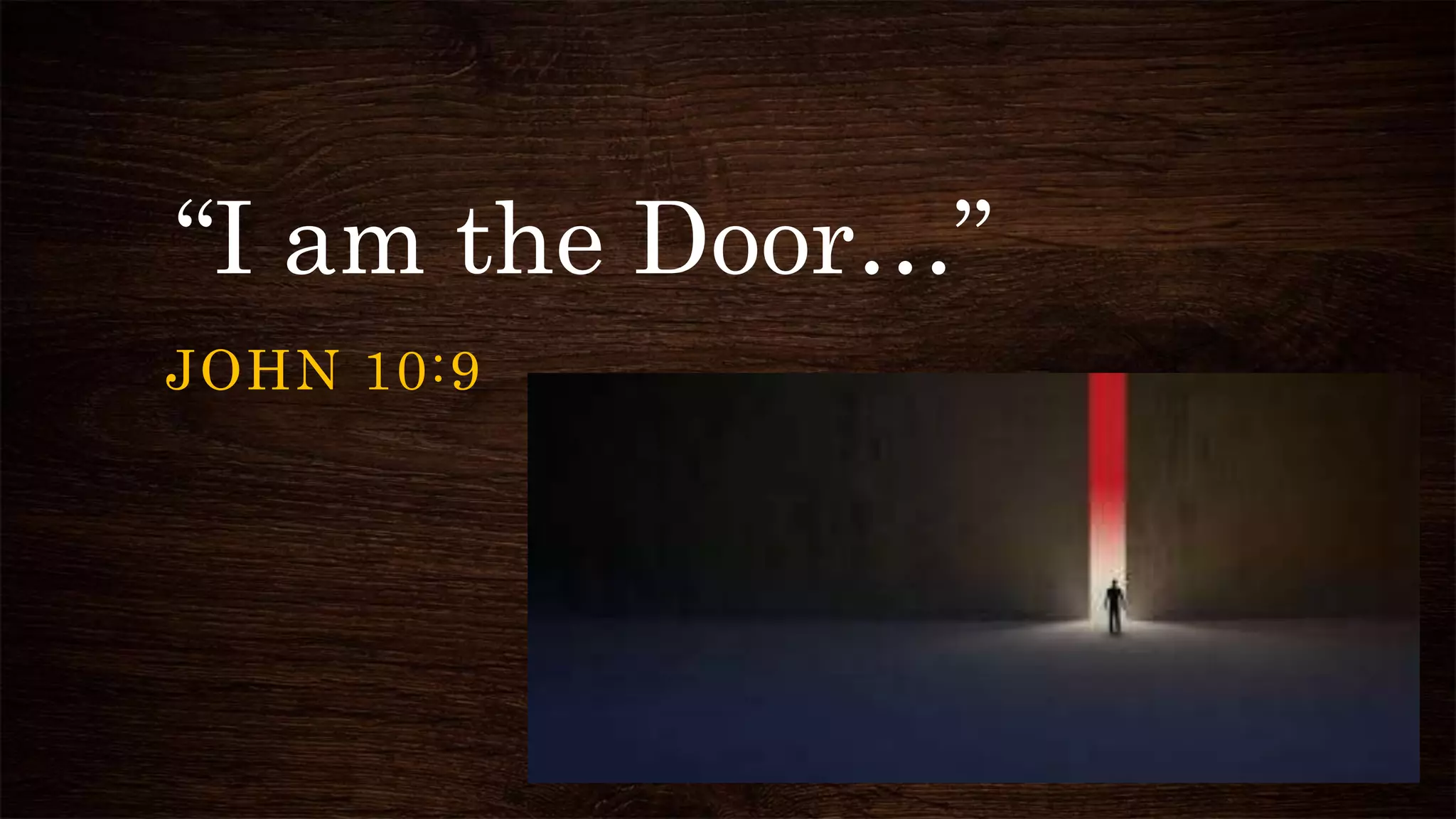
“I am the Door…”
JOHN 10:9
The Third “I Am” statement
•This is a powerful allegorical
sermon that grew out of the
confrontation with the
Pharisees throughout chapter
nine.
•a representation of an
abstract or spiritual meaning
through concrete or material
forms; figurative treatment of
one subject under the guise of
another, or a symbolical
narrative
The Third “I Am” statement
•After the blind man’s excommunication, Jesus
changed the image to shepherd and sheep.
Why?
•To the Jewish mind, a “shepherd” was any
kind of leader, spiritual or political
•People looked on Kings and prophets as
shepherds.
•Israel was privileged to be the “flock” of the
Lord, (Ps 100:3, Jer 23, Eze 34, Zech 11)
The Third “I Am” statement
•So Jesus opened this sermon with
an illustration everyone would
understand
•This may be one of the most
complex chapters of John’s gospel
•So we’ll break it down with a
series of messages titled after the
three declarations He makes about
Himself in chapter 10
“Truly, truly, I say to you, he who does not enter by
the door into the fold of the sheep, but climbs up
some other way, he is a thief and a robber. 2 But he
who enters by the door is a shepherd of the sheep.
3 To him the doorkeeper opens, and the sheep hear
his voice, and he calls his own sheep by name and
leads them out. 4 When he puts forth all his own,
he goes ahead of them, and the sheep follow him
because they know his voice. 5 A stranger they
simply will not follow, but will flee from him,
because they do not know the voice of strangers.”
6 “ This figure of speech Jesus spoke to them,
but they did not understand what those things
were which He had been saying to them. 7 So
Jesus said to them again, “Truly, truly, I say to
you, I am the door of the sheep. 8 All who came
before Me are thieves and robbers, but the
sheep did not hear them. 9 I am the door; if
anyone enters through Me, he will be saved,
and will go in and out and find pasture. 10 The
thief comes only to steal and kill and destroy; I
came that they may have life, and have it
abundantly.” John 10:1-10, NASB
The Thief and the Robber…
•Vv 1-6, the familiar
illustration
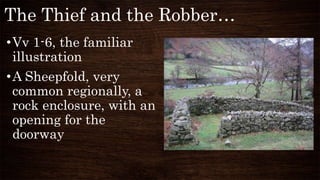
•A Sheepfold, very
common regionally, a
rock enclosure, with an
opening for the
doorway
The Thief and the Robber…
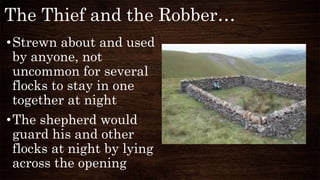
•Strewn about and used
by anyone, not
uncommon for several
flocks to stay in one
together at night
•The shepherd would
guard his and other
flocks at night by lying
across the opening
The Thief and the Robber…
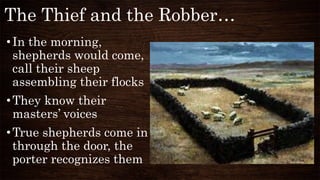
•In the morning,
shepherds would come,
call their sheep
assembling their flocks
•They know their
masters’ voices
•True shepherds come in
through the door, the
porter recognizes them
The Thief and the Robber…
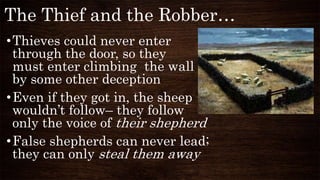
•Thieves could never enter
through the door, so they
must enter climbing the wall or
by some other deception
•Even if they got in, the sheep
wouldn’t follow– they follow
only the voice of their shepherd
•False shepherds can never lead;
they can only steal them away
The Thief and the Robber…
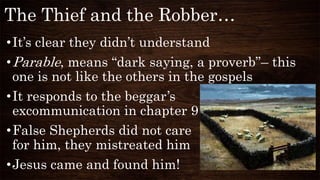
•It’s clear they didn’t understand
•Parable, means “dark saying, a proverb”– this
one is not like the others in the gospels
•It responds to the beggar’s
excommunication in chapter 9
•False Shepherds did not care
for him, they mistreated him
•Jesus came and found him!
Side note…
•It’s unfortunate that this parable is often used
to teach the wrong thing
•Sheep fold is Heaven, those trying to get in by
any way except Jesus destined for failure
•While true (Acts 4:12), it is NOT based on this
verse
•Jesus makes it very clear: the fold is Israel and
the other sheep are the Gentiles
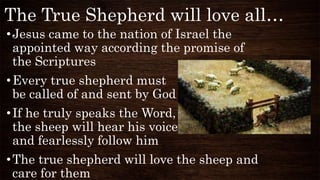
The True Shepherd will love all…
•Jesus came to the nation of Israel the
appointed way according the promise of
the Scriptures
•Every true shepherd must
be called of and sent by God
•If he truly speaks the Word,
the sheep will hear his voice
and fearlessly follow him
•The true shepherd will love the sheep and
care for them
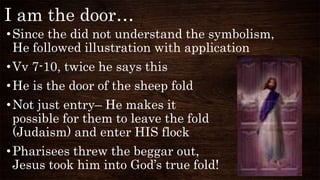
I am the door…
•Since the did not understand the symbolism,
He followed illustration with application
•Vv 7-10, twice he says this
•He is the door of the sheep fold
•Not just entry– He makes it
possible for them to leave the fold
(Judaism) and enter HIS flock
•Pharisees threw the beggar out,
Jesus took him into God’s true fold!
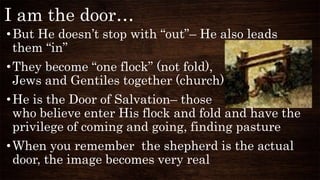
I am the door…
•But He doesn’t stop with “out”– He also leads
them “in”
•They become “one flock” (not fold),
Jews and Gentiles together (church)
•He is the Door of Salvation– those
who believe enter His flock and fold and have the
privilege of coming and going, finding pasture
•When you remember the shepherd is the actual
door, the image becomes very real
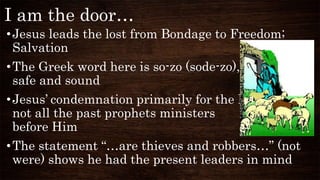
I am the door…
•Jesus leads the lost from Bondage to Freedom;
Salvation
•The Greek word here is so-zo (sode-zo), delivered
safe and sound
•Jesus’ condemnation primarily for the Pharisees,
not all the past prophets ministers
before Him
•The statement “…are thieves and robbers…” (not
were) shows he had the present leaders in mind
I am the door…
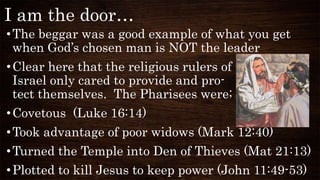
•The beggar was a good example of what you get
when God’s chosen man is NOT the leader
•Clear here that the religious rulers of
Israel only cared to provide and pro-
tect themselves. The Pharisees were;
•Covetous (Luke 16:14)
•Took advantage of poor widows (Mark 12:40)
•Turned the Temple into Den of Thieves (Mat 21:13)
•Plotted to kill Jesus to keep power (John 11:49-53)
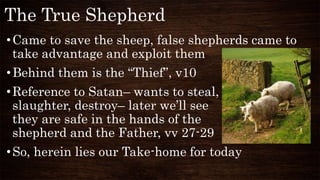
The True Shepherd
•Came to save the sheep, false shepherds came to
take advantage and exploit them
•Behind them is the “Thief”, v10
•Reference to Satan– wants to steal,
slaughter, destroy– later we’ll see
they are safe in the hands of the
shepherd and the Father, vv 27-29
•So, herein lies our Take-home for today
In Closing…
•The emphasis today was on the door, next week it
will ne on the Shepherd and the 2nd
declaration he made here
•When you go through the “door” you
receive life and are saved!
•As you go “in and out” you enjoy
abundant life in the Lord’s rich
pastures (not just in eternity)
•His Sheep enjoy fullness and freedom, now!

I am the door

  • 1.
    “I am theDoor…” JOHN 10:9
  • 2.
    The Third “IAm” statement •This is a powerful allegorical sermon that grew out of the confrontation with the Pharisees throughout chapter nine. •a representation of an abstract or spiritual meaning through concrete or material forms; figurative treatment of one subject under the guise of another, or a symbolical narrative
  • 3.
    The Third “IAm” statement •After the blind man’s excommunication, Jesus changed the image to shepherd and sheep. Why? •To the Jewish mind, a “shepherd” was any kind of leader, spiritual or political •People looked on Kings and prophets as shepherds. •Israel was privileged to be the “flock” of the Lord, (Ps 100:3, Jer 23, Eze 34, Zech 11)
  • 4.
    The Third “IAm” statement •So Jesus opened this sermon with an illustration everyone would understand •This may be one of the most complex chapters of John’s gospel •So we’ll break it down with a series of messages titled after the three declarations He makes about Himself in chapter 10
  • 5.
    “Truly, truly, Isay to you, he who does not enter by the door into the fold of the sheep, but climbs up some other way, he is a thief and a robber. 2 But he who enters by the door is a shepherd of the sheep. 3 To him the doorkeeper opens, and the sheep hear his voice, and he calls his own sheep by name and leads them out. 4 When he puts forth all his own, he goes ahead of them, and the sheep follow him because they know his voice. 5 A stranger they simply will not follow, but will flee from him, because they do not know the voice of strangers.”
  • 6.
    6 “ Thisfigure of speech Jesus spoke to them, but they did not understand what those things were which He had been saying to them. 7 So Jesus said to them again, “Truly, truly, I say to you, I am the door of the sheep. 8 All who came before Me are thieves and robbers, but the sheep did not hear them. 9 I am the door; if anyone enters through Me, he will be saved, and will go in and out and find pasture. 10 The thief comes only to steal and kill and destroy; I came that they may have life, and have it abundantly.” John 10:1-10, NASB
  • 7.
    The Thief andthe Robber… •Vv 1-6, the familiar illustration •A Sheepfold, very common regionally, a rock enclosure, with an opening for the doorway
  • 8.
    The Thief andthe Robber… •Strewn about and used by anyone, not uncommon for several flocks to stay in one together at night •The shepherd would guard his and other flocks at night by lying across the opening
  • 9.
    The Thief andthe Robber… •In the morning, shepherds would come, call their sheep assembling their flocks •They know their masters’ voices •True shepherds come in through the door, the porter recognizes them
  • 10.
    The Thief andthe Robber… •Thieves could never enter through the door, so they must enter climbing the wall or by some other deception •Even if they got in, the sheep wouldn’t follow– they follow only the voice of their shepherd •False shepherds can never lead; they can only steal them away
  • 11.
    The Thief andthe Robber… •It’s clear they didn’t understand •Parable, means “dark saying, a proverb”– this one is not like the others in the gospels •It responds to the beggar’s excommunication in chapter 9 •False Shepherds did not care for him, they mistreated him •Jesus came and found him!
  • 12.
    Side note… •It’s unfortunatethat this parable is often used to teach the wrong thing •Sheep fold is Heaven, those trying to get in by any way except Jesus destined for failure •While true (Acts 4:12), it is NOT based on this verse •Jesus makes it very clear: the fold is Israel and the other sheep are the Gentiles
  • 13.
    The True Shepherdwill love all… •Jesus came to the nation of Israel the appointed way according the promise of the Scriptures •Every true shepherd must be called of and sent by God •If he truly speaks the Word, the sheep will hear his voice and fearlessly follow him •The true shepherd will love the sheep and care for them
  • 14.
    I am thedoor… •Since the did not understand the symbolism, He followed illustration with application •Vv 7-10, twice he says this •He is the door of the sheep fold •Not just entry– He makes it possible for them to leave the fold (Judaism) and enter HIS flock •Pharisees threw the beggar out, Jesus took him into God’s true fold!
  • 15.
    I am thedoor… •But He doesn’t stop with “out”– He also leads them “in” •They become “one flock” (not fold), Jews and Gentiles together (church) •He is the Door of Salvation– those who believe enter His flock and fold and have the privilege of coming and going, finding pasture •When you remember the shepherd is the actual door, the image becomes very real
  • 16.
    I am thedoor… •Jesus leads the lost from Bondage to Freedom; Salvation •The Greek word here is so-zo (sode-zo), delivered safe and sound •Jesus’ condemnation primarily for the Pharisees, not all the past prophets ministers before Him •The statement “…are thieves and robbers…” (not were) shows he had the present leaders in mind
  • 17.
    I am thedoor… •The beggar was a good example of what you get when God’s chosen man is NOT the leader •Clear here that the religious rulers of Israel only cared to provide and pro- tect themselves. The Pharisees were; •Covetous (Luke 16:14) •Took advantage of poor widows (Mark 12:40) •Turned the Temple into Den of Thieves (Mat 21:13) •Plotted to kill Jesus to keep power (John 11:49-53)
  • 18.
    The True Shepherd •Cameto save the sheep, false shepherds came to take advantage and exploit them •Behind them is the “Thief”, v10 •Reference to Satan– wants to steal, slaughter, destroy– later we’ll see they are safe in the hands of the shepherd and the Father, vv 27-29 •So, herein lies our Take-home for today
  • 19.
    In Closing… •The emphasistoday was on the door, next week it will ne on the Shepherd and the 2nd declaration he made here •When you go through the “door” you receive life and are saved! •As you go “in and out” you enjoy abundant life in the Lord’s rich pastures (not just in eternity) •His Sheep enjoy fullness and freedom, now!