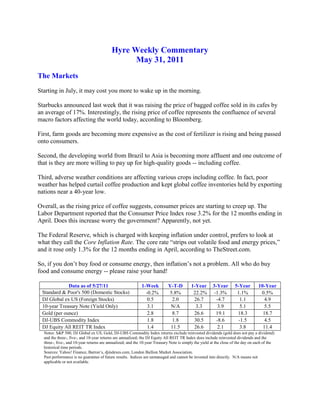
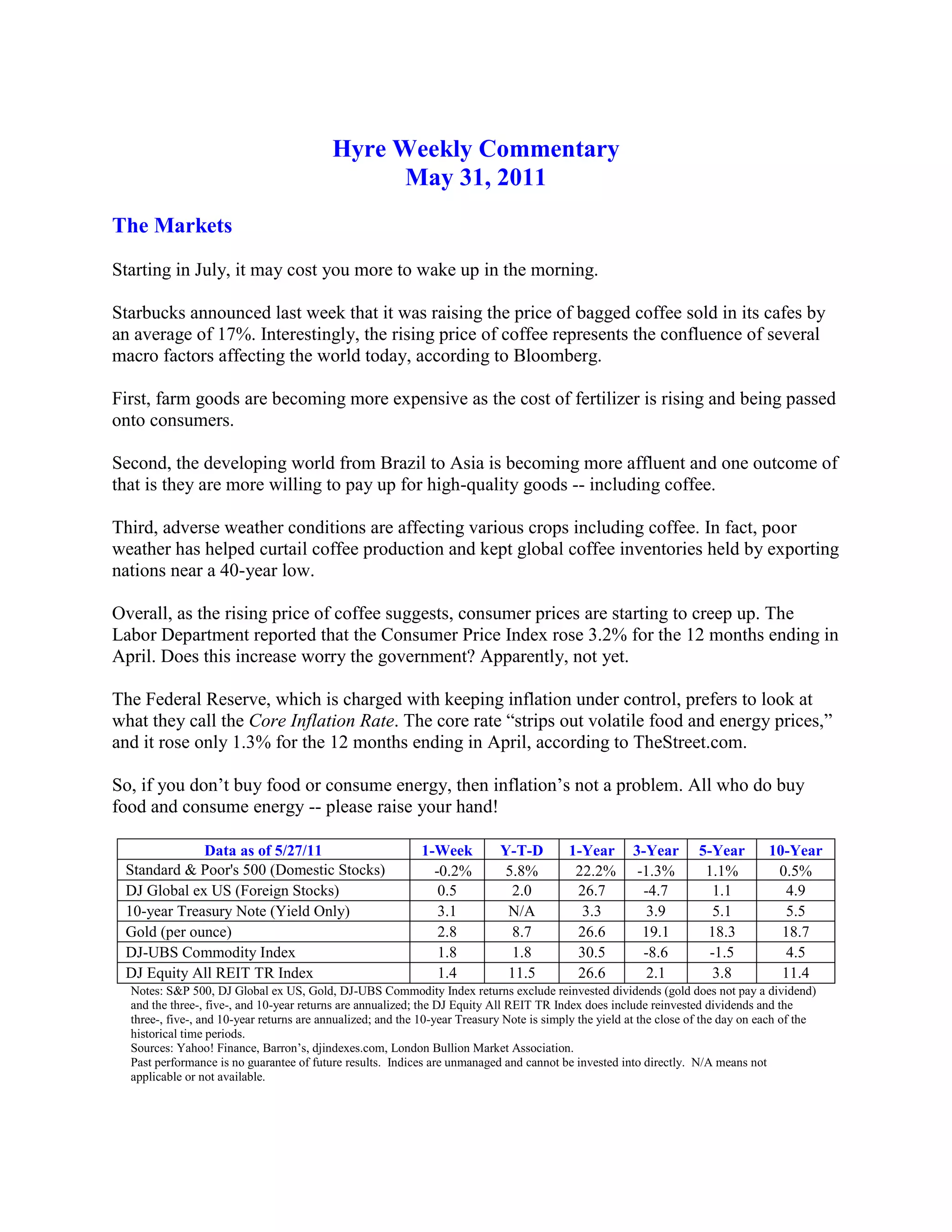
Hyre Weekly Commentary<br />May 31, 2011<br />The Markets<br />Starting in July, it may cost you more to wake up in the morning.<br />Starbucks announced last week that it was raising the price of bagged coffee sold in its cafes by an average of 17%. Interestingly, the rising price of coffee represents the confluence of several macro factors affecting the world today, according to Bloomberg.<br />First, farm goods are becoming more expensive as the cost of fertilizer is rising and being passed onto consumers.<br />Second, the developing world from Brazil to Asia is becoming more affluent and one outcome of that is they are more willing to pay up for high-quality goods -- including coffee.<br />Third, adverse weather conditions are affecting various crops including coffee. In fact, poor weather has helped curtail coffee production and kept global coffee inventories held by exporting nations near a 40-year low.<br />Overall, as the rising price of coffee suggests, consumer prices are starting to creep up. The Labor Department reported that the Consumer Price Index rose 3.2% for the 12 months ending in April. Does this increase worry the government? Apparently, not yet.<br />The Federal Reserve, which is charged with keeping inflation under control, prefers to look at what they call the Core Inflation Rate. The core rate “strips out volatile food and energy prices,” and it rose only 1.3% for the 12 months ending in April, according to TheStreet.com.<br />So, if you don’t buy food or consume energy, then inflation’s not a problem. All who do buy food and consume energy -- please raise your hand!<br />Data as of 5/27/111-WeekY-T-D1-Year3-Year5-Year10-YearStandard & Poor's 500 (Domestic Stocks)   -0.2%5.8%  22.2%-1.3%1.1%0.5%DJ Global ex US (Foreign Stocks)0.52.026.7-4.71.14.910-year Treasury Note (Yield Only)3.1N/A3.33.95.15.5Gold (per ounce) 2.88.726.619.118.318.7DJ-UBS Commodity Index1.81.830.5-8.6-1.54.5DJ Equity All REIT TR Index1.411.526.62.13.811.4<br />Notes: S&P 500, DJ Global ex US, Gold, DJ-UBS Commodity Index returns exclude reinvested dividends (gold does not pay a dividend) and the three-, five-, and 10-year returns are annualized; the DJ Equity All REIT TR Index does include reinvested dividends and the three-, five-, and 10-year returns are annualized; and the 10-year Treasury Note is simply the yield at the close of the day on each of the historical time periods.<br />Sources: Yahoo! Finance, Barron’s, djindexes.com, London Bullion Market Association.<br />Past performance is no guarantee of future results.  Indices are unmanaged and cannot be invested into directly.  N/A means not applicable or not available.<br />IS THERE A WAY TO PREDICT WHEN THE NEXT RECESSION WILL HIT? According to economists at the Conference Board, as reported by Bloomberg, “Historically the yield curve has been the first of the leading indicators to signal a turn in the business cycle.” The yield curve is simply a graph showing the interest rate on various government securities from the shortest maturity date to the longest. <br />Today, we have a rising or “steep” yield curve, which means short-term interest rates are lower than longer-term rates. In other words, the graph of these rates slopes upward to the right. <br />At the short-end of the yield curve, the Federal Reserve is holding the benchmark fed funds interest rate near 0%, while the 10-year Treasury Note yielded 3.06% last week. The “spread” between these two rates, of about 3%, is among the highest in history, according to Bloomberg. When the spread is high, that typically means the economy is growing and there’s no recession in sight.<br />Conversely, when the yield curve “inverts,” meaning short-term interest rates are higher than longer-term interest rates, that’s when you have to watch out for a new recession. Bloomberg reports that an inverted yield curve preceded the past seven recessions by an average lead time of 15 to 16 months.<br />In the most recent recession, the yield curve inverted in June 2006 and the recession started 18 months later in December 2007. <br />Of course, no indicator is foolproof and past performance is no guarantee of future results. However, the yield curve is one simple indicator that bears watching and, right now, it suggests the economy should do fine for the foreseeable future. <br />Weekly Focus – Memorial Day Thought <br />“Let every nation know, whether it wishes us well or ill, that we shall pay any price, bear any burden, meet any hardship, support any friend, oppose any foe to assure the survival and the success of liberty.” -- President John F. Kennedy<br />Best regards,<br />Jim Hyre, CFP®<br />Registered Principal<br />P.S.  Please feel free to forward this commentary to family, friends, or colleagues. If you would like us to add them to the list, please reply to this e-mail with their e-mail address and we will ask for their permission to be added.  <br />Securities offered through Raymond James Financial Services, Inc., Member FINRA/SIPC.<br />* The Standard & Poor's 500 (S&P 500) is an unmanaged group of securities considered to be representative of the stock market in general.<br />* The Dow Jones Industrial Average is a price-weighted index of 30 actively traded blue-chip stocks.  <br />* The NASDAQ Composite Index is an unmanaged, market-weighted index of all over-the-counter common stocks traded on the National Association of Securities Dealers Automated Quotation System. <br />* Gold represents the London afternoon gold price fix as reported by www.usagold.com.<br />* The DJ/AIG Commodity Index is designed to be a highly liquid and diversified benchmark for the commodity futures market. The Index is composed of futures contracts on 19 physical commodities and was launched on July 14, 1998.<br />* The 10-year Treasury Note represents debt owed by the United States Treasury to the public. Since the U.S. Government is seen as a risk-free borrower, investors use the 10-year Treasury Note as a benchmark for the long-term bond market.<br />* The DJ Equity All REIT TR Index measures the total return performance of the equity subcategory of the Real Estate Investment Trust (REIT) industry as calculated by Dow Jones<br />* Yahoo! Finance is the source for any reference to the performance of an index between two specific periods.<br />* Opinions expressed are subject to change without notice and are not intended as investment advice or to predict future performance.  <br />* Consult your financial professional before making any investment decision.  <br />* You cannot invest directly in an index. <br />* Past performance does not guarantee future results. mc101507<br />* This newsletter was prepared by PEAK for use by James Hyre, CFP®, registered principal<br />* If you would prefer not to receive this Weekly Newsletter, please contact our office via e-mail or mail your request to 2074 Arlington Ave, Upper Arlington, OH 43221.<br />* The information contained in this report does not purport to be a complete description of the securities, markets, or developments referred to in this material.  The information has been obtained from sources considered to be reliable, but we do not guarantee that the forgoing material is accurate or complete.  Any opinions are those of Jim Hyre and not necessary those of RJFS or Raymond James.  Expressions of opinion are as of this date and are subject to change without notice.  This information is not intended as a solicitation or an offer to buy or sell any security to herein.  Tax or legal matters should be discussed with the appropriate professional.<br /> <br />Jim Hyre, CFP®<br />Registered Principal<br />Raymond James Financial Services, Inc.<br />Member FINRA/SIPC<br />2074 Arlington Ave.<br />Upper Arlington, OH 43221<br />614.225.9400<br />614.225.9400 Fax<br />877.228.9515 Toll Free<br />www.hyreandassociates.com<br />Find Us Here:    <br /> <br />Raymond James Financial Services does not accept orders and/or instructions regarding your account by email, voice mail, fax or any alternate method.  Transactional details do not supersede normal trade confirmations or statements.  Email sent through the Internet is not secure or confidential.  Raymond James Financial Services reserves the right to monitor all email.  Any information provided in this email has been prepared from sources believed to be reliable, but is not guaranteed by Raymond James Financial Services and is not a complete summary or statement of all available data necessary for making an investment decision.  Any information provided is for informational purposes only and does not constitute a recommendation.  Raymond James Financial Services and its employees may own options, rights or warrants to purchase any of the securities mentioned in email.  This email is intended only for the person or entity to which it is addressed and may contain confidential and/or privileged material.  Any review, transmission, dissemination or other use of, or taking of any action in reliance upon, this information by persons or entities other than the intended recipient is prohibited.  If you received this message in error, please contact the sender immediately and delete the material from your computer. <br />
Hyre Weekly Commentary

Hyre Weekly Commentary

  • 1.
    Hyre Weekly Commentary<br/>May 31, 2011<br />The Markets<br />Starting in July, it may cost you more to wake up in the morning.<br />Starbucks announced last week that it was raising the price of bagged coffee sold in its cafes by an average of 17%. Interestingly, the rising price of coffee represents the confluence of several macro factors affecting the world today, according to Bloomberg.<br />First, farm goods are becoming more expensive as the cost of fertilizer is rising and being passed onto consumers.<br />Second, the developing world from Brazil to Asia is becoming more affluent and one outcome of that is they are more willing to pay up for high-quality goods -- including coffee.<br />Third, adverse weather conditions are affecting various crops including coffee. In fact, poor weather has helped curtail coffee production and kept global coffee inventories held by exporting nations near a 40-year low.<br />Overall, as the rising price of coffee suggests, consumer prices are starting to creep up. The Labor Department reported that the Consumer Price Index rose 3.2% for the 12 months ending in April. Does this increase worry the government? Apparently, not yet.<br />The Federal Reserve, which is charged with keeping inflation under control, prefers to look at what they call the Core Inflation Rate. The core rate “strips out volatile food and energy prices,” and it rose only 1.3% for the 12 months ending in April, according to TheStreet.com.<br />So, if you don’t buy food or consume energy, then inflation’s not a problem. All who do buy food and consume energy -- please raise your hand!<br />Data as of 5/27/111-WeekY-T-D1-Year3-Year5-Year10-YearStandard & Poor's 500 (Domestic Stocks) -0.2%5.8% 22.2%-1.3%1.1%0.5%DJ Global ex US (Foreign Stocks)0.52.026.7-4.71.14.910-year Treasury Note (Yield Only)3.1N/A3.33.95.15.5Gold (per ounce) 2.88.726.619.118.318.7DJ-UBS Commodity Index1.81.830.5-8.6-1.54.5DJ Equity All REIT TR Index1.411.526.62.13.811.4<br />Notes: S&P 500, DJ Global ex US, Gold, DJ-UBS Commodity Index returns exclude reinvested dividends (gold does not pay a dividend) and the three-, five-, and 10-year returns are annualized; the DJ Equity All REIT TR Index does include reinvested dividends and the three-, five-, and 10-year returns are annualized; and the 10-year Treasury Note is simply the yield at the close of the day on each of the historical time periods.<br />Sources: Yahoo! Finance, Barron’s, djindexes.com, London Bullion Market Association.<br />Past performance is no guarantee of future results. Indices are unmanaged and cannot be invested into directly. N/A means not applicable or not available.<br />IS THERE A WAY TO PREDICT WHEN THE NEXT RECESSION WILL HIT? According to economists at the Conference Board, as reported by Bloomberg, “Historically the yield curve has been the first of the leading indicators to signal a turn in the business cycle.” The yield curve is simply a graph showing the interest rate on various government securities from the shortest maturity date to the longest. <br />Today, we have a rising or “steep” yield curve, which means short-term interest rates are lower than longer-term rates. In other words, the graph of these rates slopes upward to the right. <br />At the short-end of the yield curve, the Federal Reserve is holding the benchmark fed funds interest rate near 0%, while the 10-year Treasury Note yielded 3.06% last week. The “spread” between these two rates, of about 3%, is among the highest in history, according to Bloomberg. When the spread is high, that typically means the economy is growing and there’s no recession in sight.<br />Conversely, when the yield curve “inverts,” meaning short-term interest rates are higher than longer-term interest rates, that’s when you have to watch out for a new recession. Bloomberg reports that an inverted yield curve preceded the past seven recessions by an average lead time of 15 to 16 months.<br />In the most recent recession, the yield curve inverted in June 2006 and the recession started 18 months later in December 2007. <br />Of course, no indicator is foolproof and past performance is no guarantee of future results. However, the yield curve is one simple indicator that bears watching and, right now, it suggests the economy should do fine for the foreseeable future. <br />Weekly Focus – Memorial Day Thought <br />“Let every nation know, whether it wishes us well or ill, that we shall pay any price, bear any burden, meet any hardship, support any friend, oppose any foe to assure the survival and the success of liberty.” -- President John F. Kennedy<br />Best regards,<br />Jim Hyre, CFP®<br />Registered Principal<br />P.S.  Please feel free to forward this commentary to family, friends, or colleagues. If you would like us to add them to the list, please reply to this e-mail with their e-mail address and we will ask for their permission to be added.  <br />Securities offered through Raymond James Financial Services, Inc., Member FINRA/SIPC.<br />* The Standard & Poor's 500 (S&P 500) is an unmanaged group of securities considered to be representative of the stock market in general.<br />* The Dow Jones Industrial Average is a price-weighted index of 30 actively traded blue-chip stocks.  <br />* The NASDAQ Composite Index is an unmanaged, market-weighted index of all over-the-counter common stocks traded on the National Association of Securities Dealers Automated Quotation System. <br />* Gold represents the London afternoon gold price fix as reported by www.usagold.com.<br />* The DJ/AIG Commodity Index is designed to be a highly liquid and diversified benchmark for the commodity futures market. The Index is composed of futures contracts on 19 physical commodities and was launched on July 14, 1998.<br />* The 10-year Treasury Note represents debt owed by the United States Treasury to the public. Since the U.S. Government is seen as a risk-free borrower, investors use the 10-year Treasury Note as a benchmark for the long-term bond market.<br />* The DJ Equity All REIT TR Index measures the total return performance of the equity subcategory of the Real Estate Investment Trust (REIT) industry as calculated by Dow Jones<br />* Yahoo! Finance is the source for any reference to the performance of an index between two specific periods.<br />* Opinions expressed are subject to change without notice and are not intended as investment advice or to predict future performance.  <br />* Consult your financial professional before making any investment decision.  <br />* You cannot invest directly in an index. <br />* Past performance does not guarantee future results. mc101507<br />* This newsletter was prepared by PEAK for use by James Hyre, CFP®, registered principal<br />* If you would prefer not to receive this Weekly Newsletter, please contact our office via e-mail or mail your request to 2074 Arlington Ave, Upper Arlington, OH 43221.<br />* The information contained in this report does not purport to be a complete description of the securities, markets, or developments referred to in this material.  The information has been obtained from sources considered to be reliable, but we do not guarantee that the forgoing material is accurate or complete.  Any opinions are those of Jim Hyre and not necessary those of RJFS or Raymond James.  Expressions of opinion are as of this date and are subject to change without notice.  This information is not intended as a solicitation or an offer to buy or sell any security to herein.  Tax or legal matters should be discussed with the appropriate professional.<br /> <br />Jim Hyre, CFP®<br />Registered Principal<br />Raymond James Financial Services, Inc.<br />Member FINRA/SIPC<br />2074 Arlington Ave.<br />Upper Arlington, OH 43221<br />614.225.9400<br />614.225.9400 Fax<br />877.228.9515 Toll Free<br />www.hyreandassociates.com<br />Find Us Here:    <br /> <br />Raymond James Financial Services does not accept orders and/or instructions regarding your account by email, voice mail, fax or any alternate method.  Transactional details do not supersede normal trade confirmations or statements.  Email sent through the Internet is not secure or confidential.  Raymond James Financial Services reserves the right to monitor all email.  Any information provided in this email has been prepared from sources believed to be reliable, but is not guaranteed by Raymond James Financial Services and is not a complete summary or statement of all available data necessary for making an investment decision.  Any information provided is for informational purposes only and does not constitute a recommendation.  Raymond James Financial Services and its employees may own options, rights or warrants to purchase any of the securities mentioned in email.  This email is intended only for the person or entity to which it is addressed and may contain confidential and/or privileged material.  Any review, transmission, dissemination or other use of, or taking of any action in reliance upon, this information by persons or entities other than the intended recipient is prohibited.  If you received this message in error, please contact the sender immediately and delete the material from your computer. <br />