Introduction to Web &
HTML
2
Topics
 Web Terminology
 HTML
 What is HTML
 Parts of an HTML Document
 HTML Tags
 Required
 Common
3
Internet vs. WWW
 Most people use the two terms interchangeably but
they are in fact different.
 The Internet is a vast, international network, made up
of computers and the physical connections (wires,
routers, etc.) allowing them to communicate.
 The World Wide Web (WWW or just the Web) is a
collection of software that spans the Internet and
enables the interlinking of documents and resources.
 Provides a way of accessing information on the Internet.
4
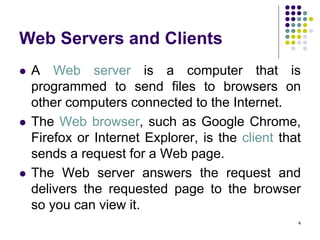
Web Servers and Clients
 A Web server is a computer that is
programmed to send files to browsers on
other computers connected to the Internet.
 The Web browser, such as Google Chrome,
Firefox or Internet Explorer, is the client that
sends a request for a Web page.
 The Web server answers the request and
delivers the requested page to the browser
so you can view it.
5
HTTP
 Stands for HyperText Transfer Protocol
 Allows computers on the WWW to
communicate with one another.
 Handles the “request” sent to the Web server
and the “response” received from the Web
server.
6
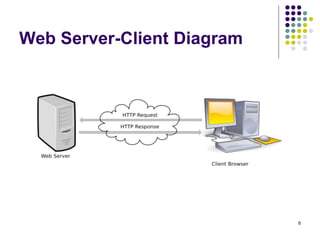
Web Server-Client Diagram
7
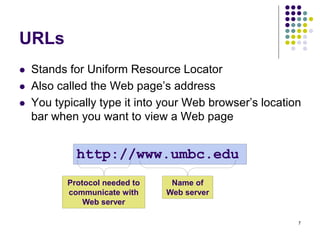
URLs
 Stands for Uniform Resource Locator
 Also called the Web page’s address
 You typically type it into your Web browser’s location
bar when you want to view a Web page
http://www.umbc.edu
Name of
Web server
Protocol needed to
communicate with
Web server
Markup Languages
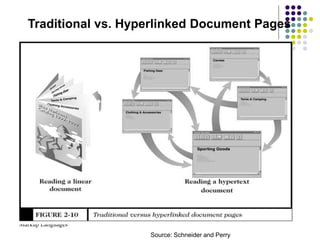
Traditional vs. Hyperlinked Document Pages
Source: Schneider and Perry
Markup Languages
Hypertext & HTML
 Hypertext Markup Language (HTML) is
the language for specifying the content of
Web pages
 hypertext refers to the fact that Web pages are
more than just text
 can contain multimedia, provide links for jumping
within & beyond
 markup refers to the fact that it works by
augmenting text with special symbols (tags)
that identify structure and content type
10
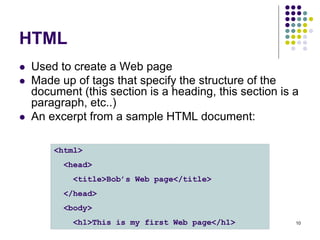
HTML
 Used to create a Web page
 Made up of tags that specify the structure of the
document (this section is a heading, this section is a
paragraph, etc..)
 An excerpt from a sample HTML document:
<html>
<head>
<title>Bob’s Web page</title>
</head>
<body>
<h1>This is my first Web page</h1>
11
HTML Tags
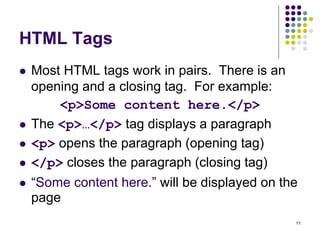
 Most HTML tags work in pairs. There is an
opening and a closing tag. For example:
<p>Some content here.</p>
 The <p>…</p> tag displays a paragraph
 <p> opens the paragraph (opening tag)
 </p> closes the paragraph (closing tag)
 “Some content here.” will be displayed on the
page
12
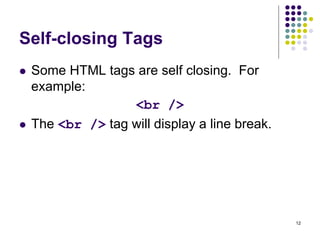
Self-closing Tags
 Some HTML tags are self closing. For
example:
<br />
 The <br /> tag will display a line break.
Markup Languages
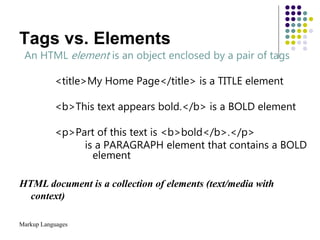
Tags vs. Elements
An HTML element is an object enclosed by a pair of tags
<title>My Home Page</title> is a TITLE element
<b>This text appears bold.</b> is a BOLD element
<p>Part of this text is <b>bold</b>.</p>
is a PARAGRAPH element that contains a BOLD
element
HTML document is a collection of elements (text/media with
context)
Markup Languages
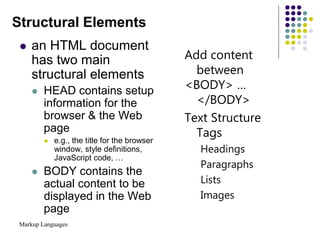
Structural Elements
 an HTML document
has two main
structural elements
 HEAD contains setup
information for the
browser & the Web
page
 e.g., the title for the browser
window, style definitions,
JavaScript code, …
 BODY contains the
actual content to be
displayed in the Web
page
Add content
between
<BODY> …
</BODY>
Text Structure
Tags
Headings
Paragraphs
Lists
Images
15
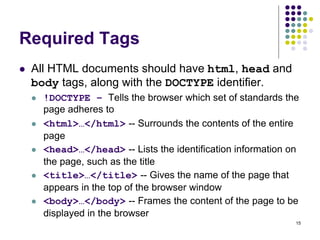
Required Tags
 All HTML documents should have html, head and
body tags, along with the DOCTYPE identifier.
 !DOCTYPE – Tells the browser which set of standards the
page adheres to
 <html>…</html> -- Surrounds the contents of the entire
page
 <head>…</head> -- Lists the identification information on
the page, such as the title
 <title>…</title> -- Gives the name of the page that
appears in the top of the browser window
 <body>…</body> -- Frames the content of the page to be
displayed in the browser
16
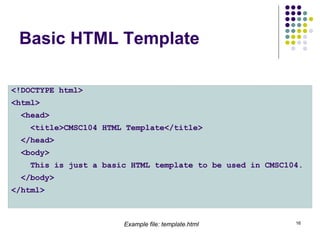
Basic HTML Template
<!DOCTYPE html>
<html>
<head>
<title>CMSC104 HTML Template</title>
</head>
<body>
This is just a basic HTML template to be used in CMSC104.
</body>
</html>
Example file: template.html
17
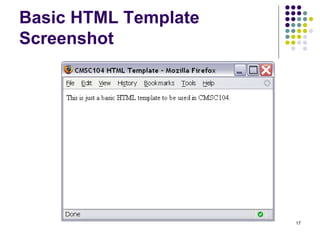
Basic HTML Template
Screenshot
18
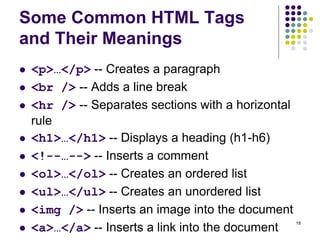
Some Common HTML Tags
and Their Meanings
 <p>…</p> -- Creates a paragraph
 <br /> -- Adds a line break
 <hr /> -- Separates sections with a horizontal
rule
 <h1>…</h1> -- Displays a heading (h1-h6)
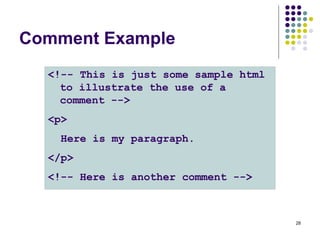
 <!--…--> -- Inserts a comment
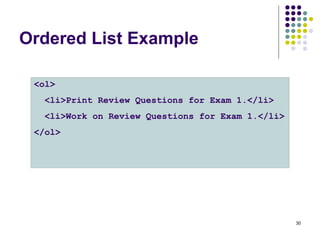
 <ol>…</ol> -- Creates an ordered list
 <ul>…</ul> -- Creates an unordered list
 <img /> -- Inserts an image into the document
 <a>…</a> -- Inserts a link into the document
19
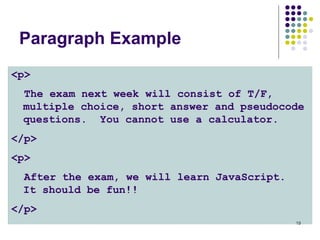
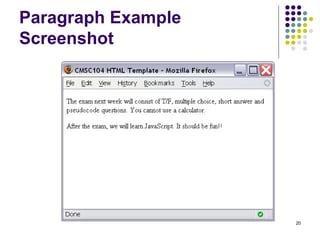
Paragraph Example
<p>
The exam next week will consist of T/F,
multiple choice, short answer and pseudocode
questions. You cannot use a calculator.
</p>
<p>
After the exam, we will learn JavaScript.
It should be fun!!
</p>
20
Paragraph Example
Screenshot
Markup Languages
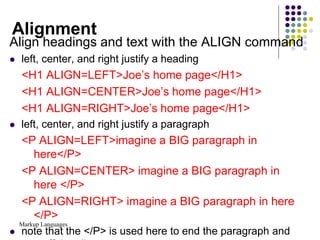
Alignment
Align headings and text with the ALIGN command
 left, center, and right justify a heading
<H1 ALIGN=LEFT>Joe’s home page</H1>
<H1 ALIGN=CENTER>Joe’s home page</H1>
<H1 ALIGN=RIGHT>Joe’s home page</H1>
 left, center, and right justify a paragraph
<P ALIGN=LEFT>imagine a BIG paragraph in
here</P>
<P ALIGN=CENTER> imagine a BIG paragraph in
here </P>
<P ALIGN=RIGHT> imagine a BIG paragraph in here
</P>
 note that the </P> is used here to end the paragraph and
22
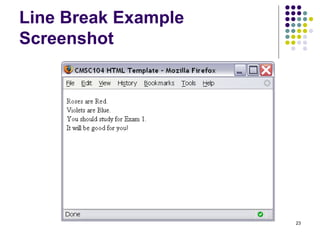
Line Break Example
<p>
Roses are Red. <br />
Violets are Blue. <br />
You should study for Exam 1. <br />
It will be good for you!
</p>
23
Line Break Example
Screenshot
24
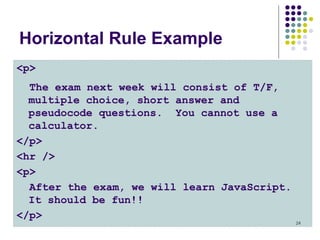
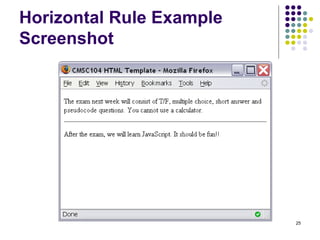
Horizontal Rule Example
<p>
The exam next week will consist of T/F,
multiple choice, short answer and
pseudocode questions. You cannot use a
calculator.
</p>
<hr />
<p>
After the exam, we will learn JavaScript.
It should be fun!!
</p>
25
Horizontal Rule Example
Screenshot
26
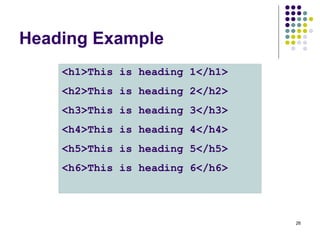
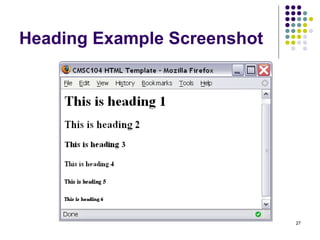
Heading Example
<h1>This is heading 1</h1>
<h2>This is heading 2</h2>
<h3>This is heading 3</h3>
<h4>This is heading 4</h4>
<h5>This is heading 5</h5>
<h6>This is heading 6</h6>
27
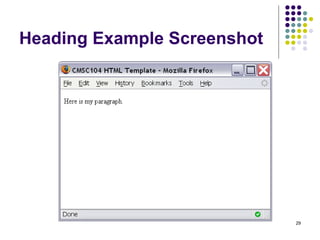
Heading Example Screenshot
28
Comment Example
<!-- This is just some sample html
to illustrate the use of a
comment -->
<p>
Here is my paragraph.
</p>
<!-- Here is another comment -->
29
Heading Example Screenshot
30
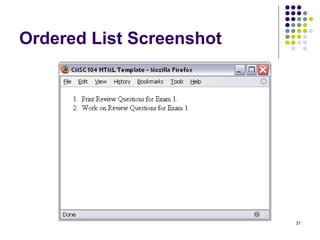
Ordered List Example
<ol>
<li>Print Review Questions for Exam 1.</li>
<li>Work on Review Questions for Exam 1.</li>
</ol>
31
Ordered List Screenshot
32
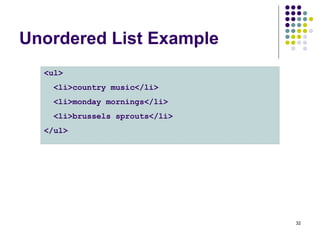
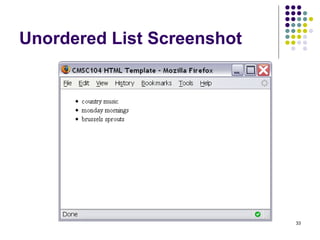
Unordered List Example
<ul>
<li>country music</li>
<li>monday mornings</li>
<li>brussels sprouts</li>
</ul>
33
Unordered List Screenshot
Markup Languages
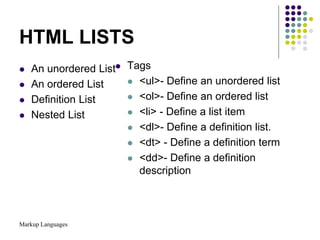
HTML LISTS
 An unordered List
 An ordered List
 Definition List
 Nested List
 Tags
 <ul>- Define an unordered list
 <ol>- Define an ordered list
 <li> - Define a list item
 <dl>- Define a definition list.
 <dt> - Define a definition term
 <dd>- Define a definition
description
Markup Languages
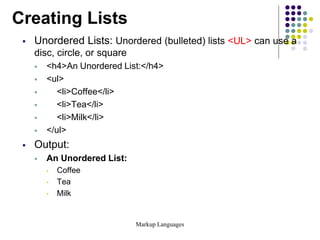
Creating Lists
 Unordered Lists: Unordered (bulleted) lists <UL> can use a
disc, circle, or square
 <h4>An Unordered List:</h4>
 <ul>
 <li>Coffee</li>
 <li>Tea</li>
 <li>Milk</li>
 </ul>
 Output:
 An Unordered List:
• Coffee
• Tea
• Milk
Markup Languages
Ordered Lists
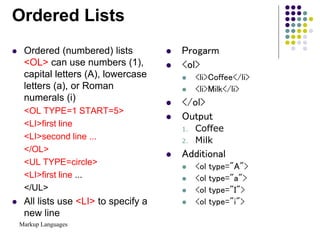
 Ordered (numbered) lists
<OL> can use numbers (1),
capital letters (A), lowercase
letters (a), or Roman
numerals (i)
<OL TYPE=1 START=5>
<LI>first line
<LI>second line ...
</OL>
<UL TYPE=circle>
<LI>first line ...
</UL>
 All lists use <LI> to specify a
new line
 Progarm
 <ol>
 <li>Coffee</li>
 <li>Milk</li>
 </ol>
 Output
1. Coffee
2. Milk
 Additional
 <ol type="A">
 <ol type="a">
 <ol type="I">
 <ol type="i">
Markup Languages
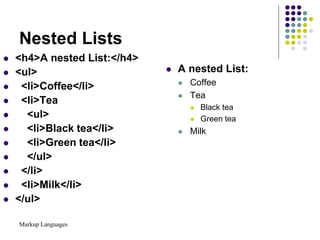
Nested Lists
 <h4>A nested List:</h4>
 <ul>
 <li>Coffee</li>
 <li>Tea
 <ul>
 <li>Black tea</li>
 <li>Green tea</li>
 </ul>
 </li>
 <li>Milk</li>
 </ul>
 A nested List:
 Coffee
 Tea
 Black tea
 Green tea
 Milk
Markup Languages
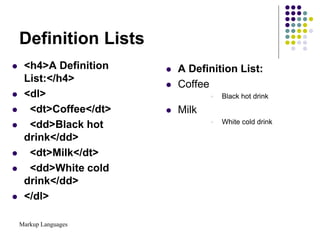
Definition Lists
 <h4>A Definition
List:</h4>
 <dl>
 <dt>Coffee</dt>
 <dd>Black hot
drink</dd>
 <dt>Milk</dt>
 <dd>White cold
drink</dd>
 </dl>
 A Definition List:
 Coffee
 Black hot drink
 Milk
 White cold drink
Markup Languages
Fonts
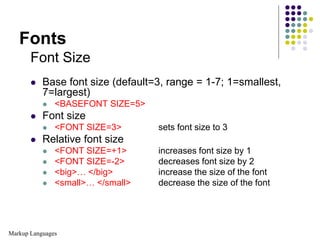
Font Size
 Base font size (default=3, range = 1-7; 1=smallest,
7=largest)
 <BASEFONT SIZE=5>
 Font size
 <FONT SIZE=3> sets font size to 3
 Relative font size
 <FONT SIZE=+1> increases font size by 1
 <FONT SIZE=-2> decreases font size by 2
 <big>… </big> increase the size of the font
 <small>… </small> decrease the size of the font
40
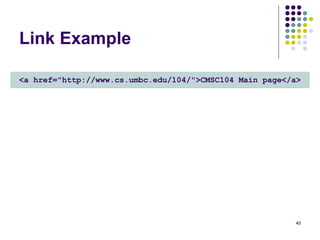
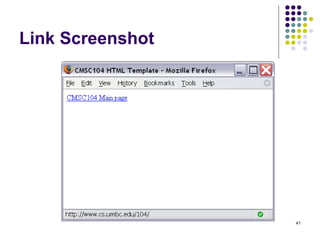
Link Example
<a href="http://www.cs.umbc.edu/104/">CMSC104 Main page</a>
41
Link Screenshot
42
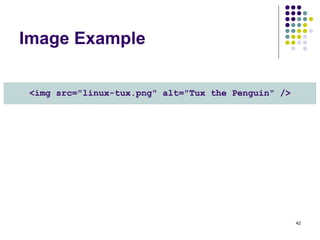
Image Example
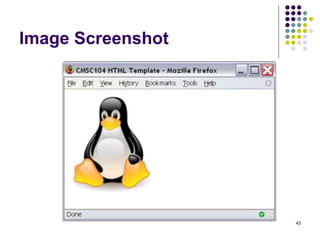
<img src="linux-tux.png" alt="Tux the Penguin" />
43
Image Screenshot
Markup Languages
HTML Images
<img> Defines an image
Attributes:SRC, ALT, HEIGHT, WIDTH,
ALIGN, HSPACE ,VSPACE
<map> Defines an image map
<area> Defines an area inside an image map
Markup Languages
Image File Formats
 Acceptable image formats vary by
browser
 Generally acceptable formats are
 GIF
 Graphics Interchange Format
 Use for graphics
 JPG
 Joint Photographic Experts Group
 Use for photographs
 PNG
 Portable Network Graphics
 Expected to replace GIF
Markup Languages
HTML Image Tag
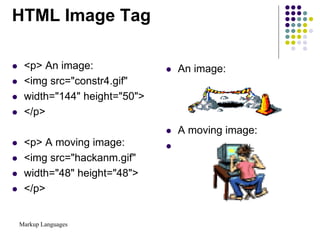
 <p> An image:
 <img src="constr4.gif"
 width="144" height="50">
 </p>
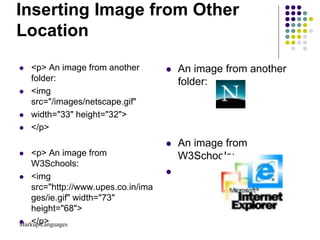
 <p> A moving image:
 <img src="hackanm.gif"
 width="48" height="48">
 </p>
 An image:
 A moving image:

Markup Languages
Inserting Image from Other
Location
 <p> An image from another
folder:
 <img
src="/images/netscape.gif"
 width="33" height="32">
 </p>
 <p> An image from
W3Schools:
 <img
src="http://www.upes.co.in/ima
ges/ie.gif" width="73"
height="68">
 </p>
 An image from another
folder:
 An image from
W3Schools:

Markup Languages
HTML Back Ground
 Attribute of Body Tag
 bgcolor
 Types of Background:
 a background color and a text color that
makes the text on the page easy to read.
 <body bgcolor=“red">
 a background color and a text color that
makes the text on the page difficult to read.
 <body bgcolor=“red" text="yellow">
Markup Languages
Background Color / Graphics
Backgrounds can be added to each document, but are not
readable on all browsers.
Attributes of <BODY>
BGCOLOR=”code” Specify color for background of the screen
BACKGROUND=”path/file” Tiles the graphic in the file to fit the
screen
<BODY BGCOLOR=”green”>
<BODY BACKGROUND=” BrickWall.gif”>
Markup Languages
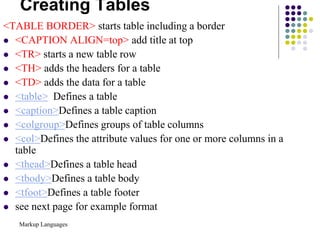
Creating Tables
<TABLE BORDER> starts table including a border
 <CAPTION ALIGN=top> add title at top
 <TR> starts a new table row
 <TH> adds the headers for a table
 <TD> adds the data for a table
 <table> Defines a table
 <caption>Defines a table caption
 <colgroup>Defines groups of table columns
 <col>Defines the attribute values for one or more columns in a
table
 <thead>Defines a table head
 <tbody>Defines a table body
 <tfoot>Defines a table footer
 see next page for example format

HyperTextMarkupLanguage.ppt

  • 1.
  • 2.
    2 Topics  Web Terminology HTML  What is HTML  Parts of an HTML Document  HTML Tags  Required  Common
  • 3.
    3 Internet vs. WWW Most people use the two terms interchangeably but they are in fact different.  The Internet is a vast, international network, made up of computers and the physical connections (wires, routers, etc.) allowing them to communicate.  The World Wide Web (WWW or just the Web) is a collection of software that spans the Internet and enables the interlinking of documents and resources.  Provides a way of accessing information on the Internet.
  • 4.
    4 Web Servers andClients  A Web server is a computer that is programmed to send files to browsers on other computers connected to the Internet.  The Web browser, such as Google Chrome, Firefox or Internet Explorer, is the client that sends a request for a Web page.  The Web server answers the request and delivers the requested page to the browser so you can view it.
  • 5.
    5 HTTP  Stands forHyperText Transfer Protocol  Allows computers on the WWW to communicate with one another.  Handles the “request” sent to the Web server and the “response” received from the Web server.
  • 6.
  • 7.
    7 URLs  Stands forUniform Resource Locator  Also called the Web page’s address  You typically type it into your Web browser’s location bar when you want to view a Web page http://www.umbc.edu Name of Web server Protocol needed to communicate with Web server
  • 8.
    Markup Languages Traditional vs.Hyperlinked Document Pages Source: Schneider and Perry
  • 9.
    Markup Languages Hypertext &HTML  Hypertext Markup Language (HTML) is the language for specifying the content of Web pages  hypertext refers to the fact that Web pages are more than just text  can contain multimedia, provide links for jumping within & beyond  markup refers to the fact that it works by augmenting text with special symbols (tags) that identify structure and content type
  • 10.
    10 HTML  Used tocreate a Web page  Made up of tags that specify the structure of the document (this section is a heading, this section is a paragraph, etc..)  An excerpt from a sample HTML document: <html> <head> <title>Bob’s Web page</title> </head> <body> <h1>This is my first Web page</h1>
  • 11.
    11 HTML Tags  MostHTML tags work in pairs. There is an opening and a closing tag. For example: <p>Some content here.</p>  The <p>…</p> tag displays a paragraph  <p> opens the paragraph (opening tag)  </p> closes the paragraph (closing tag)  “Some content here.” will be displayed on the page
  • 12.
    12 Self-closing Tags  SomeHTML tags are self closing. For example: <br />  The <br /> tag will display a line break.
  • 13.
    Markup Languages Tags vs.Elements An HTML element is an object enclosed by a pair of tags <title>My Home Page</title> is a TITLE element <b>This text appears bold.</b> is a BOLD element <p>Part of this text is <b>bold</b>.</p> is a PARAGRAPH element that contains a BOLD element HTML document is a collection of elements (text/media with context)
  • 14.
    Markup Languages Structural Elements an HTML document has two main structural elements  HEAD contains setup information for the browser & the Web page  e.g., the title for the browser window, style definitions, JavaScript code, …  BODY contains the actual content to be displayed in the Web page Add content between <BODY> … </BODY> Text Structure Tags Headings Paragraphs Lists Images
  • 15.
    15 Required Tags  AllHTML documents should have html, head and body tags, along with the DOCTYPE identifier.  !DOCTYPE – Tells the browser which set of standards the page adheres to  <html>…</html> -- Surrounds the contents of the entire page  <head>…</head> -- Lists the identification information on the page, such as the title  <title>…</title> -- Gives the name of the page that appears in the top of the browser window  <body>…</body> -- Frames the content of the page to be displayed in the browser
  • 16.
    16 Basic HTML Template <!DOCTYPEhtml> <html> <head> <title>CMSC104 HTML Template</title> </head> <body> This is just a basic HTML template to be used in CMSC104. </body> </html> Example file: template.html
  • 17.
  • 18.
    18 Some Common HTMLTags and Their Meanings  <p>…</p> -- Creates a paragraph  <br /> -- Adds a line break  <hr /> -- Separates sections with a horizontal rule  <h1>…</h1> -- Displays a heading (h1-h6)  <!--…--> -- Inserts a comment  <ol>…</ol> -- Creates an ordered list  <ul>…</ul> -- Creates an unordered list  <img /> -- Inserts an image into the document  <a>…</a> -- Inserts a link into the document
  • 19.
    19 Paragraph Example <p> The examnext week will consist of T/F, multiple choice, short answer and pseudocode questions. You cannot use a calculator. </p> <p> After the exam, we will learn JavaScript. It should be fun!! </p>
  • 20.
  • 21.
    Markup Languages Alignment Align headingsand text with the ALIGN command  left, center, and right justify a heading <H1 ALIGN=LEFT>Joe’s home page</H1> <H1 ALIGN=CENTER>Joe’s home page</H1> <H1 ALIGN=RIGHT>Joe’s home page</H1>  left, center, and right justify a paragraph <P ALIGN=LEFT>imagine a BIG paragraph in here</P> <P ALIGN=CENTER> imagine a BIG paragraph in here </P> <P ALIGN=RIGHT> imagine a BIG paragraph in here </P>  note that the </P> is used here to end the paragraph and
  • 22.
    22 Line Break Example <p> Rosesare Red. <br /> Violets are Blue. <br /> You should study for Exam 1. <br /> It will be good for you! </p>
  • 23.
  • 24.
    24 Horizontal Rule Example <p> Theexam next week will consist of T/F, multiple choice, short answer and pseudocode questions. You cannot use a calculator. </p> <hr /> <p> After the exam, we will learn JavaScript. It should be fun!! </p>
  • 25.
  • 26.
    26 Heading Example <h1>This isheading 1</h1> <h2>This is heading 2</h2> <h3>This is heading 3</h3> <h4>This is heading 4</h4> <h5>This is heading 5</h5> <h6>This is heading 6</h6>
  • 27.
  • 28.
    28 Comment Example <!-- Thisis just some sample html to illustrate the use of a comment --> <p> Here is my paragraph. </p> <!-- Here is another comment -->
  • 29.
  • 30.
    30 Ordered List Example <ol> <li>PrintReview Questions for Exam 1.</li> <li>Work on Review Questions for Exam 1.</li> </ol>
  • 31.
  • 32.
    32 Unordered List Example <ul> <li>countrymusic</li> <li>monday mornings</li> <li>brussels sprouts</li> </ul>
  • 33.
  • 34.
    Markup Languages HTML LISTS An unordered List  An ordered List  Definition List  Nested List  Tags  <ul>- Define an unordered list  <ol>- Define an ordered list  <li> - Define a list item  <dl>- Define a definition list.  <dt> - Define a definition term  <dd>- Define a definition description
  • 35.
    Markup Languages Creating Lists Unordered Lists: Unordered (bulleted) lists <UL> can use a disc, circle, or square  <h4>An Unordered List:</h4>  <ul>  <li>Coffee</li>  <li>Tea</li>  <li>Milk</li>  </ul>  Output:  An Unordered List: • Coffee • Tea • Milk
  • 36.
    Markup Languages Ordered Lists Ordered (numbered) lists <OL> can use numbers (1), capital letters (A), lowercase letters (a), or Roman numerals (i) <OL TYPE=1 START=5> <LI>first line <LI>second line ... </OL> <UL TYPE=circle> <LI>first line ... </UL>  All lists use <LI> to specify a new line  Progarm  <ol>  <li>Coffee</li>  <li>Milk</li>  </ol>  Output 1. Coffee 2. Milk  Additional  <ol type="A">  <ol type="a">  <ol type="I">  <ol type="i">
  • 37.
    Markup Languages Nested Lists <h4>A nested List:</h4>  <ul>  <li>Coffee</li>  <li>Tea  <ul>  <li>Black tea</li>  <li>Green tea</li>  </ul>  </li>  <li>Milk</li>  </ul>  A nested List:  Coffee  Tea  Black tea  Green tea  Milk
  • 38.
    Markup Languages Definition Lists <h4>A Definition List:</h4>  <dl>  <dt>Coffee</dt>  <dd>Black hot drink</dd>  <dt>Milk</dt>  <dd>White cold drink</dd>  </dl>  A Definition List:  Coffee  Black hot drink  Milk  White cold drink
  • 39.
    Markup Languages Fonts Font Size Base font size (default=3, range = 1-7; 1=smallest, 7=largest)  <BASEFONT SIZE=5>  Font size  <FONT SIZE=3> sets font size to 3  Relative font size  <FONT SIZE=+1> increases font size by 1  <FONT SIZE=-2> decreases font size by 2  <big>… </big> increase the size of the font  <small>… </small> decrease the size of the font
  • 40.
  • 41.
  • 42.
  • 43.
  • 44.
    Markup Languages HTML Images <img>Defines an image Attributes:SRC, ALT, HEIGHT, WIDTH, ALIGN, HSPACE ,VSPACE <map> Defines an image map <area> Defines an area inside an image map
  • 45.
    Markup Languages Image FileFormats  Acceptable image formats vary by browser  Generally acceptable formats are  GIF  Graphics Interchange Format  Use for graphics  JPG  Joint Photographic Experts Group  Use for photographs  PNG  Portable Network Graphics  Expected to replace GIF
  • 46.
    Markup Languages HTML ImageTag  <p> An image:  <img src="constr4.gif"  width="144" height="50">  </p>  <p> A moving image:  <img src="hackanm.gif"  width="48" height="48">  </p>  An image:  A moving image: 
  • 47.
    Markup Languages Inserting Imagefrom Other Location  <p> An image from another folder:  <img src="/images/netscape.gif"  width="33" height="32">  </p>  <p> An image from W3Schools:  <img src="http://www.upes.co.in/ima ges/ie.gif" width="73" height="68">  </p>  An image from another folder:  An image from W3Schools: 
  • 48.
    Markup Languages HTML BackGround  Attribute of Body Tag  bgcolor  Types of Background:  a background color and a text color that makes the text on the page easy to read.  <body bgcolor=“red">  a background color and a text color that makes the text on the page difficult to read.  <body bgcolor=“red" text="yellow">
  • 49.
    Markup Languages Background Color/ Graphics Backgrounds can be added to each document, but are not readable on all browsers. Attributes of <BODY> BGCOLOR=”code” Specify color for background of the screen BACKGROUND=”path/file” Tiles the graphic in the file to fit the screen <BODY BGCOLOR=”green”> <BODY BACKGROUND=” BrickWall.gif”>
  • 50.
    Markup Languages Creating Tables <TABLEBORDER> starts table including a border  <CAPTION ALIGN=top> add title at top  <TR> starts a new table row  <TH> adds the headers for a table  <TD> adds the data for a table  <table> Defines a table  <caption>Defines a table caption  <colgroup>Defines groups of table columns  <col>Defines the attribute values for one or more columns in a table  <thead>Defines a table head  <tbody>Defines a table body  <tfoot>Defines a table footer  see next page for example format