Hypercalcemia Ahmed Elshebiny University of Menoufyia
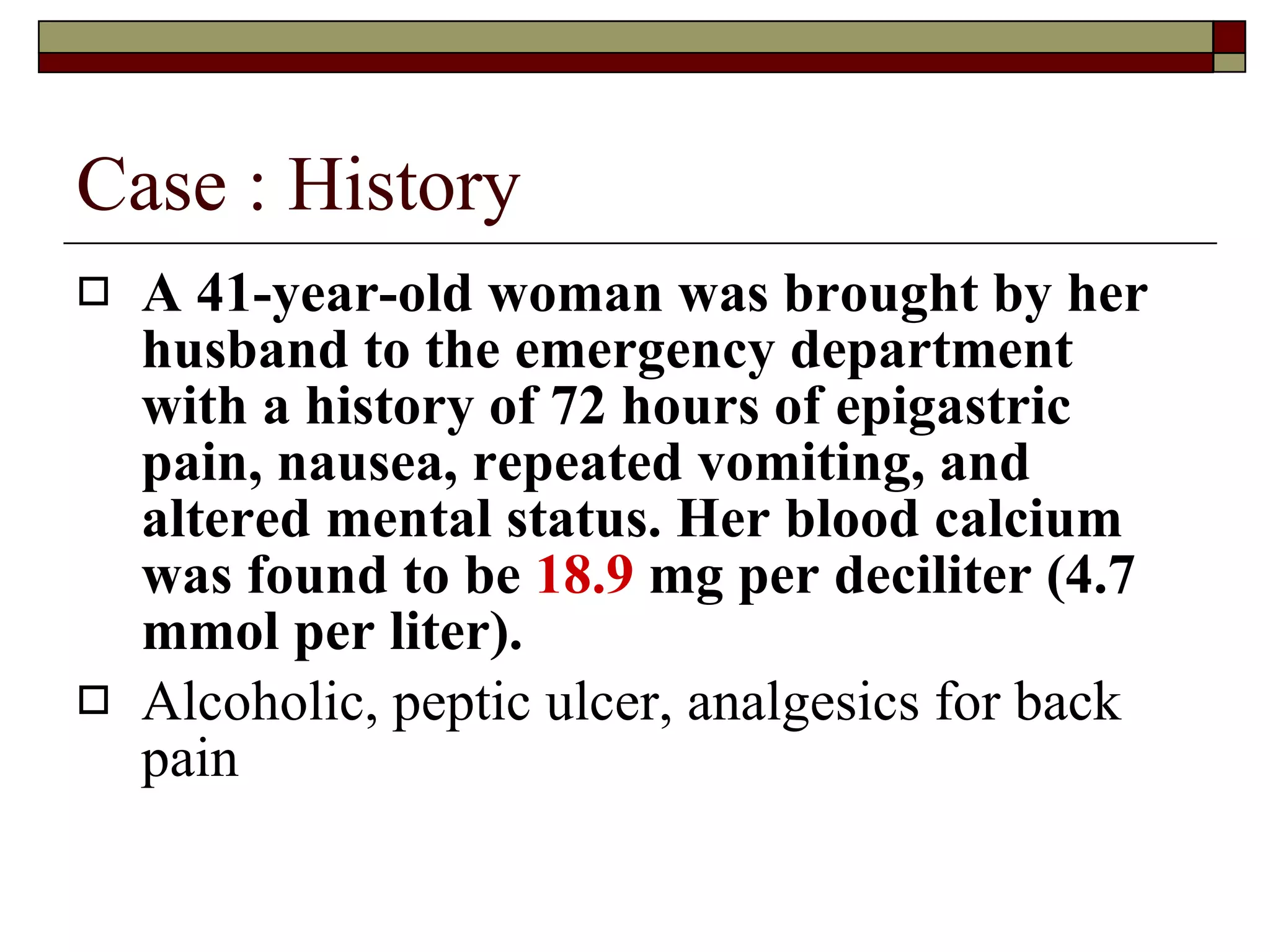
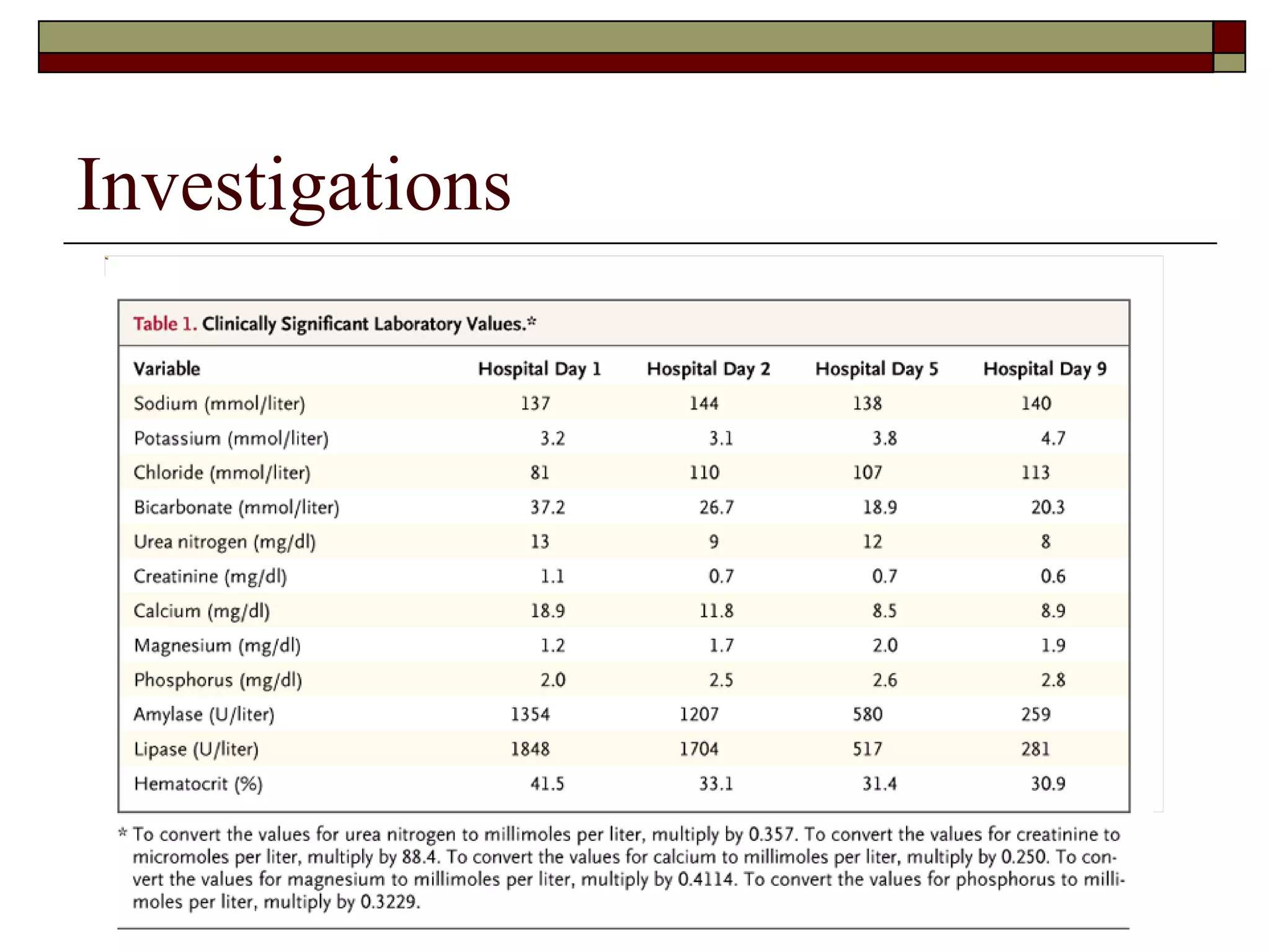
Case : History A 41-year-old woman was brought by her husband to the emergency department with a history of 72 hours of epigastric pain, nausea, repeated vomiting, and altered mental status. Her blood calcium was found to be  18.9  mg per deciliter (4.7 mmol per liter).   Alcoholic, peptic ulcer, analgesics for back pain
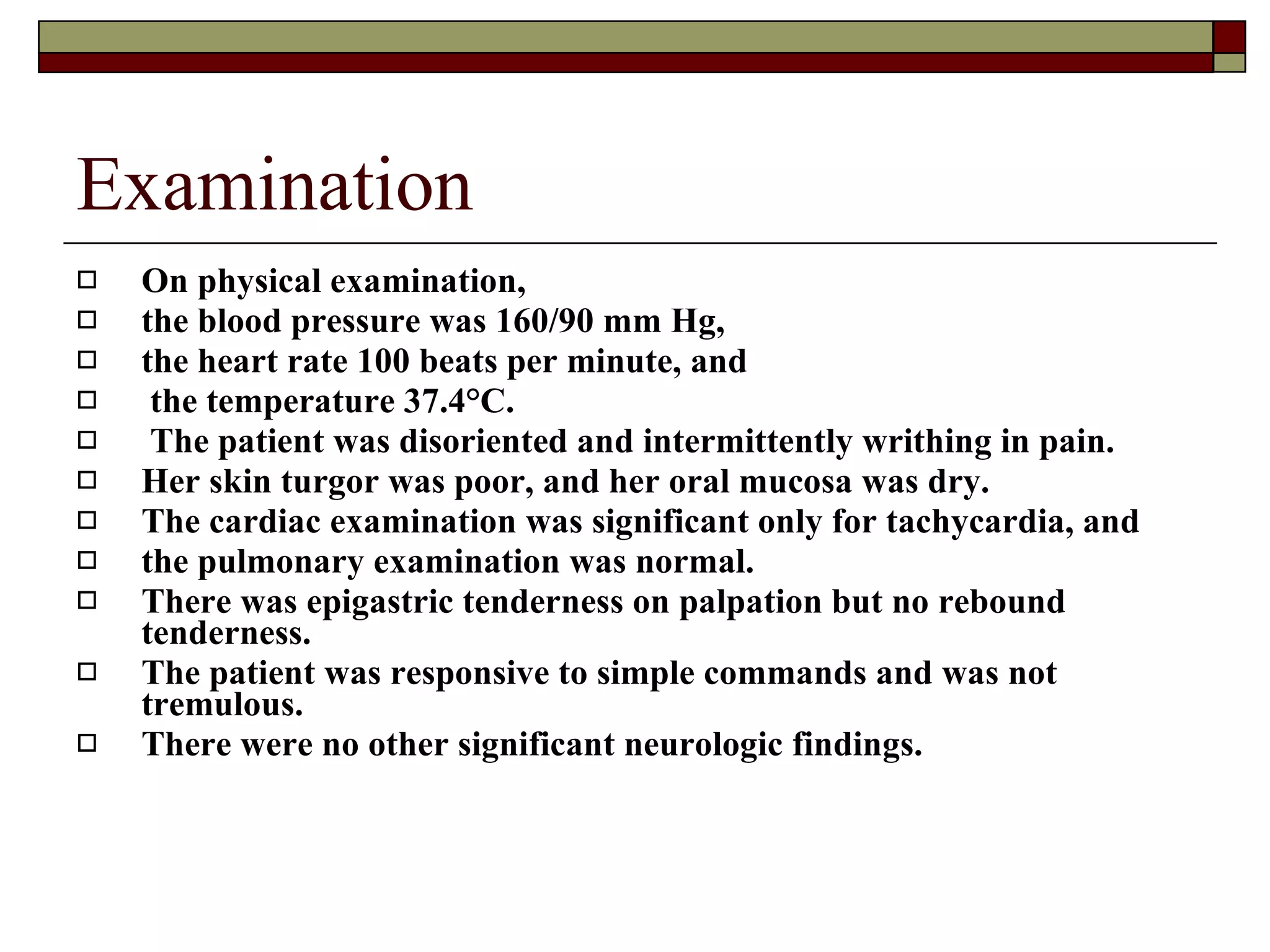
Examination On physical examination,  the blood pressure was 160/90 mm Hg,  the heart rate 100 beats per minute, and the temperature 37.4°C. The patient was disoriented and intermittently writhing in pain.  Her skin turgor was poor, and her oral mucosa was dry.  The cardiac examination was significant only for tachycardia, and  the pulmonary examination was normal.  There was epigastric tenderness on palpation but no rebound tenderness.  The patient was responsive to simple commands and was not tremulous.  There were no other significant neurologic findings.
Investigations
Specific investigations Intact parathyroid= undetectable 25 hydroxy vitamin D = normal PTH related protein= normal Calcium fall with hydration only Computed tomography (CT) of the neck revealed no parathyroid masses. CT of the chest was normal. Abdominal CT showed an edematous pancreas with surrounding infiltration of the mesenteric fat, a finding consistent with acute pancreatitis. No bone lesions were noted on the chest or abdominal CT scans.
Diagnosis In response to further questioning, the patient reported that during the days before admission she had consumed the contents of entire containers of Tums and a preparation containing sodium bicarbonate (Alka-Seltzer, Bayer) because of the severe abdominal pain. She did not consume any other medications or supplements.   This history, together with the laboratory-test results, establishes the  "milk alkali syndrome"  as the primary diagnosis
Milk Alkali Syndrome The pathogenesis of the milk alkali syndrome involves a reduction in the ability of the kidney to excrete excess calcium.  This reduction is secondary to a decrease in the glomerular filtration rate (due to renal vasoconstriction and hypovolemia) and to a significant increase in tubular reabsorption of calcium (secondary to metabolic alkalosis). The plasma PTH level decreases with the rise in the serum calcium level.  Thus, the constellation of excess oral intake of calcium and milk, plus impaired renal function, may result in PTH suppression, hypercalcemia, and hyperphosphatemia.  In cases of chronic ingestion of excessive alkaline calcium preparations and milk, metastatic calcifications and occasionally nephrocalcinosis may occur, 7  whereas such complications are not expected with acute milk alkali syndrome, as in the present case.
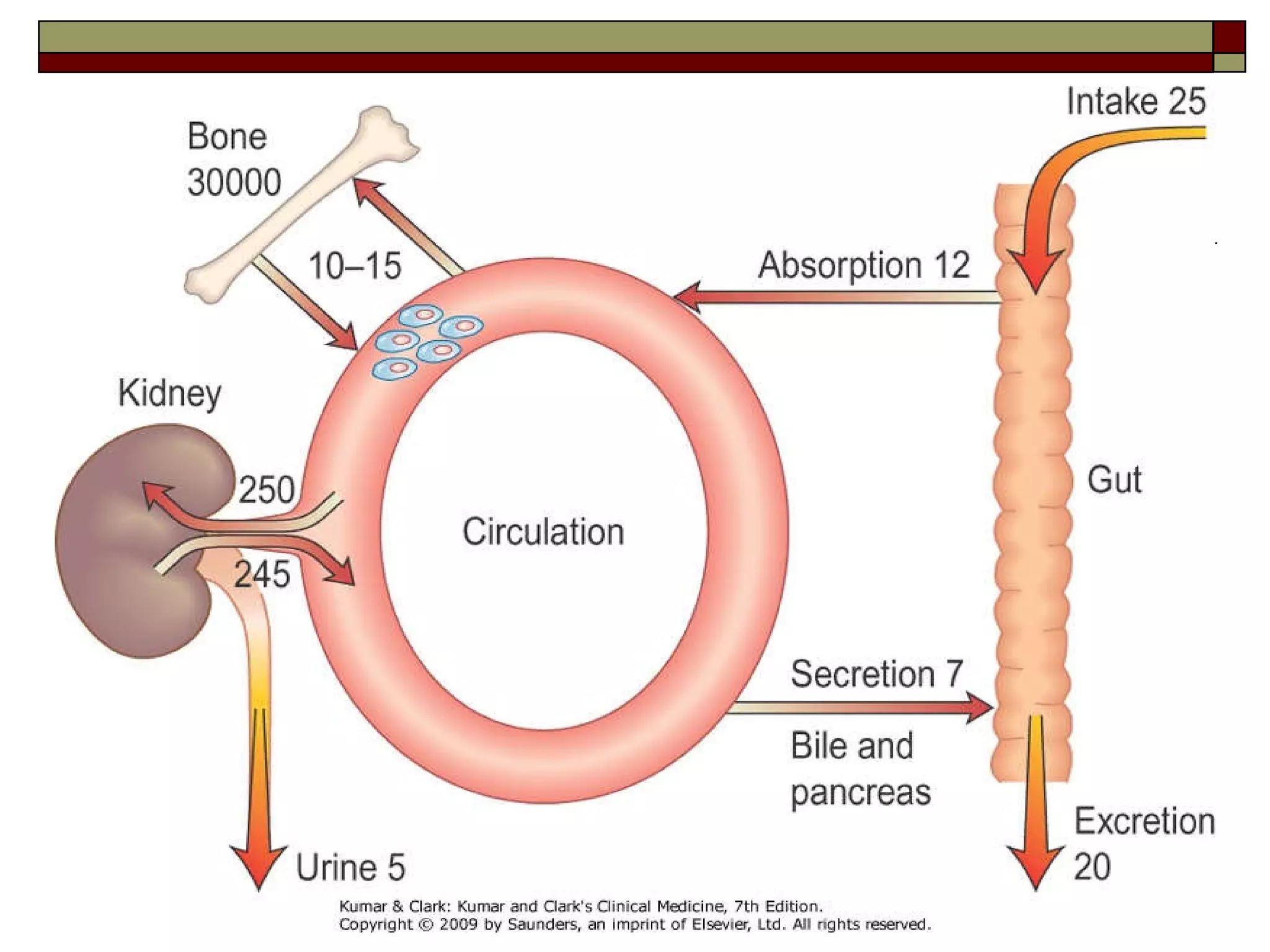
Calcium Plays a role inside (intracellular) and outside (extarcellular) cells Functions of calcium Muscle contraction Nerve conduction Coagulation Enzyme and electrolyte regulation  Hormone release and exocytosis Cell division Calcium enters extra-cellular fluid from intestine and bone Calcium is excreted through kidneys Calcium is tightly controlled by hormones (PTH, Calcitriol, calcitonin) Human body contains 1100 g calcium


Hypercalcemia For hypercalcemia to develop, the normal calcium regulation system must be overwhelmed by an excess of PTH, Calcitriol, some other serum factor that can mimic these hormones, or a huge calcium load. Between 20 and 40% of patients with cancer develop hypercalcemia at some point in their disease  the most common serious electrolyte presenting in adults with malignancies  primary hyperparathyroidism is considerably higher in women.  Hyperparathyroidism and malignancy increases with age Breast cancer is one of the most common malignancies responsible for hypercalcemia.
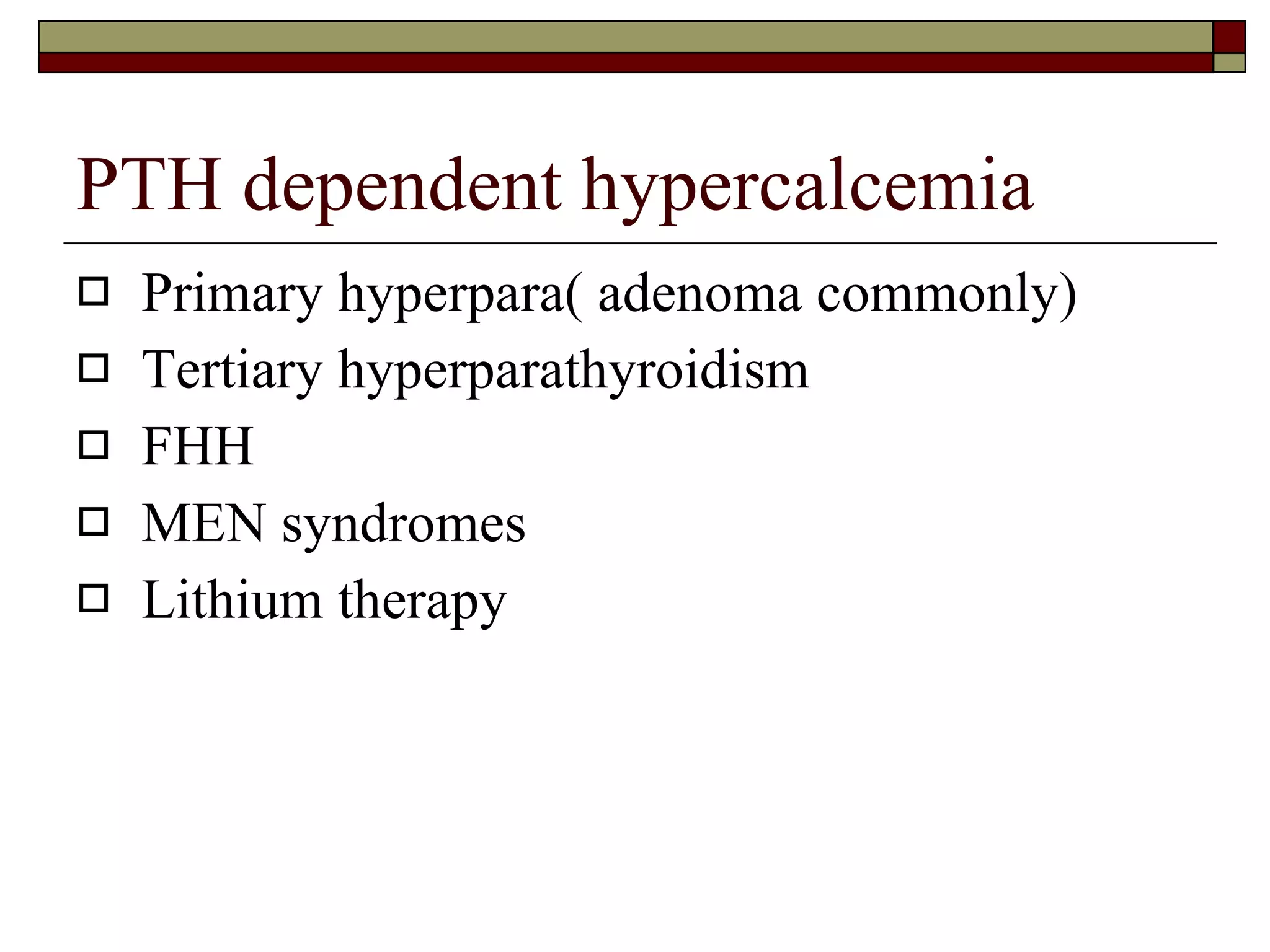
PTH dependent hypercalcemia Primary hyperpara( adenoma commonly) Tertiary hyperparathyroidism FHH MEN syndromes Lithium therapy
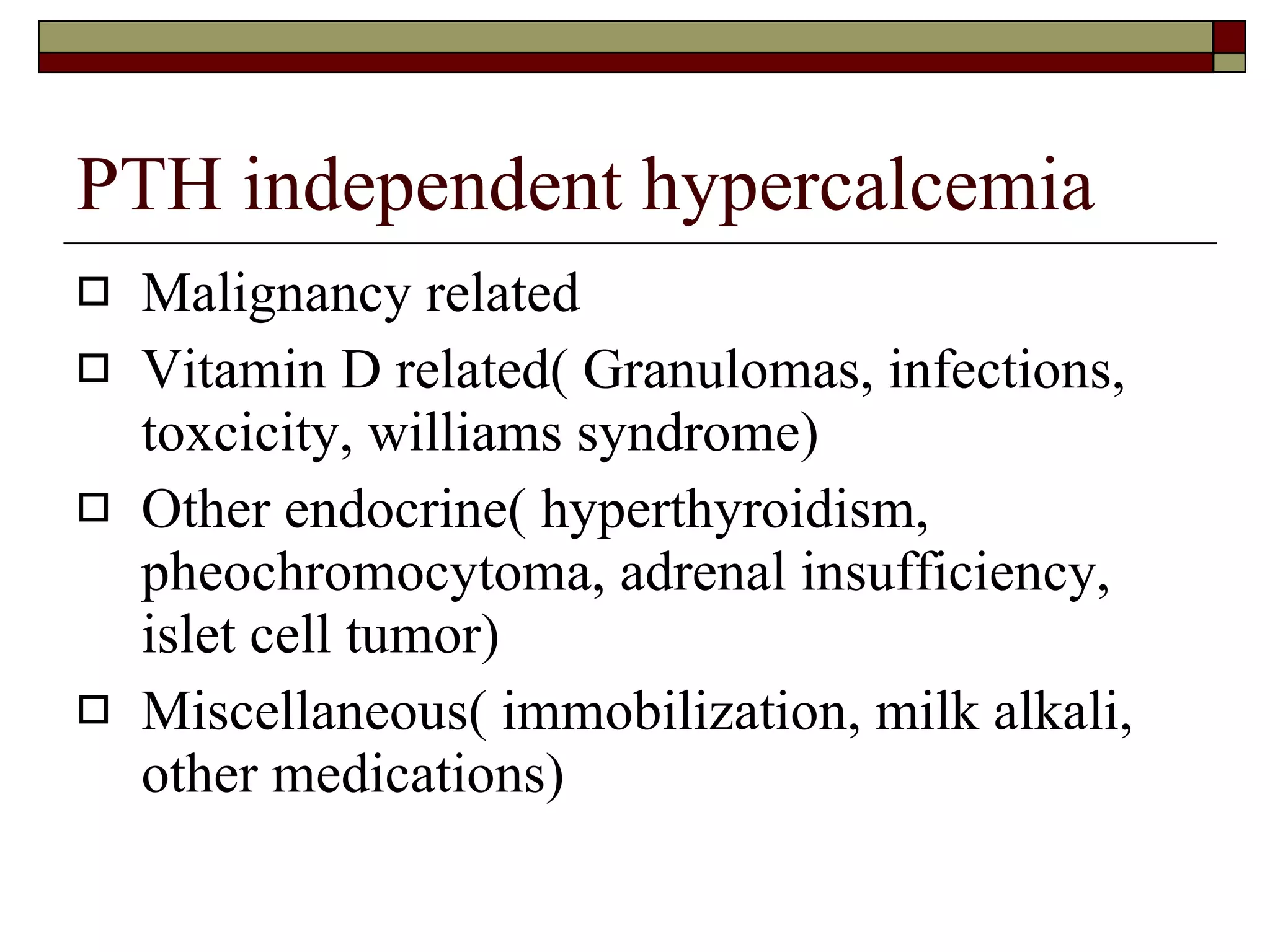
PTH independent hypercalcemia Malignancy related Vitamin D related( Granulomas, infections, toxcicity, williams syndrome) Other endocrine( hyperthyroidism, pheochromocytoma, adrenal insufficiency, islet cell tumor) Miscellaneous( immobilization, milk alkali, other medications)
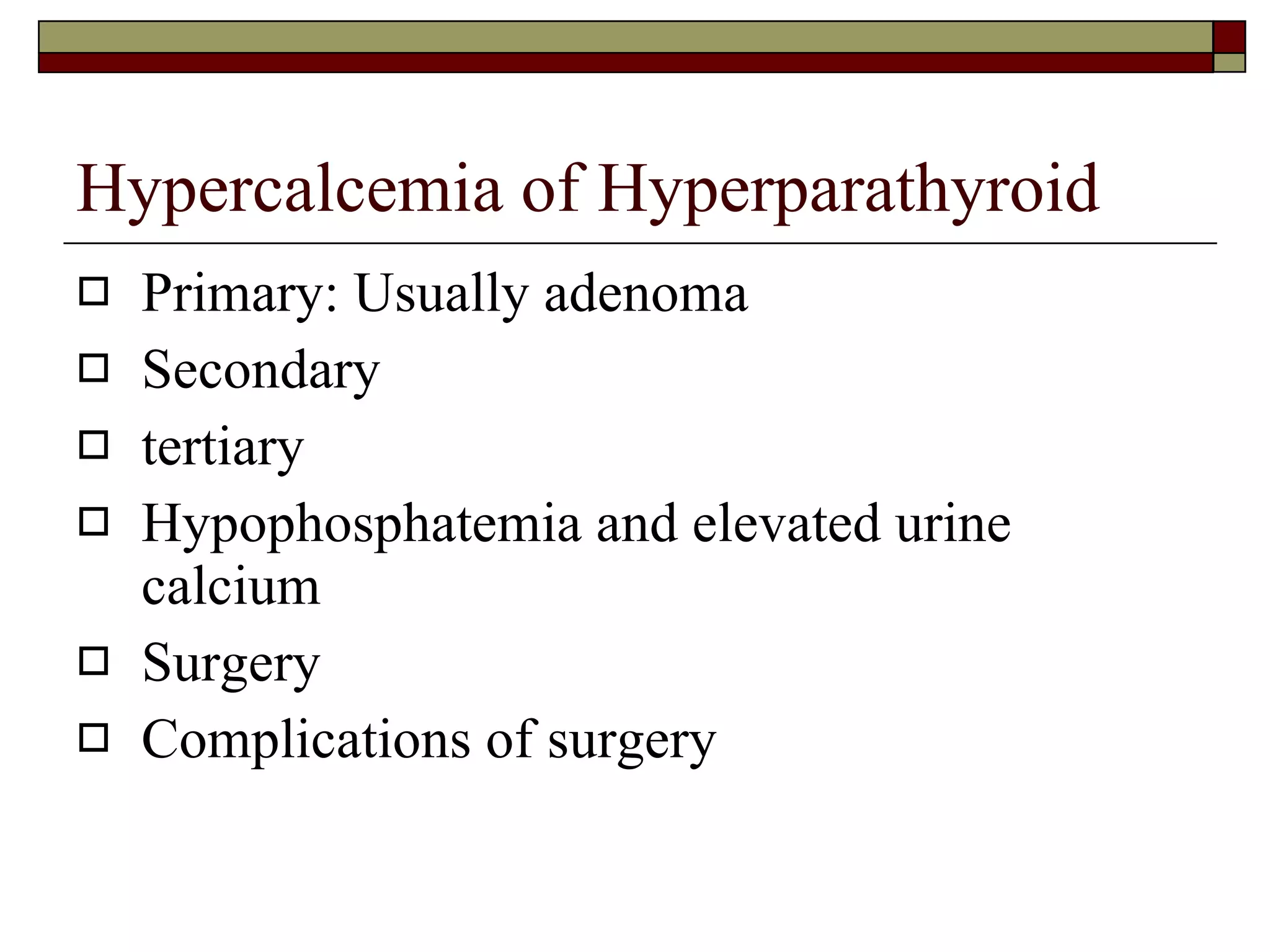
Hypercalcemia of Hyperparathyroid Primary: Usually adenoma Secondary tertiary Hypophosphatemia and elevated urine calcium Surgery Complications of surgery
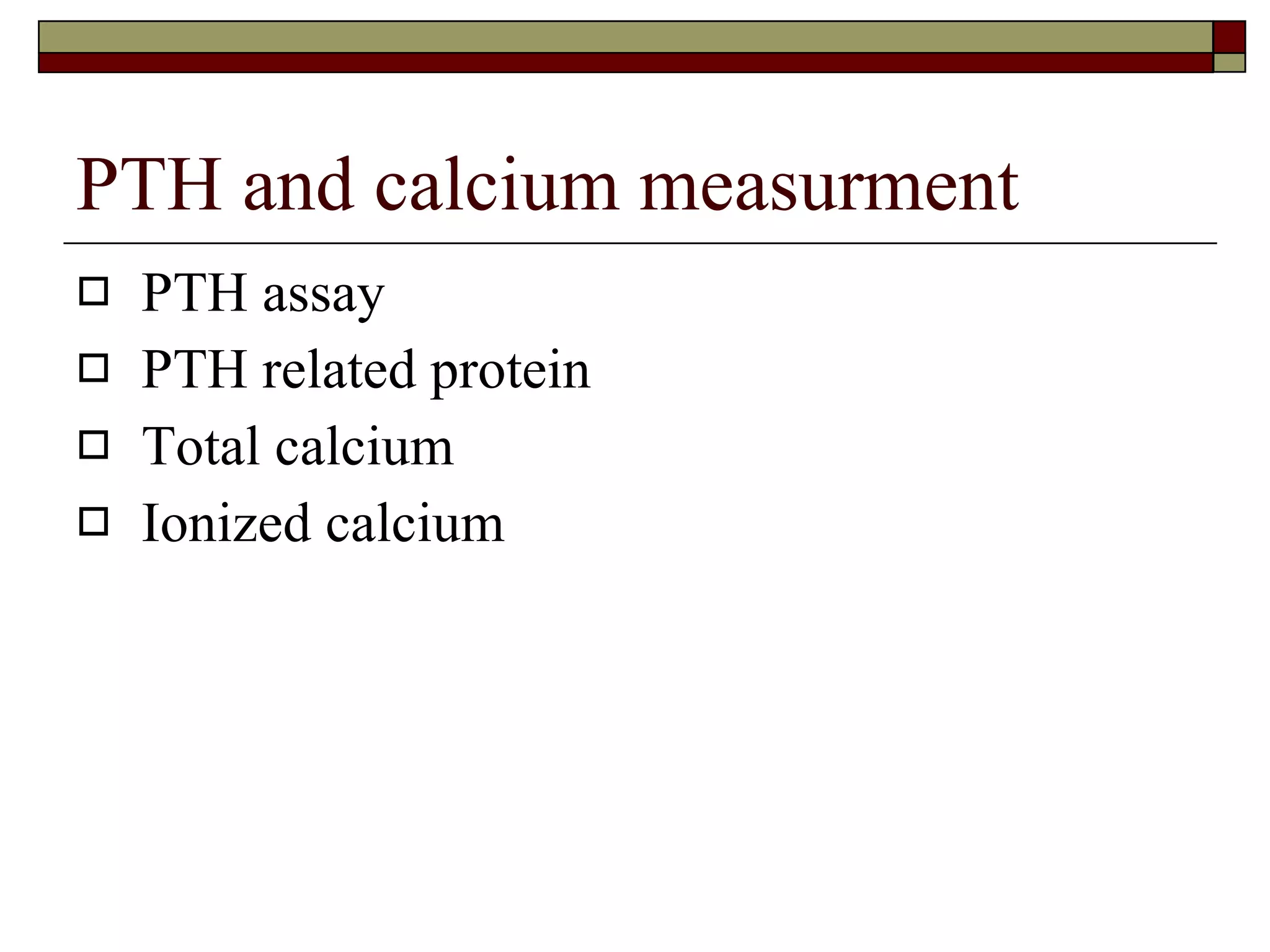
PTH and calcium measurment PTH assay PTH related protein Total calcium Ionized calcium
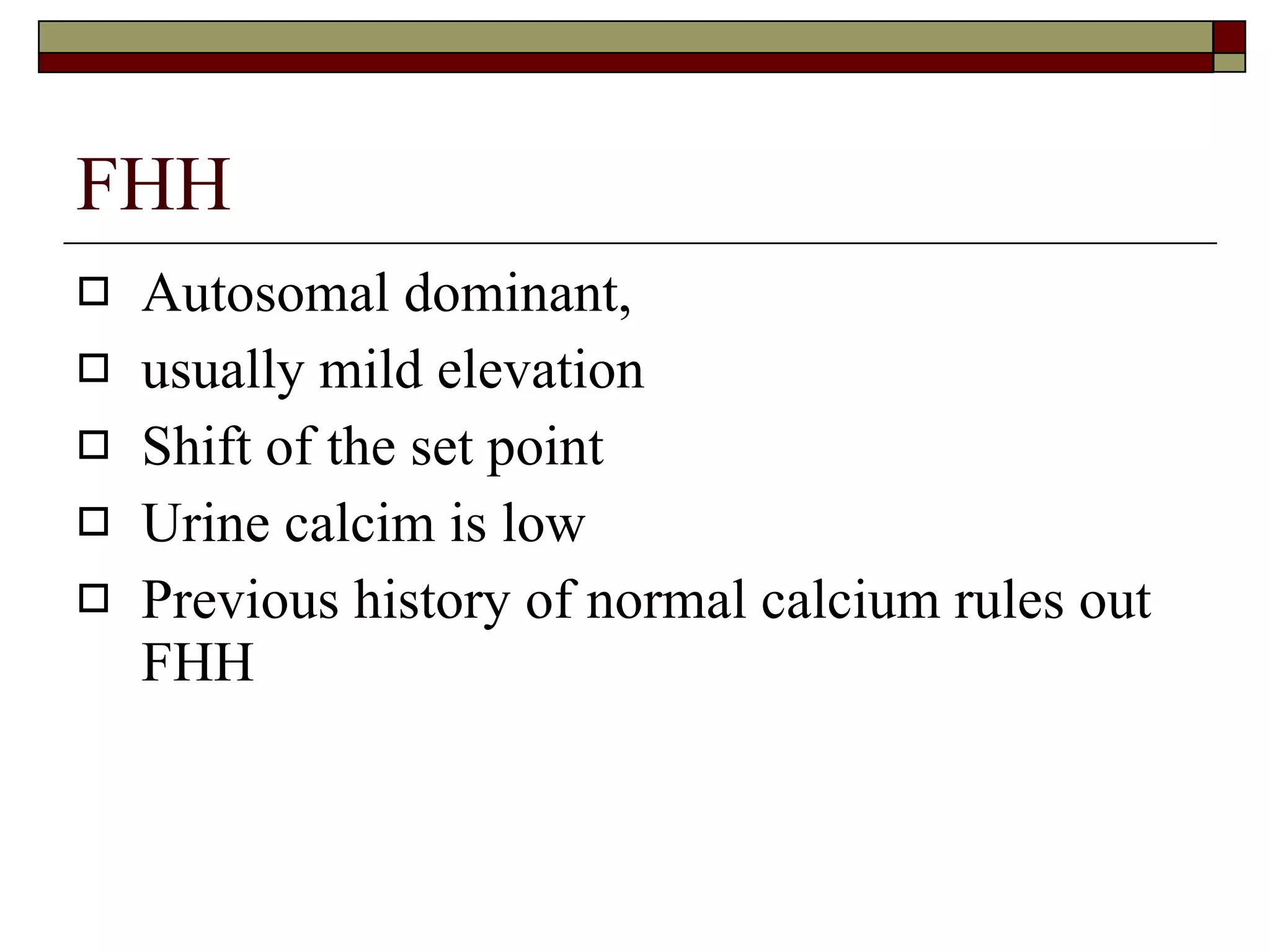
FHH Autosomal dominant,  usually mild elevation Shift of the set point Urine calcim is low Previous history of normal calcium rules out FHH
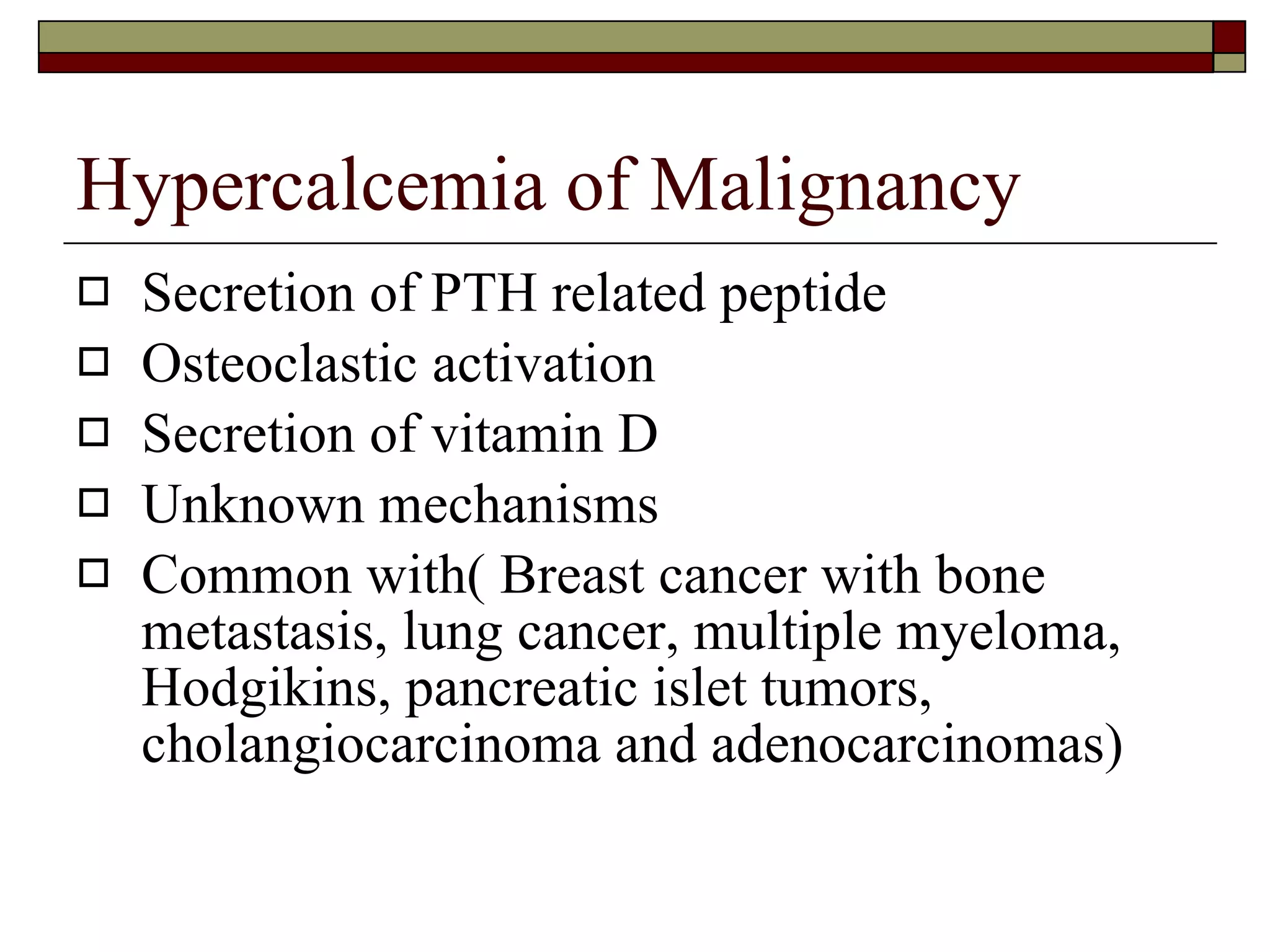
Hypercalcemia of Malignancy Secretion of PTH related peptide Osteoclastic activation Secretion of vitamin D Unknown mechanisms Common with( Breast cancer with bone metastasis, lung cancer, multiple myeloma, Hodgikins, pancreatic islet tumors, cholangiocarcinoma and adenocarcinomas)
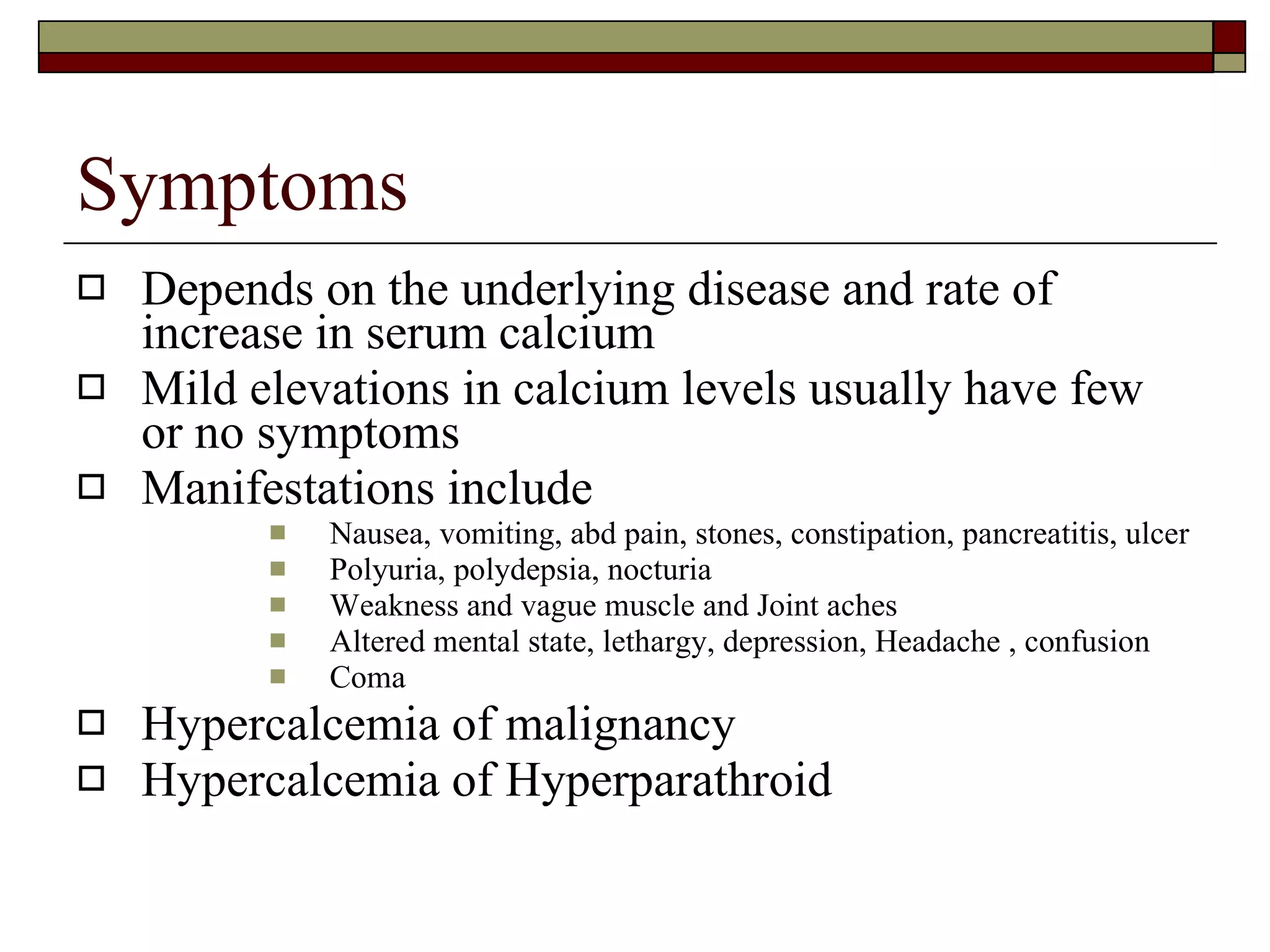
Symptoms Depends on the underlying disease and rate of increase in serum calcium Mild elevations in calcium levels usually have few or no symptoms  Manifestations include Nausea, vomiting, abd pain, stones, constipation, pancreatitis, ulcer Polyuria, polydepsia, nocturia Weakness and vague muscle and Joint aches Altered mental state, lethargy, depression, Headache , confusion  Coma Hypercalcemia of malignancy Hypercalcemia of Hyperparathroid
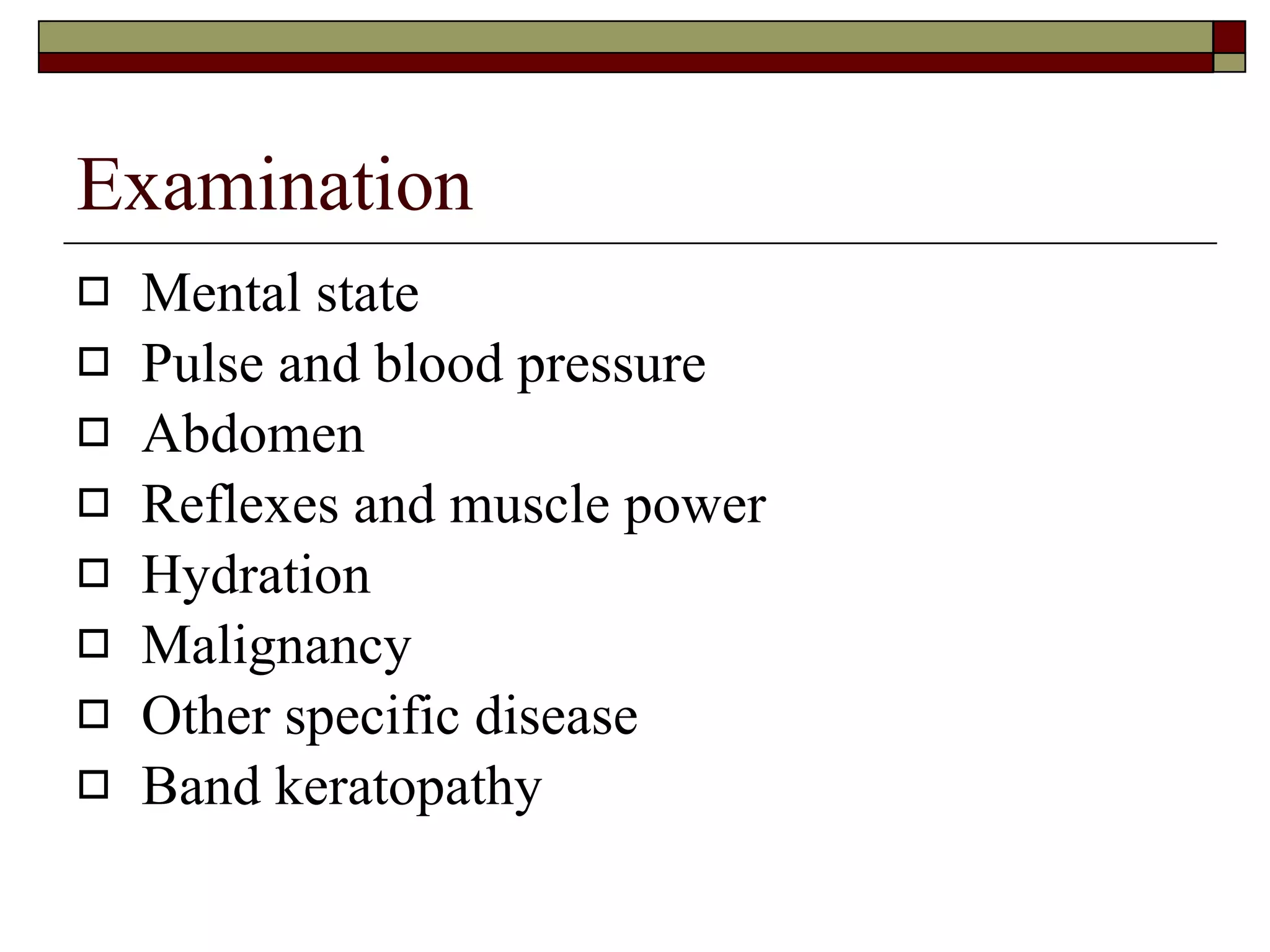
Examination Mental state Pulse and blood pressure Abdomen Reflexes and muscle power Hydration Malignancy Other specific disease Band keratopathy
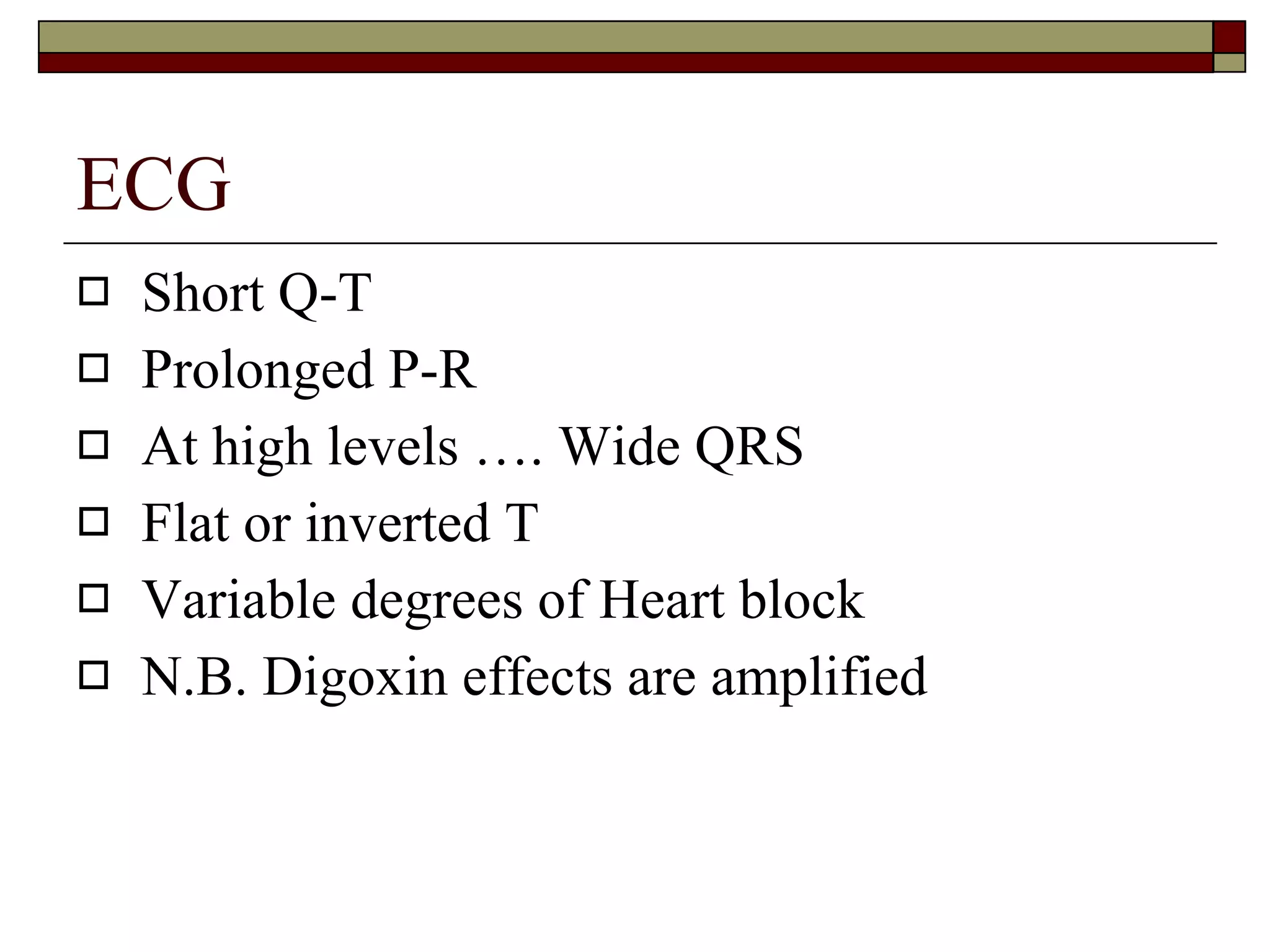
ECG Short Q-T Prolonged P-R At high levels …. Wide QRS Flat or inverted T Variable degrees of Heart block N.B. Digoxin effects are amplified
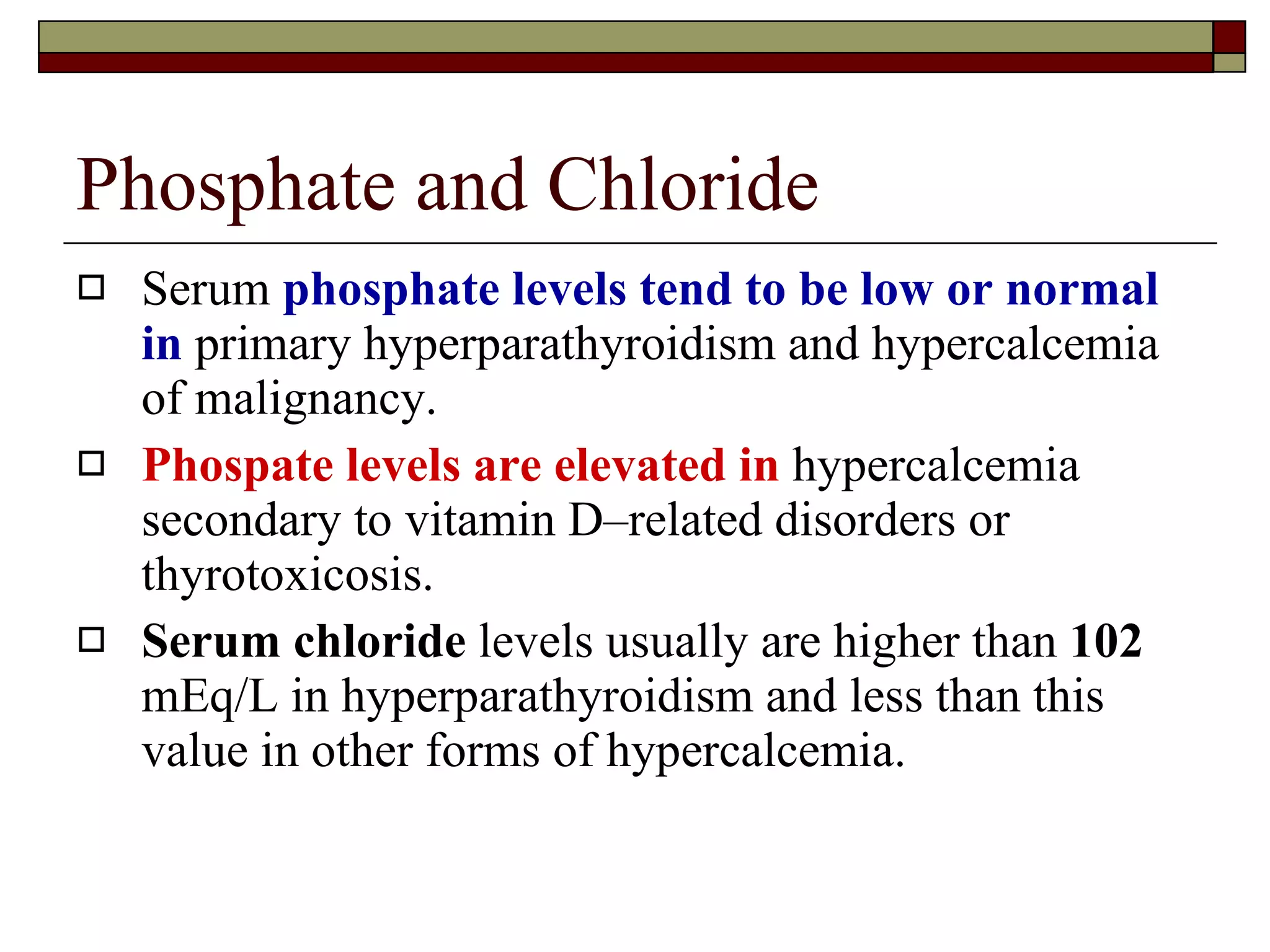
Phosphate and Chloride Serum  phosphate levels tend to be low or normal in  primary hyperparathyroidism and hypercalcemia of malignancy.  Phospate levels are elevated in  hypercalcemia secondary to vitamin D–related disorders or thyrotoxicosis.  Serum chloride  levels usually are higher than  102  mEq/L in hyperparathyroidism and less than this value in other forms of hypercalcemia.
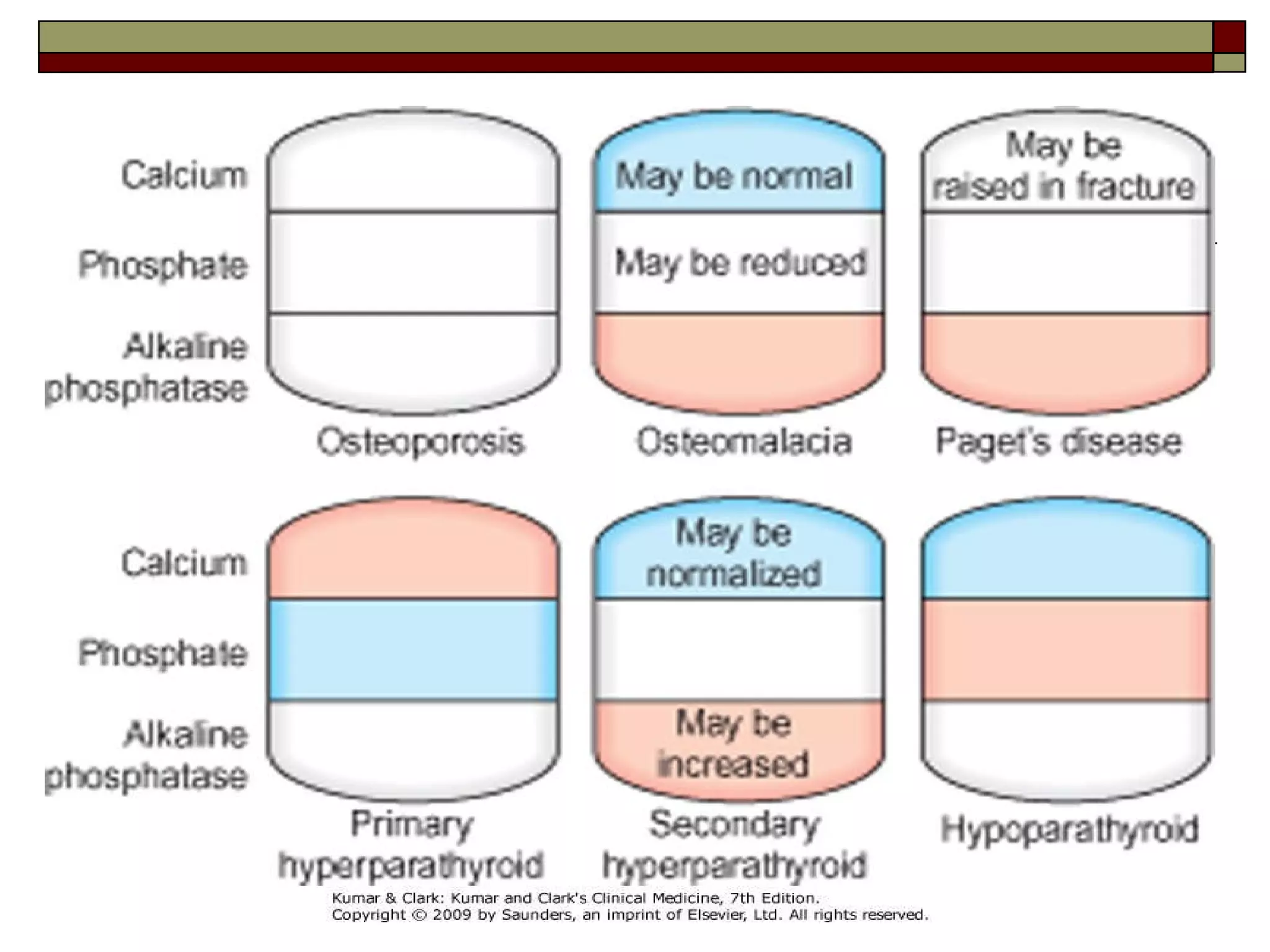
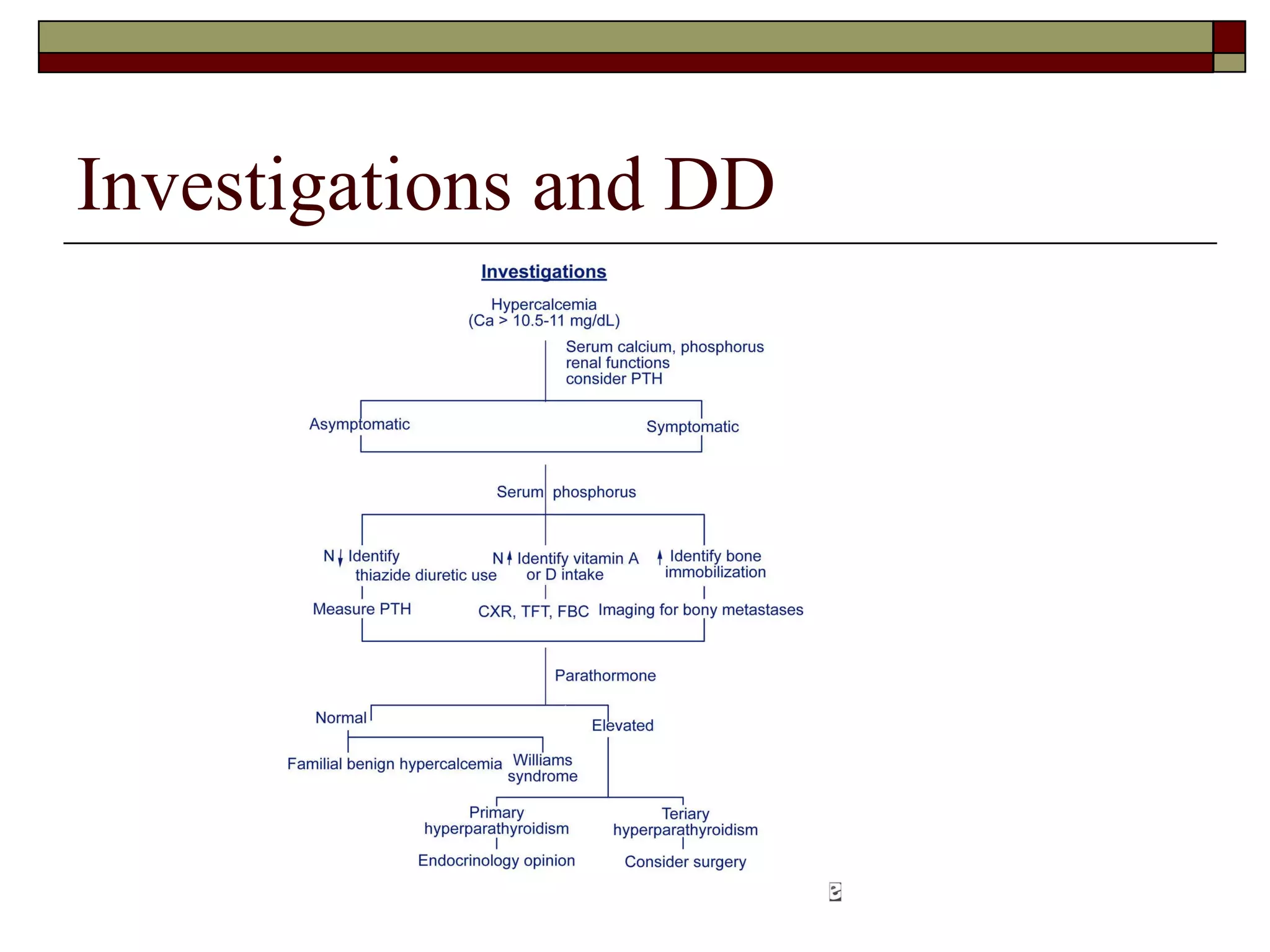
Investigations and DD
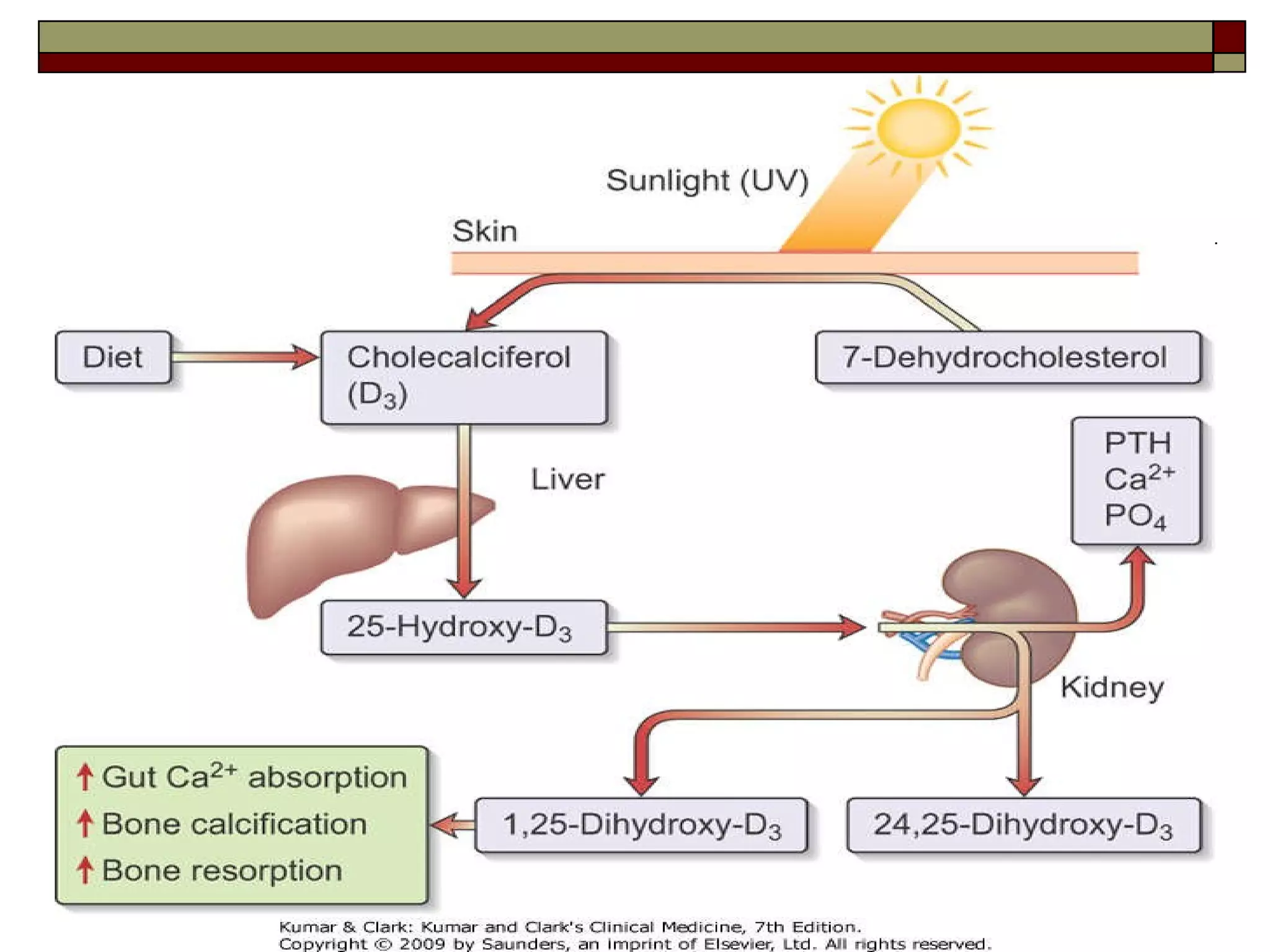
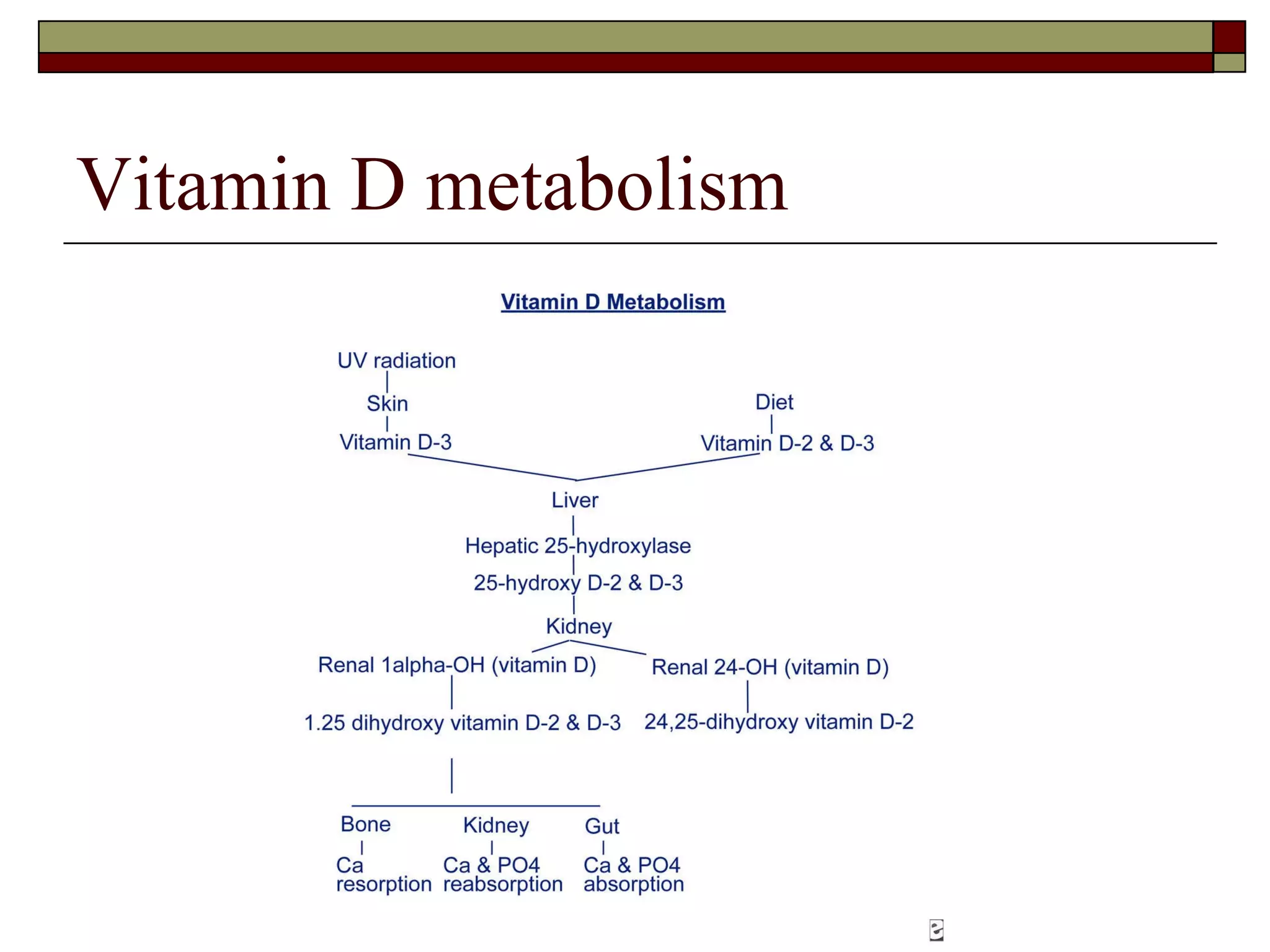
Vitamin D metabolism
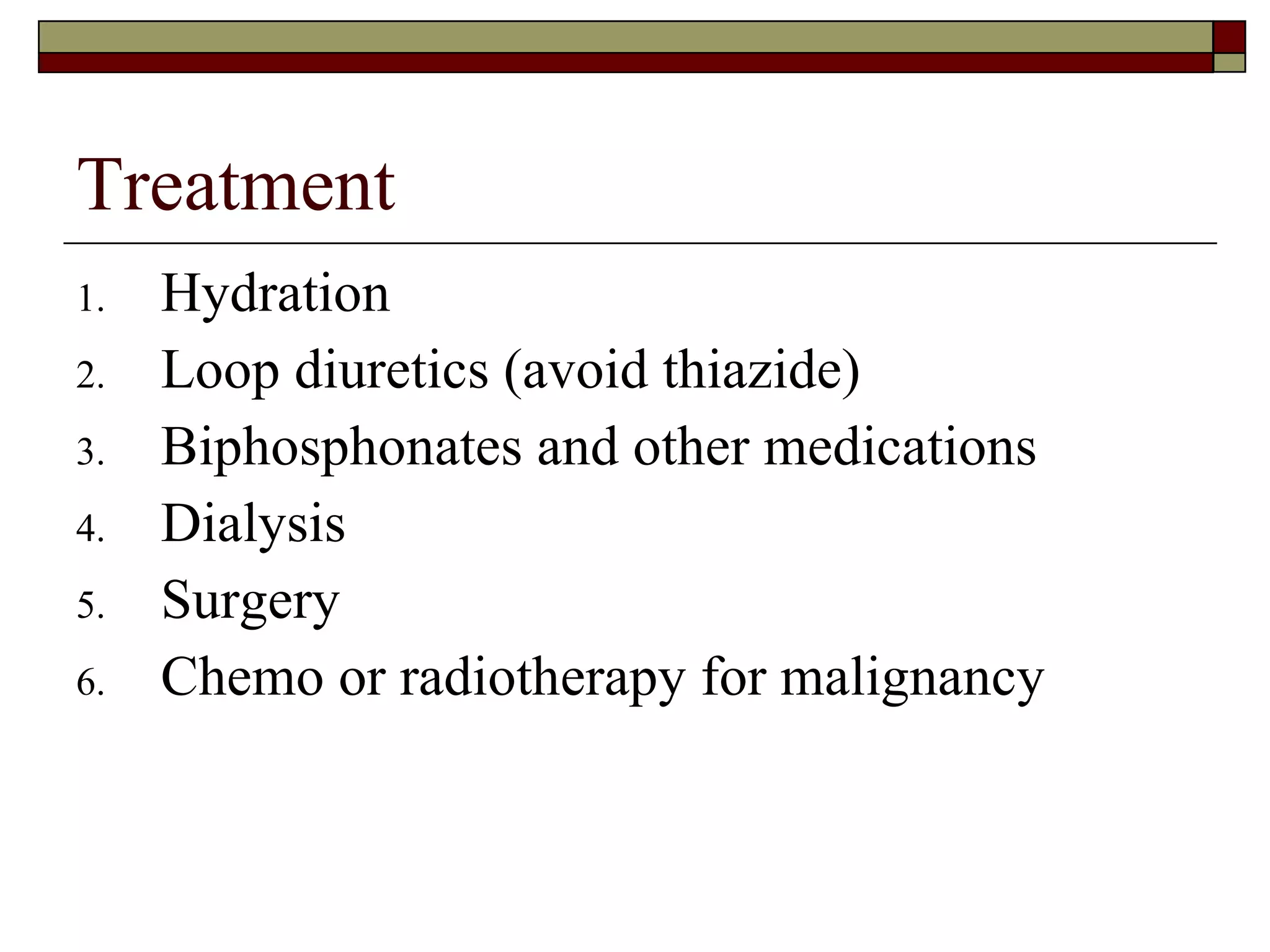
Treatment Hydration Loop diuretics (avoid thiazide) Biphosphonates and other medications Dialysis Surgery Chemo or radiotherapy for malignancy
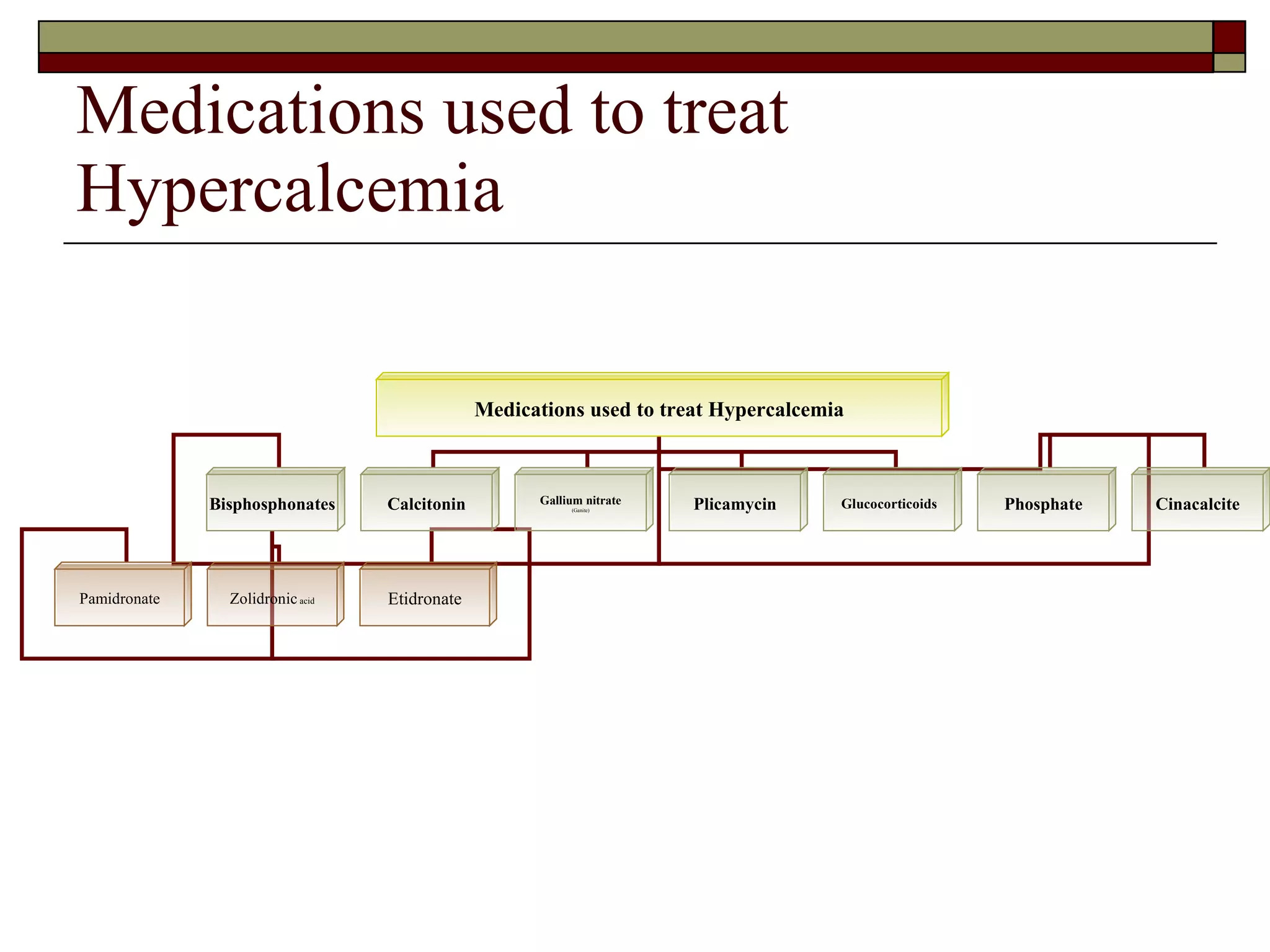
Medications used to treat Hypercalcemia Medications used to treat Hypercalcemia Bisphosphonates Calcitonin Gallium nitrate (Ganite) Plicamycin Glucocorticoids Phosphate Cinacalcite Pamidronate Zolidronic  acid Etidronate
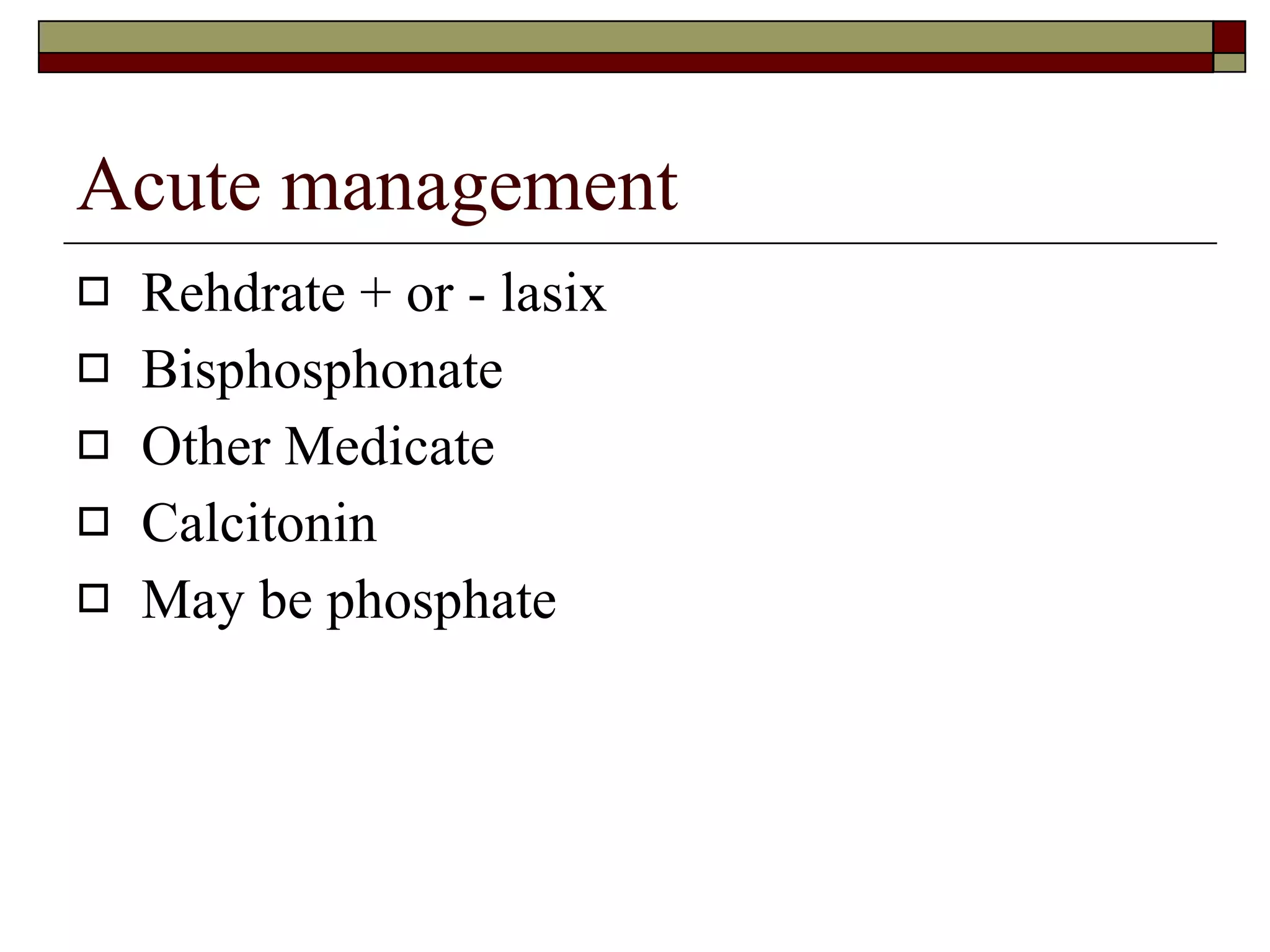
Acute management Rehdrate + or - lasix Bisphosphonate Other Medicate Calcitonin May be phosphate
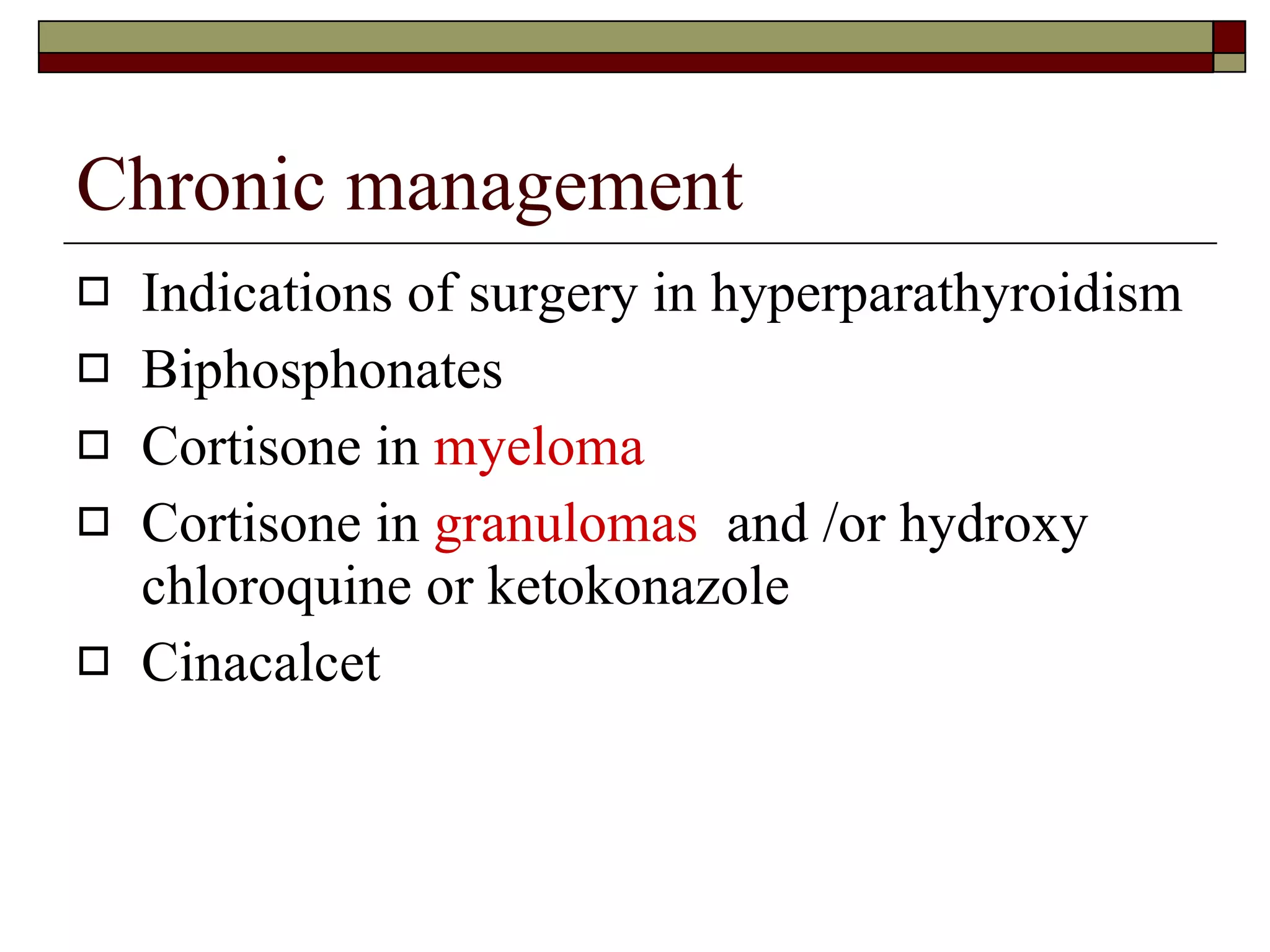
Chronic management Indications of surgery in hyperparathyroidism Biphosphonates Cortisone in  myeloma Cortisone in  granulomas  and /or hydroxy chloroquine or ketokonazole Cinacalcet
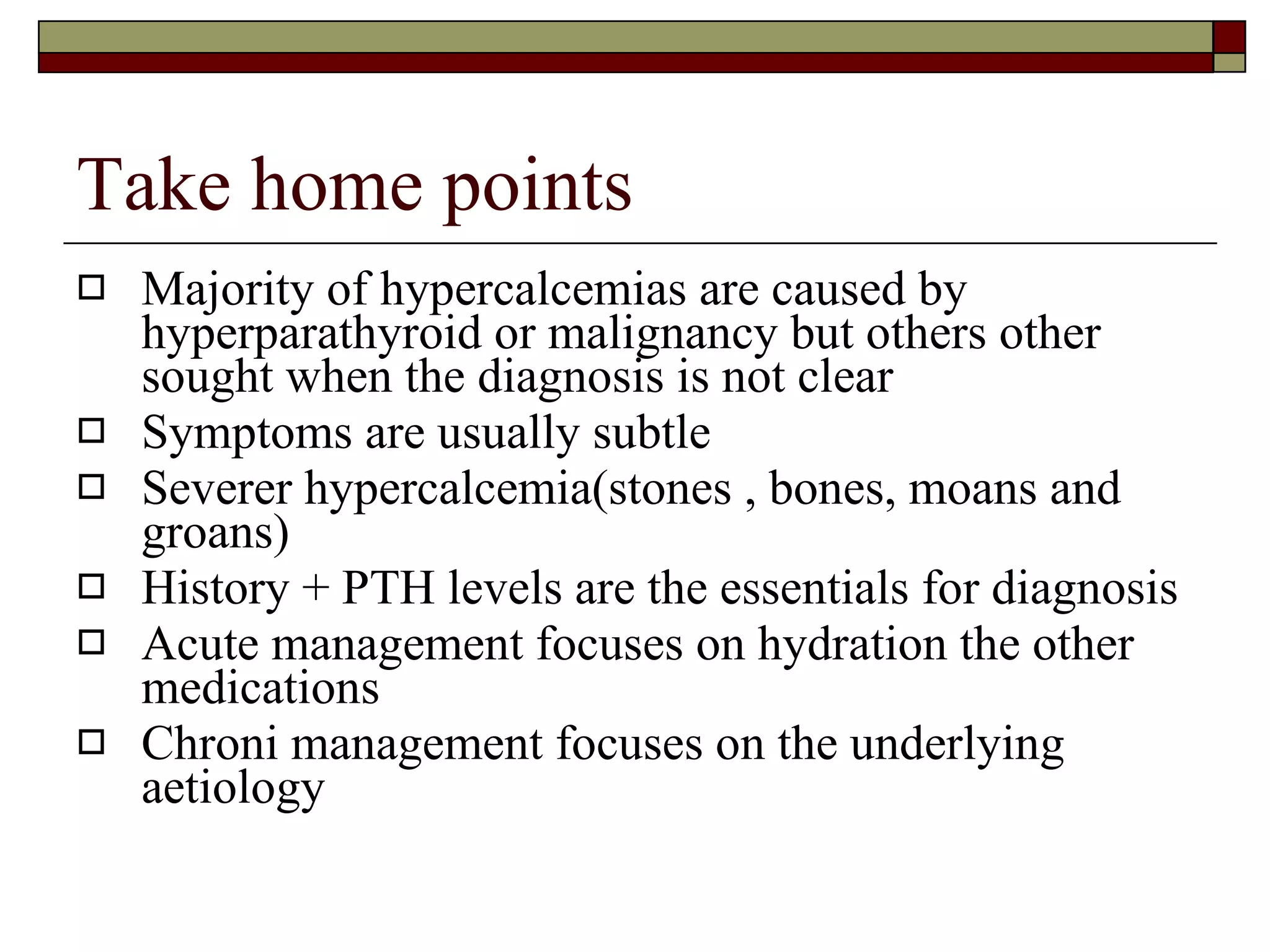
Take home points Majority of hypercalcemias are caused by hyperparathyroid or malignancy but others other sought when the diagnosis is not clear Symptoms are usually subtle Severer hypercalcemia(stones , bones, moans and groans) History + PTH levels are the essentials for diagnosis Acute management focuses on hydration the other medications Chroni management focuses on the underlying aetiology
References Washington subspecialty consult: Endocrinology 2009 Kumar and Klark’s Medicine 2009 E-medicine online text book – emergency medicine/ and Nephrology Nejm CASES, 2008
THANK  YOU

Hypercalcemia

  • 1.
  • 2.
    Hypercalcemia Ahmed ElshebinyUniversity of Menoufyia
  • 3.
    Case : HistoryA 41-year-old woman was brought by her husband to the emergency department with a history of 72 hours of epigastric pain, nausea, repeated vomiting, and altered mental status. Her blood calcium was found to be 18.9 mg per deciliter (4.7 mmol per liter). Alcoholic, peptic ulcer, analgesics for back pain
  • 4.
    Examination On physicalexamination, the blood pressure was 160/90 mm Hg, the heart rate 100 beats per minute, and the temperature 37.4°C. The patient was disoriented and intermittently writhing in pain. Her skin turgor was poor, and her oral mucosa was dry. The cardiac examination was significant only for tachycardia, and the pulmonary examination was normal. There was epigastric tenderness on palpation but no rebound tenderness. The patient was responsive to simple commands and was not tremulous. There were no other significant neurologic findings.
  • 5.
  • 6.
    Specific investigations Intactparathyroid= undetectable 25 hydroxy vitamin D = normal PTH related protein= normal Calcium fall with hydration only Computed tomography (CT) of the neck revealed no parathyroid masses. CT of the chest was normal. Abdominal CT showed an edematous pancreas with surrounding infiltration of the mesenteric fat, a finding consistent with acute pancreatitis. No bone lesions were noted on the chest or abdominal CT scans.
  • 7.
    Diagnosis In responseto further questioning, the patient reported that during the days before admission she had consumed the contents of entire containers of Tums and a preparation containing sodium bicarbonate (Alka-Seltzer, Bayer) because of the severe abdominal pain. She did not consume any other medications or supplements. This history, together with the laboratory-test results, establishes the "milk alkali syndrome" as the primary diagnosis
  • 8.
    Milk Alkali SyndromeThe pathogenesis of the milk alkali syndrome involves a reduction in the ability of the kidney to excrete excess calcium. This reduction is secondary to a decrease in the glomerular filtration rate (due to renal vasoconstriction and hypovolemia) and to a significant increase in tubular reabsorption of calcium (secondary to metabolic alkalosis). The plasma PTH level decreases with the rise in the serum calcium level. Thus, the constellation of excess oral intake of calcium and milk, plus impaired renal function, may result in PTH suppression, hypercalcemia, and hyperphosphatemia. In cases of chronic ingestion of excessive alkaline calcium preparations and milk, metastatic calcifications and occasionally nephrocalcinosis may occur, 7 whereas such complications are not expected with acute milk alkali syndrome, as in the present case.
  • 9.
    Calcium Plays arole inside (intracellular) and outside (extarcellular) cells Functions of calcium Muscle contraction Nerve conduction Coagulation Enzyme and electrolyte regulation Hormone release and exocytosis Cell division Calcium enters extra-cellular fluid from intestine and bone Calcium is excreted through kidneys Calcium is tightly controlled by hormones (PTH, Calcitriol, calcitonin) Human body contains 1100 g calcium
  • 10.
  • 11.
  • 12.
  • 13.
    Hypercalcemia For hypercalcemiato develop, the normal calcium regulation system must be overwhelmed by an excess of PTH, Calcitriol, some other serum factor that can mimic these hormones, or a huge calcium load. Between 20 and 40% of patients with cancer develop hypercalcemia at some point in their disease the most common serious electrolyte presenting in adults with malignancies primary hyperparathyroidism is considerably higher in women. Hyperparathyroidism and malignancy increases with age Breast cancer is one of the most common malignancies responsible for hypercalcemia.
  • 14.
    PTH dependent hypercalcemiaPrimary hyperpara( adenoma commonly) Tertiary hyperparathyroidism FHH MEN syndromes Lithium therapy
  • 15.
    PTH independent hypercalcemiaMalignancy related Vitamin D related( Granulomas, infections, toxcicity, williams syndrome) Other endocrine( hyperthyroidism, pheochromocytoma, adrenal insufficiency, islet cell tumor) Miscellaneous( immobilization, milk alkali, other medications)
  • 16.
    Hypercalcemia of HyperparathyroidPrimary: Usually adenoma Secondary tertiary Hypophosphatemia and elevated urine calcium Surgery Complications of surgery
  • 17.
    PTH and calciummeasurment PTH assay PTH related protein Total calcium Ionized calcium
  • 18.
    FHH Autosomal dominant, usually mild elevation Shift of the set point Urine calcim is low Previous history of normal calcium rules out FHH
  • 19.
    Hypercalcemia of MalignancySecretion of PTH related peptide Osteoclastic activation Secretion of vitamin D Unknown mechanisms Common with( Breast cancer with bone metastasis, lung cancer, multiple myeloma, Hodgikins, pancreatic islet tumors, cholangiocarcinoma and adenocarcinomas)
  • 20.
    Symptoms Depends onthe underlying disease and rate of increase in serum calcium Mild elevations in calcium levels usually have few or no symptoms Manifestations include Nausea, vomiting, abd pain, stones, constipation, pancreatitis, ulcer Polyuria, polydepsia, nocturia Weakness and vague muscle and Joint aches Altered mental state, lethargy, depression, Headache , confusion Coma Hypercalcemia of malignancy Hypercalcemia of Hyperparathroid
  • 21.
    Examination Mental statePulse and blood pressure Abdomen Reflexes and muscle power Hydration Malignancy Other specific disease Band keratopathy
  • 22.
    ECG Short Q-TProlonged P-R At high levels …. Wide QRS Flat or inverted T Variable degrees of Heart block N.B. Digoxin effects are amplified
  • 23.
    Phosphate and ChlorideSerum phosphate levels tend to be low or normal in primary hyperparathyroidism and hypercalcemia of malignancy. Phospate levels are elevated in hypercalcemia secondary to vitamin D–related disorders or thyrotoxicosis. Serum chloride levels usually are higher than 102 mEq/L in hyperparathyroidism and less than this value in other forms of hypercalcemia.
  • 24.
  • 25.
  • 26.
    Treatment Hydration Loopdiuretics (avoid thiazide) Biphosphonates and other medications Dialysis Surgery Chemo or radiotherapy for malignancy
  • 27.
    Medications used totreat Hypercalcemia Medications used to treat Hypercalcemia Bisphosphonates Calcitonin Gallium nitrate (Ganite) Plicamycin Glucocorticoids Phosphate Cinacalcite Pamidronate Zolidronic acid Etidronate
  • 28.
    Acute management Rehdrate+ or - lasix Bisphosphonate Other Medicate Calcitonin May be phosphate
  • 29.
    Chronic management Indicationsof surgery in hyperparathyroidism Biphosphonates Cortisone in myeloma Cortisone in granulomas and /or hydroxy chloroquine or ketokonazole Cinacalcet
  • 30.
    Take home pointsMajority of hypercalcemias are caused by hyperparathyroid or malignancy but others other sought when the diagnosis is not clear Symptoms are usually subtle Severer hypercalcemia(stones , bones, moans and groans) History + PTH levels are the essentials for diagnosis Acute management focuses on hydration the other medications Chroni management focuses on the underlying aetiology
  • 31.
    References Washington subspecialtyconsult: Endocrinology 2009 Kumar and Klark’s Medicine 2009 E-medicine online text book – emergency medicine/ and Nephrology Nejm CASES, 2008
  • 32.