1
• Commonly encountered in Practice
• Diagnosis often is made incidentally
• The most common causes are primary
hyperparathyroidism and malignancy
• Diagnostic work-up includes measurement
of serum calcium, intact parathyroid
hormone (I-PTH), h/o any medications
• Hypercalcemic crisis is a life-threatening
emergency
2
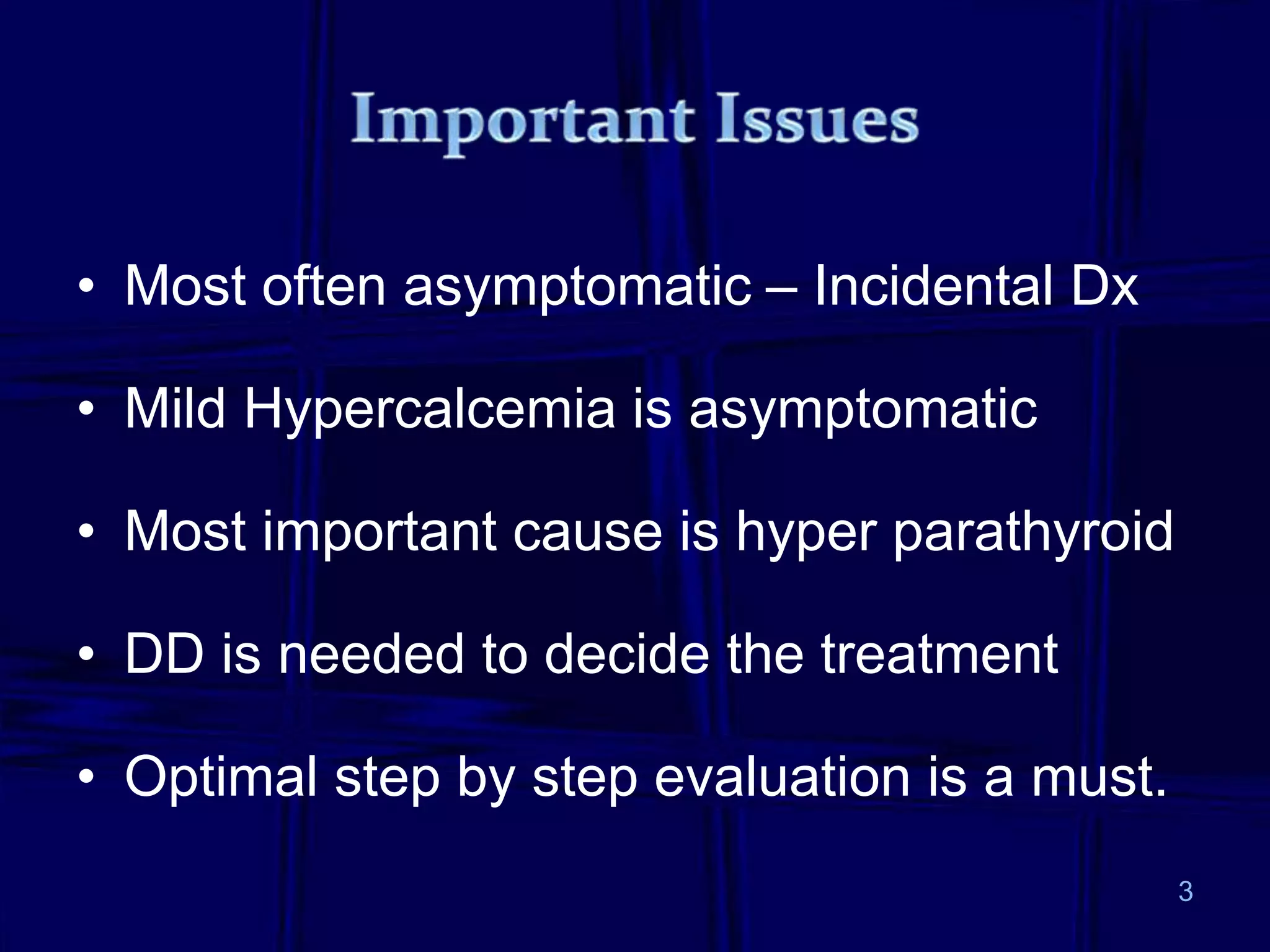
• Most often asymptomatic – Incidental Dx
• Mild Hypercalcemia is asymptomatic
• Most important cause is hyper parathyroid
• DD is needed to decide the treatment
• Optimal step by step evaluation is a must.
3
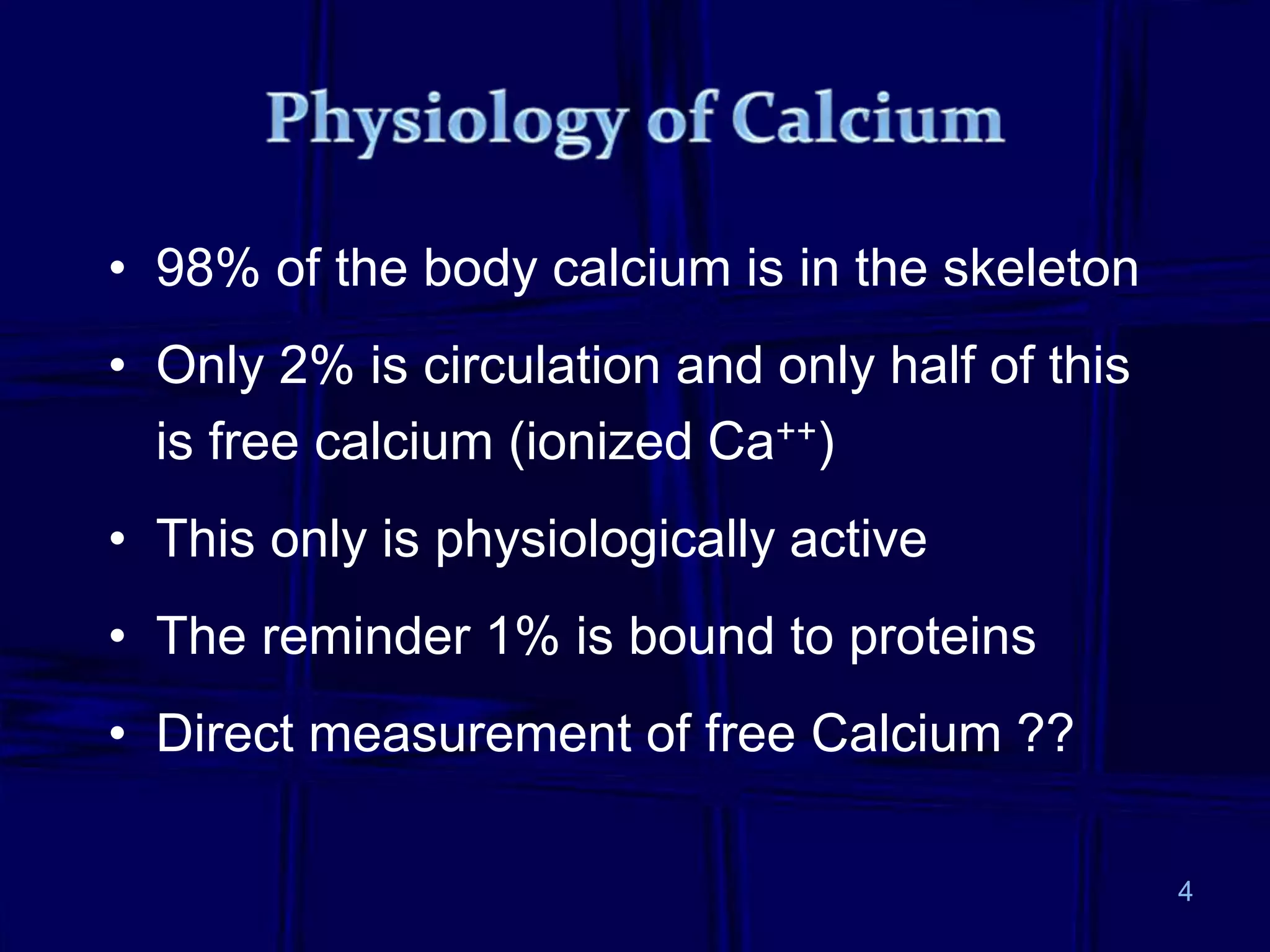
• 98% of the body calcium is in the skeleton
• Only 2% is circulation and only half of this
is free calcium (ionized Ca++)
• This only is physiologically active
• The reminder 1% is bound to proteins
• Direct measurement of free Calcium ??
4
5
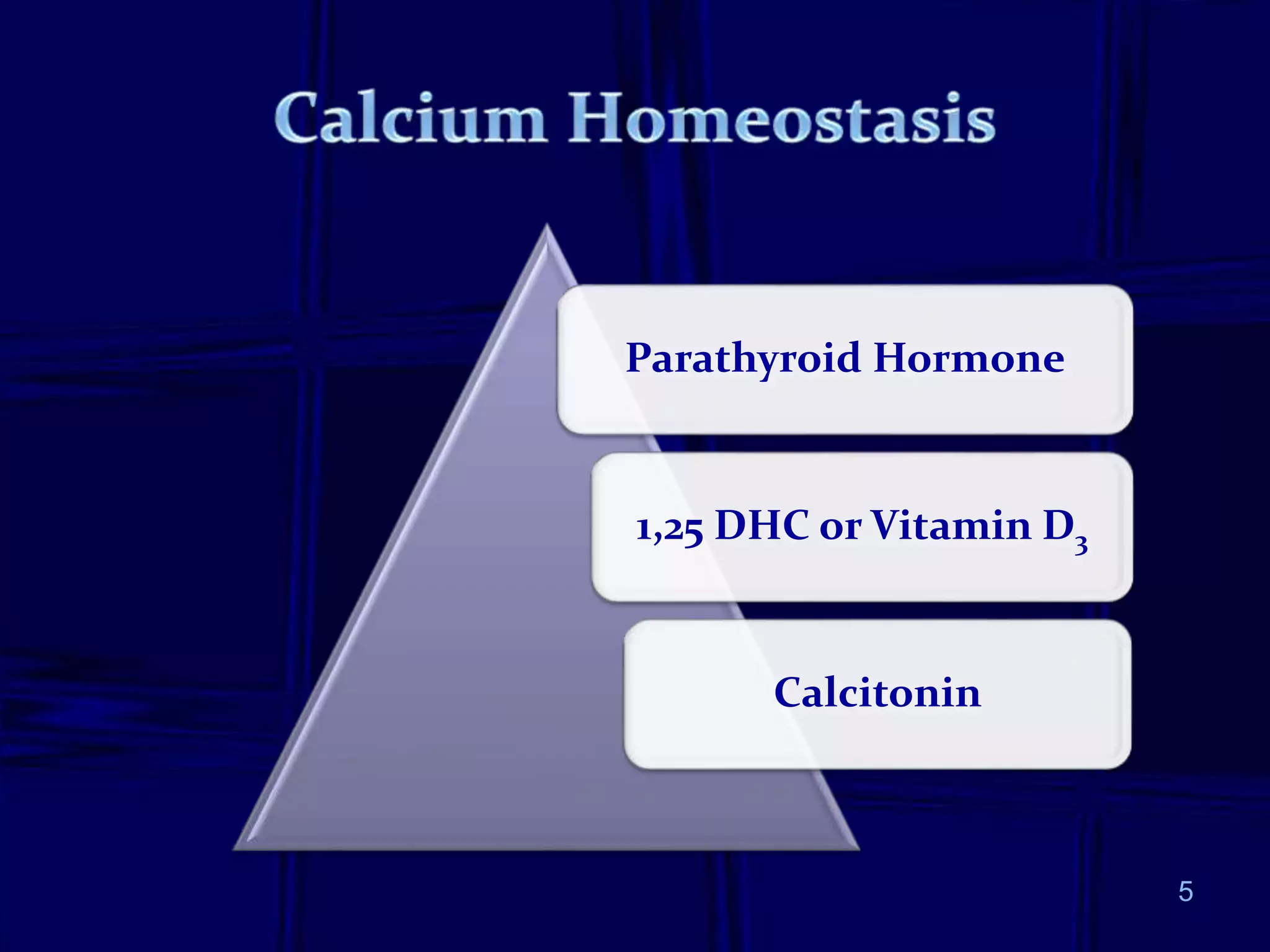
Parathyroid Hormone
1,25 DHC or Vitamin D3
Calcitonin
6
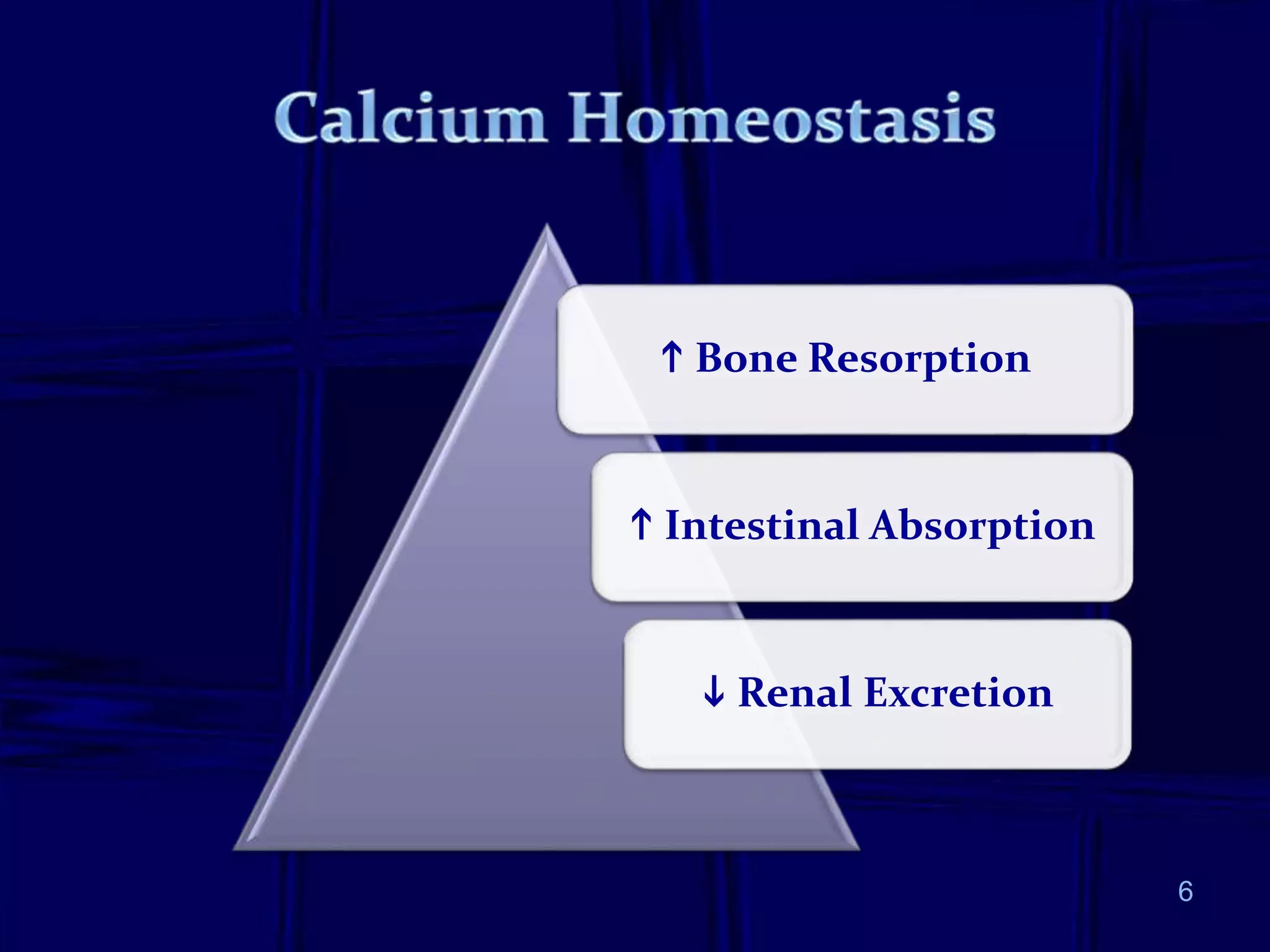
 Bone Resorption
 Intestinal Absorption
 Renal Excretion
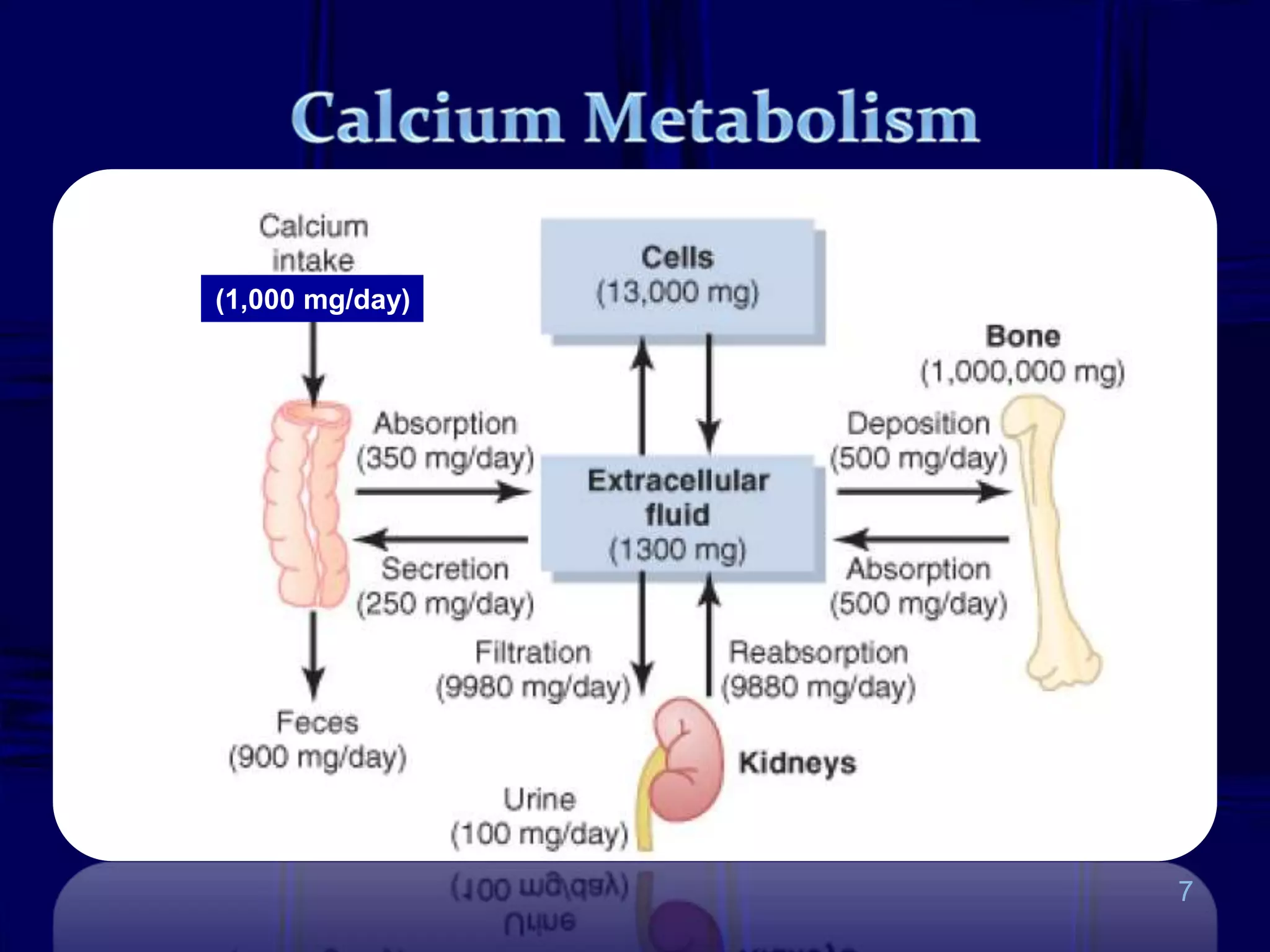
(1,000 mg/day)
7
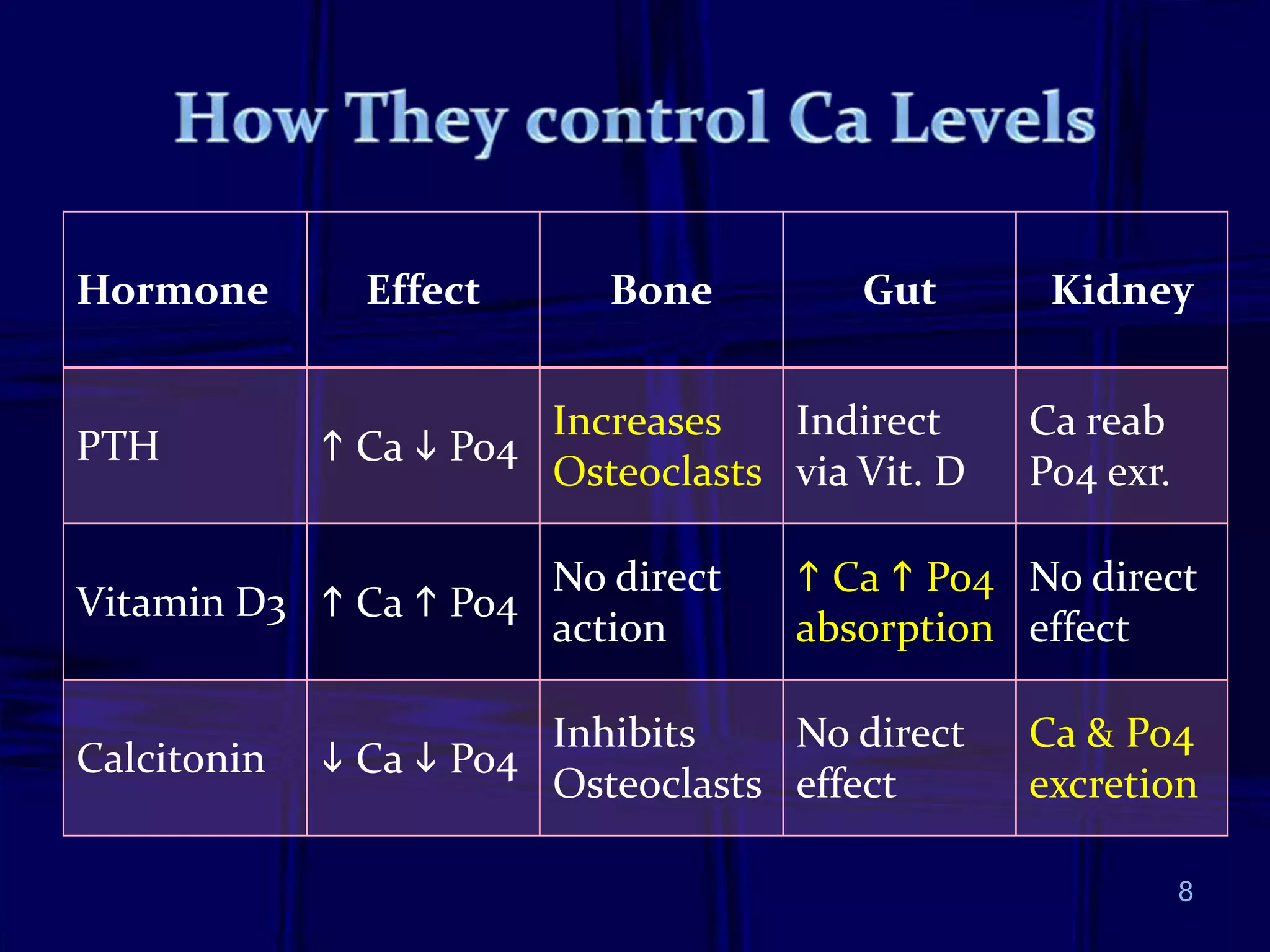
Hormone Effect Bone Gut Kidney
PTH  Ca  Po4
Increases
Osteoclasts
Indirect
via Vit. D
Ca reab
Po4 exr.
Vitamin D3  Ca  Po4
No direct
action
 Ca  Po4
absorption
No direct
effect
Calcitonin  Ca  Po4
Inhibits
Osteoclasts
No direct
effect
Ca & Po4
excretion
8
Corrected total calcium (mg%) =
[(Measured total calcium mg%) +
{(4.4 - measured albumin g%) x 0.8}]
Example:
[12.0 + {(4.4 – 2.4) x 0.8}] =
[ 12.0 + (2 x 0.8)] = 12.0 + 1.6 = 13.6
mg%
9
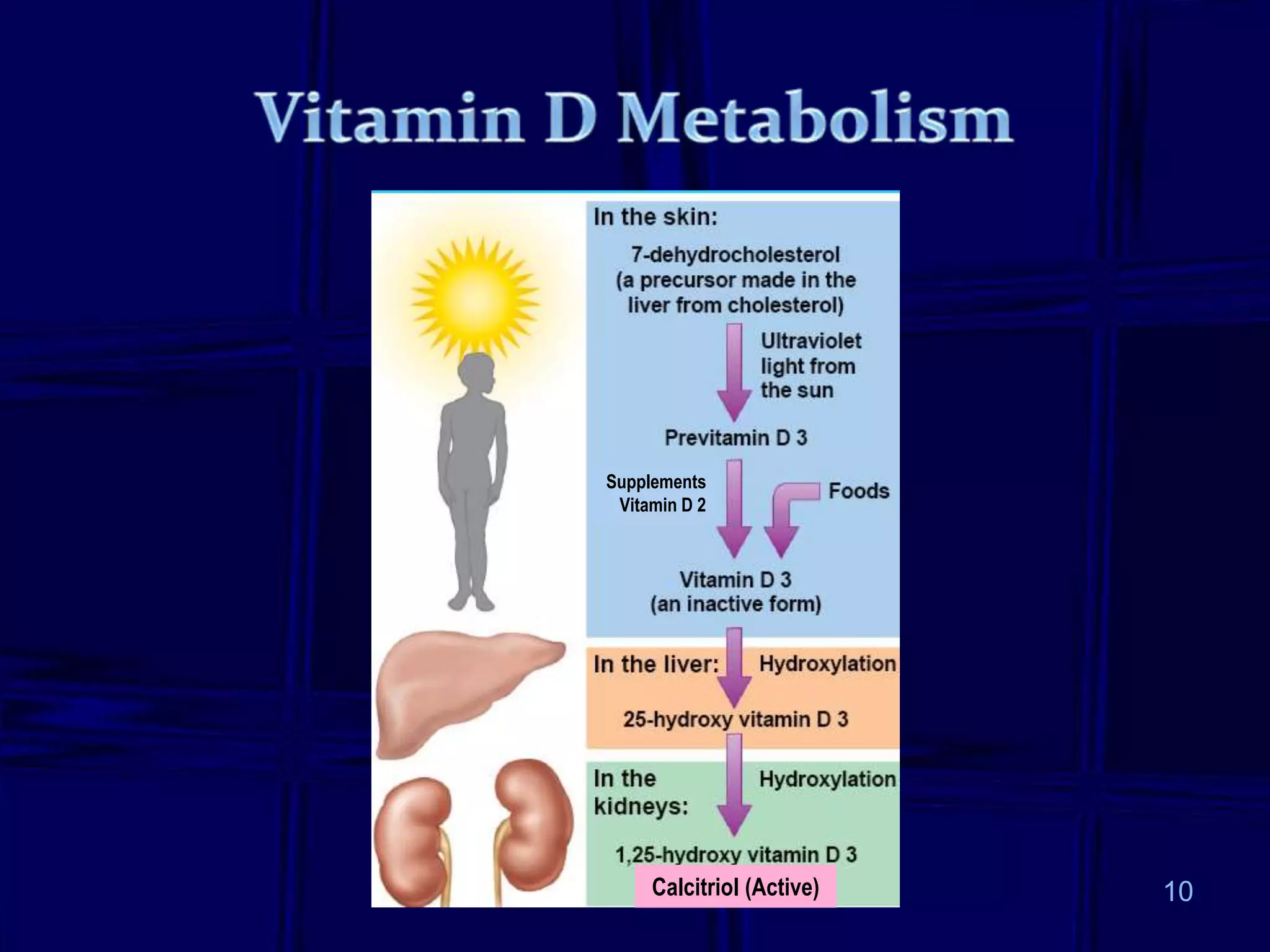
Calcitriol (Active)
Supplements
Vitamin D 2
10
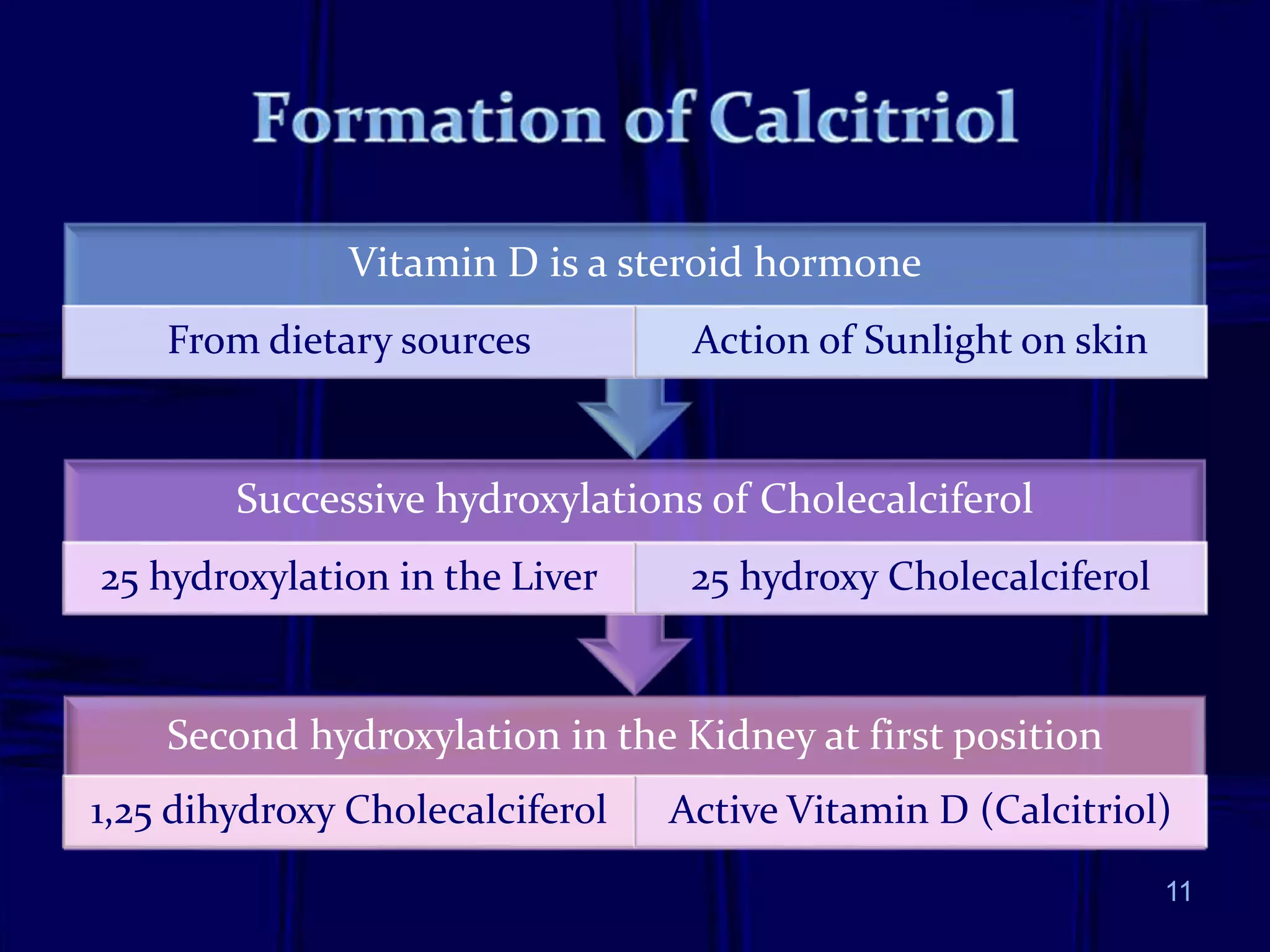
Second hydroxylation in the Kidney at first position
1,25 dihydroxy Cholecalciferol Active Vitamin D (Calcitriol)
Successive hydroxylations of Cholecalciferol
25 hydroxylation in the Liver 25 hydroxy Cholecalciferol
Vitamin D is a steroid hormone
From dietary sources Action of Sunlight on skin
11
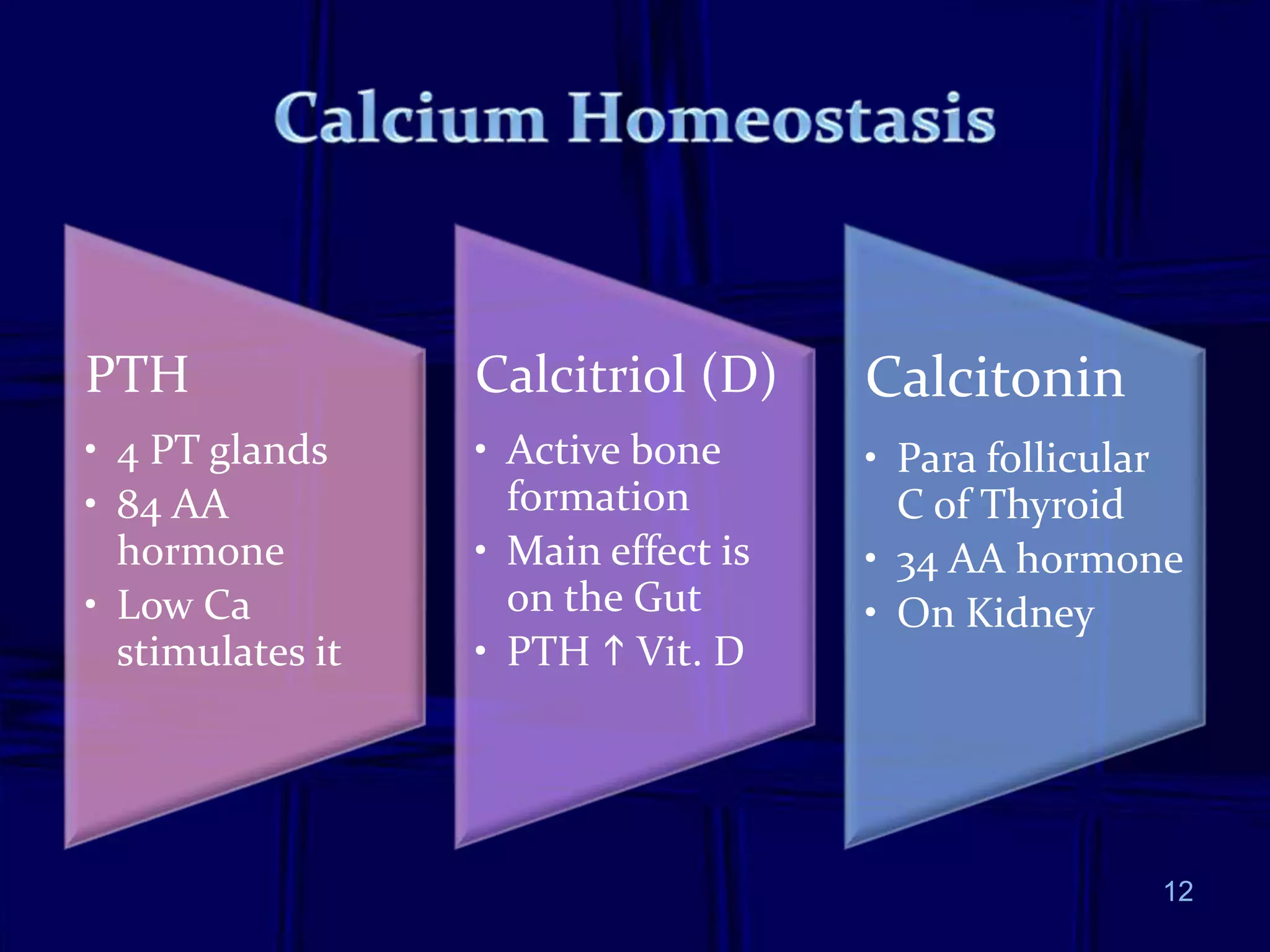
PTH
• 4 PT glands
• 84 AA
hormone
• Low Ca
stimulates it
Calcitriol (D)
• Active bone
formation
• Main effect is
on the Gut
• PTH  Vit. D
Calcitonin
• Para follicular
C of Thyroid
• 34 AA hormone
• On Kidney
12
13
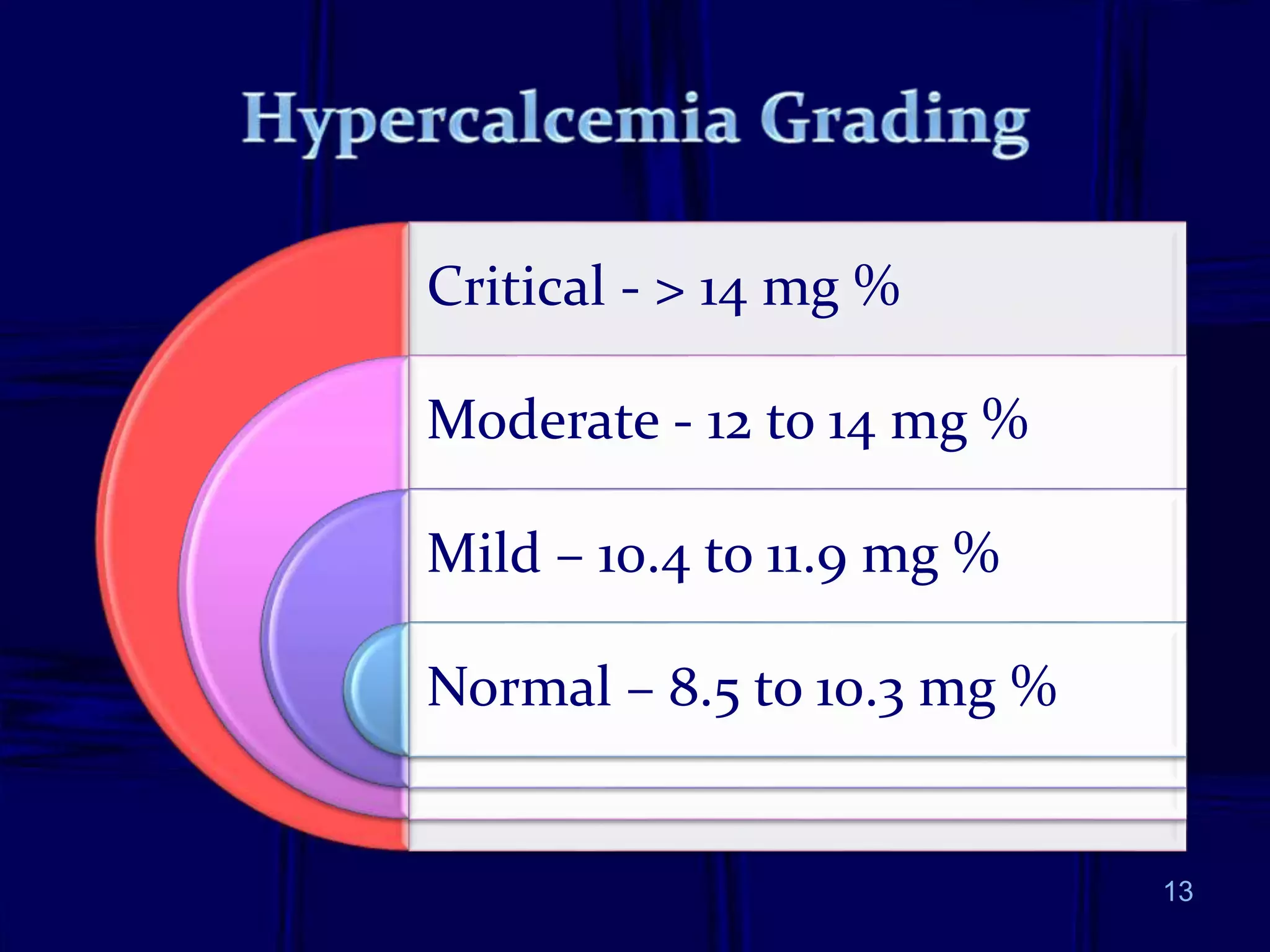
Critical - > 14 mg %
Moderate - 12 to 14 mg %
Mild – 10.4 to 11.9 mg %
Normal – 8.5 to 10.3 mg %
14
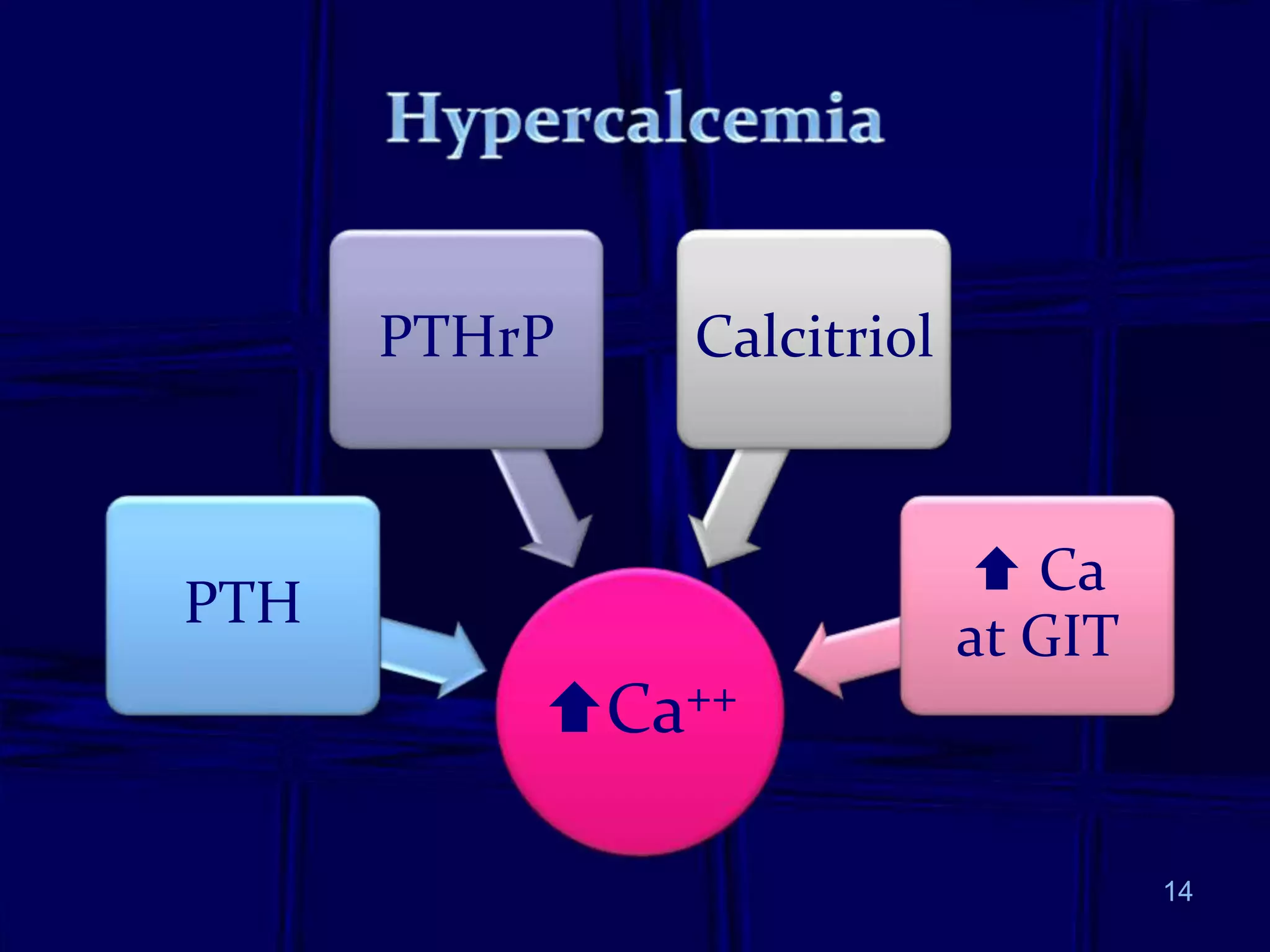
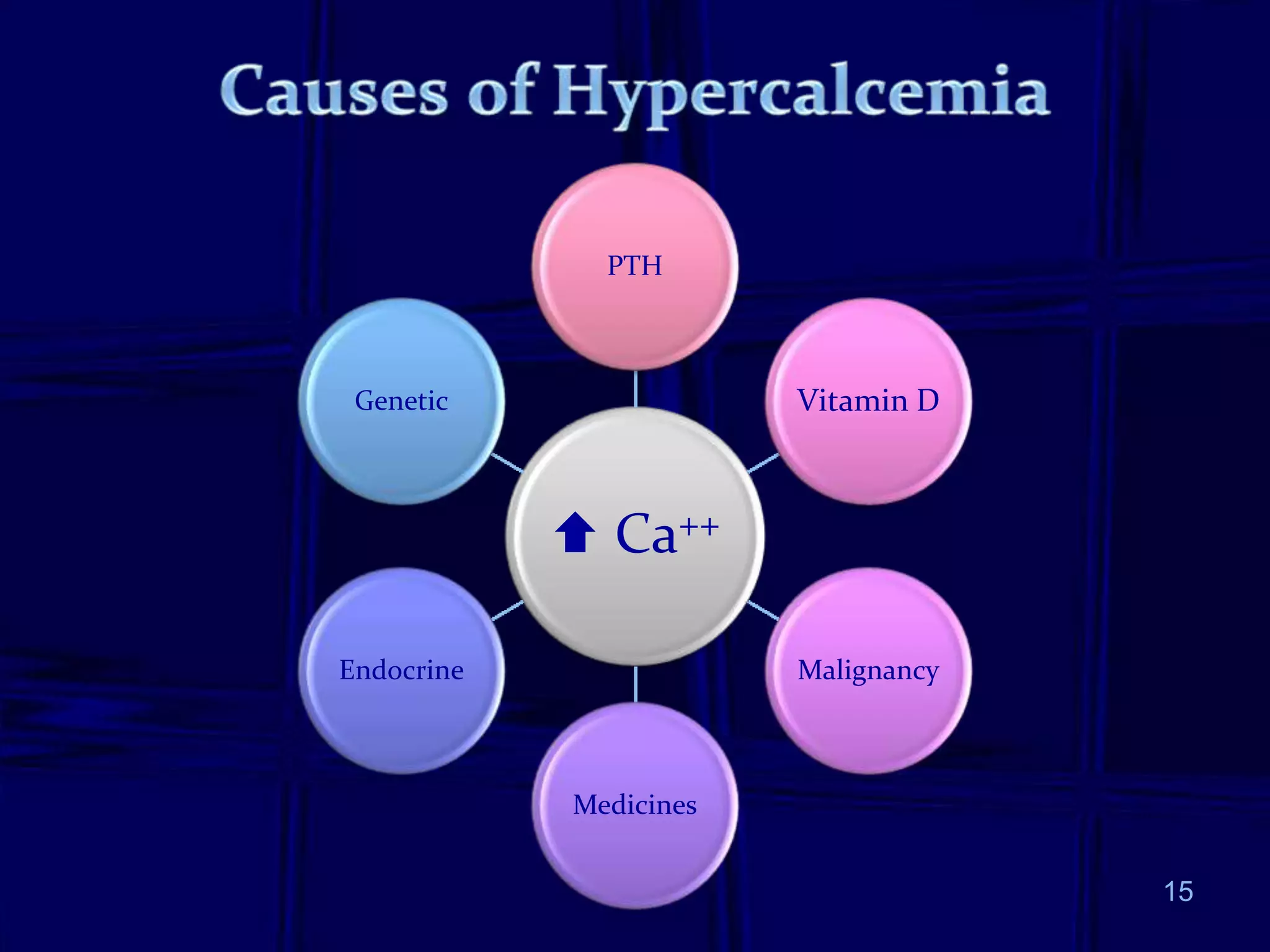
Ca++
PTH
PTHrP Calcitriol
 Ca
at GIT
 Ca++
PTH
Vitamin D
Malignancy
Medicines
Endocrine
Genetic
15
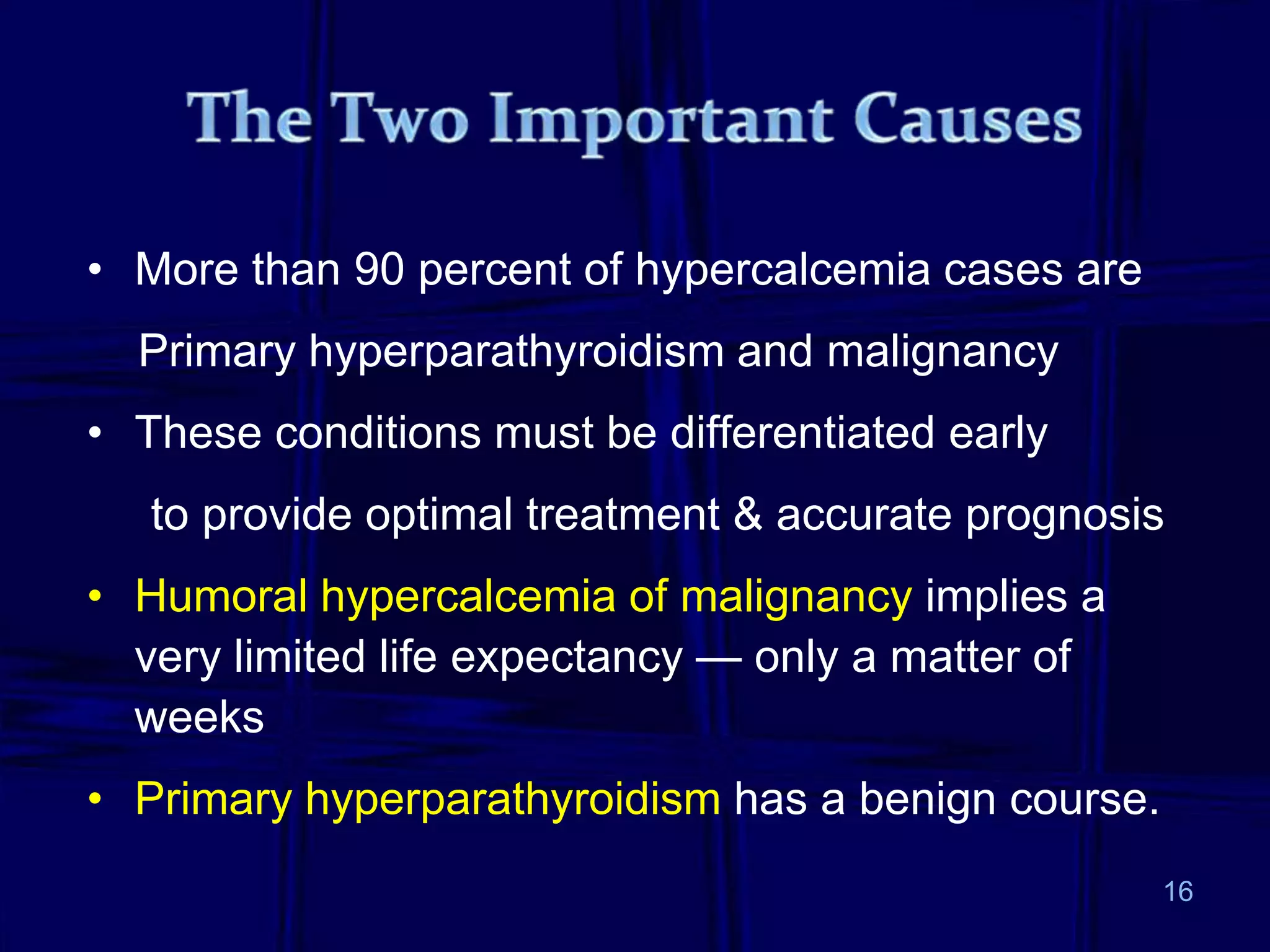
• More than 90 percent of hypercalcemia cases are
Primary hyperparathyroidism and malignancy
• These conditions must be differentiated early
to provide optimal treatment & accurate prognosis
• Humoral hypercalcemia of malignancy implies a
very limited life expectancy — only a matter of
weeks
• Primary hyperparathyroidism has a benign course.
16
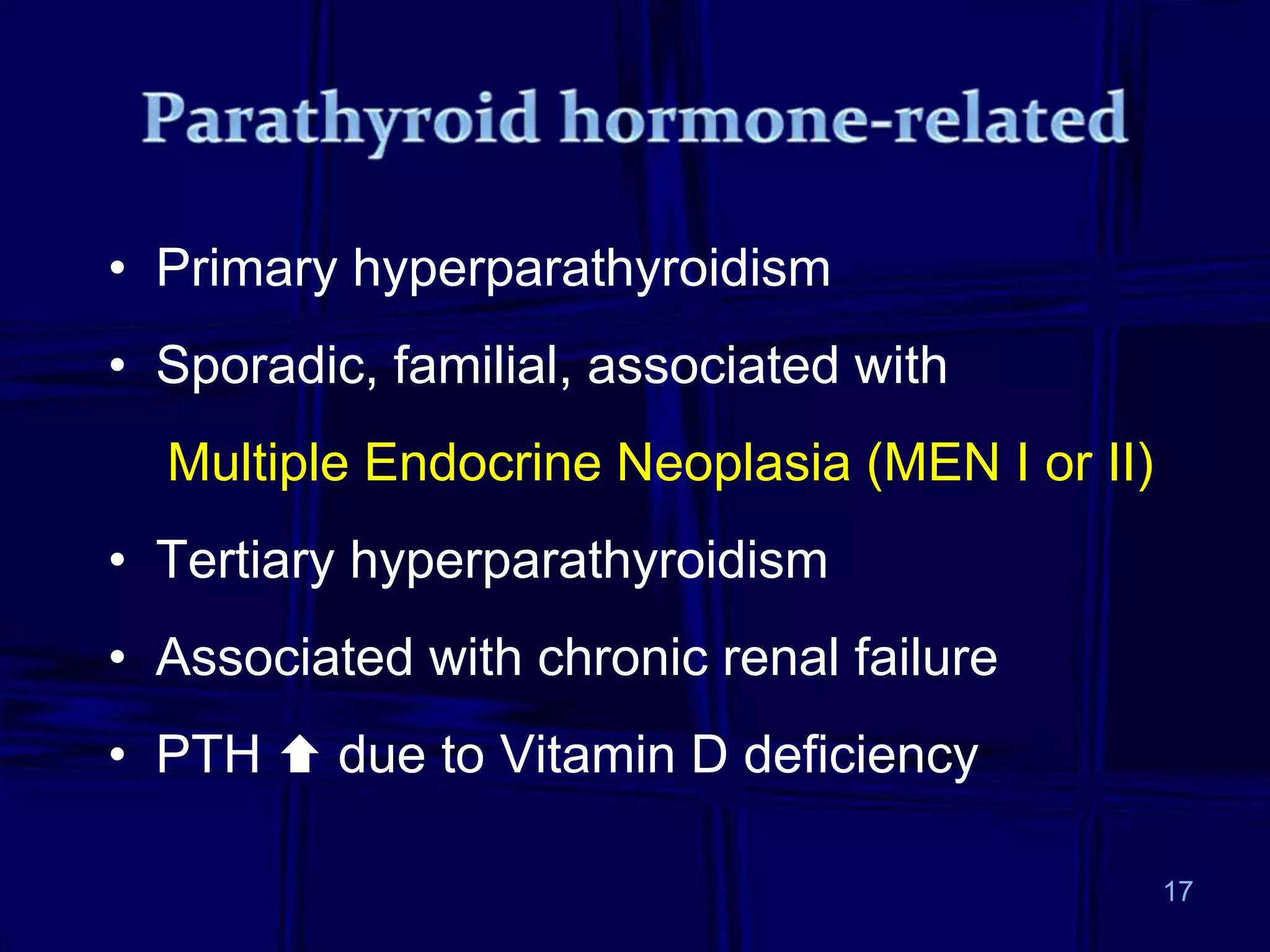
• Primary hyperparathyroidism
• Sporadic, familial, associated with
Multiple Endocrine Neoplasia (MEN I or II)
• Tertiary hyperparathyroidism
• Associated with chronic renal failure
• PTH  due to Vitamin D deficiency
17
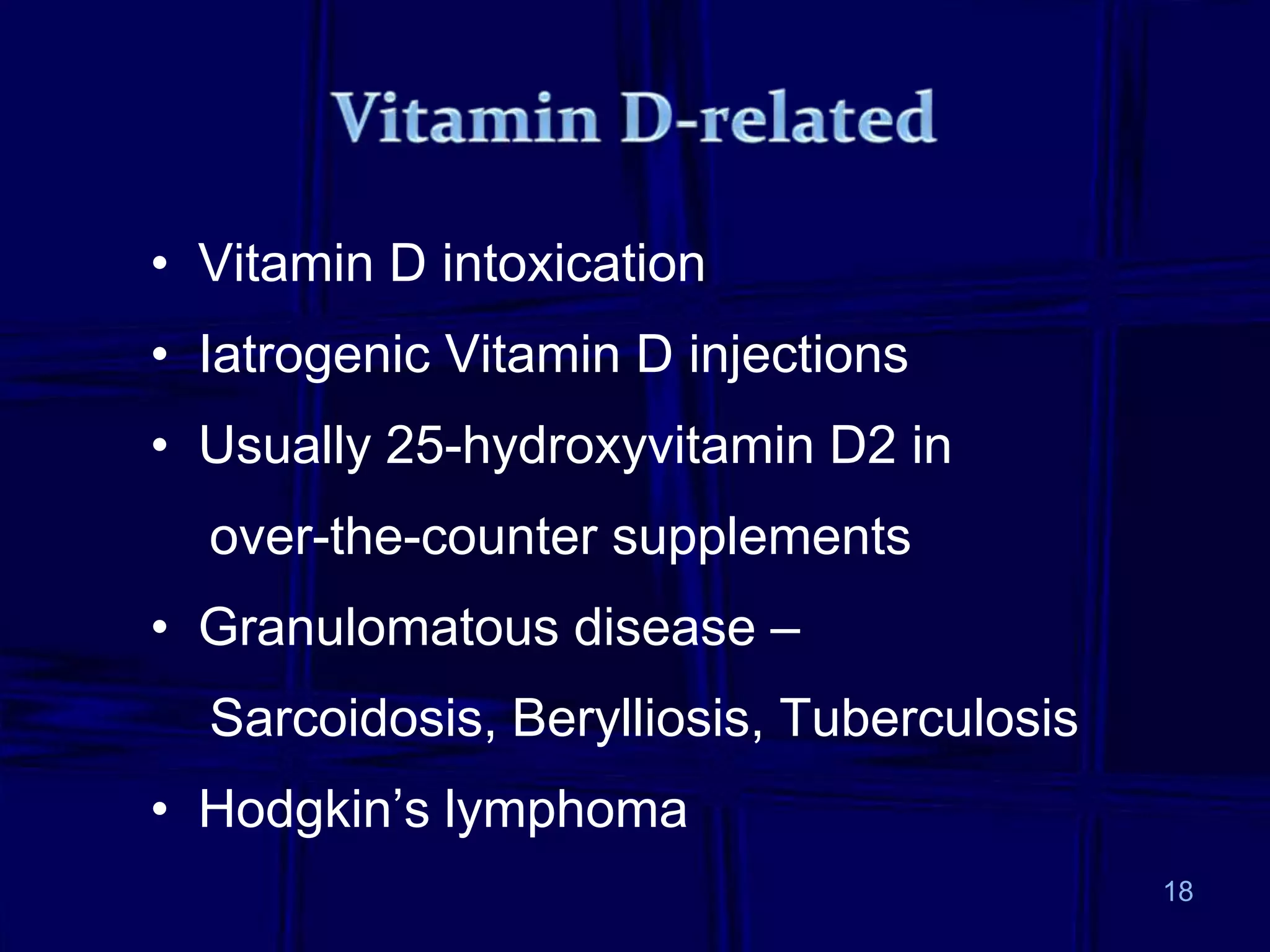
• Vitamin D intoxication
• Iatrogenic Vitamin D injections
• Usually 25-hydroxyvitamin D2 in
over-the-counter supplements
• Granulomatous disease –
Sarcoidosis, Berylliosis, Tuberculosis
• Hodgkin’s lymphoma
18
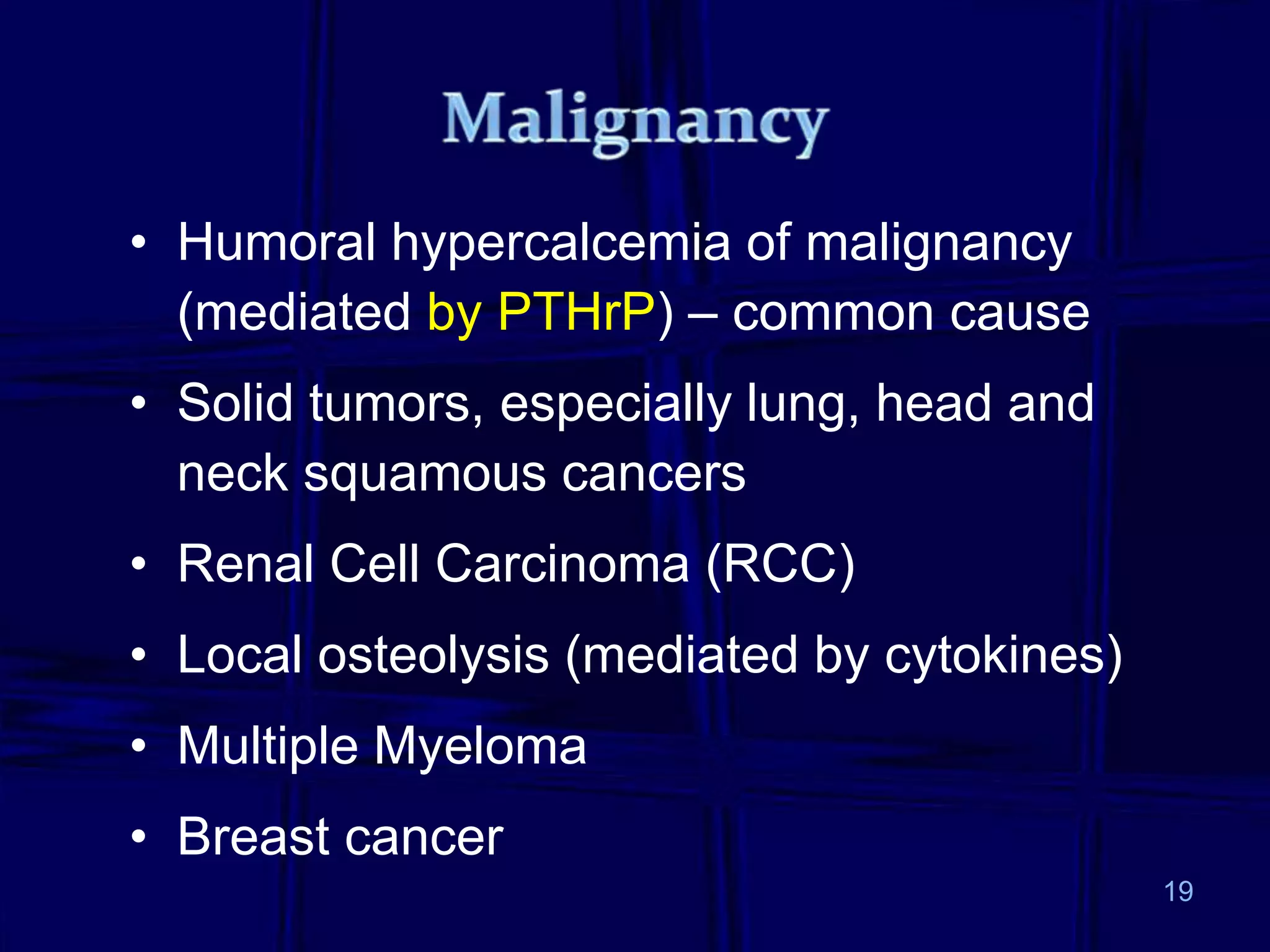
• Humoral hypercalcemia of malignancy
(mediated by PTHrP) – common cause
• Solid tumors, especially lung, head and
neck squamous cancers
• Renal Cell Carcinoma (RCC)
• Local osteolysis (mediated by cytokines)
• Multiple Myeloma
• Breast cancer
19
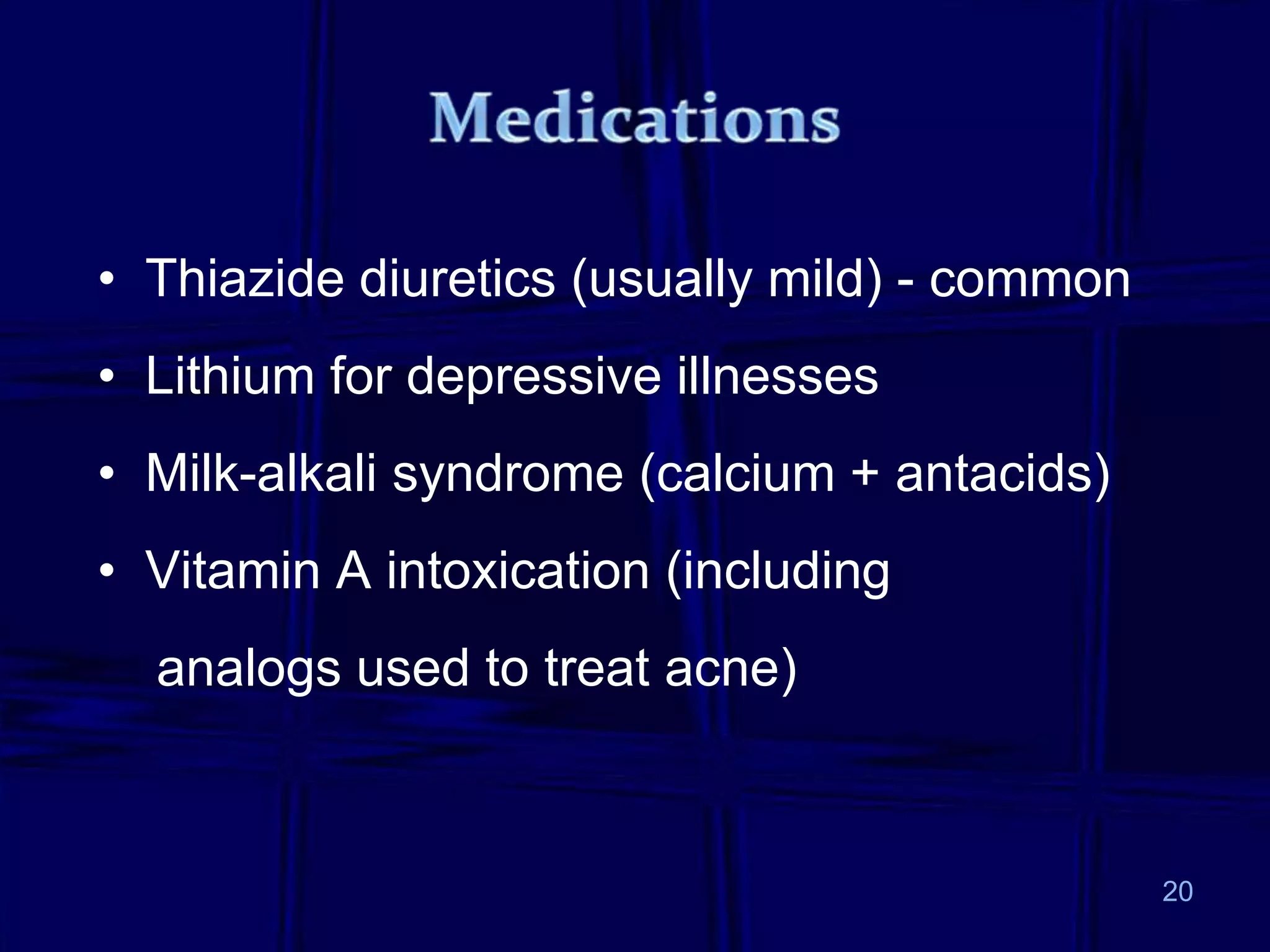
• Thiazide diuretics (usually mild) - common
• Lithium for depressive illnesses
• Milk-alkali syndrome (calcium + antacids)
• Vitamin A intoxication (including
analogs used to treat acne)
20
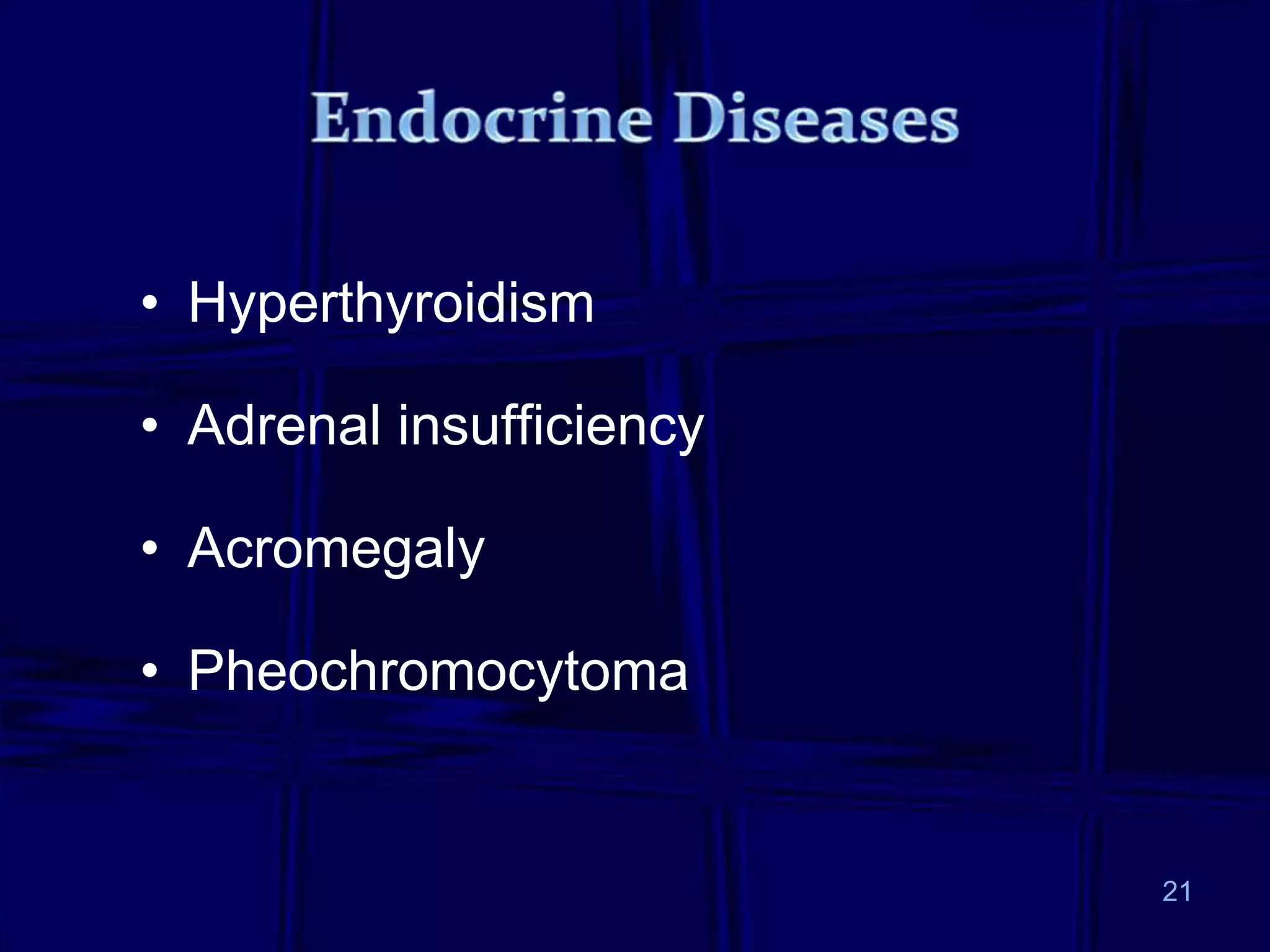
• Hyperthyroidism
• Adrenal insufficiency
• Acromegaly
• Pheochromocytoma
21
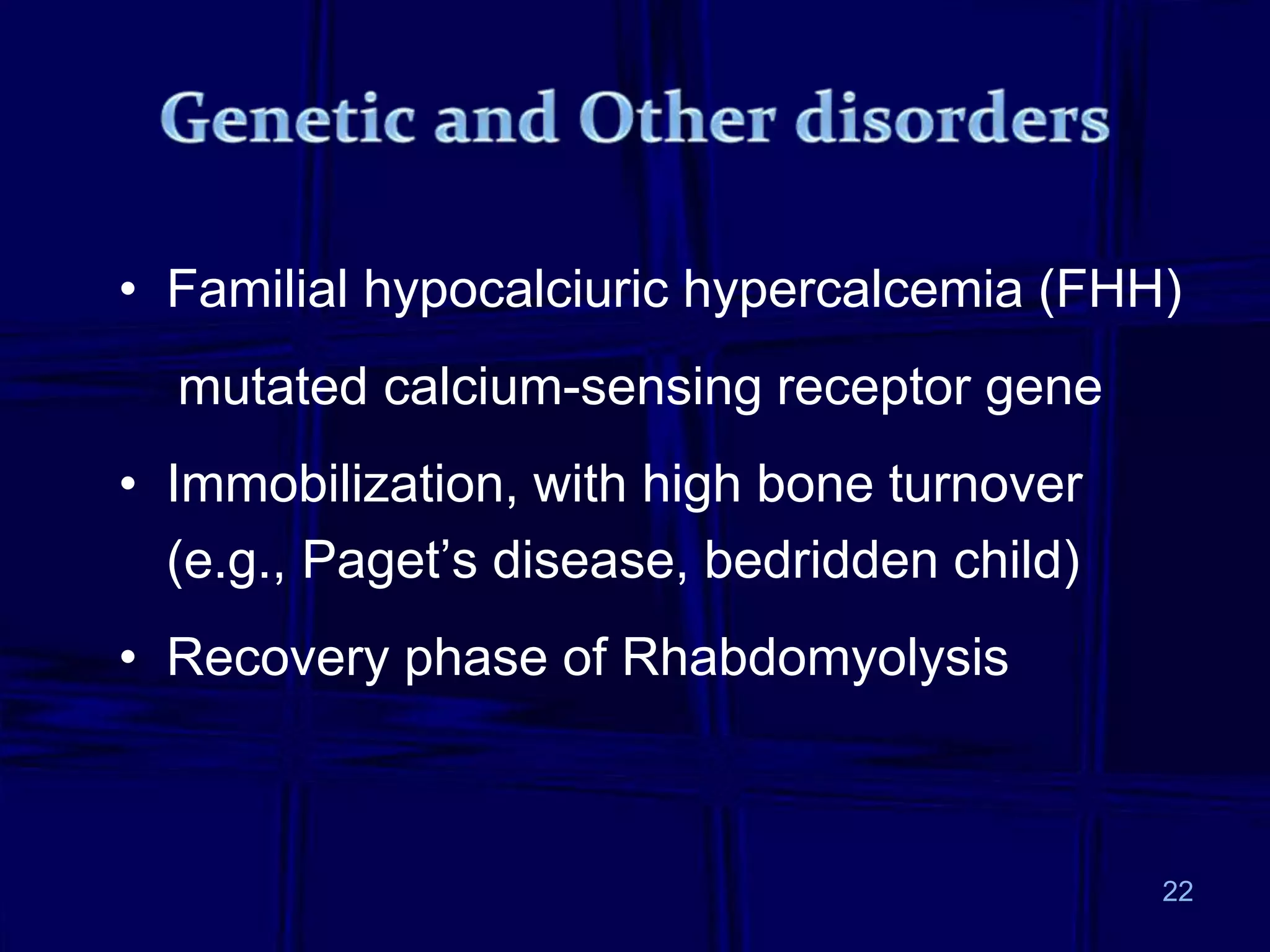
• Familial hypocalciuric hypercalcemia (FHH)
mutated calcium-sensing receptor gene
• Immobilization, with high bone turnover
(e.g., Paget’s disease, bedridden child)
• Recovery phase of Rhabdomyolysis
22
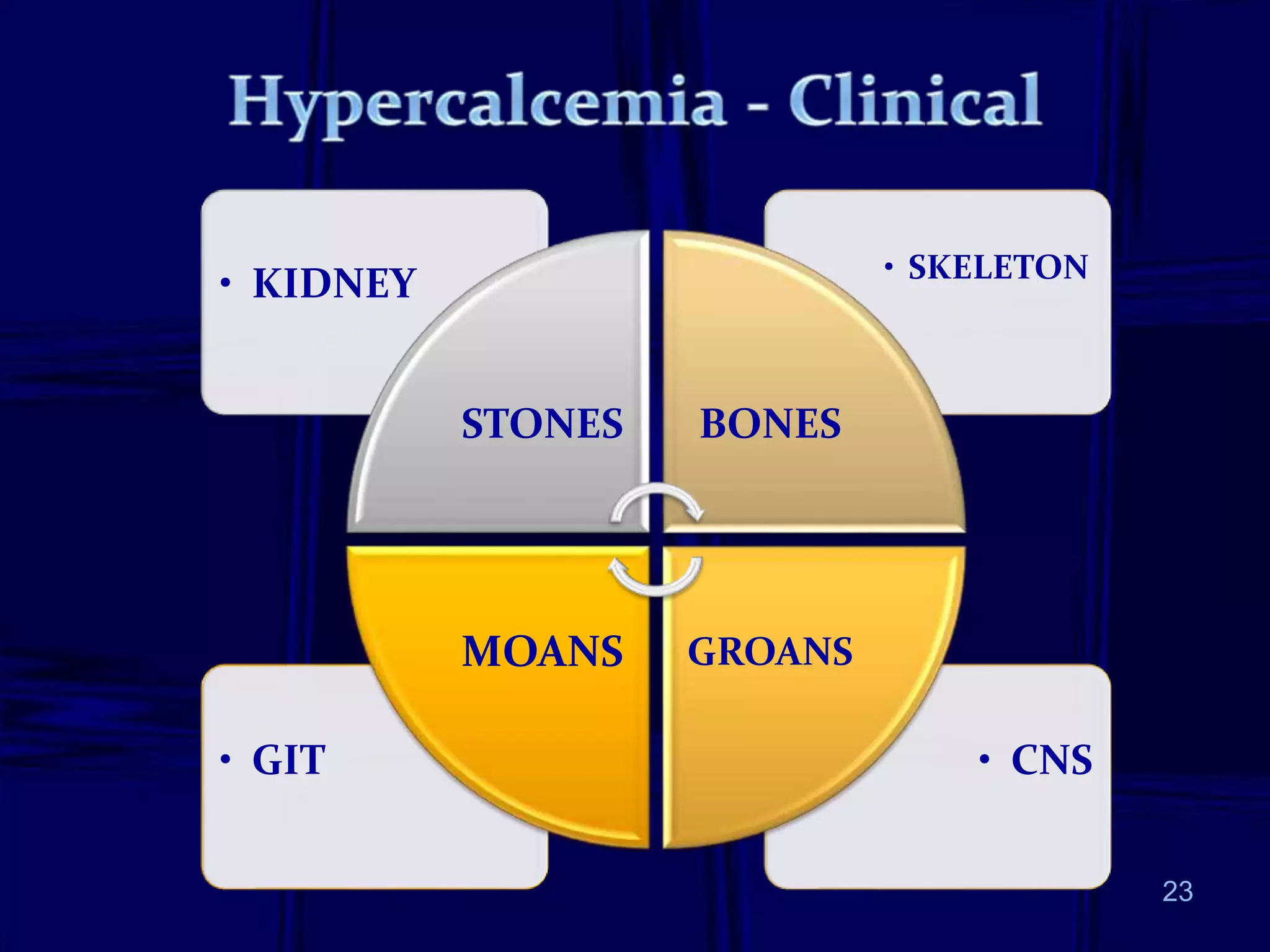
• CNS
• GIT
• SKELETON
• KIDNEY
STONES BONES
GROANS
MOANS
23
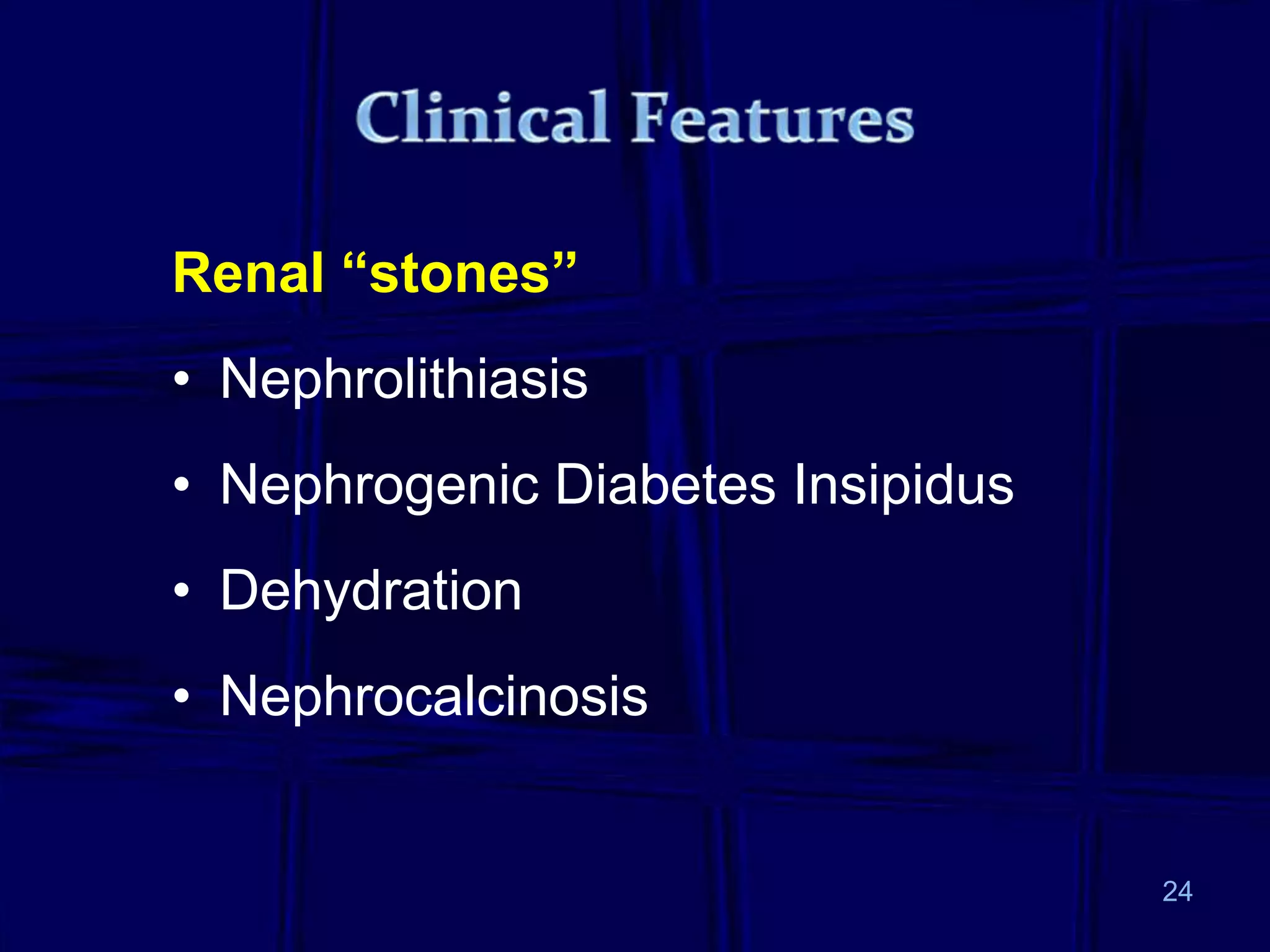
Renal “stones”
• Nephrolithiasis
• Nephrogenic Diabetes Insipidus
• Dehydration
• Nephrocalcinosis
24
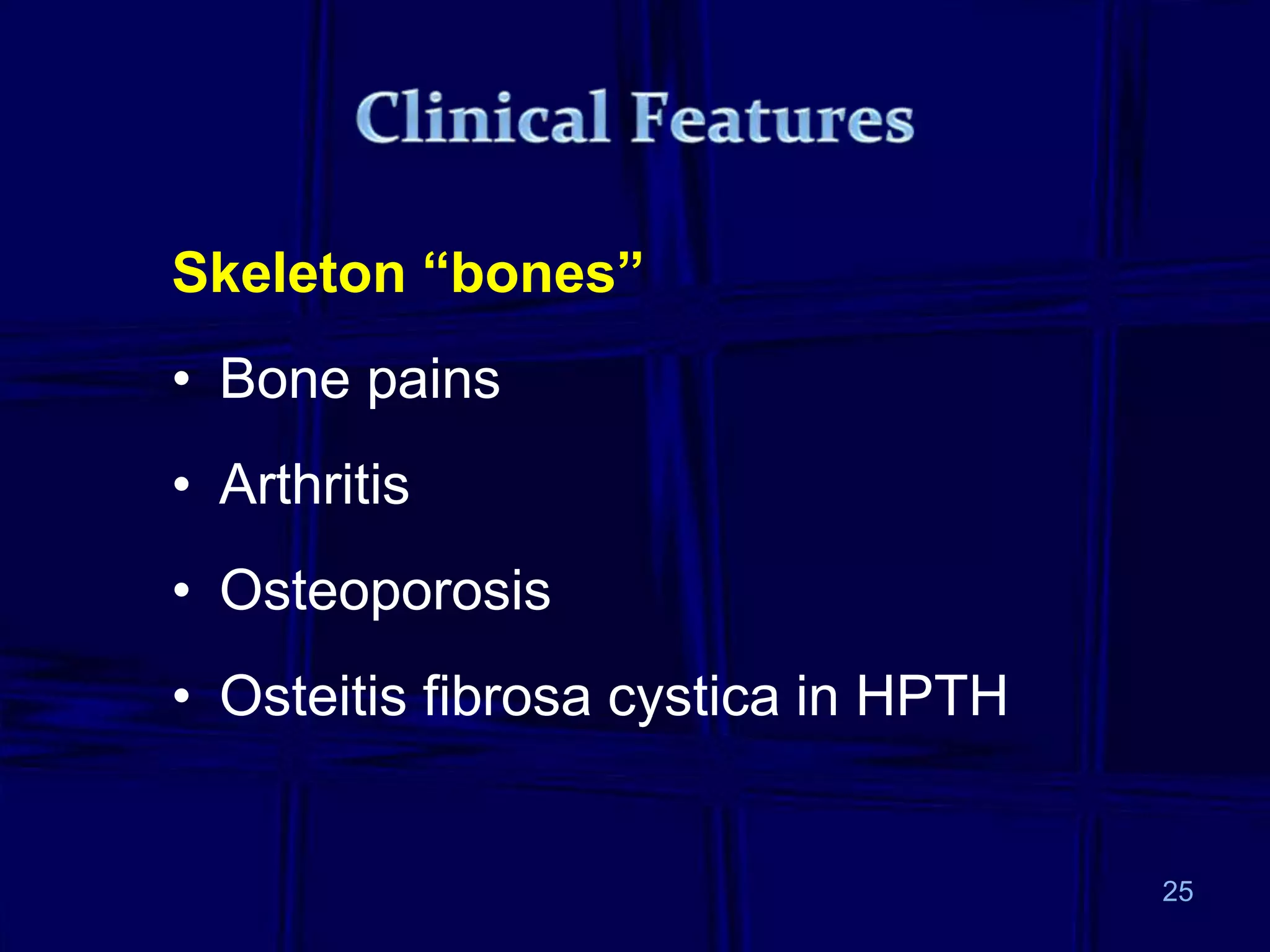
Skeleton “bones”
• Bone pains
• Arthritis
• Osteoporosis
• Osteitis fibrosa cystica in HPTH
25
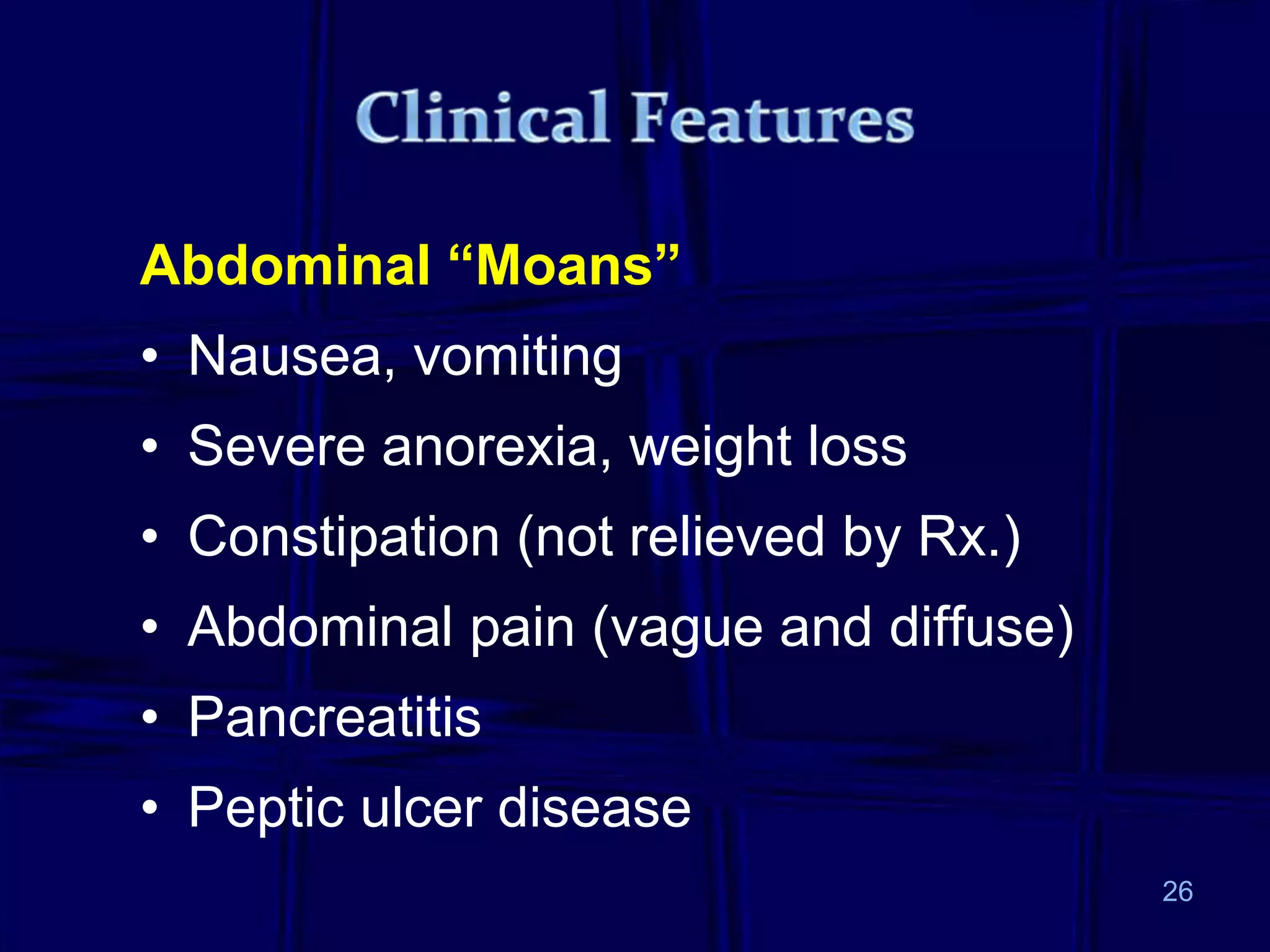
Abdominal “Moans”
• Nausea, vomiting
• Severe anorexia, weight loss
• Constipation (not relieved by Rx.)
• Abdominal pain (vague and diffuse)
• Pancreatitis
• Peptic ulcer disease
26
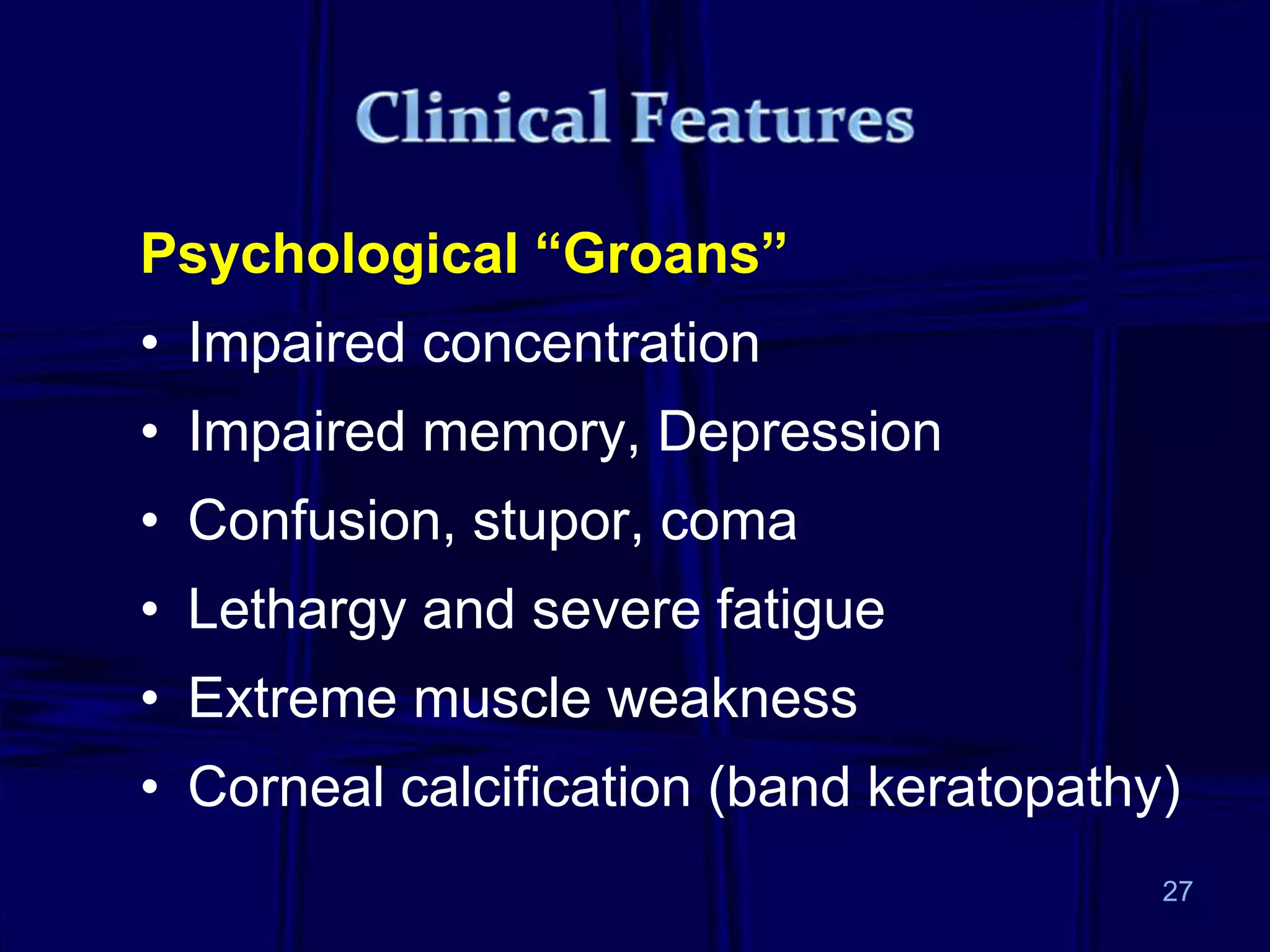
Psychological “Groans”
• Impaired concentration
• Impaired memory, Depression
• Confusion, stupor, coma
• Lethargy and severe fatigue
• Extreme muscle weakness
• Corneal calcification (band keratopathy)
27
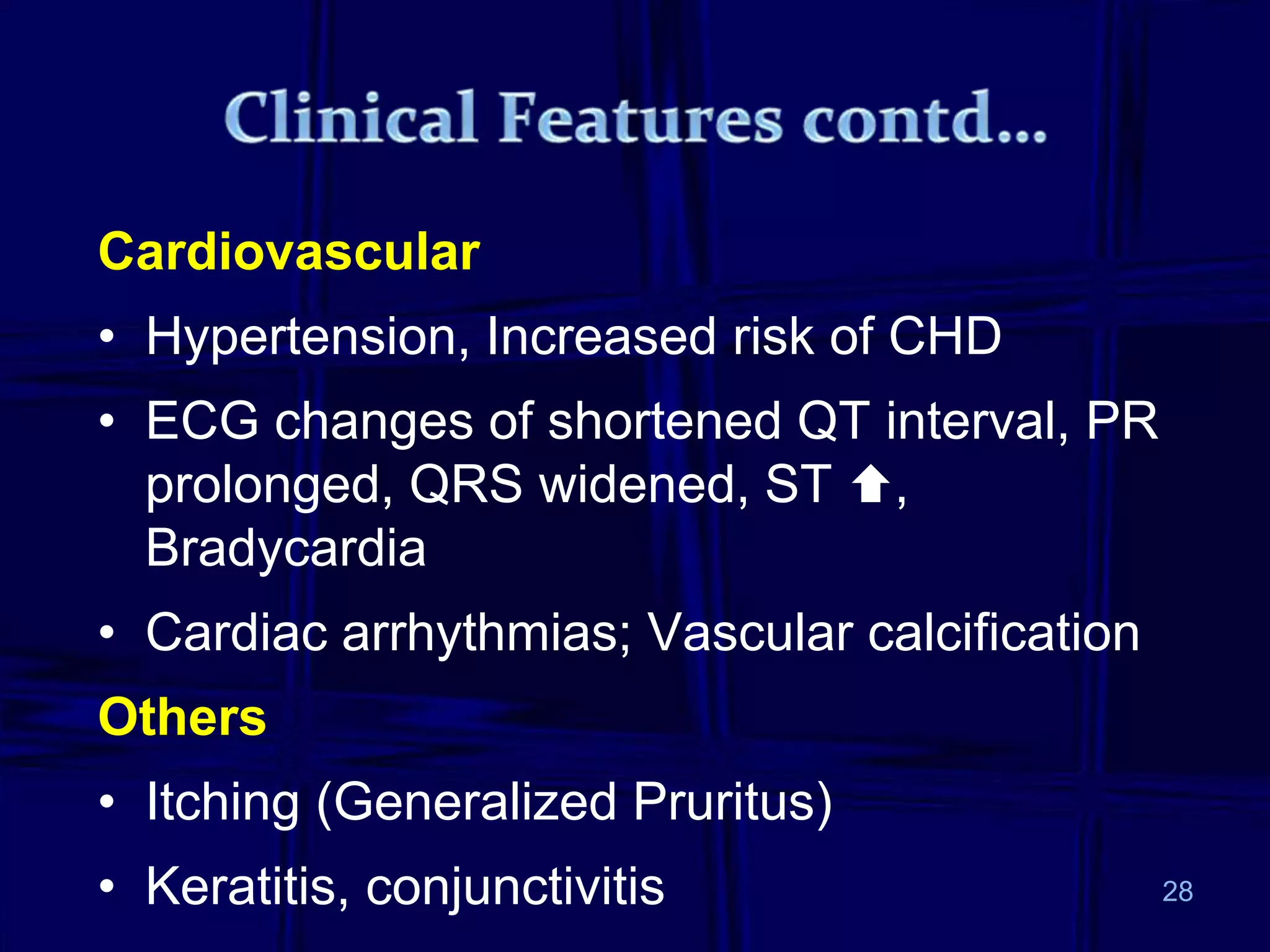
Cardiovascular
• Hypertension, Increased risk of CHD
• ECG changes of shortened QT interval, PR
prolonged, QRS widened, ST ,
Bradycardia
• Cardiac arrhythmias; Vascular calcification
Others
• Itching (Generalized Pruritus)
• Keratitis, conjunctivitis 28
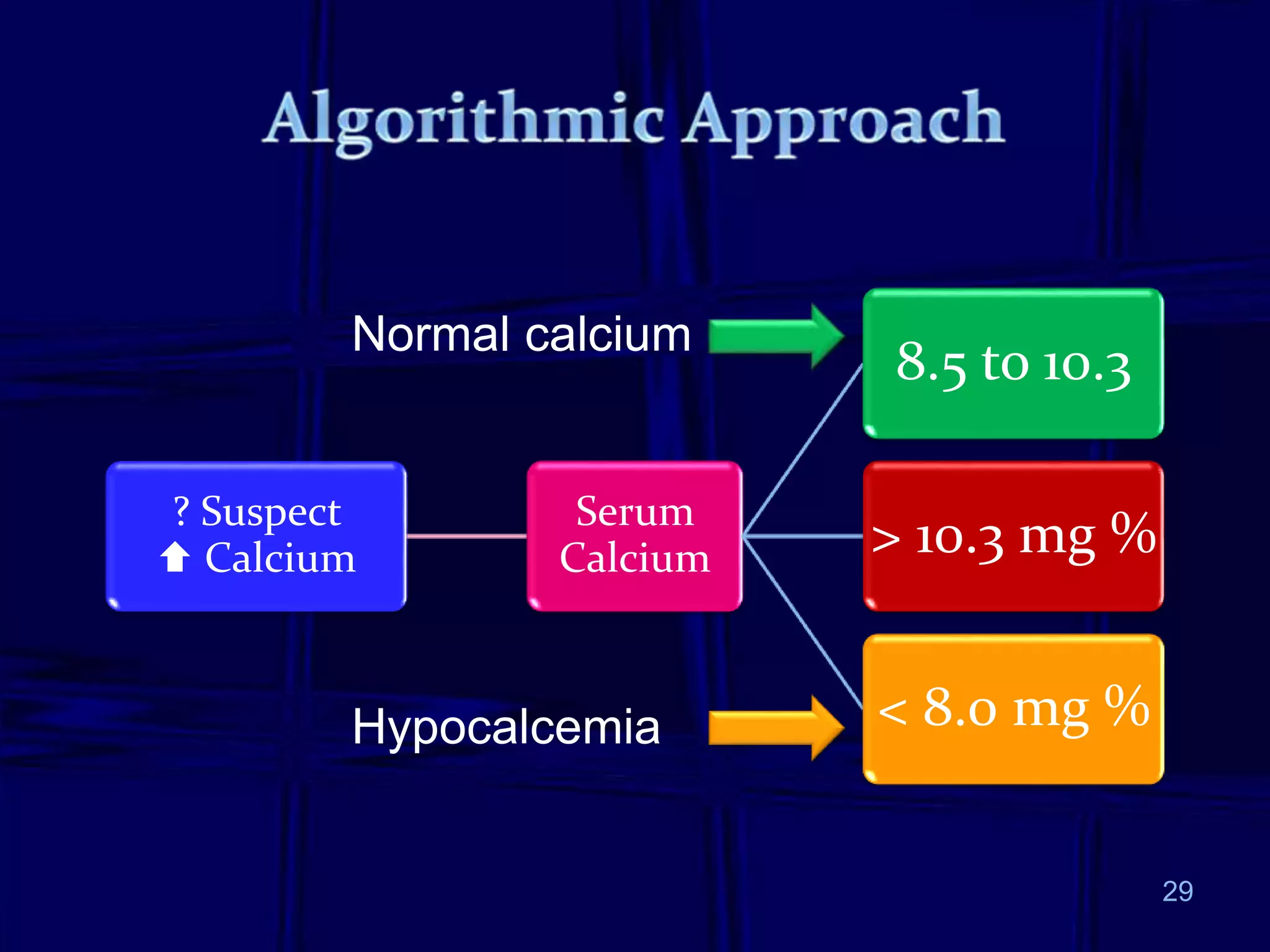
29
? Suspect
 Calcium
Serum
Calcium
8.5 to 10.3
> 10.3 mg %
< 8.0 mg %
Hypocalcemia
Normal calcium
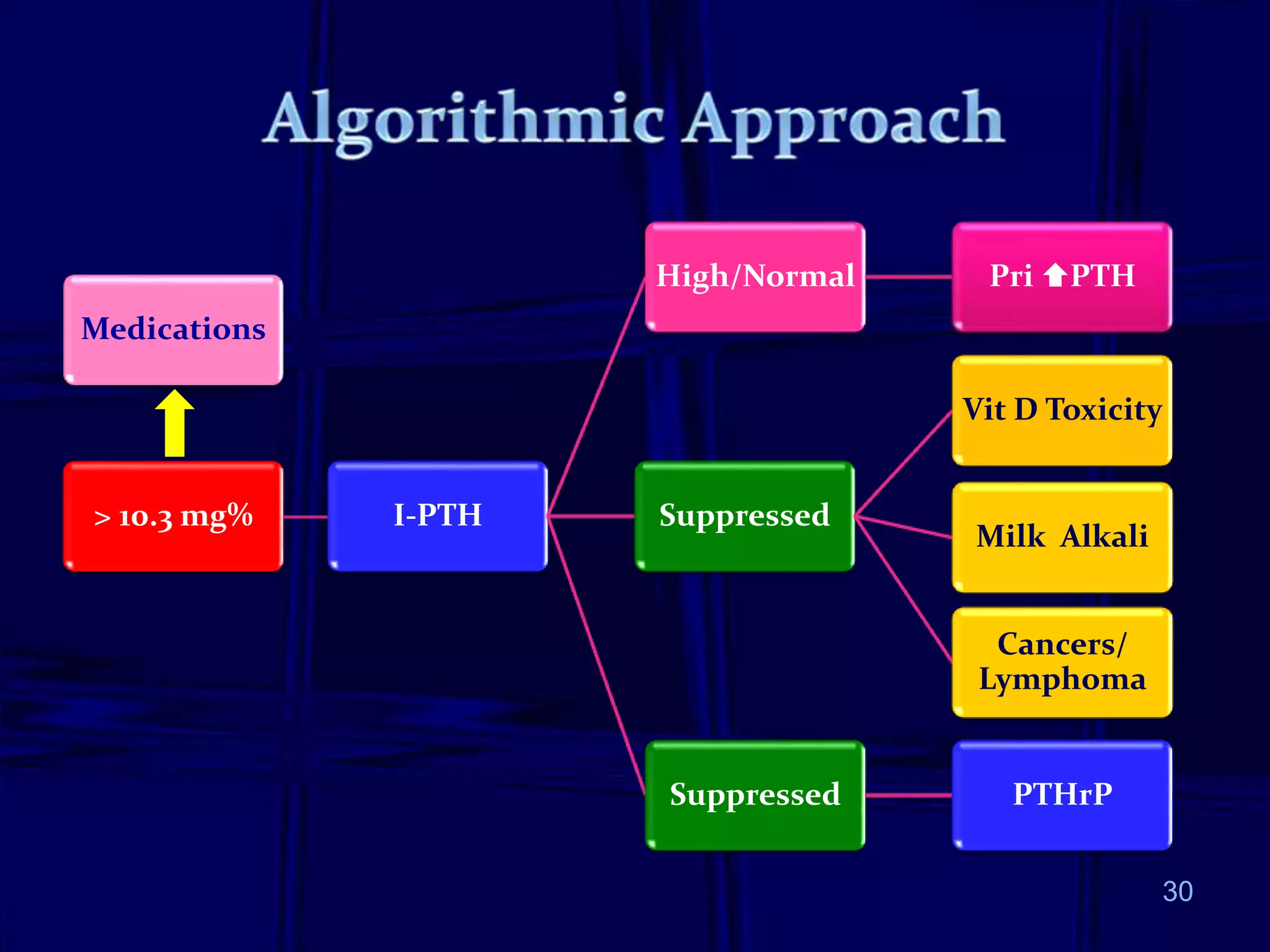
Medications
> 10.3 mg% I-PTH
High/Normal Pri PTH
Suppressed
Vit D Toxicity
Milk Alkali
Cancers/
Lymphoma
Suppressed PTHrP
30
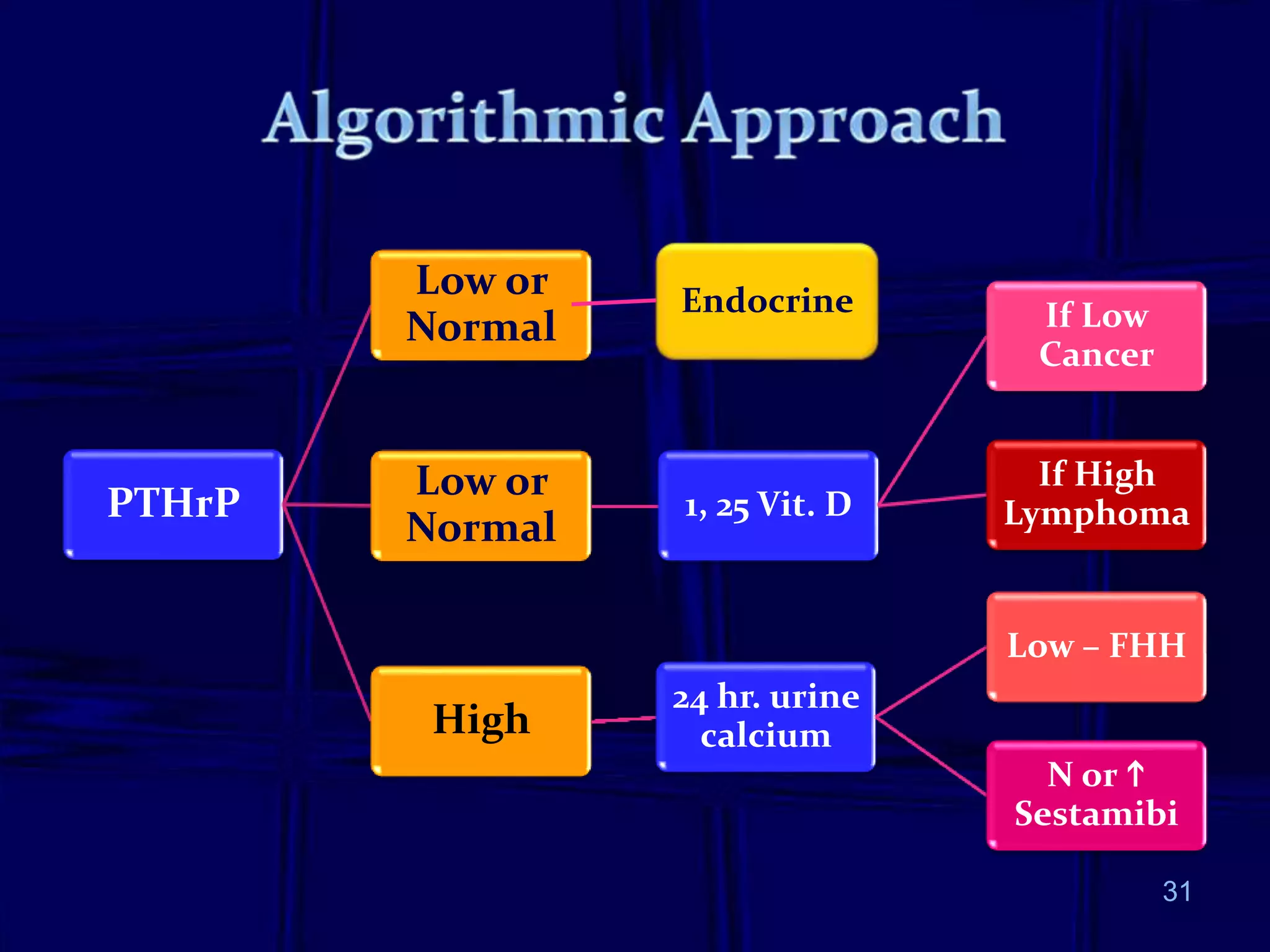
PTHrP
Low or
Normal
Low or
Normal
1, 25 Vit. D
If Low
Cancer
If High
Lymphoma
High
24 hr. urine
calcium
Low – FHH
N or 
Sestamibi
31
Endocrine
32
33
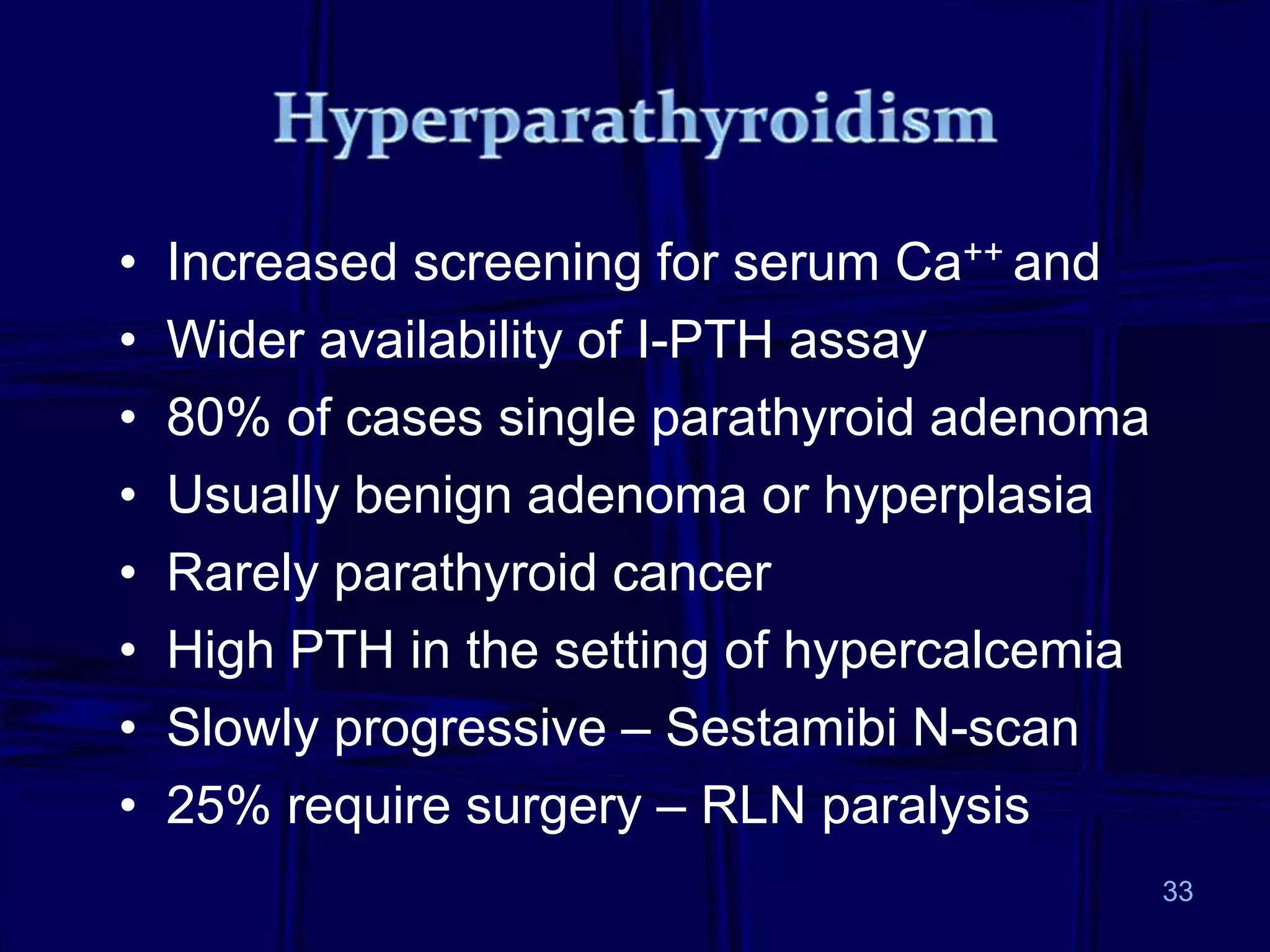
• Increased screening for serum Ca++ and
• Wider availability of I-PTH assay
• 80% of cases single parathyroid adenoma
• Usually benign adenoma or hyperplasia
• Rarely parathyroid cancer
• High PTH in the setting of hypercalcemia
• Slowly progressive – Sestamibi N-scan
• 25% require surgery – RLN paralysis
34
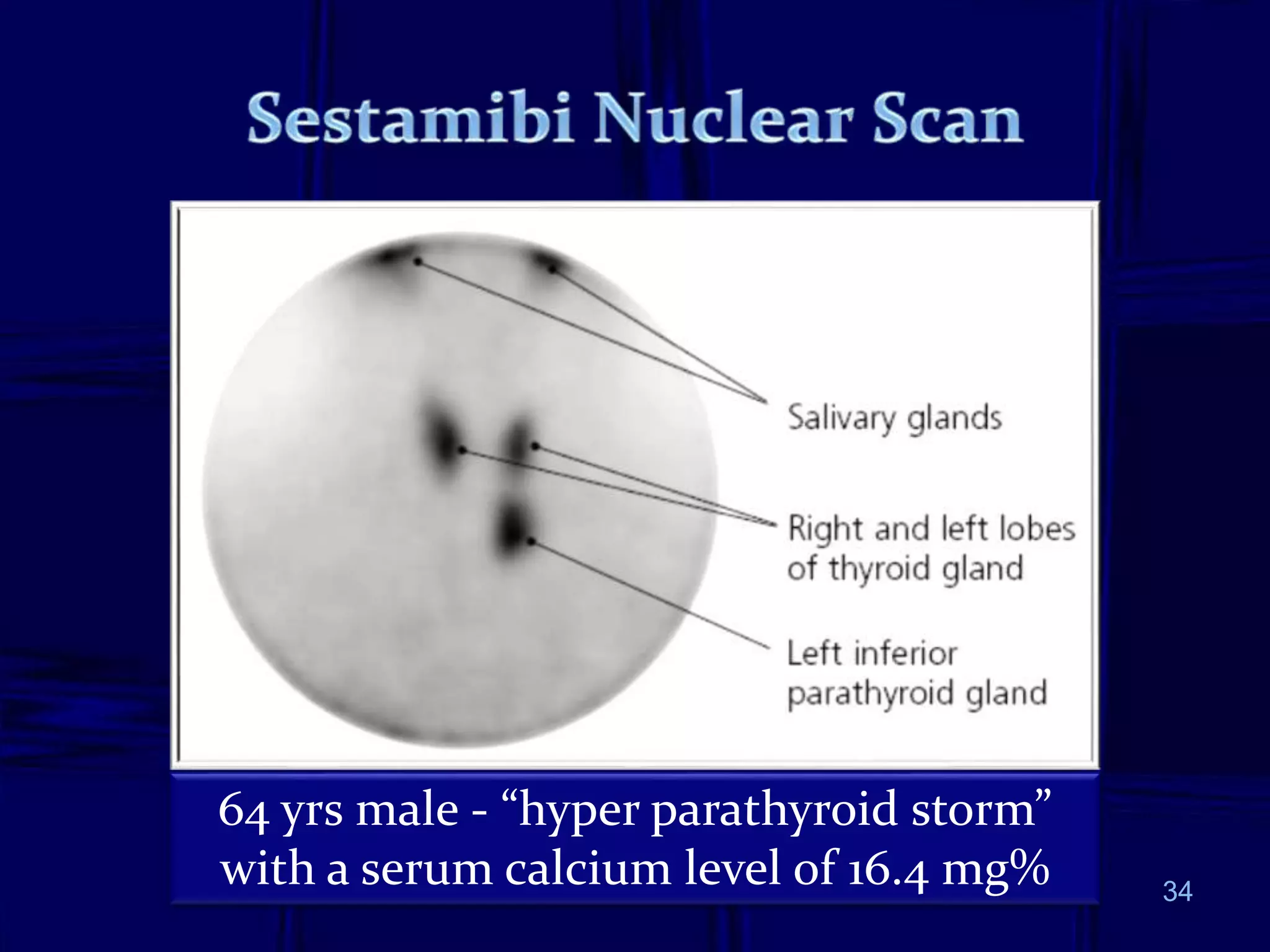
64 yrs male - “hyper parathyroid storm”
with a serum calcium level of 16.4 mg%
• Serum calcium level > 12 mg % at any time
• Episodes of hyper parathyroid crisis
• Marked hypercalciuria (urinary Ca++ > 400 mg /day)
• Nephrolithiasis; Impaired renal function
• Osteitis fibrosa cystica – Thinning of cortical bone
• Reduced bone density by DEXA scan (Z score < 2)
• Classic neuromuscular symptoms, Proximal muscle
weakness and atrophy, Hyper reflexia and ataxia
• Age younger than 50 years
35
36
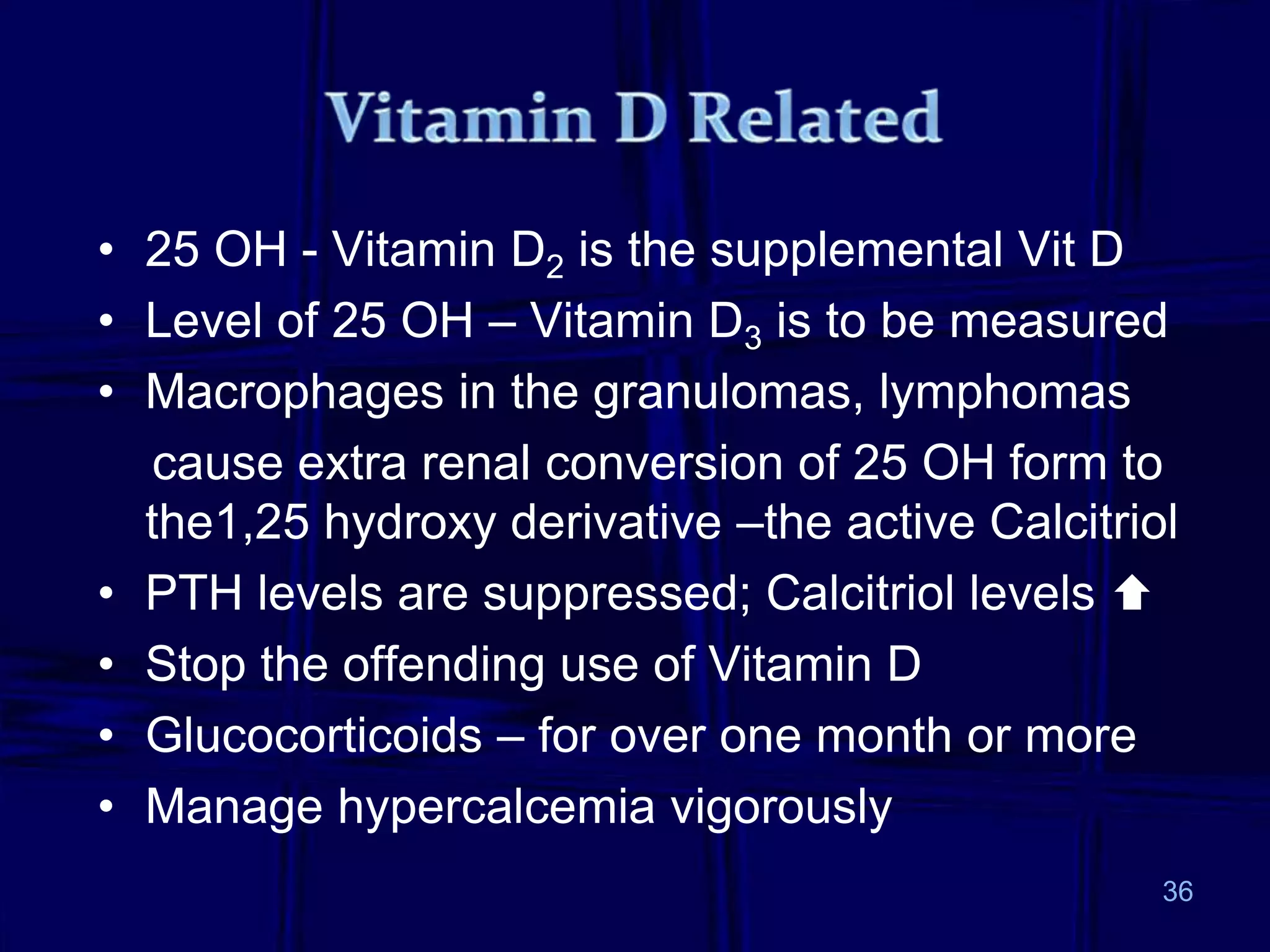
• 25 OH - Vitamin D2 is the supplemental Vit D
• Level of 25 OH – Vitamin D3 is to be measured
• Macrophages in the granulomas, lymphomas
cause extra renal conversion of 25 OH form to
the1,25 hydroxy derivative –the active Calcitriol
• PTH levels are suppressed; Calcitriol levels 
• Stop the offending use of Vitamin D
• Glucocorticoids – for over one month or more
• Manage hypercalcemia vigorously
37
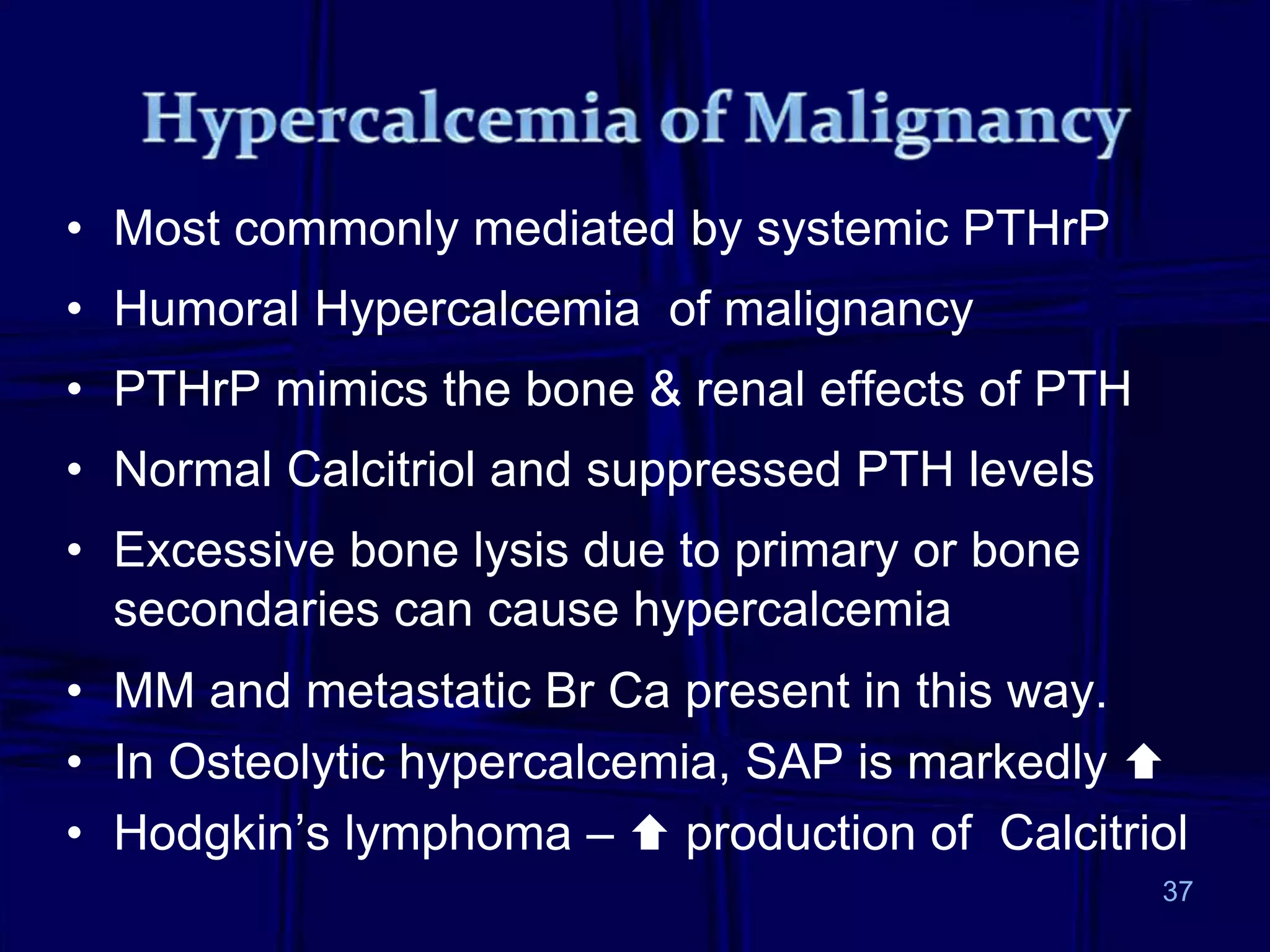
• Most commonly mediated by systemic PTHrP
• Humoral Hypercalcemia of malignancy
• PTHrP mimics the bone & renal effects of PTH
• Normal Calcitriol and suppressed PTH levels
• Excessive bone lysis due to primary or bone
secondaries can cause hypercalcemia
• MM and metastatic Br Ca present in this way.
• In Osteolytic hypercalcemia, SAP is markedly 
• Hodgkin’s lymphoma –  production of Calcitriol
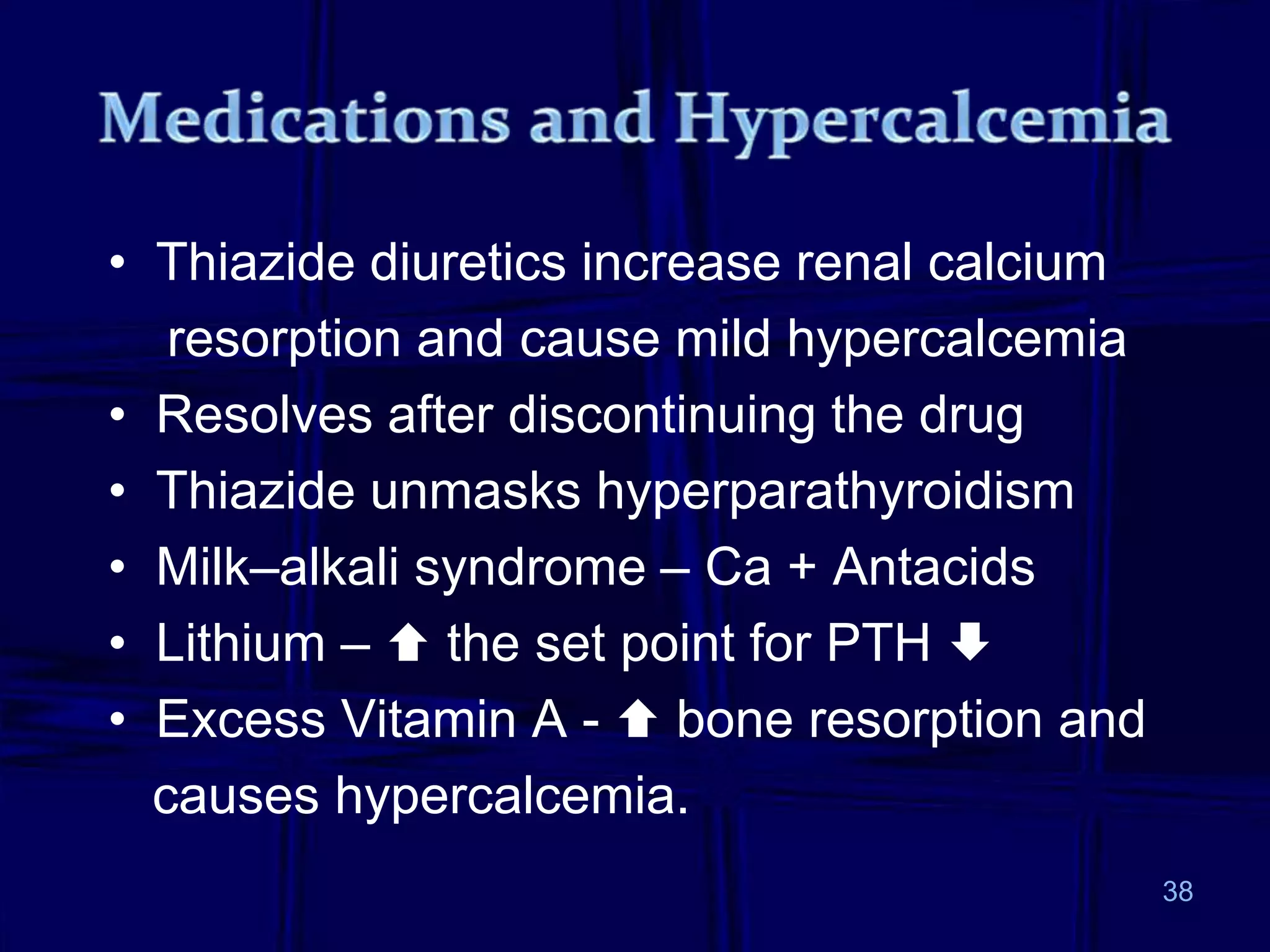
• Thiazide diuretics increase renal calcium
resorption and cause mild hypercalcemia
• Resolves after discontinuing the drug
• Thiazide unmasks hyperparathyroidism
• Milk–alkali syndrome – Ca + Antacids
• Lithium –  the set point for PTH 
• Excess Vitamin A -  bone resorption and
causes hypercalcemia.
38
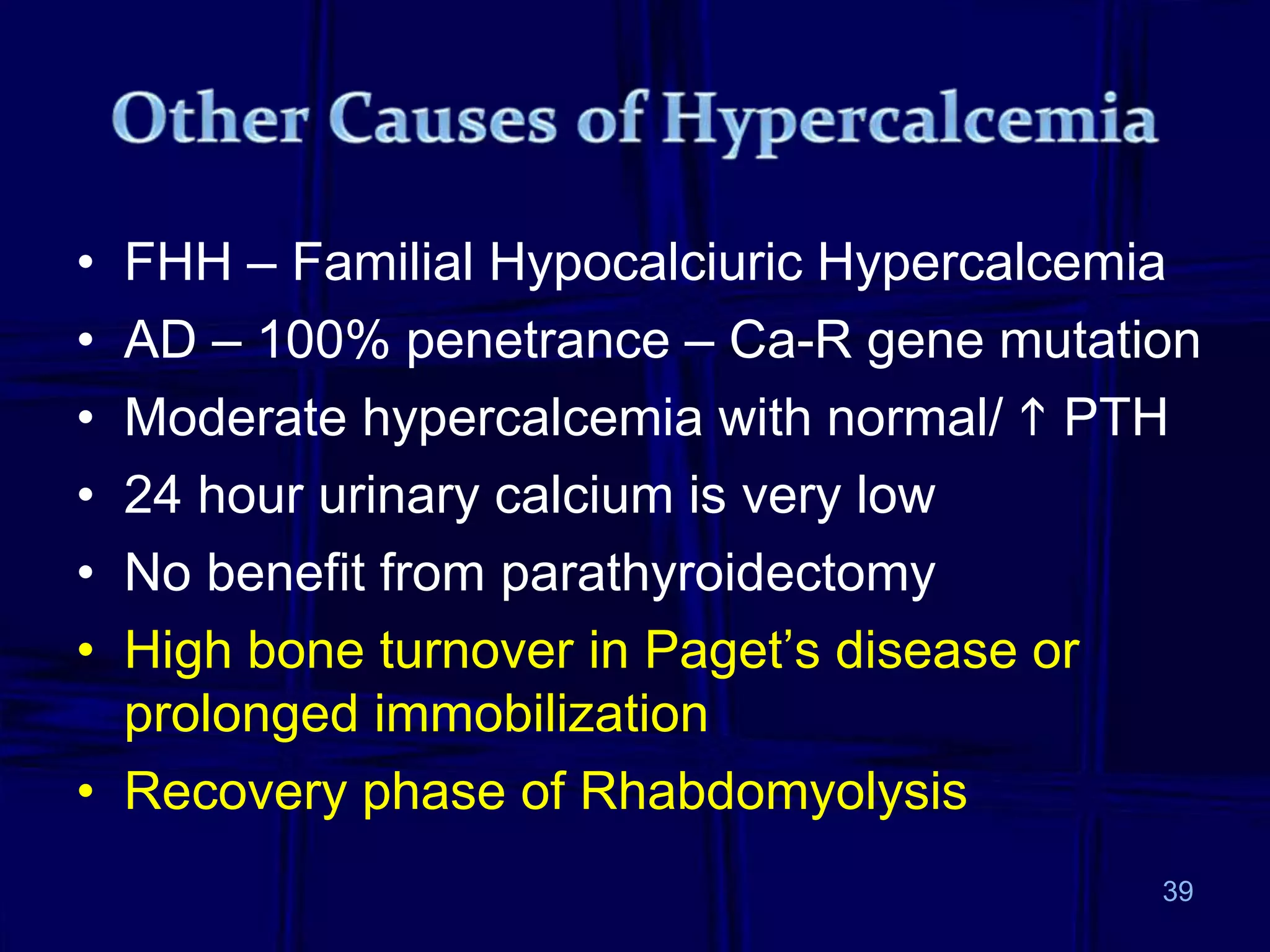
• FHH – Familial Hypocalciuric Hypercalcemia
• AD – 100% penetrance – Ca-R gene mutation
• Moderate hypercalcemia with normal/  PTH
• 24 hour urinary calcium is very low
• No benefit from parathyroidectomy
• High bone turnover in Paget’s disease or
prolonged immobilization
• Recovery phase of Rhabdomyolysis
39
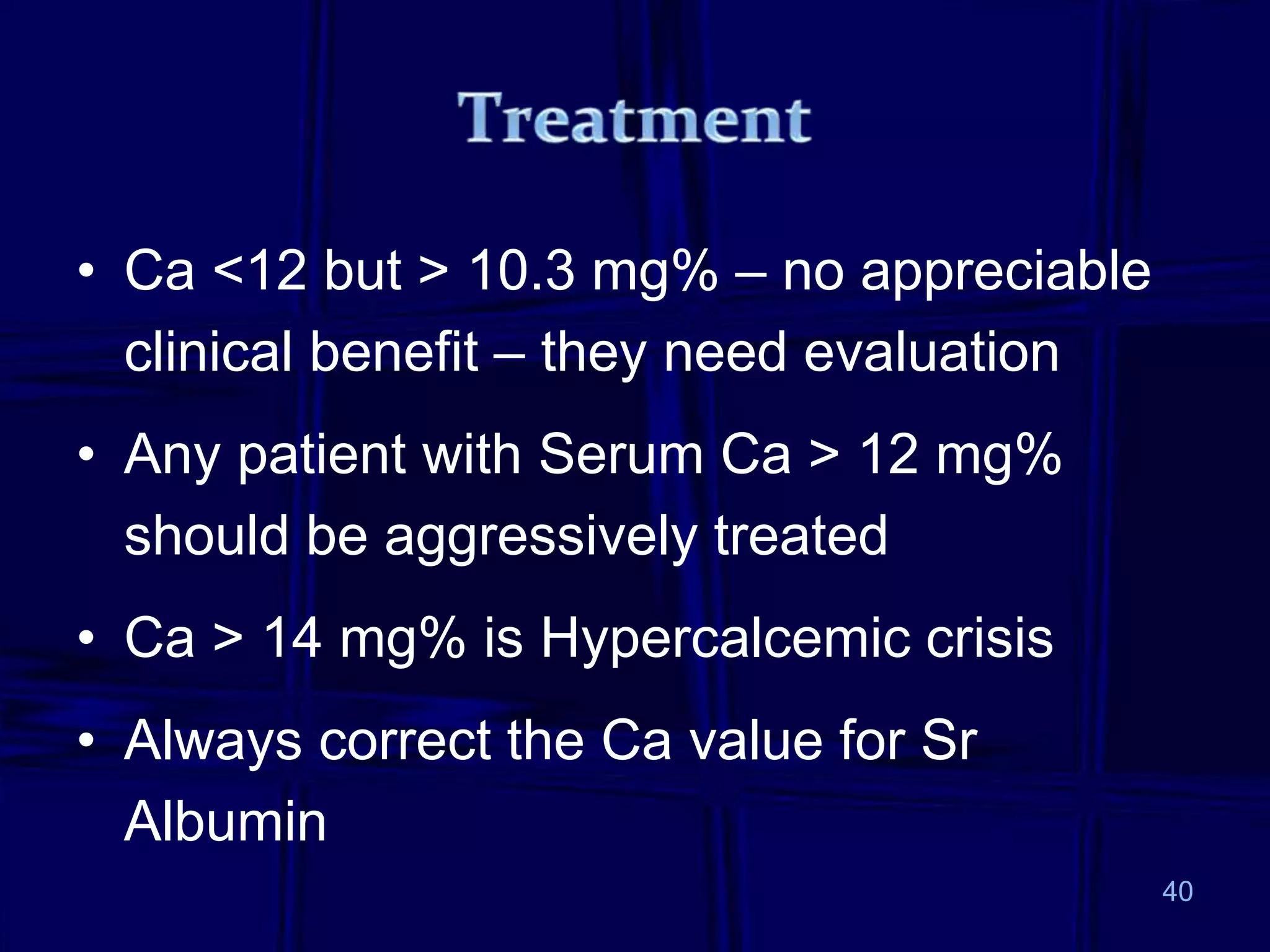
• Ca <12 but > 10.3 mg% – no appreciable
clinical benefit – they need evaluation
• Any patient with Serum Ca > 12 mg%
should be aggressively treated
• Ca > 14 mg% is Hypercalcemic crisis
• Always correct the Ca value for Sr
Albumin
40
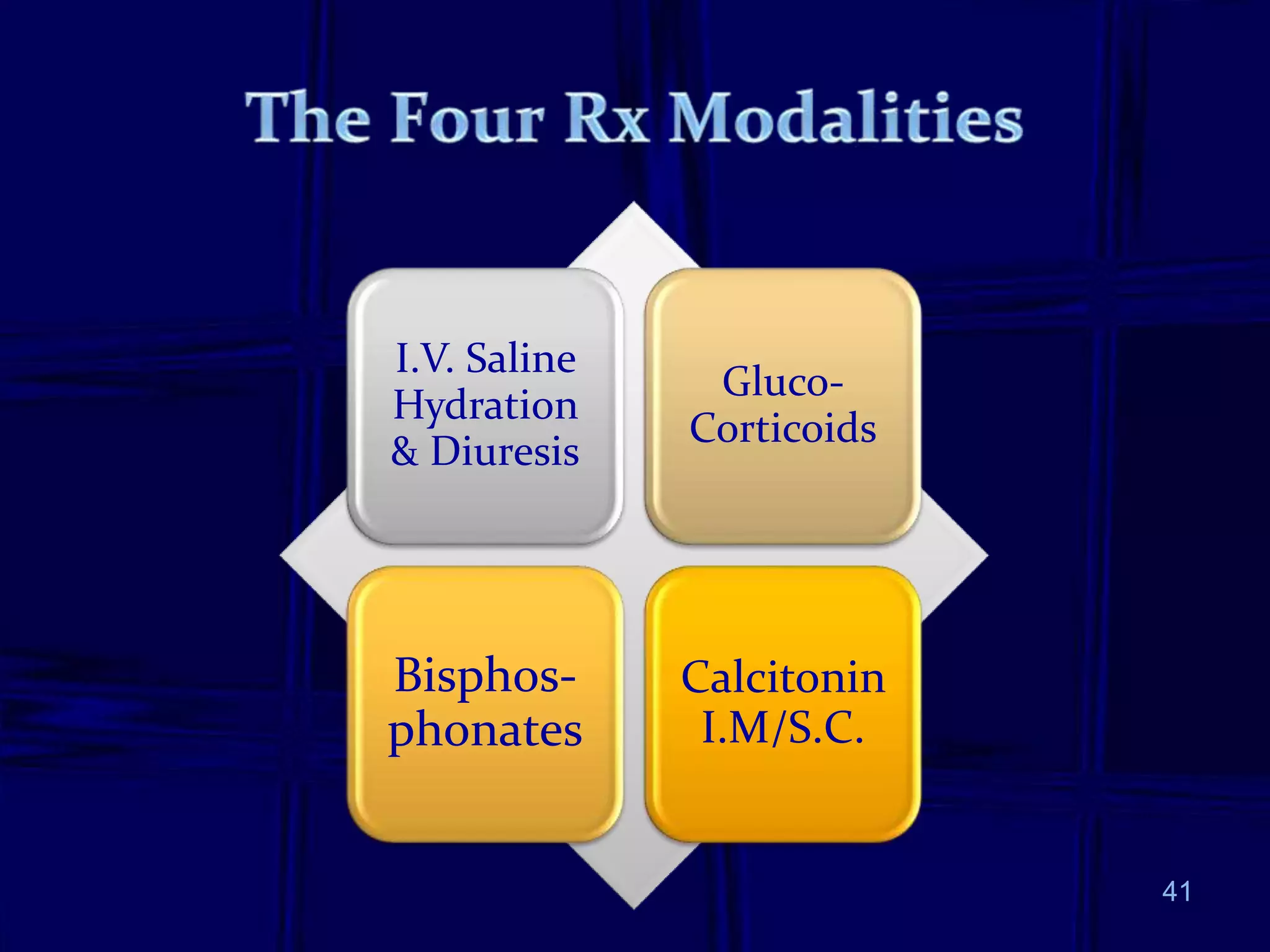
I.V. Saline
Hydration
& Diuresis
Gluco-
Corticoids
Bisphos-
phonates
Calcitonin
I.M/S.C.
41
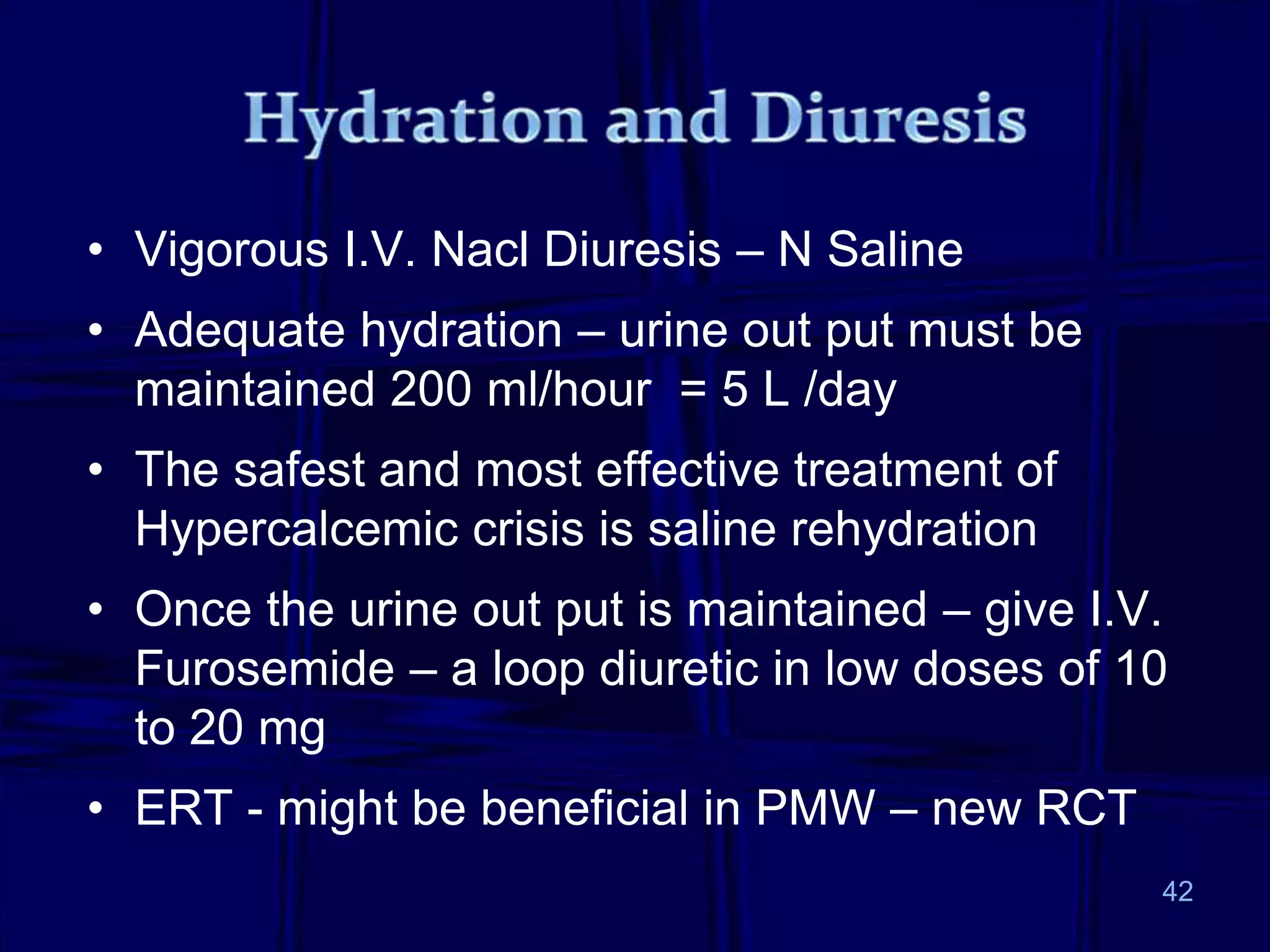
• Vigorous I.V. Nacl Diuresis – N Saline
• Adequate hydration – urine out put must be
maintained 200 ml/hour = 5 L /day
• The safest and most effective treatment of
Hypercalcemic crisis is saline rehydration
• Once the urine out put is maintained – give I.V.
Furosemide – a loop diuretic in low doses of 10
to 20 mg
• ERT - might be beneficial in PMW – new RCT
42
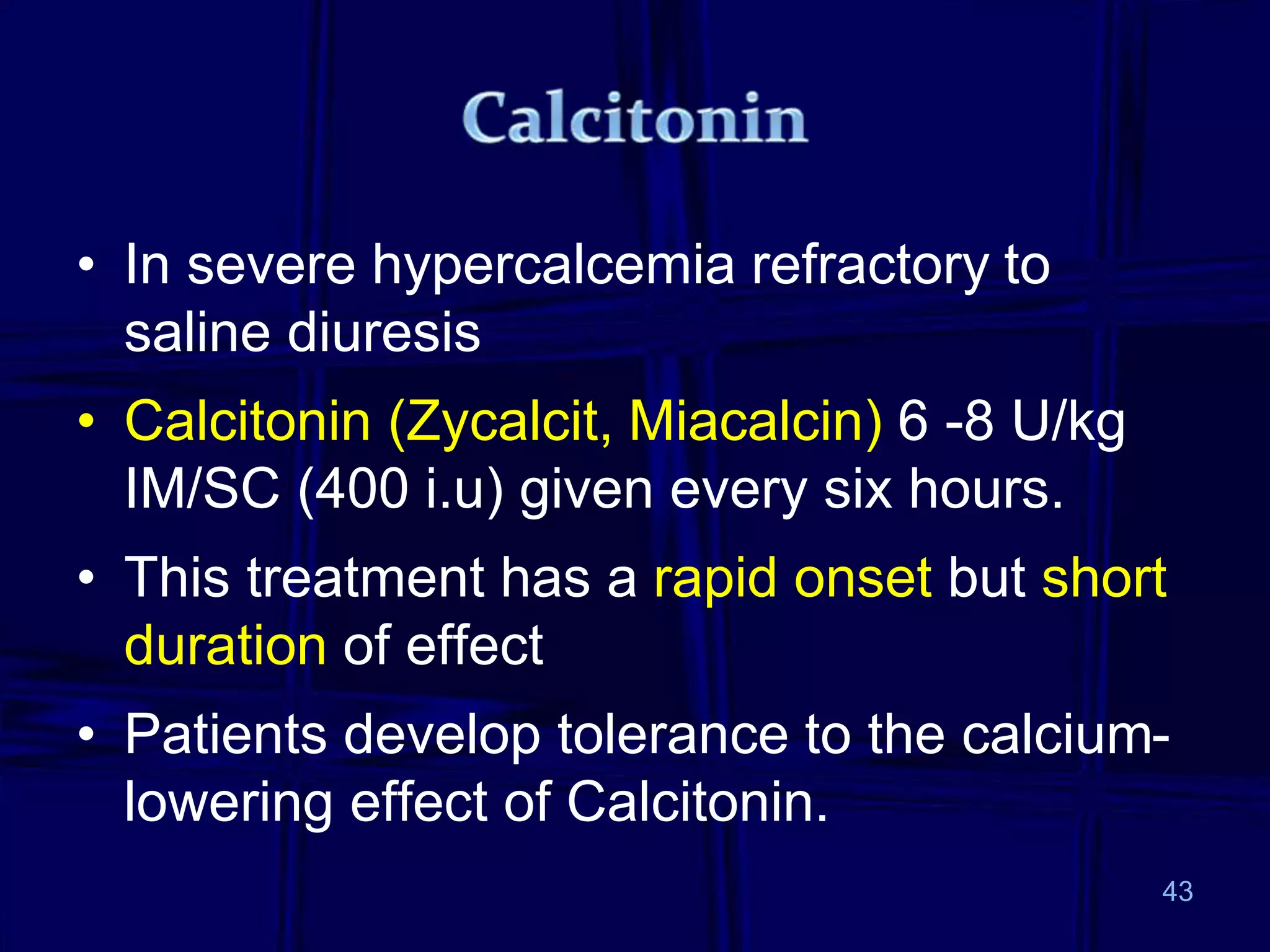
• In severe hypercalcemia refractory to
saline diuresis
• Calcitonin (Zycalcit, Miacalcin) 6 -8 U/kg
IM/SC (400 i.u) given every six hours.
• This treatment has a rapid onset but short
duration of effect
• Patients develop tolerance to the calcium-
lowering effect of Calcitonin.
43
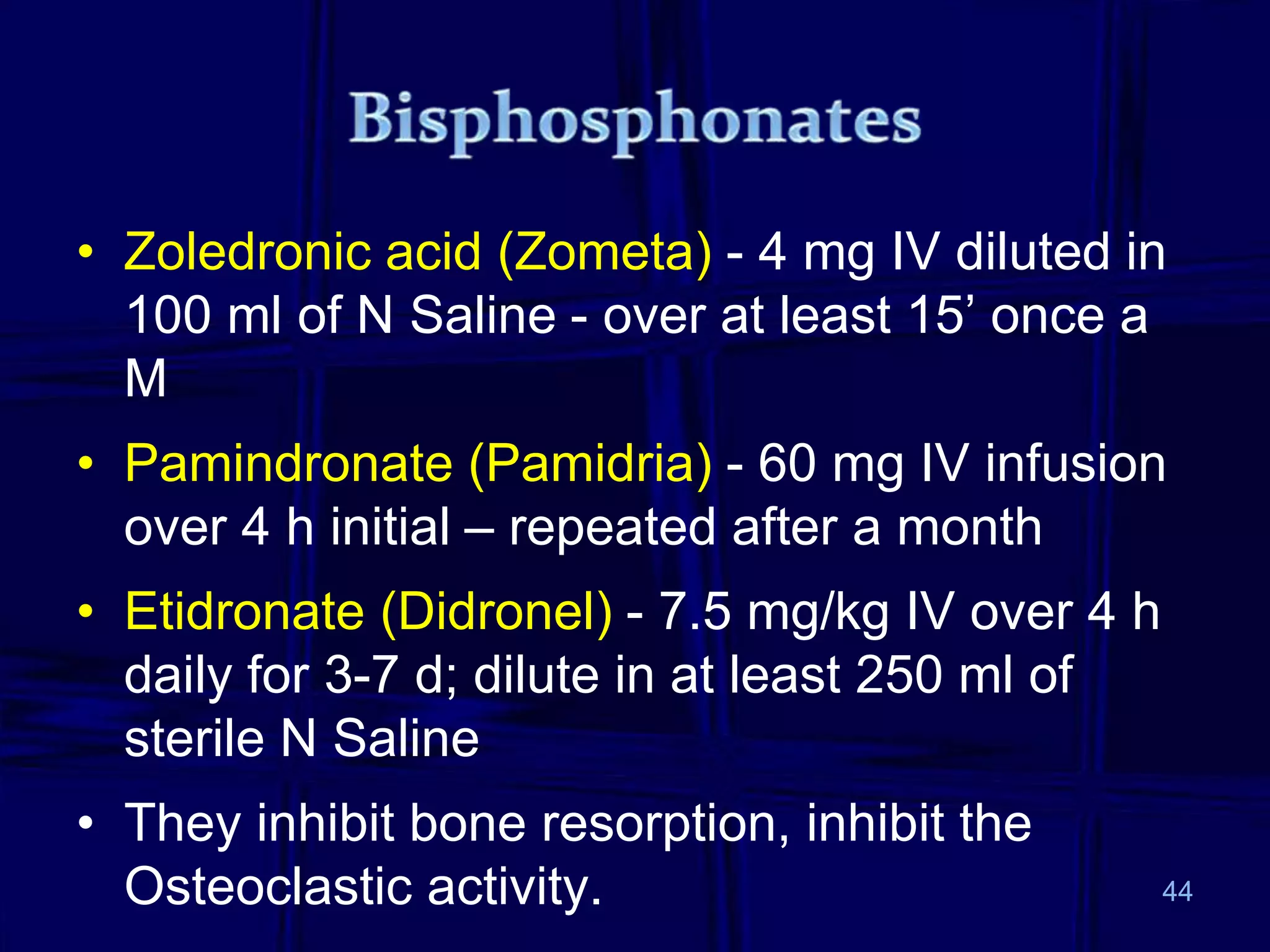
• Zoledronic acid (Zometa) - 4 mg IV diluted in
100 ml of N Saline - over at least 15’ once a
M
• Pamindronate (Pamidria) - 60 mg IV infusion
over 4 h initial – repeated after a month
• Etidronate (Didronel) - 7.5 mg/kg IV over 4 h
daily for 3-7 d; dilute in at least 250 ml of
sterile N Saline
• They inhibit bone resorption, inhibit the
Osteoclastic activity. 44
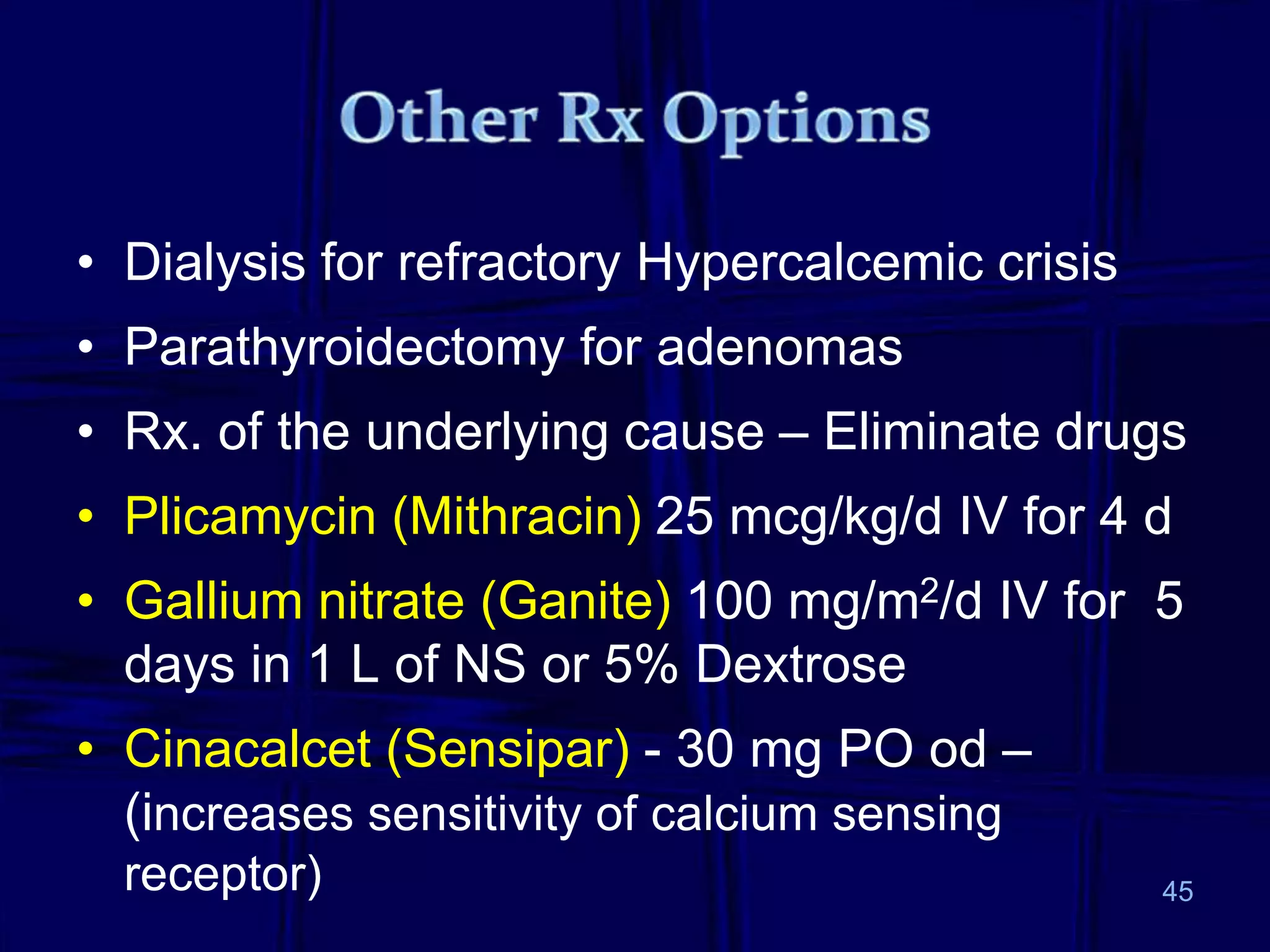
• Dialysis for refractory Hypercalcemic crisis
• Parathyroidectomy for adenomas
• Rx. of the underlying cause – Eliminate drugs
• Plicamycin (Mithracin) 25 mcg/kg/d IV for 4 d
• Gallium nitrate (Ganite) 100 mg/m2/d IV for 5
days in 1 L of NS or 5% Dextrose
• Cinacalcet (Sensipar) - 30 mg PO od –
(increases sensitivity of calcium sensing
receptor) 45
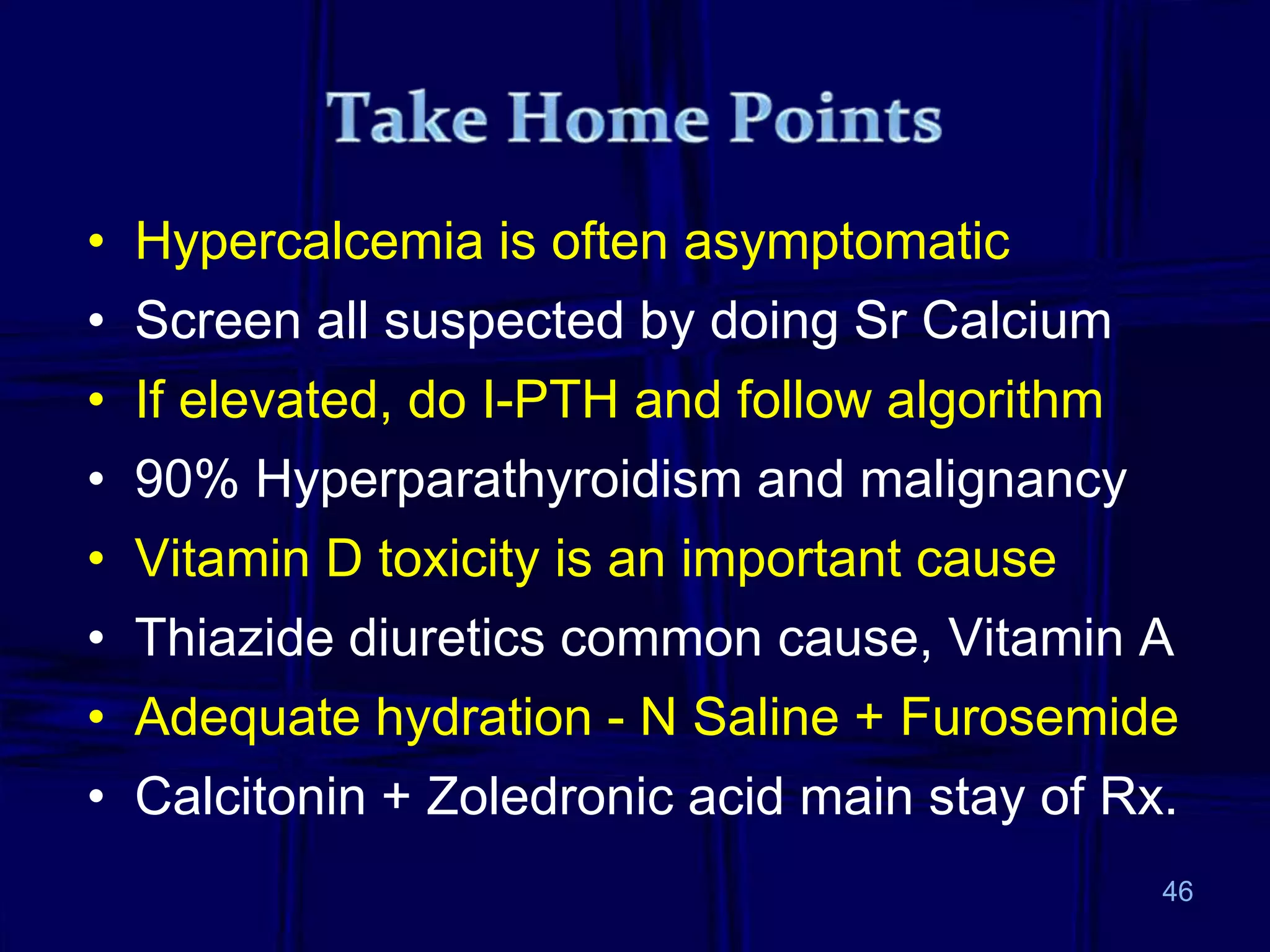
• Hypercalcemia is often asymptomatic
• Screen all suspected by doing Sr Calcium
• If elevated, do I-PTH and follow algorithm
• 90% Hyperparathyroidism and malignancy
• Vitamin D toxicity is an important cause
• Thiazide diuretics common cause, Vitamin A
• Adequate hydration - N Saline + Furosemide
• Calcitonin + Zoledronic acid main stay of Rx.
46

Hypercalcemia.ppt

  • 1.
  • 2.
    • Commonly encounteredin Practice • Diagnosis often is made incidentally • The most common causes are primary hyperparathyroidism and malignancy • Diagnostic work-up includes measurement of serum calcium, intact parathyroid hormone (I-PTH), h/o any medications • Hypercalcemic crisis is a life-threatening emergency 2
  • 3.
    • Most oftenasymptomatic – Incidental Dx • Mild Hypercalcemia is asymptomatic • Most important cause is hyper parathyroid • DD is needed to decide the treatment • Optimal step by step evaluation is a must. 3
  • 4.
    • 98% ofthe body calcium is in the skeleton • Only 2% is circulation and only half of this is free calcium (ionized Ca++) • This only is physiologically active • The reminder 1% is bound to proteins • Direct measurement of free Calcium ?? 4
  • 5.
    5 Parathyroid Hormone 1,25 DHCor Vitamin D3 Calcitonin
  • 6.
    6  Bone Resorption Intestinal Absorption  Renal Excretion
  • 7.
  • 8.
    Hormone Effect BoneGut Kidney PTH  Ca  Po4 Increases Osteoclasts Indirect via Vit. D Ca reab Po4 exr. Vitamin D3  Ca  Po4 No direct action  Ca  Po4 absorption No direct effect Calcitonin  Ca  Po4 Inhibits Osteoclasts No direct effect Ca & Po4 excretion 8
  • 9.
    Corrected total calcium(mg%) = [(Measured total calcium mg%) + {(4.4 - measured albumin g%) x 0.8}] Example: [12.0 + {(4.4 – 2.4) x 0.8}] = [ 12.0 + (2 x 0.8)] = 12.0 + 1.6 = 13.6 mg% 9
  • 10.
  • 11.
    Second hydroxylation inthe Kidney at first position 1,25 dihydroxy Cholecalciferol Active Vitamin D (Calcitriol) Successive hydroxylations of Cholecalciferol 25 hydroxylation in the Liver 25 hydroxy Cholecalciferol Vitamin D is a steroid hormone From dietary sources Action of Sunlight on skin 11
  • 12.
    PTH • 4 PTglands • 84 AA hormone • Low Ca stimulates it Calcitriol (D) • Active bone formation • Main effect is on the Gut • PTH  Vit. D Calcitonin • Para follicular C of Thyroid • 34 AA hormone • On Kidney 12
  • 13.
    13 Critical - >14 mg % Moderate - 12 to 14 mg % Mild – 10.4 to 11.9 mg % Normal – 8.5 to 10.3 mg %
  • 14.
  • 15.
  • 16.
    • More than90 percent of hypercalcemia cases are Primary hyperparathyroidism and malignancy • These conditions must be differentiated early to provide optimal treatment & accurate prognosis • Humoral hypercalcemia of malignancy implies a very limited life expectancy — only a matter of weeks • Primary hyperparathyroidism has a benign course. 16
  • 17.
    • Primary hyperparathyroidism •Sporadic, familial, associated with Multiple Endocrine Neoplasia (MEN I or II) • Tertiary hyperparathyroidism • Associated with chronic renal failure • PTH  due to Vitamin D deficiency 17
  • 18.
    • Vitamin Dintoxication • Iatrogenic Vitamin D injections • Usually 25-hydroxyvitamin D2 in over-the-counter supplements • Granulomatous disease – Sarcoidosis, Berylliosis, Tuberculosis • Hodgkin’s lymphoma 18
  • 19.
    • Humoral hypercalcemiaof malignancy (mediated by PTHrP) – common cause • Solid tumors, especially lung, head and neck squamous cancers • Renal Cell Carcinoma (RCC) • Local osteolysis (mediated by cytokines) • Multiple Myeloma • Breast cancer 19
  • 20.
    • Thiazide diuretics(usually mild) - common • Lithium for depressive illnesses • Milk-alkali syndrome (calcium + antacids) • Vitamin A intoxication (including analogs used to treat acne) 20
  • 21.
    • Hyperthyroidism • Adrenalinsufficiency • Acromegaly • Pheochromocytoma 21
  • 22.
    • Familial hypocalciurichypercalcemia (FHH) mutated calcium-sensing receptor gene • Immobilization, with high bone turnover (e.g., Paget’s disease, bedridden child) • Recovery phase of Rhabdomyolysis 22
  • 23.
    • CNS • GIT •SKELETON • KIDNEY STONES BONES GROANS MOANS 23
  • 24.
    Renal “stones” • Nephrolithiasis •Nephrogenic Diabetes Insipidus • Dehydration • Nephrocalcinosis 24
  • 25.
    Skeleton “bones” • Bonepains • Arthritis • Osteoporosis • Osteitis fibrosa cystica in HPTH 25
  • 26.
    Abdominal “Moans” • Nausea,vomiting • Severe anorexia, weight loss • Constipation (not relieved by Rx.) • Abdominal pain (vague and diffuse) • Pancreatitis • Peptic ulcer disease 26
  • 27.
    Psychological “Groans” • Impairedconcentration • Impaired memory, Depression • Confusion, stupor, coma • Lethargy and severe fatigue • Extreme muscle weakness • Corneal calcification (band keratopathy) 27
  • 28.
    Cardiovascular • Hypertension, Increasedrisk of CHD • ECG changes of shortened QT interval, PR prolonged, QRS widened, ST , Bradycardia • Cardiac arrhythmias; Vascular calcification Others • Itching (Generalized Pruritus) • Keratitis, conjunctivitis 28
  • 29.
    29 ? Suspect  Calcium Serum Calcium 8.5to 10.3 > 10.3 mg % < 8.0 mg % Hypocalcemia Normal calcium
  • 30.
    Medications > 10.3 mg%I-PTH High/Normal Pri PTH Suppressed Vit D Toxicity Milk Alkali Cancers/ Lymphoma Suppressed PTHrP 30
  • 31.
    PTHrP Low or Normal Low or Normal 1,25 Vit. D If Low Cancer If High Lymphoma High 24 hr. urine calcium Low – FHH N or  Sestamibi 31 Endocrine
  • 32.
  • 33.
    33 • Increased screeningfor serum Ca++ and • Wider availability of I-PTH assay • 80% of cases single parathyroid adenoma • Usually benign adenoma or hyperplasia • Rarely parathyroid cancer • High PTH in the setting of hypercalcemia • Slowly progressive – Sestamibi N-scan • 25% require surgery – RLN paralysis
  • 34.
    34 64 yrs male- “hyper parathyroid storm” with a serum calcium level of 16.4 mg%
  • 35.
    • Serum calciumlevel > 12 mg % at any time • Episodes of hyper parathyroid crisis • Marked hypercalciuria (urinary Ca++ > 400 mg /day) • Nephrolithiasis; Impaired renal function • Osteitis fibrosa cystica – Thinning of cortical bone • Reduced bone density by DEXA scan (Z score < 2) • Classic neuromuscular symptoms, Proximal muscle weakness and atrophy, Hyper reflexia and ataxia • Age younger than 50 years 35
  • 36.
    36 • 25 OH- Vitamin D2 is the supplemental Vit D • Level of 25 OH – Vitamin D3 is to be measured • Macrophages in the granulomas, lymphomas cause extra renal conversion of 25 OH form to the1,25 hydroxy derivative –the active Calcitriol • PTH levels are suppressed; Calcitriol levels  • Stop the offending use of Vitamin D • Glucocorticoids – for over one month or more • Manage hypercalcemia vigorously
  • 37.
    37 • Most commonlymediated by systemic PTHrP • Humoral Hypercalcemia of malignancy • PTHrP mimics the bone & renal effects of PTH • Normal Calcitriol and suppressed PTH levels • Excessive bone lysis due to primary or bone secondaries can cause hypercalcemia • MM and metastatic Br Ca present in this way. • In Osteolytic hypercalcemia, SAP is markedly  • Hodgkin’s lymphoma –  production of Calcitriol
  • 38.
    • Thiazide diureticsincrease renal calcium resorption and cause mild hypercalcemia • Resolves after discontinuing the drug • Thiazide unmasks hyperparathyroidism • Milk–alkali syndrome – Ca + Antacids • Lithium –  the set point for PTH  • Excess Vitamin A -  bone resorption and causes hypercalcemia. 38
  • 39.
    • FHH –Familial Hypocalciuric Hypercalcemia • AD – 100% penetrance – Ca-R gene mutation • Moderate hypercalcemia with normal/  PTH • 24 hour urinary calcium is very low • No benefit from parathyroidectomy • High bone turnover in Paget’s disease or prolonged immobilization • Recovery phase of Rhabdomyolysis 39
  • 40.
    • Ca <12but > 10.3 mg% – no appreciable clinical benefit – they need evaluation • Any patient with Serum Ca > 12 mg% should be aggressively treated • Ca > 14 mg% is Hypercalcemic crisis • Always correct the Ca value for Sr Albumin 40
  • 41.
  • 42.
    • Vigorous I.V.Nacl Diuresis – N Saline • Adequate hydration – urine out put must be maintained 200 ml/hour = 5 L /day • The safest and most effective treatment of Hypercalcemic crisis is saline rehydration • Once the urine out put is maintained – give I.V. Furosemide – a loop diuretic in low doses of 10 to 20 mg • ERT - might be beneficial in PMW – new RCT 42
  • 43.
    • In severehypercalcemia refractory to saline diuresis • Calcitonin (Zycalcit, Miacalcin) 6 -8 U/kg IM/SC (400 i.u) given every six hours. • This treatment has a rapid onset but short duration of effect • Patients develop tolerance to the calcium- lowering effect of Calcitonin. 43
  • 44.
    • Zoledronic acid(Zometa) - 4 mg IV diluted in 100 ml of N Saline - over at least 15’ once a M • Pamindronate (Pamidria) - 60 mg IV infusion over 4 h initial – repeated after a month • Etidronate (Didronel) - 7.5 mg/kg IV over 4 h daily for 3-7 d; dilute in at least 250 ml of sterile N Saline • They inhibit bone resorption, inhibit the Osteoclastic activity. 44
  • 45.
    • Dialysis forrefractory Hypercalcemic crisis • Parathyroidectomy for adenomas • Rx. of the underlying cause – Eliminate drugs • Plicamycin (Mithracin) 25 mcg/kg/d IV for 4 d • Gallium nitrate (Ganite) 100 mg/m2/d IV for 5 days in 1 L of NS or 5% Dextrose • Cinacalcet (Sensipar) - 30 mg PO od – (increases sensitivity of calcium sensing receptor) 45
  • 46.
    • Hypercalcemia isoften asymptomatic • Screen all suspected by doing Sr Calcium • If elevated, do I-PTH and follow algorithm • 90% Hyperparathyroidism and malignancy • Vitamin D toxicity is an important cause • Thiazide diuretics common cause, Vitamin A • Adequate hydration - N Saline + Furosemide • Calcitonin + Zoledronic acid main stay of Rx. 46