Calcium metabolism
disorders
bone
1000 g Ca++
stored in
bone
Calcium homeostasis
Blood
Ca++
small intestine
kidney
Ca++
lost in urine
Calcium in
the diet
calcium lost in feces
Ca++ absorbed
into blood
calcium resorption
calcium deposition
intake
excretion
1000 g Ca++
stored in
bone
Calcium homeostasis
Blood
Ca++
small intestine
kidney
Ca++
lost in urine
Calcium in
the diet
calcium lost in feces
Ca++ absorbed
into blood
calcium resorption
calcium deposition
storage
bone
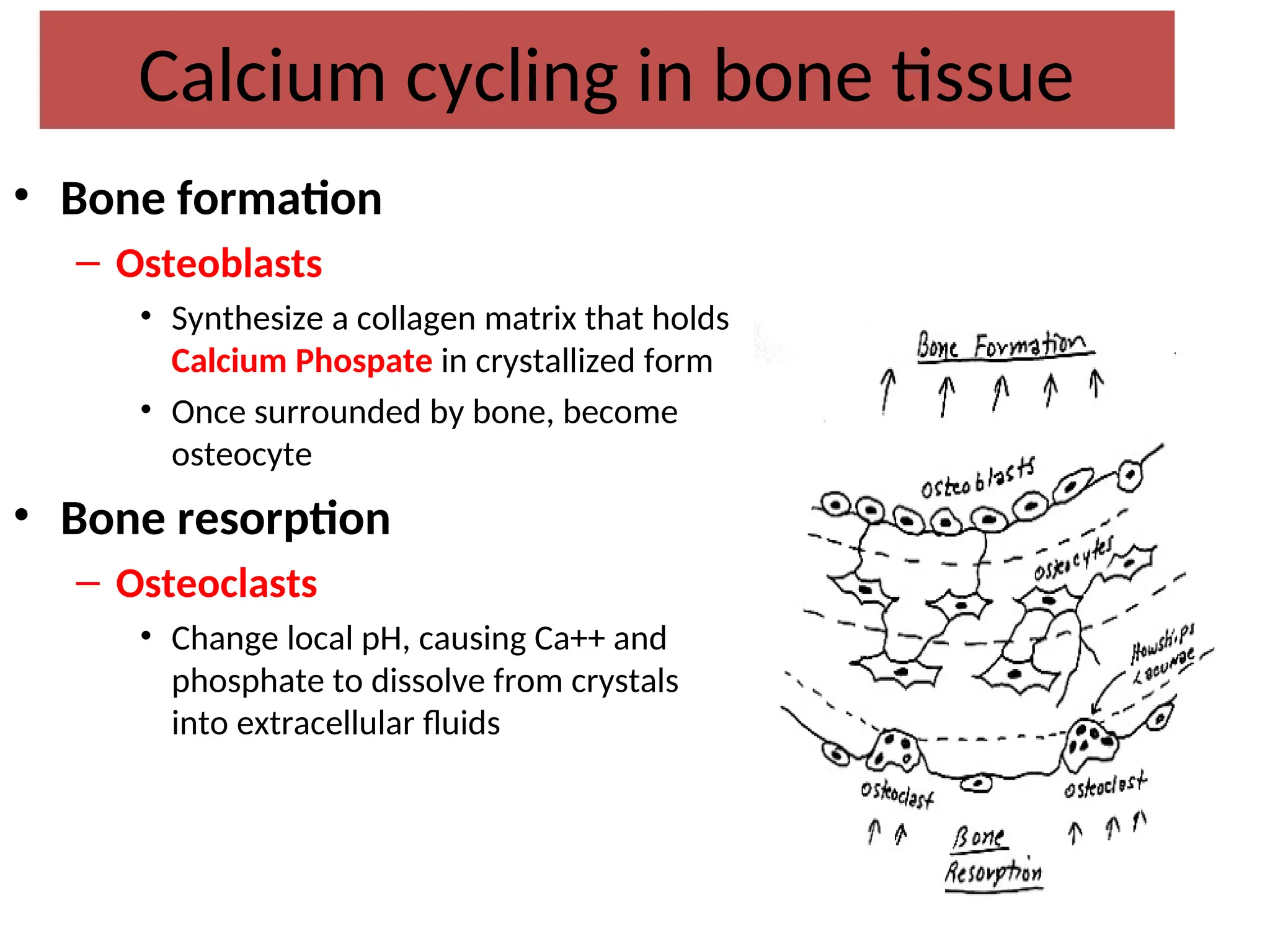
Calcium cycling in bone tissue
• Bone formation
– Osteoblasts
• Synthesize a collagen matrix that holds
Calcium Phospate in crystallized form
• Once surrounded by bone, become
osteocyte
• Bone resorption
– Osteoclasts
• Change local pH, causing Ca++ and
phosphate to dissolve from crystals
into extracellular fluids
What is calcium ?
• Calcium is a mineral that is
essential to bone health,
cardiovascular health, muscle
maintenance, circulatory
health, and blood clotting.
• Calcium also acts as an
enzyme activator.
• it is available from green leafy
vegetables, seafood, almonds,
molasses, broccoli, enriched
soy, figs, soybeans and .
Body requirements
Age (in years) Calcium Requirement
1 – 3 500mg
4 - 8 800mg
9 - 18 1300mg
19 - 50 1000mg
51+ 1500mg
*Pregnant and lactating women are
recommended a daily calcium intake of
1000mg.
Different Forms of Calcium
At any one time, most of the calcium in the body exists as the
mineral hydroxyapatite, Ca10(PO4)6(OH)2.
Calcium in the plasma:
45% in ionized form (the physiologically active form)
45% bound to proteins (predominantly albumin)
10% complexed with anions (citrate, sulfate, phosphate)
To estimate the physiologic levels of ionized calcium in states of
hypoalbuminemia:
[Ca+2
]Corrected = [Ca+2
]Measured + [ 0.8 (4 – Albumin) ]
Regulating factors
• It is regulated by :
• PTH and 1,25-(OH)2D3 on gut, kidney and
bone
• Calcium receptors:
• are present in the parathyroid gland,
kidney , brain and other organs.
Vitamin D metabolism
The active form of vitamin D is 1,25-
dihydroxycholecalcififerol.
 Its production in the kidney is catalyzed by 1 a-
hydroxylase .
1 a-hydroxylase activity is increased by :
Decreased serum Ca2+
Increased PTH level
Decreased serum phosphate
Action of 1,25-
dihydroxycholecalcififerol(Calcitriol)
1.Increases intestinal Ca2+ absorption
2.Increases intestinal phosphate absorption
3.Increase renal reabsorption of Ca2+ and
phosphate
4.Increases resorption of bone
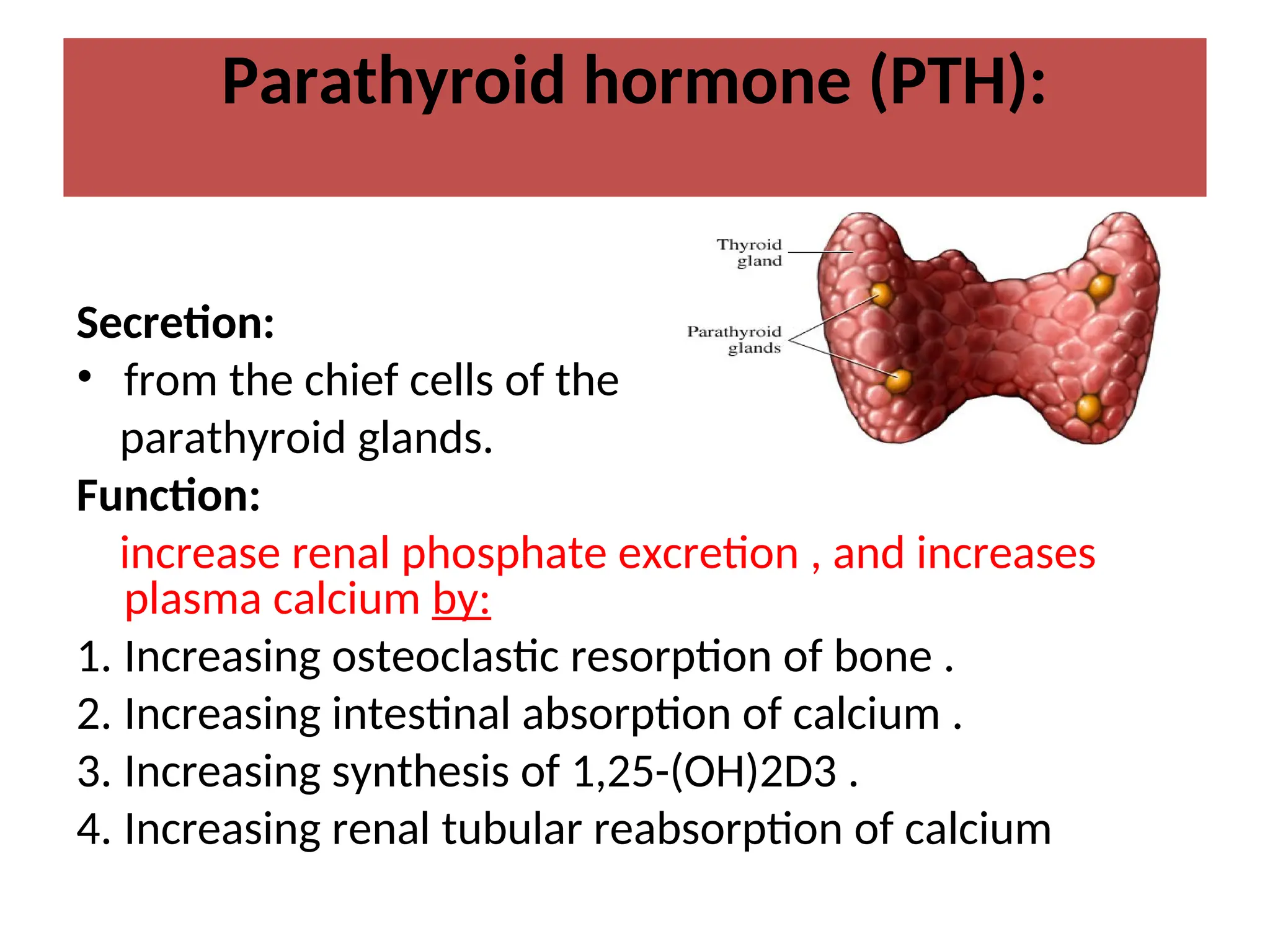
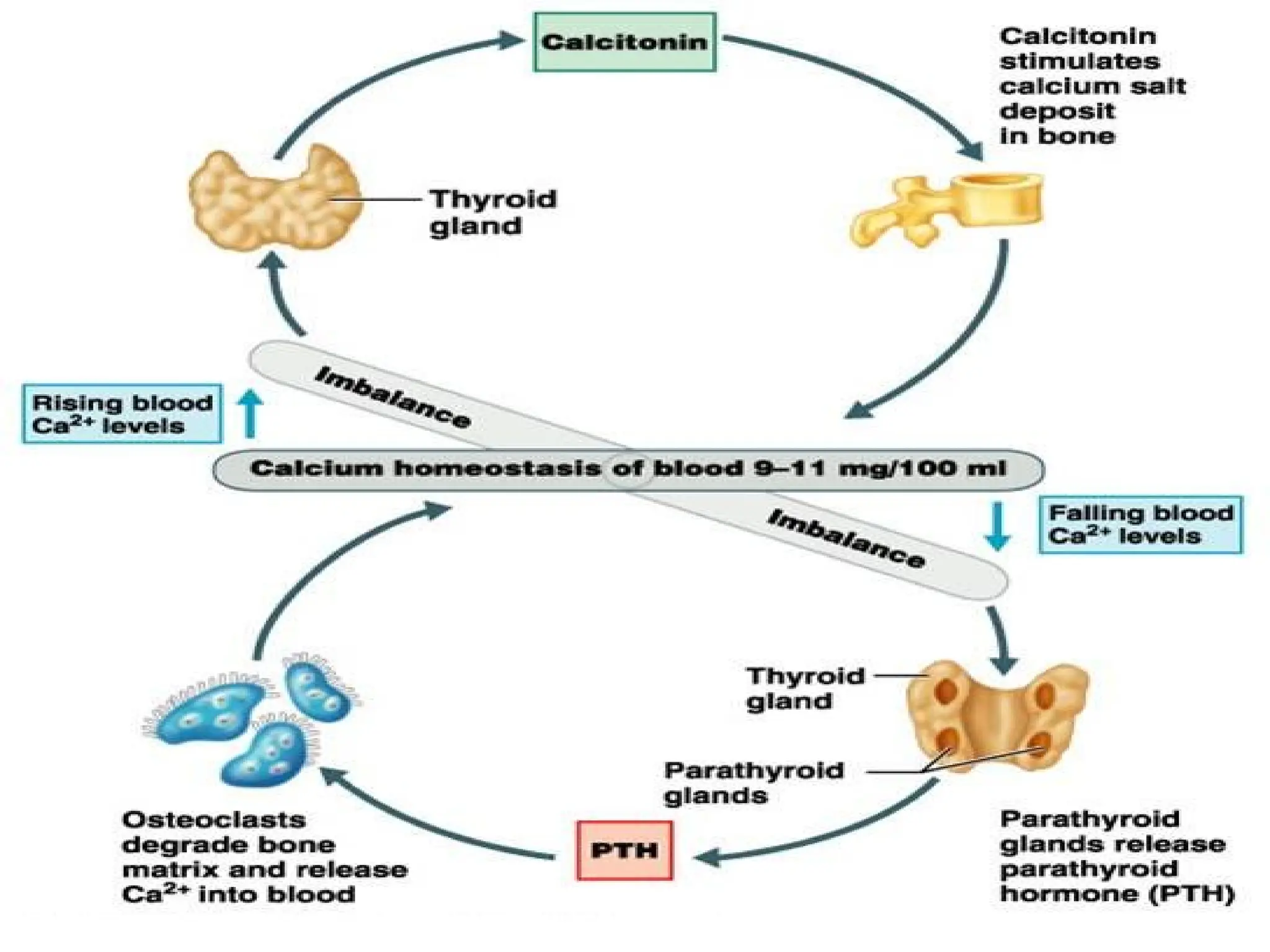
Parathyroid hormone (PTH):
Secretion:
• from the chief cells of the
parathyroid glands.
Function:
increase renal phosphate excretion , and increases
plasma calcium by:
1. Increasing osteoclastic resorption of bone .
2. Increasing intestinal absorption of calcium .
3. Increasing synthesis of 1,25-(OH)2D3 .
4. Increasing renal tubular reabsorption of calcium
Regulation of PTH
• Low serum [Ca+2
]  Increased PTH
secretion
• High serum [Ca+2
]  Decreased PTH
secretion
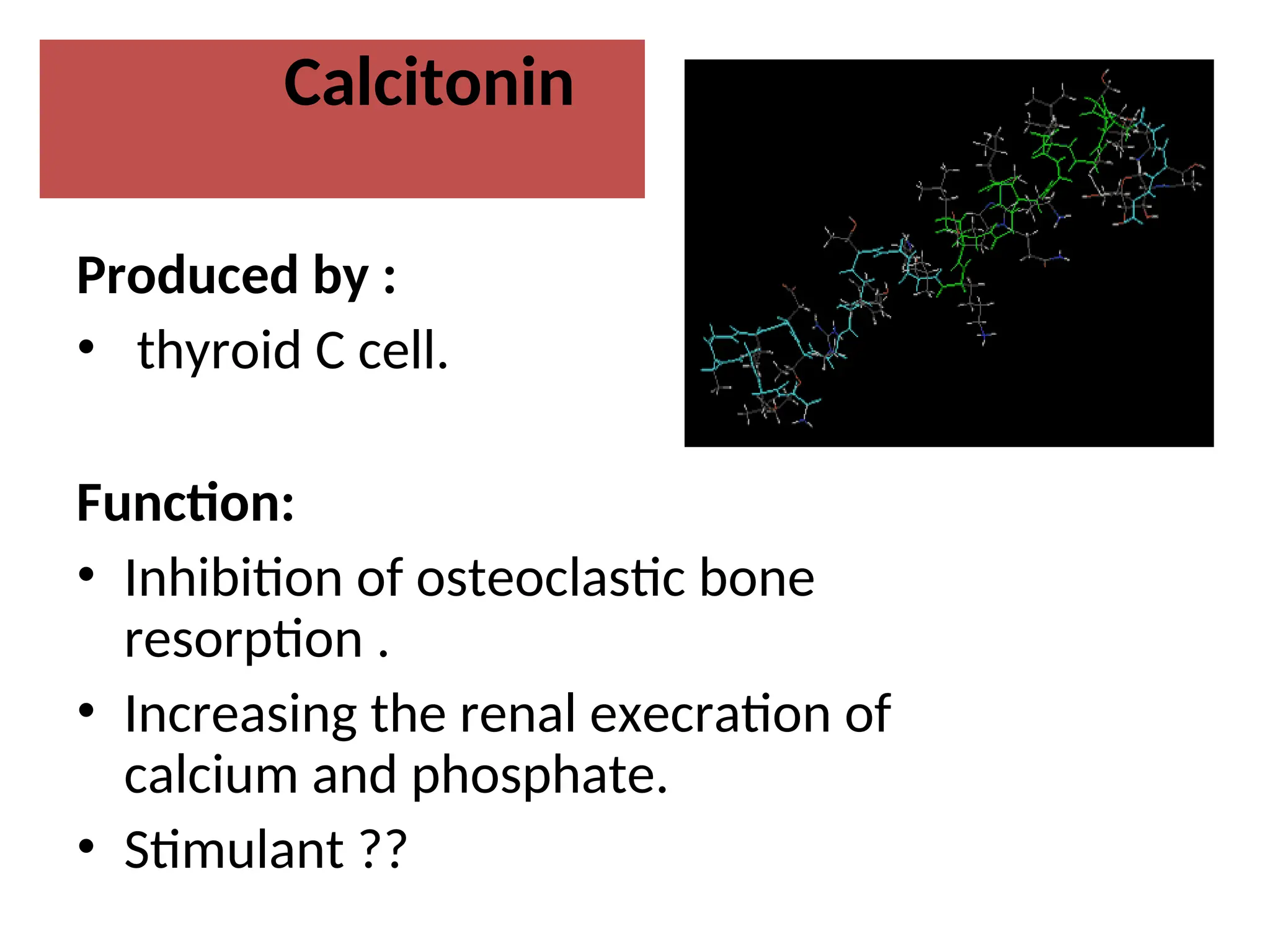
Calcitonin
Produced by :
• thyroid C cell.
Function:
• Inhibition of osteoclastic bone
resorption .
• Increasing the renal execration of
calcium and phosphate.
• Stimulant ??
Deficiency:
Deficiency of calcium levels in the body
may induce several diseases:
• Rickets disease
• Adult osteomalacia
• osteoporosis
• Osteomalacia is a disorder of decreased
mineralization of newly formed osteoid at sites of
bone turnover,
• whereas rickets is a disorder of defective
mineralization of cartilage in the epiphyseal
growth plates of children.
• Osteomalacia and rickets can occur together in
children ,but only osteomalacia occurs in adults.
• Osteoporosis
is a skeletal disorder characterized by
compromised bone strength predisposing to
an increased risk of fractures.
Throughout life, older bone is periodically
resorbed by osteoclasts at discrete sites and
replaced with new bone made by osteoblasts.
This process is known as remodeling.
Calcium metabolism disorders:
Calcium metabolism disorder include:
• Hypercalcemia
• Hypocalcemia
• hyperparathyrodism
hypercalcemia
• the calcium level in the body is above the
normal -10.5 mg/dL .
• The main cause is over activity of the
parathyroid gland.
• cancer and some medication may cause
over activity of the calcium level.
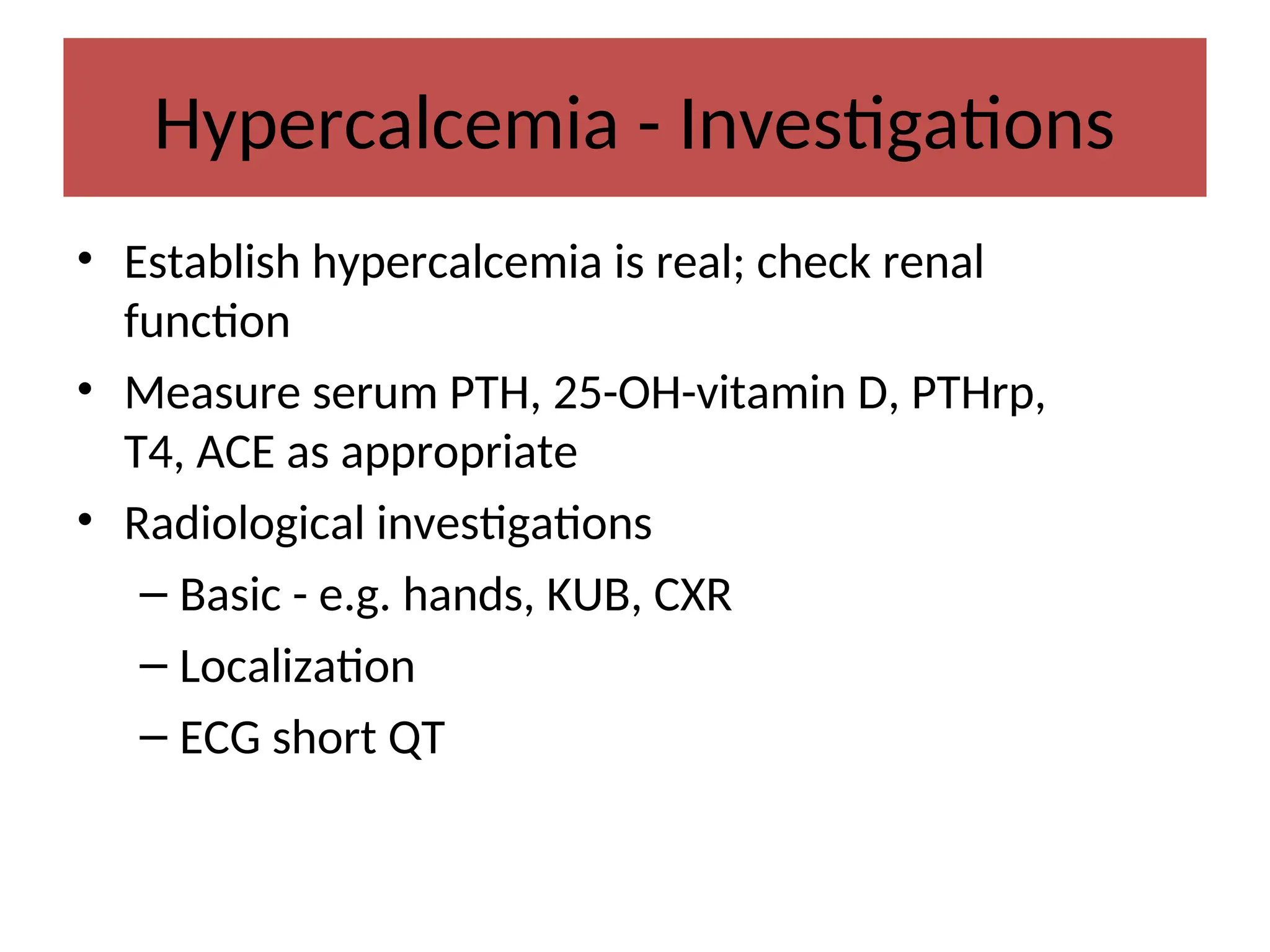
Hypercalcemia - Investigations
• Establish hypercalcemia is real; check renal
function
• Measure serum PTH, 25-OH-vitamin D, PTHrp,
T4, ACE as appropriate
• Radiological investigations
– Basic - e.g. hands, KUB, CXR
– Localization
– ECG short QT
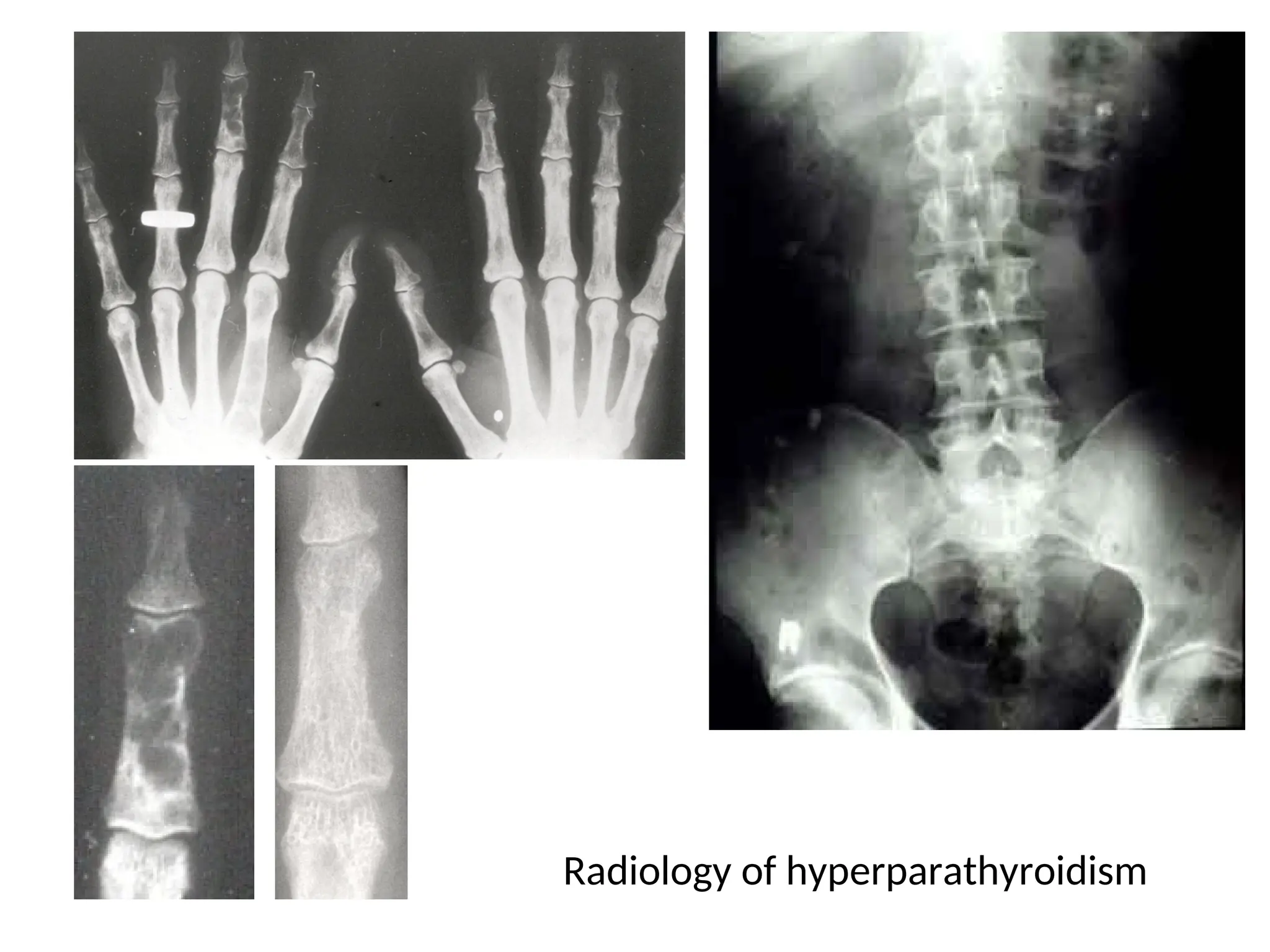
Radiology of hyperparathyroidism
Etiology of hypercalcemia
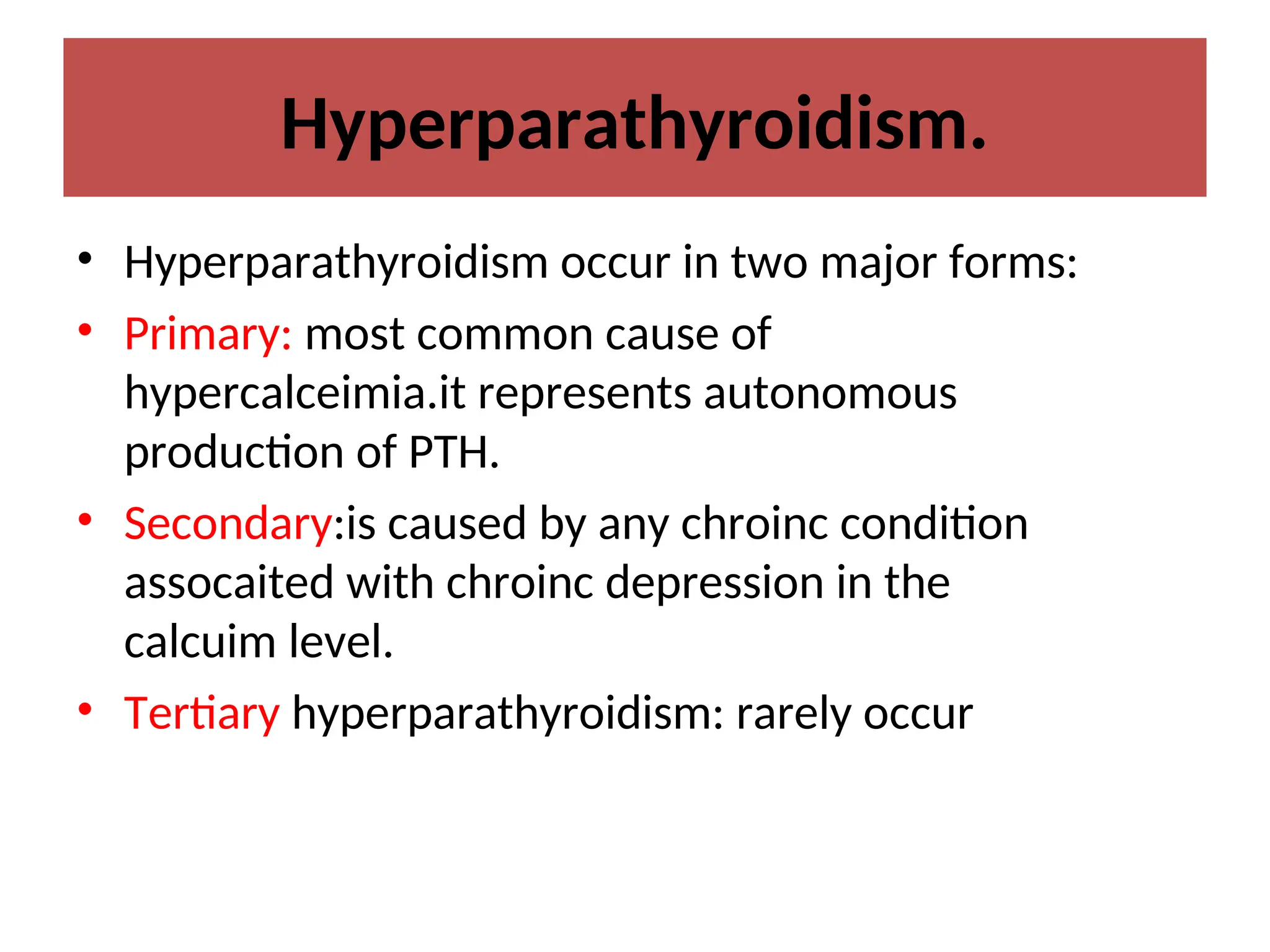
Hyperparathyroidism.
• Hyperparathyroidism occur in two major forms:
• Primary: most common cause of
hypercalceimia.it represents autonomous
production of PTH.
• Secondary:is caused by any chroinc condition
assocaited with chroinc depression in the
calcuim level.
• Tertiary hyperparathyroidism: rarely occur
• Mild hypercalcemia — Patients with asymptomatic or
mildly symptomatic hypercalcemia (calcium <12 mg/dL
[3 mmol/L]) do not require immediate treatment.
• Moderate hypercalcemia — (calcium between 12 and 14
mg/dL [3 to 3.5 mmol/L]) may not require immediate
therapy
• In these patients, we typically treat with saline hydration
and bisphosphonates,
• Severe hypercalcemia — Patients with calcium >14
mg/dL (3.5 mmol/L) require more aggressive therapy.
hypocalcaemia
• Is a condition in which the calcium level below
The normal level 8.5 mg/dl
• Is caused by low level of PTH , low level of
magnesium, deficiency of vitamin D
• The kidney dysfunction play role in hypocalcuimia
• ECG prolong QT
Etiology of the hypocalcemia
• Decreased GI Absorption
• Poor dietary intake of calcium,impair absorption
• Increased Urinary Excretion
• Decreased Bone Resorption/Increased
Mineralization
• Low PTH( post surgical)
• PTH resistance
• Vitamin D deficiency
• Autoimmune polyglandular syndrome
(associated with chronic mucocutaneous
candidiasis and primary adrenal insufficiency)
Complication
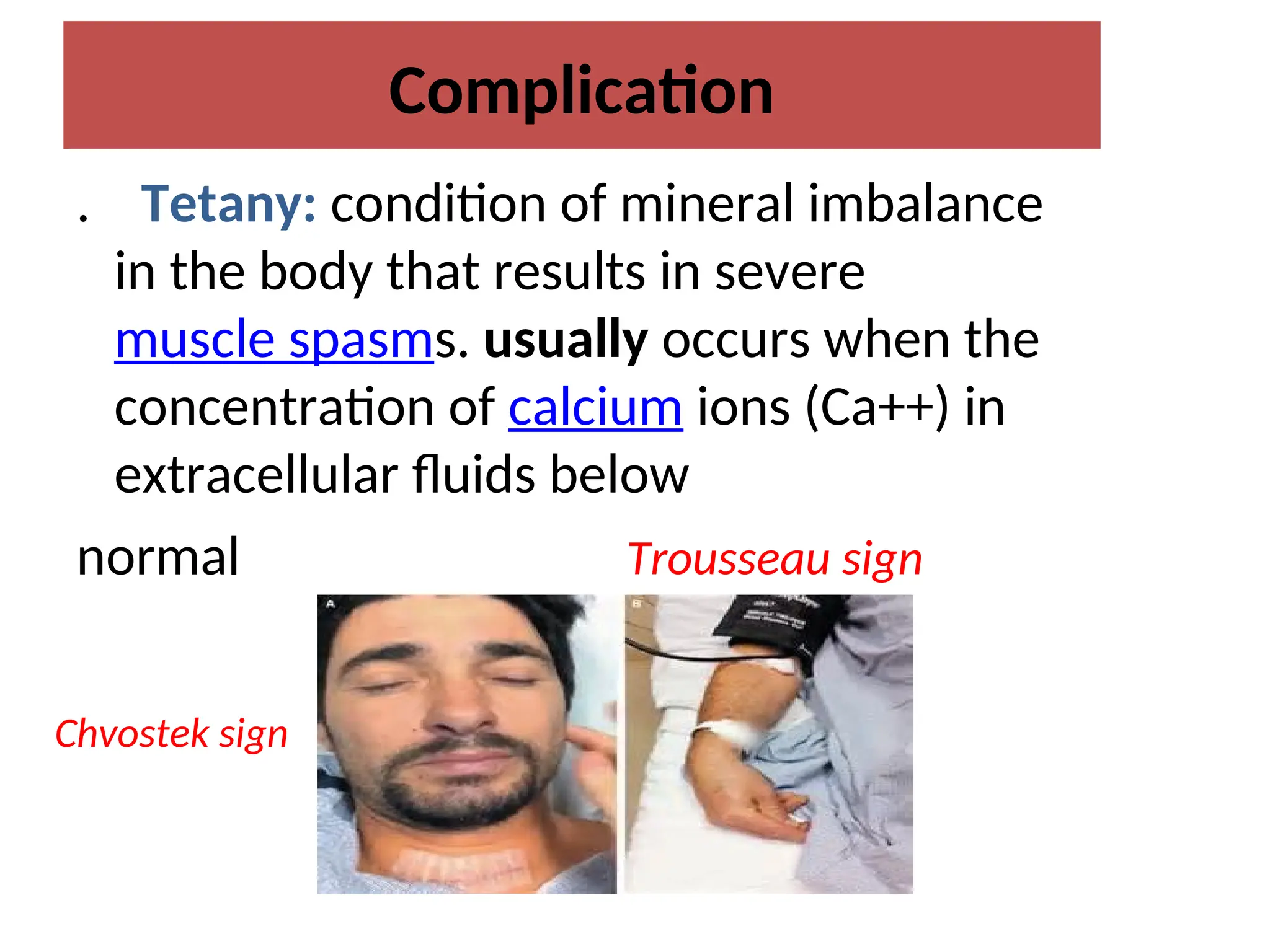
. Tetany: condition of mineral imbalance
in the body that results in severe
muscle spasms. usually occurs when the
concentration of calcium ions (Ca++) in
extracellular fluids below
normal
Chvostek sign
Trousseau sign
1-Calcium metabolism disorders for students.ppt

1-Calcium metabolism disorders for students.ppt

  • 1.
  • 2.
    bone 1000 g Ca++ storedin bone Calcium homeostasis Blood Ca++ small intestine kidney Ca++ lost in urine Calcium in the diet calcium lost in feces Ca++ absorbed into blood calcium resorption calcium deposition
  • 3.
    intake excretion 1000 g Ca++ storedin bone Calcium homeostasis Blood Ca++ small intestine kidney Ca++ lost in urine Calcium in the diet calcium lost in feces Ca++ absorbed into blood calcium resorption calcium deposition storage bone
  • 4.
    Calcium cycling inbone tissue • Bone formation – Osteoblasts • Synthesize a collagen matrix that holds Calcium Phospate in crystallized form • Once surrounded by bone, become osteocyte • Bone resorption – Osteoclasts • Change local pH, causing Ca++ and phosphate to dissolve from crystals into extracellular fluids
  • 5.
    What is calcium? • Calcium is a mineral that is essential to bone health, cardiovascular health, muscle maintenance, circulatory health, and blood clotting. • Calcium also acts as an enzyme activator. • it is available from green leafy vegetables, seafood, almonds, molasses, broccoli, enriched soy, figs, soybeans and .
  • 6.
    Body requirements Age (inyears) Calcium Requirement 1 – 3 500mg 4 - 8 800mg 9 - 18 1300mg 19 - 50 1000mg 51+ 1500mg *Pregnant and lactating women are recommended a daily calcium intake of 1000mg.
  • 7.
    Different Forms ofCalcium At any one time, most of the calcium in the body exists as the mineral hydroxyapatite, Ca10(PO4)6(OH)2. Calcium in the plasma: 45% in ionized form (the physiologically active form) 45% bound to proteins (predominantly albumin) 10% complexed with anions (citrate, sulfate, phosphate) To estimate the physiologic levels of ionized calcium in states of hypoalbuminemia: [Ca+2 ]Corrected = [Ca+2 ]Measured + [ 0.8 (4 – Albumin) ]
  • 8.
    Regulating factors • Itis regulated by : • PTH and 1,25-(OH)2D3 on gut, kidney and bone • Calcium receptors: • are present in the parathyroid gland, kidney , brain and other organs.
  • 9.
    Vitamin D metabolism Theactive form of vitamin D is 1,25- dihydroxycholecalcififerol.  Its production in the kidney is catalyzed by 1 a- hydroxylase . 1 a-hydroxylase activity is increased by : Decreased serum Ca2+ Increased PTH level Decreased serum phosphate
  • 10.
    Action of 1,25- dihydroxycholecalcififerol(Calcitriol) 1.Increasesintestinal Ca2+ absorption 2.Increases intestinal phosphate absorption 3.Increase renal reabsorption of Ca2+ and phosphate 4.Increases resorption of bone
  • 11.
    Parathyroid hormone (PTH): Secretion: •from the chief cells of the parathyroid glands. Function: increase renal phosphate excretion , and increases plasma calcium by: 1. Increasing osteoclastic resorption of bone . 2. Increasing intestinal absorption of calcium . 3. Increasing synthesis of 1,25-(OH)2D3 . 4. Increasing renal tubular reabsorption of calcium
  • 12.
    Regulation of PTH •Low serum [Ca+2 ]  Increased PTH secretion • High serum [Ca+2 ]  Decreased PTH secretion
  • 13.
    Calcitonin Produced by : •thyroid C cell. Function: • Inhibition of osteoclastic bone resorption . • Increasing the renal execration of calcium and phosphate. • Stimulant ??
  • 15.
    Deficiency: Deficiency of calciumlevels in the body may induce several diseases: • Rickets disease • Adult osteomalacia • osteoporosis
  • 16.
    • Osteomalacia isa disorder of decreased mineralization of newly formed osteoid at sites of bone turnover, • whereas rickets is a disorder of defective mineralization of cartilage in the epiphyseal growth plates of children. • Osteomalacia and rickets can occur together in children ,but only osteomalacia occurs in adults.
  • 17.
    • Osteoporosis is askeletal disorder characterized by compromised bone strength predisposing to an increased risk of fractures. Throughout life, older bone is periodically resorbed by osteoclasts at discrete sites and replaced with new bone made by osteoblasts. This process is known as remodeling.
  • 18.
    Calcium metabolism disorders: Calciummetabolism disorder include: • Hypercalcemia • Hypocalcemia • hyperparathyrodism
  • 19.
    hypercalcemia • the calciumlevel in the body is above the normal -10.5 mg/dL . • The main cause is over activity of the parathyroid gland. • cancer and some medication may cause over activity of the calcium level.
  • 20.
    Hypercalcemia - Investigations •Establish hypercalcemia is real; check renal function • Measure serum PTH, 25-OH-vitamin D, PTHrp, T4, ACE as appropriate • Radiological investigations – Basic - e.g. hands, KUB, CXR – Localization – ECG short QT
  • 21.
  • 22.
  • 23.
    Hyperparathyroidism. • Hyperparathyroidism occurin two major forms: • Primary: most common cause of hypercalceimia.it represents autonomous production of PTH. • Secondary:is caused by any chroinc condition assocaited with chroinc depression in the calcuim level. • Tertiary hyperparathyroidism: rarely occur
  • 25.
    • Mild hypercalcemia— Patients with asymptomatic or mildly symptomatic hypercalcemia (calcium <12 mg/dL [3 mmol/L]) do not require immediate treatment. • Moderate hypercalcemia — (calcium between 12 and 14 mg/dL [3 to 3.5 mmol/L]) may not require immediate therapy • In these patients, we typically treat with saline hydration and bisphosphonates, • Severe hypercalcemia — Patients with calcium >14 mg/dL (3.5 mmol/L) require more aggressive therapy.
  • 27.
    hypocalcaemia • Is acondition in which the calcium level below The normal level 8.5 mg/dl • Is caused by low level of PTH , low level of magnesium, deficiency of vitamin D • The kidney dysfunction play role in hypocalcuimia • ECG prolong QT
  • 28.
    Etiology of thehypocalcemia • Decreased GI Absorption • Poor dietary intake of calcium,impair absorption • Increased Urinary Excretion • Decreased Bone Resorption/Increased Mineralization • Low PTH( post surgical) • PTH resistance • Vitamin D deficiency • Autoimmune polyglandular syndrome (associated with chronic mucocutaneous candidiasis and primary adrenal insufficiency)
  • 29.
    Complication . Tetany: conditionof mineral imbalance in the body that results in severe muscle spasms. usually occurs when the concentration of calcium ions (Ca++) in extracellular fluids below normal Chvostek sign Trousseau sign

Editor's Notes

  • #2 Why is calcium homeostasis important? 1. One of the major intracellular messengers (draw cell with high Ca++ outside, low Ca++ inside) a. Precise levels necessary for muscle contraction b. Responsible for exocytosis of secretory granules in neuronal synapses c. Serves as second messenger in many cells 2. Ca++ is necessary for blood clotting When would Ca++ levels change? after a large meal during a growth spurt during pregnancy or lactation Blood: Ca++ level usually 10 mg/100 ml (so 500 mg total in plamsa = 0.5 g) Regulation of calcium levels occurs in three different organs: bone, kidney, and small intestine small intestine: ingestion of Ca++ in food, taken up across the gut kidney: Ca++ is filtered through the nephron, and can be excreted in the urine bone: major storage site for Ca++
  • #3  Think of it this way: Calcium is ingested through the gut (get more Ca++ into system) Calcium is secreted out of the body through the urine and the feces Calcium is stored in the bones To understand how calcium regulation occurs at the bone, we need to understand how bones work…
  • #4 Two processes: bone formation and bone resorption, going on continuously Calcium phospate crystals called ‘hydroxyapatite’ surface of crystals can exchange Ca++ and phosphate ions with extracellular fluid Write on board: -osteoblasts: builds bone (takes up Ca++ into bone) -osteoclasts: breaks down bone (removes Ca++ from bone) Now that we understand how calcium cycling happens at the bone, we can go back to the overall picture
  • #9 primary source : photoactivation (in the skin) of 7-dehydrocholesterol to cholecalciferol, which is then converted in the liver to 25-hydroxycholecalciferol (25-(OH)D3) and further converted by renal 1 a-hydroxylase to the active metabolite 1,25-dihydroxycholecalcififerol (1,25-(OH)2D3). 24,25-(OH)2D3 (a less active metabolite) is formed if vitamin D supplies are adequate. This enzyme is regulated by: PTH, phosphate and by feedback inhibition by 1,25-(OH)2D3