HYDRAULIC AND WATER
RESOURCES ENGINEERING
By
B.S. MURTY
Water Resources Engineering is as old as
Civilization
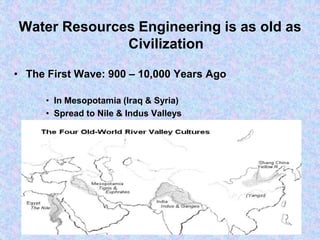
• The First Wave: 900 – 10,000 Years Ago
• In Mesopotamia (Iraq & Syria)
• Spread to Nile & Indus Valleys
Transportation & Management of
Water for Irrigation
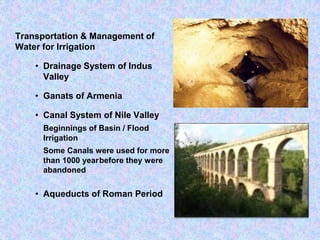
• Drainage System of Indus
Valley
• Ganats of Armenia
• Canal System of Nile Valley
Beginnings of Basin / Flood
Irrigation
Some Canals were used for more
than 1000 yearbefore they were
abandoned
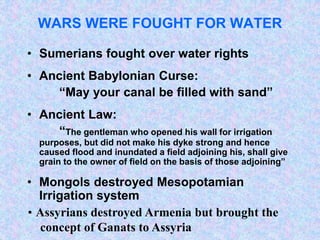
• Aqueducts of Roman Period
WARS WERE FOUGHT FOR WATER
• Sumerians fought over water rights
• Ancient Babylonian Curse:
“May your canal be filled with sand”
• Ancient Law:
“The gentleman who opened his wall for irrigation
purposes, but did not make his dyke strong and hence
caused flood and inundated a field adjoining his, shall give
grain to the owner of field on the basis of those adjoining”
• Mongols destroyed Mesopotamian
Irrigation system
• Assyrians destroyed Armenia but brought the
concept of Ganats to Assyria
Greeks:
Showed connection between Engineering &
Science
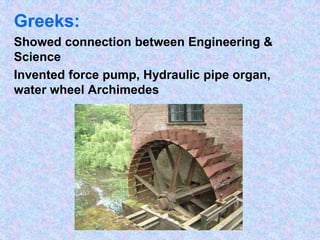
Invented force pump, Hydraulic pipe organ,
water wheel Archimedes
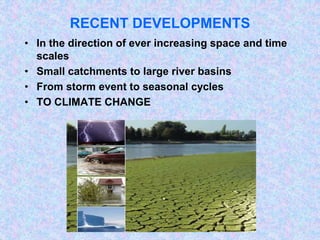
RECENT DEVELOPMENTS
• In the direction of ever increasing space and time
scales
• Small catchments to large river basins
• From storm event to seasonal cycles
• TO CLIMATE CHANGE
• 1981-1990: UN Decade for drinking water
supply & Sanitation(1300 Million lack
access to clean water 1800 Million still lack
access to sanitation service)
• 1992: Earth Summit
• Recognition that THIRD WORLD WAR will
be fought over WATER and not over OIL
• Computational Hydraulics: Understanding the
mechanics through mathematical modeling
• Systems Approach: Application of optimization
techniques for better management of water
resources
• Introduction of Concept of Sustainability
• Development of Environmental Hydraulics
• Understanding the climate change effect
INDIA SINCE INDEPENDENCE
POSITIVE
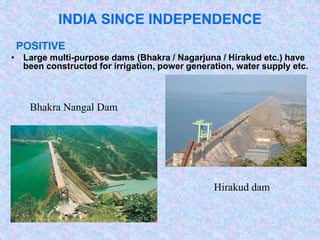
• Large multi-purpose dams (Bhakra / Nagarjuna / Hirakud etc.) have
been constructed for irrigation, power generation, water supply etc.
Hirakud dam
Bhakra Nangal Dam
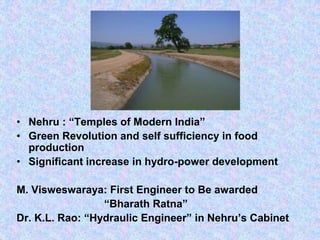
• Nehru : “Temples of Modern India”
• Green Revolution and self sufficiency in food
production
• Significant increase in hydro-power development
M. Visweswaraya: First Engineer to Be awarded
“Bharath Ratna”
Dr. K.L. Rao: “Hydraulic Engineer” in Nehru’s Cabinet
NEED OF THE HOUR
• Urban Infra-structure
24 × 7 Potable water supply
Good sanitary sewerage system
Storm water Drainage systems
• Rural Water Supply
• Bring in more land into irrigation (Food security)
• Reduction in flood damage
• Security against droughts
• Understand the concept of “sustainability”
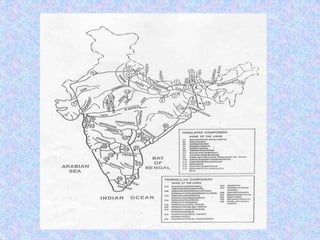
• INTERLINKING OF RIVERS???
Necessity for more water
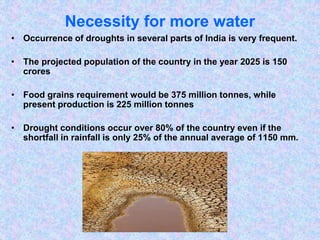
• Occurrence of droughts in several parts of India is very frequent.
• The projected population of the country in the year 2025 is 150
crores
• Food grains requirement would be 375 million tonnes, while
present production is 225 million tonnes
• Drought conditions occur over 80% of the country even if the
shortfall in rainfall is only 25% of the annual average of 1150 mm.
Why Interlinking of rivers?
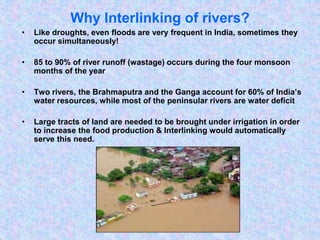
• Like droughts, even floods are very frequent in India, sometimes they
occur simultaneously!
• 85 to 90% of river runoff (wastage) occurs during the four monsoon
months of the year
• Two rivers, the Brahmaputra and the Ganga account for 60% of India’s
water resources, while most of the peninsular rivers are water deficit
• Large tracts of land are needed to be brought under irrigation in order
to increase the food production & Interlinking would automatically
serve this need.
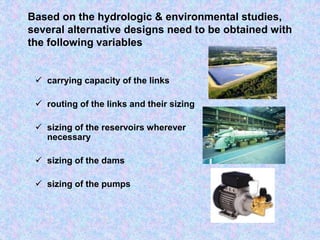
Based on the hydrologic & environmental studies,
several alternative designs need to be obtained with
the following variables
 carrying capacity of the links
 routing of the links and their sizing
 sizing of the reservoirs wherever
necessary
 sizing of the dams
 sizing of the pumps
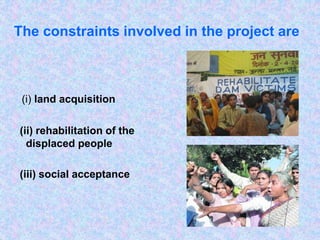
(i) land acquisition
(ii) rehabilitation of the
displaced people
(iii) social acceptance
The constraints involved in the project are
Total Expected Cost Rs. 560,000 crores
Sub-Division of total cost (Assumed, Rs in crores)
Works 403,000
Machinery & Capital goods 44,000
Services 50,000
Others 10,000
Fixed salary & land acquisition cost 53,000
NEED TO UNDERSTAND
• Mechanics of Water Flow (Surface & Subsurface)
• Hydrology (Gathering, management & analysis of
data)
• Systems Analysis
• Concepts of Uncertainty & Reliability
• Water Economics
• Planning & Financing of Water Resources
• Water Law
• Water Resources Quality (Fate & Transport of
pollutants)
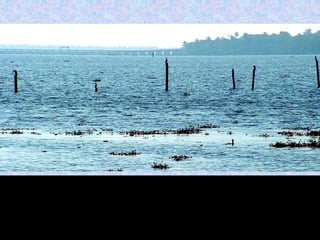
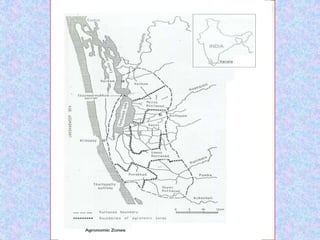
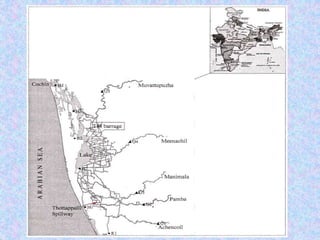
PROBLEMS ASSOCIATED WITH WATER MANAGEMENT
(Hydraulic & Hydrologic)
•Salinity Intrusion
•Floods
•Tidal effects & Inflow from rivers
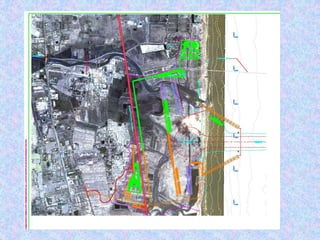
•Inappropriate operation of TMB & Thotapalli Spillway
•Inadequacy of TMB & Thotapalli Spillway
•Channel / Mouth conditions d/s of TMB / TSW
None of these issues can be looked at individually
FLOOD AND WATER QUALITY
MANAGEMENT IN
ADYAR RIVER
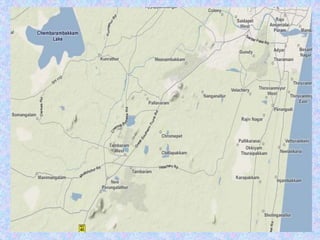
• Origin: Kancheepuram (Pillaipakkam and Kavanur Tank Groups)
• Catchment Area: 860 Km2
• Total Length: 42.5 Km
• Length in City: 15 Km
• Length in CMA: 24 Km
• Width: 10 to 200 m
• Average Discharge: 89.4 MCM/Year
• Backwater: Up to 4 Km inland
PROBLEMS WITH ADYAR
• FLOODS
• POLLUTION
• ENCROACHMENTS
• ECOLOGY
FLOODS
• Surplus waters from: 40 Tanks and lakes
Chembarambakkam also
• Major Floods: 1943, 1978, 1985,
2002, 2005
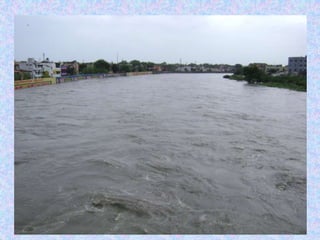
• Estimated Max. Discharge: 72,000 cfs (1950 m3/s)
• Discharge in 2005: 60,000 cfs (1620 m3/s)
• Reasons:
(i) Heavy Rain + Cyclonic Activity
(ii) Silted up waterway
(iii) Obstructions due to encroachments
(iv) Conversion of tanks into residential areas
(v) Geology not conducive for infiltration
EFFECTS
• Loss of Property
• Disruption of lives of slum dwellers
(i) Displacement (50,000 persons)
(ii) Expenditure in relief
(iii) Loss of manpower
• Health:
Malarial mosquitoes have returned in full measure
Rs. 4 crores per year for temporary measures ! (desilting)
POLLUTION
• 97 infalls into the river (58 sewage discharge points)
• Effluent from CETP of about 150 tanneries
discharges at Anakaputhur
• Effluent from Nesapakkam sewage treatment plant
• Industrial effluent: 1 MLD
• Domestic sewage: 8 MLD
• DO is OK at Nandambakkam
• DO at Saidapet (8 Km d/s) is close to zero
• BOD is as high as 375 mg/L
• Heavy metals like Cr are found (1.25 mg/L)
• Nitrates: 16 -125 t/day
• Phosphates: 1.0 -18 t/day
• Lead: 1 kg/day
• Groundwater in areas close to river are polluted
• Absence of minimum ecological flows
• High deposits of solid waste
• Presence of bacteria and virus – very high
Rs. 1700 crores for restoration of Chennai waterways
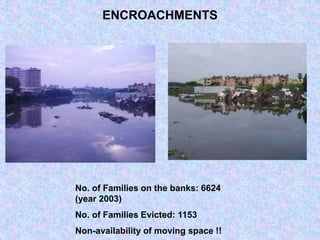
ENCROACHMENTS
No. of Families on the banks: 6624
(year 2003)
No. of Families Evicted: 1153
Non-availability of moving space !!
• Adyar estuary is an important part of Chennai Eco-
system
• Has been a haven for migratory & resident birds
• Pollution has resulted in the decline
• Emissions fluxes for the whole Adyar system
2.5 × 10⁸ g CH4 /year and 2.4 × 10⁶ g N2O /year
• Equivalent to total Chennai motor vehicle CO2 emissions
in one month
ECOLOGY
Many Proposals !
• River Restoration for Improving the Quality
• New Treatment Facilities for Wastewater
• Ecological Park in the Estuary
• Increasing the Flood Carrying Capacity
• 5 Check Dams in the Upstream Region
• Creation of New Storage Facilities
• Linking Palar river with Adyar River
Hydroualics a Case Study for newly engineering.ppt