Hydrogen Investor
Roadmap
Leading the Way to Net Zero
April 2022
Low carbon hydrogen will be vital to achieving net zero by
2050, with the potential to help decarbonise key UK industrial
sectors and provide energy across power, transport and heat.
After setting out an aim for 5GW of low carbon hydrogen
production capacity by 2030 in the UK Hydrogen Strategy we
are now doubling our ambition to up to 10GW by 2030,
subject to affordability and value for money, with at least half
from electrolytic hydrogen.
The recent policy announcements on a Net Zero Hydrogen
Fund to support deployment, a business model to ensure
long-term revenue support, and a Low Carbon Hydrogen
Standard to enable market access and certainty represent the
next substantial step forward to developing a thriving UK
hydrogen economy.
We expect that up to 2GW of low carbon hydrogen
production capacity will be in operation or construction by
2025, providing the necessary certainty to unlock over £9bn
of private investment we want to see by 2030.
2
Hydrogen Investor Roadmap: Leading the way to Net Zero
Hydrogen Investor
Roadmap
Leading the Way to Net Zero
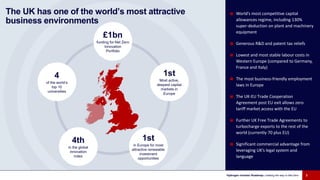
■ World’s most competitive capital
allowances regime, including 130%
super-deduction on plant and machinery
equipment
■ Generous R&D and patent tax reliefs
■ Lowest and most stable labour costs in
Western Europe (compared to Germany,
France and Italy)
■ The most business-friendly employment
laws in Europe
■ The UK-EU Trade Cooperation
Agreement post EU exit allows zero
tariff market access with the EU
■ Further UK Free Trade Agreements to
turbocharge exports to the rest of the
world (currently 70 plus EU)
■ Significant commercial advantage from
leveraging UK’s legal system and
language
The UK has one of the world’s most attractive
business environments
3
Hydrogen Investor Roadmap: Leading the way to Net Zero
4th
in the global
innovation
index
1st
in Europe for most
attractive renewable
investment
opportunities
1st
Most active,
deepest capital
markets in
Europe
4
of the world’s
top 10
universities
£1bn
funding for Net Zero
Innovation
Portfolio
£12bn
capital available from
UK Infrastructure
Bank with H2
as priority
Opportunities in an advanced &
growing sector:
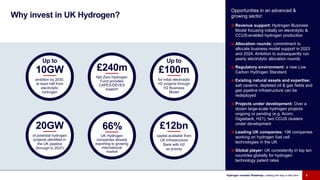
■ Revenue support: Hydrogen Business
Model focusing initially on electrolytic &
CCUS-enabled hydrogen production
■ Allocation rounds: commitment to
allocate business model support in 2023
and 2024. Ambition to subsequently run
yearly electrolytic allocation rounds
■ Regulatory environment: a new Low
Carbon Hydrogen Standard
■ Existing natural assets and expertise:
salt caverns, depleted oil & gas fields and
gas pipeline infrastructure can be
redeployed
■ Projects under development: Over a
dozen large-scale hydrogen projects
ongoing or pending (e.g. Acorn,
Gigastack, H21), two CCUS clusters
under development
■ Leading UK companies: 196 companies
working on hydrogen fuel cell
technologies in the UK
■ Global player: UK consistently in top ten
countries globally for hydrogen
technology patent rates
Why invest in UK Hydrogen?
4
20GW
of potential hydrogen
projects identified in
the UK pipeline
(through to 2037)
Hydrogen Investor Roadmap: Leading the way to Net Zero
£240m
Net Zero Hydrogen
Fund provides
CAPEX/DEVEX
support
10GW
ambition by 2030,
at least half from
electrolytic
hydrogen
Up to
£100m
for initial electrolytic
H2 projects through
H2 Business
Model
Up to
66%
UK Hydrogen
companies already
exporting to growing
international
market
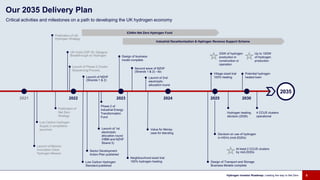
Our 2035 Delivery Plan
Critical activities and milestones on a path to developing the UK hydrogen economy
5
2035
2021 2022 2023 2024 2025 2030
Publication of
Net Zero
Strategy
Launch of Mission
Innovation Clean
Hydrogen Mission
Low Carbon Hydrogen
Supply 2 competition
launched
Low Carbon Hydrogen
Standard published
Sector Development
Action Plan published
Phase 2 of
Industrial Energy
Transformation
Fund
Launch of 1st
electrolytic
allocation round
(HBM and NZHF
Strand 3)
Neighbourhood sized trial
100% hydrogen heating Design of Transport and Storage
Business Models complete
Value for Money
case for blending
Hydrogen heating
decision (2026)
4 CCUS clusters
operational
Decision on use of hydrogen
in HGVs (mid-2020s)
UK hosts COP 26: Glasgow
Breakthrough on Hydrogen
Village sized trial
100% heating
Launch of NZHF
(Strands 1 & 2)
Potential hydrogen
heated town
Publication of UK
Hydrogen Strategy
Design of business
model complete
Launch of 2nd
electrolytic
allocation round
Second wave of NZHF
(Strands 1 & 2) - tbc
Launch of Phase-2 Cluster
Sequencing Process.
Industrial Decarbonisation & Hydrogen Revenue Support Scheme
£240m Net Zero Hydrogen Fund
2GW of hydrogen
production in
construction or
operation
Up to 10GW
of Hydrogen
production
At least 2 CCUS clusters
by mid-2020s
Hydrogen Investor Roadmap: Leading the way to Net Zero
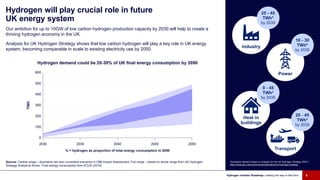
Hydrogen will play crucial role in future
UK energy system
Our ambition for up to 10GW of low carbon hydrogen production capacity by 2030 will help to create a
thriving hydrogen economy in the UK.
Analysis for UK Hydrogen Strategy shows that low carbon hydrogen will play a key role in UK energy
system, becoming comparable in scale to existing electricity use by 2050.
*Illustrative demand based on analysis for the UK Hydrogen Strategy (2021)
https://www.gov.uk/government/publications/uk-hydrogen-strategy
Source: Central range – illustrative net zero consistent scenarios in CB6 Impact Assessment. Full range – based on whole range from UK Hydrogen
Strategy Analytical Annex. Final energy consumption from ECUK (2019).
10 - 30
TWh*
by 2035
Power
25 - 45
TWh*
by 2035
Industry
0 - 45
TWh*
by 2035
Heat in
buildings
20 - 45
TWh*
by 2035
Transport
Hydrogen Investor Roadmap: Leading the way to Net Zero 6
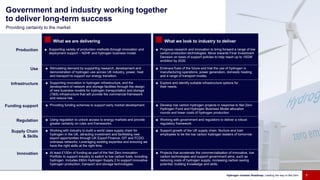
Government and industry working together
to deliver long-term success
Providing certainty to the market
What we are delivering What we look to industry to deliver
Production ■ Supporting variety of production methods through innovation and
deployment support – NZHF and hydrogen business model.
■ Progress research and innovation to bring forward a range of low
carbon production technologies. Move towards Final Investment
Decision on basis of support policies to help reach up to 10GW
ambition by 2030.
Use ■ Stimulating demand by supporting research, development and
demonstration of hydrogen use across UK industry, power, heat
and transport to support our energy transition.
■ Embrace fuels of the future and trial the use of hydrogen in
manufacturing operations, power generation, domestic heating
and a range of transport modes.
Infrastructure ■ Supporting innovation in hydrogen infrastructure, and the
development of network and storage facilities through the design
of new business models for hydrogen transportation and storage
(T&S) infrastructure that will provide the commercial framework
and reduce risk.
■ Explore and identify suitable infrastructure options for
their needs.
Funding support ■ Providing funding schemes to support early market development. ■ Develop low carbon hydrogen projects in response to Net Zero
Hydrogen Fund and Hydrogen Business Model allocation
rounds and lower costs of hydrogen production.
Regulation ■ Using regulation to unlock access to energy markets and provide
greater certainty on rules and frameworks.
■ Working with government and regulators to deliver a robust
regulatory framework.
Supply Chain
& Skills
■ Working with industry to build a world class supply chain for
hydrogen in the UK, attracting investment and facilitating new
export opportunities through UK Export Finance, DIT and FCDO
overseas networks. Leveraging existing expertise and ensuring we
have the right skills at the right time.
■ Support growth of the UK supply chain. Nurture and train
employees to be the low carbon hydrogen leaders of tomorrow.
Innovation ■ At least £100m of funding as part of the Net Zero Innovation
Portfolio to support industry to switch to low carbon fuels, including
hydrogen. Includes £60m Hydrogen Supply 2 to support innovative
hydrogen production, transport and storage technologies.
■ Projects that accelerate the commercialisation of innovative, low
carbon technologies and support government aims, such as
reducing costs of hydrogen supply, increasing carbon saving
potential, building knowledge and skills.
Hydrogen Investor Roadmap: Leading the way to Net Zero 7
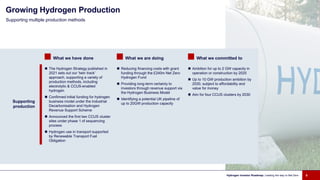
Supporting multiple production methods
Growing Hydrogen Production
Hydrogen Investor Roadmap: Leading the way to Net Zero 8
What we have done What we are doing What we committed to
Supporting
production
 The Hydrogen Strategy published in
2021 sets out our ‘twin track’
approach, supporting a variety of
production methods, including
electrolytic & CCUS-enabled
hydrogen
 Confirmed initial funding for hydrogen
business model under the Industrial
Decarbonisation and Hydrogen
Revenue Support Scheme
 Announced the first two CCUS cluster
sites under phase 1 of sequencing
process
 Hydrogen use in transport supported
by Renewable Transport Fuel
Obligation
 Reducing financing costs with grant
funding through the £240m Net Zero
Hydrogen Fund
 Providing long-term certainty to
investors through revenue support via
the Hydrogen Business Model
 Identifying a potential UK pipeline of
up to 20GW production capacity
 Ambition for up to 2 GW capacity in
operation or construction by 2025
 Up to 10 GW production ambition by
2030, subject to affordability and
value for money
 Aim for four CCUS clusters by 2030
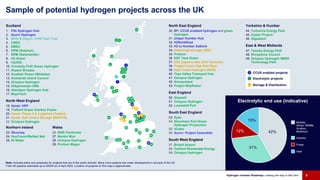
Sample of potential hydrogen projects across the UK
Hydrogen Investor Roadmap: Leading the way to Net Zero 9
Note: Includes plans and proposals for projects that are in the public domain. Many more projects are under development in all parts of the UK.
Total UK pipeline estimated up to 20GW as of April 2022. Location of projects on this map is approximate.
30
7
3
5
2
56
53
25
32
10
26
4
6
18
33
31
38
20
37
39
34
23
9
43
8
11
12
19
27
35
36
40
44
45
50
46
47
48
57
58
59
49
14
51
41
28
22
42
52
21
54
15
55
16
29
17
24
1
13
North East England
30. BP: CCUS enabled hydrogen and green
hydrogen
31. Uniper Humber Hub
32. H2NorthEast
33. H2 to Humber Saltend
34. Aldbrough storage (SSE)
35. Protium
36. EDF Tees Green
37. ECC pipeline (Nat Grid Ventures)
38. Project Union (Nat Grid Gas)
39. East Coast Hydrogen (NGN)
40. Tees Valley Transport Hub
41. Octopus Hydrogen
42. Anonymized
43. Project Mayflower
East England
50. Sizewell
51. Octopus Hydrogen
52. Lowestoft Port
South East England
53. Ryze
54. Shoreham Port Green
Hydrogen Production
55. Viridor
56. Acorn: Project Cavendish
South West England
57. Bristol Airport
58. Canford Renewable Energy
59. Octopus Hydrogen
Yorkshire & Humber
44. Yorkshire Energy Park
45. Oyster Project
46. Gigastack
East & West Midlands
47. Tyseley Energy Park
48. Shropshire Council
49. Octopus Hydrogen /MIRA
Technology Park
Scotland
1. Fife Hydrogen Hub
2. Acorn Hydrogen
3. BEIS & Ofgem: H100 Heat Trial
4. CNES
5. EMEC
6. ERM (Dolphyn)
7. ERM (Salamander)
8. H2 Green
9. Hy2GO
10. Cromarty Firth Green Hydrogen
11. Repsol Sinopec
12. Scottish Power (Whitelee)
13. Shetlands Island Council
14. Octopus Hydrogen
15. Kittybrewster HRS
16. Aberdeen Hydrogen Hub
17. BayoTech
North West England
18. Hynet: HPP
19. Trafford Green /Carlton Power
20. Hynet: Phase 2 & 3 pipeline (Cadent)
21. Hynet: Salt Cavern Storage (INOVYN)
22. Octopus Hydrogen
Northern Ireland
23. Skuunaq
24. GenComm/Belfast Met
25. NI Water
Wales
26. RWE Pembroke
27. Mentor Mon
28. Octopus Hydrogen
29. Protium Magor
CCUS enabled projects
Electrolytic projects
Storage & Distribution
42%
31%
12%
15%
Electrolytic end use (indicative)
Industry
Power
Heat
Mobility
(Road, NRMM,
Aviation,
Maritime)
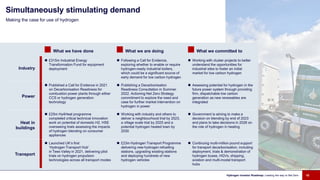
What we have done What we are doing What we committed to
Industry
 £315m Industrial Energy
Transformation Fund for equipment
deployment
 Following a Call for Evidence,
exploring whether to enable or require
hydrogen-ready industrial boilers,
which could be a significant source of
early demand for low carbon hydrogen
 Working with cluster projects to better
understand the opportunities for
industrial sites to foster an initial
market for low carbon hydrogen
Power
 Published a Call for Evidence in 2021
on Decarbonisation Readiness for
combustion power plants through either
CCS or hydrogen generation
technology
 Publishing a Decarbonisation
Readiness Consultation in Summer
2022. Actioning Net Zero Strategy
commitment to explore the need and
case for further market intervention on
hydrogen in power
 Assessing potential for hydrogen in the
future power system through providing
firm, dispatchable low carbon
generation as new renewables are
integrated
Heat in
buildings
 £25m Hy4Heat programme
completed critical technical innovation
work on potential of domestic H2. HSE
overseeing trials assessing the impacts
of hydrogen blending on consumer
appliances
 Working with industry and others to
deliver a neighbourhood trial by 2023,
a village scale trial by 2025 and a
potential hydrogen heated town by
2030
 Government is aiming to make a
decision on blending by end of 2023
and plans to take decisions in 2026 on
the role of hydrogen in heating
Transport
 Launched UK’s first
‘Hydrogen Transport Hub’
in Tees Valley in 2021, delivering pilot
trials on hydrogen propulsion
technologies across all transport modes
 £23m Hydrogen Transport Programme
delivering new hydrogen refuelling
stations, upgrading existing stations
and deploying hundreds of new
hydrogen vehicles
 Continuing multi-million pound support
for transport decarbonisation, including
deployment, trials & demonstration of
hydrogen buses, HGVs, shipping,
aviation and multi-modal transport
hubs
Making the case for use of hydrogen
Simultaneously stimulating demand
Hydrogen Investor Roadmap: Leading the way to Net Zero 10
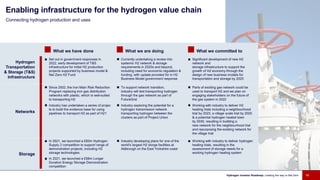
What we have done What we are doing What we committed to
Hydrogen
Transportation
& Storage (T&S)
Infrastructure
■ Set out in government responses in
2022, early development of T&S
infrastructure for initial H2 production
projects supported by business model &
Net Zero H2 Fund
 Currently undertaking a review into
systemic H2 network & storage
requirements in 2020s and beyond,
including need for economic regulation &
funding, with update provided for in H2
Business Model government response
■ Significant development of new H2
network and
storage infrastructure to support the
growth of H2 economy through the
design of new business models for
transportation and storage by 2025
Networks
 Since 2002, the Iron Main Risk Reduction
Program replacing iron gas distribution
networks with plastic, which is well-suited
to transporting H2
 Industry has undertaken a series of projec
ts to build the evidence base for using
pipelines to transport H2 as part of H21
 To support network transition,
industry will test transporting hydrogen
through the gas network as part of
FutureGrid
 Industry exploring the potential for a
hydrogen transmission network
transporting hydrogen between the
clusters as part of Project Union
 Parts of existing gas network could be
used to transport H2 and we plan on
engaging stakeholders on the future of
the gas system in 2022
 Working with industry to deliver H2
heating trials including a neighbourhood
trial by 2023, a village scale trial by 2025
& a potential hydrogen heated town
by 2030, resulting in building a
new network for the neighbourhood trial
and repurposing the existing network for
the village trial
Storage
■ In 2021, we launched a £60m Hydrogen
Supply 2 competition to support range of
demonstration projects, including H2
storage technologies
■ In 2021, we launched a £68m Longer
Duration Energy Storage Demonstration
competition
 Industry developing plans for one of the
world's largest H2 storge facilities at
Aldbrough on the East Yorkshire coast
■ Working with industry to deliver hydrogen
heating trials, resulting in the
assessment of storage needs for a
working hydrogen heating system
Connecting hydrogen production and uses
Enabling infrastructure for the hydrogen value chain
Hydrogen Investor Roadmap: Leading the way to Net Zero 11
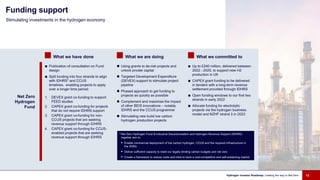
What we have done What we are doing What we committed to
Net Zero
Hydrogen
Fund
■ Publication of consultation on Fund
design
■ Split funding into four strands to align
with IDHRS* and CCUS
timelines, enabling projects to apply
over a longer time period:
1. DEVEX grant co-funding to support
FEED studies
2. CAPEX grant co-funding for projects
that do not require IDHRS support
3. CAPEX grant co-funding for non-
CCUS projects that are seeking
revenue support through IDHRS
4. CAPEX grant co-funding for CCUS-
enabled projects that are seeking
revenue support through IDHRS
 Using grants to de-risk projects and
unlock private capital
 Targeted Development Expenditure
(DEVEX) support to stimulate project
pipeline
 Phased approach to get funding to
projects as quickly as possible
 Complement and maximise the impact
of other BEIS innovations – notably
IDHRS and the CCUS programme
 Stimulating new build low carbon
hydrogen production projects
■ Up to £240 million, delivered between
2022 - 2025, to support new H2
production in UK
■ CAPEX grant funding to be delivered
in tandem with a long-term revenue
settlement provided through IDHRS
■ Open funding windows to our first two
strands in early 2022
■ Allocate funding for electrolytic
projects via the hydrogen business
model and NZHF strand 3 in 2023
Stimulating investments in the hydrogen economy
Funding support
Hydrogen Investor Roadmap: Leading the way to Net Zero 12
*Net Zero Hydrogen Fund & Industrial Decarbonisation and Hydrogen Revenue Support (IDHRS)
together aim to:
 Enable commercial deployment of low carbon hydrogen, CCUS and the required infrastructure in
the 2020s
 Deliver sufficient capacity to meet our legally binding carbon budgets and net zero
 Create a framework to reduce costs and risks to have a cost-competitive and self-sustaining market
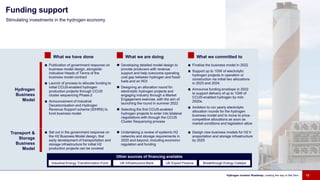
What we have done What we are doing What we committed to
Hydrogen
Business
Model
■ Publication of government response on
business model design, alongside
indicative Heads of Terms of the
business model contract
■ Launch of process to allocate funding to
initial CCUS-enabled hydrogen
production projects through CCUS
cluster sequencing Phase-2
■ Announcement of Industrial
Decarbonisation and Hydrogen
Revenue Support scheme (IDHRS) to
fund business model
 Developing detailed model design to
provide producers with revenue
support and help overcome operating
cost gap between hydrogen and fossil
fuels and an ROI
 Designing an allocation round for
electrolytic hydrogen projects and
engaging industry through a Market
Engagement exercise, with the aim of
launching the round in summer 2022
 Selecting the first CCUS-enabled
hydrogen projects to enter into bilateral
negotiations with through the CCUS
Cluster Sequencing process
■ Finalise the business model in 2022
■ Support up to 1GW of electrolytic
hydrogen projects in operation or
construction via initial two allocations
in 2023 and 2024.
■ Announce funding envelope in 2022
to support delivery of up to 1GW of
CCUS-enabled hydrogen by mid-
2020s.
■ Ambition to run yearly electrolytic
allocation rounds for the hydrogen
business model and to move to price-
competitive allocations as soon as
market conditions and legislation allow
Transport &
Storage
Business
Model
■ Set out in the government response on
the H2 Business Model design, that
early development of transportation and
storage infrastructure for initial H2
production projects can be covered
 Undertaking a review of systemic H2
networks and storage requirements in
2020 and beyond, including economic
regulation and funding
■ Design new business models for H2 tr
ansportation and storage infrastructure
by 2025
Stimulating investments in the hydrogen economy
Funding support
Hydrogen Investor Roadmap: Leading the way to Net Zero 13
Other sources of financing available
Industrial Energy Transformation Fund Breakthrough Energy Catalyst
UK Infrastructure Bank UK Export Finance
What we have done What we are doing What we committed to
Low Carbon
Hydrogen
Standard
■ Published the final design of the low
carbon hydrogen standard
 The consultation sought views on
design options for a UK standard
defining 'low carbon' hydrogen, to
underpin our support for hydrogen
production
 Developing a greenhouse gas
emissions threshold for ‘low carbon’
hydrogen and the methodology for
calculating emissions
 Consulting on potentially including the
standard under the Green Taxonomy,
to support investment in low carbon
hydrogen
■ Levelling the playing field by setting up
a hydrogen certification scheme by
2025, so the UK can play an active
role in the international hydrogen
market
 Taking full advantage of future global
trade and investment opportunities by
ensuring the standard is developed in
line with international developments
Non
Economic
Regulations
 Established a Hydrogen Regulators
Forum to determine current and future
non-economic regulatory
responsibilities across the hydrogen
value chain
 Working to identify, prioritise and
implement any changes to the existing
non-economic regulatory framework –
including addressing any gaps – to
support the growth of a hydrogen
economy
 Addressing regulatory barriers facing
first-of-a-kind H2 projects. Using
regulation to unlock access to
new markets. Ensuring role for H2
is considered in broader reviews of
regulation
Maximising UK capabilities
Robust regulatory environment
Hydrogen Investor Roadmap: Leading the way to Net Zero 14
What we have done What we are doing What we committed to
Supply
chains
■ Established strengths in
electrochemical technologies, including
fuel cells and electrolysers, which UK
companies are exporting overseas and
our functional strengths in planning,
legal, professional and financial
services
 Government working to promote
growth of UK supply chains to meet
hydrogen deployment ambitions.
 UK Export Finance providing enhanced
support for investment into developing
export capabilities
■ Supporting UK expertise in high-end
manufacturing, oil & gas, renewables,
chemicals, safety and EPCm
Skills ■ Published the Green Jobs Taskforce
report and established a Green Jobs
Delivery Group with representatives
from industry, the skills sector and other
key stakeholders to support the
development and delivery of the
Government’s plans for green jobs
and skills
 Working with industry and others to
ensure investment in skills needed
across the value chain and drive local
and regional opportunities, helping to
level-up across our industrial
heartlands
 Continue to deliver relevant green T-
levels, apprenticeships and skills
bootcamps
■ North Sea Transition Deal includes a
commitment to facilitate the reskilling
of existing parts of the oil and gas
workforce to ensure people and skills
are transferable across the wider
energy sector
Funding
innovation
■ Government has supported the
development of innovative low carbon
hydrogen technologies, providing over
£90m in direct R&I funding across the
supply chain in the last 5 years.
Hydrogen is a key priority area in our
£1bn Net Zero Innovation Portfolio
 The UK co-leads the Clean Hydrogen
Mission, with the goal of reducing end-
to-end costs to $2 per kilogram by
2030
 Programme of key research and
innovation challenges across all net
zero sectors over the next 5-10 years,
including hydrogen. Continued
collaboration with UKRI, including
Innovate UK
Maximising UK capabilities
World class UK supply chains, skills and innovation
Hydrogen Investor Roadmap: Leading the way to Net Zero 15
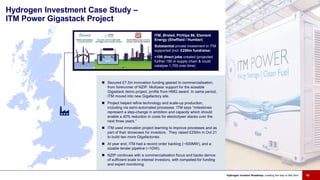
Hydrogen Investment Case Study –
ITM Power Gigastack Project
ITM, Ørsted, Phillips 66, Element
Energy (Sheffield / Humber)
Substantial private investment in ITM
supported (incl. £250m fundraise)
>100 direct jobs created (projected
further 180 in supply chain & could
catalyse 1,700 over time)
Hydrogen Investor Roadmap: Leading the way to Net Zero 16
 Secured £7.5m innovation funding geared to commercialisation,
from forerunner of NZIP. Multiyear support for the sizeable
Gigastack demo project, profile from HMG award. In same period,
ITM moved into new Gigafactory site.
 Project helped refine technology and scale-up production,
including via semi-automated processes. ITM says “milestones
represent a step-change in ambition and capacity which should
enable a 40% reduction in costs for electrolyser stacks over the
next three years.”
 ITM used innovation project learning to improve processes and as
part of their showcase for investors. They raised £250m in Oct 21
to build two more Gigafactories.
 At year end, ITM had a record order backlog (~500MW), and a
sizable tender pipeline (~1GW).
 NZIP continues with a commercialisation focus and backs demos
of sufficient scale to interest investors, with competed-for funding
and expert monitoring.
Department for International Trade
The UK’s Department for International Trade (DIT) has overall responsibility for
promoting UK trade across the world and attracting foreign investment to our
economy. We are a specialised government body with responsibility for negotiating
international trade policy, supporting business, as well as delivering an outward-
looking trade diplomacy strategy.
Disclaimer
This information has been prepared by the Department for International Trade (DIT),
and suppliers of DIT, for general informational purposes only. This information is not
intended to amount to advice on which you should rely. Although DIT and its
suppliers makes reasonable efforts to ensure the accuracy of any information
provided, neither DIT nor any of its suppliers makes any representations, warranties
or guarantees, whether express or implied, that any information supplied is accurate,
complete or up-to-date. Accordingly, you must obtain professional or specialist
advice before taking, or refraining from, any action on the basis of this information.
Neither DIT nor any of its suppliers accepts any responsibility for updating this
information in light of subsequent events or for any other reason. This information
does not constitute a recommendation or endorsement by DIT or any of its suppliers.
To the fullest extent permitted by law, neither DIT nor any of its suppliers accepts or
assumes any responsibility or liability to any reader of this information for any loss or
damage, whether in contract, tort (including negligence), breach of statutory duty, or
otherwise, even if foreseeable, arising under or in connection with the use of or
reliance on this information including, but not limited to, loss of profits, sales,
business, or revenue, business interruption, loss of business opportunity, goodwill or
reputation, or any indirect or consequential loss or damage. Should any such reader
choose to rely on this information, then they do so at their own risk.
DIT is the owner, or the licensee, of all intellectual property rights in this information
and DIT reserves all rights in this information.
great.gov.uk
Published April 2022

hydrogen-investor-roadmap.pdf

  • 1.
    Hydrogen Investor Roadmap Leading theWay to Net Zero April 2022
  • 2.
    Low carbon hydrogenwill be vital to achieving net zero by 2050, with the potential to help decarbonise key UK industrial sectors and provide energy across power, transport and heat. After setting out an aim for 5GW of low carbon hydrogen production capacity by 2030 in the UK Hydrogen Strategy we are now doubling our ambition to up to 10GW by 2030, subject to affordability and value for money, with at least half from electrolytic hydrogen. The recent policy announcements on a Net Zero Hydrogen Fund to support deployment, a business model to ensure long-term revenue support, and a Low Carbon Hydrogen Standard to enable market access and certainty represent the next substantial step forward to developing a thriving UK hydrogen economy. We expect that up to 2GW of low carbon hydrogen production capacity will be in operation or construction by 2025, providing the necessary certainty to unlock over £9bn of private investment we want to see by 2030. 2 Hydrogen Investor Roadmap: Leading the way to Net Zero Hydrogen Investor Roadmap Leading the Way to Net Zero
  • 3.
    ■ World’s mostcompetitive capital allowances regime, including 130% super-deduction on plant and machinery equipment ■ Generous R&D and patent tax reliefs ■ Lowest and most stable labour costs in Western Europe (compared to Germany, France and Italy) ■ The most business-friendly employment laws in Europe ■ The UK-EU Trade Cooperation Agreement post EU exit allows zero tariff market access with the EU ■ Further UK Free Trade Agreements to turbocharge exports to the rest of the world (currently 70 plus EU) ■ Significant commercial advantage from leveraging UK’s legal system and language The UK has one of the world’s most attractive business environments 3 Hydrogen Investor Roadmap: Leading the way to Net Zero 4th in the global innovation index 1st in Europe for most attractive renewable investment opportunities 1st Most active, deepest capital markets in Europe 4 of the world’s top 10 universities £1bn funding for Net Zero Innovation Portfolio
  • 4.
    £12bn capital available from UKInfrastructure Bank with H2 as priority Opportunities in an advanced & growing sector: ■ Revenue support: Hydrogen Business Model focusing initially on electrolytic & CCUS-enabled hydrogen production ■ Allocation rounds: commitment to allocate business model support in 2023 and 2024. Ambition to subsequently run yearly electrolytic allocation rounds ■ Regulatory environment: a new Low Carbon Hydrogen Standard ■ Existing natural assets and expertise: salt caverns, depleted oil & gas fields and gas pipeline infrastructure can be redeployed ■ Projects under development: Over a dozen large-scale hydrogen projects ongoing or pending (e.g. Acorn, Gigastack, H21), two CCUS clusters under development ■ Leading UK companies: 196 companies working on hydrogen fuel cell technologies in the UK ■ Global player: UK consistently in top ten countries globally for hydrogen technology patent rates Why invest in UK Hydrogen? 4 20GW of potential hydrogen projects identified in the UK pipeline (through to 2037) Hydrogen Investor Roadmap: Leading the way to Net Zero £240m Net Zero Hydrogen Fund provides CAPEX/DEVEX support 10GW ambition by 2030, at least half from electrolytic hydrogen Up to £100m for initial electrolytic H2 projects through H2 Business Model Up to 66% UK Hydrogen companies already exporting to growing international market
  • 5.
    Our 2035 DeliveryPlan Critical activities and milestones on a path to developing the UK hydrogen economy 5 2035 2021 2022 2023 2024 2025 2030 Publication of Net Zero Strategy Launch of Mission Innovation Clean Hydrogen Mission Low Carbon Hydrogen Supply 2 competition launched Low Carbon Hydrogen Standard published Sector Development Action Plan published Phase 2 of Industrial Energy Transformation Fund Launch of 1st electrolytic allocation round (HBM and NZHF Strand 3) Neighbourhood sized trial 100% hydrogen heating Design of Transport and Storage Business Models complete Value for Money case for blending Hydrogen heating decision (2026) 4 CCUS clusters operational Decision on use of hydrogen in HGVs (mid-2020s) UK hosts COP 26: Glasgow Breakthrough on Hydrogen Village sized trial 100% heating Launch of NZHF (Strands 1 & 2) Potential hydrogen heated town Publication of UK Hydrogen Strategy Design of business model complete Launch of 2nd electrolytic allocation round Second wave of NZHF (Strands 1 & 2) - tbc Launch of Phase-2 Cluster Sequencing Process. Industrial Decarbonisation & Hydrogen Revenue Support Scheme £240m Net Zero Hydrogen Fund 2GW of hydrogen production in construction or operation Up to 10GW of Hydrogen production At least 2 CCUS clusters by mid-2020s Hydrogen Investor Roadmap: Leading the way to Net Zero
  • 6.
    Hydrogen will playcrucial role in future UK energy system Our ambition for up to 10GW of low carbon hydrogen production capacity by 2030 will help to create a thriving hydrogen economy in the UK. Analysis for UK Hydrogen Strategy shows that low carbon hydrogen will play a key role in UK energy system, becoming comparable in scale to existing electricity use by 2050. *Illustrative demand based on analysis for the UK Hydrogen Strategy (2021) https://www.gov.uk/government/publications/uk-hydrogen-strategy Source: Central range – illustrative net zero consistent scenarios in CB6 Impact Assessment. Full range – based on whole range from UK Hydrogen Strategy Analytical Annex. Final energy consumption from ECUK (2019). 10 - 30 TWh* by 2035 Power 25 - 45 TWh* by 2035 Industry 0 - 45 TWh* by 2035 Heat in buildings 20 - 45 TWh* by 2035 Transport Hydrogen Investor Roadmap: Leading the way to Net Zero 6
  • 7.
    Government and industryworking together to deliver long-term success Providing certainty to the market What we are delivering What we look to industry to deliver Production ■ Supporting variety of production methods through innovation and deployment support – NZHF and hydrogen business model. ■ Progress research and innovation to bring forward a range of low carbon production technologies. Move towards Final Investment Decision on basis of support policies to help reach up to 10GW ambition by 2030. Use ■ Stimulating demand by supporting research, development and demonstration of hydrogen use across UK industry, power, heat and transport to support our energy transition. ■ Embrace fuels of the future and trial the use of hydrogen in manufacturing operations, power generation, domestic heating and a range of transport modes. Infrastructure ■ Supporting innovation in hydrogen infrastructure, and the development of network and storage facilities through the design of new business models for hydrogen transportation and storage (T&S) infrastructure that will provide the commercial framework and reduce risk. ■ Explore and identify suitable infrastructure options for their needs. Funding support ■ Providing funding schemes to support early market development. ■ Develop low carbon hydrogen projects in response to Net Zero Hydrogen Fund and Hydrogen Business Model allocation rounds and lower costs of hydrogen production. Regulation ■ Using regulation to unlock access to energy markets and provide greater certainty on rules and frameworks. ■ Working with government and regulators to deliver a robust regulatory framework. Supply Chain & Skills ■ Working with industry to build a world class supply chain for hydrogen in the UK, attracting investment and facilitating new export opportunities through UK Export Finance, DIT and FCDO overseas networks. Leveraging existing expertise and ensuring we have the right skills at the right time. ■ Support growth of the UK supply chain. Nurture and train employees to be the low carbon hydrogen leaders of tomorrow. Innovation ■ At least £100m of funding as part of the Net Zero Innovation Portfolio to support industry to switch to low carbon fuels, including hydrogen. Includes £60m Hydrogen Supply 2 to support innovative hydrogen production, transport and storage technologies. ■ Projects that accelerate the commercialisation of innovative, low carbon technologies and support government aims, such as reducing costs of hydrogen supply, increasing carbon saving potential, building knowledge and skills. Hydrogen Investor Roadmap: Leading the way to Net Zero 7
  • 8.
    Supporting multiple productionmethods Growing Hydrogen Production Hydrogen Investor Roadmap: Leading the way to Net Zero 8 What we have done What we are doing What we committed to Supporting production  The Hydrogen Strategy published in 2021 sets out our ‘twin track’ approach, supporting a variety of production methods, including electrolytic & CCUS-enabled hydrogen  Confirmed initial funding for hydrogen business model under the Industrial Decarbonisation and Hydrogen Revenue Support Scheme  Announced the first two CCUS cluster sites under phase 1 of sequencing process  Hydrogen use in transport supported by Renewable Transport Fuel Obligation  Reducing financing costs with grant funding through the £240m Net Zero Hydrogen Fund  Providing long-term certainty to investors through revenue support via the Hydrogen Business Model  Identifying a potential UK pipeline of up to 20GW production capacity  Ambition for up to 2 GW capacity in operation or construction by 2025  Up to 10 GW production ambition by 2030, subject to affordability and value for money  Aim for four CCUS clusters by 2030
  • 9.
    Sample of potentialhydrogen projects across the UK Hydrogen Investor Roadmap: Leading the way to Net Zero 9 Note: Includes plans and proposals for projects that are in the public domain. Many more projects are under development in all parts of the UK. Total UK pipeline estimated up to 20GW as of April 2022. Location of projects on this map is approximate. 30 7 3 5 2 56 53 25 32 10 26 4 6 18 33 31 38 20 37 39 34 23 9 43 8 11 12 19 27 35 36 40 44 45 50 46 47 48 57 58 59 49 14 51 41 28 22 42 52 21 54 15 55 16 29 17 24 1 13 North East England 30. BP: CCUS enabled hydrogen and green hydrogen 31. Uniper Humber Hub 32. H2NorthEast 33. H2 to Humber Saltend 34. Aldbrough storage (SSE) 35. Protium 36. EDF Tees Green 37. ECC pipeline (Nat Grid Ventures) 38. Project Union (Nat Grid Gas) 39. East Coast Hydrogen (NGN) 40. Tees Valley Transport Hub 41. Octopus Hydrogen 42. Anonymized 43. Project Mayflower East England 50. Sizewell 51. Octopus Hydrogen 52. Lowestoft Port South East England 53. Ryze 54. Shoreham Port Green Hydrogen Production 55. Viridor 56. Acorn: Project Cavendish South West England 57. Bristol Airport 58. Canford Renewable Energy 59. Octopus Hydrogen Yorkshire & Humber 44. Yorkshire Energy Park 45. Oyster Project 46. Gigastack East & West Midlands 47. Tyseley Energy Park 48. Shropshire Council 49. Octopus Hydrogen /MIRA Technology Park Scotland 1. Fife Hydrogen Hub 2. Acorn Hydrogen 3. BEIS & Ofgem: H100 Heat Trial 4. CNES 5. EMEC 6. ERM (Dolphyn) 7. ERM (Salamander) 8. H2 Green 9. Hy2GO 10. Cromarty Firth Green Hydrogen 11. Repsol Sinopec 12. Scottish Power (Whitelee) 13. Shetlands Island Council 14. Octopus Hydrogen 15. Kittybrewster HRS 16. Aberdeen Hydrogen Hub 17. BayoTech North West England 18. Hynet: HPP 19. Trafford Green /Carlton Power 20. Hynet: Phase 2 & 3 pipeline (Cadent) 21. Hynet: Salt Cavern Storage (INOVYN) 22. Octopus Hydrogen Northern Ireland 23. Skuunaq 24. GenComm/Belfast Met 25. NI Water Wales 26. RWE Pembroke 27. Mentor Mon 28. Octopus Hydrogen 29. Protium Magor CCUS enabled projects Electrolytic projects Storage & Distribution 42% 31% 12% 15% Electrolytic end use (indicative) Industry Power Heat Mobility (Road, NRMM, Aviation, Maritime)
  • 10.
    What we havedone What we are doing What we committed to Industry  £315m Industrial Energy Transformation Fund for equipment deployment  Following a Call for Evidence, exploring whether to enable or require hydrogen-ready industrial boilers, which could be a significant source of early demand for low carbon hydrogen  Working with cluster projects to better understand the opportunities for industrial sites to foster an initial market for low carbon hydrogen Power  Published a Call for Evidence in 2021 on Decarbonisation Readiness for combustion power plants through either CCS or hydrogen generation technology  Publishing a Decarbonisation Readiness Consultation in Summer 2022. Actioning Net Zero Strategy commitment to explore the need and case for further market intervention on hydrogen in power  Assessing potential for hydrogen in the future power system through providing firm, dispatchable low carbon generation as new renewables are integrated Heat in buildings  £25m Hy4Heat programme completed critical technical innovation work on potential of domestic H2. HSE overseeing trials assessing the impacts of hydrogen blending on consumer appliances  Working with industry and others to deliver a neighbourhood trial by 2023, a village scale trial by 2025 and a potential hydrogen heated town by 2030  Government is aiming to make a decision on blending by end of 2023 and plans to take decisions in 2026 on the role of hydrogen in heating Transport  Launched UK’s first ‘Hydrogen Transport Hub’ in Tees Valley in 2021, delivering pilot trials on hydrogen propulsion technologies across all transport modes  £23m Hydrogen Transport Programme delivering new hydrogen refuelling stations, upgrading existing stations and deploying hundreds of new hydrogen vehicles  Continuing multi-million pound support for transport decarbonisation, including deployment, trials & demonstration of hydrogen buses, HGVs, shipping, aviation and multi-modal transport hubs Making the case for use of hydrogen Simultaneously stimulating demand Hydrogen Investor Roadmap: Leading the way to Net Zero 10
  • 11.
    What we havedone What we are doing What we committed to Hydrogen Transportation & Storage (T&S) Infrastructure ■ Set out in government responses in 2022, early development of T&S infrastructure for initial H2 production projects supported by business model & Net Zero H2 Fund  Currently undertaking a review into systemic H2 network & storage requirements in 2020s and beyond, including need for economic regulation & funding, with update provided for in H2 Business Model government response ■ Significant development of new H2 network and storage infrastructure to support the growth of H2 economy through the design of new business models for transportation and storage by 2025 Networks  Since 2002, the Iron Main Risk Reduction Program replacing iron gas distribution networks with plastic, which is well-suited to transporting H2  Industry has undertaken a series of projec ts to build the evidence base for using pipelines to transport H2 as part of H21  To support network transition, industry will test transporting hydrogen through the gas network as part of FutureGrid  Industry exploring the potential for a hydrogen transmission network transporting hydrogen between the clusters as part of Project Union  Parts of existing gas network could be used to transport H2 and we plan on engaging stakeholders on the future of the gas system in 2022  Working with industry to deliver H2 heating trials including a neighbourhood trial by 2023, a village scale trial by 2025 & a potential hydrogen heated town by 2030, resulting in building a new network for the neighbourhood trial and repurposing the existing network for the village trial Storage ■ In 2021, we launched a £60m Hydrogen Supply 2 competition to support range of demonstration projects, including H2 storage technologies ■ In 2021, we launched a £68m Longer Duration Energy Storage Demonstration competition  Industry developing plans for one of the world's largest H2 storge facilities at Aldbrough on the East Yorkshire coast ■ Working with industry to deliver hydrogen heating trials, resulting in the assessment of storage needs for a working hydrogen heating system Connecting hydrogen production and uses Enabling infrastructure for the hydrogen value chain Hydrogen Investor Roadmap: Leading the way to Net Zero 11
  • 12.
    What we havedone What we are doing What we committed to Net Zero Hydrogen Fund ■ Publication of consultation on Fund design ■ Split funding into four strands to align with IDHRS* and CCUS timelines, enabling projects to apply over a longer time period: 1. DEVEX grant co-funding to support FEED studies 2. CAPEX grant co-funding for projects that do not require IDHRS support 3. CAPEX grant co-funding for non- CCUS projects that are seeking revenue support through IDHRS 4. CAPEX grant co-funding for CCUS- enabled projects that are seeking revenue support through IDHRS  Using grants to de-risk projects and unlock private capital  Targeted Development Expenditure (DEVEX) support to stimulate project pipeline  Phased approach to get funding to projects as quickly as possible  Complement and maximise the impact of other BEIS innovations – notably IDHRS and the CCUS programme  Stimulating new build low carbon hydrogen production projects ■ Up to £240 million, delivered between 2022 - 2025, to support new H2 production in UK ■ CAPEX grant funding to be delivered in tandem with a long-term revenue settlement provided through IDHRS ■ Open funding windows to our first two strands in early 2022 ■ Allocate funding for electrolytic projects via the hydrogen business model and NZHF strand 3 in 2023 Stimulating investments in the hydrogen economy Funding support Hydrogen Investor Roadmap: Leading the way to Net Zero 12 *Net Zero Hydrogen Fund & Industrial Decarbonisation and Hydrogen Revenue Support (IDHRS) together aim to:  Enable commercial deployment of low carbon hydrogen, CCUS and the required infrastructure in the 2020s  Deliver sufficient capacity to meet our legally binding carbon budgets and net zero  Create a framework to reduce costs and risks to have a cost-competitive and self-sustaining market
  • 13.
    What we havedone What we are doing What we committed to Hydrogen Business Model ■ Publication of government response on business model design, alongside indicative Heads of Terms of the business model contract ■ Launch of process to allocate funding to initial CCUS-enabled hydrogen production projects through CCUS cluster sequencing Phase-2 ■ Announcement of Industrial Decarbonisation and Hydrogen Revenue Support scheme (IDHRS) to fund business model  Developing detailed model design to provide producers with revenue support and help overcome operating cost gap between hydrogen and fossil fuels and an ROI  Designing an allocation round for electrolytic hydrogen projects and engaging industry through a Market Engagement exercise, with the aim of launching the round in summer 2022  Selecting the first CCUS-enabled hydrogen projects to enter into bilateral negotiations with through the CCUS Cluster Sequencing process ■ Finalise the business model in 2022 ■ Support up to 1GW of electrolytic hydrogen projects in operation or construction via initial two allocations in 2023 and 2024. ■ Announce funding envelope in 2022 to support delivery of up to 1GW of CCUS-enabled hydrogen by mid- 2020s. ■ Ambition to run yearly electrolytic allocation rounds for the hydrogen business model and to move to price- competitive allocations as soon as market conditions and legislation allow Transport & Storage Business Model ■ Set out in the government response on the H2 Business Model design, that early development of transportation and storage infrastructure for initial H2 production projects can be covered  Undertaking a review of systemic H2 networks and storage requirements in 2020 and beyond, including economic regulation and funding ■ Design new business models for H2 tr ansportation and storage infrastructure by 2025 Stimulating investments in the hydrogen economy Funding support Hydrogen Investor Roadmap: Leading the way to Net Zero 13 Other sources of financing available Industrial Energy Transformation Fund Breakthrough Energy Catalyst UK Infrastructure Bank UK Export Finance
  • 14.
    What we havedone What we are doing What we committed to Low Carbon Hydrogen Standard ■ Published the final design of the low carbon hydrogen standard  The consultation sought views on design options for a UK standard defining 'low carbon' hydrogen, to underpin our support for hydrogen production  Developing a greenhouse gas emissions threshold for ‘low carbon’ hydrogen and the methodology for calculating emissions  Consulting on potentially including the standard under the Green Taxonomy, to support investment in low carbon hydrogen ■ Levelling the playing field by setting up a hydrogen certification scheme by 2025, so the UK can play an active role in the international hydrogen market  Taking full advantage of future global trade and investment opportunities by ensuring the standard is developed in line with international developments Non Economic Regulations  Established a Hydrogen Regulators Forum to determine current and future non-economic regulatory responsibilities across the hydrogen value chain  Working to identify, prioritise and implement any changes to the existing non-economic regulatory framework – including addressing any gaps – to support the growth of a hydrogen economy  Addressing regulatory barriers facing first-of-a-kind H2 projects. Using regulation to unlock access to new markets. Ensuring role for H2 is considered in broader reviews of regulation Maximising UK capabilities Robust regulatory environment Hydrogen Investor Roadmap: Leading the way to Net Zero 14
  • 15.
    What we havedone What we are doing What we committed to Supply chains ■ Established strengths in electrochemical technologies, including fuel cells and electrolysers, which UK companies are exporting overseas and our functional strengths in planning, legal, professional and financial services  Government working to promote growth of UK supply chains to meet hydrogen deployment ambitions.  UK Export Finance providing enhanced support for investment into developing export capabilities ■ Supporting UK expertise in high-end manufacturing, oil & gas, renewables, chemicals, safety and EPCm Skills ■ Published the Green Jobs Taskforce report and established a Green Jobs Delivery Group with representatives from industry, the skills sector and other key stakeholders to support the development and delivery of the Government’s plans for green jobs and skills  Working with industry and others to ensure investment in skills needed across the value chain and drive local and regional opportunities, helping to level-up across our industrial heartlands  Continue to deliver relevant green T- levels, apprenticeships and skills bootcamps ■ North Sea Transition Deal includes a commitment to facilitate the reskilling of existing parts of the oil and gas workforce to ensure people and skills are transferable across the wider energy sector Funding innovation ■ Government has supported the development of innovative low carbon hydrogen technologies, providing over £90m in direct R&I funding across the supply chain in the last 5 years. Hydrogen is a key priority area in our £1bn Net Zero Innovation Portfolio  The UK co-leads the Clean Hydrogen Mission, with the goal of reducing end- to-end costs to $2 per kilogram by 2030  Programme of key research and innovation challenges across all net zero sectors over the next 5-10 years, including hydrogen. Continued collaboration with UKRI, including Innovate UK Maximising UK capabilities World class UK supply chains, skills and innovation Hydrogen Investor Roadmap: Leading the way to Net Zero 15
  • 16.
    Hydrogen Investment CaseStudy – ITM Power Gigastack Project ITM, Ørsted, Phillips 66, Element Energy (Sheffield / Humber) Substantial private investment in ITM supported (incl. £250m fundraise) >100 direct jobs created (projected further 180 in supply chain & could catalyse 1,700 over time) Hydrogen Investor Roadmap: Leading the way to Net Zero 16  Secured £7.5m innovation funding geared to commercialisation, from forerunner of NZIP. Multiyear support for the sizeable Gigastack demo project, profile from HMG award. In same period, ITM moved into new Gigafactory site.  Project helped refine technology and scale-up production, including via semi-automated processes. ITM says “milestones represent a step-change in ambition and capacity which should enable a 40% reduction in costs for electrolyser stacks over the next three years.”  ITM used innovation project learning to improve processes and as part of their showcase for investors. They raised £250m in Oct 21 to build two more Gigafactories.  At year end, ITM had a record order backlog (~500MW), and a sizable tender pipeline (~1GW).  NZIP continues with a commercialisation focus and backs demos of sufficient scale to interest investors, with competed-for funding and expert monitoring.
  • 17.
    Department for InternationalTrade The UK’s Department for International Trade (DIT) has overall responsibility for promoting UK trade across the world and attracting foreign investment to our economy. We are a specialised government body with responsibility for negotiating international trade policy, supporting business, as well as delivering an outward- looking trade diplomacy strategy. Disclaimer This information has been prepared by the Department for International Trade (DIT), and suppliers of DIT, for general informational purposes only. This information is not intended to amount to advice on which you should rely. Although DIT and its suppliers makes reasonable efforts to ensure the accuracy of any information provided, neither DIT nor any of its suppliers makes any representations, warranties or guarantees, whether express or implied, that any information supplied is accurate, complete or up-to-date. Accordingly, you must obtain professional or specialist advice before taking, or refraining from, any action on the basis of this information. Neither DIT nor any of its suppliers accepts any responsibility for updating this information in light of subsequent events or for any other reason. This information does not constitute a recommendation or endorsement by DIT or any of its suppliers. To the fullest extent permitted by law, neither DIT nor any of its suppliers accepts or assumes any responsibility or liability to any reader of this information for any loss or damage, whether in contract, tort (including negligence), breach of statutory duty, or otherwise, even if foreseeable, arising under or in connection with the use of or reliance on this information including, but not limited to, loss of profits, sales, business, or revenue, business interruption, loss of business opportunity, goodwill or reputation, or any indirect or consequential loss or damage. Should any such reader choose to rely on this information, then they do so at their own risk. DIT is the owner, or the licensee, of all intellectual property rights in this information and DIT reserves all rights in this information. great.gov.uk Published April 2022