COURSE CODE: ED1101
COURSE NAME: ATOMIC STRUCTURE AND BONDING
TOPIC: TYPES OF HYBRIDIZATIONSHAPES OF
SIMPLE INORGANIC MOLECLUES AND IONS.
SUBMITTED BY:
ED24B1019
KIRTI VINAY JAMBHALI
CHEMISTRY MAJOR
ITEP- B.SC, B.ED,
I YEAR
NATIONAL INSTITUTE OF TECHNOLOGY
PUDUCHERRY
SUBMITTED TO:
MR.S. DETCHANAMURTHY
FACULTY OF CHEMISTRY,
DEPARTMENT OF EDUCATION,
NATIONAL INSTITUTE OF TECHNOLOGY
PUDUCHERRY.
WHAT IS HYBRIDIZATION ?
 Hybridization combines atomic orbitals to form
new ones for bonding in molecules.
 This intermixing usually results in the formation
of hybrid orbitals having entirely different
energies, shapes, etc.
 The atomic orbitals of the same energy level
mainly take part in hybridization.
 Possible hybrid combinations are sp,sp2
,sp3
,
sp3
d,sp3
d2
.
sp3
HYBRIDISATION
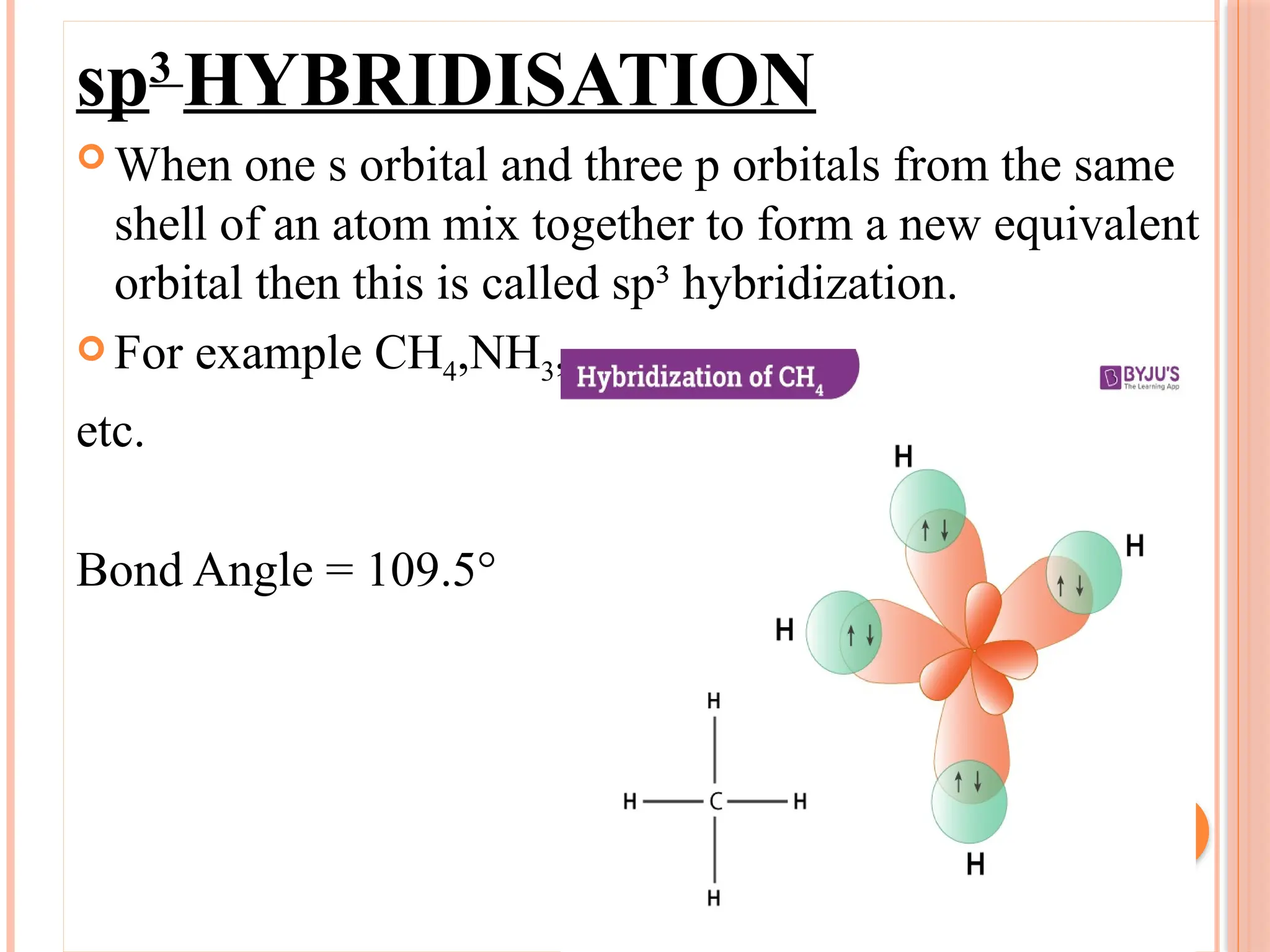
 When one s orbital and three p orbitals from the same
shell of an atom mix together to form a new equivalent
orbital then this is called sp³ hybridization.
 For example CH4,NH3,
etc.
Bond Angle = 109.5°
sp2
HYBRIDISATION
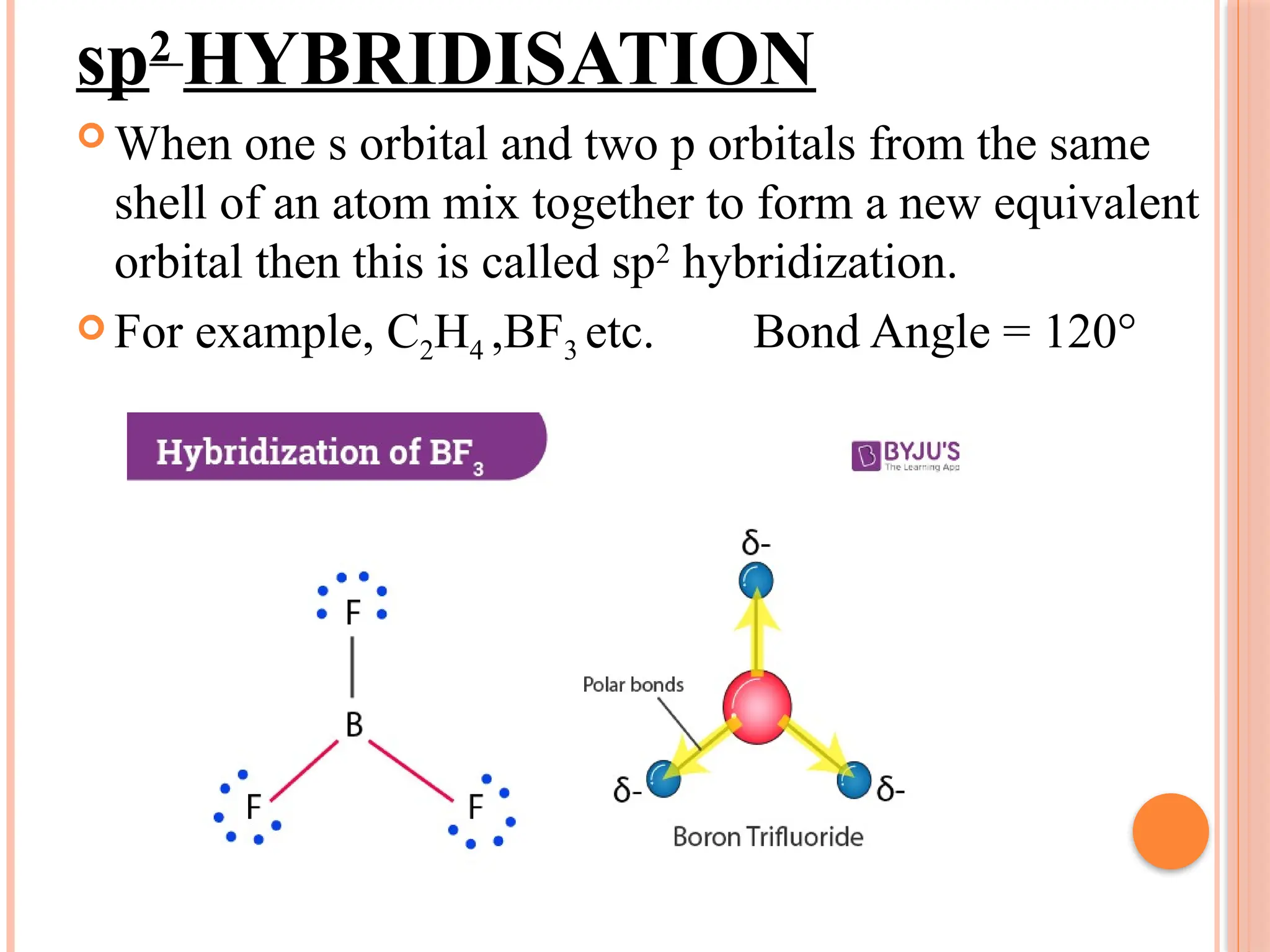
 When one s orbital and two p orbitals from the same
shell of an atom mix together to form a new equivalent
orbital then this is called sp2
hybridization.
 For example, C2H4 ,BF3 etc. Bond Angle = 120°
sp HYBRIDISATION
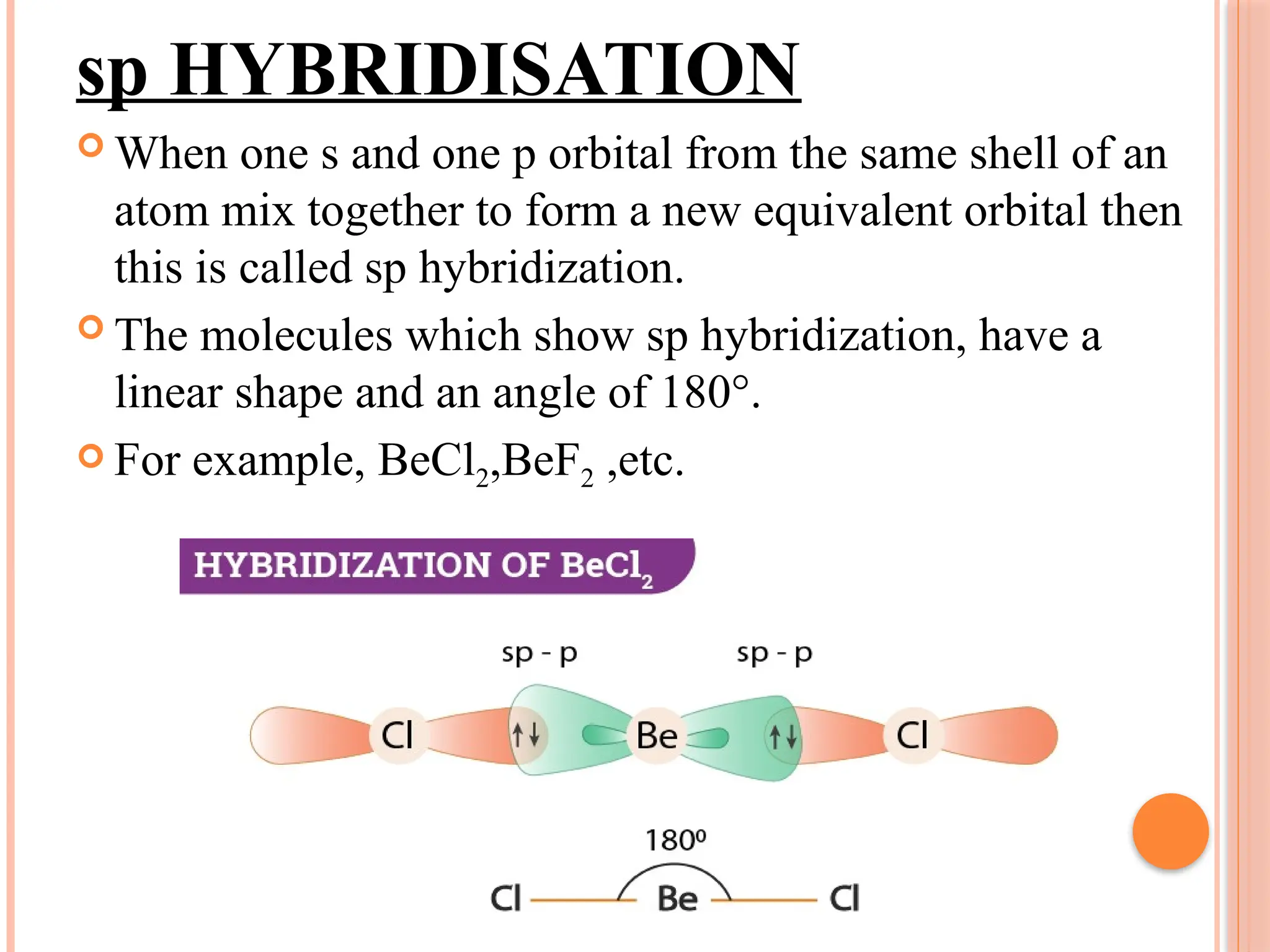
 When one s and one p orbital from the same shell of an
atom mix together to form a new equivalent orbital then
this is called sp hybridization.
 The molecules which show sp hybridization, have a
linear shape and an angle of 180°.
 For example, BeCl2,BeF2 ,etc.
GEOMETRY OF SIMPLE
MOLECULES / IONS
 The study of the three-dimensional arrangement
of the atoms that constitute a molecule is called
Molecular geometry.
 Five main shapes
1)Linear
2)Trigonal planar
3)Tetrahedral
4)Trigonal bipyramidal
5)Octahedral
LINEAR
 No. of electron pairs : 2
 Bond angle : 1800
 BeCl2 , HgCl2
 No. of electron pairs : 3
 Bond angle : 1200
 BF3
TRIGONAL PLANAR
TETRAHEDRAL
 No. of electron pairs : 4
 Bond angle : 109.50
 CH4
 No. of electron pairs : 5
 Bond angle : 900
&1200
 PCl5
TRIGONAL BIPYRAMIDAL
OCTAHEDRAL
 No. of electron pairs : 6
 Bond angle : 900
 SF6
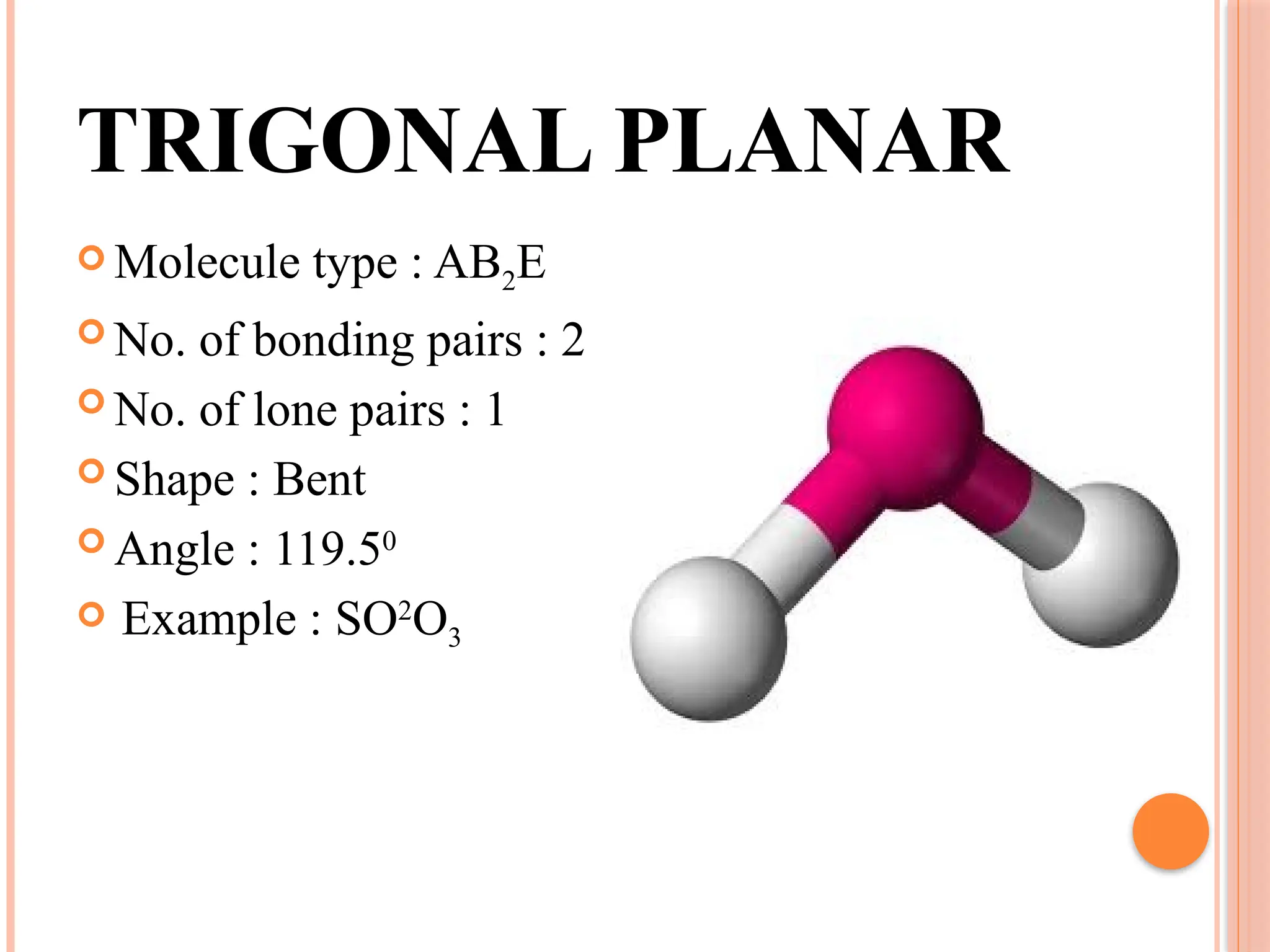
TRIGONAL PLANAR
 Molecule type : AB2E
 No. of bonding pairs : 2
 No. of lone pairs : 1
 Shape : Bent
 Angle : 119.50
 Example : SO2
O3
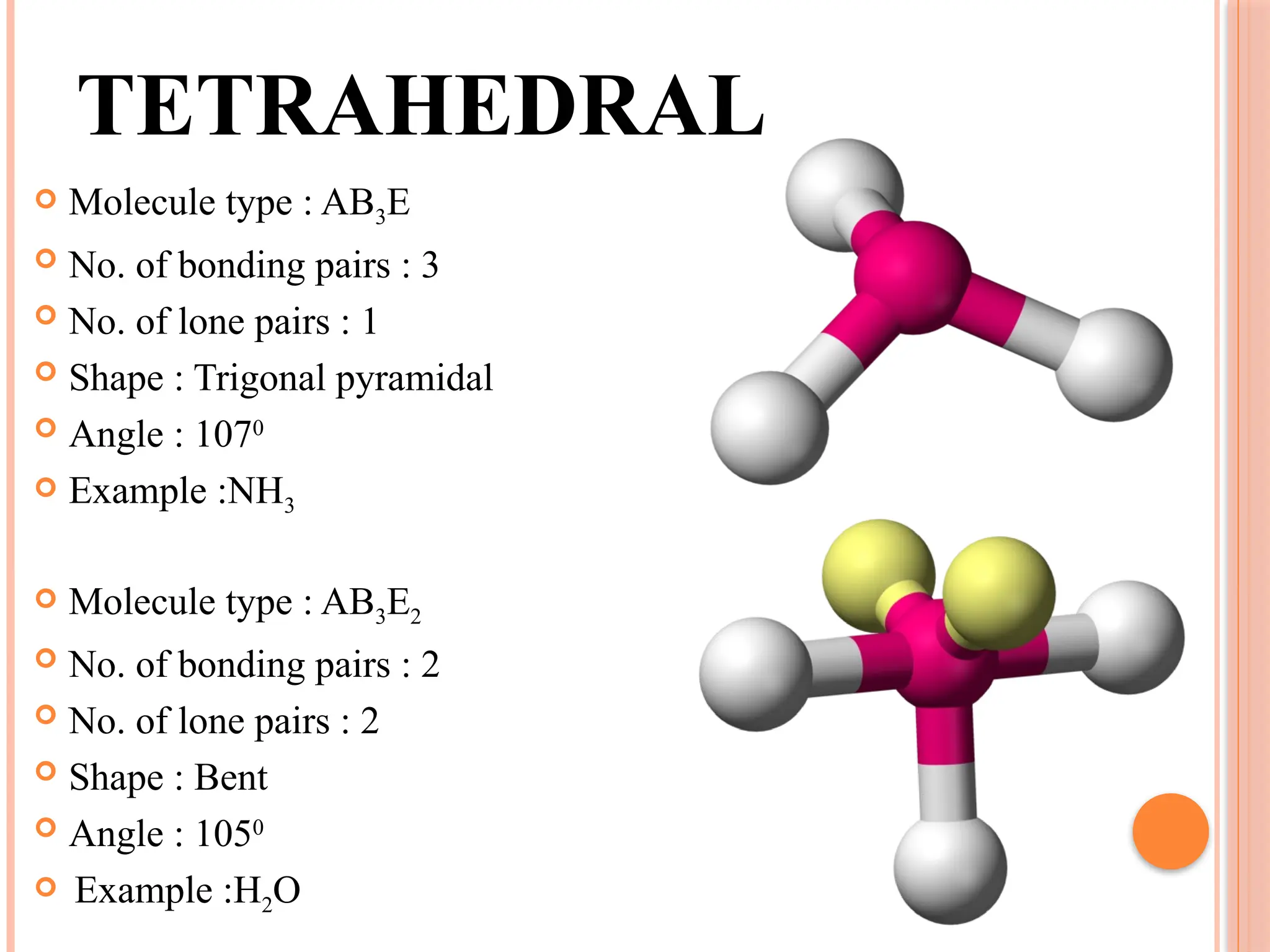
TETRAHEDRAL
 Molecule type : AB3E
 No. of bonding pairs : 3
 No. of lone pairs : 1
 Shape : Trigonal pyramidal
 Angle : 1070
 Example :NH3
 Molecule type : AB3E2
 No. of bonding pairs : 2
 No. of lone pairs : 2
 Shape : Bent
 Angle : 1050
 Example :H2O
TRIGONAL BI-PYRAMIDAL
 Molecule type : AB4E
 No. of bonding pairs : 4
 No. of lone pairs : 1
 Shape : See saw
 Angle : 900
& 1200
 Example :SF4
 Molecule type : AB3E2
 No. of bonding pairs : 3
 No. of lone pairs : 2
 Shape : T-shape
 Angle : 900
 Example :ClF3
OCTAHEDRAL
 Molecule type : AB5E
 No. of bonding pairs : 5
 No. of lone pairs : 1
 Shape : Square pyramid
 Example : BrF5
 Molecule type : AB4E2
 No. of bonding pairs : 4
 No. of lone pairs : 2
 Shape : Square planar
 Example : XeF4
CHART
REFERENCES
NCERT Textbook for 11th
Part I
Byju’s
END

Hybridization and types of hybridization

  • 1.
    COURSE CODE: ED1101 COURSENAME: ATOMIC STRUCTURE AND BONDING TOPIC: TYPES OF HYBRIDIZATIONSHAPES OF SIMPLE INORGANIC MOLECLUES AND IONS. SUBMITTED BY: ED24B1019 KIRTI VINAY JAMBHALI CHEMISTRY MAJOR ITEP- B.SC, B.ED, I YEAR NATIONAL INSTITUTE OF TECHNOLOGY PUDUCHERRY SUBMITTED TO: MR.S. DETCHANAMURTHY FACULTY OF CHEMISTRY, DEPARTMENT OF EDUCATION, NATIONAL INSTITUTE OF TECHNOLOGY PUDUCHERRY.
  • 2.
    WHAT IS HYBRIDIZATION?  Hybridization combines atomic orbitals to form new ones for bonding in molecules.  This intermixing usually results in the formation of hybrid orbitals having entirely different energies, shapes, etc.  The atomic orbitals of the same energy level mainly take part in hybridization.  Possible hybrid combinations are sp,sp2 ,sp3 , sp3 d,sp3 d2 .
  • 3.
    sp3 HYBRIDISATION  When ones orbital and three p orbitals from the same shell of an atom mix together to form a new equivalent orbital then this is called sp³ hybridization.  For example CH4,NH3, etc. Bond Angle = 109.5°
  • 4.
    sp2 HYBRIDISATION  When ones orbital and two p orbitals from the same shell of an atom mix together to form a new equivalent orbital then this is called sp2 hybridization.  For example, C2H4 ,BF3 etc. Bond Angle = 120°
  • 5.
    sp HYBRIDISATION  Whenone s and one p orbital from the same shell of an atom mix together to form a new equivalent orbital then this is called sp hybridization.  The molecules which show sp hybridization, have a linear shape and an angle of 180°.  For example, BeCl2,BeF2 ,etc.
  • 6.
    GEOMETRY OF SIMPLE MOLECULES/ IONS  The study of the three-dimensional arrangement of the atoms that constitute a molecule is called Molecular geometry.  Five main shapes 1)Linear 2)Trigonal planar 3)Tetrahedral 4)Trigonal bipyramidal 5)Octahedral
  • 7.
    LINEAR  No. ofelectron pairs : 2  Bond angle : 1800  BeCl2 , HgCl2  No. of electron pairs : 3  Bond angle : 1200  BF3 TRIGONAL PLANAR
  • 8.
    TETRAHEDRAL  No. ofelectron pairs : 4  Bond angle : 109.50  CH4  No. of electron pairs : 5  Bond angle : 900 &1200  PCl5 TRIGONAL BIPYRAMIDAL
  • 9.
    OCTAHEDRAL  No. ofelectron pairs : 6  Bond angle : 900  SF6
  • 10.
    TRIGONAL PLANAR  Moleculetype : AB2E  No. of bonding pairs : 2  No. of lone pairs : 1  Shape : Bent  Angle : 119.50  Example : SO2 O3
  • 11.
    TETRAHEDRAL  Molecule type: AB3E  No. of bonding pairs : 3  No. of lone pairs : 1  Shape : Trigonal pyramidal  Angle : 1070  Example :NH3  Molecule type : AB3E2  No. of bonding pairs : 2  No. of lone pairs : 2  Shape : Bent  Angle : 1050  Example :H2O
  • 12.
    TRIGONAL BI-PYRAMIDAL  Moleculetype : AB4E  No. of bonding pairs : 4  No. of lone pairs : 1  Shape : See saw  Angle : 900 & 1200  Example :SF4  Molecule type : AB3E2  No. of bonding pairs : 3  No. of lone pairs : 2  Shape : T-shape  Angle : 900  Example :ClF3
  • 13.
    OCTAHEDRAL  Molecule type: AB5E  No. of bonding pairs : 5  No. of lone pairs : 1  Shape : Square pyramid  Example : BrF5  Molecule type : AB4E2  No. of bonding pairs : 4  No. of lone pairs : 2  Shape : Square planar  Example : XeF4
  • 14.
  • 15.
    REFERENCES NCERT Textbook for11th Part I Byju’s
  • 16.