





BUILDING A
PLATFORM FOR FUTURE
GROWTH SALESFORCE
ROADMAP
2© 2018 Huron Consulting Group Inc. and affiliates. All rights reserved.
1. Guiding Principles
•  Strategic Goals
•  CRM Goals
•  Decision Framework
•  Business Value & Alignment
•  Key Decision Questions
•  Use and Existing or Create a
New Org
•  Single vs. Multiple Orgs
2. The Enterprise Org Strategy
•  The Enterprise Vision
•  Constituent Life Cycle
•  Data Management Principles
•  Roadmap Principles
•  Timeline
3. Appendix
•  Project Approach
•  Solution Sustainability
Contents
GUIDING
PRINCIPLES
4© 2018 Huron Consulting Group Inc. and affiliates. All rights reserved.
CRM Goals
•  Create new models for engagement across multiple channels
•  Increase the visibility of how departments communicate and interact with
constituents
•  Leverage native Salesforce functionality when possible to allow for further
enhanced functionality as the platform upgrades
•  Build additional functionality in a way that is scalable for the future and does
not monopolize and overly customize functionality for a single group
•  Where possible, consolidate systems which will allow for decreased costs in
maintenance and integrations to build/maintain
5© 2018 Huron Consulting Group Inc. and affiliates. All rights reserved.
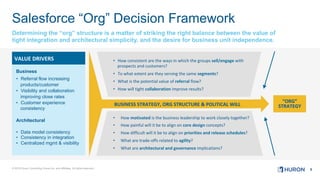
Salesforce “Org” Decision Framework
Determining the “org” structure is a matter of striking the right balance between the value of
tight integration and architectural simplicity, and the desire for business unit independence.
“ORG”	
STRATEGY	
Business
•  Referral flow increasing
products/customer
•  Visibility and collaboration
improving close rates
•  Customer experience
consistency
Architectural
•  Data model consistency
•  Consistency in integration
•  Centralized mgmt & visibility
VALUE	DRIVERS	
BUSINESS	STRATEGY,	ORG	STRUCTURE	&	POLITICAL	WILL	
•  How	consistent	are	the	ways	in	which	the	groups	sell/engage	with	
prospects	and	customers?	
•  To	what	extent	are	they	serving	the	same	segments?	
•  What	is	the	potential	value	of	referral	flow?	
•  How	will	tight	collaboration	improve	results?	
•  How	motivated	is	the	business	leadership	to	work	closely	together?	
•  How	painful	will	it	be	to	align	on	core	design	concepts?	
•  How	difficult	will	it	be	to	align	on	priorities	and	release	schedules?	
•  What	are	trade-offs	related	to	agility?	
•  What	are	architectural	and	governance	implications?
6© 2018 Huron Consulting Group Inc. and affiliates. All rights reserved.

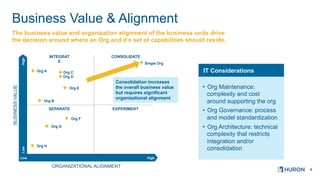
Business Value & Alignment
The business value and organization alignment of the business units drive
the decision around where an Org and it’s set of capabilities should reside.
•  Org Maintenance:
complexity and cost
around supporting the org
•  Org Governance: process
and model standardization
•  Org Architecture: technical
complexity that restricts
integration and/or
consolidation
IT Considerations
BUSINESSVALUE
ORGANIZATIONAL ALIGNMENT
High
HighLow
LowHigh
Low High
INTEGRAT
E
EXPERIMENT
CONSOLIDATE
SEPARATE
Org A
Org B
Org G
Org F
Org H
Org D
Org C
Org E
Single Org
Consolidation increases
the overall business value
but requires significant
organizational alignment
7© 2018 Huron Consulting Group Inc. and affiliates. All rights reserved.
Governance Key Decision Questions
Framework guiding questions to support Client decision making
process around org enablement and governance.
AREA KEY DECISION SAMPLE FRAMEWORK GUIDING QUESTIONS
Platform
Selection
Should the new group use
SFDC or another system?
•  Does the application support active business functions, and provide value?
•  Does the application conform to current and future architectural standards?
•  Is the application redundant with other existing systems?
•  Is there a high cost to maintain and/or upgrade the application?
•  Based on the organization’s risk tolerance, can the application be in the cloud?
New Group on
Salesforce
Create new org or add to
existing org?
•  How many distinct high-level selling models exist?
•  How many different models are there? How fundamentally different or similar are the models?
•  What is the degree of constituent overlap across units?
•  What is the business value associated with being able to tightly collaborate about specific constituents or
opportunities across units?
•  How much political will / business focus is there on driving commonality of approach and collaboration
across units?
New Capability How to implement a new
strategic capability?
•  Is this capability being provided anywhere else in the solutions stack and to what extend the needs and
customer base align?
•  What common processes, if applicable, need to be followed?
•  What are the different dimensions of the target state architecture (application, integration and data)?
•  What kind of ownership model and governance process needed to support key releases, code rationalization
and data migration strategy?
3rd Party
Application
Selection
Should a new 3rd party App
be used?
•  Can the capability be easily built using Force.com platform?
•  What kind of cost implications will a 3rd party app have?
•  Will Client get more return on the investment by building or buying the app?
•  What kind of maintenance and update work required by the 3rd party app?
8© 2018 Huron Consulting Group Inc. and affiliates. All rights reserved.
Use an Existing or Create New Org?
As Client considers merging processes and management, Client may consider merging Salesforce
orgs to realize cost savings and business agility to better respond to a constituent’s needs.
•  Reduce cost of maintaining multiple orgs
•  Increase the speed of responding to customer needs
across business units
•  Realize efficiencies from common data, consolidated
processes, reports, and collaboration across
business units
•  Attain a 360 view of customer, sales, and forecasts
•  Reduce the cost of maintaining data across multiple
business units
•  Global standardization and economies of scale
•  Business units maintain unique and localized
needs
•  Little or no data is shared across business units
•  Complex integrations exist with existing Salesforce
orgs
•  Maturity of master data management – singular org
can subscribe to the source and update the source
based on overall synchronization model
CREATE	NEW	USE	EXISTING
9© 2018 Huron Consulting Group Inc. and affiliates. All rights reserved.
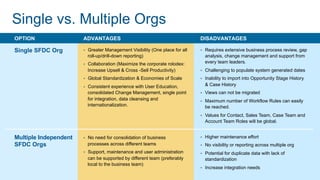
Single vs. Multiple Orgs
OPTION ADVANTAGES DISADVANTAGES
Single SFDC Org §  Greater Management Visibility (One place for all
roll-up/drill-down reporting)
§  Collaboration (Maximize the corporate rolodex:
Increase Upsell & Cross -Sell Productivity)
§  Global Standardization & Economies of Scale
§  Consistent experience with User Education,
consolidated Change Management, single point
for integration, data cleansing and
internationalization.
§  No need for consolidation of business
processes across different teams
§  Support, maintenance and user administration
can be supported by different team (preferably
local to the business team)
§  Requires extensive business process review, gap
analysis, change management and support from
every team leaders.
§  Challenging to populate system generated dates
§  Inability to import into Opportunity Stage History
& Case History
§  Views can not be migrated
§  Maximum number of Workflow Rules can easily
be reached.
§  Values for Contact, Sales Team, Case Team and
Account Team Roles will be global.
§  Higher maintenance effort
§  No visibility or reporting across multiple org
§  Potential for duplicate data with lack of
standardization
§  Increase integration needs
Multiple Independent
SFDC Orgs
2
THE ENTERPRISE
ORG STRATEGY
11© 2018 Huron Consulting Group Inc. and affiliates. All rights reserved.
The Enterprise Vision
We envision a future state in which Salesforce operates as an enterprise
wide CRM for student and nonstudent constituents to enable improved
tracking, workflow, and engagement.
With Salesforce as a conduit for these interactions, <CLIENT> will consolidate
engagement and administrative processing on the platform to better leverage the
School’s investment in technology and lead in the field of service delivery. This
will provide a 360-degree view into the schools’ interactions with a constituent
which will provide greater visibility and help foster collaboration between
business units.
Given the Salesforce vision, getting the correct Salesforce Org structure will be
able to save <CLIENT> money in the long term, because merging orgs or
moving a unit to a different org is a very costly endeavor.
12© 2018 Huron Consulting Group Inc. and affiliates. All rights reserved.
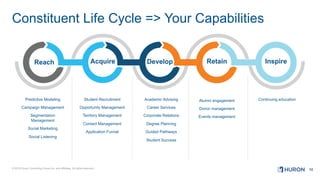
Constituent Life Cycle => Your Capabilities
Predictive Modeling
Campaign Management
Segmentation
Management
Social Marketing
Social Listening
Student Recruitment
Opportunity Management
Territory Management
Contact Management
Application Funnel
Academic Advising
Career Services
Corporate Relations
Degree Planning
Guided Pathways
Student Success
Continuing education
Reach Acquire Develop Retain Inspire
Alumni engagement
Donor management
Events management
13© 2018 Huron Consulting Group Inc. and affiliates. All rights reserved.
Data Management Principles
It is imperative to ensure that the “System of Record” (SOR) for Master Data is managed effectively
and key considerations taken into account for its design.
GUIDING PRINCIPLES COMMENTS
Identify a single SOR •  Having a single SOR reduces the risk of having multiple versions of the data and not being able
to identify the true version.
Do not maintain or copy data
unless there is a valid business
requirement to do so
•  If an application does not need a data attribute to perform required functions then it probably
should not have the attribute. This will reduce the risk of having redundant and varying versions
of the data.
The SOR should be the only
source for the data
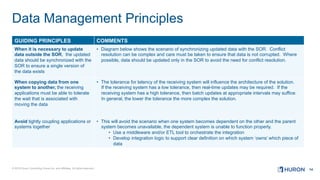
•  Diagram below depicts the scenario to avoid, as well as the correct method of sharing data.
The data should only be updated in
the SOR
•  When data is updated in multiple locations, the risk of having multiple versions of the data are
introduced. This leads to the problem of not being able to identify the correct version of truth.
Diagram below depicts the scenario where data is updated in multiple locations. Where
possible, this scenario should be avoided.
14© 2018 Huron Consulting Group Inc. and affiliates. All rights reserved.
Data Management Principles
GUIDING PRINCIPLES	 COMMENTS	
When it is necessary to update
data outside the SOR, the updated
data should be synchronized with the
SOR to ensure a single version of
the data exists	
•  Diagram below shows the scenario of synchronizing updated data with the SOR. Conflict
resolution can be complex and care must be taken to ensure that data is not corrupted. Where
possible, data should be updated only in the SOR to avoid the need for conflict resolution.	
When copying data from one
system to another, the receiving
applications must be able to tolerate
the wait that is associated with
moving the data	
•  The tolerance for latency of the receiving system will influence the architecture of the solution.
If the receiving system has a low tolerance, then real-time updates may be required. If the
receiving system has a high tolerance, then batch updates at appropriate intervals may suffice.
In general, the lower the tolerance the more complex the solution.	
Avoid tightly coupling applications or
systems together	
•  This will avoid the scenario when one system becomes dependent on the other and the parent
system becomes unavailable, the dependent system is unable to function properly.
•  Use a middleware and/or ETL tool to orchestrate the integration
•  Develop integration logic to support clear definition on which system ‘owns’ which piece of
data
15© 2018 Huron Consulting Group Inc. and affiliates. All rights reserved.
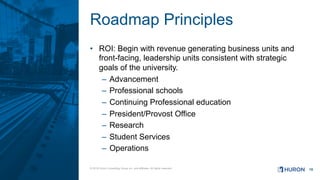
Roadmap Principles
•  ROI: Begin with revenue generating business units and
front-facing, leadership units consistent with strategic
goals of the university.
–  Advancement
–  Professional schools
–  Continuing Professional education
–  President/Provost Office
–  Research
–  Student Services
–  Operations
16© 2018 Huron Consulting Group Inc. and affiliates. All rights reserved.
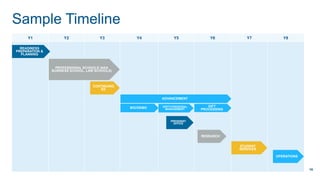
Sample Timeline
Y1 Y2 Y3 Y4 Y5 Y6 Y7 Y8
PROFESSIONAL SCHOOLS (AKA
BUSINESS SCHOOL, LAW SCHOOLS)
CONTINUING
ED
STUDENT
SERVICES
PRESIDENT
OFFICE
RESEARCH
OPERATIONS
ADVANCEMENT
READINESS
PREPARATION &
PLANNING
BIO/DEMO OPPTY/PROPOSAL
MANAGEMENT
GIFT
PROCESSING
APPENDIX
18© 2018 Huron Consulting Group Inc. and affiliates. All rights reserved.
•  Experience implementing and
optimizing all Salesforce solutions
•  200+ Successful implementations
•  100+ Salesforce consultants
•  150+ Unique technical certifications
•  100+ Analytics professionals
•  5-star app exchange rating
•  9.55 CSAT score
Salesforce
Overview
G L O B A L P R E S E N C E
US | CANADA | INDIA | UAE
19© 2018 Huron Consulting Group Inc. and affiliates. All rights reserved.
Experienced Team Includes
Salesforce MVP and three founding members
of the Higher Education Advisory Council
Salesforce GoldPartner Preferred Partner
for Salesforce.org
Expertise in specialty products:
HEDA, Communities, Analytics, Marketing
Cloud, and Pardot
Nation’s largest consulting
firm dedicated to the Higher Education industry
400 consultants dedicated to Higher Ed;
approaching Salesforce consultants100
A proven education partner
20© 2018 Huron Consulting Group Inc. and affiliates. All rights reserved.
Services we provide to Higher ED
TECHNOLOGY & INNOVATION STRATEGY & ENSURING PROJECT SUCCESS
Enterprise Salesforce Architecture Planning &
Implementation
Enterprise Salesforce Strategy & “Connected Campus”
Workshops
Sales/Service Cloud Deployments — Salesforce Across
the Student Lifecycle
Solution Roadmaps to Architect, Optimize & Improve
Salesforce Deployments
Marketing Cloud Automation Implementation & Strategy
for MC, Pardot & Social Studio
Change Management Including Creating a Communication
Plan, Center of Excellence & Steering Committee
Communities for Applicants, Students & Faculty Master Data Management & ETL Selection/Integration
Accelerators for Advising Early Alerts, Executive
Education, Advancement & Alumni Relations
Support Services & Training
UI & UX Capabilities Health Check & Salesforce Org Consolidation
Business Intelligence, Analytics & Reporting Program Management & Salesforce License Exploration
PROJECT APPROACH
22© 2018 Huron Consulting Group Inc. and affiliates. All rights reserved.
Project Roles
Project Manager: Time Commitment: 50%
•  Responsible for working with Huron Project manager to achieve overall project direction and success
•  Responsible for coordinating the project work stream plans and dealing with project interdependencies
•  Responsible for managing escalated project issues
•  Responsible for ensuring project communications with the Business and IT sponsors
•  Attend core workshops and meetings throughout the project and provide leadership
Executive Oversight: Time Commitment: 10%
•  Review and approve key budgeting and forecasting requirements
•  Resolve project issues
•  Attend Steering Committee meetings and key presentations/demos throughout the project
Functional Subject Matter Experts: Time Commitment: 25%
•  Visible leader for the given business area and provides expert advise and guidance for the specific process area
•  Participate in workshop preparation and delivery
•  Ensure key business subject matter experts are involved through out the project
•  Own process KPI’s
•  Review and sign off key deliverables from this phase
23© 2018 Huron Consulting Group Inc. and affiliates. All rights reserved.
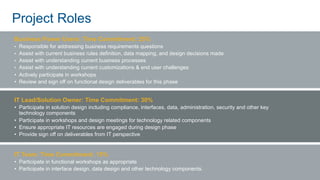
Project Roles
IT Lead/Solution Owner: Time Commitment: 30%
•  Participate in solution design including compliance, interfaces, data, administration, security and other key
technology components
•  Participate in workshops and design meetings for technology related components
•  Ensure appropriate IT resources are engaged during design phase
•  Provide sign off on deliverables from IT perspective
Business Power Users: Time Commitment: 25%
•  Responsible for addressing business requirements questions
•  Assist with current business rules definition, data mapping, and design decisions made
•  Assist with understanding current business processes
•  Assist with understanding current customizations & end user challenges
•  Actively participate in workshops
•  Review and sign off on functional design deliverables for this phase
IT Team: Time Commitment: 15%
•  Participate in functional workshops as appropriate
•  Participate in interface design, data design and other technology components.
24© 2018 Huron Consulting Group Inc. and affiliates. All rights reserved.
Project Governance
Our proposed structure leverages the combined experience of Huron and CLIENT.
We feel that a badge less team with the strengths of each organization and each
team member can deliver the optimal solution for CLIENT.
EXECUTIVE STEERING
COMMITTEE
Executives from both Client and Huron
PROJECT
MANAGEMENT TEAM
PM’s from both Huron and Client
BUSINESS TEAM
Huron and Client Business Team
•  Empower team
•  Remove road blocks
•  Resolve escalated
issues
•  Evaluate progress
•  Develop Requirements
•  Develop Functional Design
•  Develop / Execute Test Cases
•  Develop and Execute Training
TECHNICAL TEAM:
Huron and Client Technical Teams
•  Architect overall solution
•  Configure Application
•  Develop Interface Design
•  Develop Data Design
COMMUNICATIONS
§  Monthly Reviews – Summarizes
account engagement, overall quality,
and satisfaction
§  Bi-Weekly Engagement Status –
Highlights major milestones, resource
updates, quality and satisfaction
§  Weekly Project Status – Details
scope, budget, timeline, risk, etc. to
sponsor(s)
§  Daily Checkpoints – Communicates
status, challenges, and issue
resolution with the project team
DELIVERY MANAGEMENT
§  Overall project delivery
§  Delegate and monitor project tasks
§  Manage issues/risks
§  Drive milestones to completion
§  Manage project budget and scope
25© 2018 Huron Consulting Group Inc. and affiliates. All rights reserved.
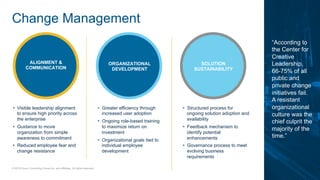
Change Management
SOLUTION
SUSTAINABILITY
ORGANIZATIONAL
DEVELOPMENT
§  Visible leadership alignment
to ensure high priority across
the enterprise
§  Guidance to move
organization from simple
awareness to commitment
§  Reduced employee fear and
change resistance
§  Greater efficiency through
increased user adoption
§  Ongoing role-based training
to maximize return on
investment
§  Organizational goals tied to
individual employee
development
§  Structured process for
ongoing solution adoption and
availability
§  Feedback mechanism to
identify potential
enhancements
§  Governance process to meet
evolving business
requirements
ALIGNMENT &
COMMUNICATION
“According to
the Center for
Creative
Leadership,
66-75% of all
public and
private change
initiatives fail.
A resistant
organizational
culture was the
chief culprit the
majority of the
time.”
26© 2018 Huron Consulting Group Inc. and affiliates. All rights reserved.
Change Management Approach
Our Change Management Approach encompasses five key areas to drive adoption of new
processes and systems. The items listed below have been identified as key deliverables
•  Stakeholder
Identification and
Assessment
•  High Level
Stakeholder
Engagement Plan
•  Change Agent
Network
CUSTOM EDUCATIONCHANGE PREPARATION ORGANIZATIONAL
ALIGNMENT
STAKEHOLDER
ENGAGEMENT
•  Project Brand
•  Communication
Strategy & Plan
•  Leadership Key
Messages
•  Development and
Delivery of
Communications
•  Change Impact
Assessment
•  Role-To-Position
Mapping
•  Manager Readiness
•  Training Needs
Assessment
•  Training Strategy
•  Training Plan
•  Training Schedule
•  Training Materials
•  Train-the-Trainer
•  Training Delivery
•  Competency Center
Roles &
Responsibility
•  Change Control
Process
•  User Support
•  Knowledge Transfer
SOLUTION
SUSTAINABILITY
27© 2018 Huron Consulting Group Inc. and affiliates. All rights reserved.
Custom Education & Knowledge Transfer
KNOWLEDGE
TRANSFER
CUSTOM
EDUCATION
PERFORMANCE
SUPPORT
§  Plan skills development –
Knowledge, skills and abilities (KSA)
§  Knowledge planning and metrics
§  Apply knowledge sharing
techniques: coaching, formal training
and documentation
§  Functional process and policy and
procedures development
§  Specific skills training for project
delivery and ongoing performance
support
§  Leverage our leading practice
knowledge base
§  End user focused training – process,
policy and procedures development
§  Integrated training development
process:
§  Analysis : training needs
assessment and strategy,
infrastructure analysis
§  Design: training curriculum and
design
§  Development: materials
development
§  Implementation: blended learning:
train-the trainer, web based
§  Evaluation: training and metrics
§  Process owners roles and
responsibilities and performance
support requirements
§  Integration with training teams and
IT help desk or system owners for
post implementation support
§  Gap closure tactics following
evaluations
§  Train-the–trainer continued support
for super users
§  Job aids to support process
program teams
28
SOLUTION SUSTAINABILITY
29© 2018 Huron Consulting Group Inc. and affiliates. All rights reserved.
Center of Excellence
A Center of Excellence is leveraged to ensure Salesforce
Best Practices, knowledge are shared amongst the group
as well as provide Governance Guidelines and a Release
Management Process
Key Responsibilities
•  Data Governance Standards
•  Build Standards
•  Release Management
•  Training and Change Management Guides
•  Center of Knowledge
Executive Sponsors*
Program Team
Release
(ProjectManagement)
Business
ScrumTeams
(Development)
Architectural
Adoption/Training
Support
30© 2018 Huron Consulting Group Inc. and affiliates. All rights reserved.
Peer Group - Resourcing
Investing in a core CRM team ensures solution sustainability and ability to grow and scale successfully.
Here are some examples how other educational institutions have resourced their CRM project.
Private School
in Boston
1000 Users for 4 Business Groups
•  1 Full Time Architect
•  1 Full Time Project Manager
•  4 FTE Developers (7 total cross trained
people)
•  12 FTE Admins (cross trained people)
Public School
in the Southwest
2500 Users for 5 Centralized
Business Groups
•  1 Architect
•  4 Admins
•  10 Developers/Integrations – these roles
also do some Admin duties
•  2 FTE Outsourced Admins
•  1.5 FTE Project Manager
Private Business School
in the Southwest
100 Users For 4 Major Business
Groups (Entire Lifecycle)
•  1 Sr Admin
•  1.5 Jr part time FTE to support the
business units
•  3 Outsourced Resources
Private School in the Midwest
University Wide, Multi-phase Roll-out
(Entire Lifecycle)
•  Central CRM team
•  1 CRM lead
•  1 Sr Admin
•  1 Jr Admin
•  1 Marketing Cloud admin
•  1 Jr Admin/Pardot admin for Business
School
•  2 Developers
State School in the West
200 Users for Graduate School
and College of Business
•  1 CRM lead (Grad School)
•  1 Admin (College of Business)
•  1 Admin/Developer (Grad School)
•  1 Developer (Grad School)
31© 2018 Huron Consulting Group Inc. and affiliates. All rights reserved.
Enhancement Considerations
•  Enhancement Priority (see sample considerations
on next slide)
•  Can other groups leverage this solution?
•  Is there an integration need – inbound or outbound?
•  What resources are required? Delegated system admins
(if only for one group), Integration? Development?
Training/Change Management?
32© 2018 Huron Consulting Group Inc. and affiliates. All rights reserved.
What determines Relative Priority within
and across different units?
•  Impact on Operational Effectiveness
•  Targeting/Market Assessment capability
•  Automation/standardization of outreach
•  Capability to track/monitor progress
•  Access to data/reporting
•  Organizational Impact
•  Ability to centralize fragmented university wide services
•  Increase in collaboration among different units by viewing data from currently siloed systems
•  Revenue Implications
•  Increasing funding
•  Increasing number of donors
•  Increasing relationship value and thus stewardship
33© 2018 Huron Consulting Group Inc. and affiliates. All rights reserved.
Release Management
All Major Releases will be approved by the Center of Excellence and the
core CRM team. The meeting should consist of something like this
Meet about upcoming
needs, provide LOE,
Prioritization and clear
Requirements
Confirm Small
Changes (minor
changes don’t get
escalated to this point
For projects approved
for next roadmap
approve designs and
confirm resource
capacity Confirm UAT of current
release, make final
decision on “Deploy”
or wait. Write up
Release Notes for org
and confirm training /
change management
is set
Deploy Releases and
support new
functionality
Week 1
Week 2
Week 3
Week 4
34© 2018 Huron Consulting Group Inc. and affiliates. All rights reserved.
Process
INITIATE
PLAN
DEPLOY
•  Business Group Expresses Interest to Computing
•  Computing has the unit fill out questionnaire
•  CRM team and CoE meets to plan prioritization on timeline and best org fit
•  Project is created and necessary configuration items are built, tested, users
are trained and the support process is defined
THANK YOU

Huron Consulting — 2018 Salesforce Roadmap

  • 1.
    BUILDING A PLATFORM FORFUTURE GROWTH SALESFORCE ROADMAP
  • 2.
    2© 2018 HuronConsulting Group Inc. and affiliates. All rights reserved. 1. Guiding Principles •  Strategic Goals •  CRM Goals •  Decision Framework •  Business Value & Alignment •  Key Decision Questions •  Use and Existing or Create a New Org •  Single vs. Multiple Orgs 2. The Enterprise Org Strategy •  The Enterprise Vision •  Constituent Life Cycle •  Data Management Principles •  Roadmap Principles •  Timeline 3. Appendix •  Project Approach •  Solution Sustainability Contents
  • 3.
  • 4.
    4© 2018 HuronConsulting Group Inc. and affiliates. All rights reserved. CRM Goals •  Create new models for engagement across multiple channels •  Increase the visibility of how departments communicate and interact with constituents •  Leverage native Salesforce functionality when possible to allow for further enhanced functionality as the platform upgrades •  Build additional functionality in a way that is scalable for the future and does not monopolize and overly customize functionality for a single group •  Where possible, consolidate systems which will allow for decreased costs in maintenance and integrations to build/maintain
  • 5.
    5© 2018 HuronConsulting Group Inc. and affiliates. All rights reserved. Salesforce “Org” Decision Framework Determining the “org” structure is a matter of striking the right balance between the value of tight integration and architectural simplicity, and the desire for business unit independence. “ORG” STRATEGY Business •  Referral flow increasing products/customer •  Visibility and collaboration improving close rates •  Customer experience consistency Architectural •  Data model consistency •  Consistency in integration •  Centralized mgmt & visibility VALUE DRIVERS BUSINESS STRATEGY, ORG STRUCTURE & POLITICAL WILL •  How consistent are the ways in which the groups sell/engage with prospects and customers? •  To what extent are they serving the same segments? •  What is the potential value of referral flow? •  How will tight collaboration improve results? •  How motivated is the business leadership to work closely together? •  How painful will it be to align on core design concepts? •  How difficult will it be to align on priorities and release schedules? •  What are trade-offs related to agility? •  What are architectural and governance implications?
  • 6.
    6© 2018 HuronConsulting Group Inc. and affiliates. All rights reserved. Business Value & Alignment The business value and organization alignment of the business units drive the decision around where an Org and it’s set of capabilities should reside. •  Org Maintenance: complexity and cost around supporting the org •  Org Governance: process and model standardization •  Org Architecture: technical complexity that restricts integration and/or consolidation IT Considerations BUSINESSVALUE ORGANIZATIONAL ALIGNMENT High HighLow LowHigh Low High INTEGRAT E EXPERIMENT CONSOLIDATE SEPARATE Org A Org B Org G Org F Org H Org D Org C Org E Single Org Consolidation increases the overall business value but requires significant organizational alignment
  • 7.
    7© 2018 HuronConsulting Group Inc. and affiliates. All rights reserved. Governance Key Decision Questions Framework guiding questions to support Client decision making process around org enablement and governance. AREA KEY DECISION SAMPLE FRAMEWORK GUIDING QUESTIONS Platform Selection Should the new group use SFDC or another system? •  Does the application support active business functions, and provide value? •  Does the application conform to current and future architectural standards? •  Is the application redundant with other existing systems? •  Is there a high cost to maintain and/or upgrade the application? •  Based on the organization’s risk tolerance, can the application be in the cloud? New Group on Salesforce Create new org or add to existing org? •  How many distinct high-level selling models exist? •  How many different models are there? How fundamentally different or similar are the models? •  What is the degree of constituent overlap across units? •  What is the business value associated with being able to tightly collaborate about specific constituents or opportunities across units? •  How much political will / business focus is there on driving commonality of approach and collaboration across units? New Capability How to implement a new strategic capability? •  Is this capability being provided anywhere else in the solutions stack and to what extend the needs and customer base align? •  What common processes, if applicable, need to be followed? •  What are the different dimensions of the target state architecture (application, integration and data)? •  What kind of ownership model and governance process needed to support key releases, code rationalization and data migration strategy? 3rd Party Application Selection Should a new 3rd party App be used? •  Can the capability be easily built using Force.com platform? •  What kind of cost implications will a 3rd party app have? •  Will Client get more return on the investment by building or buying the app? •  What kind of maintenance and update work required by the 3rd party app?
  • 8.
    8© 2018 HuronConsulting Group Inc. and affiliates. All rights reserved. Use an Existing or Create New Org? As Client considers merging processes and management, Client may consider merging Salesforce orgs to realize cost savings and business agility to better respond to a constituent’s needs. •  Reduce cost of maintaining multiple orgs •  Increase the speed of responding to customer needs across business units •  Realize efficiencies from common data, consolidated processes, reports, and collaboration across business units •  Attain a 360 view of customer, sales, and forecasts •  Reduce the cost of maintaining data across multiple business units •  Global standardization and economies of scale •  Business units maintain unique and localized needs •  Little or no data is shared across business units •  Complex integrations exist with existing Salesforce orgs •  Maturity of master data management – singular org can subscribe to the source and update the source based on overall synchronization model CREATE NEW USE EXISTING
  • 9.
    9© 2018 HuronConsulting Group Inc. and affiliates. All rights reserved. Single vs. Multiple Orgs OPTION ADVANTAGES DISADVANTAGES Single SFDC Org §  Greater Management Visibility (One place for all roll-up/drill-down reporting) §  Collaboration (Maximize the corporate rolodex: Increase Upsell & Cross -Sell Productivity) §  Global Standardization & Economies of Scale §  Consistent experience with User Education, consolidated Change Management, single point for integration, data cleansing and internationalization. §  No need for consolidation of business processes across different teams §  Support, maintenance and user administration can be supported by different team (preferably local to the business team) §  Requires extensive business process review, gap analysis, change management and support from every team leaders. §  Challenging to populate system generated dates §  Inability to import into Opportunity Stage History & Case History §  Views can not be migrated §  Maximum number of Workflow Rules can easily be reached. §  Values for Contact, Sales Team, Case Team and Account Team Roles will be global. §  Higher maintenance effort §  No visibility or reporting across multiple org §  Potential for duplicate data with lack of standardization §  Increase integration needs Multiple Independent SFDC Orgs
  • 10.
  • 11.
    11© 2018 HuronConsulting Group Inc. and affiliates. All rights reserved. The Enterprise Vision We envision a future state in which Salesforce operates as an enterprise wide CRM for student and nonstudent constituents to enable improved tracking, workflow, and engagement. With Salesforce as a conduit for these interactions, <CLIENT> will consolidate engagement and administrative processing on the platform to better leverage the School’s investment in technology and lead in the field of service delivery. This will provide a 360-degree view into the schools’ interactions with a constituent which will provide greater visibility and help foster collaboration between business units. Given the Salesforce vision, getting the correct Salesforce Org structure will be able to save <CLIENT> money in the long term, because merging orgs or moving a unit to a different org is a very costly endeavor.
  • 12.
    12© 2018 HuronConsulting Group Inc. and affiliates. All rights reserved. Constituent Life Cycle => Your Capabilities Predictive Modeling Campaign Management Segmentation Management Social Marketing Social Listening Student Recruitment Opportunity Management Territory Management Contact Management Application Funnel Academic Advising Career Services Corporate Relations Degree Planning Guided Pathways Student Success Continuing education Reach Acquire Develop Retain Inspire Alumni engagement Donor management Events management
  • 13.
    13© 2018 HuronConsulting Group Inc. and affiliates. All rights reserved. Data Management Principles It is imperative to ensure that the “System of Record” (SOR) for Master Data is managed effectively and key considerations taken into account for its design. GUIDING PRINCIPLES COMMENTS Identify a single SOR •  Having a single SOR reduces the risk of having multiple versions of the data and not being able to identify the true version. Do not maintain or copy data unless there is a valid business requirement to do so •  If an application does not need a data attribute to perform required functions then it probably should not have the attribute. This will reduce the risk of having redundant and varying versions of the data. The SOR should be the only source for the data •  Diagram below depicts the scenario to avoid, as well as the correct method of sharing data. The data should only be updated in the SOR •  When data is updated in multiple locations, the risk of having multiple versions of the data are introduced. This leads to the problem of not being able to identify the correct version of truth. Diagram below depicts the scenario where data is updated in multiple locations. Where possible, this scenario should be avoided.
  • 14.
    14© 2018 HuronConsulting Group Inc. and affiliates. All rights reserved. Data Management Principles GUIDING PRINCIPLES COMMENTS When it is necessary to update data outside the SOR, the updated data should be synchronized with the SOR to ensure a single version of the data exists •  Diagram below shows the scenario of synchronizing updated data with the SOR. Conflict resolution can be complex and care must be taken to ensure that data is not corrupted. Where possible, data should be updated only in the SOR to avoid the need for conflict resolution. When copying data from one system to another, the receiving applications must be able to tolerate the wait that is associated with moving the data •  The tolerance for latency of the receiving system will influence the architecture of the solution. If the receiving system has a low tolerance, then real-time updates may be required. If the receiving system has a high tolerance, then batch updates at appropriate intervals may suffice. In general, the lower the tolerance the more complex the solution. Avoid tightly coupling applications or systems together •  This will avoid the scenario when one system becomes dependent on the other and the parent system becomes unavailable, the dependent system is unable to function properly. •  Use a middleware and/or ETL tool to orchestrate the integration •  Develop integration logic to support clear definition on which system ‘owns’ which piece of data
  • 15.
    15© 2018 HuronConsulting Group Inc. and affiliates. All rights reserved. Roadmap Principles •  ROI: Begin with revenue generating business units and front-facing, leadership units consistent with strategic goals of the university. –  Advancement –  Professional schools –  Continuing Professional education –  President/Provost Office –  Research –  Student Services –  Operations
  • 16.
    16© 2018 HuronConsulting Group Inc. and affiliates. All rights reserved. Sample Timeline Y1 Y2 Y3 Y4 Y5 Y6 Y7 Y8 PROFESSIONAL SCHOOLS (AKA BUSINESS SCHOOL, LAW SCHOOLS) CONTINUING ED STUDENT SERVICES PRESIDENT OFFICE RESEARCH OPERATIONS ADVANCEMENT READINESS PREPARATION & PLANNING BIO/DEMO OPPTY/PROPOSAL MANAGEMENT GIFT PROCESSING
  • 17.
  • 18.
    18© 2018 HuronConsulting Group Inc. and affiliates. All rights reserved. •  Experience implementing and optimizing all Salesforce solutions •  200+ Successful implementations •  100+ Salesforce consultants •  150+ Unique technical certifications •  100+ Analytics professionals •  5-star app exchange rating •  9.55 CSAT score Salesforce Overview G L O B A L P R E S E N C E US | CANADA | INDIA | UAE
  • 19.
    19© 2018 HuronConsulting Group Inc. and affiliates. All rights reserved. Experienced Team Includes Salesforce MVP and three founding members of the Higher Education Advisory Council Salesforce GoldPartner Preferred Partner for Salesforce.org Expertise in specialty products: HEDA, Communities, Analytics, Marketing Cloud, and Pardot Nation’s largest consulting firm dedicated to the Higher Education industry 400 consultants dedicated to Higher Ed; approaching Salesforce consultants100 A proven education partner
  • 20.
    20© 2018 HuronConsulting Group Inc. and affiliates. All rights reserved. Services we provide to Higher ED TECHNOLOGY & INNOVATION STRATEGY & ENSURING PROJECT SUCCESS Enterprise Salesforce Architecture Planning & Implementation Enterprise Salesforce Strategy & “Connected Campus” Workshops Sales/Service Cloud Deployments — Salesforce Across the Student Lifecycle Solution Roadmaps to Architect, Optimize & Improve Salesforce Deployments Marketing Cloud Automation Implementation & Strategy for MC, Pardot & Social Studio Change Management Including Creating a Communication Plan, Center of Excellence & Steering Committee Communities for Applicants, Students & Faculty Master Data Management & ETL Selection/Integration Accelerators for Advising Early Alerts, Executive Education, Advancement & Alumni Relations Support Services & Training UI & UX Capabilities Health Check & Salesforce Org Consolidation Business Intelligence, Analytics & Reporting Program Management & Salesforce License Exploration
  • 21.
  • 22.
    22© 2018 HuronConsulting Group Inc. and affiliates. All rights reserved. Project Roles Project Manager: Time Commitment: 50% •  Responsible for working with Huron Project manager to achieve overall project direction and success •  Responsible for coordinating the project work stream plans and dealing with project interdependencies •  Responsible for managing escalated project issues •  Responsible for ensuring project communications with the Business and IT sponsors •  Attend core workshops and meetings throughout the project and provide leadership Executive Oversight: Time Commitment: 10% •  Review and approve key budgeting and forecasting requirements •  Resolve project issues •  Attend Steering Committee meetings and key presentations/demos throughout the project Functional Subject Matter Experts: Time Commitment: 25% •  Visible leader for the given business area and provides expert advise and guidance for the specific process area •  Participate in workshop preparation and delivery •  Ensure key business subject matter experts are involved through out the project •  Own process KPI’s •  Review and sign off key deliverables from this phase
  • 23.
    23© 2018 HuronConsulting Group Inc. and affiliates. All rights reserved. Project Roles IT Lead/Solution Owner: Time Commitment: 30% •  Participate in solution design including compliance, interfaces, data, administration, security and other key technology components •  Participate in workshops and design meetings for technology related components •  Ensure appropriate IT resources are engaged during design phase •  Provide sign off on deliverables from IT perspective Business Power Users: Time Commitment: 25% •  Responsible for addressing business requirements questions •  Assist with current business rules definition, data mapping, and design decisions made •  Assist with understanding current business processes •  Assist with understanding current customizations & end user challenges •  Actively participate in workshops •  Review and sign off on functional design deliverables for this phase IT Team: Time Commitment: 15% •  Participate in functional workshops as appropriate •  Participate in interface design, data design and other technology components.
  • 24.
    24© 2018 HuronConsulting Group Inc. and affiliates. All rights reserved. Project Governance Our proposed structure leverages the combined experience of Huron and CLIENT. We feel that a badge less team with the strengths of each organization and each team member can deliver the optimal solution for CLIENT. EXECUTIVE STEERING COMMITTEE Executives from both Client and Huron PROJECT MANAGEMENT TEAM PM’s from both Huron and Client BUSINESS TEAM Huron and Client Business Team •  Empower team •  Remove road blocks •  Resolve escalated issues •  Evaluate progress •  Develop Requirements •  Develop Functional Design •  Develop / Execute Test Cases •  Develop and Execute Training TECHNICAL TEAM: Huron and Client Technical Teams •  Architect overall solution •  Configure Application •  Develop Interface Design •  Develop Data Design COMMUNICATIONS §  Monthly Reviews – Summarizes account engagement, overall quality, and satisfaction §  Bi-Weekly Engagement Status – Highlights major milestones, resource updates, quality and satisfaction §  Weekly Project Status – Details scope, budget, timeline, risk, etc. to sponsor(s) §  Daily Checkpoints – Communicates status, challenges, and issue resolution with the project team DELIVERY MANAGEMENT §  Overall project delivery §  Delegate and monitor project tasks §  Manage issues/risks §  Drive milestones to completion §  Manage project budget and scope
  • 25.
    25© 2018 HuronConsulting Group Inc. and affiliates. All rights reserved. Change Management SOLUTION SUSTAINABILITY ORGANIZATIONAL DEVELOPMENT §  Visible leadership alignment to ensure high priority across the enterprise §  Guidance to move organization from simple awareness to commitment §  Reduced employee fear and change resistance §  Greater efficiency through increased user adoption §  Ongoing role-based training to maximize return on investment §  Organizational goals tied to individual employee development §  Structured process for ongoing solution adoption and availability §  Feedback mechanism to identify potential enhancements §  Governance process to meet evolving business requirements ALIGNMENT & COMMUNICATION “According to the Center for Creative Leadership, 66-75% of all public and private change initiatives fail. A resistant organizational culture was the chief culprit the majority of the time.”
  • 26.
    26© 2018 HuronConsulting Group Inc. and affiliates. All rights reserved. Change Management Approach Our Change Management Approach encompasses five key areas to drive adoption of new processes and systems. The items listed below have been identified as key deliverables •  Stakeholder Identification and Assessment •  High Level Stakeholder Engagement Plan •  Change Agent Network CUSTOM EDUCATIONCHANGE PREPARATION ORGANIZATIONAL ALIGNMENT STAKEHOLDER ENGAGEMENT •  Project Brand •  Communication Strategy & Plan •  Leadership Key Messages •  Development and Delivery of Communications •  Change Impact Assessment •  Role-To-Position Mapping •  Manager Readiness •  Training Needs Assessment •  Training Strategy •  Training Plan •  Training Schedule •  Training Materials •  Train-the-Trainer •  Training Delivery •  Competency Center Roles & Responsibility •  Change Control Process •  User Support •  Knowledge Transfer SOLUTION SUSTAINABILITY
  • 27.
    27© 2018 HuronConsulting Group Inc. and affiliates. All rights reserved. Custom Education & Knowledge Transfer KNOWLEDGE TRANSFER CUSTOM EDUCATION PERFORMANCE SUPPORT §  Plan skills development – Knowledge, skills and abilities (KSA) §  Knowledge planning and metrics §  Apply knowledge sharing techniques: coaching, formal training and documentation §  Functional process and policy and procedures development §  Specific skills training for project delivery and ongoing performance support §  Leverage our leading practice knowledge base §  End user focused training – process, policy and procedures development §  Integrated training development process: §  Analysis : training needs assessment and strategy, infrastructure analysis §  Design: training curriculum and design §  Development: materials development §  Implementation: blended learning: train-the trainer, web based §  Evaluation: training and metrics §  Process owners roles and responsibilities and performance support requirements §  Integration with training teams and IT help desk or system owners for post implementation support §  Gap closure tactics following evaluations §  Train-the–trainer continued support for super users §  Job aids to support process program teams
  • 28.
  • 29.
    29© 2018 HuronConsulting Group Inc. and affiliates. All rights reserved. Center of Excellence A Center of Excellence is leveraged to ensure Salesforce Best Practices, knowledge are shared amongst the group as well as provide Governance Guidelines and a Release Management Process Key Responsibilities •  Data Governance Standards •  Build Standards •  Release Management •  Training and Change Management Guides •  Center of Knowledge Executive Sponsors* Program Team Release (ProjectManagement) Business ScrumTeams (Development) Architectural Adoption/Training Support
  • 30.
    30© 2018 HuronConsulting Group Inc. and affiliates. All rights reserved. Peer Group - Resourcing Investing in a core CRM team ensures solution sustainability and ability to grow and scale successfully. Here are some examples how other educational institutions have resourced their CRM project. Private School in Boston 1000 Users for 4 Business Groups •  1 Full Time Architect •  1 Full Time Project Manager •  4 FTE Developers (7 total cross trained people) •  12 FTE Admins (cross trained people) Public School in the Southwest 2500 Users for 5 Centralized Business Groups •  1 Architect •  4 Admins •  10 Developers/Integrations – these roles also do some Admin duties •  2 FTE Outsourced Admins •  1.5 FTE Project Manager Private Business School in the Southwest 100 Users For 4 Major Business Groups (Entire Lifecycle) •  1 Sr Admin •  1.5 Jr part time FTE to support the business units •  3 Outsourced Resources Private School in the Midwest University Wide, Multi-phase Roll-out (Entire Lifecycle) •  Central CRM team •  1 CRM lead •  1 Sr Admin •  1 Jr Admin •  1 Marketing Cloud admin •  1 Jr Admin/Pardot admin for Business School •  2 Developers State School in the West 200 Users for Graduate School and College of Business •  1 CRM lead (Grad School) •  1 Admin (College of Business) •  1 Admin/Developer (Grad School) •  1 Developer (Grad School)
  • 31.
    31© 2018 HuronConsulting Group Inc. and affiliates. All rights reserved. Enhancement Considerations •  Enhancement Priority (see sample considerations on next slide) •  Can other groups leverage this solution? •  Is there an integration need – inbound or outbound? •  What resources are required? Delegated system admins (if only for one group), Integration? Development? Training/Change Management?
  • 32.
    32© 2018 HuronConsulting Group Inc. and affiliates. All rights reserved. What determines Relative Priority within and across different units? •  Impact on Operational Effectiveness •  Targeting/Market Assessment capability •  Automation/standardization of outreach •  Capability to track/monitor progress •  Access to data/reporting •  Organizational Impact •  Ability to centralize fragmented university wide services •  Increase in collaboration among different units by viewing data from currently siloed systems •  Revenue Implications •  Increasing funding •  Increasing number of donors •  Increasing relationship value and thus stewardship
  • 33.
    33© 2018 HuronConsulting Group Inc. and affiliates. All rights reserved. Release Management All Major Releases will be approved by the Center of Excellence and the core CRM team. The meeting should consist of something like this Meet about upcoming needs, provide LOE, Prioritization and clear Requirements Confirm Small Changes (minor changes don’t get escalated to this point For projects approved for next roadmap approve designs and confirm resource capacity Confirm UAT of current release, make final decision on “Deploy” or wait. Write up Release Notes for org and confirm training / change management is set Deploy Releases and support new functionality Week 1 Week 2 Week 3 Week 4
  • 34.
    34© 2018 HuronConsulting Group Inc. and affiliates. All rights reserved. Process INITIATE PLAN DEPLOY •  Business Group Expresses Interest to Computing •  Computing has the unit fill out questionnaire •  CRM team and CoE meets to plan prioritization on timeline and best org fit •  Project is created and necessary configuration items are built, tested, users are trained and the support process is defined
  • 35.