Readings
Panofsky, E. (1955). The History of Art as a Humanistic Discipline. Meaning in the Visual Arts. Australia:
Penguin Books.
Dhakhwa, S. & Enriquez, S. (2008). The Relevance of Confucian Philosophy to Modern Concepts of Leadership and Followership
(2008). All Volumes (2001-2008). 5.http://digitalcommons.unf.edu/ojii_volumes/5
CANVAS Network. Module 1 - Introductions and Definitions. WHAT IS ART?
https://learn.canvas.net/courses/24/pages/m1-what-is-art?module_item_id=44378
Study.com. Christian Humanism: Definition & Role in the Renaissance. Chapter 1, Lesson 14.
https://study.com/academy/lesson/christian-humanism-definition-role-in-the-
renaissance.html#:~:text=Christian%20Humanism%20was%20a%20Renaissance,helped%20encourage%20the%20Protestant%2
0Reformation.
Video
Who Am I. (Dec. 4, 2010). https://www.youtube.com/watch?v=mBcqria2wmg
What was crucifixion like? (April 15, 2017). https://youtu.be/V0gNIL5GAdE
The audacity of Christian art: the problem with Christ | National Gallery.
https://www.khanacademy.org/humanities/ap-art-history/introduction-cultures-religions-apah/christianity-
apah/v/christian-art-national-gallery
1. Survey the Place of the Humanities in the History of Western and Eastern
Civilization.
2. Distinguish the Humanities and the Sciences as Fields of Learning.
REFERENCES
Lesson 1.1. Understanding Humanities
6
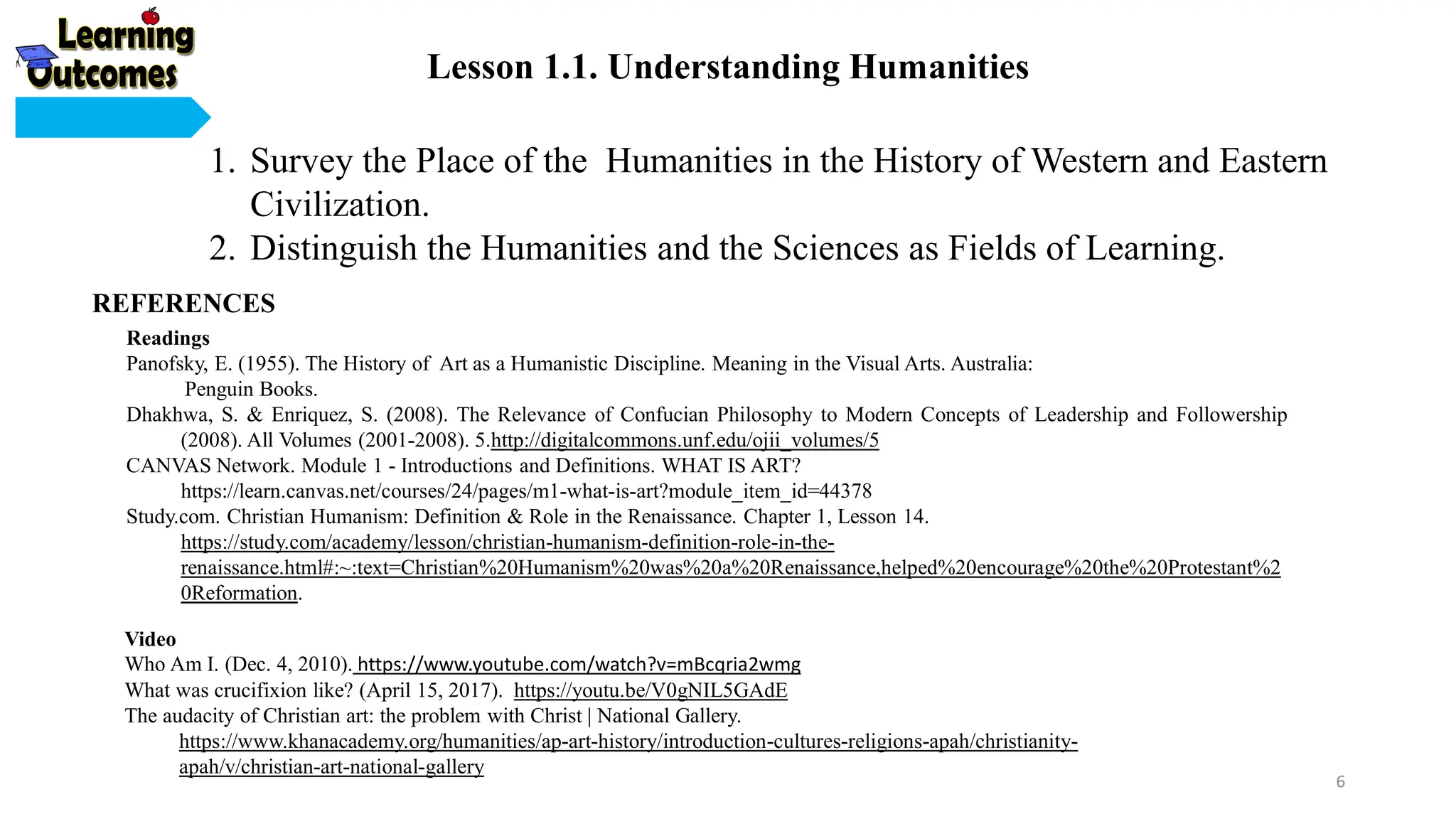
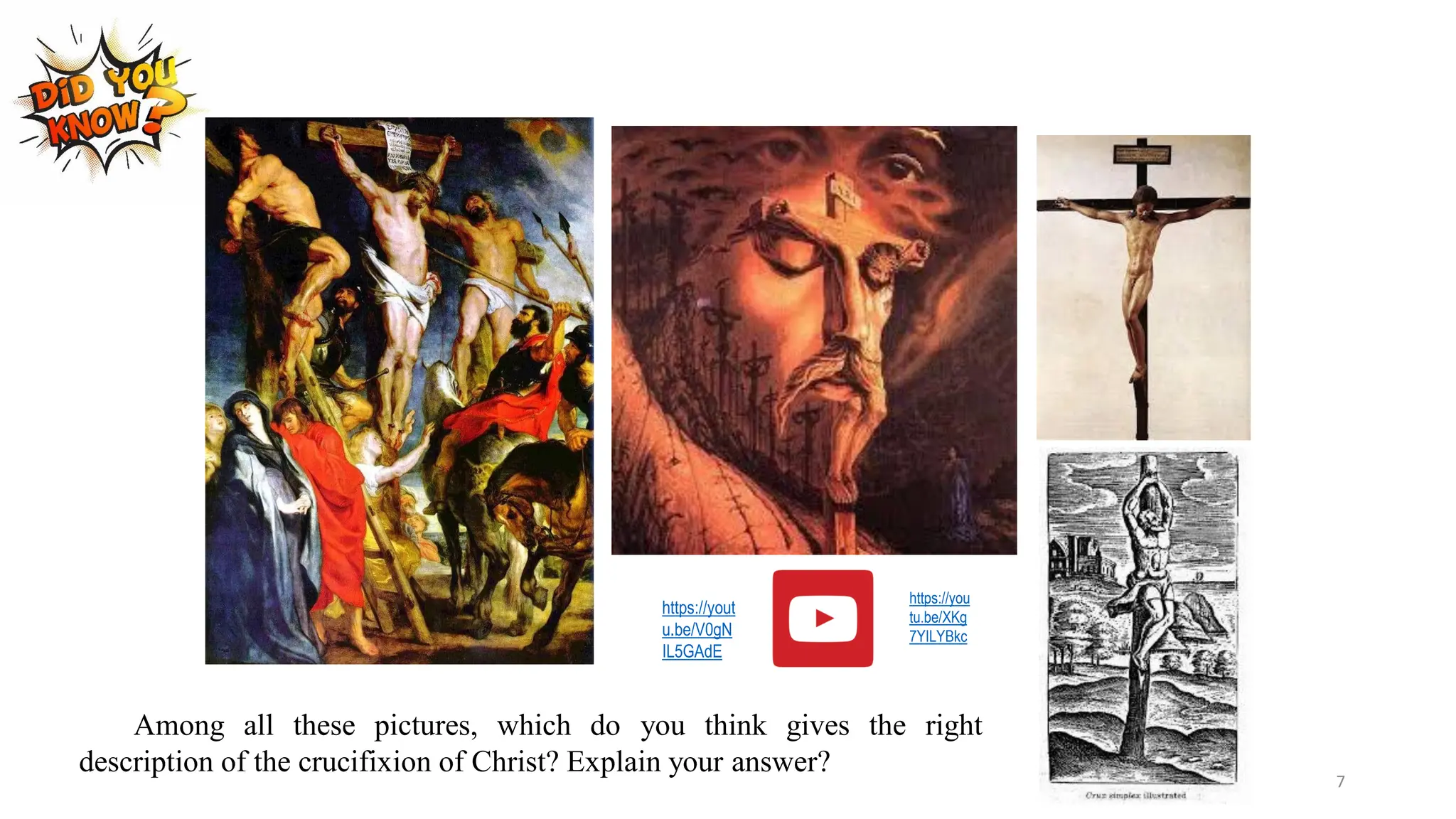
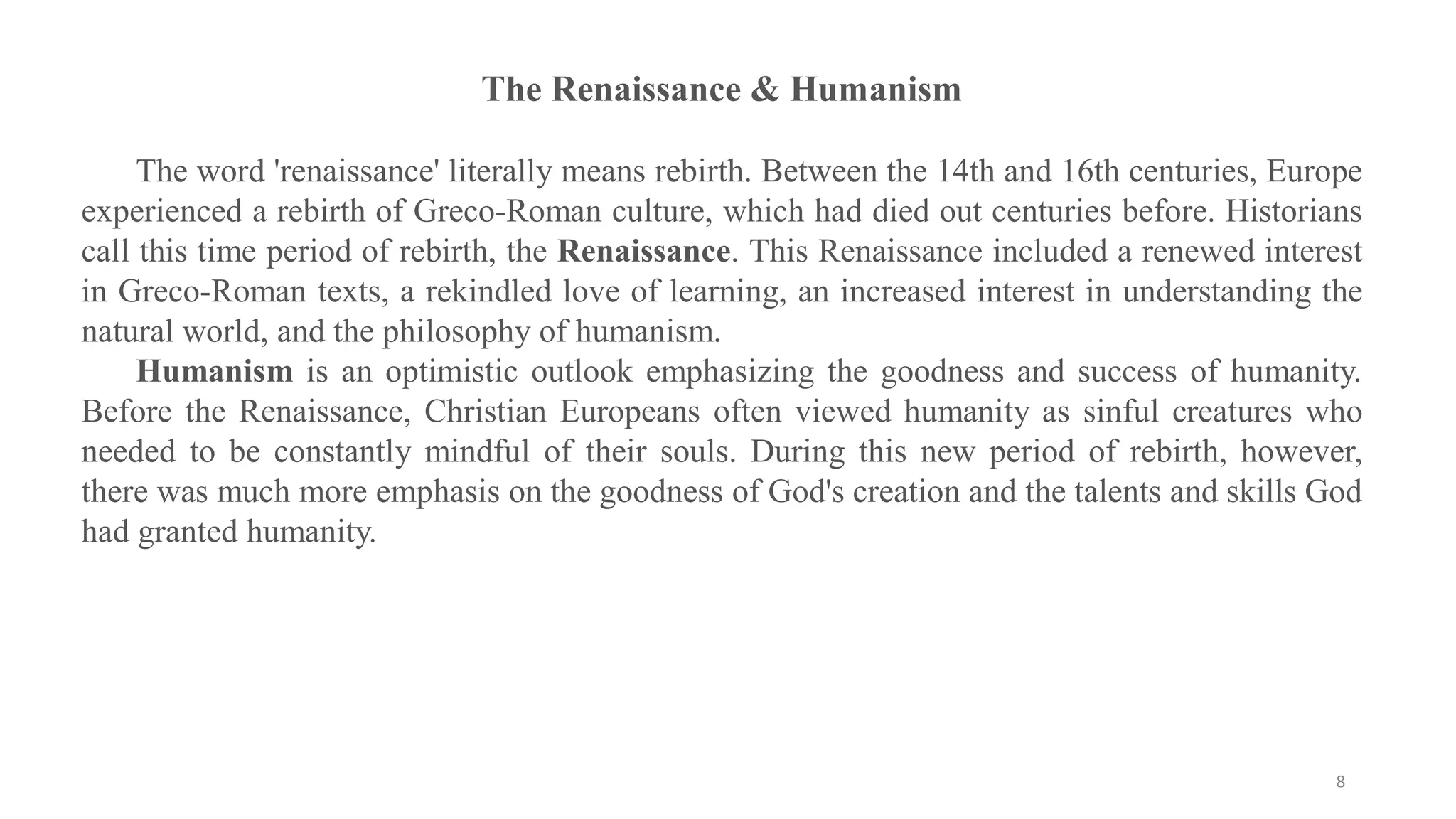
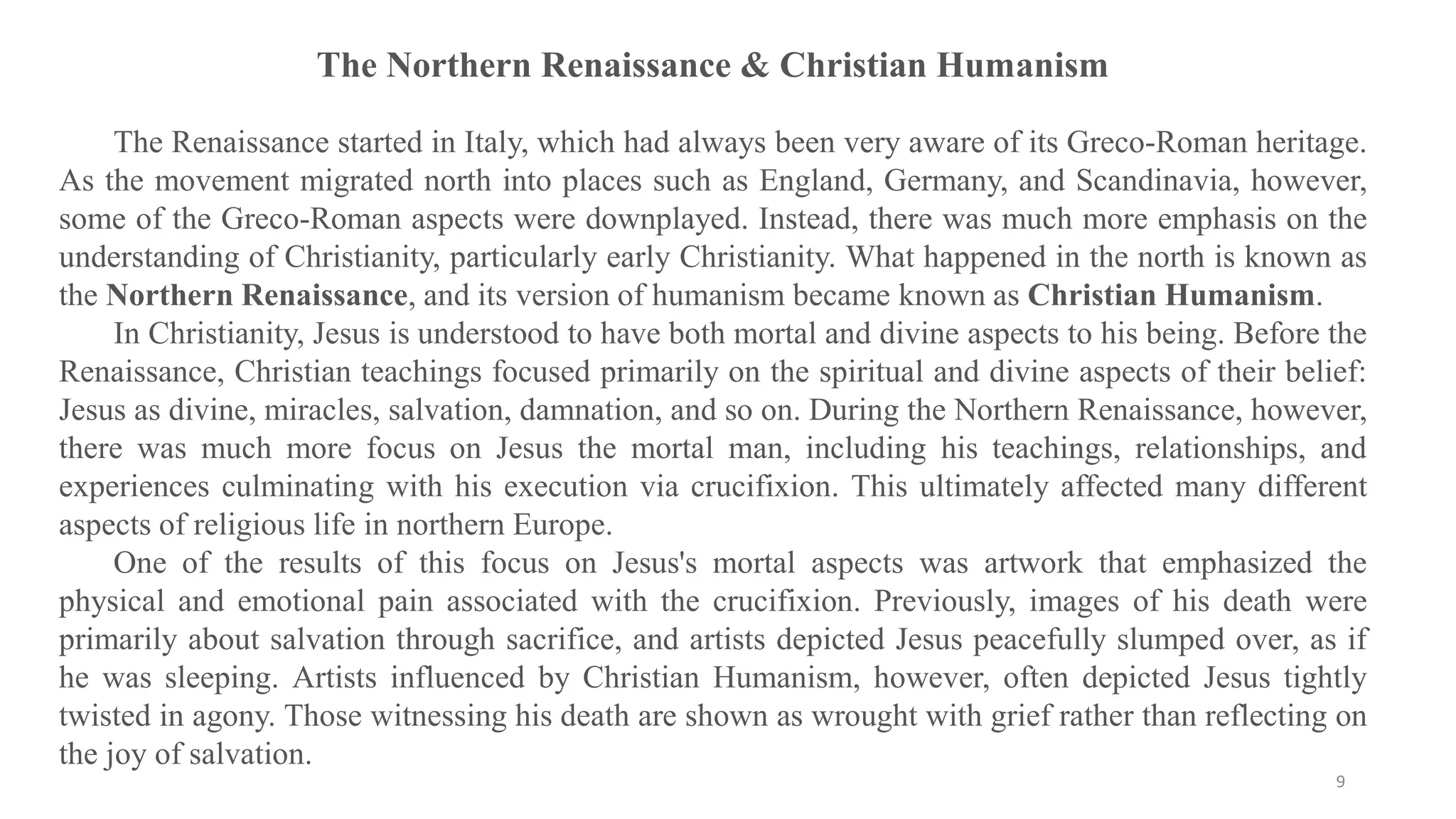
Among all these pictures, which do you think gives the right
description of the crucifixion of Christ? Explain your answer?
https://yout
u.be/V0gN
IL5GAdE
https://you
tu.be/XKg
7YILYBkc
7
The Renaissance & Humanism
The word 'renaissance' literally means rebirth. Between the 14th and 16th centuries, Europe
experienced a rebirth of Greco-Roman culture, which had died out centuries before. Historians
call this time period of rebirth, the Renaissance. This Renaissance included a renewed interest
in Greco-Roman texts, a rekindled love of learning, an increased interest in understanding the
natural world, and the philosophy of humanism.
Humanism is an optimistic outlook emphasizing the goodness and success of humanity.
Before the Renaissance, Christian Europeans often viewed humanity as sinful creatures who
needed to be constantly mindful of their souls. During this new period of rebirth, however,
there was much more emphasis on the goodness of God's creation and the talents and skills God
had granted humanity.
8
The Northern Renaissance & Christian Humanism
The Renaissance started in Italy, which had always been very aware of its Greco-Roman heritage.
As the movement migrated north into places such as England, Germany, and Scandinavia, however,
some of the Greco-Roman aspects were downplayed. Instead, there was much more emphasis on the
understanding of Christianity, particularly early Christianity. What happened in the north is known as
the Northern Renaissance, and its version of humanism became known as Christian Humanism.
In Christianity, Jesus is understood to have both mortal and divine aspects to his being. Before the
Renaissance, Christian teachings focused primarily on the spiritual and divine aspects of their belief:
Jesus as divine, miracles, salvation, damnation, and so on. During the Northern Renaissance, however,
there was much more focus on Jesus the mortal man, including his teachings, relationships, and
experiences culminating with his execution via crucifixion. This ultimately affected many different
aspects of religious life in northern Europe.
One of the results of this focus on Jesus's mortal aspects was artwork that emphasized the
physical and emotional pain associated with the crucifixion. Previously, images of his death were
primarily about salvation through sacrifice, and artists depicted Jesus peacefully slumped over, as if
he was sleeping. Artists influenced by Christian Humanism, however, often depicted Jesus tightly
twisted in agony. Those witnessing his death are shown as wrought with grief rather than reflecting on
the joy of salvation.
9
How would you define ‘art’? For many people art is a specific thing; a painting, sculpture or
photograph, a dance, a poem or a play. It is all of these things, and more. They are mediums of
artistic expression. Webster’s New Collegiate dictionary defines art as “The conscious use of
skill and creative imagination especially in the production of aesthetic objects.” Yet art is much
more than a medium, or words on a page. It is the expression of our experience.
Art is uniquely human and tied directly to culture. It takes the ordinary and makes it
extraordinary. It asks questions about who we are, what we value, the meaning of beauty and the
human condition. As an expressive medium it allows us to experience sublime joy, deep sorrow,
confusion and clarity. It tests our strengths, vulnerabilities and resolve. It gives voice to ideas
and feelings, connects us to the past, reflects the present and anticipates the future. Along these
lines, art history, combined with anthropology and literature, are three main sources in
observing, recording and interpreting our human past. Visual art is a rich and complex subject
whose definition is in flux as the culture around it changes. Because of this, how we define art is
in essence a question of agreement. In this respect, we can look again to the dictionary’s
definition for an understanding of exactly what to look for when we proclaim something as ‘art’.
10
DR. ALLAN C. ORATE, UE
FRAMEWORKS AND PERSPECTIVES
Sciences HUMANITIES
Art
Creation
Artist
Practice
ART
APPRECIATION
Spectator
Theory
History
FIELDS OF LEARNING
Language Philosophy
ART
Our frail and fallible human bodies leave behind
frail and fallible records of our frail and fallible
lives oddly turning our inescapable mortality into
a kind of immortality for subsequent mortals to
humanistically or scientifically observe. And so,
the duality we face regarding the definition of
"humanity" still remains.
The humanities actually compliment
the sciences and vice versa. It's only
that the exactness of science is a
mastery and the depth of the
humanities is wisdom.
KEY
CONCEPTS
11
DR. ALLAN C. ORATE, UE
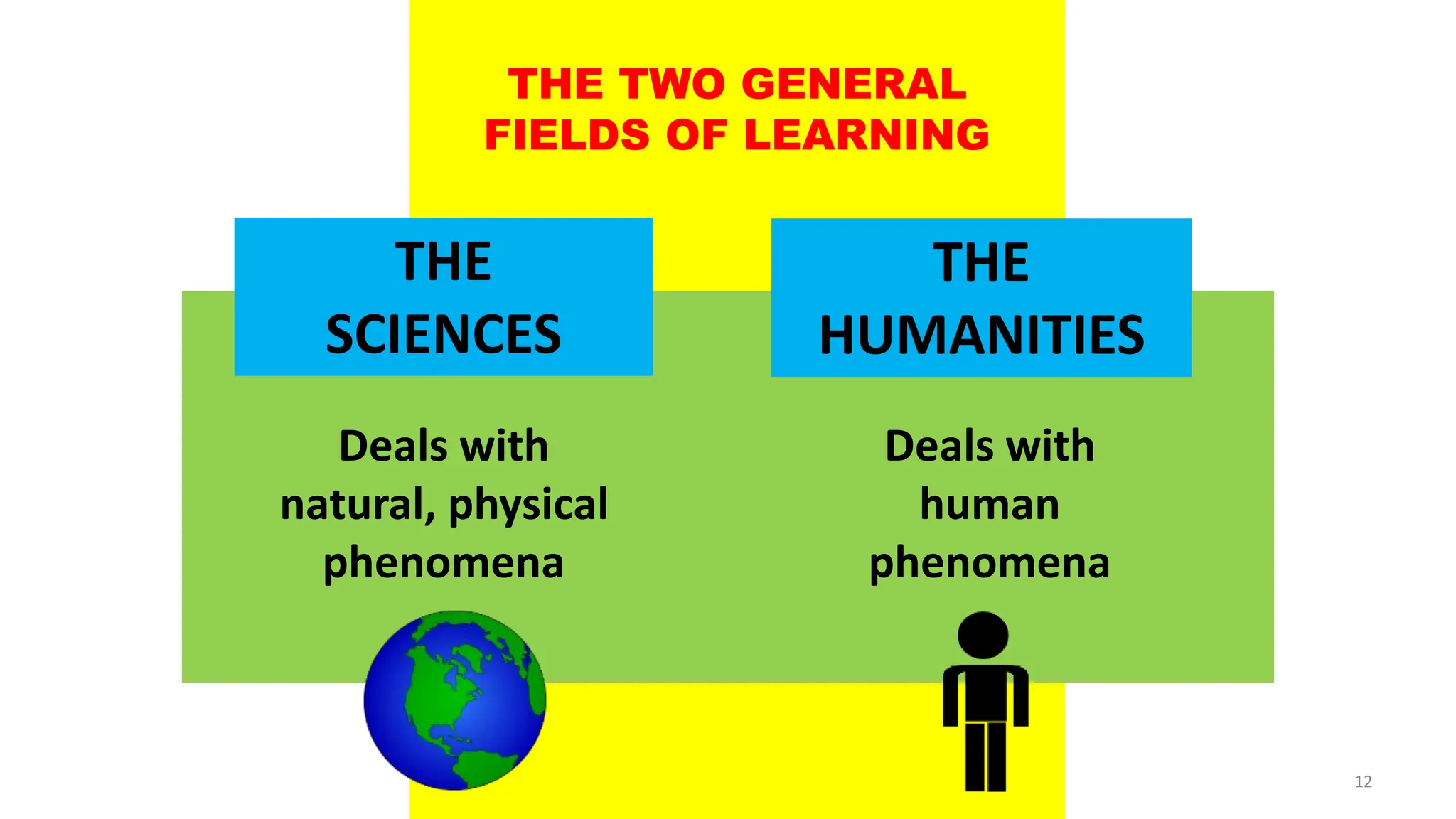
THE
SCIENCES
THE TWO GENERAL
FIELDS OF LEARNING
THE
HUMANITIES
Deals with
natural, physical
phenomena
Deals with
human
phenomena
12
DR. ALLAN C. ORATE, UE
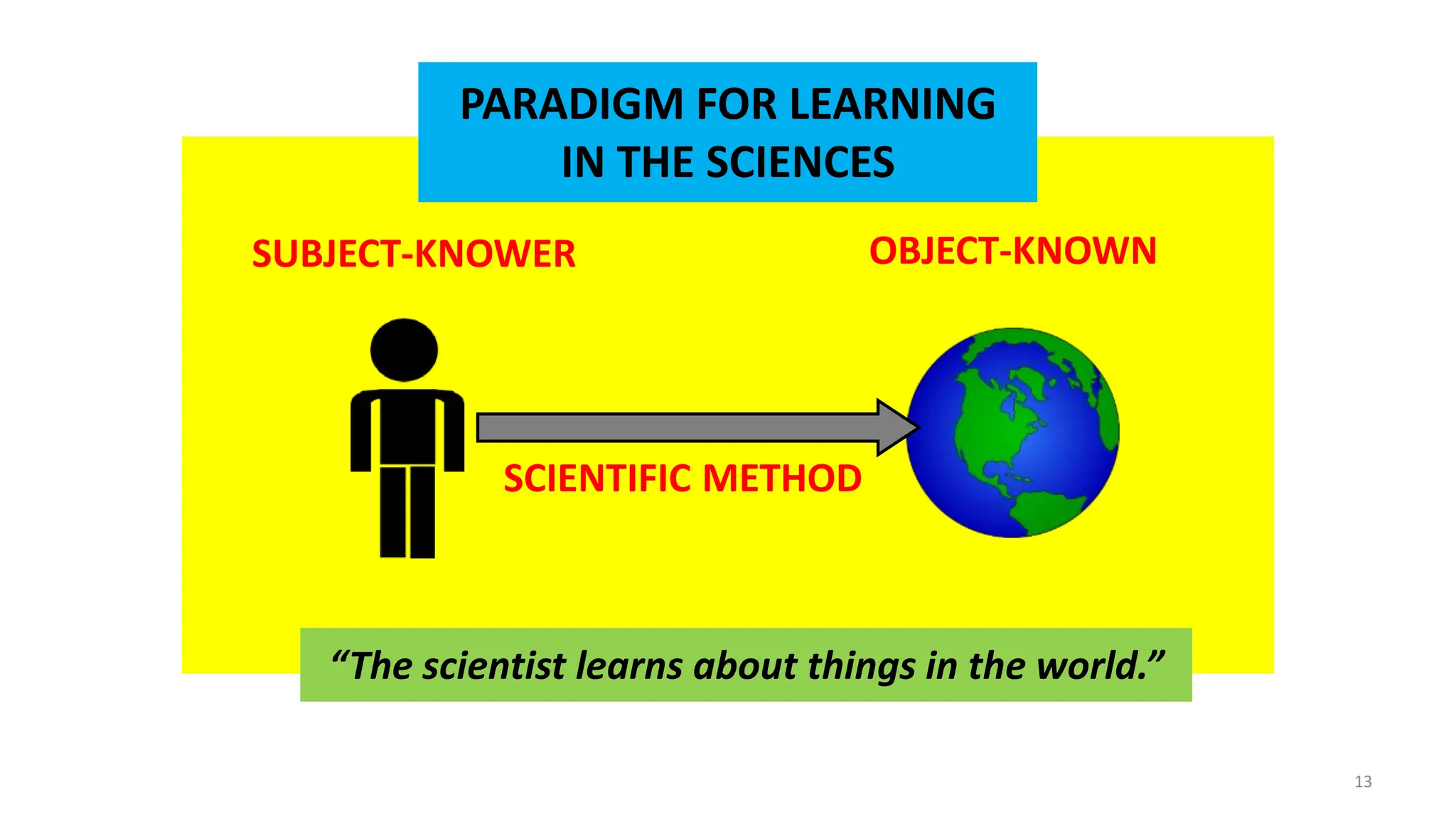
SUBJECT-KNOWER
PARADIGM FOR LEARNING
IN THE SCIENCES
OBJECT-KNOWN
“The scientist learns about things in the world.”
SCIENTIFIC METHOD
13
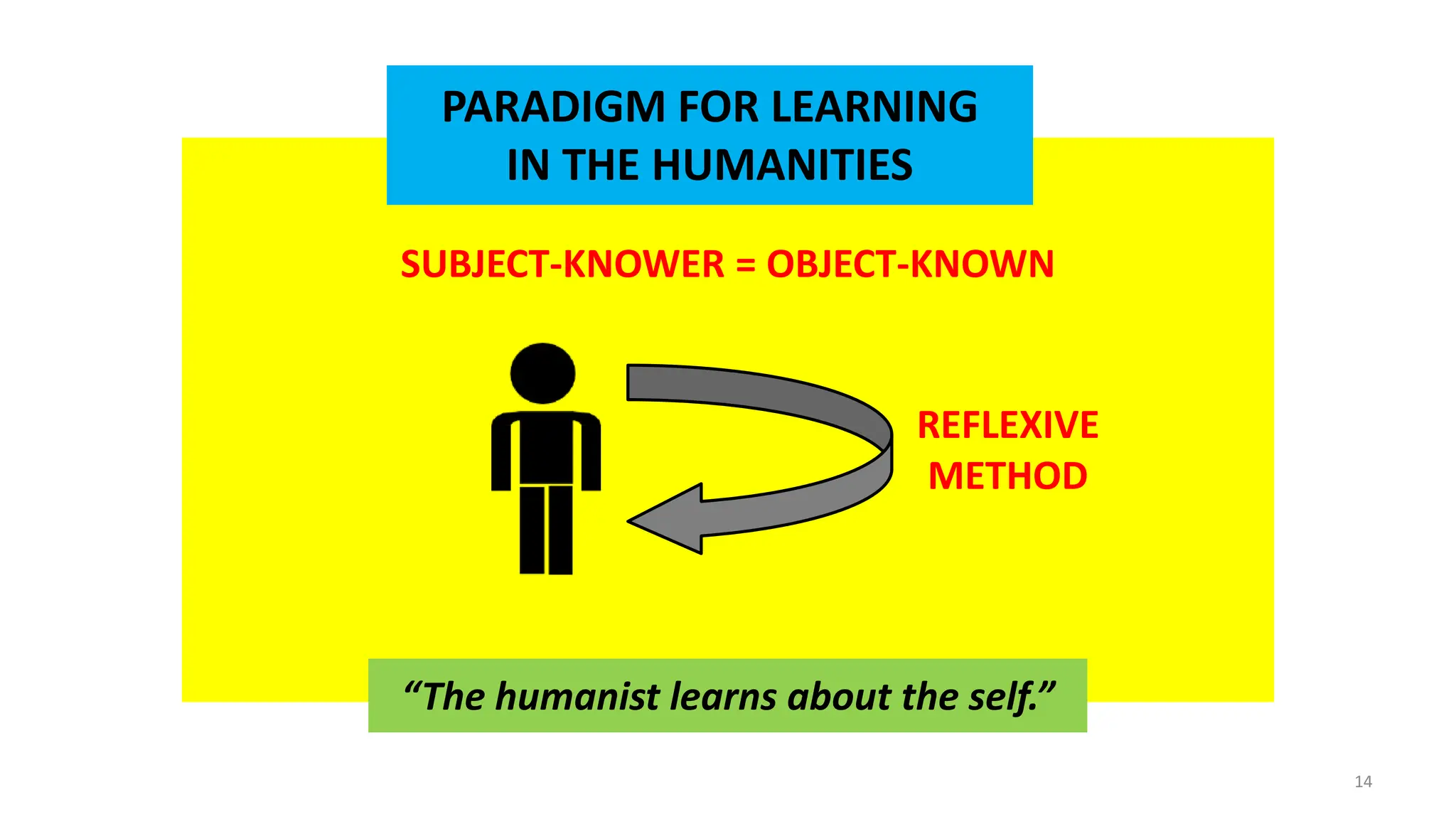
SUBJECT-KNOWER = OBJECT-KNOWN
PARADIGM FOR LEARNING
IN THE HUMANITIES
“The humanist learns about the self.”
REFLEXIVE
METHOD
14
“Who am I?”
THE BASIC
QUESTION IN
THE HUMANITIES
https://www.
youtube.com
/watch?v=m
Bcqria2wmg
15
DR. ALLAN C. ORATE, UE
For various reasons cultural, political, economic, and ideological that the
norm of self-knowledge has come and gone with the tides through Western
history. Even if we had been constantly enjoined to achieve self-knowledge
for the 2,300 years since the time Socrates spoke, just as Sigmund Freud
said about civilization; that civilization is constantly being created anew and
everyone being born has to work their way up to being civilized being; so,
also the project of achieving self-knowledge is a project for every single new
member of our species. No one can be given it at birth. It’s not an
achievement you get for free like a high IQ or a prominent chin. Continuing
to beat that drum, to remind people of the importance of that, is something
we’ll always be doing.
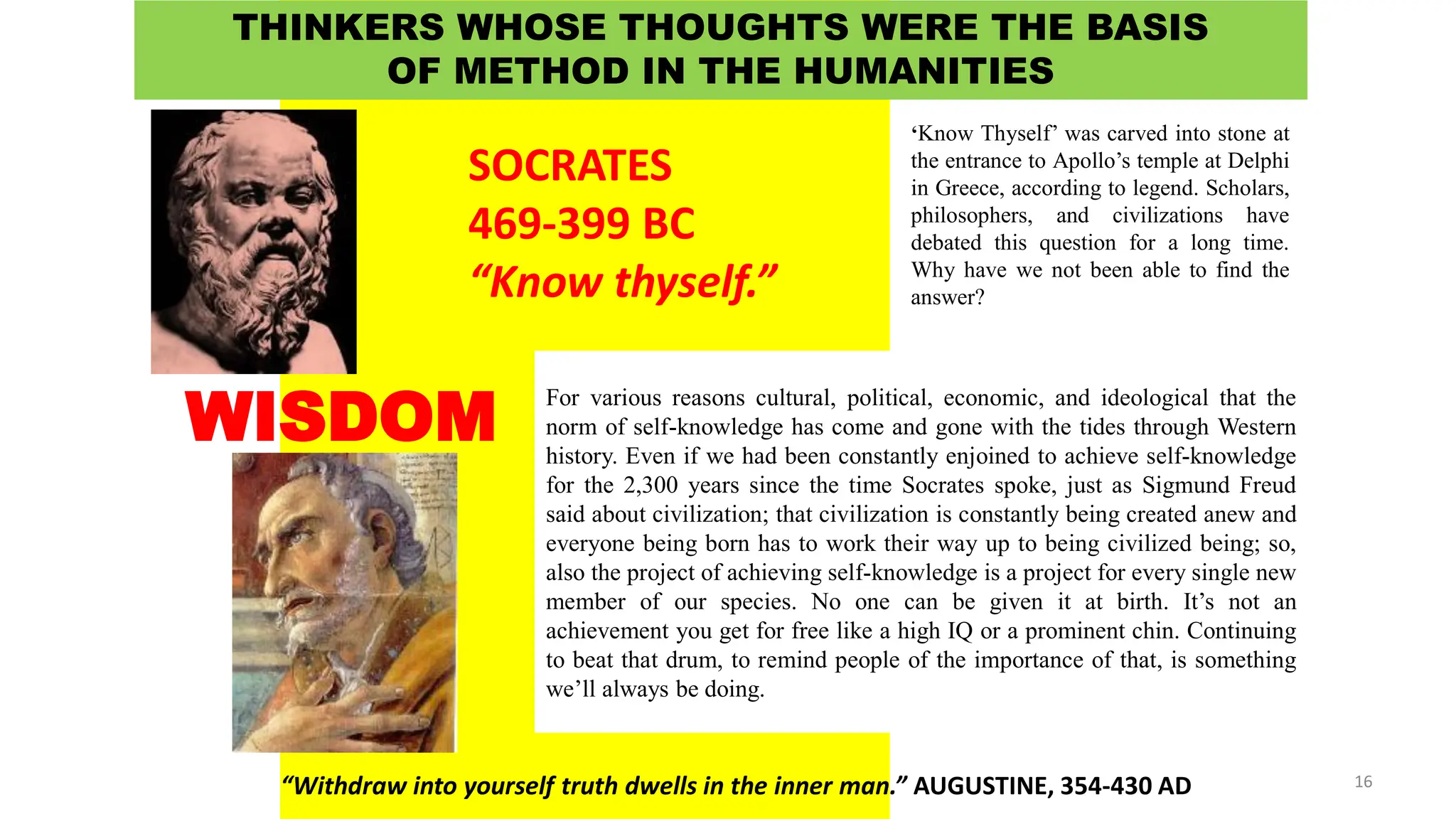
SOCRATES
469-399 BC
“Know thyself.”
“Withdraw into yourself truth dwells in the inner man.” AUGUSTINE, 354-430 AD
WISDOM
THINKERS WHOSE THOUGHTS WERE THE BASIS
OF METHOD IN THE HUMANITIES
‘Know Thyself’ was carved into stone at
the entrance to Apollo’s temple at Delphi
in Greece, according to legend. Scholars,
philosophers, and civilizations have
debated this question for a long time.
Why have we not been able to find the
answer?
16
DR. ALLAN C. ORATE, UE
THE
SCIENCES
THE
HUMANITIES
KNOWLEDGE WISDOM
The scientist
becomes a
LEARNED MAN.
The humanist
becomes a
WISE MAN.
17
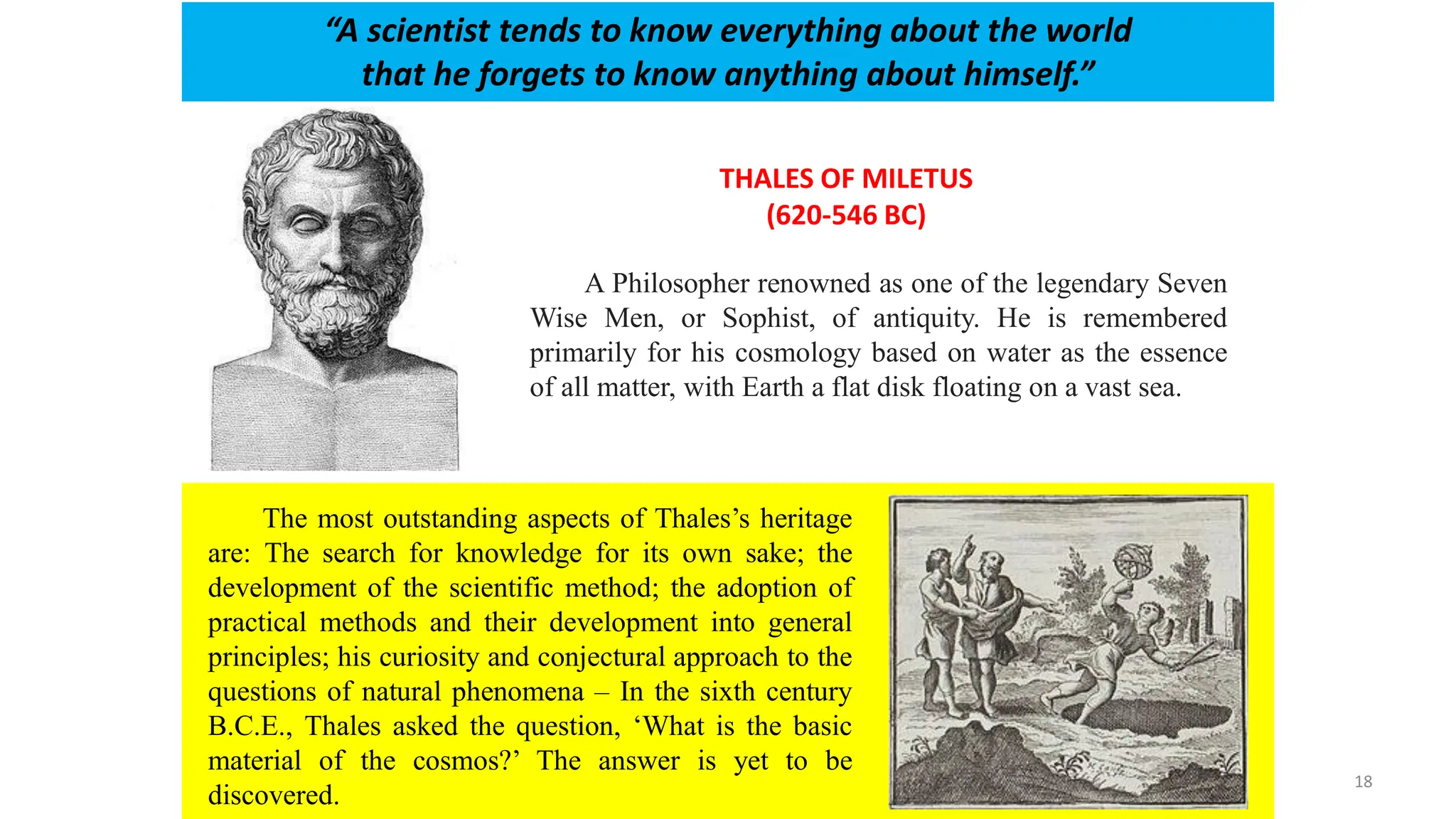
THALES OF MILETUS
(620-546 BC)
“A scientist tends to know everything about the world
that he forgets to know anything about himself.”
A Philosopher renowned as one of the legendary Seven
Wise Men, or Sophist, of antiquity. He is remembered
primarily for his cosmology based on water as the essence
of all matter, with Earth a flat disk floating on a vast sea.
The most outstanding aspects of Thales’s heritage
are: The search for knowledge for its own sake; the
development of the scientific method; the adoption of
practical methods and their development into general
principles; his curiosity and conjectural approach to the
questions of natural phenomena – In the sixth century
B.C.E., Thales asked the question, ‘What is the basic
material of the cosmos?’ The answer is yet to be
discovered.
18
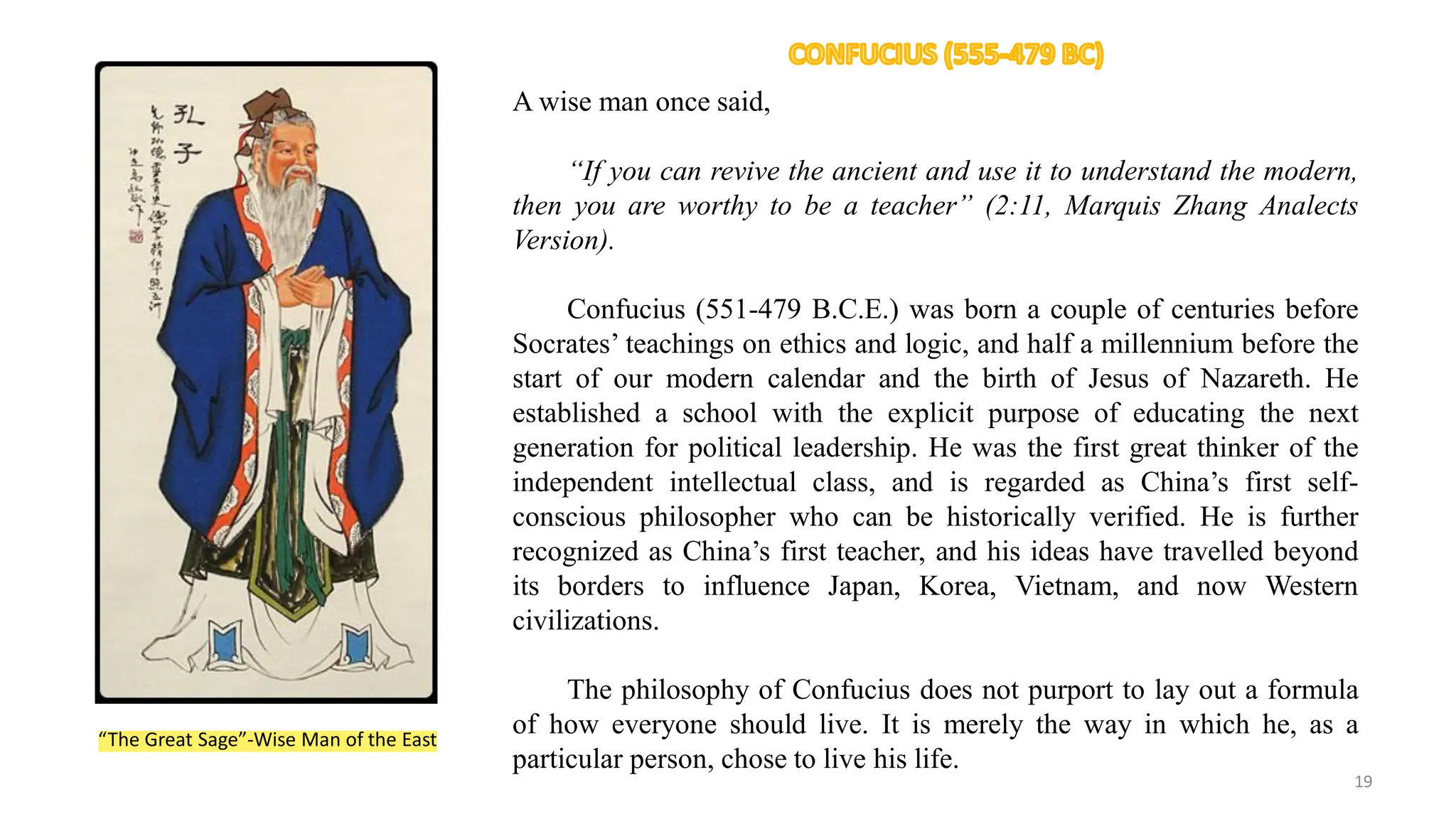
A wise man once said,
“If you can revive the ancient and use it to understand the modern,
then you are worthy to be a teacher” (2:11, Marquis Zhang Analects
Version).
Confucius (551-479 B.C.E.) was born a couple of centuries before
Socrates’ teachings on ethics and logic, and half a millennium before the
start of our modern calendar and the birth of Jesus of Nazareth. He
established a school with the explicit purpose of educating the next
generation for political leadership. He was the first great thinker of the
independent intellectual class, and is regarded as China’s first self-
conscious philosopher who can be historically verified. He is further
recognized as China’s first teacher, and his ideas have travelled beyond
its borders to influence Japan, Korea, Vietnam, and now Western
civilizations.
The philosophy of Confucius does not purport to lay out a formula
of how everyone should live. It is merely the way in which he, as a
particular person, chose to live his life.
“The Great Sage”-Wise Man of the East
19
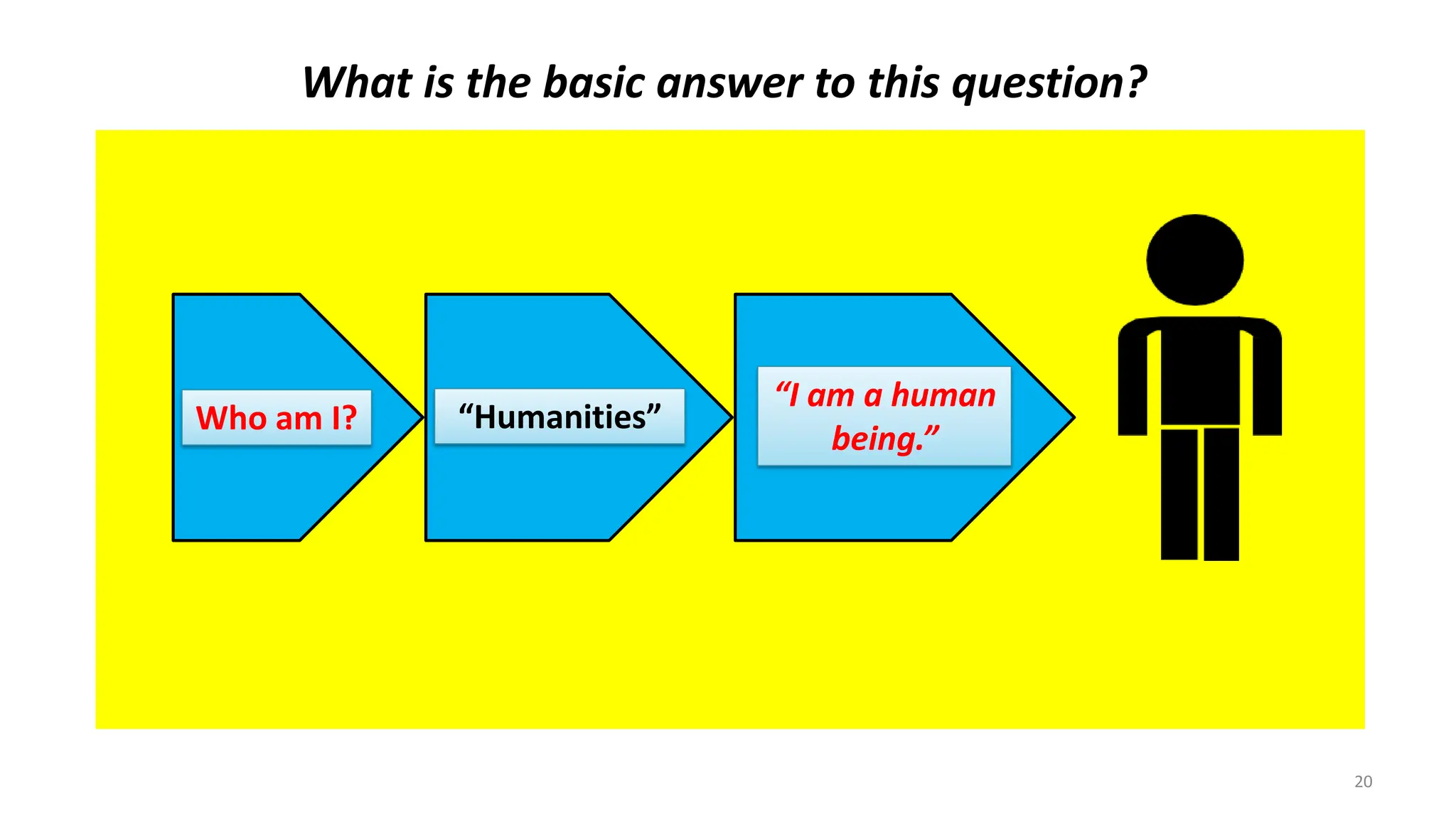
What is the basic answer to this question?
“I am a human
being.”
Who am I? “Humanities”
20

Humanities Lesson 1 Understanding the Humanities

  • 1.
    Readings Panofsky, E. (1955).The History of Art as a Humanistic Discipline. Meaning in the Visual Arts. Australia: Penguin Books. Dhakhwa, S. & Enriquez, S. (2008). The Relevance of Confucian Philosophy to Modern Concepts of Leadership and Followership (2008). All Volumes (2001-2008). 5.http://digitalcommons.unf.edu/ojii_volumes/5 CANVAS Network. Module 1 - Introductions and Definitions. WHAT IS ART? https://learn.canvas.net/courses/24/pages/m1-what-is-art?module_item_id=44378 Study.com. Christian Humanism: Definition & Role in the Renaissance. Chapter 1, Lesson 14. https://study.com/academy/lesson/christian-humanism-definition-role-in-the- renaissance.html#:~:text=Christian%20Humanism%20was%20a%20Renaissance,helped%20encourage%20the%20Protestant%2 0Reformation. Video Who Am I. (Dec. 4, 2010). https://www.youtube.com/watch?v=mBcqria2wmg What was crucifixion like? (April 15, 2017). https://youtu.be/V0gNIL5GAdE The audacity of Christian art: the problem with Christ | National Gallery. https://www.khanacademy.org/humanities/ap-art-history/introduction-cultures-religions-apah/christianity- apah/v/christian-art-national-gallery 1. Survey the Place of the Humanities in the History of Western and Eastern Civilization. 2. Distinguish the Humanities and the Sciences as Fields of Learning. REFERENCES Lesson 1.1. Understanding Humanities 6
  • 2.
    Among all thesepictures, which do you think gives the right description of the crucifixion of Christ? Explain your answer? https://yout u.be/V0gN IL5GAdE https://you tu.be/XKg 7YILYBkc 7
  • 3.
    The Renaissance &Humanism The word 'renaissance' literally means rebirth. Between the 14th and 16th centuries, Europe experienced a rebirth of Greco-Roman culture, which had died out centuries before. Historians call this time period of rebirth, the Renaissance. This Renaissance included a renewed interest in Greco-Roman texts, a rekindled love of learning, an increased interest in understanding the natural world, and the philosophy of humanism. Humanism is an optimistic outlook emphasizing the goodness and success of humanity. Before the Renaissance, Christian Europeans often viewed humanity as sinful creatures who needed to be constantly mindful of their souls. During this new period of rebirth, however, there was much more emphasis on the goodness of God's creation and the talents and skills God had granted humanity. 8
  • 4.
    The Northern Renaissance& Christian Humanism The Renaissance started in Italy, which had always been very aware of its Greco-Roman heritage. As the movement migrated north into places such as England, Germany, and Scandinavia, however, some of the Greco-Roman aspects were downplayed. Instead, there was much more emphasis on the understanding of Christianity, particularly early Christianity. What happened in the north is known as the Northern Renaissance, and its version of humanism became known as Christian Humanism. In Christianity, Jesus is understood to have both mortal and divine aspects to his being. Before the Renaissance, Christian teachings focused primarily on the spiritual and divine aspects of their belief: Jesus as divine, miracles, salvation, damnation, and so on. During the Northern Renaissance, however, there was much more focus on Jesus the mortal man, including his teachings, relationships, and experiences culminating with his execution via crucifixion. This ultimately affected many different aspects of religious life in northern Europe. One of the results of this focus on Jesus's mortal aspects was artwork that emphasized the physical and emotional pain associated with the crucifixion. Previously, images of his death were primarily about salvation through sacrifice, and artists depicted Jesus peacefully slumped over, as if he was sleeping. Artists influenced by Christian Humanism, however, often depicted Jesus tightly twisted in agony. Those witnessing his death are shown as wrought with grief rather than reflecting on the joy of salvation. 9
  • 5.
    How would youdefine ‘art’? For many people art is a specific thing; a painting, sculpture or photograph, a dance, a poem or a play. It is all of these things, and more. They are mediums of artistic expression. Webster’s New Collegiate dictionary defines art as “The conscious use of skill and creative imagination especially in the production of aesthetic objects.” Yet art is much more than a medium, or words on a page. It is the expression of our experience. Art is uniquely human and tied directly to culture. It takes the ordinary and makes it extraordinary. It asks questions about who we are, what we value, the meaning of beauty and the human condition. As an expressive medium it allows us to experience sublime joy, deep sorrow, confusion and clarity. It tests our strengths, vulnerabilities and resolve. It gives voice to ideas and feelings, connects us to the past, reflects the present and anticipates the future. Along these lines, art history, combined with anthropology and literature, are three main sources in observing, recording and interpreting our human past. Visual art is a rich and complex subject whose definition is in flux as the culture around it changes. Because of this, how we define art is in essence a question of agreement. In this respect, we can look again to the dictionary’s definition for an understanding of exactly what to look for when we proclaim something as ‘art’. 10
  • 6.
    DR. ALLAN C.ORATE, UE FRAMEWORKS AND PERSPECTIVES Sciences HUMANITIES Art Creation Artist Practice ART APPRECIATION Spectator Theory History FIELDS OF LEARNING Language Philosophy ART Our frail and fallible human bodies leave behind frail and fallible records of our frail and fallible lives oddly turning our inescapable mortality into a kind of immortality for subsequent mortals to humanistically or scientifically observe. And so, the duality we face regarding the definition of "humanity" still remains. The humanities actually compliment the sciences and vice versa. It's only that the exactness of science is a mastery and the depth of the humanities is wisdom. KEY CONCEPTS 11
  • 7.
    DR. ALLAN C.ORATE, UE THE SCIENCES THE TWO GENERAL FIELDS OF LEARNING THE HUMANITIES Deals with natural, physical phenomena Deals with human phenomena 12
  • 8.
    DR. ALLAN C.ORATE, UE SUBJECT-KNOWER PARADIGM FOR LEARNING IN THE SCIENCES OBJECT-KNOWN “The scientist learns about things in the world.” SCIENTIFIC METHOD 13
  • 9.
    SUBJECT-KNOWER = OBJECT-KNOWN PARADIGMFOR LEARNING IN THE HUMANITIES “The humanist learns about the self.” REFLEXIVE METHOD 14
  • 10.
    “Who am I?” THEBASIC QUESTION IN THE HUMANITIES https://www. youtube.com /watch?v=m Bcqria2wmg 15
  • 11.
    DR. ALLAN C.ORATE, UE For various reasons cultural, political, economic, and ideological that the norm of self-knowledge has come and gone with the tides through Western history. Even if we had been constantly enjoined to achieve self-knowledge for the 2,300 years since the time Socrates spoke, just as Sigmund Freud said about civilization; that civilization is constantly being created anew and everyone being born has to work their way up to being civilized being; so, also the project of achieving self-knowledge is a project for every single new member of our species. No one can be given it at birth. It’s not an achievement you get for free like a high IQ or a prominent chin. Continuing to beat that drum, to remind people of the importance of that, is something we’ll always be doing. SOCRATES 469-399 BC “Know thyself.” “Withdraw into yourself truth dwells in the inner man.” AUGUSTINE, 354-430 AD WISDOM THINKERS WHOSE THOUGHTS WERE THE BASIS OF METHOD IN THE HUMANITIES ‘Know Thyself’ was carved into stone at the entrance to Apollo’s temple at Delphi in Greece, according to legend. Scholars, philosophers, and civilizations have debated this question for a long time. Why have we not been able to find the answer? 16
  • 12.
    DR. ALLAN C.ORATE, UE THE SCIENCES THE HUMANITIES KNOWLEDGE WISDOM The scientist becomes a LEARNED MAN. The humanist becomes a WISE MAN. 17
  • 13.
    THALES OF MILETUS (620-546BC) “A scientist tends to know everything about the world that he forgets to know anything about himself.” A Philosopher renowned as one of the legendary Seven Wise Men, or Sophist, of antiquity. He is remembered primarily for his cosmology based on water as the essence of all matter, with Earth a flat disk floating on a vast sea. The most outstanding aspects of Thales’s heritage are: The search for knowledge for its own sake; the development of the scientific method; the adoption of practical methods and their development into general principles; his curiosity and conjectural approach to the questions of natural phenomena – In the sixth century B.C.E., Thales asked the question, ‘What is the basic material of the cosmos?’ The answer is yet to be discovered. 18
  • 14.
    A wise manonce said, “If you can revive the ancient and use it to understand the modern, then you are worthy to be a teacher” (2:11, Marquis Zhang Analects Version). Confucius (551-479 B.C.E.) was born a couple of centuries before Socrates’ teachings on ethics and logic, and half a millennium before the start of our modern calendar and the birth of Jesus of Nazareth. He established a school with the explicit purpose of educating the next generation for political leadership. He was the first great thinker of the independent intellectual class, and is regarded as China’s first self- conscious philosopher who can be historically verified. He is further recognized as China’s first teacher, and his ideas have travelled beyond its borders to influence Japan, Korea, Vietnam, and now Western civilizations. The philosophy of Confucius does not purport to lay out a formula of how everyone should live. It is merely the way in which he, as a particular person, chose to live his life. “The Great Sage”-Wise Man of the East 19
  • 15.
    What is thebasic answer to this question? “I am a human being.” Who am I? “Humanities” 20