The Humanities A Study Of Values
• The humanities are those studies that are
directly concerned with human values.
• Human values that can be perceived, felt, and
expressed in subtle yet enduring ways.
• In the medieval period the word “Humanities”
distinguished that which pertained to humans
from that which pertained to God.
A Humanist Approach
• The humanists say, “what we need is a study
that will get us closer to ourselves.”
• Approaching the humanities is through art,
music, literature, fashion, writings, theater,
culture, -isms, -phies, -ogies, .
Disciplinary Domain of the Humanities
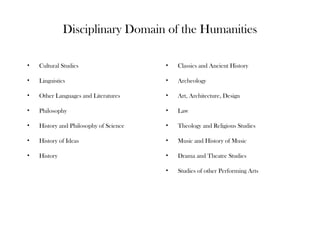
• Cultural Studies
• Linguistics
• Other Languages and Literatures
• Philosophy
• History and Philosophy of Science
• History of Ideas
• History
• Classics and Ancient History
• Archeology
• Art, Architecture, Design
• Law
• Theology and Religious Studies
• Music and History of Music
• Drama and Theatre Studies
• Studies of other Performing Arts
Relationships in Culture
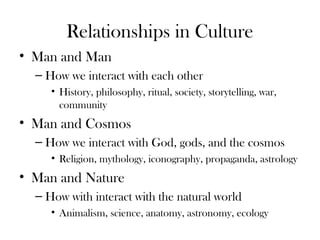
• Man and Man
– How we interact with each other
• History, philosophy, ritual, society, storytelling, war,
community
• Man and Cosmos
– How we interact with God, gods, and the cosmos
• Religion, mythology, iconography, propaganda, astrology
• Man and Nature
– How with interact with the natural world
• Animalism, science, anatomy, astronomy, ecology
What is culture?
• Encompasses the values and behaviors
shared by a group of people, developed over
time, and passed down from generation to
generation
• Art from earliest times was associated with the
religious and political elites, who used it
as a way of expressing the values of a the
culture
CREATION MYTHS
• Stories about the Creation of the World
• “tell people who they are by telling where they
came from”
• influence how they think about the world &
treat it
• their worldview
• symbolic story about how the world was
created & how humans came to be
6
CREATION MYTHS
• common traits:
• advance a general cultural outlook
• perspectives on life
• ways to understand life
• also
• birth theme: start of life cycle
• higher power: a creator, catalyst
• innocence, sinlessness
• animals & humans together
7
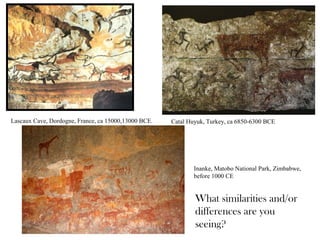
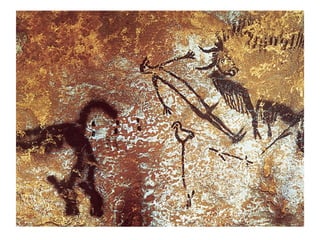
Lascaux Cave, Dordogne, France, ca 15000,13000 BCE. Catal Huyuk, Turkey, ca 6850-6300 BCE
Inanke, Matobo National Park, Zimbabwe,
before 1000 CE
What similarities and/or
differences are you
seeing?
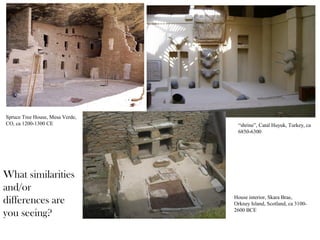
“shrine”, Catal Huyuk, Turkey, ca
6850-6300
House interior, Skara Brae,
Orkney Island, Scotland, ca 3100-
2600 BCE
Spruce Tree House, Mesa Verde,
CO, ca 1200-1300 CE
What similarities
and/or
differences are
you seeing?
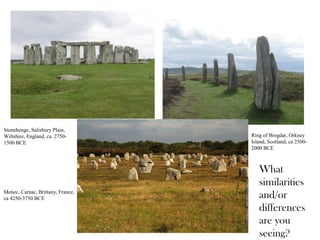
Stonehenge, Salisbury Plain,
Wiltshire, England, ca. 2750-
1500 BCE
Menec, Carnac, Brittany, France,
ca 4250-3750 BCE
Ring of Brogdar, Orkney
Island, Scotland, ca 2500-
2000 BCE
What
similarities
and/or
differences
are you
seeing?
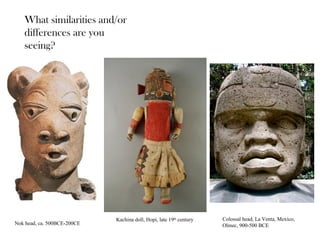
Kachina doll, Hopi, late 19th
century Colossal head, La Venta, Mexico,
Olmec, 900-500 BCENok head, ca. 500BCE-200CE
What similarities and/or
differences are you
seeing?
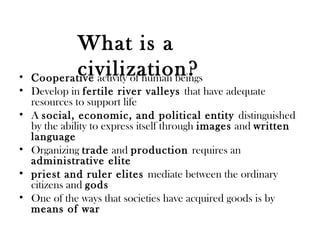
• Cooperative activity of human beings
• Develop in fertile river valleys that have adequate
resources to support life
• A social, economic, and political entity distinguished
by the ability to express itself through images and written
language
• Organizing trade and production requires an
administrative elite
• priest and ruler elites mediate between the ordinary
citizens and gods
• One of the ways that societies have acquired goods is by
means of war
What is a
civilization?
The Prehistoric Past
• Paleolithic era ‘Old Stone Age’
• Neolithic era ‘New Stone Age’
• ‘Bronze Age’ –science of metallurgy; the stone and
bone tools were replaced by metal ones
• Nomadic lifestyle gave way to a more sedentary
lifestyle
• In the great river valleys of the Middle East
and Asia distinct centers of people began to form
civilizations
• Rich cultures that later developed into civilizations
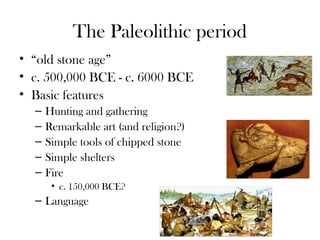
The Paleolithic period
• “old stone age”
• c. 500,000 BCE - c. 6000 BCE
• Basic features
– Hunting and gathering
– Remarkable art (and religion?)
– Simple tools of chipped stone
– Simple shelters
– Fire
• c. 150,000 BCE?
– Language
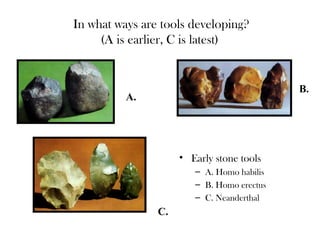
In what ways are tools developing?
(A is earlier, C is latest)
B.
C.
• Early stone tools
– A. Homo habilis
– B. Homo erectus
– C. Neanderthal
A.
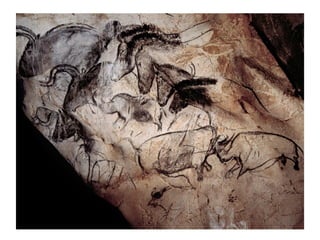
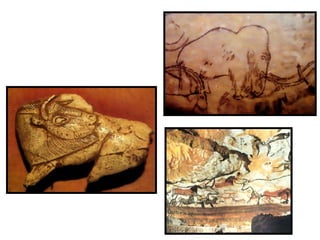
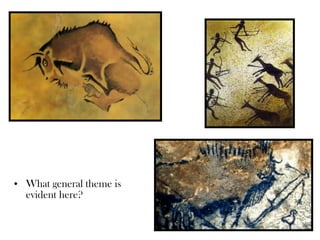
Chauvet cave – in front of the horses is a herd of aurochs, extinct
ancestors of oxen
Why were these paintings made?
• The drawings were magic charms meant to
ensure a successful hunt
• The caves –gateways to the underworld and
death
• Served as calendars for predicting the
seasonal migration of the animals
• Possessed some from of agency – they were
created to exert some power or authority over
those who came into contact with it
What is the significance of the Chauvet cave?
• its antiquity
• The range of animals it depicts
• Perspective painting style which shows a
stunning naturalism
• Abandonment of the linear theory of the
development of realistic art
• What general theme is
evident here?
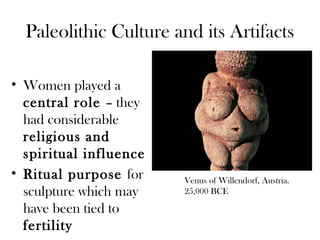
Paleolithic Culture and its Artifacts
• Women played a
central role – they
had considerable
religious and
spiritual influence
• Ritual purpose for
sculpture which may
have been tied to
fertility
Venus of Willendorf, Austria.
25,000 BCE
The Neolithic period
• Began in Middle East around 6000 BCE
– to c. 3700 BCE
• Basic features
– Food production
– Polished stone tools
• and weapons?
– More settled, less nomadic lifestyles
– “permanent” villages
– Population increases
– Development of a more complex (and
satisfying?) social order
How did agriculture develop?
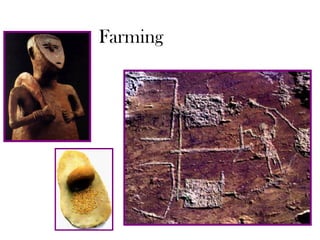
• Agriculture-- animal husbandry, domestication
of dogs
• From hunting gathering to agriculture
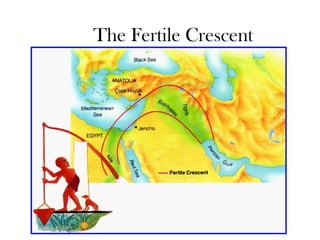
• Populations came together into cities in fertile
river valleys
• Travel through rivers leads to growing
civilizations, trade, economic improvements
The Fertile Crescent
Farming
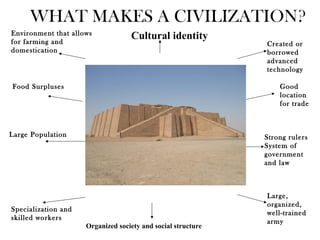
WHAT MAKES A CIVILIZATION?
Environment that allows
for farming and
domestication
Food Surpluses
Large Population
Specialization and
skilled workers
Created or
borrowed
advanced
technology
Good
location
for trade
Strong rulers
System of
government
and law
Large,
organized,
well-trained
army
Organized society and social structure
Cultural identity

HUMA101-Chapter1

  • 1.
    The Humanities AStudy Of Values • The humanities are those studies that are directly concerned with human values. • Human values that can be perceived, felt, and expressed in subtle yet enduring ways. • In the medieval period the word “Humanities” distinguished that which pertained to humans from that which pertained to God.
  • 2.
    A Humanist Approach •The humanists say, “what we need is a study that will get us closer to ourselves.” • Approaching the humanities is through art, music, literature, fashion, writings, theater, culture, -isms, -phies, -ogies, .
  • 3.
    Disciplinary Domain ofthe Humanities • Cultural Studies • Linguistics • Other Languages and Literatures • Philosophy • History and Philosophy of Science • History of Ideas • History • Classics and Ancient History • Archeology • Art, Architecture, Design • Law • Theology and Religious Studies • Music and History of Music • Drama and Theatre Studies • Studies of other Performing Arts
  • 4.
    Relationships in Culture •Man and Man – How we interact with each other • History, philosophy, ritual, society, storytelling, war, community • Man and Cosmos – How we interact with God, gods, and the cosmos • Religion, mythology, iconography, propaganda, astrology • Man and Nature – How with interact with the natural world • Animalism, science, anatomy, astronomy, ecology
  • 5.
    What is culture? •Encompasses the values and behaviors shared by a group of people, developed over time, and passed down from generation to generation • Art from earliest times was associated with the religious and political elites, who used it as a way of expressing the values of a the culture
  • 6.
    CREATION MYTHS • Storiesabout the Creation of the World • “tell people who they are by telling where they came from” • influence how they think about the world & treat it • their worldview • symbolic story about how the world was created & how humans came to be 6
  • 7.
    CREATION MYTHS • commontraits: • advance a general cultural outlook • perspectives on life • ways to understand life • also • birth theme: start of life cycle • higher power: a creator, catalyst • innocence, sinlessness • animals & humans together 7
  • 8.
    Lascaux Cave, Dordogne,France, ca 15000,13000 BCE. Catal Huyuk, Turkey, ca 6850-6300 BCE Inanke, Matobo National Park, Zimbabwe, before 1000 CE What similarities and/or differences are you seeing?
  • 9.
    “shrine”, Catal Huyuk,Turkey, ca 6850-6300 House interior, Skara Brae, Orkney Island, Scotland, ca 3100- 2600 BCE Spruce Tree House, Mesa Verde, CO, ca 1200-1300 CE What similarities and/or differences are you seeing?
  • 10.
    Stonehenge, Salisbury Plain, Wiltshire,England, ca. 2750- 1500 BCE Menec, Carnac, Brittany, France, ca 4250-3750 BCE Ring of Brogdar, Orkney Island, Scotland, ca 2500- 2000 BCE What similarities and/or differences are you seeing?
  • 11.
    Kachina doll, Hopi,late 19th century Colossal head, La Venta, Mexico, Olmec, 900-500 BCENok head, ca. 500BCE-200CE What similarities and/or differences are you seeing?
  • 12.
    • Cooperative activityof human beings • Develop in fertile river valleys that have adequate resources to support life • A social, economic, and political entity distinguished by the ability to express itself through images and written language • Organizing trade and production requires an administrative elite • priest and ruler elites mediate between the ordinary citizens and gods • One of the ways that societies have acquired goods is by means of war What is a civilization?
  • 13.
    The Prehistoric Past •Paleolithic era ‘Old Stone Age’ • Neolithic era ‘New Stone Age’ • ‘Bronze Age’ –science of metallurgy; the stone and bone tools were replaced by metal ones • Nomadic lifestyle gave way to a more sedentary lifestyle • In the great river valleys of the Middle East and Asia distinct centers of people began to form civilizations • Rich cultures that later developed into civilizations
  • 14.
    The Paleolithic period •“old stone age” • c. 500,000 BCE - c. 6000 BCE • Basic features – Hunting and gathering – Remarkable art (and religion?) – Simple tools of chipped stone – Simple shelters – Fire • c. 150,000 BCE? – Language
  • 15.
    In what waysare tools developing? (A is earlier, C is latest) B. C. • Early stone tools – A. Homo habilis – B. Homo erectus – C. Neanderthal A.
  • 16.
    Chauvet cave –in front of the horses is a herd of aurochs, extinct ancestors of oxen
  • 18.
    Why were thesepaintings made? • The drawings were magic charms meant to ensure a successful hunt • The caves –gateways to the underworld and death • Served as calendars for predicting the seasonal migration of the animals • Possessed some from of agency – they were created to exert some power or authority over those who came into contact with it
  • 19.
    What is thesignificance of the Chauvet cave? • its antiquity • The range of animals it depicts • Perspective painting style which shows a stunning naturalism • Abandonment of the linear theory of the development of realistic art
  • 21.
    • What generaltheme is evident here?
  • 22.
    Paleolithic Culture andits Artifacts • Women played a central role – they had considerable religious and spiritual influence • Ritual purpose for sculpture which may have been tied to fertility Venus of Willendorf, Austria. 25,000 BCE
  • 23.
    The Neolithic period •Began in Middle East around 6000 BCE – to c. 3700 BCE • Basic features – Food production – Polished stone tools • and weapons? – More settled, less nomadic lifestyles – “permanent” villages – Population increases – Development of a more complex (and satisfying?) social order
  • 24.
    How did agriculturedevelop? • Agriculture-- animal husbandry, domestication of dogs • From hunting gathering to agriculture • Populations came together into cities in fertile river valleys • Travel through rivers leads to growing civilizations, trade, economic improvements
  • 25.
  • 26.
  • 27.
    WHAT MAKES ACIVILIZATION? Environment that allows for farming and domestication Food Surpluses Large Population Specialization and skilled workers Created or borrowed advanced technology Good location for trade Strong rulers System of government and law Large, organized, well-trained army Organized society and social structure Cultural identity