HUMAN SEXUALITY
B y : A k h i l a . E
INTRODUCTI
ON
DEFINITION
HUMAN SEXUALITY is the way
in which we experience and
express ourselves as sexual
beings.
-Rathus et al - 1993
1.Primary Sexual
Characteristics
2. Secondary Sexual
Characteristics
o They are directly related to
reproduction and include the sex
organs(genetalia).
o They are the attributes other than
the sex organs that generally
distinguish one sex from the
other.
o They are not essentially required
for reproduction.
o These are the breasts in women
o Facial hair and deeper voice in
HUMAN SEXUAL
CHARACTERISTICS
BIOLOGICAL
PERSPECTIVE
LEARNING
PERSPECTIVE
BIOLOGICAL
PERSPECTIVE
• Hormones are the major “driving forces” of sexual desire.
• Hormones are produced by: a.Gonads(testes and ovaries)
b.Adrenal cortex(androgens & estrogen)
c.The pituitary gland(FSH & LH)
d.Hypothalamus(GnRH)
• Androgens , estrogen and progestin are present both in male and female.
• Androgens differentiate male reproductive system before birth and puberty
in boys.
• Estrogen and progestins found in higher concentration within females
regulate menstrual cycle and essential for reproduction.
LEARNING PERSPECTIVE
PRINCIPLES
REGARDING
INFORMATION ABOUT
SEXUAITY
Each child s process of maturation as a
perosn is different.
Single parents sensitivity with a child of
opposite sex.
Timely information regarding sexuality must be
provided in the broadest context.
Delay should not be done in providing
information to the children.
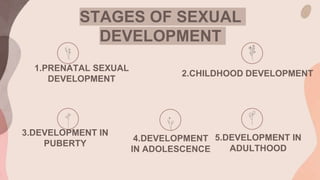
STAGES OF SEXUAL
DEVELOPMENT
1.PRENATAL SEXUAL
DEVELOPMENT
3.DEVELOPMENT IN
PUBERTY
4.DEVELOPMENT
IN ADOLESCENCE
2.CHILDHOOD DEVELOPMENT
5.DEVELOPMENT IN
ADULTHOOD
PRENATAL SEXUAL DEVELOPMENT
● About 6 weeks after conception, if Y chromosome is present in
the embryo’s cells, a gene on the chromosome directs the
undifferentiated gonads to become testes.
● If Y is not present, the undifferentiated gonads will become
ovaries.
● If the gonads become testes, they begin to produce androgens by
about 8th week after conception .
CHILDHOOD DEVELOPMENT:
• Usually children touch or play with their genital organs at this age.
• From the beginning itself, there is difference in toys and play preferences.
• Children indulge in play games such as ‘doctor’ or ‘house’ that include sexual
exploration.
• These experiences are not labelled sexual by the children.
• Generally by the age of 6 or 7, children develop a sense of privacy and are aware
of social restrictions on sexual expression.
• Bodily changes of puberty begin, sometimes from the age of 8 to the age of 12,
the child may become self-conscious and more private.
DEVELOPMENT IN PUBERTY
• Puberty in girls begins from 8-13 yrs., where as in boys it starts about 2
yrs. later.
• The secondary sexual characteristics develop at this age, followed by
menstrual period in female.
• Hormones primarily responsible for these changes in young girls are:
-Adrenal androgens, Estrogens, Progesterone, Growth
hormones
In boys:
-Growth hormones, Androgens(testosterone).
• Sex education should be provided to boys and girls in this age.
DEVELOPMENT IN ADOLESCENCE
• Adolescence period is from about the age of 12-17yrs or older.
• It is the socially defined periods during which a person adjusts to
the physical emotional and sexual changes associated with the
transition from childhood to adulthood.
• They get exposed to sexual orientation which refers to a persons
erotic, romantic or affectional attraction to other sex or both
-Homosexuality
-Heterosexuality
DEVELOPMENT IN ADULTHOOD
• It is the period leading to engagement and the choice of that preferred
attachment which can lead to formation of family.
• During the period, more permanent relationships, in the form of marriage
become prevalent.
PHYSIOLOGY OF SEX
1. EXCITEMENT:
• It is the stage of sexual arousal in which there is vasoconstriction.
• In Men-
Penis becomes engorged with blood.
Penis gets larger and erect.
Skin of scrotum thickness.
Tension increases in the scrotal sac.
Scrotum is pulled up closer to the body.
• In Women-
Fluid seeps through vaginal walls to produce vaginal lubrication.
The glans of the clitoris becomes larger and harder than usual.
Nipples become erect.
Labia majora flattens and spread apart.
Labia minora swell and open.
Pulse rate and blood pressure increases during excitement phase.
2. PLATEAU:
• In this phase vasoconstriction peaks.
• Breathing rate, pulse rate and BP increases.
• The mans penis becomes completely erect and the glans swells.
• Fluid secreted from the cowpers gland( located near the urethra, below the
prostate) may appear at the tip of the penis.
• This fluid which nourishes the sperm, may contain active sperms capable of
impregnating a women.
• In women, the breasts continues to swell, the lower third of the vagina swells , the
clitoris retracts into the body, and the uterus enlarges.
• As women approaches orgasm, the labia majora darkens.
3.ORGASM:
• It is also called the climax
• It is an intense and usually pleasurable sensation that occurs at the peak of
sexual arousal.
• Not all sexual arousal leads to orgasm.
• Breathing rate, pulse rate and BP increases dramatically during orgasm.
• The sensation is very intense-more intense than the tingling or pleasure that
accompany strong sexual arousal.
4.RESOLUTION:
• In this phase, the processes of excitement and plateau stages reverse, the bodies
of both the women and men return to the unaroused state and there is reduction in
muscular tension.
SEXUAL DYSFUNCTION
THAT’S ALL

Human sexuality-eve.pptx

  • 1.
    HUMAN SEXUALITY B y: A k h i l a . E
  • 2.
  • 3.
    DEFINITION HUMAN SEXUALITY isthe way in which we experience and express ourselves as sexual beings. -Rathus et al - 1993
  • 4.
    1.Primary Sexual Characteristics 2. SecondarySexual Characteristics o They are directly related to reproduction and include the sex organs(genetalia). o They are the attributes other than the sex organs that generally distinguish one sex from the other. o They are not essentially required for reproduction. o These are the breasts in women o Facial hair and deeper voice in HUMAN SEXUAL CHARACTERISTICS
  • 5.
  • 6.
    BIOLOGICAL PERSPECTIVE • Hormones arethe major “driving forces” of sexual desire. • Hormones are produced by: a.Gonads(testes and ovaries) b.Adrenal cortex(androgens & estrogen) c.The pituitary gland(FSH & LH) d.Hypothalamus(GnRH) • Androgens , estrogen and progestin are present both in male and female. • Androgens differentiate male reproductive system before birth and puberty in boys. • Estrogen and progestins found in higher concentration within females regulate menstrual cycle and essential for reproduction.
  • 7.
  • 8.
  • 9.
    Each child sprocess of maturation as a perosn is different. Single parents sensitivity with a child of opposite sex. Timely information regarding sexuality must be provided in the broadest context. Delay should not be done in providing information to the children.
  • 10.
    STAGES OF SEXUAL DEVELOPMENT 1.PRENATALSEXUAL DEVELOPMENT 3.DEVELOPMENT IN PUBERTY 4.DEVELOPMENT IN ADOLESCENCE 2.CHILDHOOD DEVELOPMENT 5.DEVELOPMENT IN ADULTHOOD
  • 11.
    PRENATAL SEXUAL DEVELOPMENT ●About 6 weeks after conception, if Y chromosome is present in the embryo’s cells, a gene on the chromosome directs the undifferentiated gonads to become testes. ● If Y is not present, the undifferentiated gonads will become ovaries. ● If the gonads become testes, they begin to produce androgens by about 8th week after conception .
  • 12.
    CHILDHOOD DEVELOPMENT: • Usuallychildren touch or play with their genital organs at this age. • From the beginning itself, there is difference in toys and play preferences. • Children indulge in play games such as ‘doctor’ or ‘house’ that include sexual exploration. • These experiences are not labelled sexual by the children. • Generally by the age of 6 or 7, children develop a sense of privacy and are aware of social restrictions on sexual expression. • Bodily changes of puberty begin, sometimes from the age of 8 to the age of 12, the child may become self-conscious and more private.
  • 13.
    DEVELOPMENT IN PUBERTY •Puberty in girls begins from 8-13 yrs., where as in boys it starts about 2 yrs. later. • The secondary sexual characteristics develop at this age, followed by menstrual period in female. • Hormones primarily responsible for these changes in young girls are: -Adrenal androgens, Estrogens, Progesterone, Growth hormones In boys: -Growth hormones, Androgens(testosterone). • Sex education should be provided to boys and girls in this age.
  • 14.
    DEVELOPMENT IN ADOLESCENCE •Adolescence period is from about the age of 12-17yrs or older. • It is the socially defined periods during which a person adjusts to the physical emotional and sexual changes associated with the transition from childhood to adulthood. • They get exposed to sexual orientation which refers to a persons erotic, romantic or affectional attraction to other sex or both -Homosexuality -Heterosexuality
  • 15.
    DEVELOPMENT IN ADULTHOOD •It is the period leading to engagement and the choice of that preferred attachment which can lead to formation of family. • During the period, more permanent relationships, in the form of marriage become prevalent.
  • 16.
    PHYSIOLOGY OF SEX 1.EXCITEMENT: • It is the stage of sexual arousal in which there is vasoconstriction. • In Men- Penis becomes engorged with blood. Penis gets larger and erect. Skin of scrotum thickness. Tension increases in the scrotal sac. Scrotum is pulled up closer to the body. • In Women- Fluid seeps through vaginal walls to produce vaginal lubrication. The glans of the clitoris becomes larger and harder than usual. Nipples become erect. Labia majora flattens and spread apart. Labia minora swell and open. Pulse rate and blood pressure increases during excitement phase.
  • 17.
    2. PLATEAU: • Inthis phase vasoconstriction peaks. • Breathing rate, pulse rate and BP increases. • The mans penis becomes completely erect and the glans swells. • Fluid secreted from the cowpers gland( located near the urethra, below the prostate) may appear at the tip of the penis. • This fluid which nourishes the sperm, may contain active sperms capable of impregnating a women. • In women, the breasts continues to swell, the lower third of the vagina swells , the clitoris retracts into the body, and the uterus enlarges. • As women approaches orgasm, the labia majora darkens.
  • 18.
    3.ORGASM: • It isalso called the climax • It is an intense and usually pleasurable sensation that occurs at the peak of sexual arousal. • Not all sexual arousal leads to orgasm. • Breathing rate, pulse rate and BP increases dramatically during orgasm. • The sensation is very intense-more intense than the tingling or pleasure that accompany strong sexual arousal. 4.RESOLUTION: • In this phase, the processes of excitement and plateau stages reverse, the bodies of both the women and men return to the unaroused state and there is reduction in muscular tension.
  • 19.
  • 20.