Coming Challenges for
  Human Resources
       Reynolds Atkins
       November 2012
Themes
• Economic Security Index (ESI)
   – Developed by political scientist Jacob Hacker and colleagues at
     the Rockefeller Foundation
Themes
• ESI
  – Measures major loss of income (> 25%) due to either decline
    in income or significant out-of-pocket medical expenses
        • Hacker’s chart shows in excess of 20% of Americans were in this
          category in late 2009, higher than in previous recessions
  – ESI linked most prominently to rate of unemployment, but at
    all levels of unemployment economic insecurity has risen
    dramatically since 1985
  – A Spring 2009 survey of US households showed just under half
    would experience economic hardship in two months or less
    following a major interruption in income
Themes
• Implications
   – Loss of income resulting from unemployment and disability
     routinely top list of Americans’ leading economic concerns
      • Our employees bring these insecurities with them to the workplace
      • Uncertainty about long-term employment prospects a significant
        source of discontent in even the healthiest companies
   – Rockefeller Foundation American Worker Survey, February 2007
      “Compared to 10 years ago, do you think Americans today have…”
      Less economic security                      65%
      More economic security                      19%
      About the same economic security            16%
      • Suspect percentage of “Less” would be substantially higher in 2012
Themes
• Implications
   – Whether one is employed or unemployed, chronic economic
     insecurity is corrosive
      • Its effects can be felt in:
          – Lowered productivity
          – Increased medical claims for everything from mental health services to
            gastrointestinal disorders
          – Excessive absenteeism
          – “Presenteeism”
          – Increased incidence of workplace fraud
          – Performance problems
Themes
• Implications
   – A distracted, uneasy, risk-averse workforce hardly the platform
     on which to build a robust economic revival
      • Few companies seem to be engaging in an open dialogue with their
        employees about what the academic and author Richard Florida has
        referred to as “The Great Reset”
      • Employees no longer expect reassurances that their positions are
        secure – such reassurances are increasingly empty -- but they do want
        reliable information – financial, market, long-term growth prospects --
        on their companies
          – Even if such information is incomplete or unsettling, it can help dissipate
            some of the uncertainty
Themes
• Implications
   – What is the role of Human Resources in an age of diminished
     expectations among employees?
      • Creativity and employee engagement likely casualties of lengthy salary
        freezes and benefit reductions
          – What happens when traditional incentives disappear?
      • Will companies invest in training and developing their employees as
        they seek to compete more aggressively internationally?
      • Will the long-expected departures of Baby Boomers from the
        workforce actually materialize, at least in the large numbers predicted
        early last decade?
          – Recent studies of Boomer retirement patterns suggests upwards of 65%
            expect to work well into their 60s
Themes
• Implications
   – Role of Human Resources
      • Social networking, by its nature anti-hierarchical, poses challenge to
        command-and-control management structures and the centralizing
        tendencies of many traditional human resources programs
      • Do human resources departments properly appreciate the diversity of
        talent available today and how a decreasing percentage of it is “home-
        grown”?
          – According to College Board, the percentage of US college graduates
            (associates’ degree and higher) in the 25 to 34-year-old bracket has over
            the past decade fallen from 1st in the world to 12th
      • Employee commitment in an age of diminished institutional trust
Themes
• Employee Commitment
  – Deloitte’s 2011 Human Capital Trends report asked this
    question of employees included in its annual survey of
    employment satisfaction:
                     Are you staying or going?
            Employees expecting to stay with their current employer
                                     35%
  Employees who have been, plan to, or are currently seeking new employment
                                    65%
Themes
• Employee Commitment
  – Whether or not the desire to leave one’s current employer is
    wishful thinking – employee mobility and the rate of voluntary
    quits are greatly reduced from pre-recession levels – a
    substantial segment of the workforce seems disengaged

    Despite a challenging job market, employers surveyed by Deloitte predict
    moderate to severe shortages in the years ahead in R&D, management,
    sales, strategy and planning, HR, procurement, operations, finance and IT
    talent
Themes
• Implications
   – As complicated as these “macro” issues are – inter-
     generational cooperation, stagnant wages and incentives,
     retirements and succession planning, growing mismatches
     between skills required and skills available -- how much of the
     traditional Human Resources “tool-kit” continues to work:
      • Performance management programs when performance standards are
        constantly shifting and incentives have been sharply reduced?
      • Career management (and what is a “career” these days) and rotation
        programs?
      • One-size-fits-all total reward programs?
      • Investment in employees – training and development, tuition
        reimbursement, seminars and executive education programs?
Themes
• Unemployment
  – What happens to a formerly healthy economy when it loses 8
    million jobs in a little over eighteen months, many of which
    have not returned?

     New jobs will open in the U.S. But many will have different skill requirements than the old
     ones. “In a sense” says Gary Burtless, a labor economist at the Brookings Institution, “every
     time someone is laid off now, they need to start all over. They don’t even know what industry
     they’ll be in next.” And as a spell of unemployment lengthens, skills erode and behavior tends
     to change, leaving some people unqualified even for the work they once did well.
                             from “How a New Jobless Era Will Transform America”
                              Atlantic Magazine, March 2010

  – Predictions like this will do little to allay workforce insecurities
Themes
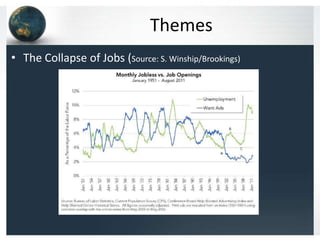
• The Collapse of Jobs (Source: S. Winship/Brookings)
Themes
• Unemployment
  – To return to the 5% level of unemployment that existed prior
    to the recession will require the creation of 10 million jobs
     • That is 1.5 million new jobs each year just to keep up with new
       entrants into the labor market
     • Economic Policy Institute expects unemployment to stand at roughly
       8% through 2014

      “We haven’t seen anything like this before: a really deep recession combined
       with an extended period, maybe as much as eight years all told, of highly
       elevated unemployment,” *Heidi+ Shierholtz told me. “We’re about to see a
       big national experiment on stress.”
                                            - Atlantic Magazine, March 2010
Themes
• Unemployment
  – Ignoring for the moment the waste of human capital and the
    thousands of individual and family tragedies these numbers
    represent, they pose a particular challenge to Human
    Resources departments:
     • Companies and organizations where new jobs are being created are
       seeing an large number of candidates who have been out of work for
       two or more years
         – Skills and capabilities atrophy if not used, requiring in many cases
           extensive retraining for those fortunate enough to find employment
     • Research into long-term unemployment found that young adults
       experience lasting changes in behavior and mental health, e.g.,
       depression, excessive drinking
Themes
• Unemployment
    • To the extent that more qualified candidates (and even those with
      jobs) can choose to relocate , less desirable regions and cities will find
      the quality of their labor pool compromised making it difficult to
      attract new businesses
    • Institutional memory has been diminished in even our more stable
      enterprises leaving new employees to largely struggle on their own to
      adapt to often chaotic workplace cultures
    • The sheer crush of unqualified applicants for virtually any job
      advertised
Themes
• Unemployment
  – Long-term unemployment remains the most significant social,
    economic, and political challenge facing this country
Themes
• Unemployment
    • Growing awareness among our political elites – witness the
      continuing extension of unemployment benefits – that
      unemployment (and the threat of unemployment) and the
      attendant financial insecurity it brings continue to
      undermine the still-nascent recovery
       – A protracted period of high unemployment will change the
         expectations, behavior and character of a generation of young
         adults
       – Negative effects already evident among many “blue-collar” men
Themes
• Unemployment
Themes
• Unemployment
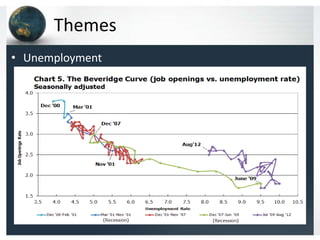
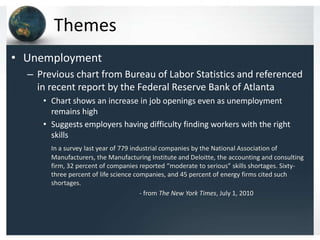
  – Previous chart from Bureau of Labor Statistics and referenced
    in recent report by the Federal Reserve Bank of Atlanta
     • Chart shows an increase in job openings even as unemployment
       remains high
     • Suggests employers having difficulty finding workers with the right
       skills
       In a survey last year of 779 industrial companies by the National Association of
       Manufacturers, the Manufacturing Institute and Deloitte, the accounting and consulting
       firm, 32 percent of companies reported “moderate to serious” skills shortages. Sixty-
       three percent of life science companies, and 45 percent of energy firms cited such
       shortages.
                                       - from The New York Times, July 1, 2010

Human resources challenges v5 4 5-2012

  • 1.
    Coming Challenges for Human Resources Reynolds Atkins November 2012
  • 2.
    Themes • Economic SecurityIndex (ESI) – Developed by political scientist Jacob Hacker and colleagues at the Rockefeller Foundation
  • 3.
    Themes • ESI – Measures major loss of income (> 25%) due to either decline in income or significant out-of-pocket medical expenses • Hacker’s chart shows in excess of 20% of Americans were in this category in late 2009, higher than in previous recessions – ESI linked most prominently to rate of unemployment, but at all levels of unemployment economic insecurity has risen dramatically since 1985 – A Spring 2009 survey of US households showed just under half would experience economic hardship in two months or less following a major interruption in income
  • 4.
    Themes • Implications – Loss of income resulting from unemployment and disability routinely top list of Americans’ leading economic concerns • Our employees bring these insecurities with them to the workplace • Uncertainty about long-term employment prospects a significant source of discontent in even the healthiest companies – Rockefeller Foundation American Worker Survey, February 2007 “Compared to 10 years ago, do you think Americans today have…” Less economic security 65% More economic security 19% About the same economic security 16% • Suspect percentage of “Less” would be substantially higher in 2012
  • 5.
    Themes • Implications – Whether one is employed or unemployed, chronic economic insecurity is corrosive • Its effects can be felt in: – Lowered productivity – Increased medical claims for everything from mental health services to gastrointestinal disorders – Excessive absenteeism – “Presenteeism” – Increased incidence of workplace fraud – Performance problems
  • 6.
    Themes • Implications – A distracted, uneasy, risk-averse workforce hardly the platform on which to build a robust economic revival • Few companies seem to be engaging in an open dialogue with their employees about what the academic and author Richard Florida has referred to as “The Great Reset” • Employees no longer expect reassurances that their positions are secure – such reassurances are increasingly empty -- but they do want reliable information – financial, market, long-term growth prospects -- on their companies – Even if such information is incomplete or unsettling, it can help dissipate some of the uncertainty
  • 7.
    Themes • Implications – What is the role of Human Resources in an age of diminished expectations among employees? • Creativity and employee engagement likely casualties of lengthy salary freezes and benefit reductions – What happens when traditional incentives disappear? • Will companies invest in training and developing their employees as they seek to compete more aggressively internationally? • Will the long-expected departures of Baby Boomers from the workforce actually materialize, at least in the large numbers predicted early last decade? – Recent studies of Boomer retirement patterns suggests upwards of 65% expect to work well into their 60s
  • 8.
    Themes • Implications – Role of Human Resources • Social networking, by its nature anti-hierarchical, poses challenge to command-and-control management structures and the centralizing tendencies of many traditional human resources programs • Do human resources departments properly appreciate the diversity of talent available today and how a decreasing percentage of it is “home- grown”? – According to College Board, the percentage of US college graduates (associates’ degree and higher) in the 25 to 34-year-old bracket has over the past decade fallen from 1st in the world to 12th • Employee commitment in an age of diminished institutional trust
  • 9.
    Themes • Employee Commitment – Deloitte’s 2011 Human Capital Trends report asked this question of employees included in its annual survey of employment satisfaction: Are you staying or going? Employees expecting to stay with their current employer 35% Employees who have been, plan to, or are currently seeking new employment 65%
  • 10.
    Themes • Employee Commitment – Whether or not the desire to leave one’s current employer is wishful thinking – employee mobility and the rate of voluntary quits are greatly reduced from pre-recession levels – a substantial segment of the workforce seems disengaged Despite a challenging job market, employers surveyed by Deloitte predict moderate to severe shortages in the years ahead in R&D, management, sales, strategy and planning, HR, procurement, operations, finance and IT talent
  • 11.
    Themes • Implications – As complicated as these “macro” issues are – inter- generational cooperation, stagnant wages and incentives, retirements and succession planning, growing mismatches between skills required and skills available -- how much of the traditional Human Resources “tool-kit” continues to work: • Performance management programs when performance standards are constantly shifting and incentives have been sharply reduced? • Career management (and what is a “career” these days) and rotation programs? • One-size-fits-all total reward programs? • Investment in employees – training and development, tuition reimbursement, seminars and executive education programs?
  • 12.
    Themes • Unemployment – What happens to a formerly healthy economy when it loses 8 million jobs in a little over eighteen months, many of which have not returned? New jobs will open in the U.S. But many will have different skill requirements than the old ones. “In a sense” says Gary Burtless, a labor economist at the Brookings Institution, “every time someone is laid off now, they need to start all over. They don’t even know what industry they’ll be in next.” And as a spell of unemployment lengthens, skills erode and behavior tends to change, leaving some people unqualified even for the work they once did well. from “How a New Jobless Era Will Transform America” Atlantic Magazine, March 2010 – Predictions like this will do little to allay workforce insecurities
  • 13.
    Themes • The Collapseof Jobs (Source: S. Winship/Brookings)
  • 14.
    Themes • Unemployment – To return to the 5% level of unemployment that existed prior to the recession will require the creation of 10 million jobs • That is 1.5 million new jobs each year just to keep up with new entrants into the labor market • Economic Policy Institute expects unemployment to stand at roughly 8% through 2014 “We haven’t seen anything like this before: a really deep recession combined with an extended period, maybe as much as eight years all told, of highly elevated unemployment,” *Heidi+ Shierholtz told me. “We’re about to see a big national experiment on stress.” - Atlantic Magazine, March 2010
  • 15.
    Themes • Unemployment – Ignoring for the moment the waste of human capital and the thousands of individual and family tragedies these numbers represent, they pose a particular challenge to Human Resources departments: • Companies and organizations where new jobs are being created are seeing an large number of candidates who have been out of work for two or more years – Skills and capabilities atrophy if not used, requiring in many cases extensive retraining for those fortunate enough to find employment • Research into long-term unemployment found that young adults experience lasting changes in behavior and mental health, e.g., depression, excessive drinking
  • 16.
    Themes • Unemployment • To the extent that more qualified candidates (and even those with jobs) can choose to relocate , less desirable regions and cities will find the quality of their labor pool compromised making it difficult to attract new businesses • Institutional memory has been diminished in even our more stable enterprises leaving new employees to largely struggle on their own to adapt to often chaotic workplace cultures • The sheer crush of unqualified applicants for virtually any job advertised
  • 17.
    Themes • Unemployment – Long-term unemployment remains the most significant social, economic, and political challenge facing this country
  • 18.
    Themes • Unemployment • Growing awareness among our political elites – witness the continuing extension of unemployment benefits – that unemployment (and the threat of unemployment) and the attendant financial insecurity it brings continue to undermine the still-nascent recovery – A protracted period of high unemployment will change the expectations, behavior and character of a generation of young adults – Negative effects already evident among many “blue-collar” men
  • 19.
  • 20.
    Themes • Unemployment – Previous chart from Bureau of Labor Statistics and referenced in recent report by the Federal Reserve Bank of Atlanta • Chart shows an increase in job openings even as unemployment remains high • Suggests employers having difficulty finding workers with the right skills In a survey last year of 779 industrial companies by the National Association of Manufacturers, the Manufacturing Institute and Deloitte, the accounting and consulting firm, 32 percent of companies reported “moderate to serious” skills shortages. Sixty- three percent of life science companies, and 45 percent of energy firms cited such shortages. - from The New York Times, July 1, 2010