International Research Journal of Engineering and Technology (IRJET) e-ISSN: 2395-0056
p-ISSN: 2395-0072
Volume: 10 Issue: 08 | Aug 2023 www.irjet.net
Human Emotion Detection for Customer Feedback & Food Classifier
Ayesha Samreen 1, Srividya M.S 2
1PG student, Department of Computer Science & Engineering, RV College of Engineering, Bengaluru-560059, India
2Assistant Professor, Department of Computer Science & Engineering, RV College of Engineering, Bengaluru-
560059, India
---------------------------------------------------------------------***---------------------------------------------------------------------
Abstract - This study analyses the level to which hotel
employees are aware of their facial expression/emotion
recognition abilities in interacting with customers. As a signof
satisfaction and service quality delivered, facial expressions
and emotions may have significant implications. The results
show that a significant proportion of hotel employees are not
fully aware of their facial expression/emotion recognition
abilities and that many of them tend to engorge their abilities.
This study has important implications in terms of employee
efforts put into tasks (such as effort and concentration), self-
development and training, and employee risk-taking behavior
in their service encounters. In addition, Food Recommendation
based on Emotion Analysis is proposed. An IoT device which
first detects the human emotion and then using its artificial
intelligence and pretrained images, suggests some food items
to the customers at that moment. For the functioning purpose,
we used a pretrained emotion detection model and tested it on
an image pretrained images from Kaggle.
Key Words: emotion recognition, facial expressions, etc.
1. INTRODUCTION
Feedback is a vital part in the process of self- improvement
in any service sector. This study computes hotel and
restaurant service sector. In the conventional model,
feedback is collected by means of questionnaires (whether
manual or digital), and through online screens or kiosks. The
model displays various delicacy messages related to the
customers overall experience of the service.
This proposed application can be technologically advanced
by incorporating digital video cameras to capture the
mood/emotion of the customers at various key strategic
places within the vicinity of the particular hotel or
restaurant outlet and by using artificial intelligence and
machine learning to extract frames from the continuous
video stream to record the exact emotion expressed by the
customer with respect to and in reaction to the various
services offered by the soliciting organization.
These frames which includes emotions displayed by the
consumer is passed through various established human
emotion detection algorithms to extract the exact feeling felt
by customer in response to the service efficiency of the
service provided.
For instance, when a user passes in front of such a camera-
cum-display device, the device may display a message such
as “please rate the ambience of the hotel with respect toyour
experience” or “please indicate through a gesture how you
felt about the food”. When the response is recorded, based
on the intensity of the feeling in the user, the algorithm may
classify the response into “excellent “, “outstanding” “happy”,
“not satisfactory “etc.
This system thus delivers the customer feedback to the
service-provider organization, which can then use the
information to take corrective measures to improve the
quality of service to the end customer.
Between food and mood apparently there exists a
relationship, various things like eating foods and thinking or
reacting etc. Foods and emotions are two different entities
which differs from person to person still interconnected.
Emotions play an important role in food choice. Studies
shows that foods precisely raise the brain neurotransmitter
system that have the greater effects on mood. Thus, food can
impact our mood and mood can impact our food. Food and
emotion are routine and logical components of our lives that
is alluring they don’t getconfine together.Eventhough, there
are many research on of effect and cause of food and mood
relation such as, brain chemicals, neurotransmitters like
serotonin, dopamine and acetylcholine can be influenced by
eaten and also variations in bloodsugar levels are influenced
by what we eat. Healthy foods, suchas vegetables, fruits, fish,
nuts, seeds, help to promote being cheerful, satisfaction and
happiness. Few other foods can increase negative feelings,
such as frustration, anger, tension, anxiety. Sad: Chocolate,
tea, coffee, nuts peanuts, cashew, almonds and walnuts.
Angry Tea, coffee, light food like chips, waffles Fear Eggs,
nuts, turmeric Disgust Water. For Surprise: water, any
available chilled drink. Shown in table1.
2. LITERATURE SURVEY
[1] This system proposes sentiment analysis model based on
images. Pretrained models (VGG-19, DenseNet121, and
ResNet50V2) are compared to predict the sentiments
from pictures. Theperformanceofthemodel isimproved
by freezing the initial layers and unfreezing part of the
model. Over fitting effect is been reduced by addition of
layers like dropout, batch normalization, and weight
regularization layers in turn helped to predict sentiments
from the database. With DenseNet121 model 0.89
accuracy is obtained for image sentiment analysis.
[2] This research work uses social media platforms, which is
the easiest way to express emotions pertaining to any
© 2023, IRJET | Impact Factor value: 8.226 | ISO 9001:2008 Certified Journal | Page 534
International Research Journal of Engineering and Technology (IRJET) e-ISSN: 2395-0056
p-ISSN: 2395-0072
Volume: 10 Issue: 08 | Aug 2023 www.irjet.net
occasion and expressing their feelings through social
media is by uploading pictures. Based ontheemotions in
picture they are classified into positive, negative and
neutral. This classification is used in automatic tag
available on social media based on the available image
through which emotionsandsentiments ofpersoncanbe
found by Natural language processing (NLP). Two
pretrained and one custom model are used comparison
and to predict the emotions. Better results are shown in
custom model and by using web camera.
[3] This research study is based on the facial expression of
the person, there emotions and sentiment are found
which is conducted with available database using
MATLAB. Gaussian filtering is used to remove the noise
in the image, canny is used find out heavy edges,
geometric ratios remove errors which increases the
performance of image processing. The expressions such
happy, sad, angry, confused etc. are classified based the
sentiment recognition.
[4] In this study, Convolutional Neural Networks is used to
determine different emotions like fear,happy,angry,sad,
surprise etc. This type of classification helps in
application where automatic tag predictor, usually in
social media where in the sentiment of person is
understood based on their emotions. Two pretrained
model are compared and accuracies of image sentiment
is determined. First sentiment is determined and then
emotion is predicted which describes happy, sad, fear,
surprise or no emotions etc.
[5] This study aims at improving signal to noise ratio of
seismic data by using median filtering, mean filtering
which has yielded to high signal to noise ration and put
forwards Convolutional neural network noise reduction
framework. Presents deep learningConvolutional neural
network based on fault noise suppression method which
results in high performance. The network comprises of
input layer, convolution layer, activation layer,
normalization layer and output layer. The usage of
residual learning, RELU function, and batch
normalization has improved accuracy FD-Net model and
preserving the original datasets and high signal to noise
ratio and retains fault information pertaining to the
image.
[6] This project reports a sewing defect detection method
based on CNN with per-trained VGG-16 to find broken
stitch from a picture of a sewing operation. The efficacy
of 92.3% was obtained, determined with the set of
sewing, normal and rotated images. In order to reduce
the computing time, computing devices and deep
learning libraries were analyzed. The resultconfirmsthe
usefulness in manufacturing technology for garment
production.
[7] The main aim of this work is found a alternative method
for the conventional pooling method i.e., combpool layer
consists of three architectures. It’s observed that,
addition of arithmetic means and maximum as a
combination as yielded better results. The combination
of Sugeno integral had an improved performance. Do
Sugeno integral obtains good results when combined
with other functions. Since positive results were
obtained through the generalization of the Sugeno
integral, performance of models which include the
Choquet integral andgeneralizations asa combpoollayer
were tested and also combpool is used in modern
architectures.
[8] This work presents, detection of food spoilage from the
production stage to consumption stage. Freshness of
fruit is detected by computer vision-based technique
which uses deep learning with CNN. Later the model is
analyzed with available dataset with fresh fruits images
and rotten and classified from Kaggle.
[9] This paper presents larger value of analysis on facial
responses. Where in eyebrow raises, sad, happy, disgust,
positive and negative expressions were measured frame
by frame basis and mapped with ad liking and brand
purchase and effectiveness is measured. A model has
been built to predict the emotional responses; results
showed high liking scores. And also, one more model has
been created for predicting changes in intent based on
automatic facial responses, results show good
effectiveness of the model. The work tested in this paper
is for short-term purchasing decision like chocolate. This
approach can be combined with content analysis audio
and visual ads.
[10]This study presents various problems related to
sentiment analysis. The techniques used is divided into
machine learning, lexicon-based, and hybrid approaches.
sentiment analysis based on machine learning is
classified supervised, unsupervised, and deep machine
learning techniques. Social network post and reviews
which is in the form of textual data is analyzed in
decision making process based on their emotional
behavior and are classified preprocessing, feature
extraction, and classification or clustering. All the three
techniques were applied for sentiment analysis are
compared; outcome had high accuracy rate.
[11]This study exhibits the functionality of image pre-
processing and augmentation techniques present in
HistoClean can be improved in the field of deep learning
by CNN. HistoClean is used as open-source software to
implement image preprocessing techniques, time is
saved and there’s transparency and data integrity.
HistoClean provides a rapid, strong and reproduced,
Without the knowledge of coding. It also saves the
running and re- running of scripts The application is
created to minimize and procedure instruction thereby
creating user-friendly experience.
[12]This study proposes a comparison among various
sentiment analysis classifiers using three different
techniques – machine learning, deep learning, and an
© 2023, IRJET | Impact Factor value: 8.226 | ISO 9001:2008 Certified Journal | Page 535
International Research Journal of Engineering and Technology (IRJET) e-ISSN: 2395-0056
p-ISSN: 2395-0072
Volume: 10 Issue: 08 | Aug 2023 www.irjet.net
evolutionary approach called EvoMSA. Comparison is
done by developing two corpora of expressions into the
programming domain, which determines the emotional
state of student regarding teachers, exams, homework,
and academic projects. A corpus called sentiTEXT has
polarity i.e., positive and negative labels, while a corpus
called eduSERE has positive and negative learning-
centered emotions like sad, happy, exhausted, excited,
bored, and frustrated labels. Comparing the three
techniques, its concluded that evolutionary algorithm
(EvoMSA) generated better results for corpus
sentiTEXT= 93%, and corpus eduSERE = 84% accuracy.
[13]This work presents a inclusive study on face recognition
methods based on deep learning. Deep learning
techniques is totally applied on face recognition and have
played vital role in avoiding challenges in FR, pose
variations, illumination, age, facial expression and
heterogeneous face matching. Deep learning methods
have yielded better results in processing RGB-D, video,
and heterogeneous face.
[14]The main aim of this study, A method is created for
implementing a fully connected deep neural network
and convolutional neural network inference system ona
FPGA. In CNN, systolic array architecture present along
with parallel processing potential is used. Algorithmic
analysis requires minimum memory for fixed point
trained parameters. results shows thatthe forblock over
distributed memory saves ≈62% look-up- tables for the
DNN, and for distributed over block. Memory saves
≈30% BRAM for the LeNet-5 CNN unit. This study gives
intuition for developing FPGA-based digital systems for
applications requiring DNN and CNN.
[15]Different types of Machine Learning and depth learning
methods are used in Sentiment Analysis like Support
Vector Machines, NB, Haar Cascade, LBPH, CNN, etc. This
as lead in hotels to express their opinion on the food,
ambience, etc. which can be a useful resource to obtain
feedback from the Customers. Proposed work
determines Sentiment Analysis pictures pertaining to
users along with their faces from the hotel reviews
revealing it to high efficiency in finding and classifying
emotions from images.
[16]This work describes textual sentiment analysis along
with visual sentiment analysis for the given image and
classifying as positive or negative or neutral. Visual
sentiment analysis can be put together as image
classification using deep learning methods like CNN. But
sentiment the captured image is affected by three
factors: image factor, user factor, and item factor. item-
oriented and user-oriented CNN has been developed
with the interchange of image features with specific
expressions of users. Results shows that images from
restaurant have been more effective in classifying the
sentiments.
[17]This paper proposes, sentiment analysis is classified
based on the facial expressions and visual analysis to find
whether the image is positive or negative based on the
emotions. An image sentiment prediction model is built
using CNN. And the sentiments are classified efficiently
and increases the accuracy of hotel picture posted on
social media. The results yield best performance analysis
of reviews from images compared to naive bayes in ML
technique.
[18]Image sentiment ideas are Adjective Noun Pairs i.e.,
automatically finds the tags of picture which is useful in
finding the emotions. The deep learning techniques are
used for sentiment analysis, as they have the ability to
effectively learn the image polarity. This paper proposes
a Deep Neural Network, Convolutional Neural Network,
Region-based CNN and Fast R-CNN with the suitable to
particular applications in image sentiment analysis.
[19]In this study, determines how CNN can be used to
predict the various emotions like happy, surprise, sad,
fear, exited, exhausted and neutral. There are several
applications which automatically tag predictions for
visual data on social media and for understanding
emotions. They have used VGG16 model, ResNet model,
customized CNN framework with 7 layers, which can
predict the emotion and sentimentofthegivenimage.By
using CNN, the prediction was more accurate and
efficient. The trained model was used to find the emotion
on a live photo by loading a captured image using a GUI.
[20]This project describes Sentiment Analysis by facial
recognition using Viola-jones algorithm to find an image
and local binary pattern for expression recognition.
Support vector machine is used for classification of
expression. Based on the facial expression it can find
facial expression and tell whether the person is happy,
sad or exited. This framework first finds and read a
person face. Later it computes different facial
expressions. After finding it classifies the expressions
such sadness, happy, sad, exhausted etc. Based on these
frameworks decides emotional state.
3. IMPLIMENTATION
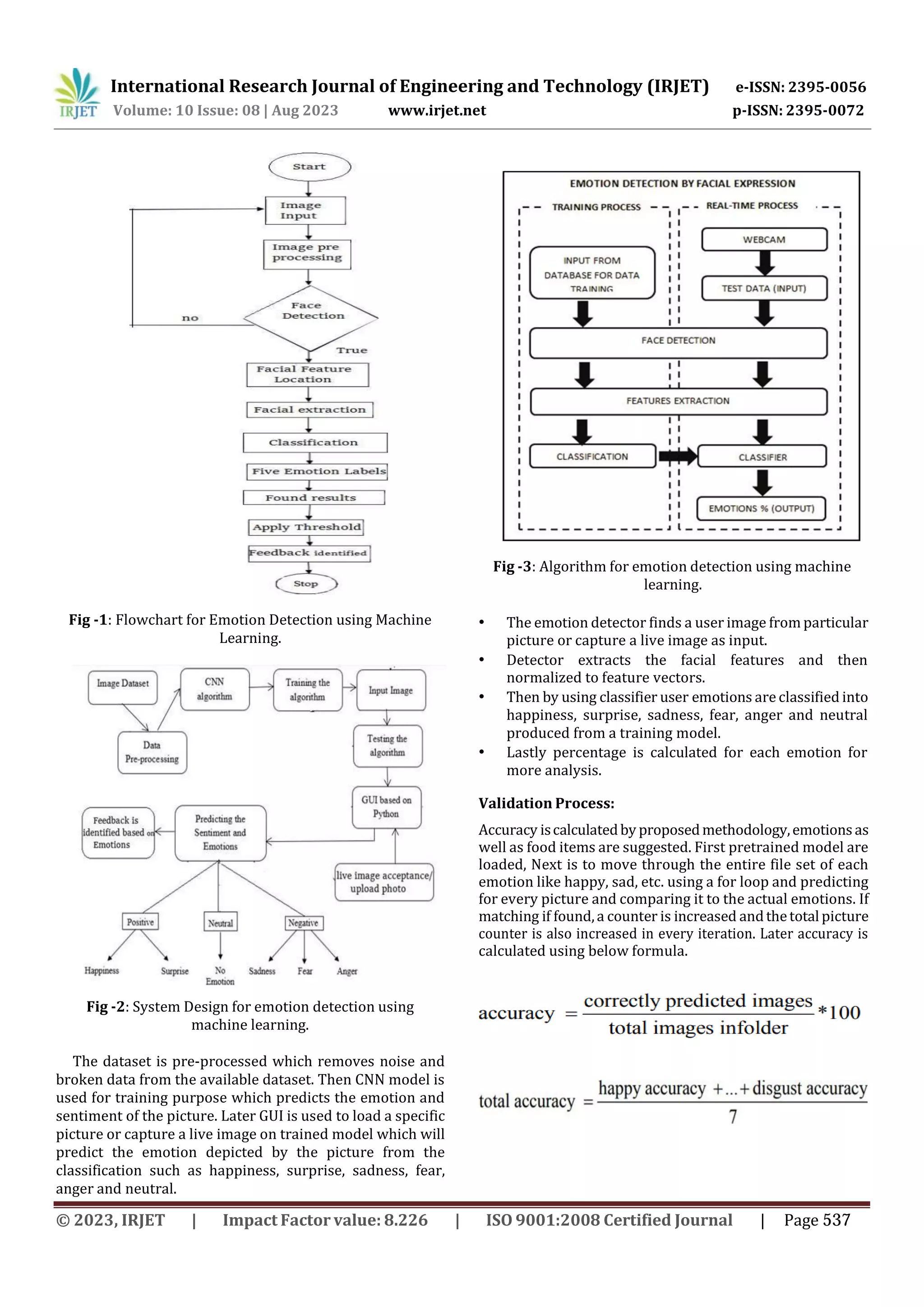
The input to facial feature locator is still image from face
detector. The output from facial feature is given to the facial
feature extractor to extractinterest points on mouthand eye.
Classification module takes the output of normalized face
image as input which contains extracted eye and mouth
outline obtained from the ending marker points for eye and
mouth outline, which is the output of feature extractor
module. The image is ready to classify out of 5 emotions
listed. The emotion labelled image is given as input for the
feedback rating, the outputs of the image which matches
highest rating is assigned for every class. Later once the
threshold is reached, segmented image is given as output.
Lastly result recognizer gives the feedback with high
accuracy.
© 2023, IRJET | Impact Factor value: 8.226 | ISO 9001:2008 Certified Journal | Page 536
International Research Journal of Engineering and Technology (IRJET) e-ISSN: 2395-0056
p-ISSN: 2395-0072
Volume: 10 Issue: 08 | Aug 2023 www.irjet.net
Fig -1: Flowchart for Emotion Detection using Machine
Learning.
Fig -2: System Design for emotion detection using
machine learning.
The dataset is pre-processed which removes noise and
broken data from the available dataset. Then CNN model is
used for training purpose which predicts the emotion and
sentiment of the picture. Later GUI is used to load a specific
picture or capture a live image on trained model which will
predict the emotion depicted by the picture from the
classification such as happiness, surprise, sadness, fear,
anger and neutral.
Fig -3: Algorithm for emotion detection using machine
learning.
• The emotion detector finds a user image from particular
picture or capture a live image as input.
• Detector extracts the facial features and then
normalized to feature vectors.
• Then by using classifier user emotions are classified into
happiness, surprise, sadness, fear, anger and neutral
produced from a training model.
• Lastly percentage is calculated for each emotion for
more analysis.
Validation Process:
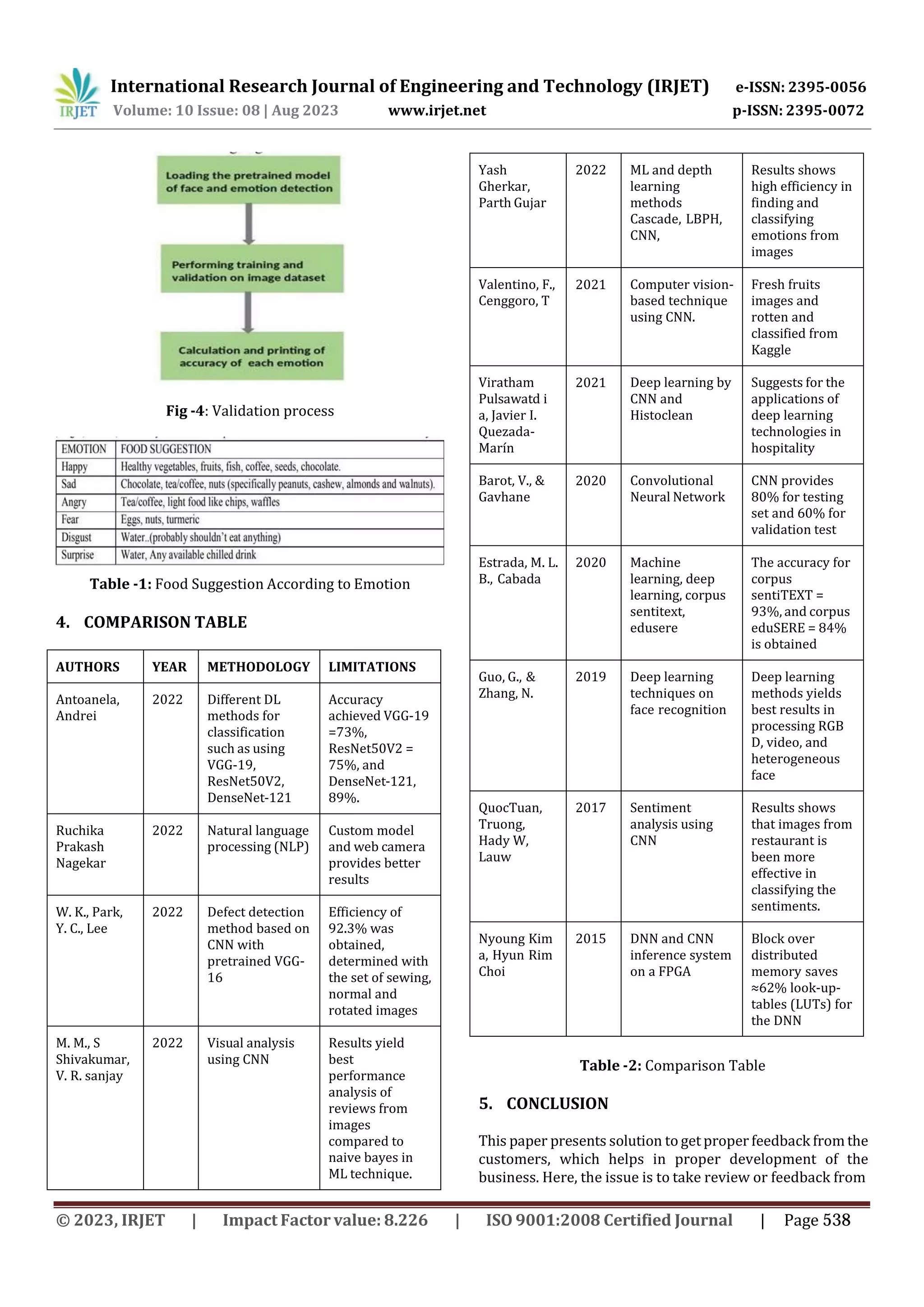
Accuracy iscalculatedby proposedmethodology,emotionsas
well as food items are suggested. First pretrained model are
loaded, Next is to move through the entire file set of each
emotion like happy, sad, etc. using a for loop and predicting
for every picture and comparing it to the actual emotions. If
matching if found,a counter is increased andthetotal picture
counter is also increased in every iteration. Later accuracy is
calculated using below formula.
© 2023, IRJET | Impact Factor value: 8.226 | ISO 9001:2008 Certified Journal | Page 537
International Research Journal of Engineering and Technology (IRJET) e-ISSN: 2395-0056
p-ISSN: 2395-0072
Volume: 10 Issue: 08 | Aug 2023 www.irjet.net
Fig -4: Validation process
Table -1: Food Suggestion According to Emotion
4. COMPARISON TABLE
Table -2: Comparison Table
5. CONCLUSION
This paper presents solution to get proper feedback from the
customers, which helps in proper development of the
business. Here, the issue is to take review or feedback from
Yash
Gherkar,
Parth Gujar
2022 ML and depth
learning
methods
Cascade, LBPH,
CNN,
Results shows
high efficiency in
finding and
classifying
emotions from
images
Valentino, F.,
Cenggoro, T
2021 Computer vision-
based technique
using CNN.
Fresh fruits
images and
rotten and
classified from
Kaggle
Viratham
Pulsawatd i
a, Javier I.
Quezada-
Marín
2021 Deep learning by
CNN and
Histoclean
Suggests for the
applications of
deep learning
technologies in
hospitality
Barot, V., &
Gavhane
2020 Convolutional
Neural Network
CNN provides
80% for testing
set and 60% for
validation test
Estrada, M. L.
B., Cabada
2020 Machine
learning, deep
learning, corpus
sentitext,
edusere
The accuracy for
corpus
sentiTEXT =
93%, and corpus
eduSERE = 84%
is obtained
Guo, G., &
Zhang, N.
2019 Deep learning
techniques on
face recognition
Deep learning
methods yields
best results in
processing RGB
D, video, and
heterogeneous
face
QuocTuan,
Truong,
Hady W,
Lauw
2017 Sentiment
analysis using
CNN
Results shows
that images from
restaurant is
been more
effective in
classifying the
sentiments.
Nyoung Kim
a, Hyun Rim
Choi
2015 DNN and CNN
inference system
on a FPGA
Block over
distributed
memory saves
≈62% look-up-
tables (LUTs) for
the DNN
AUTHORS YEAR METHODOLOGY LIMITATIONS
Antoanela,
Andrei
2022 Different DL
methods for
classification
such as using
VGG-19,
ResNet50V2,
DenseNet-121
Accuracy
achieved VGG-19
=73%,
ResNet50V2 =
75%, and
DenseNet-121,
89%.
Ruchika
Prakash
Nagekar
2022 Natural language
processing (NLP)
Custom model
and web camera
provides better
results
W. K., Park,
Y. C., Lee
2022 Defect detection
method based on
CNN with
pretrained VGG-
16
Efficiency of
92.3% was
obtained,
determined with
the set of sewing,
normal and
rotated images
M. M., S
Shivakumar,
V. R. sanjay
2022 Visual analysis
using CNN
Results yield
best
performance
analysis of
reviews from
images
compared to
naive bayes in
ML technique.
© 2023, IRJET | Impact Factor value: 8.226 | ISO 9001:2008 Certified Journal | Page 538
International Research Journal of Engineering and Technology (IRJET) e-ISSN: 2395-0056
p-ISSN: 2395-0072
Volume: 10 Issue: 08 | Aug 2023 www.irjet.net
the customers who visit the place(hotel). Those who are
interested in giving feedback regularly they give it but major
percentage of people think it as a waste of time so they will
not give the review or feedback, so this project helps us to
get proper feedback from the customers. In simple terms we
have developed technique in which customer need not spend
more time holding a pen and paper fulling according to their
wishes we just need a small glimpse of image which the
customer will have a look and the camera automatically
captures the expression and updates it in the database
accordingly. Meaning the question about the particular
property e.g., service, cost, food is taken and is analyzed
using the technology and is auto updated in the databaselike
good, excellent, bad. Based the expression the customer
gives for the particular asked question by our server. In
addition, a new idea to detects human emotion by analyzing
the facial images and recommending food. The proposed
model also analyzes the emotion and suggest food items
which can make us happier and ecstatic. Food influences the
mood in various ways. The results of emotion analysis and
food recommendation were accurate and shows how
emotion detectionand food suggestioncangohand-in-hand.
REFERENCES
[1] Chandrasekaran G, Antoanela N, Andrei G, Monica C, &
Hemanth J. “Visual Sentiment Analysis Using Deep
Learning Models with Social Media Data “Applied
Sciences (Switzerland) -2022.
[2] Swapnil Sanjay Nagvenkar, Ruchika Prakash Nagekar,
Tanmay Naik, Amey Kerkar, “Emotion detection based
on facial expression” (IJCRT)-2022.
[3] Aynur Sevinç, Buket Kaya, Ayten Geçmez, “A Sentiment
Analysis Study on Recognition of Facial Expressions:
Gauss and Canny Methods” (IEEEI)-2020.
[4] Doshi U, Barot V, & Gavhane S, “Emotion detection and
sentiment analysis of static images” (IEEE)-2020.
[5] Gherkar Y, Gujar P, Gaziyani A, & Kadu S, “Sentiment
Analysis of Images using Machine Learning Techniques
Yash” (ICCDW)-(2022).
[6] Kim H, Jung W K, Park Y C, Lee J W, & Ahn S H, “Broken
stitch detection method for sewing operation using CNN
feature map and image-processing techniques. Expert
Systems with Applications” (IEEE)-2021.
[7] Rodriguez Martinez I, Lafuente J, SantiagoR HN, Dimuro
G P, Herrera F, & Bustince H,” Replacing pooling
functions in Convolutional Neural Networks by linear
combinations of increasing functions Neural Networks”.
(IEEE) 2022.
[8] Valentino F, Cenggoro T W, & Pardamean B, “A Design of
Deep Learning Experimentation for Fruit Freshness
Detection. IOP Conference Series: Earth and
Environmental Science” (IEEE)-2021
[9] D McDuff, R El Kaliouby, J F Cohn and P Picard,
“Predicting ad liking and purcha se intent: Large-scale
analysis of facial responses to ads” (IEEE)- 2015.
[10] Shaha Al-Otaibi and Amal Al-Rasheed, “A Review and
Comparative Analysis of Sentiment Analysis
Techniques” (Informatica)-2022.
[11] Kris DnMcCombe, Stephanie G Craig, Amélie Viratham
Pulsawatdi, Javier I Quezada-Marín, “Open- source
software for histological image pre-processing and
augmentation to improve development of robust
convolutional neural networks” (IEEE)-2021.
[12] Estradam MLB, Cabada R Z, Bustillos R O & Graff
M,“Opinion mining and emotion recognition applied to
learning environments”(Expert Systems with
Applications)-2020.
[13] Guo G, & Zhang N, “A survey on deeplearning-based face
recognition”. (Computer Vision and Image
Understanding)-2019.
[14] Mukhopadhyay A K, Majumder S, & Chakrabarti I.
“Systematic realization of a fully connected deep and
convolutional neural network architecture on a field
programmable gate array” (IEEE)-2022.
[15] Yash Gherkar, Parth Gujar, Siddhi Kadu, “Sentiment
Analysis of Images using Machine Learning Techniques”
(itmconf)-2022.
[16] QuocTuan, Truong, HadyW, Lauw, “Visual Sentiment
Analysis for Review Images with Item Oriented and
User- Oriented CNN” (Corpus)-2022.
[17] S Shivakumar,V R sanjay, “Visual SentimentClassification
of Restaurant Review Images using DeepConvolutional
Neural Networks” (Corpus)-2022.
[18] Namita Mittal, Divya Sharma, M. Joshi, “Image Sentiment
Analysis Using Deep Learning” (Corpus) -2018.
[19] Udit Doshi, Vaibhav Barot, Sachin Gavhane, “Emotion
Detection and Sentiment” (IJESC)-2017.
[20] R.N Devendra Kumar, Dr. C. Arvind, “Facial Expression
Recognition System “Sentiment Analysis” (Jour of Adv
Research in Dynamical & Control Systems)-2017.
© 2023, IRJET | Impact Factor value: 8.226 | ISO 9001:2008 Certified Journal | Page 539

Human Emotion Detection for Customer Feedback & Food Classifier

  • 1.
    International Research Journalof Engineering and Technology (IRJET) e-ISSN: 2395-0056 p-ISSN: 2395-0072 Volume: 10 Issue: 08 | Aug 2023 www.irjet.net Human Emotion Detection for Customer Feedback & Food Classifier Ayesha Samreen 1, Srividya M.S 2 1PG student, Department of Computer Science & Engineering, RV College of Engineering, Bengaluru-560059, India 2Assistant Professor, Department of Computer Science & Engineering, RV College of Engineering, Bengaluru- 560059, India ---------------------------------------------------------------------***--------------------------------------------------------------------- Abstract - This study analyses the level to which hotel employees are aware of their facial expression/emotion recognition abilities in interacting with customers. As a signof satisfaction and service quality delivered, facial expressions and emotions may have significant implications. The results show that a significant proportion of hotel employees are not fully aware of their facial expression/emotion recognition abilities and that many of them tend to engorge their abilities. This study has important implications in terms of employee efforts put into tasks (such as effort and concentration), self- development and training, and employee risk-taking behavior in their service encounters. In addition, Food Recommendation based on Emotion Analysis is proposed. An IoT device which first detects the human emotion and then using its artificial intelligence and pretrained images, suggests some food items to the customers at that moment. For the functioning purpose, we used a pretrained emotion detection model and tested it on an image pretrained images from Kaggle. Key Words: emotion recognition, facial expressions, etc. 1. INTRODUCTION Feedback is a vital part in the process of self- improvement in any service sector. This study computes hotel and restaurant service sector. In the conventional model, feedback is collected by means of questionnaires (whether manual or digital), and through online screens or kiosks. The model displays various delicacy messages related to the customers overall experience of the service. This proposed application can be technologically advanced by incorporating digital video cameras to capture the mood/emotion of the customers at various key strategic places within the vicinity of the particular hotel or restaurant outlet and by using artificial intelligence and machine learning to extract frames from the continuous video stream to record the exact emotion expressed by the customer with respect to and in reaction to the various services offered by the soliciting organization. These frames which includes emotions displayed by the consumer is passed through various established human emotion detection algorithms to extract the exact feeling felt by customer in response to the service efficiency of the service provided. For instance, when a user passes in front of such a camera- cum-display device, the device may display a message such as “please rate the ambience of the hotel with respect toyour experience” or “please indicate through a gesture how you felt about the food”. When the response is recorded, based on the intensity of the feeling in the user, the algorithm may classify the response into “excellent “, “outstanding” “happy”, “not satisfactory “etc. This system thus delivers the customer feedback to the service-provider organization, which can then use the information to take corrective measures to improve the quality of service to the end customer. Between food and mood apparently there exists a relationship, various things like eating foods and thinking or reacting etc. Foods and emotions are two different entities which differs from person to person still interconnected. Emotions play an important role in food choice. Studies shows that foods precisely raise the brain neurotransmitter system that have the greater effects on mood. Thus, food can impact our mood and mood can impact our food. Food and emotion are routine and logical components of our lives that is alluring they don’t getconfine together.Eventhough, there are many research on of effect and cause of food and mood relation such as, brain chemicals, neurotransmitters like serotonin, dopamine and acetylcholine can be influenced by eaten and also variations in bloodsugar levels are influenced by what we eat. Healthy foods, suchas vegetables, fruits, fish, nuts, seeds, help to promote being cheerful, satisfaction and happiness. Few other foods can increase negative feelings, such as frustration, anger, tension, anxiety. Sad: Chocolate, tea, coffee, nuts peanuts, cashew, almonds and walnuts. Angry Tea, coffee, light food like chips, waffles Fear Eggs, nuts, turmeric Disgust Water. For Surprise: water, any available chilled drink. Shown in table1. 2. LITERATURE SURVEY [1] This system proposes sentiment analysis model based on images. Pretrained models (VGG-19, DenseNet121, and ResNet50V2) are compared to predict the sentiments from pictures. Theperformanceofthemodel isimproved by freezing the initial layers and unfreezing part of the model. Over fitting effect is been reduced by addition of layers like dropout, batch normalization, and weight regularization layers in turn helped to predict sentiments from the database. With DenseNet121 model 0.89 accuracy is obtained for image sentiment analysis. [2] This research work uses social media platforms, which is the easiest way to express emotions pertaining to any © 2023, IRJET | Impact Factor value: 8.226 | ISO 9001:2008 Certified Journal | Page 534
  • 2.
    International Research Journalof Engineering and Technology (IRJET) e-ISSN: 2395-0056 p-ISSN: 2395-0072 Volume: 10 Issue: 08 | Aug 2023 www.irjet.net occasion and expressing their feelings through social media is by uploading pictures. Based ontheemotions in picture they are classified into positive, negative and neutral. This classification is used in automatic tag available on social media based on the available image through which emotionsandsentiments ofpersoncanbe found by Natural language processing (NLP). Two pretrained and one custom model are used comparison and to predict the emotions. Better results are shown in custom model and by using web camera. [3] This research study is based on the facial expression of the person, there emotions and sentiment are found which is conducted with available database using MATLAB. Gaussian filtering is used to remove the noise in the image, canny is used find out heavy edges, geometric ratios remove errors which increases the performance of image processing. The expressions such happy, sad, angry, confused etc. are classified based the sentiment recognition. [4] In this study, Convolutional Neural Networks is used to determine different emotions like fear,happy,angry,sad, surprise etc. This type of classification helps in application where automatic tag predictor, usually in social media where in the sentiment of person is understood based on their emotions. Two pretrained model are compared and accuracies of image sentiment is determined. First sentiment is determined and then emotion is predicted which describes happy, sad, fear, surprise or no emotions etc. [5] This study aims at improving signal to noise ratio of seismic data by using median filtering, mean filtering which has yielded to high signal to noise ration and put forwards Convolutional neural network noise reduction framework. Presents deep learningConvolutional neural network based on fault noise suppression method which results in high performance. The network comprises of input layer, convolution layer, activation layer, normalization layer and output layer. The usage of residual learning, RELU function, and batch normalization has improved accuracy FD-Net model and preserving the original datasets and high signal to noise ratio and retains fault information pertaining to the image. [6] This project reports a sewing defect detection method based on CNN with per-trained VGG-16 to find broken stitch from a picture of a sewing operation. The efficacy of 92.3% was obtained, determined with the set of sewing, normal and rotated images. In order to reduce the computing time, computing devices and deep learning libraries were analyzed. The resultconfirmsthe usefulness in manufacturing technology for garment production. [7] The main aim of this work is found a alternative method for the conventional pooling method i.e., combpool layer consists of three architectures. It’s observed that, addition of arithmetic means and maximum as a combination as yielded better results. The combination of Sugeno integral had an improved performance. Do Sugeno integral obtains good results when combined with other functions. Since positive results were obtained through the generalization of the Sugeno integral, performance of models which include the Choquet integral andgeneralizations asa combpoollayer were tested and also combpool is used in modern architectures. [8] This work presents, detection of food spoilage from the production stage to consumption stage. Freshness of fruit is detected by computer vision-based technique which uses deep learning with CNN. Later the model is analyzed with available dataset with fresh fruits images and rotten and classified from Kaggle. [9] This paper presents larger value of analysis on facial responses. Where in eyebrow raises, sad, happy, disgust, positive and negative expressions were measured frame by frame basis and mapped with ad liking and brand purchase and effectiveness is measured. A model has been built to predict the emotional responses; results showed high liking scores. And also, one more model has been created for predicting changes in intent based on automatic facial responses, results show good effectiveness of the model. The work tested in this paper is for short-term purchasing decision like chocolate. This approach can be combined with content analysis audio and visual ads. [10]This study presents various problems related to sentiment analysis. The techniques used is divided into machine learning, lexicon-based, and hybrid approaches. sentiment analysis based on machine learning is classified supervised, unsupervised, and deep machine learning techniques. Social network post and reviews which is in the form of textual data is analyzed in decision making process based on their emotional behavior and are classified preprocessing, feature extraction, and classification or clustering. All the three techniques were applied for sentiment analysis are compared; outcome had high accuracy rate. [11]This study exhibits the functionality of image pre- processing and augmentation techniques present in HistoClean can be improved in the field of deep learning by CNN. HistoClean is used as open-source software to implement image preprocessing techniques, time is saved and there’s transparency and data integrity. HistoClean provides a rapid, strong and reproduced, Without the knowledge of coding. It also saves the running and re- running of scripts The application is created to minimize and procedure instruction thereby creating user-friendly experience. [12]This study proposes a comparison among various sentiment analysis classifiers using three different techniques – machine learning, deep learning, and an © 2023, IRJET | Impact Factor value: 8.226 | ISO 9001:2008 Certified Journal | Page 535
  • 3.
    International Research Journalof Engineering and Technology (IRJET) e-ISSN: 2395-0056 p-ISSN: 2395-0072 Volume: 10 Issue: 08 | Aug 2023 www.irjet.net evolutionary approach called EvoMSA. Comparison is done by developing two corpora of expressions into the programming domain, which determines the emotional state of student regarding teachers, exams, homework, and academic projects. A corpus called sentiTEXT has polarity i.e., positive and negative labels, while a corpus called eduSERE has positive and negative learning- centered emotions like sad, happy, exhausted, excited, bored, and frustrated labels. Comparing the three techniques, its concluded that evolutionary algorithm (EvoMSA) generated better results for corpus sentiTEXT= 93%, and corpus eduSERE = 84% accuracy. [13]This work presents a inclusive study on face recognition methods based on deep learning. Deep learning techniques is totally applied on face recognition and have played vital role in avoiding challenges in FR, pose variations, illumination, age, facial expression and heterogeneous face matching. Deep learning methods have yielded better results in processing RGB-D, video, and heterogeneous face. [14]The main aim of this study, A method is created for implementing a fully connected deep neural network and convolutional neural network inference system ona FPGA. In CNN, systolic array architecture present along with parallel processing potential is used. Algorithmic analysis requires minimum memory for fixed point trained parameters. results shows thatthe forblock over distributed memory saves ≈62% look-up- tables for the DNN, and for distributed over block. Memory saves ≈30% BRAM for the LeNet-5 CNN unit. This study gives intuition for developing FPGA-based digital systems for applications requiring DNN and CNN. [15]Different types of Machine Learning and depth learning methods are used in Sentiment Analysis like Support Vector Machines, NB, Haar Cascade, LBPH, CNN, etc. This as lead in hotels to express their opinion on the food, ambience, etc. which can be a useful resource to obtain feedback from the Customers. Proposed work determines Sentiment Analysis pictures pertaining to users along with their faces from the hotel reviews revealing it to high efficiency in finding and classifying emotions from images. [16]This work describes textual sentiment analysis along with visual sentiment analysis for the given image and classifying as positive or negative or neutral. Visual sentiment analysis can be put together as image classification using deep learning methods like CNN. But sentiment the captured image is affected by three factors: image factor, user factor, and item factor. item- oriented and user-oriented CNN has been developed with the interchange of image features with specific expressions of users. Results shows that images from restaurant have been more effective in classifying the sentiments. [17]This paper proposes, sentiment analysis is classified based on the facial expressions and visual analysis to find whether the image is positive or negative based on the emotions. An image sentiment prediction model is built using CNN. And the sentiments are classified efficiently and increases the accuracy of hotel picture posted on social media. The results yield best performance analysis of reviews from images compared to naive bayes in ML technique. [18]Image sentiment ideas are Adjective Noun Pairs i.e., automatically finds the tags of picture which is useful in finding the emotions. The deep learning techniques are used for sentiment analysis, as they have the ability to effectively learn the image polarity. This paper proposes a Deep Neural Network, Convolutional Neural Network, Region-based CNN and Fast R-CNN with the suitable to particular applications in image sentiment analysis. [19]In this study, determines how CNN can be used to predict the various emotions like happy, surprise, sad, fear, exited, exhausted and neutral. There are several applications which automatically tag predictions for visual data on social media and for understanding emotions. They have used VGG16 model, ResNet model, customized CNN framework with 7 layers, which can predict the emotion and sentimentofthegivenimage.By using CNN, the prediction was more accurate and efficient. The trained model was used to find the emotion on a live photo by loading a captured image using a GUI. [20]This project describes Sentiment Analysis by facial recognition using Viola-jones algorithm to find an image and local binary pattern for expression recognition. Support vector machine is used for classification of expression. Based on the facial expression it can find facial expression and tell whether the person is happy, sad or exited. This framework first finds and read a person face. Later it computes different facial expressions. After finding it classifies the expressions such sadness, happy, sad, exhausted etc. Based on these frameworks decides emotional state. 3. IMPLIMENTATION The input to facial feature locator is still image from face detector. The output from facial feature is given to the facial feature extractor to extractinterest points on mouthand eye. Classification module takes the output of normalized face image as input which contains extracted eye and mouth outline obtained from the ending marker points for eye and mouth outline, which is the output of feature extractor module. The image is ready to classify out of 5 emotions listed. The emotion labelled image is given as input for the feedback rating, the outputs of the image which matches highest rating is assigned for every class. Later once the threshold is reached, segmented image is given as output. Lastly result recognizer gives the feedback with high accuracy. © 2023, IRJET | Impact Factor value: 8.226 | ISO 9001:2008 Certified Journal | Page 536
  • 4.
    International Research Journalof Engineering and Technology (IRJET) e-ISSN: 2395-0056 p-ISSN: 2395-0072 Volume: 10 Issue: 08 | Aug 2023 www.irjet.net Fig -1: Flowchart for Emotion Detection using Machine Learning. Fig -2: System Design for emotion detection using machine learning. The dataset is pre-processed which removes noise and broken data from the available dataset. Then CNN model is used for training purpose which predicts the emotion and sentiment of the picture. Later GUI is used to load a specific picture or capture a live image on trained model which will predict the emotion depicted by the picture from the classification such as happiness, surprise, sadness, fear, anger and neutral. Fig -3: Algorithm for emotion detection using machine learning. • The emotion detector finds a user image from particular picture or capture a live image as input. • Detector extracts the facial features and then normalized to feature vectors. • Then by using classifier user emotions are classified into happiness, surprise, sadness, fear, anger and neutral produced from a training model. • Lastly percentage is calculated for each emotion for more analysis. Validation Process: Accuracy iscalculatedby proposedmethodology,emotionsas well as food items are suggested. First pretrained model are loaded, Next is to move through the entire file set of each emotion like happy, sad, etc. using a for loop and predicting for every picture and comparing it to the actual emotions. If matching if found,a counter is increased andthetotal picture counter is also increased in every iteration. Later accuracy is calculated using below formula. © 2023, IRJET | Impact Factor value: 8.226 | ISO 9001:2008 Certified Journal | Page 537
  • 5.
    International Research Journalof Engineering and Technology (IRJET) e-ISSN: 2395-0056 p-ISSN: 2395-0072 Volume: 10 Issue: 08 | Aug 2023 www.irjet.net Fig -4: Validation process Table -1: Food Suggestion According to Emotion 4. COMPARISON TABLE Table -2: Comparison Table 5. CONCLUSION This paper presents solution to get proper feedback from the customers, which helps in proper development of the business. Here, the issue is to take review or feedback from Yash Gherkar, Parth Gujar 2022 ML and depth learning methods Cascade, LBPH, CNN, Results shows high efficiency in finding and classifying emotions from images Valentino, F., Cenggoro, T 2021 Computer vision- based technique using CNN. Fresh fruits images and rotten and classified from Kaggle Viratham Pulsawatd i a, Javier I. Quezada- Marín 2021 Deep learning by CNN and Histoclean Suggests for the applications of deep learning technologies in hospitality Barot, V., & Gavhane 2020 Convolutional Neural Network CNN provides 80% for testing set and 60% for validation test Estrada, M. L. B., Cabada 2020 Machine learning, deep learning, corpus sentitext, edusere The accuracy for corpus sentiTEXT = 93%, and corpus eduSERE = 84% is obtained Guo, G., & Zhang, N. 2019 Deep learning techniques on face recognition Deep learning methods yields best results in processing RGB D, video, and heterogeneous face QuocTuan, Truong, Hady W, Lauw 2017 Sentiment analysis using CNN Results shows that images from restaurant is been more effective in classifying the sentiments. Nyoung Kim a, Hyun Rim Choi 2015 DNN and CNN inference system on a FPGA Block over distributed memory saves ≈62% look-up- tables (LUTs) for the DNN AUTHORS YEAR METHODOLOGY LIMITATIONS Antoanela, Andrei 2022 Different DL methods for classification such as using VGG-19, ResNet50V2, DenseNet-121 Accuracy achieved VGG-19 =73%, ResNet50V2 = 75%, and DenseNet-121, 89%. Ruchika Prakash Nagekar 2022 Natural language processing (NLP) Custom model and web camera provides better results W. K., Park, Y. C., Lee 2022 Defect detection method based on CNN with pretrained VGG- 16 Efficiency of 92.3% was obtained, determined with the set of sewing, normal and rotated images M. M., S Shivakumar, V. R. sanjay 2022 Visual analysis using CNN Results yield best performance analysis of reviews from images compared to naive bayes in ML technique. © 2023, IRJET | Impact Factor value: 8.226 | ISO 9001:2008 Certified Journal | Page 538
  • 6.
    International Research Journalof Engineering and Technology (IRJET) e-ISSN: 2395-0056 p-ISSN: 2395-0072 Volume: 10 Issue: 08 | Aug 2023 www.irjet.net the customers who visit the place(hotel). Those who are interested in giving feedback regularly they give it but major percentage of people think it as a waste of time so they will not give the review or feedback, so this project helps us to get proper feedback from the customers. In simple terms we have developed technique in which customer need not spend more time holding a pen and paper fulling according to their wishes we just need a small glimpse of image which the customer will have a look and the camera automatically captures the expression and updates it in the database accordingly. Meaning the question about the particular property e.g., service, cost, food is taken and is analyzed using the technology and is auto updated in the databaselike good, excellent, bad. Based the expression the customer gives for the particular asked question by our server. In addition, a new idea to detects human emotion by analyzing the facial images and recommending food. The proposed model also analyzes the emotion and suggest food items which can make us happier and ecstatic. Food influences the mood in various ways. The results of emotion analysis and food recommendation were accurate and shows how emotion detectionand food suggestioncangohand-in-hand. REFERENCES [1] Chandrasekaran G, Antoanela N, Andrei G, Monica C, & Hemanth J. “Visual Sentiment Analysis Using Deep Learning Models with Social Media Data “Applied Sciences (Switzerland) -2022. [2] Swapnil Sanjay Nagvenkar, Ruchika Prakash Nagekar, Tanmay Naik, Amey Kerkar, “Emotion detection based on facial expression” (IJCRT)-2022. [3] Aynur Sevinç, Buket Kaya, Ayten Geçmez, “A Sentiment Analysis Study on Recognition of Facial Expressions: Gauss and Canny Methods” (IEEEI)-2020. [4] Doshi U, Barot V, & Gavhane S, “Emotion detection and sentiment analysis of static images” (IEEE)-2020. [5] Gherkar Y, Gujar P, Gaziyani A, & Kadu S, “Sentiment Analysis of Images using Machine Learning Techniques Yash” (ICCDW)-(2022). [6] Kim H, Jung W K, Park Y C, Lee J W, & Ahn S H, “Broken stitch detection method for sewing operation using CNN feature map and image-processing techniques. Expert Systems with Applications” (IEEE)-2021. [7] Rodriguez Martinez I, Lafuente J, SantiagoR HN, Dimuro G P, Herrera F, & Bustince H,” Replacing pooling functions in Convolutional Neural Networks by linear combinations of increasing functions Neural Networks”. (IEEE) 2022. [8] Valentino F, Cenggoro T W, & Pardamean B, “A Design of Deep Learning Experimentation for Fruit Freshness Detection. IOP Conference Series: Earth and Environmental Science” (IEEE)-2021 [9] D McDuff, R El Kaliouby, J F Cohn and P Picard, “Predicting ad liking and purcha se intent: Large-scale analysis of facial responses to ads” (IEEE)- 2015. [10] Shaha Al-Otaibi and Amal Al-Rasheed, “A Review and Comparative Analysis of Sentiment Analysis Techniques” (Informatica)-2022. [11] Kris DnMcCombe, Stephanie G Craig, Amélie Viratham Pulsawatdi, Javier I Quezada-Marín, “Open- source software for histological image pre-processing and augmentation to improve development of robust convolutional neural networks” (IEEE)-2021. [12] Estradam MLB, Cabada R Z, Bustillos R O & Graff M,“Opinion mining and emotion recognition applied to learning environments”(Expert Systems with Applications)-2020. [13] Guo G, & Zhang N, “A survey on deeplearning-based face recognition”. (Computer Vision and Image Understanding)-2019. [14] Mukhopadhyay A K, Majumder S, & Chakrabarti I. “Systematic realization of a fully connected deep and convolutional neural network architecture on a field programmable gate array” (IEEE)-2022. [15] Yash Gherkar, Parth Gujar, Siddhi Kadu, “Sentiment Analysis of Images using Machine Learning Techniques” (itmconf)-2022. [16] QuocTuan, Truong, HadyW, Lauw, “Visual Sentiment Analysis for Review Images with Item Oriented and User- Oriented CNN” (Corpus)-2022. [17] S Shivakumar,V R sanjay, “Visual SentimentClassification of Restaurant Review Images using DeepConvolutional Neural Networks” (Corpus)-2022. [18] Namita Mittal, Divya Sharma, M. Joshi, “Image Sentiment Analysis Using Deep Learning” (Corpus) -2018. [19] Udit Doshi, Vaibhav Barot, Sachin Gavhane, “Emotion Detection and Sentiment” (IJESC)-2017. [20] R.N Devendra Kumar, Dr. C. Arvind, “Facial Expression Recognition System “Sentiment Analysis” (Jour of Adv Research in Dynamical & Control Systems)-2017. © 2023, IRJET | Impact Factor value: 8.226 | ISO 9001:2008 Certified Journal | Page 539