Greek & Roman Humanities
Professor	Will	Adams	·	Wadams5@valenciacollege.edu	·	Hum2220.blogspot.com	
Osceola	Campus	–	Building	2,	Room	232	·	Mondays	&	Wednesdays,	1:30	–	2:45	PM	
	
“Wise men talk because they have something to say,
fools because they have to say something.” - Plato
	
Course Description
§ Greek	&	Roman	Humanities	offers	the	student	integrated	examinations	of	dominant	
developments	in	the	Classical	civilizations	as	expressed	in	art,	architecture,	politics,	
literature,	music,	philosophy	and	religion.		
§ The	course	will	cover	the	period	from	the	Paleolithic	era	through	the	birth	of	Russia,	and	
will	emphasize	the	development	and	influence	of	classical	thoughts	and	ideals.	
§ This	course	is	a	Gordon	Rule	course,	in	which	the	student	is	required	to	demonstrate	
college-level	writing	skills	through	multiple	writing	assignments.	A	minimum	grade	of	C	
required	if	used	to	satisfy	Gordon	Rule	requirement.	
	
Course Objectives
§ To	understand	the	continuation	and	evolution	of	the	human	experience	by	thinking	
critically	about	humanity’s	artistic,	cultural,	and	intellectual	development.	
§ To	broaden	the	student’s	knowledge	of	the	ideas	and	personalities	associated	with	the	
Greek	and	Roman	civilizations.	
§ To	learn,	internalize,	and	utilize	vocabulary	specific	to	the	period	covered	by	this	course.	
§ To	appreciate	the	legacy	left	behind	by	both	the	Greek	and	Roman	civilizations.	
§ To	learn	skills	essential	to	critical	thinking	and	synthesis	of	thought	by	carrying	out	
scholarly	research	and	authoring	thoughtful	essays.		
§ To	attend	cultural	events	in	order	to	recognize	the	continued	relevance	of	the	sometimes-
ancient	ideas	being	discussed	throughout	the	class’s	duration.	
	
Required Textbook
Gloria	K.	Fiero,	The	Humanistic	Tradition,	Book	1.	
Additional	readings	as	assigned	throughout	the	semester
Evaluation Formula
1. Attendance	&	Class	Participation	 	 	 	 	 	 	 	 30%	
§ Attendance	will	be	taken	at	the	beginning	of	each	class	meeting,	and	count	as	part	of	
the	attendance	&	participation	grade.	
§ The	professor	should	hear	each	student’s	voice	at	least	once	per	class	meeting.	
§ Please	be	aware	that,	under	Valencia’s	Attendance	Policy,	there	is	no	such	thing	as	an	
“excused	absence”.	
2. Cultural	Event	with	Written	Evaluation	 	 	 	 	 	 	 10%	
§ You	will	be	required	to	attend	one	cultural	event	throughout	the	class’s	duration.	
§ The	instructor	throughout	the	class’s	duration	may	suggest	various	events	to	you,	but	it	
is	ultimately	your	own	responsibility	to	find	and	attend	an	approved	cultural	event.	
§ Proof	of	attendance	at	said	event	must	be	furnished	(i.e.	ticket	stub,	program,	souvenir,	
etc).	
§ A	two-page	“reaction”	(i.e.	non-research)	paper	is	required.	Be	sure	to	answer	the	
following	questions:	What	did	I	do?	What	did	I	think	of	it?	What	did	I	learn?	
3. Research	Project	 	 	 	 	 	 	 	 	 	 20%	
§ One	4-page	written	research	project	is	required.	
§ Proper	MLA	style	citation	should	be	used	for	all	written	assignments.	
§ One	draft	may	be	turned	in	for	the	professor’s	perusal	two	weeks	prior	to	the	due	date.	
§ Plagiarism	=	A	grade	of	zero.	No	exceptions.		
§ Wikipedia	=	A	grade	of	zero.	No	exceptions.	
§ All	research	projects	should	be	stapled	or	bound	by	the	student	
§ A	detailed	research	project	description	will	be	distributed	at	a	later	date.	
4. Quizzes	 	 	 	 	 	 	 	 	 	 	 	 10%	
§ Four	short-form	quizzes	will	be	administered	throughout	the	course	of	the	class.	
§ The	administration	of	quizzes	will	not	be	announced	beforehand.	
§ The	format	that	the	quizzes	appear	in	may	vary.	
5. Examinations	 	 	 	 	 	 	 	 	 	 	 30%	
§ Four	long-form	examinations	will	be	administered.	
§ Examinations	will	not	be	cumulative	in	their	subject	matter.	
§ You	will	be	given	a	study	guide	for	exams,	at	the	instructor’s	discretion.	
	
Grading Scale
100	–	90%	 =	A	
89	–	80%	 =	B	
79	–	70%	 =	C	
69	–	60%	 =	D	
59	–	0%	 =	F
Class Meeting Schedule
Date	 Task	
Monday,	January	11	 Activity:	Introduce	class,	distribute	and	discuss	syllabus.	
Wednesday,	January	13	 Lecture:	Paleolithic	cave	art	
Activity:	Cave	painting		
Monday,	January	18	 MLK	Day	–	NO	CLASS	
Wednesday,	January	20	 Lecture:	The	earliest	ancient	written	languages	&	religion.		
Activity:	Translation	competiton	
Monday,	January	25	 Lecture:	Embalming	&	Egyptian	funerary	architecture	
Homework:	Sarcophagus	lid	
Wednesday,	January	27	 Lecture:	The	Art	&	Culture	of	the	Ancient	Aegean	Civilizations	
Monday,	February	1	 EXAM	#1	
Wednesday,	February	3	 NO	CLASS	
Read	On	Blog:	Greek	Mythology	
Monday,	February	8	 RESEARCH	PROJECTS	ASSIGNED	&	LIBRARY	VISIT	
Wednesday,	February	10	 Lecture:	Dionysus	&	Ancient	Greek	Theatre	
Monday,	February	15	 NO	CLASS	-	President’s	Day	
Wednesday,	February	17	 Watch	Medea	in	class	
Monday,	February	22	 NO	CLASS	
Watch	Medea	via	Library’s	website	
Wednesday,	February	25	 EXAM	#2	
Monday,	February	29	 Lecture:	Ancient	Greek	Philosophy	
Wednesday,	March	2	 Lecture:	Aristotle’s	Nichomachean	Ethics	Deconstructed	
Monday,	March	7	 NO	CLASS	-	Spring	Break	
Wednesday,	March	9	 NO	CLASS	-	Spring	Break	
Monday,	March	14	 Lecture:	The	Classical	orders	&	the	great	temples	of	ancient	
Greece.	
Homework:	Classical	architecture	sketch	
Wednesday,	March	16	 Lecture:	The	Roman	Republic	&	What	Is	Satire?	
Monday,	March	21	 EXAM	#3	
Wednesday,	March	23	 Lecture:	Rome’s	Best	&	Craziest	Emperors		
Read	On	Blog:	The	Coliseum’s	Bloody	History	&	Its	Legacy	
Monday,	March	28	 Watch	Ancient	Rome,	The	Modern	Stadium	
Wednesday,	March	30	 Lecture:	Pompeii:	Roman	Time	Capsule	
Monday,	April	4	 Lecture:	The	Emergence	of	Christianity	in	Ancient	Rome	
Wednesday,	April	6	 Lecture:	The	Byzantine	Era:	An	Empire	Evolves
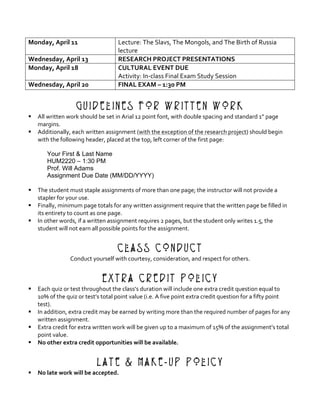
Monday,	April	11	 Lecture:	The	Slavs,	The	Mongols,	and	The	Birth	of	Russia	
lecture	
Wednesday,	April	13	 RESEARCH	PROJECT	PRESENTATIONS	
Monday,	April	18	 CULTURAL	EVENT	DUE	
Activity:	In-class	Final	Exam	Study	Session	
Wednesday,	April	20	 FINAL	EXAM	–	1:30	PM	
	
Guidelines for Written Work
§ All	written	work	should	be	set	in	Arial	12	point	font,	with	double	spacing	and	standard	1”	page	
margins.	
§ Additionally,	each	written	assignment	(with	the	exception	of	the	research	project)	should	begin	
with	the	following	header,	placed	at	the	top,	left	corner	of	the	first	page:	
	
Your First & Last Name
HUM2220 – 1:30 PM
Prof. Will Adams
Assignment Due Date (MM/DD/YYYY)	 	
	 	
§ The	student	must	staple	assignments	of	more	than	one	page;	the	instructor	will	not	provide	a	
stapler	for	your	use.	
§ Finally,	minimum	page	totals	for	any	written	assignment	require	that	the	written	page	be	filled	in	
its	entirety	to	count	as	one	page.	
§ In	other	words,	if	a	written	assignment	requires	2	pages,	but	the	student	only	writes	1.5,	the	
student	will	not	earn	all	possible	points	for	the	assignment.	
	
Class Conduct
Conduct	yourself	with	courtesy,	consideration,	and	respect	for	others.	
	
Extra Credit Policy
§ Each	quiz	or	test	throughout	the	class’s	duration	will	include	one	extra	credit	question	equal	to	
10%	of	the	quiz	or	test’s	total	point	value	(i.e.	A	five	point	extra	credit	question	for	a	fifty	point	
test).		
§ In	addition,	extra	credit	may	be	earned	by	writing	more	than	the	required	number	of	pages	for	any	
written	assignment.	
§ Extra	credit	for	extra	written	work	will	be	given	up	to	a	maximum	of	15%	of	the	assignment’s	total	
point	value.	
§ No	other	extra	credit	opportunities	will	be	available.	
	
Late & Make-Up Policy
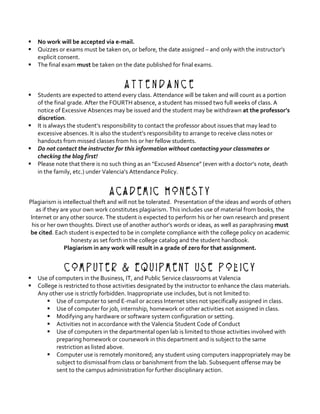
§ No	late	work	will	be	accepted.
§ No	work	will	be	accepted	via	e-mail.			
§ Quizzes	or	exams	must	be	taken	on,	or	before,	the	date	assigned	–	and	only	with	the	instructor’s	
explicit	consent.	
§ The	final	exam	must	be	taken	on	the	date	published	for	final	exams.	
	
A t t e n d a n c e
§ Students	are	expected	to	attend	every	class.	Attendance	will	be	taken	and	will	count	as	a	portion	
of	the	final	grade.	After	the	FOURTH	absence,	a	student	has	missed	two	full	weeks	of	class.	A	
notice	of	Excessive	Absences	may	be	issued	and	the	student	may	be	withdrawn	at	the	professor’s	
discretion.		
§ It	is	always	the	student’s	responsibility	to	contact	the	professor	about	issues	that	may	lead	to	
excessive	absences.	It	is	also	the	student’s	responsibility	to	arrange	to	receive	class	notes	or	
handouts	from	missed	classes	from	his	or	her	fellow	students.		
§ Do	not	contact	the	instructor	for	this	information	without	contacting	your	classmates	or	
checking	the	blog	first!		
§ Please	note	that	there	is	no	such	thing	as	an	“Excused	Absence”	(even	with	a	doctor’s	note,	death	
in	the	family,	etc.)	under	Valencia’s	Attendance	Policy.	
	
Academic Honesty
Plagiarism	is	intellectual	theft	and	will	not	be	tolerated.		Presentation	of	the	ideas	and	words	of	others	
as	if	they	are	your	own	work	constitutes	plagiarism.	This	includes	use	of	material	from	books,	the	
Internet	or	any	other	source.	The	student	is	expected	to	perform	his	or	her	own	research	and	present	
his	or	her	own	thoughts.	Direct	use	of	another	author’s	words	or	ideas,	as	well	as	paraphrasing	must	
be	cited.	Each	student	is	expected	to	be	in	complete	compliance	with	the	college	policy	on	academic	
honesty	as	set	forth	in	the	college	catalog	and	the	student	handbook.		
Plagiarism	in	any	work	will	result	in	a	grade	of	zero	for	that	assignment.	
	
Computer & Equipment Use Policy
§ Use	of	computers	in	the	Business,	IT,	and	Public	Service	classrooms	at	Valencia	
§ College	is	restricted	to	those	activities	designated	by	the	instructor	to	enhance	the	class	materials.	
Any	other	use	is	strictly	forbidden.	Inappropriate	use	includes,	but	is	not	limited	to:	
§ Use	of	computer	to	send	E-mail	or	access	Internet	sites	not	specifically	assigned	in	class.	
§ Use	of	computer	for	job,	internship,	homework	or	other	activities	not	assigned	in	class.	
§ Modifying	any	hardware	or	software	system	configuration	or	setting.	
§ Activities	not	in	accordance	with	the	Valencia	Student	Code	of	Conduct	
§ Use	of	computers	in	the	departmental	open	lab	is	limited	to	those	activities	involved	with	
preparing	homework	or	coursework	in	this	department	and	is	subject	to	the	same	
restriction	as	listed	above.	
§ Computer	use	is	remotely	monitored;	any	student	using	computers	inappropriately	may	be	
subject	to	dismissal	from	class	or	banishment	from	the	lab.	Subsequent	offense	may	be	
sent	to	the	campus	administration	for	further	disciplinary	action.
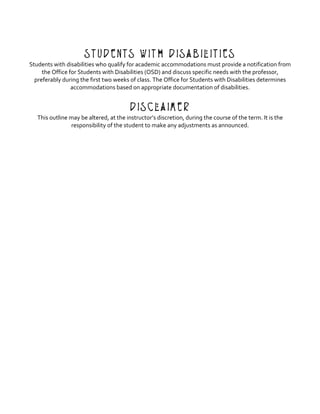
Students with Disabilities
Students	with	disabilities	who	qualify	for	academic	accommodations	must	provide	a	notification	from	
the	Office	for	Students	with	Disabilities	(OSD)	and	discuss	specific	needs	with	the	professor,	
preferably	during	the	first	two	weeks	of	class.	The	Office	for	Students	with	Disabilities	determines	
accommodations	based	on	appropriate	documentation	of	disabilities.	
	
Disclaimer
This	outline	may	be	altered,	at	the	instructor’s	discretion,	during	the	course	of	the	term.	It	is	the	
responsibility	of	the	student	to	make	any	adjustments	as	announced.

Hum2220 sp2016 syllabus

  • 1.
    Greek & RomanHumanities Professor Will Adams · Wadams5@valenciacollege.edu · Hum2220.blogspot.com Osceola Campus – Building 2, Room 232 · Mondays & Wednesdays, 1:30 – 2:45 PM “Wise men talk because they have something to say, fools because they have to say something.” - Plato Course Description § Greek & Roman Humanities offers the student integrated examinations of dominant developments in the Classical civilizations as expressed in art, architecture, politics, literature, music, philosophy and religion. § The course will cover the period from the Paleolithic era through the birth of Russia, and will emphasize the development and influence of classical thoughts and ideals. § This course is a Gordon Rule course, in which the student is required to demonstrate college-level writing skills through multiple writing assignments. A minimum grade of C required if used to satisfy Gordon Rule requirement. Course Objectives § To understand the continuation and evolution of the human experience by thinking critically about humanity’s artistic, cultural, and intellectual development. § To broaden the student’s knowledge of the ideas and personalities associated with the Greek and Roman civilizations. § To learn, internalize, and utilize vocabulary specific to the period covered by this course. § To appreciate the legacy left behind by both the Greek and Roman civilizations. § To learn skills essential to critical thinking and synthesis of thought by carrying out scholarly research and authoring thoughtful essays. § To attend cultural events in order to recognize the continued relevance of the sometimes- ancient ideas being discussed throughout the class’s duration. Required Textbook Gloria K. Fiero, The Humanistic Tradition, Book 1. Additional readings as assigned throughout the semester
  • 2.
    Evaluation Formula 1. Attendance & Class Participation 30% § Attendance will be taken at the beginning of each class meeting, and count as part of the attendance & participation grade. § The professor should hear each student’s voice at least once per class meeting. § Please be aware that, under Valencia’s Attendance Policy, there is no such thing as an “excused absence”. 2. Cultural Event with Written Evaluation 10% § You will be required to attend one cultural event throughout the class’s duration. § The instructor throughout the class’s duration may suggest various events to you, but it is ultimately your own responsibility to find and attend an approved cultural event. § Proof of attendance at said event must be furnished (i.e. ticket stub, program, souvenir, etc). § A two-page “reaction” (i.e. non-research) paper is required. Be sure to answer the following questions: What did I do? What did I think of it? What did I learn? 3. Research Project 20% § One 4-page written research project is required. § Proper MLA style citation should be used for all written assignments. § One draft may be turned in for the professor’s perusal two weeks prior to the due date. § Plagiarism = A grade of zero. No exceptions. § Wikipedia = A grade of zero. No exceptions. § All research projects should be stapled or bound by the student § A detailed research project description will be distributed at a later date. 4. Quizzes 10% § Four short-form quizzes will be administered throughout the course of the class. § The administration of quizzes will not be announced beforehand. § The format that the quizzes appear in may vary. 5. Examinations 30% § Four long-form examinations will be administered. § Examinations will not be cumulative in their subject matter. § You will be given a study guide for exams, at the instructor’s discretion. Grading Scale 100 – 90% = A 89 – 80% = B 79 – 70% = C 69 – 60% = D 59 – 0% = F
  • 3.
    Class Meeting Schedule Date Task Monday, January 11 Activity: Introduce class, distribute and discuss syllabus. Wednesday, January 13 Lecture: Paleolithic cave art Activity: Cave painting Monday, January 18 MLK Day – NO CLASS Wednesday, January 20 Lecture: The earliest ancient written languages & religion. Activity: Translation competiton Monday, January 25 Lecture: Embalming & Egyptian funerary architecture Homework: Sarcophagus lid Wednesday, January 27 Lecture: The Art & Culture of the Ancient Aegean Civilizations Monday, February 1 EXAM #1 Wednesday, February 3 NO CLASS Read On Blog: Greek Mythology Monday, February 8 RESEARCH PROJECTS ASSIGNED & LIBRARY VISIT Wednesday, February 10 Lecture: Dionysus & Ancient Greek Theatre Monday, February 15 NO CLASS - President’s Day Wednesday, February 17 Watch Medea in class Monday, February 22 NO CLASS Watch Medea via Library’s website Wednesday, February 25 EXAM #2 Monday, February 29 Lecture: Ancient Greek Philosophy Wednesday, March 2 Lecture: Aristotle’s Nichomachean Ethics Deconstructed Monday, March 7 NO CLASS - Spring Break Wednesday, March 9 NO CLASS - Spring Break Monday, March 14 Lecture: The Classical orders & the great temples of ancient Greece. Homework: Classical architecture sketch Wednesday, March 16 Lecture: The Roman Republic & What Is Satire? Monday, March 21 EXAM #3 Wednesday, March 23 Lecture: Rome’s Best & Craziest Emperors Read On Blog: The Coliseum’s Bloody History & Its Legacy Monday, March 28 Watch Ancient Rome, The Modern Stadium Wednesday, March 30 Lecture: Pompeii: Roman Time Capsule Monday, April 4 Lecture: The Emergence of Christianity in Ancient Rome Wednesday, April 6 Lecture: The Byzantine Era: An Empire Evolves
  • 4.
    Monday, April 11 Lecture: The Slavs, The Mongols, and The Birth of Russia lecture Wednesday, April 13 RESEARCH PROJECT PRESENTATIONS Monday, April 18 CULTURAL EVENT DUE Activity: In-class Final Exam Study Session Wednesday, April 20 FINAL EXAM – 1:30 PM Guidelines for Written Work § All written work should be set in Arial 12 point font, with double spacing and standard 1” page margins. § Additionally, each written assignment (with the exception of the research project) should begin with the following header, placed at the top, left corner of the first page: Your First & Last Name HUM2220 – 1:30 PM Prof. Will Adams Assignment Due Date (MM/DD/YYYY) § The student must staple assignments of more than one page; the instructor will not provide a stapler for your use. § Finally, minimum page totals for any written assignment require that the written page be filled in its entirety to count as one page. § In other words, if a written assignment requires 2 pages, but the student only writes 1.5, the student will not earn all possible points for the assignment. Class Conduct Conduct yourself with courtesy, consideration, and respect for others. Extra Credit Policy § Each quiz or test throughout the class’s duration will include one extra credit question equal to 10% of the quiz or test’s total point value (i.e. A five point extra credit question for a fifty point test). § In addition, extra credit may be earned by writing more than the required number of pages for any written assignment. § Extra credit for extra written work will be given up to a maximum of 15% of the assignment’s total point value. § No other extra credit opportunities will be available. Late & Make-Up Policy § No late work will be accepted.
  • 5.
    § No work will be accepted via e-mail. § Quizzes or exams must be taken on, or before, the date assigned – and only with the instructor’s explicit consent. §The final exam must be taken on the date published for final exams. A t t e n d a n c e § Students are expected to attend every class. Attendance will be taken and will count as a portion of the final grade. After the FOURTH absence, a student has missed two full weeks of class. A notice of Excessive Absences may be issued and the student may be withdrawn at the professor’s discretion. § It is always the student’s responsibility to contact the professor about issues that may lead to excessive absences. It is also the student’s responsibility to arrange to receive class notes or handouts from missed classes from his or her fellow students. § Do not contact the instructor for this information without contacting your classmates or checking the blog first! § Please note that there is no such thing as an “Excused Absence” (even with a doctor’s note, death in the family, etc.) under Valencia’s Attendance Policy. Academic Honesty Plagiarism is intellectual theft and will not be tolerated. Presentation of the ideas and words of others as if they are your own work constitutes plagiarism. This includes use of material from books, the Internet or any other source. The student is expected to perform his or her own research and present his or her own thoughts. Direct use of another author’s words or ideas, as well as paraphrasing must be cited. Each student is expected to be in complete compliance with the college policy on academic honesty as set forth in the college catalog and the student handbook. Plagiarism in any work will result in a grade of zero for that assignment. Computer & Equipment Use Policy § Use of computers in the Business, IT, and Public Service classrooms at Valencia § College is restricted to those activities designated by the instructor to enhance the class materials. Any other use is strictly forbidden. Inappropriate use includes, but is not limited to: § Use of computer to send E-mail or access Internet sites not specifically assigned in class. § Use of computer for job, internship, homework or other activities not assigned in class. § Modifying any hardware or software system configuration or setting. § Activities not in accordance with the Valencia Student Code of Conduct § Use of computers in the departmental open lab is limited to those activities involved with preparing homework or coursework in this department and is subject to the same restriction as listed above. § Computer use is remotely monitored; any student using computers inappropriately may be subject to dismissal from class or banishment from the lab. Subsequent offense may be sent to the campus administration for further disciplinary action.
  • 6.