Group Membership and Diffusion
in Virtual Worlds	


David Huffaker	

School of Information, University of Michigan	

(Now at Google)	


In collaboration with Lada Adamic, Chun-Yuen Teng, Matthew Simmons and
Liuling Gong
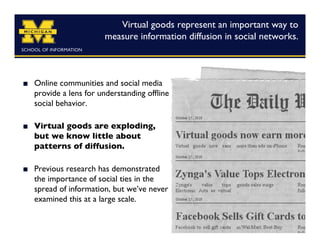
Virtual goods represent an important way to
                         measure information diffusion in social networks.	


    Online communities and social media
     provide a lens for understanding offline
     social behavior. 

    Virtual goods are exploding,
     but we know little about
     patterns of diffusion.

    Previous research has demonstrated
     the importance of social ties in the
     spread of information, but we’ve never
     examined this at a large scale.
Diffusion has often been explained in terms of
                                                   social influence and homophily.	


    Theories of Social Influence suggest that                           Social Influence
     exposure to influential individuals increase the
     likelihood of adopting similar beliefs [Monge 
     Contractor, 2003].	

      –  Examples in online settings: Wu et. al, 2006; Bakshy et. al,
         2009, Centola, 2010.

    Theories of Homophily suggest that individuals
     seek out others with same self-categorization or
     belong to same formal or informal groups [McPherson                  Homophily
     2001]. 	

      –  Examples in online settings: Aral et. al, 2009; Leskovec et.
         al, 2007)

    Some argue there is really a complex
     interplay of the two [Jackson, 2009; Shalizi 
     Thomas, 2011; Crandall et. al, 2008]
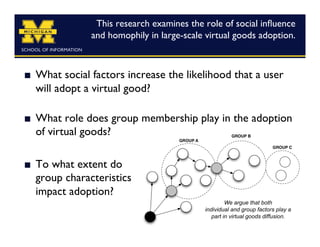
This research examines the role of social influence
                   and homophily in large-scale virtual goods adoption.


    What social factors increase the likelihood that a user
     will adopt a virtual good?

    What role does group membership play in the adoption
     of virtual goods?	


    To what extent do
     group characteristics 
     impact adoption?	

                                                          We argue that both
                                                 individual and group factors play a
                                                    part in virtual goods diffusion.
Second Life is a free, 3D virtual world 
                                                    with over one million users1.	


[1]: Source: http://en.wikipedia.org/wiki/Second_Life
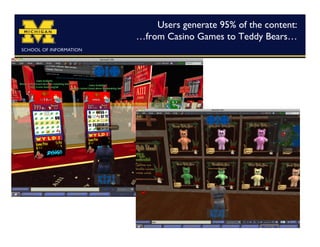
Users generate 95% of the content:
…from Casino Games to Teddy Bears…
Users can join up to 25 groups in Second Life.	


    Most groups involving top virtual goods
     sellers fall into the following categories:
     [Huffaker et. al, 2010]	


      –  Retail and Scripting (e.g., avatars, fashion,
         furniture, etc.)

      –  Music / Clubs / DJ (e.g., fan clubs, venues,
         and promotion)

      –  Lifestyle (e.g., interest, social or adult-
         oriented groups)

      –  Land  Rentals (e.g., landlords, vacation
         rentals)

      –  Games (e.g., casinos, games of chance)
We rely on a large-scale data set of user-level and
                                                               group-level behavior.	


    All virtual goods adoptions that took place in
     Nov-Dec 2008 (N = 1,092,094; 546,047 unique
     goods)	

      –  Distance to first adopter; number of friends shared
         with previous adopter

    Behavioral data for the unique users involved in
     the adoptions (N = 235,467)	

      –  Tenure in Second Life; Number of previous
         adoptions, Active days; Number of groups;

    Group-level data for groups with 10+ members
     and 5+ adopters (N = 61,722)	

      –  Group size; Turnover; Social network measures

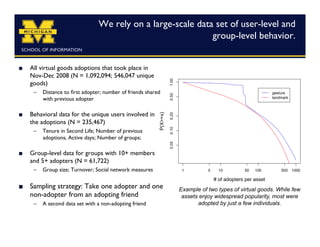
    Sampling strategy: Take one adopter and one              Example of two types of virtual goods. While few
     non-adopter from an adopting friend	

                    assets enjoy widespread popularity, most were
      –  A second data set with a non-adopting friend 	

            adopted by just a few individuals.
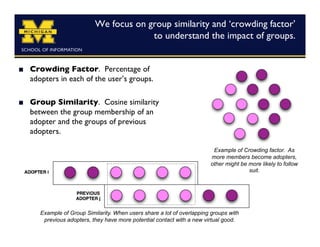
We focus on group similarity and ‘crowding factor’
                                          to understand the impact of groups. 	


    Crowding Factor. Percentage of
     adopters in each of the user’s groups.	


    Group Similarity. Cosine similarity
     between the group membership of an
     adopter and the groups of previous
     adopters.

                                                                           Example of Crowding factor. As
                                                                          more members become adopters,
                                                                          other might be more likely to follow
                                                                                         suit.


        Example of Group Similarity. When users share a lot of overlapping groups with
         previous adopters, they have more potential contact with a new virtual good.
Group similarity and crowding factor have a strong
                                              impact on the likelihood of adoption.


    We use a logistic regression model to                                                         Estimate	

   CV	

     predict the likelihood of adopting an
     asset after a friend adopts it [Bakshy et. al,          # Days in Second Life	

                  –.01	

   .50	

     2009].
                                                             # Adopting Friends	

                     –.44	

   .53	


    We use cross-validation (10-fold) in     # of Groups	

                                           –.52	

   .53	

     order to estimate how well the
                                              Distance from 1st Adopter	

                             –.07	

   .56	

     predictive model performs. The left-most
     column shows the individual CVs.      # Other Adopted Assets	

                                .48	

    .58	


    Group similarity and crowding                           # Friends with Previous                   .34	

    .58	

     factor are the most predictive                          Adopters	

     individuals variables in                                Crowding Factor	

                        .10	

    .61	

     determined if an adopter’s
     friends will adopt.                                  Group Similarity	

                       .23	

    .63	


                                                             Combined Model	

                                   .68	

    Note: We applied the same analysis to a data set
     where the adopter and non-adopter do not share a
                                                             All variables are significant, p  .001
     common adopting friend and find consistent results.
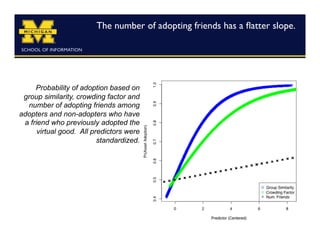
The number of adopting friends has a flatter slope.


     Probability of adoption based on
 group similarity, crowding factor and
  number of adopting friends among
adopters and non-adopters who have
 a friend who previously adopted the
      virtual good. All predictors were
                          standardized.
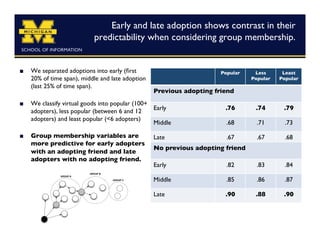
Early and late adoption shows contrast in their
                             predictability when considering group membership. 	


    We separated adoptions into early (first                             Popular	

    Less         Least
     20% of time span), middle and late adoption                                      Popular	

   Popular	

     (last 25% of time span).
                                                   Previous adopting friend	

    We classify virtual goods into popular (100+
     adopters), less popular (between 6 and 12    Early	

                 .76	

       .74	

       .79	

     adopters) and least popular (6 adopters)
                                                  Middle	

                .68	

       .71	

       .73	


    Group membership variables are                Late	

                 .67	

       .67	

       .68	

     more predictive for early adopters
                                                   No previous adopting friend	

     with an adopting friend and late
     adopters with no adopting friend.	

                                                   Early	

                .82	

       .83	

       .84	


                                                   Middle	

               .85	

       .86	

       .87	


                                                   Late	

                 .90	

       .88	

       .90
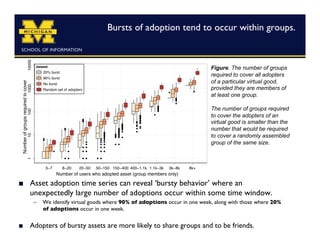
Bursts of adoption tend to occur within groups.


                                                                           Figure. The number of groups
                                                                           required to cover all adopters
                                                                           of a particular virtual good,
                                                                           provided they are members of
                                                                           at least one group.

                                                                           The number of groups required
                                                                           to cover the adopters of an
                                                                           virtual good is smaller than the
                                                                           number that would be required
                                                                           to cover a randomly assembled
                                                                           group of the same size.


    Asset adoption time series can reveal ‘bursty behavior’ where an
     unexpectedly large number of adoptions occur within some time window.	

      –  We identify virtual goods where 90% of adoptions occur in one week, along with those where 20%
         of adoptions occur in one week.


    Adopters of bursty assets are more likely to share groups and to be friends.
Groups with strong signatures of interaction are
                                           more responsible for the spread of virtual goods.


    A high degree of clustering and
     strongly connected components
     are positively correlated with
     both within-group transfers and
     total adoptions by group
     members.

    Groups with more highly connected
     individuals (i.e., average degree) are
     positively correlated with transfers but
     negatively correlated with total
     adoptions.	

      –    Interconnectedness creates boundaries?
           Taste-making. Less innovation can enter.

    Group size shows a negative correlation             Network visualizations of transaction ties (in black) and
     for transfers and adoptions, but opposite             social ties (in gray) for the lowest (Top) and highest
     is true for groups with highly active               (Bottom) frequency of adoption for a random sample of
     members.	

                                                          groups with 20 members.
      –    Problem with large groups?
Groups (and group membership) play an important
                                              role in the diffusion process. 	


    When an individual belongs to many of the same groups as other adopters—
     and when an individual’s groups are populated by adopters—she is more
     likely to adopt a virtual good.

    There are, of course, limitations:	

      –  Confounding nature of social influence and homophily We need to disentangle how group
         membership represents shared interest vs. actually promoting a virtual good.

      –  Generalizability Second Life to other online communities. We recognize the unique
         context and community of SL. 

    Further support that individual influence is not the sole factor in the diffusion
     process; considering larger collectives can better explain the likelihood of adopting
     an innovation.
Acknowledgements	


                        NetSI Lab	

                        Lada Adamic	


http://www.davehuffaker.com

Group Membership and Diffusion in Virtual Worlds

  • 1.
    Group Membership andDiffusion in Virtual Worlds David Huffaker School of Information, University of Michigan (Now at Google) In collaboration with Lada Adamic, Chun-Yuen Teng, Matthew Simmons and Liuling Gong
  • 2.
    Virtual goods representan important way to measure information diffusion in social networks.   Online communities and social media provide a lens for understanding offline social behavior.   Virtual goods are exploding, but we know little about patterns of diffusion.   Previous research has demonstrated the importance of social ties in the spread of information, but we’ve never examined this at a large scale.
  • 3.
    Diffusion has oftenbeen explained in terms of social influence and homophily.   Theories of Social Influence suggest that Social Influence exposure to influential individuals increase the likelihood of adopting similar beliefs [Monge Contractor, 2003]. –  Examples in online settings: Wu et. al, 2006; Bakshy et. al, 2009, Centola, 2010.   Theories of Homophily suggest that individuals seek out others with same self-categorization or belong to same formal or informal groups [McPherson Homophily 2001]. –  Examples in online settings: Aral et. al, 2009; Leskovec et. al, 2007)   Some argue there is really a complex interplay of the two [Jackson, 2009; Shalizi Thomas, 2011; Crandall et. al, 2008]
  • 4.
    This research examinesthe role of social influence and homophily in large-scale virtual goods adoption.   What social factors increase the likelihood that a user will adopt a virtual good?   What role does group membership play in the adoption of virtual goods?   To what extent do group characteristics impact adoption? We argue that both individual and group factors play a part in virtual goods diffusion.
  • 5.
    Second Life isa free, 3D virtual world with over one million users1. [1]: Source: http://en.wikipedia.org/wiki/Second_Life
  • 6.
    Users generate 95%of the content: …from Casino Games to Teddy Bears…
  • 7.
    Users can joinup to 25 groups in Second Life.   Most groups involving top virtual goods sellers fall into the following categories: [Huffaker et. al, 2010] –  Retail and Scripting (e.g., avatars, fashion, furniture, etc.) –  Music / Clubs / DJ (e.g., fan clubs, venues, and promotion) –  Lifestyle (e.g., interest, social or adult- oriented groups) –  Land Rentals (e.g., landlords, vacation rentals) –  Games (e.g., casinos, games of chance)
  • 8.
    We rely ona large-scale data set of user-level and group-level behavior.   All virtual goods adoptions that took place in Nov-Dec 2008 (N = 1,092,094; 546,047 unique goods) –  Distance to first adopter; number of friends shared with previous adopter   Behavioral data for the unique users involved in the adoptions (N = 235,467) –  Tenure in Second Life; Number of previous adoptions, Active days; Number of groups;   Group-level data for groups with 10+ members and 5+ adopters (N = 61,722) –  Group size; Turnover; Social network measures   Sampling strategy: Take one adopter and one Example of two types of virtual goods. While few non-adopter from an adopting friend assets enjoy widespread popularity, most were –  A second data set with a non-adopting friend adopted by just a few individuals.
  • 9.
    We focus ongroup similarity and ‘crowding factor’ to understand the impact of groups.   Crowding Factor. Percentage of adopters in each of the user’s groups.   Group Similarity. Cosine similarity between the group membership of an adopter and the groups of previous adopters. Example of Crowding factor. As more members become adopters, other might be more likely to follow suit. Example of Group Similarity. When users share a lot of overlapping groups with previous adopters, they have more potential contact with a new virtual good.
  • 10.
    Group similarity andcrowding factor have a strong impact on the likelihood of adoption.   We use a logistic regression model to Estimate CV predict the likelihood of adopting an asset after a friend adopts it [Bakshy et. al, # Days in Second Life –.01 .50 2009]. # Adopting Friends –.44 .53   We use cross-validation (10-fold) in # of Groups –.52 .53 order to estimate how well the Distance from 1st Adopter –.07 .56 predictive model performs. The left-most column shows the individual CVs. # Other Adopted Assets .48 .58   Group similarity and crowding # Friends with Previous .34 .58 factor are the most predictive Adopters individuals variables in Crowding Factor .10 .61 determined if an adopter’s friends will adopt. Group Similarity .23 .63 Combined Model .68   Note: We applied the same analysis to a data set where the adopter and non-adopter do not share a All variables are significant, p .001 common adopting friend and find consistent results.
  • 11.
    The number ofadopting friends has a flatter slope. Probability of adoption based on group similarity, crowding factor and number of adopting friends among adopters and non-adopters who have a friend who previously adopted the virtual good. All predictors were standardized.
  • 12.
    Early and lateadoption shows contrast in their predictability when considering group membership.   We separated adoptions into early (first Popular Less Least 20% of time span), middle and late adoption Popular Popular (last 25% of time span). Previous adopting friend   We classify virtual goods into popular (100+ adopters), less popular (between 6 and 12 Early .76 .74 .79 adopters) and least popular (6 adopters) Middle .68 .71 .73   Group membership variables are Late .67 .67 .68 more predictive for early adopters No previous adopting friend with an adopting friend and late adopters with no adopting friend. Early .82 .83 .84 Middle .85 .86 .87 Late .90 .88 .90
  • 13.
    Bursts of adoptiontend to occur within groups. Figure. The number of groups required to cover all adopters of a particular virtual good, provided they are members of at least one group. The number of groups required to cover the adopters of an virtual good is smaller than the number that would be required to cover a randomly assembled group of the same size.   Asset adoption time series can reveal ‘bursty behavior’ where an unexpectedly large number of adoptions occur within some time window. –  We identify virtual goods where 90% of adoptions occur in one week, along with those where 20% of adoptions occur in one week.   Adopters of bursty assets are more likely to share groups and to be friends.
  • 14.
    Groups with strongsignatures of interaction are more responsible for the spread of virtual goods.   A high degree of clustering and strongly connected components are positively correlated with both within-group transfers and total adoptions by group members.   Groups with more highly connected individuals (i.e., average degree) are positively correlated with transfers but negatively correlated with total adoptions. –  Interconnectedness creates boundaries? Taste-making. Less innovation can enter.   Group size shows a negative correlation Network visualizations of transaction ties (in black) and for transfers and adoptions, but opposite social ties (in gray) for the lowest (Top) and highest is true for groups with highly active (Bottom) frequency of adoption for a random sample of members. groups with 20 members. –  Problem with large groups?
  • 15.
    Groups (and groupmembership) play an important role in the diffusion process.   When an individual belongs to many of the same groups as other adopters— and when an individual’s groups are populated by adopters—she is more likely to adopt a virtual good.   There are, of course, limitations: –  Confounding nature of social influence and homophily We need to disentangle how group membership represents shared interest vs. actually promoting a virtual good. –  Generalizability Second Life to other online communities. We recognize the unique context and community of SL.   Further support that individual influence is not the sole factor in the diffusion process; considering larger collectives can better explain the likelihood of adopting an innovation.
  • 16.
    Acknowledgements NetSI Lab Lada Adamic http://www.davehuffaker.com