CS637 Class 2
We are looking at slides from
HTML and CSS: Design and Build Websites by Jon
Duckett
Slides are posted on the class website, protected by a
password written on the (virtual) board
Take roll for second and last time.
Note: Exams are open-books, no cell phone or email
use, proctored by Zoom, with private recording.
If you must take a phone call during an exam, tell the
proctor what you’re doing.
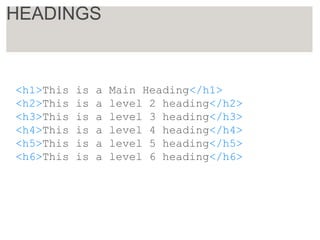
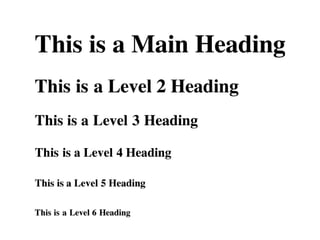
<h1>This is a Main Heading</h1>
<h2>This is a level 2 heading</h2>
<h3>This is a level 3 heading</h3>
<h4>This is a level 4 heading</h4>
<h5>This is a level 5 heading</h5>
<h6>This is a level 6 heading</h6>
HEADINGS
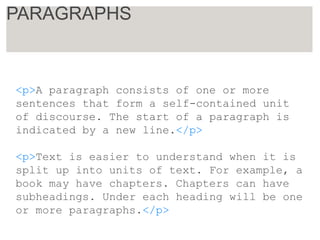
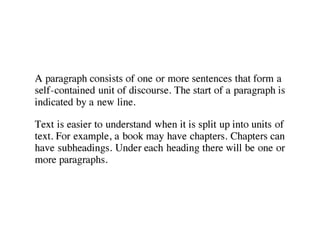
<p>A paragraph consists of one or more
sentences that form a self-contained unit
of discourse. The start of a paragraph is
indicated by a new line.</p>
<p>Text is easier to understand when it is
split up into units of text. For example, a
book may have chapters. Chapters can have
subheadings. Under each heading will be one
or more paragraphs.</p>
PARAGRAPHS
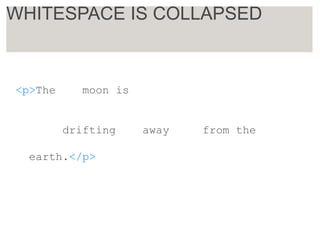
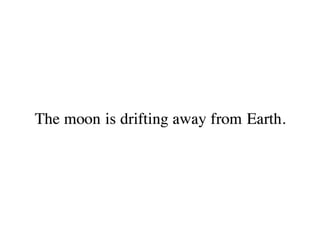
<p>The moon is
drifting away from the
earth.</p>
WHITESPACE IS COLLAPSED
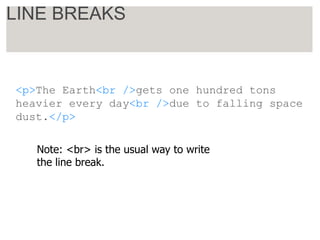
<p>The Earth<br />gets one hundred tons
heavier every day<br />due to falling space
dust.</p>
LINE BREAKS
Note: <br> is the usual way to write
the line break.
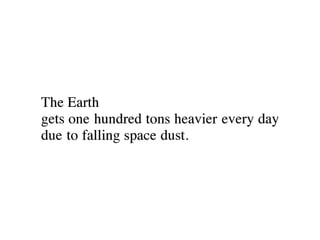
<p>The Earth<br />gets one hundred tons
heavier every day<br />due to falling space
dust.</p>
LINE BREAKS
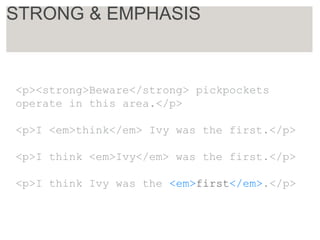
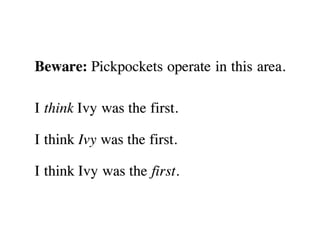
<p><strong>Beware</strong> pickpockets
operate in this area.</p>
<p>I <em>think</em> Ivy was the first.</p>
<p>I think <em>Ivy</em> was the first.</p>
<p>I think Ivy was the <em>first</em>.</p>
STRONG & EMPHASIS
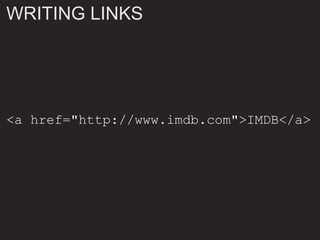
WRITING LINKS
<a href="http://www.imdb.com">IMDB</a>
WRITING LINKS
<a href="http://www.imdb.com">IMDB</a>
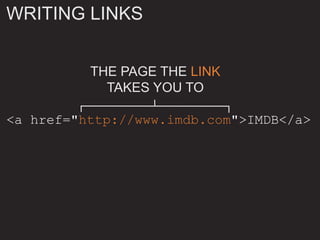
THE PAGE THE LINK
TAKES YOU TO
WRITING LINKS
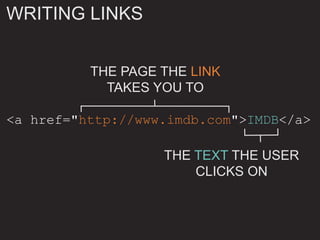
<a href="http://www.imdb.com">IMDB</a>
THE PAGE THE LINK
TAKES YOU TO
THE TEXT THE USER
CLICKS ON
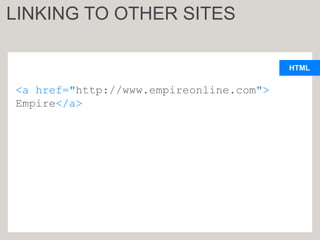
HTML
<a href="http://www.empireonline.com">
Empire</a>
LINKING TO OTHER SITES
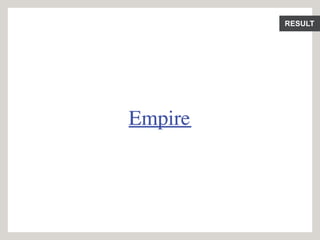
RESULT
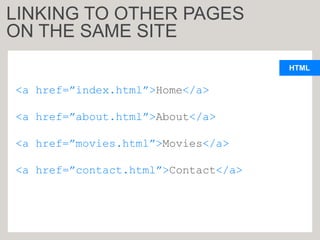
HTML
<a href=”index.html”>Home</a>
<a href=”about.html”>About</a>
<a href=”movies.html”>Movies</a>
<a href=”contact.html”>Contact</a>
LINKING TO OTHER PAGES
ON THE SAME SITE
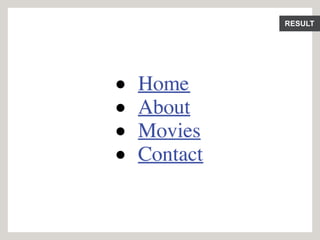
RESULT
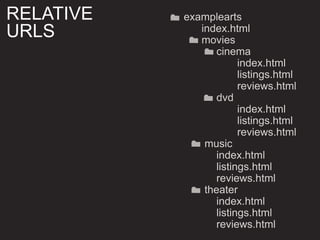
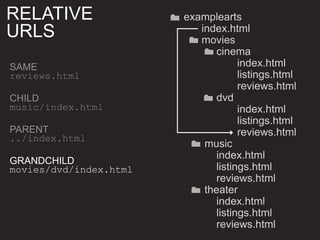
examplearts
index.html
movies
cinema
index.html
listings.html
reviews.html
dvd
index.html
listings.html
reviews.html
music
index.html
listings.html
reviews.html
theater
index.html
listings.html
reviews.html
RELATIVE
URLS
examplearts
index.html
movies
cinema
index.html
listings.html
reviews.html
dvd
index.html
listings.html
reviews.html
music
index.html
listings.html
reviews.html
theater
index.html
listings.html
reviews.html
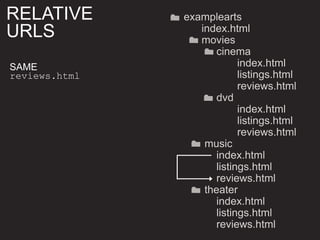
SAME
reviews.html
RELATIVE
URLS
examplearts
index.html
movies
cinema
index.html
listings.html
reviews.html
dvd
index.html
listings.html
reviews.html
music
index.html
listings.html
reviews.html
theater
index.html
listings.html
reviews.html
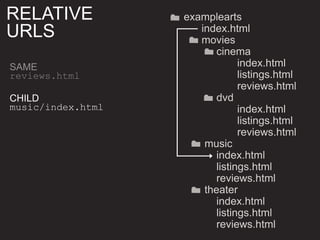
CHILD
music/index.html
RELATIVE
URLS
examplearts
index.html
movies
cinema
index.html
listings.html
reviews.html
dvd
index.html
listings.html
reviews.html
music
index.html
listings.html
reviews.html
theater
index.html
listings.html
reviews.html
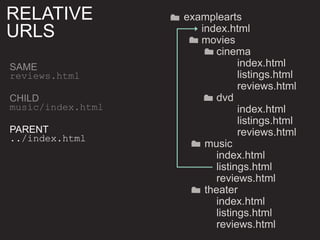
PARENT
../index.html
RELATIVE
URLS
examplearts
index.html
movies
cinema
index.html
listings.html
reviews.html
dvd
index.html
listings.html
reviews.html
music
index.html
listings.html
reviews.html
theater
index.html
listings.html
reviews.html
GRANDCHILD
movies/dvd/index.html
RELATIVE
URLS
examplearts
index.html
movies
cinema
index.html
listings.html
reviews.html
dvd
index.html
listings.html
reviews.html
music
index.html
listings.html
reviews.html
theater
index.html
listings.html
reviews.html
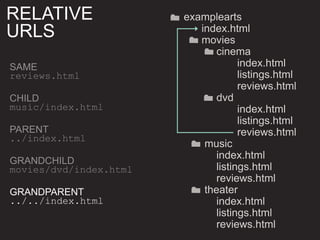
GRANDPARENT
../../index.html
RELATIVE
URLS
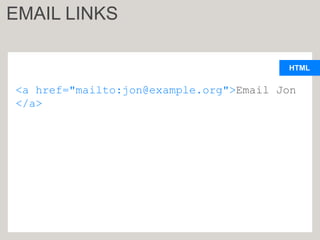
HTML
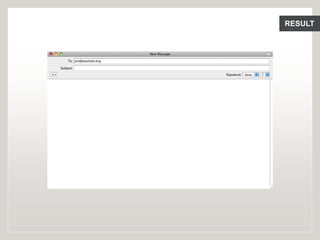
<a href="mailto:jon@example.org">Email Jon
</a>
EMAIL LINKS
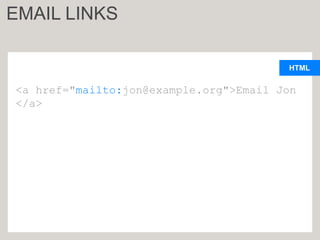
HTML
<a href="mailto:jon@example.org">Email Jon
</a>
EMAIL LINKS
RESULT
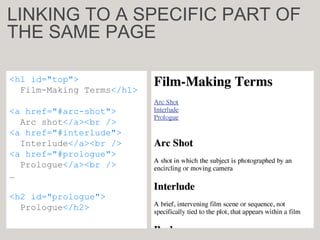
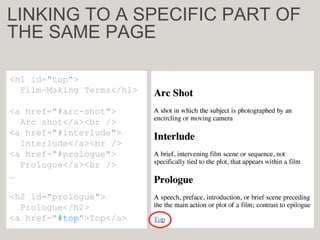
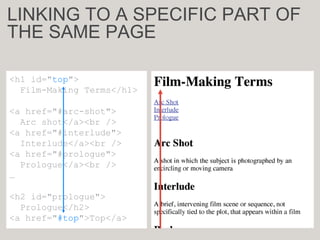
<h1 id="top">
Film-Making Terms</h1>
<a href="#arc-shot">
Arc shot</a><br />
<a href="#interlude">
Interlude</a><br />
<a href="#prologue">
Prologue</a><br />
…
<h2 id="prologue">
Prologue</h2>
LINKING TO A SPECIFIC PART OF
THE SAME PAGE
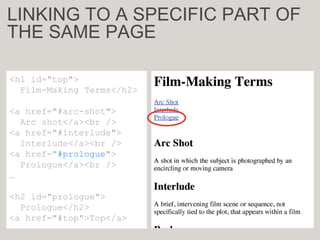
<h1 id="top">
Film-Making Terms</h2>
<a href="#arc-shot">
Arc shot</a><br />
<a href="#interlude">
Interlude</a><br />
<a href="#prologue">
Prologue</a><br />
<h2 id="prologue">
Prologue</h2>
<a href="#top">Top</a>
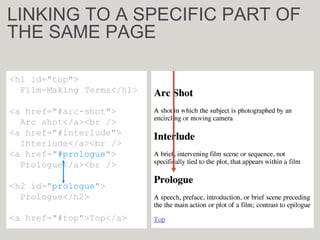
<h1 id="top">
Film-Making Terms</h2>
<a href="#arc-shot">
Arc shot</a><br />
<a href="#interlude">
Interlude</a><br />
<a href="#prologue">
Prologue</a><br />
…
<h2 id="prologue">
Prologue</h2>
<a href="#top">Top</a>
LINKING TO A SPECIFIC PART OF
THE SAME PAGE
<h1 id="top">
Film-Making Terms</h2>
<a href="#arc-shot">
Arc shot</a><br />
<a href="#interlude">
Interlude</a><br />
<a href="#prologue">
Prologue</a><br />
<h2 id="prologue">
Prologue</h2>
<a href="#top">Top</a>
<h1 id="top">
Film-Making Terms</h2>
<a href="#arc-shot">
Arc shot</a><br />
<a href="#interlude">
Interlude</a><br />
<a href="#prologue">
Prologue</a><br />
<h2 id="prologue">
Prologue</h2>
<a href="#top">Top</a>
<h1 id="top">
Film-Making Terms</h1>
<a href="#arc-shot">
Arc shot</a><br />
<a href="#interlude">
Interlude</a><br />
<a href="#prologue">
Prologue</a><br />
<h2 id="prologue">
Prologue</h2>
<a href="#top">Top</a>
LINKING TO A SPECIFIC PART OF
THE SAME PAGE
<h1 id="top">
Film-Making Terms</h2>
<a href="#arc-shot">
Arc shot</a><br />
<a href="#interlude">
Interlude</a><br />
<a href="#prologue">
Prologue</a><br />
<h2 id="prologue">
Prologue</h2>
<a href="#top">Top</a>
<h1 id="top">
Film-Making Terms</h1>
<a href="#arc-shot">
Arc shot</a><br />
<a href="#interlude">
Interlude</a><br />
<a href="#prologue">
Prologue</a><br />
…
<h2 id="prologue">
Prologue</h2>
<a href="#top">Top</a>
LINKING TO A SPECIFIC PART OF
THE SAME PAGE
<h1 id="top">
Film-Making Terms</h2>
<a href="#arc-shot">
Arc shot</a><br />
<a href="#interlude">
Interlude</a><br />
<a href="#prologue">
Prologue</a><br />
<h2 id="prologue">
Prologue</h2>
<a href="#top">Top</a>
<h1 id="top">
Film-Making Terms</h1>
<a href="#arc-shot">
Arc shot</a><br />
<a href="#interlude">
Interlude</a><br />
<a href="#prologue">
Prologue</a><br />
…
<h2 id="prologue">
Prologue</h2>
<a href="#top">Top</a>
LINKING TO A SPECIFIC PART OF
THE SAME PAGE
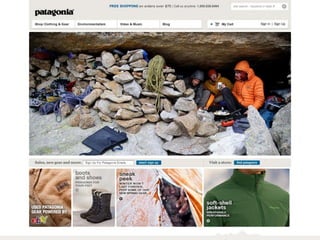
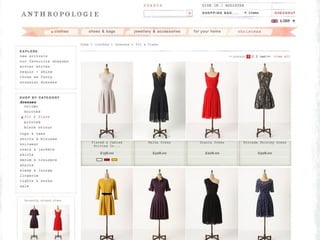
Images can set the tone for a
site in less time than it takes to
read a description.
CHOOSING IMAGES
FOR YOUR SITE
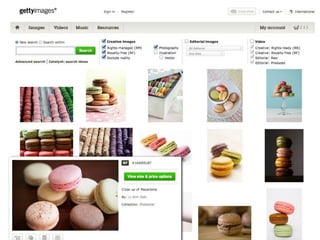
Images are subject to copyright
but there are stock photography
sites where you can buy them.
CHOOSING IMAGES
FOR YOUR SITE
If a page shows several photos
of products or members of a
team, keep them consistent.
CHOOSING IMAGES
FOR YOUR SITE
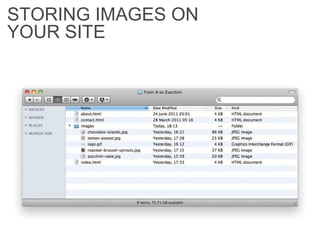
STORING IMAGES ON
YOUR SITE
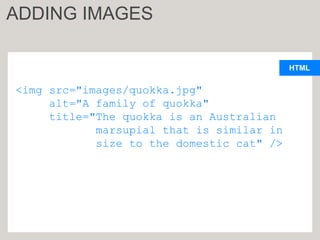
HTML
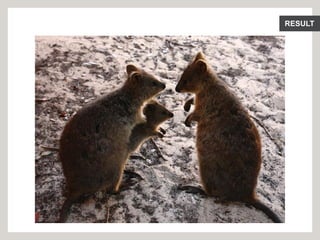
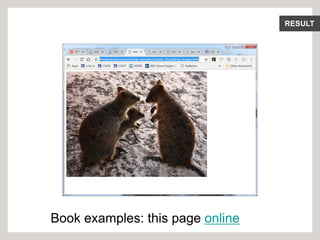
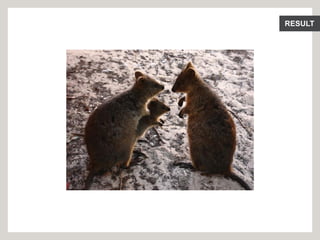
<img src="images/quokka.jpg"
alt="A family of quokka"
title="The quokka is an Australian
marsupial that is similar in
size to the domestic cat" />
ADDING IMAGES
RESULT
RESULT
Book examples: this page online
RESULT
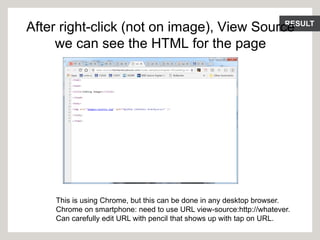
After right-click (not on image), View Source
we can see the HTML for the page
This is using Chrome, but this can be done in any desktop browser.

Chrome on smartphone: need to use URL view-source:http://whatever.

Can carefully edit URL with pencil that shows up with tap on URL.
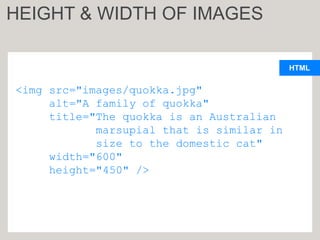
HTML
<img src="images/quokka.jpg"
alt="A family of quokka"
title="The quokka is an Australian
marsupial that is similar in
size to the domestic cat"
width="600"
height="450" />
HEIGHT & WIDTH OF IMAGES
RESULT
RESULT
Resizing
• Although browsers will resize images as
specified by width and height, it’s not a great
idea to use it.
• Can end up with distorted or fuzzy images.
• Better to make another right-size image
using a graphics editor and use that.
RESULT
How a page with an image gets displayed
• In this case, the user selects the page as usual
• The browser does a GET request to the server
• The server sends the HTML page with the <img>…
• The browser receives the HTML, parses the <img> URL, and
issues another GET request for the image data (no user
involvement here)
• The server sends the image data back
• The browser shows the completed page to the user
• This means two complete “request cycles” to the server
• We can make a chart showing this communication…
RESULT
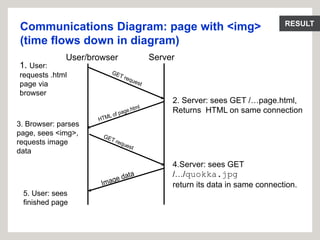
Communications Diagram: page with <img>
(time flows down in diagram)
User/browser Server
2. Server: sees GET /…page.html,
Returns HTML on same connection
4.Server: sees GET
/…/quokka.jpg
return its data in same connection.
3. Browser: parses
page, sees <img>,
requests image
data
5. User: sees
finished page
1. User:
requests .html
page via
browser
RESULT
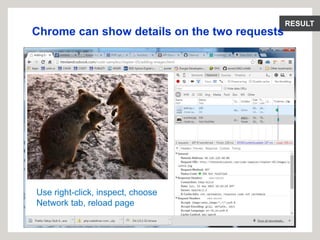
Chrome can show details on the two requests
Use right-click, inspect, choose
Network tab, reload page
RESULT
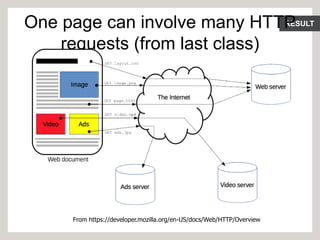
One page can involve many HTTP
requests (from last class)
From https://developer.mozilla.org/en-US/docs/Web/HTTP/Overview
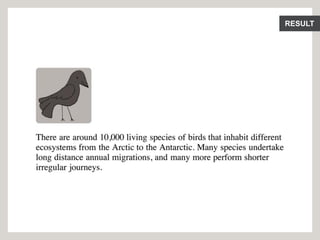
<img src="images/bird.gif" alt="bird"
width="100" height="100" />
<p>There are around 10,000 living species
of birds that inhabit different ecosystems
from the Arctic to the Antarctic. Man
species undertake long distance annual
migrations, and many more perform shorter
irregular journeys.</p>
WHERE TO PLACE IMAGES
IN YOUR CODE
RESULT
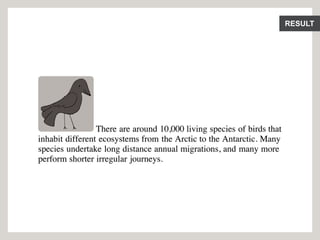
<p><img src="images/bird.gif" alt="bird"
width="100" height="100" />There are
around 10,000 living species of birds that
inhabit different ecosystems from the
Arctic to the Antarctic. Man species
undertake long distance annual migrations,
and many more perform shorter irregular
journeys.</p>
WHERE TO PLACE IMAGES
IN YOUR CODE
RESULT
RESULT
<img> is “inline”
• Now we look at cases where the <img>
element lies inside the <p> element.
• <p> is a block element, starts a new line
• <img> Image is an inline element, keeps
going on the current line
• Other block elements: <h1>, <ul>, <li>, …
• Other inline elements: <em>, <a>, <strong>
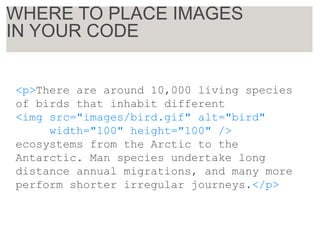
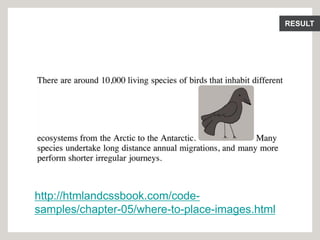
<p>There are around 10,000 living species
of birds that inhabit different
<img src="images/bird.gif" alt="bird"
width="100" height="100" />
ecosystems from the Arctic to the
Antarctic. Man species undertake long
distance annual migrations, and many more
perform shorter irregular journeys.</p>
WHERE TO PLACE IMAGES
IN YOUR CODE
RESULT
http://htmlandcssbook.com/code-
samples/chapter-05/where-to-place-images.html
RESULT
“OLD CODE”
• In the next slide and in Duckett, “OLD
CODE” means pre-HTML5
• In HTML5, we use CSS to arrange non-
default positioning
• Skip “OLD CODE” for this class, but note it
could be useful for working with older HTML.
• We should revisit these examples once
we’ve tackled CSS.
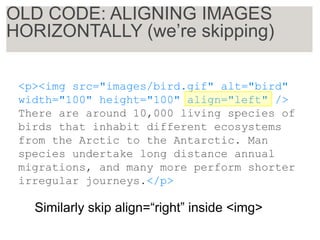
<p><img src="images/bird.gif" alt="bird"
width="100" height="100" align="left" />
There are around 10,000 living species of
birds that inhabit different ecosystems
from the Arctic to the Antarctic. Man
species undertake long distance annual
migrations, and many more perform shorter
irregular journeys.</p>
OLD CODE: ALIGNING IMAGES
HORIZONTALLY (we’re skipping)
Similarly skip align=“right” inside <img>
IMAGE FORMATS:
JPEG
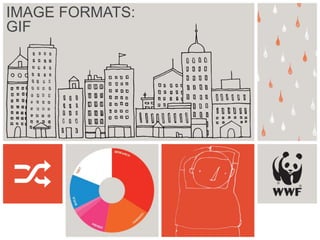
IMAGE FORMATS:
GIF
Example image
• See http://htmlandcssbook.com/code-
samples/chapter-05/adding-images.html
• HTML:
<body>
<img src="images/quokka.jpg" alt="Quokka (Setonix brachyurus)" />
</body>
• Note how it stays the same size while you resize the
page. It shows in 600x450 screen pixels.
• On my laptop, 600 px width = 50% of screen width
• Right-click on image in Chrome, Inspect, to see its
dimensions.
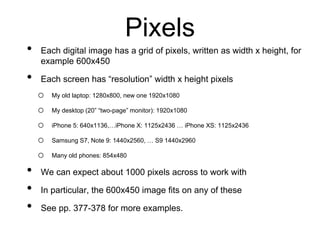
Pixels
• Each digital image has a grid of pixels, written as width x height, for
example 600x450
• Each screen has “resolution” width x height pixels
o My old laptop: 1280x800, new one 1920x1080
o My desktop (20” “two-page” monitor): 1920x1080
o iPhone 5: 640x1136,…iPhone X: 1125x2436 … iPhone XS: 1125x2436
o Samsung S7, Note 9: 1440x2560, … S9 1440x2960
o Many old phones: 854x480
• We can expect about 1000 pixels across to work with
• In particular, the 600x450 image fits on any of these
• See pp. 377-378 for more examples.
• Create each image the same
width and height as you would
like it to appear on your
website, using total width =
1000 px.
• Check it on various devices.
• More on this later.
IMAGE DIMENSIONS
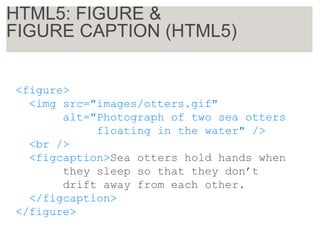
<figure>
<img src="images/otters.gif"
alt="Photograph of two sea otters
floating in the water" />
<br />
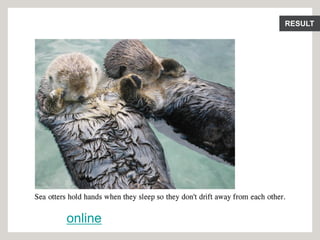
<figcaption>Sea otters hold hands when
they sleep so that they don’t
drift away from each other.
</figcaption>
</figure>
HTML5: FIGURE &
FIGURE CAPTION (HTML5)
<figure>
<img src="images/otters.gif"
alt="Photograph of two sea otters
floating in the water" />
<br />
<figcaption>Sea otters hold hands when
they sleep so that they don’t
drift away from each other.
</figcaption>
</figure>
HTML5: FIGURE &
FIGURE CAPTION
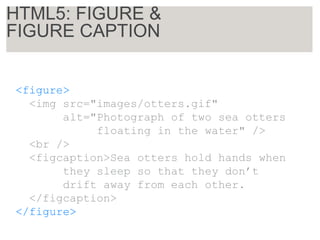
<figure>
<img src="images/otters.gif"
alt="Photograph of two sea otters
floating in the water" />
<br />
<figcaption>Sea otters hold hands when
they sleep so that they don’t
drift away from each other.
</figcaption>
</figure>
HTML5: FIGURE &
FIGURE CAPTION
RESULT
online
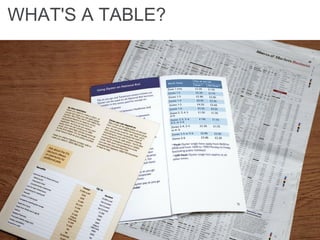
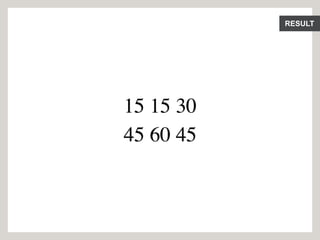
WHAT'S A TABLE?
HTML
<table>
<tr>
<td>15</td>
<td>15</td>
<td>30</td>
</tr>
<tr>
<td>45</td>
<td>60</td>
<td>90</td>
</tr>
</table>
BASIC TABLE STRUCTURE
RESULT
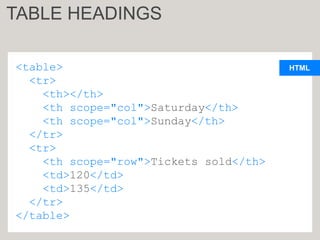
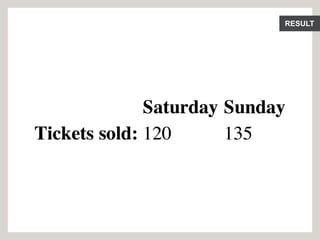
HTML
<table>
<tr>
<th></th>
<th scope="col">Saturday</th>
<th scope="col">Sunday</th>
</tr>
<tr>
<th scope="row">Tickets sold</th>
<td>120</td>
<td>135</td>
</tr>
</table>
TABLE HEADINGS
RESULT
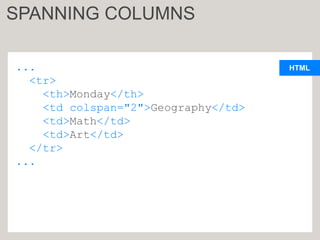
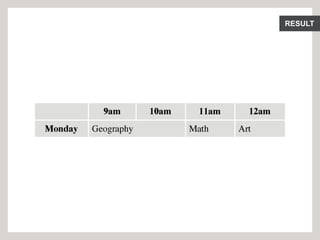
HTML
...
<tr>
<th>Monday</th>
<td colspan="2">Geography</td>
<td>Math</td>
<td>Art</td>
</tr>
...
SPANNING COLUMNS
RESULT
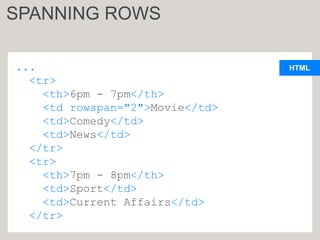
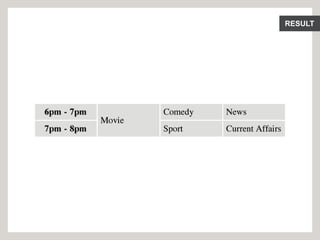
HTML
...
<tr>
<th>6pm - 7pm</th>
<td rowspan="2">Movie</td>
<td>Comedy</td>
<td>News</td>
</tr>
<tr>
<th>7pm - 8pm</th>
<td>Sport</td>
<td>Current Affairs</td>
</tr>
SPANNING ROWS
RESULT
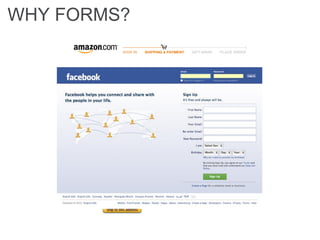
WHY FORMS?
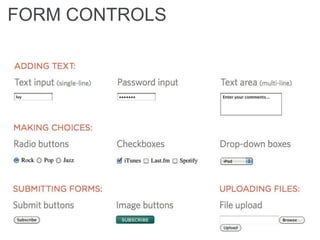
FORM CONTROLS
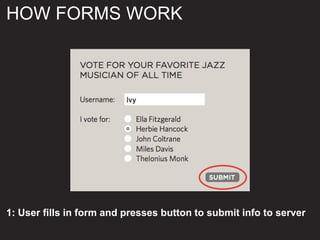
1: User fills in form and presses button to submit info to server
HOW FORMS WORK
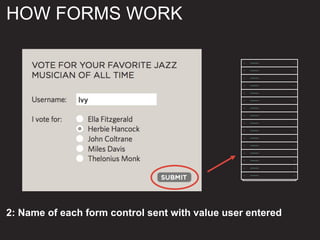
2: Name of each form control sent with value user entered
HOW FORMS WORK
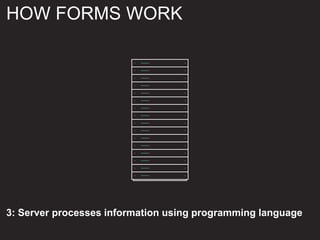
3: Server processes information using programming language
HOW FORMS WORK
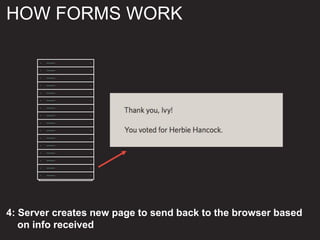
4: Server creates new page to send back to the browser based
on info received
HOW FORMS WORK
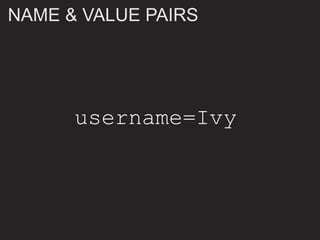
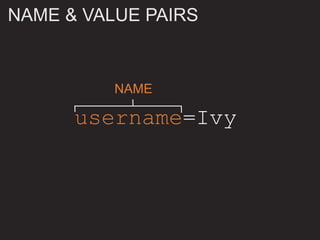
NAME & VALUE PAIRS
username=Ivy
NAME & VALUE PAIRS
username=Ivy
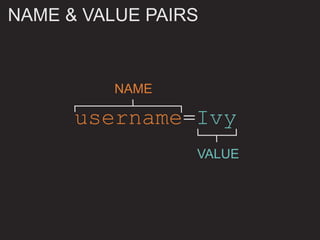
NAME
NAME & VALUE PAIRS
username=Ivy
VALUE
NAME
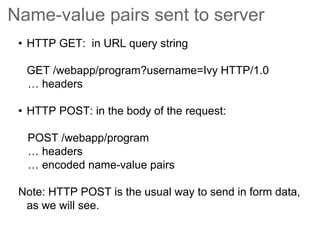
Name-value pairs sent to server
• HTTP GET: in URL query string
GET /webapp/program?username=Ivy HTTP/1.0
… headers
• HTTP POST: in the body of the request:
POST /webapp/program
… headers
… encoded name-value pairs
Note: HTTP POST is the usual way to send in form data,
as we will see.
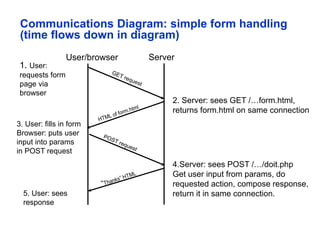
Communications Diagram: simple form handling
(time flows down in diagram)
User/browser Server
2. Server: sees GET /…form.html,
returns form.html on same connection
4.Server: sees POST /…/doit.php
Get user input from params, do
requested action, compose response,
return it in same connection.
3. User: fills in form
Browser: puts user
input into params
in POST request
5. User: sees
response
1. User:
requests form
page via
browser
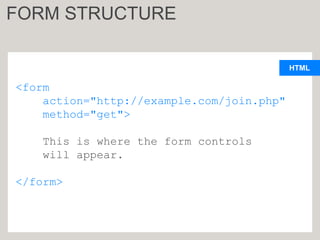
HTML
<form
action="http://example.com/join.php"
method="get">
This is where the form controls
will appear.
</form>
FORM STRUCTURE
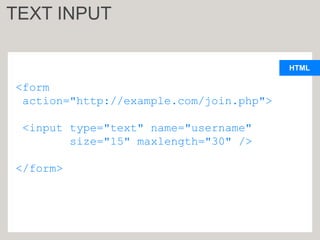
HTML
<form
action="http://example.com/join.php">
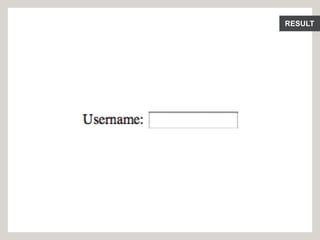
<input type="text" name="username"
size="15" maxlength="30" />
</form>
TEXT INPUT
RESULT
HTML
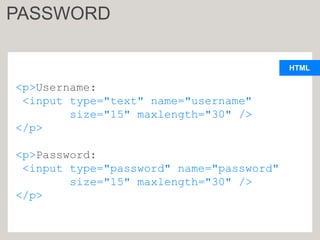
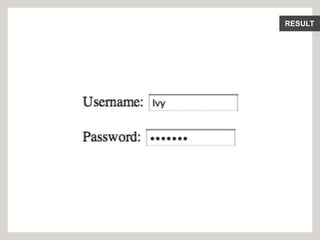
<p>Username:
<input type="text" name="username"
size="15" maxlength="30" />
</p>
<p>Password:
<input type="password" name="password"
size="15" maxlength="30" />
</p>
PASSWORD
RESULT
HTML
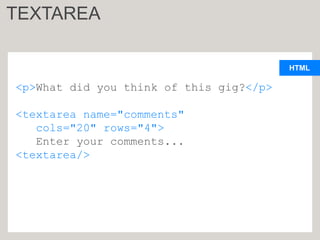
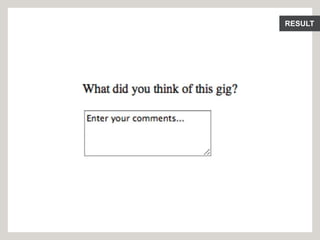
<p>What did you think of this gig?</p>
<textarea name="comments"
cols="20" rows="4">
Enter your comments...
<textarea/>
TEXTAREA
RESULT
HTML
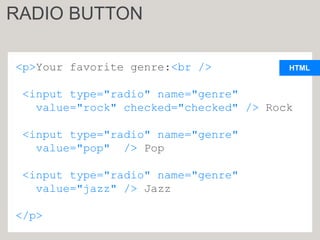
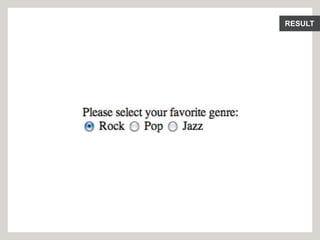
<p>Your favorite genre:<br />
<input type="radio" name="genre"
value="rock" checked="checked" /> Rock
<input type="radio" name="genre"
value="pop" /> Pop
<input type="radio" name="genre"
value="jazz" /> Jazz
</p>
RADIO BUTTON
RESULT
HTML
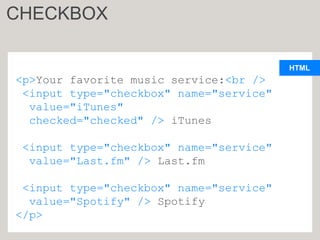
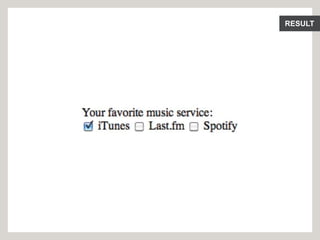
<p>Your favorite music service:<br />
<input type="checkbox" name="service"
value="iTunes"
checked="checked" /> iTunes
<input type="checkbox" name="service"
value="Last.fm" /> Last.fm
<input type="checkbox" name="service"
value="Spotify" /> Spotify
</p>
CHECKBOX
RESULT
HTML
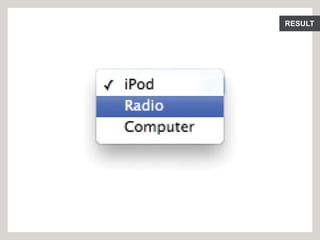
<select name="devices">
<option value="iPod"
selected="selected">iPod</option>
<option value="radio">Radio</option>
<option value="PC">Computer</option>
</select>
DROP DOWN LIST BOX
RESULT
HTML
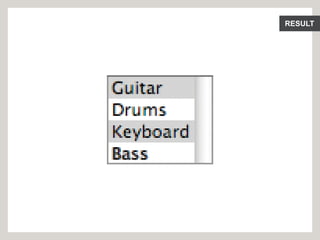
<select name="devices" size="4“
multiple="multiple">
<option value="guitar"
selected="selected">Guitar</option>
<option value="drums">Drums</option>
<option value="keys"
selected="selected">Keyboard</option>
<option value="bass">Bass</option>
</select>
MULTIPLE SELECT BOX, select with
additional attribute (red)
RESULT
HTML
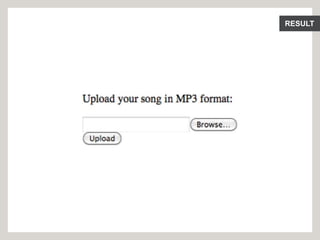
<form action="http://eg.com/upload.php"
method="post">
<p>Upload your song in MP3 format:</p>
<input type="file" name="user-song" />
<input type="submit" value="upload" />
</form>
FILE INPUT BOX: we won’t need this.
RESULT
HTML
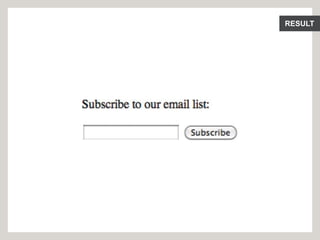
<form action="http://eg.com/email.php">
<p>Subscribe to our email list:</p>
<input type="text" name="email" />
<input type="submit"
value="Subscribe" />
</form>
SUBMIT BUTTON
RESULT
HTML
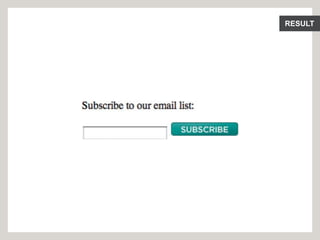
<form action="http://eg.com/email.php">
<p>Subscribe to our email list:</p>
<input type="text" name="email" />
<input type="image"
src="images/subscribe.jpg"
width="100" height="20" />
</form>
IMAGE BUTTON (does submit)
RESULT
HTML
<form action="http://eg.com/add.php">
<button>
<img src="images/add.gif" alt="add"
width="10" height="20" />
</button>
</form>
This submits the form, like <input type=“submit”> or <input type=“image”>.
Tip from www.w3schools.com: If you use the <button> element in an
HTML form, different browsers may submit different values. Use <input> to
create buttons in an HTML form.
• Let’s follow this rule.
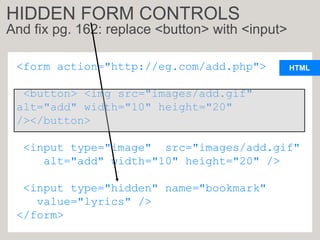
BUTTONS: Don’t use <button> inside
a form!
HTML
<form action="http://eg.com/add.php">
<button> <img src="images/add.gif"
alt="add" width="10" height="20"
/></button>
<input type="image" src="images/add.gif"
alt="add" width="10" height="20" />
<input type="hidden" name="bookmark"
value="lyrics" />
</form>
HIDDEN FORM CONTROLS
And fix pg. 162: replace <button> with <input>
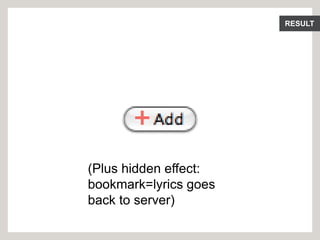
RESULT
(Plus hidden effect:
bookmark=lyrics goes
back to server)
RESULT
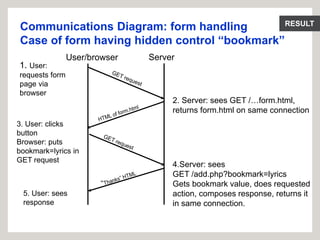
Communications Diagram: form handling
Case of form having hidden control “bookmark”
User/browser Server
2. Server: sees GET /…form.html,
returns form.html on same connection
4.Server: sees
GET /add.php?bookmark=lyrics
Gets bookmark value, does requested
action, composes response, returns it
in same connection.
3. User: clicks
button
Browser: puts
bookmark=lyrics in
GET request
5. User: sees
response
1. User:
requests form
page via
browser
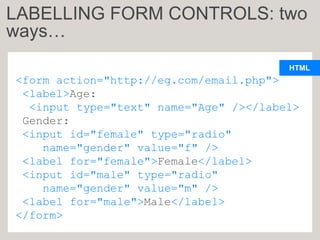
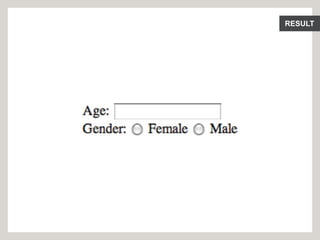
HTML
<form action="http://eg.com/email.php">
<label>Age:
<input type="text" name="Age" /></label>
Gender:
<input id="female" type="radio"
name="gender" value="f" />
<label for="female">Female</label>
<input id="male" type="radio"
name="gender" value="m" />
<label for="male">Male</label>
</form>
LABELLING FORM CONTROLS: two
ways…
RESULT
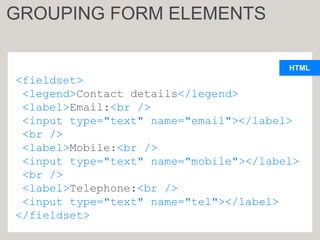
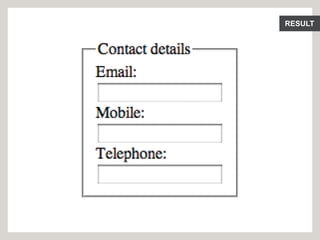
HTML
<fieldset>
<legend>Contact details</legend>
<label>Email:<br />
<input type="text" name="email"></label>
<br />
<label>Mobile:<br />
<input type="text" name="mobile"></label>
<br />
<label>Telephone:<br />
<input type="text" name="tel"></label>
</fieldset>
GROUPING FORM ELEMENTS
RESULT
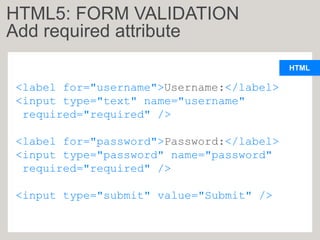
HTML
<label for="username">Username:</label>
<input type="text" name="username"
required="required" />
<label for="password">Password:</label>
<input type="password" name="password"
required="required" />
<input type="submit" value="Submit" />
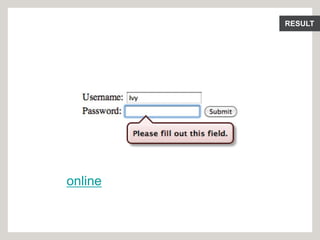
HTML5: FORM VALIDATION
Add required attribute
RESULT
online
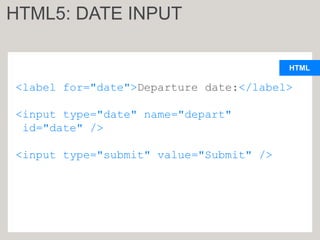
HTML
<label for="date">Departure date:</label>
<input type="date" name="depart"
id="date" />
<input type="submit" value="Submit" />
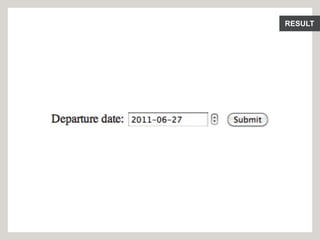
HTML5: DATE INPUT
RESULT
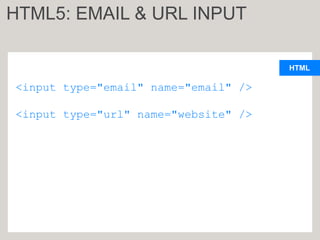
HTML
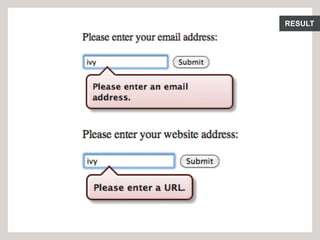
<input type="email" name="email" />
<input type="url" name="website" />
HTML5: EMAIL & URL INPUT
RESULT
HTML
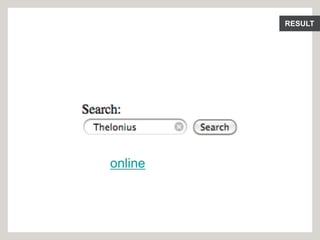
<input type="search" name="search"
placeholder="Enter keyword" />
<input type="submit" value="Search" />
HTML5: SEARCH INPUT
RESULT
online
Whenever you want to collect
information from visitors you
will need a form, which lives
inside a <form> element.
Note: this is not strictly true, since it is possible to use
<input> outside a form along with scripts that specify
resulting behavior on user actions. It is true for simple
PHP websites (they have no scripts).
SUMMARY
Information from a form is
sent in name/value pairs.
SUMMARY
Each form control is given a
name, and the text the user
types in or the values of the
options they select are sent
to the server.
SUMMARY
HTML5 introduces new
form elements which make
it easier for visitors to
fill in forms.
SUMMARY

HTML_CSS02.pdf