HTML 5 vs. XHTML 2:  The Future of Web Standards Chris Poteet www.siolon.com
Background Deficiencies set forth from HTML 4 and XHTML 1 Need less presentational elements Need more semantic elements Further separate presentation from structure Allow richer serialization More robust media controls The two standards that are “competing”  for attention are XHTML 2.0 and HTML 5
History of XHTML 2 W3C started the process in 2001 after XHTML 1.1 was published. First draft published in 2002 Safari opted out of participating
History of HTML 5 Started by the Web Hypertext Application Technology Working Group (WHATWG) There was frustration about the direction of XMTML 2.0, and the group itself April 2007, the W3C adopted the group’s specification for review Has better browser support
XHTML 2 Emphasis XHTML 2.0, unlike previous incarnations, is based solely on XML No more SGML heritage Greater emphasis on XML technologies such as XForms, XML Events, etc. Even more of an emphasis of separating presentation and structure Better internationalization
HTML 5 Emphasis Focus more on transitional technology than revolutionary Address deficiencies in HTML 4 More open working group Maintain a SGML syntax Can choose whether to serialize as HTML or XML
New Elements in HTML 5 Layout <nav> <footer> <header> <section> <aside> Media <video> <audio> <source> <figure> <m> <canvas> Forms Support for different content types (dates, email, etc)
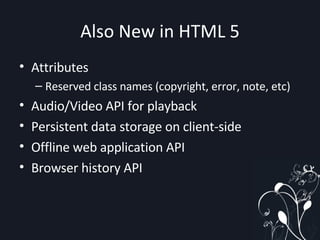
Also New in HTML 5 Attributes Reserved class names (copyright, error, note, etc) Audio/Video API for playback Persistent data storage on client-side Offline web application API Browser history API
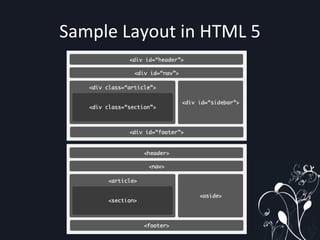
Sample Layout in HTML 5
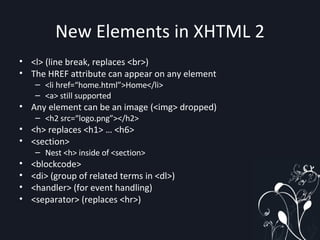
New Elements in XHTML 2 <l> (line break, replaces <br>) The HREF attribute can appear on any element <li href=“home.html”>Home</li> <a> still supported Any element can be an image (<img> dropped) <h2 src=“logo.png”></h2> <h> replaces <h1> … <h6> <section> Nest <h> inside of <section> <blockcode> <di> (group of related terms in <dl>) <handler> (for event handling) <separator> (replaces <hr>)
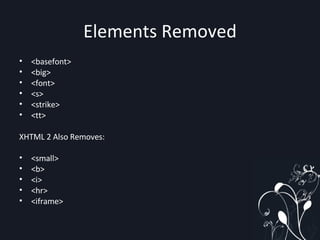
Elements Removed <basefont> <big> <font> <s> <strike> <tt> XHTML 2 Also Removes: <small> <b> <i> <hr> <iframe>
Which One? HTML 5 has better support amongst upcoming browsers (IE8, FF 3, Saf 3) Although 95% of all browsers are XML based XHTML continues to push us towards the future of the web—XML HTML 5 allows for less strict markup (unlike XML) HTML 5 introduces great layout elements XHTML 2 has greater focus on separating presentation and structure Both standards offer solutions to different developers
Further Reading Comparisons http://immike.net/blog/2008/02/06/xhtml-2-vs-html-5/ http://www.alistapart.com/articles/previewofhtml5 http://xhtml.com/en/future/x-html-5-versus-xhtml-2/ http://www.digital-web.com/articles/html5_xhtml2_and_the_future_of_the_web/ Specifications XHTML 2 http://www.w3.org/TR/xhtml2/ HTML 5 http://www.w3.org/html/wg/html5/ http://www.whatwg.org/specs/web-apps/current-work/
Contact Information [email_address] www.siolon.com

HTML 5 vs. XHTML 2: The Future of Web Standards

  • 1.
    HTML 5 vs.XHTML 2: The Future of Web Standards Chris Poteet www.siolon.com
  • 2.
    Background Deficiencies setforth from HTML 4 and XHTML 1 Need less presentational elements Need more semantic elements Further separate presentation from structure Allow richer serialization More robust media controls The two standards that are “competing” for attention are XHTML 2.0 and HTML 5
  • 3.
    History of XHTML2 W3C started the process in 2001 after XHTML 1.1 was published. First draft published in 2002 Safari opted out of participating
  • 4.
    History of HTML5 Started by the Web Hypertext Application Technology Working Group (WHATWG) There was frustration about the direction of XMTML 2.0, and the group itself April 2007, the W3C adopted the group’s specification for review Has better browser support
  • 5.
    XHTML 2 EmphasisXHTML 2.0, unlike previous incarnations, is based solely on XML No more SGML heritage Greater emphasis on XML technologies such as XForms, XML Events, etc. Even more of an emphasis of separating presentation and structure Better internationalization
  • 6.
    HTML 5 EmphasisFocus more on transitional technology than revolutionary Address deficiencies in HTML 4 More open working group Maintain a SGML syntax Can choose whether to serialize as HTML or XML
  • 7.
    New Elements inHTML 5 Layout <nav> <footer> <header> <section> <aside> Media <video> <audio> <source> <figure> <m> <canvas> Forms Support for different content types (dates, email, etc)
  • 8.
    Also New inHTML 5 Attributes Reserved class names (copyright, error, note, etc) Audio/Video API for playback Persistent data storage on client-side Offline web application API Browser history API
  • 9.
  • 10.
    New Elements inXHTML 2 <l> (line break, replaces <br>) The HREF attribute can appear on any element <li href=“home.html”>Home</li> <a> still supported Any element can be an image (<img> dropped) <h2 src=“logo.png”></h2> <h> replaces <h1> … <h6> <section> Nest <h> inside of <section> <blockcode> <di> (group of related terms in <dl>) <handler> (for event handling) <separator> (replaces <hr>)
  • 11.
    Elements Removed <basefont><big> <font> <s> <strike> <tt> XHTML 2 Also Removes: <small> <b> <i> <hr> <iframe>
  • 12.
    Which One? HTML5 has better support amongst upcoming browsers (IE8, FF 3, Saf 3) Although 95% of all browsers are XML based XHTML continues to push us towards the future of the web—XML HTML 5 allows for less strict markup (unlike XML) HTML 5 introduces great layout elements XHTML 2 has greater focus on separating presentation and structure Both standards offer solutions to different developers
  • 13.
    Further Reading Comparisonshttp://immike.net/blog/2008/02/06/xhtml-2-vs-html-5/ http://www.alistapart.com/articles/previewofhtml5 http://xhtml.com/en/future/x-html-5-versus-xhtml-2/ http://www.digital-web.com/articles/html5_xhtml2_and_the_future_of_the_web/ Specifications XHTML 2 http://www.w3.org/TR/xhtml2/ HTML 5 http://www.w3.org/html/wg/html5/ http://www.whatwg.org/specs/web-apps/current-work/
  • 14.