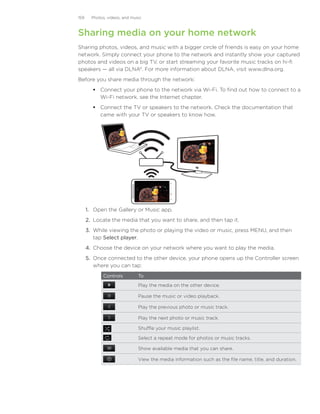
Your HTC Incredible S
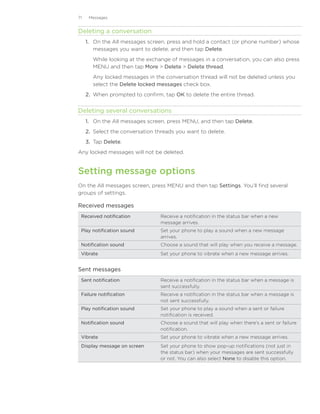
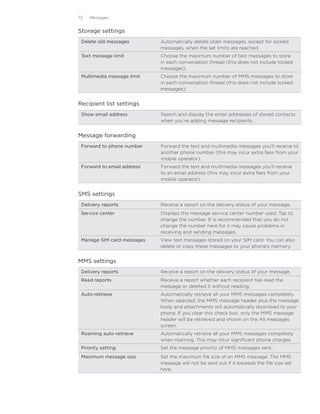
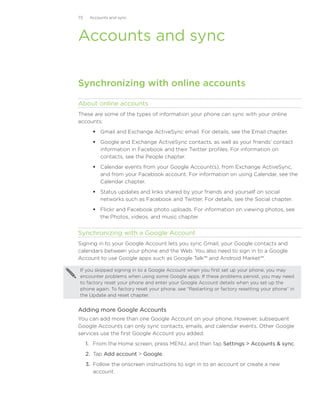
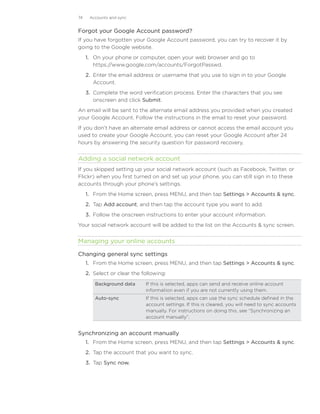
            User guide
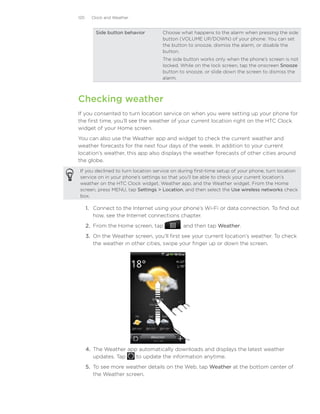
Conventions used in this guide
In this user guide, we use the following symbols to indicate useful and important
information:

      This is a note. A note often gives additional information, such as what happens on
      your phone when you choose to do or not to do a certain action. A note also provides
      information that may only be applicable to some situations.

      This is a tip. A tip gives you an alternative way to do a particular step or procedure, or
      lets you know of an option that you may find helpful.

      This indicates that something is very important. Important information is something that
      you need to do in order to accomplish a certain task or to get a phone feature to work
      properly.

      This provides safety precaution information, that is, information that you need to be
      careful about to prevent potential problems when using your phone.
Contents


Contents
Basics	                                                            7
      Inside the box	                                         7
      Your phone	                                             7
      Back cover	                                             9
      SIM card	                                               10
      Storage card	                                           11
      Battery	                                                12
      Switching your phone on or off	                         14
      Entering your PIN	                                      14
      Finger gestures	                                        14


Getting started	                                               15
      Setting up your phone for the first time	               15
      Home screen	                                            15
      Status and notifications	                               17
      Notifications panel	                                    19
      Connecting your phone to a computer	                    20
      Searching your phone and the Web	                       22
      Adjusting the volume	                                   24
      Sleep mode	                                             25


Personalizing	                                                 26
Making your phone truly yours	26
Personalizing your phone with scenes	26
Changing your wallpaper	27
Applying a new skin	28
Personalizing your Home screen with widgets	28
Adding icons and other shortcuts on your Home screen	30
Adding folders on your Home screen	30
Rearranging or removing widgets and icons on your Home screen	31
Rearranging the Home screen	32
Changing your ringtones and alarms	32
Rearranging or hiding application tabs	34


Phone calls	                                                   35
Making calls	35
Receiving calls	38
HTC Caller ID	39
Using in-call options	39
Using Call history	                                           42
Call services	                                                43
Turning Airplane mode on or off 	                             44
Contents


People	                                                                            45
About People	                                                                     45
Setting up My contact card	                                                       46
Ways of getting contacts into your phone	                                         46
Merging contact information	                                                      48
Your contacts list	                                                               50
Contact information and conversations	                                            52
Contact groups	                                                                   54
People widget	                                                                    56


Keyboard	                                                                          57
Using the onscreen keyboard	                                                      57
Entering words with predictive text	                                              59
Entering text by speaking	                                                        60
Editing text	                                                                     61
Adjusting touch input settings	                                                   62


Messages	                                                                         64
About Messages	                                                                   64
Sending a text message (SMS)	                                                     65
Sending a multimedia message (MMS)	                                               66
Resuming a draft message	                                                         67
Viewing and replying to a message	                                                67
Managing message conversations	                                                   70
Setting message options	                                                          71


Accounts and sync	                                                                 73
Synchronizing with online accounts	                                               73
Synchronizing with your computer	                                                 76


Social	                                                                            83
Facebook for HTC Sense	                                                           83
Facebook for Android	                                                             84
What’s the difference between Facebook for Android and Facebook for HTC Sense?	   85
Tweeting on your phone	                                                           85
Friend Stream	                                                                    88
Chatting in Google Talk	                                                          91


Email	                                                                             93
Using Gmail	                                                                      93
Using Mail	                                                                       99


Calendar	                                                                         107
About Calendar	                                                                   107
Creating calendar events	                                                         107
Changing calendar views	                                                          109
Managing calendar events	                                                         111
Calendar event reminders	                                                         112
Displaying and synchronizing calendars	                                           113
Changing Calendar settings	                                                       114
About the Calendar widget	                                                        114
Contents


Clock and Weather	                                                                  115
About the HTC Clock widget	                                                         115
About the Clock app	                                                                115
Using Desk Clock	                                                                   116
Using World Clock	                                                                  117
Setting the alarm clock	                                                            118
Checking weather	                                                                   120
About the Weather widget	                                                           121


Internet connections	                                                               122
Data connection	                                                                    122
Wi-Fi	                                                                              123
Adding connection widgets	                                                          124
Connecting to a virtual private network (VPN)	                                      125
Using your phone as a modem (tethering)	                                            126
Connecting your phone to the Internet through a computer (Internet Pass-through)	   126
Using your phone as a wireless router	                                              127


Web browser	                                                                        128
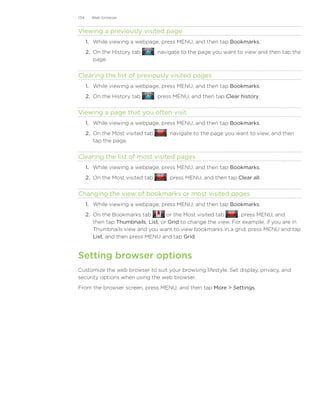
Using your phone’s web browser	                                                     128
Downloading from the Web	                                                           131
Copying text, looking up information, and sharing	                                  132
Viewing bookmarks and previously visited pages	                                     133
Setting browser options	                                                            134


Bluetooth	                                                                          135
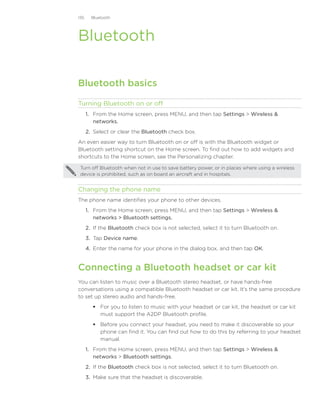
Bluetooth basics	                                                                   135
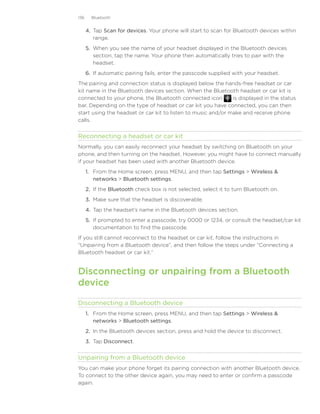
Connecting a Bluetooth headset or car kit	                                          135
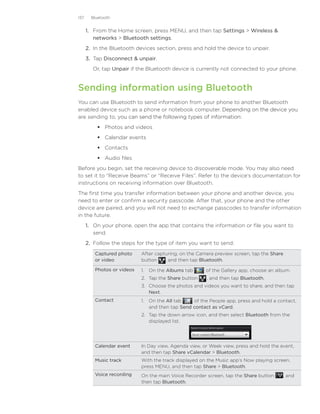
Disconnecting or unpairing from a Bluetooth device	                                 136
Sending information using Bluetooth	                                                137
Receiving information using Bluetooth	                                              138


Camera	                                                                             140
Camera basics	                                                                      140
Taking a photo	                                                                     141
Recording video	                                                                    142
Adding effects	                                                                     143
After capturing	                                                                    143
Changing camera settings	                                                           144


Photos, videos, and music	                                                          145
Browsing your Gallery	                                                              145
Listening to music	                                                                 153
Sharing media on your home network	                                                 159


HTCSense.com	                                                                       161
About HTCSense.com	                                                                 161
Signing up for your HTCSense.com account	                                           161
Using HTCSense.com	                                                                 162
Signing out from or deleting your HTCSense.com account	                             163
Contents


Maps and location	                                       164
Turning on location services	                            164
Locations	                                               164
Google Maps	                                             174


More apps	                                               178
Watching videos on YouTube	                              178
Reading news feeds	                                      179
Reading eBooks	                                          182
Working on documents, spreadsheets, and presentations	   186
Keeping track of your stocks	                            187
Listening to FM Radio	                                   189
Recording your voice	                                    190
Using Flashlight	                                        191
Finding and installing apps from Android Market	         192
Sharing games and apps	                                  194


Security	                                                195
Protecting your SIM card with a PIN	                     195
Protecting your phone with a screen lock	                196


Settings	                                                197
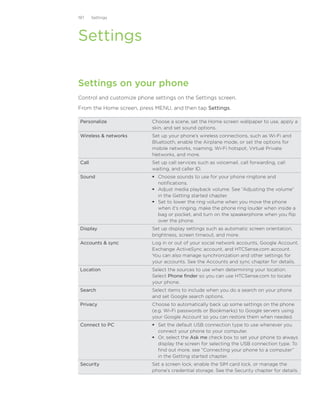
Settings on your phone	                                  197
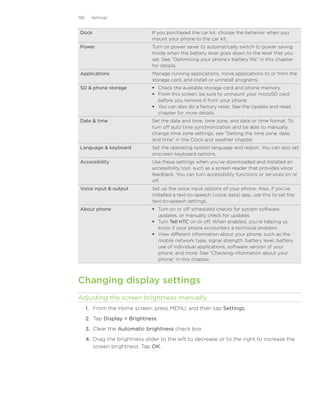
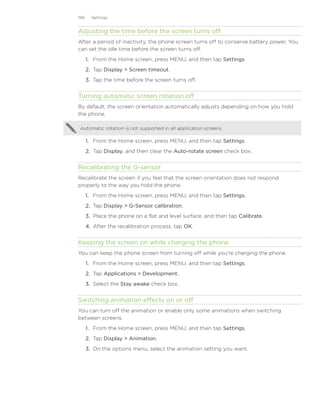
Changing display settings	                               198
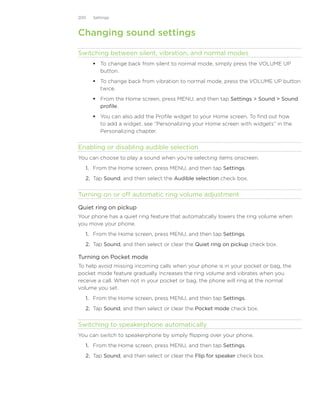
Changing sound settings	200
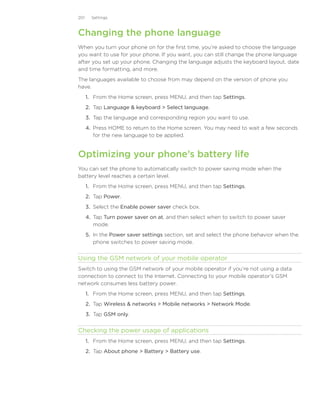
Changing the phone language	201
Optimizing your phone’s battery life	201
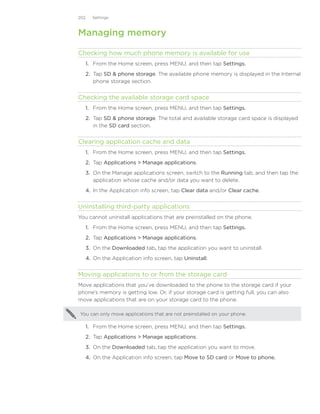
Managing memory	202
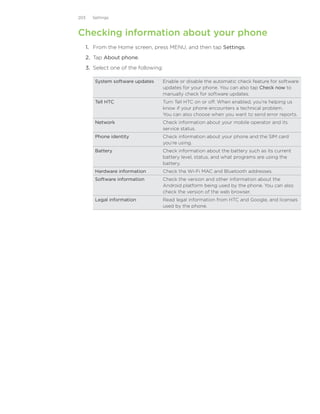
Checking information about your phone	203


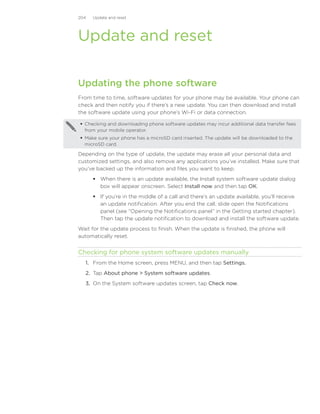
Update and reset	                                        204
Updating the phone software	204
Restarting or factory resetting your phone	205


Trademarks and copyrights	                               206

Index	                                                   207
Basics


Basics

Inside the box
You will find the following inside the box:

        Phone                                    3.5mm stereo headset

        Battery (preinstalled)                   Power adapter

        microSD™ card (preinstalled)             Quick start guide

        USB cable                                Safety and regulatory guide


Your phone

Front panel
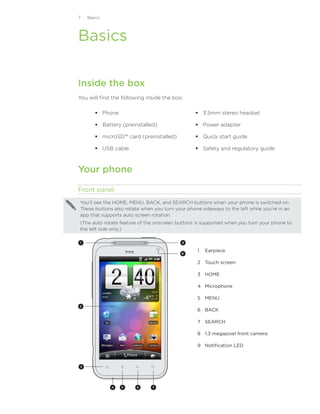
You’ll see the HOME, MENU, BACK, and SEARCH buttons when your phone is switched on.
These buttons also rotate when you turn your phone sideways to the left while you’re in an
app that supports auto screen rotation.
(The auto rotate feature of the onscreen buttons is supported when you turn your phone to
the left side only.)

1                                          9

                                                  1	 Earpiece
                                           8

                                                  2	 Touch screen

                                                  3	 HOME

                                                  4	 Microphone

                                                  5	 MENU
2
                                                  6	 BACK

                                                  7	 SEARCH

                                                  8	 1.3 megapixel front camera

                                                  9	 Notification LED


3


             4   5      6      7
Basics


Top panel
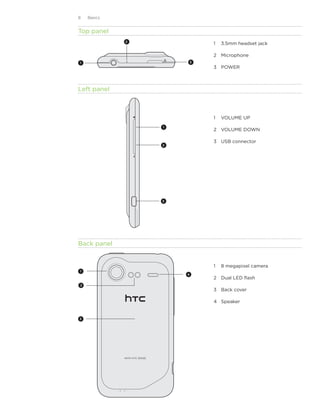
             2
                             1	 3.5mm headset jack

                             2	 Microphone
1                        3
                             3	 POWER


Left panel


                             1	 VOLUME UP
                 1
                             2	 VOLUME DOWN

                             3	 USB connector
                 2


                 3


Back panel


                             1	 8 megapixel camera
1
                     4
                             2	 Dual LED flash
2
                             3	 Back cover

                             4	 Speaker


3
Basics


Back cover

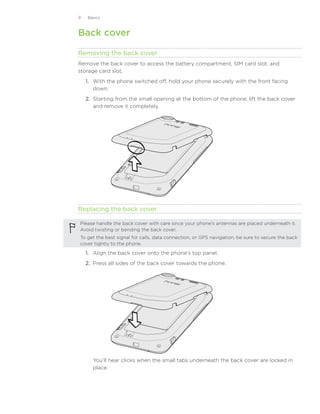
Removing the back cover
Remove the back cover to access the battery compartment, SIM card slot, and
storage card slot.
    1. With the phone switched off, hold your phone securely with the front facing
       down.
    2. Starting from the small opening at the bottom of the phone, lift the back cover
       and remove it completely.


Replacing the back cover

Please handle the back cover with care since your phone’s antennas are placed underneath it.
Avoid twisting or bending the back cover.
To get the best signal for calls, data connection, or GPS navigation, be sure to secure the back
cover tightly to the phone.

    1. Align the back cover onto the phone’s top panel.
    2. Press all sides of the back cover towards the phone.


      You’ll hear clicks when the small tabs underneath the back cover are locked in
      place.
10    Basics


SIM card
The SIM card contains your phone number, service details, and phonebook/message
memory. Your phone supports both 1.8 V and 3 V SIM cards.

 Some legacy SIM cards may not function with your phone. You should consult with your
 mobile operator for a replacement SIM card. There may be fees for this service.


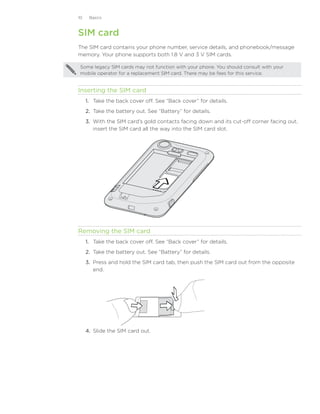
Inserting the SIM card
     1. Take the back cover off. See “Back cover” for details.
     2.	 Take the battery out. See “Battery” for details.
     3.	 With the SIM card’s gold contacts facing down and its cut-off corner facing out,
         insert the SIM card all the way into the SIM card slot.


Removing the SIM card
     1.	 Take the back cover off. See “Back cover” for details.
     2.	 Take the battery out. See “Battery” for details.
     3.	 Press and hold the SIM card tab, then push the SIM card out from the opposite
         end.


     4.	 Slide the SIM card out.
11   Basics


Storage card
Use the microSD card to store your photos, videos, and music. You’ll find the microSD
card already inserted in your phone.


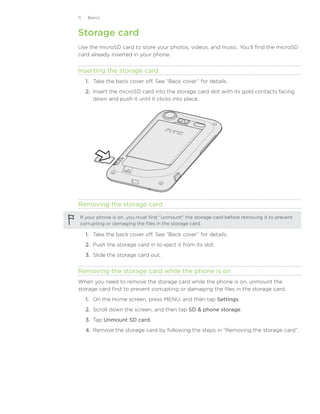
Inserting the storage card
     1.	 Take the back cover off. See “Back cover” for details.
     2.	 Insert the microSD card into the storage card slot with its gold contacts facing
         down and push it until it clicks into place.


Removing the storage card
 If your phone is on, you must first “unmount” the storage card before removing it to prevent
 corrupting or damaging the files in the storage card.

     1.	 Take the back cover off. See “Back cover” for details.
     2.	 Push the storage card in to eject it from its slot.
     3.	 Slide the storage card out.


Removing the storage card while the phone is on
When you need to remove the storage card while the phone is on, unmount the
storage card first to prevent corrupting or damaging the files in the storage card.
     1. On the Home screen, press MENU, and then tap Settings.
     2. Scroll down the screen, and then tap SD  phone storage.
     3. Tap Unmount SD card.
     4. Remove the storage card by following the steps in “Removing the storage card”.
12    Basics


Battery
Your phone uses a rechargeable battery. Please use only original batteries and
accessories that came with your phone or replacements that we recommend.
How long the battery can last before it needs recharging depends on how you use
your phone. Among these are the phone features and accessories you use (for
example, leaving your Bluetooth connection always on uses more power). Long phone
calls and frequent web browsing use up much battery. Also, consider your location:
poor signal strength from your mobile network and extreme temperature make the
battery work harder.


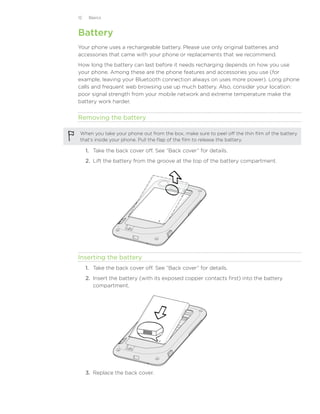
Removing the battery

 When you take your phone out from the box, make sure to peel off the thin film of the battery
 that’s inside your phone. Pull the flap of the film to release the battery.

     1.	 Take the back cover off. See “Back cover” for details.
     2.	 Lift the battery from the groove at the top of the battery compartment.


Inserting the battery
     1.	 Take the back cover off. See “Back cover” for details.
     2.	 Insert the battery (with its exposed copper contacts first) into the battery
         compartment.


     3.	 Replace the back cover.
13    Basics


Charging the battery
The battery is partially charged when shipped. Before you turn on and start using your
phone, it is recommended that you charge the battery. Some batteries perform best
after several full charge/discharge cycles.

  Only the power adapter and USB sync cable provided with your phone must be used to
   charge the battery.
  Do not remove the battery from the phone while you are charging it using the power or car
   adapter.


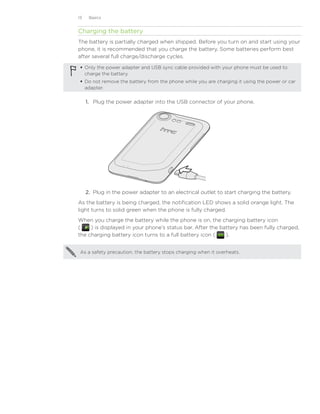
     1.	 Plug the power adapter into the USB connector of your phone.


     2.	 Plug in the power adapter to an electrical outlet to start charging the battery.
As the battery is being charged, the notification LED shows a solid orange light. The
light turns to solid green when the phone is fully charged.
When you charge the battery while the phone is on, the charging battery icon
(    ) is displayed in your phone’s status bar. After the battery has been fully charged,
the charging battery icon turns to a full battery icon (    ).


 As a safety precaution, the battery stops charging when it overheats.
14     Basics


Switching your phone on or off

Switching your phone on
Press and hold the POWER button. Easy.

 When you turn on the phone for the first time, you’ll need to set it up. See the Getting started
 chapter for details.


Switching your phone off
     1.	 If the display is off, press the POWER button to turn it back on, then unlock the
         screen by sliding down the bar on the lock screen.
         See “Unlocking the screen” in the Getting started chapter for details.
     2.	 Press and hold the POWER button for a few seconds.
     3.	 When the Power options menu appears, tap Power off.


Entering your PIN
Most SIM cards come with a PIN (personal identification number) set by your mobile
operator. If you’re asked for a PIN, enter it and then tap OK.
To find out how to enable, disable, or change the PIN, see “Protecting your SIM card
with a PIN” in the Security chapter.

 If you enter the wrong PIN three times, your SIM card is blocked. No problem. Just contact
 your mobile operator and ask for the PUK (PIN Unblocking Key).


Finger gestures
 Tap                 When you want to type using the keyboard, select items onscreen such as
                     application and settings icons, or press onscreen buttons, simply tap them
                     with your finger.
 Press and hold      To open the available options for an item (for example, a contact or link in a
                     web page), simply press and hold the item.
 Swipe or slide      To swipe or slide means to quickly drag your finger vertically or horizontally
                     across the screen.
 Drag                Press and hold your finger with some pressure before you start to drag.
                     While dragging, do not release your finger until you have reached the
                     target position.
 Flick               Flicking the screen is similar to swiping, except that you need to swipe your
                     finger in light, quicker strokes. This finger gesture is always in a vertical
                     direction, such as when flicking the contacts or message list.
 Rotate              For most screens, you can automatically change the screen orientation
                     from portrait to landscape by turning the phone sideways. When entering
                     text, you can turn the phone sideways to bring up a bigger keyboard.
 Pinch               In some apps, like Gallery or the web browser, you can “pinch” the screen
                     using two fingers (for example, thumb and index finger) to zoom in or
                     zoom out when viewing a picture or a web page.
15   Getting started


Getting started

Setting up your phone for the first time
When you switch on your phone for the first time, you’ll be asked to set up your
phone. You can choose your language, how you want to connect to the Internet,
and whether you want your current location to be automatically detected. If you still
have personal contacts and calendar events stored on your old phone, you can easily
transfer them to your new phone through Bluetooth as well.
Be sure to sign in to your Google Account so you can use Google apps like
Gmail™. You can also set up your other email accounts, favorite social networks like
Facebook® and Twitter™, and more.
Just follow the onscreen instructions and you’ll be up and running with your phone in
no time.

 Some features that need to connect to the Internet such as location-based services and
 auto-sync of your online accounts may incur extra data fees from your mobile operator. Don’t
 worry. You can enable or disable them in your phone’s settings as you go along later on. To
 find out how, see the Settings chapter.


Home screen
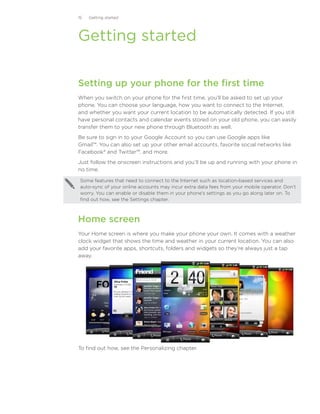
Your Home screen is where you make your phone your own. It comes with a weather
clock widget that shows the time and weather in your current location. You can also
add your favorite apps, shortcuts, folders and widgets so they’re always just a tap
away.


To find out how, see the Personalizing chapter.
16   Getting started


Extended Home screen
As you start to do more things with your phone, you might find that one Home screen
is not enough. No problem. You can use up to six extra screens. It should be plenty.
Slide your finger horizontally to the left or right and you’ll discover more space for
adding icons, widgets, and more.
Press HOME to return to the main Home screen (that is, the center home screen).


Using Leap view
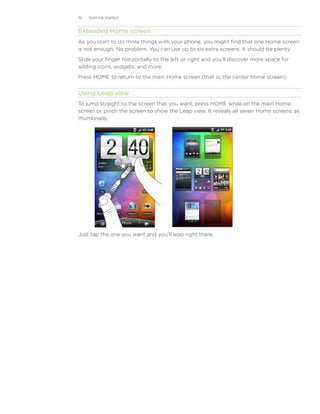
To jump straight to the screen that you want, press HOME while on the main Home
screen or pinch the screen to show the Leap view. It reveals all seven Home screens as
thumbnails.


Just tap the one you want and you’ll leap right there.
17   Getting started


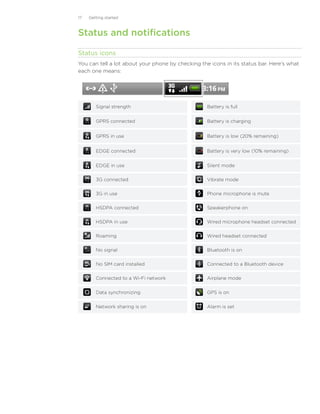
Status and notifications

Status icons
You can tell a lot about your phone by checking the icons in its status bar. Here’s what
each one means:


        Signal strength                            Battery is full


        GPRS connected                             Battery is charging


        GPRS in use                                Battery is low (20% remaining)

        EDGE connected                             Battery is very low (10% remaining)

        EDGE in use                                Silent mode

        3G connected                               Vibrate mode

        3G in use                                  Phone microphone is mute

        HSDPA connected                            Speakerphone on

        HSDPA in use                               Wired microphone headset connected

        Roaming                                    Wired headset connected

        No signal                                  Bluetooth is on

        No SIM card installed                      Connected to a Bluetooth device

        Connected to a Wi-Fi network               Airplane mode


        Data synchronizing                         GPS is on


        Network sharing is on                      Alarm is set
18   Getting started


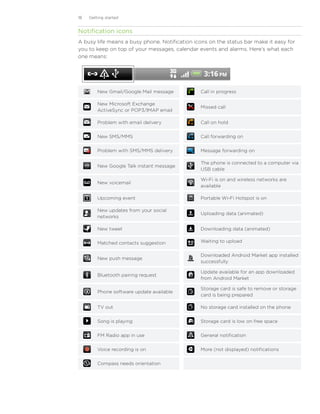
Notification icons
A busy life means a busy phone. Notification icons on the status bar make it easy for
you to keep on top of your messages, calendar events and alarms. Here’s what each
one means:


         New Gmail/Google Mail message          Call in progress

         New Microsoft Exchange
                                                Missed call
         ActiveSync or POP3/IMAP email

         Problem with email delivery            Call on hold

         New SMS/MMS                            Call forwarding on

         Problem with SMS/MMS delivery          Message forwarding on

                                                The phone is connected to a computer via
         New Google Talk instant message
                                                USB cable

                                                Wi-Fi is on and wireless networks are
         New voicemail
                                                available

         Upcoming event                         Portable Wi-Fi Hotspot is on

         New updates from your social
                                                Uploading data (animated)
         networks

         New tweet                              Downloading data (animated)

         Matched contacts suggestion            Waiting to upload

                                                Downloaded Android Market app installed
         New push message
                                                successfully

                                                Update available for an app downloaded
         Bluetooth pairing request
                                                from Android Market

                                                Storage card is safe to remove or storage
         Phone software update available
                                                card is being prepared

         TV out                                 No storage card installed on the phone

         Song is playing                        Storage card is low on free space

         FM Radio app in use                    General notification

         Voice recording is on                  More (not displayed) notifications

         Compass needs orientation
19   Getting started


Notification LED


The notification LED shows a:
        Solid green light when the phone is connected to the power adapter or a
         computer and the battery is fully charged.
        Flashing green light when you have a pending notification.
        Solid orange light when the battery is being charged.
        Flashing orange light when the battery level reaches very low.


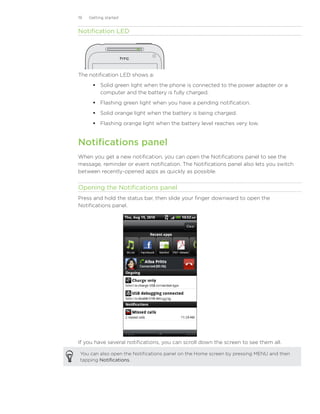
Notifications panel
When you get a new notification, you can open the Notifications panel to see the
message, reminder or event notification. The Notifications panel also lets you switch
between recently-opened apps as quickly as possible.


Opening the Notifications panel
Press and hold the status bar, then slide your finger downward to open the
Notifications panel.


If you have several notifications, you can scroll down the screen to see them all.

 You can also open the Notifications panel on the Home screen by pressing MENU and then
 tapping Notifications.
20    Getting started


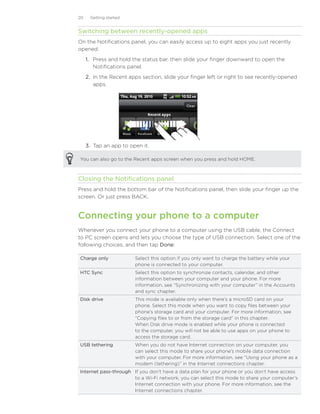
Switching between recently-opened apps
On the Notifications panel, you can easily access up to eight apps you just recently
opened.
     1.	 Press and hold the status bar, then slide your finger downward to open the
         Notifications panel.
     2.	 In the Recent apps section, slide your finger left or right to see recently-opened
         apps.


     3.	 Tap an app to open it.

You can also go to the Recent apps screen when you press and hold HOME.


Closing the Notifications panel
Press and hold the bottom bar of the Notifications panel, then slide your finger up the
screen. Or just press BACK.


Connecting your phone to a computer
Whenever you connect your phone to a computer using the USB cable, the Connect
to PC screen opens and lets you choose the type of USB connection. Select one of the
following choices, and then tap Done:

Charge only              Select this option if you only want to charge the battery while your
                         phone is connected to your computer.
HTC Sync                 Select this option to synchronize contacts, calendar, and other
                         information between your computer and your phone. For more
                         information, see “Synchronizing with your computer” in the Accounts
                         and sync chapter.
Disk drive               This mode is available only when there’s a microSD card on your
                         phone. Select this mode when you want to copy files between your
                         phone’s storage card and your computer. For more information, see
                         “Copying files to or from the storage card” in this chapter.
                         When Disk drive mode is enabled while your phone is connected
                         to the computer, you will not be able to use apps on your phone to
                         access the storage card.
USB tethering            When you do not have Internet connection on your computer, you
                         can select this mode to share your phone’s mobile data connection
                         with your computer. For more information, see “Using your phone as a
                         modem (tethering)” in the Internet connections chapter.
Internet pass-through If you don’t have a data plan for your phone or you don’t have access
                      to a Wi-Fi network, you can select this mode to share your computer’s
                      Internet connection with your phone. For more information, see the
                      Internet connections chapter.
21    Getting started


You can also change the type of USB connection on-the-fly, without having to
disconnect and reconnect your phone. Slide open the Notifications panel, and then
tap the notification that says “Select to change USB connection type” to open the
Connect to PC screen again.

 To change the default connection type or choose between showing and hiding the Connect to
 PC screen, press MENU from the Home screen, and then tap Settings  Connect to PC.


Copying files to or from the storage card
You can copy your music, photos, and other files to your phone’s storage card.
     1.	 Connect your phone to your computer using the supplied USB cable.
     2.	 On your phone’s Connect to PC screen, tap Disk drive, and then tap Done.
        On your computer, the connected phone is recognized as a removable disk.
     3.	 Navigate to the removable disk and open it.
     4.	 Do one of the following:
           Copy the files from the computer to the phone’s storage card’s root folder.
           Copy the files from the phone’s storage card to a folder in your computer.
     5.	 After copying the files, unmount the removable disk (that is, the connected
         phone) as required by your computer’s operating system to safely remove your
         phone.
     6.	 Do one of the following:
           Disconnect the phone from the computer.
           If you want to keep the phone connected to the computer but want the
            phone to be able to access the storage card, open the Notifications panel,
            tap Disk drive, select an option except Disk drive, and then tap Done.
22    Getting started


Searching your phone and the Web
Find all types of information on your phone and the Web. Search Anywhere sifts
through different files, information, and apps on your phone. You can also choose to
search the Web using your favorite web search service.
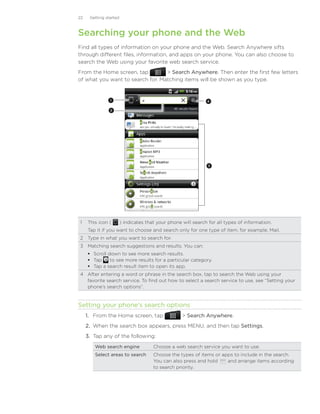
From the Home screen, tap          Search Anywhere. Then enter the first few letters
of what you want to search for. Matching items will be shown as you type.


                1                                              4

                2


                                                                3


1	 This icon (          ) indicates that your phone will search for all types of information.
     Tap it if you want to choose and search only for one type of item, for example, Mail.
2	 Type in what you want to search for.
3	 Matching search suggestions and results. You can:
      Scroll down to see more search results.
      Tap     to see more results for a particular category.
      Tap a search result item to open its app.
4	 After entering a word or phrase in the search box, tap to search the Web using your
   favorite search service. To find out how to select a search service to use, see “Setting your
   phone’s search options”.


Setting your phone’s search options
     1. From the Home screen, tap                    Search Anywhere.
     2. When the search box appears, press MENU, and then tap Settings.
     3. Tap any of the following:
        Web search engine              Choose a web search service you want to use.
        Select areas to search         Choose the types of items or apps to include in the search.
                                       You can also press and hold    and arrange items according
                                       to search priority.
23    Getting started


Quickly looking up information on the Web
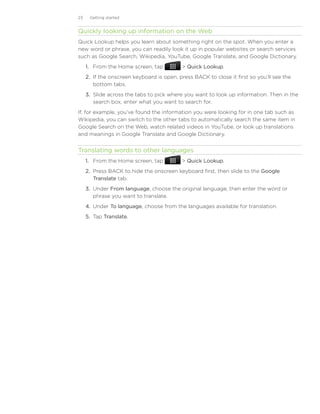
Quick Lookup helps you learn about something right on the spot. When you enter a
new word or phrase, you can readily look it up in popular websites or search services
such as Google Search, Wikipedia, YouTube, Google Translate, and Google Dictionary.
     1.	 From the Home screen, tap           Quick Lookup.
     2.	 If the onscreen keyboard is open, press BACK to close it first so you’ll see the
         bottom tabs.
     3.	 Slide across the tabs to pick where you want to look up information. Then in the
         search box, enter what you want to search for.
If, for example, you’ve found the information you were looking for in one tab such as
Wikipedia, you can switch to the other tabs to automatically search the same item in
Google Search on the Web, watch related videos in YouTube, or look up translations
and meanings in Google Translate and Google Dictionary.


Translating words to other languages
     1.	 From the Home screen, tap           Quick Lookup.
     2.	 Press BACK to hide the onscreen keyboard first, then slide to the Google
         Translate tab.
     3.	 Under From language, choose the original language, then enter the word or
         phrase you want to translate.
     4.	 Under To language, choose from the languages available for translation.
     5.	 Tap Translate.
24    Getting started


Adjusting the volume
Adjusting the ringer volume changes the volume level of the phone ringtone, while
adjusting the media volume changes the volume level of sound notifications and music
or video playback.


Adjusting the ringer volume
         Press the VOLUME UP or VOLUME DOWN button on the left panel of the
          phone to adjust the ringer volume to your desired level. The Ringer volume
          window appears on the screen to display the volume levels.
         While in the lowest ringer volume level (Silent mode), press VOLUME DOWN
          once to set your phone to Vibrate mode. The phone vibrates and the vibrate
          mode icon (     ) appears in the status bar.
         While in Vibrate mode, press VOLUME UP once to switch to silent mode. The
          speaker mute icon (    ) displays in the status bar.


Adjusting the media volume
When playing music or watching video, press the VOLUME UP or VOLUME DOWN
button on the left panel of the phone to adjust the media volume. The Media volume
window appears on the screen to display the volume level.


Adjusting the earpiece volume for phone calls
During a phone call, press the VOLUME UP or VOLUME DOWN button.


Adjusting the volume via settings
     1.	 From the Home screen, press MENU, and then tap Settings  Sound  Volume.
     2.	 Drag the volume sliders to the left or right to adjust the volume levels of your
         phone’s ringtone, media playback, alarms, and notifications.
        Your phone briefly plays a sample tone with the volume being adjusted as you
        drag a slider.
     3.	 If you want the same volume for your ringtone and notifications, select Use
         incoming call volume for notifications.
     4.	 When you’re done, tap OK.
25   Getting started


Sleep mode
Sleep mode saves battery power by putting your phone into a low power state while
the display is off. It also stops accidental button presses when the phone’s in your bag
or pocket. You’ll still receive messages and calls though.
To change the delay before your screen turns off, see “Adjusting the time before the screen
turns off” in the Settings chapter.


Switching to Sleep mode
Quickly press the POWER button to turn off the display and switch your phone to
Sleep mode. Your phone also automatically goes into Sleep mode when it’s idle for a
while.


Waking up from Sleep mode
Your phone automatically wakes up when you have an incoming call. To wake it up
manually, press the POWER button. You’ll need to unlock the screen.


Unlocking the screen
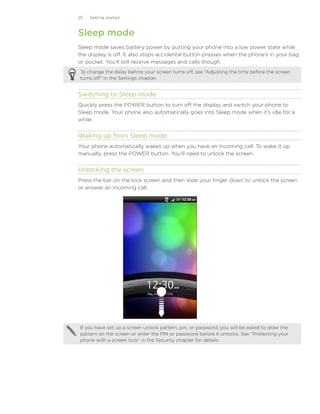
Press the bar on the lock screen and then slide your finger down to unlock the screen
or answer an incoming call.


If you have set up a screen unlock pattern, pin, or password, you will be asked to draw the
pattern on the screen or enter the PIN or password before it unlocks. See “Protecting your
phone with a screen lock” in the Security chapter for details.
26    Personalizing


Personalizing

Making your phone truly yours
Make your phone look and sound just the way you want it. Personalize your phone
with a different wallpaper, skin, ringtone, and notification sound for events such as
incoming text, email, and calendar reminders.
Tap the Personalize button (           ) right on the Home screen to get started.


Personalizing your phone with scenes
Your phone becomes multiple phones in one when you use scenes. Scenes are
personalized Home screen layouts that you can quickly apply to your phone. By
switching between scenes, you instantly turn your phone into your perfect weekend
phone, travel phone, work phone, or pure play phone.
Everytime you add or modify something on the Home screen, your phone automatically saves
your changes to the current scene selected.


Using a preset scene
Your phone features preset scenes, each preconfigured with a different wallpaper and
collection of widgets that reflect different moments in your life. You can choose a
scene that is suitable for work, play, travel, or your social life.
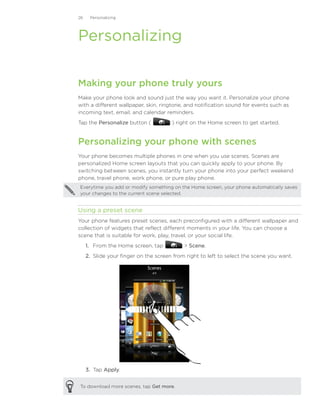
     1. From the Home screen, tap�           Scene.
     2. Slide your finger on the screen from right to left to select the scene you want.


     3.	 Tap Apply.


To download more scenes, tap Get more.
27    Personalizing


Creating a new scene
You’ll start with an empty Home screen when you create a new scene.
     1. From the Home screen, tap            Scene.
     2. Press MENU, then tap New.
     3. Enter a new scene name, then tap Done.
     4. Personalize the scene by adding widgets and other elements, arranging the
        Home screen layout, and changing the skin or wallpaper. All of your changes will
        be automatically saved to this scene.


Renaming a scene
     1. From the Home screen, tap            Scene.
     2. Slide your finger on the screen from right to left to select the scene you want to
        rename.
     3. Press and hold a scene thumbnail, then tap Rename.
     4. Enter a new scene name, then tap Done.


Deleting scenes
     1. From the Home screen, tap            Scene.
     2. Press MENU, then tap Delete.
     3. Slide your finger on the screen from right to left to browse through scenes, then
        tap one or more scenes you want to delete.
     4. Tap Delete.


Changing your wallpaper
Personalizing your wallpaper with your favorite photo is a quick and easy way to
change the feel of your phone and give it a fresh look. Browse the collection of
wallpapers included in your phone or choose from photos that you have taken with
the camera. You can also change your Home screen to use an animated wallpaper.
     1. From the Home screen, tap            Wallpaper.
     2.	 Tap one of the following:
        HTC wallpapers         Choose a preset wallpaper, then tap Preview  Apply.
        Live wallpapers        Choose from preset animated wallpapers. Tap Preview to view
                               the animation, and then tap Apply.
        Gallery                Choose a photo that you have taken using the camera or
                               copied to your storage card. Crop the photo and then tap Save.


To download more wallpapers, tap Wallpaper  HTC wallpapers  Get more.
28    Personalizing


Applying a new skin
Personalize beyond the Home screen by applying a new skin. Skins are set to give a
different look and feel to most of your phone’s onscreen buttons, application screens,
option menus, and other items.
     1. From the Home screen, tap             Skin.
     2. Slide your finger on the screen from right to left to select the skin you want.
     3.	 Tap Apply.


To download more skins, tap Get more.


Personalizing your Home screen with widgets
Widgets put at-a-glance important information and media content up front on
your Home screen. Some widgets are already added to your Home screen for your
convenience. You can add more from the available selections of widgets, or download
more widgets.


Adding a widget
     1. Go to a part of the Home screen where there’s space to add a new widget.
     2. Tap�           Widget.
     3. Select a widget that you want.
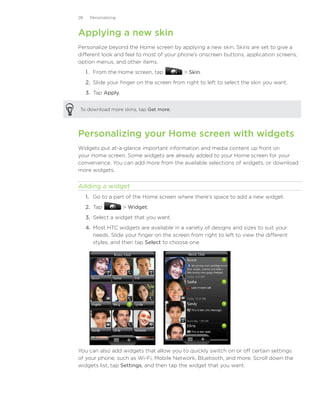
     4. Most HTC widgets are available in a variety of designs and sizes to suit your
        needs. Slide your finger on the screen from right to left to view the different
        styles, and then tap Select to choose one.


You can also add widgets that allow you to quickly switch on or off certain settings
of your phone, such as Wi-Fi, Mobile Network, Bluetooth, and more. Scroll down the
widgets list, tap Settings, and then tap the widget that you want.
29    Personalizing


Changing the settings of a widget
Basic settings of some widgets (for example, the People and Mail widgets) can be
modified from the Home screen.
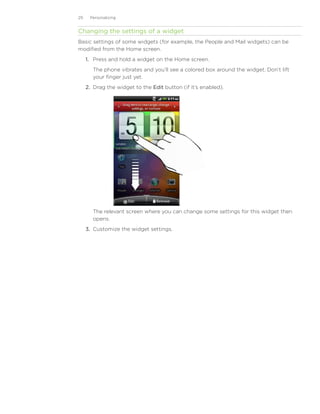
     1.	 Press and hold a widget on the Home screen.
        The phone vibrates and you’ll see a colored box around the widget. Don’t lift
        your finger just yet.
     2.	 Drag the widget to the Edit button (if it’s enabled).


        The relevant screen where you can change some settings for this widget then
        opens.
     3.	 Customize the widget settings.
30    Personalizing


Adding icons and other shortcuts on your
Home screen
Place app icons on your Home screen to open apps quicker. You can also add
shortcuts to settings and specific information such as a bookmarked webpage,
someone’s phone number, a music playlist, route directions, and many other items, to
your Home screen.

The shortcuts available depend on the apps that are installed on your phone.


     1. Go to a part of the Home screen where there’s space to add a new icon or
        shortcut.
     2. Tap           , then do one of the following:
          To add an app icon, tap App and then select one from the Add app shortcut
           list.
          To add a shortcut to a setting or information, tap Shortcut and then select
           the type of information or setting.

To add an app icon on the Home screen, you can also press HOME, tap           , and then press
and hold an app icon. Without lifting your finger, drag the icon to an empty area on the Home
screen, and then release it.


Adding folders on your Home screen
Use folders to group related apps and other shortcuts to keep your Home screen tidy
and organized. You can also add information folders that show up-to-date information
such as Bluetooth received files, your Facebook phonebook, and more.


Creating a new folder and adding items to it
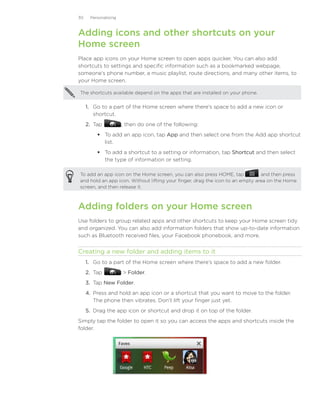
     1. Go to a part of the Home screen where there’s space to add a new folder.
     2. Tap            Folder.
     3. Tap New Folder.
     4. Press and hold an app icon or a shortcut that you want to move to the folder.
        The phone then vibrates. Don’t lift your finger just yet.
     5. Drag the app icon or shortcut and drop it on top of the folder.
Simply tap the folder to open it so you can access the apps and shortcuts inside the
folder.
31    Personalizing


Renaming a folder
     1. Tap the folder to open it.
     2. Press and hold the folder window’s title bar.
     3. Enter a new folder name and then tap OK.


Rearranging or removing widgets and icons on
your Home screen
Rearrange the widgets and icons on your Home screen to give room for adding more
items to the Home screen. You can also remove widgets and icons that you don’t
frequently use.


Moving a widget or icon
     1.	 Press and hold the widget or icon you want to move.
        The phone vibrates and you’ll see a colored box around the widget or icon. Don’t
        lift your finger just yet.
     2.	 Drag the widget or icon to a new location on the screen.
        You can pause at the left or right edge of the screen to drag the widget or icon
        onto another Home screen panel.
     3.	 When the widget or icon is where you want it, lift your finger.


Removing a widget or icon
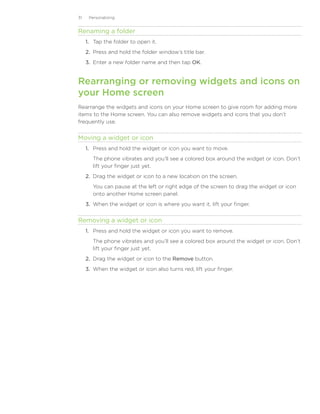
     1.	 Press and hold the widget or icon you want to remove.
        The phone vibrates and you’ll see a colored box around the widget or icon. Don’t
        lift your finger just yet.
     2.	 Drag the widget or icon to the Remove button.
     3.	 When the widget or icon also turns red, lift your finger.
32    Personalizing


Rearranging the Home screen
Reorder your Home screen panels in any way that fits how you use the Home screen.
For example, move the panels with frequently-used widgets, shortcuts, and folders
closer to the main Home screen.
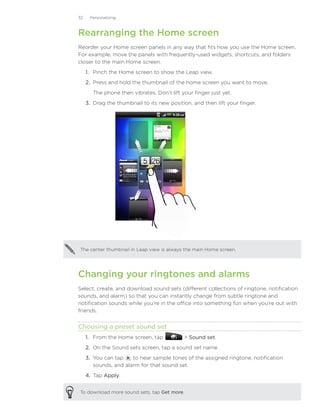
     1.	 Pinch the Home screen to show the Leap view.
     2.	 Press and hold the thumbnail of the home screen you want to move.
        The phone then vibrates. Don’t lift your finger just yet.
     3.	 Drag the thumbnail to its new position, and then lift your finger.


The center thumbnail in Leap view is always the main Home screen.


Changing your ringtones and alarms
Select, create, and download sound sets (different collections of ringtone, notification
sounds, and alarm) so that you can instantly change from subtle ringtone and
notification sounds while you’re in the office into something fun when you’re out with
friends.


Choosing a preset sound set
     1. From the Home screen, tap             Sound set.
     2. On the Sound sets screen, tap a sound set name.
     3.	 You can tap    to hear sample tones of the assigned ringtone, notification
         sounds, and alarm for that sound set.
     4.	 Tap Apply.


To download more sound sets, tap Get more.
33    Personalizing


Creating a sound set
     1. From the Home screen, tap             Sound set.
     2. On the Sound sets screen, tap New sound set.
     3. Enter a new sound set name, then tap Done.
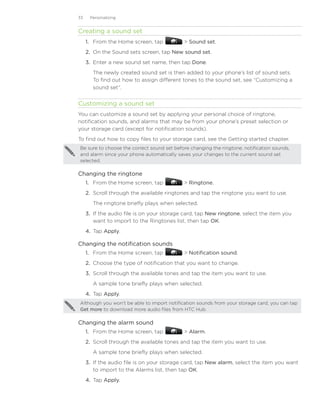
        The newly created sound set is then added to your phone’s list of sound sets.
        To find out how to assign different tones to the sound set, see “Customizing a
        sound set”.


Customizing a sound set
You can customize a sound set by applying your personal choice of ringtone,
notification sounds, and alarms that may be from your phone’s preset selection or
your storage card (except for notification sounds).
To find out how to copy files to your storage card, see the Getting started chapter.
Be sure to choose the correct sound set before changing the ringtone, notification sounds,
and alarm since your phone automatically saves your changes to the current sound set
selected.

Changing the ringtone
     1. From the Home screen, tap             Ringtone.
     2.	 Scroll through the available ringtones and tap the ringtone you want to use.
        The ringtone briefly plays when selected.
     3.	 If the audio file is on your storage card, tap New ringtone, select the item you
         want to import to the Ringtones list, then tap OK.
     4.	 Tap Apply.

Changing the notification sounds
     1. From the Home screen, tap             Notification sound.
     2.	 Choose the type of notification that you want to change.
     3.	 Scroll through the available tones and tap the item you want to use.
        A sample tone briefly plays when selected.
     4.	 Tap Apply.
Although you won’t be able to import notification sounds from your storage card, you can tap
Get more to download more audio files from HTC Hub.

Changing the alarm sound
     1. From the Home screen, tap             Alarm.
     2.	 Scroll through the available tones and tap the item you want to use.
        A sample tone briefly plays when selected.
     3.	 If the audio file is on your storage card, tap New alarm, select the item you want
         to import to the Alarms list, then tap OK.
     4.	 Tap Apply.
34    Personalizing


Deleting sound sets
     1. From the Home screen, tap              Sound set.
     2. Press MENU, and then tap Delete.
     3. Tap one or more sound sets you want to delete.
     4. Tap Delete.


Rearranging or hiding application tabs
You can rearrange the tabs at the bottom of some of your phone’s apps to prioritize
the types of information you frequently use or remove the tabs you don’t really need.
     1.	 Open an app that has the usual tabs at the bottom of its screen (for example,
         the contact details screen in People).


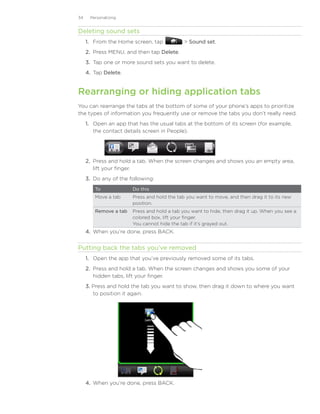
     2.	 Press and hold a tab. When the screen changes and shows you an empty area,
         lift your finger.
     3.	 Do any of the following:
        To              Do this
        Move a tab      Press and hold the tab you want to move, and then drag it to its new
                        position.
        Remove a tab    Press and hold a tab you want to hide, then drag it up. When you see a
                        colored box, lift your finger.
                        You cannot hide the tab if it’s grayed out.
     4.	 When you’re done, press BACK.


Putting back the tabs you’ve removed
     1.	 Open the app that you’ve previously removed some of its tabs.
     2.	 Press and hold a tab. When the screen changes and shows you some of your
         hidden tabs, lift your finger.
     3. Press and hold the tab you want to show, then drag it down to where you want
        to position it again.


     4.	 When you’re done, press BACK.
35    Phone calls


Phone calls

Making calls
Most SIM cards come with a PIN (personal identification number) set by your mobile operator.
If you’re asked for a PIN, enter it and then tap OK.
If you enter the wrong PIN three times, your SIM card is blocked. To unlock your SIM card, see
“Restoring a SIM card that has been locked out” in the Security chapter.

Your phone’s antennas are placed underneath the back cover. To get the best signal for calls,
be sure to secure the back cover tightly to the phone.


Making a call on the Phone dialer screen
You can either dial a number directly, or use the Smart dial feature to search and call a
stored contact or a number from your call history.
     1.	 On the Home screen, tap Phone.
     2.	 Begin entering the first few digits of a phone number or characters of a contact
         name on the phone keypad.
        The Phone dialer screen then displays a list of matching numbers and names.
        If you enter a wrong digit or letter, tap    to delete it. To erase the entire entry,
        press and hold     .
     3.	 Tap      to close the phone keypad and to see if there are more matching
         numbers or contacts. To browse through the filtered list, flick through the list or
         slide your finger up or down the list slowly.
     4.	 To place a call, do one of the following:
          Tap a phone number or contact from the list.
          After entering a complete number, tap Call.
          To call a different phone number associated with the contact, you can tap
              at the right side of the contact name. On the contact details screen, tap
           the number you want to call.
While dialing or when the call is in progress, the status bar displays the Call in progress
icon (    ) and its color changes to pulsing green.
36    Phone calls


What is Smart dial?
The phone dialer’s Smart Dial feature makes it quick and easy for you to place a call.
Simply enter the phone number or first few letters of the person’s name you want
to call. Smart Dial automatically searches and filters your contacts list (stored on
your phone, SIM card, and online accounts such as Google Account and Exchange
ActiveSync) and the phone numbers from the call history.


Using Speed dial
Use Speed dial to call a phone number with a single tap. For example, if you assign a
contact’s number to the number 2 key, you can simply press and hold this key on the
Phone dialer keypad to dial that number.

Assigning a speed dial key
     1. On the Home screen, tap Phone.
     2. Press MENU, and then tap Speed dial  Add new.
     3. Enter the name of the contact you want to add. When the name comes up in the
        list, tap the name.
     4. On the Speed dial screen, choose the phone number of the contact to use, and a
        speed dial key to assign.
     5. Tap Save.

Calling a speed dial number
     1. On the Home screen, tap Phone.
     2. On the phone keypad:
          The number 1 key is generally reserved for your voicemail. Press and hold
           this key to call voicemail and retrieve your voicemail messages.
          Press and hold the key that is associated with the contact you want to call.


Calling a phone number in a text message
     1. From the Home screen, tap           Messages.
     2. Tap the number or name of the person who sent you the text message.
     3. Tap the phone number within the message.


     4.	 Edit the phone number if needed, and then tap Call.

To call the message sender, press and hold the sender or the received message, and then tap
Call on the options menu.

To find out more about text messaging, see the Messages chapter.
37    Phone calls


Calling a phone number in an email
     1. From the Home screen, tap          Mail.
     2. In your email account’s inbox, tap the email that contains the phone number to
        call.
     3. In the email body, tap the phone number. A selection menu then pops up and
        the phone number is highlighted.
        The phone will recognize a number as a phone number if the number has a
        minimum of 5 digits and have at least one of the following:
           Numbers starting with a plus sign (+). For example, +1-987-654-321 or
            +1987654321.
           Numbers starting with an area or country code enclosed in a parenthesis.
            For example, (02)987654321 or (02)987-654-321.
           Numbers separated by dashes. For example, (02)-987-654-321 or
            0987-654-321.
     4.	 Tap Call.
     5.	 When the phone dialer screen opens with the phone number already entered,
         tap Call.
To find out more about using email on your phone, see the Email chapter.


Making an emergency call
You can make emergency calls from your phone even if you don’t have a SIM card
installed or your SIM card has been blocked.
     1. From the Home screen, tap Phone.
     2. Dial the international emergency number for your locale (for example, 000),
        and then tap Call.

Additional emergency numbers may be included in your SIM card. Contact your mobile
operator for details.

If you’ve enabled but forgotten your lock screen password, lock pattern, and/or the
SIM lock, you can still make emergency calls by tapping Emergency call on the screen.
38    Phone calls


Receiving calls
When you receive a phone call from a contact, the Incoming call screen appears and
displays the caller ID icon, name, and phone number of the calling party.
When you receive a phone call from someone who is not stored in People, only the
default caller ID icon and phone number appear on the Incoming call screen.

You can use your phone’s polite ringer and pocket mode features for receiving calls. To find
out how, see “Turning on or off automatic ring volume adjustment” in the Settings chapter.


Answering or rejecting an incoming call


If                  To answer the call                         To reject the call
Display is on       Tap Answer.                                Tap Decline.
Display is off      When the Lock screen appears, drag the     Drag the bar upward.
                    bar that shows the caller name or number   Or, press MENU and then tap
                    downward.                                  Decline.

You can also do one of the following to reject an incoming call:
        Press the POWER button twice.
        To reject the call and send a text message, press MENU, and then tap Send
         message.

Changing the text message to send out for rejected calls
     1. On the Phone dialer screen, press MENU.
     2. Tap Settings  Edit default message.
     3. Enter the new message, and then tap OK.
39   Phone calls


Muting the ringing sound without rejecting the call
Do one of the following:
       Press the VOLUME DOWN or VOLUME UP button.
       Press the POWER button.
       Place the phone face down on a leveled surface.

If the phone is already facing down, the phone will still ring when there are subsequent
incoming calls.


HTC Caller ID
Everytime you make a call or your friend gives you a ring, you get to see your friend’s
latest status update from social networks like Facebook or Twitter right on the call
screen.
You also won’t miss people’s birthdays. You’ll see a birthday reminder, if your friend’s
birthday will occur sometime within the next seven days.


Using in-call options
When a call is in progress, use the buttons onscreen to mute or unmute the
microphone or to turn on or off the speakerphone. You can also press MENU and
choose whether to add a call, place the call on hold, mute the microphone, and more.


Putting a call on hold
Press MENU and then tap Hold to put the call on hold. When you put a call on hold,
the status bar displays the Hold call icon ( ) and its color changes to pulsing red.
Press MENU, and then tap Unhold to resume the call.
40     Phone calls


Switching between calls
If you’re already on a call and accept another call, you can choose to switch between
the two calls.
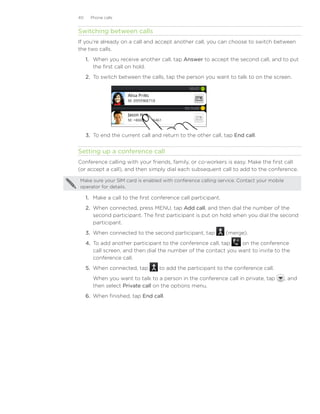
     1.	 When you receive another call, tap Answer to accept the second call, and to put
         the first call on hold.
     2.	 To switch between the calls, tap the person you want to talk to on the screen.


     3.	 To end the current call and return to the other call, tap End call.


Setting up a conference call
Conference calling with your friends, family, or co-workers is easy. Make the first call
(or accept a call), and then simply dial each subsequent call to add to the conference.

Make sure your SIM card is enabled with conference calling service. Contact your mobile
operator for details.

     1. Make a call to the first conference call participant.
     2. When connected, press MENU, tap Add call, and then dial the number of the
        second participant. The first participant is put on hold when you dial the second
        participant.
     3. When connected to the second participant, tap           (merge).
     4. To add another participant to the conference call, tap    on the conference
        call screen, and then dial the number of the contact you want to invite to the
        conference call.
     5.	 When connected, tap       to add the participant to the conference call.
        When you want to talk to a person in the conference call in private, tap          , and
        then select Private call on the options menu.
     6.	 When finished, tap End call.
41   Phone calls


Turning the speakerphone on or off during a call
To turn the speakerphone on, you can do any of the following:
       Flip your phone over during a call (be sure that Flip for speaker is selected in
        HOME  MENU  Settings  Sound).
       On the call screen, tap        .
      The speakerphone icon (         ) appears in the status bar when the speakerphone
      is on.
To turn the speakerphone off, just flip the phone over again, facing it up. Or tap
again.

 To decrease potential damage to your hearing, do not hold your phone against your ear when
 the speakerphone is on.


Muting the microphone during a call
On the call screen, tap     to toggle between turning the microphone on or off.
When the microphone is turned off, the Mute icon (  ) appears in the status bar.


Ending a call
Do one of the following to end the call:
       On the call screen, tap End call.

 If the phone display is off, press POWER to turn on the screen so you can tap End call.

       Slide open the Notifications panel, then tap           .
       If you are using the provided wired headset, press the button to end the call.
If the phone number of the person who called is not in your contacts list, you can
choose to save the number to your contacts list after you hang up.
42    Phone calls


Using Call history
Use the Call history to check missed calls, your dialed numbers and received calls.


Checking a missed call
You will see the missed call icon       in the status bar when you miss a call.
     1.	 Slide open the Notifications panel to check who the caller is.
     2.	 To return the call, tap the missed call notification. Then tap the caller’s name or
         number on the Call history screen.


Checking calls in the call history
     1. From the Home screen, tap             Call history. You can also tap       on the
        Phone dialer screen.
     2. On the Call history screen, you can:
          Tap a name or number in the list to call.
          Press and hold a name or number in the list to display the options menu
           where you can select to check the call history details, view contact
           information (if the number is stored in your contacts list), send a text
           message, delete from call history, or block the caller.
          Tap       to check only the call history of a particular contact.
          Press MENU, then tap View to display just a particular type of calls such as
           Missed calls or Outgoing calls.

You can also access Call history from the People app. For details, see the People chapter.


Adding a new phone number to your contacts from call history
     1. On the Call history screen, press and hold a phone number that you want to save
        to your contacts, and then tap Save to People.
     2.	 Choose whether to create a new contact or to save the number to an existing
         contact on your phone.
     3.	 Do any of the following:
         When creating a new contact, enter the contact name, contact type, and
          other information in the blank contact record that appears. The phone
          number is automatically added to the Mobile field in the Phone section.
          To store it as another type of number, for example a home number, tap the
          Mobile button.
         When saving the number to an existing contact, tap a contact stored on your
          phone, and then select the number type.
     4.	 Tap Save.

To find out how to add new contacts or edit the contact information, see the People chapter.
43   Phone calls


Clearing the call history list
On the Call history screen, you can do the following:
       To remove one name or number from the list, press and hold the name or
        number, and then tap Delete from call history.
       To clear the entire list, press MENU, and then tap Delete all.


Call services
Your phone can directly link to the mobile phone network, and enable you to access
and change the settings of various phone services for your phone. Call services
may include call forwarding, call waiting, voicemail, and more. Contact your mobile
operator to find out about the availability of call services for your phone.
To open call services, press MENU from the Home screen, and then tap Settings  Call.

Fixed Dialing Numbers      Restrict outgoing calls to a fixed set of numbers. To enable this
                           feature, you must know your SIM card’s PIN2 code.
Voicemail service          Shows the current voicemail service being used.
Voicemail settings         Specify another voicemail number aside from the voice mail number
                           on your SIM card.
Clear voicemail            If you have a notification of a new voicemail, you can clear the
notification               notification with this option.
Phone settings             Edit the call reject message, choose whether to open the message
                           editor when you reject a call with a message, and choose whether to
                           allow automatic saving of an unknown contact number when a call
                           with that number ends.
Cell broadcast             Enable or disable receipt of cell broadcast messages from your
                           service provider.
Cell broadcast settings    Configure channels and language for cell broadcast messages.
Call forwarding            Select how you want your phone to handle busy, unanswered, and
                           unreachable calls. You can also set the call forwarding option for all
                           incoming calls.
Call barring settings      Choose whether to block various categories of incoming and
                           outgoing call.
Additional call settings   Enable or disable operator services such as caller ID and call waiting.
44   Phone calls


Turning Airplane mode on or off
In many countries, you are required by law to turn off the phone while on board an
aircraft. A way to turn off the phone function is to switch your phone to Airplane
mode. When you enable Airplane mode, all wireless radios on your phone are turned
off, including the call function, data services, Bluetooth, and Wi-Fi.
To turn Airplane mode on or off, you can:
       Press and hold POWER, and then tap Airplane mode.
       From the Home screen, press MENU. Tap Settings  Wireless  networks, and
        then select or clear the Airplane mode check box.
When enabled, the Airplane mode icon (          ) is displayed in the status bar.

When you disable Airplane mode, the call function is turned back on and the previous state of
Bluetooth and Wi-Fi is restored.
45   People


    People

    About People
    With the People app, you can sync your phone with contacts from your Google
    Account, computer, and Facebook. You can also sync with work contacts from the
    Exchange ActiveSync Server in your workplace. To find out how, see “Ways of getting
    contacts into your phone.”
    Per contact, link the person’s information from all these different sources as one so
    you won’t have duplicated entries in your contacts list. To find out how to link, see
    “Merging contact information”.
    And that’s not all. You can manage your communications with your contacts via
    phone, messaging, and email without the need to jump from one app to another. After
    you’ve linked contacts to their social network accounts like Facebook, Twitter, and
    Flickr, you’ll also see their updates and events from these accounts all in one place.


    People screen
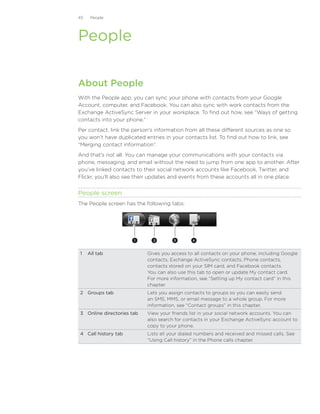
    The People screen has the following tabs:


	                          1      2        3       4


    1	 All tab                  Gives you access to all contacts on your phone, including Google
                                contacts, Exchange ActiveSync contacts, Phone contacts,
                                contacts stored on your SIM card, and Facebook contacts.
                                You can also use this tab to open or update My contact card.
                                For more information, see “Setting up My contact card” in this
                                chapter.
    2	 Groups tab               Lets you assign contacts to groups so you can easily send
                                an SMS, MMS, or email message to a whole group. For more
                                information, see “Contact groups” in this chapter.
    3	 Online directories tab   View your friends list in your social network accounts. You can
                                also search for contacts in your Exchange ActiveSync account to
                                copy to your phone.
    4	 Call history tab         Lists all your dialed numbers and received and missed calls. See
                                “Using Call history” in the Phone calls chapter.
46    People


Setting up My contact card
My contact card provides a convenient way to store your personal contact information
so that you can easily send it via SMS, MMS, email, or Bluetooth.
     1. From the Home screen, tap            People.
     2. On the All tab of the People screen, tap Me.
If you are logged in to your Facebook account through Facebook for HTC Sense, instead of
Me, you will see the name you use in Facebook. Tap your name. Then press MENU and tap
Edit.

     3.	 Enter your name and contact details.
     4.	 Tap Save.


Ways of getting contacts into your phone
Gmail                         Google contacts are imported to your phone after you sign in to
                              your Google Account.
                              You can also create more Google contacts right from your
                              phone. To find out how, see “Adding a new contact“ in this
                              chapter.
Facebook                      See “Adding a social network account” in the Accounts and sync
                              chapter for details.
Phone contacts                See “Transferring contacts from your old phone” and “Adding a
                              new contact“ in this chapter.
SIM card                      See “Importing contacts from your SIM card” in this chapter.
Exchange ActiveSync           See “Adding a Microsoft Exchange ActiveSync account” in the
Server                        Email chapter.
Contacts on your computer See “Synchronizing with your computer” in the Accounts and
                          sync chapter.


Transferring contacts from your old phone
Easily transfer contacts from your old phone to your new HTC phone through
Bluetooth. Depending on your old phone’s model, you may also transfer other types of
data such as calendar events and text messages to your phone.
     1. From the Home screen, tap             Transfer Data.
     2. Tap Next to begin.
     3. To check whether your old phone is supported, select a manufacturer name and
        phone model.
     4. If supported, turn your old phone’s Bluetooth on and set it to discoverable mode,
        then tap Next to continue.
        Your new HTC phone automatically turns Bluetooth on and searches for
        Bluetooth devices.
     5.	 From the device list, select your old phone and then tap Next.
47    People


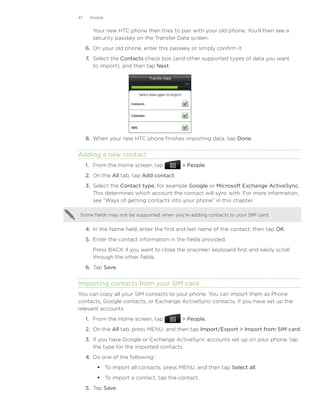
        Your new HTC phone then tries to pair with your old phone. You’ll then see a
        security passkey on the Transfer Data screen.
     6.	 On your old phone, enter this passkey or simply confirm it.
     7.	 Select the Contacts check box (and other supported types of data you want
         to import), and then tap Next.


     8.	 When your new HTC phone finishes importing data, tap Done.


Adding a new contact
     1. From the Home screen, tap            People.
     2. On the All tab, tap Add contact.
     3.	 Select the Contact type, for example Google or Microsoft Exchange ActiveSync.
         This determines which account the contact will sync with. For more information,
         see “Ways of getting contacts into your phone” in this chapter.

Some fields may not be supported when you’re adding contacts to your SIM card.


     4.	 In the Name field, enter the first and last name of the contact, then tap OK.
     5.	 Enter the contact information in the fields provided.
        Press BACK if you want to close the onscreen keyboard first and easily scroll
        through the other fields.
     6.	 Tap Save.


Importing contacts from your SIM card
You can copy all your SIM contacts to your phone. You can import them as Phone
contacts, Google contacts, or Exchange ActiveSync contacts, if you have set up the
relevant accounts.
     1. From the Home screen, tap            People.
     2. On the All tab, press MENU, and then tap Import/Export  Import from SIM card.
     3. If you have Google or Exchange ActiveSync accounts set up on your phone, tap
        the type for the imported contacts.
     4. Do one of the following:
          To import all contacts, press MENU, and then tap Select all.
          To import a contact, tap the contact.
     5.	 Tap Save.
48    People


Importing a contact from an Exchange ActiveSync account
You can search for a work contact from your Exchange ActiveSync account, and then
copy it to your phone.
You need to have your Exchange ActiveSync account set up on your phone first. To
find out how, see “Adding a Microsoft Exchange ActiveSync account“ in the Email
chapter.
     1. From the Home screen, tap              People.
     2. On the Online directories tab, tap Company directory.
     3. Enter the name, and then tap      .
     4. In the list, tap the name of the contact you want to copy to your phone.
     5. Tap Save to People.


Merging contact information
If you have the same contacts on your phone, Google Account, and social network
accounts such as Facebook and Twitter, your phone will try to combine them
automatically or let you decide which contacts to combine. Combining the same
contacts avoids duplicated entries in your contacts list.


Accepting matched contacts suggestions
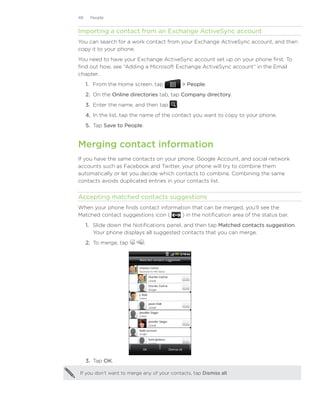
When your phone finds contact information that can be merged, you’ll see the
Matched contact suggestions icon (    ) in the notification area of the status bar.
     1. Slide down the Notifications panel, and then tap Matched contacts suggestion.
        Your phone displays all suggested contacts that you can merge.
     2.	 To merge, tap        .


     3.	 Tap OK.

If you don’t want to merge any of your contacts, tap Dismiss all.
49    People


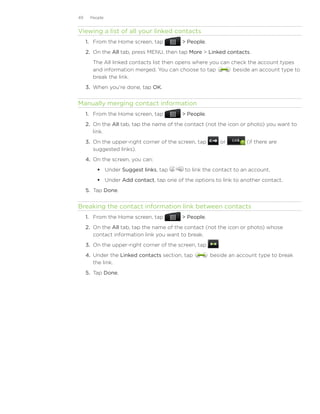
Viewing a list of all your linked contacts
     1. From the Home screen, tap          People.
     2. On the All tab, press MENU, then tap More  Linked contacts.
       The All linked contacts list then opens where you can check the account types
       and information merged. You can choose to tap          beside an account type to
       break the link.
     3.	 When you’re done, tap OK.


Manually merging contact information
     1. From the Home screen, tap          People.
     2. On the All tab, tap the name of the contact (not the icon or photo) you want to
        link.
     3. On the upper-right corner of the screen, tap          or    (if there are
        suggested links).
     4.	 On the screen, you can:
          Under Suggest links, tap        to link the contact to an account.
          Under Add contact, tap one of the options to link to another contact.
     5.	 Tap Done.


Breaking the contact information link between contacts
     1. From the Home screen, tap          People.
     2. On the All tab, tap the name of the contact (not the icon or photo) whose
        contact information link you want to break.
     3. On the upper-right corner of the screen, tap      .
     4. Under the Linked contacts section, tap         beside an account type to break
        the link.
     5. Tap Done.
50    People


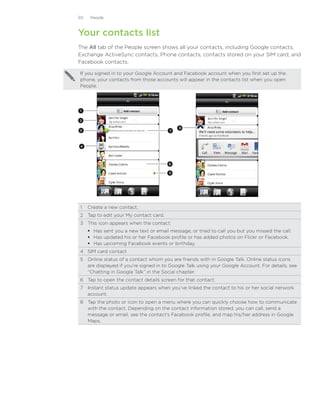
Your contacts list
The All tab of the People screen shows all your contacts, including Google contacts,
Exchange ActiveSync contacts, Phone contacts, contacts stored on your SIM card, and
Facebook contacts.

If you signed in to your Google Account and Facebook account when you first set up the
phone, your contacts from those accounts will appear in the contacts list when you open
People.


1


2

                                            8
3                                       7


4


                                        6

                                        5


1	 Create a new contact.
2	 Tap to edit your My contact card.
3	 This icon appears when the contact:
      Has sent you a new text or email message, or tried to call you but you missed the call.
      Has updated his or her Facebook profile or has added photos on Flickr or Facebook.
      Has upcoming Facebook events or birthday.
4	 SIM card contact
5	 Online status of a contact whom you are friends with in Google Talk. Online status icons
   are displayed if you’re signed in to Google Talk using your Google Account. For details, see
   “Chatting in Google Talk” in the Social chapter.
6	 Tap to open the contact details screen for that contact.
7	 Instant status update appears when you’ve linked the contact to his or her social network
   account.
8	 Tap the photo or icon to open a menu where you can quickly choose how to communicate
   with the contact. Depending on the contact information stored, you can call, send a
   message or email, see the contact’s Facebook profile, and map his/her address in Google
   Maps.
51    People


Filtering your contacts list
You can choose to display contacts of a particular type only, for example Google
contacts or Facebook contacts.
     1. From the Home screen, tap            People.
     2. On the All tab, press MENU, then tap View.
     3. Select the types of contacts you want to show in your contacts list.


        You can also choose how you want to display and sort your contacts.
     4.	 Tap Done.


Searching for a contact
     1. From the Home screen, tap            People.
     2. Press SEARCH, then enter the first few letters of a contact’s first or last name,
        email, or company name.
        You can also type in the first few digits of your contact’s phone number.
        Matching contacts are displayed.
     3.	 Tap the contact to open his or her contact details screen. See “Contact
         information and conversations” in this chapter for details.


Backing up your contacts to the storage card
     1. From the Home screen, tap            People.
     2. Press MENU, and then tap Import/Export  Export to SD card.
     3. Select an account or type of contacts to export, then tap OK.
52    People


Importing contacts from the storage card
     1. From the Home screen, tap              People.
     2. Press MENU, and then tap Import/Export  Import from SD card.

You can only import contacts that were exported to the storage card using the Export to SD
card feature on the phone. See “Backing up your contacts to the storage card.”

     3.	 If you have Google or Exchange ActiveSync accounts set up on your phone, tap
         the type for the imported contacts.


Deleting contacts
     1. From the Home screen, tap              People.
     2. On the All tab, press MENU, and then tap Delete.
     3. Select the contacts you want to delete, and then tap Delete.
     4. When prompted, tap OK.


Contact information and conversations
When you tap a contact on the People screen, the contact details screen opens,
showing you the information stored for that contact, exchanged messages and phone
calls with that contact, updates and events from social networks, and more.
The contact details screen has the following tabs:


                   1      2      3      4      5     6


1	 Details tab         Shows the information you have stored for the contact, and allows you
                       to get in touch with the contact directly by tapping any of the displayed
                       methods. For example, if the contact has a stored work phone number,
                       tap Call work to call that number.
2	 Messages tab        Shows your exchanged SMS messages with the contact. You can reply
                       to the contact’s message directly from this tab. To send a new message,
                       press MENU, and then tap New message. See the Messages chapter for
                       details.
3	 Mail tab            Shows all the email you have received from the contact. Tap an email
                       to view it. To send a new email, tap New mail. To find out more about
                       sending email, see the Email chapter.
4	 Updates and         Shows the contact’s updates and events from social network accounts
   events tab          like Facebook, Twitter, and Flickr.
                       You’ll be able to see updates such as posted status messages, uploads,
                       and profile changes from all these accounts. To find out more about
                       Facebook for HTC Sense, see the Social chapter.
5	 Gallery tab         Shows the contact’s Facebook and Flickr photo albums. Tap an album to
                       look at the photos in the album.
                       You need to be logged in to the same social networks on your phone to
                       see the updates and events. If you are not logged in, tap the relevant link
                       on the screen to sign in.
6�����������������
 	 Call history tab    Lists all your incoming, outgoing, and missed calls to and from the
                       contact. Tap a list item to call the contact using the displayed number.
53    People


Editing a contact’s information
     1. From the Home screen, tap           People.
     2. On the All tab, press and hold the contact, and then tap Edit contact.

You cannot edit the contact information of a Facebook friend.


     3.	 Enter the new information for the contact.
     4.	 Tap Save.


Sending contact information as a vCard
Share the contact information on your phone in different ways such as a text or
multimedia message, email, and Bluetooth. To find out about how to send through
Bluetooth, see the Bluetooth chapter.

Sending someone’s contact information
     1. From the Home screen, tap           People.
     2. On the All tab, press and hold the name of the contact (not the icon or photo)
        whose contact information you want to send, and then tap Send contact as
        vCard.

You cannot send contact information that’s from your Facebook account.


     3.	 Choose how you want to send it.
     4.	 Select the contact details you want to share, and then tap Send.

Sending your contact information
     1. From the Home screen, tap           People.
     2. On the All tab, tap [Your name] My contact card.
     3. Press MENU, then tap Send my contact info.
     4. Choose how you want to send it.
     5.	 Select the contact details you want to share, and then tap Send.
54    People


Contact groups
Assign contacts to groups so you can easily send a message or email to a whole
group. You can also sync groups on your phone with the groups in your Google
account, accessible via your computer’s web browser.
We’ve also added the Frequent group as a special group type that automatically
stores the contacts you dial or get calls from the most.


Creating a group
     1. From the Home screen, tap              People.
     2. On the Groups tab, tap Add group.
     3. Enter a name for the group, and then tap Add contact to group.
     4. Select the contacts you want to add to the group, and then tap Save.

If your contacts list is long, you can use the search bar to search for contacts quickly, or press
BACK to hide the onscreen keyboard and scroll through the list.

     5.	 Tap    to select a photo for the group.
     6.	 Tap Save.


Editing a contact group
     1. From the Home screen, tap              People.
     2. On the Groups tab, press and hold the group, and then tap Edit group.
     3. You can:
           Tap the group name to change the name. You can only change the name for
            groups that you have created.
           Tap the icon beside the group name to change or remove the group photo.
           To add contacts to the group, tap Add contact to group, select the contacts
            you want to add, and then tap Save.
           To remove a contact from the group, tap           at the right side of the contact
            name.
     4.	 Tap Save.
55    People


Sending a message or email to a group
You will be charged by your mobile provider for each message sent. For example, if you send a
message to a group of five people, you will be charged for five messages.

     1. From the Home screen, tap           People.
     2. On the Groups tab, tap the group you want to send a message or email to.
     3.	 Go to the Group action tab, and then do one of the following:
          Tap Send group message to send a message to the group. For information
           about composing and sending messages, see the Messages chapter.
          Tap Send group mail to send an email to the group. For information on
           composing and sending email, see the Email chapter.


Rearranging your contact groups
     1. From the Home screen, tap           People.
     2. On the Groups tab, press MENU, and then tap Rearrange.
     3. Press and hold      at the end of the group name you want to move. When the
        row is highlighted, drag it to its new position.


     4.	 Tap Save.


Rearranging the members of a contact group
     1. From the Home screen, tap           People.
     2. On the Groups tab, tap the group to see its members.
     3. Press MENU, and then tap Rearrange.
     4. Press and hold      at the end of the contact’s name you want to move. When the
        row is highlighted, drag it to its new position.
     5. Tap Save.


Deleting a group
     1. From the Home screen, tap           People.
     2. On the Groups tab, press and hold the group you want to delete, and then tap
        Delete group.

You can only delete groups that you have created.
56    People


People widget
Put the group of people you contact most right on the Home screen of your phone by
adding them as the People widget. Using the People widget, you can instantly place a
call, send a message, or view details of a favorite contact with a single tap.


Adding People widgets
Stay in touch with different circles of friends or colleagues in your life. You can add
several People widgets on the Home screen, with a different group of contacts on
each widget.
     1. From the Home screen, tap            Widget  People.
     2. Choose the widget style, and then tap Select.
     3. Select the group you want to add as a widget.
     4. Drag the widget to a blank space on a Home screen. When the widget is where
        you want it, lift your finger.
     5.	 Repeat the above steps to add another People widget.


Setting the default communication method
     1. On the Home screen, go to the People widget.
     2. Tap a contact on the widget.
     3. On the Select default action screen, tap the communication method you want
        for the contact.


Changing the default communication method
     1. On the Home screen, go to the People widget.
     2. Tap the name of a contact on the widget to open the person’s contact card.
     3. Press MENU, and then tap More  Set widget action.
     4. On the Select default action screen, tap the communication method you want
        for the contact.


Getting in touch with a contact
     1. On the Home screen, go to the People widget.
     2. Tap a contact (photo not the name) on the widget. The default communication
        method will be performed.
       If you have not set a default communication method, you need to choose one
       first. See “Setting the default communication method.”

Tap the name of the contact to open the contact details screen for that contact.
57    Keyboard


Keyboard

Using the onscreen keyboard
When you start an app or select a field that requires text or numbers, the onscreen
keyboard becomes available.
After entering your text, you can tap           or press BACK to close the onscreen
keyboard.


Selecting a keyboard layout
You can choose from three different keyboard layouts to suit your typing style.
     1.	 On the onscreen keyboard, tap the Language key (for example, tap      if you’re
         currently using the English onscreen keyboard). Then on the International
         keyboard options menu, tap Settings.
       If tapping the Language key doesn’t display the International keyboard menu,
       press HOME  MENU, and tap Settings  Language  keyboard  Touch Input.
     2.	 Tap Keyboard types, and then select the keyboard layout that you want to use.
         Choose one from the following:

        QWERTY                    This layout is similar to a desktop computer keyboard. This is
                                  the default keyboard layout.
        Phone Keypad              This layout resembles the traditional mobile phone keypad.
        Compact QWERTY            This layout features two letters on each key. The key size is
                                  slightly bigger than on the full QWERTY layout.


Entering text
Use the following keys while entering text using the onscreen keyboard:

         Press and hold keys with gray characters at the top to enter numbers, symbols, or
         accented letters. The gray character displayed on the key is the character that will be
         inserted when you press and hold that key. Some keys have multiple characters or
         accents associated with them.

         Shift key. Tap to enter an uppercase letter. Tap twice to turn on caps lock.


         Tap to switch to the numeric and symbol keyboard.


         Enter key. Tap to create a new line.

 Tap the Up, Down, Left, or Right key to move the text cursor in the direction that you want
 while you are entering or editing text.
58    Keyboard


         Backspace key. Tap to delete the previous character.

         Language key. The key you see depends on the keyboard language you are currently
         using. Tap to switch to another keyboard language (see “Enabling multiple keyboard
         languages”). You can also access onscreen keyboard settings.
         Tap to toggle between Multitap and XT9 predictive modes when using the Compact
         QWERTY or Phone keypad layout. For more information, see “Entering words with
         predictive text.”

         Tap to hide the onscreen keyboard.


Enabling multiple keyboard languages
If there are multiple keyboard languages available on your phone, you can choose
which languages to enable in the onscreen keyboard so that you can switch to these
languages and use them to enter text.
     1.	 On the onscreen keyboard, tap the Language key (for example, tap      if you’re
         currently using the English onscreen keyboard). Then on the International
         keyboard options menu, tap Settings.
       If tapping the Language key doesn’t display the International keyboard menu,
       press HOME  MENU, and tap Settings  Language  keyboard  Touch Input.
     2.	 Tap International keyboard.
     3.	 Choose the languages that you want.
       Available languages depend on the region where you purchased the phone.


Changing to the landscape onscreen keyboard
When entering text, you can choose to use the landscape orientation of the onscreen
keyboard. Turn your phone sideways to use a larger keyboard for easy typing.

 The Auto-rotate screen check box in HOME  MENU  Settings  Display needs to be
  selected for the screen orientation to automatically change.
 The landscape orientation keyboard is not supported in all apps.
59    Keyboard


Entering words with predictive text
The onscreen keyboard has predictive text to help you type quickly and accurately.
Predictive text input is enabled by default, and word suggestions are displayed as you
type.


To enter a word in predictive mode, do any of the following:
        If you see the word you want highlighted in green or orange, you can simply
         tap the space bar to insert the word into your text.
        If you see the word you want shown in the suggestions before you have
         finished typing the entire word, tap the word to insert it into your text.
        If an arrow is shown to the right of the suggestion list, tap the arrow to see
         more suggestions.


Setting a second language for the keyboard
Aside from the keyboard language you are currently using, you can set the predictive
text to be bilingual. As you type, you’ll get word suggestions in two languages that
you’ve selected.
     1.	 On the onscreen keyboard, tap the Language key (for example, tap      if you’re
         currently using the English onscreen keyboard). Then on the International
         keyboard options menu, tap Settings.
       If tapping the Language key doesn’t display the International keyboard menu,
       press HOME  MENU, and tap Settings  Language  keyboard  Touch Input.
     2.	 Tap Bilingual prediction, and then choose the language you want.


Adding a word to the predictive text dictionary
Your phone comes with a list of words that it references for predictive text
suggestions. Sometimes you may need to add a word to the predictive text dictionary,
for example a name or a specialized technical word.
While entering text using the QWERTY keyboard layout, if you tap any word on the
suggestion list, it is automatically added to the predictive text dictionary if it was not
in the dictionary already.
You can also add a word to the list manually:
     1. From the Home screen, press MENU, and then tap Settings  Language 
        keyboard  Touch Input.
     2. Tap Personal dictionary  Edit personal dictionary  Add new.
     3. Enter the word to add, and then tap OK.
60    Keyboard


Editing or deleting a word in the predictive text dictionary
You can edit or remove words that you previously added to the predictive text
dictionary.
     1. From the Home screen, press MENU, and then tap Settings  Language 
        keyboard  Touch Input.
     2. Tap Personal dictionary  Edit personal dictionary.
          To edit a word, tap the word itself.
          To delete words from the dictionary, press MENU and tap Delete. Then
           choose the words to remove and tap OK.


Backing up your personal dictionary to your storage card
You can use your storage card to back up the new words you’ve added to the
predictive text dictionary.
     1. From the Home screen, press MENU, and then tap Settings  Language 
        keyboard  Touch Input.
     2. Tap Personal dictionary  Sync personal dictionary  Copy to storage card.
     3. When prompted, tap OK.


Importing your personal dictionary from your storage card
     1. From the Home screen, press MENU, and then tap Settings  Language 
        keyboard  Touch Input.
     2. Tap Personal dictionary  Sync personal dictionary  Restore from storage card.
     3. When prompted, tap OK.


Entering text by speaking
No time to type? Try speaking the words to enter it in most text fields that let you use
the onscreen keyboard.
Simply press and hold the Language key. When your phone cues you to “Speak now”,
tell your phone what you want to be typed in.

 First make sure to select the language you’ll be using in the Voice input  output settings.
  See “Setting the voice input language”.
 Since your phone uses Google’s speech-recognition service, you need to be connected to
  the Internet to enter text by speaking.


Setting the voice input language
     1.	 From the Home screen, press MENU, then tap Settings  Voice input  output 
         Voice recognizer settings.
     2.	 Tap Language, then choose the language you want.
       Available languages depend on the voice input languages supported by Google.
61    Keyboard


Editing text
You can select, copy, or cut the text you enter using the onscreen keyboard, then
paste it in another text field within or across apps.


 Some apps may offer their own way of selecting or copying text.


Selecting text
Highlight a portion of a text or select all that you want to copy or cut.
     1. Press and hold the text field that contains the text to select. Don’t lift your finger
        just yet to display the magnifier.


     2.	 Drag your finger to move the text cursor to a letter within the text that you want
         to select. It should be easy since the magnifier gives you a bigger view of the
         text.
     3.	 After positioning the text cursor, lift your finger. The text selection menu then
         pops up.
     4.	 Do one of the following:
         Tap Select text. When the word where you’ve placed the text cursor is
          highlighted, drag the start and end markers to select the text you want.


         Tap Select all to select everything in the text field.


Copying and pasting text
     1.	 After you have selected the text you want to copy, tap Copy or Cut.
        The selected text is then copied to the clipboard.
     2.	 Within the same or another app, press and hold a text field where you want to
         paste the text. Don’t lift your finger just yet to display the magnifier.
62    Keyboard


     3.	 Drag your finger to move the text cursor to where you want to paste the text.
     4.	 After positioning the text cursor, lift your finger. The text selection menu then
         pops up.
     5.	 Tap Paste.


Adjusting touch input settings
Open the Touch Input settings by doing one of the following:
         On the onscreen keyboard, tap the Language key (for example, tap
          if you’re currently using the English onscreen keyboard). Then on the
          International keyboard options menu, tap Settings.
         From the Home screen, press MENU and then tap Settings  Language 
          keyboard  Touch Input.


Touch Input settings
Keyboard types               Select the keyboard layout to use. You can choose from QWERTY,
                             Phone Keypad, or Compact QWERTY.
International keyboard       Add or remove languages from the onscreen keyboard language
                             list.
Bilingual prediction         Select a secondary keyboard language to use. See “Setting a
                             second language for the keyboard”.
Text input                   Set text input options when entering text, calibrate the keyboard,
                             and set a sound and/or vibration feedback whenever you tap a
                             key. See “Text input” for details.
Tutorial                     Learn how to use the onscreen keyboard with this interactive
                             tutorial.
Personal dictionary          Add, edit or remove words in the predictive text dictionary. See
                             “Entering words with predictive text.”


Text input
QWERTY
Prediction                   Select to enable the word prediction feature which provides a list
                             of possible words that reflect the characters of the keys you have
                             tapped as well as characters of nearby keys.
Spell correction             Select to correct typographical errors by selecting from a list of
                             possible words that reflect the characters of the keys you have
                             tapped as well as characters of nearby keys.


Phone keypad  compact QWERTY
Spell correction             Select to correct typographical errors by selecting from a list of
                             possible words that reflect the characters of the keys you have
                             tapped as well as characters of nearby keys.
Word completion              When using the Compact QWERTY or Phone keypad, lets you
                             select from a list of possible combinations based on the characters
                             that appear on the keys that you tapped.
63   Keyboard


Other settings
Sound feedback           Select to hear a clicking sound whenever you tap a key on the
                         keyboard.
Vibrate when typing      Select to enable vibration feedback whenever you tap a key on
                         the keyboard.


Finger touch precision
Calibration tool         Tap to re-calibrate the keyboard touch accuracy. Re-calibrate the
                         keyboard if you feel that the keyboard keys are not responding
                         accurately to your taps.
Reset calibration        Tap to reset the calibration back to factory default.
64   Messages


Messages

About Messages
Keep in touch with important people in your life. Use the Messages app to compose
and send text (SMS) and multimedia messages (MMS).
From the Home screen, tap           Messages.


On the All messages screen, all your sent and received messages are neatly grouped
into conversations, by contact name or phone number. You can:
       Scroll up or down the list of conversations by swiping your finger on the
        screen.
       Tap a contact name or number to view the exchange of messages.
       Tap the photo or icon to open a menu where you can quickly choose how to
        communicate with the contact.


You can also view your messages on the Home screen with the Messages widget. If
this widget is not there already, you can add it by following the steps in “Personalizing
your Home screen with widgets” in the Personalizing chapter.
65    Messages


Sending a text message (SMS)
If you exceed the limit on the number of characters for a single text message, your text
message will be delivered as one but will be billed as more than one message.
     1. From the Home screen, tap             Messages.
     2. On the All messages screen, tap Compose message.
     3.	 Fill in one or more recipients. You can:
          Enter the first few letters of a contact name or starting digits of a mobile
           number. As you type, matching names with phone numbers from your
           stored contacts are displayed. Tap a name or one of the contact’s number.
          Tap the     icon, and then select the phone numbers of the contacts to
           whom you want to send the message. You can also select contact groups as
           recipients.
           When you have selected all the message recipients, tap Done.
          Enter the complete phone numbers directly in the To field.
     4.	 Tap the box that says “Add text”, and then enter your message.


     5.	 Tap Send.
        Or press BACK to save it as a draft. To open and edit a draft message, see
        “Resuming a draft message.”

Your text message automatically becomes a multimedia message when you enter an email
address as the recipient, add a message subject, attach an item, or compose a very long
message.
66    Messages


Sending a multimedia message (MMS)
To compose a multimedia message, start by creating a new text message. Then
choose the type of attachment to include in your message.
     1. From the Home screen, tap             Messages.
     2. On the All messages screen, tap Compose message.
     3.	 Fill in one or more recipients. You can:
           Enter the first few letters of a contact name or starting digits of a mobile
            number. As you type, matching names with phone numbers and email
            addresses from your stored contacts are displayed. Tap a contact’s number
            or email address.
            Email addresses will be displayed when Show email address is selected
            in Recipient list settings. To find out more about message settings, see
            “Setting message options”.
           Tap the     icon, and then select the phone numbers of the contacts to
            whom you want to send the message. You can also select contact groups as
            recipients.
            When you have selected all the message recipients, tap Done.
           Enter the complete phone numbers or email address directly in the To field.
     4.	 To add a subject line, press MENU and then tap Add subject.
     5.	 Tap the box that says “Add text”, and then enter your message.
     6.	 Tap        and then choose the type of attachment.

         Picture                     Select Camera to take a photo and attach it, or Gallery to
                                     attach a photo from your storage card.
         Video                       Select Camcorder to capture a video and attach it, or
                                     Videos to attach a video from your storage card.
         Audio                       Select Voice Recorder to make a voice recording and
                                     attach it, or Music  sounds to attach a music file or voice
                                     recording from your storage card.
         App recommendation          Choose an app you’ve installed from Android Market that
                                     you want to share with others. The URL from which the
                                     app can be downloaded will be inserted to your message.
         Location                    Add your current location (requires GPS to be turned on),
                                     or a location you pick on a map to your message. See the
                                     Maps and location chapter for more details.
         Contact (vCard)             Select a contact, and then select the information to attach.
         Appointment (vCalendar)     Select the calendar event you want to attach.

         Slideshow                   See “Creating a slideshow” for details.

     7.	 To make changes to your attachment, tap           or     (depending on the type of
         file you’ve attached).
        You can also press MENU, then tap Remove to start over.
     8.	 Tap Send.
        Or press BACK to save it as a draft. To open and edit a draft message, see
        “Resuming a draft message.”
67    Messages


Creating a slideshow
In a multimedia message, you can add slides, each containing a photo, video, or audio.
     1. In the multimedia message you’re composing, tap               Slideshow.
     2. On the Edit slideshow screen, tap Add slide.
     3. Tap Slide 1.
     4. To compose your slideshow, do any of the following:

         Add a picture                     Tap Insert picture.
         Add a video                       Press MENU, and then tap Add video (you cannot
                                           add both a picture and a video on the same slide).
         Add music or a voice recording    Press MENU, and then tap Add audio.
         Add a caption                     Tap the box that says “Add text”.
         Add a new slide                   Tap Add slide.
         View the next or previous slide   Tap       or      .
         Preview your slideshow            Press MENU, and then tap Preview.

        For more options, press MENU, and then tap More.
     5.	 When finished, tap Done to attach the slideshow to your message.
     6.	 Tap Send.
        Or press BACK to save it as a draft. To open and edit a draft message, see
        “Resuming a draft message.”


Resuming a draft message
     1. On the All messages screen, press MENU, and then tap Drafts.
     2. Tap the message to resume editing it.
     3. When you finish editing the message, tap Send.


Viewing and replying to a message
Depending on your notification settings, the phone plays a ringtone, vibrates, or
displays the message briefly in the status bar when you receive a new message. A new
message icon      is also displayed in the status bar.


You can change the notification for new messages. See “Setting message options.”
68    Messages


Viewing a message
To open and read your received messages, you can:
        Press and hold the status bar, and then slide your finger down to open the
         Notifications panel. Tap the new message notification.
        Open the Messages app to access and read the message.
While reading the message, you can:

 Call or save a phone number         Tap the phone number. Then choose whether to dial the
 contained in the message            number or add it to your contacts.
 Open a link in the message          Tap the link to open it in the web browser.
 Send to or save an email address    Tap the email address. Then choose whether to send
 contained in the message            an email, send a multimedia message, or save the email
                                     address to your contacts.
 Forward a message                   Press and hold the message to open the options menu,
                                     and then tap Forward.
 Check message details               Press and hold the message to open the options menu,
                                     and then tap View message details.


Replying to a message
     1.	 On the All messages screen, tap a contact (or phone number) to display the
         exchange of messages with that contact.
     2.	 To reply to the message, tap the text box at the bottom of the screen, then enter
         your reply message.
       You can also reply with a multimedia message. See “Sending a multimedia
       message (MMS)” for details.
     3.	 Tap Send.


Replying to another phone number of the contact
When a contact has multiple phone numbers stored on your phone, you’ll see the
particular phone number used within the message. There’s also a bold letter before the
phone number to indicate the number type (for example, M stands for Mobile).


Keep in mind that your response will be sent to the phone number of the latest
message you’ve received from this contact.
If you want to change the phone number before you send out your reply, press MENU,
then tap More  Recipient phone number. Select another phone number of this
contact, and then tap OK.
69    Messages


Viewing and saving an attachment from a multimedia message
If you are concerned about the size of your data downloads, check the multimedia
message size first before you download it.

When Auto-retrieve in MMS settings is disabled, only the message header is downloaded. To
download the entire message, tap the Download button at the right side of the message. To
find out more about message settings, see “Setting message options.”

        If there’s a media attachment such as a photo or video in a received message,
         tap it to view the content.
        If the attachment is a contact (vCard), tap it to view the contact information,
         then tap Save to add to your contacts.
         Open the People app to view the contact. See the People chapter.
        If the attachment is an appointment or event (vCalendar), tap it and then
         choose the calendar where to save it. Tap Import.
         Open the Calendar app to view the appointment or event. See the Calendar
         chapter.
        To save the attachment to your storage card, press and hold the multimedia
         message, and then tap Save [attachment type] on the options menu.


Viewing push messages
Push messages contain a web link. Often, the link will be to download a file that you
have requested, for example a ringtone.
When you receive a push message, a notification icon        is displayed in the status bar.

Opening and reading a new push message
     1. Press and hold the status bar, and then slide the status bar down to open the
        Notifications panel.
     2. Tap the new message.
     3. Tap Visit website.

Viewing all your push messages
     1. From the Home screen, tap          Messages.
     2. Press MENU, and then tap Push messages.
70    Messages


Managing message conversations

Protecting a message from deletion
You can lock a message so that it will not be deleted even if you delete the other
messages in the conversation.
     1. On the All messages screen, tap a contact (or phone number) to display the
        exchange of messages with that contact.
     2. Press and hold the message that you want to lock.
     3. Tap Lock message on the options menu.
A lock icon (     ) is displayed at the right hand side of the message.


Copying a message to your SIM card
     1. On the All messages screen, tap a contact (or phone number) to display the
        exchange of messages with that contact.
     2. Press and hold a message, and then tap Copy to SIM.
A SIM card icon (      ) is displayed at the right hand side of the message.


Deleting a single message
     1. On the All messages screen, tap a contact (or phone number) to display the
        exchange of messages with that contact.
     2. Press and hold the message that you want to delete.
     3. If the message is locked, tap Unlock message on the options menu, and then
        press and hold the message to display the options menu again.
     4. Tap Delete message on the options menu.
     5. When prompted to confirm, tap OK.


Deleting several messages within a conversation
     1. On the All messages screen, tap a contact (or phone number) to display the
        exchange of messages with that contact.
     2. Press MENU and then tap More  Delete.
     3. Tap Delete by selection.

You can also tap Delete by phone number if the contact used multiple phone numbers
throughout the conversation and you want to delete the messages sent from a particular
number.

     4.	 Select the messages you want to delete and then tap Delete.
71    Messages


Deleting a conversation
     1. On the All messages screen, press and hold a contact (or phone number) whose
        messages you want to delete, and then tap Delete.
       While looking at the exchange of messages in a conversation, you can also press
       MENU and then tap More  Delete  Delete thread.
       Any locked messages in the conversation thread will not be deleted unless you
       select the Delete locked messages check box.
     2.	 When prompted to confirm, tap OK to delete the entire thread.


Deleting several conversations
     1. On the All messages screen, press MENU, and then tap Delete.
     2. Select the conversation threads you want to delete.
     3. Tap Delete.
Any locked messages will not be deleted.


Setting message options
On the All messages screen, press MENU and then tap Settings. You’ll find several
groups of settings.

Received messages
 Received notification            Receive a notification in the status bar when a new
                                  message arrives.
 Play notification sound          Set your phone to play a sound when a new message
                                  arrives.
 Notification sound               Choose a sound that will play when you receive a message.
 Vibrate                          Set your phone to vibrate when a new message arrives.


Sent messages
 Sent notification                Receive a notification in the status bar when a message is
                                  sent successfully.
 Failure notification             Receive a notification in the status bar when a message is
                                  not sent successfully.
 Play notification sound          Set your phone to play a sound when a sent or failure
                                  notification is received.
 Notification sound               Choose a sound that will play when there’s a sent or failure
                                  notification.
 Vibrate                          Set your phone to vibrate when a new message arrives.
 Display message on screen        Set your phone to show pop-up notifications (not just in
                                  the status bar) when your messages are sent successfully
                                  or not. You can also select None to disable this option.
72   Messages


Storage settings
 Delete old messages        Automatically delete older messages, except for locked
                            messages, when the set limits are reached.
 Text message limit         Choose the maximum number of text messages to store
                            in each conversation thread (this does not include locked
                            messages).
 Multimedia message limit   Choose the maximum number of MMS messages to store
                            in each conversation thread (this does not include locked
                            messages).


Recipient list settings
 Show email address         Search and display the email addresses of stored contacts
                            when you’re adding message recipients.


Message forwarding
 Forward to phone number    Forward the text and multimedia messages you’ll receive to
                            another phone number (this may incur extra fees from your
                            mobile operator).
 Forward to email address   Forward the text and multimedia messages you’ll receive
                            to an email address (this may incur extra fees from your
                            mobile operator).


SMS settings
 Delivery reports           Receive a report on the delivery status of your message.
 Service center             Displays the message service center number used. Tap to
                            change the number. It is recommended that you do not
                            change the number here for it may cause problems in
                            receiving and sending messages.
 Manage SIM card messages   View text messages stored on your SIM card. You can also
                            delete or copy these messages to your phone’s memory.


MMS settings
 Delivery reports           Receive a report on the delivery status of your message.
 Read reports               Receive a report whether each recipient has read the
                            message or deleted it without reading.
 Auto-retrieve              Automatically retrieve all your MMS messages completely.
                            When selected, the MMS message header plus the message
                            body and attachments will automatically download to your
                            phone. If you clear this check box, only the MMS message
                            header will be retrieved and shown on the All messages
                            screen.
 Roaming auto-retrieve      Automatically retrieve all your MMS messages completely
                            when roaming. This may incur significant phone charges.
 Priority setting           Set the message priority of MMS messages sent.
 Maximum message size       Set the maximum file size of an MMS message. The MMS
                            message will not be sent out if it exceeds the file size set
                            here.
73    Accounts and sync


Accounts and sync

Synchronizing with online accounts

About online accounts
These are some of the types of information your phone can sync with your online
accounts:
        Gmail and Exchange ActiveSync email. For details, see the Email chapter.
        Google and Exchange ActiveSync contacts, as well as your friends’ contact
         information in Facebook and their Twitter profiles. For information on
         contacts, see the People chapter.
        Calendar events from your Google Account(s), from Exchange ActiveSync,
         and from your Facebook account. For information on using Calendar, see the
         Calendar chapter.
        Status updates and links shared by your friends and yourself on social
         networks such as Facebook and Twitter. For details, see the Social chapter.
        Flickr and Facebook photo uploads. For information on viewing photos, see
         the Photos, videos, and music chapter.


Synchronizing with a Google Account
Signing in to your Google Account lets you sync Gmail, your Google contacts and
calendars between your phone and the Web. You also need to sign in to a Google
Account to use Google apps such as Google Talk™ and Android Market™.

If you skipped signing in to a Google Account when you first set up your phone, you may
encounter problems when using some Google apps. If these problems persist, you may need
to factory reset your phone and enter your Google Account details when you set up the
phone again. To factory reset your phone, see “Restarting or factory resetting your phone” in
the Update and reset chapter.


Adding more Google Accounts
You can add more than one Google Account on your phone. However, subsequent
Google Accounts can only sync contacts, emails, and calendar events. Other Google
services use the first Google Account you added.
     1. From the Home screen, press MENU, and then tap Settings  Accounts  sync.
     2. Tap Add account  Google.
     3. Follow the onscreen instructions to sign in to an account or create a new
        account.
74    Accounts and sync


Forgot your Google Account password?
If you have forgotten your Google Account password, you can try to recover it by
going to the Google website.
     1. On your phone or computer, open your web browser and go to
        https://www.google.com/accounts/ForgotPasswd.
     2. Enter the email address or username that you use to sign in to your Google
        Account.
     3. Complete the word verification process. Enter the characters that you see
        onscreen and click Submit.
An email will be sent to the alternate email address you provided when you created
your Google Account. Follow the instructions in the email to reset your password.
If you don’t have an alternate email address or cannot access the email account you
used to create your Google Account, you can reset your Google Account after 24
hours by answering the security question for password recovery.


Adding a social network account
If you skipped setting up your social network account (such as Facebook, Twitter, or
Flickr) when you first turned on and set up your phone, you can still sign in to these
accounts through your phone’s settings.
     1. From the Home screen, press MENU, and then tap Settings  Accounts  sync.
     2. Tap Add account, and then tap the account type you want to add.
     3. Follow the onscreen instructions to enter your account information.
Your social network account will be added to the list on the Accounts  sync screen.


Managing your online accounts

Changing general sync settings
     1. From the Home screen, press MENU, and then tap Settings  Accounts  sync.
     2. Select or clear the following:
        Background data      If this is selected, apps can send and receive online account
                             information even if you are not currently using them.
        Auto-sync            If this is selected, apps can use the sync schedule defined in the
                             account settings. If this is cleared, you will need to sync accounts
                             manually. For instructions on doing this, see “Synchronizing an
                             account manually”.


Synchronizing an account manually
     1. From the Home screen, press MENU, and then tap Settings  Accounts  sync.
     2. Tap the account that you want to sync.
     3. Tap Sync now.
75    Accounts and sync


Changing account settings
You can change settings such as the sync frequency and the types of information
synchronized, the kinds of notification you receive, and the way that account
information is displayed.
     1. On the Accounts  sync screen, tap the account that you want to edit.
     2. Tap the type of information you want to sync or select an item to edit its
        settings.

Removing an account
You can remove an account to delete it and all information associated with it from
your phone, for example messages, contacts, or settings. Removing an account does
not delete information from the online service itself.

You cannot remove some accounts, such as the first Google Account you signed into on the
phone, except by deleting all personal information from your phone with a hard reset. For
instructions on doing this, see “Restarting or factory resetting your phone” in the Update and
reset chapter.

     1. From the Home screen, press MENU, and then tap Settings  Accounts  sync.
     2. Tap the account that you want to remove.
     3. Tap Remove account, and then confirm that you want to remove the account.
76    Accounts and sync


Synchronizing with your computer
You have your new vacation photos on your phone while your business calendar is on
your computer. Why not make these types of files and information available on both
devices? With HTC Sync™, you can:
        Sync your contacts between your Microsoft® Outlook®, Outlook® Express or
         Windows Contacts on your computer and your phone.
        Sync your calendar events between the Outlook or Windows Calendar on
         your computer and your phone.
        Bring your photos, videos, documents, songs, and playlists from your
         computer to your phone and enjoy them on the go.
        Easily import your captured photos and videos from your phone to your
         computer.
        Store the same bookmarks on both your computer and phone’s web
         browsers.
        Use your computer’s Internet connection to download maps and useful
         add-on services for your phone’s Locations app (if available).
        Install third-party mobile phone apps (not downloaded from Android Market)
         from your computer.
 You need a microSD card inserted into your phone to be able to sync multimedia files, maps,
  and documents.
 The available categories and options depend on the phone you’ve connected to your
  computer.


Installing HTC Sync that came with the microSD card
Make sure the microSD card is inserted to your phone. Copy the HTC Sync installer
from the microSD card to your computer and use it to install.

 The HTC Sync version in the microSD card that came with your phone can be installed on a
  computer running Windows 7, Windows Vista, or Windows XP.
 HTC Sync requires USB 2.0 on your computer to connect and sync with your phone.
 For trouble-free installation, first quit all running programs and temporarily exit from your
  anti-virus program before you start installing HTC Sync.


     1.	 Connect your phone to your computer using the supplied USB cable.
     2.	 On your phone’s Connect to PC screen, tap Disk drive, and then tap Done.
       On your computer, the connected phone is recognized as a removable disk.
     3.	 Navigate to the removable disk and open it.
     4.	 Copy HTCSync.exe to your computer.
     5.	 After copying, unmount the removable disk (that is, the connected phone) as
         required by your computer’s operating system to safely remove your phone.
     6.	 On your computer, double-click HTCSync.exe and follow the onscreen
         instructions to install HTC Sync.
77    Accounts and sync


Setting up HTC Sync to recognize your phone
After installing HTC Sync, the HTC Connect icon  is added to your computer’s system
tray (check the bottom-right side of your computer screen). You can double-click this
icon to open HTC Sync.
     1.	 Connect your phone to your computer using the USB cable that came with your
         phone.
     2.	 When your phone prompts you to choose a type of USB connection, tap HTC
         Sync, and then tap Done.
     3.	 Wait for HTC Sync to recognize your phone. On the Device setup screen, enter a
         name for your phone.
     4.	 Click Save. The Device panel then opens.
       You can later on change the name of your phone when you click Overview 
       Device setup.


Getting to know the Device panel
On the Device panel, you can set your sync options, see your phone’s general
information, check the used and available space on your storage card, and begin
synchronization.
        Click a category of items to see its sync options on the right side of the
         Device panel.
         You can also click Overview to see your phone’s basic software information
         and storage card usage, change the phone name, or install third-party
         applications to your phone.
The available categories and options depend on the phone you’ve connected to your
computer. For example, Locations appears in the Device panel when you have the Locations
app on your phone.

        Click Sync now to start synchronizing the categories and options you’ve
         selected.
        The estimated storage usage bar beside the Sync now button shows you the
         estimated storage card space that will be used when there are new items to
         be synchronized and added to your phone.
78    Accounts and sync


Setting up synchronization

Music
Bring the music tracks and songs you play on your computer to your phone. If you
have playlists created in iTunes® or Windows Media® Player, you can sync these too and
enjoy them on the go.
You can sync audio files in these formats:
*.aac, *.amr, *.m4a, *.mid, *.midi, *.mp3, *.wav, and *.wma.

     1.	 On the Device panel, click Music, and then click the On button.
       Turning Music sync on means you want this category included every time you
       sync your computer and phone.
     2.	 Select Sync music files from, and then click Add.
     3.	 Choose the folder that contains your audio files, and then click OK.
       All supported audio files added to this folder will also be copied to your phone’s
       storage card during synchronization.
     4.	 Select Sync music files from iTunes and Windows Media Player if you’re using
         iTunes or Windows Media Player on your computer.
       You can then choose between completely synchronizing all songs and playlists in
       these applications or just the songs from your selected playlists.

Gallery
You can choose to automatically copy your phone camera shots to your computer. At
the same time, when you select a folder from your computer, the photos and videos
stored in it are also synchronized on your phone’s storage card.
You can sync photos and videos in these formats:
 Photos: *.bmp, *.gif, *.jpeg, *.jpg, and *.png.
 Videos: *.3gp, *.3g2, *.mp4, and *.wmv.

     1. On the Device panel, click Gallery, and then click the On button.
       Turning Gallery sync on means you want this category included every time you
       sync your computer and phone.
     2.	 To automatically import your camera shots to your computer during
         synchronization, select Copy device Camera Shots to PC.
       Photos and videos from your storage card will be saved to the
       My PhotosDevice Camera Shots folder on your computer.
     3.	 Select Sync PC photos  videos from, and then click Add.
     4.	 Choose the folder on your computer that contains your multimedia files, and
         then click OK.
       All supported image and video files added to this folder will also be copied to
       your phone’s storage card during synchronization.
79    Accounts and sync


Calendar
Your phone can sync appointments and events with your calendar in Outlook
(Outlook XP, Outlook 2003 or Outlook 2007) or Windows Calendar (for Windows
Vista).
     1. On the Device panel, click Calendar, and then click the On button.
       Turning Calendar sync on means you want this category included every time you
       sync your computer and phone.
     2.	 Select the app you want to sync calendar events with.
     3.	 Choose from which point you want to start synchronizing your calendar events.
     4.	 In cases when conflicting information is found on both the phone and computer,
         choose which information you want to keep.
You can only sync the following calendar event details: Event name, Event date, Start time,
End time, Event location, Description, Reminder, and Repetition.

People
Sync your phone contacts with your Outlook (Outlook XP, Outlook 2003 or Outlook
2007), Outlook Express, or Windows Contacts (for Windows Vista).
If you have contacts to sync from your SIM card, you have to import these first to your
phone storage.
     1.	 On the Device panel, click People, and then click the On button.
       Turning People sync on means you want this category included every time you
       sync your computer and phone.
     2.	 Choose the app you want to sync your contacts with.
     3.	 In cases when conflicting information is found on both the phone and computer,
         choose which information you want to keep.

Only the contact fields supported on your phone will be synchronized.


Bookmarks
Sync the bookmarks inside the HTC Bookmarks favorites folder in your computer’s
web browser with the bookmarks stored on your phone’s web browser.
     1.	 Using your favorite web browser on your computer, create a favorites folder
         named HTC bookmarks. Make sure to save your favorite bookmarks in this folder
         to be able to sync it with your phone.
     2.	 On HTC Sync’s Device panel, click Bookmarks, and then click the On button.
       Turning Bookmarks sync on means you want this category included every time
       you sync your computer and phone.
     3.	 Choose the web browser that stores the bookmarks to sync with your phone.
 Only the web page title and URL information are synchronized.
 If you are using Google Chrome™ or Firefox® Internet browsers and have selected it to sync
  with your phone, make sure to close all browser windows before you begin synchronization.
 When conflicting information is found on both the phone and computer, HTC Sync keeps the
  information from your computer.
80    Accounts and sync


Documents
You can sync files and documents from your computer to your phone. Make sure that
your phone has the app needed to open or view such files and documents.
You can also sync email attachments that you stored on your phone’s storage card to
your computer.
 To open a document on your phone, you’ll need a compatible app. Usually, your phone can
  open and view these file types: Microsoft Office 2003 and 2007 Word (*.doc), Excel (*.xls),
  and PowerPoint (*.ppt), PDF files (*.pdf), text files (*.txt).
 To sync email attachments stored on your phone’s storage card to your computer, you must
  set up an Exchange ActiveSync or POP3/IMAP email account on your phone using Mail. For
  more information on how to do this, see the Email chapter.

     1.	 On the Device panel, click Documents, and then click the On button.
       Turning Documents sync on means you want this category included every time
       you sync your computer and phone.
     2.	 To sync email attachments that you’ve stored on your phone’s storage card,
         select Copy all download Mail documents to PC.
       When you sync the phone with your computer, email attachments will be saved
       to the My DocumentsDevice documents folder on your computer.
     3.	 Select Sync PC documents from, and then click Add.
     4.	 Choose a folder that contains the files you want to sync with your phone, and
         then click OK.
       Documents from your computer will be saved to the My DocumentsDevice
       documents folder on your storage card.

Locations
Before going on a trip to another city or country, you can download the maps you
need using HTC Sync on your computer, then sync it to your phone. Aside from
different maps, you can also purchase licenses for other useful data such as driving
and walking navigation, safety cameras alerts, and more.
The Locations feature will be available in the next release of HTC Sync. Visit our support
website (www.htc.com/support) from time to time to check for updates and more information.

To find out how you can use the downloaded content on your phone, see the Maps
and location chapter.
     1.	 On the Device panel, click Locations, and then click the On button.
       Turning Locations sync on means you want this category included every time
       you sync your computer and phone.
     2.	 Select and download maps and additional map features. To find out how, see
         “Downloading maps or purchasing services”.
     3.	After you’re done downloading items on your computer, you’ll see these items
        in the Locations content list. You can then choose whether you want to sync all
        maps and licenses or just the items you select.
81    Accounts and sync


Downloading maps or purchasing services
You can download maps for free or purchase premium services such as navigation,
safety cameras, and turn-by-turn voice instructions.

Adding products to your shopping cart
     1.	 On the Device panel, click Locations, and then click the On button.
     2.	 Click Get more Maps and Licenses.
     3.	 On the left side of the Navigation store window, click the type of content you
         want to download, and then select a country.
     4.	 Under the Additional map features section, you can choose one or more
         navigation products you want to download or purchase.
         When purchasing navigation products, you also need to consider the license
         duration for using the downloaded content.
     5.	 Click the Add to Shopping cart button    .

Checking out products or licenses
     1.	 Click     beside Navigation store to view your shopping cart.
     2.	 Review the items you’ve selected and the total amount of purchase.
     3.	 Click Check out.
     4.	 Enter your email address and your billing information (if you selected a premium
         navigation product).
     5.	 Downloading content comes with a set of terms and conditions. Please take time
         to review the agreement, and then click I agree to the terms and agreement to
         continue.
     6.	 Click Review purchase to see a list of items you’ve selected, your email address,
         and the billing information you’ve provided.
     7.	 When everything is correct, click Confirm and download.
        The download progress of your selected maps will then display in the Device
        panel.


Synchronizing your phone
After selecting and customizing the categories you want to sync, click the Sync now
button. The next time you connect your phone to your computer, synchronization
automatically begins based on your sync settings.
After synchronization is complete, click Disconnect and safely remove your phone as
required by your computer’s operating system.
Always check the estimated file size of new items that you want to synchronize with your
phone. You will see a warning icon beside the estimated storage usage bar and the Sync now
button is also disabled when there isn’t enough space left on your storage card.
82    Accounts and sync


Installing apps from your computer to your phone
If you have application files (*.apk) on your computer, you can use HTC Sync to install
them to your phone (running an Android platform). We strongly recommend you
install only applications that you trust.
Before you begin, make sure that your phone is set to allow app from your computer
to be installed to your phone. To do this, press MENU from the Home screen, tap
Settings  Applications, and then select the Unknown sources check box.
     1.	 On the Device panel of HTC Sync, click Overview.
     2.	 Click Application installer.
     3.	 Browse for the application file on your computer, and then click Open.
        The installation process starts on your phone.
     4.	 Check your phone’s screen to see if there are additional instructions to complete
         the installation.
     5.	 After installation is complete, you can click Disconnect and safely remove your
         phone as required by your computer’s operating system.


Connecting multiple phones to your computer
You can switch from one phone to another, if you have more than one device to
sync. Make sure that HTC Sync recognizes the phones you have connected to your
computer. To find out how, see “Setting up HTC Sync to recognize your phone”.
Click the phone you want to set up or begin synchronization. The Device panel then
opens, where you can separately customize your sync settings for this phone. To
switch to another phone to sync, click Devices, and then click the phone’s name or
image.
83   Social


Social

Facebook for HTC Sense
If you signed in to your Facebook account when you turned on and set up your phone
for the first time, that means your Facebook account is linked to Facebook for HTC
Sense on your phone. (If you did not do this, see the Accounts and sync chapter to
find out how to sign in to Facebook for HTC Sense.)
With Facebook for HTC Sense, you can:
       See all your Facebook contacts and their instant status updates in People.


                                     When you tap a contact on the People screen, slide
                                     to the Updates and events tab to see updates such
                                     as posted status messages, uploads, and profile
                                     changes.

                                     When there is a notification of the contact’s birthday,
                                     you can tap the notification to send a greeting.


       See Facebook photos right on the Gallery app.


                                     You can also upload one or more photos from your
                                     storage card to Facebook, then tag and add captions
                                     that go with it.

                                     When you’re viewing the albums of a Facebook
                                     friend, you can also share a link to a particular album,
                                     or comment on the album photos.

                                     To know more about viewing Facebook photos, see
                                     the Photos, videos, and music chapter.
84    Social


         Check your friends’ Facebook status updates in Friend Stream. See “Friend
          Stream” to find out the things you can do in the Friend Stream app.
         Add your Facebook events and your friends’ birthdays to the Calendar app.
          See the Calendar chapter for details.


Facebook for Android
The Facebook app on your phone lets you keep up and stay close with your friends
in Facebook. It offers most of the features that you are familiar with when using
Facebook on your computer.
With the Facebook app, you can:
         Share your thoughts and check other people’s status updates.
         View your friends list and write on someone’s wall.
         Comment on and like a friend’s post.
         View someone’s personal information, including photo albums.
         Check your Facebook notifications.
         Take a photo and upload it straight to your Facebook account.


Using the Facebook app
     1.	 Press HOME, and then tap           Facebook.
     2.	 If this is your first time to use Facebook, follow the onscreen instructions to sign
         in to your Facebook account.
     3.	 On the News Feed screen, tap              to access the other functions.

 While on the Facebook home screen, press MENU, and then tap Settings to set refresh and
  notification options.
 On some Facebook screens, you can press and hold an item to open an options menu.


Adding the Facebook widget
Add the Facebook widget to the Home screen by following the steps in “Personalizing
your Home screen with widgets” in the Personalizing chapter.

The widget will only link to the Facebook account that you logged into on the Facebook app.
85   Social


What’s the difference between Facebook for
Android and Facebook for HTC Sense?
       Facebook for HTC Sense is not a standalone app. It is integrated in People,
        Friend Stream, Gallery, and Calendar to give you up-to-date information
        about your Facebook contacts (their status updates, shared links, and photos)
        in these apps.
       Facebook for Android is a standalone app. Use this app to do most of the
        things that you would do when you’re using your computer’s web browser
        to access your Facebook account, such as adding a friend and sending
        Facebook messages.
       The two do not share the same login credentials. Signing in to Facebook for
        HTC Sense does not sign you in to the Facebook for Android app and vice
        versa. If you want to use the same Facebook account for both, you’ll have to
        sign in to both using the same login credentials.

If you have more than one Facebook account, you may sign in to the Facebook app using
your second account, since the Facebook app does not share the same login credentials as
Facebook for HTC Sense.


Tweeting on your phone
You can post and read tweets, send and receive direct messages, search for new
Twitter users to follow using the Peep app. Peep is a Twitter client that lets you enjoy
“tweeting” on your phone.
You can also link your contacts in People to their Twitter profiles (if you’re following
them). To find out how, see “Merging contact information” in the People chapter.
If you did not sign in to your Twitter account when you first turned on the phone, you
can do one of the following:
       Sign in to your Twitter account from Peep. From the Home screen, tap
                Peep, then follow the onscreen instructions.
       Add the Twitter for HTC Sense account in Settings  Accounts  sync. To find
        out how, see “Adding a social network account” in the Accounts and sync
        chapter.

Twitter for HTC Sense and Peep share the same login credentials. This means that when you
use Peep on your phone for tweeting, you can also link your contacts to their Twitter profiles
via Twitter for HTC Sense.
86    Social


Using Peep
From the Home screen, tap              Peep. Peep opens in the All tweets tab.


                     1


                     2


                     3


                     4


                            5     6     7     8


1	 Tap in this area to compose and send a tweet.
2	 Tap a person’s name to check profile details and all of his or her tweets.
3	 If you have linked the contact in People, tap the photo or icon to open a menu where you
   can quickly choose how to communicate with the contact.
4	 Press and hold a tweet to open an options menu to reply, send a direct message, retweet,
   and more.
5	 All tweets tab. View all the tweets from people you follow and tweets that you have
   posted.
6	 Mentions tab. View all tweets that mention your username using the “@[your username]”
   convention.
7	 Direct message tab. View all private/direct messages that you have received or sent.
8	 Favorites tab. View tweets that you have marked as favorites.


Sending a tweet
     1. On the All tweets tab, tap the box that says “What’s happening?”.
     2. Type your tweet.
     3. Add a picture or location to your tweet.
           Tap    to post a picture from Gallery or Camera to your default photo
            hosting site and add the link to the picture in your tweet.
           Tap      to insert your location into the tweet. You can choose to add a map
            link, insert your location name, or insert your position coordinates.
     4.	 Tap Post.
87    Social


Searching for Twitter users to follow
     1. On the Peep screen, press the SEARCH button.
     2. Type a Twitter name in the search box.
        You can also narrow down the search when you tap                Users.
     3.	 Tap   .
     4.	 In the list of search results, tap the Twitter user you want to follow.
     5.	 Press MENU, and then tap Follow.

Unfollowing a Twitter user
     1. On the Peep screen, tap the name of the Twitter user you want to stop following.
     2. Press MENU, and then tap Unfollow.


Sending a direct message
You can only send a direct message to someone who is following you.
     1. On the Peep screen, press MENU, and then tap New message.
     2.	 Tap the To field, and then enter the name. As you enter characters, the names of
         the Twitter users that match the characters you enter will appear. Tap the name
         when you see it.
     3.	 Enter your message, and then tap Post.
You can also send a direct message when you press and hold a tweet of the person
you want to send the direct message to, and then tap Send direct message on the
options menu.


Setting Peep options
On the Peep screen, press MENU, and then tap More  Settings. You can set these
options:
Account settings          Sign out of your Twitter account.
General settings          Choose whether to show the screen name or the real name of the
                          people you follow.
Send  receive            Set the frequency to check for new tweets and set the number of
                          tweets to download.
Services                  Set your photo hosting site, photo quality, location options, and URL
                          shortening host.
Notification settings     Select when and how you want to be notified.


About the Twitter widget
Use the Twitter widget to send and follow your tweets right on your Home screen.
To find out how to add a widget to the Home screen, see “Personalizing your Home
screen with widgets” in the Personalizing chapter.
88    Social


Friend Stream
Friend Stream connects you to your social networks. Share and get updates
from friends in popular networks like Facebook and Twitter in a single feed. With
Friend Stream, you can easily track your friends’ status messages, photo uploads,
notifications, and more — or comment and post your own.
        You must be signed in to at least one social network account to use Friend
         Stream. To find out how, see “Adding a social network account” in the
         Accounts and sync chapter.
        To use your Facebook account on Friend Stream, you need to be signed in via
         Facebook for HTC Sense. See “Facebook for HTC Sense” in this chapter.


               1


               2


                3


                4


                                                       5


1	 Tap in this area to compose and send a status update.
2	 If you have linked the contact in People, tap the photo or icon to open a menu where you
   can quickly choose how to communicate with the contact.
3	 When you tap someone’s status update, you can:
       Open Peep and view all tweets. See “Tweeting on your phone” in this chapter.
       Write a comment. Like or unlike someone’s Facebook posts.
       Look at someone’s album photos.
4	 When you tap someone’s name, you can:
       Check the person’s profile details.
       Look at the person’s Facebook wall.
       Check the person’s posted tweets.
5	 Slide to the other tabs to view social network updates grouped as status updates only,
   photo uploads, links, updates from members of your Facebook list, or social network
   notifications.


Updating your status
You can update your status simultaneously on all the social network accounts you are
signed in to.
     1. From the Home screen, tap              Friend Stream.
     2. On the All updates tab, tap the box that says “What’s on your mind?”.
89    Social


     3. Enter your status update.
     4.	 If you do not want to send the status update to all your social network accounts,
         tap       and clear the check boxes of the social networks to exclude.
     5.	 Tap       and then choose what you want to attach to your tweet or status update.

         App recommendation      Choose an app you’ve installed from Android Market that you
                                 want to share with others. The URL from which the app can be
                                 downloaded will be inserted to your status.
                                 To find out more about sharing app, see “Sharing games and
                                 apps” in the More apps chapter.
         Picture                 Select From Camera to take a photo and attach it or From
                                 Gallery to attach a photo from your storage card.
         Location                Add your current location or a location you pick on a map. See
                                 the Maps and location chapter for details.

     6.	 Tap Post.


Commenting on and liking Facebook posts
After tapping someone’s status update on the All updates tab, you can do the
following:


               1


                                                         3


               2


1	 Tap a photo or the album name shown in the status update to view and comment on the
   album photos using the Gallery app. See the Photos, videos, and music chapter.
2	 Type what you think about the person’s status update.
3	 Like or unlike the person’s status update.
90   Social


Checking notifications from your social networks
Slide to the Notifications tab to easily see a single feed of your notifications from
different social networks. It can be a comment on your Facebook post, a mention or
direct message in Twitter, a tagged photo of you, and more.


About the Friend Stream widget
Use the Friend Stream widget so you can easily update your status and view other
people’s status updates right on the Home screen.
If you don’t have this widget on your Home screen, see “Personalizing your Home
screen with widgets” in the Personalizing chapter to find out how to add it to the
Home screen.
91    Social


Chatting in Google Talk
Google Talk is Google’s instant messaging program. It lets you communicate with
other people that also use Google Talk.
If you signed in to your Google Account when you first set up the phone, you are
already signed in to Google Talk.


Chatting with friends
     1. From the Home screen, tap                Talk.
     2. Tap a friend in the Friends list.
     3. Enter your message in the text box. You can also insert a smiley by pressing
        MENU, and then tapping More  Insert smiley.
     4. Tap Send.
     5. While chatting, press MENU and then tap any of these options:
         Chat off record   Your Google Talk messages are stored in the Chats folder of your
                           Gmail account. Tap this option if you don’t want to store your chat
                           messages.
         Switch chats      If you have more than one chat going, tap this to switch chat with
                           another friend.
         Friends list      Return to the Friends list.
         Add to chat       Add another friend to your chat. The friend you invited and the friend
                           your currently chatting with receive an invitation to a group chat. Each
                           one who accepts the invitation joins the group chat.
         End chat          End your current chat.
         More              Clear the chat history, insert a smiley or view your friend’s contact
                           details.


Accepting chat invitations
When a friend sends you a Google Talk message, you’ll receive a notification. Their
entry in the Friends list displays the message.
Do one of the following:
         In the Friends list, tap the friend who sent you the invitation to chat.
         Open the Notifications panel, and then tap the chat notification. See “Opening
          the Notifications panel” in the Getting started chapter.


Changing your online status and picture
     1. From the Home screen, tap                Talk.
     2. In the Friends list, tap your name to open the Set Status screen.
     3. Enter your new status message, or press BACK to choose a custom status from
        the list.
     4. Tap the online status beside your picture, and then select the status you want on
        the menu.
92    Social


     5. Tap your picture, and then tap Remove to remove your photo, or Change to
        select another picture on the storage card. Note that if you’ve selected a big
        picture, you will be asked to crop it.
     6. Tap Done.
Your online status, message, and picture appear in your contact’s Friends lists and in
other apps where your Google Talk status are displayed.


Adding and managing friends
The Friends list is where you add and manage your friends in Google Talk.
     1. From the Home screen, tap              Talk.
     2. In the Friends list, do any of the following.
        Invite a friend     1.	 Press MENU, and then tap Add friend.
                            2.	 Enter the Google Talk instant messaging ID or Gmail address of
                                the friend you want to add.
                            3.	 Tap Send invitation.
        View all friends    Initially, only those friends that you often chat with — the most
                            popular — are shown in the Friends list. To view all your friends,
                            press MENU, and then tap All friends. To view only friends that you
                            often chat with, press MENU, and then tap Most popular.
        Make a friend       1.	 Press MENU, and then tap All friends.
        popular             2.	 Press and hold a friend’s name, and then tap Always show friend.
        Block a friend      You can block a friend from sending you messages. When blocked,
                            your friend is removed from the Friends list and is added to the
                            blocked friends list.
                            1.	 Press MENU, and then tap All friends.
                            2.	 Press and hold a friend’s name, and then tap Block friend.
        Unblock a friend    1.	 Press MENU, and then tap More  Blocked.
                            2.	 Tap the name of the blocked friend, and then tap OK.
        View all invited    Press MENU, and then tap More  Invites. Friends who have not yet
        friends             accepted your invitation are listed in the screen.


Changing the settings and signing out
     1. From the Home screen, tap              Talk.
     2. In the Friends list, press MENU and then tap:
         Settings to change the app and notification settings.
         Sign out to sign out from Google Talk.
93    Email


Email

Using Gmail
Gmail is Google’s web-based email service. When you first set up your phone, make
sure you sign into your Google Account so you can send and receive Gmail messages.
If you didn’t do so, go to the Accounts  sync setting to sign in.
You can also set up more than one Google Account on your phone, and then switch
between accounts in Gmail. To find out how to set up several Google Accounts, see
“Adding more Google Accounts” in the Accounts and sync chapter.


Viewing your Gmail Inbox
The Inbox conversations list is your default Gmail view. All your received emails are
delivered to your Inbox.
Gmail groups each message you send with all the responses you receive. This
conversation list continues to grow as new replies arrive, so you can always see your
messages in context. A new message or a change to the subject of a current message
will begin a new conversation.
     1.	 From the Home screen, tap            Gmail.
         Your inbox appears.


     2.	 Do any of the following:

        View more email         If the Inbox is full, swipe your finger up the screen to view more
        messages                messages and conversations.
        Read a new email        Tap the unread message or the conversation with an unread
        message                 message (just arrived items display in bold). For more
                                information, see “Reading your messages.”
94    Email


        Select messages and     Tap the box (   ) before the email or conversation. Then tap
        conversations           the onscreen buttons at the bottom to choose what to do with
                                the selected messages or conversations.
        Display messages        Tap Inbox at the top left of the screen, and then tap another
        and conversations of    label (such as Sent, Drafts, or your created label) to view its
        another label           messages and conversations.
        Switch to your other    Tap the current account at the top right of the screen, and then
        Gmail account           tap another account you want to switch to.

        Refresh the Inbox       Press MENU, and then tap Refresh.


Sending a new message
     1.	 From the Home screen, tap            Gmail.
     2.	 In the Inbox, press MENU and then tap Compose.
     3.	 If you’ve set up multiple Google Accounts on your phone, choose which Gmail
         address you want to use for sending your email.
        Tap the box that shows your current Gmail address, and then tap another
        address that you want to use for sending.
     4.	 Enter the message recipient’s email address in the To field. If you are sending the
         email to several recipients, separate the email addresses with a comma.
         As you enter email addresses, any matching addresses from your contacts list
         are displayed. Tap a match to enter that address directly.

If you want to send a carbon copy (Cc) or a blind carbon copy (Bcc) of the email to other
recipients, press MENU and then tap Add Cc/Bcc.

     5.	 Enter the email subject, and then compose your email.
     6.	 If you want to attach a picture, press MENU and then tap Attach. Locate and
         then tap the picture you want to attach.
     7.	 After composing your message, tap         .

 While composing the message, tap        to save it as a draft. Or press the BACK button to
  discard the message.
 To view your draft email messages, in the Inbox, tap Inbox at the top left of the screen and
  then tap Drafts.
 To view your sent messages, in the Inbox, tap Inbox at the top left of the screen and then
  tap Sent.


Reading your messages
Depending on your notification settings, the phone plays a ringtone or vibrates when
you receive a new email. A new email icon (      ) also appears on the notifications area
of the status bar to tell you that you have a new email. For more information on email
notification settings, refer to “Changing Gmail settings” later in this chapter.
     1.	 Press and hold the status bar, and then slide down your finger on the screen to
         open the Notifications panel.
     2.	 Tap the new email.
95    Email


     3.	 In the Inbox, tap the unread email or the conversation with the unread email to
         view it.
     4.	 On the email message or conversation, do any of the following:
           Scroll through the messages in the conversation by swiping your finger up
            or down the screen.
           If you have two or more email messages in the conversation, tap
            to expand all message headers in the conversation.
           Tap the star (   ) to star the message. See “Searching and organizing your
            emails” for more information.
           If the sender is a friend in Google Talk, check the button ( ) before the
            star in the message header to know your friend’s online status.
           Tap Archive to remove the conversation from your Inbox and transfer it to
            the All Mail folder in your Google Account.
           Tap Delete to delete the conversation from your Inbox.
 If you’ve archived or deleted a conversation by accident, tap Undo at the top of the
  conversations list. The conversation is returned to your Inbox.
 To view your archived or deleted messages, in the Inbox, tap Inbox at the top left of the
  screen and then tap All Mail (for archived messages) or Trash (for deleted messages).

           Tap       or      to see the previous or next conversation in your Inbox.
           Press MENU to see more options.


Replying to or forwarding an email message
     1.	 From the Home screen, tap           Gmail.
     2.	 In the Inbox, tap the email message or conversation.
         If the email message is long, swipe your finger up the screen.
     3.	 To reply to the sender, tap    . Or, tap   and choose whether to Reply all or
         Forward.
     4.	 Do one of the following:
           If you selected Reply or Reply all, enter your reply message.
           If you selected Forward, specify the message recipients.
Tap Respond inline if you want to interleave your new message with the received email. But
this removes any attachments or formatting in the original email.

     5.	 Tap   .
96    Email


Searching and organizing your emails

Searching for messages
You can search for messages that contain one or more words in their contents or in
their addresses, subjects, labels, and so on. When you search for messages, all of the
messages in your Gmail account on the web are included (except those labeled Trash
or Spam), not just those that you’ve synchronized onto your phone.
     1.	 From the Home screen, tap          Gmail.
     2.	 In the Inbox, press SEARCH.
     3.	 Enter the word or words to search for.
     4.	 Tap   or tap the Enter key on the onscreen keyboard.
A conversation list opens, displaying all of the conversations with messages that
contain the words you searched for. The words you searched for are displayed below
the status bar. You work with the conversations in this list just as you would with the
conversations in your Inbox or any other conversation list.

Starring an email message or conversation
You can star an important message or a conversation so that you can easily find it
again. To view just starred messages or conversations with starred messages, see
“Filtering conversations” in this chapter.
     1.	 From the Home screen, tap          Gmail.
     2.	 Do one of the following:
         In the Inbox, tap the star (   ) to the right of the conversation subject to star
          the latest message in the conversation. Conversations with starred messages
          are displayed with a star in your Inbox and in other conversation lists.
         In the inbox, tap a conversation and then go to the message that you want to
          star. Tap the star (   ) in the message header.
To unstar a message or conversation, tap its star again. You can also tap a star in a
conversation list to unstar all messages in that conversation.

Labeling conversations
You can organize conversations by labeling them. Gmail has several preset labels you
can use, and you can also add your own labels, using Gmail on the web.
     1.	 From the Home screen, tap          Gmail.
     2.	 Select the check boxes of the conversations that you want to label.
     3.	 Tap Labels at the bottom of the screen.
     4.	 Select the labels that you want to assign to the conversations, and then tap OK.
97    Email


Filtering conversations
You can choose to display conversations that have the same label or only those that
are starred.
     1.	 From the Home screen, tap            Gmail.
     2.	 When viewing your Inbox or another conversation list, tap the name of the
         current label at the top left of the screen to open the labels selection screen.
     3.	 Tap a label to view a list of conversations bearing that label.
The conversation list resembles your Inbox, but the label replaces “Inbox” below the
status bar. You work with labeled conversations lists in the same way as with your
Inbox.

Cleaning up your Inbox
You can clean up your Inbox by archiving, deleting, or muting conversations. You can
also report a conversation as spam to stop receiving any future messages from that
sender.
     1.	 From the Home screen, tap            Gmail.
     2.	 In the Inbox, tap the box (  ) before the conversations you want to work on,
         and then do any of the following:

        Delete                  Tap Delete.
                                If you’ve deleted the conversation by accident, tap Undo at the
                                top of the screen to move the conversation back to the Inbox.
        Archive                 Tap Archive.
                                If you’ve archived the conversation by accident, tap Undo at
                                the top of the screen to move the conversation back to the
                                Inbox.
        Mute                    Press MENU, and then tap Mute.
                                If you ‘mute’ a conversation, you will not receive any future
                                messages for that conversation.
        Report as spam          Press MENU, and then tap Report spam.
                                The Gmail webmail service works hard to prevent spam
                                (unwanted and unsolicited “junk” mail) from reaching your
                                Inbox. But when spam makes it through, you can help improve
                                the service by reporting the conversation as spam.


Changing Gmail settings
     1.	 From the Home screen, tap            Gmail.
     2.	 In the Inbox, press MENU and then tap More  Settings.
     3.	 Set the following options:

        Signature               Enter a signature that automatically appears at the end of your
                                email messages.
        Confirm actions         Show a confirmation box when you archive, delete or send a
                                conversation.
98    Email


        Reply all              Select this check box if you want to replace the Reply button
                               (    ) in message headers with the Reply all button (    ), so
                               you don’t need to tap the arrow (    ) to access it.
        Auto-advance           Select which conversation to display after you delete or archive
                               a conversation.
        Message text size      Adjust the size of text in your email messages.
        Batch operations       When selected, this adds a check box to the left of each
                               conversation so you can add it to a batch.
        Clear search history   Remove the searches you have performed.
        Labels                 Set how many days and which Gmail labels to synchronize.
                               See “Changing Gmail synchronization settings” in this chapter.
        Email notifications    Show a notification icon on the status bar when you receive a
                               new email.
        Select ringtone        Choose a notification sound for new email messages.
        Vibrate                Make your phone vibrate when you receive a new email
                               message.
        Notify once            When cleared, you are notified every time you receive a new
                               email message.


Changing Gmail synchronization settings
     1.	 From the Home screen, tap           Gmail.
     2.	 In the Inbox, press MENU, and then tap More  Settings  Labels.
     3.	 To set the number of days to synchronize, tap Number of days to sync.
     4.	 To set synchronization for a particular message label, tap the label, and then
         select whether you want messages bearing that label to sync according to the
         default number of days you selected earlier, sync all, or sync none of them.


Getting help
To find out more about using Gmail, press MENU, and then tap More  Help. The web
browser will take you to the Google Mobile Help site.
99    Email


Using Mail
Use the Mail app to add your webmail and other POP3 or IMAP email accounts. You
can also set up and use your Exchange ActiveSync email on your phone.


Adding a POP3/IMAP email account
     1. From the Home screen, tap           Mail.
     2. Do one of the following:
          If this is your first time to add an email account in Mail, tap Other (POP3/
           IMAP) on the Choose a mail provider screen.
          If you’ve already added an email account in Mail, press MENU, and then tap
           More  New account. If the Choose a mail provider screen is displayed, tap
           Other (POP3/IMAP).
     3.	 Enter the email address and password for your email account and then tap Next.
     4.	 If the account type you want to set up is not in the phone database, you’ll be
         asked to enter more details.
     5.	 Enter the account name and your name and then tap Finish setup.


Adding a Microsoft Exchange ActiveSync account
You can add one or more Microsoft Exchange ActiveSync accounts on your phone.
You can sync with Microsoft Exchange Server 2003 Service Pack 2 (SP2) or later.


You can add up to 15 Exchange ActiveSync accounts on your phone.


     1. From the Home screen, tap           Mail.
     2. Do one of the following:
          If this is your first time to add an email account in Mail, tap Microsoft
           Exchange ActiveSync on the Choose a mail provider screen.
          If you’ve already added an email account in Mail, press MENU, and then tap
           More  New account. If the Choose a mail provider screen is displayed, tap
           Microsoft Exchange ActiveSync.
     3.	 Enter the Exchange ActiveSync account details, and then tap Next. Your
         corporate Exchange Server must support auto-detect for the phone to
         automatically set up the Exchange ActiveSync account. If your corporate
         Exchange Server does not support auto-detect, you’ll need to enter your
         Exchange Server settings after you tap Next. Ask your Exchange Server
         administrator for details.
     4.	 Choose the types of information you want to sync. Also choose how often you
         want to update and sync email to your phone.
     5.	 Enter your account name, then tap Finish setup.
100   Email


Checking your Mail inbox
When you open the Mail app, it displays the inbox of one of your email accounts that
you’ve set up on your phone. To switch between email accounts, tap the bar that
shows the current email account, and then tap another account.


Viewing the unified inbox of all your email accounts
You can view email from all your accounts just in one place without having to switch to
different accounts.
Just tap the bar that shows the current email account, and then tap All accounts.
Email messages are color coded so you can easily distinguish which email accounts
they belong to.


Up to 15 email accounts can be shown in the unified inbox.
101    Email


Different views of your inbox
If you have lots of email messages, it may take you some time to browse through the
long list and find a single email or related email messages. To skim through your email
messages easier, tap one of the following tabs to change the view of your inbox:

           Received. Displays email messages as individual items.

           Conversations. Displays email messages as conversations, grouped according to the
           subject line. Tap a subject in the list to show the email conversation.
           Favorites. Displays all email messages from a contact group. To choose which contact
           group to display, press MENU, tap View, and then select a group.
           To find out more about working with contact groups, see “Contact groups” in the
           People chapter.

           Unread. Displays unread messages.


           Marked (Exchange ActiveSync only). Displays all flagged messages.

           Meeting invitations (Exchange ActiveSync only). Displays meeting invitations which
           you have not yet accepted or declined.

           Attachments. Displays all messages that have attachments.


 You can rearrange the tabs to the order that you want. To find out how, see “Rearranging or
 hiding application tabs” in the Personalizing chapter.


Refreshing your email account
Whatever your automatic synchronization settings are, you can also synchronize your
sent and received emails manually at any time.
         While in the account you want to sync, press MENU, and then tap Refresh.
         If you have several email accounts, you can refresh them all at the same time.
          Go to the unified inbox first. Then press MENU and tap Refresh.
           To find out how to display the unified inbox, see “Viewing the unified inbox of
           all your email accounts.”

Sorting email messages
You can sort email messages by date received, priority, subject, sender, or size.
On the inbox, press MENU, tap Sort, and select from the sorting options.

Quickly browsing your inbox
If you have a long list of email messages in your inbox, it may not be easy to browse
the list and find an email that you want.
You can quickly browse through your inbox by using finger gestures.
      1. Choose a sorting order for displaying your email messages. See “Sorting email
         messages.”
      2. Press and hold your two fingers on any email message, and then slightly drag
         downward without lifting your fingers.
102     Email


Your screen then jumps to the next or previous set of email messages based on your
chosen sorting order. For instance:
         If your email messages are arranged by date, your screen jumps to the email
          messages received on the previous or next date, depending on your sorting
          order.
         If your email messages are arranged alphabetically by sender name or
          subject, your screen jumps to the previous or next sender or subject,
          depending on what’s your sorting order.


Managing email messages

Deleting an email message
      1. On the inbox, press and hold the message you want to delete.
      2. On the options menu, tap Delete.

Selecting several email messages
      1. Tap the check boxes of email messages to select them.
      2. Choose what you want to do with the selected messages: Mark unread, Delete,
         or Move to another folder.

You cannot move email messages when you’re in the unified (All accounts) inbox.


Moving several email messages to another folder
      1. Switch to the email account you want to use.
      2. Go to the Received tab or any other tab (except for the Conversations tab).
      3. Tap the check boxes of email messages you want to move.
      4. Tap Move to, and then tap the folder where to move the email messages.
103     Email


Moving an email message after reading
In the open message, press MENU, and then tap More  Move to.

Deleting all messages
      1. First tap the check box of any email message.
      2. Press MENU, and then tap Select all.
      3. Tap Delete.


Switching to other mail folders
      1. Press MENU, and then tap Folders.
      2. Tap the mail folder whose messages you want to view.


Sending an email message
      1. From the Home screen, tap            Mail.
      2. Switch to the email account that you want to use for sending email.
      3. On the email account inbox, tap Compose mail.
      4. Fill in one or more recipients. You can:
           Enter email addresses directly in the To field, separating them with a
            comma. As you enter email addresses, any matching addresses from your
            contacts list are displayed. Tap a match to enter that address directly.
           Tap the    icon, and then choose the contacts to whom you want to
            send the message. You can also select contact groups as recipients, or
            search and add contacts from the company directory if you have set up an
            Exchange ActiveSync account on your phone. When you have selected all
            the message recipients, tap Done.

If you want to send a carbon copy (Cc) or a blind carbon copy (Bcc) of the email to other
recipients, press MENU, and then tap Show Cc/Bcc.

      4.	 Enter the subject, and then compose your message.
      5.	 To add an attachment, press MENU, tap Attach, and choose from the following
          options:
         Picture                     Select Camera to take a photo and attach it, or Gallery to
                                     attach a photo from your storage card.
         Video                       Select Camcorder to capture a video and attach it, or
                                     Videos to attach a video from your storage card.
         Audio                       Select Voice Recorder to make a voice recording and
                                     attach it, or Files to attach a music file or voice recording
                                     from your storage card.
         App recommendation          Choose an app you’ve installed from Android Market that
                                     you want to tell other people about. The URL from which
                                     the app can be downloaded will be inserted in your email.
                                     See “Sharing games and apps” in the More apps chapter.
104     Email


         Location                     You can attach location information. Send your current
                                      location (requires GPS to be turned on) or a location you
                                      pick on a map. For more information, see the Maps and
                                      location chapter.
         Document                     Attach a PDF file or an Office document such as a text file
                                      or a spreadsheet.
         Contact (vCard)              Attach someone’s contact information.
         Appointment (vCalendar)      Attach a calendar event.
         File                         Attach any file from your storage card.

      6.	 Tap Send to send the message immediately, or tap Save as draft to send it later.

If there’s no Wi-Fi or data connection available or Airplane mode is on when you send your
email, the email will be saved to the Outbox folder. Once there’s Wi-Fi or data connection
available, the saved email will be sent automatically next time your phone syncs.


Resuming a draft email message
      1. In the email account inbox, press MENU, and then tap Folders  Drafts.
      2. Tap the message.
      3. When you finish editing the message, tap Send.


Reading and replying to an email message
      1. From the Home screen, tap             Mail.
      2. Switch to the email account you want to use.
      3. On the email account inbox, tap the email you want to read.
      4. Do any of the following:
         Reply to the message                Tap Reply or Reply all.
         Forward the message                 Press MENU, and then tap More  Forward.
         Delete the message                  Press MENU, and then tap Delete.
         Mark the message as unread          Press MENU, and then tap Mark unread.


Setting the priority for an email message
You can set the priority for an email message that you send.
      1. While composing the message, press MENU.
      2. Tap Set priority.
      3. Select the priority for the message.
If you selected High or Low priority, the priority appears below the subject line of the
message.
105     Email


Working with Exchange ActiveSync email
If you sync your phone with your work Exchange ActiveSync account, you can read,
reply, send, and manage email in the same easy way as with a POP3/IMAP account. In
addition, you can also use some powerful Exchange features.
To find out how you can set up your Exchange ActiveSync account, see “Adding a
Microsoft Exchange ActiveSync account” in this chapter.

Flagging an email
While viewing the inbox, tap the white flag icon   that appears on the right of an
email message. The icon turns red    after you flagged the email.
While reading an email, you can also tap the flag icon in the email.

Setting out of the office status
You can set your out of office status and auto-reply message right from your phone.
      1. Switch to your Exchange ActiveSync account.
      2. Press MENU and then tap More  Out of the office.
      3. Tap the box, and then select Out of the office.
      4. Set the dates and times for the period when you will be out of the office.
      5. Enter the auto-reply message.
      6. Tap Save.

Sending a meeting request
      1. Switch to your Exchange ActiveSync account.
      2. Go to the Meeting invitations tab, and then tap New meeting invitation.
      3. Enter the meeting details.
      4. Tap Send.
106     Email


Changing email account settings
      1. Switch to the email account whose settings you want to change.
      2. Press MENU and then tap More  Settings.
      3. Select from the following:
         Account settings        Change the email account settings such as the name, email
                                 address, password, and description.
         General settings        Set the font size when reading emails, enable, disable or set the
                                 signature, set the account as the default email account, and set
                                 where to save email attachments.
         Send  Receive          Set the maximum email file size limit when receiving and
                                 frequency to check for new emails and how many to check for.
                                 You can also set to have emails that you send bcc’d to yourself.
         Notification settings   Set email notification settings.
         Delete account          Tap to delete the email account.

      4.	 Press BACK to save your changes.

Deleting an email account
      1. Switch to the email account you want to delete.
      2. Press MENU, and then tap More  Settings  Delete account.
107     Calendar


Calendar

About Calendar
Never miss an important date again. Use your phone’s Calendar to schedule your
events, meetings, and appointments.
You can set up your phone to stay in sync with the following types of calendars:
         On your phone, sign in to your Google Account so you’ll be able to sync your
          phone’s Calendar with your Google Calendar online. You can add multiple
          Google accounts. If you have not signed in to your Google Account yet, see
          the Accounts and sync chapter to find out how to sign in.
         If you’re using Microsoft Outlook on your computer, you can set up HTC Sync
          on your computer to sync Outlook Calendar with your phone’s Calendar. See
          “Synchronizing with your computer” in the Accounts and sync chapter.
         If you have a Microsoft Exchange ActiveSync account and you have added
          it on your phone, you can sync your phone’s Calendar with your Exchange
          ActiveSync calendar events. See the Email and Accounts and sync chapters
          for details.
If you’ve signed in to your social network accounts such as Facebook, birthdays and
events of friends from your social networks will appear in Calendar. To find out how to
sign in to your social networks, see “Adding a social network account” in the Accounts
and sync chapter.


Creating calendar events
You can create events that sync with your Google Calendar, your computer’s Outlook
Calendar, or Exchange ActiveSync calendar, as well as events that appear on your
phone only.
      1.	 From the Home screen, tap         , and then tap Calendar.
      2.	 On any Calendar view, press MENU and then tap Add event.

When you are in the Month or Agenda view, you can also tap      at the bottom-right of the
screen to create a new event.

      3.	 If you have more than one calendar, select a calendar in which to add the event:
           Select your Google Account to create a Google Calendar event. If you have
            several Google Calendars on the Web, select one in which to add your
            event.
           Select PC Sync to create calendar events on your phone. You can sync them
            with your computer using HTC Sync. For details, see the Accounts and sync
            chapter.
108     Calendar


           Select your Exchange ActiveSync account to create an Exchange
            ActiveSync calendar event.
      4.	 Enter a name for the event.
      5.	 To specify the date and time of the event, do one of the following:
           If there is a time frame for the event, tap the From and To date and time to
            set them.
           If it is a special occasion such as a birthday or a whole-day event, set the
            From and To date, then select the All day check box.
      6.	 Enter the event location and description.
      7.	 Set the reminder time.

You can add another reminder time in a Google Calendar event. Press MENU and then tap
Add reminder.

      8.	 If the event occurs on a regular basis, tap the Repetition box and then choose
          how often the event occurs.
      9.	 Tap Save.


Inviting guests to your event (Google Account only)
If you want to invite guests to your event, you need to create and add the event
in your Google Calendar. An invitation email will be sent to your guests using your
Google Account.
      1.	 Open Calendar and create a new event. Tap the Calendar field and then select
          your Google Account (or one of your other Google Calendars). For the steps, see
          “Creating calendar events”.
      2.	 Add details about the event, such as date and time, location, and more.
      3.	 In the Guests field, enter the email addresses of everyone you want to invite to
          the event. Separate multiple addresses with commas ( , ).
         If the people to whom you send invitations use Google Calendar, they’ll receive
         an invitation in Calendar and by email.
      4.	 Tap Save to add the event to your Google Calendar.
109     Calendar


Sending a meeting request using Calendar (Exchange ActiveSync only)
If you have an Exchange ActiveSync account set up on your phone, you can use
Calendar to create a meeting appointment and send a meeting request email to the
people you want to invite to your meeting.
      1.	 Open Calendar and create a new event. Tap the Calendar field and then select
          your Exchange ActiveSync account. For the steps, see “Creating calendar
          events”.
      2.	 Add details about the meeting, such as date and time, location, and more.
      3.	 Press MENU and then tap Meeting Invitation.
      4.	 Tap      and choose attendees from your contacts or Company directory.
      5.	 Enter your message and then tap Send.


Changing calendar views
When you open Calendar, it displays the Month view by default. You can also display
the Calendar in Agenda, Day, or Week view. To change between calendar views, press
MENU, and then choose the type of view that you want.


Month view
In Month view, you’ll see markers on days that have events.


When in Month view:
          Tap     on the bottom left of the screen to switch to Agenda view. Tap
           on the bottom right to create a new event.
          Tap a day to view the events of that day.
          Press and hold a day to open an options menu from which you can also
           choose to create an event or switch to either Day or Agenda view.
          Slide your finger up or down the screen to view earlier or later months.
110   Calendar


Day and Agenda views
Day view displays a list of the events of one day and also shows weather information
at the bottom of the screen when you’re viewing events of the current day. Agenda
view shows a list of all your events in chronological order.


The color bars on the left side of the events indicate the type of calendar in which
the event is part of. To find out what each color represents, press MENU and then tap
More  Calendars.
When in Day view, slide left or right across the screen to view earlier or later days.

  In Day view, the weather information appears only if the event is within the five-day forecast
   of the Weather app.
  Weather information does not appear in Day view when you change Day view to display as
   a time list. See “Changing Calendar settings” for details.


Week view
Week view displays a chart of the events of one week.
111    Calendar


When in Week view:
         You can press and hold on a time slot to create a new event at that time.
         Tap an event to view its details.
         Slide left or right across the screen to view earlier or later weeks.


Managing calendar events
You can view, edit, delete, or share events that you created. You can also view and
share event invitations that other people sent to you.


Viewing an event
      1.	 From the Home screen, tap            , and then tap Calendar.
      2.	 In Month view, tap the day when the event takes place, and then tap the event to
          open it.
        The Event details screen then opens and shows the summary of the event.
      3.	 When viewing the event summary, you can do the following:
           Find the event’s location in Maps.
           Call any phone number included in the event location or description.
           Check the participants of the event you sent or are invited to.
           Respond whether you’ll attend the event you’re invited to.
           If it’s an Exchange ActiveSync calendar event, reply by email to the
            organizer or to all the guests. Press MENU, and then either tap Reply or
            Reply all.
           Select any text and look it up on the web. To learn more, see “Selecting text”
            in the Keyboard chapter and “Quickly looking up information on the Web” in
            the Getting started chapter.
           Tap the reminder time to change it. Press BACK to save changes.


Editing an event
      1.	 While viewing an event, press MENU, and then tap Edit event.
      2.	 Make your changes to the event.
      3.	 When you’re done editing, tap Save.


Deleting an event
There are a number of ways to delete an event.
         While viewing the summary of an event on the Event details screen, press
          MENU and then tap Delete event.
         In Day, Agenda or Week view, press and hold an event and then tap Delete
          event.
112    Calendar


          When editing an event, tap Delete.
         If the event repeats, you’ll be asked whether you want to delete just that
         occurrence, this and all future occurrences, or all past and future occurrences in
         your Calendar.


Sharing an event (vCalendar)
You can share a calendar event as a vCalendar to someone’s phone using Bluetooth or
by sending it as a file attachment with your email or message.
      1. While viewing an event, press MENU, and then tap Share vCalendar.
      2. Do one of the following:
           Tap Bluetooth. you’ll be asked to turn on Bluetooth on your phone and
            connect to the receiving Bluetooth device. Follow the steps in “Sending
            information using Bluetooth” in the Bluetooth chapter.
           Tap Mail. A new message window opens and automatically includes the
            vCalendar as an attachment. Your default email account that’s selected
            in the Mail app will be used to send. For more information, see the Email
            chapter.
           Tap Message. A new message window opens and automatically includes
            the vCalendar as a multimedia attachment. For more information, see the
            Messages chapter.


Calendar event reminders
If you have set at least one reminder for an event, the upcoming event icon    will
appear in the notifications area of the status bar to remind you of the upcoming event.


Dismissing or snoozing event reminders
      1.	 Tap the status bar, then slide your finger down the screen to open the
          Notifications panel.
      2.	 Do one of the following:
           Tap Clear to dismiss event reminders and all other notifications. Other types
            of notifications such as new messages and missed calls will also be deleted.
           After sliding open the Notifications panel, tap the calendar event reminder.
            You’ll then see a list of all pending event reminders. Tap Snooze all to
            snooze all event reminders for five minutes, or tap Dismiss all to dismiss all
            event reminders.
           Press BACK to keep the reminders pending in the notifications area of the
            status bar.
113    Calendar


Displaying and synchronizing calendars
You can select which calendars to show or hide on your phone’s Calendar, and which
ones to keep synchronized.


Showing or hiding calendars
In any Calendar view, press MENU , tap More  Calendars, and then select or clear a
calendar to show or hide it. Tap All calendars to display all calendars.
The calendars are kept synchronized on your phone, whether or not you hide them.


Choosing which Google Calendars are synchronized on your phone
You can choose which Google Calendars to keep synchronized on your phone or
which ones to stop synchronizing.

Stop synchronizing a Google Calendar
      1. In any Calendar view, press MENU and then tap More  Calendars.
      2. Press MENU again and then tap Remove calendars.
      3. Select a Google Calendar to remove from your calendars list, and then tap OK.
      4. Press BACK to update Calendar with the new changes and return to the
         Calendar view you were viewing.
The calendars that you remove from your calendars list will no longer be synchronized
on your phone, but you remain subscribed to them and can work with them in Google
Calendar on the Web.

Adding a Google Calendar to sync with
Only the calendars that you’ve created or subscribed to on the Web, but previously
removed from your calendars list, are shown in the list of calendars that you can add.
      1. In any Calendar view, press MENU and then tap More  Calendars.
      2. Press MENU again and then tap Add calendars.
      3. Select a Google Calendar to add to your calendars list, and then tap OK.
      4. Press BACK to update Calendar with the new changes and return to the
         Calendar view you were viewing.
114     Calendar


Changing Calendar settings
You can change Calendar settings to specify how it displays events and how it notifies
you of upcoming events. In any Calendar view, press MENU and then tap More 
Settings to access Calendar’s settings.


Reminder settings
Choose how you want Calendar to issue event reminders when there are upcoming
events.

 All calendars               Select this check box to use the same event reminder settings
                             for all types of calendars. If you clear this check box, you can
                             set different reminder settings for each calendar.
 Alerts  notifications      Configure event reminders to open an alert, send you a
                             notification, or turn off event notifications on your phone.
 Default reminder time       Choose how soon before an event you want to be notified.
 Select ringtone             Choose a ringtone to sound when you receive an event
                             reminder.
 Vibrate                     Choose whether you want your phone to vibrate when you
                             receive an event notification.
 Hide declined events        Choose whether to show or hide events to which you’ve
                             declined invitations.


Calendar view settings
Choose what appears in Calendar when opened and what’s shown in Day, Week, and
Month views.

 Start in                    Choose the default Calendar view that is displayed when you
                             open Calendar.
 Day views                   Choose whether to display Day view in the form of an event
                             list or time list.
 First day of week           Set the Month and Week views to start on a Sunday or
                             Monday.
 Include weather             Make sure this check box is selected so that weather
                             information is shown in Day view’s event list.
 City                        By default, Day view displays your current location’s weather.
                             You can change it to display the weather of another city.


About the Calendar widget
There’s a Calendar widget available that you can add to your Home screen, and it
comes in different calendar views. Tapping a day or event on the widget brings you
to the Calendar app. To find out how you can add a widget, see “Personalizing your
Home screen with widgets” in the Personalizing chapter.
115   Clock and Weather


Clock and Weather

About the HTC Clock widget
Use the HTC Clock widget to see your current date, time, and location. It’s added by
default on your Home screen. Tap the weather image to open the Weather app and
check for more weather forecasts. See “Checking weather” for details.


If you want to show the time of another city, you can:
        Edit the widget settings. Press and hold the HTC Clock widget on the Home
         screen, then drag it to the Edit button. Select the city you want to show.
        Add another clock widget to the extended Home screen. Select from a
         variety of looks and designs. To find out how you can add a widget, see
         “Personalizing your Home screen with widgets” in the Personalizing chapter.


About the Clock app
Get more from the Clock app than just the regular date and time. Use your phone as
a desk clock complete with weather information. Or let it serve as a night clock or a
screensaver. As a world clock, see what time it is in several cities across the globe. You
could also use it as an alarm clock, stopwatch, and countdown timer.
To open the Clock app, you can:
        Tap the HTC Clock widget on the Home screen.
        From the Home screen, tap          , and then tap Clock.
116   Clock and Weather


Tap the tabs at the bottom row or slide your finger across the tabs to switch between
the different functions of the Clock app.


                                                       1	 Desk Clock tab

                                                       2	 World Clock tab

                                                       3	 Alarms tab

                                                       4	 Stopwatch tab

                                                       5	 Timer tab


                          1   2    3    4    5


Using Desk Clock
Opening the Clock app brings you directly to the Desk Clock screen.
The Desk Clock displays the current date, time, and weather. It also has an alarm clock
indicator and a battery charging indicator. You can dim the screen to show only the
time and date on the Desk Clock.


                                                       1


                                                       2
                5


                4                                     3


 1	 Shows whether the alarm clock is on or off. To find out how to turn on and set the alarm
    clock, see “Setting the alarm clock.”
 2	 Shows the weather information of your current location. Tapping it brings you to the
    Weather app where you can see weather forecasts of the next few days. See “Checking
    weather” for more information about the Weather app.
 3	 Shows the battery charge level. You’ll see it only when your phone is plugged with the
    power adapter or connected to your computer.
 4	 Tap to dim the screen and display only the time and date on the Desk Clock. To light up the
    screen again, tap anywhere on the screen or press the BACK button on your phone.
 5	 Tap to dim the screen and go into screensaver mode. When in screensaver mode, the time
    and date will change position on the screen after every few minutes. To light up the screen
    again, tap anywhere on the screen or press the BACK button on your phone.
117    Clock and Weather


You can change the Desk Clock screen to display the date and time of another time
zone. To find out how to select a different time zone, see “Setting the time zone, date,
and time.”


Using World Clock
Use the Clock app’s World Clock screen to check the current time in several places
around the globe simultaneously. You can also set your home city, add more cities to
the world clock list, and manually set your time zone, date, and time.


Setting your home city
      1. Tap the HTC Clock widget on the Home screen.
      2. Tap the World Clock tab.
      3. Press MENU and then tap Home settings.
      4. Enter your home city’s name. As you enter letters, the list is filtered to show
         matching cities and countries.
      5. Scroll through the list and tap your home city.


Setting the time zone, date, and time
To set the time zone, date, and time on your phone manually, you need to turn off auto
time synchronization first.
      1. Tap the HTC Clock widget on the Home screen.
      2. Tap the World Clock tab.
      3. Press MENU and then tap Local time settings to open the Date  time settings
         screen.
      4. Clear the Automatic check box.
      5. Tap Select time zone. Scroll through the list and then tap the time zone that you
         want.
118    Clock and Weather


      6. To change the date, tap Set date. Adjust the date by rolling the day, month, and
         year scroll wheels onscreen and then tap OK.
      7. To change the time, tap Set time. Adjust the time by rolling the hour and minute
         scroll wheels onscreen and then tap OK.
      8. Tap the Use 24-hour format check box to toggle between using a 12-hour or a
         24-hour time format.
      9. Tap Select date format then select how you want dates to be displayed. (The
         selected date format also applies to the date displayed in the alarm clock.)

 From the Home screen, you can also press MENU and then tap Settings  Date  time to open
 the Date  time settings screen.


Adding a city to the World Clock screen
Add more cities to the World Clock screen so you can instantly check the date and
time in these cities. In addition to the current and home cities, the World Clock screen
can display up to 15 cities.
      1. Tap the HTC Clock widget on the Home screen.
      2. Tap the World Clock tab.
      3. Tap Add city. Enter the city name you want to add. As you enter letters, the list
         is filtered to show matching cities and countries.
      4. Scroll through the matching list and tap the city that you want to add.


Setting the alarm clock
You can use the Clock app’s Alarms screen to set up one or more wake-up alarms.
119    Clock and Weather


Setting an alarm
      1.	 Tap the HTC Clock widget on the Home screen.
      2.	 Tap the Alarms tab.
      3.	 Select the check box of an alarm, and then tap that alarm.
      4.	 On the Set alarm screen, drag your finger up or down to roll the time scroll
          wheels and set the alarm time.
      5.	 Scroll through the Set alarms screen to see all the available alarm options. You
          can:
           Enter the alarm Description and choose the Alarm sound to use.
           Tap Repeat. Select what days of the week to sound the alarm and then tap
            OK.
           Select the Vibrate check box if you want your phone to also vibrate when
            the alarm goes off.
      6.	 When you’ve finished setting the alarm, tap Done.
  To turn off an alarm, clear the check box of that alarm.
  If you need to set more than three alarms, press MENU while you’re on the Alarms screen
   and then tap Add alarm.


Deleting an alarm
      1. Tap the HTC Clock widget on the Home screen.
      2. Tap the Alarms tab.
      3. On the Alarms screen, press MENU and then tap Delete.
      4. Select the alarms you want to delete and then tap Delete.


Changing alarm sound settings
If you’ve set one or more alarms, you can change their settings such as the alarm
volume, how long to snooze the alarm, and more.
      1. Tap the HTC Clock widget on the Home screen.
      2. Tap the Alarms tab.
      3. On the Alarms screen, press MENU and then tap Settings. You can change the
         following settings:

          Alarm in silent mode       Selected by default, this option allows the alarm to sound
                                     even when your phone’s volume is set to silent mode.
                                     Clear this check box if you want to silence the alarm when
                                     the volume is in silent mode.
          Alarm volume               Set the volume level that you want for the alarm.
          Snooze duration            Set how long to snooze between alarms.
120     Clock and Weather


          Side button behavior       Choose what happens to the alarm when pressing the side
                                     button (VOLUME UP/DOWN) of your phone. You can set
                                     the button to snooze, dismiss the alarm, or disable the
                                     button.
                                     The side button works only when the phone’s screen is not
                                     locked. While on the lock screen, tap the onscreen Snooze
                                     button to snooze, or slide down the screen to dismiss the
                                     alarm.


Checking weather
If you consented to turn location service on when you were setting up your phone for
the first time, you’ll see the weather of your current location right on the HTC Clock
widget of your Home screen.
You can also use the Weather app and widget to check the current weather and
weather forecasts for the next four days of the week. In addition to your current
location’s weather, this app also displays the weather forecasts of other cities around
the globe.
If you declined to turn location service on during first-time setup of your phone, turn location
service on in your phone’s settings so that you’ll be able to check your current location’s
weather on the HTC Clock widget, Weather app, and the Weather widget. From the Home
screen, press MENU, tap Settings  Location, and then select the Use wireless networks check
box.

      1.	 Connect to the Internet using your phone’s Wi-Fi or data connection. To find out
          how, see the Internet connections chapter.
      2.	 From the Home screen, tap         , and then tap Weather.
      3.	 On the Weather screen, you’ll first see your current location’s weather. To check
          the weather in other cities, swipe your finger up or down the screen.


      4.	 The Weather app automatically downloads and displays the latest weather
          updates. Tap   to update the information anytime.
      5.	 To see more weather details on the Web, tap Weather at the bottom center of
          the Weather screen.
121    Clock and Weather


Adding a city to the Weather screen
Add more cities to the Weather screen so you can instantly check the weather
forecasts in these cities. In addition to your current location, the Weather screen can
display up to 15 cities.
      1. On the Weather screen, tap           .
      2. Enter the location you want to add. As you type, the list is filtered to show the
         possible locations based on the letters you entered.
      3. Tap the desired city to select it.


Changing the order of cities on the Weather screen
      1. On the Weather screen, press MENU and then tap Rearrange.
      2. Press and hold      at the end of the item you want to move. When the row is
         highlighted in green, drag it to its new position, then release.
      3. Tap Done.


Deleting cities from the Weather screen
      1. On the Weather screen, press MENU and then tap Delete.
      2. Select the cities you want to remove and then tap Delete.


Changing weather options
      1. On the Weather screen, press MENU and then tap Settings.
      2. You can change the following weather settings:

          Update when opened          Select this check box to refresh weather updates every
                                      time you open the Weather app.
          Update automatically        Select this check box to automatically download weather
                                      updates.
          Update schedule             Set an auto update schedule.
          Temperature scale           Choose whether to display weather in Celsius or
                                      Fahrenheit.


About the Weather widget
Use the Weather widget to instantly check weather forecasts of your current location
and other cities without having to open the Weather app. The Weather widget comes
in different looks and styles.
You can add this widget to the Home screen, if it’s not yet added. To find out how
you can add a widget, see “Personalizing your Home screen with widgets” in the
Personalizing chapter.
122     Internet connections


Internet connections

Data connection
Your phone will be automatically set up to use your mobile operator’s data connection
when you turn on your phone (if the SIM card is inserted) for the first time.


Checking the data connection you are using
      1. From the Home screen, press MENU, and then tap Settings
      2. Tap Wireless  networks  Mobile networks  Network operators or Access
         Point Names.


Turning the data connection on or off
Turning your data connection off can help save battery life and save money on data
charges. However, if you don’t have data connection turned on and you’re also not
connected to a Wi-Fi network, you won’t receive automatic updates to your email,
social network accounts, and other synchronized information.
      1. From the Home screen, press MENU, and then tap Settings.
      2. Tap Wireless  networks.
      3. Select the Mobile network check box to turn on the data connection; clear the
         check box to turn off the data connection.


Creating a new access point
Before you add another data connection on your phone, have the access point name
and settings (including username and password if required) from your mobile operator
ready.
      1. From the Home screen, press MENU, and then tap Settings.
      2. Tap Wireless  networks  Mobile networks  Access Point Names.
      3. On the APNs screen, press MENU and then tap New APN.
      4. On the Edit access point screen, enter the APN settings. Tap the APN setting
         item to edit it.
      5. Press MENU and then tap Save.
123     Internet connections


Enabling data roaming
Connect to your mobile operator’s partner networks and access data services when
you’re out of your mobile operator’s coverage area.

 Using data services while roaming will be costly. Check with your mobile operator for data
 roaming rates before you use data roaming.

      1. From the Home screen, press MENU, and then tap Settings.
      2. Tap Wireless  networks  Mobile networks, and then select the Data roaming
         check box.
        Select the Data roaming sound check box if you’d like your phone to play a
        sound so you’ll know when it’s connecting to a roaming network.


Wi-Fi
To use Wi-Fi on your phone, you need access to a wireless access point or “hotspot”.
The availability and strength of the Wi-Fi signal will vary depending on objects, such
as buildings or simply a wall between rooms, the Wi-Fi signal has to pass through.


Turning Wi-Fi on and connecting to a wireless network
      1. From the Home screen, press MENU, and then tap Settings.
      2. Tap Wireless  networks, and then select the Wi-Fi check box to turn Wi-Fi on.
         The phone then scans for available wireless networks.
      3. Tap Wi-Fi settings. The network names and security settings of detected Wi-Fi
         networks are displayed in the Wi-Fi networks section.
      4. If the wireless network you want to connect to is not in the list of detected
         networks, scroll down the screen, and then tap Add Wi-Fi network. Enter the
         wireless network settings, and then tap Save.
      5. Tap the Wi-Fi network you want to connect to.
            If you selected an open network, you’ll be automatically connected to the
             network.
            If you selected a network that is secured with WEP, enter the key and then
             tap Connect.

 Depending on the network type and its security settings, you may also need to enter more
 information or choose a security certificate.

When your phone is connected to a wireless network, the Wi-Fi icon     appears in the
status bar and tells you the approximate signal strength (number of bands that light
up).
The next time your phone connects to a previously accessed secured wireless network,
you won’t be asked to enter the key or other security information again, unless you
reset your phone to its factory default settings.
124     Internet connections


Connecting to a Wi-Fi network with EAP-TLS security
You may need to install a network certificate (*.p12) to your phone before you can
connect to a Wi-Fi network with EAP-TLS authentication protocol.
      1. Save the certificate file to the root folder of the storage card.
      2. From the Home screen, press MENU, and then tap Settings.
      3. Tap Security  Install from SD card.
      4. Select the network certificate needed to connect to the EAP-TLS network.
      5. Follow the steps in the previous section to connect to the Wi-Fi network.


Checking the wireless network status
      1. From the Home screen, press MENU, and then tap Settings.
      2. Tap Wireless  networks.
      3. On the Wireless  networks screen, tap Wi-Fi settings, and then tap the wireless
         network that the phone is currently connected to.
A message box is then displayed showing the Wi-Fi network name, status, speed,
signal strength, and more.

 If you want to remove the wireless network settings on your phone, tap Forget. You’ll need to
 enter the settings again if you want to connect to this wireless network.


Connecting to another Wi-Fi network
      1. From the Home screen, press MENU, and then tap Settings.
      2. Tap Wireless  networks  Wi-Fi settings. Detected Wi-Fi networks are displayed
                                    ��������������
         in the Wi-Fi networks section.
      3. To manually scan for available Wi-Fi networks, on the Wi-Fi settings screen,
         press MENU and then tap Scan.
      4. Tap another Wi-Fi network to connect to it.


Adding connection widgets
Add the Mobile Network and Wi-Fi widgets or the Data dashboard widget to the
Home screen to make it faster for you to turn on or off these connections. Tap the
widget or icon on the dashboard to turn on or off the connection.


To find out how to add widgets, see “Adding a widget” in the Personalizing chapter.
125     Internet connections


Connecting to a virtual private network (VPN)
Add, set up, and manage virtual private networks (VPNs) so you can connect and
access resources inside a secured local network, such as your corporate network.
Depending on the type of VPN you’re using at work, you may be asked to enter
your login credentials and install security certificates before you can connect to
your company’s local network. You can get this information from your network
administrator.
Also, your phone must first establish a Wi-Fi or data connection before you can start
a VPN connection. For information about setting up and using these connections on
your phone, see “Data connection” and “Wi-Fi” in this chapter.


Setting up secure credential storage
If your network administrator tells you to download and install security certificates,
you must first set up the phone’s secure credential storage.
      1. From the Home screen, press MENU, and then tap Settings.
      2. Tap Security  Set password.
      3. Enter a new password for the credential storage.
      4. Scroll down and confirm the password, and then tap OK.
      5. Select the Use secure credentials check box.
You can then download and install the certificates needed to access your local
network. Your network administrator can tell you how to do this.


Adding a VPN connection
      1. From the Home screen, press MENU, and then tap Settings.
                               �������������������������
      2. Tap Wireless  networks  VPN settings.
      3. Tap Add VPN, and then tap the type of VPN you want to add.
      4. Tap the VPN settings and set them up according to the security details your
         network administrator gave you.
      5. Press MENU, and then tap Save.
The VPN is then added to the VPNs section of the VPN settings screen.


Connecting to a VPN
      1. From the Home screen, press MENU, and then tap Settings.
      2. Tap Wireless  networks  VPN settings.
      3. In the VPNs section, tap the VPN that you want to connect to.
      4. When asked, enter your login credentials, and then tap Connect.
         When you’re connected, the VPN connected icon        appears in the notification
         area of the status bar.
You can then open the web browser to access resources such as your corporate
network intranet.
126     Internet connections


Disconnecting from a VPN
      1. Press and hold the status bar, and then slide down your finger to open the
         Notifications panel.
      2. Tap the VPN connection to return to the VPN settings screen, and then tap the
         VPN connection to disconnect from it.
When your phone has disconnected from the VPN, the VPN disconnected icon                      is
displayed in the notification area of the status bar.


Using your phone as a modem (tethering)
No Internet connection available for your computer? No problem. Use your phone’s
data connection to connect to the Internet using your computer.
You need your SIM card inserted on your phone to use the data connection. To find
out how to set up and use the data connection, see “Data connection” earlier in this
chapter.
Before you can use your phone as a modem, be sure to install HTC Sync on your
computer first. To find out how to install HTC Sync, see “Synchronizing with your
computer” in the Accounts and sync chapter.
      1. Make sure your phone’s data connection is turned on. See “Turning the data
         connection on or off” earlier in this chapter to find out how to turn on the
         phone’s data connection.
      2. Connect the phone to the computer using the provided USB cable.
      3. On the Connect to PC screen, select USB tethering, and then tap Done.


Connecting your phone to the Internet through
a computer (Internet Pass-through)

If you don’t have a data plan for your phone or you don’t have access to a Wi-Fi
network, you can still go online on your phone by using your computer’s Internet
connection.
Before you can use your computer as a modem, be sure to install HTC Sync on your
computer first. To find out how to install HTC Sync, see “Synchronizing with your
computer” in the Accounts and sync chapter.
      1. Make sure your computer is connected to the Internet.

 Two things to check for your computer’s Internet connection. One, we recommend that you
 turn off your local network’s firewall. Two, if your computer connects to the Internet via PPP
 (e.g. Dial UP, xDSL, or VPN), Internet Pass-through will only support TCP protocol.

      2.	 Connect the phone to the computer using the provided USB cable.

      3.	 On the Connect to PC screen, select Internet Pass-through, and then tap Done.

      4.	 On the message window, tap OK.
127     Internet connections


Using your phone as a wireless router
Share your data connection with other devices by turning your phone into a wireless
router. Make sure your phone’s data connection is turned on before you use it as a
wireless router. To find out how to turn on your phone’s data connection, see “Data
connection” earlier in this chapter.
      1. From the Home screen, press MENU, and then tap Settings.
      2. Tap Wireless  networks  Portable Wi-Fi hotspot settings.

 The first time you open Portable Wi-Fi hotspot, a brief introduction describing the app is
 displayed. Tap OK.

      3.	 Enter a name in Router name (SSID), or use the default router name.
      4.	 Choose the type of Security and set the Password (key) for your wireless router.
          If you selected None in Security, you don’t need to enter a password.
        The password is the key other people need to enter on their device so they can
        connect and use your phone as a wireless router.
      5.	 Select the Portable Wi-Fi Hotspot check box to turn on your phone’s wireless
          router.
Your phone is ready to be used as a wireless router when you see              on the status bar.
128     Web browser


Web browser

Using your phone’s web browser
 You must have an active data connection or Wi-Fi connection to access the Internet.

Do one of the following to open the web browser and start surfing the Web:
          On the Home screen, tap Internet.
          From the Home screen, tap             Internet.


Going to a webpage
      1. On the browser screen, press MENU and then tap the URL field on top of the
         screen.
      2.	 Enter the webpage address using the keyboard. As you enter the address,
          matching webpage addresses will appear on the screen. Tap an address to go
          directly to that webpage or continue entering the webpage address.


      3.	 Tap    .


Setting your home page
      1. From the browser screen, press MENU, and then tap More  Settings  Set home
         page.
      2. On the Set home page screen, select the home page you want to use.


Changing the screen orientation
The phone automatically changes the screen orientation depending on how you’re
holding your phone. Turn your phone sideways to display the web browser in
landscape orientation.

 If the screen orientation doesn’t change automatically, switch automatic screen orientation on.
 From the Home screen, press MENU, tap Settings  Display, and then select the Auto-rotate
 screen check box.

 You can also set to always use the landscape orientation when you’re browsing the Web. From
 the browser screen, press MENU, and then tap More  Settings  Landscape-only display.
129     Web browser


Browsing full versions of all websites
Some websites display a mobile version of their pages on phone web browsers. You
can choose to view the full version of all pages, even for these sites.
From the browser screen, press MENU, tap More  Settings, and then clear the Mobile
view check box.


Choosing when to show Flash content
Choose which Flash® content you want to see by switching to On demand. By
switching to On demand, you decide when Flash content appear on a webpage.
      1. From the browser screen, press MENU, and then tap More  Settings  Enable
         plugins.
      2. Tap On demand.
After switching to On demand, you can show the Flash content by tapping                 on the
web page.


Navigating on a webpage
You can swipe your finger on the screen to navigate and view other areas of the
webpage.


Zooming in or out on a webpage
Tap the screen twice quickly to zoom in, then tap the screen twice quickly again to
zoom out. You can also use your fingers to spread or pinch the screen to zoom in and
out.


Selecting a link on a webpage
You can tap a link with your finger to open it, or press and hold a link for more options.

 Link                     What to do
 Webpage address           Tap the link to open the webpage.
 (URLs)                    Press and hold the link to open a menu that allows you to open,
                            bookmark, copy to the clipboard, or share the link via email or your
                            social networks.
 Email address             Tap to send an email message to the email address.
                           Press and hold, then tap Copy on the menu to copy the email
                            address to the clipboard. You can paste the email address later
                            when creating a new contact or sending a new email message.
130     Web browser


Selecting an address or phone number on a webpage
You can map an address or call a phone number on a webpage.

Link                     What to do
Location address         Tap the address to copy it or map it using Google Maps™.
Phone number             Tap the phone number to copy, call, send a text message to that
                         number, or save the number to a contact in People.


Opening a new browser window
Open multiple browser windows to make it easier for you to switch from one website
to another. You can open up to 4 browser windows.
      1. While viewing a webpage, press MENU and then tap Windows.
      2. Tap    .
A new browser window opens and goes to the home page that is set.


Switching between browser windows
      1. While viewing a web page, do one of the following:
           Press MENU and then tap Windows.
           Pinch the screen (zoom out) until you see the other browser windows.
      2.	 Select the browser window you want to view by sliding your finger on the screen
          from right to left.


You can also do the following:


                                                    2     1	 Tap a webpage to display it in
                                                             full screen.

1                                                         2	 Tap     to close a webpage.
131    Web browser


Downloading from the Web
Do more than just browsing the Web. You can download web files such as photos and
apps then save them on your storage card.


Downloading apps from the Web
You can download apps directly from your favorite websites. Apps downloaded from
the Web can be from unknown sources. To protect your phone and personal data, we
strongly recommend that you download and install only apps you trust.

 All downloaded files will be saved to your storage card. Before downloading apps from the
 Web, be sure that you have your storage card on your phone. The app you want to download
 should also be compatible with your phone.

      1.	 Open your web browser, then go to the website where you can download the
          app you want.
      2.	 Follow the website’s instructions for downloading the app.
Before you can install the downloaded app, you need to set your phone to allow
installation of third-party apps. From the Home screen, press MENU, then tap Settings
 Applications  Unknown sources.


Viewing your downloads
While viewing a webpage, press MENU and then tap More  Downloads.
132     Web browser


Copying text, looking up information, and
sharing
You can select text and then:
         Copy it.
         Search it using Google Search.
         Look it up on Wikipedia, YouTube, or Google Dictionary.
         Get a translation of the text from Google Translate.
         Share the text in a new email, text, or multimedia message or in your status
          update on a social network.


Finding text within a webpage
      1. While viewing a webpage, press MENU and then tap More  Find on page.
      2. Enter what you want to search for. As you enter characters, matching characters
         will be highlighted. Tap the left or right arrow to go to the previous or next
         matching item.


Selecting text
      1.	 Press and hold on a word.
      2.	 Drag the start and end markers to highlight the surrounding text you want to
          select.


                                                    1	 Start and end markers. Drag to increase
                                                       or decrease the text selection area.
         1


 To select text in a link, press and hold the link, and then tap Copy link URL.
133     Web browser


Copying and pasting text
      1. After you have selected the text you want to copy, tap      . The selected text is
         then copied to the clipboard.
      2. In a text entry field (for example while composing a message), press and hold at
         the point where you want to paste the text.
      3. Tap Paste.


Searching or translating text
After you have selected the text you want to search or translate, tap  . This opens
the Quick Lookup app. See “Quickly looking up information on the Web” in the Getting
started chapter for details.


Pasting text in a new message or social network status update
      1.	 After you have selected the text you want to share, tap     .
      2.	 Select an option to paste the selected text in a new email, text or multimedia
          message or in your status update on a social network such as Twitter. See
          the Email, Messages, and Social chapters for more information on using these
          features.


Viewing bookmarks and previously visited
pages
You can store as many bookmarks as you want on your phone. You can also access a
convenient History list of the sites you have visited, or quickly view the pages that you
access most often.


Bookmarking a webpage
      1. While viewing a webpage, press MENU, and then tap Add bookmark.
      2. Edit the bookmark name if needed, and then tap Add.


Opening a bookmark
      1. While viewing a webpage, press MENU, and then tap Bookmarks.
      2. On the Bookmarks tab         , navigate to the bookmark you want to open, and
         then tap it.


Editing a bookmark
      1. While viewing a webpage, press MENU, and then tap Bookmarks.
      2. On the Bookmarks tab         , press MENU and then tap Edit.
      3. Tap the bookmark you want to edit.
      4. Enter your changes, and then tap Edit.
134     Web browser


Viewing a previously visited page
      1. While viewing a webpage, press MENU, and then tap Bookmarks.
      2. On the History tab         , navigate to the page you want to view and then tap the
         page.


Clearing the list of previously visited pages
      1. While viewing a webpage, press MENU, and then tap Bookmarks.
      2. On the History tab         , press MENU, and then tap Clear history.


Viewing a page that you often visit
      1. While viewing a webpage, press MENU, and then tap Bookmarks.
      2. On the Most visited tab        , navigate to the page you want to view, and then
         tap the page.


Clearing the list of most visited pages
      1. While viewing a webpage, press MENU, and then tap Bookmarks.
      2. On the Most visited tab        , press MENU, and then tap Clear all.


Changing the view of bookmarks or most visited pages
      1. While viewing a webpage, press MENU, and then tap Bookmarks.
      2. On the Bookmarks tab         or the Most visited tab      , press MENU, and
         then tap Thumbnails, List, or Grid to change the view. For example, if you are in
         Thumbnails view and you want to view bookmarks in a grid, press MENU and tap
         List, and then press MENU and tap Grid.


Setting browser options
Customize the web browser to suit your browsing lifestyle. Set display, privacy, and
security options when using the web browser.
From the browser screen, press MENU, and then tap More  Settings.
135     Bluetooth


Bluetooth

Bluetooth basics

Turning Bluetooth on or off
      1. From the Home screen, press MENU, and then tap Settings  Wireless 
         networks.
      2. Select or clear the Bluetooth check box.
An even easier way to turn Bluetooth on or off is with the Bluetooth widget or
Bluetooth setting shortcut on the Home screen. To find out how to add widgets and
shortcuts to the Home screen, see the Personalizing chapter.

 Turn off Bluetooth when not in use to save battery power, or in places where using a wireless
 device is prohibited, such as on board an aircraft and in hospitals.


Changing the phone name
The phone name identifies your phone to other devices.
      1. From the Home screen, press MENU, and then tap Settings  Wireless 
         networks  Bluetooth settings.
      2. If the Bluetooth check box is not selected, select it to turn Bluetooth on.
      3. Tap Device name.
      4. Enter the name for your phone in the dialog box, and then tap OK.


Connecting a Bluetooth headset or car kit
You can listen to music over a Bluetooth stereo headset, or have hands-free
conversations using a compatible Bluetooth headset or car kit. It’s the same procedure
to set up stereo audio and hands-free.
          For you to listen to music with your headset or car kit, the headset or car kit
           must support the A2DP Bluetooth profile.
          Before you connect your headset, you need to make it discoverable so your
           phone can find it. You can find out how to do this by referring to your headset
           manual.
      1.	 From the Home screen, press MENU, and then tap Settings  Wireless 
          networks  Bluetooth settings.
      2.	 If the Bluetooth check box is not selected, select it to turn Bluetooth on.
      3.	 Make sure that the headset is discoverable.
136     Bluetooth


      4.	 Tap Scan for devices. Your phone will start to scan for Bluetooth devices within
          range.
      5.	 When you see the name of your headset displayed in the Bluetooth devices
          section, tap the name. Your phone then automatically tries to pair with the
          headset.
      6.	 If automatic pairing fails, enter the passcode supplied with your headset.
The pairing and connection status is displayed below the hands-free headset or car
kit name in the Bluetooth devices section. When the Bluetooth headset or car kit is
connected to your phone, the Bluetooth connected icon         is displayed in the status
bar. Depending on the type of headset or car kit you have connected, you can then
start using the headset or car kit to listen to music and/or make and receive phone
calls.


Reconnecting a headset or car kit
Normally, you can easily reconnect your headset by switching on Bluetooth on your
phone, and then turning on the headset. However, you might have to connect manually
if your headset has been used with another Bluetooth device.
      1. From the Home screen, press MENU, and then tap Settings  Wireless 
         networks  Bluetooth settings.
      2. If the Bluetooth check box is not selected, select it to turn Bluetooth on.
      3. Make sure that the headset is discoverable.
      4. Tap the headset’s name in the Bluetooth devices section.
      5. If prompted to enter a passcode, try 0000 or 1234, or consult the headset/car kit
         documentation to find the passcode.
If you still cannot reconnect to the headset or car kit, follow the instructions in
“Unpairing from a Bluetooth device”, and then follow the steps under “Connecting a
Bluetooth headset or car kit.”


Disconnecting or unpairing from a Bluetooth
device

Disconnecting a Bluetooth device
      1. From the Home screen, press MENU, and then tap Settings  Wireless 
         networks  Bluetooth settings.
      2. In the Bluetooth devices section, press and hold the device to disconnect.
      3. Tap Disconnect.


Unpairing from a Bluetooth device
You can make your phone forget its pairing connection with another Bluetooth device.
To connect to the other device again, you may need to enter or confirm a passcode
again.
137     Bluetooth


      1. From the Home screen, press MENU, and then tap Settings  Wireless 
         networks  Bluetooth settings.
      2. In the Bluetooth devices section, press and hold the device to unpair.
      3. Tap Disconnect  unpair.
        Or, tap Unpair if the Bluetooth device is currently not connected to your phone.


Sending information using Bluetooth
You can use Bluetooth to send information from your phone to another Bluetooth
enabled device such as a phone or notebook computer. Depending on the device you
                                                         ����������������������������
are sending to, y�����������������������������������������������
                 ou can send the following types of information:
           Photos and videos
           Calendar events
           Contacts
           Audio files
Before you begin, set the receiving device to discoverable mode. You may also need
to set it to “Receive Beams” or “Receive Files”. Refer to the device’s documentation for
instructions on receiving information over Bluetooth.
The first time you transfer information between your phone and another device, you
need to enter or confirm a security passcode. After that, your phone and the other
device are paired, and you will not need to exchange passcodes to transfer information
in the future.
      1.	 On your phone, open the app that contains the information or file you want to
          send.
      2.	 Follow the steps for the type of item you want to send:
         Captured photo     After capturing, on the Camera preview screen, tap the Share
         or video           button    , and then tap Bluetooth.

         Photos or videos   1.	 On the Albums tab        of the Gallery app, choose an album.
                            2.	 Tap the Share button     , and then tap Bluetooth.
                            3.	 Choose the photos and videos you want to share, and then tap
                                Next.
         Contact            1.	 On the All tab     of the People app, press and hold a contact,
                                and then tap Send contact as vCard.
                            2.	 Tap the down arrow icon, and then select Bluetooth from the
                                displayed list.


         Calendar event     In Day view, Agenda view, or Week view, press and hold the event,
                            and then tap Share vCalendar  Bluetooth.
         Music track        With the track displayed on the Music app’s Now playing screen,
                            press MENU, and then tap Share  Bluetooth.
         Voice recording    On the main Voice Recorder screen, tap the Share button      , and
                            then tap Bluetooth.
138     Bluetooth


      3.	 Turn on Bluetooth if you’re asked to do so.
      4.	 If you haven’t paired with the receiving device before, tap Scan for devices.
      5.	 Tap the name of the receiving device.
      6.	 If prompted, accept the pairing request on your phone and the receiving device.
         Also enter the same passcode on both your phone and the other device, or
         confirm the auto-generated passcode.
      7.	 On the receiving device, accept the file.


Where sent information is saved
When you send information from your phone using Bluetooth, the location where it’s
saved depends on the type of information and the receiving device.
If you send a calendar event or contact, it is normally added directly to the
corresponding app on the receiving device. For example, if you send a calendar event
to a compatible phone, the event is shown in that phone’s calendar app.
If you send another file type to a Windows computer, it is normally saved in the
Bluetooth Exchange folder within your personal document folders.
          On Windows XP, the path may be:
           C:Documents and Settings[your username]My DocumentsBluetooth
           Exchange
          On Windows Vista, the path may be:
           C:Users[your username]Documents
          On Windows 7, the path may be:
           C:Users[your username]My DocumentsBluetooth Exchange Folder
If you send a file to another device, the saved location may depend on the file type.
For example, if you send an image file to another mobile phone, it may be saved in a
folder named “Images.”


Receiving information using Bluetooth
Your phone is capable of receiving a wide variety of file types with Bluetooth,
including photos, music tracks, and documents such as PDFs.
The first time you transfer information between your phone and another device, you
need to enter or confirm a security passcode. After that, your phone and the other
device are paired, and you will not need to exchange passcodes to transfer information
in the future.
To receive files using Bluetooth, you need to have a microSD card on your phone.
      1. From the Home screen, press MENU, and then tap Settings  Wireless 
         networks  Bluetooth settings.
      2. If the Bluetooth check box is not selected, select it to turn Bluetooth on.
      3. Select the Discoverable check box.
      4. On the sending device, send one or more files to your phone. Refer to the
         device’s documentation for instructions on sending information over Bluetooth.
139     Bluetooth


      5.	 If prompted, accept the pairing request on your phone and the receiving device.
         Also enter the same passcode on both your phone and the other device, or
         confirm the auto-generated passcode.
         A Bluetooth authorization request is then displayed on your phone.
      6.	 If you want to automatically receive files from the sending device in the future,
          select the Always check box.
      7.	 Tap Accept or OK.
      8.	 When your phone receives a file transfer request notification, slide down the
          Notifications panel, tap the incoming file notification, and then tap Accept.
      9.	 When a file is transferred, a notification is displayed. To open the file immediately,
          slide down the Notifications panel, and then tap the relevant notification.
         When you open a received file, what happens next depends on the file type:
           Media files and documents are usually opened directly in a compatible app.
            For example, if you open a music track, it starts playing in the Music app.
           For a vCalendar file, choose the calendar where you want to save the event,
            and then tap Import. The vCalendar is added to your Calendar events. For
            information on using Calendar, see the Calendar chapter.
           For a vCard contact file, if there are multiple vCard files on your storage
            card, you can choose to import one, several, or all of those contacts to your
            contacts list.


Adding the Bluetooth received folder to the Home screen
You can add a folder to the Home screen that shows all files you have received with
Bluetooth.
      1. From the Home screen, tap              .
      2. On the Personalize screen, tap Folder  Bluetooth received.
      3. Press and hold the Bluetooth received folder icon, and drag it to the Home
         screen position you want.
To view the folder contents, tap the folder icon. To open a file, tap the file name.
140   Camera


Camera

Camera basics
Whether traveling for business or fun, enjoy taking photos and videos of your trip and
encounters with your phone’s camera.
Be sure to plug in your microSD card before you use your phone’s camera. Photos and videos
                                                                         ������������������
captured with the camera will be stored onto your microSD card.
If you have not yet inserted your microSD card to your phone, follow the steps in “Inserting the
storage card“ in the Basics chapter to insert it.

       To open the camera in photo mode and take photos, tap                  from the Home
        screen, and then tap Camera.
       To open the camera directly in video mode so you can immediately start
        capturing videos, tap      from the Home screen, and then tap Camcorder.


Viewfinder screen
When you’re in photo mode and you turn your phone left or right, the camera
onscreen controls automatically rotate to how you hold the phone. You’ll find the
following onscreen controls on the Viewfinder screen:

                                                        7


                                                        6


1
                                                       5

2
                                                       4


                                                        3


1	 Auto focus indicator             See “Auto focusing.”
2	 Zoom bar                         See “Zooming.”
3	 Gallery button                   See the “Photos, videos, and music” chapter.
4	 Effects button                   See “Adding effects.”
5	 Shutter release/Record button    Tap to take a photo or start capturing video.
6	 Flash button                     See “Taking a photo” and “Recording video.”
7	 Mode button                      Tap to switch between photo and video modes.


Zooming
Before taking a photo or video, you can first use the onscreen zoom bar to zoom in or
out of your subject.
141    Camera


Simply slide your finger across the zoom bar to zoom in or out.


When you’re recording video, the zoom bar is always shown onscreen. You can freely
zoom in or out while recording.

 Zooming is not available when you’re using the front camera.


Taking a photo
      1.	 From the Home screen, tap         Camera.
      2.	 Before taking the photo, you can zoom in or out first on your subject. To find out
          how, see “Zooming”.
      3.	 Tap the Flash button repeatedly to choose a flash mode depending on your
          lighting conditions.
              Auto flash		           Flash on		             Flash off
      4.	 Choose the resolution and other camera settings you want to use. See
          “Changing camera settings” for details.
      5.	 You can choose an effect to apply to your photo. See “Adding effects” for
          details.
      6.	 Point the camera and focus on your subject. See “Auto focusing” for details.
          Then tap     to take the photo.
      7.	 Choose what you want to do with the photo you’ve just taken. See “After
          capturing“ for details.
You can also take a photo using the front camera. Just press MENU, then tap Switch
camera.

 Some camera features are not available when you’re using the front camera, such as auto
 focusing, zooming, using flash, and face detection.


Auto focusing
Whenever you point the camera at a different subject or location, it shows the auto
focus indicator at the center of the Viewfinder screen.
Let the camera auto focus on the center of the screen. Or you can tap another area on
the screen that you want to focus on.
142     Camera


Face detection
If you turn Face detection on in the camera settings, the camera will automatically
recognize faces and adjust the focus when you’re taking photos of people. When you
see boxes on people’s faces, tap      to take the photo.


 Auto focus and face detection are not available when you’re using the front camera.


Recording video
      1.	 From the Home screen, tap               Camcorder.
      2.	 Choose the video quality and other camera settings you want to use. See
          “Changing camera settings” for details.
         To record video in HD, set video quality to HD 720P. Or for sharing on the Web,
         select Online (HD).
      3.	 You can choose an effect to apply to your video. See “Adding effects” for details.
      4.	 Frame your subject on the Viewfinder screen.
      5.	 Tap     to start recording.
      6.	 You can freely zoom in or out while recording video. To find out how, see
          “Zooming”.
      7.	 You can change focus to a different subject or area by just tapping it on the
          Viewfinder screen.
      8.	 Tap the Flash button to switch the camera light on or off during recording.
              Light on		              Light off
      9.	 To stop recording, tap        again.
      10.	Choose what you want to do with the video you’ve just recorded. See “After
          capturing“ for details.
You can also shoot videos using the front camera. Just press MENU, then tap Switch
camera.

 Some camera features are not available when you’re using the front camera, such as auto
 focusing, zooming, flash mode, and HD 720P recording.
143   Camera


  Camera flash doesn’t turn on?
  The camera flash uses much battery power. To save battery power, the camera
  disables it (even when it’s set on) when one of the following occurs:

  You have an incoming call
  The camera flash will be disabled temporarily when you have an incoming call.
  After the call ends, you’ll be able to use it again.
  If you have set the flash to Auto flash or Flash on in photo mode or Light on in
  video mode, it turns back on after you answer and end the call.

  Your phone’s battery level reaches 15% or lower
  Recharge the battery so that the camera can have enough battery power to use
  the flash.

  Cold weather may lower battery performance which affects the flash
  To make sure the camera has enough battery life to power up the flash, keep
  your phone warm. When not in use, put the phone inside your jacket to keep
  it warm, and try to avoid sudden temperature changes that may affect battery
  performance.


Adding effects
Want to make your photos look more interesting? Easy. Use the available camera
effects to make your photos look like they’ve been taken through special lenses and
filters. You can also add certain effects to videos.
Choose an effect first before you start taking a photo or video. Just tap         . Then scroll
through the available effects and tap one that you like.
When you choose certain photo effects such as depth of field, distortion, or vignette,
drag the bar that appears on the right side of the screen to adjust the intensity of the
effect.


After capturing
After capturing a photo or video, the Review screen will display the photo or the
starting image of the video that you have just captured. Tap the onscreen buttons to
choose what you want to do next.

       Camera. Return to the Viewfinder screen.

       Delete. Delete the photo or video.

       Share. Send the photo or video to another phone or your computer using Bluetooth,
       send it by email, or select a social network where you want to upload it to.

       Set as. Choose how you want to use the photo, such as to use it as your wallpaper.

       Play. Watch the video.
144   Camera


Changing camera settings
Open the menu panel to access and change camera settings. To open it, just press
MENU.
Scroll through the menu panel and choose the settings that you want.

Some camera features are not available when you’re using the front camera, such as auto
focusing, zooming, using flash, and face detection.


Switch camera               Lets you switch between using your phone’s main camera or
                            front camera.
Self-timer                  If you need to take a group photo or your own photo, you can set
(photo mode only)           a time delay before your camera automatically takes the photo.
Image adjustments           Slide your finger across each of the slider bars to adjust the
                            exposure, contrast, saturation, and sharpness.
White balance               White balance enables the camera to capture colors more
                            accurately by adjusting to your current lighting environment.
                            White balance settings include: Auto, Incandescent, Fluorescent,
                            Daylight, and Cloudy.
Resolution/Video quality    Choose a photo or video resolution to use.
ISO (photo mode only)       You can choose an ISO level or set it back to Auto. Higher ISO
                            numbers are better for taking pictures in low light conditions.
Review duration             Set the time for a captured photo or video to be displayed on the
                            Review screen before the camera changes back to the Viewfinder
                            screen.
Widescreen                  When this check box is selected (default), photo resolutions
(photo mode only)           available for selection are in 5:3 ratio and you can use the entire
                            Viewfinder screen to frame your subject. When not selected,
                            photo resolutions available for selection are in standard 4:3 ratio.
Geo-tag photos              Select this check box when you want to store GPS location in
(photo mode only)           your captured photos.
Mirror mode                 Select this check box if you want to show the mirror image on the
(front camera only)         viewfinder screen.
Auto focus                  This option enables or disables centered auto focus. Auto focus is
                            enabled by default.
Face detection              This option allows the camera to automatically recognize
(photo mode only)           faces and adjust the focus when you take people photos. Face
                            detection will be turned off if you disable auto focus.
Shutter sound               Select or clear this check box, depending on whether you want
                            the camera to play a sound when you press the shutter release or
                            record button.
Grid (photo mode only)      Select this check box when you want to display a grid on the
                            Viewfinder screen so you can easily frame and center your
                            subject before taking the photo.
Record with audio           Select or clear the check box, depending on whether you want to
(video mode only)           record audio when capturing videos.
Reset to default            Change the camera back to default settings.
145   Photos, videos, and music


Photos, videos, and music

Browsing your Gallery

About the Gallery app
Relive the fun while viewing photos and videos of your latest travels or your pet’s
newest tricks. Get an audience by tagging your Facebook and Flickr friends. You can
even play your media on a TV screen.
To start using Gallery, check first if you have photos or videos copied on your storage card.
To find out how to copy files, see “Copying files to or from the storage card” in the Getting
started chapter.

What’s more, you can edit and add effects to your photos. You can also easily turn a
photo as your contact icon, location icon, or wallpaper.


Selecting an album
From the Home screen, tap            , and then tap Gallery.
The Gallery app opens in the Albums screen where your photos and videos are
organized by albums for easy viewing.


The following are preset albums:
       Camera shots lets you view photos and videos that are stored in the camera’s
        folder.
       Photos and videos that you set as your favorites will be grouped under My
        favorites.
       All photos lets you view all photos that are stored in all the folders on the
        storage card.
146   Photos, videos, and music


       All videos lets you view all videos that are stored in all the folders on the
        storage card.
       All downloads lets you view photos and videos that you downloaded.
Folders in your storage card that contain photos and videos will also be treated as
albums and will be listed below the preset albums. The actual folder names will be
used as the album names.
Simply tap an album to view the photos and/or videos in that album.

If there are photos or videos under the root path of your storage card (that are not contained
in folders), they will be grouped under the Other album.


Viewing photos
After you’ve selected an album, you can browse through your photos and videos.
Depending on how you hold your phone, the screen automatically switches to either
grid view or filmstrip view:
       While in grid view, slide your finger up or down to scroll through the
        thumbnails. Tap a photo or video to view it in full screen.


       While in filmstrip view (when you turn your phone sideways), slide your finger
        left or right across the screen to go through your photos and videos. Tap a
        photo or video to view it in full screen.
147     Photos, videos, and music


Zooming in or out on a photo
There are two ways you can zoom in or out of a photo:
          Tap the screen twice quickly to zoom in, then tap the screen twice quickly
           again to zoom out.
          You can also use pinch zooming. Press your thumb and index finger on the
           screen and then spread your fingers apart to zoom in. Pinch your fingers
           together to zoom out.


Viewing videos
Video is always displayed in landscape mode when you play it. Use the onscreen
controls to play, pause, or stop the video. For an enhanced audio experience, tap                to
turn on SRS sound effect. Tap      to toggle between full and best-fit screens.


     SRS is not available when you’re using a Bluetooth stereo headset.
     Another way to easily get to your videos is to tap    from the Home screen, and then tap
      Videos.


Editing your photos
Do basic editing tasks on your photos such as rotate and crop. You can also enhance
your photos by applying effects such as high contrast, vintage, and more.

Rotating a photo
      1. On the Gallery app’s Albums screen, tap an album.
      2. Press and hold on the photo that you want to rotate.
      3. In the menu that opens, tap Edit, and then tap either Rotate left or Rotate right.

Cropping a photo
      1. On the Gallery app’s Albums screen, tap an album.
      2. Press and hold on the photo that you want to crop.
148     Photos, videos, and music


      3. In the menu that opens, tap Edit, and then tap Crop. You’ll see a crop box around
         the photo.


      4.	 To adjust the crop box size, press and hold the edge of the box. When directional
          arrows appear, drag your finger inward to or outward to resize the crop box.
      5.	 To move the crop box to the part of the photo that you want to crop, drag the
          crop box to the desired position.
      6.	 Tap Save to keep the changes.
        The cropped photo is saved in the storage card as a copy. The original photo
        remains unedited.

Adding effects
      1.	 On the Gallery app’s Albums screen, tap an album.
      2.	 Press and hold on the photo that you want to add effects to.
      3.	 In the menu that opens, tap Edit, and then tap Effects. On the panel that opens,
          you’ll see options available to you.
      4.	 Tap an effect to apply on the photo.
      5.	 Tap Save to keep the changes.
        The enhanced photo is saved in the storage card as a copy. The original photo
        remains unedited.


Sending your photos and videos
Send photos and videos via email or MMS. You can also send them to another phone
or your computer using Bluetooth.

Sending photos or videos by email
You can send several photos, videos, or both in an email message. They are added as
file attachments in your email.
      1. From the Home screen, tap           , and then tap Gallery.
      2. Tap the album where the photos or videos you want to share are in.
      3. Tap      , and then tap Gmail or Mail.
      4. Select the photos or videos you want to share and then tap Next.
      5. Compose your message and then tap Send.

If you selected Mail and you have multiple email accounts, the default email account will be
used.
149     Photos, videos, and music


Sending a photo or video by MMS
      1. From the Home screen, tap            , and then tap Gallery.
      2. Tap the album where the photo or video you want to share is in.
      3. Tap      , and then tap Messages.
      4. Tap the photo or video you want to send.
      5. The photo or video is automatically added into the MMS message.
        If you want to add more photos to your slideshow attachment, tap Add slide,
        and then tap Insert picture. When finished, tap Done.
      6.	 Compose your message and then tap Send.

Sending photos or videos using Bluetooth
You can select several photos, videos, or both and send them to someone’s phone or
your computer using Bluetooth.
      1. From the Home screen, tap            , and then tap Gallery.
      2. Tap the album where the photos or videos you want to share are in.
      3. Tap      , and then tap Bluetooth.
      4. Select the photos or videos you want to share and then tap Next.
      5. In the next few steps, you’ll be asked to turn on Bluetooth on your phone and
         connect to the receiving Bluetooth device so the files can be sent. Follow the
         steps in “Sending information using Bluetooth” in the Bluetooth chapter


Sharing your photos and videos on the Web
Using the Gallery app, you can share photos and videos on your social networks, as
well as post videos on YouTube.
You can also use the Camera or Camcorder app to share a photo or video right after
you’ve captured it. See the Camera chapter.

Sharing photos or videos on Facebook
You need to be logged in to your Facebook account to be able to upload photos or
videos.
      1. From the Home screen, tap            , and then tap Gallery.
      2. Tap the album where the photos or videos you want to share are in.
      3. Tap      , and then tap Facebook for HTC Sense.
      4. Select the photos or videos you want to share and then tap Next.
      5. Enter a different caption on each photo or video.
        You can also tag friends on your photos. Tap Tag this photo, and then tap the
        part where your friend is. From the list that shows, select who you want to tag,
        then tap Done.
150     Photos, videos, and music


      6.	 Slide to the left to go to the next photo or video.


      7.	 Tap Upload.
      8.	 Select which album to upload to and set privacy settings for the uploaded
          photos or videos.
      9.	 Tap Done.

Sharing photos or videos on Flickr
You need to be logged in to your Flickr account to be able to upload photos or videos.
      1. From the Home screen, tap           , and then tap Gallery.
      2. Tap the album where the photos or videos you want to share are in.
      3. Tap      , and then tap Flickr.
      4. Select the photos or videos you want to share and then tap Next.
      5. Enter a different title and description on each photo or video.
         You can also tag friends on your photos. Tap Tag this photo, and then tap the
         part where your friend is. From the list that shows, select who you want to tag.
      6.	 Slide to the left to go to the next photo or video.
151    Photos, videos, and music


      7.	 Tap Upload.
      8.	 Select which album to upload to and set privacy settings for the uploaded
          photos or videos.
      9.	 Tap Done.

Sharing photos on Picasa
You need to be signed in to a Google Account to be able to upload photos to the
Picasa™ photo organizing service.
      1. From the Home screen, tap          , and then tap Gallery.
      2. Tap the album where the photos you want to share are in.
      3. Tap      , and then tap Picasa.
      4. Select the photos you want to share and then tap Next.
      5. Enter a caption for the photos you’re uploading.
      6. Select the online album where you want to upload the photos, or tap     to
         create a new album.
      7. Tap Upload.
         You can view the photos online at http://picasaweb.google.com.

Sharing videos on YouTube
You can share your videos by uploading them to YouTube™. Please sign in to your
YouTube or Google Account, if you’re asked to do so.
      1. From the Home screen, tap          , and then tap Gallery.
      2. Tap the album where the videos you want to share are in.
      3. Tap      , and then tap YouTube.
      4. Select the videos you want to share and then tap Next.
      5. Enter a title for the videos you’re uploading.
      6. Tap More details and enter the prompted information, such as description and
         tags, and select a privacy option.
      7. Tap Upload.
152     Photos, videos, and music


Viewing photos in your social networks
Right on the Gallery app, check what you and your friends have uploaded to your
social networks (Facebook and Flickr only).

Viewing photos on Facebook
You need to be logged in to your Facebook account to view Facebook photos.
      1. From the Home screen, tap         , and then tap Gallery.
      2. Tap the Facebook tab.
      3. Tap your account name or your friend’s account on the list to view the photos in
         the account.
         You can view photos in your online albums the same way as how you view
         photos in your storage card.

Viewing photos on Flickr
You need to be logged in to your Flickr account to view Flickr photos.
      1.	 From the Home screen, tap        , and then tap Gallery.
      2.	 Tap the Flickr tab.
         You may be asked to give authorization for the app to connect to the Flickr
         website. If this happens, you need to give authorization to access your Flickr
         account.
      3.	 Tap your account name or your friend’s account on the list to view the photos in
          the account.
         You can view photos in your online albums the same way as how you view
         photos in your storage card.

Commenting on photos in your social networks
Add comments to your uploaded photos as well as your friends’.
      1.	 Do one of the following:
            While browsing online albums, press and hold a photo and then tap Add
             comment.
            While viewing a photo in full screen, tap anywhere on the screen, and then
             tap    .
      2.	 Tap the box that says “Write a comment.”
      3.	 Enter your text, and then tap Comment.
153    Photos, videos, and music


Listening to music
Enjoy listening to songs and music on your phone using the Music app.
 You need to copy music files to your storage card first to use the Music app to play music.
 To find out how to copy files, see “Copying files to or from the storage card” in the Getting
 started chapter.

From the Home screen, tap                   , and then tap Music.
The Music app opens in the Playback screen. Tap the onscreen icons to control music
playback, select a song to play, repeat songs, and more.


             1                                                11


                                                              10


             2


             3                                                9

             4                                                8


                                   5   6     7


 1	 Turn shuffle on or off.
    (Shuffle is off when button is gray.)
 2	 Press and drag your finger across the progress bar to jump to any part of the song.
 3	 Tap to check out featured albums from HTCSense.com. (Availability depends on your
    country.)
 4	 Go to the Library.
 5	 Go to the previous song in the Now playing list.
 6	 Play, pause, or resume playing the song.
 7	 Go to the next song in the Now playing list.
 8	 Switch between showing the Now playing list and Playback screen. You can rearrange
    songs in the Now playing list.
 9	 Buy songs from the Amazon music store. (Availability depends on your country.)
 10	 Enjoy listening to your music with SRS. Or, if you’re using a wired headset, you can also
     choose from various preset equalizer settings.
 	    (SRS and equalizer are not available when you’re using a Bluetooth stereo headset.)
 11	 Cycle through the repeat modes: Repeat all songs, Repeat current song, and Don’t repeat.
154   Photos, videos, and music


When you’re listening to music and the screen turns off, press POWER to turn the
screen back on and control the music playback directly on the Lock screen.
If you don’t see the playback controls on the Lock screen, tap anywhere on the screen
to display them.


You can also pause music playback right from the Notifications panel. To find out how
to open the Notifications panel, see the Getting started chapter.


Flipping through your albums
Swipe your finger left or right across the screen to go to the next or previous music
album.
When you turn your phone sideways to the left, you get a wider view of your screen
and can skim through your albums with more ease.


       If you have lots of albums, flick left or right across the screen to quickly skim
        through them.
       To look at one album at a time, slide your finger left or right.
       Tap          to see the song list of the current album.
155     Photos, videos, and music


Browsing music in the Library
Tap          on the Music app’s Playback screen or Now playing list to go to the Library.
In the Library, your music is organized by categories such as Artists and Albums.
Choose a category by tapping one of the tabs at the bottom of the screen.
When you tap a song in a category to play it, the Now playing list is updated with the
song list from your selected category.

 You can add, remove, or rearrange the tabs in the Library. To find out how, see “Rearranging or
 hiding application tabs” in the Personalizing chapter.


Creating a playlist
Personalize your music experience by creating music playlists. Make a playlist
containing just your favorite songs or create one to match your mood for the day. You
can make as many playlists as you like.
      1. From the Home screen, tap            , and then tap Music.
      2. Tap        to go to the Library.
      3. In the Library, tap or slide your finger on the bottom row to go to the Playlists
         category.
      4. Tap Add playlist.
      5. Enter a playlist name, and then tap Add songs to playlist.
      6. Choose a category. If you go to the Songs category, you can see a complete list
         of songs on your storage card.
      7. Select the check boxes of songs you want to add to the playlist and then tap
         Add.
      8. Tap Save.

Playing the songs in a playlist
      1. In the Library, tap or slide your finger on the bottom row to go to the Playlists
         category.
      2. Tap a playlist to open it.
      3. Tap the first song or any song in the playlist.
         When you tap a song in the list to play it, the Now playing list is updated with
         the songs from your playlist.

Managing playlists
After creating a playlist, you can add more songs to it, rearrange their order, and more.
      1. In the Library, tap or slide your finger on the bottom row to go to the Playlists
         category.
      2. Tap a playlist to open it.
156     Photos, videos, and music


      3. Press MENU, and then choose what you want to do:

          Add more songs to a         1. Tap Add songs.
          playlist                    . Go to the Songs category or any other category.
                                      . Select the songs you want to add to the playlist and then
                                         tap Add.
          Rearrange songs             1. Tap Change order.
                                      . Press and hold      at the end of the song title you want
                                         to move. When the row is highlighted, drag it to its new
                                         position, then release.
                                      . Tap Done.
          Delete songs from a         1. Tap Remove songs.
          playlist                    . Select the songs you want to delete and then tap
                                         Remove.
          Change playlist name        Tap Rename playlist.


Deleting playlists
      1. In the Library, tap or slide your finger on the bottom row to go to the Playlists
         category.
      2. Press MENU and then tap Delete playlists.
      3. Select the playlists to delete and then tap Delete.


Setting a song as ringtone
You can choose a song from the Music app’s Library and set it as your phone’s
ringtone or a ringtone for a certain contact.
      1. From the Home screen, tap             , and then tap Music.
      2. Tap        to go to the Library.
      3. In the Library, choose the song that you want to use as ringtone and then play it
         back.
      4. On the Playback screen, press MENU and then tap More  Set as ringtone.
      5. If you chose an MP3 song, you can trim it first and set the part that you trimmed
         as the ringtone. See “Trimming an MP3 ringtone.”
      6. In the Set as ringtone options menu, tap Phone ringtone or Contact ringtone.
         If you select Contact ringtone, you need to choose the contacts you want to
         associate the song with in the next screen.
157     Photos, videos, and music


Trimming an MP3 ringtone
The Music app has a built-in ringtone trimmer. You can trim an MP3 song and set a
part of it as your ringtone.
      1.	 On the Playback screen, press MENU, and then tap More  Set as ringtone 
          Trim the ringtone.
      2.	 Use the onscreen controls to trim your ringtone.


                                                         5


                    1
                                                         4

                    2                                    3


         1	 Trim sliders
         2	 Left button. Tap to slightly move the selected trim slider to the left.
         3	 Right button. Tap to slightly move the selected trim slider to the right.
         4	 Play/Pause button
         5	 Markers. (These show where the ringtone starts and ends.)

        To trim, you can:
            First drag the two trim sliders approximately to the part where you want the
             ringtone to begin and end.
            Then tap the right and left arrow buttons to more precisely set the start and
             end points of the ringtone.
      3.	 After you’ve finished trimming, tap Set as. Then choose whether to set the
          trimmed song as your Phone ringtone or Contact ringtone.

Checking if the song was added as a ringtone
      1. From the Home screen, press MENU and then tap Settings.
      2. On the Settings screen, tap Sound  Phone ringtone. The song should be in the
         ringtone list and selected.
158     Photos, videos, and music


Sharing music using Bluetooth
You can choose a song from the Music app’s Library and send it to someone’s phone
or your computer using Bluetooth.
      1. From the Home screen, tap           , and then tap Music.
      2. Tap        to go to the Library.
      3. In the Library, tap the song that you want to share.
      4. On the Playback screen, press MENU and then tap Share  Bluetooth.
      5. In the next few steps, you’ll be asked to turn on Bluetooth on your phone and
         connect to the receiving Bluetooth device so the music can be sent. Follow the
         steps in “Sending information using Bluetooth” in the Bluetooth chapter.


Finding music videos in YouTube
You can find music videos of the song you’re listening to in YouTube.
It’s simple. On the Playback screen, just press MENU and then tap Find videos.


About the Music widget
You can use the Music widget to play music right from your Home screen. To find out
how you can add this widget to your Home screen, see “Personalizing your Home
screen with widgets” in the Personalizing chapter.
159     Photos, videos, and music


Sharing media on your home network
Sharing photos, videos, and music with a bigger circle of friends is easy on your home
network. Simply connect your phone to the network and instantly show your captured
photos and videos on a big TV, or start streaming your favorite music tracks on hi-fi
speakers — all via DLNA®. For more information about DLNA, visit www.dlna.org.
Before you share media through the network:
         Connect your phone to the network via Wi-Fi. To find out how to connect to a
          Wi-Fi network, see the Internet chapter.
         Connect the TV or speakers to the network. Check the documentation that
          came with your TV or speakers to know how.


      1.	 Open the Gallery or Music app.
      2.	 Locate the media that you want to share, and then tap it.
      3.	 While viewing the photo or playing the video or music, press MENU, and then
          tap Select player.
      4.	 Choose the device on your network where you want to play the media.
      5.	 Once connected to the other device, your phone opens up the Controller screen
          where you can tap:
             Controls          To
                               Play the media on the other device.

                               Pause the music or video playback.

                               Play the previous photo or music track.

                               Play the next photo or music track.

                               Shuffle your music playlist.

                               Select a repeat mode for photos or music tracks.

                               Show available media that you can share.

                               View the media information such as the file name, title, and duration.
160     Photos, videos, and music


             Controls          To

                               Connect to another photo/video player on the network.

                               Connect to another music player on the network.

                               Adjust the volume of the video or music you’re playing on the other
                  /
                               device. You can also drag the volume slider to adjust the volume.

While playing a media on another device, you can press BACK and do other things on your
phone. To return to the Controller screen, slide open the Notifications panel, and then tap the
device you’re connected to.

      6.	 To stop sharing your media, tap          to disconnect your phone from the other
          device.

Until you disconnect the phone from the other device, other media that you open from the
Gallery or Music app are shared on the other device.
161    HTCSense.com


HTCSense.com

About HTCSense.com
The HTC Sense experience has now extended from the phone to the Web. Without
physically connecting the phone to the computer, you can communicate with your
phone through the computer’s web browser.
 Your phone must be turned on and have an active mobile data connection for HTCSense.com
 to communicate with your phone.


Signing up for your HTCSense.com account
You can sign up for your HTCSense.com account through your phone or your
computer’s web browser.


Signing up from your phone
      1. Do one of the following:
           From the Home screen, tap            HTC Hub.
           From the Home screen, press MENU, and then tap Settings  Accounts 
            sync  Add account  HTC Sense.
      2.	 Follow the onscreen instructions to sign up for your HTCSense.com account.


Signing up from your computer
Make sure you have your phone close by, you’ll need your phone to complete the sign-
up process.
      1. On your computer, open your web browser.
      2. Go to www.htcsense.com.
      3. Follow the onscreen instructions to sign up for your HTCSense.com account.
After signing up to HTCSense.com on the Web, you have to sign in using the same
account credentials on your phone. Follow the steps in “Signing up from your phone”
to sign in on your phone.


Updating your HTCSense.com account details
      1.	 On your computer, open your web browser and sign in to your HTCSense.com
          account.
      2.	 On the upper-right corner, click Account.
      3.	 Update your account details, and then click Save Changes.
162     HTCSense.com


Using HTCSense.com
Forgot your phone at home or you can’t find it? Or worse, it slipped out of your
pocket while riding the train. Use Dashboard to communicate with your phone so you
can forward calls and messages to a different number, make your phone ring, lock
your phone, and even erase the contents of your phone.


Turning on Phone finder
Most features of Dashboard require that the Phone finder option on your phone is
selected.
      1. On your phone, from the Home screen, press MENU, and then tap Settings.
      2. Tap Location.
      3. Select the Phone finder check box.


Forwarding calls and messages
You can forward calls and messages to another phone if you don’t have your phone
with you.
      1.	 On your computer, open your web browser and sign in to your HTCSense.com
          account.
      2.	 Click the Forward calls and/or Forward messages On/Off switch.
      3.	 Enter the phone number where you want your calls and/or messages to be
          forwarded to.

 You can also forward messages to an email account.


Making your phone ring
You know your phone is somewhere in your home but you just can’t find it. Make your
phone ring, even if it’s on mute, so you can find it. Hopefully, it’s just buried under
some clothes in the hamper.
      1.	 On your computer, open your web browser and sign in to your HTCSense.com
          account.
      2.	 Click Ring.


Locating your phone
Left your phone somewhere while doing your errands? You can use the Dashboard to
find the approximate location of your phone.
 You must have the Phone finder option selected on your phone for this feature to work. Refer
 to “Turning on Phone finder” earlier in this chapter to find out how to turn on Phone finder.

      1.	 On your computer, open your web browser and sign in to your HTCSense.com
          account.
      2.	 Check the map to see where your phone is. Click Refresh location above the
          map to refresh the map.
163     HTCSense.com


Locking your phone
Lost your phone? Lock your phone and show a message onscreen so if somebody
finds it, they can contact you.
      1.	 On your computer, open your web browser and sign in to your HTCSense.com
          account.
      2.	 Click Lock phone.
      3.	 Enter a PIN, an alternate phone number to call if somebody finds your phone,
          and a short message to show onscreen.
 The alternate number is shown on your phone’s screen. If somebody happens to find your
 phone, that person can simply tap it to call that number using your phone.

      4.	 Click Save.


Erasing your phone contents
If there’s no chance of getting your phone back, you can erase the contents of the
phone and the installed storage card so no one sees sensitive information on your
phone.
 There’s no way to recover your phone and storage card data after you erase the contents so
 be absolutely sure before you proceed.

      1.	 On your computer, open your web browser and sign in to your HTCSense.com
          account.
      2.	 Click Erase phone.
      3.	 When asked to confirm, click Erase phone.


Signing out from or deleting your 	
HTCSense.com account

Signing out of your HTCSense.com account
If you want to stop syncing your phone with your HTCSense.com account, sign out of
HTCSense.com from the phone.
      1. From the Home screen, press MENU, and then tap Settings.
      2. Tap Accounts  sync  HTC Sense  Remove account.
Rest assured that your contacts, footprints, and messages on the phone won’t be
deleted when you sign out from your HTCSense.com account.


Deleting your HTCSense.com account
      1.	 On your computer, open your web browser and sign in to your HTCSense.com
          account.
      2.	 On the upper-right corner, click Account.
      3.	 Click Click here to delete your HTCSense account.
Deleting your HTCSense.com account will also delete your data on HTCSense.com
servers.
164     Maps and location


Maps and location

Turning on location services
In order to find your location on your phone, you need to enable location sources.
      1. From the Home screen, press MENU, and then tap Settings  Location.
      2. Select one or both of the following:

         Use wireless networks        Uses Wi-Fi or your mobile data connection to find your
                                      approximate location.
         Use GPS satellites           Finds your exact GPS location. This requires a clear view
                                      of the sky and more battery power.


Locations
Search for places of interest, get directions to places you want to go to, and drive
using turn-by-turn GPS navigation with Locations. Locations is also your perfect
travel companion, whether you’re at home or when you’re in a different country. With
Locations, you can download maps to your phone beforehand so you don’t have to
worry about having an Internet connection while on the road or costly data roaming
charges when abroad. Have your map ready before you start your journey.

If you are in an area where there are a lot of surrounding buildings, Locations may have a hard
time pinpointing your location.

Your phone comes with a map installed. The map on your phone will depend on the
country where you bought your phone. Don’t worry, you can download other maps
when you need them. Refer to “Downloading maps or purchasing services” in this
chapter to find out how.


Finding your location and what’s around you
      1. From the Home screen, tap            Locations.
      2. You can see your current location right below the tab name.


         Press MENU, and then tap My location to update your current location or tap
         Map to show your current location on the map.
      3.	 Select a category that you’re interested in to see the places that are close by.
          The places are listed according to the distance from your current location.
165     Maps and location


Searching for a place of interest or an address

Searching for a place of interest
You can search using a name of an establishment, street, or city.
As you enter the place to look for, suggested matches from the database, footprints,
and previously searched items are displayed.
      1. From the Home screen, tap              Locations.
      2. Press the SEARCH button.
      3. Enter the place you want to search in the search box. Matching establishments
         are shown sorted by the distance from your current location. If you don’t see
         what you are looking for, keep entering characters to narrow down the search.

  Search is done in your current country. If you want to do a search on a different country
   on your phone, tap Current search region. To find out how to download other maps, see
   “Downloading maps or purchasing services” in this chapter.
  Tap       if you don’t see any suggestions or if you don’t see the place you are looking for in
   the list.

      4.	 Tap an establishment to get directions, call them, add it as a footprint, and more.


Searching for an address
To find an address, you don’t need to enter the complete address. You can just enter
the street or city name and we’ll show you a list of suggestions that will guide you to
what you are looking for.
For example, to find “321, Church Street, London, UK”, just enter “Church” or “London”
to start your search.

 You can also search by entering a zip code. To search using a zip code, enter the zip code, and
 then tap    .
166     Maps and location


Viewing maps
In Locations, press MENU, and then tap Map.


1                                 5

                                         1	 Tap to switch between 2D and 3D views.
                                         2	 Point of interest. Tap to see details, call, get
                                            directions, or share. See “Choosing which places
                                            of interest to show on the map” to find out how
                                            to show or hide places of interests.
                                  4
                                         3	 Your current location.
 2
                                         4	 Tap the screen to show the zoom buttons and
                                            My location button.
                                         5	 Tap to use or not use the compass.
                                   3


Using the compass
Should I turn left or right? By using the compass, the map adjusts depending on where
you’re facing so you know where to go.

Moving around the map
Swipe your finger on the screen to view other areas of the map.

Zooming in or out of a map
Do one of the following:
         Spread your thumb and index finger across the map to zoom in.
         Pinch your thumb and index finger on the map to zoom out.
         Double-tap a location on the map to zoom in to that location.

Choosing which places of interest to show on the map
      1. While viewing a map, press MENU, and then tap View.
      2. Choose the points of interest you want or don’t want to see when you’re viewing
         a map.

You can also choose to show or not show footprints and 3D buildings on the map.

      3.	 Tap Done.
167     Maps and location


Pinning a location on the map
Pin a favorite location on the map and add it as a footprint, get directions to it, or
share it with friends. Sharing is a great way to let your friends know about that little
place you found that has the best sandwiches in town.
      1. While viewing a map, press and hold an area on the map that you want to pin.
      2. Tap     and then choose if you want to add the location as a footprint, get
         directions to it, or share it.

 To remove all the pins on the map, while viewing a map, press MENU, and then tap More 
 Clear pin.

Changing the language of street names and places of interest
      1. From the Home screen, tap              Locations.
      2. On the Nearby tab, press MENU, and then tap Settings  Map language.
      3. Choose one of the following.
           Use native map language if you want to use the local language of the map.
            For example, if you are looking at a map of Japan, it will use Japanese
            characters.
           Use language that fits best if you want to use the language of your phone.
            This may not be available for all maps.


Footprints
A footprint consists of a photo of a location such as a restaurant, a sightseeing
destination, etc., stored together with a precise GPS position and other information
about that location such as the street address and phone number.
The next time you want to visit the same place, simply access the footprint. You can
then dial the phone number or view the location in the map.

Adding a location as a footprint
      1. In Locations, search for the destination you want to go to. See “Searching for a
         place of interest” earlier in this chapter to find out how.
      2. Tap Save to Footprints.
      3.	 You can:
          Tap        to take a picture and add it as a photo for the footprint.
          Tap        to fine tune the position of the footprint on the map.
          Tap Select categories, and then choose the appropriate labels for the location.
          Press MENU, and then tap Record voice to add a voice memo to the footprint.
      4.	 Tap Done.
168     Maps and location


Setting a footprint as your home location
Save your home address as a footprint to make it easier to set it as your destination.
      1.	 While at your home location, open Locations, and then go to the Footprints tab.
      2.	 Tap Save to Footprints.

The address shown should be your current location. If it doesn’t show your home address,
press MENU, and then tap My location.

      3.	 Tap Done.
      4.	 Tap Set my home, select your home address from the list, and then tap Done.

Tap        to change your home address.

Revisiting a footprint
      1.	 On the Footprints tab, tap a category.
      2.	 Tap the footprint you want to revisit.
      3.	 Tap the information fields to get directions, share the footprint, call a stored
          phone number, and more.

Editing or deleting a footprint
      1.	 On the Footprints tab, tap a category.
      2.	 Press and hold the footprint you want to edit or delete.
      3.	 Tap Edit or Delete on the options menu.

Sharing your footprints
      1.	 Create a footprint. See “Adding a location as a footprint” earlier in this chapter to
          find out how.
      2.	 On the Footprints tab, tap the footprint that you have just created.
      3.	 Tap Share, and then choose how you want to share the footprint.

Deleting multiple footprints
      1.	 On the Footprints tab, tap a category.
      2.	 Press MENU, and then tap Delete.
      3.	 Select the footprints you want to delete, and then tap Delete.

Exporting your footprints
Back up footprints by exporting them to the storage card. You can also open exported
footprints files in other applications such as Google Earth on your PC. To transfer files
from your storage card to your computer, see “Copying files to or from the storage
card” in the Getting started chapter.
      1.	 On the Footprints tab, tap a category.
      2.	 Press MENU, and then tap Export.
      3.	 Select the footprints you want to export, and then tap Export.

Press MENU and then tap Deselect all to clear all the footprints.
169     Maps and location


Exported footprints are saved as .kmz files in the Footprints folder on your storage
card. If you exported multiple footprints at one time, they are saved together in one
.kmz file.

Importing footprints
Bring back footprints you previously backed up to the storage card to your phone.
You can also import .kmz files that you saved in other applications, or use a photo as a
footprint.
      1.	 On the Footprints tab, press MENU, and then tap Import.
      2.	 Do one of the following:
           To import a saved footprint or another .kmz file from the storage card, tap
            Footprints data, and then tap the file you want to import. If a footprint
            on your phone is the same as the one you want to import, you’re asked
            whether you want to overwrite it.
           To import a photo, tap Photos, navigate to the photo you want to import,
            and then tap the photo. You can then add Footprints information such as
            location and category.


Getting directions
Get detailed driving or walking text instructions on how to get to your destination.

Getting directions from your current location
      1. In Locations, search for the destination you want to go to. See “Searching for a
         place of interest” earlier in this chapter to find out how.

You have footprints saved? You can also set a footprint as your destination. Just go to the
Footprints tab, and then choose a footprint.

      2.	 Tap Directions.
      3.	 Choose how you want to get to your destination. The map opens showing the
          route to your destination.
      4.	 Do one of the following:
           At the bottom of the screen, tap       or     to follow the route to your
            destination.
           Slide up the directions bar, and then tap the instructions to follow the route
            to your destination.


If you have turn-by-turn navigation for that country, press MENU, and then tap Premium Navi
to start turn-by-turn navigation.
170     Maps and location


Getting directions by setting a start and end location
      1. While viewing the map, press MENU, and then tap Directions.
      2. Tap the My Location text box, and then search for the starting location you want.
      3. Tap the End point text box, and then search for the destination you want.
      4. Tap Driving or Walking depending on how you want to get to your destination.
      5. Do one of the following:
           At the bottom of the screen, tap         or     to follow the route to your
            destination.
           Slide up the directions bar, and then tap the instructions to follow the route
            to your destination.

If you have turn-by-turn navigation for that country, press MENU, and then tap Premium Navi
to start turn-by-turn navigation.


Using turn-by-turn navigation (Premium navigation)
 To use turn-by-turn navigation, the Use GPS satellites option in Location sources needs to
  be selected. To find out how to turn it on, see “Turning on location services” in this chapter.
 Check if you have the turn-by-turn navigation for the country or region you’re using. To
  find out if the phone has turn-by-turn navigation for the country or region, see “Managing
  Locations services.”


Using Car Panel to set a destination
Easily access footprints, points of interest, and places nearby with Car Panel, and then
start navigation to show you how to get there.


 1                                  6
                                        1	����������������������������������
                                           Search for a destination to go to�
                                                                            .
                                        2	�������������������������������������������
                                           Select a footprint to set as a destination.
                                        3	������������������������������������������������
                                           Check the places you’ve search before, and then
  2
                                    5      choose one to set as your destination.
                                        4	 Set Car Panel options.
                                        5	 Download or purchase additional services such as
                                           navigation, safety camera, and turn-by-turn voice
 3                                  4      instructions.
                                        6	�������������������
                                           Make a phone call.�
171    Maps and location


       Car Panel keeps opening by itself when you’re using a mini-to-
       micro USB converter?
       If you connect a mini-USB power adapter or car charger to your phone through
       a mini-to-micro USB converter, your phone may misinterpret this to be a car kit
       connection (due to the different connector PIN assignment on the mini-USB
       power adapter or car charger) and automatically display the Car Panel.
       You can prevent Car Panel from automatically opening by:
       1.	 From the Home srcreen, press MENU, and then tap Settings.
       2.	 Tap Dock, and then clear the Auto-launch check box.


      1.	 From the Home screen, tap              Car Panel.
      2.	 Set your destination by choosing one of the available options.
      3.	 Tap Premium navigation.
You might need to wait a few seconds for the GPS satellites to find your current
location. Once your location is found, you can start driving to your destination by
following the turn-by-turn instructions. If you prefer a different voice to guide you,
you can download a different voice. To find out how to download new voices, see
“Downloading maps or purchasing services” in this chapter.
While driving, you can tap the screen to see what other options are available.
 Exit/Stop           When not en route to a destination, tap to exit turn-by-turn navigation.
                     When en route to a destination, tap to stop turn-by-turn navigation.
 Preview            Check the route you’ll be taking by going on a “virtual helicopter ride” from
                    your current position to your destination.
 Phone              Make a call.
 Back               Close the panel.
 2D/3D              Switch to 2D or 3D view of the map.
 Nearby             Check places of interest that are close to your current location, and then
                    choose one to set as your destination.
 Mute               Turn on or off the voice instructions for turn-by-turn navigation.
 Car Panel          Open the Car Panel. See “Using Car Panel” in this chapter for details.


Using your phone with the car kit
If you purchased the dedicated car kit for your phone, you can use the included in-
car holder to mount your phone securely inside your car and use your phone on the
road. Refer to the car kit guide for instructions on how to install the in-car holder and
properly mount your phone to the holder.
When you mount your phone on the car kit, the Car Panel automatically opens. To find
out more about the Car Panel, refer to “Using Car Panel” earlier in this chapter.

 When your phone is in the holder and is not connected to a Bluetooth car kit or headset, the
 phone’s speakerphone is automatically turned on when you make or answer a phone call.
172     Maps and location


Using Locations to set a destination
      1. In Locations, search for the destination you want to go to. See “Searching for a
         place of interest” earlier in this chapter to find out how.

 You have footprints stored? You can also set a footprint as your destination. Just go to the
 Footprints tab, and then choose a footprint.

      2.	 Tap Premium navigation.

Setting navigation preferences
Choose how you want Locations to map your route. You can tell Locations to avoid
highways or toll roads, show lane information, choose your route preference, and more.
      1. While using turn-by-turn navigation, tap the screen.
      2. Tap Car Panel  Settings  Navigator.
      3. Set your preferences by selecting or tapping an item.

Turning off speed and safety camera alerts
If you have the safety camera service, you can choose to turn this service off
temporarily.
      1. While using turn-by-turn navigation, tap the screen.
      2. Tap Car Panel  Settings  Warnings.
      3. Clear the Speed warning and Safety camera warning check boxes.

Automatically connecting to a Bluetooth car kit or headset
You can set your phone to connect to your Bluetooth car kit or Bluetooth headset
automatically, if one is paired with your phone, whenever you mount the phone on the
in-car holder.

 If you don’t have a Bluetooth car kit or headset paired with your phone, refer to the Bluetooth
 chapter to find out how to pair a Bluetooth device with your phone.

      1. In Car Panel, tap Settings  Car kit.
      2. Select the Auto-connect check box.
      3. If you have more than one Bluetooth car kit or headset paired with your phone,
         tap Default device to choose the Bluetooth car kit or headset to use.
Before mounting your phone on the in-car holder, make sure that Bluetooth on your
phone and the paired Bluetooth car kit or headset is turned on.

Answering a call while using navigation
When a call comes in, the whole map nudges up a bit so you can see the incoming call
and answer it. Don’t worry, you’ll still be able to use navigation as we made sure that
the call screen just occupies as little space as possible at the bottom of the screen.
173     Maps and location


Managing Locations services
Check the maps, navigation, safety camera information, and voices for turn-by-turn
voice instructions that are already on your phone.
      1. From the Home screen, tap            Locations.
      2. Press MENU, and then tap Get more.
      3. In the Manage licenses  content tab, you’ll see a list of services that are already
         on your phone.


Downloading maps or purchasing services
Going to a different country for vacation? You can download the map of the country
you’re going to for free. You can also download or purchase additional services such
as navigation, safety camera, and turn-by-turn voice instructions.

 You need a data or Wi-Fi connection to download or purchase maps and services.


      1. From the Home screen, tap            Locations.
      2. Press MENU, and then tap Get more.
      3. Slide to the tab of the item or service that you want to download.
      4. Tap what you want to download.
      5. Depending on what you selected, tap Download or Purchase.
Depending on the country where you bought your phone, you may only need to enter
a voucher code to activate turn-by-turn navigation. If you have a voucher code, enter
it by tapping Voucher code at the top of the Purchase navigation tab.


Adding navigation widgets
Add a favorite destination and places of interest that are nearby and your footprints
as widgets on your Home screen. Add the Navigate widget to start turn-by-turn
navigation to your favorite destination. Add the Locations widget to let you browse
places of interest and your footprints right on the Home screen.
To find out how to add widgets, refer to “Adding a widget” in the Personalizing
chapter.
174     Maps and location


Google Maps
Google Maps lets you track your current location, view real-time traffic situations, and
receive detailed directions to your destination. It also provides a search tool where you
can locate places of interest or an address on a map, or view locations at street level.

  You need an active mobile data or Wi-Fi connection to use Google Maps.
  To find your location with Google Maps, you need to enable location sources. To learn how,
   see “Turning on location services” in this chapter.
  The Google Maps app does not cover every country or city.


Getting around maps
When you open Google Maps, you can easily find your location on the map or check
out nearby places by panning and zooming in and out on the map.
To find your location with Google Maps, you need to enable location sources. See
“Turning on location services” in this chapter to learn how.
      1. From the Home screen, tap             Maps.
      2. Tap     to show your current location. The blue marker�         shows your location
         on the map.
      3.	 Do any of the following on the map:
         Move around              Swipe your finger to any direction on the screen to view
                                  nearby places on the map.
         Zoom in                   Place your thumb and index fingers on top of the area that
                                    you want to zoom in, and then spread your fingers across
                                    the map.
                                   Tap
                                   Double-tap the area on the map that you want to zoom in.
         Zoom out                  Pinch your thumb and index finger on the map to zoom out.
                                   Tap     .
         View information for a   1.	 Press and hold a location on the map. A balloon opens over
         random location              the location, with the address and a thumbnail from street
                                      view (if available).
                                  2.	 Tap the balloon to see more information.
                                      You can get directions to the location, check for nearby
                                      places of interest, and more.


Searching for a location
In Google Maps, you can search for a location, such as an address or a type of
business or establishment (for example, museums).
      1. From the Home screen, tap             Maps.
      2. Enter the place you want to search in the search box.
         As you enter the location to look for, suggested matches from your contacts, the
         web, and previously searched items are displayed.
      3. Tap     to search for the location you entered or tap a suggested search item.
         The search results are displayed as markers on the map.
175     Maps and location


      4.	 Do any of the following:

            If the first search result (   ) is what you’re looking for, tap the balloon.
             Otherwise, tap        to go to the next search result until you find the location
             you’re searching for, and then tap its balloon.
            Tap        to show the search results as a list, and then tap the location.
         Details about the selected location displays on the screen.
      5.	 Do any of the following:
            Tap the onscreen buttons to view the location on a map, get directions, view
             the location in Street View, if available, and more.
            Swipe left or right across the screen to view the information for the next or
             previous search result.

Clearing the map
After you’ve search on a map, you can clear away the various markers drawn on it by
pressing MENU, and then tapping More  Clear Map.


Searching for a place of interest near you
Use Places to find places of interest near your current location. Places uses Google
Maps to search common places that you would want to find, such as the nearest gas
station or ATM kiosk.
Before you use Places, you need to enable location sources. See “Turning on location
services” in this chapter to learn how.
      1. From the Home screen, tap              Places.
      2. Tap the place you want to search.
      3. Do any of the following:
          When one or two places of interest are found, the search results are displayed
           as markers on the map. You can tap the marker, and then tap the balloon to
           view more information about the place.
          When several places are found, the search results display in a list. Tap a
           place to show its location on a map, and then tap its balloon to view more
           information about the place.
         See “Searching for a location” in this chapter to learn what you can do on the
         location information screen.

Adding a place to search
In Places, you can add other places of interest that you frequently search for, such as a
church or a pizza restaurant.
      1. From the Home screen, tap              Places.
      2. Tap Add.
      3. Enter the place you want to add to Places’ search items, and then tap Add.
         The place is added as a button on the Places’ screen.
176     Maps and location


Getting directions
Get detailed directions to your destination. Google Maps can provide directions for
travel by foot, public transportation, or car.
      1. From the Home screen, tap            Maps.
      2. While viewing a map, press MENU, and then tap Directions.
      3. Use your current location as the starting point, or enter a location from where to
         start in the first text box. Then enter your destination in the second text box.
         Or tap    to select an address from your contacts, starred places, or a point that
         you tap on a map.


      4.	 Choose how you want to get to your destination by tapping the car, public
          transit, or walk button.
      5.	 Tap Go.
      6.	 If the place you’ve set as your destination has several locations available, choose
          which one to go to.
         The next screen displays the directions to your destination in a list.
      7.	 Tap an item to view the directions on the map.
      8.	 Tap the arrow buttons on the map to follow the directions.
When you’re finished viewing or following the directions, press MENU and then tap
More  Clear Map to reset the map. Your destination is automatically saved in the
Google Maps history.


Getting help
If you need help or have questions about Google Maps, press MENU, and then tap
More  Help. The web browser will take you to the Google Maps Help site.


Finding your friends with Google Latitude (available by country)
Google Latitude™ user location service lets you and your friends share locations and
status messages with each other. It also lets you send text and email messages, make
phone calls, and get directions to your friends’ locations.
Your location is not shared automatically. You must join Latitude, and then invite your
friends to view your location or accept their invitations. Only friends that you have
explicitly invited or accepted can see your location.
To learn more about Latitude, visit Google Latitude on the web:
http://www.google.com/mobile/latitude/
177     Maps and location


Opening and joining Latitude
      1. From the Home screen, tap               Maps.
      2. While viewing a map, press MENU and then tap Join Latitude.
      3. After you’ve joined Latitude and closed the application, you can do any of the
         following to open it from the Home screen:
         Tap                Latitude.
         Tap                Maps, press MENU, and then tap Latitude.
178     More apps


More apps

Watching videos on YouTube
Use the YouTube app to check out what’s popular on the online video-sharing website.

  You need an active Wi-Fi or data connection to access YouTube.
  The first time you use certain YouTube functions such as video sharing, sign in using your
   YouTube or Google Account, if you’re asked to do so.

      1. From the Home screen, tap            YouTube.
      2. Scroll through the list of videos, and then tap a video to watch it.
      3. While watching a video, you can:
           Turn your phone sideways or double-tap the screen to watch the video in
            full screen.
           Tap the video screen to pause, resume playback, or drag the slider to jump
            to a different part of the video.
           Tap a tab to learn more about the video, see related videos, or check out
            what other viewers think. You can also slide your finger across the tabs to
            see if there are more tabs available.
           Tap the thumbs-up or thumbs-down icon to add your video rating. Tap More
            to see other options.
      4.	 Press MENU, and then tap Home to return to the YouTube main screen.


Searching for videos
      1. On the YouTube main screen, press SEARCH.
      2. Enter a search keyword, and then tap        .
      3. Scroll through the results and tap a video to watch it.
 You also have the option to show results that were just recently posted. Tap All time, and then
 select a time period you want.

Clearing the search history
      1. On the YouTube main screen, press MENU, and then tap Settings.
      2. Tap Clear search history, and then tap OK when prompted.
179     More apps


Sharing a video link
      1. On the video’s watch screen, tap More  Share.
      2. Choose how you want to share the video link from the available options.


Capturing a video and sharing it on YouTube
      1. From the Home screen, tap             YouTube.
      2. Tap        .
      3. Press     to start capturing video. When you are done capturing, press
         again. Tap Done.
      4. Enter a title, description, and tags for your video.
      5. Set the privacy level.
      6. Tap Upload.


Reading news feeds
Don’t get left behind with yesterday’s stories. Use the News app to subscribe to news
feeds that cover breaking news, sports, top blogs, and more. You can also get updates
based on specific keywords you want.
From the Home screen, tap               News.


                          1       2


 1	 Subscriptions tab. Tap to list the channels you’ve subscribed to. To find out how to
    subscribe, see “Subscribing to news channels.”
 2	 My items tab. Tap to show links to your starred items and added keywords. See “Starring a
    story” and “Adding a keyword”.
180     More apps


Subscribing to news channels
      1. From the Home screen, tap                 News.
      2. On the Subscriptions tab, tap Add feeds.
      3. Do one of the following:
         Tap                                To
         Any category                       Choose from popular news feeds.
         (such as Blogs, Entertainment,
         Sports, and more)
         Search more                        Enter a keyword to search the Web for related news
                                            feeds or enter the complete URL of a news feed to
                                            subscribe to.

      4.	 After selecting the channel or channels to subscribe to, tap Add.


Reading a story
      1. From the Home screen, tap                 News.
      2. On the Subscriptions tab, tap a channel.
      3. Tap a story to read it. While reading the story, you can:
         Tap         To
                     Star the story as a favorite.

                     Share a link to the story from the available options.

                     Go to the web page where the story is published.

                     Go to the next or previous story in the channel.


      4.	 If you want to read the whole story, tap Read full article. This opens the story
          in the web browser. See “Using your phone’s web browser” in the Web browser
          chapter to learn how to navigate the web page.


Manually checking for new stories
On the Subscriptions tab, press MENU, and then tap Refresh.


Starring a story
Star your favorite stories to read them again later. Starred stories are displayed on the
Starred tab. Do one of the following:
          On a list of stories, tap        next to a story.
          While reading a story, tap            near the top-right corner of the screen.
You can remove the star from a story by tapping the star icon again.
181    More apps


Adding a keyword
Easily find stories that interest you by entering a search keyword. Stories that contain
the keyword are grouped together on the Keywords tab.
      1. From the Home screen, tap           News.
      2. On the My items tab, tap Keywords  Add keywords.
      3. Enter the keyword, and then tap Add.
        Your new keyword is displayed on the Keywords tab. Tap the keyword to show
        the stories that contain that keyword.


Changing update schedule and font settings
In the News app, press MENU, tap Settings, and then do the following:
 Tap                   To
 Accounts  sync       Manage sync options and general News settings.
 Update when           Update the content of the channels you’ve subscribed to every time
 opened                you open the News app.
 Update schedule       Choose a time interval when the channels you’ve subscribed to are
                       updated. Select Manual to refresh the content only when you like.
 News content          Choose how to read news stories by default: whether as a summary or
                       as a web page article.
 Mobile view           If you’ve selected to view the news content as a web page article,
                       choose whether to show the web page article in mobile or full version.


Adding the News widget
Read snippets of stories that you have subscribed to right on the Home screen. To find
out how to add this widget to your Home screen, see “Personalizing your Home screen
with widgets” in the Personalizing chapter.
182     More apps


Reading eBooks
Start your own library of bestsellers and literary classics right on your phone.
Use the Reader app to read and download eBooks from Kobo, an online bookstore.

 We’ve included some eBooks for you to try. But to browse for more titles from Kobo, you need
 to be connected to the Internet.

From the Home screen, tap               Reader.
You’ll find thumbnails of your twenty recently read and downloaded eBooks. To view
your complete library, simply tap    .


 1

                                            5


 2

3                                          4                                          6


 1	 Slide your fingers left or right across the screen, and then tap a book thumbnail to open an
    eBook. See “Flipping through an eBook.”
 2	 Tap to show suggestions of top-rated and best-selling eBooks from Kobo.
 3	 Tap to go to the library.
 4	 Tap to go to the bookstore where you can browse eBook categories, including free
    downloads, and buy from Kobo. See “Downloading an eBook.”
 5	 Find and select an eBook to read from your library. Press MENU to show options for sorting
    (by Most Recent, Title, or Author) and deleting eBooks.
 6	 Slide to other tabs for options on downloading eBooks. See “Downloading an eBook.”


Flipping through an eBook
      1.	 On the Reader main screen, do one of the following to open an eBook:
           Tap a book thumbnail
           Tap      , and then tap a title from the library
      2.	 Slide your finger left or right of the screen to flip through previous or next pages.
      3	 While reading, you can:
           Add a bookmark. Press MENU, and then tap Bookmarks. Easily return to the
            page later when you view the Annotations tab.
183     More apps


               Change the font size. Press MENU, and then tap Font size. A simpler way is
                to pinch or spread your thumb and index fingers across the page.


               Turn your phone left sideways to view the eBook in landscape mode.
               Jump between chapters. Tap anywhere on the screen, and then drag the
                slider.


          4.	 Press BACK to close the eBook.

     When you reopen an eBook, it will take you to the page that you last viewed.


    Searching inside an eBook
          1.	 While reading an eBook, press SEARCH.
          2.	 Type the word or words you want to search for.
          3.	 Tap    to view the matches. You’ll see a list of chapters that contain the
              matches.
          4.	 Tap a chapter to preview where the matches appear, and then tap a match to go
              to the specific page where it’s highlighted.

     Want to take your search further to the web? Simply select the text and then tap Quick
     Lookup. To learn more, see “Selecting text” in the Keyboard chapter and “Quickly looking up
     information on the Web” in the Getting started chapter.
184     More apps


Adding a note or highlighting selected text
Spotted an interesting quote or a less-known fact? Take note or highlight it.
      1.	 While reading an eBook, press and hold on a word.
         Drag the start and end markers to select the surrounding text.
      2.	 Do one of the following:
                             1


                                                  1	 Tap to add a note. Type a short comment
            2                                        or remark, and then tap Done.
                                                  2	 Tap to highlight the selected text using
                                                     your choice of color.


      3.	 To view any note or highlight you’ve created, do either of the following:
           Press MENU  Annotations, and then slide to the Notes or Highlights tabs.
           Tap anywhere on the screen, and then tap Annotations  Notes or
            Highlights.

You can also view your bookmarks as well as the eBook’s table of contents from the
Annotations tab.


Downloading an eBook
Browse the bookstore and choose from hundreds of available titles to download.
But first, you need to have:
          a microSD card on your phone
          an active Wi-Fi or data connection
          a Kobo account and an Adobe ID account. If you don’t have these accounts
           yet, either sign up from your phone or from your computer’s web browser
           (www.kobobooks.com/signup.html and
           www.adobe.com/cfusion/membership/index.cfm).
      1.	 On the Reader main screen, tap       to go to the bookstore.
                                               �����������������������

If you have previously bought eBooks from Kobo using another computer, you can download
it to your phone from the Reader screen’s Available for download tab.

      2.	 Tap a category to see available eBook titles. To switch views for more categories,
          press MENU, and then tap either Browse or Discover.

To find a specific eBook title or author in the bookstore, press SEARCH.


      3.	 Tap the eBook you want to download.
         You’ll then see information such as the eBook’s price, as well as its summary and
         customer ratings.
185     More apps


      4.	 Tap   to place your order.
      5.	 When prompted, sign in with your Kobo and Adobe ID accounts.
      6.	 Provide your purchase details, and then tap Buy.
 When you’ve used Kobo once to purchase an eBook, the phone remembers your billing details
 so you don’t need to enter it the next time. If you want to clear it, you need to do it from the
 Kobo website. For information on protecting your phone, see the Security chapter.

      7.	 Tap    to download the eBook. When downloading is complete, you can find
          the eBook in your library.


Recommending an eBook
Let your friends know what you’re reading, and suggest titles that you’ve enjoyed.
      1.	 While reading an eBook, press MENU, and then tap Share.
      2.	 Choose how you want to share the eBook title from the available options.


Deleting an eBook
      1. On the Reader main screen, tap       .
      2. On the Books tab, press MENU, and then tap Delete.
      3. Select the items you want to delete.
      4. Tap Delete, and then tap OK to confirm.


About the My shelf widget
Use the My shelf widget to easily open your eBooks for reading right from your Home
screen. To find out how to add this widget to your Home screen, see “Personalizing
your Home screen with widgets” in the Personalizing chapter.
186     More apps


Working on documents, spreadsheets, and
presentations
Need to tweak a report while you’re on the go? Use Quickoffice to easily view, edit, or
even create Microsoft Office Word (.doc) and Microsoft Office Excel (.xls) files. You can
also use it to view Microsoft PowerPoint (.ppt) presentations and text (.txt) files on
your phone.
From the Home screen, tap                   Quickoffice.
If you have a long file list, press MENU and then tap Sort to arrange your files by name
or date. Press SEARCH to look for specific filenames.


Viewing a document, spreadsheet, or presentation
      1.	 On the Quickoffice main screen, tap the file you want to open.
      2.	 While viewing a file, you can:
           Slide your finger on the screen to pan or go through the pages of the file.
           Turn your phone left sideways to view the file in landscape mode.
           To zoom in, spread your thumb and index finger across the screen. To zoom
            out, pinch your thumb and index finger on the screen.

After you zoomed in on a PowerPoint slide, double-tap the slide to make it fit with the screen’s
width.

           Press MENU and then tap Worksheet to view other worksheets in an Excel
            file.
           Tap a URL link in a Word or PowerPoint file to open the web page in the
            web browser.
           When you open Word documents, Quickoffice reformats the text to make
            it fit the screen’s width. Press MENU, and then tap View to switch between
            normal and reformatted modes.

Quickoffice does not reflow text in tables.


Editing a document or worksheet
      1.	 While viewing a document or worksheet, press MENU, and then tap Edit.
      2.	 Make your changes on the file.
      3.	 When done, press MENU, and then tap Save (or More  Save as) to keep your
          changes.
187     More apps


Creating a new document or worksheet
      1.	 On the Quickoffice main screen, press MENU, and then tap New.
      2.	 Choose a file type to create:
            Word 97- 2003 document
            Excel 97 - 2003 workbook
      3.	 Start entering text.
      4.	 When done, press MENU, and then tap Save (or More  Save as) to keep your
          changes.


Keeping track of your stocks
Use the Stocks app to get the latest stock updates for stock quotes and market
indices you follow.
From the Home screen, tap                  Stocks.


 1

                                                      6


                                                      5


2                                             3       4


 1	 Tap an item to view from the list of stock quotes and market indices.
 2	 Tap to update the stock information.
 3	 Tap to add a stock quote or stock market index.
 4	 Slide to other tabs to view up to two years of an item’s past trade information.
 5	 Tap to view related news for a selected item.
 6	 View an item’s trade information, and as well as its price chart for a specific period.


Adding a stock quote or stock market index
      1. On the Stocks main screen, tap           .
      2.	 Enter the stock quote or stock market index on the text field, and then tap         .
      3.	 On the results list, tap the stock quote or stock market index you want to add.
188     More apps


Changing the stock list order
      1. On the Stocks main screen, press MENU, and then tap Rearrange.
      2. Press and hold      at the end of the item you want to move. When the row is
         highlighted in green, drag it to its new position, and then release.
      3. Tap Done.


Deleting stock quotes and indices
      1. On the Stocks main screen, press MENU, and then tap Delete.
      2. Select the items you want to delete, and then tap Delete.


Manually updating stock information
On the Stocks main screen, press MENU, and then tap Update.


Changing update schedule and color settings
 Downloading stock information automatically may incur additional fees from your mobile
 operator.

In the Stocks app, press MENU, tap Settings, and then do the following:
 Tap                    To
 Update when            Update the stock information every time you open the Stocks app.
 opened
 Scheduled sync         Set automatic downloads of stock information.
 Update schedule        Choose a time interval for checking updates.
 Set color for price    Change the color for displaying stock price increases to either red or
 raise                  green, depending on what’s being used in your country.


About the Stocks widget
Use the Stocks widget to instantly check stock updates right on your Home screen.
It comes in different looks and styles. To find out how to add this widget to your
Home screen, see “Personalizing your Home screen with widgets” in the Personalizing
chapter.
189   More apps


Listening to FM Radio
Tune in and listen to chart-topping pop songs using your phone’s FM Radio app.

You need to connect a headset first to the audio jack of your phone to use FM Radio. FM
Radio uses the stereo headset as the FM radio antenna.

From the Home screen, tap                FM Radio.
The first time you open FM Radio, it automatically scans for available FM stations,
saves them as presets, and plays the first FM station found.


                                                        8


                  1


                  2                                    7


                  3                                    6


                                 4      5


1	 Drag to tune in to a frequency on the FM band.
2	 Tap to fine tune the radio frequency by -0.1 MHz.
3	 View the All presets list.
4	 Tap to search the FM band for the previous FM station.”
5	 Tap to search the FM band for the next FM station.
6	 Tap to change the name of the current station you are tuned into.
7	 Tap to fine tune the radio frequency by +0.1 MHz.
8	 Switch off and close FM Radio.


Tuning in to an FM station
There are several things you can do while you’re on the FM Radio screen:
       Tap           and then select a station you want to listen to.
       Tap        to go to the previous available FM station, or           to go to the
        next available FM station.
       Press the VOLUME UP and VOLUME DOWN buttons on the side of the phone
        to adjust the volume.
       To repeat scanning and saving of FM stations, press MENU, and then tap Scan
         Save. Press BACK to stop the auto-scan.
190     More apps


          Press MENU to mute the sound or to change the sound output to Mono or
           Stereo.
          You can also switch the sound output between the Speaker and Headset.


Closing or turning off FM Radio
To close the FM Radio screen:
          Press BACK. FM Radio continues to run in the background, and you can still
           listen to the radio while using other apps on your phone.
           To go back to the FM Radio screen, slide open the Notifications panel, and
           then tap FM Radio.
To turn off completely and close FM Radio:
          Tap       on the upper-right corner of the FM Radio screen.


Adding the FM Radio widget
Use the FM Radio widget to listen to your favorite FM stations right on your Home
screen. To find out how to add this widget to your Home screen, see “Personalizing
your Home screen with widgets” in the Personalizing chapter.


Recording your voice
Don’t just think out loud. Use Voice Recorder to quickly capture your thoughts. You
can also record your voice and set it as a ringtone.

You need to have a microSD card on your phone to use Voice Recorder.

      1. From the Home screen, tap            Voice Recorder.
      2. Hold the phone’s microphone near your mouth.
      3. Tap         to start recording a voice clip.

Voice Recorder can run on the background while you do other things on your phone, except
when you open other apps that also use audio functions. To go back to the Voice Recorder
screen, slide open the Notifications panel, and then tap Voice Recorder.

      4.	 Tap        to stop recording.
      5.	 Type a name for the voice clip and tap Save.
      6.	 To play back the voice clip, tap       .
      7.	 To show options for sharing, deleting, or renaming the voice clip, press MENU.


Sharing a voice clip
      1. On the Voice Recorder screen, tap            .
      2. Press and hold the voice clip you want to share, and then tap Share.
      3. From the available options, choose how you want to share the voice clip.
191    More apps


Setting a voice clip as a ringtone
      1. On the Voice Recorder screen, tap          .
      2. Press and hold the voice clip you want to set as a ringtone, and then tap Set as
         ringtone.


Renaming a voice clip
      1. On the Voice Recorder screen, tap          .
      2. Press and hold the voice clip you want to rename, and then tap Rename.
      3. Enter the name, and then tap Save.


Using Flashlight
Never get caught in the dark again. Use the Flashlight app to turn on your phone’s
LED flashlight to shine a light wherever you need it.
On the Home screen, tap             Flashlight.


         To adjust the brightness of the light, simply tap the onscreen power button on
          the flashlight handle.
         Press MENU to switch to Auto flash, SOS, or Manual mode.
         To close the flashlight, press BACK.
192     More apps


Finding and installing apps from Android
Market
Android Market™ is the place to go to find new apps for your phone. Choose from a
wide variety of free and paid apps ranging from productivity apps, entertainment, to
games. When you find an app you want, you can easily download and install it on your
phone with just a few taps of your finger.
To access Android Market, you must first connect to the Internet using your phone’s
Wi-Fi or data connection and sign in to your Google Account.

 Paid apps are currently only available in certain countries.


Finding and installing an app
When you install apps from Android Market and use them on your phone, they may
require access to your personal information (such as your location, contact data, and
more) or access to certain functions or settings of your phone. Download and install
only apps that you trust.
  You need a Google Checkout account to purchase items on Android Market. See “Creating a
   Google Checkout account” to set up a Google Checkout account if you do not have one.
  Be cautious when downloading apps that have access to your phone’s functions or a
   significant amount of your data. You’re responsible for the results of using downloaded apps
   on your phone.

      1.	 From the Home screen, tap             Market.
        When you open Android Market for the first time, the Terms of Service window
        will appear. Tap Accept to continue.
      2.	 Do any of the following to find an app:

         To                      Do this
         Browse featured apps    Scroll through the list of featured apps.
         Browse apps by          Tap Apps or Games, and then tap a category. Under a category,
         categories              you can filter the apps by Top paid, Top free or Just in.

         Search for an app       Tap     on the Android Market home screen, enter the name or
                                 type of app you’re looking for, and then tap  to the right of
                                 the search box.

      3.	 When you find the app that you like, tap it and read its description and user
          comments.
      4.	 To download or purchase the app, tap Free (for free apps) or the price below
          Buy (for paid apps).
        The subsequent screen notifies you whether the app will require access to your
        personal information or access to certain functions or settings of your phone.
      5.	 If you agree to the conditions, tap OK to begin downloading and installing the
          app.
193     More apps


        If you selected a paid app, after tapping OK, you will be redirected to the Google
        Checkout screen to pay for the app before it’s downloaded to your phone.
 You can uninstall an app for a refund within a limited time after your purchase. To know more
 about the refund policy for paid apps, please visit the Android Market Help site
 (http://market.android.com/support).


Creating a Google Checkout account
You must have a Google Checkout account associated with your Google Account to
purchase items from Android Market.
To create a Google Checkout account, do one of the following:
         On your computer, go to http://checkout.google.com.
         The first time you use your phone to buy an app from Android Market, follow
          the prompts onscreen to enter your billing information.
 When you’ve used Google Checkout once to purchase an app from Android Market, the phone
 remembers your password, so you don’t need to enter it the next time. For this reason, you
 should secure your phone to prevent others from using it without your permission. See the
 Security chapter to learn how to secure your phone.


Opening an installed app
Do one of the following:
         If you see this icon (  ) on the status bar, open the Notifications panel, and
          then tap the app. See “Opening the Notifications panel” in the Getting started
          chapter.
         From the Home screen, tap          Market  My apps. On the My apps
          screen, tap the app and then tap Open.
         From the Home screen, tap             . On the All apps screen, locate the app,
          and then tap it.


Uninstalling an app
You can uninstall any app that you have downloaded and installed from Android
Market.
      1. From the Home screen, tap            Market  My apps.
      2. Tap the app you want to uninstall, and then tap Uninstall.
      3. When asked, tap OK.
      4. Choose the reason for removing the app, and then tap OK.


Getting help
If you need help or have questions about Android Market, press MENU, and then tap
Help. The web browser will take you to the Android Market Help site.
194     More apps


Sharing games and apps
Having fun with a game or app that you’ve downloaded from Android Market? Share it
instantly with your circle of friends.
For your friends to link to the app and download it from Android Market, they must be using
an Android phone.

      1.	 From the Home screen, tap         .
      2.	 Press MENU, and then tap Share.
        You’ll then see the list of games and apps that you downloaded and installed
        from Android Market.
      3.	 Tap an app, and then choose how to share it:
         Bluetooth             Send the link using Bluetooth.
                               See the Bluetooth chapter.
         Facebook              Post the link to Facebook.
                               See the Social chapter.
         Friend Stream         Post the link to Facebook and Twitter.
                               See the Social chapter.
         Gmail                 Send the link using your Gmail account.
                               See the Email chapter.
         Mail                  Send the link using your POP3/IMAP or Exchange ActiveSync
                               email account.
                               See the Email chapter.
         Messages              Send the link in a text message.
                               See the Messages chapter.
         Peep                  Share the link in Twitter.
                               See the Social chapter.

When your friends see the link in your sent message, email, or status update, they can
simply tap the link to go directly to the game or app in Android Market to download it.


 While entering your status update in Friend Stream, you can also tap    to choose from
  games or apps that you want to share in your social networks.
 If you’ve already created a new text or email message, press MENU and then tap Attach 
  App recommendation to choose from your list of installed games and apps.
195     Security


Security

Protecting your SIM card with a PIN
Add another layer of security for your phone by assigning a PIN (personal
identification number).
Make sure you have the default SIM PIN provided by your mobile operator before
continuing.
      1. From the Home screen, press MENU, and then tap Settings  Security.
      2. Tap Set up SIM card lock, then select Lock SIM card.
      3. Enter the default SIM card PIN, and then tap OK.
      4. To change the SIM card PIN, tap Change SIM PIN.
 Emergency calls can be placed at any time without requiring a PIN. See “Making an
 emergency call” in the Phone calls chapter for more details.


Restoring a SIM card that has been locked out
If you enter the wrong PIN more times than the maximum number of attempts
allowed, your SIM card will become “PUK-locked.” You need a PUK code to restore
access to the phone. This code may have been provided by your mobile operator
when you received your SIM card.
      1. On the Phone dialer screen, enter the PUK code, and then tap Next.
      2. Enter the new PIN you want to use, and then tap Next.
      3. Enter the new PIN again, and then tap Next.
196     Security


Protecting your phone with a screen lock
Protect your personal information and prevent others from using your phone without
your permission by setting a screen lock password, a PIN, or a lock pattern.
Your screen lock will be asked every time your phone is turned on or when it’s idle for
a certain period of time.
      1. From the Home screen, press MENU, and then tap Settings  Security.
      2. Tap Set up screen lock.
      3. Tap one of the following:
         None       Disable the screen lock you’ve previously created.
         Pattern    Set a screen lock pattern by following the onscreen instructions.
         PIN        Set a numeric password of at least four digits.
         Password   Set an alpha-numeric password.

      4.	 On the Security screen, tap Lock phone after, then specify the idle time you can
          allow before the screen is locked.
You can also clear the Use visible pattern or Visible passwords on the Security screen if you
don’t want your screen lock to display as you enter it onscreen.


Changing your screen lock
      1. From the Home screen, press MENU, and then tap Settings  Security.
      2. Tap Change screen lock.
      3. Enter your current screen lock to confirm that you want to change it.
      4. Choose a different screen lock type, then enter your new pattern, PIN, or
         password.
        Or tap None if you don’t want to use a screen lock.


Forgot your screen lock pattern?
If you’ve forgotten your screen lock pattern, you have up to five attempts to try and
unlock your phone. If this fails, you can unlock your phone by entering your Google
Account user name and password.
      1. On the unlock screen, enter your lock pattern.
      2. After the fifth attempt and you’re asked to wait for 30 seconds, tap OK.
      3. If the display goes off, press the POWER button to turn the display back on, and
         then press the bar on the lock screen and slide your finger down to unlock the
         screen.
      4. Tap the Forgot pattern? button in the lower right corner when it appears.
      5. Enter your Google Account name and password, and then tap Sign in.
You’ll then be asked to create a new screen lock pattern. If you no longer want to do
so, tap Cancel.
197     Settings


Settings

Settings on your phone
Control and customize phone settings on the Settings screen.
From the Home screen, press MENU, and then tap Settings.

 Personalize                Choose a scene, set the Home screen wallpaper to use, apply a
                            skin, and set sound options.
 Wireless  networks        Set up your phone’s wireless connections, such as Wi-Fi and
                            Bluetooth, enable the Airplane mode, or set the options for
                            mobile networks, roaming, Wi-Fi hotspot, Virtual Private
                            Networks, and more.
 Call                       Set up call services such as voicemail, call forwarding, call
                            waiting, and caller ID.
 Sound                       Choose sounds to use for your phone ringtone and
                              notifications.
                             Adjust media playback volume. See “Adjusting the volume”
                              in the Getting started chapter.
                             Set to lower the ring volume when you move the phone
                              when it’s ringing, make the phone ring louder when inside a
                              bag or pocket, and turn on the speakerphone when you flip
                              over the phone.
 Display                    Set up display settings such as automatic screen orientation,
                            brightness, screen timeout, and more.
 Accounts  sync            Log in or out of your social network accounts, Google Account,
                            Exchange ActiveSync account, and HTCSense.com account.
                            You can also manage synchronization and other settings for
                            your accounts. See the Accounts and sync chapter for details.
 Location                   Select the sources to use when determining your location.
                            Select Phone finder so you can use HTCSense.com to locate
                            your phone.
 Search                     Select items to include when you do a search on your phone
                            and set Google search options.
 Privacy                    Choose to automatically back up some settings on the phone
                            (e.g. Wi-Fi passwords or Bookmarks) to Google servers using
                            your Google Account so you can restore them when needed.
 Connect to PC               Set the default USB connection type to use whenever you
                              connect your phone to your computer.
                             Or, select the Ask me check box to set your phone to always
                              display the screen for selecting the USB connection type. To
                              find out more, see “Connecting your phone to a computer”
                              in the Getting started chapter.
 Security                   Set a screen lock, enable the SIM card lock, or manage the
                            phone’s credential storage. See the Security chapter for details.
198     Settings


Dock                             If you purchased the car kit, choose the behavior when you
                                 mount your phone to the car kit.
Power                            Turn on power saver to automatically switch to power saving
                                 mode when the battery level goes down to the level that you
                                 set. See “Optimizing your phone’s battery life” in this chapter
                                 for details.
Applications                     Manage running applications, move applications to or from the
                                 storage card, and install or uninstall programs.
SD  phone storage                Check the available storage card and phone memory.
                                  From this screen, be sure to unmount your microSD card
                                   before you remove it from your phone.
                                  You can also do a factory reset. See the Update and reset
                                   chapter for more details.
Date  time                      Set the date and time, time zone, and date or time format. To
                                 turn off auto time synchronization and be able to manually
                                 change time zone settings, see “Setting the time zone, date,
                                 and time” in the Clock and weather chapter.
Language  keyboard              Set the operating system language and region. You can also set
                                 onscreen keyboard options.
Accessibility                    Use these settings when you’ve downloaded and installed an
                                 accessibility tool, such as a screen reader that provides voice
                                 feedback. You can turn accessibility functions or services on or
                                 off.
Voice input  output             Set up the voice input options of your phone. Also, if you’ve
                                 installed a text-to-speech (voice data) app, use this to set the
                                 text-to-speech settings.
About phone                       Turn on or off scheduled checks for system software
                                   updates, or manually check for updates.
                                  Turn Tell HTC on or off. When enabled, you’re helping us
                                   know if your phone encounters a technical problem.
                                  View different information about your phone, such as the
                                   mobile network type, signal strength, battery level, battery
                                   use of individual applications, software version of your
                                   phone, and more. See “Checking information about your
                                   phone” in this chapter.


Changing display settings
Adjusting the screen brightness manually
      1. From the Home screen, press MENU, and then tap Settings.
      2. Tap Display  Brightness.
      3. Clear the Automatic brightness check box.
      4. Drag the brightness slider to the left to decrease or to the right to increase the
         screen brightness. Tap OK.
199     Settings


Adjusting the time before the screen turns off
After a period of inactivity, the phone screen turns off to conserve battery power. You
can set the idle time before the screen turns off.
      1. From the Home screen, press MENU, and then tap Settings.
      2. Tap Display  Screen timeout.
      3. Tap the time before the screen turns off.


Turning automatic screen rotation off
By default, the screen orientation automatically adjusts depending on how you hold
the phone.

Automatic rotation is not supported in all application screens.

      1. From the Home screen, press MENU, and then tap Settings .
      2. Tap Display, and then clear the Auto-rotate screen check box.


Recalibrating the G-sensor
Recalibrate the screen if you feel that the screen orientation does not respond
properly to the way you hold the phone.
      1. From the Home screen, press MENU, and then tap Settings.
      2. Tap Display  G-Sensor calibration.
      3. Place the phone on a flat and level surface, and then tap Calibrate.
      4. After the recalibration process, tap OK.


Keeping the screen on while charging the phone
You can keep the phone screen from turning off while you’re charging the phone.
      1. From the Home screen, press MENU, and then tap Settings.
      2. Tap Applications  Development.
      3. Select the Stay awake check box.


Switching animation effects on or off
You can turn off the animation or enable only some animations when switching
between screens.
      1. From the Home screen, press MENU, and then tap Settings.
      2. Tap Display  Animation.
      3. On the options menu, select the animation setting you want.
200   Settings


Changing sound settings

Switching between silent, vibration, and normal modes
       To change back from silent to normal mode, simply press the VOLUME UP
        button.
       To change back from vibration to normal mode, press the VOLUME UP button
        twice.
       From the Home screen, press MENU, and then tap Settings  Sound  Sound
        profile.
       You can also add the Profile widget to your Home screen. To find out how
        to add a widget, see “Personalizing your Home screen with widgets” in the
        Personalizing chapter.


Enabling or disabling audible selection
You can choose to play a sound when you’re selecting items onscreen.
  1. From the Home screen, press MENU, and then tap Settings.
  2. Tap Sound, and then select the Audible selection check box.


Turning on or off automatic ring volume adjustment

Quiet ring on pickup
Your phone has a quiet ring feature that automatically lowers the ring volume when
you move your phone.
  1. From the Home screen, press MENU, and then tap Settings.
  2. Tap Sound, and then select or clear the Quiet ring on pickup check box.

Turning on Pocket mode
To help avoid missing incoming calls when your phone is in your pocket or bag, the
pocket mode feature gradually increases the ring volume and vibrates when you
receive a call. When not in your pocket or bag, the phone will ring at the normal
volume you set.
  1. From the Home screen, press MENU, and then tap Settings.
  2. Tap Sound, and then select or clear the Pocket mode check box.


Switching to speakerphone automatically
You can switch to speakerphone by simply flipping over your phone.
  1. From the Home screen, press MENU, and then tap Settings.
  2. Tap Sound, and then select or clear the Flip for speaker check box.
201     Settings


Changing the phone language
When you turn your phone on for the first time, you’re asked to choose the language
you want to use for your phone. If you want, you can still change the phone language
after you set up your phone. Changing the language adjusts the keyboard layout, date
and time formatting, and more.
The languages available to choose from may depend on the version of phone you
have.
      1. From the Home screen, press MENU, and then tap Settings.
      2. Tap Language  keyboard  Select language.
      3. Tap the language and corresponding region you want to use.
      4. Press HOME to return to the Home screen. You may need to wait a few seconds
         for the new language to be applied.


Optimizing your phone’s battery life
You can set the phone to automatically switch to power saving mode when the
battery level reaches a certain level.
      1. From the Home screen, press MENU, and then tap Settings.
      2. Tap Power.
      3. Select the Enable power saver check box.
      4. Tap Turn power saver on at, and then select when to switch to power saver
         mode.
      5. In the Power saver settings section, set and select the phone behavior when the
         phone switches to power saving mode.


Using the GSM network of your mobile operator
Switch to using the GSM network of your mobile operator if you’re not using a data
connection to connect to the Internet. Connecting to your mobile operator’s GSM
network consumes less battery power.
      1. From the Home screen, press MENU, and then tap Settings.
      2. Tap Wireless  networks  Mobile networks  Network Mode.
      3. Tap GSM only.


Checking the power usage of applications
      1. From the Home screen, press MENU, and then tap Settings.
      2. Tap About phone  Battery  Battery use.
202     Settings


Managing memory

Checking how much phone memory is available for use
      1. From the Home screen, press MENU, and then tap Settings.
      2. Tap SD  phone storage. The available phone memory is displayed in the Internal
         phone storage section.


Checking the available storage card space
      1. From the Home screen, press MENU, and then tap Settings.
      2. Tap SD  phone storage. The total and available storage card space is displayed
         in the SD card section.


Clearing application cache and data
      1. From the Home screen, press MENU, and then tap Settings.
      2. Tap Applications  Manage applications.
      3. On the Manage applications screen, switch to the Running tab, and then tap the
         application whose cache and/or data you want to delete.
      4.	 In the Application info screen, tap Clear data and/or Clear cache.


Uninstalling third-party applications
You cannot uninstall applications that are preinstalled on the phone.
      1. From the Home screen, press MENU, and then tap Settings.
      2. Tap Applications  Manage applications.
      3. On the Downloaded tab, tap the application you want to uninstall.
      4. On the Application info screen, tap Uninstall.


Moving applications to or from the storage card
Move applications that you’ve downloaded to the phone to the storage card if your
phone’s memory is getting low. Or, if your storage card is getting full, you can also
move applications that are on your storage card to the phone.

You can only move applications that are not preinstalled on your phone.

      1. From the Home screen, press MENU, and then tap Settings.
      2. Tap Applications  Manage applications.
      3. On the Downloaded tab, tap the application you want to move.
      4. On the Application info screen, tap Move to SD card or Move to phone.
203   Settings


Checking information about your phone
  1. From the Home screen, press MENU, and then tap Settings.
  2. Tap About phone.
  3. Select one of the following:

       System software updates   Enable or disable the automatic check feature for software
                                 updates for your phone. You can also tap Check now to
                                 manually check for software updates.
       Tell HTC                  Turn Tell HTC on or off. When enabled, you’re helping us
                                 know if your phone encounters a technical problem.
                                 You can also choose when you want to send error reports.
       Network                   Check information about your mobile operator and its
                                 service status.
       Phone identity            Check information about your phone and the SIM card
                                 you’re using.
       Battery                   Check information about the battery such as its current
                                 battery level, status, and what programs are using the
                                 battery.
       Hardware information      Check the Wi-Fi MAC and Bluetooth addresses.
       Software information      Check the version and other information about the
                                 Android platform being used by the phone. You can also
                                 check the version of the web browser.
       Legal information         Read legal information from HTC and Google, and licenses
                                 used by the phone.
204   Update and reset


Update and reset

Updating the phone software
From time to time, software updates for your phone may be available. Your phone can
check and then notify you if there’s a new update. You can then download and install
the software update using your phone’s Wi-Fi or data connection.

 Checking and downloading phone software updates may incur additional data transfer fees
  from your mobile operator.
 Make sure your phone has a microSD card inserted. The update will be downloaded to the
  microSD card.

Depending on the type of update, the update may erase all your personal data and
customized settings, and also remove any applications you’ve installed. Make sure that
you’ve backed up the information and files you want to keep.
       When there is an update available, the Install system software update dialog
        box will appear onscreen. Select Install now and then tap OK.
       If you’re in the middle of a call and there’s an update available, you’ll receive
        an update notification. After you end the call, slide open the Notifications
        panel (see “Opening the Notifications panel” in the Getting started chapter).
        Then tap the update notification to download and install the software update.
Wait for the update process to finish. When the update is finished, the phone will
automatically reset.


Checking for phone system software updates manually
  1. From the Home screen, press MENU, and then tap Settings.
  2. Tap About phone  System software updates.
  3. On the System software updates screen, tap Check now.
205   Update and reset


Restarting or factory resetting your phone

Restarting your phone (soft reset)
If your phone is running slower than normal, an application is not performing properly,
or your phone becomes unresponsive, try restarting your phone and see if that helps
solve the problem.
   1. If the display is off, press the POWER button to turn it back on.
   2. Unlock your phone if the Lock screen is displayed. See “Unlocking the screen” in
      the Getting started chapter.
   3. Press and hold the POWER button, and then tap Restart.
   4. When asked to confirm, tap Restart.
If you can’t restart the phone following the above steps, remove the battery, wait for a
few seconds, reinsert the battery, and then turn the phone on.


Performing a factory reset (hard reset)
If you’re passing your phone on to someone else or your phone has a persistent
problem that cannot be solved, you can do a factory reset (also called a hard reset).
This returns your phone to the state it was in before the first time you turned it on.

Factory reset will not erase the data and files that are on the storage card.

Factory reset is not a step to be taken lightly. It’ll permanently delete all your data
and customized settings, and will remove any applications you’ve downloaded and
installed. Be sure to back up any data and files you want to keep before you do a
factory reset.

Performing a factory reset via settings
   1. From the Home screen, press MENU, and then tap Settings.
   2. Tap SD  phone storage  Factory data reset.
   3. On the Factory data reset screen, tap Reset phone, and then tap Erase
      everything.

Performing a factory reset using phone buttons
If you can’t turn on your phone or access the phone settings, you can still perform a
factory reset by using the buttons on the phone.
   1. Remove the battery, wait for a few seconds, then reinsert the battery.
   2. Press and hold the VOLUME DOWN button, and then briefly press the POWER
      button.
   3. Wait for the screen with the three Android images to appear, and then release
      the VOLUME DOWN button.
   4. Press VOLUME DOWN to select FACTORY RESET, and then press the POWER
      button.
206


Trademarks and copyrights
Copyright © 2011 HTC Corporation. All Rights Reserved.
The HTC logo, the HTC quietly brilliant logo, HTC Incredible S, HTC Sense, HTC Hub,
Footprints, Locations, HTC Sync, and HTC Care are trademarks and/or service marks
of HTC Corporation.
Copyright © 2011 Google Inc. Used with permission.
Google, the Google logo, Android, Google Search, Google Maps, Gmail, Google Mail,
YouTube, Android Market, and Google Talk are trademarks of Google Inc.
Google, the Google logo and Google Maps are trademarks of Google, Inc. TeleAtlas®
Map Data ©2011. Street View Images ©2011 Google.
Microsoft, Windows, ActiveSync, Excel, Outlook, PowerPoint, Windows Media,
Windows Vista, and Word are either registered trademarks or trademarks of Microsoft
Corporation in the United States and/or other countries.
Bluetooth and the Bluetooth logo are trademarks owned by Bluetooth SIG, Inc.
Wi-Fi is a registered trademark of the Wireless Fidelity Alliance, Inc.
microSD is a trademark of SD Card Association.
Copyright © 2011 Adobe Systems Incorporated. All Rights Reserved.
Facebook is a trademark of Facebook, Inc.
Twitter is a trademark of Twitter, Inc., and is used under license.
Flickr is a trademark of Yahoo! Inc.
DLNA is a registered trademark, DLNA disc logo is a service mark, and DLNA Certified
is a trademark of the Digital Living Network Alliance.
©2011 Kobo Inc. All rights reserved. ™ Kobo and the Kobo logo are trademarks of
Kobo Inc.
iTunes is a trademark of Apple Inc.
All other company, product and service names mentioned herein are trademarks,
registered trademarks or service marks of their respective owners.
HTC shall not be liable for technical or editorial errors or omissions contained herein,
nor for incidental or consequential damages resulting from furnishing this material. The
information is provided “as is” without warranty of any kind and is subject to change
without notice. HTC also reserves the right to revise the content of this document at
any time without prior notice.
No part of this document may be reproduced or transmitted in any form or by any
means, electronic or mechanical, including photocopying, recording or storing in a
retrieval system, or translated into any language in any form without prior written
permission of HTC.
207   Index


Index
Symbols                                   C
3G 122                                    Calendar 107
                                           - creating events 107
A                                          - deleting events 111
                                           - editing events 111
Access point 122
                                           - inviting guests to a Google calendar
Airplane mode 44
                                                event 108
Alarms 118
                                           - sending an Exchange ActiveSync
 - changing alarm sound settings 119
                                                meeting request 109
 - changing the alarm sound 33
                                           - sharing a vCalendar 112
Album (Gallery app) 145
                                           - viewing events 111
Android Market 192
                                           - widget 114
Apps
                                          Caller ID 38, 39
 - adding icons from the Home screen 30
                                          Call history 42
 - rearranging or hiding tabs 34
                                          Calls
 - sharing games and apps 194
                                           - answering a call 38
 - switching between recently-opened
                                           - ending a call 41
      apps 20
                                           - making a call 35
Attachments
                                           - putting a call on hold 39
 - types of message attachments 66
                                           - rejecting a call 38
 - viewing and saving message
                                           - switching between calls 40
      attachments 69
                                          Call services 43
Auto focus 141, 144
                                          Camera 140
                                          Car kit 171
B
                                          Car Panel 170
Back cover                                Charging the battery 13
 - removing 9                             Chat invitations
 - replacing 9                             - accepting 91
Battery 12                                 - inviting a friend in Google Talk 92
 - charging 13                            Chatting in Google Talk 91
 - inserting 12                           Checking information
 - optimizing 201                          - about your phone 203
 - removing 12                             - checking for phone system software
Bluetooth                                       updates 204
 - Bluetooth received folder 139           - notifications from your social networks
 - changing phone name 135                      90
 - connecting headset or car kit 135      Checking weather 120
 - receiving information 138              Clock 115
 - sending information 137                Clock widget (HTC) 115
 - sending photos or videos 143, 149      Conference call 40
 - sharing music 158                      Connected media 159
 - turning on or off 135                  Connecting your phone to a computer 20
Bookmarks 133
Browser 128
208   Index


Contact groups 54                            - sharing photos 149
 - creating 54                               - view photos 152
 - deleting a group 55                      Facebook for HTC Sense
 - editing a contact group 54                - sharing photo or video 143
 - rearranging your contact groups 55       Face detection 144
 - Sending a message or email to a group    Factory reset 205
      55                                    Finger gestures 14
Contact information                         Flashlight 191
 - editing 53                               Flash settings (camera)
 - merging 48                                - photo mode 141
 - sending 53                                - video mode 142
Contacts                                    Flickr
 - adding a new contact 47                   - commenting photos 152
 - backing up your contacts to the           - sharing photos 150
      storage card 51                        - viewing photos 152
 - importing from an Exchange               FM Radio 189
      ActiveSync account 48                 Folders 30
 - importing from your SIM card 47           - creating a new folder 30
 - transferring contacts from your old       - renaming a folder 31
      phone 46                              Footprints 167
Contacts list 50                            Friend Stream 88
Conversations 52, 70                         - commenting on and liking Facebook
Copying files to or from the storage card          posts 89
    21                                       - Friend Stream widget 90
Copying text 132
                                            G
D                                           G-sensor 199
Data connection 122                         Gallery 145
Date and time 117                           Gmail
Desk Clock 116                               - about 93
                                             - adding a signature 97
E                                            - changing the settings 97
                                             - labeling conversations 96
Editing text 61
                                             - muting a conversation 97
Effects (camera) 143
                                             - reading emails 94
Email
                                             - replying/forwarding emails 95
 - checking your Mail inbox 100
                                             - searching emails 96
 - sending photos or videos 143, 148
                                             - sending an email 94
Emergency call 37
                                             - spam 97
Event reminders 112
                                             - star an email 96
Exchange ActiveSync 99, 105
                                             - using batch operations 98
Extended Home screen 16
                                             - viewing the Inbox 93
                                            Google Accounts 73
F
                                            Google Latitude 176
Facebook                                    Google Maps 174
 - commenting photos 152                    Google Talk 91
 - Facebook for Android 84, 85              Groups 54
 - Facebook for HTC Sense 83, 85
209   Index


H                                          - searching 165
                                           - sharing a location 167
Home city 117
                                           - turn-by-turn navigation 170
Home page 128
                                           - viewing maps 166
Home screen 15
                                           - widgets 173
 - adding folders 30
                                          Location services 164
 - adding icons and shortcuts 30
                                          Lock message 70
 - adding widgets 28
                                          Lock screen 25
 - changing the wallpaper 27
 - extended Home screen 16
                                          M
 - personalizing with scenes 26
 - rearranging Home screen items 31       Mail app
 - rearranging the home panels 32          - about 99
HTC Caller ID 39                           - all accounts 100
HTC Clock widget 115                       - checking email 100
HTCSense.com 161                           - deleting conversation 95
 - deleting 163                            - deleting email 102, 103
 - signing out 163                         - different views of inbox 101
 - signing up 161                          - Exchange ActiveSync 99, 105
 - unpairing your phone 163                - marking unread 102
HTC Sync 76                                - moving 102, 103
                                           - POP3/IMAP account 99
I                                          - quick browsing 101
                                           - reading and replying 104
Internet connections 122
                                           - selecting email messages 102
Internet pass-through 20
                                           - sending 103
                                           - setting priority 104
K                                          - settings 106
Keyboard 57                                - sorting 101
 - adjusting touch input settings 62       - switching folders 103
 - changing to the landscape onscreen      - unified inbox 100
      keyboard 58                         Making calls 35
 - copying and pasting text 61            Managing memory 202
 - enabling multiple keyboard languages   Maps 174
      58                                  Matched contacts suggestions 48
                                          Media volume 24
L                                         Meeting request 105
                                          Memory 202
Latitude 176
                                          Merging contact information 48
Leap view 16
                                          Messages 64
Library (Music) 155
                                           - about the Messages app 64
Linking contact information 48
                                           - deleting a message 70
Live wallpapers 27
                                           - protecting a message 70
Locations 164
                                           - replying to a message 68
 - Car Panel 170
                                           - resuming a draft message 67
 - downloading or purchasing services
                                           - sending a multimedia message 66
      173
                                           - sending a text message 65
 - Footprints 167
                                           - settings 71
 - getting directions 169
                                           - viewing a message 68
                                          microSD card 11
210   Index


Microsoft Exchange ActiveSync 99           Photos
Missed call 42                              - commenting in your social networks
MMS 66                                           152
 - attaching files and information 66       - editing 147
 - creating a slideshow 67                  - sending by Bluetooth 149
 - settings 72                              - sending by email 148
Mobile network connection 122               - sending by MMS 149
Modem 126                                   - sharing on Facebook 149
MP3 157                                     - sharing on Flickr 150
Music 153                                   - sharing on Picasa 151
 - creating a playlist 155                  - viewing 146
 - sharing 158                              - viewing albums in social networks 152
Muting the microphone 41                    - zooming in or out 147
My contact card                            Pinch 14
 - creating 46                             Pocket mode 200
 - sending your contact information 53     POP3/IMAP 99
                                           Predictive text 59
N                                           - Personal dictionary 59
                                            - setting a second language for the
Navigation 164, 170
                                                 keyboard 59
News feeds 179
                                           PUK 195
Notification icons 18
                                           Push messages 69
Notification sound 33
Notifications panel 19
                                           Q
O                                          Quick Lookup 23
                                           Quickoffice 186
Online accounts 73
                                           Quiet ring on pickup 200
Onscreen keyboard 57
Optimizing your phone’s battery life 201
                                           R
P                                          Reader 182
                                            - deleting an ebook 185
Peep 85
                                            - downloading an eBook 184
People
                                            - reading an eBook 182
 - about 45
                                            - recommending an eBook 185
 - contact information and conversations
                                            - searching inside an eBook 183
      52
                                            - widget 185
 - People screen 45
                                           Recalibrating the G-sensor 199
 - People widget 56
                                           Recent apps 20
Personalizing 26
                                           Recording
Phone
                                            - video 142
 - front, top, left, and back panels 7
                                            - voice 190
 - phone dialer 35
                                           Rejecting an incoming call 38
Photo
                                           Restarting 205
 - sharing 143
                                           Ringer volume 24
 - taking a photo 141
                                           Ringtone 32, 156
Photo editing 147
                                            - trimming 157
 - adding effects 148
 - cropping 147
 - rotating 147
211   Index


S                                             Speakerphone 41
                                              Speed dial 36
Scenes 26
                                              Status icons 17
 - creating 27
                                              Stocks 187
 - deleting 27
                                              Stopwatch 115
 - renaming 27
                                              Storage 202
Screen lock
                                              Storage card 11
 - changing your screen lock 196
                                               - copying files to or from 21
 - lock password 196
                                               - inserting 11
 - lock pattern 196
                                               - removing 11
 - PIN 196
                                               - removing while phone is on 11
Screen unlock pattern 196
                                              Switching between calls 40
Search Anywhere 22
                                              Switching your phone on or off 14
 - searching your phone and the Web 22
 - setting search options 22
                                              T
Searching for a contact 51
Security 195                                  Talk 91
Selecting text 132                            Tethering 126
Settings 197                                  Text
 - calendar 114                                - editing 61
 - camera 144                                  - entering text by speaking 60
Setting up My contact card 46                  - entering text using the onscreen
Setting up your phone for the first time 15         keyboard 57
Sharing                                        - using predictive text input 59
 - photo 143                                  Timer 115
 - video 143                                  Time zone 117
 - YouTube 179                                Touch input settings 62
Shortcuts 30                                  Transfer Data 46
SIM card 10                                   Translating words 23
 - copying a message to 70                    Turning your phone on or off 14
 - entering PIN 14                            Tweeting on your phone 86
 - inserting 10                               Twitter 86
 - removing 10                                 - Twitter for HTC Sense 85
 - restoring a SIM card that has been          - Twitter widget 87
      locked out 195
 - SIM PIN 195                                U
Skins 28                                      Uninstalling third-party applications 202
Sleep mode 25                                 Unlocking the screen 25
Slideshow 67                                  Updating the phone software 204
SMS                                           USB tethering 20
 - composing and sending 65                   Using your phone as a modem 126
 - settings 72
Social networks                               V
 - adding a social network account 74
                                              vCalendar 112
 - sharing photo/video 143
                                              vCard 53
Sound sets
                                              Vibrate mode 24
 - choosing a preset sound set 32
 - creating 33
 - customizing 33
 - deleting 34
212   Index


Video
 - capturing/recording 142
 - sharing 143
Videos 178
 - sending by Bluetooth 149
 - sending by email 148
 - sending by MMS 149
 - sharing on Facebook 149
 - sharing on Flickr 150
 - sharing on YouTube 151
 - viewing 147
Voice Recorder 190
Volume
 - adjusting the earpiece volume for calls
      24
 - adjusting the media volume 24
 - adjusting the ringer volume 24
 - adjusting via settings 24
VPN 125

W
Wallpaper 27, 143
Weather 120
 - about the Weather widget 121
 - adding a city 121
Web browser 128
Wi-Fi 123
Widgets 28, 181, 188, 190
 - adding 28
 - changing the widget settings 29
World Clock 117
 - adding a city 118

Y
YouTube 151, 178
 - sharing video 143

Z
Zooming (camera) 140

Htc incredible s

  • 1.
    Your HTC IncredibleS User guide
  • 2.
    Conventions used inthis guide In this user guide, we use the following symbols to indicate useful and important information: This is a note. A note often gives additional information, such as what happens on your phone when you choose to do or not to do a certain action. A note also provides information that may only be applicable to some situations. This is a tip. A tip gives you an alternative way to do a particular step or procedure, or lets you know of an option that you may find helpful. This indicates that something is very important. Important information is something that you need to do in order to accomplish a certain task or to get a phone feature to work properly. This provides safety precaution information, that is, information that you need to be careful about to prevent potential problems when using your phone.
  • 3.
    Contents Contents Basics 7 Inside the box 7 Your phone 7 Back cover 9 SIM card 10 Storage card 11 Battery 12 Switching your phone on or off 14 Entering your PIN 14 Finger gestures 14 Getting started 15 Setting up your phone for the first time 15 Home screen 15 Status and notifications 17 Notifications panel 19 Connecting your phone to a computer 20 Searching your phone and the Web 22 Adjusting the volume 24 Sleep mode 25 Personalizing 26 Making your phone truly yours 26 Personalizing your phone with scenes 26 Changing your wallpaper 27 Applying a new skin 28 Personalizing your Home screen with widgets 28 Adding icons and other shortcuts on your Home screen 30 Adding folders on your Home screen 30 Rearranging or removing widgets and icons on your Home screen 31 Rearranging the Home screen 32 Changing your ringtones and alarms 32 Rearranging or hiding application tabs 34 Phone calls 35 Making calls 35 Receiving calls 38 HTC Caller ID 39 Using in-call options 39 Using Call history 42 Call services 43 Turning Airplane mode on or off 44
  • 4.
    Contents People 45 About People 45 Setting up My contact card 46 Ways of getting contacts into your phone 46 Merging contact information 48 Your contacts list 50 Contact information and conversations 52 Contact groups 54 People widget 56 Keyboard 57 Using the onscreen keyboard 57 Entering words with predictive text 59 Entering text by speaking 60 Editing text 61 Adjusting touch input settings 62 Messages 64 About Messages 64 Sending a text message (SMS) 65 Sending a multimedia message (MMS) 66 Resuming a draft message 67 Viewing and replying to a message 67 Managing message conversations 70 Setting message options 71 Accounts and sync 73 Synchronizing with online accounts 73 Synchronizing with your computer 76 Social 83 Facebook for HTC Sense 83 Facebook for Android 84 What’s the difference between Facebook for Android and Facebook for HTC Sense? 85 Tweeting on your phone 85 Friend Stream 88 Chatting in Google Talk 91 Email 93 Using Gmail 93 Using Mail 99 Calendar 107 About Calendar 107 Creating calendar events 107 Changing calendar views 109 Managing calendar events 111 Calendar event reminders 112 Displaying and synchronizing calendars 113 Changing Calendar settings 114 About the Calendar widget 114
  • 5.
    Contents Clock and Weather 115 About the HTC Clock widget 115 About the Clock app 115 Using Desk Clock 116 Using World Clock 117 Setting the alarm clock 118 Checking weather 120 About the Weather widget 121 Internet connections 122 Data connection 122 Wi-Fi 123 Adding connection widgets 124 Connecting to a virtual private network (VPN) 125 Using your phone as a modem (tethering) 126 Connecting your phone to the Internet through a computer (Internet Pass-through) 126 Using your phone as a wireless router 127 Web browser 128 Using your phone’s web browser 128 Downloading from the Web 131 Copying text, looking up information, and sharing 132 Viewing bookmarks and previously visited pages 133 Setting browser options 134 Bluetooth 135 Bluetooth basics 135 Connecting a Bluetooth headset or car kit 135 Disconnecting or unpairing from a Bluetooth device 136 Sending information using Bluetooth 137 Receiving information using Bluetooth 138 Camera 140 Camera basics 140 Taking a photo 141 Recording video 142 Adding effects 143 After capturing 143 Changing camera settings 144 Photos, videos, and music 145 Browsing your Gallery 145 Listening to music 153 Sharing media on your home network 159 HTCSense.com 161 About HTCSense.com 161 Signing up for your HTCSense.com account 161 Using HTCSense.com 162 Signing out from or deleting your HTCSense.com account 163
  • 6.
    Contents Maps and location 164 Turning on location services 164 Locations 164 Google Maps 174 More apps 178 Watching videos on YouTube 178 Reading news feeds 179 Reading eBooks 182 Working on documents, spreadsheets, and presentations 186 Keeping track of your stocks 187 Listening to FM Radio 189 Recording your voice 190 Using Flashlight 191 Finding and installing apps from Android Market 192 Sharing games and apps 194 Security 195 Protecting your SIM card with a PIN 195 Protecting your phone with a screen lock 196 Settings 197 Settings on your phone 197 Changing display settings 198 Changing sound settings 200 Changing the phone language 201 Optimizing your phone’s battery life 201 Managing memory 202 Checking information about your phone 203 Update and reset 204 Updating the phone software 204 Restarting or factory resetting your phone 205 Trademarks and copyrights 206 Index 207
  • 7.
    Basics Basics Inside the box Youwill find the following inside the box:  Phone  3.5mm stereo headset  Battery (preinstalled)  Power adapter  microSD™ card (preinstalled)  Quick start guide  USB cable  Safety and regulatory guide Your phone Front panel You’ll see the HOME, MENU, BACK, and SEARCH buttons when your phone is switched on. These buttons also rotate when you turn your phone sideways to the left while you’re in an app that supports auto screen rotation. (The auto rotate feature of the onscreen buttons is supported when you turn your phone to the left side only.) 1 9 1 Earpiece 8 2 Touch screen 3 HOME 4 Microphone 5 MENU 2 6 BACK 7 SEARCH 8 1.3 megapixel front camera 9 Notification LED 3 4 5 6 7
  • 8.
    Basics Top panel 2 1 3.5mm headset jack 2 Microphone 1 3 3 POWER Left panel 1 VOLUME UP 1 2 VOLUME DOWN 3 USB connector 2 3 Back panel 1 8 megapixel camera 1 4 2 Dual LED flash 2 3 Back cover 4 Speaker 3
  • 9.
    Basics Back cover Removing theback cover Remove the back cover to access the battery compartment, SIM card slot, and storage card slot. 1. With the phone switched off, hold your phone securely with the front facing down. 2. Starting from the small opening at the bottom of the phone, lift the back cover and remove it completely. Replacing the back cover Please handle the back cover with care since your phone’s antennas are placed underneath it. Avoid twisting or bending the back cover. To get the best signal for calls, data connection, or GPS navigation, be sure to secure the back cover tightly to the phone. 1. Align the back cover onto the phone’s top panel. 2. Press all sides of the back cover towards the phone. You’ll hear clicks when the small tabs underneath the back cover are locked in place.
  • 10.
    10 Basics SIM card The SIM card contains your phone number, service details, and phonebook/message memory. Your phone supports both 1.8 V and 3 V SIM cards. Some legacy SIM cards may not function with your phone. You should consult with your mobile operator for a replacement SIM card. There may be fees for this service. Inserting the SIM card 1. Take the back cover off. See “Back cover” for details. 2. Take the battery out. See “Battery” for details. 3. With the SIM card’s gold contacts facing down and its cut-off corner facing out, insert the SIM card all the way into the SIM card slot. Removing the SIM card 1. Take the back cover off. See “Back cover” for details. 2. Take the battery out. See “Battery” for details. 3. Press and hold the SIM card tab, then push the SIM card out from the opposite end. 4. Slide the SIM card out.
  • 11.
    11 Basics Storage card Use the microSD card to store your photos, videos, and music. You’ll find the microSD card already inserted in your phone. Inserting the storage card 1. Take the back cover off. See “Back cover” for details. 2. Insert the microSD card into the storage card slot with its gold contacts facing down and push it until it clicks into place. Removing the storage card If your phone is on, you must first “unmount” the storage card before removing it to prevent corrupting or damaging the files in the storage card. 1. Take the back cover off. See “Back cover” for details. 2. Push the storage card in to eject it from its slot. 3. Slide the storage card out. Removing the storage card while the phone is on When you need to remove the storage card while the phone is on, unmount the storage card first to prevent corrupting or damaging the files in the storage card. 1. On the Home screen, press MENU, and then tap Settings. 2. Scroll down the screen, and then tap SD phone storage. 3. Tap Unmount SD card. 4. Remove the storage card by following the steps in “Removing the storage card”.
  • 12.
    12 Basics Battery Your phone uses a rechargeable battery. Please use only original batteries and accessories that came with your phone or replacements that we recommend. How long the battery can last before it needs recharging depends on how you use your phone. Among these are the phone features and accessories you use (for example, leaving your Bluetooth connection always on uses more power). Long phone calls and frequent web browsing use up much battery. Also, consider your location: poor signal strength from your mobile network and extreme temperature make the battery work harder. Removing the battery When you take your phone out from the box, make sure to peel off the thin film of the battery that’s inside your phone. Pull the flap of the film to release the battery. 1. Take the back cover off. See “Back cover” for details. 2. Lift the battery from the groove at the top of the battery compartment. Inserting the battery 1. Take the back cover off. See “Back cover” for details. 2. Insert the battery (with its exposed copper contacts first) into the battery compartment. 3. Replace the back cover.
  • 13.
    13 Basics Charging the battery The battery is partially charged when shipped. Before you turn on and start using your phone, it is recommended that you charge the battery. Some batteries perform best after several full charge/discharge cycles.  Only the power adapter and USB sync cable provided with your phone must be used to charge the battery.  Do not remove the battery from the phone while you are charging it using the power or car adapter. 1. Plug the power adapter into the USB connector of your phone. 2. Plug in the power adapter to an electrical outlet to start charging the battery. As the battery is being charged, the notification LED shows a solid orange light. The light turns to solid green when the phone is fully charged. When you charge the battery while the phone is on, the charging battery icon ( ) is displayed in your phone’s status bar. After the battery has been fully charged, the charging battery icon turns to a full battery icon ( ). As a safety precaution, the battery stops charging when it overheats.
  • 14.
    14 Basics Switching your phone on or off Switching your phone on Press and hold the POWER button. Easy. When you turn on the phone for the first time, you’ll need to set it up. See the Getting started chapter for details. Switching your phone off 1. If the display is off, press the POWER button to turn it back on, then unlock the screen by sliding down the bar on the lock screen. See “Unlocking the screen” in the Getting started chapter for details. 2. Press and hold the POWER button for a few seconds. 3. When the Power options menu appears, tap Power off. Entering your PIN Most SIM cards come with a PIN (personal identification number) set by your mobile operator. If you’re asked for a PIN, enter it and then tap OK. To find out how to enable, disable, or change the PIN, see “Protecting your SIM card with a PIN” in the Security chapter. If you enter the wrong PIN three times, your SIM card is blocked. No problem. Just contact your mobile operator and ask for the PUK (PIN Unblocking Key). Finger gestures Tap When you want to type using the keyboard, select items onscreen such as application and settings icons, or press onscreen buttons, simply tap them with your finger. Press and hold To open the available options for an item (for example, a contact or link in a web page), simply press and hold the item. Swipe or slide To swipe or slide means to quickly drag your finger vertically or horizontally across the screen. Drag Press and hold your finger with some pressure before you start to drag. While dragging, do not release your finger until you have reached the target position. Flick Flicking the screen is similar to swiping, except that you need to swipe your finger in light, quicker strokes. This finger gesture is always in a vertical direction, such as when flicking the contacts or message list. Rotate For most screens, you can automatically change the screen orientation from portrait to landscape by turning the phone sideways. When entering text, you can turn the phone sideways to bring up a bigger keyboard. Pinch In some apps, like Gallery or the web browser, you can “pinch” the screen using two fingers (for example, thumb and index finger) to zoom in or zoom out when viewing a picture or a web page.
  • 15.
    15 Getting started Getting started Setting up your phone for the first time When you switch on your phone for the first time, you’ll be asked to set up your phone. You can choose your language, how you want to connect to the Internet, and whether you want your current location to be automatically detected. If you still have personal contacts and calendar events stored on your old phone, you can easily transfer them to your new phone through Bluetooth as well. Be sure to sign in to your Google Account so you can use Google apps like Gmail™. You can also set up your other email accounts, favorite social networks like Facebook® and Twitter™, and more. Just follow the onscreen instructions and you’ll be up and running with your phone in no time. Some features that need to connect to the Internet such as location-based services and auto-sync of your online accounts may incur extra data fees from your mobile operator. Don’t worry. You can enable or disable them in your phone’s settings as you go along later on. To find out how, see the Settings chapter. Home screen Your Home screen is where you make your phone your own. It comes with a weather clock widget that shows the time and weather in your current location. You can also add your favorite apps, shortcuts, folders and widgets so they’re always just a tap away. To find out how, see the Personalizing chapter.
  • 16.
    16 Getting started Extended Home screen As you start to do more things with your phone, you might find that one Home screen is not enough. No problem. You can use up to six extra screens. It should be plenty. Slide your finger horizontally to the left or right and you’ll discover more space for adding icons, widgets, and more. Press HOME to return to the main Home screen (that is, the center home screen). Using Leap view To jump straight to the screen that you want, press HOME while on the main Home screen or pinch the screen to show the Leap view. It reveals all seven Home screens as thumbnails. Just tap the one you want and you’ll leap right there.
  • 17.
    17 Getting started Status and notifications Status icons You can tell a lot about your phone by checking the icons in its status bar. Here’s what each one means: Signal strength Battery is full GPRS connected Battery is charging GPRS in use Battery is low (20% remaining) EDGE connected Battery is very low (10% remaining) EDGE in use Silent mode 3G connected Vibrate mode 3G in use Phone microphone is mute HSDPA connected Speakerphone on HSDPA in use Wired microphone headset connected Roaming Wired headset connected No signal Bluetooth is on No SIM card installed Connected to a Bluetooth device Connected to a Wi-Fi network Airplane mode Data synchronizing GPS is on Network sharing is on Alarm is set
  • 18.
    18 Getting started Notification icons A busy life means a busy phone. Notification icons on the status bar make it easy for you to keep on top of your messages, calendar events and alarms. Here’s what each one means: New Gmail/Google Mail message Call in progress New Microsoft Exchange Missed call ActiveSync or POP3/IMAP email Problem with email delivery Call on hold New SMS/MMS Call forwarding on Problem with SMS/MMS delivery Message forwarding on The phone is connected to a computer via New Google Talk instant message USB cable Wi-Fi is on and wireless networks are New voicemail available Upcoming event Portable Wi-Fi Hotspot is on New updates from your social Uploading data (animated) networks New tweet Downloading data (animated) Matched contacts suggestion Waiting to upload Downloaded Android Market app installed New push message successfully Update available for an app downloaded Bluetooth pairing request from Android Market Storage card is safe to remove or storage Phone software update available card is being prepared TV out No storage card installed on the phone Song is playing Storage card is low on free space FM Radio app in use General notification Voice recording is on More (not displayed) notifications Compass needs orientation
  • 19.
    19 Getting started Notification LED The notification LED shows a:  Solid green light when the phone is connected to the power adapter or a computer and the battery is fully charged.  Flashing green light when you have a pending notification.  Solid orange light when the battery is being charged.  Flashing orange light when the battery level reaches very low. Notifications panel When you get a new notification, you can open the Notifications panel to see the message, reminder or event notification. The Notifications panel also lets you switch between recently-opened apps as quickly as possible. Opening the Notifications panel Press and hold the status bar, then slide your finger downward to open the Notifications panel. If you have several notifications, you can scroll down the screen to see them all. You can also open the Notifications panel on the Home screen by pressing MENU and then tapping Notifications.
  • 20.
    20 Getting started Switching between recently-opened apps On the Notifications panel, you can easily access up to eight apps you just recently opened. 1. Press and hold the status bar, then slide your finger downward to open the Notifications panel. 2. In the Recent apps section, slide your finger left or right to see recently-opened apps. 3. Tap an app to open it. You can also go to the Recent apps screen when you press and hold HOME. Closing the Notifications panel Press and hold the bottom bar of the Notifications panel, then slide your finger up the screen. Or just press BACK. Connecting your phone to a computer Whenever you connect your phone to a computer using the USB cable, the Connect to PC screen opens and lets you choose the type of USB connection. Select one of the following choices, and then tap Done: Charge only Select this option if you only want to charge the battery while your phone is connected to your computer. HTC Sync Select this option to synchronize contacts, calendar, and other information between your computer and your phone. For more information, see “Synchronizing with your computer” in the Accounts and sync chapter. Disk drive This mode is available only when there’s a microSD card on your phone. Select this mode when you want to copy files between your phone’s storage card and your computer. For more information, see “Copying files to or from the storage card” in this chapter. When Disk drive mode is enabled while your phone is connected to the computer, you will not be able to use apps on your phone to access the storage card. USB tethering When you do not have Internet connection on your computer, you can select this mode to share your phone’s mobile data connection with your computer. For more information, see “Using your phone as a modem (tethering)” in the Internet connections chapter. Internet pass-through If you don’t have a data plan for your phone or you don’t have access to a Wi-Fi network, you can select this mode to share your computer’s Internet connection with your phone. For more information, see the Internet connections chapter.
  • 21.
    21 Getting started You can also change the type of USB connection on-the-fly, without having to disconnect and reconnect your phone. Slide open the Notifications panel, and then tap the notification that says “Select to change USB connection type” to open the Connect to PC screen again. To change the default connection type or choose between showing and hiding the Connect to PC screen, press MENU from the Home screen, and then tap Settings Connect to PC. Copying files to or from the storage card You can copy your music, photos, and other files to your phone’s storage card. 1. Connect your phone to your computer using the supplied USB cable. 2. On your phone’s Connect to PC screen, tap Disk drive, and then tap Done. On your computer, the connected phone is recognized as a removable disk. 3. Navigate to the removable disk and open it. 4. Do one of the following:  Copy the files from the computer to the phone’s storage card’s root folder.  Copy the files from the phone’s storage card to a folder in your computer. 5. After copying the files, unmount the removable disk (that is, the connected phone) as required by your computer’s operating system to safely remove your phone. 6. Do one of the following:  Disconnect the phone from the computer.  If you want to keep the phone connected to the computer but want the phone to be able to access the storage card, open the Notifications panel, tap Disk drive, select an option except Disk drive, and then tap Done.
  • 22.
    22 Getting started Searching your phone and the Web Find all types of information on your phone and the Web. Search Anywhere sifts through different files, information, and apps on your phone. You can also choose to search the Web using your favorite web search service. From the Home screen, tap Search Anywhere. Then enter the first few letters of what you want to search for. Matching items will be shown as you type. 1 4 2 3 1 This icon ( ) indicates that your phone will search for all types of information. Tap it if you want to choose and search only for one type of item, for example, Mail. 2 Type in what you want to search for. 3 Matching search suggestions and results. You can:  Scroll down to see more search results.  Tap to see more results for a particular category.  Tap a search result item to open its app. 4 After entering a word or phrase in the search box, tap to search the Web using your favorite search service. To find out how to select a search service to use, see “Setting your phone’s search options”. Setting your phone’s search options 1. From the Home screen, tap Search Anywhere. 2. When the search box appears, press MENU, and then tap Settings. 3. Tap any of the following: Web search engine Choose a web search service you want to use. Select areas to search Choose the types of items or apps to include in the search. You can also press and hold and arrange items according to search priority.
  • 23.
    23 Getting started Quickly looking up information on the Web Quick Lookup helps you learn about something right on the spot. When you enter a new word or phrase, you can readily look it up in popular websites or search services such as Google Search, Wikipedia, YouTube, Google Translate, and Google Dictionary. 1. From the Home screen, tap Quick Lookup. 2. If the onscreen keyboard is open, press BACK to close it first so you’ll see the bottom tabs. 3. Slide across the tabs to pick where you want to look up information. Then in the search box, enter what you want to search for. If, for example, you’ve found the information you were looking for in one tab such as Wikipedia, you can switch to the other tabs to automatically search the same item in Google Search on the Web, watch related videos in YouTube, or look up translations and meanings in Google Translate and Google Dictionary. Translating words to other languages 1. From the Home screen, tap Quick Lookup. 2. Press BACK to hide the onscreen keyboard first, then slide to the Google Translate tab. 3. Under From language, choose the original language, then enter the word or phrase you want to translate. 4. Under To language, choose from the languages available for translation. 5. Tap Translate.
  • 24.
    24 Getting started Adjusting the volume Adjusting the ringer volume changes the volume level of the phone ringtone, while adjusting the media volume changes the volume level of sound notifications and music or video playback. Adjusting the ringer volume  Press the VOLUME UP or VOLUME DOWN button on the left panel of the phone to adjust the ringer volume to your desired level. The Ringer volume window appears on the screen to display the volume levels.  While in the lowest ringer volume level (Silent mode), press VOLUME DOWN once to set your phone to Vibrate mode. The phone vibrates and the vibrate mode icon ( ) appears in the status bar.  While in Vibrate mode, press VOLUME UP once to switch to silent mode. The speaker mute icon ( ) displays in the status bar. Adjusting the media volume When playing music or watching video, press the VOLUME UP or VOLUME DOWN button on the left panel of the phone to adjust the media volume. The Media volume window appears on the screen to display the volume level. Adjusting the earpiece volume for phone calls During a phone call, press the VOLUME UP or VOLUME DOWN button. Adjusting the volume via settings 1. From the Home screen, press MENU, and then tap Settings Sound Volume. 2. Drag the volume sliders to the left or right to adjust the volume levels of your phone’s ringtone, media playback, alarms, and notifications. Your phone briefly plays a sample tone with the volume being adjusted as you drag a slider. 3. If you want the same volume for your ringtone and notifications, select Use incoming call volume for notifications. 4. When you’re done, tap OK.
  • 25.
    25 Getting started Sleep mode Sleep mode saves battery power by putting your phone into a low power state while the display is off. It also stops accidental button presses when the phone’s in your bag or pocket. You’ll still receive messages and calls though. To change the delay before your screen turns off, see “Adjusting the time before the screen turns off” in the Settings chapter. Switching to Sleep mode Quickly press the POWER button to turn off the display and switch your phone to Sleep mode. Your phone also automatically goes into Sleep mode when it’s idle for a while. Waking up from Sleep mode Your phone automatically wakes up when you have an incoming call. To wake it up manually, press the POWER button. You’ll need to unlock the screen. Unlocking the screen Press the bar on the lock screen and then slide your finger down to unlock the screen or answer an incoming call. If you have set up a screen unlock pattern, pin, or password, you will be asked to draw the pattern on the screen or enter the PIN or password before it unlocks. See “Protecting your phone with a screen lock” in the Security chapter for details.
  • 26.
    26 Personalizing Personalizing Making your phone truly yours Make your phone look and sound just the way you want it. Personalize your phone with a different wallpaper, skin, ringtone, and notification sound for events such as incoming text, email, and calendar reminders. Tap the Personalize button ( ) right on the Home screen to get started. Personalizing your phone with scenes Your phone becomes multiple phones in one when you use scenes. Scenes are personalized Home screen layouts that you can quickly apply to your phone. By switching between scenes, you instantly turn your phone into your perfect weekend phone, travel phone, work phone, or pure play phone. Everytime you add or modify something on the Home screen, your phone automatically saves your changes to the current scene selected. Using a preset scene Your phone features preset scenes, each preconfigured with a different wallpaper and collection of widgets that reflect different moments in your life. You can choose a scene that is suitable for work, play, travel, or your social life. 1. From the Home screen, tap� Scene. 2. Slide your finger on the screen from right to left to select the scene you want. 3. Tap Apply. To download more scenes, tap Get more.
  • 27.
    27 Personalizing Creating a new scene You’ll start with an empty Home screen when you create a new scene. 1. From the Home screen, tap Scene. 2. Press MENU, then tap New. 3. Enter a new scene name, then tap Done. 4. Personalize the scene by adding widgets and other elements, arranging the Home screen layout, and changing the skin or wallpaper. All of your changes will be automatically saved to this scene. Renaming a scene 1. From the Home screen, tap Scene. 2. Slide your finger on the screen from right to left to select the scene you want to rename. 3. Press and hold a scene thumbnail, then tap Rename. 4. Enter a new scene name, then tap Done. Deleting scenes 1. From the Home screen, tap Scene. 2. Press MENU, then tap Delete. 3. Slide your finger on the screen from right to left to browse through scenes, then tap one or more scenes you want to delete. 4. Tap Delete. Changing your wallpaper Personalizing your wallpaper with your favorite photo is a quick and easy way to change the feel of your phone and give it a fresh look. Browse the collection of wallpapers included in your phone or choose from photos that you have taken with the camera. You can also change your Home screen to use an animated wallpaper. 1. From the Home screen, tap Wallpaper. 2. Tap one of the following: HTC wallpapers Choose a preset wallpaper, then tap Preview Apply. Live wallpapers Choose from preset animated wallpapers. Tap Preview to view the animation, and then tap Apply. Gallery Choose a photo that you have taken using the camera or copied to your storage card. Crop the photo and then tap Save. To download more wallpapers, tap Wallpaper HTC wallpapers Get more.
  • 28.
    28 Personalizing Applying a new skin Personalize beyond the Home screen by applying a new skin. Skins are set to give a different look and feel to most of your phone’s onscreen buttons, application screens, option menus, and other items. 1. From the Home screen, tap Skin. 2. Slide your finger on the screen from right to left to select the skin you want. 3. Tap Apply. To download more skins, tap Get more. Personalizing your Home screen with widgets Widgets put at-a-glance important information and media content up front on your Home screen. Some widgets are already added to your Home screen for your convenience. You can add more from the available selections of widgets, or download more widgets. Adding a widget 1. Go to a part of the Home screen where there’s space to add a new widget. 2. Tap� Widget. 3. Select a widget that you want. 4. Most HTC widgets are available in a variety of designs and sizes to suit your needs. Slide your finger on the screen from right to left to view the different styles, and then tap Select to choose one. You can also add widgets that allow you to quickly switch on or off certain settings of your phone, such as Wi-Fi, Mobile Network, Bluetooth, and more. Scroll down the widgets list, tap Settings, and then tap the widget that you want.
  • 29.
    29 Personalizing Changing the settings of a widget Basic settings of some widgets (for example, the People and Mail widgets) can be modified from the Home screen. 1. Press and hold a widget on the Home screen. The phone vibrates and you’ll see a colored box around the widget. Don’t lift your finger just yet. 2. Drag the widget to the Edit button (if it’s enabled). The relevant screen where you can change some settings for this widget then opens. 3. Customize the widget settings.
  • 30.
    30 Personalizing Adding icons and other shortcuts on your Home screen Place app icons on your Home screen to open apps quicker. You can also add shortcuts to settings and specific information such as a bookmarked webpage, someone’s phone number, a music playlist, route directions, and many other items, to your Home screen. The shortcuts available depend on the apps that are installed on your phone. 1. Go to a part of the Home screen where there’s space to add a new icon or shortcut. 2. Tap , then do one of the following:  To add an app icon, tap App and then select one from the Add app shortcut list.  To add a shortcut to a setting or information, tap Shortcut and then select the type of information or setting. To add an app icon on the Home screen, you can also press HOME, tap , and then press and hold an app icon. Without lifting your finger, drag the icon to an empty area on the Home screen, and then release it. Adding folders on your Home screen Use folders to group related apps and other shortcuts to keep your Home screen tidy and organized. You can also add information folders that show up-to-date information such as Bluetooth received files, your Facebook phonebook, and more. Creating a new folder and adding items to it 1. Go to a part of the Home screen where there’s space to add a new folder. 2. Tap Folder. 3. Tap New Folder. 4. Press and hold an app icon or a shortcut that you want to move to the folder. The phone then vibrates. Don’t lift your finger just yet. 5. Drag the app icon or shortcut and drop it on top of the folder. Simply tap the folder to open it so you can access the apps and shortcuts inside the folder.
  • 31.
    31 Personalizing Renaming a folder 1. Tap the folder to open it. 2. Press and hold the folder window’s title bar. 3. Enter a new folder name and then tap OK. Rearranging or removing widgets and icons on your Home screen Rearrange the widgets and icons on your Home screen to give room for adding more items to the Home screen. You can also remove widgets and icons that you don’t frequently use. Moving a widget or icon 1. Press and hold the widget or icon you want to move. The phone vibrates and you’ll see a colored box around the widget or icon. Don’t lift your finger just yet. 2. Drag the widget or icon to a new location on the screen. You can pause at the left or right edge of the screen to drag the widget or icon onto another Home screen panel. 3. When the widget or icon is where you want it, lift your finger. Removing a widget or icon 1. Press and hold the widget or icon you want to remove. The phone vibrates and you’ll see a colored box around the widget or icon. Don’t lift your finger just yet. 2. Drag the widget or icon to the Remove button. 3. When the widget or icon also turns red, lift your finger.
  • 32.
    32 Personalizing Rearranging the Home screen Reorder your Home screen panels in any way that fits how you use the Home screen. For example, move the panels with frequently-used widgets, shortcuts, and folders closer to the main Home screen. 1. Pinch the Home screen to show the Leap view. 2. Press and hold the thumbnail of the home screen you want to move. The phone then vibrates. Don’t lift your finger just yet. 3. Drag the thumbnail to its new position, and then lift your finger. The center thumbnail in Leap view is always the main Home screen. Changing your ringtones and alarms Select, create, and download sound sets (different collections of ringtone, notification sounds, and alarm) so that you can instantly change from subtle ringtone and notification sounds while you’re in the office into something fun when you’re out with friends. Choosing a preset sound set 1. From the Home screen, tap Sound set. 2. On the Sound sets screen, tap a sound set name. 3. You can tap to hear sample tones of the assigned ringtone, notification sounds, and alarm for that sound set. 4. Tap Apply. To download more sound sets, tap Get more.
  • 33.
    33 Personalizing Creating a sound set 1. From the Home screen, tap Sound set. 2. On the Sound sets screen, tap New sound set. 3. Enter a new sound set name, then tap Done. The newly created sound set is then added to your phone’s list of sound sets. To find out how to assign different tones to the sound set, see “Customizing a sound set”. Customizing a sound set You can customize a sound set by applying your personal choice of ringtone, notification sounds, and alarms that may be from your phone’s preset selection or your storage card (except for notification sounds). To find out how to copy files to your storage card, see the Getting started chapter. Be sure to choose the correct sound set before changing the ringtone, notification sounds, and alarm since your phone automatically saves your changes to the current sound set selected. Changing the ringtone 1. From the Home screen, tap Ringtone. 2. Scroll through the available ringtones and tap the ringtone you want to use. The ringtone briefly plays when selected. 3. If the audio file is on your storage card, tap New ringtone, select the item you want to import to the Ringtones list, then tap OK. 4. Tap Apply. Changing the notification sounds 1. From the Home screen, tap Notification sound. 2. Choose the type of notification that you want to change. 3. Scroll through the available tones and tap the item you want to use. A sample tone briefly plays when selected. 4. Tap Apply. Although you won’t be able to import notification sounds from your storage card, you can tap Get more to download more audio files from HTC Hub. Changing the alarm sound 1. From the Home screen, tap Alarm. 2. Scroll through the available tones and tap the item you want to use. A sample tone briefly plays when selected. 3. If the audio file is on your storage card, tap New alarm, select the item you want to import to the Alarms list, then tap OK. 4. Tap Apply.
  • 34.
    34 Personalizing Deleting sound sets 1. From the Home screen, tap Sound set. 2. Press MENU, and then tap Delete. 3. Tap one or more sound sets you want to delete. 4. Tap Delete. Rearranging or hiding application tabs You can rearrange the tabs at the bottom of some of your phone’s apps to prioritize the types of information you frequently use or remove the tabs you don’t really need. 1. Open an app that has the usual tabs at the bottom of its screen (for example, the contact details screen in People). 2. Press and hold a tab. When the screen changes and shows you an empty area, lift your finger. 3. Do any of the following: To Do this Move a tab Press and hold the tab you want to move, and then drag it to its new position. Remove a tab Press and hold a tab you want to hide, then drag it up. When you see a colored box, lift your finger. You cannot hide the tab if it’s grayed out. 4. When you’re done, press BACK. Putting back the tabs you’ve removed 1. Open the app that you’ve previously removed some of its tabs. 2. Press and hold a tab. When the screen changes and shows you some of your hidden tabs, lift your finger. 3. Press and hold the tab you want to show, then drag it down to where you want to position it again. 4. When you’re done, press BACK.
  • 35.
    35 Phone calls Phone calls Making calls Most SIM cards come with a PIN (personal identification number) set by your mobile operator. If you’re asked for a PIN, enter it and then tap OK. If you enter the wrong PIN three times, your SIM card is blocked. To unlock your SIM card, see “Restoring a SIM card that has been locked out” in the Security chapter. Your phone’s antennas are placed underneath the back cover. To get the best signal for calls, be sure to secure the back cover tightly to the phone. Making a call on the Phone dialer screen You can either dial a number directly, or use the Smart dial feature to search and call a stored contact or a number from your call history. 1. On the Home screen, tap Phone. 2. Begin entering the first few digits of a phone number or characters of a contact name on the phone keypad. The Phone dialer screen then displays a list of matching numbers and names. If you enter a wrong digit or letter, tap to delete it. To erase the entire entry, press and hold  . 3. Tap to close the phone keypad and to see if there are more matching numbers or contacts. To browse through the filtered list, flick through the list or slide your finger up or down the list slowly. 4. To place a call, do one of the following:  Tap a phone number or contact from the list.  After entering a complete number, tap Call.  To call a different phone number associated with the contact, you can tap at the right side of the contact name. On the contact details screen, tap the number you want to call. While dialing or when the call is in progress, the status bar displays the Call in progress icon ( ) and its color changes to pulsing green.
  • 36.
    36 Phone calls What is Smart dial? The phone dialer’s Smart Dial feature makes it quick and easy for you to place a call. Simply enter the phone number or first few letters of the person’s name you want to call. Smart Dial automatically searches and filters your contacts list (stored on your phone, SIM card, and online accounts such as Google Account and Exchange ActiveSync) and the phone numbers from the call history. Using Speed dial Use Speed dial to call a phone number with a single tap. For example, if you assign a contact’s number to the number 2 key, you can simply press and hold this key on the Phone dialer keypad to dial that number. Assigning a speed dial key 1. On the Home screen, tap Phone. 2. Press MENU, and then tap Speed dial Add new. 3. Enter the name of the contact you want to add. When the name comes up in the list, tap the name. 4. On the Speed dial screen, choose the phone number of the contact to use, and a speed dial key to assign. 5. Tap Save. Calling a speed dial number 1. On the Home screen, tap Phone. 2. On the phone keypad:  The number 1 key is generally reserved for your voicemail. Press and hold this key to call voicemail and retrieve your voicemail messages.  Press and hold the key that is associated with the contact you want to call. Calling a phone number in a text message 1. From the Home screen, tap Messages. 2. Tap the number or name of the person who sent you the text message. 3. Tap the phone number within the message. 4. Edit the phone number if needed, and then tap Call. To call the message sender, press and hold the sender or the received message, and then tap Call on the options menu. To find out more about text messaging, see the Messages chapter.
  • 37.
    37 Phone calls Calling a phone number in an email 1. From the Home screen, tap Mail. 2. In your email account’s inbox, tap the email that contains the phone number to call. 3. In the email body, tap the phone number. A selection menu then pops up and the phone number is highlighted. The phone will recognize a number as a phone number if the number has a minimum of 5 digits and have at least one of the following:  Numbers starting with a plus sign (+). For example, +1-987-654-321 or +1987654321.  Numbers starting with an area or country code enclosed in a parenthesis. For example, (02)987654321 or (02)987-654-321.  Numbers separated by dashes. For example, (02)-987-654-321 or 0987-654-321. 4. Tap Call. 5. When the phone dialer screen opens with the phone number already entered, tap Call. To find out more about using email on your phone, see the Email chapter. Making an emergency call You can make emergency calls from your phone even if you don’t have a SIM card installed or your SIM card has been blocked. 1. From the Home screen, tap Phone. 2. Dial the international emergency number for your locale (for example, 000), and then tap Call. Additional emergency numbers may be included in your SIM card. Contact your mobile operator for details. If you’ve enabled but forgotten your lock screen password, lock pattern, and/or the SIM lock, you can still make emergency calls by tapping Emergency call on the screen.
  • 38.
    38 Phone calls Receiving calls When you receive a phone call from a contact, the Incoming call screen appears and displays the caller ID icon, name, and phone number of the calling party. When you receive a phone call from someone who is not stored in People, only the default caller ID icon and phone number appear on the Incoming call screen. You can use your phone’s polite ringer and pocket mode features for receiving calls. To find out how, see “Turning on or off automatic ring volume adjustment” in the Settings chapter. Answering or rejecting an incoming call If To answer the call To reject the call Display is on Tap Answer. Tap Decline. Display is off When the Lock screen appears, drag the Drag the bar upward. bar that shows the caller name or number Or, press MENU and then tap downward. Decline. You can also do one of the following to reject an incoming call:  Press the POWER button twice.  To reject the call and send a text message, press MENU, and then tap Send message. Changing the text message to send out for rejected calls 1. On the Phone dialer screen, press MENU. 2. Tap Settings Edit default message. 3. Enter the new message, and then tap OK.
  • 39.
    39 Phone calls Muting the ringing sound without rejecting the call Do one of the following:  Press the VOLUME DOWN or VOLUME UP button.  Press the POWER button.  Place the phone face down on a leveled surface. If the phone is already facing down, the phone will still ring when there are subsequent incoming calls. HTC Caller ID Everytime you make a call or your friend gives you a ring, you get to see your friend’s latest status update from social networks like Facebook or Twitter right on the call screen. You also won’t miss people’s birthdays. You’ll see a birthday reminder, if your friend’s birthday will occur sometime within the next seven days. Using in-call options When a call is in progress, use the buttons onscreen to mute or unmute the microphone or to turn on or off the speakerphone. You can also press MENU and choose whether to add a call, place the call on hold, mute the microphone, and more. Putting a call on hold Press MENU and then tap Hold to put the call on hold. When you put a call on hold, the status bar displays the Hold call icon ( ) and its color changes to pulsing red. Press MENU, and then tap Unhold to resume the call.
  • 40.
    40 Phone calls Switching between calls If you’re already on a call and accept another call, you can choose to switch between the two calls. 1. When you receive another call, tap Answer to accept the second call, and to put the first call on hold. 2. To switch between the calls, tap the person you want to talk to on the screen. 3. To end the current call and return to the other call, tap End call. Setting up a conference call Conference calling with your friends, family, or co-workers is easy. Make the first call (or accept a call), and then simply dial each subsequent call to add to the conference. Make sure your SIM card is enabled with conference calling service. Contact your mobile operator for details. 1. Make a call to the first conference call participant. 2. When connected, press MENU, tap Add call, and then dial the number of the second participant. The first participant is put on hold when you dial the second participant. 3. When connected to the second participant, tap (merge). 4. To add another participant to the conference call, tap on the conference call screen, and then dial the number of the contact you want to invite to the conference call. 5. When connected, tap to add the participant to the conference call. When you want to talk to a person in the conference call in private, tap , and then select Private call on the options menu. 6. When finished, tap End call.
  • 41.
    41 Phone calls Turning the speakerphone on or off during a call To turn the speakerphone on, you can do any of the following:  Flip your phone over during a call (be sure that Flip for speaker is selected in HOME MENU Settings Sound).  On the call screen, tap . The speakerphone icon ( ) appears in the status bar when the speakerphone is on. To turn the speakerphone off, just flip the phone over again, facing it up. Or tap again. To decrease potential damage to your hearing, do not hold your phone against your ear when the speakerphone is on. Muting the microphone during a call On the call screen, tap to toggle between turning the microphone on or off. When the microphone is turned off, the Mute icon ( ) appears in the status bar. Ending a call Do one of the following to end the call:  On the call screen, tap End call. If the phone display is off, press POWER to turn on the screen so you can tap End call.  Slide open the Notifications panel, then tap .  If you are using the provided wired headset, press the button to end the call. If the phone number of the person who called is not in your contacts list, you can choose to save the number to your contacts list after you hang up.
  • 42.
    42 Phone calls Using Call history Use the Call history to check missed calls, your dialed numbers and received calls. Checking a missed call You will see the missed call icon in the status bar when you miss a call. 1. Slide open the Notifications panel to check who the caller is. 2. To return the call, tap the missed call notification. Then tap the caller’s name or number on the Call history screen. Checking calls in the call history 1. From the Home screen, tap Call history. You can also tap on the Phone dialer screen. 2. On the Call history screen, you can:  Tap a name or number in the list to call.  Press and hold a name or number in the list to display the options menu where you can select to check the call history details, view contact information (if the number is stored in your contacts list), send a text message, delete from call history, or block the caller.  Tap to check only the call history of a particular contact.  Press MENU, then tap View to display just a particular type of calls such as Missed calls or Outgoing calls. You can also access Call history from the People app. For details, see the People chapter. Adding a new phone number to your contacts from call history 1. On the Call history screen, press and hold a phone number that you want to save to your contacts, and then tap Save to People. 2. Choose whether to create a new contact or to save the number to an existing contact on your phone. 3. Do any of the following:  When creating a new contact, enter the contact name, contact type, and other information in the blank contact record that appears. The phone number is automatically added to the Mobile field in the Phone section. To store it as another type of number, for example a home number, tap the Mobile button.  When saving the number to an existing contact, tap a contact stored on your phone, and then select the number type. 4. Tap Save. To find out how to add new contacts or edit the contact information, see the People chapter.
  • 43.
    43 Phone calls Clearing the call history list On the Call history screen, you can do the following:  To remove one name or number from the list, press and hold the name or number, and then tap Delete from call history.  To clear the entire list, press MENU, and then tap Delete all. Call services Your phone can directly link to the mobile phone network, and enable you to access and change the settings of various phone services for your phone. Call services may include call forwarding, call waiting, voicemail, and more. Contact your mobile operator to find out about the availability of call services for your phone. To open call services, press MENU from the Home screen, and then tap Settings Call. Fixed Dialing Numbers Restrict outgoing calls to a fixed set of numbers. To enable this feature, you must know your SIM card’s PIN2 code. Voicemail service Shows the current voicemail service being used. Voicemail settings Specify another voicemail number aside from the voice mail number on your SIM card. Clear voicemail If you have a notification of a new voicemail, you can clear the notification notification with this option. Phone settings Edit the call reject message, choose whether to open the message editor when you reject a call with a message, and choose whether to allow automatic saving of an unknown contact number when a call with that number ends. Cell broadcast Enable or disable receipt of cell broadcast messages from your service provider. Cell broadcast settings Configure channels and language for cell broadcast messages. Call forwarding Select how you want your phone to handle busy, unanswered, and unreachable calls. You can also set the call forwarding option for all incoming calls. Call barring settings Choose whether to block various categories of incoming and outgoing call. Additional call settings Enable or disable operator services such as caller ID and call waiting.
  • 44.
    44 Phone calls Turning Airplane mode on or off In many countries, you are required by law to turn off the phone while on board an aircraft. A way to turn off the phone function is to switch your phone to Airplane mode. When you enable Airplane mode, all wireless radios on your phone are turned off, including the call function, data services, Bluetooth, and Wi-Fi. To turn Airplane mode on or off, you can:  Press and hold POWER, and then tap Airplane mode.  From the Home screen, press MENU. Tap Settings Wireless networks, and then select or clear the Airplane mode check box. When enabled, the Airplane mode icon ( ) is displayed in the status bar. When you disable Airplane mode, the call function is turned back on and the previous state of Bluetooth and Wi-Fi is restored.
  • 45.
    45 People People About People With the People app, you can sync your phone with contacts from your Google Account, computer, and Facebook. You can also sync with work contacts from the Exchange ActiveSync Server in your workplace. To find out how, see “Ways of getting contacts into your phone.” Per contact, link the person’s information from all these different sources as one so you won’t have duplicated entries in your contacts list. To find out how to link, see “Merging contact information”. And that’s not all. You can manage your communications with your contacts via phone, messaging, and email without the need to jump from one app to another. After you’ve linked contacts to their social network accounts like Facebook, Twitter, and Flickr, you’ll also see their updates and events from these accounts all in one place. People screen The People screen has the following tabs: 1 2 3 4 1 All tab Gives you access to all contacts on your phone, including Google contacts, Exchange ActiveSync contacts, Phone contacts, contacts stored on your SIM card, and Facebook contacts. You can also use this tab to open or update My contact card. For more information, see “Setting up My contact card” in this chapter. 2 Groups tab Lets you assign contacts to groups so you can easily send an SMS, MMS, or email message to a whole group. For more information, see “Contact groups” in this chapter. 3 Online directories tab View your friends list in your social network accounts. You can also search for contacts in your Exchange ActiveSync account to copy to your phone. 4 Call history tab Lists all your dialed numbers and received and missed calls. See “Using Call history” in the Phone calls chapter.
  • 46.
    46 People Setting up My contact card My contact card provides a convenient way to store your personal contact information so that you can easily send it via SMS, MMS, email, or Bluetooth. 1. From the Home screen, tap People. 2. On the All tab of the People screen, tap Me. If you are logged in to your Facebook account through Facebook for HTC Sense, instead of Me, you will see the name you use in Facebook. Tap your name. Then press MENU and tap Edit. 3. Enter your name and contact details. 4. Tap Save. Ways of getting contacts into your phone Gmail Google contacts are imported to your phone after you sign in to your Google Account. You can also create more Google contacts right from your phone. To find out how, see “Adding a new contact“ in this chapter. Facebook See “Adding a social network account” in the Accounts and sync chapter for details. Phone contacts See “Transferring contacts from your old phone” and “Adding a new contact“ in this chapter. SIM card See “Importing contacts from your SIM card” in this chapter. Exchange ActiveSync See “Adding a Microsoft Exchange ActiveSync account” in the Server Email chapter. Contacts on your computer See “Synchronizing with your computer” in the Accounts and sync chapter. Transferring contacts from your old phone Easily transfer contacts from your old phone to your new HTC phone through Bluetooth. Depending on your old phone’s model, you may also transfer other types of data such as calendar events and text messages to your phone. 1. From the Home screen, tap Transfer Data. 2. Tap Next to begin. 3. To check whether your old phone is supported, select a manufacturer name and phone model. 4. If supported, turn your old phone’s Bluetooth on and set it to discoverable mode, then tap Next to continue. Your new HTC phone automatically turns Bluetooth on and searches for Bluetooth devices. 5. From the device list, select your old phone and then tap Next.
  • 47.
    47 People Your new HTC phone then tries to pair with your old phone. You’ll then see a security passkey on the Transfer Data screen. 6. On your old phone, enter this passkey or simply confirm it. 7. Select the Contacts check box (and other supported types of data you want to import), and then tap Next. 8. When your new HTC phone finishes importing data, tap Done. Adding a new contact 1. From the Home screen, tap People. 2. On the All tab, tap Add contact. 3. Select the Contact type, for example Google or Microsoft Exchange ActiveSync. This determines which account the contact will sync with. For more information, see “Ways of getting contacts into your phone” in this chapter. Some fields may not be supported when you’re adding contacts to your SIM card. 4. In the Name field, enter the first and last name of the contact, then tap OK. 5. Enter the contact information in the fields provided. Press BACK if you want to close the onscreen keyboard first and easily scroll through the other fields. 6. Tap Save. Importing contacts from your SIM card You can copy all your SIM contacts to your phone. You can import them as Phone contacts, Google contacts, or Exchange ActiveSync contacts, if you have set up the relevant accounts. 1. From the Home screen, tap People. 2. On the All tab, press MENU, and then tap Import/Export Import from SIM card. 3. If you have Google or Exchange ActiveSync accounts set up on your phone, tap the type for the imported contacts. 4. Do one of the following:  To import all contacts, press MENU, and then tap Select all.  To import a contact, tap the contact. 5. Tap Save.
  • 48.
    48 People Importing a contact from an Exchange ActiveSync account You can search for a work contact from your Exchange ActiveSync account, and then copy it to your phone. You need to have your Exchange ActiveSync account set up on your phone first. To find out how, see “Adding a Microsoft Exchange ActiveSync account“ in the Email chapter. 1. From the Home screen, tap People. 2. On the Online directories tab, tap Company directory. 3. Enter the name, and then tap . 4. In the list, tap the name of the contact you want to copy to your phone. 5. Tap Save to People. Merging contact information If you have the same contacts on your phone, Google Account, and social network accounts such as Facebook and Twitter, your phone will try to combine them automatically or let you decide which contacts to combine. Combining the same contacts avoids duplicated entries in your contacts list. Accepting matched contacts suggestions When your phone finds contact information that can be merged, you’ll see the Matched contact suggestions icon ( ) in the notification area of the status bar. 1. Slide down the Notifications panel, and then tap Matched contacts suggestion. Your phone displays all suggested contacts that you can merge. 2. To merge, tap . 3. Tap OK. If you don’t want to merge any of your contacts, tap Dismiss all.
  • 49.
    49 People Viewing a list of all your linked contacts 1. From the Home screen, tap People. 2. On the All tab, press MENU, then tap More Linked contacts. The All linked contacts list then opens where you can check the account types and information merged. You can choose to tap beside an account type to break the link. 3. When you’re done, tap OK. Manually merging contact information 1. From the Home screen, tap People. 2. On the All tab, tap the name of the contact (not the icon or photo) you want to link. 3. On the upper-right corner of the screen, tap or (if there are suggested links). 4. On the screen, you can:  Under Suggest links, tap to link the contact to an account.  Under Add contact, tap one of the options to link to another contact. 5. Tap Done. Breaking the contact information link between contacts 1. From the Home screen, tap People. 2. On the All tab, tap the name of the contact (not the icon or photo) whose contact information link you want to break. 3. On the upper-right corner of the screen, tap . 4. Under the Linked contacts section, tap beside an account type to break the link. 5. Tap Done.
  • 50.
    50 People Your contacts list The All tab of the People screen shows all your contacts, including Google contacts, Exchange ActiveSync contacts, Phone contacts, contacts stored on your SIM card, and Facebook contacts. If you signed in to your Google Account and Facebook account when you first set up the phone, your contacts from those accounts will appear in the contacts list when you open People. 1 2 8 3 7 4 6 5 1 Create a new contact. 2 Tap to edit your My contact card. 3 This icon appears when the contact:  Has sent you a new text or email message, or tried to call you but you missed the call.  Has updated his or her Facebook profile or has added photos on Flickr or Facebook.  Has upcoming Facebook events or birthday. 4 SIM card contact 5 Online status of a contact whom you are friends with in Google Talk. Online status icons are displayed if you’re signed in to Google Talk using your Google Account. For details, see “Chatting in Google Talk” in the Social chapter. 6 Tap to open the contact details screen for that contact. 7 Instant status update appears when you’ve linked the contact to his or her social network account. 8 Tap the photo or icon to open a menu where you can quickly choose how to communicate with the contact. Depending on the contact information stored, you can call, send a message or email, see the contact’s Facebook profile, and map his/her address in Google Maps.
  • 51.
    51 People Filtering your contacts list You can choose to display contacts of a particular type only, for example Google contacts or Facebook contacts. 1. From the Home screen, tap People. 2. On the All tab, press MENU, then tap View. 3. Select the types of contacts you want to show in your contacts list. You can also choose how you want to display and sort your contacts. 4. Tap Done. Searching for a contact 1. From the Home screen, tap People. 2. Press SEARCH, then enter the first few letters of a contact’s first or last name, email, or company name. You can also type in the first few digits of your contact’s phone number. Matching contacts are displayed. 3. Tap the contact to open his or her contact details screen. See “Contact information and conversations” in this chapter for details. Backing up your contacts to the storage card 1. From the Home screen, tap People. 2. Press MENU, and then tap Import/Export Export to SD card. 3. Select an account or type of contacts to export, then tap OK.
  • 52.
    52 People Importing contacts from the storage card 1. From the Home screen, tap People. 2. Press MENU, and then tap Import/Export Import from SD card. You can only import contacts that were exported to the storage card using the Export to SD card feature on the phone. See “Backing up your contacts to the storage card.” 3. If you have Google or Exchange ActiveSync accounts set up on your phone, tap the type for the imported contacts. Deleting contacts 1. From the Home screen, tap People. 2. On the All tab, press MENU, and then tap Delete. 3. Select the contacts you want to delete, and then tap Delete. 4. When prompted, tap OK. Contact information and conversations When you tap a contact on the People screen, the contact details screen opens, showing you the information stored for that contact, exchanged messages and phone calls with that contact, updates and events from social networks, and more. The contact details screen has the following tabs: 1 2 3 4 5 6 1 Details tab Shows the information you have stored for the contact, and allows you to get in touch with the contact directly by tapping any of the displayed methods. For example, if the contact has a stored work phone number, tap Call work to call that number. 2 Messages tab Shows your exchanged SMS messages with the contact. You can reply to the contact’s message directly from this tab. To send a new message, press MENU, and then tap New message. See the Messages chapter for details. 3 Mail tab Shows all the email you have received from the contact. Tap an email to view it. To send a new email, tap New mail. To find out more about sending email, see the Email chapter. 4 Updates and Shows the contact’s updates and events from social network accounts events tab like Facebook, Twitter, and Flickr. You’ll be able to see updates such as posted status messages, uploads, and profile changes from all these accounts. To find out more about Facebook for HTC Sense, see the Social chapter. 5 Gallery tab Shows the contact’s Facebook and Flickr photo albums. Tap an album to look at the photos in the album. You need to be logged in to the same social networks on your phone to see the updates and events. If you are not logged in, tap the relevant link on the screen to sign in. 6����������������� Call history tab Lists all your incoming, outgoing, and missed calls to and from the contact. Tap a list item to call the contact using the displayed number.
  • 53.
    53 People Editing a contact’s information 1. From the Home screen, tap People. 2. On the All tab, press and hold the contact, and then tap Edit contact. You cannot edit the contact information of a Facebook friend. 3. Enter the new information for the contact. 4. Tap Save. Sending contact information as a vCard Share the contact information on your phone in different ways such as a text or multimedia message, email, and Bluetooth. To find out about how to send through Bluetooth, see the Bluetooth chapter. Sending someone’s contact information 1. From the Home screen, tap People. 2. On the All tab, press and hold the name of the contact (not the icon or photo) whose contact information you want to send, and then tap Send contact as vCard. You cannot send contact information that’s from your Facebook account. 3. Choose how you want to send it. 4. Select the contact details you want to share, and then tap Send. Sending your contact information 1. From the Home screen, tap People. 2. On the All tab, tap [Your name] My contact card. 3. Press MENU, then tap Send my contact info. 4. Choose how you want to send it. 5. Select the contact details you want to share, and then tap Send.
  • 54.
    54 People Contact groups Assign contacts to groups so you can easily send a message or email to a whole group. You can also sync groups on your phone with the groups in your Google account, accessible via your computer’s web browser. We’ve also added the Frequent group as a special group type that automatically stores the contacts you dial or get calls from the most. Creating a group 1. From the Home screen, tap People. 2. On the Groups tab, tap Add group. 3. Enter a name for the group, and then tap Add contact to group. 4. Select the contacts you want to add to the group, and then tap Save. If your contacts list is long, you can use the search bar to search for contacts quickly, or press BACK to hide the onscreen keyboard and scroll through the list. 5. Tap to select a photo for the group. 6. Tap Save. Editing a contact group 1. From the Home screen, tap People. 2. On the Groups tab, press and hold the group, and then tap Edit group. 3. You can:  Tap the group name to change the name. You can only change the name for groups that you have created.  Tap the icon beside the group name to change or remove the group photo.  To add contacts to the group, tap Add contact to group, select the contacts you want to add, and then tap Save.  To remove a contact from the group, tap at the right side of the contact name. 4. Tap Save.
  • 55.
    55 People Sending a message or email to a group You will be charged by your mobile provider for each message sent. For example, if you send a message to a group of five people, you will be charged for five messages. 1. From the Home screen, tap People. 2. On the Groups tab, tap the group you want to send a message or email to. 3. Go to the Group action tab, and then do one of the following:  Tap Send group message to send a message to the group. For information about composing and sending messages, see the Messages chapter.  Tap Send group mail to send an email to the group. For information on composing and sending email, see the Email chapter. Rearranging your contact groups 1. From the Home screen, tap People. 2. On the Groups tab, press MENU, and then tap Rearrange. 3. Press and hold at the end of the group name you want to move. When the row is highlighted, drag it to its new position. 4. Tap Save. Rearranging the members of a contact group 1. From the Home screen, tap People. 2. On the Groups tab, tap the group to see its members. 3. Press MENU, and then tap Rearrange. 4. Press and hold at the end of the contact’s name you want to move. When the row is highlighted, drag it to its new position. 5. Tap Save. Deleting a group 1. From the Home screen, tap People. 2. On the Groups tab, press and hold the group you want to delete, and then tap Delete group. You can only delete groups that you have created.
  • 56.
    56 People People widget Put the group of people you contact most right on the Home screen of your phone by adding them as the People widget. Using the People widget, you can instantly place a call, send a message, or view details of a favorite contact with a single tap. Adding People widgets Stay in touch with different circles of friends or colleagues in your life. You can add several People widgets on the Home screen, with a different group of contacts on each widget. 1. From the Home screen, tap Widget People. 2. Choose the widget style, and then tap Select. 3. Select the group you want to add as a widget. 4. Drag the widget to a blank space on a Home screen. When the widget is where you want it, lift your finger. 5. Repeat the above steps to add another People widget. Setting the default communication method 1. On the Home screen, go to the People widget. 2. Tap a contact on the widget. 3. On the Select default action screen, tap the communication method you want for the contact. Changing the default communication method 1. On the Home screen, go to the People widget. 2. Tap the name of a contact on the widget to open the person’s contact card. 3. Press MENU, and then tap More Set widget action. 4. On the Select default action screen, tap the communication method you want for the contact. Getting in touch with a contact 1. On the Home screen, go to the People widget. 2. Tap a contact (photo not the name) on the widget. The default communication method will be performed. If you have not set a default communication method, you need to choose one first. See “Setting the default communication method.” Tap the name of the contact to open the contact details screen for that contact.
  • 57.
    57 Keyboard Keyboard Using the onscreen keyboard When you start an app or select a field that requires text or numbers, the onscreen keyboard becomes available. After entering your text, you can tap or press BACK to close the onscreen keyboard. Selecting a keyboard layout You can choose from three different keyboard layouts to suit your typing style. 1. On the onscreen keyboard, tap the Language key (for example, tap if you’re currently using the English onscreen keyboard). Then on the International keyboard options menu, tap Settings. If tapping the Language key doesn’t display the International keyboard menu, press HOME MENU, and tap Settings Language keyboard Touch Input. 2. Tap Keyboard types, and then select the keyboard layout that you want to use. Choose one from the following: QWERTY This layout is similar to a desktop computer keyboard. This is the default keyboard layout. Phone Keypad This layout resembles the traditional mobile phone keypad. Compact QWERTY This layout features two letters on each key. The key size is slightly bigger than on the full QWERTY layout. Entering text Use the following keys while entering text using the onscreen keyboard: Press and hold keys with gray characters at the top to enter numbers, symbols, or accented letters. The gray character displayed on the key is the character that will be inserted when you press and hold that key. Some keys have multiple characters or accents associated with them. Shift key. Tap to enter an uppercase letter. Tap twice to turn on caps lock. Tap to switch to the numeric and symbol keyboard. Enter key. Tap to create a new line. Tap the Up, Down, Left, or Right key to move the text cursor in the direction that you want while you are entering or editing text.
  • 58.
    58 Keyboard Backspace key. Tap to delete the previous character. Language key. The key you see depends on the keyboard language you are currently using. Tap to switch to another keyboard language (see “Enabling multiple keyboard languages”). You can also access onscreen keyboard settings. Tap to toggle between Multitap and XT9 predictive modes when using the Compact QWERTY or Phone keypad layout. For more information, see “Entering words with predictive text.” Tap to hide the onscreen keyboard. Enabling multiple keyboard languages If there are multiple keyboard languages available on your phone, you can choose which languages to enable in the onscreen keyboard so that you can switch to these languages and use them to enter text. 1. On the onscreen keyboard, tap the Language key (for example, tap if you’re currently using the English onscreen keyboard). Then on the International keyboard options menu, tap Settings. If tapping the Language key doesn’t display the International keyboard menu, press HOME MENU, and tap Settings Language keyboard Touch Input. 2. Tap International keyboard. 3. Choose the languages that you want. Available languages depend on the region where you purchased the phone. Changing to the landscape onscreen keyboard When entering text, you can choose to use the landscape orientation of the onscreen keyboard. Turn your phone sideways to use a larger keyboard for easy typing.  The Auto-rotate screen check box in HOME MENU Settings Display needs to be selected for the screen orientation to automatically change.  The landscape orientation keyboard is not supported in all apps.
  • 59.
    59 Keyboard Entering words with predictive text The onscreen keyboard has predictive text to help you type quickly and accurately. Predictive text input is enabled by default, and word suggestions are displayed as you type. To enter a word in predictive mode, do any of the following:  If you see the word you want highlighted in green or orange, you can simply tap the space bar to insert the word into your text.  If you see the word you want shown in the suggestions before you have finished typing the entire word, tap the word to insert it into your text.  If an arrow is shown to the right of the suggestion list, tap the arrow to see more suggestions. Setting a second language for the keyboard Aside from the keyboard language you are currently using, you can set the predictive text to be bilingual. As you type, you’ll get word suggestions in two languages that you’ve selected. 1. On the onscreen keyboard, tap the Language key (for example, tap if you’re currently using the English onscreen keyboard). Then on the International keyboard options menu, tap Settings. If tapping the Language key doesn’t display the International keyboard menu, press HOME MENU, and tap Settings Language keyboard Touch Input. 2. Tap Bilingual prediction, and then choose the language you want. Adding a word to the predictive text dictionary Your phone comes with a list of words that it references for predictive text suggestions. Sometimes you may need to add a word to the predictive text dictionary, for example a name or a specialized technical word. While entering text using the QWERTY keyboard layout, if you tap any word on the suggestion list, it is automatically added to the predictive text dictionary if it was not in the dictionary already. You can also add a word to the list manually: 1. From the Home screen, press MENU, and then tap Settings Language keyboard Touch Input. 2. Tap Personal dictionary Edit personal dictionary Add new. 3. Enter the word to add, and then tap OK.
  • 60.
    60 Keyboard Editing or deleting a word in the predictive text dictionary You can edit or remove words that you previously added to the predictive text dictionary. 1. From the Home screen, press MENU, and then tap Settings Language keyboard Touch Input. 2. Tap Personal dictionary Edit personal dictionary.  To edit a word, tap the word itself.  To delete words from the dictionary, press MENU and tap Delete. Then choose the words to remove and tap OK. Backing up your personal dictionary to your storage card You can use your storage card to back up the new words you’ve added to the predictive text dictionary. 1. From the Home screen, press MENU, and then tap Settings Language keyboard Touch Input. 2. Tap Personal dictionary Sync personal dictionary Copy to storage card. 3. When prompted, tap OK. Importing your personal dictionary from your storage card 1. From the Home screen, press MENU, and then tap Settings Language keyboard Touch Input. 2. Tap Personal dictionary Sync personal dictionary Restore from storage card. 3. When prompted, tap OK. Entering text by speaking No time to type? Try speaking the words to enter it in most text fields that let you use the onscreen keyboard. Simply press and hold the Language key. When your phone cues you to “Speak now”, tell your phone what you want to be typed in.  First make sure to select the language you’ll be using in the Voice input output settings. See “Setting the voice input language”.  Since your phone uses Google’s speech-recognition service, you need to be connected to the Internet to enter text by speaking. Setting the voice input language 1. From the Home screen, press MENU, then tap Settings Voice input output Voice recognizer settings. 2. Tap Language, then choose the language you want. Available languages depend on the voice input languages supported by Google.
  • 61.
    61 Keyboard Editing text You can select, copy, or cut the text you enter using the onscreen keyboard, then paste it in another text field within or across apps. Some apps may offer their own way of selecting or copying text. Selecting text Highlight a portion of a text or select all that you want to copy or cut. 1. Press and hold the text field that contains the text to select. Don’t lift your finger just yet to display the magnifier. 2. Drag your finger to move the text cursor to a letter within the text that you want to select. It should be easy since the magnifier gives you a bigger view of the text. 3. After positioning the text cursor, lift your finger. The text selection menu then pops up. 4. Do one of the following:  Tap Select text. When the word where you’ve placed the text cursor is highlighted, drag the start and end markers to select the text you want.  Tap Select all to select everything in the text field. Copying and pasting text 1. After you have selected the text you want to copy, tap Copy or Cut. The selected text is then copied to the clipboard. 2. Within the same or another app, press and hold a text field where you want to paste the text. Don’t lift your finger just yet to display the magnifier.
  • 62.
    62 Keyboard 3. Drag your finger to move the text cursor to where you want to paste the text. 4. After positioning the text cursor, lift your finger. The text selection menu then pops up. 5. Tap Paste. Adjusting touch input settings Open the Touch Input settings by doing one of the following:  On the onscreen keyboard, tap the Language key (for example, tap if you’re currently using the English onscreen keyboard). Then on the International keyboard options menu, tap Settings.  From the Home screen, press MENU and then tap Settings Language keyboard Touch Input. Touch Input settings Keyboard types Select the keyboard layout to use. You can choose from QWERTY, Phone Keypad, or Compact QWERTY. International keyboard Add or remove languages from the onscreen keyboard language list. Bilingual prediction Select a secondary keyboard language to use. See “Setting a second language for the keyboard”. Text input Set text input options when entering text, calibrate the keyboard, and set a sound and/or vibration feedback whenever you tap a key. See “Text input” for details. Tutorial Learn how to use the onscreen keyboard with this interactive tutorial. Personal dictionary Add, edit or remove words in the predictive text dictionary. See “Entering words with predictive text.” Text input QWERTY Prediction Select to enable the word prediction feature which provides a list of possible words that reflect the characters of the keys you have tapped as well as characters of nearby keys. Spell correction Select to correct typographical errors by selecting from a list of possible words that reflect the characters of the keys you have tapped as well as characters of nearby keys. Phone keypad compact QWERTY Spell correction Select to correct typographical errors by selecting from a list of possible words that reflect the characters of the keys you have tapped as well as characters of nearby keys. Word completion When using the Compact QWERTY or Phone keypad, lets you select from a list of possible combinations based on the characters that appear on the keys that you tapped.
  • 63.
    63 Keyboard Other settings Sound feedback Select to hear a clicking sound whenever you tap a key on the keyboard. Vibrate when typing Select to enable vibration feedback whenever you tap a key on the keyboard. Finger touch precision Calibration tool Tap to re-calibrate the keyboard touch accuracy. Re-calibrate the keyboard if you feel that the keyboard keys are not responding accurately to your taps. Reset calibration Tap to reset the calibration back to factory default.
  • 64.
    64 Messages Messages About Messages Keep in touch with important people in your life. Use the Messages app to compose and send text (SMS) and multimedia messages (MMS). From the Home screen, tap Messages. On the All messages screen, all your sent and received messages are neatly grouped into conversations, by contact name or phone number. You can:  Scroll up or down the list of conversations by swiping your finger on the screen.  Tap a contact name or number to view the exchange of messages.  Tap the photo or icon to open a menu where you can quickly choose how to communicate with the contact. You can also view your messages on the Home screen with the Messages widget. If this widget is not there already, you can add it by following the steps in “Personalizing your Home screen with widgets” in the Personalizing chapter.
  • 65.
    65 Messages Sending a text message (SMS) If you exceed the limit on the number of characters for a single text message, your text message will be delivered as one but will be billed as more than one message. 1. From the Home screen, tap Messages. 2. On the All messages screen, tap Compose message. 3. Fill in one or more recipients. You can:  Enter the first few letters of a contact name or starting digits of a mobile number. As you type, matching names with phone numbers from your stored contacts are displayed. Tap a name or one of the contact’s number.  Tap the icon, and then select the phone numbers of the contacts to whom you want to send the message. You can also select contact groups as recipients. When you have selected all the message recipients, tap Done.  Enter the complete phone numbers directly in the To field. 4. Tap the box that says “Add text”, and then enter your message. 5. Tap Send. Or press BACK to save it as a draft. To open and edit a draft message, see “Resuming a draft message.” Your text message automatically becomes a multimedia message when you enter an email address as the recipient, add a message subject, attach an item, or compose a very long message.
  • 66.
    66 Messages Sending a multimedia message (MMS) To compose a multimedia message, start by creating a new text message. Then choose the type of attachment to include in your message. 1. From the Home screen, tap Messages. 2. On the All messages screen, tap Compose message. 3. Fill in one or more recipients. You can:  Enter the first few letters of a contact name or starting digits of a mobile number. As you type, matching names with phone numbers and email addresses from your stored contacts are displayed. Tap a contact’s number or email address. Email addresses will be displayed when Show email address is selected in Recipient list settings. To find out more about message settings, see “Setting message options”.  Tap the icon, and then select the phone numbers of the contacts to whom you want to send the message. You can also select contact groups as recipients. When you have selected all the message recipients, tap Done.  Enter the complete phone numbers or email address directly in the To field. 4. To add a subject line, press MENU and then tap Add subject. 5. Tap the box that says “Add text”, and then enter your message. 6. Tap and then choose the type of attachment. Picture Select Camera to take a photo and attach it, or Gallery to attach a photo from your storage card. Video Select Camcorder to capture a video and attach it, or Videos to attach a video from your storage card. Audio Select Voice Recorder to make a voice recording and attach it, or Music sounds to attach a music file or voice recording from your storage card. App recommendation Choose an app you’ve installed from Android Market that you want to share with others. The URL from which the app can be downloaded will be inserted to your message. Location Add your current location (requires GPS to be turned on), or a location you pick on a map to your message. See the Maps and location chapter for more details. Contact (vCard) Select a contact, and then select the information to attach. Appointment (vCalendar) Select the calendar event you want to attach. Slideshow See “Creating a slideshow” for details. 7. To make changes to your attachment, tap or (depending on the type of file you’ve attached). You can also press MENU, then tap Remove to start over. 8. Tap Send. Or press BACK to save it as a draft. To open and edit a draft message, see “Resuming a draft message.”
  • 67.
    67 Messages Creating a slideshow In a multimedia message, you can add slides, each containing a photo, video, or audio. 1. In the multimedia message you’re composing, tap Slideshow. 2. On the Edit slideshow screen, tap Add slide. 3. Tap Slide 1. 4. To compose your slideshow, do any of the following: Add a picture Tap Insert picture. Add a video Press MENU, and then tap Add video (you cannot add both a picture and a video on the same slide). Add music or a voice recording Press MENU, and then tap Add audio. Add a caption Tap the box that says “Add text”. Add a new slide Tap Add slide. View the next or previous slide Tap or . Preview your slideshow Press MENU, and then tap Preview. For more options, press MENU, and then tap More. 5. When finished, tap Done to attach the slideshow to your message. 6. Tap Send. Or press BACK to save it as a draft. To open and edit a draft message, see “Resuming a draft message.” Resuming a draft message 1. On the All messages screen, press MENU, and then tap Drafts. 2. Tap the message to resume editing it. 3. When you finish editing the message, tap Send. Viewing and replying to a message Depending on your notification settings, the phone plays a ringtone, vibrates, or displays the message briefly in the status bar when you receive a new message. A new message icon is also displayed in the status bar. You can change the notification for new messages. See “Setting message options.”
  • 68.
    68 Messages Viewing a message To open and read your received messages, you can:  Press and hold the status bar, and then slide your finger down to open the Notifications panel. Tap the new message notification.  Open the Messages app to access and read the message. While reading the message, you can: Call or save a phone number Tap the phone number. Then choose whether to dial the contained in the message number or add it to your contacts. Open a link in the message Tap the link to open it in the web browser. Send to or save an email address Tap the email address. Then choose whether to send contained in the message an email, send a multimedia message, or save the email address to your contacts. Forward a message Press and hold the message to open the options menu, and then tap Forward. Check message details Press and hold the message to open the options menu, and then tap View message details. Replying to a message 1. On the All messages screen, tap a contact (or phone number) to display the exchange of messages with that contact. 2. To reply to the message, tap the text box at the bottom of the screen, then enter your reply message. You can also reply with a multimedia message. See “Sending a multimedia message (MMS)” for details. 3. Tap Send. Replying to another phone number of the contact When a contact has multiple phone numbers stored on your phone, you’ll see the particular phone number used within the message. There’s also a bold letter before the phone number to indicate the number type (for example, M stands for Mobile). Keep in mind that your response will be sent to the phone number of the latest message you’ve received from this contact. If you want to change the phone number before you send out your reply, press MENU, then tap More Recipient phone number. Select another phone number of this contact, and then tap OK.
  • 69.
    69 Messages Viewing and saving an attachment from a multimedia message If you are concerned about the size of your data downloads, check the multimedia message size first before you download it. When Auto-retrieve in MMS settings is disabled, only the message header is downloaded. To download the entire message, tap the Download button at the right side of the message. To find out more about message settings, see “Setting message options.”  If there’s a media attachment such as a photo or video in a received message, tap it to view the content.  If the attachment is a contact (vCard), tap it to view the contact information, then tap Save to add to your contacts. Open the People app to view the contact. See the People chapter.  If the attachment is an appointment or event (vCalendar), tap it and then choose the calendar where to save it. Tap Import. Open the Calendar app to view the appointment or event. See the Calendar chapter.  To save the attachment to your storage card, press and hold the multimedia message, and then tap Save [attachment type] on the options menu. Viewing push messages Push messages contain a web link. Often, the link will be to download a file that you have requested, for example a ringtone. When you receive a push message, a notification icon is displayed in the status bar. Opening and reading a new push message 1. Press and hold the status bar, and then slide the status bar down to open the Notifications panel. 2. Tap the new message. 3. Tap Visit website. Viewing all your push messages 1. From the Home screen, tap Messages. 2. Press MENU, and then tap Push messages.
  • 70.
    70 Messages Managing message conversations Protecting a message from deletion You can lock a message so that it will not be deleted even if you delete the other messages in the conversation. 1. On the All messages screen, tap a contact (or phone number) to display the exchange of messages with that contact. 2. Press and hold the message that you want to lock. 3. Tap Lock message on the options menu. A lock icon ( ) is displayed at the right hand side of the message. Copying a message to your SIM card 1. On the All messages screen, tap a contact (or phone number) to display the exchange of messages with that contact. 2. Press and hold a message, and then tap Copy to SIM. A SIM card icon ( ) is displayed at the right hand side of the message. Deleting a single message 1. On the All messages screen, tap a contact (or phone number) to display the exchange of messages with that contact. 2. Press and hold the message that you want to delete. 3. If the message is locked, tap Unlock message on the options menu, and then press and hold the message to display the options menu again. 4. Tap Delete message on the options menu. 5. When prompted to confirm, tap OK. Deleting several messages within a conversation 1. On the All messages screen, tap a contact (or phone number) to display the exchange of messages with that contact. 2. Press MENU and then tap More Delete. 3. Tap Delete by selection. You can also tap Delete by phone number if the contact used multiple phone numbers throughout the conversation and you want to delete the messages sent from a particular number. 4. Select the messages you want to delete and then tap Delete.
  • 71.
    71 Messages Deleting a conversation 1. On the All messages screen, press and hold a contact (or phone number) whose messages you want to delete, and then tap Delete. While looking at the exchange of messages in a conversation, you can also press MENU and then tap More Delete Delete thread. Any locked messages in the conversation thread will not be deleted unless you select the Delete locked messages check box. 2. When prompted to confirm, tap OK to delete the entire thread. Deleting several conversations 1. On the All messages screen, press MENU, and then tap Delete. 2. Select the conversation threads you want to delete. 3. Tap Delete. Any locked messages will not be deleted. Setting message options On the All messages screen, press MENU and then tap Settings. You’ll find several groups of settings. Received messages Received notification Receive a notification in the status bar when a new message arrives. Play notification sound Set your phone to play a sound when a new message arrives. Notification sound Choose a sound that will play when you receive a message. Vibrate Set your phone to vibrate when a new message arrives. Sent messages Sent notification Receive a notification in the status bar when a message is sent successfully. Failure notification Receive a notification in the status bar when a message is not sent successfully. Play notification sound Set your phone to play a sound when a sent or failure notification is received. Notification sound Choose a sound that will play when there’s a sent or failure notification. Vibrate Set your phone to vibrate when a new message arrives. Display message on screen Set your phone to show pop-up notifications (not just in the status bar) when your messages are sent successfully or not. You can also select None to disable this option.
  • 72.
    72 Messages Storage settings Delete old messages Automatically delete older messages, except for locked messages, when the set limits are reached. Text message limit Choose the maximum number of text messages to store in each conversation thread (this does not include locked messages). Multimedia message limit Choose the maximum number of MMS messages to store in each conversation thread (this does not include locked messages). Recipient list settings Show email address Search and display the email addresses of stored contacts when you’re adding message recipients. Message forwarding Forward to phone number Forward the text and multimedia messages you’ll receive to another phone number (this may incur extra fees from your mobile operator). Forward to email address Forward the text and multimedia messages you’ll receive to an email address (this may incur extra fees from your mobile operator). SMS settings Delivery reports Receive a report on the delivery status of your message. Service center Displays the message service center number used. Tap to change the number. It is recommended that you do not change the number here for it may cause problems in receiving and sending messages. Manage SIM card messages View text messages stored on your SIM card. You can also delete or copy these messages to your phone’s memory. MMS settings Delivery reports Receive a report on the delivery status of your message. Read reports Receive a report whether each recipient has read the message or deleted it without reading. Auto-retrieve Automatically retrieve all your MMS messages completely. When selected, the MMS message header plus the message body and attachments will automatically download to your phone. If you clear this check box, only the MMS message header will be retrieved and shown on the All messages screen. Roaming auto-retrieve Automatically retrieve all your MMS messages completely when roaming. This may incur significant phone charges. Priority setting Set the message priority of MMS messages sent. Maximum message size Set the maximum file size of an MMS message. The MMS message will not be sent out if it exceeds the file size set here.
  • 73.
    73 Accounts and sync Accounts and sync Synchronizing with online accounts About online accounts These are some of the types of information your phone can sync with your online accounts:  Gmail and Exchange ActiveSync email. For details, see the Email chapter.  Google and Exchange ActiveSync contacts, as well as your friends’ contact information in Facebook and their Twitter profiles. For information on contacts, see the People chapter.  Calendar events from your Google Account(s), from Exchange ActiveSync, and from your Facebook account. For information on using Calendar, see the Calendar chapter.  Status updates and links shared by your friends and yourself on social networks such as Facebook and Twitter. For details, see the Social chapter.  Flickr and Facebook photo uploads. For information on viewing photos, see the Photos, videos, and music chapter. Synchronizing with a Google Account Signing in to your Google Account lets you sync Gmail, your Google contacts and calendars between your phone and the Web. You also need to sign in to a Google Account to use Google apps such as Google Talk™ and Android Market™. If you skipped signing in to a Google Account when you first set up your phone, you may encounter problems when using some Google apps. If these problems persist, you may need to factory reset your phone and enter your Google Account details when you set up the phone again. To factory reset your phone, see “Restarting or factory resetting your phone” in the Update and reset chapter. Adding more Google Accounts You can add more than one Google Account on your phone. However, subsequent Google Accounts can only sync contacts, emails, and calendar events. Other Google services use the first Google Account you added. 1. From the Home screen, press MENU, and then tap Settings Accounts sync. 2. Tap Add account Google. 3. Follow the onscreen instructions to sign in to an account or create a new account.
  • 74.
    74 Accounts and sync Forgot your Google Account password? If you have forgotten your Google Account password, you can try to recover it by going to the Google website. 1. On your phone or computer, open your web browser and go to https://www.google.com/accounts/ForgotPasswd. 2. Enter the email address or username that you use to sign in to your Google Account. 3. Complete the word verification process. Enter the characters that you see onscreen and click Submit. An email will be sent to the alternate email address you provided when you created your Google Account. Follow the instructions in the email to reset your password. If you don’t have an alternate email address or cannot access the email account you used to create your Google Account, you can reset your Google Account after 24 hours by answering the security question for password recovery. Adding a social network account If you skipped setting up your social network account (such as Facebook, Twitter, or Flickr) when you first turned on and set up your phone, you can still sign in to these accounts through your phone’s settings. 1. From the Home screen, press MENU, and then tap Settings Accounts sync. 2. Tap Add account, and then tap the account type you want to add. 3. Follow the onscreen instructions to enter your account information. Your social network account will be added to the list on the Accounts sync screen. Managing your online accounts Changing general sync settings 1. From the Home screen, press MENU, and then tap Settings Accounts sync. 2. Select or clear the following: Background data If this is selected, apps can send and receive online account information even if you are not currently using them. Auto-sync If this is selected, apps can use the sync schedule defined in the account settings. If this is cleared, you will need to sync accounts manually. For instructions on doing this, see “Synchronizing an account manually”. Synchronizing an account manually 1. From the Home screen, press MENU, and then tap Settings Accounts sync. 2. Tap the account that you want to sync. 3. Tap Sync now.
  • 75.
    75 Accounts and sync Changing account settings You can change settings such as the sync frequency and the types of information synchronized, the kinds of notification you receive, and the way that account information is displayed. 1. On the Accounts sync screen, tap the account that you want to edit. 2. Tap the type of information you want to sync or select an item to edit its settings. Removing an account You can remove an account to delete it and all information associated with it from your phone, for example messages, contacts, or settings. Removing an account does not delete information from the online service itself. You cannot remove some accounts, such as the first Google Account you signed into on the phone, except by deleting all personal information from your phone with a hard reset. For instructions on doing this, see “Restarting or factory resetting your phone” in the Update and reset chapter. 1. From the Home screen, press MENU, and then tap Settings Accounts sync. 2. Tap the account that you want to remove. 3. Tap Remove account, and then confirm that you want to remove the account.
  • 76.
    76 Accounts and sync Synchronizing with your computer You have your new vacation photos on your phone while your business calendar is on your computer. Why not make these types of files and information available on both devices? With HTC Sync™, you can:  Sync your contacts between your Microsoft® Outlook®, Outlook® Express or Windows Contacts on your computer and your phone.  Sync your calendar events between the Outlook or Windows Calendar on your computer and your phone.  Bring your photos, videos, documents, songs, and playlists from your computer to your phone and enjoy them on the go.  Easily import your captured photos and videos from your phone to your computer.  Store the same bookmarks on both your computer and phone’s web browsers.  Use your computer’s Internet connection to download maps and useful add-on services for your phone’s Locations app (if available).  Install third-party mobile phone apps (not downloaded from Android Market) from your computer.  You need a microSD card inserted into your phone to be able to sync multimedia files, maps, and documents.  The available categories and options depend on the phone you’ve connected to your computer. Installing HTC Sync that came with the microSD card Make sure the microSD card is inserted to your phone. Copy the HTC Sync installer from the microSD card to your computer and use it to install.  The HTC Sync version in the microSD card that came with your phone can be installed on a computer running Windows 7, Windows Vista, or Windows XP.  HTC Sync requires USB 2.0 on your computer to connect and sync with your phone.  For trouble-free installation, first quit all running programs and temporarily exit from your anti-virus program before you start installing HTC Sync. 1. Connect your phone to your computer using the supplied USB cable. 2. On your phone’s Connect to PC screen, tap Disk drive, and then tap Done. On your computer, the connected phone is recognized as a removable disk. 3. Navigate to the removable disk and open it. 4. Copy HTCSync.exe to your computer. 5. After copying, unmount the removable disk (that is, the connected phone) as required by your computer’s operating system to safely remove your phone. 6. On your computer, double-click HTCSync.exe and follow the onscreen instructions to install HTC Sync.
  • 77.
    77 Accounts and sync Setting up HTC Sync to recognize your phone After installing HTC Sync, the HTC Connect icon is added to your computer’s system tray (check the bottom-right side of your computer screen). You can double-click this icon to open HTC Sync. 1. Connect your phone to your computer using the USB cable that came with your phone. 2. When your phone prompts you to choose a type of USB connection, tap HTC Sync, and then tap Done. 3. Wait for HTC Sync to recognize your phone. On the Device setup screen, enter a name for your phone. 4. Click Save. The Device panel then opens. You can later on change the name of your phone when you click Overview Device setup. Getting to know the Device panel On the Device panel, you can set your sync options, see your phone’s general information, check the used and available space on your storage card, and begin synchronization.  Click a category of items to see its sync options on the right side of the Device panel. You can also click Overview to see your phone’s basic software information and storage card usage, change the phone name, or install third-party applications to your phone. The available categories and options depend on the phone you’ve connected to your computer. For example, Locations appears in the Device panel when you have the Locations app on your phone.  Click Sync now to start synchronizing the categories and options you’ve selected.  The estimated storage usage bar beside the Sync now button shows you the estimated storage card space that will be used when there are new items to be synchronized and added to your phone.
  • 78.
    78 Accounts and sync Setting up synchronization Music Bring the music tracks and songs you play on your computer to your phone. If you have playlists created in iTunes® or Windows Media® Player, you can sync these too and enjoy them on the go. You can sync audio files in these formats: *.aac, *.amr, *.m4a, *.mid, *.midi, *.mp3, *.wav, and *.wma. 1. On the Device panel, click Music, and then click the On button. Turning Music sync on means you want this category included every time you sync your computer and phone. 2. Select Sync music files from, and then click Add. 3. Choose the folder that contains your audio files, and then click OK. All supported audio files added to this folder will also be copied to your phone’s storage card during synchronization. 4. Select Sync music files from iTunes and Windows Media Player if you’re using iTunes or Windows Media Player on your computer. You can then choose between completely synchronizing all songs and playlists in these applications or just the songs from your selected playlists. Gallery You can choose to automatically copy your phone camera shots to your computer. At the same time, when you select a folder from your computer, the photos and videos stored in it are also synchronized on your phone’s storage card. You can sync photos and videos in these formats:  Photos: *.bmp, *.gif, *.jpeg, *.jpg, and *.png.  Videos: *.3gp, *.3g2, *.mp4, and *.wmv. 1. On the Device panel, click Gallery, and then click the On button. Turning Gallery sync on means you want this category included every time you sync your computer and phone. 2. To automatically import your camera shots to your computer during synchronization, select Copy device Camera Shots to PC. Photos and videos from your storage card will be saved to the My PhotosDevice Camera Shots folder on your computer. 3. Select Sync PC photos videos from, and then click Add. 4. Choose the folder on your computer that contains your multimedia files, and then click OK. All supported image and video files added to this folder will also be copied to your phone’s storage card during synchronization.
  • 79.
    79 Accounts and sync Calendar Your phone can sync appointments and events with your calendar in Outlook (Outlook XP, Outlook 2003 or Outlook 2007) or Windows Calendar (for Windows Vista). 1. On the Device panel, click Calendar, and then click the On button. Turning Calendar sync on means you want this category included every time you sync your computer and phone. 2. Select the app you want to sync calendar events with. 3. Choose from which point you want to start synchronizing your calendar events. 4. In cases when conflicting information is found on both the phone and computer, choose which information you want to keep. You can only sync the following calendar event details: Event name, Event date, Start time, End time, Event location, Description, Reminder, and Repetition. People Sync your phone contacts with your Outlook (Outlook XP, Outlook 2003 or Outlook 2007), Outlook Express, or Windows Contacts (for Windows Vista). If you have contacts to sync from your SIM card, you have to import these first to your phone storage. 1. On the Device panel, click People, and then click the On button. Turning People sync on means you want this category included every time you sync your computer and phone. 2. Choose the app you want to sync your contacts with. 3. In cases when conflicting information is found on both the phone and computer, choose which information you want to keep. Only the contact fields supported on your phone will be synchronized. Bookmarks Sync the bookmarks inside the HTC Bookmarks favorites folder in your computer’s web browser with the bookmarks stored on your phone’s web browser. 1. Using your favorite web browser on your computer, create a favorites folder named HTC bookmarks. Make sure to save your favorite bookmarks in this folder to be able to sync it with your phone. 2. On HTC Sync’s Device panel, click Bookmarks, and then click the On button. Turning Bookmarks sync on means you want this category included every time you sync your computer and phone. 3. Choose the web browser that stores the bookmarks to sync with your phone.  Only the web page title and URL information are synchronized.  If you are using Google Chrome™ or Firefox® Internet browsers and have selected it to sync with your phone, make sure to close all browser windows before you begin synchronization.  When conflicting information is found on both the phone and computer, HTC Sync keeps the information from your computer.
  • 80.
    80 Accounts and sync Documents You can sync files and documents from your computer to your phone. Make sure that your phone has the app needed to open or view such files and documents. You can also sync email attachments that you stored on your phone’s storage card to your computer.  To open a document on your phone, you’ll need a compatible app. Usually, your phone can open and view these file types: Microsoft Office 2003 and 2007 Word (*.doc), Excel (*.xls), and PowerPoint (*.ppt), PDF files (*.pdf), text files (*.txt).  To sync email attachments stored on your phone’s storage card to your computer, you must set up an Exchange ActiveSync or POP3/IMAP email account on your phone using Mail. For more information on how to do this, see the Email chapter. 1. On the Device panel, click Documents, and then click the On button. Turning Documents sync on means you want this category included every time you sync your computer and phone. 2. To sync email attachments that you’ve stored on your phone’s storage card, select Copy all download Mail documents to PC. When you sync the phone with your computer, email attachments will be saved to the My DocumentsDevice documents folder on your computer. 3. Select Sync PC documents from, and then click Add. 4. Choose a folder that contains the files you want to sync with your phone, and then click OK. Documents from your computer will be saved to the My DocumentsDevice documents folder on your storage card. Locations Before going on a trip to another city or country, you can download the maps you need using HTC Sync on your computer, then sync it to your phone. Aside from different maps, you can also purchase licenses for other useful data such as driving and walking navigation, safety cameras alerts, and more. The Locations feature will be available in the next release of HTC Sync. Visit our support website (www.htc.com/support) from time to time to check for updates and more information. To find out how you can use the downloaded content on your phone, see the Maps and location chapter. 1. On the Device panel, click Locations, and then click the On button. Turning Locations sync on means you want this category included every time you sync your computer and phone. 2. Select and download maps and additional map features. To find out how, see “Downloading maps or purchasing services”. 3. After you’re done downloading items on your computer, you’ll see these items in the Locations content list. You can then choose whether you want to sync all maps and licenses or just the items you select.
  • 81.
    81 Accounts and sync Downloading maps or purchasing services You can download maps for free or purchase premium services such as navigation, safety cameras, and turn-by-turn voice instructions. Adding products to your shopping cart 1. On the Device panel, click Locations, and then click the On button. 2. Click Get more Maps and Licenses. 3. On the left side of the Navigation store window, click the type of content you want to download, and then select a country. 4. Under the Additional map features section, you can choose one or more navigation products you want to download or purchase. When purchasing navigation products, you also need to consider the license duration for using the downloaded content. 5. Click the Add to Shopping cart button . Checking out products or licenses 1. Click beside Navigation store to view your shopping cart. 2. Review the items you’ve selected and the total amount of purchase. 3. Click Check out. 4. Enter your email address and your billing information (if you selected a premium navigation product). 5. Downloading content comes with a set of terms and conditions. Please take time to review the agreement, and then click I agree to the terms and agreement to continue. 6. Click Review purchase to see a list of items you’ve selected, your email address, and the billing information you’ve provided. 7. When everything is correct, click Confirm and download. The download progress of your selected maps will then display in the Device panel. Synchronizing your phone After selecting and customizing the categories you want to sync, click the Sync now button. The next time you connect your phone to your computer, synchronization automatically begins based on your sync settings. After synchronization is complete, click Disconnect and safely remove your phone as required by your computer’s operating system. Always check the estimated file size of new items that you want to synchronize with your phone. You will see a warning icon beside the estimated storage usage bar and the Sync now button is also disabled when there isn’t enough space left on your storage card.
  • 82.
    82 Accounts and sync Installing apps from your computer to your phone If you have application files (*.apk) on your computer, you can use HTC Sync to install them to your phone (running an Android platform). We strongly recommend you install only applications that you trust. Before you begin, make sure that your phone is set to allow app from your computer to be installed to your phone. To do this, press MENU from the Home screen, tap Settings Applications, and then select the Unknown sources check box. 1. On the Device panel of HTC Sync, click Overview. 2. Click Application installer. 3. Browse for the application file on your computer, and then click Open. The installation process starts on your phone. 4. Check your phone’s screen to see if there are additional instructions to complete the installation. 5. After installation is complete, you can click Disconnect and safely remove your phone as required by your computer’s operating system. Connecting multiple phones to your computer You can switch from one phone to another, if you have more than one device to sync. Make sure that HTC Sync recognizes the phones you have connected to your computer. To find out how, see “Setting up HTC Sync to recognize your phone”. Click the phone you want to set up or begin synchronization. The Device panel then opens, where you can separately customize your sync settings for this phone. To switch to another phone to sync, click Devices, and then click the phone’s name or image.
  • 83.
    83 Social Social Facebook for HTC Sense If you signed in to your Facebook account when you turned on and set up your phone for the first time, that means your Facebook account is linked to Facebook for HTC Sense on your phone. (If you did not do this, see the Accounts and sync chapter to find out how to sign in to Facebook for HTC Sense.) With Facebook for HTC Sense, you can:  See all your Facebook contacts and their instant status updates in People. When you tap a contact on the People screen, slide to the Updates and events tab to see updates such as posted status messages, uploads, and profile changes. When there is a notification of the contact’s birthday, you can tap the notification to send a greeting.  See Facebook photos right on the Gallery app. You can also upload one or more photos from your storage card to Facebook, then tag and add captions that go with it. When you’re viewing the albums of a Facebook friend, you can also share a link to a particular album, or comment on the album photos. To know more about viewing Facebook photos, see the Photos, videos, and music chapter.
  • 84.
    84 Social  Check your friends’ Facebook status updates in Friend Stream. See “Friend Stream” to find out the things you can do in the Friend Stream app.  Add your Facebook events and your friends’ birthdays to the Calendar app. See the Calendar chapter for details. Facebook for Android The Facebook app on your phone lets you keep up and stay close with your friends in Facebook. It offers most of the features that you are familiar with when using Facebook on your computer. With the Facebook app, you can:  Share your thoughts and check other people’s status updates.  View your friends list and write on someone’s wall.  Comment on and like a friend’s post.  View someone’s personal information, including photo albums.  Check your Facebook notifications.  Take a photo and upload it straight to your Facebook account. Using the Facebook app 1. Press HOME, and then tap Facebook. 2. If this is your first time to use Facebook, follow the onscreen instructions to sign in to your Facebook account. 3. On the News Feed screen, tap to access the other functions.  While on the Facebook home screen, press MENU, and then tap Settings to set refresh and notification options.  On some Facebook screens, you can press and hold an item to open an options menu. Adding the Facebook widget Add the Facebook widget to the Home screen by following the steps in “Personalizing your Home screen with widgets” in the Personalizing chapter. The widget will only link to the Facebook account that you logged into on the Facebook app.
  • 85.
    85 Social What’s the difference between Facebook for Android and Facebook for HTC Sense?  Facebook for HTC Sense is not a standalone app. It is integrated in People, Friend Stream, Gallery, and Calendar to give you up-to-date information about your Facebook contacts (their status updates, shared links, and photos) in these apps.  Facebook for Android is a standalone app. Use this app to do most of the things that you would do when you’re using your computer’s web browser to access your Facebook account, such as adding a friend and sending Facebook messages.  The two do not share the same login credentials. Signing in to Facebook for HTC Sense does not sign you in to the Facebook for Android app and vice versa. If you want to use the same Facebook account for both, you’ll have to sign in to both using the same login credentials. If you have more than one Facebook account, you may sign in to the Facebook app using your second account, since the Facebook app does not share the same login credentials as Facebook for HTC Sense. Tweeting on your phone You can post and read tweets, send and receive direct messages, search for new Twitter users to follow using the Peep app. Peep is a Twitter client that lets you enjoy “tweeting” on your phone. You can also link your contacts in People to their Twitter profiles (if you’re following them). To find out how, see “Merging contact information” in the People chapter. If you did not sign in to your Twitter account when you first turned on the phone, you can do one of the following:  Sign in to your Twitter account from Peep. From the Home screen, tap Peep, then follow the onscreen instructions.  Add the Twitter for HTC Sense account in Settings Accounts sync. To find out how, see “Adding a social network account” in the Accounts and sync chapter. Twitter for HTC Sense and Peep share the same login credentials. This means that when you use Peep on your phone for tweeting, you can also link your contacts to their Twitter profiles via Twitter for HTC Sense.
  • 86.
    86 Social Using Peep From the Home screen, tap Peep. Peep opens in the All tweets tab. 1 2 3 4 5 6 7 8 1 Tap in this area to compose and send a tweet. 2 Tap a person’s name to check profile details and all of his or her tweets. 3 If you have linked the contact in People, tap the photo or icon to open a menu where you can quickly choose how to communicate with the contact. 4 Press and hold a tweet to open an options menu to reply, send a direct message, retweet, and more. 5 All tweets tab. View all the tweets from people you follow and tweets that you have posted. 6 Mentions tab. View all tweets that mention your username using the “@[your username]” convention. 7 Direct message tab. View all private/direct messages that you have received or sent. 8 Favorites tab. View tweets that you have marked as favorites. Sending a tweet 1. On the All tweets tab, tap the box that says “What’s happening?”. 2. Type your tweet. 3. Add a picture or location to your tweet.  Tap to post a picture from Gallery or Camera to your default photo hosting site and add the link to the picture in your tweet.  Tap to insert your location into the tweet. You can choose to add a map link, insert your location name, or insert your position coordinates. 4. Tap Post.
  • 87.
    87 Social Searching for Twitter users to follow 1. On the Peep screen, press the SEARCH button. 2. Type a Twitter name in the search box. You can also narrow down the search when you tap Users. 3. Tap . 4. In the list of search results, tap the Twitter user you want to follow. 5. Press MENU, and then tap Follow. Unfollowing a Twitter user 1. On the Peep screen, tap the name of the Twitter user you want to stop following. 2. Press MENU, and then tap Unfollow. Sending a direct message You can only send a direct message to someone who is following you. 1. On the Peep screen, press MENU, and then tap New message. 2. Tap the To field, and then enter the name. As you enter characters, the names of the Twitter users that match the characters you enter will appear. Tap the name when you see it. 3. Enter your message, and then tap Post. You can also send a direct message when you press and hold a tweet of the person you want to send the direct message to, and then tap Send direct message on the options menu. Setting Peep options On the Peep screen, press MENU, and then tap More Settings. You can set these options: Account settings Sign out of your Twitter account. General settings Choose whether to show the screen name or the real name of the people you follow. Send receive Set the frequency to check for new tweets and set the number of tweets to download. Services Set your photo hosting site, photo quality, location options, and URL shortening host. Notification settings Select when and how you want to be notified. About the Twitter widget Use the Twitter widget to send and follow your tweets right on your Home screen. To find out how to add a widget to the Home screen, see “Personalizing your Home screen with widgets” in the Personalizing chapter.
  • 88.
    88 Social Friend Stream Friend Stream connects you to your social networks. Share and get updates from friends in popular networks like Facebook and Twitter in a single feed. With Friend Stream, you can easily track your friends’ status messages, photo uploads, notifications, and more — or comment and post your own.  You must be signed in to at least one social network account to use Friend Stream. To find out how, see “Adding a social network account” in the Accounts and sync chapter.  To use your Facebook account on Friend Stream, you need to be signed in via Facebook for HTC Sense. See “Facebook for HTC Sense” in this chapter. 1 2 3 4 5 1 Tap in this area to compose and send a status update. 2 If you have linked the contact in People, tap the photo or icon to open a menu where you can quickly choose how to communicate with the contact. 3 When you tap someone’s status update, you can:  Open Peep and view all tweets. See “Tweeting on your phone” in this chapter.  Write a comment. Like or unlike someone’s Facebook posts.  Look at someone’s album photos. 4 When you tap someone’s name, you can:  Check the person’s profile details.  Look at the person’s Facebook wall.  Check the person’s posted tweets. 5 Slide to the other tabs to view social network updates grouped as status updates only, photo uploads, links, updates from members of your Facebook list, or social network notifications. Updating your status You can update your status simultaneously on all the social network accounts you are signed in to. 1. From the Home screen, tap Friend Stream. 2. On the All updates tab, tap the box that says “What’s on your mind?”.
  • 89.
    89 Social 3. Enter your status update. 4. If you do not want to send the status update to all your social network accounts, tap   and clear the check boxes of the social networks to exclude. 5. Tap and then choose what you want to attach to your tweet or status update. App recommendation Choose an app you’ve installed from Android Market that you want to share with others. The URL from which the app can be downloaded will be inserted to your status. To find out more about sharing app, see “Sharing games and apps” in the More apps chapter. Picture Select From Camera to take a photo and attach it or From Gallery to attach a photo from your storage card. Location Add your current location or a location you pick on a map. See the Maps and location chapter for details. 6. Tap Post. Commenting on and liking Facebook posts After tapping someone’s status update on the All updates tab, you can do the following: 1 3 2 1 Tap a photo or the album name shown in the status update to view and comment on the album photos using the Gallery app. See the Photos, videos, and music chapter. 2 Type what you think about the person’s status update. 3 Like or unlike the person’s status update.
  • 90.
    90 Social Checking notifications from your social networks Slide to the Notifications tab to easily see a single feed of your notifications from different social networks. It can be a comment on your Facebook post, a mention or direct message in Twitter, a tagged photo of you, and more. About the Friend Stream widget Use the Friend Stream widget so you can easily update your status and view other people’s status updates right on the Home screen. If you don’t have this widget on your Home screen, see “Personalizing your Home screen with widgets” in the Personalizing chapter to find out how to add it to the Home screen.
  • 91.
    91 Social Chatting in Google Talk Google Talk is Google’s instant messaging program. It lets you communicate with other people that also use Google Talk. If you signed in to your Google Account when you first set up the phone, you are already signed in to Google Talk. Chatting with friends 1. From the Home screen, tap Talk. 2. Tap a friend in the Friends list. 3. Enter your message in the text box. You can also insert a smiley by pressing MENU, and then tapping More Insert smiley. 4. Tap Send. 5. While chatting, press MENU and then tap any of these options: Chat off record Your Google Talk messages are stored in the Chats folder of your Gmail account. Tap this option if you don’t want to store your chat messages. Switch chats If you have more than one chat going, tap this to switch chat with another friend. Friends list Return to the Friends list. Add to chat Add another friend to your chat. The friend you invited and the friend your currently chatting with receive an invitation to a group chat. Each one who accepts the invitation joins the group chat. End chat End your current chat. More Clear the chat history, insert a smiley or view your friend’s contact details. Accepting chat invitations When a friend sends you a Google Talk message, you’ll receive a notification. Their entry in the Friends list displays the message. Do one of the following:  In the Friends list, tap the friend who sent you the invitation to chat.  Open the Notifications panel, and then tap the chat notification. See “Opening the Notifications panel” in the Getting started chapter. Changing your online status and picture 1. From the Home screen, tap Talk. 2. In the Friends list, tap your name to open the Set Status screen. 3. Enter your new status message, or press BACK to choose a custom status from the list. 4. Tap the online status beside your picture, and then select the status you want on the menu.
  • 92.
    92 Social 5. Tap your picture, and then tap Remove to remove your photo, or Change to select another picture on the storage card. Note that if you’ve selected a big picture, you will be asked to crop it. 6. Tap Done. Your online status, message, and picture appear in your contact’s Friends lists and in other apps where your Google Talk status are displayed. Adding and managing friends The Friends list is where you add and manage your friends in Google Talk. 1. From the Home screen, tap Talk. 2. In the Friends list, do any of the following. Invite a friend 1. Press MENU, and then tap Add friend. 2. Enter the Google Talk instant messaging ID or Gmail address of the friend you want to add. 3. Tap Send invitation. View all friends Initially, only those friends that you often chat with — the most popular — are shown in the Friends list. To view all your friends, press MENU, and then tap All friends. To view only friends that you often chat with, press MENU, and then tap Most popular. Make a friend 1. Press MENU, and then tap All friends. popular 2. Press and hold a friend’s name, and then tap Always show friend. Block a friend You can block a friend from sending you messages. When blocked, your friend is removed from the Friends list and is added to the blocked friends list. 1. Press MENU, and then tap All friends. 2. Press and hold a friend’s name, and then tap Block friend. Unblock a friend 1. Press MENU, and then tap More Blocked. 2. Tap the name of the blocked friend, and then tap OK. View all invited Press MENU, and then tap More Invites. Friends who have not yet friends accepted your invitation are listed in the screen. Changing the settings and signing out 1. From the Home screen, tap Talk. 2. In the Friends list, press MENU and then tap:  Settings to change the app and notification settings.  Sign out to sign out from Google Talk.
  • 93.
    93 Email Email Using Gmail Gmail is Google’s web-based email service. When you first set up your phone, make sure you sign into your Google Account so you can send and receive Gmail messages. If you didn’t do so, go to the Accounts sync setting to sign in. You can also set up more than one Google Account on your phone, and then switch between accounts in Gmail. To find out how to set up several Google Accounts, see “Adding more Google Accounts” in the Accounts and sync chapter. Viewing your Gmail Inbox The Inbox conversations list is your default Gmail view. All your received emails are delivered to your Inbox. Gmail groups each message you send with all the responses you receive. This conversation list continues to grow as new replies arrive, so you can always see your messages in context. A new message or a change to the subject of a current message will begin a new conversation. 1. From the Home screen, tap Gmail. Your inbox appears. 2. Do any of the following: View more email If the Inbox is full, swipe your finger up the screen to view more messages messages and conversations. Read a new email Tap the unread message or the conversation with an unread message message (just arrived items display in bold). For more information, see “Reading your messages.”
  • 94.
    94 Email Select messages and Tap the box ( ) before the email or conversation. Then tap conversations the onscreen buttons at the bottom to choose what to do with the selected messages or conversations. Display messages Tap Inbox at the top left of the screen, and then tap another and conversations of label (such as Sent, Drafts, or your created label) to view its another label messages and conversations. Switch to your other Tap the current account at the top right of the screen, and then Gmail account tap another account you want to switch to. Refresh the Inbox Press MENU, and then tap Refresh. Sending a new message 1. From the Home screen, tap Gmail. 2. In the Inbox, press MENU and then tap Compose. 3. If you’ve set up multiple Google Accounts on your phone, choose which Gmail address you want to use for sending your email. Tap the box that shows your current Gmail address, and then tap another address that you want to use for sending. 4. Enter the message recipient’s email address in the To field. If you are sending the email to several recipients, separate the email addresses with a comma. As you enter email addresses, any matching addresses from your contacts list are displayed. Tap a match to enter that address directly. If you want to send a carbon copy (Cc) or a blind carbon copy (Bcc) of the email to other recipients, press MENU and then tap Add Cc/Bcc. 5. Enter the email subject, and then compose your email. 6. If you want to attach a picture, press MENU and then tap Attach. Locate and then tap the picture you want to attach. 7. After composing your message, tap .  While composing the message, tap to save it as a draft. Or press the BACK button to discard the message.  To view your draft email messages, in the Inbox, tap Inbox at the top left of the screen and then tap Drafts.  To view your sent messages, in the Inbox, tap Inbox at the top left of the screen and then tap Sent. Reading your messages Depending on your notification settings, the phone plays a ringtone or vibrates when you receive a new email. A new email icon ( ) also appears on the notifications area of the status bar to tell you that you have a new email. For more information on email notification settings, refer to “Changing Gmail settings” later in this chapter. 1. Press and hold the status bar, and then slide down your finger on the screen to open the Notifications panel. 2. Tap the new email.
  • 95.
    95 Email 3. In the Inbox, tap the unread email or the conversation with the unread email to view it. 4. On the email message or conversation, do any of the following:  Scroll through the messages in the conversation by swiping your finger up or down the screen.  If you have two or more email messages in the conversation, tap to expand all message headers in the conversation.  Tap the star ( ) to star the message. See “Searching and organizing your emails” for more information.  If the sender is a friend in Google Talk, check the button ( ) before the star in the message header to know your friend’s online status.  Tap Archive to remove the conversation from your Inbox and transfer it to the All Mail folder in your Google Account.  Tap Delete to delete the conversation from your Inbox.  If you’ve archived or deleted a conversation by accident, tap Undo at the top of the conversations list. The conversation is returned to your Inbox.  To view your archived or deleted messages, in the Inbox, tap Inbox at the top left of the screen and then tap All Mail (for archived messages) or Trash (for deleted messages).  Tap or to see the previous or next conversation in your Inbox.  Press MENU to see more options. Replying to or forwarding an email message 1. From the Home screen, tap Gmail. 2. In the Inbox, tap the email message or conversation. If the email message is long, swipe your finger up the screen. 3. To reply to the sender, tap . Or, tap and choose whether to Reply all or Forward. 4. Do one of the following:  If you selected Reply or Reply all, enter your reply message.  If you selected Forward, specify the message recipients. Tap Respond inline if you want to interleave your new message with the received email. But this removes any attachments or formatting in the original email. 5. Tap .
  • 96.
    96 Email Searching and organizing your emails Searching for messages You can search for messages that contain one or more words in their contents or in their addresses, subjects, labels, and so on. When you search for messages, all of the messages in your Gmail account on the web are included (except those labeled Trash or Spam), not just those that you’ve synchronized onto your phone. 1. From the Home screen, tap Gmail. 2. In the Inbox, press SEARCH. 3. Enter the word or words to search for. 4. Tap or tap the Enter key on the onscreen keyboard. A conversation list opens, displaying all of the conversations with messages that contain the words you searched for. The words you searched for are displayed below the status bar. You work with the conversations in this list just as you would with the conversations in your Inbox or any other conversation list. Starring an email message or conversation You can star an important message or a conversation so that you can easily find it again. To view just starred messages or conversations with starred messages, see “Filtering conversations” in this chapter. 1. From the Home screen, tap Gmail. 2. Do one of the following:  In the Inbox, tap the star ( ) to the right of the conversation subject to star the latest message in the conversation. Conversations with starred messages are displayed with a star in your Inbox and in other conversation lists.  In the inbox, tap a conversation and then go to the message that you want to star. Tap the star ( ) in the message header. To unstar a message or conversation, tap its star again. You can also tap a star in a conversation list to unstar all messages in that conversation. Labeling conversations You can organize conversations by labeling them. Gmail has several preset labels you can use, and you can also add your own labels, using Gmail on the web. 1. From the Home screen, tap Gmail. 2. Select the check boxes of the conversations that you want to label. 3. Tap Labels at the bottom of the screen. 4. Select the labels that you want to assign to the conversations, and then tap OK.
  • 97.
    97 Email Filtering conversations You can choose to display conversations that have the same label or only those that are starred. 1. From the Home screen, tap Gmail. 2. When viewing your Inbox or another conversation list, tap the name of the current label at the top left of the screen to open the labels selection screen. 3. Tap a label to view a list of conversations bearing that label. The conversation list resembles your Inbox, but the label replaces “Inbox” below the status bar. You work with labeled conversations lists in the same way as with your Inbox. Cleaning up your Inbox You can clean up your Inbox by archiving, deleting, or muting conversations. You can also report a conversation as spam to stop receiving any future messages from that sender. 1. From the Home screen, tap Gmail. 2. In the Inbox, tap the box ( ) before the conversations you want to work on, and then do any of the following: Delete Tap Delete. If you’ve deleted the conversation by accident, tap Undo at the top of the screen to move the conversation back to the Inbox. Archive Tap Archive. If you’ve archived the conversation by accident, tap Undo at the top of the screen to move the conversation back to the Inbox. Mute Press MENU, and then tap Mute. If you ‘mute’ a conversation, you will not receive any future messages for that conversation. Report as spam Press MENU, and then tap Report spam. The Gmail webmail service works hard to prevent spam (unwanted and unsolicited “junk” mail) from reaching your Inbox. But when spam makes it through, you can help improve the service by reporting the conversation as spam. Changing Gmail settings 1. From the Home screen, tap Gmail. 2. In the Inbox, press MENU and then tap More Settings. 3. Set the following options: Signature Enter a signature that automatically appears at the end of your email messages. Confirm actions Show a confirmation box when you archive, delete or send a conversation.
  • 98.
    98 Email Reply all Select this check box if you want to replace the Reply button ( ) in message headers with the Reply all button ( ), so you don’t need to tap the arrow ( ) to access it. Auto-advance Select which conversation to display after you delete or archive a conversation. Message text size Adjust the size of text in your email messages. Batch operations When selected, this adds a check box to the left of each conversation so you can add it to a batch. Clear search history Remove the searches you have performed. Labels Set how many days and which Gmail labels to synchronize. See “Changing Gmail synchronization settings” in this chapter. Email notifications Show a notification icon on the status bar when you receive a new email. Select ringtone Choose a notification sound for new email messages. Vibrate Make your phone vibrate when you receive a new email message. Notify once When cleared, you are notified every time you receive a new email message. Changing Gmail synchronization settings 1. From the Home screen, tap Gmail. 2. In the Inbox, press MENU, and then tap More Settings Labels. 3. To set the number of days to synchronize, tap Number of days to sync. 4. To set synchronization for a particular message label, tap the label, and then select whether you want messages bearing that label to sync according to the default number of days you selected earlier, sync all, or sync none of them. Getting help To find out more about using Gmail, press MENU, and then tap More Help. The web browser will take you to the Google Mobile Help site.
  • 99.
    99 Email Using Mail Use the Mail app to add your webmail and other POP3 or IMAP email accounts. You can also set up and use your Exchange ActiveSync email on your phone. Adding a POP3/IMAP email account 1. From the Home screen, tap Mail. 2. Do one of the following:  If this is your first time to add an email account in Mail, tap Other (POP3/ IMAP) on the Choose a mail provider screen.  If you’ve already added an email account in Mail, press MENU, and then tap More New account. If the Choose a mail provider screen is displayed, tap Other (POP3/IMAP). 3. Enter the email address and password for your email account and then tap Next. 4. If the account type you want to set up is not in the phone database, you’ll be asked to enter more details. 5. Enter the account name and your name and then tap Finish setup. Adding a Microsoft Exchange ActiveSync account You can add one or more Microsoft Exchange ActiveSync accounts on your phone. You can sync with Microsoft Exchange Server 2003 Service Pack 2 (SP2) or later. You can add up to 15 Exchange ActiveSync accounts on your phone. 1. From the Home screen, tap Mail. 2. Do one of the following:  If this is your first time to add an email account in Mail, tap Microsoft Exchange ActiveSync on the Choose a mail provider screen.  If you’ve already added an email account in Mail, press MENU, and then tap More New account. If the Choose a mail provider screen is displayed, tap Microsoft Exchange ActiveSync. 3. Enter the Exchange ActiveSync account details, and then tap Next. Your corporate Exchange Server must support auto-detect for the phone to automatically set up the Exchange ActiveSync account. If your corporate Exchange Server does not support auto-detect, you’ll need to enter your Exchange Server settings after you tap Next. Ask your Exchange Server administrator for details. 4. Choose the types of information you want to sync. Also choose how often you want to update and sync email to your phone. 5. Enter your account name, then tap Finish setup.
  • 100.
    100 Email Checking your Mail inbox When you open the Mail app, it displays the inbox of one of your email accounts that you’ve set up on your phone. To switch between email accounts, tap the bar that shows the current email account, and then tap another account. Viewing the unified inbox of all your email accounts You can view email from all your accounts just in one place without having to switch to different accounts. Just tap the bar that shows the current email account, and then tap All accounts. Email messages are color coded so you can easily distinguish which email accounts they belong to. Up to 15 email accounts can be shown in the unified inbox.
  • 101.
    101 Email Different views of your inbox If you have lots of email messages, it may take you some time to browse through the long list and find a single email or related email messages. To skim through your email messages easier, tap one of the following tabs to change the view of your inbox: Received. Displays email messages as individual items. Conversations. Displays email messages as conversations, grouped according to the subject line. Tap a subject in the list to show the email conversation. Favorites. Displays all email messages from a contact group. To choose which contact group to display, press MENU, tap View, and then select a group. To find out more about working with contact groups, see “Contact groups” in the People chapter. Unread. Displays unread messages. Marked (Exchange ActiveSync only). Displays all flagged messages. Meeting invitations (Exchange ActiveSync only). Displays meeting invitations which you have not yet accepted or declined. Attachments. Displays all messages that have attachments. You can rearrange the tabs to the order that you want. To find out how, see “Rearranging or hiding application tabs” in the Personalizing chapter. Refreshing your email account Whatever your automatic synchronization settings are, you can also synchronize your sent and received emails manually at any time.  While in the account you want to sync, press MENU, and then tap Refresh.  If you have several email accounts, you can refresh them all at the same time. Go to the unified inbox first. Then press MENU and tap Refresh. To find out how to display the unified inbox, see “Viewing the unified inbox of all your email accounts.” Sorting email messages You can sort email messages by date received, priority, subject, sender, or size. On the inbox, press MENU, tap Sort, and select from the sorting options. Quickly browsing your inbox If you have a long list of email messages in your inbox, it may not be easy to browse the list and find an email that you want. You can quickly browse through your inbox by using finger gestures. 1. Choose a sorting order for displaying your email messages. See “Sorting email messages.” 2. Press and hold your two fingers on any email message, and then slightly drag downward without lifting your fingers.
  • 102.
    102 Email Your screen then jumps to the next or previous set of email messages based on your chosen sorting order. For instance:  If your email messages are arranged by date, your screen jumps to the email messages received on the previous or next date, depending on your sorting order.  If your email messages are arranged alphabetically by sender name or subject, your screen jumps to the previous or next sender or subject, depending on what’s your sorting order. Managing email messages Deleting an email message 1. On the inbox, press and hold the message you want to delete. 2. On the options menu, tap Delete. Selecting several email messages 1. Tap the check boxes of email messages to select them. 2. Choose what you want to do with the selected messages: Mark unread, Delete, or Move to another folder. You cannot move email messages when you’re in the unified (All accounts) inbox. Moving several email messages to another folder 1. Switch to the email account you want to use. 2. Go to the Received tab or any other tab (except for the Conversations tab). 3. Tap the check boxes of email messages you want to move. 4. Tap Move to, and then tap the folder where to move the email messages.
  • 103.
    103 Email Moving an email message after reading In the open message, press MENU, and then tap More Move to. Deleting all messages 1. First tap the check box of any email message. 2. Press MENU, and then tap Select all. 3. Tap Delete. Switching to other mail folders 1. Press MENU, and then tap Folders. 2. Tap the mail folder whose messages you want to view. Sending an email message 1. From the Home screen, tap Mail. 2. Switch to the email account that you want to use for sending email. 3. On the email account inbox, tap Compose mail. 4. Fill in one or more recipients. You can:  Enter email addresses directly in the To field, separating them with a comma. As you enter email addresses, any matching addresses from your contacts list are displayed. Tap a match to enter that address directly.  Tap the icon, and then choose the contacts to whom you want to send the message. You can also select contact groups as recipients, or search and add contacts from the company directory if you have set up an Exchange ActiveSync account on your phone. When you have selected all the message recipients, tap Done. If you want to send a carbon copy (Cc) or a blind carbon copy (Bcc) of the email to other recipients, press MENU, and then tap Show Cc/Bcc. 4. Enter the subject, and then compose your message. 5. To add an attachment, press MENU, tap Attach, and choose from the following options: Picture Select Camera to take a photo and attach it, or Gallery to attach a photo from your storage card. Video Select Camcorder to capture a video and attach it, or Videos to attach a video from your storage card. Audio Select Voice Recorder to make a voice recording and attach it, or Files to attach a music file or voice recording from your storage card. App recommendation Choose an app you’ve installed from Android Market that you want to tell other people about. The URL from which the app can be downloaded will be inserted in your email. See “Sharing games and apps” in the More apps chapter.
  • 104.
    104 Email Location You can attach location information. Send your current location (requires GPS to be turned on) or a location you pick on a map. For more information, see the Maps and location chapter. Document Attach a PDF file or an Office document such as a text file or a spreadsheet. Contact (vCard) Attach someone’s contact information. Appointment (vCalendar) Attach a calendar event. File Attach any file from your storage card. 6. Tap Send to send the message immediately, or tap Save as draft to send it later. If there’s no Wi-Fi or data connection available or Airplane mode is on when you send your email, the email will be saved to the Outbox folder. Once there’s Wi-Fi or data connection available, the saved email will be sent automatically next time your phone syncs. Resuming a draft email message 1. In the email account inbox, press MENU, and then tap Folders Drafts. 2. Tap the message. 3. When you finish editing the message, tap Send. Reading and replying to an email message 1. From the Home screen, tap Mail. 2. Switch to the email account you want to use. 3. On the email account inbox, tap the email you want to read. 4. Do any of the following: Reply to the message Tap Reply or Reply all. Forward the message Press MENU, and then tap More Forward. Delete the message Press MENU, and then tap Delete. Mark the message as unread Press MENU, and then tap Mark unread. Setting the priority for an email message You can set the priority for an email message that you send. 1. While composing the message, press MENU. 2. Tap Set priority. 3. Select the priority for the message. If you selected High or Low priority, the priority appears below the subject line of the message.
  • 105.
    105 Email Working with Exchange ActiveSync email If you sync your phone with your work Exchange ActiveSync account, you can read, reply, send, and manage email in the same easy way as with a POP3/IMAP account. In addition, you can also use some powerful Exchange features. To find out how you can set up your Exchange ActiveSync account, see “Adding a Microsoft Exchange ActiveSync account” in this chapter. Flagging an email While viewing the inbox, tap the white flag icon that appears on the right of an email message. The icon turns red after you flagged the email. While reading an email, you can also tap the flag icon in the email. Setting out of the office status You can set your out of office status and auto-reply message right from your phone. 1. Switch to your Exchange ActiveSync account. 2. Press MENU and then tap More Out of the office. 3. Tap the box, and then select Out of the office. 4. Set the dates and times for the period when you will be out of the office. 5. Enter the auto-reply message. 6. Tap Save. Sending a meeting request 1. Switch to your Exchange ActiveSync account. 2. Go to the Meeting invitations tab, and then tap New meeting invitation. 3. Enter the meeting details. 4. Tap Send.
  • 106.
    106 Email Changing email account settings 1. Switch to the email account whose settings you want to change. 2. Press MENU and then tap More Settings. 3. Select from the following: Account settings Change the email account settings such as the name, email address, password, and description. General settings Set the font size when reading emails, enable, disable or set the signature, set the account as the default email account, and set where to save email attachments. Send Receive Set the maximum email file size limit when receiving and frequency to check for new emails and how many to check for. You can also set to have emails that you send bcc’d to yourself. Notification settings Set email notification settings. Delete account Tap to delete the email account. 4. Press BACK to save your changes. Deleting an email account 1. Switch to the email account you want to delete. 2. Press MENU, and then tap More Settings Delete account.
  • 107.
    107 Calendar Calendar About Calendar Never miss an important date again. Use your phone’s Calendar to schedule your events, meetings, and appointments. You can set up your phone to stay in sync with the following types of calendars:  On your phone, sign in to your Google Account so you’ll be able to sync your phone’s Calendar with your Google Calendar online. You can add multiple Google accounts. If you have not signed in to your Google Account yet, see the Accounts and sync chapter to find out how to sign in.  If you’re using Microsoft Outlook on your computer, you can set up HTC Sync on your computer to sync Outlook Calendar with your phone’s Calendar. See “Synchronizing with your computer” in the Accounts and sync chapter.  If you have a Microsoft Exchange ActiveSync account and you have added it on your phone, you can sync your phone’s Calendar with your Exchange ActiveSync calendar events. See the Email and Accounts and sync chapters for details. If you’ve signed in to your social network accounts such as Facebook, birthdays and events of friends from your social networks will appear in Calendar. To find out how to sign in to your social networks, see “Adding a social network account” in the Accounts and sync chapter. Creating calendar events You can create events that sync with your Google Calendar, your computer’s Outlook Calendar, or Exchange ActiveSync calendar, as well as events that appear on your phone only. 1. From the Home screen, tap  , and then tap Calendar. 2. On any Calendar view, press MENU and then tap Add event. When you are in the Month or Agenda view, you can also tap at the bottom-right of the screen to create a new event. 3. If you have more than one calendar, select a calendar in which to add the event:  Select your Google Account to create a Google Calendar event. If you have several Google Calendars on the Web, select one in which to add your event.  Select PC Sync to create calendar events on your phone. You can sync them with your computer using HTC Sync. For details, see the Accounts and sync chapter.
  • 108.
    108 Calendar  Select your Exchange ActiveSync account to create an Exchange ActiveSync calendar event. 4. Enter a name for the event. 5. To specify the date and time of the event, do one of the following:  If there is a time frame for the event, tap the From and To date and time to set them.  If it is a special occasion such as a birthday or a whole-day event, set the From and To date, then select the All day check box. 6. Enter the event location and description. 7. Set the reminder time. You can add another reminder time in a Google Calendar event. Press MENU and then tap Add reminder. 8. If the event occurs on a regular basis, tap the Repetition box and then choose how often the event occurs. 9. Tap Save. Inviting guests to your event (Google Account only) If you want to invite guests to your event, you need to create and add the event in your Google Calendar. An invitation email will be sent to your guests using your Google Account. 1. Open Calendar and create a new event. Tap the Calendar field and then select your Google Account (or one of your other Google Calendars). For the steps, see “Creating calendar events”. 2. Add details about the event, such as date and time, location, and more. 3. In the Guests field, enter the email addresses of everyone you want to invite to the event. Separate multiple addresses with commas ( , ). If the people to whom you send invitations use Google Calendar, they’ll receive an invitation in Calendar and by email. 4. Tap Save to add the event to your Google Calendar.
  • 109.
    109 Calendar Sending a meeting request using Calendar (Exchange ActiveSync only) If you have an Exchange ActiveSync account set up on your phone, you can use Calendar to create a meeting appointment and send a meeting request email to the people you want to invite to your meeting. 1. Open Calendar and create a new event. Tap the Calendar field and then select your Exchange ActiveSync account. For the steps, see “Creating calendar events”. 2. Add details about the meeting, such as date and time, location, and more. 3. Press MENU and then tap Meeting Invitation. 4. Tap and choose attendees from your contacts or Company directory. 5. Enter your message and then tap Send. Changing calendar views When you open Calendar, it displays the Month view by default. You can also display the Calendar in Agenda, Day, or Week view. To change between calendar views, press MENU, and then choose the type of view that you want. Month view In Month view, you’ll see markers on days that have events. When in Month view:  Tap on the bottom left of the screen to switch to Agenda view. Tap on the bottom right to create a new event.  Tap a day to view the events of that day.  Press and hold a day to open an options menu from which you can also choose to create an event or switch to either Day or Agenda view.  Slide your finger up or down the screen to view earlier or later months.
  • 110.
    110 Calendar Day and Agenda views Day view displays a list of the events of one day and also shows weather information at the bottom of the screen when you’re viewing events of the current day. Agenda view shows a list of all your events in chronological order. The color bars on the left side of the events indicate the type of calendar in which the event is part of. To find out what each color represents, press MENU and then tap More Calendars. When in Day view, slide left or right across the screen to view earlier or later days.  In Day view, the weather information appears only if the event is within the five-day forecast of the Weather app.  Weather information does not appear in Day view when you change Day view to display as a time list. See “Changing Calendar settings” for details. Week view Week view displays a chart of the events of one week.
  • 111.
    111 Calendar When in Week view:  You can press and hold on a time slot to create a new event at that time.  Tap an event to view its details.  Slide left or right across the screen to view earlier or later weeks. Managing calendar events You can view, edit, delete, or share events that you created. You can also view and share event invitations that other people sent to you. Viewing an event 1. From the Home screen, tap  , and then tap Calendar. 2. In Month view, tap the day when the event takes place, and then tap the event to open it. The Event details screen then opens and shows the summary of the event. 3. When viewing the event summary, you can do the following:  Find the event’s location in Maps.  Call any phone number included in the event location or description.  Check the participants of the event you sent or are invited to.  Respond whether you’ll attend the event you’re invited to.  If it’s an Exchange ActiveSync calendar event, reply by email to the organizer or to all the guests. Press MENU, and then either tap Reply or Reply all.  Select any text and look it up on the web. To learn more, see “Selecting text” in the Keyboard chapter and “Quickly looking up information on the Web” in the Getting started chapter.  Tap the reminder time to change it. Press BACK to save changes. Editing an event 1. While viewing an event, press MENU, and then tap Edit event. 2. Make your changes to the event. 3. When you’re done editing, tap Save. Deleting an event There are a number of ways to delete an event.  While viewing the summary of an event on the Event details screen, press MENU and then tap Delete event.  In Day, Agenda or Week view, press and hold an event and then tap Delete event.
  • 112.
    112 Calendar  When editing an event, tap Delete. If the event repeats, you’ll be asked whether you want to delete just that occurrence, this and all future occurrences, or all past and future occurrences in your Calendar. Sharing an event (vCalendar) You can share a calendar event as a vCalendar to someone’s phone using Bluetooth or by sending it as a file attachment with your email or message. 1. While viewing an event, press MENU, and then tap Share vCalendar. 2. Do one of the following:  Tap Bluetooth. you’ll be asked to turn on Bluetooth on your phone and connect to the receiving Bluetooth device. Follow the steps in “Sending information using Bluetooth” in the Bluetooth chapter.  Tap Mail. A new message window opens and automatically includes the vCalendar as an attachment. Your default email account that’s selected in the Mail app will be used to send. For more information, see the Email chapter.  Tap Message. A new message window opens and automatically includes the vCalendar as a multimedia attachment. For more information, see the Messages chapter. Calendar event reminders If you have set at least one reminder for an event, the upcoming event icon will appear in the notifications area of the status bar to remind you of the upcoming event. Dismissing or snoozing event reminders 1. Tap the status bar, then slide your finger down the screen to open the Notifications panel. 2. Do one of the following:  Tap Clear to dismiss event reminders and all other notifications. Other types of notifications such as new messages and missed calls will also be deleted.  After sliding open the Notifications panel, tap the calendar event reminder. You’ll then see a list of all pending event reminders. Tap Snooze all to snooze all event reminders for five minutes, or tap Dismiss all to dismiss all event reminders.  Press BACK to keep the reminders pending in the notifications area of the status bar.
  • 113.
    113 Calendar Displaying and synchronizing calendars You can select which calendars to show or hide on your phone’s Calendar, and which ones to keep synchronized. Showing or hiding calendars In any Calendar view, press MENU , tap More Calendars, and then select or clear a calendar to show or hide it. Tap All calendars to display all calendars. The calendars are kept synchronized on your phone, whether or not you hide them. Choosing which Google Calendars are synchronized on your phone You can choose which Google Calendars to keep synchronized on your phone or which ones to stop synchronizing. Stop synchronizing a Google Calendar 1. In any Calendar view, press MENU and then tap More Calendars. 2. Press MENU again and then tap Remove calendars. 3. Select a Google Calendar to remove from your calendars list, and then tap OK. 4. Press BACK to update Calendar with the new changes and return to the Calendar view you were viewing. The calendars that you remove from your calendars list will no longer be synchronized on your phone, but you remain subscribed to them and can work with them in Google Calendar on the Web. Adding a Google Calendar to sync with Only the calendars that you’ve created or subscribed to on the Web, but previously removed from your calendars list, are shown in the list of calendars that you can add. 1. In any Calendar view, press MENU and then tap More Calendars. 2. Press MENU again and then tap Add calendars. 3. Select a Google Calendar to add to your calendars list, and then tap OK. 4. Press BACK to update Calendar with the new changes and return to the Calendar view you were viewing.
  • 114.
    114 Calendar Changing Calendar settings You can change Calendar settings to specify how it displays events and how it notifies you of upcoming events. In any Calendar view, press MENU and then tap More Settings to access Calendar’s settings. Reminder settings Choose how you want Calendar to issue event reminders when there are upcoming events. All calendars Select this check box to use the same event reminder settings for all types of calendars. If you clear this check box, you can set different reminder settings for each calendar. Alerts notifications Configure event reminders to open an alert, send you a notification, or turn off event notifications on your phone. Default reminder time Choose how soon before an event you want to be notified. Select ringtone Choose a ringtone to sound when you receive an event reminder. Vibrate Choose whether you want your phone to vibrate when you receive an event notification. Hide declined events Choose whether to show or hide events to which you’ve declined invitations. Calendar view settings Choose what appears in Calendar when opened and what’s shown in Day, Week, and Month views. Start in Choose the default Calendar view that is displayed when you open Calendar. Day views Choose whether to display Day view in the form of an event list or time list. First day of week Set the Month and Week views to start on a Sunday or Monday. Include weather Make sure this check box is selected so that weather information is shown in Day view’s event list. City By default, Day view displays your current location’s weather. You can change it to display the weather of another city. About the Calendar widget There’s a Calendar widget available that you can add to your Home screen, and it comes in different calendar views. Tapping a day or event on the widget brings you to the Calendar app. To find out how you can add a widget, see “Personalizing your Home screen with widgets” in the Personalizing chapter.
  • 115.
    115 Clock and Weather Clock and Weather About the HTC Clock widget Use the HTC Clock widget to see your current date, time, and location. It’s added by default on your Home screen. Tap the weather image to open the Weather app and check for more weather forecasts. See “Checking weather” for details. If you want to show the time of another city, you can:  Edit the widget settings. Press and hold the HTC Clock widget on the Home screen, then drag it to the Edit button. Select the city you want to show.  Add another clock widget to the extended Home screen. Select from a variety of looks and designs. To find out how you can add a widget, see “Personalizing your Home screen with widgets” in the Personalizing chapter. About the Clock app Get more from the Clock app than just the regular date and time. Use your phone as a desk clock complete with weather information. Or let it serve as a night clock or a screensaver. As a world clock, see what time it is in several cities across the globe. You could also use it as an alarm clock, stopwatch, and countdown timer. To open the Clock app, you can:  Tap the HTC Clock widget on the Home screen.  From the Home screen, tap , and then tap Clock.
  • 116.
    116 Clock and Weather Tap the tabs at the bottom row or slide your finger across the tabs to switch between the different functions of the Clock app. 1 Desk Clock tab 2 World Clock tab 3 Alarms tab 4 Stopwatch tab 5 Timer tab 1 2 3 4 5 Using Desk Clock Opening the Clock app brings you directly to the Desk Clock screen. The Desk Clock displays the current date, time, and weather. It also has an alarm clock indicator and a battery charging indicator. You can dim the screen to show only the time and date on the Desk Clock. 1 2 5 4 3 1 Shows whether the alarm clock is on or off. To find out how to turn on and set the alarm clock, see “Setting the alarm clock.” 2 Shows the weather information of your current location. Tapping it brings you to the Weather app where you can see weather forecasts of the next few days. See “Checking weather” for more information about the Weather app. 3 Shows the battery charge level. You’ll see it only when your phone is plugged with the power adapter or connected to your computer. 4 Tap to dim the screen and display only the time and date on the Desk Clock. To light up the screen again, tap anywhere on the screen or press the BACK button on your phone. 5 Tap to dim the screen and go into screensaver mode. When in screensaver mode, the time and date will change position on the screen after every few minutes. To light up the screen again, tap anywhere on the screen or press the BACK button on your phone.
  • 117.
    117 Clock and Weather You can change the Desk Clock screen to display the date and time of another time zone. To find out how to select a different time zone, see “Setting the time zone, date, and time.” Using World Clock Use the Clock app’s World Clock screen to check the current time in several places around the globe simultaneously. You can also set your home city, add more cities to the world clock list, and manually set your time zone, date, and time. Setting your home city 1. Tap the HTC Clock widget on the Home screen. 2. Tap the World Clock tab. 3. Press MENU and then tap Home settings. 4. Enter your home city’s name. As you enter letters, the list is filtered to show matching cities and countries. 5. Scroll through the list and tap your home city. Setting the time zone, date, and time To set the time zone, date, and time on your phone manually, you need to turn off auto time synchronization first. 1. Tap the HTC Clock widget on the Home screen. 2. Tap the World Clock tab. 3. Press MENU and then tap Local time settings to open the Date time settings screen. 4. Clear the Automatic check box. 5. Tap Select time zone. Scroll through the list and then tap the time zone that you want.
  • 118.
    118 Clock and Weather 6. To change the date, tap Set date. Adjust the date by rolling the day, month, and year scroll wheels onscreen and then tap OK. 7. To change the time, tap Set time. Adjust the time by rolling the hour and minute scroll wheels onscreen and then tap OK. 8. Tap the Use 24-hour format check box to toggle between using a 12-hour or a 24-hour time format. 9. Tap Select date format then select how you want dates to be displayed. (The selected date format also applies to the date displayed in the alarm clock.) From the Home screen, you can also press MENU and then tap Settings Date time to open the Date time settings screen. Adding a city to the World Clock screen Add more cities to the World Clock screen so you can instantly check the date and time in these cities. In addition to the current and home cities, the World Clock screen can display up to 15 cities. 1. Tap the HTC Clock widget on the Home screen. 2. Tap the World Clock tab. 3. Tap Add city. Enter the city name you want to add. As you enter letters, the list is filtered to show matching cities and countries. 4. Scroll through the matching list and tap the city that you want to add. Setting the alarm clock You can use the Clock app’s Alarms screen to set up one or more wake-up alarms.
  • 119.
    119 Clock and Weather Setting an alarm 1. Tap the HTC Clock widget on the Home screen. 2. Tap the Alarms tab. 3. Select the check box of an alarm, and then tap that alarm. 4. On the Set alarm screen, drag your finger up or down to roll the time scroll wheels and set the alarm time. 5. Scroll through the Set alarms screen to see all the available alarm options. You can:  Enter the alarm Description and choose the Alarm sound to use.  Tap Repeat. Select what days of the week to sound the alarm and then tap OK.  Select the Vibrate check box if you want your phone to also vibrate when the alarm goes off. 6. When you’ve finished setting the alarm, tap Done.  To turn off an alarm, clear the check box of that alarm.  If you need to set more than three alarms, press MENU while you’re on the Alarms screen and then tap Add alarm. Deleting an alarm 1. Tap the HTC Clock widget on the Home screen. 2. Tap the Alarms tab. 3. On the Alarms screen, press MENU and then tap Delete. 4. Select the alarms you want to delete and then tap Delete. Changing alarm sound settings If you’ve set one or more alarms, you can change their settings such as the alarm volume, how long to snooze the alarm, and more. 1. Tap the HTC Clock widget on the Home screen. 2. Tap the Alarms tab. 3. On the Alarms screen, press MENU and then tap Settings. You can change the following settings: Alarm in silent mode Selected by default, this option allows the alarm to sound even when your phone’s volume is set to silent mode. Clear this check box if you want to silence the alarm when the volume is in silent mode. Alarm volume Set the volume level that you want for the alarm. Snooze duration Set how long to snooze between alarms.
  • 120.
    120 Clock and Weather Side button behavior Choose what happens to the alarm when pressing the side button (VOLUME UP/DOWN) of your phone. You can set the button to snooze, dismiss the alarm, or disable the button. The side button works only when the phone’s screen is not locked. While on the lock screen, tap the onscreen Snooze button to snooze, or slide down the screen to dismiss the alarm. Checking weather If you consented to turn location service on when you were setting up your phone for the first time, you’ll see the weather of your current location right on the HTC Clock widget of your Home screen. You can also use the Weather app and widget to check the current weather and weather forecasts for the next four days of the week. In addition to your current location’s weather, this app also displays the weather forecasts of other cities around the globe. If you declined to turn location service on during first-time setup of your phone, turn location service on in your phone’s settings so that you’ll be able to check your current location’s weather on the HTC Clock widget, Weather app, and the Weather widget. From the Home screen, press MENU, tap Settings Location, and then select the Use wireless networks check box. 1. Connect to the Internet using your phone’s Wi-Fi or data connection. To find out how, see the Internet connections chapter. 2. From the Home screen, tap , and then tap Weather. 3. On the Weather screen, you’ll first see your current location’s weather. To check the weather in other cities, swipe your finger up or down the screen. 4. The Weather app automatically downloads and displays the latest weather updates. Tap to update the information anytime. 5. To see more weather details on the Web, tap Weather at the bottom center of the Weather screen.
  • 121.
    121 Clock and Weather Adding a city to the Weather screen Add more cities to the Weather screen so you can instantly check the weather forecasts in these cities. In addition to your current location, the Weather screen can display up to 15 cities. 1. On the Weather screen, tap . 2. Enter the location you want to add. As you type, the list is filtered to show the possible locations based on the letters you entered. 3. Tap the desired city to select it. Changing the order of cities on the Weather screen 1. On the Weather screen, press MENU and then tap Rearrange. 2. Press and hold at the end of the item you want to move. When the row is highlighted in green, drag it to its new position, then release. 3. Tap Done. Deleting cities from the Weather screen 1. On the Weather screen, press MENU and then tap Delete. 2. Select the cities you want to remove and then tap Delete. Changing weather options 1. On the Weather screen, press MENU and then tap Settings. 2. You can change the following weather settings: Update when opened Select this check box to refresh weather updates every time you open the Weather app. Update automatically Select this check box to automatically download weather updates. Update schedule Set an auto update schedule. Temperature scale Choose whether to display weather in Celsius or Fahrenheit. About the Weather widget Use the Weather widget to instantly check weather forecasts of your current location and other cities without having to open the Weather app. The Weather widget comes in different looks and styles. You can add this widget to the Home screen, if it’s not yet added. To find out how you can add a widget, see “Personalizing your Home screen with widgets” in the Personalizing chapter.
  • 122.
    122 Internet connections Internet connections Data connection Your phone will be automatically set up to use your mobile operator’s data connection when you turn on your phone (if the SIM card is inserted) for the first time. Checking the data connection you are using 1. From the Home screen, press MENU, and then tap Settings 2. Tap Wireless networks Mobile networks Network operators or Access Point Names. Turning the data connection on or off Turning your data connection off can help save battery life and save money on data charges. However, if you don’t have data connection turned on and you’re also not connected to a Wi-Fi network, you won’t receive automatic updates to your email, social network accounts, and other synchronized information. 1. From the Home screen, press MENU, and then tap Settings. 2. Tap Wireless networks. 3. Select the Mobile network check box to turn on the data connection; clear the check box to turn off the data connection. Creating a new access point Before you add another data connection on your phone, have the access point name and settings (including username and password if required) from your mobile operator ready. 1. From the Home screen, press MENU, and then tap Settings. 2. Tap Wireless networks Mobile networks Access Point Names. 3. On the APNs screen, press MENU and then tap New APN. 4. On the Edit access point screen, enter the APN settings. Tap the APN setting item to edit it. 5. Press MENU and then tap Save.
  • 123.
    123 Internet connections Enabling data roaming Connect to your mobile operator’s partner networks and access data services when you’re out of your mobile operator’s coverage area. Using data services while roaming will be costly. Check with your mobile operator for data roaming rates before you use data roaming. 1. From the Home screen, press MENU, and then tap Settings. 2. Tap Wireless networks Mobile networks, and then select the Data roaming check box. Select the Data roaming sound check box if you’d like your phone to play a sound so you’ll know when it’s connecting to a roaming network. Wi-Fi To use Wi-Fi on your phone, you need access to a wireless access point or “hotspot”. The availability and strength of the Wi-Fi signal will vary depending on objects, such as buildings or simply a wall between rooms, the Wi-Fi signal has to pass through. Turning Wi-Fi on and connecting to a wireless network 1. From the Home screen, press MENU, and then tap Settings. 2. Tap Wireless networks, and then select the Wi-Fi check box to turn Wi-Fi on. The phone then scans for available wireless networks. 3. Tap Wi-Fi settings. The network names and security settings of detected Wi-Fi networks are displayed in the Wi-Fi networks section. 4. If the wireless network you want to connect to is not in the list of detected networks, scroll down the screen, and then tap Add Wi-Fi network. Enter the wireless network settings, and then tap Save. 5. Tap the Wi-Fi network you want to connect to.  If you selected an open network, you’ll be automatically connected to the network.  If you selected a network that is secured with WEP, enter the key and then tap Connect. Depending on the network type and its security settings, you may also need to enter more information or choose a security certificate. When your phone is connected to a wireless network, the Wi-Fi icon appears in the status bar and tells you the approximate signal strength (number of bands that light up). The next time your phone connects to a previously accessed secured wireless network, you won’t be asked to enter the key or other security information again, unless you reset your phone to its factory default settings.
  • 124.
    124 Internet connections Connecting to a Wi-Fi network with EAP-TLS security You may need to install a network certificate (*.p12) to your phone before you can connect to a Wi-Fi network with EAP-TLS authentication protocol. 1. Save the certificate file to the root folder of the storage card. 2. From the Home screen, press MENU, and then tap Settings. 3. Tap Security Install from SD card. 4. Select the network certificate needed to connect to the EAP-TLS network. 5. Follow the steps in the previous section to connect to the Wi-Fi network. Checking the wireless network status 1. From the Home screen, press MENU, and then tap Settings. 2. Tap Wireless networks. 3. On the Wireless networks screen, tap Wi-Fi settings, and then tap the wireless network that the phone is currently connected to. A message box is then displayed showing the Wi-Fi network name, status, speed, signal strength, and more. If you want to remove the wireless network settings on your phone, tap Forget. You’ll need to enter the settings again if you want to connect to this wireless network. Connecting to another Wi-Fi network 1. From the Home screen, press MENU, and then tap Settings. 2. Tap Wireless networks Wi-Fi settings. Detected Wi-Fi networks are displayed �������������� in the Wi-Fi networks section. 3. To manually scan for available Wi-Fi networks, on the Wi-Fi settings screen, press MENU and then tap Scan. 4. Tap another Wi-Fi network to connect to it. Adding connection widgets Add the Mobile Network and Wi-Fi widgets or the Data dashboard widget to the Home screen to make it faster for you to turn on or off these connections. Tap the widget or icon on the dashboard to turn on or off the connection. To find out how to add widgets, see “Adding a widget” in the Personalizing chapter.
  • 125.
    125 Internet connections Connecting to a virtual private network (VPN) Add, set up, and manage virtual private networks (VPNs) so you can connect and access resources inside a secured local network, such as your corporate network. Depending on the type of VPN you’re using at work, you may be asked to enter your login credentials and install security certificates before you can connect to your company’s local network. You can get this information from your network administrator. Also, your phone must first establish a Wi-Fi or data connection before you can start a VPN connection. For information about setting up and using these connections on your phone, see “Data connection” and “Wi-Fi” in this chapter. Setting up secure credential storage If your network administrator tells you to download and install security certificates, you must first set up the phone’s secure credential storage. 1. From the Home screen, press MENU, and then tap Settings. 2. Tap Security Set password. 3. Enter a new password for the credential storage. 4. Scroll down and confirm the password, and then tap OK. 5. Select the Use secure credentials check box. You can then download and install the certificates needed to access your local network. Your network administrator can tell you how to do this. Adding a VPN connection 1. From the Home screen, press MENU, and then tap Settings. ������������������������� 2. Tap Wireless networks VPN settings. 3. Tap Add VPN, and then tap the type of VPN you want to add. 4. Tap the VPN settings and set them up according to the security details your network administrator gave you. 5. Press MENU, and then tap Save. The VPN is then added to the VPNs section of the VPN settings screen. Connecting to a VPN 1. From the Home screen, press MENU, and then tap Settings. 2. Tap Wireless networks VPN settings. 3. In the VPNs section, tap the VPN that you want to connect to. 4. When asked, enter your login credentials, and then tap Connect. When you’re connected, the VPN connected icon appears in the notification area of the status bar. You can then open the web browser to access resources such as your corporate network intranet.
  • 126.
    126 Internet connections Disconnecting from a VPN 1. Press and hold the status bar, and then slide down your finger to open the Notifications panel. 2. Tap the VPN connection to return to the VPN settings screen, and then tap the VPN connection to disconnect from it. When your phone has disconnected from the VPN, the VPN disconnected icon is displayed in the notification area of the status bar. Using your phone as a modem (tethering) No Internet connection available for your computer? No problem. Use your phone’s data connection to connect to the Internet using your computer. You need your SIM card inserted on your phone to use the data connection. To find out how to set up and use the data connection, see “Data connection” earlier in this chapter. Before you can use your phone as a modem, be sure to install HTC Sync on your computer first. To find out how to install HTC Sync, see “Synchronizing with your computer” in the Accounts and sync chapter. 1. Make sure your phone’s data connection is turned on. See “Turning the data connection on or off” earlier in this chapter to find out how to turn on the phone’s data connection. 2. Connect the phone to the computer using the provided USB cable. 3. On the Connect to PC screen, select USB tethering, and then tap Done. Connecting your phone to the Internet through a computer (Internet Pass-through) If you don’t have a data plan for your phone or you don’t have access to a Wi-Fi network, you can still go online on your phone by using your computer’s Internet connection. Before you can use your computer as a modem, be sure to install HTC Sync on your computer first. To find out how to install HTC Sync, see “Synchronizing with your computer” in the Accounts and sync chapter. 1. Make sure your computer is connected to the Internet. Two things to check for your computer’s Internet connection. One, we recommend that you turn off your local network’s firewall. Two, if your computer connects to the Internet via PPP (e.g. Dial UP, xDSL, or VPN), Internet Pass-through will only support TCP protocol. 2. Connect the phone to the computer using the provided USB cable. 3. On the Connect to PC screen, select Internet Pass-through, and then tap Done. 4. On the message window, tap OK.
  • 127.
    127 Internet connections Using your phone as a wireless router Share your data connection with other devices by turning your phone into a wireless router. Make sure your phone’s data connection is turned on before you use it as a wireless router. To find out how to turn on your phone’s data connection, see “Data connection” earlier in this chapter. 1. From the Home screen, press MENU, and then tap Settings. 2. Tap Wireless networks Portable Wi-Fi hotspot settings. The first time you open Portable Wi-Fi hotspot, a brief introduction describing the app is displayed. Tap OK. 3. Enter a name in Router name (SSID), or use the default router name. 4. Choose the type of Security and set the Password (key) for your wireless router. If you selected None in Security, you don’t need to enter a password. The password is the key other people need to enter on their device so they can connect and use your phone as a wireless router. 5. Select the Portable Wi-Fi Hotspot check box to turn on your phone’s wireless router. Your phone is ready to be used as a wireless router when you see on the status bar.
  • 128.
    128 Web browser Web browser Using your phone’s web browser You must have an active data connection or Wi-Fi connection to access the Internet. Do one of the following to open the web browser and start surfing the Web:  On the Home screen, tap Internet.  From the Home screen, tap Internet. Going to a webpage 1. On the browser screen, press MENU and then tap the URL field on top of the screen. 2. Enter the webpage address using the keyboard. As you enter the address, matching webpage addresses will appear on the screen. Tap an address to go directly to that webpage or continue entering the webpage address. 3. Tap . Setting your home page 1. From the browser screen, press MENU, and then tap More Settings Set home page. 2. On the Set home page screen, select the home page you want to use. Changing the screen orientation The phone automatically changes the screen orientation depending on how you’re holding your phone. Turn your phone sideways to display the web browser in landscape orientation. If the screen orientation doesn’t change automatically, switch automatic screen orientation on. From the Home screen, press MENU, tap Settings Display, and then select the Auto-rotate screen check box. You can also set to always use the landscape orientation when you’re browsing the Web. From the browser screen, press MENU, and then tap More Settings Landscape-only display.
  • 129.
    129 Web browser Browsing full versions of all websites Some websites display a mobile version of their pages on phone web browsers. You can choose to view the full version of all pages, even for these sites. From the browser screen, press MENU, tap More Settings, and then clear the Mobile view check box. Choosing when to show Flash content Choose which Flash® content you want to see by switching to On demand. By switching to On demand, you decide when Flash content appear on a webpage. 1. From the browser screen, press MENU, and then tap More Settings Enable plugins. 2. Tap On demand. After switching to On demand, you can show the Flash content by tapping on the web page. Navigating on a webpage You can swipe your finger on the screen to navigate and view other areas of the webpage. Zooming in or out on a webpage Tap the screen twice quickly to zoom in, then tap the screen twice quickly again to zoom out. You can also use your fingers to spread or pinch the screen to zoom in and out. Selecting a link on a webpage You can tap a link with your finger to open it, or press and hold a link for more options. Link What to do Webpage address  Tap the link to open the webpage. (URLs)  Press and hold the link to open a menu that allows you to open, bookmark, copy to the clipboard, or share the link via email or your social networks. Email address  Tap to send an email message to the email address.  Press and hold, then tap Copy on the menu to copy the email address to the clipboard. You can paste the email address later when creating a new contact or sending a new email message.
  • 130.
    130 Web browser Selecting an address or phone number on a webpage You can map an address or call a phone number on a webpage. Link What to do Location address Tap the address to copy it or map it using Google Maps™. Phone number Tap the phone number to copy, call, send a text message to that number, or save the number to a contact in People. Opening a new browser window Open multiple browser windows to make it easier for you to switch from one website to another. You can open up to 4 browser windows. 1. While viewing a webpage, press MENU and then tap Windows. 2. Tap . A new browser window opens and goes to the home page that is set. Switching between browser windows 1. While viewing a web page, do one of the following:  Press MENU and then tap Windows.  Pinch the screen (zoom out) until you see the other browser windows. 2. Select the browser window you want to view by sliding your finger on the screen from right to left. You can also do the following: 2 1 Tap a webpage to display it in full screen. 1 2 Tap to close a webpage.
  • 131.
    131 Web browser Downloading from the Web Do more than just browsing the Web. You can download web files such as photos and apps then save them on your storage card. Downloading apps from the Web You can download apps directly from your favorite websites. Apps downloaded from the Web can be from unknown sources. To protect your phone and personal data, we strongly recommend that you download and install only apps you trust. All downloaded files will be saved to your storage card. Before downloading apps from the Web, be sure that you have your storage card on your phone. The app you want to download should also be compatible with your phone. 1. Open your web browser, then go to the website where you can download the app you want. 2. Follow the website’s instructions for downloading the app. Before you can install the downloaded app, you need to set your phone to allow installation of third-party apps. From the Home screen, press MENU, then tap Settings Applications Unknown sources. Viewing your downloads While viewing a webpage, press MENU and then tap More Downloads.
  • 132.
    132 Web browser Copying text, looking up information, and sharing You can select text and then:  Copy it.  Search it using Google Search.  Look it up on Wikipedia, YouTube, or Google Dictionary.  Get a translation of the text from Google Translate.  Share the text in a new email, text, or multimedia message or in your status update on a social network. Finding text within a webpage 1. While viewing a webpage, press MENU and then tap More Find on page. 2. Enter what you want to search for. As you enter characters, matching characters will be highlighted. Tap the left or right arrow to go to the previous or next matching item. Selecting text 1. Press and hold on a word. 2. Drag the start and end markers to highlight the surrounding text you want to select. 1 Start and end markers. Drag to increase or decrease the text selection area. 1 To select text in a link, press and hold the link, and then tap Copy link URL.
  • 133.
    133 Web browser Copying and pasting text 1. After you have selected the text you want to copy, tap  . The selected text is then copied to the clipboard. 2. In a text entry field (for example while composing a message), press and hold at the point where you want to paste the text. 3. Tap Paste. Searching or translating text After you have selected the text you want to search or translate, tap  . This opens the Quick Lookup app. See “Quickly looking up information on the Web” in the Getting started chapter for details. Pasting text in a new message or social network status update 1. After you have selected the text you want to share, tap  . 2. Select an option to paste the selected text in a new email, text or multimedia message or in your status update on a social network such as Twitter. See the Email, Messages, and Social chapters for more information on using these features. Viewing bookmarks and previously visited pages You can store as many bookmarks as you want on your phone. You can also access a convenient History list of the sites you have visited, or quickly view the pages that you access most often. Bookmarking a webpage 1. While viewing a webpage, press MENU, and then tap Add bookmark. 2. Edit the bookmark name if needed, and then tap Add. Opening a bookmark 1. While viewing a webpage, press MENU, and then tap Bookmarks. 2. On the Bookmarks tab  , navigate to the bookmark you want to open, and then tap it. Editing a bookmark 1. While viewing a webpage, press MENU, and then tap Bookmarks. 2. On the Bookmarks tab  , press MENU and then tap Edit. 3. Tap the bookmark you want to edit. 4. Enter your changes, and then tap Edit.
  • 134.
    134 Web browser Viewing a previously visited page 1. While viewing a webpage, press MENU, and then tap Bookmarks. 2. On the History tab  , navigate to the page you want to view and then tap the page. Clearing the list of previously visited pages 1. While viewing a webpage, press MENU, and then tap Bookmarks. 2. On the History tab  , press MENU, and then tap Clear history. Viewing a page that you often visit 1. While viewing a webpage, press MENU, and then tap Bookmarks. 2. On the Most visited tab  , navigate to the page you want to view, and then tap the page. Clearing the list of most visited pages 1. While viewing a webpage, press MENU, and then tap Bookmarks. 2. On the Most visited tab  , press MENU, and then tap Clear all. Changing the view of bookmarks or most visited pages 1. While viewing a webpage, press MENU, and then tap Bookmarks. 2. On the Bookmarks tab or the Most visited tab  , press MENU, and then tap Thumbnails, List, or Grid to change the view. For example, if you are in Thumbnails view and you want to view bookmarks in a grid, press MENU and tap List, and then press MENU and tap Grid. Setting browser options Customize the web browser to suit your browsing lifestyle. Set display, privacy, and security options when using the web browser. From the browser screen, press MENU, and then tap More Settings.
  • 135.
    135 Bluetooth Bluetooth Bluetooth basics Turning Bluetooth on or off 1. From the Home screen, press MENU, and then tap Settings Wireless networks. 2. Select or clear the Bluetooth check box. An even easier way to turn Bluetooth on or off is with the Bluetooth widget or Bluetooth setting shortcut on the Home screen. To find out how to add widgets and shortcuts to the Home screen, see the Personalizing chapter. Turn off Bluetooth when not in use to save battery power, or in places where using a wireless device is prohibited, such as on board an aircraft and in hospitals. Changing the phone name The phone name identifies your phone to other devices. 1. From the Home screen, press MENU, and then tap Settings Wireless networks Bluetooth settings. 2. If the Bluetooth check box is not selected, select it to turn Bluetooth on. 3. Tap Device name. 4. Enter the name for your phone in the dialog box, and then tap OK. Connecting a Bluetooth headset or car kit You can listen to music over a Bluetooth stereo headset, or have hands-free conversations using a compatible Bluetooth headset or car kit. It’s the same procedure to set up stereo audio and hands-free.  For you to listen to music with your headset or car kit, the headset or car kit must support the A2DP Bluetooth profile.  Before you connect your headset, you need to make it discoverable so your phone can find it. You can find out how to do this by referring to your headset manual. 1. From the Home screen, press MENU, and then tap Settings Wireless networks Bluetooth settings. 2. If the Bluetooth check box is not selected, select it to turn Bluetooth on. 3. Make sure that the headset is discoverable.
  • 136.
    136 Bluetooth 4. Tap Scan for devices. Your phone will start to scan for Bluetooth devices within range. 5. When you see the name of your headset displayed in the Bluetooth devices section, tap the name. Your phone then automatically tries to pair with the headset. 6. If automatic pairing fails, enter the passcode supplied with your headset. The pairing and connection status is displayed below the hands-free headset or car kit name in the Bluetooth devices section. When the Bluetooth headset or car kit is connected to your phone, the Bluetooth connected icon is displayed in the status bar. Depending on the type of headset or car kit you have connected, you can then start using the headset or car kit to listen to music and/or make and receive phone calls. Reconnecting a headset or car kit Normally, you can easily reconnect your headset by switching on Bluetooth on your phone, and then turning on the headset. However, you might have to connect manually if your headset has been used with another Bluetooth device. 1. From the Home screen, press MENU, and then tap Settings Wireless networks Bluetooth settings. 2. If the Bluetooth check box is not selected, select it to turn Bluetooth on. 3. Make sure that the headset is discoverable. 4. Tap the headset’s name in the Bluetooth devices section. 5. If prompted to enter a passcode, try 0000 or 1234, or consult the headset/car kit documentation to find the passcode. If you still cannot reconnect to the headset or car kit, follow the instructions in “Unpairing from a Bluetooth device”, and then follow the steps under “Connecting a Bluetooth headset or car kit.” Disconnecting or unpairing from a Bluetooth device Disconnecting a Bluetooth device 1. From the Home screen, press MENU, and then tap Settings Wireless networks Bluetooth settings. 2. In the Bluetooth devices section, press and hold the device to disconnect. 3. Tap Disconnect. Unpairing from a Bluetooth device You can make your phone forget its pairing connection with another Bluetooth device. To connect to the other device again, you may need to enter or confirm a passcode again.
  • 137.
    137 Bluetooth 1. From the Home screen, press MENU, and then tap Settings Wireless networks Bluetooth settings. 2. In the Bluetooth devices section, press and hold the device to unpair. 3. Tap Disconnect unpair. Or, tap Unpair if the Bluetooth device is currently not connected to your phone. Sending information using Bluetooth You can use Bluetooth to send information from your phone to another Bluetooth enabled device such as a phone or notebook computer. Depending on the device you ���������������������������� are sending to, y����������������������������������������������� ou can send the following types of information:  Photos and videos  Calendar events  Contacts  Audio files Before you begin, set the receiving device to discoverable mode. You may also need to set it to “Receive Beams” or “Receive Files”. Refer to the device’s documentation for instructions on receiving information over Bluetooth. The first time you transfer information between your phone and another device, you need to enter or confirm a security passcode. After that, your phone and the other device are paired, and you will not need to exchange passcodes to transfer information in the future. 1. On your phone, open the app that contains the information or file you want to send. 2. Follow the steps for the type of item you want to send: Captured photo After capturing, on the Camera preview screen, tap the Share or video button , and then tap Bluetooth. Photos or videos 1. On the Albums tab   of the Gallery app, choose an album. 2. Tap the Share button  , and then tap Bluetooth. 3. Choose the photos and videos you want to share, and then tap Next. Contact 1. On the All tab   of the People app, press and hold a contact, and then tap Send contact as vCard. 2. Tap the down arrow icon, and then select Bluetooth from the displayed list. Calendar event In Day view, Agenda view, or Week view, press and hold the event, and then tap Share vCalendar Bluetooth. Music track With the track displayed on the Music app’s Now playing screen, press MENU, and then tap Share Bluetooth. Voice recording On the main Voice Recorder screen, tap the Share button , and then tap Bluetooth.
  • 138.
    138 Bluetooth 3. Turn on Bluetooth if you’re asked to do so. 4. If you haven’t paired with the receiving device before, tap Scan for devices. 5. Tap the name of the receiving device. 6. If prompted, accept the pairing request on your phone and the receiving device. Also enter the same passcode on both your phone and the other device, or confirm the auto-generated passcode. 7. On the receiving device, accept the file. Where sent information is saved When you send information from your phone using Bluetooth, the location where it’s saved depends on the type of information and the receiving device. If you send a calendar event or contact, it is normally added directly to the corresponding app on the receiving device. For example, if you send a calendar event to a compatible phone, the event is shown in that phone’s calendar app. If you send another file type to a Windows computer, it is normally saved in the Bluetooth Exchange folder within your personal document folders.  On Windows XP, the path may be: C:Documents and Settings[your username]My DocumentsBluetooth Exchange  On Windows Vista, the path may be: C:Users[your username]Documents  On Windows 7, the path may be: C:Users[your username]My DocumentsBluetooth Exchange Folder If you send a file to another device, the saved location may depend on the file type. For example, if you send an image file to another mobile phone, it may be saved in a folder named “Images.” Receiving information using Bluetooth Your phone is capable of receiving a wide variety of file types with Bluetooth, including photos, music tracks, and documents such as PDFs. The first time you transfer information between your phone and another device, you need to enter or confirm a security passcode. After that, your phone and the other device are paired, and you will not need to exchange passcodes to transfer information in the future. To receive files using Bluetooth, you need to have a microSD card on your phone. 1. From the Home screen, press MENU, and then tap Settings Wireless networks Bluetooth settings. 2. If the Bluetooth check box is not selected, select it to turn Bluetooth on. 3. Select the Discoverable check box. 4. On the sending device, send one or more files to your phone. Refer to the device’s documentation for instructions on sending information over Bluetooth.
  • 139.
    139 Bluetooth 5. If prompted, accept the pairing request on your phone and the receiving device. Also enter the same passcode on both your phone and the other device, or confirm the auto-generated passcode. A Bluetooth authorization request is then displayed on your phone. 6. If you want to automatically receive files from the sending device in the future, select the Always check box. 7. Tap Accept or OK. 8. When your phone receives a file transfer request notification, slide down the Notifications panel, tap the incoming file notification, and then tap Accept. 9. When a file is transferred, a notification is displayed. To open the file immediately, slide down the Notifications panel, and then tap the relevant notification. When you open a received file, what happens next depends on the file type:  Media files and documents are usually opened directly in a compatible app. For example, if you open a music track, it starts playing in the Music app.  For a vCalendar file, choose the calendar where you want to save the event, and then tap Import. The vCalendar is added to your Calendar events. For information on using Calendar, see the Calendar chapter.  For a vCard contact file, if there are multiple vCard files on your storage card, you can choose to import one, several, or all of those contacts to your contacts list. Adding the Bluetooth received folder to the Home screen You can add a folder to the Home screen that shows all files you have received with Bluetooth. 1. From the Home screen, tap  . 2. On the Personalize screen, tap Folder Bluetooth received. 3. Press and hold the Bluetooth received folder icon, and drag it to the Home screen position you want. To view the folder contents, tap the folder icon. To open a file, tap the file name.
  • 140.
    140 Camera Camera Camera basics Whether traveling for business or fun, enjoy taking photos and videos of your trip and encounters with your phone’s camera. Be sure to plug in your microSD card before you use your phone’s camera. Photos and videos ������������������ captured with the camera will be stored onto your microSD card. If you have not yet inserted your microSD card to your phone, follow the steps in “Inserting the storage card“ in the Basics chapter to insert it.  To open the camera in photo mode and take photos, tap from the Home screen, and then tap Camera.  To open the camera directly in video mode so you can immediately start capturing videos, tap from the Home screen, and then tap Camcorder. Viewfinder screen When you’re in photo mode and you turn your phone left or right, the camera onscreen controls automatically rotate to how you hold the phone. You’ll find the following onscreen controls on the Viewfinder screen: 7 6 1 5 2 4 3 1 Auto focus indicator See “Auto focusing.” 2 Zoom bar See “Zooming.” 3 Gallery button See the “Photos, videos, and music” chapter. 4 Effects button See “Adding effects.” 5 Shutter release/Record button Tap to take a photo or start capturing video. 6 Flash button See “Taking a photo” and “Recording video.” 7 Mode button Tap to switch between photo and video modes. Zooming Before taking a photo or video, you can first use the onscreen zoom bar to zoom in or out of your subject.
  • 141.
    141 Camera Simply slide your finger across the zoom bar to zoom in or out. When you’re recording video, the zoom bar is always shown onscreen. You can freely zoom in or out while recording. Zooming is not available when you’re using the front camera. Taking a photo 1. From the Home screen, tap Camera. 2. Before taking the photo, you can zoom in or out first on your subject. To find out how, see “Zooming”. 3. Tap the Flash button repeatedly to choose a flash mode depending on your lighting conditions.   Auto flash   Flash on   Flash off 4. Choose the resolution and other camera settings you want to use. See “Changing camera settings” for details. 5. You can choose an effect to apply to your photo. See “Adding effects” for details. 6. Point the camera and focus on your subject. See “Auto focusing” for details. Then tap to take the photo. 7. Choose what you want to do with the photo you’ve just taken. See “After capturing“ for details. You can also take a photo using the front camera. Just press MENU, then tap Switch camera. Some camera features are not available when you’re using the front camera, such as auto focusing, zooming, using flash, and face detection. Auto focusing Whenever you point the camera at a different subject or location, it shows the auto focus indicator at the center of the Viewfinder screen. Let the camera auto focus on the center of the screen. Or you can tap another area on the screen that you want to focus on.
  • 142.
    142 Camera Face detection If you turn Face detection on in the camera settings, the camera will automatically recognize faces and adjust the focus when you’re taking photos of people. When you see boxes on people’s faces, tap to take the photo. Auto focus and face detection are not available when you’re using the front camera. Recording video 1. From the Home screen, tap Camcorder. 2. Choose the video quality and other camera settings you want to use. See “Changing camera settings” for details. To record video in HD, set video quality to HD 720P. Or for sharing on the Web, select Online (HD). 3. You can choose an effect to apply to your video. See “Adding effects” for details. 4. Frame your subject on the Viewfinder screen. 5. Tap to start recording. 6. You can freely zoom in or out while recording video. To find out how, see “Zooming”. 7. You can change focus to a different subject or area by just tapping it on the Viewfinder screen. 8. Tap the Flash button to switch the camera light on or off during recording.   Light on   Light off 9. To stop recording, tap again. 10. Choose what you want to do with the video you’ve just recorded. See “After capturing“ for details. You can also shoot videos using the front camera. Just press MENU, then tap Switch camera. Some camera features are not available when you’re using the front camera, such as auto focusing, zooming, flash mode, and HD 720P recording.
  • 143.
    143 Camera Camera flash doesn’t turn on? The camera flash uses much battery power. To save battery power, the camera disables it (even when it’s set on) when one of the following occurs: You have an incoming call The camera flash will be disabled temporarily when you have an incoming call. After the call ends, you’ll be able to use it again. If you have set the flash to Auto flash or Flash on in photo mode or Light on in video mode, it turns back on after you answer and end the call. Your phone’s battery level reaches 15% or lower Recharge the battery so that the camera can have enough battery power to use the flash. Cold weather may lower battery performance which affects the flash To make sure the camera has enough battery life to power up the flash, keep your phone warm. When not in use, put the phone inside your jacket to keep it warm, and try to avoid sudden temperature changes that may affect battery performance. Adding effects Want to make your photos look more interesting? Easy. Use the available camera effects to make your photos look like they’ve been taken through special lenses and filters. You can also add certain effects to videos. Choose an effect first before you start taking a photo or video. Just tap . Then scroll through the available effects and tap one that you like. When you choose certain photo effects such as depth of field, distortion, or vignette, drag the bar that appears on the right side of the screen to adjust the intensity of the effect. After capturing After capturing a photo or video, the Review screen will display the photo or the starting image of the video that you have just captured. Tap the onscreen buttons to choose what you want to do next. Camera. Return to the Viewfinder screen. Delete. Delete the photo or video. Share. Send the photo or video to another phone or your computer using Bluetooth, send it by email, or select a social network where you want to upload it to. Set as. Choose how you want to use the photo, such as to use it as your wallpaper. Play. Watch the video.
  • 144.
    144 Camera Changing camera settings Open the menu panel to access and change camera settings. To open it, just press MENU. Scroll through the menu panel and choose the settings that you want. Some camera features are not available when you’re using the front camera, such as auto focusing, zooming, using flash, and face detection. Switch camera Lets you switch between using your phone’s main camera or front camera. Self-timer If you need to take a group photo or your own photo, you can set (photo mode only) a time delay before your camera automatically takes the photo. Image adjustments Slide your finger across each of the slider bars to adjust the exposure, contrast, saturation, and sharpness. White balance White balance enables the camera to capture colors more accurately by adjusting to your current lighting environment. White balance settings include: Auto, Incandescent, Fluorescent, Daylight, and Cloudy. Resolution/Video quality Choose a photo or video resolution to use. ISO (photo mode only) You can choose an ISO level or set it back to Auto. Higher ISO numbers are better for taking pictures in low light conditions. Review duration Set the time for a captured photo or video to be displayed on the Review screen before the camera changes back to the Viewfinder screen. Widescreen When this check box is selected (default), photo resolutions (photo mode only) available for selection are in 5:3 ratio and you can use the entire Viewfinder screen to frame your subject. When not selected, photo resolutions available for selection are in standard 4:3 ratio. Geo-tag photos Select this check box when you want to store GPS location in (photo mode only) your captured photos. Mirror mode Select this check box if you want to show the mirror image on the (front camera only) viewfinder screen. Auto focus This option enables or disables centered auto focus. Auto focus is enabled by default. Face detection This option allows the camera to automatically recognize (photo mode only) faces and adjust the focus when you take people photos. Face detection will be turned off if you disable auto focus. Shutter sound Select or clear this check box, depending on whether you want the camera to play a sound when you press the shutter release or record button. Grid (photo mode only) Select this check box when you want to display a grid on the Viewfinder screen so you can easily frame and center your subject before taking the photo. Record with audio Select or clear the check box, depending on whether you want to (video mode only) record audio when capturing videos. Reset to default Change the camera back to default settings.
  • 145.
    145 Photos, videos, and music Photos, videos, and music Browsing your Gallery About the Gallery app Relive the fun while viewing photos and videos of your latest travels or your pet’s newest tricks. Get an audience by tagging your Facebook and Flickr friends. You can even play your media on a TV screen. To start using Gallery, check first if you have photos or videos copied on your storage card. To find out how to copy files, see “Copying files to or from the storage card” in the Getting started chapter. What’s more, you can edit and add effects to your photos. You can also easily turn a photo as your contact icon, location icon, or wallpaper. Selecting an album From the Home screen, tap , and then tap Gallery. The Gallery app opens in the Albums screen where your photos and videos are organized by albums for easy viewing. The following are preset albums:  Camera shots lets you view photos and videos that are stored in the camera’s folder.  Photos and videos that you set as your favorites will be grouped under My favorites.  All photos lets you view all photos that are stored in all the folders on the storage card.
  • 146.
    146 Photos, videos, and music  All videos lets you view all videos that are stored in all the folders on the storage card.  All downloads lets you view photos and videos that you downloaded. Folders in your storage card that contain photos and videos will also be treated as albums and will be listed below the preset albums. The actual folder names will be used as the album names. Simply tap an album to view the photos and/or videos in that album. If there are photos or videos under the root path of your storage card (that are not contained in folders), they will be grouped under the Other album. Viewing photos After you’ve selected an album, you can browse through your photos and videos. Depending on how you hold your phone, the screen automatically switches to either grid view or filmstrip view:  While in grid view, slide your finger up or down to scroll through the thumbnails. Tap a photo or video to view it in full screen.  While in filmstrip view (when you turn your phone sideways), slide your finger left or right across the screen to go through your photos and videos. Tap a photo or video to view it in full screen.
  • 147.
    147 Photos, videos, and music Zooming in or out on a photo There are two ways you can zoom in or out of a photo:  Tap the screen twice quickly to zoom in, then tap the screen twice quickly again to zoom out.  You can also use pinch zooming. Press your thumb and index finger on the screen and then spread your fingers apart to zoom in. Pinch your fingers together to zoom out. Viewing videos Video is always displayed in landscape mode when you play it. Use the onscreen controls to play, pause, or stop the video. For an enhanced audio experience, tap to turn on SRS sound effect. Tap to toggle between full and best-fit screens.  SRS is not available when you’re using a Bluetooth stereo headset.  Another way to easily get to your videos is to tap from the Home screen, and then tap Videos. Editing your photos Do basic editing tasks on your photos such as rotate and crop. You can also enhance your photos by applying effects such as high contrast, vintage, and more. Rotating a photo 1. On the Gallery app’s Albums screen, tap an album. 2. Press and hold on the photo that you want to rotate. 3. In the menu that opens, tap Edit, and then tap either Rotate left or Rotate right. Cropping a photo 1. On the Gallery app’s Albums screen, tap an album. 2. Press and hold on the photo that you want to crop.
  • 148.
    148 Photos, videos, and music 3. In the menu that opens, tap Edit, and then tap Crop. You’ll see a crop box around the photo. 4. To adjust the crop box size, press and hold the edge of the box. When directional arrows appear, drag your finger inward to or outward to resize the crop box. 5. To move the crop box to the part of the photo that you want to crop, drag the crop box to the desired position. 6. Tap Save to keep the changes. The cropped photo is saved in the storage card as a copy. The original photo remains unedited. Adding effects 1. On the Gallery app’s Albums screen, tap an album. 2. Press and hold on the photo that you want to add effects to. 3. In the menu that opens, tap Edit, and then tap Effects. On the panel that opens, you’ll see options available to you. 4. Tap an effect to apply on the photo. 5. Tap Save to keep the changes. The enhanced photo is saved in the storage card as a copy. The original photo remains unedited. Sending your photos and videos Send photos and videos via email or MMS. You can also send them to another phone or your computer using Bluetooth. Sending photos or videos by email You can send several photos, videos, or both in an email message. They are added as file attachments in your email. 1. From the Home screen, tap , and then tap Gallery. 2. Tap the album where the photos or videos you want to share are in. 3. Tap , and then tap Gmail or Mail. 4. Select the photos or videos you want to share and then tap Next. 5. Compose your message and then tap Send. If you selected Mail and you have multiple email accounts, the default email account will be used.
  • 149.
    149 Photos, videos, and music Sending a photo or video by MMS 1. From the Home screen, tap , and then tap Gallery. 2. Tap the album where the photo or video you want to share is in. 3. Tap , and then tap Messages. 4. Tap the photo or video you want to send. 5. The photo or video is automatically added into the MMS message. If you want to add more photos to your slideshow attachment, tap Add slide, and then tap Insert picture. When finished, tap Done. 6. Compose your message and then tap Send. Sending photos or videos using Bluetooth You can select several photos, videos, or both and send them to someone’s phone or your computer using Bluetooth. 1. From the Home screen, tap , and then tap Gallery. 2. Tap the album where the photos or videos you want to share are in. 3. Tap , and then tap Bluetooth. 4. Select the photos or videos you want to share and then tap Next. 5. In the next few steps, you’ll be asked to turn on Bluetooth on your phone and connect to the receiving Bluetooth device so the files can be sent. Follow the steps in “Sending information using Bluetooth” in the Bluetooth chapter Sharing your photos and videos on the Web Using the Gallery app, you can share photos and videos on your social networks, as well as post videos on YouTube. You can also use the Camera or Camcorder app to share a photo or video right after you’ve captured it. See the Camera chapter. Sharing photos or videos on Facebook You need to be logged in to your Facebook account to be able to upload photos or videos. 1. From the Home screen, tap , and then tap Gallery. 2. Tap the album where the photos or videos you want to share are in. 3. Tap , and then tap Facebook for HTC Sense. 4. Select the photos or videos you want to share and then tap Next. 5. Enter a different caption on each photo or video. You can also tag friends on your photos. Tap Tag this photo, and then tap the part where your friend is. From the list that shows, select who you want to tag, then tap Done.
  • 150.
    150 Photos, videos, and music 6. Slide to the left to go to the next photo or video. 7. Tap Upload. 8. Select which album to upload to and set privacy settings for the uploaded photos or videos. 9. Tap Done. Sharing photos or videos on Flickr You need to be logged in to your Flickr account to be able to upload photos or videos. 1. From the Home screen, tap , and then tap Gallery. 2. Tap the album where the photos or videos you want to share are in. 3. Tap , and then tap Flickr. 4. Select the photos or videos you want to share and then tap Next. 5. Enter a different title and description on each photo or video. You can also tag friends on your photos. Tap Tag this photo, and then tap the part where your friend is. From the list that shows, select who you want to tag. 6. Slide to the left to go to the next photo or video.
  • 151.
    151 Photos, videos, and music 7. Tap Upload. 8. Select which album to upload to and set privacy settings for the uploaded photos or videos. 9. Tap Done. Sharing photos on Picasa You need to be signed in to a Google Account to be able to upload photos to the Picasa™ photo organizing service. 1. From the Home screen, tap , and then tap Gallery. 2. Tap the album where the photos you want to share are in. 3. Tap , and then tap Picasa. 4. Select the photos you want to share and then tap Next. 5. Enter a caption for the photos you’re uploading. 6. Select the online album where you want to upload the photos, or tap to create a new album. 7. Tap Upload. You can view the photos online at http://picasaweb.google.com. Sharing videos on YouTube You can share your videos by uploading them to YouTube™. Please sign in to your YouTube or Google Account, if you’re asked to do so. 1. From the Home screen, tap , and then tap Gallery. 2. Tap the album where the videos you want to share are in. 3. Tap , and then tap YouTube. 4. Select the videos you want to share and then tap Next. 5. Enter a title for the videos you’re uploading. 6. Tap More details and enter the prompted information, such as description and tags, and select a privacy option. 7. Tap Upload.
  • 152.
    152 Photos, videos, and music Viewing photos in your social networks Right on the Gallery app, check what you and your friends have uploaded to your social networks (Facebook and Flickr only). Viewing photos on Facebook You need to be logged in to your Facebook account to view Facebook photos. 1. From the Home screen, tap , and then tap Gallery. 2. Tap the Facebook tab. 3. Tap your account name or your friend’s account on the list to view the photos in the account. You can view photos in your online albums the same way as how you view photos in your storage card. Viewing photos on Flickr You need to be logged in to your Flickr account to view Flickr photos. 1. From the Home screen, tap , and then tap Gallery. 2. Tap the Flickr tab. You may be asked to give authorization for the app to connect to the Flickr website. If this happens, you need to give authorization to access your Flickr account. 3. Tap your account name or your friend’s account on the list to view the photos in the account. You can view photos in your online albums the same way as how you view photos in your storage card. Commenting on photos in your social networks Add comments to your uploaded photos as well as your friends’. 1. Do one of the following:  While browsing online albums, press and hold a photo and then tap Add comment.  While viewing a photo in full screen, tap anywhere on the screen, and then tap . 2. Tap the box that says “Write a comment.” 3. Enter your text, and then tap Comment.
  • 153.
    153 Photos, videos, and music Listening to music Enjoy listening to songs and music on your phone using the Music app. You need to copy music files to your storage card first to use the Music app to play music. To find out how to copy files, see “Copying files to or from the storage card” in the Getting started chapter. From the Home screen, tap  , and then tap Music. The Music app opens in the Playback screen. Tap the onscreen icons to control music playback, select a song to play, repeat songs, and more. 1 11 10 2 3 9 4 8 5 6 7 1 Turn shuffle on or off. (Shuffle is off when button is gray.) 2 Press and drag your finger across the progress bar to jump to any part of the song. 3 Tap to check out featured albums from HTCSense.com. (Availability depends on your country.) 4 Go to the Library. 5 Go to the previous song in the Now playing list. 6 Play, pause, or resume playing the song. 7 Go to the next song in the Now playing list. 8 Switch between showing the Now playing list and Playback screen. You can rearrange songs in the Now playing list. 9 Buy songs from the Amazon music store. (Availability depends on your country.) 10 Enjoy listening to your music with SRS. Or, if you’re using a wired headset, you can also choose from various preset equalizer settings. (SRS and equalizer are not available when you’re using a Bluetooth stereo headset.) 11 Cycle through the repeat modes: Repeat all songs, Repeat current song, and Don’t repeat.
  • 154.
    154 Photos, videos, and music When you’re listening to music and the screen turns off, press POWER to turn the screen back on and control the music playback directly on the Lock screen. If you don’t see the playback controls on the Lock screen, tap anywhere on the screen to display them. You can also pause music playback right from the Notifications panel. To find out how to open the Notifications panel, see the Getting started chapter. Flipping through your albums Swipe your finger left or right across the screen to go to the next or previous music album. When you turn your phone sideways to the left, you get a wider view of your screen and can skim through your albums with more ease.  If you have lots of albums, flick left or right across the screen to quickly skim through them.  To look at one album at a time, slide your finger left or right.  Tap to see the song list of the current album.
  • 155.
    155 Photos, videos, and music Browsing music in the Library Tap on the Music app’s Playback screen or Now playing list to go to the Library. In the Library, your music is organized by categories such as Artists and Albums. Choose a category by tapping one of the tabs at the bottom of the screen. When you tap a song in a category to play it, the Now playing list is updated with the song list from your selected category. You can add, remove, or rearrange the tabs in the Library. To find out how, see “Rearranging or hiding application tabs” in the Personalizing chapter. Creating a playlist Personalize your music experience by creating music playlists. Make a playlist containing just your favorite songs or create one to match your mood for the day. You can make as many playlists as you like. 1. From the Home screen, tap  , and then tap Music. 2. Tap to go to the Library. 3. In the Library, tap or slide your finger on the bottom row to go to the Playlists category. 4. Tap Add playlist. 5. Enter a playlist name, and then tap Add songs to playlist. 6. Choose a category. If you go to the Songs category, you can see a complete list of songs on your storage card. 7. Select the check boxes of songs you want to add to the playlist and then tap Add. 8. Tap Save. Playing the songs in a playlist 1. In the Library, tap or slide your finger on the bottom row to go to the Playlists category. 2. Tap a playlist to open it. 3. Tap the first song or any song in the playlist. When you tap a song in the list to play it, the Now playing list is updated with the songs from your playlist. Managing playlists After creating a playlist, you can add more songs to it, rearrange their order, and more. 1. In the Library, tap or slide your finger on the bottom row to go to the Playlists category. 2. Tap a playlist to open it.
  • 156.
    156 Photos, videos, and music 3. Press MENU, and then choose what you want to do: Add more songs to a 1. Tap Add songs. playlist . Go to the Songs category or any other category. . Select the songs you want to add to the playlist and then tap Add. Rearrange songs 1. Tap Change order. . Press and hold at the end of the song title you want to move. When the row is highlighted, drag it to its new position, then release. . Tap Done. Delete songs from a 1. Tap Remove songs. playlist . Select the songs you want to delete and then tap Remove. Change playlist name Tap Rename playlist. Deleting playlists 1. In the Library, tap or slide your finger on the bottom row to go to the Playlists category. 2. Press MENU and then tap Delete playlists. 3. Select the playlists to delete and then tap Delete. Setting a song as ringtone You can choose a song from the Music app’s Library and set it as your phone’s ringtone or a ringtone for a certain contact. 1. From the Home screen, tap  , and then tap Music. 2. Tap to go to the Library. 3. In the Library, choose the song that you want to use as ringtone and then play it back. 4. On the Playback screen, press MENU and then tap More Set as ringtone. 5. If you chose an MP3 song, you can trim it first and set the part that you trimmed as the ringtone. See “Trimming an MP3 ringtone.” 6. In the Set as ringtone options menu, tap Phone ringtone or Contact ringtone. If you select Contact ringtone, you need to choose the contacts you want to associate the song with in the next screen.
  • 157.
    157 Photos, videos, and music Trimming an MP3 ringtone The Music app has a built-in ringtone trimmer. You can trim an MP3 song and set a part of it as your ringtone. 1. On the Playback screen, press MENU, and then tap More Set as ringtone Trim the ringtone. 2. Use the onscreen controls to trim your ringtone. 5 1 4 2 3 1 Trim sliders 2 Left button. Tap to slightly move the selected trim slider to the left. 3 Right button. Tap to slightly move the selected trim slider to the right. 4 Play/Pause button 5 Markers. (These show where the ringtone starts and ends.) To trim, you can:  First drag the two trim sliders approximately to the part where you want the ringtone to begin and end.  Then tap the right and left arrow buttons to more precisely set the start and end points of the ringtone. 3. After you’ve finished trimming, tap Set as. Then choose whether to set the trimmed song as your Phone ringtone or Contact ringtone. Checking if the song was added as a ringtone 1. From the Home screen, press MENU and then tap Settings. 2. On the Settings screen, tap Sound Phone ringtone. The song should be in the ringtone list and selected.
  • 158.
    158 Photos, videos, and music Sharing music using Bluetooth You can choose a song from the Music app’s Library and send it to someone’s phone or your computer using Bluetooth. 1. From the Home screen, tap  , and then tap Music. 2. Tap to go to the Library. 3. In the Library, tap the song that you want to share. 4. On the Playback screen, press MENU and then tap Share Bluetooth. 5. In the next few steps, you’ll be asked to turn on Bluetooth on your phone and connect to the receiving Bluetooth device so the music can be sent. Follow the steps in “Sending information using Bluetooth” in the Bluetooth chapter. Finding music videos in YouTube You can find music videos of the song you’re listening to in YouTube. It’s simple. On the Playback screen, just press MENU and then tap Find videos. About the Music widget You can use the Music widget to play music right from your Home screen. To find out how you can add this widget to your Home screen, see “Personalizing your Home screen with widgets” in the Personalizing chapter.
  • 159.
    159 Photos, videos, and music Sharing media on your home network Sharing photos, videos, and music with a bigger circle of friends is easy on your home network. Simply connect your phone to the network and instantly show your captured photos and videos on a big TV, or start streaming your favorite music tracks on hi-fi speakers — all via DLNA®. For more information about DLNA, visit www.dlna.org. Before you share media through the network:  Connect your phone to the network via Wi-Fi. To find out how to connect to a Wi-Fi network, see the Internet chapter.  Connect the TV or speakers to the network. Check the documentation that came with your TV or speakers to know how. 1. Open the Gallery or Music app. 2. Locate the media that you want to share, and then tap it. 3. While viewing the photo or playing the video or music, press MENU, and then tap Select player. 4. Choose the device on your network where you want to play the media. 5. Once connected to the other device, your phone opens up the Controller screen where you can tap: Controls To Play the media on the other device. Pause the music or video playback. Play the previous photo or music track. Play the next photo or music track. Shuffle your music playlist. Select a repeat mode for photos or music tracks. Show available media that you can share. View the media information such as the file name, title, and duration.
  • 160.
    160 Photos, videos, and music Controls To Connect to another photo/video player on the network. Connect to another music player on the network. Adjust the volume of the video or music you’re playing on the other / device. You can also drag the volume slider to adjust the volume. While playing a media on another device, you can press BACK and do other things on your phone. To return to the Controller screen, slide open the Notifications panel, and then tap the device you’re connected to. 6. To stop sharing your media, tap to disconnect your phone from the other device. Until you disconnect the phone from the other device, other media that you open from the Gallery or Music app are shared on the other device.
  • 161.
    161 HTCSense.com HTCSense.com About HTCSense.com The HTC Sense experience has now extended from the phone to the Web. Without physically connecting the phone to the computer, you can communicate with your phone through the computer’s web browser. Your phone must be turned on and have an active mobile data connection for HTCSense.com to communicate with your phone. Signing up for your HTCSense.com account You can sign up for your HTCSense.com account through your phone or your computer’s web browser. Signing up from your phone 1. Do one of the following:  From the Home screen, tap HTC Hub.  From the Home screen, press MENU, and then tap Settings Accounts sync Add account HTC Sense. 2. Follow the onscreen instructions to sign up for your HTCSense.com account. Signing up from your computer Make sure you have your phone close by, you’ll need your phone to complete the sign- up process. 1. On your computer, open your web browser. 2. Go to www.htcsense.com. 3. Follow the onscreen instructions to sign up for your HTCSense.com account. After signing up to HTCSense.com on the Web, you have to sign in using the same account credentials on your phone. Follow the steps in “Signing up from your phone” to sign in on your phone. Updating your HTCSense.com account details 1. On your computer, open your web browser and sign in to your HTCSense.com account. 2. On the upper-right corner, click Account. 3. Update your account details, and then click Save Changes.
  • 162.
    162 HTCSense.com Using HTCSense.com Forgot your phone at home or you can’t find it? Or worse, it slipped out of your pocket while riding the train. Use Dashboard to communicate with your phone so you can forward calls and messages to a different number, make your phone ring, lock your phone, and even erase the contents of your phone. Turning on Phone finder Most features of Dashboard require that the Phone finder option on your phone is selected. 1. On your phone, from the Home screen, press MENU, and then tap Settings. 2. Tap Location. 3. Select the Phone finder check box. Forwarding calls and messages You can forward calls and messages to another phone if you don’t have your phone with you. 1. On your computer, open your web browser and sign in to your HTCSense.com account. 2. Click the Forward calls and/or Forward messages On/Off switch. 3. Enter the phone number where you want your calls and/or messages to be forwarded to. You can also forward messages to an email account. Making your phone ring You know your phone is somewhere in your home but you just can’t find it. Make your phone ring, even if it’s on mute, so you can find it. Hopefully, it’s just buried under some clothes in the hamper. 1. On your computer, open your web browser and sign in to your HTCSense.com account. 2. Click Ring. Locating your phone Left your phone somewhere while doing your errands? You can use the Dashboard to find the approximate location of your phone. You must have the Phone finder option selected on your phone for this feature to work. Refer to “Turning on Phone finder” earlier in this chapter to find out how to turn on Phone finder. 1. On your computer, open your web browser and sign in to your HTCSense.com account. 2. Check the map to see where your phone is. Click Refresh location above the map to refresh the map.
  • 163.
    163 HTCSense.com Locking your phone Lost your phone? Lock your phone and show a message onscreen so if somebody finds it, they can contact you. 1. On your computer, open your web browser and sign in to your HTCSense.com account. 2. Click Lock phone. 3. Enter a PIN, an alternate phone number to call if somebody finds your phone, and a short message to show onscreen. The alternate number is shown on your phone’s screen. If somebody happens to find your phone, that person can simply tap it to call that number using your phone. 4. Click Save. Erasing your phone contents If there’s no chance of getting your phone back, you can erase the contents of the phone and the installed storage card so no one sees sensitive information on your phone. There’s no way to recover your phone and storage card data after you erase the contents so be absolutely sure before you proceed. 1. On your computer, open your web browser and sign in to your HTCSense.com account. 2. Click Erase phone. 3. When asked to confirm, click Erase phone. Signing out from or deleting your HTCSense.com account Signing out of your HTCSense.com account If you want to stop syncing your phone with your HTCSense.com account, sign out of HTCSense.com from the phone. 1. From the Home screen, press MENU, and then tap Settings. 2. Tap Accounts sync HTC Sense Remove account. Rest assured that your contacts, footprints, and messages on the phone won’t be deleted when you sign out from your HTCSense.com account. Deleting your HTCSense.com account 1. On your computer, open your web browser and sign in to your HTCSense.com account. 2. On the upper-right corner, click Account. 3. Click Click here to delete your HTCSense account. Deleting your HTCSense.com account will also delete your data on HTCSense.com servers.
  • 164.
    164 Maps and location Maps and location Turning on location services In order to find your location on your phone, you need to enable location sources. 1. From the Home screen, press MENU, and then tap Settings Location. 2. Select one or both of the following: Use wireless networks Uses Wi-Fi or your mobile data connection to find your approximate location. Use GPS satellites Finds your exact GPS location. This requires a clear view of the sky and more battery power. Locations Search for places of interest, get directions to places you want to go to, and drive using turn-by-turn GPS navigation with Locations. Locations is also your perfect travel companion, whether you’re at home or when you’re in a different country. With Locations, you can download maps to your phone beforehand so you don’t have to worry about having an Internet connection while on the road or costly data roaming charges when abroad. Have your map ready before you start your journey. If you are in an area where there are a lot of surrounding buildings, Locations may have a hard time pinpointing your location. Your phone comes with a map installed. The map on your phone will depend on the country where you bought your phone. Don’t worry, you can download other maps when you need them. Refer to “Downloading maps or purchasing services” in this chapter to find out how. Finding your location and what’s around you 1. From the Home screen, tap Locations. 2. You can see your current location right below the tab name. Press MENU, and then tap My location to update your current location or tap Map to show your current location on the map. 3. Select a category that you’re interested in to see the places that are close by. The places are listed according to the distance from your current location.
  • 165.
    165 Maps and location Searching for a place of interest or an address Searching for a place of interest You can search using a name of an establishment, street, or city. As you enter the place to look for, suggested matches from the database, footprints, and previously searched items are displayed. 1. From the Home screen, tap Locations. 2. Press the SEARCH button. 3. Enter the place you want to search in the search box. Matching establishments are shown sorted by the distance from your current location. If you don’t see what you are looking for, keep entering characters to narrow down the search.  Search is done in your current country. If you want to do a search on a different country on your phone, tap Current search region. To find out how to download other maps, see “Downloading maps or purchasing services” in this chapter.  Tap if you don’t see any suggestions or if you don’t see the place you are looking for in the list. 4. Tap an establishment to get directions, call them, add it as a footprint, and more. Searching for an address To find an address, you don’t need to enter the complete address. You can just enter the street or city name and we’ll show you a list of suggestions that will guide you to what you are looking for. For example, to find “321, Church Street, London, UK”, just enter “Church” or “London” to start your search. You can also search by entering a zip code. To search using a zip code, enter the zip code, and then tap  .
  • 166.
    166 Maps and location Viewing maps In Locations, press MENU, and then tap Map. 1 5 1 Tap to switch between 2D and 3D views. 2 Point of interest. Tap to see details, call, get directions, or share. See “Choosing which places of interest to show on the map” to find out how to show or hide places of interests. 4 3 Your current location. 2 4 Tap the screen to show the zoom buttons and My location button. 5 Tap to use or not use the compass. 3 Using the compass Should I turn left or right? By using the compass, the map adjusts depending on where you’re facing so you know where to go. Moving around the map Swipe your finger on the screen to view other areas of the map. Zooming in or out of a map Do one of the following:  Spread your thumb and index finger across the map to zoom in.  Pinch your thumb and index finger on the map to zoom out.  Double-tap a location on the map to zoom in to that location. Choosing which places of interest to show on the map 1. While viewing a map, press MENU, and then tap View. 2. Choose the points of interest you want or don’t want to see when you’re viewing a map. You can also choose to show or not show footprints and 3D buildings on the map. 3. Tap Done.
  • 167.
    167 Maps and location Pinning a location on the map Pin a favorite location on the map and add it as a footprint, get directions to it, or share it with friends. Sharing is a great way to let your friends know about that little place you found that has the best sandwiches in town. 1. While viewing a map, press and hold an area on the map that you want to pin. 2. Tap and then choose if you want to add the location as a footprint, get directions to it, or share it. To remove all the pins on the map, while viewing a map, press MENU, and then tap More Clear pin. Changing the language of street names and places of interest 1. From the Home screen, tap Locations. 2. On the Nearby tab, press MENU, and then tap Settings Map language. 3. Choose one of the following.  Use native map language if you want to use the local language of the map. For example, if you are looking at a map of Japan, it will use Japanese characters.  Use language that fits best if you want to use the language of your phone. This may not be available for all maps. Footprints A footprint consists of a photo of a location such as a restaurant, a sightseeing destination, etc., stored together with a precise GPS position and other information about that location such as the street address and phone number. The next time you want to visit the same place, simply access the footprint. You can then dial the phone number or view the location in the map. Adding a location as a footprint 1. In Locations, search for the destination you want to go to. See “Searching for a place of interest” earlier in this chapter to find out how. 2. Tap Save to Footprints. 3. You can:  Tap to take a picture and add it as a photo for the footprint.  Tap to fine tune the position of the footprint on the map.  Tap Select categories, and then choose the appropriate labels for the location.  Press MENU, and then tap Record voice to add a voice memo to the footprint. 4. Tap Done.
  • 168.
    168 Maps and location Setting a footprint as your home location Save your home address as a footprint to make it easier to set it as your destination. 1. While at your home location, open Locations, and then go to the Footprints tab. 2. Tap Save to Footprints. The address shown should be your current location. If it doesn’t show your home address, press MENU, and then tap My location. 3. Tap Done. 4. Tap Set my home, select your home address from the list, and then tap Done. Tap to change your home address. Revisiting a footprint 1. On the Footprints tab, tap a category. 2. Tap the footprint you want to revisit. 3. Tap the information fields to get directions, share the footprint, call a stored phone number, and more. Editing or deleting a footprint 1. On the Footprints tab, tap a category. 2. Press and hold the footprint you want to edit or delete. 3. Tap Edit or Delete on the options menu. Sharing your footprints 1. Create a footprint. See “Adding a location as a footprint” earlier in this chapter to find out how. 2. On the Footprints tab, tap the footprint that you have just created. 3. Tap Share, and then choose how you want to share the footprint. Deleting multiple footprints 1. On the Footprints tab, tap a category. 2. Press MENU, and then tap Delete. 3. Select the footprints you want to delete, and then tap Delete. Exporting your footprints Back up footprints by exporting them to the storage card. You can also open exported footprints files in other applications such as Google Earth on your PC. To transfer files from your storage card to your computer, see “Copying files to or from the storage card” in the Getting started chapter. 1. On the Footprints tab, tap a category. 2. Press MENU, and then tap Export. 3. Select the footprints you want to export, and then tap Export. Press MENU and then tap Deselect all to clear all the footprints.
  • 169.
    169 Maps and location Exported footprints are saved as .kmz files in the Footprints folder on your storage card. If you exported multiple footprints at one time, they are saved together in one .kmz file. Importing footprints Bring back footprints you previously backed up to the storage card to your phone. You can also import .kmz files that you saved in other applications, or use a photo as a footprint. 1. On the Footprints tab, press MENU, and then tap Import. 2. Do one of the following:  To import a saved footprint or another .kmz file from the storage card, tap Footprints data, and then tap the file you want to import. If a footprint on your phone is the same as the one you want to import, you’re asked whether you want to overwrite it.  To import a photo, tap Photos, navigate to the photo you want to import, and then tap the photo. You can then add Footprints information such as location and category. Getting directions Get detailed driving or walking text instructions on how to get to your destination. Getting directions from your current location 1. In Locations, search for the destination you want to go to. See “Searching for a place of interest” earlier in this chapter to find out how. You have footprints saved? You can also set a footprint as your destination. Just go to the Footprints tab, and then choose a footprint. 2. Tap Directions. 3. Choose how you want to get to your destination. The map opens showing the route to your destination. 4. Do one of the following:  At the bottom of the screen, tap or to follow the route to your destination.  Slide up the directions bar, and then tap the instructions to follow the route to your destination. If you have turn-by-turn navigation for that country, press MENU, and then tap Premium Navi to start turn-by-turn navigation.
  • 170.
    170 Maps and location Getting directions by setting a start and end location 1. While viewing the map, press MENU, and then tap Directions. 2. Tap the My Location text box, and then search for the starting location you want. 3. Tap the End point text box, and then search for the destination you want. 4. Tap Driving or Walking depending on how you want to get to your destination. 5. Do one of the following:  At the bottom of the screen, tap or to follow the route to your destination.  Slide up the directions bar, and then tap the instructions to follow the route to your destination. If you have turn-by-turn navigation for that country, press MENU, and then tap Premium Navi to start turn-by-turn navigation. Using turn-by-turn navigation (Premium navigation)  To use turn-by-turn navigation, the Use GPS satellites option in Location sources needs to be selected. To find out how to turn it on, see “Turning on location services” in this chapter.  Check if you have the turn-by-turn navigation for the country or region you’re using. To find out if the phone has turn-by-turn navigation for the country or region, see “Managing Locations services.” Using Car Panel to set a destination Easily access footprints, points of interest, and places nearby with Car Panel, and then start navigation to show you how to get there. 1 6 1 ���������������������������������� Search for a destination to go to� . 2 ������������������������������������������� Select a footprint to set as a destination. 3 ������������������������������������������������ Check the places you’ve search before, and then 2 5 choose one to set as your destination. 4 Set Car Panel options. 5 Download or purchase additional services such as navigation, safety camera, and turn-by-turn voice 3 4 instructions. 6 ������������������� Make a phone call.�
  • 171.
    171 Maps and location Car Panel keeps opening by itself when you’re using a mini-to- micro USB converter? If you connect a mini-USB power adapter or car charger to your phone through a mini-to-micro USB converter, your phone may misinterpret this to be a car kit connection (due to the different connector PIN assignment on the mini-USB power adapter or car charger) and automatically display the Car Panel. You can prevent Car Panel from automatically opening by: 1. From the Home srcreen, press MENU, and then tap Settings. 2. Tap Dock, and then clear the Auto-launch check box. 1. From the Home screen, tap Car Panel. 2. Set your destination by choosing one of the available options. 3. Tap Premium navigation. You might need to wait a few seconds for the GPS satellites to find your current location. Once your location is found, you can start driving to your destination by following the turn-by-turn instructions. If you prefer a different voice to guide you, you can download a different voice. To find out how to download new voices, see “Downloading maps or purchasing services” in this chapter. While driving, you can tap the screen to see what other options are available. Exit/Stop  When not en route to a destination, tap to exit turn-by-turn navigation.  When en route to a destination, tap to stop turn-by-turn navigation. Preview Check the route you’ll be taking by going on a “virtual helicopter ride” from your current position to your destination. Phone Make a call. Back Close the panel. 2D/3D Switch to 2D or 3D view of the map. Nearby Check places of interest that are close to your current location, and then choose one to set as your destination. Mute Turn on or off the voice instructions for turn-by-turn navigation. Car Panel Open the Car Panel. See “Using Car Panel” in this chapter for details. Using your phone with the car kit If you purchased the dedicated car kit for your phone, you can use the included in- car holder to mount your phone securely inside your car and use your phone on the road. Refer to the car kit guide for instructions on how to install the in-car holder and properly mount your phone to the holder. When you mount your phone on the car kit, the Car Panel automatically opens. To find out more about the Car Panel, refer to “Using Car Panel” earlier in this chapter. When your phone is in the holder and is not connected to a Bluetooth car kit or headset, the phone’s speakerphone is automatically turned on when you make or answer a phone call.
  • 172.
    172 Maps and location Using Locations to set a destination 1. In Locations, search for the destination you want to go to. See “Searching for a place of interest” earlier in this chapter to find out how. You have footprints stored? You can also set a footprint as your destination. Just go to the Footprints tab, and then choose a footprint. 2. Tap Premium navigation. Setting navigation preferences Choose how you want Locations to map your route. You can tell Locations to avoid highways or toll roads, show lane information, choose your route preference, and more. 1. While using turn-by-turn navigation, tap the screen. 2. Tap Car Panel Settings Navigator. 3. Set your preferences by selecting or tapping an item. Turning off speed and safety camera alerts If you have the safety camera service, you can choose to turn this service off temporarily. 1. While using turn-by-turn navigation, tap the screen. 2. Tap Car Panel Settings Warnings. 3. Clear the Speed warning and Safety camera warning check boxes. Automatically connecting to a Bluetooth car kit or headset You can set your phone to connect to your Bluetooth car kit or Bluetooth headset automatically, if one is paired with your phone, whenever you mount the phone on the in-car holder. If you don’t have a Bluetooth car kit or headset paired with your phone, refer to the Bluetooth chapter to find out how to pair a Bluetooth device with your phone. 1. In Car Panel, tap Settings Car kit. 2. Select the Auto-connect check box. 3. If you have more than one Bluetooth car kit or headset paired with your phone, tap Default device to choose the Bluetooth car kit or headset to use. Before mounting your phone on the in-car holder, make sure that Bluetooth on your phone and the paired Bluetooth car kit or headset is turned on. Answering a call while using navigation When a call comes in, the whole map nudges up a bit so you can see the incoming call and answer it. Don’t worry, you’ll still be able to use navigation as we made sure that the call screen just occupies as little space as possible at the bottom of the screen.
  • 173.
    173 Maps and location Managing Locations services Check the maps, navigation, safety camera information, and voices for turn-by-turn voice instructions that are already on your phone. 1. From the Home screen, tap Locations. 2. Press MENU, and then tap Get more. 3. In the Manage licenses content tab, you’ll see a list of services that are already on your phone. Downloading maps or purchasing services Going to a different country for vacation? You can download the map of the country you’re going to for free. You can also download or purchase additional services such as navigation, safety camera, and turn-by-turn voice instructions. You need a data or Wi-Fi connection to download or purchase maps and services. 1. From the Home screen, tap Locations. 2. Press MENU, and then tap Get more. 3. Slide to the tab of the item or service that you want to download. 4. Tap what you want to download. 5. Depending on what you selected, tap Download or Purchase. Depending on the country where you bought your phone, you may only need to enter a voucher code to activate turn-by-turn navigation. If you have a voucher code, enter it by tapping Voucher code at the top of the Purchase navigation tab. Adding navigation widgets Add a favorite destination and places of interest that are nearby and your footprints as widgets on your Home screen. Add the Navigate widget to start turn-by-turn navigation to your favorite destination. Add the Locations widget to let you browse places of interest and your footprints right on the Home screen. To find out how to add widgets, refer to “Adding a widget” in the Personalizing chapter.
  • 174.
    174 Maps and location Google Maps Google Maps lets you track your current location, view real-time traffic situations, and receive detailed directions to your destination. It also provides a search tool where you can locate places of interest or an address on a map, or view locations at street level.  You need an active mobile data or Wi-Fi connection to use Google Maps.  To find your location with Google Maps, you need to enable location sources. To learn how, see “Turning on location services” in this chapter.  The Google Maps app does not cover every country or city. Getting around maps When you open Google Maps, you can easily find your location on the map or check out nearby places by panning and zooming in and out on the map. To find your location with Google Maps, you need to enable location sources. See “Turning on location services” in this chapter to learn how. 1. From the Home screen, tap Maps. 2. Tap to show your current location. The blue marker� shows your location on the map. 3. Do any of the following on the map: Move around Swipe your finger to any direction on the screen to view nearby places on the map. Zoom in  Place your thumb and index fingers on top of the area that you want to zoom in, and then spread your fingers across the map.  Tap  Double-tap the area on the map that you want to zoom in. Zoom out  Pinch your thumb and index finger on the map to zoom out.  Tap . View information for a 1. Press and hold a location on the map. A balloon opens over random location the location, with the address and a thumbnail from street view (if available). 2. Tap the balloon to see more information. You can get directions to the location, check for nearby places of interest, and more. Searching for a location In Google Maps, you can search for a location, such as an address or a type of business or establishment (for example, museums). 1. From the Home screen, tap Maps. 2. Enter the place you want to search in the search box. As you enter the location to look for, suggested matches from your contacts, the web, and previously searched items are displayed. 3. Tap   to search for the location you entered or tap a suggested search item. The search results are displayed as markers on the map.
  • 175.
    175 Maps and location 4. Do any of the following:  If the first search result ( ) is what you’re looking for, tap the balloon. Otherwise, tap to go to the next search result until you find the location you’re searching for, and then tap its balloon.  Tap to show the search results as a list, and then tap the location. Details about the selected location displays on the screen. 5. Do any of the following:  Tap the onscreen buttons to view the location on a map, get directions, view the location in Street View, if available, and more.  Swipe left or right across the screen to view the information for the next or previous search result. Clearing the map After you’ve search on a map, you can clear away the various markers drawn on it by pressing MENU, and then tapping More Clear Map. Searching for a place of interest near you Use Places to find places of interest near your current location. Places uses Google Maps to search common places that you would want to find, such as the nearest gas station or ATM kiosk. Before you use Places, you need to enable location sources. See “Turning on location services” in this chapter to learn how. 1. From the Home screen, tap Places. 2. Tap the place you want to search. 3. Do any of the following:  When one or two places of interest are found, the search results are displayed as markers on the map. You can tap the marker, and then tap the balloon to view more information about the place.  When several places are found, the search results display in a list. Tap a place to show its location on a map, and then tap its balloon to view more information about the place. See “Searching for a location” in this chapter to learn what you can do on the location information screen. Adding a place to search In Places, you can add other places of interest that you frequently search for, such as a church or a pizza restaurant. 1. From the Home screen, tap Places. 2. Tap Add. 3. Enter the place you want to add to Places’ search items, and then tap Add. The place is added as a button on the Places’ screen.
  • 176.
    176 Maps and location Getting directions Get detailed directions to your destination. Google Maps can provide directions for travel by foot, public transportation, or car. 1. From the Home screen, tap Maps. 2. While viewing a map, press MENU, and then tap Directions. 3. Use your current location as the starting point, or enter a location from where to start in the first text box. Then enter your destination in the second text box. Or tap to select an address from your contacts, starred places, or a point that you tap on a map. 4. Choose how you want to get to your destination by tapping the car, public transit, or walk button. 5. Tap Go. 6. If the place you’ve set as your destination has several locations available, choose which one to go to. The next screen displays the directions to your destination in a list. 7. Tap an item to view the directions on the map. 8. Tap the arrow buttons on the map to follow the directions. When you’re finished viewing or following the directions, press MENU and then tap More Clear Map to reset the map. Your destination is automatically saved in the Google Maps history. Getting help If you need help or have questions about Google Maps, press MENU, and then tap More Help. The web browser will take you to the Google Maps Help site. Finding your friends with Google Latitude (available by country) Google Latitude™ user location service lets you and your friends share locations and status messages with each other. It also lets you send text and email messages, make phone calls, and get directions to your friends’ locations. Your location is not shared automatically. You must join Latitude, and then invite your friends to view your location or accept their invitations. Only friends that you have explicitly invited or accepted can see your location. To learn more about Latitude, visit Google Latitude on the web: http://www.google.com/mobile/latitude/
  • 177.
    177 Maps and location Opening and joining Latitude 1. From the Home screen, tap Maps. 2. While viewing a map, press MENU and then tap Join Latitude. 3. After you’ve joined Latitude and closed the application, you can do any of the following to open it from the Home screen:  Tap Latitude.  Tap Maps, press MENU, and then tap Latitude.
  • 178.
    178 More apps More apps Watching videos on YouTube Use the YouTube app to check out what’s popular on the online video-sharing website.  You need an active Wi-Fi or data connection to access YouTube.  The first time you use certain YouTube functions such as video sharing, sign in using your YouTube or Google Account, if you’re asked to do so. 1. From the Home screen, tap YouTube. 2. Scroll through the list of videos, and then tap a video to watch it. 3. While watching a video, you can:  Turn your phone sideways or double-tap the screen to watch the video in full screen.  Tap the video screen to pause, resume playback, or drag the slider to jump to a different part of the video.  Tap a tab to learn more about the video, see related videos, or check out what other viewers think. You can also slide your finger across the tabs to see if there are more tabs available.  Tap the thumbs-up or thumbs-down icon to add your video rating. Tap More to see other options. 4. Press MENU, and then tap Home to return to the YouTube main screen. Searching for videos 1. On the YouTube main screen, press SEARCH. 2. Enter a search keyword, and then tap . 3. Scroll through the results and tap a video to watch it. You also have the option to show results that were just recently posted. Tap All time, and then select a time period you want. Clearing the search history 1. On the YouTube main screen, press MENU, and then tap Settings. 2. Tap Clear search history, and then tap OK when prompted.
  • 179.
    179 More apps Sharing a video link 1. On the video’s watch screen, tap More Share. 2. Choose how you want to share the video link from the available options. Capturing a video and sharing it on YouTube 1. From the Home screen, tap YouTube. 2. Tap . 3. Press to start capturing video. When you are done capturing, press again. Tap Done. 4. Enter a title, description, and tags for your video. 5. Set the privacy level. 6. Tap Upload. Reading news feeds Don’t get left behind with yesterday’s stories. Use the News app to subscribe to news feeds that cover breaking news, sports, top blogs, and more. You can also get updates based on specific keywords you want. From the Home screen, tap News. 1 2 1 Subscriptions tab. Tap to list the channels you’ve subscribed to. To find out how to subscribe, see “Subscribing to news channels.” 2 My items tab. Tap to show links to your starred items and added keywords. See “Starring a story” and “Adding a keyword”.
  • 180.
    180 More apps Subscribing to news channels 1. From the Home screen, tap News. 2. On the Subscriptions tab, tap Add feeds. 3. Do one of the following: Tap To Any category Choose from popular news feeds. (such as Blogs, Entertainment, Sports, and more) Search more Enter a keyword to search the Web for related news feeds or enter the complete URL of a news feed to subscribe to. 4. After selecting the channel or channels to subscribe to, tap Add. Reading a story 1. From the Home screen, tap News. 2. On the Subscriptions tab, tap a channel. 3. Tap a story to read it. While reading the story, you can: Tap To Star the story as a favorite. Share a link to the story from the available options. Go to the web page where the story is published. Go to the next or previous story in the channel. 4. If you want to read the whole story, tap Read full article. This opens the story in the web browser. See “Using your phone’s web browser” in the Web browser chapter to learn how to navigate the web page. Manually checking for new stories On the Subscriptions tab, press MENU, and then tap Refresh. Starring a story Star your favorite stories to read them again later. Starred stories are displayed on the Starred tab. Do one of the following:  On a list of stories, tap   next to a story.  While reading a story, tap near the top-right corner of the screen. You can remove the star from a story by tapping the star icon again.
  • 181.
    181 More apps Adding a keyword Easily find stories that interest you by entering a search keyword. Stories that contain the keyword are grouped together on the Keywords tab. 1. From the Home screen, tap News. 2. On the My items tab, tap Keywords Add keywords. 3. Enter the keyword, and then tap Add. Your new keyword is displayed on the Keywords tab. Tap the keyword to show the stories that contain that keyword. Changing update schedule and font settings In the News app, press MENU, tap Settings, and then do the following: Tap To Accounts sync Manage sync options and general News settings. Update when Update the content of the channels you’ve subscribed to every time opened you open the News app. Update schedule Choose a time interval when the channels you’ve subscribed to are updated. Select Manual to refresh the content only when you like. News content Choose how to read news stories by default: whether as a summary or as a web page article. Mobile view If you’ve selected to view the news content as a web page article, choose whether to show the web page article in mobile or full version. Adding the News widget Read snippets of stories that you have subscribed to right on the Home screen. To find out how to add this widget to your Home screen, see “Personalizing your Home screen with widgets” in the Personalizing chapter.
  • 182.
    182 More apps Reading eBooks Start your own library of bestsellers and literary classics right on your phone. Use the Reader app to read and download eBooks from Kobo, an online bookstore. We’ve included some eBooks for you to try. But to browse for more titles from Kobo, you need to be connected to the Internet. From the Home screen, tap Reader. You’ll find thumbnails of your twenty recently read and downloaded eBooks. To view your complete library, simply tap . 1 5 2 3 4 6 1 Slide your fingers left or right across the screen, and then tap a book thumbnail to open an eBook. See “Flipping through an eBook.” 2 Tap to show suggestions of top-rated and best-selling eBooks from Kobo. 3 Tap to go to the library. 4 Tap to go to the bookstore where you can browse eBook categories, including free downloads, and buy from Kobo. See “Downloading an eBook.” 5 Find and select an eBook to read from your library. Press MENU to show options for sorting (by Most Recent, Title, or Author) and deleting eBooks. 6 Slide to other tabs for options on downloading eBooks. See “Downloading an eBook.” Flipping through an eBook 1. On the Reader main screen, do one of the following to open an eBook:  Tap a book thumbnail  Tap , and then tap a title from the library 2. Slide your finger left or right of the screen to flip through previous or next pages. 3 While reading, you can:  Add a bookmark. Press MENU, and then tap Bookmarks. Easily return to the page later when you view the Annotations tab.
  • 183.
    183 More apps  Change the font size. Press MENU, and then tap Font size. A simpler way is to pinch or spread your thumb and index fingers across the page.  Turn your phone left sideways to view the eBook in landscape mode.  Jump between chapters. Tap anywhere on the screen, and then drag the slider. 4. Press BACK to close the eBook. When you reopen an eBook, it will take you to the page that you last viewed. Searching inside an eBook 1. While reading an eBook, press SEARCH. 2. Type the word or words you want to search for. 3. Tap to view the matches. You’ll see a list of chapters that contain the matches. 4. Tap a chapter to preview where the matches appear, and then tap a match to go to the specific page where it’s highlighted. Want to take your search further to the web? Simply select the text and then tap Quick Lookup. To learn more, see “Selecting text” in the Keyboard chapter and “Quickly looking up information on the Web” in the Getting started chapter.
  • 184.
    184 More apps Adding a note or highlighting selected text Spotted an interesting quote or a less-known fact? Take note or highlight it. 1. While reading an eBook, press and hold on a word. Drag the start and end markers to select the surrounding text. 2. Do one of the following: 1 1 Tap to add a note. Type a short comment 2 or remark, and then tap Done. 2 Tap to highlight the selected text using your choice of color. 3. To view any note or highlight you’ve created, do either of the following:  Press MENU Annotations, and then slide to the Notes or Highlights tabs.  Tap anywhere on the screen, and then tap Annotations Notes or Highlights. You can also view your bookmarks as well as the eBook’s table of contents from the Annotations tab. Downloading an eBook Browse the bookstore and choose from hundreds of available titles to download. But first, you need to have:  a microSD card on your phone  an active Wi-Fi or data connection  a Kobo account and an Adobe ID account. If you don’t have these accounts yet, either sign up from your phone or from your computer’s web browser (www.kobobooks.com/signup.html and www.adobe.com/cfusion/membership/index.cfm). 1. On the Reader main screen, tap to go to the bookstore. ����������������������� If you have previously bought eBooks from Kobo using another computer, you can download it to your phone from the Reader screen’s Available for download tab. 2. Tap a category to see available eBook titles. To switch views for more categories, press MENU, and then tap either Browse or Discover. To find a specific eBook title or author in the bookstore, press SEARCH. 3. Tap the eBook you want to download. You’ll then see information such as the eBook’s price, as well as its summary and customer ratings.
  • 185.
    185 More apps 4. Tap to place your order. 5. When prompted, sign in with your Kobo and Adobe ID accounts. 6. Provide your purchase details, and then tap Buy. When you’ve used Kobo once to purchase an eBook, the phone remembers your billing details so you don’t need to enter it the next time. If you want to clear it, you need to do it from the Kobo website. For information on protecting your phone, see the Security chapter. 7. Tap to download the eBook. When downloading is complete, you can find the eBook in your library. Recommending an eBook Let your friends know what you’re reading, and suggest titles that you’ve enjoyed. 1. While reading an eBook, press MENU, and then tap Share. 2. Choose how you want to share the eBook title from the available options. Deleting an eBook 1. On the Reader main screen, tap . 2. On the Books tab, press MENU, and then tap Delete. 3. Select the items you want to delete. 4. Tap Delete, and then tap OK to confirm. About the My shelf widget Use the My shelf widget to easily open your eBooks for reading right from your Home screen. To find out how to add this widget to your Home screen, see “Personalizing your Home screen with widgets” in the Personalizing chapter.
  • 186.
    186 More apps Working on documents, spreadsheets, and presentations Need to tweak a report while you’re on the go? Use Quickoffice to easily view, edit, or even create Microsoft Office Word (.doc) and Microsoft Office Excel (.xls) files. You can also use it to view Microsoft PowerPoint (.ppt) presentations and text (.txt) files on your phone. From the Home screen, tap Quickoffice. If you have a long file list, press MENU and then tap Sort to arrange your files by name or date. Press SEARCH to look for specific filenames. Viewing a document, spreadsheet, or presentation 1. On the Quickoffice main screen, tap the file you want to open. 2. While viewing a file, you can:  Slide your finger on the screen to pan or go through the pages of the file.  Turn your phone left sideways to view the file in landscape mode.  To zoom in, spread your thumb and index finger across the screen. To zoom out, pinch your thumb and index finger on the screen. After you zoomed in on a PowerPoint slide, double-tap the slide to make it fit with the screen’s width.  Press MENU and then tap Worksheet to view other worksheets in an Excel file.  Tap a URL link in a Word or PowerPoint file to open the web page in the web browser.  When you open Word documents, Quickoffice reformats the text to make it fit the screen’s width. Press MENU, and then tap View to switch between normal and reformatted modes. Quickoffice does not reflow text in tables. Editing a document or worksheet 1. While viewing a document or worksheet, press MENU, and then tap Edit. 2. Make your changes on the file. 3. When done, press MENU, and then tap Save (or More Save as) to keep your changes.
  • 187.
    187 More apps Creating a new document or worksheet 1. On the Quickoffice main screen, press MENU, and then tap New. 2. Choose a file type to create:  Word 97- 2003 document  Excel 97 - 2003 workbook 3. Start entering text. 4. When done, press MENU, and then tap Save (or More Save as) to keep your changes. Keeping track of your stocks Use the Stocks app to get the latest stock updates for stock quotes and market indices you follow. From the Home screen, tap Stocks. 1 6 5 2 3 4 1 Tap an item to view from the list of stock quotes and market indices. 2 Tap to update the stock information. 3 Tap to add a stock quote or stock market index. 4 Slide to other tabs to view up to two years of an item’s past trade information. 5 Tap to view related news for a selected item. 6 View an item’s trade information, and as well as its price chart for a specific period. Adding a stock quote or stock market index 1. On the Stocks main screen, tap . 2. Enter the stock quote or stock market index on the text field, and then tap . 3. On the results list, tap the stock quote or stock market index you want to add.
  • 188.
    188 More apps Changing the stock list order 1. On the Stocks main screen, press MENU, and then tap Rearrange. 2. Press and hold at the end of the item you want to move. When the row is highlighted in green, drag it to its new position, and then release. 3. Tap Done. Deleting stock quotes and indices 1. On the Stocks main screen, press MENU, and then tap Delete. 2. Select the items you want to delete, and then tap Delete. Manually updating stock information On the Stocks main screen, press MENU, and then tap Update. Changing update schedule and color settings Downloading stock information automatically may incur additional fees from your mobile operator. In the Stocks app, press MENU, tap Settings, and then do the following: Tap To Update when Update the stock information every time you open the Stocks app. opened Scheduled sync Set automatic downloads of stock information. Update schedule Choose a time interval for checking updates. Set color for price Change the color for displaying stock price increases to either red or raise green, depending on what’s being used in your country. About the Stocks widget Use the Stocks widget to instantly check stock updates right on your Home screen. It comes in different looks and styles. To find out how to add this widget to your Home screen, see “Personalizing your Home screen with widgets” in the Personalizing chapter.
  • 189.
    189 More apps Listening to FM Radio Tune in and listen to chart-topping pop songs using your phone’s FM Radio app. You need to connect a headset first to the audio jack of your phone to use FM Radio. FM Radio uses the stereo headset as the FM radio antenna. From the Home screen, tap FM Radio. The first time you open FM Radio, it automatically scans for available FM stations, saves them as presets, and plays the first FM station found. 8 1 2 7 3 6 4 5 1 Drag to tune in to a frequency on the FM band. 2 Tap to fine tune the radio frequency by -0.1 MHz. 3 View the All presets list. 4 Tap to search the FM band for the previous FM station.” 5 Tap to search the FM band for the next FM station. 6 Tap to change the name of the current station you are tuned into. 7 Tap to fine tune the radio frequency by +0.1 MHz. 8 Switch off and close FM Radio. Tuning in to an FM station There are several things you can do while you’re on the FM Radio screen:  Tap and then select a station you want to listen to.  Tap to go to the previous available FM station, or to go to the next available FM station.  Press the VOLUME UP and VOLUME DOWN buttons on the side of the phone to adjust the volume.  To repeat scanning and saving of FM stations, press MENU, and then tap Scan Save. Press BACK to stop the auto-scan.
  • 190.
    190 More apps  Press MENU to mute the sound or to change the sound output to Mono or Stereo.  You can also switch the sound output between the Speaker and Headset. Closing or turning off FM Radio To close the FM Radio screen:  Press BACK. FM Radio continues to run in the background, and you can still listen to the radio while using other apps on your phone. To go back to the FM Radio screen, slide open the Notifications panel, and then tap FM Radio. To turn off completely and close FM Radio:  Tap on the upper-right corner of the FM Radio screen. Adding the FM Radio widget Use the FM Radio widget to listen to your favorite FM stations right on your Home screen. To find out how to add this widget to your Home screen, see “Personalizing your Home screen with widgets” in the Personalizing chapter. Recording your voice Don’t just think out loud. Use Voice Recorder to quickly capture your thoughts. You can also record your voice and set it as a ringtone. You need to have a microSD card on your phone to use Voice Recorder. 1. From the Home screen, tap Voice Recorder. 2. Hold the phone’s microphone near your mouth. 3. Tap to start recording a voice clip. Voice Recorder can run on the background while you do other things on your phone, except when you open other apps that also use audio functions. To go back to the Voice Recorder screen, slide open the Notifications panel, and then tap Voice Recorder. 4. Tap to stop recording. 5. Type a name for the voice clip and tap Save. 6. To play back the voice clip, tap . 7. To show options for sharing, deleting, or renaming the voice clip, press MENU. Sharing a voice clip 1. On the Voice Recorder screen, tap  . 2. Press and hold the voice clip you want to share, and then tap Share. 3. From the available options, choose how you want to share the voice clip.
  • 191.
    191 More apps Setting a voice clip as a ringtone 1. On the Voice Recorder screen, tap  . 2. Press and hold the voice clip you want to set as a ringtone, and then tap Set as ringtone. Renaming a voice clip 1. On the Voice Recorder screen, tap  . 2. Press and hold the voice clip you want to rename, and then tap Rename. 3. Enter the name, and then tap Save. Using Flashlight Never get caught in the dark again. Use the Flashlight app to turn on your phone’s LED flashlight to shine a light wherever you need it. On the Home screen, tap Flashlight.  To adjust the brightness of the light, simply tap the onscreen power button on the flashlight handle.  Press MENU to switch to Auto flash, SOS, or Manual mode.  To close the flashlight, press BACK.
  • 192.
    192 More apps Finding and installing apps from Android Market Android Market™ is the place to go to find new apps for your phone. Choose from a wide variety of free and paid apps ranging from productivity apps, entertainment, to games. When you find an app you want, you can easily download and install it on your phone with just a few taps of your finger. To access Android Market, you must first connect to the Internet using your phone’s Wi-Fi or data connection and sign in to your Google Account. Paid apps are currently only available in certain countries. Finding and installing an app When you install apps from Android Market and use them on your phone, they may require access to your personal information (such as your location, contact data, and more) or access to certain functions or settings of your phone. Download and install only apps that you trust.  You need a Google Checkout account to purchase items on Android Market. See “Creating a Google Checkout account” to set up a Google Checkout account if you do not have one.  Be cautious when downloading apps that have access to your phone’s functions or a significant amount of your data. You’re responsible for the results of using downloaded apps on your phone. 1. From the Home screen, tap Market. When you open Android Market for the first time, the Terms of Service window will appear. Tap Accept to continue. 2. Do any of the following to find an app: To Do this Browse featured apps Scroll through the list of featured apps. Browse apps by Tap Apps or Games, and then tap a category. Under a category, categories you can filter the apps by Top paid, Top free or Just in. Search for an app Tap on the Android Market home screen, enter the name or type of app you’re looking for, and then tap to the right of the search box. 3. When you find the app that you like, tap it and read its description and user comments. 4. To download or purchase the app, tap Free (for free apps) or the price below Buy (for paid apps). The subsequent screen notifies you whether the app will require access to your personal information or access to certain functions or settings of your phone. 5. If you agree to the conditions, tap OK to begin downloading and installing the app.
  • 193.
    193 More apps If you selected a paid app, after tapping OK, you will be redirected to the Google Checkout screen to pay for the app before it’s downloaded to your phone. You can uninstall an app for a refund within a limited time after your purchase. To know more about the refund policy for paid apps, please visit the Android Market Help site (http://market.android.com/support). Creating a Google Checkout account You must have a Google Checkout account associated with your Google Account to purchase items from Android Market. To create a Google Checkout account, do one of the following:  On your computer, go to http://checkout.google.com.  The first time you use your phone to buy an app from Android Market, follow the prompts onscreen to enter your billing information. When you’ve used Google Checkout once to purchase an app from Android Market, the phone remembers your password, so you don’t need to enter it the next time. For this reason, you should secure your phone to prevent others from using it without your permission. See the Security chapter to learn how to secure your phone. Opening an installed app Do one of the following:  If you see this icon ( ) on the status bar, open the Notifications panel, and then tap the app. See “Opening the Notifications panel” in the Getting started chapter.  From the Home screen, tap Market My apps. On the My apps screen, tap the app and then tap Open.  From the Home screen, tap  . On the All apps screen, locate the app, and then tap it. Uninstalling an app You can uninstall any app that you have downloaded and installed from Android Market. 1. From the Home screen, tap Market My apps. 2. Tap the app you want to uninstall, and then tap Uninstall. 3. When asked, tap OK. 4. Choose the reason for removing the app, and then tap OK. Getting help If you need help or have questions about Android Market, press MENU, and then tap Help. The web browser will take you to the Android Market Help site.
  • 194.
    194 More apps Sharing games and apps Having fun with a game or app that you’ve downloaded from Android Market? Share it instantly with your circle of friends. For your friends to link to the app and download it from Android Market, they must be using an Android phone. 1. From the Home screen, tap . 2. Press MENU, and then tap Share. You’ll then see the list of games and apps that you downloaded and installed from Android Market. 3. Tap an app, and then choose how to share it: Bluetooth Send the link using Bluetooth. See the Bluetooth chapter. Facebook Post the link to Facebook. See the Social chapter. Friend Stream Post the link to Facebook and Twitter. See the Social chapter. Gmail Send the link using your Gmail account. See the Email chapter. Mail Send the link using your POP3/IMAP or Exchange ActiveSync email account. See the Email chapter. Messages Send the link in a text message. See the Messages chapter. Peep Share the link in Twitter. See the Social chapter. When your friends see the link in your sent message, email, or status update, they can simply tap the link to go directly to the game or app in Android Market to download it.  While entering your status update in Friend Stream, you can also tap to choose from games or apps that you want to share in your social networks.  If you’ve already created a new text or email message, press MENU and then tap Attach App recommendation to choose from your list of installed games and apps.
  • 195.
    195 Security Security Protecting your SIM card with a PIN Add another layer of security for your phone by assigning a PIN (personal identification number). Make sure you have the default SIM PIN provided by your mobile operator before continuing. 1. From the Home screen, press MENU, and then tap Settings Security. 2. Tap Set up SIM card lock, then select Lock SIM card. 3. Enter the default SIM card PIN, and then tap OK. 4. To change the SIM card PIN, tap Change SIM PIN. Emergency calls can be placed at any time without requiring a PIN. See “Making an emergency call” in the Phone calls chapter for more details. Restoring a SIM card that has been locked out If you enter the wrong PIN more times than the maximum number of attempts allowed, your SIM card will become “PUK-locked.” You need a PUK code to restore access to the phone. This code may have been provided by your mobile operator when you received your SIM card. 1. On the Phone dialer screen, enter the PUK code, and then tap Next. 2. Enter the new PIN you want to use, and then tap Next. 3. Enter the new PIN again, and then tap Next.
  • 196.
    196 Security Protecting your phone with a screen lock Protect your personal information and prevent others from using your phone without your permission by setting a screen lock password, a PIN, or a lock pattern. Your screen lock will be asked every time your phone is turned on or when it’s idle for a certain period of time. 1. From the Home screen, press MENU, and then tap Settings Security. 2. Tap Set up screen lock. 3. Tap one of the following: None Disable the screen lock you’ve previously created. Pattern Set a screen lock pattern by following the onscreen instructions. PIN Set a numeric password of at least four digits. Password Set an alpha-numeric password. 4. On the Security screen, tap Lock phone after, then specify the idle time you can allow before the screen is locked. You can also clear the Use visible pattern or Visible passwords on the Security screen if you don’t want your screen lock to display as you enter it onscreen. Changing your screen lock 1. From the Home screen, press MENU, and then tap Settings Security. 2. Tap Change screen lock. 3. Enter your current screen lock to confirm that you want to change it. 4. Choose a different screen lock type, then enter your new pattern, PIN, or password. Or tap None if you don’t want to use a screen lock. Forgot your screen lock pattern? If you’ve forgotten your screen lock pattern, you have up to five attempts to try and unlock your phone. If this fails, you can unlock your phone by entering your Google Account user name and password. 1. On the unlock screen, enter your lock pattern. 2. After the fifth attempt and you’re asked to wait for 30 seconds, tap OK. 3. If the display goes off, press the POWER button to turn the display back on, and then press the bar on the lock screen and slide your finger down to unlock the screen. 4. Tap the Forgot pattern? button in the lower right corner when it appears. 5. Enter your Google Account name and password, and then tap Sign in. You’ll then be asked to create a new screen lock pattern. If you no longer want to do so, tap Cancel.
  • 197.
    197 Settings Settings Settings on your phone Control and customize phone settings on the Settings screen. From the Home screen, press MENU, and then tap Settings. Personalize Choose a scene, set the Home screen wallpaper to use, apply a skin, and set sound options. Wireless networks Set up your phone’s wireless connections, such as Wi-Fi and Bluetooth, enable the Airplane mode, or set the options for mobile networks, roaming, Wi-Fi hotspot, Virtual Private Networks, and more. Call Set up call services such as voicemail, call forwarding, call waiting, and caller ID. Sound  Choose sounds to use for your phone ringtone and notifications.  Adjust media playback volume. See “Adjusting the volume” in the Getting started chapter.  Set to lower the ring volume when you move the phone when it’s ringing, make the phone ring louder when inside a bag or pocket, and turn on the speakerphone when you flip over the phone. Display Set up display settings such as automatic screen orientation, brightness, screen timeout, and more. Accounts sync Log in or out of your social network accounts, Google Account, Exchange ActiveSync account, and HTCSense.com account. You can also manage synchronization and other settings for your accounts. See the Accounts and sync chapter for details. Location Select the sources to use when determining your location. Select Phone finder so you can use HTCSense.com to locate your phone. Search Select items to include when you do a search on your phone and set Google search options. Privacy Choose to automatically back up some settings on the phone (e.g. Wi-Fi passwords or Bookmarks) to Google servers using your Google Account so you can restore them when needed. Connect to PC  Set the default USB connection type to use whenever you connect your phone to your computer.  Or, select the Ask me check box to set your phone to always display the screen for selecting the USB connection type. To find out more, see “Connecting your phone to a computer” in the Getting started chapter. Security Set a screen lock, enable the SIM card lock, or manage the phone’s credential storage. See the Security chapter for details.
  • 198.
    198 Settings Dock If you purchased the car kit, choose the behavior when you mount your phone to the car kit. Power Turn on power saver to automatically switch to power saving mode when the battery level goes down to the level that you set. See “Optimizing your phone’s battery life” in this chapter for details. Applications Manage running applications, move applications to or from the storage card, and install or uninstall programs. SD phone storage  Check the available storage card and phone memory.  From this screen, be sure to unmount your microSD card before you remove it from your phone.  You can also do a factory reset. See the Update and reset chapter for more details. Date time Set the date and time, time zone, and date or time format. To turn off auto time synchronization and be able to manually change time zone settings, see “Setting the time zone, date, and time” in the Clock and weather chapter. Language keyboard Set the operating system language and region. You can also set onscreen keyboard options. Accessibility Use these settings when you’ve downloaded and installed an accessibility tool, such as a screen reader that provides voice feedback. You can turn accessibility functions or services on or off. Voice input output Set up the voice input options of your phone. Also, if you’ve installed a text-to-speech (voice data) app, use this to set the text-to-speech settings. About phone  Turn on or off scheduled checks for system software updates, or manually check for updates.  Turn Tell HTC on or off. When enabled, you’re helping us know if your phone encounters a technical problem.  View different information about your phone, such as the mobile network type, signal strength, battery level, battery use of individual applications, software version of your phone, and more. See “Checking information about your phone” in this chapter. Changing display settings Adjusting the screen brightness manually 1. From the Home screen, press MENU, and then tap Settings. 2. Tap Display Brightness. 3. Clear the Automatic brightness check box. 4. Drag the brightness slider to the left to decrease or to the right to increase the screen brightness. Tap OK.
  • 199.
    199 Settings Adjusting the time before the screen turns off After a period of inactivity, the phone screen turns off to conserve battery power. You can set the idle time before the screen turns off. 1. From the Home screen, press MENU, and then tap Settings. 2. Tap Display Screen timeout. 3. Tap the time before the screen turns off. Turning automatic screen rotation off By default, the screen orientation automatically adjusts depending on how you hold the phone. Automatic rotation is not supported in all application screens. 1. From the Home screen, press MENU, and then tap Settings . 2. Tap Display, and then clear the Auto-rotate screen check box. Recalibrating the G-sensor Recalibrate the screen if you feel that the screen orientation does not respond properly to the way you hold the phone. 1. From the Home screen, press MENU, and then tap Settings. 2. Tap Display G-Sensor calibration. 3. Place the phone on a flat and level surface, and then tap Calibrate. 4. After the recalibration process, tap OK. Keeping the screen on while charging the phone You can keep the phone screen from turning off while you’re charging the phone. 1. From the Home screen, press MENU, and then tap Settings. 2. Tap Applications Development. 3. Select the Stay awake check box. Switching animation effects on or off You can turn off the animation or enable only some animations when switching between screens. 1. From the Home screen, press MENU, and then tap Settings. 2. Tap Display Animation. 3. On the options menu, select the animation setting you want.
  • 200.
    200 Settings Changing sound settings Switching between silent, vibration, and normal modes  To change back from silent to normal mode, simply press the VOLUME UP button.  To change back from vibration to normal mode, press the VOLUME UP button twice.  From the Home screen, press MENU, and then tap Settings Sound Sound profile.  You can also add the Profile widget to your Home screen. To find out how to add a widget, see “Personalizing your Home screen with widgets” in the Personalizing chapter. Enabling or disabling audible selection You can choose to play a sound when you’re selecting items onscreen. 1. From the Home screen, press MENU, and then tap Settings. 2. Tap Sound, and then select the Audible selection check box. Turning on or off automatic ring volume adjustment Quiet ring on pickup Your phone has a quiet ring feature that automatically lowers the ring volume when you move your phone. 1. From the Home screen, press MENU, and then tap Settings. 2. Tap Sound, and then select or clear the Quiet ring on pickup check box. Turning on Pocket mode To help avoid missing incoming calls when your phone is in your pocket or bag, the pocket mode feature gradually increases the ring volume and vibrates when you receive a call. When not in your pocket or bag, the phone will ring at the normal volume you set. 1. From the Home screen, press MENU, and then tap Settings. 2. Tap Sound, and then select or clear the Pocket mode check box. Switching to speakerphone automatically You can switch to speakerphone by simply flipping over your phone. 1. From the Home screen, press MENU, and then tap Settings. 2. Tap Sound, and then select or clear the Flip for speaker check box.
  • 201.
    201 Settings Changing the phone language When you turn your phone on for the first time, you’re asked to choose the language you want to use for your phone. If you want, you can still change the phone language after you set up your phone. Changing the language adjusts the keyboard layout, date and time formatting, and more. The languages available to choose from may depend on the version of phone you have. 1. From the Home screen, press MENU, and then tap Settings. 2. Tap Language keyboard Select language. 3. Tap the language and corresponding region you want to use. 4. Press HOME to return to the Home screen. You may need to wait a few seconds for the new language to be applied. Optimizing your phone’s battery life You can set the phone to automatically switch to power saving mode when the battery level reaches a certain level. 1. From the Home screen, press MENU, and then tap Settings. 2. Tap Power. 3. Select the Enable power saver check box. 4. Tap Turn power saver on at, and then select when to switch to power saver mode. 5. In the Power saver settings section, set and select the phone behavior when the phone switches to power saving mode. Using the GSM network of your mobile operator Switch to using the GSM network of your mobile operator if you’re not using a data connection to connect to the Internet. Connecting to your mobile operator’s GSM network consumes less battery power. 1. From the Home screen, press MENU, and then tap Settings. 2. Tap Wireless networks Mobile networks Network Mode. 3. Tap GSM only. Checking the power usage of applications 1. From the Home screen, press MENU, and then tap Settings. 2. Tap About phone Battery Battery use.
  • 202.
    202 Settings Managing memory Checking how much phone memory is available for use 1. From the Home screen, press MENU, and then tap Settings. 2. Tap SD phone storage. The available phone memory is displayed in the Internal phone storage section. Checking the available storage card space 1. From the Home screen, press MENU, and then tap Settings. 2. Tap SD phone storage. The total and available storage card space is displayed in the SD card section. Clearing application cache and data 1. From the Home screen, press MENU, and then tap Settings. 2. Tap Applications Manage applications. 3. On the Manage applications screen, switch to the Running tab, and then tap the application whose cache and/or data you want to delete. 4. In the Application info screen, tap Clear data and/or Clear cache. Uninstalling third-party applications You cannot uninstall applications that are preinstalled on the phone. 1. From the Home screen, press MENU, and then tap Settings. 2. Tap Applications Manage applications. 3. On the Downloaded tab, tap the application you want to uninstall. 4. On the Application info screen, tap Uninstall. Moving applications to or from the storage card Move applications that you’ve downloaded to the phone to the storage card if your phone’s memory is getting low. Or, if your storage card is getting full, you can also move applications that are on your storage card to the phone. You can only move applications that are not preinstalled on your phone. 1. From the Home screen, press MENU, and then tap Settings. 2. Tap Applications Manage applications. 3. On the Downloaded tab, tap the application you want to move. 4. On the Application info screen, tap Move to SD card or Move to phone.
  • 203.
    203 Settings Checking information about your phone 1. From the Home screen, press MENU, and then tap Settings. 2. Tap About phone. 3. Select one of the following: System software updates Enable or disable the automatic check feature for software updates for your phone. You can also tap Check now to manually check for software updates. Tell HTC Turn Tell HTC on or off. When enabled, you’re helping us know if your phone encounters a technical problem. You can also choose when you want to send error reports. Network Check information about your mobile operator and its service status. Phone identity Check information about your phone and the SIM card you’re using. Battery Check information about the battery such as its current battery level, status, and what programs are using the battery. Hardware information Check the Wi-Fi MAC and Bluetooth addresses. Software information Check the version and other information about the Android platform being used by the phone. You can also check the version of the web browser. Legal information Read legal information from HTC and Google, and licenses used by the phone.
  • 204.
    204 Update and reset Update and reset Updating the phone software From time to time, software updates for your phone may be available. Your phone can check and then notify you if there’s a new update. You can then download and install the software update using your phone’s Wi-Fi or data connection.  Checking and downloading phone software updates may incur additional data transfer fees from your mobile operator.  Make sure your phone has a microSD card inserted. The update will be downloaded to the microSD card. Depending on the type of update, the update may erase all your personal data and customized settings, and also remove any applications you’ve installed. Make sure that you’ve backed up the information and files you want to keep.  When there is an update available, the Install system software update dialog box will appear onscreen. Select Install now and then tap OK.  If you’re in the middle of a call and there’s an update available, you’ll receive an update notification. After you end the call, slide open the Notifications panel (see “Opening the Notifications panel” in the Getting started chapter). Then tap the update notification to download and install the software update. Wait for the update process to finish. When the update is finished, the phone will automatically reset. Checking for phone system software updates manually 1. From the Home screen, press MENU, and then tap Settings. 2. Tap About phone System software updates. 3. On the System software updates screen, tap Check now.
  • 205.
    205 Update and reset Restarting or factory resetting your phone Restarting your phone (soft reset) If your phone is running slower than normal, an application is not performing properly, or your phone becomes unresponsive, try restarting your phone and see if that helps solve the problem. 1. If the display is off, press the POWER button to turn it back on. 2. Unlock your phone if the Lock screen is displayed. See “Unlocking the screen” in the Getting started chapter. 3. Press and hold the POWER button, and then tap Restart. 4. When asked to confirm, tap Restart. If you can’t restart the phone following the above steps, remove the battery, wait for a few seconds, reinsert the battery, and then turn the phone on. Performing a factory reset (hard reset) If you’re passing your phone on to someone else or your phone has a persistent problem that cannot be solved, you can do a factory reset (also called a hard reset). This returns your phone to the state it was in before the first time you turned it on. Factory reset will not erase the data and files that are on the storage card. Factory reset is not a step to be taken lightly. It’ll permanently delete all your data and customized settings, and will remove any applications you’ve downloaded and installed. Be sure to back up any data and files you want to keep before you do a factory reset. Performing a factory reset via settings 1. From the Home screen, press MENU, and then tap Settings. 2. Tap SD phone storage Factory data reset. 3. On the Factory data reset screen, tap Reset phone, and then tap Erase everything. Performing a factory reset using phone buttons If you can’t turn on your phone or access the phone settings, you can still perform a factory reset by using the buttons on the phone. 1. Remove the battery, wait for a few seconds, then reinsert the battery. 2. Press and hold the VOLUME DOWN button, and then briefly press the POWER button. 3. Wait for the screen with the three Android images to appear, and then release the VOLUME DOWN button. 4. Press VOLUME DOWN to select FACTORY RESET, and then press the POWER button.
  • 206.
    206 Trademarks and copyrights Copyright© 2011 HTC Corporation. All Rights Reserved. The HTC logo, the HTC quietly brilliant logo, HTC Incredible S, HTC Sense, HTC Hub, Footprints, Locations, HTC Sync, and HTC Care are trademarks and/or service marks of HTC Corporation. Copyright © 2011 Google Inc. Used with permission. Google, the Google logo, Android, Google Search, Google Maps, Gmail, Google Mail, YouTube, Android Market, and Google Talk are trademarks of Google Inc. Google, the Google logo and Google Maps are trademarks of Google, Inc. TeleAtlas® Map Data ©2011. Street View Images ©2011 Google. Microsoft, Windows, ActiveSync, Excel, Outlook, PowerPoint, Windows Media, Windows Vista, and Word are either registered trademarks or trademarks of Microsoft Corporation in the United States and/or other countries. Bluetooth and the Bluetooth logo are trademarks owned by Bluetooth SIG, Inc. Wi-Fi is a registered trademark of the Wireless Fidelity Alliance, Inc. microSD is a trademark of SD Card Association. Copyright © 2011 Adobe Systems Incorporated. All Rights Reserved. Facebook is a trademark of Facebook, Inc. Twitter is a trademark of Twitter, Inc., and is used under license. Flickr is a trademark of Yahoo! Inc. DLNA is a registered trademark, DLNA disc logo is a service mark, and DLNA Certified is a trademark of the Digital Living Network Alliance. ©2011 Kobo Inc. All rights reserved. ™ Kobo and the Kobo logo are trademarks of Kobo Inc. iTunes is a trademark of Apple Inc. All other company, product and service names mentioned herein are trademarks, registered trademarks or service marks of their respective owners. HTC shall not be liable for technical or editorial errors or omissions contained herein, nor for incidental or consequential damages resulting from furnishing this material. The information is provided “as is” without warranty of any kind and is subject to change without notice. HTC also reserves the right to revise the content of this document at any time without prior notice. No part of this document may be reproduced or transmitted in any form or by any means, electronic or mechanical, including photocopying, recording or storing in a retrieval system, or translated into any language in any form without prior written permission of HTC.
  • 207.
    207 Index Index Symbols C 3G 122 Calendar 107 - creating events 107 A - deleting events 111 - editing events 111 Access point 122 - inviting guests to a Google calendar Airplane mode 44 event 108 Alarms 118 - sending an Exchange ActiveSync - changing alarm sound settings 119 meeting request 109 - changing the alarm sound 33 - sharing a vCalendar 112 Album (Gallery app) 145 - viewing events 111 Android Market 192 - widget 114 Apps Caller ID 38, 39 - adding icons from the Home screen 30 Call history 42 - rearranging or hiding tabs 34 Calls - sharing games and apps 194 - answering a call 38 - switching between recently-opened - ending a call 41 apps 20 - making a call 35 Attachments - putting a call on hold 39 - types of message attachments 66 - rejecting a call 38 - viewing and saving message - switching between calls 40 attachments 69 Call services 43 Auto focus 141, 144 Camera 140 Car kit 171 B Car Panel 170 Back cover Charging the battery 13 - removing 9 Chat invitations - replacing 9 - accepting 91 Battery 12 - inviting a friend in Google Talk 92 - charging 13 Chatting in Google Talk 91 - inserting 12 Checking information - optimizing 201 - about your phone 203 - removing 12 - checking for phone system software Bluetooth updates 204 - Bluetooth received folder 139 - notifications from your social networks - changing phone name 135 90 - connecting headset or car kit 135 Checking weather 120 - receiving information 138 Clock 115 - sending information 137 Clock widget (HTC) 115 - sending photos or videos 143, 149 Conference call 40 - sharing music 158 Connected media 159 - turning on or off 135 Connecting your phone to a computer 20 Bookmarks 133 Browser 128
  • 208.
    208 Index Contact groups 54 - sharing photos 149 - creating 54 - view photos 152 - deleting a group 55 Facebook for HTC Sense - editing a contact group 54 - sharing photo or video 143 - rearranging your contact groups 55 Face detection 144 - Sending a message or email to a group Factory reset 205 55 Finger gestures 14 Contact information Flashlight 191 - editing 53 Flash settings (camera) - merging 48 - photo mode 141 - sending 53 - video mode 142 Contacts Flickr - adding a new contact 47 - commenting photos 152 - backing up your contacts to the - sharing photos 150 storage card 51 - viewing photos 152 - importing from an Exchange FM Radio 189 ActiveSync account 48 Folders 30 - importing from your SIM card 47 - creating a new folder 30 - transferring contacts from your old - renaming a folder 31 phone 46 Footprints 167 Contacts list 50 Friend Stream 88 Conversations 52, 70 - commenting on and liking Facebook Copying files to or from the storage card posts 89 21 - Friend Stream widget 90 Copying text 132 G D G-sensor 199 Data connection 122 Gallery 145 Date and time 117 Gmail Desk Clock 116 - about 93 - adding a signature 97 E - changing the settings 97 - labeling conversations 96 Editing text 61 - muting a conversation 97 Effects (camera) 143 - reading emails 94 Email - replying/forwarding emails 95 - checking your Mail inbox 100 - searching emails 96 - sending photos or videos 143, 148 - sending an email 94 Emergency call 37 - spam 97 Event reminders 112 - star an email 96 Exchange ActiveSync 99, 105 - using batch operations 98 Extended Home screen 16 - viewing the Inbox 93 Google Accounts 73 F Google Latitude 176 Facebook Google Maps 174 - commenting photos 152 Google Talk 91 - Facebook for Android 84, 85 Groups 54 - Facebook for HTC Sense 83, 85
  • 209.
    209 Index H - searching 165 - sharing a location 167 Home city 117 - turn-by-turn navigation 170 Home page 128 - viewing maps 166 Home screen 15 - widgets 173 - adding folders 30 Location services 164 - adding icons and shortcuts 30 Lock message 70 - adding widgets 28 Lock screen 25 - changing the wallpaper 27 - extended Home screen 16 M - personalizing with scenes 26 - rearranging Home screen items 31 Mail app - rearranging the home panels 32 - about 99 HTC Caller ID 39 - all accounts 100 HTC Clock widget 115 - checking email 100 HTCSense.com 161 - deleting conversation 95 - deleting 163 - deleting email 102, 103 - signing out 163 - different views of inbox 101 - signing up 161 - Exchange ActiveSync 99, 105 - unpairing your phone 163 - marking unread 102 HTC Sync 76 - moving 102, 103 - POP3/IMAP account 99 I - quick browsing 101 - reading and replying 104 Internet connections 122 - selecting email messages 102 Internet pass-through 20 - sending 103 - setting priority 104 K - settings 106 Keyboard 57 - sorting 101 - adjusting touch input settings 62 - switching folders 103 - changing to the landscape onscreen - unified inbox 100 keyboard 58 Making calls 35 - copying and pasting text 61 Managing memory 202 - enabling multiple keyboard languages Maps 174 58 Matched contacts suggestions 48 Media volume 24 L Meeting request 105 Memory 202 Latitude 176 Merging contact information 48 Leap view 16 Messages 64 Library (Music) 155 - about the Messages app 64 Linking contact information 48 - deleting a message 70 Live wallpapers 27 - protecting a message 70 Locations 164 - replying to a message 68 - Car Panel 170 - resuming a draft message 67 - downloading or purchasing services - sending a multimedia message 66 173 - sending a text message 65 - Footprints 167 - settings 71 - getting directions 169 - viewing a message 68 microSD card 11
  • 210.
    210 Index Microsoft Exchange ActiveSync 99 Photos Missed call 42 - commenting in your social networks MMS 66 152 - attaching files and information 66 - editing 147 - creating a slideshow 67 - sending by Bluetooth 149 - settings 72 - sending by email 148 Mobile network connection 122 - sending by MMS 149 Modem 126 - sharing on Facebook 149 MP3 157 - sharing on Flickr 150 Music 153 - sharing on Picasa 151 - creating a playlist 155 - viewing 146 - sharing 158 - viewing albums in social networks 152 Muting the microphone 41 - zooming in or out 147 My contact card Pinch 14 - creating 46 Pocket mode 200 - sending your contact information 53 POP3/IMAP 99 Predictive text 59 N - Personal dictionary 59 - setting a second language for the Navigation 164, 170 keyboard 59 News feeds 179 PUK 195 Notification icons 18 Push messages 69 Notification sound 33 Notifications panel 19 Q O Quick Lookup 23 Quickoffice 186 Online accounts 73 Quiet ring on pickup 200 Onscreen keyboard 57 Optimizing your phone’s battery life 201 R P Reader 182 - deleting an ebook 185 Peep 85 - downloading an eBook 184 People - reading an eBook 182 - about 45 - recommending an eBook 185 - contact information and conversations - searching inside an eBook 183 52 - widget 185 - People screen 45 Recalibrating the G-sensor 199 - People widget 56 Recent apps 20 Personalizing 26 Recording Phone - video 142 - front, top, left, and back panels 7 - voice 190 - phone dialer 35 Rejecting an incoming call 38 Photo Restarting 205 - sharing 143 Ringer volume 24 - taking a photo 141 Ringtone 32, 156 Photo editing 147 - trimming 157 - adding effects 148 - cropping 147 - rotating 147
  • 211.
    211 Index S Speakerphone 41 Speed dial 36 Scenes 26 Status icons 17 - creating 27 Stocks 187 - deleting 27 Stopwatch 115 - renaming 27 Storage 202 Screen lock Storage card 11 - changing your screen lock 196 - copying files to or from 21 - lock password 196 - inserting 11 - lock pattern 196 - removing 11 - PIN 196 - removing while phone is on 11 Screen unlock pattern 196 Switching between calls 40 Search Anywhere 22 Switching your phone on or off 14 - searching your phone and the Web 22 - setting search options 22 T Searching for a contact 51 Security 195 Talk 91 Selecting text 132 Tethering 126 Settings 197 Text - calendar 114 - editing 61 - camera 144 - entering text by speaking 60 Setting up My contact card 46 - entering text using the onscreen Setting up your phone for the first time 15 keyboard 57 Sharing - using predictive text input 59 - photo 143 Timer 115 - video 143 Time zone 117 - YouTube 179 Touch input settings 62 Shortcuts 30 Transfer Data 46 SIM card 10 Translating words 23 - copying a message to 70 Turning your phone on or off 14 - entering PIN 14 Tweeting on your phone 86 - inserting 10 Twitter 86 - removing 10 - Twitter for HTC Sense 85 - restoring a SIM card that has been - Twitter widget 87 locked out 195 - SIM PIN 195 U Skins 28 Uninstalling third-party applications 202 Sleep mode 25 Unlocking the screen 25 Slideshow 67 Updating the phone software 204 SMS USB tethering 20 - composing and sending 65 Using your phone as a modem 126 - settings 72 Social networks V - adding a social network account 74 vCalendar 112 - sharing photo/video 143 vCard 53 Sound sets Vibrate mode 24 - choosing a preset sound set 32 - creating 33 - customizing 33 - deleting 34
  • 212.
    212 Index Video - capturing/recording 142 - sharing 143 Videos 178 - sending by Bluetooth 149 - sending by email 148 - sending by MMS 149 - sharing on Facebook 149 - sharing on Flickr 150 - sharing on YouTube 151 - viewing 147 Voice Recorder 190 Volume - adjusting the earpiece volume for calls 24 - adjusting the media volume 24 - adjusting the ringer volume 24 - adjusting via settings 24 VPN 125 W Wallpaper 27, 143 Weather 120 - about the Weather widget 121 - adding a city 121 Web browser 128 Wi-Fi 123 Widgets 28, 181, 188, 190 - adding 28 - changing the widget settings 29 World Clock 117 - adding a city 118 Y YouTube 151, 178 - sharing video 143 Z Zooming (camera) 140