IS YOUR TONOMETER
ACCURATE?
Your guide to checking
tonometer calibration
With eye clinics becoming increasingly busy it is vital
that all tonometry equipment is maintained to the
highest possible standard. Patient safety is critical,
so it is imperitive that routine checks are completed
regularly. This ensures that faults are quickly identified
and that all measurements are accurate. Haag-Streit
guidelines advise that the calibration of your tonometer
should be checked at least once every month to
ensure it performs in accordance with standards and
specifications.
This leaflet outlines the recommended procedures for
checking tonometer calibration. It gives you advice
on what to do if you find your tonometer is out of
calibration during checks.
In this leaflet you will find checking procedures for the
following tonometers; AT 900M/Q, AT 900 C/M and
AT 900 BQ.
Reliable results & reduced
equipment downtime
THE IMPORTANCE OF PERFECT CALIBRATION
Turn the zero calibration on the measuring drum
downwards by the width of one calibration marking,
against the index marker. When the feeler arm is in the
free movement zone, it should then move itself against
the stop piece in the direction of the examiner.
Turn the zero calibration on the measuring drum
upwards by the width of one calibration marking, against
the index marker. When the feeler arm is in the free
movement zone, it should then move itself against the
stop piece in the direction of the patient.
Check at measuring drum
setting 0
Check position -0.05
Check position +0.05
Fig. 1: Check position -0.05
Fig. 2: Check position +0.05
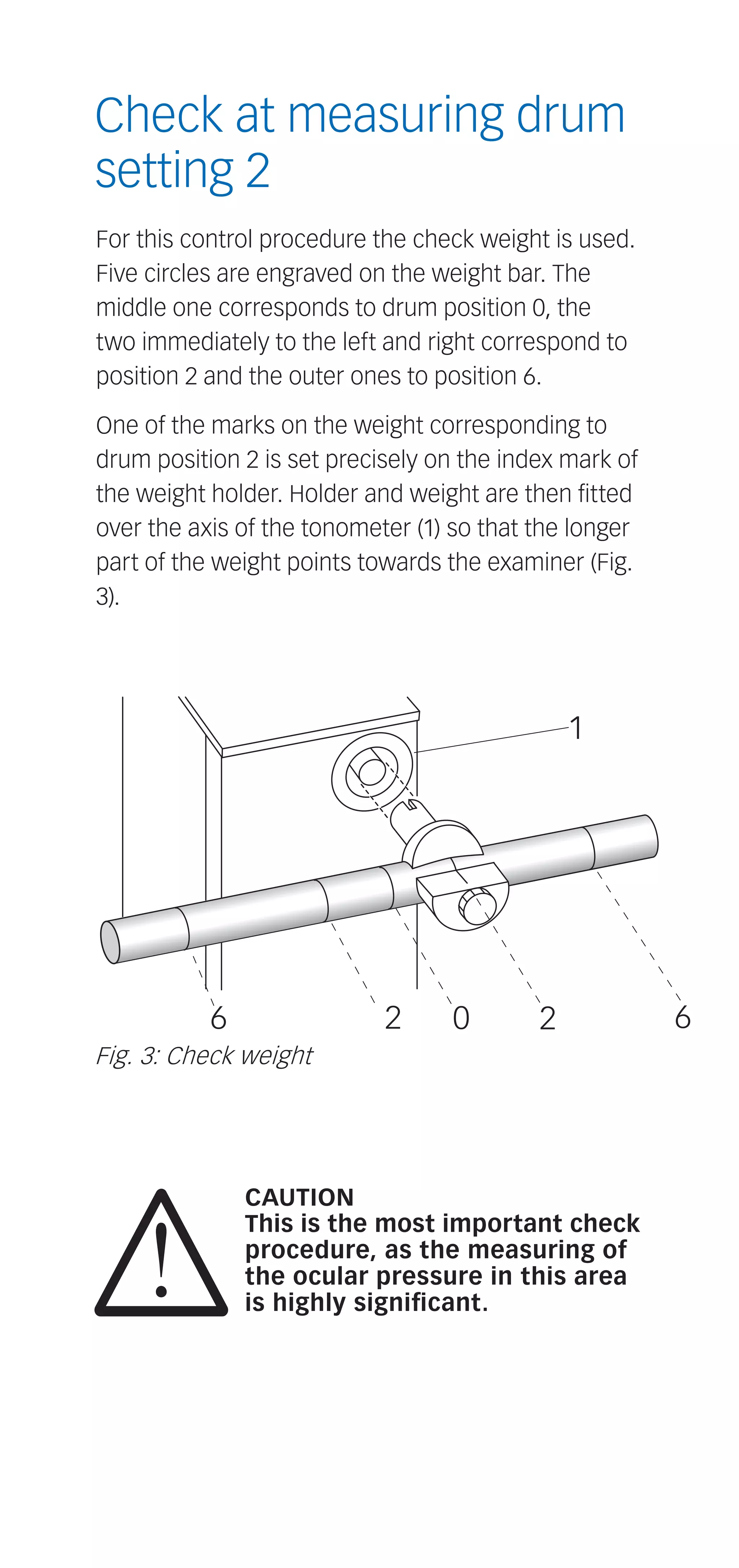
For this control procedure the check weight is used.
Five circles are engraved on the weight bar. The
middle one corresponds to drum position 0, the
two immediately to the left and right correspond to
position 2 and the outer ones to position 6.
One of the marks on the weight corresponding to
drum position 2 is set precisely on the index mark of
the weight holder. Holder and weight are then fitted
over the axis of the tonometer (1) so that the longer
part of the weight points towards the examiner (Fig.
3).
Check at measuring drum
setting 2
1
2 0 2
6 6
Fig. 3: Check weight
CAUTION
This is the most important check
procedure, as the measuring of
the ocular pressure in this area
is highly significant.
When the measuring drum setting is 1.95, the feeler
arm should move from the free movement zone
against the stop piece towards the examiner.
When the measuring drum setting is 2.05, the feeler
arm should move from the free movement zone
against the stop piece in the direction of the patient.
Check at measuring drum
setting 2 (cont.)
Check position 1.95
Check position 2.05
Fig. 4: Check position 1.95
Fig. 5: Check position 2.05
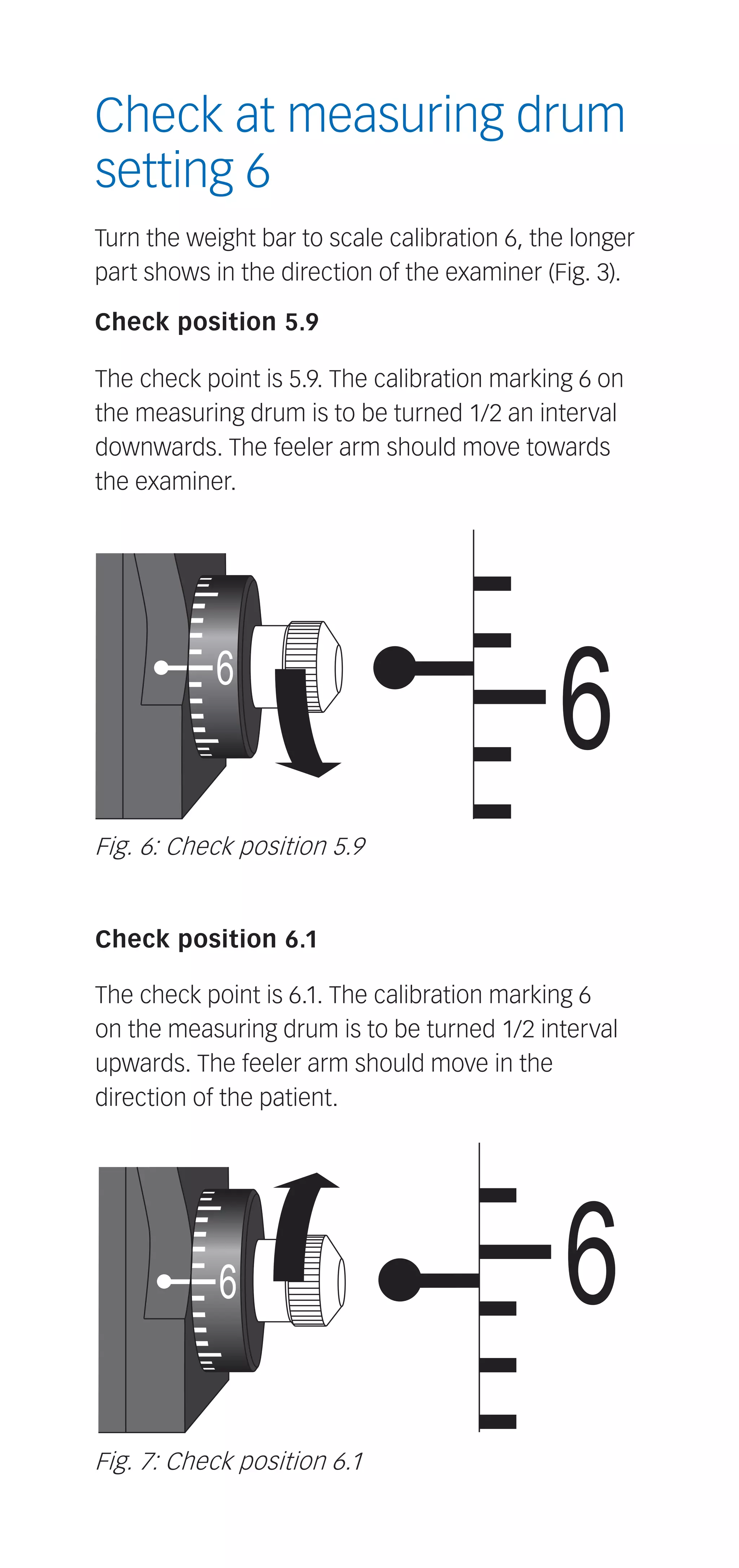
The check point is 5.9. The calibration marking 6 on
the measuring drum is to be turned 1/2 an interval
downwards. The feeler arm should move towards
the examiner.
Turn the weight bar to scale calibration 6, the longer
part shows in the direction of the examiner (Fig. 3).
The check point is 6.1. The calibration marking 6
on the measuring drum is to be turned 1/2 interval
upwards. The feeler arm should move in the
direction of the patient.
Check at measuring drum
setting 6
Check position 5.9
Check position 6.1
Fig. 6: Check position 5.9
Fig. 7: Check position 6.1
The checks in this leaflet should be completed once
every month* and a visual inspection should be
completed before every use to check for damage.
If your tonometer shows errors when you test the
calibration, please check the following;
Once you have made these checks, repeat the
assessment procedure. Any faulty tonometry
equipment should be returned to HS-UK
immediately for servicing.
Is your tonometer out of
calibration?
The check weight is precisely adjusted.
The measuring prism is properly inserted
*Recommended Haag-Streit guidelines
HS-UK are the only Haag-Streit authorised
tonometer service agent in the UK and, thus, the
only organisation that uses genuine Haag-Streit
tonometer parts and jigs calibrated to Haag-Streit
standards.
Why choose HS-UK to
service your tonometer?
We automatically replace worn or damaged parts,
such as cone arms and internal bearings, meaning
your tonometer is fully-repaired and automatically
refurbished.
Our dedicated tonometer servicing workshop
is fully-equipped with state-of-the-art testing
equipment which is calibrated to Haag-Streit
standards. We have fully-trained, certified service
engineers who will service and repair your
tonometer quickly, causing minimal disruption to
your clinic.
HS-UK maintain compliance with all applicable
regulations and standards for the servicing of
ophthalmic diagnostic equipment, including
certification to BS EN ISO 13485.
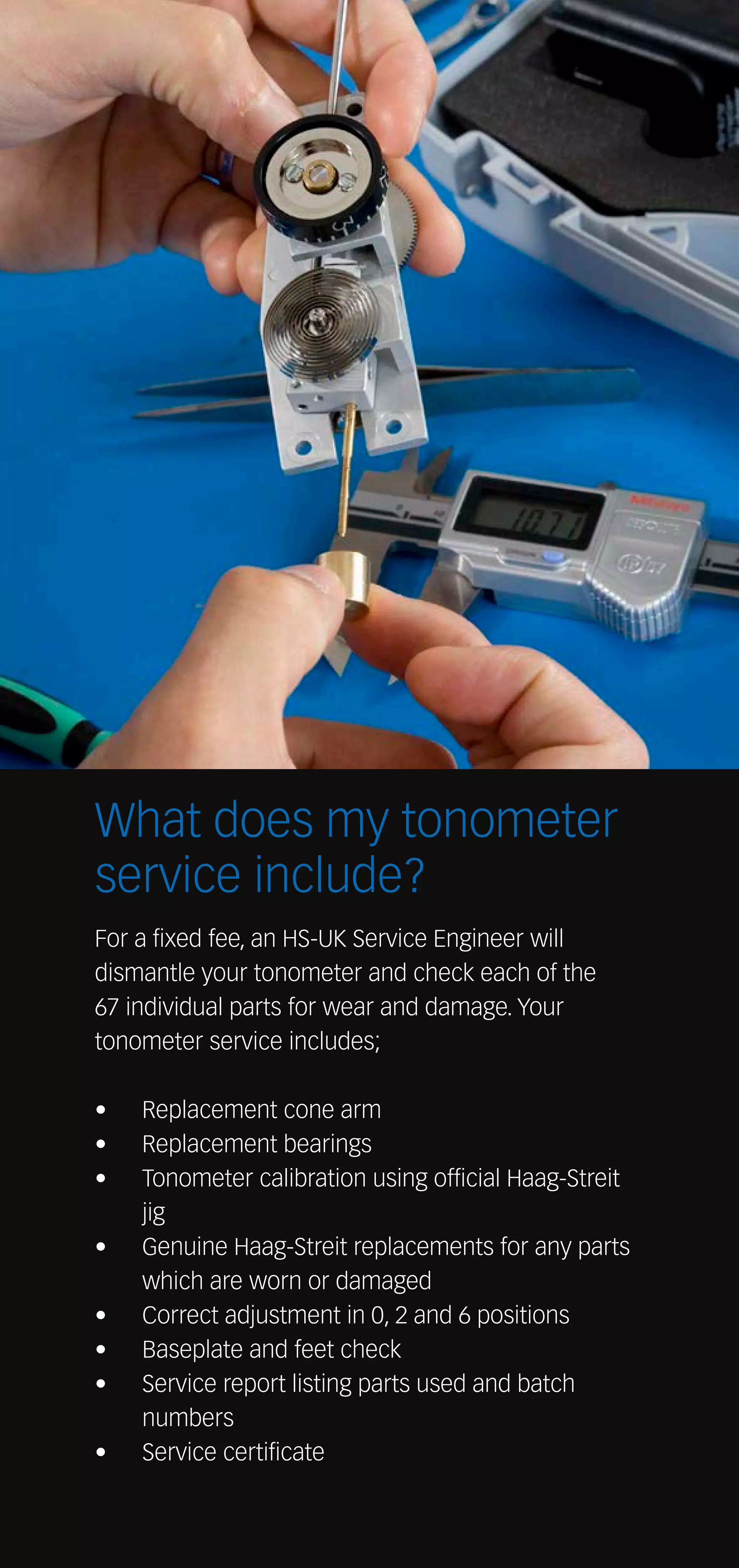
For a fixed fee, an HS-UK Service Engineer will
dismantle your tonometer and check each of the
67 individual parts for wear and damage. Your
tonometer service includes;
• Replacement cone arm
• Replacement bearings
• Tonometer calibration using official Haag-Streit
jig
• Genuine Haag-Streit replacements for any parts
which are worn or damaged
• Correct adjustment in 0, 2 and 6 positions
• Baseplate and feet check
• Service report listing parts used and batch
numbers
• Service certificate
What does my tonometer
service include?
Tonometer repair process
During the repair process, the Haag-Streit Service
Engineer will clean the tonometer, ensure movement
is smooth, replace any worn parts and check the
following;
Bottom shaft
• Shaft spindle, for burrs and damage
• Shaft bearing bolt wheel & pin
• Shaft dial bearing
• Block tension spring
• Star washer & dial
Middle Shaft
• Shaft pin
• Block shaft
• Spindle bar
Top Shaft
• Spindle & pin
• Movement of weights
The Engineer will also replace all the bearings and
the cone arm on the tonometer and re-grease the
spindle. Once reassembled, a calibration certificate
will be issued for each tonometer listing the serial
number of the tonometer and the serial number of
the test jig used for calibration.
For further information, or to book in a tonometer
repair, please contact our service team on (01279)
456314 or, alternatively, email service@haag-streit-
uk.com.
If your tonometer is not serviceable and you require
a new one, please visit www.haagstreituk.com/
goldmanntonometer for further information, or
alternatively, call 01279 456261.
Contact us...
E&OE. 5805013/Issue 3/Sept 2021
HAAG-STREIT UK
Unit C, Woodside Industrial Estate
Dunmow Road
Bishop’s Stortford
Hertfordshire
CM23 5RG
(01279) 456314
service@haag-streit-uk.com
https://hsuk.co/tonometryservice

HS-UK Guide to Checking Tonometer Calibration

  • 1.
    IS YOUR TONOMETER ACCURATE? Yourguide to checking tonometer calibration
  • 2.
    With eye clinicsbecoming increasingly busy it is vital that all tonometry equipment is maintained to the highest possible standard. Patient safety is critical, so it is imperitive that routine checks are completed regularly. This ensures that faults are quickly identified and that all measurements are accurate. Haag-Streit guidelines advise that the calibration of your tonometer should be checked at least once every month to ensure it performs in accordance with standards and specifications. This leaflet outlines the recommended procedures for checking tonometer calibration. It gives you advice on what to do if you find your tonometer is out of calibration during checks. In this leaflet you will find checking procedures for the following tonometers; AT 900M/Q, AT 900 C/M and AT 900 BQ. Reliable results & reduced equipment downtime THE IMPORTANCE OF PERFECT CALIBRATION
  • 3.
    Turn the zerocalibration on the measuring drum downwards by the width of one calibration marking, against the index marker. When the feeler arm is in the free movement zone, it should then move itself against the stop piece in the direction of the examiner. Turn the zero calibration on the measuring drum upwards by the width of one calibration marking, against the index marker. When the feeler arm is in the free movement zone, it should then move itself against the stop piece in the direction of the patient. Check at measuring drum setting 0 Check position -0.05 Check position +0.05 Fig. 1: Check position -0.05 Fig. 2: Check position +0.05
  • 4.
    For this controlprocedure the check weight is used. Five circles are engraved on the weight bar. The middle one corresponds to drum position 0, the two immediately to the left and right correspond to position 2 and the outer ones to position 6. One of the marks on the weight corresponding to drum position 2 is set precisely on the index mark of the weight holder. Holder and weight are then fitted over the axis of the tonometer (1) so that the longer part of the weight points towards the examiner (Fig. 3). Check at measuring drum setting 2 1 2 0 2 6 6 Fig. 3: Check weight CAUTION This is the most important check procedure, as the measuring of the ocular pressure in this area is highly significant.
  • 5.
    When the measuringdrum setting is 1.95, the feeler arm should move from the free movement zone against the stop piece towards the examiner. When the measuring drum setting is 2.05, the feeler arm should move from the free movement zone against the stop piece in the direction of the patient. Check at measuring drum setting 2 (cont.) Check position 1.95 Check position 2.05 Fig. 4: Check position 1.95 Fig. 5: Check position 2.05
  • 6.
    The check pointis 5.9. The calibration marking 6 on the measuring drum is to be turned 1/2 an interval downwards. The feeler arm should move towards the examiner. Turn the weight bar to scale calibration 6, the longer part shows in the direction of the examiner (Fig. 3). The check point is 6.1. The calibration marking 6 on the measuring drum is to be turned 1/2 interval upwards. The feeler arm should move in the direction of the patient. Check at measuring drum setting 6 Check position 5.9 Check position 6.1 Fig. 6: Check position 5.9 Fig. 7: Check position 6.1
  • 7.
    The checks inthis leaflet should be completed once every month* and a visual inspection should be completed before every use to check for damage. If your tonometer shows errors when you test the calibration, please check the following; Once you have made these checks, repeat the assessment procedure. Any faulty tonometry equipment should be returned to HS-UK immediately for servicing. Is your tonometer out of calibration? The check weight is precisely adjusted. The measuring prism is properly inserted *Recommended Haag-Streit guidelines
  • 8.
    HS-UK are theonly Haag-Streit authorised tonometer service agent in the UK and, thus, the only organisation that uses genuine Haag-Streit tonometer parts and jigs calibrated to Haag-Streit standards. Why choose HS-UK to service your tonometer? We automatically replace worn or damaged parts, such as cone arms and internal bearings, meaning your tonometer is fully-repaired and automatically refurbished. Our dedicated tonometer servicing workshop is fully-equipped with state-of-the-art testing equipment which is calibrated to Haag-Streit standards. We have fully-trained, certified service engineers who will service and repair your tonometer quickly, causing minimal disruption to your clinic. HS-UK maintain compliance with all applicable regulations and standards for the servicing of ophthalmic diagnostic equipment, including certification to BS EN ISO 13485.
  • 9.
    For a fixedfee, an HS-UK Service Engineer will dismantle your tonometer and check each of the 67 individual parts for wear and damage. Your tonometer service includes; • Replacement cone arm • Replacement bearings • Tonometer calibration using official Haag-Streit jig • Genuine Haag-Streit replacements for any parts which are worn or damaged • Correct adjustment in 0, 2 and 6 positions • Baseplate and feet check • Service report listing parts used and batch numbers • Service certificate What does my tonometer service include?
  • 10.
    Tonometer repair process Duringthe repair process, the Haag-Streit Service Engineer will clean the tonometer, ensure movement is smooth, replace any worn parts and check the following; Bottom shaft • Shaft spindle, for burrs and damage • Shaft bearing bolt wheel & pin • Shaft dial bearing • Block tension spring • Star washer & dial Middle Shaft • Shaft pin • Block shaft • Spindle bar Top Shaft • Spindle & pin • Movement of weights The Engineer will also replace all the bearings and the cone arm on the tonometer and re-grease the spindle. Once reassembled, a calibration certificate will be issued for each tonometer listing the serial number of the tonometer and the serial number of the test jig used for calibration.
  • 11.
    For further information,or to book in a tonometer repair, please contact our service team on (01279) 456314 or, alternatively, email service@haag-streit- uk.com. If your tonometer is not serviceable and you require a new one, please visit www.haagstreituk.com/ goldmanntonometer for further information, or alternatively, call 01279 456261. Contact us...
  • 12.
    E&OE. 5805013/Issue 3/Sept2021 HAAG-STREIT UK Unit C, Woodside Industrial Estate Dunmow Road Bishop’s Stortford Hertfordshire CM23 5RG (01279) 456314 service@haag-streit-uk.com https://hsuk.co/tonometryservice