A DIRTY INVESTMENT
European Development Banks’ Link to Abuses
in the Democratic Republic of Congo's Palm Oil Industry
H U M A N
R I G H T S
W A T C H
A Dirty Investment
European Development Banks’ Link to Abuses in the Democratic Republic of
Congo's Palm Oil Industry
Copyright © 2019 Human Rights Watch
All rights reserved.
Printed in the United States of America
ISBN: 978-1-6231-37823
Cover design by Rafael Jimenez
Human Rights Watch defends the rights of people worldwide. We scrupulously investigate
abuses, expose the facts widely, and pressure those with power to respect rights and
secure justice. Human Rights Watch is an independent, international organization that
works as part of a vibrant movement to uphold human dignity and advance the cause of
human rights for all.
Human Rights Watch is an international organization with staff in more than 40 countries,
and offices in Amsterdam, Beirut, Berlin, Brussels, Chicago, Geneva, Goma, Johannesburg,
Kinshasa, London, Los Angeles, Miami, Moscow, Nairobi, New York, Paris, San Francisco,
Sydney, Tokyo, Toronto, Tunis, Washington DC, and Zurich.
For more information, please visit our website: http://www.hrw.org
NOVEMBER 2019 ISBN: 978-1-6231-37823
A Dirty Investment
European Development Banks’ Link to Abuses in the Democratic Republic of
Congo's Palm Oil Industry
Glossary................................................................................................................................ i
Maps and Satellite Imagery .................................................................................................iv
i. Research Locations......................................................................................................... iv
ii. Boteka Concession .......................................................................................................... v
iii. Lokutu Concession ........................................................................................................ vii
iv. Yaligimba Concession..................................................................................................... ix
v. Boloku Village ................................................................................................................ xi
Summary...............................................................................................................................1
Workers Exposed to Toxic Pesticides.......................................................................................2
Dumping Untreated Waste......................................................................................................4
Labor Rights Violations and Extreme Poverty Wages ................................................................6
Lack of Oversight and Enforcement.........................................................................................7
Key Recommendations to BIO, CDC Group, DEG and FMO................................................. 10
To the Governments of Belgium, Germany, the Netherlands and the United Kingdom.........11
To the Government of the Democratic Republic of Congo ..................................................11
To Feronia and PHC.........................................................................................................11
Methodology.........................................................................................................................1
I. Workers Exposed to Toxic Pesticides ................................................................................ 4
Health Problems Reported by Workers Applying Pesticides......................................................6
Impotence.......................................................................................................................6
Skin Problems .................................................................................................................7
Eye Problems...................................................................................................................8
Headaches ......................................................................................................................8
Inadequate Information and Training Regarding Pesticide Exposure.........................................9
Inadequate and Incomplete Protective Equipment During Pesticide Application ..................... 10
Helmets ........................................................................................................................ 12
Respirators.................................................................................................................... 12
Goggles......................................................................................................................... 14
Gloves........................................................................................................................... 15
Overalls ........................................................................................................................ 16
Boots............................................................................................................................ 18
Inadequate Medical Care and Monitoring.............................................................................. 19
II. Dumping Untreated Industrial Waste in Rivers, Communities ........................................ 22
PHC Dumps Untreated Industrial Waste ................................................................................24
Industrial Waste Dumping Next to Residential Areas..............................................................30
Industrial Waste Contaminates Communities’ Water Sources.................................................33
III. Abusive Employment Practices and Extreme Poverty Wages......................................... 36
Extreme Poverty Wages and Abuse of Short-term Contracts.................................................... 37
Wages........................................................................................................................... 37
Livelihoods ................................................................................................................... 41
Failure to Provide Sufficient Protective Equipment.................................................................47
IV. Feronia and PHC’s Failed Commitments, Obligations and Responsibilities ................... 52
PHC Institutional Commitments ............................................................................................52
Obligations under Congolese Law......................................................................................... 53
Contractual Obligations with Development Banks ................................................................. 53
Human Rights Responsibilities ............................................................................................. 57
V. European Development Banks’ Failed Obligations ......................................................... 59
Extraterritorial Human Rights Obligations..............................................................................59
Human Rights Due Diligence.................................................................................................62
Inadequate Oversight and Enforcement ................................................................................64
Impact of Opacity of Development Bank Operations ..............................................................66
The Accountability Gap ........................................................................................................67
VI. Congolese Government Failed Oversight........................................................................72
Right to Health..................................................................................................................... 73
Right to Information .............................................................................................................74
Right to Water...................................................................................................................... 75
Labor Rights ........................................................................................................................76
Business and Human Rights................................................................................................. 77
VII. Responses to Human Rights Watch findings................................................................ 78
Company’s Response...........................................................................................................78
Banks’ Response .................................................................................................................78
Response to Findings on Occupational Health and Safety................................................78
Response to Findings on Untreated Industrial Waste Dumping.........................................79
Response to Findings on Labor Rights Violations and Extreme Poverty Wages...................80
Recommendations .............................................................................................................82
To the European Development Banks (BIO, CDC Group, DEG and FMO) ...................................82
To the Governments of Belgium, Germany, the Netherlands, and the United Kingdom .............83
To Feronia and PHC ..............................................................................................................84
To the Government of the Democratic Republic of Congo .......................................................85
To the Prime Minister and the Ministry of Labor, Employment and Welfare........................85
To the Labor Inspectorates in Equateur, Mongala and Tshopo Provinces ..........................85
To the Ministry of Environment and Sustainable Development .........................................86
To the Provincial Coordination of the Environment Ministry in Équateur, Mongala and
Tshopo Provinces ..........................................................................................................86
Acknowledgments..............................................................................................................88
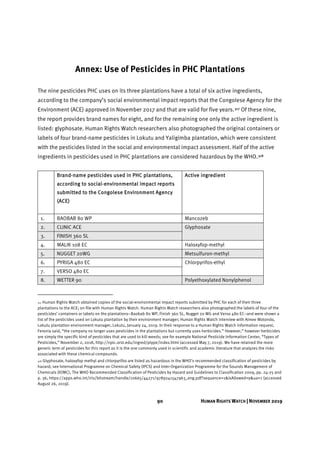
Annex: Use of Pesticides in PHC Plantations...................................................................... 90
Mancozeb............................................................................................................................ 91
Glyphosate.......................................................................................................................... 91
Haloxyfop-methyl.................................................................................................................93
Metsulfuron-methyl..............................................................................................................93
Chlorpyrifos.........................................................................................................................93
Polyethoxylated Nonylphenol ...............................................................................................95
A DIRTY INVESTMENT i
Glossary
ACE Congolese Agency for the Environment (Agence Congolaise
pour l’Environnement)
Area General Manager The highest-ranking executive in a PHC site, which includes
the oil palm plantation and the palm oil mill
BIO Belgian Investment Company for Developing Countries
SA/NV, a Belgian development bank
CDC Group British development bank, formerly the Commonwealth
Development Corporation
Congo Democratic Republic of Congo
Contract worker Worker with a contract of indeterminate duration
Day laborer Worker who is hired per day
DEG Deutsche Investitions-und Entwicklungsgesellschaft mbH, a
German development bank
DFI Development Finance Institution
Divisional Manager A manager who oversees a division at a PHC plantation, which
comprises between 200 to 300 plantation workers
ESAP Environmental and Social Action Plan, a contractually binding
plan agreed between the development banks and Feronia-
PHC to bring the company’s operations into compliance with
good international industry standards
ii HUMAN RIGHTS WATCH | NOVEMBER 2019
Factory Manager Person responsible for the operations of the palm oil mill on a
PHC site
FMO Nederlandse Financierings-Maatschappij voor
Ontwikkelingslanden, a Dutch development bank
IARC International Agency for Research on Cancer, a branch of the
World Health Organization
IFC International Finance Corporation, a member of the World
Bank Group
Oil Palm Elaeis guineensis, African tree in the palm family (Arecaceae)
cultivated as a source of oil; palm oil is obtained from its
fruits
Palm Oil Mill Factory where palm oil is extracted from fresh fruit bunches
(FFB) by a mechanical process
Plantation Manager Person responsible for the operations of the plantation on a
PHC site
PHC Plantations et Huileries du Congo, S.A., a subsidiary of
Feronia in Congo
WHO World Health Organization
iv HUMAN RIGHTS WATCH | NOVEMBER 2019
Maps and Satellite Imagery
i. Research Locations
Human Rights Watch conducted research at PHC’s three plantations (Boteka, Lokutu, and
Yaligimba), as well as in the cities of Bumba, Kinshasa, Kisangani, Lisala, and Mbandaka.
A DIRTY INVESTMENT v
ii. Boteka Concession
vi HUMAN RIGHTS WATCH | NOVEMBER 2019
The Boteka agricultural concession, located in the northwestern province of Équateur,
spans over 6,000 hectares, of which 3,667 are planted with oil palm, according to the
plantation’s social environmental impact report which was approved by the Congolese
government in 2017. The company’s palm oil mill dumps its effluents on the Momboyo
River, a tributary of the Congo River.
Sources: Satellite image April 25, 2019. © 2019 ESA. The boundaries of the agricultural
concessions and planted areas were uploaded by Feronia on MapHubs on January 11,
2017, https://feronia.maphubs.com/layer/info/103/Boteka-Planted-Areas#12.84/-
0.451/19.1089 (accessed July 25, 2019). Waterways data: Open Street Map (accessed July
24, 2019). Location of the palm oil mill available on OpenStreetMap,
https://www.openstreetmap.org/way/651138268 (accessed July 25, 2019); Human Rights
Watch researchers also conducted a visit to the mill in November 2018.
A DIRTY INVESTMENT vii
iii. Lokutu Concession
viii HUMAN RIGHTS WATCH | NOVEMBER 2019
The Lokutu plantation, located in the province of Tshopo, spans over 60,000 hectares, of
which 14,800 are planted with oil palm, according to the plantation’s social environmental
impact report, which was approved by the Congolese government in 2017. The company’s
palm oil mill dumps its effluents into the Congo River.
Sources: Satellite image May 7, 2019. © 2019 ESA. Boundaries of the agricultural
concessions and planted areas uploaded by Feronia on MapHubs on January 11, 2017,
available at: https://feronia.maphubs.com/layer/info/40/Plantation-
Lokutu#11.05/1.0864/23.5352 (accessed July 25, 2019). Waterways data: Open Street Map
(accessed July 24, 2019). Human Rights Watch researchers pinpointed the location of the
palm oil mill using a GPS in February 2019 during a research trip to Lokutu
A DIRTY INVESTMENT ix
iv. Yaligimba Concession
x HUMAN RIGHTS WATCH | NOVEMBER 2019
The Yaligimba plantation, located in the province of Mongala, spans over 30,000 hectares,
of which 11,682 are planted with oil palm, according to the plantation’s social
environmental impact report, which was approved by the Congolese government in 2017.
The company’s palm oil mill dumps its effluents next to workers’ homes. Downstream the
waste mixes with a natural pond and a stream that supplies drinking water to Boloku, a
community of several hundred people outside of the agricultural concession. Though the
company has built or restored a number of boreholes, there are none in the affected
community, residents told Human Rights Watch, as it is outside the bounds of the
agricultural concession. The nearest borehole inside the plantation is five kilometers away
measured in a straight line; no dirt road is visible between the two locations in the satellite
imagery.
Sources: Satellite image January 22, 2019. © 2019 ESA. Boundaries of the agricultural
concessions and planted areas uploaded by Feronia on MapHubs on January 11, 2017,
available at: https://feronia.maphubs.com/layer/info/41/Plantation-
Yaligimba#10.52/2.3146/22.9373 (accessed July 25, 2019). Waterways data: Open Street
Map (accessed July 24, 2019). Human Rights Watch researchers used GPS to pinpoint the
location of the palm oil mill, the natural pond where the effluent stream flows into, and
Boloku in February 2019 during a research trip to Yaligimba. Researchers walked five
kilometers along sections of the effluent stream and used GPS to track the journey.
A DIRTY INVESTMENT xi
v. Boloku Village
xii HUMAN RIGHTS WATCH | NOVEMBER 2019
Boloku village, located less than five kilometers from the boundaries of the Yaligimba PHC
agricultural concession, can be seen in this satellite image. In 2011, when the image was
taken, there were approximately 75 houses in the village. Community leaders told Human
Rights Watch there were over 100 homes in February 2019. To the west of Boloku is Loeka
stream and its creek; community members told Human Rights Watch this was their only
source of drinking water and that effluents from the PHC mill had contaminated it in 2018.
Though PHC has drilled a number of boreholes in the concession, the nearest one to
Boloku is five kilometers away measured in a straight line; no dirt road is visible between
the two in the satellite imagery. The palm oil production quadrupled that year in Yaligimba,
according to the company’s 2018 tax declarations. To the east of Boloku, the Yaligimba
mill releases largely untreated effluents that flow into a natural pond, which is connected
to Loeka stream through a narrow channel (see Map 4 above). Satellite image March 29,
2011. © DigitalGlobe - Maxar Technologies 2019; source: Google Earth.
Source: Human Rights Watch researchers used a GPS to pinpoint the location of Boloku
during a research trip to Yaligimba in February 2019. During that visit, researchers were
taken on canoes by villagers on what we believe is Loeka creek. They subsequently
identified Loeka stream through analysis of satellite imagery.
A DIRTY INVESTMENT 1
Summary
This report examines the responsibility of four European development banks for abusive
practices on oil palm plantations in the Democratic Republic of Congo. These banks – BIO,
from Belgium; CDC Group, from the United Kingdom; DEG, from Germany; and FMO, from
the Netherlands – are among the ten largest bilateral development financial institutions in
the world, controlling billions of dollars in investments across more than 2,000 projects in
developing countries. Human Rights Watch found that the banks have failed to ensure that
the palm oil companies they finance in Congo are respecting the basic rights of the people
who work and live on or near their plantations.
Since 2013, the four banks have invested a total of nearly US$100 million in the palm oil
company Feronia and its subsidiary Plantations et Huileries du Congo S.A. (PHC) (together
“the company”), which operates three oil palm plantations spanning over 100,000
hectares in northern Congo: “Boteka,” “Lokutu,” and “Yaligimba.” In addition to being an
investor, CDC Group is also a shareholder in Feronia: it currently owns 38 percent of the
company. The three plantations employ a total of nearly 10,000 workers. Approximately
100,000 people live on or within five kilometers of their property.
During field research in Congo between November 2018 and May 2019, Human Rights
Watch visited the company’s three plantations and interviewed more than 200 people,
including 102 PHC employees residing on or near the plantations, 20 Feronia and PHC
executives and company managers, and 25 government officials, among others. Human
Rights Watch also reviewed extensive documentary evidence, including social-
environmental impact reports the company submitted to Congolese authorities.
Human Rights Watch found that lack of proper oversight by the banks has enabled Feronia
and its subsidiary PHC to commit abuses and environmental harm that infringed upon
health and labor rights. These abuses include exposing more than 200 employees to toxic
pesticides without adequate protection; not providing employees exposed to hazardous
materials with the results of medical examinations; and engaging in abusive employment
practices that place many workers under the extreme poverty line. The plantations’ palm
2 HUMAN RIGHTS WATCH | NOVEMBER 2019
oil mills also routinely dump untreated industrial waste and may have already
contaminated the only drinking water source of local communities.
Congolese authorities have failed to ensure PHC’s compliance with domestic laws
regulating labor and environment conditions and to protect the rights of plantation
workers and local residents.
While the Congolese government has primary responsibility for protecting the rights of PHC
workers, the development banks are also obligated to ensure that the companies they
finance are not engaging in abusive practices, an obligation they have failed to meet. This
is partly the result of structural failures in the way the banks operate: most of the banks do
not assess the potential human rights impacts of the projects they invest in and all do little
to disclose relevant information to communities that might be impacted. The banks also
do not ensure that affected communities have access to effective remedies when the
companies they finance engage in abusive practices.
Development banks could play an important role in promoting economic opportunities in
Congo, a country where two-thirds of the 84 million residents live in poverty, 7.7 million are
severely food insecure, and 4.5 million have been internally displaced due to armed
conflict. As one the five largest private employers in the country – and the largest in the
agricultural sector, which employs most of the working population – PHC’s palm oil
plantations are an important source of economic opportunity. However, by failing to
ensure that PHC is complying with international standards and domestic law regulating
employment and environmental practices, the banks are not fulfilling their obligation to
protect rights, thereby compromising their stated mission to advance sustainable
development.
Workers Exposed to Toxic Pesticides
Half of the active ingredients in the nine pesticides that PHC uses in its plantations are
considered hazardous by the World Health Organization (WHO), including some that may
cause severe damage to the eyes. Three of the pesticides contain active ingredients that
are considered cancer-causing by the WHO or other recognized health authorities. In
August 2019, regulators recommended to the European Commission that approval for one
A DIRTY INVESTMENT 3
of these chemicals be revoked; German authorities said in September they would
completely phase out another of these substances by 2023.
As of May 2019, at least 245 PHC male contract employees were working with pesticides
across the three plantations. Of these, 213 workers apply these toxic chemicals six days a
week using a 16-liter backpack sprayer, each treating 300 to 600 palm trees per day.
Thirteen team leaders supervise them on site. Fifteen workers are responsible for mixing
pesticides in their purest form to create the formula their team members spray. Every day,
the mixers create 200 gallons (the equivalent of nearly 800 liters) worth of formula.
Given the risks to human health, the WHO has developed standards regarding appropriate
protective equipment for the use of pesticides in agriculture. Similarly, Congolese law
requires that employers provide workers with appropriate protective equipment for their
occupation and ensure special medical monitoring for workers in hazardous occupations.
PHC’s own policies elaborate on the company’s institutional commitment to protect the
health of their workers and prescribe specific equipment for workers who apply pesticides.
Human Rights Watch interviewed 43 workers on specialized pesticide teams employed by
PHC, as well as the manager of one of these teams. Researchers also inspected the
pesticide teams’ protective equipment and reviewed the training manuals PHC distributed
to them. After consulting with occupational and public health experts, Human Rights
Watch concluded that the equipment workers received was not consistent with WHO
standards, Congolese law, or the company’s own policies.
Workers described a wide range of health problems that they had experienced since they
began working with pesticides. These included both conditions that developed
immediately after spraying pesticides and chronic conditions that emerged over time.
• Most of the workers, who were between the ages of 25 to 46, said they had become
impotent since they started their job.
• A number of workers described skin irritation, itchiness, and blisters immediately
after the pesticides came into contact with their skin.
• Several workers described pain and irritation in their eyes while applying
pesticides; others said their vision had diminished or become blurred since they
started the job.
4 HUMAN RIGHTS WATCH | NOVEMBER 2019
• Other workers said they experienced shortness of breath, elevated heart rate,
headaches, weight loss, and chronic fatigue.
Some of these health problems are consistent with risks posed by the active ingredients in
the specific pesticides sprayed by PHC workers, such as skin and eye problems. Other
health problems such as impotence, shortness of breath, headaches, and weight loss are
consistent with exposure to pesticides in general, as described in scientific literature.
Human Rights Watch research found that PHC has not provided workers with information
necessary for them to understand the short and long-term health risks associated with
their jobs or to consent to these risks. Though these workers are subject to special medical
oversight from company doctors, most of those interviewed by Human Rights Watch said
they did not receive the results of their medical examinations, even after they repeatedly
asked for them, leaving them in a state of uncertainty about their health. The remainder
did not say if they had received their results.
Dumping Untreated Waste
At least two of PHC’s three palm oil mills dump untreated waste into rivers and near the
homes of workers, according to Feronia and PHC staff. The company’s waste disposal
procedures do not appear to be compliant with Congolese law or with international human
rights standards for the conduct of business. Nor are they apparently compliant with
commercial good practice expected from appropriately designed, operated, and
maintained facilities operating under normal conditions, according to guidelines designed
by the World Bank Group.
At the Yaligimba plantation, the company dumps its waste in a narrow channel beside the
Mindonga workers’ camp, a settlement behind their palm oil mill. The effluents produce a
putrid smell and fumes that pervade hundreds of homes on each side of the channel
where workers live with their families. The stream of effluents continues its course for five
kilometers before flowing into a natural pond. There, women and children bathe and wash
their clothes and cooking utensils.
A DIRTY INVESTMENT 5
From this pond, the effluents flow through a channel to Loeka stream, west of the palm oil
mill, which Human Rights Watch found after pinpointing GPS coordinates in the course of
field research and analyzing satellite imagery of the site.
There are no sources of drinking water other than Loeka stream in Boloku, a village of
several hundred families downstream from the PHC mill, residents told Human Rights
Watch. Boloku’s customary leader filed a formal complaint with PHC in November 2018,
alleging the stream was polluted by the company’s waste discharges. At the time Human
Rights Watch interviewed him, three months after he filed the complaint, the company had
not taken any action, he said.
In 2018, the year Boloku villagers filed the complaint, the production in Yaligimba
quadrupled between January and November, according to the company’s tax declarations
– with the volume of waste discharged into the water growing proportionally. Boloku’s
customary leader told Human Rights Watch that residents observed oily waste in the water
and that the color of the water had changed. “We don’t want to drink it anymore,” he said.
The World Bank Group’s Environmental, Health and Safety (EHS) Guidelines on Vegetable
Oil Production and Processing indicate palm oil mill effluents should be treated to bring
them into compliance with nine parameters before releasing them into the environment. In
its two largest plantations, PHC only controls effluents for one of these nine parameters –
the content of palm oil – to avoid dumping their product.
The European development banks imposed compliance with the International Finance
Corporation (IFC) Performance Standards and the EHS Guidelines on Feronia and PHC as
part of their contractual obligations. The guidelines “are achievable under normal
operating conditions in appropriately designed, operated, and maintained facilities,”
according to the IFC.
The company’s practice of dumping untreated effluents endangers the health of villagers
who must rely on polluted water and undermines their ability to enjoy private, family, and
cultural life in their homes without being overwhelmed by a putrid smell. If unchecked and
untreated, effluent dumping could, over time, also cause fish to suffocate and die, or
cause large growths of algae that can adversely affect the health of those who come into
contact with polluted water or consume tainted fish.
6 HUMAN RIGHTS WATCH | NOVEMBER 2019
Labor Rights Violations and Extreme Poverty Wages
In addition to failing to provide adequate equipment to employees who work with
pesticides, PHC has not provided basic protective equipment to day laborers, who are
employed and paid per day and make up the majority of the company’s workforce. Day
laborers often set out on the plantation without gloves or boots, making them vulnerable
to snake and spider bites, machete and thorn prick injuries, and trauma.
Female plantation workers appeared to be disproportionately impacted by the lack of
protective equipment. Speaking of the group of women with which she works, a female
laborer from Boteka plantation told Human Rights Watch, “We work without boots, without
gloves – with our bare hands, sometimes the fruits [we have to pick up] fall on cows’ or
people’s excrement.” In a visit to the Boteka palm oil mill, Human Rights Watch
researchers observed that women were the only employees working without any protective
equipment.
The range of practices that put workers’ health and safety at risk contravene Congolese
labor law and international human rights standards, as well as the company’s policies.
However, PHC workers face considerable barriers when seeking redress for harms incurred,
as the remote location of the plantations makes it physically difficult for them to file
complaints. In addition, government agencies in charge of enforcing labor law are
underfunded, understaffed, and often unable to travel to the plantations to conduct
inspections. Further, some of the workers that Human Rights Watch interviewed expressed
mistrust toward their trade union representatives, who in some instances are also part of
company management.
PHC has made routine use of temporary contracts in apparent violation of Congolese law,
which states that companies can hire day laborers for no longer than 22 days in any two-
month period, after which a company must offer an indefinite contract. Many workers told
Human Rights Watch they were employed as day laborers on temporary contracts for years
at a time, including as long as ten years in one case. At one plantation, Congolese
authorities imposed a hefty fine for this illegal practice and ordered the company to
provide indefinite contracts over the course of two years to 1,500 workers. In December
2018, PHC had nearly 7,000 day laborers.
A DIRTY INVESTMENT 7
Day labor schemes preclude cash benefits that are otherwise owed to contract workers
under the collective bargaining agreement, such as end-of-year bonuses and statutory
annual raises. Day labor schemes then result in significantly lower wages for workers that
keep them below the extreme poverty line of US$1.90 per day, as defined by the World
Bank. While PHC’s director general said day laborers are paid on the same scale as
contract workers, several day laborers told Human Rights Watch the agreement with the
company was to be paid 2,000 FC (US$1.20) per day, which is lower than the lowest paid
contract workers.
Among plantation workers, female laborers reported the lowest monthly salaries, ranging
between 12,000 FC (US$7.30) and 30,000 FC (US$18.75). A former manager who
supervised over 200 plantation workers in Boteka told Human Rights Watch that women
were mainly employed as fruit-picker day laborers, that the company pays them 30 FC
(US$0.01) for every sac of 10 kilos, and that “15 sacs per day is already too hard to
accomplish.” The maximum a woman in this role can earn is 15,000 FC (US$9.04) per
month, he said.
Most Congolese live in poverty, and the company provides employment for people who
otherwise might be jobless. But the investment banks have consistently stated that one of
their primary objectives when they invested in Feronia and PHC was to create decent jobs
and promote development. CDC group said that “improving the conditions and rights of
workers” was “at the heart” of their investment, in accordance with their development
mandate. But contrary to the banks’ development mandate, workers in all three
plantations, both men and women, told Human Rights Watch that their low wages did not
enable them to meet even basic needs, and that they could not afford to provide their
families three meals a day.
Lack of Oversight and Enforcement
Congolese authorities have not adequately enforced domestic labor and environmental
laws that would help protect workers and communities from the abuses documented in
this report. These include the rights to health, to water, and to information, as well as their
labor rights. Provincial authorities cited lack of resources and staff as the most common
cause for deficient monitoring, highlighting the need for national authorities to provide
adequate resources at the local level.
8 HUMAN RIGHTS WATCH | NOVEMBER 2019
The European development banks, which their respective states wholly own or have
majority-ownership, have an extraterritorial obligation to uphold international human
rights law. International standards obligate states, and thus the investment banks, to take
steps to prevent and provide redress for rights abuses that occur outside their territories
due to the activities of business entities over which they can exercise control. KfW, the
German-owned development bank that owns and supervises DEG, explicitly recognizes its
extraterritorial obligations in its human rights declaration, but has still fallen short in
protecting rights.
As a practical matter, the banks that invested in Feronia and PHC can exercise control on
decisive operational matters through the conditions they attach to their lending and by
monitoring company compliance with these conditions – thereby taking steps to prevent
and redress infringements of rights.
The banks conducted due diligence to assess social and environmental risks that could
pose a liability to themselves as investors, and they evaluated the gap between the
companies’ practices and international industry standards. However, neither of these
assessments are designed to prevent infringement of human rights that could result from
business activity, as would human rights-specific due diligence.
An Environmental, Social and Action Plan (ESAP) was prepared based on the social and
environmental assessments. The ESAP’s objective is “to ensure that over time Feronia
reaches compliance with international standards and law,”specifically Congolese law, the
2012 IFC Performance Standards, the EHS Guidelines, and the criteria to obtain
certification from the Roundtable on Sustainable Palm Oil (RSPO), a certification initiative
for palm oil producers wishing to adhere to labor, social, and environmental industry-
specific standards.
The ESAP could be the instrument to ensure that the banks’ investments do not support
activities that cause or contribute to human rights abuses. Human Rights Watch considers
that an ESAP should be prepared on the basis of environmental, social, and human rights
due diligence so that the banks may fulfill their duty to protect rights. To effectively prevent
abuses, an ESAP should set minimal social and environmental standards for the
company’s operations with a clear timeframe for these standards to be met. In addition to
establishing monitoring mechanisms, it should also define consequences in the event
A DIRTY INVESTMENT 9
there are serious violations of the company’s contractual obligations. In addition, an ESAP
should establish enforceable and accessible remediation avenues for people who have
suffered rights abuses from bank-funded commercial activities.
On grounds of commercial secrecy, the banks have not disclosed their due diligence
assessments, nor the mitigation measures they agreed the company would implement. So
long as they shield this information, it is difficult – if not impossible – to effectively
monitor whether they are meeting their human rights obligations. This is particularly
concerning for investments that are deemed “high risk” under the IFC environmental and
social categorization, as PHC has indeed been classified by FMO, because of their
“potential significant adverse environmental or social risks and/or impacts that are
diverse, irreversible, or unprecedented.” Disclosing such assessments would not be
unusual – the IFC, a member of the World Bank Group, publishes social and environmental
impact assessments for all their projects.
This opacity means that Congolese and European government oversight agencies have had
limited access to information on the human rights risks associated with investments, or
the documentation that lays out the agreement between the banks and their clients.
Potentially affected communities do not have access to information on how development
banks identify, prevent, or mitigate the human rights impacts associated with
investments, what these impacts could be, and how these impacts could affect their rights
and livelihoods. Civil society groups have been prevented from scrutinizing whether public
funds invested in the development banks are enabling activities that cause or contribute
to human rights violations abroad.
The four European development banks have complaint mechanisms that provide them
with feedback on whether they have acted in compliance with their policies and whether
these policies are adequate to prevent negative social and environmental impacts. Yet,
these mechanisms have multiple weaknesses:
• They do not have the authority to compel banks, or the businesses in which they
invest, to participate in dispute resolution processes or to implement the
agreements reached through these processes;
• They cannot reach a determination of fault or decide liability for abuses;
10 HUMAN RIGHTS WATCH | NOVEMBER 2019
• They are chiefly available online, and the banks do little or nothing to publicize
their existence for potentially affected people, rendering the mechanism
considerably inaccessible for vulnerable rural communities;
• In the case of CDC, the mechanism does not provide any guidance to complainants
on timeframes, types of resolutions they might be able expect, or guarantees
against retaliation or reprisal when the complaint is brought by an external party,
and the authority responsible for investigating complaints submitted through the
mechanism is part of the bank’s management structure, instead of being an
independent authority, compromising its impartiality. In addition, CDC does not
publish details of the complaints.
The banks said they encourage the creation and implementation of effective grievance
mechanisms at the company level so that businesses continue operating responsibly after
development banks divest. While it is undoubtedly important for such mechanisms to exist
at the company level, this does not relieve the banks – or the government authorities that
oversee them – of their obligation to provide remedy and to create avenues for
accountability for their role in supporting activities that caused or contributed to abuses.
The banks and government oversight authorities should strengthen these mechanisms to
create or provide genuine remediation avenues.
Key Recommendations to BIO, CDC Group, DEG and FMO
The four European development banks should undertake structural reforms to ensure that
they are meeting their human rights obligations to prevent and mitigate abuses by
companies in which they invest, such as those documented in this report.
Specifically, the banks should:
• Adopt human rights policies that acknowledge their extraterritorial human rights
obligations, in the case of BIO and CDC Group, or modify their existing human
rights policy to acknowledge extraterritorial obligations, in the case of FMO;
• Consistently conduct human rights due diligence prior to investing in a project and
disclose, at a minimum, summaries of these risk assessments, as well as the
mitigation measures they have adopted to address these risks;
A DIRTY INVESTMENT 11
• Ensure this information reaches potentially affected communities, and that it is
also made available to government agencies that have oversight over the
companies;
• Strengthen their grievance mechanisms so they are effective accountability
avenues, and adopt anti-retaliation policies that protect activists from backlash
when they bring forth complaints; and
• Adopt policies on decent work that compel investees to pay living wages, so that
their investments meet their development mandate.
To the Governments of Belgium, Germany, the Netherlands and the United Kingdom
The governments that wholly-own or majority own these banks should ensure that nothing
in their domestic legislation prevents the banks from engaging in structural reform that
would enable them to meet their human rights obligations.
To the Government of the Democratic Republic of Congo
The government of Congo has the primary responsibility to protect the rights of workers
and communities impacted by PHC operations, specifically to:
• Ensure that provincial representations of the Environment and Labor ministry are
appropriately staffed and resourced, so they are able to conduct regulatory
inspections and enforce the law;
• Investigate allegations of labor rights violations and environmental contamination;
and
• Adopt a living wage for agricultural workers.
To Feronia and PHC
Feronia and PHC should engage in reform to prevent, mitigate, and address abuses on
their plantations. The company should:
• Ensure that all workers have appropriate and complete equipment that adequately
protects them from the hazards of their occupation;
• Ensure that laborers who work with toxic chemicals have access to adequate
information to understand the risks associated to their job, that they promptly
12 HUMAN RIGHTS WATCH | NOVEMBER 2019
receive all test results of medical examinations, and that they are not forced to
work without adequate equipment;
• Treat all waste in accordance with good industry standards and Congolese
domestic law;
• Effectively address complaints about water contamination with a view to provide
reparations to affected communities; and
• Ensure access for Congolese authorities to all company sites whenever they
conduct regulatory inspections, in line with domestic law.
A DIRTY INVESTMENT 1
Methodology
This report is based on field research conducted by Human Rights Watch researchers for a total of
eight weeks between November 2018 and May 2019 in the Democratic Republic of Congo.
Researchers visited each of PHC’s three plantations: Boteka in Équateur province, Lokutu in
Tshopo province, and Yaligimba in Mongala province. In every case, researchers obtained consent
from the highest-ranking company executive on site to remain inside or within proximity of the
plantation. Human Rights Watch also conducted interviews with public officials in the capitals of
the three provinces where the plantations are located – Mbandaka, Kisangani, and Lisala,
respectively. Researchers also interviewed company executives, public officials and diplomatic
personnel in Kinshasa, the national capital, in addition to telephone interviews with
representatives of nongovernmental organizations (NGO) and academics.
Human Rights Watch researchers interviewed 206 people for this report, including 102 PHC
workers, of whom 98 were plantation workers and four were factory workers. Nine of the workers
interviewed were women. The workers performed various occupations, including applying
pesticides, harvesting fresh fruit bunches, weeding the area around palm trees, and gathering
fruits on the ground. Interviews were conducted in French or in Lingala – the most widely spoken
language in the three plantations – via an interpreter.
All interviewees provided oral informed consent and were assured that they could end the
interview at any time or decline to answer any question. We have withheld workers’ names to
protect them from possible reprisals. Interviewees were not compensated, but some who traveled
to meet researchers were reimbursed for transport expenses.
Human Rights Watch researchers also interviewed a total of 20 Feronia and PHC executives and
managers, including the then-Feronia chief executive officer (CEO), the PHC director general (DG),
plantation managers, environmental managers, factory managers, human resources directors, and
laboratory chiefs in the three plantations we visited and in Kinshasa. In addition, we interviewed
two former PHC managers who worked in Boteka and Lokutu. We also interviewed 16 health
workers employed or contracted by PHC, including three doctors, one in each plantation.
Human Rights Watch researchers conducted interviews with a total of 25 Congolese public officials
from the Ministry of Labor, Employment and Welfare, the Ministry of Industry, the Ministry of
2 HUMAN RIGHTS WATCH | NOVEMBER 2019
Environment and Sustainable Development, the Congolese Agency for the Environment, the
National Commission for Human Rights, and national and provincial tax authorities across Bumba,
Kinshasa, Kisangani, Lisala, and Mbandaka. We interviewed these officials regarding their
attributions and, specifically, their oversight and law enforcement role over PHC. We also asked
them about relevant Congolese laws and regulations that are applicable to PHC operations.
Human Rights Watch also met with a total of seven diplomatic personnel from the embassies of
Belgium, Germany, the Netherlands, and the United Kingdom in Kinshasa to understand their role
in regard to their countries’ development banks’ financial participation in Feronia and PHC.
On March 21, 2019, Human Rights Watch requested information from Feronia’s CEO on Feronia and
PHC policies, corporate governance, workers’ compensation, and staff composition, as well as
environmental protection and mitigation measures for their operations. The company responded
on May 6, 2019 with a letter and 71 documentary pieces. On September 30, 2019, Human Rights
Watch sent a summary of our findings to Feronia and PHC requesting information on the steps
taken to address the human rights issues documented in this report. The company had not replied
at the time of publication.
Between February and May 2019, we requested information from the Belgian Investment Company
for Developing Countries SA/NV (BIO), CDC Group, the Deutsche Investitions- und
Entwicklungsgesellschaft mbH (DEG), and the Nederlandse Financierings-Maatschappij voor
Ontwikkelingslanden (FMO) regarding their participation in Feronia and PHC. The four banks
responded in writing between February 6 and May 8, 2019. On September 30, 2019, Human Rights
Watch sent a summary of our findings to the banks requesting information on the steps taken to
address the human rights issues documented in this report, to which they replied on October 22,
2019.
Between May and June 2019, we also requested information from the government agencies in
charge of supervising the development banks: the Kreditanstalt für Wiederaufbau (KfW) in
Germany, the Department for International Development (DFID) in the UK, the Ministry for
Development Cooperation in Belgium, and the Ministry of Foreign Affairs in the Netherlands. The
four agencies responded between June 7 and 25, 2019.
Responses from the banks and the company are incorporated throughout the report. All letters
sent and received by Human Rights Watch are available online as an Annex to this report at:
https://www.hrw.org/sites/default/files/supporting_resources/drc_report_annex.pdf.
A DIRTY INVESTMENT 3
Human Rights Watch reviewed extensive documentation for this report, including internal policies
and training manuals produced by Feronia and PHC, official written complaints submitted through
the PHC grievance mechanisms by workers and villagers residing on their concessions, social
environmental impact reports for PHC three plantations submitted to the Congolese Agency for the
Environment (ACE), 2018 tax payments made by PHC, public statements by Feronia assessing their
own performance, and publicly available internal policies and statements of the four development
banks that have invested in Feronia. We also reviewed documentation provided by workers
regarding their wages, benefits, and training.
Human Rights Watch consulted a total of six experts on water quality, occupational health, public
health, and indigenous peoples in Congo, in addition to 11 NGO representatives with expertise on
forest conservation in Congo. We also reviewed secondary sources, including academic studies
and media reports.
4 HUMAN RIGHTS WATCH | NOVEMBER 2019
I. Workers Exposed to Toxic Pesticides
“Each day, [our] bodies are victims of these products.”
Worker, 29, father of four, Yaligimba, January 2019
More than 200 workers are mixing and spraying toxic chemicals on PHC plantations with
inadequate and incomplete protective equipment. Many have noticed a deterioration in their
health since they started on the job.
PHC uses nine pesticides across its three plantations. Pesticides are chemical compounds used in
agriculture to kill pests, including insects, rodents, fungi, and unwanted plants (weeds), that
damage crops.1 Half of the active ingredients in the nine pesticides that PHC uses in its
plantations are considered hazardous by the World Health Organization (WHO), including some
that may cause severe damage to the eyes. Three of the pesticides contain active ingredients that
are considered cancer-causing by the WHO or other recognized health authorities. In August 2019,
regulators recommended to the European Commission that approval for one of these chemicals be
revoked; German authorities said in September they would completely phase out another of these
substances by 2023 (see the Annex for a detailed discussion of the use of pesticides on PHC
plantations.)
As of May 2019, at least 245 PHC employees were working with pesticides across the three
plantations, all male contract workers, according to the company.2 They are exposed to toxic
chemicals in different ways. Six days a week, 217 workers spray pesticides using a 16-liter
backpack sprayer, each treating 300 to 600 palm trees per day. Thirteen team leaders supervise
them on site; 3 and 15 workers are responsible for mixing these pesticides in their purest form to
1 World Health Organization, “Pesticides,” https://www.who.int/topics/pesticides/en/ (accessed May 7, 2019).
2 Feronia provided the figures for the number of workers who apply pesticides on their plantations in response to an information
request from Human Rights Watch; Feronia letter in response to a Human Rights Watch information request, May 6, 2019, copy on file.
Company executives said that this occupation was not appropriate for women, citing women’s supposed fragility and tendency to
negligence, evidencing discriminatory views towards female workers in the plantations’ managerial structure. Human Rights Watch
interview with Jean Pierre Ilombe, Lokutu, January 27, 2019; Human Rights Watch interview with Aimee Motondo, Lokutu Environmental
Manager, Lokutu, January 24, 2019; Human Rights Watch interview with Yaligimba director of Human Resources, Yaligimba, January 31,
2019.
3 These 217 workers are supervised by 13 team leaders who are on the plantation with them while they spray with similarly inadequate
equipment. Jean Luc Mbuwa, who has supervised over a hundred workers who mix and apply pesticides in Yaligimba for three years,
told Human Rights Watch about their daily tasks; Human Rights Watch interview with Jean Luc Mbuwa, Yaligimba PHC plantation,
February 1, 2019.
A DIRTY INVESTMENT 5
create the formula their colleagues spray. Every day, the latter mix 200 gallons worth of formula,
the equivalent of nearly 800 liters.4
The World Health Organization (WHO) and other recognized authorities, including the European
Union and the US Environmental Protection Agency (US EPA), have established that pesticides can
pose a risk to human health. “By their nature, pesticides are potentially toxic to other organisms,
including humans, and need to be used safely,” the WHO has determined.5
Given these risks, the WHO has developed standards regarding the appropriate protective
equipment for the use of pesticides in agriculture.6 Similarly, Congolese law requires that the
employer provide workers with appropriate protective equipment for their occupation, and to
ensure special medical monitoring for workers in hazardous occupations.7 PHC’s own policies
prescribe specific equipment for workers who apply pesticides, and, more broadly, state the
company’s institutional commitment to protect the health of their workers.8 Occupational health is
also the subject of several provisions in a collective bargaining agreement PHC reached with six
trade unions.9
Human Rights Watch interviewed 43 workers PHC employs on specialized pesticide teams.
Workers said the equipment they received was not consistent with what the company had told
them they would need to protect themselves when applying pesticides. Following interviews with
workers, inspecting equipment, reviewing training manuals, and consulting occupational and
public health experts, Human Rights Watch research confirmed that the equipment they received
was not consistent with WHO standards or Congolese law.
4 Feronia provided the number of workers; Feronia letter in response to a Human Rights Watch information request, May 6, 2019, copy
on file. Workers who mix pesticides told Human Rights Watch about their daily tasks, for example Human Rights Watch interview with
Worker #20, Lokutu, January 25, 2019.
5 World Health Organization, “Pesticides,” https://www.who.int/topics/pesticides/en/ (accessed May 7, 2019).
6 WHO, “Preventing Health Risks from the Use of Pesticides in Agriculture: Protecting Workers’ Health Series No. 1,” p. 16
http://www.who.int/occupational_health/publications/en/oehpesticides.pdf?ua=1 (accessed October 22, 2019).
7 See section “Obligations under Congolese Law” in Chapter V. Feronia and PHC’s Failed Commitments, Obligations and
Responsibilities below.
8 PHC Plan de Santé, Sécurité et Environnement (PSSE), 2019; copy on file with Human Rights Watch.
9 Collective Bargaining Agreement of the PHC Society, August 2018, article 52(b) and 53 (copy on file with Human Rights Watch).
6 HUMAN RIGHTS WATCH | NOVEMBER 2019
Health Problems Reported by Workers Applying Pesticides
Workers described a wide range of adverse health effects they experienced since they began
manipulating pesticides. These effects included both ailments that manifested immediately after
spraying pesticides and chronic conditions that developed over time. Some of these effects are
consistent with risks posed by the active ingredients in the specific pesticides sprayed by PHC
workers, such as skin problems (rashes, pustules, and burns) and eye problems (eye irritation and
pain, blurred vision). They described other symptoms including impotence, shortness of breath,
headaches, and weight loss, that are consistent with exposure to pesticides in general, as
described in scientific literature.
Impotence
Many male workers ages 25 to 46 told Human Rights Watch they had become impotent since they
started their job.10
• “Sexually, I feel weak. I don’t have the strength to satisfy my wife in bed. It shames me,”
said a 32-year-old who had been applying pesticides for two years.11
• “They didn’t warn me of sexual weakness, if they’d say it, we’d protest. They told us we
need to protect ourselves, but they didn’t tell us what the risks are,” said a 30-year-old
worker from Lokutu. 12
• “For what concerns sexual weakness, it’s a problem for all the members of the pesticide
team,” said a worker who has applied pesticides for three and a half years. “There are
some among us who won’t tell you about it, but it will be because they are ashamed, but
we all have this problem regardless of age.”13
• “There is a chronic fatigue, difficulty breathing and what scares us the most, there is
sexual weakness,” said a 29-year-old worker who has applied pesticides in Yaligimba for
two years. “I’m no longer able to satisfy my wife in bed … and this issue is for everyone in
our team.”14
10 Workers generally used the euphemism of “sexual weakness” (faiblesse sexuelle in French) when referring to impotence. Human
Rights Watch asked interviewees what they meant by that expression and workers confirmed it was the difficulty to have and maintain
an erection. Twenty-seven of the 43 male employees who work with pesticides interviewed by Human Rights Watch said they had
become impotent since they started the job.
11 Human Rights Watch interview with Worker #44, Lokutu, January 26, 2019.
12 Human Rights Watch interview with Worker #28, Lokutu, January 26, 2019.
13 Human Rights Watch interview with Worker #43, Lokutu, January 26, 2019.
14 Human Rights Watch interview with Worker #78, Yaligimba, January 31, 2019.
A DIRTY INVESTMENT 7
• “There is a problem that threatens us all and it’s becoming sexually weak,” said a worker
who has been applying pesticides in Yaligimba since April 2016. “At first I thought I was
the only one with this problem [impotence] and that I should not talk about it with others,
but when I heard others, I opened up about what I had become.”15
Skin Problems
A number of workers described skin irritation, itchiness, and blisters immediately after the
pesticides came into contact with their skin.16
• “The backpack sprayers that we use are not in good condition anymore, they let the
product out and it falls on the person,” a worker who has applied pesticides in Yaligimba
for two years told Human Rights Watch. “We get pustules [a small elevation of the skin
containing pus] that invade the skin.” 17
• “The product spilled on my back, [I felt] heat, [got] sores all over my body, the irritation
lasted three days. I applied palm oil [to heal]. For us who are far away [from the only
hospital], there are no products in the health centers,” said a 26-year-old father of six.18
• “When the product touches the skin there are these pustules that appear and it hurts a
lot,” a 32-year-old worker in Lokutu told Human Rights Watch.19
• “Once you get the product on your skin, [you have] irritation, small itchy pustules, burns,
[these are among] the effects we have observed,” a 25-year-old worker from Yaligimba told
Human Rights Watch.20
• “I have skin irritation and pustules appear frequently,” said a 44-year-old father of six from
Yaligimba.21
15 Human Rights Watch interview with Worker #91, Yaligimba, February 1, 2019.
16 Twelve of the 43 male employees who work with pesticides interviewed by Human Rights Watch said they had experienced skin
problems following exposure to pesticides.
17 Human Rights Watch interview with Worker #78, Yaligimba, January 31, 2019.
18 Human Rights Watch interview with Worker #32, Lokutu, January 26, 2019.
19 Human Rights Watch interview with Worker #44, Lokutu, January 26, 2019.
20 Human Rights Watch interview with Worker #72, Yaligimba, January 30, 2019.
21 Human Rights Watch interview with Worker #79, Yaligimba, January 31, 2019.
8 HUMAN RIGHTS WATCH | NOVEMBER 2019
Eye Problems
Several workers described pain and irritation in their eyes while applying pesticides. Others said
their vision had diminished or become blurred since they started the job. One doctor and five
company nurses said that common complaints among workers who apply pesticides relate to eye
problems.22
• “The product entered my left eye while I was working, I felt pain, until now,” said a 41-year-
old father of six, “it’s been around three months, my eyesight is blurry.”23
• “I once fell and the product touched my eyes, when there’s too much sun out it hurts, I
went to the hospital [and] they gave me eye drops, it helped me but not really,” a 30-year-
old worker from Lokutu told Human Rights Watch. “We were recently given goggles, before
I worked without them.”24
• “I have vision problems,” a 33-year-old father of six in Yaligimba said. “We asked for
goggles several times, they told us to wait but we haven’t gotten anything yet.”25
• “The wind can get chemicals in your eyes,” a 29-year old father of three from Lokutu said.
“Sometimes the product got in my eyes, I felt pain.”26
• “With pesticide workers, the products enter their eyes, they are complaining a lot,” said
the chief nurse from a health center in Lokutu.27
Headaches
Some workers also said they often had headaches, a concern that medical staff echoed.
• “The smell of this product gives you migraines,” a 34-year-old father of four said.28
• “They often complain of … headaches,” said the chief nurse of Lokumete hospital. “[It’s]
the smell of the chemical products they’re breathing.”29
22 Nine of the 43 male employees who work with pesticides interviewed by Human Rights Watch said they had experienced eye
problems following exposure to pesticides. Human Rights Watch interview with Nurse #7, Nurse #8, Nurse #11 and Nurse #13, and
Nurse #26, Lokutu, January 24-26, 2019; Human Rights Watch interview with Dr. Parfait Kiyoso, Chief Doctor of PHC Pembe Hospital,
Yaligimba, February 3, 2019.
23 Human Rights Watch interview with Worker #16, Lokutu, January 25, 2019.
24 Human Rights Watch interview with Worker #28, Lokutu, January 26, 2019.
25 Human Rights Watch interview with Worker #96, Yaligimba, February 3, 2019.
26 Human Rights Watch interview with Worker #15, Lokutu, January 25, 2019.
27 Human Rights Watch interview with Pascal Sulunga, Mosite Health Centre Chief Nurse, Lokutu, January 26, 2019.
28 Human Rights Watch interview with Worker #20, Lokutu, January 25, 2019.
29 Human Rights Watch interview with Lisaka Zambe, Lokumete Hospital interim Chief Nurse, Lokutu, January 25, 2019.
A DIRTY INVESTMENT 9
Workers are exposed to multiple pesticides simultaneously, as the formula they spray or mix
combines several of these chemicals. Eye and skin irritation are potential side effects that are
associated specifically with exposure to several of the active ingredients in the pesticides sprayed
by PHC workers. The other symptoms workers described, such as impotence, shortness of breath,
elevated heart rate, headaches, weight loss, and chronic fatigue have been associated with acute
and chronic exposure to pesticides in general, according to medical studies and an agricultural
toxicologist consulted by Human Rights Watch who worked for many years in Southeast Asia
studying rural health issues associated with chemical use and crop production.30
While Human Rights Watch is not in a position to assert that the health effects reported by workers
are the direct result of their exposure to pesticides, scientific literature, recognized health
authorities, and experts have established these are chemical compounds that pose a danger to
human health and whose manipulation requires special protective equipment – equipment the
company has consistently failed to provide to workers.
Inadequate Information and Training Regarding Pesticide Exposure
According to the PHC sustainability director, employees who work with pesticides undergo a one-
week training in Lingala – the most widely spoken language in the three plantations – prior to
beginning their service.31 The training informs workers about the health and environmental risks
associated with the chemicals and the importance of wearing personal protective equipment, he
said.32 Some workers, however, told Human Rights Watch the training was mostly in French with
few explanations in Lingala, which could pose accessibility and comprehension barriers.
30 Leah A. McCauley, W. Kent Anger, Matthew Keifer, Rick Langley, Mark G. Robson, and Diane Rohlman, “Studying Health Outcomes in
Farmworker Populations Exposed to Pesticides,” Environmental Health Perspectives, vol. 114, no. 6 (2006), p. 953
https://ehp.niehs.nih.gov/doi/pdf/10.1289/ehp.8526 (accessed November 1, 2019); Cornell University Pesticide Management
Education Program, http://psep.cce.cornell.edu/Tutorials/core-tutorial/module09/index.aspx (accessed March 24, 2019); Thomas A.
Arcury et al., “Organophosphate Pesticide Exposure in Farmworker Family Members in Western North Carolina and Virginia: Case
Comparisons,” Hum Organ., 64(1): 40-51, 2005 https://www.ncbi.nlm.nih.gov/pmc/articles/PMC6714983/ (accessed November 1,
2019); Manyilizu WB, Mdegela RH, Kazwala R, Muller M, Lyche LJ, et al.(2015) Self-reported Health Effects among Short and Long-term
Pesticide Sprayers in Arusha, Northern Tanzania: A cross Sectional Study. Occup Med Health Aff, 3: 223,
https://nmbu.brage.unit.no/nmbu-xmlui/bitstream/handle/11250/2387192/2329-6879-1000223.pdf?sequence=3 (accessed
September 24, 2019); Oliva A, Giami A, Multigner L. Environmental agents and erectile dysfunction: a study in a consulting population.
Journal of Andrology. 2002 Jul 8;23(4):546-50 https://www.ncbi.nlm.nih.gov/pubmed/12065462 (accessed November 1, 2019); Burnett
AL. Environmental erectile dysfunction: Can the environment really be hazardous to your erectile health? Journal of Andrology. 2008
May 6;29(3):229-36 https://www.ncbi.nlm.nih.gov/pubmed/18187396 (accessed November 1, 2019.) Written comments provided to
Human Rights Watch by Mark Robson, Board of Governors Distinguished Service Professor at Rutgers University’s School of
Environmental and Biological Sciences, April 29, 2019.
31 Some workers told Human Rights Watch the training only lasted a few days.
32 Human Rights Watch interview with Godefroid Baelenge, PHC sustainability director, Yaligimba, January 31, 2019.
10 HUMAN RIGHTS WATCH | NOVEMBER 2019
The trainings were administered by various company executives: plantation managers,
environmental managers, and health and safety managers. Health workers – such as doctors and
nurses – do not participate. 33 Agricultural managers on each site are responsible for the
trainings.34
Human Rights Watch obtained copies of training documents PHC distributed to employees who
work with pesticides on the Lokutu and Yaligimba plantations.35 The documents are all in French
and describe health risks associated with prolonged pesticide exposure as “increased risk of
cancer and tumors,” infertility, obesity, and fetal malformation. Some workers said they were
warned of a risk of impotence as a result of prolonged exposure to pesticides, though this was not
explicitly mentioned in the manuals Human Rights Watch obtained. The list of risks described in
PHC training manuals was not only incomplete, it also failed to explain the distinction between
acute and chronic pesticide poisoning.36
In response to a Human Rights Watch information request, Feronia shared another training
document for workers who apply pesticides that was distributed in Lokutu, the latter mentioned a
“risk of contamination” but contained no information about the health risks associated with
pesticide exposure.37 Feronia said that among the objectives of the training is for workers “to
understand the risks associated with all hazardous products, including herbicides, fertilizers, and
crop-processing products.”38 While training documents reveal an effort to educate workers about
risks to the environment, they teach little or nothing about the risks they are facing themselves.
Inadequate and Incomplete Protective Equipment During Pesticide Application
The WHO lists the following as components of proper personal protective equipment for the use of
pesticides in agriculture: protection of the head, eyes, and face; respiratory protection; and
protective gloves, clothes, and footwear.39 These are necessary for workers as pesticides enter the
33 Human Rights Watch interview with Godefroid Baelenge, PHC sustainability director, Yaligimba, January 31, 2019.
34 Feronia letter in response to a Human Rights Watch information request, May 6, 2019, copy on file.
35 Documents on file with Human Rights Watch.
36 Aimee Motondo Mosuka (Lokutu Environment Manager), “Impact Environnementaux des Herbicides à Base de Glyphosate : Module
de Formation a l’intention des opérateurs de désherbage chimique," May 2018; on file with Human Rights Watch. The document bears
the logo of both Feronia and PHC.
37 Papy Ilunga, Environmental Manager, “Module de Formation des Agents Pulvérisateurs, " February 2016; on file with Human Rights
Watch. The document bears the logo of Feronia and PHC.
38 Feronia letter in response to an information request from Human Rights Watch, May 6, 2019; copy on file.
39 WHO, “Preventing Health Risks from the Use of Pesticides in Agriculture: Protecting Workers’ Health Series No. 1,”
http://www.who.int/occupational_health/publications/en/oehpesticides.pdf?ua=1, p. 16 (accessed November 1, 2019).
A DIRTY INVESTMENT 11
human body when they are inhaled, ingested, or absorbed through the skin.40 Skin contact is the
most common cause of pesticide poisoning for applicators and some pesticides enter the body
through the skin quite readily.41
The compulsory trainings PHC administers to workers who apply pesticides instruct them that they
must wear protective equipment, specifically: helmet, respirator, goggles, gloves, waterproof
overalls, and waterproof boots.42 “We do everything possible to protect them,” the then Yaligimba
interim area general manager told Human Rights Watch.43
Human Rights Watch asked workers about the type of protective equipment they had received and
how it compared to what they had learned in their trainings. Researchers inspected and
photographed several protective equipment items in workers’ homes as well as in the company’s
warehouses, where they obtained the specifications for some of these items. Lastly, Human Rights
Watch followed behind a group of workers spraying pesticides in the Yaligimba plantation and
interviewed their manager.
While PHC internal guidelines for protective equipment appear to be in line with WHO standards,
Human Rights Watch found that poor implementation of these guidelines results in workers being
exposed to toxic pesticides with inadequate and incomplete equipment. This is even the case
after workers repeatedly complained to their supervisors about inadequate equipment or
equipment the company never distributed despite instructing them it was indispensable. PHC
continued to send them to the oil palm fields to apply pesticides, however, without improving or
providing the missing gear.
40 Pesticide Education Program, “Personal Protective Equipment for Pesticide Applicators,” Montana State University,
http://www.pesticides.montana.edu/reference/ppe.html (accessed March 21, 2019).
41 Pesticide Education Program, “Personal Protective Equipment for Pesticide Applicators,” Montana State University,
http://www.pesticides.montana.edu/reference/ppe.html (accessed March 21, 2019).
42 See below, illustration extracted from PHC training manual given to a worker who applies pesticides in Lokutu; copy on file.
43 Human Rights Watch interview with Pierre Boland, interim Area General Manager, Yaligimba PHC plantation, January 30, 2019.
12 HUMAN RIGHTS WATCH | NOVEMBER 2019
The training manual PHC distributed to employees who work with pesticides in Lokutu
says they require a waterproof helmet, goggles, a gas mask, long gloves, waterproof
overalls, and waterproof boots. Lokutu, January 27, 2019. © 2019 Timo Müller for Human
Rights Watch.
Helmets
None of the workers interviewed received helmets, as mandated by the company’s health and
safety guidelines. These helmets are intended to both protect them from pesticide exposure as
well as against thorny palm tree branches that can inflict head injuries.44
Respirators
Fewer than half the workers said they had received respirators.45 However, according to the WHO
guidelines, agricultural workers using pesticides should have respiratory protection.46
44 Human Rights Watch interview with Jean Luc Mbuwa, Yaligimba PHC plantation, February 1, 2019.
45 Nineteen of the 43 male employees who work with pesticides interviewed by Human Rights Watch said they had received respirators.
46 WHO, “Preventing Health Risks from the Use of Pesticides in Agriculture: Protecting Workers’ Health Series No. 1,”
http://www.who.int/occupational_health/publications/en/oehpesticides.pdf?ua=1, p. 16.
A DIRTY INVESTMENT 13
In January 2019, a PHC health and safety auditor told Human Rights Watch that workers in Lokutu
had been spraying pesticides without respirators for two months.47 He said he filed a complaint
and was told that management had placed an order, but the respirators had not yet arrived.48 A
worker in Lokutu similarly reported he and his team of 14 had already worked without a respirator
for three months.49 Another said it had already been five months for his team.50
A former PHC manager who worked in Boteka for three years and oversaw a team of 200 plantation
workers said that laborers who applied pesticides only had respirators “sometimes”.51 The
supervisor of the pesticides team in Yaligimba plantation told Human Rights Watch that only
workers who mixed pesticides had appropriate respirators. They are five out of a team of 114.52
Human Rights Watch obtained the specifications of the respirators that PHC/Feronia distributed to
some of the workers who spray pesticides and consulted an agricultural toxicologist who has
studied rural health issues associated with chemical use and crop production for many years. The
expert’s assessment was that the respirator provided by the company is “designed for the control
of dust and other particles, it is not an approved pesticide respirator and not designed to
adequately protect workers from exposure.”53
47 Human Rights Watch interview with Jean Pierre Ilombe, Lokutu, January 27, 2019.
48 Human Rights Watch interview Jean Pierre Ilombe, Lokutu, January 27, 2019.
49 Human Rights Watch interview with Worker #30, Lokutu PHC plantation, January 26, 2019.
50 Human Rights Watch interview with Worker #32, Lokutu PHC plantation, January 26, 2019.
51 Human Rights Watch interview with a PHC former Divisional Manager, Mbandaka, November 22, 2018.
52 Human Rights Watch interview with Jean Luc Mbuwa, Yaligimba PHC plantation, February 1, 2019. At the time of the interview, Mbuwa
had already worked for PHC for three years. Feronia provided the number of workers who apply pesticides and their occupation in
Yaligimba in response to an information request from Human Rights Watch; Feronia letter in response to a Human Rights Watch
information request, May 6, 2019, copy on file.
53 Written comments provided to Human Rights Watch by Mark Robson, Board of Governors Distinguished Service Professor at Rutgers
University’s School of Environmental and Biological Sciences, April 29, 2019.
14 HUMAN RIGHTS WATCH | NOVEMBER 2019
Goggles
“Glyphosate generally causes vision
problems, we insist on workers wearing
their goggles,” said the PHC
sustainability director, who oversees the
company’s health and safety
department.54 However, only ten of the
43 pesticide applicators and mixers
Human Rights Watch interviewed said
they had received goggles. Several
complained their vision had developed
problems since they started the job.55 “I
have never received goggles and I don’t
know anyone who has,” a 25-year-old
who has been working in Lokutu for two
and a half years told Human Rights
Watch.56
Even workers who had goggles said they
had worked for long periods of time, up
to 22 months, before ever receiving a
pair.57 A father of six from Lokutu said:
The product, during work, entered my left eye. I felt a pain, until now. It’s been
around three months. My vision is blurry. I went to see the [company] doctor [in
Lokutu], my medicine doesn’t help me … they didn’t test me, they just gave me
medicine. I continued to work every day [after the accident]. If the sun’s up, I don’t
see much with my left eye. I wear goggles now. I had asked for them before the
incident, but I didn’t get them.58
54 Human Rights Watch interview with Godefroid Baelenge, PHC sustainability director, Yaligimba, January 31, 2019.
55 In addition, five nurses told Human Rights Watch that workers who applied pesticides frequently complained of troubles with their
eyes as a result of contact with the chemicals.
56 Human Rights Watch interview with Worker #54, Lokutu PHC plantation, January 27, 2019.
57 Human Rights Watch interview with Worker #27, Lokutu, January 26, 2019.
58 Human Rights Watch interview with Worker #16, Lokutu PHC plantation, January 25, 2019.
The respirator distributed by PHC to workers who spray
pesticides is intended for dust control and is not an approved
pesticide respirator, an occupational health expert told Human
Rights Watch. Yaligimba, February 1, 2019. © 2019 Human
Rights Watch.
A DIRTY INVESTMENT 15
Another worker, who started spraying pesticides in December 2016 in Yaligimba, told Human
Rights Watch that he and his team of 25 never received goggles and helmets even though they
were instructed these were necessary in a training imparted by the company.59 A former PHC
manager who worked in Boteka for three years and oversaw a team of 200 plantation workers said
workers who spray pesticides did not have goggles at this site.60
Gloves
Most of the workers told Human Rights Watch they had gloves.61 However, the gloves distributed
by the company were made of a mix of cloth and leather. This material can be more hazardous
than no protection at all because they absorb and hold the pesticide close to the skin for long
periods of time.62 A few workers had two types of gloves. Human Rights Watch could not obtain
the specifications for the second variety, though in appearance they are made of a thin yellow
plastic similar to cleaning gloves for domestic use.
The PHC sustainability director told Human Rights Watch they replaced damaged gloves for
workers who spray pesticides, “all they have to do is show them,” he said.63 However, for the rest
of the equipment, they do not replace the items except once every six months.64
59 Human Rights Watch interview with Worker #72, Yaligimba, January 30, 2019.
60 Human Rights Watch interview with a PHC former divisional manager, Mbandaka, November 22, 2018.
61 Thirty-two of the 43 male employees who work with pesticides interviewed by Human Rights Watch said they had gloves.
62 Pesticide Education Program, “Personal Protective Equipment for Pesticide Applicators,” Montana State University,
http://www.pesticides.montana.edu/reference/ppe.html (accessed March 21, 2019).
63 Human Rights Watch interview with Godefroid Baelenge, PHC sustainability director, Yaligimba, January 31, 2019.
64 Human Rights Watch interview with Godefroid Baelenge, PHC sustainability director, Yaligimba, January 31, 2019.
16 HUMAN RIGHTS WATCH | NOVEMBER 2019
The gloves PHC distributes to workers who apply
pesticides are 60 percent leather and 40 percent cloth;
these materials absorb and hold the pesticide close to
the skin. Yaligimba, February 1, 2019. © 2019 Human
Rights Watch.
Workers who spray pesticides in Lokutu, wearing leather
and cloth gloves and cotton overalls. Lokutu, May 28,
2016. © 2016 Private.
Overalls
Nearly all the workers Human Rights Workers interviewed said their overalls were made of
permeable cotton, even though they had learned they needed waterproof overalls during the
training imparted by the company.65 “These clothes don’t protect the body,” said a 25-year-old
worker from Lokutu.66
65 Thirty-eight of the 43 workers who apply or mix pesticides told Human Rights Watch the company had given them permeable cotton
overalls. Human Rights Watch also reviewed a copy of the training documents given to workers who apply pesticides in Lokutu, which
states they should wear waterproof long sleeved overalls (“Induction sur la Protection contre la Manipulation des Pesticides”; on file
with Human Rights Watch).
66 Human Rights Watch interview with Worker #21, Lokutu, January 25, 2019.
A DIRTY INVESTMENT 17
In addition to wearing their overalls while spraying pesticides, workers must sometimes wait to be
picked up by company transport on the plantation and then still have to travel a considerable
distance to their homes, increasing the exposure time to their contaminated clothing and
potentially exposing others in their homes to the pesticides.
“It doesn’t protect us at all,” said a 29-year-old agronomist, who sprays pesticides on the
Yaligimba plantation.67 “We’re accumulating the poison in our body,” another worker said.68
Many other workers expressed concern that the equipment provided was inferior to the quality
prescribed in the training and feared that their health was suffering as a result.
A PHC health and safety auditor told Human Rights Watch that, in the second semester of 2018,
management announced they would purchase a sample pair of waterproof overalls for the
Yaligimba plantation. The workers “have never had waterproof overalls except for that sample,”
he said.69 Subsequently, Human Rights Watch interviewed the supervisor of the employees who
work with pesticides in Yaligimba. He presented the one (and only) waterproof jacket and trousers
they had ever received, in May 2018. All workers continue to use cotton overalls, he said.70
The PHC sustainability director told Human Rights Watch they provided soap for workers to wash
their equipment at their offices while wearing gloves.71 However, the supervisor of all the
employees who work with pesticides on the Yaligimba plantation said that workers did not wash
their overalls in their offices because there were no facilities to do so and that the company had
not communicated to him any plans to build a laundry room or a dressing room. “The overalls
should not go home [with the workers],” he said. “They’re poisoned.”72
Workers told Human Rights Watch they handwash their cotton overalls at home several times per
week, further exposing themselves to the remains of pesticides in their clothing. Most of them
said they washed their overalls barehanded in a bucket of water that they then throw behind their
homes. One said the company gave him soap for a month and then stopped, now he just hangs
his suit under the sun.73
67 Human Rights Watch interview with Worker #78, Yaligimba, January 31, 2019.
68 Human Rights Watch interview with Worker #72, Yaligimba, January 30, 2019.
69 Human Rights Watch interview Jean Pierre Ilombe, Lokutu, January 27, 2019.
70 Human Rights Watch interview with Jean Luc Mbuwa, Yaligimba PHC plantation, February 1, 2019.
71 Human Rights Watch interview with Godefroid Baelenge, PHC sustainability director, Yaligimba, January 31, 2019.
72 Human Rights Watch interview with Jean Luc Mbuwa, Yaligimba PHC plantation, February 1, 2019.
73 Human Rights Watch interview with Worker #15, Lokutu, January 25, 2019.
18 HUMAN RIGHTS WATCH | NOVEMBER 2019
Human Rights Watch also found that there were no facilities for workers to shower or bathe at the
end of their shift spraying pesticides, a practice recommended by the WHO to prevent “hazardous
contamination.”74
Boots
Most workers said they had rubber boots but many complained that the footwear was of poor
quality and ripped easily.75 At the Yaligimba plantation, more than a dozen workers showed
Human Rights Watch their torn boots with which they set off for the plantation six days a week.
Working with torn boots means their feet are exposed to the chemicals they spray on the ground
around the palm trees and in the furrows between palm tree rows.
Workers show their ripped boots before setting off to spray pesticides in Yaligimba plantation, February 1, 2019.
© 2019 Timo Müller/Human Rights Watch.
74 WHO, “Preventing Health Risks from the Use of Pesticides in Agriculture: Protecting Workers’ Health Series No. 1,”
http://www.who.int/occupational_health/publications/en/oehpesticides.pdf?ua=1, p. 28.
75 Thirty of the 43 male employees who work with pesticides interviewed by Human Rights Watch said they had rubber boots.
A DIRTY INVESTMENT 19
Inadequate Medical Care and Monitoring
Feronia and PHC executives, managers, and medical professionals said that employees who
worked with pesticides had undergone preventive medical examinations twice a year since
February 2016 – when they began hiring workers specifically for this task.76 The protocol is
intended to comply with Congolese labor regulations that mandate that workers exposed to
“particular risks” are the subject of a “special medical monitoring.” 77
The PHC sustainability director – who is the direct supervisor of the plantations’ health and safety
managers – said workers were “always” informed of the results.78
Company doctors told Human Rights Watch these examinations include urine and blood tests in
addition to a physical exam.79 The doctors admitted they face technical limitations to properly
assess the health of workers exposed to pesticides. “With the equipment I have I cannot control
all the illnesses that could be linked to these chemicals,” said the chief doctor of PHC Pembe
Hospital in Yaligimba.80
The company doctors in Lokutu and Yaligimba did not know which pesticides the workers applied
and complained about limitations in their laboratory equipment.81 Some medical professionals
said they did not have appropriate medicine to treat the conditions displayed by employees who
work with pesticides.82
76 Human Rights Watch confirmed that exams are supposed to take place every six months from multiple sources: Feronia letter in
response to a Human Rights Watch information request, May 6, 2019, copy on file. Human Rights Watch interview with Aimee Motondo,
Environmental Manager, Lokutu PHC Plantation, January 24, 2019; Godefroid Baelenge, PHC sustainability director, Yaligimba, January
31, 2019; PHC Yaligimba plantation chief of staff, January 31, 2019; Dr. Christian Sembadi, Boteka PHC hospital chief doctor, November
16, 2018. Feronia’s own Medical Surveillance Operating Policy recognizes that in virtue of this legislation, workers who apply pesticides
must undergo special medical examinations; copy on file with Human Rights Watch.
77 Arrété Départemental 28/75 du 30 octobre 1975 relatif aux examens d’embauche et de reprise, aux examens médicaux nécessités par
l’exposition des travailleurs à des risques particuliers et à l’exercice des travaux légers et salubres, available at
https://www.ilo.org/dyn/natlex/natlex4.detail?p_lang=en&p_isn=84897 (accessed May 8, 2019). The United Nation’s Food and
Agriculture Organisation (FAO) also indicates that the “health of operators exposed to pesticides must be monitored,” UN FAO,
“Guidelines on Good Practice for Ground Application of Pesticides,” 2001, http://www.fao.org/3/y2767e/y2767e00.htm#3
78 Human Rights Watch interview with Godefroid Baelenge, PHC sustainability director, Yaligimba, January 31, 2019. The health and
safety managers as well as the environmental managers in every plantation fall under his supervision.
79 Human Rights Watch interview with Dr. Rami Bapeleki, deputy chief doctor at PHC Lokutu Hospital, Lokutu, February 4, 2019; Dr.
Parfait Kiyoso, chief doctor of PHC Pembe Hospital, Yaligimba, February 3, 2019.
80 Human Rights Watch interview with Dr. Parfait Kiyoso, chief doctor of PHC Pembe Hospital, Yaligimba, February 3, 2019.
81 Human Rights Watch interview with Dr. Parfait Kiyoso, chief doctor of PHC Pembe Hospital, Yaligimba, February 3, 2019; Dr. Rami
Bapeleki, deputy chief doctor at PHC Lokutu Hospital, Lokutu, February 4, 2019.
82 Human Rights Watch interview with a nurse, Lokumete Hospital, Lokutu, January 25, 2019.
20 HUMAN RIGHTS WATCH | NOVEMBER 2019
None of the workers Human Rights Watch interviewed, including those who started working with
pesticides in 2016, had undergone an examination prior to 2017 and very few of them said they
had undergone two examinations in one year.
Almost every worker interviewed said they had not received test results after they underwent
examination, even after some of them had requested these repeatedly from doctors and
supervisors.83 The chief nurse of a health center in one of the plantations said he was responsible
for distributing the results to workers, but the hospital had never sent these to him since he
started three years ago.84
Not knowing the test results can be devastating for workers, particularly as they are acutely aware
of their improper and inadequate protective equipment. “They don’t tell us if we’re poisoned,” a
30-year-old worker who had been spraying pesticides for three years said.85 “The company
sacrifices us for their interests,” said another. “The proof is that the results of our tests are never
given to us.” 86 “We think the company found abnormal things in our bodies and to avoid itself any
troubles they opted for silence,” said a father of six from Yaligimba.87
Some workers said they had complained to their trade union representatives about the company
hospital’s failure to disclose the results of their tests, but that their representatives had been
ineffective. “We asked the trade union representative to give us results, but no viable reason was
given [as to why this hasn’t happened],” said a 33-year-old father of six from Yaligimba.88 “The
trade union does absolutely nothing, they just get our money, they’re afraid of their boss at
Feronia,” said a 30-year-old worker who sprays pesticides in Lokutu plantation.89
The president of one of the trade unions in Lokutu told Human Rights he “did not think of asking”
the doctor why the workers were not getting their results.90
83 Most of the workers interviewed by Human Rights Watch told us they had not received the tests results (34 of the 43), several of them
unprompted. The remainder of interviewees (nine) did not say whether they had received them.
84 Human Rights Watch interview with Pascal Sulunga, chief nurse of Mosite Health Center, Lokutu, January 26, 2019.
85 Human Rights Watch interview with Worker #86, Yaligimba, February 1, 2019.
86 Human Rights Watch interview with Worker #104, Yaligimba, February 3, 2019.
87 Human Rights Watch interview with Worker #79, Yaligimba, January 31, 2019.
88 Human Rights Watch interview with Worker #96, February 3, 2019.
89 Human Rights Watch interview with Worker #28, January 26, 2019.
90 Human Rights Watch interview with Jean Pierre Ilombe, President of the ECO trade union in Lokutu, January 27, 2019.
A DIRTY INVESTMENT 21
After being confronted with extensive personal accounts, the deputy chief doctor of Lokutu PHC
Hospital, the largest plantation, vigorously denied having failed to disclose the results, alleging
that workers were “certainly” lying.91
Workers also reported that doctors dismissed their medical concerns. A 30-year-old worker said
that when he attempted to discuss becoming impotent with one of the doctors in Lokutu, the
doctor allegedly responded: “The work isn’t good, but it’s better than unemployment.”92
91 Human Rights Watch interview with Dr. Rami Bapeleki, deputy chief doctor at PHC Lokutu Hospital, Lokutu, February 4, 2019.
92 Human Rights Watch interview with Worker #28, Lokutu, January 26, 2019.
22 HUMAN RIGHTS WATCH | NOVEMBER 2019
II. Dumping Untreated Industrial Waste in Rivers, Communities
“The population [in my grouping] uses water that has dirt from the factory. They’re
using it. I discussed it with Feronia but nothing has been done about it yet.”
Dominique Asayo Elenga, Yanzeka grouping customary authority, Boloku, Yaligimba, February 2019
At least two of PHC’s three palm oil mills dump untreated waste in rivers and near the homes of
workers, according to Feronia and PHC staff. In one plantation, the foul smell of this putrid waste
pervades workers’ homes next to the open channel where it is dumped, and it appears effluents
have also contaminated the only drinking water source for hundreds of villagers in a nearby
community.
Palm oil mill effluents are the liquid waste that comes from the sterilization and clarification
sections of the oil palm milling process.93 Among the waste generated in palm oil production,
palm oil mill effluent (POME) is considered “the most harmful waste for the environment if
discharged untreated.”94 Treatment of POME is considered essential to avoid environmental
pollution.95 This pollution can manifest in the form of contamination of surface waters and a putrid
93 Josephine Bolaji Edward, Eunice Opeyemi Idowu, Oluwatoyosi Eniola Oyebola, “Impact of Palm Oil Mill Effluent on Physico-chemical
Parameters of a Southwestern River, Ekiti State, Nigeria,” Journal of Natural Sciences Research, Vol. 5, No.14, 2015, p. 2
https://www.iiste.org/Journals/index.php/JNSR/article/view/24349/24920 (accessed November 1, 2019).
94 Parveen Fatemeh Rupani, Rajeev Pratap Singh, M. Hakimi Ibrahim and Norizan Esa, Review of Current Palm Oil Mill Effluent (POME)
Treatment Methods: Vermicomposting as a Sustainable Practice, World Applied Sciences Journal 11 (1): 70-81, 2010, p. 70.
95 Parveen Fatemeh Rupani, Rajeev Pratap Singh, M. Hakimi Ibrahim and Norizan Esa, Review of Current Palm Oil Mill Effluent (POME)
Treatment Methods: Vermicomposting as a Sustainable Practice, World Applied Sciences Journal 11 (1): 70-81, 2010, pp. 70-71. Human
Rights Watch reviewed several studies that underlined the polluting and harmful impacts of POME if released untreated, including:
Seyed Ehsan Hosseini & Mazlan Abdul Wahid, “Pollutant in palm oil production process,” Journal of the Air & Waste Management
Association, 65:7, 773-781, 2015; Parveen Fatemeh Rupani, Rajeev Pratap Singh, M. Hakimi Ibrahim and Norizan Esa, “Review of Current
Palm Oil Mill Effluent (POME) Treatment Methods: Vermicomposting as a Sustainable Practice,” World Applied Sciences Journal 11 (1):
70-81, 2010; Nwachukwu Justus Nmaduka, Njoku Uzoma Obioma, Agu Chidozie Victor, Okonkwo Christopher Chukwudi and Obidiegwu
Chinonye Juliet, “Impact of Palm Oil Mill Effluent (POME) Contamination on Soil Enzyme Activities and Physicochemical Properties,”
Research Journal of Environmental Toxicology, Res. J. Environ. Toxicol., 12 (1): 34-41, 2018; Josephine Bolaji Edward, Eunice Opeyemi
Idowu Oluwatoyosi Eniola Oyebola, “Impact of Palm Oil Mill Effluent on Physico-chemical Parameters of a Southwestern River, Ekiti
State, Nigeria,” Journal of Natural Sciences Research, Vol.5, No.14, 2015; Okwute, Loretta Ojonoma and Isu, Nnennaya R., “The
environmental impact of palm oil mill effluent (pome) on some physico-chemical parameters and total aerobic bioload of soil at a dump
site in Anyigba, Kogi State, Nigeria,”African Journal of Agricultural Research Vol. 2 (12), pp. 656-662, 2007; J.C. Igwe and 2C.C.
Onyegbado, “A Review of Palm Oil Mill Effluent (Pome) Water Treatment,” Global Journal of Environmental Research, 1 (2): 54-62, 2007;
Jeremiah David Bala, Japareng Lalung and Norli Ismail, “Palm Oil Mill Effluent (POME ) Treatment ‘‘Microbial Communities in an
Anaerobic Digester’’: A Review,” International Journal of Scientific and Research Publications, Volume 4, Issue 6, 2014; Mohammadreza
Soleimaninanadegani and Soheila Manshad, “Enhancement of Biodegradation of Palm Oil Mill Effluents by Local Isolated
Microorganisms,” International Scholarly Research Notices, 2014; Seyed Ehsan Hosseini & Mazlan Abdul Wahid, “Pollutant in palm oil
production process,” Journal of the Air & Waste Management Association, 65:7, 773-781, 2015; and Orathai Chavalparit, “Clean
Technology for the Crude Palm Oil Industry in Thailand,” PhD Thesis Wageningen University, 2006.
A DIRTY INVESTMENT 23
smell, undermining people’s ability to enjoy private, family, and cultural life in their homes, or to
consume the water.96
The World Bank Group’s Environmental, Health and Safety Guidelines on Vegetable Oil Production
and Processing indicate palm oil mill effluents should be treated to bring them into compliance
with nine parameters before releasing them into the environment.97 In its two largest plantations,
PHC only controls effluents for one of these nine parameters – the content of palm oil — to avoid
dumping their product. This is the case even though PHC’s social environmental impact reports,
which were approved by the Congolese Agency for the Environment (ACE) in November 2017,
ordered the company to implement effluent treatment systems at both of these sites.98 When
effluents are not treated according to good practice before being dumped in waterways it can have
serious consequences for biodiversity and for the health of people who consume water tainted by
effluents.
The development banks that invested in Feronia and PHC consider International Finance
Corporation (IFC) Performance Standards as their “reference framework,” and the company is
bound to work towards compliance; the World Bank Group’s Environmental, Health and Safety
Guidelines are considered the technical guidance for implementation of the IFC Performance
standards.99 The guidelines “are achievable under normal operating conditions in appropriately
designed, operated, and maintained facilities,” according to the World Bank.100 However, PHC is
96 In Lopez-Ostra v. Spain, the European Court of Human Rights ruled that “severe environmental pollution may affect individuals’ well-
being and prevent them from enjoying their homes in such a way as to affect their private and family life adversely”; see European
Court of Human Rights, Case of López Ostra v. Spain, Application no. 16798/90, Judgment, December 9, 1994, para. 51, p. 16; UN
Committee on Economic, Social and Cultural Rights (CESCR), “General comment no. 21 Right of everyone to take part in cultural life (art.
15, para. 1a of the Covenant on Economic, Social and Cultural Rights),” December 21, 2009. See also: Orathai Chavalparit, “Clean
Technology for the Crude Palm Oil Industry in Thailand,” PhD Thesis Wageningen University, 2006.
97 World Bank Group, “Environmental, Health and Safety Guidelines for Vegetable Oil Production and Processing,” February 12, 2015,
https://www.ifc.org/wps/wcm/connect/topics_ext_content/ifc_external_corporate_site/sustainability-at-
ifc/publications/publications_policy_ehs_vegetable_oil (accessed July 25, 2019). FMO told Human Rights Watch that the World Bank
Group’s Environmental, Health and Safety Guidelines are among the standards Feronia and PHC are contractually obligated to abide by,
as part of the conditions FMO attached to its lending; FMO letter in response to Human Rights Watch request for comments, October 22,
2019.
98 Copies on file.
99 FMO letter in response to a Human Rights Watch information request, May 7, 2019; copy on file. CDC letter in response to a Human
Rights Watch information request, April 30, 2019; copy on file.
100 World Bank Group, “Environmental, Health and Safety Guidelines for Vegetable Oil Production and Processing,” February 12, 2015, p.
14 https://www.ifc.org/wps/wcm/connect/topics_ext_content/ifc_external_corporate_site/sustainability-at-
ifc/publications/publications_policy_ehs_vegetable_oil (accessed July 25, 2019).
24 HUMAN RIGHTS WATCH | NOVEMBER 2019
not complying with what the World Bank refers to as “good international industry practice,”101 nor,
at a minimum, domestic legislation when disposing of the waste their palm oil mills in Lokutu and
Yaligimba produce.102 The communities of several hundred people who live with this foul waste
flowing next to their homes or contaminating their only source of drinking water are bearing the
consequences of the company’s actions.
PHC Dumps Untreated Industrial Waste
PHC mills in Lokutu and Yaligimba are dumping tons of essentially untreated effluents on the
Congo River and next to communities home to several hundred people, several PHC executives
and managers with oversight roles over the factories’ operations and the company’s sustainability
policies told Human Rights Watch. Currently, the only measure company representatives
consistently reported to be taking at these two PHC mills is to reduce the content of palm oil in the
effluents to ensure they are not dumping their product.
According to the World Bank Group’s guidelines, “vegetable oil processing wastewater generated
during oil washing and neutralization may have a high content of organic material and,
subsequently, a high biochemical oxygen demand (BOD) and chemical oxygen demand (COD),” as
well as “high content of suspended solids, organic nitrogen, and oil and fat, and may contain
pesticides residues from the treatment of the raw materials.”103 All of these are factors that
contribute to the “contaminant loading,” or the mass of a pollutant that is discharged into a water
body during a period of time, such as tons per week. The contaminants in wastewater from
vegetable oil processing can have a number of impacts on human health and biodiversity:
101 The World Bank Group defines good international industry practice as “the exercise of professional skill, diligence, prudence, and
foresight that would be reasonably expected from skilled and experienced professionals engaged in the same type of undertaking,
under the same or similar circumstances globally. The circumstances that skilled and experienced professionals may find when
evaluating the range of pollution prevention and control techniques available to a project may include, but are not limited to, varying
levels of environmental degradation and environmental assimilative capacity, as well as varying levels of financial and technical
feasibility.” See World Bank Group, “Environmental, Health and Safety Guidelines for Vegetable Oil Production and Processing,”
February 12, 2015, p. 1 https://www.ifc.org/wps/wcm/connect/topics_ext_content/ifc_external_corporate_site/sustainability-at-
ifc/publications/publications_policy_ehs_vegetable_oil (accessed July 25, 2019).
102 See below for PHC obligations under Congolese law, as well as the banks’ responses to our findings on potential water
contamination.
103 World Bank Group, “Environmental, Health and Safety Guidelines for Vegetable Oil Production and Processing,” February 12, 2015, p.
4 https://www.ifc.org/wps/wcm/connect/topics_ext_content/ifc_external_corporate_site/sustainability-at-
ifc/publications/publications_policy_ehs_vegetable_oil (accessed July 25, 2019).
A DIRTY INVESTMENT 25
• BOD directly affects the amount of dissolved oxygen in rivers and streams.
• High BOD can lead to aquatic organisms, including fish that communities rely on for
sustenance, to suffocate and die.104
• Excess nitrogen and phosphorus in the water causes algae to grow faster than ecosystems
can handle. Large growths of algae, called algal blooms, can severely reduce or eliminate
oxygen in the water, leading to illnesses in fish and the death of large numbers of fish.
Some algal blooms are harmful to humans because they produce elevated toxins and
bacterial growth that can make people sick if they come into contact with polluted water,
consume tainted fish or shellfish, or drink contaminated water.105
• Too much nitrogen in drinking water, in the form of nitrate, can also be harmful to young
infants. Excessive nitrate can result in a person’s bloodstream’s decreased ability to carry
vital oxygen around the body. In particular, infants under the age of four months lack the
enzyme necessary to correct this condition, which can result in “blue baby syndrome,” an
uncommon but serious condition. Infants may show signs of blueness around the mouth,
hands, and feet, and may also have trouble breathing, and may suffer from vomiting and
diarrhea. In extreme cases, there is marked lethargy, loss of consciousness and seizures,
and some cases may be fatal.106
PHC does not measure the volume of effluents these two factories release, which in practice
means it is also unable to measure the volume of contaminants it releases into water bodies and
next to human settlements.107 The Lokutu chief of technical service, who oversees all the
operations in the palm oil mill, provided an estimate nonetheless. “Theoretically,” he said, “for
1,000 tons of palm oil fruits [we’d produce] 40,000 liters of effluents, meaning 40 tons… [and] in
average, we process 100 tons of fruits in a day.” According to his own estimate, the Lokutu mill
releases 40 tons of untreated effluents in the Congo River every ten days.108
104 United States Environmental Protection Agency, Dissolved Oxygen and Biochemical Oxygen Demand,
https://archive.epa.gov/water/archive/web/html/vms52.html (accessed April 29, 2019)
105 United States Environmental Protection Agency, Nutrient Pollution, https://www.epa.gov/nutrientpollution/issue (accessed April 29,
2019); U.S. Geological Survey (USGS), “Nitrogen and Water,” https://www.usgs.gov/special-topic/water-science-
school/science/nitrogen-and-water?qt-science_center_objects=0#qt-science_center_objects (September 30, 2019).
106 WHO, “Water-related diseases: Methaemoglobinemia,” https://www.who.int/water_sanitation_health/diseases-
risks/diseases/methaemoglob/en/ (accessed October 1, 2019).
107 The Yaligimba palm oil mill laboratory chief, who had been working in Yaligimba for three months and had worked as the Lokutu
palm oil mill laboratory chief for one year and nine months prior to that, told Human Rights Watch neither factories had a flowmeter;
Human Rights Watch interview with Christian Bafengo, PHC Laboratory Chief in Yaligimba palm oil mill, Yaligimba, February 2, 2019. The
PHC sustainability director told Human Rights Watch there was no treatment of effluents in Lokutu and Boteka; Human Rights Watch
interview with Godefroid Baelenge, PHC sustainability director, Yaligimba, January 31, 2019.
108 Prior to being the Lokutu chief of technical service, he was factory chief for five years in Lokutu, four and a half years in Boteka, and
five years in Yaligimba; Human Rights Watch interview with Paulin Ndedi, PHC Chief of Technical Service in Lokutu palm oil mill, Lokutu,
February 4, 2019.
26 HUMAN RIGHTS WATCH | NOVEMBER 2019
The Lokutu mill pipeline is located to the west of the mill, facing the Congo River. In the picture above, a leak in the
pipeline releases some of the mill’s effluents onto the riverbank.
The pipeline deposits untreated effluents directly into the Congo River. Every ten days the mill releases
approximately 40 tons of effluents into the environment, according to an estimate provided by the Lokutu PHC chief
of technical service. February 5, 2019, Lokutu. © 2019 Luciana Téllez/Human Rights Watch.
A DIRTY INVESTMENT 27
The PHC representatives Human Rights Watch interviewed include:
• The PHC director general, Yanick Vernet, who told Human Rights Watch there are
mechanisms in place to recover traces of palm oil in the effluents. He added there was a
“whole battery of tests done every six hours.” However, other PHC staff Human Rights
Watch interviewed and who have firsthand knowledge of the matter contradicted him in
regard to the testing, saying they only measured the content of oil in effluents and lacked
the laboratory equipment to conduct other testing that is otherwise routine in the palm oil
industry.109
• The PHC sustainability director, Godefroid Baelenge, who coordinates the company’s
sustainability strategy and supervises both environment managers and health and safety
managers in every plantation, among other duties. Baelenge has worked at PHC since
1993, including as factory manager, plantation manager and area general manager in
Boteka and Lokutu. Baelenge told Human Rights Watch that the Lokutu mill does not treat
effluents except for reducing the content of palm oil before dumping them in the Congo
River.110
• The Lokutu chief of technical service, Paulin Ndedi, who oversees maintenance and
production at the Lokutu mill. Ndedi has worked at PHC for 15 years, including as factory
manager in Boteka, Lokutu, and Yaligimba. He told Human Rights Watch that they limit the
content of palm oil in effluents before releasing them in nature and that this process is the
same in every mill. Ndedi also said their methods for assessing the environmental impacts
of their effluents was simply seeing whether there were fish in the water and worms in the
ground where they dumped them.111
• The Yaligimba factory manager, Paul Nzau, who oversees the palm oil mill’s operations
said that currently, limiting the content of oil in effluents was the only measure they
performed. He said there were other tests they could be conducting but that they lacked
the necessary equipment to perform them.112
• The Yaligimba environment manager, Édouard Mautu, who oversees the implementation of
the company’s sustainability policies and coordinates environmental monitoring, among
other duties. Mautu told Human Rights Watch the Yaligimba palm oil mill does not treat
109 Human Rights Watch interview with Yanick Vernet, PHC director general, Kinshasa, April 26, 2019.
110 Human Rights Watch interview Godefroid Baelenge, PHC sustainability director, Yaligimba, January 31, 2019.
111 Human Rights Watch interview with Paulin Ndedi, Lokutu PHC chief of technical service, Lokutu, February 4, 2019. He said: “We went
to the basin where effluents are deposited, [we] dug to see micro-organisms, if they were still alive, we saw worms, we dug with a
machete… Another test was to verify the existence of fish. [Our] methodology was to observe visually.”
112 Human Rights Watch interview with Paul Nzau, PHC factory manager in Yaligimba palm oil mill, Yaligimba, February 1, 2019.
28 HUMAN RIGHTS WATCH | NOVEMBER 2019
effluents before releasing them next to Mindonga settlement. “Personally, I don’t agree
with that,” Mautu said.113
• The laboratory chiefs in Lokutu and Yaligimba, who perform the tests done regularly on site
on the effluents, among other duties. The laboratory chief in Yaligimba, Christian Bafengo,
told Human Rights Watch he monitors the content of oil in the effluents every hour, to
ensure it remains below one percent. If the content of oil exceeds 1 percent, effluents are
sent back to sit in a tank to allow for the palm oil residue to separate from the waste water,
so that the oil can be recovered. He said he did not perform any other tests on the effluents
and that the situation was similar in Lokutu, where he had previously worked as laboratory
chief for 21 months. The laboratory chief in Lokutu, Fiston Bikoli Mongite, said he
measures the content of oil in effluents. He said he does not have enough laboratory
equipment to perform other tests and that they did not measure the volume of effluents
released by the mill.114
In Lokutu, the PHC palm oil mill dumps its effluents in the Congo River.115 In Yaligimba, the mill
releases the effluents in a channel next to Mindonga workers’ camp, a settlement directly behind
the mill, home to hundreds of people. The stream of waste water continues its course for five
kilometers, passing several communities in its way, and finally flowing into a natural pond.116 An
agent of the Congolese Agency for the Environment (ACE) told Human Rights Watch that, while
conducting an inspection in Yaligimba in the third trimester of 2016, he had observed that the
“effluents are poorly handled, their pipeline dumps them upstream from where the population
draws water for their domestic activities.”117 His agency did not, however, take action to sanction
the company or remediate any contaminated water sources.
113 Human Rights Watch interview with Édouard Mautu, PHC environmental manager in Yaligimba plantation, Yaligimba, February 1,
2019.
114 Human Rights Watch interviews with Christian Bafengo, PHC laboratory chief in Yaligimba palm oil mill, Yaligimba, February 2, 2019;
Fiston Bikoli Mongite, PHC laboratory chief in Lokutu palm oil mill, Lokutu, February 4, 2019.
115 Human Rights Watch researchers visited the palm oil mill and identified the site where effluents were channeled through in February
2019. Researchers also filmed where the effluents were being dumped on the river; footage on file.
116 Human Rights Watch researchers found the narrow channel that leaves from the Yaligimba palm oil mill and followed the stream of
waste on foot for five kilometers, guided by community members from Mindonga workers’ camp; researchers also interviewed an
administrative authority (chef de groupement, in French) and residents of Boloku, a community downstream from the palm oil mill that
submitted a complaint for water contamination to the company’s administration in Yaligimba, copy of the complaint on file with Human
Rights Watch.
117 Human Rights Watch interview with Bavon Ntende Yende, Human Resources Director of the Congolese Agency for the Environment,
Kinshasa, February 11, 2019; Yende told Human Rights Watch that the agency was so poorly staffed it was common for him to conduct
inspections.
A DIRTY INVESTMENT 29
When Human Rights Watch visited the plantations and factories in early 2019, this remained the
case even though PHC’s social environmental impact assessment reports approved by ACE in
November 2017 established that the company should implement treatment systems at both of
these factories as part of their compliance measures.118
Feronia’s CEO, Xavier de Carnière, told Human Rights Watch “the effluents have no environmental
impact, on the contrary it has a positive impact.”119 If correctly treated, effluents can indeed be
used as fertilizers on the plantation. However, dumping untreated waste can have serious
consequences on the environment and riverine residents’ livelihoods and health.120
PHC failure to treat effluents in accordance with good practice are compounded by concerning
allegations from officials who claim the company has sometimes fended off regulatory
inspections.
The provincial coordinator for the Environment Ministry in Lisala told Human Rights Watch that he
and three environmental inspectors sent from Kinshasa attempted to conduct a monitoring
mission in Yaligimba on March 2018. A few hours upon arriving to Yaligimba, the inspectors
received a call from the environment minister in Kinshasa to withdraw from the plantation
“immediately.” “We returned… the same day,” the provincial coordinator said. “Our
understanding is that the company appealed to the environment minister to avoid the
118 Tshabantu Consulting Office (TCO), “Etude d’Impact Environnemental et Social des Activités des Plantations et Huileries du Congo
(PHC S.A.) : Site de Lokutu,» approved by the Congolese Agency for the Environment on November 6, 2017, p. 119, p. 133, pp. 174-175, p.
177, p. 188, p. 199 ; copy on file. Tshabantu Consulting Office (TCO), “Etude d’Impact Environnemental et Social des Activités des
Plantations et Huileries du Congo (PHC S.A.) : Site de Yaligimba,» approved by the Congolese Agency for the Environment on November
6, 2017, p. 125, p. 182; copy on file. A previous social-environmental impact report produced by a consulting firm in 2015 at the request
of the company also noted “palm oil mill effluent generated as part of the production process is currently not treated at any of the
locations, although an informal ponding system has been constructed at Boteka,” see Digby Wells Environmental, “Feronia Waste
Water Treatment Assessment Report, September 2015, p.1. The report on Boteka validated by the ACE in 2017 also notes the existence
of a ponding system (systeme de lagunage) at the Boteka palm oil mill.
119 Human Rights Watch interview with Christian Bafengo, PHC laboratory chief in Yaligimba palm oil mill, Yaligimba, February 2, 2019;
Human Rights Watch interview with Xavier de Carniere, Feronia CEO, Kinshasa, February 7, 2019.
120 The World Bank Group’s Effluent Guidelines for Vegetable Oil Processing set guideline values for nine parameters according to which
palm oil mill effluents should be treated. These include Biochemical Oxygen Demand (BOD), nitrogen and phosphorus. BOD directly
affects the amount of dissolved oxygen in rivers and streams. High BOD can lead to aquatic organisms, including fish that communities
rely on for sustenance, to suffocate, and die. Too much nitrogen and phosphorus in the water causes algae to grow faster than
ecosystems can handle. Large growths of algae, called algal blooms, can severely reduce or eliminate oxygen in the water, leading to
illnesses in fish and the death of large numbers of fish. Some algal blooms are harmful to humans because they produce elevated
toxins and bacterial growth that can make people sick if they come into contact with polluted water, consume tainted fish or shellfish,
or drink contaminated water. See: World Bank Group, “Environmental, Health and Safety Guidelines for Vegetable Oil Production and
Processing,” February 12, 2015, p. 13; United States Environmental Protection Agency, Dissolved Oxygen and Biochemical Oxygen
Demand, https://archive.epa.gov/water/archive/web/html/vms52.html (accessed April 29, 2019); and, United States Environmental
Protection Agency, Nutrient Pollution, https://www.epa.gov/nutrientpollution/issue (accessed April 29, 2019).
30 HUMAN RIGHTS WATCH | NOVEMBER 2019
inspection.… We couldn’t get inside.”121 During an interview in Kinshasa, the PHC director general
told Human Rights Watch he was not aware of this sort of incidents at any of his plantations.122
Representatives of the Environment Ministry in Kinshasa could not be reached for comment to
corroborate the allegations.
Industrial Waste Dumping Next to Residential Areas
In Yaligimba plantation, the PHC palm oil mill dumps its largely untreated effluents in an open
channel next to Mindonga settlement. The stream of effluents continues its course for five
kilometers, at which point it flows into a natural pond.123
A woman from Mindonga settlement boils the effluents that emanate from the Yaligimba palm oil mill to make a
paste she uses like soap. “We use it to wash our clothes, the cooking utensils, [to] wash our bodies,” another one of
the women who makes ‘soap’ said. Yaligimba, February 2, 2019. © 2019 Timo Müller/Human Rights Watch.
121 Human Rights Watch interview with Eugene Motengo, provincial coordinator for the Environment Ministry in Lisala, Lisala, January
29, 2019.
122 Human Rights Watch interview with Yanick Vernet, PHC director general, Kinshasa, April 26, 2019.
123 Human Rights Watch researchers found the channel that leaves from Yaligimba palm oil mill and followed the stream of waste on
foot for five kilometers, guided by community members from Mindonga workers’ camp. Researchers tracked the journey with a GPS
device.
A DIRTY INVESTMENT 31
Human Rights Watch researchers experienced the effluents’ strong, putrid smell and fumes that
pervade the workers’ housing located next to the mill where they live with their families. Though
the stench is considerably worse in the section closest to the mill, it carries through the
settlements located on each side of the open wastewater channel until it reaches the natural
pond. Villagers, mainly women and children, were bathing and washing their clothes and cooking
utensils in this pond.
The stream of effluents that
emanates from the
Yaligimba palm oil mill flows
right next to Mindonga, a
settlement with hundreds of
workers and their families,
emiting a putrid smell and
fumes, particularly in this
section that is closest to the
source of waste. The water
tank located on the grounds
of the mill is visible in the
background, about 550
meters away, as measured
with a GPS device. February
2, 2019, Yaligimba. © 2019
Luciana Téllez/Human
Rights Watch.
The stream of effluents,
viewed from the opposite
direction, continues its
course. February 2, 2019,
Yaligimba. © 2019 Luciana
Téllez/Human Rights Watch.
32 HUMAN RIGHTS WATCH | NOVEMBER 2019
Residents of Mindonga
settlement stand on the
banks of the stream of
effluents released by the
PHC palm oil mill. Their
adobe houses can be seen
within close proximity in the
background. February 2,
2019, Yaligimba. © 2019
Luciana Téllez/Human
Rights Watch.
Five kilometers downstream
from the Yaligimba palm oil
mill, after passing several
communities on its way, the
stream of effluents flows
into this natural pond. (See
Map 3.) Human Rights Watch
saw villagers, mainly women
and children, bathing and
washing their clothes in this
clearing. February 2, 2019,
Yaligimba. © 2019 Luciana
Téllez/Human Rights Watch.
A DIRTY INVESTMENT 33
Industrial Waste Contaminates Communities’ Water Sources
Residents from Boloku, a settlement west of the Yaligimba mill with over 100 homes, said they
believe Loeka creek, their only source of drinking water, has been contaminated by PHC activities
since 2018.124 After pinpointing GPS coordinates during field research and analyzing satellite
imagery, Human Rights Watch found that a channel effectively connects the pond where the
Yaligimba mill deposits its effluents to Loeka stream and creek (see Map 4).
“Loeka didn’t use to have problems but recently the water changed, we saw it got dirty, we saw oil
mixed with fuel,” said a 42-year-old fisherman who has lived in Boloku since 2003. “I’ve never
seen the water change like this.”125
One possible explanation why residents said they had not experienced this before is that
Yaligimba’s mill quadrupled its production between January and November 2018: Yaligimba
produced 507,438 kilograms of palm oil in January and 1,918,975 kilograms in November.126
Feronia also reported a year-over-year increase in their palm oil production, across its three
plantations, of 36 percent between the second quarter of 2018 and the second quarter of 2019.127
The volume of effluents generated by the mills is proportional to the volume of production.128
A 38-year-old resident from Boloku said:
The water had oil, it was mixed with diesel. It was not a small quantity. It was
everywhere in the water. We see that the factory water enters our creek. It wasn’t
just one time… If they work hard, it’ll return. You can smell the fuel. When it’s there,
you need to wait a week until you can use [the water] again. We use the water to
cook, for drinking. We also put cassava in the water [to soften it]. We leave the
cassava for one day in water. We have 103 houses here. Of them… we all use the
water from Loeka. … We don’t have pumps here, there are no sources other than
Loeka.129
124 The local pastor, who has resided in Boloku since 2003, said he had a list of villages in the Boloku area and provided the estimated
number of houses; Human Rights Watch interview with Boloku pastor and fisherman #87, Yaligimba, February 1, 2019.
125 Human Rights Watch interview with a Boloku pastor and fisherman #87, Yaligimba, February 1, 2019.
126 Documents consulted by Human Rights Watch at the provincial tax offices of Mongala province; copies on file.
127 Feronia, “Feronia Inc. Reports Q2 2019 Results,” August 29, 2019, https://www.feronia.com/news/view/feronia-inc-reports-q2-2019-
results (accessed October 1, 2019).
128 Human Rights Watch interview with Paulin Ndedi, PHC chief of technical service in Lokutu palm oil mill, Lokutu, February 4, 2019.
129 Human Rights Watch interview with a Boloku resident #88, Yaligimba, February 1, 2019.
34 HUMAN RIGHTS WATCH | NOVEMBER 2019
“I discussed it [Loeka creek] with Feronia but nothing has been done about it yet,” Dominique
Azayo Elenga, customary authority of the Yanzeka grouping, which includes Boloku, told Human
Rights Watch.130 Human Rights Watch obtained a copy of the official complaint Asayo submitted to
the company’s grievance mechanism on November 11, 2018, which corroborates that the PHC
administration in Yaligimba has been aware of the residents’ grievances for several months.
On November 22, 2018, the Yanzeka grouping customary authority Dominique Azayo Elenga submitted
an official complaint to PHC, alleging the waste from the Yaligimba mill was contaminating his
community’s “drinking-water sources” (“eaux de ruisseaux et sources de leur groupement qui servent
de boisson a la communauté”, in French in the original). January 31, 2019, Yaligimba. © 2019 Human
Rights Watch.
“There’s oil from the factory. The color of water changes… Nothing has been done yet,” Asayo said.
“People still drink it.… We put [cassava] in this water [to soften it] but it’s getting mixed with this
substance.” Azayo said that the Yaligimba PHC environment manager told him that the company
130 Human Rights Watch interview with Dominique Asayo Elenga, Yanzeka Grouping Chief (Chef de Groupement, in French), Yaligimba,
February 1, 2019.
A DIRTY INVESTMENT 35
had tested the water and found that “the substance isn’t harmful for people so [the company]
doesn’t think it’s necessary to compensate.” But Azayo said he was not shown any test results.131
Azayo also said that the environmental manager told him the company needed to make
modifications to the open channel through which they disposed of the waste, and that he drew up
a settlement in response to Azayo’s complaint. The settlement apparently did not offer any
compensation for the harm. Azayo said he rejected it.132
In February 2019, the PHC director general told Human Rights Watch he was not aware of
complaints about contaminated water in the company’s plantations.133
131 Human Rights Watch interview with Dominique Asayo Elenga, Yanzeka Grouping Chief (Chef de Groupement), Yaligimba, February 1,
2019.
132 Human Rights Watch interview with Dominique Asayo Elenga, Yanzeka Grouping Chief (Chef de Groupement), Yaligimba, February 1,
2019.
133 Human Rights Watch interview with Yanick Vernet, PHC Director General, Kinshasa, April 26, 2019.
36 HUMAN RIGHTS WATCH | NOVEMBER 2019
III. Abusive Employment Practices and Extreme Poverty Wages
PHC has not adequately provided protective equipment to its workers, while frequently
underpaying wages and relying on temporary contracts to withhold benefits in apparent violation
of Congolese law.
PHC workers face considerable barriers when seeking redress for abusive company practices. The
government agencies responsible for enforcing labor law are drastically under-resourced and
understaffed, and because of the remote location of the plantations, PHC workers have little
recourse for bringing complaints against the company or reporting harmful practices.134 Several
workers expressed mistrust towards their trade union representatives and Human Rights Watch
found that some union leaders were also mid-level managers overseeing hundreds of plantation
workers, contrary to freedom of association guarantees enshrined in labor rights conventions in
force in Congo.
Many workers also told Human Rights Watch that their wages do not enable them to meet even
basic needs. For example, workers in all three plantations reported that their salaries did not
make it possible for their families to eat three meals a day. While the majority of Congolese live in
poverty, the European development banks have consistently stated that one of their primary
objectives when investing in Feronia and PHC was to create decent jobs and promote
development. CDC group, for example, said that “improving the conditions and rights of workers”
was “at the heart” of their investment, in accordance with their development mandate. The banks’
development mandate, however, is only poorly met if PHC workers are struggling to put food on
the table for their families.
134 Between November 2018 and February 2019, Human Rights Watch interviewed the chief labor inspectors of Tshopo and Mongala
provinces, as well as two labor inspectors in Equateur province; their main grievances were lack of resources, staff and transportation
means to conduct monitoring missions and enforce the law, in accordance with their mandate. They all said that each time they had
visited PHC plantations, the company had covered the cost of their transport, accommodation and meals.
A DIRTY INVESTMENT 37
Extreme Poverty Wages and Abuse of Short-term Contracts
There’s no life with this salary, the salary just covers the debt.
Plantation contract worker, Lokutu, January 2019
The contract is given according to the will of the chief: there are people who do
three months, six months, even three years or more without a contract. It’s become
corrupt.
Plantation worker, Boteka, November 2018
Wages
Contract Workers
Contract workers should be paid according to a wage scale agreed between PHC and six trade
unions in February 2018, at the conclusion of a collective bargaining agreement that is in force
across all the plantations.135 The agreement protects contract workers only, who were 4,282 of
PHC’s nearly 11,000 workers in December 2018, according to figures provided by the company.
Several workers expressed mistrust toward their trade union representatives and said union
leaders are ineffective and that they charge a considerable fee. Such mistrust could be explained
because some union leaders are also part of management. For example, the president of a trade
union in Lokutu is also a manager for PHC and oversees over 200 plantation workers; he told
Human Rights Watch that he saw his role as defending workers while at the same time protecting
the company.He also said the company paid all expenses for union leaders to travel to Kinshasa
to meet with management.136
Human Rights Watch was not able to conduct a comprehensive assessment regarding the state of
unions operating on PHC plantations. However, workers’ mistrust along with some union leaders
being mid-level management raise serious concerns about the independence of these
organizations and whether workers’ right to freedom of association and collective bargaining are
adequately protected. These risks are compounded by the potential of retaliation for those who do
challenge the company. A former manager who oversaw more than 200 plantation workers said
135 Copy on file.
136 Human Rights Watch interview with Jean Pierre Ilombe, PHC divisional manager, Lokutu, January 24, 2019.
38 HUMAN RIGHTS WATCH | NOVEMBER 2019
that union leaders would not press the company hard for fear of being dismissed, as it would be
considered they were “inciting others to revolt.”137
This could partly explain the very low wages the trade unions agreed to in the 2018 collective
bargaining agreement. The wages for many contract workers would place them under the World
Bank’s extreme poverty line, which is defined as living with less than US$1.90 per day.138
The three lowest categories in the wage scale for contract workers are the least skilled workers,
corresponding to many plantation laborers. Workers who cut fruit bunches or weed the area
around palm trees, for example, are generally paid according to the lowest categories, receiving
between 2,085.42 FC (US$1.27) and 2,773.60 FC (US$1.69) per day. Feronia told Human Rights
Watch this rate is complemented by an additional two months’ pay disbursed to contract workers
in December, so that the worker in the lowest category will effectively make 2432.99 FC (US$1.50)
per day, though still well below the extreme poverty line of US$1.90 per day.
In addition to their daily rate, contract workers have benefits such as a premium per child, paid
leave, statutory three percent annual wage increase, and access to health care on company
hospitals.139 However, these benefits vary widely from worker to worker depending on their time
served with the company, their category, and family composition.
Human Rights Watch reviewed 43 pay slips of contract workers from the three plantations – they
are paid per day worked, as are day laborers. Their daily rate ranged between 2,562.42 FC
(US$1.50)140 and 3.442.20 FC (US$2.00)141, except for one who supervised a team of 13 plantation
workers and earned 4,6589.34 FC (US$2.80)142 per day in 2018. In a letter to Human Rights Watch,
Feronia said that their average worker earns US$3.30 per day, but did not substantiate their
statement with supporting documentation or explain the calculation through which this average
was obtained.143
137 Human Rights Watch interview with a PHC former divisional manager, Mbandaka, November 1, 2018.
138 World Bank Group, “FAGs: Global Poverty Line Update,” https://www.worldbank.org/en/topic/poverty/brief/global-poverty-line-faq
(accessed October 22, 2019).
139 Pay slips reviewed by Human Rights Watch, copies on file. Workers receive a premium per child and a 3 percent statutory annual
increase; Feronia letter in response to an information request from Human Rights Watch, May 6, 2019; copy on file.
140 Human Rights Watch interview with Worker #38, Yaligimba, January 26, 2019; copy of pay slip on file with Human Rights Watch.
141 Human Rights Watch interview with Worker #11, Boteka, November 16, 2018; copy of pay slip on file with Human Rights Watch.
142 Human Rights Watch interview with Worker #55, Lokutu, January 27, 2019; copy of pay slip on file with Human Rights Watch.
143 Feronia provided salary scales according to which their workers are paid, but not any document that would show how they arrived at
the conclusion that their average worker is paid US$3.30; Feronia letter in response to an information request from Human Rights
Watch, May 6, 2019; copy on file.
A DIRTY INVESTMENT 39
Mr. Nzabi (pseudonym) has been a contract worker for PHC since 2008. He harvests oil palm fruits on Lokutu
plantation. He said the company has not given him gloves or a helmet, despite the fruits being thorny and
sometimes weighing two dozen kilos. He worked as a day laborer for three years, cutting weeds around oil
palm trees between 2005 and 2008, before being offered a contract. He stands with his two sons in front of
the company housing where he resides with his spouse and their five children. January 26, 2019, Lokutu. ©
2019 Luciana Téllez/Human Rights Watch.
Day Laborers
Day laborers do not receive pay slips with their monthly cash payments, workers across all
plantations told Human Rights Watch. Day laborers in the three sites said they were paid between
10,000 FC (US$6.00) and 54,000 FC (US$32.41) per month. This depends on whether workers meet
the minimum quota the company assigned them (for example, manually cutting down a minimum
of 130 oil palm fruits per day) and can also vary depending on how many days they have worked
per month (up to 26).
Day laborers are paid according to the same wage scale as contract workers though without
benefits (such as housing and health care), the PHC director general said. However, four day
laborers told Human Rights Watch the agreement with the company was to be paid 2,000 FC
(US$1.20) per day, which is lower than even the lowest earning contract worker, according to the
40 HUMAN RIGHTS WATCH | NOVEMBER 2019
scale.144 Following a Human Rights Watch information request, Feronia added that day laborers’
day rate does not increase with years served.145 Because day laborers are not entitled to the
benefits that are owed to contract workers, this means their monthly payments are considerably
lower.
Women Workers
Among the plantation workers interviewed by Human Rights Watch, women reported the lowest
wages. Managers who supervise women plantation workers corroborated their accounts.
A mother of six in Boteka, who works as a fruit picker, said she earned between 12,000 FC
(US$7.30) and 15,000 FC (US$9.10) per month.146 A former manager who supervised more than
200 plantation workers in Boteka corroborated her account. He said that women were mainly
employed as day laborers to pick fruits. “We pay 30 FC [US$0.01] for every sac of 10 kilos [that the
women gather]… 15 sacs per day is already too hard to accomplish… 15,000 FC [US$ 9.10] is really
the maximum a woman can make [per month],” he said.147
PHC Wages and Congo’s Mandatory Minimum Wage
In December 2018, PHC employed a total of 4,282 contract workers and 6,645 day laborers,
according to the PHC deputy sustainability manager.148 Since Feronia acquired PHC in 2009, they
increased all wages, the company told Human Rights Watch. Taking the lowest paid workers’ daily
wage as reference, this increased from 560 FC (US$0.35) on July 1, 2009, to 2,085.42 FC (US$1.30)
on February 1, 2018, according to numbers the company provided.149 In 2017, the company signed
a year-long agreement on an “experimental” basis with six trade unions to raise salaries in the
144 Human Rights Watch interviews with Worker #29, Boteka, November 18, 2018; Worker #31, Boteka, November 18, 2018; Worker #32,
Boteka, November 18, 2018; Worker #43, Boteka, November 18, 2018.
145 Human Rights Watch interview with Yanick Vernet, PHC director general, Kinshasa, April 26, 2019; Feronia letter in response to an
information request from Human Rights Watch, May 6, 2019; copy on file.
146 Human Rights Watch interview with Worker #25, Boteka, November 17, 2018.
147 Human Rights Watch interview with a former PHC divisional chief, Mbandaka, November 22, 2018.
148 As of December 2018, PHC employed 1,690 contract workers and 3,007 day laborers in Lokutu, 1,692 contract workers and 2,794 day
laborers in Yaligimba; and 859 contract workers and 640 day laborers in Boteka. Human Rights Watch interview with Fanny Salmon,
Feronia Deputy Sustainability Director, Kinshasa, February 11, 2019.
149 Feronia told Human Rights Watch that, on average, they pay US$10.2 million in salaries every year–a global figure that would include
both managers and unskilled workers; Feronia letter in response to an information request from Human Rights Watch, May 6, 2019;
copy on file.
A DIRTY INVESTMENT 41
event inflation exceeded a certain level, but they did not clarify whether the agreement had been
renewed in subsequent years.150
In May 2018, the Congolese government fixed the new minimum wage to 7,075 FC (US$4.31) per
day.151 This increase would have normally benefited agricultural workers, such as PHC plantation
laborers. However, the government made an exception for agroindustry, until such time it would
decree “relief measures.” The new minimum wage was set to be implemented by June 1, 2019 in
this sector.152 To date, the government has not enacted any special measures, nor has it
announced a new deadline to extend minimum wage revisions to agricultural laborers.153 As a
result of the agro-industry exemption, PHC salaries for contract workers are in compliance with, or
above the former Congolese minimum salary of 1,680 FC (US$1.03) per day that was introduced in
2008.154
The 2008 minimum salary the Congolese government defined for agricultural workers is almost 50
percent lower than the World Bank’s extreme poverty threshold of US$1.90 a day.155 By this
definition, many PHC workers – especially day laborers, who constitute the majority of their
workforce – are under or just barely above the extreme poverty line.
Livelihoods
Many workers told Human Rights Watch they struggled to meet their families’ basic needs,
including food, even in cases where both parents worked on the plantation.
150 Feronia also said they raise salaries “twice yearly in the event that the DRC inflation rate exceeds a certain level,” following an
agreement with six trade unions signed in March 2017. The agreement states it is valid through 2017 “in an experimental manner.”
Feronia did not specify whether they had renewed the agreement in 2018, but said they had increased wages by an unspecified
percentage twice in 2017 and once in February 2018. Feronia letter in response to an information request from Human Rights Watch,
May 6, 2019; Protocole d’Accord, March 2, 2017; copies on file with Human Rights Watch.
151 Note Circulaire Explicative, n°003/CAB/ MINETAT/MTEPS/FBM/01/2018; copy on file with Human Rights Watch.
152 Note Circulaire Explicative, n°003/CAB/ MINETAT/MTEPS/FBM/01/2018; copy on file with Human Rights Watch.
153 Ministry of Employment officials interviewed by Human Rights Watch said they did not know when the industry would be made to
comply; Human Rights Watch private communication with Teddy Dako, Tshopo Chief Labor Inspector, April 23, 2019.
154 Ordonnance n° 08/040 du 30 avril 2008, https://www.leganet.cd/Legislation/JO/2008/JOS.10.05.08.08.40.pdf (accessed April 25,
2019).
155 The World Bank Data Helpdesk, https://datahelpdesk.worldbank.org/knowledgebase/articles/746163-what-is-the-1-90-poverty-
line-and-based-on-this (accessed April 26, 2019).
42 HUMAN RIGHTS WATCH | NOVEMBER 2019
A nurse who had worked for the Boteka hospital for 30 years said in November 2018 that he
treated between 20 to 25 cases of child malnutrition every month: “Mainly workers’ children,” He
said. 156
Nearly a third of the workers Human Rights Watch interviewed across the three plantations said
they only eat once or twice a day, with most of them saying they only eat once and with little
nutritional value.157
“I don’t have [enough] salary to eat three times a day,” a plantation worker from Lokutu said.158
“Feronia owns most of the land so we only live off the slim salary it gives us, we have no place to
cultivate,” said a worker from Boteka.159 “We don’t eat healthy food adequate for our work,” said a
46-year-old father of 10 from Yaligimba.160
To make ends meet, nearly a quarter of the workers we interviewed said they had incurred debts –
with some as high as a 100 percent interest rate – to cover basic needs for themselves and their
families, mainly food.161 “[I have a] 250,000 FC (US$150) debt… to keep us from starving,” said a
father of seven from Lokutu.162 Another worker said he was shouldering a debt of 120,000 FC
(US$75) with a monthly salary of 98,000 FC (US$61.25).163
Most workers we spoke to said they spent their wage in the first few days upon receiving it, with
the largest share going to paying school fees for the education of their children and children in
their care.
Many factors impact poverty and education outcomes. However, according to a survey of the three
plantations conducted by a consulting firm employed by Feronia, there is no evidence of a
relationship between employment with PHC and improved food security or increased primary
school attendance. In fact, employment with PHC is negatively correlated with food security and
primary school attendance. Among these three plantations, the more reliant a population is on
156 Human Rights Watch interview with a nurse from SMS Boteka Hospital, Boteka, November 16, 2018.
157 Thirty-one workers told Human Rights Watch they only eat once or twice a day, and 25 said they only eat once.
158 Human Rights Watch interview with Worker #47, Lokutu, January 27, 2019.
159 Human Rights Watch interview with Worker #26, Boteka, November 17, 2018.
160 Human Rights Watch interview with Worker #97, Yaligimba, February 3, 2019.
161 Twenty-three of the workers interviewed said they had incurred debts to cover basic needs for themselves and their families.
162 Human Rights Watch interview with Worker #37, Lokutu, January 26, 2019.
163 Human Rights Watch interview with Worker #40, Lokutu, January 26, 2019.
A DIRTY INVESTMENT 43
PHC for income, the greater food insecurity they experience and a smaller proportion of children
attend primary school (see table below). Boteka, where 85 percent of residents depend on the
company as their primary source of income, nearly every household (92 percent) reported food
shortages.164
Social indicators on PHC plantations, according to a 2015 survey conducted by a consulting firm
employed by Feronia in the three sites.165
Boteka Lokutu Yaligimba
% of households who
get their primary income
through employment
with Feronia/PHC
85% 34% 67%
% of households that
reported food shortages 92% 89% 33%
% of school attendance
for children 6-13 years 46% 73% 67%
Abusive Wage Practices
In addition to paying wages at poverty levels, PHC has engaged in underpayment of wages and
apparent illegal use of temporary contracts over protracted periods of time across the three
plantations. This enables it to pay lower salaries and deny benefits to workers for years.
In December 2018, PHC employed a total of 6,441 day laborers of whom 3,007 were employed at
Lokutu, 2,794 were employed at Yaligimba and 640 were employed at Boteka.166
A former manager who worked in Boteka for three years and 11 workers in the three plantations
said that the company has a policy of only paying 50 percent of a day laborers’ day rate if they do
not meet 100 percent of their daily task, even if they accomplished over half of the task
164 Digby Wells Environmental, “Feronia Environmental and Social Assessment – Summary Report,” 2015,
https://www.feronia.com/uploads/2018-02-08/esasummaryreportenglish71268.pdf (accessed April 2, 2019).
165 All data is sourced from Digby Wells Environmental, “Feronia Environmental and Social Assessment – Summary Report,” 2015,
https://www.feronia.com/uploads/2018-02-08/esasummaryreportenglish71268.pdf (accessed April 2, 2019).
166 As of December 2018, PHC employed 1,690 contract workers and 3,007 day laborers in Lokutu, 1,692 contract workers and 2,794 day
laborers in Yaligimba; and 859 contract workers and 640 day laborers in Boteka. Human Rights Watch interview with Fanny Salmon,
Feronia Deputy Sustainability Director, Kinshasa, February 11, 2019.
44 HUMAN RIGHTS WATCH | NOVEMBER 2019
assigned.167 For example, a worker can be tasked to clear the weeds around 80 palm trees in one
day, but if he accomplishes 70, he will still only get paid half of his daily rate.
“If the person doesn’t meet its daily quota of [oil palm fruit] baskets, they register her as only
having worked half a day,” a woman worker from Lokutu who picks palm fruits off the ground
said.168 Her normal monthly salary, at a 48-hour work week, if paid in full, would still only be
between 20,000 FC (US$12.50) and 30,000 FC (US$18.75), she said.
About a dozen day laborers told Human Rights Watch that the company did not pay their wages in
full.169 They said their supervisors proffered excuses related to technical or administrative issues,
but that they ended up not being paid the outstanding sums.170 “If we insist, there’s a risk that we
won’t be taken again [as day laborers] so we just drop it,” a plantation worker from Lokutu said.
“There are many people who lose [money] every month... I’ve been a victim multiple times.” 171
Feronia said that payment issues were common grievances registered by their human resources
managers, following an information request from Human Rights Watch. They said they were “in the
process of implementing an automated payroll system” to “mitigate” the issue but did not specify
whether they would compensate workers for unpaid wages.172 The workers interviewed by Human
Rights Watch did, however, consistently report that they were paid regularly and on time.
Over a dozen workers said they had been employed as day laborers between three months and
over a decade. Under Congolese labor law, PHC cannot employ workers for longer than 22 days in
a two-month period as day laborers, after which period the company must offer an indeterminate
contract.173
167 Human Rights Watch interview with a PHC former divisional manager, Mbandaka, November 22, 2018. 11 workers told Human Rights
Watch this was an established practice.
168 Human Rights Watch interview with Worker #23, Lokutu, January 25, 2019.
169 Thirteen day laborers told Human Rights Watch that the company did not pay their wages in full.
170 Human Rights Watch interviewed 13 workers across the three plantations who said their salaries had at times not being paid in full,
some also said their colleagues –in particular day workers– had experienced the same.
171 Human Rights Watch interview with Worker #62, Lokutu, January 27, 2019.
172 Feronia letter in response to a Human Rights Watch information request, May 6, 2019; copy on file.
173 Article 40 of the 2002 Labor Code (Law no.015/2002, October 16, 2002); Human Rights Watch interview with Teddy Dako, chief
Tshopo Labor Inspector, Kisangani, February 6, 2019 and Human Rights Watch interview with Claude Bomolo, Provincial Director of the
National Employment Office (ONEM), Mbandaka, November 23, 2018.
A DIRTY INVESTMENT 45
The use of temporary contracts has allowed PHC to deny workers the benefits – and hence the full
wages – they would be entitled to under a contract consistent with the terms of Congolese law and
a collective bargaining agreement the company entered in August 2018.174 These benefits would
include housing, health care for themselves and their families, annual wage increases, and paid
leave after one year of work.175
In the province of Tshopo, where Lokutu plantation is located, provincial authorities fined PHC for
30 million FC (US$18,750) for this unlawful practice and ordered them to provide contracts to
1,500 day laborers over a period of two years.176 During an inspection in May 2018, the chief
Tshopo labor inspector had found PHC was engaging in an “abusive use” of temporary
contracts.177 Furthermore, the company had created a fictitious category of workers called “free
providers” (fournisseurs libres, in French) whom they effectively employ as day laborers. “I don’t
know where they got this category from, it does not exist in our laws,” the inspector said.178
Labor inspectors in Équateur and Mongala, however, have not conducted a similar investigations
in Boteka and Yaligimba to determine how many day laborers are entitled to a contract, Human
Rights Watch found after interviewing these officials. They complained about their lack of
resources but admitted they had visited the plantations on a couple of occasions when PHC had
covered the cost of their transportation, accommodation, and food.179
In a June 2019 letter, Feronia stated that “it is not the company’s policy to make systematic use of
[day laborers].”180 However, the human resources manager of Yaligimba plantation, which
employs nearly 3,000 day laborers, told Human Rights Watch that day laborers are hired for six
months, then dismissed, and rehired for another six months. “This is a new system,” she said, “[it
174 The PHC director general told Human Rights Watch day laborers are paid the same daily rate as contract workers but without
benefits. In a letter to Human Rights Watch, Feronia also said that day laborers are paid according to the same salary scale but do not
benefit from statutory annual wage increases. Human Rights Watch interview with Yanick Vernet, PHC Director General, Kinshasa, April
26, 2019; Feronia letter in response to an information request from Human Rights Watch, May 6, 2019; copy on file.
175 The Yaligimba plantation director of Human Resources told Human Rights Watch a worker was entitled to 26 days of vacation after
working for a year; Human Rights Watch interview with the Yaligimba plantation director of Human Resources, Yaligimba, January 31,
2019. Day laborers are only entitled to emergency health care in case of a work-related accident, Feronia told Human Rights Watch;
Feronia letter in response to a Human Rights Watch information request, May 6, 2019, copy on file.
176 Human Rights Watch consulted a copy of the final ruling of the Tshopo labor inspectorate dated September 26, 2018, in the Tshopo
Labor Inspectorate office in Kisangani; on file with Human Rights Watch.
177 Human Rights Watch interview with Teddy Dako, chief Tshopo labor inspector, Kisangani, February 6, 2019.
178 Human Rights Watch interview with Teddy Dako, chief Tshopo labor inspector, Kisangani, February 6, 2019.
179 Human Rights Watch interview with Isidor Mongamunde, Equateur Labor Inspector, Mbandaka, November 23, 2018; Human Rights
Watch interview with Henri Isola-Alaboa, chief Mongala Labor Inspector, Lisala, January 29, 2019.
180 Copy on file.
46 HUMAN RIGHTS WATCH | NOVEMBER 2019
started] around 2012.” 181 The accounts of workers interviewed by Human Rights Watch, who said
they were employed for extended periods of time as day laborers, also contradicts Feronia’s
claim.182
Ensuring Workers a Living Wage
Human Rights Watch believes that governments should ensure that all workers are paid a living
wage as part of their duty to ensure the right to a decent standard of living for everyone.
The UN Committee on Economic, Social and Cultural Rights, the body of independent experts that
monitors implementation of the International Covenant on Economic, Social and Cultural Rights
(ICESCR), has said in a general comment that states have an international human rights obligation
to legislate a minimum wage that is “non-discriminatory and non-derogable, fixed by taking into
consideration relevant economic factors and indexed to the cost of living so as to ensure a decent
living for workers and their families.” Congo is a party to the ICESCR, as are the states that are the
home nations of the four European banks.183
If Congo is failing to meet its international human rights obligation to ensure agricultural workers a
decent standard of living, the European banks should have addressed this regulatory gap as part
of Feronia and PHC’s contractual obligations. Furthermore, the mandate of the European banks
that invested in Feronia and PHC is to foster development:
• DEG’s mission is to “promote social justice as well as ecological and economical
sustainability,” in addition to “actively promot[ing] human rights”;184
• CDC Group’s “strategic focus on jobs” as “the main route out of poverty” prioritizes
“decent work and economic growth”;185
181 Human Rights Watch interview with Yaligimba Human Resources manager, Yaligimba, January 31, 2019.
182 Feronia letter in response to a Human Rights Watch information request, June 5, 2019.
183 CESCR, General Comment No. 23, 2016, para 65(c).
184 DEG Mission Statement, https://www.deginvest.de/International-financing/DEG/%C3%9Cber-uns/Wer-wir-sind/Unser-Leitbild/#
(accessed May 6, 2019).
185 CDC Group, “How we operate,” https://www.cdcgroup.com/about/our-company/how-we-operate/ (accessed May 6, 2019).
Additionally, CDC Group told Human Rights Watch they required Feronia to comply with its Code of Responsible Investment (2017),
which encourages businesses to “adopt, develop, offer or market… a working environment and terms of employment that reflect decent
work,” see CDC Group, Code of Responsible Investment, March 2017, p. 10. CDC Group letter in response to Human Rights Watch
information request, April 30, 2019.
A DIRTY INVESTMENT 47
• FMO’s objective is to contribute “to the development of the business sector in developing
countries in the interest of the economic and social advancement of these countries”;186
and;
• BIO’s investments are conditioned to contributing to the “economic and social progress of
the countries of intervention,” as well as resulting “directly or indirectly, in sustainable
productive employment, respecting fundamental labour rights.”187
Human Rights Watch believes that companies too should pay its workers a living wage. PHC need
not wait for national legislation nor a contractual obligation from the European banks to pay its
workers a living wage.
Failure to Provide Sufficient Protective Equipment
Evidence of company practices that violate workers’ right to health are consistent across PHC’s
three plantations. Our findings on the inadequate and incomplete equipment of employees who
work with pesticides are part of a broader problem that extends to all plantation workers and in
particular, day laborers.
A large number of plantation workers who spoke to Human Rights Watch, most of them day
laborers, said they did not have protective equipment.188 This does not include the employees who
work with pesticides, who are part of a specialized team. PHC’s failure to provide adequate gear to
workers heightens their vulnerability to machete, thorn prick and trauma injuries, snake and
spider bites, and exposes them to chemical fertilizers without protection. 189
“We asked for protective equipment, [but] the chief of the plantation told me day laborers are not
entitled to that,” one worker from Boteka said.190 “We are many women. … We don’t benefit from
anything. We work without boots, without gloves – with our bare hands. Sometimes the fruits [we
186 Articles of Association of Nederlandse Financierings-Maatschappij voor Ontwikkelingslanden N.V. (19 August 2009), Article 3.
187 Act of 3 November 2001 on the establishment of the Belgian Investment Company for Developing Countries. L 2017-11-23/16, art. 48,
005; article 3, http://www.bio-invest.be/en/about-us/governance.html (accessed May 6, 2019).
188 Nearly half (21) of the 55 plantation workers interviewed by Human Rights Watch who are not pesticide applicators said they did not
have protective equipment.
189 These are common risks associated with plantation work, medical staff told Human Rights Watch. Human Rights Watch interviewed
16 medical staff, including three doctors, across PHC’s three plantations between November 2018 and February 2019.
190 Human Rights Watch interview with Worker #29, Boteka, November 18, 2018.
48 HUMAN RIGHTS WATCH | NOVEMBER 2019
have to pick up] fall into cows’ and peoples’ excrement,” said a woman who has worked for PHC
for over six years as a day laborer in Boteka.191
Plantation workers who apply fertilizers around palm trees said they did so barehanded. “We have
to apply two to three bags [of fertilizer] per day,” said an older woman plantation worker. “It feels
like my hands are being burned with salt.”192 A 27-year-old day laborer who applies fertilizers in
Boteka said, “It itches my hands like I have chili on them, the smell gives me nauseas [and]
sometimes I feel this heat in my chest.” 193 In Lokutu, the daily task for workers who apply
fertilizers is of 320 palm trees per day, according to the acting area general manager.194
Though women are a minority among the workers, their accounts and those of others who work
alongside women indicate they might be disproportionately lacking protective equipment and
disproportionately employed as day laborers. In the Boteka palm oil mill, for example, Human
Rights Watch observed that women day laborers were the only ones working without any
protective equipment.195
191 Human Rights Watch interview with Worker #25, Boteka, November 17, 2018.
192 Human Rights Watch interview with Worker #27, Boteka, November 18, 2018. Another worker told Human Rights Watch each fertilizer
bag weighs 50 kilos. He and his team of six carry 150 bags per day; Human Rights Watch interview with Worker #28, Boteka, November
18, 2018.
193 Human Rights Watch interview with Worker #32, Boteka, November 18, 2018.
194 Human Rights Watch interview with Wesell, Acting Area General Manager of Lokutu plantation, Lokutu, January 24, 2019.
195 The factory manager said their equipment was being washed over the weekend – but even if this were true, they should not be
compelled to work without protection; Human Rights Watch interview with Boteka Factory Manager, Boteka, November 17, 2018. Human
Rights Watch did not interview the women to confirm or disprove the factory manager’s claim, as researchers were being closely
watched and did not want to expose workers to potential retaliation.
A DIRTY INVESTMENT 49
Women workers pick up and transport palm fruit waste without protective equipment in the PHC Boteka palm oil
mill; November 17, 2018, Boteka. © 2018 Luciana Téllez/Human Rights Watch.
Day laborers sustain the greatest amount of work-related injuries, according to the company’s own
records. For example, out of the 380 hand injuries registered in 2018 across the three plantations,
260 affected day laborers – about 68 percent – according to Feronia’s records. In the same year,
out of 180-foot injuries, 125 affected day laborers, about 69 percent.196 Additionally, plantation
workers appear most vulnerable to injury among all PHC workers. According to the records of
Pembe Hospital, the company’s hospital in Yaligimba, of the 293 work accidents registered in this
site during 2018, 278 took place in the plantation – some 95 percent.197
A nurse who has worked for 30 years in the Boteka company hospital said that he treats between
30 to 40 injuries monthly, mainly machete injuries and thorn prick injuries.198 “Because they put
chemicals on the palm trees,” he said. “[Thorn prick injuries] can swell and get infected if they
196 Feronia’s Deputy Sustainability Director showed Human Rights Watch a number of graphs related to health and safety in the
plantations for 2018, including injuries by body part by type of worker; Human Rights Watch interview with Fanny Salmon, Feronia
Deputy Sustainability Director, February 11, 2019.
197 2018 Annual Report of the Pembe PHC Hospital, on file with Human Rights Watch.
198 Human Rights Watch interview with a nurse at SMS Hospital, Boteka, November 16, 2018.
50 HUMAN RIGHTS WATCH | NOVEMBER 2019
don’t come to the hospital.”199 The Lokutu deputy chief doctor told Human Rights Watch they treat
approximately 40 to 50 work injuries per month in Lokutu Hospital, with the most common being
machete injuries and thorn prick injuries.200
“I don’t have gloves; when we pick up the fruit bunches it hurts us,” said a palm fruit harvester that has worked for
the company for over a decade. “Sometimes the fruit bunches fall on people or animals’ excrement.” Boteka,
November 17, 2018. © 2018 Luciana Téllez/Human Rights Watch.
PHC has made efforts to meet its obligations under Congolese law to provide medical care to
contract workers. Day laborers are only covered in the event of work accidents under the law.
The company provides medical care and medicine for contract workers, their spouses and children
– provided these family members are legally registered as their relatives with the state and the
199 Human Rights Watch interview with a nurse at SMS Hospital, Boteka, November 16, 2018.
200 Human Rights Watch interview with Dr. Rami Bapeleki, deputy chief doctor, Lokutu PHC Hospital, January 24, 2019.
A DIRTY INVESTMENT 51
company – in conformity with Congolese labor law. 201 Currently, contract workers, spouses and
children registered with PHC that can exercise this entitlement amount to 22,000 people,
according to the company’s deputy sustainability director.202 However, day laborers are entitled to
free medical care only in the event of work-related accidents, the PHC general director told Human
Rights Watch. Community members residing on the plantations can seek care in the company
hospitals in exchange for payment.
Both medical staff and workers told Human Rights Watch they at times experience shortages of
medicine, leading contract workers to spend a significant portion of their income on medicine to
which they are entitled to for free. “Today, I spent 7,000 Congolese Francs [US$4.30] for my child’s
measles treatment,” a plantation worker from Lokutu said. The expense amounted to just over two
days’ pay for him.203 The medicine shortages are more frequent and more severe in the health
centers – small units where nurses provide ambulatory care – than in hospitals, Human Rights
Watch observed based on visits to the establishments’ stock rooms and medical staff’s
testimonies.204
201 Articles 177 – 184 of the 2002 Labor Code (Law no.015/2002, October 16, 2002).
202 Human Rights Watch interview with Fanny Salmon, PHC Deputy Sustainability Director, Kinshasa, February 11, 2019. In addition,
company-employed doctors told Human Rights Watch that, in cases of exceptional gravity where PHC hospitals cannot provide
adequate care, they would transfer sick workers to hospitals in the nearest provincial capitals or Kinshasa, at the company’s expense;
Human Rights Watch interview with Dr. Parfait Kiyoso, Chief Doctor, PHC Pembe Hospital, Yaligimba, February 3, 2019; Human Rights
Watch interview with Dr. Rami Bapeleki, Deputy Chief Doctor, PHC Lokutu Hospital, January 24, 2019.
203 Human Rights Watch interview with Worker #32, Lokutu, January 26, 2019. Human Rights Watch also reviewed this worker’s pay slip
from July 2018 that showed his salary stood at 3,392.64 Congolese Francs per day (US$ 2,1); copy on file with Human Rights Watch.
204 Human Rights Watch interview with Mosite health center chief nurse, Lokutu, January 26, 2019; Yambula health centre nurse,
Lokutu, January 26, 2019.
52 HUMAN RIGHTS WATCH | NOVEMBER 2019
IV. Feronia and PHC’s Failed Commitments, Obligations
and Responsibilities
Human Rights Watch researched allegations that Feronia and PHC (“the company”) failed to meet
commitments under its institutional policies, its obligations under agreements with unions,
Congolese law, as well as its responsibilities towards constituencies affected by its operations as
defined by the UN Guiding Principles on Business and Human Rights. Human Rights Watch also
assessed the company’s practices against the industry standards the development banks said are
contractually binding.
Based on this review of documentation and interviews with public officials from Congo’s
Environment and Labor Ministries, Human Rights Watch found that Feronia and PHC appear not to
have met these commitments, obligations, and responsibilities. Similarly, Human Rights Watch
found evidence the company has not yet met several operating standards imposed by the banks.
These failed obligations or lags in implementation of industry standards have come at a cost to
the rights of workers and affected communities.
PHC Institutional Commitments
PHC adopted a Health, Safety and Environment plan that states the company’s commitment “to
providing personal protective equipment adequate and appropriate for all potentially dangerous
operations,”205 and to espouse “the protection of health, of safety at work and their continuous
improvement as a principal objective of the business.”
In the case of contract workers, PHC entered a collective bargaining agreement with six unions in
August 2018. The abuses Human Rights Watch documented run counter to several provisions,
including article 52(B), which states “it is the duty of the employer to prevent work accidents and
occupational health hazards, in conformity with the law,”206 and article 53, which establishes the
company’s commitment to “attaching particular importance to the equipment of workers allocated
to dangerous occupations and ensure their protection.”207
205 PHC Plan de Santé, Sécurité et Environnement (PSSE), 2019; copy on file with Human Rights Watch.
206 Collective Bargaining Agreement of the PHC Society, August 2018, article 52(b), (copy on file with Human Rights Watch).
207 Collective Bargaining Agreement of the PHC Society, August 2018, article 53 (copy on file with Human Rights Watch).
A DIRTY INVESTMENT 53
Obligations under Congolese Law
PHC is subject to Congolese labor and environmental laws. Following discussions with authorities
from the labor and environment ministries, Human Rights Watch found the company may have
acted in violation of the following legal provisions.
• The Labor Code and its associated regulations, which:
o Mandate that the employer “see that the work is conducted in appropriate
conditions, both in regard to the security, the health and dignity of the worker,”
including by providing protective equipment adequate to the hazards the person
is exposed to; 208 and
o Prohibit employers from hiring workers for longer than 22 days in two months as
day laborers, a period after which the company must provide a contract.209
• The law on the protection of the environment, which prohibits the disposal of waste in
inappropriate sites that would provoke unpleasant smells or cause disruption or damages
to the environment, public health and safety, or to dispose of waste that would degrade
the quality of surface or ground water.210
• The water law, which places an obligation on concession owners “not to infringe on the
rights of the riverine residents, to restitute the water so that it is reusable and to respect
the integrity of the environment and aquatic ecosystems.”211
Contractual Obligations with Development Banks
Feronia and PHC are contractually obligated to meet, over time, the International Financial
Corporation (IFC) Performance Standards, the World Bank Group’s Environmental, Health and
Safety Guidelines (EHS) and ILO Conventions No. 1, No. 26, No. 131 and No. 155 in their operations,
as well as to achieve certification from the Roundtable on Sustainable Palm Oil (RSPO), by virtue
208 Law No. 015/2002 “Labor Code,” October 16, 2002, article 55; Ministerial Ruling no. 001, August 4, 1972.
209 Labor Code (Law no. 015/2002, October 16, 2002) article 40; Human Rights Watch interview with Teddy Dako, chief Tshopo Labor
Inspector, Kisangani, February 6, 2019 and Human Rights Watch interview with Claude Bomolo, Provincial Director of the National
Employment Office (ONEM), Mbandaka, November 23, 2018.
210 Law No. 11/009, July 9, 2011 on the fundamental principles for the protection of the environment, articles 49 and 57.
211 Law No. 15/026, December 31, 2015, on water, Journal Officiel de la République Démocratique du Congo, Kinshasa, January 13, 2016,
article 28.
54 HUMAN RIGHTS WATCH | NOVEMBER 2019
of the agreements they concluded with four European development banks that invested over
US$100 million in equity and loans in the companies.212
In Human Rights Watch’s view, based on our research findings, the company has not yet met the
following IFC Performance Standards:
• “Identify and evaluate environmental and social risks and impacts of the project,” and
“adopt a mitigation hierarchy to anticipate and avoid, or where avoidance is not possible,
minimize, and, where residual impacts remain, compensate/offset for risks and impacts to
workers, affected communities, and the environment”;213
• “To ensure that grievances from Affected Communities and external communications from
other stakeholders are responded to and managed appropriately” and “to promote and
provide means for adequate engagement with affected communities throughout the
project cycle on issues that could potentially affect them and to ensure that relevant
environmental and social information is disclosed and disseminated”;214
• “Avoid or minimize the potential for community exposure to hazardous materials and
substances that may be released by the project”;215
• “Avoid or minimize the potential for community exposure to water-borne, water-based,
water-related, and vector-borne diseases, and communicable diseases that could result
from project activities, taking into consideration differentiated exposure to and higher
sensitivity of vulnerable groups”;216
212 BIO has invested US$ 11 million in PHC as of April 2019; BIO letter in response to a Human Rights Watch information request, April
12, 2019. CDC Group has invested US$ 49.7 million in Feronia as of April 2019: CDC Group letter in response to a Human Rights Watch
information request, April 30, 2019. DEG has invested US$16.5 million in PHC as of April 2019; DEG email in response to a Human
Rights Watch information request, April 17, 2019. FMO has invested US$ 16,5 million in PHC as of May 2019; FMO letter in response to a
Human Rights Watch information request, May 7, 2019. FMO told Human Rights Watch in a letter dated October 22, 2019, that the World
Bank Group’s EHS and those ILO Conventions were part of PHC contractual obligations.
213 IFC Performance Standard 1: Assessment and Management of Environmental and Social Risks
and Impacts, January 1, 2012, p.1,
https://www.ifc.org/wps/wcm/connect/topics_ext_content/ifc_external_corporate_site/sustainability-at-ifc/policies-
standards/performance-standards/ps1 (accessed October 22, 2019).
214 IFC Performance Standard 1: Assessment and Management of Environmental and Social Risks
and Impacts, January 1, 2012, p.2,
https://www.ifc.org/wps/wcm/connect/topics_ext_content/ifc_external_corporate_site/sustainability-at-ifc/policies-
standards/performance-standards/ps1 (accessed October 22, 2019).
215 IFC Performance Standard 4: Community Health, Safety and Security, January 1, 2012, para. 7.
https://www.ifc.org/wps/wcm/connect/topics_ext_content/ifc_external_corporate_site/sustainability-at-ifc/policies-
standards/performance-standards/ps4 (accessed November 1, 2019).
216 IFC Performance Standard 4: Community Health, Safety and Security, January 1, 2012, para. 9,
https://www.ifc.org/wps/wcm/connect/topics_ext_content/ifc_external_corporate_site/sustainability-at-ifc/policies-
standards/performance-standards/ps4 (accessed October 22, 2019).
A DIRTY INVESTMENT 55
• Avoid the generation if possible, and if not, reduce or reuse hazardous and non-hazardous
waste “in a manner that is safe for human health and the environment,” or where waste
can neither be avoided, recovered or reused, “treat, destroy, or dispose of it in an
environmentally sound manner that includes the appropriate control of emissions and
residues resulting from the handling and processing of the waste material”;217
• “Provide a safe and healthy environment, taking into account inherent risks in its
particular sector and specific classes of hazard in [its] work areas, including physical,
chemical, biological and radiological hazards”;218
• Take “steps to prevent accidents, injury, and disease arising from, associated with or
occurring in the course of work by minimizing, as far as reasonably practicable, the causes
of hazard,” including “the provision of preventive and protective measures, including
modification, substitution, or elimination of hazardous conditions or substances”;219
• “Provide workers with documented information that is clear and understandable regarding
their rights under national labor and employment law and any applicable collective
agreements, including their rights related to hours of work, wages, overtime,
compensation, and benefits upon beginning the working relationship and when any
material changes occur”;220 and
• Respect any collective bargaining agreement with a workers’ organization that the
company is a party to.221
In Human Rights Watch’s view, the company also has not yet met key provisions of ILO Convention
no. 155 on occupational health, particularly:
217 IFC Performance Standard 3: Resource Efficiency and Pollution Prevention, January 1, 2012, para. 12,
https://www.ifc.org/wps/wcm/connect/topics_ext_content/ifc_external_corporate_site/sustainability-at-ifc/policies-
standards/performance-standards/ps3 (accessed October 22, 2019).
218 IFC Performance Standard 2: Labor and Working Conditions, January 1, 2012, para. 23,
https://www.ifc.org/wps/wcm/connect/topics_ext_content/ifc_external_corporate_site/sustainability-at-ifc/policies-
standards/performance-standards/ps2 (accessed October 22, 2019).
219 IFC Performance Standard 2: Labor and Working Conditions, January 1, 2012, para. 23,
https://www.ifc.org/wps/wcm/connect/topics_ext_content/ifc_external_corporate_site/sustainability-at-ifc/policies-
standards/performance-standards/ps2 (accessed October 22, 2019).
220 IFC Performance Standard 2: Labor and Working Conditions, January 1, 2012, para. 9,
https://www.ifc.org/wps/wcm/connect/topics_ext_content/ifc_external_corporate_site/sustainability-at-ifc/policies-
standards/performance-standards/ps2 (accessed October 22, 2019).
221 IFC Performance Standard 2: Labor and Working Conditions, January 1, 2012, para. 10.
https://www.ifc.org/wps/wcm/connect/topics_ext_content/ifc_external_corporate_site/sustainability-at-ifc/policies-
standards/performance-standards/ps2 (accessed November 1, 2019).
56 HUMAN RIGHTS WATCH | NOVEMBER 2019
• “Employers shall be required to ensure that, so far as is reasonably practicable, the
chemical, physical and biological substances and agents under their control are without
risk to health when the appropriate measures of protection are taken,”222 and
• “Employers shall be required to provide, where necessary, adequate protective equipment
to prevent, so far as is reasonably practicable, risk of accidents or of adverse effects on
health.”223
Furthermore, in order to meet criteria that would have brought it closer to RSPO certification,
Feronia and PHC would have to:
• Implement a “conflict resolution mechanism” that “resolves disputes in an effective,
timely and appropriate manner, ensuring anonymity of complainants, [human rights
defenders], community spokespersons and whistleblowers, where requested, without risk
of reprisal or intimidation” and that “includes the option of access to independent legal
and technical advice, the ability for complainants to choose individuals or groups to
support them and/or acts as observers, as well as a third-party mediator”;224
• Provide, free of charge, “personal protective equipment (PPE)… to all workers at the place
of work to cover all potentially hazardous operations, such as pesticide application,
machine operations, land preparation, and harvesting” as well as make available
“sanitation facilities for those applying pesticides … so that workers can change out of
PPE, wash and put on their personal clothing”;225
• Demonstrate “specific annual medical surveillance for pesticide operators, and
documented action to treat related health conditions”;226
• Implement a waste management plant that sees that the company does “not restrict
access to clean water or contribute to pollution of water used by communities” and that
“workers have adequate access to clean water”;227 and
222 ILO Convention no. 155, Article 16 (2),
https://www.ilo.org/dyn/normlex/en/f?p=normlexpub:12100:0::no::p12100_instrument_id:312300 (accessed on October 28, 2019).
223 ILO Convention no. 155, Article 16 (3),
https://www.ilo.org/dyn/normlex/en/f?p=normlexpub:12100:0::no::p12100_instrument_id:312300 (accessed on October 28, 2019).
224 Roundtable on Sustainable Palm Oil, “Principles and Criteria for the Production of Sustainable Palm Oil, 2018,” pp. 34-35, endorsed
by the RSPO Board of Governors and adopted at the 15th Annual General Assembly by RSPO Members on 15 November, 2018,
https://rspo.org/resources/certification/rspo-principles-criteria-certification (accessed August 13, 2019). While the company does
have a grievance mechanism, our findings on industrial waste dumping suggest that affected communities who avail themselves of this
mechanism do not see their complaints resolved effectively, timely or appropriately.
225 Roundtable on Sustainable Palm Oil, “Principles and Criteria for the Production of Sustainable Palm Oil, 2018,” p. 51.
226 Roundtable on Sustainable Palm Oil, “Principles and Criteria for the Production of Sustainable Palm Oil, 2018,” p. 55.
227 Roundtable on Sustainable Palm Oil, “Principles and Criteria for the Production of Sustainable Palm Oil, 2018,” p. 59.
A DIRTY INVESTMENT 57
• Treat palm oil mill effluents “in compliance with national regulations” and regularly
monitoring the “discharge quality of the mill effluent, especially Biochemical Oxygen
Demand (BOD).”228
Human Rights Responsibilities
While governments have the primary obligation to respect, protect, and fulfill human rights under
international law, businesses also have internationally recognized responsibilities regarding
human rights, including workers’ rights.
The UN Guiding Principles on Business and Human Rights, which the UN Human Rights Council
endorsed in 2011, are widely accepted as a legitimate articulation of businesses’ human rights
responsibilities. They specify that businesses should exercise human rights due diligence to
identify human rights risks associated with their operations, take effective steps to prevent or
mitigate those risks, and ensure that the victims of any abuses have access to remedies.229
The Guiding Principles provide that businesses report formally on human rights due diligence
measures as a matter of transparency and accountability. Reporting should be “of a form and
frequency that reflect an enterprise’s human rights impacts and that are accessible to its intended
audiences,” and provide “information that is sufficient to evaluate the adequacy of an enterprise’s
response to the particular human rights impact involved.”230
228 Roundtable on Sustainable Palm Oil, “Principles and Criteria for the Production of Sustainable Palm Oil, 2018,” p. 60.
229 UN Human Rights Council, “Guiding Principles on Business and Human Rights: Implementing the United Nations ‘Protect, Respect
and Remedy’ Framework.” The UN Human Rights Council endorsed the Guiding Principles in resolution 17/4 of 16 June 2011: UN Human
Rights Council, “Human Rights and Transnational Corporations and Other Business Enterprises,” Resolution 17/4,
A/HRC/17/L.17/Rev.1; UN Human Rights Council, “Mandate of the Special Representative of the Secretary General on the Issue of
Human Rights and Transnational Corporations and Other Business Enterprises,” Resolution 8/7, A/HRC/RES/8/7.
230 UN Office of the High Commissioner on Human Rights, Guiding Principles on Business and Human Rights, no. 21.
58 HUMAN RIGHTS WATCH | NOVEMBER 2019
The UN special rapporteur on toxic waste put forward a set of principles on human rights and the
protection of workers from exposure to toxic substances, grounded in the Guiding Principles on
Business and Human Rights and other international human rights instruments. Among these
principles is that businesses have a “responsibility to prevent occupational exposures to toxic
substances.” Furthermore, workers have a “right to know,” among others, “the implications of
exposure, the action being taken to prevent exposure and their rights in relation to such
exposure,” as well as “the right to know current information about their actual and potential
exposures to toxic and otherwise hazardous substances.”231
231 UN Special Rapporteur on the implications for human rights of the environmentally sound management and disposal of hazardous
substances and wastes, “Principles on human rights and the protection of workers from exposure to toxic substances,” July 17, 2019,
https://documents-dds-ny.un.org/doc/UNDOC/GEN/G19/217/70/PDF/G1921770.pdf?OpenElement (accessed September 24, 2019).
A DIRTY INVESTMENT 59
V. European Development Banks’ Failed Obligations
BIO, CDC Group, DEG, and FMO are domestic development financial institutions (DFIs) from
Belgium, the United Kingdom, Germany and the Netherlands, respectively. They are state-owned
or state majority-owned businesses.232 All four banks are among the ten largest domestic
development financial institutions in the world, according to the Organisation for Economic Co-
operation and Development (OECD), with FMO being the largest.233
Together, these banks have invested nearly US$100 million in Feronia and PHC between November
2013 and March 2019. CDC Group is also a shareholder, currently owning 37.86 percent of
Feronia.234
Extraterritorial Human Rights Obligations
As businesses that are wholly or majority owned by state shareholders, domestic development
banks have an obligation to uphold their states’ international human rights commitments
232 BIO is entirely owned by the Belgian state; Belgian Ministry of Development Cooperation reply to a Human Rights Watch information
request, June 20, 2019. CDC Group is entirely owned by the UK government’s Department for International Development (DFID), see
CDC Group, “Corporate Governance,” https://www.cdcgroup.com/en/about/our-company/our-corporate-governance/. DEG is a
subsidiary of KfW, a German state-owned bank; KfW reply to a Human Rights Watch information request, May 20, 2019. FMO is a state-
owned enterprise with the Dutch State owning 51 percent of FMO’s shares; Dutch Ministry of Foreign Affairs reply to a Human Rights
Watch information request, June 25, 2019.
233 FMO is the largest domestic development financial institution in the world, DEG is second, CDC Group is fourth and BIO is ninth; see
OECD, “Development finance institutions and private sector development,”
https://public.tableau.com/views/NONODA_DFIs/DFIs_EN?%3Aembed=y&%3Adisplay_count=no%3F&%3AshowVizHome=no#1
(accessed July 29, 2019).
234 BIO has invested US$11 million in PHC in the form of a senior loan since 2016; BIO response to a Human Rights Watch information
request, April 30, 2019. CDC Group first invested in Feronia in late 2013 and, following an additional investment in early 2016, owned 67
percent of the Company; CDC Group, “A briefing on our investment in Feronia,” November 21, 2016,
https://www.cdcgroup.com/en/news-insight/news/a-briefing-on-our-investment-in-feronia/ (accessed May 3, 2019). New investors
joined in early 2018, diluting CDC Group; Human Rights Watch interview with Xavier de Carniere, CEO of Feronia, Kinshasa, February 7,
2019. CDC Group now owns 37.86 percent of Feronia. In total, between November 2013 and March 2019, CDC Group invested US$49.7
million in Feronia, of which US$16.3 million in equity; CDC Group response to Human Rights Watch information request, April 30, 2019;
copy on file. DEG has invested US$16.5 million in PHC S.A. since December 2015 in the form of a long-term loan; DEG response to a
Human Rights Watch information request, April 17, 2019; copy on file. FMO has invested US$16.5 million in PHC S.A. since December
2015 in the form of a loan; FMO response to a Human Rights Watch information request, May 8, 2019; copy on file.
60 HUMAN RIGHTS WATCH | NOVEMBER 2019
abroad.235 As the Committee on Economic, Social and Cultural Rights has stated, this
extraterritorial obligation to protect “requires States parties to take steps to prevent and redress
infringements of [economic, social and cultural] rights that occur outside their territories due to
the activities of business entities over which they can exercise control.”236
The UN Human Rights Committee has also recognized the extraterritorial obligations of companies
under the International Covenant on Civil and Political Rights (ICCPR). On October 31, 2012, in its
Concluding Observations on Germany's sixth periodic review under the ICCPR, the committee
raised concerns that Germany took insufficient steps with respect to German companies
contravening human rights standards while operating abroad. The committee stated:
The State party is encouraged to set out clearly the expectation that all business
enterprises domiciled in its territory and/or its jurisdiction respect human rights
standards in accordance with the Covenant throughout their operations. It is also
encouraged to take appropriate measures to strengthen the remedies provided to
protect people who have been victims of activities of such business enterprises
operating abroad.237
In practice, the development banks that invested in Feronia and PHC can exercise control on
decisive operational matters through the conditions they attach to their lending and by monitoring
company compliance with these conditions – thereby taking steps to prevent and address
infringements of rights.
BIO does not have a human rights policy statement. Their sustainability policy, however, states
that “if BIO considers that IFC Performance Standards do not sufficiently cover a human right in a
given investment, BIO will give special attention to this right and adopt specific measures in
connection with the E&S assessment and monitoring of such investment.” CDC also does not have
235 See CESCR, “General comment No. 24 on State obligations under the International Covenant on Economic, Social and Cultural Rights
in the context of business activities,” 2017, para. 10 (The ICESCR “establishes specific obligations of States parties at three levels — to
respect, to protect and to fulfil. These obligations apply both with respect to situations on the State’s national territory, and outside the
national territory in situations over which States parties may exercise control.”)
http://docstore.ohchr.org/SelfServices/FilesHandler.ashx?enc=4slQ6QSmlBEDzFEovLCuW1a0Szab0oXTdImnsJZZVQcIMOuuG4TpS9jwI
hCJcXiuZ1yrkMD%2FSj8YF%2BSXo4mYx7Y%2F3L3zvM2zSUbw6ujlnCawQrJx3hlK8Odka6DUwG3Y (accessed September 30, 2019).
236 Ibid., para. 30.
237 UN Human Rights Committee, Concluding observations on the sixth periodic report of Germany, adopted by the Committee at its
106th session, 15 October to 2 November 2012, para. 16 (available at https://www.business-
humanrights.org/sites/default/files/media/documents/iccpr-con-obs-germany-2012.pdf).
A DIRTY INVESTMENT 61
a human rights policy statement. Their investment policy, however, includes a Code of
Responsible Investing that sets out environment and social standards modeled after the IFC
Performance Standards and the UN Guiding Principles on Business and Human Rights.238 The code
does not include an acknowledgment of CDC’s human rights obligations. In Human Rights Watch
view, these banks should adopt dedicated policies that explicitly recognizes their obligation to
protect rights, requires managers to conduct human rights due diligence, and establishes which
concrete actions the banks will take to prevent, mitigate and address harm.
DEG has said that it “operates in line” with the KfW Group’s declaration on human rights.239
Kreditanstalt für Wiederaufbau (KfW), the German development bank of which DEG is a subsidiary,
has acknowledged its extraterritorial obligations:
The international human rights agreements that Germany has ratified are legally
binding. … As a bank owned by the federal government and the federal states, KfW
Bankengruppe considers itself under a special obligation to conduct its business
in line with Germany’s commitments under these international agreements. … KfW
Bankengruppe respects and protects international human rights in its sphere of
influence and will not be involved in any human rights violations.240
Furthermore, DEG told Human Rights Watch that it “recognizes and honours its human rights
obligations” by contractually obligating companies it finances to comply with IFC Performance
Standards, ILO Core Labour Standards as well as the ILO Basic Terms and Conditions of
Employment.241
FMO adopted a human rights policy of its own. FMO’s policy states a commitment to “take
measures through the due diligence process to avoid supporting activities that may contribute to
or cause human rights violations” and acknowledges “the responsibility of [its] business clients to
respect human rights.”242 FMO also told Human Rights Watch it acknowledges it has an
238 CDC Group, Code of Responsible Investing, March 2017, https://assets.cdcgroup.com/wp-
content/uploads/2018/06/25150831/Code-of-Responsible-Investing.pdf (accessed October 28, 2019).
239 DEG, Independent Complaints Mechanism DEG, https://www.deginvest.de/International-financing/DEG/Über-
uns/Verantwortung/Beschwerdemanagement/, p.4.
240 Declaration by KfW Bankengruppe on the consideration of human rights in its business operations, November 28, 2008,
https://www.kfw.de/nachhaltigkeit/Dokumente/Sonstiges/Menschenrechtserkl%C3%A4rung-en.pdf (accessed August 13, 2019).
241 DEG letter in response to Human Rights Watch information request, October 22, 2019.
242 FMO Position Statement on Human Rights, https://www.fmo.nl/policies-and-position-statements (accessed August 13, 2019).
62 HUMAN RIGHTS WATCH | NOVEMBER 2019
“obligation to see to avoid and address adverse human rights impacts outside the Kingdom of the
Netherlands.”243
Human Rights Due Diligence
In June 2013, CDC commissioned the consulting group Control Union to undertake environmental
and social due diligence (ESDD) on its proposed investment in Feronia.244 ESDD consists of
reviewing environmental and social risks associated with the business activities of a potential
client, and whether these present a liability to the bank. The process also helps identify the
mitigation measures necessary to reduce risks.245 A few years later, when the other development
banks joined as investors, they commissioned an analysis of the gaps between PHC practices and
the 2012 International Financial Corporation (IFC) Performance Standards.
Neither ESDD nor the gap assessment are processes designed to prevent infringement of rights
that could result from business activity, as would human rights due diligence as set out in the UN
Guiding Principles on Business and Human Rights.246 They can, to some extent, contribute towards
this goal.247
Based on these assessments, the banks told Human Rights Watch, a contractually binding
Environmental and Social Action Plan (ESAP) was developed in 2013 when CDC first invested. It
was expanded in 2015 when the other development banks joined.248 The ESAP’s objective is “to
ensure that over time Feronia reaches compliance with international standards and law,”
243 FMO letter in response to Human Rights Watch request for comments, October 22, 2019.
244 CDC Group letter in response to a Human Rights Watch information request, April 30, 2019; copy on file. In April 2019, the European
Commission punished Control Union for their deficient monitoring efforts in certifying organic cotton in five countries. Leo Frühschütz,
“EU commission withdraws licence of international organic certifier,” Organic-Market, April 9, 2019, https://organic-market.info/news-
in-brief-and-reports-article/eu-commission-withdraws-licence-of-international-organic-certifier.html (accessed October 2, 2019).
245 IFC, FIRST for Sustainability, Environment and Social Due Diligence, https://firstforsustainability.org/risk-management/managing-
environmental-and-social-risk-2_2/components-of-an-esms/environmental-and-social-due-diligence/ (accessed October 2, 2019).
246 UN Human Rights Council, “Guiding Principles on Business and Human Rights: Implementing the United Nations ‘Protect, Respect
and Remedy’ Framework,” principle 17.
247 CDC explicitly acknowledges these shortcomings, and has created human rights assessments guidance for fund managers;
https://toolkit.cdcgroup.com/es-topics/human-rights/ (accessed October 28, 2019).
248 On May 6, 2019, Feronia shared a summary of the ESAP in the form of a three-page table that contained actions, deliverables and
status pursuant to an information request from Human Rights Watch. Feronia Environmental and Social Action Plan (ESAP) Summary,
September 2018; copy on file with Human Rights Watch.
A DIRTY INVESTMENT 63
specifically Congolese law, the IFC Performance Standards, and the criteria to obtain certification
from the Roundtable on Sustainable Palm Oil (RSPO), the banks said.249
The four European development banks, following two information requests from Human Rights
Watch, did not disclose the documentation that outlines the risks they identified or the measures
they took to mitigate these risks, on the grounds of commercial confidentiality.250 In contrast, the
IFC, another major development bank, publishes at least a summary of the environmental and
social impact assessments for all its investment projects.251
Following the adoption of the ESAP, the development banks said they have continued to monitor
the company’s progress toward compliance through the following mechanisms, among others:
• Appointing an economic and social advisor – a consultant – paid by Feronia,252 to assess
the “ESAP implementation progress and operations compliance with applicable
requirements,” 253 and who will submit a report to the banks and the company with
recommendations once a year;
• Participating in Feronia’s Environmental and Social Governance Board Committee (ESG
Committee) as observers; the ESG Committee oversees the implementation of the ESAP,
and Feronia reports to it quarterly “on labor, social, environmental matters” as well as
“exceptional events”;254
• Commissioning “bespoke” surveys and assessments that to date, include legacy land
issues (2016), RSPO certification opportunities and challenges (2017), and a security
assessment (2018);255
249 BIO letter in response to Human Rights Watch information request, February 6, 2019, copy on file; CDC Group’s response to Human
Rights Watch information request, April 30, 2019, copy on file; DEG response to Human Rights Watch information request, April 17,
2019, copy on file.
250 In the case of CDC Group, which was the first development financial institution to invest, they commissioned the consulting firm
Control Union to undertake Environmental and Social Due Diligence (ESDD) on its proposed investment in Feronia in June 2013; CDC
Group’s response to Human Rights Watch information request, April 30, 2019, copy on file.
251 IFC Access to Information Policy (AIP), https://disclosures.ifc.org/#/accessInfoPolicy (accessed September 30, 2019); World Bank,
“Bank Policy: Access to Information,” July 1, 2015, http://pubdocs.worldbank.org/en/393051435850102801/World-Bank-Policy-on-
Access-to-Information-V2.pdf (accessed October 2, 2019).
252 Human Rights Watch interview with Xavier de Carniere, CEO of Feronia, Kinshasa, February 7, 2019.
253 BIO response to Human Rights Watch information request, February 6, 2019; copy on file.
254 BIO response to Human Rights Watch information request, February 6, 2019, copy on file; Feronia letter in response to a Human
Rights Watch information request, May 6, 2019, copy on file.
255 CDC Group’s response to Human Rights Watch information request, April 30, 2019, copy on file.
64 HUMAN RIGHTS WATCH | NOVEMBER 2019
• Conducting on-site visits at least annually.256
In practice, the ESAP could be the instrument that banks use to ensure that their investments do
not support activities that cause or contribute to human rights violations abroad. In Human Rights
Watch’s view, the ESAP should be prepared on the basis of both ESDD and human rights due
diligence so that the banks may fulfill their duty to protect rights. To effectively prevent abuses,
the ESAP should set minimal social and environmental standards for the companies’ operations
with a clear timeframe for these standards to be met. In addition to establishing monitoring
mechanisms, it should also define consequences in the event there are serious violations of
contractual obligations relating to workers’ rights. Lastly, the ESAP should establish enforceable
and accessible remediation avenues for victims when the commercial activities funded by the
banks result in human rights violations.
Inadequate Oversight and Enforcement
While the banks declined to disclose the ESDD and the ESAP on the basis of commercial
confidentiality, Feronia sent Human Rights Watch a three-page summary of the ESAP, which briefly
outlines actions, deliverables, and whether these are “ongoing” or “complete.” 257
The ESAP summary disclosed by Feronia focuses on building the company’s capacity to address
social and environmental impacts of their operations, chiefly by adopting internal policies and
recruiting dedicated staff. In some cases it sets specific targets such as “provide Personal
Protective Equipment (PPE) to workers as determined by [health and safety] risk assessments,”
which is marked as completed.258 Human Rights Watch does not have access to the whole
document, as a result we are unable to assess which parameters the development banks used to
judge that these reforms were successfully implemented. Our own field research, however, found
that there have been serious shortcomings that have resulted in violations to health,
256 BIO response to Human Rights Watch information request, February 6, 2019; copy on file. CDC Group’s Chief Executive Nick
O’Donohue told Human Rights Watch CDC staff visited the plantations at least every six months; CDC Group’s response to Human
Rights Watch information request, April 30, 2019, copy on file.
257 FMO said it had conducted an analysis of the gaps between the company’s practices and IFC Performance Standards that resulted in
the ESAP but that “this document is confidential.” CDC Group said it was “unable to provide… documents which are commercially
confidential,” but provided some of the items the ESAP comprises: environmental and social policies and procedures, surveys and
assessments, implementation of an environmental and social management system, staff training, an occupational health and safety
program, and a “stakeholder engagement and grievance mechanism.” In regard to the compliance reports requested by Human Rights
Watch, FMO said these “cannot be shared, as Feronia is a listed company and in view of confidentiality.” FMO response to an
information request from Human Rights Watch, May 7, 2019, copy on file; CDC Group’s response to Human Rights Watch information
request, April 30, 2019, copy on file. Feronia response to a Human Rights Watch information request, May 6, 2019; copy on file.
258 Feronia Environmental and Social Action Plan (ESAP) Summary, September 2018; copy on file.
A DIRTY INVESTMENT 65
environmental and labor rights, including in regard to the provision of protective equipment to
workers.
Importantly, the ESAP summary does not lay out specific measures for Feronia or PHC to monitor or
mitigate the impacts of their operations on water sources, even as it is well established in
scientific literature that the use of pesticides and fertilizers in industrial agriculture, as well as
dumping largely untreated palm oil mill effluents in waterways, could negatively affect water
quality.259 This is a grave omission as tens of thousands of people reside on or near PHC
agricultural concessions and rely on these sources of water for their survival, and Congolese
provincial environmental authorities, which are dramatically under-resourced, are unable or
unwilling to conduct proper oversight.
Ultimately, despite the contractually binding conditions and the mechanisms the development
banks created to monitor the companies’ performance, the abuses that Human Rights Watch
documented in the plantations have persisted throughout, or have first occurred during, the six
years after CDC Group became one of Feronia’s largest shareholders and three years after BIO,
DEG and FMO first invested in PHC. Furthermore, the abuses we documented run counter to the
performance standards the banks said are contractually binding on the company, as well as
Congolese law. While the banks said that the objective of the ESAP is to, “over time,” bring the
company into compliance, if no deadline is set, or deadlines are not respected, these standards
are ultimately ineffectual to prevent or mitigate negative impacts on communities and the
environment.
Because the banks have not disclosed the due diligence reports they performed, or the mitigation
measures they agreed the company would implement, it is not possible to assess the actions and
timelines, if any, they may have imposed for the mitigation of potential and actual negative
impacts of the company’s operations.
259 Human Rights Watch obtained the environmental and social impact reports PHC submitted to the Congolese Agency for the
Environment (ACE) for its three plantations. ACE approved the reports in November 2017, and they are valid for five years; these reports
provide a comprehensive list of the pesticides and chemical fertilizers used in the plantations. Multiple academic studies show that
the use of pesticides and chemical fertilizers, as well as releasing untreated effluents, can have negative environmental impacts: Ah
Tung, P. G., Mohd Kamil Yusoff, Nik Muhamad Majid, Joo GohKah, Huang GanHuang, “Effect of N and K fertilizers on nutrient leaching
and groundwater quality under mature oil palm in Sabah during the monsoon period,” American Journal of Applied Sciences, 2009
Vol.6 No.10 pp. 1788-1799; Fitzherbert, E.B., Struebig, M.J., Morel, A., Danielsen, F., Brühl, C.A., Donald, P.F., & Phalan, B., “How will oil
palm expansion affect biodiversity? Trends in Ecology and Evolution,” 2008, 23(10), 538-545; Sheil, D., Casson, A., Meijaard, E., van
Nordwijk, M. Gaskell, J., Sunderland-Groves, J., Wertz, K. & Kanninen, M., “The impacts and opportunities of oil palm in Southeast Asia:
What do we know and what do we need to know?” Bogor, Indonesia: CIFOR, Occasional paper no. 51; Saswattecha, Kanokwan, Carolien
Kroeze, Warit Jawjit, and Lars Hein, "Assessing the environmental impact of palm oil produced in Thailand," Journal of Cleaner
Production 100 (2015): pp. 150-169.
66 HUMAN RIGHTS WATCH | NOVEMBER 2019
All banks, however, did concede they were aware of issues related to our findings. The banks
knew that there were important shortcomings of protective equipment, including for workers who
spray pesticides, and that the company is dumping untreated effluents. They also knew the
company is using temporary contracts in a widespread manner, and are aware of the wages paid
to workers. As part of their due diligence and monitoring process, Human Rights Watch is of the
view that they should have learned of the full extent of the abuses documented in this report.They
should have taken steps to mitigate them and pressed the company to provide remedies to the
workers and communities when their health and livelihoods were being harmed by business
activity. If the company repeatedly and deliberately failed to change the practices that resulted in
human rights abuses, the banks should have imposed penalties on the company, including
reconsidering the business relationship, as part of their ongoing human rights obligations.
Impact of Opacity of Development Bank Operations
The development banks’ invocation of commercial secrecy to shield measures they take affecting
communities makes it difficult to independently scrutinize whether they are supporting activities
that cause or contribute to abuses in violation of their extraterritorial obligations under human
rights law. 260 This is particularly concerning for investments that are deemed “high risk” under the
IFC environmental and social categorization, as FMO determined for PHC, due to their “potential
significant adverse environmental or social risks and/or impacts that are diverse, irreversible, or
unprecedented.”261
The opacity of the banks’ operations sometimes extends as well to their regulatory agencies. KfW,
the agency that supervises DEG, did not disclose to Human Rights Watch how and through what
mechanisms they exercise their supervisory role over DEG.
This opacity has various important implications:
260 FMO has nonetheless made noticeable efforts to improve transparency in their operations. While it does not disclose impact
assessments, FMO publishes planned investments 30 days prior to contracting, investments’ risk category, and whether a project
involves resettlement and/or indigenous peoples. These are positive steps in the direction of greater transparency and accountability,
but they are still insufficient as they do not address the implications listed above. FMO letter in response to Human Rights Watch
request for comments, October 22, 2019.
261 IFC Environmental and Social Categorization,
https://www.ifc.org/wps/wcm/connect/topics_ext_content/ifc_external_corporate_site/sustainability-at-ifc/policies-standards/es-
categorization (accessed September 30, 2019), emphasis added. FMO disclosed the risk category associated to their investment in
PHC; FMO, Plantations et Huileries du Congo SA, https://www.fmo.nl/project-detail/45017 (accessed September 30, 2019).
A DIRTY INVESTMENT 67
• The foreign government agencies that own or majority-own these banks, and the agencies
in charge of exercising oversight over these banks, which sometimes are the same, have
little or no access to information outlining the human rights risks associated with
investments. They also have little or no access to the documentation that lays out the
terms of agreement between the development banks and their clients. This is the case for
CDC Group, DEG and FMO.262
• Potentially affected communities do not have access to information used by development
banks to identify, prevent or mitigate the human rights impacts associated with their
investments, what these impacts could be, or how it could affect their rights and
livelihoods.
• Civil society organizations are unable to scrutinize whether public funds invested in the
development banks are enabling activities that cause or contribute to human rights
violations abroad.
In response to Human Rights Watch findings, the banks noted that as part of implementation of
the IFC Performance Standards, the company was expected to engage stakeholders, and that the
banks monitored compliance of this condition. While a positive business practice, this is distinct
from the banks’ responsibility to disclose information to potentially affected communities about
how their investment could infringe on their rights or livelihoods, and how they intend to prevent
or address these risks.263
The Accountability Gap
The states owning or having a majority interest in the four European development banks have
created complaint mechanisms that provide feedback to banks on whether they have acted in
compliance with their policies, and whether their policies are adequate. These mechanisms have
multiple weaknesses:
• They place no requirements on the banks or the businesses with which they contract to
participate in dispute resolution processes or to comply with the resulting agreements;
• They cannot reach a determination of fault with a party or decide liability for abuses;
262 Department for International Development (DFID) letter in response to a Human Rights Watch information request; Dutch Ministry of
Foreign Affairs (MBZ) letter in response to a Human Rights Watch information request; copies on file. Human Rights Watch interview
with Jürgen Kretz, representative of the German embassy in Congo, Kinshasa, February 8, 2019.
263 Letters from BIO, CDC Group, DEG and FMO in response to Human Rights Watch request for comments, October 22, 2019.
68 HUMAN RIGHTS WATCH | NOVEMBER 2019
• They are chiefly available online, and the banks do little or nothing to publicize their
existence with potentially affected communities, rendering the mechanism considerably
inaccessible.
In the case of CDC, the mechanism does not provide any guidance to complainants on timeframes,
types of resolutions they might be able to expect, or guarantees against retaliation or reprisal
when the complaint is brought by an external party, and the authority responsible for investigating
complaints submitted through the mechanism is part of the bank’s management structure,
instead of being an independent authority, compromising its impartiality. In addition, CDC does
not publish details of the complaints.
The banks said the primary responsibility to address complaints that arise from business
operations lies with the company. They also noted that encouraging the creation and
implementation of effective grievance mechanisms at the company level was an objective of their
investment, so that companies continue operating responsibly after development banks divest.
While Human Rights Watch recognizes that these are positive practices at the company level,
these are distinct from the obligation of the development banks – or the government authorities
that oversee them – to provide remedy and to create avenues for accountability for their role in
supporting activities that caused or contributed to abuses.
BIO
BIO’s grievance mechanism consists of a page in their website where complainants may submit
information about “material adverse effects with respect to environmental and social matters:
labour and working conditions, resource efficiency, pollution, etc.” (sic) or “non-compliance with
legal provisions and deviations from good practices with respect to money laundering, fraud,
corruption, bribery, etc.” (sic). Complaints may also be sent through the post to BIO’s offices.
Since it created the mechanism in 2018, BIO discloses the complaints received in its annual
report, however “information identified as confidential or sensitive may not be disclosed.”264
Provided the complaint is admissible, a dispute resolution or compliance review may follow.
Complainant and investee must voluntarily agree to engage in a dispute resolution process that is
mediated by BIO’s Internal Audit function, who then also assists parties to monitor
implementation of any agreement. In the event of a compliance review, BIO’s Internal Audit
264 BIO’s Grievance Mechanism Operating Principles, https://www.bio-invest.be/files/BIO-invest/Grievance-Mechanism/Grievance-
Mechanism-Operating-Rules_EN.pdf (accessed October 28, 2019).
A DIRTY INVESTMENT 69
function will assess compliance of BIO with its own policies and procedures. If the audit finds BIO
is non-compliant, it will trigger a responsibility on the part of BIO’s management to “take
responsive actions to restore compliance and provide redress for harm that may have occurred,”
including “strengthened supervision and monitoring, changes in project implementation and
measures to avoid or mitigate adverse impacts.”265
This grievance mechanism explicitly provides for BIO to take responsibility for harms and to take
action to address complaints. However, as the other mechanisms listed in this section, it cannot
compel businesses to participate or comply with dispute resolution processes. Another key
shortcoming is its inaccessibility. Indeed, the most vulnerable communities – such as workers
living in extreme poverty or villagers affected by water contamination – would struggle to access a
mechanism that is chiefly available online. Furthermore, it is unclear what actions BIO is taking to
publicize its existence. In a letter to Human Rights Watch, the bank acknowledged it is “still
exploring the most suitable ways to communicate on our grievance mechanism among potentially
affected parties in case of higher risk projects where BIO is leading the investment.”266
CDC Group
CDC Group does not appear to have a complaints mechanism, except for providing an email
address on their website to which anyone can submit “evidence of a breach of [its] Code of
Responsible Investing.” The code is a set of policies that guide CDC investments. The mechanism
is geared towards whistleblowers within CDC who would report misconduct, not external
complainants who might be negatively impacted by businesses that CDC invested in. Neither the
website, nor CDC’s policy on whistleblowing and complaints, provide guidance to external
complainants on timeframes or types of resolution they might be able expect.267 External
complainants are also not protected from reprisal or retaliation, CDC’s policy states. The authority
responsible for investigating complaints is a member of the bank’s senior management, the
director of business integrity and compliance, not an independent authority.268 CDC told Human
265 BIO’s Grievance Mechanism Operating Principles, https://www.bio-invest.be/files/BIO-invest/Grievance-Mechanism/Grievance-
Mechanism-Operating-Rules_EN.pdf (accessed October 28, 2019).
266 BIO letter in response to Human Rights Watch request for comments, October 22, 2019.
267 CDC Group, “Complaints and Whistleblowing”, https://www.cdcgroup.com/en/complaints-whistleblowing/ (accessed August 13,
2019); CDC Group, “Policy on whistle-blowing and complaints,” July 2018, https://assets.cdcgroup.com/wp-
content/uploads/2018/06/03073422/Whistleblower-and-Complaints-Policy-July-2018.pdf (accessed October 28, 2019).
268 CDC Group, “Complaints and Whistleblowing”, https://www.cdcgroup.com/en/complaints-whistleblowing/ (accessed August 13,
2019).
70 HUMAN RIGHTS WATCH | NOVEMBER 2019
Rights Watch that, beyond the website, they “do not promote the mechanism amongst investee
company stakeholders.”269
DEG and FMO
DEG and FMO have jointly created an Independent Complaint Mechanism, which allows external
parties to file a complaint concerning an operation financed by either or both banks. An
Independent Expert Panel decides on the admissibility of the complaints, which may concern
“rights abuses, negative environmental, social and corporate governance effects affecting the
complainant that are linked to the operations financed by [the banks]” or “a failure by [the banks]
to comply with its own policies.”270 Once the complaint is declared admissible, the expert panel
conducts a preliminary review, upon which parties are offered to participate in a “dispute
resolution” or “compliance review,” though in some cases both are conducted successively.271 In
2014, FMO and DEG began introducing contractual arrangements into their clients’ agreements to
grant the panel’s experts access to the premises of the client and to the information relevant for
working on the complainant’s case.272 At any given point, the panel will “not take a position on
particular allegations nor does it find fault with a party or decide liability.”273
269 CDC Group letter in response to Human Rights Watch request for comments, October 22, 2019.
270 FMO, Independent Complaint Mechanism - Guide for FMO Clients, https://www.fmo.nl/independent-complaints-mechanism, p.1.
271 FMO, Independent Complaint Mechanism FMO, https://www.fmo.nl/independent-complaints-mechanism, p. 9.
272 FMO letter in response to Human Rights Watch request for comments, October 22, 2019.
273 FMO, Independent Complaint Mechanism - Guide for FMO Clients, https://www.fmo.nl/independent-complaints-mechanism, p. 2.
A DIRTY INVESTMENT 71
Communities Bring Complaint Against DEG Regarding PHC
On November 5, 2018, the Network of Information and Support to NGOs in Democratic
Republic of Congo (RIAO), filed a complaint against DEG on behalf of the customary
chiefs, dignitaries (“notables” in French), and community leaders of nine localities in
Boteka and Lokutu. The complainants “consider the PHC occupation and activities on
their land to be illegitimate and likely illegal, due to the land legacy issues and the
continued lack of community consent to the occupation of land by PHC to which these
communities hold customary rights.” The complainants accused DEG of approving a
loan for PHC “without requesting that existing land conflicts be resolved and
communities’ customary land rights be respected.”274
The Independent Expert Panel declared the complaint admissible in January 2019 and
is currently conducting a preliminary review.275
On July 21, a PHC security guard allegedly killed a RIAO member, Joel Imbangola,
according to RIAO and media reports. Imbangola had been involved in facilitating
meetings between communities and members of the complaint mechanism’s
independent panel of experts, RIAO’s director told Human Rights Watch. The
Congolese police opened an investigation into the killing. In August, CDC Group
appointed an “independent team to investigate the death of Mr. Joël Imbangola
Lunea.”276 Human Rights Watch has not been able to independently verify whether
Imbangola’s killing is related to his role as a community organizer.
274 The complaint is available on farmlandgrab.org:
https://www.farmlandgrab.org/uploads/attachment/DEG_Complaint_PHC_Annexes_final_redacted.pdf (accessed August 15, 2019).
275 DEG, PHC (Feronia) / 18-002, https://www.deginvest.de/%C3%9Cber-uns/Verantwortung/Beschwerdemanagement/Feronia/index-
2.html (accessed August 15, 2019).
276 CDC Group, “CDC appoints independent team to investigate the death of Joël Imbangola Lunea,” August 23, 2019,
https://www.cdcgroup.com/en/news-insight/news/cdc-appoints-independent-team-to-investigate-the-death-of-joel-imbangola-lunea-
feronia/ (accessed September 30, 2019).
72 HUMAN RIGHTS WATCH | NOVEMBER 2019
VI. Congolese Government Failed Oversight
The Congolese government is not meeting its obligations under Congolese and international
human rights law toward PHC workers and communities within or near PHC agricultural
concessions. The Congolese government owns 16 percent of PHC, though it does not have
operational control.277
The Congolese government has failed to enforce its state laws and regulations to the detriment of
workers and communities, including:
• Provisions in the Labor Code and labor regulations that impose an obligation on the
employer to “see that the work is conducted in appropriate conditions, both in regard to
the security, the health and dignity of the worker,” including by providing protective
equipment adequate to the hazards to which the person is exposed.278
• Provisions in labor regulations that order the company to provide clean and safe drinking
water for workers.279
• Provisions in Congolese environmental law placing an obligation on concession owners
“not to infringe on the rights of the riverine residents, to restitute the water so that it is
reusable and to respect the integrity of the environment and aquatic ecosystems.”280
• Provisions in the Labor Code that prohibit employers from hiring workers for longer than 22
days in two months as day laborers, a period after which the company must provide a
contract. 281
Contributing to the failure of Congolese government agencies to monitor, oversee, and enforce
domestic laws and regulations is a lack of resources and inadequate staffing, particularly for
provincial offices outside of the national capital that are closest to the plantations.
Representatives of the Provincial Labor Inspectorate and the Provincial Coordination of the
277 Human Rights Watch interview with Xavier de Carniere, CEO of Feronia, Kinshasa, February 7, 2019.
278 Law No. 015/2002 “Labor Code,” October 16, 2002, article 55; Ministerial Ruling no. 001, August 4, 1972.
279 Ministerial Order 0013, August 4, 1972 on the conditions of hygiene in the workplace, chapter 10, article 15.
280 Law no. 15/026, December 31, 2015 on water, article 28.
281 Law No. 015/2002 “Labor Code”, October 16, 2002, article 40; Human Rights Watch interview with Teddy Dako, chief Tshopo Labor
Inspector, Kisangani, February 6, 2019 and Human Rights Watch interview with Claude Bomolo, Provincial Director of the National
Employment Office (ONEM), Mbandaka, November 23, 2018.
A DIRTY INVESTMENT 73
Environment Ministry in Equateur, Mongala, and Tshopo repeatedly told Human Rights Watch how
they had virtually no budget, no transportation, and were operating with a fraction of the staff they
were supposed to be assigned to cover their vast territories.282
Under the International Covenant on Economic Social and Cultural Rights (ICESCR), to which
Congo is a party, the government has an obligation to progressively realize economic and social
rights to the maximum of its available resources.283
Right to Health
International human rights law recognizes the right to the highest attainable standard of health.
The ICESCR obligates governments to take the steps necessary for the “prevention, treatment and
control of … occupational and other diseases,”284 and recognizes “the right of everyone to the
enjoyment of just and favorable conditions of work” including “safe and healthy working
conditions.”285 Governments have the obligation to improve “all aspects of environmental and
industrial hygiene,” for example, through preventive measures to avoid occupational accidents
and diseases, and the prevention and reduction of the population’s exposure to harmful
substances such as harmful chemicals “that directly or indirectly impact upon human health.”286
The UN special rapporteur on toxic waste has put forward a set of principles on human rights and
the protection of workers from exposure to toxic substances, grounded in existing international
human rights law and built upon the UN Guiding Principles on Business and Human Rights,
several instruments of the International Labour Organization and relevant international
agreements on toxic chemicals and wastes. These principles include states’ “duty to protect the
human rights of workers through the prevention of exposure to toxic substances.” Furthermore,
282 Human Rights Watch interviews with Claude Bomolo, Provincial Director of the National Employment Office (ONEM), Mbandaka,
November 23, 2018; Teddy Dako, chief Tshopo Labor Inspector, Kisangani, February 6, 2019 and Henri Isola-Alaboa, Mongala labor
inspector, Lisala, January 29, 2019.
283 International Covenant on Economic, Social and Cultural Rights (ICESCR), G.A. res. 2200A (XXI), 21 U.N. GAOR Supp. (No. 16) at 49,
U.N. Doc. A/6316 (1966), 993 U.N.T.S. 3, entered into force January 3, 1976, article 2(1). Congo ratified the ICESCR in 1976.
284 ICESCR, art. 12.
285 ICESCR, art. 7.
286 UN CESCR, General Comment No. 14, Article 12, The Right to the Highest Attainable Standard of Health, E/C.12/2000/4 (2000), para.
15.
74 HUMAN RIGHTS WATCH | NOVEMBER 2019
“workers, their families and their communities must have immediate access to an appropriate and
effective remedy, which should be available from the time of exposure.”287
Right to Information
The right to information is enshrined in article 19 of the International Covenant on Civil and
Political Rights (ICCPR), which establishes that the right to free expression includes the “freedom
to seek, receive and impart information and ideas of all kinds.”288 Article 9 of the African Charter
on Human and Peoples’ Rights states “every individual shall have the right to receive
information.”289
The CESCR, in its General Comment No. 14, stated that the right to health includes “healthy
occupational and environmental conditions, and access to health-related education and
information.”290 The committee noted that, “States parties are required to formulate, implement
and periodically review a coherent national policy to minimize the risk of occupational accidents
and diseases, as well as to provide a coherent national policy on occupational safety and health
services,” finding that elements of such a policy include “the provision of health information to
workers and the provision, if needed, of adequate protective clothing and equipment.”291 The
CESCR further stated that a “core obligation” of states is to “provide education and access to
information concerning the main health problems in the community, including methods of
preventing and controlling them.”292
In its General Comment No. 15 on the right to water, the CESCR noted that a core obligation of
states under the right to water is that individuals have the right to seek, receive, and impart
information concerning water issues.293 The CESCR has also noted that “[i]ndividuals and groups
287 UN Special Rapporteur on the implications for human rights of the environmentally sound management and disposal of hazardous
substances and wastes, “Principles on human rights and the protection of workers from exposure to toxic substances,” July 17, 2019,
https://documents-dds-ny.un.org/doc/UNDOC/GEN/G19/217/70/PDF/G1921770.pdf?OpenElement (accessed September 24, 2019).
288 International Covenant on Civil and Political Rights (ICCPR), adopted December 16, 1966, G.A. Res. 2200A (XXI), 21 U.N.
GAOR Supp. (No. 16) at 52, U.N. Doc. A/6316 (1966), 999 U.N.T.S. 171, entered into force March 23, 1976, article 19(2). Congo ratified
the ICCPR in 1976.
289 African [Banjul] Charter on Human and Peoples’ Rights, adopted June 27, 1981, OAU Doc. CAB/LEG/67/3 rev. 5, 21 I.L.M.
58 (1982), entered into force October 21, 1986, article 9. Congo ratified the African Charter in 1987.
290 CESCR, General Comment No. 14, Right to the Highest Attainable Standard of Health, para. 11.
291 CESCR, General Comment No. 14, Right to the Highest Attainable Standard of Health, para. 36 and footnote 25.
292 CESCR, General Comment No. 14, para. 44(d).
293 CESCR General Comment No. 15, subpoint (iv), para. 12(c).
A DIRTY INVESTMENT 75
should be given full and equal access to information concerning water, water services and the
environment, held by public authorities or third parties.”294
The UN special rapporteur on human rights and the environment’s Framework Principles provide
that individuals should have access to timely and accurate information on environmental
conditions. Specifically, Framework Principle 7 states that “[s]tates should provide public access
to environmental information by collecting and disseminating information and by providing
affordable, effective and timely access to information to any person upon request.”295
The UN special rapporteur on toxic waste’s “Principles on protection of workers from exposure to
toxic substances” includes workers’ “right to know,” among others, “the implications of exposure,
the action being taken to prevent exposure and their rights in relation to such exposure,” as well
as “the right to know current information about their actual and potential exposures to toxic and
otherwise hazardous substances.”296
Right to Water
The right to water entitles everyone, without discrimination, “to have access to sufficient, safe,
acceptable, physically accessible and affordable water for personal and domestic use.”297 Various
resolutions from the UN General Assembly and Human Rights Council affirm that the right to safe
drinking water is derived from the right to an adequate standard of living.298 The right to an
adequate standard of living is enshrined in human rights instruments ratified by Congo, such as
the ICESCR, Convention on the Elimination of All Forms of Discrimination against Women,299 and
the Convention on the Rights of the Child.300
294 CESCR General Comment No. 15, para. 48.
295 UN Human Rights Council, Report of the Special Rapporteur on the Issue of Human Rights Obligations Relating to the Enjoyment of a
Safe, Clean, Healthy and Sustainable Environment, A/HRC/37/59 (24 January 2018), available at http://undocs.org/A/HRC/37/59.
296 UN Special Rapporteur on the implications for human rights of the environmentally sound management and disposal of hazardous
substances and wastes, “Principles on human rights and the protection of workers from exposure to toxic substances,” July 17, 2019,
https://documents-dds-ny.un.org/doc/UNDOC/GEN/G19/217/70/PDF/G1921770.pdf?OpenElement (accessed September 24, 2019).
297 UN General Assembly, “The human rights to safe drinking water and sanitation,” Resolution 70/169, U.N. Doc. A/RES/70/169,
December 17, 2015, https://www.un.org/en/ga/search/view_doc.asp?symbol=A/RES/70/169, para. 2.
298 UN General Assembly, “The human rights to safe drinking water and sanitation,” Resolution 70/169, U.N. Doc. A/RES/70/169,
December 17, 2015. See also, UN Human Rights Council resolution 15/9 of September 2010, resolution 16/2 of March 2011, resolution
18/1 of September 2011 and resolution 21/2 of September 2012.
299 Un Convention on the Elimination of All Forms of Discrimination against Women, December 18, 1989
https://www.ohchr.org/en/professionalinterest/pages/cedaw.aspx
300 https://www.ohchr.org/en/professionalinterest/pages/crc.aspx
76 HUMAN RIGHTS WATCH | NOVEMBER 2019
In its General Comment No. 15 on the right to water, the CESCR noted that an aspect of the core
content of the right to water is that water required for personal or domestic use must be safe. This
means it must be free from microbes and parasites, chemical substances, and radiological
hazards that constitute a threat to a person’s health.301
Labor Rights
Congo is a party to international legal instruments protecting workers’ rights. The ICESCR
recognizes “the right of everyone to the enjoyment of just and favourable conditions of work.”
Such conditions must ensure: remuneration, safe and healthy working conditions, rest,
reasonable limitation of working hours and periodic holidays with pay, and remuneration for
public holidays.302 The African Charter on Human and Peoples’ Rights protects “the right to work
under equitable and satisfactory conditions.”303
Congo is also party to the International Labor Organization’s (ILO) Convention No. 98 on the right
to organize and collective bargaining and Convention No. 158 on termination of employment:
• ILO Convention No. 98 protects workers’ organizations from “acts of interference,” in
particular “acts which are designed to promote the establishment of workers'
organisations under the domination of employers or employers' organisations, or to
support workers' organisations by financial or other means, with the object of placing such
organisations under the control of employers or employers' organisations.”304
• ILO Convention No. 158 together with Recommendation No. 166 governs the use of short-
term contracts.305 These provide that fixed-term contracts should be limited to situations
where the “nature of work,” the “circumstances under which it is to be effected,” or “the
301 UN CESCR, General Comment No. 15, The Right to Water, U.N. Doc. E/C.12/2002/11, adopted January 20, 2003, para. 12(b).
302 ICESCR, article 7 (a), (b), and (d).
303 African Charter, article 15.
304 ILO Convention No. 98 concerning Right to Organise and Collective Bargaining, 1949,
https://www.ilo.org/dyn/normlex/en/f?p=NORMLEXPUB:12100:0::NO:12100:P12100_INSTRUMENT_ID:312243:NO (accessed October
17, 2019).
305 ILO Convention No. 158 concerning Termination of Employment at the Initiative of the Employer (Termination of
Employment Convention), 1982, adopted June 22, 1982, entered into force November 23, 1995, ratified by Congo on April 3, 1987,
https://www.ilo.org/dyn/normlex/en/f?p=NORMLEXPUB:12100:0::NO::P12100_ILO_CODE:C158 C158 (accessed October 17, 2019); ILO
Recommendation No. 166 on the Termination of Employment Convention, 1982,
https://www.ilo.org/dyn/normlex/en/f?p=NORMLEXPUB:12100:0::NO::P12100_ILO_CODE:R166 (accessed October 17, 2019), article
3(2)(a).
A DIRTY INVESTMENT 77
interests of the worker” requires them.306 Where short-term contracts are renewed one or
more times, or when they are not limited to the situations described above, states should
deem them as contracts of indeterminate duration.307
Business and Human Rights
Governments have a duty to protect human rights in the context of business activity,
including commercial agriculture, through effective regulation.308 The UN Guiding
Principles on Business and Human Rights state that this “requires taking appropriate steps to
prevent, investigate and redress such abuse through effective policies, legislation, regulations
and adjudication.”309 Governments also have a duty to effectively enforce that legal and regulatory
framework once it is in place, to prevent abuse and ensure accountability and redress for abuses
that do occur. Governments should also continually assess whether existing rules — and the
enforcement of those rules — are adequate to the task of ensuring respect for human rights, and
improve upon them if they are not.310
306 Ibid., article 3(2)(a).
307 Ibid., article 3(2)(b) and (c).
308 UN Human Rights Council, “Guiding Principles on Business and Human Rights: Implementing the United Nations ‘Protect,
Respect and Remedy’ Framework,” 2011,
http://www.ohchr.org/Documents/Publications/GuidingPrinciplesBusinessHR_EN.pdf (accessed October 13, 2015), para.6.
309 UN Human Rights Council, “Guiding Principles on Business and Human Rights: Implementing the United Nations ‘Protect,
Respect and Remedy’ Framework,” 2011,
http://www.ohchr.org/Documents/Publications/GuidingPrinciplesBusinessHR_EN.pdf (accessed October 13, 2015), I.A.1.
310 UN Human Rights Council, “Guiding Principles on Business and Human Rights: Implementing the United Nations ‘Protect,
Respect and Remedy’ Framework,” 2011,
http://www.ohchr.org/Documents/Publications/GuidingPrinciplesBusinessHR_EN.pdf (accessed October 13, 2015), I.B.3.
78 HUMAN RIGHTS WATCH | NOVEMBER 2019
VII. Responses to Human Rights Watch findings
Company’s Response
Human Rights Watch shared a summary of findings with Feronia and PHC on September 30, 2019
and requested the company’s comments. We had not received a response at the time of writing.
Banks’ Response
CDC responded to a summary of the abuses documented by Human Rights Watch on PHC
plantations on behalf of the four banks. All banks admitted individually that they had identified
issues related to Human Rights Watch’s findings before investing in Feronia and PHC, and said
that they had put plans in place to address them.311 While Human Rights Watch acknowledges
Feronia and PHC have made progress in establishing internal policies to protect workers and the
environment since the banks invested, the abuses documented in this report show the company
continues to fall inexcusably short in several areas. The positive impacts the company may have
do not offset its responsibility to address any negative impacts it may be involved with. Similarly,
while the banks may have well-devised mitigation measures, these were either poorly
implemented or insufficient to prevent harm.
Response to Findings on Occupational Health and Safety
CDC conceded that, in general, provision of personal protective equipment was an area “in
progress” where “further improvement is required,” but that it had supported improvements
through training and a specific financial allocation to the company for protective equipment. CDC
said that in January 2019 “specific requirements to increase the availability and use” of protective
equipment were included in the ESAP, as part of the company’s contractual obligations.
Furthermore, it said that occupational health and safety was regularly discussed in meetings of
the Feronia board’s environmental and social governance committee.
CDC said that the company had initiated “twice-yearly medical check-ups for its workers,” but did
not otherwise respond to workers’ allegations that PHC has consistently failed to disclose test
311 The sources for this section are: CDC Group letter in response to Human Rights Watch request for comments, October 22, 2019; FMO
letter in response to Human Rights Watch request for comments, October 22, 2019; BIO letter in response to Human Rights Watch
request for comments, October 22, 219 and DEG letter in response to Human Rights Watch request for comments, October 22, 2019;
copies on file.
A DIRTY INVESTMENT 79
results. CDC also said that the company had a “strict policy” that all issued protective equipment
must be worn or work is denied, however the issue Human Rights Watch documented is that the
equipment workers were given was inadequate and incomplete, not that workers refused to wear
it.
CDC said the company had improved in a number of ways, but Human Rights Watch is unable to
confirm these claims given that neither Feronia nor PHC responded to our request for comments.
Specifically, CDC said the company made a “firm commitment that everyone working on its sites
will have access to the correct [personal protective equipment] early in 2020,” and that it was
“investigating” how to provide greater access to changing and washing facilities for workers who
mix and spray pesticides. CDC also said there were “improvements” in regard to the company’s
“challenge” to find waterproof clothing since our visit to the sites, though it is unclear whether
this means workers were in fact given this equipment.
Response to Findings on Untreated Industrial Waste Dumping
CDC Group conceded palm oil mill effluents are discharged into rivers, that this is “sub-optimal”
and does not meet global best practice, and that it remained “their intention to tackle this
problem with Feronia.” CDC said that Feronia’s board environmental and social governance
committee had decided in 2016 to give priority to a “range of social and environmental actions”
and “maintaining and enhancing social infrastructure,” with the recognition that effluent
treatment should be addressed “as soon as practical.” Lastly, CDC noted that the company’s
financial constraints had also factored into the decision of delaying implementation of waste
treatment measures.
CDC argued Congolese law does not establish “limit values” for the quality of waste effluents from
palm oil mills. While this is true, it does not follow that the company’s practice is compliant with
domestic law. Indeed, when Human Rights Watch disclosed findings on untreated waste dumping
to the Mongala Environment Ministry’s provincial coordinator, the official provided a list of laws he
believed the company’s practices contravened.312 Prior to that, during an interview in Lisala, the
official also told Human Rights Watch he attempted to conduct a regulatory inspection in
Yaligimba but had been ordered to turn away within hours by his superiors; he believes the
312 Correspondence between Human Rights Watch and Eugene Motengo, provincial coordinator of the Environment Ministry for the
province of Mongala, May 1, 2019. The provisions are listed in chapter IV, which details Feronia and PHC’s obligations under Congolese
law.
80 HUMAN RIGHTS WATCH | NOVEMBER 2019
company appealed to the Environment Minister in Kinshasa to circumvent oversight.313
Furthermore, the social environmental impact assessments the Congolese Agency for the
Environment approved for the company’s three plantations in 2017 determined it should treat
effluents in order to bring operations in compliance with domestic environmental law.
CDC conceded that effluents “might be harmful if drunk,” but that they are “strongly diluted after
discharge.” CDC also said the company had installed or rehabilitated 70 boreholes to provide
drinking water for its workers and greater access for the communities in its three sites. This
coincides with the information Feronia provided to Human Rights Watch in April 2019, following an
information request. However, these sources are thinly stretched across PHC 100,000 hectares of
land and between their 100,000 residents. Indeed, this sizeable population sources its water for
drinking, cooking and bathing primarily from surface water — rivers, streams, and springs —
according to an environmental and social impact assessment commissioned by the company in
2015.314 Furthermore, the allegations of pollution Human Rights Watch documented concerned
communities who lived outside of the company’s land, far from any of the boreholes it has built,
highlighting the company’s environmental footprint beyond the boundaries of its property.
Response to Findings on Labor Rights Violations and Extreme Poverty Wages
CDC said that a “key part” of their “commitment to the company is to try to support decent
livelihoods.”
CDC said the company has a stated commitment to transition to a “situation where the vast
majority of its staff are full-time permanent workers,” and that it had already “converted more than
2,000 workers to permanent employees over the last three years.” While Feronia did not respond
to a request for comments on our findings, in a previous letter from June 2019 the company said
that it had converted this number of workers to permanent employees in the stated time period. In
that previous letter, the company also said the number of day laborers they have is “artificially
inflated by a potentially large number of ghost workers.” The company also said it is not the
company policy to make systematic use of day laborers. 315 However, the accounts of one of the
313 Human Rights Watch interview with Eugene Motengo, provincial coordinator of the Environment Ministry for the province of Mongala,
Lisala, January 29, 2019.
314 As of 2015: in Boteka, rivers and streams provide 55% of households with water and 32% use traditional wells; in Yaligimba, rivers
and streams provide 78% of households with water and 21% use wells; in Lokutu, rivers and streams provide 40% of households with
water and 57% use wells. Digby Wells Environmental, “Feronia Environmental and Social Assessment: Summary Report,” 2015, pp. 22-
24.
315 Feronia letter in response to Human Rights Watch information request, June 5, 2019; copy on file.
A DIRTY INVESTMENT 81
plantation’s human resources manager and the workers interviewed by Human Rights Watch
suggest otherwise. 316
CDC also noted that PHC has “a strong relationship with the six unions” operating in the
plantations and that it had “held successful negotiations with the unions around wages, which
has resulted in the company… paying above the statutory minimum wage for agriculture in the
DRC.” Human Rights Watch found, however, there was cause for concern regarding the union’s
independence. Managerial staff is in some instances acting as representatives for plantation
workers, in contravention of freedom of assembly guarantees. Furthermore, while it is true that
PHC wages are above the statutory minimum wage for agriculture, the latter is currently almost 50
percent lower than the extreme poverty threshold defined by the World Bank, as described above.
316 Human Rights Watch interview with Yaligimba Human Resources manager, Yaligimba, January 31, 2019. See the section above on
“Abusive Wage Practices.”
82 HUMAN RIGHTS WATCH | NOVEMBER 2019
Recommendations
To the European Development Banks (BIO, CDC Group, DEG and FMO)
• Publicly acknowledge, as institutions owned or majority-owned by states, that there exist
extraterritorial human rights obligations that need to be met in operations;
• Strengthen independent complaint mechanisms so that they are capable of providing
remedies, and publish details of complaints received and how the bank is acting to
respond to these;
• Systematically conduct, prior to approving an investment, a human rights due diligence
analysis that specifically evaluates the risk of the proposed investment and the business
activity on the enjoyment of rights of potentially impacted communities;
• Publish the environmental, social, and human rights due diligence analysis conducted
prior to an investment, as well as risk mitigation measures and contractually binding
standards agreed with clients, especially for those projects classified as “high risk
investments” under the IFC categorization system, and ensure that the information
published is accessible to enable review by relevant authorities and potentially impacted
communities;
• Ensure that the terms of the agreement signed with Feronia and PHC protect rights in line
with extraterritorial human rights obligations, including by:
o Jointly commissioning a third-party investigation to determine PHC agricultural
activities’ impact on the quality of water sources that communities rely on at the
three plantations, including by interviewing residents who allege their sources
have been contaminated and ensuring witnesses are protected from retaliation;
o Jointly commissioning a third-party investigation on allegations of health effects on
workers who apply pesticides, with a view to define appropriate remediation for
workers and identify individuals in the companies’ management responsible for
failing to enforce protective equipment guidelines and withholding information
from workers;
o Jointly commissioning an assessment that evaluates the companies’ compliance
with Congolese labor law and environmental law and an assessment of domestic
law in relation to international standards, to define those conditions to be made
binding on the companies to meet international human rights obligations;
o Jointly conduct an assessment to establish a living wage benchmark and wage
ladder for workers in Feronia’s plantations–these should be developed in
A DIRTY INVESTMENT 83
consultation with workers and other labor rights groups and experts, and take into
account the basic needs of women and indigenous peoples;
o Jointly review the Environmental and Social Action Plan (ESAP) to ensure that
mitigation measures provided are adequate and comprehensive, take into account
the evaluations above and the companies’ growing production output, and define
time-bound objectives to protect the rights of workers and communities;
o Jointly ensure the ESAP provides for enforceable remediation measures for affected
workers and communities and that these are widely disseminated among
stakeholders so that information is accessible and functional.
• Fund independent evaluations that include an examination of key human rights impacts,
rather than requiring the companies to assume the cost, to ensure the independence,
quality, and impartiality of consultants;
• If the measures above do not address rights abuses and the companies consistently fail to
remediate harmful practices or lasting harms to workers and communities on the
plantations, reconsider the business relationship including by suspending funding until
the implementation of mitigation and remediation measures;
• Adopt a policy on “decent work” that by which all corporate actors benefitting from
development bank investments commit, over time, to paying a living wage to their workers;
and
• Adopt a policy to prevent and respond to retaliation against labor activists and human
rights defenders in the context of their investments.
To the Governments of Belgium, Germany, the Netherlands, and the United
Kingdom
• Ensure that agencies exercising a supervisory role over development banks have access to
the documentation that would enable them to determine whether these institutions are
meeting their human rights obligations; and
• Ensure that domestic legislation does not prevent development banks from disclosing
functional and accessible information to potentially affected communities about the
human rights risks associated with their investments, as well as intended mitigation
measures.
84 HUMAN RIGHTS WATCH | NOVEMBER 2019
To Feronia and PHC
• Engage in structural reform that ensures water sources that communities rely on are
protected and workers’ labor and health rights are respected, including by:
o Establishing a clear, time-bound plan to treat all industrial waste dumped in
waterbodies in line with good industry standards and in compliance with
Congolese environmental law, and, where possible, avoid discharging waste
adjacent to human settlements;
o Determining the extent of both surface and ground water contamination, develop
and execute, in conjunction with affected communities, a comprehensive
remediation plan;
o Conduct regular monitoring and testing of waterbodies and groundwater inside
the agricultural concessions, in accordance to the social-environmental impact
assessment approved by the Congolese Agency for the Environment;
o Act promptly in reaction to adverse water testing results and/or complaints
submitted by residents, including by informing residents potentially at risk,
enacting mitigation and remediation measures and where necessary providing
alternative water sources to affected communities, in coordination with Congolese
environmental authorities;
o Immediately provide employees who work with pesticides with adequate and
complete protective equipment that safeguards their health from acute and
chronic exposure to pesticides, and ensure that no one works without it, including
by establishing sanctions for supervisors whose laborers work without the
appropriate equipment, in line with Congolese labor law;
o Ensure the content of trainings administered to workers who apply pesticides is
accessible and enables them to understand all the health risks associated with
the work, and provide the training in Lingala;
o Enforce existing company guidelines to ensure workers who apply pesticides are
subject to appropriate medical oversight, including undergoing medical
examinations every six months, in line with Congolese labor law, and that they
receive the results of their examinations without exception;
o Ensure that the recommendations of the Health and Safety Department and the
Environmental Department are compulsory and are effectively enforced
throughout the company’s operations, and an appropriate follow-up mechanism
is established to monitor compliance across plantations;
o End the underpayment of wages when daily tasks are not met;
A DIRTY INVESTMENT 85
o Provide copies of contracts to all contract workers, clearly outlining the terms of
employment, including any benefits the worker and their family members are
entitled to, in line with Congolese labor law;
o End the practice of employing day laborers for periods exceeding the maximum
stipulated in Congolese labor law and commit to a time-bound plan to provide
contracts to all those who are entitled to a contract and full benefits in line with
their months or years of service; and
o Ensure that women are not subject to discriminatory practices that would result in
them being disproportionately vulnerable to occupational health hazards, lower
wages or precarious employment.
• Cooperate with Congolese authorities monitoring and oversight activities, including by
allowing unhindered access to the three plantations to inspectors and providing regular
reports on health and safety, occupational health and injuries to the Labor Inspectorate,
as mandated by Congolese law.
To the Government of the Democratic Republic of Congo
To the Prime Minister and the Ministry of Labor, Employment and Welfare
• Adopt the special relief measures for the agro-industry and pastoral sectors noted in
Decree no. 18/017 and adopt a schedule that will ensure the rollout of the new Guaranteed
Interprofessional Minimum Salary (SMIG, by its French acronym ) to salaried workers in
these sectors, including PHC’s approximately 10,000 workers; and,
• Ensure that provincial Labor Inspectorates have adequate resources, staff and
transportation to enforce labor laws and regulations in their jurisdiction.
To the Labor Inspectorates in Equateur, Mongala and Tshopo Provinces
• Ensure compliance with Congolese labor laws and Congo’s international human rights
obligations across PHC’s three plantations through regular and transparent inspections, in
particular:
o Ensure that the company provides all workers – both contract workers and day
laborers– with personal protective equipment that is adequate to the risks to which
they are exposed, with particular attention to vulnerabilities faced by workers in
hazardous occupations and without discrimination against female workers;
o Ensure that workers who apply pesticides receive accessible information necessary
for them to understand the health risks associated with their occupation and
86 HUMAN RIGHTS WATCH | NOVEMBER 2019
provide informed consent, in line with recommendations made by the United
Nations special rapporteur on toxic waste;
o Ensure that any worker who undergoes medical examinations and testing by
company doctors is promptly informed of their results, without exception;
o Investigate allegations of matters related to occupational health hazards from
workers who apply pesticides, with a view to providing remedies for the workers
and sanctions for the company;
o Ensure that a consistent sick leave policy is applied for all contract workers;
o Investigate allegations of underpayment of wages with a view to ensuring that
workers are compensated for unfair losses;
o Establish the number of day laborers who have worked over 22 days in a two-
month period and are entitled to permanent contracts and benefits in each
plantation, and enter an agreement with PHC in Boteka and Yaligimba with a clear
timeline for when these workers will receive their contracts in each plantation;
o Ensure that all contract workers receive copies of their contracts with the terms of
their employment clearly outlined, including wages, benefits, entitlement to health
care, sick leave and vacations days, to prevent unilateral changes by the company
in the terms of employment;
o Ensure that PHC officials regularly report on occupational health and hazards, and
occupational injuries and invoke the penalty in line with Congolese law when it
does not.
• Ensure that proceeds from inspections are recorded in writing, including any agreements
entered with PHC, to ensure continuity in oversight and enforcement.
To the Ministry of Environment and Sustainable Development
• Ensure that provincial Labor Inspectorates are appropriately funded and staffed and have
the necessary means of transportation to discharge their obligations to enforce
environmental law and regulations.
To the Provincial Coordination of the Environment Ministry in Équateur, Mongala and Tshopo
Provinces
• Ensure compliance with Congolese environmental law across the PHC three plantations
through regular and transparent monitoring missions, in particular:
o Inspect the factories on PHC plantations to ensure all waste is disposed of in a
accordance with good industry practice and Congolese environmental law, in
A DIRTY INVESTMENT 87
particular the hundreds of tons of palm oil mill effluents released into rivers near
human settlements;
o Ensure that the application of chemical pesticides and fertilizers on the plantations
is in accordance with industry good practice and Congolese environmental
regulation, with a view to protecting water sources and communities;
o Provide technical guidance as needed to the Labor Inspectorates to ensure the
protective equipment provided to employees who work with pesticides is adequate
to the occupational health risks they are exposed to.
88 HUMAN RIGHTS WATCH | NOVEMBER 2019
Acknowledgments
This report was written by Luciana Téllez Chávez, Environment and Human Rights Researcher,
based on field research she conducted jointly with Timo Müller, then-Congo researcher and Goma
office leader, and Kaem Kapalata, senior research assistant and Goma deputy office leader.
Environment and Human Rights interns Lena Dodson and Rachael Gamlin provided desk research
assistance.
This report was reviewed and edited by Müller; Lewis Mudge, Central Africa director; Daniel
Wilkinson, Environment and Human Rights interim director; Joe Amon, public health consultant;
Komala Ramachandra, senior researcher in the Business and Human Rights division; Amanda
Klasing, Women’s Rights acting co-director; Aruna Kashyap, Women’s Rights senior researcher
and Juliana Nnoko-Mewanu, Women’s Rights researcher. Babatunde Olugboji, deputy program
director, and James Ross, legal and policy director, provided program and legal review,
respectively. Tim James-Matthews, barrister at Matrix Chambers, provided pro-bono libel review.
Dr. Mark Robson, Board of Governors Distinguished Service Professor at Rutgers University’s
School of Environmental and Biological Sciences, provided comments and a pro-bono review of
the findings on exposure to pesticides. Dr. Guy Lanza, Research Professor at the State University
of New York’s Department of Environmental and Forest Biology, provided independent readings of
company-sponsored water testing results and a pro-bono review of the findings on waste dumping
and water contamination.
Marie Bilau translated the report into French. Peter Huvos, web editor, vetted the French
translation. Cara Schulte, associate in the Environment and Human Rights division, and Jean-
Sébastien Sépulchre contributed to the report production. Remington Arthur, the publications
associate, formatted the report. The report was prepared for publication by Fitzroy Hepkins,
administrative manager; and José Martínez, senior administration coordinator.
Human Rights Watch also wishes to thank our partners in the Democratic Republic of Congo for
their guidance and support, including Regine Mboyo, Equateur provincial coordinator of the NGO
Solidarity for the Advancement of Indigenous Women (SPFA); Dieudonné Nzabi Mangili, Équateur-
based human rights activist; and Marie Paul Awa Kendewa, Chef de Travaux at the University of
Kisangani.
A DIRTY INVESTMENT 89
Human Rights Watch is deeply grateful to the workers and community members who shared their
accounts with us, as well as their vision for dignified, fair and healthy working and living
conditions on PHC plantations.
90 HUMAN RIGHTS WATCH | NOVEMBER 2019
Annex: Use of Pesticides in PHC Plantations
The nine pesticides PHC uses on its three plantations have a total of six active ingredients,
according to the company’s social environmental impact reports that the Congolese Agency for the
Environment (ACE) approved in November 2017 and that are valid for five years.317 Of these nine,
the report provides brand names for eight, and for the remaining one only the active ingredient is
listed: glyphosate. Human Rights Watch researchers also photographed the original containers or
labels of four brand-name pesticides in Lokutu and Yaligimba plantation, which were consistent
with the pesticides listed in the social and environmental impact assessment. Half of the active
ingredients in pesticides used in PHC plantations are considered hazardous by the WHO.318
Brand-name pesticides used in PHC plantations,
according to social-environmental impact reports
submitted to the Congolese Environment Agency
(ACE)
Active ingredient
1. BAOBAB 80 WP Mancozeb
2. CLINIC ACE Glyphosate
3. FINISH 360 SL
4. MALIK 108 EC Haloxyfop-methyl
5. NUGGET 20WG Metsulfuron-methyl
6. PYRIGA 480 EC Chlorpyrifos-ethyl
7. VERSO 480 EC
8. WETTER 90 Polyethoxylated Nonylphenol
317 Human Rights Watch obtained copies of the social-environmental impact reports submitted by PHC for each of their three
plantations to the ACE; on file with Human Rights Watch. Human Rights Watch researchers also photographed the labels of four of the
pesticides’ containers or labels on the plantations–Baobab 80 WP, Finish 360 SL, Nugget 20 WG and Verso 480 EC–and were shown a
list of the pesticides used on Lokutu plantation by their environment manager; Human Rights Watch interview with Aimee Motondo,
Lokutu plantation environment manager, Lokutu, January 24, 2019. In their response to a Human Rights Watch information request,
Feronia said, “the company no longer uses pesticides in the plantations but currently uses herbicides.” However,” however herbicides
are simply the specific kind of pesticides that are used to kill weeds; see for example National Pesticide Information Center, “Types of
Pesticides,” November 2, 2018, http://npic.orst.edu/ingred/ptype/index.html (accessed May 7, 2019). We have retained the more
generic term of pesticides for this report as it is the one commonly used in scientific and academic literature that analyzes the risks
associated with these chemical compounds.
318 Glyphosate, haloxyfop methyl and chlorpyrifos are listed as hazardous in the WHO’s recommended classification of pesticides by
hazard; see International Programme on Chemical Safety (IPCS) and Inter-Organization Programme for the Sounds Management of
Chemicals (IOMC), The WHO Recommended Classification of Pesticides by Hazard and Guidelines to Classification 2009, pp. 24-25 and
p. 36, https://apps.who.int/iris/bitstream/handle/10665/44271/9789241547963_eng.pdf?sequence=1&isAllowed=y&ua=1 (accessed
August 26, 2019).
A DIRTY INVESTMENT 91
Mancozeb
Mancozeb is the active ingredient in one of the pesticides applied by PHC workers: BAOBAB 80
WP. Human Rights Watch researchers obtained the original label.
Regarding human health, EU regulations state that mancozeb “may cause an allergic skin
reaction,” and is “suspected of damaging the unborn child.” In terms of its environmental impact,
mancozeb is “very toxic to aquatic life.”319 The US EPA found that mancozeb may also cause
irritation of the skin, respiratory tract and eyes.320 The WHO has equally found mancozeb may be
an irritant to skin upon multiple exposure.321
BAOBAB 80 WP’s original label indicates that workers who mix the pesticide, fill containers with
the pesticide or use a backpack sprayer to apply the pesticide should use a face mask that
protects the eyes, nose and mouth, rubber gloves, protective footwear and clothing that covers
arms and legs. The label also indicates that workers should wash their bodies and work clothing
after spraying the pesticide.322
Glyphosate
Glyphosate is the active ingredient in two of the brand-name pesticides applied by PHC workers:
CLINIC ACE and FINISH 360 SL. Human Rights Watch obtained the labels for both of these
pesticides.
319 See EU Pesticides database classification, https://ec.europa.eu/food/plant/pesticides/eu-pesticides-
database/public/?event=activesubstance.detail&language=EN&selectedID=1531 (accessed August 23, 2019); and, Regulation (EC) No.
1272/2008 of the European Parliament and of the Council, December 16, 2008, on classification, labelling and packaging of
substances and mixtures, https://eur-lex.europa.eu/legal-content/EN/TXT/PDF/?uri=CELEX:32008R1272&from=EN (accessed August
23, 2019).
320 US Environmental Protection Agency/Office of Prevention, Pesticides, and Toxic Substances. Roberts, J.R., Reigart, J.R. Recognition
and Management of Pesticide Poisonings. 6th ed. 2013. EPA Document No. EPA 735K13001,
https://www.epa.gov/sites/production/files/2015-01/documents/rmpp_6thed_final_lowresopt.pdf (accessed August 26, 2019).
321 International Programme on Chemical Safety (IPCS) and Inter-Organization Programme for the Sounds Management of Chemicals
(IOMC), The WHO Recommended Classification of Pesticides by Hazard and Guidelines to Classification 2009, p. 44
https://apps.who.int/iris/bitstream/handle/10665/44271/9789241547963_eng.pdf?sequence=1&isAllowed=y&ua=1 (accessed
August 26, 2019).
322 Human Rights Watch photographed the original packaging of this pesticide at the Yaligimba plantation on February 1, 2019.
92 HUMAN RIGHTS WATCH | NOVEMBER 2019
Glyphosate is considered “probably carcinogenic to humans” by the International Agency for
Research on Cancer (IARC)–the branch of the WHO that classifies carcinogens.323
European regulations state glyphosate may “cause serious eye damage” and is “toxic to aquatic
life with long-lasting effects.”324 In September 2019, the German government announced it would
completely phase out glyphosate-based pesticides by 2023, and would oppose the EU renewal of
this pesticide’s license in 2022. 325 In 2017, the European Parliament approved a nonbinding
resolution to ban glyphosate by 2022.326
FINISH 360 SL original label indicates that workers should wear gloves, “face and eyes
protection,” and “appropriate protective clothing” while handling the concentrated or diluted
version of the pesticide. It further indicates that care should be taken to avoid any contact with the
eyes or skin, or to “breathe the product.” Workers are to change clothes and wash their bodies
after spraying the pesticide. 327
323 See IARC Monograph on Glyphosate, December 21, 2015, https://www.iarc.fr/featured-news/media-centre-iarc-news-glyphosate/
(accessed April 3, 2019). The carcinogenic quality of glyphosate has elicited controversy. The pesticide Roundup, whose active
ingredient is glyphosate, has been the subject of thousands of lawsuits in US courts; U.S. Right to Know, a non-profit investigative
research group focused on the food industry, tracks Roundup lawsuits; see “Monsanto Roundup Trial Tracker,”
https://usrtk.org/monsanto-roundup-trial-tracker-index/ (accessed August 23, 2019). Most recently, in May 2019, a California judge
ordered Bayer AG, the manufacturer of Roundup, to compensate a couple who both developed cancer after decades of using the
pesticide to kill weeds; Taylor Telford, “Judge to slash US$2 billion award for couple with cancer in Roundup lawsuit,” Washington Post,
July 19, 2019, https://www.washingtonpost.com/business/2019/07/19/judge-slash-billion-award-couple-with-cancer-roundup-
lawsuit/?noredirect=on (accessed August 23, 2019). The US Environmental Protection Agency (EPA), however, maintains glyphosate is
not a carcinogen; see US EPA, “EPA Takes Next Step in Review Process for Herbicide Glyphosate, Reaffirms No Risk to Public Health,”
April 30, 2019, https://www.epa.gov/newsreleases/epa-takes-next-step-review-process-herbicide-glyphosate-reaffirms-no-risk-public-
health (accessed August 23, 2019). The EPA’s classification has been the subject of criticism by scientists, including peer-reviewed
studies that exposed evidence the EPA relied heavily on studies commissioned by pesticide manufacturers and did not give
appropriate consideration to the carcinogenic risk posed by occupational exposure; see C. M. Benbrook, “How did the US EPA and IARC
reach diametrically opposed conclusions on the genotoxicity of glyphosate-based herbicides?” Environmental Sciences Europe,
December 2019 31:2, https://link.springer.com/article/10.1186/s12302-018-0184-7 (accessed August 26, 2019). We have retained the
classification of the WHO’s IARC, as it is the global authority on cancer.
324 See EU Pesticides database classification, https://ec.europa.eu/food/plant/pesticides/eu-pesticides-
database/public/?event=activesubstance.detail&language=EN&selectedID=1438 (accessed August 23, 2019); and, Regulation (EC)
No. 1272/2008 of the European Parliament and of the Council, December 16, 2008, on classification, labelling and packaging of
substances and mixtures, https://eur-lex.europa.eu/legal-content/EN/TXT/PDF/?uri=CELEX:32008R1272&from=EN (accessed August
23, 2019).
325 DW, “Germany set to ban glyphosate from end of 2023,” September 4, 2019, https://www.dw.com/en/germany-set-to-ban-
glyphosate-from-end-of-2023/a-50282891 (accessed September 24, 2019). Birgit Jennen, “Germany Aims to Ban Glyphosate
Weedkillers,” Bloomberg, September 4, 2019, https://www.bloomberg.com/news/articles/2019-09-04/germany-cabinet-aims-to-
reduce-glyphosate-usage-in-coming-years (accessed September 24, 2019).
326 DW, “EU lawmakers vote to ban glyphosate weed killer by 2022,” October 24, 2017, https://www.dw.com/en/eu-lawmakers-vote-to-
ban-glyphosate-weed-killer-by-2022/a-41093018 (accessed September 24, 2019).
327 Human Rights Watch also photographed the original packaging of this pesticide at the Lokutu plantation on January 27, 2019.
A DIRTY INVESTMENT 93
The safety data sheet associated to CLINIC ACE, which Human Rights Watch obtained through its
manufacturer’s website, states the substance poses a “risk of serious damage to eyes” and may
“cause serious eye irritation.”It also indicates that workers should wear “protective
gloves/protective clothing/eye protection/face protection.” It also instructs that “contaminated
clothing and gloves, including the inside,” should be removed and washed before re-use. 328
Haloxyfop-methyl
Haloxyfop-methyl is the active ingredient in one of the pesticides sprayed by PHC workers: MALIK
108 EC. Human Rights Watch could not obtain the original label of this pesticide. The US EPA
considers haloxyfop-methyl a “probable human carcinogen.”329 The WHO’s IARC has not yet
assessed whether haloxyfop-methyl is a carcinogen. The European Union has not yet provided a
classification for haloxyfop-methyl, nor haloxyfop, with the latter not being authorized in any EU
member state.330
Metsulfuron-methyl
Metsulfuron-methyl is the active ingredient in one of the pesticides applied by PHC workers:
NUGGET 20WG. 331 Human Rights Watch obtained the original packaging of this pesticide, which
only specified the active ingredient. Human Rights Watch could not obtain the safety datasheet for
this pesticide on the manufacturer’s website.
Chlorpyrifos
Chlorpyrifos is the active ingredient in two of the pesticides applied by PHC workers: VERSO 480
EC and PYRIGA 480 EC. Human Rights Watch researchers could only obtain the label for the first.
328 Human Rights Watch obtained a photograph of this pesticide’s label and its safety data sheet via their manufacturer website. See
Nufarm, Clinic Ace, https://cdn.nufarm.com/wp-content/uploads/sites/30/2018/10/16132941/Clinic_ACE_labelinfo_ie.pdf.pdf and
https://cdn.nufarm.com/wp-content/uploads/sites/30/2018/10/16132913/Clinic-Ace_IRL.pdf (accessed August 26, 2019).
329 US EPA Agency Office of Pesticide Programs, “Chemicals Evaluated for Carcinogenic, Potential Annual Cancer Report 2018,” p. 21,
http://npic.orst.edu/chemicals_evaluated.pdf (accessed August 23, 2019).
330 See EU Pesticides database, Haloxyfop-P (Haloxyfop-R) https://ec.europa.eu/food/plant/pesticides/eu-pesticides-
database/public/?event=activesubstance.detail&language=EN&selectedID=1444 (accessed August 26, 2019); Haloxyfop
https://ec.europa.eu/food/plant/pesticides/eu-pesticides-
database/public/?event=activesubstance.detail&language=EN&selectedID=1443 (accessed August 26, 2019).
331 Human Rights Watch researchers also photographed a part of the original packaging of this pesticide at the Lokutu plantation on
January 27, 2019.
94 HUMAN RIGHTS WATCH | NOVEMBER 2019
The European Union considers chlorpyrifos “very toxic to aquatic life with long lasting effects.”332
Chlorpyrifos “affects the nervous system of people, pets, and other animals the same way it
affects the target pest… leading to overstimulation of the nervous system causing nausea,
dizziness, and confusion,” according to the Toxicology Data Network.333
In August 2019, the European Food Safety Authority (EFSA) stated that chlorpyrifos does not meet
the safety criteria for renewed approval by the European Union, as the pesticide’s permit is set to
expire in January 2020.334
Other recognized authorities have moved to ban the pesticide due to its health effects. On May
2019, the California Environmental Protection Agency announced that it was acting to ban the use
of chlorpyrifos following recent findings that “the pesticide causes serious health effects in
children and other sensitive populations at lower levels of exposure than previously understood,”
including “impaired brain and neurological development.”335
VERSO 480 EC’s original label indicates that workers who mix the pesticide, fill containers with the
pesticide or use a backpack sprayer to apply the pesticide should use a face mask that protects
the eyes, nose and mouth, rubber gloves, protective footwear and clothing that covers arms and
legs. The label also indicates that workers should wash their bodies and the clothing they used
during work after spraying the pesticide.336
332 See EU Pesticides database classification, https://ec.europa.eu/food/plant/pesticides/eu-pesticides-
database/public/?event=activesubstance.detail&language=EN&selectedID=1130 (accessed August 23, 2019); and, Regulation (EC) No.
1272/2008 of the European Parliament and of the Council, December 16, 2008, on classification, labelling and packaging of
substances and mixtures, https://eur-lex.europa.eu/legal-content/EN/TXT/PDF/?uri=CELEX:32008R1272&from=EN (accessed August
23, 2019).
333 Toxicology Data Network, Hazardous Substances Data Bank (HSDB), Chlorpyrifoshttp://toxnet.nlm.nih.gov/cgi-
bin/sis/search2/r?dbs+hsdb:@term+@DOCNO+389 (accessed November 1, 2019).
334 European Food Safety Authority (EFSA), “Statement on the available outcomes of the human health assessment in the context of the
pesticides peer review of the active substance chlorpyrifos,” July 31, 2019,
https://efsa.onlinelibrary.wiley.com/doi/epdf/10.2903/j.efsa.2019.5809 (accessed September 24, 2019).
335 California Environmental Protection Agency and California Department of Pesticide Regulation, “California Acts to Prohibit
Chlorpyrifos Pesticide,” May 8, 2019, https://calepa.ca.gov/2019/05/08/california-acts-to-prohibit-chlorpyrifos-pesticide/ (accessed
August 23, 2019).
336 Human Rights Watch also inspected and photographed the original packaging of this pesticide at the Yaligimba plantation on
February 1, 2019.
A DIRTY INVESTMENT 95
Polyethoxylated Nonylphenol
Polyethoxylated nonylphenol is the active ingredient of one the pesticides applied by PHC
workers: WETTER 90. Human Rights Watch could not inspect the packaging nor obtain the
manufacturer’s safety data sheet online. This active ingredient does not appear to have been
approved nor regulated by the European Union, as it is not listed in their pesticides database. A
specific entry referring to polyethoxylated nonylphenol is not available on the Toxicology Data
Network, but one on no
nylphenol, that also speaks to products containing nonylphenol, is. Direct contact with
nonylphenol is, according to this database, “very irritating to the skin and eyes of humans.”337
Neither the US EPA nor the IARC have assessed the carcinogenic potential of nonylphenol.
337 Toxicology Data Network, Hazardous Substances Data Bank (HSDB), Nonylphenol, http://toxnet.nlm.nih.gov/cgi-
bin/sis/search2/r?dbs+hsdb:@term+@DOCNO+1032 (August 26, 2019).
hrw.org
(above) Oil palm plantation, Boteka,
November 17, 2018.
© 2018 Luciana Téllez/Human Rights Watch
(front cover) PHC workers await instructions
from their supervisor in Yaligimba
plantation. Yaligimba, February 1, 2019.
© 2019 Timo Mueller/Human Rights Watch
Four of the world's largest bilateral development banks are financing oil palm plantations in the
Democratic Republic of Congo with abusive employment and environmental practices. These
plantations belong to the Canadian company Feronia and its subsidiary Plantations et Huileries
du Congo (PHC). They extend over 100,000 hectares in the Congo Basin. More than 100,000
people live on the plantations and 10,000 work for the company, one of Congo’s five largest
private employers.
A Dirty Investment documents how the company exposes workers to toxic chemicals without
adequate protection, dumps untreated industrial waste that contaminates local drinking water,
and pays extreme poverty wages. The development banks—BIO from Belgium, CDC Group from
the United Kingdom, DEG from Germany, and FMO from the Netherlands—are failing to meet their
obligations as state-owned entities to assess the human rights risks associated with their
investments, disclose critical information to government authorities and affected communities,
and provide effective avenues for redress to the victims of the abusive practices of the companies
they finance.
The banks should fulfill their mandates to foster sustainable development and should adopt
policies that will ensure their investments are not funding activities that cause or contribute to
human rights abuses.

HRW

  • 1.
    A DIRTY INVESTMENT EuropeanDevelopment Banks’ Link to Abuses in the Democratic Republic of Congo's Palm Oil Industry H U M A N R I G H T S W A T C H
  • 2.
    A Dirty Investment EuropeanDevelopment Banks’ Link to Abuses in the Democratic Republic of Congo's Palm Oil Industry
  • 3.
    Copyright © 2019Human Rights Watch All rights reserved. Printed in the United States of America ISBN: 978-1-6231-37823 Cover design by Rafael Jimenez Human Rights Watch defends the rights of people worldwide. We scrupulously investigate abuses, expose the facts widely, and pressure those with power to respect rights and secure justice. Human Rights Watch is an independent, international organization that works as part of a vibrant movement to uphold human dignity and advance the cause of human rights for all. Human Rights Watch is an international organization with staff in more than 40 countries, and offices in Amsterdam, Beirut, Berlin, Brussels, Chicago, Geneva, Goma, Johannesburg, Kinshasa, London, Los Angeles, Miami, Moscow, Nairobi, New York, Paris, San Francisco, Sydney, Tokyo, Toronto, Tunis, Washington DC, and Zurich. For more information, please visit our website: http://www.hrw.org
  • 4.
    NOVEMBER 2019 ISBN:978-1-6231-37823 A Dirty Investment European Development Banks’ Link to Abuses in the Democratic Republic of Congo's Palm Oil Industry Glossary................................................................................................................................ i Maps and Satellite Imagery .................................................................................................iv i. Research Locations......................................................................................................... iv ii. Boteka Concession .......................................................................................................... v iii. Lokutu Concession ........................................................................................................ vii iv. Yaligimba Concession..................................................................................................... ix v. Boloku Village ................................................................................................................ xi Summary...............................................................................................................................1 Workers Exposed to Toxic Pesticides.......................................................................................2 Dumping Untreated Waste......................................................................................................4 Labor Rights Violations and Extreme Poverty Wages ................................................................6 Lack of Oversight and Enforcement.........................................................................................7 Key Recommendations to BIO, CDC Group, DEG and FMO................................................. 10 To the Governments of Belgium, Germany, the Netherlands and the United Kingdom.........11 To the Government of the Democratic Republic of Congo ..................................................11 To Feronia and PHC.........................................................................................................11 Methodology.........................................................................................................................1 I. Workers Exposed to Toxic Pesticides ................................................................................ 4 Health Problems Reported by Workers Applying Pesticides......................................................6 Impotence.......................................................................................................................6 Skin Problems .................................................................................................................7 Eye Problems...................................................................................................................8 Headaches ......................................................................................................................8 Inadequate Information and Training Regarding Pesticide Exposure.........................................9 Inadequate and Incomplete Protective Equipment During Pesticide Application ..................... 10 Helmets ........................................................................................................................ 12 Respirators.................................................................................................................... 12
  • 5.
    Goggles......................................................................................................................... 14 Gloves........................................................................................................................... 15 Overalls........................................................................................................................ 16 Boots............................................................................................................................ 18 Inadequate Medical Care and Monitoring.............................................................................. 19 II. Dumping Untreated Industrial Waste in Rivers, Communities ........................................ 22 PHC Dumps Untreated Industrial Waste ................................................................................24 Industrial Waste Dumping Next to Residential Areas..............................................................30 Industrial Waste Contaminates Communities’ Water Sources.................................................33 III. Abusive Employment Practices and Extreme Poverty Wages......................................... 36 Extreme Poverty Wages and Abuse of Short-term Contracts.................................................... 37 Wages........................................................................................................................... 37 Livelihoods ................................................................................................................... 41 Failure to Provide Sufficient Protective Equipment.................................................................47 IV. Feronia and PHC’s Failed Commitments, Obligations and Responsibilities ................... 52 PHC Institutional Commitments ............................................................................................52 Obligations under Congolese Law......................................................................................... 53 Contractual Obligations with Development Banks ................................................................. 53 Human Rights Responsibilities ............................................................................................. 57 V. European Development Banks’ Failed Obligations ......................................................... 59 Extraterritorial Human Rights Obligations..............................................................................59 Human Rights Due Diligence.................................................................................................62 Inadequate Oversight and Enforcement ................................................................................64 Impact of Opacity of Development Bank Operations ..............................................................66 The Accountability Gap ........................................................................................................67 VI. Congolese Government Failed Oversight........................................................................72 Right to Health..................................................................................................................... 73 Right to Information .............................................................................................................74 Right to Water...................................................................................................................... 75 Labor Rights ........................................................................................................................76 Business and Human Rights................................................................................................. 77 VII. Responses to Human Rights Watch findings................................................................ 78 Company’s Response...........................................................................................................78 Banks’ Response .................................................................................................................78 Response to Findings on Occupational Health and Safety................................................78
  • 6.
    Response to Findingson Untreated Industrial Waste Dumping.........................................79 Response to Findings on Labor Rights Violations and Extreme Poverty Wages...................80 Recommendations .............................................................................................................82 To the European Development Banks (BIO, CDC Group, DEG and FMO) ...................................82 To the Governments of Belgium, Germany, the Netherlands, and the United Kingdom .............83 To Feronia and PHC ..............................................................................................................84 To the Government of the Democratic Republic of Congo .......................................................85 To the Prime Minister and the Ministry of Labor, Employment and Welfare........................85 To the Labor Inspectorates in Equateur, Mongala and Tshopo Provinces ..........................85 To the Ministry of Environment and Sustainable Development .........................................86 To the Provincial Coordination of the Environment Ministry in Équateur, Mongala and Tshopo Provinces ..........................................................................................................86 Acknowledgments..............................................................................................................88 Annex: Use of Pesticides in PHC Plantations...................................................................... 90 Mancozeb............................................................................................................................ 91 Glyphosate.......................................................................................................................... 91 Haloxyfop-methyl.................................................................................................................93 Metsulfuron-methyl..............................................................................................................93 Chlorpyrifos.........................................................................................................................93 Polyethoxylated Nonylphenol ...............................................................................................95
  • 7.
    A DIRTY INVESTMENTi Glossary ACE Congolese Agency for the Environment (Agence Congolaise pour l’Environnement) Area General Manager The highest-ranking executive in a PHC site, which includes the oil palm plantation and the palm oil mill BIO Belgian Investment Company for Developing Countries SA/NV, a Belgian development bank CDC Group British development bank, formerly the Commonwealth Development Corporation Congo Democratic Republic of Congo Contract worker Worker with a contract of indeterminate duration Day laborer Worker who is hired per day DEG Deutsche Investitions-und Entwicklungsgesellschaft mbH, a German development bank DFI Development Finance Institution Divisional Manager A manager who oversees a division at a PHC plantation, which comprises between 200 to 300 plantation workers ESAP Environmental and Social Action Plan, a contractually binding plan agreed between the development banks and Feronia- PHC to bring the company’s operations into compliance with good international industry standards
  • 8.
    ii HUMAN RIGHTSWATCH | NOVEMBER 2019 Factory Manager Person responsible for the operations of the palm oil mill on a PHC site FMO Nederlandse Financierings-Maatschappij voor Ontwikkelingslanden, a Dutch development bank IARC International Agency for Research on Cancer, a branch of the World Health Organization IFC International Finance Corporation, a member of the World Bank Group Oil Palm Elaeis guineensis, African tree in the palm family (Arecaceae) cultivated as a source of oil; palm oil is obtained from its fruits Palm Oil Mill Factory where palm oil is extracted from fresh fruit bunches (FFB) by a mechanical process Plantation Manager Person responsible for the operations of the plantation on a PHC site PHC Plantations et Huileries du Congo, S.A., a subsidiary of Feronia in Congo WHO World Health Organization
  • 9.
    iv HUMAN RIGHTSWATCH | NOVEMBER 2019 Maps and Satellite Imagery i. Research Locations Human Rights Watch conducted research at PHC’s three plantations (Boteka, Lokutu, and Yaligimba), as well as in the cities of Bumba, Kinshasa, Kisangani, Lisala, and Mbandaka.
  • 10.
    A DIRTY INVESTMENTv ii. Boteka Concession
  • 11.
    vi HUMAN RIGHTSWATCH | NOVEMBER 2019 The Boteka agricultural concession, located in the northwestern province of Équateur, spans over 6,000 hectares, of which 3,667 are planted with oil palm, according to the plantation’s social environmental impact report which was approved by the Congolese government in 2017. The company’s palm oil mill dumps its effluents on the Momboyo River, a tributary of the Congo River. Sources: Satellite image April 25, 2019. © 2019 ESA. The boundaries of the agricultural concessions and planted areas were uploaded by Feronia on MapHubs on January 11, 2017, https://feronia.maphubs.com/layer/info/103/Boteka-Planted-Areas#12.84/- 0.451/19.1089 (accessed July 25, 2019). Waterways data: Open Street Map (accessed July 24, 2019). Location of the palm oil mill available on OpenStreetMap, https://www.openstreetmap.org/way/651138268 (accessed July 25, 2019); Human Rights Watch researchers also conducted a visit to the mill in November 2018.
  • 12.
    A DIRTY INVESTMENTvii iii. Lokutu Concession
  • 13.
    viii HUMAN RIGHTSWATCH | NOVEMBER 2019 The Lokutu plantation, located in the province of Tshopo, spans over 60,000 hectares, of which 14,800 are planted with oil palm, according to the plantation’s social environmental impact report, which was approved by the Congolese government in 2017. The company’s palm oil mill dumps its effluents into the Congo River. Sources: Satellite image May 7, 2019. © 2019 ESA. Boundaries of the agricultural concessions and planted areas uploaded by Feronia on MapHubs on January 11, 2017, available at: https://feronia.maphubs.com/layer/info/40/Plantation- Lokutu#11.05/1.0864/23.5352 (accessed July 25, 2019). Waterways data: Open Street Map (accessed July 24, 2019). Human Rights Watch researchers pinpointed the location of the palm oil mill using a GPS in February 2019 during a research trip to Lokutu
  • 14.
    A DIRTY INVESTMENTix iv. Yaligimba Concession
  • 15.
    x HUMAN RIGHTSWATCH | NOVEMBER 2019 The Yaligimba plantation, located in the province of Mongala, spans over 30,000 hectares, of which 11,682 are planted with oil palm, according to the plantation’s social environmental impact report, which was approved by the Congolese government in 2017. The company’s palm oil mill dumps its effluents next to workers’ homes. Downstream the waste mixes with a natural pond and a stream that supplies drinking water to Boloku, a community of several hundred people outside of the agricultural concession. Though the company has built or restored a number of boreholes, there are none in the affected community, residents told Human Rights Watch, as it is outside the bounds of the agricultural concession. The nearest borehole inside the plantation is five kilometers away measured in a straight line; no dirt road is visible between the two locations in the satellite imagery. Sources: Satellite image January 22, 2019. © 2019 ESA. Boundaries of the agricultural concessions and planted areas uploaded by Feronia on MapHubs on January 11, 2017, available at: https://feronia.maphubs.com/layer/info/41/Plantation- Yaligimba#10.52/2.3146/22.9373 (accessed July 25, 2019). Waterways data: Open Street Map (accessed July 24, 2019). Human Rights Watch researchers used GPS to pinpoint the location of the palm oil mill, the natural pond where the effluent stream flows into, and Boloku in February 2019 during a research trip to Yaligimba. Researchers walked five kilometers along sections of the effluent stream and used GPS to track the journey.
  • 16.
    A DIRTY INVESTMENTxi v. Boloku Village
  • 17.
    xii HUMAN RIGHTSWATCH | NOVEMBER 2019 Boloku village, located less than five kilometers from the boundaries of the Yaligimba PHC agricultural concession, can be seen in this satellite image. In 2011, when the image was taken, there were approximately 75 houses in the village. Community leaders told Human Rights Watch there were over 100 homes in February 2019. To the west of Boloku is Loeka stream and its creek; community members told Human Rights Watch this was their only source of drinking water and that effluents from the PHC mill had contaminated it in 2018. Though PHC has drilled a number of boreholes in the concession, the nearest one to Boloku is five kilometers away measured in a straight line; no dirt road is visible between the two in the satellite imagery. The palm oil production quadrupled that year in Yaligimba, according to the company’s 2018 tax declarations. To the east of Boloku, the Yaligimba mill releases largely untreated effluents that flow into a natural pond, which is connected to Loeka stream through a narrow channel (see Map 4 above). Satellite image March 29, 2011. © DigitalGlobe - Maxar Technologies 2019; source: Google Earth. Source: Human Rights Watch researchers used a GPS to pinpoint the location of Boloku during a research trip to Yaligimba in February 2019. During that visit, researchers were taken on canoes by villagers on what we believe is Loeka creek. They subsequently identified Loeka stream through analysis of satellite imagery.
  • 18.
    A DIRTY INVESTMENT1 Summary This report examines the responsibility of four European development banks for abusive practices on oil palm plantations in the Democratic Republic of Congo. These banks – BIO, from Belgium; CDC Group, from the United Kingdom; DEG, from Germany; and FMO, from the Netherlands – are among the ten largest bilateral development financial institutions in the world, controlling billions of dollars in investments across more than 2,000 projects in developing countries. Human Rights Watch found that the banks have failed to ensure that the palm oil companies they finance in Congo are respecting the basic rights of the people who work and live on or near their plantations. Since 2013, the four banks have invested a total of nearly US$100 million in the palm oil company Feronia and its subsidiary Plantations et Huileries du Congo S.A. (PHC) (together “the company”), which operates three oil palm plantations spanning over 100,000 hectares in northern Congo: “Boteka,” “Lokutu,” and “Yaligimba.” In addition to being an investor, CDC Group is also a shareholder in Feronia: it currently owns 38 percent of the company. The three plantations employ a total of nearly 10,000 workers. Approximately 100,000 people live on or within five kilometers of their property. During field research in Congo between November 2018 and May 2019, Human Rights Watch visited the company’s three plantations and interviewed more than 200 people, including 102 PHC employees residing on or near the plantations, 20 Feronia and PHC executives and company managers, and 25 government officials, among others. Human Rights Watch also reviewed extensive documentary evidence, including social- environmental impact reports the company submitted to Congolese authorities. Human Rights Watch found that lack of proper oversight by the banks has enabled Feronia and its subsidiary PHC to commit abuses and environmental harm that infringed upon health and labor rights. These abuses include exposing more than 200 employees to toxic pesticides without adequate protection; not providing employees exposed to hazardous materials with the results of medical examinations; and engaging in abusive employment practices that place many workers under the extreme poverty line. The plantations’ palm
  • 19.
    2 HUMAN RIGHTSWATCH | NOVEMBER 2019 oil mills also routinely dump untreated industrial waste and may have already contaminated the only drinking water source of local communities. Congolese authorities have failed to ensure PHC’s compliance with domestic laws regulating labor and environment conditions and to protect the rights of plantation workers and local residents. While the Congolese government has primary responsibility for protecting the rights of PHC workers, the development banks are also obligated to ensure that the companies they finance are not engaging in abusive practices, an obligation they have failed to meet. This is partly the result of structural failures in the way the banks operate: most of the banks do not assess the potential human rights impacts of the projects they invest in and all do little to disclose relevant information to communities that might be impacted. The banks also do not ensure that affected communities have access to effective remedies when the companies they finance engage in abusive practices. Development banks could play an important role in promoting economic opportunities in Congo, a country where two-thirds of the 84 million residents live in poverty, 7.7 million are severely food insecure, and 4.5 million have been internally displaced due to armed conflict. As one the five largest private employers in the country – and the largest in the agricultural sector, which employs most of the working population – PHC’s palm oil plantations are an important source of economic opportunity. However, by failing to ensure that PHC is complying with international standards and domestic law regulating employment and environmental practices, the banks are not fulfilling their obligation to protect rights, thereby compromising their stated mission to advance sustainable development. Workers Exposed to Toxic Pesticides Half of the active ingredients in the nine pesticides that PHC uses in its plantations are considered hazardous by the World Health Organization (WHO), including some that may cause severe damage to the eyes. Three of the pesticides contain active ingredients that are considered cancer-causing by the WHO or other recognized health authorities. In August 2019, regulators recommended to the European Commission that approval for one
  • 20.
    A DIRTY INVESTMENT3 of these chemicals be revoked; German authorities said in September they would completely phase out another of these substances by 2023. As of May 2019, at least 245 PHC male contract employees were working with pesticides across the three plantations. Of these, 213 workers apply these toxic chemicals six days a week using a 16-liter backpack sprayer, each treating 300 to 600 palm trees per day. Thirteen team leaders supervise them on site. Fifteen workers are responsible for mixing pesticides in their purest form to create the formula their team members spray. Every day, the mixers create 200 gallons (the equivalent of nearly 800 liters) worth of formula. Given the risks to human health, the WHO has developed standards regarding appropriate protective equipment for the use of pesticides in agriculture. Similarly, Congolese law requires that employers provide workers with appropriate protective equipment for their occupation and ensure special medical monitoring for workers in hazardous occupations. PHC’s own policies elaborate on the company’s institutional commitment to protect the health of their workers and prescribe specific equipment for workers who apply pesticides. Human Rights Watch interviewed 43 workers on specialized pesticide teams employed by PHC, as well as the manager of one of these teams. Researchers also inspected the pesticide teams’ protective equipment and reviewed the training manuals PHC distributed to them. After consulting with occupational and public health experts, Human Rights Watch concluded that the equipment workers received was not consistent with WHO standards, Congolese law, or the company’s own policies. Workers described a wide range of health problems that they had experienced since they began working with pesticides. These included both conditions that developed immediately after spraying pesticides and chronic conditions that emerged over time. • Most of the workers, who were between the ages of 25 to 46, said they had become impotent since they started their job. • A number of workers described skin irritation, itchiness, and blisters immediately after the pesticides came into contact with their skin. • Several workers described pain and irritation in their eyes while applying pesticides; others said their vision had diminished or become blurred since they started the job.
  • 21.
    4 HUMAN RIGHTSWATCH | NOVEMBER 2019 • Other workers said they experienced shortness of breath, elevated heart rate, headaches, weight loss, and chronic fatigue. Some of these health problems are consistent with risks posed by the active ingredients in the specific pesticides sprayed by PHC workers, such as skin and eye problems. Other health problems such as impotence, shortness of breath, headaches, and weight loss are consistent with exposure to pesticides in general, as described in scientific literature. Human Rights Watch research found that PHC has not provided workers with information necessary for them to understand the short and long-term health risks associated with their jobs or to consent to these risks. Though these workers are subject to special medical oversight from company doctors, most of those interviewed by Human Rights Watch said they did not receive the results of their medical examinations, even after they repeatedly asked for them, leaving them in a state of uncertainty about their health. The remainder did not say if they had received their results. Dumping Untreated Waste At least two of PHC’s three palm oil mills dump untreated waste into rivers and near the homes of workers, according to Feronia and PHC staff. The company’s waste disposal procedures do not appear to be compliant with Congolese law or with international human rights standards for the conduct of business. Nor are they apparently compliant with commercial good practice expected from appropriately designed, operated, and maintained facilities operating under normal conditions, according to guidelines designed by the World Bank Group. At the Yaligimba plantation, the company dumps its waste in a narrow channel beside the Mindonga workers’ camp, a settlement behind their palm oil mill. The effluents produce a putrid smell and fumes that pervade hundreds of homes on each side of the channel where workers live with their families. The stream of effluents continues its course for five kilometers before flowing into a natural pond. There, women and children bathe and wash their clothes and cooking utensils.
  • 22.
    A DIRTY INVESTMENT5 From this pond, the effluents flow through a channel to Loeka stream, west of the palm oil mill, which Human Rights Watch found after pinpointing GPS coordinates in the course of field research and analyzing satellite imagery of the site. There are no sources of drinking water other than Loeka stream in Boloku, a village of several hundred families downstream from the PHC mill, residents told Human Rights Watch. Boloku’s customary leader filed a formal complaint with PHC in November 2018, alleging the stream was polluted by the company’s waste discharges. At the time Human Rights Watch interviewed him, three months after he filed the complaint, the company had not taken any action, he said. In 2018, the year Boloku villagers filed the complaint, the production in Yaligimba quadrupled between January and November, according to the company’s tax declarations – with the volume of waste discharged into the water growing proportionally. Boloku’s customary leader told Human Rights Watch that residents observed oily waste in the water and that the color of the water had changed. “We don’t want to drink it anymore,” he said. The World Bank Group’s Environmental, Health and Safety (EHS) Guidelines on Vegetable Oil Production and Processing indicate palm oil mill effluents should be treated to bring them into compliance with nine parameters before releasing them into the environment. In its two largest plantations, PHC only controls effluents for one of these nine parameters – the content of palm oil – to avoid dumping their product. The European development banks imposed compliance with the International Finance Corporation (IFC) Performance Standards and the EHS Guidelines on Feronia and PHC as part of their contractual obligations. The guidelines “are achievable under normal operating conditions in appropriately designed, operated, and maintained facilities,” according to the IFC. The company’s practice of dumping untreated effluents endangers the health of villagers who must rely on polluted water and undermines their ability to enjoy private, family, and cultural life in their homes without being overwhelmed by a putrid smell. If unchecked and untreated, effluent dumping could, over time, also cause fish to suffocate and die, or cause large growths of algae that can adversely affect the health of those who come into contact with polluted water or consume tainted fish.
  • 23.
    6 HUMAN RIGHTSWATCH | NOVEMBER 2019 Labor Rights Violations and Extreme Poverty Wages In addition to failing to provide adequate equipment to employees who work with pesticides, PHC has not provided basic protective equipment to day laborers, who are employed and paid per day and make up the majority of the company’s workforce. Day laborers often set out on the plantation without gloves or boots, making them vulnerable to snake and spider bites, machete and thorn prick injuries, and trauma. Female plantation workers appeared to be disproportionately impacted by the lack of protective equipment. Speaking of the group of women with which she works, a female laborer from Boteka plantation told Human Rights Watch, “We work without boots, without gloves – with our bare hands, sometimes the fruits [we have to pick up] fall on cows’ or people’s excrement.” In a visit to the Boteka palm oil mill, Human Rights Watch researchers observed that women were the only employees working without any protective equipment. The range of practices that put workers’ health and safety at risk contravene Congolese labor law and international human rights standards, as well as the company’s policies. However, PHC workers face considerable barriers when seeking redress for harms incurred, as the remote location of the plantations makes it physically difficult for them to file complaints. In addition, government agencies in charge of enforcing labor law are underfunded, understaffed, and often unable to travel to the plantations to conduct inspections. Further, some of the workers that Human Rights Watch interviewed expressed mistrust toward their trade union representatives, who in some instances are also part of company management. PHC has made routine use of temporary contracts in apparent violation of Congolese law, which states that companies can hire day laborers for no longer than 22 days in any two- month period, after which a company must offer an indefinite contract. Many workers told Human Rights Watch they were employed as day laborers on temporary contracts for years at a time, including as long as ten years in one case. At one plantation, Congolese authorities imposed a hefty fine for this illegal practice and ordered the company to provide indefinite contracts over the course of two years to 1,500 workers. In December 2018, PHC had nearly 7,000 day laborers.
  • 24.
    A DIRTY INVESTMENT7 Day labor schemes preclude cash benefits that are otherwise owed to contract workers under the collective bargaining agreement, such as end-of-year bonuses and statutory annual raises. Day labor schemes then result in significantly lower wages for workers that keep them below the extreme poverty line of US$1.90 per day, as defined by the World Bank. While PHC’s director general said day laborers are paid on the same scale as contract workers, several day laborers told Human Rights Watch the agreement with the company was to be paid 2,000 FC (US$1.20) per day, which is lower than the lowest paid contract workers. Among plantation workers, female laborers reported the lowest monthly salaries, ranging between 12,000 FC (US$7.30) and 30,000 FC (US$18.75). A former manager who supervised over 200 plantation workers in Boteka told Human Rights Watch that women were mainly employed as fruit-picker day laborers, that the company pays them 30 FC (US$0.01) for every sac of 10 kilos, and that “15 sacs per day is already too hard to accomplish.” The maximum a woman in this role can earn is 15,000 FC (US$9.04) per month, he said. Most Congolese live in poverty, and the company provides employment for people who otherwise might be jobless. But the investment banks have consistently stated that one of their primary objectives when they invested in Feronia and PHC was to create decent jobs and promote development. CDC group said that “improving the conditions and rights of workers” was “at the heart” of their investment, in accordance with their development mandate. But contrary to the banks’ development mandate, workers in all three plantations, both men and women, told Human Rights Watch that their low wages did not enable them to meet even basic needs, and that they could not afford to provide their families three meals a day. Lack of Oversight and Enforcement Congolese authorities have not adequately enforced domestic labor and environmental laws that would help protect workers and communities from the abuses documented in this report. These include the rights to health, to water, and to information, as well as their labor rights. Provincial authorities cited lack of resources and staff as the most common cause for deficient monitoring, highlighting the need for national authorities to provide adequate resources at the local level.
  • 25.
    8 HUMAN RIGHTSWATCH | NOVEMBER 2019 The European development banks, which their respective states wholly own or have majority-ownership, have an extraterritorial obligation to uphold international human rights law. International standards obligate states, and thus the investment banks, to take steps to prevent and provide redress for rights abuses that occur outside their territories due to the activities of business entities over which they can exercise control. KfW, the German-owned development bank that owns and supervises DEG, explicitly recognizes its extraterritorial obligations in its human rights declaration, but has still fallen short in protecting rights. As a practical matter, the banks that invested in Feronia and PHC can exercise control on decisive operational matters through the conditions they attach to their lending and by monitoring company compliance with these conditions – thereby taking steps to prevent and redress infringements of rights. The banks conducted due diligence to assess social and environmental risks that could pose a liability to themselves as investors, and they evaluated the gap between the companies’ practices and international industry standards. However, neither of these assessments are designed to prevent infringement of human rights that could result from business activity, as would human rights-specific due diligence. An Environmental, Social and Action Plan (ESAP) was prepared based on the social and environmental assessments. The ESAP’s objective is “to ensure that over time Feronia reaches compliance with international standards and law,”specifically Congolese law, the 2012 IFC Performance Standards, the EHS Guidelines, and the criteria to obtain certification from the Roundtable on Sustainable Palm Oil (RSPO), a certification initiative for palm oil producers wishing to adhere to labor, social, and environmental industry- specific standards. The ESAP could be the instrument to ensure that the banks’ investments do not support activities that cause or contribute to human rights abuses. Human Rights Watch considers that an ESAP should be prepared on the basis of environmental, social, and human rights due diligence so that the banks may fulfill their duty to protect rights. To effectively prevent abuses, an ESAP should set minimal social and environmental standards for the company’s operations with a clear timeframe for these standards to be met. In addition to establishing monitoring mechanisms, it should also define consequences in the event
  • 26.
    A DIRTY INVESTMENT9 there are serious violations of the company’s contractual obligations. In addition, an ESAP should establish enforceable and accessible remediation avenues for people who have suffered rights abuses from bank-funded commercial activities. On grounds of commercial secrecy, the banks have not disclosed their due diligence assessments, nor the mitigation measures they agreed the company would implement. So long as they shield this information, it is difficult – if not impossible – to effectively monitor whether they are meeting their human rights obligations. This is particularly concerning for investments that are deemed “high risk” under the IFC environmental and social categorization, as PHC has indeed been classified by FMO, because of their “potential significant adverse environmental or social risks and/or impacts that are diverse, irreversible, or unprecedented.” Disclosing such assessments would not be unusual – the IFC, a member of the World Bank Group, publishes social and environmental impact assessments for all their projects. This opacity means that Congolese and European government oversight agencies have had limited access to information on the human rights risks associated with investments, or the documentation that lays out the agreement between the banks and their clients. Potentially affected communities do not have access to information on how development banks identify, prevent, or mitigate the human rights impacts associated with investments, what these impacts could be, and how these impacts could affect their rights and livelihoods. Civil society groups have been prevented from scrutinizing whether public funds invested in the development banks are enabling activities that cause or contribute to human rights violations abroad. The four European development banks have complaint mechanisms that provide them with feedback on whether they have acted in compliance with their policies and whether these policies are adequate to prevent negative social and environmental impacts. Yet, these mechanisms have multiple weaknesses: • They do not have the authority to compel banks, or the businesses in which they invest, to participate in dispute resolution processes or to implement the agreements reached through these processes; • They cannot reach a determination of fault or decide liability for abuses;
  • 27.
    10 HUMAN RIGHTSWATCH | NOVEMBER 2019 • They are chiefly available online, and the banks do little or nothing to publicize their existence for potentially affected people, rendering the mechanism considerably inaccessible for vulnerable rural communities; • In the case of CDC, the mechanism does not provide any guidance to complainants on timeframes, types of resolutions they might be able expect, or guarantees against retaliation or reprisal when the complaint is brought by an external party, and the authority responsible for investigating complaints submitted through the mechanism is part of the bank’s management structure, instead of being an independent authority, compromising its impartiality. In addition, CDC does not publish details of the complaints. The banks said they encourage the creation and implementation of effective grievance mechanisms at the company level so that businesses continue operating responsibly after development banks divest. While it is undoubtedly important for such mechanisms to exist at the company level, this does not relieve the banks – or the government authorities that oversee them – of their obligation to provide remedy and to create avenues for accountability for their role in supporting activities that caused or contributed to abuses. The banks and government oversight authorities should strengthen these mechanisms to create or provide genuine remediation avenues. Key Recommendations to BIO, CDC Group, DEG and FMO The four European development banks should undertake structural reforms to ensure that they are meeting their human rights obligations to prevent and mitigate abuses by companies in which they invest, such as those documented in this report. Specifically, the banks should: • Adopt human rights policies that acknowledge their extraterritorial human rights obligations, in the case of BIO and CDC Group, or modify their existing human rights policy to acknowledge extraterritorial obligations, in the case of FMO; • Consistently conduct human rights due diligence prior to investing in a project and disclose, at a minimum, summaries of these risk assessments, as well as the mitigation measures they have adopted to address these risks;
  • 28.
    A DIRTY INVESTMENT11 • Ensure this information reaches potentially affected communities, and that it is also made available to government agencies that have oversight over the companies; • Strengthen their grievance mechanisms so they are effective accountability avenues, and adopt anti-retaliation policies that protect activists from backlash when they bring forth complaints; and • Adopt policies on decent work that compel investees to pay living wages, so that their investments meet their development mandate. To the Governments of Belgium, Germany, the Netherlands and the United Kingdom The governments that wholly-own or majority own these banks should ensure that nothing in their domestic legislation prevents the banks from engaging in structural reform that would enable them to meet their human rights obligations. To the Government of the Democratic Republic of Congo The government of Congo has the primary responsibility to protect the rights of workers and communities impacted by PHC operations, specifically to: • Ensure that provincial representations of the Environment and Labor ministry are appropriately staffed and resourced, so they are able to conduct regulatory inspections and enforce the law; • Investigate allegations of labor rights violations and environmental contamination; and • Adopt a living wage for agricultural workers. To Feronia and PHC Feronia and PHC should engage in reform to prevent, mitigate, and address abuses on their plantations. The company should: • Ensure that all workers have appropriate and complete equipment that adequately protects them from the hazards of their occupation; • Ensure that laborers who work with toxic chemicals have access to adequate information to understand the risks associated to their job, that they promptly
  • 29.
    12 HUMAN RIGHTSWATCH | NOVEMBER 2019 receive all test results of medical examinations, and that they are not forced to work without adequate equipment; • Treat all waste in accordance with good industry standards and Congolese domestic law; • Effectively address complaints about water contamination with a view to provide reparations to affected communities; and • Ensure access for Congolese authorities to all company sites whenever they conduct regulatory inspections, in line with domestic law.
  • 30.
    A DIRTY INVESTMENT1 Methodology This report is based on field research conducted by Human Rights Watch researchers for a total of eight weeks between November 2018 and May 2019 in the Democratic Republic of Congo. Researchers visited each of PHC’s three plantations: Boteka in Équateur province, Lokutu in Tshopo province, and Yaligimba in Mongala province. In every case, researchers obtained consent from the highest-ranking company executive on site to remain inside or within proximity of the plantation. Human Rights Watch also conducted interviews with public officials in the capitals of the three provinces where the plantations are located – Mbandaka, Kisangani, and Lisala, respectively. Researchers also interviewed company executives, public officials and diplomatic personnel in Kinshasa, the national capital, in addition to telephone interviews with representatives of nongovernmental organizations (NGO) and academics. Human Rights Watch researchers interviewed 206 people for this report, including 102 PHC workers, of whom 98 were plantation workers and four were factory workers. Nine of the workers interviewed were women. The workers performed various occupations, including applying pesticides, harvesting fresh fruit bunches, weeding the area around palm trees, and gathering fruits on the ground. Interviews were conducted in French or in Lingala – the most widely spoken language in the three plantations – via an interpreter. All interviewees provided oral informed consent and were assured that they could end the interview at any time or decline to answer any question. We have withheld workers’ names to protect them from possible reprisals. Interviewees were not compensated, but some who traveled to meet researchers were reimbursed for transport expenses. Human Rights Watch researchers also interviewed a total of 20 Feronia and PHC executives and managers, including the then-Feronia chief executive officer (CEO), the PHC director general (DG), plantation managers, environmental managers, factory managers, human resources directors, and laboratory chiefs in the three plantations we visited and in Kinshasa. In addition, we interviewed two former PHC managers who worked in Boteka and Lokutu. We also interviewed 16 health workers employed or contracted by PHC, including three doctors, one in each plantation. Human Rights Watch researchers conducted interviews with a total of 25 Congolese public officials from the Ministry of Labor, Employment and Welfare, the Ministry of Industry, the Ministry of
  • 31.
    2 HUMAN RIGHTSWATCH | NOVEMBER 2019 Environment and Sustainable Development, the Congolese Agency for the Environment, the National Commission for Human Rights, and national and provincial tax authorities across Bumba, Kinshasa, Kisangani, Lisala, and Mbandaka. We interviewed these officials regarding their attributions and, specifically, their oversight and law enforcement role over PHC. We also asked them about relevant Congolese laws and regulations that are applicable to PHC operations. Human Rights Watch also met with a total of seven diplomatic personnel from the embassies of Belgium, Germany, the Netherlands, and the United Kingdom in Kinshasa to understand their role in regard to their countries’ development banks’ financial participation in Feronia and PHC. On March 21, 2019, Human Rights Watch requested information from Feronia’s CEO on Feronia and PHC policies, corporate governance, workers’ compensation, and staff composition, as well as environmental protection and mitigation measures for their operations. The company responded on May 6, 2019 with a letter and 71 documentary pieces. On September 30, 2019, Human Rights Watch sent a summary of our findings to Feronia and PHC requesting information on the steps taken to address the human rights issues documented in this report. The company had not replied at the time of publication. Between February and May 2019, we requested information from the Belgian Investment Company for Developing Countries SA/NV (BIO), CDC Group, the Deutsche Investitions- und Entwicklungsgesellschaft mbH (DEG), and the Nederlandse Financierings-Maatschappij voor Ontwikkelingslanden (FMO) regarding their participation in Feronia and PHC. The four banks responded in writing between February 6 and May 8, 2019. On September 30, 2019, Human Rights Watch sent a summary of our findings to the banks requesting information on the steps taken to address the human rights issues documented in this report, to which they replied on October 22, 2019. Between May and June 2019, we also requested information from the government agencies in charge of supervising the development banks: the Kreditanstalt für Wiederaufbau (KfW) in Germany, the Department for International Development (DFID) in the UK, the Ministry for Development Cooperation in Belgium, and the Ministry of Foreign Affairs in the Netherlands. The four agencies responded between June 7 and 25, 2019. Responses from the banks and the company are incorporated throughout the report. All letters sent and received by Human Rights Watch are available online as an Annex to this report at: https://www.hrw.org/sites/default/files/supporting_resources/drc_report_annex.pdf.
  • 32.
    A DIRTY INVESTMENT3 Human Rights Watch reviewed extensive documentation for this report, including internal policies and training manuals produced by Feronia and PHC, official written complaints submitted through the PHC grievance mechanisms by workers and villagers residing on their concessions, social environmental impact reports for PHC three plantations submitted to the Congolese Agency for the Environment (ACE), 2018 tax payments made by PHC, public statements by Feronia assessing their own performance, and publicly available internal policies and statements of the four development banks that have invested in Feronia. We also reviewed documentation provided by workers regarding their wages, benefits, and training. Human Rights Watch consulted a total of six experts on water quality, occupational health, public health, and indigenous peoples in Congo, in addition to 11 NGO representatives with expertise on forest conservation in Congo. We also reviewed secondary sources, including academic studies and media reports.
  • 33.
    4 HUMAN RIGHTSWATCH | NOVEMBER 2019 I. Workers Exposed to Toxic Pesticides “Each day, [our] bodies are victims of these products.” Worker, 29, father of four, Yaligimba, January 2019 More than 200 workers are mixing and spraying toxic chemicals on PHC plantations with inadequate and incomplete protective equipment. Many have noticed a deterioration in their health since they started on the job. PHC uses nine pesticides across its three plantations. Pesticides are chemical compounds used in agriculture to kill pests, including insects, rodents, fungi, and unwanted plants (weeds), that damage crops.1 Half of the active ingredients in the nine pesticides that PHC uses in its plantations are considered hazardous by the World Health Organization (WHO), including some that may cause severe damage to the eyes. Three of the pesticides contain active ingredients that are considered cancer-causing by the WHO or other recognized health authorities. In August 2019, regulators recommended to the European Commission that approval for one of these chemicals be revoked; German authorities said in September they would completely phase out another of these substances by 2023 (see the Annex for a detailed discussion of the use of pesticides on PHC plantations.) As of May 2019, at least 245 PHC employees were working with pesticides across the three plantations, all male contract workers, according to the company.2 They are exposed to toxic chemicals in different ways. Six days a week, 217 workers spray pesticides using a 16-liter backpack sprayer, each treating 300 to 600 palm trees per day. Thirteen team leaders supervise them on site; 3 and 15 workers are responsible for mixing these pesticides in their purest form to 1 World Health Organization, “Pesticides,” https://www.who.int/topics/pesticides/en/ (accessed May 7, 2019). 2 Feronia provided the figures for the number of workers who apply pesticides on their plantations in response to an information request from Human Rights Watch; Feronia letter in response to a Human Rights Watch information request, May 6, 2019, copy on file. Company executives said that this occupation was not appropriate for women, citing women’s supposed fragility and tendency to negligence, evidencing discriminatory views towards female workers in the plantations’ managerial structure. Human Rights Watch interview with Jean Pierre Ilombe, Lokutu, January 27, 2019; Human Rights Watch interview with Aimee Motondo, Lokutu Environmental Manager, Lokutu, January 24, 2019; Human Rights Watch interview with Yaligimba director of Human Resources, Yaligimba, January 31, 2019. 3 These 217 workers are supervised by 13 team leaders who are on the plantation with them while they spray with similarly inadequate equipment. Jean Luc Mbuwa, who has supervised over a hundred workers who mix and apply pesticides in Yaligimba for three years, told Human Rights Watch about their daily tasks; Human Rights Watch interview with Jean Luc Mbuwa, Yaligimba PHC plantation, February 1, 2019.
  • 34.
    A DIRTY INVESTMENT5 create the formula their colleagues spray. Every day, the latter mix 200 gallons worth of formula, the equivalent of nearly 800 liters.4 The World Health Organization (WHO) and other recognized authorities, including the European Union and the US Environmental Protection Agency (US EPA), have established that pesticides can pose a risk to human health. “By their nature, pesticides are potentially toxic to other organisms, including humans, and need to be used safely,” the WHO has determined.5 Given these risks, the WHO has developed standards regarding the appropriate protective equipment for the use of pesticides in agriculture.6 Similarly, Congolese law requires that the employer provide workers with appropriate protective equipment for their occupation, and to ensure special medical monitoring for workers in hazardous occupations.7 PHC’s own policies prescribe specific equipment for workers who apply pesticides, and, more broadly, state the company’s institutional commitment to protect the health of their workers.8 Occupational health is also the subject of several provisions in a collective bargaining agreement PHC reached with six trade unions.9 Human Rights Watch interviewed 43 workers PHC employs on specialized pesticide teams. Workers said the equipment they received was not consistent with what the company had told them they would need to protect themselves when applying pesticides. Following interviews with workers, inspecting equipment, reviewing training manuals, and consulting occupational and public health experts, Human Rights Watch research confirmed that the equipment they received was not consistent with WHO standards or Congolese law. 4 Feronia provided the number of workers; Feronia letter in response to a Human Rights Watch information request, May 6, 2019, copy on file. Workers who mix pesticides told Human Rights Watch about their daily tasks, for example Human Rights Watch interview with Worker #20, Lokutu, January 25, 2019. 5 World Health Organization, “Pesticides,” https://www.who.int/topics/pesticides/en/ (accessed May 7, 2019). 6 WHO, “Preventing Health Risks from the Use of Pesticides in Agriculture: Protecting Workers’ Health Series No. 1,” p. 16 http://www.who.int/occupational_health/publications/en/oehpesticides.pdf?ua=1 (accessed October 22, 2019). 7 See section “Obligations under Congolese Law” in Chapter V. Feronia and PHC’s Failed Commitments, Obligations and Responsibilities below. 8 PHC Plan de Santé, Sécurité et Environnement (PSSE), 2019; copy on file with Human Rights Watch. 9 Collective Bargaining Agreement of the PHC Society, August 2018, article 52(b) and 53 (copy on file with Human Rights Watch).
  • 35.
    6 HUMAN RIGHTSWATCH | NOVEMBER 2019 Health Problems Reported by Workers Applying Pesticides Workers described a wide range of adverse health effects they experienced since they began manipulating pesticides. These effects included both ailments that manifested immediately after spraying pesticides and chronic conditions that developed over time. Some of these effects are consistent with risks posed by the active ingredients in the specific pesticides sprayed by PHC workers, such as skin problems (rashes, pustules, and burns) and eye problems (eye irritation and pain, blurred vision). They described other symptoms including impotence, shortness of breath, headaches, and weight loss, that are consistent with exposure to pesticides in general, as described in scientific literature. Impotence Many male workers ages 25 to 46 told Human Rights Watch they had become impotent since they started their job.10 • “Sexually, I feel weak. I don’t have the strength to satisfy my wife in bed. It shames me,” said a 32-year-old who had been applying pesticides for two years.11 • “They didn’t warn me of sexual weakness, if they’d say it, we’d protest. They told us we need to protect ourselves, but they didn’t tell us what the risks are,” said a 30-year-old worker from Lokutu. 12 • “For what concerns sexual weakness, it’s a problem for all the members of the pesticide team,” said a worker who has applied pesticides for three and a half years. “There are some among us who won’t tell you about it, but it will be because they are ashamed, but we all have this problem regardless of age.”13 • “There is a chronic fatigue, difficulty breathing and what scares us the most, there is sexual weakness,” said a 29-year-old worker who has applied pesticides in Yaligimba for two years. “I’m no longer able to satisfy my wife in bed … and this issue is for everyone in our team.”14 10 Workers generally used the euphemism of “sexual weakness” (faiblesse sexuelle in French) when referring to impotence. Human Rights Watch asked interviewees what they meant by that expression and workers confirmed it was the difficulty to have and maintain an erection. Twenty-seven of the 43 male employees who work with pesticides interviewed by Human Rights Watch said they had become impotent since they started the job. 11 Human Rights Watch interview with Worker #44, Lokutu, January 26, 2019. 12 Human Rights Watch interview with Worker #28, Lokutu, January 26, 2019. 13 Human Rights Watch interview with Worker #43, Lokutu, January 26, 2019. 14 Human Rights Watch interview with Worker #78, Yaligimba, January 31, 2019.
  • 36.
    A DIRTY INVESTMENT7 • “There is a problem that threatens us all and it’s becoming sexually weak,” said a worker who has been applying pesticides in Yaligimba since April 2016. “At first I thought I was the only one with this problem [impotence] and that I should not talk about it with others, but when I heard others, I opened up about what I had become.”15 Skin Problems A number of workers described skin irritation, itchiness, and blisters immediately after the pesticides came into contact with their skin.16 • “The backpack sprayers that we use are not in good condition anymore, they let the product out and it falls on the person,” a worker who has applied pesticides in Yaligimba for two years told Human Rights Watch. “We get pustules [a small elevation of the skin containing pus] that invade the skin.” 17 • “The product spilled on my back, [I felt] heat, [got] sores all over my body, the irritation lasted three days. I applied palm oil [to heal]. For us who are far away [from the only hospital], there are no products in the health centers,” said a 26-year-old father of six.18 • “When the product touches the skin there are these pustules that appear and it hurts a lot,” a 32-year-old worker in Lokutu told Human Rights Watch.19 • “Once you get the product on your skin, [you have] irritation, small itchy pustules, burns, [these are among] the effects we have observed,” a 25-year-old worker from Yaligimba told Human Rights Watch.20 • “I have skin irritation and pustules appear frequently,” said a 44-year-old father of six from Yaligimba.21 15 Human Rights Watch interview with Worker #91, Yaligimba, February 1, 2019. 16 Twelve of the 43 male employees who work with pesticides interviewed by Human Rights Watch said they had experienced skin problems following exposure to pesticides. 17 Human Rights Watch interview with Worker #78, Yaligimba, January 31, 2019. 18 Human Rights Watch interview with Worker #32, Lokutu, January 26, 2019. 19 Human Rights Watch interview with Worker #44, Lokutu, January 26, 2019. 20 Human Rights Watch interview with Worker #72, Yaligimba, January 30, 2019. 21 Human Rights Watch interview with Worker #79, Yaligimba, January 31, 2019.
  • 37.
    8 HUMAN RIGHTSWATCH | NOVEMBER 2019 Eye Problems Several workers described pain and irritation in their eyes while applying pesticides. Others said their vision had diminished or become blurred since they started the job. One doctor and five company nurses said that common complaints among workers who apply pesticides relate to eye problems.22 • “The product entered my left eye while I was working, I felt pain, until now,” said a 41-year- old father of six, “it’s been around three months, my eyesight is blurry.”23 • “I once fell and the product touched my eyes, when there’s too much sun out it hurts, I went to the hospital [and] they gave me eye drops, it helped me but not really,” a 30-year- old worker from Lokutu told Human Rights Watch. “We were recently given goggles, before I worked without them.”24 • “I have vision problems,” a 33-year-old father of six in Yaligimba said. “We asked for goggles several times, they told us to wait but we haven’t gotten anything yet.”25 • “The wind can get chemicals in your eyes,” a 29-year old father of three from Lokutu said. “Sometimes the product got in my eyes, I felt pain.”26 • “With pesticide workers, the products enter their eyes, they are complaining a lot,” said the chief nurse from a health center in Lokutu.27 Headaches Some workers also said they often had headaches, a concern that medical staff echoed. • “The smell of this product gives you migraines,” a 34-year-old father of four said.28 • “They often complain of … headaches,” said the chief nurse of Lokumete hospital. “[It’s] the smell of the chemical products they’re breathing.”29 22 Nine of the 43 male employees who work with pesticides interviewed by Human Rights Watch said they had experienced eye problems following exposure to pesticides. Human Rights Watch interview with Nurse #7, Nurse #8, Nurse #11 and Nurse #13, and Nurse #26, Lokutu, January 24-26, 2019; Human Rights Watch interview with Dr. Parfait Kiyoso, Chief Doctor of PHC Pembe Hospital, Yaligimba, February 3, 2019. 23 Human Rights Watch interview with Worker #16, Lokutu, January 25, 2019. 24 Human Rights Watch interview with Worker #28, Lokutu, January 26, 2019. 25 Human Rights Watch interview with Worker #96, Yaligimba, February 3, 2019. 26 Human Rights Watch interview with Worker #15, Lokutu, January 25, 2019. 27 Human Rights Watch interview with Pascal Sulunga, Mosite Health Centre Chief Nurse, Lokutu, January 26, 2019. 28 Human Rights Watch interview with Worker #20, Lokutu, January 25, 2019. 29 Human Rights Watch interview with Lisaka Zambe, Lokumete Hospital interim Chief Nurse, Lokutu, January 25, 2019.
  • 38.
    A DIRTY INVESTMENT9 Workers are exposed to multiple pesticides simultaneously, as the formula they spray or mix combines several of these chemicals. Eye and skin irritation are potential side effects that are associated specifically with exposure to several of the active ingredients in the pesticides sprayed by PHC workers. The other symptoms workers described, such as impotence, shortness of breath, elevated heart rate, headaches, weight loss, and chronic fatigue have been associated with acute and chronic exposure to pesticides in general, according to medical studies and an agricultural toxicologist consulted by Human Rights Watch who worked for many years in Southeast Asia studying rural health issues associated with chemical use and crop production.30 While Human Rights Watch is not in a position to assert that the health effects reported by workers are the direct result of their exposure to pesticides, scientific literature, recognized health authorities, and experts have established these are chemical compounds that pose a danger to human health and whose manipulation requires special protective equipment – equipment the company has consistently failed to provide to workers. Inadequate Information and Training Regarding Pesticide Exposure According to the PHC sustainability director, employees who work with pesticides undergo a one- week training in Lingala – the most widely spoken language in the three plantations – prior to beginning their service.31 The training informs workers about the health and environmental risks associated with the chemicals and the importance of wearing personal protective equipment, he said.32 Some workers, however, told Human Rights Watch the training was mostly in French with few explanations in Lingala, which could pose accessibility and comprehension barriers. 30 Leah A. McCauley, W. Kent Anger, Matthew Keifer, Rick Langley, Mark G. Robson, and Diane Rohlman, “Studying Health Outcomes in Farmworker Populations Exposed to Pesticides,” Environmental Health Perspectives, vol. 114, no. 6 (2006), p. 953 https://ehp.niehs.nih.gov/doi/pdf/10.1289/ehp.8526 (accessed November 1, 2019); Cornell University Pesticide Management Education Program, http://psep.cce.cornell.edu/Tutorials/core-tutorial/module09/index.aspx (accessed March 24, 2019); Thomas A. Arcury et al., “Organophosphate Pesticide Exposure in Farmworker Family Members in Western North Carolina and Virginia: Case Comparisons,” Hum Organ., 64(1): 40-51, 2005 https://www.ncbi.nlm.nih.gov/pmc/articles/PMC6714983/ (accessed November 1, 2019); Manyilizu WB, Mdegela RH, Kazwala R, Muller M, Lyche LJ, et al.(2015) Self-reported Health Effects among Short and Long-term Pesticide Sprayers in Arusha, Northern Tanzania: A cross Sectional Study. Occup Med Health Aff, 3: 223, https://nmbu.brage.unit.no/nmbu-xmlui/bitstream/handle/11250/2387192/2329-6879-1000223.pdf?sequence=3 (accessed September 24, 2019); Oliva A, Giami A, Multigner L. Environmental agents and erectile dysfunction: a study in a consulting population. Journal of Andrology. 2002 Jul 8;23(4):546-50 https://www.ncbi.nlm.nih.gov/pubmed/12065462 (accessed November 1, 2019); Burnett AL. Environmental erectile dysfunction: Can the environment really be hazardous to your erectile health? Journal of Andrology. 2008 May 6;29(3):229-36 https://www.ncbi.nlm.nih.gov/pubmed/18187396 (accessed November 1, 2019.) Written comments provided to Human Rights Watch by Mark Robson, Board of Governors Distinguished Service Professor at Rutgers University’s School of Environmental and Biological Sciences, April 29, 2019. 31 Some workers told Human Rights Watch the training only lasted a few days. 32 Human Rights Watch interview with Godefroid Baelenge, PHC sustainability director, Yaligimba, January 31, 2019.
  • 39.
    10 HUMAN RIGHTSWATCH | NOVEMBER 2019 The trainings were administered by various company executives: plantation managers, environmental managers, and health and safety managers. Health workers – such as doctors and nurses – do not participate. 33 Agricultural managers on each site are responsible for the trainings.34 Human Rights Watch obtained copies of training documents PHC distributed to employees who work with pesticides on the Lokutu and Yaligimba plantations.35 The documents are all in French and describe health risks associated with prolonged pesticide exposure as “increased risk of cancer and tumors,” infertility, obesity, and fetal malformation. Some workers said they were warned of a risk of impotence as a result of prolonged exposure to pesticides, though this was not explicitly mentioned in the manuals Human Rights Watch obtained. The list of risks described in PHC training manuals was not only incomplete, it also failed to explain the distinction between acute and chronic pesticide poisoning.36 In response to a Human Rights Watch information request, Feronia shared another training document for workers who apply pesticides that was distributed in Lokutu, the latter mentioned a “risk of contamination” but contained no information about the health risks associated with pesticide exposure.37 Feronia said that among the objectives of the training is for workers “to understand the risks associated with all hazardous products, including herbicides, fertilizers, and crop-processing products.”38 While training documents reveal an effort to educate workers about risks to the environment, they teach little or nothing about the risks they are facing themselves. Inadequate and Incomplete Protective Equipment During Pesticide Application The WHO lists the following as components of proper personal protective equipment for the use of pesticides in agriculture: protection of the head, eyes, and face; respiratory protection; and protective gloves, clothes, and footwear.39 These are necessary for workers as pesticides enter the 33 Human Rights Watch interview with Godefroid Baelenge, PHC sustainability director, Yaligimba, January 31, 2019. 34 Feronia letter in response to a Human Rights Watch information request, May 6, 2019, copy on file. 35 Documents on file with Human Rights Watch. 36 Aimee Motondo Mosuka (Lokutu Environment Manager), “Impact Environnementaux des Herbicides à Base de Glyphosate : Module de Formation a l’intention des opérateurs de désherbage chimique," May 2018; on file with Human Rights Watch. The document bears the logo of both Feronia and PHC. 37 Papy Ilunga, Environmental Manager, “Module de Formation des Agents Pulvérisateurs, " February 2016; on file with Human Rights Watch. The document bears the logo of Feronia and PHC. 38 Feronia letter in response to an information request from Human Rights Watch, May 6, 2019; copy on file. 39 WHO, “Preventing Health Risks from the Use of Pesticides in Agriculture: Protecting Workers’ Health Series No. 1,” http://www.who.int/occupational_health/publications/en/oehpesticides.pdf?ua=1, p. 16 (accessed November 1, 2019).
  • 40.
    A DIRTY INVESTMENT11 human body when they are inhaled, ingested, or absorbed through the skin.40 Skin contact is the most common cause of pesticide poisoning for applicators and some pesticides enter the body through the skin quite readily.41 The compulsory trainings PHC administers to workers who apply pesticides instruct them that they must wear protective equipment, specifically: helmet, respirator, goggles, gloves, waterproof overalls, and waterproof boots.42 “We do everything possible to protect them,” the then Yaligimba interim area general manager told Human Rights Watch.43 Human Rights Watch asked workers about the type of protective equipment they had received and how it compared to what they had learned in their trainings. Researchers inspected and photographed several protective equipment items in workers’ homes as well as in the company’s warehouses, where they obtained the specifications for some of these items. Lastly, Human Rights Watch followed behind a group of workers spraying pesticides in the Yaligimba plantation and interviewed their manager. While PHC internal guidelines for protective equipment appear to be in line with WHO standards, Human Rights Watch found that poor implementation of these guidelines results in workers being exposed to toxic pesticides with inadequate and incomplete equipment. This is even the case after workers repeatedly complained to their supervisors about inadequate equipment or equipment the company never distributed despite instructing them it was indispensable. PHC continued to send them to the oil palm fields to apply pesticides, however, without improving or providing the missing gear. 40 Pesticide Education Program, “Personal Protective Equipment for Pesticide Applicators,” Montana State University, http://www.pesticides.montana.edu/reference/ppe.html (accessed March 21, 2019). 41 Pesticide Education Program, “Personal Protective Equipment for Pesticide Applicators,” Montana State University, http://www.pesticides.montana.edu/reference/ppe.html (accessed March 21, 2019). 42 See below, illustration extracted from PHC training manual given to a worker who applies pesticides in Lokutu; copy on file. 43 Human Rights Watch interview with Pierre Boland, interim Area General Manager, Yaligimba PHC plantation, January 30, 2019.
  • 41.
    12 HUMAN RIGHTSWATCH | NOVEMBER 2019 The training manual PHC distributed to employees who work with pesticides in Lokutu says they require a waterproof helmet, goggles, a gas mask, long gloves, waterproof overalls, and waterproof boots. Lokutu, January 27, 2019. © 2019 Timo Müller for Human Rights Watch. Helmets None of the workers interviewed received helmets, as mandated by the company’s health and safety guidelines. These helmets are intended to both protect them from pesticide exposure as well as against thorny palm tree branches that can inflict head injuries.44 Respirators Fewer than half the workers said they had received respirators.45 However, according to the WHO guidelines, agricultural workers using pesticides should have respiratory protection.46 44 Human Rights Watch interview with Jean Luc Mbuwa, Yaligimba PHC plantation, February 1, 2019. 45 Nineteen of the 43 male employees who work with pesticides interviewed by Human Rights Watch said they had received respirators. 46 WHO, “Preventing Health Risks from the Use of Pesticides in Agriculture: Protecting Workers’ Health Series No. 1,” http://www.who.int/occupational_health/publications/en/oehpesticides.pdf?ua=1, p. 16.
  • 42.
    A DIRTY INVESTMENT13 In January 2019, a PHC health and safety auditor told Human Rights Watch that workers in Lokutu had been spraying pesticides without respirators for two months.47 He said he filed a complaint and was told that management had placed an order, but the respirators had not yet arrived.48 A worker in Lokutu similarly reported he and his team of 14 had already worked without a respirator for three months.49 Another said it had already been five months for his team.50 A former PHC manager who worked in Boteka for three years and oversaw a team of 200 plantation workers said that laborers who applied pesticides only had respirators “sometimes”.51 The supervisor of the pesticides team in Yaligimba plantation told Human Rights Watch that only workers who mixed pesticides had appropriate respirators. They are five out of a team of 114.52 Human Rights Watch obtained the specifications of the respirators that PHC/Feronia distributed to some of the workers who spray pesticides and consulted an agricultural toxicologist who has studied rural health issues associated with chemical use and crop production for many years. The expert’s assessment was that the respirator provided by the company is “designed for the control of dust and other particles, it is not an approved pesticide respirator and not designed to adequately protect workers from exposure.”53 47 Human Rights Watch interview with Jean Pierre Ilombe, Lokutu, January 27, 2019. 48 Human Rights Watch interview Jean Pierre Ilombe, Lokutu, January 27, 2019. 49 Human Rights Watch interview with Worker #30, Lokutu PHC plantation, January 26, 2019. 50 Human Rights Watch interview with Worker #32, Lokutu PHC plantation, January 26, 2019. 51 Human Rights Watch interview with a PHC former Divisional Manager, Mbandaka, November 22, 2018. 52 Human Rights Watch interview with Jean Luc Mbuwa, Yaligimba PHC plantation, February 1, 2019. At the time of the interview, Mbuwa had already worked for PHC for three years. Feronia provided the number of workers who apply pesticides and their occupation in Yaligimba in response to an information request from Human Rights Watch; Feronia letter in response to a Human Rights Watch information request, May 6, 2019, copy on file. 53 Written comments provided to Human Rights Watch by Mark Robson, Board of Governors Distinguished Service Professor at Rutgers University’s School of Environmental and Biological Sciences, April 29, 2019.
  • 43.
    14 HUMAN RIGHTSWATCH | NOVEMBER 2019 Goggles “Glyphosate generally causes vision problems, we insist on workers wearing their goggles,” said the PHC sustainability director, who oversees the company’s health and safety department.54 However, only ten of the 43 pesticide applicators and mixers Human Rights Watch interviewed said they had received goggles. Several complained their vision had developed problems since they started the job.55 “I have never received goggles and I don’t know anyone who has,” a 25-year-old who has been working in Lokutu for two and a half years told Human Rights Watch.56 Even workers who had goggles said they had worked for long periods of time, up to 22 months, before ever receiving a pair.57 A father of six from Lokutu said: The product, during work, entered my left eye. I felt a pain, until now. It’s been around three months. My vision is blurry. I went to see the [company] doctor [in Lokutu], my medicine doesn’t help me … they didn’t test me, they just gave me medicine. I continued to work every day [after the accident]. If the sun’s up, I don’t see much with my left eye. I wear goggles now. I had asked for them before the incident, but I didn’t get them.58 54 Human Rights Watch interview with Godefroid Baelenge, PHC sustainability director, Yaligimba, January 31, 2019. 55 In addition, five nurses told Human Rights Watch that workers who applied pesticides frequently complained of troubles with their eyes as a result of contact with the chemicals. 56 Human Rights Watch interview with Worker #54, Lokutu PHC plantation, January 27, 2019. 57 Human Rights Watch interview with Worker #27, Lokutu, January 26, 2019. 58 Human Rights Watch interview with Worker #16, Lokutu PHC plantation, January 25, 2019. The respirator distributed by PHC to workers who spray pesticides is intended for dust control and is not an approved pesticide respirator, an occupational health expert told Human Rights Watch. Yaligimba, February 1, 2019. © 2019 Human Rights Watch.
  • 44.
    A DIRTY INVESTMENT15 Another worker, who started spraying pesticides in December 2016 in Yaligimba, told Human Rights Watch that he and his team of 25 never received goggles and helmets even though they were instructed these were necessary in a training imparted by the company.59 A former PHC manager who worked in Boteka for three years and oversaw a team of 200 plantation workers said workers who spray pesticides did not have goggles at this site.60 Gloves Most of the workers told Human Rights Watch they had gloves.61 However, the gloves distributed by the company were made of a mix of cloth and leather. This material can be more hazardous than no protection at all because they absorb and hold the pesticide close to the skin for long periods of time.62 A few workers had two types of gloves. Human Rights Watch could not obtain the specifications for the second variety, though in appearance they are made of a thin yellow plastic similar to cleaning gloves for domestic use. The PHC sustainability director told Human Rights Watch they replaced damaged gloves for workers who spray pesticides, “all they have to do is show them,” he said.63 However, for the rest of the equipment, they do not replace the items except once every six months.64 59 Human Rights Watch interview with Worker #72, Yaligimba, January 30, 2019. 60 Human Rights Watch interview with a PHC former divisional manager, Mbandaka, November 22, 2018. 61 Thirty-two of the 43 male employees who work with pesticides interviewed by Human Rights Watch said they had gloves. 62 Pesticide Education Program, “Personal Protective Equipment for Pesticide Applicators,” Montana State University, http://www.pesticides.montana.edu/reference/ppe.html (accessed March 21, 2019). 63 Human Rights Watch interview with Godefroid Baelenge, PHC sustainability director, Yaligimba, January 31, 2019. 64 Human Rights Watch interview with Godefroid Baelenge, PHC sustainability director, Yaligimba, January 31, 2019.
  • 45.
    16 HUMAN RIGHTSWATCH | NOVEMBER 2019 The gloves PHC distributes to workers who apply pesticides are 60 percent leather and 40 percent cloth; these materials absorb and hold the pesticide close to the skin. Yaligimba, February 1, 2019. © 2019 Human Rights Watch. Workers who spray pesticides in Lokutu, wearing leather and cloth gloves and cotton overalls. Lokutu, May 28, 2016. © 2016 Private. Overalls Nearly all the workers Human Rights Workers interviewed said their overalls were made of permeable cotton, even though they had learned they needed waterproof overalls during the training imparted by the company.65 “These clothes don’t protect the body,” said a 25-year-old worker from Lokutu.66 65 Thirty-eight of the 43 workers who apply or mix pesticides told Human Rights Watch the company had given them permeable cotton overalls. Human Rights Watch also reviewed a copy of the training documents given to workers who apply pesticides in Lokutu, which states they should wear waterproof long sleeved overalls (“Induction sur la Protection contre la Manipulation des Pesticides”; on file with Human Rights Watch). 66 Human Rights Watch interview with Worker #21, Lokutu, January 25, 2019.
  • 46.
    A DIRTY INVESTMENT17 In addition to wearing their overalls while spraying pesticides, workers must sometimes wait to be picked up by company transport on the plantation and then still have to travel a considerable distance to their homes, increasing the exposure time to their contaminated clothing and potentially exposing others in their homes to the pesticides. “It doesn’t protect us at all,” said a 29-year-old agronomist, who sprays pesticides on the Yaligimba plantation.67 “We’re accumulating the poison in our body,” another worker said.68 Many other workers expressed concern that the equipment provided was inferior to the quality prescribed in the training and feared that their health was suffering as a result. A PHC health and safety auditor told Human Rights Watch that, in the second semester of 2018, management announced they would purchase a sample pair of waterproof overalls for the Yaligimba plantation. The workers “have never had waterproof overalls except for that sample,” he said.69 Subsequently, Human Rights Watch interviewed the supervisor of the employees who work with pesticides in Yaligimba. He presented the one (and only) waterproof jacket and trousers they had ever received, in May 2018. All workers continue to use cotton overalls, he said.70 The PHC sustainability director told Human Rights Watch they provided soap for workers to wash their equipment at their offices while wearing gloves.71 However, the supervisor of all the employees who work with pesticides on the Yaligimba plantation said that workers did not wash their overalls in their offices because there were no facilities to do so and that the company had not communicated to him any plans to build a laundry room or a dressing room. “The overalls should not go home [with the workers],” he said. “They’re poisoned.”72 Workers told Human Rights Watch they handwash their cotton overalls at home several times per week, further exposing themselves to the remains of pesticides in their clothing. Most of them said they washed their overalls barehanded in a bucket of water that they then throw behind their homes. One said the company gave him soap for a month and then stopped, now he just hangs his suit under the sun.73 67 Human Rights Watch interview with Worker #78, Yaligimba, January 31, 2019. 68 Human Rights Watch interview with Worker #72, Yaligimba, January 30, 2019. 69 Human Rights Watch interview Jean Pierre Ilombe, Lokutu, January 27, 2019. 70 Human Rights Watch interview with Jean Luc Mbuwa, Yaligimba PHC plantation, February 1, 2019. 71 Human Rights Watch interview with Godefroid Baelenge, PHC sustainability director, Yaligimba, January 31, 2019. 72 Human Rights Watch interview with Jean Luc Mbuwa, Yaligimba PHC plantation, February 1, 2019. 73 Human Rights Watch interview with Worker #15, Lokutu, January 25, 2019.
  • 47.
    18 HUMAN RIGHTSWATCH | NOVEMBER 2019 Human Rights Watch also found that there were no facilities for workers to shower or bathe at the end of their shift spraying pesticides, a practice recommended by the WHO to prevent “hazardous contamination.”74 Boots Most workers said they had rubber boots but many complained that the footwear was of poor quality and ripped easily.75 At the Yaligimba plantation, more than a dozen workers showed Human Rights Watch their torn boots with which they set off for the plantation six days a week. Working with torn boots means their feet are exposed to the chemicals they spray on the ground around the palm trees and in the furrows between palm tree rows. Workers show their ripped boots before setting off to spray pesticides in Yaligimba plantation, February 1, 2019. © 2019 Timo Müller/Human Rights Watch. 74 WHO, “Preventing Health Risks from the Use of Pesticides in Agriculture: Protecting Workers’ Health Series No. 1,” http://www.who.int/occupational_health/publications/en/oehpesticides.pdf?ua=1, p. 28. 75 Thirty of the 43 male employees who work with pesticides interviewed by Human Rights Watch said they had rubber boots.
  • 48.
    A DIRTY INVESTMENT19 Inadequate Medical Care and Monitoring Feronia and PHC executives, managers, and medical professionals said that employees who worked with pesticides had undergone preventive medical examinations twice a year since February 2016 – when they began hiring workers specifically for this task.76 The protocol is intended to comply with Congolese labor regulations that mandate that workers exposed to “particular risks” are the subject of a “special medical monitoring.” 77 The PHC sustainability director – who is the direct supervisor of the plantations’ health and safety managers – said workers were “always” informed of the results.78 Company doctors told Human Rights Watch these examinations include urine and blood tests in addition to a physical exam.79 The doctors admitted they face technical limitations to properly assess the health of workers exposed to pesticides. “With the equipment I have I cannot control all the illnesses that could be linked to these chemicals,” said the chief doctor of PHC Pembe Hospital in Yaligimba.80 The company doctors in Lokutu and Yaligimba did not know which pesticides the workers applied and complained about limitations in their laboratory equipment.81 Some medical professionals said they did not have appropriate medicine to treat the conditions displayed by employees who work with pesticides.82 76 Human Rights Watch confirmed that exams are supposed to take place every six months from multiple sources: Feronia letter in response to a Human Rights Watch information request, May 6, 2019, copy on file. Human Rights Watch interview with Aimee Motondo, Environmental Manager, Lokutu PHC Plantation, January 24, 2019; Godefroid Baelenge, PHC sustainability director, Yaligimba, January 31, 2019; PHC Yaligimba plantation chief of staff, January 31, 2019; Dr. Christian Sembadi, Boteka PHC hospital chief doctor, November 16, 2018. Feronia’s own Medical Surveillance Operating Policy recognizes that in virtue of this legislation, workers who apply pesticides must undergo special medical examinations; copy on file with Human Rights Watch. 77 Arrété Départemental 28/75 du 30 octobre 1975 relatif aux examens d’embauche et de reprise, aux examens médicaux nécessités par l’exposition des travailleurs à des risques particuliers et à l’exercice des travaux légers et salubres, available at https://www.ilo.org/dyn/natlex/natlex4.detail?p_lang=en&p_isn=84897 (accessed May 8, 2019). The United Nation’s Food and Agriculture Organisation (FAO) also indicates that the “health of operators exposed to pesticides must be monitored,” UN FAO, “Guidelines on Good Practice for Ground Application of Pesticides,” 2001, http://www.fao.org/3/y2767e/y2767e00.htm#3 78 Human Rights Watch interview with Godefroid Baelenge, PHC sustainability director, Yaligimba, January 31, 2019. The health and safety managers as well as the environmental managers in every plantation fall under his supervision. 79 Human Rights Watch interview with Dr. Rami Bapeleki, deputy chief doctor at PHC Lokutu Hospital, Lokutu, February 4, 2019; Dr. Parfait Kiyoso, chief doctor of PHC Pembe Hospital, Yaligimba, February 3, 2019. 80 Human Rights Watch interview with Dr. Parfait Kiyoso, chief doctor of PHC Pembe Hospital, Yaligimba, February 3, 2019. 81 Human Rights Watch interview with Dr. Parfait Kiyoso, chief doctor of PHC Pembe Hospital, Yaligimba, February 3, 2019; Dr. Rami Bapeleki, deputy chief doctor at PHC Lokutu Hospital, Lokutu, February 4, 2019. 82 Human Rights Watch interview with a nurse, Lokumete Hospital, Lokutu, January 25, 2019.
  • 49.
    20 HUMAN RIGHTSWATCH | NOVEMBER 2019 None of the workers Human Rights Watch interviewed, including those who started working with pesticides in 2016, had undergone an examination prior to 2017 and very few of them said they had undergone two examinations in one year. Almost every worker interviewed said they had not received test results after they underwent examination, even after some of them had requested these repeatedly from doctors and supervisors.83 The chief nurse of a health center in one of the plantations said he was responsible for distributing the results to workers, but the hospital had never sent these to him since he started three years ago.84 Not knowing the test results can be devastating for workers, particularly as they are acutely aware of their improper and inadequate protective equipment. “They don’t tell us if we’re poisoned,” a 30-year-old worker who had been spraying pesticides for three years said.85 “The company sacrifices us for their interests,” said another. “The proof is that the results of our tests are never given to us.” 86 “We think the company found abnormal things in our bodies and to avoid itself any troubles they opted for silence,” said a father of six from Yaligimba.87 Some workers said they had complained to their trade union representatives about the company hospital’s failure to disclose the results of their tests, but that their representatives had been ineffective. “We asked the trade union representative to give us results, but no viable reason was given [as to why this hasn’t happened],” said a 33-year-old father of six from Yaligimba.88 “The trade union does absolutely nothing, they just get our money, they’re afraid of their boss at Feronia,” said a 30-year-old worker who sprays pesticides in Lokutu plantation.89 The president of one of the trade unions in Lokutu told Human Rights he “did not think of asking” the doctor why the workers were not getting their results.90 83 Most of the workers interviewed by Human Rights Watch told us they had not received the tests results (34 of the 43), several of them unprompted. The remainder of interviewees (nine) did not say whether they had received them. 84 Human Rights Watch interview with Pascal Sulunga, chief nurse of Mosite Health Center, Lokutu, January 26, 2019. 85 Human Rights Watch interview with Worker #86, Yaligimba, February 1, 2019. 86 Human Rights Watch interview with Worker #104, Yaligimba, February 3, 2019. 87 Human Rights Watch interview with Worker #79, Yaligimba, January 31, 2019. 88 Human Rights Watch interview with Worker #96, February 3, 2019. 89 Human Rights Watch interview with Worker #28, January 26, 2019. 90 Human Rights Watch interview with Jean Pierre Ilombe, President of the ECO trade union in Lokutu, January 27, 2019.
  • 50.
    A DIRTY INVESTMENT21 After being confronted with extensive personal accounts, the deputy chief doctor of Lokutu PHC Hospital, the largest plantation, vigorously denied having failed to disclose the results, alleging that workers were “certainly” lying.91 Workers also reported that doctors dismissed their medical concerns. A 30-year-old worker said that when he attempted to discuss becoming impotent with one of the doctors in Lokutu, the doctor allegedly responded: “The work isn’t good, but it’s better than unemployment.”92 91 Human Rights Watch interview with Dr. Rami Bapeleki, deputy chief doctor at PHC Lokutu Hospital, Lokutu, February 4, 2019. 92 Human Rights Watch interview with Worker #28, Lokutu, January 26, 2019.
  • 51.
    22 HUMAN RIGHTSWATCH | NOVEMBER 2019 II. Dumping Untreated Industrial Waste in Rivers, Communities “The population [in my grouping] uses water that has dirt from the factory. They’re using it. I discussed it with Feronia but nothing has been done about it yet.” Dominique Asayo Elenga, Yanzeka grouping customary authority, Boloku, Yaligimba, February 2019 At least two of PHC’s three palm oil mills dump untreated waste in rivers and near the homes of workers, according to Feronia and PHC staff. In one plantation, the foul smell of this putrid waste pervades workers’ homes next to the open channel where it is dumped, and it appears effluents have also contaminated the only drinking water source for hundreds of villagers in a nearby community. Palm oil mill effluents are the liquid waste that comes from the sterilization and clarification sections of the oil palm milling process.93 Among the waste generated in palm oil production, palm oil mill effluent (POME) is considered “the most harmful waste for the environment if discharged untreated.”94 Treatment of POME is considered essential to avoid environmental pollution.95 This pollution can manifest in the form of contamination of surface waters and a putrid 93 Josephine Bolaji Edward, Eunice Opeyemi Idowu, Oluwatoyosi Eniola Oyebola, “Impact of Palm Oil Mill Effluent on Physico-chemical Parameters of a Southwestern River, Ekiti State, Nigeria,” Journal of Natural Sciences Research, Vol. 5, No.14, 2015, p. 2 https://www.iiste.org/Journals/index.php/JNSR/article/view/24349/24920 (accessed November 1, 2019). 94 Parveen Fatemeh Rupani, Rajeev Pratap Singh, M. Hakimi Ibrahim and Norizan Esa, Review of Current Palm Oil Mill Effluent (POME) Treatment Methods: Vermicomposting as a Sustainable Practice, World Applied Sciences Journal 11 (1): 70-81, 2010, p. 70. 95 Parveen Fatemeh Rupani, Rajeev Pratap Singh, M. Hakimi Ibrahim and Norizan Esa, Review of Current Palm Oil Mill Effluent (POME) Treatment Methods: Vermicomposting as a Sustainable Practice, World Applied Sciences Journal 11 (1): 70-81, 2010, pp. 70-71. Human Rights Watch reviewed several studies that underlined the polluting and harmful impacts of POME if released untreated, including: Seyed Ehsan Hosseini & Mazlan Abdul Wahid, “Pollutant in palm oil production process,” Journal of the Air & Waste Management Association, 65:7, 773-781, 2015; Parveen Fatemeh Rupani, Rajeev Pratap Singh, M. Hakimi Ibrahim and Norizan Esa, “Review of Current Palm Oil Mill Effluent (POME) Treatment Methods: Vermicomposting as a Sustainable Practice,” World Applied Sciences Journal 11 (1): 70-81, 2010; Nwachukwu Justus Nmaduka, Njoku Uzoma Obioma, Agu Chidozie Victor, Okonkwo Christopher Chukwudi and Obidiegwu Chinonye Juliet, “Impact of Palm Oil Mill Effluent (POME) Contamination on Soil Enzyme Activities and Physicochemical Properties,” Research Journal of Environmental Toxicology, Res. J. Environ. Toxicol., 12 (1): 34-41, 2018; Josephine Bolaji Edward, Eunice Opeyemi Idowu Oluwatoyosi Eniola Oyebola, “Impact of Palm Oil Mill Effluent on Physico-chemical Parameters of a Southwestern River, Ekiti State, Nigeria,” Journal of Natural Sciences Research, Vol.5, No.14, 2015; Okwute, Loretta Ojonoma and Isu, Nnennaya R., “The environmental impact of palm oil mill effluent (pome) on some physico-chemical parameters and total aerobic bioload of soil at a dump site in Anyigba, Kogi State, Nigeria,”African Journal of Agricultural Research Vol. 2 (12), pp. 656-662, 2007; J.C. Igwe and 2C.C. Onyegbado, “A Review of Palm Oil Mill Effluent (Pome) Water Treatment,” Global Journal of Environmental Research, 1 (2): 54-62, 2007; Jeremiah David Bala, Japareng Lalung and Norli Ismail, “Palm Oil Mill Effluent (POME ) Treatment ‘‘Microbial Communities in an Anaerobic Digester’’: A Review,” International Journal of Scientific and Research Publications, Volume 4, Issue 6, 2014; Mohammadreza Soleimaninanadegani and Soheila Manshad, “Enhancement of Biodegradation of Palm Oil Mill Effluents by Local Isolated Microorganisms,” International Scholarly Research Notices, 2014; Seyed Ehsan Hosseini & Mazlan Abdul Wahid, “Pollutant in palm oil production process,” Journal of the Air & Waste Management Association, 65:7, 773-781, 2015; and Orathai Chavalparit, “Clean Technology for the Crude Palm Oil Industry in Thailand,” PhD Thesis Wageningen University, 2006.
  • 52.
    A DIRTY INVESTMENT23 smell, undermining people’s ability to enjoy private, family, and cultural life in their homes, or to consume the water.96 The World Bank Group’s Environmental, Health and Safety Guidelines on Vegetable Oil Production and Processing indicate palm oil mill effluents should be treated to bring them into compliance with nine parameters before releasing them into the environment.97 In its two largest plantations, PHC only controls effluents for one of these nine parameters – the content of palm oil — to avoid dumping their product. This is the case even though PHC’s social environmental impact reports, which were approved by the Congolese Agency for the Environment (ACE) in November 2017, ordered the company to implement effluent treatment systems at both of these sites.98 When effluents are not treated according to good practice before being dumped in waterways it can have serious consequences for biodiversity and for the health of people who consume water tainted by effluents. The development banks that invested in Feronia and PHC consider International Finance Corporation (IFC) Performance Standards as their “reference framework,” and the company is bound to work towards compliance; the World Bank Group’s Environmental, Health and Safety Guidelines are considered the technical guidance for implementation of the IFC Performance standards.99 The guidelines “are achievable under normal operating conditions in appropriately designed, operated, and maintained facilities,” according to the World Bank.100 However, PHC is 96 In Lopez-Ostra v. Spain, the European Court of Human Rights ruled that “severe environmental pollution may affect individuals’ well- being and prevent them from enjoying their homes in such a way as to affect their private and family life adversely”; see European Court of Human Rights, Case of López Ostra v. Spain, Application no. 16798/90, Judgment, December 9, 1994, para. 51, p. 16; UN Committee on Economic, Social and Cultural Rights (CESCR), “General comment no. 21 Right of everyone to take part in cultural life (art. 15, para. 1a of the Covenant on Economic, Social and Cultural Rights),” December 21, 2009. See also: Orathai Chavalparit, “Clean Technology for the Crude Palm Oil Industry in Thailand,” PhD Thesis Wageningen University, 2006. 97 World Bank Group, “Environmental, Health and Safety Guidelines for Vegetable Oil Production and Processing,” February 12, 2015, https://www.ifc.org/wps/wcm/connect/topics_ext_content/ifc_external_corporate_site/sustainability-at- ifc/publications/publications_policy_ehs_vegetable_oil (accessed July 25, 2019). FMO told Human Rights Watch that the World Bank Group’s Environmental, Health and Safety Guidelines are among the standards Feronia and PHC are contractually obligated to abide by, as part of the conditions FMO attached to its lending; FMO letter in response to Human Rights Watch request for comments, October 22, 2019. 98 Copies on file. 99 FMO letter in response to a Human Rights Watch information request, May 7, 2019; copy on file. CDC letter in response to a Human Rights Watch information request, April 30, 2019; copy on file. 100 World Bank Group, “Environmental, Health and Safety Guidelines for Vegetable Oil Production and Processing,” February 12, 2015, p. 14 https://www.ifc.org/wps/wcm/connect/topics_ext_content/ifc_external_corporate_site/sustainability-at- ifc/publications/publications_policy_ehs_vegetable_oil (accessed July 25, 2019).
  • 53.
    24 HUMAN RIGHTSWATCH | NOVEMBER 2019 not complying with what the World Bank refers to as “good international industry practice,”101 nor, at a minimum, domestic legislation when disposing of the waste their palm oil mills in Lokutu and Yaligimba produce.102 The communities of several hundred people who live with this foul waste flowing next to their homes or contaminating their only source of drinking water are bearing the consequences of the company’s actions. PHC Dumps Untreated Industrial Waste PHC mills in Lokutu and Yaligimba are dumping tons of essentially untreated effluents on the Congo River and next to communities home to several hundred people, several PHC executives and managers with oversight roles over the factories’ operations and the company’s sustainability policies told Human Rights Watch. Currently, the only measure company representatives consistently reported to be taking at these two PHC mills is to reduce the content of palm oil in the effluents to ensure they are not dumping their product. According to the World Bank Group’s guidelines, “vegetable oil processing wastewater generated during oil washing and neutralization may have a high content of organic material and, subsequently, a high biochemical oxygen demand (BOD) and chemical oxygen demand (COD),” as well as “high content of suspended solids, organic nitrogen, and oil and fat, and may contain pesticides residues from the treatment of the raw materials.”103 All of these are factors that contribute to the “contaminant loading,” or the mass of a pollutant that is discharged into a water body during a period of time, such as tons per week. The contaminants in wastewater from vegetable oil processing can have a number of impacts on human health and biodiversity: 101 The World Bank Group defines good international industry practice as “the exercise of professional skill, diligence, prudence, and foresight that would be reasonably expected from skilled and experienced professionals engaged in the same type of undertaking, under the same or similar circumstances globally. The circumstances that skilled and experienced professionals may find when evaluating the range of pollution prevention and control techniques available to a project may include, but are not limited to, varying levels of environmental degradation and environmental assimilative capacity, as well as varying levels of financial and technical feasibility.” See World Bank Group, “Environmental, Health and Safety Guidelines for Vegetable Oil Production and Processing,” February 12, 2015, p. 1 https://www.ifc.org/wps/wcm/connect/topics_ext_content/ifc_external_corporate_site/sustainability-at- ifc/publications/publications_policy_ehs_vegetable_oil (accessed July 25, 2019). 102 See below for PHC obligations under Congolese law, as well as the banks’ responses to our findings on potential water contamination. 103 World Bank Group, “Environmental, Health and Safety Guidelines for Vegetable Oil Production and Processing,” February 12, 2015, p. 4 https://www.ifc.org/wps/wcm/connect/topics_ext_content/ifc_external_corporate_site/sustainability-at- ifc/publications/publications_policy_ehs_vegetable_oil (accessed July 25, 2019).
  • 54.
    A DIRTY INVESTMENT25 • BOD directly affects the amount of dissolved oxygen in rivers and streams. • High BOD can lead to aquatic organisms, including fish that communities rely on for sustenance, to suffocate and die.104 • Excess nitrogen and phosphorus in the water causes algae to grow faster than ecosystems can handle. Large growths of algae, called algal blooms, can severely reduce or eliminate oxygen in the water, leading to illnesses in fish and the death of large numbers of fish. Some algal blooms are harmful to humans because they produce elevated toxins and bacterial growth that can make people sick if they come into contact with polluted water, consume tainted fish or shellfish, or drink contaminated water.105 • Too much nitrogen in drinking water, in the form of nitrate, can also be harmful to young infants. Excessive nitrate can result in a person’s bloodstream’s decreased ability to carry vital oxygen around the body. In particular, infants under the age of four months lack the enzyme necessary to correct this condition, which can result in “blue baby syndrome,” an uncommon but serious condition. Infants may show signs of blueness around the mouth, hands, and feet, and may also have trouble breathing, and may suffer from vomiting and diarrhea. In extreme cases, there is marked lethargy, loss of consciousness and seizures, and some cases may be fatal.106 PHC does not measure the volume of effluents these two factories release, which in practice means it is also unable to measure the volume of contaminants it releases into water bodies and next to human settlements.107 The Lokutu chief of technical service, who oversees all the operations in the palm oil mill, provided an estimate nonetheless. “Theoretically,” he said, “for 1,000 tons of palm oil fruits [we’d produce] 40,000 liters of effluents, meaning 40 tons… [and] in average, we process 100 tons of fruits in a day.” According to his own estimate, the Lokutu mill releases 40 tons of untreated effluents in the Congo River every ten days.108 104 United States Environmental Protection Agency, Dissolved Oxygen and Biochemical Oxygen Demand, https://archive.epa.gov/water/archive/web/html/vms52.html (accessed April 29, 2019) 105 United States Environmental Protection Agency, Nutrient Pollution, https://www.epa.gov/nutrientpollution/issue (accessed April 29, 2019); U.S. Geological Survey (USGS), “Nitrogen and Water,” https://www.usgs.gov/special-topic/water-science- school/science/nitrogen-and-water?qt-science_center_objects=0#qt-science_center_objects (September 30, 2019). 106 WHO, “Water-related diseases: Methaemoglobinemia,” https://www.who.int/water_sanitation_health/diseases- risks/diseases/methaemoglob/en/ (accessed October 1, 2019). 107 The Yaligimba palm oil mill laboratory chief, who had been working in Yaligimba for three months and had worked as the Lokutu palm oil mill laboratory chief for one year and nine months prior to that, told Human Rights Watch neither factories had a flowmeter; Human Rights Watch interview with Christian Bafengo, PHC Laboratory Chief in Yaligimba palm oil mill, Yaligimba, February 2, 2019. The PHC sustainability director told Human Rights Watch there was no treatment of effluents in Lokutu and Boteka; Human Rights Watch interview with Godefroid Baelenge, PHC sustainability director, Yaligimba, January 31, 2019. 108 Prior to being the Lokutu chief of technical service, he was factory chief for five years in Lokutu, four and a half years in Boteka, and five years in Yaligimba; Human Rights Watch interview with Paulin Ndedi, PHC Chief of Technical Service in Lokutu palm oil mill, Lokutu, February 4, 2019.
  • 55.
    26 HUMAN RIGHTSWATCH | NOVEMBER 2019 The Lokutu mill pipeline is located to the west of the mill, facing the Congo River. In the picture above, a leak in the pipeline releases some of the mill’s effluents onto the riverbank. The pipeline deposits untreated effluents directly into the Congo River. Every ten days the mill releases approximately 40 tons of effluents into the environment, according to an estimate provided by the Lokutu PHC chief of technical service. February 5, 2019, Lokutu. © 2019 Luciana Téllez/Human Rights Watch.
  • 56.
    A DIRTY INVESTMENT27 The PHC representatives Human Rights Watch interviewed include: • The PHC director general, Yanick Vernet, who told Human Rights Watch there are mechanisms in place to recover traces of palm oil in the effluents. He added there was a “whole battery of tests done every six hours.” However, other PHC staff Human Rights Watch interviewed and who have firsthand knowledge of the matter contradicted him in regard to the testing, saying they only measured the content of oil in effluents and lacked the laboratory equipment to conduct other testing that is otherwise routine in the palm oil industry.109 • The PHC sustainability director, Godefroid Baelenge, who coordinates the company’s sustainability strategy and supervises both environment managers and health and safety managers in every plantation, among other duties. Baelenge has worked at PHC since 1993, including as factory manager, plantation manager and area general manager in Boteka and Lokutu. Baelenge told Human Rights Watch that the Lokutu mill does not treat effluents except for reducing the content of palm oil before dumping them in the Congo River.110 • The Lokutu chief of technical service, Paulin Ndedi, who oversees maintenance and production at the Lokutu mill. Ndedi has worked at PHC for 15 years, including as factory manager in Boteka, Lokutu, and Yaligimba. He told Human Rights Watch that they limit the content of palm oil in effluents before releasing them in nature and that this process is the same in every mill. Ndedi also said their methods for assessing the environmental impacts of their effluents was simply seeing whether there were fish in the water and worms in the ground where they dumped them.111 • The Yaligimba factory manager, Paul Nzau, who oversees the palm oil mill’s operations said that currently, limiting the content of oil in effluents was the only measure they performed. He said there were other tests they could be conducting but that they lacked the necessary equipment to perform them.112 • The Yaligimba environment manager, Édouard Mautu, who oversees the implementation of the company’s sustainability policies and coordinates environmental monitoring, among other duties. Mautu told Human Rights Watch the Yaligimba palm oil mill does not treat 109 Human Rights Watch interview with Yanick Vernet, PHC director general, Kinshasa, April 26, 2019. 110 Human Rights Watch interview Godefroid Baelenge, PHC sustainability director, Yaligimba, January 31, 2019. 111 Human Rights Watch interview with Paulin Ndedi, Lokutu PHC chief of technical service, Lokutu, February 4, 2019. He said: “We went to the basin where effluents are deposited, [we] dug to see micro-organisms, if they were still alive, we saw worms, we dug with a machete… Another test was to verify the existence of fish. [Our] methodology was to observe visually.” 112 Human Rights Watch interview with Paul Nzau, PHC factory manager in Yaligimba palm oil mill, Yaligimba, February 1, 2019.
  • 57.
    28 HUMAN RIGHTSWATCH | NOVEMBER 2019 effluents before releasing them next to Mindonga settlement. “Personally, I don’t agree with that,” Mautu said.113 • The laboratory chiefs in Lokutu and Yaligimba, who perform the tests done regularly on site on the effluents, among other duties. The laboratory chief in Yaligimba, Christian Bafengo, told Human Rights Watch he monitors the content of oil in the effluents every hour, to ensure it remains below one percent. If the content of oil exceeds 1 percent, effluents are sent back to sit in a tank to allow for the palm oil residue to separate from the waste water, so that the oil can be recovered. He said he did not perform any other tests on the effluents and that the situation was similar in Lokutu, where he had previously worked as laboratory chief for 21 months. The laboratory chief in Lokutu, Fiston Bikoli Mongite, said he measures the content of oil in effluents. He said he does not have enough laboratory equipment to perform other tests and that they did not measure the volume of effluents released by the mill.114 In Lokutu, the PHC palm oil mill dumps its effluents in the Congo River.115 In Yaligimba, the mill releases the effluents in a channel next to Mindonga workers’ camp, a settlement directly behind the mill, home to hundreds of people. The stream of waste water continues its course for five kilometers, passing several communities in its way, and finally flowing into a natural pond.116 An agent of the Congolese Agency for the Environment (ACE) told Human Rights Watch that, while conducting an inspection in Yaligimba in the third trimester of 2016, he had observed that the “effluents are poorly handled, their pipeline dumps them upstream from where the population draws water for their domestic activities.”117 His agency did not, however, take action to sanction the company or remediate any contaminated water sources. 113 Human Rights Watch interview with Édouard Mautu, PHC environmental manager in Yaligimba plantation, Yaligimba, February 1, 2019. 114 Human Rights Watch interviews with Christian Bafengo, PHC laboratory chief in Yaligimba palm oil mill, Yaligimba, February 2, 2019; Fiston Bikoli Mongite, PHC laboratory chief in Lokutu palm oil mill, Lokutu, February 4, 2019. 115 Human Rights Watch researchers visited the palm oil mill and identified the site where effluents were channeled through in February 2019. Researchers also filmed where the effluents were being dumped on the river; footage on file. 116 Human Rights Watch researchers found the narrow channel that leaves from the Yaligimba palm oil mill and followed the stream of waste on foot for five kilometers, guided by community members from Mindonga workers’ camp; researchers also interviewed an administrative authority (chef de groupement, in French) and residents of Boloku, a community downstream from the palm oil mill that submitted a complaint for water contamination to the company’s administration in Yaligimba, copy of the complaint on file with Human Rights Watch. 117 Human Rights Watch interview with Bavon Ntende Yende, Human Resources Director of the Congolese Agency for the Environment, Kinshasa, February 11, 2019; Yende told Human Rights Watch that the agency was so poorly staffed it was common for him to conduct inspections.
  • 58.
    A DIRTY INVESTMENT29 When Human Rights Watch visited the plantations and factories in early 2019, this remained the case even though PHC’s social environmental impact assessment reports approved by ACE in November 2017 established that the company should implement treatment systems at both of these factories as part of their compliance measures.118 Feronia’s CEO, Xavier de Carnière, told Human Rights Watch “the effluents have no environmental impact, on the contrary it has a positive impact.”119 If correctly treated, effluents can indeed be used as fertilizers on the plantation. However, dumping untreated waste can have serious consequences on the environment and riverine residents’ livelihoods and health.120 PHC failure to treat effluents in accordance with good practice are compounded by concerning allegations from officials who claim the company has sometimes fended off regulatory inspections. The provincial coordinator for the Environment Ministry in Lisala told Human Rights Watch that he and three environmental inspectors sent from Kinshasa attempted to conduct a monitoring mission in Yaligimba on March 2018. A few hours upon arriving to Yaligimba, the inspectors received a call from the environment minister in Kinshasa to withdraw from the plantation “immediately.” “We returned… the same day,” the provincial coordinator said. “Our understanding is that the company appealed to the environment minister to avoid the 118 Tshabantu Consulting Office (TCO), “Etude d’Impact Environnemental et Social des Activités des Plantations et Huileries du Congo (PHC S.A.) : Site de Lokutu,» approved by the Congolese Agency for the Environment on November 6, 2017, p. 119, p. 133, pp. 174-175, p. 177, p. 188, p. 199 ; copy on file. Tshabantu Consulting Office (TCO), “Etude d’Impact Environnemental et Social des Activités des Plantations et Huileries du Congo (PHC S.A.) : Site de Yaligimba,» approved by the Congolese Agency for the Environment on November 6, 2017, p. 125, p. 182; copy on file. A previous social-environmental impact report produced by a consulting firm in 2015 at the request of the company also noted “palm oil mill effluent generated as part of the production process is currently not treated at any of the locations, although an informal ponding system has been constructed at Boteka,” see Digby Wells Environmental, “Feronia Waste Water Treatment Assessment Report, September 2015, p.1. The report on Boteka validated by the ACE in 2017 also notes the existence of a ponding system (systeme de lagunage) at the Boteka palm oil mill. 119 Human Rights Watch interview with Christian Bafengo, PHC laboratory chief in Yaligimba palm oil mill, Yaligimba, February 2, 2019; Human Rights Watch interview with Xavier de Carniere, Feronia CEO, Kinshasa, February 7, 2019. 120 The World Bank Group’s Effluent Guidelines for Vegetable Oil Processing set guideline values for nine parameters according to which palm oil mill effluents should be treated. These include Biochemical Oxygen Demand (BOD), nitrogen and phosphorus. BOD directly affects the amount of dissolved oxygen in rivers and streams. High BOD can lead to aquatic organisms, including fish that communities rely on for sustenance, to suffocate, and die. Too much nitrogen and phosphorus in the water causes algae to grow faster than ecosystems can handle. Large growths of algae, called algal blooms, can severely reduce or eliminate oxygen in the water, leading to illnesses in fish and the death of large numbers of fish. Some algal blooms are harmful to humans because they produce elevated toxins and bacterial growth that can make people sick if they come into contact with polluted water, consume tainted fish or shellfish, or drink contaminated water. See: World Bank Group, “Environmental, Health and Safety Guidelines for Vegetable Oil Production and Processing,” February 12, 2015, p. 13; United States Environmental Protection Agency, Dissolved Oxygen and Biochemical Oxygen Demand, https://archive.epa.gov/water/archive/web/html/vms52.html (accessed April 29, 2019); and, United States Environmental Protection Agency, Nutrient Pollution, https://www.epa.gov/nutrientpollution/issue (accessed April 29, 2019).
  • 59.
    30 HUMAN RIGHTSWATCH | NOVEMBER 2019 inspection.… We couldn’t get inside.”121 During an interview in Kinshasa, the PHC director general told Human Rights Watch he was not aware of this sort of incidents at any of his plantations.122 Representatives of the Environment Ministry in Kinshasa could not be reached for comment to corroborate the allegations. Industrial Waste Dumping Next to Residential Areas In Yaligimba plantation, the PHC palm oil mill dumps its largely untreated effluents in an open channel next to Mindonga settlement. The stream of effluents continues its course for five kilometers, at which point it flows into a natural pond.123 A woman from Mindonga settlement boils the effluents that emanate from the Yaligimba palm oil mill to make a paste she uses like soap. “We use it to wash our clothes, the cooking utensils, [to] wash our bodies,” another one of the women who makes ‘soap’ said. Yaligimba, February 2, 2019. © 2019 Timo Müller/Human Rights Watch. 121 Human Rights Watch interview with Eugene Motengo, provincial coordinator for the Environment Ministry in Lisala, Lisala, January 29, 2019. 122 Human Rights Watch interview with Yanick Vernet, PHC director general, Kinshasa, April 26, 2019. 123 Human Rights Watch researchers found the channel that leaves from Yaligimba palm oil mill and followed the stream of waste on foot for five kilometers, guided by community members from Mindonga workers’ camp. Researchers tracked the journey with a GPS device.
  • 60.
    A DIRTY INVESTMENT31 Human Rights Watch researchers experienced the effluents’ strong, putrid smell and fumes that pervade the workers’ housing located next to the mill where they live with their families. Though the stench is considerably worse in the section closest to the mill, it carries through the settlements located on each side of the open wastewater channel until it reaches the natural pond. Villagers, mainly women and children, were bathing and washing their clothes and cooking utensils in this pond. The stream of effluents that emanates from the Yaligimba palm oil mill flows right next to Mindonga, a settlement with hundreds of workers and their families, emiting a putrid smell and fumes, particularly in this section that is closest to the source of waste. The water tank located on the grounds of the mill is visible in the background, about 550 meters away, as measured with a GPS device. February 2, 2019, Yaligimba. © 2019 Luciana Téllez/Human Rights Watch. The stream of effluents, viewed from the opposite direction, continues its course. February 2, 2019, Yaligimba. © 2019 Luciana Téllez/Human Rights Watch.
  • 61.
    32 HUMAN RIGHTSWATCH | NOVEMBER 2019 Residents of Mindonga settlement stand on the banks of the stream of effluents released by the PHC palm oil mill. Their adobe houses can be seen within close proximity in the background. February 2, 2019, Yaligimba. © 2019 Luciana Téllez/Human Rights Watch. Five kilometers downstream from the Yaligimba palm oil mill, after passing several communities on its way, the stream of effluents flows into this natural pond. (See Map 3.) Human Rights Watch saw villagers, mainly women and children, bathing and washing their clothes in this clearing. February 2, 2019, Yaligimba. © 2019 Luciana Téllez/Human Rights Watch.
  • 62.
    A DIRTY INVESTMENT33 Industrial Waste Contaminates Communities’ Water Sources Residents from Boloku, a settlement west of the Yaligimba mill with over 100 homes, said they believe Loeka creek, their only source of drinking water, has been contaminated by PHC activities since 2018.124 After pinpointing GPS coordinates during field research and analyzing satellite imagery, Human Rights Watch found that a channel effectively connects the pond where the Yaligimba mill deposits its effluents to Loeka stream and creek (see Map 4). “Loeka didn’t use to have problems but recently the water changed, we saw it got dirty, we saw oil mixed with fuel,” said a 42-year-old fisherman who has lived in Boloku since 2003. “I’ve never seen the water change like this.”125 One possible explanation why residents said they had not experienced this before is that Yaligimba’s mill quadrupled its production between January and November 2018: Yaligimba produced 507,438 kilograms of palm oil in January and 1,918,975 kilograms in November.126 Feronia also reported a year-over-year increase in their palm oil production, across its three plantations, of 36 percent between the second quarter of 2018 and the second quarter of 2019.127 The volume of effluents generated by the mills is proportional to the volume of production.128 A 38-year-old resident from Boloku said: The water had oil, it was mixed with diesel. It was not a small quantity. It was everywhere in the water. We see that the factory water enters our creek. It wasn’t just one time… If they work hard, it’ll return. You can smell the fuel. When it’s there, you need to wait a week until you can use [the water] again. We use the water to cook, for drinking. We also put cassava in the water [to soften it]. We leave the cassava for one day in water. We have 103 houses here. Of them… we all use the water from Loeka. … We don’t have pumps here, there are no sources other than Loeka.129 124 The local pastor, who has resided in Boloku since 2003, said he had a list of villages in the Boloku area and provided the estimated number of houses; Human Rights Watch interview with Boloku pastor and fisherman #87, Yaligimba, February 1, 2019. 125 Human Rights Watch interview with a Boloku pastor and fisherman #87, Yaligimba, February 1, 2019. 126 Documents consulted by Human Rights Watch at the provincial tax offices of Mongala province; copies on file. 127 Feronia, “Feronia Inc. Reports Q2 2019 Results,” August 29, 2019, https://www.feronia.com/news/view/feronia-inc-reports-q2-2019- results (accessed October 1, 2019). 128 Human Rights Watch interview with Paulin Ndedi, PHC chief of technical service in Lokutu palm oil mill, Lokutu, February 4, 2019. 129 Human Rights Watch interview with a Boloku resident #88, Yaligimba, February 1, 2019.
  • 63.
    34 HUMAN RIGHTSWATCH | NOVEMBER 2019 “I discussed it [Loeka creek] with Feronia but nothing has been done about it yet,” Dominique Azayo Elenga, customary authority of the Yanzeka grouping, which includes Boloku, told Human Rights Watch.130 Human Rights Watch obtained a copy of the official complaint Asayo submitted to the company’s grievance mechanism on November 11, 2018, which corroborates that the PHC administration in Yaligimba has been aware of the residents’ grievances for several months. On November 22, 2018, the Yanzeka grouping customary authority Dominique Azayo Elenga submitted an official complaint to PHC, alleging the waste from the Yaligimba mill was contaminating his community’s “drinking-water sources” (“eaux de ruisseaux et sources de leur groupement qui servent de boisson a la communauté”, in French in the original). January 31, 2019, Yaligimba. © 2019 Human Rights Watch. “There’s oil from the factory. The color of water changes… Nothing has been done yet,” Asayo said. “People still drink it.… We put [cassava] in this water [to soften it] but it’s getting mixed with this substance.” Azayo said that the Yaligimba PHC environment manager told him that the company 130 Human Rights Watch interview with Dominique Asayo Elenga, Yanzeka Grouping Chief (Chef de Groupement, in French), Yaligimba, February 1, 2019.
  • 64.
    A DIRTY INVESTMENT35 had tested the water and found that “the substance isn’t harmful for people so [the company] doesn’t think it’s necessary to compensate.” But Azayo said he was not shown any test results.131 Azayo also said that the environmental manager told him the company needed to make modifications to the open channel through which they disposed of the waste, and that he drew up a settlement in response to Azayo’s complaint. The settlement apparently did not offer any compensation for the harm. Azayo said he rejected it.132 In February 2019, the PHC director general told Human Rights Watch he was not aware of complaints about contaminated water in the company’s plantations.133 131 Human Rights Watch interview with Dominique Asayo Elenga, Yanzeka Grouping Chief (Chef de Groupement), Yaligimba, February 1, 2019. 132 Human Rights Watch interview with Dominique Asayo Elenga, Yanzeka Grouping Chief (Chef de Groupement), Yaligimba, February 1, 2019. 133 Human Rights Watch interview with Yanick Vernet, PHC Director General, Kinshasa, April 26, 2019.
  • 65.
    36 HUMAN RIGHTSWATCH | NOVEMBER 2019 III. Abusive Employment Practices and Extreme Poverty Wages PHC has not adequately provided protective equipment to its workers, while frequently underpaying wages and relying on temporary contracts to withhold benefits in apparent violation of Congolese law. PHC workers face considerable barriers when seeking redress for abusive company practices. The government agencies responsible for enforcing labor law are drastically under-resourced and understaffed, and because of the remote location of the plantations, PHC workers have little recourse for bringing complaints against the company or reporting harmful practices.134 Several workers expressed mistrust towards their trade union representatives and Human Rights Watch found that some union leaders were also mid-level managers overseeing hundreds of plantation workers, contrary to freedom of association guarantees enshrined in labor rights conventions in force in Congo. Many workers also told Human Rights Watch that their wages do not enable them to meet even basic needs. For example, workers in all three plantations reported that their salaries did not make it possible for their families to eat three meals a day. While the majority of Congolese live in poverty, the European development banks have consistently stated that one of their primary objectives when investing in Feronia and PHC was to create decent jobs and promote development. CDC group, for example, said that “improving the conditions and rights of workers” was “at the heart” of their investment, in accordance with their development mandate. The banks’ development mandate, however, is only poorly met if PHC workers are struggling to put food on the table for their families. 134 Between November 2018 and February 2019, Human Rights Watch interviewed the chief labor inspectors of Tshopo and Mongala provinces, as well as two labor inspectors in Equateur province; their main grievances were lack of resources, staff and transportation means to conduct monitoring missions and enforce the law, in accordance with their mandate. They all said that each time they had visited PHC plantations, the company had covered the cost of their transport, accommodation and meals.
  • 66.
    A DIRTY INVESTMENT37 Extreme Poverty Wages and Abuse of Short-term Contracts There’s no life with this salary, the salary just covers the debt. Plantation contract worker, Lokutu, January 2019 The contract is given according to the will of the chief: there are people who do three months, six months, even three years or more without a contract. It’s become corrupt. Plantation worker, Boteka, November 2018 Wages Contract Workers Contract workers should be paid according to a wage scale agreed between PHC and six trade unions in February 2018, at the conclusion of a collective bargaining agreement that is in force across all the plantations.135 The agreement protects contract workers only, who were 4,282 of PHC’s nearly 11,000 workers in December 2018, according to figures provided by the company. Several workers expressed mistrust toward their trade union representatives and said union leaders are ineffective and that they charge a considerable fee. Such mistrust could be explained because some union leaders are also part of management. For example, the president of a trade union in Lokutu is also a manager for PHC and oversees over 200 plantation workers; he told Human Rights Watch that he saw his role as defending workers while at the same time protecting the company.He also said the company paid all expenses for union leaders to travel to Kinshasa to meet with management.136 Human Rights Watch was not able to conduct a comprehensive assessment regarding the state of unions operating on PHC plantations. However, workers’ mistrust along with some union leaders being mid-level management raise serious concerns about the independence of these organizations and whether workers’ right to freedom of association and collective bargaining are adequately protected. These risks are compounded by the potential of retaliation for those who do challenge the company. A former manager who oversaw more than 200 plantation workers said 135 Copy on file. 136 Human Rights Watch interview with Jean Pierre Ilombe, PHC divisional manager, Lokutu, January 24, 2019.
  • 67.
    38 HUMAN RIGHTSWATCH | NOVEMBER 2019 that union leaders would not press the company hard for fear of being dismissed, as it would be considered they were “inciting others to revolt.”137 This could partly explain the very low wages the trade unions agreed to in the 2018 collective bargaining agreement. The wages for many contract workers would place them under the World Bank’s extreme poverty line, which is defined as living with less than US$1.90 per day.138 The three lowest categories in the wage scale for contract workers are the least skilled workers, corresponding to many plantation laborers. Workers who cut fruit bunches or weed the area around palm trees, for example, are generally paid according to the lowest categories, receiving between 2,085.42 FC (US$1.27) and 2,773.60 FC (US$1.69) per day. Feronia told Human Rights Watch this rate is complemented by an additional two months’ pay disbursed to contract workers in December, so that the worker in the lowest category will effectively make 2432.99 FC (US$1.50) per day, though still well below the extreme poverty line of US$1.90 per day. In addition to their daily rate, contract workers have benefits such as a premium per child, paid leave, statutory three percent annual wage increase, and access to health care on company hospitals.139 However, these benefits vary widely from worker to worker depending on their time served with the company, their category, and family composition. Human Rights Watch reviewed 43 pay slips of contract workers from the three plantations – they are paid per day worked, as are day laborers. Their daily rate ranged between 2,562.42 FC (US$1.50)140 and 3.442.20 FC (US$2.00)141, except for one who supervised a team of 13 plantation workers and earned 4,6589.34 FC (US$2.80)142 per day in 2018. In a letter to Human Rights Watch, Feronia said that their average worker earns US$3.30 per day, but did not substantiate their statement with supporting documentation or explain the calculation through which this average was obtained.143 137 Human Rights Watch interview with a PHC former divisional manager, Mbandaka, November 1, 2018. 138 World Bank Group, “FAGs: Global Poverty Line Update,” https://www.worldbank.org/en/topic/poverty/brief/global-poverty-line-faq (accessed October 22, 2019). 139 Pay slips reviewed by Human Rights Watch, copies on file. Workers receive a premium per child and a 3 percent statutory annual increase; Feronia letter in response to an information request from Human Rights Watch, May 6, 2019; copy on file. 140 Human Rights Watch interview with Worker #38, Yaligimba, January 26, 2019; copy of pay slip on file with Human Rights Watch. 141 Human Rights Watch interview with Worker #11, Boteka, November 16, 2018; copy of pay slip on file with Human Rights Watch. 142 Human Rights Watch interview with Worker #55, Lokutu, January 27, 2019; copy of pay slip on file with Human Rights Watch. 143 Feronia provided salary scales according to which their workers are paid, but not any document that would show how they arrived at the conclusion that their average worker is paid US$3.30; Feronia letter in response to an information request from Human Rights Watch, May 6, 2019; copy on file.
  • 68.
    A DIRTY INVESTMENT39 Mr. Nzabi (pseudonym) has been a contract worker for PHC since 2008. He harvests oil palm fruits on Lokutu plantation. He said the company has not given him gloves or a helmet, despite the fruits being thorny and sometimes weighing two dozen kilos. He worked as a day laborer for three years, cutting weeds around oil palm trees between 2005 and 2008, before being offered a contract. He stands with his two sons in front of the company housing where he resides with his spouse and their five children. January 26, 2019, Lokutu. © 2019 Luciana Téllez/Human Rights Watch. Day Laborers Day laborers do not receive pay slips with their monthly cash payments, workers across all plantations told Human Rights Watch. Day laborers in the three sites said they were paid between 10,000 FC (US$6.00) and 54,000 FC (US$32.41) per month. This depends on whether workers meet the minimum quota the company assigned them (for example, manually cutting down a minimum of 130 oil palm fruits per day) and can also vary depending on how many days they have worked per month (up to 26). Day laborers are paid according to the same wage scale as contract workers though without benefits (such as housing and health care), the PHC director general said. However, four day laborers told Human Rights Watch the agreement with the company was to be paid 2,000 FC (US$1.20) per day, which is lower than even the lowest earning contract worker, according to the
  • 69.
    40 HUMAN RIGHTSWATCH | NOVEMBER 2019 scale.144 Following a Human Rights Watch information request, Feronia added that day laborers’ day rate does not increase with years served.145 Because day laborers are not entitled to the benefits that are owed to contract workers, this means their monthly payments are considerably lower. Women Workers Among the plantation workers interviewed by Human Rights Watch, women reported the lowest wages. Managers who supervise women plantation workers corroborated their accounts. A mother of six in Boteka, who works as a fruit picker, said she earned between 12,000 FC (US$7.30) and 15,000 FC (US$9.10) per month.146 A former manager who supervised more than 200 plantation workers in Boteka corroborated her account. He said that women were mainly employed as day laborers to pick fruits. “We pay 30 FC [US$0.01] for every sac of 10 kilos [that the women gather]… 15 sacs per day is already too hard to accomplish… 15,000 FC [US$ 9.10] is really the maximum a woman can make [per month],” he said.147 PHC Wages and Congo’s Mandatory Minimum Wage In December 2018, PHC employed a total of 4,282 contract workers and 6,645 day laborers, according to the PHC deputy sustainability manager.148 Since Feronia acquired PHC in 2009, they increased all wages, the company told Human Rights Watch. Taking the lowest paid workers’ daily wage as reference, this increased from 560 FC (US$0.35) on July 1, 2009, to 2,085.42 FC (US$1.30) on February 1, 2018, according to numbers the company provided.149 In 2017, the company signed a year-long agreement on an “experimental” basis with six trade unions to raise salaries in the 144 Human Rights Watch interviews with Worker #29, Boteka, November 18, 2018; Worker #31, Boteka, November 18, 2018; Worker #32, Boteka, November 18, 2018; Worker #43, Boteka, November 18, 2018. 145 Human Rights Watch interview with Yanick Vernet, PHC director general, Kinshasa, April 26, 2019; Feronia letter in response to an information request from Human Rights Watch, May 6, 2019; copy on file. 146 Human Rights Watch interview with Worker #25, Boteka, November 17, 2018. 147 Human Rights Watch interview with a former PHC divisional chief, Mbandaka, November 22, 2018. 148 As of December 2018, PHC employed 1,690 contract workers and 3,007 day laborers in Lokutu, 1,692 contract workers and 2,794 day laborers in Yaligimba; and 859 contract workers and 640 day laborers in Boteka. Human Rights Watch interview with Fanny Salmon, Feronia Deputy Sustainability Director, Kinshasa, February 11, 2019. 149 Feronia told Human Rights Watch that, on average, they pay US$10.2 million in salaries every year–a global figure that would include both managers and unskilled workers; Feronia letter in response to an information request from Human Rights Watch, May 6, 2019; copy on file.
  • 70.
    A DIRTY INVESTMENT41 event inflation exceeded a certain level, but they did not clarify whether the agreement had been renewed in subsequent years.150 In May 2018, the Congolese government fixed the new minimum wage to 7,075 FC (US$4.31) per day.151 This increase would have normally benefited agricultural workers, such as PHC plantation laborers. However, the government made an exception for agroindustry, until such time it would decree “relief measures.” The new minimum wage was set to be implemented by June 1, 2019 in this sector.152 To date, the government has not enacted any special measures, nor has it announced a new deadline to extend minimum wage revisions to agricultural laborers.153 As a result of the agro-industry exemption, PHC salaries for contract workers are in compliance with, or above the former Congolese minimum salary of 1,680 FC (US$1.03) per day that was introduced in 2008.154 The 2008 minimum salary the Congolese government defined for agricultural workers is almost 50 percent lower than the World Bank’s extreme poverty threshold of US$1.90 a day.155 By this definition, many PHC workers – especially day laborers, who constitute the majority of their workforce – are under or just barely above the extreme poverty line. Livelihoods Many workers told Human Rights Watch they struggled to meet their families’ basic needs, including food, even in cases where both parents worked on the plantation. 150 Feronia also said they raise salaries “twice yearly in the event that the DRC inflation rate exceeds a certain level,” following an agreement with six trade unions signed in March 2017. The agreement states it is valid through 2017 “in an experimental manner.” Feronia did not specify whether they had renewed the agreement in 2018, but said they had increased wages by an unspecified percentage twice in 2017 and once in February 2018. Feronia letter in response to an information request from Human Rights Watch, May 6, 2019; Protocole d’Accord, March 2, 2017; copies on file with Human Rights Watch. 151 Note Circulaire Explicative, n°003/CAB/ MINETAT/MTEPS/FBM/01/2018; copy on file with Human Rights Watch. 152 Note Circulaire Explicative, n°003/CAB/ MINETAT/MTEPS/FBM/01/2018; copy on file with Human Rights Watch. 153 Ministry of Employment officials interviewed by Human Rights Watch said they did not know when the industry would be made to comply; Human Rights Watch private communication with Teddy Dako, Tshopo Chief Labor Inspector, April 23, 2019. 154 Ordonnance n° 08/040 du 30 avril 2008, https://www.leganet.cd/Legislation/JO/2008/JOS.10.05.08.08.40.pdf (accessed April 25, 2019). 155 The World Bank Data Helpdesk, https://datahelpdesk.worldbank.org/knowledgebase/articles/746163-what-is-the-1-90-poverty- line-and-based-on-this (accessed April 26, 2019).
  • 71.
    42 HUMAN RIGHTSWATCH | NOVEMBER 2019 A nurse who had worked for the Boteka hospital for 30 years said in November 2018 that he treated between 20 to 25 cases of child malnutrition every month: “Mainly workers’ children,” He said. 156 Nearly a third of the workers Human Rights Watch interviewed across the three plantations said they only eat once or twice a day, with most of them saying they only eat once and with little nutritional value.157 “I don’t have [enough] salary to eat three times a day,” a plantation worker from Lokutu said.158 “Feronia owns most of the land so we only live off the slim salary it gives us, we have no place to cultivate,” said a worker from Boteka.159 “We don’t eat healthy food adequate for our work,” said a 46-year-old father of 10 from Yaligimba.160 To make ends meet, nearly a quarter of the workers we interviewed said they had incurred debts – with some as high as a 100 percent interest rate – to cover basic needs for themselves and their families, mainly food.161 “[I have a] 250,000 FC (US$150) debt… to keep us from starving,” said a father of seven from Lokutu.162 Another worker said he was shouldering a debt of 120,000 FC (US$75) with a monthly salary of 98,000 FC (US$61.25).163 Most workers we spoke to said they spent their wage in the first few days upon receiving it, with the largest share going to paying school fees for the education of their children and children in their care. Many factors impact poverty and education outcomes. However, according to a survey of the three plantations conducted by a consulting firm employed by Feronia, there is no evidence of a relationship between employment with PHC and improved food security or increased primary school attendance. In fact, employment with PHC is negatively correlated with food security and primary school attendance. Among these three plantations, the more reliant a population is on 156 Human Rights Watch interview with a nurse from SMS Boteka Hospital, Boteka, November 16, 2018. 157 Thirty-one workers told Human Rights Watch they only eat once or twice a day, and 25 said they only eat once. 158 Human Rights Watch interview with Worker #47, Lokutu, January 27, 2019. 159 Human Rights Watch interview with Worker #26, Boteka, November 17, 2018. 160 Human Rights Watch interview with Worker #97, Yaligimba, February 3, 2019. 161 Twenty-three of the workers interviewed said they had incurred debts to cover basic needs for themselves and their families. 162 Human Rights Watch interview with Worker #37, Lokutu, January 26, 2019. 163 Human Rights Watch interview with Worker #40, Lokutu, January 26, 2019.
  • 72.
    A DIRTY INVESTMENT43 PHC for income, the greater food insecurity they experience and a smaller proportion of children attend primary school (see table below). Boteka, where 85 percent of residents depend on the company as their primary source of income, nearly every household (92 percent) reported food shortages.164 Social indicators on PHC plantations, according to a 2015 survey conducted by a consulting firm employed by Feronia in the three sites.165 Boteka Lokutu Yaligimba % of households who get their primary income through employment with Feronia/PHC 85% 34% 67% % of households that reported food shortages 92% 89% 33% % of school attendance for children 6-13 years 46% 73% 67% Abusive Wage Practices In addition to paying wages at poverty levels, PHC has engaged in underpayment of wages and apparent illegal use of temporary contracts over protracted periods of time across the three plantations. This enables it to pay lower salaries and deny benefits to workers for years. In December 2018, PHC employed a total of 6,441 day laborers of whom 3,007 were employed at Lokutu, 2,794 were employed at Yaligimba and 640 were employed at Boteka.166 A former manager who worked in Boteka for three years and 11 workers in the three plantations said that the company has a policy of only paying 50 percent of a day laborers’ day rate if they do not meet 100 percent of their daily task, even if they accomplished over half of the task 164 Digby Wells Environmental, “Feronia Environmental and Social Assessment – Summary Report,” 2015, https://www.feronia.com/uploads/2018-02-08/esasummaryreportenglish71268.pdf (accessed April 2, 2019). 165 All data is sourced from Digby Wells Environmental, “Feronia Environmental and Social Assessment – Summary Report,” 2015, https://www.feronia.com/uploads/2018-02-08/esasummaryreportenglish71268.pdf (accessed April 2, 2019). 166 As of December 2018, PHC employed 1,690 contract workers and 3,007 day laborers in Lokutu, 1,692 contract workers and 2,794 day laborers in Yaligimba; and 859 contract workers and 640 day laborers in Boteka. Human Rights Watch interview with Fanny Salmon, Feronia Deputy Sustainability Director, Kinshasa, February 11, 2019.
  • 73.
    44 HUMAN RIGHTSWATCH | NOVEMBER 2019 assigned.167 For example, a worker can be tasked to clear the weeds around 80 palm trees in one day, but if he accomplishes 70, he will still only get paid half of his daily rate. “If the person doesn’t meet its daily quota of [oil palm fruit] baskets, they register her as only having worked half a day,” a woman worker from Lokutu who picks palm fruits off the ground said.168 Her normal monthly salary, at a 48-hour work week, if paid in full, would still only be between 20,000 FC (US$12.50) and 30,000 FC (US$18.75), she said. About a dozen day laborers told Human Rights Watch that the company did not pay their wages in full.169 They said their supervisors proffered excuses related to technical or administrative issues, but that they ended up not being paid the outstanding sums.170 “If we insist, there’s a risk that we won’t be taken again [as day laborers] so we just drop it,” a plantation worker from Lokutu said. “There are many people who lose [money] every month... I’ve been a victim multiple times.” 171 Feronia said that payment issues were common grievances registered by their human resources managers, following an information request from Human Rights Watch. They said they were “in the process of implementing an automated payroll system” to “mitigate” the issue but did not specify whether they would compensate workers for unpaid wages.172 The workers interviewed by Human Rights Watch did, however, consistently report that they were paid regularly and on time. Over a dozen workers said they had been employed as day laborers between three months and over a decade. Under Congolese labor law, PHC cannot employ workers for longer than 22 days in a two-month period as day laborers, after which period the company must offer an indeterminate contract.173 167 Human Rights Watch interview with a PHC former divisional manager, Mbandaka, November 22, 2018. 11 workers told Human Rights Watch this was an established practice. 168 Human Rights Watch interview with Worker #23, Lokutu, January 25, 2019. 169 Thirteen day laborers told Human Rights Watch that the company did not pay their wages in full. 170 Human Rights Watch interviewed 13 workers across the three plantations who said their salaries had at times not being paid in full, some also said their colleagues –in particular day workers– had experienced the same. 171 Human Rights Watch interview with Worker #62, Lokutu, January 27, 2019. 172 Feronia letter in response to a Human Rights Watch information request, May 6, 2019; copy on file. 173 Article 40 of the 2002 Labor Code (Law no.015/2002, October 16, 2002); Human Rights Watch interview with Teddy Dako, chief Tshopo Labor Inspector, Kisangani, February 6, 2019 and Human Rights Watch interview with Claude Bomolo, Provincial Director of the National Employment Office (ONEM), Mbandaka, November 23, 2018.
  • 74.
    A DIRTY INVESTMENT45 The use of temporary contracts has allowed PHC to deny workers the benefits – and hence the full wages – they would be entitled to under a contract consistent with the terms of Congolese law and a collective bargaining agreement the company entered in August 2018.174 These benefits would include housing, health care for themselves and their families, annual wage increases, and paid leave after one year of work.175 In the province of Tshopo, where Lokutu plantation is located, provincial authorities fined PHC for 30 million FC (US$18,750) for this unlawful practice and ordered them to provide contracts to 1,500 day laborers over a period of two years.176 During an inspection in May 2018, the chief Tshopo labor inspector had found PHC was engaging in an “abusive use” of temporary contracts.177 Furthermore, the company had created a fictitious category of workers called “free providers” (fournisseurs libres, in French) whom they effectively employ as day laborers. “I don’t know where they got this category from, it does not exist in our laws,” the inspector said.178 Labor inspectors in Équateur and Mongala, however, have not conducted a similar investigations in Boteka and Yaligimba to determine how many day laborers are entitled to a contract, Human Rights Watch found after interviewing these officials. They complained about their lack of resources but admitted they had visited the plantations on a couple of occasions when PHC had covered the cost of their transportation, accommodation, and food.179 In a June 2019 letter, Feronia stated that “it is not the company’s policy to make systematic use of [day laborers].”180 However, the human resources manager of Yaligimba plantation, which employs nearly 3,000 day laborers, told Human Rights Watch that day laborers are hired for six months, then dismissed, and rehired for another six months. “This is a new system,” she said, “[it 174 The PHC director general told Human Rights Watch day laborers are paid the same daily rate as contract workers but without benefits. In a letter to Human Rights Watch, Feronia also said that day laborers are paid according to the same salary scale but do not benefit from statutory annual wage increases. Human Rights Watch interview with Yanick Vernet, PHC Director General, Kinshasa, April 26, 2019; Feronia letter in response to an information request from Human Rights Watch, May 6, 2019; copy on file. 175 The Yaligimba plantation director of Human Resources told Human Rights Watch a worker was entitled to 26 days of vacation after working for a year; Human Rights Watch interview with the Yaligimba plantation director of Human Resources, Yaligimba, January 31, 2019. Day laborers are only entitled to emergency health care in case of a work-related accident, Feronia told Human Rights Watch; Feronia letter in response to a Human Rights Watch information request, May 6, 2019, copy on file. 176 Human Rights Watch consulted a copy of the final ruling of the Tshopo labor inspectorate dated September 26, 2018, in the Tshopo Labor Inspectorate office in Kisangani; on file with Human Rights Watch. 177 Human Rights Watch interview with Teddy Dako, chief Tshopo labor inspector, Kisangani, February 6, 2019. 178 Human Rights Watch interview with Teddy Dako, chief Tshopo labor inspector, Kisangani, February 6, 2019. 179 Human Rights Watch interview with Isidor Mongamunde, Equateur Labor Inspector, Mbandaka, November 23, 2018; Human Rights Watch interview with Henri Isola-Alaboa, chief Mongala Labor Inspector, Lisala, January 29, 2019. 180 Copy on file.
  • 75.
    46 HUMAN RIGHTSWATCH | NOVEMBER 2019 started] around 2012.” 181 The accounts of workers interviewed by Human Rights Watch, who said they were employed for extended periods of time as day laborers, also contradicts Feronia’s claim.182 Ensuring Workers a Living Wage Human Rights Watch believes that governments should ensure that all workers are paid a living wage as part of their duty to ensure the right to a decent standard of living for everyone. The UN Committee on Economic, Social and Cultural Rights, the body of independent experts that monitors implementation of the International Covenant on Economic, Social and Cultural Rights (ICESCR), has said in a general comment that states have an international human rights obligation to legislate a minimum wage that is “non-discriminatory and non-derogable, fixed by taking into consideration relevant economic factors and indexed to the cost of living so as to ensure a decent living for workers and their families.” Congo is a party to the ICESCR, as are the states that are the home nations of the four European banks.183 If Congo is failing to meet its international human rights obligation to ensure agricultural workers a decent standard of living, the European banks should have addressed this regulatory gap as part of Feronia and PHC’s contractual obligations. Furthermore, the mandate of the European banks that invested in Feronia and PHC is to foster development: • DEG’s mission is to “promote social justice as well as ecological and economical sustainability,” in addition to “actively promot[ing] human rights”;184 • CDC Group’s “strategic focus on jobs” as “the main route out of poverty” prioritizes “decent work and economic growth”;185 181 Human Rights Watch interview with Yaligimba Human Resources manager, Yaligimba, January 31, 2019. 182 Feronia letter in response to a Human Rights Watch information request, June 5, 2019. 183 CESCR, General Comment No. 23, 2016, para 65(c). 184 DEG Mission Statement, https://www.deginvest.de/International-financing/DEG/%C3%9Cber-uns/Wer-wir-sind/Unser-Leitbild/# (accessed May 6, 2019). 185 CDC Group, “How we operate,” https://www.cdcgroup.com/about/our-company/how-we-operate/ (accessed May 6, 2019). Additionally, CDC Group told Human Rights Watch they required Feronia to comply with its Code of Responsible Investment (2017), which encourages businesses to “adopt, develop, offer or market… a working environment and terms of employment that reflect decent work,” see CDC Group, Code of Responsible Investment, March 2017, p. 10. CDC Group letter in response to Human Rights Watch information request, April 30, 2019.
  • 76.
    A DIRTY INVESTMENT47 • FMO’s objective is to contribute “to the development of the business sector in developing countries in the interest of the economic and social advancement of these countries”;186 and; • BIO’s investments are conditioned to contributing to the “economic and social progress of the countries of intervention,” as well as resulting “directly or indirectly, in sustainable productive employment, respecting fundamental labour rights.”187 Human Rights Watch believes that companies too should pay its workers a living wage. PHC need not wait for national legislation nor a contractual obligation from the European banks to pay its workers a living wage. Failure to Provide Sufficient Protective Equipment Evidence of company practices that violate workers’ right to health are consistent across PHC’s three plantations. Our findings on the inadequate and incomplete equipment of employees who work with pesticides are part of a broader problem that extends to all plantation workers and in particular, day laborers. A large number of plantation workers who spoke to Human Rights Watch, most of them day laborers, said they did not have protective equipment.188 This does not include the employees who work with pesticides, who are part of a specialized team. PHC’s failure to provide adequate gear to workers heightens their vulnerability to machete, thorn prick and trauma injuries, snake and spider bites, and exposes them to chemical fertilizers without protection. 189 “We asked for protective equipment, [but] the chief of the plantation told me day laborers are not entitled to that,” one worker from Boteka said.190 “We are many women. … We don’t benefit from anything. We work without boots, without gloves – with our bare hands. Sometimes the fruits [we 186 Articles of Association of Nederlandse Financierings-Maatschappij voor Ontwikkelingslanden N.V. (19 August 2009), Article 3. 187 Act of 3 November 2001 on the establishment of the Belgian Investment Company for Developing Countries. L 2017-11-23/16, art. 48, 005; article 3, http://www.bio-invest.be/en/about-us/governance.html (accessed May 6, 2019). 188 Nearly half (21) of the 55 plantation workers interviewed by Human Rights Watch who are not pesticide applicators said they did not have protective equipment. 189 These are common risks associated with plantation work, medical staff told Human Rights Watch. Human Rights Watch interviewed 16 medical staff, including three doctors, across PHC’s three plantations between November 2018 and February 2019. 190 Human Rights Watch interview with Worker #29, Boteka, November 18, 2018.
  • 77.
    48 HUMAN RIGHTSWATCH | NOVEMBER 2019 have to pick up] fall into cows’ and peoples’ excrement,” said a woman who has worked for PHC for over six years as a day laborer in Boteka.191 Plantation workers who apply fertilizers around palm trees said they did so barehanded. “We have to apply two to three bags [of fertilizer] per day,” said an older woman plantation worker. “It feels like my hands are being burned with salt.”192 A 27-year-old day laborer who applies fertilizers in Boteka said, “It itches my hands like I have chili on them, the smell gives me nauseas [and] sometimes I feel this heat in my chest.” 193 In Lokutu, the daily task for workers who apply fertilizers is of 320 palm trees per day, according to the acting area general manager.194 Though women are a minority among the workers, their accounts and those of others who work alongside women indicate they might be disproportionately lacking protective equipment and disproportionately employed as day laborers. In the Boteka palm oil mill, for example, Human Rights Watch observed that women day laborers were the only ones working without any protective equipment.195 191 Human Rights Watch interview with Worker #25, Boteka, November 17, 2018. 192 Human Rights Watch interview with Worker #27, Boteka, November 18, 2018. Another worker told Human Rights Watch each fertilizer bag weighs 50 kilos. He and his team of six carry 150 bags per day; Human Rights Watch interview with Worker #28, Boteka, November 18, 2018. 193 Human Rights Watch interview with Worker #32, Boteka, November 18, 2018. 194 Human Rights Watch interview with Wesell, Acting Area General Manager of Lokutu plantation, Lokutu, January 24, 2019. 195 The factory manager said their equipment was being washed over the weekend – but even if this were true, they should not be compelled to work without protection; Human Rights Watch interview with Boteka Factory Manager, Boteka, November 17, 2018. Human Rights Watch did not interview the women to confirm or disprove the factory manager’s claim, as researchers were being closely watched and did not want to expose workers to potential retaliation.
  • 78.
    A DIRTY INVESTMENT49 Women workers pick up and transport palm fruit waste without protective equipment in the PHC Boteka palm oil mill; November 17, 2018, Boteka. © 2018 Luciana Téllez/Human Rights Watch. Day laborers sustain the greatest amount of work-related injuries, according to the company’s own records. For example, out of the 380 hand injuries registered in 2018 across the three plantations, 260 affected day laborers – about 68 percent – according to Feronia’s records. In the same year, out of 180-foot injuries, 125 affected day laborers, about 69 percent.196 Additionally, plantation workers appear most vulnerable to injury among all PHC workers. According to the records of Pembe Hospital, the company’s hospital in Yaligimba, of the 293 work accidents registered in this site during 2018, 278 took place in the plantation – some 95 percent.197 A nurse who has worked for 30 years in the Boteka company hospital said that he treats between 30 to 40 injuries monthly, mainly machete injuries and thorn prick injuries.198 “Because they put chemicals on the palm trees,” he said. “[Thorn prick injuries] can swell and get infected if they 196 Feronia’s Deputy Sustainability Director showed Human Rights Watch a number of graphs related to health and safety in the plantations for 2018, including injuries by body part by type of worker; Human Rights Watch interview with Fanny Salmon, Feronia Deputy Sustainability Director, February 11, 2019. 197 2018 Annual Report of the Pembe PHC Hospital, on file with Human Rights Watch. 198 Human Rights Watch interview with a nurse at SMS Hospital, Boteka, November 16, 2018.
  • 79.
    50 HUMAN RIGHTSWATCH | NOVEMBER 2019 don’t come to the hospital.”199 The Lokutu deputy chief doctor told Human Rights Watch they treat approximately 40 to 50 work injuries per month in Lokutu Hospital, with the most common being machete injuries and thorn prick injuries.200 “I don’t have gloves; when we pick up the fruit bunches it hurts us,” said a palm fruit harvester that has worked for the company for over a decade. “Sometimes the fruit bunches fall on people or animals’ excrement.” Boteka, November 17, 2018. © 2018 Luciana Téllez/Human Rights Watch. PHC has made efforts to meet its obligations under Congolese law to provide medical care to contract workers. Day laborers are only covered in the event of work accidents under the law. The company provides medical care and medicine for contract workers, their spouses and children – provided these family members are legally registered as their relatives with the state and the 199 Human Rights Watch interview with a nurse at SMS Hospital, Boteka, November 16, 2018. 200 Human Rights Watch interview with Dr. Rami Bapeleki, deputy chief doctor, Lokutu PHC Hospital, January 24, 2019.
  • 80.
    A DIRTY INVESTMENT51 company – in conformity with Congolese labor law. 201 Currently, contract workers, spouses and children registered with PHC that can exercise this entitlement amount to 22,000 people, according to the company’s deputy sustainability director.202 However, day laborers are entitled to free medical care only in the event of work-related accidents, the PHC general director told Human Rights Watch. Community members residing on the plantations can seek care in the company hospitals in exchange for payment. Both medical staff and workers told Human Rights Watch they at times experience shortages of medicine, leading contract workers to spend a significant portion of their income on medicine to which they are entitled to for free. “Today, I spent 7,000 Congolese Francs [US$4.30] for my child’s measles treatment,” a plantation worker from Lokutu said. The expense amounted to just over two days’ pay for him.203 The medicine shortages are more frequent and more severe in the health centers – small units where nurses provide ambulatory care – than in hospitals, Human Rights Watch observed based on visits to the establishments’ stock rooms and medical staff’s testimonies.204 201 Articles 177 – 184 of the 2002 Labor Code (Law no.015/2002, October 16, 2002). 202 Human Rights Watch interview with Fanny Salmon, PHC Deputy Sustainability Director, Kinshasa, February 11, 2019. In addition, company-employed doctors told Human Rights Watch that, in cases of exceptional gravity where PHC hospitals cannot provide adequate care, they would transfer sick workers to hospitals in the nearest provincial capitals or Kinshasa, at the company’s expense; Human Rights Watch interview with Dr. Parfait Kiyoso, Chief Doctor, PHC Pembe Hospital, Yaligimba, February 3, 2019; Human Rights Watch interview with Dr. Rami Bapeleki, Deputy Chief Doctor, PHC Lokutu Hospital, January 24, 2019. 203 Human Rights Watch interview with Worker #32, Lokutu, January 26, 2019. Human Rights Watch also reviewed this worker’s pay slip from July 2018 that showed his salary stood at 3,392.64 Congolese Francs per day (US$ 2,1); copy on file with Human Rights Watch. 204 Human Rights Watch interview with Mosite health center chief nurse, Lokutu, January 26, 2019; Yambula health centre nurse, Lokutu, January 26, 2019.
  • 81.
    52 HUMAN RIGHTSWATCH | NOVEMBER 2019 IV. Feronia and PHC’s Failed Commitments, Obligations and Responsibilities Human Rights Watch researched allegations that Feronia and PHC (“the company”) failed to meet commitments under its institutional policies, its obligations under agreements with unions, Congolese law, as well as its responsibilities towards constituencies affected by its operations as defined by the UN Guiding Principles on Business and Human Rights. Human Rights Watch also assessed the company’s practices against the industry standards the development banks said are contractually binding. Based on this review of documentation and interviews with public officials from Congo’s Environment and Labor Ministries, Human Rights Watch found that Feronia and PHC appear not to have met these commitments, obligations, and responsibilities. Similarly, Human Rights Watch found evidence the company has not yet met several operating standards imposed by the banks. These failed obligations or lags in implementation of industry standards have come at a cost to the rights of workers and affected communities. PHC Institutional Commitments PHC adopted a Health, Safety and Environment plan that states the company’s commitment “to providing personal protective equipment adequate and appropriate for all potentially dangerous operations,”205 and to espouse “the protection of health, of safety at work and their continuous improvement as a principal objective of the business.” In the case of contract workers, PHC entered a collective bargaining agreement with six unions in August 2018. The abuses Human Rights Watch documented run counter to several provisions, including article 52(B), which states “it is the duty of the employer to prevent work accidents and occupational health hazards, in conformity with the law,”206 and article 53, which establishes the company’s commitment to “attaching particular importance to the equipment of workers allocated to dangerous occupations and ensure their protection.”207 205 PHC Plan de Santé, Sécurité et Environnement (PSSE), 2019; copy on file with Human Rights Watch. 206 Collective Bargaining Agreement of the PHC Society, August 2018, article 52(b), (copy on file with Human Rights Watch). 207 Collective Bargaining Agreement of the PHC Society, August 2018, article 53 (copy on file with Human Rights Watch).
  • 82.
    A DIRTY INVESTMENT53 Obligations under Congolese Law PHC is subject to Congolese labor and environmental laws. Following discussions with authorities from the labor and environment ministries, Human Rights Watch found the company may have acted in violation of the following legal provisions. • The Labor Code and its associated regulations, which: o Mandate that the employer “see that the work is conducted in appropriate conditions, both in regard to the security, the health and dignity of the worker,” including by providing protective equipment adequate to the hazards the person is exposed to; 208 and o Prohibit employers from hiring workers for longer than 22 days in two months as day laborers, a period after which the company must provide a contract.209 • The law on the protection of the environment, which prohibits the disposal of waste in inappropriate sites that would provoke unpleasant smells or cause disruption or damages to the environment, public health and safety, or to dispose of waste that would degrade the quality of surface or ground water.210 • The water law, which places an obligation on concession owners “not to infringe on the rights of the riverine residents, to restitute the water so that it is reusable and to respect the integrity of the environment and aquatic ecosystems.”211 Contractual Obligations with Development Banks Feronia and PHC are contractually obligated to meet, over time, the International Financial Corporation (IFC) Performance Standards, the World Bank Group’s Environmental, Health and Safety Guidelines (EHS) and ILO Conventions No. 1, No. 26, No. 131 and No. 155 in their operations, as well as to achieve certification from the Roundtable on Sustainable Palm Oil (RSPO), by virtue 208 Law No. 015/2002 “Labor Code,” October 16, 2002, article 55; Ministerial Ruling no. 001, August 4, 1972. 209 Labor Code (Law no. 015/2002, October 16, 2002) article 40; Human Rights Watch interview with Teddy Dako, chief Tshopo Labor Inspector, Kisangani, February 6, 2019 and Human Rights Watch interview with Claude Bomolo, Provincial Director of the National Employment Office (ONEM), Mbandaka, November 23, 2018. 210 Law No. 11/009, July 9, 2011 on the fundamental principles for the protection of the environment, articles 49 and 57. 211 Law No. 15/026, December 31, 2015, on water, Journal Officiel de la République Démocratique du Congo, Kinshasa, January 13, 2016, article 28.
  • 83.
    54 HUMAN RIGHTSWATCH | NOVEMBER 2019 of the agreements they concluded with four European development banks that invested over US$100 million in equity and loans in the companies.212 In Human Rights Watch’s view, based on our research findings, the company has not yet met the following IFC Performance Standards: • “Identify and evaluate environmental and social risks and impacts of the project,” and “adopt a mitigation hierarchy to anticipate and avoid, or where avoidance is not possible, minimize, and, where residual impacts remain, compensate/offset for risks and impacts to workers, affected communities, and the environment”;213 • “To ensure that grievances from Affected Communities and external communications from other stakeholders are responded to and managed appropriately” and “to promote and provide means for adequate engagement with affected communities throughout the project cycle on issues that could potentially affect them and to ensure that relevant environmental and social information is disclosed and disseminated”;214 • “Avoid or minimize the potential for community exposure to hazardous materials and substances that may be released by the project”;215 • “Avoid or minimize the potential for community exposure to water-borne, water-based, water-related, and vector-borne diseases, and communicable diseases that could result from project activities, taking into consideration differentiated exposure to and higher sensitivity of vulnerable groups”;216 212 BIO has invested US$ 11 million in PHC as of April 2019; BIO letter in response to a Human Rights Watch information request, April 12, 2019. CDC Group has invested US$ 49.7 million in Feronia as of April 2019: CDC Group letter in response to a Human Rights Watch information request, April 30, 2019. DEG has invested US$16.5 million in PHC as of April 2019; DEG email in response to a Human Rights Watch information request, April 17, 2019. FMO has invested US$ 16,5 million in PHC as of May 2019; FMO letter in response to a Human Rights Watch information request, May 7, 2019. FMO told Human Rights Watch in a letter dated October 22, 2019, that the World Bank Group’s EHS and those ILO Conventions were part of PHC contractual obligations. 213 IFC Performance Standard 1: Assessment and Management of Environmental and Social Risks and Impacts, January 1, 2012, p.1, https://www.ifc.org/wps/wcm/connect/topics_ext_content/ifc_external_corporate_site/sustainability-at-ifc/policies- standards/performance-standards/ps1 (accessed October 22, 2019). 214 IFC Performance Standard 1: Assessment and Management of Environmental and Social Risks and Impacts, January 1, 2012, p.2, https://www.ifc.org/wps/wcm/connect/topics_ext_content/ifc_external_corporate_site/sustainability-at-ifc/policies- standards/performance-standards/ps1 (accessed October 22, 2019). 215 IFC Performance Standard 4: Community Health, Safety and Security, January 1, 2012, para. 7. https://www.ifc.org/wps/wcm/connect/topics_ext_content/ifc_external_corporate_site/sustainability-at-ifc/policies- standards/performance-standards/ps4 (accessed November 1, 2019). 216 IFC Performance Standard 4: Community Health, Safety and Security, January 1, 2012, para. 9, https://www.ifc.org/wps/wcm/connect/topics_ext_content/ifc_external_corporate_site/sustainability-at-ifc/policies- standards/performance-standards/ps4 (accessed October 22, 2019).
  • 84.
    A DIRTY INVESTMENT55 • Avoid the generation if possible, and if not, reduce or reuse hazardous and non-hazardous waste “in a manner that is safe for human health and the environment,” or where waste can neither be avoided, recovered or reused, “treat, destroy, or dispose of it in an environmentally sound manner that includes the appropriate control of emissions and residues resulting from the handling and processing of the waste material”;217 • “Provide a safe and healthy environment, taking into account inherent risks in its particular sector and specific classes of hazard in [its] work areas, including physical, chemical, biological and radiological hazards”;218 • Take “steps to prevent accidents, injury, and disease arising from, associated with or occurring in the course of work by minimizing, as far as reasonably practicable, the causes of hazard,” including “the provision of preventive and protective measures, including modification, substitution, or elimination of hazardous conditions or substances”;219 • “Provide workers with documented information that is clear and understandable regarding their rights under national labor and employment law and any applicable collective agreements, including their rights related to hours of work, wages, overtime, compensation, and benefits upon beginning the working relationship and when any material changes occur”;220 and • Respect any collective bargaining agreement with a workers’ organization that the company is a party to.221 In Human Rights Watch’s view, the company also has not yet met key provisions of ILO Convention no. 155 on occupational health, particularly: 217 IFC Performance Standard 3: Resource Efficiency and Pollution Prevention, January 1, 2012, para. 12, https://www.ifc.org/wps/wcm/connect/topics_ext_content/ifc_external_corporate_site/sustainability-at-ifc/policies- standards/performance-standards/ps3 (accessed October 22, 2019). 218 IFC Performance Standard 2: Labor and Working Conditions, January 1, 2012, para. 23, https://www.ifc.org/wps/wcm/connect/topics_ext_content/ifc_external_corporate_site/sustainability-at-ifc/policies- standards/performance-standards/ps2 (accessed October 22, 2019). 219 IFC Performance Standard 2: Labor and Working Conditions, January 1, 2012, para. 23, https://www.ifc.org/wps/wcm/connect/topics_ext_content/ifc_external_corporate_site/sustainability-at-ifc/policies- standards/performance-standards/ps2 (accessed October 22, 2019). 220 IFC Performance Standard 2: Labor and Working Conditions, January 1, 2012, para. 9, https://www.ifc.org/wps/wcm/connect/topics_ext_content/ifc_external_corporate_site/sustainability-at-ifc/policies- standards/performance-standards/ps2 (accessed October 22, 2019). 221 IFC Performance Standard 2: Labor and Working Conditions, January 1, 2012, para. 10. https://www.ifc.org/wps/wcm/connect/topics_ext_content/ifc_external_corporate_site/sustainability-at-ifc/policies- standards/performance-standards/ps2 (accessed November 1, 2019).
  • 85.
    56 HUMAN RIGHTSWATCH | NOVEMBER 2019 • “Employers shall be required to ensure that, so far as is reasonably practicable, the chemical, physical and biological substances and agents under their control are without risk to health when the appropriate measures of protection are taken,”222 and • “Employers shall be required to provide, where necessary, adequate protective equipment to prevent, so far as is reasonably practicable, risk of accidents or of adverse effects on health.”223 Furthermore, in order to meet criteria that would have brought it closer to RSPO certification, Feronia and PHC would have to: • Implement a “conflict resolution mechanism” that “resolves disputes in an effective, timely and appropriate manner, ensuring anonymity of complainants, [human rights defenders], community spokespersons and whistleblowers, where requested, without risk of reprisal or intimidation” and that “includes the option of access to independent legal and technical advice, the ability for complainants to choose individuals or groups to support them and/or acts as observers, as well as a third-party mediator”;224 • Provide, free of charge, “personal protective equipment (PPE)… to all workers at the place of work to cover all potentially hazardous operations, such as pesticide application, machine operations, land preparation, and harvesting” as well as make available “sanitation facilities for those applying pesticides … so that workers can change out of PPE, wash and put on their personal clothing”;225 • Demonstrate “specific annual medical surveillance for pesticide operators, and documented action to treat related health conditions”;226 • Implement a waste management plant that sees that the company does “not restrict access to clean water or contribute to pollution of water used by communities” and that “workers have adequate access to clean water”;227 and 222 ILO Convention no. 155, Article 16 (2), https://www.ilo.org/dyn/normlex/en/f?p=normlexpub:12100:0::no::p12100_instrument_id:312300 (accessed on October 28, 2019). 223 ILO Convention no. 155, Article 16 (3), https://www.ilo.org/dyn/normlex/en/f?p=normlexpub:12100:0::no::p12100_instrument_id:312300 (accessed on October 28, 2019). 224 Roundtable on Sustainable Palm Oil, “Principles and Criteria for the Production of Sustainable Palm Oil, 2018,” pp. 34-35, endorsed by the RSPO Board of Governors and adopted at the 15th Annual General Assembly by RSPO Members on 15 November, 2018, https://rspo.org/resources/certification/rspo-principles-criteria-certification (accessed August 13, 2019). While the company does have a grievance mechanism, our findings on industrial waste dumping suggest that affected communities who avail themselves of this mechanism do not see their complaints resolved effectively, timely or appropriately. 225 Roundtable on Sustainable Palm Oil, “Principles and Criteria for the Production of Sustainable Palm Oil, 2018,” p. 51. 226 Roundtable on Sustainable Palm Oil, “Principles and Criteria for the Production of Sustainable Palm Oil, 2018,” p. 55. 227 Roundtable on Sustainable Palm Oil, “Principles and Criteria for the Production of Sustainable Palm Oil, 2018,” p. 59.
  • 86.
    A DIRTY INVESTMENT57 • Treat palm oil mill effluents “in compliance with national regulations” and regularly monitoring the “discharge quality of the mill effluent, especially Biochemical Oxygen Demand (BOD).”228 Human Rights Responsibilities While governments have the primary obligation to respect, protect, and fulfill human rights under international law, businesses also have internationally recognized responsibilities regarding human rights, including workers’ rights. The UN Guiding Principles on Business and Human Rights, which the UN Human Rights Council endorsed in 2011, are widely accepted as a legitimate articulation of businesses’ human rights responsibilities. They specify that businesses should exercise human rights due diligence to identify human rights risks associated with their operations, take effective steps to prevent or mitigate those risks, and ensure that the victims of any abuses have access to remedies.229 The Guiding Principles provide that businesses report formally on human rights due diligence measures as a matter of transparency and accountability. Reporting should be “of a form and frequency that reflect an enterprise’s human rights impacts and that are accessible to its intended audiences,” and provide “information that is sufficient to evaluate the adequacy of an enterprise’s response to the particular human rights impact involved.”230 228 Roundtable on Sustainable Palm Oil, “Principles and Criteria for the Production of Sustainable Palm Oil, 2018,” p. 60. 229 UN Human Rights Council, “Guiding Principles on Business and Human Rights: Implementing the United Nations ‘Protect, Respect and Remedy’ Framework.” The UN Human Rights Council endorsed the Guiding Principles in resolution 17/4 of 16 June 2011: UN Human Rights Council, “Human Rights and Transnational Corporations and Other Business Enterprises,” Resolution 17/4, A/HRC/17/L.17/Rev.1; UN Human Rights Council, “Mandate of the Special Representative of the Secretary General on the Issue of Human Rights and Transnational Corporations and Other Business Enterprises,” Resolution 8/7, A/HRC/RES/8/7. 230 UN Office of the High Commissioner on Human Rights, Guiding Principles on Business and Human Rights, no. 21.
  • 87.
    58 HUMAN RIGHTSWATCH | NOVEMBER 2019 The UN special rapporteur on toxic waste put forward a set of principles on human rights and the protection of workers from exposure to toxic substances, grounded in the Guiding Principles on Business and Human Rights and other international human rights instruments. Among these principles is that businesses have a “responsibility to prevent occupational exposures to toxic substances.” Furthermore, workers have a “right to know,” among others, “the implications of exposure, the action being taken to prevent exposure and their rights in relation to such exposure,” as well as “the right to know current information about their actual and potential exposures to toxic and otherwise hazardous substances.”231 231 UN Special Rapporteur on the implications for human rights of the environmentally sound management and disposal of hazardous substances and wastes, “Principles on human rights and the protection of workers from exposure to toxic substances,” July 17, 2019, https://documents-dds-ny.un.org/doc/UNDOC/GEN/G19/217/70/PDF/G1921770.pdf?OpenElement (accessed September 24, 2019).
  • 88.
    A DIRTY INVESTMENT59 V. European Development Banks’ Failed Obligations BIO, CDC Group, DEG, and FMO are domestic development financial institutions (DFIs) from Belgium, the United Kingdom, Germany and the Netherlands, respectively. They are state-owned or state majority-owned businesses.232 All four banks are among the ten largest domestic development financial institutions in the world, according to the Organisation for Economic Co- operation and Development (OECD), with FMO being the largest.233 Together, these banks have invested nearly US$100 million in Feronia and PHC between November 2013 and March 2019. CDC Group is also a shareholder, currently owning 37.86 percent of Feronia.234 Extraterritorial Human Rights Obligations As businesses that are wholly or majority owned by state shareholders, domestic development banks have an obligation to uphold their states’ international human rights commitments 232 BIO is entirely owned by the Belgian state; Belgian Ministry of Development Cooperation reply to a Human Rights Watch information request, June 20, 2019. CDC Group is entirely owned by the UK government’s Department for International Development (DFID), see CDC Group, “Corporate Governance,” https://www.cdcgroup.com/en/about/our-company/our-corporate-governance/. DEG is a subsidiary of KfW, a German state-owned bank; KfW reply to a Human Rights Watch information request, May 20, 2019. FMO is a state- owned enterprise with the Dutch State owning 51 percent of FMO’s shares; Dutch Ministry of Foreign Affairs reply to a Human Rights Watch information request, June 25, 2019. 233 FMO is the largest domestic development financial institution in the world, DEG is second, CDC Group is fourth and BIO is ninth; see OECD, “Development finance institutions and private sector development,” https://public.tableau.com/views/NONODA_DFIs/DFIs_EN?%3Aembed=y&%3Adisplay_count=no%3F&%3AshowVizHome=no#1 (accessed July 29, 2019). 234 BIO has invested US$11 million in PHC in the form of a senior loan since 2016; BIO response to a Human Rights Watch information request, April 30, 2019. CDC Group first invested in Feronia in late 2013 and, following an additional investment in early 2016, owned 67 percent of the Company; CDC Group, “A briefing on our investment in Feronia,” November 21, 2016, https://www.cdcgroup.com/en/news-insight/news/a-briefing-on-our-investment-in-feronia/ (accessed May 3, 2019). New investors joined in early 2018, diluting CDC Group; Human Rights Watch interview with Xavier de Carniere, CEO of Feronia, Kinshasa, February 7, 2019. CDC Group now owns 37.86 percent of Feronia. In total, between November 2013 and March 2019, CDC Group invested US$49.7 million in Feronia, of which US$16.3 million in equity; CDC Group response to Human Rights Watch information request, April 30, 2019; copy on file. DEG has invested US$16.5 million in PHC S.A. since December 2015 in the form of a long-term loan; DEG response to a Human Rights Watch information request, April 17, 2019; copy on file. FMO has invested US$16.5 million in PHC S.A. since December 2015 in the form of a loan; FMO response to a Human Rights Watch information request, May 8, 2019; copy on file.
  • 89.
    60 HUMAN RIGHTSWATCH | NOVEMBER 2019 abroad.235 As the Committee on Economic, Social and Cultural Rights has stated, this extraterritorial obligation to protect “requires States parties to take steps to prevent and redress infringements of [economic, social and cultural] rights that occur outside their territories due to the activities of business entities over which they can exercise control.”236 The UN Human Rights Committee has also recognized the extraterritorial obligations of companies under the International Covenant on Civil and Political Rights (ICCPR). On October 31, 2012, in its Concluding Observations on Germany's sixth periodic review under the ICCPR, the committee raised concerns that Germany took insufficient steps with respect to German companies contravening human rights standards while operating abroad. The committee stated: The State party is encouraged to set out clearly the expectation that all business enterprises domiciled in its territory and/or its jurisdiction respect human rights standards in accordance with the Covenant throughout their operations. It is also encouraged to take appropriate measures to strengthen the remedies provided to protect people who have been victims of activities of such business enterprises operating abroad.237 In practice, the development banks that invested in Feronia and PHC can exercise control on decisive operational matters through the conditions they attach to their lending and by monitoring company compliance with these conditions – thereby taking steps to prevent and address infringements of rights. BIO does not have a human rights policy statement. Their sustainability policy, however, states that “if BIO considers that IFC Performance Standards do not sufficiently cover a human right in a given investment, BIO will give special attention to this right and adopt specific measures in connection with the E&S assessment and monitoring of such investment.” CDC also does not have 235 See CESCR, “General comment No. 24 on State obligations under the International Covenant on Economic, Social and Cultural Rights in the context of business activities,” 2017, para. 10 (The ICESCR “establishes specific obligations of States parties at three levels — to respect, to protect and to fulfil. These obligations apply both with respect to situations on the State’s national territory, and outside the national territory in situations over which States parties may exercise control.”) http://docstore.ohchr.org/SelfServices/FilesHandler.ashx?enc=4slQ6QSmlBEDzFEovLCuW1a0Szab0oXTdImnsJZZVQcIMOuuG4TpS9jwI hCJcXiuZ1yrkMD%2FSj8YF%2BSXo4mYx7Y%2F3L3zvM2zSUbw6ujlnCawQrJx3hlK8Odka6DUwG3Y (accessed September 30, 2019). 236 Ibid., para. 30. 237 UN Human Rights Committee, Concluding observations on the sixth periodic report of Germany, adopted by the Committee at its 106th session, 15 October to 2 November 2012, para. 16 (available at https://www.business- humanrights.org/sites/default/files/media/documents/iccpr-con-obs-germany-2012.pdf).
  • 90.
    A DIRTY INVESTMENT61 a human rights policy statement. Their investment policy, however, includes a Code of Responsible Investing that sets out environment and social standards modeled after the IFC Performance Standards and the UN Guiding Principles on Business and Human Rights.238 The code does not include an acknowledgment of CDC’s human rights obligations. In Human Rights Watch view, these banks should adopt dedicated policies that explicitly recognizes their obligation to protect rights, requires managers to conduct human rights due diligence, and establishes which concrete actions the banks will take to prevent, mitigate and address harm. DEG has said that it “operates in line” with the KfW Group’s declaration on human rights.239 Kreditanstalt für Wiederaufbau (KfW), the German development bank of which DEG is a subsidiary, has acknowledged its extraterritorial obligations: The international human rights agreements that Germany has ratified are legally binding. … As a bank owned by the federal government and the federal states, KfW Bankengruppe considers itself under a special obligation to conduct its business in line with Germany’s commitments under these international agreements. … KfW Bankengruppe respects and protects international human rights in its sphere of influence and will not be involved in any human rights violations.240 Furthermore, DEG told Human Rights Watch that it “recognizes and honours its human rights obligations” by contractually obligating companies it finances to comply with IFC Performance Standards, ILO Core Labour Standards as well as the ILO Basic Terms and Conditions of Employment.241 FMO adopted a human rights policy of its own. FMO’s policy states a commitment to “take measures through the due diligence process to avoid supporting activities that may contribute to or cause human rights violations” and acknowledges “the responsibility of [its] business clients to respect human rights.”242 FMO also told Human Rights Watch it acknowledges it has an 238 CDC Group, Code of Responsible Investing, March 2017, https://assets.cdcgroup.com/wp- content/uploads/2018/06/25150831/Code-of-Responsible-Investing.pdf (accessed October 28, 2019). 239 DEG, Independent Complaints Mechanism DEG, https://www.deginvest.de/International-financing/DEG/Über- uns/Verantwortung/Beschwerdemanagement/, p.4. 240 Declaration by KfW Bankengruppe on the consideration of human rights in its business operations, November 28, 2008, https://www.kfw.de/nachhaltigkeit/Dokumente/Sonstiges/Menschenrechtserkl%C3%A4rung-en.pdf (accessed August 13, 2019). 241 DEG letter in response to Human Rights Watch information request, October 22, 2019. 242 FMO Position Statement on Human Rights, https://www.fmo.nl/policies-and-position-statements (accessed August 13, 2019).
  • 91.
    62 HUMAN RIGHTSWATCH | NOVEMBER 2019 “obligation to see to avoid and address adverse human rights impacts outside the Kingdom of the Netherlands.”243 Human Rights Due Diligence In June 2013, CDC commissioned the consulting group Control Union to undertake environmental and social due diligence (ESDD) on its proposed investment in Feronia.244 ESDD consists of reviewing environmental and social risks associated with the business activities of a potential client, and whether these present a liability to the bank. The process also helps identify the mitigation measures necessary to reduce risks.245 A few years later, when the other development banks joined as investors, they commissioned an analysis of the gaps between PHC practices and the 2012 International Financial Corporation (IFC) Performance Standards. Neither ESDD nor the gap assessment are processes designed to prevent infringement of rights that could result from business activity, as would human rights due diligence as set out in the UN Guiding Principles on Business and Human Rights.246 They can, to some extent, contribute towards this goal.247 Based on these assessments, the banks told Human Rights Watch, a contractually binding Environmental and Social Action Plan (ESAP) was developed in 2013 when CDC first invested. It was expanded in 2015 when the other development banks joined.248 The ESAP’s objective is “to ensure that over time Feronia reaches compliance with international standards and law,” 243 FMO letter in response to Human Rights Watch request for comments, October 22, 2019. 244 CDC Group letter in response to a Human Rights Watch information request, April 30, 2019; copy on file. In April 2019, the European Commission punished Control Union for their deficient monitoring efforts in certifying organic cotton in five countries. Leo Frühschütz, “EU commission withdraws licence of international organic certifier,” Organic-Market, April 9, 2019, https://organic-market.info/news- in-brief-and-reports-article/eu-commission-withdraws-licence-of-international-organic-certifier.html (accessed October 2, 2019). 245 IFC, FIRST for Sustainability, Environment and Social Due Diligence, https://firstforsustainability.org/risk-management/managing- environmental-and-social-risk-2_2/components-of-an-esms/environmental-and-social-due-diligence/ (accessed October 2, 2019). 246 UN Human Rights Council, “Guiding Principles on Business and Human Rights: Implementing the United Nations ‘Protect, Respect and Remedy’ Framework,” principle 17. 247 CDC explicitly acknowledges these shortcomings, and has created human rights assessments guidance for fund managers; https://toolkit.cdcgroup.com/es-topics/human-rights/ (accessed October 28, 2019). 248 On May 6, 2019, Feronia shared a summary of the ESAP in the form of a three-page table that contained actions, deliverables and status pursuant to an information request from Human Rights Watch. Feronia Environmental and Social Action Plan (ESAP) Summary, September 2018; copy on file with Human Rights Watch.
  • 92.
    A DIRTY INVESTMENT63 specifically Congolese law, the IFC Performance Standards, and the criteria to obtain certification from the Roundtable on Sustainable Palm Oil (RSPO), the banks said.249 The four European development banks, following two information requests from Human Rights Watch, did not disclose the documentation that outlines the risks they identified or the measures they took to mitigate these risks, on the grounds of commercial confidentiality.250 In contrast, the IFC, another major development bank, publishes at least a summary of the environmental and social impact assessments for all its investment projects.251 Following the adoption of the ESAP, the development banks said they have continued to monitor the company’s progress toward compliance through the following mechanisms, among others: • Appointing an economic and social advisor – a consultant – paid by Feronia,252 to assess the “ESAP implementation progress and operations compliance with applicable requirements,” 253 and who will submit a report to the banks and the company with recommendations once a year; • Participating in Feronia’s Environmental and Social Governance Board Committee (ESG Committee) as observers; the ESG Committee oversees the implementation of the ESAP, and Feronia reports to it quarterly “on labor, social, environmental matters” as well as “exceptional events”;254 • Commissioning “bespoke” surveys and assessments that to date, include legacy land issues (2016), RSPO certification opportunities and challenges (2017), and a security assessment (2018);255 249 BIO letter in response to Human Rights Watch information request, February 6, 2019, copy on file; CDC Group’s response to Human Rights Watch information request, April 30, 2019, copy on file; DEG response to Human Rights Watch information request, April 17, 2019, copy on file. 250 In the case of CDC Group, which was the first development financial institution to invest, they commissioned the consulting firm Control Union to undertake Environmental and Social Due Diligence (ESDD) on its proposed investment in Feronia in June 2013; CDC Group’s response to Human Rights Watch information request, April 30, 2019, copy on file. 251 IFC Access to Information Policy (AIP), https://disclosures.ifc.org/#/accessInfoPolicy (accessed September 30, 2019); World Bank, “Bank Policy: Access to Information,” July 1, 2015, http://pubdocs.worldbank.org/en/393051435850102801/World-Bank-Policy-on- Access-to-Information-V2.pdf (accessed October 2, 2019). 252 Human Rights Watch interview with Xavier de Carniere, CEO of Feronia, Kinshasa, February 7, 2019. 253 BIO response to Human Rights Watch information request, February 6, 2019; copy on file. 254 BIO response to Human Rights Watch information request, February 6, 2019, copy on file; Feronia letter in response to a Human Rights Watch information request, May 6, 2019, copy on file. 255 CDC Group’s response to Human Rights Watch information request, April 30, 2019, copy on file.
  • 93.
    64 HUMAN RIGHTSWATCH | NOVEMBER 2019 • Conducting on-site visits at least annually.256 In practice, the ESAP could be the instrument that banks use to ensure that their investments do not support activities that cause or contribute to human rights violations abroad. In Human Rights Watch’s view, the ESAP should be prepared on the basis of both ESDD and human rights due diligence so that the banks may fulfill their duty to protect rights. To effectively prevent abuses, the ESAP should set minimal social and environmental standards for the companies’ operations with a clear timeframe for these standards to be met. In addition to establishing monitoring mechanisms, it should also define consequences in the event there are serious violations of contractual obligations relating to workers’ rights. Lastly, the ESAP should establish enforceable and accessible remediation avenues for victims when the commercial activities funded by the banks result in human rights violations. Inadequate Oversight and Enforcement While the banks declined to disclose the ESDD and the ESAP on the basis of commercial confidentiality, Feronia sent Human Rights Watch a three-page summary of the ESAP, which briefly outlines actions, deliverables, and whether these are “ongoing” or “complete.” 257 The ESAP summary disclosed by Feronia focuses on building the company’s capacity to address social and environmental impacts of their operations, chiefly by adopting internal policies and recruiting dedicated staff. In some cases it sets specific targets such as “provide Personal Protective Equipment (PPE) to workers as determined by [health and safety] risk assessments,” which is marked as completed.258 Human Rights Watch does not have access to the whole document, as a result we are unable to assess which parameters the development banks used to judge that these reforms were successfully implemented. Our own field research, however, found that there have been serious shortcomings that have resulted in violations to health, 256 BIO response to Human Rights Watch information request, February 6, 2019; copy on file. CDC Group’s Chief Executive Nick O’Donohue told Human Rights Watch CDC staff visited the plantations at least every six months; CDC Group’s response to Human Rights Watch information request, April 30, 2019, copy on file. 257 FMO said it had conducted an analysis of the gaps between the company’s practices and IFC Performance Standards that resulted in the ESAP but that “this document is confidential.” CDC Group said it was “unable to provide… documents which are commercially confidential,” but provided some of the items the ESAP comprises: environmental and social policies and procedures, surveys and assessments, implementation of an environmental and social management system, staff training, an occupational health and safety program, and a “stakeholder engagement and grievance mechanism.” In regard to the compliance reports requested by Human Rights Watch, FMO said these “cannot be shared, as Feronia is a listed company and in view of confidentiality.” FMO response to an information request from Human Rights Watch, May 7, 2019, copy on file; CDC Group’s response to Human Rights Watch information request, April 30, 2019, copy on file. Feronia response to a Human Rights Watch information request, May 6, 2019; copy on file. 258 Feronia Environmental and Social Action Plan (ESAP) Summary, September 2018; copy on file.
  • 94.
    A DIRTY INVESTMENT65 environmental and labor rights, including in regard to the provision of protective equipment to workers. Importantly, the ESAP summary does not lay out specific measures for Feronia or PHC to monitor or mitigate the impacts of their operations on water sources, even as it is well established in scientific literature that the use of pesticides and fertilizers in industrial agriculture, as well as dumping largely untreated palm oil mill effluents in waterways, could negatively affect water quality.259 This is a grave omission as tens of thousands of people reside on or near PHC agricultural concessions and rely on these sources of water for their survival, and Congolese provincial environmental authorities, which are dramatically under-resourced, are unable or unwilling to conduct proper oversight. Ultimately, despite the contractually binding conditions and the mechanisms the development banks created to monitor the companies’ performance, the abuses that Human Rights Watch documented in the plantations have persisted throughout, or have first occurred during, the six years after CDC Group became one of Feronia’s largest shareholders and three years after BIO, DEG and FMO first invested in PHC. Furthermore, the abuses we documented run counter to the performance standards the banks said are contractually binding on the company, as well as Congolese law. While the banks said that the objective of the ESAP is to, “over time,” bring the company into compliance, if no deadline is set, or deadlines are not respected, these standards are ultimately ineffectual to prevent or mitigate negative impacts on communities and the environment. Because the banks have not disclosed the due diligence reports they performed, or the mitigation measures they agreed the company would implement, it is not possible to assess the actions and timelines, if any, they may have imposed for the mitigation of potential and actual negative impacts of the company’s operations. 259 Human Rights Watch obtained the environmental and social impact reports PHC submitted to the Congolese Agency for the Environment (ACE) for its three plantations. ACE approved the reports in November 2017, and they are valid for five years; these reports provide a comprehensive list of the pesticides and chemical fertilizers used in the plantations. Multiple academic studies show that the use of pesticides and chemical fertilizers, as well as releasing untreated effluents, can have negative environmental impacts: Ah Tung, P. G., Mohd Kamil Yusoff, Nik Muhamad Majid, Joo GohKah, Huang GanHuang, “Effect of N and K fertilizers on nutrient leaching and groundwater quality under mature oil palm in Sabah during the monsoon period,” American Journal of Applied Sciences, 2009 Vol.6 No.10 pp. 1788-1799; Fitzherbert, E.B., Struebig, M.J., Morel, A., Danielsen, F., Brühl, C.A., Donald, P.F., & Phalan, B., “How will oil palm expansion affect biodiversity? Trends in Ecology and Evolution,” 2008, 23(10), 538-545; Sheil, D., Casson, A., Meijaard, E., van Nordwijk, M. Gaskell, J., Sunderland-Groves, J., Wertz, K. & Kanninen, M., “The impacts and opportunities of oil palm in Southeast Asia: What do we know and what do we need to know?” Bogor, Indonesia: CIFOR, Occasional paper no. 51; Saswattecha, Kanokwan, Carolien Kroeze, Warit Jawjit, and Lars Hein, "Assessing the environmental impact of palm oil produced in Thailand," Journal of Cleaner Production 100 (2015): pp. 150-169.
  • 95.
    66 HUMAN RIGHTSWATCH | NOVEMBER 2019 All banks, however, did concede they were aware of issues related to our findings. The banks knew that there were important shortcomings of protective equipment, including for workers who spray pesticides, and that the company is dumping untreated effluents. They also knew the company is using temporary contracts in a widespread manner, and are aware of the wages paid to workers. As part of their due diligence and monitoring process, Human Rights Watch is of the view that they should have learned of the full extent of the abuses documented in this report.They should have taken steps to mitigate them and pressed the company to provide remedies to the workers and communities when their health and livelihoods were being harmed by business activity. If the company repeatedly and deliberately failed to change the practices that resulted in human rights abuses, the banks should have imposed penalties on the company, including reconsidering the business relationship, as part of their ongoing human rights obligations. Impact of Opacity of Development Bank Operations The development banks’ invocation of commercial secrecy to shield measures they take affecting communities makes it difficult to independently scrutinize whether they are supporting activities that cause or contribute to abuses in violation of their extraterritorial obligations under human rights law. 260 This is particularly concerning for investments that are deemed “high risk” under the IFC environmental and social categorization, as FMO determined for PHC, due to their “potential significant adverse environmental or social risks and/or impacts that are diverse, irreversible, or unprecedented.”261 The opacity of the banks’ operations sometimes extends as well to their regulatory agencies. KfW, the agency that supervises DEG, did not disclose to Human Rights Watch how and through what mechanisms they exercise their supervisory role over DEG. This opacity has various important implications: 260 FMO has nonetheless made noticeable efforts to improve transparency in their operations. While it does not disclose impact assessments, FMO publishes planned investments 30 days prior to contracting, investments’ risk category, and whether a project involves resettlement and/or indigenous peoples. These are positive steps in the direction of greater transparency and accountability, but they are still insufficient as they do not address the implications listed above. FMO letter in response to Human Rights Watch request for comments, October 22, 2019. 261 IFC Environmental and Social Categorization, https://www.ifc.org/wps/wcm/connect/topics_ext_content/ifc_external_corporate_site/sustainability-at-ifc/policies-standards/es- categorization (accessed September 30, 2019), emphasis added. FMO disclosed the risk category associated to their investment in PHC; FMO, Plantations et Huileries du Congo SA, https://www.fmo.nl/project-detail/45017 (accessed September 30, 2019).
  • 96.
    A DIRTY INVESTMENT67 • The foreign government agencies that own or majority-own these banks, and the agencies in charge of exercising oversight over these banks, which sometimes are the same, have little or no access to information outlining the human rights risks associated with investments. They also have little or no access to the documentation that lays out the terms of agreement between the development banks and their clients. This is the case for CDC Group, DEG and FMO.262 • Potentially affected communities do not have access to information used by development banks to identify, prevent or mitigate the human rights impacts associated with their investments, what these impacts could be, or how it could affect their rights and livelihoods. • Civil society organizations are unable to scrutinize whether public funds invested in the development banks are enabling activities that cause or contribute to human rights violations abroad. In response to Human Rights Watch findings, the banks noted that as part of implementation of the IFC Performance Standards, the company was expected to engage stakeholders, and that the banks monitored compliance of this condition. While a positive business practice, this is distinct from the banks’ responsibility to disclose information to potentially affected communities about how their investment could infringe on their rights or livelihoods, and how they intend to prevent or address these risks.263 The Accountability Gap The states owning or having a majority interest in the four European development banks have created complaint mechanisms that provide feedback to banks on whether they have acted in compliance with their policies, and whether their policies are adequate. These mechanisms have multiple weaknesses: • They place no requirements on the banks or the businesses with which they contract to participate in dispute resolution processes or to comply with the resulting agreements; • They cannot reach a determination of fault with a party or decide liability for abuses; 262 Department for International Development (DFID) letter in response to a Human Rights Watch information request; Dutch Ministry of Foreign Affairs (MBZ) letter in response to a Human Rights Watch information request; copies on file. Human Rights Watch interview with Jürgen Kretz, representative of the German embassy in Congo, Kinshasa, February 8, 2019. 263 Letters from BIO, CDC Group, DEG and FMO in response to Human Rights Watch request for comments, October 22, 2019.
  • 97.
    68 HUMAN RIGHTSWATCH | NOVEMBER 2019 • They are chiefly available online, and the banks do little or nothing to publicize their existence with potentially affected communities, rendering the mechanism considerably inaccessible. In the case of CDC, the mechanism does not provide any guidance to complainants on timeframes, types of resolutions they might be able to expect, or guarantees against retaliation or reprisal when the complaint is brought by an external party, and the authority responsible for investigating complaints submitted through the mechanism is part of the bank’s management structure, instead of being an independent authority, compromising its impartiality. In addition, CDC does not publish details of the complaints. The banks said the primary responsibility to address complaints that arise from business operations lies with the company. They also noted that encouraging the creation and implementation of effective grievance mechanisms at the company level was an objective of their investment, so that companies continue operating responsibly after development banks divest. While Human Rights Watch recognizes that these are positive practices at the company level, these are distinct from the obligation of the development banks – or the government authorities that oversee them – to provide remedy and to create avenues for accountability for their role in supporting activities that caused or contributed to abuses. BIO BIO’s grievance mechanism consists of a page in their website where complainants may submit information about “material adverse effects with respect to environmental and social matters: labour and working conditions, resource efficiency, pollution, etc.” (sic) or “non-compliance with legal provisions and deviations from good practices with respect to money laundering, fraud, corruption, bribery, etc.” (sic). Complaints may also be sent through the post to BIO’s offices. Since it created the mechanism in 2018, BIO discloses the complaints received in its annual report, however “information identified as confidential or sensitive may not be disclosed.”264 Provided the complaint is admissible, a dispute resolution or compliance review may follow. Complainant and investee must voluntarily agree to engage in a dispute resolution process that is mediated by BIO’s Internal Audit function, who then also assists parties to monitor implementation of any agreement. In the event of a compliance review, BIO’s Internal Audit 264 BIO’s Grievance Mechanism Operating Principles, https://www.bio-invest.be/files/BIO-invest/Grievance-Mechanism/Grievance- Mechanism-Operating-Rules_EN.pdf (accessed October 28, 2019).
  • 98.
    A DIRTY INVESTMENT69 function will assess compliance of BIO with its own policies and procedures. If the audit finds BIO is non-compliant, it will trigger a responsibility on the part of BIO’s management to “take responsive actions to restore compliance and provide redress for harm that may have occurred,” including “strengthened supervision and monitoring, changes in project implementation and measures to avoid or mitigate adverse impacts.”265 This grievance mechanism explicitly provides for BIO to take responsibility for harms and to take action to address complaints. However, as the other mechanisms listed in this section, it cannot compel businesses to participate or comply with dispute resolution processes. Another key shortcoming is its inaccessibility. Indeed, the most vulnerable communities – such as workers living in extreme poverty or villagers affected by water contamination – would struggle to access a mechanism that is chiefly available online. Furthermore, it is unclear what actions BIO is taking to publicize its existence. In a letter to Human Rights Watch, the bank acknowledged it is “still exploring the most suitable ways to communicate on our grievance mechanism among potentially affected parties in case of higher risk projects where BIO is leading the investment.”266 CDC Group CDC Group does not appear to have a complaints mechanism, except for providing an email address on their website to which anyone can submit “evidence of a breach of [its] Code of Responsible Investing.” The code is a set of policies that guide CDC investments. The mechanism is geared towards whistleblowers within CDC who would report misconduct, not external complainants who might be negatively impacted by businesses that CDC invested in. Neither the website, nor CDC’s policy on whistleblowing and complaints, provide guidance to external complainants on timeframes or types of resolution they might be able expect.267 External complainants are also not protected from reprisal or retaliation, CDC’s policy states. The authority responsible for investigating complaints is a member of the bank’s senior management, the director of business integrity and compliance, not an independent authority.268 CDC told Human 265 BIO’s Grievance Mechanism Operating Principles, https://www.bio-invest.be/files/BIO-invest/Grievance-Mechanism/Grievance- Mechanism-Operating-Rules_EN.pdf (accessed October 28, 2019). 266 BIO letter in response to Human Rights Watch request for comments, October 22, 2019. 267 CDC Group, “Complaints and Whistleblowing”, https://www.cdcgroup.com/en/complaints-whistleblowing/ (accessed August 13, 2019); CDC Group, “Policy on whistle-blowing and complaints,” July 2018, https://assets.cdcgroup.com/wp- content/uploads/2018/06/03073422/Whistleblower-and-Complaints-Policy-July-2018.pdf (accessed October 28, 2019). 268 CDC Group, “Complaints and Whistleblowing”, https://www.cdcgroup.com/en/complaints-whistleblowing/ (accessed August 13, 2019).
  • 99.
    70 HUMAN RIGHTSWATCH | NOVEMBER 2019 Rights Watch that, beyond the website, they “do not promote the mechanism amongst investee company stakeholders.”269 DEG and FMO DEG and FMO have jointly created an Independent Complaint Mechanism, which allows external parties to file a complaint concerning an operation financed by either or both banks. An Independent Expert Panel decides on the admissibility of the complaints, which may concern “rights abuses, negative environmental, social and corporate governance effects affecting the complainant that are linked to the operations financed by [the banks]” or “a failure by [the banks] to comply with its own policies.”270 Once the complaint is declared admissible, the expert panel conducts a preliminary review, upon which parties are offered to participate in a “dispute resolution” or “compliance review,” though in some cases both are conducted successively.271 In 2014, FMO and DEG began introducing contractual arrangements into their clients’ agreements to grant the panel’s experts access to the premises of the client and to the information relevant for working on the complainant’s case.272 At any given point, the panel will “not take a position on particular allegations nor does it find fault with a party or decide liability.”273 269 CDC Group letter in response to Human Rights Watch request for comments, October 22, 2019. 270 FMO, Independent Complaint Mechanism - Guide for FMO Clients, https://www.fmo.nl/independent-complaints-mechanism, p.1. 271 FMO, Independent Complaint Mechanism FMO, https://www.fmo.nl/independent-complaints-mechanism, p. 9. 272 FMO letter in response to Human Rights Watch request for comments, October 22, 2019. 273 FMO, Independent Complaint Mechanism - Guide for FMO Clients, https://www.fmo.nl/independent-complaints-mechanism, p. 2.
  • 100.
    A DIRTY INVESTMENT71 Communities Bring Complaint Against DEG Regarding PHC On November 5, 2018, the Network of Information and Support to NGOs in Democratic Republic of Congo (RIAO), filed a complaint against DEG on behalf of the customary chiefs, dignitaries (“notables” in French), and community leaders of nine localities in Boteka and Lokutu. The complainants “consider the PHC occupation and activities on their land to be illegitimate and likely illegal, due to the land legacy issues and the continued lack of community consent to the occupation of land by PHC to which these communities hold customary rights.” The complainants accused DEG of approving a loan for PHC “without requesting that existing land conflicts be resolved and communities’ customary land rights be respected.”274 The Independent Expert Panel declared the complaint admissible in January 2019 and is currently conducting a preliminary review.275 On July 21, a PHC security guard allegedly killed a RIAO member, Joel Imbangola, according to RIAO and media reports. Imbangola had been involved in facilitating meetings between communities and members of the complaint mechanism’s independent panel of experts, RIAO’s director told Human Rights Watch. The Congolese police opened an investigation into the killing. In August, CDC Group appointed an “independent team to investigate the death of Mr. Joël Imbangola Lunea.”276 Human Rights Watch has not been able to independently verify whether Imbangola’s killing is related to his role as a community organizer. 274 The complaint is available on farmlandgrab.org: https://www.farmlandgrab.org/uploads/attachment/DEG_Complaint_PHC_Annexes_final_redacted.pdf (accessed August 15, 2019). 275 DEG, PHC (Feronia) / 18-002, https://www.deginvest.de/%C3%9Cber-uns/Verantwortung/Beschwerdemanagement/Feronia/index- 2.html (accessed August 15, 2019). 276 CDC Group, “CDC appoints independent team to investigate the death of Joël Imbangola Lunea,” August 23, 2019, https://www.cdcgroup.com/en/news-insight/news/cdc-appoints-independent-team-to-investigate-the-death-of-joel-imbangola-lunea- feronia/ (accessed September 30, 2019).
  • 101.
    72 HUMAN RIGHTSWATCH | NOVEMBER 2019 VI. Congolese Government Failed Oversight The Congolese government is not meeting its obligations under Congolese and international human rights law toward PHC workers and communities within or near PHC agricultural concessions. The Congolese government owns 16 percent of PHC, though it does not have operational control.277 The Congolese government has failed to enforce its state laws and regulations to the detriment of workers and communities, including: • Provisions in the Labor Code and labor regulations that impose an obligation on the employer to “see that the work is conducted in appropriate conditions, both in regard to the security, the health and dignity of the worker,” including by providing protective equipment adequate to the hazards to which the person is exposed.278 • Provisions in labor regulations that order the company to provide clean and safe drinking water for workers.279 • Provisions in Congolese environmental law placing an obligation on concession owners “not to infringe on the rights of the riverine residents, to restitute the water so that it is reusable and to respect the integrity of the environment and aquatic ecosystems.”280 • Provisions in the Labor Code that prohibit employers from hiring workers for longer than 22 days in two months as day laborers, a period after which the company must provide a contract. 281 Contributing to the failure of Congolese government agencies to monitor, oversee, and enforce domestic laws and regulations is a lack of resources and inadequate staffing, particularly for provincial offices outside of the national capital that are closest to the plantations. Representatives of the Provincial Labor Inspectorate and the Provincial Coordination of the 277 Human Rights Watch interview with Xavier de Carniere, CEO of Feronia, Kinshasa, February 7, 2019. 278 Law No. 015/2002 “Labor Code,” October 16, 2002, article 55; Ministerial Ruling no. 001, August 4, 1972. 279 Ministerial Order 0013, August 4, 1972 on the conditions of hygiene in the workplace, chapter 10, article 15. 280 Law no. 15/026, December 31, 2015 on water, article 28. 281 Law No. 015/2002 “Labor Code”, October 16, 2002, article 40; Human Rights Watch interview with Teddy Dako, chief Tshopo Labor Inspector, Kisangani, February 6, 2019 and Human Rights Watch interview with Claude Bomolo, Provincial Director of the National Employment Office (ONEM), Mbandaka, November 23, 2018.
  • 102.
    A DIRTY INVESTMENT73 Environment Ministry in Equateur, Mongala, and Tshopo repeatedly told Human Rights Watch how they had virtually no budget, no transportation, and were operating with a fraction of the staff they were supposed to be assigned to cover their vast territories.282 Under the International Covenant on Economic Social and Cultural Rights (ICESCR), to which Congo is a party, the government has an obligation to progressively realize economic and social rights to the maximum of its available resources.283 Right to Health International human rights law recognizes the right to the highest attainable standard of health. The ICESCR obligates governments to take the steps necessary for the “prevention, treatment and control of … occupational and other diseases,”284 and recognizes “the right of everyone to the enjoyment of just and favorable conditions of work” including “safe and healthy working conditions.”285 Governments have the obligation to improve “all aspects of environmental and industrial hygiene,” for example, through preventive measures to avoid occupational accidents and diseases, and the prevention and reduction of the population’s exposure to harmful substances such as harmful chemicals “that directly or indirectly impact upon human health.”286 The UN special rapporteur on toxic waste has put forward a set of principles on human rights and the protection of workers from exposure to toxic substances, grounded in existing international human rights law and built upon the UN Guiding Principles on Business and Human Rights, several instruments of the International Labour Organization and relevant international agreements on toxic chemicals and wastes. These principles include states’ “duty to protect the human rights of workers through the prevention of exposure to toxic substances.” Furthermore, 282 Human Rights Watch interviews with Claude Bomolo, Provincial Director of the National Employment Office (ONEM), Mbandaka, November 23, 2018; Teddy Dako, chief Tshopo Labor Inspector, Kisangani, February 6, 2019 and Henri Isola-Alaboa, Mongala labor inspector, Lisala, January 29, 2019. 283 International Covenant on Economic, Social and Cultural Rights (ICESCR), G.A. res. 2200A (XXI), 21 U.N. GAOR Supp. (No. 16) at 49, U.N. Doc. A/6316 (1966), 993 U.N.T.S. 3, entered into force January 3, 1976, article 2(1). Congo ratified the ICESCR in 1976. 284 ICESCR, art. 12. 285 ICESCR, art. 7. 286 UN CESCR, General Comment No. 14, Article 12, The Right to the Highest Attainable Standard of Health, E/C.12/2000/4 (2000), para. 15.
  • 103.
    74 HUMAN RIGHTSWATCH | NOVEMBER 2019 “workers, their families and their communities must have immediate access to an appropriate and effective remedy, which should be available from the time of exposure.”287 Right to Information The right to information is enshrined in article 19 of the International Covenant on Civil and Political Rights (ICCPR), which establishes that the right to free expression includes the “freedom to seek, receive and impart information and ideas of all kinds.”288 Article 9 of the African Charter on Human and Peoples’ Rights states “every individual shall have the right to receive information.”289 The CESCR, in its General Comment No. 14, stated that the right to health includes “healthy occupational and environmental conditions, and access to health-related education and information.”290 The committee noted that, “States parties are required to formulate, implement and periodically review a coherent national policy to minimize the risk of occupational accidents and diseases, as well as to provide a coherent national policy on occupational safety and health services,” finding that elements of such a policy include “the provision of health information to workers and the provision, if needed, of adequate protective clothing and equipment.”291 The CESCR further stated that a “core obligation” of states is to “provide education and access to information concerning the main health problems in the community, including methods of preventing and controlling them.”292 In its General Comment No. 15 on the right to water, the CESCR noted that a core obligation of states under the right to water is that individuals have the right to seek, receive, and impart information concerning water issues.293 The CESCR has also noted that “[i]ndividuals and groups 287 UN Special Rapporteur on the implications for human rights of the environmentally sound management and disposal of hazardous substances and wastes, “Principles on human rights and the protection of workers from exposure to toxic substances,” July 17, 2019, https://documents-dds-ny.un.org/doc/UNDOC/GEN/G19/217/70/PDF/G1921770.pdf?OpenElement (accessed September 24, 2019). 288 International Covenant on Civil and Political Rights (ICCPR), adopted December 16, 1966, G.A. Res. 2200A (XXI), 21 U.N. GAOR Supp. (No. 16) at 52, U.N. Doc. A/6316 (1966), 999 U.N.T.S. 171, entered into force March 23, 1976, article 19(2). Congo ratified the ICCPR in 1976. 289 African [Banjul] Charter on Human and Peoples’ Rights, adopted June 27, 1981, OAU Doc. CAB/LEG/67/3 rev. 5, 21 I.L.M. 58 (1982), entered into force October 21, 1986, article 9. Congo ratified the African Charter in 1987. 290 CESCR, General Comment No. 14, Right to the Highest Attainable Standard of Health, para. 11. 291 CESCR, General Comment No. 14, Right to the Highest Attainable Standard of Health, para. 36 and footnote 25. 292 CESCR, General Comment No. 14, para. 44(d). 293 CESCR General Comment No. 15, subpoint (iv), para. 12(c).
  • 104.
    A DIRTY INVESTMENT75 should be given full and equal access to information concerning water, water services and the environment, held by public authorities or third parties.”294 The UN special rapporteur on human rights and the environment’s Framework Principles provide that individuals should have access to timely and accurate information on environmental conditions. Specifically, Framework Principle 7 states that “[s]tates should provide public access to environmental information by collecting and disseminating information and by providing affordable, effective and timely access to information to any person upon request.”295 The UN special rapporteur on toxic waste’s “Principles on protection of workers from exposure to toxic substances” includes workers’ “right to know,” among others, “the implications of exposure, the action being taken to prevent exposure and their rights in relation to such exposure,” as well as “the right to know current information about their actual and potential exposures to toxic and otherwise hazardous substances.”296 Right to Water The right to water entitles everyone, without discrimination, “to have access to sufficient, safe, acceptable, physically accessible and affordable water for personal and domestic use.”297 Various resolutions from the UN General Assembly and Human Rights Council affirm that the right to safe drinking water is derived from the right to an adequate standard of living.298 The right to an adequate standard of living is enshrined in human rights instruments ratified by Congo, such as the ICESCR, Convention on the Elimination of All Forms of Discrimination against Women,299 and the Convention on the Rights of the Child.300 294 CESCR General Comment No. 15, para. 48. 295 UN Human Rights Council, Report of the Special Rapporteur on the Issue of Human Rights Obligations Relating to the Enjoyment of a Safe, Clean, Healthy and Sustainable Environment, A/HRC/37/59 (24 January 2018), available at http://undocs.org/A/HRC/37/59. 296 UN Special Rapporteur on the implications for human rights of the environmentally sound management and disposal of hazardous substances and wastes, “Principles on human rights and the protection of workers from exposure to toxic substances,” July 17, 2019, https://documents-dds-ny.un.org/doc/UNDOC/GEN/G19/217/70/PDF/G1921770.pdf?OpenElement (accessed September 24, 2019). 297 UN General Assembly, “The human rights to safe drinking water and sanitation,” Resolution 70/169, U.N. Doc. A/RES/70/169, December 17, 2015, https://www.un.org/en/ga/search/view_doc.asp?symbol=A/RES/70/169, para. 2. 298 UN General Assembly, “The human rights to safe drinking water and sanitation,” Resolution 70/169, U.N. Doc. A/RES/70/169, December 17, 2015. See also, UN Human Rights Council resolution 15/9 of September 2010, resolution 16/2 of March 2011, resolution 18/1 of September 2011 and resolution 21/2 of September 2012. 299 Un Convention on the Elimination of All Forms of Discrimination against Women, December 18, 1989 https://www.ohchr.org/en/professionalinterest/pages/cedaw.aspx 300 https://www.ohchr.org/en/professionalinterest/pages/crc.aspx
  • 105.
    76 HUMAN RIGHTSWATCH | NOVEMBER 2019 In its General Comment No. 15 on the right to water, the CESCR noted that an aspect of the core content of the right to water is that water required for personal or domestic use must be safe. This means it must be free from microbes and parasites, chemical substances, and radiological hazards that constitute a threat to a person’s health.301 Labor Rights Congo is a party to international legal instruments protecting workers’ rights. The ICESCR recognizes “the right of everyone to the enjoyment of just and favourable conditions of work.” Such conditions must ensure: remuneration, safe and healthy working conditions, rest, reasonable limitation of working hours and periodic holidays with pay, and remuneration for public holidays.302 The African Charter on Human and Peoples’ Rights protects “the right to work under equitable and satisfactory conditions.”303 Congo is also party to the International Labor Organization’s (ILO) Convention No. 98 on the right to organize and collective bargaining and Convention No. 158 on termination of employment: • ILO Convention No. 98 protects workers’ organizations from “acts of interference,” in particular “acts which are designed to promote the establishment of workers' organisations under the domination of employers or employers' organisations, or to support workers' organisations by financial or other means, with the object of placing such organisations under the control of employers or employers' organisations.”304 • ILO Convention No. 158 together with Recommendation No. 166 governs the use of short- term contracts.305 These provide that fixed-term contracts should be limited to situations where the “nature of work,” the “circumstances under which it is to be effected,” or “the 301 UN CESCR, General Comment No. 15, The Right to Water, U.N. Doc. E/C.12/2002/11, adopted January 20, 2003, para. 12(b). 302 ICESCR, article 7 (a), (b), and (d). 303 African Charter, article 15. 304 ILO Convention No. 98 concerning Right to Organise and Collective Bargaining, 1949, https://www.ilo.org/dyn/normlex/en/f?p=NORMLEXPUB:12100:0::NO:12100:P12100_INSTRUMENT_ID:312243:NO (accessed October 17, 2019). 305 ILO Convention No. 158 concerning Termination of Employment at the Initiative of the Employer (Termination of Employment Convention), 1982, adopted June 22, 1982, entered into force November 23, 1995, ratified by Congo on April 3, 1987, https://www.ilo.org/dyn/normlex/en/f?p=NORMLEXPUB:12100:0::NO::P12100_ILO_CODE:C158 C158 (accessed October 17, 2019); ILO Recommendation No. 166 on the Termination of Employment Convention, 1982, https://www.ilo.org/dyn/normlex/en/f?p=NORMLEXPUB:12100:0::NO::P12100_ILO_CODE:R166 (accessed October 17, 2019), article 3(2)(a).
  • 106.
    A DIRTY INVESTMENT77 interests of the worker” requires them.306 Where short-term contracts are renewed one or more times, or when they are not limited to the situations described above, states should deem them as contracts of indeterminate duration.307 Business and Human Rights Governments have a duty to protect human rights in the context of business activity, including commercial agriculture, through effective regulation.308 The UN Guiding Principles on Business and Human Rights state that this “requires taking appropriate steps to prevent, investigate and redress such abuse through effective policies, legislation, regulations and adjudication.”309 Governments also have a duty to effectively enforce that legal and regulatory framework once it is in place, to prevent abuse and ensure accountability and redress for abuses that do occur. Governments should also continually assess whether existing rules — and the enforcement of those rules — are adequate to the task of ensuring respect for human rights, and improve upon them if they are not.310 306 Ibid., article 3(2)(a). 307 Ibid., article 3(2)(b) and (c). 308 UN Human Rights Council, “Guiding Principles on Business and Human Rights: Implementing the United Nations ‘Protect, Respect and Remedy’ Framework,” 2011, http://www.ohchr.org/Documents/Publications/GuidingPrinciplesBusinessHR_EN.pdf (accessed October 13, 2015), para.6. 309 UN Human Rights Council, “Guiding Principles on Business and Human Rights: Implementing the United Nations ‘Protect, Respect and Remedy’ Framework,” 2011, http://www.ohchr.org/Documents/Publications/GuidingPrinciplesBusinessHR_EN.pdf (accessed October 13, 2015), I.A.1. 310 UN Human Rights Council, “Guiding Principles on Business and Human Rights: Implementing the United Nations ‘Protect, Respect and Remedy’ Framework,” 2011, http://www.ohchr.org/Documents/Publications/GuidingPrinciplesBusinessHR_EN.pdf (accessed October 13, 2015), I.B.3.
  • 107.
    78 HUMAN RIGHTSWATCH | NOVEMBER 2019 VII. Responses to Human Rights Watch findings Company’s Response Human Rights Watch shared a summary of findings with Feronia and PHC on September 30, 2019 and requested the company’s comments. We had not received a response at the time of writing. Banks’ Response CDC responded to a summary of the abuses documented by Human Rights Watch on PHC plantations on behalf of the four banks. All banks admitted individually that they had identified issues related to Human Rights Watch’s findings before investing in Feronia and PHC, and said that they had put plans in place to address them.311 While Human Rights Watch acknowledges Feronia and PHC have made progress in establishing internal policies to protect workers and the environment since the banks invested, the abuses documented in this report show the company continues to fall inexcusably short in several areas. The positive impacts the company may have do not offset its responsibility to address any negative impacts it may be involved with. Similarly, while the banks may have well-devised mitigation measures, these were either poorly implemented or insufficient to prevent harm. Response to Findings on Occupational Health and Safety CDC conceded that, in general, provision of personal protective equipment was an area “in progress” where “further improvement is required,” but that it had supported improvements through training and a specific financial allocation to the company for protective equipment. CDC said that in January 2019 “specific requirements to increase the availability and use” of protective equipment were included in the ESAP, as part of the company’s contractual obligations. Furthermore, it said that occupational health and safety was regularly discussed in meetings of the Feronia board’s environmental and social governance committee. CDC said that the company had initiated “twice-yearly medical check-ups for its workers,” but did not otherwise respond to workers’ allegations that PHC has consistently failed to disclose test 311 The sources for this section are: CDC Group letter in response to Human Rights Watch request for comments, October 22, 2019; FMO letter in response to Human Rights Watch request for comments, October 22, 2019; BIO letter in response to Human Rights Watch request for comments, October 22, 219 and DEG letter in response to Human Rights Watch request for comments, October 22, 2019; copies on file.
  • 108.
    A DIRTY INVESTMENT79 results. CDC also said that the company had a “strict policy” that all issued protective equipment must be worn or work is denied, however the issue Human Rights Watch documented is that the equipment workers were given was inadequate and incomplete, not that workers refused to wear it. CDC said the company had improved in a number of ways, but Human Rights Watch is unable to confirm these claims given that neither Feronia nor PHC responded to our request for comments. Specifically, CDC said the company made a “firm commitment that everyone working on its sites will have access to the correct [personal protective equipment] early in 2020,” and that it was “investigating” how to provide greater access to changing and washing facilities for workers who mix and spray pesticides. CDC also said there were “improvements” in regard to the company’s “challenge” to find waterproof clothing since our visit to the sites, though it is unclear whether this means workers were in fact given this equipment. Response to Findings on Untreated Industrial Waste Dumping CDC Group conceded palm oil mill effluents are discharged into rivers, that this is “sub-optimal” and does not meet global best practice, and that it remained “their intention to tackle this problem with Feronia.” CDC said that Feronia’s board environmental and social governance committee had decided in 2016 to give priority to a “range of social and environmental actions” and “maintaining and enhancing social infrastructure,” with the recognition that effluent treatment should be addressed “as soon as practical.” Lastly, CDC noted that the company’s financial constraints had also factored into the decision of delaying implementation of waste treatment measures. CDC argued Congolese law does not establish “limit values” for the quality of waste effluents from palm oil mills. While this is true, it does not follow that the company’s practice is compliant with domestic law. Indeed, when Human Rights Watch disclosed findings on untreated waste dumping to the Mongala Environment Ministry’s provincial coordinator, the official provided a list of laws he believed the company’s practices contravened.312 Prior to that, during an interview in Lisala, the official also told Human Rights Watch he attempted to conduct a regulatory inspection in Yaligimba but had been ordered to turn away within hours by his superiors; he believes the 312 Correspondence between Human Rights Watch and Eugene Motengo, provincial coordinator of the Environment Ministry for the province of Mongala, May 1, 2019. The provisions are listed in chapter IV, which details Feronia and PHC’s obligations under Congolese law.
  • 109.
    80 HUMAN RIGHTSWATCH | NOVEMBER 2019 company appealed to the Environment Minister in Kinshasa to circumvent oversight.313 Furthermore, the social environmental impact assessments the Congolese Agency for the Environment approved for the company’s three plantations in 2017 determined it should treat effluents in order to bring operations in compliance with domestic environmental law. CDC conceded that effluents “might be harmful if drunk,” but that they are “strongly diluted after discharge.” CDC also said the company had installed or rehabilitated 70 boreholes to provide drinking water for its workers and greater access for the communities in its three sites. This coincides with the information Feronia provided to Human Rights Watch in April 2019, following an information request. However, these sources are thinly stretched across PHC 100,000 hectares of land and between their 100,000 residents. Indeed, this sizeable population sources its water for drinking, cooking and bathing primarily from surface water — rivers, streams, and springs — according to an environmental and social impact assessment commissioned by the company in 2015.314 Furthermore, the allegations of pollution Human Rights Watch documented concerned communities who lived outside of the company’s land, far from any of the boreholes it has built, highlighting the company’s environmental footprint beyond the boundaries of its property. Response to Findings on Labor Rights Violations and Extreme Poverty Wages CDC said that a “key part” of their “commitment to the company is to try to support decent livelihoods.” CDC said the company has a stated commitment to transition to a “situation where the vast majority of its staff are full-time permanent workers,” and that it had already “converted more than 2,000 workers to permanent employees over the last three years.” While Feronia did not respond to a request for comments on our findings, in a previous letter from June 2019 the company said that it had converted this number of workers to permanent employees in the stated time period. In that previous letter, the company also said the number of day laborers they have is “artificially inflated by a potentially large number of ghost workers.” The company also said it is not the company policy to make systematic use of day laborers. 315 However, the accounts of one of the 313 Human Rights Watch interview with Eugene Motengo, provincial coordinator of the Environment Ministry for the province of Mongala, Lisala, January 29, 2019. 314 As of 2015: in Boteka, rivers and streams provide 55% of households with water and 32% use traditional wells; in Yaligimba, rivers and streams provide 78% of households with water and 21% use wells; in Lokutu, rivers and streams provide 40% of households with water and 57% use wells. Digby Wells Environmental, “Feronia Environmental and Social Assessment: Summary Report,” 2015, pp. 22- 24. 315 Feronia letter in response to Human Rights Watch information request, June 5, 2019; copy on file.
  • 110.
    A DIRTY INVESTMENT81 plantation’s human resources manager and the workers interviewed by Human Rights Watch suggest otherwise. 316 CDC also noted that PHC has “a strong relationship with the six unions” operating in the plantations and that it had “held successful negotiations with the unions around wages, which has resulted in the company… paying above the statutory minimum wage for agriculture in the DRC.” Human Rights Watch found, however, there was cause for concern regarding the union’s independence. Managerial staff is in some instances acting as representatives for plantation workers, in contravention of freedom of assembly guarantees. Furthermore, while it is true that PHC wages are above the statutory minimum wage for agriculture, the latter is currently almost 50 percent lower than the extreme poverty threshold defined by the World Bank, as described above. 316 Human Rights Watch interview with Yaligimba Human Resources manager, Yaligimba, January 31, 2019. See the section above on “Abusive Wage Practices.”
  • 111.
    82 HUMAN RIGHTSWATCH | NOVEMBER 2019 Recommendations To the European Development Banks (BIO, CDC Group, DEG and FMO) • Publicly acknowledge, as institutions owned or majority-owned by states, that there exist extraterritorial human rights obligations that need to be met in operations; • Strengthen independent complaint mechanisms so that they are capable of providing remedies, and publish details of complaints received and how the bank is acting to respond to these; • Systematically conduct, prior to approving an investment, a human rights due diligence analysis that specifically evaluates the risk of the proposed investment and the business activity on the enjoyment of rights of potentially impacted communities; • Publish the environmental, social, and human rights due diligence analysis conducted prior to an investment, as well as risk mitigation measures and contractually binding standards agreed with clients, especially for those projects classified as “high risk investments” under the IFC categorization system, and ensure that the information published is accessible to enable review by relevant authorities and potentially impacted communities; • Ensure that the terms of the agreement signed with Feronia and PHC protect rights in line with extraterritorial human rights obligations, including by: o Jointly commissioning a third-party investigation to determine PHC agricultural activities’ impact on the quality of water sources that communities rely on at the three plantations, including by interviewing residents who allege their sources have been contaminated and ensuring witnesses are protected from retaliation; o Jointly commissioning a third-party investigation on allegations of health effects on workers who apply pesticides, with a view to define appropriate remediation for workers and identify individuals in the companies’ management responsible for failing to enforce protective equipment guidelines and withholding information from workers; o Jointly commissioning an assessment that evaluates the companies’ compliance with Congolese labor law and environmental law and an assessment of domestic law in relation to international standards, to define those conditions to be made binding on the companies to meet international human rights obligations; o Jointly conduct an assessment to establish a living wage benchmark and wage ladder for workers in Feronia’s plantations–these should be developed in
  • 112.
    A DIRTY INVESTMENT83 consultation with workers and other labor rights groups and experts, and take into account the basic needs of women and indigenous peoples; o Jointly review the Environmental and Social Action Plan (ESAP) to ensure that mitigation measures provided are adequate and comprehensive, take into account the evaluations above and the companies’ growing production output, and define time-bound objectives to protect the rights of workers and communities; o Jointly ensure the ESAP provides for enforceable remediation measures for affected workers and communities and that these are widely disseminated among stakeholders so that information is accessible and functional. • Fund independent evaluations that include an examination of key human rights impacts, rather than requiring the companies to assume the cost, to ensure the independence, quality, and impartiality of consultants; • If the measures above do not address rights abuses and the companies consistently fail to remediate harmful practices or lasting harms to workers and communities on the plantations, reconsider the business relationship including by suspending funding until the implementation of mitigation and remediation measures; • Adopt a policy on “decent work” that by which all corporate actors benefitting from development bank investments commit, over time, to paying a living wage to their workers; and • Adopt a policy to prevent and respond to retaliation against labor activists and human rights defenders in the context of their investments. To the Governments of Belgium, Germany, the Netherlands, and the United Kingdom • Ensure that agencies exercising a supervisory role over development banks have access to the documentation that would enable them to determine whether these institutions are meeting their human rights obligations; and • Ensure that domestic legislation does not prevent development banks from disclosing functional and accessible information to potentially affected communities about the human rights risks associated with their investments, as well as intended mitigation measures.
  • 113.
    84 HUMAN RIGHTSWATCH | NOVEMBER 2019 To Feronia and PHC • Engage in structural reform that ensures water sources that communities rely on are protected and workers’ labor and health rights are respected, including by: o Establishing a clear, time-bound plan to treat all industrial waste dumped in waterbodies in line with good industry standards and in compliance with Congolese environmental law, and, where possible, avoid discharging waste adjacent to human settlements; o Determining the extent of both surface and ground water contamination, develop and execute, in conjunction with affected communities, a comprehensive remediation plan; o Conduct regular monitoring and testing of waterbodies and groundwater inside the agricultural concessions, in accordance to the social-environmental impact assessment approved by the Congolese Agency for the Environment; o Act promptly in reaction to adverse water testing results and/or complaints submitted by residents, including by informing residents potentially at risk, enacting mitigation and remediation measures and where necessary providing alternative water sources to affected communities, in coordination with Congolese environmental authorities; o Immediately provide employees who work with pesticides with adequate and complete protective equipment that safeguards their health from acute and chronic exposure to pesticides, and ensure that no one works without it, including by establishing sanctions for supervisors whose laborers work without the appropriate equipment, in line with Congolese labor law; o Ensure the content of trainings administered to workers who apply pesticides is accessible and enables them to understand all the health risks associated with the work, and provide the training in Lingala; o Enforce existing company guidelines to ensure workers who apply pesticides are subject to appropriate medical oversight, including undergoing medical examinations every six months, in line with Congolese labor law, and that they receive the results of their examinations without exception; o Ensure that the recommendations of the Health and Safety Department and the Environmental Department are compulsory and are effectively enforced throughout the company’s operations, and an appropriate follow-up mechanism is established to monitor compliance across plantations; o End the underpayment of wages when daily tasks are not met;
  • 114.
    A DIRTY INVESTMENT85 o Provide copies of contracts to all contract workers, clearly outlining the terms of employment, including any benefits the worker and their family members are entitled to, in line with Congolese labor law; o End the practice of employing day laborers for periods exceeding the maximum stipulated in Congolese labor law and commit to a time-bound plan to provide contracts to all those who are entitled to a contract and full benefits in line with their months or years of service; and o Ensure that women are not subject to discriminatory practices that would result in them being disproportionately vulnerable to occupational health hazards, lower wages or precarious employment. • Cooperate with Congolese authorities monitoring and oversight activities, including by allowing unhindered access to the three plantations to inspectors and providing regular reports on health and safety, occupational health and injuries to the Labor Inspectorate, as mandated by Congolese law. To the Government of the Democratic Republic of Congo To the Prime Minister and the Ministry of Labor, Employment and Welfare • Adopt the special relief measures for the agro-industry and pastoral sectors noted in Decree no. 18/017 and adopt a schedule that will ensure the rollout of the new Guaranteed Interprofessional Minimum Salary (SMIG, by its French acronym ) to salaried workers in these sectors, including PHC’s approximately 10,000 workers; and, • Ensure that provincial Labor Inspectorates have adequate resources, staff and transportation to enforce labor laws and regulations in their jurisdiction. To the Labor Inspectorates in Equateur, Mongala and Tshopo Provinces • Ensure compliance with Congolese labor laws and Congo’s international human rights obligations across PHC’s three plantations through regular and transparent inspections, in particular: o Ensure that the company provides all workers – both contract workers and day laborers– with personal protective equipment that is adequate to the risks to which they are exposed, with particular attention to vulnerabilities faced by workers in hazardous occupations and without discrimination against female workers; o Ensure that workers who apply pesticides receive accessible information necessary for them to understand the health risks associated with their occupation and
  • 115.
    86 HUMAN RIGHTSWATCH | NOVEMBER 2019 provide informed consent, in line with recommendations made by the United Nations special rapporteur on toxic waste; o Ensure that any worker who undergoes medical examinations and testing by company doctors is promptly informed of their results, without exception; o Investigate allegations of matters related to occupational health hazards from workers who apply pesticides, with a view to providing remedies for the workers and sanctions for the company; o Ensure that a consistent sick leave policy is applied for all contract workers; o Investigate allegations of underpayment of wages with a view to ensuring that workers are compensated for unfair losses; o Establish the number of day laborers who have worked over 22 days in a two- month period and are entitled to permanent contracts and benefits in each plantation, and enter an agreement with PHC in Boteka and Yaligimba with a clear timeline for when these workers will receive their contracts in each plantation; o Ensure that all contract workers receive copies of their contracts with the terms of their employment clearly outlined, including wages, benefits, entitlement to health care, sick leave and vacations days, to prevent unilateral changes by the company in the terms of employment; o Ensure that PHC officials regularly report on occupational health and hazards, and occupational injuries and invoke the penalty in line with Congolese law when it does not. • Ensure that proceeds from inspections are recorded in writing, including any agreements entered with PHC, to ensure continuity in oversight and enforcement. To the Ministry of Environment and Sustainable Development • Ensure that provincial Labor Inspectorates are appropriately funded and staffed and have the necessary means of transportation to discharge their obligations to enforce environmental law and regulations. To the Provincial Coordination of the Environment Ministry in Équateur, Mongala and Tshopo Provinces • Ensure compliance with Congolese environmental law across the PHC three plantations through regular and transparent monitoring missions, in particular: o Inspect the factories on PHC plantations to ensure all waste is disposed of in a accordance with good industry practice and Congolese environmental law, in
  • 116.
    A DIRTY INVESTMENT87 particular the hundreds of tons of palm oil mill effluents released into rivers near human settlements; o Ensure that the application of chemical pesticides and fertilizers on the plantations is in accordance with industry good practice and Congolese environmental regulation, with a view to protecting water sources and communities; o Provide technical guidance as needed to the Labor Inspectorates to ensure the protective equipment provided to employees who work with pesticides is adequate to the occupational health risks they are exposed to.
  • 117.
    88 HUMAN RIGHTSWATCH | NOVEMBER 2019 Acknowledgments This report was written by Luciana Téllez Chávez, Environment and Human Rights Researcher, based on field research she conducted jointly with Timo Müller, then-Congo researcher and Goma office leader, and Kaem Kapalata, senior research assistant and Goma deputy office leader. Environment and Human Rights interns Lena Dodson and Rachael Gamlin provided desk research assistance. This report was reviewed and edited by Müller; Lewis Mudge, Central Africa director; Daniel Wilkinson, Environment and Human Rights interim director; Joe Amon, public health consultant; Komala Ramachandra, senior researcher in the Business and Human Rights division; Amanda Klasing, Women’s Rights acting co-director; Aruna Kashyap, Women’s Rights senior researcher and Juliana Nnoko-Mewanu, Women’s Rights researcher. Babatunde Olugboji, deputy program director, and James Ross, legal and policy director, provided program and legal review, respectively. Tim James-Matthews, barrister at Matrix Chambers, provided pro-bono libel review. Dr. Mark Robson, Board of Governors Distinguished Service Professor at Rutgers University’s School of Environmental and Biological Sciences, provided comments and a pro-bono review of the findings on exposure to pesticides. Dr. Guy Lanza, Research Professor at the State University of New York’s Department of Environmental and Forest Biology, provided independent readings of company-sponsored water testing results and a pro-bono review of the findings on waste dumping and water contamination. Marie Bilau translated the report into French. Peter Huvos, web editor, vetted the French translation. Cara Schulte, associate in the Environment and Human Rights division, and Jean- Sébastien Sépulchre contributed to the report production. Remington Arthur, the publications associate, formatted the report. The report was prepared for publication by Fitzroy Hepkins, administrative manager; and José Martínez, senior administration coordinator. Human Rights Watch also wishes to thank our partners in the Democratic Republic of Congo for their guidance and support, including Regine Mboyo, Equateur provincial coordinator of the NGO Solidarity for the Advancement of Indigenous Women (SPFA); Dieudonné Nzabi Mangili, Équateur- based human rights activist; and Marie Paul Awa Kendewa, Chef de Travaux at the University of Kisangani.
  • 118.
    A DIRTY INVESTMENT89 Human Rights Watch is deeply grateful to the workers and community members who shared their accounts with us, as well as their vision for dignified, fair and healthy working and living conditions on PHC plantations.
  • 119.
    90 HUMAN RIGHTSWATCH | NOVEMBER 2019 Annex: Use of Pesticides in PHC Plantations The nine pesticides PHC uses on its three plantations have a total of six active ingredients, according to the company’s social environmental impact reports that the Congolese Agency for the Environment (ACE) approved in November 2017 and that are valid for five years.317 Of these nine, the report provides brand names for eight, and for the remaining one only the active ingredient is listed: glyphosate. Human Rights Watch researchers also photographed the original containers or labels of four brand-name pesticides in Lokutu and Yaligimba plantation, which were consistent with the pesticides listed in the social and environmental impact assessment. Half of the active ingredients in pesticides used in PHC plantations are considered hazardous by the WHO.318 Brand-name pesticides used in PHC plantations, according to social-environmental impact reports submitted to the Congolese Environment Agency (ACE) Active ingredient 1. BAOBAB 80 WP Mancozeb 2. CLINIC ACE Glyphosate 3. FINISH 360 SL 4. MALIK 108 EC Haloxyfop-methyl 5. NUGGET 20WG Metsulfuron-methyl 6. PYRIGA 480 EC Chlorpyrifos-ethyl 7. VERSO 480 EC 8. WETTER 90 Polyethoxylated Nonylphenol 317 Human Rights Watch obtained copies of the social-environmental impact reports submitted by PHC for each of their three plantations to the ACE; on file with Human Rights Watch. Human Rights Watch researchers also photographed the labels of four of the pesticides’ containers or labels on the plantations–Baobab 80 WP, Finish 360 SL, Nugget 20 WG and Verso 480 EC–and were shown a list of the pesticides used on Lokutu plantation by their environment manager; Human Rights Watch interview with Aimee Motondo, Lokutu plantation environment manager, Lokutu, January 24, 2019. In their response to a Human Rights Watch information request, Feronia said, “the company no longer uses pesticides in the plantations but currently uses herbicides.” However,” however herbicides are simply the specific kind of pesticides that are used to kill weeds; see for example National Pesticide Information Center, “Types of Pesticides,” November 2, 2018, http://npic.orst.edu/ingred/ptype/index.html (accessed May 7, 2019). We have retained the more generic term of pesticides for this report as it is the one commonly used in scientific and academic literature that analyzes the risks associated with these chemical compounds. 318 Glyphosate, haloxyfop methyl and chlorpyrifos are listed as hazardous in the WHO’s recommended classification of pesticides by hazard; see International Programme on Chemical Safety (IPCS) and Inter-Organization Programme for the Sounds Management of Chemicals (IOMC), The WHO Recommended Classification of Pesticides by Hazard and Guidelines to Classification 2009, pp. 24-25 and p. 36, https://apps.who.int/iris/bitstream/handle/10665/44271/9789241547963_eng.pdf?sequence=1&isAllowed=y&ua=1 (accessed August 26, 2019).
  • 120.
    A DIRTY INVESTMENT91 Mancozeb Mancozeb is the active ingredient in one of the pesticides applied by PHC workers: BAOBAB 80 WP. Human Rights Watch researchers obtained the original label. Regarding human health, EU regulations state that mancozeb “may cause an allergic skin reaction,” and is “suspected of damaging the unborn child.” In terms of its environmental impact, mancozeb is “very toxic to aquatic life.”319 The US EPA found that mancozeb may also cause irritation of the skin, respiratory tract and eyes.320 The WHO has equally found mancozeb may be an irritant to skin upon multiple exposure.321 BAOBAB 80 WP’s original label indicates that workers who mix the pesticide, fill containers with the pesticide or use a backpack sprayer to apply the pesticide should use a face mask that protects the eyes, nose and mouth, rubber gloves, protective footwear and clothing that covers arms and legs. The label also indicates that workers should wash their bodies and work clothing after spraying the pesticide.322 Glyphosate Glyphosate is the active ingredient in two of the brand-name pesticides applied by PHC workers: CLINIC ACE and FINISH 360 SL. Human Rights Watch obtained the labels for both of these pesticides. 319 See EU Pesticides database classification, https://ec.europa.eu/food/plant/pesticides/eu-pesticides- database/public/?event=activesubstance.detail&language=EN&selectedID=1531 (accessed August 23, 2019); and, Regulation (EC) No. 1272/2008 of the European Parliament and of the Council, December 16, 2008, on classification, labelling and packaging of substances and mixtures, https://eur-lex.europa.eu/legal-content/EN/TXT/PDF/?uri=CELEX:32008R1272&from=EN (accessed August 23, 2019). 320 US Environmental Protection Agency/Office of Prevention, Pesticides, and Toxic Substances. Roberts, J.R., Reigart, J.R. Recognition and Management of Pesticide Poisonings. 6th ed. 2013. EPA Document No. EPA 735K13001, https://www.epa.gov/sites/production/files/2015-01/documents/rmpp_6thed_final_lowresopt.pdf (accessed August 26, 2019). 321 International Programme on Chemical Safety (IPCS) and Inter-Organization Programme for the Sounds Management of Chemicals (IOMC), The WHO Recommended Classification of Pesticides by Hazard and Guidelines to Classification 2009, p. 44 https://apps.who.int/iris/bitstream/handle/10665/44271/9789241547963_eng.pdf?sequence=1&isAllowed=y&ua=1 (accessed August 26, 2019). 322 Human Rights Watch photographed the original packaging of this pesticide at the Yaligimba plantation on February 1, 2019.
  • 121.
    92 HUMAN RIGHTSWATCH | NOVEMBER 2019 Glyphosate is considered “probably carcinogenic to humans” by the International Agency for Research on Cancer (IARC)–the branch of the WHO that classifies carcinogens.323 European regulations state glyphosate may “cause serious eye damage” and is “toxic to aquatic life with long-lasting effects.”324 In September 2019, the German government announced it would completely phase out glyphosate-based pesticides by 2023, and would oppose the EU renewal of this pesticide’s license in 2022. 325 In 2017, the European Parliament approved a nonbinding resolution to ban glyphosate by 2022.326 FINISH 360 SL original label indicates that workers should wear gloves, “face and eyes protection,” and “appropriate protective clothing” while handling the concentrated or diluted version of the pesticide. It further indicates that care should be taken to avoid any contact with the eyes or skin, or to “breathe the product.” Workers are to change clothes and wash their bodies after spraying the pesticide. 327 323 See IARC Monograph on Glyphosate, December 21, 2015, https://www.iarc.fr/featured-news/media-centre-iarc-news-glyphosate/ (accessed April 3, 2019). The carcinogenic quality of glyphosate has elicited controversy. The pesticide Roundup, whose active ingredient is glyphosate, has been the subject of thousands of lawsuits in US courts; U.S. Right to Know, a non-profit investigative research group focused on the food industry, tracks Roundup lawsuits; see “Monsanto Roundup Trial Tracker,” https://usrtk.org/monsanto-roundup-trial-tracker-index/ (accessed August 23, 2019). Most recently, in May 2019, a California judge ordered Bayer AG, the manufacturer of Roundup, to compensate a couple who both developed cancer after decades of using the pesticide to kill weeds; Taylor Telford, “Judge to slash US$2 billion award for couple with cancer in Roundup lawsuit,” Washington Post, July 19, 2019, https://www.washingtonpost.com/business/2019/07/19/judge-slash-billion-award-couple-with-cancer-roundup- lawsuit/?noredirect=on (accessed August 23, 2019). The US Environmental Protection Agency (EPA), however, maintains glyphosate is not a carcinogen; see US EPA, “EPA Takes Next Step in Review Process for Herbicide Glyphosate, Reaffirms No Risk to Public Health,” April 30, 2019, https://www.epa.gov/newsreleases/epa-takes-next-step-review-process-herbicide-glyphosate-reaffirms-no-risk-public- health (accessed August 23, 2019). The EPA’s classification has been the subject of criticism by scientists, including peer-reviewed studies that exposed evidence the EPA relied heavily on studies commissioned by pesticide manufacturers and did not give appropriate consideration to the carcinogenic risk posed by occupational exposure; see C. M. Benbrook, “How did the US EPA and IARC reach diametrically opposed conclusions on the genotoxicity of glyphosate-based herbicides?” Environmental Sciences Europe, December 2019 31:2, https://link.springer.com/article/10.1186/s12302-018-0184-7 (accessed August 26, 2019). We have retained the classification of the WHO’s IARC, as it is the global authority on cancer. 324 See EU Pesticides database classification, https://ec.europa.eu/food/plant/pesticides/eu-pesticides- database/public/?event=activesubstance.detail&language=EN&selectedID=1438 (accessed August 23, 2019); and, Regulation (EC) No. 1272/2008 of the European Parliament and of the Council, December 16, 2008, on classification, labelling and packaging of substances and mixtures, https://eur-lex.europa.eu/legal-content/EN/TXT/PDF/?uri=CELEX:32008R1272&from=EN (accessed August 23, 2019). 325 DW, “Germany set to ban glyphosate from end of 2023,” September 4, 2019, https://www.dw.com/en/germany-set-to-ban- glyphosate-from-end-of-2023/a-50282891 (accessed September 24, 2019). Birgit Jennen, “Germany Aims to Ban Glyphosate Weedkillers,” Bloomberg, September 4, 2019, https://www.bloomberg.com/news/articles/2019-09-04/germany-cabinet-aims-to- reduce-glyphosate-usage-in-coming-years (accessed September 24, 2019). 326 DW, “EU lawmakers vote to ban glyphosate weed killer by 2022,” October 24, 2017, https://www.dw.com/en/eu-lawmakers-vote-to- ban-glyphosate-weed-killer-by-2022/a-41093018 (accessed September 24, 2019). 327 Human Rights Watch also photographed the original packaging of this pesticide at the Lokutu plantation on January 27, 2019.
  • 122.
    A DIRTY INVESTMENT93 The safety data sheet associated to CLINIC ACE, which Human Rights Watch obtained through its manufacturer’s website, states the substance poses a “risk of serious damage to eyes” and may “cause serious eye irritation.”It also indicates that workers should wear “protective gloves/protective clothing/eye protection/face protection.” It also instructs that “contaminated clothing and gloves, including the inside,” should be removed and washed before re-use. 328 Haloxyfop-methyl Haloxyfop-methyl is the active ingredient in one of the pesticides sprayed by PHC workers: MALIK 108 EC. Human Rights Watch could not obtain the original label of this pesticide. The US EPA considers haloxyfop-methyl a “probable human carcinogen.”329 The WHO’s IARC has not yet assessed whether haloxyfop-methyl is a carcinogen. The European Union has not yet provided a classification for haloxyfop-methyl, nor haloxyfop, with the latter not being authorized in any EU member state.330 Metsulfuron-methyl Metsulfuron-methyl is the active ingredient in one of the pesticides applied by PHC workers: NUGGET 20WG. 331 Human Rights Watch obtained the original packaging of this pesticide, which only specified the active ingredient. Human Rights Watch could not obtain the safety datasheet for this pesticide on the manufacturer’s website. Chlorpyrifos Chlorpyrifos is the active ingredient in two of the pesticides applied by PHC workers: VERSO 480 EC and PYRIGA 480 EC. Human Rights Watch researchers could only obtain the label for the first. 328 Human Rights Watch obtained a photograph of this pesticide’s label and its safety data sheet via their manufacturer website. See Nufarm, Clinic Ace, https://cdn.nufarm.com/wp-content/uploads/sites/30/2018/10/16132941/Clinic_ACE_labelinfo_ie.pdf.pdf and https://cdn.nufarm.com/wp-content/uploads/sites/30/2018/10/16132913/Clinic-Ace_IRL.pdf (accessed August 26, 2019). 329 US EPA Agency Office of Pesticide Programs, “Chemicals Evaluated for Carcinogenic, Potential Annual Cancer Report 2018,” p. 21, http://npic.orst.edu/chemicals_evaluated.pdf (accessed August 23, 2019). 330 See EU Pesticides database, Haloxyfop-P (Haloxyfop-R) https://ec.europa.eu/food/plant/pesticides/eu-pesticides- database/public/?event=activesubstance.detail&language=EN&selectedID=1444 (accessed August 26, 2019); Haloxyfop https://ec.europa.eu/food/plant/pesticides/eu-pesticides- database/public/?event=activesubstance.detail&language=EN&selectedID=1443 (accessed August 26, 2019). 331 Human Rights Watch researchers also photographed a part of the original packaging of this pesticide at the Lokutu plantation on January 27, 2019.
  • 123.
    94 HUMAN RIGHTSWATCH | NOVEMBER 2019 The European Union considers chlorpyrifos “very toxic to aquatic life with long lasting effects.”332 Chlorpyrifos “affects the nervous system of people, pets, and other animals the same way it affects the target pest… leading to overstimulation of the nervous system causing nausea, dizziness, and confusion,” according to the Toxicology Data Network.333 In August 2019, the European Food Safety Authority (EFSA) stated that chlorpyrifos does not meet the safety criteria for renewed approval by the European Union, as the pesticide’s permit is set to expire in January 2020.334 Other recognized authorities have moved to ban the pesticide due to its health effects. On May 2019, the California Environmental Protection Agency announced that it was acting to ban the use of chlorpyrifos following recent findings that “the pesticide causes serious health effects in children and other sensitive populations at lower levels of exposure than previously understood,” including “impaired brain and neurological development.”335 VERSO 480 EC’s original label indicates that workers who mix the pesticide, fill containers with the pesticide or use a backpack sprayer to apply the pesticide should use a face mask that protects the eyes, nose and mouth, rubber gloves, protective footwear and clothing that covers arms and legs. The label also indicates that workers should wash their bodies and the clothing they used during work after spraying the pesticide.336 332 See EU Pesticides database classification, https://ec.europa.eu/food/plant/pesticides/eu-pesticides- database/public/?event=activesubstance.detail&language=EN&selectedID=1130 (accessed August 23, 2019); and, Regulation (EC) No. 1272/2008 of the European Parliament and of the Council, December 16, 2008, on classification, labelling and packaging of substances and mixtures, https://eur-lex.europa.eu/legal-content/EN/TXT/PDF/?uri=CELEX:32008R1272&from=EN (accessed August 23, 2019). 333 Toxicology Data Network, Hazardous Substances Data Bank (HSDB), Chlorpyrifoshttp://toxnet.nlm.nih.gov/cgi- bin/sis/search2/r?dbs+hsdb:@term+@DOCNO+389 (accessed November 1, 2019). 334 European Food Safety Authority (EFSA), “Statement on the available outcomes of the human health assessment in the context of the pesticides peer review of the active substance chlorpyrifos,” July 31, 2019, https://efsa.onlinelibrary.wiley.com/doi/epdf/10.2903/j.efsa.2019.5809 (accessed September 24, 2019). 335 California Environmental Protection Agency and California Department of Pesticide Regulation, “California Acts to Prohibit Chlorpyrifos Pesticide,” May 8, 2019, https://calepa.ca.gov/2019/05/08/california-acts-to-prohibit-chlorpyrifos-pesticide/ (accessed August 23, 2019). 336 Human Rights Watch also inspected and photographed the original packaging of this pesticide at the Yaligimba plantation on February 1, 2019.
  • 124.
    A DIRTY INVESTMENT95 Polyethoxylated Nonylphenol Polyethoxylated nonylphenol is the active ingredient of one the pesticides applied by PHC workers: WETTER 90. Human Rights Watch could not inspect the packaging nor obtain the manufacturer’s safety data sheet online. This active ingredient does not appear to have been approved nor regulated by the European Union, as it is not listed in their pesticides database. A specific entry referring to polyethoxylated nonylphenol is not available on the Toxicology Data Network, but one on no nylphenol, that also speaks to products containing nonylphenol, is. Direct contact with nonylphenol is, according to this database, “very irritating to the skin and eyes of humans.”337 Neither the US EPA nor the IARC have assessed the carcinogenic potential of nonylphenol. 337 Toxicology Data Network, Hazardous Substances Data Bank (HSDB), Nonylphenol, http://toxnet.nlm.nih.gov/cgi- bin/sis/search2/r?dbs+hsdb:@term+@DOCNO+1032 (August 26, 2019).
  • 125.
    hrw.org (above) Oil palmplantation, Boteka, November 17, 2018. © 2018 Luciana Téllez/Human Rights Watch (front cover) PHC workers await instructions from their supervisor in Yaligimba plantation. Yaligimba, February 1, 2019. © 2019 Timo Mueller/Human Rights Watch Four of the world's largest bilateral development banks are financing oil palm plantations in the Democratic Republic of Congo with abusive employment and environmental practices. These plantations belong to the Canadian company Feronia and its subsidiary Plantations et Huileries du Congo (PHC). They extend over 100,000 hectares in the Congo Basin. More than 100,000 people live on the plantations and 10,000 work for the company, one of Congo’s five largest private employers. A Dirty Investment documents how the company exposes workers to toxic chemicals without adequate protection, dumps untreated industrial waste that contaminates local drinking water, and pays extreme poverty wages. The development banks—BIO from Belgium, CDC Group from the United Kingdom, DEG from Germany, and FMO from the Netherlands—are failing to meet their obligations as state-owned entities to assess the human rights risks associated with their investments, disclose critical information to government authorities and affected communities, and provide effective avenues for redress to the victims of the abusive practices of the companies they finance. The banks should fulfill their mandates to foster sustainable development and should adopt policies that will ensure their investments are not funding activities that cause or contribute to human rights abuses.