HR Content Samples
Sample1
Thinking Micro and Employee of One
HR or Human Resource roles have undergone a sea change over the past decade or so. As with any
industry we have been expected to stay abreast with trends, adapt technology and evolve with changing
needs of times. However as our roles are primarily centered around the ‘Human’ aspect of an
organization we have been at the forefront of identifying and mitigating the ripple effect that any
organizational change would bring with it.
Starting from personnel management which was largely restricted to administrative tasks of ensuring
companies followed regulations, was in compliance with laws, determining wages, employee contracts
etc. we have come a long way where HR is instrumental in identifying, retaining and engaging
employees who will help organizations grow – not just in terms of revenue but culturally as well. HR is
required to set the tone and influence the organizational culture and internal-external ethos.
Concepts like YOLO (You only live once) , FOMO (Fear of missing Out) and similar are not limited to social
media but have precipitated in our personal lives. This has brought a sea change in the attitude of the
employee and the way he/she perceives the organization.
In times like these where the attitudes are changing and the expectations are shifting, it is important for
the HR to understand these indicators, predict future changes and remain fluid in responses.
Considering the recent pandemic example, organizations were forced to go remote and digital overnight
because of the lockdown. As HR it was impractical to continue our efforts in achieving the targets set at
the start of the year. As the situation evolved over time, it was necessary for the organization to shift
gears and keep working towards the shared goal of business improvement, revenue generation etc. but
it was equally important to look deeper and set agile goals that were more focused on organizational
well-being, health and wellness of the employees and building trust and transparency.
Data Driven Goals
I believe that organizations today need two sets of goals and performance indicators. One that is set at
the organizational or sectoral level and the other which focuses on the softer aspects and is more micro,
targeting a group of workers or even individuals where necessary. These are agile goals that are
determined based on the needs of the individual, team or cohort. Determining these can be possible
with performance analytics. Leveraging data to augment informed decisions is the need today. Similarly
predictive analytics can assess and deduce the success of employee retention, recruitment strategies
and more like wellness programs.
2.
The reports canbe an indication of not just what needs to be improved, but also about how it needs to
be improved. Eg: If the employee turnover rate is high in a particular year or quarter, use this as an
opportunity to dig deeper and identify if the team needs a skilling program, flexible work hours, does the
manager need a refresher course in soft skills and similar.
Similarly, instead of waiting for the yearly assessment, if the HR becomes proactive in terms of employee
engagement, growth and retention by utilizing micro analytics, the businesses can have not just a
productive workforce but a workforce that is proactive with leadership qualities.
Start by consolidating processes, developing future leaders and building a culture of recognition to
sustain employee morale, productivity and retention. This is possible only if the HR is engaging the
employees, not just in the offline model but hybrid or remote model as well.
Tech for driving Employee engagement
Today’s digital world needs tech driven solutions. The millennials that are joining the workforce are
technology natives and we need to adapt to this medium to stay in sync with their aspirations. Chat and
collaboration tools have become the new email and the conversations within the organizations too have
become easy going.
Leverage technology to have informal performance conversations. These conversations can be online,
over a cup of coffee or even during team building exercises. Employees today are more productive and
confident when they have frequent performance conversations with their managers. Developing this
culture is part of HR responsibility.
Hiring culture champions and not just skilled employees
Airbnb interviews included a round of culture and beliefs round. This was where the team gauged the
shared values that the organization and the seeker had and hired people with similar values. This helped
build a strong work culture that was in sync with the organizations vision. This is a great way to build a
strong culture within the organization. It is the prime responsibility of the HR to create opportunities to
develop culture champions within the organization. This will help in improving productivity and
employee retention.
Agile development Goals
We are moving towards a more lateral structure than a pyramidal one. As HR it is our prime
responsibility to identify the skill sets within an employee and prime them to take up greater
responsibilities in that area. The performance measurement is not limited to high achievers focused on
achieving a set target, but also considers the nuanced expertise like people skill, analytics, research etc.
which might not figure in the target but are important skills that will help the organization. Support for
skilling, online learning etc. will be seen as a differentiator by employees considering the organization.
Similarly lateral movement of employees will be important.
3.
Sample 2
AI inHR - Will it be the end of
HR professionals?
AI has become omnipresent in many areas of life. Right from manufacturing, app development,
writing to even images and music, everything seems to be AI driven.
Human resources management is no exception to this emerging AI trend. As per a recent
SHRM.org report, nearly 1 in 4 organizations are using AI tools for accomplishing HR activities in
their organizations.
AI tools and AI-driven platforms help HR professionals at various levels. Starting from the
recruitment process to talent acquisitions, AI can reduce the administrative labor of HR people
by managing various technical, repetitive and time-consuming tasks and allow them to focus on
strategic planning which increases productivity and helps the organization to grow and achieve
its success goals.
AI can help HR in various ways for the recruitment and talent management process.
1. AI tools can help HRs to find the right talent. From creating digital forms, and job
description optimization to analyzing resumes and automated video interviews.
2. New employees often have plenty of questions and queries regarding their job duties,
work ethics and company policies. AI-driven virtual assistants work great in solving the
common questions and queries of employees and help in managing training sessions for
new employees as well.
3. AI helps in tracking performance metrics (predictive analytic etc.) and provides detailed
data. Analyzing data (based on employee sentiment and other activity), allows HR
professionals to access and analyze employee engagement.
4. AI can make surveys and real-time feedback processes quicker and help HR professionals
to get more insight into employees' experiences and challenges within the organization.
5. AI can help in suggesting personalized learning resources (article, videos) to employees
to maintain their learning momentum which helps in keeping them engaged and provide
them with an excellent opportunity for learning and career development.
4.
The pharmaceutical sectoris one of the prime examples who has incorporated AI tools
effectively for managing HR tasks in their organizations.
Pharma companies like Pfizer and Novartis are great examples that showcase how AI tools can
work so well in managing various HR responsibilities in the Pharma sector.
The AI-driven HR sector may soon become the future for HR management. However, it does not
mean the death of an HR professional.
For using AI tools to their maximum potential, we will need qualified HR professionals who have
the expertise in using impressive AI features, while having the empathy to understand the
organizational needs and connect with the human stories within the organization.
We will need empathetic and agile HR professionals to deal with common AI related problems
like systemic bias, inaccurate information with incorrect data etc.
The way I see it, AI can take over the repetitive and mundane tasks to free up HR professionals
to handle more complex issues like digital transformation of the organization, driving the
organizational culture, strategizing with different business heads to identify talent that goes
beyond KPI’s and metrics and nurturing them to ensure organzation has a good talent pool. How
do you think HR and AI can work together? Let me know in the comments.
Sample 3
Hire in Malaysia
Introduction
Malaysia is the fourth largest economy in Southeast Asia as per IMF 2020 and has a high density of
knowledge-based industries. A Southeast Asian country that comprises of two freestanding regions-
Peninsular Malaysia or West Malaysia and Malaysia Timur or East Malaysia, separated by 400 miles of
South China Sea, Malaysia has a thriving international trade ecosystem.
Post pandemic, Malaysia’s labor market improved moderately in Q4 of 2020 and the country’s
unemployment rate is expected to fall between 4.2% to 4.3% in 2021 as compared to the extraordinary
high of 4.7% witnessed in 2020. As per the Malaysian Labor Report, the employment outlook has been
positive since March 2021, however there is a gap between opportunities and qualifications.
Overview
Population – 32.75 million
GDP – 338.28 billion USD (FY 2020)
5.
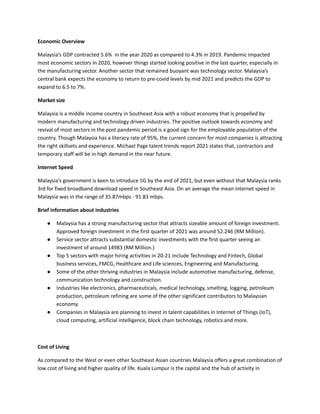
Economic Overview
Malaysia’s GDPcontracted 5.6% in the year 2020 as compared to 4.3% in 2019. Pandemic impacted
most economic sectors in 2020, however things started looking positive in the last quarter, especially in
the manufacturing sector. Another sector that remained buoyant was technology sector. Malaysia’s
central bank expects the economy to return to pre-covid levels by mid 2021 and predicts the GDP to
expand to 6.5 to 7%.
Market size
Malaysia is a middle income country in Southeast Asia with a robust economy that is propelled by
modern manufacturing and technology driven industries. The positive outlook towards economy and
revival of most sectors in the post pandemic period is a good sign for the employable population of the
country. Though Malaysia has a literacy rate of 95%, the current concern for most companies is attracting
the right skillsets and experience. Michael Page talent trends report 2021 states that, contractors and
temporary staff will be in high demand in the near future.
Internet Speed
Malaysia’s government is keen to introduce 5G by the end of 2021, but even without that Malaysia ranks
3rd for fixed broadband download speed in Southeast Asia. On an average the mean internet speed in
Malaysia was in the range of 35.87mbps - 91.83 mbps.
Brief information about industries
● Malaysia has a strong manufacturing sector that attracts sizeable amount of foreign investment.
Approved foreign investment in the first quarter of 2021 was around 52.246 (RM Million).
● Service sector attracts substantial domestic investments with the first quarter seeing an
investment of around 14983 (RM Million.)
● Top 5 sectors with major hiring activities in 20-21 include Technology and Fintech, Global
business services, FMCG, Healthcare and Life sciences, Engineering and Manufacturing.
● Some of the other thriving industries in Malaysia include automotive manufacturing, defense,
communication technology and construction.
● Industries like electronics, pharmaceuticals, medical technology, smelting, logging, petroleum
production, petroleum refining are some of the other significant contributors to Malaysian
economy.
● Companies in Malaysia are planning to invest in talent capabilities in Internet of Things (IoT),
cloud computing, artificial intelligence, block chain technology, robotics and more.
Cost of Living
As compared to the West or even other Southeast Asian countries Malaysia offers a great combination of
low cost of living and higher quality of life. Kuala Lumpur is the capital and the hub of activity in
6.
Malaysia. While otherliving expenses are similar across Malaysia, the rents are higher in Kuala Lumpur.
Another cost that can add up for expats and students is the currency conversion.
The average cost may also wary depending on the composition of your family. If you are single or a
university student the costs may be different as compared to a family of four. The average cost of living in
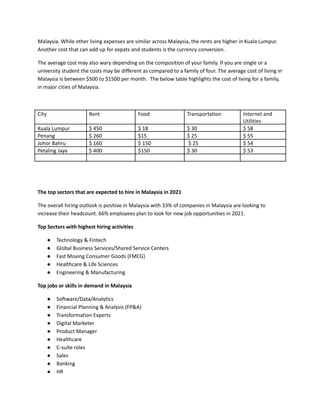
Malaysia is between $500 to $1500 per month. The below table highlights the cost of living for a family,
in major cities of Malaysia.
City Rent Food Transportation Internet and
Utilities
Kuala Lumpur $ 450 $ 18 $ 30 $ 58
Penang $ 260 $15 $ 25 $ 55
Johor Bahru $ 160 $ 150 $ 25 $ 54
Petaling Jaya $ 400 $150 $ 30 $ 53
The top sectors that are expected to hire in Malaysia in 2021
The overall hiring outlook is positive in Malaysia with 33% of companies in Malaysia are looking to
increase their headcount. 66% employees plan to look for new job opportunities in 2021.
Top Sectors with highest hiring activities
● Technology & Fintech
● Global Business Services/Shared Service Centers
● Fast Moving Consumer Goods (FMCG)
● Healthcare & Life Sciences
● Engineering & Manufacturing
Top jobs or skills in demand in Malaysia
● Software/Data/Analytics
● Financial Planning & Analysis (FP&A)
● Transformation Experts
● Digital Marketer
● Product Manager
● Healthcare
● C-suite roles
● Sales
● Banking
● HR
7.
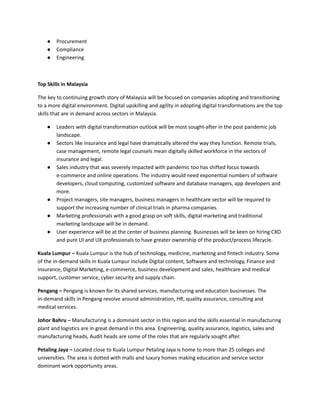
● Procurement
● Compliance
●Engineering
Top Skills in Malaysia
The key to continuing growth story of Malaysia will be focused on companies adopting and transitioning
to a more digital environment. Digital upskilling and agility in adopting digital transformations are the top
skills that are in demand across sectors in Malaysia.
● Leaders with digital transformation outlook will be most sought-after in the post pandemic job
landscape.
● Sectors like insurance and legal have dramatically altered the way they function. Remote trials,
case management, remote legal counsels mean digitally skilled workforce in the sectors of
insurance and legal.
● Sales industry that was severely impacted with pandemic too has shifted focus towards
e-commerce and online operations. The industry would need exponential numbers of software
developers, cloud computing, customized software and database managers, app developers and
more.
● Project managers, site managers, business managers in healthcare sector will be required to
support the increasing number of clinical trials in pharma companies.
● Marketing professionals with a good grasp on soft skills, digital marketing and traditional
marketing landscape will be in demand.
● User experience will be at the center of business planning. Businesses will be keen on hiring CXO
and pure UI and UX professionals to have greater ownership of the product/process lifecycle.
Kuala Lumpur – Kuala Lumpur is the hub of technology, medicine, marketing and fintech industry. Some
of the in-demand skills in Kuala Lumpur include Digital content, Software and technology, Finance and
Insurance, Digital Marketing, e-commerce, business development and sales, healthcare and medical
support, customer service, cyber security and supply chain.
Pengang – Pengang is known for its shared services, manufacturing and education businesses. The
in-demand skills in Pengang revolve around administration, HR, quality assurance, consulting and
medical services.
Johor Bahru – Manufacturing is a dominant sector in this region and the skills essential in manufacturing
plant and logistics are in great demand in this area. Engineering, quality assurance, logistics, sales and
manufacturing heads, Audit heads are some of the roles that are regularly sought after.
Petaling Jaya – Located close to Kuala Lumpur Petaling Jaya is home to more than 25 colleges and
universities. The area is dotted with malls and luxury homes making education and service sector
dominant work opportunity areas.
8.
Hiring Cost
If youare an employer from a country other than Malaysia, then it is important that you set up a legal
entity in Malaysia before hiring local talent. Another important cost that needs to be considered is the
legal assistance. To remain compliant with local laws, it is important that you hire a legal expert in
Malaysia.
Hiring Costs to be considered in Malaysia
● Company registration costs
● Legal assistance costs
● Expenses involved in screening, interviewing and onboarding new employees
● Travel expenses to interview candidates
● Advertising expenses for job posting
● Background Checks
Salary structure for various roles:
The median salary range for Malaysian employees is from MYR 1758.00 to MYR 6226.00. Performance
related bonuses form an important component of Malaysian salaries. As per the recent survey by
Michael Page, 72% of respondents said remunerations and benefits is an important consideration while
accepting a job offer.
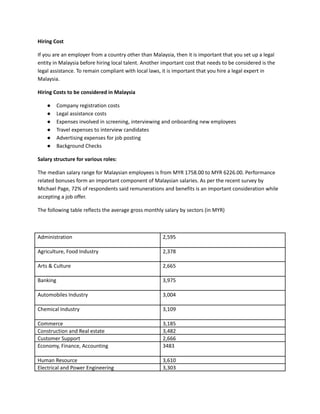
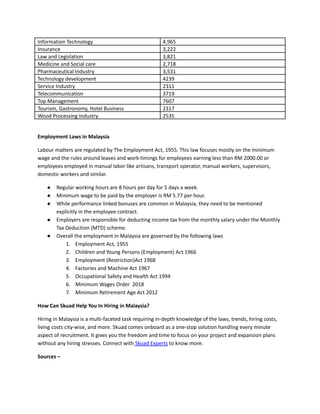
The following table reflects the average gross monthly salary by sectors (in MYR)
Administration 2,595
Agriculture, Food Industry 2,378
Arts & Culture 2,665
Banking 3,975
Automobiles Industry 3,004
Chemical Industry 3,109
Commerce 3,185
Construction and Real estate 3,482
Customer Support 2,666
Economy, Finance, Accounting 3483
Human Resource 3,610
Electrical and Power Engineering 3,303
9.
Information Technology 4,965
Insurance3,222
Law and Legislation 3,821
Medicine and Social care 2,718
Pharmaceutical Industry 3,531
Technology development 4239
Service Industry 2311
Telecommunication 3719
Top Management 7607
Tourism, Gastronomy, Hotel Business 2317
Wood Processing Industry 2535
Employment Laws in Malaysia
Labour matters are regulated by The Employment Act, 1955. This law focuses mostly on the minimum
wage and the rules around leaves and work-timings for employees earning less than RM 2000.00 or
employees employed in manual labor like artisans, transport operator, manual workers, supervisors,
domestic workers and similar.
● Regular working hours are 8 hours per day for 5 days a week.
● Minimum wage to be paid by the employer is RM 5.77 per hour.
● While performance linked bonuses are common in Malaysia, they need to be mentioned
explicitly in the employee contract.
● Employers are responsible for deducting income tax from the monthly salary under the Monthly
Tax Deduction (MTD) scheme.
● Overall the employment in Malaysia are governed by the following laws
1. Employment Act, 1955
2. Children and Young Persons (Employment) Act 1966
3. Employment (Restriction)Act 1968
4. Factories and Machine Act 1967
5. Occupational Safety and Health Act 1994
6. Minimum Wages Order 2018
7. Minimum Retirement Age Act 2012
How Can Skuad Help You In Hiring in Malaysia?
Hiring in Malaysia is a multi-faceted task requiring in-depth knowledge of the laws, trends, hiring costs,
living costs city-wise, and more. Skuad comes onboard as a one-stop solution handling every minute
aspect of recruitment. It gives you the freedom and time to focus on your project and expansion plans
without any hiring stresses. Connect with Skuad Experts to know more.
Sources –
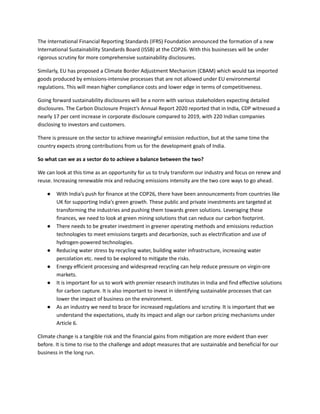
The International FinancialReporting Standards (IFRS) Foundation announced the formation of a new
International Sustainability Standards Board (ISSB) at the COP26. With this businesses will be under
rigorous scrutiny for more comprehensive sustainability disclosures.
Similarly, EU has proposed a Climate Border Adjustment Mechanism (CBAM) which would tax imported
goods produced by emissions-intensive processes that are not allowed under EU environmental
regulations. This will mean higher compliance costs and lower edge in terms of competitiveness.
Going forward sustainability disclosures will be a norm with various stakeholders expecting detailed
disclosures. The Carbon Disclosure Project’s Annual Report 2020 reported that in India, CDP witnessed a
nearly 17 per cent increase in corporate disclosure compared to 2019, with 220 Indian companies
disclosing to investors and customers.
There is pressure on the sector to achieve meaningful emission reduction, but at the same time the
country expects strong contributions from us for the development goals of India.
So what can we as a sector do to achieve a balance between the two?
We can look at this time as an opportunity for us to truly transform our industry and focus on renew and
reuse. Increasing renewable mix and reducing emissions intensity are the two core ways to go ahead.
● With India’s push for finance at the COP26, there have been announcements from countries like
UK for supporting India’s green growth. These public and private investments are targeted at
transforming the industries and pushing them towards green solutions. Leveraging these
finances, we need to look at green mining solutions that can reduce our carbon footprint.
● There needs to be greater investment in greener operating methods and emissions reduction
technologies to meet emissions targets and decarbonize, such as electrification and use of
hydrogen-powered technologies.
● Reducing water stress by recycling water, building water infrastructure, increasing water
percolation etc. need to be explored to mitigate the risks.
● Energy efficient processing and widespread recycling can help reduce pressure on virgin-ore
markets.
● It is important for us to work with premier research institutes in India and find effective solutions
for carbon capture. It is also important to invest in identifying sustainable processes that can
lower the impact of business on the environment.
● As an industry we need to brace for increased regulations and scrutiny. It is important that we
understand the expectations, study its impact and align our carbon pricing mechanisms under
Article 6.
Climate change is a tangible risk and the financial gains from mitigation are more evident than ever
before. It is time to rise to the challenge and adopt measures that are sustainable and beneficial for our
business in the long run.
12.
Sample 5
Needfor Skills, Are Skills enough or does
one need something more than Skills to
perform
Dictionary meaning of skill is the ability to do something well, expertise
However, I don’t think skill ends with that. This is something that I like to call the first level of
skilling. Cooking, Housekeeping, accounting, customer service, interviewing, email writing are
all skills. The first level skills are something that can be taught and are taught at various levels of
formal education.
Most of us know the basics of the above mentioned skills. Some of us might have grown
proficient in a couple of them over the years, but these are not something that will be enough
to perform and succeed.
So if you are in finance and you know accounting, you definitely know what is needed to
perform your daily duties, however if you dream of heading the finance department someday,
just accounting knowledge is not going to help.
I believe there are three levels to skilling
● Basic Skills
● Skills for Mastery
● Skills to Succeed
The first one is the beginner skill that gives you enough to start a job. The next level is where
you are skilling up to ensure that you are in sync with that is happening in your field, are
learning a few allied skills that will help you stay ahead or make you an expert in your domain or
ready you for your next career pivot. Finally there are a few skills that you will learn by
observation and by self-actualization. These skills are crucial to succeed and be a leader.
There are two kinds of people in this world. Some who believe that once the first level skilling is
done or they have attained proficiency in a particular field/skill there is nothing more to learn.
They grow complacent. At this stage the person will stop growing in knowledge and career. They
will reach a stagnation point and beyond that I suspect they will also lose the joy of working.
13.
Then there areothers who will learn continuously. They will self-evaluate to understand their
strengths, needs of their profile and keep learning to improve on these strengths. They will
continue to acquire new skills that will take them to the next level or help them pivot to a
different goal. Always aim to be the second kind of people.
Are Skills Enough to Perform?
Let us start by accepting that skills are essential for any task. However are skills enough is a
question that needs dwelling upon. When we learn a skill, we need to be able to apply it. Only
after its application in the real world or your day to day business can you claim to be proficient
in it or be ready for the next position. The only way to know if you are ready to take on the next
role is by doing them proactively.
There is another way of looking at this. When you decide to learn a new skill, check your
readiness and the need for it in your current or next role. A skill that cannot be applied is
knowledge that is in cold storage. If you are in HR, learning to code might not really help you go
higher in your chosen career of HR, but if you are planning to be a coder and pivot your career
then it might be useful.
Finally there is the third level of skills that are behavioral or competency based. These latent
skills need to be harnessed and chiseled to form future leaders who will shape the organization.
These are also called soft skills by many.
Learnability, resilience, agility, empathy are the mark of a good leader. These attitudes, skills or
behaviors as you wish to call them are something that you can learn by observation and
self-assertion. Similarly, written and verbal communication, problem-solving, negotiation,
creativity are competencies that can be developed by formal and applied education.
To sum it up, are skills important – Yes, Can they be learnt – definitely, are skills enough – Never.
I leave you with a very profound quote by John F Kennedy, "Leadership and learning are
indispensable to each other."
If you aim to be a leader, never stop learning and applying the knowledge that you gain in
training others, to help them grow.