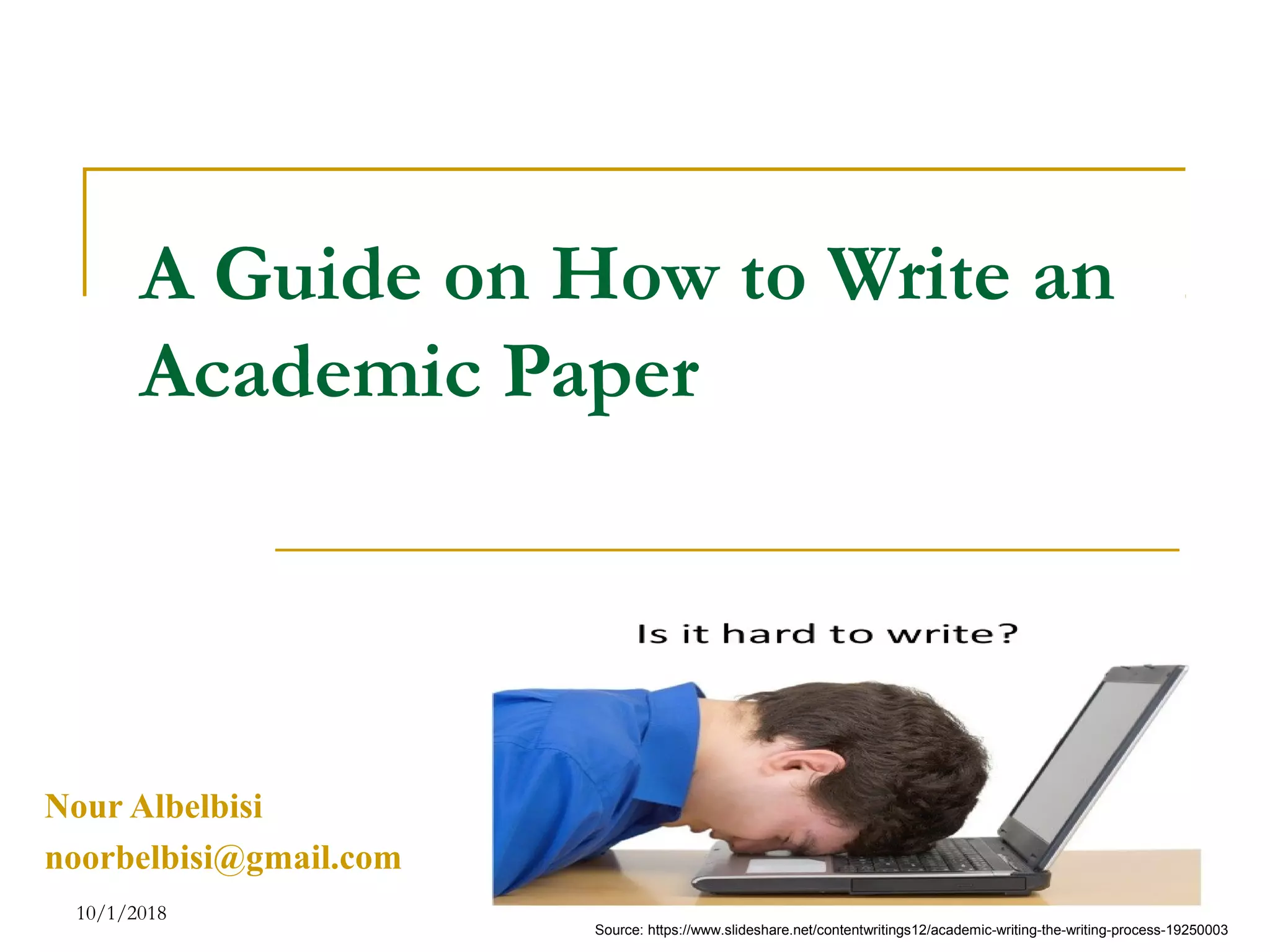

A Guide on How to Write an
Academic Paper
Nour Albelbisi
noorbelbisi@gmail.com
10/1/2018
Source: https://www.slideshare.net/contentwritings12/academic-writing-the-writing-process-19250003
What is a research paper?
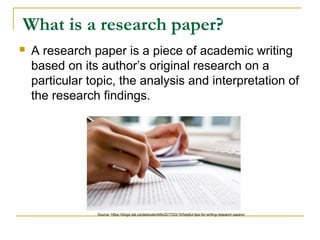
 A research paper is a piece of academic writing
based on its author’s original research on a
particular topic, the analysis and interpretation of
the research findings.
Source: https://blogs.dal.ca/dalstudentlife/2017/03/15/helpful-tips-for-writing-research-papers/
11/07/18
How To Start writing a Research Paper?
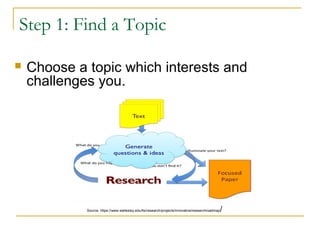
 Choose a topic which interests and
challenges you.
Source: https://www.wellesley.edu/lts/research/projects/innovative/researchroadmap/
Step 1: Find a Topic
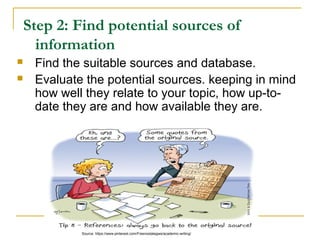
Step 2: Find potential sources of
information
 Find the suitable sources and database.
 Evaluate the potential sources. keeping in mind
how well they relate to your topic, how up-to-
date they are and how available they are.
Source: https://www.pinterest.com/Fresnostategws/academic-writing/
Step 3: Determine your problem
statement
 A problem statement is a key idea, a central
point of your research paper. The arguments
you provide in your paper should be based on
this idea.
 Do some critical thinking and write your
problem statement in one sentence.
Source: https://studybreaks.com/2017/04/27/edit/
Step 4: Take notes
 You should take notes on ideas and
concepts that you think are important to
include in your paper. You also can include
supporting examples that you think would be
helpful to refer to.
Source :https://www.pinterest.co.uk/thomassonm/dissertation/
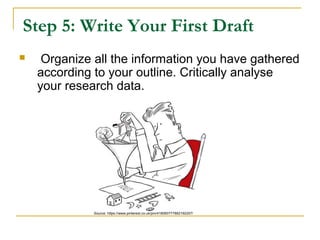
Step 5: Write Your First Draft
 Organize all the information you have gathered
according to your outline. Critically analyse
your research data.
Source: https://www.pinterest.co.uk/pin/418060777882192257/
Step 6: Follow the Outline of the
Research Paper The Title
 Abstract
 Keywords
 Introduction
 Literature review
 Methods
 Population / Sampling strategy
 Data collection instruments and procedures
 Results
 Discussion
 Conclusions
 Acknowledgements:
 References
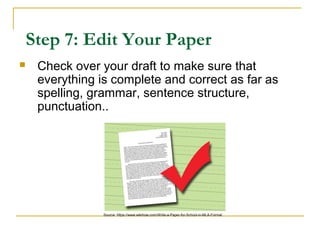
Step 7: Edit Your Paper
 Check over your draft to make sure that
everything is complete and correct as far as
spelling, grammar, sentence structure,
punctuation..
Source: https://www.wikihow.com/Write-a-Paper-for-School-in-MLA-Format
Step 8: Select a Journal
 Each journal specializes in a specific area of
research.
 Select 2 or 3 journals in the chosen area with
relatively high impact factors.
 Discuss with your supervisor  and decide on the
journal.
 Find out the journal’s submission criteria and format.
Source: https://awayofhappening.wordpress.com/2015/11/27/web-of-science-scopus-and-open-access-what-they-are-doing-right-and-what-they-are-doing-wrong/
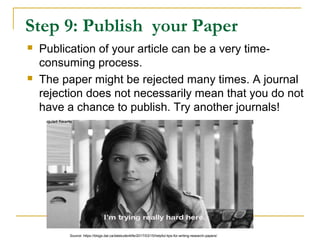
Step 9: Publish your Paper
 Publication of your article can be a very time-
consuming process.
 The paper might be rejected many times. A journal
rejection does not necessarily mean that you do not
have a chance to publish. Try another journals!
Source: https://blogs.dal.ca/dalstudentlife/2017/03/15/helpful-tips-for-writing-research-papers/
For More Information
 http://student-tutor.com/blog/how-to-write-a-
research-paper-in-11-steps/
 http://www.aresearchguide.com/1steps.html#ste
p8
 https://www.esc.edu/online-writing-
center/resources/research/research-paper-
steps/
Thank you 
noorbelbisi@gmail.com

How to write research paper

  • 1.
    A Guide onHow to Write an Academic Paper Nour Albelbisi noorbelbisi@gmail.com 10/1/2018 Source: https://www.slideshare.net/contentwritings12/academic-writing-the-writing-process-19250003
  • 2.
    What is aresearch paper?  A research paper is a piece of academic writing based on its author’s original research on a particular topic, the analysis and interpretation of the research findings. Source: https://blogs.dal.ca/dalstudentlife/2017/03/15/helpful-tips-for-writing-research-papers/
  • 3.
    11/07/18 How To Startwriting a Research Paper?
  • 4.
     Choose atopic which interests and challenges you. Source: https://www.wellesley.edu/lts/research/projects/innovative/researchroadmap/ Step 1: Find a Topic
  • 5.
    Step 2: Findpotential sources of information  Find the suitable sources and database.  Evaluate the potential sources. keeping in mind how well they relate to your topic, how up-to- date they are and how available they are. Source: https://www.pinterest.com/Fresnostategws/academic-writing/
  • 6.
    Step 3: Determineyour problem statement  A problem statement is a key idea, a central point of your research paper. The arguments you provide in your paper should be based on this idea.  Do some critical thinking and write your problem statement in one sentence. Source: https://studybreaks.com/2017/04/27/edit/
  • 7.
    Step 4: Takenotes  You should take notes on ideas and concepts that you think are important to include in your paper. You also can include supporting examples that you think would be helpful to refer to. Source :https://www.pinterest.co.uk/thomassonm/dissertation/
  • 8.
    Step 5: WriteYour First Draft  Organize all the information you have gathered according to your outline. Critically analyse your research data. Source: https://www.pinterest.co.uk/pin/418060777882192257/
  • 9.
    Step 6: Followthe Outline of the Research Paper The Title  Abstract  Keywords  Introduction  Literature review  Methods  Population / Sampling strategy  Data collection instruments and procedures  Results  Discussion  Conclusions  Acknowledgements:  References
  • 10.
    Step 7: EditYour Paper  Check over your draft to make sure that everything is complete and correct as far as spelling, grammar, sentence structure, punctuation.. Source: https://www.wikihow.com/Write-a-Paper-for-School-in-MLA-Format
  • 11.
    Step 8: Selecta Journal  Each journal specializes in a specific area of research.  Select 2 or 3 journals in the chosen area with relatively high impact factors.  Discuss with your supervisor  and decide on the journal.  Find out the journal’s submission criteria and format. Source: https://awayofhappening.wordpress.com/2015/11/27/web-of-science-scopus-and-open-access-what-they-are-doing-right-and-what-they-are-doing-wrong/
  • 12.
    Step 9: Publishyour Paper  Publication of your article can be a very time- consuming process.  The paper might be rejected many times. A journal rejection does not necessarily mean that you do not have a chance to publish. Try another journals! Source: https://blogs.dal.ca/dalstudentlife/2017/03/15/helpful-tips-for-writing-research-papers/
  • 13.
    For More Information http://student-tutor.com/blog/how-to-write-a- research-paper-in-11-steps/  http://www.aresearchguide.com/1steps.html#ste p8  https://www.esc.edu/online-writing- center/resources/research/research-paper- steps/
  • 14.