How to write a
CED plan
Read this if you want to learn:
1. Why have a plan?
2. What do we mean by CED?
3. Writing your plan
4. What a good plan looks like
5. Checklist
Why have a plan?
Your Community Economic Development (CED) Plan is intended to help residents, local business
and public sector organisations map out how to achieve real economic change in their area –
whether this is in food, housing, finance, energy or any other local economic opportunities.
The plan can help …
• To involve a range of people, groups and organisations in discussions of how to improve their
local economy
• To attract funding
• To think in a structured way about how you tackle problems and achieve real economic change
• To show the difference you have already made
What do we mean by CED?
Building a strong local economy means not only looking at the economic effect of activities but
also their social and environmental impact. These three areas are called the ‘triple bottom
line’, against which we want to measure the success of the local economic system.
For example, Ed and Gemma run Recycling a (fictional) social enterprise run as a non-profit.
They get income by offering local unemployed people the chance to earn a living repairing and
reselling old bikes. The business earns a profit, which is re-invested back into the community.
The social benefit is meaningful employment for local people out of work, and a reduction in
society's welfare bill. The environmental benefit comes from recycling old bikes.
Writing your plan
This guide will walk you through each of the key topics you will need to cover in your final plan
and offer some helpful reminders of what to include and check.
Firstly, it’s important to make sure your plan is written in way that everyone in your local
community can understand it.
• Keep your message clear, simple and tangible - even if the issue is complex
• Use plain-English, avoid jargon and acronyms
• Always stick to the most important information - what does the reader ‘need to know’?
• Ask someone else to proofread it before others see it
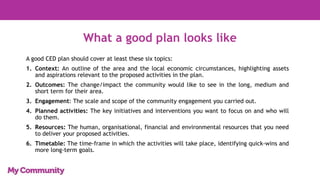
What a good plan looks like
A good CED plan should cover at least these six topics:
1. Context: An outline of the area and the local economic circumstances, highlighting assets
and aspirations relevant to the proposed activities in the plan.
2. Outcomes: The change/impact the community would like to see in the long, medium and
short term for their area.
3. Engagement: The scale and scope of the community engagement you carried out.
4. Planned activities: The key initiatives and interventions you want to focus on and who will
do them.
5. Resources: The human, organisational, financial and environmental resources that you need
to deliver your proposed activities.
6. Timetable: The time-frame in which the activities will take place, identifying quick-wins and
more long-term goals.
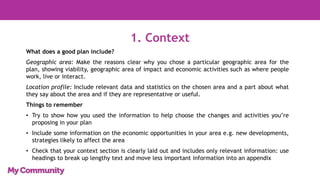
1. Context
What does a good plan include?
Geographic area: Make the reasons clear why you chose a particular geographic area for the
plan, showing viability, geographic area of impact and economic activities such as where people
work, live or interact.
Location profile: Include relevant data and statistics on the chosen area and a part about what
they say about the area and if they are representative or useful.
Things to remember
• Try to show how you used the information to help choose the changes and activities you’re
proposing in your plan
• Include some information on the economic opportunities in your area e.g. new developments,
strategies likely to affect the area
• Check that your context section is clearly laid out and includes only relevant information: use
headings to break up lengthy text and move less important information into an appendix
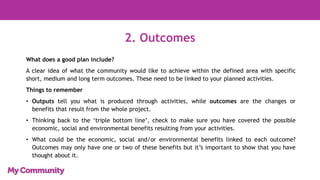
2. Outcomes
What does a good plan include?
A clear idea of what the community would like to achieve within the defined area with specific
short, medium and long term outcomes. These need to be linked to your planned activities.
Things to remember
• Outputs tell you what is produced through activities, while outcomes are the changes or
benefits that result from the whole project.
• Thinking back to the ‘triple bottom line’, check to make sure you have covered the possible
economic, social and environmental benefits resulting from your activities.
• What could be the economic, social and/or environmental benefits linked to each outcome?
Outcomes may only have one or two of these benefits but it’s important to show that you have
thought about it.
2. Outcomes
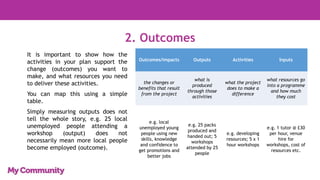
It is important to show how the
activities in your plan support the
change (outcomes) you want to
make, and what resources you need
to deliver these activities.
You can map this using a simple
table.
Simply measuring outputs does not
tell the whole story, e.g. 25 local
unemployed people attending a
workshop (output) does not
necessarily mean more local people
become employed (outcome).
Outcomes/impacts Outputs Activities Inputs
the changes or
benefits that result
from the project
what is
produced
through those
activities
what the project
does to make a
difference
what resources go
into a programme
and how much
they cost
e.g. local
unemployed young
people using new
skills, knowledge
and confidence to
get promotions and
better jobs
e.g. 25 packs
produced and
handed out; 5
workshops
attended by 25
people
e.g. developing
resources; 5 x 1
hour workshops
e.g. 1 tutor @ £30
per hour, venue
hire for
workshops, cost of
resources etc.
3. Engagement
What does a good plan include?
An overview of how you engaged with your community to develop and build wider support for
the plan up until now, and to deliver the plan in the future. It should also explain what other
groups, bodies, organisations and structures you need to talk to / need to be brought together to
deliver the outcomes you want.
Things to remember
• Have you described who you engaged with and how you engaged with them including any
existing relationships not created as a result of the CED programme?
• How did engaging with people, groups and organisations help to think about the activities you
want to do and outcomes you want?
• If you haven’t done any engagement activities or they have not been planned, include how
people will be involved in delivering your plan through your planned activities
4. Planned activities
What does a good plan include?
A summary of the main activities that you want to see taking place to develop the local
economy, highlighting how these activities link to the local context and meet your priorities.
Things to remember
• Focus on the economic activities and projects you’ve decided you need in your community as
well as other engagement or fundraising work
• Break down each of your activities into smaller tasks and map these onto your timetable
• Explain why it is important to deliver the activities in the way you are proposing
• Be specific about who is involved in the activities e.g. young unemployed people
• Link your activities to the change you are trying to achieve
5. Resources
What does a good plan include?
You will need to think carefully about all the human, environmental and financial resources you
will need to carry out your activities. You will also need to show how you have calculated these
e.g. capital requirements and sources (potential grant programmes, social investment), how you
will use natural resources efficiently, and how you plan to develop people’s skills to deliver your
proposed activities.
Things to remember
• Make sure you include the resources you will need to put into your activities and where they
are coming from e.g. if you plan on training 20 unemployed people to repair bikes for 3
months you may need to pay for a workspace, equipment, a tutor etc.
• Test the assumptions that you’re making e.g. if you plan on funding the training using grant
money, you will need to apply. If you don’t get the funding, you may need to have another
way to get funding so it is worth describing your backup plan.
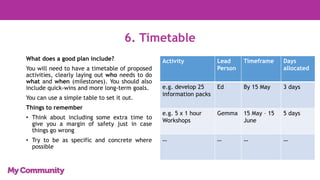
6. Timetable
What does a good plan include?
You will need to have a timetable of proposed
activities, clearly laying out who needs to do
what and when (milestones). You should also
include quick-wins and more long-term goals.
You can use a simple table to set it out.
Things to remember
• Think about including some extra time to
give you a margin of safety just in case
things go wrong
• Try to be as specific and concrete where
possible
Activity Lead
Person
Timeframe Days
allocated
e.g. develop 25
information packs
Ed By 15 May 3 days
e.g. 5 x 1 hour
Workshops
Gemma 15 May – 15
June
5 days
… … … …
Checklist
You can use this handy checklist when writing your final plan:
• Is your plan clear and written in plain-English so that everyone can understand it?
• Have you broken up lengthy text and moved less relevant information into an appendix?
• Do the outcomes cover the ‘triple bottom line’, the possible economic, social and environmental
benefits resulting from your activities?
• How have you engaged/will you engage with people, groups and organisations locally to help
develop your activities and outcomes?
• Have you planned specific economic activities, broken them down into smaller tasks and linked
them to your outcomes?
• What resources will you need to put into your activities and where are they coming from?
• Are there significant risks, or have you made certain assumptions, which may stop activities in your
plan from happening? Do you need to include any backup activities?
mycommunity.org.uk
@mycommunityhelp
#mycommunityhelp
My Community Rights

How to write a CED plan

  • 1.
    How to writea CED plan Read this if you want to learn: 1. Why have a plan? 2. What do we mean by CED? 3. Writing your plan 4. What a good plan looks like 5. Checklist
  • 2.
    Why have aplan? Your Community Economic Development (CED) Plan is intended to help residents, local business and public sector organisations map out how to achieve real economic change in their area – whether this is in food, housing, finance, energy or any other local economic opportunities. The plan can help … • To involve a range of people, groups and organisations in discussions of how to improve their local economy • To attract funding • To think in a structured way about how you tackle problems and achieve real economic change • To show the difference you have already made
  • 3.
    What do wemean by CED? Building a strong local economy means not only looking at the economic effect of activities but also their social and environmental impact. These three areas are called the ‘triple bottom line’, against which we want to measure the success of the local economic system. For example, Ed and Gemma run Recycling a (fictional) social enterprise run as a non-profit. They get income by offering local unemployed people the chance to earn a living repairing and reselling old bikes. The business earns a profit, which is re-invested back into the community. The social benefit is meaningful employment for local people out of work, and a reduction in society's welfare bill. The environmental benefit comes from recycling old bikes.
  • 4.
    Writing your plan Thisguide will walk you through each of the key topics you will need to cover in your final plan and offer some helpful reminders of what to include and check. Firstly, it’s important to make sure your plan is written in way that everyone in your local community can understand it. • Keep your message clear, simple and tangible - even if the issue is complex • Use plain-English, avoid jargon and acronyms • Always stick to the most important information - what does the reader ‘need to know’? • Ask someone else to proofread it before others see it
  • 5.
    What a goodplan looks like A good CED plan should cover at least these six topics: 1. Context: An outline of the area and the local economic circumstances, highlighting assets and aspirations relevant to the proposed activities in the plan. 2. Outcomes: The change/impact the community would like to see in the long, medium and short term for their area. 3. Engagement: The scale and scope of the community engagement you carried out. 4. Planned activities: The key initiatives and interventions you want to focus on and who will do them. 5. Resources: The human, organisational, financial and environmental resources that you need to deliver your proposed activities. 6. Timetable: The time-frame in which the activities will take place, identifying quick-wins and more long-term goals.
  • 6.
    1. Context What doesa good plan include? Geographic area: Make the reasons clear why you chose a particular geographic area for the plan, showing viability, geographic area of impact and economic activities such as where people work, live or interact. Location profile: Include relevant data and statistics on the chosen area and a part about what they say about the area and if they are representative or useful. Things to remember • Try to show how you used the information to help choose the changes and activities you’re proposing in your plan • Include some information on the economic opportunities in your area e.g. new developments, strategies likely to affect the area • Check that your context section is clearly laid out and includes only relevant information: use headings to break up lengthy text and move less important information into an appendix
  • 7.
    2. Outcomes What doesa good plan include? A clear idea of what the community would like to achieve within the defined area with specific short, medium and long term outcomes. These need to be linked to your planned activities. Things to remember • Outputs tell you what is produced through activities, while outcomes are the changes or benefits that result from the whole project. • Thinking back to the ‘triple bottom line’, check to make sure you have covered the possible economic, social and environmental benefits resulting from your activities. • What could be the economic, social and/or environmental benefits linked to each outcome? Outcomes may only have one or two of these benefits but it’s important to show that you have thought about it.
  • 8.
    2. Outcomes It isimportant to show how the activities in your plan support the change (outcomes) you want to make, and what resources you need to deliver these activities. You can map this using a simple table. Simply measuring outputs does not tell the whole story, e.g. 25 local unemployed people attending a workshop (output) does not necessarily mean more local people become employed (outcome). Outcomes/impacts Outputs Activities Inputs the changes or benefits that result from the project what is produced through those activities what the project does to make a difference what resources go into a programme and how much they cost e.g. local unemployed young people using new skills, knowledge and confidence to get promotions and better jobs e.g. 25 packs produced and handed out; 5 workshops attended by 25 people e.g. developing resources; 5 x 1 hour workshops e.g. 1 tutor @ £30 per hour, venue hire for workshops, cost of resources etc.
  • 9.
    3. Engagement What doesa good plan include? An overview of how you engaged with your community to develop and build wider support for the plan up until now, and to deliver the plan in the future. It should also explain what other groups, bodies, organisations and structures you need to talk to / need to be brought together to deliver the outcomes you want. Things to remember • Have you described who you engaged with and how you engaged with them including any existing relationships not created as a result of the CED programme? • How did engaging with people, groups and organisations help to think about the activities you want to do and outcomes you want? • If you haven’t done any engagement activities or they have not been planned, include how people will be involved in delivering your plan through your planned activities
  • 10.
    4. Planned activities Whatdoes a good plan include? A summary of the main activities that you want to see taking place to develop the local economy, highlighting how these activities link to the local context and meet your priorities. Things to remember • Focus on the economic activities and projects you’ve decided you need in your community as well as other engagement or fundraising work • Break down each of your activities into smaller tasks and map these onto your timetable • Explain why it is important to deliver the activities in the way you are proposing • Be specific about who is involved in the activities e.g. young unemployed people • Link your activities to the change you are trying to achieve
  • 11.
    5. Resources What doesa good plan include? You will need to think carefully about all the human, environmental and financial resources you will need to carry out your activities. You will also need to show how you have calculated these e.g. capital requirements and sources (potential grant programmes, social investment), how you will use natural resources efficiently, and how you plan to develop people’s skills to deliver your proposed activities. Things to remember • Make sure you include the resources you will need to put into your activities and where they are coming from e.g. if you plan on training 20 unemployed people to repair bikes for 3 months you may need to pay for a workspace, equipment, a tutor etc. • Test the assumptions that you’re making e.g. if you plan on funding the training using grant money, you will need to apply. If you don’t get the funding, you may need to have another way to get funding so it is worth describing your backup plan.
  • 12.
    6. Timetable What doesa good plan include? You will need to have a timetable of proposed activities, clearly laying out who needs to do what and when (milestones). You should also include quick-wins and more long-term goals. You can use a simple table to set it out. Things to remember • Think about including some extra time to give you a margin of safety just in case things go wrong • Try to be as specific and concrete where possible Activity Lead Person Timeframe Days allocated e.g. develop 25 information packs Ed By 15 May 3 days e.g. 5 x 1 hour Workshops Gemma 15 May – 15 June 5 days … … … …
  • 13.
    Checklist You can usethis handy checklist when writing your final plan: • Is your plan clear and written in plain-English so that everyone can understand it? • Have you broken up lengthy text and moved less relevant information into an appendix? • Do the outcomes cover the ‘triple bottom line’, the possible economic, social and environmental benefits resulting from your activities? • How have you engaged/will you engage with people, groups and organisations locally to help develop your activities and outcomes? • Have you planned specific economic activities, broken them down into smaller tasks and linked them to your outcomes? • What resources will you need to put into your activities and where are they coming from? • Are there significant risks, or have you made certain assumptions, which may stop activities in your plan from happening? Do you need to include any backup activities?
  • 14.