Table of Contents
• Overview of Project Management
• Projects and the Strategic Goals of the Organization
a. The art and science of project management
b. The project management perspectives: The
Process Context, The Interpersonal & Behavioral
Context, The Organizational Context
Table of Contents
c. Project Management: Past and Present
d. Understanding Project and Project Management
Overview of Project Management
• People have been undertaking projects since
the earliest days of organized human activity.
• The hunting parties of our prehistoric
ancestors were project.
• Large complex projects such as the pyramids
and the Great Wall of China were in their day
of roughly the same dimensions as the Apollo
project to send men to the moon.
Overview of Project Management
1. Project Attributes
- a project has distinctive attributes that
distinguish it from ongoing work or business
operations.
- Projects are temporary in nature. Its purpose of
a project is to meet its goals and conclude. It is
completed when its goals and objectives are
accomplished.
- Operations are ongoing and repetitive. It keep
the organization functioning.
Overview of Project Management
2. Definition of Project
Project - a temporary endeavor undertaken to create
a unique product, service, or result. Its temporary
nature is indicates a definite beginning and end.
This means that the end is reached when the project’s
objectives have been achieved or when the project is
terminated because its objectives will not or cannot be
met, or when the need for the project no longer exists.
Overview of Project Management
3. Project Characteristics
Projects have several characteristics:
• Projects are unique.
• Projects are temporary in nature and have a
definite beginning and ending date.
• Projects are completed when the project goals
are achieved or it’s determined the project is
no longer viable.
A successful project is one that meets or exceeds the
expectations of the stakeholders.
Overview of Project Management
4. The Process of Project Management
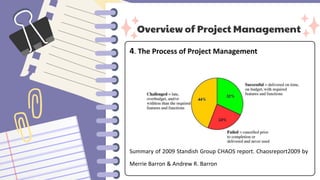
Summary of 2009 Standish Group CHAOS report. Chaosreport2009 by
Merrie Barron & Andrew R. Barron
Overview of Project Management
4. The Process of Project Management
• Project management is the application of
knowledge, skills, tools, and techniques applied to
project activities in order to meet the project
requirements.
• Project management is a process that includes
planning, putting the project plan into action, and
measuring progress and performance.
Overview of Project Management
Project constraints:
• Cost - it is the budget approved for the project including
all necessary expenses needed to deliver the project.
• Scope - is what the project is trying to achieve. It entails
all the work involved in delivering the project outcomes
and the processes used to produce them. It is the reason
and the purpose of the project.
• Quality - is a combination of the standards and criteria to
which the project’s products must be delivered for them
to perform effectively.
Overview of Project Management
Project constraints:
• Risk - is defined by potential external events that will have a
negative impact on your project if they occur. Risk refers to
the combination of the probability the event will occur and
the impact on the project if the event occurs.
• Resources - are required to carry out the project tasks. They
can be people, equipment, facilities, funding, or anything
else capable of definition (usually other than labor)
required for the completion of a project activity.
• Time - is defined as the time to complete the project. Time
is often the most frequent project oversight in developing
projects.
Overview of Project Management
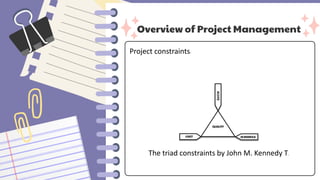
Project constraints:
The triad constraints by John M. Kennedy T.
Overview of Project Management
5. Project Management Expertise
• To manage the competing project constraints and
the project as a whole, there are some areas of
expertise you should bring to the project team:
 knowledge of the application area
 the standards and regulations in your industry
 understanding of the project environment
 general management knowledge and skills
 interpersonal skills
Overview of Project Management
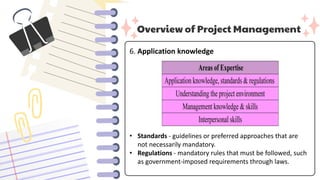
6. Application knowledge
• Standards - guidelines or preferred approaches that are
not necessarily mandatory.
• Regulations - mandatory rules that must be followed, such
as government-imposed requirements through laws.
Overview of Project Management
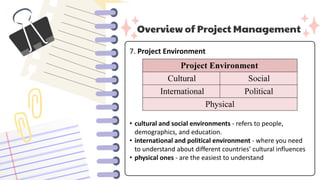
7. Project Environment
• cultural and social environments - refers to people,
demographics, and education.
• international and political environment - where you need
to understand about different countries’ cultural influences
• physical ones - are the easiest to understand
Overview of Project Management
8. Management Knowledge and Skills
• As the project manager, you have to rely on your project
management knowledge and your general management
skills such as your ability to plan the project, execute it
properly, and of course control it and bring it to a
successful conclusion, along with your ability to guide the
project team to achieve project objectives and balance
project constraints.
Overview of Project Management
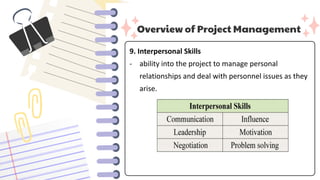
9. Interpersonal Skills
- ability into the project to manage personal
relationships and deal with personnel issues as they
arise.
Overview of Project Management
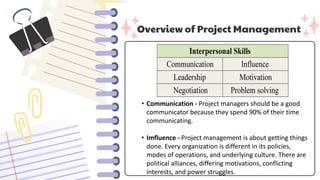
• Communication - Project managers should be a good
communicator because they spend 90% of their time
communicating.
• Imfluence - Project management is about getting things
done. Every organization is different in its policies,
modes of operations, and underlying culture. There are
political alliances, differing motivations, conflicting
interests, and power struggles.
Overview of Project Management
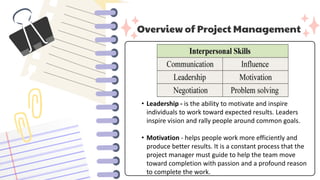
• Leadership - is the ability to motivate and inspire
individuals to work toward expected results. Leaders
inspire vision and rally people around common goals.
• Motivation - helps people work more efficiently and
produce better results. It is a constant process that the
project manager must guide to help the team move
toward completion with passion and a profound reason
to complete the work.
Overview of Project Management
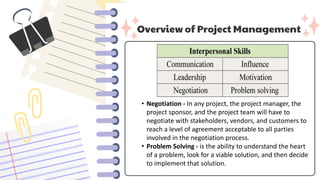
• Negotiation - In any project, the project manager, the
project sponsor, and the project team will have to
negotiate with stakeholders, vendors, and customers to
reach a level of agreement acceptable to all parties
involved in the negotiation process.
• Problem Solving - is the ability to understand the heart
of a problem, look for a viable solution, and then decide
to implement that solution.
The Art and Science of Project management
Project management has two major aspects:
• the art—leading the people on the project. It means that
project management requires a keen knowledge of human
behavior and the ability to skillfully apply appropriate
interpersonal skills.
• the science—defining and coordinating the work to be
done. It involves the knowledge, understanding, and
skillful application of a prescribed project management
process.
Project Management Perspectives
A. the process context
B. the interpersonal and behavioral context
C. the organizational context
Project Management Perspectives
A. Project Management: The Process Context
• Project - a temporary endeavor undertaken to create
a unique product, service, or result. It consists of a
well-defined collection of small jobs (tasks) and
ordinarily culminates in the creation of an end product
or products (deliverables).
• Risk—an ever-present threat to your ability to make
definitive plans and predict outcomes with high levels
of confidence.
Project Management Perspectives
A. Project Management: The Process Context
The Project Management Institute defines project
management as “... the application of knowledge, skills,
tools and techniques to project activities to meet project
requirements” (A Guide to the Project Management Body
of Knowledge, 2000 Edition, Newtown Square, PA: Project
Management Institute, 2000, p.6).
Project Management Perspectives
A. Project Management: The Process Context
4 Phases of Project:
1. Initiation Phase - the need is identified.
2. Planning Phase - project solution is further developed
in as much detail as possible.
3. Execution Phase - the prescribed work is performed
under the watchful eye of the project manager.
4. Close-Out Phase - the emphasis is on verifying that the
project has satisfied or will satisfy the original need.
Project Management Perspectives
A. Project Management: The Process Context
The Project Management Process: Step by Step
1. Identify and frame the problem or opportunity.
2. Identify and define the best project solution.
3. Identify task and resource requirements.
4. Prepare the control schedule and resource allocation
plan.
5. Estimate project costs and prepare a project budget.
6. Analyze risk and establish stakeholder relationships.
7. Maintain control and communicate as needed during
execution.
8. Manage to an orderly close-out.
Project Management Perspectives
B. Project Management: The Interpersonal and
Behavioral Context
The Phenomenon of Project Leadership
• The project leader lives in an environment of constant
uncertainty.
• The project leader must work with this diverse group of
people so that they coalesce into an effective working
team.
• The project leader must be skilled in obtaining
cooperation from other people over whom he or she
does not have direct control.
Project Management Perspectives
B. Project Management: The Interpersonal and
Behavioral Context
Practical Tips for Creating a Motivational Climate
1. Convey the attitude that people and their work are
valued
2. Convey Confidence in People’s Knowledge,Ability, and
Work Ethic
3. Recognize Good Performance
4. Lead by Example
Project Management Perspectives
B. Project Management: The Interpersonal and
Behavioral Context
Managing Diverse Objectives and Perspectives
• You must learn to recognize and discourage all kinds of
personal objectives and be able to focus the entire team
on the overall project objectives.
• Project managers may also have to manage diverse
objectives from outside their project teams (i.e.
suppliers, subcontractors and partners).
Project Management Perspectives
C. Project Management: The Organizational Context
• Overcoming the “Silo Mentality” - it is when people in
an organization tend to think first of the needs,
interests, and goals of their individual departments,
before the needs, interests, and goals of the
organization as a whole.
• One of the best ways to get team members to work
across function lines is by using project management
discipline and applying project management
techniques.
Project Management Perspectives
C. Project Management: The Organizational Context
How Does Your Management View Projects?
• The fundamental objective for a project is to achieve a
business result, such as improving effectiveness,
increasing sales, or making operations more efficient.
• The expectation is that you should manage your project
as if you were a businessperson starting up a small
enterprise.
Project Management Perspectives
C. Project Management: The Organizational Context
What Is Your Organization’s “Level of Maturity”?
The metrics in identifying the level of maturity of an
organization:
• The extent to which project process documentation has
been developed and distributed and is understood
throughout the organization
• The ability of project teams to predict outcomes with
reasonable accuracy
• The efficiency with which projects are executed
• The perceived success rate of projects
• The organization’s ability to learn from its experiences
• The extent of continuous improvement in project
execution over time
Project Management Perspectives
C. Project Management: The Organizational Context
Defining Project Success
Level I: Meeting Project Targets
Level II: Project Efficiency
Level III: Customer or User Utility
Level IV: Organizational Improvement
Project Management: Past and Present
Careers Using Project Management Skills
• Project managers can be seen in many industry sectors
including agriculture and natural resources; arts, media,
and entertainment; building trades and construction;
energy and utilities; engineering and design; fashion
and interiors; finance and business; health and human
services; hospitality, tourism, and recreation;
manufacturing and product development; public and
private education services; public services; retail and
wholesale trade; transportation; and information
technology.
Project Management: Past and Present
Business Owners
• The pillars of project management are delivering a
product/service within schedule, cost, scope, and
quality requirements.
• Understanding the finances, operations, and expenses
of the business are among the skills that project
managers learn and practice.
Project Management: Past and Present
Creative Services
• Creative service careers include graphic artists, curators,
video editors, gaming managers, multimedia artists,
media producers, technical writers, interpreters, and
translators. These positions use project management
skills, especially in handling the delivery channel and
meeting clients’ requirements.
Project Management: Past and Present
Educators
• “Educator” is a broad term that can describe a career in
teaching, maybe being a lecturer, a professor, a tutor, or
a homeschooler.
• Educators provide motivation to learn a new language
or showcase new products and services. Educators use
project management skills including planning and
communication.
Project Management: Past and Present
Engineers
• Engineers use many project management skills,
especially when they must specify functional
requirements. They demonstrate attention to quality as
they evaluate a design’s overall effectiveness, cost,
reliability, and safety similar to the project manager
reviewing the criteria for the customer’s acceptance of
delivery of the product or service.
Project Management: Past and Present
Health Care
• There are many jobs and careers in health care that use
project management skills. Occupations in the field of
health care vary widely, such as athletic trainer, dental
hygienist, massage therapist, occupational therapist,
optometrist, nurse, physician, physician assistant, and
X-ray technician. These individuals actively apply risk
management in providing health care delivery of service
to their clients, ensuring that they do not injure the
person they are caring for
Project Management: Past and Present
Paralegal
• Project management skills such as planning are used in
helping lawyers prepare for closings, hearings, trials,
and corporate meetings. Communication skills are used
in preparing written reports that help attorneys
determine how cases should be handled or drafts for
actions such as pleading, filing motions, and obtaining
affidavits.
Project Management: Past and Present
Software developer
• Software developers us project management skills to
develop the requirements for the software, identify and
track the product development tasks, communicate
within the development team and with clients, test
cases, and manage quality, the schedule, and resources
(staff, equipment, labs, and more).
Project Management: Past and Present
Science Technicians
• Planning skills project managers use can be seen as
science technicians set up, operate, and maintain
laboratory instruments; monitor experiments; and
observe, calculate, and record results. Quality is a factor
here as it is in project management; science technicians
must ensure that processes are performed correctly,
with proper proportions of ingredients, for purity or for
strength and durability.
Project Management: Past and Present
History
• In late 19th century, in the United States, large-scale
government projects were the impetus for making
important decisions that became the basis for project
management methodology such as the transcontinental
railroad, which began construction in the 1860s.
• Henry Gantt, studied in great detail the order of
operations in work and is most famous for developing
the Gantt chart in the 1910s. A Gantt chart (Figure 1.3
MindView Gantt Chart, by Matchware Inc (MindView) )
is a popular type of bar chart that illustrates a project
schedule and has become a common technique for
representing the phases and activities of a project so
they can be understood by a wide audience.
Project Management: Past and Present
History
• By the mid-20th century, projects were managed on an
ad hoc basis using mostly Gantt charts and informal
techniques and tools. During that time, the Manhattan
Project was initiated and its complexity was only
possible because of project management methods. The
Manhattan Project was the code name given to the
Allied effort to develop the first nuclear weapons during
World War II.
Project Management: Past and Present
History
• The 1950s marked the beginning of the modern project
management era. Two mathematical project-scheduling
models were developed. 17 The program evaluation
and review technique (PERT) was developed by Booz-
Allen and Hamilton as part of the United States Navy’s
Polaris missile submarine program.
• PERT is basically a method for analyzing the tasks
involved in completing a project, especially the time
needed to complete each task, the dependencies
among tasks, and the minimum time needed to
complete the total project
Project Management: Past and Present
History
• The critical path method (CPM) was developed in a joint
venture by DuPont Corporation and Remington Rand
Corporation for managing plant maintenance projects.
• Project management in its present form began to take
root a few decades ago. In the early 1960s, industrial
and business organizations began to understand the
benefits of organizing work around projects. They
understood the critical need to communicate and
integrate work across multiple departments and
professions.
CONCLUSION
PPM Report about Project Management (MGD)

PPM Report about Project Management (MGD)

  • 2.
    Table of Contents •Overview of Project Management • Projects and the Strategic Goals of the Organization a. The art and science of project management b. The project management perspectives: The Process Context, The Interpersonal & Behavioral Context, The Organizational Context
  • 3.
    Table of Contents c.Project Management: Past and Present d. Understanding Project and Project Management
  • 4.
    Overview of ProjectManagement • People have been undertaking projects since the earliest days of organized human activity. • The hunting parties of our prehistoric ancestors were project. • Large complex projects such as the pyramids and the Great Wall of China were in their day of roughly the same dimensions as the Apollo project to send men to the moon.
  • 5.
    Overview of ProjectManagement 1. Project Attributes - a project has distinctive attributes that distinguish it from ongoing work or business operations. - Projects are temporary in nature. Its purpose of a project is to meet its goals and conclude. It is completed when its goals and objectives are accomplished. - Operations are ongoing and repetitive. It keep the organization functioning.
  • 6.
    Overview of ProjectManagement 2. Definition of Project Project - a temporary endeavor undertaken to create a unique product, service, or result. Its temporary nature is indicates a definite beginning and end. This means that the end is reached when the project’s objectives have been achieved or when the project is terminated because its objectives will not or cannot be met, or when the need for the project no longer exists.
  • 7.
    Overview of ProjectManagement 3. Project Characteristics Projects have several characteristics: • Projects are unique. • Projects are temporary in nature and have a definite beginning and ending date. • Projects are completed when the project goals are achieved or it’s determined the project is no longer viable. A successful project is one that meets or exceeds the expectations of the stakeholders.
  • 8.
    Overview of ProjectManagement 4. The Process of Project Management Summary of 2009 Standish Group CHAOS report. Chaosreport2009 by Merrie Barron & Andrew R. Barron
  • 9.
    Overview of ProjectManagement 4. The Process of Project Management • Project management is the application of knowledge, skills, tools, and techniques applied to project activities in order to meet the project requirements. • Project management is a process that includes planning, putting the project plan into action, and measuring progress and performance.
  • 10.
    Overview of ProjectManagement Project constraints: • Cost - it is the budget approved for the project including all necessary expenses needed to deliver the project. • Scope - is what the project is trying to achieve. It entails all the work involved in delivering the project outcomes and the processes used to produce them. It is the reason and the purpose of the project. • Quality - is a combination of the standards and criteria to which the project’s products must be delivered for them to perform effectively.
  • 11.
    Overview of ProjectManagement Project constraints: • Risk - is defined by potential external events that will have a negative impact on your project if they occur. Risk refers to the combination of the probability the event will occur and the impact on the project if the event occurs. • Resources - are required to carry out the project tasks. They can be people, equipment, facilities, funding, or anything else capable of definition (usually other than labor) required for the completion of a project activity. • Time - is defined as the time to complete the project. Time is often the most frequent project oversight in developing projects.
  • 12.
    Overview of ProjectManagement Project constraints: The triad constraints by John M. Kennedy T.
  • 13.
    Overview of ProjectManagement 5. Project Management Expertise • To manage the competing project constraints and the project as a whole, there are some areas of expertise you should bring to the project team:  knowledge of the application area  the standards and regulations in your industry  understanding of the project environment  general management knowledge and skills  interpersonal skills
  • 14.
    Overview of ProjectManagement 6. Application knowledge • Standards - guidelines or preferred approaches that are not necessarily mandatory. • Regulations - mandatory rules that must be followed, such as government-imposed requirements through laws.
  • 15.
    Overview of ProjectManagement 7. Project Environment • cultural and social environments - refers to people, demographics, and education. • international and political environment - where you need to understand about different countries’ cultural influences • physical ones - are the easiest to understand
  • 16.
    Overview of ProjectManagement 8. Management Knowledge and Skills • As the project manager, you have to rely on your project management knowledge and your general management skills such as your ability to plan the project, execute it properly, and of course control it and bring it to a successful conclusion, along with your ability to guide the project team to achieve project objectives and balance project constraints.
  • 17.
    Overview of ProjectManagement 9. Interpersonal Skills - ability into the project to manage personal relationships and deal with personnel issues as they arise.
  • 18.
    Overview of ProjectManagement • Communication - Project managers should be a good communicator because they spend 90% of their time communicating. • Imfluence - Project management is about getting things done. Every organization is different in its policies, modes of operations, and underlying culture. There are political alliances, differing motivations, conflicting interests, and power struggles.
  • 19.
    Overview of ProjectManagement • Leadership - is the ability to motivate and inspire individuals to work toward expected results. Leaders inspire vision and rally people around common goals. • Motivation - helps people work more efficiently and produce better results. It is a constant process that the project manager must guide to help the team move toward completion with passion and a profound reason to complete the work.
  • 20.
    Overview of ProjectManagement • Negotiation - In any project, the project manager, the project sponsor, and the project team will have to negotiate with stakeholders, vendors, and customers to reach a level of agreement acceptable to all parties involved in the negotiation process. • Problem Solving - is the ability to understand the heart of a problem, look for a viable solution, and then decide to implement that solution.
  • 22.
    The Art andScience of Project management Project management has two major aspects: • the art—leading the people on the project. It means that project management requires a keen knowledge of human behavior and the ability to skillfully apply appropriate interpersonal skills. • the science—defining and coordinating the work to be done. It involves the knowledge, understanding, and skillful application of a prescribed project management process.
  • 23.
    Project Management Perspectives A.the process context B. the interpersonal and behavioral context C. the organizational context
  • 24.
    Project Management Perspectives A.Project Management: The Process Context • Project - a temporary endeavor undertaken to create a unique product, service, or result. It consists of a well-defined collection of small jobs (tasks) and ordinarily culminates in the creation of an end product or products (deliverables). • Risk—an ever-present threat to your ability to make definitive plans and predict outcomes with high levels of confidence.
  • 25.
    Project Management Perspectives A.Project Management: The Process Context The Project Management Institute defines project management as “... the application of knowledge, skills, tools and techniques to project activities to meet project requirements” (A Guide to the Project Management Body of Knowledge, 2000 Edition, Newtown Square, PA: Project Management Institute, 2000, p.6).
  • 26.
    Project Management Perspectives A.Project Management: The Process Context 4 Phases of Project: 1. Initiation Phase - the need is identified. 2. Planning Phase - project solution is further developed in as much detail as possible. 3. Execution Phase - the prescribed work is performed under the watchful eye of the project manager. 4. Close-Out Phase - the emphasis is on verifying that the project has satisfied or will satisfy the original need.
  • 27.
    Project Management Perspectives A.Project Management: The Process Context The Project Management Process: Step by Step 1. Identify and frame the problem or opportunity. 2. Identify and define the best project solution. 3. Identify task and resource requirements. 4. Prepare the control schedule and resource allocation plan. 5. Estimate project costs and prepare a project budget. 6. Analyze risk and establish stakeholder relationships. 7. Maintain control and communicate as needed during execution. 8. Manage to an orderly close-out.
  • 28.
    Project Management Perspectives B.Project Management: The Interpersonal and Behavioral Context The Phenomenon of Project Leadership • The project leader lives in an environment of constant uncertainty. • The project leader must work with this diverse group of people so that they coalesce into an effective working team. • The project leader must be skilled in obtaining cooperation from other people over whom he or she does not have direct control.
  • 29.
    Project Management Perspectives B.Project Management: The Interpersonal and Behavioral Context Practical Tips for Creating a Motivational Climate 1. Convey the attitude that people and their work are valued 2. Convey Confidence in People’s Knowledge,Ability, and Work Ethic 3. Recognize Good Performance 4. Lead by Example
  • 30.
    Project Management Perspectives B.Project Management: The Interpersonal and Behavioral Context Managing Diverse Objectives and Perspectives • You must learn to recognize and discourage all kinds of personal objectives and be able to focus the entire team on the overall project objectives. • Project managers may also have to manage diverse objectives from outside their project teams (i.e. suppliers, subcontractors and partners).
  • 31.
    Project Management Perspectives C.Project Management: The Organizational Context • Overcoming the “Silo Mentality” - it is when people in an organization tend to think first of the needs, interests, and goals of their individual departments, before the needs, interests, and goals of the organization as a whole. • One of the best ways to get team members to work across function lines is by using project management discipline and applying project management techniques.
  • 32.
    Project Management Perspectives C.Project Management: The Organizational Context How Does Your Management View Projects? • The fundamental objective for a project is to achieve a business result, such as improving effectiveness, increasing sales, or making operations more efficient. • The expectation is that you should manage your project as if you were a businessperson starting up a small enterprise.
  • 33.
    Project Management Perspectives C.Project Management: The Organizational Context What Is Your Organization’s “Level of Maturity”? The metrics in identifying the level of maturity of an organization: • The extent to which project process documentation has been developed and distributed and is understood throughout the organization • The ability of project teams to predict outcomes with reasonable accuracy • The efficiency with which projects are executed • The perceived success rate of projects • The organization’s ability to learn from its experiences • The extent of continuous improvement in project execution over time
  • 34.
    Project Management Perspectives C.Project Management: The Organizational Context Defining Project Success Level I: Meeting Project Targets Level II: Project Efficiency Level III: Customer or User Utility Level IV: Organizational Improvement
  • 35.
    Project Management: Pastand Present Careers Using Project Management Skills • Project managers can be seen in many industry sectors including agriculture and natural resources; arts, media, and entertainment; building trades and construction; energy and utilities; engineering and design; fashion and interiors; finance and business; health and human services; hospitality, tourism, and recreation; manufacturing and product development; public and private education services; public services; retail and wholesale trade; transportation; and information technology.
  • 36.
    Project Management: Pastand Present Business Owners • The pillars of project management are delivering a product/service within schedule, cost, scope, and quality requirements. • Understanding the finances, operations, and expenses of the business are among the skills that project managers learn and practice.
  • 37.
    Project Management: Pastand Present Creative Services • Creative service careers include graphic artists, curators, video editors, gaming managers, multimedia artists, media producers, technical writers, interpreters, and translators. These positions use project management skills, especially in handling the delivery channel and meeting clients’ requirements.
  • 38.
    Project Management: Pastand Present Educators • “Educator” is a broad term that can describe a career in teaching, maybe being a lecturer, a professor, a tutor, or a homeschooler. • Educators provide motivation to learn a new language or showcase new products and services. Educators use project management skills including planning and communication.
  • 39.
    Project Management: Pastand Present Engineers • Engineers use many project management skills, especially when they must specify functional requirements. They demonstrate attention to quality as they evaluate a design’s overall effectiveness, cost, reliability, and safety similar to the project manager reviewing the criteria for the customer’s acceptance of delivery of the product or service.
  • 40.
    Project Management: Pastand Present Health Care • There are many jobs and careers in health care that use project management skills. Occupations in the field of health care vary widely, such as athletic trainer, dental hygienist, massage therapist, occupational therapist, optometrist, nurse, physician, physician assistant, and X-ray technician. These individuals actively apply risk management in providing health care delivery of service to their clients, ensuring that they do not injure the person they are caring for
  • 41.
    Project Management: Pastand Present Paralegal • Project management skills such as planning are used in helping lawyers prepare for closings, hearings, trials, and corporate meetings. Communication skills are used in preparing written reports that help attorneys determine how cases should be handled or drafts for actions such as pleading, filing motions, and obtaining affidavits.
  • 42.
    Project Management: Pastand Present Software developer • Software developers us project management skills to develop the requirements for the software, identify and track the product development tasks, communicate within the development team and with clients, test cases, and manage quality, the schedule, and resources (staff, equipment, labs, and more).
  • 43.
    Project Management: Pastand Present Science Technicians • Planning skills project managers use can be seen as science technicians set up, operate, and maintain laboratory instruments; monitor experiments; and observe, calculate, and record results. Quality is a factor here as it is in project management; science technicians must ensure that processes are performed correctly, with proper proportions of ingredients, for purity or for strength and durability.
  • 44.
    Project Management: Pastand Present History • In late 19th century, in the United States, large-scale government projects were the impetus for making important decisions that became the basis for project management methodology such as the transcontinental railroad, which began construction in the 1860s. • Henry Gantt, studied in great detail the order of operations in work and is most famous for developing the Gantt chart in the 1910s. A Gantt chart (Figure 1.3 MindView Gantt Chart, by Matchware Inc (MindView) ) is a popular type of bar chart that illustrates a project schedule and has become a common technique for representing the phases and activities of a project so they can be understood by a wide audience.
  • 45.
    Project Management: Pastand Present History • By the mid-20th century, projects were managed on an ad hoc basis using mostly Gantt charts and informal techniques and tools. During that time, the Manhattan Project was initiated and its complexity was only possible because of project management methods. The Manhattan Project was the code name given to the Allied effort to develop the first nuclear weapons during World War II.
  • 46.
    Project Management: Pastand Present History • The 1950s marked the beginning of the modern project management era. Two mathematical project-scheduling models were developed. 17 The program evaluation and review technique (PERT) was developed by Booz- Allen and Hamilton as part of the United States Navy’s Polaris missile submarine program. • PERT is basically a method for analyzing the tasks involved in completing a project, especially the time needed to complete each task, the dependencies among tasks, and the minimum time needed to complete the total project
  • 47.
    Project Management: Pastand Present History • The critical path method (CPM) was developed in a joint venture by DuPont Corporation and Remington Rand Corporation for managing plant maintenance projects. • Project management in its present form began to take root a few decades ago. In the early 1960s, industrial and business organizations began to understand the benefits of organizing work around projects. They understood the critical need to communicate and integrate work across multiple departments and professions.
  • 48.

Editor's Notes

  • #6 Projects can last minutes, hours, days, weeks, months, or years.
  • #9 In the United States, more than $250 billion is spent each year on information technology (IT) application development in approximately 175,000 projects. The Standish Group (a Boston-based leader in project and value performance research) released the summary version of their 2009 CHAOS Report that tracks project failure rates across a broad range of companies and industries. Jim Johnson, chairman of the Standish Group, has stated that “this year’s results show a marked decrease in project success rates, with 32% of all projects succeeding which are delivered on time, on budget, with required features and functions, 44% were challenged-which are late, over budget, and/or with less than the required features and functions and 24% failed which are cancelled prior to completion or delivered and never used.
  • #13 In this triangle, each side represents one of the constraints (or related constraints) wherein any changes to any one side cause a change in the other sides. The best projects have a perfectly balanced triangle. Maintaining this balance is difficult because projects are prone to change. For example, if scope increases, cost and time may increase disproportionately. Alternatively, if the amount of money you have for your project decreases, you may be able to do as much, but your time may increase.
  • #16 Project managers in multicultural projects must appreciate the culture dimensions (i.e. Colors which has different meanings in different cultures) and try to learn relevant customs, courtesies, and business protocols before taking responsibility for managing an international project. A project manager must take into consideration these various cultural influences and how they may affect the project’s completion, schedule, scope, and cost.
  • #17 managing a project is similar to running a business: there are risk and rewards, finance and accounting activities, human resource issues, time management, stress management, and a purpose for the project to exist. General management skills are needed in every project.
  • #19 Influence - . A project manager must understand all of the unspoken influences at work within an organization.
  • #20 Leader - A good project manager can motivate and inspire the project team to see the vision and value of the project. Motivation - Motivating the team is accomplished by using a variety of team-building techniques and exercises.
  • #21 The starting point for problem solving is problem definition.
  • #23 The starting point for problem solving is problem definition.
  • #24 The starting point for problem solving is problem definition.
  • #25 The starting point for problem solving is problem definition.
  • #26 The starting point for problem solving is problem definition.
  • #27 Intermediate work products (interim deliverables) are identified, along with the strategy for producing them. Formulating this strategy begins with the definition of the required elements of work (tasks) and the optimum sequence for executing them (the schedule). Progress is continuously monitored and appropriate adjustments are made and recorded as variances from the original plan.
  • #28 Intermediate work products (interim deliverables) are identified, along with the strategy for producing them. Formulating this strategy begins with the definition of the required elements of work (tasks) and the optimum sequence for executing them (the schedule). Progress is continuously monitored and appropriate adjustments are made and recorded as variances from the original plan.
  • #29 As mentioned previously, the art of project management is about dealing with people and about getting work done through other people. So let’s take a closer look at the phenomenon of project leadership.