How to Make A Good
Design
COURSE TITLE: APPLIED ART AND DESIGN
THE IMPORTANCE OF GOOD TASTE
When beauty is expressed in our
surroundings, it becomes a part of our life
and our personality.
Beauty is not determined by the cost, but by
the quality of the objects which are chosen.
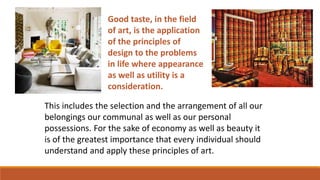
Good taste, in the field
of art, is the application
of the principles of
design to the problems
in life where appearance
as well as utility is a
consideration.
This includes the selection and the arrangement of all our
belongings our communal as well as our personal
possessions. For the sake of economy as well as beauty it
is of the greatest importance that every individual should
understand and apply these principles of art.
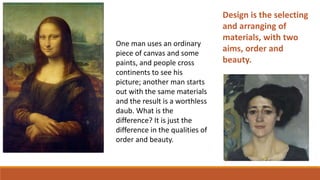
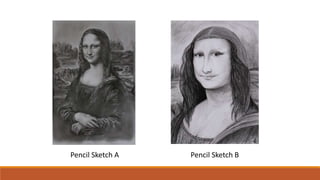
One man uses an ordinary
piece of canvas and some
paints, and people cross
continents to see his
picture; another man starts
out with the same materials
and the result is a worthless
daub. What is the
difference? It is just the
difference in the qualities of
order and beauty.
Design is the selecting
and arranging of
materials, with two
aims, order and
beauty.
Pencil Sketch A Pencil Sketch B
How much would it mean to everyone who selects articles of
clothing and home furnishings to be able to do so according to
the right principles…………
Homemakers, who are planning to furnish their homes, or to
rearrange those already furnished are anxious to have an art basis
for the selection of the new things.
Women wish to know what colors and styles are becoming or
unbecoming;
Salesmen want to tell people confidently, with reasons, that certain
patterns and colors in wall papers, draperies or rugs are good or bad,
where particular colors and patterns are good, and how they should
be combined.
Solution
All such problems call for good taste and can be solved by the application of five fundamental
art principles to the structure of objects and their decoration.
These principles, which can be used as a measuring stick to judge taste are:
(1) harmony
(2) proportion
(3) balance
(4) rhythm
(5) emphasis

How to make a good design

  • 1.
    How to MakeA Good Design COURSE TITLE: APPLIED ART AND DESIGN
  • 2.
    THE IMPORTANCE OFGOOD TASTE When beauty is expressed in our surroundings, it becomes a part of our life and our personality. Beauty is not determined by the cost, but by the quality of the objects which are chosen.
  • 3.
    Good taste, inthe field of art, is the application of the principles of design to the problems in life where appearance as well as utility is a consideration. This includes the selection and the arrangement of all our belongings our communal as well as our personal possessions. For the sake of economy as well as beauty it is of the greatest importance that every individual should understand and apply these principles of art.
  • 4.
    One man usesan ordinary piece of canvas and some paints, and people cross continents to see his picture; another man starts out with the same materials and the result is a worthless daub. What is the difference? It is just the difference in the qualities of order and beauty. Design is the selecting and arranging of materials, with two aims, order and beauty.
  • 5.
    Pencil Sketch APencil Sketch B
  • 6.
    How much wouldit mean to everyone who selects articles of clothing and home furnishings to be able to do so according to the right principles………… Homemakers, who are planning to furnish their homes, or to rearrange those already furnished are anxious to have an art basis for the selection of the new things. Women wish to know what colors and styles are becoming or unbecoming; Salesmen want to tell people confidently, with reasons, that certain patterns and colors in wall papers, draperies or rugs are good or bad, where particular colors and patterns are good, and how they should be combined.
  • 7.
    Solution All such problemscall for good taste and can be solved by the application of five fundamental art principles to the structure of objects and their decoration. These principles, which can be used as a measuring stick to judge taste are: (1) harmony (2) proportion (3) balance (4) rhythm (5) emphasis