How To Get Started with
Machine Learning?
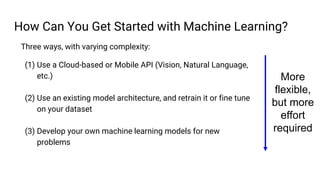
How Can You Get Started with Machine Learning?
Three ways, with varying complexity:
(1) Use a Cloud-based or Mobile API (Vision, Natural Language,
etc.)
(2) Use an existing model architecture, and retrain it or fine tune
on your dataset
(3) Develop your own machine learning models for new
problems
More
flexible,
but more
effort
required
Cloud Machine Learning APIs
See, Hear and Understand the world
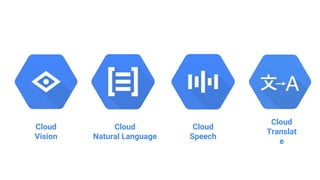
Cloud
Natural Language
Cloud
Speech
Cloud
Translat
e
Cloud
Vision
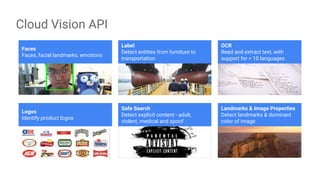
Faces
Faces, facial landmarks, emotions
OCR
Read and extract text, with
support for > 10 languages
Label
Detect entities from furniture to
transportation
Logos
Identify product logos
Landmarks & Image Properties
Detect landmarks & dominant
color of image
Safe Search
Detect explicit content - adult,
violent, medical and spoof
Cloud Vision API
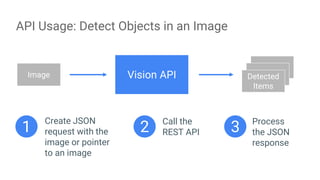
API Usage: Detect Objects in an Image
Image Detected
Items
Vision API
Create JSON
request with the
image or pointer
to an image
Process
the JSON
response
Call the
REST API1 2 3
Confidential & ProprietaryGoogle Cloud Platform 7
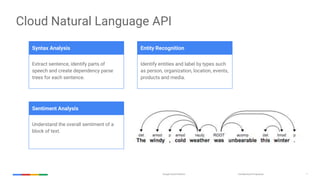
Cloud Natural Language API
Extract sentence, identify parts of
speech and create dependency parse
trees for each sentence.
Identify entities and label by types such
as person, organization, location, events,
products and media.
Understand the overall sentiment of a
block of text.
Syntax Analysis Entity Recognition
Sentiment Analysis
Confidential & ProprietaryGoogle Cloud Platform 8
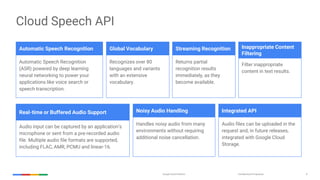
Cloud Speech API
Automatic Speech Recognition
(ASR) powered by deep learning
neural networking to power your
applications like voice search or
speech transcription.
Recognizes over 80
languages and variants
with an extensive
vocabulary.
Returns partial
recognition results
immediately, as they
become available.
Filter inappropriate
content in text results.
Audio input can be captured by an application’s
microphone or sent from a pre-recorded audio
file. Multiple audio file formats are supported,
including FLAC, AMR, PCMU and linear-16.
Handles noisy audio from many
environments without requiring
additional noise cancellation.
Audio files can be uploaded in the
request and, in future releases,
integrated with Google Cloud
Storage.
Automatic Speech Recognition Global Vocabulary Inappropriate Content
Filtering
Streaming Recognition
Real-time or Buffered Audio Support Noisy Audio Handling Integrated API
Mobile Vision API
Providing on-device vision for applications
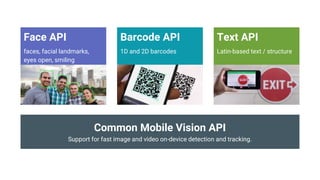
Face API
faces, facial landmarks,
eyes open, smiling
Barcode API
1D and 2D barcodes
Text API
Latin-based text / structure
Common Mobile Vision API
Support for fast image and video on-device detection and tracking.
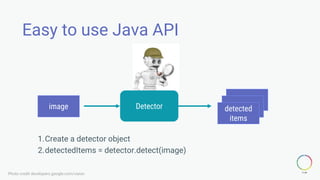
Easy to use Java API
image detected
items
Detector
1.Create a detector object
2.detectedItems = detector.detect(image)
Photo credit developers.google.com/vision
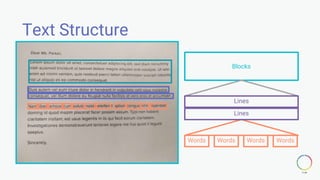
Text Structure
Blocks
Lines
Words
Lines
Words Words Words
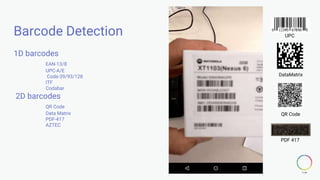
Barcode Detection
1D barcodes
EAN-13/8
UPC-A/E
Code-39/93/128
ITF
Codabar
2D barcodes
QR Code
Data Matrix
PDF-417
AZTEC
UPC
DataMatrix
QR Code
PDF 417
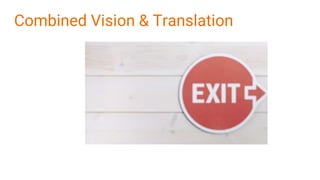
Combined Vision & Translation
● Open source Machine
Learning library
● Especially useful for
Deep Learning
● For research and
production
● Apache 2.0 license
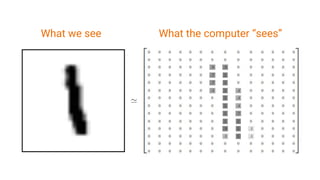
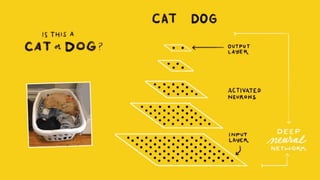
What we see What the computer “sees”
1818
TensorFlow Playground Demo
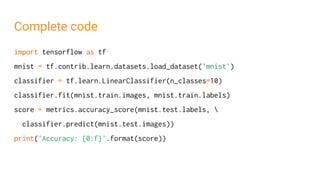
Complete code
import tensorflow as tf
mnist = tf.contrib.learn.datasets.load_dataset('mnist')
classifier = tf.learn.LinearClassifier(n_classes=10)
classifier.fit(mnist.train.images, mnist.train.labels)
score = metrics.accuracy_score(mnist.test.labels, 
classifier.predict(mnist.test.images))
print('Accuracy: {0:f}'.format(score))
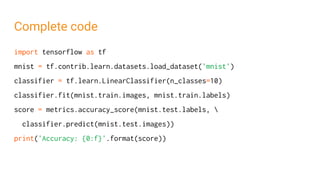
Complete code
import tensorflow as tf
mnist = tf.contrib.learn.datasets.load_dataset('mnist')
classifier = tf.learn.LinearClassifier(n_classes=10)
classifier.fit(mnist.train.images, mnist.train.labels)
score = metrics.accuracy_score(mnist.test.labels, 
classifier.predict(mnist.test.images))
print('Accuracy: {0:f}'.format(score))
A little more TensorFlow
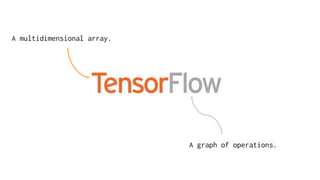
A multidimensional array.
A graph of operations.
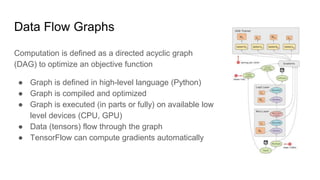
Data Flow Graphs
Computation is defined as a directed acyclic graph
(DAG) to optimize an objective function
● Graph is defined in high-level language (Python)
● Graph is compiled and optimized
● Graph is executed (in parts or fully) on available low
level devices (CPU, GPU)
● Data (tensors) flow through the graph
● TensorFlow can compute gradients automatically
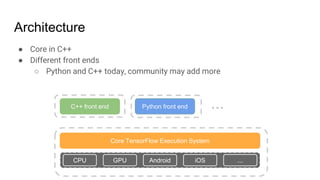
Architecture
● Core in C++
● Different front ends
○ Python and C++ today, community may add more
Core TensorFlow Execution System
CPU GPU Android iOS ...
C++ front end Python front end ...
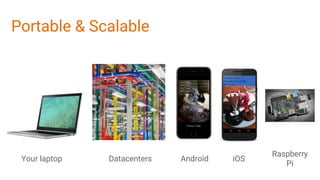
Raspberry
Pi
DatacentersYour laptop Android iOS
Portable & Scalable
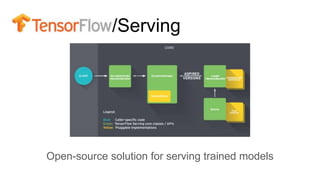
/Serving
Open-source solution for serving trained models
Examples of Machine Learning
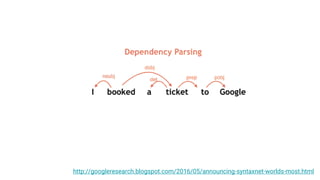
http://googleresearch.blogspot.com/2016/05/announcing-syntaxnet-worlds-most.html
Questions?

How to Get Started in ML?

  • 1.
    How To GetStarted with Machine Learning?
  • 2.
    How Can YouGet Started with Machine Learning? Three ways, with varying complexity: (1) Use a Cloud-based or Mobile API (Vision, Natural Language, etc.) (2) Use an existing model architecture, and retrain it or fine tune on your dataset (3) Develop your own machine learning models for new problems More flexible, but more effort required
  • 3.
    Cloud Machine LearningAPIs See, Hear and Understand the world
  • 4.
  • 5.
    Faces Faces, facial landmarks,emotions OCR Read and extract text, with support for > 10 languages Label Detect entities from furniture to transportation Logos Identify product logos Landmarks & Image Properties Detect landmarks & dominant color of image Safe Search Detect explicit content - adult, violent, medical and spoof Cloud Vision API
  • 6.
    API Usage: DetectObjects in an Image Image Detected Items Vision API Create JSON request with the image or pointer to an image Process the JSON response Call the REST API1 2 3
  • 7.
    Confidential & ProprietaryGoogleCloud Platform 7 Cloud Natural Language API Extract sentence, identify parts of speech and create dependency parse trees for each sentence. Identify entities and label by types such as person, organization, location, events, products and media. Understand the overall sentiment of a block of text. Syntax Analysis Entity Recognition Sentiment Analysis
  • 8.
    Confidential & ProprietaryGoogleCloud Platform 8 Cloud Speech API Automatic Speech Recognition (ASR) powered by deep learning neural networking to power your applications like voice search or speech transcription. Recognizes over 80 languages and variants with an extensive vocabulary. Returns partial recognition results immediately, as they become available. Filter inappropriate content in text results. Audio input can be captured by an application’s microphone or sent from a pre-recorded audio file. Multiple audio file formats are supported, including FLAC, AMR, PCMU and linear-16. Handles noisy audio from many environments without requiring additional noise cancellation. Audio files can be uploaded in the request and, in future releases, integrated with Google Cloud Storage. Automatic Speech Recognition Global Vocabulary Inappropriate Content Filtering Streaming Recognition Real-time or Buffered Audio Support Noisy Audio Handling Integrated API
  • 9.
    Mobile Vision API Providingon-device vision for applications
  • 10.
    Face API faces, faciallandmarks, eyes open, smiling Barcode API 1D and 2D barcodes Text API Latin-based text / structure Common Mobile Vision API Support for fast image and video on-device detection and tracking.
  • 11.
    Easy to useJava API image detected items Detector 1.Create a detector object 2.detectedItems = detector.detect(image) Photo credit developers.google.com/vision
  • 12.
  • 13.
    Barcode Detection 1D barcodes EAN-13/8 UPC-A/E Code-39/93/128 ITF Codabar 2Dbarcodes QR Code Data Matrix PDF-417 AZTEC UPC DataMatrix QR Code PDF 417
  • 14.
    Combined Vision &Translation
  • 15.
    ● Open sourceMachine Learning library ● Especially useful for Deep Learning ● For research and production ● Apache 2.0 license
  • 16.
    What we seeWhat the computer “sees”
  • 18.
  • 19.
    Complete code import tensorflowas tf mnist = tf.contrib.learn.datasets.load_dataset('mnist') classifier = tf.learn.LinearClassifier(n_classes=10) classifier.fit(mnist.train.images, mnist.train.labels) score = metrics.accuracy_score(mnist.test.labels, classifier.predict(mnist.test.images)) print('Accuracy: {0:f}'.format(score))
  • 20.
    Complete code import tensorflowas tf mnist = tf.contrib.learn.datasets.load_dataset('mnist') classifier = tf.learn.LinearClassifier(n_classes=10) classifier.fit(mnist.train.images, mnist.train.labels) score = metrics.accuracy_score(mnist.test.labels, classifier.predict(mnist.test.images)) print('Accuracy: {0:f}'.format(score))
  • 21.
    A little moreTensorFlow
  • 22.
    A multidimensional array. Agraph of operations.
  • 23.
    Data Flow Graphs Computationis defined as a directed acyclic graph (DAG) to optimize an objective function ● Graph is defined in high-level language (Python) ● Graph is compiled and optimized ● Graph is executed (in parts or fully) on available low level devices (CPU, GPU) ● Data (tensors) flow through the graph ● TensorFlow can compute gradients automatically
  • 24.
    Architecture ● Core inC++ ● Different front ends ○ Python and C++ today, community may add more Core TensorFlow Execution System CPU GPU Android iOS ... C++ front end Python front end ...
  • 25.
  • 26.
    /Serving Open-source solution forserving trained models
  • 27.
  • 28.
  • 30.