How to Effectively Design and Execute Your
B2B Social Media Program

Todd Wilms
Sr Director, Social Media Audience Marketing
Recap:


Run your program
1. Know who you are,

2. Know what you are going after,

3. Know where they are,

4. Know “how you know,”

5. Know that social may (or may not) be the answer,

6. Know you are in for the long haul,

7. Know to keep everyone engaged, and

8. – 10. Lastly, do it, do it well, but don’t be afraid to try something new
Email in 72 hours:
               Toddwilms.com


Twitter: @toddmwilms
Personal Blog:
www.Forbes.blogs.com/sap/todd-wilms
#1: Know Thyself
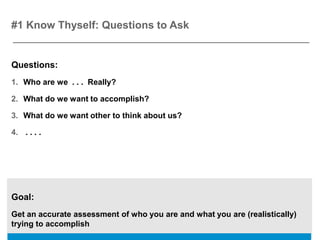
#1 Know Thyself: Questions to Ask


Questions:
1. Who are we . . . Really?

2. What do we want to accomplish?

3. What do we want other to think about us?

4. . . . .


Goal:
Get an accurate assessment of who you are and what you are (realistically)
trying to accomplish
#2: Set the “right” goals
and objectives
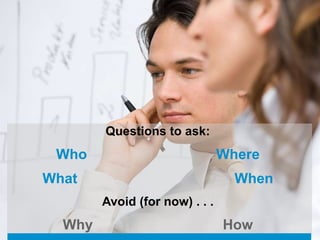
Questions to ask:
 Who                            Where
What                              When
        Avoid (for now) . . .
  Why                           How
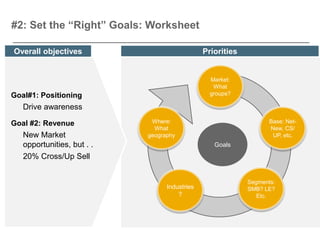
#2: Set the “Right” Goals: Worksheet

Overall objectives                             Priorities


                                                 Market:
                                                  What
Goal#1: Positioning                              groups?

   Drive awareness

Goal #2: Revenue             Where:                                Base: Net-
                              What                                 New, CS/
   New Market               geography                               UP, etc.
   opportunities, but . .                         Goals
   20% Cross/Up Sell


                                                            Segments:
                                  Industries                SMB? LE?
                                      ?                        Etc.
Envision that perfect person for your program
#3 Find you Audience
#3: Find your Audience: One Word . . .


                 Empathy
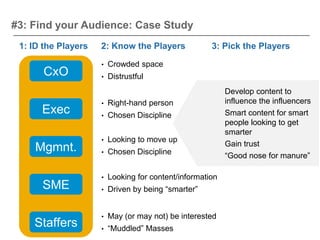
#3: Find your Audience: Case Study
 1: ID the Players   2: Know the Players              3: Pick the Players
                     •   Crowded space
       CxO           •   Distrustful
                                                           Develop content to
                     •   Right-hand person                 influence the influencers
      Exec           •   Chosen Discipline                 Smart content for smart
                                                           people looking to get
                                                           smarter
                     •   Looking to move up
                                                           Gain trust
    Mgmnt.           •   Chosen Discipline                 “Good nose for manure”

                     •   Looking for content/information
      SME            •   Driven by being “smarter”


                     •   May (or may not) be interested
    Staffers         •   “Muddled” Masses
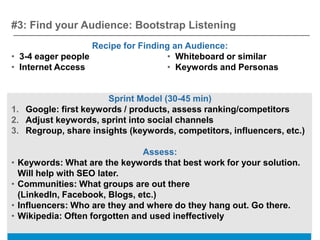
#3: Find your Audience: Bootstrap Listening
                   Recipe for Finding an Audience:
• 3-4 eager people                   • Whiteboard or similar
• Internet Access                    • Keywords and Personas


                      Sprint Model (30-45 min)
1. Google: first keywords / products, assess ranking/competitors
2. Adjust keywords, sprint into social channels
3. Regroup, share insights (keywords, competitors, influencers, etc.)

                                 Assess:
•   Keywords: What are the keywords that best work for your solution.
    Will help with SEO later.
•   Communities: What groups are out there
    (LinkedIn, Facebook, Blogs, etc.)
•   Influencers: Who are they and where do they hang out. Go there.
•   Wikipedia: Often forgotten and used ineffectively
#4 Set measurements before you start
#4: Measurements: Before you start . . .


Two reasons:
1: You have to define success

2: You may not be able (or easily able) to measure
#5 Social Media is not free . . . and may not be your
                      answer
#5 Social Media is not free


  “Social Media is not the cure for every problem
                without a budget”


Social Media is a Marketing Channel:
Treat is just like any other - it has a cost/benefit analysis
#6 Sustain. Think day 180, not day 1
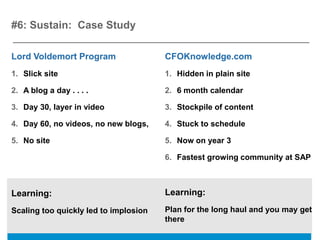
#6: Sustain: Case Study

Lord Voldemort Program                 CFOKnowledge.com
1. Slick site                          1. Hidden in plain site

2. A blog a day . . . .                2. 6 month calendar

3. Day 30, layer in video              3. Stockpile of content

4. Day 60, no videos, no new blogs,    4. Stuck to schedule

5. No site                             5. Now on year 3

                                       6. Fastest growing community at SAP


Learning:                              Learning:

Scaling too quickly led to implosion   Plan for the long haul and you may get
                                       there
# 7: Sell Internally: Both Up and Down
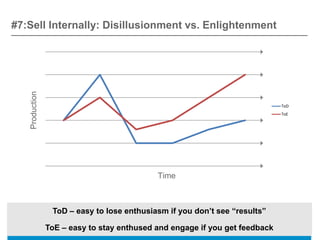
#7:Sell Internally: Disillusionment vs. Enlightenment
   Production


                                                                             ToD
                                                                             ToE


                                            Time


                 ToD – easy to lose enthusiasm if you don’t see “results”

                ToE – easy to stay enthused and engage if you get feedback
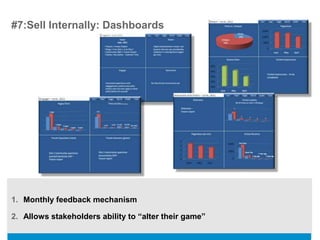
#7:Sell Internally: Dashboards


1. Monthly feedback mechanism

2. Allows stakeholders ability to “alter their game”
“You cannot plough a field by turning it over
in your mind” - Anonymous
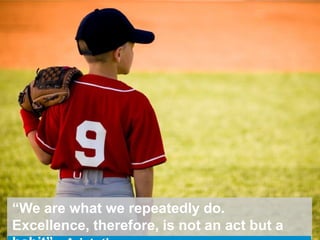
“We are what we repeatedly do.
Excellence, therefore, is not an act but a
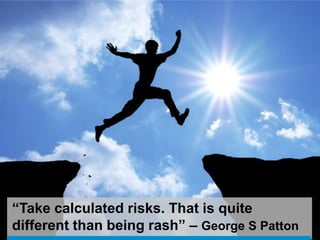
“Take calculated risks. That is quite
different than being rash” – George S Patton
Recap:


Run your program
1. Know who you are,

2. Know what you are going after,

3. Know where they are,

4. Know “how you know,”

5. Know that social may (or may not) be the answer,

6. Know you are in for the long haul,

7. Know to keep everyone engaged, and

8. – 10. Lastly, do it, do it well, but don’t be afraid to try something new
Email in 72 hours:
               Toddwilms.com


Twitter: @toddmwilms
Personal Blog:
www.Forbes.blogs.com/sap/todd-wilms

How to design you b2 b social program

  • 1.
    How to EffectivelyDesign and Execute Your B2B Social Media Program Todd Wilms Sr Director, Social Media Audience Marketing
  • 2.
    Recap: Run your program 1.Know who you are, 2. Know what you are going after, 3. Know where they are, 4. Know “how you know,” 5. Know that social may (or may not) be the answer, 6. Know you are in for the long haul, 7. Know to keep everyone engaged, and 8. – 10. Lastly, do it, do it well, but don’t be afraid to try something new
  • 3.
    Email in 72hours: Toddwilms.com Twitter: @toddmwilms Personal Blog: www.Forbes.blogs.com/sap/todd-wilms
  • 4.
  • 5.
    #1 Know Thyself:Questions to Ask Questions: 1. Who are we . . . Really? 2. What do we want to accomplish? 3. What do we want other to think about us? 4. . . . . Goal: Get an accurate assessment of who you are and what you are (realistically) trying to accomplish
  • 6.
    #2: Set the“right” goals and objectives
  • 7.
    Questions to ask: Who Where What When Avoid (for now) . . . Why How
  • 8.
    #2: Set the“Right” Goals: Worksheet Overall objectives Priorities Market: What Goal#1: Positioning groups? Drive awareness Goal #2: Revenue Where: Base: Net- What New, CS/ New Market geography UP, etc. opportunities, but . . Goals 20% Cross/Up Sell Segments: Industries SMB? LE? ? Etc.
  • 9.
    Envision that perfectperson for your program
  • 10.
    #3 Find youAudience
  • 11.
    #3: Find yourAudience: One Word . . . Empathy
  • 12.
    #3: Find yourAudience: Case Study 1: ID the Players 2: Know the Players 3: Pick the Players • Crowded space CxO • Distrustful Develop content to • Right-hand person influence the influencers Exec • Chosen Discipline Smart content for smart people looking to get smarter • Looking to move up Gain trust Mgmnt. • Chosen Discipline “Good nose for manure” • Looking for content/information SME • Driven by being “smarter” • May (or may not) be interested Staffers • “Muddled” Masses
  • 13.
    #3: Find yourAudience: Bootstrap Listening Recipe for Finding an Audience: • 3-4 eager people • Whiteboard or similar • Internet Access • Keywords and Personas Sprint Model (30-45 min) 1. Google: first keywords / products, assess ranking/competitors 2. Adjust keywords, sprint into social channels 3. Regroup, share insights (keywords, competitors, influencers, etc.) Assess: • Keywords: What are the keywords that best work for your solution. Will help with SEO later. • Communities: What groups are out there (LinkedIn, Facebook, Blogs, etc.) • Influencers: Who are they and where do they hang out. Go there. • Wikipedia: Often forgotten and used ineffectively
  • 14.
    #4 Set measurementsbefore you start
  • 15.
    #4: Measurements: Beforeyou start . . . Two reasons: 1: You have to define success 2: You may not be able (or easily able) to measure
  • 16.
    #5 Social Mediais not free . . . and may not be your answer
  • 17.
    #5 Social Mediais not free “Social Media is not the cure for every problem without a budget” Social Media is a Marketing Channel: Treat is just like any other - it has a cost/benefit analysis
  • 18.
    #6 Sustain. Thinkday 180, not day 1
  • 19.
    #6: Sustain: CaseStudy Lord Voldemort Program CFOKnowledge.com 1. Slick site 1. Hidden in plain site 2. A blog a day . . . . 2. 6 month calendar 3. Day 30, layer in video 3. Stockpile of content 4. Day 60, no videos, no new blogs, 4. Stuck to schedule 5. No site 5. Now on year 3 6. Fastest growing community at SAP Learning: Learning: Scaling too quickly led to implosion Plan for the long haul and you may get there
  • 20.
    # 7: SellInternally: Both Up and Down
  • 21.
    #7:Sell Internally: Disillusionmentvs. Enlightenment Production ToD ToE Time ToD – easy to lose enthusiasm if you don’t see “results” ToE – easy to stay enthused and engage if you get feedback
  • 22.
    #7:Sell Internally: Dashboards 1.Monthly feedback mechanism 2. Allows stakeholders ability to “alter their game”
  • 23.
    “You cannot plougha field by turning it over in your mind” - Anonymous
  • 24.
    “We are whatwe repeatedly do. Excellence, therefore, is not an act but a
  • 25.
    “Take calculated risks.That is quite different than being rash” – George S Patton
  • 26.
    Recap: Run your program 1.Know who you are, 2. Know what you are going after, 3. Know where they are, 4. Know “how you know,” 5. Know that social may (or may not) be the answer, 6. Know you are in for the long haul, 7. Know to keep everyone engaged, and 8. – 10. Lastly, do it, do it well, but don’t be afraid to try something new
  • 27.
    Email in 72hours: Toddwilms.com Twitter: @toddmwilms Personal Blog: www.Forbes.blogs.com/sap/todd-wilms

Editor's Notes

  • #5 B-2-C is personalB-2-B is not, it is people yes, but not personalSounds obvious so people skip this step and jump to tacticsExample: not the best known, so let’s focus on thought leadershipDefine who you are and what you really want to accomplish
  • #6 B-2-C is personalB-2-B is not, it is people yes, but not personalSounds obvious so people skip this step and jump to tacticsExample: not the best known, so let’s focus on thought leadershipDefine who you are and what you really want to accomplish
  • #7 Don’t think tactics, think goalsWho, What, Where, WhenSAP FrameworkGo after the right group by imagine perfect person in cocktail party – create that personaExample: Everyone going after CxO, we will go after Dir/VP, LE, English Speaking
  • #8 Don’t think tactics, think goalsWho, What, Where, WhenSAP FrameworkGo after the right group by imagine perfect person in cocktail party – create that personaExample: Everyone going after CxO, we will go after Dir/VP, LE, English Speaking
  • #9 Don’t think tactics, think goalsWho, What, Where, WhenSAP FrameworkGo after the right group by imagine perfect person in cocktail party – create that personaExample: Everyone going after CxO, we will go after Dir/VP, LE, English Speaking
  • #10 Don’t think tactics, think goalsWho, What, Where, WhenSAP FrameworkGo after the right group by imagine perfect person in cocktail party – create that personaExample: Everyone going after CxO, we will go after Dir/VP, LE, English Speaking
  • #11 One Word: Empathy - What do they want from me?Dating analogy – I know who I want, now what makes me attractiveExample: Baseball messages worked in the US, but failed overseasStudy: People at this level were there for a reason and wanted to move upTargeted content to this level, demystifying complex topicsLonger listening process, but worksheet here
  • #12 One Word: Empathy - What do they want from me?Dating analogy – I know who I want, now what makes me attractiveExample: Baseball messages worked in the US, but failed overseasStudy: People at this level were there for a reason and wanted to move upTargeted content to this level, demystifying complex topicsLonger listening process, but worksheet here
  • #13 One Word: Empathy - What do they want from me?Dating analogy – I know who I want, now what makes me attractiveExample: Baseball messages worked in the US, but failed overseasStudy: People at this level were there for a reason and wanted to move upTargeted content to this level, demystifying complex topicsLonger listening process, but worksheet here
  • #14 One Word: Empathy - What do they want from me?Dating analogy – I know who I want, now what makes me attractiveExample: Baseball messages worked in the US, but failed overseasStudy: People at this level were there for a reason and wanted to move upTargeted content to this level, demystifying complex topicsLonger listening process, but worksheet here
  • #15 First reason – know what to call successSecond reason – harder . . .With SM being so new, it is hard to find tools to accurately measureExample: Want to see how my blog drives revenue? If rev important, does your program make sense?Start at the end; make sure you can measure it, before you deploy it.
  • #16 First reason – know what to call successSecond reason – harder . . .With SM being so new, it is hard to find tools to accurately measureExample: Want to see how my blog drives revenue? If rev important, does your program make sense?Start at the end; make sure you can measure it, before you deploy it.
  • #17 Example: X thousand for a one-time event, no people to help. Answer – emailFamily reunion example“Social media is not a cure for every problem without a budget”Know where social fits into your mix
  • #18 Example: X thousand for a one-time event, no people to help. Answer – emailFamily reunion example“Social media is not a cure for every problem without a budget”Know where social fits into your mix
  • #19 Don’t let early success fool you; can you sustain what you are doing over timeNext section – talks about keeping enthusiasm highBlogger training at TLA Company: write 10 before you post 1Reason there are not more and better programs out there is not lack of vision, it is “sustained execution
  • #20 Don’t let early success fool you; can you sustain what you are doing over timeNext section – talks about keeping enthusiasm highBlogger training at TLA Company: write 10 before you post 1Reason there are not more and better programs out there is not lack of vision, it is “sustained execution
  • #21 Sell to your team – your contributors. Keep them engagedEarly reporting keeps them engagedStudy: CRM Team and Dashboards: Engagement means “Empathy”Result: Do these calls or get out your pom-poms and start cheerleadingSell Up: avoid the one-way begging conversationGet them involved, let them think this their idea
  • #22 Sell to your team – your contributors. Keep them engagedEarly reporting keeps them engagedStudy: CRM Team and Dashboards: Engagement means “Empathy”Result: Do these calls or get out your pom-poms and start cheerleadingSell Up: avoid the one-way begging conversationGet them involved, let them think this their idea
  • #23 Sell to your team – your contributors. Keep them engagedEarly reporting keeps them engagedStudy: CRM Team and Dashboards: Engagement means “Empathy”Result: Do these calls or get out your pom-poms and start cheerleadingSell Up: avoid the one-way begging conversationGet them involved, let them think this their idea
  • #24 You cannot plough a field by turning it over in your mind. – AnonymousThe only way you are going to get in there and do this is to do it. Even if you are managing a program, you have to . . . have to . . . have to take a turn at doing everything you ask your team to do. You should try to build your bench by having team members take different roles. I am more of a writer, but I take roles reviewing metrics, community managing, creating video content, etc. because I need to know how to do these if I am going to help run these programs.
  • #25 We are what we repeatedly do. Excellence, therefore, is not an act but a habit. – AristotleTry everything, but pick your battles and do that really well. This is both personal and for your program. My boss, the CMO of SAP, told me the following: it took 1 year before his blog – written every Sunday for 52 weeks, received 1000 views per month at the end of the year. Year two, (he missed posting Christmas week) 2000 views per month. Year three, 4000 per month. He is now around 8,000 per month. He is a good writer, but excellence for him is a habit – something you do continuously.
  • #26 Take calculated risks. That is quite different from being rash. – George S PattonNothing like ending on a Patton quote . . . The great thing about social media – it is the Marketing Hinterland. Unlike other marketing channels, your ability for true exploration and experimentation is wide open. Take some calculated risks. Get in there and mix it up. This doesn’t mean jumping in without a plan, or being rash