4 - 1
Copyright © 2016 Pearson Education, Inc.
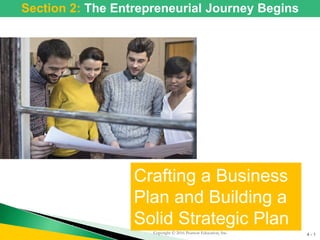
Crafting a Business
Plan and Building a
Solid Strategic Plan
Section 2: The Entrepreneurial Journey Begins
1. Explain the benefits of an effective business plan.
2. Describe the elements of a solid business plan.
3. Explain the “five Cs of credit” and why they are
important to potential lenders and investors
reviewing business plans.
4. Understand the keys to making an effective
business plan presentation.
Copyright © 2016 Pearson Education, Inc. 5 - 2
5. Understand the importance of strategic
management to a small business.
6. Explain why and how a small business must
create a competitive advantage in the market.
7. Develop a strategic plan for a business using
the nine steps in the strategic management
process.
Copyright © 2016 Pearson Education, Inc. 5 - 3
(continued)
Business plan:
A written summary of:
An entrepreneur’s proposed business venture
The operational and financial details
The marketing opportunities and strategy
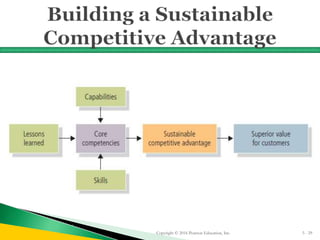
The managers’ skills and abilities
A business plan is the best insurance against
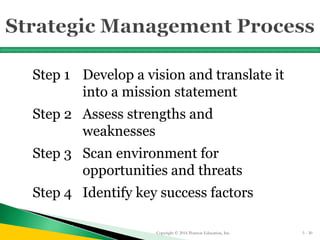
launching a business destined to fail or
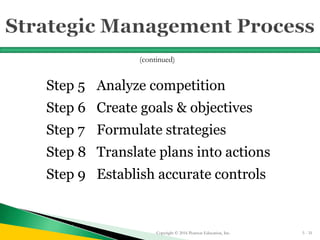
mismanaging a potentially successful company.
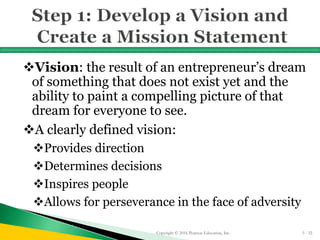
Copyright © 2016 Pearson Education, Inc. 5 - 4
1. Guiding the company by charting its future
course and defining its strategy for
following it.
2. Attracting lenders and investors who will
provide needed capital.
Copyright © 2016 Pearson Education, Inc. 5 - 5
1. The Reality Test: proving that:
A market really does exist for your product or service.
You can actually build or provide it for the cost
estimates in the plan.
2. The Competitive Test: evaluates:
A company’s position relative to its competitors.
Management’s ability to create a company that will
gain an edge over its rivals.
3. The Value Test: proving that:
A venture offers investors or lenders an attractive
rate of return or a high probability of repayment.
Copyright © 2016 Pearson Education, Inc. 5 - 6
Although building a plan does not guarantee
success, it does increase your chances of
succeeding in business.
A plan is like a road map that serves as a guide
on a journey through unfamiliar, harsh, and
dangerous territory. Don’t attempt the trip
without a map!
Copyright © 2016 Pearson Education, Inc. 5 - 7
Title Page and Table of Contents
Executive Summary
Copyright © 2016 Pearson Education, Inc. 5 - 8
The executive summary is a written version
of “the elevator pitch”
A good elevator pitch provides:
Context
Benefit
Target customers
Point of differentiation
Clincher/decisive factor
Copyright © 2016 Pearson Education, Inc. 5 - 9
Title Page and Table of Contents
Executive Summary
Mission and Vision Statement
Description of a Firm’s Product or Service
Copyright © 2016 Pearson Education, Inc. 5 - 10
(continued from 5-9)
Describe the benefits customers get from the
product or service
A feature is a descriptive fact about a
product or service.
A benefit is what the customer gains from
the product or service feature.
Copyright © 2016 Pearson Education, Inc. 5 - 11
Title Page and Table of Contents
Executive Summary
Mission and Vision Statement
Description of a Firm’s Product or Service
Business and Industry Profile
Competitor Analysis
Copyright © 2016 Pearson Education, Inc. 5 - 12
(continued from 5-11)
Who are the company’s key competitors?
What are there strengths and weaknesses?
What are their strategies?
How successful are they?
What distinguishes the entrepreneur’s
product or service from others already in the
market, and how will these differences
produce a competitive edge?
Copyright © 2016 Pearson Education, Inc. 5 - 13
Title Page and Table of Contents
Executive Summary
Mission and Vision Statement
Description of a Firm’s Product or Service
Business and Industry Profile
Competitor Analysis
Market Entry Strategy
Marketing Strategy
Copyright © 2016 Pearson Education, Inc. 5 - 14
(continued from 5-13)
Show customer interest
Prove that target customers actually need
or want the product or service.
Document market claims
Support market size and growth rates with
facts.
Copyright © 2016 Pearson Education, Inc. 5 - 15
Address:
Target market
Advertising and promotion
Market size and trends
Location
Pricing
Distribution
Copyright © 2016 Pearson Education, Inc. 5 - 16
(continued)
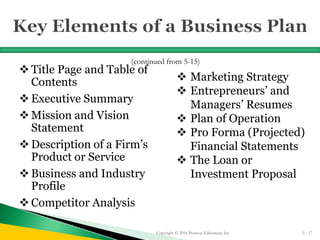
 Title Page and Table of
Contents
 Executive Summary
 Mission and Vision
Statement
 Description of a Firm’s
Product or Service
 Business and Industry
Profile
 Competitor Analysis
Copyright © 2016 Pearson Education, Inc. 5 - 17
(continued from 5-15)
 Marketing Strategy
 Entrepreneurs’ and
Managers’ Resumes
 Plan of Operation
 Pro Forma (Projected)
Financial Statements
 The Loan or
Investment Proposal
First impressions count! Use an attractive cover.
Checks for errors.
Make it visually appealing.
Include a table of contents with page numbers.
Make it interesting!
Show that it will make money.
Use spreadsheets for realistic financial forecasts.
Include cash flow projections.
Keep the plan “crisp.” or focused
Tell the truth.
Copyright © 2016 Pearson Education, Inc. 5 - 18
 The “5 Cs” of Credit
1. Capital
2. Capacity
3. Collateral
4. Character
5. Conditions
Copyright © 2016 Pearson Education, Inc. 5 - 19
 The time allotted for presenting is usually less
than 20 minutes, so it’s important to rehearse and
be prepared.
 A basic presentation should cover:
 Your company and its products and services.
 The problem to be solved.
 A description of your solution to the problem.
 Your company’s business model.
 Your company’s competitive edge.
Copyright © 2016 Pearson Education, Inc. 5 - 20
 Prepare
 Practice your delivery and then practice some more.
 Demonstrate interest/enthusiasm about the business
but don’t be overly emotional.
 Focus on communicating the dynamic opportunity
your idea offers and how you plan to capitalize on it.
 Hook investors quickly with an up-front explanation
of the new venture, its opportunities, and the
anticipated benefits to them.
Copyright © 2016 Pearson Education, Inc. 5 - 21
 Use visual aids.
 Follow the 10/20/30 rule for PowerPoint
presentations. (10 slides; 20 minutes; font 30)
 Explain how your company’s products or services
solve some problems and emphasize the factors
that make your company unique.
 Offer proof.
 Hit the highlights.
 Keep the presentation “crisp.”
Copyright © 2016 Pearson Education, Inc. 5 - 22
(continued)
 Avoid the use of technical terms that will be above
most of the audience.
 Remember to tell lenders and investors how they will
benefit.
 Be prepared for questions.
 Anticipate questions and prepare for them in
advance.
 Focus your answers on what’s important to lenders
and investors.
 Follow up with every lender and investor to whom
you make a presentation.
Copyright © 2016 Pearson Education, Inc. 5 - 23
(continued)
 Entrepreneurs must be able to adapt to changes in
the marketplace.
 Strategic planning is a tool that can help: it
involves developing a game plan to guide the
company as it works to accomplish its vision,
mission, goals, and objectives and to keep it from
straying off course.
It’s crucial to building a successful business.
Copyright © 2016 Pearson Education, Inc. 5 - 24
 The biggest change facing
entrepreneurs today is the shift from
financial capital to intellectual capital
Human
Structural
Customer
Copyright © 2016 Pearson Education, Inc. 5 - 25
Developing a strategic plan is crucial to
creating a sustainable competitive
advantage: the aggregation of factors that
sets a company apart from its competitors
and gives it a unique position in the
market that is superior to its competition.
Example: Whole Foods
Copyright © 2016 Pearson Education, Inc. 5 - 26
Consider five aspects of a small
company:
1. Products they sell
2. Service they provide
3. Pricing they offer
4. Way they sell
5. Values to which they are committed
Copyright © 2016 Pearson Education, Inc. 5 - 27
Unique set of capabilities a company develops in
key areas, such as superior quality, customer
service, innovation, team-building, flexibility,
responsiveness, and others that allow it to vault
past competitors.
They are what a company does best.
Best to rely on a natural advantage (often
linked to a company’s “smallness”).
Example: Noodles & Company
Copyright © 2016 Pearson Education, Inc. 5 - 28
Copyright © 2016 Pearson Education, Inc. 5 - 29
Step 1 Develop a vision and translate it
into a mission statement
Step 2 Assess strengths and
weaknesses
Step 3 Scan environment for
opportunities and threats
Step 4 Identify key success factors
Copyright © 2016 Pearson Education, Inc. 5 - 30
Step 5 Analyze competition
Step 6 Create goals & objectives
Step 7 Formulate strategies
Step 8 Translate plans into actions
Step 9 Establish accurate controls
Copyright © 2016 Pearson Education, Inc. 5 - 31
(continued)
Vision: the result of an entrepreneur’s dream
of something that does not exist yet and the
ability to paint a compelling picture of that
dream for everyone to see.
A clearly defined vision:
Provides direction
Determines decisions
Inspires people
Allows for perseverance in the face of adversity
Copyright © 2016 Pearson Education, Inc. 5 - 32
Mission statement: addresses the
question: “what business are we in?”
Clarifies “why we are here” and “where we
are going.”
Serves as a “strategic compass.”
Examples: Bongo World, Nisolo Shoes,
Badger Mining, Putney, Inc., Clymb
Copyright © 2016 Pearson Education, Inc. 5 - 33
(continued)
Four key questions:
What are we in business to accomplish?
Who are we in to business to serve?
How are we going to accomplish that purpose?
What principles and beliefs form the
foundation of the way we do business?
Copyright © 2016 Pearson Education, Inc. 5 - 34
Use a balance sheet to identify:
Strengths
Positive internal factors a company can draw
on to accomplish its mission, goals, and
objectives.
Weaknesses
Negative internal factors that inhibit a
company’s ability to accomplish its mission,
goals, and objectives.
Copyright © 2016 Pearson Education, Inc. 5 - 35
Identify and manage:
Opportunities
Positive external factors the company can
exploit to accomplish its mission, goals, and
objectives.
Threats
Negative external factors that inhibit the
firm's ability to accomplish its mission, goals,
and objectives.
Copyright © 2016 Pearson Education, Inc. 5 - 36
Key success factors (KSFs): factors
that determine the relative success of
market participants.
The keys to unlocking the secrets of
competing successfully in a particular
market segment.
Example: Five Guys Burgers and Fries
Copyright © 2016 Pearson Education, Inc. 5 - 37
Small business owners believe they
operate in a highly competitive
environment and the level of competition
is increasing.
Yet, 97 percent of all TZ businesses do not
systematically track the progress of their
key competitors.
Copyright © 2016 Pearson Education, Inc. 5 - 38
Goal of competitive intelligence:
Conduct continuous rather than periodic
analysis of competition.
Avoid surprises from existing competitors’
use of new strategies and tactics.
Identify potential new competitors.
Improve reaction time to competitors’
actions.
Anticipate rivals’ next strategic moves.
Copyright © 2016 Pearson Education, Inc. 5 - 39
(continued)
Direct competitors
Offer the same products and services
Customers often compare prices, features and deals
among these competitors when they shop
Significant competitors
Offer some of the same or similar products or services
Product or service lines overlap but not completely
Indirect competitors
Offer same or similar products in only a small number
of areas
Copyright © 2016 Pearson Education, Inc. 5 - 40
Monitor industry and trade publications.
Talk to customers and suppliers.
Debrief employees, especially sales
representatives and purchasing agents.
Attend trade shows and conferences and
study competitors’ sales literature.
Watch for competitor’s employment ads.
Copyright © 2016 Pearson Education, Inc. 5 - 41
Watch for competitor’s employment ads.
Conduct patent searches for patents competitors
have filed.
Get reports for the factories of competing
manufacturers.
Monitor direct competitors via social media.
Learn about the kinds of equipment and raw
materials competitors are importing from the
Journal of Commerce Port Import Export
Reporting Service.
Copyright © 2016 Pearson Education, Inc. 5 - 42
(continued)
Buy competitors’ products and “benchmark” them.
Get competitors’ credit reports.
Check out the reports publicly-held competitors
must file with the.
Investigate reports.
Check out the resources in your local library.
Use the Internet to learn more about competitors.
Visit competing businesses to observe their
operations.
Copyright © 2016 Pearson Education, Inc. 5 - 43
(continued)
Goals: Broad, long-range attributes to be
accomplished.
Inspire and focus the company
Copyright © 2016 Pearson Education, Inc. 5 - 44
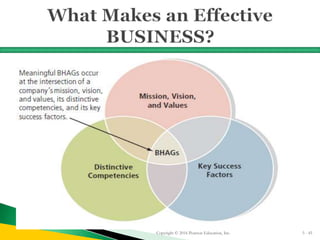
Copyright © 2016 Pearson Education, Inc. 5 - 45
 Strategy: a road map of the actions an
entrepreneur draws up to achieve a
company’s mission, goals, and objectives.
 It is the company’s game plan for gaining a
competitive advantage.
Copyright © 2016 Pearson Education, Inc. 5 - 46
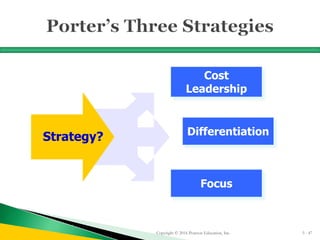
Copyright © 2016 Pearson Education, Inc. 5 - 47
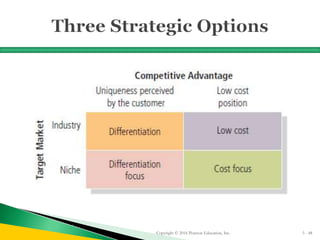
Strategy?
Cost
Leadership
Focus
Differentiation
Copyright © 2016 Pearson Education, Inc. 5 - 48
Goal: Be the low-cost producer in the industry
or market segment.
Low-cost leaders have advantages:
Reaching buyers who buy on the basis of
price.
The power to set the industry’s price floor.
Copyright © 2016 Pearson Education, Inc. 5 - 49
Cost Leadership works well when:
Buyers are sensitive to price changes.
Competing firms sell the same commodity
products.
A company can benefit from economies of
scale.
Examples: Dollar General and Dollar Tree
Copyright © 2016 Pearson Education, Inc. 5 - 50
(continued)
Goal: Build customer loyalty by positioning its
goods or services in a unique or different fashion.
Be special at something customers value.
Key: Build basis for differentiation on a distinctive
competence, something that the small company is
uniquely good at doing in comparison to its
competitors.
Example: RentTheChicken.com
Copyright © 2016 Pearson Education, Inc. 5 - 51
Goal: Select one or more customer segments in
a market, identify customers’ special needs,
wants, or interests, and then target them with a
product or service designed specifically for
them.
Strategy builds on the differences among
market segments.
Rather than try to serve the total market, the
company focuses on serving a niche (or
several niches) within that market.
Example: I Do Now I Don’t
Copyright © 2016 Pearson Education, Inc. 5 - 52
 Proper execution of a company’s strategy
accounts for 85% of a company’s financial
performance.
 Make plans workable by defining:
Purpose
Scope
Contribution
Resource requirements
Timing
Copyright © 2016 Pearson Education, Inc. 5 - 53
Plan establishes the standards against which
actual performance is measured.
Entrepreneur must:
Identify and track key performance
indicators.
Take corrective action.
Copyright © 2016 Pearson Education, Inc. 5 - 54
A set of measurements unique to a company
that includes both financial and operational
measures.
Gives managers a quick, yet comprehensive,
picture of a company’s overall performance.
Copyright © 2016 Pearson Education, Inc. 5 - 55
Five Perspectives:
1. Customer: How do customers see us?
2. Internal Business: At what must we excel?
3. Innovation and Learning: Can we continue to
improve and create value?
4. Financial: How do we look to shareholders?
5. Corporate Citizenship: Do we meet our
responsibility to society as a whole, the
environment, the community, and other
external stakeholders?
Copyright © 2016 Pearson Education, Inc. 5 - 56
(continued)
 The strategic planning process:
 Begins with the nine steps.
 Becomes more efficient each time.
 Teaches entrepreneurial discipline for a
higher chance of survival.
Copyright © 2016 Pearson Education, Inc. 5 - 57

How to create formulating business plans

  • 1.
    4 - 1 Copyright© 2016 Pearson Education, Inc. Crafting a Business Plan and Building a Solid Strategic Plan Section 2: The Entrepreneurial Journey Begins
  • 2.
    1. Explain thebenefits of an effective business plan. 2. Describe the elements of a solid business plan. 3. Explain the “five Cs of credit” and why they are important to potential lenders and investors reviewing business plans. 4. Understand the keys to making an effective business plan presentation. Copyright © 2016 Pearson Education, Inc. 5 - 2
  • 3.
    5. Understand theimportance of strategic management to a small business. 6. Explain why and how a small business must create a competitive advantage in the market. 7. Develop a strategic plan for a business using the nine steps in the strategic management process. Copyright © 2016 Pearson Education, Inc. 5 - 3 (continued)
  • 4.
    Business plan: A writtensummary of: An entrepreneur’s proposed business venture The operational and financial details The marketing opportunities and strategy The managers’ skills and abilities A business plan is the best insurance against launching a business destined to fail or mismanaging a potentially successful company. Copyright © 2016 Pearson Education, Inc. 5 - 4
  • 5.
    1. Guiding thecompany by charting its future course and defining its strategy for following it. 2. Attracting lenders and investors who will provide needed capital. Copyright © 2016 Pearson Education, Inc. 5 - 5
  • 6.
    1. The RealityTest: proving that: A market really does exist for your product or service. You can actually build or provide it for the cost estimates in the plan. 2. The Competitive Test: evaluates: A company’s position relative to its competitors. Management’s ability to create a company that will gain an edge over its rivals. 3. The Value Test: proving that: A venture offers investors or lenders an attractive rate of return or a high probability of repayment. Copyright © 2016 Pearson Education, Inc. 5 - 6
  • 7.
    Although building aplan does not guarantee success, it does increase your chances of succeeding in business. A plan is like a road map that serves as a guide on a journey through unfamiliar, harsh, and dangerous territory. Don’t attempt the trip without a map! Copyright © 2016 Pearson Education, Inc. 5 - 7
  • 8.
    Title Page andTable of Contents Executive Summary Copyright © 2016 Pearson Education, Inc. 5 - 8
  • 9.
    The executive summaryis a written version of “the elevator pitch” A good elevator pitch provides: Context Benefit Target customers Point of differentiation Clincher/decisive factor Copyright © 2016 Pearson Education, Inc. 5 - 9
  • 10.
    Title Page andTable of Contents Executive Summary Mission and Vision Statement Description of a Firm’s Product or Service Copyright © 2016 Pearson Education, Inc. 5 - 10 (continued from 5-9)
  • 11.
    Describe the benefitscustomers get from the product or service A feature is a descriptive fact about a product or service. A benefit is what the customer gains from the product or service feature. Copyright © 2016 Pearson Education, Inc. 5 - 11
  • 12.
    Title Page andTable of Contents Executive Summary Mission and Vision Statement Description of a Firm’s Product or Service Business and Industry Profile Competitor Analysis Copyright © 2016 Pearson Education, Inc. 5 - 12 (continued from 5-11)
  • 13.
    Who are thecompany’s key competitors? What are there strengths and weaknesses? What are their strategies? How successful are they? What distinguishes the entrepreneur’s product or service from others already in the market, and how will these differences produce a competitive edge? Copyright © 2016 Pearson Education, Inc. 5 - 13
  • 14.
    Title Page andTable of Contents Executive Summary Mission and Vision Statement Description of a Firm’s Product or Service Business and Industry Profile Competitor Analysis Market Entry Strategy Marketing Strategy Copyright © 2016 Pearson Education, Inc. 5 - 14 (continued from 5-13)
  • 15.
    Show customer interest Provethat target customers actually need or want the product or service. Document market claims Support market size and growth rates with facts. Copyright © 2016 Pearson Education, Inc. 5 - 15
  • 16.
    Address: Target market Advertising andpromotion Market size and trends Location Pricing Distribution Copyright © 2016 Pearson Education, Inc. 5 - 16 (continued)
  • 17.
     Title Pageand Table of Contents  Executive Summary  Mission and Vision Statement  Description of a Firm’s Product or Service  Business and Industry Profile  Competitor Analysis Copyright © 2016 Pearson Education, Inc. 5 - 17 (continued from 5-15)  Marketing Strategy  Entrepreneurs’ and Managers’ Resumes  Plan of Operation  Pro Forma (Projected) Financial Statements  The Loan or Investment Proposal
  • 18.
    First impressions count!Use an attractive cover. Checks for errors. Make it visually appealing. Include a table of contents with page numbers. Make it interesting! Show that it will make money. Use spreadsheets for realistic financial forecasts. Include cash flow projections. Keep the plan “crisp.” or focused Tell the truth. Copyright © 2016 Pearson Education, Inc. 5 - 18
  • 19.
     The “5Cs” of Credit 1. Capital 2. Capacity 3. Collateral 4. Character 5. Conditions Copyright © 2016 Pearson Education, Inc. 5 - 19
  • 20.
     The timeallotted for presenting is usually less than 20 minutes, so it’s important to rehearse and be prepared.  A basic presentation should cover:  Your company and its products and services.  The problem to be solved.  A description of your solution to the problem.  Your company’s business model.  Your company’s competitive edge. Copyright © 2016 Pearson Education, Inc. 5 - 20
  • 21.
     Prepare  Practiceyour delivery and then practice some more.  Demonstrate interest/enthusiasm about the business but don’t be overly emotional.  Focus on communicating the dynamic opportunity your idea offers and how you plan to capitalize on it.  Hook investors quickly with an up-front explanation of the new venture, its opportunities, and the anticipated benefits to them. Copyright © 2016 Pearson Education, Inc. 5 - 21
  • 22.
     Use visualaids.  Follow the 10/20/30 rule for PowerPoint presentations. (10 slides; 20 minutes; font 30)  Explain how your company’s products or services solve some problems and emphasize the factors that make your company unique.  Offer proof.  Hit the highlights.  Keep the presentation “crisp.” Copyright © 2016 Pearson Education, Inc. 5 - 22 (continued)
  • 23.
     Avoid theuse of technical terms that will be above most of the audience.  Remember to tell lenders and investors how they will benefit.  Be prepared for questions.  Anticipate questions and prepare for them in advance.  Focus your answers on what’s important to lenders and investors.  Follow up with every lender and investor to whom you make a presentation. Copyright © 2016 Pearson Education, Inc. 5 - 23 (continued)
  • 24.
     Entrepreneurs mustbe able to adapt to changes in the marketplace.  Strategic planning is a tool that can help: it involves developing a game plan to guide the company as it works to accomplish its vision, mission, goals, and objectives and to keep it from straying off course. It’s crucial to building a successful business. Copyright © 2016 Pearson Education, Inc. 5 - 24
  • 25.
     The biggestchange facing entrepreneurs today is the shift from financial capital to intellectual capital Human Structural Customer Copyright © 2016 Pearson Education, Inc. 5 - 25
  • 26.
    Developing a strategicplan is crucial to creating a sustainable competitive advantage: the aggregation of factors that sets a company apart from its competitors and gives it a unique position in the market that is superior to its competition. Example: Whole Foods Copyright © 2016 Pearson Education, Inc. 5 - 26
  • 27.
    Consider five aspectsof a small company: 1. Products they sell 2. Service they provide 3. Pricing they offer 4. Way they sell 5. Values to which they are committed Copyright © 2016 Pearson Education, Inc. 5 - 27
  • 28.
    Unique set ofcapabilities a company develops in key areas, such as superior quality, customer service, innovation, team-building, flexibility, responsiveness, and others that allow it to vault past competitors. They are what a company does best. Best to rely on a natural advantage (often linked to a company’s “smallness”). Example: Noodles & Company Copyright © 2016 Pearson Education, Inc. 5 - 28
  • 29.
    Copyright © 2016Pearson Education, Inc. 5 - 29
  • 30.
    Step 1 Developa vision and translate it into a mission statement Step 2 Assess strengths and weaknesses Step 3 Scan environment for opportunities and threats Step 4 Identify key success factors Copyright © 2016 Pearson Education, Inc. 5 - 30
  • 31.
    Step 5 Analyzecompetition Step 6 Create goals & objectives Step 7 Formulate strategies Step 8 Translate plans into actions Step 9 Establish accurate controls Copyright © 2016 Pearson Education, Inc. 5 - 31 (continued)
  • 32.
    Vision: the resultof an entrepreneur’s dream of something that does not exist yet and the ability to paint a compelling picture of that dream for everyone to see. A clearly defined vision: Provides direction Determines decisions Inspires people Allows for perseverance in the face of adversity Copyright © 2016 Pearson Education, Inc. 5 - 32
  • 33.
    Mission statement: addressesthe question: “what business are we in?” Clarifies “why we are here” and “where we are going.” Serves as a “strategic compass.” Examples: Bongo World, Nisolo Shoes, Badger Mining, Putney, Inc., Clymb Copyright © 2016 Pearson Education, Inc. 5 - 33 (continued)
  • 34.
    Four key questions: Whatare we in business to accomplish? Who are we in to business to serve? How are we going to accomplish that purpose? What principles and beliefs form the foundation of the way we do business? Copyright © 2016 Pearson Education, Inc. 5 - 34
  • 35.
    Use a balancesheet to identify: Strengths Positive internal factors a company can draw on to accomplish its mission, goals, and objectives. Weaknesses Negative internal factors that inhibit a company’s ability to accomplish its mission, goals, and objectives. Copyright © 2016 Pearson Education, Inc. 5 - 35
  • 36.
    Identify and manage: Opportunities Positiveexternal factors the company can exploit to accomplish its mission, goals, and objectives. Threats Negative external factors that inhibit the firm's ability to accomplish its mission, goals, and objectives. Copyright © 2016 Pearson Education, Inc. 5 - 36
  • 37.
    Key success factors(KSFs): factors that determine the relative success of market participants. The keys to unlocking the secrets of competing successfully in a particular market segment. Example: Five Guys Burgers and Fries Copyright © 2016 Pearson Education, Inc. 5 - 37
  • 38.
    Small business ownersbelieve they operate in a highly competitive environment and the level of competition is increasing. Yet, 97 percent of all TZ businesses do not systematically track the progress of their key competitors. Copyright © 2016 Pearson Education, Inc. 5 - 38
  • 39.
    Goal of competitiveintelligence: Conduct continuous rather than periodic analysis of competition. Avoid surprises from existing competitors’ use of new strategies and tactics. Identify potential new competitors. Improve reaction time to competitors’ actions. Anticipate rivals’ next strategic moves. Copyright © 2016 Pearson Education, Inc. 5 - 39 (continued)
  • 40.
    Direct competitors Offer thesame products and services Customers often compare prices, features and deals among these competitors when they shop Significant competitors Offer some of the same or similar products or services Product or service lines overlap but not completely Indirect competitors Offer same or similar products in only a small number of areas Copyright © 2016 Pearson Education, Inc. 5 - 40
  • 41.
    Monitor industry andtrade publications. Talk to customers and suppliers. Debrief employees, especially sales representatives and purchasing agents. Attend trade shows and conferences and study competitors’ sales literature. Watch for competitor’s employment ads. Copyright © 2016 Pearson Education, Inc. 5 - 41
  • 42.
    Watch for competitor’semployment ads. Conduct patent searches for patents competitors have filed. Get reports for the factories of competing manufacturers. Monitor direct competitors via social media. Learn about the kinds of equipment and raw materials competitors are importing from the Journal of Commerce Port Import Export Reporting Service. Copyright © 2016 Pearson Education, Inc. 5 - 42 (continued)
  • 43.
    Buy competitors’ productsand “benchmark” them. Get competitors’ credit reports. Check out the reports publicly-held competitors must file with the. Investigate reports. Check out the resources in your local library. Use the Internet to learn more about competitors. Visit competing businesses to observe their operations. Copyright © 2016 Pearson Education, Inc. 5 - 43 (continued)
  • 44.
    Goals: Broad, long-rangeattributes to be accomplished. Inspire and focus the company Copyright © 2016 Pearson Education, Inc. 5 - 44
  • 45.
    Copyright © 2016Pearson Education, Inc. 5 - 45
  • 46.
     Strategy: aroad map of the actions an entrepreneur draws up to achieve a company’s mission, goals, and objectives.  It is the company’s game plan for gaining a competitive advantage. Copyright © 2016 Pearson Education, Inc. 5 - 46
  • 47.
    Copyright © 2016Pearson Education, Inc. 5 - 47 Strategy? Cost Leadership Focus Differentiation
  • 48.
    Copyright © 2016Pearson Education, Inc. 5 - 48
  • 49.
    Goal: Be thelow-cost producer in the industry or market segment. Low-cost leaders have advantages: Reaching buyers who buy on the basis of price. The power to set the industry’s price floor. Copyright © 2016 Pearson Education, Inc. 5 - 49
  • 50.
    Cost Leadership workswell when: Buyers are sensitive to price changes. Competing firms sell the same commodity products. A company can benefit from economies of scale. Examples: Dollar General and Dollar Tree Copyright © 2016 Pearson Education, Inc. 5 - 50 (continued)
  • 51.
    Goal: Build customerloyalty by positioning its goods or services in a unique or different fashion. Be special at something customers value. Key: Build basis for differentiation on a distinctive competence, something that the small company is uniquely good at doing in comparison to its competitors. Example: RentTheChicken.com Copyright © 2016 Pearson Education, Inc. 5 - 51
  • 52.
    Goal: Select oneor more customer segments in a market, identify customers’ special needs, wants, or interests, and then target them with a product or service designed specifically for them. Strategy builds on the differences among market segments. Rather than try to serve the total market, the company focuses on serving a niche (or several niches) within that market. Example: I Do Now I Don’t Copyright © 2016 Pearson Education, Inc. 5 - 52
  • 53.
     Proper executionof a company’s strategy accounts for 85% of a company’s financial performance.  Make plans workable by defining: Purpose Scope Contribution Resource requirements Timing Copyright © 2016 Pearson Education, Inc. 5 - 53
  • 54.
    Plan establishes thestandards against which actual performance is measured. Entrepreneur must: Identify and track key performance indicators. Take corrective action. Copyright © 2016 Pearson Education, Inc. 5 - 54
  • 55.
    A set ofmeasurements unique to a company that includes both financial and operational measures. Gives managers a quick, yet comprehensive, picture of a company’s overall performance. Copyright © 2016 Pearson Education, Inc. 5 - 55
  • 56.
    Five Perspectives: 1. Customer:How do customers see us? 2. Internal Business: At what must we excel? 3. Innovation and Learning: Can we continue to improve and create value? 4. Financial: How do we look to shareholders? 5. Corporate Citizenship: Do we meet our responsibility to society as a whole, the environment, the community, and other external stakeholders? Copyright © 2016 Pearson Education, Inc. 5 - 56 (continued)
  • 57.
     The strategicplanning process:  Begins with the nine steps.  Becomes more efficient each time.  Teaches entrepreneurial discipline for a higher chance of survival. Copyright © 2016 Pearson Education, Inc. 5 - 57