How Open Source Is
Funded
The Enterprise Differentiation Tightrope
Ryan Dawson Mauricio Salatino
Sept 2019
“[W]e didn't open source it to get help from the community, to
make the product better. We open sourced as a freemium
strategy; to drive adoption.”
MongoDB CEO Dev Ittycheria
Speakers
Ryan Dawson
● Worked in banks...
● Switched to open source
● Also in paid-for enterprise
https://github.com/ryandawsonuk
Mauricio Salatino - Salaboy
● 12 years in Open Source
● http://salaboy.com
● @salaboy
● @ZeebeHQ
● @learnK8s
Speakers Background
● Worked in open source for a long time
● Experienced how confusing open core business model can be
● Open Source users and contributors
Agenda
● Intro on Open Source Software
● Growth of Open Source
● Types of Stewardship/Management
● Types of funding for Stewardship
● Open Core
● Challenges of Open Core
What is Open Source?
Open source software is software with source code that
anyone can inspect, modify, and enhance.
Opensource.com
Reasons developers join OSS
● Collaboration instead of reinvention
○ Organically form around problems
○ Contribution to the whole developer community
○ Diverse environments
○ Merit based
● Career points
○ Interesting people/experts
○ Public profile
○ Learning for most experienced people
● “People hate their families”
Open Source in the Enterprise
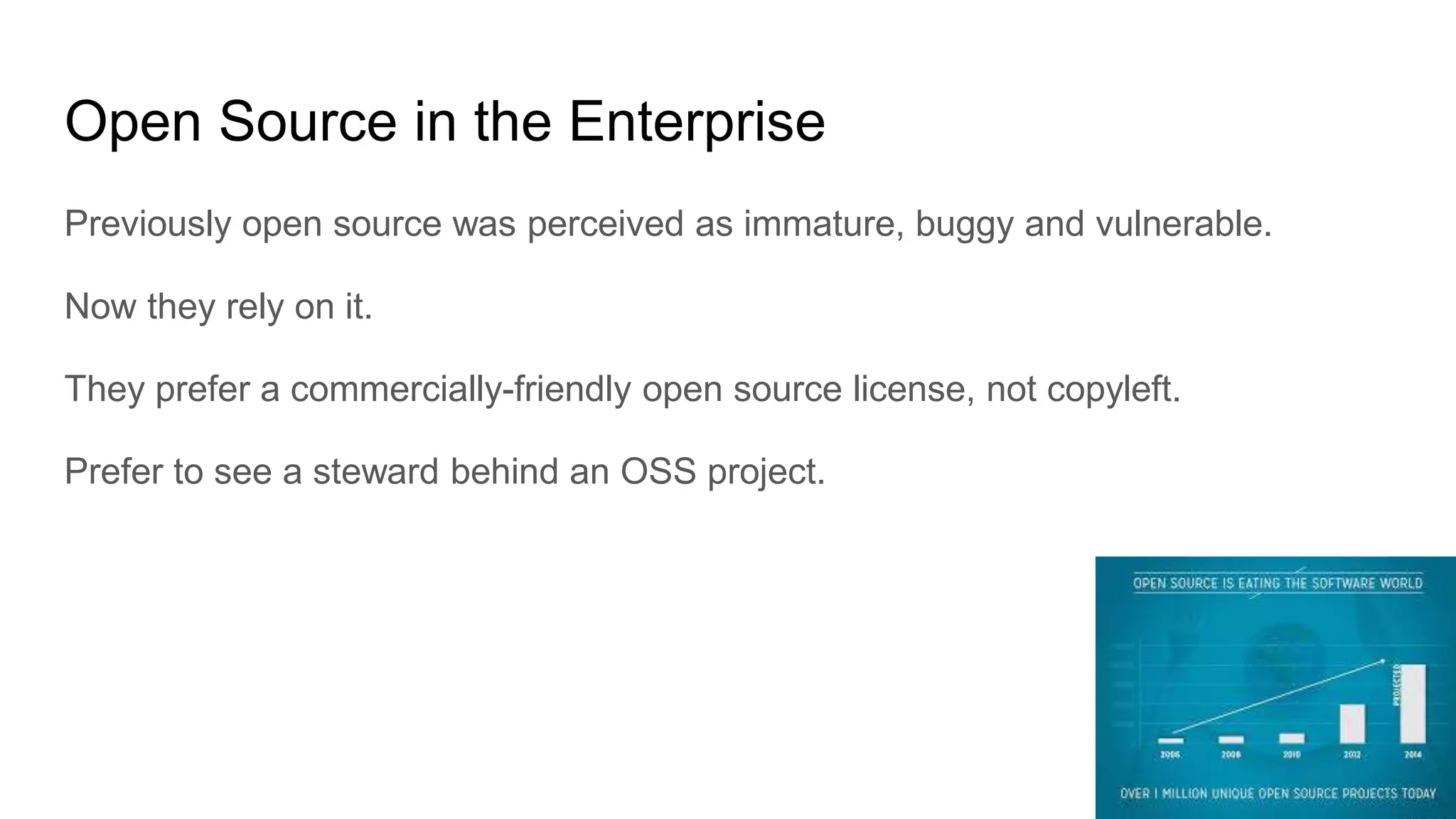
Previously open source was perceived as immature, buggy and vulnerable.
Now they rely on it.
They prefer a commercially-friendly open source license, not copyleft.
Prefer to see a steward behind an OSS project.
Stewardship
The steward is whoever provides governance and sets the roadmap for the
project. This may be one party, several collaborating or even nobody.
Or there are foundations:
Apache, linux, CNCF, eclipse...
May be actors in the community that have roadmap influence.
Types of Stewardship
Key cases:
● In-house project goes open source e.g. netflix microservice components and
Spring Cloud.
● OSS aimed at promoting an ecosystem e.g. google-led OSS in kubernetes
space. The incentive is to indirectly promote the platform.
● The OSS is offered free but a related paid-for option is available e.g. hosted
Stewardship and Monetisation
OSS might be developed with the intention to monetise e.g. MuleSoft.
Or it may be developed for a use-case and later monetised e.g. Kafka - developed
at LinkedIn and now offered by Confluent.
Sometimes companies monetise an existing open source e.g. WSO2
Whoever controls roadmap is best placed to monetise.
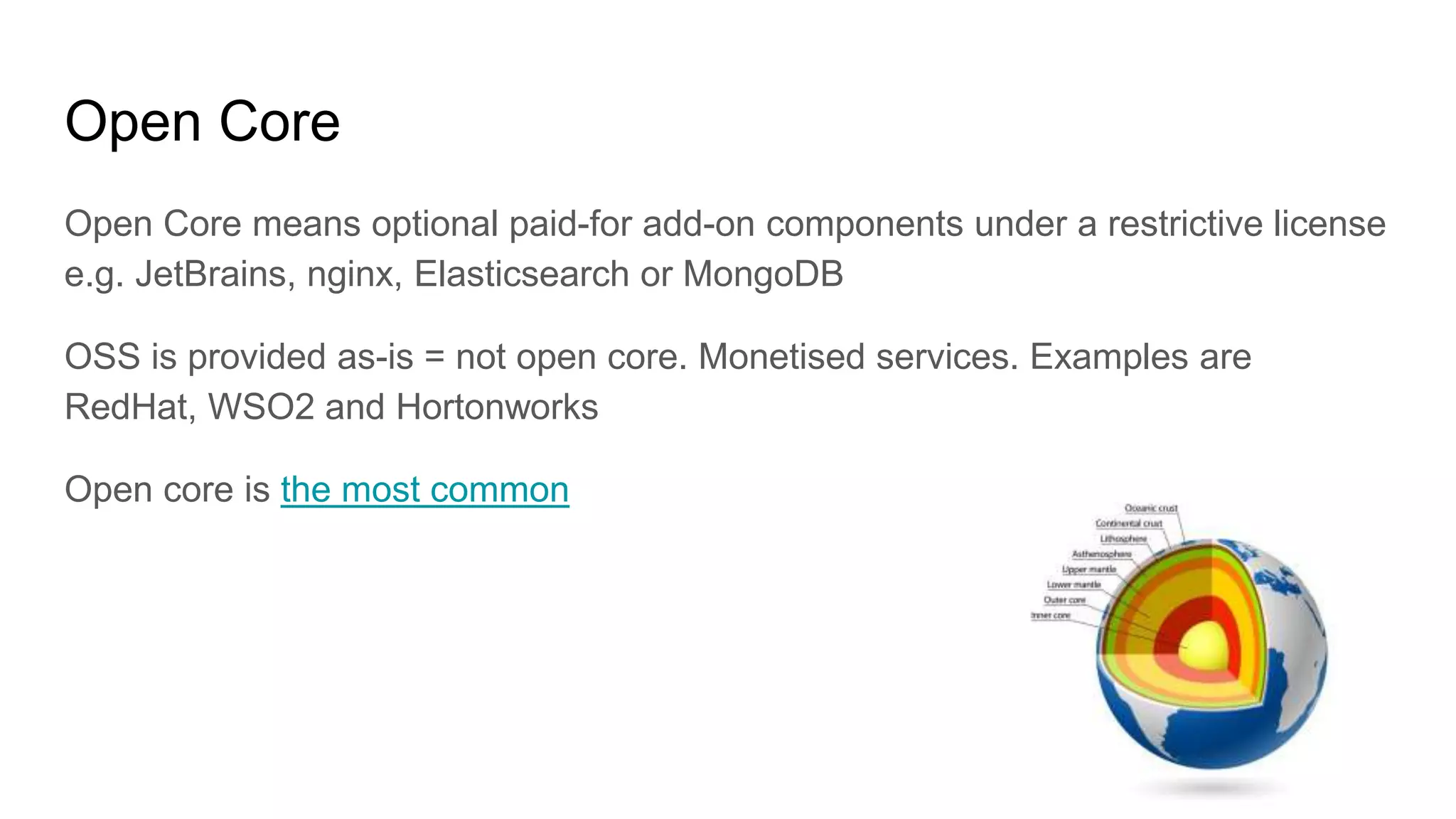
Open Core
Open Core means optional paid-for add-on components under a restrictive license
e.g. JetBrains, nginx, Elasticsearch or MongoDB
OSS is provided as-is = not open core. Monetised services. Examples are
RedHat, WSO2 and Hortonworks
Open core is the most common
The Open Core Bargain
Open source users use the project for free.
The steward effectively gets their contributions (PRs and bug reports) for free.
These can feed into the paid version.
The dynamics can vary a lot.
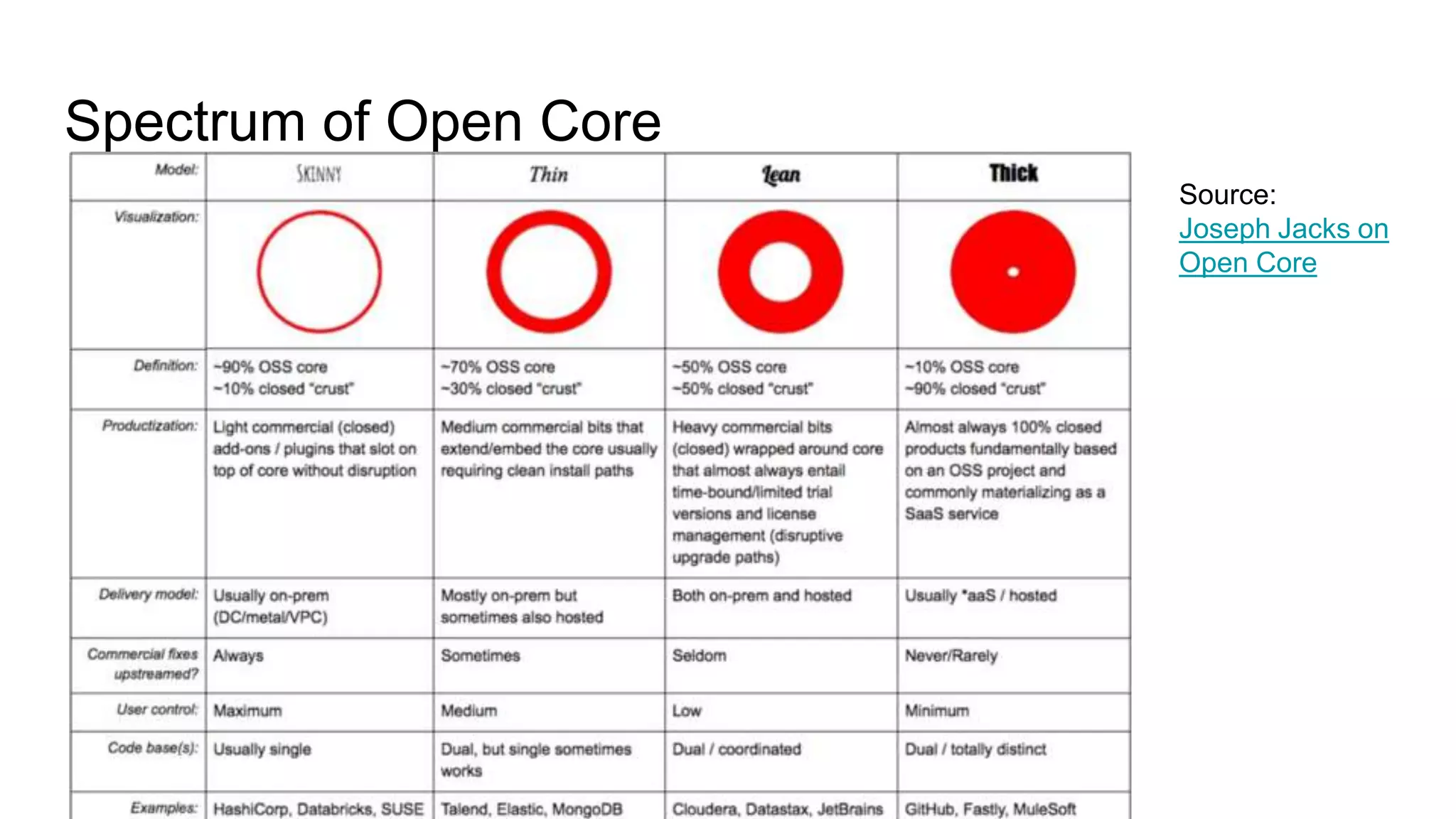
Spectrum of Open Core
Source:
Joseph Jacks on
Open Core
Open Core Licensing
Open source = permissive license e.g. Apache, MIT
Paid-for will likely fall under a Master Software License Agreement. This will
encompass some mix of:
- SLA-based support
- Access to enterprise/premium features
- Integration Services or Customer Success
- Training
- Premium materials
Enterprise Differentiation
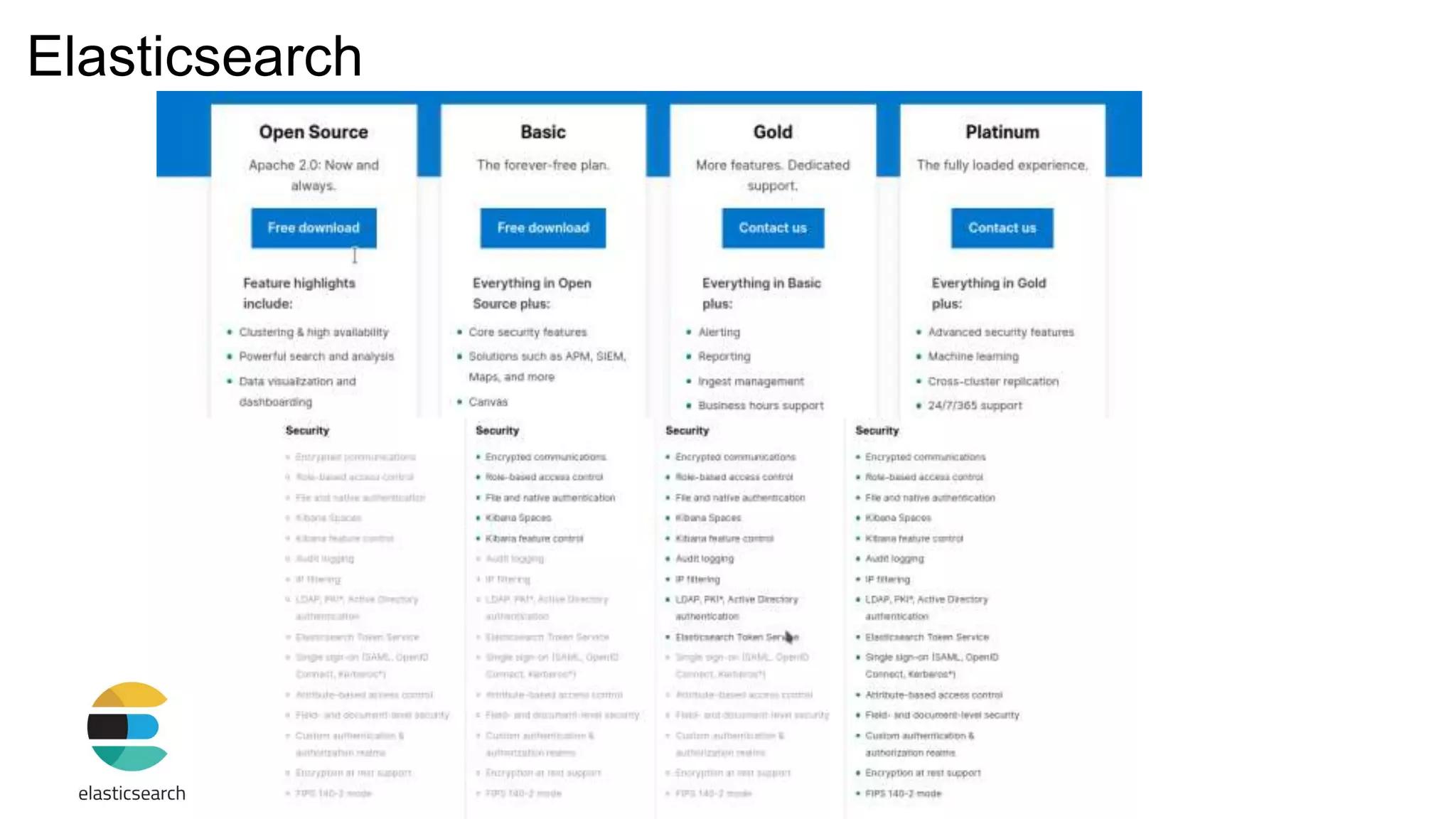
Features available only in premium and not in open source are enterprise
differentiation.
Can be add-on tools.
A commercial driver for offering this can be to persuade buyers that they are
getting tangible value for money.
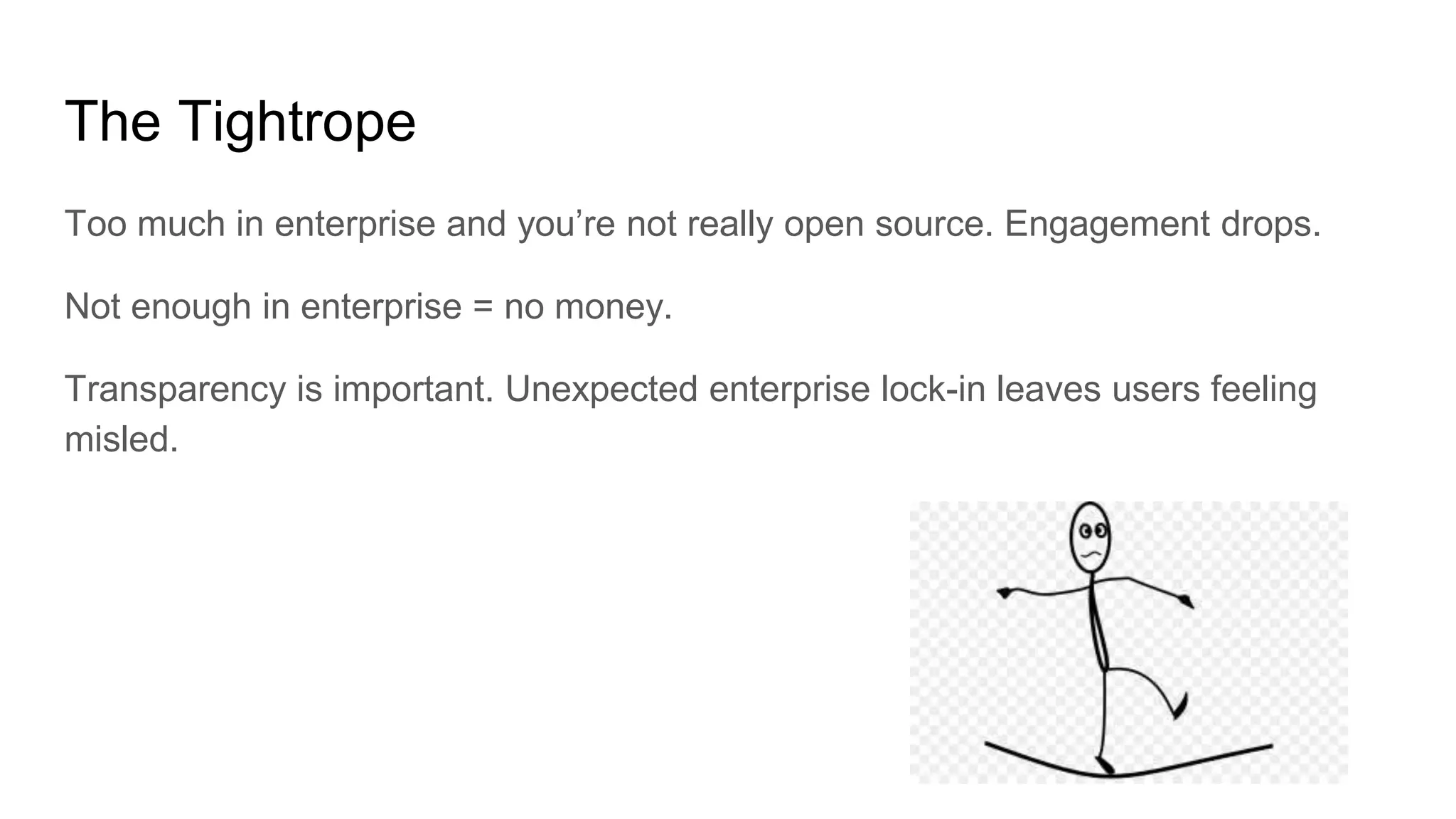
The Tightrope
Too much in enterprise and you’re not really open source. Engagement drops.
Not enough in enterprise = no money.
Transparency is important. Unexpected enterprise lock-in leaves users feeling
misled.
Pitching Enterprise Features
Enterprise features could be pitched at corporate users for:
- Scale
- Visibility
- Governance
- Multi-tenancy
- Security
Chimes well with a tiered pricing model.
Case Studies
nginx
Nginx-plus is differentiated from open source by:
- Built-in openid-connect
- Extra Metrics
- Sticky sessions and persistent sessions
- Bandwidth controls for MP4s
- And others
So focused around high availability, high use and monitoring
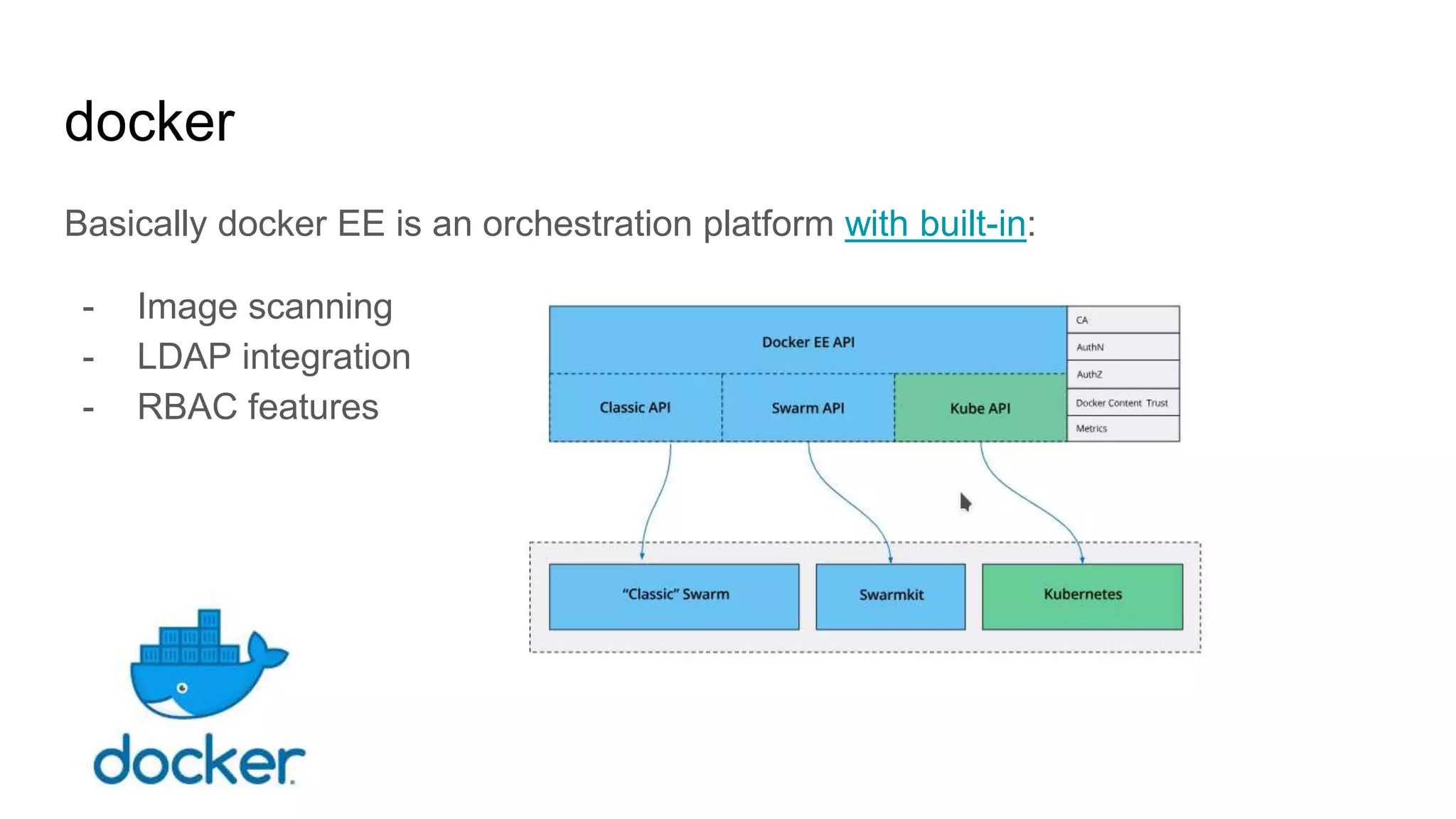
docker
Basically docker EE is an orchestration platform with built-in:
- Image scanning
- LDAP integration
- RBAC features
Elasticsearch
GitLab
Weighting for issues
CSV Export
Burndown charts
Multiple reviewers in code reviews
More
MongoDB
Enterprise server offers:
- Encryption
- LDAP integration
- in-mem storage
Plus you can get a bunch of install, monitoring, maintenance and backup tools
Adapting to Cloud
● Cloud already changed the rules for open source projects
● Pricing based on clustering/replicas or CPU
● SaaS for OSS
Growing Open Source Communities
Not everything is about making money.
Join Open Source Projects

How open source is funded the enterprise differentiation tightrope (1)

  • 1.
    How Open SourceIs Funded The Enterprise Differentiation Tightrope Ryan Dawson Mauricio Salatino Sept 2019
  • 2.
    “[W]e didn't opensource it to get help from the community, to make the product better. We open sourced as a freemium strategy; to drive adoption.” MongoDB CEO Dev Ittycheria
  • 3.
    Speakers Ryan Dawson ● Workedin banks... ● Switched to open source ● Also in paid-for enterprise https://github.com/ryandawsonuk Mauricio Salatino - Salaboy ● 12 years in Open Source ● http://salaboy.com ● @salaboy ● @ZeebeHQ ● @learnK8s
  • 4.
    Speakers Background ● Workedin open source for a long time ● Experienced how confusing open core business model can be ● Open Source users and contributors
  • 5.
    Agenda ● Intro onOpen Source Software ● Growth of Open Source ● Types of Stewardship/Management ● Types of funding for Stewardship ● Open Core ● Challenges of Open Core
  • 6.
    What is OpenSource? Open source software is software with source code that anyone can inspect, modify, and enhance. Opensource.com
  • 7.
    Reasons developers joinOSS ● Collaboration instead of reinvention ○ Organically form around problems ○ Contribution to the whole developer community ○ Diverse environments ○ Merit based ● Career points ○ Interesting people/experts ○ Public profile ○ Learning for most experienced people ● “People hate their families”
  • 8.
    Open Source inthe Enterprise Previously open source was perceived as immature, buggy and vulnerable. Now they rely on it. They prefer a commercially-friendly open source license, not copyleft. Prefer to see a steward behind an OSS project.
  • 9.
    Stewardship The steward iswhoever provides governance and sets the roadmap for the project. This may be one party, several collaborating or even nobody. Or there are foundations: Apache, linux, CNCF, eclipse... May be actors in the community that have roadmap influence.
  • 10.
    Types of Stewardship Keycases: ● In-house project goes open source e.g. netflix microservice components and Spring Cloud. ● OSS aimed at promoting an ecosystem e.g. google-led OSS in kubernetes space. The incentive is to indirectly promote the platform. ● The OSS is offered free but a related paid-for option is available e.g. hosted
  • 11.
    Stewardship and Monetisation OSSmight be developed with the intention to monetise e.g. MuleSoft. Or it may be developed for a use-case and later monetised e.g. Kafka - developed at LinkedIn and now offered by Confluent. Sometimes companies monetise an existing open source e.g. WSO2 Whoever controls roadmap is best placed to monetise.
  • 12.
    Open Core Open Coremeans optional paid-for add-on components under a restrictive license e.g. JetBrains, nginx, Elasticsearch or MongoDB OSS is provided as-is = not open core. Monetised services. Examples are RedHat, WSO2 and Hortonworks Open core is the most common
  • 13.
    The Open CoreBargain Open source users use the project for free. The steward effectively gets their contributions (PRs and bug reports) for free. These can feed into the paid version. The dynamics can vary a lot.
  • 14.
    Spectrum of OpenCore Source: Joseph Jacks on Open Core
  • 15.
    Open Core Licensing Opensource = permissive license e.g. Apache, MIT Paid-for will likely fall under a Master Software License Agreement. This will encompass some mix of: - SLA-based support - Access to enterprise/premium features - Integration Services or Customer Success - Training - Premium materials
  • 16.
    Enterprise Differentiation Features availableonly in premium and not in open source are enterprise differentiation. Can be add-on tools. A commercial driver for offering this can be to persuade buyers that they are getting tangible value for money.
  • 17.
    The Tightrope Too muchin enterprise and you’re not really open source. Engagement drops. Not enough in enterprise = no money. Transparency is important. Unexpected enterprise lock-in leaves users feeling misled.
  • 18.
    Pitching Enterprise Features Enterprisefeatures could be pitched at corporate users for: - Scale - Visibility - Governance - Multi-tenancy - Security Chimes well with a tiered pricing model.
  • 19.
  • 20.
    nginx Nginx-plus is differentiatedfrom open source by: - Built-in openid-connect - Extra Metrics - Sticky sessions and persistent sessions - Bandwidth controls for MP4s - And others So focused around high availability, high use and monitoring
  • 21.
    docker Basically docker EEis an orchestration platform with built-in: - Image scanning - LDAP integration - RBAC features
  • 22.
  • 23.
    GitLab Weighting for issues CSVExport Burndown charts Multiple reviewers in code reviews More
  • 24.
    MongoDB Enterprise server offers: -Encryption - LDAP integration - in-mem storage Plus you can get a bunch of install, monitoring, maintenance and backup tools
  • 25.
    Adapting to Cloud ●Cloud already changed the rules for open source projects ● Pricing based on clustering/replicas or CPU ● SaaS for OSS
  • 26.
    Growing Open SourceCommunities Not everything is about making money.
  • 27.

Editor's Notes

  • #4 Salaboy: Started working in open source project in 2008 but my first meaningful contributions where done in 2009 and since then I have managed to convince people to let me work on open source projects.. So not a single line in a private repo since then. I currently work for a company called camunda that has a project called Zeebe and it is an orchestration framework for microservices. I also contribute to LearnK8s as content creator and instructor for kubernetes trainings. Back in 2008 I created a blog that helped me to share my Open Source journey with people and I made a lot of friends since then. We are doing this presentation with Ryan due we both share the same passion about Open Source, we are committed to our projects and other open source projects and we would love to share with you our struggles and rewards coming from these open source projects.
  • #5 We have both contributed to several open source projects and we are currently working full time in our companies Open Source projects. We both struggle together in previous lives seeing how companies have a hard time to define what their business model is and how their Open Source projects work for them .
  • #6 Can we change to Quick intro to Open Source Types of Stewardship/Governance Open Core (contains the case studies) Adapting to the cloud Not everything is about money
  • #7 Lots of java-based examples in github: Spring, Kafka, Elasticsearch, Hadoop, lots of libraries (e.g. jackson), lots of apache projects
  • #8 There are several reasons to get involved with an open source project here are just a few: Usually instead of reinventing the wheel you should check if there is an open source project already solving the problem that you have at hand.. Then you can collaborate to make a better solution for everyone else Open Source projects are formed around a common problem that requires solution
  • #9 Docker, linux, kubernetes are fundamental
  • #10 Often the github org under which a project sits belongs to the stewarding organisation.
  • #11 SaaS or managed service as paid (on-prem free).
  • #17 When there is a single stewarding company, they can set the roadmap to select features for open source or enterprise
  • #26 MongoDB changed their license because of amazon - https://www.theregister.co.uk/2018/10/16/mongodb_licensning_change/ It is super interesting to see how the Cloud, Cloud Providers and the Cloud Ecosystem has change the way that companies see and related to open source projects. For Open Source projects that were designed as libraries or tools for other developers Cloud Providers and Customers going to the cloud have changed the way that monetization used to work for them. Today if you ask any Open Source company, they all are interested in selling to cloud and on-prem customers, which opens a lot of questions on how projects should be structured and licensed. The old pricing models for On Prem software doesn’t work anymore in the cloud and packaging and selling a Software as a Service (managed) version of our Open Source projects makes a lot of sense to a lot of businesses. But it also creates a lot of questions. Most of these projects were not designed to work in a SaaS environment and neither the companies which were selling on Prem.. so there is a big cultural change that needs to happen for those companies to survive. As usual, instead of inventing your own way of solving very complicated problems you can take a look at the Linux Foundation and Cloud Native Foundation where most large companies and Open Source projects are incubated and productized.
  • #27 Not everything is about money, there are organizations and companies out there set up to help open source projects to grow and be healthy. Google Summer of Code is a great program by Google which offer students the opportunity to help in a open source project during summer time (3 months) where they get paid to get involved into an open source project which offer a mentor which will guide the student. Similar to GSoC OutReachy is an organization that promote internships into Open Source projects. They coordinate mentors and pay interns for 3 months of work Open Collective is an org and a company that helps to connect funds to Open Source projects. They are aiming to maintain the maintainers and they provide all the platform and tools needed to connect people that wants to pay for getting some features done in a certain project and how that money will flow to the people involved in making that happen. Finally github sponsors.. With that weird and a little bit scary logo.. Github sponsors is integrating with Stripe so you can basically pay any github user via Stripe.. For what I understand it is more like donate to your fav open source project or user..
  • #28 Finally.. We are more than happy to help anyone interested in joining any of these open source projects. Or any other projects that you might find interesting. We know these projects and we are quite involved so we can definitely advise.