How Can You Build a Future-Proof System for
Managing Medical Images?
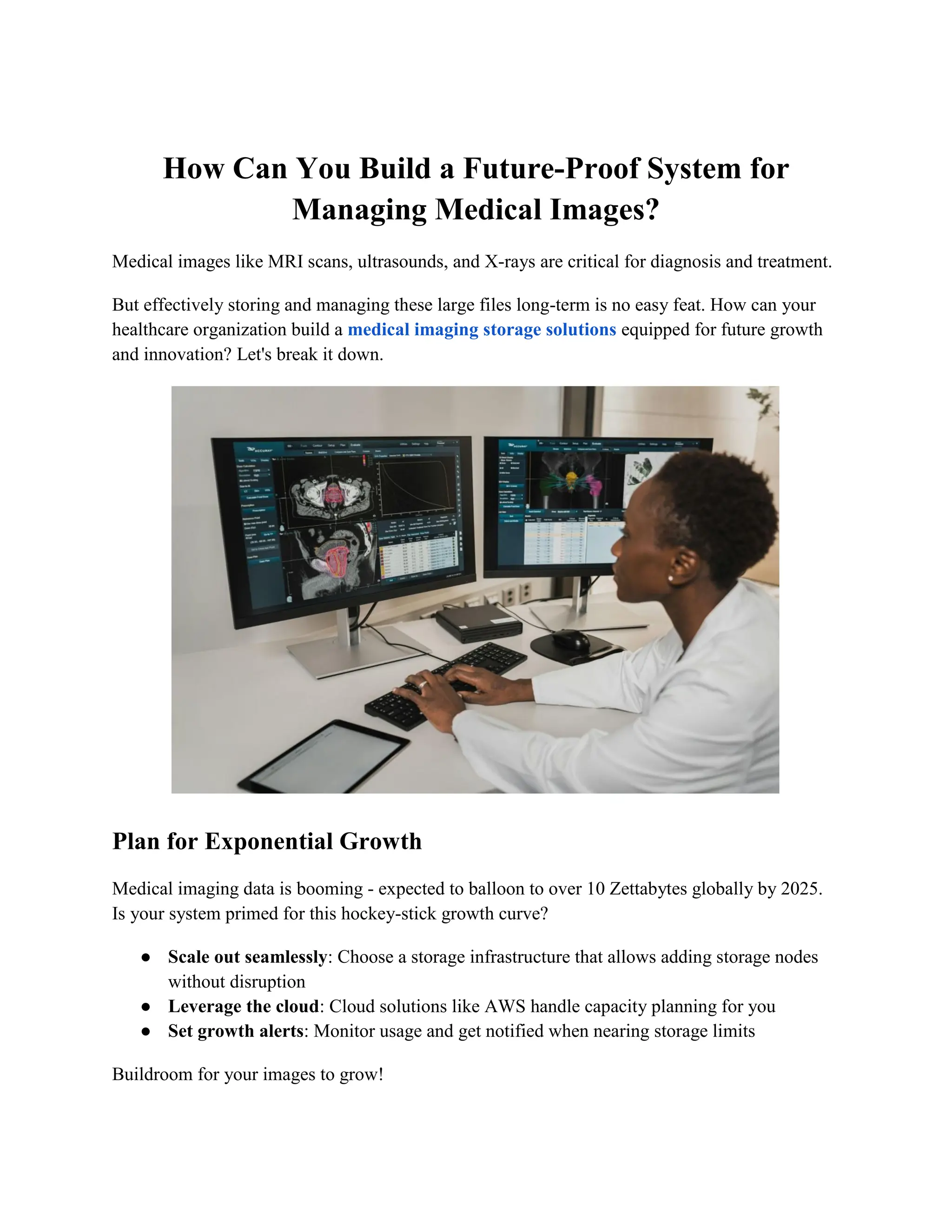
Medical images like MRI scans, ultrasounds, and X-rays are critical for diagnosis and treatment.
But effectively storing and managing these large files long-term is no easy feat. How can your
healthcare organization build a medical imaging storage solutions equipped for future growth
and innovation? Let's break it down.
Plan for Exponential Growth
Medical imaging data is booming - expected to balloon to over 10 Zettabytes globally by 2025.
Is your system primed for this hockey-stick growth curve?
● Scale out seamlessly: Choose a storage infrastructure that allows adding storage nodes
without disruption
● Leverage the cloud: Cloud solutions like AWS handle capacity planning for you
● Set growth alerts: Monitor usage and get notified when nearing storage limits
Buildroom for your images to grow!
Ensure Redundancy and Availability
What would happen if you lost critical scan data overnight? Robust redundancy keeps images
available 24/7:
● Geo-distribute storage: Replicate data across zones or regions
● Enable quick failover: If one node goes down, instantly switch to another
● Consider air-gapped archive: Keep an offline copy in a physically separate location
● Confirm with audits: Run simulations to confirm redundancy systems work
Because when it comes to medical images, uptime is a matter of health.
Fortify Security and Compliance
HIPAA violations from exposed medical data can lead to massive fines and reputational damage.
But relax - you can create an impenetrable imaging fortress with:
● Role-based access controls: Restrict data access to authorized users
● Enable identity federation: Integrate with existing systems like Active Directory
● Encrypt data end-to-end: Scramble data while in transit and at rest
● Log events extensively: Track all user activity for auditing
● Consult experts: Work with resources to bulletproof your security posture
Staying compliant doesn't have to be complicated. Arm yourself with the right protections for
peace of mind.
Retain Images Long-Term
Some medical images may need retention for decades depending on regulations. While storing
60 years of chest X-rays seems daunting, it's straightforward with:
● Multi-tier storage: Transition older data to cheaper object storage
● Define retention rules: Set policies to move images to appropriate tiers
● Fingerprint files: Enable quick lookups without retrieving entire images
● Consider WORM storage: Write Once Read Many devices have immutable retention
● Test restores: Validate you can retrieve archived data when needed
Implementing sound retention practices today salvages images tomorrow!
Maintain Accessibility and Usability
Images buried behind outdated viewers or formatting may be inaccessible when needed most.
Keep data usable through:
● Standard formats: Use vendor-neutral formats like DICOM for images
● Viewer-agnostic access: Allow access from any modern viewer
● Metadata attached: Retain patient data linked to images
● Format migration: Convert legacy formats if necessary
● Confirm functionality: Validate usability by sampling images
Because even flawlessly stored data loses value if providers can't access it easily!
Accommodate Emerging Data Sources
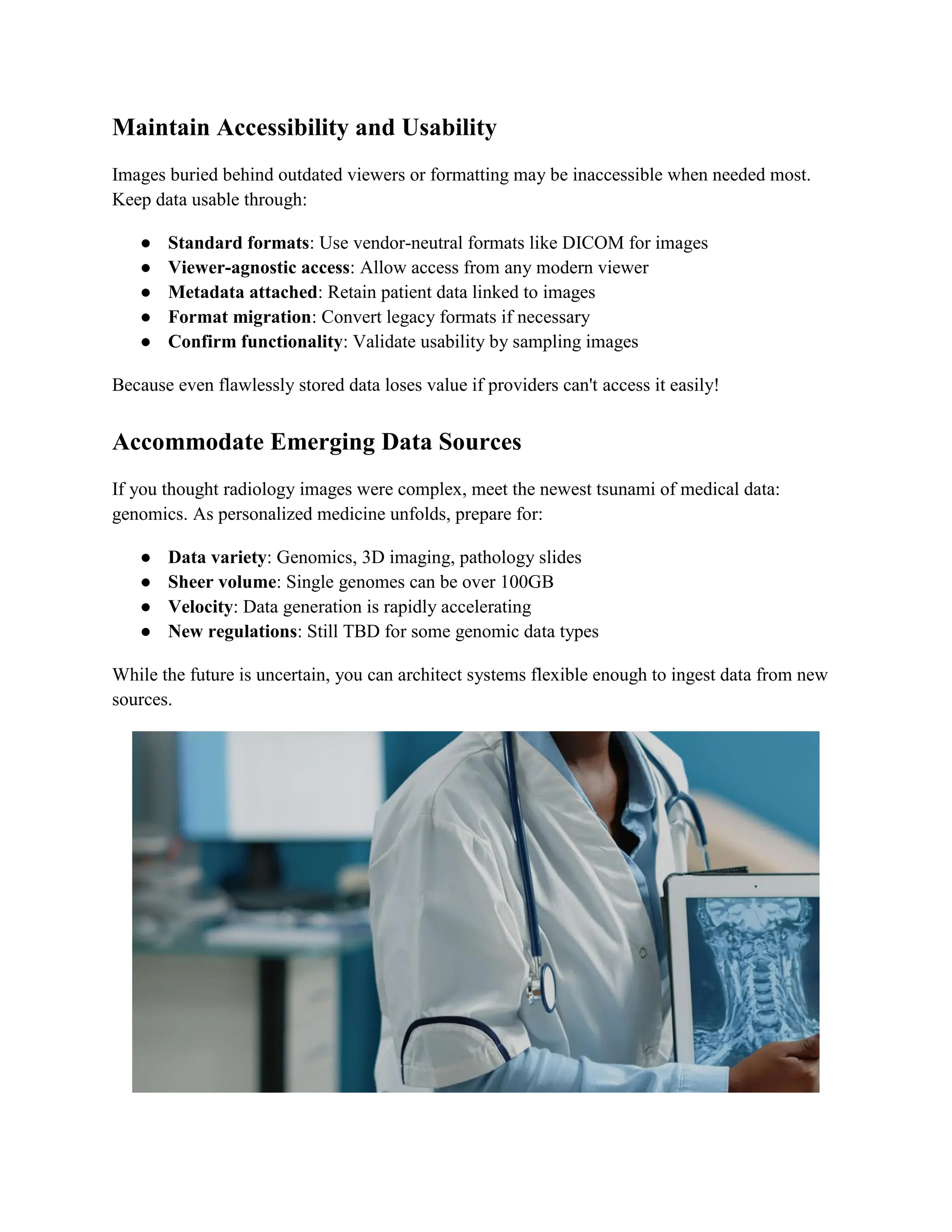
If you thought radiology images were complex, meet the newest tsunami of medical data:
genomics. As personalized medicine unfolds, prepare for:
● Data variety: Genomics, 3D imaging, pathology slides
● Sheer volume: Single genomes can be over 100GB
● Velocity: Data generation is rapidly accelerating
● New regulations: Still TBD for some genomic data types
While the future is uncertain, you can architect systems flexible enough to ingest data from new
sources.
Adopt Vendor-Agnostic Systems
Relying on one vendor's proprietary system could paint you into a corner. Instead:
● Demand transparency: Reject "black box" solutions
● Insist on data portability: Can you export if changing systems?
● Avoid lock-in: Don't get stuck owing storage rental fees indefinitely
● Ask about roadmap: What new capabilities are on their horizon?
Vendor transparency today gives you choices tomorrow.
The Bottom Line
The amount of medical images showing up on your doorstep will only intensify. But don't let the
coming crunch crush your systems!
Follow these 8 tips to architect imaging management built to prevail through decades of
healthcare innovation yet to come:
☑ Plan for growth
☑ Ensure redundancy
☑ Secure data
☑ Retain long-term
☑ Maintain accessibility
☑ Welcome new data types
☑ Seek vendor transparency
☑ Insist on portability
With forethought and adaptability woven into your strategy, your medical imaging infrastructure
can withstand whatever the future fathoms.

How Can You Build a Future-Proof System for Managing Medical Images.pdf

  • 1.
    How Can YouBuild a Future-Proof System for Managing Medical Images? Medical images like MRI scans, ultrasounds, and X-rays are critical for diagnosis and treatment. But effectively storing and managing these large files long-term is no easy feat. How can your healthcare organization build a medical imaging storage solutions equipped for future growth and innovation? Let's break it down. Plan for Exponential Growth Medical imaging data is booming - expected to balloon to over 10 Zettabytes globally by 2025. Is your system primed for this hockey-stick growth curve? ● Scale out seamlessly: Choose a storage infrastructure that allows adding storage nodes without disruption ● Leverage the cloud: Cloud solutions like AWS handle capacity planning for you ● Set growth alerts: Monitor usage and get notified when nearing storage limits Buildroom for your images to grow!
  • 2.
    Ensure Redundancy andAvailability What would happen if you lost critical scan data overnight? Robust redundancy keeps images available 24/7: ● Geo-distribute storage: Replicate data across zones or regions ● Enable quick failover: If one node goes down, instantly switch to another ● Consider air-gapped archive: Keep an offline copy in a physically separate location ● Confirm with audits: Run simulations to confirm redundancy systems work Because when it comes to medical images, uptime is a matter of health. Fortify Security and Compliance HIPAA violations from exposed medical data can lead to massive fines and reputational damage. But relax - you can create an impenetrable imaging fortress with: ● Role-based access controls: Restrict data access to authorized users ● Enable identity federation: Integrate with existing systems like Active Directory ● Encrypt data end-to-end: Scramble data while in transit and at rest ● Log events extensively: Track all user activity for auditing ● Consult experts: Work with resources to bulletproof your security posture Staying compliant doesn't have to be complicated. Arm yourself with the right protections for peace of mind. Retain Images Long-Term Some medical images may need retention for decades depending on regulations. While storing 60 years of chest X-rays seems daunting, it's straightforward with: ● Multi-tier storage: Transition older data to cheaper object storage ● Define retention rules: Set policies to move images to appropriate tiers ● Fingerprint files: Enable quick lookups without retrieving entire images ● Consider WORM storage: Write Once Read Many devices have immutable retention ● Test restores: Validate you can retrieve archived data when needed Implementing sound retention practices today salvages images tomorrow!
  • 3.
    Maintain Accessibility andUsability Images buried behind outdated viewers or formatting may be inaccessible when needed most. Keep data usable through: ● Standard formats: Use vendor-neutral formats like DICOM for images ● Viewer-agnostic access: Allow access from any modern viewer ● Metadata attached: Retain patient data linked to images ● Format migration: Convert legacy formats if necessary ● Confirm functionality: Validate usability by sampling images Because even flawlessly stored data loses value if providers can't access it easily! Accommodate Emerging Data Sources If you thought radiology images were complex, meet the newest tsunami of medical data: genomics. As personalized medicine unfolds, prepare for: ● Data variety: Genomics, 3D imaging, pathology slides ● Sheer volume: Single genomes can be over 100GB ● Velocity: Data generation is rapidly accelerating ● New regulations: Still TBD for some genomic data types While the future is uncertain, you can architect systems flexible enough to ingest data from new sources.
  • 4.
    Adopt Vendor-Agnostic Systems Relyingon one vendor's proprietary system could paint you into a corner. Instead: ● Demand transparency: Reject "black box" solutions ● Insist on data portability: Can you export if changing systems? ● Avoid lock-in: Don't get stuck owing storage rental fees indefinitely ● Ask about roadmap: What new capabilities are on their horizon? Vendor transparency today gives you choices tomorrow. The Bottom Line The amount of medical images showing up on your doorstep will only intensify. But don't let the coming crunch crush your systems! Follow these 8 tips to architect imaging management built to prevail through decades of healthcare innovation yet to come: ☑ Plan for growth ☑ Ensure redundancy ☑ Secure data ☑ Retain long-term ☑ Maintain accessibility ☑ Welcome new data types ☑ Seek vendor transparency ☑ Insist on portability With forethought and adaptability woven into your strategy, your medical imaging infrastructure can withstand whatever the future fathoms.