HOW BUILD A
PARAGRAPH
By: Edward Julián Carvajal
Díaz
EAN UNIVERSITY
A PARAGRAPH CONTAIN…
 A CLEAR MAIN IDEA
 A MINITATURE ESSAY
 PART OF A LONGER COMPOSITION
 SUPPORTING INFORMATION
 A GROUP OF SENTENCES
WHAT THE PARAGRAPH SHOULD
CONTAIN
Unity: One main idea, Topic Sentence and
Other sentences support.
Coherence: Well organized spatial,
chronological, importance, logical, linkers and
connectors.
Other sentences support
SOME LINKS TO TAKE INTO ACCOUNT
 LINKERS:
 Cause and Effect: As a result, because, hence, since so, etc…
 Importance: At first, last, least, most important, next, etc…
 Similarity: Also, another, and, in addition to, like, etc…
 Difference: Although, but, however, instead, though, etc…
 Place: Above, around, behind, here, nearby, etc….
 Time: After, before, then, when, finally, etc…
OTHER THINGS THAT THE PARAGRAPH
SHOULD CONTAIN
Support: Supporting ideas, Evidence,
Examples, Detail, etc…
Good Language: Grammatical Accuracy,
Correct Punctuation, Apt Vocabulary, Variety of
structures.
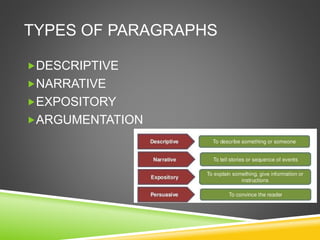
TYPES OF PARAGRAPHS
DESCRIPTIVE
NARRATIVE
EXPOSITORY
ARGUMENTATION
DESCRIPTIVE
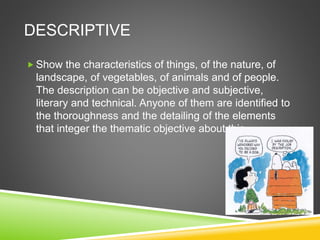
 Show the characteristics of things, of the nature, of
landscape, of vegetables, of animals and of people.
The description can be objective and subjective,
literary and technical. Anyone of them are identified to
the thoroughness and the detailing of the elements
that integer the thematic objective about this.
NARRATIVE
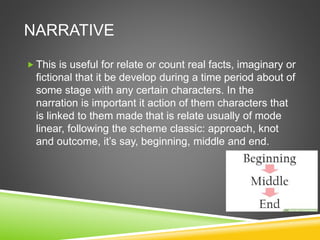
 This is useful for relate or count real facts, imaginary or
fictional that it be develop during a time period about of
some stage with any certain characters. In the
narration is important it action of them characters that
is linked to them made that is relate usually of mode
linear, following the scheme classic: approach, knot
and outcome, it’s say, beginning, middle and end.
EXPOSITORY
It raises an issue that has to be explained with
neat ideas, objective and clear so that it can be
understood and accurately interpreted by
readers. Predominates the logical order,
presentation, body, and conclusion, with a
development deductive or inductive.
ARGUMENTATION
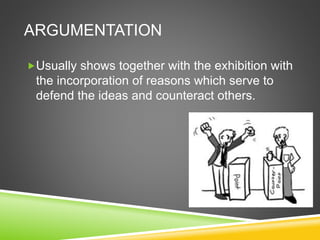
Usually shows together with the exhibition with
the incorporation of reasons which serve to
defend the ideas and counteract others.

How build a paragraph

  • 1.
    HOW BUILD A PARAGRAPH By:Edward Julián Carvajal Díaz EAN UNIVERSITY
  • 2.
    A PARAGRAPH CONTAIN… A CLEAR MAIN IDEA  A MINITATURE ESSAY  PART OF A LONGER COMPOSITION  SUPPORTING INFORMATION  A GROUP OF SENTENCES
  • 3.
    WHAT THE PARAGRAPHSHOULD CONTAIN Unity: One main idea, Topic Sentence and Other sentences support. Coherence: Well organized spatial, chronological, importance, logical, linkers and connectors. Other sentences support
  • 4.
    SOME LINKS TOTAKE INTO ACCOUNT  LINKERS:  Cause and Effect: As a result, because, hence, since so, etc…  Importance: At first, last, least, most important, next, etc…  Similarity: Also, another, and, in addition to, like, etc…  Difference: Although, but, however, instead, though, etc…  Place: Above, around, behind, here, nearby, etc….  Time: After, before, then, when, finally, etc…
  • 5.
    OTHER THINGS THATTHE PARAGRAPH SHOULD CONTAIN Support: Supporting ideas, Evidence, Examples, Detail, etc… Good Language: Grammatical Accuracy, Correct Punctuation, Apt Vocabulary, Variety of structures.
  • 6.
  • 7.
    DESCRIPTIVE  Show thecharacteristics of things, of the nature, of landscape, of vegetables, of animals and of people. The description can be objective and subjective, literary and technical. Anyone of them are identified to the thoroughness and the detailing of the elements that integer the thematic objective about this.
  • 8.
    NARRATIVE  This isuseful for relate or count real facts, imaginary or fictional that it be develop during a time period about of some stage with any certain characters. In the narration is important it action of them characters that is linked to them made that is relate usually of mode linear, following the scheme classic: approach, knot and outcome, it’s say, beginning, middle and end.
  • 9.
    EXPOSITORY It raises anissue that has to be explained with neat ideas, objective and clear so that it can be understood and accurately interpreted by readers. Predominates the logical order, presentation, body, and conclusion, with a development deductive or inductive.
  • 10.
    ARGUMENTATION Usually shows togetherwith the exhibition with the incorporation of reasons which serve to defend the ideas and counteract others.