Cebu Blogger’s Society, Inc.
How Blogs are Used for Social
Change: Philippine and
International Perspectives


GEN. MEMBERSHIP Bernales
          Bjornson
                   MEETING
                               Blogger
July 28, 2012 | Costabella Tropical Resort, Mactan Cebu
Outline:
  A. Definition of Blogging
  B. How To Use blogging for social change
  C. Niches of bloggers for Social Change
      1. Socio-cultural (travel, food and heritage)
      2. Technology
      3. Political
      4. Business and economy
      5. Medical
      6. Social Media
      7. Environment
  D. What are bloggers?
  E. Why are bloggers blogging?
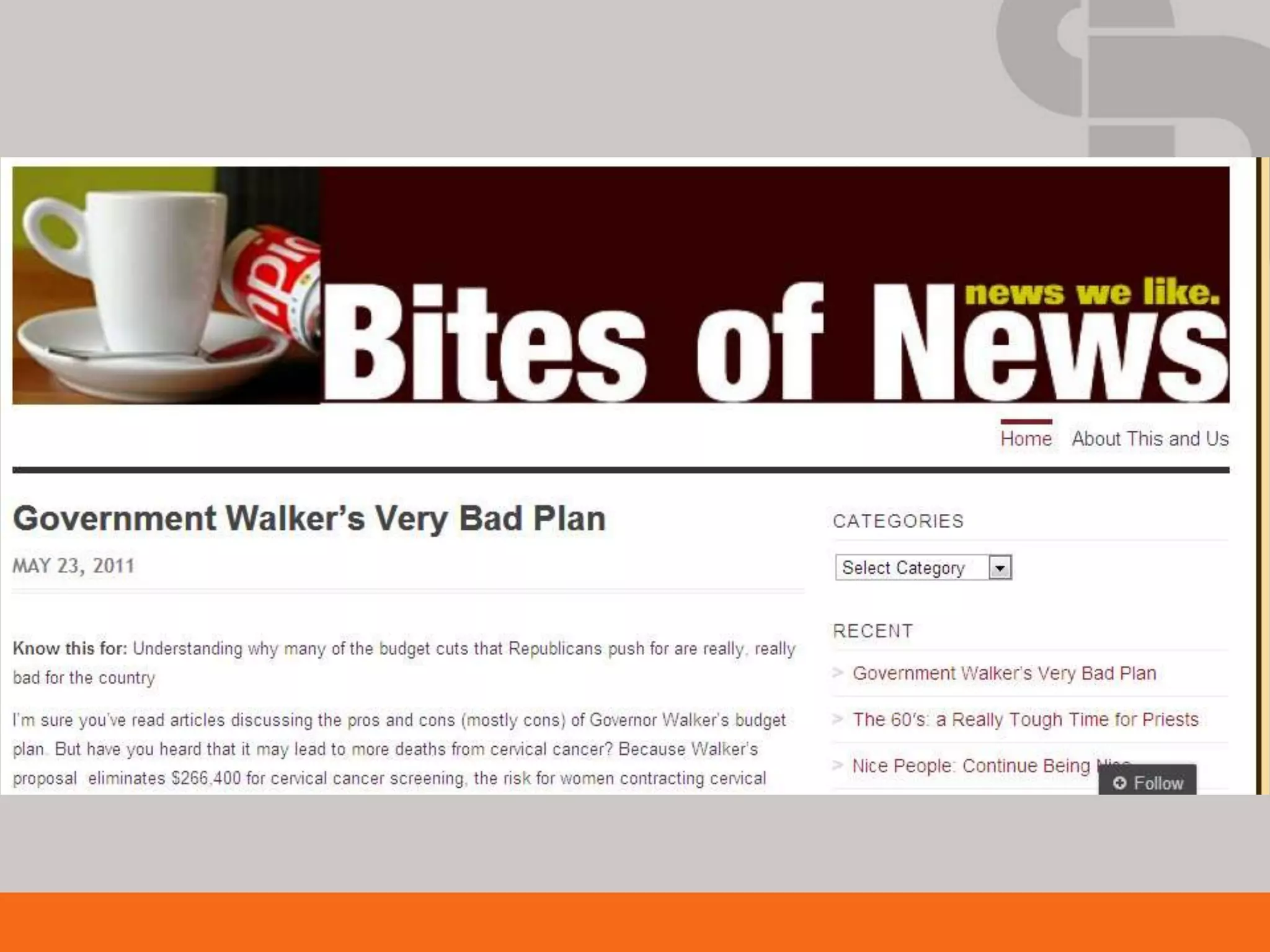
What is Blogging?
Quotes from well-known bloggers

 “I believe the term “blog” means more than an online journal. I believe a blog is a
 conversation. People go to blogs to read AND write, not just consume.”
 (Michael Arrington)


 “It should feel genuinely good to earn income from your blog — you should be driven by a
 healthy ambition to succeed. If your blog provides genuine value, you fully deserve to earn
 income from it.” (Steve Pavlina)

 “The sad truth is most bloggers, even those who incessantly work on monetization
 strategies, end up sitting around the few dollars a day mark and find it difficult to rise above
 this level.” (Yaro Starak)

 “Just as we don’t spend a lot of time worrying about how all those poets out there are going
 to monetize their poetry, the same is true for most bloggers.” (Seth Godin)
What is Blogging?
“As I have repeatedly written in one form or other, blogging is not about writing posts. Heck,
that’s the least of your challenges. No, blogging is about cultivating a mutually beneficial
relationships with an ever-growing online readership, and that’s hard work.” (Alister
Cameron)


“I think the pleasure of completed work is what makes blogging so popular. You have to
believe most bloggers have few if any actual readers. The writers are in it for other reasons.
Blogging is like work, but without coworkers thwarting you at every turn. All you get is the
pleasure of a completed task.” (Scott Adams)


“I’ve long advised that bloggers seeking to make money from blogging spread their interests
across multiple revenue streams so as not to put all their eggs in one basket.” (Darren Rowse)

 “The fact of the matter is, if you can start up a local blog about the independent hip-hop
scene in Seattle or the financial side of the restaurant business or the intersection of
immigration and entrepreneurship, you’ve got a far better shot at becoming a leader in your
field.” (Rand Fishkin)
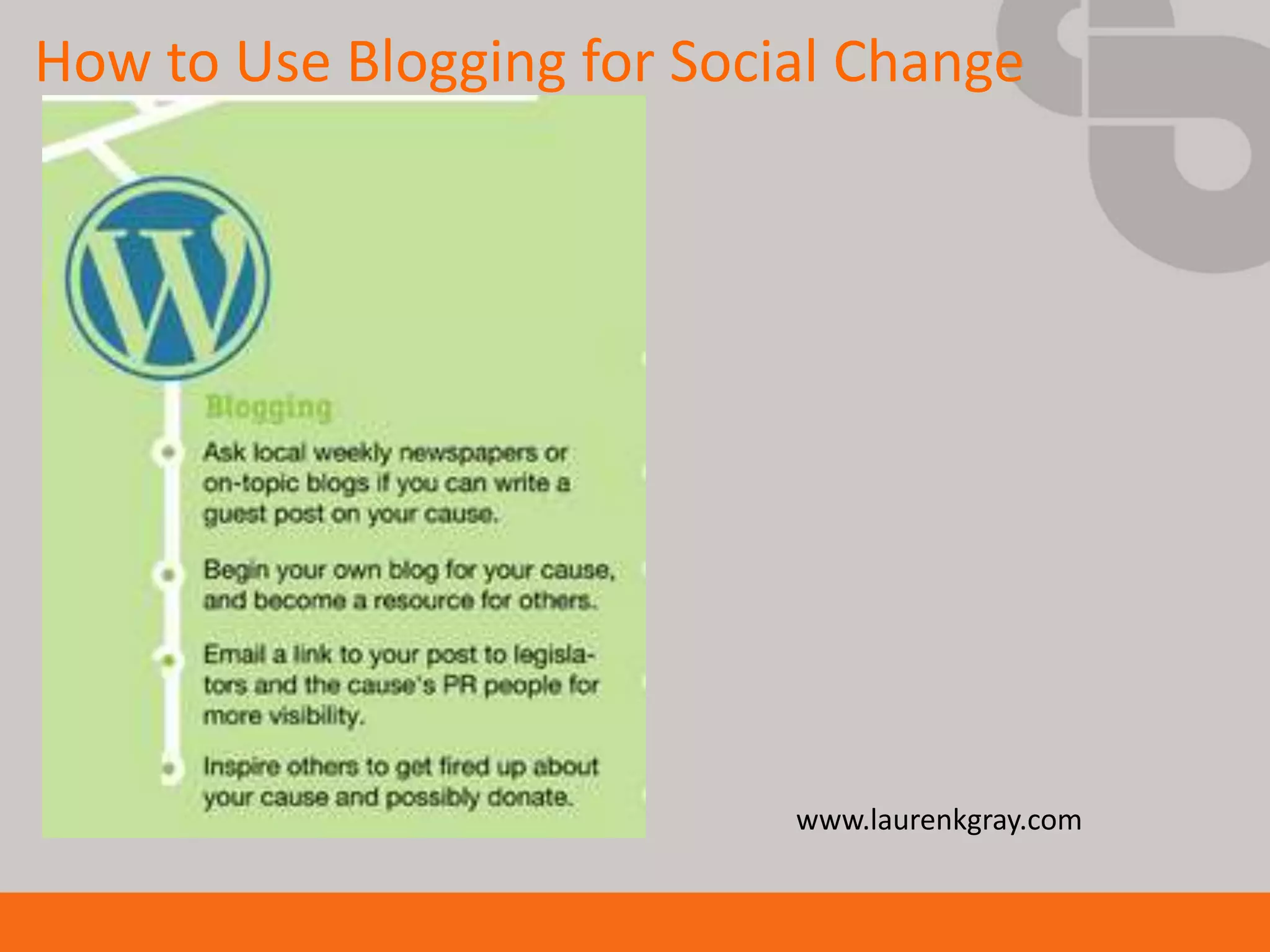
How to Use Blogging for Social Change


                            www.laurenkgray.com
How to Use Blogging for Social Change

    -Be passionate and consistent

    -- Create a community

    ---Inspire others to do the same and
    to ACT NOW
Niches of Blogs for Social Change
   •Technology
   •Political
   •Business and economy
   •Medical
   •Social Media
   •Environment
   •Travel, food and heritage
What are Bloggers?
The term “blogger” is used to
describe a person who likes to
 post blogs on the internet.
•Writers
•Journalists
•Entrepreneurs
•Marketers
•Politicians
•Students
•Experts
Bloggers are Advocates


… and they take risks.
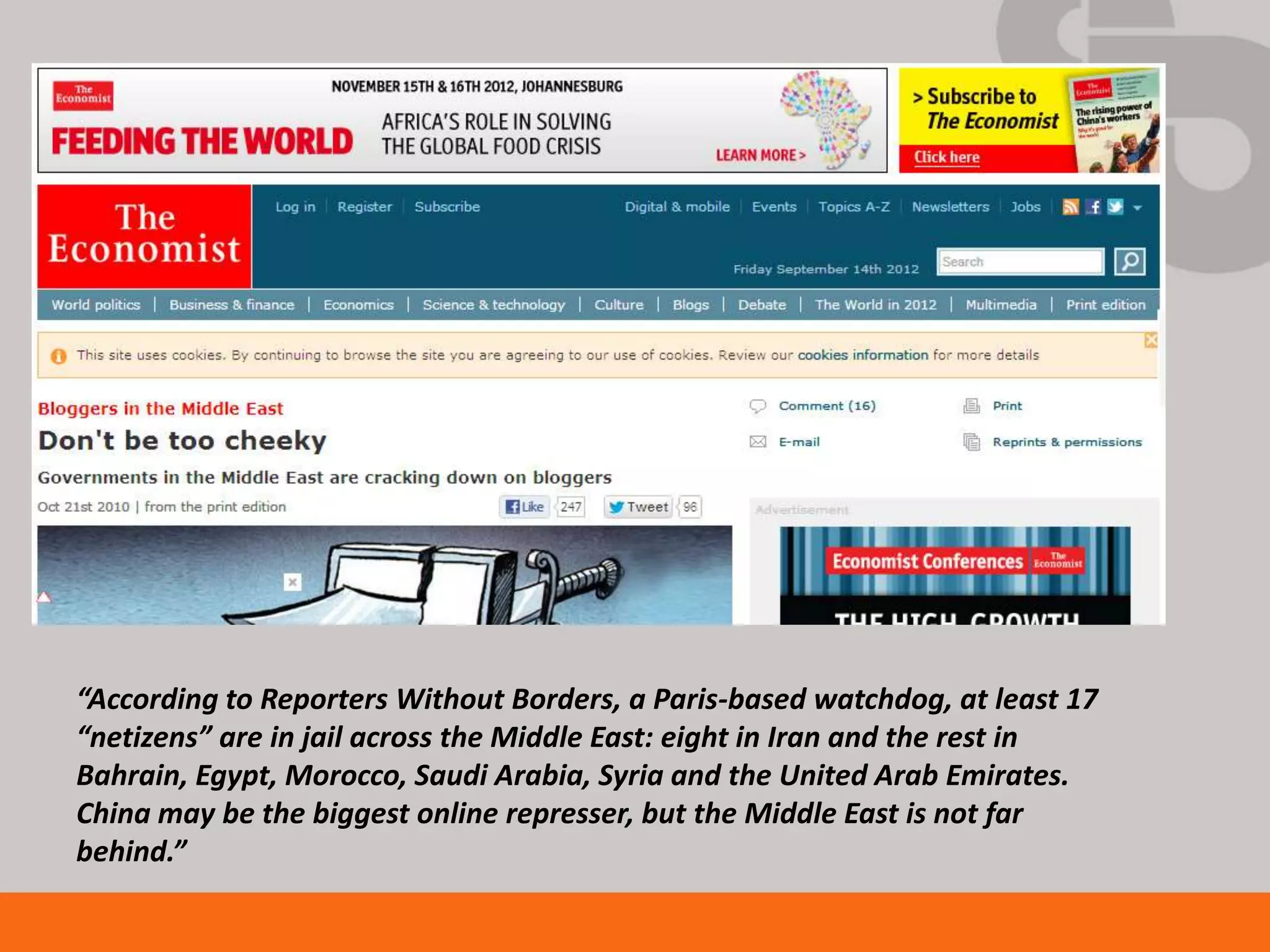
“According to Reporters Without Borders, a Paris-based watchdog, at least 17
“netizens” are in jail across the Middle East: eight in Iran and the rest in
Bahrain, Egypt, Morocco, Saudi Arabia, Syria and the United Arab Emirates.
China may be the biggest online represser, but the Middle East is not far
behind.”
Why are bloggers blogging?
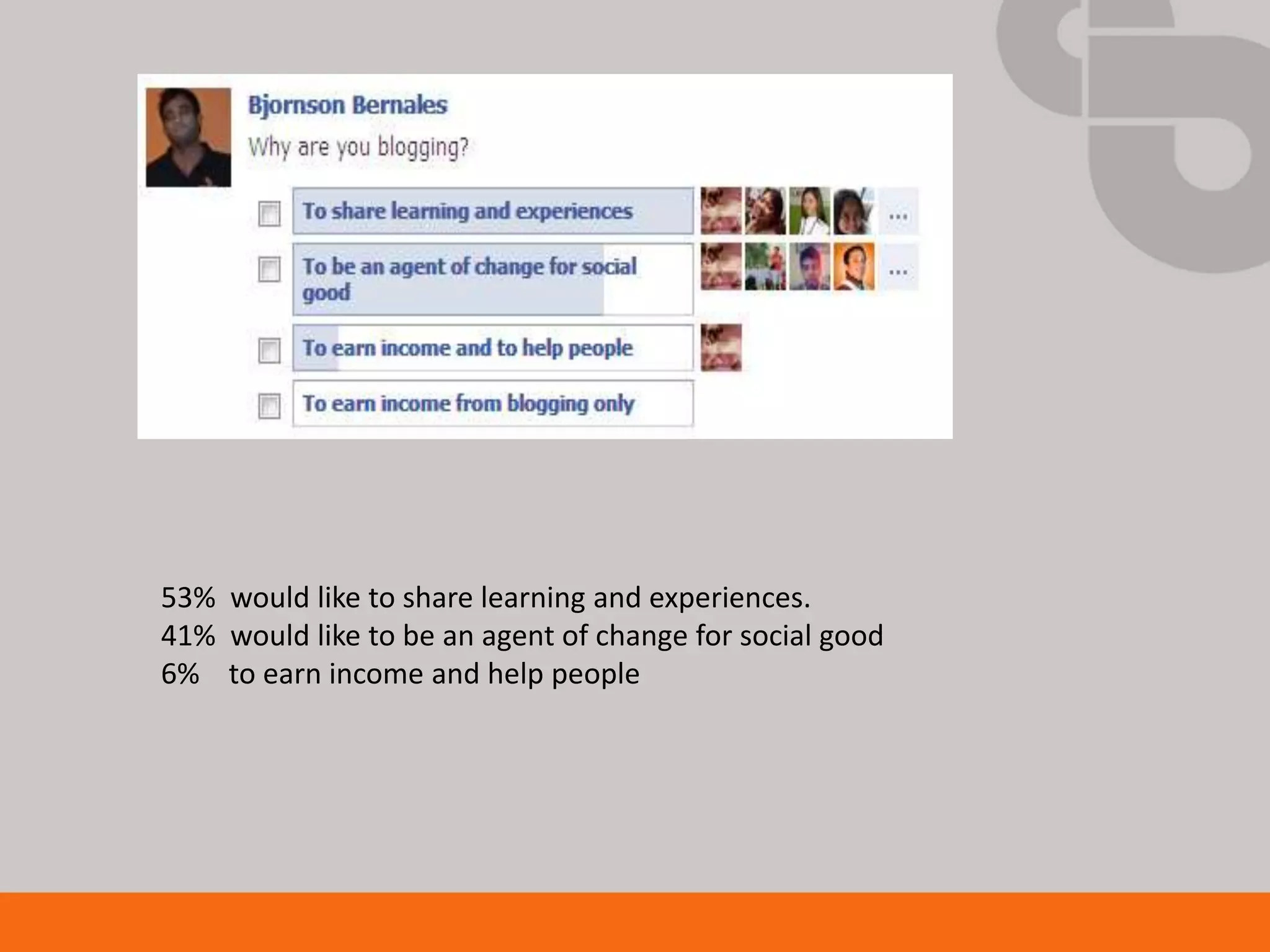
53% would like to share learning and experiences.
41% would like to be an agent of change for social good
6% to earn income and help people
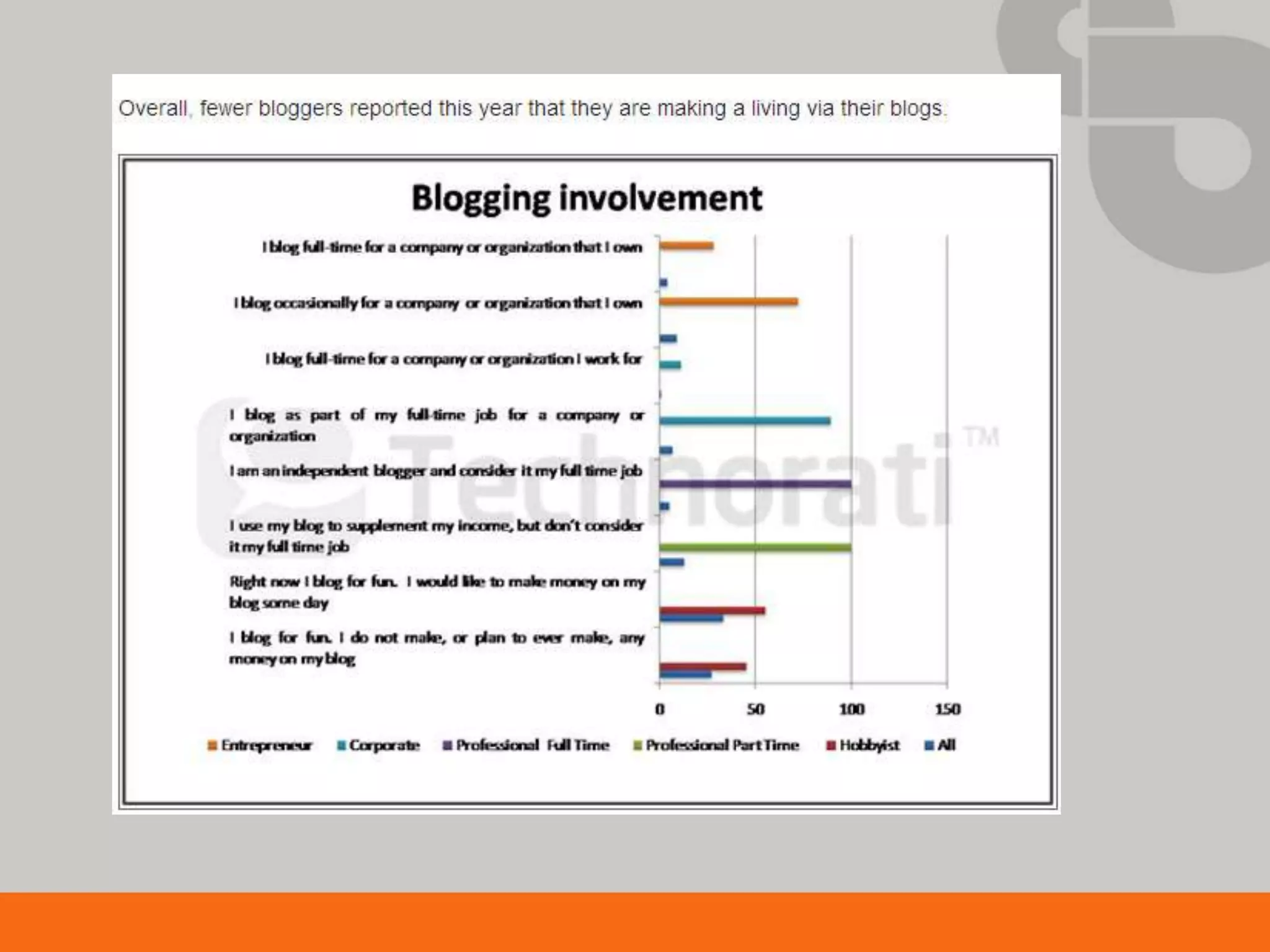
•Interestingly, only 37% of Professional Full Time respondents say they derive
their primary income from blogging. Of these Professional Full Time bloggers,
55% are a parent (and 57% of Entrepreneurs are a parent). That's almost 10%
higher than other segments of bloggers (46% of Hobbyists, 48% of
Professional Part Timers, and 48% of Corporates).
• Professional Full Time bloggers are much less likely to be (otherwise)
employed full time, much more likely to be self-employed, and somewhat
more likely to be a stay-at-home parent or retired.
•Professional Full Timers (56%) and Entrepreneurs (63%) are also more likely
to be married than Hobbyists (51%), especially Entrepreneurs, who are 12%
more likely.
•Professional Full Timers skew older when compared to all other bloggers:
Only 28% are under 34 years old, vs. 38% overall.
•Professional Full Timers are fairly highly educated – 41% have at least some
graduate work (31% have an actual graduate degree). This is lower than the
55% of Corporate bloggers who have done at least some grad work, but likely
high relative to the general population.


Source: Technorati.com, State of the blogosphere 2011
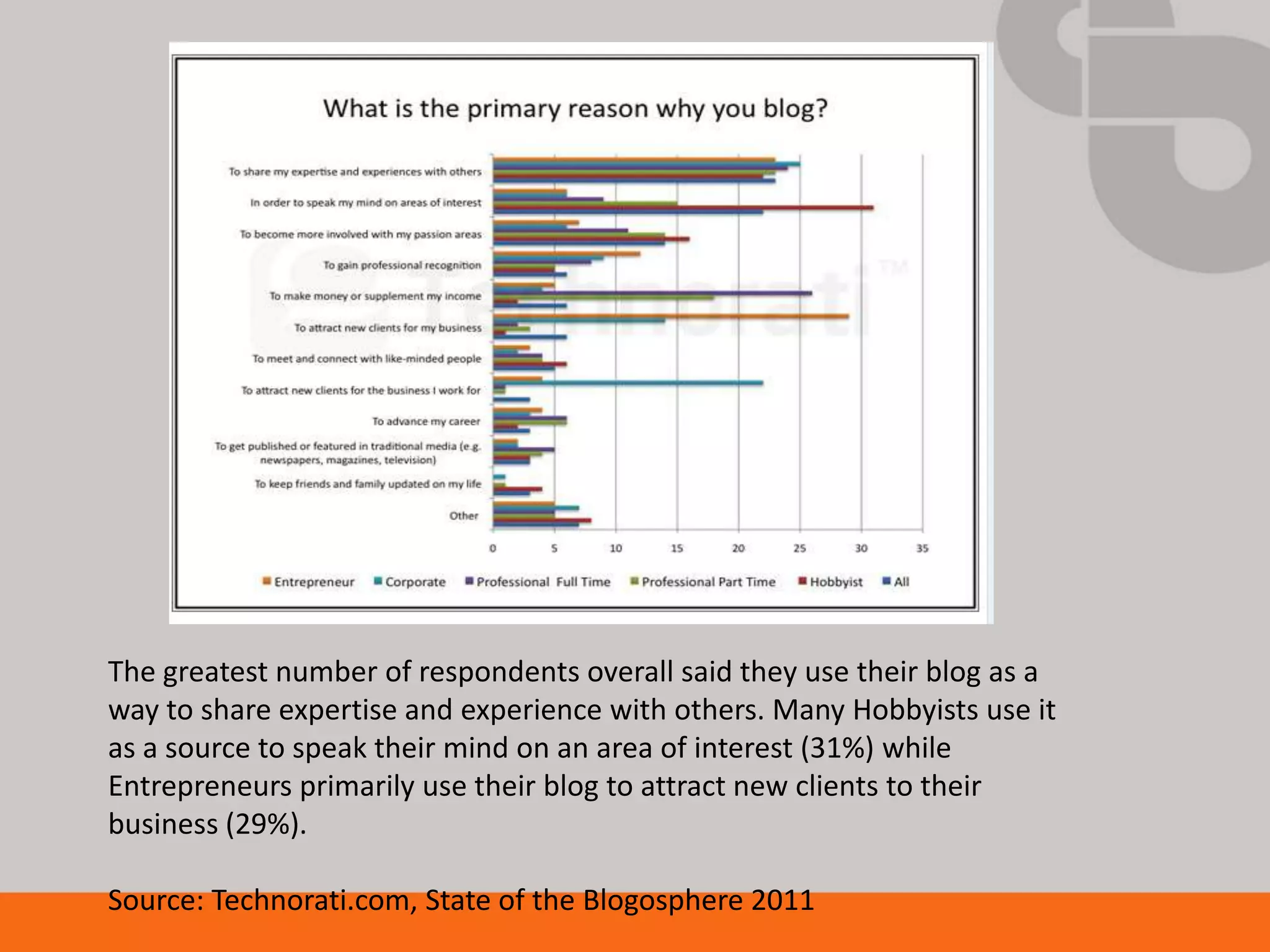
The greatest number of respondents overall said they use their blog as a
way to share expertise and experience with others. Many Hobbyists use it
as a source to speak their mind on an area of interest (31%) while
Entrepreneurs primarily use their blog to attract new clients to their
business (29%).

Source: Technorati.com, State of the Blogosphere 2011
Your ultimate consumers are your
   users, not search engines.
Google * Quoted from their Webmasters manual “Search Engine Optimization
                             Starter Guide” *
Unfortunately, blogging generally requires a lot of work! Gaining a large
readership for your business blog requires much of your attention and a big
dose of patience.


Chadrack Irobogo * Quoted from one of his own posts “Top 3 Reasons Why
Many Entrepreneurs Fail With Business Blog Marketing And How To
Overcome Them!” *
“Blog is a medium for social change”

                         Follow Bjorn Bernales

                         @bjorns24

                         www.bjorncebuano.com
                         www.bjornbern.com

                         Real Estate website:

                         www.cebubestproperties.com

How Blogs are used for Social Change: Philippine and International perspectives

  • 1.
    Cebu Blogger’s Society,Inc. How Blogs are Used for Social Change: Philippine and International Perspectives GEN. MEMBERSHIP Bernales Bjornson MEETING Blogger July 28, 2012 | Costabella Tropical Resort, Mactan Cebu
  • 2.
    Outline: A.Definition of Blogging B. How To Use blogging for social change C. Niches of bloggers for Social Change 1. Socio-cultural (travel, food and heritage) 2. Technology 3. Political 4. Business and economy 5. Medical 6. Social Media 7. Environment D. What are bloggers? E. Why are bloggers blogging?
  • 3.
    What is Blogging? Quotesfrom well-known bloggers “I believe the term “blog” means more than an online journal. I believe a blog is a conversation. People go to blogs to read AND write, not just consume.” (Michael Arrington) “It should feel genuinely good to earn income from your blog — you should be driven by a healthy ambition to succeed. If your blog provides genuine value, you fully deserve to earn income from it.” (Steve Pavlina) “The sad truth is most bloggers, even those who incessantly work on monetization strategies, end up sitting around the few dollars a day mark and find it difficult to rise above this level.” (Yaro Starak) “Just as we don’t spend a lot of time worrying about how all those poets out there are going to monetize their poetry, the same is true for most bloggers.” (Seth Godin)
  • 4.
    What is Blogging? “AsI have repeatedly written in one form or other, blogging is not about writing posts. Heck, that’s the least of your challenges. No, blogging is about cultivating a mutually beneficial relationships with an ever-growing online readership, and that’s hard work.” (Alister Cameron) “I think the pleasure of completed work is what makes blogging so popular. You have to believe most bloggers have few if any actual readers. The writers are in it for other reasons. Blogging is like work, but without coworkers thwarting you at every turn. All you get is the pleasure of a completed task.” (Scott Adams) “I’ve long advised that bloggers seeking to make money from blogging spread their interests across multiple revenue streams so as not to put all their eggs in one basket.” (Darren Rowse) “The fact of the matter is, if you can start up a local blog about the independent hip-hop scene in Seattle or the financial side of the restaurant business or the intersection of immigration and entrepreneurship, you’ve got a far better shot at becoming a leader in your field.” (Rand Fishkin)
  • 5.
    How to UseBlogging for Social Change www.laurenkgray.com
  • 6.
    How to UseBlogging for Social Change -Be passionate and consistent -- Create a community ---Inspire others to do the same and to ACT NOW
  • 7.
    Niches of Blogsfor Social Change •Technology •Political •Business and economy •Medical •Social Media •Environment •Travel, food and heritage
  • 25.
  • 26.
    The term “blogger”is used to describe a person who likes to post blogs on the internet.
  • 27.
  • 28.
    Bloggers are Advocates …and they take risks.
  • 29.
    “According to ReportersWithout Borders, a Paris-based watchdog, at least 17 “netizens” are in jail across the Middle East: eight in Iran and the rest in Bahrain, Egypt, Morocco, Saudi Arabia, Syria and the United Arab Emirates. China may be the biggest online represser, but the Middle East is not far behind.”
  • 30.
  • 31.
    53% would liketo share learning and experiences. 41% would like to be an agent of change for social good 6% to earn income and help people
  • 33.
    •Interestingly, only 37%of Professional Full Time respondents say they derive their primary income from blogging. Of these Professional Full Time bloggers, 55% are a parent (and 57% of Entrepreneurs are a parent). That's almost 10% higher than other segments of bloggers (46% of Hobbyists, 48% of Professional Part Timers, and 48% of Corporates). • Professional Full Time bloggers are much less likely to be (otherwise) employed full time, much more likely to be self-employed, and somewhat more likely to be a stay-at-home parent or retired. •Professional Full Timers (56%) and Entrepreneurs (63%) are also more likely to be married than Hobbyists (51%), especially Entrepreneurs, who are 12% more likely. •Professional Full Timers skew older when compared to all other bloggers: Only 28% are under 34 years old, vs. 38% overall. •Professional Full Timers are fairly highly educated – 41% have at least some graduate work (31% have an actual graduate degree). This is lower than the 55% of Corporate bloggers who have done at least some grad work, but likely high relative to the general population. Source: Technorati.com, State of the blogosphere 2011
  • 34.
    The greatest numberof respondents overall said they use their blog as a way to share expertise and experience with others. Many Hobbyists use it as a source to speak their mind on an area of interest (31%) while Entrepreneurs primarily use their blog to attract new clients to their business (29%). Source: Technorati.com, State of the Blogosphere 2011
  • 35.
    Your ultimate consumersare your users, not search engines. Google * Quoted from their Webmasters manual “Search Engine Optimization Starter Guide” *
  • 36.
    Unfortunately, blogging generallyrequires a lot of work! Gaining a large readership for your business blog requires much of your attention and a big dose of patience. Chadrack Irobogo * Quoted from one of his own posts “Top 3 Reasons Why Many Entrepreneurs Fail With Business Blog Marketing And How To Overcome Them!” *
  • 37.
    “Blog is amedium for social change” Follow Bjorn Bernales @bjorns24 www.bjorncebuano.com www.bjornbern.com Real Estate website: www.cebubestproperties.com