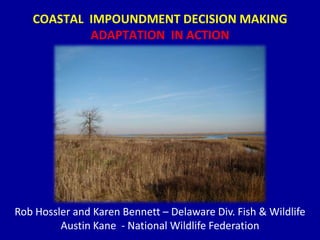
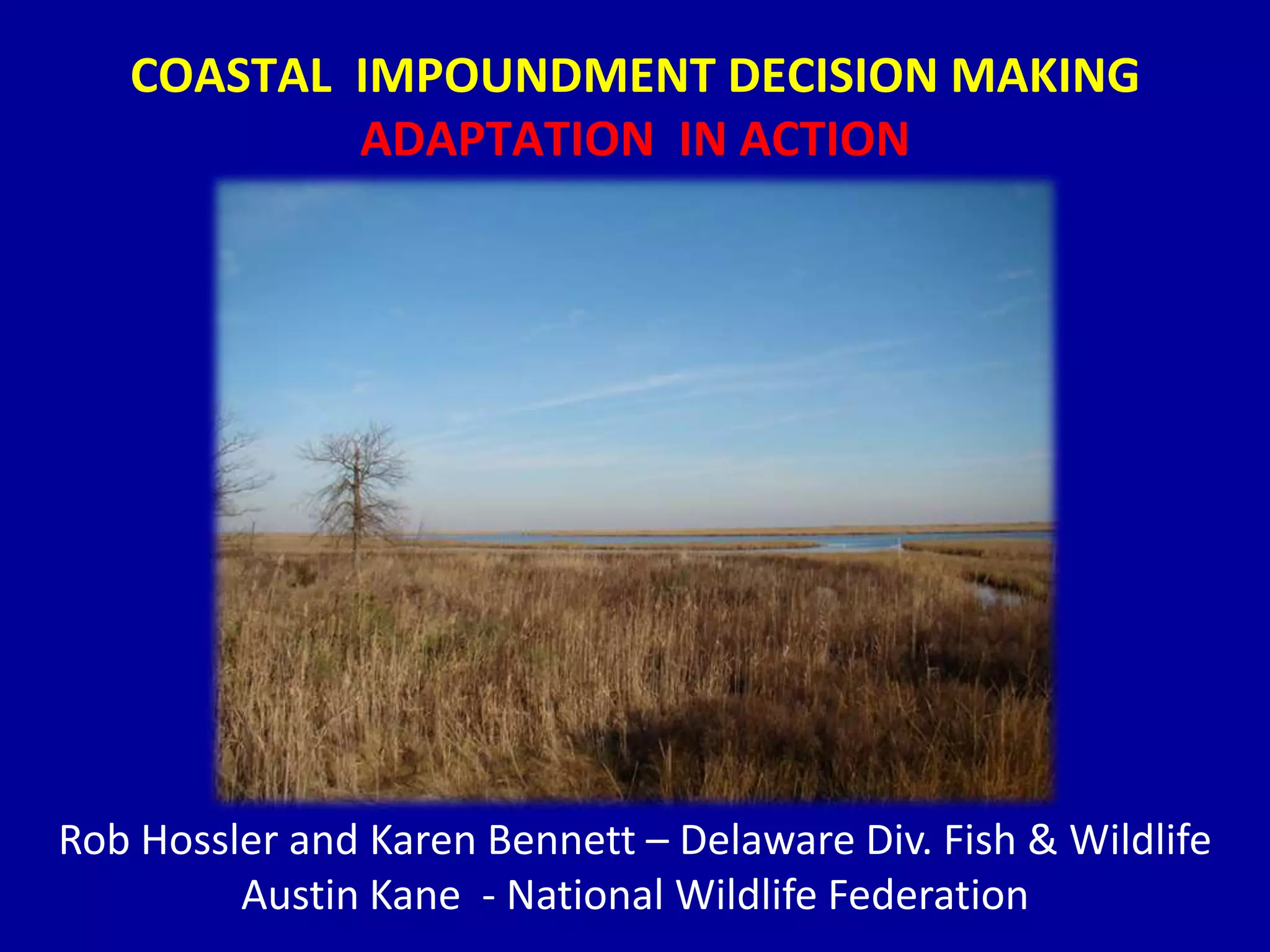
COASTAL IMPOUNDMENT DECISION MAKING
ADAPTATION IN ACTION
Rob Hossler and Karen Bennett – Delaware Div. Fish & Wildlife
Austin Kane - National Wildlife Federation
LIONS, TIGERS and On The GROUND CLIMATE
CHANGE ADAPTATION…
OH MY!
Delaware’s Efforts to get over the Fear and Make Decisions to
Implement/Adapt to Climate Change for its Coastal Impoundments
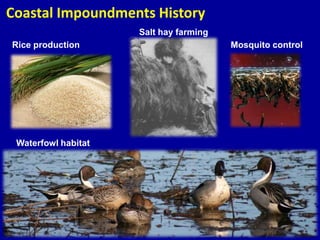
Coastal Impoundments History
Rice production Mosquito control
Salt hay farming
Waterfowl habitat
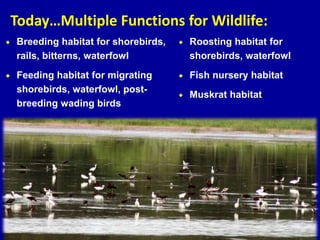
Today…Multiple Functions for Wildlife:
 Breeding habitat for shorebirds,
rails, bitterns, waterfowl
 Feeding habitat for migrating
shorebirds, waterfowl, post-
breeding wading birds
 Roosting habitat for
shorebirds, waterfowl
 Fish nursery habitat
 Muskrat habitat
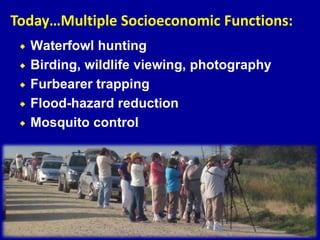
 Waterfowl hunting
 Birding, wildlife viewing, photography
 Furbearer trapping
 Flood-hazard reduction
 Mosquito control
Today…Multiple Socioeconomic Functions:
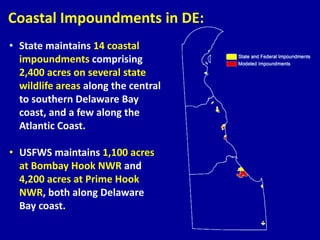
Coastal Impoundments in DE:
• State maintains 14 coastal
impoundments comprising
2,400 acres on several state
wildlife areas along the central
to southern Delaware Bay
coast, and a few along the
Atlantic Coast.
• USFWS maintains 1,100 acres
at Bombay Hook NWR and
4,200 acres at Prime Hook
NWR, both along Delaware
Bay coast.
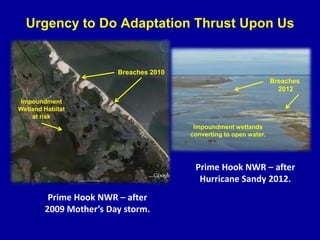
Urgency to Do Adaptation Thrust Upon Us
Prime Hook NWR – after
Hurricane Sandy 2012.
Breaches 2010
Impoundment
Wetland Habitat
at risk
Prime Hook NWR – after
2009 Mother’s Day storm.
Breaches
2012
Impoundment wetlands
converting to open water.
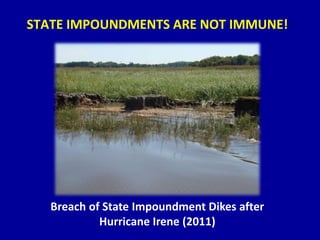
STATE IMPOUNDMENTS ARE NOT IMMUNE!
Breach of State Impoundment Dikes after
Hurricane Irene (2011)
Step 1: Initiation of a State Impoundment
Management Plan/Philosophy
• Collective wisdom of administrator, program and land
managers, and staff scientists to support continued
management and preservation of state impoundments.
• Goal is to Avoided Administrative Neglect, i.e., “I will be
retired before it’s an issue” and make adaptation an
immediate priority among other current funding needs.
• Begin the development of a systematic approach for
evaluating the current status of impoundments,
identifying objectives and developing an adaptive strategy
to enhance resilience in face of climate change.
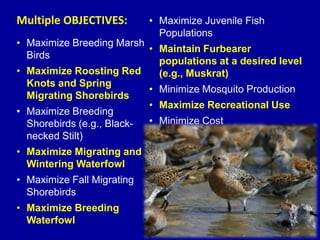
• Maximize Breeding Marsh
Birds
• Maximize Roosting Red
Knots and Spring
Migrating Shorebirds
• Maximize Breeding
Shorebirds (e.g., Black-
necked Stilt)
• Maximize Migrating and
Wintering Waterfowl
• Maximize Fall Migrating
Shorebirds
• Maximize Breeding
Waterfowl
• Maximize Juvenile Fish
Populations
• Maintain Furbearer
populations at a desired level
(e.g., Muskrat)
• Minimize Mosquito Production
• Maximize Recreational Use
• Minimize Cost
Multiple OBJECTIVES:
Now what??? It’s complicated….
• We can’t manage for everything,
everywhere…not physically possible given
biological needs of target wildlife.
• We’ll never have all the data we think we need.
• Cost constraints and uncertainty are a reality.
• Tradeoffs among competing objectives must
be made.
• We want to find the best combination of
management actions to achieve multiple
affordable objectives in the face of climate
change uncertainty.
• Developed a prototype decision model for 4 impoundments
looking 30 years out (estimated impoundment life span).
• Small team of experts identified key management
objectives and predicted outcomes (e.g., duck-use days,
roosting red knots, mosquito and fish counts) of different
actions under different SLR scenarios (5 and 10 mm/year).
• SDM is an explicit, organized way to deal with multiple,
competing objectives and uncertainty.
Step 2: Approach - Structured Decision Making
• Flexible
• Transparent
• Adaptive
• Incorporates cost constraints
• Provides a suite of actions that
maximizes benefit
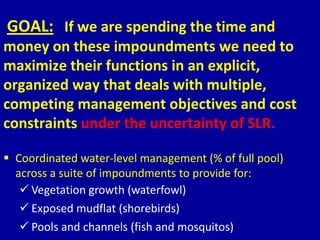
GOAL: If we are spending the time and
money on these impoundments we need to
maximize their functions in an explicit,
organized way that deals with multiple,
competing management objectives and cost
constraints under the uncertainty of SLR.
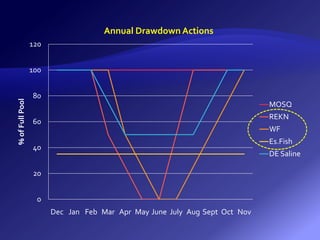
 Coordinated water-level management (% of full pool)
across a suite of impoundments to provide for:
 Vegetation growth (waterfowl)
 Exposed mudflat (shorebirds)
 Pools and channels (fish and mosquitos)
0
20
40
60
80
100
120
Dec Jan Feb Mar Apr May June July Aug Sept Oct Nov
%ofFullPool
Annual Drawdown Actions
MOSQ
REKN
WF
Es.Fish
DE Saline
RoostingRed
Knots
Water
Mgmt
Stopover
Population
Predator
Control
Weather
Vegetation
Control
Predators
Water Level Amt. Roost
Habitat
Habitat
Configuration
Tide
Distanceto
Foraging
Habitat
Climate
Change
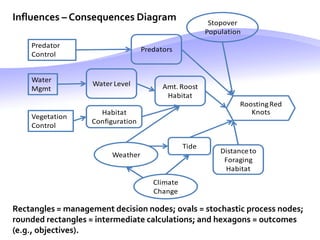
Rectangles = management decision nodes; ovals = stochastic process nodes;
rounded rectangles = intermediate calculations; and hexagons = outcomes
(e.g., objectives).
Influences – Consequences Diagram
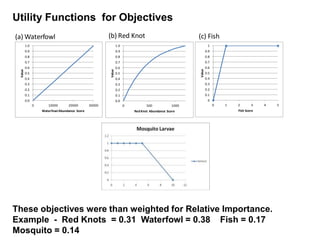
These objectives were than weighted for Relative Importance.
Example - Red Knots = 0.31 Waterfowl = 0.38 Fish = 0.17
Mosquito = 0.14
Utility Functions for Objectives
0.0
0.1
0.2
0.3
0.4
0.5
0.6
0.7
0.8
0.9
1.0
0 10000 20000 30000
Value
WaterfowlAbundance Score
0.0
0.1
0.2
0.3
0.4
0.5
0.6
0.7
0.8
0.9
1.0
0 500 1000
Value Red Knot Abundance Score
0
0.1
0.2
0.3
0.4
0.5
0.6
0.7
0.8
0.9
1
0 1 2 3 4 5
Value
Fish Score
(a) Waterfowl (b) Red Knot (c) Fish
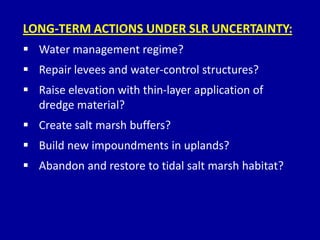
LONG-TERM ACTIONS UNDER SLR UNCERTAINTY:
 Water management regime?
 Repair levees and water-control structures?
 Raise elevation with thin-layer application of
dredge material?
 Create salt marsh buffers?
 Build new impoundments in uplands?
 Abandon and restore to tidal salt marsh habitat?
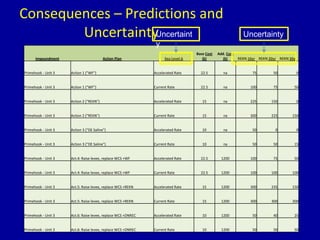
Consequences – Predictions and
Uncertainty
Impoundment Action Plan Sea Level Δ
Base Cost
(k)
Add. Cost
(k) REKN 10yr REKN 20yr REKN 30yr
Primehook - Unit 3 Action 1 ("WF") Accelerated Rate 22.5 na 75 50 0
Primehook - Unit 3 Action 1 ("WF") Current Rate 22.5 na 100 75 50
Primehook - Unit 3 Action 2 ("REKN") Accelerated Rate 15 na 225 150 0
Primehook - Unit 3 Action 2 ("REKN") Current Rate 15 na 300 225 150
Primehook - Unit 3 Action 3 ("DE Saline") Accelerated Rate 10 na 50 0 0
Primehook - Unit 3 Action 3 ("DE Saline") Current Rate 10 na 50 50 15
Primehook - Unit 3 Act.4: Raise levee, replace WCS +WF Accelerated Rate 22.5 1200 100 75 50
Primehook - Unit 3 Act.4: Raise levee, replace WCS +WF Current Rate 22.5 1200 100 100 100
Primehook - Unit 3 Act.5: Raise levee, replace WCS +REKN Accelerated Rate 15 1200 300 235 150
Primehook - Unit 3 Act.5: Raise levee, replace WCS +REKN Current Rate 15 1200 300 300 300
Primehook - Unit 3 Act.6: Raise levee, replace WCS +DNREC Accelerated Rate 10 1200 50 40 25
Primehook - Unit 3 Act.6: Raise levee, replace WCS +DNREC Current Rate 10 1200 50 50 50
UncertaintyUncertaint
y
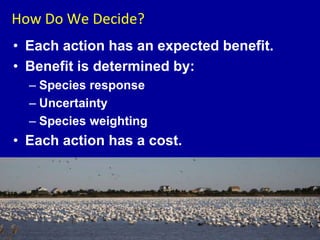
How Do We Decide?
• Each action has an expected benefit.
• Benefit is determined by:
– Species response
– Uncertainty
– Species weighting
• Each action has a cost.
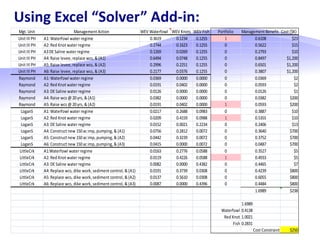
Using Excel “Solver” Add-in:
Mgt. Unit Management Action WEV Waterfowl WEV Knots WEV Fish Portfolio Management Benefit Cost ($K)
Unit III PH A1: Waterfowl water regime 0.3619 0.1234 0.1255 1 0.6108 $23
Unit III PH A2: Red Knot water regime 0.2744 0.1623 0.1255 0 0.5622 $15
Unit III PH A3DE Saline water regime 0.1269 0.0269 0.1255 0 0.2793 $10
Unit III PH A4: Raise levee, replace wcs, & (A1) 0.6494 0.0748 0.1255 0 0.8497 $1,200
Unit III PH A5: Raise levee, replace wcs, & (A2) 0.2996 0.2251 0.1255 0 0.6501 $1,200
Unit III PH A6: Raise levee, replace wcs, & (A3) 0.2177 0.0376 0.1255 0 0.3807 $1,200
Raymond A1: Waterfowl water regime 0.0369 0.0000 0.0000 0 0.0369 $2
Raymond A2: Red Knot water regime 0.0191 0.0402 0.0000 0 0.0593 $2
Raymond A3: DE Saline water regime 0.0126 0.0000 0.0000 0 0.0126 $1
Raymond A4: Raise wcs @20yrs, & (A1) 0.0382 0.0000 0.0000 0 0.0382 $200
Raymond A5: Raise wcs @20yrs, & (A2) 0.0191 0.0402 0.0000 1 0.0593 $200
LoganS A1: Waterfowl water regime 0.0217 0.2688 0.0983 0 0.3887 $10
LoganS A2: Red Knot water regime 0.0209 0.4159 0.0988 1 0.5355 $10
LoganS A3: DE Saline water regime 0.0152 0.0021 0.2234 0 0.2406 $13
LoganS A4: Construct new 150ac imp, pumping, & (A1) 0.0756 0.2812 0.0072 0 0.3640 $700
LoganS A5: Construct new 150ac imp, pumping, & (A2) 0.0442 0.3239 0.0072 0 0.3752 $700
LoganS A6: Construct new 150ac imp, pumping, & (A3) 0.0415 0.0000 0.0072 0 0.0487 $700
LittleCrk A1:Waterfowl water regime 0.0163 0.2776 0.0588 0 0.3527 $5
LittleCrk A2: Red Knot water regime 0.0119 0.4226 0.0588 1 0.4933 $5
LittleCrk A3: DE Saline water regime 0.0082 0.0000 0.4382 0 0.4465 $7
LittleCrk A4: Replace wcs, dike work, sediment control, & (A1) 0.0191 0.3739 0.0308 0 0.4239 $800
LittleCrk A5: Replace wcs, dike work, sediment control, & (A2) 0.0137 0.5610 0.0308 0 0.6055 $800
LittleCrk A6: Replace wcs, dike work, sediment control, & (A3) 0.0087 0.0000 0.4396 0 0.4484 $800
1.6989 $238
1.6989
Waterfowl 0.4138
Red Knot 1.0021
Fish 0.2831
Cost Constraint $250
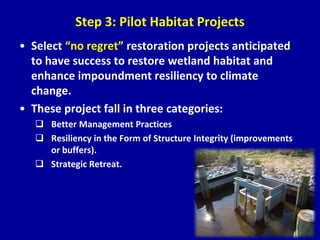
Step 3: Pilot Habitat Projects
• Select “no regret” restoration projects anticipated
to have success to restore wetland habitat and
enhance impoundment resiliency to climate
change.
• These project fall in three categories:
 Better Management Practices
 Resiliency in the Form of Structure Integrity (improvements
or buffers).
 Strategic Retreat.
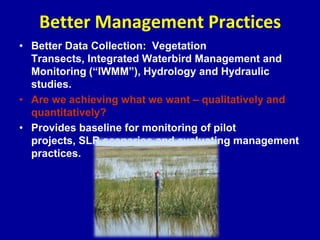
Better Management Practices
• Better Data Collection: Vegetation
Transects, Integrated Waterbird Management and
Monitoring (“IWMM”), Hydrology and Hydraulic
studies.
• Are we achieving what we want – qualitatively and
quantitatively?
• Provides baseline for monitoring of pilot
projects, SLR scenarios and evaluating management
practices.
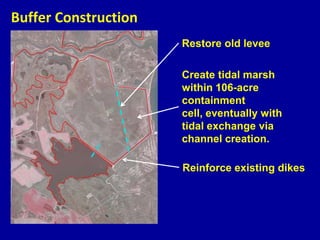
Buffer Construction
Restore old levee
Create tidal marsh
within 106-acre
containment
cell, eventually with
tidal exchange via
channel creation.
Reinforce existing dikes
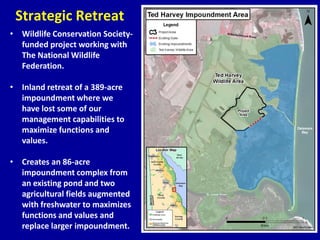
Strategic Retreat
• Wildlife Conservation Society-
funded project working with
The National Wildlife
Federation.
• Inland retreat of a 389-acre
impoundment where we
have lost some of our
management capabilities to
maximize functions and
values.
• Creates an 86-acre
impoundment complex from
an existing pond and two
agricultural fields augmented
with freshwater to maximizes
functions and values and
replace larger impoundment.
• National Fish and Wildlife Foundation
• Wildlife Conservation Society
• State Wildlife Grants and Wildlife and Sport Fish
Restoration
• National Wildlife Federation – Climate Smart Guidance
Project
• Delaware Impoundment Management and SDM Team
Thank you!!!

Hossler coastal impoundments decision making

  • 1.
    COASTAL IMPOUNDMENT DECISIONMAKING ADAPTATION IN ACTION Rob Hossler and Karen Bennett – Delaware Div. Fish & Wildlife Austin Kane - National Wildlife Federation
  • 2.
    LIONS, TIGERS andOn The GROUND CLIMATE CHANGE ADAPTATION… OH MY! Delaware’s Efforts to get over the Fear and Make Decisions to Implement/Adapt to Climate Change for its Coastal Impoundments
  • 3.
    Coastal Impoundments History Riceproduction Mosquito control Salt hay farming Waterfowl habitat
  • 5.
    Today…Multiple Functions forWildlife:  Breeding habitat for shorebirds, rails, bitterns, waterfowl  Feeding habitat for migrating shorebirds, waterfowl, post- breeding wading birds  Roosting habitat for shorebirds, waterfowl  Fish nursery habitat  Muskrat habitat
  • 6.
     Waterfowl hunting Birding, wildlife viewing, photography  Furbearer trapping  Flood-hazard reduction  Mosquito control Today…Multiple Socioeconomic Functions:
  • 7.
    Coastal Impoundments inDE: • State maintains 14 coastal impoundments comprising 2,400 acres on several state wildlife areas along the central to southern Delaware Bay coast, and a few along the Atlantic Coast. • USFWS maintains 1,100 acres at Bombay Hook NWR and 4,200 acres at Prime Hook NWR, both along Delaware Bay coast.
  • 8.
    Urgency to DoAdaptation Thrust Upon Us Prime Hook NWR – after Hurricane Sandy 2012. Breaches 2010 Impoundment Wetland Habitat at risk Prime Hook NWR – after 2009 Mother’s Day storm. Breaches 2012 Impoundment wetlands converting to open water.
  • 11.
    STATE IMPOUNDMENTS ARENOT IMMUNE! Breach of State Impoundment Dikes after Hurricane Irene (2011)
  • 12.
    Step 1: Initiationof a State Impoundment Management Plan/Philosophy • Collective wisdom of administrator, program and land managers, and staff scientists to support continued management and preservation of state impoundments. • Goal is to Avoided Administrative Neglect, i.e., “I will be retired before it’s an issue” and make adaptation an immediate priority among other current funding needs. • Begin the development of a systematic approach for evaluating the current status of impoundments, identifying objectives and developing an adaptive strategy to enhance resilience in face of climate change.
  • 13.
    • Maximize BreedingMarsh Birds • Maximize Roosting Red Knots and Spring Migrating Shorebirds • Maximize Breeding Shorebirds (e.g., Black- necked Stilt) • Maximize Migrating and Wintering Waterfowl • Maximize Fall Migrating Shorebirds • Maximize Breeding Waterfowl • Maximize Juvenile Fish Populations • Maintain Furbearer populations at a desired level (e.g., Muskrat) • Minimize Mosquito Production • Maximize Recreational Use • Minimize Cost Multiple OBJECTIVES:
  • 14.
    Now what??? It’scomplicated…. • We can’t manage for everything, everywhere…not physically possible given biological needs of target wildlife. • We’ll never have all the data we think we need. • Cost constraints and uncertainty are a reality. • Tradeoffs among competing objectives must be made. • We want to find the best combination of management actions to achieve multiple affordable objectives in the face of climate change uncertainty.
  • 15.
    • Developed aprototype decision model for 4 impoundments looking 30 years out (estimated impoundment life span). • Small team of experts identified key management objectives and predicted outcomes (e.g., duck-use days, roosting red knots, mosquito and fish counts) of different actions under different SLR scenarios (5 and 10 mm/year). • SDM is an explicit, organized way to deal with multiple, competing objectives and uncertainty. Step 2: Approach - Structured Decision Making • Flexible • Transparent • Adaptive • Incorporates cost constraints • Provides a suite of actions that maximizes benefit
  • 16.
    GOAL: If weare spending the time and money on these impoundments we need to maximize their functions in an explicit, organized way that deals with multiple, competing management objectives and cost constraints under the uncertainty of SLR.  Coordinated water-level management (% of full pool) across a suite of impoundments to provide for:  Vegetation growth (waterfowl)  Exposed mudflat (shorebirds)  Pools and channels (fish and mosquitos)
  • 17.
    0 20 40 60 80 100 120 Dec Jan FebMar Apr May June July Aug Sept Oct Nov %ofFullPool Annual Drawdown Actions MOSQ REKN WF Es.Fish DE Saline
  • 18.
    RoostingRed Knots Water Mgmt Stopover Population Predator Control Weather Vegetation Control Predators Water Level Amt.Roost Habitat Habitat Configuration Tide Distanceto Foraging Habitat Climate Change Rectangles = management decision nodes; ovals = stochastic process nodes; rounded rectangles = intermediate calculations; and hexagons = outcomes (e.g., objectives). Influences – Consequences Diagram
  • 19.
    These objectives werethan weighted for Relative Importance. Example - Red Knots = 0.31 Waterfowl = 0.38 Fish = 0.17 Mosquito = 0.14 Utility Functions for Objectives 0.0 0.1 0.2 0.3 0.4 0.5 0.6 0.7 0.8 0.9 1.0 0 10000 20000 30000 Value WaterfowlAbundance Score 0.0 0.1 0.2 0.3 0.4 0.5 0.6 0.7 0.8 0.9 1.0 0 500 1000 Value Red Knot Abundance Score 0 0.1 0.2 0.3 0.4 0.5 0.6 0.7 0.8 0.9 1 0 1 2 3 4 5 Value Fish Score (a) Waterfowl (b) Red Knot (c) Fish
  • 20.
    LONG-TERM ACTIONS UNDERSLR UNCERTAINTY:  Water management regime?  Repair levees and water-control structures?  Raise elevation with thin-layer application of dredge material?  Create salt marsh buffers?  Build new impoundments in uplands?  Abandon and restore to tidal salt marsh habitat?
  • 21.
    Consequences – Predictionsand Uncertainty Impoundment Action Plan Sea Level Δ Base Cost (k) Add. Cost (k) REKN 10yr REKN 20yr REKN 30yr Primehook - Unit 3 Action 1 ("WF") Accelerated Rate 22.5 na 75 50 0 Primehook - Unit 3 Action 1 ("WF") Current Rate 22.5 na 100 75 50 Primehook - Unit 3 Action 2 ("REKN") Accelerated Rate 15 na 225 150 0 Primehook - Unit 3 Action 2 ("REKN") Current Rate 15 na 300 225 150 Primehook - Unit 3 Action 3 ("DE Saline") Accelerated Rate 10 na 50 0 0 Primehook - Unit 3 Action 3 ("DE Saline") Current Rate 10 na 50 50 15 Primehook - Unit 3 Act.4: Raise levee, replace WCS +WF Accelerated Rate 22.5 1200 100 75 50 Primehook - Unit 3 Act.4: Raise levee, replace WCS +WF Current Rate 22.5 1200 100 100 100 Primehook - Unit 3 Act.5: Raise levee, replace WCS +REKN Accelerated Rate 15 1200 300 235 150 Primehook - Unit 3 Act.5: Raise levee, replace WCS +REKN Current Rate 15 1200 300 300 300 Primehook - Unit 3 Act.6: Raise levee, replace WCS +DNREC Accelerated Rate 10 1200 50 40 25 Primehook - Unit 3 Act.6: Raise levee, replace WCS +DNREC Current Rate 10 1200 50 50 50 UncertaintyUncertaint y
  • 22.
    How Do WeDecide? • Each action has an expected benefit. • Benefit is determined by: – Species response – Uncertainty – Species weighting • Each action has a cost.
  • 23.
    Using Excel “Solver”Add-in: Mgt. Unit Management Action WEV Waterfowl WEV Knots WEV Fish Portfolio Management Benefit Cost ($K) Unit III PH A1: Waterfowl water regime 0.3619 0.1234 0.1255 1 0.6108 $23 Unit III PH A2: Red Knot water regime 0.2744 0.1623 0.1255 0 0.5622 $15 Unit III PH A3DE Saline water regime 0.1269 0.0269 0.1255 0 0.2793 $10 Unit III PH A4: Raise levee, replace wcs, & (A1) 0.6494 0.0748 0.1255 0 0.8497 $1,200 Unit III PH A5: Raise levee, replace wcs, & (A2) 0.2996 0.2251 0.1255 0 0.6501 $1,200 Unit III PH A6: Raise levee, replace wcs, & (A3) 0.2177 0.0376 0.1255 0 0.3807 $1,200 Raymond A1: Waterfowl water regime 0.0369 0.0000 0.0000 0 0.0369 $2 Raymond A2: Red Knot water regime 0.0191 0.0402 0.0000 0 0.0593 $2 Raymond A3: DE Saline water regime 0.0126 0.0000 0.0000 0 0.0126 $1 Raymond A4: Raise wcs @20yrs, & (A1) 0.0382 0.0000 0.0000 0 0.0382 $200 Raymond A5: Raise wcs @20yrs, & (A2) 0.0191 0.0402 0.0000 1 0.0593 $200 LoganS A1: Waterfowl water regime 0.0217 0.2688 0.0983 0 0.3887 $10 LoganS A2: Red Knot water regime 0.0209 0.4159 0.0988 1 0.5355 $10 LoganS A3: DE Saline water regime 0.0152 0.0021 0.2234 0 0.2406 $13 LoganS A4: Construct new 150ac imp, pumping, & (A1) 0.0756 0.2812 0.0072 0 0.3640 $700 LoganS A5: Construct new 150ac imp, pumping, & (A2) 0.0442 0.3239 0.0072 0 0.3752 $700 LoganS A6: Construct new 150ac imp, pumping, & (A3) 0.0415 0.0000 0.0072 0 0.0487 $700 LittleCrk A1:Waterfowl water regime 0.0163 0.2776 0.0588 0 0.3527 $5 LittleCrk A2: Red Knot water regime 0.0119 0.4226 0.0588 1 0.4933 $5 LittleCrk A3: DE Saline water regime 0.0082 0.0000 0.4382 0 0.4465 $7 LittleCrk A4: Replace wcs, dike work, sediment control, & (A1) 0.0191 0.3739 0.0308 0 0.4239 $800 LittleCrk A5: Replace wcs, dike work, sediment control, & (A2) 0.0137 0.5610 0.0308 0 0.6055 $800 LittleCrk A6: Replace wcs, dike work, sediment control, & (A3) 0.0087 0.0000 0.4396 0 0.4484 $800 1.6989 $238 1.6989 Waterfowl 0.4138 Red Knot 1.0021 Fish 0.2831 Cost Constraint $250
  • 24.
    Step 3: PilotHabitat Projects • Select “no regret” restoration projects anticipated to have success to restore wetland habitat and enhance impoundment resiliency to climate change. • These project fall in three categories:  Better Management Practices  Resiliency in the Form of Structure Integrity (improvements or buffers).  Strategic Retreat.
  • 25.
    Better Management Practices •Better Data Collection: Vegetation Transects, Integrated Waterbird Management and Monitoring (“IWMM”), Hydrology and Hydraulic studies. • Are we achieving what we want – qualitatively and quantitatively? • Provides baseline for monitoring of pilot projects, SLR scenarios and evaluating management practices.
  • 26.
    Buffer Construction Restore oldlevee Create tidal marsh within 106-acre containment cell, eventually with tidal exchange via channel creation. Reinforce existing dikes
  • 27.
    Strategic Retreat • WildlifeConservation Society- funded project working with The National Wildlife Federation. • Inland retreat of a 389-acre impoundment where we have lost some of our management capabilities to maximize functions and values. • Creates an 86-acre impoundment complex from an existing pond and two agricultural fields augmented with freshwater to maximizes functions and values and replace larger impoundment.
  • 28.
    • National Fishand Wildlife Foundation • Wildlife Conservation Society • State Wildlife Grants and Wildlife and Sport Fish Restoration • National Wildlife Federation – Climate Smart Guidance Project • Delaware Impoundment Management and SDM Team Thank you!!!