12 ADJ December 2015
FOCUS: Hospital Ships
“Floating vessels” at sea that provides medical
support has been an integral part of the de-
fence forces. The vessel does not only provide
healthcare to the wounded during war, but it also
extends humanitarian assistance and disaster
relief (HADR) support during peace time–usually
being used during military exercises with allied
and friendly nations.
The hospital ship concept is not relatively new.
At the beginning of the 17th century, it has been
a practice for naval fleets to be accompanied by
special vessels entrusted with the task of carry-
ing the wounded on board after each missions.
The practice has been expanded vigorously dur-
ing the second half of the 19th century. During
the Crimean War, more than 100,000 sick and
wounded were repatriated to England onboard
hospital transports. Since then, it has been normal
practice for military missions to deploy ships to
evacuate soldiers from the combat area and give
them the much needed medical attention they
require. ADJ this month takes a closer look at
these floating saviours.
Floating Hospitals in War Times
Ships transformed into medical platforms have
been used extensively during World War I, where
passenger liners have been converted into hos-
pital ships. Examples of these are Britain’s RMS
Aquitania and HMHS Britannic. It is only during
World War II that specially-built hospital ships were
constructed, with vast improvements made on the
patient’s accommodation. The fact that military
bases are far apart from theatres of operation
made defence forces to bring along service ships,
which were actually floating hospitals, to give com-
plete medical and surgical treatment. In current
times, most hospital ships are usually converted
from oil tankers, ocean liners or freighters.
These vessels could stand as full-fledged
hospitals on their own. A fully-equipped hospital
ship comes with operating theatres, X-ray and
sterilising units, as well as the necessary labora-
tories, apart from the barrage of doctors, nurses
and orderlies that they carry. The suites are larger
than operating rooms at land-based hospitals
because the doctors perform more than one spe-
cialty surgery at one time. The spacious rooms
are equipped with state-of-the-art equipment to
ensure personnel are given the best care. The very
nature of these vessels is that, they are designed
for operations of a long-term nature, and can travel
for up to 30 days without major resupply.
Due to the neutral nature of their creation, hospi-
tal ships are normally not equipped with their own
defensive systems. The white paint that envelopes
these ships, together with the red crosses or red
crescents emblazoned on the sides distinguish it
from war vessels. The purpose and existence of
these ships are fully protected under the Geneva
Convention, as well as the working personnel and
wounded patients onboard. However, personnel
working onboard the ships are allowed to employ
small weapons for the purpose of “personal de-
fence and for the protection of the wounded and
sick under their charge against marauders and
other persons violating the laws of war,” stated
Article 22 of the Convention.
Healthcare, Whenever, Wherever
At present, hospital ships are only owned by rich
and modern military forces, even though in recent
times, some developing nations have also already
transformed their vessels into one. The most well-
known hospital ships in the world are from the
US with their Mercy-class vessels. Touted as the
world’s biggest hospital ships, the vessels–USNS
Comfort and USNS Mercy, are about ten-storey
height of a building, and are about the length of
ten football fields. Built and converted by National
Steel and Shipbuilding Co, the ships are powered
by two GE turbines that could produce maximum
power output of 24,500hp in one shaft. The ship
has a displacement of 69,360 tonnes, full load,
and can travel at the speed of around 17 knots.
The two ships are owned and operated by the
Military Sealift Command, and provide emergency,
on-site care for US combatant forces deployed in
war and other missions. Aside, the ships second-
ary mission is to provide full hospital services to
support US disaster relief and humanitarian opera-
tions worldwide. Both Mercy and Comfort have
12-fully equipped operating rooms, can accommo-
date up to 1,000 beds, and can receive up to 200
patients a day. State-of-the-art equipment include
digital radiological services, a medical laboratory, a
pharmacy, an optometry lab, a CAT-scan, special-
ised trauma centres, and two-oxygen producing
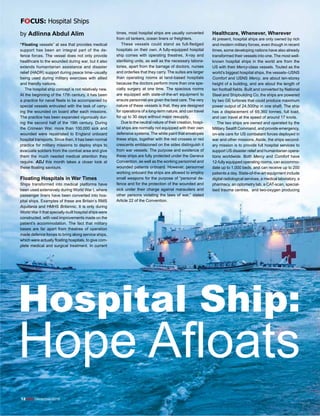
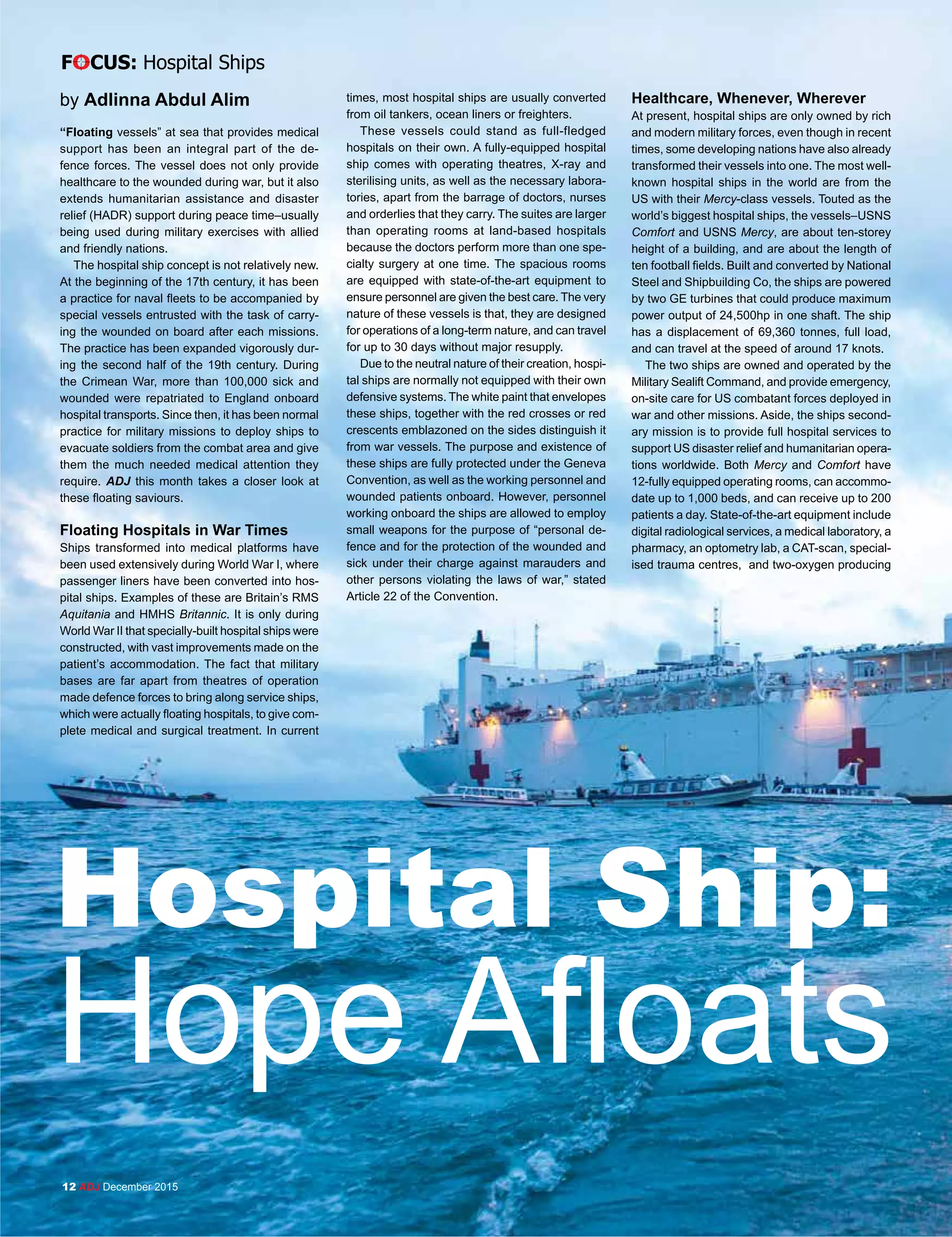
Hospital Ship:
Hope Afloats
by Adlinna Abdul Alim
FOCUS: Hospital Ships
12 ADJ December 2015
ADJ December 2015 13
plants. Each ship is equipped with a helicopter
deck capable of landing large military helicopters.
At full operating capacity, each ship could accom-
modate up to 65 civil service mariners and around
1,200 naval medical personnel–among the most
highly trained in the world.
Mercy primarily operates in the Pacific and
Indian Oceans. She has served coalition troops
in the first Gulf War. She was also deployed for
disaster relief operations–her first–in the 2004
tsunami under Operation Unified Assistance. In
2013, she came to the aid of the Philippines and
other nations in the aftermath of Typhoon Haiyan.
Mercy became a part of a larger, ongoing mission
in 2006–Pacific Partnership, where she heads
to the Pacific every two years to places where
medical care is hard to come by. To date, USNS
Mercy has treated over 400,000 patients under
the Pacific Partnership banner. Her sister ship,
Comfort, on the other hand, operates mostly in
the Caribbean and LatinAmerica. She had served
troops off the coast of Kuwait in Operation Desert
Storm. Her first humanitarian mission in 1994 saw
her busy helping the Cuban and Haitian immi-
grants coming toAmerica. During the aftermath of
the September 11 attacks, Comfort was deployed
to Manhattan, New York to provide medical and
counselling services. Soon after, she headed to
the Gulf again for Operation Iraqi Freedom. Just
like USNS Mercy, USNS Comfort is also part of
ongoing humanitarian projects. She is involved in
Partnership for the Americas since 2007, where
she has provided medical support to nations
within the Caribbean Ocean coastlines. She is
also involved in Continuing Promise since 2011,
where she visited the Caribbean, Central and
South American nations.
China’s Vessels of Peace
The Asian military power is increasing its HADR
capabilities with two Nankang-class hospital
ships–Nanyung and Nankang, as well as Daishan-
dao, or popularly known as Peace Ark. Analysts
said that China’s growing interest in HADR mis-
sions are largely attributed to the skirmishes in
the Paracels and Spratlys. The Nankang-class
vessels were converted from the 150-tonne Qiong-
sha-class attack transport ships which were built
in 1980s by Guangzhou Shipyard International
Company, a subsidiary of China State Shipbuild-
ing Cooperation. Both ships are deployed in the
South Sea fleet.
Daishandao/Peace Ark is China’s first purpose-
built hospital ship. Commissioned in December
2008, the ship is placed in the South Sea Fleet
at Zhoushan, in Zhejiang province. Peace Ark is
583ft long, with displacement of 10,000 tonnes,
fully loaded. She has a helicopter hangar which
could hold up to two helicopters along with a
helicopter pad. China’s indigenous Z-8 shipborne
helicopter is said to have operated with Peace Ark.
Upon deployment, the ship could accommodate
up to 328 crew and 100 medical personnel. The
ship also acts as a training platform for medical
staff to conduct research and training. One unique
feature of this ship is that, the doctors onboard
not only practice Western-style medicine, but also
traditional Chinese techniques. A room onboard
Peace Ark is said to being specifically reserved
for the ancient therapies of cupping, massage,
and acupuncture.
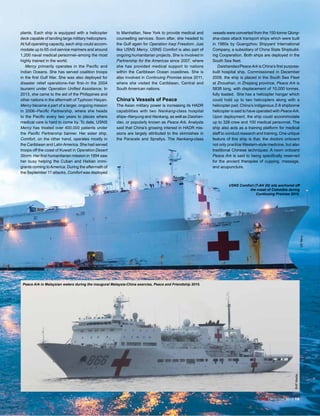
USNS Comfort (T-AH 20) sits anchored off
the coast of Colombia during
Continuing Promise 2015.
USNavy
SHPMedia
Peace Ark in Malaysian waters during the inaugural Malaysia-China exercise, Peace and Friendship 2015.
ADJ December 2015 13
14 ADJ December 2015
FOCUS: Hospital Ships
Peace Ark has two triage areas. It is here that
patients are divided according to conditions for
treatments. Patients are then loaded onto a wide
hospital-style elevator that can accept up to two
gurneys for transport to the medical decks. The
ship has eight operating rooms that could perform
up to 40 major surgeries a day. Other facilities
include 20 intensive care unit beds, and 300
regular hospital beds. The ship also has extensive
diagnostic and examination facilities, with an x-ray
room, an ultrasound room and a C-T scanner. An
examination room is also available to examine
clinical specimens. The ship also has a gynaeco-
logical examination room, which was useful during
humanitarian missions.
The Chinese hospital ship offers a variety of
medical capabilities. For patients who are exposed
to elements upon being rescued at sea, Peace Ark
is equipped with a hypothermic resuscitation bag
to treat individuals diagnosed with hypothermia.
The device, which resembles a sleeping bag, is
equipped with a Chinese-made haemodialysis
unit, the TL-219, touted by the People’s Libera-
tion Army–Navy as the first capable of performing
blood purification on ships, vehicles, and disaster
zones.
The ship has impressive networking and com-
munication capabilities. Not only can doctors
monitor patients remotely, bringing up data to
their workstations, but they could teleconference
with other doctors and specialists at conventional
hospitals in Beijing and Shanghai. The ship’s
deck has wide doorways, and smooth floors to
accommodate gurneys and wheelchairs. In case
it is necessary to abandon ship, Peace Ark is
equipped with specially-designed lifeboats, each
capable of accommodating 18 stretchers or 24
ambulatory patients.
Peace Ark has also participated in international
level humanitarian missions such as the Rim of the
Pacific (RIMPAC) exercise in 2014–the first time
that China participated. Beijing’s move is seen as
an effort to show the softer side of China’s military.
Her very existence is meant to prove that China
can be a friend to other countries. Recently in
September, the ship berthed at Malaysia’s harbour
for the inaugural Malaysia-China exercise, Peace
and Friendship 2015. Soon after, the ship set sail
again for Harmonious Mission 2015. Peace Ark
is scheduled to visit seven nations and regions
around the Pacific Ocean that include Australia,
French Polynesia, US, Mexico, Barbados, Gre-
nada and Peru, for military diplomacy, medical
exchange and cultural communication. It will also
provide free medical and humanitarian services.
This is the fifth Harmonious Mission task carried
out by the hospital ship Peace Ark after it visited
five countries in Asia and Africa in 2010, four
countries in Latin America in 2011, eight coun-
tries in Asia in 2013 and four countries in South
Pacific in 2014.
Indonesia’s KRI Dr Soeharso
Previously known as KRI 972 Tanjung Dalpele,
this ship is classified a multi-purpose landing
platform dock (LPD). Originally, Dr Soerharso was
meant as a warship, under a $35 million contract
signed in 2003 between the Indonesian govern-
ment and Daewoo International. It was later con-
verted to a hospital ship in August 2007. The ship
was built by Daesun Shipbuilding and Eng Co Ltd
Pusan. Dr Soeharso has a length of 122 metres,
and width of 22 metres. At full displacement, the
ship weights 16,000 tonnes. She has a long and
wide deck, capable of operating two large helicop-
ters, such as the Airbus Helicopters’ Super Puma
family at the same time. The ship’s hangar could
accommodate another helicopter. This capability
enables the ship to also be involved in search
and rescue (SAR) missions. She is also capable
to carry two landing craft unit and one hovercraft.
Dr Soeharso is powered by diesel engine, and
capable to sail at maximum speed of 16 knots.
For her medical missions, Dr Soeharso is
equipped with one emergency room, three operat-
ing rooms, six polyclinics, and two boarding halls,
capable of accommodating 20 beds each. The
ship could accommodate up to 400 personnel that
include 75 crew and 65 medical staff. Due to the
fact that it was previously a warship, Dr Soerharso
is equipped with one SAK 40mm L/70 Bofors
cannon, two 20mm air attack deterrent cannon
from Rheinmetall, and two 12.7mm machinegun.
Among humanitarian missions which saw the
ship’s participation include Pacific Partnership. At
the height of the haze issues that has been plagu-
ing countries in SoutheastAsia a few months ago,
KRI Dr Soerharso docked at on Trisakti Harbour,
Banjarmasin to treat affected patients. The ship
currently sails 100 days a year, but there were
talks in May this year to extend its deployment to
another 100 days as part of Indonesia’s Millen-
nium Development Goals.
Vietnam’s Unique Ship
Vietnamese Navy’s Khanh Hoa HQ561 is the
country’s first ship for both naval transport and
medical purposes. The K-122-class ship was
designed by Shipbuilding Science and Technol-
ogy Institute of the Vietnam Shipbuilding Industry
Corp, and built by the Z189 Factory of the Gen-
eral Department of Defence Industry under the
supervision of the Ship Technology Development
Company.
Equipped with two main diesel engines with to-
tal capacity of nearly 5,000hp, the 70.6m long and
13.2m wide ship can operate at 16 nautical miles
per hour with an operation range of 2,500 nauti-
cal miles for 45 days and nights in bad weather.
Khanh Hoa is manned by a team of 12 doctors,
nurses, and medical equipment to treat patients
with different diseases, even in critical conditions.
She has participated in Exercise Komodo in In-
donesia last year.
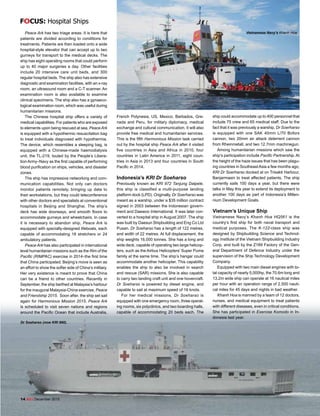
Vietnamese Navy’s Khanh Hoa.
Dr Soeharso (now KRI 990).
14 ADJ December 2015
ADJ December 2015 15
European Medical Vessels
Although not formally specified as hospital ships
due to certain technicalities, the French Navy and
the Royal Navy have their respective vessels that
provide medical support at sea. They also do not
carry the Red Cross emblem on the outwards
unlike their other counterparts. However, their
capabilities should not be undermined.
Mistral-class
The French Mistral is actually a class of am-
phibious assault, command and power projection
ship (BPC). Currently, three ships–Mistral, Ton-
nerre, Dixmude–have been built and employed
in the fleet of the French Navy. The requirement
for the fourth ship is still an option and open for
discussions. The ship has caught the eye of the
Russian government, which has ordered two of
the vessels. However, due to the controversy
on Russia’s intervention in Ukraine, the French
government called the deal off in September last
year. Nevertheless, the vessels are not short of
buyer, as they have been sold to the Egyptian
Navy in October 2015.
Built by DCNS, the ship measures about 199
metres long, with beam of around 32 metres,
and displacement at full load at around 23,000
tonnes. Due to its multi-purpose characteristics,
the Mistral-class is slightly faster, able to reach
speed in excess of 18 knots. Her all-electric pro-
pulsion features two electric azimuth pods and
an electric bow thruster. Three Wartsila 16V32
diesel-alternator, and one Wartsila Vaasa diesel-
alternator 18V200 keep her going at sea.
As a floating hospital, the Mistral has dedicated
over 750 square metres of space, which is certified
Level-3 medevac standard. It has 20 rooms, able
to accommodate 69 hospital beds for active-care
patients, two operating theatres, and a range of
state-of-the-art equipment. Part of the upper ve-
hicle hangar can be converted into a modular field
hospital if extra space is required. Medical equip-
ment onboard include two operating rooms, and
facilities for X-ray, dental, and scanning. To carry
patients and personnel onboard, the Mistral-class
could accommodate six helicopters at its flight
deck, while the below deck could accommodate
up to 16 helicopters. The bow area of the ship
could accommodate heavy helicopters of CH-53 or
CH-47 types. Mistral could carry between 450-700
passengers and 160 crew members. She could
also carry four landing crafts, and 70 vehicles or
13 main battle tanks.
Mistral is a true epitome of France’s indigenous
technology. For the advanced command-post role,
the ship is equipped with state-of-the-art HF/VHF/
UHF/Satcom communications suite to the latest
NATO standard, and C4ISR systems for joint air,
land, and sea operations. For combat manage-
ment, Mistral is equipped with DCNS SENIT
9, and Thales SIC 21. Optronics include HGH
Vigiscan at the ship’s bow, SAGEM EOMS-NG
at the stern, and Automatic Sea Vision. Thales
contribution includes DRBN-38 navigation radars,
MRR-3D-NG air/surface sentry radar, and ARBR
21 radar warning receiver. As for the weapons,
the Mistral-class is armed with two MBDA Simbad
anti-air missiles system, and four 12.7mm M2-HB
Browning machineguns.
The Mistrals have exercised with US Navy and
Marine Corps. She was also involved in several
high-profile operations such as the 2011 interven-
tion in Libya. In fact, due to its amphibious multi-
purpose capability, Mistral is highly suitable to be
used for sea basing for HADR missions.
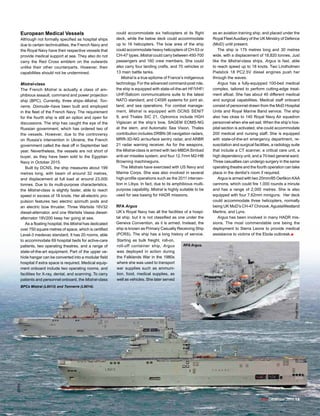
RFA Argus
UK’s Royal Navy has all the facilities of a hospi-
tal ship, but it is not classified as one under the
Geneva Convention, as it is armed. Instead, the
ship is known as Primary Casualty Receiving Ship
(PCRS). The ship has a long history of service.
Starting as bulk freight, roll-on,
roll-off container ship, Argus
was deployed in action during
the Falklands War in the 1980s
where she was used to transport
war supplies such as ammuni-
tion, food, medical supplies, as
well as vehicles. She later served
as an aviation training ship, and placed under the
Royal FleetAuxiliary of the UK Ministry of Defence
(MoD) until present.
The ship is 175 metres long and 30 metres
wide, with a displacement of 18,820 tonnes. Just
like the Mistral-class ships, Argus is fast, able
to reach speed up to 18 knots. Two Lindholmen
Pielstick 18 PC2.5V diesel engines push her
through the waves.
Argus has a fully-equipped 100-bed medical
complex, tailored to perform cutting-edge treat-
ment afloat. She has about 40 different medical
and surgical capabilities. Medical staff onboard
consist of personnel drawn from the MoD Hospital
Units and Royal Marine Band service. The ship
also has close to 140 Royal Navy Air squadron
personnel when she set sail. When the ship’s hos-
pital section is activated, she could accommodate
200 medical and nursing staff. She is equipped
with state-of-the-art emergency department, re-
suscitation and surgical facilities, a radiology suite
that include a CT scanner, a critical care unit, a
high dependency unit, and a 70-bed general ward.
Three casualties can undergo surgery in the same
operating theatre and the fourth operation can take
place in the dentist’s room if required.
Argus is armed with two 20mm/85 Oerlikon KAA
cannons, which could fire 1,000 rounds a minute
and has a range of 2,000 metres. She is also
equipped with four 7.62mm miniguns. Her deck
could accommodate three helicopters, normally
being UK MoD’s CH-47 Chinook,AgustaWestland
Merlins, and Lynx.
Argus has been involved in many HADR mis-
sions. The most commendable one being the
deployment to Sierra Leone to provide medical
assistance to victims of the Ebola outbreak.■
RoyalNavy
RFA Argus.
BPCs Mistral (L9013) and Tonnerre (L9014).
DCNS
ADJ December 2015 15

Hospital Ships

  • 1.
    12 ADJ December2015 FOCUS: Hospital Ships “Floating vessels” at sea that provides medical support has been an integral part of the de- fence forces. The vessel does not only provide healthcare to the wounded during war, but it also extends humanitarian assistance and disaster relief (HADR) support during peace time–usually being used during military exercises with allied and friendly nations. The hospital ship concept is not relatively new. At the beginning of the 17th century, it has been a practice for naval fleets to be accompanied by special vessels entrusted with the task of carry- ing the wounded on board after each missions. The practice has been expanded vigorously dur- ing the second half of the 19th century. During the Crimean War, more than 100,000 sick and wounded were repatriated to England onboard hospital transports. Since then, it has been normal practice for military missions to deploy ships to evacuate soldiers from the combat area and give them the much needed medical attention they require. ADJ this month takes a closer look at these floating saviours. Floating Hospitals in War Times Ships transformed into medical platforms have been used extensively during World War I, where passenger liners have been converted into hos- pital ships. Examples of these are Britain’s RMS Aquitania and HMHS Britannic. It is only during World War II that specially-built hospital ships were constructed, with vast improvements made on the patient’s accommodation. The fact that military bases are far apart from theatres of operation made defence forces to bring along service ships, which were actually floating hospitals, to give com- plete medical and surgical treatment. In current times, most hospital ships are usually converted from oil tankers, ocean liners or freighters. These vessels could stand as full-fledged hospitals on their own. A fully-equipped hospital ship comes with operating theatres, X-ray and sterilising units, as well as the necessary labora- tories, apart from the barrage of doctors, nurses and orderlies that they carry. The suites are larger than operating rooms at land-based hospitals because the doctors perform more than one spe- cialty surgery at one time. The spacious rooms are equipped with state-of-the-art equipment to ensure personnel are given the best care. The very nature of these vessels is that, they are designed for operations of a long-term nature, and can travel for up to 30 days without major resupply. Due to the neutral nature of their creation, hospi- tal ships are normally not equipped with their own defensive systems. The white paint that envelopes these ships, together with the red crosses or red crescents emblazoned on the sides distinguish it from war vessels. The purpose and existence of these ships are fully protected under the Geneva Convention, as well as the working personnel and wounded patients onboard. However, personnel working onboard the ships are allowed to employ small weapons for the purpose of “personal de- fence and for the protection of the wounded and sick under their charge against marauders and other persons violating the laws of war,” stated Article 22 of the Convention. Healthcare, Whenever, Wherever At present, hospital ships are only owned by rich and modern military forces, even though in recent times, some developing nations have also already transformed their vessels into one. The most well- known hospital ships in the world are from the US with their Mercy-class vessels. Touted as the world’s biggest hospital ships, the vessels–USNS Comfort and USNS Mercy, are about ten-storey height of a building, and are about the length of ten football fields. Built and converted by National Steel and Shipbuilding Co, the ships are powered by two GE turbines that could produce maximum power output of 24,500hp in one shaft. The ship has a displacement of 69,360 tonnes, full load, and can travel at the speed of around 17 knots. The two ships are owned and operated by the Military Sealift Command, and provide emergency, on-site care for US combatant forces deployed in war and other missions. Aside, the ships second- ary mission is to provide full hospital services to support US disaster relief and humanitarian opera- tions worldwide. Both Mercy and Comfort have 12-fully equipped operating rooms, can accommo- date up to 1,000 beds, and can receive up to 200 patients a day. State-of-the-art equipment include digital radiological services, a medical laboratory, a pharmacy, an optometry lab, a CAT-scan, special- ised trauma centres, and two-oxygen producing Hospital Ship: Hope Afloats by Adlinna Abdul Alim FOCUS: Hospital Ships 12 ADJ December 2015
  • 2.
    ADJ December 201513 plants. Each ship is equipped with a helicopter deck capable of landing large military helicopters. At full operating capacity, each ship could accom- modate up to 65 civil service mariners and around 1,200 naval medical personnel–among the most highly trained in the world. Mercy primarily operates in the Pacific and Indian Oceans. She has served coalition troops in the first Gulf War. She was also deployed for disaster relief operations–her first–in the 2004 tsunami under Operation Unified Assistance. In 2013, she came to the aid of the Philippines and other nations in the aftermath of Typhoon Haiyan. Mercy became a part of a larger, ongoing mission in 2006–Pacific Partnership, where she heads to the Pacific every two years to places where medical care is hard to come by. To date, USNS Mercy has treated over 400,000 patients under the Pacific Partnership banner. Her sister ship, Comfort, on the other hand, operates mostly in the Caribbean and LatinAmerica. She had served troops off the coast of Kuwait in Operation Desert Storm. Her first humanitarian mission in 1994 saw her busy helping the Cuban and Haitian immi- grants coming toAmerica. During the aftermath of the September 11 attacks, Comfort was deployed to Manhattan, New York to provide medical and counselling services. Soon after, she headed to the Gulf again for Operation Iraqi Freedom. Just like USNS Mercy, USNS Comfort is also part of ongoing humanitarian projects. She is involved in Partnership for the Americas since 2007, where she has provided medical support to nations within the Caribbean Ocean coastlines. She is also involved in Continuing Promise since 2011, where she visited the Caribbean, Central and South American nations. China’s Vessels of Peace The Asian military power is increasing its HADR capabilities with two Nankang-class hospital ships–Nanyung and Nankang, as well as Daishan- dao, or popularly known as Peace Ark. Analysts said that China’s growing interest in HADR mis- sions are largely attributed to the skirmishes in the Paracels and Spratlys. The Nankang-class vessels were converted from the 150-tonne Qiong- sha-class attack transport ships which were built in 1980s by Guangzhou Shipyard International Company, a subsidiary of China State Shipbuild- ing Cooperation. Both ships are deployed in the South Sea fleet. Daishandao/Peace Ark is China’s first purpose- built hospital ship. Commissioned in December 2008, the ship is placed in the South Sea Fleet at Zhoushan, in Zhejiang province. Peace Ark is 583ft long, with displacement of 10,000 tonnes, fully loaded. She has a helicopter hangar which could hold up to two helicopters along with a helicopter pad. China’s indigenous Z-8 shipborne helicopter is said to have operated with Peace Ark. Upon deployment, the ship could accommodate up to 328 crew and 100 medical personnel. The ship also acts as a training platform for medical staff to conduct research and training. One unique feature of this ship is that, the doctors onboard not only practice Western-style medicine, but also traditional Chinese techniques. A room onboard Peace Ark is said to being specifically reserved for the ancient therapies of cupping, massage, and acupuncture. USNS Comfort (T-AH 20) sits anchored off the coast of Colombia during Continuing Promise 2015. USNavy SHPMedia Peace Ark in Malaysian waters during the inaugural Malaysia-China exercise, Peace and Friendship 2015. ADJ December 2015 13
  • 3.
    14 ADJ December2015 FOCUS: Hospital Ships Peace Ark has two triage areas. It is here that patients are divided according to conditions for treatments. Patients are then loaded onto a wide hospital-style elevator that can accept up to two gurneys for transport to the medical decks. The ship has eight operating rooms that could perform up to 40 major surgeries a day. Other facilities include 20 intensive care unit beds, and 300 regular hospital beds. The ship also has extensive diagnostic and examination facilities, with an x-ray room, an ultrasound room and a C-T scanner. An examination room is also available to examine clinical specimens. The ship also has a gynaeco- logical examination room, which was useful during humanitarian missions. The Chinese hospital ship offers a variety of medical capabilities. For patients who are exposed to elements upon being rescued at sea, Peace Ark is equipped with a hypothermic resuscitation bag to treat individuals diagnosed with hypothermia. The device, which resembles a sleeping bag, is equipped with a Chinese-made haemodialysis unit, the TL-219, touted by the People’s Libera- tion Army–Navy as the first capable of performing blood purification on ships, vehicles, and disaster zones. The ship has impressive networking and com- munication capabilities. Not only can doctors monitor patients remotely, bringing up data to their workstations, but they could teleconference with other doctors and specialists at conventional hospitals in Beijing and Shanghai. The ship’s deck has wide doorways, and smooth floors to accommodate gurneys and wheelchairs. In case it is necessary to abandon ship, Peace Ark is equipped with specially-designed lifeboats, each capable of accommodating 18 stretchers or 24 ambulatory patients. Peace Ark has also participated in international level humanitarian missions such as the Rim of the Pacific (RIMPAC) exercise in 2014–the first time that China participated. Beijing’s move is seen as an effort to show the softer side of China’s military. Her very existence is meant to prove that China can be a friend to other countries. Recently in September, the ship berthed at Malaysia’s harbour for the inaugural Malaysia-China exercise, Peace and Friendship 2015. Soon after, the ship set sail again for Harmonious Mission 2015. Peace Ark is scheduled to visit seven nations and regions around the Pacific Ocean that include Australia, French Polynesia, US, Mexico, Barbados, Gre- nada and Peru, for military diplomacy, medical exchange and cultural communication. It will also provide free medical and humanitarian services. This is the fifth Harmonious Mission task carried out by the hospital ship Peace Ark after it visited five countries in Asia and Africa in 2010, four countries in Latin America in 2011, eight coun- tries in Asia in 2013 and four countries in South Pacific in 2014. Indonesia’s KRI Dr Soeharso Previously known as KRI 972 Tanjung Dalpele, this ship is classified a multi-purpose landing platform dock (LPD). Originally, Dr Soerharso was meant as a warship, under a $35 million contract signed in 2003 between the Indonesian govern- ment and Daewoo International. It was later con- verted to a hospital ship in August 2007. The ship was built by Daesun Shipbuilding and Eng Co Ltd Pusan. Dr Soeharso has a length of 122 metres, and width of 22 metres. At full displacement, the ship weights 16,000 tonnes. She has a long and wide deck, capable of operating two large helicop- ters, such as the Airbus Helicopters’ Super Puma family at the same time. The ship’s hangar could accommodate another helicopter. This capability enables the ship to also be involved in search and rescue (SAR) missions. She is also capable to carry two landing craft unit and one hovercraft. Dr Soeharso is powered by diesel engine, and capable to sail at maximum speed of 16 knots. For her medical missions, Dr Soeharso is equipped with one emergency room, three operat- ing rooms, six polyclinics, and two boarding halls, capable of accommodating 20 beds each. The ship could accommodate up to 400 personnel that include 75 crew and 65 medical staff. Due to the fact that it was previously a warship, Dr Soerharso is equipped with one SAK 40mm L/70 Bofors cannon, two 20mm air attack deterrent cannon from Rheinmetall, and two 12.7mm machinegun. Among humanitarian missions which saw the ship’s participation include Pacific Partnership. At the height of the haze issues that has been plagu- ing countries in SoutheastAsia a few months ago, KRI Dr Soerharso docked at on Trisakti Harbour, Banjarmasin to treat affected patients. The ship currently sails 100 days a year, but there were talks in May this year to extend its deployment to another 100 days as part of Indonesia’s Millen- nium Development Goals. Vietnam’s Unique Ship Vietnamese Navy’s Khanh Hoa HQ561 is the country’s first ship for both naval transport and medical purposes. The K-122-class ship was designed by Shipbuilding Science and Technol- ogy Institute of the Vietnam Shipbuilding Industry Corp, and built by the Z189 Factory of the Gen- eral Department of Defence Industry under the supervision of the Ship Technology Development Company. Equipped with two main diesel engines with to- tal capacity of nearly 5,000hp, the 70.6m long and 13.2m wide ship can operate at 16 nautical miles per hour with an operation range of 2,500 nauti- cal miles for 45 days and nights in bad weather. Khanh Hoa is manned by a team of 12 doctors, nurses, and medical equipment to treat patients with different diseases, even in critical conditions. She has participated in Exercise Komodo in In- donesia last year. Vietnamese Navy’s Khanh Hoa. Dr Soeharso (now KRI 990). 14 ADJ December 2015
  • 4.
    ADJ December 201515 European Medical Vessels Although not formally specified as hospital ships due to certain technicalities, the French Navy and the Royal Navy have their respective vessels that provide medical support at sea. They also do not carry the Red Cross emblem on the outwards unlike their other counterparts. However, their capabilities should not be undermined. Mistral-class The French Mistral is actually a class of am- phibious assault, command and power projection ship (BPC). Currently, three ships–Mistral, Ton- nerre, Dixmude–have been built and employed in the fleet of the French Navy. The requirement for the fourth ship is still an option and open for discussions. The ship has caught the eye of the Russian government, which has ordered two of the vessels. However, due to the controversy on Russia’s intervention in Ukraine, the French government called the deal off in September last year. Nevertheless, the vessels are not short of buyer, as they have been sold to the Egyptian Navy in October 2015. Built by DCNS, the ship measures about 199 metres long, with beam of around 32 metres, and displacement at full load at around 23,000 tonnes. Due to its multi-purpose characteristics, the Mistral-class is slightly faster, able to reach speed in excess of 18 knots. Her all-electric pro- pulsion features two electric azimuth pods and an electric bow thruster. Three Wartsila 16V32 diesel-alternator, and one Wartsila Vaasa diesel- alternator 18V200 keep her going at sea. As a floating hospital, the Mistral has dedicated over 750 square metres of space, which is certified Level-3 medevac standard. It has 20 rooms, able to accommodate 69 hospital beds for active-care patients, two operating theatres, and a range of state-of-the-art equipment. Part of the upper ve- hicle hangar can be converted into a modular field hospital if extra space is required. Medical equip- ment onboard include two operating rooms, and facilities for X-ray, dental, and scanning. To carry patients and personnel onboard, the Mistral-class could accommodate six helicopters at its flight deck, while the below deck could accommodate up to 16 helicopters. The bow area of the ship could accommodate heavy helicopters of CH-53 or CH-47 types. Mistral could carry between 450-700 passengers and 160 crew members. She could also carry four landing crafts, and 70 vehicles or 13 main battle tanks. Mistral is a true epitome of France’s indigenous technology. For the advanced command-post role, the ship is equipped with state-of-the-art HF/VHF/ UHF/Satcom communications suite to the latest NATO standard, and C4ISR systems for joint air, land, and sea operations. For combat manage- ment, Mistral is equipped with DCNS SENIT 9, and Thales SIC 21. Optronics include HGH Vigiscan at the ship’s bow, SAGEM EOMS-NG at the stern, and Automatic Sea Vision. Thales contribution includes DRBN-38 navigation radars, MRR-3D-NG air/surface sentry radar, and ARBR 21 radar warning receiver. As for the weapons, the Mistral-class is armed with two MBDA Simbad anti-air missiles system, and four 12.7mm M2-HB Browning machineguns. The Mistrals have exercised with US Navy and Marine Corps. She was also involved in several high-profile operations such as the 2011 interven- tion in Libya. In fact, due to its amphibious multi- purpose capability, Mistral is highly suitable to be used for sea basing for HADR missions. RFA Argus UK’s Royal Navy has all the facilities of a hospi- tal ship, but it is not classified as one under the Geneva Convention, as it is armed. Instead, the ship is known as Primary Casualty Receiving Ship (PCRS). The ship has a long history of service. Starting as bulk freight, roll-on, roll-off container ship, Argus was deployed in action during the Falklands War in the 1980s where she was used to transport war supplies such as ammuni- tion, food, medical supplies, as well as vehicles. She later served as an aviation training ship, and placed under the Royal FleetAuxiliary of the UK Ministry of Defence (MoD) until present. The ship is 175 metres long and 30 metres wide, with a displacement of 18,820 tonnes. Just like the Mistral-class ships, Argus is fast, able to reach speed up to 18 knots. Two Lindholmen Pielstick 18 PC2.5V diesel engines push her through the waves. Argus has a fully-equipped 100-bed medical complex, tailored to perform cutting-edge treat- ment afloat. She has about 40 different medical and surgical capabilities. Medical staff onboard consist of personnel drawn from the MoD Hospital Units and Royal Marine Band service. The ship also has close to 140 Royal Navy Air squadron personnel when she set sail. When the ship’s hos- pital section is activated, she could accommodate 200 medical and nursing staff. She is equipped with state-of-the-art emergency department, re- suscitation and surgical facilities, a radiology suite that include a CT scanner, a critical care unit, a high dependency unit, and a 70-bed general ward. Three casualties can undergo surgery in the same operating theatre and the fourth operation can take place in the dentist’s room if required. Argus is armed with two 20mm/85 Oerlikon KAA cannons, which could fire 1,000 rounds a minute and has a range of 2,000 metres. She is also equipped with four 7.62mm miniguns. Her deck could accommodate three helicopters, normally being UK MoD’s CH-47 Chinook,AgustaWestland Merlins, and Lynx. Argus has been involved in many HADR mis- sions. The most commendable one being the deployment to Sierra Leone to provide medical assistance to victims of the Ebola outbreak.■ RoyalNavy RFA Argus. BPCs Mistral (L9013) and Tonnerre (L9014). DCNS ADJ December 2015 15