Balaji Behera
Smrutishikha Mahapatra
Amlan Priyadarshan Muduli
Biswaranjan Sethi
Hospital Design: Secondary Case Study
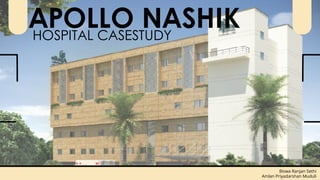
APOLLO NASHIK
HOSPITAL CASESTUDY
Amlan Priyadarshan Muduli
Biswa Ranjan Sethi
Apollo Nashik is 150 beds; scaling up to 200 beds is a manageable increment.
Planning strategies (zoning, circulation, vertical distribution) can be directly
studied and adapted.
Nashik and Navi Mumbai are both urbanizing Tier-2/metro-adjacent Indian
cities.
Both deal with mixed populations (residential + industrial workforce).
Demand for multispecialty tertiary care is similar, making Apollo Nashik’s
functional mix relevant.
INTRODUCTION
Why Apollo Nashik ?
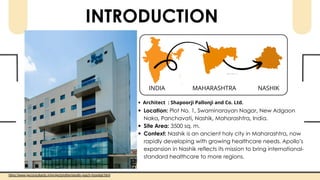
Location: Plot No. 1, Swaminarayan Nagar, New Adgaon
Naka, Panchavati, Nashik, Maharashtra, India.
Site Area: 3500 sq. m.
Context: Nashik is an ancient holy city in Maharashtra, now
rapidly developing with growing healthcare needs. Apollo’s
expansion in Nashik reflects its mission to bring international-
standard healthcare to more regions.
INTRODUCTION
INDIA MAHARASHTRA NASHIK
Architect : Shapoorji Pallonji and Co. Ltd.
https://www.jwconsultants.in/projects/other/apollo-reach-hospital.html
NEIGHBOURHOOD
.5
km
1 km
5
km
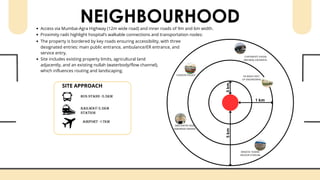
MINATAI THAKRE
INDOOR STADIUM
KK WAGH INST.
OF ENGINEERING
SWATANTRA VEER
SAWARKAR SMARAK
LONDON PALACE
CHATRAPATI SHIVAJI
MAHARAJ UDDANPUL
Access via Mumbai-Agra Highway (12m wide road) and inner roads of 9m and 6m width.
Proximity radii highlight hospital’s walkable connections and transportation nodes:
SITE APPROACH
The property is bordered by key roads ensuring accessibility, with three
designated entries: main public entrance, ambulance/ER entrance, and
service entry.
Site includes existing property limits, agricultural land
adjacently, and an existing nullah (waterbody/flow channel),
which influences routing and landscaping.
INTRODUCTION
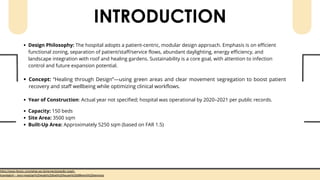
Design Philosophy: The hospital adopts a patient-centric, modular design approach. Emphasis is on efficient
functional zoning, separation of patient/staff/service flows, abundant daylighting, energy efficiency, and
landscape integration with roof and healing gardens. Sustainability is a core goal, with attention to infection
control and future expansion potential.
Concept: “Healing through Design”—using green areas and clear movement segregation to boost patient
recovery and staff wellbeing while optimizing clinical workflows.
Year of Construction: Actual year not specified; hospital was operational by 2020–2021 per public records.
Capacity: 150 beds
Site Area: 3500 sqm
Built-Up Area: Approximately 5250 sqm (based on FAR 1.5)
https://www.hksinc.com/what-we-do/projects/apollo-reach-
hospitals/#:~:text=modular%20pods%20that%20house%20different%20services
SITE ANALYSIS
https://www.meteoblue.com/en/weather/historyclimate/climatemod
elled/nashik_india_1261731
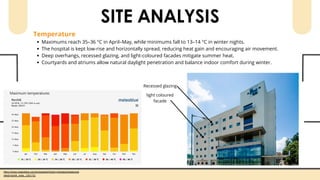
Temperature
Maximums reach 35–36 °C in April–May, while minimums fall to 13–14 °C in winter nights.
The hospital is kept low-rise and horizontally spread, reducing heat gain and encouraging air movement.
Deep overhangs, recessed glazing, and light-coloured facades mitigate summer heat.
Courtyards and atriums allow natural daylight penetration and balance indoor comfort during winter.
Recessed glazing
light coloured
facade
SITE ANALYSIS
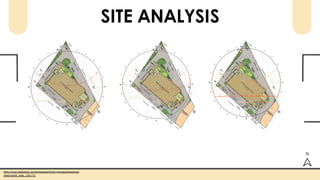
https://www.meteoblue.com/en/weather/historyclimate/climatemod
elled/nashik_india_1261731
N
SITE ANALYSIS
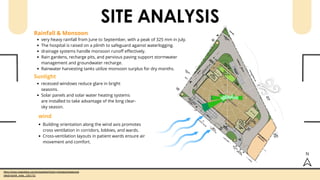
Rainfall & Monsoon
very heavy rainfall from June to September, with a peak of 325 mm in July.
The hospital is raised on a plinth to safeguard against waterlogging.
drainage systems handle monsoon runoff effectively.
Rain gardens, recharge pits, and pervious paving support stormwater
management and groundwater recharge.
Rainwater harvesting tanks utilize monsoon surplus for dry months.
https://www.meteoblue.com/en/weather/historyclimate/climatemod
elled/nashik_india_1261731
recessed windows reduce glare in bright
seasons.
Solar panels and solar water heating systems
are installed to take advantage of the long clear-
sky season.
Sunlight
wind
Building orientation along the wind axis promotes
cross ventilation in corridors, lobbies, and wards.
Cross-ventilation layouts in patient wards ensure air
movement and comfort.
N
SITE ZONING
https://www.scribd.com/document/521917044/Apollo-Hospital-Nashik-
Architecture-Case-Study
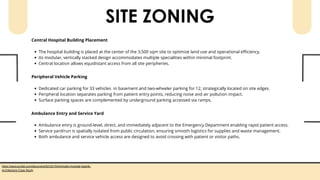
Peripheral Vehicle Parking
Dedicated car parking for 33 vehicles in basement and two-wheeler parking for 12, strategically located on site edges.
Peripheral location separates parking from patient entry points, reducing noise and air pollution impact.
Surface parking spaces are complemented by underground parking accessed via ramps.
Central Hospital Building Placement
The hospital building is placed at the center of the 3,500 sqm site to optimize land use and operational efficiency.
Its modular, vertically stacked design accommodates multiple specialities within minimal footprint.
Central location allows equidistant access from all site peripheries.
Ambulance Entry and Service Yard
Ambulance entry is ground-level, direct, and immediately adjacent to the Emergency Department enabling rapid patient access.
Service yard/run is spatially isolated from public circulation, ensuring smooth logistics for supplies and waste management.
Both ambulance and service vehicle access are designed to avoid crossing with patient or visitor paths.
SITE ZONING
https://www.scribd.com/document/521917044/Apollo-Hospital-Nashik-
Architecture-Case-Study
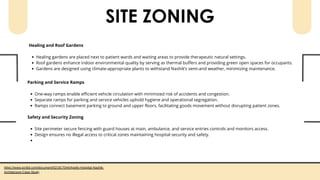
Healing and Roof Gardens
Healing gardens are placed next to patient wards and waiting areas to provide therapeutic natural settings.
Roof gardens enhance indoor environmental quality by serving as thermal buffers and providing green open spaces for occupants.
Gardens are designed using climate-appropriate plants to withstand Nashik’s semi-arid weather, minimizing maintenance.
Parking and Service Ramps
One-way ramps enable efficient vehicle circulation with minimized risk of accidents and congestion.
Separate ramps for parking and service vehicles uphold hygiene and operational segregation.
Ramps connect basement parking to ground and upper floors, facilitating goods movement without disrupting patient zones.
Safety and Security Zoning
Site perimeter secure fencing with guard houses at main, ambulance, and service entries controls and monitors access.
Design ensures no illegal access to critical zones maintaining hospital security and safety.
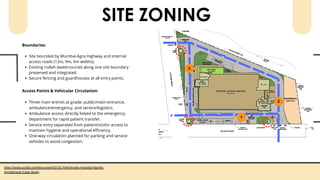
1
2
3
Access Points & Vehicular Circulation:
Three main entries at grade: public/main entrance,
ambulance/emergency, and service/logistics.
Ambulance access directly linked to the emergency
department for rapid patient transfer.
Service entry separated from patient/visitor access to
maintain hygiene and operational efficiency.
One-way circulation planned for parking and service
vehicles to avoid congestion.
SITE ZONING
https://www.scribd.com/document/521917044/Apollo-Hospital-Nashik-
Architecture-Case-Study
Boundaries:
Site bounded by Mumbai-Agra Highway and internal
access roads (12m, 9m, 6m widths).
Existing nullah (watercourse) along one site boundary
preserved and integrated.
Secure fencing and guardhouses at all entry points.
SITE ZONING
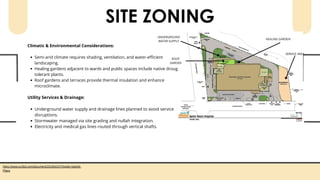
Climatic & Environmental Considerations:
Semi-arid climate requires shading, ventilation, and water-efficient
landscaping.
Healing gardens adjacent to wards and public spaces include native drought-
tolerant plants.
Roof gardens and terraces provide thermal insulation and enhance
microclimate.
Utility Services & Drainage:
Underground water supply and drainage lines planned to avoid service
disruptions.
Stormwater managed via site grading and nullah integration.
Electricity and medical gas lines routed through vertical shafts.
ROOF
GARDEN
UNDERGROUND
WATER SUPPLY
HEALING GARDEN
SERVICE AREA
https://www.scribd.com/document/201654107/Apollo-Nashik-
Plans
TRAFFIC INFO.
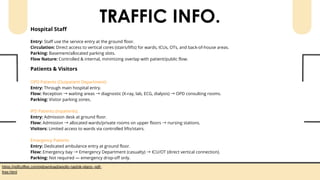
Hospital Staff
Entry: Staff use the service entry at the ground floor.
Circulation: Direct access to vertical cores (stairs/lifts) for wards, ICUs, OTs, and back-of-house areas.
Parking: Basement/allocated parking slots.
Flow Nature: Controlled & internal, minimizing overlap with patient/public flow.
Patients & Visitors
OPD Patients (Outpatient Department)
Entry: Through main hospital entry.
Flow: Reception →waiting areas →diagnostic (X-ray, lab, ECG, dialysis) →OPD consulting rooms.
Parking: Visitor parking zones.
IPD Patients (Inpatients)
Entry: Admission desk at ground floor.
Flow: Admission →allocated wards/private rooms on upper floors →nursing stations.
Visitors: Limited access to wards via controlled lifts/stairs.
Emergency Patients
Entry: Dedicated ambulance entry at ground floor.
Flow: Emergency bay →Emergency Department (casualty) →ICU/OT (direct vertical connection).
Parking: Not required — emergency drop-off only.
https://pdfcoffee.com/qdownload/apollo-nashik-plans--pdf-
free.html
TRAFFIC INFO.
https://pdfcoffee.com/qdownload/apollo-nashik-plans--pdf-
free.html
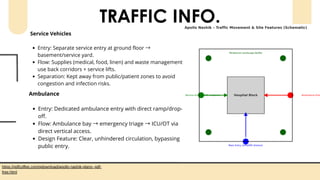
Service Vehicles
Entry: Separate service entry at ground floor →
basement/service yard.
Flow: Supplies (medical, food, linen) and waste management
use back corridors + service lifts.
Separation: Kept away from public/patient zones to avoid
congestion and infection risks.
Ambulance
Entry: Dedicated ambulance entry with direct ramp/drop-
off.
Flow: Ambulance bay →emergency triage →ICU/OT via
direct vertical access.
Design Feature: Clear, unhindered circulation, bypassing
public entry.
MATERIAL AND FINISHES
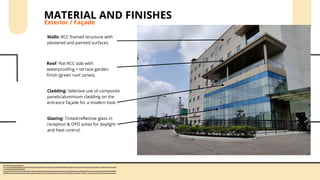
Walls: RCC framed structure with
plastered and painted surfaces.
Cladding: Selective use of composite
panels/aluminium cladding on the
entrance façade for a modern look.
Glazing: Tinted/reflective glass in
reception & OPD areas for daylight
and heat control.
Roof: Flat RCC slab with
waterproofing + terrace garden
finish (green roof zones).
Exterior / Façade
https://www.google.com/search?
sca_esv=2df61ded53f7a9a5&sxsrf=AE3TifOHnSAPUaLd4tkd6PaXLmrqHn9aPg:1755961822986&udm=2&fbs=AIIjpHxU7SXXniUZfeShr2fp4giZ1Y6MJ25_tmWITc7uy4KIetxLMeWi
1u_d0OMRvkClUba76WL62NDKV-
tuv6_wPYBC9v7ob7zIjaDzKC7u3qUzfD7e7YM11gPmU080OmUCW2ra6dnp670CRAaKtkLzGbsTDSqnsqGdRqpRgn7m8J8sRSSZQGr1gsZNygXo3gegFkXRGx97PLV94iHXkSHB
uVAPRbU0rg&q=apollo+nashik&sa=X&ved=2ahUKEwix4srFm6GPAxV4ma8BHbSVJqQQtKgLegQIFRAB&biw=1536&bih=776&dpr=1.25#vhid=ciUSXykBUUQZPM&vssid=mosaic
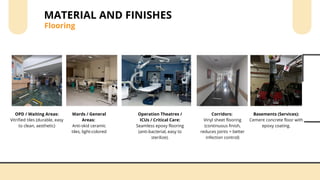
Flooring
MATERIAL AND FINISHES
OPD / Waiting Areas:
Vitrified tiles (durable, easy
to clean, aesthetic)
Wards / General
Areas:
Anti-skid ceramic
tiles, light-colored
Operation Theatres /
ICUs / Critical Care:
Seamless epoxy flooring
(anti-bacterial, easy to
sterilize).
Corridors:
Vinyl sheet flooring
(continuous finish,
reduces joints = better
infection control)
Basements (Services):
Cement concrete floor with
epoxy coating.
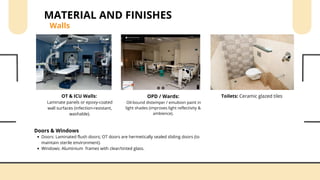
OPD / Wards:
Oil-bound distemper / emulsion paint in
light shades (improves light reflectivity &
ambience).
OT & ICU Walls:
Laminate panels or epoxy-coated
wall surfaces (infection-resistant,
washable).
Toilets: Ceramic glazed tiles
Walls
MATERIAL AND FINISHES
Doors & Windows
Doors: Laminated flush doors; OT doors are hermetically sealed sliding doors (to
maintain sterile environment).
Windows: Aluminium frames with clear/tinted glass.
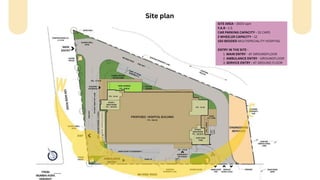
Site plan
SITE AREA - 3500 sqm
F.A.R - 1.5
CAR PARKING CAPACITY - 33 CARS
2 WHEELER CAPACITY - 12
150 BEDDED MULTISPECIALITY HOSPITAL
ENTRY IN THE SITE -
1. MAIN ENTRY - AT GROUNDFLOOR
2. AMBULANCE ENTRY - GROUNDFLOOR
3. SERVICE ENTRY - AT GROUND FLOOR
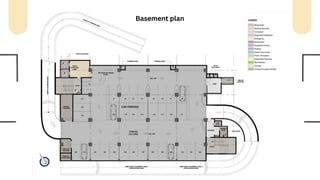
Basement plan
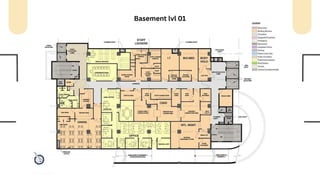
Basement lvl 01
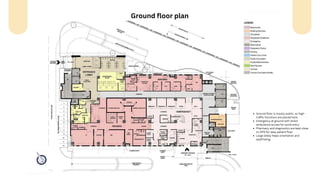
Ground floor plan
Ground floor is mostly public, so high-
traffic functions are placed here.
Emergency at ground with direct
ambulance access for quick entry.
Pharmacy and diagnostics are kept close
to OPD for easy patient flow.
Large lobby helps orientation and
wayfinding.
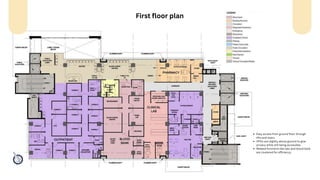
First floor plan
Easy access from ground floor through
lifts and stairs.
OPDs are slightly above ground to give
privacy while still being accessible.
Related functions like labs and blood bank
are clustered for efficiency.
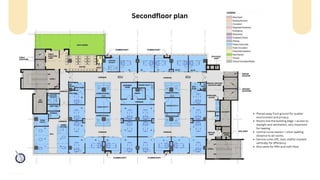
Secondfloor plan
Placed away from ground for quieter
environment and privacy.
Rooms line the building edge → access to
daylight and ventilation, very important
for healing.
Central nurse station → short walking
distance to all rooms.
Service cores (lift, stair, shafts) stacked
vertically for efficiency.
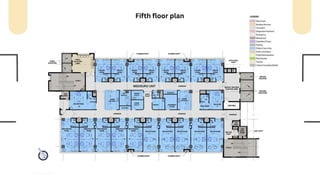
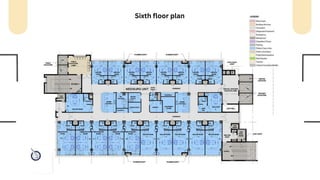
Also same for fifth and sixth floor
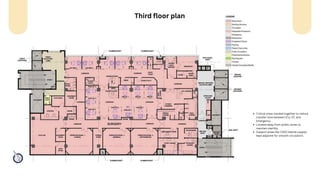
Third floor plan
Critical areas stacked together to reduce
transfer time between ICU, OT, and
Emergency.
Located away from public zones to
maintain sterility.
Support areas like CSSD (sterile supply)
kept adjacent for smooth circulation.
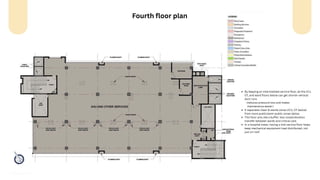
Fourth floor plan
By keeping an intermediate service floor, all the ICU,
OT, and ward floors below can get shorter vertical
duct runs.
(reduces pressure loss and makes
maintenance easier.)
It separates clean & sterile zones (ICU, OT below)
from more public/semi-public zones below.
This floor acts like a buffer: less noise/vibration
transfer between wards and critical care.
In a hospital tower, having a mid-service floor helps
keep mechanical equipment load distributed, not
just on roof.
Fifth floor plan
Sixth floor plan
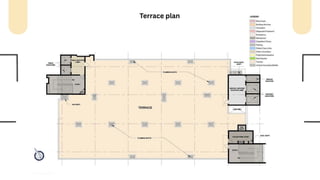
Terrace plan
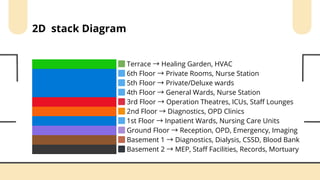
🟩Terrace →Healing Garden, HVAC
🟦6th Floor →Private Rooms, Nurse Station
🟦5th Floor →Private/Deluxe wards
🟦4th Floor →General Wards, Nurse Station
🟥3rd Floor →Operation Theatres, ICUs, Staff Lounges
🟧2nd Floor →Diagnostics, OPD Clinics
🟦1st Floor →Inpatient Wards, Nursing Care Units
🟪Ground Floor →Reception, OPD, Emergency, Imaging
🟫Basement 1 →Diagnostics, Dialysis, CSSD, Blood Bank
⬛Basement 2 →MEP, Staff Facilities, Records, Mortuary
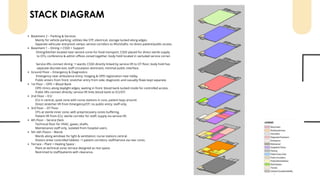
2D stack Diagram
Basement 2 – Parking & Services
Mainly for vehicle parking; utilities like STP, electrical, storage tucked along edges.
Separate vehicular entry/exit ramps; service corridors to lifts/shafts; no direct patient/public access.
Basement 1 – Dining + CSSD + Support
Dining/kitchen located near service cores for food transport; CSSD placed for direct sterile supply
to OTs; conference & admin offices zoned together; body hold located in secluded service corner.
Service lifts connect dining →wards; CSSD directly linked by service lift to OT floor; body hold has
separate discrete exit; staff circulation dominant, minimal public interface.
Ground Floor – Emergency & Diagnostics
Emergency near ambulance entry; Imaging & OPD registration near lobby.
Public enters from front; stretcher entry from side; diagnostic and casualty flows kept separate.
1st Floor – OPD + Blood Bank
OPD clinics along daylight edges; waiting in front; blood bank tucked inside for controlled access.
Public lifts connect directly; service lift links blood bank to ICU/OT.
2nd Floor – ICU
ICU in central, quiet zone with nurse stations in core, patient bays around.
Direct stretcher lift from Emergency/OT; no public entry; staff only.
3rd Floor – OT Floor
OTs at sterile inner zone, with prep/recovery zones buffering.
Patient lift from ICU; sterile corridor for staff; supply via service lift.
4th Floor – Service Deck
Technical floor for HVAC, gases, shafts.
Maintenance staff only, isolated from hospital users.
5th–6th Floors – Wards
Wards along windows for light & ventilation; nurse stations central.
Visitors enter controlled lobbies →patient corridors; staff/service via rear cores.
Terrace – Plant + Healing Space :
Plant at technical zone; terrace designed as rest space.
Restricted to staff/patients with clearance.
STACK DIAGRAM
PART 1: THE PRESENTATION
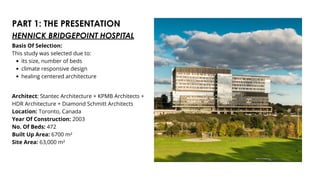
Basis Of Selection:
This study was selected due to:
its size, number of beds
climate responsive design
healing centered architecture
Architect: Stantec Architecture + KPMB Architects +
HDR Architecture + Diamond Schmitt Architects
Location: Toronto, Canada
Year Of Construction: 2003
No. Of Beds: 472
Built Up Area: 6700 m²
Site Area: 63,000 m²
HENNICK BRIDGEPOINT HOSPITAL
PART 1: THE PRESENTATION
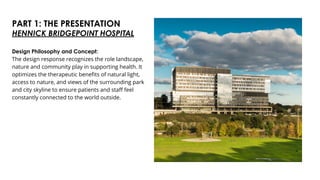
Design Philosophy and Concept:
The design response recognizes the role landscape,
nature and community play in supporting health. It
optimizes the therapeutic benefits of natural light,
access to nature, and views of the surrounding park
and city skyline to ensure patients and staff feel
constantly connected to the world outside.
HENNICK BRIDGEPOINT HOSPITAL
PART 1: THE PRESENTATION
HENNICK BRIDGEPOINT HOSPITAL
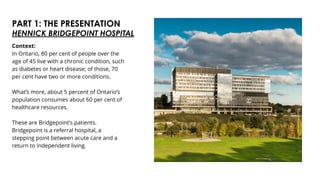
Context:
In Ontario, 80 per cent of people over the
age of 45 live with a chronic condition, such
as diabetes or heart disease; of those, 70
per cent have two or more conditions.
What’s more, about 5 percent of Ontario’s
population consumes about 60 per cent of
healthcare resources.
These are Bridgepoint’s patients.
Bridgepoint is a referral hospital, a
stepping point between acute care and a
return to independent living.
PART 2: PLANNING AND DESIGN FEATURES
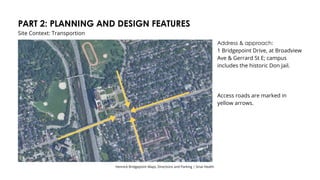
Site Context: Transportion
Address & approach:
1 Bridgepoint Drive, at Broadview
Ave & Gerrard St E; campus
includes the historic Don Jail.
Access roads are marked in
yellow arrows.
Hennick Bridgepoint Maps, Directions and Parking | Sinai Health
PART 2: PLANNING AND DESIGN FEATURES
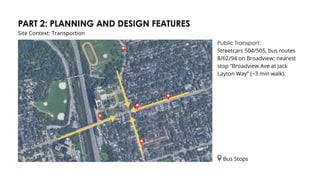
Site Context: Transportion
Public Transport:
Streetcars 504/505, bus routes
8/62/94 on Broadview; nearest
stop “Broadview Ave at Jack
Layton Way” (~3 min walk).
Bus Stops
PART 2: PLANNING AND DESIGN FEATURES
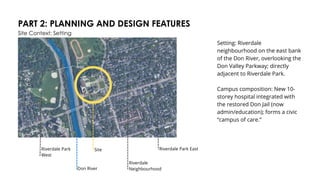
Site Context: Setting
Setting: Riverdale
neighbourhood on the east bank
of the Don River, overlooking the
Don Valley Parkway; directly
adjacent to Riverdale Park.
Campus composition: New 10-
storey hospital integrated with
the restored Don Jail (now
admin/education); forms a civic
“campus of care.”
Don River
Site Riverdale Park East
Riverdale
Neighbourhood
Riverdale Park
West
PART 2: PLANNING AND DESIGN FEATURES
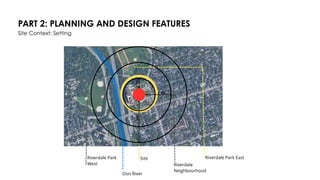
Site Context: Setting
Don River
Site Riverdale Park East
Riverdale
Neighbourhood
Riverdale Park
West
1
km
2 km
3km
PART 2: PLANNING AND DESIGN FEATURES
Site Context: Planning
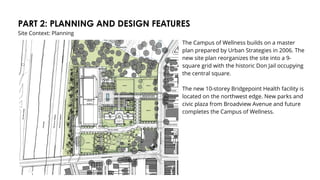
The Campus of Wellness builds on a master
plan prepared by Urban Strategies in 2006. The
new site plan reorganizes the site into a 9-
square grid with the historic Don Jail occupying
the central square.
The new 10-storey Bridgepoint Health facility is
located on the northwest edge. New parks and
civic plaza from Broadview Avenue and future
completes the Campus of Wellness.
PART 2: PLANNING AND DESIGN FEATURES
Site Context: Planning
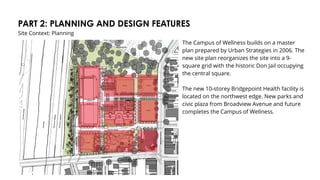
The Campus of Wellness builds on a master
plan prepared by Urban Strategies in 2006. The
new site plan reorganizes the site into a 9-
square grid with the historic Don Jail occupying
the central square.
The new 10-storey Bridgepoint Health facility is
located on the northwest edge. New parks and
civic plaza from Broadview Avenue and future
completes the Campus of Wellness.
PART 2: PLANNING AND DESIGN FEATURES
Site Context: Planning
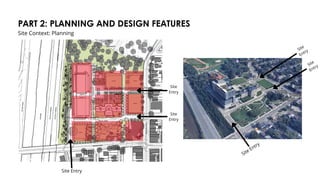
Site
Entry
Site
Entry
Site Entry
Site
Entry
Site
Entry
Site Entry
PART 2: PLANNING AND DESIGN FEATURES
Site Context: Setting
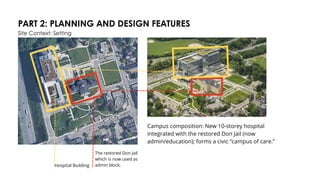
Campus composition: New 10-storey hospital
integrated with the restored Don Jail (now
admin/education); forms a civic “campus of care.”
Hospital Building
The restored Don Jail
which is now used as
admin block.
PART 2: PLANNING AND DESIGN FEATURES
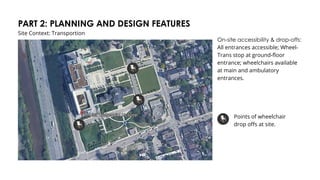
Site Context: Transportion
On-site accessibility & drop-offs:
All entrances accessible; Wheel-
Trans stop at ground-floor
entrance; wheelchairs available
at main and ambulatory
entrances.
Points of wheelchair
drop offs at site.
PART 2: PLANNING AND DESIGN FEATURES
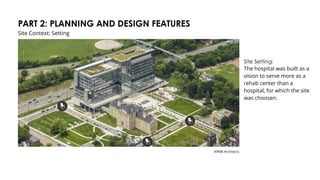
Site Context: Setting
Site Setting:
The hospital was built as a
vision to serve more as a
rehab center than a
hospital, for which the site
was choosen.
KPMB Architects
PART 2: PLANNING AND DESIGN FEATURES
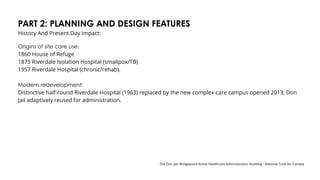
History And Present Day Impact:
Origins of site care use:
1860 House of Refuge
1875 Riverdale Isolation Hospital (smallpox/TB)
1957 Riverdale Hospital (chronic/rehab).
Modern redevelopment:
Distinctive half-round Riverdale Hospital (1963) replaced by the new complex-care campus opened 2013; Don
Jail adaptively reused for administration.
The Don Jail: Bridgepoint Active Healthcare Administration Building - National Trust for Canada
PART 2: PLANNING AND DESIGN FEATURES
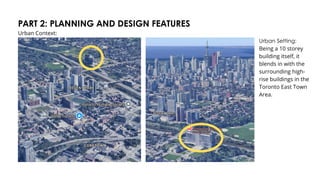
Urban Context:
Urban Setting:
Being a 10 storey
building itself, it
blends in with the
surrounding high-
rise buildings in the
Toronto East Town
Area.
Part 2: Planning and Design Features
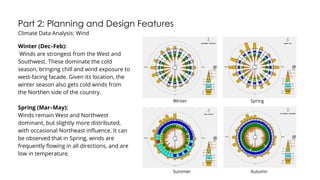
Climate Data Analysis: Wind
Winter Spring
Summer Autumn
Winter (Dec–Feb):
Winds are strongest from the West and
Southwest. These dominate the cold
season, bringing chill and wind exposure to
west-facing facade. Given its location, the
winter season also gets cold winds from
the Northen side of the country.
Spring (Mar–May):
Winds remain West and Northwest
dominant, but slightly more distributed,
with occasional Northeast influence. It can
be observed that in Spring, winds are
frequently flowing in all directions, and are
low in temperature.
Part 2: Planning and Design Features
Climate Data Analysis: Wind
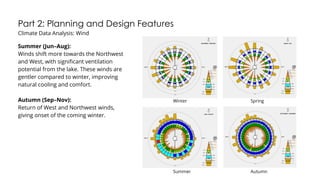
Winter Spring
Summer Autumn
Summer (Jun–Aug):
Winds shift more towards the Northwest
and West, with significant ventilation
potential from the lake. These winds are
gentler compared to winter, improving
natural cooling and comfort.
Autumn (Sep–Nov):
Return of West and Northwest winds,
giving onset of the coming winter.
Part 2: Planning and Design Features
Climate Data Analysis: Wind
Design Response at Hennick Bridgepoint Hospital
West/Northwest façades are protected by deep window bays and pop-outs, reducing drafts and heat loss
during winter winds.
The entire form of the building is two blocks joined compactly to reduce low temperature wind movement
in the peak winter months.
Part 2: Planning and Design Features
Climate Data Analysis: Temperature
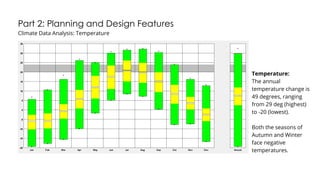
Temperature:
The annual
temperature change is
49 degrees, ranging
from 29 deg (highest)
to -20 (lowest).
Both the seasons of
Autumn and Winter
face negative
temperatures.
Part 2: Planning and Design Features
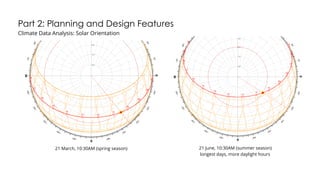
Climate Data Analysis: Solar Orientation
21 March, 10:30AM (spring season) 21 June, 10:30AM (summer season)
longest days, more daylight hours
Part 2: Planning and Design Features
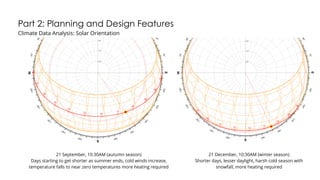
Climate Data Analysis: Solar Orientation
21 September, 10:30AM (autumn season)
Days starting to get shorter as summer ends, cold winds increase,
temperature falls to near zero temperatures more heating required
21 December, 10:30AM (winter season)
Shorter days, lesser daylight, harsh cold season with
snowfall, more heating required
Part 2: Planning and Design Features
Climate Data Analysis: Temperature And Solar Orientation
Design Response at Hennick Bridgepoint Hospital
High-Performance Glazing: The hospital utilizes high-efficiency glazing to minimize solar heat gain while
maximizing natural daylight, enhancing patient comfort and reducing energy consumption.
Thermal Mass: The building's design incorporates materials with high thermal mass, which help to
moderate indoor temperatures by absorbing heat during the day and releasing it at night.
Operable Windows: Patient rooms feature operable windows, allowing for natural ventilation and
enabling occupants to control airflow, contributing to thermal comfort.
Snow Melt Systems: The hospital has implemented snow melt systems in critical areas to prevent ice
accumulation, ensuring safe access during winter months.
Insulated Building Envelope: The building envelope is designed with high insulation values to reduce
heat loss, maintaining indoor comfort and energy efficiency during cold weather.
Hennick Bridgepoint Hospital | Toronto, ON, Canada | Plenary
Part 2: Planning and Design Features
Materials And Finishes Used:
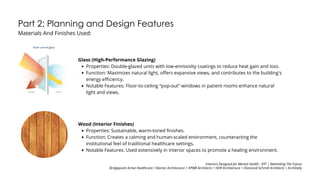
Glass (High-Performance Glazing)
Properties: Double-glazed units with low-emissivity coatings to reduce heat gain and loss.
Function: Maximizes natural light, offers expansive views, and contributes to the building's
energy efficiency.
Notable Features: Floor-to-ceiling “pop-out” windows in patient rooms enhance natural
light and views.
Wood (Interior Finishes)
Properties: Sustainable, warm-toned finishes.
Function: Creates a calming and human-scaled environment, counteracting the
institutional feel of traditional healthcare settings.
Notable Features: Used extensively in interior spaces to promote a healing environment.
Interiors Designed for Mental Health - RTF | Rethinking The Future
Bridgepoint Active Healthcare / Stantec Architecture + KPMB Architects + HDR Architecture + Diamond Schmitt Architects | ArchDaily
Part 2: Planning and Design Features
Materials And Finishes Used:
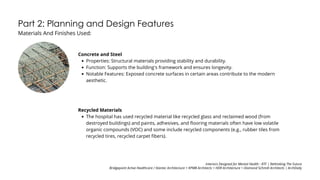
Concrete and Steel
Properties: Structural materials providing stability and durability.
Function: Supports the building's framework and ensures longevity.
Notable Features: Exposed concrete surfaces in certain areas contribute to the modern
aesthetic.
Recycled Materials
The hospital has used recycled material like recycled glass and reclaimed wood (from
destroyed buildings) and paints, adhesives, and flooring materials often have low volatile
organic compounds (VOC) and some include recycled components (e.g., rubber tiles from
recycled tires, recycled carpet fibers).
Interiors Designed for Mental Health - RTF | Rethinking The Future
Bridgepoint Active Healthcare / Stantec Architecture + KPMB Architects + HDR Architecture + Diamond Schmitt Architects | ArchDaily
Part 2: Planning and
Design Features
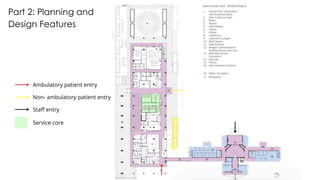
Ambulatory patient entry
Non- ambulatory patient entry
Staff entry
Service core
Part 2: Planning and
Design Features
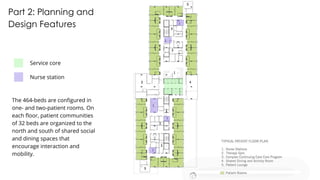
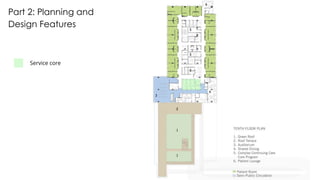
Service core
Nurse station
The 464-beds are configured in
one- and two-patient rooms. On
each floor, patient communities
of 32 beds are organized to the
north and south of shared social
and dining spaces that
encourage interaction and
mobility.
Part 2: Planning and
Design Features
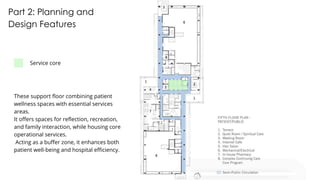
Service core
These support floor combining patient
wellness spaces with essential services
areas.
It offers spaces for reflection, recreation,
and family interaction, while housing core
operational services.
Acting as a buffer zone, it enhances both
patient well-being and hospital efficiency.
Part 2: Planning and
Design Features
Service core
Part 2: Planning and Design Features
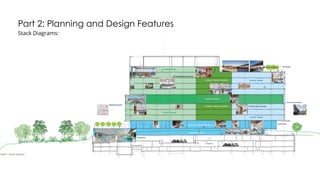
Stack Diagrams:
Part 2: Planning and Design Features
Parking:
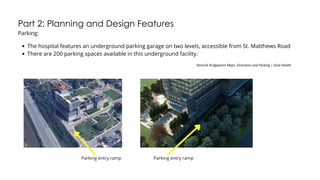
The hospital features an underground parking garage on two levels, accessible from St. Matthews Road
There are 200 parking spaces available in this underground facility.
Hennick Bridgepoint Maps, Directions and Parking | Sinai Health
Parking entry ramp Parking entry ramp
Part 2: Planning and Design Features
LEED Certification:
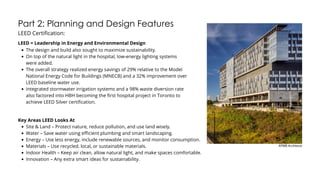
The design and build also sought to maximize sustainability.
On top of the natural light in the hospital, low-energy lighting systems
were added.
The overall strategy realized energy savings of 29% relative to the Model
National Energy Code for Buildings (MNECB) and a 32% improvement over
LEED baseline water use.
Integrated stormwater irrigation systems and a 98% waste diversion rate
also factored into HBH becoming the first hospital project in Toronto to
achieve LEED Silver certification.
LEED = Leadership in Energy and Environmental Design
KPMB Architects
Key Areas LEED Looks At
Site & Land – Protect nature, reduce pollution, and use land wisely.
Water – Save water using efficient plumbing and smart landscaping.
Energy – Use less energy, include renewable sources, and monitor consumption.
Materials – Use recycled, local, or sustainable materials.
Indoor Health – Keep air clean, allow natural light, and make spaces comfortable.
Innovation – Any extra smart ideas for sustainability.
Part 2: Planning and Design Features
LEED Certification:
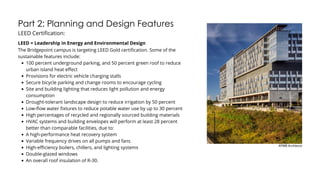
The Bridgepoint campus is targeting LEED Gold certification. Some of the
sustainable features include:
100 percent underground parking, and 50 percent green roof to reduce
urban island heat effect
Provisions for electric vehicle charging stalls
Secure bicycle parking and change rooms to encourage cycling
Site and building lighting that reduces light pollution and energy
consumption
Drought-tolerant landscape design to reduce irrigation by 50 percent
Low-flow water fixtures to reduce potable water use by up to 30 percent
High percentages of recycled and regionally sourced building materials
HVAC systems and building envelopes will perform at least 28 percent
better than comparable facilities, due to:
A high-performance heat recovery system
Variable frequency drives on all pumps and fans
High-efficiency boilers, chillers, and lighting systems
Double-glazed windows
An overall roof insulation of R-30.
LEED = Leadership in Energy and Environmental Design
KPMB Architects
Part 2: Planning and Design Features
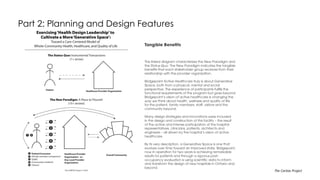
The Caritas Project
Part 2: Planning and Design Features
Similar Certifications In India:
GRIHA (Green Rating for Integrated Habitat Assessment)
IGBC (Indian Green Building Council) Rating
ECBC (Energy Conservation Building Code)
Part 2: Planning and Design Features
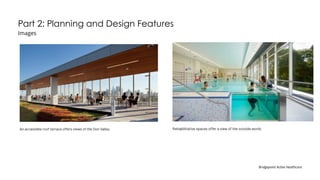
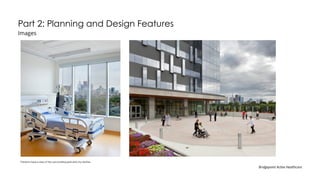
Images
Bridgepoint Active Healthcare
Part 2: Planning and Design Features
Images
Bridgepoint Active Healthcare
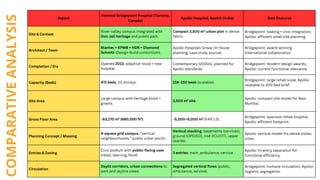
COMPARATIVE
ANALYSIS Aspect
Hennick Bridgepoint Hospital (Toronto,
Canada)
Apollo Hospital, Nashik (India) Best Features
Site & Context
River-valley campus integrated with
Don Jail heritage and public park.
Compact 3,500 m² urban plot in dense
fabric.
Bridgepoint: healing + civic integration;
Apollo: efficient small-site planning.
Architect / Team
Stantec + KPMB + HDR + Diamond
Schmitt (Design-Build consortium).
Apollo Hospitals Group (in-house
planning, case study source).
Bridgepoint: award-winning
international collaboration.
Completion / Era
Opened 2013, adaptive reuse + new
hospital.
Contemporary (2000s), planned for
Apollo standards.
Bridgepoint: modern design awards;
Apollo: current functional relevance.
Capacity (Beds) 472 beds, 10 storeys. 118–150 beds (scalable).
Bridgepoint: large rehab scale; Apollo:
relatable to 200-bed brief.
Site Area
Large campus with heritage block +
greens.
3,500 m² site.
Apollo: compact site model for Navi
Mumbai.
Gross Floor Area ~63,170 m² (680,000 ft²). ~5,000–6,000 m² (FAR 1.5).
Bridgepoint: spacious rehab hospital;
Apollo: efficient footprint.
Planning Concept / Massing
9-square grid campus, “vertical
neighbourhoods,” public urban porch.
Vertical stacking: basements (services),
ground (OPD/ED), mid (ICU/OT), upper
(wards).
Apollo: vertical model fits dense Indian
cities.
Entries & Zoning
Civic podium with public-facing uses
(retail, learning, food).
3 entries: main, ambulance, service.
Apollo: tri-entry separation for
functional efficiency.
Circulation
Daylit corridors, urban connections to
park and skyline views.
Segregated vertical flows (public,
ambulance, service).
Bridgepoint: humane circulation; Apollo:
hygienic segregation.
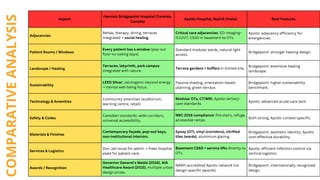
COMPARATIVE
ANALYSIS
Adjacencies
Rehab, therapy, dining, terraces
integrated → social healing.
Critical care adjacencies: ED–Imaging–
ICU/OT; CSSD in basement to OTs.
Apollo: adjacency efficiency for
emergencies.
Patient Rooms / Windows
Every patient has a window (pop-out
floor-to-ceiling bays).
Standard modular wards, natural light
access.
Bridgepoint: stronger healing design.
Landscape / Healing
Terraces, labyrinth, park campus
integrated with nature.
Terrace gardens + buffers in limited site.
Bridgepoint: extensive healing
landscape.
Sustainability
LEED Silver, salutogenic beyond energy
→ mental well-being focus.
Passive shading, orientation-based
planning, green terrace.
Bridgepoint: higher sustainability
benchmark.
Technology & Amenities
Community amenities (auditorium,
learning centre, retail).
Modular OTs, CT/MRI, Apollo tertiary-
care standards.
Apollo: advanced acute-care tech.
Safety & Codes
Canadian standards: wide corridors,
universal accessibility.
NBC 2016 compliance: fire stairs, refuge,
accessible ramps.
Both strong; Apollo context-specific.
Materials & Finishes
Contemporary façade, pop-out bays,
non-institutional interiors.
Epoxy (OT), vinyl (corridors), vitrified
tiles (wards), aluminium glazing.
Bridgepoint: aesthetic identity; Apollo:
cost-effective durability.
Services & Logistics
Don Jail reuse for admin → frees hospital
plate for patient care.
Basement CSSD + service lifts directly to
OTs.
Apollo: efficient infection control via
vertical logistics.
Awards / Recognition
Governor General’s Medal (2016), AIA
Healthcare Award (2015), multiple urban
design prizes.
NABH-accredited Apollo network (no
design-specific awards).
Bridgepoint: internationally recognized
design.
Aspect
Hennick Bridgepoint Hospital (Toronto,
Canada)
Apollo Hospital, Nashik (India) Best Features
INFERENCES
APOLLO NASHIK
Vertical Stacking for Compact Sites - Efficient planning on only 3,500 m² site
Segregated Entries - Separate ambulance, service, and main entry for smooth
circulation.
Functional Adjacencies - ED near diagnostics & ICU; CSSD directly connected to OTs
via service lifts.
Healing Terraces - Small-scale but effective green elements even in dense sites.
Cost-Effective Materials & Finishes - Vinyl/epoxy floors, vitrified tiles, modular OTs -
durable and hygienic yet affordable.
Scalable Design - Wards & OTs are modular; can expand from 150 - 200 beds easily.
INFERENCES
HENNICK BRIDGEPOINT HOSPITAL
Healing campus integrated with nature + heritage (Don River & Don Jail).
Every patient has a window - daylight & views aid recovery.
Salutogenic design - terraces, gardens, communal spaces encourage wellness.
Community integration - civic podium with public amenities.
9-square grid & vertical neighbourhoods - clear zoning + social interaction.
Daylit corridors - intuitive wayfinding, humane circulation.
LEED Silver certified - sustainable, future-ready model.
Globally awarded for design excellence (Governor General’s Medal, AIA).
THANK YOU

Hospital Case Study .architecture design

  • 1.
    Balaji Behera Smrutishikha Mahapatra AmlanPriyadarshan Muduli Biswaranjan Sethi Hospital Design: Secondary Case Study
  • 2.
    APOLLO NASHIK HOSPITAL CASESTUDY AmlanPriyadarshan Muduli Biswa Ranjan Sethi
  • 3.
    Apollo Nashik is150 beds; scaling up to 200 beds is a manageable increment. Planning strategies (zoning, circulation, vertical distribution) can be directly studied and adapted. Nashik and Navi Mumbai are both urbanizing Tier-2/metro-adjacent Indian cities. Both deal with mixed populations (residential + industrial workforce). Demand for multispecialty tertiary care is similar, making Apollo Nashik’s functional mix relevant. INTRODUCTION Why Apollo Nashik ?
  • 4.
    Location: Plot No.1, Swaminarayan Nagar, New Adgaon Naka, Panchavati, Nashik, Maharashtra, India. Site Area: 3500 sq. m. Context: Nashik is an ancient holy city in Maharashtra, now rapidly developing with growing healthcare needs. Apollo’s expansion in Nashik reflects its mission to bring international- standard healthcare to more regions. INTRODUCTION INDIA MAHARASHTRA NASHIK Architect : Shapoorji Pallonji and Co. Ltd. https://www.jwconsultants.in/projects/other/apollo-reach-hospital.html
  • 5.
    NEIGHBOURHOOD .5 km 1 km 5 km MINATAI THAKRE INDOORSTADIUM KK WAGH INST. OF ENGINEERING SWATANTRA VEER SAWARKAR SMARAK LONDON PALACE CHATRAPATI SHIVAJI MAHARAJ UDDANPUL Access via Mumbai-Agra Highway (12m wide road) and inner roads of 9m and 6m width. Proximity radii highlight hospital’s walkable connections and transportation nodes: SITE APPROACH The property is bordered by key roads ensuring accessibility, with three designated entries: main public entrance, ambulance/ER entrance, and service entry. Site includes existing property limits, agricultural land adjacently, and an existing nullah (waterbody/flow channel), which influences routing and landscaping.
  • 6.
    INTRODUCTION Design Philosophy: Thehospital adopts a patient-centric, modular design approach. Emphasis is on efficient functional zoning, separation of patient/staff/service flows, abundant daylighting, energy efficiency, and landscape integration with roof and healing gardens. Sustainability is a core goal, with attention to infection control and future expansion potential. Concept: “Healing through Design”—using green areas and clear movement segregation to boost patient recovery and staff wellbeing while optimizing clinical workflows. Year of Construction: Actual year not specified; hospital was operational by 2020–2021 per public records. Capacity: 150 beds Site Area: 3500 sqm Built-Up Area: Approximately 5250 sqm (based on FAR 1.5) https://www.hksinc.com/what-we-do/projects/apollo-reach- hospitals/#:~:text=modular%20pods%20that%20house%20different%20services
  • 7.
    SITE ANALYSIS https://www.meteoblue.com/en/weather/historyclimate/climatemod elled/nashik_india_1261731 Temperature Maximums reach35–36 °C in April–May, while minimums fall to 13–14 °C in winter nights. The hospital is kept low-rise and horizontally spread, reducing heat gain and encouraging air movement. Deep overhangs, recessed glazing, and light-coloured facades mitigate summer heat. Courtyards and atriums allow natural daylight penetration and balance indoor comfort during winter. Recessed glazing light coloured facade
  • 8.
  • 9.
    SITE ANALYSIS Rainfall &Monsoon very heavy rainfall from June to September, with a peak of 325 mm in July. The hospital is raised on a plinth to safeguard against waterlogging. drainage systems handle monsoon runoff effectively. Rain gardens, recharge pits, and pervious paving support stormwater management and groundwater recharge. Rainwater harvesting tanks utilize monsoon surplus for dry months. https://www.meteoblue.com/en/weather/historyclimate/climatemod elled/nashik_india_1261731 recessed windows reduce glare in bright seasons. Solar panels and solar water heating systems are installed to take advantage of the long clear- sky season. Sunlight wind Building orientation along the wind axis promotes cross ventilation in corridors, lobbies, and wards. Cross-ventilation layouts in patient wards ensure air movement and comfort. N
  • 10.
    SITE ZONING https://www.scribd.com/document/521917044/Apollo-Hospital-Nashik- Architecture-Case-Study Peripheral VehicleParking Dedicated car parking for 33 vehicles in basement and two-wheeler parking for 12, strategically located on site edges. Peripheral location separates parking from patient entry points, reducing noise and air pollution impact. Surface parking spaces are complemented by underground parking accessed via ramps. Central Hospital Building Placement The hospital building is placed at the center of the 3,500 sqm site to optimize land use and operational efficiency. Its modular, vertically stacked design accommodates multiple specialities within minimal footprint. Central location allows equidistant access from all site peripheries. Ambulance Entry and Service Yard Ambulance entry is ground-level, direct, and immediately adjacent to the Emergency Department enabling rapid patient access. Service yard/run is spatially isolated from public circulation, ensuring smooth logistics for supplies and waste management. Both ambulance and service vehicle access are designed to avoid crossing with patient or visitor paths.
  • 11.
    SITE ZONING https://www.scribd.com/document/521917044/Apollo-Hospital-Nashik- Architecture-Case-Study Healing andRoof Gardens Healing gardens are placed next to patient wards and waiting areas to provide therapeutic natural settings. Roof gardens enhance indoor environmental quality by serving as thermal buffers and providing green open spaces for occupants. Gardens are designed using climate-appropriate plants to withstand Nashik’s semi-arid weather, minimizing maintenance. Parking and Service Ramps One-way ramps enable efficient vehicle circulation with minimized risk of accidents and congestion. Separate ramps for parking and service vehicles uphold hygiene and operational segregation. Ramps connect basement parking to ground and upper floors, facilitating goods movement without disrupting patient zones. Safety and Security Zoning Site perimeter secure fencing with guard houses at main, ambulance, and service entries controls and monitors access. Design ensures no illegal access to critical zones maintaining hospital security and safety.
  • 12.
    1 2 3 Access Points &Vehicular Circulation: Three main entries at grade: public/main entrance, ambulance/emergency, and service/logistics. Ambulance access directly linked to the emergency department for rapid patient transfer. Service entry separated from patient/visitor access to maintain hygiene and operational efficiency. One-way circulation planned for parking and service vehicles to avoid congestion. SITE ZONING https://www.scribd.com/document/521917044/Apollo-Hospital-Nashik- Architecture-Case-Study Boundaries: Site bounded by Mumbai-Agra Highway and internal access roads (12m, 9m, 6m widths). Existing nullah (watercourse) along one site boundary preserved and integrated. Secure fencing and guardhouses at all entry points.
  • 13.
    SITE ZONING Climatic &Environmental Considerations: Semi-arid climate requires shading, ventilation, and water-efficient landscaping. Healing gardens adjacent to wards and public spaces include native drought- tolerant plants. Roof gardens and terraces provide thermal insulation and enhance microclimate. Utility Services & Drainage: Underground water supply and drainage lines planned to avoid service disruptions. Stormwater managed via site grading and nullah integration. Electricity and medical gas lines routed through vertical shafts. ROOF GARDEN UNDERGROUND WATER SUPPLY HEALING GARDEN SERVICE AREA https://www.scribd.com/document/201654107/Apollo-Nashik- Plans
  • 14.
    TRAFFIC INFO. Hospital Staff Entry:Staff use the service entry at the ground floor. Circulation: Direct access to vertical cores (stairs/lifts) for wards, ICUs, OTs, and back-of-house areas. Parking: Basement/allocated parking slots. Flow Nature: Controlled & internal, minimizing overlap with patient/public flow. Patients & Visitors OPD Patients (Outpatient Department) Entry: Through main hospital entry. Flow: Reception →waiting areas →diagnostic (X-ray, lab, ECG, dialysis) →OPD consulting rooms. Parking: Visitor parking zones. IPD Patients (Inpatients) Entry: Admission desk at ground floor. Flow: Admission →allocated wards/private rooms on upper floors →nursing stations. Visitors: Limited access to wards via controlled lifts/stairs. Emergency Patients Entry: Dedicated ambulance entry at ground floor. Flow: Emergency bay →Emergency Department (casualty) →ICU/OT (direct vertical connection). Parking: Not required — emergency drop-off only. https://pdfcoffee.com/qdownload/apollo-nashik-plans--pdf- free.html
  • 15.
    TRAFFIC INFO. https://pdfcoffee.com/qdownload/apollo-nashik-plans--pdf- free.html Service Vehicles Entry:Separate service entry at ground floor → basement/service yard. Flow: Supplies (medical, food, linen) and waste management use back corridors + service lifts. Separation: Kept away from public/patient zones to avoid congestion and infection risks. Ambulance Entry: Dedicated ambulance entry with direct ramp/drop- off. Flow: Ambulance bay →emergency triage →ICU/OT via direct vertical access. Design Feature: Clear, unhindered circulation, bypassing public entry.
  • 16.
    MATERIAL AND FINISHES Walls:RCC framed structure with plastered and painted surfaces. Cladding: Selective use of composite panels/aluminium cladding on the entrance façade for a modern look. Glazing: Tinted/reflective glass in reception & OPD areas for daylight and heat control. Roof: Flat RCC slab with waterproofing + terrace garden finish (green roof zones). Exterior / Façade https://www.google.com/search? sca_esv=2df61ded53f7a9a5&sxsrf=AE3TifOHnSAPUaLd4tkd6PaXLmrqHn9aPg:1755961822986&udm=2&fbs=AIIjpHxU7SXXniUZfeShr2fp4giZ1Y6MJ25_tmWITc7uy4KIetxLMeWi 1u_d0OMRvkClUba76WL62NDKV- tuv6_wPYBC9v7ob7zIjaDzKC7u3qUzfD7e7YM11gPmU080OmUCW2ra6dnp670CRAaKtkLzGbsTDSqnsqGdRqpRgn7m8J8sRSSZQGr1gsZNygXo3gegFkXRGx97PLV94iHXkSHB uVAPRbU0rg&q=apollo+nashik&sa=X&ved=2ahUKEwix4srFm6GPAxV4ma8BHbSVJqQQtKgLegQIFRAB&biw=1536&bih=776&dpr=1.25#vhid=ciUSXykBUUQZPM&vssid=mosaic
  • 17.
    Flooring MATERIAL AND FINISHES OPD/ Waiting Areas: Vitrified tiles (durable, easy to clean, aesthetic) Wards / General Areas: Anti-skid ceramic tiles, light-colored Operation Theatres / ICUs / Critical Care: Seamless epoxy flooring (anti-bacterial, easy to sterilize). Corridors: Vinyl sheet flooring (continuous finish, reduces joints = better infection control) Basements (Services): Cement concrete floor with epoxy coating.
  • 18.
    OPD / Wards: Oil-bounddistemper / emulsion paint in light shades (improves light reflectivity & ambience). OT & ICU Walls: Laminate panels or epoxy-coated wall surfaces (infection-resistant, washable). Toilets: Ceramic glazed tiles Walls MATERIAL AND FINISHES Doors & Windows Doors: Laminated flush doors; OT doors are hermetically sealed sliding doors (to maintain sterile environment). Windows: Aluminium frames with clear/tinted glass.
  • 19.
    Site plan SITE AREA- 3500 sqm F.A.R - 1.5 CAR PARKING CAPACITY - 33 CARS 2 WHEELER CAPACITY - 12 150 BEDDED MULTISPECIALITY HOSPITAL ENTRY IN THE SITE - 1. MAIN ENTRY - AT GROUNDFLOOR 2. AMBULANCE ENTRY - GROUNDFLOOR 3. SERVICE ENTRY - AT GROUND FLOOR
  • 20.
  • 21.
  • 22.
    Ground floor plan Groundfloor is mostly public, so high- traffic functions are placed here. Emergency at ground with direct ambulance access for quick entry. Pharmacy and diagnostics are kept close to OPD for easy patient flow. Large lobby helps orientation and wayfinding.
  • 23.
    First floor plan Easyaccess from ground floor through lifts and stairs. OPDs are slightly above ground to give privacy while still being accessible. Related functions like labs and blood bank are clustered for efficiency.
  • 24.
    Secondfloor plan Placed awayfrom ground for quieter environment and privacy. Rooms line the building edge → access to daylight and ventilation, very important for healing. Central nurse station → short walking distance to all rooms. Service cores (lift, stair, shafts) stacked vertically for efficiency. Also same for fifth and sixth floor
  • 25.
    Third floor plan Criticalareas stacked together to reduce transfer time between ICU, OT, and Emergency. Located away from public zones to maintain sterility. Support areas like CSSD (sterile supply) kept adjacent for smooth circulation.
  • 26.
    Fourth floor plan Bykeeping an intermediate service floor, all the ICU, OT, and ward floors below can get shorter vertical duct runs. (reduces pressure loss and makes maintenance easier.) It separates clean & sterile zones (ICU, OT below) from more public/semi-public zones below. This floor acts like a buffer: less noise/vibration transfer between wards and critical care. In a hospital tower, having a mid-service floor helps keep mechanical equipment load distributed, not just on roof.
  • 27.
  • 28.
  • 29.
  • 30.
    🟩Terrace →Healing Garden,HVAC 🟦6th Floor →Private Rooms, Nurse Station 🟦5th Floor →Private/Deluxe wards 🟦4th Floor →General Wards, Nurse Station 🟥3rd Floor →Operation Theatres, ICUs, Staff Lounges 🟧2nd Floor →Diagnostics, OPD Clinics 🟦1st Floor →Inpatient Wards, Nursing Care Units 🟪Ground Floor →Reception, OPD, Emergency, Imaging 🟫Basement 1 →Diagnostics, Dialysis, CSSD, Blood Bank ⬛Basement 2 →MEP, Staff Facilities, Records, Mortuary 2D stack Diagram
  • 31.
    Basement 2 –Parking & Services Mainly for vehicle parking; utilities like STP, electrical, storage tucked along edges. Separate vehicular entry/exit ramps; service corridors to lifts/shafts; no direct patient/public access. Basement 1 – Dining + CSSD + Support Dining/kitchen located near service cores for food transport; CSSD placed for direct sterile supply to OTs; conference & admin offices zoned together; body hold located in secluded service corner. Service lifts connect dining →wards; CSSD directly linked by service lift to OT floor; body hold has separate discrete exit; staff circulation dominant, minimal public interface. Ground Floor – Emergency & Diagnostics Emergency near ambulance entry; Imaging & OPD registration near lobby. Public enters from front; stretcher entry from side; diagnostic and casualty flows kept separate. 1st Floor – OPD + Blood Bank OPD clinics along daylight edges; waiting in front; blood bank tucked inside for controlled access. Public lifts connect directly; service lift links blood bank to ICU/OT. 2nd Floor – ICU ICU in central, quiet zone with nurse stations in core, patient bays around. Direct stretcher lift from Emergency/OT; no public entry; staff only. 3rd Floor – OT Floor OTs at sterile inner zone, with prep/recovery zones buffering. Patient lift from ICU; sterile corridor for staff; supply via service lift. 4th Floor – Service Deck Technical floor for HVAC, gases, shafts. Maintenance staff only, isolated from hospital users. 5th–6th Floors – Wards Wards along windows for light & ventilation; nurse stations central. Visitors enter controlled lobbies →patient corridors; staff/service via rear cores. Terrace – Plant + Healing Space : Plant at technical zone; terrace designed as rest space. Restricted to staff/patients with clearance. STACK DIAGRAM
  • 32.
    PART 1: THEPRESENTATION Basis Of Selection: This study was selected due to: its size, number of beds climate responsive design healing centered architecture Architect: Stantec Architecture + KPMB Architects + HDR Architecture + Diamond Schmitt Architects Location: Toronto, Canada Year Of Construction: 2003 No. Of Beds: 472 Built Up Area: 6700 m² Site Area: 63,000 m² HENNICK BRIDGEPOINT HOSPITAL
  • 33.
    PART 1: THEPRESENTATION Design Philosophy and Concept: The design response recognizes the role landscape, nature and community play in supporting health. It optimizes the therapeutic benefits of natural light, access to nature, and views of the surrounding park and city skyline to ensure patients and staff feel constantly connected to the world outside. HENNICK BRIDGEPOINT HOSPITAL
  • 34.
    PART 1: THEPRESENTATION HENNICK BRIDGEPOINT HOSPITAL Context: In Ontario, 80 per cent of people over the age of 45 live with a chronic condition, such as diabetes or heart disease; of those, 70 per cent have two or more conditions. What’s more, about 5 percent of Ontario’s population consumes about 60 per cent of healthcare resources. These are Bridgepoint’s patients. Bridgepoint is a referral hospital, a stepping point between acute care and a return to independent living.
  • 35.
    PART 2: PLANNINGAND DESIGN FEATURES Site Context: Transportion Address & approach: 1 Bridgepoint Drive, at Broadview Ave & Gerrard St E; campus includes the historic Don Jail. Access roads are marked in yellow arrows. Hennick Bridgepoint Maps, Directions and Parking | Sinai Health
  • 36.
    PART 2: PLANNINGAND DESIGN FEATURES Site Context: Transportion Public Transport: Streetcars 504/505, bus routes 8/62/94 on Broadview; nearest stop “Broadview Ave at Jack Layton Way” (~3 min walk). Bus Stops
  • 37.
    PART 2: PLANNINGAND DESIGN FEATURES Site Context: Setting Setting: Riverdale neighbourhood on the east bank of the Don River, overlooking the Don Valley Parkway; directly adjacent to Riverdale Park. Campus composition: New 10- storey hospital integrated with the restored Don Jail (now admin/education); forms a civic “campus of care.” Don River Site Riverdale Park East Riverdale Neighbourhood Riverdale Park West
  • 38.
    PART 2: PLANNINGAND DESIGN FEATURES Site Context: Setting Don River Site Riverdale Park East Riverdale Neighbourhood Riverdale Park West 1 km 2 km 3km
  • 39.
    PART 2: PLANNINGAND DESIGN FEATURES Site Context: Planning The Campus of Wellness builds on a master plan prepared by Urban Strategies in 2006. The new site plan reorganizes the site into a 9- square grid with the historic Don Jail occupying the central square. The new 10-storey Bridgepoint Health facility is located on the northwest edge. New parks and civic plaza from Broadview Avenue and future completes the Campus of Wellness.
  • 40.
    PART 2: PLANNINGAND DESIGN FEATURES Site Context: Planning The Campus of Wellness builds on a master plan prepared by Urban Strategies in 2006. The new site plan reorganizes the site into a 9- square grid with the historic Don Jail occupying the central square. The new 10-storey Bridgepoint Health facility is located on the northwest edge. New parks and civic plaza from Broadview Avenue and future completes the Campus of Wellness.
  • 41.
    PART 2: PLANNINGAND DESIGN FEATURES Site Context: Planning Site Entry Site Entry Site Entry Site Entry Site Entry Site Entry
  • 42.
    PART 2: PLANNINGAND DESIGN FEATURES Site Context: Setting Campus composition: New 10-storey hospital integrated with the restored Don Jail (now admin/education); forms a civic “campus of care.” Hospital Building The restored Don Jail which is now used as admin block.
  • 43.
    PART 2: PLANNINGAND DESIGN FEATURES Site Context: Transportion On-site accessibility & drop-offs: All entrances accessible; Wheel- Trans stop at ground-floor entrance; wheelchairs available at main and ambulatory entrances. Points of wheelchair drop offs at site.
  • 44.
    PART 2: PLANNINGAND DESIGN FEATURES Site Context: Setting Site Setting: The hospital was built as a vision to serve more as a rehab center than a hospital, for which the site was choosen. KPMB Architects
  • 45.
    PART 2: PLANNINGAND DESIGN FEATURES History And Present Day Impact: Origins of site care use: 1860 House of Refuge 1875 Riverdale Isolation Hospital (smallpox/TB) 1957 Riverdale Hospital (chronic/rehab). Modern redevelopment: Distinctive half-round Riverdale Hospital (1963) replaced by the new complex-care campus opened 2013; Don Jail adaptively reused for administration. The Don Jail: Bridgepoint Active Healthcare Administration Building - National Trust for Canada
  • 46.
    PART 2: PLANNINGAND DESIGN FEATURES Urban Context: Urban Setting: Being a 10 storey building itself, it blends in with the surrounding high- rise buildings in the Toronto East Town Area.
  • 47.
    Part 2: Planningand Design Features Climate Data Analysis: Wind Winter Spring Summer Autumn Winter (Dec–Feb): Winds are strongest from the West and Southwest. These dominate the cold season, bringing chill and wind exposure to west-facing facade. Given its location, the winter season also gets cold winds from the Northen side of the country. Spring (Mar–May): Winds remain West and Northwest dominant, but slightly more distributed, with occasional Northeast influence. It can be observed that in Spring, winds are frequently flowing in all directions, and are low in temperature.
  • 48.
    Part 2: Planningand Design Features Climate Data Analysis: Wind Winter Spring Summer Autumn Summer (Jun–Aug): Winds shift more towards the Northwest and West, with significant ventilation potential from the lake. These winds are gentler compared to winter, improving natural cooling and comfort. Autumn (Sep–Nov): Return of West and Northwest winds, giving onset of the coming winter.
  • 49.
    Part 2: Planningand Design Features Climate Data Analysis: Wind Design Response at Hennick Bridgepoint Hospital West/Northwest façades are protected by deep window bays and pop-outs, reducing drafts and heat loss during winter winds. The entire form of the building is two blocks joined compactly to reduce low temperature wind movement in the peak winter months.
  • 50.
    Part 2: Planningand Design Features Climate Data Analysis: Temperature Temperature: The annual temperature change is 49 degrees, ranging from 29 deg (highest) to -20 (lowest). Both the seasons of Autumn and Winter face negative temperatures.
  • 51.
    Part 2: Planningand Design Features Climate Data Analysis: Solar Orientation 21 March, 10:30AM (spring season) 21 June, 10:30AM (summer season) longest days, more daylight hours
  • 52.
    Part 2: Planningand Design Features Climate Data Analysis: Solar Orientation 21 September, 10:30AM (autumn season) Days starting to get shorter as summer ends, cold winds increase, temperature falls to near zero temperatures more heating required 21 December, 10:30AM (winter season) Shorter days, lesser daylight, harsh cold season with snowfall, more heating required
  • 53.
    Part 2: Planningand Design Features Climate Data Analysis: Temperature And Solar Orientation Design Response at Hennick Bridgepoint Hospital High-Performance Glazing: The hospital utilizes high-efficiency glazing to minimize solar heat gain while maximizing natural daylight, enhancing patient comfort and reducing energy consumption. Thermal Mass: The building's design incorporates materials with high thermal mass, which help to moderate indoor temperatures by absorbing heat during the day and releasing it at night. Operable Windows: Patient rooms feature operable windows, allowing for natural ventilation and enabling occupants to control airflow, contributing to thermal comfort. Snow Melt Systems: The hospital has implemented snow melt systems in critical areas to prevent ice accumulation, ensuring safe access during winter months. Insulated Building Envelope: The building envelope is designed with high insulation values to reduce heat loss, maintaining indoor comfort and energy efficiency during cold weather. Hennick Bridgepoint Hospital | Toronto, ON, Canada | Plenary
  • 54.
    Part 2: Planningand Design Features Materials And Finishes Used: Glass (High-Performance Glazing) Properties: Double-glazed units with low-emissivity coatings to reduce heat gain and loss. Function: Maximizes natural light, offers expansive views, and contributes to the building's energy efficiency. Notable Features: Floor-to-ceiling “pop-out” windows in patient rooms enhance natural light and views. Wood (Interior Finishes) Properties: Sustainable, warm-toned finishes. Function: Creates a calming and human-scaled environment, counteracting the institutional feel of traditional healthcare settings. Notable Features: Used extensively in interior spaces to promote a healing environment. Interiors Designed for Mental Health - RTF | Rethinking The Future Bridgepoint Active Healthcare / Stantec Architecture + KPMB Architects + HDR Architecture + Diamond Schmitt Architects | ArchDaily
  • 55.
    Part 2: Planningand Design Features Materials And Finishes Used: Concrete and Steel Properties: Structural materials providing stability and durability. Function: Supports the building's framework and ensures longevity. Notable Features: Exposed concrete surfaces in certain areas contribute to the modern aesthetic. Recycled Materials The hospital has used recycled material like recycled glass and reclaimed wood (from destroyed buildings) and paints, adhesives, and flooring materials often have low volatile organic compounds (VOC) and some include recycled components (e.g., rubber tiles from recycled tires, recycled carpet fibers). Interiors Designed for Mental Health - RTF | Rethinking The Future Bridgepoint Active Healthcare / Stantec Architecture + KPMB Architects + HDR Architecture + Diamond Schmitt Architects | ArchDaily
  • 56.
    Part 2: Planningand Design Features Ambulatory patient entry Non- ambulatory patient entry Staff entry Service core
  • 57.
    Part 2: Planningand Design Features Service core Nurse station The 464-beds are configured in one- and two-patient rooms. On each floor, patient communities of 32 beds are organized to the north and south of shared social and dining spaces that encourage interaction and mobility.
  • 58.
    Part 2: Planningand Design Features Service core These support floor combining patient wellness spaces with essential services areas. It offers spaces for reflection, recreation, and family interaction, while housing core operational services. Acting as a buffer zone, it enhances both patient well-being and hospital efficiency.
  • 59.
    Part 2: Planningand Design Features Service core
  • 60.
    Part 2: Planningand Design Features Stack Diagrams:
  • 61.
    Part 2: Planningand Design Features Parking: The hospital features an underground parking garage on two levels, accessible from St. Matthews Road There are 200 parking spaces available in this underground facility. Hennick Bridgepoint Maps, Directions and Parking | Sinai Health Parking entry ramp Parking entry ramp
  • 62.
    Part 2: Planningand Design Features LEED Certification: The design and build also sought to maximize sustainability. On top of the natural light in the hospital, low-energy lighting systems were added. The overall strategy realized energy savings of 29% relative to the Model National Energy Code for Buildings (MNECB) and a 32% improvement over LEED baseline water use. Integrated stormwater irrigation systems and a 98% waste diversion rate also factored into HBH becoming the first hospital project in Toronto to achieve LEED Silver certification. LEED = Leadership in Energy and Environmental Design KPMB Architects Key Areas LEED Looks At Site & Land – Protect nature, reduce pollution, and use land wisely. Water – Save water using efficient plumbing and smart landscaping. Energy – Use less energy, include renewable sources, and monitor consumption. Materials – Use recycled, local, or sustainable materials. Indoor Health – Keep air clean, allow natural light, and make spaces comfortable. Innovation – Any extra smart ideas for sustainability.
  • 63.
    Part 2: Planningand Design Features LEED Certification: The Bridgepoint campus is targeting LEED Gold certification. Some of the sustainable features include: 100 percent underground parking, and 50 percent green roof to reduce urban island heat effect Provisions for electric vehicle charging stalls Secure bicycle parking and change rooms to encourage cycling Site and building lighting that reduces light pollution and energy consumption Drought-tolerant landscape design to reduce irrigation by 50 percent Low-flow water fixtures to reduce potable water use by up to 30 percent High percentages of recycled and regionally sourced building materials HVAC systems and building envelopes will perform at least 28 percent better than comparable facilities, due to: A high-performance heat recovery system Variable frequency drives on all pumps and fans High-efficiency boilers, chillers, and lighting systems Double-glazed windows An overall roof insulation of R-30. LEED = Leadership in Energy and Environmental Design KPMB Architects
  • 64.
    Part 2: Planningand Design Features The Caritas Project
  • 65.
    Part 2: Planningand Design Features Similar Certifications In India: GRIHA (Green Rating for Integrated Habitat Assessment) IGBC (Indian Green Building Council) Rating ECBC (Energy Conservation Building Code)
  • 66.
    Part 2: Planningand Design Features Images Bridgepoint Active Healthcare
  • 67.
    Part 2: Planningand Design Features Images Bridgepoint Active Healthcare
  • 68.
    COMPARATIVE ANALYSIS Aspect Hennick BridgepointHospital (Toronto, Canada) Apollo Hospital, Nashik (India) Best Features Site & Context River-valley campus integrated with Don Jail heritage and public park. Compact 3,500 m² urban plot in dense fabric. Bridgepoint: healing + civic integration; Apollo: efficient small-site planning. Architect / Team Stantec + KPMB + HDR + Diamond Schmitt (Design-Build consortium). Apollo Hospitals Group (in-house planning, case study source). Bridgepoint: award-winning international collaboration. Completion / Era Opened 2013, adaptive reuse + new hospital. Contemporary (2000s), planned for Apollo standards. Bridgepoint: modern design awards; Apollo: current functional relevance. Capacity (Beds) 472 beds, 10 storeys. 118–150 beds (scalable). Bridgepoint: large rehab scale; Apollo: relatable to 200-bed brief. Site Area Large campus with heritage block + greens. 3,500 m² site. Apollo: compact site model for Navi Mumbai. Gross Floor Area ~63,170 m² (680,000 ft²). ~5,000–6,000 m² (FAR 1.5). Bridgepoint: spacious rehab hospital; Apollo: efficient footprint. Planning Concept / Massing 9-square grid campus, “vertical neighbourhoods,” public urban porch. Vertical stacking: basements (services), ground (OPD/ED), mid (ICU/OT), upper (wards). Apollo: vertical model fits dense Indian cities. Entries & Zoning Civic podium with public-facing uses (retail, learning, food). 3 entries: main, ambulance, service. Apollo: tri-entry separation for functional efficiency. Circulation Daylit corridors, urban connections to park and skyline views. Segregated vertical flows (public, ambulance, service). Bridgepoint: humane circulation; Apollo: hygienic segregation.
  • 69.
    COMPARATIVE ANALYSIS Adjacencies Rehab, therapy, dining,terraces integrated → social healing. Critical care adjacencies: ED–Imaging– ICU/OT; CSSD in basement to OTs. Apollo: adjacency efficiency for emergencies. Patient Rooms / Windows Every patient has a window (pop-out floor-to-ceiling bays). Standard modular wards, natural light access. Bridgepoint: stronger healing design. Landscape / Healing Terraces, labyrinth, park campus integrated with nature. Terrace gardens + buffers in limited site. Bridgepoint: extensive healing landscape. Sustainability LEED Silver, salutogenic beyond energy → mental well-being focus. Passive shading, orientation-based planning, green terrace. Bridgepoint: higher sustainability benchmark. Technology & Amenities Community amenities (auditorium, learning centre, retail). Modular OTs, CT/MRI, Apollo tertiary- care standards. Apollo: advanced acute-care tech. Safety & Codes Canadian standards: wide corridors, universal accessibility. NBC 2016 compliance: fire stairs, refuge, accessible ramps. Both strong; Apollo context-specific. Materials & Finishes Contemporary façade, pop-out bays, non-institutional interiors. Epoxy (OT), vinyl (corridors), vitrified tiles (wards), aluminium glazing. Bridgepoint: aesthetic identity; Apollo: cost-effective durability. Services & Logistics Don Jail reuse for admin → frees hospital plate for patient care. Basement CSSD + service lifts directly to OTs. Apollo: efficient infection control via vertical logistics. Awards / Recognition Governor General’s Medal (2016), AIA Healthcare Award (2015), multiple urban design prizes. NABH-accredited Apollo network (no design-specific awards). Bridgepoint: internationally recognized design. Aspect Hennick Bridgepoint Hospital (Toronto, Canada) Apollo Hospital, Nashik (India) Best Features
  • 70.
    INFERENCES APOLLO NASHIK Vertical Stackingfor Compact Sites - Efficient planning on only 3,500 m² site Segregated Entries - Separate ambulance, service, and main entry for smooth circulation. Functional Adjacencies - ED near diagnostics & ICU; CSSD directly connected to OTs via service lifts. Healing Terraces - Small-scale but effective green elements even in dense sites. Cost-Effective Materials & Finishes - Vinyl/epoxy floors, vitrified tiles, modular OTs - durable and hygienic yet affordable. Scalable Design - Wards & OTs are modular; can expand from 150 - 200 beds easily.
  • 71.
    INFERENCES HENNICK BRIDGEPOINT HOSPITAL Healingcampus integrated with nature + heritage (Don River & Don Jail). Every patient has a window - daylight & views aid recovery. Salutogenic design - terraces, gardens, communal spaces encourage wellness. Community integration - civic podium with public amenities. 9-square grid & vertical neighbourhoods - clear zoning + social interaction. Daylit corridors - intuitive wayfinding, humane circulation. LEED Silver certified - sustainable, future-ready model. Globally awarded for design excellence (Governor General’s Medal, AIA).
  • 72.