History of Horror 
George Brinan + Marcus Osinfolarin
1890-1920’s 
The best known horror film that came with the original few is the silent film ‘Le 
Manoir du Diable’ directed by Georges Melies, which is sometimes referred to 
as the first ever horror film. 
In 1910 Edison Studios produced the first ever film version of ‘Frankenstein’ 
which can be referred to as the most famous/successful horror film of all time. 
German film makers would significantly influence later films in the horror genre. 
‘The Golem’ directed by Paul Wegener and ‘The Cabinet of Dr. Caligari’ directed 
by Robert Wiene, had a particularly large impact on the horror genre.
1930’s 
Horror was said to have been reborn in the 1930’s mainly due to the 
improvements in sound technology greatly enhancing the cinema experience. 
Sound can make or break a horror film therefore it was vital for production 
companies to utilise the sound technology they had available. Sound can 
help build suspense and tension and gives the audience a new threat within 
the film. 
Two of the most famous horror films were released in 1931, ‘Frankenstein’ 
and ‘Dracula’. They come about because of the new found love, from 
audiences, for monsters or creatures in horror films. 
Frankenstein was focused on an experiment gone bad, in which a terrifying 
creature was formed from mixed body parts.
1940-1950’s 
The 1940’s saw the internalization of horror films. i.e. horror films being 
produced and distributed in the same country. 
. As hard as the Americans tried to not become like europe it was difficult to 
separate themselves from their european roots who linked there recent released 
to world war two. 
From 1940 movies had a powerful envoy from the dark side. Now there were 
more recognizably human faces attached to evil. Those who had fought of both 
sides in WW2, the development of the atomic bomb and death camp and also 
mad scientists who’s activities would have certainly been more unnerved than 
Victor Frankenstein. 
Many new movies in the 1950’s referenced the news at the current time. This 
included using the themes of animals taking over the world who generated 
chaos and disaster towards the human race. These included “Godzilla”, “The fly” 
and early attempts of “King Kong”.
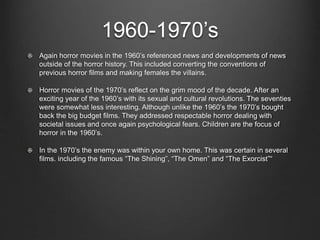
1960-1970’s 
Again horror movies in the 1960’s referenced news and developments of news 
outside of the horror history. This included converting the conventions of 
previous horror films and making females the villains. 
Horror movies of the 1970’s reflect on the grim mood of the decade. After an 
exciting year of the 1960’s with its sexual and cultural revolutions. The seventies 
were somewhat less interesting. Although unlike the 1960’s the 1970’s bought 
back the big budget films. They addressed respectable horror dealing with 
societal issues and once again psychological fears. Children are the focus of 
horror in the 1960’s. 
In the 1970’s the enemy was within your own home. This was certain in several 
films. including the famous “The Shining”, “The Omen” and “The Exorcist”“
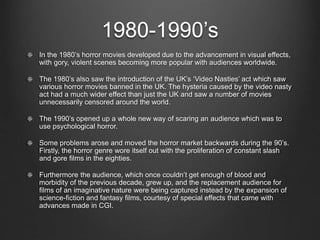
1980-1990’s 
In the 1980’s horror movies developed due to the advancement in visual effects, 
with gory, violent scenes becoming more popular with audiences worldwide. 
The 1980’s also saw the introduction of the UK’s ‘Video Nasties’ act which saw 
various horror movies banned in the UK. The hysteria caused by the video nasty 
act had a much wider effect than just the UK and saw a number of movies 
unnecessarily censored around the world. 
The 1990’s opened up a whole new way of scaring an audience which was to 
use psychological horror. 
Some problems arose and moved the horror market backwards during the 90’s. 
Firstly, the horror genre wore itself out with the proliferation of constant slash 
and gore films in the eighties. 
Furthermore the audience, which once couldn’t get enough of blood and 
morbidity of the previous decade, grew up, and the replacement audience for 
films of an imaginative nature were being captured instead by the expansion of 
science-fiction and fantasy films, courtesy of special effects that came with 
advances made in CGI.
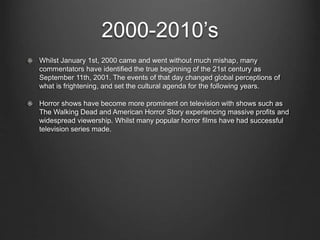
2000-2010’s 
Whilst January 1st, 2000 came and went without much mishap, many 
commentators have identified the true beginning of the 21st century as 
September 11th, 2001. The events of that day changed global perceptions of 
what is frightening, and set the cultural agenda for the following years. 
Horror shows have become more prominent on television with shows such as 
The Walking Dead and American Horror Story experiencing massive profits and 
widespread viewership. Whilst many popular horror films have had successful 
television series made.

Horror history

  • 1.
    History of Horror George Brinan + Marcus Osinfolarin
  • 2.
    1890-1920’s The bestknown horror film that came with the original few is the silent film ‘Le Manoir du Diable’ directed by Georges Melies, which is sometimes referred to as the first ever horror film. In 1910 Edison Studios produced the first ever film version of ‘Frankenstein’ which can be referred to as the most famous/successful horror film of all time. German film makers would significantly influence later films in the horror genre. ‘The Golem’ directed by Paul Wegener and ‘The Cabinet of Dr. Caligari’ directed by Robert Wiene, had a particularly large impact on the horror genre.
  • 3.
    1930’s Horror wassaid to have been reborn in the 1930’s mainly due to the improvements in sound technology greatly enhancing the cinema experience. Sound can make or break a horror film therefore it was vital for production companies to utilise the sound technology they had available. Sound can help build suspense and tension and gives the audience a new threat within the film. Two of the most famous horror films were released in 1931, ‘Frankenstein’ and ‘Dracula’. They come about because of the new found love, from audiences, for monsters or creatures in horror films. Frankenstein was focused on an experiment gone bad, in which a terrifying creature was formed from mixed body parts.
  • 4.
    1940-1950’s The 1940’ssaw the internalization of horror films. i.e. horror films being produced and distributed in the same country. . As hard as the Americans tried to not become like europe it was difficult to separate themselves from their european roots who linked there recent released to world war two. From 1940 movies had a powerful envoy from the dark side. Now there were more recognizably human faces attached to evil. Those who had fought of both sides in WW2, the development of the atomic bomb and death camp and also mad scientists who’s activities would have certainly been more unnerved than Victor Frankenstein. Many new movies in the 1950’s referenced the news at the current time. This included using the themes of animals taking over the world who generated chaos and disaster towards the human race. These included “Godzilla”, “The fly” and early attempts of “King Kong”.
  • 5.
    1960-1970’s Again horrormovies in the 1960’s referenced news and developments of news outside of the horror history. This included converting the conventions of previous horror films and making females the villains. Horror movies of the 1970’s reflect on the grim mood of the decade. After an exciting year of the 1960’s with its sexual and cultural revolutions. The seventies were somewhat less interesting. Although unlike the 1960’s the 1970’s bought back the big budget films. They addressed respectable horror dealing with societal issues and once again psychological fears. Children are the focus of horror in the 1960’s. In the 1970’s the enemy was within your own home. This was certain in several films. including the famous “The Shining”, “The Omen” and “The Exorcist”“
  • 6.
    1980-1990’s In the1980’s horror movies developed due to the advancement in visual effects, with gory, violent scenes becoming more popular with audiences worldwide. The 1980’s also saw the introduction of the UK’s ‘Video Nasties’ act which saw various horror movies banned in the UK. The hysteria caused by the video nasty act had a much wider effect than just the UK and saw a number of movies unnecessarily censored around the world. The 1990’s opened up a whole new way of scaring an audience which was to use psychological horror. Some problems arose and moved the horror market backwards during the 90’s. Firstly, the horror genre wore itself out with the proliferation of constant slash and gore films in the eighties. Furthermore the audience, which once couldn’t get enough of blood and morbidity of the previous decade, grew up, and the replacement audience for films of an imaginative nature were being captured instead by the expansion of science-fiction and fantasy films, courtesy of special effects that came with advances made in CGI.
  • 7.
    2000-2010’s Whilst January1st, 2000 came and went without much mishap, many commentators have identified the true beginning of the 21st century as September 11th, 2001. The events of that day changed global perceptions of what is frightening, and set the cultural agenda for the following years. Horror shows have become more prominent on television with shows such as The Walking Dead and American Horror Story experiencing massive profits and widespread viewership. Whilst many popular horror films have had successful television series made.