HORIZON 2020
Societal Challenge 5
"Climate action, Environment,
Resource Efficiency and Raw
Materials"
Work Programme 2016-2017
Information Day 21 September 2015
Horizon 2020: addressing Europe's challenges
• Investing in research and innovation 2014-2020
• Budget of €77 billion
• Contributing to the Juncker Commission's policy
agenda as a core component of Europe 2020,
Innovation Union & European Research Area
 Investing in jobs and growth
 Addressing people’s concerns ('societal challenges')
 Strengthening the EU’s global position in R&I
• Coupling research to innovation to maximise
impact
Societal Challenge 5: Climate action, environment,
resource efficiency and raw materials
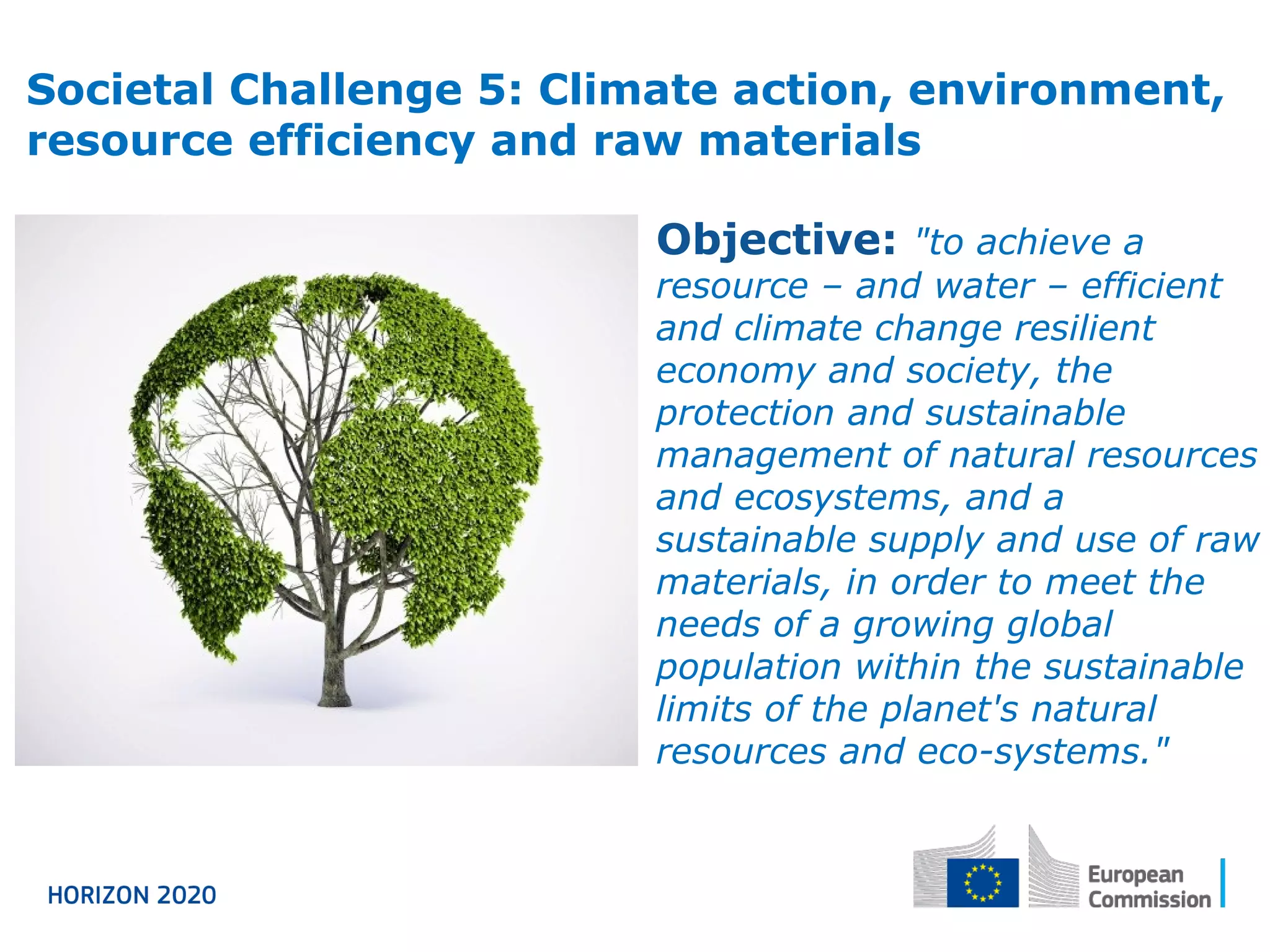
Objective: "to achieve a
resource – and water – efficient
and climate change resilient
economy and society, the
protection and sustainable
management of natural resources
and ecosystems, and a
sustainable supply and use of raw
materials, in order to meet the
needs of a growing global
population within the sustainable
limits of the planet's natural
resources and eco-systems."
Societal Challenge 5: focus for 2016-17
Increased emphasis on
delivering innovative
solutions
Transformative agenda
Systemic approach to
innovation
Unlocking private and
public investment in
future solutions
Large-scale
demonstration projects
with replication potential
Climate action
-Climate services
-Low-carbon Europe
-Arctic dimension
Systemic eco-innovation for
a circular economy
Raw materials
Sustainable growth by harnessing:
-Earth observation data
-Cultural heritage
Mainstreaming
water R&I
Societal Challenge 5: key objectives for 2016-2017
Nature-based solutions:
-for territorial resilience
-for sustainable cities
Societal Challenge 5: contributing to the
Juncker Commission's policy agenda
A new boost for jobs,
growth and investment
A deeper and fairer internal
market with a
strengthened industrial
base
A resilient Energy Union
with a forward looking
climate change policy
A stronger global actor
 Open Innovation  Open Science  Open to the world
2016-2017: Structure of the calls
• SC5 call 'Greening the economy'
• Contribution to cross-cutting calls:
 'Industry 2020 in the Circular Economy'
 'Smart and Sustainable Cities'
• Contribution to calls in other WP parts:
 'Blue growth – demonstrating an ocean of opportunities'
(SC2)
 'Sustainable Food Security – Resilient and resource-efficient
value chains' (SC2)
 'Competitive low-carbon energy' (SC3; cross-challenge topic)
 SME Instrument call
Calendar and caveats
Expected adoption date: 13 October 2015
The draft WP has been made public just before the adoption process of the
work programme to provide potential participants with the currently expected
main lines of the Work Programme 2016-2017. It is a working document not
yet endorsed by the Commission and its content does not in any way
prejudge the final decision of the Commission.
The adoption and the publication of the work programme by the Commission
are expected in mid-October 2015. Only the adopted work programme will
have legal value. This adoption will be announced on the Horizon 2020
participant portal.
Information and topic descriptions presented today may not appear in the
final work programme; likewise, new elements may be introduced at a later
stage. Any information disclosed by any other party shall not be construed as
having been endorsed by or affiliated to the Commission. The Commission
expressly disclaims liability for any future changes of the content of the draft
Work Programme.
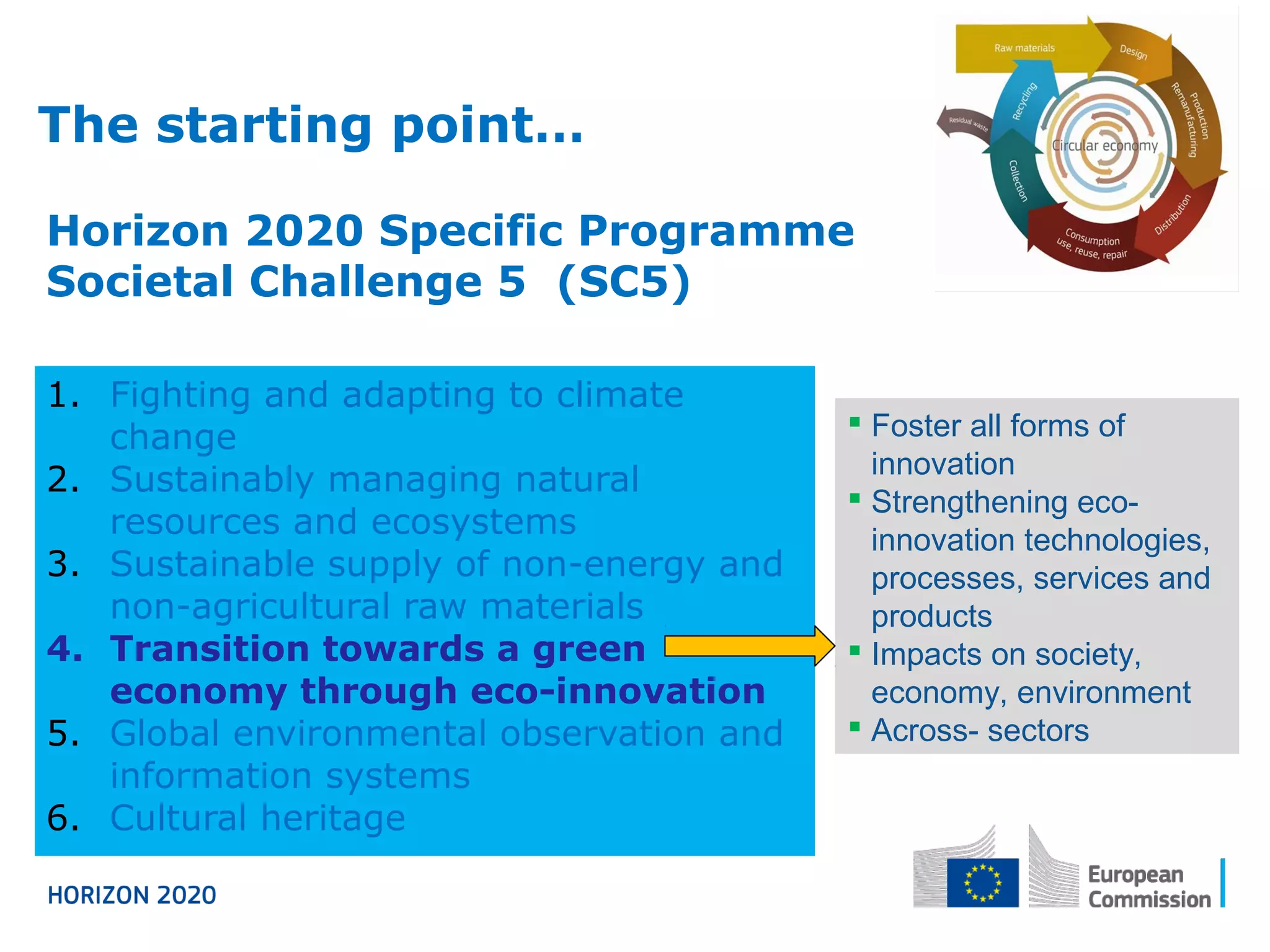
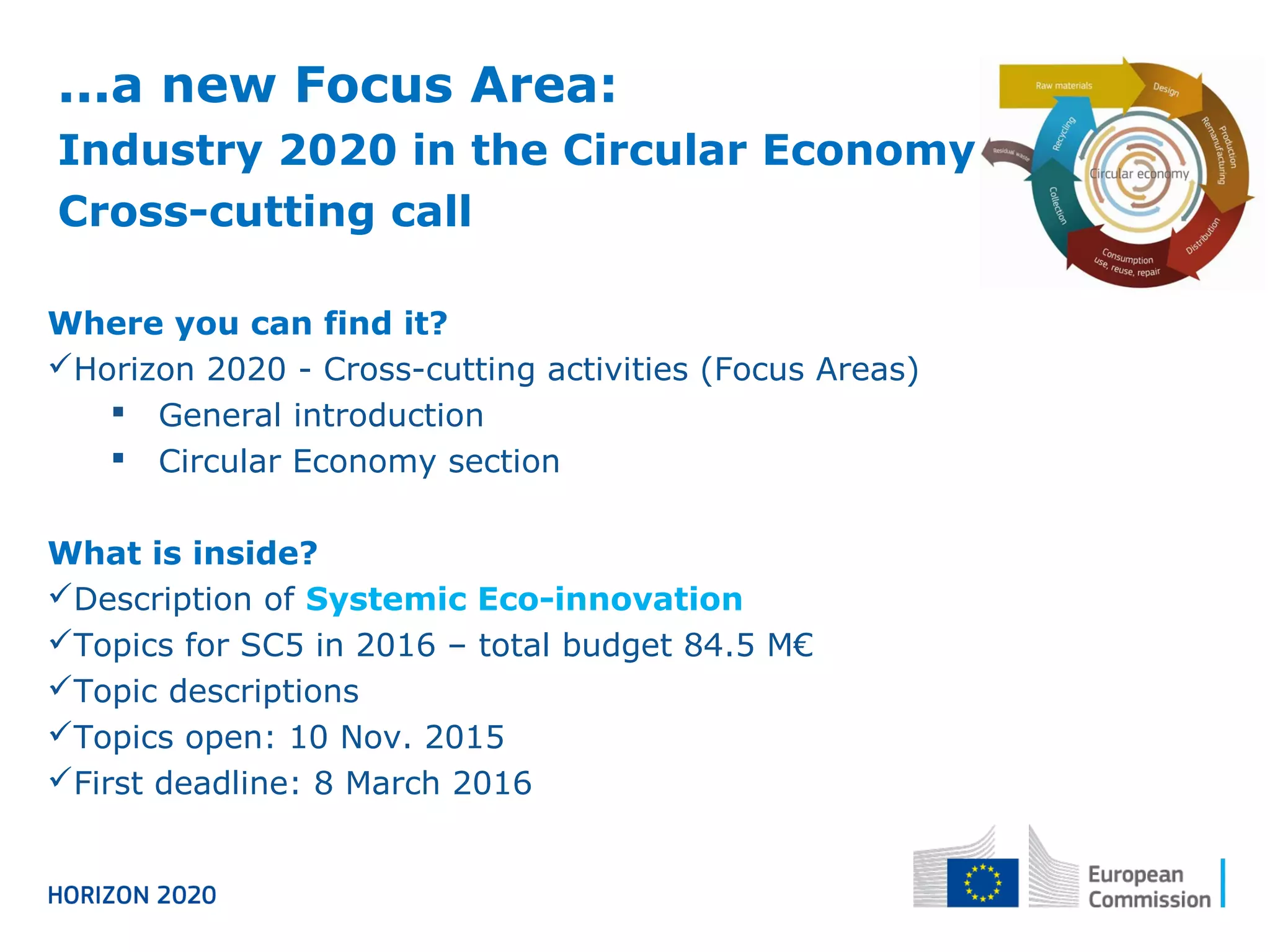
ECO-INNOVATION
…for a
CIRCULAR ECONOMY
Horizon 2020 Specific Programme
Societal Challenge 5 (SC5)
1. Fighting and adapting to climate
change
2. Sustainably managing natural
resources and ecosystems
3. Sustainable supply of non-energy and
non-agricultural raw materials
4. Transition towards a green
economy through eco-innovation
5. Global environmental observation and
information systems
6. Cultural heritage
 Foster all forms of
innovation
 Strengthening eco-
innovation technologies,
processes, services and
products
 Impacts on society,
economy, environment
 Across- sectors
The starting point…
The first steps…
Eco-Innovation in SC5 WP 2014-2015
Implementation
1.Focus Area WASTE 131 M€
2.Focus Area WATER 163 M€
3.SMEs 36 M€
Outcomes
•Innovation actions on industrial
symbiosis, across several industrial
sectors & in support of EIP priorities
•Research actions (water & climate)
•Coordination actions & public
procurement
•ERA-NET Cofund
•Wide range of stakeholders
Transition towards a more system approach to
innovation … Circular models
...along the way…
451 ideas received
• more than 42% addressed the
area 'Systemic eco-innovation
for a circular economy'
• Large enterprises and SMES
more than 22% of
submissions
https://circabc.europa.eu/sd/a/07b4b20e-c995-478f-ac00-1dfc1ca8019b/Report_outcom
...along the way…
Call for Ideas large-scale
pilot/demonstration projects
• Luisa
Business
models
Business
models
Skills and
education
Skills and
education
FinanceFinance
GovernanceGovernance
...a new step…
Systemic Eco-Innovation
Covering all forms of innovation
… Circular Economy
 demonstrating the economic and
environmental feasibility of the circular
economy
 supporting systemic innovation to
obtain a systems-wide transformation
 reorganising production & consumption
to maintain or enhance the value of
products, components, materials and
resources throughout the value chain
and the life of the products
 decoupling creation of wealth and jobs
from resource consumption
Where you can find it?
Horizon 2020 - Cross-cutting activities (Focus Areas)
 General introduction
 Circular Economy section
What is inside?
Description of Systemic Eco-innovation
Topics for SC5 in 2016 – total budget 84.5 M€
Topic descriptions
Topics open: 10 Nov. 2015
First deadline: 8 March 2016
...a new Focus Area:
Industry 2020 in the Circular Economy
Cross-cutting call
Water
 mainstreamed through
WP 2016-2017,
as part of the systemic
approach
 harnessing strong
potential for European
industry to become global
market leader
 continuity with 2014-
2015 Focus Area call on
‘Water Innovation:
Boosting its value for
Europe’
Water
 Topics in call 'Greening the
Economy'
 Total indicative budget for these topics in 2016:
€4M
 Topic SC5-11-2016:
o opens 10 Nov. 2015
o deadline 8 March 2016
 Topic SC5-12-2016:
o opens 15 Oct. 2015
o deadline 26 January 2016
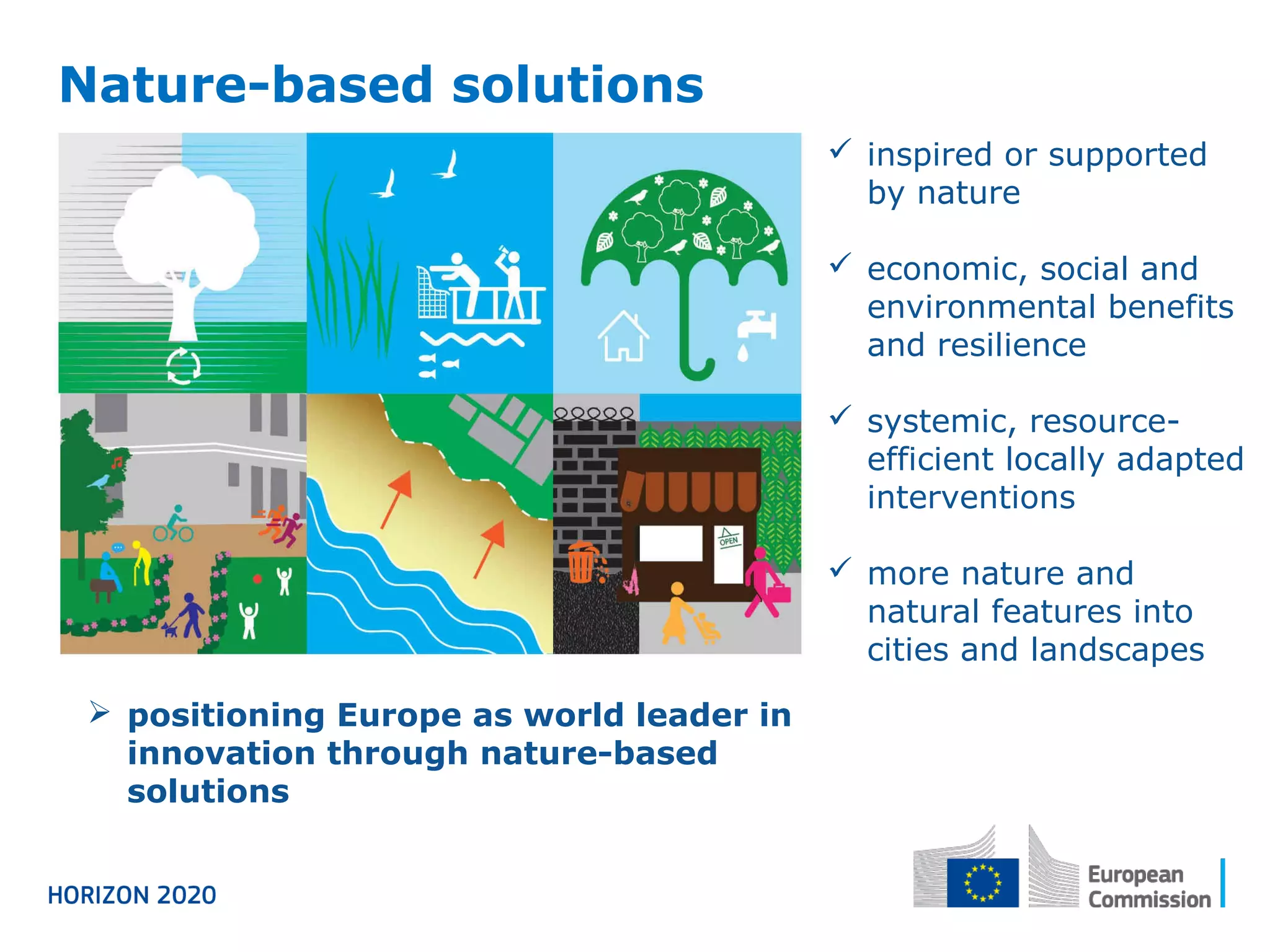
Nature-based solutions
 inspired or supported
by nature
 economic, social and
environmental benefits
and resilience
 systemic, resource-
efficient locally adapted
interventions
 more nature and
natural features into
cities and landscapes
 positioning Europe as world leader in
innovation through nature-based
solutions
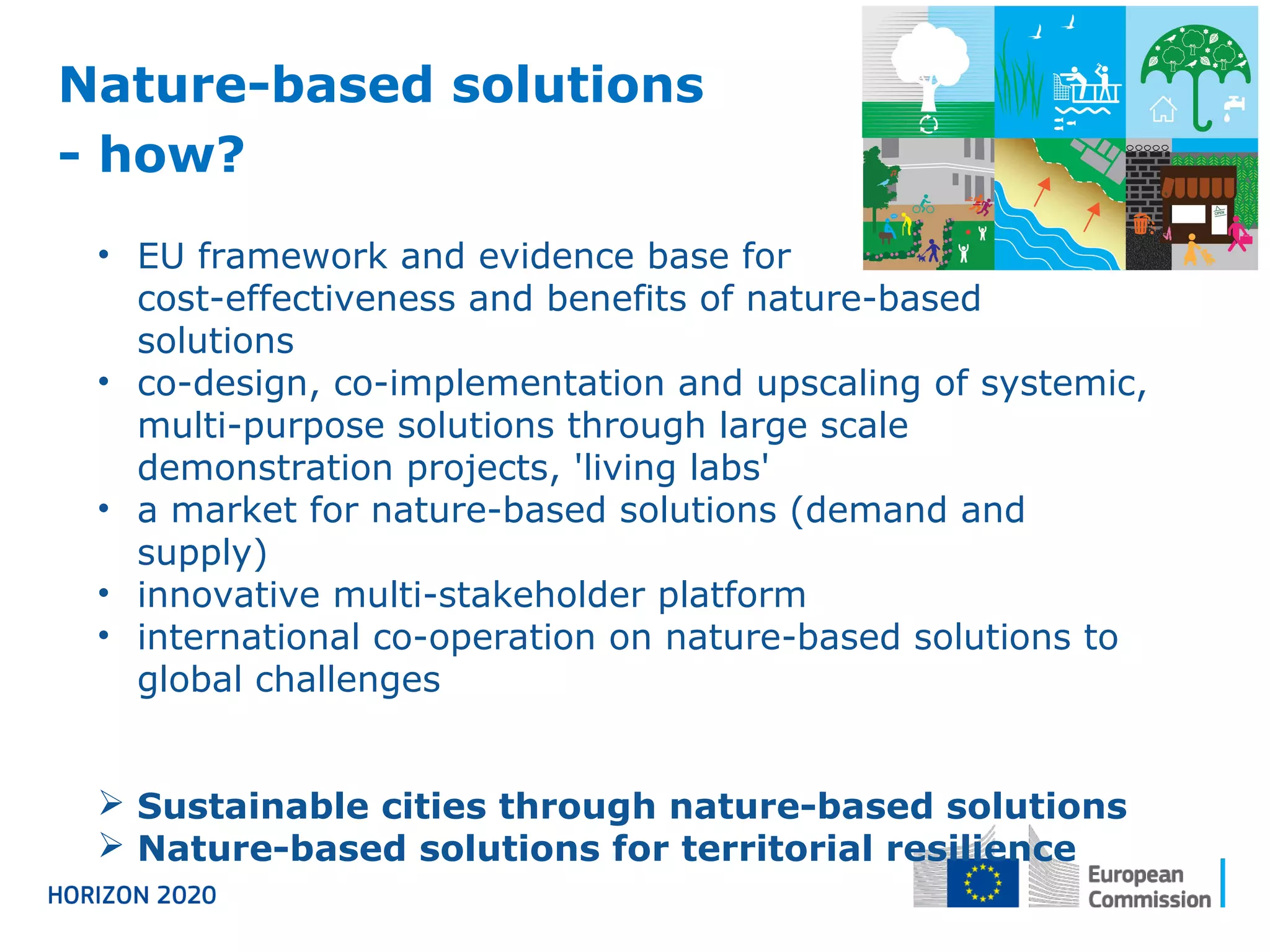
Nature-based solutions
- how?
• EU framework and evidence base for
cost-effectiveness and benefits of nature-based
solutions
• co-design, co-implementation and upscaling of systemic,
multi-purpose solutions through large scale
demonstration projects, 'living labs'
• a market for nature-based solutions (demand and
supply)
• innovative multi-stakeholder platform
• international co-operation on nature-based solutions to
global challenges
 Sustainable cities through nature-based solutions
 Nature-based solutions for territorial resilience
Nature-based solutions
- calls
Topics on Sustainable cities through nature-based
solutions are in cross-cutting call 'Smart and Sustainable
Cities'
Total indicative budget in 2016: €60M
Topics on Nature-based solutions for
territorial resilience in call 'Greening the Economy'
Total indicative budget in 2016: €8M
For both calls:
Topics open: 10 Nov. 2015
First deadline: 8 March 2016
Cultural heritage for sustainable growth
 A more dynamic approach
to cultural heritage,
beyond mere conservation
 cultural heritage as a
production rather than a
cost factor and a strategic
resource
 cultural heritage as a
catalyst for regeneration,
sustainable development,
economic growth and
quality of life
 European reference
framework and robust EU-
wide evidence
Cultural heritage for
sustainable growth
 Topics in call 'Greening the
Economy'
 Total indicative budget for this
topic in 2016: €10M
 Topic opens: 10 Nov. 2015
 First deadline: 8 March 2016
Climate services
 building Europe's
capacity to
respond to and
improve resilience
to climate change
 strengthening
significantly the
nascent global
market for
demand-driven
climate services
 addressing both
climate change
mitigation and
adaptation needs
Towards a low-carbon Europe
 deepening the analysis
of possible and cost-
effective trajectories for
Europe to achieve its
medium and long-term
climate objectives
 maximising societal
benefits and economic
prosperity
Climate services and Towards
a low-carbon Europe
 Topics in call 'Greening the
Economy'
 Total indicative budget for these
topics* in 2016: €40M
 Topics open: 10 Nov. 2015
 First deadline: 8 March 2016
*excludes CSA
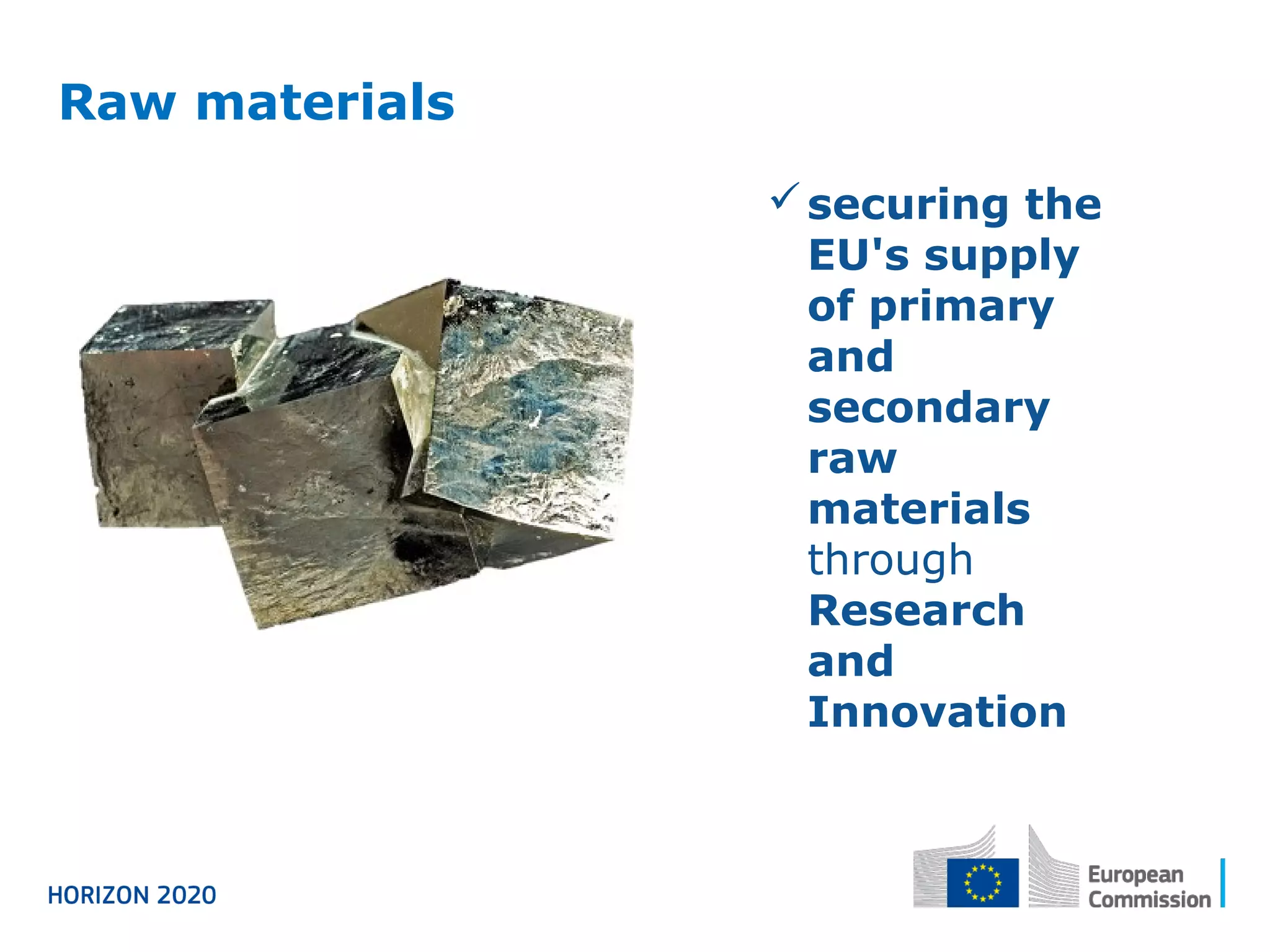
Raw materials
securing the
EU's supply
of primary
and
secondary
raw
materials
through
Research
and
Innovation
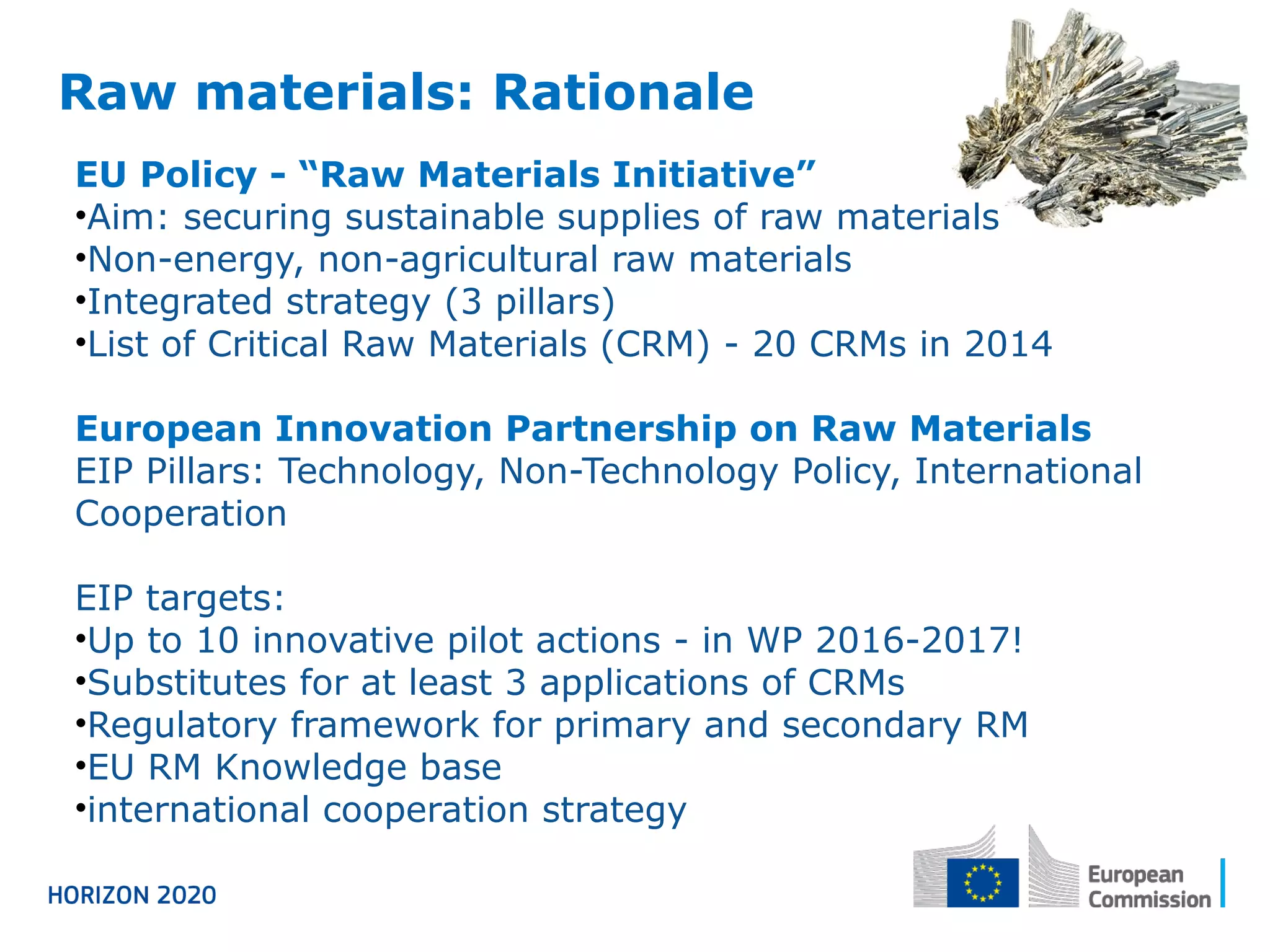
Raw materials: Rationale
EU Policy - “Raw Materials Initiative”
•Aim: securing sustainable supplies of raw materials
•Non-energy, non-agricultural raw materials
•Integrated strategy (3 pillars)
•List of Critical Raw Materials (CRM) - 20 CRMs in 2014
European Innovation Partnership on Raw Materials
EIP Pillars: Technology, Non-Technology Policy, International
Cooperation
EIP targets:
•Up to 10 innovative pilot actions - in WP 2016-2017!
•Substitutes for at least 3 applications of CRMs
•Regulatory framework for primary and secondary RM
•EU RM Knowledge base
•international cooperation strategy
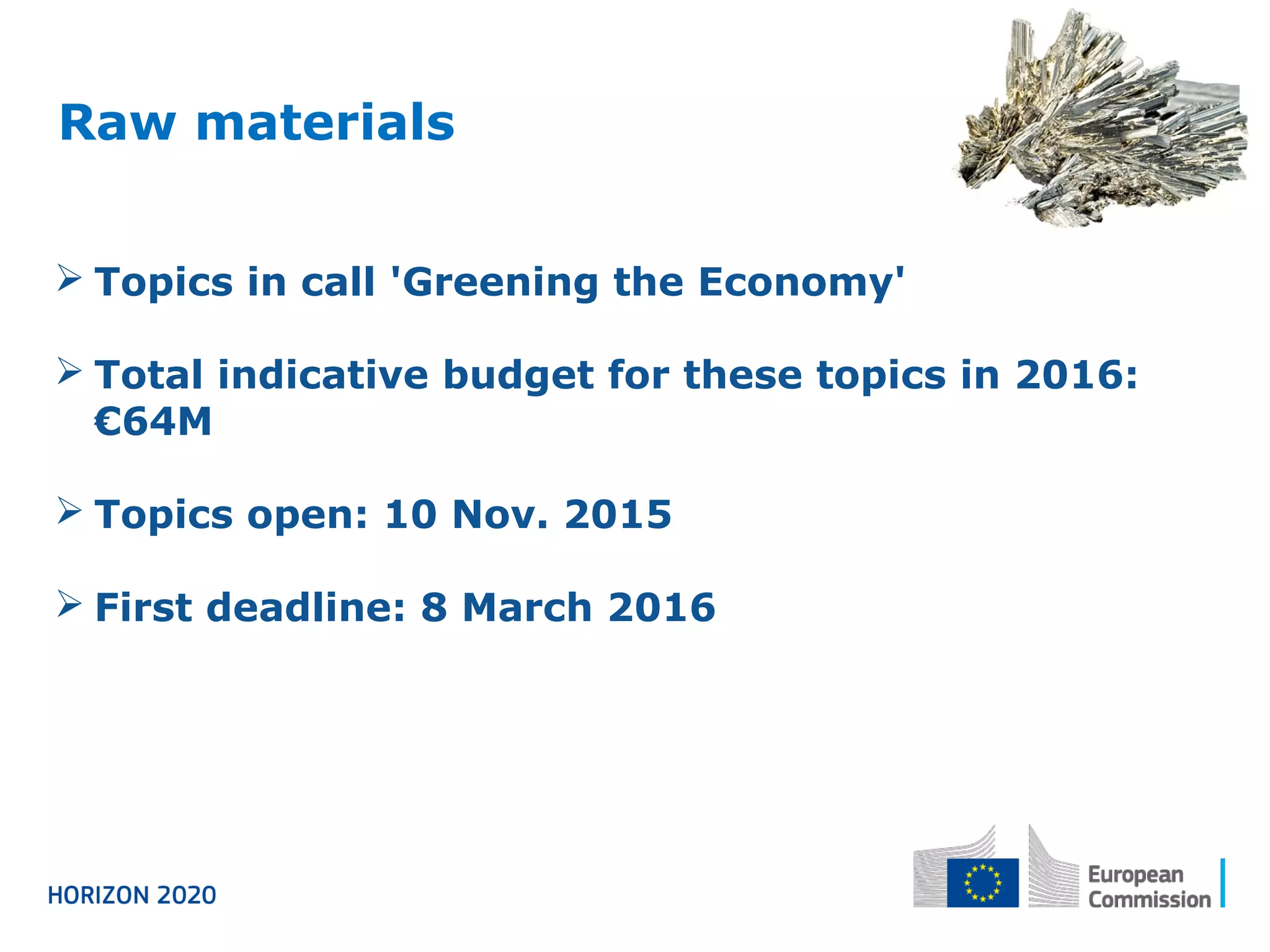
Raw materials
 Topics in call 'Greening the Economy'
 Total indicative budget for these topics in 2016:
€64M
 Topics open: 10 Nov. 2015
 First deadline: 8 March 2016
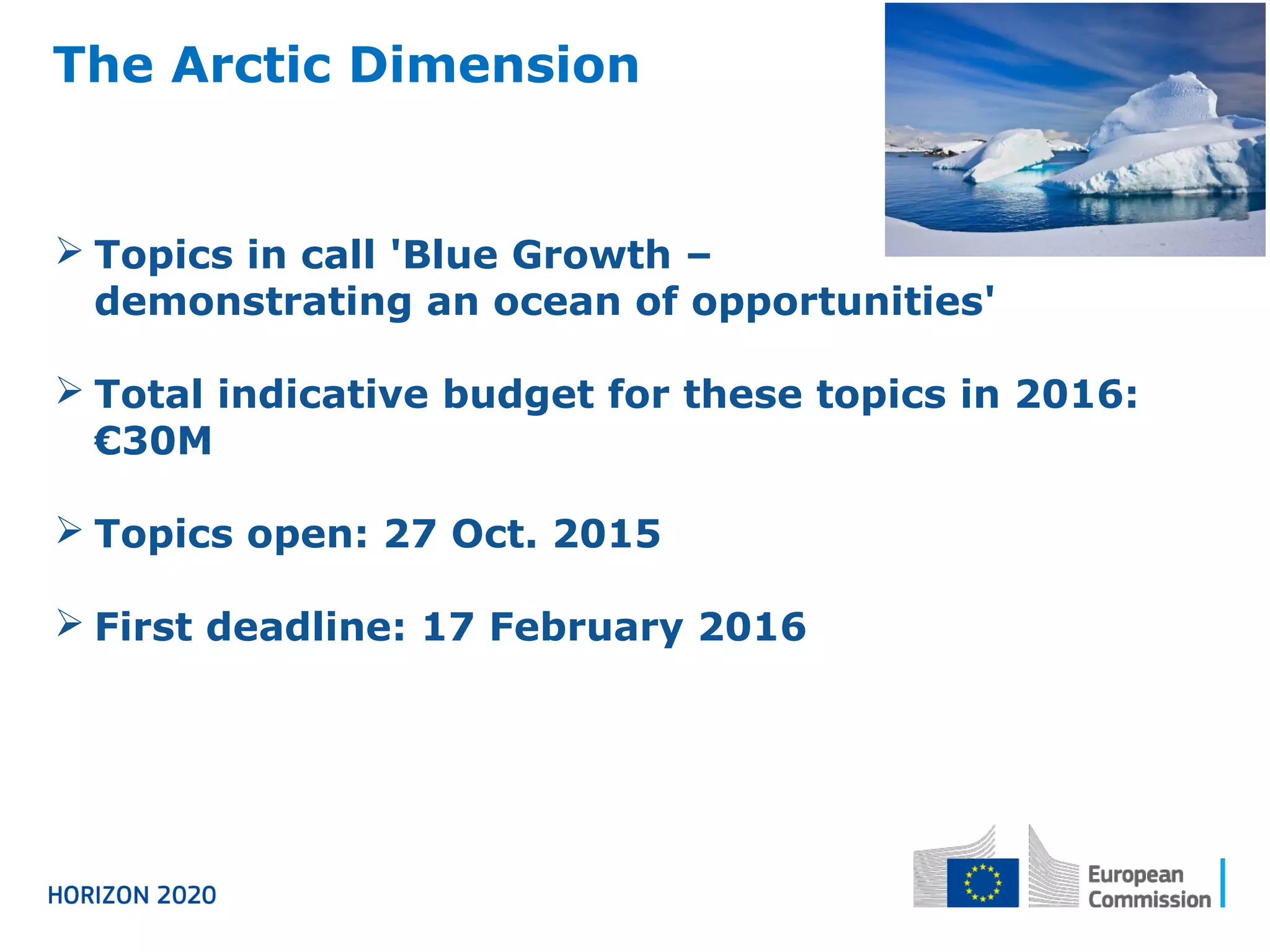
The Arctic Dimension
 The region of the globe
where climate is changing
the most rapidly. Changes
in the Arctic have global
consequences, with socio-
economic impact on the EU.
 deepening knowledge and
identifying sustainable and
innovative approaches to
tackle the challenges
climate change is posing in
the Arctic region.
 Improving our predictive
capability of the evolution
of climate-related changes.
The Arctic Dimension
 Topics in call 'Blue Growth –
demonstrating an ocean of opportunities'
 Total indicative budget for these topics in 2016:
€30M
 Topics open: 27 Oct. 2015
 First deadline: 17 February 2016
Earth observation
 maximising the benefits for
European citizens of the Earth
observation infrastructure
 developing innovative services
to support more sustainable
production and consumption
patterns and resilient societies
 completing the in-situ
component of GEOSS and
Copernicus
 enabling the sharing and full,
open and unrestricted access to
validated Earth observation
datasets
 engaging with the private sector
to leverage emerging
technologies and develop
services
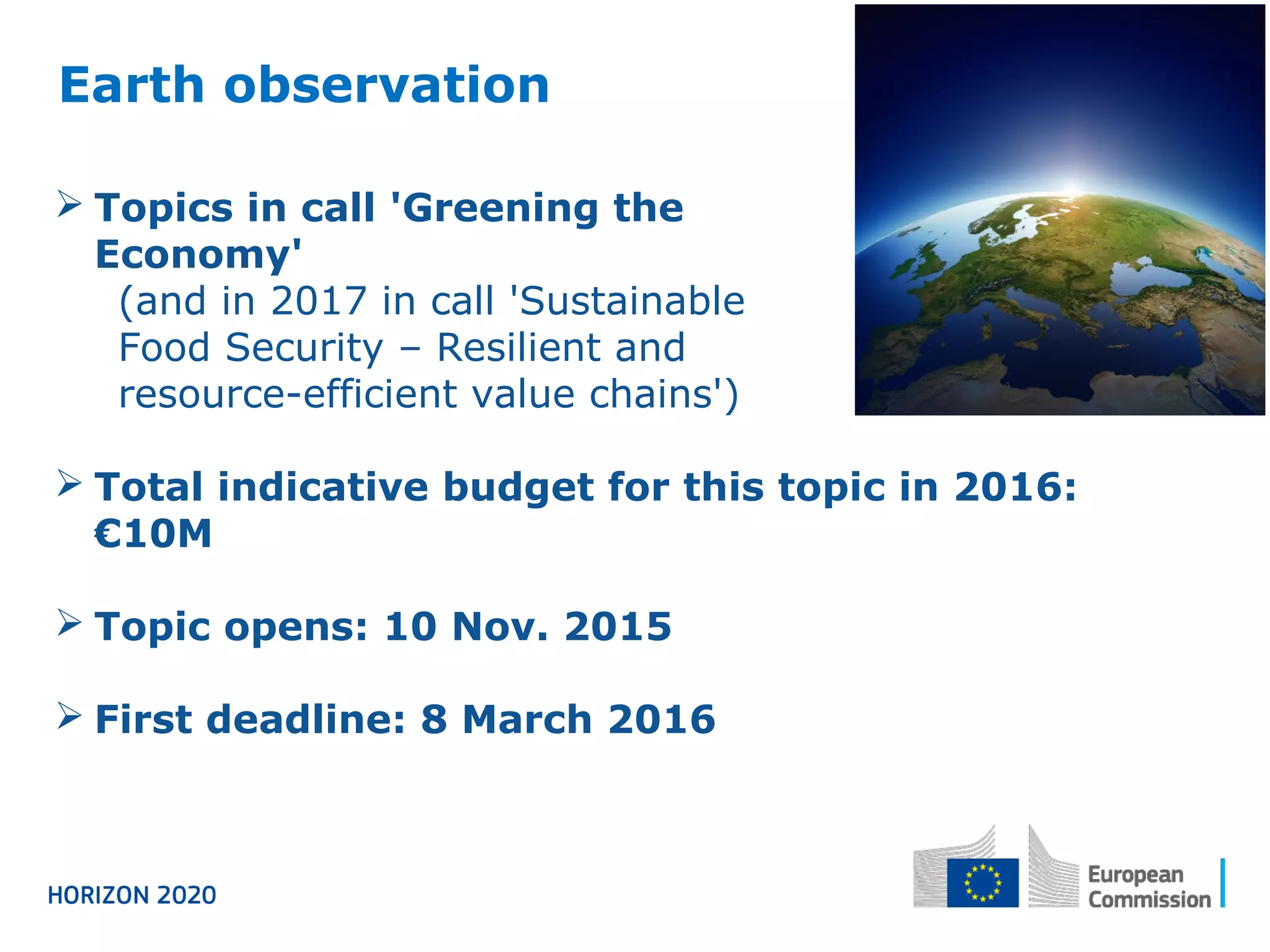
Earth observation
 Topics in call 'Greening the
Economy'
(and in 2017 in call 'Sustainable
Food Security – Resilient and
resource-efficient value chains')
 Total indicative budget for this topic in 2016:
€10M
 Topic opens: 10 Nov. 2015
 First deadline: 8 March 2016
HORIZON 2020
Thank you
for your attention!
Find out more:
www.ec.europa/research/horizon2020

Horizon 2020 SC5 info day presentation (morning session)

  • 1.
    HORIZON 2020 Societal Challenge5 "Climate action, Environment, Resource Efficiency and Raw Materials" Work Programme 2016-2017 Information Day 21 September 2015
  • 2.
    Horizon 2020: addressingEurope's challenges • Investing in research and innovation 2014-2020 • Budget of €77 billion • Contributing to the Juncker Commission's policy agenda as a core component of Europe 2020, Innovation Union & European Research Area  Investing in jobs and growth  Addressing people’s concerns ('societal challenges')  Strengthening the EU’s global position in R&I • Coupling research to innovation to maximise impact
  • 3.
    Societal Challenge 5:Climate action, environment, resource efficiency and raw materials Objective: "to achieve a resource – and water – efficient and climate change resilient economy and society, the protection and sustainable management of natural resources and ecosystems, and a sustainable supply and use of raw materials, in order to meet the needs of a growing global population within the sustainable limits of the planet's natural resources and eco-systems."
  • 4.
    Societal Challenge 5:focus for 2016-17 Increased emphasis on delivering innovative solutions Transformative agenda Systemic approach to innovation Unlocking private and public investment in future solutions Large-scale demonstration projects with replication potential
  • 5.
    Climate action -Climate services -Low-carbonEurope -Arctic dimension Systemic eco-innovation for a circular economy Raw materials Sustainable growth by harnessing: -Earth observation data -Cultural heritage Mainstreaming water R&I Societal Challenge 5: key objectives for 2016-2017 Nature-based solutions: -for territorial resilience -for sustainable cities
  • 6.
    Societal Challenge 5:contributing to the Juncker Commission's policy agenda A new boost for jobs, growth and investment A deeper and fairer internal market with a strengthened industrial base A resilient Energy Union with a forward looking climate change policy A stronger global actor  Open Innovation  Open Science  Open to the world
  • 7.
    2016-2017: Structure ofthe calls • SC5 call 'Greening the economy' • Contribution to cross-cutting calls:  'Industry 2020 in the Circular Economy'  'Smart and Sustainable Cities' • Contribution to calls in other WP parts:  'Blue growth – demonstrating an ocean of opportunities' (SC2)  'Sustainable Food Security – Resilient and resource-efficient value chains' (SC2)  'Competitive low-carbon energy' (SC3; cross-challenge topic)  SME Instrument call
  • 8.
    Calendar and caveats Expectedadoption date: 13 October 2015 The draft WP has been made public just before the adoption process of the work programme to provide potential participants with the currently expected main lines of the Work Programme 2016-2017. It is a working document not yet endorsed by the Commission and its content does not in any way prejudge the final decision of the Commission. The adoption and the publication of the work programme by the Commission are expected in mid-October 2015. Only the adopted work programme will have legal value. This adoption will be announced on the Horizon 2020 participant portal. Information and topic descriptions presented today may not appear in the final work programme; likewise, new elements may be introduced at a later stage. Any information disclosed by any other party shall not be construed as having been endorsed by or affiliated to the Commission. The Commission expressly disclaims liability for any future changes of the content of the draft Work Programme.
  • 9.
  • 10.
    Horizon 2020 SpecificProgramme Societal Challenge 5 (SC5) 1. Fighting and adapting to climate change 2. Sustainably managing natural resources and ecosystems 3. Sustainable supply of non-energy and non-agricultural raw materials 4. Transition towards a green economy through eco-innovation 5. Global environmental observation and information systems 6. Cultural heritage  Foster all forms of innovation  Strengthening eco- innovation technologies, processes, services and products  Impacts on society, economy, environment  Across- sectors The starting point…
  • 11.
    The first steps… Eco-Innovationin SC5 WP 2014-2015 Implementation 1.Focus Area WASTE 131 M€ 2.Focus Area WATER 163 M€ 3.SMEs 36 M€ Outcomes •Innovation actions on industrial symbiosis, across several industrial sectors & in support of EIP priorities •Research actions (water & climate) •Coordination actions & public procurement •ERA-NET Cofund •Wide range of stakeholders Transition towards a more system approach to innovation … Circular models
  • 12.
  • 13.
    451 ideas received •more than 42% addressed the area 'Systemic eco-innovation for a circular economy' • Large enterprises and SMES more than 22% of submissions https://circabc.europa.eu/sd/a/07b4b20e-c995-478f-ac00-1dfc1ca8019b/Report_outcom ...along the way… Call for Ideas large-scale pilot/demonstration projects • Luisa
  • 14.
  • 15.
    … Circular Economy demonstrating the economic and environmental feasibility of the circular economy  supporting systemic innovation to obtain a systems-wide transformation  reorganising production & consumption to maintain or enhance the value of products, components, materials and resources throughout the value chain and the life of the products  decoupling creation of wealth and jobs from resource consumption
  • 16.
    Where you canfind it? Horizon 2020 - Cross-cutting activities (Focus Areas)  General introduction  Circular Economy section What is inside? Description of Systemic Eco-innovation Topics for SC5 in 2016 – total budget 84.5 M€ Topic descriptions Topics open: 10 Nov. 2015 First deadline: 8 March 2016 ...a new Focus Area: Industry 2020 in the Circular Economy Cross-cutting call
  • 17.
    Water  mainstreamed through WP2016-2017, as part of the systemic approach  harnessing strong potential for European industry to become global market leader  continuity with 2014- 2015 Focus Area call on ‘Water Innovation: Boosting its value for Europe’
  • 18.
    Water  Topics incall 'Greening the Economy'  Total indicative budget for these topics in 2016: €4M  Topic SC5-11-2016: o opens 10 Nov. 2015 o deadline 8 March 2016  Topic SC5-12-2016: o opens 15 Oct. 2015 o deadline 26 January 2016
  • 19.
    Nature-based solutions  inspiredor supported by nature  economic, social and environmental benefits and resilience  systemic, resource- efficient locally adapted interventions  more nature and natural features into cities and landscapes  positioning Europe as world leader in innovation through nature-based solutions
  • 20.
    Nature-based solutions - how? •EU framework and evidence base for cost-effectiveness and benefits of nature-based solutions • co-design, co-implementation and upscaling of systemic, multi-purpose solutions through large scale demonstration projects, 'living labs' • a market for nature-based solutions (demand and supply) • innovative multi-stakeholder platform • international co-operation on nature-based solutions to global challenges  Sustainable cities through nature-based solutions  Nature-based solutions for territorial resilience
  • 21.
    Nature-based solutions - calls Topicson Sustainable cities through nature-based solutions are in cross-cutting call 'Smart and Sustainable Cities' Total indicative budget in 2016: €60M Topics on Nature-based solutions for territorial resilience in call 'Greening the Economy' Total indicative budget in 2016: €8M For both calls: Topics open: 10 Nov. 2015 First deadline: 8 March 2016
  • 22.
    Cultural heritage forsustainable growth  A more dynamic approach to cultural heritage, beyond mere conservation  cultural heritage as a production rather than a cost factor and a strategic resource  cultural heritage as a catalyst for regeneration, sustainable development, economic growth and quality of life  European reference framework and robust EU- wide evidence
  • 23.
    Cultural heritage for sustainablegrowth  Topics in call 'Greening the Economy'  Total indicative budget for this topic in 2016: €10M  Topic opens: 10 Nov. 2015  First deadline: 8 March 2016
  • 24.
    Climate services  buildingEurope's capacity to respond to and improve resilience to climate change  strengthening significantly the nascent global market for demand-driven climate services  addressing both climate change mitigation and adaptation needs
  • 25.
    Towards a low-carbonEurope  deepening the analysis of possible and cost- effective trajectories for Europe to achieve its medium and long-term climate objectives  maximising societal benefits and economic prosperity
  • 26.
    Climate services andTowards a low-carbon Europe  Topics in call 'Greening the Economy'  Total indicative budget for these topics* in 2016: €40M  Topics open: 10 Nov. 2015  First deadline: 8 March 2016 *excludes CSA
  • 27.
    Raw materials securing the EU'ssupply of primary and secondary raw materials through Research and Innovation
  • 28.
    Raw materials: Rationale EUPolicy - “Raw Materials Initiative” •Aim: securing sustainable supplies of raw materials •Non-energy, non-agricultural raw materials •Integrated strategy (3 pillars) •List of Critical Raw Materials (CRM) - 20 CRMs in 2014 European Innovation Partnership on Raw Materials EIP Pillars: Technology, Non-Technology Policy, International Cooperation EIP targets: •Up to 10 innovative pilot actions - in WP 2016-2017! •Substitutes for at least 3 applications of CRMs •Regulatory framework for primary and secondary RM •EU RM Knowledge base •international cooperation strategy
  • 29.
    Raw materials  Topicsin call 'Greening the Economy'  Total indicative budget for these topics in 2016: €64M  Topics open: 10 Nov. 2015  First deadline: 8 March 2016
  • 30.
    The Arctic Dimension The region of the globe where climate is changing the most rapidly. Changes in the Arctic have global consequences, with socio- economic impact on the EU.  deepening knowledge and identifying sustainable and innovative approaches to tackle the challenges climate change is posing in the Arctic region.  Improving our predictive capability of the evolution of climate-related changes.
  • 31.
    The Arctic Dimension Topics in call 'Blue Growth – demonstrating an ocean of opportunities'  Total indicative budget for these topics in 2016: €30M  Topics open: 27 Oct. 2015  First deadline: 17 February 2016
  • 32.
    Earth observation  maximisingthe benefits for European citizens of the Earth observation infrastructure  developing innovative services to support more sustainable production and consumption patterns and resilient societies  completing the in-situ component of GEOSS and Copernicus  enabling the sharing and full, open and unrestricted access to validated Earth observation datasets  engaging with the private sector to leverage emerging technologies and develop services
  • 33.
    Earth observation  Topicsin call 'Greening the Economy' (and in 2017 in call 'Sustainable Food Security – Resilient and resource-efficient value chains')  Total indicative budget for this topic in 2016: €10M  Topic opens: 10 Nov. 2015  First deadline: 8 March 2016
  • 34.
    HORIZON 2020 Thank you foryour attention! Find out more: www.ec.europa/research/horizon2020

Editor's Notes