Homeopathy acute
prescribing
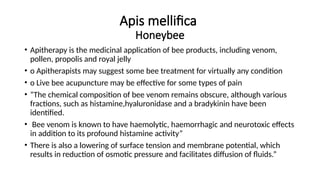
Apis mellifica
Honeybee
• Apitherapy is the medicinal application of bee products, including venom,
pollen, propolis and royal jelly
• o Apitherapists may suggest some bee treatment for virtually any condition
• o Live bee acupuncture may be effective for some types of pain
• “The chemical composition of bee venom remains obscure, although various
fractions, such as histamine,hyaluronidase and a bradykinin have been
identified.
• Bee venom is known to have haemolytic, haemorrhagic and neurotoxic effects
in addition to its profound histamine activity”
• There is also a lowering of surface tension and membrane potential, which
results in reduction of osmotic pressure and facilitates diffusion of fluids.”
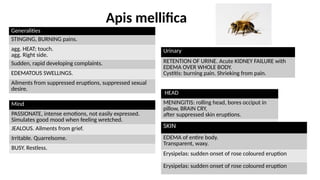
Mind
PASSIONATE, intense emotions, not easily expressed.
Simulates good mood when feeling wretched.
JEALOUS. Ailments from grief.
Irritable. Quarrelsome.
BUSY. Restless.
Generalities
STINGING, BURNING pains.
agg. HEAT; touch.
agg. Right side.
Sudden, rapid developing complaints.
EDEMATOUS SWELLINGS.
Ailments from suppressed eruptions, suppressed sexual
desire.
Urinary
RETENTION OF URINE. Acute KIDNEY FAILURE with
EDEMA OVER WHOLE BODY.
Cystitis: burning pain. Shrieking from pain.
HEAD
MENINGITIS: rolling head, bores occiput in
pillow, BRAIN CRY,
after suppressed skin eruptions.
SKIN
EDEMA of entire body.
Transparent, waxy.
Erysipelas: sudden onset of rose coloured eruption
Apis mellifica
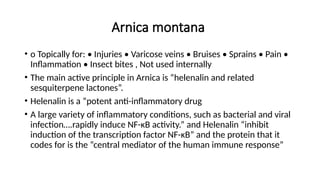
Arnica montana
• o Topically for: • Injuries • Varicose veins • Bruises • Sprains • Pain •
Inflammation • Insect bites , Not used internally
• The main active principle in Arnica is “helenalin and related
sesquiterpene lactones”.
• Helenalin is a “potent anti-inflammatory drug
• A large variety of inflammatory conditions, such as bacterial and viral
infection….rapidly induce NF-κB activity.” and Helenalin “inhibit
induction of the transcription factor NF-κB” and the protein that it
codes for is the “central mediator of the human immune response”
Arnica montana
theme
• “The main theme of Arnica symptomatology revolves around a deep
traumatic experience upon the physical or emotional or mental body.
A traumatic experience of the human organism resulting from
injuries, falls, blows, concussions, fright, fear, financial loss, etc.
• The experience leaves the person with a tremendous fear of coming
into physical contact with anything which is hard or penetrating. The
whole of the symptomatology develops around this basic fear: Do not
touch me, do not come too close to me, physically or emotionally and
most of all do not penetrate me, physically or metaphorically”
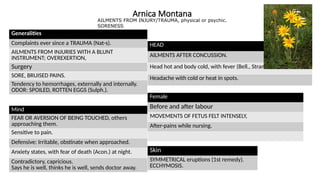
Arnica Montana
Generalities
Complaints ever since a TRAUMA (Nat-s).
AILMENTS FROM INJURIES WITH A BLUNT
INSTRUMENT; OVEREXERTION,
Surgery
SORE, BRUISED PAINS.
Tendency to hemorrhages, externally and internally.
ODOR: SPOILED, ROTTEN EGGS (Sulph.).
Mind
FEAR OR AVERSION OF BEING TOUCHED, others
approaching them.
Sensitive to pain.
Defensive: Irritable, obstinate when approached.
Anxiety states, with fear of death (Acon.) at night.
Contradictory, capricious.
Says he is well, thinks he is well, sends doctor away.
HEAD
AILMENTS AFTER CONCUSSION.
Head hot and body cold, with fever (Bell., Stram.).
Headache with cold or heat in spots.
Female
Before and after labour
MOVEMENTS OF FETUS FELT INTENSELY,
After-pains while nursing.
Skin
SYMMETRICAL eruptions (1st remedy).
ECCHYMOSIS.
AILMENTS FROM INJURY/TRAUMA, physical or psychic.
SORENESS.
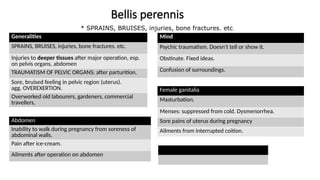
Bellis perennis
common Daisy
• Not commonly used in herbalism
• An vaso-tonic alterative against toxins and uric acid; it clears the
blood and tissue fluids. Circulatory tonic to the heart and arteries
improving blood supply to the periphery in chilblains.” “Heals
wounds”
• Few trials done already
Bellis perennis
Theme
• “Bellis is an important remedy for deep traumas, whether they be of
the physical body or of the psyche. It is a remedy that should be
considered whenever a mistreatment or hurt has been suffered in
deep parts: when the physical body has been cut up in an operation
or hurt in an accident, or when the emotional body has been
mistreated in an emotional conflict.
• It is important for the student of homeopathy to understand that
different constitutions have different predispositions. In this remedy
there seems to be a predisposition for the tissues of the muscular
system and the tendons to be in a precariously weak or tired state”
Bellis perennis
Generalities
SPRAINS, BRUISES, injuries, bone fractures. etc.
Injuries to deeper tissues after major operation, esp.
on pelvis organs, abdomen
TRAUMATISM OF PELVIC ORGANS; after parturition.
Sore, bruised feeling in pelvic region (uterus).
agg. OVEREXERTION.
Overworked old labourers, gardeners, commercial
travellers,
Abdomen
Inability to walk during pregnancy from soreness of
abdominal walls.
Pain after ice-cream.
Ailments after operation on abdomen
Mind
Psychic traumatism. Doesn't tell or show it.
Obstinate. Fixed ideas.
Confusion of surroundings.
Female ganitalia
Masturbation.
Menses: suppressed from cold. Dysmenorrhea.
Sore pains of uterus during pregnancy
Ailments from interrupted coition.
* SPRAINS, BRUISES, injuries, bone fractures. etc.
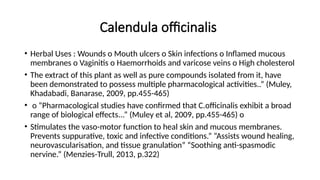
Calendula officinalis
• Herbal Uses : Wounds o Mouth ulcers o Skin infections o Inflamed mucous
membranes o Vaginitis o Haemorrhoids and varicose veins o High cholesterol
• The extract of this plant as well as pure compounds isolated from it, have
been demonstrated to possess multiple pharmacological activities..” (Muley,
Khadabadi, Banarase, 2009, pp.455-465)
• o “Pharmacological studies have confirmed that C.officinalis exhibit a broad
range of biological effects...” (Muley et al, 2009, pp.455-465) o
• Stimulates the vaso-motor function to heal skin and mucous membranes.
Prevents suppurative, toxic and infective conditions.” “Assists wound healing,
neurovascularisation, and tissue granulation” “Soothing anti-spasmodic
nervine.” (Menzies-Trull, 2013, p.322)
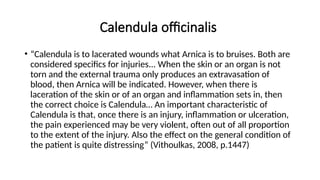
Calendula officinalis
• “Calendula is to lacerated wounds what Arnica is to bruises. Both are
considered specifics for injuries... When the skin or an organ is not
torn and the external trauma only produces an extravasation of
blood, then Arnica will be indicated. However, when there is
laceration of the skin or of an organ and inflammation sets in, then
the correct choice is Calendula… An important characteristic of
Calendula is that, once there is an injury, inflammation or ulceration,
the pain experienced may be very violent, often out of all proportion
to the extent of the injury. Also the effect on the general condition of
the patient is quite distressing” (Vithoulkas, 2008, p.1447)
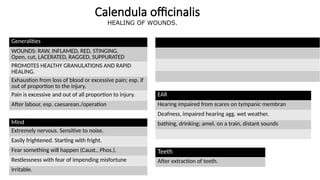
Calendula officinalis
Generalities
WOUNDS: RAW, INFLAMED, RED, STINGING.
Open, cut, LACERATED, RAGGED, SUPPURATED
PROMOTES HEALTHY GRANULATIONS AND RAPID
HEALING.
Exhaustion from loss of blood or excessive pain; esp. if
out of proportion to the injury.
Pain is excessive and out of all proportion to injury.
After labour, esp. caesarean./operation
Mind
Extremely nervous. Sensitive to noise.
Easily frightened. Starting with fright.
Fear something will happen (Caust., Phos.).
Restlessness with fear of impending misfortune
Irritable.
EAR
Hearing impaired from scares on tympanic membran
Deafness, impaired hearing agg. wet weather,
bathing, drinking; amel. on a train, distant sounds
Teeth
After extraction of teeth.
HEALING OF WOUNDS.
Rhus toxicodendron
poison ivy
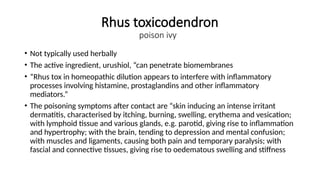
• Not typically used herbally
• The active ingredient, urushiol, “can penetrate biomembranes
• “Rhus tox in homeopathic dilution appears to interfere with inflammatory
processes involving histamine, prostaglandins and other inflammatory
mediators.”
• The poisoning symptoms after contact are “skin inducing an intense irritant
dermatitis, characterised by itching, burning, swelling, erythema and vesication;
with lymphoid tissue and various glands, e.g. parotid, giving rise to inflammation
and hypertrophy; with the brain, tending to depression and mental confusion;
with muscles and ligaments, causing both pain and temporary paralysis; with
fascial and connective tissues, giving rise to oedematous swelling and stiffness
Rhus toxicodendron
theme
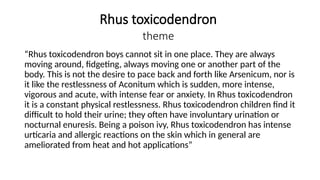
“Rhus toxicodendron boys cannot sit in one place. They are always
moving around, fidgeting, always moving one or another part of the
body. This is not the desire to pace back and forth like Arsenicum, nor is
it like the restlessness of Aconitum which is sudden, more intense,
vigorous and acute, with intense fear or anxiety. In Rhus toxicodendron
it is a constant physical restlessness. Rhus toxicodendron children find it
difficult to hold their urine; they often have involuntary urination or
nocturnal enuresis. Being a poison ivy, Rhus toxicodendron has intense
urticaria and allergic reactions on the skin which in general are
ameliorated from heat and hot applications”
Rhus toxicodendron
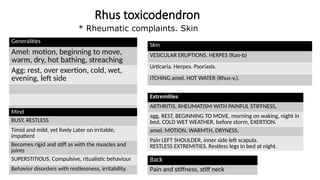
Generalities
Amel: motion, beginning to move,
warm, dry, hot bathing, streaching
Agg: rest, over exertion, cold, wet,
evening, left side
Mind
BUSY, RESTLESS
Timid and mild, yet lively Later on irritable,
impatient
Becomes rigid and stiff as with the muscles and
joints
SUPERSTITIOUS. Compulsive, ritualistic behaviour
Behavior disorders with restlessness, irritability.
Skin
VESICULAR ERUPTIONS. HERPES (Ran-b)
Urticaria. Herpes. Psoriasis.
ITCHING amel. HOT WATER (Rhus-v.).
Extremities
ARTHRITIS, RHEUMATISM WITH PAINFUL STIFFNESS,
agg. REST, BEGINNING TO MOVE, morning on waking, night in
bed, COLD WET WEATHER, before storm, EXERTION.
amel. MOTION, WARMTH, DRYNESS.
Pain LEFT SHOULDER, inner side left scapula.
RESTLESS EXTREMITIES. Restless legs in bed at night.
Back
Pain and stiffness, stiff neck
* Rheumatic complaints. Skin.
Hypericum perforatum
St john’s wort
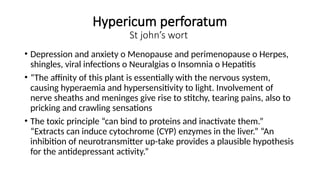
• Depression and anxiety o Menopause and perimenopause o Herpes,
shingles, viral infections o Neuralgias o Insomnia o Hepatitis
• “The affinity of this plant is essentially with the nervous system,
causing hyperaemia and hypersensitivity to light. Involvement of
nerve sheaths and meninges give rise to stitchy, tearing pains, also to
pricking and crawling sensations
• The toxic principle “can bind to proteins and inactivate them.”
“Extracts can induce cytochrome (CYP) enzymes in the liver.” “An
inhibition of neurotransmitter up-take provides a plausible hypothesis
for the antidepressant activity.”
Hypericum perforatum
St john’s wort- Theme
• Arnica for the nerves:
With that title, it is not surprising that this remedy is the one to use for
bruises and wounds affecting the nervous system. It is especially useful
for the ends of the extremities (crushing wounds to the fingers, with
laceration and tornaway flesh), and for the spinal column, in particular
injuries to the coccyx from a fall. It can be used in the higher potencies
for such injuries. This remedy is also indicated after surgery, if the
wound is painful, and in cases of head injuries, such as those incurred
by the use of forceps”
Hypericum perforatum
Generalities
INJURIES TO PARTS RICH IN NERVES (Led).
PAIN: SHOOTING, UPWARD, ALONG NERVE
Convulsions after injury, esp. to spine, head (Nat-s
Ailments from PUNCTURED WOUNDS, lacerations,
bites of animals; after operations.
Ailments of shock, fright, mesmerism.
Phantom pains (All-c, Staph).
Mind
MENTAL/EMOTIONAL SYMPTOMS AFTER INJURIES
(Nat-s); depression, dullness, forgetfulness, hysteria;
Feels as if lifted in the air.
Fear of falling from height, downward motion (Bor).
Mistakes in writing. Forgets what she wanted to say.
Back
INJURIES TO SPINE, COCCYX (Sil).
Pain shoots up the spine and down limbs.
Bruised coccyx after labor.
Phantom pains
Sciatica
Injuries to nerves and spine.
Ruta graveolens
bitterwort
• Herbal : Sprains, strains & injuries o Arthritis o Menstrual disorders, uterine
stimulant o Spasms o Poor appetite, dyspepsia o Circulatory disorders, high
blood pressure , palpitations o Inflamed mucosa o Toothache o Skin diseases
• o “Ruta is chemically very complex” The pharmacological effects are
“antimicrobial, antispasmodic, anti-exudative, analgesic and ion channel
inhibiting…” (Wink, Van Wyk, 2008, p. 208)
• o “the tissue affinities of the plant are mainly with the eyes, especially the
ocular muscles; with muscles and tendons, especially those of flexor
muscles,…synovial sheaths of tendons as well as the sites of insertion into
the periosteum. The joints mainly involved are wrists, knees and ankles;
with the rectum and skin.” (G
Ruta graveolens
Theme
• “Ruta is the most important remedy for problems of the periosteum,
even if these problems have occurred for a long time. One of the
most frequent reasons of periostitis is trauma... Traumatic
inflammation of the joints is a very good indication for Ruta. e.g. the
patient with a fracture caused by an accident who develops an
inflammation of the periost followed by arthritis. The periost is also
often affected in case of injuries and sprain… If the patient with
rheumatoid arthritis has a lame feeling in his joints, Ruta is the best
indicated...”
Ruta graveolens
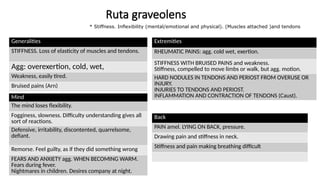
Generalities
STIFFNESS. Loss of elasticity of muscles and tendons.
Agg: overexertion, cold, wet,
Weakness, easily tired.
Bruised pains (Arn)
Mind
The mind loses flexibility.
Fogginess, slowness. Difficulty understanding gives all
sort of reactions.
Defensive, irritability, discontented, quarrelsome,
defiant.
Remorse. Feel guilty, as if they did something wrong
FEARS AND ANXIETY agg. WHEN BECOMING WARM.
Fears during fever.
Nightmares in children. Desires company at night.
Extremities
RHEUMATIC PAINS: agg. cold wet, exertion.
STIFFNESS WITH BRUISED PAINS and weakness.
Stiffness, compelled to move limbs or walk, but agg. motion.
HARD NODULES IN TENDONS AND PERIOST FROM OVERUSE OR
INJURY.
INJURIES TO TENDONS AND PERIOST.
INFLAMMATION AND CONTRACTION OF TENDONS (Caust).
Back
PAIN amel. LYING ON BACK, pressure.
Drawing pain and stiffness in neck.
Stiffness and pain making breathing difficult
* Stiffness. Inflexibility (mental/emotional and physical). (Muscles attached )and tendons
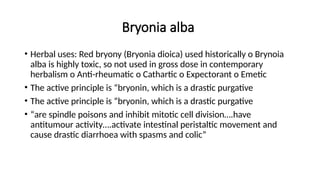
Bryonia alba
• Herbal uses: Red bryony (Bryonia dioica) used historically o Brynoia
alba is highly toxic, so not used in gross dose in contemporary
herbalism o Anti-rheumatic o Cathartic o Expectorant o Emetic
• The active principle is “bryonin, which is a drastic purgative
• “are spindle poisons and inhibit mitotic cell division….have
antitumour activity….activate intestinal peristaltic movement and
cause drastic diarrhoea with spasms and colic”
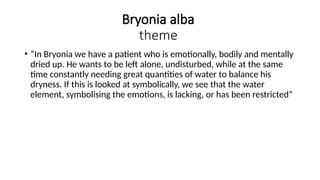
Bryonia alba
theme
• “In Bryonia we have a patient who is emotionally, bodily and mentally
dried up. He wants to be left alone, undisturbed, while at the same
time constantly needing great quantities of water to balance his
dryness. If this is looked at symbolically, we see that the water
element, symbolising the emotions, is lacking, or has been restricted”
Bryonia alba
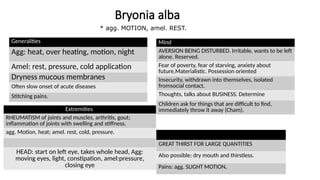
Generalities
Agg: heat, over heating, motion, night
Amel: rest, pressure, cold application
Dryness mucous membranes
Often slow onset of acute diseases
Stitching pains.
Mind
AVERSION BEING DISTURBED. Irritable, wants to be left
alone. Reserved.
Fear of poverty, fear of starving, anxiety about
future.Materialistic. Possession oriented
Insecurity, withdrawn into themselves, isolated
fromsocial contact.
Thoughts, talks about BUSINESS. Determine
Children ask for things that are difficult to find,
immediately throw it away (Cham).
GREAT THIRST FOR LARGE QUANTITIES
Also possible: dry mouth and thirstless.
Pains: agg. SLIGHT MOTION,
Extremities
RHEUMATISM of joints and muscles, arthritis, gout;
inflammation of joints with swelling and stiffness.
agg. Motion, heat; amel. rest, cold, pressure.
HEAD: start on left eye, takes whole head, Agg:
moving eyes, light, constipation, amel:pressure,
closing eye
* agg. MOTION, amel. REST.
Ledum palustre
• Herbal Uses o Coughs o Rheumatism o Whooping cough o Emetic (cause
vomiting) o Diuretic (increase urination) o Diaphoretic (increase
perspiration)
• The flowers contain an anti-septic oil, ‘ledol’ (Gibson, 1991, p.307) o The
composition of the essential oil of Ledum palustre is said to contain “in total,
80 components…with the principal components being “ledol, palustrol and
myrtenal” (Tattje & Bos, 1981, pp.303-307)
• o Extracts of leaves and twigs from the Ledum genus have shown “a strong
antioxidant activity” “.. significant antiinflammatory activity, inhibiting NO
(nitric oxide) release” (Dufour D et al, 2007, pp.22-28)
• o “Ledol exhibits intoxicant and narcotic properties”
Ledum palustre
theme
• “Ledum is a remedy for the surgeon, and is closely associated in
traumatism with Arnica and Hypericum. The symptoms very much
resemble such as follow certain kinds of injury, for instance an injury
from stepping on tacks, from puncturing with needles, wounds that
bleed scantily but are followed by pain, puffiness and coldness of the
part.
• Stepping on a nail and it pierces the sole of the foot or the heel, or he
receives such a wound in the palm of the hand from a splinter, or he
runs a splinter under the nail. If after such punctured wounds, the part
becomes cold and then pale, paralyzed and mottled think of Ledum”
Ledum palustre
Generalities
CHILLY BUT agg. HEAT
PAINS amel. BY COLD APPLICATIONS.
agg. Heat, heat of bed, night
COLDNESS OF AFFECTED PART. Antidote of animal
poisons.
Complaints go from below upward (Thal).
Ailments from PUNCTURED WOUNDS. Prevents tetanus.
Alcoholism
Extremities
RHEUMATISM. GOUT. Mainly of lower limbs. Podagra.
Nodosities.
AFFECTIONS TRAVELLING UPWARD FROM FEET.
amel. COLD APPLICATIONS
Swelling of affected joints.
Elephantiasis of lower extremities.
Put their feet in ICE WATER.
agg. HEAT in bed, motion.
Mind
Irritable. Dissatisfied.
Desire for solitude. Misanthrophy.
Restlessness, must constantly move.
Skin
PUNCTURED WOUNDS. BITES. Stepping on a nail (also in
horses).(Hyper)
INSECT BITES AND STINGS
AFFECTED PARTS BECOME COLD, PUFFY AND MOTTLED
WITH amel.AFFECTED PARTS BECOME COLD, PUFFY AND
MOTTLED WITH amel.
* Rheumatic complaints. Punctured wounds, stings and bites.
Paediatrics
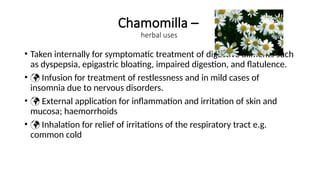
Chamomilla –
herbal uses
• Taken internally for symptomatic treatment of digestive ailments such
as dyspepsia, epigastric bloating, impaired digestion, and flatulence.
•  Infusion for treatment of restlessness and in mild cases of
insomnia due to nervous disorders.
•  External application for inflammation and irritation of skin and
mucosa; haemorrhoids
•  Inhalation for relief of irritations of the respiratory tract e.g.
common cold
Chamomilla
pharmacology
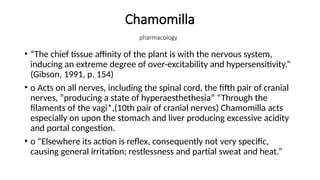
• “The chief tissue affinity of the plant is with the nervous system,
inducing an extreme degree of over-excitability and hypersensitivity.”
(Gibson, 1991, p. 154)
• o Acts on all nerves, including the spinal cord, the fifth pair of cranial
nerves, “producing a state of hyperaesthethesia” “Through the
filaments of the vagi*,(10th pair of cranial nerves) Chamomilla acts
especially on upon the stomach and liver producing excessive acidity
and portal congestion.
• o “Elsewhere its action is reflex, consequently not very specific,
causing general irritation; restlessness and partial sweat and heat.”
Chamomilla -
theme
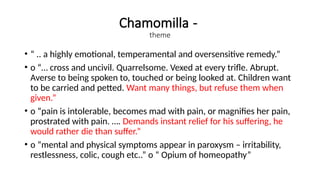
• “ .. a highly emotional, temperamental and oversensitive remedy.”
• o “… cross and uncivil. Quarrelsome. Vexed at every trifle. Abrupt.
Averse to being spoken to, touched or being looked at. Children want
to be carried and petted. Want many things, but refuse them when
given.”
• o “pain is intolerable, becomes mad with pain, or magnifies her pain,
prostrated with pain. …. Demands instant relief for his suffering, he
would rather die than suffer.”
• o “mental and physical symptoms appear in paroxysm – irritability,
restlessness, colic, cough etc..” o “ Opium of homeopathy”
Chamomilla
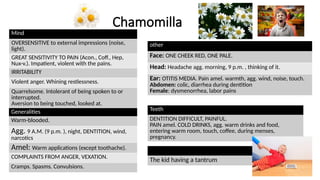
Mind
OVERSENSITIVE to external impressions (noise,
light).
GREAT SENSITIVITY TO PAIN (Acon., Coff., Hep,
Nux-v.). Impatient, violent with the pains.
IRRITABILITY
Violent anger. Whining restlessness.
Quarrelsome. Intolerant of being spoken to or
interrupted.
Aversion to being touched, looked at.
Generalities
Warm-blooded.
Agg. 9 A.M. (9 p.m. ), night, DENTITION, wind,
narcotics
Amel: Warm applications (except toothache).
COMPLAINTS FROM ANGER, VEXATION.
Cramps. Spasms. Convulsions.
other
Face: ONE CHEEK RED, ONE PALE.
Head: Headache agg. morning, 9 p.m. , thinking of it.
Ear: OTITIS MEDIA. Pain amel. warmth, agg. wind, noise, touch.
Abdomen: colic, diarrhea during dentition
Female: dysmenorrhea, labor pains
Teeth
DENTITION DIFFICULT, PAINFUL.
PAIN amel. COLD DRINKS, agg. warm drinks and food,
entering warm room, touch, coffee, during menses,
pregnancy.
The kid having a tantrum
Belladonna
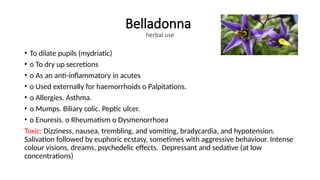
herbal use
• To dilate pupils (mydriatic)
• o To dry up secretions
• o As an anti-inflammatory in acutes
• o Used externally for haemorrhoids o Palpitations.
• o Allergies. Asthma.
• o Mumps. Biliary colic. Peptic ulcer.
• o Enuresis. o Rheumatism o Dysmenorrhoea
Toxic: Dizziness, nausea, trembling, and vomiting, bradycardia, and hypotension.
Salivation followed by euphoric ecstasy, sometimes with aggressive behaviour. Intense
colour visions, dreams, psychedelic effects. Depressant and sedative (at low
concentrations)
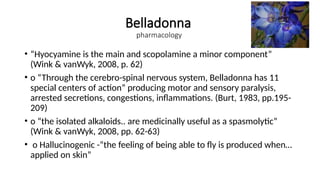
Belladonna
pharmacology
• “Hyocyamine is the main and scopolamine a minor component”
(Wink & vanWyk, 2008, p. 62)
• o “Through the cerebro-spinal nervous system, Belladonna has 11
special centers of action” producing motor and sensory paralysis,
arrested secretions, congestions, inflammations. (Burt, 1983, pp.195-
209)
• o “the isolated alkaloids.. are medicinally useful as a spasmolytic”
(Wink & vanWyk, 2008, pp. 62-63)
• o Hallucinogenic -“the feeling of being able to fly is produced when…
applied on skin”
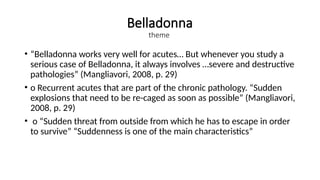
Belladonna
theme
• “Belladonna works very well for acutes… But whenever you study a
serious case of Belladonna, it always involves …severe and destructive
pathologies” (Mangliavori, 2008, p. 29)
• o Recurrent acutes that are part of the chronic pathology. “Sudden
explosions that need to be re-caged as soon as possible” (Mangliavori,
2008, p. 29)
• o “Sudden threat from outside from which he has to escape in order
to survive” “Suddenness is one of the main characteristics”
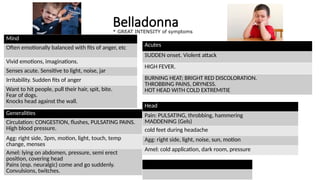
Belladonna
Mind
Often emotionally balanced with fits of anger, etc
Vivid emotions, imaginations.
Senses acute. Sensitive to light, noise, jar
Irritability. Sudden fits of anger
Want to hit people, pull their hair, spit, bite.
Fear of dogs.
Knocks head against the wall.
Generalities
Circulation: CONGESTION, flushes, PULSATING PAINS.
High blood pressure.
Agg: right side, 3pm, motion, light, touch, temp
change, menses
Amel: lying on abdomen, pressure, semi erect
position, covering head
Pains (esp. neuralgic) come and go suddenly.
Convulsions, twitches.
Acutes
SUDDEN onset. Violent attack
HIGH FEVER.
BURNING HEAT; BRIGHT RED DISCOLORATION.
THROBBING PAINS, DRYNESS.
HOT HEAD WITH COLD EXTREMITIE
Head
Pain: PULSATING, throbbing, hammering
MADDENING (Gels)
cold feet during headache
Agg: right side, light, noise, sun, motion
Amel: cold application, dark room, pressure
* GREAT INTENSITY of symptoms
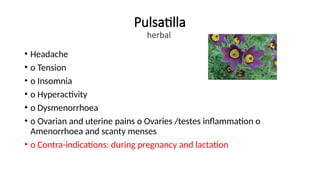
Pulsatilla
herbal
• Headache
• o Tension
• o Insomnia
• o Hyperactivity
• o Dysmenorrhoea
• o Ovarian and uterine pains o Ovaries /testes inflammation o
Amenorrhoea and scanty menses
• o Contra-indications: during pregnancy and lactation
Pulsatilla-
pharmacology
• Protoanemonin, the active ingredient, is a mutagenic. It is also
strongly antibacterial and antifungal. On contact with protoanemonin
severe allergic dermatitis (itching, blistering, rash) is seen. It causes
paralysis of the CNS, GI disturbances, including nausea, vomiting and
diarrhoea as well as nephritis. (Wink & vanWyk, 2008, p. 197)
• o “There is a very definite affinity with mucous membranes producing
catarrhal responses evidenced by thick mucoid discharges” (Gibson,
1991, p. 414)
• o “An anti-spasmodic nervine having special influence to the eyes,
ears, urinary tract, uterus and prostate.”
Pulsatilla
theme
• “ I will survive if I am soft and gentle, not hard and rigid” (Sankaran, 1997, p.
170)
• o “Changeability with softness” “moulds herself to what others want”
“malleable” “ no one pattern” (Vithoulkas, 1991, pp. 170-171) “pains and
aches which are wandering and shifting” (Sankaran, 1997, p. 170)
• o Weeps easily and relieved by weeping and consolation. ” (Vithoulkas, 1991,
pp. 170-171)
• o “Is hot and cannot live without fresh air” (Sankaran, 1997, p. 170). “Wilts in
a warm room” ” (Vithoulkas, 1991, pp. 170-171)
• o Attracted to dogmas, spiritual communities – likely to change from one
dogma to another. ”
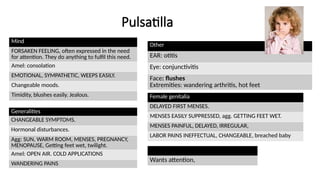
Pulsatilla
Mind
FORSAKEN FEELING, often expressed in the need
for attention. They do anything to fulfil this need.
Amel: consolation
EMOTIONAL, SYMPATHETIC, WEEPS EASILY.
Changeable moods.
Timidity, blushes easily. Jealous.
Generalities
CHANGEABLE SYMPTOMS.
Hormonal disturbances.
Agg: SUN, WARM ROOM, MENSES, PREGNANCY,
MENOPAUSE, Getting feet wet, twilight.
Amel: OPEN AIR. COLD APPLICATIONS
WANDERING PAINS
Other
EAR: otitis
Eye: conjunctivitis
Face: flushes
Extremities: wandering arthritis, hot feet
Female genitalia
DELAYED FIRST MENSES.
MENSES EASILY SUPPRESSED, agg. GETTING FEET WET.
MENSES PAINFUL, DELAYED, IRREGULAR,
LABOR PAINS INEFFECTUAL, CHANGEABLE, breached baby
Wants attention,
Nux vomica
herbal
• CNS stimulant o Tonic.
• o Digestive.
• o Anti-diarrhoeal
• o Anti-convulsant o Aphrodisiac. (Menzies-Trull, 2013, p.549)
• o Analgesic
• o Seeds used as rodent poison
• o Used to poison arrows by South American Indians as it caused
muscular paralysis.
Nux vomica
pharmacology
• The alkaloid, strychnine, “has a marked effect on the nervous system”
“the action of the poison on the motor elements of the pons and
spinal cord results in exaggerated motor responses to sensory stimuli”
“the excessive excitability… resulting initially in muscle spasm.... At a
later stage, paralysis.” (Gibson, 1991, pp. 366-367) o “Strychine
inhibits the glycine receptor (an inhibiting neuroceptor) and thus
increases excitability of all parts of the CNS. Strychine is especially
active in the spinal cord that has a density of glycine receptors. Even
small sensory signals can cause symmetric muscular spasms” (Wink &
vanWyk, 2008, p. 221)
Nux vomica
theme
• Ambitious, intelligent, quick, capable and competent.
• o Strong sense of duty and work ethics
• o Self-reliant.
• o Intelligence is pragmatic rather than philosophical. (Vithoulkas,
1991, pp. 143-149)
• o “ Is a person who gets his thing done by hook or by crook”
• o Irritable, impatient, passionate, and very fastidious. May be rash,
audacious, forceful, expressive, “not cowardly inside”
• o “Has a craving for stimulants.”
Nux vomica
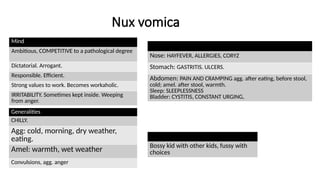
Mind
Ambitious, COMPETITIVE to a pathological degree
Dictatorial. Arrogant.
Responsible. Efficient.
Strong values to work. Becomes workaholic.
IRRITABILITY. Sometimes kept inside. Weeping
from anger.
Generalities
CHILLY.
Agg: cold, morning, dry weather,
eating.
Amel: warmth, wet weather
Convulsions, agg. anger
Nose: HAYFEVER, ALLERGIES, CORYZ
Stomach: GASTRITIS. ULCERS.
Abdomen: PAIN AND CRAMPING agg. after eating, before stool,
cold; amel. after stool, warmth.
Sleep: SLEEPLESSNESS
Bladder: CYSTITIS, CONSTANT URGING,
Bossy kid with other kids, fussy with
choices
Ipecac
herbal uses
• Ingredient of emetic syrups “used to induce vomiting, especially in
cases where children have been accidentally poisoned.” (Wink &
vanWyk, 2008, p.195)
• o Expectorant
• o Allays inflammation
• o Anti-protozoal (entamoeba histolytica)
• o Anti-viral (HIV/AIDS)
• o Anti-neoplastic (Tumours) o Anti-spasmodic
Ipecac
pharmacology
• “The most important alkaloid is emetine (60%) and cephaeline”
(Gibson, 1991, pp. 264-265)
• o “they are irritants and stimulants of the nervus vagus in the
stomach, resulting in a reflex reaction that leads to secretion of water
in the lungs. Ipecac therefore has expectorant and secretolytic
activities. Emetine strongly intercalates DNA and blocks protein
biosynthesis; it causes cell death by apoptosis.” (Wink & vanWyk,
2008, p. 195)
• o Has a profound action on the lungs – causes increased secretions.
Toxic doses can “kill by arresting respiration
Ipecac
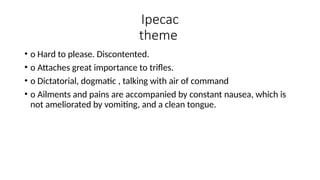
theme
• o Hard to please. Discontented.
• o Attaches great importance to trifles.
• o Dictatorial, dogmatic , talking with air of command
• o Ailments and pains are accompanied by constant nausea, which is
not ameliorated by vomiting, and a clean tongue.
Ipecac
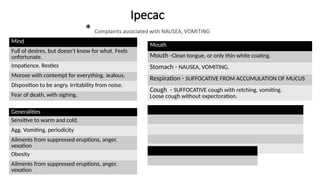
* Complaints associated with NAUSEA, VOMITING
Mind
Full of desires, but doesn't know for what. Feels
unfortunate.
Impatience. Restles
Morose with contempt for everything. Jealous.
Disposition to be angry. Irritability from noise.
Fear of death, with sighing.
Generalities
Sensitive to warm and cold.
Agg. Vomiting, periodicity
Ailments from suppressed eruptions, anger,
vexation
Obesity
Ailments from suppressed eruptions, anger,
vexation
Mouth
Mouth -Clean tongue, or only thin white coating.
Stomach - NAUSEA, VOMITING.
Respiration - SUFFOCATIVE FROM ACCUMULATION OF MUCUS
Cough - SUFFOCATIVE cough with retching, vomiting.
Loose cough without expectoration.
Fever
Aconite
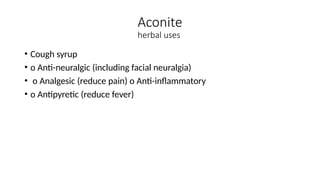
herbal uses
• Cough syrup
• o Anti-neuralgic (including facial neuralgia)
• o Analgesic (reduce pain) o Anti-inflammatory
• o Antipyretic (reduce fever)
Aconite
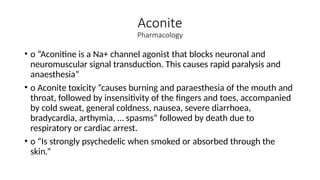
Pharmacology
• o “Aconitine is a Na+ channel agonist that blocks neuronal and
neuromuscular signal transduction. This causes rapid paralysis and
anaesthesia”
• o Aconite toxicity “causes burning and paraesthesia of the mouth and
throat, followed by insensitivity of the fingers and toes, accompanied
by cold sweat, general coldness, nausea, severe diarrhoea,
bradycardia, arthymia, … spasms” followed by death due to
respiratory or cardiac arrest.
• o “Is strongly psychedelic when smoked or absorbed through the
skin.”
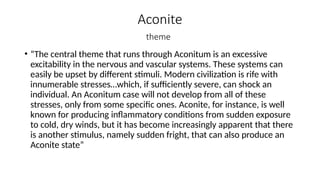
Aconite
theme
• “The central theme that runs through Aconitum is an excessive
excitability in the nervous and vascular systems. These systems can
easily be upset by different stimuli. Modern civilization is rife with
innumerable stresses…which, if sufficiently severe, can shock an
individual. An Aconitum case will not develop from all of these
stresses, only from some specific ones. Aconite, for instance, is well
known for producing inflammatory conditions from sudden exposure
to cold, dry winds, but it has become increasingly apparent that there
is another stimulus, namely sudden fright, that can also produce an
Aconite state”
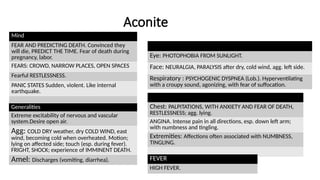
Aconite
Mind
FEAR AND PREDICTING DEATH. Convinced they
will die, PREDICT THE TIME. Fear of death during
pregnancy, labor.
FEARS: CROWD, NARROW PLACES, OPEN SPACES
Fearful RESTLESSNESS.
PANIC STATES Sudden, violent. Like internal
earthquake.
Generalities
Extreme excitability of nervous and vascular
system.Desire open air.
Agg: COLD DRY weather, dry COLD WIND, east
wind, becoming cold when overheated. Motion;
lying on affected side; touch (esp. during fever).
FRIGHT, SHOCK; experience of IMMINENT DEATH.
Amel: Discharges (vomiting, diarrhea).
Eye: PHOTOPHOBIA FROM SUNLIGHT.
Face: NEURALGIA, PARALYSIS after dry, cold wind, agg. left side.
Respiratory : PSYCHOGENIC DYSPNEA (Lob.). Hyperventilating
with a croupy sound, agonizing, with fear of suffocation.
Chest: PALPITATIONS, WITH ANXIETY AND FEAR OF DEATH,
RESTLESSNESS; agg. lying.
ANGINA. Intense pain in all directions, esp. down left arm;
with numbness and tingling.
Extremities: Affections often associated with NUMBNESS,
TINGLING.
FEVER
HIGH FEVER.
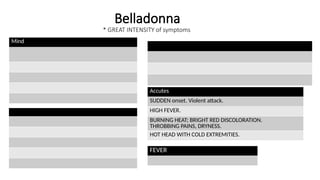
Belladonna
* GREAT INTENSITY of symptoms
Mind
Accutes
SUDDEN onset. Violent attack.
HIGH FEVER.
BURNING HEAT; BRIGHT RED DISCOLORATION.
THROBBING PAINS, DRYNESS.
HOT HEAD WITH COLD EXTREMITIES.
FEVER
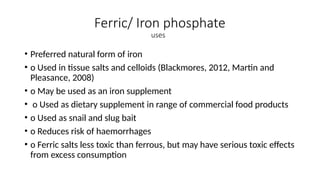
Ferric/ Iron phosphate
uses
• Preferred natural form of iron
• o Used in tissue salts and celloids (Blackmores, 2012, Martin and
Pleasance, 2008)
• o May be used as an iron supplement
• o Used as dietary supplement in range of commercial food products
• o Used as snail and slug bait
• o Reduces risk of haemorrhages
• o Ferric salts less toxic than ferrous, but may have serious toxic effects
from excess consumption
Ferric/ Iron phosphate
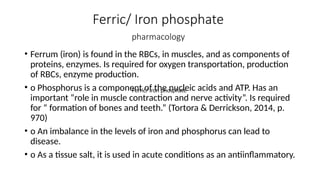
pharmacology
• Ferrum (iron) is found in the RBCs, in muscles, and as components of
proteins, enzymes. Is required for oxygen transportation, production
of RBCs, enzyme production.
• o Phosphorus is a component of the nucleic acids and ATP. Has an
important “role in muscle contraction and nerve activity”. Is required
for “ formation of bones and teeth.” (Tortora & Derrickson, 2014, p.
970)
• o An imbalance in the levels of iron and phosphorus can lead to
disease.
• o As a tissue salt, it is used in acute conditions as an antiinflammatory.
Ferric/ Iron phosphate
theme
• “This tissue salt can be given with advantage in the early stages of
acute disorders, and it should be administered at frequent intervals
until the inflammatory symptoms subside
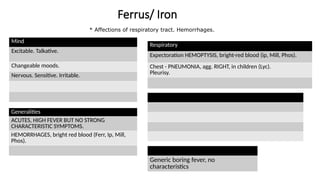
Ferrus/ Iron
Mind
Excitable. Talkative.
Changeable moods.
Nervous. Sensitive. Irritable.
Generalities
ACUTES, HIGH FEVER BUT NO STRONG
CHARACTERISTIC SYMPTOMS.
HEMORRHAGES, bright red blood (Ferr, Ip, Mill,
Phos).
Respiratory
Expectoration HEMOPTYSIS, bright-red blood (ip, Mill, Phos).
Chest - PNEUMONIA, agg. RIGHT, in children (Lyc).
Pleurisy.
Generic boring fever, no
characteristics
* Affections of respiratory tract. Hemorrhages.
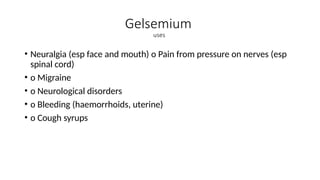
Gelsemium
uses
• Neuralgia (esp face and mouth) o Pain from pressure on nerves (esp
spinal cord)
• o Migraine
• o Neurological disorders
• o Bleeding (haemorrhoids, uterine)
• o Cough syrups
Gelsemium
pharmacology
• “The alkaloids activate acetycholine receptors, cholinesterase and the
synaptic re-uptake of dopamine, noradrenaline and serotonin.” (Wink &
Van Wyk, 2008, p. 131)
• o “Toxic doses produce a sensation of languor, relaxation and muscular
weakness which may progress to a degree of actual paralysis. The
expression becomes anxious, the temperature subnormal, the skin cold
and clammy, and the pulse rapid and feeble. Ptosis of upper eyelids,
dropping of the lower jaw, medial squint, double vision and dilation of
the pupil all ensue as the result of loss of muscle tone. Respiration
becomes slow and feeble, shallow and irregular, and death follows.”
Gelsemium
theme
• The idea which comes to mind with Gelsemium is frailty; frailty which
leads to trembling, weakness, and at times, paralysis. The frailty can
exist in either the mind, the emotions, or the body; a frail person,
weak, defenceless, trembling internally from fear and externally from
weakness of the nervous system; a person that cannot face any
challenge in life. It is one of the main remedies where the person is a
real coward. This concept is the basic framework to which further
information about Gelsemium can be added”
Gelsemium
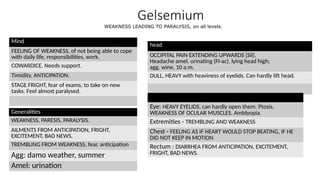
Mind
FEELING OF WEAKNESS, of not being able to cope
with daily life, responsibilities, work.
COWARDICE. Needs support.
Timidity. ANTICIPATION.
STAGE FRIGHT, fear of exams, to take on new
tasks. Feel almost paralysed.
Generalities
WEAKNESS, PARESIS, PARALYSIS.
AILMENTS FROM ANTICIPATION, FRIGHT,
EXCITEMENT, BAD NEWS.
TREMBLING FROM WEAKNESS, fear, anticipation
Agg: damo weather, summer
Amel: urination
head
OCCIPITAL PAIN EXTENDING UPWARDS (Sil).
Headache amel. urinating (Fl-ac), lying head high;
agg. wine, 10 a.m.
DULL, HEAVY with heaviness of eyelids. Can hardly lift head.
Eye: HEAVY EYELIDS, can hardly open them. Ptosis.
WEAKNESS OF OCULAR MUSCLES. Amblyopia.
Extremities - TREMBLING AND WEAKNESS
Chest - FEELING AS IF HEART WOULD STOP BEATING, IF HE
DID NOT KEEP IN MOTION
Rectum : DIARRHEA FROM ANTICIPATION, EXCITEMENT,
FRIGHT, BAD NEWS.
WEAKNESS LEADING TO PARALYSIS, on all levels.
China
uses
• Red cinchona (C.pubescens) is used more commonly, yellow cinchona
is second main source of bark (wild varieties also used)
• o Stimulates appetite
• o Flatulence
• o Heart rhythm complaints
• o Antimalarial
China
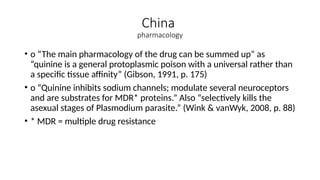
pharmacology
• o “The main pharmacology of the drug can be summed up” as
“quinine is a general protoplasmic poison with a universal rather than
a specific tissue affinity” (Gibson, 1991, p. 175)
• o “Quinine inhibits sodium channels; modulate several neuroceptors
and are substrates for MDR* proteins.” Also “selectively kills the
asexual stages of Plasmodium parasite.” (Wink & vanWyk, 2008, p. 88)
• * MDR = multiple drug resistance
China
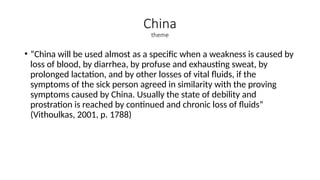
theme
• “China will be used almost as a specific when a weakness is caused by
loss of blood, by diarrhea, by profuse and exhausting sweat, by
prolonged lactation, and by other losses of vital fluids, if the
symptoms of the sick person agreed in similarity with the proving
symptoms caused by China. Usually the state of debility and
prostration is reached by continued and chronic loss of fluids”
(Vithoulkas, 2001, p. 1788)
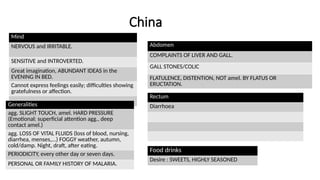
China
Mind
NERVOUS and IRRITABLE.
SENSITIVE and INTROVERTED.
Great imagination, ABUNDANT IDEAS in the
EVENING IN BED.
Cannot express feelings easily; difficulties showing
gratefulness or affection.
Generalities
agg. SLIGHT TOUCH, amel. HARD PRESSURE
(Emotional: superficial attention agg., deep
contact amel.)
agg. LOSS OF VITAL FLUIDS (loss of blood, nursing,
diarrhea, menses,...) FOGGY weather, autumn,
cold/damp. Night, draft, after eating.
PERIODICITY, every other day or seven days.
PERSONAL OR FAMILY HISTORY OF MALARIA.
Abdomen
COMPLAINTS OF LIVER AND GALL.
GALL STONES/COLIC
FLATULENCE, DISTENTION, NOT amel. BY FLATUS OR
ERUCTATION.
Rectum
Diarrhoea
Food drinks
Desire : SWEETS, HIGHLY SEASONED
Batisia
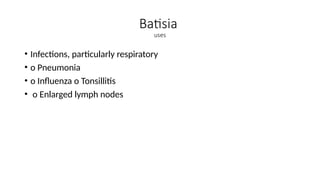
uses
• Infections, particularly respiratory
• o Pneumonia
• o Influenza o Tonsillitis
• o Enlarged lymph nodes
Batisia
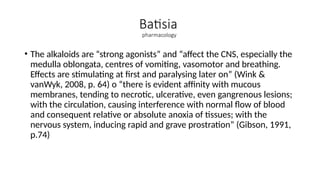
pharmacology
• The alkaloids are “strong agonists” and “affect the CNS, especially the
medulla oblongata, centres of vomiting, vasomotor and breathing.
Effects are stimulating at first and paralysing later on” (Wink &
vanWyk, 2008, p. 64) o “there is evident affinity with mucous
membranes, tending to necrotic, ulcerative, even gangrenous lesions;
with the circulation, causing interference with normal flow of blood
and consequent relative or absolute anoxia of tissues; with the
nervous system, inducing rapid and grave prostration” (Gibson, 1991,
p.74)
Batisia
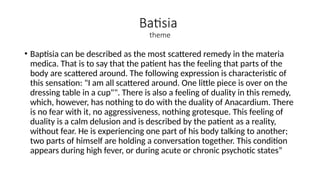
theme
• Baptisia can be described as the most scattered remedy in the materia
medica. That is to say that the patient has the feeling that parts of the
body are scattered around. The following expression is characteristic of
this sensation: "I am all scattered around. One little piece is over on the
dressing table in a cup"". There is also a feeling of duality in this remedy,
which, however, has nothing to do with the duality of Anacardium. There
is no fear with it, no aggressiveness, nothing grotesque. This feeling of
duality is a calm delusion and is described by the patient as a reality,
without fear. He is experiencing one part of his body talking to another;
two parts of himself are holding a conversation together. This condition
appears during high fever, or during acute or chronic psychotic states”
Batisia
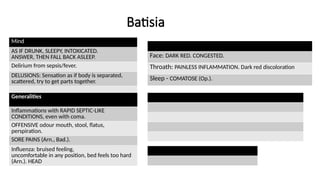
Mind
AS IF DRUNK, SLEEPY, INTOXICATED.
ANSWER, THEN FALL BACK ASLEEP.
Delirium from sepsis/fever.
DELUSIONS: Sensation as if body is separated,
scattered, try to get parts together.
Generalities
Inflammations with RAPID SEPTIC-LIKE
CONDITIONS, even with coma.
OFFENSIVE odour mouth, stool, flatus,
perspiration.
SORE PAINS (Arn., Bad.).
Influenza: bruised feeling,
uncomfortable in any position, bed feels too hard
(Arn.). HEAD
Face: DARK RED. CONGESTED.
Throath: PAINLESS INFLAMMATION. Dark red discoloration
Sleep - COMATOSE (Op.).
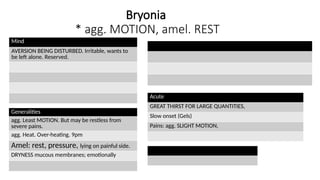
Bryonia
* agg. MOTION, amel. REST
Mind
AVERSION BEING DISTURBED. Irritable, wants to
be left alone. Reserved.
Generalities
agg. Least MOTION. But may be restless from
severe pains.
agg. Heat. Over-heating. 9pm
Amel: rest, pressure, lying on painful side.
DRYNESS mucous membranes; emotionally
Acute
GREAT THIRST FOR LARGE QUANTITIES,
Slow onset (Gels)
Pains: agg. SLIGHT MOTION,
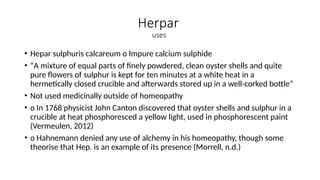
Herpar
uses
• Hepar sulphuris calcareum o Impure calcium sulphide
• “A mixture of equal parts of finely powdered, clean oyster shells and quite
pure flowers of sulphur is kept for ten minutes at a white heat in a
hermetically closed crucible and afterwards stored up in a well-corked bottle”
• Not used medicinally outside of homeopathy
• o In 1768 physicist John Canton discovered that oyster shells and sulphur in a
crucible at heat phosphoresced a yellow light, used in phosphorescent paint
(Vermeulen, 2012)
• o Hahnemann denied any use of alchemy in his homeopathy, though some
theorise that Hep. is an example of its presence (Morrell, n.d.)
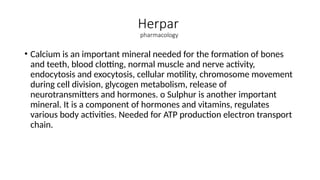
Herpar
pharmacology
• Calcium is an important mineral needed for the formation of bones
and teeth, blood clotting, normal muscle and nerve activity,
endocytosis and exocytosis, cellular motility, chromosome movement
during cell division, glycogen metabolism, release of
neurotransmitters and hormones. o Sulphur is another important
mineral. It is a component of hormones and vitamins, regulates
various body activities. Needed for ATP production electron transport
chain.
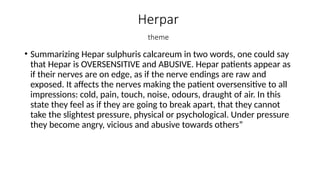
Herpar
theme
• Summarizing Hepar sulphuris calcareum in two words, one could say
that Hepar is OVERSENSITIVE and ABUSIVE. Hepar patients appear as
if their nerves are on edge, as if the nerve endings are raw and
exposed. It affects the nerves making the patient oversensitive to all
impressions: cold, pain, touch, noise, odours, draught of air. In this
state they feel as if they are going to break apart, that they cannot
take the slightest pressure, physical or psychological. Under pressure
they become angry, vicious and abusive towards others”
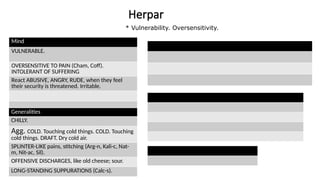
Herpar
Mind
VULNERABLE.
OVERSENSITIVE TO PAIN (Cham, Coff).
INTOLERANT OF SUFFERING
React ABUSIVE, ANGRY, RUDE, when they feel
their security is threatened. Irritable.
Generalities
CHILLY.
Agg. COLD. Touching cold things. COLD. Touching
cold things. DRAFT. Dry cold air.
SPLINTER-LIKE pains, stitching (Arg-n, Kali-c, Nat-
m, Nit-ac, Sil).
OFFENSIVE DISCHARGES, like old cheese; sour.
LONG-STANDING SUPPURATIONS (Calc-s).
* Vulnerability. Oversensitivity.
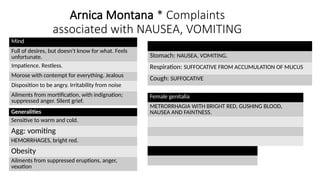
Arnica Montana
Arnica Montana * Complaints
associated with NAUSEA, VOMITING
Mind
Full of desires, but doesn't know for what. Feels
unfortunate.
Impatience. Restless.
Morose with contempt for everything. Jealous
Disposition to be angry. Irritability from noise
Ailments from mortification, with indignation;
suppressed anger. Silent grief.
Generalities
Sensitive to warm and cold.
Agg: vomiting
HEMORRHAGES, bright red.
Obesity
Ailments from suppressed eruptions, anger,
vexation
Stomach: NAUSEA, VOMITING.
Respiration: SUFFOCATIVE FROM ACCUMULATION OF MUCUS
Cough: SUFFOCATIVE
Female genitalia
METRORRHAGIA WITH BRIGHT RED, GUSHING BLOOD,
NAUSEA AND FAINTNESS.
homeopathy acute prescribing presentation.pptx

homeopathy acute prescribing presentation.pptx

  • 1.
  • 2.
    Apis mellifica Honeybee • Apitherapyis the medicinal application of bee products, including venom, pollen, propolis and royal jelly • o Apitherapists may suggest some bee treatment for virtually any condition • o Live bee acupuncture may be effective for some types of pain • “The chemical composition of bee venom remains obscure, although various fractions, such as histamine,hyaluronidase and a bradykinin have been identified. • Bee venom is known to have haemolytic, haemorrhagic and neurotoxic effects in addition to its profound histamine activity” • There is also a lowering of surface tension and membrane potential, which results in reduction of osmotic pressure and facilitates diffusion of fluids.”
  • 3.
    Mind PASSIONATE, intense emotions,not easily expressed. Simulates good mood when feeling wretched. JEALOUS. Ailments from grief. Irritable. Quarrelsome. BUSY. Restless. Generalities STINGING, BURNING pains. agg. HEAT; touch. agg. Right side. Sudden, rapid developing complaints. EDEMATOUS SWELLINGS. Ailments from suppressed eruptions, suppressed sexual desire. Urinary RETENTION OF URINE. Acute KIDNEY FAILURE with EDEMA OVER WHOLE BODY. Cystitis: burning pain. Shrieking from pain. HEAD MENINGITIS: rolling head, bores occiput in pillow, BRAIN CRY, after suppressed skin eruptions. SKIN EDEMA of entire body. Transparent, waxy. Erysipelas: sudden onset of rose coloured eruption Erysipelas: sudden onset of rose coloured eruption Apis mellifica
  • 4.
    Arnica montana • oTopically for: • Injuries • Varicose veins • Bruises • Sprains • Pain • Inflammation • Insect bites , Not used internally • The main active principle in Arnica is “helenalin and related sesquiterpene lactones”. • Helenalin is a “potent anti-inflammatory drug • A large variety of inflammatory conditions, such as bacterial and viral infection….rapidly induce NF-κB activity.” and Helenalin “inhibit induction of the transcription factor NF-κB” and the protein that it codes for is the “central mediator of the human immune response”
  • 5.
    Arnica montana theme • “Themain theme of Arnica symptomatology revolves around a deep traumatic experience upon the physical or emotional or mental body. A traumatic experience of the human organism resulting from injuries, falls, blows, concussions, fright, fear, financial loss, etc. • The experience leaves the person with a tremendous fear of coming into physical contact with anything which is hard or penetrating. The whole of the symptomatology develops around this basic fear: Do not touch me, do not come too close to me, physically or emotionally and most of all do not penetrate me, physically or metaphorically”
  • 6.
    Arnica Montana Generalities Complaints eversince a TRAUMA (Nat-s). AILMENTS FROM INJURIES WITH A BLUNT INSTRUMENT; OVEREXERTION, Surgery SORE, BRUISED PAINS. Tendency to hemorrhages, externally and internally. ODOR: SPOILED, ROTTEN EGGS (Sulph.). Mind FEAR OR AVERSION OF BEING TOUCHED, others approaching them. Sensitive to pain. Defensive: Irritable, obstinate when approached. Anxiety states, with fear of death (Acon.) at night. Contradictory, capricious. Says he is well, thinks he is well, sends doctor away. HEAD AILMENTS AFTER CONCUSSION. Head hot and body cold, with fever (Bell., Stram.). Headache with cold or heat in spots. Female Before and after labour MOVEMENTS OF FETUS FELT INTENSELY, After-pains while nursing. Skin SYMMETRICAL eruptions (1st remedy). ECCHYMOSIS. AILMENTS FROM INJURY/TRAUMA, physical or psychic. SORENESS.
  • 7.
    Bellis perennis common Daisy •Not commonly used in herbalism • An vaso-tonic alterative against toxins and uric acid; it clears the blood and tissue fluids. Circulatory tonic to the heart and arteries improving blood supply to the periphery in chilblains.” “Heals wounds” • Few trials done already
  • 8.
    Bellis perennis Theme • “Bellisis an important remedy for deep traumas, whether they be of the physical body or of the psyche. It is a remedy that should be considered whenever a mistreatment or hurt has been suffered in deep parts: when the physical body has been cut up in an operation or hurt in an accident, or when the emotional body has been mistreated in an emotional conflict. • It is important for the student of homeopathy to understand that different constitutions have different predispositions. In this remedy there seems to be a predisposition for the tissues of the muscular system and the tendons to be in a precariously weak or tired state”
  • 9.
    Bellis perennis Generalities SPRAINS, BRUISES,injuries, bone fractures. etc. Injuries to deeper tissues after major operation, esp. on pelvis organs, abdomen TRAUMATISM OF PELVIC ORGANS; after parturition. Sore, bruised feeling in pelvic region (uterus). agg. OVEREXERTION. Overworked old labourers, gardeners, commercial travellers, Abdomen Inability to walk during pregnancy from soreness of abdominal walls. Pain after ice-cream. Ailments after operation on abdomen Mind Psychic traumatism. Doesn't tell or show it. Obstinate. Fixed ideas. Confusion of surroundings. Female ganitalia Masturbation. Menses: suppressed from cold. Dysmenorrhea. Sore pains of uterus during pregnancy Ailments from interrupted coition. * SPRAINS, BRUISES, injuries, bone fractures. etc.
  • 10.
    Calendula officinalis • HerbalUses : Wounds o Mouth ulcers o Skin infections o Inflamed mucous membranes o Vaginitis o Haemorrhoids and varicose veins o High cholesterol • The extract of this plant as well as pure compounds isolated from it, have been demonstrated to possess multiple pharmacological activities..” (Muley, Khadabadi, Banarase, 2009, pp.455-465) • o “Pharmacological studies have confirmed that C.officinalis exhibit a broad range of biological effects...” (Muley et al, 2009, pp.455-465) o • Stimulates the vaso-motor function to heal skin and mucous membranes. Prevents suppurative, toxic and infective conditions.” “Assists wound healing, neurovascularisation, and tissue granulation” “Soothing anti-spasmodic nervine.” (Menzies-Trull, 2013, p.322)
  • 11.
    Calendula officinalis • “Calendulais to lacerated wounds what Arnica is to bruises. Both are considered specifics for injuries... When the skin or an organ is not torn and the external trauma only produces an extravasation of blood, then Arnica will be indicated. However, when there is laceration of the skin or of an organ and inflammation sets in, then the correct choice is Calendula… An important characteristic of Calendula is that, once there is an injury, inflammation or ulceration, the pain experienced may be very violent, often out of all proportion to the extent of the injury. Also the effect on the general condition of the patient is quite distressing” (Vithoulkas, 2008, p.1447)
  • 12.
    Calendula officinalis Generalities WOUNDS: RAW,INFLAMED, RED, STINGING. Open, cut, LACERATED, RAGGED, SUPPURATED PROMOTES HEALTHY GRANULATIONS AND RAPID HEALING. Exhaustion from loss of blood or excessive pain; esp. if out of proportion to the injury. Pain is excessive and out of all proportion to injury. After labour, esp. caesarean./operation Mind Extremely nervous. Sensitive to noise. Easily frightened. Starting with fright. Fear something will happen (Caust., Phos.). Restlessness with fear of impending misfortune Irritable. EAR Hearing impaired from scares on tympanic membran Deafness, impaired hearing agg. wet weather, bathing, drinking; amel. on a train, distant sounds Teeth After extraction of teeth. HEALING OF WOUNDS.
  • 13.
    Rhus toxicodendron poison ivy •Not typically used herbally • The active ingredient, urushiol, “can penetrate biomembranes • “Rhus tox in homeopathic dilution appears to interfere with inflammatory processes involving histamine, prostaglandins and other inflammatory mediators.” • The poisoning symptoms after contact are “skin inducing an intense irritant dermatitis, characterised by itching, burning, swelling, erythema and vesication; with lymphoid tissue and various glands, e.g. parotid, giving rise to inflammation and hypertrophy; with the brain, tending to depression and mental confusion; with muscles and ligaments, causing both pain and temporary paralysis; with fascial and connective tissues, giving rise to oedematous swelling and stiffness
  • 14.
    Rhus toxicodendron theme “Rhus toxicodendronboys cannot sit in one place. They are always moving around, fidgeting, always moving one or another part of the body. This is not the desire to pace back and forth like Arsenicum, nor is it like the restlessness of Aconitum which is sudden, more intense, vigorous and acute, with intense fear or anxiety. In Rhus toxicodendron it is a constant physical restlessness. Rhus toxicodendron children find it difficult to hold their urine; they often have involuntary urination or nocturnal enuresis. Being a poison ivy, Rhus toxicodendron has intense urticaria and allergic reactions on the skin which in general are ameliorated from heat and hot applications”
  • 15.
    Rhus toxicodendron Generalities Amel: motion,beginning to move, warm, dry, hot bathing, streaching Agg: rest, over exertion, cold, wet, evening, left side Mind BUSY, RESTLESS Timid and mild, yet lively Later on irritable, impatient Becomes rigid and stiff as with the muscles and joints SUPERSTITIOUS. Compulsive, ritualistic behaviour Behavior disorders with restlessness, irritability. Skin VESICULAR ERUPTIONS. HERPES (Ran-b) Urticaria. Herpes. Psoriasis. ITCHING amel. HOT WATER (Rhus-v.). Extremities ARTHRITIS, RHEUMATISM WITH PAINFUL STIFFNESS, agg. REST, BEGINNING TO MOVE, morning on waking, night in bed, COLD WET WEATHER, before storm, EXERTION. amel. MOTION, WARMTH, DRYNESS. Pain LEFT SHOULDER, inner side left scapula. RESTLESS EXTREMITIES. Restless legs in bed at night. Back Pain and stiffness, stiff neck * Rheumatic complaints. Skin.
  • 16.
    Hypericum perforatum St john’swort • Depression and anxiety o Menopause and perimenopause o Herpes, shingles, viral infections o Neuralgias o Insomnia o Hepatitis • “The affinity of this plant is essentially with the nervous system, causing hyperaemia and hypersensitivity to light. Involvement of nerve sheaths and meninges give rise to stitchy, tearing pains, also to pricking and crawling sensations • The toxic principle “can bind to proteins and inactivate them.” “Extracts can induce cytochrome (CYP) enzymes in the liver.” “An inhibition of neurotransmitter up-take provides a plausible hypothesis for the antidepressant activity.”
  • 17.
    Hypericum perforatum St john’swort- Theme • Arnica for the nerves: With that title, it is not surprising that this remedy is the one to use for bruises and wounds affecting the nervous system. It is especially useful for the ends of the extremities (crushing wounds to the fingers, with laceration and tornaway flesh), and for the spinal column, in particular injuries to the coccyx from a fall. It can be used in the higher potencies for such injuries. This remedy is also indicated after surgery, if the wound is painful, and in cases of head injuries, such as those incurred by the use of forceps”
  • 18.
    Hypericum perforatum Generalities INJURIES TOPARTS RICH IN NERVES (Led). PAIN: SHOOTING, UPWARD, ALONG NERVE Convulsions after injury, esp. to spine, head (Nat-s Ailments from PUNCTURED WOUNDS, lacerations, bites of animals; after operations. Ailments of shock, fright, mesmerism. Phantom pains (All-c, Staph). Mind MENTAL/EMOTIONAL SYMPTOMS AFTER INJURIES (Nat-s); depression, dullness, forgetfulness, hysteria; Feels as if lifted in the air. Fear of falling from height, downward motion (Bor). Mistakes in writing. Forgets what she wanted to say. Back INJURIES TO SPINE, COCCYX (Sil). Pain shoots up the spine and down limbs. Bruised coccyx after labor. Phantom pains Sciatica Injuries to nerves and spine.
  • 19.
    Ruta graveolens bitterwort • Herbal: Sprains, strains & injuries o Arthritis o Menstrual disorders, uterine stimulant o Spasms o Poor appetite, dyspepsia o Circulatory disorders, high blood pressure , palpitations o Inflamed mucosa o Toothache o Skin diseases • o “Ruta is chemically very complex” The pharmacological effects are “antimicrobial, antispasmodic, anti-exudative, analgesic and ion channel inhibiting…” (Wink, Van Wyk, 2008, p. 208) • o “the tissue affinities of the plant are mainly with the eyes, especially the ocular muscles; with muscles and tendons, especially those of flexor muscles,…synovial sheaths of tendons as well as the sites of insertion into the periosteum. The joints mainly involved are wrists, knees and ankles; with the rectum and skin.” (G
  • 20.
    Ruta graveolens Theme • “Rutais the most important remedy for problems of the periosteum, even if these problems have occurred for a long time. One of the most frequent reasons of periostitis is trauma... Traumatic inflammation of the joints is a very good indication for Ruta. e.g. the patient with a fracture caused by an accident who develops an inflammation of the periost followed by arthritis. The periost is also often affected in case of injuries and sprain… If the patient with rheumatoid arthritis has a lame feeling in his joints, Ruta is the best indicated...”
  • 21.
    Ruta graveolens Generalities STIFFNESS. Lossof elasticity of muscles and tendons. Agg: overexertion, cold, wet, Weakness, easily tired. Bruised pains (Arn) Mind The mind loses flexibility. Fogginess, slowness. Difficulty understanding gives all sort of reactions. Defensive, irritability, discontented, quarrelsome, defiant. Remorse. Feel guilty, as if they did something wrong FEARS AND ANXIETY agg. WHEN BECOMING WARM. Fears during fever. Nightmares in children. Desires company at night. Extremities RHEUMATIC PAINS: agg. cold wet, exertion. STIFFNESS WITH BRUISED PAINS and weakness. Stiffness, compelled to move limbs or walk, but agg. motion. HARD NODULES IN TENDONS AND PERIOST FROM OVERUSE OR INJURY. INJURIES TO TENDONS AND PERIOST. INFLAMMATION AND CONTRACTION OF TENDONS (Caust). Back PAIN amel. LYING ON BACK, pressure. Drawing pain and stiffness in neck. Stiffness and pain making breathing difficult * Stiffness. Inflexibility (mental/emotional and physical). (Muscles attached )and tendons
  • 22.
    Bryonia alba • Herbaluses: Red bryony (Bryonia dioica) used historically o Brynoia alba is highly toxic, so not used in gross dose in contemporary herbalism o Anti-rheumatic o Cathartic o Expectorant o Emetic • The active principle is “bryonin, which is a drastic purgative • The active principle is “bryonin, which is a drastic purgative • “are spindle poisons and inhibit mitotic cell division….have antitumour activity….activate intestinal peristaltic movement and cause drastic diarrhoea with spasms and colic”
  • 23.
    Bryonia alba theme • “InBryonia we have a patient who is emotionally, bodily and mentally dried up. He wants to be left alone, undisturbed, while at the same time constantly needing great quantities of water to balance his dryness. If this is looked at symbolically, we see that the water element, symbolising the emotions, is lacking, or has been restricted”
  • 24.
    Bryonia alba Generalities Agg: heat,over heating, motion, night Amel: rest, pressure, cold application Dryness mucous membranes Often slow onset of acute diseases Stitching pains. Mind AVERSION BEING DISTURBED. Irritable, wants to be left alone. Reserved. Fear of poverty, fear of starving, anxiety about future.Materialistic. Possession oriented Insecurity, withdrawn into themselves, isolated fromsocial contact. Thoughts, talks about BUSINESS. Determine Children ask for things that are difficult to find, immediately throw it away (Cham). GREAT THIRST FOR LARGE QUANTITIES Also possible: dry mouth and thirstless. Pains: agg. SLIGHT MOTION, Extremities RHEUMATISM of joints and muscles, arthritis, gout; inflammation of joints with swelling and stiffness. agg. Motion, heat; amel. rest, cold, pressure. HEAD: start on left eye, takes whole head, Agg: moving eyes, light, constipation, amel:pressure, closing eye * agg. MOTION, amel. REST.
  • 25.
    Ledum palustre • HerbalUses o Coughs o Rheumatism o Whooping cough o Emetic (cause vomiting) o Diuretic (increase urination) o Diaphoretic (increase perspiration) • The flowers contain an anti-septic oil, ‘ledol’ (Gibson, 1991, p.307) o The composition of the essential oil of Ledum palustre is said to contain “in total, 80 components…with the principal components being “ledol, palustrol and myrtenal” (Tattje & Bos, 1981, pp.303-307) • o Extracts of leaves and twigs from the Ledum genus have shown “a strong antioxidant activity” “.. significant antiinflammatory activity, inhibiting NO (nitric oxide) release” (Dufour D et al, 2007, pp.22-28) • o “Ledol exhibits intoxicant and narcotic properties”
  • 26.
    Ledum palustre theme • “Ledumis a remedy for the surgeon, and is closely associated in traumatism with Arnica and Hypericum. The symptoms very much resemble such as follow certain kinds of injury, for instance an injury from stepping on tacks, from puncturing with needles, wounds that bleed scantily but are followed by pain, puffiness and coldness of the part. • Stepping on a nail and it pierces the sole of the foot or the heel, or he receives such a wound in the palm of the hand from a splinter, or he runs a splinter under the nail. If after such punctured wounds, the part becomes cold and then pale, paralyzed and mottled think of Ledum”
  • 27.
    Ledum palustre Generalities CHILLY BUTagg. HEAT PAINS amel. BY COLD APPLICATIONS. agg. Heat, heat of bed, night COLDNESS OF AFFECTED PART. Antidote of animal poisons. Complaints go from below upward (Thal). Ailments from PUNCTURED WOUNDS. Prevents tetanus. Alcoholism Extremities RHEUMATISM. GOUT. Mainly of lower limbs. Podagra. Nodosities. AFFECTIONS TRAVELLING UPWARD FROM FEET. amel. COLD APPLICATIONS Swelling of affected joints. Elephantiasis of lower extremities. Put their feet in ICE WATER. agg. HEAT in bed, motion. Mind Irritable. Dissatisfied. Desire for solitude. Misanthrophy. Restlessness, must constantly move. Skin PUNCTURED WOUNDS. BITES. Stepping on a nail (also in horses).(Hyper) INSECT BITES AND STINGS AFFECTED PARTS BECOME COLD, PUFFY AND MOTTLED WITH amel.AFFECTED PARTS BECOME COLD, PUFFY AND MOTTLED WITH amel. * Rheumatic complaints. Punctured wounds, stings and bites.
  • 28.
  • 29.
    Chamomilla – herbal uses •Taken internally for symptomatic treatment of digestive ailments such as dyspepsia, epigastric bloating, impaired digestion, and flatulence. •  Infusion for treatment of restlessness and in mild cases of insomnia due to nervous disorders. •  External application for inflammation and irritation of skin and mucosa; haemorrhoids •  Inhalation for relief of irritations of the respiratory tract e.g. common cold
  • 30.
    Chamomilla pharmacology • “The chieftissue affinity of the plant is with the nervous system, inducing an extreme degree of over-excitability and hypersensitivity.” (Gibson, 1991, p. 154) • o Acts on all nerves, including the spinal cord, the fifth pair of cranial nerves, “producing a state of hyperaesthethesia” “Through the filaments of the vagi*,(10th pair of cranial nerves) Chamomilla acts especially on upon the stomach and liver producing excessive acidity and portal congestion. • o “Elsewhere its action is reflex, consequently not very specific, causing general irritation; restlessness and partial sweat and heat.”
  • 31.
    Chamomilla - theme • “.. a highly emotional, temperamental and oversensitive remedy.” • o “… cross and uncivil. Quarrelsome. Vexed at every trifle. Abrupt. Averse to being spoken to, touched or being looked at. Children want to be carried and petted. Want many things, but refuse them when given.” • o “pain is intolerable, becomes mad with pain, or magnifies her pain, prostrated with pain. …. Demands instant relief for his suffering, he would rather die than suffer.” • o “mental and physical symptoms appear in paroxysm – irritability, restlessness, colic, cough etc..” o “ Opium of homeopathy”
  • 32.
    Chamomilla Mind OVERSENSITIVE to externalimpressions (noise, light). GREAT SENSITIVITY TO PAIN (Acon., Coff., Hep, Nux-v.). Impatient, violent with the pains. IRRITABILITY Violent anger. Whining restlessness. Quarrelsome. Intolerant of being spoken to or interrupted. Aversion to being touched, looked at. Generalities Warm-blooded. Agg. 9 A.M. (9 p.m. ), night, DENTITION, wind, narcotics Amel: Warm applications (except toothache). COMPLAINTS FROM ANGER, VEXATION. Cramps. Spasms. Convulsions. other Face: ONE CHEEK RED, ONE PALE. Head: Headache agg. morning, 9 p.m. , thinking of it. Ear: OTITIS MEDIA. Pain amel. warmth, agg. wind, noise, touch. Abdomen: colic, diarrhea during dentition Female: dysmenorrhea, labor pains Teeth DENTITION DIFFICULT, PAINFUL. PAIN amel. COLD DRINKS, agg. warm drinks and food, entering warm room, touch, coffee, during menses, pregnancy. The kid having a tantrum
  • 33.
    Belladonna herbal use • Todilate pupils (mydriatic) • o To dry up secretions • o As an anti-inflammatory in acutes • o Used externally for haemorrhoids o Palpitations. • o Allergies. Asthma. • o Mumps. Biliary colic. Peptic ulcer. • o Enuresis. o Rheumatism o Dysmenorrhoea Toxic: Dizziness, nausea, trembling, and vomiting, bradycardia, and hypotension. Salivation followed by euphoric ecstasy, sometimes with aggressive behaviour. Intense colour visions, dreams, psychedelic effects. Depressant and sedative (at low concentrations)
  • 34.
    Belladonna pharmacology • “Hyocyamine isthe main and scopolamine a minor component” (Wink & vanWyk, 2008, p. 62) • o “Through the cerebro-spinal nervous system, Belladonna has 11 special centers of action” producing motor and sensory paralysis, arrested secretions, congestions, inflammations. (Burt, 1983, pp.195- 209) • o “the isolated alkaloids.. are medicinally useful as a spasmolytic” (Wink & vanWyk, 2008, pp. 62-63) • o Hallucinogenic -“the feeling of being able to fly is produced when… applied on skin”
  • 35.
    Belladonna theme • “Belladonna worksvery well for acutes… But whenever you study a serious case of Belladonna, it always involves …severe and destructive pathologies” (Mangliavori, 2008, p. 29) • o Recurrent acutes that are part of the chronic pathology. “Sudden explosions that need to be re-caged as soon as possible” (Mangliavori, 2008, p. 29) • o “Sudden threat from outside from which he has to escape in order to survive” “Suddenness is one of the main characteristics”
  • 36.
    Belladonna Mind Often emotionally balancedwith fits of anger, etc Vivid emotions, imaginations. Senses acute. Sensitive to light, noise, jar Irritability. Sudden fits of anger Want to hit people, pull their hair, spit, bite. Fear of dogs. Knocks head against the wall. Generalities Circulation: CONGESTION, flushes, PULSATING PAINS. High blood pressure. Agg: right side, 3pm, motion, light, touch, temp change, menses Amel: lying on abdomen, pressure, semi erect position, covering head Pains (esp. neuralgic) come and go suddenly. Convulsions, twitches. Acutes SUDDEN onset. Violent attack HIGH FEVER. BURNING HEAT; BRIGHT RED DISCOLORATION. THROBBING PAINS, DRYNESS. HOT HEAD WITH COLD EXTREMITIE Head Pain: PULSATING, throbbing, hammering MADDENING (Gels) cold feet during headache Agg: right side, light, noise, sun, motion Amel: cold application, dark room, pressure * GREAT INTENSITY of symptoms
  • 37.
    Pulsatilla herbal • Headache • oTension • o Insomnia • o Hyperactivity • o Dysmenorrhoea • o Ovarian and uterine pains o Ovaries /testes inflammation o Amenorrhoea and scanty menses • o Contra-indications: during pregnancy and lactation
  • 38.
    Pulsatilla- pharmacology • Protoanemonin, theactive ingredient, is a mutagenic. It is also strongly antibacterial and antifungal. On contact with protoanemonin severe allergic dermatitis (itching, blistering, rash) is seen. It causes paralysis of the CNS, GI disturbances, including nausea, vomiting and diarrhoea as well as nephritis. (Wink & vanWyk, 2008, p. 197) • o “There is a very definite affinity with mucous membranes producing catarrhal responses evidenced by thick mucoid discharges” (Gibson, 1991, p. 414) • o “An anti-spasmodic nervine having special influence to the eyes, ears, urinary tract, uterus and prostate.”
  • 39.
    Pulsatilla theme • “ Iwill survive if I am soft and gentle, not hard and rigid” (Sankaran, 1997, p. 170) • o “Changeability with softness” “moulds herself to what others want” “malleable” “ no one pattern” (Vithoulkas, 1991, pp. 170-171) “pains and aches which are wandering and shifting” (Sankaran, 1997, p. 170) • o Weeps easily and relieved by weeping and consolation. ” (Vithoulkas, 1991, pp. 170-171) • o “Is hot and cannot live without fresh air” (Sankaran, 1997, p. 170). “Wilts in a warm room” ” (Vithoulkas, 1991, pp. 170-171) • o Attracted to dogmas, spiritual communities – likely to change from one dogma to another. ”
  • 40.
    Pulsatilla Mind FORSAKEN FEELING, oftenexpressed in the need for attention. They do anything to fulfil this need. Amel: consolation EMOTIONAL, SYMPATHETIC, WEEPS EASILY. Changeable moods. Timidity, blushes easily. Jealous. Generalities CHANGEABLE SYMPTOMS. Hormonal disturbances. Agg: SUN, WARM ROOM, MENSES, PREGNANCY, MENOPAUSE, Getting feet wet, twilight. Amel: OPEN AIR. COLD APPLICATIONS WANDERING PAINS Other EAR: otitis Eye: conjunctivitis Face: flushes Extremities: wandering arthritis, hot feet Female genitalia DELAYED FIRST MENSES. MENSES EASILY SUPPRESSED, agg. GETTING FEET WET. MENSES PAINFUL, DELAYED, IRREGULAR, LABOR PAINS INEFFECTUAL, CHANGEABLE, breached baby Wants attention,
  • 41.
    Nux vomica herbal • CNSstimulant o Tonic. • o Digestive. • o Anti-diarrhoeal • o Anti-convulsant o Aphrodisiac. (Menzies-Trull, 2013, p.549) • o Analgesic • o Seeds used as rodent poison • o Used to poison arrows by South American Indians as it caused muscular paralysis.
  • 42.
    Nux vomica pharmacology • Thealkaloid, strychnine, “has a marked effect on the nervous system” “the action of the poison on the motor elements of the pons and spinal cord results in exaggerated motor responses to sensory stimuli” “the excessive excitability… resulting initially in muscle spasm.... At a later stage, paralysis.” (Gibson, 1991, pp. 366-367) o “Strychine inhibits the glycine receptor (an inhibiting neuroceptor) and thus increases excitability of all parts of the CNS. Strychine is especially active in the spinal cord that has a density of glycine receptors. Even small sensory signals can cause symmetric muscular spasms” (Wink & vanWyk, 2008, p. 221)
  • 43.
    Nux vomica theme • Ambitious,intelligent, quick, capable and competent. • o Strong sense of duty and work ethics • o Self-reliant. • o Intelligence is pragmatic rather than philosophical. (Vithoulkas, 1991, pp. 143-149) • o “ Is a person who gets his thing done by hook or by crook” • o Irritable, impatient, passionate, and very fastidious. May be rash, audacious, forceful, expressive, “not cowardly inside” • o “Has a craving for stimulants.”
  • 44.
    Nux vomica Mind Ambitious, COMPETITIVEto a pathological degree Dictatorial. Arrogant. Responsible. Efficient. Strong values to work. Becomes workaholic. IRRITABILITY. Sometimes kept inside. Weeping from anger. Generalities CHILLY. Agg: cold, morning, dry weather, eating. Amel: warmth, wet weather Convulsions, agg. anger Nose: HAYFEVER, ALLERGIES, CORYZ Stomach: GASTRITIS. ULCERS. Abdomen: PAIN AND CRAMPING agg. after eating, before stool, cold; amel. after stool, warmth. Sleep: SLEEPLESSNESS Bladder: CYSTITIS, CONSTANT URGING, Bossy kid with other kids, fussy with choices
  • 45.
    Ipecac herbal uses • Ingredientof emetic syrups “used to induce vomiting, especially in cases where children have been accidentally poisoned.” (Wink & vanWyk, 2008, p.195) • o Expectorant • o Allays inflammation • o Anti-protozoal (entamoeba histolytica) • o Anti-viral (HIV/AIDS) • o Anti-neoplastic (Tumours) o Anti-spasmodic
  • 46.
    Ipecac pharmacology • “The mostimportant alkaloid is emetine (60%) and cephaeline” (Gibson, 1991, pp. 264-265) • o “they are irritants and stimulants of the nervus vagus in the stomach, resulting in a reflex reaction that leads to secretion of water in the lungs. Ipecac therefore has expectorant and secretolytic activities. Emetine strongly intercalates DNA and blocks protein biosynthesis; it causes cell death by apoptosis.” (Wink & vanWyk, 2008, p. 195) • o Has a profound action on the lungs – causes increased secretions. Toxic doses can “kill by arresting respiration
  • 47.
    Ipecac theme • o Hardto please. Discontented. • o Attaches great importance to trifles. • o Dictatorial, dogmatic , talking with air of command • o Ailments and pains are accompanied by constant nausea, which is not ameliorated by vomiting, and a clean tongue.
  • 48.
    Ipecac * Complaints associatedwith NAUSEA, VOMITING Mind Full of desires, but doesn't know for what. Feels unfortunate. Impatience. Restles Morose with contempt for everything. Jealous. Disposition to be angry. Irritability from noise. Fear of death, with sighing. Generalities Sensitive to warm and cold. Agg. Vomiting, periodicity Ailments from suppressed eruptions, anger, vexation Obesity Ailments from suppressed eruptions, anger, vexation Mouth Mouth -Clean tongue, or only thin white coating. Stomach - NAUSEA, VOMITING. Respiration - SUFFOCATIVE FROM ACCUMULATION OF MUCUS Cough - SUFFOCATIVE cough with retching, vomiting. Loose cough without expectoration.
  • 49.
  • 50.
    Aconite herbal uses • Coughsyrup • o Anti-neuralgic (including facial neuralgia) • o Analgesic (reduce pain) o Anti-inflammatory • o Antipyretic (reduce fever)
  • 51.
    Aconite Pharmacology • o “Aconitineis a Na+ channel agonist that blocks neuronal and neuromuscular signal transduction. This causes rapid paralysis and anaesthesia” • o Aconite toxicity “causes burning and paraesthesia of the mouth and throat, followed by insensitivity of the fingers and toes, accompanied by cold sweat, general coldness, nausea, severe diarrhoea, bradycardia, arthymia, … spasms” followed by death due to respiratory or cardiac arrest. • o “Is strongly psychedelic when smoked or absorbed through the skin.”
  • 52.
    Aconite theme • “The centraltheme that runs through Aconitum is an excessive excitability in the nervous and vascular systems. These systems can easily be upset by different stimuli. Modern civilization is rife with innumerable stresses…which, if sufficiently severe, can shock an individual. An Aconitum case will not develop from all of these stresses, only from some specific ones. Aconite, for instance, is well known for producing inflammatory conditions from sudden exposure to cold, dry winds, but it has become increasingly apparent that there is another stimulus, namely sudden fright, that can also produce an Aconite state”
  • 53.
    Aconite Mind FEAR AND PREDICTINGDEATH. Convinced they will die, PREDICT THE TIME. Fear of death during pregnancy, labor. FEARS: CROWD, NARROW PLACES, OPEN SPACES Fearful RESTLESSNESS. PANIC STATES Sudden, violent. Like internal earthquake. Generalities Extreme excitability of nervous and vascular system.Desire open air. Agg: COLD DRY weather, dry COLD WIND, east wind, becoming cold when overheated. Motion; lying on affected side; touch (esp. during fever). FRIGHT, SHOCK; experience of IMMINENT DEATH. Amel: Discharges (vomiting, diarrhea). Eye: PHOTOPHOBIA FROM SUNLIGHT. Face: NEURALGIA, PARALYSIS after dry, cold wind, agg. left side. Respiratory : PSYCHOGENIC DYSPNEA (Lob.). Hyperventilating with a croupy sound, agonizing, with fear of suffocation. Chest: PALPITATIONS, WITH ANXIETY AND FEAR OF DEATH, RESTLESSNESS; agg. lying. ANGINA. Intense pain in all directions, esp. down left arm; with numbness and tingling. Extremities: Affections often associated with NUMBNESS, TINGLING. FEVER HIGH FEVER.
  • 54.
    Belladonna * GREAT INTENSITYof symptoms Mind Accutes SUDDEN onset. Violent attack. HIGH FEVER. BURNING HEAT; BRIGHT RED DISCOLORATION. THROBBING PAINS, DRYNESS. HOT HEAD WITH COLD EXTREMITIES. FEVER
  • 55.
    Ferric/ Iron phosphate uses •Preferred natural form of iron • o Used in tissue salts and celloids (Blackmores, 2012, Martin and Pleasance, 2008) • o May be used as an iron supplement • o Used as dietary supplement in range of commercial food products • o Used as snail and slug bait • o Reduces risk of haemorrhages • o Ferric salts less toxic than ferrous, but may have serious toxic effects from excess consumption
  • 56.
    Ferric/ Iron phosphate pharmacology •Ferrum (iron) is found in the RBCs, in muscles, and as components of proteins, enzymes. Is required for oxygen transportation, production of RBCs, enzyme production. • o Phosphorus is a component of the nucleic acids and ATP. Has an important “role in muscle contraction and nerve activity”. Is required for “ formation of bones and teeth.” (Tortora & Derrickson, 2014, p. 970) • o An imbalance in the levels of iron and phosphorus can lead to disease. • o As a tissue salt, it is used in acute conditions as an antiinflammatory. Ferric/ Iron phosphate
  • 57.
    Ferric/ Iron phosphate theme •“This tissue salt can be given with advantage in the early stages of acute disorders, and it should be administered at frequent intervals until the inflammatory symptoms subside
  • 58.
    Ferrus/ Iron Mind Excitable. Talkative. Changeablemoods. Nervous. Sensitive. Irritable. Generalities ACUTES, HIGH FEVER BUT NO STRONG CHARACTERISTIC SYMPTOMS. HEMORRHAGES, bright red blood (Ferr, Ip, Mill, Phos). Respiratory Expectoration HEMOPTYSIS, bright-red blood (ip, Mill, Phos). Chest - PNEUMONIA, agg. RIGHT, in children (Lyc). Pleurisy. Generic boring fever, no characteristics * Affections of respiratory tract. Hemorrhages.
  • 59.
    Gelsemium uses • Neuralgia (espface and mouth) o Pain from pressure on nerves (esp spinal cord) • o Migraine • o Neurological disorders • o Bleeding (haemorrhoids, uterine) • o Cough syrups
  • 60.
    Gelsemium pharmacology • “The alkaloidsactivate acetycholine receptors, cholinesterase and the synaptic re-uptake of dopamine, noradrenaline and serotonin.” (Wink & Van Wyk, 2008, p. 131) • o “Toxic doses produce a sensation of languor, relaxation and muscular weakness which may progress to a degree of actual paralysis. The expression becomes anxious, the temperature subnormal, the skin cold and clammy, and the pulse rapid and feeble. Ptosis of upper eyelids, dropping of the lower jaw, medial squint, double vision and dilation of the pupil all ensue as the result of loss of muscle tone. Respiration becomes slow and feeble, shallow and irregular, and death follows.”
  • 61.
    Gelsemium theme • The ideawhich comes to mind with Gelsemium is frailty; frailty which leads to trembling, weakness, and at times, paralysis. The frailty can exist in either the mind, the emotions, or the body; a frail person, weak, defenceless, trembling internally from fear and externally from weakness of the nervous system; a person that cannot face any challenge in life. It is one of the main remedies where the person is a real coward. This concept is the basic framework to which further information about Gelsemium can be added”
  • 62.
    Gelsemium Mind FEELING OF WEAKNESS,of not being able to cope with daily life, responsibilities, work. COWARDICE. Needs support. Timidity. ANTICIPATION. STAGE FRIGHT, fear of exams, to take on new tasks. Feel almost paralysed. Generalities WEAKNESS, PARESIS, PARALYSIS. AILMENTS FROM ANTICIPATION, FRIGHT, EXCITEMENT, BAD NEWS. TREMBLING FROM WEAKNESS, fear, anticipation Agg: damo weather, summer Amel: urination head OCCIPITAL PAIN EXTENDING UPWARDS (Sil). Headache amel. urinating (Fl-ac), lying head high; agg. wine, 10 a.m. DULL, HEAVY with heaviness of eyelids. Can hardly lift head. Eye: HEAVY EYELIDS, can hardly open them. Ptosis. WEAKNESS OF OCULAR MUSCLES. Amblyopia. Extremities - TREMBLING AND WEAKNESS Chest - FEELING AS IF HEART WOULD STOP BEATING, IF HE DID NOT KEEP IN MOTION Rectum : DIARRHEA FROM ANTICIPATION, EXCITEMENT, FRIGHT, BAD NEWS. WEAKNESS LEADING TO PARALYSIS, on all levels.
  • 63.
    China uses • Red cinchona(C.pubescens) is used more commonly, yellow cinchona is second main source of bark (wild varieties also used) • o Stimulates appetite • o Flatulence • o Heart rhythm complaints • o Antimalarial
  • 64.
    China pharmacology • o “Themain pharmacology of the drug can be summed up” as “quinine is a general protoplasmic poison with a universal rather than a specific tissue affinity” (Gibson, 1991, p. 175) • o “Quinine inhibits sodium channels; modulate several neuroceptors and are substrates for MDR* proteins.” Also “selectively kills the asexual stages of Plasmodium parasite.” (Wink & vanWyk, 2008, p. 88) • * MDR = multiple drug resistance
  • 65.
    China theme • “China willbe used almost as a specific when a weakness is caused by loss of blood, by diarrhea, by profuse and exhausting sweat, by prolonged lactation, and by other losses of vital fluids, if the symptoms of the sick person agreed in similarity with the proving symptoms caused by China. Usually the state of debility and prostration is reached by continued and chronic loss of fluids” (Vithoulkas, 2001, p. 1788)
  • 66.
    China Mind NERVOUS and IRRITABLE. SENSITIVEand INTROVERTED. Great imagination, ABUNDANT IDEAS in the EVENING IN BED. Cannot express feelings easily; difficulties showing gratefulness or affection. Generalities agg. SLIGHT TOUCH, amel. HARD PRESSURE (Emotional: superficial attention agg., deep contact amel.) agg. LOSS OF VITAL FLUIDS (loss of blood, nursing, diarrhea, menses,...) FOGGY weather, autumn, cold/damp. Night, draft, after eating. PERIODICITY, every other day or seven days. PERSONAL OR FAMILY HISTORY OF MALARIA. Abdomen COMPLAINTS OF LIVER AND GALL. GALL STONES/COLIC FLATULENCE, DISTENTION, NOT amel. BY FLATUS OR ERUCTATION. Rectum Diarrhoea Food drinks Desire : SWEETS, HIGHLY SEASONED
  • 67.
    Batisia uses • Infections, particularlyrespiratory • o Pneumonia • o Influenza o Tonsillitis • o Enlarged lymph nodes
  • 68.
    Batisia pharmacology • The alkaloidsare “strong agonists” and “affect the CNS, especially the medulla oblongata, centres of vomiting, vasomotor and breathing. Effects are stimulating at first and paralysing later on” (Wink & vanWyk, 2008, p. 64) o “there is evident affinity with mucous membranes, tending to necrotic, ulcerative, even gangrenous lesions; with the circulation, causing interference with normal flow of blood and consequent relative or absolute anoxia of tissues; with the nervous system, inducing rapid and grave prostration” (Gibson, 1991, p.74)
  • 69.
    Batisia theme • Baptisia canbe described as the most scattered remedy in the materia medica. That is to say that the patient has the feeling that parts of the body are scattered around. The following expression is characteristic of this sensation: "I am all scattered around. One little piece is over on the dressing table in a cup"". There is also a feeling of duality in this remedy, which, however, has nothing to do with the duality of Anacardium. There is no fear with it, no aggressiveness, nothing grotesque. This feeling of duality is a calm delusion and is described by the patient as a reality, without fear. He is experiencing one part of his body talking to another; two parts of himself are holding a conversation together. This condition appears during high fever, or during acute or chronic psychotic states”
  • 70.
    Batisia Mind AS IF DRUNK,SLEEPY, INTOXICATED. ANSWER, THEN FALL BACK ASLEEP. Delirium from sepsis/fever. DELUSIONS: Sensation as if body is separated, scattered, try to get parts together. Generalities Inflammations with RAPID SEPTIC-LIKE CONDITIONS, even with coma. OFFENSIVE odour mouth, stool, flatus, perspiration. SORE PAINS (Arn., Bad.). Influenza: bruised feeling, uncomfortable in any position, bed feels too hard (Arn.). HEAD Face: DARK RED. CONGESTED. Throath: PAINLESS INFLAMMATION. Dark red discoloration Sleep - COMATOSE (Op.).
  • 71.
    Bryonia * agg. MOTION,amel. REST Mind AVERSION BEING DISTURBED. Irritable, wants to be left alone. Reserved. Generalities agg. Least MOTION. But may be restless from severe pains. agg. Heat. Over-heating. 9pm Amel: rest, pressure, lying on painful side. DRYNESS mucous membranes; emotionally Acute GREAT THIRST FOR LARGE QUANTITIES, Slow onset (Gels) Pains: agg. SLIGHT MOTION,
  • 72.
    Herpar uses • Hepar sulphuriscalcareum o Impure calcium sulphide • “A mixture of equal parts of finely powdered, clean oyster shells and quite pure flowers of sulphur is kept for ten minutes at a white heat in a hermetically closed crucible and afterwards stored up in a well-corked bottle” • Not used medicinally outside of homeopathy • o In 1768 physicist John Canton discovered that oyster shells and sulphur in a crucible at heat phosphoresced a yellow light, used in phosphorescent paint (Vermeulen, 2012) • o Hahnemann denied any use of alchemy in his homeopathy, though some theorise that Hep. is an example of its presence (Morrell, n.d.)
  • 73.
    Herpar pharmacology • Calcium isan important mineral needed for the formation of bones and teeth, blood clotting, normal muscle and nerve activity, endocytosis and exocytosis, cellular motility, chromosome movement during cell division, glycogen metabolism, release of neurotransmitters and hormones. o Sulphur is another important mineral. It is a component of hormones and vitamins, regulates various body activities. Needed for ATP production electron transport chain.
  • 74.
    Herpar theme • Summarizing Heparsulphuris calcareum in two words, one could say that Hepar is OVERSENSITIVE and ABUSIVE. Hepar patients appear as if their nerves are on edge, as if the nerve endings are raw and exposed. It affects the nerves making the patient oversensitive to all impressions: cold, pain, touch, noise, odours, draught of air. In this state they feel as if they are going to break apart, that they cannot take the slightest pressure, physical or psychological. Under pressure they become angry, vicious and abusive towards others”
  • 75.
    Herpar Mind VULNERABLE. OVERSENSITIVE TO PAIN(Cham, Coff). INTOLERANT OF SUFFERING React ABUSIVE, ANGRY, RUDE, when they feel their security is threatened. Irritable. Generalities CHILLY. Agg. COLD. Touching cold things. COLD. Touching cold things. DRAFT. Dry cold air. SPLINTER-LIKE pains, stitching (Arg-n, Kali-c, Nat- m, Nit-ac, Sil). OFFENSIVE DISCHARGES, like old cheese; sour. LONG-STANDING SUPPURATIONS (Calc-s). * Vulnerability. Oversensitivity.
  • 76.
  • 77.
    Arnica Montana *Complaints associated with NAUSEA, VOMITING Mind Full of desires, but doesn't know for what. Feels unfortunate. Impatience. Restless. Morose with contempt for everything. Jealous Disposition to be angry. Irritability from noise Ailments from mortification, with indignation; suppressed anger. Silent grief. Generalities Sensitive to warm and cold. Agg: vomiting HEMORRHAGES, bright red. Obesity Ailments from suppressed eruptions, anger, vexation Stomach: NAUSEA, VOMITING. Respiration: SUFFOCATIVE FROM ACCUMULATION OF MUCUS Cough: SUFFOCATIVE Female genitalia METRORRHAGIA WITH BRIGHT RED, GUSHING BLOOD, NAUSEA AND FAINTNESS.