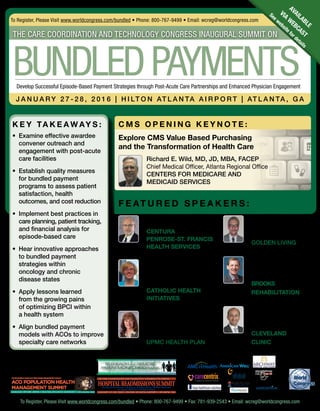
c m s o p e n i n g k e y n o t e :
f e at u r e d s p e a k e r s :
Explore CMS Value Based Purchasing
and the Transformation of Health Care
	Scott Campbell, EdD
BPCI-CHF Project Lead
Centura
Penrose-St. Francis
Health Services
	Tamara Cull,
DHA, MSW, LCSW, ACM
National Director, Population
Health Account Management
Catholic Health
Initiatives
	Sandra McAnallen
Senior Vice President,
Clinical Affairs and
Quality Performance
UPMC Health Plan
	 John P. Perticone
Vice President,
Strategic Partnerships
Golden Living
	Michael Spigel, PT, MHA
President and
Chief Operating Officer
Brooks
Rehabilitation
	Nirav Vakharia, MD
Associate Chief
Quality Officer
Cleveland
Clinic
To Register, Please Visit www.worldcongress.com/bundled • Phone: 800-767-9499 • Fax: 781-939-2543 • Email: wcreg@worldcongress.com
Organized by:
C o - l o c at e d w i t h :
J a n u a r y 2 7 - 2 8 , 2 0 1 6 • H i l t o n A t l a n t a A i r p o r t • A t l a n t a , G A
ACO Population Health
Management Summit
The Care Coordination and Technology Congress 2nd Annual
The Care Coordination and Technology Congress inaugural summit on
To Register, Please Visit www.worldcongress.com/bundled • Phone: 800-767-9499 • Email: wcreg@worldcongress.com
	 Richard E. Wild, MD, JD, MBA, FACEP
Chief Medical Officer, Atlanta Regional Office
Centers for Medicare and
Medicaid Services
telehealthand Remote
patientmonitoringsummit
telehealthand Remote
patientmonitoringsummit
The Care Coordination and Technology Congress 4th AnnualThe Care Coordination and Technology Congress 4th Annual
D e v e l o p i n g S u c c e ss f u l S t r a t e g i e s f o r i m p l e m e n t i n g
a n d s u s t a i n i n g a R e m o t e M o n i t o r i n g P r o g r a m
J a n u a r y 2 7 - 2 8 , 2 0 1 6 • H i l t o n A t l a n t a A i r p o r t • a t l a n t a , g a
Available
via
w
ebcast
See website for details
Develop Successful Episode-Based Payment Strategies through Post-Acute Care Partnerships and Enhanced Physician Engagement
J a n u a r y 2 7 - 2 8 , 2 0 1 6 | H i lt o n At l a n ta A i rp o r t | At l a n ta , G A
bundledpayments
•	 Examine effective awardee
convener outreach and
engagement with post-acute
care facilities
•	 Establish quality measures
for bundled payment
programs to assess patient
satisfaction, health
outcomes, and cost reduction
•	 Implement best practices in
care planning, patient tracking,
and financial analysis for
episode-based care
•	 Hear innovative approaches
to bundled payment
strategies within
oncology and chronic
disease states
•	 Apply lessons learned
from the growing pains
of optimizing BPCI within
a health system
•	 Align bundled payment
models with ACOs to improve
specialty care networks
k e y ta k e a w ay s :
HospitalReadmissionssummit
T h e C a r e C o o r d i n at i o n a n d T e c h n o l o g y C o n g r e s s 7 t h A n n u a l
Identify At-Risk Patients and Engage Providers Across the Care Continuum
to Improve Outcomes and Reduce Costs
J a n u a r y 2 7 - 2 8 , 2 0 1 6 • H i l t o n At l a n t a A i r p o r t • At l a n t a , GA
Educational Underwriters:
mpahealthcaresolutions
Who Should Attend
From Health Systems, Hospitals,
and Skilled Nursing Facilities:
•	 Chief Medical Officer
•	 Chief Operating Officer
•	 Chief Financial Officer
•	 Chief Information Officer
•	 Chief Administrative Officer
•	 Chief Nursing Officer
•	 Chief Executive Officer
•	 Vice Presidents and Directors of:
–	Innovation
–	Strategy
–	Surgery
–	 Case Management
–	 Purchasing
–	 Bundled Payments
–	Managed Care
From Health Plans:
•	 Vice Presidents and Directors of:
–	 Bundled Payments
–	 Payment Innovation
–	Reimbursement
–	 Population Health
This Summit Also Benefits:
•	 Episode-Based Care Solutions Providers
•	Data Analytics Companies
Dear Colleague,
The future is here. CMS has made it abundantly clear that it intends to accelerate the transition from volume-based to
value-based payments over a very short time horizon, with 50% of all Medicare payments made in alternative payments
methodologies by 2018. And, if CMS’ Comprehensive Care for Joint Replacement (CCJR) proposal moves ahead as
planned, the future for some of us will arrive even sooner – January 1, 2016.
The CCJR is only one program moving us all toward value-based care. Along with the existing Bundled Payments for
Care Improvement (BPCI) Initiative, reimbursement for outcomes and costs across episodes of care is taking center
stage. While CMS leads the charge forward with the proposed CCJR and the existing BPCI Initiative, interest in
value-based reimbursement is growing among physicians, health systems, commercial payers, and employers seeking
a means to improve care coordination, reduce waste, eliminate clinical variation, and manage costs.
How prepared are you to work in this new world?
Building, implementing, and managing a bundle payment program is complicated and challenging on many levels.
The rewards, however, can be significant, both for providers and for patients. As interest in bundled payments grows
among government and commercial payers, it is increasingly evident that this evolving payment system is gaining real
traction and providers across the health care industry need to be sure they are ready for this comprehensive approach
to value-based payments.
The World Congress Summit on Bundled Payments brings together executives from across the health care industry
to discuss best practices in building and implementing bundled payment models. Major themes include:
•	 Building mutually beneficial partnerships with various stakeholders including post-acute care facilities,
commercial payers, and employers
•	Developing approaches to physician engagement to improve provider buy-in and increase program success
•	Implementing complex gainsharing models to incentivize providers
•	Modeling innovative approaches to bundled payments with case studies from oncology and congestive heart failure
•	 Evaluating results from episode-based care to determine how this approach improves patient satisfaction and
outcomes, impacts the way the patient sees the providers and payers, minimizes wasteful health care practices,
and reduces costs of care
This timely and important conference helps you stay competitive and agile in a rapidly changing and challenging
health care world. I look forward to seeing you January 27-28 in Atlanta as we share best practices in episode-based care.
Sincerely,
Jan Vest
	 Jan Vest
Chief Executive Officer
Signature Medical Group
Chairperson, Bundled Payments Summit
bundledpayments
The Care Coordination and Technology Congress inaugural summit on
To Register, Please Visit www.worldcongress.com/bundled • Phone: 800-767-9499 • Fax: 781-939-2543 • Email: wcreg@worldcongress.com
C O N S I D E R A S P O N S O R S H I P P A C K A G E
• Present to Key Players in Your Target Market • Take Advantage of 1-on-1 Sponsor/Attendee Meetings Facilitated On-Site
To inquire about Sponsorship, Exhibit, Branding, and Executive Networking Opportunities, Contact:
Suzanne Carroll, Business Development Manager ,World Congress
Phone 781-939-2648 • Email Suzanne.Carroll@worldcongress.com
D ay O n e — W e d n e s d ay, J a n u a ry 2 7 , 2 0 1 6
8:00 am –
8:30 am Workshop Registration and coffee
8:30 am –
11:45 am
The
Workshops
are not part
of the live
or archived
webcast
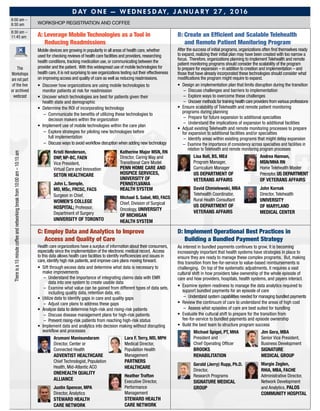
A: Leverage Mobile Technologies as a Tool in
Reducing Readmissions
Mobile devices are growing in popularity in all areas of health care,whether
used for checking reviews of health care facilities and providers,researching
health conditions,tracking medication use,or communicating between the
provider and the patient. With this widespread use of mobile technologies for
health care,it is not surprising to see organizations testing out their effectiveness
on improving access and quality of care as well as reducing readmissions.
•	Discover how organizations are using mobile technologies to
monitor patients at risk for readmission
•	Uncover which technologies are best for patients given their
health state and demographic
•	Determine the ROI of incorporating technology
–	 Communicate the benefits of utilizing these technologies to
decision makers within the organization
•	Implement use of mobile technologies within the care plan
–	 Explore strategies for piloting new technologies before
full implementation
–	Discuss ways to avoid workflow disruption when adding new technology
	 Kristi Henderson,
DNP, NP-BC, FAEN
Vice President,
Virtual Care and Innovation
Seton Healthcare
	 John L. Semple,
MD, MSc, FRCSC, FACS
Surgeon in Chief,
Women’s College
Hospital; Professor,
Department of Surgery
University of Toronto
	 Katherine Major MSN, RN
Director, Caring Way and
Transitional Care Model
Penn Home Care and
Hospice Services,
University of
Pennsylvania
Health System
	 Michael S. Sabel, MD, FACS
Chief, Division of Surgical
Oncology, University
of Michigan
Health System
B: Create an Efficient and Scalable Telehealth
and Remote Patient Monitoring Program
After the success of initial programs, organizations often find themselves ready
to expand, realizing their initial plan may have been created with too narrow a
focus. Therefore, organizations planning to implement Telehealth and remote
patient monitoring programs should consider the scalability of the program
to prepare for expansion – in addition to creation and implementation – and
those that have already incorporated these technologies should consider what
modifications the program might require to expand.
•	Design an implementation plan that limits disruption during the transition
–	Discuss challenges and barriers to implementation
–	 Explore ways to overcome these challenges
–	Uncover methods for training health care providers from various professions
•	 Ensure scalability of Telehealth and remote patient monitoring
programs during planning
–	 Prepare for future expansion to additional specialties
–	Understand the implications of expansion to additional facilities
•	Adjust existing Telehealth and remote monitoring processes to prepare
for expansion to additional facilities and/or specialties
–	Identify areas within existing programs that might delay expansion
–	 Examine the importance of consistency across specialties and facilities in
relation to Telehealth and remote monitoring program processes
	Lisa Bell, BS, MEd
Program Manager,
Curriculum Manager
US Department of
Veterans Affairs
	David Chmielewski, MBA
Telehealth Coordinator,
Rural Health Consultant
US Department of
Veterans Affairs
	 Andrea Hannan,
MSN/MHA RN
Home Telehealth Master
Preceptor,US Department
of Veterans Affairs
	 John Kornak
Director, Telehealth
University
of Maryland
Medical Center
C: Employ Data and Analytics to Improve
Access and Quality of Care
Health care organizations have a surplus of information about their consumers,
especially since the implementation of the electronic medical record. Access
to this data allows health care facilities to identify inefficiencies and issues in
care, identify high risk patients, and improve care plans moving forward.
•	Sift through excess data and determine what data is necessary to
make improvements
–	Understand the importance of integrating claims data with EMR
data into one system to create usable data
–	 Examine what value can be gained from different types of data sets,
including quality data, retention data, etc.
•	Utilize data to identify gaps in care and quality gaps
–	Adjust care plans to address these gaps
•	Analyze data to determine high-risk and rising-risk patients
–	Discuss disease management plans for high-risk patients
–	 Prevent rising-risk patients from reaching high-risk status
•	Implement data and analytics into decision making without disrupting
workflow and processes
	 Arumani Manisundaram
Director, Center or
Connected Health
Adventist HealthCare
Chief Technologist, Population
Health, Mid-Atlantic ACO
OneHealth Quality
Alliance
	 Justin Spencer, MPA
Director, Analytics
Steward Health
Care Network
	 Lara F. Terry, MD, MPH
Medical Director,
Population Health
Management
Partners
Healthcare
	 Heather Trafton
Executive Director,
Performance
Management
Steward Health
Care Network
D: Implement Operational Best Practices in
Building a Bundled Payment Strategy
As interest in bundled payments continues to grow, it is becoming
increasingly important that health systems have strategies in place to
ensure they are ready to manage these complex programs. But, making
this transition from fee-for-service to value-based reimbursements is
challenging. On top of the systematic adjustments, it requires a vast
cultural shift in how providers take ownership of the whole episode of
care and how providers, hospitals, health systems, and payers interact.
•	 Examine system readiness to manage the data analytics required to
support bundled payments for an episode of care
–	Understand system capabilities needed for managing bundled payments
•	Review the continuum of care to understand the areas of high cost
–	Assess what episodes of care are best suited for bundling
•	 Evaluate the cultural shift to prepare for the transition from
fee-for-service to bundled payments and episode ownership
•	 Build the best team to structure program success
	 Michael Spigel, PT, MHA
President and
Chief Operating Officer
Brooks
Rehabilitation
	 Gerald (Jerry) Rupp, Ph.D.
Director,
Research Programs
Signature Medical
Group
	 Jim Gera, MBA
Senior Vice President,
Business Development
Signature
Medical Group
	 Margie Zeglen,
RHIA, MBA, FACHE
Administrative Director,
Network Development
and Analytics, Palos
Community Hospital
Thereisa15minutecoffeeandnetworkingbreakfrom10:00am–10:15am
D ay O n e — M a i n S u mm i t — W e d n e s d ay, J a n u a ry 2 7 , 2 0 1 6
11:45 am –
1:00 pm Lunch on Your Own/Main Summit Registration
S H ARE D SESSI O NS W IT H C O - L O C ATE D SU M M ITS
1:00 pm –
1:15 pm Chairperson’s Welcome and Opening Remarks				
	David Renfro, MS, RN, NE-BC, VHA-CM
Chief Nurse, Specialty and Hospital Based Services
VA Palo Alto Health System
1:15 pm –
2:15 pm
Shared
Session
CMS Opening Keynote: Explore CMS Value Based Purchasing and the Transformation of Health Care	
The health care industry is constantly changing and the Centers for Medicare and Medicaid Services is at the forefront of this evolution.
Hear what CMS sees for the future of the industry and what it will take to get there.
•	Discuss the move to value based care, the timing of the shift, and what it means for hospitals
•	 Examine the recent ACO guidelines and understand how they impact the use and structure of the model
•	Uncover the future outlook of the health care industry and prepare for the short-term and long-term changes
	 Richard E. Wild, MD, JD, MBA, FACEP
Chief Medical Officer, Atlanta Regional Office
Centers for Medicare and Medicaid Services (CMS)
2:15 pm –
3:00 pm
Shared
Session
Keynote: Utilize Technology to Reduce Hospital Readmissions
Telehealth and remote patient monitoring technologies can improve efficiency, access, and quality of care and recently are proving successful in
reducing readmissions.
•	 Examine the various ways Telehealth and remote monitoring technology are used for patients at risk for readmissions
•	Uncover the reduction in readmission rates as a result of implementing technology in the care plan
•	Determine which technologies best complement existing programs aimed at reducing readmissions
	 Andrea Fenner-Koepp
Director, Health Services
Geisinger Health Plan
	 Jonathan Leviss, MD, FACP
Chief Medical Officer
AMC Health
	 Nirav Vakharia, MD
Associate Chief Quality Officer
Cleveland Clinic
3:00 pm –
3:45 pm Networking and Refreshment Break
B u n dl e d Pay m e n t s S u mm i t
3:45 pm –
4:00 pm Chair Person’s Welcome and Opening Remarks
	 Jan Vest
Chief Executive Officer
Signature Medical Group
4:00 pm –
4:40 pm Engage Providers to Increase Support for Episode-Based Payment Models
Engaging providers is vital to the success of episode-based care. Here, providers and payers can collaborate to build true partnerships and establish best
practices in care re-design. As providers become more comfortable in episode ownership and taking on risk, together payers and providers can begin
the transition to prospective models. But first, full provider engagement is required. In this session, hear how health systems and payers work with their
providers to change the culture of care, build effective protocols, and optimize engagement.
•	Review common challenges in gaining provider support for bundled payments
•	 Collaborate with providers to build care models
•	Identify physician champions within your system
•	Implement training and engagement programs to improve provider buy-in
•	Align incentives and discuss how to approach these with your providers
	Sandra McAnallen
Senior Vice President, Clinical Affairs and Quality Performance
UPMC Health Plan
To Register, Please Visit www.worldcongress.com/bundled • Phone: 800-767-9499 • Fax: 781-939-2543 • Email: wcreg@worldcongress.comTo Register, Please Visit www.worldcongress.com/bundled • Phone: 800-767-9499 • Fax: 781-939-2543 • Email: wcreg@worldcongress.com
Use Promo Code “Brochure” when registering for an additional $100 Savings
To Register, Please Visit www.worldcongress.com/bundled • Phone: 800-767-9499 • Fax: 781-939-2543 • Email: wcreg@worldcongress.comTo Register, Please Visit www.worldcongress.com/bundled • Phone: 800-767-9499 • Fax: 781-939-2543 • Email: wcreg@worldcongress.com
D ay O n e — W e d n e s d ay, J a n u a ry 2 7 , 2 0 1 6 ( c o n t i n u e d )
4:40 pm –
5:20 pm Create Sustainable Value-Based Reimbursement Programs
As organizations continue to move toward value-based reimbursement programs, bundled reimbursement models stand out as an opportunity to
achieve value for all constituents including payers, providers, and consumers. But while many organizations are just now launching bundled methods, it
is important that they design their programs for sustainability. In this session, address the long-term viability of bundled programs for improved quality,
more efficient care, and economics that share value across providers, payers, and consumers.
•	 Explore the reasons behind why bundled strategies fail to create sustainable models
•	Learn about aligning provider economics through operational transparency
•	Understand the patient’s role in achieving value for providers and payers
	 John W. Adams Jr.
President and Chief Executive Officer
Global Healthcare Alliance, Inc.
5:20 pm –
6:20 pm Cocktail and Networking Reception
D AY T WO – Th u r s d ay, J a n u a ry 2 8 , 2 0 1 6
7:30 am –
8:00 am Morning Coffee hosted by:
B u n dl e d Pay m e n t s S u mm i t
8:00 am –
8:05 am Chairperson’s Welcome and Review of Day One				
	 Jan Vest
Chief Executive Officer
Signature Medical Group
8:05 am –
8:45 am BPCI Case Study: Improve Patient Satisfaction and Reduce Readmissions with Episode-Base Payment Models
Making the BPCI work in a health system takes time and investment. But this pilot program has shown significant promise as more organizations
are voluntarily taking on risk. While many are talking about bundled payments, the number of organizations with first-hand experience in managing
successful models is relatively low. In this session, hear how Catholic Health Initiatives (CHI) implemented BPCI and is achieving positive outcomes in this
value-based model.
•	Discuss the CHI population health strategy that includes a focus on Clinically Integrated Networks (CINs) and providing care management across the
care continuum
•	Understand the change management components required and how organizations must adapt to succeed in episode-based payment models
•	Hear how CHI reduced readmissions by 46% in their first year of the BPCI Program
	Tamara Cull, DHA, MSW, LCSW, ACM
National Director, Population Health Account Management
Catholic Health Initiatives
8:45 am –
9:25 am Examine Best Practices in Contracting with Private Payers around Bundled Payment Models
A great deal of the discussion about bundled payments to date is centered on CMS’s BPCI pilot and proposed CCJR that will impact traditional Medicare
enrollees. However, private payers are not waiting for the results of CMS efforts to roll out their own bundled payment contracts. In this session, hear
what private payers look for when making bundled payment contracts and discuss best practices in partnering with payers to improve clinical outcomes
and reduce the cost of care for Medicare Advantage, Managed Medicaid, and commercially insured members.
•	 Understand how private payers’ interests in episode-based payment models differ from those of CMS
•	 Discuss strategies for building partnerships with private payers around bundled payment models that build upon current delivery models such as
PCMH and ACOs
•	 Understand what data analyses health systems need to have completed in order to negotiate bundled payment contracts with private payers
•	 Hear what data requests health systems should seek from payers that will support ongoing analysis and inform care redesign to ensure long-term
partnerships across the continuum of care
	 Susan Nedza, MD, MBA
Senior Vice President of Clinical Outcomes Management, MPA Healthcare Solutions
Former Chief Medical Officer at the Centers for Medicare and Medicaid Services (CMS)
C o - l o c at e d w i t h :
J a n u a r y 2 7 - 2 8 , 2 0 1 6 • H i l t o n A t l a n t a A i r p o r t • A t l a n t a , G A
ACO Population Health
Management Summit
The Care Coordination and Technology Congress 2nd Annual
telehealthand Remote
patientmonitoringsummit
telehealthand Remote
patientmonitoringsummit
The Care Coordination and Technology Congress 4th AnnualThe Care Coordination and Technology Congress 4th Annual
D e v e l o p i n g S u c c e ss f u l S t r a t e g i e s f o r i m p l e m e n t i n g
a n d s u s t a i n i n g a R e m o t e M o n i t o r i n g P r o g r a m
J a n u a r y 2 7 - 2 8 , 2 0 1 6 • H i l t o n A t l a n t a A i r p o r t • a t l a n t a , g a
HospitalReadmissionssummit
T h e C a r e C o o r d i n at i o n a n d T e c h n o l o g y C o n g r e s s 7 t h A n n u a l
Identify At-Risk Patients and Engage Providers Across the Care Continuum
to Improve Outcomes and Reduce Costs
J a n u a r y 2 7 - 2 8 , 2 0 1 6 • H i l t o n At l a n t a A i r p o r t • At l a n t a , GA
To Register, Please Visit www.worldcongress.com/bundled • Phone: 800-767-9499 • Fax: 781-939-2543 • Email: wcreg@worldcongress.comTo Register, Please Visit www.worldcongress.com/bundled • Phone: 800-767-9499 • Fax: 781-939-2543 • Email: wcreg@worldcongress.com
D AY T WO – Th u r s d ay, J a n u a ry 2 8 , 2 0 1 6 ( c o n t i n u e d )
9:25 am –
10:05 am Implement Best Practices in Care Planning, Patient Tracking, and Financial Analysis for Episode-Based Care
Conveners and Episode Initiators participating in the Bundled Payment Models must be able to track patient progress along the continuum of care.
This process involves four basic steps – Identify, Assess, Care Plan, and Track. Providers who have implemented this process have access to a real time
health status dashboard that identifies which patients are on track and which patients need attention.
•	Discuss ways to address the four main questions providers need to answer about the patients they’re caring for, and taking risk for, within a
bundled episode of care:
–	 Where is my patient today?		
– Are they on track with their care plan?
–	Are they on budget?			
– Do we need to intervene?
•	Hear how this approach leads to significant reductions in SNF stays and fewer hospital readmissions
•	Identify cost effective strategies for managing data analysis and creating care coordination teams
	 David P. Terry
Founder and Chief Executive Officer
Archway Health Advisors
10:05 am –
10:35 am Networking and Refreshment Break
10:35 am –
11:15 am Build Partnerships with Post-Acute Care Facilities to Coordinate Care and Manage Care Costs
A significant portion of Medicare costs within a bundling program model 2 and model 3 of BPCI come from outside of the hospital walls. In order for
awardee conveners, hospitals, and other risk takers to be successful, they must carefully consider their post-acute strategy. This can be complicated
given that some of these post-acute care settings are outside the health system’s ownership and collaboration requires extensive effort.
•	 Examine effective awardee convener outreach and engagement with post-acute care facilities including SNFs and Home Health
–	Determine the role of Nurse Navigators
–	 Establish effective communication and governance structure
•	Implement best practices to establish narrow networks of post-acute programs
–	Develop scorecards and profiles of relevant criteria			
–	Understand patient choice and beneficiary experience of care
•	Recognize challenges in post-acute care partnership development including substitution of alternative lower cost settings for higher cost settings, high
acuity patients, use of traditional Medicare clinical guidelines, and working with patients with behavioral and psychiatric conditions
	 John P. Perticone
Vice President, Strategic Partnerships
Golden Living
11:15 am –
11:55 am Establish Quality Measures to Evaluate Outcomes in Episode-Based Care
Care programs that are rooted in cost reduction often face a notable level of skepticism on the part of the provider. In order to improve provider buy-in,
systems must be able to demonstrate how bundles will improve overall outcomes for their patients.
•	 Examine how bundled payments programs engage patients in their care	
• Evaluate quality measurements to capture outcomes
•	Improve care coordination and post-acute care transition		
• Hear how bundles reduce unnecessary testing and relieve patient burden
	Carmen Alexander
Director, Bundled Payment Program
Health Choice Arizona, INC.
	 Denise A. McGinley, MSNAd, RN
Director, Center for Orthopaedic Innovation
St. Luke’s Medical Center
To Register, Please Visit www.worldcongress.com/bundled • Phone: 800-767-9499 • Fax: 781-939-2543 • Email: wcreg@worldcongress.comTo Register, Please Visit www.worldcongress.com/bundled • Phone: 800-767-9499 • Fax: 781-939-2543 • Email: wcreg@worldcongress.com
D AY T WO – Th u r s d ay, J a n u a ry 2 8 , 2 0 1 6 ( c o n t i n u e d )
11:55 am –
12:35 pm Oncology Case Study: Improve Patient Satisfaction, Ease Administrative Billing Burdens, and Reduce
Care Costs with Radiation Oncology Bundled Payment Programs
In 2012, 21st Century Oncology launched its bundled payment program in collaboration with commercial payer partners. Hear how it leveraged bundled
payment programs to increase patient and provider satisfaction, improve patients’ perceptions of its health plan, mitigate complex billing challenges, and
reduce overall costs of care.
•	Define episodes of care for payers			
• Establish benchmarks for evaluating episode-based payment models
•	Streamline the claims management process		
• Reduce the burden of the pre-authorization process
•	 Engage providers in the re-design of care
•	 Examine how patient satisfaction with providers and payers changed pre- and post-implementation of the bundled payment program
•	Understand how episode-based care models impact the revenue cycle
	Constantine Mantz, MD
Chief Medical Officer
21st Century Oncology, Inc.
12:35 pm –
1:45 pm Luncheon
1:45 pm –
2:30 pm CHF Case Study:Address Challenges and Opportunities in Episode-Based Care for Chronic Disease States
Bundled Payment Models for Congestive Heart Failure offer a bridge into applying this reimbursement models to chronic conditions. Providers and
payers alike are beginning to take an increasing interest in the unique challenges of implementing episode-based care models for the chronic disease
states that comprise the vast majority of Medicare spend; however, building and implementing these programs is complex.
•	Discuss challenges in defining episodes of care
•	Review the continuum of care for CHF patients to understand the areas of high cost and how these differ from surgical and procedural bundled payment models
•	Identify opportunities to partner with SNFs, palliative care, and outpatient clinics
•	 Explore the unique challenges of post-acute care management for chronic disease state populations
•	Review how outcomes in the bundled program compare to the traditional fee-for-service
•	 Establish patient optimization criteria for assigning patients to a bundle and evaluating comorbidities
	Scott Campbell, EdD
BPCI-CHF Project Lead
Centura Penrose-St. Francis Health Services
2:30 pm –
3:15 pm
Implement Complex Gainsharing Models with Your Partners
Gainsharing in bundled payment models offers an opportunity to engage specialists by incentivize their involvement. But building the right gainsharing
model for your network and approaching that conversation with providers is complex. In this session, discuss how one organization built their
gainsharing model and lessons learned in implementation.
•	 Examine the upfront considerations in designing an effective gainsharing model
•	Understand the Waterfall Model for gainsharing and how to manage risk with your partners
•	Review the operational steps to successful implementation of gainsharing
•	Discuss the role of the governance council and their importance in overseeing gainsharing
	 Bob Ward
Director of Operations, Contract Management and Analytics
South Shore Physician Hospital Organization
3:15 pm –
4:00 pm
Customize EHR to Share Data and Support Bundled Care Models
Standardizing care for all patients with a specific diagnosis and tracking their care across a standardized bundle pathway is imperative in order to proactively identify
patients not meeting certain goals and identify variation from evidence-based practices.Electronic health records have various functionalities that can be brought
together to create a flexible and synergistic pathway from admission to discharge.Additionally,use of patient centric app can close the gap during transitions of care.
•	Describe the need and process of creating QI toolkit using existing Epic functionalities	
•	Integrate the QI toolkit into clinical workflow of providers at the point-of-care
•	Measure care processes and improve outcomes across different patient populations
•	Learn how patient centric app can complement EHR initiatives to optimize outcomes
•	Hear how Mount Sinai Health System utilizes bundled payment models to promote population health
	 Lindsay Jubelt, MD, MSc
Medical Director, Population Health
Mount Sinai Health System
	 Stacey Cohen, PT
Clinical Informaticist
Mount Sinai Health System
4:00 pm Close of Summit
From Hospitals and Health Systems:
·	 Chief Executive Officers
·	 Chief Financial Officers
·	 Chief Operating Officers
·	 Chief Medical Officers
·	 Chief Nursing Officers
·	Vice Presidents and Directors of:
	 – Admissions
	 – Care Management
	 – Utilization Management
	 – Continuum of Care
	 – Quality Management
	 – Patient Safety
·	Nurses
·	 Case Managers
This Summit Also Benefits:
·	Health plans
·	Data analytics companies
·	 Care coordination solution providers
·	 Population health management companies
w h o s h o u l d att e n d
Can’t travel to Atlanta?
Participate via live webcast
See www.worldcongress.com/readmissions
for details
C O N S I D E R A S P O N S O R S H I P P A C K A G E
• Present to Key Players in Your Target Market • Take Advantage of 1-on-1 Sponsor/Attendee Meetings Facilitated On-Site
To inquire about Sponsorship, Exhibit, Branding, and Executive Networking Opportunities, Contact:
Suzanne Carroll, Business Development Manager, World Congress • Phone 781-939-2648 • Email Suzanne.Carroll@worldcongress.com
To Register, Please Visit www.worldcongress.com/bundled • Phone: 800-767-9499 • Fax: 781-939-2543 • Email: wcreg@worldcongress.comTo Register, Please Visit www.worldcongress.com/bundled • Phone: 800-767-9499 • Fax: 781-939-2543 • Email: wcreg@worldcongress.com
Develop Successful Episode-Based Payment Strategies through Post-Acute Care Partnerships and Enhanced Physician Engagement
J a n u a r y 2 7 - 2 8 , 2 0 1 6 | H i lt o n At l a n ta A i rp o r t | At l a n ta , G A
bundledpayments
The Care Coordination and Technology Congress inaugural summit on
Educational
underwriters
mpahealthcaresolutions
Exhibitors
PRSRT STD
U.S. Postage
PAID
Gallery
World Congress
500 West Cummings Park, Suite 5200
Woburn, MA 01801
HL16004
Venue:
Hilton Atlanta Airport
1031 Virginia Ave.
Atlanta, GA 30354
P: 404-767-9000
Room Rate: $149
Cut-off date: 1/8/16
Register Now!
WEBSITE
WorldCongress.com/
Bundled
E-MAIL
wcreg@
worldcongress.com
PHONE
800-767-9499
781-939-2400 outside the U.S.
Follow us on Twitter:
@wrldhealthcare
Please visit the conference website for
information to receive this special rate.
Registration Fee: Register By
10/30/2015
Register By
12/18/2015
Register By
1/27/2016Standard
Conference $ 1695.00 $ 1995.00 $ 2295.00
Conference + 1 Workshop $ 1895.00 $ 2195.00 $ 2495.00
Workshop Only $ 500.00
hospitals  health systems
Conference $ 595.00 $ 895.00 $ 1195.00
Conference + 1 Workshop $ 795.00 $ 1095.00 $ 1395.00
Workshop Only $ 500.00
health plans
Conference $ 995.00 $ 1295.00 $ 1595.00
Conference + 1 Workshop $ 1195.00 $ 1495.00 $ 1795.00
Workshop Only $ 500.00
webcast
Main Conference Only $ 995.00
Webcast + Flash Drive $ 1094.00
Webcast Archive on Flash
Drive (Main Conference Only) $ 995.00
Fee for conference includes welcome coffee, reception, refreshments, and web-
based conference documentation available pre- and post-event, accessible through
password-protected website. Checks in U.S. funds drawn from U.S. bank payable to:
WC Research Inc. No personal checks accepted. Verification may be required for rate
approvals. Please contact us should you have any special needs.
SPECIAL TEAM DISCOUNTS: Your organization may send
ONE executive FREE for every three delegates registered.
All registrations must be made at the same time to qualify.
To register your team, contact us at 800-767-9499.
Participant Substitution and Cancellations: Your registration may
be transferred to a member of your organization up to 24 hours in advance of the
conference. Cancellations received in writing on or before 30 days prior to the start
of the event will be refunded, less a $395 administrative charge. No refunds will
be made after this date; however, the registration fee less the $395 administrative
charge can be credited to another World Congress conference if you register within
6 months from the date of this conference. In case of conference cancellation,
World Congress’ liability is limited to refund of the conference registration fee only.
World Congress reserves the right to alter this program without prior notice.
Satisfaction guaranteed: World Congress stands behind the quality of its
conferences. If you are not satisfied with the quality of the conference, a credit will
be awarded towards a comparable World Congress conference of your choice.
Best Value
f e at u r e d c a s e s t u d i e s :
Oncology Case Study: Improve Patient
Satisfaction and Reduce Costs with Bundled
Payment Programs
•	 Establish benchmarks for evaluating episode-based care models
•	Streamline the claims management process
•	Reduce the burden of the pre-authorization process
•	 Engage providers in the re-design of care
•	 Examine how patient satisfaction with providers and payers changed
pre- and post-implementation of the bundled payment program
•	Understand how episode-based care models impact the revenue cycle
	Constantine Mantz
Chief Medical Officer
21st Century Oncology, Inc.
CHF Case Study: Address Challenges and Opportunities
in Episode-Based Care for Chronic Disease States
•	Discuss challenges in defining episodes of care
•	Review the continuum of care for CHF patients to understand the areas of high
cost and how these differ from traditional bundled payment models
•	Identify opportunities to partner with SNFs, palliative care, and outpatient clinics
•	 Explore the unique challenges of post-acute care management for chronic disease
state populations
•	Review how outcomes in the bundled program compare to the traditional fee-for-service
•	 Establish patient optimization criteria for assigning patients to a bundle and
evaluating comorbidities
	Scott Campbell, EdD
BPCI-CHF Project Lead
Centura Penrose-St. Francis Health Services
Co-located with:
telehealth and Remote
patient monitoring summit
The Care Coordination and Technology Congress 4th AnnualThe Care Coordination and Technology Congress 4th Annual
D e v e l o p i n g S u c c e ss f u l S t r a t e g i e s f o r i m p l e m e n t i n g
a n d s u s t a i n i n g a R e m o t e M o n i t o r i n g P r o g r a m
J a n u a r y 2 7 - 2 8 , 2 0 1 6 • H i l t o n A t l a n t a A i r p o r t • a t l a n t a , g a
To Register, Please Visit www.worldcongress.com/bundled • Phone: 800-767-9499 • Fax: 781-939-2543 • Email: wcreg@worldcongress.com
J a n u a r y 2 7 - 2 8 , 2 0 1 6 • H i l t o n A t l a n t a A i r p o r t • A t l a n t a , G A
ACO Population Health
Management Summit
The Care Coordination and Technology Congress 2nd Annual
Develop Successful Episode-Based Payment Strategies through Post-Acute Care Partnerships and Enhanced Physician Engagement
J a n u a r y 2 7 - 2 8 , 2 0 1 6 | H i lt o n At l a n ta A i rp o r t | At l a n ta , G A
bundledpayments
The Care Coordination and Technology Congress inaugural summit on
Use Promo Code “Brochure” when registering for an additional $100 Savings
HospitalReadmissionssummit
T h e C a r e C o o r d i n at i o n a n d T e c h n o l o g y C o n g r e s s 7 t h A n n u a l
Identify At-Risk Patients and Engage Providers Across the Care Continuum
to Improve Outcomes and Reduce Costs
J a n u a r y 2 7 - 2 8 , 2 0 1 6 • H i l t o n At l a n t a A i r p o r t • At l a n t a , GA

HL16004_brochure

  • 1.
    c m so p e n i n g k e y n o t e : f e at u r e d s p e a k e r s : Explore CMS Value Based Purchasing and the Transformation of Health Care Scott Campbell, EdD BPCI-CHF Project Lead Centura Penrose-St. Francis Health Services Tamara Cull, DHA, MSW, LCSW, ACM National Director, Population Health Account Management Catholic Health Initiatives Sandra McAnallen Senior Vice President, Clinical Affairs and Quality Performance UPMC Health Plan John P. Perticone Vice President, Strategic Partnerships Golden Living Michael Spigel, PT, MHA President and Chief Operating Officer Brooks Rehabilitation Nirav Vakharia, MD Associate Chief Quality Officer Cleveland Clinic To Register, Please Visit www.worldcongress.com/bundled • Phone: 800-767-9499 • Fax: 781-939-2543 • Email: wcreg@worldcongress.com Organized by: C o - l o c at e d w i t h : J a n u a r y 2 7 - 2 8 , 2 0 1 6 • H i l t o n A t l a n t a A i r p o r t • A t l a n t a , G A ACO Population Health Management Summit The Care Coordination and Technology Congress 2nd Annual The Care Coordination and Technology Congress inaugural summit on To Register, Please Visit www.worldcongress.com/bundled • Phone: 800-767-9499 • Email: wcreg@worldcongress.com Richard E. Wild, MD, JD, MBA, FACEP Chief Medical Officer, Atlanta Regional Office Centers for Medicare and Medicaid Services telehealthand Remote patientmonitoringsummit telehealthand Remote patientmonitoringsummit The Care Coordination and Technology Congress 4th AnnualThe Care Coordination and Technology Congress 4th Annual D e v e l o p i n g S u c c e ss f u l S t r a t e g i e s f o r i m p l e m e n t i n g a n d s u s t a i n i n g a R e m o t e M o n i t o r i n g P r o g r a m J a n u a r y 2 7 - 2 8 , 2 0 1 6 • H i l t o n A t l a n t a A i r p o r t • a t l a n t a , g a Available via w ebcast See website for details Develop Successful Episode-Based Payment Strategies through Post-Acute Care Partnerships and Enhanced Physician Engagement J a n u a r y 2 7 - 2 8 , 2 0 1 6 | H i lt o n At l a n ta A i rp o r t | At l a n ta , G A bundledpayments • Examine effective awardee convener outreach and engagement with post-acute care facilities • Establish quality measures for bundled payment programs to assess patient satisfaction, health outcomes, and cost reduction • Implement best practices in care planning, patient tracking, and financial analysis for episode-based care • Hear innovative approaches to bundled payment strategies within oncology and chronic disease states • Apply lessons learned from the growing pains of optimizing BPCI within a health system • Align bundled payment models with ACOs to improve specialty care networks k e y ta k e a w ay s : HospitalReadmissionssummit T h e C a r e C o o r d i n at i o n a n d T e c h n o l o g y C o n g r e s s 7 t h A n n u a l Identify At-Risk Patients and Engage Providers Across the Care Continuum to Improve Outcomes and Reduce Costs J a n u a r y 2 7 - 2 8 , 2 0 1 6 • H i l t o n At l a n t a A i r p o r t • At l a n t a , GA Educational Underwriters: mpahealthcaresolutions
  • 2.
    Who Should Attend FromHealth Systems, Hospitals, and Skilled Nursing Facilities: • Chief Medical Officer • Chief Operating Officer • Chief Financial Officer • Chief Information Officer • Chief Administrative Officer • Chief Nursing Officer • Chief Executive Officer • Vice Presidents and Directors of: – Innovation – Strategy – Surgery – Case Management – Purchasing – Bundled Payments – Managed Care From Health Plans: • Vice Presidents and Directors of: – Bundled Payments – Payment Innovation – Reimbursement – Population Health This Summit Also Benefits: • Episode-Based Care Solutions Providers • Data Analytics Companies Dear Colleague, The future is here. CMS has made it abundantly clear that it intends to accelerate the transition from volume-based to value-based payments over a very short time horizon, with 50% of all Medicare payments made in alternative payments methodologies by 2018. And, if CMS’ Comprehensive Care for Joint Replacement (CCJR) proposal moves ahead as planned, the future for some of us will arrive even sooner – January 1, 2016. The CCJR is only one program moving us all toward value-based care. Along with the existing Bundled Payments for Care Improvement (BPCI) Initiative, reimbursement for outcomes and costs across episodes of care is taking center stage. While CMS leads the charge forward with the proposed CCJR and the existing BPCI Initiative, interest in value-based reimbursement is growing among physicians, health systems, commercial payers, and employers seeking a means to improve care coordination, reduce waste, eliminate clinical variation, and manage costs. How prepared are you to work in this new world? Building, implementing, and managing a bundle payment program is complicated and challenging on many levels. The rewards, however, can be significant, both for providers and for patients. As interest in bundled payments grows among government and commercial payers, it is increasingly evident that this evolving payment system is gaining real traction and providers across the health care industry need to be sure they are ready for this comprehensive approach to value-based payments. The World Congress Summit on Bundled Payments brings together executives from across the health care industry to discuss best practices in building and implementing bundled payment models. Major themes include: • Building mutually beneficial partnerships with various stakeholders including post-acute care facilities, commercial payers, and employers • Developing approaches to physician engagement to improve provider buy-in and increase program success • Implementing complex gainsharing models to incentivize providers • Modeling innovative approaches to bundled payments with case studies from oncology and congestive heart failure • Evaluating results from episode-based care to determine how this approach improves patient satisfaction and outcomes, impacts the way the patient sees the providers and payers, minimizes wasteful health care practices, and reduces costs of care This timely and important conference helps you stay competitive and agile in a rapidly changing and challenging health care world. I look forward to seeing you January 27-28 in Atlanta as we share best practices in episode-based care. Sincerely, Jan Vest Jan Vest Chief Executive Officer Signature Medical Group Chairperson, Bundled Payments Summit bundledpayments The Care Coordination and Technology Congress inaugural summit on To Register, Please Visit www.worldcongress.com/bundled • Phone: 800-767-9499 • Fax: 781-939-2543 • Email: wcreg@worldcongress.com C O N S I D E R A S P O N S O R S H I P P A C K A G E • Present to Key Players in Your Target Market • Take Advantage of 1-on-1 Sponsor/Attendee Meetings Facilitated On-Site To inquire about Sponsorship, Exhibit, Branding, and Executive Networking Opportunities, Contact: Suzanne Carroll, Business Development Manager ,World Congress Phone 781-939-2648 • Email Suzanne.Carroll@worldcongress.com
  • 3.
    D ay On e — W e d n e s d ay, J a n u a ry 2 7 , 2 0 1 6 8:00 am – 8:30 am Workshop Registration and coffee 8:30 am – 11:45 am The Workshops are not part of the live or archived webcast A: Leverage Mobile Technologies as a Tool in Reducing Readmissions Mobile devices are growing in popularity in all areas of health care,whether used for checking reviews of health care facilities and providers,researching health conditions,tracking medication use,or communicating between the provider and the patient. With this widespread use of mobile technologies for health care,it is not surprising to see organizations testing out their effectiveness on improving access and quality of care as well as reducing readmissions. • Discover how organizations are using mobile technologies to monitor patients at risk for readmission • Uncover which technologies are best for patients given their health state and demographic • Determine the ROI of incorporating technology – Communicate the benefits of utilizing these technologies to decision makers within the organization • Implement use of mobile technologies within the care plan – Explore strategies for piloting new technologies before full implementation – Discuss ways to avoid workflow disruption when adding new technology Kristi Henderson, DNP, NP-BC, FAEN Vice President, Virtual Care and Innovation Seton Healthcare John L. Semple, MD, MSc, FRCSC, FACS Surgeon in Chief, Women’s College Hospital; Professor, Department of Surgery University of Toronto Katherine Major MSN, RN Director, Caring Way and Transitional Care Model Penn Home Care and Hospice Services, University of Pennsylvania Health System Michael S. Sabel, MD, FACS Chief, Division of Surgical Oncology, University of Michigan Health System B: Create an Efficient and Scalable Telehealth and Remote Patient Monitoring Program After the success of initial programs, organizations often find themselves ready to expand, realizing their initial plan may have been created with too narrow a focus. Therefore, organizations planning to implement Telehealth and remote patient monitoring programs should consider the scalability of the program to prepare for expansion – in addition to creation and implementation – and those that have already incorporated these technologies should consider what modifications the program might require to expand. • Design an implementation plan that limits disruption during the transition – Discuss challenges and barriers to implementation – Explore ways to overcome these challenges – Uncover methods for training health care providers from various professions • Ensure scalability of Telehealth and remote patient monitoring programs during planning – Prepare for future expansion to additional specialties – Understand the implications of expansion to additional facilities • Adjust existing Telehealth and remote monitoring processes to prepare for expansion to additional facilities and/or specialties – Identify areas within existing programs that might delay expansion – Examine the importance of consistency across specialties and facilities in relation to Telehealth and remote monitoring program processes Lisa Bell, BS, MEd Program Manager, Curriculum Manager US Department of Veterans Affairs David Chmielewski, MBA Telehealth Coordinator, Rural Health Consultant US Department of Veterans Affairs Andrea Hannan, MSN/MHA RN Home Telehealth Master Preceptor,US Department of Veterans Affairs John Kornak Director, Telehealth University of Maryland Medical Center C: Employ Data and Analytics to Improve Access and Quality of Care Health care organizations have a surplus of information about their consumers, especially since the implementation of the electronic medical record. Access to this data allows health care facilities to identify inefficiencies and issues in care, identify high risk patients, and improve care plans moving forward. • Sift through excess data and determine what data is necessary to make improvements – Understand the importance of integrating claims data with EMR data into one system to create usable data – Examine what value can be gained from different types of data sets, including quality data, retention data, etc. • Utilize data to identify gaps in care and quality gaps – Adjust care plans to address these gaps • Analyze data to determine high-risk and rising-risk patients – Discuss disease management plans for high-risk patients – Prevent rising-risk patients from reaching high-risk status • Implement data and analytics into decision making without disrupting workflow and processes Arumani Manisundaram Director, Center or Connected Health Adventist HealthCare Chief Technologist, Population Health, Mid-Atlantic ACO OneHealth Quality Alliance Justin Spencer, MPA Director, Analytics Steward Health Care Network Lara F. Terry, MD, MPH Medical Director, Population Health Management Partners Healthcare Heather Trafton Executive Director, Performance Management Steward Health Care Network D: Implement Operational Best Practices in Building a Bundled Payment Strategy As interest in bundled payments continues to grow, it is becoming increasingly important that health systems have strategies in place to ensure they are ready to manage these complex programs. But, making this transition from fee-for-service to value-based reimbursements is challenging. On top of the systematic adjustments, it requires a vast cultural shift in how providers take ownership of the whole episode of care and how providers, hospitals, health systems, and payers interact. • Examine system readiness to manage the data analytics required to support bundled payments for an episode of care – Understand system capabilities needed for managing bundled payments • Review the continuum of care to understand the areas of high cost – Assess what episodes of care are best suited for bundling • Evaluate the cultural shift to prepare for the transition from fee-for-service to bundled payments and episode ownership • Build the best team to structure program success Michael Spigel, PT, MHA President and Chief Operating Officer Brooks Rehabilitation Gerald (Jerry) Rupp, Ph.D. Director, Research Programs Signature Medical Group Jim Gera, MBA Senior Vice President, Business Development Signature Medical Group Margie Zeglen, RHIA, MBA, FACHE Administrative Director, Network Development and Analytics, Palos Community Hospital Thereisa15minutecoffeeandnetworkingbreakfrom10:00am–10:15am
  • 4.
    D ay On e — M a i n S u mm i t — W e d n e s d ay, J a n u a ry 2 7 , 2 0 1 6 11:45 am – 1:00 pm Lunch on Your Own/Main Summit Registration S H ARE D SESSI O NS W IT H C O - L O C ATE D SU M M ITS 1:00 pm – 1:15 pm Chairperson’s Welcome and Opening Remarks David Renfro, MS, RN, NE-BC, VHA-CM Chief Nurse, Specialty and Hospital Based Services VA Palo Alto Health System 1:15 pm – 2:15 pm Shared Session CMS Opening Keynote: Explore CMS Value Based Purchasing and the Transformation of Health Care The health care industry is constantly changing and the Centers for Medicare and Medicaid Services is at the forefront of this evolution. Hear what CMS sees for the future of the industry and what it will take to get there. • Discuss the move to value based care, the timing of the shift, and what it means for hospitals • Examine the recent ACO guidelines and understand how they impact the use and structure of the model • Uncover the future outlook of the health care industry and prepare for the short-term and long-term changes Richard E. Wild, MD, JD, MBA, FACEP Chief Medical Officer, Atlanta Regional Office Centers for Medicare and Medicaid Services (CMS) 2:15 pm – 3:00 pm Shared Session Keynote: Utilize Technology to Reduce Hospital Readmissions Telehealth and remote patient monitoring technologies can improve efficiency, access, and quality of care and recently are proving successful in reducing readmissions. • Examine the various ways Telehealth and remote monitoring technology are used for patients at risk for readmissions • Uncover the reduction in readmission rates as a result of implementing technology in the care plan • Determine which technologies best complement existing programs aimed at reducing readmissions Andrea Fenner-Koepp Director, Health Services Geisinger Health Plan Jonathan Leviss, MD, FACP Chief Medical Officer AMC Health Nirav Vakharia, MD Associate Chief Quality Officer Cleveland Clinic 3:00 pm – 3:45 pm Networking and Refreshment Break B u n dl e d Pay m e n t s S u mm i t 3:45 pm – 4:00 pm Chair Person’s Welcome and Opening Remarks Jan Vest Chief Executive Officer Signature Medical Group 4:00 pm – 4:40 pm Engage Providers to Increase Support for Episode-Based Payment Models Engaging providers is vital to the success of episode-based care. Here, providers and payers can collaborate to build true partnerships and establish best practices in care re-design. As providers become more comfortable in episode ownership and taking on risk, together payers and providers can begin the transition to prospective models. But first, full provider engagement is required. In this session, hear how health systems and payers work with their providers to change the culture of care, build effective protocols, and optimize engagement. • Review common challenges in gaining provider support for bundled payments • Collaborate with providers to build care models • Identify physician champions within your system • Implement training and engagement programs to improve provider buy-in • Align incentives and discuss how to approach these with your providers Sandra McAnallen Senior Vice President, Clinical Affairs and Quality Performance UPMC Health Plan To Register, Please Visit www.worldcongress.com/bundled • Phone: 800-767-9499 • Fax: 781-939-2543 • Email: wcreg@worldcongress.comTo Register, Please Visit www.worldcongress.com/bundled • Phone: 800-767-9499 • Fax: 781-939-2543 • Email: wcreg@worldcongress.com Use Promo Code “Brochure” when registering for an additional $100 Savings
  • 5.
    To Register, PleaseVisit www.worldcongress.com/bundled • Phone: 800-767-9499 • Fax: 781-939-2543 • Email: wcreg@worldcongress.comTo Register, Please Visit www.worldcongress.com/bundled • Phone: 800-767-9499 • Fax: 781-939-2543 • Email: wcreg@worldcongress.com D ay O n e — W e d n e s d ay, J a n u a ry 2 7 , 2 0 1 6 ( c o n t i n u e d ) 4:40 pm – 5:20 pm Create Sustainable Value-Based Reimbursement Programs As organizations continue to move toward value-based reimbursement programs, bundled reimbursement models stand out as an opportunity to achieve value for all constituents including payers, providers, and consumers. But while many organizations are just now launching bundled methods, it is important that they design their programs for sustainability. In this session, address the long-term viability of bundled programs for improved quality, more efficient care, and economics that share value across providers, payers, and consumers. • Explore the reasons behind why bundled strategies fail to create sustainable models • Learn about aligning provider economics through operational transparency • Understand the patient’s role in achieving value for providers and payers John W. Adams Jr. President and Chief Executive Officer Global Healthcare Alliance, Inc. 5:20 pm – 6:20 pm Cocktail and Networking Reception D AY T WO – Th u r s d ay, J a n u a ry 2 8 , 2 0 1 6 7:30 am – 8:00 am Morning Coffee hosted by: B u n dl e d Pay m e n t s S u mm i t 8:00 am – 8:05 am Chairperson’s Welcome and Review of Day One Jan Vest Chief Executive Officer Signature Medical Group 8:05 am – 8:45 am BPCI Case Study: Improve Patient Satisfaction and Reduce Readmissions with Episode-Base Payment Models Making the BPCI work in a health system takes time and investment. But this pilot program has shown significant promise as more organizations are voluntarily taking on risk. While many are talking about bundled payments, the number of organizations with first-hand experience in managing successful models is relatively low. In this session, hear how Catholic Health Initiatives (CHI) implemented BPCI and is achieving positive outcomes in this value-based model. • Discuss the CHI population health strategy that includes a focus on Clinically Integrated Networks (CINs) and providing care management across the care continuum • Understand the change management components required and how organizations must adapt to succeed in episode-based payment models • Hear how CHI reduced readmissions by 46% in their first year of the BPCI Program Tamara Cull, DHA, MSW, LCSW, ACM National Director, Population Health Account Management Catholic Health Initiatives 8:45 am – 9:25 am Examine Best Practices in Contracting with Private Payers around Bundled Payment Models A great deal of the discussion about bundled payments to date is centered on CMS’s BPCI pilot and proposed CCJR that will impact traditional Medicare enrollees. However, private payers are not waiting for the results of CMS efforts to roll out their own bundled payment contracts. In this session, hear what private payers look for when making bundled payment contracts and discuss best practices in partnering with payers to improve clinical outcomes and reduce the cost of care for Medicare Advantage, Managed Medicaid, and commercially insured members. • Understand how private payers’ interests in episode-based payment models differ from those of CMS • Discuss strategies for building partnerships with private payers around bundled payment models that build upon current delivery models such as PCMH and ACOs • Understand what data analyses health systems need to have completed in order to negotiate bundled payment contracts with private payers • Hear what data requests health systems should seek from payers that will support ongoing analysis and inform care redesign to ensure long-term partnerships across the continuum of care Susan Nedza, MD, MBA Senior Vice President of Clinical Outcomes Management, MPA Healthcare Solutions Former Chief Medical Officer at the Centers for Medicare and Medicaid Services (CMS) C o - l o c at e d w i t h : J a n u a r y 2 7 - 2 8 , 2 0 1 6 • H i l t o n A t l a n t a A i r p o r t • A t l a n t a , G A ACO Population Health Management Summit The Care Coordination and Technology Congress 2nd Annual telehealthand Remote patientmonitoringsummit telehealthand Remote patientmonitoringsummit The Care Coordination and Technology Congress 4th AnnualThe Care Coordination and Technology Congress 4th Annual D e v e l o p i n g S u c c e ss f u l S t r a t e g i e s f o r i m p l e m e n t i n g a n d s u s t a i n i n g a R e m o t e M o n i t o r i n g P r o g r a m J a n u a r y 2 7 - 2 8 , 2 0 1 6 • H i l t o n A t l a n t a A i r p o r t • a t l a n t a , g a HospitalReadmissionssummit T h e C a r e C o o r d i n at i o n a n d T e c h n o l o g y C o n g r e s s 7 t h A n n u a l Identify At-Risk Patients and Engage Providers Across the Care Continuum to Improve Outcomes and Reduce Costs J a n u a r y 2 7 - 2 8 , 2 0 1 6 • H i l t o n At l a n t a A i r p o r t • At l a n t a , GA
  • 6.
    To Register, PleaseVisit www.worldcongress.com/bundled • Phone: 800-767-9499 • Fax: 781-939-2543 • Email: wcreg@worldcongress.comTo Register, Please Visit www.worldcongress.com/bundled • Phone: 800-767-9499 • Fax: 781-939-2543 • Email: wcreg@worldcongress.com D AY T WO – Th u r s d ay, J a n u a ry 2 8 , 2 0 1 6 ( c o n t i n u e d ) 9:25 am – 10:05 am Implement Best Practices in Care Planning, Patient Tracking, and Financial Analysis for Episode-Based Care Conveners and Episode Initiators participating in the Bundled Payment Models must be able to track patient progress along the continuum of care. This process involves four basic steps – Identify, Assess, Care Plan, and Track. Providers who have implemented this process have access to a real time health status dashboard that identifies which patients are on track and which patients need attention. • Discuss ways to address the four main questions providers need to answer about the patients they’re caring for, and taking risk for, within a bundled episode of care: – Where is my patient today? – Are they on track with their care plan? – Are they on budget? – Do we need to intervene? • Hear how this approach leads to significant reductions in SNF stays and fewer hospital readmissions • Identify cost effective strategies for managing data analysis and creating care coordination teams David P. Terry Founder and Chief Executive Officer Archway Health Advisors 10:05 am – 10:35 am Networking and Refreshment Break 10:35 am – 11:15 am Build Partnerships with Post-Acute Care Facilities to Coordinate Care and Manage Care Costs A significant portion of Medicare costs within a bundling program model 2 and model 3 of BPCI come from outside of the hospital walls. In order for awardee conveners, hospitals, and other risk takers to be successful, they must carefully consider their post-acute strategy. This can be complicated given that some of these post-acute care settings are outside the health system’s ownership and collaboration requires extensive effort. • Examine effective awardee convener outreach and engagement with post-acute care facilities including SNFs and Home Health – Determine the role of Nurse Navigators – Establish effective communication and governance structure • Implement best practices to establish narrow networks of post-acute programs – Develop scorecards and profiles of relevant criteria – Understand patient choice and beneficiary experience of care • Recognize challenges in post-acute care partnership development including substitution of alternative lower cost settings for higher cost settings, high acuity patients, use of traditional Medicare clinical guidelines, and working with patients with behavioral and psychiatric conditions John P. Perticone Vice President, Strategic Partnerships Golden Living 11:15 am – 11:55 am Establish Quality Measures to Evaluate Outcomes in Episode-Based Care Care programs that are rooted in cost reduction often face a notable level of skepticism on the part of the provider. In order to improve provider buy-in, systems must be able to demonstrate how bundles will improve overall outcomes for their patients. • Examine how bundled payments programs engage patients in their care • Evaluate quality measurements to capture outcomes • Improve care coordination and post-acute care transition • Hear how bundles reduce unnecessary testing and relieve patient burden Carmen Alexander Director, Bundled Payment Program Health Choice Arizona, INC. Denise A. McGinley, MSNAd, RN Director, Center for Orthopaedic Innovation St. Luke’s Medical Center
  • 7.
    To Register, PleaseVisit www.worldcongress.com/bundled • Phone: 800-767-9499 • Fax: 781-939-2543 • Email: wcreg@worldcongress.comTo Register, Please Visit www.worldcongress.com/bundled • Phone: 800-767-9499 • Fax: 781-939-2543 • Email: wcreg@worldcongress.com D AY T WO – Th u r s d ay, J a n u a ry 2 8 , 2 0 1 6 ( c o n t i n u e d ) 11:55 am – 12:35 pm Oncology Case Study: Improve Patient Satisfaction, Ease Administrative Billing Burdens, and Reduce Care Costs with Radiation Oncology Bundled Payment Programs In 2012, 21st Century Oncology launched its bundled payment program in collaboration with commercial payer partners. Hear how it leveraged bundled payment programs to increase patient and provider satisfaction, improve patients’ perceptions of its health plan, mitigate complex billing challenges, and reduce overall costs of care. • Define episodes of care for payers • Establish benchmarks for evaluating episode-based payment models • Streamline the claims management process • Reduce the burden of the pre-authorization process • Engage providers in the re-design of care • Examine how patient satisfaction with providers and payers changed pre- and post-implementation of the bundled payment program • Understand how episode-based care models impact the revenue cycle Constantine Mantz, MD Chief Medical Officer 21st Century Oncology, Inc. 12:35 pm – 1:45 pm Luncheon 1:45 pm – 2:30 pm CHF Case Study:Address Challenges and Opportunities in Episode-Based Care for Chronic Disease States Bundled Payment Models for Congestive Heart Failure offer a bridge into applying this reimbursement models to chronic conditions. Providers and payers alike are beginning to take an increasing interest in the unique challenges of implementing episode-based care models for the chronic disease states that comprise the vast majority of Medicare spend; however, building and implementing these programs is complex. • Discuss challenges in defining episodes of care • Review the continuum of care for CHF patients to understand the areas of high cost and how these differ from surgical and procedural bundled payment models • Identify opportunities to partner with SNFs, palliative care, and outpatient clinics • Explore the unique challenges of post-acute care management for chronic disease state populations • Review how outcomes in the bundled program compare to the traditional fee-for-service • Establish patient optimization criteria for assigning patients to a bundle and evaluating comorbidities Scott Campbell, EdD BPCI-CHF Project Lead Centura Penrose-St. Francis Health Services 2:30 pm – 3:15 pm Implement Complex Gainsharing Models with Your Partners Gainsharing in bundled payment models offers an opportunity to engage specialists by incentivize their involvement. But building the right gainsharing model for your network and approaching that conversation with providers is complex. In this session, discuss how one organization built their gainsharing model and lessons learned in implementation. • Examine the upfront considerations in designing an effective gainsharing model • Understand the Waterfall Model for gainsharing and how to manage risk with your partners • Review the operational steps to successful implementation of gainsharing • Discuss the role of the governance council and their importance in overseeing gainsharing Bob Ward Director of Operations, Contract Management and Analytics South Shore Physician Hospital Organization 3:15 pm – 4:00 pm Customize EHR to Share Data and Support Bundled Care Models Standardizing care for all patients with a specific diagnosis and tracking their care across a standardized bundle pathway is imperative in order to proactively identify patients not meeting certain goals and identify variation from evidence-based practices.Electronic health records have various functionalities that can be brought together to create a flexible and synergistic pathway from admission to discharge.Additionally,use of patient centric app can close the gap during transitions of care. • Describe the need and process of creating QI toolkit using existing Epic functionalities • Integrate the QI toolkit into clinical workflow of providers at the point-of-care • Measure care processes and improve outcomes across different patient populations • Learn how patient centric app can complement EHR initiatives to optimize outcomes • Hear how Mount Sinai Health System utilizes bundled payment models to promote population health Lindsay Jubelt, MD, MSc Medical Director, Population Health Mount Sinai Health System Stacey Cohen, PT Clinical Informaticist Mount Sinai Health System 4:00 pm Close of Summit
  • 8.
    From Hospitals andHealth Systems: · Chief Executive Officers · Chief Financial Officers · Chief Operating Officers · Chief Medical Officers · Chief Nursing Officers · Vice Presidents and Directors of: – Admissions – Care Management – Utilization Management – Continuum of Care – Quality Management – Patient Safety · Nurses · Case Managers This Summit Also Benefits: · Health plans · Data analytics companies · Care coordination solution providers · Population health management companies w h o s h o u l d att e n d Can’t travel to Atlanta? Participate via live webcast See www.worldcongress.com/readmissions for details C O N S I D E R A S P O N S O R S H I P P A C K A G E • Present to Key Players in Your Target Market • Take Advantage of 1-on-1 Sponsor/Attendee Meetings Facilitated On-Site To inquire about Sponsorship, Exhibit, Branding, and Executive Networking Opportunities, Contact: Suzanne Carroll, Business Development Manager, World Congress • Phone 781-939-2648 • Email Suzanne.Carroll@worldcongress.com To Register, Please Visit www.worldcongress.com/bundled • Phone: 800-767-9499 • Fax: 781-939-2543 • Email: wcreg@worldcongress.comTo Register, Please Visit www.worldcongress.com/bundled • Phone: 800-767-9499 • Fax: 781-939-2543 • Email: wcreg@worldcongress.com Develop Successful Episode-Based Payment Strategies through Post-Acute Care Partnerships and Enhanced Physician Engagement J a n u a r y 2 7 - 2 8 , 2 0 1 6 | H i lt o n At l a n ta A i rp o r t | At l a n ta , G A bundledpayments The Care Coordination and Technology Congress inaugural summit on Educational underwriters mpahealthcaresolutions Exhibitors
  • 9.
    PRSRT STD U.S. Postage PAID Gallery WorldCongress 500 West Cummings Park, Suite 5200 Woburn, MA 01801 HL16004 Venue: Hilton Atlanta Airport 1031 Virginia Ave. Atlanta, GA 30354 P: 404-767-9000 Room Rate: $149 Cut-off date: 1/8/16 Register Now! WEBSITE WorldCongress.com/ Bundled E-MAIL wcreg@ worldcongress.com PHONE 800-767-9499 781-939-2400 outside the U.S. Follow us on Twitter: @wrldhealthcare Please visit the conference website for information to receive this special rate. Registration Fee: Register By 10/30/2015 Register By 12/18/2015 Register By 1/27/2016Standard Conference $ 1695.00 $ 1995.00 $ 2295.00 Conference + 1 Workshop $ 1895.00 $ 2195.00 $ 2495.00 Workshop Only $ 500.00 hospitals health systems Conference $ 595.00 $ 895.00 $ 1195.00 Conference + 1 Workshop $ 795.00 $ 1095.00 $ 1395.00 Workshop Only $ 500.00 health plans Conference $ 995.00 $ 1295.00 $ 1595.00 Conference + 1 Workshop $ 1195.00 $ 1495.00 $ 1795.00 Workshop Only $ 500.00 webcast Main Conference Only $ 995.00 Webcast + Flash Drive $ 1094.00 Webcast Archive on Flash Drive (Main Conference Only) $ 995.00 Fee for conference includes welcome coffee, reception, refreshments, and web- based conference documentation available pre- and post-event, accessible through password-protected website. Checks in U.S. funds drawn from U.S. bank payable to: WC Research Inc. No personal checks accepted. Verification may be required for rate approvals. Please contact us should you have any special needs. SPECIAL TEAM DISCOUNTS: Your organization may send ONE executive FREE for every three delegates registered. All registrations must be made at the same time to qualify. To register your team, contact us at 800-767-9499. Participant Substitution and Cancellations: Your registration may be transferred to a member of your organization up to 24 hours in advance of the conference. Cancellations received in writing on or before 30 days prior to the start of the event will be refunded, less a $395 administrative charge. No refunds will be made after this date; however, the registration fee less the $395 administrative charge can be credited to another World Congress conference if you register within 6 months from the date of this conference. In case of conference cancellation, World Congress’ liability is limited to refund of the conference registration fee only. World Congress reserves the right to alter this program without prior notice. Satisfaction guaranteed: World Congress stands behind the quality of its conferences. If you are not satisfied with the quality of the conference, a credit will be awarded towards a comparable World Congress conference of your choice. Best Value f e at u r e d c a s e s t u d i e s : Oncology Case Study: Improve Patient Satisfaction and Reduce Costs with Bundled Payment Programs • Establish benchmarks for evaluating episode-based care models • Streamline the claims management process • Reduce the burden of the pre-authorization process • Engage providers in the re-design of care • Examine how patient satisfaction with providers and payers changed pre- and post-implementation of the bundled payment program • Understand how episode-based care models impact the revenue cycle Constantine Mantz Chief Medical Officer 21st Century Oncology, Inc. CHF Case Study: Address Challenges and Opportunities in Episode-Based Care for Chronic Disease States • Discuss challenges in defining episodes of care • Review the continuum of care for CHF patients to understand the areas of high cost and how these differ from traditional bundled payment models • Identify opportunities to partner with SNFs, palliative care, and outpatient clinics • Explore the unique challenges of post-acute care management for chronic disease state populations • Review how outcomes in the bundled program compare to the traditional fee-for-service • Establish patient optimization criteria for assigning patients to a bundle and evaluating comorbidities Scott Campbell, EdD BPCI-CHF Project Lead Centura Penrose-St. Francis Health Services Co-located with: telehealth and Remote patient monitoring summit The Care Coordination and Technology Congress 4th AnnualThe Care Coordination and Technology Congress 4th Annual D e v e l o p i n g S u c c e ss f u l S t r a t e g i e s f o r i m p l e m e n t i n g a n d s u s t a i n i n g a R e m o t e M o n i t o r i n g P r o g r a m J a n u a r y 2 7 - 2 8 , 2 0 1 6 • H i l t o n A t l a n t a A i r p o r t • a t l a n t a , g a To Register, Please Visit www.worldcongress.com/bundled • Phone: 800-767-9499 • Fax: 781-939-2543 • Email: wcreg@worldcongress.com J a n u a r y 2 7 - 2 8 , 2 0 1 6 • H i l t o n A t l a n t a A i r p o r t • A t l a n t a , G A ACO Population Health Management Summit The Care Coordination and Technology Congress 2nd Annual Develop Successful Episode-Based Payment Strategies through Post-Acute Care Partnerships and Enhanced Physician Engagement J a n u a r y 2 7 - 2 8 , 2 0 1 6 | H i lt o n At l a n ta A i rp o r t | At l a n ta , G A bundledpayments The Care Coordination and Technology Congress inaugural summit on Use Promo Code “Brochure” when registering for an additional $100 Savings HospitalReadmissionssummit T h e C a r e C o o r d i n at i o n a n d T e c h n o l o g y C o n g r e s s 7 t h A n n u a l Identify At-Risk Patients and Engage Providers Across the Care Continuum to Improve Outcomes and Reduce Costs J a n u a r y 2 7 - 2 8 , 2 0 1 6 • H i l t o n At l a n t a A i r p o r t • At l a n t a , GA