PrecedentThe Supreme Court (House of Lords)Miss Hart G1522010-11
Can you name these cases?Till death do us partZzzBrum. Thwack. Brum. Zzz. Oops. Worst plan ever to get out of a contract. Son… be a man… kill your mumHow much damage can a paper do? Surely that’s a wheely easy question!But don’t you love me? You laugh and I’ll rock your worldBaby vs WallCanary wins over TVVeg out?Howe’d you think we’d let you leave our gang?But you beat each other brown and blue! That’s not on.You’re a tool for killing him. Marriages break up, but the paper stays the same.Axeually, I can use it.Andrew! I love you, there’s no butt about it!
The Supreme CourtCan you remember the key rules?It is bound by its own previous decisions.The material facts of the case are sufficiently similarThe European Court of JusticeThe interpretation of European Union LawThe European Court of Human RightsHuman Rights under the Human Rights Act 1998All the courts below it.
What’s the problem?Well, essentially, what if the Supreme Court need to change their minds? They may have got the law wrong, or social standards may have changed.Should we be stuck with law which doesn’t work or we know to be ‘wrong’?Is certainty more important than injustice?
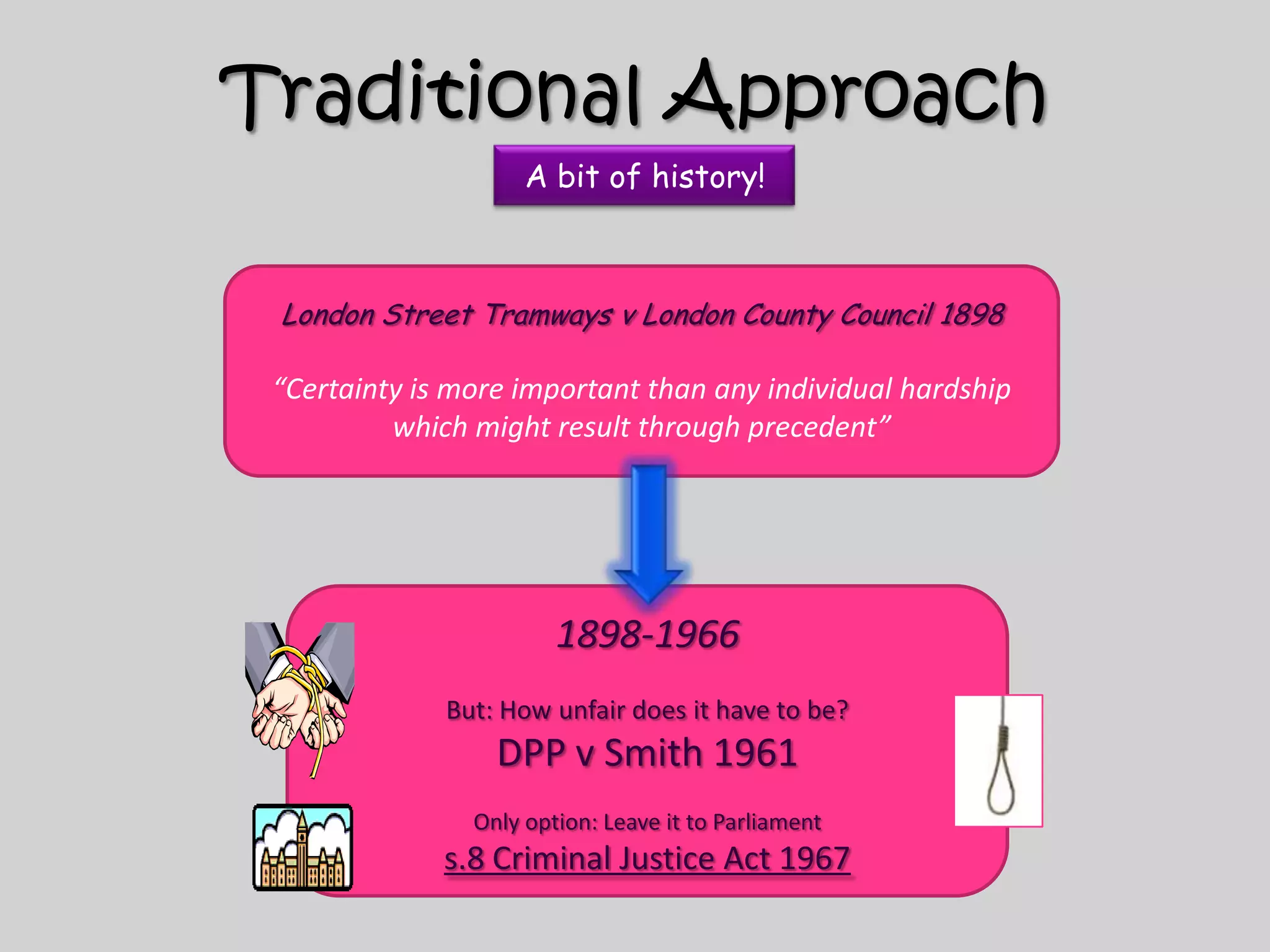
Traditional ApproachA bit of history!London Street Tramways v London County Council 1898“Certainty is more important than any individual hardship which might result through precedent”1898-1966But: How unfair does it have to be?DPP v Smith 1961Only option: Leave it to Parliaments.8 Criminal Justice Act 1967
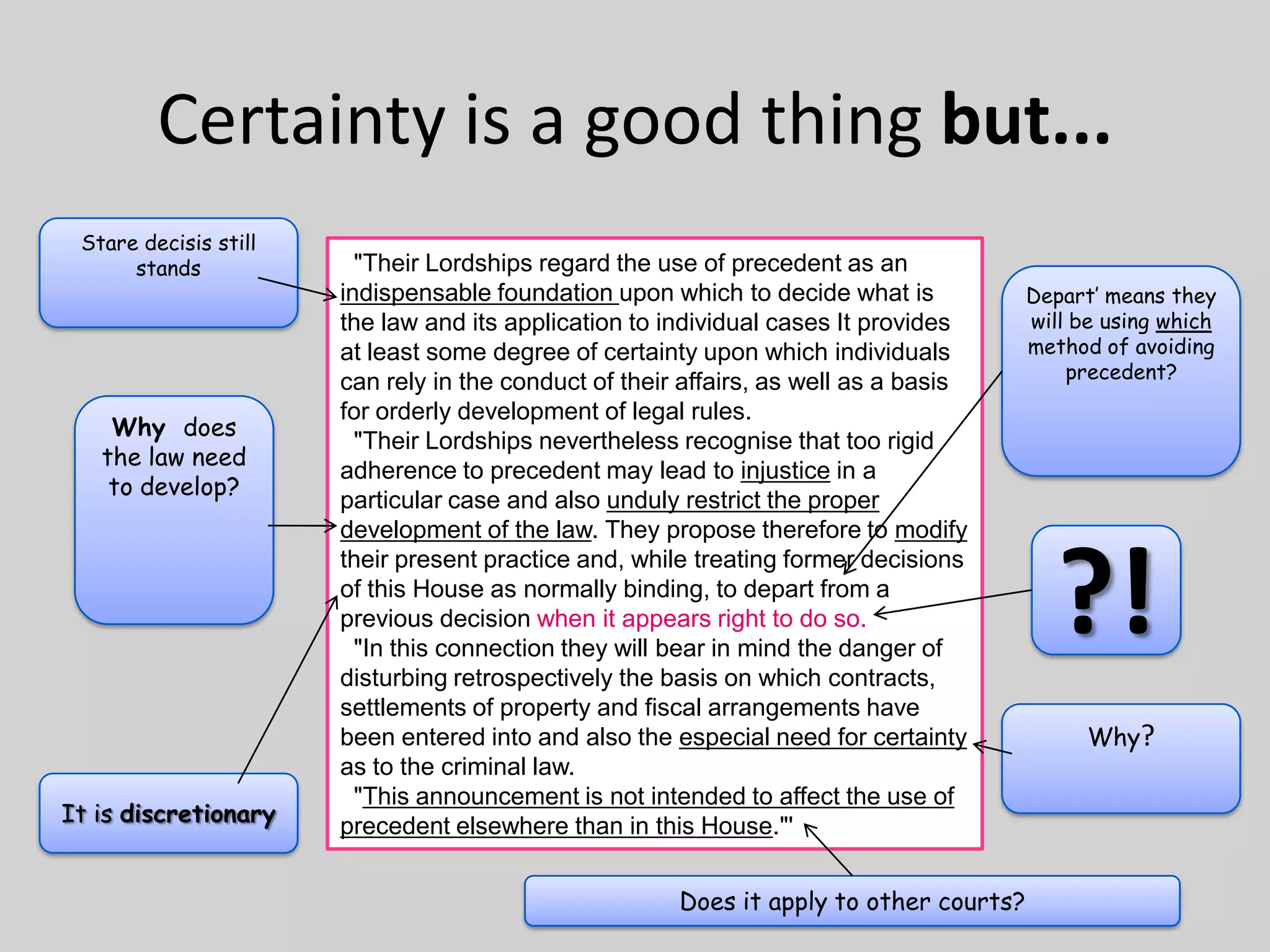
Certainty is a good thing but...Stare decisis still stands  "Their Lordships regard the use of precedent as an indispensable foundation upon which to decide what is the law and its application to individual cases It provides at least some degree of certainty upon which individuals can rely in the conduct of their affairs, as well as a basis for orderly development of legal rules.   "Their Lordships nevertheless recognise that too rigid adherence to precedent may lead to injustice in a particular case and also unduly restrict the proper development of the law. They propose therefore to modifytheir present practice and, while treating former decisions of this House as normally binding, to depart from a previous decision when it appears right to do so.   "In this connection they will bear in mind the danger of disturbing retrospectively the basis on which contracts, settlements of property and fiscal arrangements have been entered into and also the especial need for certainty as to the criminal law.   "This announcement is not intended to affect the use of precedent elsewhere than in this House."' Depart’ means they will be using which method of avoiding precedent?Why  does the law need to develop??!Why?It is discretionaryDoes it apply to other courts?
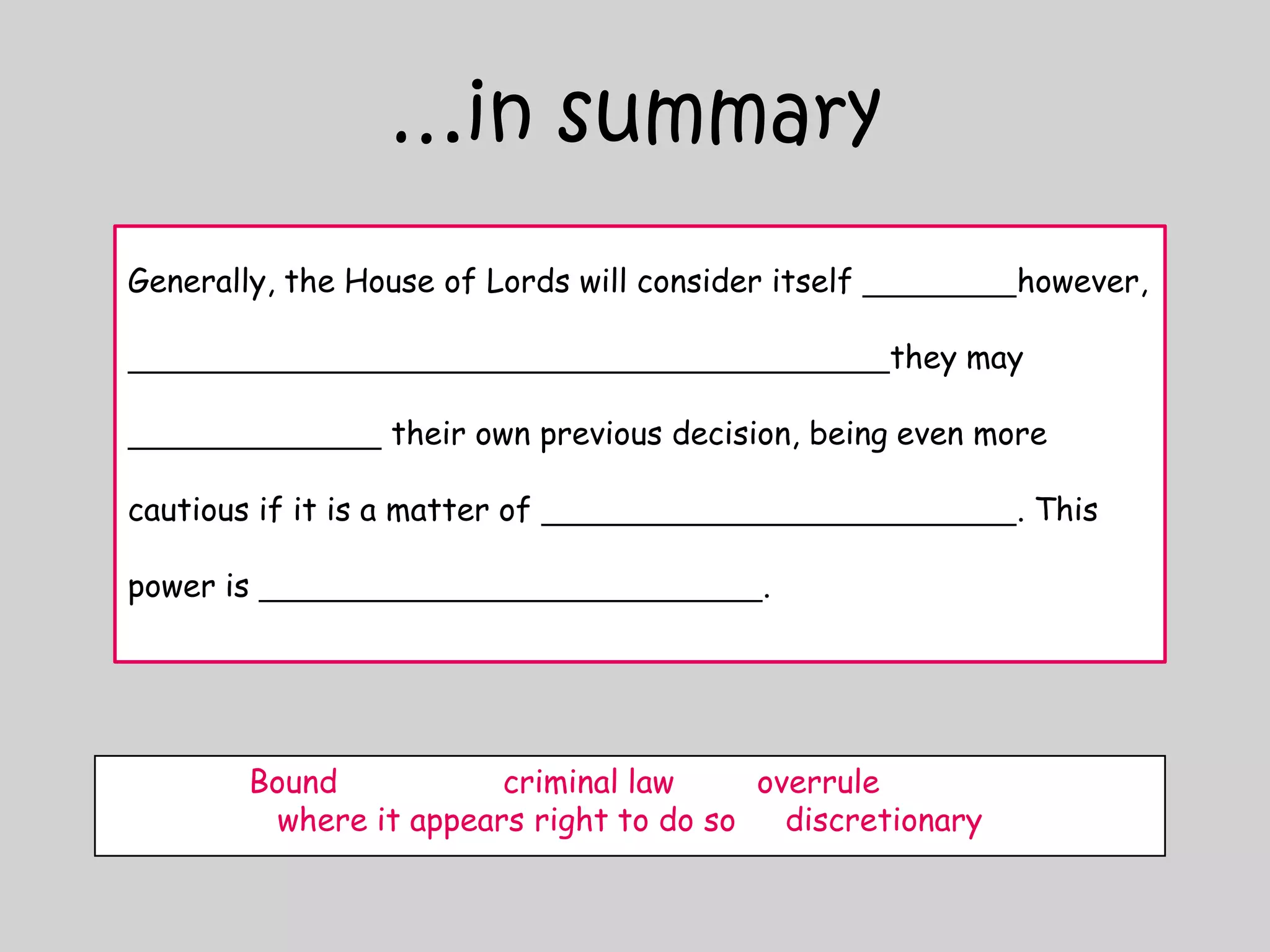
…in summaryGenerally, the House of Lords will consider itself however, they may  their own previous decision, being even more cautious if it is a matter of . This power is .Bound		criminal law	overrule		where it appears right to do so	discretionary
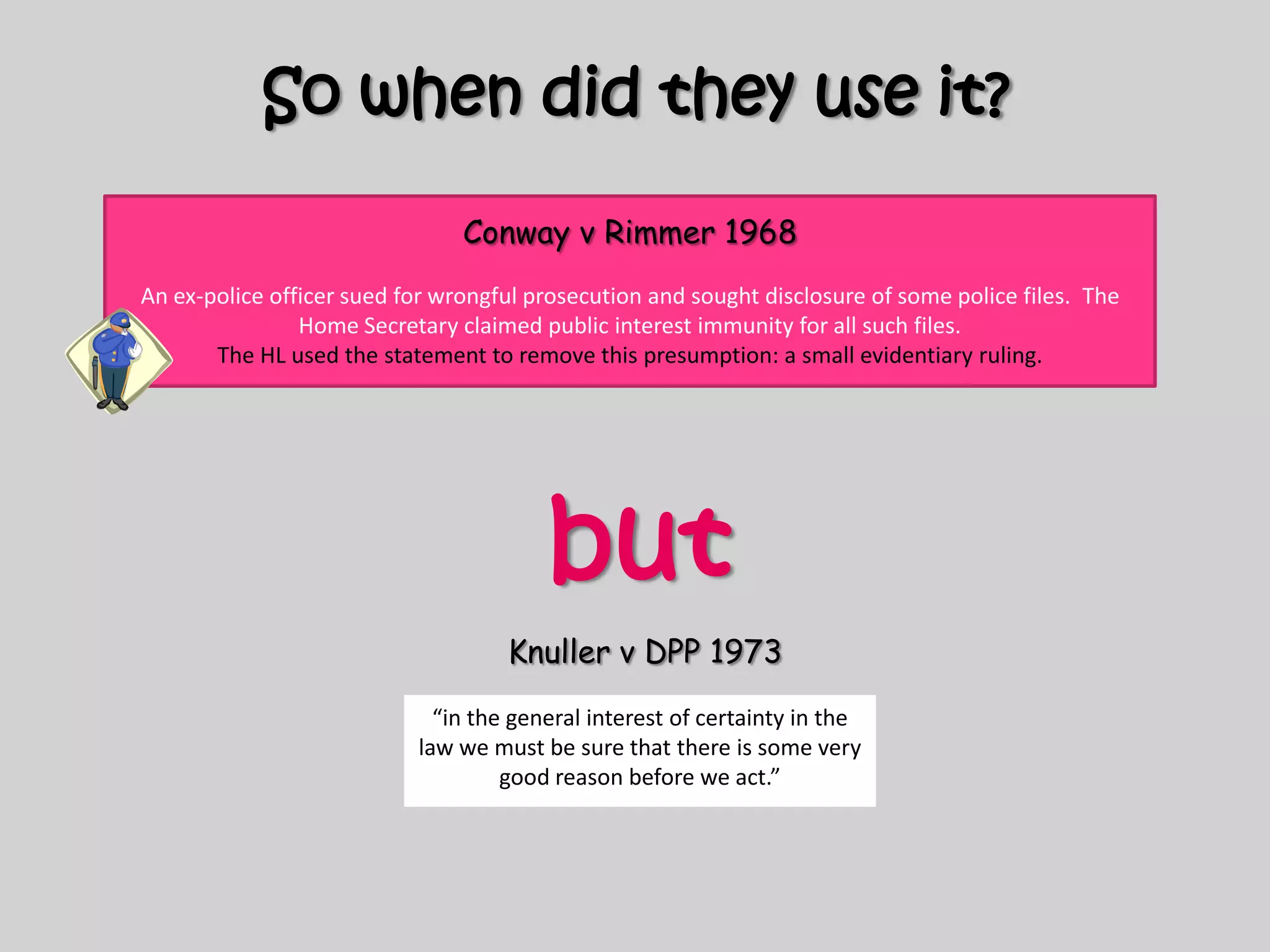
So when did they use it?Conway v Rimmer 1968An ex-police officer sued for wrongful prosecution and sought disclosure of some police files.  The Home Secretary claimed public interest immunity for all such files.The HL used the statement to remove this presumption: a small evidentiary ruling. butKnuller v DPP 1973“in the general interest of certainty in the law we must be sure that there is some very good reason before we act.”
First Use of Statement in Civil LawChange in Social ConditionsBRB v Herrington (1972) overruling Addie v Dumbreck (1920)
Other civil examples:Change in Economic statusMiliangos v George Frank Ltd overruling Havana Railways 1968
Other civil examples:To Create CertaintyMurphy v Brentwood DC (1990)overruling Anns v Merton BC (1977)
Other civil examples:To Help to Develop the LawPepper v Hart 1993 overruling Davis v Johnson 1979
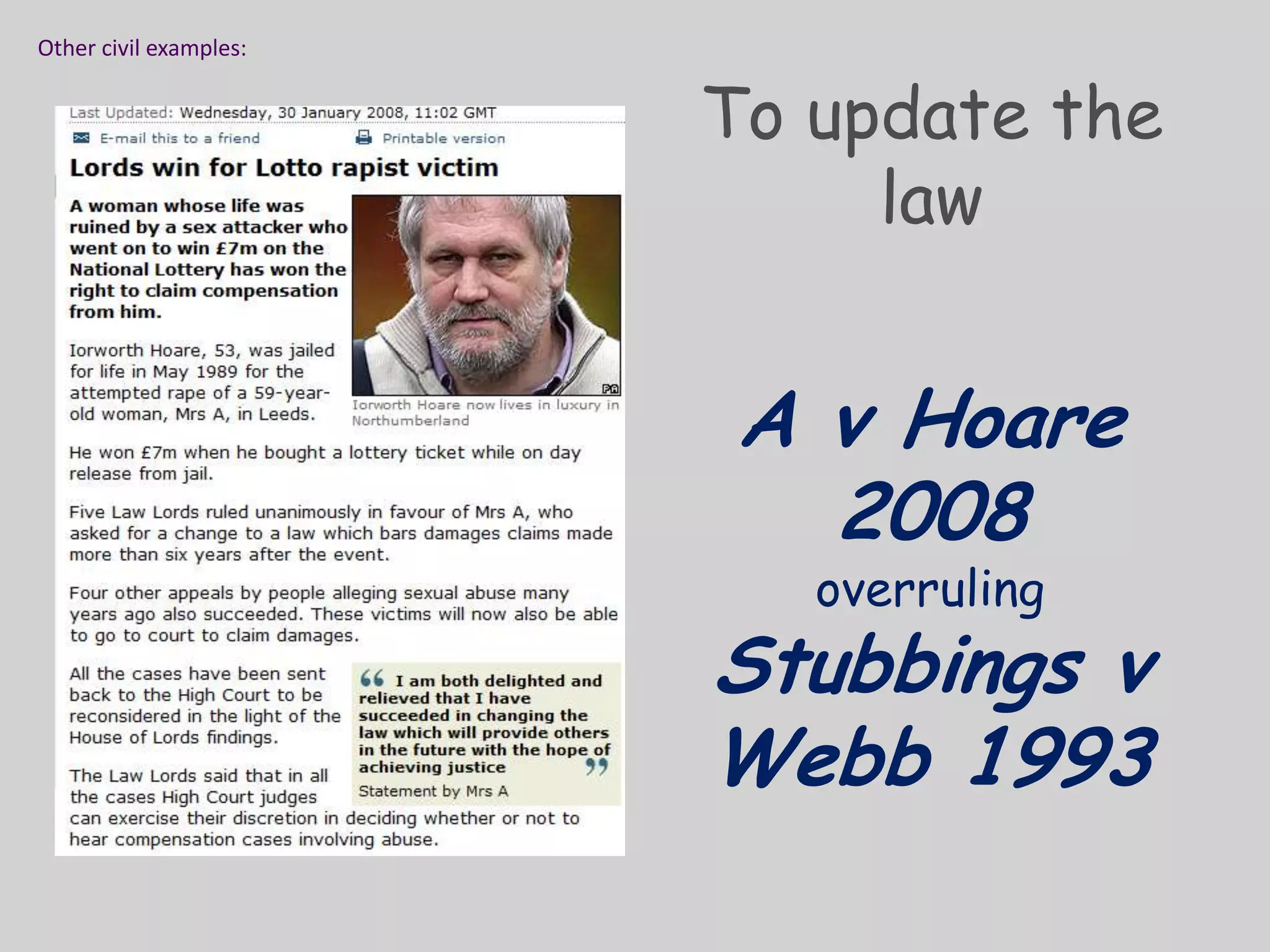
Other civil examples:To update the lawA v Hoare 2008 overrulingStubbings v Webb 1993
What about the Criminal law?The court was even more cautious here... as  there is an ‘especial’ need for certainty.
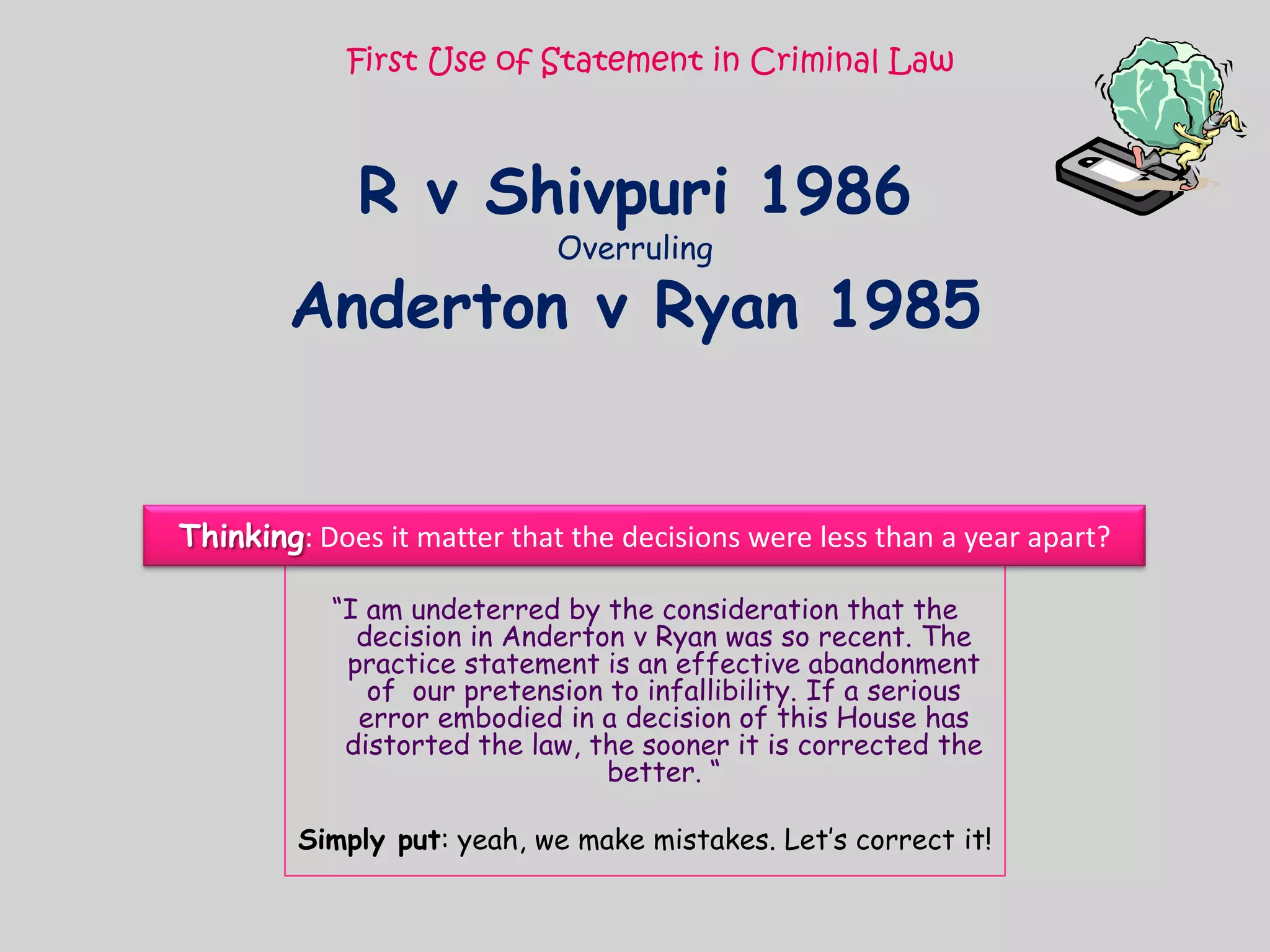
First Use of Statement in Criminal LawR v Shivpuri 1986OverrulingAnderton v Ryan 1985Thinking: Does it matter that the decisions were less than a year apart?“I am undeterred by the consideration that the decision in Anderton v Ryan was so recent. The practice statement is an effective abandonment of  our pretension to infallibility. If a serious error embodied in a decision of this House has distorted the law, the sooner it is corrected the better. “Simply put: yeah, we make mistakes. Let’s correct it!
Other Criminal Uses...R v Howe 1987 overrulingDPP for NI v Lynch 1975
Other Criminal Uses...R v R 1991overrulingR v Miller 1954
Other Criminal Uses...R v G&R 2003 overrulingR v Caldwell 1982
So when willthey use the Practice Statement now?To correct their own previous errors; and
To develop the law to reflect the changing social and economic status. ButThere are some areas they will not change, and leave to Parliament C v DPP (1995)This is all about the age of criminal responsibility. 10-14 presumption of ‘doliincapax’
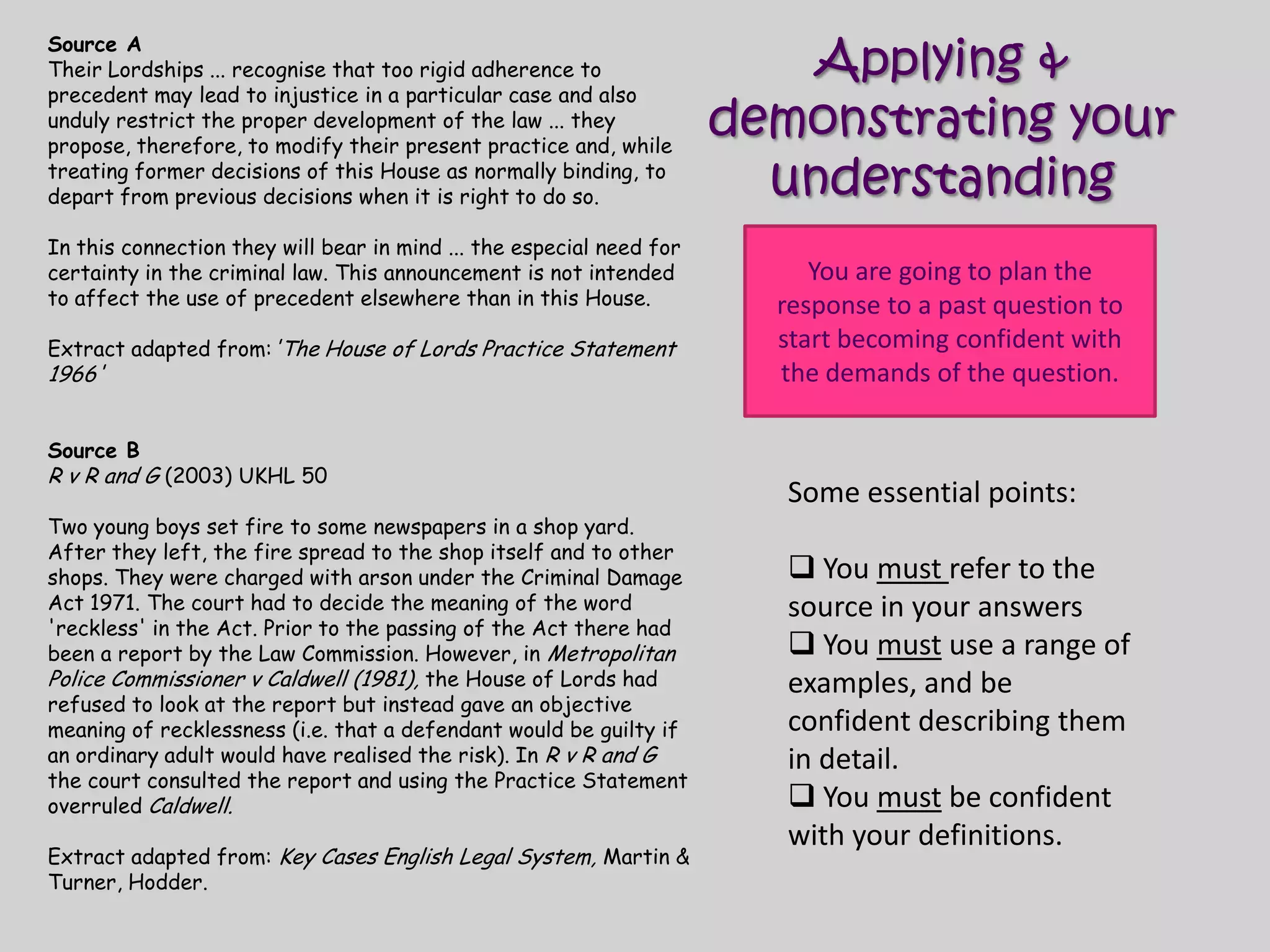
Source ATheir Lordships ... recognise that too rigid adherence to precedent may lead to injustice in a particular case and also unduly restrict the proper development of the law ... they propose, therefore, to modify their present practice and, while treating former decisions of this House as normally binding, to depart from previous decisions when it is right to do so.In this connection they will bear in mind ... the especial need for certainty in the criminal law. This announcement is not intended to affect the use of precedent elsewhere than in this House.Extract adapted from:'The House of Lords Practice Statement 1966'Source BR v R and G (2003) UKHL 50Two young boys set fire to some newspapers in a shop yard. After they left, the fire spread to the shop itself and to other shops. They were charged with arson under the Criminal Damage Act 1971. The court had to decide the meaning of the word 'reckless' in the Act. Prior to the passing of the Act there had been a report by the Law Commission. However, in Metropolitan Police Commissioner v Caldwell (1981), the House of Lords had refused to look at the report but instead gave an objective meaning of recklessness (i.e. that a defendant would be guilty if an ordinary adult would have realised the risk). In R v R and G the court consulted the report and using the Practice Statement overruled Caldwell.Extract adapted from: Key Cases English Legal System, Martin & Turner, Hodder.Applying & demonstrating your understandingYou are going to plan the response to a past question to start becoming confident with the demands of the question. Some essential points:You must refer to the source in your answers

Supreme Court & Practice Statement (2012)

  • 1.
    PrecedentThe Supreme Court(House of Lords)Miss Hart G1522010-11
  • 2.
    Can you namethese cases?Till death do us partZzzBrum. Thwack. Brum. Zzz. Oops. Worst plan ever to get out of a contract. Son… be a man… kill your mumHow much damage can a paper do? Surely that’s a wheely easy question!But don’t you love me? You laugh and I’ll rock your worldBaby vs WallCanary wins over TVVeg out?Howe’d you think we’d let you leave our gang?But you beat each other brown and blue! That’s not on.You’re a tool for killing him. Marriages break up, but the paper stays the same.Axeually, I can use it.Andrew! I love you, there’s no butt about it!
  • 3.
    The Supreme CourtCanyou remember the key rules?It is bound by its own previous decisions.The material facts of the case are sufficiently similarThe European Court of JusticeThe interpretation of European Union LawThe European Court of Human RightsHuman Rights under the Human Rights Act 1998All the courts below it.
  • 4.
    What’s the problem?Well,essentially, what if the Supreme Court need to change their minds? They may have got the law wrong, or social standards may have changed.Should we be stuck with law which doesn’t work or we know to be ‘wrong’?Is certainty more important than injustice?
  • 5.
    Traditional ApproachA bitof history!London Street Tramways v London County Council 1898“Certainty is more important than any individual hardship which might result through precedent”1898-1966But: How unfair does it have to be?DPP v Smith 1961Only option: Leave it to Parliaments.8 Criminal Justice Act 1967
  • 6.
    Certainty is agood thing but...Stare decisis still stands  "Their Lordships regard the use of precedent as an indispensable foundation upon which to decide what is the law and its application to individual cases It provides at least some degree of certainty upon which individuals can rely in the conduct of their affairs, as well as a basis for orderly development of legal rules.   "Their Lordships nevertheless recognise that too rigid adherence to precedent may lead to injustice in a particular case and also unduly restrict the proper development of the law. They propose therefore to modifytheir present practice and, while treating former decisions of this House as normally binding, to depart from a previous decision when it appears right to do so.   "In this connection they will bear in mind the danger of disturbing retrospectively the basis on which contracts, settlements of property and fiscal arrangements have been entered into and also the especial need for certainty as to the criminal law.   "This announcement is not intended to affect the use of precedent elsewhere than in this House."' Depart’ means they will be using which method of avoiding precedent?Why does the law need to develop??!Why?It is discretionaryDoes it apply to other courts?
  • 7.
    …in summaryGenerally, theHouse of Lords will consider itself however, they may their own previous decision, being even more cautious if it is a matter of . This power is .Bound criminal law overrule where it appears right to do so discretionary
  • 8.
    So when didthey use it?Conway v Rimmer 1968An ex-police officer sued for wrongful prosecution and sought disclosure of some police files.  The Home Secretary claimed public interest immunity for all such files.The HL used the statement to remove this presumption: a small evidentiary ruling. butKnuller v DPP 1973“in the general interest of certainty in the law we must be sure that there is some very good reason before we act.”
  • 9.
    First Use ofStatement in Civil LawChange in Social ConditionsBRB v Herrington (1972) overruling Addie v Dumbreck (1920)
  • 10.
    Other civil examples:Changein Economic statusMiliangos v George Frank Ltd overruling Havana Railways 1968
  • 11.
    Other civil examples:ToCreate CertaintyMurphy v Brentwood DC (1990)overruling Anns v Merton BC (1977)
  • 12.
    Other civil examples:ToHelp to Develop the LawPepper v Hart 1993 overruling Davis v Johnson 1979
  • 13.
    Other civil examples:Toupdate the lawA v Hoare 2008 overrulingStubbings v Webb 1993
  • 14.
    What about theCriminal law?The court was even more cautious here... as there is an ‘especial’ need for certainty.
  • 15.
    First Use ofStatement in Criminal LawR v Shivpuri 1986OverrulingAnderton v Ryan 1985Thinking: Does it matter that the decisions were less than a year apart?“I am undeterred by the consideration that the decision in Anderton v Ryan was so recent. The practice statement is an effective abandonment of our pretension to infallibility. If a serious error embodied in a decision of this House has distorted the law, the sooner it is corrected the better. “Simply put: yeah, we make mistakes. Let’s correct it!
  • 16.
    Other Criminal Uses...Rv Howe 1987 overrulingDPP for NI v Lynch 1975
  • 17.
    Other Criminal Uses...Rv R 1991overrulingR v Miller 1954
  • 18.
    Other Criminal Uses...Rv G&R 2003 overrulingR v Caldwell 1982
  • 19.
    So when willtheyuse the Practice Statement now?To correct their own previous errors; and
  • 20.
    To develop thelaw to reflect the changing social and economic status. ButThere are some areas they will not change, and leave to Parliament C v DPP (1995)This is all about the age of criminal responsibility. 10-14 presumption of ‘doliincapax’
  • 21.
    Source ATheir Lordships... recognise that too rigid adherence to precedent may lead to injustice in a particular case and also unduly restrict the proper development of the law ... they propose, therefore, to modify their present practice and, while treating former decisions of this House as normally binding, to depart from previous decisions when it is right to do so.In this connection they will bear in mind ... the especial need for certainty in the criminal law. This announcement is not intended to affect the use of precedent elsewhere than in this House.Extract adapted from:'The House of Lords Practice Statement 1966'Source BR v R and G (2003) UKHL 50Two young boys set fire to some newspapers in a shop yard. After they left, the fire spread to the shop itself and to other shops. They were charged with arson under the Criminal Damage Act 1971. The court had to decide the meaning of the word 'reckless' in the Act. Prior to the passing of the Act there had been a report by the Law Commission. However, in Metropolitan Police Commissioner v Caldwell (1981), the House of Lords had refused to look at the report but instead gave an objective meaning of recklessness (i.e. that a defendant would be guilty if an ordinary adult would have realised the risk). In R v R and G the court consulted the report and using the Practice Statement overruled Caldwell.Extract adapted from: Key Cases English Legal System, Martin & Turner, Hodder.Applying & demonstrating your understandingYou are going to plan the response to a past question to start becoming confident with the demands of the question. Some essential points:You must refer to the source in your answers
  • 22.
    You must usea range of examples, and be confident describing them in detail.
  • 23.
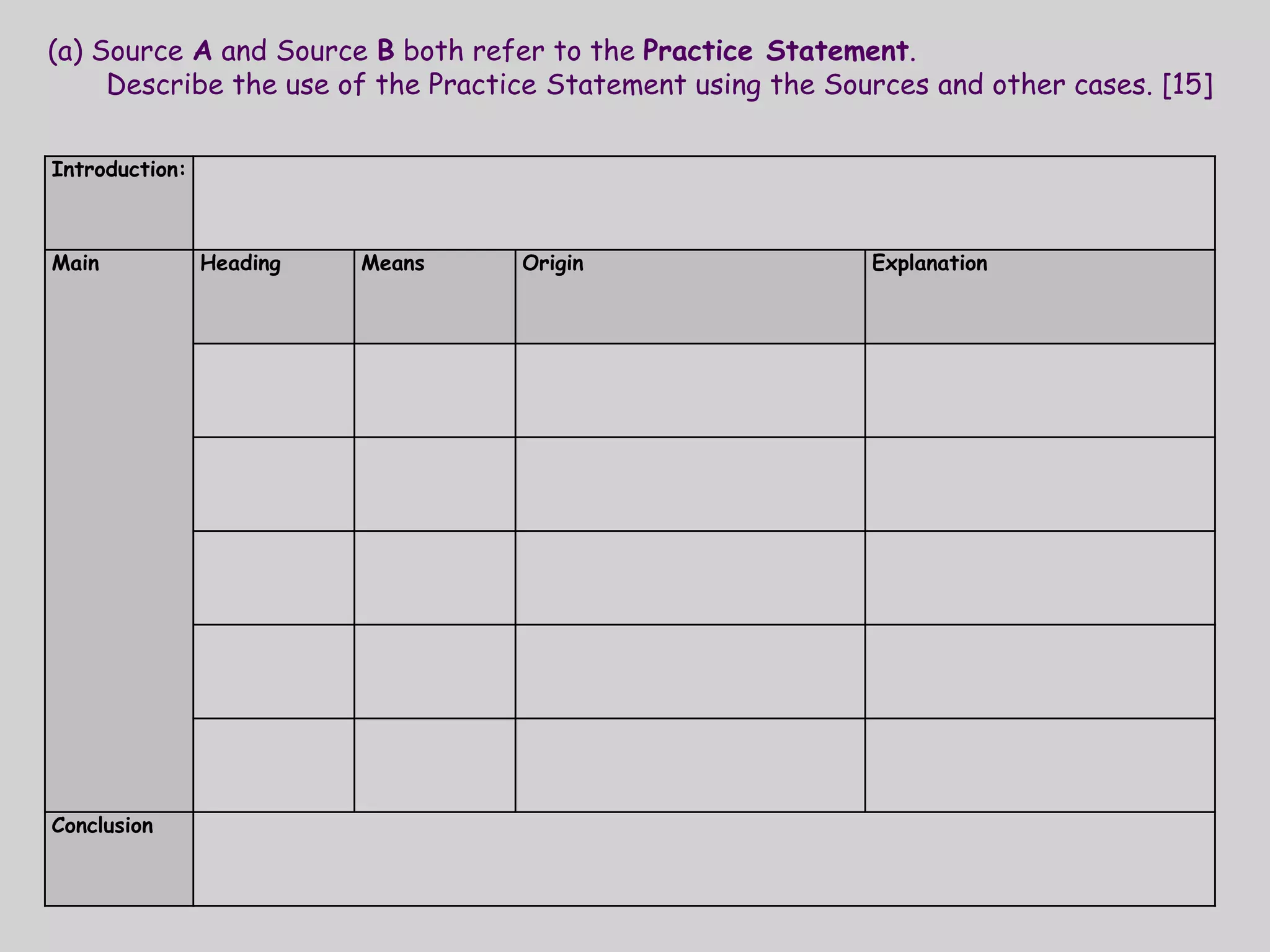
    You mustbe confidentwith your definitions.(a) Source A and Source B both refer to the Practice Statement. Describe the use of the Practice Statement using the Sources and other cases. [15]