The principles of
Hinduism
-Gurubasamma Reedy
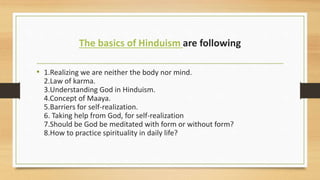
The basics of Hinduism are following
• 1.Realizing we are neither the body nor mind.
2.Law of karma.
3.Understanding God in Hinduism.
4.Concept of Maaya.
5.Barriers for self-realization.
6. Taking help from God, for self-realization
7.Should be God be meditated with form or without form?
8.How to practice spirituality in daily life?
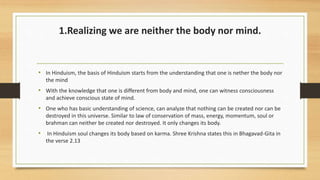
1.Realizing we are neither the body nor mind.
• In Hinduism, the basis of Hinduism starts from the understanding that one is nether the body nor
the mind
• With the knowledge that one is different from body and mind, one can witness consciousness
and achieve conscious state of mind.
• One who has basic understanding of science, can analyze that nothing can be created nor can be
destroyed in this universe. Similar to law of conservation of mass, energy, momentum, soul or
brahman can neither be created nor destroyed. It only changes its body.
• In Hinduism soul changes its body based on karma. Shree Krishna states this in Bhagavad-Gita in
the verse 2.13
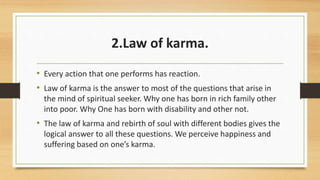
2.Law of karma.
• Every action that one performs has reaction.
• Law of karma is the answer to most of the questions that arise in
the mind of spiritual seeker. Why one has born in rich family other
into poor. Why One has born with disability and other not.
• The law of karma and rebirth of soul with different bodies gives the
logical answer to all these questions. We perceive happiness and
suffering based on one’s karma.
3.Understanding God.
• God is referred as Sat-Chit-Ananda. Sat means truth, chit means pure
consciousness, and Ananda means eternal bliss. God is the truth and pure
consciousness and He is eternally blissful.
• Even a soul or brahman has all the qualities of God. But God is ocean of
bliss and Brahman is the drop of that bliss. Even an individual soul can
realize its true nature and become eternally blissful.
• It can get out of chains of reactions of karma. To realize its true nature, it
has to get out of illusion, which is referred as Maaya in the scriptures.
4.Maaya.
• Maaya means illusion. A soul gets illusioned by the world around it. It mainly happens
due to false ego.
• Soul attaches itself to the body, and mind that it gets. It views nature from the
perspective of its mind and body. This is the illusion. In reality it is the pure conscious
bliss. When it perceives the soul through mind, realizes it is the witness consciousness,
then happenings in the world surrounding it loses the significance. When this happens,
it stops to suffer.
• So, to get of out of Maaya, Knowledge is required. Everyone is not eager to attain
knowledge and suffer due the lack of knowledge. This is referred as “Tamas” meaning
ignorance of the soul.
5.Barriers for self-realization.
• Maaya is always keen to attack the mind, and immediately one starts producing
thoughts, by attaching himself to the body and mind.
• False ego is the biggest enemy of realization. False ego further produces generates
kama (desire), krodha (anger), lobha (greed), mada (Sense of I), moha (Attachment), and
matsarya (jealousy). If we carefully analyze our thoughts, mostly they arise out of one
among these. These are called as arishadvarga, meaning the six enemies of self-
realization.
• Whenever one generates thoughts, he has to become consciousness and view his
thoughts from the lens of kama, krodha, moha, lobha, mada, matsarya. One should try
to get rid of all of these in his thoughts. It takes very hard practice.
6. Taking help from God, for self-realization
• Scriptures always emphasizes on path of Bhakti and devotion rather than
path of knowledge. But knowledge is required to understand the right
path, and to think rationally. But Love is beyond the limitations of the
mind. So, after understanding the truth, one has to surrender his mind
and thinking, and should start loving the God.
• As God is the perfect being, meditating on him, purifies the living entity.
The dirt that has been accumulated due past karmas of many life times,
gets washed due to meditation up on him.
7.Should God be meditated with form or without form?
• One can meditate on both formless state of God or God with form also. But
worshipping God with form is better. It is better for the mind, to imagine God
with form, qualities.
• Meditating on forms, qualities, past times of the God, it is easier for the mind to
get focused. Since God is pure, thinking about him, talking about him, singing his
qualities makes the mind purer.
• One can worship their favourite deity, Known as Ishta devata. They can select
their Ishta devata on the basis of their Bhava(feelings).
8.How to practice spirituality in daily life?
• In these modern times, survival has become difficult. One is constrained to
follow spirituality along with their profession.
• Sometimes profession is so hectic that, one gets very little time for practicing
spirituality. But practicing spirituality does not mean that one has to isolate
himself from society and practice it.
• Spirituality can be practiced with in society, along with profession. If one does
the profession, without expecting any results from that profession, then every
act that he performs become spiritual. This is called karma yoga mentioned in
Bhagavad-Gita verse 2.47.
• The more detailed guide to Hinduism can be found in the following article.
• https://beingkrishnaconscious.com/basics/

Hinduism concepets 1.pptx

  • 1.
  • 2.
    The basics ofHinduism are following • 1.Realizing we are neither the body nor mind. 2.Law of karma. 3.Understanding God in Hinduism. 4.Concept of Maaya. 5.Barriers for self-realization. 6. Taking help from God, for self-realization 7.Should be God be meditated with form or without form? 8.How to practice spirituality in daily life?
  • 3.
    1.Realizing we areneither the body nor mind. • In Hinduism, the basis of Hinduism starts from the understanding that one is nether the body nor the mind • With the knowledge that one is different from body and mind, one can witness consciousness and achieve conscious state of mind. • One who has basic understanding of science, can analyze that nothing can be created nor can be destroyed in this universe. Similar to law of conservation of mass, energy, momentum, soul or brahman can neither be created nor destroyed. It only changes its body. • In Hinduism soul changes its body based on karma. Shree Krishna states this in Bhagavad-Gita in the verse 2.13
  • 4.
    2.Law of karma. •Every action that one performs has reaction. • Law of karma is the answer to most of the questions that arise in the mind of spiritual seeker. Why one has born in rich family other into poor. Why One has born with disability and other not. • The law of karma and rebirth of soul with different bodies gives the logical answer to all these questions. We perceive happiness and suffering based on one’s karma.
  • 5.
    3.Understanding God. • Godis referred as Sat-Chit-Ananda. Sat means truth, chit means pure consciousness, and Ananda means eternal bliss. God is the truth and pure consciousness and He is eternally blissful. • Even a soul or brahman has all the qualities of God. But God is ocean of bliss and Brahman is the drop of that bliss. Even an individual soul can realize its true nature and become eternally blissful. • It can get out of chains of reactions of karma. To realize its true nature, it has to get out of illusion, which is referred as Maaya in the scriptures.
  • 6.
    4.Maaya. • Maaya meansillusion. A soul gets illusioned by the world around it. It mainly happens due to false ego. • Soul attaches itself to the body, and mind that it gets. It views nature from the perspective of its mind and body. This is the illusion. In reality it is the pure conscious bliss. When it perceives the soul through mind, realizes it is the witness consciousness, then happenings in the world surrounding it loses the significance. When this happens, it stops to suffer. • So, to get of out of Maaya, Knowledge is required. Everyone is not eager to attain knowledge and suffer due the lack of knowledge. This is referred as “Tamas” meaning ignorance of the soul.
  • 7.
    5.Barriers for self-realization. •Maaya is always keen to attack the mind, and immediately one starts producing thoughts, by attaching himself to the body and mind. • False ego is the biggest enemy of realization. False ego further produces generates kama (desire), krodha (anger), lobha (greed), mada (Sense of I), moha (Attachment), and matsarya (jealousy). If we carefully analyze our thoughts, mostly they arise out of one among these. These are called as arishadvarga, meaning the six enemies of self- realization. • Whenever one generates thoughts, he has to become consciousness and view his thoughts from the lens of kama, krodha, moha, lobha, mada, matsarya. One should try to get rid of all of these in his thoughts. It takes very hard practice.
  • 8.
    6. Taking helpfrom God, for self-realization • Scriptures always emphasizes on path of Bhakti and devotion rather than path of knowledge. But knowledge is required to understand the right path, and to think rationally. But Love is beyond the limitations of the mind. So, after understanding the truth, one has to surrender his mind and thinking, and should start loving the God. • As God is the perfect being, meditating on him, purifies the living entity. The dirt that has been accumulated due past karmas of many life times, gets washed due to meditation up on him.
  • 9.
    7.Should God bemeditated with form or without form? • One can meditate on both formless state of God or God with form also. But worshipping God with form is better. It is better for the mind, to imagine God with form, qualities. • Meditating on forms, qualities, past times of the God, it is easier for the mind to get focused. Since God is pure, thinking about him, talking about him, singing his qualities makes the mind purer. • One can worship their favourite deity, Known as Ishta devata. They can select their Ishta devata on the basis of their Bhava(feelings).
  • 10.
    8.How to practicespirituality in daily life? • In these modern times, survival has become difficult. One is constrained to follow spirituality along with their profession. • Sometimes profession is so hectic that, one gets very little time for practicing spirituality. But practicing spirituality does not mean that one has to isolate himself from society and practice it. • Spirituality can be practiced with in society, along with profession. If one does the profession, without expecting any results from that profession, then every act that he performs become spiritual. This is called karma yoga mentioned in Bhagavad-Gita verse 2.47.
  • 11.
    • The moredetailed guide to Hinduism can be found in the following article. • https://beingkrishnaconscious.com/basics/