HIGH END CHARITY RETAIL
An approach at a reverse retail-
charity concept
CONCEPT AND PRESENTATION BY: SHAFIYA RIZWAN, UNITED ARAB EMIRATES
CONCEPT
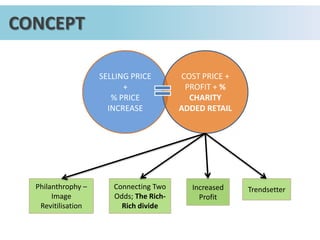
SELLING PRICE
+
% PRICE
INCREASE
COST PRICE +
PROFIT + %
CHARITY
ADDED RETAIL
Philanthrophy –
Image
Revitilisation
Connecting Two
Odds; The Rich-
Rich divide
Increased
Profit
Trendsetter
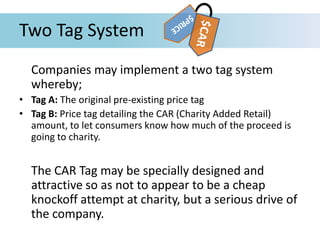
Two Tag System
Companies may implement a two tag system
whereby;
• Tag A: The original pre-existing price tag
• Tag B: Price tag detailing the CAR (Charity Added Retail)
amount, to let consumers know how much of the proceed is
going to charity.
The CAR Tag may be specially designed and
attractive so as not to appear to be a cheap
knockoff attempt at charity, but a serious drive of
the company.
Connecting two odds – Rich Vs Rich
• Drawing the philanthropic rich as well as their
counterpart into one cohesive ecosystem.
• Greater expenditure with a more relaxed conscience.
• Tax benefits for consumers as well as retailer.
• Detailed CAR distribution information = greater
consumer relationship and cooperation
opportunities.
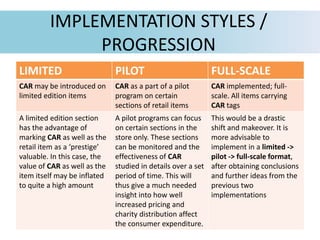
IMPLEMENTATION STYLES /
PROGRESSION
LIMITED PILOT FULL-SCALE
CAR may be introduced on
limited edition items
CAR as a part of a pilot
program on certain
sections of retail items
CAR implemented; full-
scale. All items carrying
CAR tags
A limited edition section
has the advantage of
marking CAR as well as the
retail item as a ‘prestige’
valuable. In this case, the
value of CAR as well as the
item itself may be inflated
to quite a high amount
A pilot programs can focus
on certain sections in the
store only. These sections
can be monitored and the
effectiveness of CAR
studied in details over a set
period of time. This will
thus give a much needed
insight into how well
increased pricing and
charity distribution affect
the consumer expenditure.
This would be a drastic
shift and makeover. It is
more advisable to
implement in a limited ->
pilot -> full-scale format,
after obtaining conclusions
and further ideas from the
previous two
implementations

High end charity retail

  • 1.
    HIGH END CHARITYRETAIL An approach at a reverse retail- charity concept CONCEPT AND PRESENTATION BY: SHAFIYA RIZWAN, UNITED ARAB EMIRATES
  • 2.
    CONCEPT SELLING PRICE + % PRICE INCREASE COSTPRICE + PROFIT + % CHARITY ADDED RETAIL Philanthrophy – Image Revitilisation Connecting Two Odds; The Rich- Rich divide Increased Profit Trendsetter
  • 3.
    Two Tag System Companiesmay implement a two tag system whereby; • Tag A: The original pre-existing price tag • Tag B: Price tag detailing the CAR (Charity Added Retail) amount, to let consumers know how much of the proceed is going to charity. The CAR Tag may be specially designed and attractive so as not to appear to be a cheap knockoff attempt at charity, but a serious drive of the company.
  • 4.
    Connecting two odds– Rich Vs Rich • Drawing the philanthropic rich as well as their counterpart into one cohesive ecosystem. • Greater expenditure with a more relaxed conscience. • Tax benefits for consumers as well as retailer. • Detailed CAR distribution information = greater consumer relationship and cooperation opportunities.
  • 5.
    IMPLEMENTATION STYLES / PROGRESSION LIMITEDPILOT FULL-SCALE CAR may be introduced on limited edition items CAR as a part of a pilot program on certain sections of retail items CAR implemented; full- scale. All items carrying CAR tags A limited edition section has the advantage of marking CAR as well as the retail item as a ‘prestige’ valuable. In this case, the value of CAR as well as the item itself may be inflated to quite a high amount A pilot programs can focus on certain sections in the store only. These sections can be monitored and the effectiveness of CAR studied in details over a set period of time. This will thus give a much needed insight into how well increased pricing and charity distribution affect the consumer expenditure. This would be a drastic shift and makeover. It is more advisable to implement in a limited -> pilot -> full-scale format, after obtaining conclusions and further ideas from the previous two implementations