And our future Presentation by Thomas Neudorfer


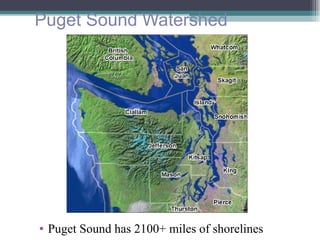
Puget Sound Watershed Puget Sound has 2100+ miles of shorelines
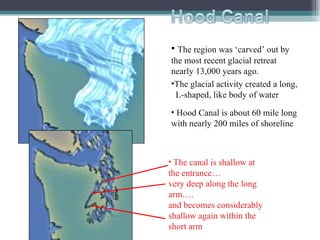
The canal is shallow at the entrance…  very deep along the long arm….  and becomes considerably shallow again within the short arm The region was ‘carved’ out by the most recent glacial retreat nearly 13,000 years ago. The glacial activity created a long,  L-shaped, like body of water Hood Canal is about 60 mile long with nearly 200 miles of shoreline
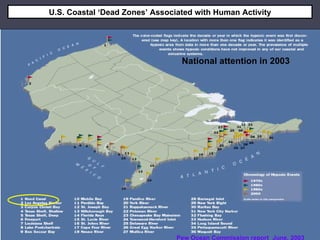
U.S. Coastal ‘Dead Zones’ Associated with Human Activity National attention in 2003 Source:   America’s Oceans: Charting a Course for the Sea Change. Pew Ocean Commission report June, 2003
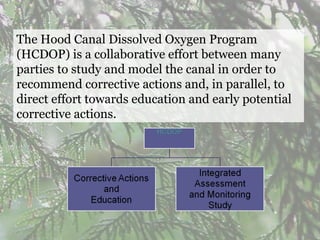
The Hood Canal Dissolved Oxygen Program (HCDOP) is a collaborative effort between many parties to study and model the canal in order to recommend corrective actions and, in parallel, to direct effort towards education and early potential corrective actions.
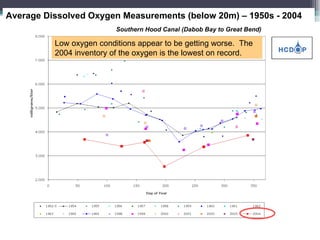
Southern Hood Canal (Dabob Bay to Great Bend)   Average Dissolved Oxygen Measurements (below 20m) – 1950s - 2004 Low oxygen conditions appear to be getting worse.  The 2004 inventory of the oxygen is the lowest on record.
Hood Canal Attributes Strong stratification, distinct layers maintained with different characteristics. Deep waters with low oxygen don’t get mixed. Slow circulation, long residence time. Bulk of waters are “old” –  with no recent air contact. High productivity, high organic load. Oxygen is respired away during decomposition of this matter.    RESULT:   Hood Canal is naturally predisposed to low dissolved oxygen, much more so than Puget Sound which is better flushed and less stratified.
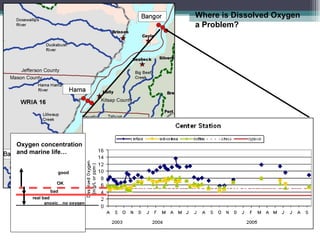
Where is Dissolved Oxygen a Problem?  Oxygen concentration and marine life…   bad real   bad good OK anoxic…no oxygen
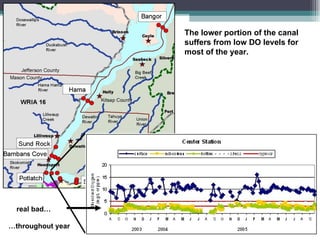
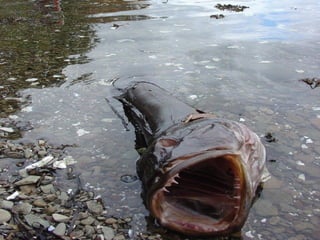
real bad… … throughout year The lower portion of the canal suffers from low DO levels for most of the year.
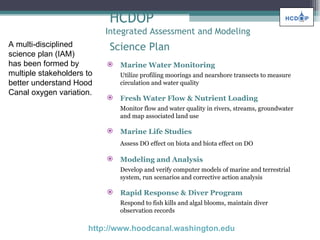
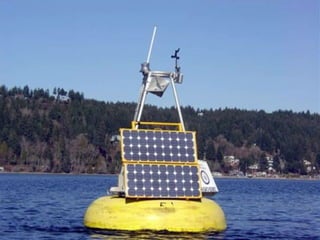
HCDOP  Integrated Assessment and Modeling   Science Plan Marine Water Monitoring   Utilize profiling moorings and nearshore transects to measure circulation and water quality  Fresh Water Flow &   Nutrient Loading   Monitor flow and water quality in rivers, streams, groundwater and map associated land use Marine Life Studies Assess DO effect on biota and biota effect on DO Modeling and Analysis     Develop and verify computer models of marine and terrestrial system, run scenarios and corrective action analysis  Rapid Response & Diver Program     Respond to fish kills and algal blooms, maintain diver observation records A multi-disciplined science plan (IAM)  has been formed by multiple stakeholders to better understand Hood Canal oxygen variation. http://www.hoodcanal.washington.edu
Increased Nutrients: Nitrogen Essential for life But can be harmful at high levels Increased human development Increased levels of nitrogen enter Hood Canal watershed                           
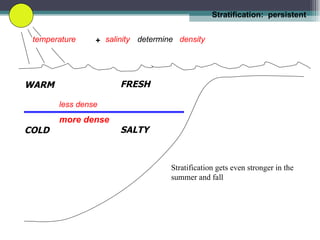
WARM COLD temperature salinity determine   density FRESH SALTY + less dense more dense Stratification:  persistent   Stratification gets even stronger in the summer and fall
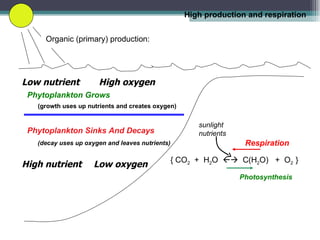
Low nutrient   High oxygen High nutrient   Low oxygen Organic (primary) production: Phytoplankton Sinks And Decays   (decay uses up oxygen and leaves nutrients) { CO 2   +  H 2 O     C(H 2 O)  +  O 2  } sunlight nutrients Respiration Photosynthesis High production and respiration Phytoplankton Grows (growth uses up nutrients and creates oxygen)
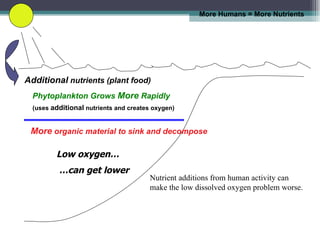
More Humans = More Nutrients  Phytoplankton Grows  More  Rapidly (uses  additional  nutrients and creates oxygen) Additional  nutrients (plant food) Low oxygen… … can get lower Nutrient additions from human activity can make the low dissolved oxygen problem worse.  More  organic material to sink and decompose
 
 
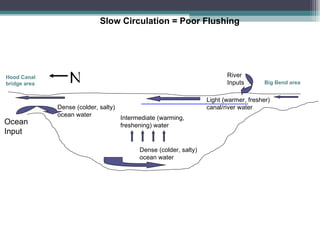
Hood Canal bridge area Big Bend area N Slow Circulation = Poor Flushing Ocean Input River Inputs Dense (colder, salty) ocean water Dense (colder, salty) ocean water Light (warmer, fresher) canal/river water Intermediate (warming, freshening) water
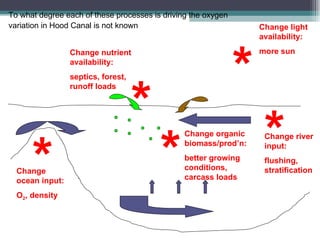
* * * * * Change ocean input: O 2 , density Change river input: flushing, stratification Change light availability: more sun Change organic biomass/prod’n: better growing conditions, carcass loads Change nutrient availability: septics, forest, runoff loads To what degree each of these processes is driving the oxygen variation in Hood Canal is not known


Sources: DOE , HCDOP, EPA, PSP, HCOW.GOV, PEW, ECY.GOV

High Def

  • 1.
    And our futurePresentation by Thomas Neudorfer
  • 2.
  • 3.
  • 4.
  • 5.
  • 6.
  • 7.
  • 8.
  • 9.
  • 10.
  • 11.
  • 12.
  • 13.
  • 14.
  • 15.
  • 16.
  • 17.
  • 18.
  • 19.
  • 20.
  • 21.
  • 22.
  • 23.
  • 24.
  • 25.
    Puget Sound WatershedPuget Sound has 2100+ miles of shorelines
  • 26.
    The canal isshallow at the entrance… very deep along the long arm…. and becomes considerably shallow again within the short arm The region was ‘carved’ out by the most recent glacial retreat nearly 13,000 years ago. The glacial activity created a long, L-shaped, like body of water Hood Canal is about 60 mile long with nearly 200 miles of shoreline
  • 27.
    U.S. Coastal ‘DeadZones’ Associated with Human Activity National attention in 2003 Source: America’s Oceans: Charting a Course for the Sea Change. Pew Ocean Commission report June, 2003
  • 28.
    The Hood CanalDissolved Oxygen Program (HCDOP) is a collaborative effort between many parties to study and model the canal in order to recommend corrective actions and, in parallel, to direct effort towards education and early potential corrective actions.
  • 29.
    Southern Hood Canal(Dabob Bay to Great Bend) Average Dissolved Oxygen Measurements (below 20m) – 1950s - 2004 Low oxygen conditions appear to be getting worse. The 2004 inventory of the oxygen is the lowest on record.
  • 30.
    Hood Canal AttributesStrong stratification, distinct layers maintained with different characteristics. Deep waters with low oxygen don’t get mixed. Slow circulation, long residence time. Bulk of waters are “old” – with no recent air contact. High productivity, high organic load. Oxygen is respired away during decomposition of this matter.  RESULT: Hood Canal is naturally predisposed to low dissolved oxygen, much more so than Puget Sound which is better flushed and less stratified.
  • 31.
    Where is DissolvedOxygen a Problem? Oxygen concentration and marine life… bad real bad good OK anoxic…no oxygen
  • 32.
    real bad… …throughout year The lower portion of the canal suffers from low DO levels for most of the year.
  • 33.
    HCDOP IntegratedAssessment and Modeling Science Plan Marine Water Monitoring Utilize profiling moorings and nearshore transects to measure circulation and water quality Fresh Water Flow & Nutrient Loading Monitor flow and water quality in rivers, streams, groundwater and map associated land use Marine Life Studies Assess DO effect on biota and biota effect on DO Modeling and Analysis Develop and verify computer models of marine and terrestrial system, run scenarios and corrective action analysis Rapid Response & Diver Program Respond to fish kills and algal blooms, maintain diver observation records A multi-disciplined science plan (IAM) has been formed by multiple stakeholders to better understand Hood Canal oxygen variation. http://www.hoodcanal.washington.edu
  • 34.
    Increased Nutrients: NitrogenEssential for life But can be harmful at high levels Increased human development Increased levels of nitrogen enter Hood Canal watershed                        
  • 35.
    WARM COLD temperaturesalinity determine density FRESH SALTY + less dense more dense Stratification: persistent Stratification gets even stronger in the summer and fall
  • 36.
    Low nutrient High oxygen High nutrient Low oxygen Organic (primary) production: Phytoplankton Sinks And Decays (decay uses up oxygen and leaves nutrients) { CO 2 + H 2 O  C(H 2 O) + O 2 } sunlight nutrients Respiration Photosynthesis High production and respiration Phytoplankton Grows (growth uses up nutrients and creates oxygen)
  • 37.
    More Humans =More Nutrients Phytoplankton Grows More Rapidly (uses additional nutrients and creates oxygen) Additional nutrients (plant food) Low oxygen… … can get lower Nutrient additions from human activity can make the low dissolved oxygen problem worse. More organic material to sink and decompose
  • 38.
  • 39.
  • 40.
    Hood Canal bridgearea Big Bend area N Slow Circulation = Poor Flushing Ocean Input River Inputs Dense (colder, salty) ocean water Dense (colder, salty) ocean water Light (warmer, fresher) canal/river water Intermediate (warming, freshening) water
  • 41.
    * * ** * Change ocean input: O 2 , density Change river input: flushing, stratification Change light availability: more sun Change organic biomass/prod’n: better growing conditions, carcass loads Change nutrient availability: septics, forest, runoff loads To what degree each of these processes is driving the oxygen variation in Hood Canal is not known
  • 42.
  • 43.
  • 44.
  • 45.
  • 46.
  • 47.
  • 48.
  • 49.
  • 50.
    Sources: DOE ,HCDOP, EPA, PSP, HCOW.GOV, PEW, ECY.GOV