Hibernate Fetch Strategies,
   N+1 Select Problem


                          1
Topics
●   Fetching strategies
●   Types of fetching strategies
    –   How fetching is done
    –   When fetching is done
●   N+1 select problem
    –   Factors that influence number of select statements
    –   Various examples
●   Recommendation


                                                             2
Fetching Strategies

                      3
What is a Fetching Strategy?
●   A fetching strategy is the strategy Hibernate will
    use for retrieving associated objects if the
    application needs to navigate the association.
●   Fetching strategy will have performance impact
●   Fetch strategies may be declared in the
    mapping files, or over-ridden by a particular
    HQL or Criteria query.


                                                     4
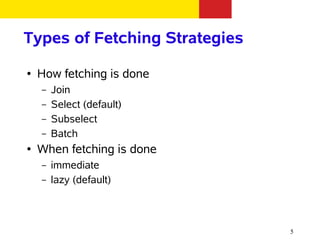
Types of Fetching Strategies
●   How fetching is done
    –   Join
    –   Select (default)
    –   Subselect
    –   Batch
●   When fetching is done
    –   immediate
    –   lazy (default)


                               5
Fetching Strategies:
How Fetching is Done
                        6
Join Fetching
●   Hibernate retrieves the associated instance or
    collection in the same SELECT, using an
    OUTER JOIN


                                                     7
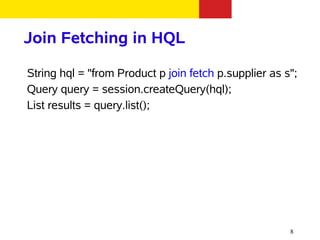
Join Fetching in HQL

String hql = "from Product p join fetch p.supplier as s";
Query query = session.createQuery(hql);
List results = query.list();


                                                       8
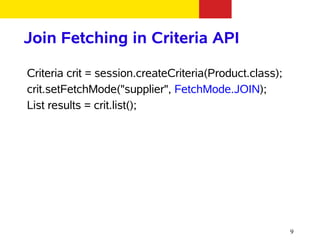
Join Fetching in Criteria API

Criteria crit = session.createCriteria(Product.class);
crit.setFetchMode("supplier", FetchMode.JOIN);
List results = crit.list();


                                                         9
Select Fetching
●   Default fetch mode
●   Vulnerable to N+1 selects problem
    –   “N” number of SELECT's are used to retrieve the
        associated entity or collection.
●   Unless you explicitly disable lazy fetching by
    specifying lazy="false", the subsequent select
    will only be executed when you actually access
    the association.


                                                          10
Subselect Fetching
●   A second SELECT is used to retrieve the
    associated collections for all entities retrieved in
    a previous query or fetch.
●   Unless you explicitly disable lazy fetching by
    specifying lazy="false", this second select will
    only be executed when you actually access the
    association.


                                                       11
Batch Fetching
●   An optimization strategy for select fetching -
    Hibernate retrieves a batch of entity instances or
    collections in a single SELECT, by specifying a
    list of primary keys or foreign keys.


                                                    12
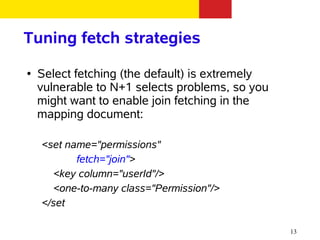
Tuning fetch strategies
●   Select fetching (the default) is extremely
    vulnerable to N+1 selects problems, so you
    might want to enable join fetching in the
    mapping document:

    <set name="permissions"
           fetch="join">
      <key column="userId"/>
      <one-to-many class="Permission"/>
    </set

                                                 13
Fetching Strategies:
When Fetching is Done
                        14
Lazy Fetching
●   A collection is fetched when the application
    invokes an operation upon that collection
●   Default for collections


                                                   15
N+1 Select
 Problem
             16
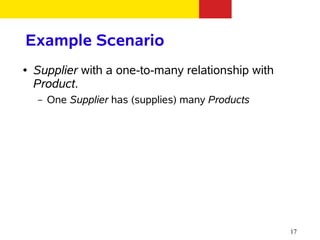
Example Scenario
●   Supplier with a one-to-many relationship with
    Product.
    –   One Supplier has (supplies) many Products


                                                    17
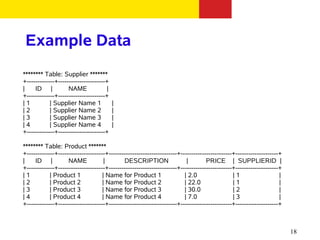
Example Data
******** Table: Supplier *******
+-------------+----------------------+
|    ID |           NAME             |
+-------------+----------------------+
|1          | Supplier Name 1            |
|2          | Supplier Name 2            |
|3          | Supplier Name 3            |
|4          | Supplier Name 4            |
+-------------+----------------------+

******** Table: Product *******
+-------------+----------------------+--------------------------------+------------------------+--------------------+
|    ID |           NAME             |       DESCRIPTION                  |        PRICE | SUPPLIERID |
+-------------+----------------------+--------------------------------+------------------------+--------------------+
|1          | Product 1             | Name for Product 1                 | 2.0                 |1                   |
|2          | Product 2             | Name for Product 2                 | 22.0                |1                   |
|3          | Product 3             | Name for Product 3                 | 30.0                |2                   |
|4          | Product 4             | Name for Product 4                 | 7.0                 |3                   |
+-------------+----------------------+--------------------------------+------------------------+--------------------+


                                                                                                                        18
Factors that influence “number of
select statements”
●   When fetching is done
    –   lazy mode for Supplier
●   How fetching is done
    –   Fetch mode used for querying on Product
    –   Select vs. Join
●   Whether Supplier is accessed through Product or
    not
●   Caching
    –   Whether Supplier is cached or now


                                                  19
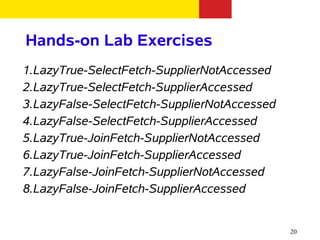
Hands-on Lab Exercises
1.LazyTrue-SelectFetch-SupplierNotAccessed
2.LazyTrue-SelectFetch-SupplierAccessed
3.LazyFalse-SelectFetch-SupplierNotAccessed
4.LazyFalse-SelectFetch-SupplierAccessed
5.LazyTrue-JoinFetch-SupplierNotAccessed
6.LazyTrue-JoinFetch-SupplierAccessed
7.LazyFalse-JoinFetch-SupplierNotAccessed
8.LazyFalse-JoinFetch-SupplierAccessed


                                              20
Hands-on Lab Exercises
9.LazyFalse-JoinFetchLeftOuter-SupplierAccessed
10.LazyFalse-JoinFetchRightOuter-SupplierAccessed


                                             21
Example #1
LazyTrue-SelectFetch-
SupplierNotAccessed


                        22
Example #1
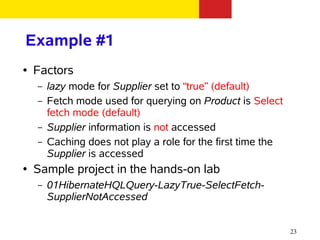
●   Factors
    –   lazy mode for Supplier set to “true” (default)
    –   Fetch mode used for querying on Product is Select
        fetch mode (default)
    –   Supplier information is not accessed
    –   Caching does not play a role for the first time the
        Supplier is accessed
●   Sample project in the hands-on lab
    –   01HibernateHQLQuery-LazyTrue-SelectFetch-
        SupplierNotAccessed


                                                              23
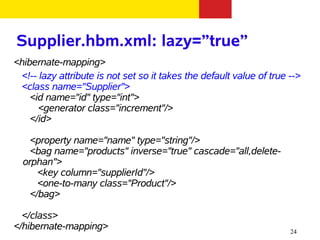
Supplier.hbm.xml: lazy=”true”
<hibernate-mapping>
 <!-- lazy attribute is not set so it takes the default value of true -->
 <class name="Supplier">
    <id name="id" type="int">
      <generator class="increment"/>
    </id>

    <property name="name" type="string"/>
    <bag name="products" inverse="true" cascade="all,delete-
  orphan">
      <key column="supplierId"/>
      <one-to-many class="Product"/>
    </bag>

  </class>
</hibernate-mapping>                                                  24
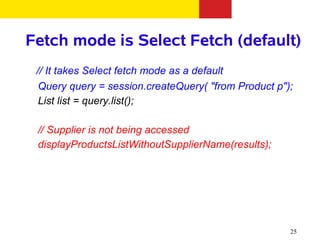
Fetch mode is Select Fetch (default)
 // It takes Select fetch mode as a default
  Query query = session.createQuery( "from Product p");
  List list = query.list();

 // Supplier is not being accessed
 displayProductsListWithoutSupplierName(results);


                                                      25
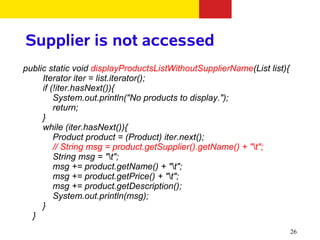
Supplier is not accessed
public static void displayProductsListWithoutSupplierName(List list){
     Iterator iter = list.iterator();
     if (!iter.hasNext()){
         System.out.println("No products to display.");
         return;
     }
     while (iter.hasNext()){
         Product product = (Product) iter.next();
         // String msg = product.getSupplier().getName() + "t";
         String msg = "t";
         msg += product.getName() + "t";
         msg += product.getPrice() + "t";
         msg += product.getDescription();
         System.out.println(msg);
     }
  }
                                                                        26
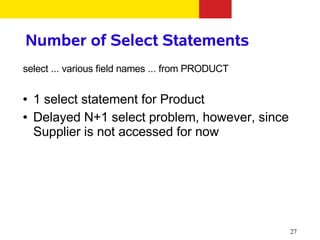
Number of Select Statements
select ... various field names ... from PRODUCT

●   1 select statement for Product
●   Delayed N+1 select problem, however, since
    Supplier is not accessed for now


                                                  27
Example #2
LazyTrue-SelectFetch-
  SupplierAccessed


                        28
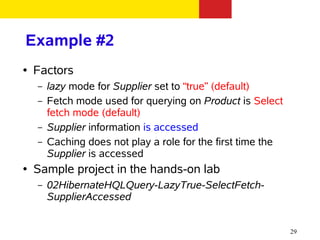
Example #2
●   Factors
    –   lazy mode for Supplier set to “true” (default)
    –   Fetch mode used for querying on Product is Select
        fetch mode (default)
    –   Supplier information is accessed
    –   Caching does not play a role for the first time the
        Supplier is accessed
●   Sample project in the hands-on lab
    –   02HibernateHQLQuery-LazyTrue-SelectFetch-
        SupplierAccessed


                                                              29
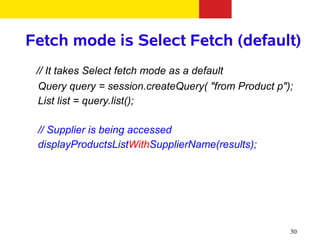
Fetch mode is Select Fetch (default)
 // It takes Select fetch mode as a default
  Query query = session.createQuery( "from Product p");
  List list = query.list();

 // Supplier is being accessed
 displayProductsListWithSupplierName(results);


                                                      30
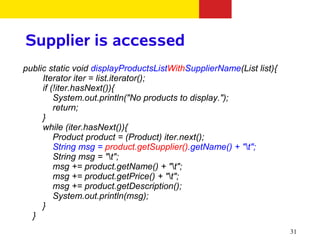
Supplier is accessed
public static void displayProductsListWithSupplierName(List list){
     Iterator iter = list.iterator();
     if (!iter.hasNext()){
         System.out.println("No products to display.");
         return;
     }
     while (iter.hasNext()){
         Product product = (Product) iter.next();
         String msg = product.getSupplier().getName() + "t";
         String msg = "t";
         msg += product.getName() + "t";
         msg += product.getPrice() + "t";
         msg += product.getDescription();
         System.out.println(msg);
     }
  }
                                                                     31
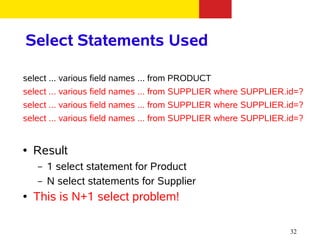
Select Statements Used

select ... various field names ... from PRODUCT
select ... various field names ... from SUPPLIER where SUPPLIER.id=?


●   Result
    –   1 select statement for Product
    –   N select statements for Supplier
●   This is N+1 select problem!

                                                                32
Example #3
LazyFalse-SelectFetch-
  SupplierAccessed


                         33
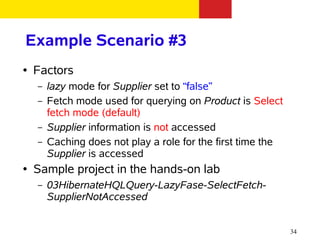
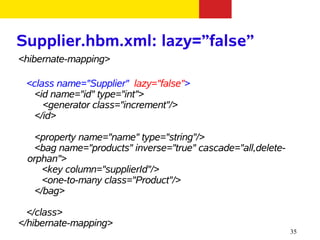
Example Scenario #3
●   Factors
    –   lazy mode for Supplier set to “false”
    –   Fetch mode used for querying on Product is Select
        fetch mode (default)
    –   Supplier information is not accessed
    –   Caching does not play a role for the first time the
        Supplier is accessed
●   Sample project in the hands-on lab
    –   03HibernateHQLQuery-LazyFase-SelectFetch-
        SupplierNotAccessed


                                                              34
Supplier.hbm.xml: lazy=”false”
<hibernate-mapping>

 <class name="Supplier" lazy="false">
   <id name="id" type="int">
     <generator class="increment"/>
   </id>

   <property name="name" type="string"/>
   <bag name="products" inverse="true" cascade="all,delete-
 orphan">
     <key column="supplierId"/>
     <one-to-many class="Product"/>
   </bag>

  </class>
</hibernate-mapping>
                                                              35
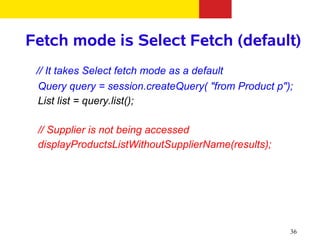
Fetch mode is Select Fetch (default)
 // It takes Select fetch mode as a default
  Query query = session.createQuery( "from Product p");
  List list = query.list();

 // Supplier is not being accessed
 displayProductsListWithoutSupplierName(results);


                                                      36
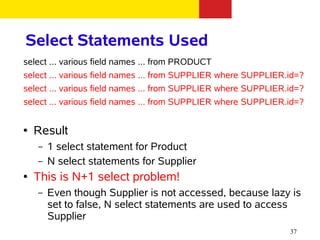
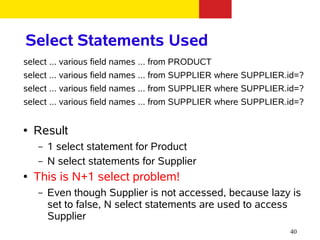
Select Statements Used
select ... various field names ... from PRODUCT
select ... various field names ... from SUPPLIER where SUPPLIER.id=?


●   Result
    –   1 select statement for Product
    –   N select statements for Supplier
●   This is N+1 select problem!
    –   Even though Supplier is not accessed, because lazy is
        set to false, N select statements are used to access
        Supplier
                                                                37
Example #4
LazyFalse-SelectFetch-
 SupplierNotAccessed


                         38
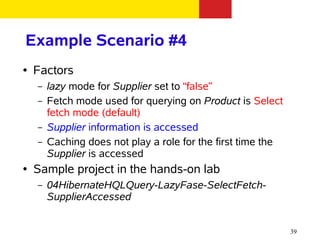
Example Scenario #4
●   Factors
    –   lazy mode for Supplier set to “false”
    –   Fetch mode used for querying on Product is Select
        fetch mode (default)
    –   Supplier information is accessed
    –   Caching does not play a role for the first time the
        Supplier is accessed
●   Sample project in the hands-on lab
    –   04HibernateHQLQuery-LazyFase-SelectFetch-
        SupplierAccessed


                                                              39
Select Statements Used
select ... various field names ... from PRODUCT
select ... various field names ... from SUPPLIER where SUPPLIER.id=?


●   Result
    –   1 select statement for Product
    –   N select statements for Supplier
●   This is N+1 select problem!
    –   Even though Supplier is not accessed, because lazy is
        set to false, N select statements are used to access
        Supplier
                                                                40
Example #5
LazyTrue-JoinFetch-
SupplierNotAccessed


                      41
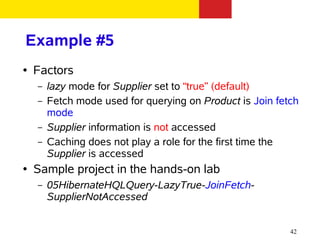
Example #5
●   Factors
    –   lazy mode for Supplier set to “true” (default)
    –   Fetch mode used for querying on Product is Join fetch
        mode
    –   Supplier information is not accessed
    –   Caching does not play a role for the first time the
        Supplier is accessed
●   Sample project in the hands-on lab
    –   05HibernateHQLQuery-LazyTrue-JoinFetch-
        SupplierNotAccessed


                                                           42
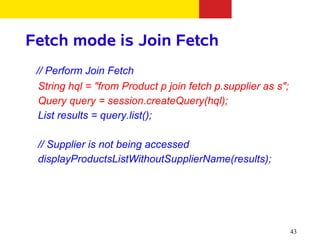
Fetch mode is Join Fetch
 // Perform Join Fetch
  String hql = "from Product p join fetch p.supplier as s";
  Query query = session.createQuery(hql);
  List results = query.list();

 // Supplier is not being accessed
 displayProductsListWithoutSupplierName(results);


                                                              43
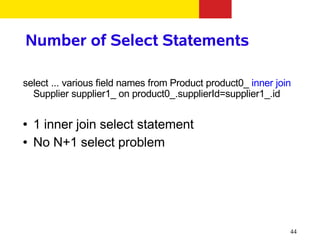
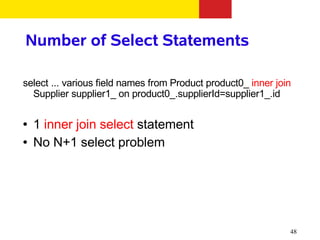
Number of Select Statements

select ... various field names from Product product0_ inner join
  Supplier supplier1_ on product0_.supplierId=supplier1_.id

●   1 inner join select statement
●   No N+1 select problem


                                                               44
Example #6
LazyTrue-JoinFetch-
 SupplierAccessed


                      45
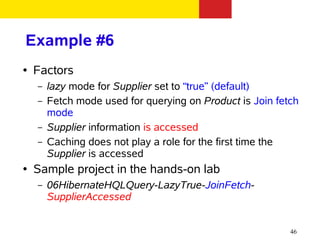
Example #6
●   Factors
    –   lazy mode for Supplier set to “true” (default)
    –   Fetch mode used for querying on Product is Join fetch
        mode
    –   Supplier information is accessed
    –   Caching does not play a role for the first time the
        Supplier is accessed
●   Sample project in the hands-on lab
    –   06HibernateHQLQuery-LazyTrue-JoinFetch-
        SupplierAccessed


                                                           46
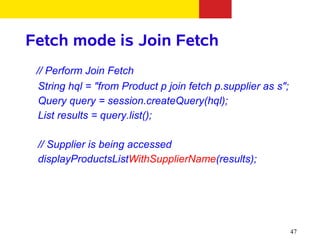
Fetch mode is Join Fetch
 // Perform Join Fetch
  String hql = "from Product p join fetch p.supplier as s";
  Query query = session.createQuery(hql);
  List results = query.list();

 // Supplier is being accessed
 displayProductsListWithSupplierName(results);


                                                              47
Number of Select Statements

select ... various field names from Product product0_ inner join
  Supplier supplier1_ on product0_.supplierId=supplier1_.id

●   1 inner join select statement
●   No N+1 select problem


                                                               48
Example #7
LazyFalse-JoinFetch-
SupplierNotAccessed


                       49
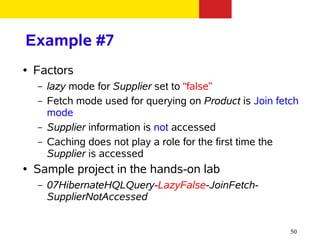
Example #7
●   Factors
    –   lazy mode for Supplier set to “false”
    –   Fetch mode used for querying on Product is Join fetch
        mode
    –   Supplier information is not accessed
    –   Caching does not play a role for the first time the
        Supplier is accessed
●   Sample project in the hands-on lab
    –   07HibernateHQLQuery-LazyFalse-JoinFetch-
        SupplierNotAccessed


                                                           50
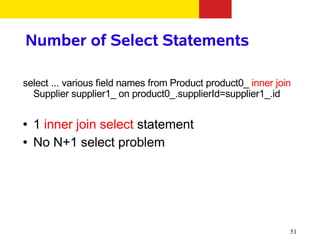
Number of Select Statements

select ... various field names from Product product0_ inner join
  Supplier supplier1_ on product0_.supplierId=supplier1_.id

●   1 inner join select statement
●   No N+1 select problem


                                                               51
Example #8
LazyFalse-JoinFetch-
 SupplierAccessed


                       52
Example #8
●   Factors
    –   lazy mode for Supplier set to “false”
    –   Fetch mode used for querying on Product is Join fetch
        mode
    –   Supplier information is accessed
    –   Caching does not play a role for the first time the
        Supplier is accessed
●   Sample project in the hands-on lab
    –   08HibernateHQLQuery-LazyFalse-JoinFetch-
        SupplierAccessed


                                                           53
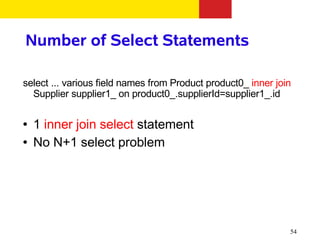
Number of Select Statements

select ... various field names from Product product0_ inner join
  Supplier supplier1_ on product0_.supplierId=supplier1_.id

●   1 inner join select statement
●   No N+1 select problem


                                                               54
Example #9
  LazyTrue-SelectFetch-
SupplierAccessed-Caching


                           55
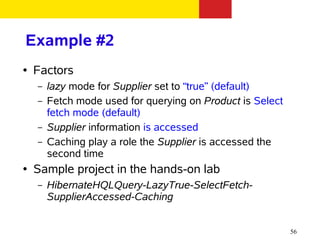
Example #2
●   Factors
    –   lazy mode for Supplier set to “true” (default)
    –   Fetch mode used for querying on Product is Select
        fetch mode (default)
    –   Supplier information is accessed
    –   Caching play a role the Supplier is accessed the
        second time
●   Sample project in the hands-on lab
    –   HibernateHQLQuery-LazyTrue-SelectFetch-
        SupplierAccessed-Caching


                                                            56
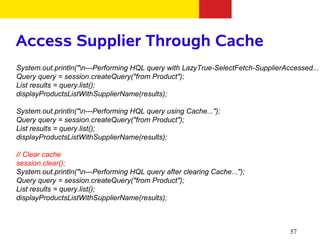
Access Supplier Through Cache
System.out.println("n---Performing HQL query with LazyTrue-SelectFetch-SupplierAccessed..."
Query query = session.createQuery("from Product");
List results = query.list();
displayProductsListWithSupplierName(results);

System.out.println("n---Performing HQL query using Cache...");
Query query = session.createQuery("from Product");
List results = query.list();
displayProductsListWithSupplierName(results);

// Clear cache
session.clear();
System.out.println("n---Performing HQL query after clearing Cache...");
Query query = session.createQuery("from Product");
List results = query.list();
displayProductsListWithSupplierName(results);


                                                                                  57
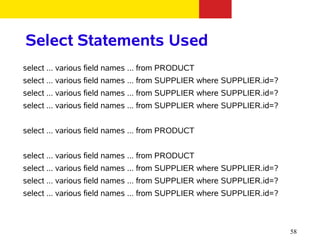
Select Statements Used
select ... various field names ... from PRODUCT
select ... various field names ... from SUPPLIER where SUPPLIER.id=?


select ... various field names ... from PRODUCT


select ... various field names ... from PRODUCT
select ... various field names ... from SUPPLIER where SUPPLIER.id=?


                                                                       58
Fetching Strategies:
 Recommendations
                       59
Recommendation
●   Join fetching is good for small collection of child
    objects often used with parent
●   Large collections and/or not always used
    collections are better retrieved with lazy select
    fetching


                                                          60
Hibernate Fetch Strategies,
   N+1 Select Problem


                          61

Hibernatejoinfetch

  • 1.
    Hibernate Fetch Strategies, N+1 Select Problem 1
  • 2.
    Topics ● Fetching strategies ● Types of fetching strategies – How fetching is done – When fetching is done ● N+1 select problem – Factors that influence number of select statements – Various examples ● Recommendation 2
  • 3.
  • 4.
    What is aFetching Strategy? ● A fetching strategy is the strategy Hibernate will use for retrieving associated objects if the application needs to navigate the association. ● Fetching strategy will have performance impact ● Fetch strategies may be declared in the mapping files, or over-ridden by a particular HQL or Criteria query. 4
  • 5.
    Types of FetchingStrategies ● How fetching is done – Join – Select (default) – Subselect – Batch ● When fetching is done – immediate – lazy (default) 5
  • 6.
  • 7.
    Join Fetching ● Hibernate retrieves the associated instance or collection in the same SELECT, using an OUTER JOIN 7
  • 8.
    Join Fetching inHQL String hql = "from Product p join fetch p.supplier as s"; Query query = session.createQuery(hql); List results = query.list(); 8
  • 9.
    Join Fetching inCriteria API Criteria crit = session.createCriteria(Product.class); crit.setFetchMode("supplier", FetchMode.JOIN); List results = crit.list(); 9
  • 10.
    Select Fetching ● Default fetch mode ● Vulnerable to N+1 selects problem – “N” number of SELECT's are used to retrieve the associated entity or collection. ● Unless you explicitly disable lazy fetching by specifying lazy="false", the subsequent select will only be executed when you actually access the association. 10
  • 11.
    Subselect Fetching ● A second SELECT is used to retrieve the associated collections for all entities retrieved in a previous query or fetch. ● Unless you explicitly disable lazy fetching by specifying lazy="false", this second select will only be executed when you actually access the association. 11
  • 12.
    Batch Fetching ● An optimization strategy for select fetching - Hibernate retrieves a batch of entity instances or collections in a single SELECT, by specifying a list of primary keys or foreign keys. 12
  • 13.
    Tuning fetch strategies ● Select fetching (the default) is extremely vulnerable to N+1 selects problems, so you might want to enable join fetching in the mapping document: <set name="permissions" fetch="join"> <key column="userId"/> <one-to-many class="Permission"/> </set 13
  • 14.
  • 15.
    Lazy Fetching ● A collection is fetched when the application invokes an operation upon that collection ● Default for collections 15
  • 16.
  • 17.
    Example Scenario ● Supplier with a one-to-many relationship with Product. – One Supplier has (supplies) many Products 17
  • 18.
    Example Data ******** Table:Supplier ******* +-------------+----------------------+ | ID | NAME | +-------------+----------------------+ |1 | Supplier Name 1 | |2 | Supplier Name 2 | |3 | Supplier Name 3 | |4 | Supplier Name 4 | +-------------+----------------------+ ******** Table: Product ******* +-------------+----------------------+--------------------------------+------------------------+--------------------+ | ID | NAME | DESCRIPTION | PRICE | SUPPLIERID | +-------------+----------------------+--------------------------------+------------------------+--------------------+ |1 | Product 1 | Name for Product 1 | 2.0 |1 | |2 | Product 2 | Name for Product 2 | 22.0 |1 | |3 | Product 3 | Name for Product 3 | 30.0 |2 | |4 | Product 4 | Name for Product 4 | 7.0 |3 | +-------------+----------------------+--------------------------------+------------------------+--------------------+ 18
  • 19.
    Factors that influence“number of select statements” ● When fetching is done – lazy mode for Supplier ● How fetching is done – Fetch mode used for querying on Product – Select vs. Join ● Whether Supplier is accessed through Product or not ● Caching – Whether Supplier is cached or now 19
  • 20.
  • 21.
  • 22.
  • 23.
    Example #1 ● Factors – lazy mode for Supplier set to “true” (default) – Fetch mode used for querying on Product is Select fetch mode (default) – Supplier information is not accessed – Caching does not play a role for the first time the Supplier is accessed ● Sample project in the hands-on lab – 01HibernateHQLQuery-LazyTrue-SelectFetch- SupplierNotAccessed 23
  • 24.
    Supplier.hbm.xml: lazy=”true” <hibernate-mapping> <!--lazy attribute is not set so it takes the default value of true --> <class name="Supplier"> <id name="id" type="int"> <generator class="increment"/> </id> <property name="name" type="string"/> <bag name="products" inverse="true" cascade="all,delete- orphan"> <key column="supplierId"/> <one-to-many class="Product"/> </bag> </class> </hibernate-mapping> 24
  • 25.
    Fetch mode isSelect Fetch (default) // It takes Select fetch mode as a default Query query = session.createQuery( "from Product p"); List list = query.list(); // Supplier is not being accessed displayProductsListWithoutSupplierName(results); 25
  • 26.
    Supplier is notaccessed public static void displayProductsListWithoutSupplierName(List list){ Iterator iter = list.iterator(); if (!iter.hasNext()){ System.out.println("No products to display."); return; } while (iter.hasNext()){ Product product = (Product) iter.next(); // String msg = product.getSupplier().getName() + "t"; String msg = "t"; msg += product.getName() + "t"; msg += product.getPrice() + "t"; msg += product.getDescription(); System.out.println(msg); } } 26
  • 27.
    Number of SelectStatements select ... various field names ... from PRODUCT ● 1 select statement for Product ● Delayed N+1 select problem, however, since Supplier is not accessed for now 27
  • 28.
  • 29.
    Example #2 ● Factors – lazy mode for Supplier set to “true” (default) – Fetch mode used for querying on Product is Select fetch mode (default) – Supplier information is accessed – Caching does not play a role for the first time the Supplier is accessed ● Sample project in the hands-on lab – 02HibernateHQLQuery-LazyTrue-SelectFetch- SupplierAccessed 29
  • 30.
    Fetch mode isSelect Fetch (default) // It takes Select fetch mode as a default Query query = session.createQuery( "from Product p"); List list = query.list(); // Supplier is being accessed displayProductsListWithSupplierName(results); 30
  • 31.
    Supplier is accessed publicstatic void displayProductsListWithSupplierName(List list){ Iterator iter = list.iterator(); if (!iter.hasNext()){ System.out.println("No products to display."); return; } while (iter.hasNext()){ Product product = (Product) iter.next(); String msg = product.getSupplier().getName() + "t"; String msg = "t"; msg += product.getName() + "t"; msg += product.getPrice() + "t"; msg += product.getDescription(); System.out.println(msg); } } 31
  • 32.
    Select Statements Used select... various field names ... from PRODUCT select ... various field names ... from SUPPLIER where SUPPLIER.id=? select ... various field names ... from SUPPLIER where SUPPLIER.id=? select ... various field names ... from SUPPLIER where SUPPLIER.id=? ● Result – 1 select statement for Product – N select statements for Supplier ● This is N+1 select problem! 32
  • 33.
  • 34.
    Example Scenario #3 ● Factors – lazy mode for Supplier set to “false” – Fetch mode used for querying on Product is Select fetch mode (default) – Supplier information is not accessed – Caching does not play a role for the first time the Supplier is accessed ● Sample project in the hands-on lab – 03HibernateHQLQuery-LazyFase-SelectFetch- SupplierNotAccessed 34
  • 35.
    Supplier.hbm.xml: lazy=”false” <hibernate-mapping> <classname="Supplier" lazy="false"> <id name="id" type="int"> <generator class="increment"/> </id> <property name="name" type="string"/> <bag name="products" inverse="true" cascade="all,delete- orphan"> <key column="supplierId"/> <one-to-many class="Product"/> </bag> </class> </hibernate-mapping> 35
  • 36.
    Fetch mode isSelect Fetch (default) // It takes Select fetch mode as a default Query query = session.createQuery( "from Product p"); List list = query.list(); // Supplier is not being accessed displayProductsListWithoutSupplierName(results); 36
  • 37.
    Select Statements Used select... various field names ... from PRODUCT select ... various field names ... from SUPPLIER where SUPPLIER.id=? select ... various field names ... from SUPPLIER where SUPPLIER.id=? select ... various field names ... from SUPPLIER where SUPPLIER.id=? ● Result – 1 select statement for Product – N select statements for Supplier ● This is N+1 select problem! – Even though Supplier is not accessed, because lazy is set to false, N select statements are used to access Supplier 37
  • 38.
  • 39.
    Example Scenario #4 ● Factors – lazy mode for Supplier set to “false” – Fetch mode used for querying on Product is Select fetch mode (default) – Supplier information is accessed – Caching does not play a role for the first time the Supplier is accessed ● Sample project in the hands-on lab – 04HibernateHQLQuery-LazyFase-SelectFetch- SupplierAccessed 39
  • 40.
    Select Statements Used select... various field names ... from PRODUCT select ... various field names ... from SUPPLIER where SUPPLIER.id=? select ... various field names ... from SUPPLIER where SUPPLIER.id=? select ... various field names ... from SUPPLIER where SUPPLIER.id=? ● Result – 1 select statement for Product – N select statements for Supplier ● This is N+1 select problem! – Even though Supplier is not accessed, because lazy is set to false, N select statements are used to access Supplier 40
  • 41.
  • 42.
    Example #5 ● Factors – lazy mode for Supplier set to “true” (default) – Fetch mode used for querying on Product is Join fetch mode – Supplier information is not accessed – Caching does not play a role for the first time the Supplier is accessed ● Sample project in the hands-on lab – 05HibernateHQLQuery-LazyTrue-JoinFetch- SupplierNotAccessed 42
  • 43.
    Fetch mode isJoin Fetch // Perform Join Fetch String hql = "from Product p join fetch p.supplier as s"; Query query = session.createQuery(hql); List results = query.list(); // Supplier is not being accessed displayProductsListWithoutSupplierName(results); 43
  • 44.
    Number of SelectStatements select ... various field names from Product product0_ inner join Supplier supplier1_ on product0_.supplierId=supplier1_.id ● 1 inner join select statement ● No N+1 select problem 44
  • 45.
  • 46.
    Example #6 ● Factors – lazy mode for Supplier set to “true” (default) – Fetch mode used for querying on Product is Join fetch mode – Supplier information is accessed – Caching does not play a role for the first time the Supplier is accessed ● Sample project in the hands-on lab – 06HibernateHQLQuery-LazyTrue-JoinFetch- SupplierAccessed 46
  • 47.
    Fetch mode isJoin Fetch // Perform Join Fetch String hql = "from Product p join fetch p.supplier as s"; Query query = session.createQuery(hql); List results = query.list(); // Supplier is being accessed displayProductsListWithSupplierName(results); 47
  • 48.
    Number of SelectStatements select ... various field names from Product product0_ inner join Supplier supplier1_ on product0_.supplierId=supplier1_.id ● 1 inner join select statement ● No N+1 select problem 48
  • 49.
  • 50.
    Example #7 ● Factors – lazy mode for Supplier set to “false” – Fetch mode used for querying on Product is Join fetch mode – Supplier information is not accessed – Caching does not play a role for the first time the Supplier is accessed ● Sample project in the hands-on lab – 07HibernateHQLQuery-LazyFalse-JoinFetch- SupplierNotAccessed 50
  • 51.
    Number of SelectStatements select ... various field names from Product product0_ inner join Supplier supplier1_ on product0_.supplierId=supplier1_.id ● 1 inner join select statement ● No N+1 select problem 51
  • 52.
  • 53.
    Example #8 ● Factors – lazy mode for Supplier set to “false” – Fetch mode used for querying on Product is Join fetch mode – Supplier information is accessed – Caching does not play a role for the first time the Supplier is accessed ● Sample project in the hands-on lab – 08HibernateHQLQuery-LazyFalse-JoinFetch- SupplierAccessed 53
  • 54.
    Number of SelectStatements select ... various field names from Product product0_ inner join Supplier supplier1_ on product0_.supplierId=supplier1_.id ● 1 inner join select statement ● No N+1 select problem 54
  • 55.
    Example #9 LazyTrue-SelectFetch- SupplierAccessed-Caching 55
  • 56.
    Example #2 ● Factors – lazy mode for Supplier set to “true” (default) – Fetch mode used for querying on Product is Select fetch mode (default) – Supplier information is accessed – Caching play a role the Supplier is accessed the second time ● Sample project in the hands-on lab – HibernateHQLQuery-LazyTrue-SelectFetch- SupplierAccessed-Caching 56
  • 57.
    Access Supplier ThroughCache System.out.println("n---Performing HQL query with LazyTrue-SelectFetch-SupplierAccessed..." Query query = session.createQuery("from Product"); List results = query.list(); displayProductsListWithSupplierName(results); System.out.println("n---Performing HQL query using Cache..."); Query query = session.createQuery("from Product"); List results = query.list(); displayProductsListWithSupplierName(results); // Clear cache session.clear(); System.out.println("n---Performing HQL query after clearing Cache..."); Query query = session.createQuery("from Product"); List results = query.list(); displayProductsListWithSupplierName(results); 57
  • 58.
    Select Statements Used select... various field names ... from PRODUCT select ... various field names ... from SUPPLIER where SUPPLIER.id=? select ... various field names ... from SUPPLIER where SUPPLIER.id=? select ... various field names ... from SUPPLIER where SUPPLIER.id=? select ... various field names ... from PRODUCT select ... various field names ... from PRODUCT select ... various field names ... from SUPPLIER where SUPPLIER.id=? select ... various field names ... from SUPPLIER where SUPPLIER.id=? select ... various field names ... from SUPPLIER where SUPPLIER.id=? 58
  • 59.
  • 60.
    Recommendation ● Join fetching is good for small collection of child objects often used with parent ● Large collections and/or not always used collections are better retrieved with lazy select fetching 60
  • 61.
    Hibernate Fetch Strategies, N+1 Select Problem 61